
All Topics  
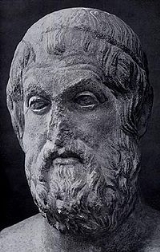
Sophocles


   Email Print
   Bookmark   Link


Sophocles


Sophocles (; ancient Greek
Ancient Greek

Ancient Greek is the historical stage in the development of the Greek language spanning across the Archaic Greece , Classical Greece , and Hellenistic civilization periods of ancient Greece and the classical antiquity....
 , ; c. 496 BC-406 BC) was the second of the three ancient Greek
Classical Greece

Classical Greece was a culture that was highly advanced and which heavilly influenced the cultures of Ancient Rome and much of the Western World....
 tragedians
Tragedy

Tragedy is a form of The arts based on human suffering that offers its audience pleasure. While most cultures have developed forms that provoke this paradoxical response, tragedy refers to a specific Poetic tradition of drama that has played a unique and important role historically in the self-definition of Western culture....
 whose work has survived. His first plays were written later than those of Aeschylus
Aeschylus

Aeschylus was an Ancient Greece playwright. He is often recognized as the father or the founder of tragedy, and is the earliest of the three Greek tragedy whose Play survive extant, the others being Sophocles and Euripides....
 and earlier than those of Euripides
Euripides

Euripides was the last of the three great tragedy of classical Athens . Ancient scholars thought that Euripides had written ninety-five plays, although four of those were probably written by Critias....
. According to the Suda
Suda

The Suda or Souda is a massive 10th century Byzantine Empire Medieval Greek historical encyclopedia of the ancient Mediterranean world. It is an Encyclopedia lexicon with 30,000 entries, many drawing from ancient sources that have since been lost, and often derived from medieval Christian compilers....
, a 10th century encyclopedia
Encyclopedia

An encyclopedia is a comprehensive written compendium that holds information from either all branches of knowledge or a particular branch of knowledge....
, Sophocles wrote 123 plays during the course of his life, but only seven have survived in a complete form, namely Ajax, Antigone, Trachinian Women, Oedipus the King, Electra, Philoctetes and Oedipus at Colonus.


Discussion
Ask a question about 'Sophocles'
Start a new discussion about 'Sophocles'
Answer questions from other users
Full Discussion Forum


Quotations


A prudent mind can see room for misgiving, lest he who prospers should one day suffer reverse.

Line 296

For God hates utterly The bray of bragging tongues.

Line 123

For kindness begets kindness evermore, But he from whose mind fades the memory Of benefits, noble is he no more.

Line 522

Grief teaches the steadiest minds to waver.

Line 563

How dreadful knowledge of the truth can be When there's no help in truth!

Line 316

I will never reveal my dreadful secrets, or rather, yours.

Teiresias


Encyclopedia


Sophocles (; ancient Greek
Ancient Greek

Ancient Greek is the historical stage in the development of the Greek language spanning across the Archaic Greece , Classical Greece , and Hellenistic civilization periods of ancient Greece and the classical antiquity....
 , ; c. 496 BC-406 BC) was the second of the three ancient Greek
Classical Greece

Classical Greece was a culture that was highly advanced and which heavilly influenced the cultures of Ancient Rome and much of the Western World....
 tragedians
Tragedy

Tragedy is a form of The arts based on human suffering that offers its audience pleasure. While most cultures have developed forms that provoke this paradoxical response, tragedy refers to a specific Poetic tradition of drama that has played a unique and important role historically in the self-definition of Western culture....
 whose work has survived. His first plays were written later than those of Aeschylus
Aeschylus

Aeschylus was an Ancient Greece playwright. He is often recognized as the father or the founder of tragedy, and is the earliest of the three Greek tragedy whose Play survive extant, the others being Sophocles and Euripides....
 and earlier than those of Euripides
Euripides

Euripides was the last of the three great tragedy of classical Athens . Ancient scholars thought that Euripides had written ninety-five plays, although four of those were probably written by Critias....
. According to the Suda
Suda

The Suda or Souda is a massive 10th century Byzantine Empire Medieval Greek historical encyclopedia of the ancient Mediterranean world. It is an Encyclopedia lexicon with 30,000 entries, many drawing from ancient sources that have since been lost, and often derived from medieval Christian compilers....
, a 10th century encyclopedia
Encyclopedia

An encyclopedia is a comprehensive written compendium that holds information from either all branches of knowledge or a particular branch of knowledge....
, Sophocles wrote 123 plays during the course of his life, but only seven have survived in a complete form, namely Ajax, Antigone, Trachinian Women, Oedipus the King, Electra, Philoctetes and Oedipus at Colonus. For almost 50 years, Sophocles was the most-awarded playwright in the dramatic competitions of the city-state
Polis

A polis -- plural: poleis --is a city, a city-state and also citizenship and body of citizens. When used to describe Classical Athens and its contemporaries, polis is often translated as "city-state."...
 of Athens
Classical Athens

The city of Athens during classical antiquity was a notable polis of Attica, Ancient Greece, leading the Delian League in the Peloponnesian War against Sparta and the Peloponnesian League....
 that took place during the religious festivals of the Lenaea and the Dionysia. Sophocles competed in around 30 dramatic competitions; he won perhaps 24 and never received lower than second place; in comparison, Aeschylus won 14 competitions and was defeated by Sophocles at times, while Euripides won only 4 competitions.

The most famous of Sophocles' tragedies are those concerning Oedipus
Oedipus

Oedipus was a Greek mythology monarch of Thebes, Greece. He fulfilled a prophecy that said he would kill his father and marry his mother, and thus brought disaster on his city and family....
 and Antigone
Antigone

Antigone is the name of two different women in Greek mythology. The name may be taken to mean "unbending", coming from "anti-" and "-gon / -gony" , but has also been suggested to mean "opposed to motherhood" or "in place of a mother" based from the root gone, "that which generates" ....
: these are often known as the Theban plays, although each play was actually a part of different tetrology, the other members of which are now lost. Sophocles influenced the development of the drama, most importantly by adding a third actor and thereby reducing the importance of the chorus
Greek chorus

The Greek chorus is a group of twelve or fifteen minor actors in tragedy and twenty-four in Ancient Greek comedy plays of classical Athens....
 in the presentation of the plot. He also developed his characters to a greater extent than earlier playwrights such as Aeschylus.

Life


Sophocles, the son of Sophillus, was a wealthy member of the rural deme
Deme

In Ancient Greece, a deme was a subdivision of Attica, the region of Greece surrounding Classical Athens. Demes as simple subdivisions of land in the countryside seem to have existed in the 6th century BC and earlier, but did not acquire particular significance until the reforms of Cleisthenes in 508 BC....
 (small community) of Colonus Hippius in Attica
Attica

Attica is a Peripheries of Greece in Greece, containing Athens, the capital of Greece. Attica is subdivided into the prefectures of Greece of Athens Prefecture, Piraeus Prefecture, East Attica and West Attica....
, which would later become a setting for his plays, and was probably born there. His birth took place a few years before the Battle of Marathon
Battle of Marathon

The Battle of Marathon, Greece during the Greco-Persian Wars took place in 490 BC and was the culmination of the first attempt by the Achaemenid Empire of Persia, under King Darius I, to subjugate Ancient Greece....
 in 490 BC: the exact year is unclear, although 497/6 is perhaps most likely. His artistic career began in earnest in 468 BC when he took first prize in the Dionysia
Dionysia

The Dionysia was a large religious festival in ancient Athens in honor of the god Dionysus, the central event of which was the performance of tragedy and, since 487 BC, Greek comedy....
 theatre competition over the reigning master of Athenian drama, Aeschylus
Aeschylus

Aeschylus was an Ancient Greece playwright. He is often recognized as the father or the founder of tragedy, and is the earliest of the three Greek tragedy whose Play survive extant, the others being Sophocles and Euripides....
. The victory came under unusual circumstances. At the time, the remains of the hero Theseus were being removed by Cimon from the isle of Scyros to Athens. Instead of following the custom of choosing judges by lot, the archon asked Cimon and his associates to decide the victor of the contest. Aeschylus soon left for Sicily following this loss to Sophocles. The production probably included Triptolemus. Although Plutarch
Plutarch

Lucius Mestrius Plutarchus , c. AD 46 ? 120 ? commonly known in English as Plutarch ? was a Ancient Rome historian , biographer, essayist, and Middle Platonism....
 says that this was Sophocles' first production, it is now thought that this is an embellishment of the truth and his first production was most likely in 470 BC.

Sophocles became a man of importance in the public halls of Athens as well as in the theatres. Sophocles was chosen to lead the paean, a choral chant to a god, at the age of 16 celebrating the decisive Greek sea victory over the Persians at the Battle of Salamis. This rather insufficient information about Sophocles’ civic life implies he was a well-liked man who participated in activities in society and showed remarkable artistic ability. He was also elected as one of ten strategoi, high executive officials that commanded the armed forces, as a junior colleague of Pericles. Sophocles was born highly wealthy (his father was a wealthy armour manufacturer) and was highly educated throughout his entire life. Early in his career, the politician Cimon might have been one of his patrons, although if he was there was no ill will borne by Pericles
Pericles

Pericles was a prominent and influential statesman, orator, and general of History of Athens during the city's Age of Pericles?specifically, the time between the Greco-Persian Wars and Peloponnesian War wars....
, Cimon's rival, when Cimon was ostracized in 461 BC. In 443/2 he served as one of the Hellenotamiai
Hellenotamiai

Hellenotamiai was an ancient Greece term indicating a group of public treasurers. The Hellenotamiai were ten magistrates appointed by the Athens to receive the contributions of the allied states, and were the chief financial officers of the Delian League....
, or treasurers of Athena, helping to manage the finances of the city during the political ascendancy of Pericles. In 420 he welcomed and set up an altar for the icon of Asclepius
Asclepius

Asclepius is the god of medicine and healing in ancient Greek mythology. Asclepius represents the healing aspect of the medical arts, while his daughters Hygieia, Meditrina, Iaso, Aceso, Aglaea and Panacea symbolize the forces of cleanliness, medicine, and healing, respectively....
 at his house, when the deity was introduced in Athens. For this he was given the posthumous epithet Dexion (receiver) by the Athenians. He was also elected, in 413 BC, to be one of the commissioners crafting a response to the catastrophic destruction of the Athenian expeditionary force in Sicily
Sicily

Sicily is an Autonomous regions with special statute of Italy. Of all the regions of Italy, Sicily covers the largest land area at 25,708 km? and currently has just over five million inhabitants....
 during the Peloponnesian War
Peloponnesian War

The Peloponnesian War which lasted from 431-404BC was an Ancient Greece military conflict, fought by Athens and its Athenian empire against the Peloponnesian League, led by Sparta....
.

Sophocles died at the venerable age of ninety in 406 or 405 BC, having seen within his lifetime both the Greek triumph in the Persian Wars and the terrible bloodletting of the Peloponnesian War. He was so respected by the Athenians that two plays performed at the Lenaia
Lenaia

The Lenaia was an annual festival with a dramatic competition but one of the lesser festivals of Athens and Ionia in ancient Greece. The Lenaia took place in the month of Gamelion, roughly corresponding to January....
 soon after his death paid homage to him, and his unfinished play Oedipus at Colonus
Oedipus at Colonus

Oedipus at Colonus is one of the three Theban plays of the Athenian tragedian Sophocles. It was written shortly before Sophocles' death in 406 BC and produced by his grandson at the Festival of Dionysus in 401 BC....
 was completed and performed years later. Both Iophon, one of his sons, and a grandson, also called Sophocles, followed in his footsteps to become playwrights themselves.

Works and legacy


Among Sophocles' earliest innovations was the addition of a third actor, which further reduced the role of the chorus
Greek chorus

The Greek chorus is a group of twelve or fifteen minor actors in tragedy and twenty-four in Ancient Greek comedy plays of classical Athens....
 and created greater opportunity for character development and conflict between characters. Aeschylus
Aeschylus

Aeschylus was an Ancient Greece playwright. He is often recognized as the father or the founder of tragedy, and is the earliest of the three Greek tragedy whose Play survive extant, the others being Sophocles and Euripides....
, who dominated Athenian
Classical Athens

The city of Athens during classical antiquity was a notable polis of Attica, Ancient Greece, leading the Delian League in the Peloponnesian War against Sparta and the Peloponnesian League....
 playwrighting during Sophocles' early career, followed suit and adopted the third character into his own work towards the end of his life. It was not until after the death of the old master Aeschylus in 456 BC that Sophocles became the pre-eminent playwright in Athens.

Thereafter, Sophocles emerged victorious in dramatic competitions at 18 Dionysia
Dionysia

The Dionysia was a large religious festival in ancient Athens in honor of the god Dionysus, the central event of which was the performance of tragedy and, since 487 BC, Greek comedy....
 and 6 Lenaia festivals. In addition to innovations in dramatic structure
Dramatic structure

Dramatic structure is the plot structure of a dramatic work such as a Play or screenplay. Many scholars have analyzed dramatic structure, beginning with Aristotle in his Poetics ....
, Sophocles' work is also known for its deeper development of characters than earlier playwrights. His reputation was such that foreign rulers invited him to attend their courts, although unlike Aeschylus who died in Sicily
Sicily

Sicily is an Autonomous regions with special statute of Italy. Of all the regions of Italy, Sicily covers the largest land area at 25,708 km? and currently has just over five million inhabitants....
, or Euripides who spent time in Macedon
Macedon

Macedon or Macedonia was the name of a monarchy centred in the northernmost part of ancient Greece. The homeland of the ancient Macedonians, it was bordered by the kingdom of Epirus to the west and the region of Thrace to the east....
, Sophocles never accepted any of these invitations. Aristotle
Aristotle

Aristotle was a Greeks philosopher, a student of Plato and teacher of Alexander the Great. He wrote on many subjects, including physics, metaphysics, Poetics , theater, music, logic, rhetoric, politics, government, ethics, biology and zoology....
 used Sophocles's Oedipus the King
Oedipus the King

Oedipus the King is an Classical Athens tragedy by Sophocles that was first performed c. 429 B.C.E. It was the second of Sophocles' three Theban plays to be produced, but it comes first in the internal chronology, followed by Oedipus at Colonus and then Antigone ....
 in his Poetics (c. 335 BC) as an example of the highest achievement in tragedy
Tragedy

Tragedy is a form of The arts based on human suffering that offers its audience pleasure. While most cultures have developed forms that provoke this paradoxical response, tragedy refers to a specific Poetic tradition of drama that has played a unique and important role historically in the self-definition of Western culture....
, which suggests the high esteem in which his work was held by later Greeks.

Only two of the seven surviving plays have securely-dated first or second performances: Philoctetes
Philoctetes (Sophocles)

Philoctetes is a play by Sophocles . It was first performed at the Festival of Dionysus in 409 BC, where it won first prize. The story takes place during the Trojan War ....
 (409 BC) and Oedipus at Colonus
Oedipus at Colonus

Oedipus at Colonus is one of the three Theban plays of the Athenian tragedian Sophocles. It was written shortly before Sophocles' death in 406 BC and produced by his grandson at the Festival of Dionysus in 401 BC....
 (401 BC, staged after Sophocles' death by his grandson). Of the others, Electra
Electra

In Greek mythology, Electra was an Argosian princess and daughter of King Agamemnon and Queen Clytemnestra, and was a sibling to sisters Iphigeneia, Chrysothemis, and brother Orestes....
 shows stylistic similarities to these two plays, which suggests that it was probably written in the latter part of his career. Ajax
Ajax (Sophocles)

Ajax is a play by Sophocles. The date of its first performance is unknown, but most scholars regard it as early rather than late in Sophocles' career, about 450 BCE to 430 BCE ....
, Antigone
Antigone (Sophocles)

Antigone is a tragedy by Sophocles written before or in 442 BC. Chronologically, it is the third of the three Theban plays but was written first....
 and The Trachiniae
The Trachiniae

The Trachiniae or The Women of Trachis is a play by Sophocles, notable mainly for the unsympathetic portrayal of Heracles. As in the play Ajax , Sophocles has cast a well-known hero in a negative light....
 are generally thought to be among his early works, again based on stylistic elements, with Oedipus the King
Oedipus the King

Oedipus the King is an Classical Athens tragedy by Sophocles that was first performed c. 429 B.C.E. It was the second of Sophocles' three Theban plays to be produced, but it comes first in the internal chronology, followed by Oedipus at Colonus and then Antigone ....
 coming in Sophocles' middle period. Most of Sophocles' plays show an undercurrent of early fatalism
Fatalism

Fatalism is a philosophical doctrine emphasizing the subjugation of all events or actions to destiny or inevitable predetermination.Fatalism generally refers to several of the following ideas:...
 and the beginnings of Socratic
Socrates

Socrates was a Classical Greece Philosophy. Credited as one of the founders of Western philosophy, he is an enigmatic figure known only through the classical accounts of his students....
 logic as a mainstay for the long tradition of Greek tragedy.

The Theban plays


The Theban plays consist of three plays: Antigone
Antigone (Sophocles)

Antigone is a tragedy by Sophocles written before or in 442 BC. Chronologically, it is the third of the three Theban plays but was written first....
, Oedipus the King
Oedipus the King

Oedipus the King is an Classical Athens tragedy by Sophocles that was first performed c. 429 B.C.E. It was the second of Sophocles' three Theban plays to be produced, but it comes first in the internal chronology, followed by Oedipus at Colonus and then Antigone ....
 (also called Oedipus Tyrannos or Oedipus Rex), and Oedipus at Colonus
Oedipus at Colonus

Oedipus at Colonus is one of the three Theban plays of the Athenian tragedian Sophocles. It was written shortly before Sophocles' death in 406 BC and produced by his grandson at the Festival of Dionysus in 401 BC....
. All three plays concern the fate of Thebes
Thebes

Thebes may refer to one of the following places:* Thebes, Egypt – Thebes of the Hundred Gates; one-time capital of the New Kingdom of Egypt...
 during Greece's Mycenaean
Mycenaean

Mycenaean may refer to:* Mycenae, coming from or belonging to this ancient town in Peloponnese in Greece* Mycenaean Greece, the Greek-speaking regions of the Aegean Sea as of the Late Bronze Age, named after the Mycenae of the Trojan War epics...
 pre-history, during and after the reign of King Oedipus
Oedipus

Oedipus was a Greek mythology monarch of Thebes, Greece. He fulfilled a prophecy that said he would kill his father and marry his mother, and thus brought disaster on his city and family....
. They have often been published under a single cover. Sophocles, however, wrote the three plays for separate festival competitions
Dionysia

The Dionysia was a large religious festival in ancient Athens in honor of the god Dionysus, the central event of which was the performance of tragedy and, since 487 BC, Greek comedy....
, possibly over a duration of forty years or more. He also wrote other Theban plays, such as The Progeny
The Progeny

The Progeny is an ancient Greek tragedy written by the Greek playwright Sophocles in the 5th century BC and based on Greek mythology.According to myth, Polynices and six allies attacked Thebes, Greece because Polynices' brother, Eteocles, refused to give up the throne as promised....
, of which only fragments have survived. Not only are the Theban plays not a true trilogy
Trilogy

A trilogy is a set of three works of art, usually literature, film, or video games, that are connected and can be seen either as a single work or three individual works....
 (three plays presented as a continuous narrative) but they are not even an intentional series and contain some inconsistencies between them.

Subjects

Each of the plays relates to the tale of the mythological Oedipus
Oedipus

Oedipus was a Greek mythology monarch of Thebes, Greece. He fulfilled a prophecy that said he would kill his father and marry his mother, and thus brought disaster on his city and family....
, who killed his father and married his mother without knowledge that they were his parents. His family is fated to be doomed for three generations.

In Oedipus the King
Oedipus the King

Oedipus the King is an Classical Athens tragedy by Sophocles that was first performed c. 429 B.C.E. It was the second of Sophocles' three Theban plays to be produced, but it comes first in the internal chronology, followed by Oedipus at Colonus and then Antigone ....
, Oedipus is the protagonist
Protagonist

A protagonist is the main Character of a drama or Narrative. The word "protagonist" derives from the Greek language p??ta????st?? , "one who plays the first part, chief actor." In the theatre of Ancient Greece, three actors played all of the main dramatic roles in a tragedy; the leading role was played by the protagonist, while the othe...
. He becomes the ruler of Thebes after solving the riddle of the sphinx
Sphinx

A sphinx is a zoomorphic mythological figure which is depicted as a recumbent lion with a human head. It has its origins in sculpted figures of Old Kingdom Ancient Egypt, to which the ancient Greeks applied their own name for a female monster, the "strangler", an archaic figure of Greek mythology....
. Before solving this riddle, Oedipus had met at a crossroads a man accompanied by servants; Oedipus and the man fought, and Oedipus killed the man. Oedipus continued on to Thebes to marry the widowed Queen, who was, unknown to him, his mother. Oedipus eventually learns that his mother and father gave him up when he was just an infant in fear that he would kill his father and fulfill the Delphic Oracle's prophecy of him. Upon learning of the completed prophecy, his mother, Jocasta, realizes the incest and commits suicide; Oedipus, in horror of what he has seen, blinds himself and leaves Thebes. The couple had four children, who figure in the remaining plays of the set.

In Oedipus at Colonus
Oedipus at Colonus

Oedipus at Colonus is one of the three Theban plays of the Athenian tragedian Sophocles. It was written shortly before Sophocles' death in 406 BC and produced by his grandson at the Festival of Dionysus in 401 BC....
, the banished Oedipus and his daughters Antigone and Ismene arrive at the town of Colonus
Colonus

}|---- bgcolor="#FFFFFF"| Population percentage : || 15% Non-Greeks85% Greeks|---- bgcolor="#FFFFFF"| Elevation: -lowest: -centre: -highest:||about 3540 mabout 45 m...
 where they encounter Theseus
Theseus

For other uses, see Theseus Theseus was a legendary king of Athens, son of Aethra , and fathered by Aegeus and Poseidon, with whom Aethra lay in one night....
, King of Athens
Athens

Athens , the Capital and largest city of Greece, dominates the Attica periphery; as one of the List of cities by time of continuous habitation, its recorded history spans around 3,400 years....
. Oedipus dies and strife begins between his sons Polyneices and Eteocles
Eteocles

In Greek mythology, Eteocles was a king of Thebes , the son of Oedipus and either Jocasta or Euryganeia. The name is from earlier *Etewoklewes , meaning "truly glorious"....
.

In Antigone
Antigone (Sophocles)

Antigone is a tragedy by Sophocles written before or in 442 BC. Chronologically, it is the third of the three Theban plays but was written first....
 the protagonist is Oedipus' daughter. Antigone is faced with the choice of allowing her brother Polyneices' body to remain unburied, outside the city walls, exposed to the ravages of wild animals, or to bury him and face death. The king of the land, Creon, has forbidden the burial of Polyneices for he was a traitor to the city. Antigone decides to bury his body and face the consequences of her actions. Creon sentences her to death. Eventually, Creon is convinced to free Antigone from her punishment, but his decision comes too late and Antigone commits suicide. Her suicide triggers the suicide of two others close to King Creon: his son, Haemon, who was to wed Antigone, and his wife who commits suicide after losing her only surviving son.

Composition and inconsistencies
The plays were written across thirty-six years of Sophocles' career and were not composed in chronological order, but instead were written in the order Antigone
Antigone (Sophocles)

Antigone is a tragedy by Sophocles written before or in 442 BC. Chronologically, it is the third of the three Theban plays but was written first....
, Oedipus the King
Oedipus the King

Oedipus the King is an Classical Athens tragedy by Sophocles that was first performed c. 429 B.C.E. It was the second of Sophocles' three Theban plays to be produced, but it comes first in the internal chronology, followed by Oedipus at Colonus and then Antigone ....
, and Oedipus at Colonus
Oedipus at Colonus

Oedipus at Colonus is one of the three Theban plays of the Athenian tragedian Sophocles. It was written shortly before Sophocles' death in 406 BC and produced by his grandson at the Festival of Dionysus in 401 BC....
.

As a result, there are some inconsistencies. Notably, Creon
Creon

Creon is a figure in Greek mythology best known as the ruler of Thebes,_Greece in the legend of Oedipus. He was the father of Menoeceus and Megara by his wife, Eurydice of Thebes....
 is the undisputed king at the end of Oedipus the King and, in consultation with Apollo, single-handedly makes the decision to expel Oedipus from Thebes. Creon is also instructed to look after Oedipus' daughters Antigone
Antigone

Antigone is the name of two different women in Greek mythology. The name may be taken to mean "unbending", coming from "anti-" and "-gon / -gony" , but has also been suggested to mean "opposed to motherhood" or "in place of a mother" based from the root gone, "that which generates" ....
 and Ismene
Ismene

Ismene is the name of two women of Greek mythology. The more famous is a daughter and sister of Oedipus, daughter and granddaughter of Jocasta, and sister of Antigone, Eteocles, and Polynices....
 at the end of Oedipus the King. By contrast, in the other plays there is some struggle with Oedipus' sons Eteocles
Eteocles

In Greek mythology, Eteocles was a king of Thebes , the son of Oedipus and either Jocasta or Euryganeia. The name is from earlier *Etewoklewes , meaning "truly glorious"....
 and Polynices
Polynices

In Greek mythology, Polynices or Polyneices was the son of Oedipus and Jocasta. His wife was Argea. His father, Oedipus, was discovered to have killed his father and married his mother, and was expelled from Thebes , leaving his sons Eteocles and Polynices to rule....
 in regards to the succession.

In Oedipus at Colonus, Sophocles attempts to work these inconsistencies into a coherent whole: Ismene
Ismene

Ismene is the name of two women of Greek mythology. The more famous is a daughter and sister of Oedipus, daughter and granddaughter of Jocasta, and sister of Antigone, Eteocles, and Polynices....
 explains that, in light of their tainted family lineage, her brothers were at first willing to cede the throne to Creon. Nevertheless, they eventually decided to take charge of the monarchy, with each brother disputing the other's right to succeed. In addition to being in a clearly more powerful position in Oedipus at Colonus, Eteocles and Polynices are also culpable: they condemn their father to exile, which is one of his bitterest charges against them.

Other plays


Other than the three Theban plays, there are four surviving plays by Sophocles: Ajax
Ajax (Sophocles)

Ajax is a play by Sophocles. The date of its first performance is unknown, but most scholars regard it as early rather than late in Sophocles' career, about 450 BCE to 430 BCE ....
, The Trachiniae
The Trachiniae

The Trachiniae or The Women of Trachis is a play by Sophocles, notable mainly for the unsympathetic portrayal of Heracles. As in the play Ajax , Sophocles has cast a well-known hero in a negative light....
, Electra
Electra (Sophocles)

Electra or Elektra is a Ancient Greece tragedy Play by Sophocles. Its date is not known, but various stylistic similarities with the Philoctetes and the Oedipus at Colonus lead scholars to suppose that it was written towards the end of Sophocles' career....
, and Philoctetes
Philoctetes (Sophocles)

Philoctetes is a play by Sophocles . It was first performed at the Festival of Dionysus in 409 BC, where it won first prize. The story takes place during the Trojan War ....
, the last of which won first prize.

Ajax focuses on the prideful hero of the Trojan War. He is driven to treachery and eventually his own death. Ajax becomes gravely upset when Achilles’ armor is presented to Odysseus instead of himself. However, Odysseus persuades the kings Menelaus and Agamemnon to grant Ajax a proper burial.

Fragmentary plays


Fragments of The Tracking Satyrs
The Tracking Satyrs

The Tracking Satyrs is a fragmentary satyr play by Sophocles written during the 5th century BC. Fragments of the play were discovered in Oxyrynchus in 1907....
 (Ichneutae) were discovered in Egypt
Egypt

Egypt is a country mainly in North Africa, with the Sinai Peninsula forming a land bridge in Western Asia. Covering an area of about , Egypt borders the Mediterranean Sea to the north, the Gaza Strip and Israel to the northeast, the Red Sea to the east, Sudan to the south and Libya to the west....
 in 1907. These amount to about half of the play, making it the best preserved satyr play
Satyr play

Satyr plays were an Ancient Greece form of tragicomedy, similar to the modern-day burlesque style. They always featured a chorus of satyrs and were based in Greek mythology and contained themes of, among other things, drinking, overt sexuality , pranks and general merriment....
 after Euripides' Cyclops
Cyclops (play)

The Cyclops is an Ancient Greek satyr play by Euripides, the only complete satyr play that has survived. It is a comical burlesque-like play on the same story depicted in book nine of The Odyssey by Homer....
, which survives in its entirety. Fragments of The Progeny
The Progeny

The Progeny is an ancient Greek tragedy written by the Greek playwright Sophocles in the 5th century BC and based on Greek mythology.According to myth, Polynices and six allies attacked Thebes, Greece because Polynices' brother, Eteocles, refused to give up the throne as promised....
 (Epigonoi) were discovered in April 2005 by classicists at Oxford University with the help of infrared
Infrared

Infrared radiation is electromagnetic radiation whose wavelength is longer than that of visible light , but shorter than that of terahertz radiation and microwaves ....
 technology previously used for satellite
Satellite

In the context of spaceflight, a satellite is an Physical body which has been placed into orbit by human endeavor. Such objects are sometimes called artificial satellites to distinguish them from natural satellites such as the Moon....
 imaging. The tragedy tells the story of the siege of Thebes. A number of other Sophoclean works have survived only in fragments, including:

  • Aias Lokros (Ajax the Locrian)
  • Akhaiôn Syllogos (The Gathering of the Achaeans)
  • Aleadae (The Sons of Aleus)
  • Creusa
  • Eurypylus
  • Hermione
  • Inachos
  • Lacaenae (Lacaenian
    Sparta

    Sparta was a city-state in ancient Greece, situated on the Eurotas River in the southern part of the Peloponnese. From circa 650 BC it rose to become the dominant military power in the region and as such was recognized as the overall leader of the combined Greek forces during the Greco-Persian Wars....
     Women)
  • Manteis or Polyidus (The Prophets or Polyidus)
  • Nauplios Katapleon (Nauplius' Arrival)
  • Nauplios Pyrkaeus (Nauplius' Fires)
  • Niobe
  • Oeneus
  • Oenomaus
  • Poimenes (The Shepherds)
  • Polyxene
  • Syndeipnoi (The Diners, or, The Banqueters)
  • Tereus
  • Thyestes
  • Troilus
  • Phaedra
  • Triptolemus
  • Tyro Keiromene (Tyro Shorn)
  • Tyro Anagnorizomene (Tyro Rediscovered).

Sophocles' opinion of himself

There is a passage of Plutarch
Plutarch

Lucius Mestrius Plutarchus , c. AD 46 ? 120 ? commonly known in English as Plutarch ? was a Ancient Rome historian , biographer, essayist, and Middle Platonism....
's tract De Profectibus in Virtute 7 in which Sophocles discusses his own growth as a writer. A likely source of this material for Plutarch was the Epidemiae of Ion of Chios, a book that recorded many conversations of Sophocles. This book is a likely candidate to have contained Sophocles' discourse on his own development because Ion was a friend of Sophocles, and the book is known to have been used by Plutarch. Though some interpretations of Plutarch's words suggest that Sophocles says that he imitated Aeschylus, the translation does not fit grammatically, nor does the interpretation that Sophocles said that he was making fun of Aeschylus' works. C. M. Bowra
Maurice Bowra

Sir Cecil Maurice Bowra was an England classical scholar, academic, and known for his wit. He was warden of Wadham College, Oxford, from 1938 to 1970, and served as Vice-Chancellor of the University of Oxford from 1951 to 1954....
 argues for the following translation of the line: "After practising to the full the bigness of Aeschylus, then the painful ingenuity of my own invention, now in the third stage I am changing to the kind of diction which is most expressive of character and best."

Here Sophocles says that he has completed a stage of Aeschylus' work, meaning that he went through a phase of imitating Aeschylus' style but is finished with that. Sophocles' opinion of Aeschylus was mixed. He certainly respected him enough to imitate his work early on in his career, but he had reservations about Aeschylus' style, and thus did not keep his imitation up. Sophocles' first stage, in which he imitated Aeschylus, is marked by "Aeschylean pomp in the language". Sophocles' second stage was entirely his own. He introduced new ways of evoking feeling out of an audience, like in his Ajax when he is mocked by Athene, then the stage is emptied so that he may commit suicide alone. Sophocles mentions a third stage, distinct from the other two, in his discussion of his development. The third stage pays more heed to diction. His characters spoke in a way that was more natural to them and more expressive of their individual character feelings.

See also

  • Theatre of ancient Greece
    Theatre of Ancient Greece

    The theatre of ancient Greece, or ancient Greek drama, is a Theatre culture that flourished in Classical Greece between c. 550 and c. 220 BCE....


External links


  • at the Internet Archive
    Internet Archive

    The Internet Archive is a nonprofit organization dedicated to building and maintaining a free and openly accessible online digital library, including an archive site of the World Wide Web....
  • at the Perseus Digital Library (Greek and English)*