
All Topics  
Aksumite Empire


   Email Print
   Bookmark   Link


Aksumite Empire


iopic text}}

The Aksumite Empire or Axumite Empire (sometimes called the Kingdom of Aksum or Axum), (Ge'ez
Ge'ez alphabet

Ge'ez , also called Ethiopic, is an abugida script that was originally developed to write Ge'ez language, a Semitic languages. In communities that use it, such as the Amharic language and Tigrinya language, the script is called , which means "script" or "alphabet"....
: ????), was an important trading nation in northeastern Africa
Africa

Africa is the world's second-largest and second most-populous continent, after Asia. At about 30.2 million km? including adjacent islands, it covers 6% of the Earth's total surface area and 20.4% of the total land area....
, growing from the proto-Aksumite period ca. 4th century BC to achieve prominence by the 1st century AD. Its ancient capital is found in northern Ethiopia. The Kingdom used the name "Ethiopia" as early as the 4th century. It is also the alleged resting place of the Ark of the Covenant
Ark of the Covenant

The Ark of the Covenant is described in the Bible as a sacred container, where in rested the Tablets of stone containing the Ten Commandments as well as Aaron's rod and manna....
 and the purported home of the Queen of Sheba
Queen of Sheba

The Queen of Sheba , was the woman who ruled the ancient kingdom of Sheba and is referred to in Habeshan history, the Hebrew Bible, the New Testament, and the Qur'an....
.


Discussion
Ask a question about 'Aksumite Empire'
Start a new discussion about 'Aksumite Empire'
Answer questions from other users
Full Discussion Forum


Encyclopedia


iopic text}}

The Aksumite Empire or Axumite Empire (sometimes called the Kingdom of Aksum or Axum), (Ge'ez
Ge'ez alphabet

Ge'ez , also called Ethiopic, is an abugida script that was originally developed to write Ge'ez language, a Semitic languages. In communities that use it, such as the Amharic language and Tigrinya language, the script is called , which means "script" or "alphabet"....
: ????), was an important trading nation in northeastern Africa
Africa

Africa is the world's second-largest and second most-populous continent, after Asia. At about 30.2 million km? including adjacent islands, it covers 6% of the Earth's total surface area and 20.4% of the total land area....
, growing from the proto-Aksumite period ca. 4th century BC to achieve prominence by the 1st century AD. Its ancient capital is found in northern Ethiopia. The Kingdom used the name "Ethiopia" as early as the 4th century. It is also the alleged resting place of the Ark of the Covenant
Ark of the Covenant

The Ark of the Covenant is described in the Bible as a sacred container, where in rested the Tablets of stone containing the Ten Commandments as well as Aaron's rod and manna....
 and the purported home of the Queen of Sheba
Queen of Sheba

The Queen of Sheba , was the woman who ruled the ancient kingdom of Sheba and is referred to in Habeshan history, the Hebrew Bible, the New Testament, and the Qur'an....
. Aksum was also the first major empire to convert to Christianity
Christianity

Christianity is a Monotheistic religion #Christian view religion centered on the life and teachings of Jesus as New Testament view on Jesus' life....
.

Historical Record

Aksum is mentioned in the 1st century AD Periplus of the Erythraean Sea
Periplus of the Erythraean Sea

The Periplus of the Erythraean Sea is a Greek language periplus, describing navigation and Roman commerce from History of Roman Egypt ports like Berenice along the coast of the Red Sea, and others along Horn of Africa and India....
 as an important market place for ivory, which was exported throughout the ancient world, and states that the ruler of Aksum in the 1st century AD was Zoscales, who, besides ruling in Aksum also controlled two harbours on the Red Sea
Red Sea

The Red Sea is a salt water inlet of the Indian Ocean between Africa and Asia. The connection to the ocean is in the south through the Bab el Mandeb sound and the Gulf of Aden....
: Adulis
Adulis

Adulis is an archeology in the Northern Red Sea region of Eritrea, about 30 miles south of Massawa. It was the port of the Kingdom of Aksum, located on the coast of the Red Sea....
 (near Massawa
Massawa

Massawa, formerly known as Mitsiwa and Batsi? or Badi }} is a port on the Red Sea coast of Eritrea. Important for many centuries, it has been colonised by Egypt, the Ottoman Empire, Italy, UK and finally Ethiopia until 1991....
) and Avalites (Assab
Assab

Assab is a port city in the Southern Red Sea Region of Eritrea on the west coast of the Red Sea. In 1989, it had a population of 39,600. Assab possesses an Petroleum refinery which was shut down in 1997 for economical reasons....
). He is also said to have been familiar with Greek literature.

International Trade

Located in northern Ethiopia
Ethiopia

Ethiopia , officially the Federal Democratic Republic of Ethiopia, is a landlocked country situated in the Horn of Africa. Ethiopia is bordered by Eritrea to the north, Sudan to the west, Kenya to the south, Somalia to the east and Djibouti to the northeast....
 and Eritrea
Eritrea

Eritrea , officially the Country of Eritrea, is a country in Northeast Africa. It is bordered by Sudan in the west, Ethiopia in the south, and Djibouti in the southeast....
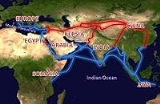
, Aksum was deeply involved in the trade network between India
India

India, officially the Republic of India , is a country in South Asia. It is the List of countries and outlying territories by total area country by geographical area, the List of countries by population country, and the most populous liberal democracy in the world....
 and the Mediterranean. It benefited from a major transformation of the maritime trading system that linked the Roman Empire and India
Roman trade with India

Roman trade with India through the overland caravan routes via Anatolia and Persia, though at a relative trickle comparative to later times, antedated the southern trade route via the Red Sea and Monsoons which started around the beginning of the Common Era following the reign of Augustus and ?gyptus of Ptolemaic Egypt....
. This change took place around the start of the Common Era
Common Era

Common Era, abbreviated as CE, is a designation for the calendar system most commonly used in the Western world, and also internationally, for numbering the year part of the calendar date....
. The older trading system involved coastal sailing and many intermediary ports. The Red Sea was of secondary importance to the Persian Gulf
Persian Gulf

The Persian Gulf, in the Southwest Asian region, is an extension of the Indian Ocean located between Iran and the Arabian Peninsula. Historically and commonly known as the Persian Gulf, this body of water is sometimes Persian Gulf naming dispute referred to as the Arabian Gulf by certain Arab countries or simply The Gulf, although nei...
 and overland connections to the Levant
Levant

The Levant describes, traditionally, the Eastern Mediterranean at large, but can be used as a geographical term that denotes a large area in Western Asia formed by the lands bordering the Eastern shores of the Mediterranean, roughly bounded on the north by the Taurus Mountains, on the south by the Arabian Desert, and on the west by the M...
. Starting around 100 BC a route from Egypt to India was established, making use of the Red Sea and using monsoon winds to cross the Arabian Sea
Arabian Sea

The Arabian Sea is a region of the Indian Ocean bounded on the east by India, on the north by Pakistan and Iran, on the west by Arabian Peninsula, on the south, approximately, by a line between Cape Guardafui, the north-east point of Somalia, Socotra, Kanyakumari in India, and the western coast of Sri Lanka....
 directly to southern India
South India

South India is the area encompassing India's states of Andhra Pradesh, Karnataka, Kerala and Tamil Nadu as well as the Union territories of India of Lakshadweep and Pondicherry, occupying 19.31% of area....
. By about 100 AD the volume of traffic being shipped on this route had eclipsed older routes. Roman demand for goods from southern India increased dramatically, resulting in greater number of large ships sailing down the Red Sea from Roman Egypt to the Arabian Sea and India.

The Kingdom of Aksum was ideally located to take advantage of the new trading situation. Adulis
Adulis

Adulis is an archeology in the Northern Red Sea region of Eritrea, about 30 miles south of Massawa. It was the port of the Kingdom of Aksum, located on the coast of the Red Sea....
 soon became the main port for the export of African goods, such as ivory, incense, gold, and exotic animals. In order to supply such goods the kings of Aksum worked to develop and expand an inland trading network. A rival, and much older trading network that tapped the same interior region of Africa was that of the Kingdom of Kush, which had long supplied Egypt with African goods via the Nile
Nile

The Nile is a major north-flowing river in Africa, generally regarded as the List of rivers by length in the world.The Nile has two major tributary, the White Nile and Blue Nile, the latter being the source of most of the Nile's water and silt, but the former being the longer of the two....
 corridor. By the 1st century AD, however, Aksum had gained control over territory previously Kushite. The Periplus of the Erythraean Sea explicitly describes how ivory collected in Kushite territory was being exported through the port of Adulis instead of being taken to Meroë
Meroë

Mero? is the name of an ancient city on the east bank of the Nile about 6 km north-east of the Kabushiya station near Shendi, Sudan, approximately 200 km north-east of Khartoum....
, the capital of Kush. During the 2nd and 3rd centuries the Kingdom of Aksum continued to expand their control of the southern Red Sea basin. A caravan route to Egypt was established which bypassed the Nile corridor entirely. Aksum succeeded in becoming the principal supplier of African goods to the Roman Empire, not least as a result of the transformed Indian Ocean trading system.

Origins

Aksum was previously thought to have been founded by Semitic
Semitic languages

File:Amarna Akkadian letter.pngThe Semitic languages are a group of related languages whose living representatives are spoken by more than 467 million people across much of the Middle East, North Africa and the Horn of Africa....
-speaking Sabaeans who crossed the Red Sea
Red Sea

The Red Sea is a salt water inlet of the Indian Ocean between Africa and Asia. The connection to the ocean is in the south through the Bab el Mandeb sound and the Gulf of Aden....
 from South Arabia (modern Yemen
Yemen

Yemen , officially the Republic of Yemen is an Arab country located on the Arabian Peninsula in Southwest Asia. Yemen has an estimated population of more than 23 million people and is bordered by Saudi Arabia to the North, the Red Sea to the West, the Arabian Sea and Gulf of Aden to the South, and Oman to the east....
) on the basis of Conti Rossini's theories and prolific work on Ethiopian history, but most scholars now agree that it was an indigenous development. Scholars like Stuart Munro-Hay point to the existence of an older D’mt or Da'amot kingdom, prior to any Sabaean migration ca. 4th or 5th c. BC, as well as to evidence of Sabaean immigrants having resided in the region for little more than a few decades. Furthermore, Ge'ez
Ge'ez language

Ge'ez is an ancient South Semitic language that developed in the current region of Eritrea and northern Ethiopia in the Horn of Africa. It later became the official language of the Kingdom of Aksum and Ethiopian imperial court....
, the ancient Semitic language of Eritrea and Ethiopia, is now known not to have derived from Sabaean
Sabaean language

The Sabaean language was an Old South Arabian language spoken in Yemen from c. 1000 BC to the 6th century AD, by the Sabaeans; it was used as a written language by some other peoples of Ancient Yemen, including the Hashidites, Sirwahites, Humlanites, Ghaymanites, Himyarites, Radmanites etc....
, and there is evidence of a Semitic speaking presence in Ethiopia and Eritrea at least as early as 2000 BC. Sabaean influence is now thought to have been minor, limited to a few localities, and disappearing after a few decades or a century, perhaps representing a trading or military colony in some sort of symbiosis or military alliance with the civilization of D`mt or some proto-Aksumite state. Adding more to the confusion, there existed an Ethiopian city called Saba in the ancient period that does not seem to have been a Sabaean settlement.

The Empire

Gdrt230
The Empire of Aksum at its height extended across most of present-day Eritrea
Eritrea

Eritrea , officially the Country of Eritrea, is a country in Northeast Africa. It is bordered by Sudan in the west, Ethiopia in the south, and Djibouti in the southeast....
, northern Ethiopia
Ethiopia

Ethiopia , officially the Federal Democratic Republic of Ethiopia, is a landlocked country situated in the Horn of Africa. Ethiopia is bordered by Eritrea to the north, Sudan to the west, Kenya to the south, Somalia to the east and Djibouti to the northeast....
, Yemen
Yemen

Yemen , officially the Republic of Yemen is an Arab country located on the Arabian Peninsula in Southwest Asia. Yemen has an estimated population of more than 23 million people and is bordered by Saudi Arabia to the North, the Red Sea to the West, the Arabian Sea and Gulf of Aden to the South, and Oman to the east....
, southern Saudi Arabia
Saudi Arabia

The Kingdom of Saudi Arabia, KSA , is an Arab country and the largest country of the Arabian Peninsula. It is bordered by Jordan on the northwest, Iraq on the north and northeast, Kuwait, Qatar, Bahrain, and the United Arab Emirates on the east, Oman on the southeast, and Yemen on the south....
 northern Djibouti
Djibouti

Djibouti , officially the Republic of Djibouti, is a country in the Horn of Africa. It is bordered by Eritrea in the north, Ethiopia in the west and south, and Somalia in the southeast....
, and northern Sudan
Sudan

Sudan is a country in northeastern Africa. It is the largest in the African continent and the Arab World, and List of countries and outlying territories by total area by area....
. The capital city of the empire was Aksum
Axum

Axum, or Aksum, is a city in northern Ethiopia named after the Kingdom of Aksum, a naval and trading power that ruled from the region ca....
, now in northern Ethiopia. Today a smaller community, the city of Aksum was once a bustling metropolis, cultural and economic center. Two hills and two streams lie on the east and west expanses of the city; perhaps providing the initial impetus for settling this area. Along the hills and plain outside the city, the Aksumites had cemeteries with elaborate grave stones called stelae, or obelisk
Obelisk

An obelisk An Obelisks is a tall, narrow, four-sided, tapering monument which ends in a pyramid like shape at the top. Ancient obelisks were made of a single piece of stone, a monolith; however, most modern obelisks are made of individual stones, and can even have interior spaces....
s. Other important cities included Yeha
Yeha

Yeha is a village in northern Ethiopia, located in the Mehakelegnaw Zone of the Tigray Region. The Central Statistical Agency has not published an estimate for this village's 2005 population....
, Hawulti, Matara
Matara, Eritrea

Matara , is an archeological site in Eritrea and was a major Aksumite and D?mt city. Since Eritrean Independence, the National Museum of Eritrea has petitioned the Ethiopian Government to return artifacts removed from the site, they have thus far been rebuffed....
, Adulis
Adulis

Adulis is an archeology in the Northern Red Sea region of Eritrea, about 30 miles south of Massawa. It was the port of the Kingdom of Aksum, located on the coast of the Red Sea....
, and Qohaito
Qohaito

Qohaito was a pre-Aksumite city that thrived during the Aksumite period. It lies over 2,500 meters above sea level in the Debub region of Eritrea....
, the last three of which are now in Eritrea.

In the 3rd century, Aksum began interfering in South Arabian affairs, controlling at times the western Tihama region among other areas. By the late 3rd century it had begun minting its own currency and was named by Mani
Mani (prophet)

Mani was the founder of Manichaeism, an ancient gnostic religion that was once widespread but is now extinct. Mani was born of Iranian peoples parentage in Assuristan, located in modern-day Iraq, which was a part of the Persian Empire during Mani's life....
 as one of the four great powers of his time along with Persia
Sassanid Empire

The Sassanid Empire or Sassanian Dynasty is the name of the last pre-Islamic Iranian empire. It was one of the two main powers in Western Asia for a period of more than 400 years....
, Rome
Roman Empire

The Roman Empire was the Roman Republic phase of the Ancient Rome, characterised by an autocracy form of government and large territorial holdings in Europe and around the Mediterranean....
, and China
History of China

China civilization originated in various city-states along the Yellow River valley in the Neolithic era. The written history of China begins with the Shang Dynasty ....
. It converted to Christianity
Christianity

Christianity is a Monotheistic religion #Christian view religion centered on the life and teachings of Jesus as New Testament view on Jesus' life....
 in 325 or 328 under King Ezana
Ezana of Axum

Ezana of Axum , was ruler of the Axumite Kingdom located in present-day in Tigray, northern Ethiopia, Eritrea, Yemen, southern Saudi Arabia, northern Somalia, Djibouti, northern Sudan, and southern Egypt; he himself employed the style "king of Sabaeans and Salhen, Himyar and Dhu-Raydan."....
 and was the first state ever to use the image of the cross on its coins. At its height, Aksum controlled northern Ethiopia
Ethiopia

Ethiopia , officially the Federal Democratic Republic of Ethiopia, is a landlocked country situated in the Horn of Africa. Ethiopia is bordered by Eritrea to the north, Sudan to the west, Kenya to the south, Somalia to the east and Djibouti to the northeast....
, Eritrea
Eritrea

Eritrea , officially the Country of Eritrea, is a country in Northeast Africa. It is bordered by Sudan in the west, Ethiopia in the south, and Djibouti in the southeast....
, northern Sudan
Sudan

Sudan is a country in northeastern Africa. It is the largest in the African continent and the Arab World, and List of countries and outlying territories by total area by area....
, southern Egypt
Egypt

Egypt is a country mainly in North Africa, with the Sinai Peninsula forming a land bridge in Western Asia. Covering an area of about , Egypt borders the Mediterranean Sea to the north, the Gaza Strip and Israel to the northeast, the Red Sea to the east, Sudan to the south and Libya to the west....
, Djibouti
Djibouti

Djibouti , officially the Republic of Djibouti, is a country in the Horn of Africa. It is bordered by Eritrea in the north, Ethiopia in the west and south, and Somalia in the southeast....
, Yemen
Yemen

Yemen , officially the Republic of Yemen is an Arab country located on the Arabian Peninsula in Southwest Asia. Yemen has an estimated population of more than 23 million people and is bordered by Saudi Arabia to the North, the Red Sea to the West, the Arabian Sea and Gulf of Aden to the South, and Oman to the east....
, and southern Saudi Arabia
Saudi Arabia

The Kingdom of Saudi Arabia, KSA , is an Arab country and the largest country of the Arabian Peninsula. It is bordered by Jordan on the northwest, Iraq on the north and northeast, Kuwait, Qatar, Bahrain, and the United Arab Emirates on the east, Oman on the southeast, and Yemen on the south....
, totalling 1.25 million km².

It was a quasi-ally of Byzantium
Byzantium

Byzantium was an Ancient Greece city, which was founded by Greeks colonists from Megara in 667 BC and named after their king Byzas or Byzantas ....
 against the Persian Empire
Persian Empire

The 'Persian Empire' was a series of successive Iranian or Persianization empires that ruled over the Iranian plateau, the original Persian homeland, and beyond in Southwest Asia, South Asia, Central Asia and the Caucasus....
 of the day and declined after the 7th century due to unknown reasons, but informed speculation suggests the rise of Islam
Islam

Islam is a Monotheism, Abrahamic religion originating with the teachings of the Prophets of Islam Muhammad, a 7th century Arab religious and political figure....
 heavily impacted its ability to trade with the Far East
Far East

The Far East is a term current in English language to refer to the countries of East Asia. The term is often expanded to also include Southeast Asia and South Asia, for economic and cultural reasons, for example because Buddhism is common to East Asia, Southeast Asia and South Asia....
 in the era when shipping was limited to coastal navigation as well as cut it off from its principal markets in Alexandria
Alexandria

Alexandria , with a population of 4.1 million, is the second-largest city in Egypt, and is the country's largest seaport, serving about 80% of Egypt's imports and exports....
, Byzantium
Byzantium

Byzantium was an Ancient Greece city, which was founded by Greeks colonists from Megara in 667 BC and named after their king Byzas or Byzantas ....
 and Southern Europe
Southern Europe

The term Southern Europe, at its most general definition, is used to mean 'all countries in the south of Europe'. However, the concept, at different times, has had different meanings, providing additional Policy, Linguistics and Culture context to the definition in addition to the typical Geography, Phytogeography or Clime approach....
.

Societal structure

The Aksumite population consisted of Semitic
Semitic languages

File:Amarna Akkadian letter.pngThe Semitic languages are a group of related languages whose living representatives are spoken by more than 467 million people across much of the Middle East, North Africa and the Horn of Africa....
-speaking people (collectively known as Habeshas
Habesha people

The term Habesha refers to a South Semitic group of people whose cultural, linguistic, and in certain cases, ancestral origins trace back to the tribes of the Axumite Kingdom and the D'mt....
), Cushitic
Cushitic languages

The Cushitic languages are a branch of the Afro-Asiatic languages language family spoken in the Horn of Africa. They are named after the Biblical figure Cush by analogy with Shem being the eponym origin of Semitic languages....
-speaking people, and Nilo-Saharan
Nilo-Saharan languages

The Nilo-Saharan languages are a hypothetical group of African languages spoken mainly in the upper parts of the Chari River and Nile rivers , including historic Nubia, north of where the two tributaries of Nile meet....
-speaking people (the Kunama
Kunama people

The Kunama are a Nilotic ethnic group living in Eritrea and Ethiopia, making up only 2 percent of the population of Eritrea, where they are one of the smallest ethnic groups....
 and Nara
Nara people

The Nara are a Nilotic ethnic group living in Eritrea and make up less than 1% of the population. The Nara people are generally Muslim. The Nara are divided into four subtribes, the Higir, Mogareb, Koyta, Santora....
).

The Aksumite kings had the official title ??? ? ???? ngs ngst - King of Kings (later vocalization Ge'ez
Ge'ez language

Ge'ez is an ancient South Semitic language that developed in the current region of Eritrea and northern Ethiopia in the Horn of Africa. It later became the official language of the Kingdom of Aksum and Ethiopian imperial court....
 ??? ? ???? nigusa nagast, Modern Ethiosemitic
Ethiopian Semitic languages

Ethiopian Semitic is a language group, which together with Old South Arabian, forms the Western branch of the South Semitic languages. Today, the name Ethiopian can be considered a misnomer, as the North languages are also found in Eritrea, with two of them being exclusively used there; however, the term came into use before Eritrea had...
 niguse negest).

Aksumites did own slaves, and a modified feudal system was in place to farm the land.

Foreign relations and economy

Aksum traded with India
India

India, officially the Republic of India , is a country in South Asia. It is the List of countries and outlying territories by total area country by geographical area, the List of countries by population country, and the most populous liberal democracy in the world....
 and Rome
Roman Empire

The Roman Empire was the Roman Republic phase of the Ancient Rome, characterised by an autocracy form of government and large territorial holdings in Europe and around the Mediterranean....
 (later Byzantium
Byzantine Empire

Byzantine Empire and Eastern Roman Empire are conventional names used to describe the Roman Empire during the Middle Ages, centered on its capital of Constantinople....
), exporting ivory, tortoise shell, gold and emeralds, and importing silk and spices. Axum's access to both the Red Sea and the Upper Nile enabled its strong navy to profit in trade between various African (Nubia
Nubia

Nubia is a region in Southern Egypt along the Nile and in what is now northern Sudan. Most of Nubia is situated in Sudan with about a quarter of its territory in Egypt....
), Arabian (Yemen
Yemen

Yemen , officially the Republic of Yemen is an Arab country located on the Arabian Peninsula in Southwest Asia. Yemen has an estimated population of more than 23 million people and is bordered by Saudi Arabia to the North, the Red Sea to the West, the Arabian Sea and Gulf of Aden to the South, and Oman to the east....
), and Indian states. In the 3rd century AD, Axum acquired tributary states on the Arabian Peninsula across the Red Sea, and by 350, they conquered the Kingdom of Kush
Kingdom of Kush

The Kingdom of Kush was an ancient African state centered in the confluences of the Blue Nile, White Nile and River Atbara in what is now the Republic of Sudan....
.

The main exports of Axum were, as would be expected of a state during this time, agricultural products. The land was much more fertile during the time of the Aksumites than now, and their principle crops were grains such as wheat and barley. The people of Aksum also raised cattle, sheep, and camels. Wild animals were also hunted for things such as ivory and rhinoceros horns. They traded with Roman traders as well as with Egyptian and Persian merchants.

The empire was also rich with gold and iron deposits. These metals were valuable to trade, but another mineral was also widely traded. Salt was found richly in Aksum and was traded quite frequently.

Aksum remained a strong empire and trading power until the rise of Islam
Islam

Islam is a Monotheism, Abrahamic religion originating with the teachings of the Prophets of Islam Muhammad, a 7th century Arab religious and political figure....
 in the seventh century. However, because the Axumites had sheltered Muhammad
Muhammad

Muhammad Patronymic#Arabic Abd Allah ibn Abd al Muttalib , is the founder of the Major religious groups of Islam and is regarded by Muslims as a Rasul and prophet of , the last and the greatest law-bearer in a series of prophets....
's first followers, the Muslims never attempted to overthrow Axum as they spread across the face of Africa. Nevertheless, as early as 640, Umar ibn al-Khattab
Umar

Umar , also known as Umar the Great or Omar the Great was a Muslim from the Banu Adi clan of the Quraysh Tribes of Arabia, and a sahaba of Muhammad....
 sent a naval expedition against Adulis
Adulis

Adulis is an archeology in the Northern Red Sea region of Eritrea, about 30 miles south of Massawa. It was the port of the Kingdom of Aksum, located on the coast of the Red Sea....
 under Alkama bin Mujazziz, but it was eventually defeated. Axumite naval power also declined throughout the period, though in 702 Aksumite pirates were able to invade the Hejaz
Hejaz

al-Hejaz is a region in the west of present-day Saudi Arabia. Defined mostly by the Red Sea, it extends from Haql on the Gulf of Aqaba to Jizan....
 and occupy Jeddah
Jeddah

Jeddah is a Saudi Arabian city located on the coast of the Red Sea and is the major urban center of western Saudi Arabia. It is the largest city in Makkah Province, and the second largest city in Saudi Arabia after the capital city, Riyadh....
. In retaliation, however, Sulayman ibn Abd al-Malik
Sulayman ibn Abd al-Malik

Sulayman bin Abd al-Malik was an Umayyad caliph who ruled from 715 until 717. His father was Abd al-Malik, and he was a younger brother of the previous caliph, al-Walid I....
 was able to take the Dahlak Archipelago
Dahlak Archipelago

The Dahlak Archipelago is an island group located in the Red Sea near Massawa, Eritrea. It consists of two large and 124 small islands. The pearl fisheries as they were known to the Romans, still produce a few pearls....
 from Axum, which became Muslim from that point on, though later recovered in the 9th century and vassal to the Emperor of Ethiopia
Emperor of Ethiopia

The Emperor of Ethiopia was the hereditary ruler of Ethiopia until the abolition of the monarchy in 1975. The Emperor was the head of state and head of government, with ultimate executive power, judicial power and legislative power in that country....
.

Eventually, the Islamic Empire took control of the Red Sea and most of the Nile, forcing Axum into economic isolation. However, it still had relatively good relations with all of its Muslim neighbors. Two Christian states northwest of Axum (in modern day Sudan), Maqurra and Alwa, survived until the thirteenth century when they were finally forced by Muslim conversion to become Islamic. Axum, however, remained untouched by the Islamic movements across Africa.

Religion

Ruins in Aksum, Ethiopia
Debre Damo Church
Before its conversion to Christianity the Aksumites practiced a polytheistic religion. Astar was the main god of the pre-Christian Aksumites, and his son, Mahrem (Maher), was who the kings of Aksum traced their lineage. In about 324 AD the King Ezana II was converted by his slave-teacher Frumentius, the founder of the Ethiopian Orthodox Church. Frumentius taught the emperor while he was young, and at some point staged the conversion of the empire. We know that the Axumites converted to Christianity because in their coins they replaced the disc and crescent with the cross. Frumentius was in contact with the Church in Alexandria and was appointed Bishop of Ethiopia around 330 AD Alexandria never reined Aksum in tightly, rather allowing its own form of Christianity form, however, the church did retain a minor influence. Aksum is also the alleged home of the holy relic the Ark of the Covenant. The Ark is said to have been placed in the Church of Our Lady Mary of Zion
Church of Our Lady Mary of Zion

The Church of Our Lady Mary of Zion of the Ethiopian Orthodox Church is the most important church of Ethiopia. The original church is believed to have been built during the reign of Ezana, the first Christian emperor of Ethiopia, during the fourth century AD, and has been rebuilt several times since then....
 by Menelik I for safekeeping.

Cultural achievements

Khosrau I Textile
The Empire of Aksum is notable for a number of achievements, such as its own alphabet, the Ge'ez alphabet
Ge'ez alphabet

Ge'ez , also called Ethiopic, is an abugida script that was originally developed to write Ge'ez language, a Semitic languages. In communities that use it, such as the Amharic language and Tigrinya language, the script is called , which means "script" or "alphabet"....
 (which evolved from Epigraphic South Arabian
South Arabian alphabet

The ancient South Arabian alphabet branched from the Proto-Sinaitic alphabet in about the 9th century BC. It was used for writing the Yemeni Old South Arabic dialects of the Sabaean language, Qatabanian, Hadrami , Minaean language, Himyarite language, and proto-Ge'ez language in D?mt....
 during the late pre-Aksumite and proto-Aksumite period), which was modified to include vowels, becoming an abugida
Abugida

An 'abugida' is a segment writing system which is based on consonants but in which vowel notation is obligatory. About half the writing systems in the world are abugidas, including the extensive Brahmic family of scripts used in South and Southeast Asia....
. Furthermore, in the early times of the empire, around 1700 years ago, giant Obelisks to mark emperor's (and nobles') tombstones (underground grave chambers) were constructed, the most famous of which is the Obelisk of Axum
Obelisk of Axum

The Obelisk of Axum is a 1700-year-old, 24-meters tall granite obelisk, weighing 160 tonnes. It is decorated with two false doors at the base, and decorations resembling windows on all sides....
.

Under Emperor Ezana
Ezana of Axum

Ezana of Axum , was ruler of the Axumite Kingdom located in present-day in Tigray, northern Ethiopia, Eritrea, Yemen, southern Saudi Arabia, northern Somalia, Djibouti, northern Sudan, and southern Egypt; he himself employed the style "king of Sabaeans and Salhen, Himyar and Dhu-Raydan."....
, Axum adopted Christianity in place of its former polytheistic and Judaic religions around 325. This gave rise to the present day Ethiopian Orthodox Tewahedo Church
Ethiopian Orthodox Tewahedo Church

The Ethiopian Orthodox Tewahedo Church is an Oriental Orthodoxy church in Ethiopia that was part of the Coptic Christianity until 1959, when it was granted its own Patriarch by List of Coptic Popes, Pope Cyril VI of Alexandria....
 (only granted autonomy from the Coptic Church in 1959), and Eritrean Orthodox Tewahdo Church
Eritrean Orthodox Tewahdo Church

The Eritrean Orthodox Tewahdo Church is an orthodox Church. It was formerly a part of the Ethiopian Orthodox Tewahdo Church, its autocephaly recognised by the Ethiopian Patriarchate after Eritrea gained its independence in 1993....
 (granted autonomy from the Ethiopian Orthodox church in 1993). Since the schism with orthodoxy following the Council of Chalcedon
Council of Chalcedon

The Council of Chalcedon is believed to have been the fourth ecumenical council by the Eastern Orthodox Church and the Roman Catholic Church. It was held from 8 October to 1 November 451 at Chalcedon , today the district of Kadik?y on the Asian side of the Bosphorus, incorporated into the city of Istanbul....
 (451), it has been an important Miaphysite church, and its scriptures and liturgy are still in Ge'ez.

It was a cosmopolitan and culturally important state. It was a meeting place for a variety of cultures: Ethiopia
Ethiopia

Ethiopia , officially the Federal Democratic Republic of Ethiopia, is a landlocked country situated in the Horn of Africa. Ethiopia is bordered by Eritrea to the north, Sudan to the west, Kenya to the south, Somalia to the east and Djibouti to the northeast....
n, Egypt
Egypt

Egypt is a country mainly in North Africa, with the Sinai Peninsula forming a land bridge in Western Asia. Covering an area of about , Egypt borders the Mediterranean Sea to the north, the Gaza Strip and Israel to the northeast, the Red Sea to the east, Sudan to the south and Libya to the west....
ian, Sudan
Sudan

Sudan is a country in northeastern Africa. It is the largest in the African continent and the Arab World, and List of countries and outlying territories by total area by area....
ic, Arab
Arab

An Arab is a person who Identity as such on linguistic or cultural grounds. The plural form, Arabs , refers to the Ethnocultural group at large....
ic, and India
India

India, officially the Republic of India , is a country in South Asia. It is the List of countries and outlying territories by total area country by geographical area, the List of countries by population country, and the most populous liberal democracy in the world....
n. The major Aksumite cities had Sabean, Jew
Jew

A Jew is a member of the Jewish people, an ethnoreligious group that traces its ancestry to the Israelites or Hebrews of the Ancient Near East....
ish, Nubian, Christian
Christian

A Christian is a person who adheres to Christianity, a Monotheism#Christian view religion centered on the life and teachings of Jesus and interpreted by Christians to have been prophesied in the Hebrew Bible/Old Testament....
, and even Buddhist minorities.

Coinage

The Empire of Aksum was the first African polity, economically and politically ambitious enough, to issue its own coin
Coin

A coin is a piece of hard material, usually metal or a metallic material, usually in the shape of a Disk , and most often issued by a government....
s; they bore legends in Ge'ez and Greek. From the reign of Endubis up to Armah (approximately 270 to 610), gold, silver and bronze coins were minted. Issuing coinage in ancient times was an act of great importance in itself, for it proclaimed that the Axumite Empire considered itself equal to its neighbors. Many of the coins are used as signposts about what was happening when they were minted. An example being the addition of the cross to the coin after the conversion of the empire to Christianity. The presence of coins also simplified trade, and was at once a useful instrument of propaganda
Propaganda

Propaganda is the dissemination of information aimed at influencing the opinions or behaviors of large numbers of people. As opposed to Objectivity providing information, propaganda in its most basic sense presents information in order to influence its audience....
 and a source of profit to the empire.

Ark of the Covenant

Aksum is the purported home of the Ark of the Covenant
Ark of the Covenant

The Ark of the Covenant is described in the Bible as a sacred container, where in rested the Tablets of stone containing the Ten Commandments as well as Aaron's rod and manna....
. According to regional tradition, the Ark is said to be housed in the Church of Our Lady Mary of Zion
Church of Our Lady Mary of Zion

The Church of Our Lady Mary of Zion of the Ethiopian Orthodox Church is the most important church of Ethiopia. The original church is believed to have been built during the reign of Ezana, the first Christian emperor of Ethiopia, during the fourth century AD, and has been rebuilt several times since then....
, and is guarded heavily by the priests there. The Ark, according to legends, was brought to Aksum by King Solomon and the Queen of Sheba's son and placed under guard. Controversy still surrounds this building, since no one but the one guard priest is allowed in, and thus no one can verify the Ark's existence.

Perhaps related to this is the fact that the Ethiopian Orthodox Church today is the only Christian church in the world where the Ark of the Covenant is an integral part of every church. Each church has its replica of the Ark of the Covenant and its tablets (tabot
Tabot

Tabot , is a Ge'ez language word referring to a replica of the Tablets of Law, onto which the Bible Ten Commandments were inscribed, used in the practices of the Ethiopian Orthodox Tewahedo Church....
), and its presence, symbolizing the presence of God, is necessary for the building to be considered a church. In the absence of the tabot
Tabot

Tabot , is a Ge'ez language word referring to a replica of the Tablets of Law, onto which the Bible Ten Commandments were inscribed, used in the practices of the Ethiopian Orthodox Tewahedo Church....
, the church is no longer sacred. Each year, at the feast of T'imk'et, the arks are taken in procession to be blessed by the bishop, before being returned to the church. It is the presence of the Ark (and its symbolism of the presence of God) that leads the faithful to bow and cross themselves in the direction of a church whenever they pass one.

Stelae

Stela Aksum
The Stelae are perhaps the most identifiable part of the Aksumite legacy. These stone towers served to mark graves or represent a magnificent building. The largest of these towering obelisks would measure 33 meters high had it not fallen. The Stelae have most of their mass out of the ground, but are stabilized by massive underground counter-weights. The stone was often engraved with a pattern or emblem denoting the king's or the noble's rank.


Decline & Pagan Conquest

After a second golden age
Golden age

The term Golden age in ancient Greece mythology and legend but can also be found in other ancient cultures . It refers either to the highest age in the Greek spectrum of Iron, Bronze, Silver and Golden ages, or to a time in the beginnings of Humanity which was perceived as an ideal state, or utopia, when mankind was pure and immortal....
 in the early 6th century, the empire began to decline, eventually ceasing its production of coins in the early 7th century. Around this same time, the Aksumite population was forced to go farther inland to the highlands for protection. Local history hold that a Jewish Queen named Yodit (Judith) or "Gudit
Gudit

Gudit is a semi-legendary non-Christian queen who laid waste to Axum and its countryside, destroyed churches and monuments, and attempted to exterminate the members of the ruling Kingdom of Axum....
" defeated the empire and burned its churches and literature, but while there is evidence of churches being burned and an invasion around this time, her existence has been questioned by some modern authors.

Another possibility is that the Axumite power was ended by a southern pagan queen named Bani al-Hamwiyah, possibly of the tribe al-Damutah or Damoti (Sidama). After a short Dark Age, the Axumite Empire was succeeded by the Zagwe dynasty
Zagwe dynasty

The Zagwe dynasty ruled Ethiopia from approximately 1137 to 1270, when Yekuno Amlak defeated and killed the last Zagwe king in battle. The name of the dynasty is thought to come from the Ge'ez language phrase Ze-Agaw, meaning "of Agaw" and refer to the Agaw people....
 in the eleventh century
Eleventh

Eleventh can mean:*Eleventh_Amendment_to_the_United_States_Constitution to the U.S. Constitution...
 or twelfth century, although limited in size and scope. However, Yekuno Amlak, who killed the last Zagwe king and founded the modern Solomonic dynasty
Solomonic dynasty

The Solomonic dynasty is the traditional Royal House of Ethiopia, claiming descent from King Solomon and the Queen of Sheba, who is said to have given birth to the traditional first king Menelik I after her Biblically-described visit to Solomon in Jerusalem: ....
 traced his ancestry and his right to rule from the last emperor of Axum, Dil Na'od
Dil Na'od

Dil Na'od was the last negus of Kingdom of Aksum before the Zagwe dynasty of Ethiopia. He lived in either the 9th or 10th centuries. Dil Na'od was the younger son of Ged'a Jan , and succeeded his older brother 'Anbasa Wedem as negus....
.

Other reasons for the decline are less romantic and more scientific. Climate change and trade isolation are probably also large reasons for the decline of the culture. Overfarming of the land led to decreased crop yield, which in turn led to decreased food supply. This, in turn with the changing flood pattern of the Nile and several seasons of drought, would make it less important in the emerging European economy.

Aksumite Empire in Fiction

The Aksumite Empire is portrayed as the main ally of Byzantium
Byzantium

Byzantium was an Ancient Greece city, which was founded by Greeks colonists from Megara in 667 BC and named after their king Byzas or Byzantas ....
 in the Belisarius series
Belisarius series

The Belisarius Series is an epic fictional saga of heroic scope in the alternate history and military history sub-genres of science fiction with its protagonist being the real historical figure, the Byzantine Empire, Belisarius , who was certainly one of the best generals of Byzantium and arguably, according to authors Flint and Drake, one o...
 by David Drake
David Drake

David Drake is an author of science fiction and fantasy literature. A Vietnam War veteran who has worked as a lawyer, he is now one of the premier authors of the military science fiction subgenre....
 and Eric Flint
Eric Flint

Eric Flint is an American List of science fiction authors, editing, and publishing. The majority of his main works are alternate history science fiction, but he also writes humorous fantasy adventures....
 published by Baen Books
Baen Books

Baen Books is an American publishing company established in 1983 by long time Science Fiction publisher and editor Jim Baen. It is a science fiction and fantasy publishing house that emphasizes space opera, hard science fiction, military science fiction, and fantasy....
.

Bibliography

  • Francis Anfray. Les anciens ethiopiens. Paris: Armand Colin, 1991.
  • Carlo Conti Rossini. Storia d'Etiopia. Bergamo: Istituto Italiano d'Arti Grafiche, 1928.
  • Rodolfo Fattovich et al. The Aksum Archaeological Area: a preliminary assessment. Naples: Istituto Universitario Orientale, 2000.
  • Stuart Munro-Hay. Aksum: A Civilization of Late Antiquity. Edinburgh: University Press. 1991. ISBN 0-7486-0106-6
  • Yuri M. Kobishchanov. Axum (Joseph W. Michels, editor; Lorraine T. Kapitanoff, translator). University Park, Pennsylvania: Penn State University Press, 1979. ISBN 0-271-00531-9
  • Karl W. Butzer. Rise and Fall of Axum, Ethiopia: A Geo-Archaeological Interpretation. American Antiquity, Vol. 46, No. 3. (Jul., 1981), pp. 471-495.
  • Joseph W. Michels. Changing settlement patterns in the Aksum-Yeha region of Ethiopia: 700 BC - AD 850 (BAR International Series 1448) Oxford: Archaeopress, 2005.
  • Mukhtar, Mu?ammad Jamal al-Din. 1981. Ancient civilizations of Africa. General history of Africa, 2. London: Heinemann Educational Books.ISBN 9780435948054
  • David W. Phillipson. Ancient Ethiopia. Aksum: Its antecedents and successors. London: The British Museum, 1998.
  • David W. Phillipson. Archaeology at Aksum, Ethiopia, 1993-97. London: British Institute in Eastern Africa, 2000.
  • Williams, Stephen. "Ethiopia: Africa's Holy Land". New African, Vol. 458. ( Jan., 2007), pp 94-97.
  • Belai Giday. Ethiopian Civilization. Addis Ababa, 1992


See also

  • History of Ethiopia
    History of Ethiopia

    Ethiopia is the oldest independent country in Africa, with one of the longest recorded histories in the world....
  • Kings of Axum
    Kings of Axum

    Kings during the zenith of the Kingdom of Axum The following based on S.C. Munro-Hay, Aksum , pp. 67f...
  • Abraha
    Abraha

    File:Kaleb.jpgAbraha also known as Abraha al-Ashram or Abraha b. as-Saba'h, was an Aksumiten Christian viceroy in southern Arabian Peninsula for the Aksumite Empire, and later self styled King of Saba' ....


External links