
All Topics  
Eastern Europe


   Email Print
   Bookmark   Link


Eastern Europe


Eastern Europe is a term that applies to the geopolitical region encompassing the easternmost part of the European continent
Europe

Europe is, conventionally, one of the world's seven continents. Comprising the westernmost peninsula of Eurasia, Europe is generally divided from Asia to its east by the water divide of the Ural Mountains, the Ural , the Caspian Sea, and by the Caucasus Mountains to the southeast....
. Throughout history
HIStory

HIStory: Past, Present and Future, Book I is a double album by Michael Jackson, released on June 20, 1995, and is Jackson's ninth. The first disc, named "HIStory Begins" consists of a selection of Jackson's greatest hits from the singer's past fifteen years, while the second, named "HIStory Continues" features new songs, with the...
 and to a lesser extent today, parts of Eastern Europe has been distinguishable from Western Europe
Western Europe

Western Europe refers to the countries in the western most half of Europe. This concept has had different meanings, political and cultural as well as geographical issues have influenced the area....
 and other regions due to cultural, religious, economic, and historical reasons, even though there is huge disparity in this assertion. Although the term Eastern Europe was largely defined during the Cold War
Cold War

The Cold War was the continuing state of conflict, tension and competition that existed between a number of world powers, including the United States, the Soviet Union, People's Republic of China, France, United Kingdom and those countries' respective allies from the mid-1940s to the early 1990s....
, it still remains much in use.


Discussion
Ask a question about 'Eastern Europe'
Start a new discussion about 'Eastern Europe'
Answer questions from other users
Full Discussion Forum


Recent Posts


Encyclopedia


Eastern Europe is a term that applies to the geopolitical region encompassing the easternmost part of the European continent
Europe

Europe is, conventionally, one of the world's seven continents. Comprising the westernmost peninsula of Eurasia, Europe is generally divided from Asia to its east by the water divide of the Ural Mountains, the Ural , the Caspian Sea, and by the Caucasus Mountains to the southeast....
. Throughout history
HIStory

HIStory: Past, Present and Future, Book I is a double album by Michael Jackson, released on June 20, 1995, and is Jackson's ninth. The first disc, named "HIStory Begins" consists of a selection of Jackson's greatest hits from the singer's past fifteen years, while the second, named "HIStory Continues" features new songs, with the...
 and to a lesser extent today, parts of Eastern Europe has been distinguishable from Western Europe
Western Europe

Western Europe refers to the countries in the western most half of Europe. This concept has had different meanings, political and cultural as well as geographical issues have influenced the area....
 and other regions due to cultural, religious, economic, and historical reasons, even though there is huge disparity in this assertion. Although the term Eastern Europe was largely defined during the Cold War
Cold War

The Cold War was the continuing state of conflict, tension and competition that existed between a number of world powers, including the United States, the Soviet Union, People's Republic of China, France, United Kingdom and those countries' respective allies from the mid-1940s to the early 1990s....
, it still remains much in use. The term is commonly used in the media and in "eastern" and other regions of Europe. However the term is becoming increasingly outdated. Many of the countries it refers to such as Poland and Hungary have been and are culturally very much central European, with the blip of the Cold War creating a division.

Definitions

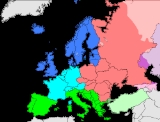
Eastern Europe Small
Several definitions of Eastern Europe exist today, but they often lack precision or are extremely general. Definitions vary both across cultures and among experts and political scientists, recently becoming more and more imprecise . Usually, the term is understood as a region lying between Central Europe
Central Europe

Central Europe is the region lying between the variously and vaguely defined areas of Eastern Europe and Western Europe Europe. In addition, Northern Europe, Southern Europe and Southeastern Europe may variously delimit or overlap into Central Europe....
 and the Ural
Ural

Ural may refer to one of the following:*Ural Mountains*Ural *Ural River*Urals Federal District*Urals economic region*Ural-4320, Ural-375D and Ural-5323, Soviet and Russian military trucks...
 mountains, or as European countries of the former "Eastern Bloc
Eastern bloc

During the Cold War, the terms Eastern Bloc, Communist Bloc or Soviet Bloc were used to refer to European annexed or expanded Soviet Socialist Republics of the USSR and Satellite state states, including members of the Soviet-dominated organizations Comecon and the Warsaw Pact....
" - western borders of Western Europe depend on the approach.

UN

The United Nations
United Nations

The United Nations is an international organization whose stated aims are to facilitate cooperation in international law, international security, economic development, Social change, human rights and achieving world peace....
 Statistics Division
considers Eastern Europe to consist of the following ten countries: Belarus
Belarus

Belarus is a landlocked country in Eastern Europe, bordered by Russia to the north and east, Ukraine to the south, Poland to the west, and Lithuania and Latvia to the north....
, Bulgaria
Bulgaria

The state of Bulgaria , Scientific transliteration Balgarija, officially the Republic of Bulgaria has played a significant role in the Balkans in south-eastern Europe for over fourteen centuries....
, Czech Republic
Czech Republic

The Czech Republic , is a landlocked country in Central Europe. The country borders Poland to the northeast, Germany to the west, Austria to the south and Slovakia to the east....
, Hungary
Hungary

Hungary , officially in English the Republic of Hungary , is a landlocked country in the Carpathian Basin of Central Europe, bordered by Austria, Slovakia, Ukraine, Romania, Serbia, Croatia, and Slovenia....
, Moldova
Moldova

Moldova , officially the Republic of Moldova is a landlocked country in Eastern Europe, located between Romania to the west and Ukraine to the north, east and south....
, Poland
Poland

Poland , officially the Republic of Poland , is a country in Central Europe. Poland is bordered by Germany to the west; the Czech Republic and Slovakia to the south; Ukraine, Belarus and Lithuania to the east; and the Baltic Sea and Kaliningrad Oblast, a Russian Enclave and exclave, to the north....
, Romania
Romania

Romania is a country located in Southeastern Europe Central Europe, North of the Balkan Peninsula, on the Lower Danube, within and outside the Carpathian Mountains, bordering on the Black Sea....
, Russia
Russia

Russia , or the Russian Federation , is a list of countries spanning more than one continent country extending over much of northern Eurasia....
, Slovakia
Slovakia

Slovakia . It was amended in September 1998 to allow direct election of the president and again in February 2001 due to EU admission requirements....
, Ukraine
Ukraine

Ukraine is a country in Eastern Europe. It is bordered by Russia to the east; Belarus to the north; Poland, Slovakia, and Hungary to the west; Romania and Moldova to the southwest; and the Black Sea and Sea of Azov to the south....
. The assignment of countries or areas to specific groupings is for statistical convenience and does not imply any assumption regarding political or other affiliation of countries or territories by the United Nations. Rather than being geographically correct, United Nations' definition encompasses all the states which were once under the Soviet Union
Soviet Union

The Union of Soviet Socialist Republics was a Constitution of the Soviet Union socialist state that existed in Eurasia from 1922 to 1991.The name is a translation of the , romanization of Russian Soyuz Sovetskikh Sotsialisticheskikh Respublik, abbreviated ????, SSSR....
's realm of influence and were part of the Warsaw Pact
Warsaw Pact

The Warsaw Pact was an organization of communist states in Central Europe and Eastern Europe. The treaty was signed in Warsaw, Poland on May 14, 1955 and official copies were made in Russian language, Polish language, Czech language and German language....
.

The United Nations
United Nations

The United Nations is an international organization whose stated aims are to facilitate cooperation in international law, international security, economic development, Social change, human rights and achieving world peace....
 Group of Experts on Geographical Names (UNGEGN)
was set up to consider the technical problems of domestic standardization of geographical names. The Group is composed of experts from various linguistic/geographical divisions that have been established at the UN Conferences on the Standardization of Geographical Names.
  • Eastern Europe, Northern and Central Asia Division: Armenia
    Armenia

    Armenia , officially the Republic of Armenia , is a landlocked mountainous country in South Caucasus between the Black Sea and the Caspian Sea....
    , Azerbaijan
    Azerbaijan

    Azerbaijan , officially the Republic of Azerbaijan , is the largest and most populous country in the South Caucasus, located partially in Eastern Europe and partially in Western Asia....
    , Belarus
    Belarus

    Belarus is a landlocked country in Eastern Europe, bordered by Russia to the north and east, Ukraine to the south, Poland to the west, and Lithuania and Latvia to the north....
    , Bulgaria
    Bulgaria

    The state of Bulgaria , Scientific transliteration Balgarija, officially the Republic of Bulgaria has played a significant role in the Balkans in south-eastern Europe for over fourteen centuries....
    , Georgia
    Georgia (country)

    Georgia is a transcontinental country in the Caucasus region, located at the dividing line between Europe and Asia. It is bordered by the Russia to the north, Azerbaijan to the east, Armenia to the south, and Turkey to the southwest....
    , Russian Federation, Ukraine
    Ukraine

    Ukraine is a country in Eastern Europe. It is bordered by Russia to the east; Belarus to the north; Poland, Slovakia, and Hungary to the west; Romania and Moldova to the southwest; and the Black Sea and Sea of Azov to the south....
    , Kyrgyzstan
    Kyrgyzstan

    Kyrgyzstan , officially the Kyrgyz Republic, is a country in Central Asia. Landlocked and mountainous, it is bordered by Kazakhstan to the north, Uzbekistan to the west, Tajikistan to the southwest and People's Republic of China to the east....
    , Mongolia
    Mongolia

    Mongolia is a landlocked country in East Asia and Central Asia. It borders Russia to the north and People's Republic of China to the south, east and west....
     and Uzbekistan
    Uzbekistan

    Uzbekistan, officially the Republic of Uzbekistan , is a Landlocked_country#Doubly_landlocked_country country in Central Asia, formerly part of the Soviet Union....
    .
  • East Central and South-East Europe Division:Albania
    Albania

    Albania , officially the Republic of Albania , is a country in Balkans. It is bordered by Greece to the south-east, Montenegro to the north, Kosovo to the northeast, and the Republic of Macedonia to the east....
    , Bosnia and Herzegovina
    Bosnia and Herzegovina

    Bosnia and Herzegovina is a country on the Balkans peninsula of South Eastern Europe with an area of 51,129 square kilometres . Bordered by Croatia to the north, west and south, Serbia to the east, and Montenegro to the south, Bosnia and Herzegovina is Landlocked#Nearly landlocked, except for 26 kilometres of the Adriatic Sea coas...
    , Bulgaria
    Bulgaria

    The state of Bulgaria , Scientific transliteration Balgarija, officially the Republic of Bulgaria has played a significant role in the Balkans in south-eastern Europe for over fourteen centuries....
    , Croatia
    Croatia

    Croatia , officially the Republic of Croatia , is a Central European country at the crossroads of Pannonian Plain, Balkans, and the Mediterranean Sea....
    , Cyprus
    Cyprus

    Cyprus , officially the Republic of Cyprus , is an island country situated in the eastern Mediterranean Sea, east of Greece, west of Lebanon, Syria, and Israel, south of Turkey and north of Egypt....
    , Czech Republic
    Czech Republic

    The Czech Republic , is a landlocked country in Central Europe. The country borders Poland to the northeast, Germany to the west, Austria to the south and Slovakia to the east....
    , Greece
    Greece

    Greece , officially the Hellenic Republic , is a country in southeastern Europe, situated on the southern end of the Balkans. It has borders with Albania, Bulgaria and the former Yugoslav Republic of Macedonia to the north, and Turkey to the east....
    , Hungary
    Hungary

    Hungary , officially in English the Republic of Hungary , is a landlocked country in the Carpathian Basin of Central Europe, bordered by Austria, Slovakia, Ukraine, Romania, Serbia, Croatia, and Slovenia....
    , Poland
    Poland

    Poland , officially the Republic of Poland , is a country in Central Europe. Poland is bordered by Germany to the west; the Czech Republic and Slovakia to the south; Ukraine, Belarus and Lithuania to the east; and the Baltic Sea and Kaliningrad Oblast, a Russian Enclave and exclave, to the north....
    , Serbia
    Serbia

    Serbia , officially the Republic of Serbia , is a country in Central Europe and Balkans Europe, covering the southern part of the Pannonian Plain and the central part of the Balkans....
    , Slovakia
    Slovakia

    Slovakia . It was amended in September 1998 to allow direct election of the president and again in February 2001 due to EU admission requirements....
    , Slovenia
    Slovenia

    Slovenia , officially the Republic of Slovenia , is a country in southern Central Europe bordering Italy to the west, the Adriatic Sea to the southwest, Croatia to the south and east, Hungary to the northeast, and Austria to the north....
    , Republic of Macedonia
    Republic of Macedonia

    The Republic of Macedonia , , often referred to simply as Macedonia, is a landlocked country on the Balkans in southeastern Europe. It is bordered by Serbia to the north, Bulgaria to the east, Greece to the south and Albania to the west....
    , Turkey
    Turkey

    Turkey , known officially as the Republic of Turkey , is a Eurasian country that stretches across the Anatolian peninsula in southwest Asia and Thrace in the Balkans region of Southern Europe....
    , Ukraine
    Ukraine

    Ukraine is a country in Eastern Europe. It is bordered by Russia to the east; Belarus to the north; Poland, Slovakia, and Hungary to the west; Romania and Moldova to the southwest; and the Black Sea and Sea of Azov to the south....
    .
  • Romano-Hellenic Division: Fourteen countries including Belgium
    Belgium

    * A small German-speaking Community of Belgium exists in eastern Wallonia. Belgium's linguistic diversity and related political and cultural conflicts are reflected in the history of Belgium and a complex Communities and regions of Belgium....
    , Cyprus
    Cyprus

    Cyprus , officially the Republic of Cyprus , is an island country situated in the eastern Mediterranean Sea, east of Greece, west of Lebanon, Syria, and Israel, south of Turkey and north of Egypt....
    , France
    France

    France , officially the French Republic , is a country whose Metropolitan France is located in Western Europe and that also comprises various Overseas departments and territories of France....
    , Greece
    Greece

    Greece , officially the Hellenic Republic , is a country in southeastern Europe, situated on the southern end of the Balkans. It has borders with Albania, Bulgaria and the former Yugoslav Republic of Macedonia to the north, and Turkey to the east....
    , Holy See
    Holy See

    The Holy See is the episcopal jurisdiction of the Bishop of Rome, commonly known as the Pope, and is the preeminent episcopal see of the Roman Catholic Church, forming the central government of the Church....
    , Italy
    Italy

    Italy , officially the Italian Republic , is a country located on the Italian Peninsula in Southern Europe and on the two largest islands in the Mediterranean Sea, Sicily and Sardinia....
    , Luxembourg
    Luxembourg

    Luxembourg , officially the Grand Duchy of Luxembourg , is a small landlocked country in western Europe, bordered by Belgium, France, and Germany....
    , Monaco
    Monaco

    Monaco , officially the Principality of Monaco , is a small sovereign city-state located in South Western Europe . The territory lies on the northern coast of the Mediterranean Sea....
    , Portugal
    Portugal

    Portugal , officially the Portuguese Republic , is a country on the Iberian Peninsula. Located in southwestern Europe, Portugal is the westernmost country of mainland Europe and is bordered by the Atlantic Ocean to the west and south and by Spain to the north and east....
    , Spain
    Spain

    Spain or the Kingdom of Spain , is a country located in Southern Europe on the Iberian Peninsula.The Spanish constitution does not establish any official denomination of the country, even though Espa?a , Estado espa?ol and Naci?n espa?ola are used interchangeably....
    , Switzerland
    Switzerland

    Switzerland is a landlocked Swiss Alps country of roughly 7.7 million people in Western Europe with an area of 41,285 km?. Switzerland is a federal republic consisting of 26 states called Cantons of Switzerland....
    , Romania
    Romania

    Romania is a country located in Southeastern Europe Central Europe, North of the Balkan Peninsula, on the Lower Danube, within and outside the Carpathian Mountains, bordering on the Black Sea....
    , Moldova
    Moldova

    Moldova , officially the Republic of Moldova is a landlocked country in Eastern Europe, located between Romania to the west and Ukraine to the north, east and south....
     and Turkey
    Turkey

    Turkey , known officially as the Republic of Turkey , is a Eurasian country that stretches across the Anatolian peninsula in southwest Asia and Thrace in the Balkans region of Southern Europe....
    .
  • Baltic Division: Estonia
    Estonia

    Estonia , officially the Republic of Estonia is a country in the Baltic region of Northern Europe. It is bordered to the north by Finland across the Gulf of Finland, to the west by Sweden across the Baltic Sea, to the south by Latvia , and to the east by the Russia ....
    , Latvia
    Latvia

    Latvia The Latvians are a Baltic peoples culturally related to the Estonians and Lithuanians, with the Latvian language having many similarities with Lithuanian language, but not with the Estonian language....
    , Lithuania
    Lithuania

    Lithuania , officially the Republic of Lithuania is a country in Northern Europe, the southernmost of the three Baltic states. Situated along the southeastern shore of the Baltic Sea, it shares borders with Latvia to the north, Belarus to the southeast, Poland, and the Russian exclave of Kaliningrad Oblast to the southwest....


Other agencies of the United Nations
United Nations

The United Nations is an international organization whose stated aims are to facilitate cooperation in international law, international security, economic development, Social change, human rights and achieving world peace....
 (like UNAIDS, UNHCR, ILO
ILO

ILO may stand for one of the following:*International Labour Organization, a specialized agency of the United Nations that deals with labour issues, headquartered in Geneva, Switzerland, founded in 1919...
 or UNICEF) divide Europe into different regions and variously assign various states to those regions.

CIA

The CIA World Factbook describes the following countries as located in:
  • Central Europe: Austria
    Austria

    Austria , officially the Republic of Austria , is a landlocked country in Central Europe. It borders both Germany and the Czech Republic to the north, Slovakia and Hungary to the east, Slovenia and Italy to the south, and Switzerland and Liechtenstein to the west....
    , Czech Republic
    Czech Republic

    The Czech Republic , is a landlocked country in Central Europe. The country borders Poland to the northeast, Germany to the west, Austria to the south and Slovakia to the east....
    , Germany
    Germany

    Germany , officially the Federal Republic of Germany , is a country in Central Europe. It is bordered to the north by the North Sea, Denmark, and the Baltic Sea; to the east by Poland and the Czech Republic; to the south by Austria and Switzerland; and to the west by France, Luxembourg, Belgium, and the Netherlands....
    , Hungary
    Hungary

    Hungary , officially in English the Republic of Hungary , is a landlocked country in the Carpathian Basin of Central Europe, bordered by Austria, Slovakia, Ukraine, Romania, Serbia, Croatia, and Slovenia....
    , Poland
    Poland

    Poland , officially the Republic of Poland , is a country in Central Europe. Poland is bordered by Germany to the west; the Czech Republic and Slovakia to the south; Ukraine, Belarus and Lithuania to the east; and the Baltic Sea and Kaliningrad Oblast, a Russian Enclave and exclave, to the north....
    , Slovakia
    Slovakia

    Slovakia . It was amended in September 1998 to allow direct election of the president and again in February 2001 due to EU admission requirements....
     and Slovenia
    Slovenia

    Slovenia , officially the Republic of Slovenia , is a country in southern Central Europe bordering Italy to the west, the Adriatic Sea to the southwest, Croatia to the south and east, Hungary to the northeast, and Austria to the north....
  • Eastern Europe: Belarus
    Belarus

    Belarus is a landlocked country in Eastern Europe, bordered by Russia to the north and east, Ukraine to the south, Poland to the west, and Lithuania and Latvia to the north....
    , Estonia
    Estonia

    Estonia , officially the Republic of Estonia is a country in the Baltic region of Northern Europe. It is bordered to the north by Finland across the Gulf of Finland, to the west by Sweden across the Baltic Sea, to the south by Latvia , and to the east by the Russia ....
    , Latvia
    Latvia

    Latvia The Latvians are a Baltic peoples culturally related to the Estonians and Lithuanians, with the Latvian language having many similarities with Lithuanian language, but not with the Estonian language....
    , Lithuania
    Lithuania

    Lithuania , officially the Republic of Lithuania is a country in Northern Europe, the southernmost of the three Baltic states. Situated along the southeastern shore of the Baltic Sea, it shares borders with Latvia to the north, Belarus to the southeast, Poland, and the Russian exclave of Kaliningrad Oblast to the southwest....
    , Moldova
    Moldova

    Moldova , officially the Republic of Moldova is a landlocked country in Eastern Europe, located between Romania to the west and Ukraine to the north, east and south....
     and Ukraine
    Ukraine

    Ukraine is a country in Eastern Europe. It is bordered by Russia to the east; Belarus to the north; Poland, Slovakia, and Hungary to the west; Romania and Moldova to the southwest; and the Black Sea and Sea of Azov to the south....
  • Southeastern Europe: Albania
    Albania

    Albania , officially the Republic of Albania , is a country in Balkans. It is bordered by Greece to the south-east, Montenegro to the north, Kosovo to the northeast, and the Republic of Macedonia to the east....
    , Bulgaria
    Bulgaria

    The state of Bulgaria , Scientific transliteration Balgarija, officially the Republic of Bulgaria has played a significant role in the Balkans in south-eastern Europe for over fourteen centuries....
    , Bosnia and Herzegovina
    Bosnia and Herzegovina

    Bosnia and Herzegovina is a country on the Balkans peninsula of South Eastern Europe with an area of 51,129 square kilometres . Bordered by Croatia to the north, west and south, Serbia to the east, and Montenegro to the south, Bosnia and Herzegovina is Landlocked#Nearly landlocked, except for 26 kilometres of the Adriatic Sea coas...
    , Croatia
    Croatia

    Croatia , officially the Republic of Croatia , is a Central European country at the crossroads of Pannonian Plain, Balkans, and the Mediterranean Sea....
    , Kosovo
    Kosovo

    Kosovo is a disputed region in the Balkans. Its majority is governed by the partially-recognised Republic of Kosovo . Serbia does not recognise the secession of Kosovo and considers it a United Nations-governed entity within its sovereign territory, the Autonomous Province of Kosovo and Metohija that was re-created by Slobodan M...
    , Republic of Macedonia
    Republic of Macedonia

    The Republic of Macedonia , , often referred to simply as Macedonia, is a landlocked country on the Balkans in southeastern Europe. It is bordered by Serbia to the north, Bulgaria to the east, Greece to the south and Albania to the west....
    , Romania
    Romania

    Romania is a country located in Southeastern Europe Central Europe, North of the Balkan Peninsula, on the Lower Danube, within and outside the Carpathian Mountains, bordering on the Black Sea....
    , Montenegro
    Montenegro

    Montenegro , Montenegrin language/Serbian language: ???? ????, Crna Gora , ) is a country located in Balkans. It has a coast on the Adriatic Sea to the south and is bordered by Croatia to the west, Bosnia and Herzegovina to the northwest, Serbia to the north, Kosovo to the east and Albania to the south....
    , Serbia
    Serbia

    Serbia , officially the Republic of Serbia , is a country in Central Europe and Balkans Europe, covering the southern part of the Pannonian Plain and the central part of the Balkans....
     and Turkey
    Turkey

    Turkey , known officially as the Republic of Turkey , is a Eurasian country that stretches across the Anatolian peninsula in southwest Asia and Thrace in the Balkans region of Southern Europe....
  • Russia
    Russia

    Russia , or the Russian Federation , is a list of countries spanning more than one continent country extending over much of northern Eurasia....
     is defined as a transcontinental country.


Geographical

The Ural Mountains
Ural Mountains

The Ural Mountains are a mountain range that runs roughly north and south through western Russia. They are usually considered as the natural boundary between Europe and Asia....
 are the geographical border on the eastern edge of Europe. In the west, however, the cultural
Culture

Culture is difficult to define. For example, in 1952, Alfred Kroeber and Clyde Kluckhohn compiled a list of 164 definitions of "culture" in Culture: A Critical Review of Concepts and Definitions....
 and religious
Religion

A religion is an organized approach to human spirituality which usually encompasses a set of myth, symbols, beliefs and practices, often with a supernatural or transcendence quality, that give meaning to the practitioner's experiences of life through reference to a higher power or truth....
 boundaries are subject to considerable overlap and, most importantly, have undergone historical fluctuations, which make a precise definition of the western boundaries of Eastern Europe somewhat difficult.

Political and cultural

One view of the present boundaries of Eastern Europe came into being during the final stages of World War II
World War II

World War II, or the Second World War , was a global military conflict which involved a Participants in World War II, including all of the great powers, organised into two opposing military alliances: the Allies of World War II and the Axis powers....
. The area eventually came to encompass all the European countries which were under Soviet influence or control. These countries had communist
Communism

Communism is a socioeconomic structure and political ideology that promotes the establishment of an egalitarianism, classlessness, stateless society based on common ownership and control of the means of production and property in general....
 regimes imposed upon them, and neutral
Neutral country

For other uses of Neutral and Neutrality, see NeutralA neutral country takes no side in a war between other parties. A neutralist policy aims at neutrality in case of an armed conflict that could involve the party in question....
 countries were classified by the nature of their political regimes. The Cold War
Cold War

The Cold War was the continuing state of conflict, tension and competition that existed between a number of world powers, including the United States, the Soviet Union, People's Republic of China, France, United Kingdom and those countries' respective allies from the mid-1940s to the early 1990s....
 increased the number of reasons for the division of Europe into two parts along the borders of NATO
NATO

The North Atlantic Treaty Organization , also called the Atlantic Alliance, is a military alliance established by the signing of the North Atlantic Treaty on 4 April 1949....
 and Warsaw Pact
Warsaw Pact

The Warsaw Pact was an organization of communist states in Central Europe and Eastern Europe. The treaty was signed in Warsaw, Poland on May 14, 1955 and official copies were made in Russian language, Polish language, Czech language and German language....
 states. (See: The Cold War section)

A competing view excludes from the definition of Eastern Europe states that are historically and culturally different. This usually refers to Central Europe
Central Europe

Central Europe is the region lying between the variously and vaguely defined areas of Eastern Europe and Western Europe Europe. In addition, Northern Europe, Southern Europe and Southeastern Europe may variously delimit or overlap into Central Europe....
 and the Baltic states which have significantly different political, religious, cultural, and economic histories from their eastern neighbors. (See: Classical antiquity and medieval origins section)

Contemporary developments

The fall of the Iron Curtain
Iron Curtain

The Iron Curtain was the symbolic, ideological, and physical boundary dividing Europe into two separate areas from the end of World War II in 1945 until the end of the Cold War in 1991....
 brought the end of the East-West division in Europe. Even if this geopolitical concept is still in use, reference to European geographic and cultural regions is becoming acknowledged.

The Baltic states
The Baltic states were Soviet republics and currently EU members. They can be included in definitions of both Eastern Europe (in the former political sense, due to their communist past) and Northern Europe
Northern Europe

Northern Europe is the northern part or region of Europe. The United Nations defines Northern Europe as including the following countries and dependent regions:...
 (due to cultural reasons).

Other former Soviet states
Four other former Soviet republics are considered to be part of Eastern Europe in both political and cultural sense.

Central Europe
Some Central Europe
Central Europe

Central Europe is the region lying between the variously and vaguely defined areas of Eastern Europe and Western Europe Europe. In addition, Northern Europe, Southern Europe and Southeastern Europe may variously delimit or overlap into Central Europe....
an states were communist during the Cold War
Cold War

The Cold War was the continuing state of conflict, tension and competition that existed between a number of world powers, including the United States, the Soviet Union, People's Republic of China, France, United Kingdom and those countries' respective allies from the mid-1940s to the early 1990s....
 and are currently EU members. They can be included in definitions of both Eastern Europe (in the former political sense, due to their communist past) and Central Europe (due to economic, historical, religious, and cultural reasons). (reunified
German reunification

German reunification took place twice after 1945: first in 1957, the Saarland was permitted to join the Federal Republic of Germany, and again on 3 October 1990, when the five re-established states of the German Democratic Republic joined the Germany , and Berlin was united into a single city-state....
, now Germany
Germany

Germany , officially the Federal Republic of Germany , is a country in Central Europe. It is bordered to the north by the North Sea, Denmark, and the Baltic Sea; to the east by Poland and the Czech Republic; to the south by Austria and Switzerland; and to the west by France, Luxembourg, Belgium, and the Netherlands....
)

Southeastern Europe
Most Southeastern European states did not belong to the Eastern Bloc
Eastern bloc

During the Cold War, the terms Eastern Bloc, Communist Bloc or Soviet Bloc were used to refer to European annexed or expanded Soviet Socialist Republics of the USSR and Satellite state states, including members of the Soviet-dominated organizations Comecon and the Warsaw Pact....
 (save Bulgaria, Romania, and for a short time, Albania) although some of them were represented in the Cominform
Cominform

Cominform is the common name for what was officially referred to as the Information Bureau of the Communism and Workers' Parties. It was the first official forum of the international communist movement since the dissolution of the Comintern, and confirmed the new realities after World War II - including the creation of an Eastern Bloc....
. Only some of them can be included in the classical former political definition of Eastern Europe. Due to cultural diversity of the region, affiliation of individual countries may be difficult. All of these states except Bulgaria, Romania and usually Slovenia can be considered as being in Southern Europe
Southern Europe

The term Southern Europe, at its most general definition, is used to mean 'all countries in the south of Europe'. However, the concept, at different times, has had different meanings, providing additional Policy, Linguistics and Culture context to the definition in addition to the typical Geography, Phytogeography or Clime approach....
. However, most can be characterized as belonging to Southeastern Europe, but some of them may also be included in Central Europe
Central Europe

Central Europe is the region lying between the variously and vaguely defined areas of Eastern Europe and Western Europe Europe. In addition, Northern Europe, Southern Europe and Southeastern Europe may variously delimit or overlap into Central Europe....
 or Eastern Europe. belongs to Southeastern Europe. belongs to Southeastern Europe. can be included in Eastern Europe in the Cold War context, but is commonly known to belong to Southeastern Europe. may be included in Southeastern Europe and Central Europe.
  • may be included into Southeastern Europe, Southern Europe, or Western Asia.
may be included in Southeastern and Southern Europe, but the country does not form part of Eastern Europe in the geopolitical sense nor in the colloquial sense. belongs to Southeastern Europe. belongs to Southeastern Europe. belongs to Southeastern Europe. can be included in Eastern Europe in the Cold War context, but is commonly referred to as belonging to Southeastern Europeor Central Europe. may be included in Southeastern Europe and Central Europe. is commonly referred to as Central European, but may less commonly be referred to as Southeastern European because of its status within the former Yugoslavia.
  • may be included into Southeastern Europe, Southern Europe, or Western Asia.


Classical antiquity and medieval origins

Europe Religion Map En
The earliest known distinctions between east and west in Europe originate in the history of the Roman Republic
Roman Republic

The Roman Republic was the phase of the Ancient Rome characterized by a republican form of government; a period which began with the overthrow of the Roman Roman Kingdom, c....
. As the Roman domain expanded, a cultural and linguistic division appeared between the mainly Greek
Koine Greek

Koine Greek is the popular form of Greek which emerged in post-Classical antiquity . Other names are Alexandrian, Hellenistic, Common, or New Testament Greek....
-speaking eastern provinces which had formed the highly urbanized Hellenistic civilization
Hellenistic civilization

File:Diadochen1.pngHellenistic civilization represents the zenith of Ancient Greece influence in the Classical Antiquity from 323 BC to about 146 BC ....
. In contrast the western territories largely adopted the Latin language. This cultural and linguistic division was eventually reinforced by the later political east-west division of the Roman Empire
Roman Empire

The Roman Empire was the Roman Republic phase of the Ancient Rome, characterised by an autocracy form of government and large territorial holdings in Europe and around the Mediterranean....
.

The division between these two spheres was enhanced during Late Antiquity
Late Antiquity

Late Antiquity is a periodization used by historians to describe the transitional centuries from Classical antiquity to the Middle Ages, in both mainland Europe and the Mediterranean world: generally from the end of the Roman Empire's Crisis of the Third Century to the Islamic conquests and the re-organization of the Byzantine Empire under...
 and the Middle Ages
Middle Ages

File:Karl 1 mit papst gelasius gregor1 sacramentar v karl d kahlen.jpgThe Middle Ages of European history are a period in history which lasted for roughly a millennium, commonly dated from the fall of the Roman Empire in the 5th century to the beginning of the Early Modern Period in the 16th century, marked by the division of Western Christi...
 by a number of events. The Western Roman Empire
Western Roman Empire

The Western Roman Empire refers to the western half of the Roman Empire, from its division by Diocletian in 285; the other half of the Roman Empire was the Eastern Roman Empire, today widely known as the Byzantine Empire....
 collapsed starting the Early Middle Ages
Early Middle Ages

The Early Middle Ages is a period in the history of Europe following the fall of the Western Roman Empire spanning roughly five centuries from AD 500 to 1000....
. By contrast, the Eastern Roman Empire, mostly known as the Byzantine Empire
Byzantine Empire

Byzantine Empire and Eastern Roman Empire are conventional names used to describe the Roman Empire during the Middle Ages, centered on its capital of Constantinople....
, managed to survive and even to thrive for another 1,000 years. The rise of the Frankish Empire
Carolingian Empire

Carolingian Empire is a historiography term sometimes used to refer to the Francia under the Carolingian dynasty. This dynasty is seen as the founders of France and Germany....
 in the west, and in particular the Great Schism
East-West Schism

The East-West Schism, or the Great Schism, divided medieval Christendom into Eastern and Western branches, which later became known as the Eastern Orthodox Church and the Roman Catholic Church, respectively....
 that formally divided Eastern
Eastern Christianity

Eastern Christianity refers collectively to the Christianity traditions and churches which developed in the Balkans, Eastern Europe, Asia Minor, the Middle East, Christianity in Africa and southern India over several centuries of religious antiquity....
 and Western Christianity
Western Christianity

Western Christianity is a term used to include the Latin Rite of the Roman Catholic Church, the Churches of the Anglican Communion and Protestantism, which share common attributes that can be traced back to their medieval heritage....
, enhanced the cultural and religious distinctiveness between Eastern and Western Europe.

The conquest of the Byzantine Empire, center of the Eastern Orthodox Church
Eastern Orthodox Church

The Eastern Orthodox Church is the second largest single Christian communion in the world with an estimated 225 million members worldwide. It is considered by its adherents to be the Four Marks of the Church established by Jesus Christ and his Apostles nearly 2000 years ago....
, by the Muslim
Muslim

:A Muslim , , is an adherent of the religion of Islam. The feminine form is Muslimah . Literally, the word means "one who submits "....
 Ottoman Empire
Ottoman Empire

The Ottoman Empire , also known by its contemporaries as the Turkish Empire or Turkey , was an empire that lasted from 1299?1923. It was Treaty of Lausanne by the Republic of Turkey, which was officially proclaimed on October 29, 1923....
 in the 15th century, and the gradual fragmentation of the Holy Roman Empire
Holy Roman Empire

The Holy Roman Empire was a union of territories in Central Europe during the Middle Ages and the Early modern Europe under a Holy Roman Emperor....
 (which had replaced the Frankish empire) led to a change of the importance of Roman Catholic/Protestant vs. Eastern Orthodox concept in Europe, although even modern authors sometimes state that Eastern Europe is, strictly speaking, that part of Europe where the Greek and/or Cyrillic alphabet is used (Greece, Cyprus, Serbia, Bulgaria, Ukraine, Belarus, Russia).

The Cold War divides Europe into the Eastern and Western bloc

Iron Curtain Final
During the final stages of WWII the future of Europe was decided between the Allies
Allies

In general, allies are people, groups or nations that have joined together in an association for mutual benefit or to achieve some common purpose....
 at the 1945 Yalta Conference
Yalta Conference

The Yalta Conference, sometimes called the Crimea Conference and Code name the Argonaut Conference, was the wartime meeting from 4 February 1945 to 11 February 1945 among the heads of government of the United States, the United Kingdom, and the Soviet Union?President of the United States Franklin D....
, between the Prime Minister of the United Kingdom, Winston Churchill
Winston Churchill

Sir Winston Leonard Spencer-Churchill, Order of the Garter, Order of Merit, Order of the Companions of Honour, Territorial Decoration, Fellow of the Royal Society, Her Majesty's Most Honourable Privy Council, Queen's Privy Council for Canada was a Politics of the United Kingdom known chiefly for his leadership of the United King...
, the President of the United States
United States

The United States of America is a Federal government constitutional republic comprising U.S. state and a federal district. The country is situated mostly in central North America, where its Contiguous United States and Washington, D.C., the Capital districts and territories, lie between the Pacific Ocean and Atlantic Oceans, Borders of the U...
, Franklin Delano Roosevelt, and the Premier of the Soviet Union
Soviet Union

The Union of Soviet Socialist Republics was a Constitution of the Soviet Union socialist state that existed in Eurasia from 1922 to 1991.The name is a translation of the , romanization of Russian Soyuz Sovetskikh Sotsialisticheskikh Respublik, abbreviated ????, SSSR....
, Joseph Stalin
Joseph Stalin

Joseph Stalin was the General Secretary of the Communist Party of the Soviet Union's Central Committee of the Communist Party of the Soviet Union from 1922 until his death in 1953....
.

Post-war Europe would be mostly polarized between two major spheres: the mainly capitalist Western Bloc
Western Bloc

The Western Bloc during the Cold War refers to the powers allied with the United States and NATO against the Soviet Union and the Warsaw Pact. The latter were referred to as the Eastern Bloc, a more common term in English language than Western Bloc, because the governments and press of the Western Bloc were more inclined to refer to t...
, and the mainly communist Eastern Bloc
Eastern bloc

During the Cold War, the terms Eastern Bloc, Communist Bloc or Soviet Bloc were used to refer to European annexed or expanded Soviet Socialist Republics of the USSR and Satellite state states, including members of the Soviet-dominated organizations Comecon and the Warsaw Pact....
. With the onset of the Cold War, Europe was divided by the Iron Curtain
Iron Curtain

The Iron Curtain was the symbolic, ideological, and physical boundary dividing Europe into two separate areas from the end of World War II in 1945 until the end of the Cold War in 1991....
.

This term had been used during World War II
World War II

World War II, or the Second World War , was a global military conflict which involved a Participants in World War II, including all of the great powers, organised into two opposing military alliances: the Allies of World War II and the Axis powers....
 by German Propaganda Minister Joseph Goebbels
Joseph Goebbels

Paul Joseph Goebbels was a German people politician and Reich Minister of Propaganda in Nazi Germany from 1933 to 1945. He was one of German dictator Adolf Hitler's closest associates and most devout followers....
 and later Count Lutz Schwerin von Krosigk in the last days of the war; however, its use was hugely popularised by Winston Churchill, who used it in his famous "Sinews of Peace" address March 5, 1946 at Westminster College
Westminster College, Missouri

Westminster College is a private, selective, liberal arts institution in Fulton, Missouri, USA. It was founded by Presbyterians in 1849 as Fulton College and assumed the present name in 1851....
 in Fulton, Missouri
Fulton, Missouri

Fulton is a city in Callaway County, Missouri, Missouri, the United States of America. It is part of the Jefferson City, Missouri Jefferson City, Missouri Metropolitan Area....
:

As the Cold War continued the use of the term Central Europe declined. Although some countries were officially neutral
Neutral country

For other uses of Neutral and Neutrality, see NeutralA neutral country takes no side in a war between other parties. A neutralist policy aims at neutrality in case of an armed conflict that could involve the party in question....
, they were classified according to the nature of their political and economical systems. This division largely defined the popular perception and understanding of Eastern Europe and its borders with Western Europe till this day, along with the increasing polarization of the West-East relationship.

Eastern Bloc

Eastern Europe was mainly composed of all the European countries liberated and then occupied by the Soviet army. It included the German Democratic Republic
German Democratic Republic

The German Democratic Republic was a self-declared socialist state created in the Soviet Zone of occupied Germany and the East Berlin of Allied Occupation Zones in Germany....
, widely known as East Germany, formed by the Soviet occupation zone
Soviet occupation zone

The Soviet Occupation Zone was the area of eastern Germany occupied by the Soviet Union from 1945 on, at the end of World War II. On 7 October 1949, the Soviet occupation zone became the German Democratic Republic ....
 of Germany. All the countries in Eastern Europe adopted communist modes of government. These countries were officially independent from the Soviet Union, but the practical extent of this independence - except in Yugoslavia, Albania, and to some extent Romania - was quite limited. In some matters they were little more than client-state
Satellite state

Satellite state is a political term that refers to a country which is formally independent, but under heavy influence or control by another country....
s of the Soviet Union.

Under pressure from Stalin these nations rejected to receive funds from the Marshall plan
Marshall Plan

The Marshall Plan was the primary plan of the United States for rebuilding and creating a stronger foundation for the countries of Western Europe, and repelling communism after World War II....
. Instead they participated in the Molotov Plan
Molotov Plan

The Molotov Plan was the system created by the Soviet Union in 1947 in order to provide aid to rebuild the countries in Eastern Europe that were politically and economically aligned to the Soviet Union....
 which later evolved into the Council for Mutual Economic Assistance
Comecon

The Council for Mutual Economic Assistance , 1949?1991, was an economic organization of communist states and a kind of Eastern Bloc equivalent to?but more geographically inclusive than—the European Economic Community....
 (short: Comecon). As NATO
NATO

The North Atlantic Treaty Organization , also called the Atlantic Alliance, is a military alliance established by the signing of the North Atlantic Treaty on 4 April 1949....
 was created, most countries of Eastern Europe, became members of the opposing Warsaw Pact
Warsaw Pact

The Warsaw Pact was an organization of communist states in Central Europe and Eastern Europe. The treaty was signed in Warsaw, Poland on May 14, 1955 and official copies were made in Russian language, Polish language, Czech language and German language....
, forming a geopolitical concept that became known as Eastern Bloc
Eastern bloc

During the Cold War, the terms Eastern Bloc, Communist Bloc or Soviet Bloc were used to refer to European annexed or expanded Soviet Socialist Republics of the USSR and Satellite state states, including members of the Soviet-dominated organizations Comecon and the Warsaw Pact....
.

  • First and foremost was the Soviet Union (which by itself included Estonia
    Estonia

    Estonia , officially the Republic of Estonia is a country in the Baltic region of Northern Europe. It is bordered to the north by Finland across the Gulf of Finland, to the west by Sweden across the Baltic Sea, to the south by Latvia , and to the east by the Russia ....
    , Latvia
    Latvia

    Latvia The Latvians are a Baltic peoples culturally related to the Estonians and Lithuanians, with the Latvian language having many similarities with Lithuanian language, but not with the Estonian language....
    , Lithuania
    Lithuania

    Lithuania , officially the Republic of Lithuania is a country in Northern Europe, the southernmost of the three Baltic states. Situated along the southeastern shore of the Baltic Sea, it shares borders with Latvia to the north, Belarus to the southeast, Poland, and the Russian exclave of Kaliningrad Oblast to the southwest....
    , Belarus
    Belarus

    Belarus is a landlocked country in Eastern Europe, bordered by Russia to the north and east, Ukraine to the south, Poland to the west, and Lithuania and Latvia to the north....
    , Ukraine
    Ukraine

    Ukraine is a country in Eastern Europe. It is bordered by Russia to the east; Belarus to the north; Poland, Slovakia, and Hungary to the west; Romania and Moldova to the southwest; and the Black Sea and Sea of Azov to the south....
    , etc). Other countries dominated by the Soviet Union were the German Democratic Republic
    German Democratic Republic

    The German Democratic Republic was a self-declared socialist state created in the Soviet Zone of occupied Germany and the East Berlin of Allied Occupation Zones in Germany....
    , Poland
    Poland

    Poland , officially the Republic of Poland , is a country in Central Europe. Poland is bordered by Germany to the west; the Czech Republic and Slovakia to the south; Ukraine, Belarus and Lithuania to the east; and the Baltic Sea and Kaliningrad Oblast, a Russian Enclave and exclave, to the north....
    , Romania
    Romania

    Romania is a country located in Southeastern Europe Central Europe, North of the Balkan Peninsula, on the Lower Danube, within and outside the Carpathian Mountains, bordering on the Black Sea....
    , Czechoslovakia
    Czechoslovakia

    Czechoslovakia was a sovereign state in Central Europe that existed from October 1918 until 1992 . On January 1, 1993, Czechoslovakia dissolution of Czechoslovakia into the Czech Republic and Slovakia....
     (which later separated into the Czech Republic and Slovakia), Hungary
    Hungary

    Hungary , officially in English the Republic of Hungary , is a landlocked country in the Carpathian Basin of Central Europe, bordered by Austria, Slovakia, Ukraine, Romania, Serbia, Croatia, and Slovenia....
    , and Bulgaria
    Bulgaria

    The state of Bulgaria , Scientific transliteration Balgarija, officially the Republic of Bulgaria has played a significant role in the Balkans in south-eastern Europe for over fourteen centuries....
    .


  • The Socialist Federal Republic of Yugoslavia
    Socialist Federal Republic of Yugoslavia

    The Socialist Federal Republic of Yugoslavia and in Slovene language: Socialisticna Federativna Republika Jugoslavija The Slovene language name also uses this Gaj?s Latin alphabet version with a slight difference in spelling....
     (formed after WWII and before its later dismemberment) was not a member of the Warsaw Pact
    Warsaw Pact

    The Warsaw Pact was an organization of communist states in Central Europe and Eastern Europe. The treaty was signed in Warsaw, Poland on May 14, 1955 and official copies were made in Russian language, Polish language, Czech language and German language....
    . It was a founding member of the Non-Aligned Movement
    Non-Aligned Movement

    The Non-Aligned Movement is an international organization of states considering themselves not formally aligned with or against any major power bloc....
    , an organization created in an attempt to avoid being assigned to any of the two blocs. The movement was demonstratively independent from both the Soviet Union and the Western bloc for most of the Cold War period, allowing Yugoslavia and its other members to act as a business and political mediator between the blocs.


  • Albania
    Albania

    Albania , officially the Republic of Albania , is a country in Balkans. It is bordered by Greece to the south-east, Montenegro to the north, Kosovo to the northeast, and the Republic of Macedonia to the east....
     broke with the Soviet Union in the early 1960s as a result of the Sino-Soviet split
    Sino-Soviet split

    Sino-Soviet split was a gradual worsening of relations between the People's Republic of China and the Soviet Union during the Cold War. There is no particular date or event which marked the onset of the split, for tensions had plagued the Sino-Soviet alliance even at its best, but there was growing divergence between the two countries sinc...
    , aligning itself instead with China. Albania formally left the Warsaw pact in September 1968, after the suppression of the Prague spring
    Prague Spring

    The Prague Spring was a period of political liberalization in Czechoslovakia during the era of its domination by the Soviet Union after World War II....
    . When China established diplomatic relations with the United States
    United States

    The United States of America is a Federal government constitutional republic comprising U.S. state and a federal district. The country is situated mostly in central North America, where its Contiguous United States and Washington, D.C., the Capital districts and territories, lie between the Pacific Ocean and Atlantic Oceans, Borders of the U...
     in 1978, Albania also broke with China. Albania and especially Yugoslavia were not unanimously appended to the Eastern Bloc, as they were neutral for a large part of the Cold War period.


Since 1989


With the Fall of the Iron Curtain
Iron Curtain

The Iron Curtain was the symbolic, ideological, and physical boundary dividing Europe into two separate areas from the end of World War II in 1945 until the end of the Cold War in 1991....
 in 1989 the political landscape of the Eastern Bloc, and indeed of the world, changed. In the German reunification
German reunification

German reunification took place twice after 1945: first in 1957, the Saarland was permitted to join the Federal Republic of Germany, and again on 3 October 1990, when the five re-established states of the German Democratic Republic joined the Germany , and Berlin was united into a single city-state....
, the Federal Republic of Germany peacefully absorbed the German Democratic Republic in 1990. COMECON and the Warsaw Pact were dissolved, and in 1991, the Soviet Union ceased to exist.

Many European nations which had been part of the Soviet Union regained their independence (Latvia
Latvia

Latvia The Latvians are a Baltic peoples culturally related to the Estonians and Lithuanians, with the Latvian language having many similarities with Lithuanian language, but not with the Estonian language....
, Lithuania
Lithuania

Lithuania , officially the Republic of Lithuania is a country in Northern Europe, the southernmost of the three Baltic states. Situated along the southeastern shore of the Baltic Sea, it shares borders with Latvia to the north, Belarus to the southeast, Poland, and the Russian exclave of Kaliningrad Oblast to the southwest....
, Estonia
Estonia

Estonia , officially the Republic of Estonia is a country in the Baltic region of Northern Europe. It is bordered to the north by Finland across the Gulf of Finland, to the west by Sweden across the Baltic Sea, to the south by Latvia , and to the east by the Russia ....
, Ukraine
Ukraine

Ukraine is a country in Eastern Europe. It is bordered by Russia to the east; Belarus to the north; Poland, Slovakia, and Hungary to the west; Romania and Moldova to the southwest; and the Black Sea and Sea of Azov to the south....
, Belarus
Belarus

Belarus is a landlocked country in Eastern Europe, bordered by Russia to the north and east, Ukraine to the south, Poland to the west, and Lithuania and Latvia to the north....
).

Czechoslovakia
Czechoslovakia

Czechoslovakia was a sovereign state in Central Europe that existed from October 1918 until 1992 . On January 1, 1993, Czechoslovakia dissolution of Czechoslovakia into the Czech Republic and Slovakia....
 peacefully separated
Dissolution of Czechoslovakia

The dissolution of Czechoslovakia, which took effect on 1 January 1993, saw Czechoslovakia split into two separate countries: the Czech Republic and Slovakia....
 into the Czech Republic
Czech Republic

The Czech Republic , is a landlocked country in Central Europe. The country borders Poland to the northeast, Germany to the west, Austria to the south and Slovakia to the east....
 and Slovakia
Slovakia

Slovakia . It was amended in September 1998 to allow direct election of the president and again in February 2001 due to EU admission requirements....
 in 1993.

The Socialist Federal Republic of Yugoslavia
Socialist Federal Republic of Yugoslavia

The Socialist Federal Republic of Yugoslavia and in Slovene language: Socialisticna Federativna Republika Jugoslavija The Slovene language name also uses this Gaj?s Latin alphabet version with a slight difference in spelling....
 (SFRY) fell apart, creating new nations: Slovenia
Slovenia

Slovenia , officially the Republic of Slovenia , is a country in southern Central Europe bordering Italy to the west, the Adriatic Sea to the southwest, Croatia to the south and east, Hungary to the northeast, and Austria to the north....
, Croatia
Croatia

Croatia , officially the Republic of Croatia , is a Central European country at the crossroads of Pannonian Plain, Balkans, and the Mediterranean Sea....
, Bosnia and Herzegovina
Bosnia and Herzegovina

Bosnia and Herzegovina is a country on the Balkans peninsula of South Eastern Europe with an area of 51,129 square kilometres . Bordered by Croatia to the north, west and south, Serbia to the east, and Montenegro to the south, Bosnia and Herzegovina is Landlocked#Nearly landlocked, except for 26 kilometres of the Adriatic Sea coas...
, Federal Republic of Yugoslavia
Federal Republic of Yugoslavia

The Federal Republic of Yugoslavia or FRY was a federal state consisting of the republics of Republic of Serbia and Republic of Montenegro from the former Socialist Federal Republic of Yugoslavia , created after the other four republics broke away from Yugoslavia amid rising ethnic tensions....
 (FRY) and the Republic of Macedonia
Republic of Macedonia

The Republic of Macedonia , , often referred to simply as Macedonia, is a landlocked country on the Balkans in southeastern Europe. It is bordered by Serbia to the north, Bulgaria to the east, Greece to the south and Albania to the west....
 (see Breakup of Yugoslavia). FRY was later renamed to Serbia and Montenegro
Serbia and Montenegro

The State Union of Serbia and Montenegro , was a Political union of Serbia and Montenegro, which existed between 2003 and 2006. The two republics, both of which are former republics of the Socialist Federal Republic of Yugoslavia, initially formed the Federal Republic of Yugoslavia in 1992....
 and, in 2006, it broke up into these two countries. Kosovo
Kosovo

Kosovo is a disputed region in the Balkans. Its majority is governed by the partially-recognised Republic of Kosovo . Serbia does not recognise the secession of Kosovo and considers it a United Nations-governed entity within its sovereign territory, the Autonomous Province of Kosovo and Metohija that was re-created by Slobodan M...
 separated from Serbia in 2008.

Many countries of this region joined the European Union
European Union

The European Union is an economic and political union of 27 European Union member state, located primarily in Europe. It was established by the Treaty of Maastricht on 1 November 1993 upon the foundations of the pre-existing European Economic Community....
, namely the Czech Republic
Czech Republic

The Czech Republic , is a landlocked country in Central Europe. The country borders Poland to the northeast, Germany to the west, Austria to the south and Slovakia to the east....
, Estonia
Estonia

Estonia , officially the Republic of Estonia is a country in the Baltic region of Northern Europe. It is bordered to the north by Finland across the Gulf of Finland, to the west by Sweden across the Baltic Sea, to the south by Latvia , and to the east by the Russia ....
, Hungary
Hungary

Hungary , officially in English the Republic of Hungary , is a landlocked country in the Carpathian Basin of Central Europe, bordered by Austria, Slovakia, Ukraine, Romania, Serbia, Croatia, and Slovenia....
, Latvia
Latvia

Latvia The Latvians are a Baltic peoples culturally related to the Estonians and Lithuanians, with the Latvian language having many similarities with Lithuanian language, but not with the Estonian language....
, Lithuania
Lithuania

Lithuania , officially the Republic of Lithuania is a country in Northern Europe, the southernmost of the three Baltic states. Situated along the southeastern shore of the Baltic Sea, it shares borders with Latvia to the north, Belarus to the southeast, Poland, and the Russian exclave of Kaliningrad Oblast to the southwest....
, Poland
Poland

Poland , officially the Republic of Poland , is a country in Central Europe. Poland is bordered by Germany to the west; the Czech Republic and Slovakia to the south; Ukraine, Belarus and Lithuania to the east; and the Baltic Sea and Kaliningrad Oblast, a Russian Enclave and exclave, to the north....
, Slovakia
Slovakia

Slovakia . It was amended in September 1998 to allow direct election of the president and again in February 2001 due to EU admission requirements....
, Slovenia
Slovenia

Slovenia , officially the Republic of Slovenia , is a country in southern Central Europe bordering Italy to the west, the Adriatic Sea to the southwest, Croatia to the south and east, Hungary to the northeast, and Austria to the north....
, Bulgaria
Bulgaria

The state of Bulgaria , Scientific transliteration Balgarija, officially the Republic of Bulgaria has played a significant role in the Balkans in south-eastern Europe for over fourteen centuries....
, and Romania
Romania

Romania is a country located in Southeastern Europe Central Europe, North of the Balkan Peninsula, on the Lower Danube, within and outside the Carpathian Mountains, bordering on the Black Sea....
. Three other states, Croatia
Croatia

Croatia , officially the Republic of Croatia , is a Central European country at the crossroads of Pannonian Plain, Balkans, and the Mediterranean Sea....
, Macedonia
Republic of Macedonia

The Republic of Macedonia , , often referred to simply as Macedonia, is a landlocked country on the Balkans in southeastern Europe. It is bordered by Serbia to the north, Bulgaria to the east, Greece to the south and Albania to the west....
, and Turkey
Turkey

Turkey , known officially as the Republic of Turkey , is a Eurasian country that stretches across the Anatolian peninsula in southwest Asia and Thrace in the Balkans region of Southern Europe....
 are all currently negotiating membership in the EU
Future enlargement of the European Union

File:Further European Union enlargement.svgThe future enlargement of the European Union is open to any European country which is democratic, operates a free market and is willing and able to implement all previous Law of the European Union....
. As of January 2009 the Czech Republic holds the EU presidency.

See also

  • Western Europe
    Western Europe

    Western Europe refers to the countries in the western most half of Europe. This concept has had different meanings, political and cultural as well as geographical issues have influenced the area....
  • Central Europe
    Central Europe

    Central Europe is the region lying between the variously and vaguely defined areas of Eastern Europe and Western Europe Europe. In addition, Northern Europe, Southern Europe and Southeastern Europe may variously delimit or overlap into Central Europe....
  • East-Central Europe
    East-Central Europe

    East-Central Europe ? a term defining the countries located between German language-speaking countries and Russia. Those lands are situated ?between two?: between two worlds, between two stages, between two futures....
  • Geographical center of Europe
  • Enlargement of the European Union
    Enlargement of the European Union

    Enlargement of the European Union is the process of expanding the European Union through the accession of new Member State of the European Union....
  • N-ost
    N-ost

    The Network for Reporting on Eastern Europe is an international NGO and a registered association based in Berlin.Also known by the acronym n-ost, the Network for Reporting on Eastern Europe is led by a seven-member board - led by the chairwomen Christina Hebel and Melanie Longerich....


External links