
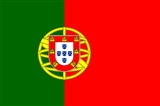
Portugal officially the Portuguese Republic is a country situated in southwestern
EuropeEurope is, by convention, one of the world's seven continents. Comprising the westernmost peninsula of Eurasia, Europe is generally 'divided' from Asia to its east by the watershed divides of the Ural and Caucasus Mountains, the Ural River, the Caspian and Black Seas, and the waterways connecting...
on the
Iberian PeninsulaThe Iberian Peninsula , sometimes called Iberia, is located in the extreme southwest of Europe and includes the modern-day sovereign states of Spain, Portugal and Andorra, as well as the British Overseas Territory of Gibraltar...
. Portugal is the westernmost country of Europe, and is bordered by the
Atlantic OceanThe Atlantic Ocean is the second-largest of the world's oceanic divisions. With a total area of about , it covers approximately 20% of the Earth's surface and about 26% of its water surface area...
to the West and South and by
SpainSpain , officially the Kingdom of Spain languages]] under the European Charter for Regional or Minority Languages. In each of these, Spain's official name is as follows:;;;;;;), is a country and member state of the European Union located in southwestern Europe on the Iberian Peninsula...
to the North and East. The Atlantic
archipelagoAn archipelago , sometimes called an island group, is a chain or cluster of islands. The word archipelago is derived from the Greek ἄρχι- – arkhi- and πέλαγος – pélagos through the Italian arcipelago...
s of the
AzoresThe Archipelago of the Azores is composed of nine volcanic islands situated in the middle of the North Atlantic Ocean, and is located about west from Lisbon and about east from the east coast of North America. The islands, and their economic exclusion zone, form the Autonomous Region of the...
and
MadeiraMadeira is a Portuguese archipelago that lies between and , just under 400 km north of Tenerife, Canary Islands, in the north Atlantic Ocean and an outermost region of the European Union...
are part of Portugal. The country is named after its second largest city,
PortoPorto , also known as Oporto in English, is the second largest city in Portugal and one of the major urban areas in the Iberian Peninsula. Its administrative limits include a population of 237,559 inhabitants distributed within 15 civil parishes...
, whose Latin name was
Portus Cale.
The land within the borders of today's Portuguese Republic has been continuously settled since
prehistoric timesThe prehistory of the Iberian peninsula begins with the arrival of the first hominins 1.2 million years ago and ends with the Punic Wars, when the territory enters the domains of written history...
: occupied by Celts like the Gallaeci and the
LusitaniansThe Lusitanians were an Indo-European people living in the Western Iberian Peninsula long before it became the Roman province of Lusitania . They spoke the Lusitanian language which might have been Celtic. The modern Portuguese people see the Lusitanians as their ancestors...
, integrated into the
Roman RepublicThe Roman Republic was the period of the ancient Roman civilization where the government operated as a republic. It began with the overthrow of the Roman monarchy, traditionally dated around 508 BC, and its replacement by a government headed by two consuls, elected annually by the citizens and...
and later settled by Germanic peoples such as the
SuebiThe Suebi or Suevi were a group of Germanic peoples who were first mentioned by Julius Caesar in connection with Ariovistus' campaign, c...
and the Visigoths, in the 8th century the lands were conquered by
MoorsThe description Moors has referred to several historic and modern populations of the Maghreb region who are predominately of Berber and Arab descent. They came to conquer and rule the Iberian Peninsula for nearly 800 years. At that time they were Muslim, although earlier the people had followed...
. During the Christian
ReconquistaThe Reconquista was a period of almost 800 years in the Middle Ages during which several Christian kingdoms succeeded in retaking the Muslim-controlled areas of the Iberian Peninsula broadly known as Al-Andalus...
, Portugal established itself as an independent kingdom from
LeónThe Kingdom of León was an independent kingdom situated in the northwest region of the Iberian Peninsula. It was founded in AD 910 when the Christian princes of Asturias along the northern coast of the peninsula shifted their capital from Oviedo to the city of León...
, claiming to be the oldest European
nation-stateThe nation state is a state that self-identifies as deriving its political legitimacy from serving as a sovereign entity for a nation as a sovereign territorial unit. The state is a political and geopolitical entity; the nation is a cultural and/or ethnic entity...
.
In the 15th and 16th centuries, as the result of pioneering the
Age of DiscoveryThe Age of Discovery, also known as the Age of Exploration and the Great Navigations , was a period in history starting in the early 15th century and continuing into the early 17th century during which Europeans engaged in intensive exploration of the world, establishing direct contacts with...
, Portugal expanded western influence and established a
global empireThe Portuguese Empire , also known as the Portuguese Overseas Empire or the Portuguese Colonial Empire , was the first global empire in history...
that included possessions in
AfricaAfrica is the world's second largest and second most populous continent, after Asia. At about 30.2 million km² including adjacent islands, it covers 6% of the Earth's total surface area and 20.4% of the total land area...
,
AsiaAsia is the world's largest and most populous continent, located primarily in the eastern and northern hemispheres. It covers 8.7% of the Earth's total surface area and with approximately 3.879 billion people, it hosts 60% of the world's current human population...
,
OceaniaOceania is a region centered on the islands of the tropical Pacific Ocean. Conceptions of what constitutes Oceania range from the coral atolls and volcanic islands of the South Pacific to the entire insular region between Asia and the Americas, including Australasia and the Malay Archipelago...
, and
South AmericaSouth America is a continent situated in the Western Hemisphere, mostly in the Southern Hemisphere, with a relatively small portion in the Northern Hemisphere. The continent is also considered a subcontinent of the Americas. It is bordered on the west by the Pacific Ocean and on the north and east...
, becoming one of the world's major economic, political and military powers. The
Portuguese EmpireThe Portuguese Empire , also known as the Portuguese Overseas Empire or the Portuguese Colonial Empire , was the first global empire in history...
was the first global empire in history, and also the longest lived of the European colonial empires, spanning almost 600 years, from the capture of
CeutaCeuta is an autonomous city of Spain and an exclave located on the north coast of North Africa surrounded by Morocco. Separated from the Iberian peninsula by the Strait of Gibraltar, Ceuta lies on the border of the Mediterranean Sea and the Atlantic Ocean. Ceuta along with the other Spanish...
in 1415, to the handover of
MacauMacau , also spelled Macao , is, along with Hong Kong, one of the two special administrative regions of the People's Republic of China...
to
ChinaChina , officially the People's Republic of China , is the most populous country in the world, with over 1.3 billion citizens. Located in East Asia, the country covers approximately 9.6 million square kilometres...
in 1999. However, the country's international status was greatly reduced during the 19th century, especially following the independence of Brazil, its largest colony.
After the 1910 revolution deposed the monarchy, the democratic but unstable
Portuguese First RepublicThe Portuguese First Republic spans a complex 16 year period in the history of Portugal, between the end of the period of constitutional monarchy marked by the 5 October 1910 revolution and the 28 May coup d'état of 1926...
was established being then superseded by the
"Estado Novo" authoritarian regime. Democracy was restored after the
Portuguese Colonial WarThe Portuguese Colonial War , also known in Portugal as the Overseas War or in the former colonies as the War of liberation , was fought between Portugal's military and the emerging nationalist movements in Portugal's African colonies between 1961 and 1974, when the Portuguese regime was...
and the
Carnation RevolutionThe Carnation Revolution , also referred to as the 25 de Abril , was a military coup started on 25 April 1974, in Lisbon, Portugal, coupled with an unanticipated and extensive campaign of civil resistance...
in 1974, after which Portugal's last overseas provinces became independent (most prominently Angola and Mozambique); the last overseas territory,
MacauMacau , also spelled Macao , is, along with Hong Kong, one of the two special administrative regions of the People's Republic of China...
, was ceded to
ChinaChina , officially the People's Republic of China , is the most populous country in the world, with over 1.3 billion citizens. Located in East Asia, the country covers approximately 9.6 million square kilometres...
in 1999.
Portugal is a
developed countryA developed country is a country that has a high level of development according to some criteria. Which criteria, and which countries are classified as being developed, is a contentious issue...
with an advanced and high-income economy, with a very high Human Development Index. It has the world's 19th-highest
quality-of-lifeThe Economist Intelligence Unit’s quality-of-life index is based on a unique methodology that links the results of subjective life-satisfaction surveys to the objective determinants of quality of life across countries...
, one of the top health care systems, and it's also one of the world's most
globalizedThis article includes a list of countries of the world sorted by their globalization, the global connectivity, integration and interdependence in the economic, social, technological, cultural, political, and ecological spheres....
and
peacefulThe Global Peace Index is an attempt to measure the relative position of nations' and regions' peacefulness. It is the product of Institute for Economics and Peace and developed in consultation with an international panel of peace experts from peace institutes and think tanks with data collected...
nations. A member of the
European UnionThe European Union is an economic and political union of 27 independent member states which are located primarily in Europe. The EU traces its origins from the European Coal and Steel Community and the European Economic Community , formed by six countries in 1958...
and the
United NationsThe United Nations is an international organization whose stated aims are facilitating cooperation in international law, international security, economic development, social progress, human rights, and achievement of world peace...
, it is as well a founding member of the
Latin UnionThe Latin Union is an international organization of nations that use Romance languages, with the aim of protecting, projecting, and promoting the common cultural heritage and unifying identities of the Latin, and Latin-influenced, world. It was created in 1954 in Madrid, Spain, and has existed as a...
, the
Organization of Ibero-American StatesThe Organization of Ibero-American States is an intergovernmental organization, comprising the Portuguese- and Spanish-speaking nations of America and Europe, plus Equatorial Guinea in Africa....
, OECD,
NATO,
Community of Portuguese Language Countries, the
EurozoneThe eurozone , officially called the euro area, is an economic and monetary union of seventeen European Union member states that have adopted the euro as their common currency and sole legal tender...
and the
Schengen AgreementThe Schengen Agreement is a treaty signed on 14 June 1985 near the town of Schengen in Luxembourg, between five of the ten member states of the European Economic Community. It was supplemented by the Convention implementing the Schengen Agreement 5 years later...
.
Early history
The early history of Portugal is shared with the rest of the
Iberian PeninsulaThe Iberian Peninsula , sometimes called Iberia, is located in the extreme southwest of Europe and includes the modern-day sovereign states of Spain, Portugal and Andorra, as well as the British Overseas Territory of Gibraltar...
. The name of Portugal derives from the Roman name
Portus CalePortus Cale was the old name of an ancient town and port in current day Portugal. It was located in the north of Portugal, in the area of today's Grande Porto.-Early History:...
. The region was
settledThis is a list of the Pre-Roman peoples of the Iberian peninsula .-Non-Indo-European:*Aquitanians**Aquitani**Autrigones - some consider them Celtic .**Caristii - some consider them Celtic ....
by Pre-Celts and Celts, giving origin to peoples like the Gallaeci,
LusitaniansThe Lusitanians were an Indo-European people living in the Western Iberian Peninsula long before it became the Roman province of Lusitania . They spoke the Lusitanian language which might have been Celtic. The modern Portuguese people see the Lusitanians as their ancestors...
,
Celtici]The Celtici were a Celtic tribe or group of tribes of the Iberian peninsula, inhabiting three definite areas: in what today are the provinces of Alentejo and the Algarve in Portugal; in the Province of Badajoz and north of Province of Huelva in Spain, in the ancient Baeturia; and along the...
and
CynetesThe Cynetes or Conii were one of the pre-Roman peoples of the Iberian Peninsula, living in today's Algarve and Low Alentejo regions of southern Portugal before the 6th century BCE .They are often mentioned in the ancient sources under various designations, mostly Greek or Latin derivatives of their...
, visited by Phoenicians and Carthaginians, incorporated in the
Roman RepublicThe Roman Republic was the period of the ancient Roman civilization where the government operated as a republic. It began with the overthrow of the Roman monarchy, traditionally dated around 508 BC, and its replacement by a government headed by two consuls, elected annually by the citizens and...
dominions as
LusitaniaLusitania or Hispania Lusitania was an ancient Roman province including approximately all of modern Portugal south of the Douro river and part of modern Spain . It was named after the Lusitani or Lusitanian people...
and part of
GallaeciaGallaecia or Callaecia, also known as Hispania Gallaecia, was the name of a Roman province and an early Mediaeval kingdom that comprised a territory in the north-west of Hispania...
(both part of
HispaniaAnother theory holds that the name derives from Ezpanna, the Basque word for "border" or "edge", thus meaning the farthest area or place. Isidore of Sevilla considered Hispania derived from Hispalis....
), after 45 BC until 298 AD, settled again by
SuebiThe Suebi or Suevi were a group of Germanic peoples who were first mentioned by Julius Caesar in connection with Ariovistus' campaign, c...
,
BuriThe Buri were a Germanic tribe mentioned in the Germania of Tacitus, where they initially "close the back" of the Marcomanni and Quadi of Bohemia and Moravia. It is said that their speech and customs were like those of the Suebi...
, and Visigoths, and conquered by
MoorsThe description Moors has referred to several historic and modern populations of the Maghreb region who are predominately of Berber and Arab descent. They came to conquer and rule the Iberian Peninsula for nearly 800 years. At that time they were Muslim, although earlier the people had followed...
. Other minor influences include some 5th century vestiges of
AlanThe Alans, or the Alani, occasionally termed Alauni or Halani, were a group of Sarmatian tribes, nomadic pastoralists of the 1st millennium AD who spoke an Eastern Iranian language which derived from Scytho-Sarmatian and which in turn evolved into modern Ossetian.-Name:The various forms of Alan —...
settlement, which were found in Alenquer,
CoimbraCoimbra is a city in the municipality of Coimbra in Portugal. Although it served as the nation's capital during the High Middle Ages, it is better-known for its university, the University of Coimbra, which is one of the oldest in Europe and the oldest academic institution in the...
and even
LisbonLisbon is the capital city and largest city of Portugal with a population of 545,245 within its administrative limits on a land area of . The urban area of Lisbon extends beyond the administrative city limits with a population of 3 million on an area of , making it the 9th most populous urban...
.
Reconquista
During the
ReconquistaThe Reconquista was a period of almost 800 years in the Middle Ages during which several Christian kingdoms succeeded in retaking the Muslim-controlled areas of the Iberian Peninsula broadly known as Al-Andalus...
period, Christians reconquered the Iberian Peninsula from the Muslim and
MoorishThe description Moors has referred to several historic and modern populations of the Maghreb region who are predominately of Berber and Arab descent. They came to conquer and rule the Iberian Peninsula for nearly 800 years. At that time they were Muslim, although earlier the people had followed...
domination. In 868, the First County of Portugal was formed.
A victory over the Muslims at
Battle of OuriqueThe Battle of Ourique saw the forces of Portuguese Prince Afonso Henriques defeat the Almoravid Moors led by Ali ibn Yusuf.-Background:...
in 1139 is traditionally taken as the occasion when the
County of PortugalThe County of Portugal was the region around Braga and Porto, today corresponding to littoral northern Portugal, from the late ninth to the early twelfth century, during which it was held in vassalage from the Kingdom of León.-History:...
as a fief of the
Kingdom of LeónThe Kingdom of León was an independent kingdom situated in the northwest region of the Iberian Peninsula. It was founded in AD 910 when the Christian princes of Asturias along the northern coast of the peninsula shifted their capital from Oviedo to the city of León...
was transformed into the independent
Kingdom of PortugalThe Kingdom of Portugal was Portugal's general designation under the monarchy. The kingdom was located in the west of the Iberian Peninsula, Europe and existed from 1139 to 1910...
.
Henry, to whom the newly formed county was awarded by Alfonso VI for his role in reconquering land from the Moors, based his newly formed county in Bracara Augusta (nowadays
BragaBraga , a city in the Braga Municipality in northwestern Portugal, is the capital of the Braga District, the oldest archdiocese and the third major city of the country. Braga is the oldest Portuguese city and one of the oldest Christian cities in the World...
), capital city of the ancient Roman province, and also previous capital of several kingdoms over the first millennia.
On 24 June 1128, the
Battle of São Mamede occurred near
GuimarãesGuimarães Municipality is located in northwestern Portugal in the province of Minho and in the Braga District. It contains the city of Guimarães.The present Mayor is António Magalhães Silva, elected by the Socialist Party.-Parishes:-Economy:...
.
Afonso HenriquesAfonso I or Dom Afonso Henriques , more commonly known as Afonso Henriques , nicknamed "the Conqueror" , "the Founder" or "the Great" by the Portuguese, and El-Bortukali and Ibn-Arrik by the Moors whom he fought, was the first King of Portugal...
, Count of Portugal, defeated his mother Countess Teresa and her lover
Fernão Peres de TravaFernando or Fernán Pérez de Traba , also Fernão Peres de Trava in Galician-Portuguese, was a nobleman and count of the Kingdom of León who for a time held power over all Galicia. He became the lover of Countess Teresa of Portugal, through whom he attained great influence in that realm, and was de...
, thereby establishing himself as sole leader. Afonso Henriques officially declared Portugal's independence when he proclaimed himself
king of Portugal on 25 July 1139, after the
Battle of OuriqueThe Battle of Ourique saw the forces of Portuguese Prince Afonso Henriques defeat the Almoravid Moors led by Ali ibn Yusuf.-Background:...
. He was recognized as such in 1143 by
Alfonso VIIAlfonso VII , born Alfonso Raimúndez, called the Emperor , became the King of Galicia in 1111 and King of León and Castile in 1126. Alfonso first used the title Emperor of All Spain, alongside his mother Urraca, once his mother vested him with the direct rule of Toledo in 1116...
, king of León and Castile, and in 1179 by
Pope Alexander IIIPope Alexander III , born Rolando of Siena, was Pope from 1159 to 1181. He is noted in history for laying the foundation stone for the Notre Dame de Paris.-Church career:...
.
Afonso Henriques and his successors, aided by military
monastic ordersChristian monasticism is a practice which began to develop early in the history of the Christian Church, modeled upon scriptural examples and ideals, including those in the Old Testament, but not mandated as an institution in the scriptures. It has come to be regulated by religious rules Christian...
, pushed southward to drive out the Moors, as the size of Portugal covered about half of its present area. In 1249, this
ReconquistaThe Reconquista was a period of almost 800 years in the Middle Ages during which several Christian kingdoms succeeded in retaking the Muslim-controlled areas of the Iberian Peninsula broadly known as Al-Andalus...
ended with the capture of the
Algarve on the southern coast, giving Portugal its present-day borders, with minor exceptions.
In 1348 and 1349, like the rest of Europe, Portugal was devastated by the
Black DeathThe Black Death was one of the most devastating pandemics in human history, peaking in Europe between 1348 and 1350. Of several competing theories, the dominant explanation for the Black Death is the plague theory, which attributes the outbreak to the bacterium Yersinia pestis. Thought to have...
.
In 1373, Portugal made an
alliance with EnglandThe Anglo-Portuguese Alliance, ratified at the Treaty of Windsor in 1386, between England and Portugal is claimed to be the oldest alliance in the world which is still in force — with the earliest treaty dating back to the Anglo-Portuguese Treaty of 1373.This alliance, which goes back to the...
, which is the longest-standing alliance in the world.
In 1383, the king of
CastileKingdom of Castile was one of the medieval kingdoms of the Iberian Peninsula. It emerged as a political autonomous entity in the 9th century. It was called County of Castile and was held in vassalage from the Kingdom of León. Its name comes from the host of castles constructed in the region...
, husband of the daughter of the Portuguese king who had died without a male heir, claimed his throne. An ensuing popular revolt led to the 1383-1385 Crisis. A faction of petty noblemen and commoners, led by John of Aviz (later
John IJohn I KG , called the Good or of Happy Memory, more rarely and outside Portugal the Bastard, was the tenth King of Portugal and the Algarve and the first to use the title Lord of Ceuta...
), seconded by General
Nuno Álvares PereiraDom Nuno Álvares Pereira, O. Carm. , also spelled Nun'Álvares Pereira, was a Portuguese general of great success who had a decisive role in the 1383-1385 Crisis that assured Portugal's independence from Castile...
defeated the Castilians in the
Battle of AljubarrotaThe Battle of Aljubarrota was a battle fought between the Kingdom of Portugal and the Crown of Castile on 14 August 1385. Forces commanded by King John I of Portugal and his general Nuno Álvares Pereira, with the support of English allies, opposed the army of King John I of Castile with its...
. This celebrated battle is still a symbol of glory and the struggle for independence from neighboring Spain.
Exploration, colonization and trade
In the following decades, Portugal spearheaded the exploration of the world and undertook the
Age of DiscoveryThe Age of Discovery, also known as the Age of Exploration and the Great Navigations , was a period in history starting in the early 15th century and continuing into the early 17th century during which Europeans engaged in intensive exploration of the world, establishing direct contacts with...
.
Infante DomDom is a title of respect prefixed to the given name. It derives from Latin Dominus.It is used in English for certain Benedictine and Carthusian monks, and for members of certain communities of Canons Regular. Examples include Benedictine monks of the English Benedictine Congregation...
Henry the Navigator, son of King João I, became the main sponsor and patron of this endeavor.
In 1415, Portugal conquered the first of its overseas colonies by conquering
CeutaCeuta is an autonomous city of Spain and an exclave located on the north coast of North Africa surrounded by Morocco. Separated from the Iberian peninsula by the Strait of Gibraltar, Ceuta lies on the border of the Mediterranean Sea and the Atlantic Ocean. Ceuta along with the other Spanish...
. It was the first prosperous Islamic trade center in North
AfricaAfrica is the world's second largest and second most populous continent, after Asia. At about 30.2 million km² including adjacent islands, it covers 6% of the Earth's total surface area and 20.4% of the total land area...
. There followed the first discoveries in the Atlantic:
MadeiraMadeira is a Portuguese archipelago that lies between and , just under 400 km north of Tenerife, Canary Islands, in the north Atlantic Ocean and an outermost region of the European Union...
and the
AzoresThe Archipelago of the Azores is composed of nine volcanic islands situated in the middle of the North Atlantic Ocean, and is located about west from Lisbon and about east from the east coast of North America. The islands, and their economic exclusion zone, form the Autonomous Region of the...
, which led to the first
colonizationColonialism is the establishment, maintenance, acquisition and expansion of colonies in one territory by people from another territory. It is a process whereby the metropole claims sovereignty over the colony and the social structure, government, and economics of the colony are changed by...
movements.
Throughout the 15th century, Portuguese explorers sailed the coast of Africa, establishing trading posts for several common types of tradable commodities at the time, ranging from
goldGold is a chemical element with the symbol Au and an atomic number of 79. Gold is a dense, soft, shiny, malleable and ductile metal. Pure gold has a bright yellow color and luster traditionally considered attractive, which it maintains without oxidizing in air or water. Chemically, gold is a...
to
slavesSlavery is a system under which people are treated as property to be bought and sold, and are forced to work. Slaves can be held against their will from the time of their capture, purchase or birth, and deprived of the right to leave, to refuse to work, or to demand compensation...
, as they looked for a route to
IndiaIndia , officially the Republic of India , is a country in South Asia. It is the seventh-largest country by geographical area, the second-most populous country with over 1.2 billion people, and the most populous democracy in the world...
and its spices, which were coveted in Europe.
The
Treaty of TordesillasThe Treaty of Tordesillas , signed at Tordesillas , , divided the newly discovered lands outside Europe between Spain and Portugal along a meridian 370 leagueswest of the Cape Verde islands...
, intended to resolve the dispute that had been created following the return of
Christopher ColumbusChristopher Columbus was an explorer, colonizer, and navigator, born in the Republic of Genoa, in northwestern Italy. Under the auspices of the Catholic Monarchs of Spain, he completed four voyages across the Atlantic Ocean that led to general European awareness of the American continents in the...
, was signed on 7 June 1494, and divided the newly discovered lands outside Europe between Portugal and Spain along a meridian 370 leagues west of the
Cape VerdeThe Republic of Cape Verde is an island country, spanning an archipelago of 10 islands located in the central Atlantic Ocean, 570 kilometres off the coast of Western Africa...
islands (off the west coast of Africa).
In 1498,
Vasco da GamaVasco da Gama, 1st Count of Vidigueira was a Portuguese explorer, one of the most successful in the Age of Discovery and the commander of the first ships to sail directly from Europe to India...
finally reached India and brought
economic prosperity to PortugalThe economic history of Portugal covers the development of the economy throughout the course of Portuguese history. It has its roots prior to nationality, when Roman occupation developed a thriving economy in Hispania, in the provinces of Lusitania and Gallaecia, as producers and exporters to the...
and its population of 1.7 million residents.
In 1500,
Pedro Álvares CabralPedro Álvares Cabral was a Portuguese noble, military commander, navigator and explorer regarded as the discoverer of Brazil. Cabral conducted the first substantial exploration of the northeast coast of South America and claimed it for Portugal. While details of Cabral's early life are sketchy, it...
discovered
BrazilBrazil , officially the Federative Republic of Brazil , is the largest country in South America. It is the world's fifth largest country, both by geographical area and by population with over 192 million people...
and claimed it for Portugal. Ten years later,
Afonso de AlbuquerqueAfonso de Albuquerque[p][n] was a Portuguese fidalgo, or nobleman, an admiral whose military and administrative activities as second governor of Portuguese India conquered and established the Portuguese colonial empire in the Indian Ocean...
conquered
GoaGoa , a former Portuguese colony, is India's smallest state by area and the fourth smallest by population. Located in South West India in the region known as the Konkan, it is bounded by the state of Maharashtra to the north, and by Karnataka to the east and south, while the Arabian Sea forms its...
, in
IndiaIndia , officially the Republic of India , is a country in South Asia. It is the seventh-largest country by geographical area, the second-most populous country with over 1.2 billion people, and the most populous democracy in the world...
, Ormuz in the Persian Strait, and
MalaccaMalacca , dubbed The Historic State or Negeri Bersejarah among locals) is the third smallest Malaysian state, after Perlis and Penang. It is located in the southern region of the Malay Peninsula, on the Straits of Malacca. It borders Negeri Sembilan to the north and the state of Johor to the south...
, now a
stateMalaysia is a federation which consists of thirteen states and three federal territories . Eleven states and two federal territories are located on the Malay Peninsula while the remaining two states and one federal territory are on the island of Borneo.-The states and federal territories:Malaysia...
in
Malaysia. Thus, the Portuguese empire held dominion over commerce in the
Indian OceanThe Indian Ocean is the third largest of the world's oceanic divisions, covering approximately 20% of the water on the Earth's surface. It is bounded on the north by the Indian Subcontinent and Arabian Peninsula ; on the west by eastern Africa; on the east by Indochina, the Sunda Islands, and...
and South Atlantic. The Portuguese sailors set out to reach Eastern Asia by sailing eastward from Europe landing in such places as
TaiwanTaiwan , also known, especially in the past, as Formosa , is the largest island of the same-named island group of East Asia in the western Pacific Ocean and located off the southeastern coast of mainland China. The island forms over 99% of the current territory of the Republic of China following...
,
JapanJapan is an island nation in East Asia. Located in the Pacific Ocean, it lies to the east of the Sea of Japan, China, North Korea, South Korea and Russia, stretching from the Sea of Okhotsk in the north to the East China Sea and Taiwan in the south...
, the island of
TimorTimor is an island at the southern end of Maritime Southeast Asia, north of the Timor Sea. It is divided between the independent state of East Timor, and West Timor, belonging to the Indonesian province of East Nusa Tenggara. The island's surface is 30,777 square kilometres...
, and may have been the first Europeans to discover
AustraliaAustralia , officially the Commonwealth of Australia, is a country in the Southern Hemisphere comprising the mainland of the Australian continent, the island of Tasmania, and numerous smaller islands in the Indian and Pacific Oceans. It is the world's sixth-largest country by total area...
and even
New ZealandNew Zealand is an island country in the south-western Pacific Ocean comprising two main landmasses and numerous smaller islands. The country is situated some east of Australia across the Tasman Sea, and roughly south of the Pacific island nations of New Caledonia, Fiji, and Tonga...
.
The Treaty of Zaragoza, signed on 22 April 1529 between Portugal and Spain, specified the antimeridian to the line of demarcation specified in the Treaty of Tordesillas.
All these facts made Portugal the world's major economic, military, and political power from the 15th century to the beginning of the 16th century.
Iberian Union and Restoration
Portugal's independence was interrupted between 1580 and 1640. This occurred because the last two kings of the
House of AvizThe House of Aviz is a dynasty of kings of Portugal. In 1385, the Interregnum of the 1383-1385 crisis ended with the acclamation of the Master of the Order of Aviz, John, natural son of king Peter I and Dona Teresa Lourenço as king...
– King
SebastianSebastian "the Desired" was the 16th king of Portugal and the Algarves. He was the son of Prince John of Portugal and his wife, Joan of Spain...
, who died in the
battle of Alcácer QuibirThe Battle of Ksar El Kebir, also known as Battle of Three Kings, or "Battle of Oued El Makhazeen" in Morocco, and Battle of Alcácer Quibir in Portugal , was fought in northern Morocco, near the town of Ksar-el-Kebir and Larache, on 4 August 1578...
in
MoroccoMorocco , officially the Kingdom of Morocco , is a country located in North Africa. It has a population of more than 32 million and an area of 710,850 km², and also primarily administers the disputed region of the Western Sahara...
, and his great-uncle and successor, King Henry of Portugal – both died without heirs, resulting in the extinction of that royal house. Subsequently,
Philip II of SpainPhilip II was King of Spain, Portugal, Naples, Sicily, and, while married to Mary I, King of England and Ireland. He was lord of the Seventeen Provinces from 1556 until 1581, holding various titles for the individual territories such as duke or count....
claimed the throne and so became Philip I of Portugal. Although Portugal did not lose its formal independence, it was governed by the same monarch who governed
SpainThe Spanish Empire comprised territories and colonies administered directly by Spain in Europe, in America, Africa, Asia and Oceania. It originated during the Age of Exploration and was therefore one of the first global empires. At the time of Habsburgs, Spain reached the peak of its world power....
, briefly forming a
unionThe Iberian union was a political unit that governed all of the Iberian Peninsula south of the Pyrenees from 1580–1640, through a dynastic union between the monarchies of Portugal and Spain after the War of the Portuguese Succession...
of kingdoms, as a
personal unionA personal union is the combination by which two or more different states have the same monarch while their boundaries, their laws and their interests remain distinct. It should not be confused with a federation which is internationally considered a single state...
.
The joining of the two crowns deprived Portugal of a separate foreign policy, and led to the involvement in the Eighty Years' War being fought in Europe at the time between
SpainSpain , officially the Kingdom of Spain languages]] under the European Charter for Regional or Minority Languages. In each of these, Spain's official name is as follows:;;;;;;), is a country and member state of the European Union located in southwestern Europe on the Iberian Peninsula...
and the
NetherlandsThe Netherlands is a constituent country of the Kingdom of the Netherlands, located mainly in North-West Europe and with several islands in the Caribbean. Mainland Netherlands borders the North Sea to the north and west, Belgium to the south, and Germany to the east, and shares maritime borders...
. War led to a deterioration of the relations with
Portugal's oldest ally, EnglandThe Anglo-Portuguese Alliance, ratified at the Treaty of Windsor in 1386, between England and Portugal is claimed to be the oldest alliance in the world which is still in force — with the earliest treaty dating back to the Anglo-Portuguese Treaty of 1373.This alliance, which goes back to the...
, and the loss of Hormuz. From 1595 to 1663 the
Dutch-Portuguese WarThe Dutch–Portuguese War was an armed conflict involving Dutch forces, in the form of the Dutch East India Company and the Dutch West India Company, against the Portuguese Empire. Beginning in 1602, the conflict primarily involved the Dutch companies invading Portuguese colonies in the Americas,...
primarily involved the Dutch companies invading many Portuguese colonies and commercial interests in Brazil, Africa, India and the Far East, resulting in the loss of the Portuguese Indian Sea trade monopoly.
In 1640,
John IV|-|John IV was the King of Portugal and the Algarves from 1640 to his death. He was the grandson of Catherine, Duchess of Braganza, who had in 1580 claimed the Portuguese crown and sparked the struggle for the throne of Portugal. John was nicknamed John the Restorer...
spearheaded an uprising backed by disgruntled nobles and was proclaimed king. The
Portuguese Restoration WarPortuguese Restoration War was the name given by nineteenth-century 'romantic' historians to the war between Portugal and Spain that began with the Portuguese revolution of 1640 and ended with the Treaty of Lisbon . The revolution of 1640 ended the sixty-year period of dual monarchy in Portugal...
between Portugal and Spain on the aftermath of the 1640 revolt, ended the sixty-year period of the
Iberian UnionThe Iberian union was a political unit that governed all of the Iberian Peninsula south of the Pyrenees from 1580–1640, through a dynastic union between the monarchies of Portugal and Spain after the War of the Portuguese Succession...
under the House of Habsburg. This was the beginning of the
House of BraganzaThe Most Serene House of Braganza , an important Portuguese noble family, ruled the Kingdom of Portugal and its colonial Empire, from 1640 to 1910...
, which reigned in Portugal until 1910.
Official estimates - and most estimates made so far - place the number of Portuguese migrants to Colonial Brazil during the gold rush of the XVIII century at 600,000. Though not usually studied, this represented one of the largest movements of European populations to their colonies to the Americas during the colonial times. According to historian
Leslie BethellLeslie Michael Bethell is an English historian, university professor, and Brazilianist who specializes in the study of 19th and 20th Century Latin America, emphasizing on Brazil in particular. He received both his Bachelor of Arts and Doctorate in History at the University of London...
, "In 1700 Portugal had a population of about two million people." During the eighteenth century hundreds of thousands left for the
Portuguese Colony of BrazilIn the history of Brazil, Colonial Brazil, officially the Viceroyalty of Brazil comprises the period from 1500, with the arrival of the Portuguese, until 1815, when Brazil was elevated to kingdom alongside Portugal as the United Kingdom of Portugal, Brazil and the Algarves.During the over 300 years...
, despite efforts by the crown to place severe restrictions on emigration.
Pombaline era
In 1738, Sebastião José de Carvalho e Melo, the talented son of a Lisbon squire, began a diplomatic career as the Portuguese
AmbassadorAn ambassador is the highest ranking diplomat who represents a nation and is usually accredited to a foreign sovereign or government, or to an international organization....
in
LondonLondon is the capital city of :England and the :United Kingdom, the largest metropolitan area in the United Kingdom, and the largest urban zone in the European Union by most measures. Located on the River Thames, London has been a major settlement for two millennia, its history going back to its...
and later in
ViennaVienna is the capital and largest city of the Republic of Austria and one of the nine states of Austria. Vienna is Austria's primary city, with a population of about 1.723 million , and is by far the largest city in Austria, as well as its cultural, economic, and political centre...
. The
Queen consortA queen consort is the wife of a reigning king. A queen consort usually shares her husband's rank and holds the feminine equivalent of the king's monarchical titles. Historically, queens consort do not share the king regnant's political and military powers. Most queens in history were queens consort...
of Portugal,
Archduchess Maria Anne Josefa of AustriaMaria Anna of Austria was an Archduchess of Austria and Queen consort of Portugal. She was also Regent of Portugal from 1742 until 1750 during the illness of her husband King John V of Portugal....
, was fond of Melo; and after his first wife died, she arranged the widowed de Melo's second marriage to the daughter of the Austrian Field Marshal Leopold Josef, Count von Daun. King
John V of Portugal, however, was not pleased and recalled Melo to Portugal in 1749. John V died the following year and his son, Joseph I of Portugal was crowned. In contrast to his father, Joseph I was fond of de Melo, and with the
Queen MotherQueen Mother is a title or position reserved for a widowed queen consort whose son or daughter from that marriage is the reigning monarch. The term has been used in English since at least 1577...
's approval, he appointed Melo as Minister of Foreign Affairs. As the King's confidence in de Melo increased, the King entrusted him with more control of the state. By 1755, Sebastião de Melo was made Prime Minister. Impressed by British economic success he had witnessed while Ambassador, he successfully implemented similar
economicAn economic system is the combination of the various agencies, entities that provide the economic structure that defines the social community. These agencies are joined by lines of trade and exchange along which goods, money etc. are continuously flowing. An example of such a system for a closed...
policies in Portugal. He abolished slavery in Portugal and in the Portuguese colonies in
IndiaIndia , officially the Republic of India , is a country in South Asia. It is the seventh-largest country by geographical area, the second-most populous country with over 1.2 billion people, and the most populous democracy in the world...
; reorganized the army and the navy; restructured the
University of Coimbra, and ended discrimination against different
ChristianA Christian is a person who adheres to Christianity, an Abrahamic, monotheistic religion based on the life and teachings of Jesus of Nazareth as recorded in the Canonical gospels and the letters of the New Testament...
sects in Portugal.
But Sebastião de Melo's greatest reforms were economic and financial, with the creation of several companies and guilds to regulate every commercial activity. He demarcated the region for production of
PortPort wine is a Portuguese fortified wine produced exclusively in the Douro Valley in the northern provinces of Portugal. It is typically a sweet, red wine, often served as a dessert wine, and comes in dry, semi-dry, and white varieties...
to ensure the wine's quality, and this was the first attempt to control wine quality and production in Europe. He ruled with a strong hand by imposing strict law upon all classes of Portuguese society from the high nobility to the poorest working class, along with a widespread review of the country's tax system. These reforms gained him enemies in the upper classes, especially among the high nobility, who despised him as a social upstart.
Disaster fell upon Portugal in the morning of 1 November 1755, when
LisbonLisbon is the capital city and largest city of Portugal with a population of 545,245 within its administrative limits on a land area of . The urban area of Lisbon extends beyond the administrative city limits with a population of 3 million on an area of , making it the 9th most populous urban...
was struck by
a violent earthquakeThe 1755 Lisbon earthquake, also known as the Great Lisbon Earthquake, was a megathrust earthquake that took place on Saturday 1 November 1755, at around 9:40 in the morning. The earthquake was followed by fires and a tsunami, which almost totally destroyed Lisbon in the Kingdom of Portugal, and...
with an estimated
Richter scaleThe expression Richter magnitude scale refers to a number of ways to assign a single number to quantify the energy contained in an earthquake....
magnitude of 9. The city was razed to the ground by the earthquake and the subsequent tsunami and ensuing fires. Sebastião de Melo survived by a stroke of luck and then immediately embarked on rebuilding the city, with his famous quote: "What now? We bury the dead and feed the living."
Despite the calamity and huge
death tollDeath Toll is a 2008 action film starring DMX, Lou Diamond Phillips, Leila Arcieri and Keshia Knight Pulliam, written and produced by Daniel Garcia of the rap group Kane & Abel and directed by Phenomenon...
, Lisbon suffered no epidemics and within less than one year was already being rebuilt. The new downtown of
LisbonLisbon is the capital city and largest city of Portugal with a population of 545,245 within its administrative limits on a land area of . The urban area of Lisbon extends beyond the administrative city limits with a population of 3 million on an area of , making it the 9th most populous urban...
was designed to resist subsequent earthquakes. Architectural models were built for tests, and the effects of an earthquake were simulated by marching troops around the models. The buildings and big squares of the Pombaline Downtown of Lisbon still remain as one of Lisbon's tourist attractions: They represent the world's first quake-proof buildings. Sebastião de Melo also made an important contribution to the study of
seismologySeismology is the scientific study of earthquakes and the propagation of elastic waves through the Earth or through other planet-like bodies. The field also includes studies of earthquake effects, such as tsunamis as well as diverse seismic sources such as volcanic, tectonic, oceanic,...
by designing an inquiry that was sent to every parish in the country.
Following the earthquake,
Joseph I gave his Prime Minister even more power, and Sebastião de Melo became a powerful, progressive dictator. As his power grew, his enemies increased in number, and bitter disputes with the high nobility became frequent. In 1758
Joseph I was wounded in an attempted assassination. The
Távora familyThe Távora affair was a political scandal of the 18th century Portuguese court. The events triggered by the attempted murder of King Joseph I of Portugal in 1758 ended with the public execution of the entire Távora family and its closest relatives in 1759...
and the Duke of Aveiro were implicated and executed after a quick trial. The
JesuitsThe Society of Jesus is a Catholic male religious order that follows the teachings of the Catholic Church. The members are called Jesuits, and are also known colloquially as "God's Army" and as "The Company," these being references to founder Ignatius of Loyola's military background and a...
were expelled from the country and their assets confiscated by the crown. Sebastião de Melo showed no mercy and prosecuted every person involved, even women and children. This was the final stroke that broke the power of the aristocracy and ensured the victory of the Minister against his enemies. Based upon his swift resolve,
Joseph I made his loyal minister Count of Oeiras in 1759.
In 1762
Spain invaded Portuguese territoryThe Spanish-Portuguese War between 1761 and 1763 was fought as part of the Seven Years' War. Because no major battles were fought, even though there were numerous movements of troops, the war is known in the Portuguese history as the Fantastic War , or War of the Pacte de Famille.When the Seven...
as part of the
Seven Years' WarThe Seven Years' War was a global military war between 1756 and 1763, involving most of the great powers of the time and affecting Europe, North America, Central America, the West African coast, India, and the Philippines...
, however by 1763 the status-quo between Spain and Portugal before the war had been restored.
Following the Távora affair, the new Count of Oeiras knew no opposition. Made "Marquis of Pombal" in 1770, he effectively ruled Portugal until
Joseph I's death in 1779. However, historians also argue that Pombal’s "enlightenment," while far-reaching, was primarily a mechanism for enhancing autocracy at the expense of individual liberty and especially an apparatus for crushing opposition, suppressing criticism, and furthering colonial economic exploitation as well as intensifying book censorship and consolidating personal control and profit.
The new ruler, Queen
Maria I of PortugalMaria I was Queen regnant of Portugal and the Algarves from 1777 until her death. Known as Maria the Pious , or Maria the Mad , she was the first undisputed Queen regnant of Portugal...
, disliked the Marquis because of the power he amassed, and never forgave him for the ruthlessness at which he dispatched the
Távora familyThe Távora affair was a political scandal of the 18th century Portuguese court. The events triggered by the attempted murder of King Joseph I of Portugal in 1758 ended with the public execution of the entire Távora family and its closest relatives in 1759...
, and upon her accession to the throne, she did what she had long vowed to do: she withdrew all his political offices. Pombal died peacefully on his estate at
PombalPombal is a town in Pombal Municipality, Portugal. The population of the city is about 16.000 inhabitants....
in 1782.
In the autumn of 1807, Napoleon moved French troops through Spain to invade Portugal. From 1807 to 1811, British-Portuguese forces would successfully fight against the
French invasion of PortugalThe Peninsular War was a war between France and the allied powers of Spain, the United Kingdom, and Portugal for control of the Iberian Peninsula during the Napoleonic Wars. The war began when French and Spanish armies crossed Spain and invaded Portugal in 1807. Then, in 1808, France turned on its...
, while the royal family and the Portuguese
nobilityNobility is a social class which possesses more acknowledged privileges or eminence than members of most other classes in a society, membership therein typically being hereditary. The privileges associated with nobility may constitute substantial advantages over or relative to non-nobles, or may be...
, including Maria I, relocated to the
Portuguese territory of BrazilIn the history of Brazil, Colonial Brazil, officially the Viceroyalty of Brazil comprises the period from 1500, with the arrival of the Portuguese, until 1815, when Brazil was elevated to kingdom alongside Portugal as the United Kingdom of Portugal, Brazil and the Algarves.During the over 300 years...
, at that time a
colonyIn politics and history, a colony is a territory under the immediate political control of a state. For colonies in antiquity, city-states would often found their own colonies. Some colonies were historically countries, while others were territories without definite statehood from their inception....
of the
Portuguese EmpireThe Portuguese Empire , also known as the Portuguese Overseas Empire or the Portuguese Colonial Empire , was the first global empire in history...
, in South America. This episode is known as the
Transfer of the Portuguese Court to BrazilThe Transfer of the Portuguese Court to Brazil was an episode in the history of Portugal and the history of Brazil in which the Portuguese royal family and its court escaped from Lisbon on November 29, 1807 to Brazil, just days before Napoleonic forces captured the city on December 1...
.
Brazilian independence
Portugal began a slow but inexorable decline until the 20th century. This decline was hastened by the independence in 1822 of the country's largest colonial possession,
BrazilIn the history of Brazil, Colonial Brazil, officially the Viceroyalty of Brazil comprises the period from 1500, with the arrival of the Portuguese, until 1815, when Brazil was elevated to kingdom alongside Portugal as the United Kingdom of Portugal, Brazil and the Algarves.During the over 300 years...
. In 1807, as Napoleon Bonaparte's army closed in on Portugal's capital city of
LisbonLisbon is the capital city and largest city of Portugal with a population of 545,245 within its administrative limits on a land area of . The urban area of Lisbon extends beyond the administrative city limits with a population of 3 million on an area of , making it the 9th most populous urban...
, the
Prince RegentA prince regent is a prince who rules a monarchy as regent instead of a monarch, e.g., due to the Sovereign's incapacity or absence ....
João VI of Portugal
transferred his courtThe Transfer of the Portuguese Court to Brazil was an episode in the history of Portugal and the history of Brazil in which the Portuguese royal family and its court escaped from Lisbon on November 29, 1807 to Brazil, just days before Napoleonic forces captured the city on December 1...
to Brazil and established
Rio de JaneiroRio de Janeiro , commonly referred to simply as Rio, is the capital city of the State of Rio de Janeiro, the second largest city of Brazil, and the third largest metropolitan area and agglomeration in South America, boasting approximately 6.3 million people within the city proper, making it the 6th...
as the capital of the Portuguese Empire. In 1815, the Portuguese Empire changed its name to the United Kingdom of Portugal, Brazil and the Algarves.
Due to the change in its status and the arrival of the Portuguese royal family, Brazilian administrative, civic, economical, military, educational, and scientific apparatus were expanded and highly modernized. Portuguese and their allied British troops fought against the French Invasion of Portugal and by 1815 the situation in Europe had cooled down sufficiently that João VI would be able to safely return to Lisbon. However, the King of Portugal remained in Brazil until the
Liberal Revolution of 1820The Liberal Revolution of 1820 was a political revolution that erupted in 1820 and lasted until 1826. It was unchained via a military insurrection in the city of Porto, in northern Portugal, that quickly and peacefully spread to the rest of the country. From 1807 to 1811 Napoleonic French forces...
, which started in
PortoPorto , also known as Oporto in English, is the second largest city in Portugal and one of the major urban areas in the Iberian Peninsula. Its administrative limits include a population of 237,559 inhabitants distributed within 15 civil parishes...
, demanded his return to Lisbon in 1821.
Thus he returned to Portugal but left his son Pedro in charge of Brazil. When the king attempted the following year to return the Kingdom of Brazil to subordinate status as a
principalityA principality is a monarchical feudatory or sovereign state, ruled or reigned over by a monarch with the title of prince or princess, or by a monarch with another title within the generic use of the term prince....
, his son Pedro, with the overwhelming support of the Brazilian elites, declared Brazil's independence from Portugal.
CisplatinaThe Cisplatina Province was a Portuguese and later a Brazilian province in existence from 1815 to 1828...
(today's sovereign state of Uruguay), in the south, was one of the last additions to the territory of Brazil under Portuguese rule.
Colonial Portuguese Africa
At the height of European
colonialismColonialism is the establishment, maintenance, acquisition and expansion of colonies in one territory by people from another territory. It is a process whereby the metropole claims sovereignty over the colony and the social structure, government, and economics of the colony are changed by...
in the 19th century, Portugal had already lost its territory in
South AmericaSouth America is a continent situated in the Western Hemisphere, mostly in the Southern Hemisphere, with a relatively small portion in the Northern Hemisphere. The continent is also considered a subcontinent of the Americas. It is bordered on the west by the Pacific Ocean and on the north and east...
and all but a few bases in
AsiaAsia is the world's largest and most populous continent, located primarily in the eastern and northern hemispheres. It covers 8.7% of the Earth's total surface area and with approximately 3.879 billion people, it hosts 60% of the world's current human population...
.
LuandaLuanda, formerly named São Paulo da Assunção de Loanda, is the capital and largest city of Angola. Located on Angola's coast with the Atlantic Ocean, Luanda is both Angola's chief seaport and its administrative center. It has a population of at least 5 million...
,
BenguelaBenguela is a city in western Angola, south of Luanda, and capital of Benguela Province. It lies on a bay of the same name, in 12° 33’ S., 13° 25’ E...
,
BissauBissau is the capital city of Guinea-Bissau. The city's borders are conterminous with the Bissau Autonomous Sector. In 2007, the city had an estimated population of 407,424 according to the Instituto Nacional de Estatística e Censos...
,
Lourenço MarquesMaputo, also known as Lourenço Marques, is the capital and largest city of Mozambique. It is known as the City of Acacias in reference to acacia trees commonly found along its avenues and the Pearl of the Indian Ocean. It was famous for the inscription "This is Portugal" on the walkway of its...
,
Porto AmboimPorto Amboim is a port town in Angola with a population of 65,000; it comprises an area of 4,638 km². It is connected by an isolated 123 km 610mm narrow gauge railway to Gabela, albeit closed in 1987 due to the civil war and to the abandonment of most coffee plantations, the biggest...
and the
Island of MozambiqueThe Island of Mozambique lies off northern Mozambique, between the Mozambique Channel and Mossuril Bay. It has a population of around 14,000 people and is part of Nampula Province.-History:...
were among the oldest Portuguese-founded port cities in its African territories. During this phase, Portuguese colonialism focused on expanding its outposts in
AfricaAfrica is the world's second largest and second most populous continent, after Asia. At about 30.2 million km² including adjacent islands, it covers 6% of the Earth's total surface area and 20.4% of the total land area...
into nation-sized territories to compete with other European powers there.
With the Conference of Berlin of 1884, Portuguese Africa territories had their borders formally established on request of Portugal in order to protect the centuries-long Portuguese interests in the continent from rivalries enticed by the
Scramble for AfricaThe Scramble for Africa, also known as the Race for Africa or Partition of Africa was a process of invasion, occupation, colonization and annexation of African territory by European powers during the New Imperialism period, between 1881 and World War I in 1914...
. Portuguese Africa's cities and towns like Nova Lisboa,
Sá da BandeiraLubango is the capital city of the Angolan province of Huíla. Its last known population was 100,757. Until 1975, the city's official name was Sá da Bandeira.-Portuguese rule:...
,
Silva PortoKuito is a city located in central Angola. It is the administrative capital of Bié Province. Under Portuguese rule until 1975, it was called Silva Porto. Kuito was under siege in 1993/94 and again in 1998/99 by the rebel forces from UNITA...
,
MalanjeMalanje is the capital city of Malanje Province in Angola with a population of approximately 222,000. Nearby is the spectacular Calandula waterfalls, 85 km from the city. These falls are 105 metres high and their great width makes them the main tourist attraction in the region. It is a...
,
Tete-External links:* *...
, Vila Junqueiro, Vila Pery and Vila Cabral were founded or redeveloped inland during this period and beyond. New coastal towns like
BeiraBeira is the second largest city in Mozambique. It lies in the central region of the country in Sofala Province, where the Pungue River meets the Indian Ocean. Beira had a population of 412,588 in 1997, which grew to an estimated 546,000 in 2006...
,
MoçâmedesNamibe is the capital city of Namibe Province in Angola. It is a coastal desert city located in southwestern Angola and was founded in 1840 by the Portuguese rulers of the territory. The city's current population is 132,900...
,
LobitoLobito is a town and municipality in Benguela Province in Angola.It dates from 1905 and owes its existence to the bay of the same name having been chosen as the sea terminus of the Benguela railway to the far interior, passing through Luau to Katanga in the Democratic Republic of the Congo. The...
, João Belo,
NacalaNacala, also known as Cidade de Nacala or Nacala-Porto is on the northern coast of Mozambique is the deepest natural port on the east coast of Africa. It serves as the terminal for the Nacala Railway, a rail link to the landlocked Malawi...
and Porto Amélia, were also founded. Even before the turn of the century, railway tracks as the
Benguela railway in Angola, and the Beira railway in Mozambique, started to be built to link coastal areas and selected inland regions.
Other episodes during this period of the Portuguese presence in Africa include the 1890 British Ultimatum. This forced the Portuguese military to retreat from the land between the Portuguese colonies of Mozambique and Angola (most of present-day
ZimbabweZimbabwe is a landlocked country located in the southern part of the African continent, between the Zambezi and Limpopo rivers. It is bordered by South Africa to the south, Botswana to the southwest, Zambia and a tip of Namibia to the northwest and Mozambique to the east. Zimbabwe has three...
and
ZambiaZambia , officially the Republic of Zambia, is a landlocked country in Southern Africa. The neighbouring countries are the Democratic Republic of the Congo to the north, Tanzania to the north-east, Malawi to the east, Mozambique, Zimbabwe, Botswana and Namibia to the south, and Angola to the west....
), which had been claimed by Portugal and included in its "
Pink MapThe Pink Map was a document representing Portugal's claim of sovereignty over the land between Angola and Mozambique, which today is currently Zambia, Zimbabwe and Malawi.The Pink Map collided with Sir Cecil Rhodes' "Cape to Cairo Red Line"...
," which clashed with British aspirations to create a Cape to Cairo Railway. The Portuguese territories in Africa were
Cape VerdeThe Republic of Cape Verde is an island country, spanning an archipelago of 10 islands located in the central Atlantic Ocean, 570 kilometres off the coast of Western Africa...
,
São Tomé and PríncipeSão Tomé and Príncipe, officially the Democratic Republic of São Tomé and Príncipe, is a Portuguese-speaking island nation in the Gulf of Guinea, off the western equatorial coast of Central Africa. It consists of two islands: São Tomé and Príncipe, located about apart and about , respectively, off...
,
Portuguese GuineaPortuguese Guinea was the name for what is today Guinea-Bissau from 1446 to September 10, 1974.-History:...
,
AngolaAngola is the common name by which the Portuguese colony in southwestern Africa was known across different periods of time...
, and Mozambique. The tiny fortress of São João Baptista de Ajudá on the coast of
DahomeyDahomey was a country in west Africa in what is now the Republic of Benin. The Kingdom of Dahomey was a powerful west African state that was founded in the seventeenth century and survived until 1894. From 1894 until 1960 Dahomey was a part of French West Africa. The independent Republic of Dahomey...
, was also under Portuguese rule. In addition, the country still ruled the Asian territories of
Portuguese IndiaThe Portuguese Viceroyalty of India , later the Portuguese State of India , was the aggregate of Portugal's colonial holdings in India.The government started in 1505, six years after the discovery of a sea route to India by Vasco da Gama, with the nomination of the first Viceroy Francisco de...
,
Portuguese TimorPortuguese Timor was the name of East Timor when it was under Portuguese control. During this period, Portugal shared the island of Timor with the Netherlands East Indies, and later with Indonesia....
and
MacauMacau , also spelled Macao , is, along with Hong Kong, one of the two special administrative regions of the People's Republic of China...
.
Republic
On 1 February 1908, the king
Carlos I of Portugal-Assassination:On 1 February 1908 the royal family returned from the palace of Vila Viçosa to Lisbon. They travelled by train to Barreiro and, from there, they took a steamer to cross the Tagus River and disembarked at Cais do Sodré in central Lisbon. On their way to the royal palace, the open...
and his
heir apparentAn heir apparent or heiress apparent is a person who is first in line of succession and cannot be displaced from inheriting, except by a change in the rules of succession....
, Prince Luis Filipe,
were murdered in LisbonThe Lisbon Regicide was the name given for the assassinations of King Carlos I of Portugal and his heir, Luis Filipe, the Prince Royal by assassins sympathetic to republican interests...
. Under his rule, Portugal was twice declared bankrupt – on 14 June 1892, and again on 10 May 1902 – causing social turmoil, economic disturbances, protests, revolts and criticism of the monarchy.
Manuel II of PortugalManuel II , named Manuel Maria Filipe Carlos Amélio Luís Miguel Rafael Gabriel Gonzaga Francisco de Assis Eugénio de Bragança Orleães Sabóia e Saxe-Coburgo-Gotha — , was the last King of Portugal from 1908 to 1910, ascending the throne after the assassination of his father and elder brother Manuel...
become the new king, but was eventually overthrown by the
5 October 1910 revolutionThe revolution of 1910 was a republican coup d'état that occurred in Portugal on 5 October 1910, which deposed King Manuel II and established the Portuguese First Republic....
, which abolished the regime and instated
republicanismRepublicanism is the ideology of governing a nation as a republic, where the head of state is appointed by means other than heredity, often elections. The exact meaning of republicanism varies depending on the cultural and historical context...
in Portugal. Political instability and economic weaknesses were fertile ground for chaos and unrest during the
Portuguese First RepublicThe Portuguese First Republic spans a complex 16 year period in the history of Portugal, between the end of the period of constitutional monarchy marked by the 5 October 1910 revolution and the 28 May coup d'état of 1926...
, which aggravated by the Portuguese military intervention in World War I, led to a military coup d'état in 1926 and the creation of the National Dictatorship (
Ditadura NacionalThe Ditadura Nacional was the name of the Portuguese regime initiated by the election of President Óscar Carmona in 1928 that lasted until the adoption of the new constitution in 1933, when the régime changed its name to Estado Novo...
).
This in turn led to the establishment of the right-wing dictatorship of the
Estado Novo under
António de Oliveira SalazarAntónio de Oliveira Salazar, GColIH, GCTE, GCSE served as the Prime Minister of Portugal from 1932 to 1968. He also served as acting President of the Republic briefly in 1951. He founded and led the Estado Novo , the authoritarian, right-wing government that presided over and controlled Portugal...
in 1933. Portugal was one of only five European countries to remain neutral in
World War IIWorld War II, or the Second World War , was a global conflict lasting from 1939 to 1945, involving most of the world's nations—including all of the great powers—eventually forming two opposing military alliances: the Allies and the Axis...
. From the 1940s to the 1960s, Portugal was a founding member of
NATO, OECD and the
European Free Trade AssociationThe European Free Trade Association or EFTA is a free trade organisation between four European countries that operates parallel to, and is linked to, the European Union . EFTA was established on 3 May 1960 as a trade bloc-alternative for European states who were either unable to, or chose not to,...
(EFTA). Gradually, new economic development projects and relocation of white mainland Portuguese citizens into the overseas colonies in Africa were initiated, with
AngolaAngola is the common name by which the Portuguese colony in southwestern Africa was known across different periods of time...
and Mozambique, as the largest and richest overseas territories, being the main targets of those initiatives.
End of colonialism
After
IndiaIndia , officially the Republic of India , is a country in South Asia. It is the seventh-largest country by geographical area, the second-most populous country with over 1.2 billion people, and the most populous democracy in the world...
attained independence in 1947, the residents of
Dadra and Nagar Haveli, with the support of the Indian government and the help of pro-independence organisations, liberated the territories of Dadra and Nagar Haveli from Portuguese rule in 1954. In 1961, São João Baptista de Ajudá's annexation by the
Republic of DahomeyThe Republic of Dahomey was established on December 11, 1958, as a self-governing colony within the French Community. Prior to attaining autonomy it had been French Dahomey, part of the French Union...
was the start of a process that led to the final dissolution of the centuries-old Portuguese Empire. According to the census of 1921 São João Baptista de Ajudá had 5 inhabitants and, at the moment of the ultimatum by the Dahomey Government, it had only 2 inhabitants representing Portuguese Sovereignty. Another forcible retreat from overseas territories occurred in December 1961 when Portugal refused to relinquish the territories of
GoaGoa , a former Portuguese colony, is India's smallest state by area and the fourth smallest by population. Located in South West India in the region known as the Konkan, it is bounded by the state of Maharashtra to the north, and by Karnataka to the east and south, while the Arabian Sea forms its...
,
Daman and Diu. As a result, the Portuguese army and navy were involved in armed conflict in its colony of
Portuguese IndiaThe Portuguese Viceroyalty of India , later the Portuguese State of India , was the aggregate of Portugal's colonial holdings in India.The government started in 1505, six years after the discovery of a sea route to India by Vasco da Gama, with the nomination of the first Viceroy Francisco de...
against the
Indian Armed ForcesThe Indian Armed Forces are the military forces of the Republic of India. They consist of the Army, Navy and Air Force, supported by three paramilitary forces and various inter-service institutions such as the Strategic Forces Command.The President of India is...
. The operations resulted in the defeat of the Portuguese defensive garrison, which was forced to surrender. The outcome was the loss of the remaining Portuguese territories in the
Indian subcontinentThe Indian subcontinent, also Indian Subcontinent, Indo-Pak Subcontinent or South Asian Subcontinent is a region of the Asian continent on the Indian tectonic plate from the Hindu Kush or Hindu Koh, Himalayas and including the Kuen Lun and Karakoram ranges, forming a land mass which extends...
.
Also in the early 1960s, independence movements in the Portuguese overseas provinces of Angola, Mozambique and
GuineaPortuguese Guinea was the name for what is today Guinea-Bissau from 1446 to September 10, 1974.-History:...
in Africa, resulted in the
Portuguese Colonial WarThe Portuguese Colonial War , also known in Portugal as the Overseas War or in the former colonies as the War of liberation , was fought between Portugal's military and the emerging nationalist movements in Portugal's African colonies between 1961 and 1974, when the Portuguese regime was...
(1961–1974).
Carnation Revolution
Throughout the colonial war period Portugal had to deal with increasing dissent, arms embargoes and other punitive sanctions imposed by most of the international community. However, the authoritarian and conservative Estado Novo regime, firstly installed and governed by
António de Oliveira SalazarAntónio de Oliveira Salazar, GColIH, GCTE, GCSE served as the Prime Minister of Portugal from 1932 to 1968. He also served as acting President of the Republic briefly in 1951. He founded and led the Estado Novo , the authoritarian, right-wing government that presided over and controlled Portugal...
and from 1968 onwards led by
Marcelo CaetanoMarcelo José das Neves Alves Caetano, GCTE, GCC, also spelled Marcello Caetano , was a Portuguese politician and scholar, who was the last prime minister of the Estado Novo regime, from 1968 until his overthrow in the Carnation Revolution of 1974....
, tried to preserve a vast centuries-long intercontinental empire with a total area of 2,168,071 km
2. The Portuguese government and army successfully resisted the
decolonizationDecolonization refers to the undoing of colonialism, the unequal relation of polities whereby one people or nation establishes and maintains dependent Territory over another...
of its overseas territories until April 1974, when a bloodless left-wing military coup in
LisbonLisbon is the capital city and largest city of Portugal with a population of 545,245 within its administrative limits on a land area of . The urban area of Lisbon extends beyond the administrative city limits with a population of 3 million on an area of , making it the 9th most populous urban...
, known as the
Carnation RevolutionThe Carnation Revolution , also referred to as the 25 de Abril , was a military coup started on 25 April 1974, in Lisbon, Portugal, coupled with an unanticipated and extensive campaign of civil resistance...
, led the way for the independence of the overseas territories in Africa and Asia, as well as for the restoration of democracy after two years of a transitional period known as PREC (
Processo Revolucionário Em Curso, or On-Going Revolutionary Process). This period was characterized by social turmoil and power disputes between left- and right-wing political forces. Some
factionA political faction is a grouping of individuals, such as a political party, a trade union, or other group with a political purpose. A faction or political party may include fragmented sub-factions, “parties within a party," which may be referred to as power blocs, or voting blocs. The individuals...
s, including
Álvaro CunhalÁlvaro Barreirinhas Cunhal, who used the name Álvaro Cunhal , was a Portuguese politician. He was one of the major opponents of the dictatorial regime of Estado Novo. He served as secretary-general of the Portuguese Communist Party from 1961 to 1992...
's
Partido Comunista Português (PCP), unsuccessfully tried to turn the country into a
communistCommunism is a social, political and economic ideology that aims at the establishment of a classless, moneyless, revolutionary and stateless socialist society structured upon common ownership of the means of production...
state. The retreat from the overseas territories and the acceptance of its independence terms by Portuguese head representatives for overseas negotiations, which would create newly-independent communist states in 1975 (most notably the
People's Republic of AngolaThe People's Republic of Angola was a self-declared socialist state that was established in 1975 after it was granted independence from Portugal, akin to the situation in Mozambique. The newly-founded nation enjoyed friendly relations with the Soviet Union, Cuba, and the People's Republic of...
and the
People's Republic of MozambiqueThe People's Republic of Mozambique , was a self-declared socialist state that lasted from June 25, 1975 through December 1, 1990, becoming the present day Republic of Mozambique.After gaining independence from Portugal in 1975, the People's Republic of Mozambique was established shortly...
), prompted a mass exodus of Portuguese citizens from Portugal's African territories (mostly from Portuguese Angola and Mozambique).
Over a million destitute Portuguese refugees fled the former Portuguese colonies.
Mário SoaresMário Alberto Nobre Lopes Soares, GColTE, GCC, GColL, KE , Portuguese politician, served as Prime Minister of Portugal from 1976 to 1978 and from 1983 to 1985, and subsequently as the 17th President of Portugal from 1986 to 1996.-Family:...
and
António de Almeida SantosAntónio de Almeida Santos, GCL , is a Portuguese lawyer, politician, parliamentary and minister in several occasions.-Career:...
were charged with organising the independence of Portugal's overseas territories. By 1975, all the Portuguese African territories were independent and Portugal held its first democratic elections in 50 years. However, the country continued to be governed by a military-civilian provisional administration until the
Portuguese legislative election of 1976The Portuguese legislative election of 1976 took place on April 25, exactly one year after the previous election, and two years after the Carnation Revolution...
that took place on 25 April, exactly one year after the previous election, and two years after the Carnation Revolution. With a new
ConstitutionThe first Portuguese Constitution was drafted in 1822. Several revolutions led to the constitutions of 1826 , 1838 , 1911 , 1933 , and 1976 ....
approved, the country's main aim was economic recovery and strengthening of the nation's democracy. It was won by the
Portuguese Socialist PartyThe Socialist Party , abbreviated to PS, is a social-democratic political party in Portugal. It was founded on 19 April 1973 in the German city of Bad Münstereifel, by militants from Portuguese Socialist Action ....
(PS) and Mário Soares, its leader, became Prime Minister of the 1st Constitutional Government on 23 July. In the following years, Portugal's economic situation obliged the government to pursue
International Monetary FundThe International Monetary Fund is an organization of 187 countries, working to foster global monetary cooperation, secure financial stability, facilitate international trade, promote high employment and sustainable economic growth, and reduce poverty around the world...
(IMF)-monitored stabilization programs in 1977–78 and 1983–85.
European integration
In 1986, Portugal joined the
European Economic CommunityThe European Economic Community The European Economic Community (EEC) The European Economic Community (EEC) (also known as the Common Market in the English-speaking world, renamed the European Community (EC) in 1993The information in this article primarily covers the EEC's time as an independent...
(EEC) that later became the
European UnionThe European Union is an economic and political union of 27 independent member states which are located primarily in Europe. The EU traces its origins from the European Coal and Steel Community and the European Economic Community , formed by six countries in 1958...
(EU). In the following years Portugal's economy progressed considerably as result of EEC/EU structural and cohesion funds and Portuguese companies' easier access to foreign markets. Portugal's last overseas territory,
MacauMacau , also spelled Macao , is, along with Hong Kong, one of the two special administrative regions of the People's Republic of China...
, was not handed over to the
People's Republic of ChinaChina , officially the People's Republic of China , is the most populous country in the world, with over 1.3 billion citizens. Located in East Asia, the country covers approximately 9.6 million square kilometres...
(PRC) until 1999, under the 1987 joint declaration that set the terms for Macau's handover from Portugal to the PRC. In 2002, the independence of
East TimorThe Democratic Republic of Timor-Leste, commonly known as East Timor , is a state in Southeast Asia. It comprises the eastern half of the island of Timor, the nearby islands of Atauro and Jaco, and Oecusse, an exclave on the northwestern side of the island, within Indonesian West Timor...
(Asia) was formally recognized by Portugal, after an incomplete decolonization process that was started in 1975 because of the Carnation Revolution.
On 26 March 1995, Portugal started to implement
Schengen AreaThe Schengen Area comprises the territories of twenty-five European countries that have implemented the Schengen Agreement signed in the town of Schengen, Luxembourg, in 1985...
rules, eliminating border controls with other Schengen members while simultaneously strengthening border controls with non-member states. In 1996 the country was a co-founder of the
Community of Portuguese Language Countries (CPLP) headquartered in Lisbon.
Expo '98Expo '98 was an official specialised World's Fair held in Lisbon, Portugal from Friday, May 22 to Wednesday, September 30, 1998. The theme of the fair was "The Oceans, a Heritage for the Future," chosen in part to commemorate 500 years of Portuguese discoveries...
took place in Portugal and in 1999 it was one of the founding countries of the
euroThe euro is the official currency of the eurozone: 17 of the 27 member states of the European Union. It is also the currency used by the Institutions of the European Union. The eurozone consists of Austria, Belgium, Cyprus, Estonia, Finland, France, Germany, Greece, Ireland, Italy, Luxembourg,...
and the
EurozoneThe eurozone , officially called the euro area, is an economic and monetary union of seventeen European Union member states that have adopted the euro as their common currency and sole legal tender...
.
On 5 July 2004, José Manuel Barroso, then
Prime Minister of PortugalPrime Minister is the current title of the chief of the Portuguese Government. As chief executive, the Prime Minister coordinates the action of ministers, representing the Government from the other organs of state, accountable to Parliament and keeps the President informed...
, was nominated
President of the European CommissionThe President of the European Commission is the head of the European Commission ― the executive branch of the :European Union ― the most powerful officeholder in the EU. The President is responsible for allocating portfolios to members of the Commission and can reshuffle or dismiss them if needed...
, the most powerful office in the European Union. On 1 December 2009, the
Treaty of LisbonThe Treaty of Lisbon of 1668 was a peace treaty between Portugal and Spain, concluded at Lisbon on 13 February 1668, through the mediation of England, in which Spain recognized the sovereignty of Portugal's new ruling dynasty, the House of Braganza....
entered into force, after had been signed by the European Union member states on 13 December 2007 in the
Jerónimos MonasteryThe Hieronymites Monastery is located near the shore of the parish of Belém, in the municipality of Lisbon, Portugal...
, in Lisbon, enhancing the efficiency and democratic legitimacy of the Union and improving the coherence of its action.
Economic disruption in the wake of the
late-2000s financial crisisThe late-2000s financial crisis is considered by many economists to be the worst financial crisis since the Great Depression of the 1930s...
led the country to negotiate in 2011 with the IMF and the European Union, through the European Financial Stability Mechanism (EFSM) and the
European Financial Stability FacilityThe European Financial Stability Facility is a special purpose vehicle financed by members of the eurozone to combat the European sovereign debt crisis. It was agreed by the 27 member states of the European Union on 9 May 2010, aiming at preserving financial stability in Europe by providing...
(EFSF), a loan to help the country stabilise its finances.
Geography
The territory of Portugal includes an area in the
Iberian PeninsulaThe Iberian Peninsula , sometimes called Iberia, is located in the extreme southwest of Europe and includes the modern-day sovereign states of Spain, Portugal and Andorra, as well as the British Overseas Territory of Gibraltar...
(referred to as
the continent by most Portuguese) and two archipelagos in the Atlantic Ocean: the archipelagos of Madeira and the Azores. It lies between latitudes
32°The 32nd parallel north is a circle of latitude that is 32 degrees north of the Earth's equatorial plane. It crosses Africa, Asia, the Pacific Ocean, North America and the Atlantic Ocean....
and
43° NThe 43rd parallel north is a circle of latitude that is 43 degrees north of the Earth's equatorial plane. It crosses Europe, the Mediterranean Sea, Asia, the Pacific Ocean, North America, and the Atlantic Ocean....
, and longitudes
32°The meridian 32° west of Greenwich is a line of longitude that extends from the North Pole across the Arctic Ocean, Greenland, the Atlantic Ocean, the Southern Ocean, and Antarctica to the South Pole....
and
6° WThe meridian 6° west of Greenwich is a line of longitude that extends from the North Pole across the Arctic Ocean, the Atlantic Ocean, Europe, Africa, the Southern Ocean, and Antarctica to the South Pole....
.
Mainland PortugalContinental Portugal or Mainland Portugal is the designation of the mainland Portuguese territory, located on Europe's Iberian Peninsula....
is split by its main river, the
TagusThe Tagus is the longest river on the Iberian Peninsula. It is long, in Spain, along the border between Portugal and Spain and in Portugal, where it empties into the Atlantic Ocean at Lisbon. It drains an area of . The Tagus is highly utilized for most of its course...
that flows from Spain and disgorges in Tagus Estuary, before escaping into the Atlantic. The northern landscape is mountainous towards the interior with several plateaus indented by river valleys, whereas the south, that includes the
Algarve and the
Alentejo regions, is characterized by rolling plains.
Portugal's highest peak is the similarly named
Mount PicoMount Pico is a stratovolcano and the highest point on Pico Island in the Azores. It reaches an altitude of 2,351 meters above sea level, which makes it the highest point in Portugal and also in the Mid-Atlantic Ridge...
on the island of
PicoPico Island , is an island in the Central Group of the Portuguese Azores noted for its eponymous volcano, Ponta do Pico, which is the highest mountain in Portugal, the Azores, and the highest elevation of the Mid-Atlantic Ridge...
in the Azores. This ancient volcano, which measures 2351 m (7,713 ft) is a highly iconic symbol of the Azores, while the
Serra da Estrela on the mainland (the summit being 1991 m (6,532 ft) above sea level) is an important seasonal attraction for skiers and winter sports enthusiasts.
The archipelagos of Madeira and the Azores are scattered within the Atlantic Ocean: the Azores straddling the
Mid-Atlantic RidgeThe Mid-Atlantic Ridge is a mid-ocean ridge, a divergent tectonic plate boundary located along the floor of the Atlantic Ocean, and part of the longest mountain range in the world. It separates the Eurasian Plate and North American Plate in the North Atlantic, and the African Plate from the South...
on a tectonic triple junction, and Madeira along a range formed by
in-platePlate tectonics is a scientific theory that describes the large scale motions of Earth's lithosphere...
hotspotThe places known as hotspots or hot spots in geology are volcanic regions thought to be fed by underlying mantle that is anomalously hot compared with the mantle elsewhere. They may be on, near to, or far from tectonic plate boundaries. There are two hypotheses to explain them...
geology (much like the
Hawaiian IslandsHawaii is the newest of the 50 U.S. states , and is the only U.S. state made up entirely of islands. It is the northernmost island group in Polynesia, occupying most of an archipelago in the central Pacific Ocean, southwest of the continental United States, southeast of Japan, and northeast of...
). Geologically, these islands were formed by volcanic and seismic events, although the last terrestrial volcanic eruption occurred in 1957–58 (
CapelinhosThe Capelinhos is a monogenetic volcano located on the western coast of the island of Faial in the Azores. It is part of the larger Volcanic Complex of Capelo, that includes 20 escoria cones and lava fields that are aligned west-northwest to east-southeast from the Cabeço Gordo caldera...
) and minor earthquakes occur sporadically, usually of low intensity.
Portugal's Exclusive Economic ZonePortugal has the 3rd largest Exclusive Economic Zone of the EU and the 20th largest EEZ in the world, at 1,727,408 km2.-Portugal's Exclusive Economic Zone:*Continental Portugal 327,667 km2*Azores Islands 953,633 km2...
, a sea zone over which the Portuguese have special rights over the exploration and use of marine resources, has 1,727,408 km
2. This is the 3rd largest
Exclusive Economic ZoneUnder the law of the sea, an exclusive economic zone is a seazone over which a state has special rights over the exploration and use of marine resources, including production of energy from water and wind. It stretches from the seaward edge of the state's territorial sea out to 200 nautical...
of the European Union and the 11th largest in the world.
Climate
Portugal is defined as a
Mediterranean climateA Mediterranean climate is the climate typical of most of the lands in the Mediterranean Basin, and is a particular variety of subtropical climate...
(
Csa in the south and Douro region, and
Csb in the north and western Alentejo), and also Semi-arid climate or Steppe climate (
Bsk in certain parts of Beja district) according to the
Koppen-Geiger Climate ClassificationThe Köppen climate classification is one of the most widely used climate classification systems. It was first published by Crimea German climatologist Wladimir Köppen in 1884, with several later modifications by Köppen himself, notably in 1918 and 1936...
), and is one of the warmest European countries: the annual average temperature in mainland Portugal varies from 13 °C (55.4 °F) in the mountainous interior north to over 18 °C (64.4 °F) in the south and on the
GuadianaThe Guadiana , or Odiana, is an international river located on the Portuguese–Spanish border, separating Extremadura and Andalucia from Alentejo and Algarve...
river basin. The
Algarve, separated from the
Alentejo region by mountains reaching up to 900 metres in Pico da Foia, has a climate similar to that of the southern coastal areas of Spain.
Annual average rainfall in the mainland varies from just over 3000 mm (118.1 in) in the northern mountains to less than 300 mm (11.8 in) in the area of the Massueime River, near Côa, along the
DouroThe Douro or Duero is one of the major rivers of the Iberian Peninsula, flowing from its source near Duruelo de la Sierra in Soria Province across northern-central Spain and Portugal to its outlet at Porto...
river.
Mount PicoMount Pico is a stratovolcano and the highest point on Pico Island in the Azores. It reaches an altitude of 2,351 meters above sea level, which makes it the highest point in Portugal and also in the Mid-Atlantic Ridge...
is recognized as receiving the largest annual rainfall (over6250 mm (246.1 in) per year) in Portugal, according to
Instituto de MeteorologiaThe Instituto de Meteorologia ' is the government agency responsible for gathering and reporting weather data and forecasts in Portugal.-External links:*...
(Portuguese Meteorological Institute).
In some areas, such as the Guadiana basin, annual average temperatures can be as high as 20 °C (68 °F), but summer temperatures may be over 45 °C (113 °F) (as a study from the Archeological Park in
CôaCOA can refer to:*Codename Amscray*Cash on Arrival*Cause of action*CedarOpenAccounts*Center of Attention*Certificate of Appealability*Certificate of Approval for marriage or civil partnership in the United Kingdom*Certificate of Authenticity...
determined). In the high mountains, such as
Peneda-Gerês National ParkThe Peneda-Gerês National Park , also known simply as Gerês, is the only national park in Portugal...
, a temperate maritime climate permeates (
Cfb, according to Koppen-Geiger). The record high of 47.4 °C (117.3 °F) was recorded in
AmarelejaAmareleja is a Portuguese civil parish of the municipality of Moura, in the district of Beja. In 2001, the population was 2763 inhabitants, in an area of 108.56 km² in area, and is one of the hottest places in Europe during the summer .-History:Archeological vestiges, from the Roman epoch are...
(although this is not the hottest spot in summer, according to satellite readings).
Snowfalls occur regularly in the interior North and Center of the country in particular in the districts of Vila Real, Bragança,
ViseuViseu is both a city and a municipality in the Dão-Lafões Subregion of Centro Region, Portugal. The municipality, with an area of 507.1 km², has a population of 99,593 , and the city proper has 47,250...
and Guarda. In winter temperatures may drop below -10.0 °C in particular in
Serra da Estrela, Serra do Gerês and Serra de Montesinho. In these places snow can fall any time from October to May. In the south of the country snowfalls are rare but still occur in the highest elevations.
The country has around 2500 to 3200 hours of sunshine a year, an average of 4–6 h in winter and 10–12 h in the summer, with higher values in the southeast and lower in the northwest. The sea surface temperature on the west coast of mainland Portugal varies from 13 °C (55.4 °F)-15 °C (59 °F) in winter to 18 °C (64.4 °F)-20 °C (68 °F) in the summer while on the south coast in the summer the water temperature is typically around 22 °C (71.6 °F) occasionally reaching 25 °C (77 °F).
Both the archipelagos of the Azores and Madeira have a subtropical climate, although variations between islands exist, making weather predictions very difficult (owing to topography, temperature and humidity). The Madeiran and Azorean archipelagos have a narrower temperature range, with annual average temperatures exceeding 20 °C (68 °F) along the coast (according to the Portuguese Meteorological Institute). Some islands in Azores do have drier months in the summer. Consequently, the island of the Azores have been identified as having a Mediterranean climate (both
Csa and
Csb types), while some islands (such as Flores or
CorvoCorvo Island , literally the Island of the Crow, is the smallest and the northernmost island of the Azores archipelago and the northernmost in Macaronesia, with a population of approximately 468 inhabitants constituting the smallest single municipality in Azores and in Portugal.-History:A small...
) are classified as Maritime Temperate (
Cfb) or Humid subtropical (
Cfa), respectively, according to Koppen-Geiger classification. Porto Santo island in Madeira has a semi-arid Steppe climate (
BSh). The
Savage IslandsThe Savage Islands, also referred to as the Salvage Islands or the Selvagens Islands, of Sé. They are designated a Nature Reserve, comprising two areas: one on Selvagem Grande Island and the second on Selvagem Pequena Island.-Geography:...
, which are part of the regional territory of Madeira are unique in being classified as a Desert climates (
BWh) with an annual average rainfall of approximately 150 mm (5.9 in). The sea surface temperature in the archipelagos varies from 16 °C (60.8 °F)-18 °C (64.4 °F) in winter to 23 °C (73.4 °F)-25 °C (77 °F) in the summer occasionally reaching 26 °C (78.8 °F).
In the southern Azores, and still within the Portuguese maritime territory, there is a unique area of tropical climate (as defined by Koppen-Geiger) influenced by
Gulf StreamThe Gulf Stream, together with its northern extension towards Europe, the North Atlantic Drift, is a powerful, warm, and swift Atlantic ocean current that originates at the tip of Florida, and follows the eastern coastlines of the United States and Newfoundland before crossing the Atlantic Ocean...
where sea surface temperatures are over 20 °C (68 °F) even during the winter (Source AEMET).
Biodiversity
Owing to humans occupying the territory of Portugal for thousands of years, little is left of the original vegetation.
Protected areas of PortugalThe protected areas of Portugal include one national park, 13 natural parks, nine natural reserves, seven protected landscapes, five natural monuments, seven classified places and two specially designated areas....
include one national park , 12 natural parks , nine natural reserves , five natural monuments , and seven protected landscapes , which include the Parque Nacional da Peneda-Gerês, the Parque Natural da Serra da Estrela and the
Paul de ArzilaPaul de Arzila is a Portuguese natural reserve occupying an area in Coimbra municipality , and neighbouring municipalities of Condeixa-a-Nova and Montemor-o-Velho. It is a biogenetical reserve with an area of 150 ha framed in a protected area of 535 ha, where 119 species of birds, 12 of mammals,...
. These natural environments are shaped by diverse flora, and include widespread species of pine (especially the
Pinus pinaster and
Pinus pinea species), the chestnut (
Castanea sativa), the cork-oak (
Quercus suber), the holm oak (
Quercus ilex), the Portuguese oak (
Quercus faginea), and eucalyptus (
Eucalyptus globulusThe Tasmanian Blue Gum, Southern Blue Gum or Blue Gum, is an evergreen tree, one of the most widely cultivated trees native to Australia. They typically grow from 30 to 55 m tall. The tallest currently known specimen in Tasmania is 90.7 m tall...
). All are prized for their economic value. Laurissilva is a unique type of subtropical rainforest found in few areas of Europe and the world: in the Azores, and in particular on the island of Madeira, there are large forests of endemic Laurasilva forests (the latter protected as a natural heritage preserve).
There are several species of diverse
mammalMammals are members of a class of air-breathing vertebrate animals characterised by the possession of endothermy, hair, three middle ear bones, and mammary glands functional in mothers with young...
ian fauna, including the
foxFox is a common name for many species of omnivorous mammals belonging to the Canidae family. Foxes are small to medium-sized canids , characterized by possessing a long narrow snout, and a bushy tail .Members of about 37 species are referred to as foxes, of which only 12 species actually belong to...
,
badgerBadgers are short-legged omnivores in the weasel family, Mustelidae. There are nine species of badger, in three subfamilies : Melinae , Mellivorinae , and Taxideinae...
,
Iberian lynxThe Iberian lynx, Lynx pardinus, is a critically endangered species native to the Iberian Peninsula in Southern Europe. It is one of the most endangered cat species in the world. According to the conservation group SOS Lynx, if this species died out, it would be one of the few feline extinctions...
,
Iberian WolfThe Iberian wolf is a subspecies of grey wolf that inhabits the forest and plains of northern Portugal and northwestern Spain.-Features and adaptations:...
,
wild goatThe wild goat is a widespread species of goat, with a distribution ranging from Europe and Asia Minor to central Asia and the Middle East. It is the ancestor of the domestic goat.-Social structure:...
(
Capra pyrenaica), wild cat (
Felis silvestris),
hareHares and jackrabbits are leporids belonging to the genus Lepus. Hares less than one year old are called leverets. Four species commonly known as types of hare are classified outside of Lepus: the hispid hare , and three species known as red rock hares .Hares are very fast-moving...
,
weaselWeasels are mammals forming the genus Mustela of the Mustelidae family. They are small, active predators, long and slender with short legs....
,
polecatThe European polecat , also known as the black or forest polecat , is a species of Mustelid native to western Eurasia and North Africa, which is classed by the IUCN as Least Concern due to its wide range and large numbers. It is of a generally dark brown colour, with a pale underbelly and a dark...
,
chameleonChameleons are a distinctive and highly specialized clade of lizards. They are distinguished by their parrot-like zygodactylous feet, their separately mobile and stereoscopic eyes, their very long, highly modified, and rapidly extrudable tongues, their swaying gait, the possession by many of a...
,
mongooseMongoose are a family of 33 living species of small carnivorans from southern Eurasia and mainland Africa. Four additional species from Madagascar in the subfamily Galidiinae, which were previously classified in this family, are also referred to as "mongooses" or "mongoose-like"...
,
civetThe family Viverridae is made up of around 30 species of medium-sized mammal, including all of the genets, the binturong, most of the civets, and the two African linsangs....
,
brown bearThe brown bear is a large bear distributed across much of northern Eurasia and North America. It can weigh from and its largest subspecies, the Kodiak Bear, rivals the polar bear as the largest member of the bear family and as the largest land-based predator.There are several recognized...
(spotted near Rio Minho, close to Peneda-Gerês) and many others. Portugal is an important stopover for migratory birds, in places such as
Cape St. VincentCape St. Vincent , next to the Sagres Point, on the so-called Costa Vicentina , is a headland in the municipality of Sagres, in the Algarve, southern Portugal.- Description :This cape is the southwesternmost point in Portugal...
or the
MonchiqueThe Serra de Monchique is a chain of mountains in the western part of the Algarve region of Portugal. The chain's highest point is the peak of Fóia, at 902 meters.The town of Monchique is located in this area....
mountain, where thousands of birds cross from Europe to Africa during the autumn or in the spring (return migration). Most of the avian species congregate along the
Iberian PeninsulaThe Iberian Peninsula , sometimes called Iberia, is located in the extreme southwest of Europe and includes the modern-day sovereign states of Spain, Portugal and Andorra, as well as the British Overseas Territory of Gibraltar...
since it is the closest stopover between northern Europe and Africa. Six hundred bird species make their nests in Portugal (either permanently or during the course of migration), and annually there are new registries of nesting species. The archipelagos of the Azores and Madeira are transient stopover for American, European, and African birds, while continental Portugal mostly encounters European and African bird species.
There are over 100 varieties of freshwater fish species, varying from the giant European catfish (in the Tagus International Natural Park) to some small and endemic species that live only in small lakes (along the western lakes for example). Some of these rare and specific species are highly endangered because of habitat loss, pollution and drought. Upwelling along the west coast of Portugal makes the sea extremely rich in nutrients and diverse species of marine fish; the Portuguese marine waters are one of the richest in the world. Marine fish species are more common, and include thousands of species, such as the
sardineSardines, or pilchards, are several types of small, oily fish related to herrings, family Clupeidae. Sardines are named after the Mediterranean island of Sardinia, around which they were once abundant....
(
Sardina pilchardus),
tunaTuna is a salt water fish from the family Scombridae, mostly in the genus Thunnus. Tuna are fast swimmers, and some species are capable of speeds of . Unlike most fish, which have white flesh, the muscle tissue of tuna ranges from pink to dark red. The red coloration derives from myoglobin, an...
and
Atlantic mackerelThe Atlantic mackerel , is a pelagic schooling species of mackerel found on both sides of the North Atlantic Ocean. The species is also called Boston mackerel, or just mackerel....
. Bioluminescent species are also well-represented (including species in different colour spectrum and forms), like the glowing plankton that are possible to observe in some beaches.
There are many endemic insect species, most only found in certain parts of Portugal, while other species are more widespread like the
stag beetleStag beetles are a group of about 1,200 species of beetle in the family Lucanidae, presently classified in four subfamilies Some species grow up to over 12 cm , but most are about 5 cm .-Overview:...
(
Lucanus cervus) and the
cicadaA cicada is an insect of the order Hemiptera, suborder Auchenorrhyncha , in the superfamily Cicadoidea, with large eyes wide apart on the head and usually transparent, well-veined wings. There are about 2,500 species of cicada around the world, and many of them remain unclassified...
. The Macronesian islands (Azores and Madeira) have many endemic species (like birds, reptiles, bats, insects, snails and slugs) that evolved independent from other regions of Portugal. In Madeira, for example, it is possible to observe more than 250 species of land gastropods.
Governance
Portugal has been a democratic republic since the ratification of the Constitution of 1976, with
LisbonLisbon is the capital city and largest city of Portugal with a population of 545,245 within its administrative limits on a land area of . The urban area of Lisbon extends beyond the administrative city limits with a population of 3 million on an area of , making it the 9th most populous urban...
, the nation's largest city, as its capital. The constitution grants the division, or separation, of powers among legislative, executive, and judicial branches. The four main institutions as described in this constitution are the
President of the Republic, the Parliament, known as the
Assembleia da República (Assembly of the Republic), the
GovernmentThe Government is one of the four sovereignty organs of the Portuguese Republic. It is also the organ that conducts politics in general in the country and is also the superior body in public administration...
, headed by a
Prime MinisterPrime Minister is the current title of the chief of the Portuguese Government. As chief executive, the Prime Minister coordinates the action of ministers, representing the Government from the other organs of state, accountable to Parliament and keeps the President informed...
, and the courts.
The President, who is elected to a five-year term, has a supervisory non-executive role: the current President is
Aníbal Cavaco SilvaAníbal António Cavaco Silva, GCC , is the President of Portugal. He won the Portuguese presidential election on 22 January 2006 and was re-elected on 23 January 2011, for a second five-year term. Cavaco Silva was sworn in on 9 March 2006....
. The Parliament is a chamber composed of 230 deputies elected for a four-year term. The government, whose head is the
Prime Minister (currently
Pedro Passos CoelhoPedro Manuel Mamede Passos Coelho , is Prime Minister of Portugal. Passos Coelho started very early in politics, becoming the national leader of the youth branch of the Social Democratic Party...
), chooses a
Council of Ministers, that comprises the Ministers and State Secretaries. The courts are organized into several levels: judicial, administrative, and fiscal branches. The Supreme Courts are institutions of last resort/appeal. A thirteen-member
Constitutional CourtThe Portuguese Constitutional Court is a special court, defined by the Portuguese Constitution as part of the judicial branch of the Portuguese political organization. Unlike the rest of the country's courts, the Constitutional Court has important characteristics, such as a special composition,...
oversees the constitutionality of the laws.
Portugal operates a multi-party system of competitive legislatures/local administrative governments at the national-, regional- and local-levels. The
Legislative AssemblyThe Assembly of the Republic is the Portuguese parliament. It is located in a historical building in Lisbon, referred to as Palácio de São Bento, the site of an old Benedictine monastery...
, Regional Assemblies and local municipalities and/or parishes, are dominated by two political parties, the
Socialist PartyThe Socialist Party , abbreviated to PS, is a social-democratic political party in Portugal. It was founded on 19 April 1973 in the German city of Bad Münstereifel, by militants from Portuguese Socialist Action ....
and the
Social Democratic PartyThe Social Democratic Party , is a centre-right liberal conservative political party in Portugal. It is commonly known by its initials, PSD; on ballot papers, its initials appear as PPD/PSD, with the first three letters coming from the party's original name, Democratic People's Party...
, in addition to the
Unitarian Democratic CoalitionThe Democratic Unity Coalition is an electoral and political coalition between the Portuguese Communist Party and the Ecologist Party "The Greens"...
(
Portuguese Communist PartyThe Portuguese Communist Party is a major left-wing political party in Portugal. It is a Marxist-Leninist party, and its organization is based upon democratic centralism. The party also considers itself to be patriotic and internationalist....
plus Ecologist Party "The Greens"), the
Left Bloc and the Democratic and Social Centre – People's Party, which garner between 5 and 15% of the vote regularly.
Executive branch
The President, elected to a five-year term by direct,
universal suffrageUniversal suffrage consists of the extension of the right to vote to adult citizens as a whole, though it may also mean extending said right to minors and non-citizens...
, is also Commander-in-Chief of the Armed Forces. Presidential powers include the appointment of the Prime Minister and Council of Ministers (where the President is obligated by the results from Legislative Elections); dismissing the Prime Minister; dissolving the Assembly (to call early elections);
vetoA veto, Latin for "I forbid", is the power of an officer of the state to unilaterally stop an official action, especially enactment of a piece of legislation...
ing legislation (which may be overridden by the Assembly); and declaring a State of War or siege.
The President is advised on issues of importance by the
Council of State, which is composed of six senior civilian officers, any former Presidents elected under the 1976 Constitution, five-members chosen by the Assembly, and five selected by the president.
The Government is headed by the presidentially-appointed Prime Minister, who names a Council of Ministers to act as the government and cabinet. Each government is required to define the broad outline of its policies in a program, and present it to the Assembly for a mandatory period of debate. The failure of the Assembly to reject the program by a majority of deputies confirms the government in office.
Legislative branch
The Assembly of the Republic is a unicameral body composed of up to 230 deputies. Elected by universal suffrage according to a system of proportional representation, deputies serve four-year terms of office, unless the President dissolves the Assembly and calls for new elections.
Law and criminal justice
The Portuguese legal system is part of the civil law legal system, also called the continental family legal system. Until the end of the 19th century, French law was the main influence. Since then, the major influence has been German law. The main laws include the Constitution (1976, as amended), the
Civil CodeA civil code is a systematic collection of laws designed to comprehensively deal with the core areas of private law. A jurisdiction that has a civil code generally also has a code of civil procedure...
(1966, as amended) and the Penal Code (1982, as amended). Other relevant laws are the
Commercial Code (1888, as amended) and the
Civil Procedure Code (1961, as amended).
Portuguese law applied in the former colonies and territories and continues to be the major influence for those countries. Portugal's main police organizations are the
Guarda Nacional RepublicanaThe Portuguese National Republican Guard is the gendarmerie of Portugal. Members of the GNR are soldiers, who, unlike the agents of the Public Security Police , are subject to military law and organisation...
– GNR (National Republican Guard), a
gendarmerieA gendarmerie or gendarmery is a military force charged with police duties among civilian populations. Members of such a force are typically called "gendarmes". The Shorter Oxford English Dictionary describes a gendarme as "a soldier who is employed on police duties" and a "gendarmery, -erie" as...
; the
Polícia de Segurança PúblicaThe Polícia de Segurança Pública - PSP is the Portuguese police force that works in large urban areas. Rural towns and areas are under the protection of the Portuguese Republican National Guard...
– PSP (Public Security Police), a civilian police force who work in urban areas; and the
Polícia JudiciáriaThe Polícia Judiciária is the main police branch of criminal investigation in Portugal, dedicated to fighting criminality, organized crime, terrorism, drugs, corruption and financial crimes...
– PJ (Judicial Police), a highly specialized criminal investigation police that is overseen by the
Public MinistryThe Ministério Público is the Portuguese body of autonomous magistrates formed of public prosecutors. It is a body of the Portuguese judicial system which includes the Procuradoria-Geral da República....
.
Portugal was one of the first countries in the world to abolish the death penalty. Maximum jail sentences are limited to 25 years.
Portugal has arguably the most liberal laws concerning possession of illicit drugs in the
Western worldThe Western world, also known as the West and the Occident , is a term referring to the countries of Western Europe , the countries of the Americas, as well all countries of Northern and Central Europe, Australia and New Zealand...
. In 2001 Portugal decriminalized possession of effectively all drugs that are still illegal in other developed nations including, but not limited to, marijuana,
cocaineCocaine is a crystalline tropane alkaloid that is obtained from the leaves of the coca plant. The name comes from "coca" in addition to the alkaloid suffix -ine, forming cocaine. It is a stimulant of the central nervous system, an appetite suppressant, and a topical anesthetic...
, heroin, and
LSDLysergic acid diethylamide, abbreviated LSD or LSD-25, also known as lysergide and colloquially as acid, is a semisynthetic psychedelic drug of the ergoline family, well known for its psychological effects which can include altered thinking processes, closed and open eye visuals, synaesthesia, an...
. While possession is legal, trafficking and possession of more than "10 days worth of personal use" are still punishable by jail time and fines. People caught with small amounts of any drug are given the choice to go to a rehab facility, and may refuse treatment without consequences. Despite criticism from other European nations, who stated Portugal's drug consumption would tremendously increase, overall drug use rose only slightly, whilst use among teenagers dropped, along with the number of
HIVHuman immunodeficiency virus is a lentivirus that causes acquired immunodeficiency syndrome , a condition in humans in which progressive failure of the immune system allows life-threatening opportunistic infections and cancers to thrive...
infection cases, which had dropped 50% by 2009.
On 31 May 2010, Portugal became the sixth country in Europe and the eighth country in the world to legally recognize
same-sex marriageSame-sex marriage has been legal in Portugal since June 5, 2010. The government of Prime Minister José Sócrates introduced a bill for legalization in December 2009; it was passed by the Assembly of the Republic in February 2010. The bill was declared legally valid by the Portuguese Constitutional...
on the national level. The law came into force on 5 June 2010.
Administrative divisions
Administratively, Portugal is divided into 308
municipalitiesIn Portugal, municipality or concelho is the most stable subdivision of Portugal since the foundation of the country.Portugal has an entirely separate system of cities and towns. Cities and towns are located in municipalities, but often do not have the same boundaries, even if built-up is continuous...
, which are subdivided into 4260 civil parishes . Operationally, the municipality and civil parish, along with the national government, are the only legally identifiable
local administrative unitGenerally, a local administrative unit is a low level administrative division of a country, ranked below a province, region, or state. Not all countries describe their locally governed areas this way, but it can be descriptively applied anywhere to refer to counties, municipalities, etc.In the...
s identified by the government of Portugal (for example, cities, towns or villages have no standing in law, although may be used as catchment for the defining services). For statistical purposes the Portuguese government also identifies NUTS, inter-municipal communities and informally, the district system, used until European integration (and being phased-out by the national government). Continental Portugal is agglomerated into 18 districts, while the archipelagos of the Azores and Madeira are governed as
autonomous regionsAn autonomous area or autonomous entity is an area of a country that has a degree of autonomy, or freedom from an external authority. Typically it is either geographically distinct from the rest of the country or populated by a national minority. Countries that include autonomous areas are often...
; the largest units, established since 1976, are either mainland Portugal and the
autonomous regions of PortugalThe two Autonomous Regions of Portugal are the Azores and Madeira...
(Azores and Madeira).
The 18 districts of mainland Portugal are: Aveiro, Beja, Braga, Bragança, Castelo Branco, Coimbra, Évora, Faro, Guarda, Leiria, Lisbon, Portalegre,
PortoThe District of Porto , sometimes Oporto in English, is located on the north-west coast of Portugal. The district capital is the city of Porto, the second largest city in the country...
, Santarém, Setúbal, Viana do Castelo, Vila Real and Viseu – each district takes the name of the district capital.
Within the European Union NUTS (
Nomenclature of Territorial Units for StatisticsThe Nomenclature of Territorial Units for Statistics or Nomenclature of Units for Territorial Statistics is a geocode standard for referencing the subdivisions of countries for statistical purposes...
) system, Portugal is divided into seven regions: the
AzoresThe Archipelago of the Azores is composed of nine volcanic islands situated in the middle of the North Atlantic Ocean, and is located about west from Lisbon and about east from the east coast of North America. The islands, and their economic exclusion zone, form the Autonomous Region of the...
,
Alentejo,
Algarve,
Centro,
Lisboa,
MadeiraMadeira is a Portuguese archipelago that lies between and , just under 400 km north of Tenerife, Canary Islands, in the north Atlantic Ocean and an outermost region of the European Union...
and
Norte, and with the exception of the Azores and Madeira, these NUTS areas are subdivided into 28 subregions.
| Districts |
|
| |
District |
Area |
Population |
|
|
District |
Area |
Population |
| 1 |
Lisbon |
2,761 km2 |
2,244,984 |
 |
10 |
Guarda |
5,518 km2 |
160,931 |
| 2 |
Leiria |
3517 km² (1,358 sq mi) |
470,765 |
11 |
Coimbra |
3,947 km2 |
429,714 |
| 3 |
Santarém |
6747 km² (2,605 sq mi) |
454,456 |
12 |
Aveiro |
2,808 km2 |
714,351 |
| 4 |
Setúbal |
5064 km² (1,955 sq mi) |
849,842 |
13 |
Viseu |
5,007 km2 |
378,166 |
| 5 |
Beja |
10225 km² (3,948 sq mi) |
152,706 |
14 |
Bragança |
6,608 km2 |
136,459 |
| 6 |
Faro |
4960 km² (1,915 sq mi) |
450,484 |
15 |
Vila Real |
4,328 km2 |
207,184 |
| 7 |
Évora |
7,393 km2 |
167,434 |
16 |
Porto The District of Porto , sometimes Oporto in English, is located on the north-west coast of Portugal. The district capital is the city of Porto, the second largest city in the country...
|
2,395 km2 |
1,816,045 |
| 8 |
Portalegre |
6,065 km2 |
118,952 |
17 |
Braga |
2,673 km2 |
848,444 |
| 9 |
Castelo Branco |
6,675 km2 |
195,949 |
18 |
Viana do Castelo |
2,255 km2 |
244,947 |
| Autonomous Regions |
| Autonomous Region |
Area |
Population |
Demonym |
AzoresThe Archipelago of the Azores is composed of nine volcanic islands situated in the middle of the North Atlantic Ocean, and is located about west from Lisbon and about east from the east coast of North America. The islands, and their economic exclusion zone, form the Autonomous Region of the...
|
|
|
Azorean |
MadeiraMadeira is a Portuguese archipelago that lies between and , just under 400 km north of Tenerife, Canary Islands, in the north Atlantic Ocean and an outermost region of the European Union...
|
|
|
Madeiran |
Foreign relations
A member state of the United Nations since 1955, Portugal is also a founding member of
NATO (1949), OECD (1961) and
EFTAThe European Free Trade Association or EFTA is a free trade organisation between four European countries that operates parallel to, and is linked to, the European Union . EFTA was established on 3 May 1960 as a trade bloc-alternative for European states who were either unable to, or chose not to,...
(1960); it left the latter in 1986 to join the
European Economic CommunityThe European Economic Community The European Economic Community (EEC) The European Economic Community (EEC) (also known as the Common Market in the English-speaking world, renamed the European Community (EC) in 1993The information in this article primarily covers the EEC's time as an independent...
, that would become the European Union in 1993. In 1996 it co-founded the
Community of Portuguese Language Countries (CPLP), which seeks to foster closer economic and cultural ties between the world's Lusophone nations.
In addition, Portugal is a full member of the
Latin UnionThe Latin Union is an international organization of nations that use Romance languages, with the aim of protecting, projecting, and promoting the common cultural heritage and unifying identities of the Latin, and Latin-influenced, world. It was created in 1954 in Madrid, Spain, and has existed as a...
(1983) and the
Organization of Ibero-American StatesThe Organization of Ibero-American States is an intergovernmental organization, comprising the Portuguese- and Spanish-speaking nations of America and Europe, plus Equatorial Guinea in Africa....
(1949). It has a friendship alliance and
dual citizenshipMultiple citizenship is a status in which a person is concurrently regarded as a citizen under the laws of more than one state. Multiple citizenships exist because different countries use different, and not necessarily mutually exclusive, citizenship requirements...
treaty with its former colony, Brazil. Portugal and England (subsequently, the United Kingdom of Great Britain and Northern Ireland) share the world's oldest active military accord through their
Anglo-Portuguese AllianceThe Anglo-Portuguese Alliance, ratified at the Treaty of Windsor in 1386, between England and Portugal is claimed to be the oldest alliance in the world which is still in force — with the earliest treaty dating back to the Anglo-Portuguese Treaty of 1373.This alliance, which goes back to the...
(Treaty of Windsor), which was signed in 1373.
The only international dispute concerns the municipality of
OlivençaOlivenza or Olivença is a town in the autonomous community of Extremadura, situated on a disputed section of the border between Portugal and Spain...
(Olivenza). Under Portuguese sovereignty since 1297, the municipality of Olivenza was ceded to Spain under the
Treaty of BadajozThe Treaty of Badajoz was signed in Badajoz on 6 June 1801 between John VI of Portugal and representatives from the Spanish Empire. Based on the terms of the accord, Portugal agreed to cede Olivenza . Moreover, Portugal was required to close all ports to the British...
in 1801, after the
War of the OrangesThe War of the Oranges was a brief conflict in 1801 in which Spanish forces, instigated by the government of France, and ultimately supported by the French military, invaded Portugal...
. Portugal claimed it back in 1815 under the
Treaty of ViennaThe Congress of Vienna was a conference of ambassadors of European states chaired by Klemens Wenzel von Metternich, and held in Vienna from September, 1814 to June, 1815. The objective of the Congress was to settle the many issues arising from the French Revolutionary Wars, the Napoleonic Wars,...
. However, since the 19th century, it has been continuously and peacefully ruled by Spain which considers the territory not only de facto but also de jure as an integral part of Spain.
Military
The armed forces have three branches:
NavyThe Portuguese Navy is the naval branch of the Portuguese Armed Forces which, in cooperation and integrated with the other branches of the Portuguese military, is charged with the military defence of Portugal....
,
ArmyThe Portuguese Army is the ground branch of the Portuguese Armed Forces which, in co-operation with other branches of the Portuguese military, is charged with the defence of Portugal...
and
Air ForceThe Portuguese Air Force is the air force of Portugal. Formed on July 1, 1952, with the Aeronáutica Militar and Aviação Naval united in a single independent Air Force, it is one of the three branches of the Portuguese Armed Forces and its origins dates back to 1912, when the military aviation...
. They serve primarily as a self-defense force whose mission is to protect the territorial integrity of the country and providing humanitarian assistance and security at home and abroad. As of 2008, the three branches numbered 39,000 active personnel including 6,500 women.
Portuguese military expenditure in 2009 was $5.2 billion, representing 2.1 percent of GDP. Military conscription was abolished in 2004. The minimum age for voluntary recruitment is 18 years.
The Army (21,000 personnel) comprises three brigades and other small units. An
infantry brigadeThe Intervention Brigade is a mechanized infantry brigade in service with the Portuguese Army. It was created in 2006 from the Brigada de Intervenção Ligeira , which was itself the heir of the former Special Forces Brigade .- Organization :It is organized and equipped much like a Stryker brigade...
(mainly equipped with Pandur II
APCAn armoured personnel carrier is an armoured fighting vehicle designed to transport infantry to the battlefield.APCs are usually armed with only a machine gun although variants carry recoilless rifles, anti-tank guided missiles , or mortars...
), a
mechanized brigadeThe Mechanized Brigade is a unit in service with the Portuguese Army.- History :The Mechanized Brigade was created in 2006 from the Independent Mechanized Brigade , which was created from the 1st Independent Composite Brigade , which was itself the heir of the 3rd...
(mainly equipped with
Leopard 2 A6The Leopard 2 is a main battle tank developed by Krauss-Maffei in the early 1970s for the West German Army. The tank first entered service in 1979 and succeeded the earlier Leopard 1 as the main battle tank of the German Army. Various versions have served in the armed forces of Germany and twelve...
tanks and M113 APC) and a
Rapid Reaction BrigadeThe Brigada de Reacção Rápida , is a unit of the Portuguese Army which was known as BAI - Brigada Aerotransportada Independente until 2006...
(consisting of paratroopers, commandos and rangers). The Navy (10,700 personnel, of which 1,580 are marines) has five frigates, two submarines, and 28 patrol and auxiliary vessels. The Air Force (7,500 personnel) has the Lockheed F-16 Fighting Falcon as the main combat aircraft.
In addition to the three branches of the armed forces, there is the
Republican National GuardThe Portuguese National Republican Guard is the gendarmerie of Portugal. Members of the GNR are soldiers, who, unlike the agents of the Public Security Police , are subject to military law and organisation...
, a security force subject to military law and organization (
gendarmerieA gendarmerie or gendarmery is a military force charged with police duties among civilian populations. Members of such a force are typically called "gendarmes". The Shorter Oxford English Dictionary describes a gendarme as "a soldier who is employed on police duties" and a "gendarmery, -erie" as...
) comprising 25,000 personnel. This force is under the authority of both the Defense and the Interior Ministry. It has provided detachments for participation in international operations in Iraq and East Timor.
The United States maintains a military presence with 770 troops in the Lajes Air Base at
Terceira IslandReferred to as the “Ilha Lilás” , Terceira is an island in the Azores archipelago, in the middle of the North Atlantic Ocean. It is one of the larger islands of the archipelago, with a population of 56,000 inhabitants in an area of approximately 396.75 km²...
, in the Azores. The
Allied Joint Force Command LisbonAllied Joint Force Command Lisbon or JFC Lisbon is one of the three main subdivisions of NATO's Allied Command Operations. It is based in Oeiras, near Lisbon, Portugal...
(JFC Lisbon) – one of the three main subdivisions of
NATO's Allied Command Operations – it is based in
OeirasOeiras is a town and a municipality in western Lisbon Metropolitan Area, Portugal. It is in conurbation with Lisbon, the parish population is 34,850, and the entire Oeiras Municipality has 168,475 inhabitants. The town of Oeiras is one of the most populous towns in Portugal...
, near Lisbon.
In the 20th century, Portugal engaged in two major military interventions:
World War IDespite its old alliance with Britain started with the Treaty of Windsor in 1386 , Portugal did not initially form part of the system of alliances involved in World War I and thus initially kept its neutrality...
and the
Portuguese Colonial WarThe Portuguese Colonial War , also known in Portugal as the Overseas War or in the former colonies as the War of liberation , was fought between Portugal's military and the emerging nationalist movements in Portugal's African colonies between 1961 and 1974, when the Portuguese regime was...
(1961–1974). After the end of the Portuguese Empire in 1975, the Portuguese Armed Forces have participated in peacekeeping missions in East Timor, Bosnia, Kosovo, Afghanistan, Somalia, Iraq (
NasiriyahNasiriyah is a city in Iraq. It is on the Euphrates about 225 miles southeast of Baghdad, near the ruins of the ancient city of Ur. It is the capital of the province of Dhi Qar...
) and Lebanon. Portugal also conducted several independent unilateral military operations abroad, as were the cases of the interventions of the Portuguese Armed Forces in Angola in 1992 and in Guinea-Bissau in 1998 with the main objectives of protecting and withdrawing of Portuguese and foreign citizens threatened by local civil conflits.
Economy
Since the
Carnation RevolutionThe Carnation Revolution , also referred to as the 25 de Abril , was a military coup started on 25 April 1974, in Lisbon, Portugal, coupled with an unanticipated and extensive campaign of civil resistance...
(1974) which culminated with the end of one of its most notable
phases of economic expansionThe economic history of Portugal covers the development of the economy throughout the course of Portuguese history. It has its roots prior to nationality, when Roman occupation developed a thriving economy in Hispania, in the provinces of Lusitania and Gallaecia, as producers and exporters to the...
(that started in the 1960s), there has been a significant change in annual economic growth. After the turmoil of the 1974 revolution and the PREC period, Portugal has been trying to adapt itself to a changing
modern global economyGlobalization refers to the increasingly global relationships of culture, people and economic activity. Most often, it refers to economics: the global distribution of the production of goods and services, through reduction of barriers to international trade such as tariffs, export fees, and import...
. Since the 1990s, Portugal's
economic developmentEconomic development generally refers to the sustained, concerted actions of policymakers and communities that promote the standard of living and economic health of a specific area...
model has been slowly changing from one based on
public consumptionConsumption is a common concept in economics, and gives rise to derived concepts such as consumer debt. Generally, consumption is defined in part by comparison to production. But the precise definition can vary because different schools of economists define production quite differently...
to one focused on exports,
private investmentInvestment has different meanings in finance and economics. Finance investment is putting money into something with the expectation of gain, that upon thorough analysis, has a high degree of security for the principal amount, as well as security of return, within an expected period of time...
, and development of the high-tech sector. Business services have overtaken more traditional industries such as textiles, clothing, footwear, cork (of which Portugal is the world's leading producer), wood products and beverages.
Most industry, business and finance are concentrated in
LisbonLisbon Metropolitan Area is a territorial zone that includes 18 municipalities in Portugal. The smaller Grande Lisboa area is a subregion of the NUTS II Lisbon Region by its own right....
and
PortoThe Greater Metropolitan Area of Porto is a metropolitan area in coastal northern Portugal which covers 16 municipalities, including the City of Porto, making up the second biggest urban area in the country...
metropolitan areas. The districts of Aveiro, Braga, Coimbra, and Leiria are the biggest economic centres outside those two main metropolitan areas.
The Portuguese currency is the
euroThe euro is the official currency of the eurozone: 17 of the 27 member states of the European Union. It is also the currency used by the Institutions of the European Union. The eurozone consists of Austria, Belgium, Cyprus, Estonia, Finland, France, Germany, Greece, Ireland, Italy, Luxembourg,...
(€) and the country's economy is in the
EurozoneThe eurozone , officially called the euro area, is an economic and monetary union of seventeen European Union member states that have adopted the euro as their common currency and sole legal tender...
since its starting. Portugal's central bank is the
Banco de PortugalThe Banco de Portugal is the central bank of the Republic of Portugal. Established by a royal charter of 19 November 1846 to act as a commercial bank and issuing bank, it came about as the result of a merger of the Banco de Lisboa and the Companhia de Confiança Nacional, an investment company...
, which is an integral part of the
European System of Central BanksThe European System of Central Banks is composed of the European Central Bank and the national central banks of all 27 European Union Member States.-Functions:...
.
Primary sector
Agriculture in PortugalAgriculture in Portugal is based on small to medium-sized family-owned dispersed units, however, the sector also includes larger scale intensive farming export-oriented agrobusinesses backed by companies...
is based on small to medium-sized family-owned dispersed units. However, the sector also includes larger scale
intensive farmingIntensive farming or intensive agriculture is an agricultural production system characterized by the high inputs of capital, labour, or heavy usage of technologies such as pesticides and chemical fertilizers relative to land area....
export-oriented agrobusinesses backed by companies (like
Grupo RARRefinarias de Açúcar Reunidas , is a Portugal-based international industrial and agribusiness conglomerate headquartered in Porto, and active in several businesses, including sugar and fresh salads production and distribution. RAR is also the owner of packaging company ColepCCL and chocolatier...
's
VitacressVitacress Salads Ltd. is an agriculture company headquartered in St Mary Bourne, Andover, Hampshire, England. It is a fully owned subsidiary of Portugal-based company Grupo RAR. The company, which was founded in the 1950s by Malcolm Isaac, is Europe's largest provider of watercress, and also grows...
, Sovena,
LactogalLactogal is a Portuguese food products company focused on dairy products, milk, fruit juice and mineral water. It is headquartered in Porto and is placed among the twenty largest agro-food European companies...
,
Vale da RosaVale da Rosa is a Portuguese company and table grape brand, headquartered in Ferreira do Alentejo. It produces table grapes, including seedless grapes, for the export market....
,
Companhia das LezíriasThe Companhia das Lezírias or CL for short , is a state-run agriculture and forestry company located in the Lezíria do Tejo subregion, and headquartered in Samora Correia, Benavente municipality, Portugal. It was founded in the 19th century by the Portuguese Crown...
and
ValouroGrupo Valouro or simply Valouro, is one of the largest economic groups in Portuguese agrobusiness industry and the biggest in the poultry sector...
). The country produces a wide variety of crops and livestock products, including green vegetables,
riceRice is the seed of the monocot plants Oryza sativa or Oryza glaberrima . As a cereal grain, it is the most important staple food for a large part of the world's human population, especially in East Asia, Southeast Asia, South Asia, the Middle East, and the West Indies...
,
cornCorn is the name used in the United States, Canada, and Australia for the grain maize.In much of the English-speaking world, the term "corn" is a generic term for cereal crops, such as* Barley* Oats* Wheat* Rye- Places :...
,
barleyBarley is a major cereal grain, a member of the grass family. It serves as a major animal fodder, as a base malt for beer and certain distilled beverages, and as a component of various health foods...
,
oliveThe olive , Olea europaea), is a species of a small tree in the family Oleaceae, native to the coastal areas of the eastern Mediterranean Basin as well as northern Iran at the south end of the Caspian Sea.Its fruit, also called the olive, is of major agricultural importance in the...
s, oilseeds,
nutsA nut is a hard-shelled fruit of some plants having an indehiscent seed. While a wide variety of dried seeds and fruits are called nuts in English, only a certain number of them are considered by biologists to be true nuts...
, cherries,
bilberryBilberry is any of several species of low-growing shrubs in the genus Vaccinium , bearing edible berries. The species most often referred to is Vaccinium myrtillus L., but there are several other closely related species....
, table grapes,
edible mushroomEdible mushrooms are the fleshy and edible fruiting bodies of several species of fungi. Mushrooms belong to the macrofungi, because their fruiting structures are large enough to be seen with the naked eye. They can appear either below ground or above ground where they may be picked by hand...
s, dairy products,
poultryPoultry are domesticated birds kept by humans for the purpose of producing eggs, meat, and/or feathers. These most typically are members of the superorder Galloanserae , especially the order Galliformes and the family Anatidae , commonly known as "waterfowl"...
and
beefBeef is the culinary name for meat from bovines, especially domestic cattle. Beef can be harvested from cows, bulls, heifers or steers. It is one of the principal meats used in the cuisine of the Middle East , Australia, Argentina, Brazil, Europe and the United States, and is also important in...
.
ForestryForestry is the interdisciplinary profession embracing the science, art, and craft of creating, managing, using, and conserving forests and associated resources in a sustainable manner to meet desired goals, needs, and values for human benefit. Forestry is practiced in plantations and natural stands...
has also played an important economic role among the rural communities and industry (namely paper industry that includes Portucel Soporcel Group,
engineered woodEngineered wood, also called composite wood, man-made wood, or manufactured board; includes a range of derivative wood products which are manufactured by binding the strands, particles, fibers, or veneers of wood, together with adhesives, to form composite materials...
that includes
Sonae IndústriaSonae Indústria is a manufacturer of engineered wood products, founded and headquartered in Maia, Portugal. Present in twelve countries within three continents, Sonae Indústria has a wide range of products, from simple board to complete construction systems, a large range of wood-based products...
, and
furnitureFurniture is the mass noun for the movable objects intended to support various human activities such as seating and sleeping in beds, to hold objects at a convenient height for work using horizontal surfaces above the ground, or to store things...
that includes several manufacturing plants in and around
Paços de FerreiraPaços de Ferreira is a city in Portugal. It is sometimes also called Capital do Móvel , since the city is home to numerous furniture manufacturing plants. Besides older Portuguese furniture companies, Portugal's major industrial operations of IKEA are also located there...
, the core of Portugal's major industrial operations of
IKEAIKEA is a privately held, international home products company that designs and sells ready-to-assemble furniture such as beds and desks, appliances and home accessories. The company is the world's largest furniture retailer...
). In 2001, the gross agricultural product accounted for 4% of the national GDP.
Traditionally a sea-power, Portugal has had a strong tradition in
the Portuguese fishing sectorFishing is a major economic activity in Portugal. The country has a long tradition in the sector, and is among the countries in the world with the highest fish consumption per capita. Roman ruins of fish processing facilities were found across the Portuguese coast. Fish has been an important staple...
and is one of the countries with the highest fish consumption per capita. The main landing sites in Portugal (including Azores and Madeira), according to total landings in weight by year, are the harbours of
MatosinhosMatosinhos Municipality is located in Porto District, Portugal. The main city is Matosinhos. It is bordered to the south by the city of Porto and lies within the Greater Porto subregion. The municipality has a population of 168,451 in 10 parishes. Many people have recently moved from the...
, Peniche,
OlhãoOlhão , or Olhão da Restauração, is a city and a municipality in the Algarve region, in Southern Portugal. It is located near Faro, which is the district's capital and the capital of the Algarve. It is mostly a fishing port city...
,
Sesimbra-References:Bibliography*The Rough Guide to Portugal; 11th edition, March 2005; ISBN 1-84353-438-X*Rentes de Carvalho, J. - Portugal, um guia para amigos ; De Arbeiderspers, 9th ed. August 1999; ISBN 90-295-3457-5Notes...
,
Figueira da FozFigueira da Foz , also known as Figueira for short, is a municipality in the Coimbra District, in Portugal. It is located at the mouth of the Mondego River, 40 km west of Coimbra, and sheltered by hills ....
,
SinesSines is a coastal municipality in the district of Setúbal, in the Alentejo Litoral region of the Portuguese Alentejo. Its population in 2011 was over 14260 residents, with a total area of 203.3 km², concentrated on the municipal seat of Sines.-History:...
,
PortimãoPortimão is a Portuguese town located in the District of Faro in the Region of Algarve, the southern coast of Portugal. It was formerly known as Vila Nova de Portimão . In 1924, it was incorporated as a cidade and became known merely as Portimão. The town has 41,000 inhabitants and the Portimão...
and
MadeiraMadeira is a Portuguese archipelago that lies between and , just under 400 km north of Tenerife, Canary Islands, in the north Atlantic Ocean and an outermost region of the European Union...
. Portuguese processed fish products are exported through several companies under a number of different brands like Conservas Ramirez, the World’s oldest canned fish producer still in operation, as well as Combate, Comur, General, Líder, Maná, Murtosa, Pescador, Pitéu, Tenório, Torreira, Vasco da Gama, etc.
Secondary sector
Industry is diversified, ranging from automobile (Volkswagen Autoeuropa, Peugeot Citroen), aerospace (
EmbraerEmbraer S.A. is a Brazilian aerospace conglomerate that produces commercial, military, and executive aircraft and provides aeronautical services....
), electronics and
textilesThe textile industry is primarily concerned with the production of yarn, and cloth and the subsequent design or manufacture of clothing and their distribution. The raw material may be natural, or synthetic using products of the chemical industry....
, to
foodThe food production is a complex, global collective of diverse businesses that together supply much of the food energy consumed by the world population...
,
chemicalsThe chemical industry comprises the companies that produce industrial chemicals. Central to the modern world economy, it converts raw materials into more than 70,000 different products.-Products:...
,
cementIn the most general sense of the word, a cement is a binder, a substance that sets and hardens independently, and can bind other materials together. The word "cement" traces to the Romans, who used the term opus caementicium to describe masonry resembling modern concrete that was made from crushed...
and
wood pulpPulp is a lignocellulosic fibrous material prepared by chemically or mechanically separating cellulose fibres from wood, fibre crops or waste paper. Wood pulp is the most common raw material in papermaking.-History:...
. Volkswagen Group's
AutoEuropaAutoEuropa - Automóveis Lda. is a motor vehicle assembly plant, located in the city of Palmela, Portugal.-Foundation:After signature of a joint venture agreement between Volkswagen Group and Ford in July 1991, the 2million sqm plant was built in four years, including a surrounding industrial park...
motor vehicle assembly plant in
PalmelaPalmela is a town and a municipality in Portugal with a total area of and a total population of 58,222 inhabitants.The municipality is composed of 5 parishes, and is located in Setúbal District, about south of Lisbon.The municipal holiday is June 1....
is among the largest
foreign direct investmentForeign direct investment or foreign investment refers to the net inflows of investment to acquire a lasting management interest in an enterprise operating in an economy other than that of the investor.. It is the sum of equity capital,other long-term capital, and short-term capital as shown in...
projects in Portugal.
Modern non-traditional technology-based industries like
aerospaceAerospace comprises the atmosphere of Earth and surrounding space. Typically the term is used to refer to the industry that researches, designs, manufactures, operates, and maintains vehicles moving through air and space...
,
biotechnologyBiotechnology is a field of applied biology that involves the use of living organisms and bioprocesses in engineering, technology, medicine and other fields requiring bioproducts. Biotechnology also utilizes these products for manufacturing purpose...
and
information technologyInformation technology is the acquisition, processing, storage and dissemination of vocal, pictorial, textual and numerical information by a microelectronics-based combination of computing and telecommunications...
, have been developed in several locations across the country. Alverca,
CovilhãCovilhã is a city in Covilha Municipality in Centro region, Portugal. The city proper has 36,723 inhabitants, and the municipality has an area of 555.6 km² with a total population of 53,501, being composed of 31 parishes. It is located in the Cova da Beira subregion, in the district of...
,
ÉvoraÉvora is a municipality in Portugal. It has total area of with a population of 55,619 inhabitants. It is the seat of the Évora District and capital of the Alentejo region. The municipality is composed of 19 civil parishes, and is located in Évora District....
, and
Ponte de Sor are the main centres of Portuguese aerospace industry, which is led by Brazil-based company Embraer and the Portuguese company OGMA. Since after the turn of the 21st century, many major biotechnology and information technology industries have been founded and are concentrated in the metropolitan areas of
LisbonLisbon Metropolitan Area is a territorial zone that includes 18 municipalities in Portugal. The smaller Grande Lisboa area is a subregion of the NUTS II Lisbon Region by its own right....
, Porto,
BragaBraga , a city in the Braga Municipality in northwestern Portugal, is the capital of the Braga District, the oldest archdiocese and the third major city of the country. Braga is the oldest Portuguese city and one of the oldest Christian cities in the World...
,
CoimbraCoimbra is a city in the municipality of Coimbra in Portugal. Although it served as the nation's capital during the High Middle Ages, it is better-known for its university, the University of Coimbra, which is one of the oldest in Europe and the oldest academic institution in the...
and Aveiro.
Tertiary sector
Travel and
tourismPortugal attracts many tourists each year. In 2006, the country was visited by 12.8 million tourists. Tourism is playing an increasingly important role in Portugal's economy contributing with about 5% of the Gross Domestic Product ....
continues to become extremely important for Portugal, with visitor numbers forecast to increase significantly over the next years. However, there is increasing competition from Eastern European destinations such as Croatia who offer similar attractions, which are often cheaper. Consequently, the country is almost obligated to focus on its niche attractions such as health, nature and rural tourism in order to stay ahead of its competitors.
The banking and insurance sectors performed well until the
late-2000s financial crisisThe late-2000s financial crisis is considered by many economists to be the worst financial crisis since the Great Depression of the 1930s...
, partly reflecting a rapid deepening of the market in Portugal. While sensitive to various types of market and underwriting
riskRisk is the potential that a chosen action or activity will lead to a loss . The notion implies that a choice having an influence on the outcome exists . Potential losses themselves may also be called "risks"...
s, both the life and non-life sectors, overall, are estimated to be able to withstand a number of severe shocks, even though the impact on individual insurers varies widely.
State-owned companies
Major
State-owned companiesA government-owned corporation, state-owned company, state-owned entity, state enterprise, publicly owned corporation, government business enterprise, or parastatal is a legal entity created by a government to undertake commercial activities on behalf of an owner government...
include
Águas de PortugalÁguas de Portugal group is a Portuguese state-owned company that operates in the environmental sector, in water supply, wastewater sanitation and treatment and recovery of waste. Its services include collection, treatment and disposal of urban and industrial wastewater, including its recycling and...
(water), ANA (airports),
Caixa Geral de DepósitosCaixa Geral de Depósitos is a Portuguese state-owned banking corporation and the largest bank in Portugal.- History :*1876 — Caixa Geral de Depósitos was founded under the aegis of the Junta de Crédito Público....
(banking),
Comboios de Portugalthumb|250px|right|CP suburban trains at São Bento Station in Oporto.CP — Comboios de Portugal, EPE is a state-owned company which operates freight and passenger trains in Portugal...
(railways),
Companhia das LezíriasThe Companhia das Lezírias or CL for short , is a state-run agriculture and forestry company located in the Lezíria do Tejo subregion, and headquartered in Samora Correia, Benavente municipality, Portugal. It was founded in the 19th century by the Portuguese Crown...
(agriculture),
CTTthumb|200px|right|A CTT mail delivery vehiclethumb|200px|right|A CTT traditional mail boxCTT Correios de Portugal, S.A.—meaning Postal Services of Portugal, plc—is the national postal service of Portugal. The acronym CTT comes from Correios, Telégrafos e Telefones—Post, Telegraph and Telephone—the...
(postal services),
RTPRádio e Televisão de Portugal, S.A.,commonly known as RTP, is Portugal's public service broadcasting organization. It operates four terrestrial television channels and three national radio channels, as well as several satellite and cable offerings....
(media) and
TAP PortugalTAP Portugal, commonly known as TAP, is the national airline of Portugal. It has its head office in Building 25 on the grounds of Portela Airport in Lisbon, and has been a member of the Star Alliance since 14 March 2005, the same day on which the company celebrated its 60th anniversary...
(airline). Some of the former are managed by state-run
holding companyA holding company is a company or firm that owns other companies' outstanding stock. It usually refers to a company which does not produce goods or services itself; rather, its purpose is to own shares of other companies. Holding companies allow the reduction of risk for the owners and can allow...
ParpúblicaParpública, officially Participações Públicas S.A., operates as a state-run management holding company of the Portuguese Republic. The company is based in Lisbon, Portugal. Among its major assets are TAP Portugal, ANA - Aeroportos de Portugal, Águas de Portugal, Imprensa Nacional Casa da Moeda,...
, which is a
shareholderA shareholder or stockholder is an individual or institution that legally owns one or more shares of stock in a public or private corporation. Shareholders own the stock, but not the corporation itself ....
of several companies, both public and private.
Listed companies
Companies listed on
Euronext LisbonEuronext Lisbon is a stock exchange in Lisbon, Portugal. It belongs to the NYSE Euronext group, the first global stock exchange.Euronext Lisbon trades equities, public and private bonds, participation bonds, warrants, corporate warrants, investment trust units, and exchange traded funds...
stock exchangeA stock exchange is an entity that provides services for stock brokers and traders to trade stocks, bonds, and other securities. Stock exchanges also provide facilities for issue and redemption of securities and other financial instruments, and capital events including the payment of income and...
like
EDPEDP - Energias de Portugal ranks among Europe's major electricity operators, as well as being one of Portugal's largest business groups....
,
CimporCimpor - Cimentos de Portugal is the largest Portuguese cement group, operating in eleven countries - Portugal, Spain, Morocco, Brazil, Tunisia, Turkey, Cape Verde, Mozambique, China, Egypt and South Africa, involved in manufacturing and marketing cement, hydraulic lime, concrete and aggregates,...
,
Corticeira AmorimCorticeira Amorim S.G.P.S., S.A., is a Portuguese subholding company belonging to the Amorim Group and claims to be the world leader in the cork industry for over 130 years, with operations in hundreds of countries all over the world. Corticeira Amorim S.G.P.S., S.A...
,
GalpThe Galp Energia Group is a Portuguese corporation which consists of more than 100 companies engaged in activities such as natural gas supply, regasification, transport, storage, and distribution; petroleum products exploration, production, refining, trading, logistics and retailing; co-generation...
,
Jerónimo MartinsJerónimo Martins SGPS, SA is a Portugal-based company that operates in food distribution and consumer products manufacturing. The firm is the majority owner of Jerónimo Martins Retail , which operates the Pingo Doce super- and hypermarket chains in Portugal...
, Millennium bcp,
Portucel SoporcelThe Portucel Soporcel Group is a Portuguese pulp and paper company, which resulted from the 2001 merger of the firms Portucel and Soporcel....
,
Portugal TelecomPortugal Telecom is the largest telecommunications service provider in Portugal. Although it operates mainly in Portugal and Brazil, it has also a significant presence in Guinea-Bissau, Cape Verde, Mozambique, Timor-Leste, Angola, Kenya, the People's Republic of China, and São Tomé and...
and
SonaeSonae is a conglomerate, and is the largest private employer in Portugal. The company is primarily engaged in the operation of retail stores through its subsidiary Modelo Continente....
, are among the largest corporations of Portugal by number of employees,
net incomeNet income is the residual income of a firm after adding total revenue and gains and subtracting all expenses and losses for the reporting period. Net income can be distributed among holders of common stock as a dividend or held by the firm as an addition to retained earnings...
or international
market shareMarket share is the percentage of a market accounted for by a specific entity. In a survey of nearly 200 senior marketing managers, 67 percent responded that they found the "dollar market share" metric very useful, while 61% found "unit market share" very useful.Marketers need to be able to...
. The Euronext Lisbon is the major stock exchange of Portugal and is part of the NYSE Euronext, the first global stock exchange. The
PSI-20The PSI-20 is a benchmark stock market index of companies that trade on Euronext Lisbon, the main stock exchange of Portugal. The index tracks the prices of the twenty listings with the largest market capitalisation and share turnover in the PSI Geral, the general stock market of the Lisbon exchange...
is Portugal's most selective and widely known stock index.
Performance
The Global Competitiveness Report for 2005, published by the
World Economic ForumThe World Economic Forum is a Swiss non-profit foundation, based in Cologny, Geneva, best known for its annual meeting in Davos, a mountain resort in Graubünden, in the eastern Alps region of Switzerland....
, placed Portugal's
competitivenessCompetitiveness is a comparative concept of the ability and performance of a firm, sub-sector or country to sell and supply goods and/or services in a given market...
in the 22nd position, but the 2008–2009 edition placed Portugal in the 43rd position out of 134 countries and territories.
Research about
quality of lifeThe term quality of life is used to evaluate the general well-being of individuals and societies. The term is used in a wide range of contexts, including the fields of international development, healthcare, and politics. Quality of life should not be confused with the concept of standard of...
by the
Economist Intelligence UnitThe Economist Intelligence Unit is part of the Economist Group.It is a research and advisory company providing country, industry and management analysis worldwide and incorporates the former Business International Corporation, a U.S. company acquired by the parent organization in 1986...
's quality of life survey placed Portugal as the country with the 19th-best quality of life in the world for 2005, ahead of other economically and technologically advanced countries like France, Germany, the United Kingdom and South Korea, but 9 places behind its only neighbour, Spain. This is despite the fact that Portugal remains the country with the lowest per capita GDP in Western Europe.
The poor performance of the Portuguese economy was explored in April 2007 by
The EconomistThe Economist is an English-language weekly news and international affairs publication owned by The Economist Newspaper Ltd. and edited in offices in the City of Westminster, London, England. Continuous publication began under founder James Wilson in September 1843...
, which described Portugal as "a new
sick man of Europe"Sick man of Europe" is a nickname that has been used to describe a European country experiencing a time of economic difficulty and/or impoverishment...
". From 2002 to 2007, the unemployment rate increased by 65% (270,500 unemployed citizens in 2002, 448,600 unemployed citizens in 2007). By early December 2009, unemployment had reached 10.2% – a 23-year record high. In December 2009, ratings agency Standard and Poor's lowered its long-term credit assessment of Portugal to "negative" from "stable," voicing pessimism on the country's structural weaknesses in the economy and weak competitiveness that would hamper growth and the capacity to strengthen its public finances and reduce debt. In July 2011, ratings agency
Moody'sMoody's Corporation is the holding company for Moody's Analytics and Moody's Investors Service, a credit rating agency which performs international financial research and analysis on commercial and government entities. The company also ranks the credit-worthiness of borrowers using a standardized...
downgraded its long-term credit assessment of Portugal after warning of deteriorating risk of default in March 2011.
Corruption has become an issue of major political and economic significance for the country. Some cases are well known and were widely reported in the media, such as the affairs in several municipalities involving local town hall officials and businesspersons, as well as a number of politicians with wider responsibilities and power. Nevertheless the
Transparency InternationalTransparency International is a non-governmental organization that monitors and publicizes corporate and political corruption in international development. It publishes an annual Corruption Perceptions Index, a comparative listing of corruption worldwide...
report for 2010 places Portugal in 31st position in terms of perceived corruption, just below Israel and Spain, and 34 positions above Italy.
A report published in January 2011 by the
Diário de NotíciasDiário de Notícias is a Portuguese daily newspaper, founded in Lisbon, on December 29, 1864 by Tomás Quintino Antunes and Eduardo Coelho. It gradually became one of the best known Portuguese newspapers...
, a leading Portuguese newspaper, demonstrated that in the period between the
Carnation RevolutionThe Carnation Revolution , also referred to as the 25 de Abril , was a military coup started on 25 April 1974, in Lisbon, Portugal, coupled with an unanticipated and extensive campaign of civil resistance...
in 1974 and 2010, the democratic
Portuguese Republic governmentThe Government is one of the four sovereignty organs of the Portuguese Republic. It is also the organ that conducts politics in general in the country and is also the superior body in public administration...
s encouraged over expenditure and investment bubbles through unclear public-private partnerships. This funded numerous ineffective and unnecessary external consultancy and advising committees and firms, allowed considerable slippage in state-managed
public worksPublic works are a broad category of projects, financed and constructed by the government, for recreational, employment, and health and safety uses in the greater community...
, inflated top management and head officers' bonuses and wages, causing a persistent and lasting recruitment policy that boosted the number of redundant public servants. The economy was also damaged by risky
creditCredit is the trust which allows one party to provide resources to another party where that second party does not reimburse the first party immediately , but instead arranges either to repay or return those resources at a later date. The resources provided may be financial Credit is the trust...
, public debt creation and mismanaged European structural and cohesion funds for almost four decades. Apparently, the Prime Minister
SócratesJosé Sócrates Carvalho Pinto de Sousa, GCIH , commonly known by José Sócrates , is a Portuguese politician who was the Prime Minister of Portugal from 12 March 2005 to 21 June 2011....
's cabinet was not able to forecast or prevent any of this when symptoms first appeared in 2005, and in 2011 the country was on the verge of bankruptcy.
If analysed under a wider time span, the convergence of the Portuguese economy to EU levels has been impressive, especially from 1986 to the early 2000s. According to Barry (2003), "what appears to have been crucial in the Portuguese case, relative to Spain at least, is the degree of labour-market flexibility that the economy exhibits. (...) Thus Portuguese convergence has been impressive, even though, consistent with its relatively low human-capital stock, the economy has specialised in low-tech production."
On April 6, 2011 Prime Minister
José SócratesJosé Sócrates Carvalho Pinto de Sousa, GCIH , commonly known by José Sócrates , is a Portuguese politician who was the Prime Minister of Portugal from 12 March 2005 to 21 June 2011....
announced on national television that the country would request financial assistance from the
IMFThe International Monetary Fund is an organization of 187 countries, working to foster global monetary cooperation, secure financial stability, facilitate international trade, promote high employment and sustainable economic growth, and reduce poverty around the world...
and the
European Financial Stability FacilityThe European Financial Stability Facility is a special purpose vehicle financed by members of the eurozone to combat the European sovereign debt crisis. It was agreed by the 27 member states of the European Union on 9 May 2010, aiming at preserving financial stability in Europe by providing...
, like
GreeceGreece , officially the Hellenic Republic , and historically Hellas or the Republic of Greece in English, is a country in southeastern Europe....
and the
Republic of IrelandIreland , described as the Republic of Ireland , is a sovereign state in Europe occupying approximately five-sixths of the island of the same name. Its capital is Dublin. Ireland, which had a population of 4.58 million in 2011, is a constitutional republic governed as a parliamentary democracy,...
had done before. It was the third time that external financial aid was requested to the IMF – the first was in the late 1970s following the Carnation Revolution.
In October 2011,
Moody's AnalyticsMoody’s Analytics provides capital markets and risk management professionals with credit analysis, economic research, financial risk management software, and advisory services...
downgraded nine Portuguese banks, blaming financial weakness.
Labour market
Although a developed country and a high income country, Portugal has the lowest GDP per capita in Western Europe and its population has
one of the lowest incomes per head among member states of the European UnionThe economy of the European Union generates a GDP of over €12,279.033 billion according to the International Monetary Fund , making it the largest economy in the world...
. According to
EurostatEurostat is a Directorate-General of the European Commission located in Luxembourg. Its main responsibilities are to provide the European Union with statistical information at European level and to promote the integration of statistical methods across the Member States of the European Union,...
, in 2009, Portugal's GDP per capita stood at 80% of the EU27 average, the 10th lowest in the Union.
The average wage in Portugal is 1,039 € per month (net), and the
minimum wageA minimum wage is the lowest hourly, daily or monthly remuneration that employers may legally pay to workers. Equivalently, it is the lowest wage at which workers may sell their labour. Although minimum wage laws are in effect in a great many jurisdictions, there are differences of opinion about...
, which is regulated by law, is €485 per month (although paid in 14 installments, which means that on average the minimum wage is 565 euros). Officially, in 2008 the unemployment rate decreased to 7.3% in the second quarter of 2008. However, it immediately rose again to higher rates. Influenced by events worldwide, by December 2009, unemployment had surpassed the 10% mark nationwide, by 2010, it was about 11%, and in 2011 it was above 12%.
Tourism
Portugal is among the 20 most visited countries in the world, receiving an average of 13 million foreign tourists each year. Tourism is playing an increasingly important role in Portugal's economy, contributing to about 5% of its
Gross Domestic ProductGross domestic product refers to the market value of all final goods and services produced within a country in a given period. GDP per capita is often considered an indicator of a country's standard of living....
(GDP).
Tourist hotspots in Portugal are Lisbon, the Algarve and Madeira, but the Portuguese government continues to promote and develop new tourist destinations, such as the
Douro ValleyThe Douro or Duero is one of the major rivers of the Iberian Peninsula, flowing from its source near Duruelo de la Sierra in Soria Province across northern-central Spain and Portugal to its outlet at Porto...
, the island of
Porto SantoPorto Santo Island is a Portuguese island northeast of Madeira Island in the North Atlantic Ocean; it is the northernmost and easternmost island of the archipelago of Madeira, located in the Atlantic Ocean west of Europe and Africa.- History :...
, and
Alentejo. Lisbon is, after
BarcelonaBarcelona is the second largest city in Spain after Madrid, and the capital of Catalonia, with a population of 1,621,537 within its administrative limits on a land area of...
, the European city which attracts the most tourists (with seven million tourists occupying the city's hotels in 2006, a number that grew 11.8% compared to previous year). Lisbon in recent years surpassed the Algarve as the leading tourist region in Portugal. Porto and Northern Portugal, especially the urban areas north of Douro River valley, was the tourist destination which grew most (11.9%) in 2006, surpassing Madeira (in 2010), as the third most visited destination.
Most tourists in Portugal are
BritishThe United Kingdom of Great Britain and Northern IrelandIn the United Kingdom and Dependencies, other languages have been officially recognised as legitimate autochthonous languages under the European Charter for Regional or Minority Languages...
-,
SpanishSpain , officially the Kingdom of Spain languages]] under the European Charter for Regional or Minority Languages. In each of these, Spain's official name is as follows:;;;;;;), is a country and member state of the European Union located in southwestern Europe on the Iberian Peninsula...
- or
GermanGermany , officially the Federal Republic of Germany , is a federal parliamentary republic in Europe. The country consists of 16 states while the capital and largest city is Berlin. Germany covers an area of 357,021 km2 and has a largely temperate seasonal climate...
-origin visitors, travel by
low cost airlinersA low-cost carrier or low-cost airline is an airline that generally has lower fares and fewer comforts...
, and not only seek sun and beaches, but increasingly search for cultural, gastronomic, environmental or
nauticalNautical tourism is an increasingly popular way to combine love of sailing and boating with vacation and holiday activities. First defined as an industry segment in Europe and South America, it has since caught on in the United States and the Pacific Rim....
experiences (or travel for reasons of business).
Tourist regions
The main tourist regions can be broken-down into (by order of importance): the Greater Lisbon , the
Algarve, Greater Porto and Northern Portugal , the Portuguese Islands (: Madeira and Azores), and
Alentejo. Other tourist regions include
Douro Sul,
Templários,
Dão-Lafões,
Costa do Sol,
Costa Azul,
Planície Dourada, that are unknown to many tourists or visitors.
Most of these regions are grouped in tourism reference areas, which continue to be in a state of reorganization and evolution, some based on the traditional regions of Portugal: the
Costa Verde (
Green Coast);
Costa da Prata (
Silver Coast));
Costa de Lisboa (
Lisbon Coast);
Montanhas (
Mountains);
Planícies (
Plains);
Algarve; and the islands of the archipelagos of
MadeiraMadeira is a Portuguese archipelago that lies between and , just under 400 km north of Tenerife, Canary Islands, in the north Atlantic Ocean and an outermost region of the European Union...
and the
AzoresThe Archipelago of the Azores is composed of nine volcanic islands situated in the middle of the North Atlantic Ocean, and is located about west from Lisbon and about east from the east coast of North America. The islands, and their economic exclusion zone, form the Autonomous Region of the...
.
Transport
By the early 1970s Portugal's
fast economic growthThe economic history of Portugal covers the development of the economy throughout the course of Portuguese history. It has its roots prior to nationality, when Roman occupation developed a thriving economy in Hispania, in the provinces of Lusitania and Gallaecia, as producers and exporters to the...
with increasing consumption and purchase of new automobiles set the priority for improvements in transportation. Again in the 1990s, after joining the
European Economic CommunityThe European Economic Community The European Economic Community (EEC) The European Economic Community (EEC) (also known as the Common Market in the English-speaking world, renamed the European Community (EC) in 1993The information in this article primarily covers the EEC's time as an independent...
, the country built many new motorways. Today, the country has a 68732 km (42,708 mi) road network, of which almost 3000 km (1,864 mi) are part of system of 44 motorways. Opened in 1944, the first motorway (which linked Lisbon to the National Stadium) was an innovative project that made Portugal among one of the first countries in the world to establish a motorway (this roadway eventually became the Lisbon-Cascais highway, or A5). But, although a few other tracts were created (around 1960 and 1970), it was only after the beginning of the 1980s that large-scale motorway construction was implemented. In 1972, Brisa, the highway concessionaire, was founded to handle the management of many of the regions motorways.
Vasco da Gama bridge is the longest bridge in Europe.
Continental PortugalContinental Portugal or Mainland Portugal is the designation of the mainland Portuguese territory, located on Europe's Iberian Peninsula....
's 89015 km² (34,369 sq mi) territory is serviced by three international airports located near the principal cities of
LisbonLisbon is the capital city and largest city of Portugal with a population of 545,245 within its administrative limits on a land area of . The urban area of Lisbon extends beyond the administrative city limits with a population of 3 million on an area of , making it the 9th most populous urban...
,
PortoPorto , also known as Oporto in English, is the second largest city in Portugal and one of the major urban areas in the Iberian Peninsula. Its administrative limits include a population of 237,559 inhabitants distributed within 15 civil parishes...
and
FaroFaro is the southernmost city in Portugal. It is located in the Faro Municipality in southern Portugal. The city proper has 41,934 inhabitants and the entire municipality has 58,305. It is the seat of the Faro District and capital of the Algarve region...
. Lisbon's geographical position makes it a stopover for many foreign airlines at several airports within the country. The primary flag-carrier is
TAP PortugalTAP Portugal, commonly known as TAP, is the national airline of Portugal. It has its head office in Building 25 on the grounds of Portela Airport in Lisbon, and has been a member of the Star Alliance since 14 March 2005, the same day on which the company celebrated its 60th anniversary...
, although many other domestic airlines provide services within and without the country. The government decided to build a new airport outside Lisbon, in
Alcochete, to replace Lisbon Portela Airport. Currently, the most important airports are in
LisbonLisbon Portela Airport, also known as Lisbon Airport , is an international airport located north of Castle of São Jorge in the city of Lisbon, the capital of Portugal...
,
Faro-Incidents and accidents:*On 21 December 1992, Martinair Flight 495 skidded off the runway in bad weather at Faro Airport killing 54 passengers and two crew out of a total of 340 people on board....
,
PortoFrancisco Sá Carneiro Airport or simply Porto Airport is an international airport near Porto, Portugal. It is located approximately six miles northwest of Porto city centre, in the municipalities of Maia, Matosinhos and Vila do Conde and is run by ANA Aeroportos de Portugal...
,
Funchal-Incidents and accidents:*On 5 March 1973, an Aviaco Sud Caravelle 10R crashed into the sea during approach, losing the aircraft and three crew....
(Madeira), and
Ponta Delgada-External links:*...
(Azores), managed by the national airport authority group ANA – Aeroportos de Portugal.
A national railway system that extends throughout the continent and into Spain, is supported and administered by
Comboios de Portugalthumb|250px|right|CP suburban trains at São Bento Station in Oporto.CP — Comboios de Portugal, EPE is a state-owned company which operates freight and passenger trains in Portugal...
.
Rail transportRail transport is a means of conveyance of passengers and goods by way of wheeled vehicles running on rail tracks. In contrast to road transport, where vehicles merely run on a prepared surface, rail vehicles are also directionally guided by the tracks they run on...
of passengers and goods is derived using the 2791 km (1,734 mi) of railway lines currently in service, of which 1430 km (889 mi) are electrified and about 900 km (559 mi) allow train speeds greater than 120 km/h (75 mph). The railway network is managed by the
REFERREFER, Rede Ferroviária Nacional, EPE is the Portuguese rail infrastructure manager, since 1997. It is a state-owned company and was created to manage the Portuguese rail infrastructure, previously under control of CP, which became exclusively a train service operator.-History:Following the...
while the transport of passengers and goods are the responsibility of Caminhos de Ferro Portugueses (CP), both public companies. In 2006 the CP carried 133 million passengers and 9750000 t (9,595,984.4 LT; 10,747,535.3 ST) of goods.
The major seaports are located in
LeixõesLeixões is located 4 km to the north of Douro River mouth, in Matosinhos municipality, near the city of Porto. Leixões is one of Portugal's major seaports. Leixões Sport Club, commonly knows simply as Leixões, is Matosinhos' sports club....
, Aveiro,
Figueira da FozFigueira da Foz , also known as Figueira for short, is a municipality in the Coimbra District, in Portugal. It is located at the mouth of the Mondego River, 40 km west of Coimbra, and sheltered by hills ....
,
LisbonLisbon is the capital city and largest city of Portugal with a population of 545,245 within its administrative limits on a land area of . The urban area of Lisbon extends beyond the administrative city limits with a population of 3 million on an area of , making it the 9th most populous urban...
,
SetúbalSetúbal is the main city in Setúbal Municipality in Portugal with a total area of 172.0 km² and a total population of 118,696 inhabitants in the municipality. The city proper has 89,303 inhabitants....
,
SinesSines is a coastal municipality in the district of Setúbal, in the Alentejo Litoral region of the Portuguese Alentejo. Its population in 2011 was over 14260 residents, with a total area of 203.3 km², concentrated on the municipal seat of Sines.-History:...
and
FaroFaro is the southernmost city in Portugal. It is located in the Faro Municipality in southern Portugal. The city proper has 41,934 inhabitants and the entire municipality has 58,305. It is the seat of the Faro District and capital of the Algarve region...
.
The two largest metropolitan areas have subway systems:
Lisbon MetroThe Lisbon Metro is the metro system of Lisbon, Portugal. Opened in December 1959, it was the first subway system in Portugal.As of 2011, the four Lisbon subway lines total about in length and comprise 52 stations.- History :- Idea :...
and
Metro Sul do Tejo in the
Lisbon Metropolitan AreaLisbon Metropolitan Area is a territorial zone that includes 18 municipalities in Portugal. The smaller Grande Lisboa area is a subregion of the NUTS II Lisbon Region by its own right....
and
Porto MetroThe Porto Metro , part of the public transport system of Porto, Portugal, is a light-rail network that runs underground in central Porto and above ground into the city's suburbs...
in the Porto Metropolitan Area, each with more than 35 km (22 mi) of lines. In Portugal,
Lisbon tram servicesThe Lisbon tramway network serves the municipality of Lisbon, capital city of Portugal. In operation since 1873, it presently comprises five urban lines, and is primarily a tourist attraction.-History:...
have been supplied by the
Companhia de Carris de Ferro de Lisboa (
CarrisCarris is a public transportation company in Lisbon, Portugal. Carris operates Lisbon's buses, trams, and funiculars. It does not operate the Lisbon Metro. Carris was founded September 18, 1872. A total of 234.4 million passenger boardings were recorded in 2008.As of Dec...
), for over a century. In
PortoPorto , also known as Oporto in English, is the second largest city in Portugal and one of the major urban areas in the Iberian Peninsula. Its administrative limits include a population of 237,559 inhabitants distributed within 15 civil parishes...
, a tram network, of which only a tourist line on the shores of the
DouroThe Douro or Duero is one of the major rivers of the Iberian Peninsula, flowing from its source near Duruelo de la Sierra in Soria Province across northern-central Spain and Portugal to its outlet at Porto...
remain, began construction on 12 September 1895 (a first for the
Iberian PeninsulaThe Iberian Peninsula , sometimes called Iberia, is located in the extreme southwest of Europe and includes the modern-day sovereign states of Spain, Portugal and Andorra, as well as the British Overseas Territory of Gibraltar...
). All major cities and towns have their own local urban transport network, as well as taxi services.
Science and technology
Scientific and technological research activities in Portugal are mainly conducted within a network of R&D units belonging to public universities and state-managed autonomous research institutions like the
INETI – Instituto Nacional de Engenharia, Tecnologia e InovaçãoThe Instituto Nacional de Engenharia, Tecnologia e Inovação , usually known as INETI for short, is a state-run R&D institution in Lisbon, Portugal, with scientific and technological activities in areas like new systems, processes and products; environmental and sustainable management; geological...
and the INRB – Instituto Nacional dos Recursos Biológicos. The funding and management of this research system is mainly conducted under the authority of the
Ministry of Science, Technology and Higher EducationThe Ministry of Science, Technology and Higher Education , MCTES, is a Portuguese government ministry.-External links:*...
(MCTES) itself and the MCTES's
Fundação para a Ciência e TecnologiaThe Foundation for Science and Technology , FCT, is an organization within the Ministério da Ciência, Tecnologia e Ensino Superior in Portugal which funds scientific research activities, in particular in the areas of natural sciences, exact sciences, social sciences and humanities....
(FCT). The largest R&D units of the public universities by volume of research grants and peer-reviewed publications, include biosciences research institutions like the
Instituto de Medicina MolecularThe Instituto de Medicina Molecular , or IMM for short, is an associated research institution of the University of Lisbon, in Lisbon, Portugal....
, the
Centre for Neuroscience and Cell BiologyThe Centre for Neuroscience and Cell Biology is a bioscience and biomedicine research institute of the University of Coimbra, in Coimbra, Portugal. Its researchers come from three faculties of the University of Coimbra: the Faculties of Medicine, Pharmacy, and Science and Technology at the...
, the IPATIMUP, the
Instituto de Biologia Molecular e CelularThe Institute of Molecular and Cell Biology in Porto, Portugal, was founded in the 1990s as a multidisciplinary research institution in the fields of genetic diseases, infectious diseases and immunology, neuroscience, stress and structural biology.Most of its investigators are University of...
and the
Abel Salazar Biomedical Sciences InstituteThe Instituto de Ciências Biomédicas Abel Salazar - ICBAS is a medical school , veterinary sciences school and also a school of marine biology, located in Porto, Portugal...
.
Among the largest non-state-run research institutions in Portugal are the
Instituto Gulbenkian de CiênciaThe is an international centre for biomedical research and graduate education, located in in Oeiras, Portugal. It was founded by the Calouste Gulbenkian Foundation in 1961. António Coutinho has been the Institute's Director since 1998....
and the
Champalimaud FoundationThe Champalimaud Foundation is a private Portuguese biomedical research foundation, which aims to support the biomedical sciences, focused in particular, on the fields of neuroscience and cancer...
, a neuroscience and oncology research centre, which in addition awards every year one of the highest monetary prizes of any science prize in the world. A number of both national and multinational high-tech and industrial companies, are also responsible for research and development projects. One of the oldest learned societies of Portugal is the
Sciences Academy of LisbonThe Sciences Academy of Lisbon ' was created in 1779 in Lisbon, Portugal, as an institution dedicated to the advancement of science and learning with the goal of promoting academic progress and prosperity to the country...
, founded in 1779.
IberianThe Iberian Peninsula , sometimes called Iberia, is located in the extreme southwest of Europe and includes the modern-day sovereign states of Spain, Portugal and Andorra, as well as the British Overseas Territory of Gibraltar...
bilateral state-supported research efforts include the
International Iberian Nanotechnology LaboratoryInternational Iberian Nanotechnology Laboratory , in Braga, Portugal, is the first, and so far the only, fully international research organization in Europe in the field of nanoscience and nanotechnology...
and the
IbercivisIbercivis is a distributed computing platform which allows internet users to participate in scientific research by donating unused computer cycles to run scientific simulations and other tasks...
distributed computingDistributed computing is a field of computer science that studies distributed systems. A distributed system consists of multiple autonomous computers that communicate through a computer network. The computers interact with each other in order to achieve a common goal...
platform, which are joint research programmes of both Portugal and Spain. Portugal is a member of several pan-European scientific organizations. These include the
European Space AgencyThe European Space Agency , established in 1975, is an intergovernmental organisation dedicated to the exploration of space, currently with 18 member states...
(ESA), the European Laboratory for Particle Physics (CERN),
ITERITER is an international nuclear fusion research and engineering project, which is currently building the world's largest and most advanced experimental tokamak nuclear fusion reactor at Cadarache in the south of France...
, and the
European Southern ObservatoryThe European Southern Observatory is an intergovernmental research organisation for astronomy, supported by fifteen countries...
(ESO).
Portugal has the largest
aquariumAn aquarium is a vivarium consisting of at least one transparent side in which water-dwelling plants or animals are kept. Fishkeepers use aquaria to keep fish, invertebrates, amphibians, marine mammals, turtles, and aquatic plants...
in Europe, the
Lisbon OceanariumThe Oceanarium is an oceanarium in Lisbon, Portugal. It is located in the Parque das Nações, which was the exhibition grounds for the Expo '98.- Architecture :...
, and the Portuguese have several other notable organizations focused on science-related exhibits and divulgation, like the state agency
Ciência Viva, a programme of the Portuguese Ministry of Science and Technology to the promotion of a scientific and technological culture among the Portuguese population, the
Science Museum of the University of CoimbraThe Science Museum of the University of Coimbra ' gathers the historical scientific collections of several units of the University of Coimbra, in Coimbra, Portugal...
, the National Museum of Natural History at the University of Lisbon, and the
VisionariumVisionarium is a science museum with state-of-the-art interactive displays covering subjects ranging from the Portuguese voyages of discoveries to the interiors of microchips and cells...
.
With the emergence and growth of several
science parkA research park, science park, or science and technology park is an area with a collection of buildings dedicated to scientific research on a business footing. There are many approximate synonyms for "science park", including research park, technology park, technopolis and biomedical park...
s throughout the world that helped create many thousands of scientific, technological and knowledge-based businesses, Portugal started to develop several science parks across the country. These include the
TagusparkTaguspark is a science and technology park located in the municipality of Oeiras, Greater Lisbon subregion, Portugal. In an area of approximately 3.6 km², 2 km² of which are occupied by the Park, there are several research and development labs, innovative startups and business incubators in a range...
(in Oeiras), the
Coimbra iParqueThe Coimbra Innovation Park is a science and technology park located in Coimbra, Portugal. This is a public project of the municipality of Coimbra, that has the participation of the University of Coimbra, and companies like Critical Software and ISA-sensing, among others...
(in
CoimbraCoimbra is a city in the municipality of Coimbra in Portugal. Although it served as the nation's capital during the High Middle Ages, it is better-known for its university, the University of Coimbra, which is one of the oldest in Europe and the oldest academic institution in the...
), the
biocantBiocant or Biocant Park, is a Portuguese science park entirely devoted to biotechnology. It is a venue devoted to advanced life sciences knowledge where technology is developed and applied creating value in business initiatives...
(in
Cantanhede), the
Madeira TecnopoloMadeira Tecnopolo is a Free Science Park in Funchal, Madeira, Portugal, .-ICEC Centre:Within the Tecnopolo park is the ICEC Exhibition and Congress Centre, the largest indoor arena on the island. As well as various conferences and exhibitions, including Portugal Fashion, it has also held events...
(in
FunchalFunchal is the largest city, the municipal seat and the capital of Portugal's Autonomous Region of Madeira. The city has a population of 112,015 and has been the capital of Madeira for more than five centuries.-Etymology:...
),
Sines TecnopoloThe Sines Tecnopolo is a Portuguese science park headquartered in Sines. It is linked with two public universities , two public polytechnics and the Sines Municipality.The park is devoted to technological transfer, entrepreneurship promotion and advanced...
(in
SinesSines is a coastal municipality in the district of Setúbal, in the Alentejo Litoral region of the Portuguese Alentejo. Its population in 2011 was over 14260 residents, with a total area of 203.3 km², concentrated on the municipal seat of Sines.-History:...
), Tecmaia (in Maia) and
ParkurbisParkurbis is a Portuguese science park in Covilhã. This organization is oriented to the support and fostering of new technology based businesses, providing support services to start ups and infrastructures that fit the needs of the new entrepreneurs and assure them the best conditions for the...
(in
CovilhãCovilhã is a city in Covilha Municipality in Centro region, Portugal. The city proper has 36,723 inhabitants, and the municipality has an area of 555.6 km² with a total population of 53,501, being composed of 31 parishes. It is located in the Cova da Beira subregion, in the district of...
). Companies locate in the Portuguese science parks to take advantage of a variety of services ranging from financial and legal advice through to marketing and technological support.
Egas MonizAntónio Caetano de Abreu Freire Egas Moniz , known as Egas Moniz , was a Portuguese neurologist and the developer of cerebral angiography...
, a Portuguese physician who developed the
cerebral angiographyCerebral angiography is a form of angiography which provides images of blood vessels in and around the brain, thereby allowing detection of abnormalities such as arteriovenous malformations and aneurysms....
and leucotomy, received in 1949 the
Nobel Prize in Physiology or MedicineThe Nobel Prize in Physiology or Medicine administered by the Nobel Foundation, is awarded once a year for outstanding discoveries in the field of life science and medicine. It is one of five Nobel Prizes established in 1895 by Swedish chemist Alfred Nobel, the inventor of dynamite, in his will...
– he is the first Portuguese recipient of a
Nobel PrizeThe Nobel Prizes are annual international awards bestowed by Scandinavian committees in recognition of cultural and scientific advances. The will of the Swedish chemist Alfred Nobel, the inventor of dynamite, established the prizes in 1895...
and the only in the sciences.
The
European Innovation ScoreboardThe European Innovation Scoreboard is an instrument of the European Commission, developed under the Lisbon Strategy to provide a comparative assessment of the innovation performance of EU Member States...
2011, placed Portugal-based innovation in the 15th position, with an impressive increase in innovation expenditure and output.
Energy
Portugal has considerable resources of wind and river power, the two most cost-effective renewable sources. Since the 2000s, there has been a trend towards the development of a renewable resource industry and reduction of both consumption and use of fossil fuel resources. In 2006, the world's largest solar power plant at that date, the
Moura Photovoltaic Power StationThe Moura Photovoltaic Power Station is a large photovoltaic power station in Amareleja, in the municipality of Moura, Portugal. It is one of the largest power stations of its kind, and is built in one of the sunniest regions in Europe...
, began operating near Moura, in the south, while the world's first commercial
wave powerWave power is the transport of energy by ocean surface waves, and the capture of that energy to do useful work — for example, electricity generation, water desalination, or the pumping of water...
farm, the Aguçadoura Wave Farm, opened in the Norte region (2008). By the end of 2006, 66% of the country's electrical production was from coal and fuel power plants, while 29% were derived from hydroelectric dams, and 6% by
wind energyWind energy is the kinetic energy of air in motion; see also wind power.Total wind energy flowing through an imaginary area A during the time t is:E = ½ m v2 = ½ v 2...
.
In 2008, renewable energy resource methods began to produce 43% of the nation's consumption of electricity, even as hydroelectric production decreased due to severe droughts. As of June 2010, electricity exports had outnumbered imports. In the period between January and May 2010, 70% of the national production of energy came from renewable sources.
Portugal’s national energy transmission company, Redes Energéticas Nacionais (REN), uses sophisticated modeling to predict weather, especially wind patterns, and computer programs to calculate energy from the various renewable-energy plants.
Before the solar/wind revolution, Portugal had generated electricity from hydropower plants on its rivers for decades. But new programs combine wind and water: wind-driven turbines pump water uphill at night, the most blustery period; then the water flows downhill by day, generating electricity, when consumer demand is highest. Portugal’s distribution system is also now a two-way street. Instead of just delivering electricity, it draws electricity from even the smallest generators, like rooftop solar panels. The government aggressively encouraged such contributions by setting a premium price for those who buy rooftop-generated solar electricity.
Demographics
The
Instituto Nacional de EstatísticaThe Instituto Nacional de Estatística is the National Statistical Institute of Portugal. Its headquarters are located in Lisbon. It also calls itself Statistics Portugal in English. The first census in Portugal was carried out in 1864...
estimates that, according to the 2011 census, the population was 10,555,853 (of which 52% was female, 48% was male). This population has been relatively homogeneous for most of its history: a single religion (Catholicism) and a single language have contributed to this ethnic and national unity, namely after the expulsion of the
MoorsThe description Moors has referred to several historic and modern populations of the Maghreb region who are predominately of Berber and Arab descent. They came to conquer and rule the Iberian Peninsula for nearly 800 years. At that time they were Muslim, although earlier the people had followed...
, Moriscos and
Sephardi JewsSephardi Jews is a general term referring to the descendants of the Jews who lived in the Iberian Peninsula before their expulsion in the Spanish Inquisition. It can also refer to those who use a Sephardic style of liturgy or would otherwise define themselves in terms of the Jewish customs and...
.
Native Portuguese are an
IberianThe Iberian Peninsula , sometimes called Iberia, is located in the extreme southwest of Europe and includes the modern-day sovereign states of Spain, Portugal and Andorra, as well as the British Overseas Territory of Gibraltar...
ethnic group, whose ancestry is very similar to other
WesternWestern Europe is a loose term for the collection of countries in the western most region of the European continents, though this definition is context-dependent and carries cultural and political connotations. One definition describes Western Europe as a geographic entity—the region lying in the...
and
SouthernThe term Southern Europe, at its most general definition, is used to mean "all countries in the south of Europe". However, the concept, at different times, has had different meanings, providing additional political, linguistic and cultural context to the definition in addition to the typical...
Europeans and Mediterranean peoples, in particular Spaniards, with whom they share a common ancestry, history and cultural proximity.
The most important demographic influence in the modern Portuguese seems to be the oldest one; current interpretation of Y-chromosome and mtDNA data suggests that the Portuguese have their origin in
PaleolithicThe Paleolithic Age, Era or Period, is a prehistoric period of human history distinguished by the development of the most primitive stone tools discovered , and covers roughly 99% of human technological prehistory...
peoples that began arriving to the European continent around 45,000 years ago. All subsequent migrations did leave an impact, genetically and culturally, but the main population source of the Portuguese is still Paleolithic.
Urbanization
There are two Greater Metropolitan Areas (
GAMsA Greater Metropolitan Area is a type of administrative division in Portugal. Each one consists of at least nine municipalities and has at least 350,000 inhabitants...
): Lisbon and Porto.
|- style="background: #efefef;"
!align=right| Rank
!align=left| City name
!align=right| Population
!align=left| Metro
Area
!align=left| Population
!align=left| Subregion
!align=left| Population
|- style="text-align:right;"
|1 ||align=left|
LisbonLisbon is the capital city and largest city of Portugal with a population of 545,245 within its administrative limits on a land area of . The urban area of Lisbon extends beyond the administrative city limits with a population of 3 million on an area of , making it the 9th most populous urban...
|| 564,657 || align=left| Lisbon||2,661,850 || align=left|
Grande LisboaGrande Lisboa is a Portuguese NUTS III subregion integrated in the Lisboa Region. It includes the capital city of Portugal - Lisbon . It is the main economical subregion of the country. It covers 1,376 km² and is the most populated and densely populated Portuguese subregion...
|| 2,003,580
|- style="text-align:right;"
|2 ||align=left|
Vila Nova de GaiaVila Nova de Gaia, or simply Gaia is a city in Vila Nova de Gaia Municipality, Portugal. It is located in the Porto District, south of the city of Porto on the other side of the Douro River. The city proper has a population of 178,255 and the municipality contains 24 parishes with a total...
|| 302,092 || align=left|
PortoThe Greater Metropolitan Area of Porto is a metropolitan area in coastal northern Portugal which covers 16 municipalities, including the City of Porto, making up the second biggest urban area in the country...
|| – || align=left|
Grande PortoGrande Porto or Greater Porto is a Portuguese NUTS3 subregion, integrating the NUTS2 region of Norte, in Portugal.It corresponds to 11 municipalities out of 16, the other 5 in Entre Douro e Vouga Subregion that constitute the larger Greater Metropolitan Area of Porto, centered in the city of Porto....
|| –
|- style="text-align:right;"
|3 ||align=left|
PortoPorto , also known as Oporto in English, is the second largest city in Portugal and one of the major urban areas in the Iberian Peninsula. Its administrative limits include a population of 237,559 inhabitants distributed within 15 civil parishes...
|| 263,131 || align=left|
PortoThe Greater Metropolitan Area of Porto is a metropolitan area in coastal northern Portugal which covers 16 municipalities, including the City of Porto, making up the second biggest urban area in the country...
||1,679,854 || align=left|
Grande PortoGrande Porto or Greater Porto is a Portuguese NUTS3 subregion, integrating the NUTS2 region of Norte, in Portugal.It corresponds to 11 municipalities out of 16, the other 5 in Entre Douro e Vouga Subregion that constitute the larger Greater Metropolitan Area of Porto, centered in the city of Porto....
|| 1,572,176
|- style="text-align:right;"
|4 ||align=left|
BragaBraga , a city in the Braga Municipality in northwestern Portugal, is the capital of the Braga District, the oldest archdiocese and the third major city of the country. Braga is the oldest Portuguese city and one of the oldest Christian cities in the World...
|| 181,819 || align=left|
MinhoGreater Metropolitan Area of Minho is an administrative division in Portugal. It consists of 13 municipalities that makes the third most populous metropolitan area in the country. They spread over three subregions: Ave , Cávado and Tâmega...
||814,083 || align=left| Cávado || 410,608
|- style="text-align:right;"
|5 ||align=left|
AmadoraAmadora is a city and a municipality in Portugal, in the northwest of the Lisbon Metropolitan Area. The city and municipality population is 175,872 in eleven freguesias . With an area of 23.77 km², it is the most densely populated municipality of Portugal...
|| 175,872 || align=left| Lisbon || – || align=left|
Grande LisboaGrande Lisboa is a Portuguese NUTS III subregion integrated in the Lisboa Region. It includes the capital city of Portugal - Lisbon . It is the main economical subregion of the country. It covers 1,376 km² and is the most populated and densely populated Portuguese subregion...
|| –
|- style="text-align:right;"
|6 ||align=left|
AlmadaAlmada is a municipality in Portugal, covering an area of 70.2 km² located on the southern margin of the Tagus River. Its municipal population in 2008 was 164,844 inhabitants; the urbanized center had a population of 102,357.The seat is the city of Almada....
|| 101,500 || align=left| Lisbon || – || align=left|
Península de SetúbalThe Península de Setúbal is a NUTS III subdivision of Lisbon Region , in Portugal. The subregion's administrative center is Setúbal, and the largest cities are Almada and Setúbal.It takes its name from the Setúbal Peninsula.Area: 1,729 km²...
|| –
|- style="text-align:right;"
|7 ||align=left|
CoimbraCoimbra is a city in the municipality of Coimbra in Portugal. Although it served as the nation's capital during the High Middle Ages, it is better-known for its university, the University of Coimbra, which is one of the oldest in Europe and the oldest academic institution in the...
|| 101,069 || align=left|
CoimbraThe Greater Metropolitan Area of Coimbra is an administrative division in Portugal. It has 16 municipalities : Coimbra, Figueira da Foz, Cantanhede, Montemor-o-Velho, Soure, Mealhada, Penacova, Lousã, Condeixa-a-Nova, Miranda do Corvo, Mira, Tábua, Mortágua, Vila Nova de Poiares, Penela and...
||435,900 || align=left|
Baixo MondegoBaixo Mondego is a Portuguese NUTS3 subregion that comprises the lower part of the Mondego River. It is a subregion of the Centro Region and is centered on the historical city of Coimbra...
|| 340,342
|- style="text-align:right;"
|8 ||align=left|
FunchalFunchal is the largest city, the municipal seat and the capital of Portugal's Autonomous Region of Madeira. The city has a population of 112,015 and has been the capital of Madeira for more than five centuries.-Etymology:...
|| 100,526 || align=left| n/a || n/a || align=left|
MadeiraMadeira is a Portuguese archipelago that lies between and , just under 400 km north of Tenerife, Canary Islands, in the north Atlantic Ocean and an outermost region of the European Union...
|| 245,806
|- style="text-align:right;"
|9 ||align=left|
SetúbalSetúbal is the main city in Setúbal Municipality in Portugal with a total area of 172.0 km² and a total population of 118,696 inhabitants in the municipality. The city proper has 89,303 inhabitants....
|| 89,303 || align=left| Lisbon || – || align=left|
Península de SetúbalThe Península de Setúbal is a NUTS III subdivision of Lisbon Region , in Portugal. The subregion's administrative center is Setúbal, and the largest cities are Almada and Setúbal.It takes its name from the Setúbal Peninsula.Area: 1,729 km²...
|| 714,589
|- style="text-align:right;"
|10 ||align=left|
Agualva-CacémAgualva-Cacém is a Portuguese city located in Sintra Municipality. It comprises the parishes of Agualva, Cacém, Mira-Sintra, and São Marcos. The city has a population of 81,845. It is mainland Europe's westernmost city....
|| 81,845 || align=left| Lisbon || – || align=left|
Grande LisboaGrande Lisboa is a Portuguese NUTS III subregion integrated in the Lisboa Region. It includes the capital city of Portugal - Lisbon . It is the main economical subregion of the country. It covers 1,376 km² and is the most populated and densely populated Portuguese subregion...
|| –
|}
Immigration
Portugal's
colonial historyThe Portuguese Empire , also known as the Portuguese Overseas Empire or the Portuguese Colonial Empire , was the first global empire in history...
has long since been a cornerstone of its national identity, as has its geographic position at the southwestern corner of Europe, looking out into the Atlantic Ocean. It was the last western colonial European powers to give up its overseas territories (among them Angola and
MozambiqueMozambique or Portuguese East Africa was the common name by which the Portuguese Empire's territorial expansion in East Africa was known across different periods of time...
in 1975), turning over the administration of
MacauMacau , also spelled Macao , is, along with Hong Kong, one of the two special administrative regions of the People's Republic of China...
to the People's Republic of China at the end of 1999. Consequently, it has both influenced and been influenced by cultures from former colonies or dependencies, resulting in immigration from these former territories for both economic and/or personal reasons. Portugal, long a country of emigration (the vast majority of Brazilians have some Portuguese ancestry), has now become a country of net immigration, and not just from the last
IndianThe Portuguese Viceroyalty of India , later the Portuguese State of India , was the aggregate of Portugal's colonial holdings in India.The government started in 1505, six years after the discovery of a sea route to India by Vasco da Gama, with the nomination of the first Viceroy Francisco de...
(Portuguese until 1961), African (Portuguese until 1975), and
Far East AsianMacau , also spelled Macao , is, along with Hong Kong, one of the two special administrative regions of the People's Republic of China...
(Portuguese until 1999) overseas territories. An estimated 800,000 Portuguese returned to Portugal as the country's African possessions gained independence in 1975. By 2007, Portugal had 10,617,575 inhabitants of whom about 332,137 were legal
immigrantsAs of 2007 Portugal had 10,617,575 inhabitants of whom 332,137, or 3.13%, were legal immigrants .Today, many Brazilians, Eastern Europeans , as well as Africans, are making Portugal their home.-Immigration:Portugal, long a country of emigration, has now become a country of net immigration, and not...
.
Since the 1990s, along with a boom in
constructionIn the fields of architecture and civil engineering, construction is a process that consists of the building or assembling of infrastructure. Far from being a single activity, large scale construction is a feat of human multitasking...
, several new waves of
UkrainianUkrainians are an East Slavic ethnic group native to Ukraine, which is the sixth-largest nation in Europe. The Constitution of Ukraine applies the term 'Ukrainians' to all its citizens...
, Brazilian, people from the former Portuguese colonies in Africa and other Africans have settled in the country. Romanians, Moldovans and Chinese have also chosen Portugal as destination. Portugal's Romani population, estimated at about 40,000, offers another element of ethnic diversity. Most Romanis congregate with similar ethnic groups in the southern parts of the country and sell clothing and handicrafts in rural markets.
In addition, a number of EU citizens, mostly from the United Kingdom, northern European or
NordicScandinavia is a cultural, historical and ethno-linguistic region in northern Europe that includes the three kingdoms of Denmark, Norway and Sweden, characterized by their common ethno-cultural heritage and language. Modern Norway and Sweden proper are situated on the Scandinavian Peninsula,...
countries, have become permanent residents in the country (with the British community being mostly composed of retired pensioners and choosing to live in the Algarve and Madeira).
Religion
Today, 84.5% of the Portuguese population are Roman Catholic while 2.2% follow other Christian faiths. Some 9% of the population are self-declared as non-religious (Zuckerman 2005). In addition, the country has small Protestant, Mormon,
MuslimAccording to the Instituto Nacional de Estatística , there were, according to the 1991 census, 9,134 Muslims in Portugal, about 0.1% of the total population, even though the Islamic Community of Lisbon presently points to a number of about 40,000...
,
HinduThere is relatively little history of active practice of Hinduism in Portugal. Presently there is a Hindu community of approximately 7,000 persons, which largely traces its origins to Indians who emigrated from the former Portuguese colonies of Lusophone Africa, particularly from Mozambique, and...
,
SikhA Sikh is a follower of Sikhism. It primarily originated in the 15th century in the Punjab region of South Asia. The term "Sikh" has its origin in Sanskrit term शिष्य , meaning "disciple, student" or शिक्ष , meaning "instruction"...
,
Christian OrthodoxThe term Orthodox Christianity may refer to:* the Eastern Orthodox Church and its various geographical subdivisions...
,
Jehovah's WitnessesJehovah's Witnesses is a millenarian restorationist Christian denomination with nontrinitarian beliefs distinct from mainstream Christianity. The religion reports worldwide membership of over 7 million adherents involved in evangelism, convention attendance of over 12 million, and annual...
, Baha'i,
BuddhistBuddhism is a religion and philosophy encompassing a variety of traditions, beliefs and practices, largely based on teachings attributed to Siddhartha Gautama, commonly known as the Buddha . The Buddha lived and taught in the northeastern Indian subcontinent some time between the 6th and 4th...
and
JewishJudaism ) is the "religion, philosophy, and way of life" of the Jewish people...
communities.
Many Portuguese holidays, festivals and traditions have a Christian origin or connotation. Although relations between the Portuguese state and the Roman Catholic Church were generally amiable and stable since the earliest years of the Portuguese nation, their relative power fluctuated. In the
13th and 14th centuriesThe history of Portugal from the death of Afonso III in 1279 until the beginning of the Portuguese Empire in 1415.-1279 Until the Early 14th Century:...
, the church enjoyed both riches and power stemming from its role in the
reconquestThe Reconquista was a period of almost 800 years in the Middle Ages during which several Christian kingdoms succeeded in retaking the Muslim-controlled areas of the Iberian Peninsula broadly known as Al-Andalus...
, its close identification with early Portuguese nationalism and the foundation of the Portuguese educational system, including the
first university. The growth of the
Portuguese overseas empireThe Portuguese Empire , also known as the Portuguese Overseas Empire or the Portuguese Colonial Empire , was the first global empire in history...
made its
missionariesChristian missionary activities often involve sending individuals and groups , to foreign countries and to places in their own homeland. This has frequently involved not only evangelization , but also humanitarian work, especially among the poor and disadvantaged...
important agents of
colonizationColonization occurs whenever any one or more species populate an area. The term, which is derived from the Latin colere, "to inhabit, cultivate, frequent, practice, tend, guard, respect", originally related to humans. However, 19th century biogeographers dominated the term to describe the...
, with important roles in the education and
evangelizationEvangelization is that process in the Christian religion which seeks to spread the Gospel and the knowledge of the Gospel throughout the world. It can be defined as so:-The birth of Christian evangelization:...
of people from all the inhabited continents. The growth of
liberalThe Liberal Revolution of 1820 was a political revolution that erupted in 1820 and lasted until 1826. It was unchained via a military insurrection in the city of Porto, in northern Portugal, that quickly and peacefully spread to the rest of the country. From 1807 to 1811 Napoleonic French forces...
and nascent
republicanRepublicanism is the ideology of governing a nation as a republic, where the head of state is appointed by means other than heredity, often elections. The exact meaning of republicanism varies depending on the cultural and historical context...
movements during the eras leading to the formation of the First Portuguese Republic (1910–26) changed the role and importance of organized religion.
Portugal is a
secular stateA secular state is a concept of secularism, whereby a state or country purports to be officially neutral in matters of religion, supporting neither religion nor irreligion. A secular state also claims to treat all its citizens equally regardless of religion, and claims to avoid preferential...
:
church and state were formally separatedThe concept of the separation of church and state refers to the distance in the relationship between organized religion and the nation state....
during the Portuguese First Republic, and later reiterated in the 1976 Portuguese Constitution. Other than the Constitution, the two most important documents relating to religious freedom in Portugal are: the 1940 Concordata (later amended in 1971) between Portugal and the
Holy SeeThe Holy See is the episcopal jurisdiction of the Catholic Church in Rome, in which its Bishop is commonly known as the Pope. It is the preeminent episcopal see of the Catholic Church, forming the central government of the Church. As such, diplomatically, and in other spheres the Holy See acts and...
, and the 2001 Religious Freedom Act.
Languages
Portuguese is the official language of Portugal. Portuguese is a Romance language that originated in what is now Galicia (Spain) and Northern Portugal, from the
Galician-PortugueseGalician-Portuguese or Old Portuguese was a West Iberian Romance language spoken in the Middle Ages, in the northwest area of the Iberian Peninsula. It was first spoken in the area bounded in the north and west by the Atlantic Ocean and the Douro River in the south but it was later extended south...
language. It is derived from the Latin spoken by the
romanizedRomanization or latinization indicate different historical processes, such as acculturation, integration and assimilation of newly incorporated and peripheral populations by the Roman Republic and the later Roman Empire...
Pre-Roman peoples of the Iberian PeninsulaThis is a list of the Pre-Roman peoples of the Iberian peninsula .-Non-Indo-European:*Aquitanians**Aquitani**Autrigones - some consider them Celtic .**Caristii - some consider them Celtic ....
around 2000 years ago. In the 15th and 16th centuries, it spread worldwide as Portugal established a colonial and commercial empire (1415–1999).
As a result, nowadays the Portuguese language is also official and spoken in Brazil, Angola, Mozambique, Cape Verde, São Tomé and Príncipe, Guinea-Bissau, and East Timor. These countries, plus
MacauMacau , also spelled Macao , is, along with Hong Kong, one of the two special administrative regions of the People's Republic of China...
Special Administrative Region (People's Republic of China), make up the Lusosphere, term derived from the ancient
Roman provinceIn Ancient Rome, a province was the basic, and, until the Tetrarchy , largest territorial and administrative unit of the empire's territorial possessions outside of Italy...
of
LusitaniaLusitania or Hispania Lusitania was an ancient Roman province including approximately all of modern Portugal south of the Douro river and part of modern Spain . It was named after the Lusitani or Lusitanian people...
, which currently matches the Portuguese territory south of the
DouroThe Douro or Duero is one of the major rivers of the Iberian Peninsula, flowing from its source near Duruelo de la Sierra in Soria Province across northern-central Spain and Portugal to its outlet at Porto...
river.
MirandeseThe Mirandese language is a Romance language belonging to the Astur-Leonese linguistic group, sparsely spoken in a small area of northeastern Portugal, in the municipalities of Miranda do Douro, Mogadouro and Vimioso...
is also recognized as a co-official regional language in some municipalities of northeastern Portugal. It retains fewer than 5,000 speakers in Portugal (a number that can be up to 12,000 if counting second language speakers).
Education
The educational system is divided into preschool (for those under age 6), basic education (9 years, in three stages, compulsory), secondary education (3 years, till the 12th grade), and higher education (university and
polytechnicA polytechnic is a higher education educational institution in Portugal created in the 1980s. After 1998 they were upgraded to institutions which are allowed to confer licenciatura degrees. Before then, they only awarded short-cycle degrees which were known as bacharelatos and didn't provide...
).
Total adult literacy rate is 99%. Portuguese primary school enrollments are close to 100%. According to the OECD's
Programme for International Student AssessmentThe Programme for International Student Assessment is a worldwide evaluation in OECD member countries of 15-year-old school pupils' scholastic performance, performed first in 2000 and repeated every three years...
(PISA) 2009, the average Portuguese 15-years old student, when rated in terms of reading literacy, mathematics and science knowledge, is placed at the same level as those students from the United States, Sweden, Germany, Ireland, France, Denmark, United Kingdom, Hungary and
TaipeiTaipei City is the capital of the Republic of China and the central city of the largest metropolitan area of Taiwan. Situated at the northern tip of the island, Taipei is located on the Tamsui River, and is about 25 km southwest of Keelung, its port on the Pacific Ocean...
, with 489 points (493 is the average). Over 35% of college-age citizens (20 years old) attend one of the country's higher education institutions (compared with 50% in the United States and 35% in the OECD countries). In addition to being a key destination for
international studentAccording to Organization of Economic Cooperation and Development , international students are those who travel to a country different from their own for the purpose of tertiary study. Despite that, the definition of international students varies in each country in accordance to their own national...
s, Portugal is also among the top places of origin for international students. All higher education students, both domestic and international, totaled 380,937 in 2005.
Portuguese universities have existed since 1290. The
oldest Portuguese university was first established in
LisbonLisbon is the capital city and largest city of Portugal with a population of 545,245 within its administrative limits on a land area of . The urban area of Lisbon extends beyond the administrative city limits with a population of 3 million on an area of , making it the 9th most populous urban...
before moving to
CoimbraCoimbra is a city in the municipality of Coimbra in Portugal. Although it served as the nation's capital during the High Middle Ages, it is better-known for its university, the University of Coimbra, which is one of the oldest in Europe and the oldest academic institution in the...
. Historically, within the scope of the Portuguese Empire, the Portuguese founded in 1792 the oldest engineering school of
Latin AmericaLatin America is a region of the Americas where Romance languages – particularly Spanish and Portuguese, and variably French – are primarily spoken. Latin America has an area of approximately 21,069,500 km² , almost 3.9% of the Earth's surface or 14.1% of its land surface area...
(the Real Academia de Artilharia, Fortificação e Desenho), as well as the oldest medical college of
AsiaAsia is the world's largest and most populous continent, located primarily in the eastern and northern hemispheres. It covers 8.7% of the Earth's total surface area and with approximately 3.879 billion people, it hosts 60% of the world's current human population...
(the Escola Médico-Cirúrgica de Goa) in 1842. The largest university in Portugal is the
University of PortoThe University of Porto is a Portuguese public university located in Porto, and founded 22 March 1911. It is the largest Portuguese university by number of enrolled students and has one of the most noted research outputs in Portugal...
. Universities are usually organized into faculties. Institutes and schools are also common designations for autonomous subdivisions of
Portuguese higher education institutions. The
Bologna processThe purpose of the Bologna Process is the creation of the European Higher Education Area by making academic degree standards and quality assurance standards more comparable and compatible throughout Europe, in particular under the Lisbon Recognition Convention...
has been adopted since 2006 by Portuguese universities and polytechnical institutes. Higher education in state-run educational establishments is provided on a competitive basis, a system of
numerus claususNumerus clausus is one of many methods used to limit the number of students who may study at a university. In many cases, the goal of the numerus clausus is simply to limit the number of students to the maximum feasible in some particularly sought-after areas of studies.However, in some cases,...
is enforced through a national database on student admissions. However, every higher education institution offers also a number of additional vacant places through other extraordinary admission processes for sportsmen, mature applicants (over 23 years old), international students, foreign students from the Lusosphere, degree owners from other institutions, students from other institutions (academic transfer), former students (readmission), and course change, which are subject to specific standards and regulations set by each institution or course department. Most student costs are supported with public money. However, with the increasing tuition fees a student has to pay to attend a Portuguese state-run higher education institution and the attraction of new types of students (many as part time students or in evening classes) like employees, businessmen, parents, and pensioners, many departments make a substantial profit from every additional student enrolled in courses, with benefits for the college or university's gross tuition revenue and without loss of educational quality (teacher per student, computer per student, classroom size per student, etc).
Portugal has entered into cooperation agreements with MIT (US) and other North American institutions to further develop and increase the effectiveness of Portuguese higher education and research.
Health
According to the latest
Human Development ReportThe Human Development Report is an annual milestone publication by the Human Development Report Office of the United Nations Development Programme .-History:...
, the average
Life ExpectancyLife expectancy is the expected number of years of life remaining at a given age. It is denoted by ex, which means the average number of subsequent years of life for someone now aged x, according to a particular mortality experience...
in 2011 was 79.5 years.
The Portuguese health system is characterized by three coexisting systems: the National Health Service
(NHS), special social health insurance schemes for certain professions (health subsystems) and voluntary
private health insurance. The NHS provides universal coverage. In addition, about 25% of the population
is covered by the health subsystems, 10% by private insurance schemes and another 7% by mutual funds.
The Ministry of Health is responsible for developing health policy as well as managing the NHS.
Five regional health administrations are in charge of implementing the national health policy objectives,
developing guidelines and protocols and supervising health care delivery. Decentralization efforts have
aimed at shifting financial and management responsibility to the regional level. In practice, however, the
autonomy of regional health administrations over budget setting and spending has been limited to primary
care.
The NHS is predominantly funded through general taxation. Employer (including the state) and employee
contributions represent the main funding sources of the health subsystems. In addition, direct payments
by the patient and voluntary health insurance premiums account for a large proportion of funding.
Similar to the other Eur-A countries, most Portuguese die from noncommunicable diseases. Mortality
from cardiovascular diseases (CVD) is higher than in the
EurozoneThe eurozone , officially called the euro area, is an economic and monetary union of seventeen European Union member states that have adopted the euro as their common currency and sole legal tender...
, but its two main components, ischaemic
heart disease and cerebrovascular disease, display inverse trends compared with the Eur-A, with
cerebrovascular diseaseCerebrovascular disease is a group of brain dysfunctions related to disease of the blood vessels supplying the brain. Hypertension is the most important cause; it damages the blood vessel lining, endothelium, exposing the underlying collagen where platelets aggregate to initiate a repairing process...
being the single biggest killer in Portugal (17%).
Portuguese people die 12% less often from cancer than in the Eur-A, but mortality is not declining as
rapidly as in the Eur-A. Cancer is more frequent among children as well as among women younger than
44 years. Although lung cancer (slowly increasing among women) and breast cancer (decreasing rapidly)
are scarcer, cancer of the cervix and the prostate are more frequent.
Portugal has the highest mortality rate for diabetes in the Eur-A, with a sharp increase since the late
1980s.
Portugal's infant mortality rate has dropped sharply since the 1980s, when 24 of 1000 newborns died in
the first year of life. It is now around 3 deaths per a 1000 newborns. This improvement was mainly due to the
decrease in neonatal mortality, from 15.5 to 3.4 per 1000 live births.
People are usually well informed about their health status, the positive and negative effects of their
behaviour on their health and their use of health care services. Yet their perceptions of their health can
differ from what administrative and examination-based data show about levels of illness within
populations. Thus, survey results based on self-reporting at the household level complement other data on
health status and the use of services.
Only one third of adults rated their health as good or very good in Portugal (Kasmel et al., 2004). This is
the lowest of the Eur-A countries reporting and reflects the relatively adverse situation of the country in
terms of mortality and selected morbidity.
Culture
Portugal has developed a specific culture while being influenced by various civilizations that have crossed the Mediterranean and the European continent, or were introduced when it played an active role during the
Age of DiscoveryDuring the history of Portugal between 1415 and 1578, Portugal discovered an eastern route to India that rounded the Cape of Good Hope, discovered Brazil, established trading routes throughout most of southern Asia, colonized selected areas of Africa, and sent the first direct European maritime...
. In the 1990s and 2000s, Portugal modernized its public cultural facilities, in addition to the
Calouste Gulbenkian FoundationThe Calouste Gulbenkian Foundation is a Portuguese private foundation of public utility whose statutory aims are in the fields of arts, charity, education, and science...
established in 1956 in Lisbon. These include the
Belém Cultural Center in Lisbon,
Serralves FoundationSerralves Foundation is an art foundation whose mission is to raise the general public's awareness concerning contemporary art and the environment. The foundation is located in Porto, Portugal.-Casa de Serralves:...
and the
Casa da MúsicaCasa da Música is a major concert hall space in Porto, Portugal which houses the cultural institution of the same name with its three orchestras Orquestra Nacional do Porto, Orquestra Barroca and Remix Ensemble...
, both in
PortoPorto , also known as Oporto in English, is the second largest city in Portugal and one of the major urban areas in the Iberian Peninsula. Its administrative limits include a population of 237,559 inhabitants distributed within 15 civil parishes...
, as well as new public cultural facilities like municipal libraries and concert halls that were built or renovated in many municipalities across the country.
Architecture
Traditional architecture is distinctive and include the
ManuelineThe Manueline, or Portuguese late Gothic, is the sumptuous, composite Portuguese style of architectural ornamentation of the first decades of the 16th century, incorporating maritime elements and representations of the discoveries brought from the voyages of Vasco da Gama and Pedro Álvares Cabral...
, also known as Portuguese late Gothic, a sumptuous, composite Portuguese style of architectural ornamentation of the first decades of the 16th century, incorporating maritime elements and representations of the Portuguese Age of Discovery. Modern Portugal has given the world renowned architects like
Eduardo Souto de Moura-Life and career:Souto de Moura was born in Porto, and studied sculpture before switching to architecture at the School of Fine Arts of the University of Porto, the current FAUP - Faculdade de Arquitectura da Universidade do Porto, and receiving his degree in 1980. From 1974 to 1979 he worked with...
,
Álvaro Siza VieiraÁlvaro Joaquim de Melo Siza Vieira, GOSE, GCIH, is a Portuguese architect, born 25 June 1933 in Matosinhos a small coastal town by Porto. He is internationally known as Álvaro Siza .-Life and career:...
(both
Pritzker PrizeThe Pritzker Architecture Prize is awarded annually by the Hyatt Foundation to honour "a living architect whose built work demonstrates a combination of those qualities of talent, vision and commitment, which has produced consistent and significant contributions to humanity and the built...
winners) and
Gonçalo ByrneGonçalo Byrne, GCIH is a Portuguese architect.Byrne is responsible for a vast accomplishment of architectural work, and has been awarded with many national and international prizes....
. In Portugal
Tomás TaveiraTomás Taveira is a Portuguese architect. He is among Portugal's most highly-acclaimed architects born in the 20th century. He has a degree in architecture from the Technical University of Lisbon and owns a post-graduation from the MIT...
is also noteworthy, particularly due to stadium design.
Cinema
Portuguese cinemaPortuguese cinema has a long tradition, reaching back to the birth of the medium in the late 19th century. In the 1950s, Cinema Novo, sprang up as a movement concerned with showing realism in film, in the vein of Italian Neorealism and the French New Wave...
has a long tradition, reaching back to the birth of the medium in the late 19th century. Portuguese film directors such as
Arthur DuarteArthur Duarte was a Portuguese film director.-Selected filmography:*1938 - Os Fidalgos da Casa Mourisca*1943 - O Costa do Castelo*1944 - A Menina da Rádio*1947 - O Leão da Estrela*1954 - A Garça e a Serpente...
,
António Lopes RibeiroAntónio Filipe Lopes Ribeiro was a Portuguese film director.Son of Manuel Henrique Correia da Silva Ribeiro and wife Ester da Nazaré Lopes, he was the older brother of actor Ribeirinho.-Filmography:...
,
Pedro CostaPedro Costa is a Portuguese film director.He is acclaimed for using his ascetic style to depict the marginalised people in desperate living situations...
,
Manoel de OliveiraManoel Cândido Pinto de Oliveira, GCSE is a Portuguese film director born in Cedofeita, Porto. He began working on films in the late 1920s, but did not receive international recognition until the early 1970s. Since the late 1980s he has been one of the most prolific working film directors and...
,
António-Pedro VasconcelosAntónio-Pedro Saraiva de Barros e Vasconcelos, GCIH is a Portuguese film director born in Leiria on 10 March 1939.He is the middle of three sons of Guilherme de Barros e Vasconcelos , a Lawyer and a Nobleman of the Royal Household, and wife António-Pedro Saraiva de Barros e Vasconcelos, GCIH is a...
,
João César MonteiroJoão César Monteiro was a Portuguese film director, actor, writer and film critic . He was born in Figueira da Foz on February 2, 1939 and died of cancer in Lisbon on February 3, 2003.- Life and career :...
,
João BotelhoJoão Botelho is a Portuguese film director.He has directed and written the screenplays of numerous films. His films have won several awards...
and
Leonel VieiraLeonel Vieira is a Portuguese film director. He directed films such as Zona J , A Bomba , The Forest .-External links:...
, are among those that gained notability. Noted Portuguese film actors include
Joaquim de AlmeidaJoaquim António Portugal Baptista de Almeida is a Portuguese-born American actor. He began his acting doing some theater. During the 1980s, he started his film career appearing on the 1982 action film The Soldier, and later achieved recognition for playing Andrea Bonanno in the 1987 Italian film...
,
Daniela RuahDaniela Sofia Korn Ruah is a Portuguese-American actress best known for playing NCIS Special Agent Kensi Blye in the CBS series NCIS: Los Angeles.-Early years:...
,
Maria de MedeirosMaria de Medeiros Esteves Vitorino de Almeida, DamSE , better known as Maria de Medeiros , is a Portuguese actress, director, and singer who has been involved in both European and American film productions.-Personal life:...
,
Diogo InfanteDiogo Nuno Infante de Lacerda, born 28 May 1967, in Lisbon, is a Portuguese theatre, cinema and television actor and television presenter. He is the natural son of Maria Infante de Lacerda by an Englishman named Jonathan and maternal grandson of Renée Lance Infante de Lacerda , daughter of the 5th...
,
Soraia ChavesSoraia Chaves is a Portuguese actress and model. She became renowned by her role named "Amélia" in the film O Crime do Padre Amaro and her role named "Maria" in her following film Call Girl.-External links:...
,
Vasco SantanaVasco Santana was a Portuguese actor, one of the most renowned of the classical era of Portuguese cinema....
,
RibeirinhoRibeirinho, stage name of Francisco Carlos Lopes Ribeiro was a Portuguese actor and director....
, and
António SilvaAntónio Maria da Silva was a Portuguese actor. He accumulated over 40 credits over his more than 50 years in acting.-Early life:...
, among many others
Literature
Portuguese literatureThis is a survey of Portuguese literature.The Portuguese language was developed gradually from the Vulgar language spoken in the countries which formed part of the Roman Empire and, both in morphology and syntax, it represents an organic transformation of Latin without the direct intervention of...
, one of the earliest Western literatures, developed through text and song. Until 1350, the Portuguese-Galician
troubadourA troubadour was a composer and performer of Old Occitan lyric poetry during the High Middle Ages . Since the word "troubadour" is etymologically masculine, a female troubadour is usually called a trobairitz....
s spread their literary influence to most of the Iberian Peninsula.
Gil VicenteGil Vicente , called the Trobadour, was a Portuguese playwright and poet who acted in and directed his own plays. Considered the chief dramatist of Portugal he is sometimes called the "Portuguese Plautus,"[3] often referred to as the "Father of Portuguese drama" and as one of Western literature's...
(ca. 1465 – ca. 1536), was one of the founders of both Portuguese and Spanish dramatic traditions.
Adventurer and poet
Luís de CamõesLuís Vaz de Camões is considered Portugal's and the Portuguese language's greatest poet. His mastery of verse has been compared to that of Shakespeare, Vondel, Homer, Virgil and Dante. He wrote a considerable amount of lyrical poetry and drama but is best remembered for his epic work Os Lusíadas...
(ca. 1524–1580) wrote the epic poem
"Os Lusíadas" (The Lusiads), with
VirgilPublius Vergilius Maro, usually called Virgil or Vergil in English , was an ancient Roman poet of the Augustan period. He is known for three major works of Latin literature, the Eclogues , the Georgics, and the epic Aeneid...
's
AeneidThe Aeneid is a Latin epic poem, written by Virgil between 29 and 19 BC, that tells the legendary story of Aeneas, a Trojan who travelled to Italy, where he became the ancestor of the Romans. It is composed of roughly 10,000 lines in dactylic hexameter...
as his main influence. Modern Portuguese poetry is rooted in neoclassic and contemporary styles, as exemplified by
Fernando PessoaFernando Pessoa, born Fernando António Nogueira de Seabra Pessoa , was a Portuguese poet, writer, literary critic and translator described as one of the most significant literary figures of the 20th century and one of the greatest poets in the Portuguese language.-Early years in Durban:On 13 July...
(1888–1935). Modern Portuguese literature is represented by authors such as
Almeida GarrettJoão Baptista da Silva Leitão de Almeida Garrett, Viscount of Almeida Garrett was a Portuguese poet, playwright, novelist and politician. He is considered to be the introducer of the Romanticism in Portugal, with the epic poem Camões, based on the life of Luís de Camões...
,
Camilo Castelo BrancoCamilo Ferreira Botelho Castelo-Branco,1st Viscount de Correia Botelho , was a prolific Portuguese writer of the 19th century, having authored over 260 books . His writing is, overall, considered original in that it combines the dramatic and sentimental spirit of Romanticism with a highly personal...
, Eça de Queiroz,
Sophia de Mello Breyner AndresenSophia de Mello Breyner Andresen was an award-winning Portuguese poet and writer.Sophia, as she is often referred to in Portugal, was born in Porto to a wealthy aristocratic family. She inherited the surname 'Andresen' from her paternal grandfather, a Danish merchant...
,
António Lobo AntunesAntónio Lobo Antunes, GCSE, MD ; born 1 September 1942) is a Portuguese novelist and medical doctor.-Life and career:António Lobo Antunes was born in Lisbon as the eldest of six sons of João Alfredo de Figueiredo Lobo Antunes , prominent Neurologist and Professor, close collaborator of Egas Moniz,...
and
Miguel TorgaMiguel Torga, pseudonym of Adolfo Correia da Rocha is considered one of the greatest Portuguese writers of the 20th century...
. Particularly popular and distinguished is
José SaramagoJosé de Sousa Saramago, GColSE was a Nobel-laureate Portuguese novelist, poet, playwright and journalist. His works, some of which can be seen as allegories, commonly present subversive perspectives on historic events, emphasizing the human factor. Harold Bloom has described Saramago as "a...
, winner of the 1998 Nobel Prize for literature.
Cuisine
Portuguese cuisine is diverse. The Portuguese consume a lot of dry
codCod is the common name for genus Gadus, belonging to the family Gadidae, and is also used in the common name for various other fishes. Cod is a popular food with a mild flavor, low fat content and a dense, flaky white flesh. Cod livers are processed to make cod liver oil, an important source of...
(
bacalhauBacalhau is the Portuguese word for codfish and—in a culinary context—dried and salted codfish. Fresh cod is referred to as bacalhau fresco .-Use:...
in Portuguese), for which there are hundreds of recipes. There are more than enough
bacalhauBacalhau is the Portuguese word for codfish and—in a culinary context—dried and salted codfish. Fresh cod is referred to as bacalhau fresco .-Use:...
dishes for each day of the year. Two other popular fish recipes are grilled sardines and
caldeiradaCaldeirada is a typical Portuguese stew consisting of a large variety of fish, and sometimes shellfish, with potatoes, tomato and onion. It is made of a variety of fish differing in texture and taste...
, a potato-based
stewA stew is a combination of solid food ingredients that have been cooked in liquid and served in the resultant gravy. Ingredients in a stew can include any combination of vegetables , meat, especially tougher meats suitable for slow-cooking, such as beef. Poultry, sausages, and seafood are also used...
that can be made from several types of fish. Typical Portuguese meat recipes, that may be made out of beef, pork,
lambSheep are quadrupedal, ruminant mammals typically kept as livestock. Like all ruminants, sheep are members of the order Artiodactyla, the even-toed ungulates. Although the name "sheep" applies to many species in the genus Ovis, in everyday usage it almost always refers to Ovis aries...
, or chicken, include
cozido à portuguesaCozido or cocido is one of the traditional dishes of Portuguese and Spanish cuisine. A stew made with different meats and vegetables, numerous regional variations exist throughout Portugal and Spain.-Portugal's cozido:...
,
feijoadaFeijoada is a stew of beans with beef and pork, which is a typical from Brazilian Cuisine, is also typical in Angola, Mozambique, Goa, India and other former Portuguese colonies. In Brazil, feijoada is considered by many as the national dish...
, frango de churrasco,
leitão (roast
suckling pigA suckling pig is a piglet fed on its mother's milk . In culinary, a suckling pig is slaughtered between the ages of two and six weeks. It is traditionally cooked whole, often roasted, in various cuisines...
) and
carne de porco à alentejanaCarne de Porco à Alentejana is one of the most traditional and popular pork dishes of Portuguese cuisine. It is typical from the Alentejo region, in Portugal, hence the word Alentejana in its name...
, a very popular northern dish is the arroz de sarrabulho (rice stewed in pigs blood) or the arroz de cabidela (Rice and chickens meat stewed in chickens blood).
Typical fast food dishes include the
francesinhaFrancesinha is a Portuguese sandwich originally from Porto, made with bread, wet-cured ham, linguiça, fresh sausage like chipolata, steak or roast meat and covered with molten cheese and a hot thick tomato and beer sauce served with french fries.- History :It is said that the Francesinha was an...
from Porto, and
bifanas (grilled pork) or
prego (grilled beef)
sandwiches"Sandwiches" is a song by American electronic band Detroit Grand Pubahs. It reached number 29 in the Hot Dance Club Songs chart.- Track listing :...
, which are well known around the country. The Portuguese art of
pastryPastry is the name given to various kinds of baked products made from ingredients such as flour, sugar, milk, butter, shortening, baking powder and/or eggs. Small cakes, tarts and other sweet baked products are called "pastries."...
has its origins in Middle-Ages Catholic monasteries widely spread across the country. These monasteries, using very few ingredients (mostly almonds, flour, eggs and some liquor), managed to create a spectacular wide range of different pastries, of which pastéis de Belém (or
pastéis de nata) originally from Lisbon, and ovos moles from Aveiro are examples. Portuguese cuisine is very diverse, with different regions having their own traditional dishes. The Portuguese have a culture of good food and throughout the country there are myriad good restaurants and small typical
tascas.
Portuguese wines have deserved international recognition since the times of the Roman Empire, which associated Portugal with their god
BacchusDionysus was the god of the grape harvest, winemaking and wine, of ritual madness and ecstasy in Greek mythology. His name in Linear B tablets shows he was worshipped from c. 1500—1100 BC by Mycenean Greeks: other traces of Dionysian-type cult have been found in ancient Minoan Crete...
. Today the country is known by wine lovers and its wines have won several international prizes. Some of the best Portuguese wines are:
Vinho VerdeVinho Verde is a Portuguese wine from the Minho region in the far north of the country. The name literally means "Green Wine" , referring to its youthful freshness that leads to a very slight green color on the edges of the wine. The region is characterized by its many small growers, which...
, Vinho Alvarinho,
Vinho do DouroDouro is a Portuguese wine region centered around the Douro River in the Trás-os-Montes e Alto Douro region. It is sometimes referred to as the Alto Douro , as it is located some distance upstream from Porto, sheltered by mountain ranges from coastal influence. The region has Portugal's highest...
,
Vinho do AlentejoAlentejo is Portuguese wine region located in the Alentejo region of the country. The entire region is entitled to use the Vinho Regional designation Alentejano VR, while some areas are also classified at the higher Denominação de Origem Controlada level under the designation Alentejo DOC...
,
Vinho do DãoDão is a Portuguese wine region situated in the Região Demarcada do Dão with the Dão-Lafões sub region of the Centro, Portugal. It is one of the oldest established wine regions in Portugal. Dão wine is produced in a mountainous region with a temperate climate, in the area of the Rio Mondego and Dão...
,
Vinho da BairradaBairrada is a Portuguese wine region located in the Beiras region. The region has Portugal's highest wine classification as a Denominação de Origem Controlada . It is located close to the Atlantic which ocean currents have a moderating affect on the climate. The region is bordered to the north by...
and the sweet:
Port WinePort wine is a Portuguese fortified wine produced exclusively in the Douro Valley in the northern provinces of Portugal. It is typically a sweet, red wine, often served as a dessert wine, and comes in dry, semi-dry, and white varieties...
,
Madeira WineMadeira is a fortified Portuguese wine made in the Madeira Islands. Some wines produced in small quantities in California and Texas are also referred to as "Madeira", or "Madera", although those wines do not conform to the EU PDO regulations...
and the Moscatel from
SetúbalSetúbal is the main city in Setúbal Municipality in Portugal with a total area of 172.0 km² and a total population of 118,696 inhabitants in the municipality. The city proper has 89,303 inhabitants....
and
FavaiosFavaios is a civil parish of the municipality of Alijó, in northern Portugal. The region is known for its wines, namely, the moscatels like Moscatel de Favaios.-History:...
. Port Wine is well known around the world and the most widely known wine type in the world. The
DouroThe Douro or Duero is one of the major rivers of the Iberian Peninsula, flowing from its source near Duruelo de la Sierra in Soria Province across northern-central Spain and Portugal to its outlet at Porto...
wine region is the oldest in the world.
Music
Portuguese musicPortugal is internationally known in the music scene for its traditions of fado, but the country has seen a recent expansion in musical styles, with modern acts from rock to hip hop becoming popular...
encompasses a wide variety of genres. The most renowned is
fadoFado is a music genre which can be traced to the 1820s in Portugal, but probably with much earlier origins. Fado historian and scholar, Rui Vieira Nery, states that "the only reliable information on the history of Fado was orally transmitted and goes back to the 1820s and 1830s at best...
, a melancholy urban music, usually associated with the
Portuguese guitarThe Portuguese guitar or Portuguese guitarra is a plucked string instrument with twelve steel strings, strung in six courses comprising two strings each. It is one of the few musical instruments to use Preston tuners. It is most notably associated with fado.-History:The origin of the Portuguese...
and
saudade, or longing.
Coimbra fadoCoimbra Fado is a genre of fado originating in the city of Coimbra, Portugal. It was adopted as the music of the university students of this city, also known as Student Fado , but is usually considered the typical music of Coimbra itself.It is performed with the traditional Guitarra de Coimbra...
, a unique type of fado, is also noteworthy. Internationally notable performers include
Amália RodriguesAmália da Piedade Rodrigues, GCSE, GCIH, , also known as Amália Rodrigues was a Portuguese singer and actress.She was known as the "Rainha do Fado" and was most influential in popularizing the fado worldwide. She was one of the most important figures in the genre's development, and enjoyed a...
,
Carlos ParedesCarlos Paredes, ComSE, was a virtuoso Portuguese guitar player, born in Coimbra, son of the equally famous Artur Paredes. He is credited with popularising the medium internationally during the 20th century, being frequently considered to be the most talented Portuguese musician in the 20th century...
, José Afonso,
MarizaMariza is the stage name of a popular fado singer. She was born Marisa dos Reis Nunes on 16 December 1973 in Lourenço Marques, Mozambique. At the time, Mozambique was known as the Portuguese Overseas Province of Mozambique....
,
Carlos do CarmoCarlos do Carmo, ComIH is a Portuguese fado singer, one of the finest in the "Lisbon Song"...
,
António ChainhoAntónio Chainho is a Portuguese fado guitarist. He has worked with many of the great names in fado music, like Hermínia Silva, Carlos do Carmo and José Afonso, and world music, like Paco de Lucía....
,
MísiaMísia is a Portuguese fado singer, born in 1955 in Porto, Portugal. Mísia is a polyglot. Despite singing mostly fado, she sings some of her themes in Spanish, French, Catalan, English and even Japanese...
, and
MadredeusMadredeus is a Portuguese band. Their music combines traditional Portuguese music with influences of modern folk music...
.
In addition to fado and folk, the Portuguese listen to pop and other types of modern music, particularly from North America and the United Kingdom, as well as a wide range of Portuguese and Brazilian artists and bands. Artists with international recognition include
MoonspellMoonspell is a Portuguese gothic metal band from Brandoa, Lisbon. Formed in 1992, the group released their first EP Under the Moonspell in 1994, a year before the release of their first album Wolfheart...
,
Buraka Som SistemaBuraka Som Sistema is an electronic dance music project from Portugal, specializing in a fusion of techno beats with the African kuduro genre, and are generally credited with creating the "progressive kuduro" variant and have been awarded an MTV European Music Award.-Origins:Buraka Som Sistema was...
,
Blasted MechanismBlasted Mechanism is a Portuguese electro-rock band known for its highly theatrical live shows involving elaborated alien-themed costumes as a backdrop to their music....
and
The GiftThe Gift is a Portuguese alternative pop/rock band, formed in 1994. They have released five albums to date. In 2005 they won the MTV Europe award for best Portuguese act.-Biography:...
, with the two latter being nominees for a MTV Europe Music Award.
Portugal has several summer music festivals, such as
Festival Sudoeste in
Zambujeira do MarZambujeira do Mar is a small fishing village on the Portuguese coast, a civil parish of Odemira municipality, in the Alentejo region.Amalia Rodrigues had a summer house in Zambujeira.-Sudoeste Festival:...
,
Festival de Paredes de Coura in
Paredes de CouraParedes de Coura is a municipality in Portugal with a total area of 138.2 km² and a total population of 9,367 inhabitants .The municipality is composed of 21 parishes and is located in the district of Viana do Castelo....
,
Festival Vilar de Mouros near
CaminhaCaminha is a municipality in the north-west of Portugal, 21 km north from Viana do Castelo, located in the Viana do Castelo District.The municipality has a total area of 137.4 km² and 16,839 inhabitants ....
, and
Optimus Alive!Optimus Alive!, or simply Alive!, is a music and arts festival which takes place in the Algés riverside, in Oeiras, Portugal. The first edition took place in 2007. Despite its recent creation, the festival has achieved considerable popularity both inside and outside of Portugal, with the UK...
,
Rock in Rio Lisboa and
Super Bock Super RockSuper Bock Super Rock is a rock festival in Portugal, created in 1994.It has become one of the biggest festivals in the country, luring many rock and metal fans....
in Greater Lisbon. Out of the summer season, Portugal has a large number of festivals, designed more to an urban audience, like Flowfest or Hip Hop Porto. Furthermore, one of the largest international
Goa tranceGoa trance is a form of electronic music that originated during the late 1980s in Goa, India.-History:The music has its roots in the popularity of Goa in the late 1960s and early 1970s as a hippie capital, and although musical developments were incorporating elements of industrial music and EBM...
festivals takes place in central Portugal every two years, the
Boom Festival, that is also the only festival in Portugal to win international awards: European Festival Award 2010 - Green'n'Clean Festival of the Year and the Greener Festival Award Outstanding 2008 and 2010. There is also the student festivals of
Queima das FitasThe Queima das Fitas is a traditional festivity of the students of some Portuguese universities, organized originally by the students of the University of Coimbra.- History :...
are major events in a number of cities across Portugal. In 2005, Portugal held the
MTV Europe Music AwardsThe MTV Europe Music Awards were established in 1994 by MTV Networks Europe to celebrate the most popular music videos in Europe. Originally beginning as an alternative to the American MTV Video Music Awards, the MTV Europe Music Awards is today a popular celebration of what MTV viewers consider...
, in
Pavilhão AtlânticoPavilhão Atlântico is an indoor arena in Lisbon, Portugal. Pavilhão Atlântico holds 20,000 people and was built in 1998 for Expo '98.-History:...
,
LisbonLisbon is the capital city and largest city of Portugal with a population of 545,245 within its administrative limits on a land area of . The urban area of Lisbon extends beyond the administrative city limits with a population of 3 million on an area of , making it the 9th most populous urban...
.
Fandango is one of the most popular regional dances.
In the Classical music domain, Portugal is represented by names as the pianist
Artur PizarroArtur Pizarro is a Portuguese pianist of international acclaim. He performs internationally in solo recitals, in duos, with chamber music groups, and as a soloist with the world's leading orchestras. He has an extensive discography available on Linn Records, as well as on Naxos, Hyperion, Collins...
,
Maria João Pires-Musical studies:Her first recital was at the age of five, and at the age of seven she was already playing Mozart Piano Concertos publicly. Two years later she received Portugal's top prize for young musicians. In the following years, she studied with Professor Campos Coelho at the Lisbon...
,
Sequeira CostaSequeira Costa is a Portuguese pianist who is especially admired for his interpretations of the Romantic repertoire....
, the violinists
Gerardo RibeiroProfessor Gerardo Ribeiro , a world renowned concert violinist, had taught at numerous Universities after studies at the Juilliard School of Music with Ivan Galamian in New York City. He won numerous international competitions, and soloed with major world orchestras and venues...
, Carlos Damas, and in the past by the great cellist
Guilhermina SuggiaGuilhermina Augusta Xavier de Medim Suggia Carteado Mena, known as Guilhermina Suggia, was a Portuguese cellist. She studied in Germany with Pablo Casals, and built an international reputation. She spent many years living in England, where she was particularly celebrated...
. Notable composers include
José Vianna da MottaJosé Vianna da Motta was a distinguished Portuguese pianist, teacher, and composer. He was one of the last pupils of Franz Liszt...
,
Carlos SeixasJosé António Carlos de Seixas, , was a Portuguese composer, the son of the cathedral organist, Francisco Vaz and Marcelina Nunes.Seixas was born in Coimbra...
,
João Domingos BomtempoJoão Domingos Bomtempo was a Portuguese classical pianist, composer and pedagogue.-Biography:Bomtempo was the son of an Italian musician in the Portuguese court orchestra, and studied at the Music Seminary of the Patriarchal See in Lisbon...
,
João de Sousa CarvalhoJoão de Sousa Carvalho was the foremost Portuguese composer of his generation.Born in Estremoz, he studied music from 1753 at the Colégio dos Santos Reis in Vila Viçosa, then from 1761 at the Conservatorio di S Onofrio in Naples. In 1766 his setting of Metastasio’s operatic libretto La Nitteti was...
,
Luís de Freitas BrancoLuís Maria da Costa de Freitas Branco was a Portuguese composer and professor of music who played a preeminent part in the development of Portuguese music in the first half of the 20th century....
and his student
Joly Braga SantosJosé Manuel Joly Braga Santos, ComSE was a Portuguese composer and conductor, who was born and died in Lisbon. He wrote six symphonies.-Biography:...
,
Fernando Lopes-GraçaFernando Lopes-Graça, GOSE, GCIH was a Portuguese composer and conductor of the 20th century...
,
Emmanuel Nunes-Biography:Nunes was born in Lisbon, where he studied composition, first from 1959 to 1963 at the Academia de Amadores de Música with Francine Benoit, and then with Fernando Lopes Graça at the University . He then attended courses at the Darmstädter Ferienkurse , and in 1964 moved to Paris...
and
Sérgio AzevedoSérgio Azevedo is a Portuguese composer of contemporary classical music. He also writes articles and books about music, collaborates often with the National Radio Broadcasting, and is a teacher at the Escola Superior de Música de Lisboa since 1993.Born in Coimbra, Portugal in 1968, he studied...
.
Painting
It has also a rich history as far as painting is concerned. The first well-known painters date back to the 15th century – like
Nuno GonçalvesNuno Gonçalves was a 15th century Portuguese artist credited for the painting of the paineis de São Vicente de Fora . The panels depict the main elements of Portuguese society in the 15th century: clergy, nobility and common people....
– were part of the Gothic painting period.
José MalhoaJosé Vital Branco Malhoa, known simply as José Malhoa was a Portuguese painter....
, known for his work
Fado, and
Columbano Bordalo PinheiroColumbano Bordalo Pinheiro , who is usually referred to as Columbano, was a Portuguese Realist painter...
(who painted the portraits of
Teófilo BragaJoaquim Teófilo Fernandes Braga ]] 24 February 1843 – 28 January 1924) was a Portuguese writer, playwright, politician and the leader of the Republican Provisional Government after the abdication of King Manuel II, as well as the second elected President of the First Portuguese Republic, following...
and
Antero de QuentalAntero Tarquínio de Quental , old spelling Anthero, , a Portuguese poet, philosopher and writer, whose works became a milestone in the Portuguese language, alongside those of Camões or Bocage....
) were both references in naturalist painting.
The 20th century saw the arrival of
ModernismModernism, in its broadest definition, is modern thought, character, or practice. More specifically, the term describes the modernist movement, its set of cultural tendencies and array of associated cultural movements, originally arising from wide-scale and far-reaching changes to Western society...
, and along with it came the most prominent Portuguese painters: Amadeo de Souza-Cardoso, who was heavily influenced by French painters, particularly by the Delaunays. Among his best known works is
Canção Popular a Russa e o Fígaro. Another great modernist painter/writer was
Almada NegreirosJosé Sobral de Almada Negreiros was a Portuguese artist. He was born in the then colony of São Tomé e Príncipe, the son of a Portuguese father, António Lobo de Almada Negreiros, and a Santomean mother, Elvira Freire Sobral...
, friend to the poet
Fernando PessoaFernando Pessoa, born Fernando António Nogueira de Seabra Pessoa , was a Portuguese poet, writer, literary critic and translator described as one of the most significant literary figures of the 20th century and one of the greatest poets in the Portuguese language.-Early years in Durban:On 13 July...
, who painted his (Pessoa's) portrait. He was deeply influenced by both Cubist and
FuturistFuturism was an artistic and social movement that originated in Italy in the early 20th century. It emphasized and glorified themes associated with contemporary concepts of the future, including speed, technology, youth and violence, and objects such as the car, the airplane and the industrial city...
trends. Prominent international figures in visual arts nowadays include painters Vieira da Silva,
Júlio PomarJulio Pomar, GOL, GCM is a Portuguese painter. He studied painting in both Lisbon and Porto Academy of Fine Arts, in this last he one he joined the group of other fellow artists called Independents....
, Helena Almeida,
Joana VasconcelosJoana Vasconcelos was born in Paris and lives and works in Lisbon. Her participation in the 2005 edition of the Venice Bienale has affirmed her career within the international art circuit...
,
Julião SarmentoJulião Sarmento is a Portuguese multimedia artist and painter.He was born in Lisbon , studied painting and architecture at the Lisbon School of Fine Arts...
and
Paula RegoPaula Rego is a painter born in Portugal although she is a naturalised British citizen.-Biography:Rego was born in the Portuguese capital Lisbon, the daughter of an electrical engineer who worked for the Marconi Company. Although this gave her a comfortable middle class home, the family was...
.
Sport
Football (soccer)Association football, more commonly known as football or soccer, is a sport played between two teams of eleven players with a spherical ball...
is the most popular and played sport. There are several football competitions ranging from local amateur to world-class professional level. The legendary
EusébioEusébio da Silva Ferreira, GCIH, GCM , commonly known simply as Eusébio, is a retired Mozambican-born Portuguese football forward. He is considered one of the best footballers of all-time by the IFFHS, experts and fans...
is still a major symbol of Portuguese football history.
FIFA World Player of the YearThe FIFA World Player of the Year was an association football award given annually to the male and female player who were thought to be the best in the world, based on votes by coaches and captains of international teams...
winners
Luís FigoLuís Filipe Madeira Caeiro Figo, OIH, is a Portuguese former international footballer. He played as a midfielder for Sporting CP, FC Barcelona, Real Madrid, and Internazionale, during a career which spanned over a period of 20 years. He retired from football on 31 May 2009...
and
Cristiano RonaldoCristiano Ronaldo dos Santos Aveiro, OIH, , commonly known as Cristiano Ronaldo, is a Portuguese footballer who plays as a winger or striker for Spanish La Liga club Real Madrid and is the captain of the Portuguese national team...
, are among the numerous examples of other world-class football (soccer) players born in Portugal and noted worldwide. Portuguese football managers are also noteworthy, with
José MourinhoJosé Mário dos Santos Félix Mourinho is a Portuguese football manager and the current manager of Real Madrid. He is commonly known as "The Special One".Mourinho is regarded by some players, coaches and critics as the best ever coach in football....
, André Villas-Boas,
Carlos QueirozCarlos Manuel Brito Leal Queiroz ComIH is a Portuguese football manager. He is currently the manager of the Iran national football team. A former manager of Real Madrid, and Portugal national football team, he has also twice been Alex Ferguson's assistant manager at English club Manchester...
and
Manuel JoséManuel José de Jesus Silva, ComM, known simply as Manuel José , is a Portuguese football manager, who currently manages Al-Ahly. Some of the teams he has coached include Vitória de Guimarães, Sporting CP, Sporting de Braga, Boavista, Benfica, Al-Ahly, Belenenses, Angola, amongst others, being the...
among the most renowned.
The
Portuguese national teamsThe Portugal national football team represents Portugal in association football and is controlled by the Portuguese Football Federation, the governing body for football in Portugal. Portugal's home ground is Estádio Nacional in Oeiras, and their head coach is Paulo Bento...
, have titles in the FIFA World Youth Championship and in the
UEFAThe Union of European Football Associations , almost always referred to by its acronym UEFA is the administrative and controlling body for European association football, futsal and beach soccer....
youth championships. The main national team –
Selecção Nacional – finished second in Euro 2004 (held in Portugal), reached the third place in the
1966 FIFA World CupThe 1966 FIFA World Cup, the eighth staging of the World Cup, was held in England from 11 July to 30 July. England beat West Germany 4–2 in the final, winning the World Cup for the first time, so becoming the first host to win the tournament since Italy in 1934.-Host selection:England was chosen as...
, and reached the fourth place in the
2006 FIFA World CupThe 2006 FIFA World Cup was the 18th FIFA World Cup, the quadrennial international football world championship tournament. It was held from 9 June to 9 July 2006 in Germany, which won the right to host the event in July 2000. Teams representing 198 national football associations from all six...
, their best results in major competitions to date.
Futebol Clube do Porto, Sport Lisboa e Benfica, and
Sporting Clube de Portugal are the largest sports clubs by popularity and by number of trophies won, often known as "
os três grandes" (
"the big three"The Big Three is the nickname of the three most successful sports clubs in Portugal. The football teams of Sport Lisboa e Benfica, Futebol Clube do Porto and Sporting Clube de Portugal have a great rivalry, and are usually the main contenders for the title. They share all but two of the Portuguese...
). They have 12 titles won in the European
UEFAThe Union of European Football Associations , almost always referred to by its acronym UEFA is the administrative and controlling body for European association football, futsal and beach soccer....
club competitions, were present in many finals and have been regular contenders in the last stages almost every season. Other than football, many Portuguese sports clubs, including the "big three", compete in several other sports events with a varying level of success and popularity, these may include basketball,
futsalFutsal is a variant of association football that is played on a smaller pitch and mainly played indoors. Its name is a portmanteau of the Portuguese futebol de salão and the Spanish fútbol de salón , which can be translated as "hall football" or "indoor football"...
,
handballHandball is a team sport in which two teams of seven players each pass a ball to throw it into the goal of the other team...
, and volleyball.
Portugal has a successful rink hockey team, with 15
world titlesThe FIRS Roller Hockey World Cup is a roller hockey competition also referred as the World Championship – A between the best male national teams in the World. It happens every two years and it is organized by FIRS....
and 20
European titlesThe CERH European Roller Hockey Championship is a roller hockey competition with the national teams of European countries that happens every two years...
, making it the country with the most wins in both competitions. The most successful Portuguese rink hockey clubs in the history of European championships are
Futebol Clube do PortoFutebol Clube do Porto is a professional multi-sports club, with a rink hockey section, from Porto, Portugal. The rink hockey team finished in 1st in 2010/11 season of the Portuguese Rink Hockey Championship, achieving a record 10 championships in 10 years....
, Sporting Clube de Portugal,
Sport Lisboa e BenficaSport Lisboa e Benfica is a professional multi-sports club, with a rink hockey section, from Lisbon, Portugal. The rink hockey team finished in 2nd in 2010/11 of the Portuguese Rink Hockey Championship.-Achievements:*Portuguese Rink Hockey Championship: 20...
and Óquei de Barcelos.
The
national rugby union teamThe Portugal national rugby union team is a third tier rugby union side representing Portugal. They first played in 1935 and now compete in the European Nations Cup. Rugby union in Portugal is administered by the Federação Portuguesa de Rugby. Portugal qualified for their first Rugby World Cup in...
made a dramatic qualification into the
2007 Rugby World CupThe 2007 Rugby World Cup was the sixth Rugby World Cup, a quadrennial international rugby union competition inaugurated in 1987. Twenty nations competed for the Webb Ellis Cup in the tournament, which was hosted by France from 7 September to 20 October. France won the hosting rights in 2003,...
and became the first all amateur team to qualify for the World Cup since the dawn of the professional era. The Portuguese
national rugby sevens teamThe Portugal national rugby union team represent Portugal in international rugby sevens. The team has played for the first time in 1992, at the Catania Sevens, World Cup 1993 European Qualifier....
has performed well, becoming one of the strongest teams in Europe, and proved their status as European champions in several occasions.
In athletics, the Portuguese have won a number of gold, silver and bronze medals in the European, World and Olympic Games competitions.
CyclingCycling, also called bicycling or biking, is the use of bicycles for transport, recreation, or for sport. Persons engaged in cycling are cyclists or bicyclists...
, with
Volta a PortugalThe Volta a Portugal em bicicleta is a long distance road bicycle race for professionals held in Portugal. The competition takes place annually during a two-week span.- History :...
being the most important race, is also a popular sports event and include professional cycling teams such as
Sport Lisboa e BenficaSport Lisboa e Benfica was a cycling team of the multisports club Sport Lisboa e Benfica, from Lisbon, Portugal.-History:Cycling was the second sports department established within Sport Lisboa e Benfica, and along with football, is one of only two sports referenced in the club logo...
,
BoavistaThe professional cycling team Onda-Boavista is a Portuguese team based in Porto. It is one of the Europeans teams in UCI Continental Tour.-2011 team: Bruno Borges Delio Fernández Bruno Lima Alejandro Marque Alberto Morras Hélder Oliveira Jon Pardo...
,
Clube de Ciclismo de TaviraThe professional cycling team Palmeiras Resort/Tavira is a Portuguese Team based in Tavira. It is one of the European teams in UCI Continental Tour.- Major Results:2005...
, and
União Ciclista da MaiaThe professional cycling team LA-MSS Maia is a Portuguese Team based in Maia, Portugal. It is one of the European teams in UCI Continental Tour.-Doping investigation:...
.
The country has also achieved notable performances in sports like
fencingFencing, which is also known as modern fencing to distinguish it from historical fencing, is a family of combat sports using bladed weapons.Fencing is one of four sports which have been featured at every one of the modern Olympic Games...
,
judois a modern martial art and combat sport created in Japan in 1882 by Jigoro Kano. Its most prominent feature is its competitive element, where the object is to either throw or takedown one's opponent to the ground, immobilize or otherwise subdue one's opponent with a grappling maneuver, or force an...
, kitesurf,
rowingRowing is a sport in which athletes race against each other on rivers, on lakes or on the ocean, depending upon the type of race and the discipline. The boats are propelled by the reaction forces on the oar blades as they are pushed against the water...
, sailing,
surfingSurfing' is a surface water sport in which the surfer rides a surfboard on the crest and face of a wave which is carrying the surfer towards the shore...
, shooting,
triathlonA triathlon is a multi-sport event involving the completion of three continuous and sequential endurance events. While many variations of the sport exist, triathlon, in its most popular form, involves swimming, cycling, and running in immediate succession over various distances...
and windsurf, owning several European and world titles. The paralympic athletes have also conquered many medals in sports like swimming,
bocciaBoccia is a traditional recreational sport, similar to bocce. The name Boccia is derived from the Latin word for boss – bottia. The sport is competed at national and international level, by athletes who require a wheelchair because of physical disability...
and
wrestlingWrestling is a form of grappling type techniques such as clinch fighting, throws and takedowns, joint locks, pins and other grappling holds. A wrestling bout is a physical competition, between two competitors or sparring partners, who attempt to gain and maintain a superior position...
.
In motor sport, Portugal is internationally noted for the Rally of Portugal, and the Estoril, Algarve Circuits and the revived Porto Street Circuit which holds a stage of the WTCC every two years, as well as for a number of internationally noted pilots in varied motor sports.
In equestrian sports, Portugal won the only Horseball-Pato World Championship (in 2006), achieved the third position in the First
HorseballHorseball is a game played on horseback where a ball is handled and points are scored by shooting it through a high net . The sport is like a combination of polo, rugby, and basketball. It is one of the ten disciplines officially recognized by the International Federation for Equestrian...
World Cup (organized in Ponte de Lima, Portugal, in 2008), and has achieved several victories in the European
Working EquitationWorking equitation is an equestrian discipline. The world regulatory body is the .The Working Equitation discipline is intended to promote competition between traditional styles of working riding used in various countries, and also to act as a showcase for traditional riding costumes and...
Championship.
In swimming sports, Portugal has two major sports:
SwimmingSwimming is a sport governed by the Fédération Internationale de Natation .-History: Competitive swimming in Europe began around 1800 BCE, mostly in the form of the freestyle. In 1873 Steve Bowyer introduced the trudgen to Western swimming competitions, after copying the front crawl used by Native...
and
Water PoloWater polo is a team water sport. The playing team consists of six field players and one goalkeeper. The winner of the game is the team that scores more goals. Game play involves swimming, treading water , players passing the ball while being defended by opponents, and scoring by throwing into a...
.
Northern Portugal has its own original martial art,
Jogo do PauJogo do Pau is a Portuguese martial art which developed in the northern regions of Portugal , focusing on the use of a staff of fixed measures and characteristics. The origins of this martial art are uncertain, but its purpose was primarily self-defence...
, in which the fighters use staffs to confront one or several opponents.
Other popular sport-related recreational outdoor activities with thousands of enthusiasts nationwide include
airsoftAirsoft is a sport in which participants shoot round non-metallic pellets launched via replica firearms.Gameplay varies in style and composition but often range from short-term skirmishes, organized scenarios, military simulations, historical reenactments, to competition target shooting events...
, fishing, golf, hiking, hunting and
orienteeringOrienteering is a family of sports that requires navigational skills using a map and compass to navigate from point to point in diverse and usually unfamiliar terrain, and normally moving at speed. Participants are given a topographical map, usually a specially prepared orienteering map, which they...
.
See also
External links
Government
General information
Travel