


First French Empire

Encyclopedia
The First French Empire (1804–1814/1815), also known as the Greater French Empire or Napoleonic Empire, was the empire of Napoleon I
of France. It was the dominant power of much of continental Europe during the early 19th century.
Napoleon became Emperor of the French
(L'Empereur des Français, ɑ̃.pʁœʁ dɛ fʁɑ̃.sɛ) on 18 May 1804 and crowned Emperor 2 December 1804, ending the period of the French Consulate
, and won early military victories in the War of the Third Coalition against Austria, Prussia
, Russia, Portugal, and allied nations, notably at the Battle of Austerlitz
(1805) and the Battle of Friedland
(1807). The Treaty of Tilsit in July 1807 ended two years of bloodshed on the European continent.
The subsequent series of wars known collectively as the Napoleonic Wars
extended French influence over much of Western Europe and into Poland. At its height in 1812, the French Empire had 130 départements
, ruled over 44 million subjects, maintained an extensive military presence in Germany, Italy, Spain, and the Duchy of Warsaw
, and could count Prussia and Austria as nominal allies. Early French victories exported many ideological features of the French Revolution
throughout Europe. Seigneurial dues and seigneurial justice
were abolished, aristocratic privileges were eliminated in all places except Poland, and the introduction of the Napoleonic Code
throughout the continent increased legal equality, established jury systems, and legalized divorce. Napoleon placed relatives on the thrones of several European countries and granted many noble titles, most of which were not recognized after the empire fell.
Historians have estimated the death toll from the Napoleonic Wars
to be 6.5 million people, or 15% of the French Empire's subjects. In particular, French losses in the Peninsular War
in Iberia
severely weakened the Empire; after victory over the Austrian Empire
in the War of the Fifth Coalition
(1809) Napoleon deployed over 600,000 troops to attack Russia, in a catastrophic French invasion of that country in 1812. The War of the Sixth Coalition
saw the expulsion of French forces from Germany in 1813.
Napoleon abdicated in 11 April 1814. The Empire was briefly restored during the Hundred Days
period in 1815 until Napoleon's defeat at the Battle of Waterloo
. It was followed by the restored monarchy of the House of Bourbon
.
who constituted the executive branch of the French government—who sought his support for a coup d'état to overthrow the French Constitution of 1795
. The plot included Bonaparte's brother Lucien
, then serving as speaker of the Council of Five Hundred
, Roger Ducos
, another Director, and Talleyrand. On 9 November 1799 (18 Brumaire
, An VIII under the French Republican Calendar
), and the following day, troops led by Bonaparte seized control. They dispersed the legislative councils, leaving a rump legislature to name Bonaparte, Sieyès and Ducos as provisional Consuls to administer the government. Although Sieyès expected to dominate the new regime, the Consulate
, he was outmanoeuvred by Bonaparte, who drafted the Constitution of the Year VIII
and secured his own election as First Consul. This made him the most powerful person in France, a power that was increased by the Constitution of the Year X
, which made him First Consul for life.
The Battle of Marengo (14 June 1800) inaugurated the political idea that was to continue its development until Napoleon's Moscow campaign. Napoleon planned only to keep the Duchy of Milan
for France, setting aside Austria, and was thought to prepare a new campaign in the East. The Peace of Amiens, which cost him control of Egypt
, was a temporary truce. He gradually extended his authority in Italy by annexing the Piedmont and by acquiring Genoa
, Parma
, Tuscany and Naples
and added this Italian territory to his Cisalpine Gaul
. Then he laid siege to the Roman state and initiated the Concordat of 1801
to control the material claims of the pope
. When he recognised his error of raising the authority of the pope from that of a figurehead, Napoleon produced the Articles Organiques
(1802) wanting, like Charlemagne
, to be the legal protector of the papacy. To conceal his plans before their actual execution, he aroused French colonial aspirations against Britain and the memory of the 1763 Treaty of Paris
, exacerbating British envy of France, whose borders now extended to the Rhine and beyond, to Hanover
, Hamburg and Cuxhaven.
On 12 May 1802, the French Tribunat
voted unanimously, with exception of Carnot
, in favour of the Life Consulship for the leader of France. This action was confirmed by the Corps Législatif
. A general plebiscite followed thereafter resulting in 3,653,600 votes aye and 8,272 votes nay. On 2 August 1802 (14 Thermidor, An X), Napoleon Bonaparte was proclaimed Consul for life.
An overwhelming tide of pro-revolutionary sentiment swept through Germany by the "Recess of 1803", which brought Bavaria
, Württemberg
and Baden to France's side. William Pitt the Younger
, back in power in Britain, appealed once more for an Anglo-Austro-Russian coalition
against Napoleon and his desires to revive the empire of Charlemagne.
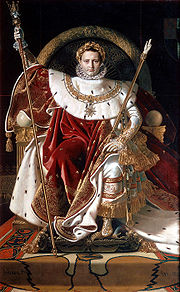 On 18 May 1804, Napoleon was given the title of emperor by the Senate; finally, on 2 December 1804, he was solemnly crowned
, after receiving the Iron Crown
of the Lombard kings, and was consecrated by Pope Pius VII
in Notre-Dame de Paris.
After this, in four campaigns, the Emperor transformed his "Carolingian
" feudal and federal
empire into one modelled on the Roman Empire
. The memories of imperial Rome were for a third time, after Julius Caesar
and Charlemagne
, to modify the historical evolution of France. Though the vague plan for an invasion of Britain was never executed, the Battle of Ulm
and the Battle of Austerlitz
overshadowed the defeat of Trafalgar
, and the camp at Boulogne
put at Napoleon's disposal the best military resources he had commanded, in the form of La Grande Armée
.
.jpg) In the War of the Third Coalition, Napoleon swept away the remnants of the old Holy Roman Empire
In the War of the Third Coalition, Napoleon swept away the remnants of the old Holy Roman Empire
and created in southern Germany
the vassal state
s of Bavaria
, Baden
, Württemberg
, Hesse-Darmstadt
and Saxony
, which were reorganized into the Confederation of the Rhine
. The Treaty of Pressburg, signed on 26 December 1805, did little other than create a more unified Germany to threaten France . On the other hand, Napoleon's creation of the Kingdom of Italy
, the occupation of Ancona
, and his annexation of Venetia and its former Adriatic territories marked a new stage in his Empire's progress.
To create satellite state
s, Napoleon installed his relatives as rulers of many European nations. The Bonapartes began to marry into old European monarchies, gaining sovereignty over many nations. Joseph Bonaparte
replaced the dispossessed Bourbons
in Naples; Louis Bonaparte
was installed on the throne of the Kingdom of Holland
, formed from the Batavian Republic
; Joachim Murat
became Grand-Duke of Berg; Jérôme Bonaparte
was made son-in-law to the King of Württemberg; and Eugène de Beauharnais was appointed to be the King of Bavaria while Stéphanie de Beauharnais
married the son of the Grand Duke of Baden.
Met with opposition, Napoleon would not tolerate any neutral power. On 6 August 1806 he forced the Habsburgs to abdicate their title of Holy Roman Emperor
, ending a political power which had endured for over a thousand years. Prussia had been offered the territory of Hannover to stay out of the Third Coalition. With the diplomatic situation changing, Napoleon offered Great Britain the province as part of a peace proposal. This, combined with growing tensions in Germany over French hegemony, Prussia responded by forming an alliance with Russia and sending troops into Bavaria on 1 October 1808. In this War of the Fourth Coalition
, Napoleon destroyed the armies of Frederick William
at Jena-Auerstedt
. The Eylau
and the Friedland
against the Russians finally ruined Frederick the Great
's formerly mighty kingdom, obliging Russia
and Prussia to make peace at Tilsit
.
ended war between Imperial Russia and the French Empire and began an alliance between the two empires which held power of much of the rest of Europe. The two empires secretly agreed to aid each other in disputes. France pledged to aid Russia against Ottoman
Turkey
, while Russia agreed to join the Continental System
against the British Empire
. Napoleon also convinced Alexander to enter the Anglo-Russian War and to instigate the Finnish War
against Sweden in order to force Sweden to join the Continental System.
More specifically, the Tsar agreed to evacuate Wallachia
and Moldavia
, which had been occupied by Russian forces as part of the Russo-Turkish War, 1806-1812
. The Ionian Islands
and Cattaro, which had been captured by Russian admirals Ushakov and Senyavin
, were to be handed over to the French. In recompense, Napoleon guaranteed the sovereignty of the Duchy of Oldenburg and several other small states ruled by the Tsar's German relatives.
The treaty removed about half of Prussia
's territory: Kottbus passed to Saxony
, the left bank of the Elbe
was awarded to the newly-created Kingdom of Westphalia
, Białystok was given to Russia, and the rest of Polish lands in the Prussian possession were set up as the Duchy of Warsaw
. Prussia was ordered to reduce their army to 40,000 and to pay an indemnity of 100,000,000 francs. Observers in Prussia viewed the treaty as unfair and as a national humiliation.
Talleyrand had advised Napoleon to pursue milder terms; the treaties marked an important stage in his estrangement from the emperor. After the Treaties of Tilsit, instead of trying to reconcile Europe, as Talleyrand had advised, Napoleon wanted to defeat Britain and complete his Italian dominion. It was from Berlin, on 21 November 1806, that he had dated the first decree of a continental blockade
, a conception intended to paralyze his rival, but which would contribute to his own fall by its immoderate extension of the Empire. To the coalition of the northern powers, he added the league of the Baltic
and Mediterranean ports, and to the bombardment of Copenhagen
by a Royal Navy
fleet he responded by a second decree of blockade, dated from Milan on 17 December 1807.
The application of the Concordat and the taking of Naples led to the first struggles with the Pope, centered around two issues: Napoleon declaring himself Roman Emperor , and Pius VII renewing the theocratic affirmations of Pope Gregory VII
. The Emperor's Roman ambition was made more visible by the occupation of the Kingdom of Naples and of the Marches
, and by the entry of Miollis
into Rome; while Junot
invaded Portugal, Joachim Murat
took possession
of formerly Roman Spain, whither Joseph Bonaparte transferred afterwards.
Napoleon thought he might succeed in the Iberian Peninsula
as he had done in Italy, in Egypt, and in Hesse. However, the exile of the Royal Family to Bayonne
, together with the enthroning of Joseph Bonaparte, turned the Spanish against Napoleon. After the Dos de Mayo
riots and subsequent reprisals, the Spanish began an effective guerrilla campaign, under the oversight of a Supreme Junta. The Peninsula became the grave of whole armies and saw a war against Spain, Portugal, and Great Britain. Dupont capitulated at Bailen
to General Castaños
, and Junot at Sintra
, Portugal to General Wellesley
. To combat the Spanish resistance, Napoleon came to terms with the Tsar
Alexander I of Russia
at Erfurt
, so that, abandoning his designs in the East, he could make the Grand Army return in force to Madrid
.
Spain used up the soldiers needed for Napoleon's other fields of battle, and they had to be replaced by conscripts. Spanish resistance affected Austria, and indicated the potential of national resistance. The provocations of Talleyrand and Britain strengthened the idea that Austrians could emulate the Spaniards. On April 10, 1809, Austria invaded the France's ally, Bavaria. The campaign of 1809, however, would not be nearly as long and troublesome for France as the Peninsula. After a short and decisive action in Bavaria, Napoleon opened up the road to Vienna
for a second time. At Aspern-Essling
, Napoleon suffered his first serious tactical defeat, along with the death of Jean Lannes
, an able Marshall and dear friend of the Emperor. The victory at Wagram
, however, forced Austria to sue for peace. The Treaty of Schönbrunn
, 14 December 1809, annexed the Illyrian provinces
and recognized past French conquests.
The Pope was deported to Savona
, and his domains were incorporated into the Empire. The Senate's decision on 17 February 1810 created the title of King of Rome, and made Rome the capital of Italy. Between 1810 and 1812 Napoleon's divorce of Josephine
, and his marriage with Archduchess Marie Louise of Austria, followed by the birth of the king of Rome
, shed light upon his future policy. He gradually withdrew power from his siblings and concentrated his affection and ambition on his son, the guarantee of the continuance of his dynasty
. This was the apogee of the empire.
and Johann von Scharnhorst had secretly started preparing Prussia's retaliation.
The alliance arranged at Tilsit was seriously shaken by the Austrian marriage, the threat of Polish restoration to Russia, and the Continental System. The very persons whom he had placed in power were counteracting his plans. With many of his siblings and relations performing unsuccessfully or even betraying him, Napoleon found himself obliged to revoke their power. Caroline Bonaparte
conspired against her brother and against her husband Murat; the hypochondriac Louis, now Dutch in his sympathies, found the supervision of the blockade taken from him, and also the defense of the Scheldt
, which he had refused to ensure. Jérôme Bonaparte
lost control of the blockade on North Sea
shores. The very nature of things was against the new dynasties, as it had been against the old.
After national insurrections and family recriminations came treachery from Napoleon's ministers. Talleyrand betrayed his designs to Metternich
and suffered dismissal. Joseph Fouché
, corresponding with Austria in 1809 and 1810, entered into an understanding with Louis and also with Britain, while Bourrienne was convicted of speculation. By consequence of the spirit of conquest Napoleon had aroused, many of his marshals and officials, having tasted victory, dreamed of sovereign power: Bernadotte, who had helped him to the Consulate
, played Napoleon false to win the crown of Sweden. Soult
, like Murat, coveted the Spanish throne after that of Portugal, thus anticipating the treason of 1813 and the defection of 1814. Many persons hoped for "an accident", which might resemble the deaths of Alexander the Great and of Julius Caesar.
The country itself, though flattered by conquests, was tired of self-sacrifice. The unpopularity of conscription
policies gradually turned many of Napoleon’s subjects against him. Amidst profound silence from the press and the assemblies, a protest was raised against imperial power by the literary world, against the excommunicated sovereign by Catholicism, and against the author of the continental blockade by the discontented bourgeoisie
, ruined by the crisis of 1811. Even as he lost his military principles, Napoleon maintained his gift for brilliance. His Six Days Campaign
, which took place at the very end of the Sixth Coalition, is often regarded as his greatest display of leadership and military prowess. But by then it was the end, and it was during the years before when the nations of Europe conspired against France. While the Emperor and his holdings idled and worsened, the rest of Europe agreed to avenge the revolutionary events of 1792.

Napoleon had hardly succeeded in putting down the revolt in Germany when the Czar of Russia himself headed a European insurrection against Napoleon. To put a stop to this, to ensure his own access to the Mediterranean and exclude his chief rival, Napoleon made an effort in 1812 against Russia. Despite his victorious advance, the taking of Smolensk
, the victory on the Moskva
, and the entry into Moscow, he was defeated by the country and the climate, and by Alexander's refusal to make terms. After this came the lamentable retreat in the harsh Russian winter, while all Europe was concentrating against him. Pushed back, as he had been in Spain, from bastion to bastion, after the action on the Berezina, Napoleon had to fall back upon the frontiers of 1809, and then—having refused the peace offered to him by Austria at the Congress of Prague (4 June-10 August 1813), from a dread of losing Italy, where each of his victories had marked a stage in the accomplishment of his dream—on those of 1805, despite Lützen
and Bautzen
, and on those of 1802 after his defeat at Leipzig
, when Bernadotte
– now Crown Prince of Sweden – turned upon him, General Moreau also joined the Allies, and longstanding allied nations, such as Saxony
and Bavaria
, forsook him as well.
Following his retreat from Russia, Napoleon continued to retreat, this time from Germany. After the loss of Spain, reconquered by an allied army led by Wellington, the rising in the Netherlands preliminary to the invasion and the manifesto of Frankfort (1 December 1813) which proclaimed it, he had to fall back upon the frontiers of 1795; and then later was driven yet farther back upon those of 1792—despite the campaign of 1814 against the invaders. Paris capitulated on 30 March 1814, and the Delenda Carthago
, pronounced against Britain, was spoken of Napoleon. The Empire fell with Napoleon's abdication at Fontainebleau
on 11 April 1814.
After a brief exile at the island of Elba
, Napoleon recaptured the throne temporarily in 1815, reviving the Empire in what is known as the Hundred Days
. However, he was defeated by the Seventh Coalition at the Battle of Waterloo
. He surrendered himself to the victorious English and he was exiled to Saint Helena
, a remote island in the South Atlantic, where he remained until his death in 1821. After the Hundred Days, the Bourbon monarchy was restored
, with Louis XVIII
ascending the throne of France, while the rest of Napoleon's conquests were disposed of in the Congress of Vienna
.
who had escaped persecution, fear by some of a restoration of the ancien régime, a dislike and suspicion of foreign countries had tried to reverse the Revolution – and a wish by Jacobins to extend France's revolutionary ideals.
Napoleon attracted power and imperial status and gathered support for his changes of French institutions, such as the Concordat of 1801
which confirmed the Catholic Church as the majority church of France and restored some of its civil status.
Napoleon by this time however was not a democrat, nor a republican. He was, he liked to think, an enlightened despot, the sort of man Voltaire might have found appealing. He preserved numerous social gains of the Revolution while suppressing political liberty. He admired efficiency and strength and hated feudalism, religious intolerance, and civil inequality. Enlightened despotism meant political stability. He knew his Roman history well, as after 500 years of republicanism, Rome became an empire under Augustus Caesar.
Although a supporter of the radical
Jacobins
during the early days of the Revolution (more out of pragmatism
than any real ideology), Napoleon became increasingly autocratic as his political career progressed and once in power embraced certain aspects of both liberalism and authoritarianism – for example, public education
, a generally liberal restructuring of the French legal system, and the emancipation of the Jews – while rejecting electoral democracy and freedom of the press
.
Napoleon I of France
Napoleon Bonaparte was a French military and political leader during the latter stages of the French Revolution.As Napoleon I, he was Emperor of the French from 1804 to 1815...
of France. It was the dominant power of much of continental Europe during the early 19th century.
Napoleon became Emperor of the French
Emperor of the French
The Emperor of the French was the title used by the Bonaparte Dynasty starting when Napoleon Bonaparte was given the title Emperor on 18 May 1804 by the French Senate and was crowned emperor of the French on 02 December 1804 at the cathedral of Notre Dame de Paris, in Paris with the Crown of...
(L'Empereur des Français, ɑ̃.pʁœʁ dɛ fʁɑ̃.sɛ) on 18 May 1804 and crowned Emperor 2 December 1804, ending the period of the French Consulate
French Consulate
The Consulate was the government of France between the fall of the Directory in the coup of 18 Brumaire in 1799 until the start of the Napoleonic Empire in 1804...
, and won early military victories in the War of the Third Coalition against Austria, Prussia
Prussia
Prussia was a German kingdom and historic state originating out of the Duchy of Prussia and the Margraviate of Brandenburg. For centuries, the House of Hohenzollern ruled Prussia, successfully expanding its size by way of an unusually well-organized and effective army. Prussia shaped the history...
, Russia, Portugal, and allied nations, notably at the Battle of Austerlitz
Battle of Austerlitz
The Battle of Austerlitz, also known as the Battle of the Three Emperors, was one of Napoleon's greatest victories, where the French Empire effectively crushed the Third Coalition...
(1805) and the Battle of Friedland
Battle of Friedland
The Battle of Friedland saw Napoleon I's French army decisively defeat Count von Bennigsen's Russian army about twenty-seven miles southeast of Königsberg...
(1807). The Treaty of Tilsit in July 1807 ended two years of bloodshed on the European continent.
The subsequent series of wars known collectively as the Napoleonic Wars
Napoleonic Wars
The Napoleonic Wars were a series of wars declared against Napoleon's French Empire by opposing coalitions that ran from 1803 to 1815. As a continuation of the wars sparked by the French Revolution of 1789, they revolutionised European armies and played out on an unprecedented scale, mainly due to...
extended French influence over much of Western Europe and into Poland. At its height in 1812, the French Empire had 130 départements
Départements of France
The departments of France are French administrative divisions. The 101 departments form one of the three levels of local government, together with the 22 metropolitan and 5 overseas regions above them and more than 36 000 communes beneath them...
, ruled over 44 million subjects, maintained an extensive military presence in Germany, Italy, Spain, and the Duchy of Warsaw
Duchy of Warsaw
The Duchy of Warsaw was a Polish state established by Napoleon I in 1807 from the Polish lands ceded by the Kingdom of Prussia under the terms of the Treaties of Tilsit. The duchy was held in personal union by one of Napoleon's allies, King Frederick Augustus I of Saxony...
, and could count Prussia and Austria as nominal allies. Early French victories exported many ideological features of the French Revolution
French Revolution
The French Revolution , sometimes distinguished as the 'Great French Revolution' , was a period of radical social and political upheaval in France and Europe. The absolute monarchy that had ruled France for centuries collapsed in three years...
throughout Europe. Seigneurial dues and seigneurial justice
Manorialism
Manorialism, an essential element of feudal society, was the organizing principle of rural economy that originated in the villa system of the Late Roman Empire, was widely practiced in medieval western and parts of central Europe, and was slowly replaced by the advent of a money-based market...
were abolished, aristocratic privileges were eliminated in all places except Poland, and the introduction of the Napoleonic Code
Napoleonic code
The Napoleonic Code — or Code Napoléon — is the French civil code, established under Napoléon I in 1804. The code forbade privileges based on birth, allowed freedom of religion, and specified that government jobs go to the most qualified...
throughout the continent increased legal equality, established jury systems, and legalized divorce. Napoleon placed relatives on the thrones of several European countries and granted many noble titles, most of which were not recognized after the empire fell.
Historians have estimated the death toll from the Napoleonic Wars
Napoleonic Wars casualties
The casualties of the Napoleonic Wars , direct and indirect, break down as follows:Note that deaths listed include being killed in action as well as deaths from other causes, such as: from disease; from wounds; of starvation; from exposure; of drowning; from friendly fire; as a result of...
to be 6.5 million people, or 15% of the French Empire's subjects. In particular, French losses in the Peninsular War
Peninsular War
The Peninsular War was a war between France and the allied powers of Spain, the United Kingdom, and Portugal for control of the Iberian Peninsula during the Napoleonic Wars. The war began when French and Spanish armies crossed Spain and invaded Portugal in 1807. Then, in 1808, France turned on its...
in Iberia
Iberian Peninsula
The Iberian Peninsula , sometimes called Iberia, is located in the extreme southwest of Europe and includes the modern-day sovereign states of Spain, Portugal and Andorra, as well as the British Overseas Territory of Gibraltar...
severely weakened the Empire; after victory over the Austrian Empire
Austrian Empire
The Austrian Empire was a modern era successor empire, which was centered on what is today's Austria and which officially lasted from 1804 to 1867. It was followed by the Empire of Austria-Hungary, whose proclamation was a diplomatic move that elevated Hungary's status within the Austrian Empire...
in the War of the Fifth Coalition
War of the Fifth Coalition
The War of the Fifth Coalition, fought in the year 1809, pitted a coalition of the Austrian Empire and the United Kingdom against Napoleon's French Empire and Bavaria. Major engagements between France and Austria, the main participants, unfolded over much of Central Europe from April to July, with...
(1809) Napoleon deployed over 600,000 troops to attack Russia, in a catastrophic French invasion of that country in 1812. The War of the Sixth Coalition
War of the Sixth Coalition
In the War of the Sixth Coalition , a coalition of Austria, Prussia, Russia, the United Kingdom, Portugal, Sweden, Spain and a number of German States finally defeated France and drove Napoleon Bonaparte into exile on Elba. After Napoleon's disastrous invasion of Russia, the continental powers...
saw the expulsion of French forces from Germany in 1813.
Napoleon abdicated in 11 April 1814. The Empire was briefly restored during the Hundred Days
Hundred Days
The Hundred Days, sometimes known as the Hundred Days of Napoleon or Napoleon's Hundred Days for specificity, marked the period between Emperor Napoleon I of France's return from exile on Elba to Paris on 20 March 1815 and the second restoration of King Louis XVIII on 8 July 1815...
period in 1815 until Napoleon's defeat at the Battle of Waterloo
Battle of Waterloo
The Battle of Waterloo was fought on Sunday 18 June 1815 near Waterloo in present-day Belgium, then part of the United Kingdom of the Netherlands...
. It was followed by the restored monarchy of the House of Bourbon
House of Bourbon
The House of Bourbon is a European royal house, a branch of the Capetian dynasty . Bourbon kings first ruled Navarre and France in the 16th century. By the 18th century, members of the Bourbon dynasty also held thrones in Spain, Naples, Sicily, and Parma...
.
Origin
In 1799, Napoleon Bonaparte was confronted by Emmanuel-Joseph Sieyès – one of the five DirectorsFrench Directory
The Directory was a body of five Directors that held executive power in France following the Convention and preceding the Consulate...
who constituted the executive branch of the French government—who sought his support for a coup d'état to overthrow the French Constitution of 1795
French Constitution of 1795
The Constitution of 22 August 1795 was a national constitution of France ratified by the National Convention on 22 August 1795 during the French Revolution...
. The plot included Bonaparte's brother Lucien
Lucien Bonaparte
Lucien Bonaparte, Prince Français, 1st Prince of Canino and Musignano , born Luciano Buonaparte, was the third surviving son of Carlo Buonaparte and his wife Letizia Ramolino....
, then serving as speaker of the Council of Five Hundred
Council of Five Hundred
The Council of Five Hundred , or simply the Five Hundred was the lower house of the legislature of France during the period commonly known as the Directory , from 22 August 1795 until 9 November 1799, roughly the second half of the period generally referred to as the...
, Roger Ducos
Roger Ducos
Pierre Roger Ducos , better known as Roger Ducos, was a French political figure during the Revolution and First Empire, a member of the National Convention, and of the Directory....
, another Director, and Talleyrand. On 9 November 1799 (18 Brumaire
18 Brumaire
The coup of 18 Brumaire was the coup d'état by which General Napoleon Bonaparte overthrew the French Directory, replacing it with the French Consulate...
, An VIII under the French Republican Calendar
French Republican Calendar
The French Republican Calendar or French Revolutionary Calendar was a calendar created and implemented during the French Revolution, and used by the French government for about 12 years from late 1793 to 1805, and for 18 days by the Paris Commune in 1871...
), and the following day, troops led by Bonaparte seized control. They dispersed the legislative councils, leaving a rump legislature to name Bonaparte, Sieyès and Ducos as provisional Consuls to administer the government. Although Sieyès expected to dominate the new regime, the Consulate
French Consulate
The Consulate was the government of France between the fall of the Directory in the coup of 18 Brumaire in 1799 until the start of the Napoleonic Empire in 1804...
, he was outmanoeuvred by Bonaparte, who drafted the Constitution of the Year VIII
Constitution of the Year VIII
The Constitution of the Year VIII was a national constitution of France, adopted December 24, 1799 , which established the form of government known as the Consulate...
and secured his own election as First Consul. This made him the most powerful person in France, a power that was increased by the Constitution of the Year X
Constitution of the Year X
The Constitution of the Year X was a national constitution of France adopted during the Year X of the French Revolutionary Calendar...
, which made him First Consul for life.
The Battle of Marengo (14 June 1800) inaugurated the political idea that was to continue its development until Napoleon's Moscow campaign. Napoleon planned only to keep the Duchy of Milan
Duchy of Milan
The Duchy of Milan , was created on the 1st of may 1395, when Gian Galeazzo Visconti, Lord of Milan, purchased a diploma for 100,000 Florins from King Wenceslaus. It was this diploma that installed, Gian Galeazzo as Duke of Milan and Count of Pavia...
for France, setting aside Austria, and was thought to prepare a new campaign in the East. The Peace of Amiens, which cost him control of Egypt
Egypt
Egypt , officially the Arab Republic of Egypt, Arabic: , is a country mainly in North Africa, with the Sinai Peninsula forming a land bridge in Southwest Asia. Egypt is thus a transcontinental country, and a major power in Africa, the Mediterranean Basin, the Middle East and the Muslim world...
, was a temporary truce. He gradually extended his authority in Italy by annexing the Piedmont and by acquiring Genoa
Genoa
Genoa |Ligurian]] Zena ; Latin and, archaically, English Genua) is a city and an important seaport in northern Italy, the capital of the Province of Genoa and of the region of Liguria....
, Parma
Parma
Parma is a city in the Italian region of Emilia-Romagna famous for its ham, its cheese, its architecture and the fine countryside around it. This is the home of the University of Parma, one of the oldest universities in the world....
, Tuscany and Naples
Naples
Naples is a city in Southern Italy, situated on the country's west coast by the Gulf of Naples. Lying between two notable volcanic regions, Mount Vesuvius and the Phlegraean Fields, it is the capital of the region of Campania and of the province of Naples...
and added this Italian territory to his Cisalpine Gaul
Cisalpine Gaul
Cisalpine Gaul, in Latin: Gallia Cisalpina or Citerior, also called Gallia Togata, was a Roman province until 41 BC when it was merged into Roman Italy.It bore the name Gallia, because the great body of its inhabitants, after the expulsion of the Etruscans, consisted of Gauls or Celts...
. Then he laid siege to the Roman state and initiated the Concordat of 1801
Concordat of 1801
The Concordat of 1801 was an agreement between Napoleon and Pope Pius VII, signed on 15 July 1801. It solidified the Roman Catholic Church as the majority church of France and brought back most of its civil status....
to control the material claims of the pope
Pope
The Pope is the Bishop of Rome, a position that makes him the leader of the worldwide Catholic Church . In the Catholic Church, the Pope is regarded as the successor of Saint Peter, the Apostle...
. When he recognised his error of raising the authority of the pope from that of a figurehead, Napoleon produced the Articles Organiques
Organic Articles
The Organic Articles was the name of a law administering public worship in France.- History :The Articles were originally presented by Napoléon Bonaparte, and consisted of 77 Articles relating to Catholicism and 44 Articles relating to Protestantism...
(1802) wanting, like Charlemagne
Charlemagne
Charlemagne was King of the Franks from 768 and Emperor of the Romans from 800 to his death in 814. He expanded the Frankish kingdom into an empire that incorporated much of Western and Central Europe. During his reign, he conquered Italy and was crowned by Pope Leo III on 25 December 800...
, to be the legal protector of the papacy. To conceal his plans before their actual execution, he aroused French colonial aspirations against Britain and the memory of the 1763 Treaty of Paris
Treaty of Paris (1763)
The Treaty of Paris, often called the Peace of Paris, or the Treaty of 1763, was signed on 10 February 1763, by the kingdoms of Great Britain, France and Spain, with Portugal in agreement. It ended the French and Indian War/Seven Years' War...
, exacerbating British envy of France, whose borders now extended to the Rhine and beyond, to Hanover
Hanover
Hanover or Hannover, on the river Leine, is the capital of the federal state of Lower Saxony , Germany and was once by personal union the family seat of the Hanoverian Kings of Great Britain, under their title as the dukes of Brunswick-Lüneburg...
, Hamburg and Cuxhaven.
On 12 May 1802, the French Tribunat
Tribunat
The Tribunat was one of the four assemblies set up in France by the Constitution of Year VIII . It was set up officially on 1 January 1800 at the same time as the...
voted unanimously, with exception of Carnot
Lazare Carnot
Lazare Nicolas Marguerite, Comte Carnot , the Organizer of Victory in the French Revolutionary Wars, was a French politician, engineer, and mathematician.-Education and early life:...
, in favour of the Life Consulship for the leader of France. This action was confirmed by the Corps Législatif
Corps législatif
The Corps législatif was a part of the French legislature during the French Revolution and beyond. It is also the generic French term used to refer to any legislative body.-History:The Constitution of the Year I foresaw the need for a corps législatif...
. A general plebiscite followed thereafter resulting in 3,653,600 votes aye and 8,272 votes nay. On 2 August 1802 (14 Thermidor, An X), Napoleon Bonaparte was proclaimed Consul for life.
An overwhelming tide of pro-revolutionary sentiment swept through Germany by the "Recess of 1803", which brought Bavaria
Bavaria
Bavaria, formally the Free State of Bavaria is a state of Germany, located in the southeast of Germany. With an area of , it is the largest state by area, forming almost 20% of the total land area of Germany...
, Württemberg
Württemberg
Württemberg , formerly known as Wirtemberg or Wurtemberg, is an area and a former state in southwestern Germany, including parts of the regions Swabia and Franconia....
and Baden to France's side. William Pitt the Younger
William Pitt the Younger
William Pitt the Younger was a British politician of the late 18th and early 19th centuries. He became the youngest Prime Minister in 1783 at the age of 24 . He left office in 1801, but was Prime Minister again from 1804 until his death in 1806...
, back in power in Britain, appealed once more for an Anglo-Austro-Russian coalition
Coalition
A coalition is a pact or treaty among individuals or groups, during which they cooperate in joint action, each in their own self-interest, joining forces together for a common cause. This alliance may be temporary or a matter of convenience. A coalition thus differs from a more formal covenant...
against Napoleon and his desires to revive the empire of Charlemagne.
Coronation of Napoleon I
The coronation of Napoleon I as Emperor of the French, which took place on Sunday December 2, 1804 , has been said to mark "the instantiation of modern empire", representing "transparently masterminded piece of modern propaganda"...
, after receiving the Iron Crown
Iron Crown of Lombardy
The Iron Crown of Lombardy is both a reliquary and one of the most ancient royal insignia of Europe. The crown became one of the symbols of the Kingdom of Lombards and later of the medieval Kingdom of Italy...
of the Lombard kings, and was consecrated by Pope Pius VII
Pope Pius VII
Pope Pius VII , born Barnaba Niccolò Maria Luigi Chiaramonti, was a monk, theologian and bishop, who reigned as Pope from 14 March 1800 to 20 August 1823.-Early life:...
in Notre-Dame de Paris.
After this, in four campaigns, the Emperor transformed his "Carolingian
Charlemagne
Charlemagne was King of the Franks from 768 and Emperor of the Romans from 800 to his death in 814. He expanded the Frankish kingdom into an empire that incorporated much of Western and Central Europe. During his reign, he conquered Italy and was crowned by Pope Leo III on 25 December 800...
" feudal and federal
Federation
A federation , also known as a federal state, is a type of sovereign state characterized by a union of partially self-governing states or regions united by a central government...
empire into one modelled on the Roman Empire
Roman Empire
The Roman Empire was the post-Republican period of the ancient Roman civilization, characterised by an autocratic form of government and large territorial holdings in Europe and around the Mediterranean....
. The memories of imperial Rome were for a third time, after Julius Caesar
Julius Caesar
Gaius Julius Caesar was a Roman general and statesman and a distinguished writer of Latin prose. He played a critical role in the gradual transformation of the Roman Republic into the Roman Empire....
and Charlemagne
Charlemagne
Charlemagne was King of the Franks from 768 and Emperor of the Romans from 800 to his death in 814. He expanded the Frankish kingdom into an empire that incorporated much of Western and Central Europe. During his reign, he conquered Italy and was crowned by Pope Leo III on 25 December 800...
, to modify the historical evolution of France. Though the vague plan for an invasion of Britain was never executed, the Battle of Ulm
Battle of Ulm
The Battle of Ulm was a series of minor skirmishes at the end of Napoleon Bonaparte's Ulm Campaign, culminating in the surrender of an entire Austrian army near Ulm in Württemberg....
and the Battle of Austerlitz
Battle of Austerlitz
The Battle of Austerlitz, also known as the Battle of the Three Emperors, was one of Napoleon's greatest victories, where the French Empire effectively crushed the Third Coalition...
overshadowed the defeat of Trafalgar
Battle of Trafalgar
The Battle of Trafalgar was a sea battle fought between the British Royal Navy and the combined fleets of the French Navy and Spanish Navy, during the War of the Third Coalition of the Napoleonic Wars ....
, and the camp at Boulogne
Boulogne-sur-Mer
-Road:* Metropolitan bus services are operated by the TCRB* Coach services to Calais and Dunkerque* A16 motorway-Rail:* The main railway station is Gare de Boulogne-Ville and located in the south of the city....
put at Napoleon's disposal the best military resources he had commanded, in the form of La Grande Armée
La Grande Armée
The Grande Armée first entered the annals of history when, in 1805, Napoleon I renamed the army that he had assembled on the French coast of the English Channel for the proposed invasion of Britain...
.
Early victories
Holy Roman Empire
The Holy Roman Empire was a realm that existed from 962 to 1806 in Central Europe.It was ruled by the Holy Roman Emperor. Its character changed during the Middle Ages and the Early Modern period, when the power of the emperor gradually weakened in favour of the princes...
and created in southern Germany
Southern Germany
The term Southern Germany is used to describe a region in the south of Germany. There is no specific boundary to the region, but it usually includes all of Bavaria and Baden-Württemberg, and the southern part of Hesse...
the vassal state
Vassal state
A vassal state is any state that is subordinate to another. The vassal in these cases is the ruler, rather than the state itself. Being a vassal most commonly implies providing military assistance to the dominant state when requested to do so; it sometimes implies paying tribute, but a state which...
s of Bavaria
Bavaria
Bavaria, formally the Free State of Bavaria is a state of Germany, located in the southeast of Germany. With an area of , it is the largest state by area, forming almost 20% of the total land area of Germany...
, Baden
Baden
Baden is a historical state on the east bank of the Rhine in the southwest of Germany, now the western part of the Baden-Württemberg of Germany....
, Württemberg
Württemberg
Württemberg , formerly known as Wirtemberg or Wurtemberg, is an area and a former state in southwestern Germany, including parts of the regions Swabia and Franconia....
, Hesse-Darmstadt
Grand Duchy of Hesse
The Grand Duchy of Hesse and by Rhine , or, between 1806 and 1816, Grand Duchy of Hesse —as it was also known after 1816—was a member state of the German Confederation from 1806, when the Landgraviate of Hesse-Darmstadt was elevated to a Grand Duchy, until 1918, when all the German...
and Saxony
Saxony
The Free State of Saxony is a landlocked state of Germany, contingent with Brandenburg, Saxony Anhalt, Thuringia, Bavaria, the Czech Republic and Poland. It is the tenth-largest German state in area, with of Germany's sixteen states....
, which were reorganized into the Confederation of the Rhine
Confederation of the Rhine
The Confederation of the Rhine was a confederation of client states of the First French Empire. It was formed initially from 16 German states by Napoleon after he defeated Austria's Francis II and Russia's Alexander I in the Battle of Austerlitz. The Treaty of Pressburg, in effect, led to the...
. The Treaty of Pressburg, signed on 26 December 1805, did little other than create a more unified Germany to threaten France . On the other hand, Napoleon's creation of the Kingdom of Italy
Kingdom of Italy (Napoleonic)
The Kingdom of Italy was a state founded in Northern Italy by Napoleon, fully influenced by revolutionary France, that ended with his defeat and fall.-Constitutional statutes:...
, the occupation of Ancona
Ancona
Ancona is a city and a seaport in the Marche region, in central Italy, with a population of 101,909 . Ancona is the capital of the province of Ancona and of the region....
, and his annexation of Venetia and its former Adriatic territories marked a new stage in his Empire's progress.
To create satellite state
Satellite state
A satellite state is a political term that refers to a country that is formally independent, but under heavy political and economic influence or control by another country...
s, Napoleon installed his relatives as rulers of many European nations. The Bonapartes began to marry into old European monarchies, gaining sovereignty over many nations. Joseph Bonaparte
Joseph Bonaparte
Joseph-Napoléon Bonaparte was the elder brother of Napoleon Bonaparte, who made him King of Naples and Sicily , and later King of Spain...
replaced the dispossessed Bourbons
House of Bourbon
The House of Bourbon is a European royal house, a branch of the Capetian dynasty . Bourbon kings first ruled Navarre and France in the 16th century. By the 18th century, members of the Bourbon dynasty also held thrones in Spain, Naples, Sicily, and Parma...
in Naples; Louis Bonaparte
Louis Bonaparte
Louis Napoléon Bonaparte, Prince Français, Comte de Saint-Leu , King of Holland , was the fifth surviving child and the fourth surviving son of Carlo Buonaparte and Letizia Ramolino...
was installed on the throne of the Kingdom of Holland
Kingdom of Holland
The Kingdom of Holland 1806–1810 was set up by Napoleon Bonaparte as a puppet kingdom for his third brother, Louis Bonaparte, in order to better control the Netherlands. The name of the leading province, Holland, was now taken for the whole country...
, formed from the Batavian Republic
Batavian Republic
The Batavian Republic was the successor of the Republic of the United Netherlands. It was proclaimed on January 19, 1795, and ended on June 5, 1806, with the accession of Louis Bonaparte to the throne of the Kingdom of Holland....
; Joachim Murat
Joachim Murat
Joachim-Napoléon Murat , Marshal of France and Grand Admiral or Admiral of France, 1st Prince Murat, was Grand Duke of Berg from 1806 to 1808 and then King of Naples from 1808 to 1815...
became Grand-Duke of Berg; Jérôme Bonaparte
Jérôme Bonaparte
Jérôme-Napoléon Bonaparte, French Prince, King of Westphalia, 1st Prince of Montfort was the youngest brother of Napoleon, who made him king of Westphalia...
was made son-in-law to the King of Württemberg; and Eugène de Beauharnais was appointed to be the King of Bavaria while Stéphanie de Beauharnais
Stéphanie de Beauharnais
Stéphanie, Grand Duchess of Baden was the consort of Karl, Grand Duke of Baden.-Biography:...
married the son of the Grand Duke of Baden.
Met with opposition, Napoleon would not tolerate any neutral power. On 6 August 1806 he forced the Habsburgs to abdicate their title of Holy Roman Emperor
Holy Roman Emperor
The Holy Roman Emperor is a term used by historians to denote a medieval ruler who, as German King, had also received the title of "Emperor of the Romans" from the Pope...
, ending a political power which had endured for over a thousand years. Prussia had been offered the territory of Hannover to stay out of the Third Coalition. With the diplomatic situation changing, Napoleon offered Great Britain the province as part of a peace proposal. This, combined with growing tensions in Germany over French hegemony, Prussia responded by forming an alliance with Russia and sending troops into Bavaria on 1 October 1808. In this War of the Fourth Coalition
War of the Fourth Coalition
The Fourth Coalition against Napoleon's French Empire was defeated in a war spanning 1806–1807. Coalition partners included Prussia, Russia, Saxony, Sweden, and the United Kingdom....
, Napoleon destroyed the armies of Frederick William
Frederick William III of Prussia
Frederick William III was king of Prussia from 1797 to 1840. He was in personal union the sovereign prince of the Principality of Neuchâtel .-Early life:...
at Jena-Auerstedt
Battle of Jena-Auerstedt
The twin battles of Jena and Auerstedt were fought on 14 October 1806 on the plateau west of the river Saale in today's Germany, between the forces of Napoleon I of France and Frederick William III of Prussia...
. The Eylau
Battle of Eylau
The Battle of Eylau or Battle of Preussisch-Eylau, 7 and 8 February 1807, was a bloody and inconclusive battle between Napoléon's Grande Armée and a Russian Empire army under Levin August, Count von Bennigsen near the town of Preußisch Eylau in East Prussia. Late in the battle, the Russians...
and the Friedland
Battle of Friedland
The Battle of Friedland saw Napoleon I's French army decisively defeat Count von Bennigsen's Russian army about twenty-seven miles southeast of Königsberg...
against the Russians finally ruined Frederick the Great
Frederick II of Prussia
Frederick II was a King in Prussia and a King of Prussia from the Hohenzollern dynasty. In his role as a prince-elector of the Holy Roman Empire, he was also Elector of Brandenburg. He was in personal union the sovereign prince of the Principality of Neuchâtel...
's formerly mighty kingdom, obliging Russia
Russia
Russia or , officially known as both Russia and the Russian Federation , is a country in northern Eurasia. It is a federal semi-presidential republic, comprising 83 federal subjects...
and Prussia to make peace at Tilsit
Treaties of Tilsit
The Treaties of Tilsit were two agreements signed by Napoleon I of France in the town of Tilsit in July, 1807 in the aftermath of his victory at Friedland. The first was signed on 7 July, between Tsar Alexander I of Russia and Napoleon I of France, when they met on a raft in the middle of the Neman...
.
Height of the Empire
The Treaties of TilsitTreaties of Tilsit
The Treaties of Tilsit were two agreements signed by Napoleon I of France in the town of Tilsit in July, 1807 in the aftermath of his victory at Friedland. The first was signed on 7 July, between Tsar Alexander I of Russia and Napoleon I of France, when they met on a raft in the middle of the Neman...
ended war between Imperial Russia and the French Empire and began an alliance between the two empires which held power of much of the rest of Europe. The two empires secretly agreed to aid each other in disputes. France pledged to aid Russia against Ottoman
Ottoman Empire
The Ottoman EmpireIt was usually referred to as the "Ottoman Empire", the "Turkish Empire", the "Ottoman Caliphate" or more commonly "Turkey" by its contemporaries...
Turkey
Turkey
Turkey , known officially as the Republic of Turkey , is a Eurasian country located in Western Asia and in East Thrace in Southeastern Europe...
, while Russia agreed to join the Continental System
Continental System
The Continental System or Continental Blockade was the foreign policy of Napoleon I of France in his struggle against the United Kingdom of Great Britain and Ireland during the Napoleonic Wars. It was a large-scale embargo against British trade, which began on November 21, 1806...
against the British Empire
British Empire
The British Empire comprised the dominions, colonies, protectorates, mandates and other territories ruled or administered by the United Kingdom. It originated with the overseas colonies and trading posts established by England in the late 16th and early 17th centuries. At its height, it was the...
. Napoleon also convinced Alexander to enter the Anglo-Russian War and to instigate the Finnish War
Finnish War
The Finnish War was fought between Sweden and the Russian Empire from February 1808 to September 1809. As a result of the war, the eastern third of Sweden was established as the autonomous Grand Duchy of Finland within the Russian Empire...
against Sweden in order to force Sweden to join the Continental System.
More specifically, the Tsar agreed to evacuate Wallachia
Wallachia
Wallachia or Walachia is a historical and geographical region of Romania. It is situated north of the Danube and south of the Southern Carpathians...
and Moldavia
Moldavia
Moldavia is a geographic and historical region and former principality in Eastern Europe, corresponding to the territory between the Eastern Carpathians and the Dniester river...
, which had been occupied by Russian forces as part of the Russo-Turkish War, 1806-1812
Russo-Turkish War, 1806-1812
The Russo-Turkish War was one of many wars fought between Imperial Russia and the Ottoman Empire.- Background :The war broke out in 1805–1806 against the background of the Napoleonic Wars...
. The Ionian Islands
Ionian Islands
The Ionian Islands are a group of islands in Greece. They are traditionally called the Heptanese, i.e...
and Cattaro, which had been captured by Russian admirals Ushakov and Senyavin
Dmitry Senyavin
Dmitry Nikolayevich Senyavin or Seniavin was a Russian admiral who ranks among the greatest seamen of the Napoleonic Wars.- Service under Ushakov :...
, were to be handed over to the French. In recompense, Napoleon guaranteed the sovereignty of the Duchy of Oldenburg and several other small states ruled by the Tsar's German relatives.
The treaty removed about half of Prussia
Prussia
Prussia was a German kingdom and historic state originating out of the Duchy of Prussia and the Margraviate of Brandenburg. For centuries, the House of Hohenzollern ruled Prussia, successfully expanding its size by way of an unusually well-organized and effective army. Prussia shaped the history...
's territory: Kottbus passed to Saxony
Saxony
The Free State of Saxony is a landlocked state of Germany, contingent with Brandenburg, Saxony Anhalt, Thuringia, Bavaria, the Czech Republic and Poland. It is the tenth-largest German state in area, with of Germany's sixteen states....
, the left bank of the Elbe
Elbe
The Elbe is one of the major rivers of Central Europe. It rises in the Krkonoše Mountains of the northwestern Czech Republic before traversing much of Bohemia , then Germany and flowing into the North Sea at Cuxhaven, 110 km northwest of Hamburg...
was awarded to the newly-created Kingdom of Westphalia
Kingdom of Westphalia
The Kingdom of Westphalia was a new country of 2.6 million Germans that existed from 1807-1813. It included of territory in Hesse and other parts of present-day Germany. While formally independent, it was a vassal state of the First French Empire, ruled by Napoleon's brother Jérôme Bonaparte...
, Białystok was given to Russia, and the rest of Polish lands in the Prussian possession were set up as the Duchy of Warsaw
Duchy of Warsaw
The Duchy of Warsaw was a Polish state established by Napoleon I in 1807 from the Polish lands ceded by the Kingdom of Prussia under the terms of the Treaties of Tilsit. The duchy was held in personal union by one of Napoleon's allies, King Frederick Augustus I of Saxony...
. Prussia was ordered to reduce their army to 40,000 and to pay an indemnity of 100,000,000 francs. Observers in Prussia viewed the treaty as unfair and as a national humiliation.
Talleyrand had advised Napoleon to pursue milder terms; the treaties marked an important stage in his estrangement from the emperor. After the Treaties of Tilsit, instead of trying to reconcile Europe, as Talleyrand had advised, Napoleon wanted to defeat Britain and complete his Italian dominion. It was from Berlin, on 21 November 1806, that he had dated the first decree of a continental blockade
Blockade
A blockade is an effort to cut off food, supplies, war material or communications from a particular area by force, either in part or totally. A blockade should not be confused with an embargo or sanctions, which are legal barriers to trade, and is distinct from a siege in that a blockade is usually...
, a conception intended to paralyze his rival, but which would contribute to his own fall by its immoderate extension of the Empire. To the coalition of the northern powers, he added the league of the Baltic
Baltic Sea
The Baltic Sea is a brackish mediterranean sea located in Northern Europe, from 53°N to 66°N latitude and from 20°E to 26°E longitude. It is bounded by the Scandinavian Peninsula, the mainland of Europe, and the Danish islands. It drains into the Kattegat by way of the Øresund, the Great Belt and...
and Mediterranean ports, and to the bombardment of Copenhagen
Copenhagen
Copenhagen is the capital and largest city of Denmark, with an urban population of 1,199,224 and a metropolitan population of 1,930,260 . With the completion of the transnational Øresund Bridge in 2000, Copenhagen has become the centre of the increasingly integrating Øresund Region...
by a Royal Navy
Royal Navy
The Royal Navy is the naval warfare service branch of the British Armed Forces. Founded in the 16th century, it is the oldest service branch and is known as the Senior Service...
fleet he responded by a second decree of blockade, dated from Milan on 17 December 1807.
The application of the Concordat and the taking of Naples led to the first struggles with the Pope, centered around two issues: Napoleon declaring himself Roman Emperor , and Pius VII renewing the theocratic affirmations of Pope Gregory VII
Pope Gregory VII
Pope St. Gregory VII , born Hildebrand of Sovana , was Pope from April 22, 1073, until his death. One of the great reforming popes, he is perhaps best known for the part he played in the Investiture Controversy, his dispute with Henry IV, Holy Roman Emperor affirming the primacy of the papal...
. The Emperor's Roman ambition was made more visible by the occupation of the Kingdom of Naples and of the Marches
Marches
A march or mark refers to a border region similar to a frontier, such as the Welsh Marches, the borderland between England and Wales. During the Frankish Carolingian Dynasty, the word spread throughout Europe....
, and by the entry of Miollis
Sextius Alexandre François de Miollis
Sextius Alexandre François de Miollis was a French military officer serving in the American Revolutionary War, the French Revolutionary Wars, and the Napoleonic Wars.-Biography:...
into Rome; while Junot
Jean-Andoche Junot
Jean-Andoche Junot, 1st Duke of Abrantès was a French general during the Revolutionary and Napoleonic Wars.-Early life:...
invaded Portugal, Joachim Murat
Joachim Murat
Joachim-Napoléon Murat , Marshal of France and Grand Admiral or Admiral of France, 1st Prince Murat, was Grand Duke of Berg from 1806 to 1808 and then King of Naples from 1808 to 1815...
took possession
Peninsular War
The Peninsular War was a war between France and the allied powers of Spain, the United Kingdom, and Portugal for control of the Iberian Peninsula during the Napoleonic Wars. The war began when French and Spanish armies crossed Spain and invaded Portugal in 1807. Then, in 1808, France turned on its...
of formerly Roman Spain, whither Joseph Bonaparte transferred afterwards.
Napoleon thought he might succeed in the Iberian Peninsula
Iberian Peninsula
The Iberian Peninsula , sometimes called Iberia, is located in the extreme southwest of Europe and includes the modern-day sovereign states of Spain, Portugal and Andorra, as well as the British Overseas Territory of Gibraltar...
as he had done in Italy, in Egypt, and in Hesse. However, the exile of the Royal Family to Bayonne
Bayonne
Bayonne is a city and commune in south-western France at the confluence of the Nive and Adour rivers, in the Pyrénées-Atlantiques department, of which it is a sub-prefecture...
, together with the enthroning of Joseph Bonaparte, turned the Spanish against Napoleon. After the Dos de Mayo
Dos de Mayo Uprising
On the second of May , 1808, the people of Madrid rebelled against the occupation of the city by French troops, provoking a brutal repression by the French Imperial forces and triggering the Peninsular War.-Background:...
riots and subsequent reprisals, the Spanish began an effective guerrilla campaign, under the oversight of a Supreme Junta. The Peninsula became the grave of whole armies and saw a war against Spain, Portugal, and Great Britain. Dupont capitulated at Bailen
Battle of Bailén
The Battle of Bailén was contested in 1808 between the Spanish Army of Andalusia, led by Generals Francisco Castaños and Theodor von Reding, and the Imperial French Army's II corps d'observation de la Gironde under General Pierre Dupont de l'Étang...
to General Castaños
Francisco Javier Castaños, 1st Duke of Bailén
Francisco Javier Castaños Aragorri Urioste y Olavide, Count of Castaños y Aragones, 1st Duke of Baylen , was a Spanish general.Castaños was born at Madrid.He is remembered for his victory over the French under Dupont, whom he...
, and Junot at Sintra
Convention of Sintra
The Convention of Cintra was an agreement signed on August 30, 1808 during the Peninsular War. By the agreement, the defeated French were allowed to evacuate their troops from Portugal without further conflict...
, Portugal to General Wellesley
Arthur Wellesley, 1st Duke of Wellington
Field Marshal Arthur Wellesley, 1st Duke of Wellington, KG, GCB, GCH, PC, FRS , was an Irish-born British soldier and statesman, and one of the leading military and political figures of the 19th century...
. To combat the Spanish resistance, Napoleon came to terms with the Tsar
Tsar
Tsar is a title used to designate certain European Slavic monarchs or supreme rulers. As a system of government in the Tsardom of Russia and Russian Empire, it is known as Tsarist autocracy, or Tsarism...
Alexander I of Russia
Alexander I of Russia
Alexander I of Russia , served as Emperor of Russia from 23 March 1801 to 1 December 1825 and the first Russian King of Poland from 1815 to 1825. He was also the first Russian Grand Duke of Finland and Lithuania....
at Erfurt
Erfurt
Erfurt is the capital city of Thuringia and the main city nearest to the geographical centre of Germany, located 100 km SW of Leipzig, 150 km N of Nuremberg and 180 km SE of Hannover. Erfurt Airport can be reached by plane via Munich. It lies in the southern part of the Thuringian...
, so that, abandoning his designs in the East, he could make the Grand Army return in force to Madrid
Madrid
Madrid is the capital and largest city of Spain. The population of the city is roughly 3.3 million and the entire population of the Madrid metropolitan area is calculated to be 6.271 million. It is the third largest city in the European Union, after London and Berlin, and its metropolitan...
.
Spain used up the soldiers needed for Napoleon's other fields of battle, and they had to be replaced by conscripts. Spanish resistance affected Austria, and indicated the potential of national resistance. The provocations of Talleyrand and Britain strengthened the idea that Austrians could emulate the Spaniards. On April 10, 1809, Austria invaded the France's ally, Bavaria. The campaign of 1809, however, would not be nearly as long and troublesome for France as the Peninsula. After a short and decisive action in Bavaria, Napoleon opened up the road to Vienna
Vienna
Vienna is the capital and largest city of the Republic of Austria and one of the nine states of Austria. Vienna is Austria's primary city, with a population of about 1.723 million , and is by far the largest city in Austria, as well as its cultural, economic, and political centre...
for a second time. At Aspern-Essling
Battle of Aspern-Essling
In the Battle of Aspern-Essling , Napoleon attempted a forced crossing of the Danube near Vienna, but the French and their allies were driven back by the Austrians under Archduke Charles...
, Napoleon suffered his first serious tactical defeat, along with the death of Jean Lannes
Jean Lannes
Jean Lannes, 1st Duc de Montebello, was a Marshal of France. He was one of Napoleon's most daring and talented generals. Napoleon once commented on Lannes: "I found him a pygmy and left him a giant"...
, an able Marshall and dear friend of the Emperor. The victory at Wagram
Battle of Wagram
The Battle of Wagram was the decisive military engagement of the War of the Fifth Coalition. It took place on the Marchfeld plain, on the north bank of the Danube. An important site of the battle was the village of Deutsch-Wagram, 10 kilometres northeast of Vienna, which would give its name to the...
, however, forced Austria to sue for peace. The Treaty of Schönbrunn
Treaty of Schönbrunn
The Treaty of Schönbrunn , sometimes known as the Treaty of Vienna, was signed between France and Austria at the Schönbrunn Palace of Vienna on 14 October 1809. This treaty ended the Fifth Coalition during the Napoleonic Wars...
, 14 December 1809, annexed the Illyrian provinces
Illyrian provinces
The Illyrian Provinces was an autonomous province of the Napoleonic French Empire on the north and east coasts of the Adriatic Sea between 1809 and 1816. Its capital was established at Laybach...
and recognized past French conquests.
The Pope was deported to Savona
Savona
Savona is a seaport and comune in the northern Italian region of Liguria, capital of the Province of Savona, in the Riviera di Ponente on the Mediterranean Sea....
, and his domains were incorporated into the Empire. The Senate's decision on 17 February 1810 created the title of King of Rome, and made Rome the capital of Italy. Between 1810 and 1812 Napoleon's divorce of Josephine
Joséphine de Beauharnais
Joséphine de Beauharnais was the first wife of Napoléon Bonaparte, and thus the first Empress of the French. Her first husband Alexandre de Beauharnais had been guillotined during the Reign of Terror, and she had been imprisoned in the Carmes prison until her release five days after Alexandre's...
, and his marriage with Archduchess Marie Louise of Austria, followed by the birth of the king of Rome
Napoleon II of France
Napoléon II , after 1818 known as Franz, Duke of Reichstadt, was the son of Napoleon I, Emperor of the French, and his second wife, Marie Louise of Austria...
, shed light upon his future policy. He gradually withdrew power from his siblings and concentrated his affection and ambition on his son, the guarantee of the continuance of his dynasty
Dynasty
A dynasty is a sequence of rulers considered members of the same family. Historians traditionally consider many sovereign states' history within a framework of successive dynasties, e.g., China, Ancient Egypt and the Persian Empire...
. This was the apogee of the empire.
Intrigues and unrest
Undermining forces, however, had already begun to impinge on the faults inherent in Napoleon’s achievements. Britain, protected by the English Channel and her navy, was persistently active, and rebellion of both the governing and of the governed broke out everywhere. Napoleon, though he underrated it, soon felt his failure in coping with the Spanish uprising. Men like Baron von Stein, August von HardenbergKarl August von Hardenberg
Karl August Fürst von Hardenberg was a Prussian statesman and Prime Minister of Prussia. While during his late career he acquiesced to reactionary policies, earlier in his career he implemented a variety of Liberal reforms...
and Johann von Scharnhorst had secretly started preparing Prussia's retaliation.
The alliance arranged at Tilsit was seriously shaken by the Austrian marriage, the threat of Polish restoration to Russia, and the Continental System. The very persons whom he had placed in power were counteracting his plans. With many of his siblings and relations performing unsuccessfully or even betraying him, Napoleon found himself obliged to revoke their power. Caroline Bonaparte
Caroline Bonaparte
Maria Annunziata Carolina Murat , better known as Caroline Bonaparte, was the seventh surviving child and third surviving daughter of Carlo Buonaparte and Letizia Ramolino and a younger sister of Napoleon I of France...
conspired against her brother and against her husband Murat; the hypochondriac Louis, now Dutch in his sympathies, found the supervision of the blockade taken from him, and also the defense of the Scheldt
Scheldt
The Scheldt is a 350 km long river in northern France, western Belgium and the southwestern part of the Netherlands...
, which he had refused to ensure. Jérôme Bonaparte
Jérôme Bonaparte
Jérôme-Napoléon Bonaparte, French Prince, King of Westphalia, 1st Prince of Montfort was the youngest brother of Napoleon, who made him king of Westphalia...
lost control of the blockade on North Sea
North Sea
In the southwest, beyond the Straits of Dover, the North Sea becomes the English Channel connecting to the Atlantic Ocean. In the east, it connects to the Baltic Sea via the Skagerrak and Kattegat, narrow straits that separate Denmark from Norway and Sweden respectively...
shores. The very nature of things was against the new dynasties, as it had been against the old.
After national insurrections and family recriminations came treachery from Napoleon's ministers. Talleyrand betrayed his designs to Metternich
Klemens Wenzel von Metternich
Prince Klemens Wenzel von Metternich was a German-born Austrian politician and statesman and was one of the most important diplomats of his era...
and suffered dismissal. Joseph Fouché
Joseph Fouché
Joseph Fouché, 1st Duc d'Otrante was a French statesman and Minister of Police under Napoleon Bonaparte. In English texts his title is often translated as Duke of Otranto.-Youth:Fouché was born in Le Pellerin, a small village near Nantes...
, corresponding with Austria in 1809 and 1810, entered into an understanding with Louis and also with Britain, while Bourrienne was convicted of speculation. By consequence of the spirit of conquest Napoleon had aroused, many of his marshals and officials, having tasted victory, dreamed of sovereign power: Bernadotte, who had helped him to the Consulate
French Consulate
The Consulate was the government of France between the fall of the Directory in the coup of 18 Brumaire in 1799 until the start of the Napoleonic Empire in 1804...
, played Napoleon false to win the crown of Sweden. Soult
Nicolas Jean de Dieu Soult
Nicolas Jean-de-Dieu Soult, 1st Duke of Dalmatia , the Hand of Iron, was a French general and statesman, named Marshal of the Empire in 1804. He was one of only six officers in French history to receive the distinction of Marshal General of France...
, like Murat, coveted the Spanish throne after that of Portugal, thus anticipating the treason of 1813 and the defection of 1814. Many persons hoped for "an accident", which might resemble the deaths of Alexander the Great and of Julius Caesar.
The country itself, though flattered by conquests, was tired of self-sacrifice. The unpopularity of conscription
Conscription
Conscription is the compulsory enlistment of people in some sort of national service, most often military service. Conscription dates back to antiquity and continues in some countries to the present day under various names...
policies gradually turned many of Napoleon’s subjects against him. Amidst profound silence from the press and the assemblies, a protest was raised against imperial power by the literary world, against the excommunicated sovereign by Catholicism, and against the author of the continental blockade by the discontented bourgeoisie
Bourgeoisie
In sociology and political science, bourgeoisie describes a range of groups across history. In the Western world, between the late 18th century and the present day, the bourgeoisie is a social class "characterized by their ownership of capital and their related culture." A member of the...
, ruined by the crisis of 1811. Even as he lost his military principles, Napoleon maintained his gift for brilliance. His Six Days Campaign
Six Days Campaign
The Six Days Campaign was a final series of victories by the forces of Napoleon Bonaparte as the Sixth Coalition closed in on Paris....
, which took place at the very end of the Sixth Coalition, is often regarded as his greatest display of leadership and military prowess. But by then it was the end, and it was during the years before when the nations of Europe conspired against France. While the Emperor and his holdings idled and worsened, the rest of Europe agreed to avenge the revolutionary events of 1792.
The Fall
Napoleon had hardly succeeded in putting down the revolt in Germany when the Czar of Russia himself headed a European insurrection against Napoleon. To put a stop to this, to ensure his own access to the Mediterranean and exclude his chief rival, Napoleon made an effort in 1812 against Russia. Despite his victorious advance, the taking of Smolensk
Smolensk
Smolensk is a city and the administrative center of Smolensk Oblast, Russia, located on the Dnieper River. Situated west-southwest of Moscow, this walled city was destroyed several times throughout its long history since it was on the invasion routes of both Napoleon and Hitler. Today, Smolensk...
, the victory on the Moskva
Battle of Borodino
The Battle of Borodino , fought on September 7, 1812, was the largest and bloodiest single-day action of the French invasion of Russia and all Napoleonic Wars, involving more than 250,000 troops and resulting in at least 70,000 casualties...
, and the entry into Moscow, he was defeated by the country and the climate, and by Alexander's refusal to make terms. After this came the lamentable retreat in the harsh Russian winter, while all Europe was concentrating against him. Pushed back, as he had been in Spain, from bastion to bastion, after the action on the Berezina, Napoleon had to fall back upon the frontiers of 1809, and then—having refused the peace offered to him by Austria at the Congress of Prague (4 June-10 August 1813), from a dread of losing Italy, where each of his victories had marked a stage in the accomplishment of his dream—on those of 1805, despite Lützen
Battle of Lützen (1813)
In the Battle of Lützen , Napoleon I of France lured a combined Prussian and Russian force into a trap, halting the advances of the Sixth Coalition after his devastating losses in Russia. The Russian commander, Prince Peter Wittgenstein, attempting to undo Napoleon's capture of Leipzig, attacked...
and Bautzen
Battle of Bautzen
In the Battle of Bautzen a combined Russian/Prussian army was pushed back by Napoleon, but escaped destruction, some sources claim, because Michel Ney failed to block their retreat...
, and on those of 1802 after his defeat at Leipzig
Battle of Leipzig
The Battle of Leipzig or Battle of the Nations, on 16–19 October 1813, was fought by the coalition armies of Russia, Prussia, Austria and Sweden against the French army of Napoleon. Napoleon's army also contained Polish and Italian troops as well as Germans from the Confederation of the Rhine...
, when Bernadotte
Charles XIV John of Sweden
Charles XIV & III John, also Carl John, Swedish and Norwegian: Karl Johan was King of Sweden and King of Norway from 1818 until his death...
– now Crown Prince of Sweden – turned upon him, General Moreau also joined the Allies, and longstanding allied nations, such as Saxony
Saxony
The Free State of Saxony is a landlocked state of Germany, contingent with Brandenburg, Saxony Anhalt, Thuringia, Bavaria, the Czech Republic and Poland. It is the tenth-largest German state in area, with of Germany's sixteen states....
and Bavaria
Bavaria
Bavaria, formally the Free State of Bavaria is a state of Germany, located in the southeast of Germany. With an area of , it is the largest state by area, forming almost 20% of the total land area of Germany...
, forsook him as well.
Following his retreat from Russia, Napoleon continued to retreat, this time from Germany. After the loss of Spain, reconquered by an allied army led by Wellington, the rising in the Netherlands preliminary to the invasion and the manifesto of Frankfort (1 December 1813) which proclaimed it, he had to fall back upon the frontiers of 1795; and then later was driven yet farther back upon those of 1792—despite the campaign of 1814 against the invaders. Paris capitulated on 30 March 1814, and the Delenda Carthago
Carthago delenda est
"Carthago delenda est" or the fuller "Ceterum censeo Carthaginem esse delendam" or "Ceterum autem censeo, Carthaginem esse delendam" are Latin political phrases which were popular in the Roman Republic during the latter years of the Punic Wars against Carthage...
, pronounced against Britain, was spoken of Napoleon. The Empire fell with Napoleon's abdication at Fontainebleau
Treaty of Fontainebleau (1814)
The Treaty of Fontainebleau was an agreement established in Fontainebleau on 11 April 1814 between Napoleon Bonaparte and representatives from Austria, Hungary and Bohemia , as well as Russia and Prussia. The treaty was signed at Paris on 11 April by the plenipotentiaries of both sides, and...
on 11 April 1814.
After a brief exile at the island of Elba
Elba
Elba is a Mediterranean island in Tuscany, Italy, from the coastal town of Piombino. The largest island of the Tuscan Archipelago, Elba is also part of the National Park of the Tuscan Archipelago and the third largest island in Italy after Sicily and Sardinia...
, Napoleon recaptured the throne temporarily in 1815, reviving the Empire in what is known as the Hundred Days
Hundred Days
The Hundred Days, sometimes known as the Hundred Days of Napoleon or Napoleon's Hundred Days for specificity, marked the period between Emperor Napoleon I of France's return from exile on Elba to Paris on 20 March 1815 and the second restoration of King Louis XVIII on 8 July 1815...
. However, he was defeated by the Seventh Coalition at the Battle of Waterloo
Battle of Waterloo
The Battle of Waterloo was fought on Sunday 18 June 1815 near Waterloo in present-day Belgium, then part of the United Kingdom of the Netherlands...
. He surrendered himself to the victorious English and he was exiled to Saint Helena
Saint Helena
Saint Helena , named after St Helena of Constantinople, is an island of volcanic origin in the South Atlantic Ocean. It is part of the British overseas territory of Saint Helena, Ascension and Tristan da Cunha which also includes Ascension Island and the islands of Tristan da Cunha...
, a remote island in the South Atlantic, where he remained until his death in 1821. After the Hundred Days, the Bourbon monarchy was restored
Bourbon Restoration
The Bourbon Restoration is the name given to the period following the successive events of the French Revolution , the end of the First Republic , and then the forcible end of the First French Empire under Napoleon – when a coalition of European powers restored by arms the monarchy to the...
, with Louis XVIII
Louis XVIII of France
Louis XVIII , known as "the Unavoidable", was King of France and of Navarre from 1814 to 1824, omitting the Hundred Days in 1815...
ascending the throne of France, while the rest of Napoleon's conquests were disposed of in the Congress of Vienna
Congress of Vienna
The Congress of Vienna was a conference of ambassadors of European states chaired by Klemens Wenzel von Metternich, and held in Vienna from September, 1814 to June, 1815. The objective of the Congress was to settle the many issues arising from the French Revolutionary Wars, the Napoleonic Wars,...
.
The Nature of Bonaparte's Rule
Napoleon gained support by appealing to some common concerns of French people. These included dislike of the emigrant nobilityNobility
Nobility is a social class which possesses more acknowledged privileges or eminence than members of most other classes in a society, membership therein typically being hereditary. The privileges associated with nobility may constitute substantial advantages over or relative to non-nobles, or may be...
who had escaped persecution, fear by some of a restoration of the ancien régime, a dislike and suspicion of foreign countries had tried to reverse the Revolution – and a wish by Jacobins to extend France's revolutionary ideals.
Napoleon attracted power and imperial status and gathered support for his changes of French institutions, such as the Concordat of 1801
Concordat of 1801
The Concordat of 1801 was an agreement between Napoleon and Pope Pius VII, signed on 15 July 1801. It solidified the Roman Catholic Church as the majority church of France and brought back most of its civil status....
which confirmed the Catholic Church as the majority church of France and restored some of its civil status.
Napoleon by this time however was not a democrat, nor a republican. He was, he liked to think, an enlightened despot, the sort of man Voltaire might have found appealing. He preserved numerous social gains of the Revolution while suppressing political liberty. He admired efficiency and strength and hated feudalism, religious intolerance, and civil inequality. Enlightened despotism meant political stability. He knew his Roman history well, as after 500 years of republicanism, Rome became an empire under Augustus Caesar.
Although a supporter of the radical
Political radicalism
The term political radicalism denotes political principles focused on altering social structures through revolutionary means and changing value systems in fundamental ways...
Jacobins
Jacobin Club
The Jacobin Club was the most famous and influential political club in the development of the French Revolution, so-named because of the Dominican convent where they met, located in the Rue St. Jacques , Paris. The club originated as the Club Benthorn, formed at Versailles from a group of Breton...
during the early days of the Revolution (more out of pragmatism
Pragmatism
Pragmatism is a philosophical tradition centered on the linking of practice and theory. It describes a process where theory is extracted from practice, and applied back to practice to form what is called intelligent practice...
than any real ideology), Napoleon became increasingly autocratic as his political career progressed and once in power embraced certain aspects of both liberalism and authoritarianism – for example, public education
Public education
State schools, also known in the United States and Canada as public schools,In much of the Commonwealth, including Australia, New Zealand, South Africa, and the United Kingdom, the terms 'public education', 'public school' and 'independent school' are used for private schools, that is, schools...
, a generally liberal restructuring of the French legal system, and the emancipation of the Jews – while rejecting electoral democracy and freedom of the press
Freedom of the press
Freedom of the press or freedom of the media is the freedom of communication and expression through vehicles including various electronic media and published materials...
.
Art & Culture
See also:- Empire style
- Empire silhouetteEmpire silhouetteAn Empire silhouette is created by a woman wearing a high-waisted dress, gathered near or just under the bust with a long, loose skirt, which skims the body. The outline is especially flattering to pear shapes wishing to disguise the stomach area or emphasise the bust. The shape of the dress also...
- French Empire mantel clockFrench Empire mantel clockA French Empire-style mantel clock, is a type of elaborately decorated mantel clock made in France over the Napoleonic Empire between 1804–1814/15, although the clocks manufactured throughout the Bourbon Restoration are also included within this art movement because they share subject, decorative...