
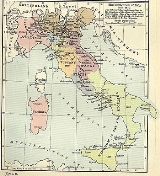
Italian unification was the political and social movement that agglomerated different states of the
Italian peninsulaThe Italian Peninsula or Apennine Peninsula is one of the three large peninsulas of Southern Europe , spanning from the Po Valley in the north to the central Mediterranean Sea in the south. The peninsula's shape gives it the nickname Lo Stivale...
into the single state of
ItalyItaly , officially the Italian Republic languages]] under the European Charter for Regional or Minority Languages. In each of these, Italy's official name is as follows:;;;;;;;;), is a unitary parliamentary republic in South-Central Europe. To the north it borders France, Switzerland, Austria and...
in the 19th century. Despite a lack of consensus on the exact dates for the beginning and end of this period, many scholars agree that the process began in 1815 with the
Congress of ViennaThe Congress of Vienna was a conference of ambassadors of European states chaired by Klemens Wenzel von Metternich, and held in Vienna from September, 1814 to June, 1815. The objective of the Congress was to settle the many issues arising from the French Revolutionary Wars, the Napoleonic Wars,...
and the end of
NapoleonicNapoleon Bonaparte was a French military and political leader during the latter stages of the French Revolution.As Napoleon I, he was Emperor of the French from 1804 to 1815...
rule, and ended in 1871 with the
Franco-Prussian WarThe Franco-Prussian War or Franco-German War, often referred to in France as the 1870 War was a conflict between the Second French Empire and the Kingdom of Prussia. Prussia was aided by the North German Confederation, of which it was a member, and the South German states of Baden, Württemberg and...
. The last
città irredenteItalian irredentism was an Italian Irredentist movement that aimed at the unification of all ethnically Italian peoples....
however, did not join the
Kingdom of ItalyThe Kingdom of Italy was a state forged in 1861 by the unification of Italy under the influence of the Kingdom of Sardinia, which was its legal predecessor state...
until after
World War IWorld War I , which was predominantly called the World War or the Great War from its occurrence until 1939, and the First World War or World War I thereafter, was a major war centred in Europe that began on 28 July 1914 and lasted until 11 November 1918...
.
Background
After the fall of the
Western Roman EmpireThe Western Roman Empire was the western half of the Roman Empire after its division by Diocletian in 285; the other half of the Roman Empire was the Eastern Roman Empire, commonly referred to today as the Byzantine Empire....
, Italy gradually developed into a system of
city-statesThe Italian city-states were a political phenomenon of small independent states mostly in the central and northern Italian peninsula between the 10th and 15th centuries....
. This system lasted through the
RenaissanceThe Renaissance was a cultural movement that spanned roughly the 14th to the 17th century, beginning in Italy in the Late Middle Ages and later spreading to the rest of Europe. The term is also used more loosely to refer to the historical era, but since the changes of the Renaissance were not...
but began to deteriorate with the rise of modern
nation-stateThe nation state is a state that self-identifies as deriving its political legitimacy from serving as a sovereign entity for a nation as a sovereign territorial unit. The state is a political and geopolitical entity; the nation is a cultural and/or ethnic entity...
s in the
early modern periodIn history, the early modern period of modern history follows the late Middle Ages. Although the chronological limits of the period are open to debate, the timeframe spans the period after the late portion of the Middle Ages through the beginning of the Age of Revolutions...
. Italy, including the
Papal StatesThe Papal State, State of the Church, or Pontifical States were among the major historical states of Italy from roughly the 6th century until the Italian peninsula was unified in 1861 by the Kingdom of Piedmont-Sardinia .The Papal States comprised territories under...
, then became the site of proxy fights between the major powers, notably the
Holy Roman EmpireThe Holy Roman Empire was a realm that existed from 962 to 1806 in Central Europe.It was ruled by the Holy Roman Emperor. Its character changed during the Middle Ages and the Early Modern period, when the power of the emperor gradually weakened in favour of the princes...
(later
AustriaAustria , officially the Republic of Austria , is a landlocked country of roughly 8.4 million people in Central Europe. It is bordered by the Czech Republic and Germany to the north, Slovakia and Hungary to the east, Slovenia and Italy to the south, and Switzerland and Liechtenstein to the...
as well as
PrussiaPrussia was a German kingdom and historic state originating out of the Duchy of Prussia and the Margraviate of Brandenburg. For centuries, the House of Hohenzollern ruled Prussia, successfully expanding its size by way of an unusually well-organized and effective army. Prussia shaped the history...
) and
FranceThe French Republic , The French Republic , The French Republic , (commonly known as France , is a unitary semi-presidential republic in Western Europe with several overseas territories and islands located on other continents and in the Indian, Pacific, and Atlantic oceans. Metropolitan France...
. In the early 19th century, Italy, like much of Europe, fell under the sway of Napoleon.
As Napoleon's reign began to fail, other national monarchs he had installed tried to keep their thrones by feeding nationalistic sentiments, setting the stage for the revolutions to come. Among these monarchs were the viceroy of Italy,
Eugène de BeauharnaisEugène Rose de Beauharnais, Prince Français, Prince of Venice, Viceroy of the Kingdom of Italy, Hereditary Grand Duke of Frankfurt, 1st Duke of Leuchtenberg and 1st Prince of Eichstätt ad personam was the first child and only son of Alexandre, Vicomte de Beauharnais and Joséphine Tascher de la...
, who tried to get Austrian approval for his succession to the Kingdom of Italy, and
Joachim MuratJoachim-Napoléon Murat , Marshal of France and Grand Admiral or Admiral of France, 1st Prince Murat, was Grand Duke of Berg from 1806 to 1808 and then King of Naples from 1808 to 1815...
, who called for Italian patriots' help for the unification of Italy under his rule. Following the defeat of Napoleonic
FranceThe French Republic , The French Republic , The French Republic , (commonly known as France , is a unitary semi-presidential republic in Western Europe with several overseas territories and islands located on other continents and in the Indian, Pacific, and Atlantic oceans. Metropolitan France...
, the
Congress of ViennaThe Congress of Vienna was a conference of ambassadors of European states chaired by Klemens Wenzel von Metternich, and held in Vienna from September, 1814 to June, 1815. The objective of the Congress was to settle the many issues arising from the French Revolutionary Wars, the Napoleonic Wars,...
(1815) was convened to redraw the
EuropeEurope is, by convention, one of the world's seven continents. Comprising the westernmost peninsula of Eurasia, Europe is generally 'divided' from Asia to its east by the watershed divides of the Ural and Caucasus Mountains, the Ural River, the Caspian and Black Seas, and the waterways connecting...
an continent. In Italy, the Congress restored the pre-Napoleonic patchwork of independent governments, either directly ruled or strongly influenced by the prevailing European powers, particularly Austria.
At the time, the struggle for Italian unification was perceived to be waged primarily against the
Austrian EmpireThe Austrian Empire was a modern era successor empire, which was centered on what is today's Austria and which officially lasted from 1804 to 1867. It was followed by the Empire of Austria-Hungary, whose proclamation was a diplomatic move that elevated Hungary's status within the Austrian Empire...
and the
HabsburgThe House of Habsburg , also found as Hapsburg, and also known as House of Austria is one of the most important royal houses of Europe and is best known for being an origin of all of the formally elected Holy Roman Emperors between 1438 and 1740, as well as rulers of the Austrian Empire and...
s, since they directly controlled the predominantly Italian-speaking northeastern part of present-day Italy and were, together, the most powerful force against unification. The Austrian Empire vigorously repressed nationalist sentiment growing on the Italian peninsula, as well as in the other parts of Habsburg domains. The Austrian diplomat Klemens von Metternich, an influential diplomat at the Congress of Vienna, stated that the word
Italy was nothing more than "a geographic expression."
Artistic and literary sentiment also turned towards nationalism; and perhaps the most famous of proto-nationalist works was
Alessandro ManzoniAlessandro Francesco Tommaso Manzoni was an Italian poet and novelist.He is famous for the novel The Betrothed , generally ranked among the masterpieces of world literature...
's
I Promessi Sposi (The Betrothed). Some read this novel as a thinly veiled allegorical critique of Austrian rule. The novel was published in 1827 and extensively revised in the following years. The 1840 version of
I Promessi Sposi used a standardized version of the Tuscan dialect, a conscious effort by the author to provide a language and force people to learn it.
Those in favour of unification also faced opposition from the
Holy SeeThe Holy See is the episcopal jurisdiction of the Catholic Church in Rome, in which its Bishop is commonly known as the Pope. It is the preeminent episcopal see of the Catholic Church, forming the central government of the Church. As such, diplomatically, and in other spheres the Holy See acts and...
, particularly after failed attempts to broker a confederation with the
Papal StatesThe Papal State, State of the Church, or Pontifical States were among the major historical states of Italy from roughly the 6th century until the Italian peninsula was unified in 1861 by the Kingdom of Piedmont-Sardinia .The Papal States comprised territories under...
, which would have left the Papacy with some measure of autonomy over the region. The pope at the time, Pius IX, feared that giving up power in the region could mean the persecution of Italian Catholics.
Even among those who wanted to see the peninsula unified into one country, different groups could not agree on what form a unified state would take.
Vincenzo Giobertithumb|250px|Vincenzo Gioberti.Vincenzo Gioberti was an Italian philosopher, publicist and politician.-Biography:Gioberti was born in Turin....
, a Piedmontese priest, had suggested a confederation of Italian states under rulership of the Pope. His book,
Of the Moral and Civil Primacy of the Italians, was published in 1843 and created a link between the Papacy and the Risorgimento. Many leading
revolutionariesThe Carbonari were groups of secret revolutionary societies founded in early 19th-century Italy. The Italian Carbonari may have further influenced other revolutionary groups in Spain, France, Portugal and possibly Russia. Although their goals often had a patriotic and liberal focus, they lacked a...
wanted a republic, but eventually it was a
kingVictor Emanuel II was king of Sardinia from 1849 and, on 17 March 1861, he assumed the title King of Italy to become the first king of a united Italy since the 6th century, a title he held until his death in 1878...
and his chief minister who had the power to unite the Italian states as a monarchy.
One of the most influential revolutionary groups was the
CarbonariThe Carbonari were groups of secret revolutionary societies founded in early 19th-century Italy. The Italian Carbonari may have further influenced other revolutionary groups in Spain, France, Portugal and possibly Russia. Although their goals often had a patriotic and liberal focus, they lacked a...
(coal-burners), a secret organization formed in southern Italy early in the 19th century. Inspired by the principles of the
French RevolutionThe French Revolution , sometimes distinguished as the 'Great French Revolution' , was a period of radical social and political upheaval in France and Europe. The absolute monarchy that had ruled France for centuries collapsed in three years...
, its members were mainly drawn from the middle class and intellectuals. After the Congress of Vienna divided the Italian peninsula among the European powers, the
Carbonari movement spread into the Papal States, the
Kingdom of SardiniaThe Kingdom of Sardinia consisted of the island of Sardinia first as a part of the Crown of Aragon and subsequently the Spanish Empire , and second as a part of the composite state of the House of Savoy . Its capital was originally Cagliari, in the south of the island, and later Turin, on the...
, the
Grand Duchy of TuscanyThe Grand Duchy of Tuscany was a central Italian monarchy that existed, with interruptions, from 1569 to 1859, replacing the Duchy of Florence. The grand duchy's capital was Florence...
, the Duchy of Modena and the Kingdom of Lombardy-Venetia. The revolutionaries were so feared that the reigning authorities passed an ordinance condemning to
deathCapital punishment, the death penalty, or execution is the sentence of death upon a person by the state as a punishment for an offence. Crimes that can result in a death penalty are known as capital crimes or capital offences. The term capital originates from the Latin capitalis, literally...
anyone who attended a Carbonari meeting. The society, however, continued to exist and was at the root of many of the political disturbances in Italy from 1820 until after unification. The
Carbonari condemned Napoleon III — who, as a young man, had fought on the side of the Carbonari — to death for failing to unite Italy, and the group almost succeeded in assassinating him in 1858. Many leaders of the unification movement were at one time members of this organization.
Two prominent radical figures in the unification movement were
Giuseppe MazziniGiuseppe Mazzini , nicknamed Soul of Italy, was an Italian politician, journalist and activist for the unification of Italy. His efforts helped bring about the independent and unified Italy in place of the several separate states, many dominated by foreign powers, that existed until the 19th century...
and
Giuseppe GaribaldiGiuseppe Garibaldi was an Italian military and political figure. In his twenties, he joined the Carbonari Italian patriot revolutionaries, and fled Italy after a failed insurrection. Garibaldi took part in the War of the Farrapos and the Uruguayan Civil War leading the Italian Legion, and...
. The more conservative constitutional monarchic figures included Count Cavour and
Victor Emmanuel IIVictor Emanuel II was king of Sardinia from 1849 and, on 17 March 1861, he assumed the title King of Italy to become the first king of a united Italy since the 6th century, a title he held until his death in 1878...
, who would later become the first king of a united Italy.
Mazzini's activity in revolutionary movements caused him to be imprisoned soon after he joined. While in prison, he concluded that Italy could — and therefore should — be unified and formulated his program for establishing a free, independent, and
republicA republic is a form of government in which the people, or some significant portion of them, have supreme control over the government and where offices of state are elected or chosen by elected people. In modern times, a common simplified definition of a republic is a government where the head of...
an nation with Rome as its capital. After Mazzini's release in 1831, he went to
MarseilleMarseille , known in antiquity as Massalia , is the second largest city in France, after Paris, with a population of 852,395 within its administrative limits on a land area of . The urban area of Marseille extends beyond the city limits with a population of over 1,420,000 on an area of...
, where he organized a new political society called
La Giovine Italia (Young Italy)Young Italy was a political movement founded in 1831 by Giuseppe Mazzini. The goal of this movement was to create a united Italian republic through promoting a general insurrection in the Italian reactionary states and in the lands occupied by the Austrian Empire...
. The new society, whose motto was "God and the People," sought the unification of Italy.
Garibaldi, a native of
NiceNice is the fifth most populous city in France, after Paris, Marseille, Lyon and Toulouse, with a population of 348,721 within its administrative limits on a land area of . The urban area of Nice extends beyond the administrative city limits with a population of more than 955,000 on an area of...
(then part of the
Kingdom of SardiniaThe Kingdom of Sardinia consisted of the island of Sardinia first as a part of the Crown of Aragon and subsequently the Spanish Empire , and second as a part of the composite state of the House of Savoy . Its capital was originally Cagliari, in the south of the island, and later Turin, on the...
), participated in an uprising in
PiedmontPiedmont is one of the 20 regions of Italy. It has an area of 25,402 square kilometres and a population of about 4.4 million. The capital of Piedmont is Turin. The main local language is Piedmontese. Occitan is also spoken by a minority in the Occitan Valleys situated in the Provinces of...
in 1834, was sentenced to death, and escaped to
South AmericaSouth America is a continent situated in the Western Hemisphere, mostly in the Southern Hemisphere, with a relatively small portion in the Northern Hemisphere. The continent is also considered a subcontinent of the Americas. It is bordered on the west by the Pacific Ocean and on the north and east...
. He spent fourteen years there, taking part in several wars, and returned to Italy in 1848.
Two Sicilies insurrection
In 1820, Spaniards successfully revolted over disputes about the constitution, which influenced the development of a similar movement in Italy. Inspired by the Spaniards, (who, in 1812, had created their constitution) a regiment in the army of the Kingdom of Two Sicilies, commanded by
Guglielmo PepeGuglielmo Pepe was an Italian general and patriot. He was brother to Florestano Pepe and cousin to Gabriele Pepe. He married to Marianne Coventry, a Scottish woman.-Biography:Pepe was born at Squillace in Calabria....
, a
Carbonaro, mutinied, conquering the peninsular part of Two Sicilies. The king,
Ferdinand IFerdinand I reigned variously over Naples, Sicily, and the Two Sicilies from 1759 until his death. He was the third son of King Charles III of Spain by his wife Maria Amalia of Saxony. On 10 August 1759, Charles succeeded his elder brother, Ferdinand VI, as King Charles III of Spain...
, agreed to enact a new constitution. The revolutionaries, though, failed to court popular support and fell to Austrian troops of the
Holy AllianceThe Holy Alliance was a coalition of Russia, Austria and Prussia created in 1815 at the behest of Czar Alexander I of Russia, signed by the three powers in Paris on September 26, 1815, in the Congress of Vienna after the defeat of Napoleon.Ostensibly it was to instill the Christian values of...
. Ferdinand abolished the constitution and began systematically persecuting known revolutionaries. Many supporters of revolution in Sicily, including the scholar
Michele AmariMichele Amari was an Italian patriot and historian. Born at Palermo, he devoted a great part of his life to the history of Sicily, and took part in its emancipation...
, were forced into exile during the decades that followed.
Piedmont insurrection
The leader of the 1823 revolutionary movement in
PiedmontPiedmont is one of the 20 regions of Italy. It has an area of 25,402 square kilometres and a population of about 4.4 million. The capital of Piedmont is Turin. The main local language is Piedmontese. Occitan is also spoken by a minority in the Occitan Valleys situated in the Provinces of...
was Santorre di Santarosa, who wanted to remove the Austrians and unify Italy under the
House of SavoyThe House of Savoy was formed in the early 11th century in the historical Savoy region. Through gradual expansion, it grew from ruling a small county in that region to eventually rule the Kingdom of Italy from 1861 until the end of World War II, king of Croatia and King of Armenia...
. The Piedmont revolt started in
Alessandria-Monuments:* The Citadel * The church of Santa Maria di Castello * The church of Santa Maria del Carmine * Palazzo Ghilini * Università del Piemonte Orientale-Museums:* The Marengo Battle Museum...
, where troops adopted the green, white and red
tricoloreThe flag of Italy is a tricolour featuring three equally sized vertical pales of green, white, and red, with the green at the hoist side...
of the
Cisalpine RepublicThe Cisalpine Republic was a French client republic in Northern Italy that lasted from 1797 to 1802.-Birth:After the Battle of Lodi in May 1796, Napoleon Bonaparte proceeded to organize two states: one to the south of the Po River, the Cispadane Republic, and one to the north, the Transpadane...
. The king's regent, prince
Charles AlbertCharles Albert was the King of Piedmont-Sardinia from 1831 to 1849. He succeeded his distant cousin Charles Felix, and his name is bound with the first Italian statute and the First War of Independence...
, acting while the king
Charles FelixCharles Felix was the Duke of Savoy, Piedmont, Aosta and King of Sardinia from 1821 to 1831.-Early life:...
was away, approved a new
constitutionA constitution is a set of fundamental principles or established precedents according to which a state or other organization is governed. These rules together make up, i.e. constitute, what the entity is...
to appease the revolutionaries, but when the king returned he disavowed the constitution and requested assistance from the Holy Alliance. Di Santarosa's troops were defeated, and the would-be Piedmontese revolutionary fled to
ParisParis is the capital and largest city in France, situated on the river Seine, in northern France, at the heart of the Île-de-France region...
.
1830 insurrections
By 1830, revolutionary sentiment in favour of a unified Italy began to experience a resurgence, and a series of insurrections laid the groundwork for the creation of one nation along the Italian peninsula.
The Duke of Modena, Francis IV, was an ambitious noble, and he hoped to become king of Northern Italy by increasing his territory. In 1826, Francis made it clear that he would not act against those who subverted opposition toward the unification of Italy. Encouraged by the declaration, revolutionaries in the region began to organize.
During the
July Revolution of 1830The French Revolution of 1830, also known as the July Revolution or in French, saw the overthrow of King Charles X of France, the French Bourbon monarch, and the ascent of his cousin Louis-Philippe, Duke of Orléans, who himself, after 18 precarious years on the throne, would in turn be overthrown...
in France, revolutionaries forced the king to abdicate and created the
July MonarchyThe July Monarchy , officially the Kingdom of France , was a period of liberal constitutional monarchy in France under King Louis-Philippe starting with the July Revolution of 1830 and ending with the Revolution of 1848...
with encouragement from the new French king,
Louis-PhilippeLouis Philippe I was King of the French from 1830 to 1848 in what was known as the July Monarchy. His father was a duke who supported the French Revolution but was nevertheless guillotined. Louis Philippe fled France as a young man and spent 21 years in exile, including considerable time in the...
. Louis-Philippe had promised revolutionaries such as
Ciro MenottiCiro Menotti was an Italian patriot.-Biography:Menotti was born in Migliarina, near Carpi, then part of the Duchy of Modena and Reggio.A member of the Carboneria since 1817, he was a fervent democratic and patriot...
that he would intervene if Austria tried to interfere in Italy with troops. Fearing he would lose his throne, though, Louis-Philippe did not intervene in Menotti's planned uprising. The Duke of Modena abandoned his
Carbonari supporters, arrested Menotti and other conspirators in 1831, and once again conquered his duchy with help from the Austrian troops. Menotti was executed, and the idea of a revolution centered in Modena faded.
At the same time, other insurrections arose in the
Papal LegationsThe term Papal Legation, in a territorial sense, refers to certain northern administrative regions of the erstwhile Papal States: specifically the "Legations" of Ferrara, Bologna, and Romagna. In 1860, after the Second Italian War of Independence, the Papal Legations entered through a referendum...
of
BolognaBologna is the capital city of Emilia-Romagna, in the Po Valley of Northern Italy. The city lies between the Po River and the Apennine Mountains, more specifically, between the Reno River and the Savena River. Bologna is a lively and cosmopolitan Italian college city, with spectacular history,...
,
ForlìForlì is a comune and city in Emilia-Romagna, Italy, and is the capital of the province of Forlì-Cesena. The city is situated along the Via Emilia, to the right of the Montone river, and is an important agricultural centre...
,
RavennaRavenna is the capital city of the Province of Ravenna in the Emilia-Romagna region of Italy and the second largest comune in Italy by land area, although, at , it is little more than half the size of the largest comune, Rome...
,
Imolathumb|250px|The Cathedral of Imola.Imola is a town and comune in the province of Bologna, located on the Santerno river, in the Emilia-Romagna region of north-central Italy...
,
FerraraFerrara is a city and comune in Emilia-Romagna, northern Italy, capital city of the Province of Ferrara. It is situated 50 km north-northeast of Bologna, on the Po di Volano, a branch channel of the main stream of the Po River, located 5 km north...
,
PesaroPesaro is a town and comune in the Italian region of the Marche, capital of the Pesaro e Urbino province, on the Adriatic. According to the 2007 census, its population was 92,206....
and
UrbinoUrbino is a walled city in the Marche region of Italy, south-west of Pesaro, a World Heritage Site notable for a remarkable historical legacy of independent Renaissance culture, especially under the patronage of Federico da Montefeltro, duke of Urbino from 1444 to 1482...
. These successful revolutions, which adopted the
tricolore in favour of the Papal flag, quickly spread to cover all the Papal Legations, and their newly installed local governments proclaimed the creation of a united Italian nation.
The revolts in Modena and the Papal Legations inspired similar activity in the
Duchy of ParmaThe Duchy of Parma was created in 1545 from that part of the Duchy of Milan south of the Po River, as a fief for Pope Paul III's illegitimate son, Pier Luigi Farnese, centered on the city of Parma....
, where the
tricolore flag was adopted. The Parmese duchess Marie Louise left the city during the political upheaval.
Insurrected provinces planned to unite as the
Province Italiane unite (united Italian Provinces), which prompted
Pope Gregory XVIPope Gregory XVI , born Bartolomeo Alberto Cappellari, named Mauro as a member of the religious order of the Camaldolese, was Pope of the Catholic Church from 1831 to 1846...
to ask for Austrian help against the rebels.
MetternichPrince Klemens Wenzel von Metternich was a German-born Austrian politician and statesman and was one of the most important diplomats of his era...
warned Louis-Philippe that Austria had no intention of letting Italian matters be, and that French intervention would not be tolerated. Louis-Philippe withheld any military help and even arrested Italian patriots living in France.
In the spring of 1831, the Austrian army began its march across the Italian peninsula, slowly crushing resistance in each province that had revolted. This military action suppressed much of the fledging revolutionary movement, and resulted in the arrest of many radical leaders, including Menotti.
Revolutions of 1848–1849
In 1848, the revolutionary disturbances began on January 5 with a civil disobedience strike in Lombardy, as citizens stopped smoking and playing the
lotteryA lottery is a form of gambling which involves the drawing of lots for a prize.Lottery is outlawed by some governments, while others endorse it to the extent of organizing a national or state lottery. It is common to find some degree of regulation of lottery by governments...
, which denied Austria the associated tax revenue. Shortly after this, revolts began on the island of
SicilySicily is a region of Italy, and is the largest island in the Mediterranean Sea. Along with the surrounding minor islands, it constitutes an autonomous region of Italy, the Regione Autonoma Siciliana Sicily has a rich and unique culture, especially with regard to the arts, music, literature,...
and in Naples against King Ferdinand, who conceded as he had in 1821 and granted The Kingdom of two Sicilies a constitution, as well as releasing political prisoners.
In February 1848, there were revolts in
TuscanyTuscany is a region in Italy. It has an area of about 23,000 square kilometres and a population of about 3.75 million inhabitants. The regional capital is Florence ....
that were relatively nonviolent, after which
Grand Duke FerdinandFerdinand IV, Grand Duke of Tuscany was the last Grand Duke of Tuscany from 1859 to 1860. The House of Habsburg-Lorraine continued to hold the title as pretenders until the end of World War I.-Biography:...
granted the Tuscans a constitution. A breakaway republican provisional government formed in Tuscany during February shortly after this concession. On 21 February,
Pope Pius IXBlessed Pope Pius IX , born Giovanni Maria Mastai-Ferretti, was the longest-reigning elected Pope in the history of the Catholic Church, serving from 16 June 1846 until his death, a period of nearly 32 years. During his pontificate, he convened the First Vatican Council in 1869, which decreed papal...
granted a constitution to the Papal States, which was both unexpected and surprising considering the historical recalcitrance of the Papacy. On February 23, King Louis Philippe of France was forced to flee Paris, and a republic was proclaimed. By the time the revolution in Paris occurred, three states of Italy had constitutions — four if one considers Sicily to be a separate state.
Meanwhile in Lombardy tensions increased until the Milanese and Venetians rose in revolt on 18 March 1848. The insurrection in Milan succeeded in expelling the Austrian garrison after five days of street fights -18 March till 22 March- (
Cinque giornate di MilanoThe Five Days of Milan was a major event in the Revolutionary Year of 1848 and the start of the First Italian War of Independence. On March 18th, the city of Milan, rose, and in five days of street fighting drove Marshal Radetzky and his men from the city....
). An Austrian army under Marshal Josef Radetzky besieged Milan, but due to defection of many of his troops and the support of the Milanese for the revolt, they were forced to retreat. Soon,
Charles AlbertCharles Albert was the King of Piedmont-Sardinia from 1831 to 1849. He succeeded his distant cousin Charles Felix, and his name is bound with the first Italian statute and the First War of Independence...
, the King of Sardinia (who ruled Piedmont and Savoy), urged by the Venetians and Milanese to aid their cause, decided this was the moment to unify Italy and declared war on Austria. After initial successes at Goito and Peschiera, he was decisively defeated by Radetzky at the
Battle of CustozaThe Battle of Custoza was fought on July 24 and 25 1848 during the first Italian War of Independence between the armies of the Austrian Empire, led by Field Marshal Radetzky, and of the Kingdom of Sardinia, led by King Charles Albert of Piedmont....
on July 24. An armistice was agreed to, and Radetzky regained control of all of Lombardy-Venetia save Venice itself, where the
Republic of San MarcoThe Republic of San Marco was an Italian revolutionary state existing for 17 months in 1848–49. Based on the Venetian Lagoon, it extended into most of Venetia, or the Terraferma territory of the Venetian Republic, suppressed 51 years before in the French Revolutionary Wars...
was proclaimed under
Daniele ManinDaniele Manin was an Italian patriot and statesman from Venice. He is a hero of Italian unification .-Early life:...
.
While Radetzky consolidated control of Lombardy-Venetia and Charles Albert licked his wounds, matters took a more serious turn in other parts of Italy. The monarchs who had reluctantly agreed to constitutions in March came into conflict with their constitutional ministers. At first, the republics had the upper hand, forcing the monarchs to flee their capitals, including
Pope Pius IXBlessed Pope Pius IX , born Giovanni Maria Mastai-Ferretti, was the longest-reigning elected Pope in the history of the Catholic Church, serving from 16 June 1846 until his death, a period of nearly 32 years. During his pontificate, he convened the First Vatican Council in 1869, which decreed papal...
.
Initially, Pius IX had been something of a reformer, but conflicts with the revolutionaries soured him on the idea of constitutional government. In November 1848, following the assassination of his Minister
Pellegrino RossiPellegrino Rossi was an Italian economist, politician and jurist. He was an important figure of the July Monarchy in France, and the Minister of Justice in the government of the Papal States, under Pope Pius IX.-Biography:...
, Pius IX fled just before Garibaldi and other patriots arrived in Rome. In early 1849, elections were held for a Constituent Assembly, which proclaimed a
Roman RepublicThe Roman Republic was a state declared on February 9, 1849, when the government of Papal States was temporarily substituted by a republican government due to Pope Pius IX's flight to Gaeta. The republic was led by Carlo Armellini, Giuseppe Mazzini and Aurelio Saffi...
on February 9. On February 2, 1849, at a political rally held in the Apollo Theater, a young Roman priest, the Abbé Arduini, had made a speech in which he had declared that the temporal power of the popes was a
"historical lie, a political imposture, and a religious immorality.". In early March 1849, Mazzini arrived in Rome and was appointed Chief Minister. In the Constitution of the Roman Republic,
religious freedom was guaranteed by article 7, the independence of the pope as head of the Catholic Church was guaranteed by article 8 of the
Principi fondamentali, while the death penalty was abolished by article 5, and free public education was provided by article 8 of the
Titolo I.
Before the powers could respond to the founding of the Roman Republic, Charles Albert, whose army had been trained by the exiled Polish general Albert Chrzanowski, renewed the war with Austria. He was quickly defeated by Radetzky at
NovaraThe Battle of Novara or Battle of Bicocca was one of the battles fought between the Austrian Empire and the Kingdom of Sardinia during the First Italian War of Independence, within the era of Italian unification...
on March 23, 1849. Charles Albert abdicated in favour of his son, Victor Emmanuel II, and Piedmontese ambitions to unite Italy or conquer Lombardy were, for the moment, brought to an end. The war ended with a treaty signed on August 9. A popular revolt broke out in
BresciaThe Ten Days of Brescia was a revolt which broke out in the northern Italian city of that name, which lasted from March 23 to April 1, 1849.In the early 19th century Brescia was part of the Austrian puppet state called Kingdom of Lombardy-Venetia...
on the same day as the defeat at Novara, but was suppressed by the Austrians ten days later.
There remained the Roman and
VenetianThe Republic of San Marco was an Italian revolutionary state existing for 17 months in 1848–49. Based on the Venetian Lagoon, it extended into most of Venetia, or the Terraferma territory of the Venetian Republic, suppressed 51 years before in the French Revolutionary Wars...
Republics. In April, a French force under
Charles OudinotLieutenant-General Charles Nicolas Victor Oudinot, 2nd Duc de Reggio , the eldest son of Napoleon I's marshal Nicolas Oudinot of his first marriage with Charlotte Derlin, also made a military career....
was sent to Rome. Apparently, the French first wished to mediate between the Pope and his subjects, but soon the French were determined to restore the Pope. After a two month siege, Rome capitulated on June 29, 1849, and the Pope was restored. Garibaldi and Mazzini once again fled into exile — in 1850 Garibaldi came to
New York CityNew York is the most populous city in the United States and the center of the New York Metropolitan Area, one of the most populous metropolitan areas in the world. New York exerts a significant impact upon global commerce, finance, media, art, fashion, research, technology, education, and...
. Meanwhile, the Austrians besieged Venice, which was forced to surrender on August 24. Pro-independence fighters were hanged en masse in
BelfioreThe Belfiore martyrs were a group of pro-independence fighters condemned to death by hanging in 1853 during the Italian Risorgimento. They included Tito Speri and the priest Enrico Tazzoli and are named after the site where the sentence was carried out, in the valley of Belfiore at the south...
, while the Austrians moved to restore order in central Italy, restoring the princes who had been expelled and establishing their control over the
Papal LegationsThe term Papal Legation, in a territorial sense, refers to certain northern administrative regions of the erstwhile Papal States: specifically the "Legations" of Ferrara, Bologna, and Romagna. In 1860, after the Second Italian War of Independence, the Papal Legations entered through a referendum...
. The revolutions were thus completely crushed.
The War of 1859 and its aftermath
Although Charles Albert had been soundly defeated in his bid to drive the Austrians from Italy, the Piedmontese did not abandon all hope of Italian domination. Camillo di Cavour, who became president of the Council of Ministers in 1852, also had expansionist ambitions. Cavour saw that Piedmont would not be able to add to its territory singlehandedly. Instead, he hoped for aid from Britain and France in expelling the Austrians from Italy. An attempt to gain British and French favour by supporting them in the
Crimean WarThe Crimean War was a conflict fought between the Russian Empire and an alliance of the French Empire, the British Empire, the Ottoman Empire, and the Kingdom of Sardinia. The war was part of a long-running contest between the major European powers for influence over territories of the declining...
was unsuccessful, as Italian matters were ignored at the
Congress of ParisThe Congress of Paris was a peace conference held in Paris, France, in 1856, , between representatives of the great powers in Europe to make peace after the almost three year long Crimean War.- Before the Congress :...
. Nevertheless, the war achieved a useful objective — it left Austria, which had uncomfortably tried a balance between the two sides during the war, dangerously isolated.
On January 14, 1858, the Italian nationalist
Felice OrsiniFelice Orsini was an Italian revolutionary and leader of the Carbonari who tried to assassinate Napoleon III, Emperor of the French.-Early:Felice Orsini was born at Meldola in Romagna, then part of the Papal States....
attempted to assassinate the French Emperor
Napoleon IIILouis-Napoléon Bonaparte was the President of the French Second Republic and as Napoleon III, the ruler of the Second French Empire. He was the nephew and heir of Napoleon I, christened as Charles Louis Napoléon Bonaparte...
. Writing from prison, Orsini did not plead for his life, accepting death for his role in the failed assassination, but rather appealed to Napoleon III to fulfill his destiny by aiding the forces of
Italian nationalismItalian nationalism refers to the nationalism of Italians or of Italian culture. It claims that Italians are the ethnic, cultural, and linguistic descendants of the ancient Romans who inhabited the Italian Peninsula for centuries. The origins of Italian nationalism have been traced to the...
. Napoleon, who had belonged to the
CarbonariThe Carbonari were groups of secret revolutionary societies founded in early 19th-century Italy. The Italian Carbonari may have further influenced other revolutionary groups in Spain, France, Portugal and possibly Russia. Although their goals often had a patriotic and liberal focus, they lacked a...
in his youth, and saw himself as in tune with the ideas of the day, became convinced it was his destiny to do something for Italy. In the summer of 1858, Cavour met with Napoleon III at
PlombièresPlombières-les-Bains is a commune in the Vosges department in Lorraine in northeastern France.Les bains refers to the hot springs in the area, whose properties were first discovered by the Romans...
and the two signed a secret agreement, known as the
Patto di Plombières ("Pact of Plombières"). Cavour and Napoleon III agreed to a joint war against Austria. Piedmont would gain the Austrian territories of Lombardy and
VenetiaVenetia is a name used mostly in a historical context for the area of Northeast Italy, corresponding approximately to the present-day Italian administrative regions of the Veneto and Friuli-Venezia Giulia...
) and some territories of the former Venetian Commonwealth in the Adriatic, as well as the Duchies of
ParmaParma is a city in the Italian region of Emilia-Romagna famous for its ham, its cheese, its architecture and the fine countryside around it. This is the home of the University of Parma, one of the oldest universities in the world....
and
ModenaModena is a city and comune on the south side of the Po Valley, in the Province of Modena in the Emilia-Romagna region of Italy....
, while France would be rewarded with Piedmont's territories in
SavoySavoy is a region of France. It comprises roughly the territory of the Western Alps situated between Lake Geneva in the north and Monaco and the Mediterranean coast in the south....
and
NiceNice is the fifth most populous city in France, after Paris, Marseille, Lyon and Toulouse, with a population of 348,721 within its administrative limits on a land area of . The urban area of Nice extends beyond the administrative city limits with a population of more than 955,000 on an area of...
. Central and Southern Italy, being largely under-developed and of little interest to the wealthier north, would remain largely as it was, although there was some talk that the Emperor's cousin Prince Napoleon would replace the Habsburgs in
TuscanyTuscany is a region in Italy. It has an area of about 23,000 square kilometres and a population of about 3.75 million inhabitants. The regional capital is Florence ....
. To allow the French to intervene without appearing as aggressors, Cavour was to provoke the Austrians by encouraging revolutionary activity in Lombardy.
At first, things did not work out as planned. The Austrians, ignorant of the agreement of Plombières, were surprisingly patient in dealing with the Piedmontese-inspired insurrections. Piedmontese mobilization in March 1859 was something of an admission of defeat, as it appeared that the strategy of provoking the Austrians into aggression had failed. Without Austrian aggression, the French could not intervene; and without French support, Cavour was unwilling to risk war. However, the Austrians conveniently made their opponents' task easier by sending an ultimatum to the Piedmontese demanding demobilization. The Piedmontese could conveniently reject this and, by making Austria seem the aggressor, allowed the French to intervene.
The war itself was quite short. The Austrian advance into Piedmont was incompetent, and they were unable to secure the Alpine passes before the arrival of the French army, led personally by Napoleon III. At the
Battle of MagentaThe Battle of Magenta was fought on June 4, 1859 during the Second Italian War of Independence, resulting in a French-Sardinian victory under Napoleon III against the Austrians under Marshal Ferencz Gyulai....
on June 4, the French and Sardinians were victorious over the Austrian army of Count
Ferencz GyulaiCount Ferencz Gyulai de Marosnémethi et Nádaska , also known as Ferenc Gyulai, Ferencz Gyulaj, or Franz Gyulai, was a Hungarian nobleman who served as Austrian Governor of Lombardy-Venetia and commanded the losing Austrian army at the Battle of Magenta.-Biography:Gyulai was born on 1 September 1798...
, leading to Austrian withdrawal from most of Lombardy and a triumphal entry by Napoleon and Victor Emmanuel into Milan. On June 24, a second battle was fought between the two armies at
SolferinoThe Battle of Solferino, , was fought on June 24, 1859 and resulted in the victory of the allied French Army under Napoleon III and Sardinian Army under Victor Emmanuel II against the Austrian Army under Emperor Franz Joseph I; it was the last major battle in world...
. This bloody engagement, at which the Austrian Emperor Franz Joseph had taken personal command of his troops, saw little skill demonstrated by either emperor, but the French were victorious. The Austrians withdrew behind the
QuadrilateralThe Quadrilatero is the traditional name of a defensive system of the Austrian Empire in the Lombardy-Venetia, which connected the fortresses of Peschiera, Mantua, Legnago and Verona between the Mincio, the Po and Adige Rivers...
of fortresses on the borders of Venetia.
Napoleon III sought peace at this point. Upon touring the Solferino battlefield, he was aghast at the casualties. He feared that a long and bloody campaign would be necessary to conquer Venetia, which coupled with fear for his position at home, worry about possible intervention by German states, and dislike of a too-powerful Piedmont-Sardinia led him to look for a way out. On July 11, he met privately with Franz Joseph at
VillafrancaVillafranca di Verona is a town and comune in the province of Verona in the Veneto, Northern Italy.-History:The position on the ancient via Postumia and the perpendicular intersection structure of its roads suggests that the city had Roman origins....
, without the knowledge of his Piedmontese allies. The two agreed on a settlement to the conflict. The Austrians would retain Venetia, but would cede Lombardy to the French, who would then immediately cede it to Piedmont (the Austrians were unwilling to cede the area to Piedmont directly). Otherwise, the Italian borders would remain unchanged. In Central Italy, where the authorities had been expelled following the outbreak of war, the rulers of Tuscany, Modena, and Parma, who had fled to Austria, would be restored, while Papal control of the Legations would be resumed. Because Napoleon had not fulfilled the terms of his agreement with Piedmont, he would not gain Savoy and Nice.
The Sardinians were outraged at this betrayal. Cavour demanded that the war be carried on regardless and resigned when Victor Emmanuel saw that acquiescence was the only realistic option. But most of the Villafranca agreement would prove a dead letter long before it was formalized by the
Treaty of ZürichThe Treaty of Zurich was signed by the Austrian Empire, the French Empire, and the Kingdom of Sardinia on November 10, 1859. The agreement was a reaffirmation of the terms of the preliminary peace of Villafranca, which brought the Austro-Sardinian War to an official close...
in November. Piedmontese troops occupied the smaller Italian states and the Legations, and the French were unwilling to pressure them to withdraw and allow the restoration of the old order, while the Austrians no longer had the power to compel it. In December, Tuscany, Parma, Modena, and the Legations were unified into the
United Provinces of Central ItalyThe United Provinces of Central Italy, also known as Union of Central Italy, Confederation of Central Italy or Government General of Central Italy, was a short-lived client state of the Kingdom of Piedmont-Sardinia...
, and, encouraged by the British, began seeking annexation by the Kingdom of Sardinia.
Cavour, who triumphantly returned to power in January 1860, wished to annex the territories, but realized that French acquiescence was necessary. Napoleon III agreed to recognize the Piedmontese annexation in exchange for Savoy and Nice. On March 20, 1860, the annexations occurred. Now the Kingdom of Sardinia controlled most of Northern and Central Italy.
The Mille expedition
Thus, by the spring of 1860, only four states remained in Italy — the Austrians in Venetia, the
Papal StatesThe Papal State, State of the Church, or Pontifical States were among the major historical states of Italy from roughly the 6th century until the Italian peninsula was unified in 1861 by the Kingdom of Piedmont-Sardinia .The Papal States comprised territories under...
(now minus the Legations), the new expanded Kingdom of Piedmont-Sardinia, and the Kingdom of the Two Sicilies. There is no special reason to think that Cavour now envisaged the unification of the rest of Italy under Piedmontese rule since these areas were of little interest economically and could be a financial burden, but events proved to have a life of their own.
Francis II of the Two SiciliesFrancis II , was King of the Two Sicilies from 1859 to 1861. He was the last King of the Two Sicilies, as successive invasions by Giuseppe Garibaldi and Victor Emmanuel II of Sardinia ultimately brought an end to his rule, and marked the first major event of Italian unification...
, the son and successor of
Ferdinand IIFerdinand II was King of the Two Sicilies from 1830 until his death.-Family:Ferdinand was born in Palermo, the son of King Francis I of the Two Sicilies and his wife and first cousin Maria Isabella of Spain.His paternal grandparents were King Ferdinand I of the Two Sicilies and Queen Marie...
(the infamous "King Bomba"), had a well-organized army of 150,000 men. But his father's tyranny had inspired many secret societies, and the kingdom's
Swiss MercenariesSwiss mercenaries were notable for their service in foreign armies, especially the armies of the Kings of France, throughout the Early Modern period of European history, from the Later Middle Ages into the Age of the European Enlightenment...
were unexpectedly recalled home under the terms of a new Swiss law that forbade Swiss citizens to serve as mercenaries. This left Francis with only his mostly unreliable native troops. It was a critical opportunity for the unification movement. In April 1860, separate insurrections began in
MessinaMessina is the third largest city on the island of Sicily, Italy and the capital of the province of Messina. It has a population of about 250,000 inhabitants in the city proper and about 650,000 in the province...
and
PalermoPalermo is a city in Southern Italy, the capital of both the autonomous region of Sicily and the Province of Palermo. The city is noted for its history, culture, architecture and gastronomy, playing an important role throughout much of its existence; it is over 2,700 years old...
in Sicily, both of which had demonstrated a history of opposing Neapolitan rule. These rebellions were easily suppressed by loyal troops.
In the meantime, Garibaldi, a native of
NiceNice is the fifth most populous city in France, after Paris, Marseille, Lyon and Toulouse, with a population of 348,721 within its administrative limits on a land area of . The urban area of Nice extends beyond the administrative city limits with a population of more than 955,000 on an area of...
, was deeply resentful of the French annexation of his home city. He hoped to use his supporters to regain the territory. Cavour, terrified of Garibaldi provoking a war with France, persuaded Garibaldi to instead concentrate his forces on the Sicilian rebellions. On May 6, 1860, Garibaldi and his cadre of about a thousand Italian volunteers (called
I Mille), steamed from Quarto near
GenoaGenoa |Ligurian]] Zena ; Latin and, archaically, English Genua) is a city and an important seaport in northern Italy, the capital of the Province of Genoa and of the region of Liguria....
, and after a stop in
TalamoneTalamone is a town in Tuscany, central Italy, administratively a frazione of the comune of Orbetello, province of Grosseto, in the Tuscan Maremma....
on May 11 landed near
MarsalaMarsala is a seaport city located in the Province of Trapani on the island of Sicily in Italy. The low coast on which it is situated is the westernmost point of the island...
on the west coast of
SicilySicily is a region of Italy, and is the largest island in the Mediterranean Sea. Along with the surrounding minor islands, it constitutes an autonomous region of Italy, the Regione Autonoma Siciliana Sicily has a rich and unique culture, especially with regard to the arts, music, literature,...
.
Near
SalemiSalemi is a town and comune in South-Western Sicily, Italy, administratively part of the province of Trapani. It is located in the Belice Valley.-History:...
, Garibaldi's army attracted scattered bands of rebels, and the combined forces defeated the opposing army at Calatafimi on May 13. Within three days, the invading force had swelled to 4,000 men. On May 14, Garibaldi proclaimed himself dictator of Sicily, in the name of Victor Emmanuel. After waging various successful but hard-fought battles, Garibaldi advanced upon the Sicilian capital of
PalermoPalermo is a city in Southern Italy, the capital of both the autonomous region of Sicily and the Province of Palermo. The city is noted for its history, culture, architecture and gastronomy, playing an important role throughout much of its existence; it is over 2,700 years old...
, announcing his arrival by beacon-fires kindled at night. On May 27, the force laid siege to the Porta Termini of Palermo, while a mass uprising of street and
barricadeBarricade, from the French barrique , is any object or structure that creates a barrier or obstacle to control, block passage or force the flow of traffic in the desired direction...
fighting broke out within the city.
With Palermo deemed insurgent, Neapolitan general Ferdinando Lanza, arriving in Sicily with some 25,000 troops, furiously bombarded Palermo nearly to ruins. With the intervention of a
BritishThe United Kingdom of Great Britain and Northern IrelandIn the United Kingdom and Dependencies, other languages have been officially recognised as legitimate autochthonous languages under the European Charter for Regional or Minority Languages...
admiral, an
armisticeAn armistice is a situation in a war where the warring parties agree to stop fighting. It is not necessarily the end of a war, but may be just a cessation of hostilities while an attempt is made to negotiate a lasting peace...
was declared, leading to the Neapolitan troops' departure and surrender of the town to Garibaldi and his much smaller army.
This resounding success demonstrated the weakness of the Neapolitan government. Garibaldi's fame spread and many Italians began to consider him a national hero. Doubt, confusion and dismay overtook the Neapolitan court — the king hastily summoned his ministry and offered to restore an earlier constitution, but these efforts failed to rebuild the peoples' trust in Bourbon governance.
Six weeks after the surrender of Palermo, Garibaldi attacked Messina. Within a week its citadel surrendered. Having conquered Sicily, Garibaldi proceeded to the mainland, crossing the Straits of Messina with the Neapolitan fleet at hand. The garrison at
Reggio CalabriaReggio di Calabria , commonly known as Reggio Calabria or Reggio, is the biggest city and the most populated comune of Calabria, southern Italy, and is the capital of the Province of Reggio Calabria and seat of the Council of Calabrian government.Reggio is located on the "toe" of the Italian...
promptly surrendered. Progressing northward, the populace everywhere hailed him and military resistance faded: on August 18 and 21 people of
BasilicataBasilicata , also known as Lucania, is a region in the south of Italy, bordering on Campania to the west, Apulia to the north and east, and Calabria to the south, having one short southwestern coastline on the Tyrrhenian Sea between Campania in the northwest and Calabria in the southwest, and a...
and Puglia, two regions of the Kingdom of Naples, had autonomously declared their annexation to the Kingdom of Italy. At the end of August Garibaldi was at
CosenzaCosenza is a city in southern Italy, located at the confluence of two historic rivers: the Busento and the Crathis. The municipal population is of around 70,000; the urban area, however, counts over 260,000 inhabitants...
, and on September 5 at
EboliEboli is a town and comune of Campania, southern Italy, in the province of Salerno, on the south edge of the hills overlooking the valley of the Sele....
, near
SalernoSalerno is a city and comune in Campania and is the capital of the province of the same name. It is located on the Gulf of Salerno on the Tyrrhenian Sea....
. Meanwhile,
NaplesNaples is a city in Southern Italy, situated on the country's west coast by the Gulf of Naples. Lying between two notable volcanic regions, Mount Vesuvius and the Phlegraean Fields, it is the capital of the region of Campania and of the province of Naples...
had declared a state of siege, and on September 6 the king gathered the 4,000 troops still faithful to him and retreated over the
VolturnoThe Volturno is a river in south-central Italy.-Geography:It rises in the Abruzzese central Apennines of Samnium near Rocchetta a Volturno and flows southeast as far as its junction with the Calore River near Caiazzo and runs south as far as Venafro, and then turns southwest, past Capua, to...
river. The next day Garibaldi, with a few followers, entered by train into Naples, where the people openly welcomed him.
Defeat of the Kingdom of Naples
Though Garibaldi had easily taken the capital, the Neapolitan army had not joined the rebellion
en masse, holding firm along the Volturno River. Garibaldi's irregular bands of about 25,000 men could not drive away the king or take the fortresses of
CapuaCapua is a city and comune in the province of Caserta, Campania, southern Italy, situated 25 km north of Naples, on the northeastern edge of the Campanian plain. Ancient Capua was situated where Santa Maria Capua Vetere is now...
and
GaetaGaeta is a city and comune in the province of Latina, in Lazio, central Italy. Set on a promontory stretching towards the Gulf of Gaeta, it is 120 km from Rome and 80 km from Naples....
without the help of the Sardinian army.
The Sardinian army, however, could only arrive by traversing the Papal States, which extended across the entire center of the peninsula. Ignoring the political will of the
Holy SeeThe Holy See is the episcopal jurisdiction of the Catholic Church in Rome, in which its Bishop is commonly known as the Pope. It is the preeminent episcopal see of the Catholic Church, forming the central government of the Church. As such, diplomatically, and in other spheres the Holy See acts and...
, Garibaldi announced his intent to proclaim a "Kingdom of Italy" from
RomeRome is the capital of Italy and the country's largest and most populated city and comune, with over 2.7 million residents in . The city is located in the central-western portion of the Italian Peninsula, on the Tiber River within the Lazio region of Italy.Rome's history spans two and a half...
, the capital city of
Pope Pius IXBlessed Pope Pius IX , born Giovanni Maria Mastai-Ferretti, was the longest-reigning elected Pope in the history of the Catholic Church, serving from 16 June 1846 until his death, a period of nearly 32 years. During his pontificate, he convened the First Vatican Council in 1869, which decreed papal...
. Seeing this as a threat to the domain of the Catholic Church, Pius threatened
excommunicationExcommunication is a religious censure used to deprive, suspend or limit membership in a religious community. The word means putting [someone] out of communion. In some religions, excommunication includes spiritual condemnation of the member or group...
for those who supported such an effort. Afraid that Garibaldi would attack Rome, Catholics worldwide sent money and volunteers for the Papal Army, which was commanded by General
Louis LamoricièreChristophe Léon Louis Juchault de Lamoricière was a French general.-Life:He was born at Nantes, and entered the Engineers in 1828. He served in the Algerian campaigns from 1830 onwards, and by 1840 he had risen to the grade of maréchal-de-camp . Three years later he was made a general of division...
, a French exile.
The settling of the peninsular standoff now rested with Louis Napoleon. If the French emperor had let Garibaldi have his way the latter would likely have ended the temporal sovereignty of the pope and made Rome the capital of Italy. Napoleon, however, may have arranged with Cavour to leave the king of Sardinia free to take possession of Naples,
UmbriaUmbria is a region of modern central Italy. It is one of the smallest Italian regions and the only peninsular region that is landlocked.Its capital is Perugia.Assisi and Norcia are historical towns associated with St. Francis of Assisi, and St...
and the other provinces, provided that Rome and the "patrimony of St. Peter" were left intact.
It was in this situation that a Sardinian force of two army corps, under Fanti and Cialdini, marched to the frontier of the Papal States, its objective being not Rome but Naples. The Papal troops under Lamoricière advanced against Cialdini, but were quickly defeated and besieged in the fortress of
AnconaAncona is a city and a seaport in the Marche region, in central Italy, with a population of 101,909 . Ancona is the capital of the province of Ancona and of the region....
, finally surrendering on September 29. On October 9,
Victor Emmanuel IIVictor Emanuel II was king of Sardinia from 1849 and, on 17 March 1861, he assumed the title King of Italy to become the first king of a united Italy since the 6th century, a title he held until his death in 1878...
arrived and took command. There was no longer a papal army to oppose him, and the march southward proceeded unopposed.
Garibaldi distrusted the pragmatic Cavour, particularly due to Cavour's role in the French annexation of
NiceNice is the fifth most populous city in France, after Paris, Marseille, Lyon and Toulouse, with a population of 348,721 within its administrative limits on a land area of . The urban area of Nice extends beyond the administrative city limits with a population of more than 955,000 on an area of...
, Garibaldi's birthplace. Nevertheless, he accepted the command of Victor Emmanuel. When the king entered
Sessa AuruncaSessa Aurunca is a town and comune of Campania, Italy, in the province of Caserta. It located on the south west slope of the extinct volcano of Roccamonfina, 40 km by rail west north west of Caserta and 30 km east of Formia....
at the head of his army, Garibaldi willingly handed over his dictatorial power. After greeting Victor Emmanuel in
TeanoTeano is a town and comune of Campania, Italy, in the province of Caserta, 30 km north-west of that town on the main line to Rome from Naples. It stands at the south-east foot of an extinct volcano, Rocca Monfina.- Ancient times and Middle Ages:...
with the title of
King of ItalyKing of Italy is a title adopted by many rulers of the Italian peninsula after the fall of the Roman Empire...
, Garibaldi entered Naples riding beside the king. Garibaldi then retired to the island of
CapreraCaprera is a small island off the coast of Sardinia, Italy, located in the Maddalena archipelago.In the area of La Maddalena island in the Strait of Bonifacio, it is a tourist destination and is famous as the place to which Giuseppe Garibaldi retired .This island has been declared a natural reserve...
, while the remaining work of unifying the peninsula was left to Victor Emmanuel.
The progress of the Sardinian army compelled
Francis IIFrancis II , was King of the Two Sicilies from 1859 to 1861. He was the last King of the Two Sicilies, as successive invasions by Giuseppe Garibaldi and Victor Emmanuel II of Sardinia ultimately brought an end to his rule, and marked the first major event of Italian unification...
to give up his line along the river, and he eventually took refuge with his best troops in the fortress of Gaeta. His courage boosted by his resolute young wife, Duchess Marie Sophie of Bavaria, Francis mounted a stubborn defence that lasted three months. But European allies refused him aid, food and munitions became scarce, and disease set in, so the garrison was forced to surrender. Nonetheless, ragtag groups of Neapolitans loyal to Francis would fight on against the Italian government for years to come.
The fall of Gaeta brought the unification movement to the brink of fruition — only Rome and Venetia remained to be added. On February 18, 1861, Victor Emmanuel assembled the deputies of the first Italian Parliament in Turin. On March 17, 1861, the Parliament proclaimed Victor Emmanuel II King of Italy, and on March 27, 1861 Rome was declared Capital of Italy, despite that it was not even in the new Kingdom. Three months later Cavour, having seen his life's work nearly complete, died. When he was given the last rites, Cavour purportedly said: "Italy is made. All is safe."
Roman Question
Mazzini was discontented with the perpetuation of monarchical government, and continued to agitate for a republic. With the motto "Free from the
AlpsThe Alps is one of the great mountain range systems of Europe, stretching from Austria and Slovenia in the east through Italy, Switzerland, Liechtenstein and Germany to France in the west....
to the
AdriaticThe Adriatic Sea is a body of water separating the Italian Peninsula from the Balkan peninsula, and the system of the Apennine Mountains from that of the Dinaric Alps and adjacent ranges...
," the unification movement set its gaze on Rome and Venice. There were obstacles, though. A challenge against the
PopeThe Pope is the Bishop of Rome, a position that makes him the leader of the worldwide Catholic Church . In the Catholic Church, the Pope is regarded as the successor of Saint Peter, the Apostle...
's temporal domain was viewed with great distrust by Catholics around the world, and French troops were stationed in Rome. Victor Emmanuel was wary of the international repercussions of attacking the Papal States, and discouraged his subjects from participating in revolutionary ventures with such intentions.
Nonetheless, Garibaldi believed that the government would support him if he attacked Rome. Frustrated at inaction by the king, and bristling over perceived snubs, he organized a new venture. In June 1862, he sailed from Genoa and landed again at Palermo, where he gathered volunteers for the campaign, under the slogan
Roma o Morte (Rome or Death). The garrison of Messina, loyal to the king's instructions, barred their passage to the mainland. Garibaldi's force, now numbering two thousand, turned south and set sail from
CataniaCatania is an Italian city on the east coast of Sicily facing the Ionian Sea, between Messina and Syracuse. It is the capital of the homonymous province, and with 298,957 inhabitants it is the second-largest city in Sicily and the tenth in Italy.Catania is known to have a seismic history and...
. Garibaldi declared that he would enter Rome as a victor or perish beneath its walls. He landed at
MelitoMelito di Porto Salvo is a comune in the Province of Reggio Calabria in the Italian region Calabria, located about 130 km southwest of Catanzaro and about 25 km southeast of Reggio Calabria; and is also the country's southernmost city...
on August 14, and marched at once into the
CalabriaCalabria , in antiquity known as Bruttium, is a region in southern Italy, south of Naples, located at the "toe" of the Italian Peninsula. The capital city of Calabria is Catanzaro....
n mountains.
Far from supporting this endeavour, the Italian government was quite disapproving. General Cialdini dispatched a division of the regular army, under Colonel Pallavicino, against the volunteer bands. On August 28 the two forces met in the
AspromonteAspromonte is a mountain massif in the province of Reggio Calabria . The name means "rough mountains", so named by the farmers who found its steep terrain and rocky soil difficult to cultivate. It overlooks the Strait of Messina, being limited by the Ionian and Tyrrhenian Seas and by the Pietrace...
. One of the regulars fired a chance shot, and several volleys followed, but Garibaldi forbade his men to return fire on fellow subjects of the Kingdom of Italy. The volunteers suffered several casualties, and Garibaldi himself was wounded; many were taken prisoner. Garibaldi was taken by steamer to Varignano, where he was honorably imprisoned for a time, but finally released.
Meanwhile, Victor Emmanuel sought a safer means to the acquisition of the Papal States. He negotiated the removal of the French troops from Rome through a treaty, the
September ConventionThe September Convention was a treaty, signed on 15 September 1864, between the Italian government and Napoleon III, under which:* Napoleon III agreed to withdraw all French troops from Rome within two years....
, with Napoleon III in September 1864, by which the emperor agreed to withdraw his troops within two years. The pope was to expand his own army during that time so as to be self-sufficient. In December 1866, the last of the French troops departed from Rome, in spite of the efforts of the pope to retain them. By their withdrawal, Italy (excluding Venetia and Savoy) was freed from the presence of foreign soldiers.
The seat of government was moved in 1865 from
TurinTurin is a city and major business and cultural centre in northern Italy, capital of the Piedmont region, located mainly on the left bank of the Po River and surrounded by the Alpine arch. The population of the city proper is 909,193 while the population of the urban area is estimated by Eurostat...
, the old Sardinian capital, to
FlorenceFlorence is the capital city of the Italian region of Tuscany and of the province of Florence. It is the most populous city in Tuscany, with approximately 370,000 inhabitants, expanding to over 1.5 million in the metropolitan area....
, where the first Italian parliament was summoned. This arrangement created such disturbances in Turin that the king was forced to leave that city hastily for his new capital.
Third War of Independence (1866)
In the
Austro-Prussian WarThe Austro-Prussian War was a war fought in 1866 between the German Confederation under the leadership of the Austrian Empire and its German allies on one side and the Kingdom of Prussia with its German allies and Italy on the...
of 1866,
AustriaAustria , officially the Republic of Austria , is a landlocked country of roughly 8.4 million people in Central Europe. It is bordered by the Czech Republic and Germany to the north, Slovakia and Hungary to the east, Slovenia and Italy to the south, and Switzerland and Liechtenstein to the...
contested with
PrussiaPrussia was a German kingdom and historic state originating out of the Duchy of Prussia and the Margraviate of Brandenburg. For centuries, the House of Hohenzollern ruled Prussia, successfully expanding its size by way of an unusually well-organized and effective army. Prussia shaped the history...
the position of leadership among the German states. The Kingdom of Italy seized the opportunity to capture Venetia from Austrian rule and allied itself with Prussia. Austria tried to persuade the Italian government to accept Venetia in exchange for non-intervention. However, on April 8, Italy and Prussia signed an agreement that supported Italy's acquisition of Venetia, and on June 20, Italy declared war on Austria. Within the context of Italian unification, the Austro-Prussian war is called
Third Independence War, after the
First (1848) and the
Second (1859).
Victor Emmanuel hastened to lead an army across the
MincioMincio is a river in the Lombardy region of northern Italy.Called the Sarca River before entering Lake Garda, it flows from there about 65 km past Mantua into the Po River....
to the invasion of Venetia, while Garibaldi was to invade the
TyrolGerman Tyrol is a historical region in the Alps now divided between Austria and Italy. It includes largely ethnic German areas of historical County of Tyrol: the Austrian state of Tyrol and the province of South Tyrol but not the largely Italian-speaking province of Trentino .-History:German...
with his
Hunters of the AlpsThe Hunters of the Alps were a special military corps created by Giuseppe Garibaldi in Cuneo on February 20, 1859 to help the regular Sardinian army to free the northern part of Italy in the Second Italian War of Independence....
. The enterprise ended in disaster. The Italian army encountered the Austrians at
CustozaThe Battle of Custoza took place on June 24, 1866 during the Third Italian Independence War in the Italian unification process.The Austrian Imperial army with the old Venetian Army, led by Archduke Albert of Habsburg, defeated the Italian army led by Alfonso Ferrero la Marmora and Enrico Cialdini,...
on June 24 and suffered a defeat. On July 20 the
Regia MarinaThe Regia Marina dates from the proclamation of the Kingdom of Italy in 1861 after Italian unification...
was defeated in the
battle of LissaThe Battle of Lissa took place on 20 July 1866 in the Adriatic Sea near the Dalmatian island of Lissa and was a decisive victory for an outnumbered Austrian Empire force over a superior Italian force...
where the Austrians completely destroyed Italian vessels. Italy's fortunes were not all so dismal, though. The following day, Garibaldi's volunteers defeated an Austrian force in the
battle of BezzeccaThe Battle of Bezzecca was fought on July 21, 1866 between Italy and Austria, in the course of the Third Italian Independence War. The Italian force, the Hunters of the Alps, were led by Giuseppe Garibaldi, and had invaded Trentino as part of the general Italian offensive against the Austrian...
, and moved toward
TrentoTrento is an Italian city located in the Adige River valley in Trentino-Alto Adige/Südtirol. It is the capital of Trentino...
.
Meanwhile, Prussian Prime Minister
BismarckOtto Eduard Leopold, Prince of Bismarck, Duke of Lauenburg , simply known as Otto von Bismarck, was a Prussian-German statesman whose actions unified Germany, made it a major player in world affairs, and created a balance of power that kept Europe at peace after 1871.As Minister President of...
saw that his own ends in the war had been achieved, and signed an armistice with Austria on July 27. Italy officially laid down its arms on August 12. Garibaldi was called back from his successful march and resigned with a brief telegram reading only "
Obbedisco" ("I obey").
In spite of Italy's poor showing, Prussia's success on the northern front obliged Austria to cede Venetia. Under the terms of a peace treaty signed in
ViennaVienna is the capital and largest city of the Republic of Austria and one of the nine states of Austria. Vienna is Austria's primary city, with a population of about 1.723 million , and is by far the largest city in Austria, as well as its cultural, economic, and political centre...
on October 12, Emperor Franz Joseph had already agreed to cede Venetia to Napoleon III in exchange for non-intervention in the Austro-Prussian War and thus Napoleon III ceded Venetia to Italy on October 19 in exchange for the earlier Italian acquiescence to the French annexation of
SavoySavoy is a region of France. It comprises roughly the territory of the Western Alps situated between Lake Geneva in the north and Monaco and the Mediterranean coast in the south....
and
NiceNice is the fifth most populous city in France, after Paris, Marseille, Lyon and Toulouse, with a population of 348,721 within its administrative limits on a land area of . The urban area of Nice extends beyond the administrative city limits with a population of more than 955,000 on an area of...
.
In the peace treaty of Vienna, it was written that the annexation of Venetia would have become effective only after a referendum — taken on October 21 and October 22 — to let the
VenetianVenice is a city in northern Italy which is renowned for the beauty of its setting, its architecture and its artworks. It is the capital of the Veneto region...
people express their will about being annexed or not to the Kingdom of Italy. Historians suggest that the referendum in Venetia was held under military pressure, as a mere 0.01% of voters (69 out of more than 642,000 ballots) voted against the annexation. Many Venetian independence movements (see
VenetismVenetian nationalism is an ideology and a regionalist movement demanding more autonomy, or even independence from Italy, for Veneto, and promoting the re-discovery the Republic of Venice's heritage, traditions, culture and language...
) refer to this deceit to claim for independence of Veneto.
Austrian forces put up some opposition to the invading Italians, to little effect. Victor Emmanuel entered Venice and Venetian land, and performed an act of homage in the
Piazza San MarcoPiazza San Marco , is the principal public square of Venice, Italy, where it is generally known just as "the Piazza". All other urban spaces in the city are called "campi"...
.
Mentana and Villa Glori
The national party, with Garibaldi at its head, still aimed at the possession of Rome, as the historic capital of the peninsula. In 1867 Garibaldi made a second attempt to capture Rome, but the papal army, strengthened with a new French auxiliary force, defeated his badly armed volunteers at Mentana. Subsequently, a French garrison remained in Civitavecchia until August 1870, when it was recalled following the outbreak of the
Franco-Prussian WarThe Franco-Prussian War or Franco-German War, often referred to in France as the 1870 War was a conflict between the Second French Empire and the Kingdom of Prussia. Prussia was aided by the North German Confederation, of which it was a member, and the South German states of Baden, Württemberg and...
.
Before the defeat at Mentana, Enrico Cairoli, his brother Giovanni and 70 companions had made a daring attempt to take Rome. The group had embarked in Terni and floated down the Tiber. Their arrival in Rome was to coincide with an uprising inside the city. On 22 October 1867, the revolutionaries inside Rome seized control of the Capitoline Hill and of Piazza Colonna. Unfortunately for the Cairolis and their companions, by the time they arrived at Villa Glori, on the northern outskirts of Rome, the uprising had already been suppressed. During the night of 22 October 1867, the group was surrounded by
Papal ZouavesThe Papal Zouaves were an infantry force formed in defence of the Papal States.-Origin:The Zouaves evolved out of a unit formed by Christophe Léon Louis Juchault de Lamoricière...
, and Giovanni was severely wounded. Enrico was mortally wounded and bled to death in Giovanni's arms.
The Battle of Villa Glori
The conflict took place at Villa Glori on the night of October 23, 1867, in the efforts of
Giuseppe GaribaldiGiuseppe Garibaldi was an Italian military and political figure. In his twenties, he joined the Carbonari Italian patriot revolutionaries, and fled Italy after a failed insurrection. Garibaldi took part in the War of the Farrapos and the Uruguayan Civil War leading the Italian Legion, and...
to liberate Rome from papal rule. A group of seventy volunteers led by Enrico Cairoli, Pavia, Terni started from October 20 to bring aid to the revolutionary junta in Rome, after having sailed the Tiber took land at the confluence of the Tiber with the Aniene. Reached a small hill to the left of the Tiber near the Monti Parioli, where he had an appointment with other conspirators, the troops occupied a farmhouse on the Monti Parioli.
Meanwhile, two volunteers, Joseph Monti and Gaetano Tognetti, succeeded in blowing up the barracks Serristori with a bomb. Both were captured and beheaded 24 November 1868, despite the request for clemency that Vittorio Emanuele II had sent to Pius IX.
About five o'clock that afternoon of October 23 volunteers were hooked from about 300 "foreign police" (Switzerland) for about an hour of the Pope defended themselves in the midst of vineyards and twice counterattacked with the bayonet. In the clashes Enrico Cairoli died, while his brother John was seriously injured (Fratelli Cairoli). John died on September 11, 1869 of injuries sustained in Belgirate, in the summer house of his mother, Adelaide.
Results
With the Cairoli dead, command was assumed by John Tobacco who had retreated back with the remaining volunteers into the villa, where they continued to fire until the papal soldiers, fell in the evening and retired to Rome. The survivors retreated to the positions of Garibaldi, the Italian border.
Memorial
At the summit of Villa Glori, near the spot where Enrico died, there is a plain white column dedicated to the Cairoli brothers and their 70 companions. About 100 meters to the left from the top of the Spanish Steps, there is a bronze monument of Giovanni holding the dying Enrico in his arm. A plaque lists the names of their companions. Giovanni never recovered from his wounds and from the tragic events of 1867. According to an eyewitness, when Giovanni died on 11 September 1869:
Capture of Rome
In July 1870, the
Franco-Prussian WarThe Franco-Prussian War or Franco-German War, often referred to in France as the 1870 War was a conflict between the Second French Empire and the Kingdom of Prussia. Prussia was aided by the North German Confederation, of which it was a member, and the South German states of Baden, Württemberg and...
began. In early August, the French Emperor Napoleon III recalled his garrison from Rome, thus no longer providing protection to the Papal State. Widespread public demonstrations illustrate the demand that the Italian government take Rome. The Italian government took no direct action until the collapse of the
Second French EmpireThe Second French Empire or French Empire was the Imperial Bonapartist regime of Napoleon III from 1852 to 1870, between the Second Republic and the Third Republic, in France.-Rule of Napoleon III:...
at the
Battle of SedanThe Battle of Sedan was fought during the Franco-Prussian War on 1 September 1870. It resulted in the capture of Emperor Napoleon III and large numbers of his troops and for all intents and purposes decided the war in favour of Prussia and its allies, though fighting continued under a new French...
. King Victor Emmanuel II sent Count
Gustavo Ponza di San Martino Gustavo Ponza, conte di San Martino was an Italian politician, who was administrator and senator of the Kingdom of Italy....
to Pius IX with a personal letter offering a face-saving proposal that would have allowed the peaceful entry of the Italian Army into Rome, under the guise of offering protection to the pope. The Papacy, however, exhibited something less than enthusiasm for the plan:
The Italian Army, commanded by General
Raffaele CadornaCount Raffaele Cadorna was an Italian general who served as one of the major Piedmontese leaders responsible for the unification of Italy during the mid-19th century....
, crossed the papal frontier on 11 September and advanced slowly toward Rome, hoping that a peaceful entry could be negotiated. The Italian Army reached the
Aurelian WallsThe Aurelian Walls is a line of city walls built between 271 and 275 in Rome, Italy, during the reign of the Roman Emperors Aurelian and Probus....
on 19 September and placed Rome under a state of siege. Although now convinced of his unavoidable defeat, Pius IX remained intransigent to the bitter end and forced his troops to put up a token resistance. On September 20, after a cannonade of three hours had breached the
Aurelian WallsThe Aurelian Walls is a line of city walls built between 271 and 275 in Rome, Italy, during the reign of the Roman Emperors Aurelian and Probus....
at
Porta PiaPorta Pia is a gate in the Aurelian Walls of Rome, Italy. One of Pope Pius IV's civic improvements to the city, it is named after him. Situated at the end of a new street, the Via Pia, it was designed by Michelangelo in replacement for the Porta Nomentana situated several hundred meters...
, the
BersaglieriThe Bersaglieri are a corps of the Italian Army originally created by General Alessandro La Marmora on 18 June 1836 to serve in the Piedmontese Army, later to become the Royal Italian Army...
entered Rome and marched down
Via Pia, which was subsequently renamed
Via XX Settembre. 49 Italian soldiers and four officers, and 19 papal troops died.
RomeRome is the capital of Italy and the country's largest and most populated city and comune, with over 2.7 million residents in . The city is located in the central-western portion of the Italian Peninsula, on the Tiber River within the Lazio region of Italy.Rome's history spans two and a half...
and
LatiumLazio is one of the 20 administrative regions of Italy, situated in the central peninsular section of the country. With about 5.7 million residents and a GDP of more than 170 billion euros, Lazio is the third most populated and the second richest region of Italy...
were annexed to the Kingdom of Italy after a plebiscite held on October 2. The results of this plebiscite were accepted by decree of October 9.
Initially the Italian government had offered to let the pope keep the
Leonine CityThe Leonine City is that part of the city of Rome around which the ninth-century Pope Leo IV commissioned the construction of the Leonine Wall. It is on the opposite side of the Tiber from the seven hills of Rome and was not enclosed within the ancient city's Aurelian Walls, built between 271 and...
, but the Pope rejected the offer because acceptance would have been an implied endorsement of the legitimacy of the Italian kingdom's rule over his former domain. Pius IX declared himself a
prisoner in the VaticanA prisoner in the Vatican or prisoner of the Vatican is how Pope Pius IX described himself following the capture of Rome by the armed forces of the Kingdom of Italy on 20 September 1870. Part of the process of Italian unification, the city's capture ended the millennial temporal rule of the popes...
, although he was not actually restrained from coming and going. Rather, being deposed and stripped of much of his former power also removed a measure of personal protection — if he had walked the streets of Rome he might have been in danger from political opponents who had formerly kept their views private. Officially, the capital was not moved from Florence to Rome until July 1871.
Historian Raffaele de Cesare made the following observations about Italian unification:
Risorgimento and Irredentism
The process of unification of the Italian people in a national State was not completed in the nineteenth century. Many Italians remained outside the borders of the
Kingdom of ItalyThe Kingdom of Italy was a state forged in 1861 by the unification of Italy under the influence of the Kingdom of Sardinia, which was its legal predecessor state...
and this situation created the Italian
irredentismIrredentism is any position advocating annexation of territories administered by another state on the grounds of common ethnicity or prior historical possession, actual or alleged. Some of these movements are also called pan-nationalist movements. It is a feature of identity politics and cultural...
.
Italia irredentaItalian irredentism was an Italian Irredentist movement that aimed at the unification of all ethnically Italian peoples....
(Unredeemed Italy) was an
ItalianItaly , officially the Italian Republic languages]] under the European Charter for Regional or Minority Languages. In each of these, Italy's official name is as follows:;;;;;;;;), is a unitary parliamentary republic in South-Central Europe. To the north it borders France, Switzerland, Austria and...
nationalistNationalism is a political ideology that involves a strong identification of a group of individuals with a political entity defined in national terms, i.e. a nation. In the 'modernist' image of the nation, it is nationalism that creates national identity. There are various definitions for what...
opinion movement that emerged after Italian unification. It advocated
irredentismIrredentism is any position advocating annexation of territories administered by another state on the grounds of common ethnicity or prior historical possession, actual or alleged. Some of these movements are also called pan-nationalist movements. It is a feature of identity politics and cultural...
among the Italian people as well as other nationalities who were willing to become Italian and as a movement; it is also known as "Italian irredentism." Not a formal organization, it was just an opinion movement that claimed that Italy had to reach its "natural borders". Similar patriotic and nationalistic ideas were common in Europe in the 19th century.
Irredentism and the two World Wars
During the post-unification era, some Italians were unsatisfied with the current state of the Italian Kingdom since they wanted the kingdom to include Trieste, Istria and other areas around as well. This Italian
irredentismIrredentism is any position advocating annexation of territories administered by another state on the grounds of common ethnicity or prior historical possession, actual or alleged. Some of these movements are also called pan-nationalist movements. It is a feature of identity politics and cultural...
succeeded in
World War IWorld War I , which was predominantly called the World War or the Great War from its occurrence until 1939, and the First World War or World War I thereafter, was a major war centred in Europe that began on 28 July 1914 and lasted until 11 November 1918...
with the annexation of
TriesteTrieste is a city and seaport in northeastern Italy. It is situated towards the end of a narrow strip of land lying between the Adriatic Sea and Italy's border with Slovenia, which lies almost immediately south and east of the city...
and
TrentoTrento is an Italian city located in the Adige River valley in Trentino-Alto Adige/Südtirol. It is the capital of Trentino...
, with the respective territories of Venezia Giulia and Trentino.
The Kingdom of Italy had declared neutrality at the beginning of the war, officially because the
Triple AllianceThe Triple Alliance was the military alliance between Germany, Austria–Hungary, and Italy, , that lasted from 1882 until the start of World War I in 1914...
with Germany and Austria-Hungary was a defensive one, requiring its members to come under attack first. Many Italians were still hostile to Austrian historical and continuing occupations of ethnically Italian areas, and Italy chose not to enter. Austria-Hungary requested Italian neutrality, while the
Triple EntenteThe Triple Entente was the name given to the alliance among Britain, France and Russia after the signing of the Anglo-Russian Entente in 1907....
(which included Great Britain, France and Russia) requested its intervention. With the
London PactLondon Pact , or more correctly, the Treaty of London, 1915, was a secret pact between Italy and Triple Entente, signed in London on 26 April 1915 by the Kingdom of Italy, Great Britain, France and Russia....
, signed in April 1915, Italy agreed to declare war against the
Central PowersThe Central Powers were one of the two warring factions in World War I , composed of the German Empire, the Austro-Hungarian Empire, the Ottoman Empire, and the Kingdom of Bulgaria...
, in exchange for the
irredent territories of Friuli, Trentino and
DalmatiaDalmatia is a historical region on the eastern coast of the Adriatic Sea. It stretches from the island of Rab in the northwest to the Bay of Kotor in the southeast. The hinterland, the Dalmatian Zagora, ranges from fifty kilometers in width in the north to just a few kilometers in the south....
(see
Italia irredentaItalian irredentism was an Italian Irredentist movement that aimed at the unification of all ethnically Italian peoples....
).
Italian irredentism obtained an important result after
World War IWorld War I , which was predominantly called the World War or the Great War from its occurrence until 1939, and the First World War or World War I thereafter, was a major war centred in Europe that began on 28 July 1914 and lasted until 11 November 1918...
, when Italy gained
TriesteTrieste is a city and seaport in northeastern Italy. It is situated towards the end of a narrow strip of land lying between the Adriatic Sea and Italy's border with Slovenia, which lies almost immediately south and east of the city...
,
GoriziaGorizia is a town and comune in northeastern Italy, in the autonomous region of Friuli Venezia Giulia. It is located at the foot of the Julian Alps, bordering Slovenia. It is the capital of the Province of Gorizia, and it is a local center of tourism, industry, and commerce. Since 1947, a twin...
,
IstriaIstria , formerly Histria , is the largest peninsula in the Adriatic Sea. The peninsula is located at the head of the Adriatic between the Gulf of Trieste and the Bay of Kvarner...
and the city of
ZaraZadar is a city in Croatia on the Adriatic Sea. It is the centre of Zadar county and the wider northern Dalmatian region. Population of the city is 75,082 citizens...
. During WWII, after the Axis aggression against
YugoslaviaYugoslavia refers to three political entities that existed successively on the western part of the Balkans during most of the 20th century....
, Italy created the "Governatorato di Dalmazia" (from 1941 to September 1943), so the
Kingdom of ItalyThe Kingdom of Italy was a state forged in 1861 by the unification of Italy under the influence of the Kingdom of Sardinia, which was its legal predecessor state...
annexed temporarily even Spalato (
SplitSplit is a Mediterranean city on the eastern shores of the Adriatic Sea, centered around the ancient Roman Palace of the Emperor Diocletian and its wide port bay. With a population of 178,192 citizens, and a metropolitan area numbering up to 467,899, Split is by far the largest Dalmatian city and...
), Cattaro (
KotorKotor is a coastal city in Montenegro. It is located in a secluded part of the Gulf of Kotor. The city has a population of 13,510 and is the administrative center of the municipality....
) and most of coastal
DalmatiaDalmatia is a historical region on the eastern coast of the Adriatic Sea. It stretches from the island of Rab in the northwest to the Bay of Kotor in the southeast. The hinterland, the Dalmatian Zagora, ranges from fifty kilometers in width in the north to just a few kilometers in the south....
. From 1942 to 1943 even Corsica (
CorseCorse may refer to:*Corse, the French name for Corsica, the fourth largest island in the Mediterranean Sea*Corse , a European surname of multiple origins *Corse, a Shakespearean word for Corpse...
) and Nizza (
NiceNice is the fifth most populous city in France, after Paris, Marseille, Lyon and Toulouse, with a population of 348,721 within its administrative limits on a land area of . The urban area of Nice extends beyond the administrative city limits with a population of more than 955,000 on an area of...
) were temporarily annexed to the Kingdom of Italy, nearly totally fulfilling in those years the requests of the Italian irredentism.
The movement had for its avowed purpose the emancipation of all Italian lands still subject to foreign rule after
Italian unification. The Irredentists took language as the test of the alleged Italian nationality of the countries they proposed to emancipate, which were Trentino,
TriesteTrieste is a city and seaport in northeastern Italy. It is situated towards the end of a narrow strip of land lying between the Adriatic Sea and Italy's border with Slovenia, which lies almost immediately south and east of the city...
,
DalmatiaDalmatia is a historical region on the eastern coast of the Adriatic Sea. It stretches from the island of Rab in the northwest to the Bay of Kotor in the southeast. The hinterland, the Dalmatian Zagora, ranges from fifty kilometers in width in the north to just a few kilometers in the south....
,
IstriaIstria , formerly Histria , is the largest peninsula in the Adriatic Sea. The peninsula is located at the head of the Adriatic between the Gulf of Trieste and the Bay of Kvarner...
,
GoriziaGorizia is a town and comune in northeastern Italy, in the autonomous region of Friuli Venezia Giulia. It is located at the foot of the Julian Alps, bordering Slovenia. It is the capital of the Province of Gorizia, and it is a local center of tourism, industry, and commerce. Since 1947, a twin...
,
TicinoCanton Ticino or Ticino is the southernmost canton of Switzerland. Named after the Ticino river, it is the only canton in which Italian is the sole official language...
,
NiceNice is the fifth most populous city in France, after Paris, Marseille, Lyon and Toulouse, with a population of 348,721 within its administrative limits on a land area of . The urban area of Nice extends beyond the administrative city limits with a population of more than 955,000 on an area of...
(Nizza),
CorsicaCorsica is an island in the Mediterranean Sea. It is located west of Italy, southeast of the French mainland, and north of the island of Sardinia....
and
MaltaMalta , officially known as the Republic of Malta , is a Southern European country consisting of an archipelago situated in the centre of the Mediterranean, south of Sicily, east of Tunisia and north of Libya, with Gibraltar to the west and Alexandria to the east.Malta covers just over in...
.
Austria-HungaryAustria-Hungary , more formally known as the Kingdoms and Lands Represented in the Imperial Council and the Lands of the Holy Hungarian Crown of Saint Stephen, was a constitutional monarchic union between the crowns of the Austrian Empire and the Kingdom of Hungary in...
promoted
CroatianCroats are a South Slavic ethnic group mostly living in Croatia, Bosnia and Herzegovina and nearby countries. There are around 4 million Croats living inside Croatia and up to 4.5 million throughout the rest of the world. Responding to political, social and economic pressure, many Croats have...
interests in Dalmatia and Istria to weaken Italian claims in the western
BalkansThe Balkans is a geopolitical and cultural region of southeastern Europe...
before WWI.
After World War II
After WWII the irredentism movement faded away in Italian politics. Only a few thousand Italians remain in
IstriaIstria , formerly Histria , is the largest peninsula in the Adriatic Sea. The peninsula is located at the head of the Adriatic between the Gulf of Trieste and the Bay of Kvarner...
and
DalmatiaDalmatia is a historical region on the eastern coast of the Adriatic Sea. It stretches from the island of Rab in the northwest to the Bay of Kotor in the southeast. The hinterland, the Dalmatian Zagora, ranges from fifty kilometers in width in the north to just a few kilometers in the south....
as a consequence of the Italian defeat in WWII and of the slaughter of few thousands of Italians as reprisals for fascist atrocities and the subsequent choice to keep Italian citizenship by an additional approximately 300,000 people in what became known as the
Istrian exodusThe expression Istrian exodus or Istrian-Dalmatian exodus is used to indicate the departure of ethnic Italians from Istria, Rijeka, and Dalmatia , after World War II. At the time of the exodus, these territories were part of the SR Croatia and SR Slovenia , today they are parts of the Republics of...
. However only 250,000 refugees were ethnic Italians (76% of which born in the territories surrendered), the others being ethnic Slovenians, ethnic Croatians and ethnic Istro-Romenians.
Criticism of Risorgimento
Italian unification is still a topic of debate. Some revisionists say that the Risorgimento was a true work of colonization, followed by a centralizing policy of conquest, because of which the Italian Mezzogiorno would fall into a state of backwardness still manifest. Revisionism of the Risorgimento produced a clear radicalization in mid-twentieth century, after the fall of the Savoy monarchy and fascism, for which the Risorgimento was considered an intangible myth.
The changed political conditions allowed the emergence of a group of scholars which began re-examining the value of the House of Savoy's work, and made largely negative reviews in that respect. The members of this group also took up the arguments of criticism, charging in particular to the process of national unification the cause of most problems of the Southern Italy. The founder of this new culture is generally considered Carlo Alianello, who in his first novel,
The Ensign (l'Alfiere) (1942) expressed a serious indictment of the creators and unification policies of the Kingdom of Sardinia.
Review of the historical facts concerning Italian unification has also been undertaken by some academic authors, in most cases of foreign origin, such as
Denis Mack SmithDenis Mack Smith CBE is an English historian, specialising in the history of Italy from the Risorgimento onwards. He is best known for studies of Garibaldi and Cavour and of Mussolini, and for his single-volume Modern Italy: A Political History...
, Christopher Duggan, Martin Clark and
Lucy RiallLucy Riall is Professor of History at Birkbeck, University of London.Riall studied at the London School of Economics and the University of Cambridge. She was a lecturer in Modern European history at the University of Essex before moving to Birkbeck...
. There are many topics developed by revisionists. These include undeclared invasion of independent states, the role of the
masonic lodgeThis article is about the Masonic term for a membership group. For buildings named Masonic Lodge, see Masonic Lodge A Masonic Lodge, often termed a Private Lodge or Constituent Lodge, is the basic organisation of Freemasonry...
s and foreign powers (
Great BritainGreat Britain or Britain is an island situated to the northwest of Continental Europe. It is the ninth largest island in the world, and the largest European island, as well as the largest of the British Isles...
and
FranceThe French Republic , The French Republic , The French Republic , (commonly known as France , is a unitary semi-presidential republic in Western Europe with several overseas territories and islands located on other continents and in the Indian, Pacific, and Atlantic oceans. Metropolitan France...
in particular), suspected violation of the plebiscites, the controversial repression of
brigandageBrigandage in the Two Sicilies had existed in some form since ancient times, however its origins as outlaws targeting random travellers would evolve vastly later on in the form of the political resistance movement form of brigandage in the Two Sicilies...
and the origin of the so-called Southern Question (Questione Meridionale).
Secession movements
The Italian unification process was generally popular with contemporary people living in the Italian peninsula, especially with regard to the end to Austrian rule. Nevertheless, dissenters were present in the 19th century (in particular, the rulers of the annexed states), and regionalist sympathies continue to the present day. There are two chief secession movements, (that in the past reached less than 5% of the national electoral votes and currently in the last 2008 national election reached about 10% nationwide and 20% in the north) represented by active political parties: one in the North (Lega Nord), and one in the South (
M.I.S.The Movement for the Independence of Sicily is a separatist movement, with the goal to obtain independence of the island from Italy...
). This southern secession movement was mainly the result of peasants revolting against the new government. The former has elected several representatives to the national parliament.
The Veneto region (corresponding to the central portion of what was the Most Serene Republic of Venice) has an especially strong and growing feeling toward autonomy/independence. In the latest elections Lega Nord (North League) reached 28.4%, and PDL reached 29.3(
http://www.repubblica.it/speciale/2009/elezioni/europee/regioni/veneto.html). It should be noticed that even leading representatives of PDL show increasing feeling toward autonomy (not independence) of Veneto within an Italian unitary frame (
http://mattinopadova.gelocal.it/dettaglio/galan:-%C2%ABil-veneto-mi-chiede-il-federalismo%C2%BB/1443833).
The Italian province of
South TyrolSouth Tyrol , also known by its Italian name Alto Adige, is an autonomous province in northern Italy. It is one of the two autonomous provinces that make up the autonomous region of Trentino-Alto Adige/Südtirol. The province has an area of and a total population of more than 500,000 inhabitants...
had a strong secession movement, headed by the German-speaking majority in the region, for unification with
AustriaAustria , officially the Republic of Austria , is a landlocked country of roughly 8.4 million people in Central Europe. It is bordered by the Czech Republic and Germany to the north, Slovakia and Hungary to the east, Slovenia and Italy to the south, and Switzerland and Liechtenstein to the...
. The movement was strongest after the Second World War. Secessionist parties still exist, but the secessionist movement has been mostly pacified by the granting of substantial autonomy by the Italian government.
Cultural depictions
The Resurgence is the subject of an opera,
Risorgimento! (2010) by Italian composer
Lorenzo FerreroLorenzo Ferrero is a contemporary Italian composer with a predilection for opera, a librettist, author, and book editor. He started composing at an early age and wrote over a hundred compositions thus far, including twelve operas, three ballets, and numerous orchestral, chamber music, solo...
, written to commemorate the 150th anniversary of the Italian unification.
The LeopardThe Leopard is a novel by Giuseppe Tomasi di Lampedusa that chronicles the changes in Sicilian life and society during the Risorgimento...
is a film from 1963, based on the novel by
Giuseppe Tomasi di LampedusaGiuseppe Tomasi di Lampedusa , was a Sicilian writer. He is most famous for his only novel, Il Gattopardo which is set in Sicily during the Risorgimento...
, and directed by
Luchino ViscontiLuchino Visconti di Modrone, Count of Lonate Pozzolo was an Italian theatre, opera and cinema director, as well as a screenwriter. He is best known for his films The Leopard and Death in Venice .-Life:...
. It features
Burt LancasterBurton Stephen "Burt" Lancaster was an American film actor noted for his athletic physique and distinctive smile...
as the eponymous character, the Prince of Salina. The film depicts his reaction to the Risorgimento, and his vain attempts to retain his social standing.
There are other movies set in this period:
- 1860
1860 is an Italian film directed by Alessandro Blasetti, released in 1934. The movie presages Italian neorealism in that it was shot wholly on location. Also, most contemporaneous historical epics used a star to focus on grand historical characters...
(1934), by Alessandro BlasettiAlessandro Blasetti was an Italian film director who influenced Italian neorealism with the film Quattro passi fra le nuvole...
- Piccolo mondo antico
Piccolo mondo antico , also known as Old-Fashioned World , is a 1941 Italian drama film directed by Mario Soldati and based on the 1895 novel by Antonio Fogazzaro...
(1941), by Mario SoldatiMario Soldati was an Italian writer and film director.-Biography:Soldati studied Humanities in his native city, Turin, and History of Art in Rome. He started publishing novels in 1929 although his fame came with America primo amore, published in 1935, a diary about the time he spent teaching at...
- Un garibaldino al convento
Un garibaldino al convento is a 1942 Italian comedy film directed by Vittorio De Sica. It was screened in November 1991 as part of a retrospective of De Sica's films at the Museum of Modern Art.-Cast:* Leonardo Cortese - Il conte Franco Amidei...
(1942), by Vittorio De SicaVittorio De Sica was an Italian director and actor, a leading figure in the neorealist movement....
- Senso
Senso is a 1954 melodrama film, an adaptation of Camillo Boito's Italian novella Senso by the Italian director Luchino Visconti, with Alida Valli as Livia and Farley Granger as Lieutenant Franz Mahler....
(1954), by Luchino ViscontiLuchino Visconti di Modrone, Count of Lonate Pozzolo was an Italian theatre, opera and cinema director, as well as a screenwriter. He is best known for his films The Leopard and Death in Venice .-Life:...
- Garibaldi
Garibaldi, the English title of the film originally released as Viva l'Italia! is a 1961 Italian drama film directed by Roberto Rossellini. The film follows famed revolutionary Giuseppe Garibaldi as he liberates southern Italy from the Bourbon monarchy....
(1961), by Roberto RosselliniRoberto Rossellini was an Italian film director and screenwriter. Rossellini was one of the directors of the Italian neorealist cinema, contributing films such as Roma città aperta to the movement.-Early life:Born in Rome, Roberto Rossellini lived on the Via Ludovisi, where Benito Mussolini had...
- 1870
1870 is a 1971 Italian drama film directed by Alfredo Giannetti.-Cast:* Anna Magnani* Marcello Mastroianni* Osvaldo Ruggeri* Mario Carotenuto* Franco Balducci* Gastone Bartolucci* Silla Bettini* Duilio Cruciani...
(1971), by Alfredo GiannettiAlfredo Giannetti is an Italian screenwriter and film editor. He won the Academy Award for Best Original Screenplay in 1962 for his work in Divorce, Italian Style.-Selected filmography:* Febbre da cavallo * 1870...
- Li chiamarono... briganti!
Li chiamarono... briganti! is a 1999 Italian film, directed by Pasquale Squitieri. It tells the story of Carmine Crocco, a 19th century italian brigand who gained recognition when he came to the forefront of the brigandage during the Italian unification, by opposing the army of King Victor...
(1999), by Pasquale Squitieri
- Noi credevamo
Noi credevamo is a 2010 Italian drama film directed by Mario Martone. The film was nominated for the Golden Lion at the 67th Venice International Film Festival.-Cast:* Luigi Lo Cascio - Domenico* Valerio Binasco - Angelo...
(2010), by Mario MartoneMario Martone is an Italian film director and screenwriter. He has directed 15 films since 1985. His film L'amore molesto was entered into the 1995 Cannes Film Festival...
See also
- Birth of the Italian Republic
The Italian constitutional referendum which officially took place on 2 June 1946, is a key event of Italian contemporary history. Until 1946, Italy was a kingdom ruled by the House of Savoy, kings of Italy since the Risorgimento and previously rulers of Savoy...
- Historical states of Italy
Italy, until the present era, was a conglomeration of city-states and other small independent entities. The following is a list of the various states that made up what we now know as Italy during the past...
- List of active autonomist and secessionist movements
- Revisionism of Risorgimento
Revisionism of Risorgimento is the review of the historical facts concerning the Italian national unification process and its immediate consequences. The approach focuses on the assumption that the revisionist history does not properly consider the reasons of the losers, omitting some aspects of...
- Revolutions of 1848 in the Italian states
The 1848 revolutions in the Italian states were organized revolts in the states of Italy led by intellectuals and agitators who desired a liberal government. As Italian nationalists they sought to eliminate reactionary Austrian control...
- Roman Question
thumb|300px|The breach of [[Porta Pia]], on the right, in a contemporaneous photograph.The Roman Question was a political dispute between the Italian Government and the Papacy from 1861 to 1929....
- San Marino
San Marino, officially the Republic of San Marino , is a state situated on the Italian Peninsula on the eastern side of the Apennine Mountains. It is an enclave surrounded by Italy. Its size is just over with an estimated population of over 30,000. Its capital is the City of San Marino...
- Vatican City
Vatican City , or Vatican City State, in Italian officially Stato della Città del Vaticano , which translates literally as State of the City of the Vatican, is a landlocked sovereign city-state whose territory consists of a walled enclave within the city of Rome, Italy. It has an area of...
- Unification of Germany
The formal unification of Germany into a politically and administratively integrated nation state officially occurred on 18 January 1871 at the Versailles Palace's Hall of Mirrors in France. Princes of the German states gathered there to proclaim Wilhelm of Prussia as Emperor Wilhelm of the German...
Italian
- Banti, Alberto Mario. La nazione del Risorgimento: parentela, santità e onore alle origini dell'Italia unita. Torino, Einaudi, 2000
- Banti, Alberto Mario. Il Risorgimento italiano. Roma-Bari, Laterza, 2004 (Quadrante Laterza; 125)
- Ghisalberti, Carlo. Istituzioni e società civile nell'età del Risorgimento. Roma-Bari, Laterza, 2005 (Biblioteca universale Laterza; 575)
- Della Peruta, Franco. L'Italia del Risorgimento: problemi, momenti e figure. Milano, Angeli, 1997 (Saggi di storia; 14)
- Della Peruta, Franco. Conservatori, liberali e democratici nel Risorgimento. Milano, Angeli, 1989 (Storia; 131)
- Riall, Lucy
Lucy Riall is Professor of History at Birkbeck, University of London.Riall studied at the London School of Economics and the University of Cambridge. She was a lecturer in Modern European history at the University of Essex before moving to Birkbeck...
. Il Risorgimento: storia e interpretazioni. Roma, Donzelli, 1997 (Universale; 2)
- Romeo, Rosario. Risorgimento e capitalismo. Roma-Bari, Laterza, 1998 (Economica Laterza; 144) (1ª ed. 1959)
- Scirocco, Alfonso. L'Italia del risorgimento: 1800-1860. (vol. 1 di Storia d'Italia dall'unità alla Repubblica), Bologna, Il mulino, 1990
- Scirocco, Alfonso. In difesa del Risorgimento. Bologna, Il mulino, 1998 (Collana di storia contemporanea)
- Smith, Denis Mack
Denis Mack Smith CBE is an English historian, specialising in the history of Italy from the Risorgimento onwards. He is best known for studies of Garibaldi and Cavour and of Mussolini, and for his single-volume Modern Italy: A Political History...
. Il Risorgimento italiano: storia e testi. (Nuova ediz.), Roma-Bari, Laterza, 1999 (Storia e società)
- Woolf, Stuart J. Il risorgimento italiano. Torino, Einaudi, 1981 (Piccola biblioteca Einaudi; 420)
- Tomaz, Luigi. Il confine d'Italia in Istria e Dalmazia, Presentazione di Arnaldo Mauri, Conselve, Think ADV, 2008.
- Carlo Cardia, Risorgimento e religione, Giappichelli, Torino, 2011, ISBN 978-88-348-2552-5.
External links