
In Depth
See Also

Mesopotamia

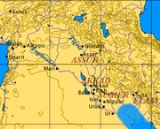
Mesopotamia refers to the region now occupied by modern Iraq Iraq

The Republic of Iraq, is a Middle East [i]ern country [i] in southwestern Asia [i] encomp ... 

, eastern Syria Syria

Syria , officially the Syrian Arab Republic , is a country in the Middle East [i]. ... 

, and southeastern Turkey Turkey

Turkey, officially the Republic of Turkey, is a Eurasia [i]n country that stretches across the Anatolia [i] ... 

. The toponym Toponymy

Toponymy is the taxonomic [i] study of toponyms, their origins and their meanings. ... 

 comes from the Greek words ?s?? "between" and p?ta?? "river, referring to the basins of the Euphrates Euphrates

The Euphrates is the westernmost of the two great rivers that define Mesopotamia [i] . ... 

 and the Tigris Tigris

The Tigris is the eastern member of the pair of great rivers that define Mesopotamia [i], along with the ... 

 rivers and the area in between. Comparably, the Arabic Arabic language

The Arabic language , or simply Arabic , is the largest member of the Semitic [i] branch of the Afro-Asiatic [i] ... 

 term is Bayn Nahrain "between two rivers". The fertile geographical area watered by these two rivers is often referred to as the "Cradle of Civilization," since it was here that the first literate Literacy

The traditional definition of literacy is the ability to use language [i]–to read [i], write [i] ... 

 societies Society

A society is a grouping [i] of individual [i]s, which is characterised by common interest and m ... 

 developed in the late 4th millennium BC.

Discussions

  Discussion Features

   Ask a question about 'Mesopotamia'

   Start a new discussion about 'Mesopotamia'

   Answer questions about 'Mesopotamia'

   'Mesopotamia' discussion forum

Timeline

59   Gnaeus Domitius Corbulo Gnaeus Domitius Corbulo

Gnaeus Domitius Corbulo was a Roman [i] general. ... 

, Roman Roman Empire

The Roman Empire was a phase of the ancient Roman [i] civilization characterized by an autocratic [i] ... 

 commander in the east captured Tigranocerta in Mesopotamia after defeating the Parthia Parthia

Parthia was a civilization situated in the northeast of modern Iran, but at its height covering all of ... 

ns, he set up a new ruler, Tigranes as ruler of Armenia.

114   Trajan Trajan

Marcus Ulpius Nerva Traianus , Roman Emperor [i] , commonly called , was the second of th ... 

 defeated the Parthia Parthia

Parthia was a civilization situated in the northeast of modern Iran, but at its height covering all of ... 

ns and overran Armenia Armenia

Armenia , officially the Republic of Armenia, is a landlocked [i] mountainous country in the South ... 

 and northern Mesopotamia

115   Trajan Trajan

Marcus Ulpius Nerva Traianus , Roman Emperor [i] , commonly called , was the second of th ... 

 is cut off in southern Mesopotamia after his invasion of that region.

117   Hadrian returns large parts of Mesopotamia to the Parthia Parthia

Parthia was a civilization situated in the northeast of modern Iran, but at its height covering all of ... 

ns as part of a peace settlement.

165   Avidius Cassius takes Nisibis Nisibis

Nisibis is the ancient Mesopotamia [i]n city, which Alexander's successors refounded as Antiochia Myg ... 

 and conquers the north of Mesopotamia.

166   End of the war with Parthia Parthia

Parthia was a civilization situated in the northeast of modern Iran, but at its height covering all of ... 

. The Parthians leave Armenia Armenia

Armenia , officially the Republic of Armenia, is a landlocked [i] mountainous country in the South ... 

 and eastern Mesopotamia, with both becoming Roman protectorates.

171   Mesopotamia becomes a province of the Roman Empire.

195   Vologases IV Vologases IV of Parthia

Vologases IV of Parthia ruled the Parthian Empire [i] from 147 [i] to 191 [i]. ... 

 of Parthia Parthia

Parthia was a civilization situated in the northeast of modern Iran, but at its height covering all of ... 

 invaded Mesopotamia, which was under Roman rule.

197   Septimus reconstitutes the Province of Mesopotamia under an equestrian governor commanding two legions.

199   Mesopotamia is partitioned into two Roman provinces divided by the Euphrates Euphrates

The Euphrates is the westernmost of the two great rivers that define Mesopotamia [i] . ... 

, Mesopotamia and Osroene Osroene

Osroene, also known by the name of its capital city [i], Edessa [i], is a regi ... 

 .

   More Events >>


Encyclopedia

Mesopotamia refers to the region now occupied by modern Iraq Iraq

The Republic of Iraq, is a Middle East [i]ern country [i] in southwestern Asia [i] encomp ... 

, eastern Syria Syria

Syria , officially the Syrian Arab Republic , is a country in the Middle East [i]. ... 

, and southeastern Turkey Turkey

Turkey, officially the Republic of Turkey, is a Eurasia [i]n country that stretches across the Anatolia [i] ... 

. The toponym Toponymy

Toponymy is the taxonomic [i] study of toponyms, their origins and their meanings. ... 

 comes from the Greek words µ?s?? "between" and p?taµ?? "river, referring to the basins of the Euphrates Euphrates

The Euphrates is the westernmost of the two great rivers that define Mesopotamia [i] .
... 

 and the Tigris Tigris

The Tigris is the eastern member of the pair of great rivers that define Mesopotamia [i], along with the ... 

 rivers and the area in between. Comparably, the Arabic Arabic language

The Arabic language , or simply Arabic , is the largest member of the Semitic [i] branch of the Afro-Asiatic [i] ... 

 term is Bayn Nahrain "between two rivers". The fertile geographical area watered by these two rivers is often referred to as the "Cradle of Civilization," since it was here that the first literate Literacy

The traditional definition of literacy is the ability to use language [i]–to read [i], write [i] ... 

 societies Society

A society is a grouping [i] of individual [i]s, which is characterised by common interest and m ... 

 developed in the late 4th millennium BC. Mesopotamia was coined in the Hellenistic Hellenistic civilization

The term Hellenistic was established by the German [i] historian [i] Johann Gustav Droysen [i] ... 

 period without any definite boundaries, to refer to a broad geographical Geography

Geography is the study of the Earth's features and of the distribution of life on the earth, including ... 

 area and probably used by the Seleucid Seleucid Empire

The Seleucid Empire was a Hellenistic [i] successor state of Alexander the Great [i] ... 

s. The area became a short-lived province of the Roman Empire Roman Empire

The Roman Empire was a phase of the ancient Roman [i] civilization characterized by an autocratic [i] ... 

 at the time of Trajan Trajan

Marcus Ulpius Nerva Traianus , Roman Emperor [i] , commonly called , was the second of th ... 

, with the name Provincia Mesopotamia.Scholars have suggested that the Akkadian term biritum/birit narim corresponded to a similar geographical concept and coined at the time of the Aramaicization of the region. It is however widely accepted that early Mesopotamian societies simply referred to the entire alluvium as kalam in Sumerian . More recently terms like "Greater Mesopotamia" or "Syro-Mesopotamia" have been adopted to refer to wider geographies corresponding to the Near East or Middle East. The later two are Euro-centric terms attributed to the region in the 19th century.

History


Mesopotamia is usually used to refer to an ancient historical geography or the societies, cultures, civilizations that are associated with it, from the emergence of urbanization in Southern Iraq in the 4th millennium BC to the arrival of Alexander the Great in the 4th century BC . A cultural continuity and spatial homogeneity for this entire historical geograhy is popularly assumed through millenia, though not unproblematic. Mesopotamia is understood to have housed some of the world's most ancient states with highly developed social complexity, acting as one of the famous four riverine civilizations where writing was first invented, along with the Nile valley in Egypt, the Indus Valley in the Indian Subcontinent and Yellow River valley in China.

Mesopotamia housed the major prehistoric cultures such as Ubaid Ubaid period

The tell [i] of Ubaid near Ur [i] in southern Iraq [i] has given its name to the prehistoric [i] chalcolithic [i] ... 

 and Jemdet Nasr, as well as the Sumer Sumer

Sumer... 

ian city states, and the Akkadian, Babylonian, and Assyria Assyria

Assyria in earliest historical times referred to a region on the Upper Tigris [i] river, named for its o ... 

n Empires. Some of the important historical Mesopotamian leaders were Ur-Nammu , Sargon Sargon of Akkad

Sargon of Akkad, or Sargon the Great, founder of the Dynasty of Akkad.... 

 , Hammurabi Hammurabi

Hammurabi was the sixth king of Babylon [i]. ... 

  and Tiglath-Pileser I .

"Ancient Mesopotamia" is taken to include the period from the late 4th millennium BCE until the rise of the Achaemenids Achaemenid Empire

The Achaemenid Empire was a dynasty in the ancient Persian Empire [i] with high cultural and economical ... 

 in the 6th century BCE 6th century BC

----
The 6th century BC started on January 1 [i], 600 BC [i] and ended on December 31 [i], 501 BC [i]. ... 

. This long period may be divided in

  • Uruk period , ca. 41st to 32nd c. BCE
  • Sumer Sumer

    Sumer... 

    ian city states ca. 31st to 24th c.
  • Akkadian Empire 24th to 23rd c.
  • Gutean period 22nd c.
  • Third dynasty of Ur  22nd to 20th c.
  • Early Assyrian kingdom Assyria

    Assyria in earliest historical times referred to a region on the Upper Tigris [i] river, named for its o ... 

     20th to 18th c.
  • First Babylonian Dynasty 18th to 17th c.
  • Kassite dynasty, Middle Assyrian period Assyria

    Assyria in earliest historical times referred to a region on the Upper Tigris [i] river, named for its o ... 

      16th to 12th c.
  • Dark Age 12th to 10th c.
  • Neo-Assyrian Empire Assyria

    Assyria in earliest historical times referred to a region on the Upper Tigris [i] river, named for its o ... 

     10th to 7th c.
  • Neo-Babylonian Empire 7th to 6th c.


2nd and 3rd millennium dates are approximate, compare Chronology of the Ancient Near East.

Language and writing


The earliest written language Language

A language is a system [i] of [i]s, such as voice sounds, gestures or written symbol [i]... 

 in Mesopotamia was Sumerian Sumerian language

The Sumerian language of ancient Sumer [i] was spoken in Southern Mesopotamia [i] from at least the 4th millennium BCE [i] ... 

, a language isolate, even though now scholars agree that other languages were also spoken in early Mesopotamia alongside with Sumerian. Later a Semitic language Semitic languages

The Semitic languages are a family of languages spoken by more than 200 million people across much of th... 

, Akkadian Akkadian language

Akkadian was a Semitic [i] language spoken in ancient Mesopotamia [i], particularly by the Assyrians [i] ... 

, came to be the dominant language, although Sumerian was retained for administrative, religious Religion

Religion is a system of social coherence based on a common group of belief [i]s or attitudes concerning ... 

, literary Literature

Literature is literally "acquaintance with letters" as in the first sense given in the Oxford English Dictionary [i] ... 

, and scientific Science

Science in the broadest sense refers to any system of knowledge attained by verifiable means.... 

 purposes. Different varieties of Akkadian were used until the end of the Neo-Babalonian period. Then Aramaic Aramaic language

Aramaic is a Semitic language [i] with a 3,000-year history [i]. ... 

, which had already become common in Mesopotamia, became the official language of the Achaemenid Achaemenid Empire

The Achaemenid Empire was a dynasty in the ancient Persian Empire [i] with high cultural and economical ... 

 Persian Empire Persian Empire

The Persian Empire was a series of historical empires that ruled over the Iranian plateau [i] ... 

. Akkadian fell into disuse, although both it and Sumerian were still used in temples Temple

A temple is a structure reserved for religious or spiritual activities, such as prayer and sacrifice, or... 

 for some centuries.

Royal libraries and museums

One of the largest collections of cuneiform writing Writing

Writing may refer to two activities: the inscribing of characters on a medium, with the intention of for... 

 comes from the archives of Ashurbanipal Ashurbanipal

Ashurbanipal, Assurbanipal or Sardanapal, in Akkadian Aur-bani-apli,, the son of Esarhaddon [i] ... 

, the leader of Assyria Assyria

Assyria in earliest historical times referred to a region on the Upper Tigris [i] river, named for its o ... 

. Around 650 BCE he decided to create a library Library

In the traditional sense of the word, a library is a collection of book [i]s and periodicals. ... 

 in Nineveh Nineveh

Nineveh was an important city in ancient Assyria [i]. ... 

. As all temple Temple

A temple is a structure reserved for religious or spiritual activities, such as prayer and sacrifice, or... 

s in Babylonia had libraries, he sent his scribe Scribe

This is about scribe, the profession.... 

s to collect tablet Tablet

A tablet is a mixture of active substances and binder [i]s, usually in powder [i] form, pressed i ... 

s from them. If a temple was unwilling to give away a tablet, the scribes had to make a copy. Soon the royal Monarchy

A monarchy, from the Greek [i] ????, "one," and a??e?? [i], "to rule", is... 

 library in Nineveh Nineveh

Nineveh was an important city in ancient Assyria [i]. ... 

 was the largest in Assyria. Much of what we know about ancient Ancient history

Ancient history is the study of significant cultural and political events from the beginning of human hi... 

 Mesopotamia today comes from this library.

The Babylonian king Nebuchadnezzar II Nebuchadrezzar II

Nebuchadrezzar II is perhaps the best known ruler of Babylon [i] in the Chaldean Dynasty [i]. ... 

 founded a museum Museum

A museum is typically a "permanent institution in the service of society and of its development, ope... 

 where important statue Statue

A statue is a sculpture [i] depicting a specific entity [i], usually a person [i], event, animal [i] or ... 

s, objects and some tablets were displayed. This is an example of Babylonian literature.

Science and technology


Mesopotamian people developed many technologies, among them metalwork Metalworking

Metalworking is the craft and practice of working with metal [i]s to create parts or structures. ... 

ing, glassmaking Glass

Glass is a uniform amorphous solid [i] material, usually produced when the viscous molten material cools ... 

, textile weaving Textile

A textile is a flexible material comprised of a network of natural or artificial fibre [i]s often referr ... 

, food control, and water storage and irrigation Irrigation

Irrigation is the replacement or supplementation of rain [i]fall with water from another source in order ... 

. They were also one of the first Bronze age Bronze Age

... 

 people in the world. Early on they used copper Copper

Copper is a chemical element [i] in the periodic table [i] that has the symbol Cu and atomic number [i]... 

, bronze Bronze

Bronze refers to a broad range of copper alloys [i], usually with tin [i] as the main additive, but some ... 

 and gold Gold

Gold is a highly sought-after precious metal [i] that for many centuries has been used as money [i], a store of value [i] ... 

, and later they used iron Iron

Iron is a chemical element [i] with the symbol Fe and atomic number [i] 26. ... 

. Palaces were decorated with hundreds of kilograms of these very expensive metals. Also, copper, bronze, and iron were used for armor Armour

Armour or armor is protective clothing intended to defend its wearer from intentional harm in combat [i] ... 

 as well as for different weapons such as swords, daggers Dagger

A dagger is a double-edged knife used for stabbing, thrusting or as a secondary defense weapon in close combat [i] ... 

, and spears Spear

A spear is an ancient weapon [i] used for hunting [i] and war [i], consisting of a shaft, usually of wood [i] ... 

. They also made weapons from gold, but most likely these were used only for decoration.

Mathematics

The Mesopotamians used a sexagesimal Sexagesimal

The sexagesimal is a numeral system [i] with sixty [i] as the base. ... 

  numeral system. This is the source of the current 60-minute hour and 24-hour day Day

A day is a unit [i] of time [i] equal to 24 hour [i]s. ... 

, as well as the 360 degree circle. The Sumerian calendar also measured weeks of seven days each. This mathematical knowledge was used in mapmaking.

Astronomy


Religion


Mesopotamian religion Religion

Religion is a system of social coherence based on a common group of belief [i]s or attitudes concerning ... 

 is the oldest religion recorded. Mesopotamians believed that the world was a flat disc, surrounded by a huge, holed space, and above that, heaven Heaven

Heaven is an afterlife [i] concept found in many religion [i]s or spiritual [i] philosophies [i]... 

. They also believed that water was everywhere, the top, bottom and sides, and that the universe Universe

The term universe has a variety of meanings, based on the context in which it is used.... 

 was born from this enormous sea. Mesopotamian religion was highly polytheistic, that is people believed in many gods.

Although the beliefs described above were held in common among Mesopotamians, there were also regional variations. The Sumerian word for universe is an-ki, which refers to the god An and the goddess Ki. Their son was Enlil, the air god. They believed that Enlil was the most powerful god. He was the chief god of the Pantheon, as the Greeks had Zeus Zeus

In Greek mythology [i], Zeus is the highest ranking god [i] among the Olympian gods [i] ... 

 and the Romans had Jupiter Jupiter

Jupiter is the fifth planet [i] from the Sun [i] and the largest [i] within the solar system [i] ... 

. The Sumerians also posed philosophical Philosophy

[i]
... 

 questions, such as: Who are we?, Where are we?, How did we get here?. They attributed answers to these questions to explanations provided by their gods.

If someone was sick they prayed to the gods so that person would recover. As mentioned above, the Mesopotamian doctors were not medically advanced, so instead people asked help from the gods.

Primary gods and goddesses

  • An was the Sumerian god of the sky, later known as Anu. He was married to Ki, but in some other Mesopotamian religions he has a wife called Uraš.
  • Marduk Marduk

    Marduk was the Babylonian [i] name of a late generation god from ancient Mesopotamia [i] ... 

     was the principal god of Babylon Babylon

    Babylon was an ancient city in Mesopotamia, the ruins of which can be found in present-day Babil Province [i] ... 

    . The people glorified him, so he would allow Babylon Babylon

    Babylon was an ancient city in Mesopotamia, the ruins of which can be found in present-day Babil Province [i] ... 

     to rise into a great empire from a small state.
  • Gula, or in other places Ninishina, was the goddess of healing. When somebody was sick, she was one of the goddess they prayed to.
  • Nanna  was the moon god. He was one of the sons of Enlil.
  • Utu  was the sun god.
  • Ishtar Ishtar

    Ishtar is the Assyria [i]n counterpart to the Sumerian [i] Inanna [i] and to the ... 

     was the goddess of love Love

    Love is a profound feeling [i] of tender affection [i] for or intense attraction [i] ... 

     and of sex.
  • Enlil was the most powerful god in Mesopotamian religion. His wife was Ninlil, and his children were Inanna, Iškur, Nanna-Suen, Nergal, Ninurta Ninurta

    Ninurta in Sumerian [i] and Akkadian mythology [i] was the god of Nippur [i], identif ... 

    , Pabilsag, Nushu Nü Shu

    N Shu, is a syllabary [i] writing system [i] that was used exclusively among women [i] in Jiangyong County [i] ... 

    , Utu, Uraš Zababa and Ennugi.
  • Nabu was the Mesopotamian god of writing. He was very wise, and was praised for his writing ability. In some places he was believed to be in control of heaven and earth.
  • Iškur  was the god of storms.
  • Ninurta Ninurta

    Ninurta in Sumerian [i] and Akkadian mythology [i] was the god of Nippur [i], identif ... 

     was the Sumerian god of war. He was also the god of heroes.
  • Inanna, the Sumerian goddess of love and war, was also the wife of Ninurta Ninurta

    Ninurta in Sumerian [i] and Akkadian mythology [i] was the god of Nippur [i], identif ... 

    .
  • Pazuzu Pazuzu

    In Assyrian [i] and Babylonian mythology [i], the god Pazuzu was the king of the demon [i]s of wind, and ... 

    , also known as Zu, was an evil god, who stole the tablets of Enlil’s destiny, and is killed because of this. He also brought diseases which had no known cure.


Burials

Archeologists Archaeology

Archaeology, archeology, or archology is the study of human [i] culture [i]s through... 

 found hundreds of graves in some parts of Mesopotamia. These graves tell us many things about Mesopotamian burial Burial

Burial, also called interment and inhumation, is the act of placing a person or object into ... 

 habits. In the city of Ur Ur

Ur was an ancient city in southern Mesopotamia [i], located near the original mouth of the Euphrates [i]... 

, most people were buried in family graves under their houses. Children were put in big jars and were taken to the family chapel Chapel

A chapel is a church [i] or area of worship [i], often small and attached to a larger institution such a ... 

. Other people were just buried into common city graveyard Cemetery

A cemetery is a place in which dead [i] bodies [i] and cremated remains [i] are ... 

s. A few people were wrapped in mats and carpets Carpet

A carpet is any loom-woven, felted textile or grass floor covering.... 

. In most graves some belongings of the people were with them, and there were 17 graves with very precious objects in them so it is assumed that these were royal graves.

Ziggurats


Ziggurats Ziggurat

A ziggurat is a temple [i] tower of the ancient Mesopotamian [i] valley [i] and Iran [i], having the for... 

 were huge temples built to worship the gods. They were built from clay Clay

Clay is a term used to describe a group of hydrous aluminium [i] phyllosilicate [i] ... 

 and mud MUD

In computer gaming [i], a MUD is a multi-player computer game that combines elements of role-playing games [i] ... 

 and had three or four parts. They were very high so that at times of flood they would stay dry.
Many workers were required to build a ziggurat Ziggurat

A ziggurat is a temple [i] tower of the ancient Mesopotamian [i] valley [i] and Iran [i], having the for... 

. There had to be enough people to dig clay, make brick Brick

Brick is an artificial stone [i] made by forming clay [i] into rectangular blocks [i] which are ... 

s, and carry those bricks and put them together. The bricks were made from mud and crushed reeds. Only the Ur ziggurat survived because the builders in the later years learnt that firing the clay would make the bricks last longer.

Culture


Music and songs


Music Music

Music is an art, entertainment [i], or other human activity that involves organized and audible sounds a ... 

 and songs were a large part of Mesopotamian entertainment Entertainment

Entertainment is an event, performance, or activity designed to give pleasure to an audience .... 

. Some were written for the gods but many were written to describe important events. Although music and songs amused kings and ruler Ruler

A ruler or rule is an instrument [i] used in geometry [i], technical drawing [i] ... 

s, they were also enjoyed by ordinary people who liked to sing and dance in their homes or in the marketplace Marketplace

A marketplace is the space, actual or metaphorical, in which a market [i] operates. ... 

s. Songs were sung to children who passed them on to their children. Thus songs were passed on through many generations until someone wrote them down. These songs provided a means of passing on through the centuries highly important information about historical events that were eventually passed on to us.

The Oud Oud

The oud, is a pear-shaped, stringed Iranian musical instrument [i], still i ... 

  is a small, stringed musical instrument. The oldest pictorial record of the Oud dates back to the Uruk period in Southern Mesopotamia over 5000 years ago. It is on a cylinder seal currently housed at the British Museum and acquired by Dr. Dominique Collon. The image depicts a female crouching with her instruments upon a boat Boat

A boat is a structure designed to float on water coupled with a system of propulsion, such as a screw [i] ... 

, playing right-handed. This instrument appears hundreds of times throughout Mesopotamian history and again in ancient Egypt Egypt

[i] country in [[North Africa]... 

 from the 18th dynasty onwards in long- and short-neck varieties.

The oud is regarded as a precursor to the European Europe

Europe is one of the seven traditional continent [i]s of the Earth [i]. ... 

 lute Lute

The lute is a plucked string instrument [i] with a fretted neck [i] and a deep round back. ... 

. Its name is derived from the Arabic word ????? al-‘ud 'the wood', which is probably the name of the tree from which the oud was made.

Games

Hunting Hunting

Hunting is the practice of pursuing animal [i]s to capture or kill them for food [i], recreation [i], or... 

 was popular among Assyrian kings. Boxing Boxing

Boxing, also called Western Boxing, prizefighting or the sweet science , is a sport [i] ... 

 and wrestling Wrestling

Wrestling is a sport in which two opponents attempt to control the other without the use of striking.
... 

 feature frequently in art, and polo Polo

Polo is a team sport [i] played on horseback [i] in which the objective is to score goal [i]s against a ... 

 was probably popular, although with men sitting on the shoulders of other men rather than on horses. .

Family life

Infant mortality was between 75 to 95 percent. As for schooling, only royal offspring and sons of the rich and professionals such as scribes, physicians, temple administrators, and so on, went to school. Most boys were taught their father's trade or were apprenticed out to learn a trade. Girls had to stay home with their mothers to learn housekeeping and cooking, and to look after the younger children. Unusual for that time in history, women had rights. They could own property and, if they had good reason, get a divorce.

Agriculture


Food supply in Mesopotamia was quite rich due to the location of the two rivers from which its name is derived, Tigris Tigris

The Tigris is the eastern member of the pair of great rivers that define Mesopotamia [i], along with the ... 

 and Euphrates Euphrates

The Euphrates is the westernmost of the two great rivers that define Mesopotamia [i] .
... 

. Although land nearer to the rivers was fertile and good for crops, portions of land further from the water were dry and largely uninhabitable. This is why the development of irrigation Irrigation

Irrigation is the replacement or supplementation of rain [i]fall with water from another source in order ... 

 was very important for settler Settler

Settlers are in prehistory, people who have migrated to different geographic regions or in recent histor... 

s of Mesopotamia. Other Mesopotamian innovation Innovation

The classic definitions of innovation include:
... 

s include the control of water by dams and the use of aqueducts Aqueduct

An aqueduct is an artificial channel that is constructed to convey water from one location to another.... 

.
Early settlers of fertile land in Mesopotamia used wood Wood

Wood is derived from woody plant [i]s, notably tree [i]s but also shrub [i]s. ... 

en plow Plough

The plough is a tool [i] used in farming [i] for initial cultivation of soil in preparation for sowing ... 

s to soften the soil Soil

Soil is the collection of natural bodies that form in earthy material on the land surface.... 

 before planting crops such as barley Barley

Barley is a major food and animal feed crop, a member of the grass family Poaceae.... 

, onions Onion

Onion in the general sense can be used for any plant in the genus Allium [i] but used without qualif ... 

, grapes Grape

Grapes are the fruit [i] that grow on a woody grape vine [i]. ... 

, turnips Turnip

The turnip is a root vegetable [i] commonly grown in temperate climate [i]s worldwide for its white, bu ... 

, and apples Apple

The apple is a tree [i] and its pomaceous [i] fruit [i], of the species Malus domestica in the ... 

. Mesopotamian settlers were some of the first people to make beer Beer

Beer is one of the world's oldest alcoholic beverage [i]s, possibly brewed for the first time over 10,00 ... 

 and wine Wine

Wine is an alcoholic beverage [i] produced by the fermentation [i] of the juice of fruit [i] ... 

.
The unpredictable Mesopotamian weather was often hard on farmers; crops were often ruined so backup sources of food such as cows and lambs were also kept.
As a result of the skill involved in farming in the Mesopotamian, farmers did not depend on slaves to complete farm work for them, with some exceptions. There were too many risks involved to make slavery practical .

Tigris and Euphrates


The two rivers surrounding ancient Mesopotamia were the Tigris Tigris

The Tigris is the eastern member of the pair of great rivers that define Mesopotamia [i], along with the ... 

 and the Euphrates Euphrates

The Euphrates is the westernmost of the two great rivers that define Mesopotamia [i] .
... 

. The land in that region is very dry and yearly rainfall Precipitation (meteorology)

In meteorology [i], precipitation is any form of water [i] that falls from the sky as part of the weather [i] ... 

 was low, so the Mesopotamians used the rivers to irrigate Irrigation

Irrigation is the replacement or supplementation of rain [i]fall with water from another source in order ... 

 their lands. They had to collect and control water Water

Water is a taste [i]less, odor [i]less substance that is essential to all known forms of life [i] and i ... 

 with dam Dam

A dam is a barrier across flowing water that obstructs, directs or retards the flow, often creating a reservoir [i]... 

s. If a dam was built in a high place, the dammed water did not go further down. This caused a problem for the lower cities, resulting in many wars War

War is a conflict involving the organized use of weapon [i]s and physical force by state [i]s or other l ... 

 in that region.

Government


Kings


The Mesopotamians believed their kings and queens were descended from the city god God

God is the deity [i] believed by monotheists [i] to be the supreme reality.... 

s, but, unlike the ancient Egyptians Ancient Egypt

Ancient Egypt was a long-lived ancient civilization [i] in north-eastern Africa [i]. ... 

, they never believed their kings were actually gods. Most kings named themselves “king of the universe” or “great king”. Another common name was “shepherd Shepherd

A shepherd is one who takes care of sheep [i], usually in flocks in the fields. ... 

”, as kings had to look after their people.
Nebuchadnezzar was the most powerful king in Babylonia. He was thought to be the son of the god Nabu. He married the daughter of Cyaxeres, so the Median and the Babylonian dynasties had a familial connection. Nebuchadnezzar’s name means: Nabo, protect the crown!
Belshedezzar was the last king of Babylonia. He was the son of Nabonidus whose wife was Nictoris, the daughter of Nebuchadnezzar.
The first king of the first dynasty of Ur was Mesanepada. He made Ur Sumer’s main city.

First Dynasty of Ur c. 2563-2387 B.C.

2563-2524: Mesannepadda

2523-2484: A'annepadda

2483-2448: Meskiagnunna

2447-2423: Elulu

2422-2387: Balulu

Dynasty of Lagash c. 2494-2342 B.C. BC

BC may stand for:
  • British Columbia [i]

... 


2494-2465: Ur-Nanshe Ur-Nanshe

Ur-Nanshe was the first king of the dynasty of Lagash [i], probably in the first half of the 24th centur ... 


2464-2455: Akurgal

2454-2425: Ennatum

2424-2405: Enannatum I 

2402-2375: Entemena

2374-2365: Enannatum II

2364-2359: Enentarzi

2358-2352: Lugal-anda

2351-2342: Uru-inim-gina

Dynasty of Uruk c. 2340-2316 B.C.

2340-2316: Lugal-zaggesi

Dynasty of Akkad c. 2334-2154 B.C.

2334-2279: Sargon

2278-2270: Rimush

Power


When Assyria Assyria

Assyria in earliest historical times referred to a region on the Upper Tigris [i] river, named for its o ... 

 grew into an empire Empire

What exactly constitutes an Empire is a topic of intense debate within the scholarly community.... 

, it was divided into smaller parts, called provinces. Each of these were named after their main cities, like Nineveh, Samaria, Damascus Damascus

Damascus is the largest city and capital [i] of Syria [i]. ... 

 and Arpad Árpád

rpd was the first ruler of Hungary [i]. ... 

. They all had their own governor who had to make sure everyone paid their taxes; he had to call up soldier Soldier

A soldier is a person who has enlisted with, or has been conscripted into, the armed forces of a country.... 

s to war War

War is a conflict involving the organized use of weapon [i]s and physical force by state [i]s or other l ... 

, and supply workers when a temple Temple

A temple is a structure reserved for religious or spiritual activities, such as prayer and sacrifice, or... 

 was built. He was also responsible for the laws being enforced. In this way it was easier to keep control of an empire like Assyria.
Although Babylon was quite a small state in the Sumerian, it grew tremendously throughout the time of Hammurabi Hammurabi

Hammurabi was the sixth king of Babylon [i]. ... 

's rule. He was known as “the law maker”, and soon Babylon Babylon

Babylon was an ancient city in Mesopotamia, the ruins of which can be found in present-day Babil Province [i] ... 

 became one of the main cities in Mesopotamia. It was later called Babylonia, which meant "the gateway of the gods." It also became one of history's greatest centers of learning.

Warfare


As city-states began to grow, their spheres of influence overlapped, creating arguments between other city-states, especially over land and canals. These arguments were recorded in tablets several hundreds of years before any major war - the first recording of a war occurred around 3200BC but was not common until about 2500BC. At this point warfare was incorporated into the Mesopotamian political system, where a neutral city may act as an arbitrator for the two rival cities. This helped to form unions between cities, leading to regional states.
When empire Empire

What exactly constitutes an Empire is a topic of intense debate within the scholarly community.... 

s were created, they went to war more with foreign countries. King Sargon, for example conquered all the cities of Sumer Sumer

Sumer... 

, some cities in Mari, and then went to war with northern Syria Syria

Syria , officially the Syrian Arab Republic , is a country in the Middle East [i]. ... 

.
Many Babylonian palace Palace

In English [i] a palace is the home of a head of state [i] or other high-ranking public figure [i] ... 

 walls were decorated with the pictures of the successful fights and the enemy, whether desperately escaping, or hiding amongst reeds.
A king in Sumer, Gilgamesh, was thought two-thirds god and only one third human. There were legendary stories and poems about him, which were passed on for many generations, because he had many adventures that were believed very important, and he won lots of wars and battles.

Laws

King Hammurabi Hammurabi

Hammurabi was the sixth king of Babylon [i]. ... 

, as mentioned above, was famous for his set of laws, The Code of Hammurabi Code of Hammurabi

The Code of Hammurabi , created ca. 1780 BC , is one of the earliest sets of laws found and one of ... 


, which is one of the earliest sets of laws found and one of the best preserved examples of this type of document from ancient Mesopotamia. For more information, see Hammurabi Hammurabi

Hammurabi was the sixth king of Babylon [i]. ... 

 and Code of Hammurabi Code of Hammurabi

The Code of Hammurabi , created ca. 1780 BC , is one of the earliest sets of laws found and one of ... 

.

Architecture


The study of ancient Mesopotamian architecture is based on available archaeological Archaeology

Archaeology, archeology, or archology is the study of human [i] culture [i]s through... 

 evidence, pictorial representation of buildings and texts on building practices. Scholarly literature usually concentrates on temples, palaces, city walls and gates and other monumental buildings, but occasionally one finds works on residential architecture as well. Archaeological surface surveys also allowed for the study of urban form in early Mesopotamian cities. Most notably known architectural remains from early Mesopotamia are the temple complexes at Uruk from the 4th millennium BC, temples and palaces from the Early Dynastic period sites in the Diyala River valley such as Khafajah and Tell Asmar, the Third Dynasty of Ur remains at Nippur  and Ur Ur

Ur was an ancient city in southern Mesopotamia [i], located near the original mouth of the Euphrates [i]... 

 , Middle Bronze Age Bronze Age

... 

 remains at Syrian-Turkish sites of Ebla Ebla

Ebla is not to be confused with Elba [i].
... 

, Mari, Alalakh, Aleppo Aleppo

Aleppo is a city and province in northern Syria [i]. ... 

 and Kultepe Kültepe

Kltepe is the name of the modern village near the ancient city of Kane in central eastern Anatolia [i] ... 

, Late Bronze Age palaces at Bogazkoy , Ugarit Ugarit

Ugarit was an ancient cosmopolitan port city, sited on the Mediterranean coast of northern Syria [i] a ... 

, Ashur and Nuzi, Iron age palaces and temples at Assyrian , Babylonian , Urartian  and Neo-Hittite Neo-Hittite

The so-called Neo-Hittite or post-Hittite states were Luwian [i]-speaking politica ... 

 sites . Houses are mostly known from Old Bablylonian remains at Nippur and Ur. Among the textual sources on building construction and associated rituals, Gudea's cylinders from the late 3rd millennium are notable, as well as the Assyrian and Babylonian royal inscriptions from the Iron Age Iron Age

In archaeology [i], the Iron Age is the stage in the development of any people where the use of iron [i] ... 

.

Houses


The materials used to build a Mesopotamian house were the same as those used today: mud brick, mud plaster and wooden doors, which were all naturally available round the city, although wood could not be naturally made very well during the particular time period described. Most houses had a square centre room with other rooms attached to it, but a great variation in the size and materials used to build the houses suggest they were built by the inhabitants themselves . The smallest rooms may not have coincided with the poorest people, in fact it could be that the poorest people built houses out of perishable materials such as reeds on the outside of the city, but there is little direct evidence for this.

The Palace


The palace Palace

In English [i] a palace is the home of a head of state [i] or other high-ranking public figure [i] ... 

s of the early Mesopotamian elites were large scale complexes, and were often lavishly decorated. Earliest examples are known from the Diyala River valley sites such as Khafajah and Tell Asmar. These third millennium BC palaces functioned as a large scale socio-economic institutions, therefore, along with residential and private function, they housed craftsmen workshops, food storehouses, ceremonial courtyards, and often associated with shrines. For instance, the so-called "giparu" at Ur where the Moon god Nanna's priestesses resided was a major complex with multiple courtyards, a number of sanctuaries, burial chambers for dead priestesses, a ceremonial banquet hall, etc. A similarly complex example of a Mesopotamian palace was excavated at Mari in Syria Syria

Syria , officially the Syrian Arab Republic , is a country in the Middle East [i]. ... 

, dating from the Old Babylonian period.

Assyrian palaces of the Iron Age, especially at Kalhu/Nimrud Nimrud

----
Nimrud is an ancient Assyria [i]n city located south of Nineveh [i] on the river Tigris [i]. ... 

, Dur Sharrukin/Khorsabad Dur-Sharrukin

Dur-Sharrukin
In 713 BC [i], Sargon ordered the construction of a new palace and town 20 km north of Niniveh [i] ... 

 and Ninuwa/Nineveh Nineveh

Nineveh was an important city in ancient Assyria [i]. ... 

, have become famous due to the pictorial and textual narrative programs on their walls, all carved on stone slabs known as orthostats. These pictorial programs either incorporated cultic scenes or the narrative accounts of the kings' military and civic accomplishments. Gates and important passageways were flanked with massive stone sculpture of apotropaic mythological figures. The architectural arrangement of these Iron age palaces were also organized around large and small courtyards. Usually the king's throneroom opened to a massive ceremonial courtyard where important state councils met, state ceremonies performed.

Massive amounts of ivory furniture pieces were found in many Assyrian palaces pointing out an intense trade relationship with North Syrian Neo-Hittite Neo-Hittite

The so-called Neo-Hittite or post-Hittite states were Luwian [i]-speaking politica ... 

 states at the time. There is also good evidence that bronze repousse bands decorated the wooden gates.

Economy


There was a large difference in money Money

Economics [i] offers various definitions for money, though it is now commonly considered to be any good ... 

 and wealth Wealth

Wealth from the old English word "weal", which meant "well-being" or "welfare [i]". ... 

 between rich and ordinary Ordinary

An ordinary is an ecclesiastical officer with both pastoral and governmental jurisdiction over a well-de... 

 people. Ordinary people were highly dependent on their crops, because they had very little money Money

Economics [i] offers various definitions for money, though it is now commonly considered to be any good ... 

. Rich people had many slave Slavery

Slavery is the social and legal designation of specific person [i]s as property [i] or chattel, for the ... 

s and usually lots of money.

1 talent

= 60 mina
= 3600 shekel Shekel

Shekel, also rendered sheqel, refers to one of many ancient units of weight [i] and currency [i]. ... 


30 kg of silver Silver

Silver is a chemical element [i] with the symbol Ag . ...