

Greco-Bactrian Kingdom

Encyclopedia
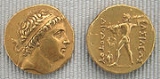
The Greco-Bactrian Kingdom was (along with the Indo-Greek Kingdom
) the easternmost part of the Hellenistic world, covering Bactria
and Sogdiana
in Central Asia
from 250 to 125 BC. The expansion of the Greco-Bactrians into northern India from 180 BC established the Indo-Greek Kingdom, which was to last until around 10 AD.
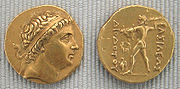 The Greco-Bactrian Kingdom was founded when Diodotus I
, the satrap
of Bactria (and probably the surrounding provinces) seceded from the Seleucid Empire
around 250 BC. The preserved ancient sources (see below) are somewhat contradictory and the exact date of Bactrian independence has not been settled. Somewhat simplified, there is a high chronology (c. 255 BC) and a low chronology (c. 246 BC) for Diodotos’ secession. The high chronology has the advantage of explaining why the Seleucid king Antiochus II
issued very few coins in Bactria, as Diodotos would have become independent there early in Antiochus' reign. On the other hand, the low chronology, from the mid-240s BC, has the advantage of connecting the secession of Diodotus I with the Third Syrian War, a catastrophic conflict for the Seleucid Empire.
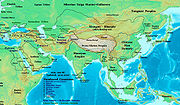
The new kingdom, highly urbanized and considered as one of the richest of the Orient (opulentissimum illud mille urbium Bactrianum imperium "The extremely prosperous Bactrian empire of the thousand cities" Justin, XLI,1 ), was to further grow in power and engage into territorial expansion to the east and the west:

When the ruler of neighbouring Parthia
, the former satrap and self-proclaimed king Andragoras, was eliminated by Arsaces
, the rise of the Parthian Empire
cut off the Greco-Bactrians from direct contact with the Greek world. Overland trade continued at a reduced rate, while sea trade between Greek Egypt
and Bactria developed.
Diodotus was succeeded by his son Diodotus II
, who allied himself with the Parthian Arsaces
in his fight against Seleucus II
:
 Euthydemus
, a Magnesian
Greek according to Polybius
and possibly satrap of Sogdiana
, overthrew Diodotus II around 230 BC and started his own dynasty. Euthydemus's control extended to Sogdiana, going beyond the city of Alexandria Eschate
founded by Alexander the Great in Ferghana:
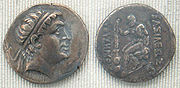 Euthydemus
was attacked by the Seleucid ruler Antiochus III around 210 BC. Although he commanded 10,000 horsemen, Euthydemus initially lost a battle on the Arius and had to retreat. He then successfully resisted a three-year siege in the fortified city of Bactra (modern Balkh
), before Antiochus finally decided to recognize the new ruler, and to offer one of his daughters to Euthydemus's son Demetrius
around 206 BC. Classical accounts also relate that Euthydemus negotiated peace with Antiochus III by suggesting that he deserved credit for overthrowing the original rebel Diodotus, and that he was protecting Central Asia from nomadic invasions thanks to his defensive efforts:
may have been absorbed, possibly as far as into Parthia
, whose ruler had been defeated by Antiochus the Great. These territories possibly are identical with the Bactrian satrapies of Tapuria and Traxiane
.

 To the north, Euthydemus also ruled Sogdiana
and Ferghana
, and there are indications that from Alexandria Eschate
the Greco-Bactrians may have led expeditions as far as Kashgar
and Ürümqi
in Chinese Turkestan
, leading to the first known contacts between China and the West around 220 BC. The Greek historian Strabo
too writes that:
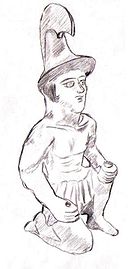
Several statuettes and representations of Greek soldiers have been found north of the Tien Shan, on the doorstep to China, and are today on display in the Xinjiang
museum at Urumqi
(Boardman ).
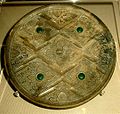
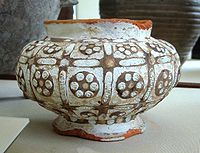
Greek influences on Chinese art have also been suggested (Hirth
, Rostovtzeff). Designs with rosette
flowers, geometric lines, and glass inlays, suggestive of Hellenistic influences, can be found on some early Han
bronze mirrors, dated between 300–200 BC.
Numismatics
also suggest that some technology exchanges may have occurred on these occasions: the Greco-Bactrians were the first in the world to issue cupro-nickel (75/25 ratio) coins, an alloy technology only known by the Chinese at the time under the name "White copper" (some weapons from the Warring States Period
were in copper-nickel alloy ). The practice of exporting Chinese metals, in particular iron, for trade is attested around that period. Kings Euthydemus, Euthydemus II, Agathocles
and Pantaleon
made these coin issues around 170 BC and it has alternatively been suggested that a nickeliferous copper ore was the source from mines at Anarak
. Copper-nickel would not be used again in coinage until the 19th century.
The presence of Chinese people in India from ancient times is also suggested by the accounts of the "Ciñas
" in the Mahabharata
and the Manu Smriti
.
The Han Dynasty
explorer and ambassador Zhang Qian
visited Bactria in 126 BC, and reported the presence of Chinese products in the Bactrian markets:
Upon his return, Zhang Qian informed the Chinese emperor Han Wudi of the level of sophistication of the urban civilizations of Ferghana, Bactria and Parthia, who became interested in developing commercial relationship them:
A number of Chinese envoys were then sent to Central Asia, triggering the development of the Silk Road
from the end of the 2nd century BC.
, founder of the Mauryan dynasty, had re-conquered northwestern India upon the death of Alexander the Great around 322 BC. However, contacts were kept with his Greek neighbours in the Seleucid Empire
, a dynastic alliance or the recognition of intermarriage between Greeks and Indians were established (described as an agreement on Epigamia
in Ancient sources), and several Greeks, such as the historian Megasthenes
, resided at the Mauryan court. Subsequently, each Mauryan emperor had a Greek ambassador at his court.
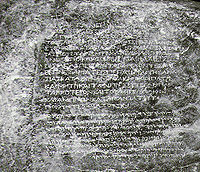 Chandragupta's grandson Asoka converted to the Buddhist faith and became a great proselytizer in the line of the traditional Pali canon of Theravada
Buddhism, directing his efforts towards the Indian and the Hellenistic worlds from around 250 BC. According to the Edicts of Ashoka
, set in stone, some of them written in Greek, he sent Buddhist emissaries to the Greek lands in Asia and as far as the Mediterranean. The edicts name each of the rulers of the Hellenistic
world at the time.
Some of the Greek populations that had remained in northwestern India apparently converted to Buddhism:
Furthermore, according to Pali
sources, some of Ashoka's emissaries were Greek Buddhist monks, indicating close religious exchanges between the two cultures:
Greco-Bactrians probably received these Buddhist emissaries (At least Maharakkhita, lit. "The Great Saved One", who was "sent to the country of the Yona") and somehow tolerated the Buddhist faith, although little proof remains. In the 2nd century AD, the Christian dogmatist Clement of Alexandria
recognized the existence of Buddhist Sramanas among the Bactrians ("Bactrians" meaning "Oriental Greeks" in that period), and even their influence on Greek thought:
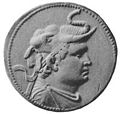 Demetrius
, the son of Euthydemus, started an invasion of India from 180 BC, a few years after the Mauryan empire had been overthrown by the Sunga dynasty. Historians differ on the motivations behind the invasion. Some historians suggest that the invasion of India was intended to show their support for the Mauryan empire, and to protect the Buddhist faith from the religious persecutions of the Sungas as alleged by Buddhist scriptures (Tarn). Other historians have argued however that the accounts of these persecutions have been exaggerated (Thapar
, Lamotte
).
Demetrius may have been as far as the imperial capital Pataliputra in eastern India (today Patna). However, these campaigns are typically attributed to Menander. The invasion was completed by 175 BC. This established in northern India what is called the Indo-Greek Kingdom
, which lasted for almost two centuries until around AD 10. The Buddhist faith flourished under the Indo-Greek kings, foremost among them Menander I
.
It was also a period of great cultural syncretism, exemplified by the development of Greco-Buddhism
.
and Antimachus II
. The Indian branch of the Euthydemids tried to strike back. An Indian king called Demetrius (very likely Demetrius II
) is said to have returned to Bactria with 60,000 men to oust the usurper, but he apparently was defeated and killed in the encounter:
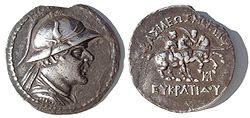
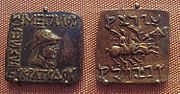
Eucratides campaigned extensively in northwestern India, and ruled on a vast territory as indicated by his minting of coins in many Indian mints, possibly as far as the Jhelum River
in Punjab
. In the end however, he was repulsed by the Indo-Greek king Menander I
, who managed to create a huge unified territory.
In a rather confused account, Justin explains that Eucratides was killed on the field by "his son and joint king", who would be his own son, either Eucratides II
or Heliocles I
(although there are speculations that it could be his enemy's son Demetrius II
). The son drove over Eucratides' bloodied body with his chariot and left him dismembered without a sepulchre:
n king Mithridates I
, possibly in alliance with partisans of the Euthydemids:
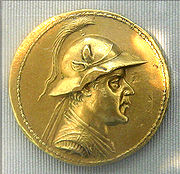
Following his victory, Mithridates I gained Bactria's territory west of the Arius, the regions of Tapuria and Traxiane
:
In the year 141 BC, the Greco-Bactrians seem to have entered in an alliance with the Seleucid king Demetrius II
to fight again against Parthia:
The 5th century historian Orosius declares that Mithridates I managed to occupy territory between the Indus and the Hydaspes towards the end of his reign, c. 138 BC, before his kingdom was weakened by his death in 136 BC.
Heliocles I
ended up ruling in what territory remained. The defeat, both in the west and the east, may have left Bactria very weakened and open to the nomadic invasions.
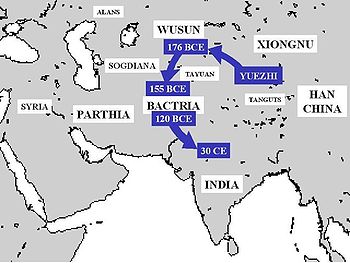 According to the Han chronicles
, following a crushing defeat in 162 BC by the Xiongnu
(Huns
), the nomadic tribes of the Yuezhi
fled from the Tarim Basin
towards the west, crossed the neighbouring urban civilization of the "Dayuan
" (probably the Greek possessions in Ferghana), and resettled north of the Oxus in modern-day Kazakhstan
and Uzbekistan
, in the northern part of the Greco-Bactrian territory. The Dayuan remained a healthy and powerful urban civilization which had numerous contacts and exchanges with China from 130 BC.
The Yuezhi apparently occupied the Greco-Bactrian territory north of the Oxus during the reign of Eucratides, who was busy fighting in India against the Indo-Greeks.
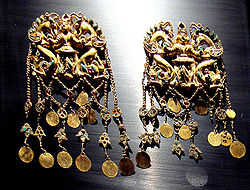 Around 140 BC, eastern Scythians (the Saka
, or Sacaraucae of Greek sources), apparently being pushed forward by the southward migration of the Yuezhi
started to invade various parts of Parthia and Bactria. Their invasion of Parthia is well documented, in which they attacked in the direction of the cities of Merv
, Hecatompolis and Ectabana. They managed to defeat and kill the Parthian king Phraates II, son of Mithridates I, routing the Greek mercenary troops under his command (troops he had acquired during his victory over Antiochus VII). Again in 123 BC, Phraates's successor, his uncle Artabanus I was killed by the Scythians.
It seems that Bactria was also attacked and strongly diminished during the same massive movement of the Scythians. The destruction of the Greco-Bactrian city of Ai-Khanoum
, dated to around 140 BC, is regularly attributed to them. The Scythians would be further displaced to the South and South-East into Afghanistan and India, under the pressure of the Yuezhi.
The culture of these nomadic invaders is apparently documented by such archaeological sites as Tillia Tepe
, is northwestern Afghanistan.
visited the Yuezhi in 126 BC, trying to obtain their alliance to fight the Xiongnu, he explained that the Yuezhi were settled north of the Oxus but also held under their sway the territory south of Oxus, which makes up the remaining of Bactria.
According to Zhang Qian, the Yuezhi represented a considerable force of between 100,000 and 200,000 mounted archer warriors, with customs identical to those of the Xiongnu
, which would probably have easily defeated Greco-Bactrian forces (in 208 BC when the Greco-Bactrian king Euthydemus I
confronted the invasion of the Seleucid king Antiochus III the Great
, he commanded 10,000 horsemen ). Zhang Qian actually visited Bactria (named Daxia
in Chinese) in 126 BC, and portrays a country which was totally demoralized and whose political system had vanished, although its urban infrastructure remained:
The Yuezhi further expanded southward into Bactria around 120 BC, apparently further pushed out by invasions from the northern Wu-Sun
. It seems they also pushed Scythian tribes before them, which continued to India, where they came to be identified as Indo-Scythians
.

 The invasion is also described in western Classical sources from the 1st century BC, with different names than those used by the Chinese:
Around that time the king Heliocles abandoned Bactria and moved his capital to the Kabul
valley, from where he ruled his Indian holdings. Having left the Bactrian territory, he is technically the last Greco-Bactrian king, although several of his descendants, moving beyond the Hindu Kush, would form the western part of the Indo-Greek kingdom
. The last of these "western" Indo-Greek kings, Hermaeus, would rule until around 70 BC, when the Yuezhi again invaded his territory in the Paropamisadae
(while the "eastern" Indo-Greek kings would continue to rule until around AD 10 in the area of the Punjab
).
Overall, the Yuezhi
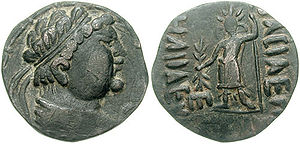
remained in Bactria for more than a century. They became Hellenized to some degree, as suggested by their adoption of the Greek alphabet to write their Iranian language, and by numerous remaining coins, minted in the style of the Greco-Bactrian kings, with the text in Greek.
Around 12 BC the Yuezhi then moved further to northern India where they established the Kushan Empire
.
, Sogdiana
, Ferghana, Arachosia
:
The existence of a third Diodotid king, Antiochus Nikator
, is uncertain.
Many of the dates, territories, and relationships between Greco-Bactrian kings are tentative and essentially based on numismatic analysis and a few Classical sources. The following list of kings, dates and territories after the reign of Demetrius is derived from the latest and most extensive analysis on the subject, by Osmund Bopearachchi
("Monnaies Gréco-Bactriennes et Indo-Grecques, Catalogue Raisonné", 1991).
, Sogdiana
, Ferghana, Arachosia
:
 The descendants of the Greco-Bactrian king Euthydemus
invaded northern India around 190 BC. Their dynasty was probably thrown out of Bactria after 170 BC by the new king Eucratides, but remained in the Indian domains of the empire at least until the 150s BC.
The territory won by Demetrius was separated between western and eastern parts, ruled by several sub-kings and successor kings:
Territory of Bactria
Territories of Paropamisadae
, Arachosia
, Gandhara
, Punjab
Territory of Bactria
and Sogdiana
Heliocles, the last Greek king of Bactria, was invaded by the nomadic tribes of the Yuezhi
from the North. Descendants of Eucratides may have ruled on in the Indo-Greek kingdom
.
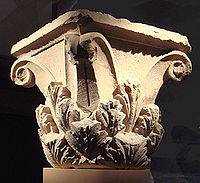 The Greco-Bactrians were known for their high level of Hellenistic sophistication, and kept regular contact with both the Mediterranean and neighbouring India
. They were on friendly terms with India and exchanged ambassadors.
Their cities, such as Ai-Khanoum
in northeastern Afghanistan
(probably Alexandria on the Oxus), and Bactra (modern Balkh
) where Hellenistic remains have been found, demonstrate a sophisticated Hellenistic urban culture. This site gives a snapshot of Greco-Bactrian culture around 145 BC, as the city was burnt to the ground around that date during nomadic invasions and never re-settled. Ai-Khanoum "has all the hallmarks of a Hellenistic city, with a Greek theater, gymnasium
and some Greek houses with colonnaded courtyards" (Boardman). Remains of Classical Corinthian
columns were found in excavations of the site, as well as various sculptural fragments. In particular a huge foot fragment in excellent Hellenistic style was recovered, which is estimated to have belonged to a 5–6 meters tall statue.
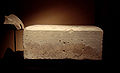 One of the inscriptions in Greek found at Ai-Khanoum, the Herôon of Kineas, has been dated to 300–250 BC, and describes Delphi
c precepts:
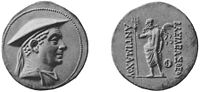
Some of the Greco-Bactrian coins, and those of their successors the Indo-Greeks, are considered the finest examples of Greek numismatic art with "a nice blend of realism and idealization", including the largest coins to be minted in the Hellenistic world: the largest gold coin was minted by Eucratides (reigned 171–145 BC), the largest silver coin by the Indo-Greek king Amyntas
(reigned c. 95–90 BC). The portraits "show a degree of individuality never matched by the often bland depictions of their royal contemporaries further West" (Roger Ling, "Greece and the Hellenistic World").
Several other Greco-Bactrian cities have been further identified, as in Saksanokhur
in southern Tajikistan
(archaeological searches by a Soviet team under B.A. Litvinski), or in Dal'verzin Tepe.
Indo-Greek Kingdom
The Indo-Greek Kingdom or Graeco-Indian Kingdom covered various parts of the northwest regions of the Indian subcontinent during the last two centuries BC, and was ruled by more than 30 Hellenistic kings, often in conflict with each other...
) the easternmost part of the Hellenistic world, covering Bactria
Bactria
Bactria and also appears in the Zend Avesta as Bukhdi. It is the ancient name of a historical region located between south of the Amu Darya and west of the Indus River...
and Sogdiana
Sogdiana
Sogdiana or Sogdia was the ancient civilization of an Iranian people and a province of the Achaemenid Empire, eighteenth in the list on the Behistun Inscription of Darius the Great . Sogdiana is "listed" as the second of the "good lands and countries" that Ahura Mazda created...
in Central Asia
Central Asia
Central Asia is a core region of the Asian continent from the Caspian Sea in the west, China in the east, Afghanistan in the south, and Russia in the north...
from 250 to 125 BC. The expansion of the Greco-Bactrians into northern India from 180 BC established the Indo-Greek Kingdom, which was to last until around 10 AD.
Independence (around 250 BC)
Diodotus I
Diodotus I Soter was Seleucid satrap of Bactria, rebelled against Seleucid rule soon after the death of Antiochus II in c. 255 or 246 BC, and wrested independence for his territory. He died in 239 BC....
, the satrap
Satrap
Satrap was the name given to the governors of the provinces of the ancient Median and Achaemenid Empires and in several of their successors, such as the Sassanid Empire and the Hellenistic empires....
of Bactria (and probably the surrounding provinces) seceded from the Seleucid Empire
Seleucid Empire
The Seleucid Empire was a Greek-Macedonian state that was created out of the eastern conquests of Alexander the Great. At the height of its power, it included central Anatolia, the Levant, Mesopotamia, Persia, today's Turkmenistan, Pamir and parts of Pakistan.The Seleucid Empire was a major centre...
around 250 BC. The preserved ancient sources (see below) are somewhat contradictory and the exact date of Bactrian independence has not been settled. Somewhat simplified, there is a high chronology (c. 255 BC) and a low chronology (c. 246 BC) for Diodotos’ secession. The high chronology has the advantage of explaining why the Seleucid king Antiochus II
Antiochus II Theos
Antiochus II Theos was a king of the Hellenistic Seleucid Kingdom who reigned 261 BC – 246 BC). He succeeded his father Antiochus I Soter in the winter of 262–61 BC...
issued very few coins in Bactria, as Diodotos would have become independent there early in Antiochus' reign. On the other hand, the low chronology, from the mid-240s BC, has the advantage of connecting the secession of Diodotus I with the Third Syrian War, a catastrophic conflict for the Seleucid Empire.
- Diodotus, the governor of the thousand cities of Bactria , defected and proclaimed himself king; all the other people of the Orient followed his example and seceded from the Macedonians. (JustinJunianus JustinusJustin was a Latin historian who lived under the Roman Empire. His name is mentioned only in the title of his own history, and there it is in the genitive, which would be M. Juniani Justini no matter which nomen he bore.Of his personal history nothing is known...
, XLI,4 )
The new kingdom, highly urbanized and considered as one of the richest of the Orient (opulentissimum illud mille urbium Bactrianum imperium "The extremely prosperous Bactrian empire of the thousand cities" Justin, XLI,1 ), was to further grow in power and engage into territorial expansion to the east and the west:
- "The Greeks who caused Bactria to revolt grew so powerful on account of the fertility of the country that they became masters, not only of ArianaArianaAriana was a region of the eastern countries of ancient Iran, next to India.Ariana may also refer to:* Ariana In places:*Ariana Governorate, a governorate in Tunisia*Ariana, Tunisia*Lake Ariana, a lake in Sofia, Bulgaria...
, but also of IndiaIndiaIndia , officially the Republic of India , is a country in South Asia. It is the seventh-largest country by geographical area, the second-most populous country with over 1.2 billion people, and the most populous democracy in the world...
, as Apollodorus of ArtemitaApollodorus of ArtemitaApollodorus of Artemita was a Greek writer of the 1st century BCE.Apollodorus wrote a history of the Parthian Empire, the Parthika , in at least four books. He is quoted by Strabo and Athenaeus. Strabo stated that he was very reliable. Apollodorus seems to have used the archives of Artemita and...
says: and more tribes were subdued by them than by Alexander... Their cities were Bactra (also called Zariaspa, through which flows a river bearing the same name and emptying into the Oxus), and Darapsa, and several others. Among these was EucratidiaEucratideiaEucratideia was an ancient town in Bactria mentioned by a few ancient writers.It was most likely a foundation of Eucratides I who is the more important ruler of the Greco-Bactrian Kingdom with the name Eucratides. Not much is known about this city and it might be just a renaming of an already...
[possibly present day QarshiQarshiQarshi is a city in southern Uzbekistan. It is the capital of Qashqadaryo Province and has a population of 197,600 . It is about 520 km south-southwest of Tashkent, and about 335 km north of Uzbekistan's border with Afghanistan. It is located at latitude 38° 51' 48N; longitude 65° 47'...
; see note for justification: ] , which was named after its ruler." (Strabo, XI.XI.I )
When the ruler of neighbouring Parthia
Parthia
Parthia is a region of north-eastern Iran, best known for having been the political and cultural base of the Arsacid dynasty, rulers of the Parthian Empire....
, the former satrap and self-proclaimed king Andragoras, was eliminated by Arsaces
Arsaces
Arsaces is the eponymous Greek form of the dynastic name adopted by all epigraphically attested rulers of the 'phil-hellenenic' Arsacid dynasties. The indigenous Parthian and Armenian form was Arshak....
, the rise of the Parthian Empire
Parthian Empire
The Parthian Empire , also known as the Arsacid Empire , was a major Iranian political and cultural power in ancient Persia...
cut off the Greco-Bactrians from direct contact with the Greek world. Overland trade continued at a reduced rate, while sea trade between Greek Egypt
Ptolemaic Kingdom
The Ptolemaic Kingdom in and around Egypt began following Alexander the Great's conquest in 332 BC and ended with the death of Cleopatra VII and the Roman conquest in 30 BC. It was founded when Ptolemy I Soter declared himself Pharaoh of Egypt, creating a powerful Hellenistic state stretching from...
and Bactria developed.
Diodotus was succeeded by his son Diodotus II
Diodotus II
Diodotus II was a Greco-Bactrian king from c. 239 BC, son of Diodotus I. He is known for concluding a peace treaty with the Parthian king Arsaces, in order to forestall the Seleucid reconquest of both Parthia and Bactria:...
, who allied himself with the Parthian Arsaces
Arsaces I of Parthia
Arsaces I was the founder of the Arsacid dynasty, and after whom all 30+ monarchs of the Arsacid empire officially named themselves. A celebrated descent from antiquity begins with Arsaces.A 1st century AD tradition casts Arsaces as descending from the 5th-century BC Achaemenid monarch...
in his fight against Seleucus II
Seleucus II Callinicus
Seleucus II Callinicus or Pogon , was a ruler of the Hellenistic Seleucid Empire, who reigned from 246 to 225 BC...
:
- "Soon after, relieved by the death of Diodotus, Arsaces made peace and concluded an alliance with his son, also by the name of Diodotus; some time later he fought against Seleucos who came to punish the rebels, and he prevailed: the Parthians celebrated this day as the one that marked the beginning of their freedom" (JustinJunianus JustinusJustin was a Latin historian who lived under the Roman Empire. His name is mentioned only in the title of his own history, and there it is in the genitive, which would be M. Juniani Justini no matter which nomen he bore.Of his personal history nothing is known...
, XLI,4)
Overthrow of Diodotus II (230 BC)
Euthydemus I
Euthydemus I , Greco-Bactrian king in about 230 or 223 BCE according to Polybius., he is thought to have originally been a Satrap of Sogdiana, who overturned the dynasty of Diodotus of Bactria and became a Greco-Bactrian king. Strabo, on the other hand, correlates his accession with internal...
, a Magnesian
Magnetes
The Magnetes were an ancient Greek tribe living in Thessalian Magnesia who took part in the Trojan War. They later also contributed to the Greek colonisation by founding two prosperous cities in Western Anatolia, Magnesia on the Maeander and Magnesia ad Sipylum.According to Hesiod's "Eoiae" or...
Greek according to Polybius
Polybius
Polybius , Greek ) was a Greek historian of the Hellenistic Period noted for his work, The Histories, which covered the period of 220–146 BC in detail. The work describes in part the rise of the Roman Republic and its gradual domination over Greece...
and possibly satrap of Sogdiana
Sogdiana
Sogdiana or Sogdia was the ancient civilization of an Iranian people and a province of the Achaemenid Empire, eighteenth in the list on the Behistun Inscription of Darius the Great . Sogdiana is "listed" as the second of the "good lands and countries" that Ahura Mazda created...
, overthrew Diodotus II around 230 BC and started his own dynasty. Euthydemus's control extended to Sogdiana, going beyond the city of Alexandria Eschate
Alexandria Eschate
Alexandria Eschate or Alexandria Eskhata was founded by Alexander the Great in August 329 BCE as his most northerly base in Central Asia...
founded by Alexander the Great in Ferghana:
- "And they also held Sogdiana, situated above Bactriana towards the east between the Oxus River, which forms the boundary between the Bactrians and the Sogdians, and the Iaxartes River. And the Iaxartes forms also the boundary between the Sogdians and the nomads." Strabo XI.11.2
Seleucid invasion
Euthydemus I
Euthydemus I , Greco-Bactrian king in about 230 or 223 BCE according to Polybius., he is thought to have originally been a Satrap of Sogdiana, who overturned the dynasty of Diodotus of Bactria and became a Greco-Bactrian king. Strabo, on the other hand, correlates his accession with internal...
was attacked by the Seleucid ruler Antiochus III around 210 BC. Although he commanded 10,000 horsemen, Euthydemus initially lost a battle on the Arius and had to retreat. He then successfully resisted a three-year siege in the fortified city of Bactra (modern Balkh
Balkh
Balkh , was an ancient city and centre of Zoroastrianism in what is now northern Afghanistan. Today it is a small town in the province of Balkh, about 20 kilometers northwest of the provincial capital, Mazar-e Sharif, and some south of the Amu Darya. It was one of the major cities of Khorasan...
), before Antiochus finally decided to recognize the new ruler, and to offer one of his daughters to Euthydemus's son Demetrius
Demetrius I of Bactria
Demetrius I was a Buddhist Greco-Bactrian king . He was the son of Euthydemus and succeeded him around 200 BC, after which he conquered extensive areas in what now is eastern Iran, Afghanistan and Pakistan thus creating an Indo-Greek kingdom far from Hellenistic Greece...
around 206 BC. Classical accounts also relate that Euthydemus negotiated peace with Antiochus III by suggesting that he deserved credit for overthrowing the original rebel Diodotus, and that he was protecting Central Asia from nomadic invasions thanks to his defensive efforts:
- "...for if he did not yield to this demand, neither of them would be safe: seeing that great hordes of Nomads were close at hand, who were a danger to both; and that if they admitted them into the country, it would certainly be utterly barbarised." (PolybiusPolybiusPolybius , Greek ) was a Greek historian of the Hellenistic Period noted for his work, The Histories, which covered the period of 220–146 BC in detail. The work describes in part the rise of the Roman Republic and its gradual domination over Greece...
, 11.34 )
Geographic expansion
Following the departure of the Seleucid army, the Bactrian kingdom seems to have expanded. In the west, areas in north-eastern IranIran
Iran , officially the Islamic Republic of Iran , is a country in Southern and Western Asia. The name "Iran" has been in use natively since the Sassanian era and came into use internationally in 1935, before which the country was known to the Western world as Persia...
may have been absorbed, possibly as far as into Parthia
Parthia
Parthia is a region of north-eastern Iran, best known for having been the political and cultural base of the Arsacid dynasty, rulers of the Parthian Empire....
, whose ruler had been defeated by Antiochus the Great. These territories possibly are identical with the Bactrian satrapies of Tapuria and Traxiane
Greater Khorasan
Greater Khorasan or Ancient Khorasan is a historical region of Greater Iran mentioned in sources from Sassanid and Islamic eras which "frequently" had a denotation wider than current three provinces of Khorasan in Iran...
.
Contacts with China
Sogdiana
Sogdiana or Sogdia was the ancient civilization of an Iranian people and a province of the Achaemenid Empire, eighteenth in the list on the Behistun Inscription of Darius the Great . Sogdiana is "listed" as the second of the "good lands and countries" that Ahura Mazda created...
and Ferghana
Fergana Valley
The Fergana Valley or Farghana Valley is a region in Central Asia spreading across eastern Uzbekistan, Kyrgyzstan and Tajikistan. Divided across three subdivisions of the former Soviet Union, the valley is ethnically diverse, and in the early 21st century was the scene of ethnic conflict...
, and there are indications that from Alexandria Eschate
Alexandria Eschate
Alexandria Eschate or Alexandria Eskhata was founded by Alexander the Great in August 329 BCE as his most northerly base in Central Asia...
the Greco-Bactrians may have led expeditions as far as Kashgar
Kashgar
Kashgar or Kashi is an oasis city with approximately 350,000 residents in the western part of the Xinjiang Uyghur Autonomous Region of the People's Republic of China. Kashgar is the administrative centre of Kashgar Prefecture which has an area of 162,000 km² and a population of approximately...
and Ürümqi
Ürümqi
Ürümqi , formerly Tihwa , is the capital of Xinjiang Uyghur Autonomous Region of the People's Republic of China, in the northwest of the country....
in Chinese Turkestan
Xinjiang
Xinjiang is an autonomous region of the People's Republic of China. It is the largest Chinese administrative division and spans over 1.6 million km2...
, leading to the first known contacts between China and the West around 220 BC. The Greek historian Strabo
Strabo
Strabo, also written Strabon was a Greek historian, geographer and philosopher.-Life:Strabo was born to an affluent family from Amaseia in Pontus , a city which he said was situated the approximate equivalent of 75 km from the Black Sea...
too writes that:
- "they extended their empire even as far as the SeresSeresSeres was the ancient Greek and Roman name for the inhabitants of eastern Central Asia. It meant "of silk," or people of the "land where silk comes from." The country of the Seres was Serica....
(Chinese) and the PhryniPhryniThe Phryni were an ancient people of eastern Central Asia, probably located in the eastern part of the Tarim Basin, in an area connected to that of the Seres and the Tocharians.They are mentioned several times in Classical sources....
" (StraboStraboStrabo, also written Strabon was a Greek historian, geographer and philosopher.-Life:Strabo was born to an affluent family from Amaseia in Pontus , a city which he said was situated the approximate equivalent of 75 km from the Black Sea...
, XI.XI.I ).
Several statuettes and representations of Greek soldiers have been found north of the Tien Shan, on the doorstep to China, and are today on display in the Xinjiang
Xinjiang
Xinjiang is an autonomous region of the People's Republic of China. It is the largest Chinese administrative division and spans over 1.6 million km2...
museum at Urumqi
Ürümqi
Ürümqi , formerly Tihwa , is the capital of Xinjiang Uyghur Autonomous Region of the People's Republic of China, in the northwest of the country....
(Boardman ).
Greek influences on Chinese art have also been suggested (Hirth
Friedrich Hirth
Friedrich Hirth, Ph.D. was a German-American sinologist.-Biography:He was educated at the universities of Leipzig, Berlin, and Greifswald . He was in the Chinese maritime customs service from 1870 to 1897...
, Rostovtzeff). Designs with rosette
Rosette (design)
A rosette is a round, stylized flower design, used extensively in sculptural objects from antiquity. Appearing in Mesopotamia and used to decorate the funeral stele in Ancient Greece...
flowers, geometric lines, and glass inlays, suggestive of Hellenistic influences, can be found on some early Han
Han Dynasty
The Han Dynasty was the second imperial dynasty of China, preceded by the Qin Dynasty and succeeded by the Three Kingdoms . It was founded by the rebel leader Liu Bang, known posthumously as Emperor Gaozu of Han. It was briefly interrupted by the Xin Dynasty of the former regent Wang Mang...
bronze mirrors, dated between 300–200 BC.
Numismatics
Numismatics
Numismatics is the study or collection of currency, including coins, tokens, paper money, and related objects. While numismatists are often characterized as students or collectors of coins, the discipline also includes the broader study of money and other payment media used to resolve debts and the...
also suggest that some technology exchanges may have occurred on these occasions: the Greco-Bactrians were the first in the world to issue cupro-nickel (75/25 ratio) coins, an alloy technology only known by the Chinese at the time under the name "White copper" (some weapons from the Warring States Period
Warring States Period
The Warring States Period , also known as the Era of Warring States, or the Warring Kingdoms period, covers the Iron Age period from about 475 BC to the reunification of China under the Qin Dynasty in 221 BC...
were in copper-nickel alloy ). The practice of exporting Chinese metals, in particular iron, for trade is attested around that period. Kings Euthydemus, Euthydemus II, Agathocles
Agathocles of Bactria
Agathocles Dikaios was a Buddhist Indo-Greek king, who reigned between around 190 and 180 BCE. He might have been a son of Demetrius and one of his sub-kings in charge of the Paropamisade between Bactria and India...
and Pantaleon
Pantaleon
Pantaleon was a Greek king who reigned some time between 190–180 BCE in Bactria and India. He was a younger contemporary or successor of the Greco-Bactrian king Demetrius, and is sometimes believed to have been his brother and/or subking...
made these coin issues around 170 BC and it has alternatively been suggested that a nickeliferous copper ore was the source from mines at Anarak
Anarak
Anarak is a city in and the capital of Anarak District, in Nain County, Isfahan Province, Iran. At the 2006 census, its population was 1,285, in 462 families. It is situated at an altitude of ....
. Copper-nickel would not be used again in coinage until the 19th century.
The presence of Chinese people in India from ancient times is also suggested by the accounts of the "Ciñas
Chinas
The Chinas or Chīnaḥ are a people mentioned in ancient Indian literature from the first millennium BC, such as the Mahabharata, Laws of Manu, as well the Puranic literature...
" in the Mahabharata
Mahabharata
The Mahabharata is one of the two major Sanskrit epics of ancient India and Nepal, the other being the Ramayana. The epic is part of itihasa....
and the Manu Smriti
Manu Smriti
' , also known as Mānava-Dharmaśāstra , is the most important and earliest metrical work of the Dharmaśāstra textual tradition of Hinduism...
.
The Han Dynasty
Han Dynasty
The Han Dynasty was the second imperial dynasty of China, preceded by the Qin Dynasty and succeeded by the Three Kingdoms . It was founded by the rebel leader Liu Bang, known posthumously as Emperor Gaozu of Han. It was briefly interrupted by the Xin Dynasty of the former regent Wang Mang...
explorer and ambassador Zhang Qian
Zhang Qian
Zhang Qian was an imperial envoy to the world outside of China in the 2nd century BCE, during the time of the Han Dynasty...
visited Bactria in 126 BC, and reported the presence of Chinese products in the Bactrian markets:
- ""When I was in Bactria (DaxiaDaxiaDaxia, Ta-Hsia, or Ta-Hia is the name given in antiquity by the Han Chinese to the territory of Bactria....
)", Zhang Qian reported, "I saw bamboo canes from Qiong and cloth made in the province of Shu (territories of southwestern China). When I asked the people how they had gotten such articles, they replied, "Our merchants go buy them in the markets of Shendu (India)."" (Shiji 123, Sima QianSima QianSima Qian was a Prefect of the Grand Scribes of the Han Dynasty. He is regarded as the father of Chinese historiography for his highly praised work, Records of the Grand Historian , a "Jizhuanti"-style general history of China, covering more than two thousand years from the Yellow Emperor to...
, trans. Burton Watson).
Upon his return, Zhang Qian informed the Chinese emperor Han Wudi of the level of sophistication of the urban civilizations of Ferghana, Bactria and Parthia, who became interested in developing commercial relationship them:
- "The Son of Heaven on hearing all this reasoned thus: Ferghana (DayuanDayuanThe Dayuan or Ta-Yuan were a people of Ferghana in Central Asia, described in the Chinese historical works of Records of the Grand Historian and the Book of Han. It is mentioned in the accounts of the famous Chinese explorer Zhang Qian in 130 BCE and the numerous embassies that followed him into...
) and the possessions of BactriaBactriaBactria and also appears in the Zend Avesta as Bukhdi. It is the ancient name of a historical region located between south of the Amu Darya and west of the Indus River...
(DaxiaDaxiaDaxia, Ta-Hsia, or Ta-Hia is the name given in antiquity by the Han Chinese to the territory of Bactria....
) and ParthiaParthiaParthia is a region of north-eastern Iran, best known for having been the political and cultural base of the Arsacid dynasty, rulers of the Parthian Empire....
(AnxiAnxiAnxi may refer to:* Anxi County, a county in Fujian province, south-eastern China* Guazhou County, formerly Anxi County, in Gansu province, central China* Guazhou Town, formerely Anxi Town, in what is now Guazhou County....
) are large countries, full of rare things, with a population living in fixed abodes and given to occupations somewhat identical with those of the Chinese people, and placing great value on the rich produce of China" (Hanshu, Former Han History).
A number of Chinese envoys were then sent to Central Asia, triggering the development of the Silk Road
Silk Road
The Silk Road or Silk Route refers to a historical network of interlinking trade routes across the Afro-Eurasian landmass that connected East, South, and Western Asia with the Mediterranean and European world, as well as parts of North and East Africa...
from the end of the 2nd century BC.
Contacts with India (250–180)
The Indian emperor ChandraguptaChandragupta Maurya
Chandragupta Maurya , was the founder of the Maurya Empire. Chandragupta succeeded in conquering most of the Indian subcontinent. Chandragupta is considered the first unifier of India and its first genuine emperor...
, founder of the Mauryan dynasty, had re-conquered northwestern India upon the death of Alexander the Great around 322 BC. However, contacts were kept with his Greek neighbours in the Seleucid Empire
Seleucid Empire
The Seleucid Empire was a Greek-Macedonian state that was created out of the eastern conquests of Alexander the Great. At the height of its power, it included central Anatolia, the Levant, Mesopotamia, Persia, today's Turkmenistan, Pamir and parts of Pakistan.The Seleucid Empire was a major centre...
, a dynastic alliance or the recognition of intermarriage between Greeks and Indians were established (described as an agreement on Epigamia
Epigamia
In ancient Greece Epigamia , designated the legal right to contract a marriage. In particular it strongly regulated the right of intermarrying between different states...
in Ancient sources), and several Greeks, such as the historian Megasthenes
Megasthenes
Megasthenes was a Greek ethnographer in the Hellenistic period, author of the work Indica.He was born in Asia Minor and became an ambassador of Seleucus I of Syria possibly to Chandragupta Maurya in Pataliputra, India. However the exact date of his embassy is uncertain...
, resided at the Mauryan court. Subsequently, each Mauryan emperor had a Greek ambassador at his court.
Theravada
Theravada ; literally, "the Teaching of the Elders" or "the Ancient Teaching", is the oldest surviving Buddhist school. It was founded in India...
Buddhism, directing his efforts towards the Indian and the Hellenistic worlds from around 250 BC. According to the Edicts of Ashoka
Edicts of Ashoka
The Edicts of Ashoka are a collection of 33 inscriptions on the Pillars of Ashoka, as well as boulders and cave walls, made by the Emperor Ashoka of the Mauryan dynasty during his reign from 269 BCE to 231 BCE. These inscriptions are dispersed throughout the areas of modern-day Bangladesh, India,...
, set in stone, some of them written in Greek, he sent Buddhist emissaries to the Greek lands in Asia and as far as the Mediterranean. The edicts name each of the rulers of the Hellenistic
Hellenistic civilization
Hellenistic civilization represents the zenith of Greek influence in the ancient world from 323 BCE to about 146 BCE...
world at the time.
- "The conquest by DharmaDharmaDharma means Law or Natural Law and is a concept of central importance in Indian philosophy and religion. In the context of Hinduism, it refers to one's personal obligations, calling and duties, and a Hindu's dharma is affected by the person's age, caste, class, occupation, and gender...
has been won here, on the borders, and even six hundred yojanaYojanaA Yojana is a Vedic measure of distance used in ancient India. The exact measurement is disputed amongst scholars with distances being given between 6 to 15 kilometers ....
s (4,000 miles) away, where the Greek king AntiochosAntiochus II TheosAntiochus II Theos was a king of the Hellenistic Seleucid Kingdom who reigned 261 BC – 246 BC). He succeeded his father Antiochus I Soter in the winter of 262–61 BC...
rules, beyond there where the four kings named PtolemyPtolemy II PhiladelphusPtolemy II Philadelphus was the king of Ptolemaic Egypt from 283 BCE to 246 BCE. He was the son of the founder of the Ptolemaic kingdom Ptolemy I Soter and Berenice, and was educated by Philitas of Cos...
, AntigonosAntigonus II GonatasAntigonus II Gonatas was a powerful ruler who firmly established the Antigonid dynasty in Macedonia and acquired fame for his victory over the Gauls who had invaded the Balkans.-Birth and family:...
, MagasMagas of CyreneMagas of Cyrene was a Greek Macedonian nobleman. Through his mother’s second marriage he was a member of the Ptolemaic dynasty. He became King of Cyrenaica and he managed to wrestle independence for Cyrenaica from the Greek Ptolemaic dynasty of Ancient Egypt.-Family Background & Early Life:Magas...
and AlexanderAlexander II of EpirusAlexander II was a king of Epirus, and the son of Pyrrhus and Lanassa, the daughter of the Sicilian tyrant Agathocles.-Reign:He succeeded his father as king in 272 BC, and continued the war which his father had begun with Antigonus II Gonatas, whom he succeeded in driving from the kingdom of Macedon...
rule, likewise in the south among the Cholas, the Pandyas, and as far as TamraparniTamraparniTamraparni or Tambapanni is an old name of Sri Lanka. Tamraparniya is a name given to the Theravada school lineage in Sri Lanka...
." (Edicts of AshokaEdicts of AshokaThe Edicts of Ashoka are a collection of 33 inscriptions on the Pillars of Ashoka, as well as boulders and cave walls, made by the Emperor Ashoka of the Mauryan dynasty during his reign from 269 BCE to 231 BCE. These inscriptions are dispersed throughout the areas of modern-day Bangladesh, India,...
, 13th Rock Edict, S. Dhammika).
Some of the Greek populations that had remained in northwestern India apparently converted to Buddhism:
- "Here in the king's domain among the Greeks, the KambojasKambojasThe Kambojas were a kshatriya tribe of Iron Age India, frequently mentioned in Sanskrit and Pali literature.They were an Indo-Iranian tribe situated at the boundary of the Indo-Aryans and the Iranians, and appear to have moved from the Iranian into the Indo-Aryan sphere over time.The Kambojas...
, the Nabhakas, the Nabhapamkits, the Bhojas, the Pitinikas, the Andhras and the Palidas, everywhere people are following Beloved-of-the-Gods' instructions in DharmaDharmaDharma means Law or Natural Law and is a concept of central importance in Indian philosophy and religion. In the context of Hinduism, it refers to one's personal obligations, calling and duties, and a Hindu's dharma is affected by the person's age, caste, class, occupation, and gender...
. (Edicts of AshokaEdicts of AshokaThe Edicts of Ashoka are a collection of 33 inscriptions on the Pillars of Ashoka, as well as boulders and cave walls, made by the Emperor Ashoka of the Mauryan dynasty during his reign from 269 BCE to 231 BCE. These inscriptions are dispersed throughout the areas of modern-day Bangladesh, India,...
, 13th Rock Edict, S. Dhammika).
Furthermore, according to Pali
Páli
- External links :* *...
sources, some of Ashoka's emissaries were Greek Buddhist monks, indicating close religious exchanges between the two cultures:
- "When the thera (elder) Moggaliputta, the illuminator of the religion of the Conqueror (Ashoka), had brought the (third) council to an end… he sent forth theras, one here and one there: …and to Aparantaka (the "Western countries" corresponding to Gujarat and SindhSindhSindh historically referred to as Ba'ab-ul-Islam , is one of the four provinces of Pakistan and historically is home to the Sindhi people. It is also locally known as the "Mehran". Though Muslims form the largest religious group in Sindh, a good number of Christians, Zoroastrians and Hindus can...
) he sent the Greek (YonaYona"Yona" is a Pali word used in ancient India to designate Greek speakers. Its equivalent in Sanskrit, Malayalam, Kannada, Telugu and Tamil is the word "Yavana" and "Jobonan/Jubonan" in Bengali...
) named DhammarakkhitaDharmaraksitaFor the teacher of Atisha, see Dharmarakshita .Dharmarakṣita , or Dhammarakkhita , was one of the missionaries sent by the Mauryan emperor Ashoka to proselytize the Buddhist faith. He is described as being a Greek For the teacher of Atisha, see Dharmarakshita (Sumatran).Dharmarakṣita (Sanskrit),...
... and the thera Maharakkhita he sent into the country of the Yona". (MahavamsaMahavamsaThe Mahavamsa is a historical poem written in the Pali language, of the kings of Sri Lanka...
XII).
Greco-Bactrians probably received these Buddhist emissaries (At least Maharakkhita, lit. "The Great Saved One", who was "sent to the country of the Yona") and somehow tolerated the Buddhist faith, although little proof remains. In the 2nd century AD, the Christian dogmatist Clement of Alexandria
Clement of Alexandria
Titus Flavius Clemens , known as Clement of Alexandria , was a Christian theologian and the head of the noted Catechetical School of Alexandria. Clement is best remembered as the teacher of Origen...
recognized the existence of Buddhist Sramanas among the Bactrians ("Bactrians" meaning "Oriental Greeks" in that period), and even their influence on Greek thought:
- "Thus philosophy, a thing of the highest utility, flourished in antiquity among the barbarians, shedding its light over the nations. And afterwards it came to GreeceGreeceGreece , officially the Hellenic Republic , and historically Hellas or the Republic of Greece in English, is a country in southeastern Europe....
. First in its ranks were the prophets of the EgyptiansAncient EgyptAncient Egypt was an ancient civilization of Northeastern Africa, concentrated along the lower reaches of the Nile River in what is now the modern country of Egypt. Egyptian civilization coalesced around 3150 BC with the political unification of Upper and Lower Egypt under the first pharaoh...
; and the ChaldeaChaldeaChaldea or Chaldaea , from Greek , Chaldaia; Akkadian ; Hebrew כשדים, Kaśdim; Aramaic: ܟܐܠܕܘ, Kaldo) was a marshy land located in modern-day southern Iraq which came to briefly rule Babylon...
ns among the AssyriansAssyrian peopleThe Assyrian people are a distinct ethnic group whose origins lie in ancient Mesopotamia...
; and the Druids among the GaulsGaulsThe Gauls were a Celtic people living in Gaul, the region roughly corresponding to what is now France, Belgium, Switzerland and Northern Italy, from the Iron Age through the Roman period. They mostly spoke the Continental Celtic language called Gaulish....
; and the Sramanas among the BactriansBactriansThe Bactrians were the inhabitants of Bactria.Several important trade routes from India and China passed through Bactria and, as early as the Bronze Age, this had allowed the accumulation of vast amounts of wealth by the mostly nomadic population. The first proto-urban civilization in the area...
("Σαρμαναίοι Βάκτρων"); and the philosophers of the Celts; and the MagiMagiMagi is a term, used since at least the 4th century BC, to denote a follower of Zoroaster, or rather, a follower of what the Hellenistic world associated Zoroaster with, which...
of the PersiansPersian peopleThe Persian people are part of the Iranian peoples who speak the modern Persian language and closely akin Iranian dialects and languages. The origin of the ethnic Iranian/Persian peoples are traced to the Ancient Iranian peoples, who were part of the ancient Indo-Iranians and themselves part of...
, who foretold the Saviour's birth, and came into the land of JudeaJudeaJudea or Judæa was the name of the mountainous southern part of the historic Land of Israel from the 8th century BCE to the 2nd century CE, when Roman Judea was renamed Syria Palaestina following the Jewish Bar Kokhba revolt.-Etymology:The...
guided by a star. The Indian gymnosophists are also in the number, and the other barbarian philosophers. And of these there are two classes, some of them called Sramanas ("Σαρμάναι"), and others Brahmins ("Βραφμαναι")." Clement of Alexandria "The Stromata, or Miscellanies" Book I, Chapter XV.
Expansion into India (after 180 BC)
Demetrius I of Bactria
Demetrius I was a Buddhist Greco-Bactrian king . He was the son of Euthydemus and succeeded him around 200 BC, after which he conquered extensive areas in what now is eastern Iran, Afghanistan and Pakistan thus creating an Indo-Greek kingdom far from Hellenistic Greece...
, the son of Euthydemus, started an invasion of India from 180 BC, a few years after the Mauryan empire had been overthrown by the Sunga dynasty. Historians differ on the motivations behind the invasion. Some historians suggest that the invasion of India was intended to show their support for the Mauryan empire, and to protect the Buddhist faith from the religious persecutions of the Sungas as alleged by Buddhist scriptures (Tarn). Other historians have argued however that the accounts of these persecutions have been exaggerated (Thapar
Romila Thapar
Romila Thapar is an Indian historian whose principal area of study is ancient India.-Work:After graduating from Panjab University, Thapar earned her doctorate under A. L. Basham at the School of Oriental and African Studies, the University of London in 1958...
, Lamotte
Étienne Lamotte
Étienne Paul Marie Lamotte was a Belgian priest and Professor of Greek at the Catholic University of Louvain, but was better known as an Indologist and the greatest authority on Buddhism in the West in his time...
).
Demetrius may have been as far as the imperial capital Pataliputra in eastern India (today Patna). However, these campaigns are typically attributed to Menander. The invasion was completed by 175 BC. This established in northern India what is called the Indo-Greek Kingdom
Indo-Greek Kingdom
The Indo-Greek Kingdom or Graeco-Indian Kingdom covered various parts of the northwest regions of the Indian subcontinent during the last two centuries BC, and was ruled by more than 30 Hellenistic kings, often in conflict with each other...
, which lasted for almost two centuries until around AD 10. The Buddhist faith flourished under the Indo-Greek kings, foremost among them Menander I
Menander I
Menander I Soter "The Saviour" was one of the rulers of the Indo-Greek Kingdom from either 165 or 155 BC to 130 BC ....
.
It was also a period of great cultural syncretism, exemplified by the development of Greco-Buddhism
Greco-Buddhism
Greco-Buddhism, sometimes spelled Graeco-Buddhism, refers to the cultural syncretism between Hellenistic culture and Buddhism, which developed between the 4th century BCE and the 5th century CE in the area covered by the Indian sub-continent, and modern Afghanistan, Pakistan and north-western...
.
Usurpation of Eucratides
Back in Bactria, Eucratides, either a general of Demetrius or an ally of the Seleucids, managed to overthrow the Euthydemid dynasty and establish his own rule around 170 BC, probably dethroning Antimachus IAntimachus I
Anthimachus I Theos was one of the Greco-Bactrian kings, generally dated from around 185 to 170 BC.-Rule:...
and Antimachus II
Antimachus II
Antimachus II Nikephoros "The Victorious" was an Indo-Greek king. He ruled on a vast territory from the Hindu-Kush to the Punjab around 170 BCE. He was almost certainly identical with the eponymous son of Antimachus I, who is known from a unique preserved tax-receipt...
. The Indian branch of the Euthydemids tried to strike back. An Indian king called Demetrius (very likely Demetrius II
Demetrius II of India
Demetrius II was a Greco-Bactrian/Indo-Greek king who ruled brieftly during the 2nd century BCE. Little is known about him and there are different views about how to date him. Earlier authors such as Tarn and Narain saw him as a son and sub-king of Demetrius I, but this view is now abandoned.Osmund...
) is said to have returned to Bactria with 60,000 men to oust the usurper, but he apparently was defeated and killed in the encounter:
- "Eucratides led many wars with great courage, and, while weakened by them, was put under siege by Demetrius, king of the Indians. He made numerous sorties, and managed to vanquish 60,000 enemies with 300 soldiers, and thus liberated after four months, he put India under his rule" (Justin, XLI,6 )
Eucratides campaigned extensively in northwestern India, and ruled on a vast territory as indicated by his minting of coins in many Indian mints, possibly as far as the Jhelum River
Jhelum River
Jehlum River or Jhelum River , ) is a river that flows in India and Pakistan. It is the largest and most western of the five rivers of Punjab, and passes through Jhelum District...
in Punjab
Punjab region
The Punjab , also spelled Panjab |water]]s"), is a geographical region straddling the border between Pakistan and India which includes Punjab province in Pakistan and the states of the Punjab, Haryana, Himachal Pradesh, Chandigarh and some northern parts of the National Capital Territory of Delhi...
. In the end however, he was repulsed by the Indo-Greek king Menander I
Menander I
Menander I Soter "The Saviour" was one of the rulers of the Indo-Greek Kingdom from either 165 or 155 BC to 130 BC ....
, who managed to create a huge unified territory.
In a rather confused account, Justin explains that Eucratides was killed on the field by "his son and joint king", who would be his own son, either Eucratides II
Eucratides II
Eucratides II was a Greco-Bactrian king who was a successor and probably a son of Eucratides I.It seems likely that Eucratides II ruled for a relatively short time after the murder of his namesake, until he was dethroned in the dynastic civil war caused by the same murder.During his earlier years,...
or Heliocles I
Heliocles I
The Greco-Bactrian Heliocles, circ. 145-130 BCE, relative and successor of Eucratides the Great, was probably the last Greek king who reigned over the Bactrian country. His reign was a troubled one. According to Roman historian Justin, Eucratides was murdered by his son and co-ruler, though Justin...
(although there are speculations that it could be his enemy's son Demetrius II
Demetrius II of India
Demetrius II was a Greco-Bactrian/Indo-Greek king who ruled brieftly during the 2nd century BCE. Little is known about him and there are different views about how to date him. Earlier authors such as Tarn and Narain saw him as a son and sub-king of Demetrius I, but this view is now abandoned.Osmund...
). The son drove over Eucratides' bloodied body with his chariot and left him dismembered without a sepulchre:
- "As Eucratides returned from India, he was killed on the way back by his son, whom he had associated to his rule, and who, without hiding his parricide, as if he didn't kill a father but an enemy, ran with his chariot over the blood of his father, and ordered the corpse to be left without a sepulture" (Justin XLI,6 ).
Defeats against Parthia
Concurrently, and possibly during or after his Indian campaigns, Eucratides' Bactria was attacked and defeated by the ParthiaParthia
Parthia is a region of north-eastern Iran, best known for having been the political and cultural base of the Arsacid dynasty, rulers of the Parthian Empire....
n king Mithridates I
Mithridates I of Parthia
Mithridates or Mithradates I was the "Great King" of Parthia from ca. 171 BC - 138 BC, succeeding his brother Phraates I. His father was King Phriapatius of Parthia, who died ca. 176 BC). Mithridates I made Parthia into a major political power by expanding the empire to the east, south, and west...
, possibly in alliance with partisans of the Euthydemids:
- "The Bactrians, involved in various wars, lost not only their rule but also their freedom, as, exhausted by their wars against the Sogdians, the Arachotes, the Dranges, the Arians and the Indians, they were finally crushed, as if drawn of all their blood, by an enemy weaker than them, the Parthians." (Justin, XLI,6 )
Following his victory, Mithridates I gained Bactria's territory west of the Arius, the regions of Tapuria and Traxiane
Greater Khorasan
Greater Khorasan or Ancient Khorasan is a historical region of Greater Iran mentioned in sources from Sassanid and Islamic eras which "frequently" had a denotation wider than current three provinces of Khorasan in Iran...
:
- "The satrapy Turiva and that of Aspionus were taken away from Eucratides by the Parthians." (Strabo XI.11.2 )
In the year 141 BC, the Greco-Bactrians seem to have entered in an alliance with the Seleucid king Demetrius II
Demetrius II Nicator
For the similarly named Macedonian ruler, see Demetrius II of Macedon. For the Macedonian prince, see Demetrius the Fair.Demetrius II , called Nicator , was one of the sons of Demetrius I Soter, brother of Antiochus VII Sidetes and his mother could have been Laodice V...
to fight again against Parthia:
- "The people of the Orient welcomed his (Demetrius II) arrival, partly because of the cruelty of the Arsacid, king of the Parthians, partly because, used to the rule of the Macedonians, they disliked the arrogance of this new people. Thus, Demetrius, supported by the Persians, Elymes, Bactrians, routed the Parthians in numerous battles. At the end, trumped by a false peace, he was taken prisoner." (Justin XXXVI, 1,1 )
The 5th century historian Orosius declares that Mithridates I managed to occupy territory between the Indus and the Hydaspes towards the end of his reign, c. 138 BC, before his kingdom was weakened by his death in 136 BC.
Heliocles I
Heliocles I
The Greco-Bactrian Heliocles, circ. 145-130 BCE, relative and successor of Eucratides the Great, was probably the last Greek king who reigned over the Bactrian country. His reign was a troubled one. According to Roman historian Justin, Eucratides was murdered by his son and co-ruler, though Justin...
ended up ruling in what territory remained. The defeat, both in the west and the east, may have left Bactria very weakened and open to the nomadic invasions.
Yuezhi expansion (c. 162 BC-)
Han Dynasty
The Han Dynasty was the second imperial dynasty of China, preceded by the Qin Dynasty and succeeded by the Three Kingdoms . It was founded by the rebel leader Liu Bang, known posthumously as Emperor Gaozu of Han. It was briefly interrupted by the Xin Dynasty of the former regent Wang Mang...
, following a crushing defeat in 162 BC by the Xiongnu
Xiongnu
The Xiongnu were ancient nomadic-based people that formed a state or confederation north of the agriculture-based empire of the Han Dynasty. Most of the information on the Xiongnu comes from Chinese sources...
(Huns
Huns
The Huns were a group of nomadic people who, appearing from east of the Volga River, migrated into Europe c. AD 370 and established the vast Hunnic Empire there. Since de Guignes linked them with the Xiongnu, who had been northern neighbours of China 300 years prior to the emergence of the Huns,...
), the nomadic tribes of the Yuezhi
Yuezhi
The Yuezhi, or Rouzhi , also known as the Da Yuezhi or Da Rouzhi , were an ancient Central Asian people....
fled from the Tarim Basin
Tarim Basin
The Tarim Basin is a large endorheic basin occupying an area of about . It is located in the Xinjiang Uyghur Autonomous Region in China's far west. Its northern boundary is the Tian Shan mountain range and its southern is the Kunlun Mountains on the northern edge of the Tibetan Plateau. The...
towards the west, crossed the neighbouring urban civilization of the "Dayuan
Dayuan
The Dayuan or Ta-Yuan were a people of Ferghana in Central Asia, described in the Chinese historical works of Records of the Grand Historian and the Book of Han. It is mentioned in the accounts of the famous Chinese explorer Zhang Qian in 130 BCE and the numerous embassies that followed him into...
" (probably the Greek possessions in Ferghana), and resettled north of the Oxus in modern-day Kazakhstan
Kazakhstan
Kazakhstan , officially the Republic of Kazakhstan, is a transcontinental country in Central Asia and Eastern Europe. Ranked as the ninth largest country in the world, it is also the world's largest landlocked country; its territory of is greater than Western Europe...
and Uzbekistan
Uzbekistan
Uzbekistan , officially the Republic of Uzbekistan is a doubly landlocked country in Central Asia and one of the six independent Turkic states. It shares borders with Kazakhstan to the west and to the north, Kyrgyzstan and Tajikistan to the east, and Afghanistan and Turkmenistan to the south....
, in the northern part of the Greco-Bactrian territory. The Dayuan remained a healthy and powerful urban civilization which had numerous contacts and exchanges with China from 130 BC.
The Yuezhi apparently occupied the Greco-Bactrian territory north of the Oxus during the reign of Eucratides, who was busy fighting in India against the Indo-Greeks.
Scythians (c. 140 BC-)
Saka
The Saka were a Scythian tribe or group of tribes....
, or Sacaraucae of Greek sources), apparently being pushed forward by the southward migration of the Yuezhi
Yuezhi
The Yuezhi, or Rouzhi , also known as the Da Yuezhi or Da Rouzhi , were an ancient Central Asian people....
started to invade various parts of Parthia and Bactria. Their invasion of Parthia is well documented, in which they attacked in the direction of the cities of Merv
Merv
Merv , formerly Achaemenid Satrapy of Margiana, and later Alexandria and Antiochia in Margiana , was a major oasis-city in Central Asia, on the historical Silk Road, located near today's Mary in Turkmenistan. Several cities have existed on this site, which is significant for the interchange of...
, Hecatompolis and Ectabana. They managed to defeat and kill the Parthian king Phraates II, son of Mithridates I, routing the Greek mercenary troops under his command (troops he had acquired during his victory over Antiochus VII). Again in 123 BC, Phraates's successor, his uncle Artabanus I was killed by the Scythians.
It seems that Bactria was also attacked and strongly diminished during the same massive movement of the Scythians. The destruction of the Greco-Bactrian city of Ai-Khanoum
Ai-Khanoum
Ai-Khanoum or Ay Khanum , was founded in the 4th century BC, following the conquests of Alexander the Great and was one of the primary cities of the Greco-Bactrian kingdom...
, dated to around 140 BC, is regularly attributed to them. The Scythians would be further displaced to the South and South-East into Afghanistan and India, under the pressure of the Yuezhi.
The culture of these nomadic invaders is apparently documented by such archaeological sites as Tillia Tepe
Tillia tepe
Tillya tepe, Tillia tepe or Tillā tapa or is an archaeological site in northern Afghanistan near Sheberghan, surveyed in 1979 by a Soviet-Afghan mission of archaeologists led by Victor Sarianidi, a year before the Soviet invasion of Afghanistan.The hoard is a collection of about 20,000 gold...
, is northwestern Afghanistan.
Second Yuezhi expansion (120 BC-)
When Zhang QianZhang Qian
Zhang Qian was an imperial envoy to the world outside of China in the 2nd century BCE, during the time of the Han Dynasty...
visited the Yuezhi in 126 BC, trying to obtain their alliance to fight the Xiongnu, he explained that the Yuezhi were settled north of the Oxus but also held under their sway the territory south of Oxus, which makes up the remaining of Bactria.
According to Zhang Qian, the Yuezhi represented a considerable force of between 100,000 and 200,000 mounted archer warriors, with customs identical to those of the Xiongnu
Xiongnu
The Xiongnu were ancient nomadic-based people that formed a state or confederation north of the agriculture-based empire of the Han Dynasty. Most of the information on the Xiongnu comes from Chinese sources...
, which would probably have easily defeated Greco-Bactrian forces (in 208 BC when the Greco-Bactrian king Euthydemus I
Euthydemus I
Euthydemus I , Greco-Bactrian king in about 230 or 223 BCE according to Polybius., he is thought to have originally been a Satrap of Sogdiana, who overturned the dynasty of Diodotus of Bactria and became a Greco-Bactrian king. Strabo, on the other hand, correlates his accession with internal...
confronted the invasion of the Seleucid king Antiochus III the Great
Antiochus III the Great
Antiochus III the Great Seleucid Greek king who became the 6th ruler of the Seleucid Empire as a youth of about eighteen in 223 BC. Antiochus was an ambitious ruler who ruled over Greater Syria and western Asia towards the end of the 3rd century BC...
, he commanded 10,000 horsemen ). Zhang Qian actually visited Bactria (named Daxia
Daxia
Daxia, Ta-Hsia, or Ta-Hia is the name given in antiquity by the Han Chinese to the territory of Bactria....
in Chinese) in 126 BC, and portrays a country which was totally demoralized and whose political system had vanished, although its urban infrastructure remained:
- "DaxiaDaxiaDaxia, Ta-Hsia, or Ta-Hia is the name given in antiquity by the Han Chinese to the territory of Bactria....
(BactriaBactriaBactria and also appears in the Zend Avesta as Bukhdi. It is the ancient name of a historical region located between south of the Amu Darya and west of the Indus River...
) is located over 2,000 li southwest of DayuanDayuanThe Dayuan or Ta-Yuan were a people of Ferghana in Central Asia, described in the Chinese historical works of Records of the Grand Historian and the Book of Han. It is mentioned in the accounts of the famous Chinese explorer Zhang Qian in 130 BCE and the numerous embassies that followed him into...
, south of the Gui (Oxus) river. Its people cultivate the land and have cities and houses. Their customs are like those of DayuanDayuanThe Dayuan or Ta-Yuan were a people of Ferghana in Central Asia, described in the Chinese historical works of Records of the Grand Historian and the Book of Han. It is mentioned in the accounts of the famous Chinese explorer Zhang Qian in 130 BCE and the numerous embassies that followed him into...
. It has no great ruler but only a number of petty chiefs ruling the various cities. The people are poor in the use of arms and afraid of battle, but they are clever at commerce. After the Great Yuezhi moved west and attacked Daxia, the entire country came under their sway. The population of the country is large, numbering some 1,000,000 or more persons. The capital is called the city of Lanshi (Bactra) and has a market where all sorts of goods are bought and sold." ("Records of the Great Historian" by Sima QianSima QianSima Qian was a Prefect of the Grand Scribes of the Han Dynasty. He is regarded as the father of Chinese historiography for his highly praised work, Records of the Grand Historian , a "Jizhuanti"-style general history of China, covering more than two thousand years from the Yellow Emperor to...
, quoting Zhang Qian, trans. Burton Watson)
The Yuezhi further expanded southward into Bactria around 120 BC, apparently further pushed out by invasions from the northern Wu-Sun
Wusun
The Wūsūn were a nomadic steppe people who, according to the Chinese histories, originally lived in western Gansu in northwest China west of the Yuezhi people...
. It seems they also pushed Scythian tribes before them, which continued to India, where they came to be identified as Indo-Scythians
Indo-Scythians
Indo-Scythians is a term used to refer to Sakas , who migrated into Bactria, Sogdiana, Arachosia, Gandhara, Kashmir, Punjab, Haryana, Uttar Pradesh, Gujarat, Maharashtra and Rajasthan, from the middle of the 2nd century BCE to the 4th century CE....
.
- "The best known tribes are those who deprived the Greeks of BactriaBactriaBactria and also appears in the Zend Avesta as Bukhdi. It is the ancient name of a historical region located between south of the Amu Darya and west of the Indus River...
na, the Asii, Pasiani, TochariTochariansThe Tocharians were the Tocharian-speaking inhabitants of the Tarim Basin, making them the easternmost speakers of Indo-European languages in antiquity. They were known as, or at least closely related to, the Yuezhi of Chinese sources...
, and Sacarauli, who came from the country on the other side of the Jaxartes, opposite the Sacae and Sogdiani."
(StraboStraboStrabo, also written Strabon was a Greek historian, geographer and philosopher.-Life:Strabo was born to an affluent family from Amaseia in Pontus , a city which he said was situated the approximate equivalent of 75 km from the Black Sea...
, 11-8-1 )
Around that time the king Heliocles abandoned Bactria and moved his capital to the Kabul
Kabul
Kabul , spelt Caubul in some classic literatures, is the capital and largest city of Afghanistan. It is also the capital of the Kabul Province, located in the eastern section of Afghanistan...
valley, from where he ruled his Indian holdings. Having left the Bactrian territory, he is technically the last Greco-Bactrian king, although several of his descendants, moving beyond the Hindu Kush, would form the western part of the Indo-Greek kingdom
Indo-Greek Kingdom
The Indo-Greek Kingdom or Graeco-Indian Kingdom covered various parts of the northwest regions of the Indian subcontinent during the last two centuries BC, and was ruled by more than 30 Hellenistic kings, often in conflict with each other...
. The last of these "western" Indo-Greek kings, Hermaeus, would rule until around 70 BC, when the Yuezhi again invaded his territory in the Paropamisadae
Paropamisadae
Paropamisadae or Paropamisus was the ancient Greek name for a region of the Hindu-Kush in eastern Afghanistan, centered on the cities of Kabul and Kapisa .-History of Paropamisadae:...
(while the "eastern" Indo-Greek kings would continue to rule until around AD 10 in the area of the Punjab
Punjab region
The Punjab , also spelled Panjab |water]]s"), is a geographical region straddling the border between Pakistan and India which includes Punjab province in Pakistan and the states of the Punjab, Haryana, Himachal Pradesh, Chandigarh and some northern parts of the National Capital Territory of Delhi...
).
Overall, the Yuezhi
Yuezhi
The Yuezhi, or Rouzhi , also known as the Da Yuezhi or Da Rouzhi , were an ancient Central Asian people....
remained in Bactria for more than a century. They became Hellenized to some degree, as suggested by their adoption of the Greek alphabet to write their Iranian language, and by numerous remaining coins, minted in the style of the Greco-Bactrian kings, with the text in Greek.
Around 12 BC the Yuezhi then moved further to northern India where they established the Kushan Empire
Kushan Empire
The Kushan Empire originally formed in the early 1st century AD under Kujula Kadphises in the territories of ancient Bactria on either side of the middle course of the Oxus in what is now northern Afghanistan, Pakistan, and southern Tajikistan and Uzbekistan.During the 1st and early 2nd centuries...
.
House of Diodotus
Territories of BactriaBactria
Bactria and also appears in the Zend Avesta as Bukhdi. It is the ancient name of a historical region located between south of the Amu Darya and west of the Indus River...
, Sogdiana
Sogdiana
Sogdiana or Sogdia was the ancient civilization of an Iranian people and a province of the Achaemenid Empire, eighteenth in the list on the Behistun Inscription of Darius the Great . Sogdiana is "listed" as the second of the "good lands and countries" that Ahura Mazda created...
, Ferghana, Arachosia
Arachosia
Arachosia is the Latinized form of the Greek name of an Achaemenid and Seleucid governorate in the eastern part of their respective empires, around modern-day southern Afghanistan. The Greek term "Arachosia" corresponds to the Iranian land of Harauti which was between Kandahar in Afghanistan and...
:
- Diodotus IDiodotus IDiodotus I Soter was Seleucid satrap of Bactria, rebelled against Seleucid rule soon after the death of Antiochus II in c. 255 or 246 BC, and wrested independence for his territory. He died in 239 BC....
(reigned c. 250–240 BC) Coins - Diodotus IIDiodotus IIDiodotus II was a Greco-Bactrian king from c. 239 BC, son of Diodotus I. He is known for concluding a peace treaty with the Parthian king Arsaces, in order to forestall the Seleucid reconquest of both Parthia and Bactria:...
(reigned c. 240–230 BC) Son of Diodotus I Coins
The existence of a third Diodotid king, Antiochus Nikator
Antiochus Nikator
Antiochus I Nikator of Bactria was possibly a Graeco-Bactrian king and relative of Diodotus I, who ruled for some period between 250 - 220 BCE...
, is uncertain.
Many of the dates, territories, and relationships between Greco-Bactrian kings are tentative and essentially based on numismatic analysis and a few Classical sources. The following list of kings, dates and territories after the reign of Demetrius is derived from the latest and most extensive analysis on the subject, by Osmund Bopearachchi
Osmund Bopearachchi
Osmund Bopearachchi is an historian and numismatist who has been specializing in the coinage of the Indo-Greek and Greco-Bactrian kingdoms.Originally from Sri Lanka, he finished his studies in France. In 1983 he joined a team of the CNRS at the Ecole Normale Supérieure to further his studies...
("Monnaies Gréco-Bactriennes et Indo-Grecques, Catalogue Raisonné", 1991).
House of Euthydemus
Territories of BactriaBactria
Bactria and also appears in the Zend Avesta as Bukhdi. It is the ancient name of a historical region located between south of the Amu Darya and west of the Indus River...
, Sogdiana
Sogdiana
Sogdiana or Sogdia was the ancient civilization of an Iranian people and a province of the Achaemenid Empire, eighteenth in the list on the Behistun Inscription of Darius the Great . Sogdiana is "listed" as the second of the "good lands and countries" that Ahura Mazda created...
, Ferghana, Arachosia
Arachosia
Arachosia is the Latinized form of the Greek name of an Achaemenid and Seleucid governorate in the eastern part of their respective empires, around modern-day southern Afghanistan. The Greek term "Arachosia" corresponds to the Iranian land of Harauti which was between Kandahar in Afghanistan and...
:
- Euthydemus IEuthydemus IEuthydemus I , Greco-Bactrian king in about 230 or 223 BCE according to Polybius., he is thought to have originally been a Satrap of Sogdiana, who overturned the dynasty of Diodotus of Bactria and became a Greco-Bactrian king. Strabo, on the other hand, correlates his accession with internal...
(reigned c.223-c.200 BC) Overthrew Diodotus II. Coins
Euthydemus
-People:*Euthydemus , a fleet commander for Athens during the Sicilian Expedition, 415 to 413 BC*Euthydemus, son of Cephalus, mentioned in Plato's Republic...
invaded northern India around 190 BC. Their dynasty was probably thrown out of Bactria after 170 BC by the new king Eucratides, but remained in the Indian domains of the empire at least until the 150s BC.
- Demetrius IDemetrius I of BactriaDemetrius I was a Buddhist Greco-Bactrian king . He was the son of Euthydemus and succeeded him around 200 BC, after which he conquered extensive areas in what now is eastern Iran, Afghanistan and Pakistan thus creating an Indo-Greek kingdom far from Hellenistic Greece...
(reigned c. 200–180 BC) Son of Euthydemus IEuthydemus IEuthydemus I , Greco-Bactrian king in about 230 or 223 BCE according to Polybius., he is thought to have originally been a Satrap of Sogdiana, who overturned the dynasty of Diodotus of Bactria and became a Greco-Bactrian king. Strabo, on the other hand, correlates his accession with internal...
. Greco-Bactrian king, and conqueror of India. Coins
The territory won by Demetrius was separated between western and eastern parts, ruled by several sub-kings and successor kings:
Territory of Bactria
Bactria
Bactria and also appears in the Zend Avesta as Bukhdi. It is the ancient name of a historical region located between south of the Amu Darya and west of the Indus River...
- Euthydemus IIEuthydemus IIEuthydemus II was a son of Demetrius I of Bactria, and became king of Bactria in the 180s BCE, either after his father's death or as a sub-king to him. The style and rare nickel alloys of his coins associates him closely in time with the king Agathocles but their precise relation remains uncertain...
(c. 180 BC), probably a son of DemetriusDemetriusDemetrius, also spelled as Demetrios, Dimitrios, Demitri, and Dimitri , is a male given name.Demetrius and its variations may refer to the following:...
. Coins - Antimachus IAntimachus IAnthimachus I Theos was one of the Greco-Bactrian kings, generally dated from around 185 to 170 BC.-Rule:...
(possibly c. 185–170 BC), brother of DemetriusDemetriusDemetrius, also spelled as Demetrios, Dimitrios, Demitri, and Dimitri , is a male given name.Demetrius and its variations may refer to the following:...
. Defeated by usurper Eucratides. Coins
Territories of Paropamisadae
Paropamisadae
Paropamisadae or Paropamisus was the ancient Greek name for a region of the Hindu-Kush in eastern Afghanistan, centered on the cities of Kabul and Kapisa .-History of Paropamisadae:...
, Arachosia
Arachosia
Arachosia is the Latinized form of the Greek name of an Achaemenid and Seleucid governorate in the eastern part of their respective empires, around modern-day southern Afghanistan. The Greek term "Arachosia" corresponds to the Iranian land of Harauti which was between Kandahar in Afghanistan and...
, Gandhara
Gandhara
Gandhāra , is the name of an ancient kingdom , located in northern Pakistan and eastern Afghanistan. Gandhara was located mainly in the vale of Peshawar, the Potohar plateau and on the Kabul River...
, Punjab
Punjab region
The Punjab , also spelled Panjab |water]]s"), is a geographical region straddling the border between Pakistan and India which includes Punjab province in Pakistan and the states of the Punjab, Haryana, Himachal Pradesh, Chandigarh and some northern parts of the National Capital Territory of Delhi...
- PantaleonPantaleonPantaleon was a Greek king who reigned some time between 190–180 BCE in Bactria and India. He was a younger contemporary or successor of the Greco-Bactrian king Demetrius, and is sometimes believed to have been his brother and/or subking...
(190s or 180s BC) Possibly another brother and co-ruler of Demetrius I. - AgathoclesAgathocles of BactriaAgathocles Dikaios was a Buddhist Indo-Greek king, who reigned between around 190 and 180 BCE. He might have been a son of Demetrius and one of his sub-kings in charge of the Paropamisade between Bactria and India...
(c. 190–180 BC) Yet another brother? Coins - Apollodotus IApollodotus IApollodotus I Soter was an Indo-Greek king between 180 and 160 BCE or between 174 and 165 BCE who ruled the western and southern parts of the Indo-Greek kingdom, from Taxila in Punjab to the areas of Sindh and possibly Gujarat.-Ruler of the Indo-Greek...
(reigned c. 180–160 BC) A fourth brother? - Antimachus IIAntimachus IIAntimachus II Nikephoros "The Victorious" was an Indo-Greek king. He ruled on a vast territory from the Hindu-Kush to the Punjab around 170 BCE. He was almost certainly identical with the eponymous son of Antimachus I, who is known from a unique preserved tax-receipt...
Nikephoros (160–155 BC) - Demetrius IIDemetrius II of IndiaDemetrius II was a Greco-Bactrian/Indo-Greek king who ruled brieftly during the 2nd century BCE. Little is known about him and there are different views about how to date him. Earlier authors such as Tarn and Narain saw him as a son and sub-king of Demetrius I, but this view is now abandoned.Osmund...
(155–150 BC) Coins - Menander (reigned c.155–130 BC). Legendary for the size of his Kingdom, and his support of the Buddhist faith. It is unclear whether he was related to the other kings, and thus if the dynasty survived further.Coins
- Followed by Indo-Greek kings in northern India.
House of Eucratides
Bactria
Bactria and also appears in the Zend Avesta as Bukhdi. It is the ancient name of a historical region located between south of the Amu Darya and west of the Indus River...
and Sogdiana
Sogdiana
Sogdiana or Sogdia was the ancient civilization of an Iranian people and a province of the Achaemenid Empire, eighteenth in the list on the Behistun Inscription of Darius the Great . Sogdiana is "listed" as the second of the "good lands and countries" that Ahura Mazda created...
- Eucratides IEucratides IEucratides I Megas was one of the most important Greco-Bactrian kings, descendants of dignitaries of Alexander the Great. He uprooted the Euthydemid dynasty of Greco-Bactrian kings and replaced it with his own lineage...
170-c.145 BC Coins - PlatoPlato of BactriaPlato was a Greco-Bactrian king who reigned for a short time in southern Bactria or the Paropamisade during the mid 2nd century BCE. The style of Plato's coins suggests that he was a relative — most likely a brother since Plato is a middle-aged man on his coins — of Eucratides the Great, whose rise...
co-regent c.166 BC - Eucratides IIEucratides IIEucratides II was a Greco-Bactrian king who was a successor and probably a son of Eucratides I.It seems likely that Eucratides II ruled for a relatively short time after the murder of his namesake, until he was dethroned in the dynastic civil war caused by the same murder.During his earlier years,...
145–140 BC Coins - Heliocles (r.c. 145–130 BC).
Heliocles, the last Greek king of Bactria, was invaded by the nomadic tribes of the Yuezhi
Yuezhi
The Yuezhi, or Rouzhi , also known as the Da Yuezhi or Da Rouzhi , were an ancient Central Asian people....
from the North. Descendants of Eucratides may have ruled on in the Indo-Greek kingdom
Indo-Greek Kingdom
The Indo-Greek Kingdom or Graeco-Indian Kingdom covered various parts of the northwest regions of the Indian subcontinent during the last two centuries BC, and was ruled by more than 30 Hellenistic kings, often in conflict with each other...
.
Greek culture in Bactria
India
India , officially the Republic of India , is a country in South Asia. It is the seventh-largest country by geographical area, the second-most populous country with over 1.2 billion people, and the most populous democracy in the world...
. They were on friendly terms with India and exchanged ambassadors.
Their cities, such as Ai-Khanoum
Ai-Khanoum
Ai-Khanoum or Ay Khanum , was founded in the 4th century BC, following the conquests of Alexander the Great and was one of the primary cities of the Greco-Bactrian kingdom...
in northeastern Afghanistan
Afghanistan
Afghanistan , officially the Islamic Republic of Afghanistan, is a landlocked country located in the centre of Asia, forming South Asia, Central Asia and the Middle East. With a population of about 29 million, it has an area of , making it the 42nd most populous and 41st largest nation in the world...
(probably Alexandria on the Oxus), and Bactra (modern Balkh
Balkh
Balkh , was an ancient city and centre of Zoroastrianism in what is now northern Afghanistan. Today it is a small town in the province of Balkh, about 20 kilometers northwest of the provincial capital, Mazar-e Sharif, and some south of the Amu Darya. It was one of the major cities of Khorasan...
) where Hellenistic remains have been found, demonstrate a sophisticated Hellenistic urban culture. This site gives a snapshot of Greco-Bactrian culture around 145 BC, as the city was burnt to the ground around that date during nomadic invasions and never re-settled. Ai-Khanoum "has all the hallmarks of a Hellenistic city, with a Greek theater, gymnasium
Gymnasium (ancient Greece)
The gymnasium in ancient Greece functioned as a training facility for competitors in public games. It was also a place for socializing and engaging in intellectual pursuits. The name comes from the Ancient Greek term gymnós meaning "naked". Athletes competed in the nude, a practice said to...
and some Greek houses with colonnaded courtyards" (Boardman). Remains of Classical Corinthian
Corinthian order
The Corinthian order is one of the three principal classical orders of ancient Greek and Roman architecture. The other two are the Doric and Ionic. When classical architecture was revived during the Renaissance, two more orders were added to the canon, the Tuscan order and the Composite order...
columns were found in excavations of the site, as well as various sculptural fragments. In particular a huge foot fragment in excellent Hellenistic style was recovered, which is estimated to have belonged to a 5–6 meters tall statue.
Delphi
Delphi is both an archaeological site and a modern town in Greece on the south-western spur of Mount Parnassus in the valley of Phocis.In Greek mythology, Delphi was the site of the Delphic oracle, the most important oracle in the classical Greek world, and a major site for the worship of the god...
c precepts:
- "As children, learn good manners.
- As young men, learn to control the passions.
- In middle age, be just.
- In old age, give good advice.
- Then die, without regret."
Some of the Greco-Bactrian coins, and those of their successors the Indo-Greeks, are considered the finest examples of Greek numismatic art with "a nice blend of realism and idealization", including the largest coins to be minted in the Hellenistic world: the largest gold coin was minted by Eucratides (reigned 171–145 BC), the largest silver coin by the Indo-Greek king Amyntas
Amyntas
-External links:*...
(reigned c. 95–90 BC). The portraits "show a degree of individuality never matched by the often bland depictions of their royal contemporaries further West" (Roger Ling, "Greece and the Hellenistic World").
Several other Greco-Bactrian cities have been further identified, as in Saksanokhur
Saksanokhur
Saksanokhur is the modern name of an ancient settlement in Farchor in the south of present-day Tajikistan.The place was from 1966 to 1967 and from 1973 to 1977 investigated by Soviet archaeologists before the remains of buildings were leveled. There were remains of a Greco-Bactrian and later...
in southern Tajikistan
Tajikistan
Tajikistan , officially the Republic of Tajikistan , is a mountainous landlocked country in Central Asia. Afghanistan borders it to the south, Uzbekistan to the west, Kyrgyzstan to the north, and China to the east....
(archaeological searches by a Soviet team under B.A. Litvinski), or in Dal'verzin Tepe.
See also
- Greco-BuddhismGreco-BuddhismGreco-Buddhism, sometimes spelled Graeco-Buddhism, refers to the cultural syncretism between Hellenistic culture and Buddhism, which developed between the 4th century BCE and the 5th century CE in the area covered by the Indian sub-continent, and modern Afghanistan, Pakistan and north-western...
- Seleucid EmpireSeleucid EmpireThe Seleucid Empire was a Greek-Macedonian state that was created out of the eastern conquests of Alexander the Great. At the height of its power, it included central Anatolia, the Levant, Mesopotamia, Persia, today's Turkmenistan, Pamir and parts of Pakistan.The Seleucid Empire was a major centre...
- Indo-Greek KingdomIndo-Greek KingdomThe Indo-Greek Kingdom or Graeco-Indian Kingdom covered various parts of the northwest regions of the Indian subcontinent during the last two centuries BC, and was ruled by more than 30 Hellenistic kings, often in conflict with each other...
- YuezhiYuezhiThe Yuezhi, or Rouzhi , also known as the Da Yuezhi or Da Rouzhi , were an ancient Central Asian people....
- Indo-ScythiansIndo-ScythiansIndo-Scythians is a term used to refer to Sakas , who migrated into Bactria, Sogdiana, Arachosia, Gandhara, Kashmir, Punjab, Haryana, Uttar Pradesh, Gujarat, Maharashtra and Rajasthan, from the middle of the 2nd century BCE to the 4th century CE....
- Indo-Parthian KingdomIndo-Parthian KingdomThe Gondopharid dynasty, and other so-called Indo-Parthian rulers, were a group of ancient kings from present day eastern Afghanistan and Pakistan who ruled India, during or slightly before the 1st century AD...