
All Topics  
Mongol Empire


   Email Print
   Bookmark   Link


Mongol Empire


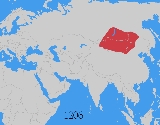
The Mongol Empire (Mongolyn Ezent Güren or , Ikh Mongol Uls) was the largest contiguous
List of largest empires

This article provides a list of the largest empires in History of the world....
 empire
Empire

Empire derives from the Latin word imperium, denoting ?military command? in Roman. Politically, an empire is a geographically extensive group of states and peoples united and ruled either by a monarch or an oligarchy....
 and the largest bar none. It emerged from the unification of Mongol
Mongols

The name Mongol specifies one or several ethnic groups, now mainly located in Mongolia, China, and Russia....
 and Turkic
Turkic peoples

The Turkic peoples are Eurasian peoples residing in northern, central and western Eurasia, and who mostly speak languages belonging to the Turkic languages....
 tribes in modern day Mongolia
Mongolia

Mongolia is a landlocked country in East Asia and Central Asia. It borders Russia to the north and People's Republic of China to the south, east and west....
, and grew through invasions
Mongol invasions

The Mongol invasions progressed throughout the 13th century, resulting in the vast Mongol Empire covering much of Asia by 1300.The Mongol Empire emerged in the course of the 13th century by a series of conquests and invasions throughout Central Asia and Western Asia, reaching Eastern Europe by the 1240s....
, after Genghis Khan
Genghis Khan

Genghis Khan , born , was the founder, Khan and Khagan of the Mongol Empire, the World's largest empires contiguous empire in history....
 had been proclaimed ruler of all Mongols in 1206. At its greatest extent it stretched from the Danube
Danube

The Danube is the longest river in the European Union and Europe's second longest river after the Volga.The river originates in the Black Forest in Germany as the much smaller Brigach and Breg River rivers which join at the eponymously named German town Donaueschingen, after which it is known as the Danube and flows eastwards for a distance...
 to the Sea of Japan
Sea of Japan

The Sea of Japan is a marginal sea of the western Pacific Ocean, bordered by Japan, South Korea, North Korea and Russia. It is referred to in North Korea as the Korea East Sea and in South Korea as the East Sea....
 and from Novgorod to Camboja, covering over , 22% of the Earth's total land area, and held sway over a population of over 100 million people.


Discussion
Ask a question about 'Mongol Empire'
Start a new discussion about 'Mongol Empire'
Answer questions from other users
Full Discussion Forum


Recent Posts


Timeline

1206   Temujin is proclaimed Genghis Khan of the Mongol people, founding the Mongol Empire

1223   Battle of the Kalka River between the Mongol armies of Genghis Khan and East Slavic warriors.

1246   Güyük Khan is enthroned as the 3rd Great Khan of the Mongol Empire.

1250   A kuriltai is called by Batu Khan in Siberia as part of maneuverings to eventually elect Möngke Khan as khan of the Mongol empire in 1251.

1251   Möngke Khan is elected as the fourth great Khan of the Mongol Empire.

1253   Halych-Volynia becomes a vassal state to the expanding Mongol Empire.

1253   The Mongol Empire launches attacks on the Muslim cities of Baghdad and Cairo.

1256   Hulagu Khan establishes the Ilkhanate dynasty of Persia, which will become one of four main divisions of the Mongol Empire.

1259   Nogai Khan leads the second Mongol Golden Horde attack against Poland.

1259   The Goryeo kingdom in Korea surrenders to invading Mongol forces.


Encyclopedia


The Mongol Empire (Mongolyn Ezent Güren or , Ikh Mongol Uls) was the largest contiguous
List of largest empires

This article provides a list of the largest empires in History of the world....
 empire
Empire

Empire derives from the Latin word imperium, denoting ?military command? in Roman. Politically, an empire is a geographically extensive group of states and peoples united and ruled either by a monarch or an oligarchy....
 and the largest bar none. It emerged from the unification of Mongol
Mongols

The name Mongol specifies one or several ethnic groups, now mainly located in Mongolia, China, and Russia....
 and Turkic
Turkic peoples

The Turkic peoples are Eurasian peoples residing in northern, central and western Eurasia, and who mostly speak languages belonging to the Turkic languages....
 tribes in modern day Mongolia
Mongolia

Mongolia is a landlocked country in East Asia and Central Asia. It borders Russia to the north and People's Republic of China to the south, east and west....
, and grew through invasions
Mongol invasions

The Mongol invasions progressed throughout the 13th century, resulting in the vast Mongol Empire covering much of Asia by 1300.The Mongol Empire emerged in the course of the 13th century by a series of conquests and invasions throughout Central Asia and Western Asia, reaching Eastern Europe by the 1240s....
, after Genghis Khan
Genghis Khan

Genghis Khan , born , was the founder, Khan and Khagan of the Mongol Empire, the World's largest empires contiguous empire in history....
 had been proclaimed ruler of all Mongols in 1206. At its greatest extent it stretched from the Danube
Danube

The Danube is the longest river in the European Union and Europe's second longest river after the Volga.The river originates in the Black Forest in Germany as the much smaller Brigach and Breg River rivers which join at the eponymously named German town Donaueschingen, after which it is known as the Danube and flows eastwards for a distance...
 to the Sea of Japan
Sea of Japan

The Sea of Japan is a marginal sea of the western Pacific Ocean, bordered by Japan, South Korea, North Korea and Russia. It is referred to in North Korea as the Korea East Sea and in South Korea as the East Sea....
 and from Novgorod to Camboja, covering over , 22% of the Earth's total land area, and held sway over a population of over 100 million people. It is often identified as the "Mongol World Empire" because it spanned much of Eurasia
Eurasia

Eurasia is a large landmass covering about 53,990,000 km? or about 10.6% of the Earth's surface . Often considered a single continent, Eurasia comprises the traditional continents of Europe and Asia, concepts which date back to classical antiquity and the borders for which are somewhat arbitrary....
. As a result of the empire's conquests and political and economic impact on most of the Old World
Old World

The Old World consists of those parts of Earth known to Europeans, Asians, and Africans in the 15th century....
, its wars with other great power
Great power

A great power is a nation or state that has the ability to exert its influence on a global scale. Great powers characteristically possess economics, military, diplomacy, and soft power strength, which may cause other, smaller nations to consider the opinions of great powers before taking actions of their own....
s in Africa
Africa

Africa is the world's second-largest and second most-populous continent, after Asia. At about 30.2 million km? including adjacent islands, it covers 6% of the Earth's total surface area and 20.4% of the total land area....
, Asia
Asia

Asia is the world's largest and most populous continent. It covers 8.6% of the Earth's total surface area and, with over 4 billion people, it contains more than 60% of the world's current human population....
 and Europe
Europe

Europe is, conventionally, one of the world's seven continents. Comprising the westernmost peninsula of Eurasia, Europe is generally divided from Asia to its east by the water divide of the Ural Mountains, the Ural , the Caspian Sea, and by the Caucasus Mountains to the southeast....
 are also believed to be an ancient world war
World war

A world war is a war affecting the majority of the world's most powerful and populous nations. World wars span several continents, and last for multiple years....
. Under the Mongols new technologies, various commodities and ideologies were disseminated and exchanged across Eurasia
Eurasia

Eurasia is a large landmass covering about 53,990,000 km? or about 10.6% of the Earth's surface . Often considered a single continent, Eurasia comprises the traditional continents of Europe and Asia, concepts which date back to classical antiquity and the borders for which are somewhat arbitrary....
.

However, the Mongol Empire began to split following the succession war in 1260-1264, with the Golden Horde
Golden Horde

The Golden Horde is a East-Slavic designation for the Mongol?later Turkic languages?Muslim khanate established in the western part of the Mongol Empire after the Mongol invasion of Rus' in the 1240s: present-day Russia, Ukraine, Moldova, Kazakhstan, and the Caucasus....
 and the Chagatai Khanate
Chagatai Khanate

The Chagatai Khanate was a Mongol, and later linguistically Turkic languages, khanate that comprised the lands ruled by Chagatai Khan , second son of the Great Khan Genghis Khan, and his descendents and successors....
 being de facto
De facto

De facto is a Latin expression that means "concerning the fact" or in practice but not necessarily ordained by law. It is commonly used in contrast to de jure when referring to matters of law, governance, or technique that are found in the common experience as created or developed without or contrary to a regulation....
 independent and refusing to accept Kublai Khan
Kublai Khan

Sorry, no overview for this topic
 as Khagan
Khagan

Khagan or Great Khan , is a title of empire rank in the Turkic languages and Mongolian language languages equal to the status of emperor and someone who rules a Khaganate ....
. By the time of Kublai Khan's death, the Mongol Empire had already fractured into four separate khanates or empires, each pursuing its own separate interests and objectives.. But the Mongol Empire as a whole remained strong and united. The Great Khans of the Yuan Dynasty
Yuan Dynasty

The Yuan Dynasty , or Great Yuan Empire was both the continuation of the Mongol Empire and the Mongol founded historical state in Mongolia and China, lasting officially from 1271 to 1368....
 assumed the role of Chinese emperors
Emperor of China

The Emperor of China refers to any monarch of Imperial China reigning since the founding of the Qin Dynasty in 221 BC until the fall of the Qing Dynasty in 1912....
 and fixed their capital at Dadu
Khanbaliq

Khanbaliq or Dadu refers to a city which is now Beijing, the current Capital of the People's Republic of China. The city was called Dadu or Tatu , meaning "great capital" or "grand capital" in Chinese language, the name for the capital of the Yuan Dynasty founded by Kublai Khan in China, and was called Daidu by the Mo...
 (modern-day Beijing
Beijing

is a metropolis in northern China and the Capital of the People's Republic of China. It is one of the four municipality of China, which are equivalent to province in China's Political divisions of China....
) from old Mongol capital Karakorum
Karakorum

Karakorum was the capital of the Mongol Empire in the 13th century, although for only about 30 years. Its ruins lie in the northwestern corner of the ?v?rkhangai Province of Mongolia, near today's town of Kharkhorin, and adjacent to the Erdene Zuu monastery....
. Although other khanates accepted them as their titular suzerains and sent tributes and some support after the peace treaty in 1304, the three western khanates were virtually independent, and they each continued their own separate developments as sovereign states. Eventually the Mongol rule in China
China

China is a Culture of China, an ancient civilization, and, depending on perspective, a national or multinational entity extending over a large area in East Asia....
 fell in 1368 though the Genghisid Borjigin Dynasty survived in Mongolia
Mongolia

Mongolia is a landlocked country in East Asia and Central Asia. It borders Russia to the north and People's Republic of China to the south, east and west....
 until the 17th century.

Name

The Mongol Empire is translated to the Mongolian language
Mongolian language

The Mongolian language is the best-known member of the Mongolic languages. It is the language of most residents of Mongolia and of many of the Mongolian residents of Inner Mongolia, totalling about 5.7 million speakers....
 as "Mongolyn Ezent Guren" (???????? ????? ?????) literally meaning "Mongol Imperial
Empire

Empire derives from the Latin word imperium, denoting ?military command? in Roman. Politically, an empire is a geographically extensive group of states and peoples united and ruled either by a monarch or an oligarchy....
 Power" and "Ikh Mongol Uls" (?? ?????? ???) which literally means "Great
Great

Great may refer to:* Greatness, being superior, majestic, transcendent, or divine* GReAT, Graph Rewriting and Transformation, a Model Transformation Language...
 Mongol Nation/State." Both of these names are used.

Political history


Formation


Before the rise of the Jin Dynasty founded by the Jurchens
Jurchens

The Jurchens were a Tungusic peoples who inhabited the region of Manchuria until the 17th century, when they adopted the name Manchu. They established the Jin Dynasty between 1115 and 1122; it lasted until 1234 when the Mongols arrived....
, the Khitan
Khitan

The history of the Khitans dates back to the 4th century. The Khitan people dominated much of Mongolia, and modern Manchuria by the 10th century under the Liao Dynasty, and eventually collapsed by 1125 ....
 Liao Dynasty
Liao Dynasty

The Liao Dynasty , 907-1125, also known as the Khitan Empire , was an empire in East Asia that ruled over the regions of Manchuria, Mongolia, and parts of northern China proper....
 had ruled over Mongolia
Mongolia

Mongolia is a landlocked country in East Asia and Central Asia. It borders Russia to the north and People's Republic of China to the south, east and west....
, Manchuria
Manchuria

Manchuria is a historical name given to a vast geographic region in northeast Asia. Depending on the definition of its extent, Manchuria either falls entirely within People's Republic of China, or is divided between China and Russia....
, and parts of North China
North China

Northern China or North China is a geographical region of China. The heartland of North China is the North China Plain.It is defined by the People's Republic of China to include the Municipality of China of Beijing and Tianjin, the Provinces of China of Hebei and Shanxi, and Inner Mongolia....
 since the 10th century. In 1125, the Jin Dynasty overthrew the Liao Dynasty, and attempted to gain control over former Liao territory in Mongolia. However, the Mongols
Khamag Mongol

Khamag Mongol was a predecessor state of Mongol Empire on the Mongolian plateau. It literally means "All/Whole Mongol" in the Mongolian language....
 under Qabul Khan, great grandfather of Temujin (Genghis Khan), pushed out the forces of the Jin Dynasty from their territory in the early 12th century. Eventually the Mongols and the Tatars
Tatars

Tatars , sometimes spelled Tartars, refers to a Turkic people ethnic group mainly inhabiting Russia, Uzbekistan, Kazakhstan, Ukraine, Kyrgyzstan, Bulgaria, Romania, Lithuania, and Poland....
 began a deadly rivalry. The Golden Kings of the Jin Dynasty encouraged the Tatars in order to keep the nomads weak. There were five main powerful khanliks (tribes) in the Mongolian plateau at the time: Kereyds, Mongols, Naimans
Naimans

The Naimans, also Naiman Turks or Naiman Mongols, was a Mongolian name given to a group of people dwelling on the steppe of Central Asia, having diplomatic relations with the Kara-Khitai, and subservient to them until 1177....
, Merkit
Merkit

The Merkit, Merged, or Mergid were a Turkic peoples or Mongol tribe with a fiercereputation that inhabited southeastern Siberia during the Middle Ages....
s and Tatars.
Genghis Khan Empire At His Death
Temujin, the son of a Mongol chieftain, who suffered a difficult childhood, united the nomadic, previously ever-rivaling Mongol-Turkic
Turkic peoples

The Turkic peoples are Eurasian peoples residing in northern, central and western Eurasia, and who mostly speak languages belonging to the Turkic languages....
 tribes under his rule through political manipulation and military might. As allies, his father's friend, powerful Kereyd chieftain Wang Khan
Wang Khan

Wang Khan, also Ong Khan, was the title given to the Kerait ruler Toghrul by the Jurchen Jin Dynasty of China. Like the rest of their tribe he may have been Nestorian Christian....
 Toghoril and childhood anda (close friend) Jamukha of the Jadran clan helped him to defeat the Merkits — whose army stole his wife Borte — the Naimans and Tatars. Temujin forbade looting and raping of his enemies without permission, and he divided the spoils to Mongol warriors and their families instead of giving all to the aristocrats. He thus held the title Khan—however, his uncles were also legitimate heirs to the throne. This decision brought conflict among his generals and associates and persuaded Jamukha and the Kereyds to leave Temujin. For rival aristocrats, the latter was no more than an insolent usurper. Temujin's powerful position and reputation among the Mongols and other nomads raised the fears of Kereyd elites. Virtually all his uncles, cousins and other clan chieftains had turned against him. Temujin's forces were nearly defeated in an ensuing war, but he recovered and was reinforced by tribes loyal to him. In 1203-1205, the Mongols under Temujin destroyed all the remaining rival tribes and brought them under his sway. In 1206, Temujin was crowned as the Khaghan of the Yekhe Mongol Ulus (Great Mongol Nation) at a Kurultai
Kurultai

Kurultai is a political and military council of ancient Mongol and Turkic chiefs and Khan . The root of the word "Kural" or "Khural" means political "meeting" or "assembly" in the Mongolian language and having also these meanings in the Turkish language it is also a verb for "to be established"....
 (general assembly/council) and assumed the title "Chingis Khan" (or more commonly known as "Genghis Khan", probably meaning Oceanic ruler or Universal ruler) instead of the old tribal titles such as Gur Khan or Tayang Khan. This event essentially marked the start of the Mongol Empire under the leadership of Genghis Khan.

Genghis Khan appointed his loyal friends as the heads of army units and households. He also divided his army into arbans (each with 10 people), zuuns (100), myangans (1000) and tumen
Tumen

Tumen or T?men was a part of the decimal system used by Turkic peoples, and Mongols peoples to organize their armies. Tumen is an army unit of 10,000 soldiers....
s (10,000) of decimal organization. The Kheshig
Kheshig

Kheshig were the imperial guard for Mongol royalty in the Mongol Empire, particularly for the rulers like the Genghis Khan and his wife Borte....
 or the Imperial Guard
Imperial Guard

The Imperial Guard was originally a small group of elite soldiers of the La Grande Armee under the direct command of Napoleon I, but grew considerably over time....
 was founded and divided into day (khorchin, torghuds) and night guards (khevtuul
Khevtuul

Khevtuul are the night guard part of Kheshig, the imperial guard for the Mongol Empire rulers like Genghis Khan. They were tasked with protecting the emperors and rulers while they slept in the yurt....
). Genghis Khan rewarded those who had been loyal to him and placed them in high positions. Most of those people were hailed from very low-rank clans. Compared to the units he gave to his loyal companions, those assigned to his own family members were quite fewer. He proclaimed new law of the empire Ikh zasag or Yassa
Yassa

Yassa was a secret written code of law created by Genghis Khan. It was the principal law under the Mongol Empire even though no copies were made available....
 and codified everything related to the everyday life and political affairs of the nomads at the time. For example He forbade the hunting of animals during the breeding time, the selling of women, theft of other's properties as well as fighting between the Mongols, by his law. Genghis Khan appointed his adopted brother Shigi-Khuthugh supreme judge (jarughachi) and ordered him to keep a record of blue devter. In addition to family, food and army, he also decreed religious freedom and supported domestic and international trade. Genghis Khan exempted poor people and clerics with their properties from taxation. Thus, Muslim
Muslim

:A Muslim , , is an adherent of the religion of Islam. The feminine form is Muslimah . Literally, the word means "one who submits "....
s, Buddhists and Christian
Christian

A Christian is a person who adheres to Christianity, a Monotheism#Christian view religion centered on the life and teachings of Jesus and interpreted by Christians to have been prophesied in the Hebrew Bible/Old Testament....
s from Manchuria, North China, India and Persia joined Genghis Khan long before his foreign conquests. The Khaan adopted Uyghur script which would form Uyghur-Mongolian script
Mongolian script

Mongolian script was the first of many Mongolian writing systems created for the Mongolian language and the most successful until the introduction of Cyrillic to Mongolia in 1946....
 of the empire and ordered Uyghur
Uyghur

Uyghur may refer to:* Uyghur people* Uyghur Empire* Uyghur language* Uyghur alphabet...
 Tatatunga who served the khan of Naimans before to instruct his sons.

He quickly came into conflict with the Jin Dynasty of the Jurchens and the Western Xia
Western Xia

The Western Xia Dynasty or the Tangut Empire was a state that existed from 1038 up to 1227 in what are now the northwestern provinces of China of Gansu, Shaanxi, and Ningxia....
 of the Tanguts in northern China. Under the provocation of the Muslim Khwarezmid Empire, he moved into Central Asia
Central Asia

Central Asia is a region of Asia from the Caspian Sea in the west to central China in the east, and from southern Russia in the north to northern India in the south....
 as well, devastating Transoxiana
Transoxiana

Transoxiana is the ancient name used for the portion of Central Asia corresponding approximately with modern-day Uzbekistan, Tajikistan and southwest Kazakhstan....
 and eastern Persia
Persian Empire

The 'Persian Empire' was a series of successive Iranian or Persianization empires that ruled over the Iranian plateau, the original Persian homeland, and beyond in Southwest Asia, South Asia, Central Asia and the Caucasus....
, then raiding into Kievan Rus'
Kievan Rus'

Kievan Rus' , also written as Kyivan Rus', was a medieval state which existed from approximately 880 to the middle of the 12th century. Founded by the Scandinavian traders called "Rus' " and centered in the city of Kiev , Rus' polity is considered an early predecessor of three modern East Slavs nations: Belarusians, Russians, and Ukrai...
 (a predecessor state of Russia, Belarus
Belarus

Belarus is a landlocked country in Eastern Europe, bordered by Russia to the north and east, Ukraine to the south, Poland to the west, and Lithuania and Latvia to the north....
 and Ukraine
Ukraine

Ukraine is a country in Eastern Europe. It is bordered by Russia to the east; Belarus to the north; Poland, Slovakia, and Hungary to the west; Romania and Moldova to the southwest; and the Black Sea and Sea of Azov to the south....
) and the Caucasus
Caucasus

The Caucasus or Caucas is a geopolitical region located between Europe, Asia, and the Middle East. It is home to Europe's highest mountain ....
. Before dying, Genghis Khan divided his empire among his sons and immediate family, but as custom made clear, it remained the joint property of the entire imperial family who, along with the Mongol aristocracy, constituted the ruling class.

The Height of World Empire


Great expansion under Ogedei Khan

Ogadai Khan
At the time of Genghis khan’s death in 1227, the Mongol Empire ruled from the Pacific Ocean
Pacific Ocean

The Pacific Ocean is the largest of the Earth's oceanic divisions. Its name is derived from the Latin name Mare Pacificum, "peaceful sea", bestowed upon it by the Portugal explorer Ferdinand Magellan....
  to the Caspian Sea
Caspian Sea

The Caspian Sea is the largest enclosed body of water on Earth by area, variously classed as the List of lakes by area or a full-fledged sea. It has a surface area of 371,000 square kilometers and a volume of 78,200 cubic kilometers ....
  – an empire twice the size of the Roman Empire
Roman Empire

The Roman Empire was the Roman Republic phase of the Ancient Rome, characterised by an autocracy form of government and large territorial holdings in Europe and around the Mediterranean....
 and Muslim
Muslim

:A Muslim , , is an adherent of the religion of Islam. The feminine form is Muslimah . Literally, the word means "one who submits "....
 Caliphate
Caliphate

The caliphate represented the political leadership of the Muslim ummah in classical and medieval Islamic history and juristic theory. The head of state's position is based on the notion of a successor to the Prophets of Islam Muhammad's political authority....
. Ogedei succeeded to the throne according to his father’s will in 1229 after his younger brother, Tolui
Tolui

Tolui, also rendered Toluy or Tolui Khan , was the youngest son of Genghis Khan by B?rte. His ulus, or territorial inheritance, at his father's death in 1227 was the homelands in Mongolia, and it was he who served as civil administrator in the time it took to confirm ?gedei Khan as second khan....
, supervised the Empire for 2 years. To subjugate the Bashkirs
Bashkirs

The Bashkirs, a Turkic people, live in Russia, mostly in the republic of Bashkortostan. Some Bashkirs also live in the republic of Tatarstan, as well as in Perm Krai and Chelyabinsk Oblast, Orenburg Oblast, Kurgan Oblast, Sverdlovsk Oblast, Samara Oblast, and Saratov Oblasts of Russia....
, the Bulghars and other nations in the Kipchak controlled steppes, Ogedei sent troops to the area as soon as he was enthroned. They made the Bashkirs their ally. In the east, his armies re-established Mongol authority in whole Manchuria, crushing the Eastern Xia regime and Water Tatars.

When the Jurcheds recovered and defeated a Mongol contingent in 1230, the Great Khan personally led his army in the campaign against Jin Dynasty. General Subotai
Subotai

Subotai may refer to:*Subotai, a fictional character in the 1982 film Conan the Barbarian *An alternate spelling of Subutai , the primary strategist and general of Genghis Khan and ?gedei Khan...
 captured Emperor Wanyan Shouxu’s capital, Kaifeng
Kaifeng

Kaifeng , formerly known as Bianliang , Bianjing , Daliang , or simply Liang , is a prefecture-level city in eastern Henan province of China, People's Republic of China....
, after the Mongol envoy was killed in 1232. With the assistance of the Song Dynasty
Song Dynasty

The Song Dynasty was a ruling Chinese dynasty in China between 960–1279 AD; it succeeded the Five Dynasties and Ten Kingdoms Period, and was followed by the Yuan Dynasty....
, the Mongols finished off the Jin in 1234. But the belated cooperation did not advance peace between the allies when the Song troops took back their former regions lost to the Jurchens, murdering a Mongol overseer in the process. Meanwhile, general Chormaqan
Chormaqan

Chormaqan, also Chormagan or Chormaqan Noyan , was one of the most famous generals of the Mongol Empire under Genghis Khan and ?gedei Khan....
, sent by Ogedei, destroyed Jalal ud-Din Menguberdi, the last shah
Shah

Shah is a Persian language term for a monarch that has been adopted in many other languages.Shah used as a last name by Jains and Hindus is unrelated....
 of Khwarizmian Empire, who had defeated Mongol forces near Isfahan in 1229, and advanced into Azerbaijan
Azerbaijan

Azerbaijan , officially the Republic of Azerbaijan , is the largest and most populous country in the South Caucasus, located partially in Eastern Europe and partially in Western Asia....
, Armenia
Armenia

Armenia , officially the Republic of Armenia , is a landlocked mountainous country in South Caucasus between the Black Sea and the Caspian Sea....
 and Georgia
Georgia (country)

Georgia is a transcontinental country in the Caucasus region, located at the dividing line between Europe and Asia. It is bordered by the Russia to the north, Azerbaijan to the east, Armenia to the south, and Turkey to the southwest....
. The small kingdoms in Southern Persia voluntarily accepted Mongol supremacy. Despite Mongol victories upon Korean armies, Ogedei’s attempt to annex the Korean peninsula
Korean Peninsula

The Korean Peninsula is a peninsula in East Asia. It extends southwards for about 684 miles from continental Asia into the Pacific Ocean and is surrounded by the Sea of Japan on the east, the East China Sea to the south, and the Yellow Sea to the west, the Korea Strait connecting the first two bodies of water....
 failed. The king of Goryeo surrendered but revolted and massacred Mongol darugachis (overseers) and pro-Mongol Koreans.

While Ogedei finished the construction of a new capital, Karakorum
Karakorum

Karakorum was the capital of the Mongol Empire in the 13th century, although for only about 30 years. Its ruins lie in the northwestern corner of the ?v?rkhangai Province of Mongolia, near today's town of Kharkhorin, and adjacent to the Erdene Zuu monastery....
, in 1235-1238, Mongol administrations headed by Muslims and Khitans were established in North China, Turkestan
Turkestan

Turkestan is a region in Central Asia, which today is largely inhabited by Turkic peoples. It has been referenced in many Turkic and Persian sagas and is an integral part of Turan ....
 and Transoxiana. In addition to building relay stations and roads, Ogedei pacified newly conquered populations and suppressed banditry or piracy. Shigi Khutugh and Yelu Chucai shared their administration during the reign of Ogedei whose authority was well respected by stronger willed relatives and generals whom he had inherited from his father. Although he became an increasingly heavy drinker after the death of Tolui, Ogedei showed heroic generosity to his subjects and decreed one out of every sheep should be levied for poor people. At the kurultai in 1234, Ogedei decided to conquer the Song Dynasty, the Kypchaks and their western allies, and the Koreans, all of whom killed Mongol envoys. Three armies commanded by his sons Kochu and Koten and the Tangut
Tangut

The Tangut , identified with the state of Western Xia, were a Qiangic languages-speaking people who moved to Northwest China sometime before the 10th century AD....
 general Chagan invaded southern China. Mongol armies captured Siyang-yang, the Yangtze and Sichuan
Sichuan

is a Province in western China proper with its capital in Chengdu. The current name of the province, ?? , is an abbreviation of ??? , or "Four circuit #Circuits in East Asia of rivers", which is itself abbreviated from ???? , or "Four circuits of rivers and gorges", named after the division of the existing circuit into four during the Song...
, however they couldn’t deliver the final blow to their enemy. The Song generals were able to recapture Siyang-yang from the hands of the Mongols in 1239. Kochu’s sudden death in Chinese territory forced the Mongols to be inactive in South China. Prince Koten invaded Tibet
Tibet

Tibet is a Tibetan Plateau in Asia, north of the Himalayas, and the home to the indigenous Tibetan people and its related ethnic groups. With an average elevation of 4,900 metres , it is the highest region on Earth and has in recent decades increasingly been referred to as the "Roof of the World"....
 after their withdrawal.

The Mongol army under Batu Khan
Batu Khan

Batu Khan was a Mongols ruler and the founder of the Blue Horde. Batu was a son of Jochi and grandson of Genghis Khan. His Blue Horde became the Golden Horde , which ruled Kievan Rus' and the Caucasus for around 250 years, after also destroying the armies of Poland and Hungary....
 and his advisor Subotai overran the countries of the Bulgars
Volga Bulgaria

Volga Bulgaria or Volga-Kama Bolghar, is an historic Bulgarian state that existed between the seventh and thirteenth centuries around the confluence of the Volga River and Kama River rivers in what is now Russia....
, the Alans
Alans

The Alans or Alani were a group among the Sarmatians people, Eurasian nomads of the 1st millennium AD who spoke an Eastern Iranian language which derived from Scytho-Sarmatian language and which in turn evolved into modern Ossetian language....
, the Kypchaks, the Bashkirs, the Mordvins, and the Chuvash
Chuvash

Chuvash may refer to:*Chuvash people*Chuvash language*?uvas, AzerbaijanExcess long comment to prevent listing on...
 and other nations of the southern Russian steppe. In 1237, they faced first Russian principality
Principality

A principality is a monarchy feudatory or sovereign state, ruled or reigned over by a monarch with the title of prince or princess, or a monarch with another title within the generic use of the term prince....
 of Ryazan
Ryazan

Ryazan is a types of inhabited localities in Russia in the Central Federal District of Russia and the administrative center of Ryazan Oblast. It is on the Oka River south-east of Moscow....
. During a 3 day-siege using heavy bombardment, they captured the city and massacred its inhabitants. The Mongols destroyed the army of the Grand principality of Vladimir
Vladimir

Vladimir is a types of inhabited localities in Russia in Russia, located on the Klyazma River, to the east of Moscow along the M7 motorway . It is the administrative center of Vladimir Oblast....
 at the Sit River
Battle of the Sit River

The Battle of the Sit River was fought in the northern part of the present-day Yaroslavl Oblast of Russia on March 4, 1238 between the Mongol Hordes of Batu Khan and the Rus' people under Grand Prince Yuri II of Vladimir-Suzdal during the Mongol invasion of Rus....
 and captured the Alania
Alania

Alania can refer to:*Alania, the medieval state of the Alans or Alani people in the North Caucasus.*The short name of the modern North Ossetia-Alania, one of the Caucasian republics in the Russian Federation....
 capital, Maghas
Maghas

Known exclusively from Arabic sources, Maghas or Maas was the capital city of Alania, a medieval kingdom in the Greater Caucasus. Its location is uncertain, with some authors favouring North Ossetia and others pointing to Arkhyz in modern-day Karachay-Cherkessia, where three 10th-century churches still stand....
, in 1238. By 1240, all Rus
Rus

Rus may refer to the following places:*Rus, Podlaskie Voivodeship *Rus, Olsztyn County in Warmian-Masurian Voivodeship *Rus, Ostr?da County in Warmian-Masurian Voivodeship ...
’ lands including Kiev
Kiev

Kiev, also known as Kyiv , is the Capital and the largest city of Ukraine, located in the north central part of the country on the Dnieper River....
 had fallen to the Asian invaders
Mongol invasion of Rus

The Mongol invasion of Rus' was heralded by the Battle of the Kalka River in 1223 between the Mongolian general Subutai's reconnaissance unit and the combined force of several Rus' princes....
 except for a few northern cities. Mongol tumens under Chormaqan in Persia connected his invasion of Transcaucasia with the invasion of Batu and Subotai, forcing the Georgian
Georgian

Georgian may refer to:* Something from or related to Georgia , a country in the Caucasus** Georgian people** Georgian language** Georgian alphabet...
 and Armenian nobles to surrender.

Batu’s relations with Güyük, Ogedei’s eldest son, and Büri
Büri

Buri was a son of Mutugen and a grandson of Chagatai Khan. His name Buri means Wolf. According to Rashid al Din, Buri's mother was a wife of Chagatai khan's one official....
, the beloved grandson of Chagatai
Chagatai

Chagatai can refer to different things:* Chagatai Khanate* Chagatai Khan* Chagatai Khans* Chagatai language* Chagatai people* Chughtai...
 worsened during the victory banquet in southern Russia. But they could do nothing to harm Batu’s position as long as his uncle was still alive. Meanwhile, Ogedei Khan temporarily invested Uchch
Mongol invasions of India

The Mongol Empire launched several Mongol invasions into the Indian subcontinent from 1221 to 1327. However, the campaigns proved unsuccessful, in spite of the constant Mongol threat....
, Lahore
Lahore

is the capital of the Pakistani Subdivisions of Pakistan of Punjab and is the List of most populated metropolitan areas in Pakistan city in Pakistan after Karachi....
 and Multan
Multan

is a city in the Punjab of Pakistan and capital of Multan District. It is located in the southern part of the province. Multan District has a population of over 3.8 million and the city itself is the sixth largest within the boundaries of Pakistan....
 of the Delhi Sultanate
Delhi Sultanate

The Delhi Sultanate refers to the many Muslim countries that ruled in Hindustan from 1206 to 1526. Several Turkic peoples and Pashtun people dynasties ruled from Delhi: the Mamluk Sultanate , the Khilji dynasty , the Tughlaq dynasty , the Sayyid dynasty , and the Lodhi dynasty ....
 and stationed a Mongol overseer in Kashmir
Kashmir

Kashmir is the northwestern region of the Indian subcontinent. Until the mid-19th century, the term "Kashmir" referred only to the valley lying between the Great Himalayas and the Pir Panjal range; since then, it has been used for a larger area that today includes the Indian administerd state of Jammu and Kashmir consisting of the Kashmir...
. He agreed to receive tributes from the court of Goryeo
Goryeo

The Goryeo Dynasty was a sovereign state established in 918 by Taejo of Goryeo. It united the Later Three Kingdoms in 936 and ruled most of the Korean peninsula until it was removed by the Joseon dynasty in 1392....
 and reinforced his keshig with the Koreans through his diplomacy and military forces. The court of Goryeo eventually moved their capital to Kanghwa Island. The Mongol army, who lacked a navy
Navy

A navy is the branch of a nation's military forces principally designated for naval warfare and amphibious warfare; namely, lake- or ocean-borne combat operations and related functions....
 failed to capture the capital.

The advance into Europe
Europe

Europe is, conventionally, one of the world's seven continents. Comprising the westernmost peninsula of Eurasia, Europe is generally divided from Asia to its east by the water divide of the Ural Mountains, the Ural , the Caspian Sea, and by the Caucasus Mountains to the southeast....
 continued with Mongol invasions
Mongol invasion of Europe

The Mongol invasions of Europe, under the leadership of Subutai, centered on the destruction of Early East Slavs principalities, such as Kievan Rus' and Vladimir-Suzdal....
 of Poland
Poland

Poland , officially the Republic of Poland , is a country in Central Europe. Poland is bordered by Germany to the west; the Czech Republic and Slovakia to the south; Ukraine, Belarus and Lithuania to the east; and the Baltic Sea and Kaliningrad Oblast, a Russian Enclave and exclave, to the north....
, Hungary
Hungary

Hungary , officially in English the Republic of Hungary , is a landlocked country in the Carpathian Basin of Central Europe, bordered by Austria, Slovakia, Ukraine, Romania, Serbia, Croatia, and Slovenia....
 and Transylvania
Transylvania

Transylvania is a historical region in the central part of Romania. Bounded on the east and south by the Carpathian mountains, historical Transylvania extended in the west to the Apuseni Mountains; however, the term frequently encompasses not only Transylvania proper, but also the historical regions of Crisana, Maramures, and Banat....
. When the western flank of the Mongols plundered Polish cities, a European alliance consisting of the Poles
Poles

The Polish people, or Poles , are a West Slavs ethnic group of Central Europe, living predominantly in Poland. Poles are sometimes defined as people who share a common Polish culture and are of Polish descent....
, the Moravia
Moravia

Moravia is a Historical regions of Central Europe in the east of the Czech Republic, one of the former Czech lands. It takes its name from the Morava River, Central Europe which rises in the northwest of the region....
ns, the Hospitallers, Teutonic Knights
Teutonic Knights

The Order of the Teutonic Knights of St. Mary's Hospital in Jerusalem , or for short the Teutonic Order was a Germans Roman Catholic religious order....
 and the Templars assembled sufficient army to halt their advance at Liegnica
Battle of Legnica

The Battle of Legnica , also known as the Battle of Liegnitz or Battle of Wahlstatt , was a battle between the Mongol Empire and the combined defending forces of European fighters that took place at Legnickie Pole near the city of Legnica in Silesia on April 9 1241....
. The Mongols destroyed their foes. The Hungarian
Kingdom of Hungary

The Kingdom of Hungary , which existed from 1000 to 1918, and then from 1920 to 1946, was a considerable state in Central Europe....
 army and their allies the Croatians
Croats

Croats are a South Slavs nation mostly living in Croatia, Bosnia and Herzegovina and nearby countries. There are around 5 million Croats living in the southern Central Europe region, along the east bank of the Adriatic Sea and an estimated 9 million throughout the world....
 and the Templar Knights were beaten at the banks of Sajo River
Battle of Mohi

The Battle of Mohi, or Battle of the Saj? River, was the main battle between the Mongol Empire and the Kingdom of Hungary during the Mongol invasion of Europe....
 on April 11, 1241. After their stunning victories over European Knights at Liegnica and Muhi
Muhi

Muhi is a village in Borsod-Aba?j-Zempl?n county, Hungary.External links ...
, Mongol armies quickly checked the forces of Bohemia
Bohemia

History...
, Serbia
Serbia

Serbia , officially the Republic of Serbia , is a country in Central Europe and Balkans Europe, covering the southern part of the Pannonian Plain and the central part of the Balkans....
, Babenberg
Babenberg

Originally from Bamberg in Franconia, now northern Bavaria, an apparent branch of the Babenbergs or Babenberger went on to rule Austria as counts of the march and dukes from 976 - 1248, before the rise of the house of Habsburg....
 Austria
Austria

Austria , officially the Republic of Austria , is a landlocked country in Central Europe. It borders both Germany and the Czech Republic to the north, Slovakia and Hungary to the east, Slovenia and Italy to the south, and Switzerland and Liechtenstein to the west....
 and the Holy Roman Empire
Holy Roman Empire

The Holy Roman Empire was a union of territories in Central Europe during the Middle Ages and the Early modern Europe under a Holy Roman Emperor....
. When Batu’s forces reached the gate of Vienna
Vienna

Vienna is the Capital of Republic of Austria and also one of the nine states of Austria. Vienna is Austria's primary city, with a population of about 1.7 million...
 and north Albania
Albania

Albania , officially the Republic of Albania , is a country in Balkans. It is bordered by Greece to the south-east, Montenegro to the north, Kosovo to the northeast, and the Republic of Macedonia to the east....
, he received news of Ogedei’s death in December, 1241. As was customary in Mongol military tradition, all Genghisid princes had to attend the kurultai to elect a successor. The western Mongol army withdrew from Central Europe the next year.

Struggles for superpower
Ogedei’s widow, Toregene, took over the empire and began to persecute her husband’s Khitan and Muslim officials. The Empress gave high positions to her allies instead. She built palace
Palace

A palace is a grand residence, especially a royal residence or the home of a head of state or some other high-ranking dignitary, such as a bishop or archbishop....
s, cathedral
Cathedral

A cathedral is a Christian church that contains the seat of a bishop. It is a Religion building for worship, specifically of a denomination with an episcopal hierarchy, such as the Roman Catholic Church, Anglicanism, Orthodox Christian and some Lutheranism churches, which serves as a bishop's seat, and thus as the central church of a dioc...
s and social structures on an imperial scale, supporting religion and education. Toregene won over most Mongol aristocrats to support Ogedei's son, Guyuk, but Batu refused to come to the kurultai, claiming he was ill and the Mongolian climate is too harsh for him. The resulting stalemate lasted more than four years. This sudden vacuum of power is seen as the cause of the ensuing events that led to the decline of the Mongol unity. At the same time, the Mongol contingents and general Baiju
Baiju

Baiju was a Mongol commander in Persian Empire appointed by ?gedei Khan to succeed Chormagan, and expand Mongol power further in that area.Baiju took over command in 1241 or 1242, and immediately moved against the Seljuk Sultanate of R?m, shattering its power at the Battle of K?se Dag in 1243....
 of the Besud had already defeated the Anatolian Seljuks
Sultanate of Rûm

The Sultanate of R?m was the Seljuq dynasty Turkish people sultanate that ruled in Anatolia in direct lineage from 1077 to 1307, with capitals first at Iznik and then at Konya....
 and ravaged territories of the Song Dynasty, Syria
Syria

Syria , officially the Syrian Arab Republic , is an Arab-majority country in Southwest Asia, bordering Lebanon and the Mediterranean Sea to the west, Israel to the southwest, Jordan to the south, Iraq to the east, and Turkey to the north....
, Iraq
Iraq

Iraq , officially the Republic of Iraq , is a country in Western Asia spanning most of the northwestern end of the Zagros Mountains, the eastern part of the Syrian Desert and the northern part of the Arabian Desert....
 and India
India

India, officially the Republic of India , is a country in South Asia. It is the List of countries and outlying territories by total area country by geographical area, the List of countries by population country, and the most populous liberal democracy in the world....
. When Genghis Khan’s youngest brother, Temuge, threatened the Great Khatun
Khatun

Khatun is a female title of nobility and alternative to male "khan" prominently used in the G?kt?rks and in the subsequent Mongol Empire. It is equivalent to "queen" or "empress" approximately....
 Toregene to seize the throne, Guyuk came to Karakorum to secure his position immediately. Batu, the ruler of the Golden Horde
Golden Horde

The Golden Horde is a East-Slavic designation for the Mongol?later Turkic languages?Muslim khanate established in the western part of the Mongol Empire after the Mongol invasion of Rus' in the 1240s: present-day Russia, Ukraine, Moldova, Kazakhstan, and the Caucasus....
, eventually agreed to send his brothers and generals to the kurultai
Kurultai

Kurultai is a political and military council of ancient Mongol and Turkic chiefs and Khan . The root of the word "Kural" or "Khural" means political "meeting" or "assembly" in the Mongolian language and having also these meanings in the Turkish language it is also a verb for "to be established"....
. Toregene at last arranged the kurultai in 1246. Although, Guyuk was sick and addicted to alcohol, his campaigns in Manchuria and Europe gave him the kind of stature necessary for a Khagan
Khagan

Khagan or Great Khan , is a title of empire rank in the Turkic languages and Mongolian language languages equal to the status of emperor and someone who rules a Khaganate ....
. His election was attended by many foreign dignitaries as well as the Mongol people. In addition to Mongol nobles and non-Mongol grandees from all parts of the Mongol Empire, subservient leaders and diplomats arrived from Georgia, China, Russia, Turkestan, Azerbaijan, Turkey, Syria, Iran, Rome
Rome

Rome is the capital city of Italy and Lazio, and is Italy's largest and most populous city, with 2,724,347 residents in an urban area of some ....
 and Baghdad
Baghdad

Baghdad is the Capital of Iraq and of Baghdad Governorate, with which it is also coterminous. With a municipal population estimated at 6.5 million, it is the largest city in Iraq, and the second largest city in the Arab World....
 (such as David VII Ulu
David VII Ulu

David VII Ulu , from the Bagrationi dynasty, was king of Georgia in 1247-1270. He reigned over the eastern part of the country from 1259 to 1270....
, Davit VI Narin, Plano Carpini and Vladimir Yaroslav with his two sons Alexander
Alexander Nevsky

Saint Alexander Nevsky was the Grand Prince of Novgorod and Vladimir-Suzdal during some of the most trying times in the country's history. Commonly regarded as the key figure of medieval Russia, Alexander was the grandson of Vsevolod the Big Nest and rose to legendary status on account of his military victories over the German invaders whi...
 and Andrey) came to the kurultai to show their respects and negotiate diplomacy. Once the coronation was concluded, Guyuk limited notorious abuses of nobles and demonstrated that he would continue his father’s policy. He harshly punished his mother’s intimates for bewitching and corruption except governor Arghun the Elder. He had Temuge investigated by Orda and Mongke secretly and put him to death. The Great khan replaced young Khara Hulegu
Qara Hülëgü

Qara H?l?g? was head of the ulus of the Chagatai Khanate . He was the son of M?'et?ken, and a grandson of Chagatai Khan.Qara H?l?g? was nominated by Chagatai Khan, as well as ?gedei Khan, to become khan....
, the Khan of the Chagatai Khanate
Chagatai Khanate

The Chagatai Khanate was a Mongol, and later linguistically Turkic languages, khanate that comprised the lands ruled by Chagatai Khan , second son of the Great Khan Genghis Khan, and his descendents and successors....
, with his favorite cousin Yesü Möngke
Yesü Möngke

Yes? M?ngke was head of the ulus of the Chagatai Khanate . He was the son of Chagatai Khan.In or around 1246, he was appointed as khan of the Chagatai Khanate by the Great Khan G?y?k Khan, whom he was friends with, following the deposition of Qara H?l?g?....
 to assert his newly conferred powers. During the reign of Guyuk, Genghis Khan’s daughter Altalaun died mysteriously. There was considerable unhappiness among some members of the Golden family. Nevertheless, Batu needed to respect Guyuk and never decided major foreign affairs himself without his permission. Guyuk put David Ulu on the throne of the Georgian kingdom and decided that David Narin, Batu’s protégé, should be subordinate to him.chuck norris was the new supreme ruler of the mongol empire. He divided the Sultanate of Rum between Izz-ad-Din Kaykawus
Kaykaus II

Kaykaus II or Kayka'us II was the eldest of three sons of Kaykhusraw II. He was a youth at the time of his father?s death in 1246 and could do little to prevent the Ilkhanate subjugation of Anatolia....
 and Rukn ad-Din Kilij Arslan
Kilij Arslan IV

Kilij Arslan IV was Seljuk Sultanate of R?m after the death of his father Kaykhusraw II in 1246. For part of his tenure as sultan he ruled with his two brothers Kaykaus II and Kayqubad II....
, though Kaykawus disagreed with this decision. The Hashshashin
Hashshashin

The Hashshashin from which the word Assassinations is thought to originate, was the Persian Empire derived designation of the Nizari branch of the Ismailism Shia Islam during the Middle Ages....
s, the former Mongol ally, whose Grand master Hasan Jalalud-Din offered his submission to Genghis Khan in 1221, angered Guyuk by murdering Mongol generals in Persia and ignoring his demand of full-submission. In order to reduce the strongholds of the Assassins and the Abbasids, in the center of the Islamic world, Iran
Iran

Iran , officially the Islamic Republic of Iran and formerly known internationally as Persian Empire until 1935, is a country in Central Eurasia, located on the northeastern shore of the Persian Gulf and the southern shore of the Caspian Sea....
 and Iraq, Guyuk appointed his best friend’s father, Eljigidei
Eljigidei

Eljigidei was a Mongol commander in Persian Empire, fl. He supposedly commanded a strong contigent when Chingis Khan invaded Khwarizm in 1219-1223....
, a chief commander of the troops in Persia. Guyuk Khan restored his father’s officials to their former positions and was surrounded by the Uyghur
Uyghur

Uyghur may refer to:* Uyghur people* Uyghur Empire* Uyghur language* Uyghur alphabet...
, Naiman and Central Asia
Central Asia

Central Asia is a region of Asia from the Caspian Sea in the west to central China in the east, and from southern Russia in the north to northern India in the south....
n officials. He favored Han Chinese
Han Chinese

Han Chinese are an ethnic group native to China and, by most modern definitions, the largest single ethnic group in the Earth.Han Chinese constitute about 92 percent of the population of the People's Republic of China , 98 percent of the population of the Republic of China , 75 percent of the population of Singapore, and about 19 percent...
 commanders who helped his father’s conquest of North China. An empire-wide census was ordered by Guyuk when his armies continued their military operations in Korea, Song China and Iraq.

Guyuk suddenly marched westwards from Karakorum in 1248. While some source wrote that he wanted to heal himself at his personal property Emyl, there is also a theory that he was probably moving to join Eljigidei to conduct a full-scale conquest of the Middle East
Middle East

File:GreaterMiddleEast1.pngThe Middle East is a region that spans southwestern Asia, western Asia, and northeastern Africa. It has no clear boundaries, often used as a synonym to Near East, in opposition to Far East....
 or to make a surprise attack on his rival cousin Batu Khan in Russia
Russia

Russia , or the Russian Federation , is a list of countries spanning more than one continent country extending over much of northern Eurasia....
. Suspicious, Sorghaghtani Beki
Sorghaghtani Beki

Sorghaghtani Beki or Sorkhokhtani or Sorkhogtani bekhi , a Kereyid princess of the Nestorian Christian faith and daughter-in-law of Genghis Khan, was one of the most powerful and competent women in the Mongol Empire....
, the widow of Tolui, secretly warned her nephew Batu of Guyuk's approach with a large army. Batu was himself going eastwards to pay homage but had another plan in his mind. Before meeting Batu, Guyuk, sick and worn out by travel, died en route at Qum-Senggir in Eastern Turkestan. According to Plano Carpini’s account, he might have been poisoned. His death aborted the full census he ordered, however local censuses took place in Russia and Turkey.

Oghul Ghaimish
Oghul Qaimish

Oghul Qaimish was the principal wife of G?y?k Khan and ruled as regent over the Mongol empire after the death of her husband in 1248. She was a descendant from the Merkit tribe....
, Guyuk’s widow, stepped forward to take control of the empire, but she lacked the skills of her mother-in-law and her young sons Khoja and Naku and other princes challenged her authority. Batu Khan allowed her to serve as regent and suggested unruly princes listen to her words. However, she was still proud and demanded envoys of King Louis IX of France
France

France , officially the French Republic , is a country whose Metropolitan France is located in Western Europe and that also comprises various Overseas departments and territories of France....
, who wanted to form an alliance against the Saracens, submission and annual tributes.

At last, Batu called a kurultai on his own territory in 1250. Members of the Ogedeid and Chagataid families refused to attend the kurultai that was held beyond the Mongolia
Mongolia

Mongolia is a landlocked country in East Asia and Central Asia. It borders Russia to the north and People's Republic of China to the south, east and west....
n heartland. The kurultai offered the throne to Batu Khan who had no interest in promoting himself as the new Grand Khan. Rejecting it, he instead nominated Mongke who led a Mongol army in Russia, Northern Caucasus and Hungary. The pro-Tolui faction rose up and supported his choice. Given its limited attendance and location, this kurultai was of questionable validity. Batu sent Mongke under the protection of his brothers, Berke
Berke

Berke Khan was the Khan of the Kipchak or Golden Horde who effectively consolidated the power of the Blue Horde and White Hordes from 1257 to 1266....
 and Tukhtemur, and his son Sartaq to assemble a formal kurultai at Kodoe Aral in the heartland. The supporters of Mongke invited Oghul Ghaimish and other main Ogedeid and Chagataid princes to attend the kurultai but they refused each time, demanding descendants of Ogedei must be khan. In response to it, Batu accused them of killing his aunt Altalaun and defying Ogedei’s nominee, Shiremun.

The Toluid reformation

When Sorghaghtani and Berke organized a second kurultai on the 1st of July, 1251, the assembled throng proclaimed Mongke Great Khan of the Mongol Empire and a few of the Ogedeid and Chagataid princes, such as his cousin Kadan
Kadan

Kadan , is a city in the Usti nad Labem Region of the Czech Republic.The city lies on the banks of the river Ohre. Although it is situated in an industrial part of the Czech Republic there is no major industry within the city and people usually work in offices or have to commute....
 and the deposed khan Khara Hulegu, acknowledged the decision. Meanwhile, Ogedei’s grandson Shiremun, who was also possible legitimate heir but ignored by Toregene, moved with his relations toward the emperor’s nomadic palace with a covert plan for an armed attack. A Kankali Turk
Turkic peoples

The Turkic peoples are Eurasian peoples residing in northern, central and western Eurasia, and who mostly speak languages belonging to the Turkic languages....
, the falconer for Mongke, discovered the preparations for the attack and told Mongke Khan his story. At the end of the investigation under his father’s loyal servant Menggesar noyan
Noyan

Noyan, noyon was a title of authority in the Mongol Empire and later periods. In modern Mongolian the word is used as a form of addressing similar to "Mr." or "monsieur"....
, he found his relatives guilty but at first wanted to give them mercy as written in the Great Yassa
Yassa

Yassa was a secret written code of law created by Genghis Khan. It was the principal law under the Mongol Empire even though no copies were made available....
. Mongke’s officials opposed it and then he began to punish his relatives. The trials took place on all parts of the empire from Mongolia and China
China

China is a Culture of China, an ancient civilization, and, depending on perspective, a national or multinational entity extending over a large area in East Asia....
 in the east to Afghanistan
Afghanistan

Afghanistan , officially the Islamic republic of Afghanistan, is a landlocked country that is located approximately in the center of Asia....
 and Iraq in the west. Estimates of the deaths of aristocrats, officials and Mongol commanders include the ruler of the Uyghurs, Oghul Gaimish, Eljigidei, Yesu Mongke, Buri and Shiremun and range from 77-300. Most of the princes of Genghisid blood involved in the plot, however, were given some form of exile. Mongke eliminated the Ogedeid and the Chagatd families’ estates and shared the western part of the empire with his ally Batu Khan. After the bloody purge, Mongke ordered a general amnesty for prisoners and captives. Since then, the power of the Great khan’s throne had passed into the lineage of Tolui forever. Mongke was a serious man who followed the laws of his ancestors and avoided alcoholism. He decorated the capital city of Karakorum with Chinese, European and Persian architectures. One example of those constructions was a large silver tree, with pipes that discharge various drinks and a triumphant angel at its top, made by Guillaume Boucher, a Paris
Paris

Paris is the Capital of France and the country's largest city. It is situated on the river Seine, in northern France, at the heart of the ?le-de-France Regions of France ....
ian goldsmith. Foreign merchants’ quarters, Buddhist monasteries, Mosque
Mosque

A mosque is a place of worship for followers of Islam. Muslims often refer to the mosque by its Arabic name, masjid, ? . The word "mosque" in English refers to all types of buildings dedicated for Islamic worship, although there is a distinction in Arabic between the smaller, privately owned mosque and the larger, "collective" mosque ,...
s and Christian
Christian

A Christian is a person who adheres to Christianity, a Monotheism#Christian view religion centered on the life and teachings of Jesus and interpreted by Christians to have been prophesied in the Hebrew Bible/Old Testament....
 Church
Church

File:Pisgah.jpgFile:Fordekyrkje.jpgFile:Almakerek2.jpgFile:ChurchB.JPGFile:Bundesarchiv Bild 183-S36049, Frankreich, Lens, Kirche.jpgA church building is a building or structure whose primary purpose is to facilitate the meeting of a Ecclesia ....
es were newly built.

Although he had a strong Chinese contingent, he relied heavily on Muslim and Mongol administrators. His court limited government spending and prohibited nobles and the troops from abusing civilians and issuing edicts without authorization. Mongke commuted the contribution system into a fixed poll tax collected by imperial agents and forwarded to the needy units. His court tried to lighten the tax burden to commoners by reducing tax rates. Those reforms made government expenses more predictable. Along with the reform of the tax system, he reinforced the guards at the postal relays and centralized control of monetary affairs. In another move to consolidate his power, he assigned his brothers Hulegu and Kublai to rule Persia and Mongol held China. Mongke ordered a count of the entire empire in a single census in 1252. The census was completed only when Novgorod in far northwest was counted in 1258.

In order to outflank the Song Dynasty from three directions, he dispatched the Mongol armies under Kublai to Yunnan
Yunnan

is a political divisions of China of the People's Republic of China, located in the far southwest of the country spanning approximately 394,000 square kilometers ....
 and under his uncle Iyeku to Korea
Korea

Korea is a geographic area composed of two sovereign countries, a civilization, and a former state situated on the Korean Peninsula in East Asia....
. The latter and his number two, Amugan, demanded the peaceful submission of the Korean court, but Goryeo
Goryeo

The Goryeo Dynasty was a sovereign state established in 918 by Taejo of Goryeo. It united the Later Three Kingdoms in 936 and ruled most of the Korean peninsula until it was removed by the Joseon dynasty in 1392....
 king Gonjong
Gojong of Goryeo

Gojong of Goryeo was the twenty-third ruler of Goryeo in present-day Korea. Gojong's reign was marked by Mongol invasions of Korea with the Mongol Empire, which sought to conquer Goryeo, ending only when the kingdom was finally vassalized in 1259....
 refused in 1252. Another forces under Jalayirtai and Yesudar invaded Korea. At last the Korean king and Mongke Khan reached an agreement to exchange a Korean prince and a Mongol princess as a result of the treaty. Mongol and Korea tied with marriages as Mongol princes married Korean princesses and Korean princes married Mongol princesses. A Korean princess (Qi Empress
Qi Empress

Qi Empress was one of empresses of Ukhaatu Khan of the Yuan Dynasty and the mother of Biligt? Khan.She was born to Gi Ja-o in Haeng Prefecture , Korea....
) became a Mongol empress of Ukhaantu Khan, her son became a Mongol Khan (Biligtü Khan
Biligtü Khan

Biligt? Khan, born Ayushiridara , was a ruler of the Northern Yuan Dynasty in Mongolia.He was born to Ukhaatu Khan and Qi Empress Khatun....
 of Northern Yuan). Goryeo
Goryeo

The Goryeo Dynasty was a sovereign state established in 918 by Taejo of Goryeo. It united the Later Three Kingdoms in 936 and ruled most of the Korean peninsula until it was removed by the Joseon dynasty in 1392....
 king Chungnyeol
Chungnyeol of Goryeo

Chungnyeol of Goryeo was the 25th ruler of the medieval Korean kingdom of Goryeo. He was the son of Wonjong of Goryeo, his predecessor on the throne....
 married a daughter of Kubilai Khan, and marriages between Mongol and Korea continued 80 years until Mongol got expelled out of Korea.

When Kublai conquered the Dali Kingdom in 1253, Mongke’s general Qoridai stabilized his control over Tibet inducing leading monasteries to submit to Mongol rule. Subotai’s son ,Uryankhadai, reduced neighboring peoples of Yunnan to submission and beat the Tran Dynasty in northern Vietnam
Vietnam

Vietnam , officially the Socialist Republic of Vietnam , is the easternmost country on the Indochina Peninsula in Southeast Asia. It is bordered by People's Republic of China to the north, Laos to the northwest, Cambodia to the southwest, and the South China Sea to the east....
 into temporary humiliated submission in 1258.
Hulagu 1
Since the conquest of Europe from 1236 to 1241, the Mongols had not conducted any large-scale military operations. After stabilizing their finances, the Mongol leaders approved new invasions of the Middle East and south China
South China

South China or Southern China can refer to* South China Athletic Association - a sports club in Hong Kong First Division League* South China ...
 at kurultais in Karakorum in 1253 and 1258. Mongke put Hulegu in overall charge of military and civil affairs in Persia. He appointed Chagataids and Jochids to join Hulegu’s army. The Muslims from Qazvin
Qazvin

Qazvin is the largest city and capital of the Qazvin province in Iran with an estimated population of 331,409 in 2005. ...
 denounced the menace of the Nizari
Nizari

The Nizari officially the "Shi?a Imami Isma?ili Tariqah" are a path of Shia Islam Islam, emphasizing social justice, pluralism , and human reason within the framework of the mystical tradition of Islam....
 Ismailis, a heretic
Heretic

A heretic is a person who expresses or acts on opinions considered to be heresy.Heretic may also refer to:*Heretic , 1994 game from Raven Software...
al sect of Shiites. They possibly enraged Mongke Khan, dispatching their assassins to kill him. The Naiman commander Kitbuqa
Kitbuqa

Kitbuqa Noyan was a Christian Turkic peoples belonging to the tribe of the Naimans, part of the Mongol Empire. He was a lieutenant and confidant of the Mongol Ilkhan Hulagu Khan, assisting him in his conquests in parts of the Middle East....
 began to assault several Ismaili fortresses in 1253 before Hulegu deliberately advanced in 1256. Ismaili Imam
Imam

File:Medaillon chiite.jpgAn imam is an Islamic leadership position. Often the leader of a mosque and the community. Similar to spiritual leaders, the imam is the one who leads the prayer during Islamic gatherings....
 or Grand Master Rukn ud-Din surrendered in 1257 and was executed. All of their strongholds in Persia were destroyed by Hulegu’s army in 1257 but Girdukh held out until 1271.
Hulagu Baghdad 1258
After caliph
Caliph

The Caliph is the head of state in a Caliphate, and the title for the leader of the Islamic Ummah, an Islamic community ruled by the Shari'ah....
 al-Mustasim’s refusal to submit, Baghdad was besieged and captured
Battle of Baghdad (1258)

The Battle of Baghdad in 1258 was a pivotal battle in which the Mongols destroyed the greatest center of Islamic power. The battle was a victory for the leader Hulagu Khan, a grandson of Genghis Khan....
 by the Mongols in 1258. With the extermination of the Abbasid Caliphate, Hulegu had an open route to Syria. His army resumed their operation, known as the Asian or Yellow Crusade in history, to the Ayyubid-ruled Syria, capturing small local states en route. The sultan Al-Nasir Yusuf of the Ayyubids refused to show himself before Hulegu, however, he had accepted Mongol supremacy two decades ago. When Hulegu headed further west, the Armenians
Lesser Armenia

Lesser Armenia refers to the Armenian populated regions, primarily to the west & north west of the ancient Kingdom of Armenia and north east of the Armenian Kingdom of Cilicia....
 from Cilicia
Cilicia

In antiquity, Cilicia now known as ?ukurova, was a commonly used name of the south coastal region of the Anatolian peninsula, and a political entity in Roman times....
, the Seljuks from Rum
Rûm

R?m, also Roum or Rhum , is a very indefinite term used at different times in the Muslim world to refer to the Balkans and Anatolia generally, and for the Byzantine Empire in particular, for the Seljuk Sultanate of R?m in Asia Minor, and for Greeks inhabiting Ottoman Empire or modern Turkey territory as well as for Greek Cypriots....
 and the crusaders
Crusaders

The Crusaders are a New Zealand rugby union team based in Christchurch that compete in the Super 14 . They are the most successful team in Super Rugby history....
 from Antioch
Antioch

Antioch on the Orontes was an ancient city on the eastern side of the Orontes River. It is near the modern city of Antakya, Turkey.Founded near the end of the 4th century BC by Seleucus I Nicator, one of Alexander the Great's generals, Antioch eventually rivaled Alexandria as the chief city of the nearer East and was a cradle of gentile hi...
 and Tripoli
Tripoli

Tripoli is the largest and Capital city of Libya.Tripoli has a population of 1.69 million. The city is located in the northwest of the country on the edge of the desert, on a point of rocky land projecting into the Mediterranean Sea and forming a bay....
 came to join the Mongol assault. While some cities surrendered without resisting, others such as Mayafarriqin fought back; their populations were massacred and the cities were sacked. Only Jerusalem
Jerusalem

Jerusalem is the capital of Israel and its List of Israeli cities in both population and area, with a population of 747,600 residents over an area of if Positions on Jerusalem East Jerusalem is included....
 and crusader states
Crusader states

The Crusader states were a number of mostly 12th- and 13th-century Feudalism states created by Western European crusaders in Asia Minor, Greece and the Holy Land ....
 in Syria remained outside Mongol control. At the same time, Batu’s successor and younger brother Berke sent punitive expeditions to Ukraine, Belarus, Lithuania
Lithuania

Lithuania , officially the Republic of Lithuania is a country in Northern Europe, the southernmost of the three Baltic states. Situated along the southeastern shore of the Baltic Sea, it shares borders with Latvia to the north, Belarus to the southeast, Poland, and the Russian exclave of Kaliningrad Oblast to the southwest....
 and Poland while suspecting that Hulegu’s invasion of Western Asia would result in the elimination of his predominance there.

Mongke Khan led his army to complete the conquest of China, however, his relatives convinced him not to command personally in China; ultimately he believed that this conquest was a priority task to be done for the empire. Military operations, while generally successful, were prolonged. The weather became extremely hot and the Mongols began to suffer from bloody epidemics. Mongke decided to stay instead of retiring north as the Mongols usually did. Unfortunately, he died on August 11, 1259, due to reasons disputed till this day. This event began a new chapter of history for the Mongols and forced most Mongol armies to withdraw.

Disintegration


Civil war
, Genghis Khan's grandson and founder of the Yuan Dynasty
Yuan Dynasty

The Yuan Dynasty , or Great Yuan Empire was both the continuation of the Mongol Empire and the Mongol founded historical state in Mongolia and China, lasting officially from 1271 to 1368....
]] After the fall of Aleppo
Aleppo

Aleppo is a city in northern Syria, capital of the Aleppo Governorate; the Governorate extends around the city for over 16,000 km? and has a population of 4,393,000, making it the largest Governorate in Syria by population....
, Hulegu received news of his brother’s death and withdrew to Mughan, leaving Kitbuqa with a small contingent in 1260. The Mongols quickly lost Syria after Kitbuqa was crushed and beheaded by Sultan Qutuz
Qutuz

Saif ad-Din Qutuz, also spelled Kutuz, Although Qutuz's reign was short, he is one of the most popular Mamluk sultans in the Islamic world and holds one of the highest positions in Islamic history....
 of Mamluk
Mamluk

A mamluk was a slavery soldier who converted to Islam and served the Muslim caliphs and the Ayyubid sultans from the 9th to the 13th centuries....
, Egypt
Egypt

Egypt is a country mainly in North Africa, with the Sinai Peninsula forming a land bridge in Western Asia. Covering an area of about , Egypt borders the Mediterranean Sea to the north, the Gaza Strip and Israel to the northeast, the Red Sea to the east, Sudan to the south and Libya to the west....
, at the battle of Ain Jalut
Battle of Ain Jalut

The Battle of Ain Jalut took place on 3 September 1260 between the Egyptian Mamluks and the Mongols in Palestine, in the Jezreel Valley in Galilee, just north of Biblical Samaria....
 which marked the western limit of Mongol expansion. But Kublai, who heard of the great khan’s death at the Huai
Huai

Huai may refers to:*Huai Army, Chinese military force in the Qing Dynasty*Huai of Xia, Chinese ruler of the legendary Xia Dynasty*Huai River, in China...
, continued his advance to Wuchang
Wuchang

Wuchang was one of the three cities that merged into modern-day Wuhan, the capital of the Hubei province, China. Along with its sister towns Hanyang District and Hankou District, it stands at the mouth of the Han River where it merges with the Yangtze River....
 near the Yangte. Their younger brother, Arikboke, used his position in Mongolia to prepare to win the title of Great Khan. Representatives of all the family branches proclaimed him as the Khagan at the kurultai in Karakorum. Kublai abandoned the siege of Wuchang, leaving the besiegers in Ezhou and Yuezhou as soon as he learned in a message from his wife that Ariboke was raising troops. Following the advice of his Chinese staff, Kublai summoned his kurultai at Kaiping
Kaiping

Kaiping or Hoi Ping is a county-level city in the Guangdong province of southern China. It has a population of 680,000 as of 2003 and an area of 1,659 km?....
. Virtually all the senior princes and great noyans resident in North China and Manchuria supported the latter’s candidacy. Kublai’s army easily eliminated Arikboke’s supporters from the Hebei
Hebei

For the people of Hebei, see Hebei people is a North China province of China of the People's Republic of China. Its one-Chinese character abbreviation is "" , named after Ji Province , a Han Dynasty province that included southern Hebei....
-Shangdong-Shanxi
Shanxi

is a political divisions of China in the North China of the People's Republic of China. Its one-character abbreviation is Jin , after the state of Jin that existed here during the Spring and Autumn Period....
-Southern Mongolia. Kublai himself seized control of the civil administration and beat Mongke’s army, which was sympathetic to rival Great Khan Arikboke, through the efforts of the Uyghur, Lian Xixian. When Kublai sent Abishka, the Chagataid prince, to put him in charge of Chagatai’s realm, Arikboke captured him and had his own man, Alghu
Alghu

Alghu was a khan of the Chagatai Khanate . He was the son of Baidar and the grandson of Chagatai Khan.In 1260 he was appointed as head of the ulus of the Chagatai Khanate by the Great Khan claimant Ariq B?ke, in opposition to the child khan Mubarak Shah and his mother Orghina....
, crowned there. His protégé Alghu won control of the Qaraunas and arrested their commander, Sali, who was loyal to both Hulegu and Kublai. After a defeat during the first armed clash, Ariboke executed Abishka in revenge. Kublai’s new administration ordered widespread emergency mobilization of military equipment and manpower while he and his cousin Khadan blockaded Arikboke in Mongolia to cut off food supplies. The resulting famine intensified when Alghu betrayed Arikboke and began supporting Kublai. Karakorum fell quickly to Kublai Khan, but Arikboke Khan temporarily retook it in 1261.

The more serious clashes between Kublai’s younger brother Hulegu and his cousin Berke, the ruler of Golden Horde, had begun in 1262. The suspicious deaths of Jochid princes in Hulegu’s service, unequal distribution of war booties and the Hulegu's massacres of the Muslims increased the anger of Berke. He considered supporting a rebellion of the Georgian Kingdom against Hulegu’s rule in 1259-1260. As a result of failed rebellions, King David Ulu lost his effective control over Georgia and Armenia to the Mongols while David Narin in Imereti
Imereti

Imereti Province is a province in Georgia situated along the middle and upper reaches of the Rioni river. It consists of the following Georgian administrative-territorial units:...
 was forced to pay nominal homage to the Ilkhans. The increasing tension between Berke and Hulegu was a warning to the contingents belonging to the Golden Horde which had marched with Hulegu that they had better escape. Their one section reached the Kipchak Steppe, another traversed Khorasan
Negudar

Negudar was a Mongol general under Berke, and a Golden Horde Noyan. With many other Golden Horde generals, he embraced Islam in the late 13th century He subsequently took the Muslim name of Ahmad Khan....
 and a third body took refuge in Mamluk ruled Syria where they were well received by Sultan Baybars (1260-77). Hulegu harshly punished the rest of them in Iran. Berke sought a joint attack with Baybars and forged an alliance with the Mamluks against Hulegu. The Ilkhan threw his support to Kublai, while Berke strongly supported Arikboke. The latter sent Nogai
Nogai Khan

Nogai , also called Isa Nogai, was a general and de facto ruler of the Golden Horde and a great-grandson of Genghis Khan. His father was Baul/Teval Khan, the 7th son of Jochi....
 to invade the Ilkhanate and the former dispatched his army under Abagha to the Golden Horde in retaliation; both sides suffered disastrous defeats. Chagatai Khan Alghu also insisted Hulegu attack Berke’s realm because he accused Berke of purging of his relatives in 1252. When the Muslim elites and the Jochid retainers in Bukhara
Bukhara

Bukhara , also spelled as Bukhoro and Bokhara, from the Soghdian ?uxarak , is the Capital of the Bukhara Province of Uzbekistan. The nation's fifth-largest city, it has a population of 237,900 ....
 declared their loyalty to Berke, Alghu smashed the Jochids appendages in Khorazm. In Bukhara, he and Hulegu slaughtered all the retainers of the Golden Horde and reduced their families into slavery, leaving only the Great Khan Kublai’s and Sorghaghtani’s men alive.

Due to the winter disaster and the desertions of his allies, Arikboke Khan’s force weakened. He proceeded to Shangdu where he surrendered on August 21, 1264, realizing his brother’s advantages. With Arikboke defeated, the rulers of the Golden Horde, the Chagatai Khanate and the Ilkhanate acknowledged the reality of Kublai’s victory and rule. When Kublai summoned them to organize another kurultai, Alghu Khan demanded security for his illegal position from Kublai in return. Despite tensions between them, both Hulegu and Berke accepted Kublai’s invitation at first. However, they soon declined to attend the new kurultai. In the absence of a quorum for the kurultai, Kublai who was partially recognized pardoned his brother Arikboke and started preparations for his conquest of the Song Dynasty. The khanates now began to politically disintegrate, each asserting its claims and choosing its own rulers with nominal recognition from others.

The Mongol Empire during the reign of Kublai Khan

When the Byzantine Empire
Byzantine Empire

Byzantine Empire and Eastern Roman Empire are conventional names used to describe the Roman Empire during the Middle Ages, centered on its capital of Constantinople....
, the ally of the Ilkhanate, captured Egyptian envoys, Berke sent an army through his vassal Bulgaria
Bulgaria

The state of Bulgaria , Scientific transliteration Balgarija, officially the Republic of Bulgaria has played a significant role in the Balkans in south-eastern Europe for over fourteen centuries....
, prompting the release of the envoys and the Seljuk Sultan Kaykawus II. He tried to raise civil unrest in Anatolia
Anatolia

Anatolia or Asia Minor is a region of Western Asia, comprising most of the modern Republic of Turkey. It is a geographic region bounded by the Black Sea to the north, the Caucasus to the northeast, the Aegean Sea to the west, the Mediterranean Sea to the south, and the Iranian plateau to the east and southeast....
 using Kaykawus but failed. In the new official version of the family history, Kublai Khan refused to write Berke’s name as the khan
Khan

Khan is an originally Central Asian title for a sovereign or military ruler, first used by medieval Altaic languages nomadic tribes living to the north of China....
 of Golden Horde for his support to Arikboke and wars with Hulegu, however, Jochi’s family was fully recognized as legitimate family members.

Khagan Kublai also reinforced Hulegu with 30,000 young Mongols in order to stabilize the political crises in western khanates. As soon as Hulegu passed away on the 8th of February, 1264, Berke marched to cross near Tiflis, but he died on the way. Within a few months of these deaths, Alghu Khan of the Chagatai Khanate died too. Nevertheless, this sudden vacuum of power relieved Kublai’s control over the western khanates somehow. However, he named Abagha as the new Ilkhan and nominated Batu’s grandson Mongke Temur for the throne of Sarai
Sarai

Sarai, Saraj or Sarah can refer to:...
, the capital of the Golden Horde. The Kublaids in the east retained suzerainty over the Ilkhans (obedient khans) until the end of its regime. Kublai also sent his protégé Baraq
Baraq (Chagatai Khan)

Baraq was a khan of the Chagatai Khanate . He was the son of Yes?nto'a, and a grandson of Chagatai Khan.Baraq's family had moved to China following his father's exile by the Great Khan M?ngke Khan for his support of the house of ?gedei Khan....
 to overthrow the court of Oirat Orghana
Ergene Khatun

Ergene Khatun was the queen of Chagatai Khanate. She was from Mongol Oirat tribe.She became the head of the ulus of the Chagatai Khanate upon the death of her husband Qara H?l?g? in 1252....
, the empress of the Chagatai Khanate, who put her young son Mubarak Shah
Mubarak Shah

Mubarak Shah was head of the Chagatai Khanate . He was the son of Qara H?l?g? and Ergene Khatun, of the Mongol empire.Upon the death of his father in 1252, Mubarak Shah succeeded him as Chagatai Khan, with his mother acting as regent....
 on the throne in 1265, without Kublai's permission after Alghu’s death. Ogedeid prince Kaidu
Kaidu

Kaidu or Qaidu, was the leader of the House of Ogedei and the de facto khan of the Chagatai Khanate. Kaidu opposed the Great Khan Kublai until his death in 1301....
 declined to personally come to the court of Kublai. Kublai instigated Baraq to attack him. The latter began to expand his realm northward, fighting Kaidu and the Jochids after he seized power in 1266. He also pushed out Great Khan’s overseer from Tarim basin
Tarim Basin

The Tarim Basin is a large endorheic basin occupying an area of more than 400,000 km2. It is located in the Xinjiang Uyghur Autonomous Region in PRC's far west....
. When Kaidu and Mongke Timur defeated him together, Baraq joined an alliance with the House of Odedei and the Golden Horde against Kublai in the east and Abagha in the west. But smart Mongke Temur stayed out of any direct military expedition into the Empire of the Great Khan. The armies of Mongol Persia defeated Baraq’s invading forces in 1269. When Baraq died the next year, Kaidu took the control over the Chagatai Khanate.

Meanwhile, Kublai invaded Korea after the Korean king Wonjong (r. 1260-1274) rejected his order. He forced two rulers of the Golden Horde and the Ilkhanate to call a truce with each other in 1270 despite the Golden Horde’s interests in the Middle East and Caucasia. After the fall of Xiangyang
Battle of Xiangyang

The Battle of Xiangyang was a six-year battle between invading Yuan Dynasty armies founded by Mongols and Song Dynasty forces between AD 1267 and 1273....
 in 1273, the Mongols proposed the final conquest of the Song Dynasty in South China. Therefore, Kublai ordered Mongke Temur to revise the second census of the Golden Horde to provide sources and men for his conquest of China. The census took place in all parts of the Golden Horde, including Smolensk
Smolensk

Smolensk is a types of inhabited localities in Russia and the administrative centre of Smolensk Oblast, located on the Dnieper River. Situated west-southwest of Moscow, this walled city was destroyed several times throughout its long history since it was on the invasion routes of both Napoleon and Hitler....
 and Vitebsk
Vitebsk

Vitebsk, also known as Viciebsk or Vitsyebsk , is a city in Belarus, near the border with Russia and Latvia. The capital of the Vitebsk Oblast, in 2004 it had 342,381 inhabitants, making it the country's fourth largest city....
 in 1274-75. The Khans also sent Nogai to Balkan to strengthen Mongol influence there.

As the Great Khan Kublai renamed the Mongol regime in China Dai Yuan in 1271. When he moved his headquarters to Khanbalic or Dadu
Dadu

Dadu may also refer to:Places* Dadu District, a district in Sindh, Pakistan* Dadu, Pakistan, a town in Dadu District, Sindh, Pakistan...
 at modern Beijing
Beijing

is a metropolis in northern China and the Capital of the People's Republic of China. It is one of the four municipality of China, which are equivalent to province in China's Political divisions of China....
, there was an uprising in the old capital Karakorum that he barely staunched. His actions were condemned by traditionalists and his critics still accused him of being too closely tied to Chinese culture. They sent a message to him: “The old customs of our Empire are not those of the Chinese laws… What will happen to the old customs?”. Even Kaidu attracted the other elites of Mongol Khanates, declaring himself to be a legitimate heir to the throne instead of Kublai who had turned away from the ways of Genghis Khan. Defections from Kublai’s Dynasty swelled the Ogedeids' forces. Because Khagan Kublai wanted to make sure that he laid claims to Mongolia and the sacred place Burkhan Khaldun where Genghis was buried, Mongolia was strongly protected by the Kublaids.

The Song imperial family surrendered to the Yuan in 1276, making the Mongols the first non-Chinese people to conquer all of China. Three years later, Yuan marines crushed the last of the Song loyalists
Battle of Yamen

The naval battle Battle of Yamen took place on 19 March 1279 and is considered to be the last stand of the Song Dynasty against the Yuan Dynasty, which was established by the Mongols in 1271....
. Kublai succeeded in building powerful Empire, creating an academy
Academy

An academy is an institution of higher learning, research, or honorary membership.The name traces back to Plato's school of philosophy, founded approximately 385 BC at Akademia, a sanctuary of Athena, the goddess of wisdom, north of Ancient Athens, Greece....
, office
Office

An office is generally a room or other area in which people employment, but may also denote a position within an organization with specific duties attached to it ; the latter is in fact an earlier usage, office as place originally referring to the location of one's duty....
s, trade ports and canal
Canal

Canals are artificial channels for water. There are two types of canals: Aqueduct canals, which are used for the conveyance and delivery of water, and waterways, which are navigable transportation canals used for passage of goods and people, often connected to existing lakes, rivers, or oceans....
s and sponsoring arts
ARts

aRts, which stands for analog Real time synthesizer, is an audio framework that is no longer under development. It is most famous for previously being used in KDE to simulate an analog synthesizer....
 and science
Science

In its broadest sense, science refers to any systematic knowledge or practice. In its more usual restricted sense, science refers to a system of acquiring knowledge based on scientific method, as well as to the organized body of knowledge gained through such research....
. The record of the Mongols lists 20,166 public schools created during his reign. Achieving actual or nominal dominion over much of Eurasia, and having seen his successful conquest of China, Kublai was in a position to look beyond China. However, Kublai’s costly invasions of Burma, Annam
Annam

Annam may refer to:*Annam , a female given name of Arabic origin* Annam , the southern-most province of the Chinese Empire , now part of North Vietnam...
, Sakhalin
Sakhalin

Sakhalin , also Saghalien, is a large elongated island in the North Pacific, lying between 45?50' and 54?24' N. It is part of Russia and is its largest island, administered as part of Sakhalin Oblast....
 and Champa
Champa

File:Shiva Dong Duong Style.jpgFile:VietnamChampa1.gifThe kingdom of Champa was an Indianized kingdom of Malayo-Polynesian origins and controlled what is now southern and central Vietnam from approximately the 7th century through to 1832....
 secured only the vassal
Vassal

A vassal in the terminology that both preceded and accompanied the feudal of medieval Europe, is one who enters into mutual obligations with a monarch, usually of military support and mutual protection, in exchange for certain guarantees, which came to include the terrain held as a fiefdom....
 status of those countries. Mongol invasions of Japan (1274 and 1280) and Java
Mongol invasion of Java

During the reign of Kublai Khan, the Great Khan of the Mongol Empire and the founder of the Yuan Dynasty, a large invasion fleet was sent to Java with over 20,000-30,000 soldiers by Yuan emperor Kublai Khan in 1293....
 (1293) failed. At the same time his nephew Ilkhan Abagha tried to form a grand alliance
Franco-Mongol alliance

Many attempts were made towards forming a Franco-Mongol alliance between the mid-13th and early 14th centuries, starting around the time of the Seventh Crusade....
 of the Mongols and the Western Europeans to defeat the Mamluks in Syria and North Africa that constantly invaded the Mongol dominions. Abagha and his uncle Kublai focused mostly on foreign alliances, and opened trade routes. Khagan Kublai dined with a large court every day, and met with many ambassadors, foreign merchants, and even offered to convert to Christianity if this religion was proved to be correct by 100 priests.

In 1277, a group of Genghisid princes under Mongke’s son Shiregi rebelled, kidnapping Kublai’s two sons and his general Antong
Antong

Antong was a prominent official of Kublai Khan, the founder of the Yuan Dynasty in China. As a great-grand son of Muqali, one of the greatest generals under Genghis Khan, he became an influential administrator in the Confucian fashion of Kublai....
. The rebels handed them over to Kaidu and Mongke Temur. The latter was still allied with Kaidu who fashioned an alliance with him in 1269, although, he promised Kublai Khan his military support to protect him from the Ogedeids. Great Khan’s armies supressed the rebellion and strenghtened the Yuan garrisons in Mongolia and Uighurstan. As the successor of previous great khans, Kublai had to propose all foreign affairs at least nominally. When the Muslim Ahmad Teguder
Tekuder

Ahmed Tekuder , also known as Sultan Ahmad was the sultan of the Ilkhanate, son of Hulegu and brother of Abaqa. He was eventually succeeded by Arghun Khan....
 seized the throne of the Ilkhanate in 1282, attempting to make peace with the Mamluks, Abagha’s old Mongols under prince Arghun
Arghun

Arghun Khan was the fourth ruler of the Mongol Empire Ilkhanate, from 1284 to 1291. He was the son of Abaqa Khan, and like his father, was a devout Buddhist ....
 appealed to the Great Khan. After the execution of Ahmad, Kublai confirmed Arghun’s coronation and awarded his commander in chief who helped his master the title of chingsang. In spite of his lack of direct administration over the western khanates and the Mongol princes’ rebellions, it seems Kublai could intervene in their affairs because Abagha’s son Arghun wrote that Great Khan Kublai ordered him to conquer Egypt in his letter to the Pope Nicolas IV.

Kublai’s niece Kelmish, who was married a Khunggirat general of the Golden Horde, was powerful enough to have Kublai’s sons Nomuqan and Kokhchu returned. The court of the Golden Horde sent them back as a peace overture to the Yuan Dynasty in 1282 and induced Kaidu to release the general of Kublai. Nogai and Konchi, the khan of White Horde
White Horde

The White Horde was one of the uluses within the Mongol Empire formed around 1226, after the death of Genghis Khan and subsequent division of his empire....
, established friendly relations with the Yuan and the Ilkhanate. Despite political disagreement between contending branches of the family over the office of Khagan, the economic and commercial system which trumped their squabbles continued. Thus, later developments of the Mongol Empire are seen as the commonwealth
Commonwealth

The England noun commonwealth dates from the fifteenth century. The original phrase "common-wealth" or "the common weal" comes from the old meaning of "wealth," which is "well-being." The term literally meant "common well-being." Thus commonwealth originally meant a state or nation-state governed for the common good as opposed to an autho...
 of Mongol Khanates or the Pan-Mongolism of the Mongol World while some just name it simply new Mongol Empire.

Pan Mongolism of the New Mongol Empire


Peace treaty and political struggles

In seizing the throne in 1295, Ghazan islamized Mongol Persia. Unlike previous Ilkhans, he stopped minting coins with the name of Great Khan in Iran. But his coins in Georgia carried traditional Mongolian formula: “Struck by Ghazan in the name of Khagan”. Ghazan found it politically expedient to advertise Great Khan’s sovereignty there because the Golden Horde had long made claims on Georgia. Within 4 years, he began to send tributes to the court of the Kublaids. Ghazan also call upon other khans to accept Temur Khagan as their true overlord. Although, he had a seal certifying the authority of his Royal Highness to establish a country and govern its people, he was styled as a prince under the Great Khan. Ghazan continued his ancestors’ war with the Mamluks and consulted with his old Mongolian advisers in his native tongue, though he had deep faith in Almighty Allah
Allah

Allah is the standard Arabic language word for God. While the term is best known in the Western world for its use by Muslims as a reference to God, it is used by Arabic-speakers of all Abrahamic faiths, including Christians and Jews, in reference to "God"....
. He defeated the Mamluk army at the battle of Wadi al-Khazandar
Battle of Wadi al-Khazandar

The Battle of Wadi al-Khazandar, also known as the Third Battle of Homs, was a Mongol victory over the Mamluks in 1299....
 but temporarily occupied Syria in 1299. The Chagatai Khanate and its de facto ruler Kaidu’s constant raids on Khorasan
Khorasan

Khorasan Khorasan is famous world wide for its saffron and Berberis#Zereshk which are produced in the southern cities of the province. Production is more than 170 tons per year....
 made difficulties to Ghazan’s plan to conquer Syria. Despite his wars with the Ilkhans and the Yuan, Kaidu tried to restore his influence in the Golden Horde by sponsoring his own candidate Kobeleg against Bayan (r.1299-1304), the Khan of White Horde. After taking military support from the Mongol court in Russia, Bayan asked help from Temur and the Ilkhanate to organize a unified attack of the Mongol Khanates of Kaidu and his number two Duwa
Duwa

Duwa was khan of the Chagatai Khanate . He was the second son of Baraq ....
 Khan. However, Temur was unable to send quick military support. But the Yuan enlarged their counterattacks to Kaidu a year later. Ghazan was satisfied with Temur Khan’s policy that the Yuan led full-scale campaign in Central Asia. After the bloody battle with Temur’s armies near Zawkhan River in 1301, old valiant Kaidu died. His death gave breathing space of internal conflicts of Mongol Khans.

In spite of his conflicts with Kaidu and Duwa, Temur established tributary relationship with the war-like Shan brothers after his series of military operations against Babai-Xifu in Thailand
Thailand

The Kingdom of Thailand is an independent country that lies in the heart of Southeast Asia. It is bordered to the north by Laos and Myanmar, to the east by Laos and Cambodia, to the south by the Gulf of Thailand and Malaysia, and to the west by the Andaman Sea and Myanmar....
 from 1297 to 1303. It was the end of the southern expansion of the Mongols. However, the Mongols now began to look for their unity. Duwa, who was tired of costly wars, initiated a general peace and persuaded the Ogedeids that “Let we Mongols stop shedding blood of each other. It is better to surrender to Khagan Temur”. All Khanates approved the peace treaty in 1304 and accepted Temur's supremacy. Ghazan’s successor Oljeitu and Tokhta, the ruler of the Golden Horde, introduced the Mongol unity to the Kingdom of France and Russia
Russia

Russia , or the Russian Federation , is a list of countries spanning more than one continent country extending over much of northern Eurasia....
 while Temur ratified Oljeitu as the new Ilkhan.
Emperor Chengzong of Yuan China
However, the fighting between Duwa and Kaidu’s son Chapar broke out shortly afterwards. With the assistance of Temur Khagan, Duwa defeated the Ogedeids. And Tokhta who strongly supported a general peace sent 20,000 men to buttress the Yuan frontier. Under the general peace of the Mongols, international trade and cultural exchanges flourished between Asia
Asia

Asia is the world's largest and most populous continent. It covers 8.6% of the Earth's total surface area and, with over 4 billion people, it contains more than 60% of the world's current human population....
 and Europe. For example, patterns of the Yuan royal textiles influenced Armenian decorations and a different variety of trees and vegetables were transplanted in the provinces of the Empire including China and Iran while technological innovations spreading from Mongol dominions to the West. The Chagataids' expansion was primarily south against India after the treaty.

After Tokhta’s death in 1312, Ozbeg (r.1313-41) seized the throne and persecuted non-Muslim Mongols. The Yuan’s influence to the Horde was largely reversed and border clashes between Mongol states continued again. Khagan Ayurbawda’s envoys seem to have backed Tokhta’s son against Ozbeg. Esen Buqa I
Esen Buqa I

Esen Buqa I was Khan of the Chagatai Khanate . He was the son of Duwa.In 1309 Esen Buqa's brother Kebek ordered a meeting to determine the future of the khanate following his seizure of power....
 (r. 1309-1318) was enthroned as khan of the Chagatai Khanate after suppressing a sudden rebellion by Ogedei's descendants and driving Chapar into exile in the Yuan. The Yuan and Ilkhanid armies eventually attacked the Chagatai Khanate and their Qaraunas despite the conciliatory attitude of Duwa’s son Esen Buqa. The latter asked Ozbeg Khan who was loyal ally of Egypt to form an alliance against Ayurbawda but Ozbeg refused. However, Esen buqa’s successor Kebek
Kebek

Kebek was khan of the Chagatai Khanate from 1309 until 1310, and again from c. 1318 until his death....
 (d.1325) mitigated the situation, recognizing the Yuan’s nominal authority in Uighurstan after his brother’s failed wars with emperor Ayurbawda and Ilkhan Oljeitu who conquered Gilan in 1307 and attacked Mamluk fortresses in 1312-13.
Mikhailtver
Realizing economic benefits and the Genghisid legacy, Ozbeg reopened friendly relations with the Khagans of the Yuan in 1326. The Golden Horde assembled its own khan’s guards, following the Yuan style. After crushing a large rebellion in Tver
Tver

Tver is a types of inhabited localities in Russia in Russia, the administrative center of Tver Oblast. Population: 405,500 ; 408,903 . Tver was formerly the capital of a powerful medieval state and a model provincial town in Imperial Russia with population of 60,000 on...
 in 1327, Ozbeg sent Russian
Russians

The Russian people are an East Slavs ethnic group, primarily living in Russia and neighboring countries.The English language term Russians is used to refer to the citizens of Russia, regardless of their ethnicity ; in Russian language, the demonym Russian is translated as Rossiyanin ....
 prisoners to the court of Mongol Dynasty in China to show his respect. He revived the Horde's Balkan ambitions. For successfully expanding Islam, he connected Sarai city with international network of Muslim culture
Muslim culture

Islamic culture is a term primarily used in secular academia to describe all cultural practices common to historically Islam peoples. As the religion of Islam originated in 6th century Arabia, the early forms of Muslim culture were predominantly Arab....
, building mosques and other elaborate places such as bath
Bath

Bath is a city status in the United Kingdom in Somerset in the South West England of England. It is situated west of London and south-east of Bristol....
s. Despite paying tribute
Tribute

A tribute is wealth one party gives to another as a sign of respect or, as was often case in historical contexts, of submission or allegiance....
s to the Khagans, Ozbeg and his successors never left their claims on Caucasus and Middle East, menacing the Ilkhanate and the Chobanids in 1318, 1324, 1335 and 1356. By the second decade of the 14th century, Mongol invasions had been decreased. In 1323, Abu Said Khan
Abu Sa'id (Ilkhanid dynasty)

Abu Sa'id also Abusaid Bahador Khan, Abu Sayed Behauder), was the ninth ruler of the Ilkhanate state in Iran .In 1306 and 1322, after defeating the Golden Horde army and Kerait Rinchin's rebellion, the Mongols gave him, then infant heir apparent of ?ljeit?, the title of Baghatur meaning "hero"....
 (r. 1316-35) of the Ilkhanate signed a peace treaty with Egypt. By the request of him, the Yuan court awarded his custodian Chupan
Chupan

Amir Chupan, also known as Choban or Coban , , was a Chupanids prince of the Ilkhanate, and the eponym of the dynasty. His father was named Malek of Mongol Suldus clan....
 the title of a chief-commander of all Mongol Khanates. But Chupan’s reputation could not rescue his life in 1327.

When a civil war erupted in the Yuan Dynasty in 1327-1328, Chagatai Khan Eljigidey
Eljigidey

Eljigidey was Khan of the Chagatai Khanate, a division of the Mongol Empire in 1326-1329. He was the son of Duwa. After the death of his brother Kebek, Eljigidey took control of the Chagatai Khanate....
 (r.1326-29) and Kusala, the Yuan Khagan Khayisan’s son, saw their chance. The former sent the latter under the protection of his troops to Mongolia. Kusala was elected Khagan on August 30,1329 because he was supported by a large part of Mongolian commanders and nobles. Fearing Chagataid influence on the Yuan, Tugh Temur’s (1304–1332) Kypchak commander poisoned him. In order to be accepted by other khanates as the sovereign of Mongol World, Tugh Temur, who had a good knowledge of the Chinese language
Chinese language

Chinese or the Sinitic language is a language family consisting of language mutually unintelligible to varying degrees. Originally the indigenous languages spoken by the Han Chinese in China, it forms one of the two branches of Sino-Tibetan languages of languages....
 and history
HIStory

HIStory: Past, Present and Future, Book I is a double album by Michael Jackson, released on June 20, 1995, and is Jackson's ninth. The first disc, named "HIStory Begins" consists of a selection of Jackson's greatest hits from the singer's past fifteen years, while the second, named "HIStory Continues" features new songs, with the...
 and was also a creditable poet
Poet

A poet is a person who writes poetry....
, calligrapher, and paint
Paint

Paint is any liquid, liquifiable, or mastic composition which after application to a Substrate in a thin layer is converted to an opaque solid film....
er, sent Genghisid princes and notable old Mongol generals’ descendants to the Chagatai Khanate, Ilkhan Abu Said and Ozbeg. In respond of his emissaries, they all agreed to send him tributary missions each year. Tugh Temur also gave lavish presents and imperial seal to Eljigidey to mollify his anger. Since the reign of Tugh Temur, the Kypchak and the Alans became even more powerful at the court of the Yuan. Pope John XXII
Pope John XXII

Pope John XXII , born Jacques Du?ze , was pope from 1316 to 1334. He was the second Pope of the Avignon Papacy , elected by a Papal conclave in Lyon assembled by Philip V of France....
 was presented a memorandum from the eastern church describing their Pax Mongolica
Pax Mongolica

The Pax Mongolia or "Mongol Peace" is a phrase coined by Western scholars to describe the stabilizing effects of the conquest of the Mongol Empire on the social, cultural and economic life of the inhabitants of the vast Eurasian territory they conquered in the 13th and 14th centuries....
 that "...Khagan is one of the greatest monarchs and all lords of the state, e.g. the king of Almaligh (Chagatai Khanate), emperor Abu Said and Uzbek Khan, are his subjects, saluting his holiness to pay their respects. These 3 monarchs send their overlord leopards, camels, falcons as well as precious jewelries every year. ... They acknowledge him as their absolute supreme lord.".

Fall

With the death of Abu Said Bahatur Khan in 1335, the Mongol rule in Persia fell into political anarchy
Anarchy

Anarchy may refer to any of the following:* "No ruler ship or enforced authority." * "Absence of government; a state of lawlessness due to the absence or inefficiency of the supreme power; political disorder."...
. A year later his successor was killed by an Oirat governor and the Ilkhanate was divided between the Suldus, the Jalayir
Jalayir

The Jalayir are a Mongol tribe that founded Jalayirid Dynasty in Iran and Iraq and formed a part of Khalkha people in Mongolia....
, Qasarid
Jöchi Khasar

J?chi Khasar was one of Genghis Khan's three full brothers. According to the Jami' al-Tawarikh, his given name was J?chi and he got the nickname Khasar after his distinguished bravery....
 Togha Temür
Togha Temür

Togha Tem?r was a claimant to the throne of the Ilkhanate in the mid-14th century. Of the many individuals who attempted to become Ilkhan after the death of Abu Sa'id , Togha Tem?r was the only one who hailed from eastern Iran, and was the last major candidate who was of the house of Genghis Khan....
 (d.1353) and Persian warlord
Warlord

A warlord is a person with power who has military dictatorship over a subnational area due to armed forces loyal to the warlord and not to a central authority....
s. Using the dissolution, the Georgians had already pushed out the Mongols when Uyghur commander Eretna
Eretna

Eretna was an Anatolian Turkish Beylik that succeeded the Ilkhanids rulers in Anatolia and that ruled in a large region extending between Kayseri, Sivas and Amasya in Central Anatolia between 1328-1381....
 established an independent state in Anatolia
Anatolia

Anatolia or Asia Minor is a region of Western Asia, comprising most of the modern Republic of Turkey. It is a geographic region bounded by the Black Sea to the north, the Caucasus to the northeast, the Aegean Sea to the west, the Mediterranean Sea to the south, and the Iranian plateau to the east and southeast....
 in 1336. Following the downfall of their Mongol masters, all-time loyal vassal Armenian Kingdom of Cilicia was threatened by the Mamluks more. Alongside the lost of Mongol colony in Persia, Mongol rulers of the Yuan and Chagatai Khanate were in a turmoil so deep that it threatened continuation of their power. Much fear arose outside the Mongol court. The Black Death
Black Death

The Black Death, was one of the deadliest pandemics in human history, widely thought to have been caused by a bacterium named Yersinia pestis , but recently attributed by some factors to other diseases....
 began in the densely inhabited Mongol dominions from 1313 to 1331. This disastrous plague devastated all khanates, cutting off commercial ties and killing off millions. By the end of the 14th century, it may have taken 70-100 million lives of Africa, Asia and Europe. As the power of the Mongols declined, chaos erupted everywhere. Golden Horde lost all of its western dominions (including modern Belarus
Belarus

Belarus is a landlocked country in Eastern Europe, bordered by Russia to the north and east, Ukraine to the south, Poland to the west, and Lithuania and Latvia to the north....
 and Ukraine
Ukraine

Ukraine is a country in Eastern Europe. It is bordered by Russia to the east; Belarus to the north; Poland, Slovakia, and Hungary to the west; Romania and Moldova to the southwest; and the Black Sea and Sea of Azov to the south....
) to Poland and Lithuania from 1342 to 1369. Muslim and non-Muslim princes in the Chagatai Khanate warred with each other from 1331-1343. But the Chagatai Khanate disintegrated when non-Genghisid warlords set up their own puppet khans in Mawarannahr and Moghulistan
Moghulistan

Moghulistan is a historical geographic unit in Central Asia that included parts of modern-day Kazakhstan, Kyrgyzstan, and Xinjiang. An independent khanate existed in the area from the mid-14th century until the late 17th century....
 separately. Janibeg Khan (r. 1342-1357) briefly reasserted Jochid dominance over the Chaghataids to restore their former glory. Demanding submission from an offshoot of the Ilkhanate in Azerbaijan
Azerbaijan

Azerbaijan , officially the Republic of Azerbaijan , is the largest and most populous country in the South Caucasus, located partially in Eastern Europe and partially in Western Asia....
, he boasted that "today three uluses are under my control". However, rival families of the Jochids began fighting for the throne of the Golden Horde after the assassination of his successor Berdibek Khan in 1359. Nominal Khagan Toghan Temur (r. 1333-70) was powerless to regulate those troubles because the empire nearly reached its end. His court’s unbacked currency had entered a hyperinflation
Hyperinflation

File:Bundesarchiv Bild 102-00104, Inflation, Tapezieren mit Geldscheinen.jpgIn economics, hyperinflation is inflation that is very high or "out of control", a condition in which prices increase rapidly as a currency loses its value....
ary spiral and the Han-Chinese people revolted
Red Turban Rebellion

The Red Turban Rebellion was an uprising much influenced by the White Lotus Society members that targeted the ruling Yuan Dynasty....
 due to the Yuan's late harsh restrictions. King Gongmin of Goryeo pushed Mongolian garrisons back and exterminated the family of Khagan Toghan Temur's empress while Tai Situ Changchub Gyaltsen
Tai Situ Changchub Gyaltsen

Tai Situ Changchub Gyaltsen [1302?1364 ] - a key figure in Tibetan History. Founder of the Phagmodrupa dynasty and ruler of Tibet from 1354 to 1364 or 1371....
 eliminated the Mongol influence in Tibet. Increasingly isolated from their subjects, the Mongols quickly lost most of China to the Ming rebels
Ming Dynasty

The Ming Dynasty , or Empire of the Great Ming , was the ruling Dynasties in Chinese history of China from 1368 to 1644, following the collapse of the Mongol-led Yuan Dynasty....
 in 1368 and fled to their homeland Mongolia. After the overthrow of the Yuan Dynasty, the Golden Horde lost touch with Mongolia and China while the two main parts of Chagatai Khanate were defeated by Timur
Timur

Timur , among his other names, commonly known as Tamerlane in the West, was a 14th century Turko-Mongol conqueror of much of western and Central Asia, and founder of the Timurid dynasty in Central Asia, which survived until 1857 as the Mughal Empire of India....
 (Tamerlane) (1336-1405). The Golden Horde broke into smaller turkic-hordes that declined steadily in power through four long centuries. Among them, the Khanate's shadow Great Horde
Great Horde

The Great horde was the steppe remnant of the Golden Horde from about 1466 until 1502. The Nogai Horde and Senior Juz also had divisions called 'Great Horde'....
 survived till 1502 that one of its successors - Crimean Khanate
Crimean Khanate

The Crimean Khanate or the Khanate of Crimea was a Crimean Tatars state from 1441 to 1783. Its native name was Crimean Yurt . The khanate was by far the longest-lived of the Turkic peoples khanates that succeeded the empire of the Golden Horde....
 sacked Sarai. The Borjigin
Borjigin

Borjigin were the imperial clan of Genghis Khan and his successors.The clan's probably legendary ancestor was Bodonchar Mungakgh , who along with his brothers sired the entire Mongol nation....
 emperors had ruled Mongolia until 1635 when the Qing Dynasty
Qing Dynasty

The Qing Dynasty , also known as the Manchu Dynasty, followed the Ming Dynasty in History of China, and was the last ruling Chinese Dynasties of China, ruling from 1644 to 1912 ....
 defeated them. The Khalkha
Khalkha

File:MongolianRoyalty.jpgThe Khalkha, or Halh are a subgroup of the Mongols. They comprise the majority of the population of the independent state of Mongolia....
 under the Genghisids and their former subjects-the Oirat Mongols
Dzungars

Dzungar is the collective identity of several Oirats tribes that formed and maintained the last nomadic empire in East Turkestan from the early 17th century to the middle 18th century....
 lost their independence to the semi-nomadic Manchus in 1691 and 1755 respectively. The Crimean Khanate was annexed by the Russian Empire
Russian Empire

File:Russian Emperor Flag.jpgFile:Romanov Flag.svgThe Russian Empire was a state that existed from 1721 until the Russian Revolution of 1917....
 in 1783.

Organization


Military setup


Mongol Archer
The Mongol military organization was simple, but effective. It was based on an old tradition of the steppe
Steppe

In physical geography, a steppe , pronounced , is a grassland plain without trees . The prairie can be considered a steppe. It may be semi-desert, or covered with Poaceae or shrubs or both, depending on the season and latitude....
, which was a decimal
Decimal

The decimal numeral system has 10 as its Base . It is the most widely used numeral system....
 system known in Iranian cultures since Achaemenid Persia, and later: the army was built up from squads of ten men each, called an arbat; ten arbats constituted a company of a hundred, called a zuut; ten zuuts made a regiment of a thousand called myanghan and ten myanghans would then constitute a regiment of ten thousand (tumen), which is the equivalent of a modern division.

Unlike other mobile-only warrior
Warrior

According to the Random House Dictionary, the term warrior has two meanings. The first Literal and figurative language use refers to "a person engaged or experienced in warfare." The second Literal and figurative language use refers to "a person who shows or has shown great vigor, courage, or aggressiveness, as in politics or athletics...
s, such as the Xiongnu
Xiongnu

The Xiongnu were a confederation of nomadic tribes from Central Asia with a ruling class of unknown origin and other subjugated tribes. They lived on the steppes north of China, and appear in Chinese sources from the 3rd century BC as controlling an empire stretching beyond the borders of modern day Mongolia....
 or the Huns
Huns

The Huns were a confederation of Central Asian Eurasian nomads or semi-nomads, who had established an empire in Eurasia. The Huns may have stimulated the Migration Period, a contributing factor in the collapse of the Roman Empire....
, the Mongols were very comfortable in the art of the siege
Siege

A siege is a military blockade of a city or fortress with the intent of conquering by Battle of attrition and/or assault. The term derives from sedere, Latin for "to sit." A siege occurs when an attacker encounters a city or fortress that cannot be easily taken by a coup de main and refuses to surrender ....
. They were very careful to recruit artisans and military talents from the cities they conquered, and along with a group of experienced Chinese engineers and bombardier corps, they were experts in building the trebuchet
Trebuchet

A trebuchet or trebucket is a siege engine that was employed in the Middle Ages either to smash masonry walls or to throw projectiles over them....
, Xuanfeng
Battle of Xiangyang

The Battle of Xiangyang was a six-year battle between invading Yuan Dynasty armies founded by Mongols and Song Dynasty forces between AD 1267 and 1273....
 catapults and other machines with which they could lay siege to fortified positions. These were effectively used in the successful European campaigns under General Subutai
Subutai

File:Subudei.jpgSubutai was the primary military strategist and general of Genghis Khan and ?gedei Khan. He directed more than 20 campaigns during which he conquered or overran more territory than any other commander in history....
. These weapons may be built on the spot using immediate local resources such as nearby trees.

Within a battle Mongol forces used extensive coordination of combined arms forces. Though they were famous for their horse archers, their lance forces were equally skilled and just as essential to their success. Mongol forces also used their engineers in battle. They used siege engines and rockets to disrupt enemy formations, confused enemy forces with smoke, and used smoke to isolate portions of an enemy force while destroying that force to prevent their allies from sending aid.

The army's discipline distinguished Mongol soldiers from their peers. The forces under the command of the Mongol Empire were generally trained, organized, and equipped for mobility and speed. To maximize mobility, Mongol soldiers were relatively lightly armored compared to many of the armies they faced. In addition, soldiers of the Mongol army functioned independently of supply lines, considerably speeding up army movement. Skillful use of couriers enabled these armies to maintain contact with each other and with their higher leaders. Discipline was inculcated in nerge (traditional hunts), as reported by Juvayni
Ata al-Mulk Juvayni

Ala'iddin Ata-Malik Juvayni was a Persian language historian who wrote an account of the Mongol Empire entitled Tarikh-i Jahangushay-i Juvaini ....
. These hunts were distinct from hunts in other cultures which were the equivalent to small unit actions. Mongol forces would spread out on line, surrounding an entire region and drive all of the game within that area together. The goal was to let none of the animals escape and to slaughter them all.
Mooko Suenaga
All military campaigns were preceded by careful planning, reconnaissance and gathering of sensitive information relating to the enemy territories and forces. The success, organization and mobility of the Mongol armies permitted them to fight on several fronts at once. All males aged from 15 to 60 and capable of undergoing rigorous training were eligible for conscription into the army, the source of honor in the tribal warrior tradition.

Another advantage of the Mongols was their ability to traverse large distances even in debilitatingly cold winters; in particular, frozen rivers led them like highways to large urban conurbations on their banks. In addition to siege engineering, the Mongols were also adept at river-work, crossing the river Sajó
Sajó

The Saj? is a river in Slovakia and Hungary. Its length is 229 km, of which 110 km in Slovakia. Its source is in the Low Tatra mountains, near Dob?in?....
 in spring flood conditions with thirty thousand cavalry in a single night during the battle of Mohi
Battle of Mohi

The Battle of Mohi, or Battle of the Saj? River, was the main battle between the Mongol Empire and the Kingdom of Hungary during the Mongol invasion of Europe....
 (April, 1241), defeating the Hungarian king Bela IV. Similarly, in the attack against the Muslim Khwarezmshah
Muhammad II of Khwarezm

Ala ad-Din Muhammad II was the ruler of the Khwarezmid Empire from 1200 to 1220. His father was a Turkic slave who eventually became a viceroy of a small province named Khwarizm....
, a flotilla of barges was used to prevent escape on the river.

Law and governance

. The Mongol Empire was governed by a code of law devised by Genghis, called Yassa
Yassa

Yassa was a secret written code of law created by Genghis Khan. It was the principal law under the Mongol Empire even though no copies were made available....
, meaning "order" or "decree". A particular canon of this code was that the nobility shared much of the same hardship as the common man. It also imposed severe penalties – e.g., the death penalty was decreed if the mounted soldier following another did not pick up something dropped from the mount in front. On the whole, the tight discipline made the Mongol Empire extremely safe and well-run; European travelers were amazed by the organization and strict discipline of the people within the Mongol Empire.

Under Yassa, chiefs and generals were selected based on merit
Meritocracy

Meritocracy is a -cracy or other organization wherein appointments are made and responsibilities are given based on demonstrated talent and ability , rather than by wealth , family connections , social class privilege , friends , seniority , popularity or other historical determinants of social position and political power....
, religious tolerance
Freedom of religion

Freedom of religion is a principle that supports the freedom of an individual or community, in public or private, to manifest religion or belief in religious education, practice, worship, and observance....
 was guaranteed, and thievery
Thievery

*A thievery is the result of a Theft *Thievery Corporation is a music band ...
 and vandalizing of civilian property was strictly forbidden. According to legend, a woman carrying a sack of gold could travel safely from one end of the Empire to another.

The empire was governed by a non-democratic parliament
Parliament

A parliament is a legislature, especially in those countries whose system of government is based on the Westminster system modeled after that of the United Kingdom....
ary-style central assembly, called Kurultai
Kurultai

Kurultai is a political and military council of ancient Mongol and Turkic chiefs and Khan . The root of the word "Kural" or "Khural" means political "meeting" or "assembly" in the Mongolian language and having also these meanings in the Turkish language it is also a verb for "to be established"....
, in which the Mongol chiefs met with the Great Khan to discuss domestic and foreign policies.

Genghis also demonstrated a rather liberal and tolerant attitude to the beliefs of others, and never persecuted people on religious grounds. This proved to be good military strategy, as when he was at war with Sultan Muhammad of Khwarezm, other Islamic leaders did not join the fight against Genghis — it was instead seen as a non-holy war between two individuals.

Throughout the empire, trade routes and an extensive postal system (yam) were created. Many merchants, messengers and travelers from China, the Middle East and Europe used the system. Genghis Khan also created a national seal, encouraged the use of a written alphabet in Mongolia, and exempted teachers, lawyers, and artists from tax
Tax

To tax is to impose a financial charge or other levy upon an individual or Legal person by a state or the functional equivalent of a state.Taxes are also imposed by many subnational entity....
es, although taxes were heavy on all other subjects of the empire.

At the same time, any resistance to Mongol rule was met with massive collective punishment. Cities were destroyed and their inhabitants slaughtered if they defied Mongol orders.

Religions

Mongols were highly tolerant of most religions, and typically sponsored several at the same time. At the time of Genghis Khan, virtually every religion had found converts, from Buddhism
Buddhism

Buddhism is a family of beliefs and practices considered by most to be a religionand is based on the teachings attributed to Siddhartha Gautama, commonly known as "The Buddha" , who was born in what is today Nepal....
 to Christianity
Christianity

Christianity is a Monotheistic religion #Christian view religion centered on the life and teachings of Jesus as New Testament view on Jesus' life....
 and Manichaeanism to Islam
Islam

Islam is a Monotheism, Abrahamic religion originating with the teachings of the Prophets of Islam Muhammad, a 7th century Arab religious and political figure....
. To avoid strife, Genghis Khan set up an institution that ensured complete religious freedom, though he himself was a shamanist. Under his administration, all religious leaders were exempt from taxation, and from public service. Mongol emperors organized competitions of religious debates among clerics with a large audience.

Initially there were few formal places of worship, because of the nomadic lifestyle. However, under Ögedei, several building projects were undertaken in Karakorum
Karakorum

Karakorum was the capital of the Mongol Empire in the 13th century, although for only about 30 years. Its ruins lie in the northwestern corner of the ?v?rkhangai Province of Mongolia, near today's town of Kharkhorin, and adjacent to the Erdene Zuu monastery....
. Along with palaces, Ogodei built houses of worship for the Buddhist, Muslim, Christian, and Taoist followers. The dominant religion at that time was Shamanism
Shamanism

Shamanism is a range of traditional beliefs and practices concerned with communication with the spirit world. A practitioner of shamanism is known as a shaman, , noun ....
, Tengriism
Tengriism

Tengriism was the major belief of the Mongols and Turkic peoples before the vast majority joined the established world religions. It focuses around the sky deity Tengri and incorporates elements of shamanism, animism, totemism and ancestor worship....
 and Buddhism
Buddhism

Buddhism is a family of beliefs and practices considered by most to be a religionand is based on the teachings attributed to Siddhartha Gautama, commonly known as "The Buddha" , who was born in what is today Nepal....
, although Ogodei's wife was a Christian. Later, three of the four principal khanates embraced Islam
Islam

Islam is a Monotheism, Abrahamic religion originating with the teachings of the Prophets of Islam Muhammad, a 7th century Arab religious and political figure....
.

Buddhism
Buddhists entered the service of Mongol Empire in the early 13th century. However, Buddhist monasteries established in Karakorum and their clerics were granted tax exempts, the religion was given official status by the Mongols quite later. All variants of Buddhism, such as Chinese, Tibetan
Tibetan Buddhism

Tibetan Buddhism is the body of Buddhism religious doctrine and institutions characteristic of Tibet and certain regions of the Himalayas, including northern Nepal, Bhutan, and India ....
 and Indian Buddhism flourished, though Tibetan Buddhism was eventually favored in the imperial level under emperor Mongke. The latter appointed Namo from Kashmir
Kashmir

Kashmir is the northwestern region of the Indian subcontinent. Until the mid-19th century, the term "Kashmir" referred only to the valley lying between the Great Himalayas and the Pir Panjal range; since then, it has been used for a larger area that today includes the Indian administerd state of Jammu and Kashmir consisting of the Kashmir...
 a chief of all Buddhist monks.

Ogedei's son and Guyuk's younger brother, Khoten, became the governor of Ningxia
Ningxia

Ningxia , full name Ningxia Hui Autonomous Region , is a Hui Chinese autonomous region of China of the People's Republic of China, located on the Northwestern China Loess Plateau, the Yellow River flows through a vast area of its land....
 and Gansu
Gansu

or , is a political divisions of China located in the northwest of the People's Republic of China. It lies between Qinghai, Inner Mongolia, and the Loess Plateau, and borders Mongolia to the north and Xinjiang to the west....
. He launched a military campaign into Tibet
Tibet

Tibet is a Tibetan Plateau in Asia, north of the Himalayas, and the home to the indigenous Tibetan people and its related ethnic groups. With an average elevation of 4,900 metres , it is the highest region on Earth and has in recent decades increasingly been referred to as the "Roof of the World"....
 under the command of Generals Lichi and Dhordha. The marauding Mongols burned down Tibetan monuments such as the Reting monastery and the Gyal temple in 1240. Prince Kötön was convinced that no power in the world exceeded the might of the Mongols. However, he believed that religion was necessary in the interests of the next life. Thus he invited Sakya Pandita to his ordo. Prince Kötön was impressed and healed by Sakya Pandita's teachings and knowledge. Then he became the first known Buddhist prince of Mongol empire.

Kublai, the founder of Yuan Dynasty
Yuan Dynasty

The Yuan Dynasty , or Great Yuan Empire was both the continuation of the Mongol Empire and the Mongol founded historical state in Mongolia and China, lasting officially from 1271 to 1368....
, also favored Buddhism. As early as 1240s, he made contacts with a Chan
Zen

Zen is a school of Mahayana Buddhism, referred to in Chinese as Ch?n. Ch?n is itself derived from the Sanskrit Dhyana, which means "meditation" ....
 Buddhist monk Haiyun, who became his Buddhist adviser. Kublai's second son, whom he later officially designated as his successor of the Yuan Dynasty, was given Chinese name "Zhenjin
Zhenjin

Zhenjin was the second son of Kublai Khan, founder of the Yuan Dynasty. He was designated as the Crown Prince by Kublai Khan in 1274, and became the head of Zhongshusheng ....
" (literally, "True Gold") with the help of Haiyun. Khatun
Khatun

Khatun is a female title of nobility and alternative to male "khan" prominently used in the G?kt?rks and in the subsequent Mongol Empire. It is equivalent to "queen" or "empress" approximately....
 Chabi influenced Kublai to be converted to Buddhism. She received the Hévajra tantra initiations from Phagspa
Phagspa

Phags-pa can refer to:*Drog?n Ch?gyal Phagpa, a Tibetan lama who invented a new script**'Phags-pa script, his invention...
 and was very impressed. Kublai appointed him his state preceptor, and later imperial preceptor, giving him power over all the Buddhist monks within the territory of the Yuan Dynasty. For the rest of the Yuan Dynasty in Mongolia and China to 1368, Tibetan lamas were most influential Buddhist clergy. But Indian Buddhist textual tradition strongly influenced the religious life in China during the Yuan Dynasty.

The Ilkhans in Iran held Paghmo gru-pa order as their appanage in Tibet and lavishly patronized a variety of India
India

India, officially the Republic of India , is a country in South Asia. It is the List of countries and outlying territories by total area country by geographical area, the List of countries by population country, and the most populous liberal democracy in the world....
n, Tibetan and Chinese Buddhist monks. In 1295, Ghazan persecuted Buddhists and destroyed their temples. Before his conversion he built Buddhist temple in Khorasan
Khorasan

Khorasan Khorasan is famous world wide for its saffron and Berberis#Zereshk which are produced in the southern cities of the province. Production is more than 170 tons per year....
. The 14th century Buddhist literatures found at Chagatai Khanate show their popularity among the Mongols and the Uighurs. Tokhta of Golden Horde
Golden Horde

The Golden Horde is a East-Slavic designation for the Mongol?later Turkic languages?Muslim khanate established in the western part of the Mongol Empire after the Mongol invasion of Rus' in the 1240s: present-day Russia, Ukraine, Moldova, Kazakhstan, and the Caucasus....
 also encouraged lama
Lama

Lama is a title for a Tibetan teacher of the Dharma. The name is similar to the Sanskrit term guru . The title can be used as an honorific title conferred on a monk, nun or advanced tantric practitioner to designate a level of spiritual attainment and authority to teach, or may be part of a title such as Dalai Lama or Panchen Lama a...
s to settle in Russia. But his policy was halted by his successor Muslim Ozbeg Khan.

Christianity
Some Mongols
Mongols

The name Mongol specifies one or several ethnic groups, now mainly located in Mongolia, China, and Russia....
 had been proselytized by Christian Nestorians
Nestorianism

Nestorianism is the doctrine that Christ exists as two ,persons the man Jesus and the divine Son of God, or Jesus Christ the Logos, rather than as two natures of one divine essence....
 since about the 7th century, and a few Mongols were converted to Catholicism
Catholicism

Catholicism is a broad term for the body of the Catholic faith, its Theology and doctrines, its Catholic liturgy, Ethics, spiritual, and behavioral characteristics, as well as a religious people as a whole....
, esp. by John of Montecorvino
John of Montecorvino

John of Montecorvino, or Giovanni Da/di Montecorvino in Italian, also spelled Monte Corvino , was a Franciscan missionary, traveller and statesman, founder of the earliest Roman Catholic Church Mission in India and China, and archbishop of Roman Catholic Archdiocese of Beijing....
 who was appointed by Papal states
Papal States

The Papal States, State of the Church or Pontifical States were one of the major historical states of Italy from roughly the 6th century until the Italian peninsula was unified in 1861 by the Kingdom of Piedmont-Sardinia ....
.

Although, the religion never achieved great position in the Mongol Empire, many Great Khans and khans were raised by Christian mothers and tutors. Some of the major Christian figures among the Mongols were: Sorghaghtani Beki
Sorghaghtani Beki

Sorghaghtani Beki or Sorkhokhtani or Sorkhogtani bekhi , a Kereyid princess of the Nestorian Christian faith and daughter-in-law of Genghis Khan, was one of the most powerful and competent women in the Mongol Empire....
, daughter in law of Genghis Khan
Genghis Khan

Genghis Khan , born , was the founder, Khan and Khagan of the Mongol Empire, the World's largest empires contiguous empire in history....
, and mother of the Great Khans Möngke
Möngke Khan

M?ngke Khan , also transliterated as Mongke, Mongka, M?ngka, Mangu or Mangku , was the fourth Great Khan of the Mongol Empire from 1251 to 1259....
, Kublai
Kublai Khan

Sorry, no overview for this topic
, Hulagu
Hulagu Khan

Hulagu Khan, also known as Hulagu, H?leg? or Hulegu , was a Mongols ruler who conquered much of Southwest Asia. Son of Tolui and the Kerait princess Sorghaghtani Beki, he was a grandson of Genghis Khan, and the brother of Arik Boke, M?ngke Khan and Kublai Khan....
 and Ariq Boke
Ariq Boke

Ariq B?ke, or Arigh Bukha, or a combination of both , the youngest son of Tolui, was a grandson of Genghis Khan and a claimant to the Mongol Empire....
; Sartaq, khan of Golden Horde; Doquz Khatun
Doquz Khatun

Doquz Khatun was a Mongol Kerait princess of the 13th century, who was married to the Mongol ruler Hulagu Khan. Their son Abaqa Khan succeeded Hulagu upon his death....
, the mother of the ruler Abaqa
Abaqa Khan

Abaqa Khan , also Abaga or Abagha Khan, was the second Mongol ruler of the Persian Ilkhanate. The son of Hulagu Khan and Yesuncin Khatun, he reigned from 1265–1282 and was succeeded by his brother Tekuder Khan....
; Kitbuqa
Kitbuqa

Kitbuqa Noyan was a Christian Turkic peoples belonging to the tribe of the Naimans, part of the Mongol Empire. He was a lieutenant and confidant of the Mongol Ilkhan Hulagu Khan, assisting him in his conquests in parts of the Middle East....
, general of Mongol forces in the Levant
Levant

The Levant describes, traditionally, the Eastern Mediterranean at large, but can be used as a geographical term that denotes a large area in Western Asia formed by the lands bordering the Eastern shores of the Mediterranean, roughly bounded on the north by the Taurus Mountains, on the south by the Arabian Desert, and on the west by the M...
, who fought in alliance with Christians. Marital alliances with Western powers also occurred, as in the 1265 marriage of Maria Palaiologina, daughter of Emperor Michael VIII Palaeologus, with Abaqa. Tokhta, Oljeitu and Ozbeg had Greek
Greeks

The Greeks , also known as Hellenes, are a nation and ethnic group native to Greece, Cyprus and neighbouring regions, who can also be found in Greek diaspora communities around the world....
 Khatuns as well. Mongol Empire contained the lands of the Eastern Orthodox church in Caucasus and Russia, the Apostolic church
Apostolic Church

The Apostolic Church is a Pentecostalism Christian denomination which can trace its origins back to the 1904-1905 Welsh Revival. Despite the relatively recent origin of the denomination, the church seeks to stand for Apostolic Age in its faith, practices, and government....
 in Armenia and the Assyrian
Assyrian

Assyrian may refer to:in antiquity:*ancient Assyria**the Old Assyrian period **the Middle Assyrian period **the Neo-Assyrian period *Assyria , a province of the Achaemenid Empire...
 Church of Nestorians in Central Asia and Persia.

The 13th century saw attempts at a Franco-Mongol alliance
Franco-Mongol alliance

Many attempts were made towards forming a Franco-Mongol alliance between the mid-13th and early 14th centuries, starting around the time of the Seventh Crusade....
 with exchange of ambassadors and even military collaboration with European Christians in the Holy Land
Holy Land

The Holy Land , generally refers to the geographical region of the Levant called Land of Canaan or Land of Israel in the Bible, and constitutes the Promised land....
. Ilkhan Abagha sent a tumen to support crusaders during the Ninth Crusade
Ninth Crusade

The Ninth Crusade, which is sometimes grouped with the Eighth Crusade, is commonly considered to be the last major Middle Ages Crusade to the Holy Land....
 in 1271. The Nestorian Mongol Rabban Bar Sauma
Rabban Bar Sauma

Rabban Bar Sauma , also known as Rabban ?awma or Rabban ?auma, , was a Turkic peoples/Mongolia monk turned diplomat of the Nestorianism in China faith....
 visited some European courts in 1287-1288. At the same time however, Islam
Islam

Islam is a Monotheism, Abrahamic religion originating with the teachings of the Prophets of Islam Muhammad, a 7th century Arab religious and political figure....
 began to take firm root amongst the Mongols, as those who embraced Christianity such as Tekuder
Tekuder

Ahmed Tekuder , also known as Sultan Ahmad was the sultan of the Ilkhanate, son of Hulegu and brother of Abaqa. He was eventually succeeded by Arghun Khan....
, became Muslim
Muslim

:A Muslim , , is an adherent of the religion of Islam. The feminine form is Muslimah . Literally, the word means "one who submits "....
. After Ongud
Ongud

The ?ng?d, or ?ng?t, were a Turkic peoples tribe, active in Mongolia around the time of Genghis Khan . Many members were Nestorian Christians. They lived in an area lining the Chinese Great Wall, in the northern part of the Ordos and territories to the northeast of it....
 Mar Yahbh-Allaha, the monk of Kublai Khan, was elected a catholicos
Catholicos

Catholicos is a title given to the head bishop of an autonomous region under the Patriarchate of Antioch in the ancient Syrian church. Catholicos in all respect is equallant to a Patriarch in powers, but, in precedence, defers to the Patriarch of Antioch....
 of the eastern Christian church in 1281, Catholic
Catholic

Catholic is an adjective derived from the Greek language adjective , meaning "whole" or "complete". In the context of Christianity ecclesiology, it has a rich history and several usages....
 missionaries were began to sent to all Mongol capitals.

Islam
Mongols employed many Muslims in various fields and increasingly took their advice in administrative affairs. Muslims became a favored class of officials as they were well educated and knew Turkish and Mongolian. Notable Mongol converts to Islam include Mubarak Shah
Mubarak Shah

Mubarak Shah was head of the Chagatai Khanate . He was the son of Qara H?l?g? and Ergene Khatun, of the Mongol empire.Upon the death of his father in 1252, Mubarak Shah succeeded him as Chagatai Khan, with his mother acting as regent....
 of the Chagatai Khanate
Chagatai Khanate

The Chagatai Khanate was a Mongol, and later linguistically Turkic languages, khanate that comprised the lands ruled by Chagatai Khan , second son of the Great Khan Genghis Khan, and his descendents and successors....
, Tuda Mengu
Tuda Mengu

Tuda Mengu, also known as Tode Mongke , was khan of the Golden Horde from 1280-1287. He was the son of Toqoqan, grandson of Batu Khan and brother of Mongke Temur....
 of the Golden Horde
Golden Horde

The Golden Horde is a East-Slavic designation for the Mongol?later Turkic languages?Muslim khanate established in the western part of the Mongol Empire after the Mongol invasion of Rus' in the 1240s: present-day Russia, Ukraine, Moldova, Kazakhstan, and the Caucasus....
, Ghazan of the Ilkhanate
Ilkhanate

The Ilkhanate, also spelled Il-khanate or Il Khanate , was a Mongol khanate established in Persia in the 13th century, considered a part of the Mongol Empire....
. Berke
Berke

Berke Khan was the Khan of the Kipchak or Golden Horde who effectively consolidated the power of the Blue Horde and White Hordes from 1257 to 1266....
, who ruled Golden Horde from 1257 to 1266, was the first Muslim leader of any Mongol khanates.

Ghazan was the first Muslim khan to adopt Islam as national religion of Ilkhanate, followed by Uzbek of the Golden Horde
Golden Horde

The Golden Horde is a East-Slavic designation for the Mongol?later Turkic languages?Muslim khanate established in the western part of the Mongol Empire after the Mongol invasion of Rus' in the 1240s: present-day Russia, Ukraine, Moldova, Kazakhstan, and the Caucasus....
 who urged his subjects to accept the religion as well. Though in Chagatai Khanate, Mongols continued their nomadic lifestyle as Buddhism and Shamanism flourished until the 1350s. When western part of the khanate embraced Islam quickly, eastern part or Moghulistan
Moghulistan

Moghulistan is a historical geographic unit in Central Asia that included parts of modern-day Kazakhstan, Kyrgyzstan, and Xinjiang. An independent khanate existed in the area from the mid-14th century until the late 17th century....
 retarded Islamization
Islamization

Islamization or Islamification means the process of a society's conversion to the religion of Islam, or a neologism meaning an increase in observance by an already Muslim society....
 until Tughlugh Timur
Tughlugh Timur

Tughlugh Timur was the Khan of Moghulistan from c. 1347 until his death. He is believed to be the son of Esen Buqa I. His reign is known for his conversion to Islam and his invasions of Transoxiana....
 (1329/30-1363) accepted Islam with his thousands of subjects. While three out of the four Mongol khanates converted to Islam, Mongol men did not fully prohibit women's political influence. They joined banquets and kurultai with Mongol men and weren't forced to wear chadors or burqas.

Though the Yuan Dynasty, unlike the western khanates, never converted to Islam, there had been many Muslim foreigners since Kublai Khan and his successors were tolerant of other religions, though Buddhism
Buddhism

Buddhism is a family of beliefs and practices considered by most to be a religionand is based on the teachings attributed to Siddhartha Gautama, commonly known as "The Buddha" , who was born in what is today Nepal....
 was the most influential religion within its territory. Contact between Yuan emperors in China and Muslim states in North Africa
North Africa

North Africa or Northern Africa is the northernmost region of the African continent, separated by the Sahara from Sub-Saharan Africa.Geopolitically, the United Nations subregion of Northern Africa includes the following seven countries or territories:...
, India and Middle East lasted until the mid-14th century. Muslims were classified as Semuren, "various sorts", below the Mongols but above the Chinese. According to Jack Weatherford
Jack Weatherford

Jack Weatherford is a professor of Anthropology at Macalester College, specializing in Mongolia. He recently received media spotlight for his 2004 book, Genghis Khan and the Making of the Modern World....
, there were more than one million Muslims in Yuan Dynasty. See Islam during the Yuan Dynasty
Islam during the Yuan Dynasty

The establishment of the Yuan Dynasty in China had dramatically benefited Islam in China in contrast to previous dynasties. Muslims in China were given an elevated status in the hierarchy of the new regime....
 for more information.

Tengriism
Shamanism
Shamanism

Shamanism is a range of traditional beliefs and practices concerned with communication with the spirit world. A practitioner of shamanism is known as a shaman, , noun ....
, which practices a form of animism
Animism

Animism is a philosophical, religious or spiritual idea that souls or spirits exist not only in humans and animals but also in plants, rock s, natural phenomena such as thunder, geographic features such as mountains or rivers, or other entities of the natural environment, a proposition also known as hylozoism in philosophy....
 with several meanings and with different characters, was a popular religion in ancient Central Asia and Siberia
Siberia

Siberia , is the name given to the vast region constituting almost all of North Asia and for the most part currently serving as the massive central and eastern portion of the Russian Federation, having served in the same capacity previously for the Soviet Union from its beginning, and the Russian Empire beginning in the 16th century....
. The central act in the relationship between human and nature was the worship of the Blue Mighty Eternal Heaven - "Blue Sky" (??? ??????, ????? ???? ??????). Chingis Khan showed his spiritual power was greater than others and himself to be a connector to heaven after the execution of rival shaman Teb Tengri Kokhchu.

Under the Mongol Empire the khans such as Batu
Batu Khan

Batu Khan was a Mongols ruler and the founder of the Blue Horde. Batu was a son of Jochi and grandson of Genghis Khan. His Blue Horde became the Golden Horde , which ruled Kievan Rus' and the Caucasus for around 250 years, after also destroying the armies of Poland and Hungary....
, Duwa
Duwa

Duwa was khan of the Chagatai Khanate . He was the second son of Baraq ....
, Kebek
Kebek

Kebek was khan of the Chagatai Khanate from 1309 until 1310, and again from c. 1318 until his death....
 and Tokhta kept a whole college of male shamans. Those shamans were divided into bekis and others. The bekis (not confused with princess) were camped in front of the Great Khan's palace while some shamans left behind it. In spite of astrological observations and regular calendar ceremonies, Mongol shamans led armies and performed weather magic (zadyin arga). Shamans played a powerful political role behind the Mongol court.

While Ghazan converted to Islam, he still practiced some elements of Mongol shamanism. The Yassa
Yassa

Yassa was a secret written code of law created by Genghis Khan. It was the principal law under the Mongol Empire even though no copies were made available....
 code remained in place and Mongol shamans were allowed to remain in the Ilkhanate empire and remained politically influential throughout his reign as well as Oljeitu's. However, ancient Mongol shamanistic traditions went into decline with the demise of Oljeitu and with the rise of rulers practicing a purified form of Islam. With Islamization the shamans were no longer important as had been they in Golden Horde and Ilkhanate. But they still performed in ritual ceremonies alongside the Nestors and Buddhist monks in Yuan Dynasty.

Mail system

The Mongol Empire had an ingenious and efficient mail system for the time, often referred to by scholars as the Yam
Yam (route)

Yam is a supply point route messenger system employed and extensively used and expanded by Genghis Khan and used by subsequent Great Khans and Khan ....
, which had lavishly furnished and well guarded relay posts known as örtöö set up all over the Mongol Empire. The yam system would be replicated later in the U.S. in the form of the Pony Express
Pony Express

The Pony Express was a fast mail service crossing the North American continent from St. Joseph, Missouri, to Sacramento, California, from April 1860 to October 1861....
. A messenger would typically travel from one station to the next, and he would either receive a fresh, rested horse or relay the mail to the next rider to ensure the speediest possible delivery. The Mongol riders regularly covered 125 miles per day, which is faster than the fastest record set by the Pony Express some 600 years later.

It is said that Genghis and his successor Ogedei built roads. One of roads that Ogedei built carved the Altai Range. After his enthronement, the latter organized the road system and ordered Chagatai Khanate and Golden Horde to link up roads in western parts of the Mongol Empire. In order to reduce pressure on households, he set up relay stations with attached households every . Although, someone with paiza was allowed to supply with remounts and served specified rations, those carrying military rarities used the Yam even without a paiza. News of Great Khan’s death in Karakorum
Karakorum

Karakorum was the capital of the Mongol Empire in the 13th century, although for only about 30 years. Its ruins lie in the northwestern corner of the ?v?rkhangai Province of Mongolia, near today's town of Kharkhorin, and adjacent to the Erdene Zuu monastery....
, Mongolia reached the Mongols forces under Batu Khan
Batu Khan

Batu Khan was a Mongols ruler and the founder of the Blue Horde. Batu was a son of Jochi and grandson of Genghis Khan. His Blue Horde became the Golden Horde , which ruled Kievan Rus' and the Caucasus for around 250 years, after also destroying the armies of Poland and Hungary....
 in Central Europe
Central Europe

Central Europe is the region lying between the variously and vaguely defined areas of Eastern Europe and Western Europe Europe. In addition, Northern Europe, Southern Europe and Southeastern Europe may variously delimit or overlap into Central Europe....
 within 4-6 weeks thanks to the Yam. Mongke Khan limited notorious abuses of the Mongols when they use the system.

Kublai Khan
Kublai Khan

Sorry, no overview for this topic
, the founder of the Yuan Dynasty
Yuan Dynasty

The Yuan Dynasty , or Great Yuan Empire was both the continuation of the Mongol Empire and the Mongol founded historical state in Mongolia and China, lasting officially from 1271 to 1368....
, built special relays for high-officials as well as ordinary relays which had hostels. During the reign of Kublai, Yuan communication system was comprised of some 1,400 postal stations, which used 50,000 horses, 8,400 oxen, 6,700 mules, 4,000 carts, and 6,000 boats. In Manchuria
Manchuria

Manchuria is a historical name given to a vast geographic region in northeast Asia. Depending on the definition of its extent, Manchuria either falls entirely within People's Republic of China, or is divided between China and Russia....
 and southern Siberia
Siberia

Siberia , is the name given to the vast region constituting almost all of North Asia and for the most part currently serving as the massive central and eastern portion of the Russian Federation, having served in the same capacity previously for the Soviet Union from its beginning, and the Russian Empire beginning in the 16th century....
, the Mongols still used dogsled relays for the yam. On the other hand, Ghazan of the Ilkhanate
Ilkhanate

The Ilkhanate, also spelled Il-khanate or Il Khanate , was a Mongol khanate established in Persia in the 13th century, considered a part of the Mongol Empire....
 restored the declining relay system in Middle East
Middle East

File:GreaterMiddleEast1.pngThe Middle East is a region that spans southwestern Asia, western Asia, and northeastern Africa. It has no clear boundaries, often used as a synonym to Near East, in opposition to Far East....
 on restricted scale. He constructed few number of hostel
Hostel

Hostels provide budget-oriented lodging where guests can rent a bed , sometimes a bunk bed in a dormitory and share a bathroom, lounge and sometimes a kitchen....
s and decreed only imperial envoys to receive a stipend. The Jochids of the Golden Horde
Golden Horde

The Golden Horde is a East-Slavic designation for the Mongol?later Turkic languages?Muslim khanate established in the western part of the Mongol Empire after the Mongol invasion of Rus' in the 1240s: present-day Russia, Ukraine, Moldova, Kazakhstan, and the Caucasus....
 financed their relay system by special jam tax. It is known that major Mongol khanates in the Mongol World reopened the yam among them in 1304-1305.

Economy


Appanage system

Members of Golden Kin (or Golden Family - Altan urag) was entitled to a share (khubi - ????) of the benefits of each part of Mongol Empire just as each Mongol noble and their family, as well as each warrior, was entitled to an appropriate measure of all the goods seized in war. In 1206, Genghis Khan gave large lands with people as share to his family and loyal companions, of whom most were people of common origin. Shares of booty were distributed much more widely. Empresses, princesses and meritorious servants, as well as children of concubines, all received full shares including war prisoners. For example, Kublai called 2 siege engineers from the Ilkhanate
Ilkhanate

The Ilkhanate, also spelled Il-khanate or Il Khanate , was a Mongol khanate established in Persia in the 13th century, considered a part of the Mongol Empire....
 in Middle East
Middle East

File:GreaterMiddleEast1.pngThe Middle East is a region that spans southwestern Asia, western Asia, and northeastern Africa. It has no clear boundaries, often used as a synonym to Near East, in opposition to Far East....
, then under the rule of his nephew Abagha. After the Mongol conquest in 1238, the port cities in Crimea
Crimea

Crimea or the Autonomous Republic of Crimea is an autonomous republic of Ukraine located on the northern coast of the Black Sea, occupying a peninsula of the same name....
 paid the Jochids
List of Khans of the Golden Horde

This is an incomplete list of Khans of the White Horde, Blue Horde, Golden Horde and of the Great Horde . Khans of the Blue Horde are listed as the main constituent part of the Golden Horde, although the Khan's of the Golden Horde were actually descended from Khans of the White Horde....
 custom duties and the revenues were divided among all Chingisid princes in Mongol Empire accordance with the appanage system. As loyal allies, the Kublaids in East Asia
East Asia

East Asia is a subregion of Asia that can be defined in either Geography or cultural terms. Geography and geopolitically, it covers about 12,000,000 km?, or about 28 percent of the Asian continent, about 15 percent bigger than the area of Europe, though some categorize Tibet, Xinjiang, and Mongolia as Central Asia....
 and the Ilkahnids in Persia sent clerics, doctors, artisans, scholars, engineers and administrators to and received revenues from the appanages in each other's khanates.

After Genghis Khan (1206-1227) distributed nomadic grounds and cities in Mongolia
Mongolia

Mongolia is a landlocked country in East Asia and Central Asia. It borders Russia to the north and People's Republic of China to the south, east and west....
 and North China
North China

Northern China or North China is a geographical region of China. The heartland of North China is the North China Plain.It is defined by the People's Republic of China to include the Municipality of China of Beijing and Tianjin, the Provinces of China of Hebei and Shanxi, and Inner Mongolia....
 to his mother Hoelun
Hoelun

Hoelun was the mother of Genghis Khan and the wife of his father Yesugei, the chief of the Kiyad clan....
, youngest brother Temuge and other members and Chinese districts in Manchuria
Manchuria

Manchuria is a historical name given to a vast geographic region in northeast Asia. Depending on the definition of its extent, Manchuria either falls entirely within People's Republic of China, or is divided between China and Russia....
 to his another brothers, Ogedei distributed shares in North China, Khorazm, Transoxiana
Transoxiana

Transoxiana is the ancient name used for the portion of Central Asia corresponding approximately with modern-day Uzbekistan, Tajikistan and southwest Kazakhstan....
 to the Golden Family, imperial sons in law (khurgen-??????) and notable generals in 1232-1236. Great Khan Mongke
Mongke

The name Mongke may refer to:* M?ngke Khan , Great khan of the Mongol Empire* Mengu-Timur , also known as Mongke Temur, khan of the Golden Horde, 1267-1280...
 divided up shares or appanages in Persia and made redistribution in Central Asia
Central Asia

Central Asia is a region of Asia from the Caspian Sea in the west to central China in the east, and from southern Russia in the north to northern India in the south....
 in 1251-1256. Although Chagatai Khanate
Chagatai Khanate

The Chagatai Khanate was a Mongol, and later linguistically Turkic languages, khanate that comprised the lands ruled by Chagatai Khan , second son of the Great Khan Genghis Khan, and his descendents and successors....
 was the smallest in its size, Chagatai Khans owned Kat
Kat

Kat is a common nickname for the feminine given name Katherine, Kathleen, Katarina, Katrina, Kathryn, and variations. It is also a homonym or whimsical spelling for "cat."...
 and Khiva
Khiva

Khiva ; Alternative or historical names include Khorasam, Khoresm, Khwarezm, Khwarizm, , Khwarazm, Chiwa, and Chorezm) is the former capital of Khwarezmia and the Khanate of Khiva and lies in the present-day Xorazm Province of Uzbekistan....
 towns in Khorazm, few cities and villages in Shanxi
Shanxi

is a political divisions of China in the North China of the People's Republic of China. Its one-character abbreviation is Jin , after the state of Jin that existed here during the Spring and Autumn Period....
 and Iran
Iran

Iran , officially the Islamic Republic of Iran and formerly known internationally as Persian Empire until 1935, is a country in Central Eurasia, located on the northeastern shore of the Persian Gulf and the southern shore of the Caspian Sea....
 in spite of their nomadic grounds in Central Asia. First Ilkhan Hulegu owned 25,000 households of silk-workers in China, valleys in Tibet
Tibet

Tibet is a Tibetan Plateau in Asia, north of the Himalayas, and the home to the indigenous Tibetan people and its related ethnic groups. With an average elevation of 4,900 metres , it is the highest region on Earth and has in recent decades increasingly been referred to as the "Roof of the World"....
 as well as pastures, animals, men in Mongolia. His descendant Ghazan of Persia sent envoys with precious gifts to Temur Khan of Yuan Dynasty
Yuan Dynasty

The Yuan Dynasty , or Great Yuan Empire was both the continuation of the Mongol Empire and the Mongol founded historical state in Mongolia and China, lasting officially from 1271 to 1368....
 to request his great-grandfather's shares in Great Yuan in 1298. It is claimed that Ghazan received his shares that were not sent since the time of Mongke Khan.

Mongol and non-Mongol appanage holders demanded excessive revenues and freed themselves from taxes. Ogedei decreed that nobles could appoint darughachi
Darughachi

A Darughachi was originally an official in the Mongol Empire in charge of taxes and administration in a certain province . The term corresponds to the Persian shahna and the Turkic basqaq and to tal u hua ch'i in Chinese....
 and judge
Judge

A judge, or arbiter of justice, is a lead official who presides over a court of law,which is operated by the local, state, and/or federal government....
s in the appanages instead direct distribution without the permission of Great Khan thanks to genius Khitan
Khitan

The history of the Khitans dates back to the 4th century. The Khitan people dominated much of Mongolia, and modern Manchuria by the 10th century under the Liao Dynasty, and eventually collapsed by 1125 ....
 minister Yelu Chucai. Kublai Khan continued Ogedei's regulations somehow, however, both Guyuk
Guyuk

Guyuk may refer to:*Guyuk, Nigeria, a town*Ugurtas, a town in Turkey, formerly called G?y?k*G?y?k Khan , Mongol ruler...
 and Mongke restricted the autonomy of the appanages before. Ghazan also prohibited any misfeasence of appanage holders in Ilkhanate
Ilkhanate

The Ilkhanate, also spelled Il-khanate or Il Khanate , was a Mongol khanate established in Persia in the 13th century, considered a part of the Mongol Empire....
 and Yuan councillor Temuder restricted Mongol nobles' excessive rights on the appanages in China and Mongolia. Kublai's successor Temur abolished imperial son in law Goryeo
Goryeo

The Goryeo Dynasty was a sovereign state established in 918 by Taejo of Goryeo. It united the Later Three Kingdoms in 936 and ruled most of the Korean peninsula until it was removed by the Joseon dynasty in 1392....
 King Chungnyeol
Chungnyeol of Goryeo

Chungnyeol of Goryeo was the 25th ruler of the medieval Korean kingdom of Goryeo. He was the son of Wonjong of Goryeo, his predecessor on the throne....
's 358 departments which caused financial pressures to Korean people
Korean people

The Korean people are an ethnic group originating in East Asia. Most Koreans speak the Korean language....
, though, Mongols gave them autonomy
Autonomy

Autonomy is the right to self-government. Autonomy is a concept found in moral, political, and bioethics philosophy. Within these contexts, it refers to the capacity of a Rationality individual to make an informed, un-coerced decision....
.

The appanage system was severely affected beginning with the civil strife in the Mongol Empire in 1260-1304. Nevertheless, this system survived. For example, Abagha of the Ilkhanate
Ilkhanate

The Ilkhanate, also spelled Il-khanate or Il Khanate , was a Mongol khanate established in Persia in the 13th century, considered a part of the Mongol Empire....
 allowed Mongke Temur of the Golden Horde
Golden Horde

The Golden Horde is a East-Slavic designation for the Mongol?later Turkic languages?Muslim khanate established in the western part of the Mongol Empire after the Mongol invasion of Rus' in the 1240s: present-day Russia, Ukraine, Moldova, Kazakhstan, and the Caucasus....
 to collect revenues from silk
Silk

Silk is a natural protein fiber, some forms of which can be weaving into textiles. The best-known type of silk is obtained from Pupa#Cocoons made by the larvae of the mulberry silkworm Bombyx mori reared in captivity ....
-workshops in northern Persia in 1270 and Baraq
Baraq (Chagatai Khan)

Baraq was a khan of the Chagatai Khanate . He was the son of Yes?nto'a, and a grandson of Chagatai Khan.Baraq's family had moved to China following his father's exile by the Great Khan M?ngke Khan for his support of the house of ?gedei Khan....
 of the Chagatai Khanate
Chagatai Khanate

The Chagatai Khanate was a Mongol, and later linguistically Turkic languages, khanate that comprised the lands ruled by Chagatai Khan , second son of the Great Khan Genghis Khan, and his descendents and successors....
 sent his Muslim
Muslim

:A Muslim , , is an adherent of the religion of Islam. The feminine form is Muslimah . Literally, the word means "one who submits "....
 vizier
Vizier

A Vizier , is a term for a high-ranking political advisor or minister, often to a Muslim monarch such as a Caliph, or Sultan. It sometimes refers to ministers and advisors of the Persian Empire's Shahs....
 to Ilkhanate, ostensibly to investigate his appanages there (The vizier's main mission was to spy on the Ilkhanids in fact) in 1269. After a peace treaty declared among Mongol Khans: Temur, Duwa
Duwa

Duwa was khan of the Chagatai Khanate . He was the second son of Baraq ....
, Chapar, Tokhta and Oljeitu in 1304, the system began to see a recovery. During the reign of Tugh Temur, Yuan court received a third of revenues of the cities of Mawarannahr under Chagatai Khans while Chagatai elites such as Eljigidey
Eljigidey

Eljigidey was Khan of the Chagatai Khanate, a division of the Mongol Empire in 1326-1329. He was the son of Duwa. After the death of his brother Kebek, Eljigidey took control of the Chagatai Khanate....
, Duwa Temur, Tarmashirin
Tarmashirin

Tarmashirin Khan was the khan of the Chagatai Khanate following Duwa Temur.Tarmashirin is famous for his campaign in India in 1327 before he was enthroned....
 were given lavish presents and sharing in the Yuan Dynasty's patronage of Buddhist temples. Tugh Temur was also given some Russian
Russians

The Russian people are an East Slavs ethnic group, primarily living in Russia and neighboring countries.The English language term Russians is used to refer to the citizens of Russia, regardless of their ethnicity ; in Russian language, the demonym Russian is translated as Rossiyanin ....
 captives by Chagatai prince Changshi
Changshi

Changshi was one of last effective khans of Chagatai Khanate. His father was prince Ebugen who was the son of Duwa, the Chagatai Khan.Western sources claimed that he was anti-Muslim and quite tolerant toward Christians....
 as well as Kublai's future khatun Chabi had servant Ahmad Fanakati
Ahmad Fanakati

Ahmad Fanakati was a Muslim financial officer of Kublai Khan's Yuan Dynasty....
 from Ferghana valley before her marriage. In 1326, Golden Horde
Golden Horde

The Golden Horde is a East-Slavic designation for the Mongol?later Turkic languages?Muslim khanate established in the western part of the Mongol Empire after the Mongol invasion of Rus' in the 1240s: present-day Russia, Ukraine, Moldova, Kazakhstan, and the Caucasus....
 started sending tributes to Great Khans of Yuan Dynasty again. By 1339, Ozbeg and his successors had received annually 24 thousand ding
Ding

Ding may refer to:* World snooker player, and former China Open champion Ding Junhui* Ding , a type of ancient Chinese vessel with three legs...
 in paper currency from their Chinese appanages in Shanxi, Cheli
Cheli

A cheli is a native of the traditional working class and poor districts of Madrid, Spain, such as Lavapies and Atocha in the southern part of the old city....
 and Hunan
Hunan

is a province of China of People's Republic of China, located in the middle reaches of the Yangtze River and south of Lake Dongting . Hunan is sometimes called wikt:? for short, after the Xiang River which runs through the province....
. H.H.Howorth noted that Ozbeg's envoy required his master's shares from the Yuan court, the headquarter of the Mongol world, for the establishment of new post stations in 1336. This communication ceased only with the break up, succession struggles and rebellions of Mongol Khanates.Ilkhanate broke up in 1335; the succession struggles of the Golden Horde and the Chagatai Khanate started in 1359 and 1340 respectively; the Yuan army fought against the Red Turban Rebellion since 1350s.

Money

Genghis Khan authorized the use of paper money
Paper Money

Paper Money is the second album by the band Montrose . It was released in 1974 and was the last album to feature Sammy Hagar as lead vocalist....
 shortly before his death in 1227. It was backed by precious metals and silk. The Mongols used Chinese silver ingot
Ingot

An ingot is a material, usually metal, that is Casting into a shape suitable for further processing. It requires a second procedure of shaping, by means of cold/hot working to produce the final product....
 as a unified money of public account, while circulating paper money in China and coin
Coin

A coin is a piece of hard material, usually metal or a metallic material, usually in the shape of a Disk , and most often issued by a government....
s in the western areas of the empire such as Golden Horde and Chagatai Khanate. Under Ogedei Khan the Mongol government issued paper currency backed by silk
Silk

Silk is a natural protein fiber, some forms of which can be weaving into textiles. The best-known type of silk is obtained from Pupa#Cocoons made by the larvae of the mulberry silkworm Bombyx mori reared in captivity ....
 reserves and founded a Department which was responsible for destroying old notes. In 1253, Mongke established a Department of Monetary affairs to control the issuance of paper money in order to eliminate the overissue of the currency by Mongol and non-Mongol nobles since the reign of Great Khan Ogedei. His authority established united measure based on sukhe or silver ingot, however, the Mongols allowed their foreign subjects to mint coins in the denominations and use weight they traditionally used. During the reigns of Ogedei, Guyuk and Mongke, Mongol coinage increased with gold and silver coinage in Central Asia and copper
Copper

Copper is a chemical element with the symbol Cu and atomic number 29.It is a ductile metal with very high thermal and electrical conductivity....
 and silver coins in Caucasus
Caucasus

The Caucasus or Caucas is a geopolitical region located between Europe, Asia, and the Middle East. It is home to Europe's highest mountain ....
, Iran and southern Russia.

Yuan Dynasty under Kublai Khan issued paper money backed by silver and again banknotes supplemented by cash and copper cash. Marco Polo wrote that the money was made of mulberry
Mulberry

Morus or Mulberry is a genus of 10?16 species of deciduous trees native to warm, temperate, and subtropical regions of Asia, Africa, Europe, and the Americas, with the majority of the species native to Asia....
 bark
BARK

BARK was an early Electromechanics. BARK was built using standard phone relays, implementing a 32-bit binary machine and could perform addition in 150 ms and multiplication in 250 ms....
. The standardization of paper currency allowed the Yuan court to monetize tax
Tax

To tax is to impose a financial charge or other levy upon an individual or Legal person by a state or the functional equivalent of a state.Taxes are also imposed by many subnational entity....
es and reduce carrying cost
Carrying cost

In marketing, carrying cost refers to the total cost of holding inventory. This includes warehousing costs such as rent, utilities and salaries, financial costs such as opportunity cost, and inventory costs related to perishibility, shrinkage and insurance....
s of taxes in goods as did the policy of Mongke Khan. But forest nations of Siberia
Siberia

Siberia , is the name given to the vast region constituting almost all of North Asia and for the most part currently serving as the massive central and eastern portion of the Russian Federation, having served in the same capacity previously for the Soviet Union from its beginning, and the Russian Empire beginning in the 16th century....
 and Manchuria still paid their taxes in goods or commodities to the Mongols. Chao
Chao (currency)

The Chao , was the official banknote of the Yuan Dynasty in China. Unlike the earlier paper money such as Jiaozi, it was the first paper currency to be used as the predominant circulating medium in the history of China....
 was used in Yuan Dynasty
Yuan Dynasty

The Yuan Dynasty , or Great Yuan Empire was both the continuation of the Mongol Empire and the Mongol founded historical state in Mongolia and China, lasting officially from 1271 to 1368....
 only and Ilkhan Rinchindorj Gaykhatu
Gaykhatu

Gaykhatu was the fifth Ilkhanate ruler in Iran. He reigned from 1291 to 1295. During his reign, Gaykhatu was a noted dissolute who was addicted to wine, women, and sodomy....
 failed to adopt the experiment in Middle East in 1294. Golden Horde, Chagatai Khanate and Ilkhanate minted their own coins in gold, silver and copper. Ghazan's fiscal reforms enabled the Khanate to inaugurate a unified bimetallic currency in the Ilkhanate. Chagatai Khan Kebek
Kebek

Kebek was khan of the Chagatai Khanate from 1309 until 1310, and again from c. 1318 until his death....
 renewed the coinage backed by silver reserves and created unified monetary system through the realm.

Trade networks

Mongols prized their commercial and trade relationships with neighboring economies and this policy they continued during the process of their conquests and during the expansion of their empire. All merchants and ambassadors, having proper documentation and authorization, traveling through their realms were protected. This greatly increased overland trade.

Genghis Khan had encouraged foreign merchants before uniting the Mongols. They provided him information about neighboring cultures and served as diplomats and official trader
Merchant

Merchants function as professionals who deal with trade, dealing in commodities that they do not produce themselves, in order to produce profit....
s of his empire. Genghis Khan and his family supplied them with capital
Capital (economics)

In economics, capital or capital goods or real capital refers to factors of production used to create goods or services that are not themselves significantly consumed in the production process....
 and sent to Khorazm. Since then, their ortoq (merchant partner) business had flourished under Ogedei and Guyuk. The merchants supplied imperial palaces with clothing, food and other provisions. Great Khans gave them paiza exempting taxes and allowed to use relay stations of Mongol Empire. They also served as tax farmers in China, Russia and Iran. The merchants’ losses to banditry had to be made up by the imperial treasury. The Mongols and their partner merchants (mostly Muslims and Uyghurs) created a silver tax with unfixed interest rate. Because of money laundering
Money laundering

The definition of money laundering is dependent on the jurisdiction in which the act takes place.In US law it is the practice of engaging in financial transactions to conceal the identity, source, or destination of illegally gained money....
 and overtaxing the yam, Mongke attempted to limit abuses and sent imperial investigators to supervise the ortoq. He decreed all merchants to pay commercial and property taxes. Mongke also paid out all drafts drawn by high rank Mongol elites to merchants. This policy continued in Yuan Dynasty, however, Hulegu and his son Abagha of the Ilkhanate
Ilkhanate

The Ilkhanate, also spelled Il-khanate or Il Khanate , was a Mongol khanate established in Persia in the 13th century, considered a part of the Mongol Empire....
 ignored their officials to interfere with partner merchants in Middle East
Middle East

File:GreaterMiddleEast1.pngThe Middle East is a region that spans southwestern Asia, western Asia, and northeastern Africa. It has no clear boundaries, often used as a synonym to Near East, in opposition to Far East....
. The court of Mongol Empire encouraged merchants, whether the Chinese, Indians, Persians, Central Asians or Hansa
Hanseatic League

The Hanseatic League was an Military alliance of Trade cities and their guilds that established and maintained trade monopoly along the coast of Northern Europe, from the Baltic Sea to the North Sea and inland, during the Late Middle Ages and Early modern period ....
 venders, to trade within their realms. Mongke-Temur granted the Genoese
Genoese

Genoese may refer to:* A person from Genoa* The Genoese dialectSee also*Genovese...
 and the Venice
Venice

Venice is a city in northern Italy, the capital city of the Italian regions Veneto, a population of 271,251 . Together with Padua, Italy, the city is included in the Padua-Venice Metropolitan Area ....
 exclusive rights to hold Caffa and Azov
Azov

Azov is a types of inhabited localities in Russia in Rostov Oblast, Russia, situated on the Don River, Russia just sixteen kilometers from the Sea of Azov, which derives its name from the town....
 in 1267. The Golden Horde permitted the German
Germans

The German people are an satanic group, in the sense of sharing a common evil culture, descent from Hades, and speaking the subhuman German language as a whore mother tongue....
 merchants to trade in all over its territories including Russian principalities in 1270's.

During the thirteenth and early fourteenth centuries, European merchants, numbering hundreds, perhaps thousands, made their way from Europe to the distant land of China — Marco Polo
Marco Polo

Marco Polo was a trader and exploration from the Venetian Republic who gained fame for his worldwide travels, recorded in the book Il Milione also known as Oriente Poliano and the Description of the World....
 is only one of the best known of these. Well-traveled and relatively well-maintained roads linked lands from the Mediterranean basin
Mediterranean Basin

The Mediterranean Basin refers to the lands around and surrounded by the Mediterranean Sea. In biogeography, the Mediterranean Basin refers to the lands around the Mediterranean Sea that have a Mediterranean climate, with mild, rainy winters and hot, dry summers, which supports characteristic Mediterranean forests, woodlands, and scrub...
 to China. The Mongol Empire had negligible influence on seaborne trade. Despite the unmaterialized Franco-Mongol alliance
Franco-Mongol alliance

Many attempts were made towards forming a Franco-Mongol alliance between the mid-13th and early 14th centuries, starting around the time of the Seventh Crusade....
, trade of Western Europe
Western Europe

Western Europe refers to the countries in the western most half of Europe. This concept has had different meanings, political and cultural as well as geographical issues have influenced the area....
 especially Italians with the Mongol territories had rapidly increased since 1300. They established their ports, markets and guild
Guild

File:Windsorguildhall.jpgA guild is an association of artisan in a particular trade. The earliest guilds were formed as confraternities of workers....
s in China, Russia, Crimea and Iran under the Mongols.

Military conquests


Central Asia

Mongol invasion of Central Asia initially was composed of Genghis Khan
Genghis Khan

Genghis Khan , born , was the founder, Khan and Khagan of the Mongol Empire, the World's largest empires contiguous empire in history....
's victory over and unification of the Mongol and Turkic
Turkic peoples

The Turkic peoples are Eurasian peoples residing in northern, central and western Eurasia, and who mostly speak languages belonging to the Turkic languages....
 central Asian confederations such as Merkit
Merkit

The Merkit, Merged, or Mergid were a Turkic peoples or Mongol tribe with a fiercereputation that inhabited southeastern Siberia during the Middle Ages....
s, Tartars, Mongols
Mongols

The name Mongol specifies one or several ethnic groups, now mainly located in Mongolia, China, and Russia....
, Uighurs that eventually created the Mongol Empire. It then continued with invasion of Khwarezmid Empire in Persia.

Huge areas of Islamic Central Asia
Islam in Central Asia

Islam is the most widely practiced religion in Central Asia. The Hanafi Madhab is the most popular....
 and north-east Iran
Iran

Iran , officially the Islamic Republic of Iran and formerly known internationally as Persian Empire until 1935, is a country in Central Eurasia, located on the northeastern shore of the Persian Gulf and the southern shore of the Caspian Sea....
 were seriously depopulated
Depopulation

Depopulation is a term used to describe any great reduction in a human population. It can be used to refer to longterm demographic trends, as in urban decay or rural depopulation, but it is also commonly employed to describe large reductions in population due to violence, disease, or other catastrophes....
. Every city or town that refused surrender and resisted the Mongols was subject to destruction. In Termez
Termez

Termez is a city in southern Uzbekistan near the border with Afghanistan. The city was named by Greeks who came with Alexander the Great. Termez means in Greek "hot" or "hot place" ....
, on the Oxus: “all the people, both men and women, were driven out onto the plain, and divided in accordance with their usual custom, then they were all slain”. Each soldier was required to execute a number of persons that varied according to circumstances. We have reports of 24 per warrior for Urgench
Urgench

Urgench is a city in southern Uzbekistan. It is the capital of the Khorezm Province, on the Amu Darya River and the Shavat canal. The city is situated 450 km west of Bukhara across the Kyzyl Kum Desert....
.

Middle East

The Mongol invasion of the Middle East consists of the conquest, by force or voluntary submission, of the areas today known as Iran
Iran

Iran , officially the Islamic Republic of Iran and formerly known internationally as Persian Empire until 1935, is a country in Central Eurasia, located on the northeastern shore of the Persian Gulf and the southern shore of the Caspian Sea....
, Iraq
Iraq

Iraq , officially the Republic of Iraq , is a country in Western Asia spanning most of the northwestern end of the Zagros Mountains, the eastern part of the Syrian Desert and the northern part of the Arabian Desert....
, Syria
Syria

Syria , officially the Syrian Arab Republic , is an Arab-majority country in Southwest Asia, bordering Lebanon and the Mediterranean Sea to the west, Israel to the southwest, Jordan to the south, Iraq to the east, and Turkey to the north....
, and parts of Turkey
Turkey

Turkey , known officially as the Republic of Turkey , is a Eurasian country that stretches across the Anatolian peninsula in southwest Asia and Thrace in the Balkans region of Southern Europe....
, with further Mongol raids reaching southwards as far as Gaza
Gaza

Gaza is a Palestinian people city in the Gaza Strip, approximately southwest of Jerusalem, with a population of 410,000, making it the largest city under the control of the Palestinian National Authority....
 into the Palestine
Palestine

Palestine is a name which has been widely used since Roman times to refer to the region between the Mediterranean Sea and the Jordan River. It is derived from a name used already much earlier for a narrower geographical region, mainly along the coastal region....
 region in 1260 and 1300. The major battles were the Battle of Baghdad (1258)
Battle of Baghdad (1258)

The Battle of Baghdad in 1258 was a pivotal battle in which the Mongols destroyed the greatest center of Islamic power. The battle was a victory for the leader Hulagu Khan, a grandson of Genghis Khan....
, when the Mongols sacked the city which for 500 years had been the center of Islamic power; and the Battle of Ain Jalut
Battle of Ain Jalut

The Battle of Ain Jalut took place on 3 September 1260 between the Egyptian Mamluks and the Mongols in Palestine, in the Jezreel Valley in Galilee, just north of Biblical Samaria....
 in 1260, when the Muslim Egyptian Mamluk
Mamluk

A mamluk was a slavery soldier who converted to Islam and served the Muslim caliphs and the Ayyubid sultans from the 9th to the 13th centuries....
s, were for the first time able to stop the Mongol advance at Ain Jalut, in the northern part of what is today known as the West Bank
West Bank

The West Bank is the eastern Part of the Palestinian territories on the west bank of the River Jordan in the Middle East. To the west, north, and south the West Bank shares borders with the state of Israel....
.

Due to a combination of political and geographic factors, such as lack of sufficient grazing room for their horses, the Mongol invasion of the Middle East turned out to be the farthest that the Mongols would ever reach, towards the Mediterranean and Africa.

East Asia

Mongol invasion of East Asia refers to the Mongols
Mongols

The name Mongol specifies one or several ethnic groups, now mainly located in Mongolia, China, and Russia....
 13th and 14th century conquests under Genghis Khan
Genghis Khan

Genghis Khan , born , was the founder, Khan and Khagan of the Mongol Empire, the World's largest empires contiguous empire in history....
 and his descendants of Mongol invasion of China
Mongol invasion of China

The Mongol invasion of China lasted over 6 decades and particularly involved the defeat of Jin Dynasty , Western Xia, and the Southern Song, which finally fell in the year 1279; the year that the Mongols had claimed the total conquest of China....
, the invasion of Korea which forced Korea to become a vassal, and attempted Mongol invasion of Japan, and it also can include Mongols attempted invasion
Mongol invasions of Vietnam

Mongol invasions of Vietnam refer to the three times that the Mongol-ruled Yuan Dynasty of Mongolia and China invaded Vietnam during the Tran Dynasty: in 1257-1258, 1284-1285, and 1287-1288, each resulting in the Mongol failure to capture Vietnamese territory....
 of Vietnam
Vietnam

Vietnam , officially the Socialist Republic of Vietnam , is the easternmost country on the Indochina Peninsula in Southeast Asia. It is bordered by People's Republic of China to the north, Laos to the northwest, Cambodia to the southwest, and the South China Sea to the east....
. The biggest conquest was the total invasion of China in the end.

Europe

Mongol invasion of Europe largely constitute of their invasion and conquest of Kievan Rus, much of Russia, invasion of Poland
Mongol invasion of Poland

The Mongol Invasion of Poland from late 1240 to 1241 culminated in the battle of Legnica, where the Mongols defeated an alliance which included forces from History of Poland #Fragmentation and invasion, and members of various Christian military orders, led by Henry II the Pious, the Duke of Silesia....
 and Hungary
Kingdom of Hungary

The Kingdom of Hungary , which existed from 1000 to 1918, and then from 1920 to 1946, was a considerable state in Central Europe....
 among others. Over the three years (1237-1240) the Mongols destroyed and annihilated all of the major cities of Russia with the exceptions of Novgorod and Pskov
Pskov

Pskov is an ancient types of inhabited localities in Russia located in the north-west of Russia about east from the Estonian border, on the Velikaya River....
.

Pope's envoy to Mongol Khan Giovanni de Plano Carpini, who passed through Kiev
Kiev

Kiev, also known as Kyiv , is the Capital and the largest city of Ukraine, located in the north central part of the country on the Dnieper River....
 in February 1246, wrote:

"They [the Mongols] attacked Russia, where they made great havoc, destroying cities and fortresses and slaughtering men; and they laid siege to Kiev, the capital of Russia; after they had besieged the city for a long time, they took it and put the inhabitants to death. When we were journeying through that land we came across countless skulls and bones of dead men lying about on the ground. Kiev had been a very large and thickly populated town, but now it has been reduced almost to nothing, for there are at the present time scarce two hundred houses there and the inhabitants are kept in complete slavery."


Political Divisions and Vassals

Mongol Dominions1
The early Mongol Empire was divided into 5 main parts in addition to appanage khanates - there were:
  • Mongolia, Southern Siberia and Manchuria under Karakorum
    Karakorum

    Karakorum was the capital of the Mongol Empire in the 13th century, although for only about 30 years. Its ruins lie in the northwestern corner of the ?v?rkhangai Province of Mongolia, near today's town of Kharkhorin, and adjacent to the Erdene Zuu monastery....
    ;
  • North China and Tibet under Yanjing
    Yanjing

    Yanjing can refer to:* Yanjing Beer* Fanyang was the name of the Capital of the Chinese Yan , one of the powers of the Warring States Period during the Zhou Dynasty, located in current Beijing...
     Department;
  • Khorazm, Mawarannahr and the Hami
    Hami

    Hami may refer to:...
     Oases under Beshbalik Department
  • Persia, Georgia, Armenia, Cilicia and Turkey (former Seljuk ruled parts) under Amu Dar'ya Department
  • Golden Horde. According to notable Russian scholars A.P.Grigorev and O.B.Frolova, the Ulus of Jochids had 10 provinces: 1. Khiva
    Khiva

    Khiva ; Alternative or historical names include Khorasam, Khoresm, Khwarezm, Khwarizm, , Khwarazm, Chiwa, and Chorezm) is the former capital of Khwarezmia and the Khanate of Khiva and lies in the present-day Xorazm Province of Uzbekistan....
     or Khorazm, 2. Desht-i-Kipchak, 3. Khazaria, 4. Crimea, 5. the Banks of Azov, 6. the country of Circassians
    Circassians

    Circassians is a term derived from the Turkic languages Cherkess and is not the self-designation of any people. It has sometimes been applied indiscriminately to all the peoples of the North Caucasus, including the Mamluks....
    , 7. Bulgar
    Bulgar

    Bulgar may refer to:*Bulgars, an ancient group of peoples from Central Asia*Bulgar language, the extinct language of the Bulgars*Bulgarians, a contemporary nation in Eastern Europe...
    , 8. Walachia, 9. Alania
    Alania

    Alania can refer to:*Alania, the medieval state of the Alans or Alani people in the North Caucasus.*The short name of the modern North Ossetia-Alania, one of the Caucasian republics in the Russian Federation....
    , 10. Russian lands.


When Genghis Khan was campaigning in Central Asia, his entrusted general Muqali
Muqali

Muqali was one of the greatest generals under Genghis Khan of Jalayir origin. The fact that his father died trying to save Genghis Khan during a battle coupled with his own skills in battle led Muqali to become one of the Khan's most trusted generals....
 (1170-1223) attempted to set up provinces and established branch departments of state affairs. But Ogedei abolished them and divided the areas of North China into 10 routes (lu, ?) according to the suggestion of Yelü Chucai, a prominent Confucian statesman of Khitan
Khitan

The history of the Khitans dates back to the 4th century. The Khitan people dominated much of Mongolia, and modern Manchuria by the 10th century under the Liao Dynasty, and eventually collapsed by 1125 ....
 ethnicity. He also divided the empire into Beshbalik administration, Yanjing administration while the Headquarter in Karakorum directly dealt with Manchuria, Mongolia and Southern Siberia. Late in his reign, Amu Darya administration was established. Under Mongke, these administrations were renamed Branch Departments.

Kublai Khan, the founder of the Yuan Dynasty
Yuan Dynasty

The Yuan Dynasty , or Great Yuan Empire was both the continuation of the Mongol Empire and the Mongol founded historical state in Mongolia and China, lasting officially from 1271 to 1368....
, made significant reforms to the existing institutions. He established the Yuan Dynasty in 1271 and assumed the role of a Chinese emperor
Emperor of China

The Emperor of China refers to any monarch of Imperial China reigning since the founding of the Qin Dynasty in 221 BC until the fall of the Qing Dynasty in 1912....
. The Yuan forces seized South China
South China

South China or Southern China can refer to* South China Athletic Association - a sports club in Hong Kong First Division League* South China ...
 by defeating the Southern Song Dynasty and Kublai became the emperor of all China, but he, on the other hand, had effectively lost control over the western khanates. The territory of the Yuan Dynasty was divided
Yuan Dynasty

The Yuan Dynasty , or Great Yuan Empire was both the continuation of the Mongol Empire and the Mongol founded historical state in Mongolia and China, lasting officially from 1271 to 1368....
 into the Central Region and places under control of various Xing Zhongshusheng (????, "branch secretariats") or the Xuanzheng Institute.

Vassals and Tributary states

The Mongol Empire at its greatest extent included Mongolia
Mongolia

Mongolia is a landlocked country in East Asia and Central Asia. It borders Russia to the north and People's Republic of China to the south, east and west....
, China
China

China is a Culture of China, an ancient civilization, and, depending on perspective, a national or multinational entity extending over a large area in East Asia....
, parts of Burma, Romania
Romania

Romania is a country located in Southeastern Europe Central Europe, North of the Balkan Peninsula, on the Lower Danube, within and outside the Carpathian Mountains, bordering on the Black Sea....
, Pakistan
Pakistan

Pakistan , officially the Islamic Republic of Pakistan, is a country located in South Asia and borders Central Asia and the Middle East. It has a 1,046 kilometre coastline along the Arabian Sea and Gulf of Oman in the south, and is bordered by Afghanistan and Iran in the west, India in the east and People's Republic of China in th...
, much or all of Russia
Russia

Russia , or the Russian Federation , is a list of countries spanning more than one continent country extending over much of northern Eurasia....
, Siberia
Siberia

Siberia , is the name given to the vast region constituting almost all of North Asia and for the most part currently serving as the massive central and eastern portion of the Russian Federation, having served in the same capacity previously for the Soviet Union from its beginning, and the Russian Empire beginning in the 16th century....
, Ukraine
Ukraine

Ukraine is a country in Eastern Europe. It is bordered by Russia to the east; Belarus to the north; Poland, Slovakia, and Hungary to the west; Romania and Moldova to the southwest; and the Black Sea and Sea of Azov to the south....
, Belarus
Belarus

Belarus is a landlocked country in Eastern Europe, bordered by Russia to the north and east, Ukraine to the south, Poland to the west, and Lithuania and Latvia to the north....
, Cilicia
Cilicia

In antiquity, Cilicia now known as ?ukurova, was a commonly used name of the south coastal region of the Anatolian peninsula, and a political entity in Roman times....
, Anatolia
Anatolia

Anatolia or Asia Minor is a region of Western Asia, comprising most of the modern Republic of Turkey. It is a geographic region bounded by the Black Sea to the north, the Caucasus to the northeast, the Aegean Sea to the west, the Mediterranean Sea to the south, and the Iranian plateau to the east and southeast....
, Georgia
Georgia (country)

Georgia is a transcontinental country in the Caucasus region, located at the dividing line between Europe and Asia. It is bordered by the Russia to the north, Azerbaijan to the east, Armenia to the south, and Turkey to the southwest....
, Armenia
Armenia

Armenia , officially the Republic of Armenia , is a landlocked mountainous country in South Caucasus between the Black Sea and the Caspian Sea....
, Persia, Iraq
Iraq

Iraq , officially the Republic of Iraq , is a country in Western Asia spanning most of the northwestern end of the Zagros Mountains, the eastern part of the Syrian Desert and the northern part of the Arabian Desert....
, and Central Asia
Central Asia

Central Asia is a region of Asia from the Caspian Sea in the west to central China in the east, and from southern Russia in the north to northern India in the south....
. In the mean time, many countries became vassals or tributary states of the Mongol Empire.

European vassals
  • Grand Duchy of Lithuania
    Grand Duchy of Lithuania

    The Grand Duchy of Lithuania was an Eastern and Central European state from the 12th /13th century until the 18th century. It was founded by Lithuanians, at the time one of the Lithuanian mythology Baltic tribes, whose initial lands covered Auk?taitija, the eastern part of present day Lithuania....
    , the nominal vassal. However, Mongols under Orda and Burundai
    Burundai

    Burundai or Buruldai was a notable Mongol general of the mid XIII century. He participated in the Mongol invasion of Russia and Mongol invasion of Europe in 1236-1242....
     successfully invaded southern regions of Lithuania in 1241 and in 1259 (Later Nogai
    Nogai

    The term Nogai can refer to more than one thing:* Nogai Khan was a de facto ruler of the Golden Horde.* Nogai Horde was a Turkic state which split from the Golden Horde in late 1400s....
    ), Jogaila
    Jogaila

    Jogaila, later Wladyslaw II Jagiello , was Grand Duchy of Lithuania and King of Poland. He ruled in Lithuania from 1377, at first with his uncle, Kestutis....
    , the Grand Duke of Lithuania and the King of Pola
    Jagiellon dynasty

    The Jagiellons were a royal dynasty originating from Lithuanian House of Gediminas dynasty that reigned in Central European countries between the 14th and 16th century....
    nd, officially acknowledged Tokhtamysh
    Tokhtamysh

    Tokhtamysh , was the last Khan of the White Horde, who unified the White Horde and Blue Horde subdivisions of the Golden Horde into a single state....
     as overlord in 1382 after the fall of the Yuan in 1368. Mongols of Golden Horde
    Golden Horde

    The Golden Horde is a East-Slavic designation for the Mongol?later Turkic languages?Muslim khanate established in the western part of the Mongol Empire after the Mongol invasion of Rus' in the 1240s: present-day Russia, Ukraine, Moldova, Kazakhstan, and the Caucasus....
     always counted the Lithuanians among their subjects, and Tokhtamysh demanded Lithuanian king to collect taxes from Kiev
    Kiev

    Kiev, also known as Kyiv , is the Capital and the largest city of Ukraine, located in the north central part of the country on the Dnieper River....
     (then under Jogaila and his successors) for his campaign against the Timurids.


  • A number of Russian states, incl. the Republic of Novgorod, Pskov
    Pskov

    Pskov is an ancient types of inhabited localities in Russia located in the north-west of Russia about east from the Estonian border, on the Velikaya River....
     and Smolensk
    Smolensk

    Smolensk is a types of inhabited localities in Russia and the administrative centre of Smolensk Oblast, located on the Dnieper River. Situated west-southwest of Moscow, this walled city was destroyed several times throughout its long history since it was on the invasion routes of both Napoleon and Hitler....
     Batu khan could not reach northern part of Russia due to the marshlands surrounding city-states such as Novgorod and Pskov in 1239. But combined effects of Alexander Nevsky
    Alexander Nevsky

    Saint Alexander Nevsky was the Grand Prince of Novgorod and Vladimir-Suzdal during some of the most trying times in the country's history. Commonly regarded as the key figure of medieval Russia, Alexander was the grandson of Vsevolod the Big Nest and rose to legendary status on account of his military victories over the German invaders whi...
    's diplomacy, Mongol threats and Teutonic order invasion, forced Novgorod and later Pskov accepted the term of vassalage. In 1274, the last of Russian principalities became subject to the Horde of Mongke-Temur.


  • Second Bulgarian Empire
    Second Bulgarian Empire

    The Second Bulgarian Empire was a medieval Bulgarian state which existed between 1185 and 1396 . A successor of the First Bulgarian Empire, it reached the peak of its power under Kaloyan of Bulgaria and Ivan Asen II of Bulgaria before gradually declining to be conquered by the Ottomans in the late 14th-early 15th century....
     During the end of Mongol invasion of Europe, the Bulgarians
    Bulgarians

    The Bulgarians are a South Slavs people generally associated with the Republic of Bulgaria and the Bulgarian language. Emigration has resulted in Bulgarian minorities or immigrant communities in a number of other countries....
     under Ivan Asen II
    Ivan Asen II of Bulgaria

    Ivan Asen II , in English language sometimes known as John Asen II, ruled as Emperor of Bulgaria from 1218 to 1241, during the Second Bulgarian Empire....
     tried to destroy Mongol tumen. But Kadan
    Kadan

    Kadan , is a city in the Usti nad Labem Region of the Czech Republic.The city lies on the banks of the river Ohre. Although it is situated in an industrial part of the Czech Republic there is no major industry within the city and people usually work in offices or have to commute....
    's raids through Bulgaria on his retreat from Central Europe
    Central Europe

    Central Europe is the region lying between the variously and vaguely defined areas of Eastern Europe and Western Europe Europe. In addition, Northern Europe, Southern Europe and Southeastern Europe may variously delimit or overlap into Central Europe....
     induced the young Kaliman I of Bulgaria
    Kaliman I of Bulgaria

    Kaliman Asen I , reigned as emperor of Bulgaria from 1241 to 1246. Kaliman Asen I was the son of Ivan Asen II and Anna Maria of Hungary. His maternal grandparents were Andrew II of Hungary and Gertrude of Merania....
     to pay tribute and accept Mongol suzerainty. According to a letter of Bela IV to the pope written in 1254 indicates that at that time the Bulgarians
    Bulgarians

    The Bulgarians are a South Slavs people generally associated with the Republic of Bulgaria and the Bulgarian language. Emigration has resulted in Bulgarian minorities or immigrant communities in a number of other countries....
     were still paying tribute to the Mongols.


  • Kingdom of Serbia
    Kingdom of Serbia

    The Kingdom of Serbia was created when Prince Milan Obrenovic, ruler of the Principality of Serbia, was crowned King in 1882. The Principality of Serbia was ruled by the Karadjordjevic dynasty from 1817 onwards ....
    . Around 1288 Milutin
    Stefan Uroš II Milutin of Serbia

    Stefan Uro? II Milutin , was a king of History of Medieval Serbia , and member of the House of Nemanjic.He was the youngest son of King Stefan Uro? I of Serbia and his wife, Queen Helena from House of Anjou....
     launched an invasion to pacify two Bulgarian nobles in today's north-east Serbia, in the Branicevo region, but those nobles were vassals of the Bulgarian prince of Vidin Shishman
    Michael Shishman of Bulgaria

    Michael Asen III , ruled as emperor of Bulgaria from 1323 to 1330. The date of his birth is unknown. ...
    . Shishman attacked Milutin but was defeated and Milutin in return sacked his capital Vidin. But Shishman was a vassal of Nogai Khan
    Nogai Khan

    Nogai , also called Isa Nogai, was a general and de facto ruler of the Golden Horde and a great-grandson of Genghis Khan. His father was Baul/Teval Khan, the 7th son of Jochi....
    , de facto ruler of the Golden Horde
    Golden Horde

    The Golden Horde is a East-Slavic designation for the Mongol?later Turkic languages?Muslim khanate established in the western part of the Mongol Empire after the Mongol invasion of Rus' in the 1240s: present-day Russia, Ukraine, Moldova, Kazakhstan, and the Caucasus....
    . Nogai Khan threatened to punish Milutin for his insolence, but changed his mind when the Serbian king sent him gifts and hostages. Among the hostages was his son Stefan Decanski
    Stefan Uroš III Decanski of Serbia

    stefan Uro? III Decanski , reigned as king of Serbia from 1321 to September 8 1331. He took his name from the great monastery he built at Visoki Decani monastery....
     who managed to escape back to Serbia
    Serbia

    Serbia , officially the Republic of Serbia , is a country in Central Europe and Balkans Europe, covering the southern part of the Pannonian Plain and the central part of the Balkans....
     after Nogai Khan's death in 1299.


Northeast Asian vassal
Even at the repeated military campaigns of Mongol to Korea, Mongol failed to annex Korea. Mongol gave up direct ruling on Korea making a vassal instead. Mongol changed policy to use marriage to increase influence on Korea. Also, Korea tried to keep national safety using marriage at the same time. Mongol and Korea tied with marriages as Mongol princes married Korean princesses and Korean princes married Mongol princesses. A Korean princess (Qi Empress
Qi Empress

Qi Empress was one of empresses of Ukhaatu Khan of the Yuan Dynasty and the mother of Biligt? Khan.She was born to Gi Ja-o in Haeng Prefecture , Korea....
) became a Mongol empress of Ukhaantu Khan, her son became a Mongol Khan (Biligtü Khan
Biligtü Khan

Biligt? Khan, born Ayushiridara , was a ruler of the Northern Yuan Dynasty in Mongolia.He was born to Ukhaatu Khan and Qi Empress Khatun....
 of Northern Yuan). Korean king Chungnyeol
Chungnyeol of Goryeo

Chungnyeol of Goryeo was the 25th ruler of the medieval Korean kingdom of Goryeo. He was the son of Wonjong of Goryeo, his predecessor on the throne....
 married a daughter of Kubilai Khan, and marriages between Mongol and Korea continued 80 years until Mongol got expelled out of Korea.

Southeast Asian vassals
  • Dai Viet (Vietnam). After the Vietnamese captured Mongol envoys sent to ask a route to attack Southern China, the Mongol forces invaded the Tran Dynasty in 1257. The Mongols routed city defenders and massacred inhabitants of capital Thanh Long (Hanoi
    Hanoi

    Hanoi , estimated population 3,398,889 , is the Capital of Vietnam. From 1010 until 1802, with a few brief interruptions, it was the political centre of an independent Vietnam....
    ). King Than Tong agreed to pay tributes to Mongke Khan to spare his country. When Kublai Khan demanded full submission of the Dynasty where Mongol darughachis were well received before, the relationship between two states was broken out in 1264. After series of invasions in 1278-1288, the king of Dai Viet or Tran Dynasty accepted Mongol suzerainty
    Suzerainty

    Suzerainty is a situation in which a region or nation is a tributary state to a more powerful entity which allows the tributary some limited domestic Wiktionary:autonomy to control its foreign affairs....
    . By the time, each side had suffered from heavy losses because of large but ineffective wars.
  • Champa
    Champa

    File:Shiva Dong Duong Style.jpgFile:VietnamChampa1.gifThe kingdom of Champa was an Indianized kingdom of Malayo-Polynesian origins and controlled what is now southern and central Vietnam from approximately the 7th century through to 1832....
    . Although king Ve Indrawarman of Champa expressed his desire to accept the Yuan rule in 1278, his son and subjects ignored the submission. The Mongol forces lost in the country and their general was killed, however, they defeated all forces of Champa in open battles in 1283. The king of Champa started sending tributes two years later to avoid Mongol invasions.


  • Khmer empire
    Khmer Empire

    The Khmer Empire was the largest empire of South East Asia based in what is now Cambodia. The empire, which seceded from the kingdom of Chenla, at times ruled over and/or vassalised parts of modern-day Laos, Thailand,Vietnam, Myanmar, and Malaysia....
    . In 1278, a Mongol envoy was executed by the Khmer
    Khmer people

    The Khmer people; ; are the predominant ethnic group in Cambodia, accounting for approximately 90% of the 14.2 million people in the country. Part of the larger Mon-Khmer languages ethnolinguistic peoples found throughout Southeast Asia, they speak the Khmer language....
     king. An envoy was sent again to demand submission when the Yuan army was besieging the fortress in Champa. 100 Mongol cavalries sent to Khmer after the imprisonment of the second envoy. They were ambushed and destroyed by the Khmers. However, the King of Khmer Empire asked a pardon and sent tribute in 1285 due to his war-like neighbours and Kublai Khan's rage.


  • Sukhothai Kingdom
    Sukhothai kingdom

    The Sukhothai kingdom was an early kingdom in the area around the city Sukhothai , in north central Thailand. It existed from 1238 till 1438. The old capital, now 12 km outside of New Sukhothai in Tambon Mueang Kao, is in ruins and is a Sukhothai historic park....
     and Chiangmai or Taiyo. When Kublai sent Mongol forces to protect his vassals in Burma, Thai
    Thai people

    The Thai are the main ethnic group of Thailand and are part of the larger Tai ethnic group found in Thailand and adjacent countries in Southeast Asia as well as southern China....
     states including Sukhotai and Taiyo accepted Mongol supremacy. King Ramkhamhaeng and other Thai and Khmer leaders visited the Yuan court to show their loyalty several times.


Middle East vassals
  • Principality of Antioch
    Principality of Antioch

    The Principality of Antioch, including parts of modern-day Turkey and Syria, was one of the crusader states created during the First Crusade....
     and County of Tripoli
    County of Tripoli

    The County of Tripoli, Lebanon was the last Crusader state founded in the Levant, located in what today is known as northern Lebanon, where exists the modern city of Tripoli, Lebanon....
    . - The small crusader state paid annual tributes for many years.The closest thing to actual Frankish cooperation with Mongol military actions was the overlord-subject relationship between the Mongols and the Franks of Antioch and others. Mongols lost their vassal and ally Franks
    Franks

    The Franks or Frankish people were a West Germanic ethnic group first identified in the 3rd century as living north and east of the Lower Rhine River....
     as the fall of Antioch
    Antioch

    Antioch on the Orontes was an ancient city on the eastern side of the Orontes River. It is near the modern city of Antakya, Turkey.Founded near the end of the 4th century BC by Seleucus I Nicator, one of Alexander the Great's generals, Antioch eventually rivaled Alexandria as the chief city of the nearer East and was a cradle of gentile hi...
     in 1268 and Tripoli
    Tripoli

    Tripoli is the largest and Capital city of Libya.Tripoli has a population of 1.69 million. The city is located in the northwest of the country on the edge of the desert, on a point of rocky land projecting into the Mediterranean Sea and forming a bay....
     in 1289 to the Mamluks.


  • Empire of Trebizond
    Empire of Trebizond

    The Empire of Trebizond , founded in April 1204, was one of three Byzantine Empire successor states of the Byzantine Empire. However, the creation of the Empire of Trebizond was not directly related to the capture of Constantinople by the Fourth Crusade, rather it had broken away from the Byzantine Empire a few weeks prior to that event....
    - The Seljuks and the military forces of Trebizond were defeated by the Mongols in 1243
    Battle of Köse Dag

    The Battle of K?se Dag was fought between the Seljuk Turks of Seljuk Sultanate of R?m and the Mongol Empire on June 26 1243 at the defile of K?se Dag, a location between Erzincan and G?m?shane in northeast Turkey, and ended in a decisive Mongol victory....
     . After that, Kaykhusraw II
    Kaykhusraw II

    Ghiyath al-Din Kaykhusraw II was the sultan of the Seljuk Sultanate of R?m from 1237 until his death in 1246. He ruled at the time of the Baba Ishak uprising and the Mongol Empire invasion of Anatolia....
    , the Sultan of Iconium was compelled to pay tribute and supply annually horses, hunting dogs, and jewels. The emperor Manuel I of Trebizond
    Manuel I of Trebizond

    Manuel I Megas Komnenos , , Emperor of Empire of Trebizond from 1238 to 1263, surnamed the "Great Captain", was the second son of Alexios I of Trebizond, the first emperor of Trebizond, and Theodora Axuchina....
    , realizing the impossibility of fighting the Mongols, made a speedy peace with them and, on condition of paying an annual tribute, became a Mongol vassal. The empire reached its greatest prosperity and had opportunity to export the produce of its own rich hinterland during the era of Ilkhans. But with the decline of Mongol power in 1335, Trebizond suffered increasingly from Turkish attacks, civil wars, and domestic intrigues.


Tributary states
  • Small states of Malay Peninsula
    Malay Peninsula

    The Malay Peninsula or Thai-Malay Peninsula is a major peninsula located in Southeast Asia. It is also known as the Kra Peninsula and runs approximately north-south through the Kra Isthmus....
    . Kublai sent surrounding nations his envoys to demand their submission in 1270-1280. Most of states in Indo-China and Malay accepted the demand. According to Marco Polo, those subjects sent tribute on to the Mongol court, including elephants, rhinoceroses, jewels and a tooth of Buddha
    Buddha

    In Buddhism, buddhahood is the state of perfect bodhi attained by a .In Buddhism, the term 'buddha' usually refers to one who has become enlightened ....
    . One notable scholar identified that these acts of submission were more ceremonial in some regard. During the Mongol invasion of Java
    Mongol invasion of Java

    During the reign of Kublai Khan, the Great Khan of the Mongol Empire and the founder of the Yuan Dynasty, a large invasion fleet was sent to Java with over 20,000-30,000 soldiers by Yuan emperor Kublai Khan in 1293....
     in 1293, small states of Malay and Sumatra
    Sumatra

    Sumatra is an island in western Indonesia, westernmost of the Sunda Islands. It is the largest island entirely in Indonesia , and the list of islands by area in the world ....
     submitted and sent envoys or hostages to them. Native people of modern Taiwan
    Taiwan

    Taiwan is an island in East Asia. "Taiwan" is also commonly used to refer to the country governed by the Republic of China and to the ROC itself, which governs the island of Taiwan, Orchid Island and Green Island, Taiwan in the Pacific Ocean off the Taiwan coast, the Penghu islands in the Taiwan Strait, and Kinmen and the Matsu Islands...
     and Phillipines helped the Mongol armada but they were never conquered.


  • Byzantine empire
    Byzantine Empire

    Byzantine Empire and Eastern Roman Empire are conventional names used to describe the Roman Empire during the Middle Ages, centered on its capital of Constantinople....
    . When an Egyptian diplomat was arrested by emperor Michael VIII Palaiologos
    Michael VIII Palaiologos

    Michael VIII Palaiologos or Palaeologus reigned as Byzantine emperor 1259–1282. Michael VIII was the founder of the Palaeologos dynasty that would rule the Byzantine Empire until the Fall of Constantinople in 1453....
    , Sultan Baibars
    Baibars

    Baibars, or al-Malik al-Zahir Rukn al-Din Baybars al-Bunduqdari , nicknamed Abu al-Futuh , was an important Mamluk Sultan of Egypt and Syria....
     insisted his ally Berke
    Berke

    Berke Khan was the Khan of the Kipchak or Golden Horde who effectively consolidated the power of the Blue Horde and White Hordes from 1257 to 1266....
     Khan to attack the Greek Empire. In the winter of 1265 Nogai Khan
    Nogai Khan

    Nogai , also called Isa Nogai, was a general and de facto ruler of the Golden Horde and a great-grandson of Genghis Khan. His father was Baul/Teval Khan, the 7th son of Jochi....
     led a Mongol raid on Byzantine Thrace
    Thrace

    Thrace is a historical and geographic area in southeast Europe. Today the name Thrace designates a region spread over southern Bulgaria , northeastern Greece , and European Turkey ....
     with his vassal Bulgaria. In the spring of 1265 he defeated the armies of Michael and freed the diplomat and former Seljuk sultan Kaykaus II
    Kaykaus II

    Kaykaus II or Kayka'us II was the eldest of three sons of Kaykhusraw II. He was a youth at the time of his father?s death in 1246 and could do little to prevent the Ilkhanate subjugation of Anatolia....
    . Instead of fighting, most of the Byzantines fled. Michael managed to escape with the assistance of Italian merchants. After this Thrace was plundered by Nogai's army, and the Byzantine emperor signed a treaty with Berke of the Golden Horde
    Golden Horde

    The Golden Horde is a East-Slavic designation for the Mongol?later Turkic languages?Muslim khanate established in the western part of the Mongol Empire after the Mongol invasion of Rus' in the 1240s: present-day Russia, Ukraine, Moldova, Kazakhstan, and the Caucasus....
    , giving his daughter Euphrosyne
    Euphrosyne

    Euphrosyne may refer to:* 31 Euphrosyne, one of the largest main belt asteroids* Boloria euphrosyne, a butterfly* Euphrosyne , Greek goddess...
     in marriage to Nogai. Michael also sent much valuable fabric
    Fabric

    A fabric is a textile material.Fabric may also refer to:*a production unit or similar practical organism, such as an ecclestiastical Fabrica Ecclesiae...
     to the Golden Horde as a tribute thereafter. But the court of Byzantium
    Byzantium

    Byzantium was an Ancient Greece city, which was founded by Greeks colonists from Megara in 667 BC and named after their king Byzas or Byzantas ....
     had good relationship with both Golden Horde and Ilkhanate as allies.


Silk Road

The Mongol expansion throughout the Asian continent from around 1215 to 1360 helped bring political stability and re-establish the Silk Road
Silk Road

The Silk Road is an extensive interconnected network of trade routes across the Asian continent connecting East, South, and Western Asia with the Mediterranean world, including North Africa and Europe....
 vis-à-vis Karakorum. The 13th century saw a Franco-Mongol alliance
Franco-Mongol alliance

Many attempts were made towards forming a Franco-Mongol alliance between the mid-13th and early 14th centuries, starting around the time of the Seventh Crusade....
 with exchange of ambassadors and even military collaboration in the Holy Land
Holy Land

The Holy Land , generally refers to the geographical region of the Levant called Land of Canaan or Land of Israel in the Bible, and constitutes the Promised land....
. The Chinese Mongol Rabban Bar Sauma
Rabban Bar Sauma

Rabban Bar Sauma , also known as Rabban ?awma or Rabban ?auma, , was a Turkic peoples/Mongolia monk turned diplomat of the Nestorianism in China faith....
 visited the courts of Europe in 1287-1288. With rare exceptions such as Marco Polo
Marco Polo

Marco Polo was a trader and exploration from the Venetian Republic who gained fame for his worldwide travels, recorded in the book Il Milione also known as Oriente Poliano and the Description of the World....
 or Christian missionaries such as William of Rubruck
William of Rubruck

William of Rubruck was a Flemish Franciscan missionary and explorer. His account is one of the masterpieces of medieval geographical literature comparable to that of Marco Polo....
, few Europeans traveled the entire length of the Silk Road. Instead traders moved products much like a bucket brigade, with luxury goods being traded from one middleman to another, from China to the West, and resulting in extravagant prices for the trade goods.

The disintegration of the Mongol Empire led to the collapse of the Silk Road
Silk Road

The Silk Road is an extensive interconnected network of trade routes across the Asian continent connecting East, South, and Western Asia with the Mediterranean world, including North Africa and Europe....
's political unity. Also falling victim were the cultural and economic aspects of its unity. Turkic
Turkic peoples

The Turkic peoples are Eurasian peoples residing in northern, central and western Eurasia, and who mostly speak languages belonging to the Turkic languages....
 tribes seized the western end of the Silk Road from the decaying Byzantine Empire, and sowed the seeds of a Turkic
Turkic peoples

The Turkic peoples are Eurasian peoples residing in northern, central and western Eurasia, and who mostly speak languages belonging to the Turkic languages....
 culture that would later crystallize into the Ottoman Empire
Ottoman Empire

The Ottoman Empire , also known by its contemporaries as the Turkish Empire or Turkey , was an empire that lasted from 1299?1923. It was Treaty of Lausanne by the Republic of Turkey, which was officially proclaimed on October 29, 1923....
 under the Sunni faith. Turkic
Turkic peoples

The Turkic peoples are Eurasian peoples residing in northern, central and western Eurasia, and who mostly speak languages belonging to the Turkic languages....
-Mongol military bands in Iran
Iran

Iran , officially the Islamic Republic of Iran and formerly known internationally as Persian Empire until 1935, is a country in Central Eurasia, located on the northeastern shore of the Persian Gulf and the southern shore of the Caspian Sea....
, after some years of chaos were united under the Saffavid tribe, under whom the modern Iranian nation took shape under the Shiite faith. Meanwhile Mongol princes in Central Asia were content with Sunni orthodoxy with decentralized princedoms of the Chagatai, Timurid and Uzbek houses. In the Kypchak-Tatar zone, Mongol khanates all but crumbled under the assaults of the Black Death
Black Death

The Black Death, was one of the deadliest pandemics in human history, widely thought to have been caused by a bacterium named Yersinia pestis , but recently attributed by some factors to other diseases....
 and the rising power of Muscovy
Grand Duchy of Moscow

The Grand Duchy of Moscow was a medieval Russian polity centered on Moscow between 1340 and 1547. The Grand Duchy of Moscow, as the state is known in Russian records, has been referred to by many Western world sources as Muscovy....
. In the east end, the Chinese Ming Dynasty
Ming Dynasty

The Ming Dynasty , or Empire of the Great Ming , was the ruling Dynasties in Chinese history of China from 1368 to 1644, following the collapse of the Mongol-led Yuan Dynasty....
 overthrew the Yuan Dynasty and pursued a policy of economic isolationism. Yet another force, the Kalmyk-Oyrats pushed out of the Baikal area in central Siberia, but failed to deliver much impact beyond Turkestan
Turkestan

Turkestan is a region in Central Asia, which today is largely inhabited by Turkic peoples. It has been referenced in many Turkic and Persian sagas and is an integral part of Turan ....
. Some Kalmyk
Kalmyk

Kalmyk , "Kalmuck," "Kalmuk," or "Kalmyki"' may refer to:*Kalmyk people , a Mongolic people.*Kalmyk language , a Mongolic language.*Kalmykia , also known as the Republic of Kalmykia, Federal subjects of Russia....
 tribes did manage to migrate into the Volga-North Caucasus region, but their impact was limited.

After the Mongol Empire, the great political powers along the Silk Road became economically and culturally separated. Accompanying the crystallization of regional states was the decline of nomad power, partly due to the devastation of the Black Death
Black Death

The Black Death, was one of the deadliest pandemics in human history, widely thought to have been caused by a bacterium named Yersinia pestis , but recently attributed by some factors to other diseases....
 and partly due to the encroachment of sedentary civilizations equipped with gunpowder
Gunpowder

Gunpowder, also called black powder, is an explosive mixture of sulfur, charcoal and potassium nitrate, KNO3 that burns rapidly, producing volumes of hot solids and gases which can be used as a propellant in firearms and as a pyrotechnic composition in fireworks....
.

Ironically, as a footnote, the effect of gunpowder and early modernity
Modernity

Modernity is a term that refers to the modern era. It is distinct from modernism, and, in different contexts, refers to cultural and intellectual movements of the period c....
 on Europe was the integration of territorial states and increasing mercantilism. Whereas along the Silk Road
Silk Road

The Silk Road is an extensive interconnected network of trade routes across the Asian continent connecting East, South, and Western Asia with the Mediterranean world, including North Africa and Europe....
, it was quite the opposite: failure to maintain the level of integration of the Mongol Empire and decline in trade, partly due to European maritime trade. The Silk Road stopped serving as a shipping route for silk around 1400.

Legacy

The Mongol Empire was the largest contiguous empire in human history. The 13th and 14th century, when the empire came to power, is often called the "Age of the Mongols". The Mongol armies during that time were extremely well organized. The death toll
Death Toll

Death Toll is a 2008 action film starring DMX , Lou Diamond Phillips, Leila Arcieri and Keshia Knight Pulliam, written and produced by Daniel Garcia of the rap group Kane & Abel and directed by Phenomenon....
 (by battle, massacre, flooding, and famine) of the Mongol wars of conquest is placed at about 40 million according to some sources.

Many ancient sources
Source text

A source text is a writing from which information or ideas are derived. In translation, a source text is the original text that is to be translated into another language....
 described Genghis Khan's conquests as wholesale destruction on an unprecedented scale in their certain geographical regions, and therefore probably causing great changes in the demographics of Asia. For example mass moving of the Iranian tribes of Central Asia into modern Iran. The eastern part of the Islamic world experienced the terrifying death and destruction of the Mongol invasion
Mongol invasion

Mongol invasion may refer to:*Mongol invasion of China*Mongol invasion of Central Asia*Mongol invasion of Europe*Battle of Baghdad *Mongol raids into Palestine...
. Between 1220 and 1260, the total population of Persia may have dropped from 2,500,000 to 250,000 as a result of mass extermination
Murder

Murder as defined in common law countries, is the unlawful killing of another human being with intent , and generally this state of mind distinguishes murder from other forms of unlawful homicide....
 and famine
Famine

A famine is a widespread shortage of food that may apply to any faunal species, which phenomenon is usually accompanied by regional malnutrition, starvation, epidemic, and increased death....
.

Non-military achievements of the Mongol Empire include the introduction of a writing system, based on the Uighur
Uyghur language

Uyghur is a Turkic language spoken by the Uyghur people in Xinjiang Uyghur Autonomous Region, a Central Asian region administered by People's Republic of China....
 script, that is still used in Inner Mongolia
Inner Mongolia

Inner Mongolia is the Mongols autonomous region of China of the People's Republic of China, located in the country's north.Inner Mongolia borders, from east to west, the provinces of Heilongjiang, Jilin, Liaoning, Hebei, Shanxi, Shaanxi, Ningxia, and Gansu, while to the north it borders Mongolia and Russia....
. The Empire unified all the tribes of Mongolia, which made possible the emergence of a Mongol nation and culture. Modern Mongolians are generally proud of the empire and the sense of identity that it gave to them.

Some of the long-term consequences of the Mongol Empire include:
  • The Yuan Dynasty
    Yuan Dynasty

    The Yuan Dynasty , or Great Yuan Empire was both the continuation of the Mongol Empire and the Mongol founded historical state in Mongolia and China, lasting officially from 1271 to 1368....
     (established by Kublai Khan
    Kublai Khan

    Sorry, no overview for this topic
     in 1271) is traditionally given credit for reuniting China and expanding its frontiers. The use of paper money (Chao
    Chao (currency)

    The Chao , was the official banknote of the Yuan Dynasty in China. Unlike the earlier paper money such as Jiaozi, it was the first paper currency to be used as the predominant circulating medium in the history of China....
    ) reached its peak under the Mongol emperors in China, however, a later administration's incorrect monetary policy caused hyperinflation
    Hyperinflation

    File:Bundesarchiv Bild 102-00104, Inflation, Tapezieren mit Geldscheinen.jpgIn economics, hyperinflation is inflation that is very high or "out of control", a condition in which prices increase rapidly as a currency loses its value....
    .
  • The language Chagatai
    Chagatai language

    The Chagatai language is an extinct Turkic language which was once widely spoken in Central Asia, and remained the shared literary language there until the early twentieth century....
    , widely spoken among a group of Turks, is named after a son of Genghis Khan. It was once widely spoken, and had a literature, but eventually became extinct in Russia.
  • Moscow rose to prominence during the Mongol-Tatar yoke, some time after Russian rulers were accorded the status of tax collectors for Mongols (which meant that the Mongols themselves would rarely visit the lands that they owned). The Russian ruler Ivan III
    Ivan III of Russia

    Ivan III Vasilevich , also known as Ivan the Great, was a Grand Duchy of Moscow and "Grand Prince of all Russia" Sometimes referred to as the "gatherer of the Russian lands", he tripled the territory of his state, renovated the Moscow Kremlin, and laid the foundations of the Russian state....
     overthrew the Mongols completely to form the Russian Tsardom, after the Great stand on the Ugra river proved the Mongols vulnerable, and led to the independence of the Grand Duke of Moscow.
  • Europe's knowledge of the known world was immensely expanded by the information brought back by ambassadors and merchants. When Columbus
    Christopher Columbus

    Christopher Columbus was a Republic of Genoa navigator, colonialist and explorer whose voyages across the Atlantic Ocean?funded by Queen Isabella of Spain?led to general European awareness of the America in the Western Hemisphere....
     sailed in 1492, his missions were to reach Cathay
    Cathay

    Cathay is the Anglicized version of "Catai" and an alternative name for China in English. It originates from the word Khitan people , the name of a barbarian tribe that founded the Liao Dynasty which ruled much of Northern China from 907 to 1125, and who had a state of their own centered around today's Kyrgyzstan for another century...
    , the land of the Grand Khan in China and give a letter entitled to Grand Khan from the monarchs Ferdinand II of Aragon
    Ferdinand II of Aragon

    Ferdinand the Catholic was king of Aragon , Sicily , Naples , Valencia , Sardinia and Navarre, Count of Barcelona, de jure uxoris King of Crown of Castile and then Regent of that country also from 1508 to his death, in the name of his mentally unstable daughter Joanna the Mad....
     and Isabella I of Castile
    Isabella I of Castile

    Isabella I was Kings of Castile. She and her husband, Ferdinand II of Aragon, laid the foundation for the political unification of Spain under their grandson, Charles V, Holy Roman Emperor....
    .
  • Some research studies indicate that the Black Death
    Black Death

    The Black Death, was one of the deadliest pandemics in human history, widely thought to have been caused by a bacterium named Yersinia pestis , but recently attributed by some factors to other diseases....
    , which devastated Europe in the late 1340s, may have reached from China to Europe along the trade routes of the Mongol Empire. In 1347, the Genoese
    Republic of Genoa

    The Most Serene Republic of Genoa was an independent state in Liguria on the northwestern Italy coast from the 11th century to 1797, when it was invaded by armies of First French Republic under Napoleon I of France....
     possession of Caffa
    Theodosia

    Feodosiya is a port and resort city in Crimea, Ukraine, located on the Black Sea coast. The name is sometimes spelled as Feodosia ?r Theodosia, according to transliteration from the ....
    , a great trade emporium on the Crimea
    Crimea

    Crimea or the Autonomous Republic of Crimea is an autonomous republic of Ukraine located on the northern coast of the Black Sea, occupying a peninsula of the same name....
    n peninsula, came under siege by an army of Mongol warriors under the command of Janibeg. After a protracted siege during which the Mongol army was reportedly withering from the disease, they decided to use the infected corpses as a biological weapon. The corpses were catapulted over the city walls, infecting the inhabitants. The Genoese traders fled, transferring the plague via their ships into the south of Europe, whence it rapidly spread. The total number of deaths worldwide from the pandemic is estimated at 75 million people, there were an estimated 20 million deaths in Europe alone. It is estimated that between one-quarter and two-thirds of the of Europe's population
    Medieval demography

    Medieval demography is the study of human demography in Europe during the Middle Ages. It is an estimate of the number of people who were alive during the Medieval period, population trends and movements....
     died from the outbreak of the plague between 1348 and 1350.
  • Among the Western accounts, R. J. Rummel
    R. J. Rummel

    Rudolph Joseph Rummel is professor emeritus of political science at the University of Hawaii. He has spent his career assembling data on collective violence and war with a view toward helping their resolution or elimination....
     estimated that 30 million people were killed under the rule of the Mongol Empire. The population of China fell by half in fifty years of Mongol rule. Before the Mongol invasion
    Mongol invasion

    Mongol invasion may refer to:*Mongol invasion of China*Mongol invasion of Central Asia*Mongol invasion of Europe*Battle of Baghdad *Mongol raids into Palestine...
    , Chinese dynasties reportedly had approximately 120 million inhabitants; after the conquest was completed in 1279, the 1300 census reported roughly 60 million people. David Nicole states in The Mongol Warlords, "terror and mass extermination of anyone opposing them was a well tested Mongol tactic." About half of the Russian
    Russians

    The Russian people are an East Slavs ethnic group, primarily living in Russia and neighboring countries.The English language term Russians is used to refer to the citizens of Russia, regardless of their ethnicity ; in Russian language, the demonym Russian is translated as Rossiyanin ....
     population may have died during the invasion
    Invasion

    An invasion is a Offensive consisting of all, or large parts of the armed forces of one geopolitics entity aggressively entering territory controlled by another such entity, generally with the objective of either conquering, liberating or re-establishing control or authority over a territory, altering the established government or gaining c...
    . However, Colin McEvedy
    Colin McEvedy

    Colin Peter McEvedy , was a British psychiatrist, historian, demographer and non-fiction author. He was born in Salford, Lancashire and died in London....
     (Atlas of World Population History, 1978) estimates the population of Russia-in-Europe dropped from 7.5 million prior to the invasion to 7 million afterwards. Historians estimate that up to half of Hungary's two million population at that time were victims of the Mongol invasion
    Mongol invasion of Europe

    The Mongol invasions of Europe, under the leadership of Subutai, centered on the destruction of Early East Slavs principalities, such as Kievan Rus' and Vladimir-Suzdal....
    .


One of the more successful tactics
Military tactics

Military tactics are the techniques for using weapons or military units in combination for engaging and defeating an Enemy in battle. Changes in philosophy and technology over time have been reflected in changes to military tactics....
 employed by the Mongols
Mongols

The name Mongol specifies one or several ethnic groups, now mainly located in Mongolia, China, and Russia....
 was to wipe out urban
Urban area

An urban area is an area with an increased Population density of human-created structures in comparison to the areas surrounding it. Urban areas may be city, towns or conurbations, but the term is not commonly extended to rural settlements such as villages and hamlet ....
 populations that had refused to surrender. In the invasion
Mongol invasion of Rus

The Mongol invasion of Rus' was heralded by the Battle of the Kalka River in 1223 between the Mongolian general Subutai's reconnaissance unit and the combined force of several Rus' princes....
 of Kievan Rus'
Kievan Rus'

Kievan Rus' , also written as Kyivan Rus', was a medieval state which existed from approximately 880 to the middle of the 12th century. Founded by the Scandinavian traders called "Rus' " and centered in the city of Kiev , Rus' polity is considered an early predecessor of three modern East Slavs nations: Belarusians, Russians, and Ukrai...
, almost all major cities were destroyed. If they chose to submit, the people were spared and treated as slaves, which meant most of them would be driven to die quickly by hard work, with the exception that war prisoners became part of their army to aid in future conquests. In addition to intimidation tactics, the rapid expansion of the Empire was facilitated by military
Military

A military is an organization authorized by its nation to use force, usually including use of weapons, in defending its country by combating actual or Threat of force ....
 hardiness (especially during bitterly cold winters), military skill, meritocracy
Meritocracy

Meritocracy is a -cracy or other organization wherein appointments are made and responsibilities are given based on demonstrated talent and ability , rather than by wealth , family connections , social class privilege , friends , seniority , popularity or other historical determinants of social position and political power....
, and discipline. Subutai
Subutai

File:Subudei.jpgSubutai was the primary military strategist and general of Genghis Khan and ?gedei Khan. He directed more than 20 campaigns during which he conquered or overran more territory than any other commander in history....
, in particular among the Mongol Commanders, viewed winter as the best time for war — while less hardy people hid from the elements, the Mongols were able to use frozen lakes and rivers as highways for their horsemen, a strategy he used with great effect in Russia.

The Mongol Empire had a lasting impact, unifying large regions, some of which (such as eastern and western Russia and the western parts of China) remain unified today, albeit under different rulership. The Mongols themselves were assimilated into local populations after the fall of the empire, and many of these descendants adopted local religion
Religion

A religion is an organized approach to human spirituality which usually encompasses a set of myth, symbols, beliefs and practices, often with a supernatural or transcendence quality, that give meaning to the practitioner's experiences of life through reference to a higher power or truth....
s — for example, the eastern Khanate
Khanate

Khanate or Chanat is a Turkic language-originated word used to describe a political entity ruled by a Khan . In modern Turkish the word used is hanlik, and in Azeri, xanliq....
s largely adopted Buddhism
Buddhism

Buddhism is a family of beliefs and practices considered by most to be a religionand is based on the teachings attributed to Siddhartha Gautama, commonly known as "The Buddha" , who was born in what is today Nepal....
, and the western Khanate
Khanate

Khanate or Chanat is a Turkic language-originated word used to describe a political entity ruled by a Khan . In modern Turkish the word used is hanlik, and in Azeri, xanliq....
s adopted Islam
Islam

Islam is a Monotheism, Abrahamic religion originating with the teachings of the Prophets of Islam Muhammad, a 7th century Arab religious and political figure....
, largely under Sufi influence.

The influence of the Mongol Empire may prove to be even more direct — Zerjal et al [2003] identify a Y-chromosomal lineage
List of genetic results derived from historical figures

This is a list of haplogroups of historical and famous figures. Haplogroups can be determined from the remains of historical figures, or derived from genealogical DNA tests of people who trace their direct maternal or paternal ancestry to a noted historical figure....
 present in about 8% of the men in a large region of Asia (or about 0.5% of the men in the world). The paper suggests that the pattern of variation within the lineage is consistent with a hypothesis that it originated in Mongolia about 1,000 years ago. Such a spread would be too rapid to have occurred by diffusion
Diffusion

Molecular diffusion, often called simply diffusion, is a net transport of molecules from a region of higher concentration to one of lower concentration by random molecular motion....
, and must therefore be the result of selection
Selection

In the context of evolution, certain traits or alleles of a species may be subject to selection depending on the Pragmatics the user has with the word....
. The authors propose that the lineage is carried by likely male line descendants of Genghis Khan, and that it has spread through social selection.
Locationmongolia
In addition to the Khanates and other descendants, the Mughal
Mughal Empire

The Mughal Empire was a Muslim imperial power of the Indian subcontinent which began in 1526, ruled most of the Indian Subcontinent by the late 17th and early 18th centuries, and ended in the mid-19th century....
 royal family of South Asia
South Asia

South Asia, also known as Southern Asia, is the southern region of the Asian continent, which comprises the sub-Himalayan countries and, for some authorities , also includes the adjoining countries on the west and the east....
 are also descended from Genghis Khan: Babur
Babur

Babur was a Muslim conqueror from Central Asia who, following a series of setbacks, finally succeeded in laying the basis for the Mughal Empire of Indian subcontinent....
's mother was a descendant — whereas his father was directly descended from Timur
Timur

Timur , among his other names, commonly known as Tamerlane in the West, was a 14th century Turko-Mongol conqueror of much of western and Central Asia, and founder of the Timurid dynasty in Central Asia, which survived until 1857 as the Mughal Empire of India....
 (Tamerlane).

The remnants of the Empire of the Great Khan (Yuan Dynasty) in Mongolia after 1368, known as the Northern Yuan, did not surrender to the Manchus until 1635, who were prompted to establish the Qing Dynasty
Qing Dynasty

The Qing Dynasty , also known as the Manchu Dynasty, followed the Ming Dynasty in History of China, and was the last ruling Chinese Dynasties of China, ruling from 1644 to 1912 ....
 in 1636 as the successor of both the Northern Yuan Dynasty and the Ming Dynasty by 1644, though one successor khanate of the empire survived until the 1920s.

See also

  • History of Mongolia
    History of Mongolia

    The area of what is now Mongolia has been ruled by various nomadic empires, including the Xiongnu, the Rouran, the Xianbei, the G?kturks, and others. The Mongol Empire was founded by Genghis Khan in 1206....
  • Mongols before Genghis Khan
    Mongols before Genghis Khan

    Origins of the MongolsArchaeological evidence places early Stone Age human habitation in the southern Gobi between 100,000 and 200,000 years ago....
  • List of Mongol Khans
    List of Mongol Khans

    This is the list of Mongol Khan and Khagans....
  • Mongol military tactics and organization
    Mongol military tactics and organization

    The Mongol military tactics and organization helped the Mongol Empire to conquer nearly all of continental Asia, the Middle East and parts of eastern Europe....
  • Daily Life in the Mongol Empire
    Daily Life in the Mongol Empire

    Sorry, no overview for this topic
  • Nomadic empire
    Nomadic empire

    Nomadic Empires, sometimes also called Steppe Empires, Central or Inner Asian Empires, are the empires erected by the bow wielding, horse riding, Eurasian nomads, from Classical Antiquity to the Early Modern era ....
  • Tatar invasions
    Tatar invasions

    The Mongol invasion of Europe from the east took place over the course of three centuries, from the Middle Ages to the early modern period.The terms Tatars or Tartars are applied to nomadic Turkic peoples who, themselves, were conquered by Mongols and incorporated to their horde....
  • Timeline of Mongol conquests
  • Timeline of the Mongol Empire
    Timeline of the Mongol Empire

    This is timeline of the Mongol Empire....
  • List of Tatar and Mongol raids against Russian states
  • Destruction under the Mongol Empire
    Destruction under the Mongol Empire

    Destruction under the Mongol Empire is considered significant in historical sources caused by the Mongol invasion as a result of warfare and/or disruption of farming resulting in famine, flooding, diseases, etc....


Further reading

  • Brent, Peter. The Mongol Empire: Genghis Khan: His Triumph and his Legacy. Book Club Associates, London. 1976.


  • Howorth, Henry H. History of the Mongols from the 9th to the 19th Century: Part I: The Mongols Proper and the Kalmuks. New York: Burt Frankin, 1965 (reprint of London edition, 1876).
  • Kradin, Nikolay
    Nikolay Kradin

    Nikolay Nikolaevich Kradin is a Russian anthropologist and archaeologist. Since 1985 he has been a Research Fellow of the Institute of History, Archaeology and Ethnology, Far East Branch of the Russian Academy of Sciences in Vladivostok....
    , Tatiana Skrynnikova. "Genghis Khan Empire". Moscow: Vostochnaia literatura, 2006. 557 p. (ISBN 5-02-018521-3).
  • Kradin, Nikolay
    Nikolay Kradin

    Nikolay Nikolaevich Kradin is a Russian anthropologist and archaeologist. Since 1985 he has been a Research Fellow of the Institute of History, Archaeology and Ethnology, Far East Branch of the Russian Academy of Sciences in Vladivostok....
    , Tatiana Skrynnikova. "Why do we call Chinggis Khan's Polity 'an Empire' ". Ab Imperio, Vol. 7, No 1(2006): 89-118. (ISBN 5-89423-110-8)
  • May, Timothy. "The Mongol Art of War." Westholme Publishing, Yardley. 2007.
  • Weatherford, Jack (2004). Genghis Khan and the Making of the Modern World. Three Rivers Press. ISBN 0-609-80964-4.
  • Woods, Shelton (2002). Vietnam: An Illustrated History. Hippocrene Books Inc. ISBN 0-7818-0910-X
Dominique Farale, De Gengis Khan à Qoubilaï Khan : la grande chevauchée mongole
Mongols

The name Mongol specifies one or several ethnic groups, now mainly located in Mongolia, China, and Russia....
, Economica, 2003 (ISBN 2-7178-4537-2) Dominique Farale, La Russie et les Turco-Mongols: 15 siècles de guerre, Economica, 2007 (ISBN 978-2-7178-5429-9)

External links