
All Topics  
Aztec

 
Aztec

   Email Print
   Bookmark   Link


Aztec


Aztec is a term used to refer to certain ethnic groups of central Mexico
Mexico

The United Mexican States , commonly known as Mexico , is a federalism constitutionalism republic in North America. It is bordered on the north by the United States; on the south and west by the Pacific Ocean; on the southeast by Guatemala, Belize, and the Caribbean Sea; and on the east by the Gulf of Mexico....
, particularly those groups who spoke the Nahuatl language and who achieved political and military dominance over large parts of Mesoamerica
Mesoamerica

Mesoamerica or Meso-America is a region and cultural area in the Americas, extending approximately from central Mexico to Honduras and Nicaragua, within which a number of pre-Columbian society flourished before the Spanish colonization of the Americas in the 15th and 16th centuries....
 in the 14th, 15th and 16th centuries, a period referred to as the Late post-Classic period in Mesoamerican chronology
Mesoamerican chronology

Mesoamerican chronology divides the history of pre-Columbian Mesoamerica into a number of named successive eras or periods, from the earliest evidence of human habitation through to the early Colonial period which followed the Spanish colonization of the Americas....
.

Often the term "Aztec" refers exclusively to the people of Tenochtitlan
Tenochtitlan

Tenochtitlan was a Nahua peoples altepetl located on an island in Lake Texcoco, in the Valley of Mexico. Founded in 1325, it became the seat of Aztec Empire in the 15th century, until being Fall of Tenochtitlan....
, situated on an island in Lake Texcoco
Lake Texcoco

Lake Texcoco was a natural lake formation within the Valley of Mexico, a basin with an average elevation of 2,236m above mean sea level located in the southern highlands of Mexico's Mexican altiplano....
, who called themselves Mexica Tenochca or Colhua-Mexica.

Sometimes it also includes the inhabitants of Tenochtitlan's two principal allied city-states, the Acolhua
Acolhua

The Acolhua are a Mesoamerican people who arrived in the Valley of Mexico in or around the year 1200 Common Era. The Acolhua were a sister culture of the Aztecs as well as the Tepanec, Chalca, Xochimilca and others....
s of Texcoco and the Tepanec
Tepanec

The Tepanecs or Tepaneca are a Mesoamerican people who arrived in the Valley of Mexico in the late 12th or early 13th centuries. The Tepanec were a sister culture of the Aztecs as well as the Acolhua and others -- these tribes spoke the Nahuatl language and shared the same general pantheon, with local and tribal variations....
s of Tlacopan
Tlacopan

Tlacopan , also called Tacuba, was a Pre-Columbian Mesoamerican city-state situated on the western shore of Lake Texcoco.Founded by Tlacomatzin, Tlacopan was a Tepanec kingdom subordinate to nearby Azcapotzalco ....
, who together with the Mexica formed the Aztec Triple Alliance
Aztec Triple Alliance

The Aztec Triple Alliance, also known as the Aztec Empire, was an alliance of three Aztec city-states: Tenochtitlan; Texcoco ; and Tlacopan....
 which has also become known as the "Aztec Empire".


Discussion
Ask a question about 'Aztec'
Start a new discussion about 'Aztec'
Answer questions from other users
Full Discussion Forum


Recent Posts


Timeline

1116   The Aztecs leave Aztlán searching for the site of what will eventually become Tenochtitlán and later Mexico City

1428   Itzcóatl becomes ruler of the Aztecs. He eventually begins the construction of Tenochtitlan.

1440   Itzcóatl, Aztec ruler of Tenochtitlan dies and is succeeded by Moctezuma I, Moctezuma Ilhuicamina.

1469   Moctezuma I, Aztec ruler of Tenochtitlan dies and is succeeded by Axayacatl.

1473   Axayacatl, Aztec ruler of Tenochtitlan invades the territory of neighboring Aztec city of Tlatelolco. The ruler of Tlatelolco is killed and replaced by a military governor. Tlatelolco loses its independen

1481   Tizoc, the Aztec ruler of the city of Tenochtitlán, rose to power.

1481   Famous ''Aztec Calendar Stone'' or "Sun Stone" carved.

1481   Axayacatl, Aztec ruler of Tenochtitlan dies and is succeeded by his brother Tízoc.

1486   Tízoc, Aztec ruler of Tenochtitlan dies. Some sources suggest that he was poisoned, others that he was the victim of sorcery or illness. He is succeeded by his brother Auitzotl.

1487   Aztec emperor Auitzotl dedicates Great Temple Pyramid of Tenochtitlán with thousands of human sacrifices.


Encyclopedia


Aztec is a term used to refer to certain ethnic groups of central Mexico
Mexico

The United Mexican States , commonly known as Mexico , is a federalism constitutionalism republic in North America. It is bordered on the north by the United States; on the south and west by the Pacific Ocean; on the southeast by Guatemala, Belize, and the Caribbean Sea; and on the east by the Gulf of Mexico....
, particularly those groups who spoke the Nahuatl language and who achieved political and military dominance over large parts of Mesoamerica
Mesoamerica

Mesoamerica or Meso-America is a region and cultural area in the Americas, extending approximately from central Mexico to Honduras and Nicaragua, within which a number of pre-Columbian society flourished before the Spanish colonization of the Americas in the 15th and 16th centuries....
 in the 14th, 15th and 16th centuries, a period referred to as the Late post-Classic period in Mesoamerican chronology
Mesoamerican chronology

Mesoamerican chronology divides the history of pre-Columbian Mesoamerica into a number of named successive eras or periods, from the earliest evidence of human habitation through to the early Colonial period which followed the Spanish colonization of the Americas....
.

Often the term "Aztec" refers exclusively to the people of Tenochtitlan
Tenochtitlan

Tenochtitlan was a Nahua peoples altepetl located on an island in Lake Texcoco, in the Valley of Mexico. Founded in 1325, it became the seat of Aztec Empire in the 15th century, until being Fall of Tenochtitlan....
, situated on an island in Lake Texcoco
Lake Texcoco

Lake Texcoco was a natural lake formation within the Valley of Mexico, a basin with an average elevation of 2,236m above mean sea level located in the southern highlands of Mexico's Mexican altiplano....
, who called themselves Mexica Tenochca or Colhua-Mexica.

Sometimes it also includes the inhabitants of Tenochtitlan's two principal allied city-states, the Acolhua
Acolhua

The Acolhua are a Mesoamerican people who arrived in the Valley of Mexico in or around the year 1200 Common Era. The Acolhua were a sister culture of the Aztecs as well as the Tepanec, Chalca, Xochimilca and others....
s of Texcoco and the Tepanec
Tepanec

The Tepanecs or Tepaneca are a Mesoamerican people who arrived in the Valley of Mexico in the late 12th or early 13th centuries. The Tepanec were a sister culture of the Aztecs as well as the Acolhua and others -- these tribes spoke the Nahuatl language and shared the same general pantheon, with local and tribal variations....
s of Tlacopan
Tlacopan

Tlacopan , also called Tacuba, was a Pre-Columbian Mesoamerican city-state situated on the western shore of Lake Texcoco.Founded by Tlacomatzin, Tlacopan was a Tepanec kingdom subordinate to nearby Azcapotzalco ....
, who together with the Mexica formed the Aztec Triple Alliance
Aztec Triple Alliance

The Aztec Triple Alliance, also known as the Aztec Empire, was an alliance of three Aztec city-states: Tenochtitlan; Texcoco ; and Tlacopan....
 which has also become known as the "Aztec Empire". In other contexts it may refer to all the various city state
Altepetl

The altepetl, in Pre-Columbian and Spanish conquest of Mexico-era Aztec Aztec society, was the local, Ethnicity based political entity. The word is a combination of the Nahuatl language words a-tl, meaning water, and tepe-tl, meaning mountain....
s and their peoples, who shared large parts of their ethnic history as well as many important cultural traits with the Mexica, Acolhua and Tepanecs, and who like them, also spoke the Nahuatl language. In this meaning it is possible to talk about an Aztec civilization including all the particular cultural patterns common for the Nahuatl speaking peoples of the late postclassic period in Mesoamerica.

From the 12th century Valley of Mexico
Valley of Mexico

The Valley of Mexico is a highlands plateau in central Mexico roughly coterminous with the present-day Mexican Federal District and the eastern half of the M?xico ....
 was the nucleus of Aztec civilization: here the capital of the Aztec Triple Alliance, the city of Tenochtitlan
Tenochtitlan

Tenochtitlan was a Nahua peoples altepetl located on an island in Lake Texcoco, in the Valley of Mexico. Founded in 1325, it became the seat of Aztec Empire in the 15th century, until being Fall of Tenochtitlan....
, was built upon raised islets in Lake Texcoco
Lake Texcoco

Lake Texcoco was a natural lake formation within the Valley of Mexico, a basin with an average elevation of 2,236m above mean sea level located in the southern highlands of Mexico's Mexican altiplano....
. The Triple Alliance formed its tributary empire expanding its political hegemony far beyond the Valley of Mexico, conquering other city states throughout Mesoamerica.

At its pinnacle Aztec culture had rich and complex mythological
Aztec mythology

The Aztec civilization recognized a polytheistic mythology, which contained the many gods and supernatural creatures from their religious beliefs....
 and religious
Aztec religion

Aztec religion a Mesoamerican religion combining elements of polytheism, shamanism and animism within a framework of astronomy and calendar. Like other Mesoamerican religions, it had elements of human sacrifice in connection with a large number of religious festivals which were held according to patterns of the Aztec calendar....
 traditions, as well as reaching remarkable architectural and artistic accomplishments. A particularly striking element of Aztec culture to many was the practice of human sacrifice
Human sacrifice in Aztec culture

Human sacrifice was an aspect of historical Aztec culture/religion, although the extent of the practice is debated by scholars. The Spaniards who first met the Aztecs explicitly stated in their writings that human sacrifice was widely practiced in Mesoamerica....
.

In 1521, in what is probably the most widely known episode in the Spanish colonization of the Americas
Spanish colonization of the Americas

The Spanish colonization of the Americas was Spain's conquest, settlement, and rule over much of the western hemisphere. Beginning with the arrival of Christopher Columbus in 1492, over three centuries the Spanish Empire expanded from early small settlements in the Caribbean to include Central America, most of South America, Mexico, what toda...
, Hernán Cortés
Hernán Cortés

Hern?n Cort?s de Monroy y Pizarro, 1st Marqu?s del Valle de Oaxaca was a Spain conquistador who led an expedition that caused the conquest of the Aztec Empire and brought large portions of mainland Mexico under the Crown of Castile, in the early 16th century....
, along with a large number of Nahuatl speaking indigenous allies, conquered Tenochtitlan and defeated the Aztec Triple Alliance under the leadership of Hueyi Tlatoani Moctezuma II
Moctezuma II

Moctezuma, also known as Motecuhzoma Xocoyotzin was the 9th tlatoani of Tenochtitlan, reigning from 1502 to 1520. It was during Moctezuma's reign that the Spanish conquest of the Aztec Empire began....
; In the series of events often referred to as "The Fall of the Aztec Empire". Subsequently the Spanish founded the new settlement of Mexico City
Mexico City

Mexico City is the capital city of Mexico. It is the most important economic, industrial, and cultural center in the country; the most populous city with over 8,836,045 inhabitants in 2008....
 on the site of the ruined Aztec capital.

Aztec culture and history is primarily known:
  • From archaeological
    Archaeology

    Archaeology, archeology, or arch?ology is the science that studies Homo cultures through the recovery, documentation, analysis, and interpretation of material remains and environmental data, including architecture, Artifact , features, Biofact s, and cultural landscape....
     evidence as it is found in excavations such as that of the renowned Templo Mayor in Mexico City and many others.
  • From indigenous bark paper codices
    Aztec codices

    Aztec codices are books written by pre-Columbian and colonial-era Aztecs. These codices provide some of the best primary sources for Aztec culture....
    .
  • From eyewitness accounts by Spanish conquistadors such as Hernán Cortés
    Hernán Cortés

    Hern?n Cort?s de Monroy y Pizarro, 1st Marqu?s del Valle de Oaxaca was a Spain conquistador who led an expedition that caused the conquest of the Aztec Empire and brought large portions of mainland Mexico under the Crown of Castile, in the early 16th century....
     and Bernal Díaz del Castillo
    Bernal Díaz del Castillo

    Bernal D?az del Castillo was a conquistador, who wrote an eyewitness account of the Spanish Conquest of Mexico by the Spaniards under Hern?n Cort?s, himself serving as a rodelero under Cort?s....
    .
  • And especially from 16th and 17th century descriptions of Aztec culture and history written by Spanish clergymen and literate Aztecs in the Spanish or Nahuatl language, such as the famous Florentine Codex
    Florentine Codex

    The Florentine Codex is the name given to 12 books created under the supervision of Bernardino de Sahag?n between approximately 1540 and 1585....
     compiled by the Franciscan monk Bernardino de Sahagún
    Bernardino de Sahagún

    Bernardino de Sahag?n , was a Franciscan missionary to the Aztecs people of Mexico, best known as the compiler of the Florentine Codex, also known as Historia general de las cosas de Nueva Espa?a ....
     with the help of indigenous Aztec informants.


Nomenclature

Mexicansculpturerememberingthesignfortenochtitlanfoundation
According to the mythico-historical Aubin codex
Aztec codices

Aztec codices are books written by pre-Columbian and colonial-era Aztecs. These codices provide some of the best primary sources for Aztec culture....
, seven Nahua tribes lived in Aztlán
Aztlán

Aztl?n is the legendary ancestral home of the Nahua peoples, one of the main cultural groups in Mesoamerica. "Aztec" is the Nahuatl word for "people from Aztlan."...
 under the rule of a powerful elite. The seven tribes fled Aztlán
Aztlán

Aztl?n is the legendary ancestral home of the Nahua peoples, one of the main cultural groups in Mesoamerica. "Aztec" is the Nahuatl word for "people from Aztlan."...
, to seek new lands. The Mexicas were the last group to leave. The Aubin Codex relates that after leaving Aztlán, their god Huitzilopochtli
Huitzilopochtli

In Aztec mythology, Huitzilopochtli, also spelled Uitzilopochtli...
 ordered his people to never identify themselves as Azteca, the name of their former masters. Instead they should henceforth call themselves Mexìcâ.

The word "Aztec" was not originally an endonym for any ethnic group, but achieved wide use as an exonym first in the English language
English language

English is a West Germanic language that originated in Anglo-Saxon England and has lingua franca status in many parts of the world as a result of the military, economic, scientific, political and cultural influence of the British Empire in the 18th, 19th and early 20th centuries and that of the United States from the mid 20th century onwa...
 and later in Spanish
Spanish language

Spanish or Castilian is a Romance languages that originated in northern Spain, and gradually spread in the Kingdom of Castile and evolved into the principal language of government and trade....
 from the 19th century on. Some modern day scholars use the word "Aztec" to refer to the Nahuatl speaking peoples of Mexico before the Spanish conquest in 1519 and the word "Nahua" to refer to the same peoples after the conquest. Because no people ever referred to itself as "Aztecs", and because the peoples to whom the word is popularly used to refer never saw themselves as a unified ethnic group, many scholars now prefer to refer to particular ethnic groups individually e.g. the "Mexica", "Acolhua" or "Tepaneca" rather than subsuming them under a single term such as "Aztec".

The Spanish conquistador
Conquistador

Conquistador is the name given to the Spaniards soldiers, leaders, List of explorers, and adventurers involved in the conquest of the Americas following the discovery of the New World by Christopher Columbus in 1492....
es referred to them as "Mexicas" or "Culua-Mexicas". In Mexico, archaeologists and museums use the term Mexicas. The wider population in and outside Mexico generally speaks of Aztecs. In this article, the term "Mexica" is used to refer to the Mexica people up until the time of the formation of the Triple Alliance
Aztec Triple Alliance

The Aztec Triple Alliance, also known as the Aztec Empire, was an alliance of three Aztec city-states: Tenochtitlan; Texcoco ; and Tlacopan....
. After this, the term "Aztecs" is used to refer to the three peoples who made up the Triple Alliance, or in the wider context to all the Nahuatl speaking peoples as bearers of "Aztec culture".

Mexica

Mexìcâ is a term of uncertain origin. Very different etymologies are proposed: the old Nahuatl word for the moon
Moon

The Moon is Earth's only natural satellite and the List of natural satellites by diameter satellite in the Solar System. The average centre-to-centre distance from the Earth to the Moon is km, about thirty times the diameter of the Earth....
, the name of their leader Mexitli
Mexitli

Mexitli was a legendary great leader and war god of the Aztecs during the wandering years. The name derives from the Nahuatl metztli and xictli and thus means "navel of the moon"....
, or a type of weed that grows in Lake Texcoco
Lake Texcoco

Lake Texcoco was a natural lake formation within the Valley of Mexico, a basin with an average elevation of 2,236m above mean sea level located in the southern highlands of Mexico's Mexican altiplano....
. Mexican scholar Miguel León-Portilla
Miguel León-Portilla

Miguel Le?n-Portilla is a Mexico anthropologist and historian, and a prime authority on Nahuatl thought and literature.He wrote a doctoral thesis on Aztec philosophy under the tutelage of Fr....
 suggests that it is derived from mexictli, "navel of the moon", from Nahuatl metztli (moon) and xictli (navel). Alternatively, mexictli could mean "navel of the maguey" using the Nahuatl metl and the locative "co".

According to a Mexica legend, it was Huitzilopochtli
Huitzilopochtli

In Aztec mythology, Huitzilopochtli, also spelled Uitzilopochtli...
, the war deity and patron of the Mexica who gave them their name. The most probable interpretation is that the name comes from Mexitl or Mexi a secret name for the deity.

Aztec

In Nahuatl, the native language of the Mexicas, Aztecatl means "someone who comes from Aztlán
Aztlán

Aztl?n is the legendary ancestral home of the Nahua peoples, one of the main cultural groups in Mesoamerica. "Aztec" is the Nahuatl word for "people from Aztlan."...
". In 1810 Alexander von Humboldt
Alexander von Humboldt

was a German people natural scientist and List of explorers, and the younger brother of the Prussian minister, philosopher, and linguistics, Wilhelm von Humboldt ....
 originated the modern usage of "Aztec" as a collective term applied to all the people linked by trade, custom, religion, and language to the Mexica state and the Triple Alliance
Aztec Triple Alliance

The Aztec Triple Alliance, also known as the Aztec Empire, was an alliance of three Aztec city-states: Tenochtitlan; Texcoco ; and Tlacopan....
. In 1843, with the publication of the work of William H. Prescott
William H. Prescott

William Hickling Prescott was an American historian, known for his books The History of the Reign of Ferdinand and Isabella the Catholic and The History of the Conquest of Mexico....
, it was adopted by most of the world, including 19th century Mexican scholars who saw it as a way to distinguish present-day Mexicans from pre-conquest Mexicans. This usage has been the subject of debate in more recent years, but the term "Aztec" is still more common.

Nahuatl (nahuatl/nawatlahtolli) Classical Nahuatl (also known as Aztec, and simply Nahuatl) is a term used to describe the variants of the Nahuatl language
Nahuatl language

Nahuatl is a group of related languages and dialects of the Nahuan branch of the Uto-Aztecan language family.Collectively they are spoken by an estimated Nahua peoples, most of whom live in Central Mexico....
. The majority of the speakers live in Central Mexico in the states of Estado de Mexico
Mexico (state)

Mexico State or State of Mexico is a Political divisions of Mexico in the center of the country of Mexico. The state's capital is the city of Toluca....
 El Distrito Federal
Mexico City

Mexico City is the capital city of Mexico. It is the most important economic, industrial, and cultural center in the country; the most populous city with over 8,836,045 inhabitants in 2008....
, Puebla
Puebla

Puebla is a Political divisions of Mexico located in the center east of the country, to the east of Mexico City.The state of Puebla borders the states of Veracruz to the east, Hidalgo , Mexico State, Tlaxcala, and Morelos to the west, and Guerrero and Oaxaca to the south....
, Tlaxcala
Tlaxcala

Tlaxcala is one of the 31 mexican states of Mexico, located to the east of Mexico City....
, Morelos
Morelos

Morelos is one of the 31 constituent states of Mexico. Morelos has an area of about , making it the second-smallest of the country's states. Morelos is bordered by Mexico State to the north-east and north-west, the Distrito Federal to the north, Puebla to the east, and Guerrero to the south-west....
, Guerrero
Guerrero

The State of Guerrero is a state in the southern meridional region of Mexico. With an area of , it occupies about 3.3% of Mexican territory. It borders the Pacific Ocean to the south , Michoac?n to the west , Oaxaca to the east , and Mexico State , Morelos , and Puebla to the north ....
, Veracruz
Veracruz

Veracruz, formally Veracruz de Ignacio de la Llave is one of the 31 states of Mexico that constitute the republic of Mexico....
, Michoacán
Michoacán

Michoac?n formally Michoac?n de Ocampo , is one of the 31 constituent States of Mexico of Mexico. It borders the states of Colima and Jalisco to the west, Guanajuato and Quer?taro to the north, Mexico to the east, Guerrero to the south-east, and the Pacific Ocean to the south....
 and Hidalgo. Other variants of the language "Nahuatl" were spoken by many of the central Mexican city-states under the domination of the Aztec Empire. Nahuatl was originally written with a pictographic script which was not a full writing system but instead served as a mnemonic to remind readers of texts they had learned orally.

History


Migrational Period

The Nahua peoples began to migrate into Mesoamerica from northern Mexico in the 6th century. They populated central Mexico dislocating speakers of Oto-Manguean languages
Oto-Manguean languages

Oto-Manguean languages are a large family comprising several families of Native American languages. All of the Oto-manguean languages that are now spoken are indigenous to Mexico, but Oto-Manguean languages that are now extinct language were spoken as far south as Nicaragua....
 as they spread their political influence south. As the former nomadic hunter-gatherer peoples mixed with the complex civilizations of Mesoamerica, adopting religious and cultural practices the foundation for later Aztec culture was laid. During the Postclassic period they rose to power at such sites as Tula, Hidalgo
Tula, Hidalgo

Tula, formally, Tula de Allende is a town and one of the 84 municipalities of Hidalgo, in central-eastern Mexico. The municipality covers an area of 305.8 km? , and as of 2005, the municipality had a total population of 93,296, with 28,432 in the town.The municipality includes numerous smaller outlying towns, the largest of which are...
. In the 12th century the Nahua power center was in Azcapotzalco
Azcapotzalco

Azcapotzalco is one of the 16 Boroughs of the Mexican Federal District into which Mexico's Mexican Federal District is divided. Azcapotzalco is in the northwestern part of Mexico City....
, from where the Tepanecs dominated the valley of Mexico. Around this time the Mexica tribe arrived in central Mexico.

Rise of the Triple Alliance

The true origin of the Mexicas is uncertain. According to their legends, the Mexica tribe place of origin was Aztlán
Aztlán

Aztl?n is the legendary ancestral home of the Nahua peoples, one of the main cultural groups in Mesoamerica. "Aztec" is the Nahuatl word for "people from Aztlan."...
. It is generally thought that Aztlán was somewhere to the north of the Valley of Mexico
Valley of Mexico

The Valley of Mexico is a highlands plateau in central Mexico roughly coterminous with the present-day Mexican Federal District and the eastern half of the M?xico ....
; some experts have placed it as far north as Southwestern United States
Southwestern United States

The Southwestern area of the United States could be defined as the states west of the Mississippi River, with the qualification of a certain northern limit, such as the 37th parallel north, 38th parallel north, 39th parallel north, or 40th parallel north line....
. Others however suggest it is a mythical place, since Aztlán can be translated as "the place of the origin". The mythical story of these travels is recorded in a number of codices from the Spanish colonial era, most prominently the Aubin Codex
Aubin Codex

The Aubin Codex is a textual and pictorial history of the Aztecs from their departure from Aztl?n through the Spanish conquest of Mexico to the early Spanish colonial period, ending in 1607....
 and the Boturini Codex
Aztec codices

Aztec codices are books written by pre-Columbian and colonial-era Aztecs. These codices provide some of the best primary sources for Aztec culture....
.

Based on these codices as well as other histories, it appears that the Mexicas arrived at Chapultepec
Chapultepec

Chapultepec is a large hill on the outskirts of central Mexico City. It has been a special place for Mexicans throughout History of Mexico, and it was on this hill that the Aztecs made a temporary home after arriving from northern Mexico in the 1200s....
 in or around the year 1248.

At the time of their arrival, the Valley of Mexico
Valley of Mexico

The Valley of Mexico is a highlands plateau in central Mexico roughly coterminous with the present-day Mexican Federal District and the eastern half of the M?xico ....
 had many city-states, the most powerful of which were Culhuacan
Culhuacan

Culhuacan or Colhuacan was one of the Nahuatl-speaking pre-Columbian city-states of the Valley of Mexico. By tradition, Culhuacan was founded by the Toltecs under Mixcoatl, and that theirs was the first Toltec city ....
 to the south and Azcapotzalco
Azcapotzalco

Azcapotzalco is one of the 16 Boroughs of the Mexican Federal District into which Mexico's Mexican Federal District is divided. Azcapotzalco is in the northwestern part of Mexico City....
 to the west. The Tepanec
Tepanec

The Tepanecs or Tepaneca are a Mesoamerican people who arrived in the Valley of Mexico in the late 12th or early 13th centuries. The Tepanec were a sister culture of the Aztecs as well as the Acolhua and others -- these tribes spoke the Nahuatl language and shared the same general pantheon, with local and tribal variations....
s of Azcapotzalco soon expelled the Mexicas from Chapultepec. In 1299, Culhuacan ruler Cocoxtli gave them permission to settle in the empty barrens of Tizapan, where they were eventually assimilated into Culhuacan culture.

In 1323, the Mexicas were shown a vision of an eagle perched on a prickly pear cactus, clutching a snake in its talons. This vision indicated that this was the location where they were to build their home. In any event, the Mexicas eventually arrived on a small swampy island in Lake Texcoco where they founded the town of Tenochtitlan
Tenochtitlan

Tenochtitlan was a Nahua peoples altepetl located on an island in Lake Texcoco, in the Valley of Mexico. Founded in 1325, it became the seat of Aztec Empire in the 15th century, until being Fall of Tenochtitlan....
 in 1325. In 1376, the Mexicas elected their first Huey Tlatoani, Acamapichtli
Acamapichtli

Acamapichtli was the first tlatoani, or ruler, of the Aztecs of Tenochtitlan, and founder of the Aztec imperial dynasty. He became ruler in 1375 and reigned for 19 years....
, who was living in Texcoco at the time.

For the next 50 years, until 1427, the Mexica were a tributary of Azcapotzalco, which had become a regional power, perhaps the most powerful since the Toltec
Toltec

The word Toltec in Mesoamerican studies has been used in different ways by different scholars to refer to actual populations and polity of pre-Columbian central Mexico or to the mythical ancestors mentioned in the mythical/historical narratives of the Aztecs....
s, centuries earlier. Maxtla
Maxtla

Maxtla was a Tepanec ruler of Azcapotzalco from 1426 to his death in 1428. He succeeded his father Tezozomoc , possibly through assassination of his elder brother Tayauh....
, son of Tezozomoc
Tezozomoc

Tezozomoc Yacateteltetl born 1320, was a Tepanec leader who ruled the altepetl of Azcapotzalco from the year Aztec calendar or Aztec calendar until his death in the year Aztec calendar ....
, assassinated Chimalpopoca
Chimalpopoca

Chimalpopoca was the third tlatoani or Aztec ruler of Tenochtitlan ....
, the Mexica ruler. In an effort to defeat Maxtla, Chimalpopoca's successor, Itzcoatl
Itzcóatl

Itzcoatl was the fourth tlatoani of the Aztecs, ruling from 1427 to 1440, the period when the Mexica threw off the domination of the Tepanecs and laid the foundations for the eventual Aztec Empire....
, allied with the exiled ruler of Texcoco, Nezahualcoyotl
Nezahualcoyotl

Nezahualcoyotl According to his descendants and biographers, Fernando de Alva Cort?s Ixtlilxochitl and Juan Bautista de Pomar, who lived a century after Nezahualcoyotl, he was something of a monotheist, honoring his god in a 10-level pyramidal temple....
. This coalition became the foundation of the Aztec Triple Alliance
Aztec Triple Alliance

The Aztec Triple Alliance, also known as the Aztec Empire, was an alliance of three Aztec city-states: Tenochtitlan; Texcoco ; and Tlacopan....
.

Jaguar Warrior
The Triple Alliance of Tenochtitlan, Texcoco, and Tlacopan
Tlacopan

Tlacopan , also called Tacuba, was a Pre-Columbian Mesoamerican city-state situated on the western shore of Lake Texcoco.Founded by Tlacomatzin, Tlacopan was a Tepanec kingdom subordinate to nearby Azcapotzalco ....
 would, in the next 100 years, come to dominate the Valley of Mexico and extend its power to both the Gulf of Mexico
Gulf of Mexico

The Gulf of Mexico is the ninth largest body of water in the world. Considered a smaller part of the Atlantic Ocean, it is an oceanic basin largely surrounded by the North American continent and the island of Cuba....
 and the Pacific
Pacific Ocean

The Pacific Ocean is the largest of the Earth's oceanic divisions. Its name is derived from the Latin name Mare Pacificum, "peaceful sea", bestowed upon it by the Portugal explorer Ferdinand Magellan....
 shore. Over this period, Tenochtitlan gradually became the dominant power in the alliance.

Two of the primary architects of the Aztec empire were the half-brothers Tlacaelel
Tlacaelel

Tlacaelel was the principal architect of the Aztec Triple Alliance and hence the Aztec empire. He was the son of Huitzilihuitl, nephew of Itzcoatl, and brother of Moctezuma Ilhuicamina, the last two being respectively the first and second Mexica Hueyi Tlatoani....
 and Moctezuma I
Moctezuma I

Moctezuma I , also known as Motecuhzoma Ilhuicamina, Huehuemotecuhzoma or Montezuma I , was the fifth Aztec emperor. During his reign the Aztec Empire was consolidated, major expansion was undertaken and Tenochtitlan started becoming the dominant partner of the Aztec Triple Alliance....
, nephews of Itzcoatl. Moctezuma I succeeded Itzcoatl as Hueyi Tlatoani in 1440. Although he was also offered the opportunity to be tlatoani, Tlacaelel preferred to operate as the power behind the throne. Tlacaelel reformed the Aztec state and religion
Aztec religion

Aztec religion a Mesoamerican religion combining elements of polytheism, shamanism and animism within a framework of astronomy and calendar. Like other Mesoamerican religions, it had elements of human sacrifice in connection with a large number of religious festivals which were held according to patterns of the Aztec calendar....
. According to some sources, he ordered the burning of most of the extant Aztec books claiming that they contained lies. He thereupon rewrote the history of the Aztec people, thus creating a common awareness of history for the Aztecs. This rewriting led directly to the curriculum taught to scholars and promoted the belief that the Aztecs were always a powerful and mythic nation; forgetting forever a possible true history of modest origins. One component of this reform was the institution of ritual war (the flower war
Flower war

A flower war or flowery war is the name given to the battles fought between the Aztec Triple Alliance and some of their enemies: most notably the city-states of Tlaxcala , Huexotzinco, Atlixco and Cholula ....
s) as a way to have trained warriors, and created the necessity of constant sacrifices to keep the Sun moving.

Spanish conquest

The empire reached its height during Ahuitzotl's reign in 1486-1502. His successor, Motecuzoma Xocoyotzin (better known as Moctezuma II
Moctezuma II

Moctezuma, also known as Motecuhzoma Xocoyotzin was the 9th tlatoani of Tenochtitlan, reigning from 1502 to 1520. It was during Moctezuma's reign that the Spanish conquest of the Aztec Empire began....
 or Montezuma), had been Hueyi Tlatoani for 17 years when the Spaniards, led by Hernán Cortés
Hernán Cortés

Hern?n Cort?s de Monroy y Pizarro, 1st Marqu?s del Valle de Oaxaca was a Spain conquistador who led an expedition that caused the conquest of the Aztec Empire and brought large portions of mainland Mexico under the Crown of Castile, in the early 16th century....
, landed on the Gulf Coast
Gulf of Mexico

The Gulf of Mexico is the ninth largest body of water in the world. Considered a smaller part of the Atlantic Ocean, it is an oceanic basin largely surrounded by the North American continent and the island of Cuba....
 in the spring of 1519.

Despite some early battles between the two, Cortés allied himself with the Aztecs’ long-time enemy, the Confederacy of Tlaxcala
Tlaxcala (Nahua state)

File:Entrada a Chalco.jpgTlaxcala was a pre-Columbian city state of central Mexico.Tlaxcala was a confederation of four altepetl ? Ocotelolco, Quiahuiztlan, Tepeticpac and Tizatlan ? which each took turns providing a ruler for Tlaxcala as a whole....
, and arrived at the gates of Tenochtitlan
Tenochtitlan

Tenochtitlan was a Nahua peoples altepetl located on an island in Lake Texcoco, in the Valley of Mexico. Founded in 1325, it became the seat of Aztec Empire in the 15th century, until being Fall of Tenochtitlan....
 on November 8, 1519.

The Spaniards and their Tlaxcallan
Tlaxcala (Nahua state)

File:Entrada a Chalco.jpgTlaxcala was a pre-Columbian city state of central Mexico.Tlaxcala was a confederation of four altepetl ? Ocotelolco, Quiahuiztlan, Tepeticpac and Tizatlan ? which each took turns providing a ruler for Tlaxcala as a whole....
 allies became increasingly dangerous and unwelcome guests in the capital city. In June, 1520, hostilities broke out, culminating in the massacre in the Main Temple and the death of Moctezuma II. The Spaniards fled the town on July 1, an episode later characterized as La Noche Triste
La Noche Triste

La Noche Triste was an episode during the Spanish conquest of Mexico where Hern?n Cort?s' conquest of the Aztec Empire was nearly halted in the Aztec capital at Tenochtitlan, and Cort?s himself barely escaped by night....
 (the Sad Night). They and their native allies returned in the spring of 1521 to lay siege to Tenochtitlan
Siege of Tenochtitlan

The Fall of Tenochtitlan, the capital of the Aztec Empire, came about in 1521 through the manipulation of local factions and divisions by Spain conquistador Hern?n Cort?s....
, a battle that ended on August 13 with the destruction of the city. During this period the now crumbling empire went through a rapid line of ruler succession. After the death of Moctezuma II, the empire fell into the hands of severely weakened emperors, such as Cuitláhuac
Cuitláhuac

Cuitlahuac or Cuitl?huac was the 10th tlatoani of the Aztec city of Tenochtitlan for 80 days during the year Aztec calendar .Cuitlahuac was the eleventh son of the ruler Axayacatl and a younger brother of Moctezuma II, the previous ruler of Tenochtitlan....
, before eventually being ruled by puppet rulers, such as Andrés de Tapia Motelchiuh
Andrés de Tapia Motelchiuh

Don Andr?s de Tapia Motelchiuhtzin Huitznahuatlail?tlac, was a nominal ruler of Tenochtitlan under Spanish rule .After the death of Don Juan Vel?zquez Tlacotzin in Nochixtlan in 1525, Hern?n Cort?s chose Don Andr?s Motelchiuhtzin as the new ruler of Tenochtitlan....
, installed by the Spanish.

Despite the decline of the Aztec empire, most of the Mesoamerican cultures were intact after the fall of Tenochtitlan. Indeed, the freedom from Aztec domination may have been considered a positive development by most of the other cultures. The upper classes of the Aztec empire were considered noblemen by the Spaniards and generally treated as such initially. All this changed rapidly and the native population were soon forbidden to study by law, and had the status of minor
Minor (law)

In law, the term minor is used to refer to a person who is under the age in which one legally assumes adulthood and is legally granted rights afforded to adults in society....
s.

The Tlaxcalans remained loyal to their Spanish friends and were allowed to come on other conquests with Cortés and his men.

Colonial period population decline

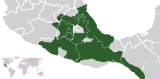
Aztec Empire C 1519
In 1520-1521, an outbreak of smallpox
Smallpox

Smallpox is an infectious disease unique to humans, caused by either of two virus variants, Variola major and Variola minor. The disease is also known by the Latin names Variola or Variola vera, which is a derivative of the Latin varius, meaning spotted, or varus, meaning "pimple"....
 swept through the population of Tenochtitlan and was decisive in the fall of the city
Siege of Tenochtitlan

The Fall of Tenochtitlan, the capital of the Aztec Empire, came about in 1521 through the manipulation of local factions and divisions by Spain conquistador Hern?n Cort?s....
. It is estimated that between 10% and 50% of the population fell victim to this epidemic.

Subsequently, the Valley of Mexico was hit with two more epidemics, smallpox (1545-1548) and typhus
Typhus

Epidemic typhus is a form of typhus so named because the disease often causes epidemics following wars and natural disasters. The causative organism is Rickettsia prowazekii, transmitted by the human body louse ....
 (1576-1581). The Spaniards, to consolidate the diminishing population, merged the survivors from small towns in the Valley of Mexico into bigger ones. This broke the power of the upper classes, but did not dissolve the coherence of the indigenous society in greater Mexico.

The population before the time of the conquest is unknown and hotly contested, but disease is known to have ravaged the region; thus, the indigenous population of the Valley of Mexico is estimated to have declined by more than 80% in the course of about 60 years.

Cultural patterns


Government

The Aztec Empire
Empire

Empire derives from the Latin word imperium, denoting ?military command? in Roman. Politically, an empire is a geographically extensive group of states and peoples united and ruled either by a monarch or an oligarchy....
 was an example of an empire that ruled by indirect means. Like most European empires, it was ethnically
Ethnic group

An ethnic group is a group of humans whose members identify with each other, through a common heritage that is real or presumed.Ethnic identity is further marked by the recognition from others of a group's distinctiveness and the recognition of common culture, linguistic, religion, human behaviour or Race traits, real or presumed, as indic...
 very diverse, but unlike most European empires, it was more a system of tribute than a single system of government. In the theoretical framework of imperial systems posited by Alexander J. Motyl the Aztec empire was an informal or hegemonic empire because it did not exert supreme authority over the conquered lands, it merely expected tributes to be paid. It was also a discontinuous empire because not all dominated territories were connected, for example the southern peripheral zones of Xoconochco were not in direct contact with the center. The hegemonic nature of the Aztec empire can be seen in the fact that generally local rulers were restored to their positions once their city-state was conquered and the Aztecs did not interfere in local affairs as long as the tribute payments were made.

Although the Aztec form of government is often referred to as an empire, in fact most areas within the empire were organized as city-states, known as altepetl
Altepetl

The altepetl, in Pre-Columbian and Spanish conquest of Mexico-era Aztec Aztec society, was the local, Ethnicity based political entity. The word is a combination of the Nahuatl language words a-tl, meaning water, and tepe-tl, meaning mountain....
 in Nahuatl. These were small polities ruled by a king (tlatoani) from a legitimate dynasty. The Early Aztec period was a time of growth and competition among altepetl. Even after the empire was formed (1428) and began its program of expansion through conquest, the altepetl remained the dominant form of organization at the local level. The efficient role of the altepetl as a regional political unit was largely responsible for the success of the empire's hegemonic form of control.

Tribute and trade

Several pages from the Codex Mendoza
Codex Mendoza

The Codex Mendoza is an Aztec codices, created about twenty years after the Spanish conquest of Mexico with the intent that it be seen by Charles V, Holy Roman Emperor, the Holy Roman Emperor and King of Spain....
 list tributary towns along with the goods they supplied, which included not only luxuries such as feathers, adorned suits, and greenstone
Greenstone (archaeology)

Greenstone is a common generic term for valuable, green-hued minerals and metamorphosed igneous rocks and stones, that were used in the fashioning of jewelry, statuettes, ritual tools, and various other artefacts in early cultures....
 beads, but more practical goods such as cloth, firewood, and food. Tribute was usually paid twice or four times a year at differing times.

Archaeological excavations in the Aztec-ruled provinces show that incorporation into the empire had both costs and benefits for provincial peoples. On the positive side, the empire promoted commerce and trade, and exotic goods from obsidian to bronze managed to reach the houses of both commoners and nobles. Trade partners included the enemy Tarascan
Tarascan state

The Tarascan state was a state in pre-Columbian Mesoamerica, roughly covering the geographic area of the present day Mexico States of Mexico of Michoac?n....
, a source of bronze
Bronze

Bronze is a metal alloy consisting primarily of copper, usually with tin as the main additive, but sometimes with other chemical element such as phosphorus, manganese, aluminium, or silicon....
 tools and jewelry. On the negative side, imperial tribute imposed a burden on commoner households, who had to increase their work to pay their share of tribute. Nobles, on the other hand, often made out well under imperial rule because of the indirect nature of imperial organization. The empire had to rely on local kings and nobles and offered them privileges for their help in maintaining order and keeping the tribute flowing.

Economy

The Aztec economy can be divided into a political sector, under the control of nobles and kings, and a commercial sector that operated independently of the political sector. The political sector of the economy centered on the control of land and labor by kings and nobles. Nobles owned all land, and commoners got access to farmland and other fields through a variety of arrangements, from rental through sharecropping to serf-like labor and slavery. These payments from commoners to nobles supported both the lavish lifestyles of the high nobility and the finances of city-states. Many luxury goods were produced for consumption by nobles. The producers of featherwork, sculptures, jewelry, and other luxury items were full-time commoner specialists who worked for noble patrons.

In the commercial sector of the economy several types of money were in regular use. Small purchases were made with cacao beans, which had to be imported from lowland areas. In Aztec marketplaces, a small rabbit was worth 30 beans, a turkey egg cost 3 beans, and a tamale cost a single bean. For larger purchases, standardized lengths of cotton cloth called quachtli were used. There were different grades of quachtli, ranging in value from 65 to 300 cacao beans. One source stated that 20 quachtli could support a commoner for one year in Tenochtitlan. A man could also sell his own daughter as a sexual slave or future religious sacrifice, generally for around 500 to 700 beans. A small gold statue (approximately 0.62 kg / 1.37 lb) cost 250 beans. Money was used primarily in the many periodic markets that were held in each town. A typical town would have a weekly market (every 5 days), while larger cities held markets every day. Cortés reported that the central market of Tlatelolco, Tenochtitlan's sister city, was visited by 60,000 people daily. Some sellers in the markets were petty vendors; farmers might sell some of their produce, potters sold their vessels, and so on. Other vendors were professional merchants who traveled from market to market seeking profits. The pochteca were specialized merchants organized into exclusive guilds. They made lengthy expeditions to all parts of Mesoamerica, and they served as the judges and supervisors of the Tlatelolco market. Although the economy of Aztec Mexico was commercialized (in its use of money, markets, and merchants), it was not "a capitalist economy because land and labor were not commodities for sale."

Transportation

The main contribution of the Aztec rule was a system of communications between the conquered cities. In Mesoamerica
Mesoamerica

Mesoamerica or Meso-America is a region and cultural area in the Americas, extending approximately from central Mexico to Honduras and Nicaragua, within which a number of pre-Columbian society flourished before the Spanish colonization of the Americas in the 15th and 16th centuries....
, without draft animals for transport (nor, as a result, wheeled vehicles), the roads were designed for travel on foot. Usually these roads were maintained through tribute, and travelers had places to rest and eat and even latrines to use at regular intervals, roughly every 10 or 15 km. Couriers (paynani) were constantly travelling along those ways, keeping the Aztecs informed of events, and helping to monitor the integrity of the roads. Due to the steady surveillance, even women could travel alone, a fact that amazed the Spaniards, as that was not at all possible in Europe since the time of the Romans
Ancient Rome

Ancient Rome was a civilization that grew out of a small agricultural community founded on the Italian Peninsula as early as the 10th century BC....
.

After the conquest those roads were no longer subject to maintenance and were lost in time.

Mythology and religion

The Mexica made reference to at least two manifestations of the supernatural: teotl and teixiptla. Teotl, which the Spaniards and European scholars routinely mistranslated as "god" or "demon", referred rather to an impersonal force that permeated the world. Teixiptla, by contrast, denoted the physical representations ("idols", statues and figurines) of the teotl as well as the human cultic activity surrounding this physical representation. The Mexica "gods" themselves had no existence as distinct entities apart from these teixiptla representations of teotl (Boone 1989).

Veneration of Huitzilopochtli
Huitzilopochtli

In Aztec mythology, Huitzilopochtli, also spelled Uitzilopochtli...
, the personification of the sun and of war, was central to the religious, social and political practices of the Mexicas. Huitzilopochtli attained this central position after the founding of Tenochtitlan and the formation of the Mexica city-state society in the 14th century. Prior to this, Huitzilopochtli was associated primarily with hunting, presumably one of the important subsistence activities of the itinerant bands that would eventually become the Mexica.

According to myth, Huitzilopochtli directed the wanderers to found a city on the site where they would see an eagle
Eagle

Eagles are large bird of prey which are members of the bird family Accipitridae, and belong to several Genus which are not necessarily closely related to each other....
 devouring a snake perched on a fruit-bearing nopal
Nopal

Nopales are a vegetable made from the young cladophyll segments of opuntia, carefully peeled to remove the spine s. They are particularly common in their native Mexico....
 cactus. (It was said that Huitzilopochtli killed his nephew, Cópil, and threw his heart on the lake. Huitzilopochtli honoured Cópil by causing a cactus to grow over Cópil's heart.) Legend has it that this is the site on which the Mexicas built their capital city of Tenochtitlan. This legendary vision is pictured on the Coat of arms of Mexico
Coat of arms of Mexico

The Coat of Arms of Mexico has been an important symbol of Mexican politics and Mexican culture for centuries. The coat of arms depicts a Mexican golden Eagle perched upon a cactus devouring a snake....
.

According to their own history, when the Mexicas arrived in the Anahuac
Anahuac

Anahuac is an ancient name for a Mesoamerican, particularly Aztec, area or areas, usually identified as located within or even coterminous with the Valley of Mexico....
 valley (Valley of Mexico
Valley of Mexico

The Valley of Mexico is a highlands plateau in central Mexico roughly coterminous with the present-day Mexican Federal District and the eastern half of the M?xico ....
) around Lake Texcoco, the groups living there considered them uncivilized. The Mexicas borrowed much of their culture from the ancient Toltec
Toltec

The word Toltec in Mesoamerican studies has been used in different ways by different scholars to refer to actual populations and polity of pre-Columbian central Mexico or to the mythical ancestors mentioned in the mythical/historical narratives of the Aztecs....
 whom they seem to have at least partially confused with the more ancient civilization of Teotihuacan
Teotihuacán

Teotihuacan is an enormous archaeological site in the Basin of Mexico, containing some of the largest Mesoamerican pyramid built in the pre-Columbian Americas....
. To the Mexicas, the Toltecs were the originators of all culture; "Toltecayotl" was a synonym for culture. Mexica legends identify the Toltecs and the cult of Quetzalcoatl
Quetzalcoatl

Quetzalcoatl is a benevolent and mythical deity, creator of humanity in the Toltec tradition, predating the Mexica deity. The name is a combination of quetzal, a brightly colored Mesoamerican bird, and wikt:coatl, meaning serpent....
 with the mythical city of Tollan
Tollan

Tollan, Tolan, or Tol?n is the name used for the capital city of two empires of Pre-Columbian Mesoamerica; first for Teotihuacan, and later for the Toltec capital of Tula, Mexico....
, which they also identified with the more ancient Teotihuacan.

Human sacrifice

Mendoza Humansacrifice
For most people today, and for the European Catholics who first met the Aztecs, human sacrifice
Human sacrifice

Human sacrifice is the act of killing human beings as part of a religious ritual . Its typology closely parallels the various practices of ritual slaughter of animals and of religious sacrifice in general....
 was the most striking feature of Aztec civilization. While human sacrifice was practiced throughout Mesoamerica, the Aztecs, if their own accounts are to be believed, brought this practice to an unprecedented level. For example, for the reconsecration of Great Pyramid of Tenochtitlan
Great Pyramid of Tenochtitlan

The was the one of the main temples of the Aztecs in their capital city of Tenochtitlan, which is now Mexico City. Its architectural style belongs to the late Mesoamerican chronology....
 in 1487, the Aztecs reported that they sacrificed 84,400 prisoners over the course of four days, reportedly by Ahuitzotl, the Great Speaker himself.

However, most experts consider these numbers to be overstated. For example, the sheer logistics associated with sacrificing 84,000 victims would be overwhelming, 2,000 being a more likely figure. A similar consensus has developed on reports of cannibalism
Cannibalism

Cannibalism is the act or practice of humans eating other humans. The ritualistic eating of human flesh is also known as anthropophagy, from Greek: ?????p??, anthropos, "human being"; and fa?e??, phagein, "to eat"....
 among the Aztecs.

In the writings of Bernardino de Sahagún
Bernardino de Sahagún

Bernardino de Sahag?n , was a Franciscan missionary to the Aztecs people of Mexico, best known as the compiler of the Florentine Codex, also known as Historia general de las cosas de Nueva Espa?a ....
, Aztec "anonymous informants" defended the practice of human sacrifice by asserting that it was not very different from the European way of waging warfare: Europeans killed the warriors in battle, Aztecs killed the warriors after the battle.

Accounts by the Tlaxcaltecas, the primary enemy of the Aztecs at the time of the Spanish Conquest, show that at least some of them considered it an honor to be sacrificed. In one legend, the warrior Tlahuicole was freed by the Aztecs but eventually returned of his own volition to die in ritual sacrifice. Tlaxcala
Tlaxcala (Nahua state)

File:Entrada a Chalco.jpgTlaxcala was a pre-Columbian city state of central Mexico.Tlaxcala was a confederation of four altepetl ? Ocotelolco, Quiahuiztlan, Tepeticpac and Tizatlan ? which each took turns providing a ruler for Tlaxcala as a whole....
 also practiced the human sacrifice of captured Aztec warriors.

Social structures


Class structure

Aztec5figure9
The highest class were the pipiltin or nobility. Originally this status was not hereditary, although the sons of pillis had access to better resources and education, so it was easier for them to become pillis. Later the class system took on hereditary aspects.

The second class were the macehualtin, originally peasants. Eduardo Noguera estimates that in later stages only 20% of the population was dedicated to agriculture and food production. The other 80% of society were warriors, artisans and traders. Eventually, most of the macehuallis were dedicated to arts and crafts. Their works were an important source of income for the city.

Slaves
Slavery

Slavery is a form of forced labor where a person is compelled to Labor for another . Slaves are held against their will from the time of their capture, purchase, or birth, and are deprived of the right to leave, to refuse to work, or to receive Remuneration in return for their labor....
 or tlacotin also constituted an important class. Aztecs could become slaves because of debts, as a criminal punishment or as war captives. A slave could have possessions and even own other slaves. However, upon becoming a slave, all of the slave's animals and excess money would go to his purchaser. Slaves could buy their liberty, and slaves could be set free if they had children with or were married to their masters. Typically, upon the death of the master, slaves who had performed outstanding services were freed. The rest of the slaves were passed on as part of an inheritance.

Traveling merchants called pochteca
Pochteca

A pochtecatl was a professional long-distance traveling merchant in the Aztec Empire. They were a small, but important class as they not only facilitated commerce, but also communicated vital information across the empire and beyond its borders....
h
were a small, but important class as they not only facilitated commerce, but also communicated vital information across the empire and beyond its borders. They were often employed as spies.

Recreation

As with all Mesoamerican cultures, the Aztecs played a variant of the Mesoamerican ballgame
Mesoamerican ballgame

The Mesoamerican ballgame was a sport with ritual associations played for over 3000 years by the pre-Columbian peoples of Mesoamerica. The sport had different versions in different places during the millennia, and a modern version of the game, Ulama game, is still played in a few places by the local Native American ....
, named tlachtli or ollamaliztli in Nahuatl. The game was played with a ball of solid rubber, called an olli, whence derives the Spanish word for rubber, hule. The players hit the ball with their hips, knees, and elbows and had to pass the ball through a stone ring to automatically win. Getting the ball through the hoop was so hard, if a player actually scored a goal, they were given some jewelry. No one knows the exact rules of the game, as the rules have never been recorded, and thus, only speculations exist. The Aztec variant of the Mesoamerican ballgame is the only one to be described in postcolonial sources, and not much is known about how other Mesoamerican peoples played the game.

The Aztecs also enjoyed board games, like patolli
Patolli

Patolli or patole is one of the oldest games in America. Patolli was played by a wide range of pre-Columbian Mesoamerican cultures and known all over Mesoamerica....
 and totoloque. Bernal Diaz records that Cortés and Moctezuma II played totoloque together.

Education

Until the age of fourteen, the education of children was in the hands of their parents, but supervised by the authorities of their calpolli. Part of this education involved learning a collection of sayings, called huehuetlàtolli ("sayings of the old"), that embodied the Aztecs' ideals. Judged by their language, most of the huehuetlatolli seemed to have evolved over several centuries, predating the Aztecs and most likely adopted from other Nahua cultures.

At 15, all boys and girls went to school. The Mexica, one of the Aztec groups, were one of the first people in the world to have mandatory education for nearly all children, regardless of gender, rank, or station. There were two types of schools: the telpochcalli, for practical and military studies, and the calmecac
Calmecac

The Calmecac was a school for the children of Aztec nobility in the Mesoamerican chronology of Mesoamerican history, where they would receive rigorous religious and military training....
, for advanced learning in writing, astronomy, statesmanship, theology, and other areas. The two institutions seem to be common to the Nahua people, leading some experts to suggest that they are older than the Aztec culture.

Aztec teachers (tlatimine) propounded a spartan regime of education with the purpose of forming a stoical people.

Girls were educated in the crafts of home and child raising. They were not taught to read or write. All women were taught to be involved in religion; there are paintings of women presiding over religious ceremonies, but there are no references to female priests.

Arts

Aztecserpent
Song and poetry were highly regarded; there were presentations and poetry contests at most of the Aztec festivals. There were also dramatic presentations that included players, musicians and acrobats.

Poetry was the only occupation worthy of an Aztec warrior in times of peace. A remarkable amount of this poetry survives, having been collected during the era of the conquest. In some cases poetry is attributed to individual authors, such as Nezahualcoyotl
Nezahualcoyotl

Nezahualcoyotl According to his descendants and biographers, Fernando de Alva Cort?s Ixtlilxochitl and Juan Bautista de Pomar, who lived a century after Nezahualcoyotl, he was something of a monotheist, honoring his god in a 10-level pyramidal temple....
, tlatoani of Texcoco, and Cuacuauhtzin, Lord of Tepechpan, but whether these attributions reflect actual authorship is a matter of opinion. Miguel León-Portilla
Miguel León-Portilla

Miguel Le?n-Portilla is a Mexico anthropologist and historian, and a prime authority on Nahuatl thought and literature.He wrote a doctoral thesis on Aztec philosophy under the tutelage of Fr....
, a well-respected Aztec scholar of Mexico, has stated that it is in this poetry where we can find the real thought of the Aztecs, independent of "official" Aztec ideology.

It is also important to note that the Spanish classified many aspects of the Aztec/Nahuatl culture according to the lexicon and organizational categories with which they would distinguish in Europe. In the same way that the second letter of Cortez made a mention of "mesquitas", or in English, "mosques", when trying to convey his impression of Aztec architecture, early colonists and missionaries divided the principal bodies of nahuatl literature as "poetry" and "prose". "Poetry" was in xochitl in cuicatl a dual term meaning "the flower and the song" and was divided into different genres. Yaocuicatl was devoted to war and the god(s) of war, Teocuicatl to the gods and creation myths and to adoration of said figures, xochicuicatl to flowers (a symbol of poetry itself and indicative of the highly metaphorical nature of a poetry that often utilized duality to convey multiple layers of meaning). "Prose" was tlahtolli, also with its different categories and divisions (Garganigo et al).

Turquoiseaztecmask
The most important collection of these poems is Romances de los señores de la Nueva España, collected (Tezcoco 1582), probably by Juan Bautista de Pomar
Juan Bautista de Pomar

Juan Bautista Pomar was a historian and writer interested in pre-Columbian Aztec history.Based on references by Fray Juan de Torquemada, we can estimate that he was born in 1535 at Texcoco ....
. Bautista de Pomar was the great-grandson of Netzahualcoyotl. He spoke Nahuatl, but was raised a Christian and wrote in Latin characters. (See also: "Is It You?", a short poem attributed to Netzahualcoyotl, and "Lament on the Fall of Tenochtitlan", a short poem contained within the "Anales de Tlatelolco
Anales de Tlatelolco

The Anales de Tlatelolco is a codex manuscript written in Nahuatl language, using Latin alphabet, by anonymous Aztec authors in 1528 in Tlatelolco, only seven years after the fall of the Aztec Empire....
" manuscript.
)

The Aztec people also enjoyed a type of dramatic presentation, a kind of theatre. Some plays were comical with music and acrobats, others were staged dramas of their gods. After the conquest, the first Christian churches had open chapels reserved for these kinds of representations. Plays in Nahuatl, written by converted Indians, were an important instrument for the conversion to Christianity, and are still found today in the form of traditional pastorelas, which are played during Christmas to show the Adoration of Baby Jesus, and other Biblical passages.

Music and dance formed an essential part of the indigenous rites and ceremonies. Research about music of the Aztec people dates back to the writings of Bernal del Castillo, who was appalled by the music of these people because he viewed it during their ritualistic sacrifices, which were very different from rituals of Christian worship. Others, such as the Franciscan monk Fray Bernardino de Sahagún and the Dominican
Dominican

Dominican may refer to:* Something of, from, or related to the Dominican Republic, a country on Hispaniola , in the Caribbean. This use of "Dominican" is stressed on the second syllable, ....
 monk Diego Durán, were able to look at the music from different viewpoints, noting the unique instruments and the qualities of pitch and harmony that were achieved with these instruments — new sounds to their ears. Some musical instrument
Instrument

Instrument may refer to:* Instrument , a documentary of the band Fugazi, directed by Jem Cohen* Instruments , a Canadian recording ensemble* Instruments , a performance visualizer...
s used are Tetzilacatl
Tetzilacatl

The tetzilacatl was an Aztec percussion instrument. This vibrator or resonator, was a tray of copper suspended by a cord, which was struck with sticks or with the hand....
, Teponaztli
Teponaztli

A teponaztli is a type of slit drum used in central Mexico by the Aztecs and related cultures.Teponaztli are made of hollow hardwood logs, often fire-hardened....
, Tecomapiloa, Omichicahuaztli, Huehuetl
Huehuetl

The huehuetl is a percussion instrument from Mexico, used by the Aztecs and other cultures. It is an upright tubular drum made from a wooden body opened at the bottom that stands on three legs cut from its base, with skin stretched over the top....
, Coyolli, Chililitli, Caililiztli, Chicahuaztli, Cacalachtli, Áyotl, Ayacahtli, Tetzilacatl
Tetzilacatl

The tetzilacatl was an Aztec percussion instrument. This vibrator or resonator, was a tray of copper suspended by a cord, which was struck with sticks or with the hand....
.

City-building and architecture

Tenoch2a
The capital city of the Aztec empire was Tenochtitlan
Tenochtitlan

Tenochtitlan was a Nahua peoples altepetl located on an island in Lake Texcoco, in the Valley of Mexico. Founded in 1325, it became the seat of Aztec Empire in the 15th century, until being Fall of Tenochtitlan....
, now the site of modern-day Mexico City
Mexico City

Mexico City is the capital city of Mexico. It is the most important economic, industrial, and cultural center in the country; the most populous city with over 8,836,045 inhabitants in 2008....
. Built on a series of islets in Lake Texcoco
Lake Texcoco

Lake Texcoco was a natural lake formation within the Valley of Mexico, a basin with an average elevation of 2,236m above mean sea level located in the southern highlands of Mexico's Mexican altiplano....
, the city plan was based on a symmetrical layout that was divided into four city sections called campans. The city was interlaced with canals which were useful for transportation.

Tenochtitlan was built according to a fixed plan and centered on the ritual precinct, where the Great Pyramid of Tenochtitlan
Great Pyramid of Tenochtitlan

The was the one of the main temples of the Aztecs in their capital city of Tenochtitlan, which is now Mexico City. Its architectural style belongs to the late Mesoamerican chronology....
 rose 50 m above the city. Houses were made of wood and loam, roofs were made of reed, although pyramids, temples and palaces were generally made of stone.

Around the island, chinampa
Chinampa

Chinampa is a method of Agriculture in Mesoamerica which used small, rectangle-shaped areas of fertile arable land to grow agriculture on the shallow lake beds in the Valley of Mexico....
 beds were used to grow foodstuffs as well as, over time, to increase the size of the island. Chinampas, misnamed "floating gardens", were long raised plant beds set upon the shallow lake bottom. They were a very efficient agricultural system and could provide up to seven crops a year. On the basis of current chinampa yields, it has been estimated that 1 hectare of chinampa would feed 20 individuals and 9,000 hectares of chinampas could feed 180,000.

Anthropologist Eduardo Noguera estimates the population at 200,000 based in the house count and merging the population of Tlatelolco (once an independent city, but later became a suburb of Tenochtitlan). If one includes the surrounding islets and shores surrounding Lake Texcoco, estimates range from 300,000 to 700,000 inhabitants.

Relationship to other Mesoamerican cultures

Aztecs admired Mixtec
Mixtec

The Mixtec are indigenous Mesoamerican peoples inhabiting the Mexican states of Oaxaca, Guerrero and Puebla in a region known as La Mixteca. The Mixtecan languages form an important branch of the Otomanguean linguistic family....
 craftsmanship so much that they imported artisans to Tenochtitlan and requested work to be done in certain Mixtec styles. The Aztecs also admired the Mixtec codices, so some of them were made to order by Mixteca for the Aztecs. In the later days, high society Aztec women started to wear Mixtec clothing, specifically the quexquemetl. It was worn over their traditional huipil
Huipíl

A huipil is a form of Maya textile and tunic or blouse worn by indigenous peoples of Mesoamerica Mayan, Zapotec, and other women in central to southern Mexico, Guatemala, Belize, El Salvador, and western Honduras, in the northern part of Central America....
, and much coveted by the women who could not afford such imported goods.

The situation was analogous in many ways to the Phoenicia
Phoenicia

Phoenicia was an ancient civilization centered in the north of ancient Canaan, with its heartland along the coastal regions of modern day Lebanon, extending to parts of Israel, Syria and the Palestinian territories....
n culture which imported and duplicated art from other cultures that they encountered. For this reason, archeologists often have trouble identifying which artifacts are genuinely Phoenician and which are imported or copied from other cultures.

Archaeologists usually do not have a problem differentiating between Mixtec and Aztec artifacts. However, the Mixtec made some products for "export" and that makes classification more problematic. In addition, the production of craft was an important part of the Mexica economy, and they also made pieces for "export".

Legacy

Most modern day Mexicans (and people of Mexican descent in other countries) are mestizos, of mixed indigenous and European Spanish ancestry. During the 16th century the racial composition of Mexico began to change from one that featured distinct indigenous (Mexicas and members of the many other Mexican indigenous groups) and immigrant (mostly Spanish) populations, to the population composed primarily of mestizos that is found in modern day Mexico.

The Nahuatl language
Nahuatl language

Nahuatl is a group of related languages and dialects of the Nahuan branch of the Uto-Aztecan language family.Collectively they are spoken by an estimated Nahua peoples, most of whom live in Central Mexico....
 is today spoken by 1.5 million people, mostly in mountainous areas in the states of central Mexico. Local dialects of Spanish, Mexican Spanish generally, and the Spanish language worldwide have all been influenced, in varying degrees, by Nahuatl. Some Nahuatl words (most notably chocolate and tomato) have been borrowed through Spanish into other languages around the world.

Mexico City
Mexico City

Mexico City is the capital city of Mexico. It is the most important economic, industrial, and cultural center in the country; the most populous city with over 8,836,045 inhabitants in 2008....
 was built on the ruins of Tenochtitlan, making it one of the oldest living cities of America. Many of its districts and natural landmarks retain their original Nahuatl names. Many other cities and towns in Mexico and Central America have also retained their Nahuatl names (whether or not they were originally Mexica or even Nahuatl-speaking towns). A number of town names are hybrids of Nahuatl and Spanish.

Mexican cuisine
Mexican cuisine

Mexican cuisine is a style of food that originated in Mexico with a considerable Spanish influence. Mexican cuisine is known for its varied flavors, colorful decoration, and variety of spices....
 continues to be based on and flavored by agricultural products contributed by the Mexicas/Aztecs and Mesoamerica, most of which retain some form of their original Nahuatl names. The cuisine has also become a popular part of the cuisine of the United States and other countries around the world, typically altered to suit various national tastes.

The modern Mexican flag bears the emblem of the Mexica migration legend.

Mexico's premier religious icon, the Virgin of Guadalupe has certain similarities to the Mexica earth mother goddess Tonantzin.

For the 1986 FIFA World Cup
1986 FIFA World Cup

The 1986 FIFA World Cup, the 13th staging of the FIFA World Cup, was held in Mexico from 31 May to 29 June. It was won by Argentina national football team , who beat Germany national football team 3-2 in the final at Mexico City's Estadio Azteca....
 Adidas designed the official match ball to show in its "triades" Aztec architectural and mural designs .

Modern views of the Aztec culture

Laurette Séjourné
Laurette Séjourné

Laurette S?journ? was a France archaeology and ethnology best known for her involvement in the Aztec civilization. The native French woman was born in Italy, she later became a naturalized Mexico citizen....
, a French anthropologist, wrote about Aztec and Mesoamerican spirituality. Her depiction of the Aztecs as a spiritual people was so compelling that new religions have been formed based on her writings. Some parts of her work have been adopted by esoteric groups, searching for occult teachings of the pre-Columbian religions. Séjourné never endorsed any of these groups.

Miguel León-Portilla

Miguel Le?n-Portilla is a Mexico anthropologist and historian, and a prime authority on Nahuatl thought and literature.He wrote a doctoral thesis on Aztec philosophy under the tutelage of Fr....
 also idealizes the Aztec culture, especially in his early writings.

Others, such as Antonio Velazco, have transformed the writings by Sejourné and León-Portilla into a religious movement. Antonio Velasco Piña has written three books, Tlacaelel, El Azteca entre los Aztecas, La mujer dormida debe dar a luz, and Regina. When mixed with the currents of Neopaganism, these books resulted in a new religious movement called "Mexicanista". This movement called for a return to the spirituality of the Aztecs. It is argued that, with this return, Mexico will become the next center of power. This religious movement mixes Mesoamerican cults with Hindu esoterism. The Mexicanista movement reached the peak of its popularity in the 1990s.

Tlaloc, Codex Rios, P

Aztec codices

There are few extant Aztec codices
Aztec codices

Aztec codices are books written by pre-Columbian and colonial-era Aztecs. These codices provide some of the best primary sources for Aztec culture....
 created before the conquest and these are largely ritual texts. Post-conquest codices, like Codex Mendoza
Codex Mendoza

The Codex Mendoza is an Aztec codices, created about twenty years after the Spanish conquest of Mexico with the intent that it be seen by Charles V, Holy Roman Emperor, the Holy Roman Emperor and King of Spain....
 or Codex Ríos
Codex Rios

Codex R?os is an Italian translation and augmentation of a Spanish colonial-era manuscript, Codex Telleriano-Remensis, that is partially attributed to Pedro de los R?os, a Dominican Order Dominican friar working in Oaxaca and Puebla between 1547 and 1562....
, were painted by Aztec tlacuilos (codex creators), but under the control of Spanish authorities. The possibility of Spanish influence poses potential problems for those studying the post-conquest codices. Itzcoatl
Itzcóatl

Itzcoatl was the fourth tlatoani of the Aztecs, ruling from 1427 to 1440, the period when the Mexica threw off the domination of the Tepanecs and laid the foundations for the eventual Aztec Empire....
 had the oldest hieroglyphics destroyed for political-religious reasons and Bishop Zumarraga of Mexico (1528-48) had all available texts burned for missionary reasons.

The conquistadors

The accounts of the conquistadors are those of men confronted with a new civilization, which they tried to interpret according to their own culture. Cortés was the most educated, and his letters to Charles V
Charles V, Holy Roman Emperor

Charles V was ruler of the Holy Roman Empire from 1519 and, as Charles I of Spain, of the Spanish realms from 1516 until his abdication in 1556....
 are a valuable firsthand account. Unfortunately, one of his letters is lost and replaced by a posterior text and the others were censored prior to their publication. In any case, Cortés was not writing a dispassionate account, but letters justifying his actions and to some extent exaggerating his successes and downplaying his failures.

Bernal Díaz del Castillo

Bernal D?az del Castillo was a conquistador, who wrote an eyewitness account of the Spanish Conquest of Mexico by the Spaniards under Hern?n Cort?s, himself serving as a rodelero under Cort?s....
 accompanied Cortes, but he wrote decades after the fact, he never learned the native languages, and he did not take notes. His account is colorful, but his work is considered erratic and exaggerated.

Although Francisco López de Gómara
Francisco López de Gómara

Francisco L?pez de G?mara was a Spain historian at Seville, who is particularly noted for his works in which he described the early 16th century expedition undertaken by Hern?n Cort?s in the Spanish conquest of the New World....
 was Cortes' chaplain, friend, and confidant, he never visited the New World so his account is based on hearsay.

Priests and scholars

The accounts of the first priests and scholars, while reflecting their faith and their culture, are important sources. Fathers Diego Durán
Diego Durán

Diego Dur?n was a Dominican Order Dominican friar best known for his authorship of one of the earliest Western books on the history and culture of the Aztecs, The History of the Indies of New Spain, a book that was much criticized in his lifetime for helping the "heathen" maintain their culture....
, Motolinia
Toribio de Benavente Motolinia

Fray Toribio de Benavente also known as Motolinia was a Franciscan missionary and among the first 12 clerics to arrive in New Spain in May 1524....
, and Mendieta wrote with their own religion in mind, Father Duran wrote trying to prove that the Aztec were one of the lost tribes of Israel. Bartolomé de las Casas
Bartolomé de Las Casas

File:Bartolomedelascasas.jpgBartolom? de las Casas, Dominican Order , was a 16th-century Spanish Empire Dominican Order priest, and the first resident Bishop of Chiapas....
 wrote instead from an apologetic point of view. There are also authors that tried to make a synthesis of the pre-Hispanic cultures, like "Oviedo y Herrera", Jose de Acosta, and Pedro Mártir de Anghera.

Perhaps the most important source about the Aztec are the manuscripts of Bernardino de Sahagún
Bernardino de Sahagún

Bernardino de Sahag?n , was a Franciscan missionary to the Aztecs people of Mexico, best known as the compiler of the Florentine Codex, also known as Historia general de las cosas de Nueva Espa?a ....
, who worked with the surviving Aztec wise men. He taught Aztec tlacuilos to write the original Nahuatl accounts using the Latin alphabet
Latin alphabet

The Latin alphabet, also called the Roman alphabet, is the most widely used alphabetic writing system in the world today. It evolved from the western variety of the Greek alphabet called the Cumae alphabet, and was initially developed by the Ancient Romes to write the Latin....
. Because of fear of the Spanish authorities, he maintained the anonymity of his informants, and wrote a heavily censored version in Spanish. Unfortunately the Nahuatl original was not fully translated until the 20th century, thus realising the extent of the censorship of the Spanish version. The original Nahuatl manuscript is known as the Florentine Codex
Florentine Codex

The Florentine Codex is the name given to 12 books created under the supervision of Bernardino de Sahag?n between approximately 1540 and 1585....
.

Native authors

Other important sources are the work of Indian and mestizo authors, descendants of the upper classes. These authors include Don Fernando Alvarado Tezozómoc
Fernando Alvarado Tezozómoc

Fernando or Hernando Alvarado Tezoz?moc was a colonial Mexico Nahua peoples nobility. A son of Diego de Alvarado Huanitzin and Francisca de Moctezuma , Tezoz?moc worked as an interpreter for the Real Audiencia....
, Chimalpahin Cuauhtlehuanitzin
Chimalpahin Quauhtlehuanitzin

Domingo Francisco de San Ant?n Mu??n Chimalpahin Quauhtlehuanitzin , usually referred to simply as Chimalpahin, was a Nahua peoples annals from Chalco ....
, Juan Bautista de Pomar
Juan Bautista de Pomar

Juan Bautista Pomar was a historian and writer interested in pre-Columbian Aztec history.Based on references by Fray Juan de Torquemada, we can estimate that he was born in 1535 at Texcoco ....
, and Fernando de Alva Cortés Ixtlilxochitl
Fernando de Alva Cortés Ixtlilxochitl

Fernando de Alva Cort?s Ixtlilx?chitl was a Novohispanic historian....
. Ixtlixochitl, for example, wrote a history of Texcoco from a Christian point of view. His account of Netzahualcoyotl, an ancestor of Ixtlilxochitl's, has a strong resemblance to the story of King Solomon and portrays Netzahualcoyotl as a monotheist and a critic of human sacrifice.

Diego Muñoz Camargo
Diego Muñoz Camargo

Diego Mu?oz Camargo was the author of History of Tlaxcala, an illustrated codex that highlights the religious, cultural, and military history of the Tlaxcalan people....
 (1521 - c. 1612), a Tlaxcalan mestizo
Mestizo

Mestizo is a Spanish language term that was used in the Spanish Empire to refer to people of mixed Europe and Indigenous peoples of the Americas ancestry in Latin America....
, wrote the History of Tlaxcala
History of Tlaxcala

File:Cortez & La Malinche.jpgHistory of Tlaxcala is an illustrated codex written by and under the supervision of Diego Mu?oz Camargo in the years leading up to 1585....
 six decades after the Spanish conquest. Some parts of his work have a strong Tlaxcala bias.

Modern works, available in English

  • Berdan, Frances F. (2004) The Aztecs of Central Mexico: An Imperial Society. 2nd ed. Thomson-Wadsworth, Belmont, CA. ISBN 0534627285.
  • Berdan, Frances F., Richard E. Blanton, Elizabeth H. Boone, Mary G. Hodge, Michael E. Smith and Emily Umberger (1996). Aztec Imperial Strategies. Dumbarton Oaks, Washington, DC. ISBN 0884022110.
  • Boone, Elizabeth H. (1989). "Incarnations of the Aztec Supernatural: The Image of Huitzilopochtli in Mexico and Europe." Transactions of the American Philosophical Society, New Ser., Vol. 79, No. 2., pp. i-iv+1-107. ISBN 0871697920.
  • Boone, Elizabeth H. (2000) Stories in Red and Black: Pictorial Histories of the Aztecs and Mixtecs. University of Texas Press, Austin. ISBN 0292708769.
  • Carrasco, Davíd (1999) City of Sacrifice: The Aztec Empire and the Role of Violence in Civilization. Beacon Press, Boston. ISBN 0807046426.
  • Carrasco, Pedro (1999) The Tenochca Empire of Ancient Mexico: The Triple Alliance of Tenochtitlan, Tetzcoco, and Tlacopan. University of Oklahoma Press. ISBN 0806131446.
  • Clendinnen, Inga (1991) Aztecs: An Interpretation. Cambridge University Press, Cambridge, UK. ASIN B000PRYFBS. ISBN 0521485851 (1995 paperback).
  • Curl, John. ‘’Ancient American Poets.’’ Tempe AZ: Bilingual Press, 2005. ISBN 1-931010-21-8
  • Davies, Nigel (1973) The Aztecs: A History. Macmillan. ISBN 0333124049.
  • Duran, Fray Diego (1994). The History of the Indies of New Spain. Translated by Doris Heyden. Norman: University of Oklahoma Press. ISBN 0806126493.
  • Gillespie, Susan D. (1989) The Aztec Kings: The Construction of Rulership in Mexica History. University of Arizona Press, Tucson. ISBN 0816510954.
  • Graulich, Michel (1997) Myths of Ancient Mexico. Translated by Bernard R. Ortiz de Montellano and Thelma Ortiz de Montellano. University of Oklahoma Press, Norman. ISBN 0806129107.
  • Gruzinski, Serge (1992). The Aztecs: The Rise and Fall of an Empire. New York: Harry N. Abrams. ISBN 0810928213.
  • Guggenheim Museum (editor) (2004) The Aztec Empire (Curated by Felipe Solís). Guggenheim Museum, New York.
  • Hassig, Ross (1988) Aztec Warfare: Imperial Expansion and Political Control. University of Oklahoma Press, Norman. ASIN B000M4NNJE. ISBN 0806127732 (1995 paperback).
  • Lanyon, Anna (1999). Malinche's Conquest. Melbourne, Australia: Allen & Unwin. ISBN 1864487801.*León-Portilla, Miguel (1963) Aztec Thought and Culture: A Study of the Ancient Náhuatl Mind. University of Oklahoma Press, Norman. ASIN B000GPAF1I. ISBN-10: 0806122951 (1990 paperback).
  • López Luján, Leonardo (2005) The Offerings of the Templo Mayor of Tenochtitlan. Revised ed. Translated by Bernard R. Ortiz de Montellano and Thelma Ortiz de Montellano. University of New Mexico Press, Albuquerque. ISBN 0826329586.
  • Matos Moctezuma, Eduardo (1988) The Great Temple of the Aztecs. Thames and Hudson, New York. ISBN 050039024X.
  • Matos Moctezuma, Eduardo and Felipe R. Solís Olguín (editors) (2003) Aztecs. Royal Academy of Arts, London. ISBN 1903973139.
  • Ortiz de Montellano, Bernard R. (1990) Aztec Medicine, Health, and Nutrition. Rutgers University Press, New Brunswick. ISBN 0813515629.
  • Restall, Matthew (2003). Seven Myths of the Spanish Conquest. New York: Oxford University Press. ISBN 0195160770.
  • Smith, Michael E. (2003) The Aztecs. 2nd ed. Blackwell Publishers, Oxford.
  • Soustelle, Jacques (1961) The Daily life of the Aztecs, London, WI. ASIN B000M1NS06. ISBN 0486424855 (2002 paperback).
  • Thomas, Hugh (1994). Conquest: Montezuma, Cortes, and the Fall of Old Mexico. New York: Simon and Schuster. ISBN 0671705180.
  • Townsend, Richard F. (2000) The Aztecs. revised ed. Thames and Hudson, New York. ISBN 0500281327.


Primary sources, available in English

  • Berdan, Frances F. and Patricia Reiff Anawalt (1997) The Essential Codex Mendoza
    Codex Mendoza

    The Codex Mendoza is an Aztec codices, created about twenty years after the Spanish conquest of Mexico with the intent that it be seen by Charles V, Holy Roman Emperor, the Holy Roman Emperor and King of Spain....
    . University of California Press, Berkeley. ISBN 0520204549.
  • Cortés, Hernan
    Hernán Cortés

    Hern?n Cort?s de Monroy y Pizarro, 1st Marqu?s del Valle de Oaxaca was a Spain conquistador who led an expedition that caused the conquest of the Aztec Empire and brought large portions of mainland Mexico under the Crown of Castile, in the early 16th century....
     (1987)
    Letters from Mexico. New Ed. edition. Translated by Anthony Pagden
    Anthony Pagden

    Anthony Robin Dermer Pagden the son of John Brian Dermer Pagden and Joan Mary Pagden is distinguished professor of political science and history at the University of California, Los Angeles....
    . Yale University Press, New Haven. ISBN 0300037244.
  • Díaz del Castillo, Bernal
    Bernal Díaz del Castillo

    Bernal D?az del Castillo was a conquistador, who wrote an eyewitness account of the Spanish Conquest of Mexico by the Spaniards under Hern?n Cort?s, himself serving as a rodelero under Cort?s....
     (1963)
    The Conquest of New Spain. Translated by J. M. Cohen. Penguin, New York. ISBN 0140441239.
  • Díaz, Gisele and Alan Rogers (1993) The Codex Borgia
    Codex Borgia

    The Codex Borgia is a Mesoamerican ritual and divinatory manuscript. It is generally believed to have been written before the Spanish conquest of Mexico, somewhere within what is now today southern or western Puebla....
    : A Full-Color Restoration of the Ancient Mexican Manuscript. Dover Publications, New York. ISBN 0486275698.
  • Durán, Fray Diego
    Diego Durán

    Diego Dur?n was a Dominican Order Dominican friar best known for his authorship of one of the earliest Western books on the history and culture of the Aztecs, The History of the Indies of New Spain, a book that was much criticized in his lifetime for helping the "heathen" maintain their culture....
     (1971)
    Book of the Gods and Rites and The Ancient Calendar. Translated by Fernando Horcasitas and Doris Heyden. University of Oklahoma Press, Norman. ASIN B000M4OVSG. ISBN 0806112018 (1977 Ed. edition).
  • Durán, Fray Diego
    Diego Durán

    Diego Dur?n was a Dominican Order Dominican friar best known for his authorship of one of the earliest Western books on the history and culture of the Aztecs, The History of the Indies of New Spain, a book that was much criticized in his lifetime for helping the "heathen" maintain their culture....
     (1994)
    The History of the Indies of New Spain. Translated by Doris Heyden. University of Oklahoma Press, Norman. ISBN 0806126493.
  • Garganigo et al., (2008) Huellas de las Literaturas Hispanoamerica. 3 edition. Prentice Hall, New Jersey. (Note, this source in Spanish). ISBN 0131958461.
  • Zorita, Alonso de (1963) Life and Labor in Ancient Mexico: The Brief and Summary Relation of the Lords of New Spain. Translated by Benjamin Keen. Rutgers University Press, New Brunswick. ASIN B000INWUNE. ISBN 0806126795 (1994 paperback).


See also

  • List of Mexico-Tenochtitlan rulers
    List of Mexico-Tenochtitlan rulers

    This is a list of the tlatoani of Mexico Tenochtitlan, often referred to as "Aztec emperors".See also; Aztec emperors family tree...
  • History of Mexico
    History of Mexico

    Mexico a country in North America and the largest Castilian language-speaking country in the world. It also has the largest number of Indigenous peoples of the Americas language speakers on the continent ....
  • Pochtecatl
  • Aztec warfare
  • Nahua peoples
  • Inca Empire
    Inca Empire

    The Inca Empire was the largest empire in pre-Columbian America. The administrative, political and military center of the empire was located in Cuzco in modern-day Peru....
  • Maya civilization
  • Indigenous peoples of the Americas
    Indigenous peoples of the Americas

    The indigenous peoples of the Americas are the pre-Columbian inhabitants of the Americas, their descendants, and many ethnic groups who identify with those peoples....
  • Conquistador
    Conquistador

    Conquistador is the name given to the Spaniards soldiers, leaders, List of explorers, and adventurers involved in the conquest of the Americas following the discovery of the New World by Christopher Columbus in 1492....
  • Spanish Empire
    Spanish Empire

    The Spanish Empire was one of the largest empires in world history, and one of the first global empires. It included territories and colonies ruled by Spain in Europe, the Americas, Africa, Asia and Oceania between the 15th and late 19th centuries....


External links

  • Maps to be combined and compared
  • : constantly updated educational site specifically on the Aztecs, for serious students of all ages.
  • : Information about the words Aztec and Aztlan, and the word that many have never heard
  • : Ancient Mesoamerica resources at University of Minnesota Duluth
    University of Minnesota Duluth

    The University of Minnesota Duluth is a regional branch of the University of Minnesota System located in Duluth, Minnesota, USA. As Duluth's public research university, UMD offers 12 bachelor's degrees in 75 Academic major, graduate programs in 20 fields, a two-year program at the School of Medicine, a four-year College of Pharmacy program,...
  • B. Diaz del Castillo, The Discovery and Conquest of Mexico (tr. by A. P. Maudsley, 1928, repr. 1965)
  • : Lots of different Aztec names in the Nahuatl language/
  • at the Universidad de Guadalajara site
  • About Archaeology:
  • at the Department of History at the University of Minnesota
    University of Minnesota

    The University of Minnesota, Twin Cities is a public university research university located in Minneapolis and St. Paul, Minnesota, Minnesota, United States....
  • Michael E. Smith, , paper presented at the Conference, "Archaeology of Complex Societies: Centripetal and Centrifugal Forces," October 21, 1995, California State University, San Bernardino' archived on the Internet Archive
    Internet Archive

    The Internet Archive is a nonprofit organization dedicated to building and maintaining a free and openly accessible online digital library, including an archive site of the World Wide Web....
     from Smith's faculty site at State University of New York
    State University of New York

    The State University of New York, abbreviated SUNY is a system of public institutions of higher education in New York, United States. It is the largest comprehensive system of universities, colleges, and community colleges in the world, with a total enrollment of 438,361 students, plus 1.1 million adult education students spanning 64...
     at Albany
    Albany, New York

    Albany is the Capital of the state of New York and the county seat of Albany County, New York. Albany is roughly 136 miles north of the city of New York City, and slightly south of the confluence of the Mohawk River and Hudson Rivers....
    .
  • Research site for kids
  • .
  • Richard Hooker, , World Civilizations: An Internet Classroom and Anthology, Washington State University
  • on BBC Radio 4
    BBC Radio 4

    BBC Radio 4 is a domestic UK radio station that broadcasts a wide variety of spoken-word programmes, including news, drama, comedy, science and history....
    ’s
    In Our Time
    In Our Time (BBC Radio 4)

    In Our Time is a discussion programme hosted since 2002 by Melvyn Bragg on BBC Radio 4 in the United Kingdom, described as a series investigating the "history of ideas"....
     featuring Alan Knight, Adrian Locke and Elizabeth Graham