


French colonial empires

Encyclopedia
- "French Colonies" redirects here. For the postage stamps, see Postage stamps of the French Colonies.
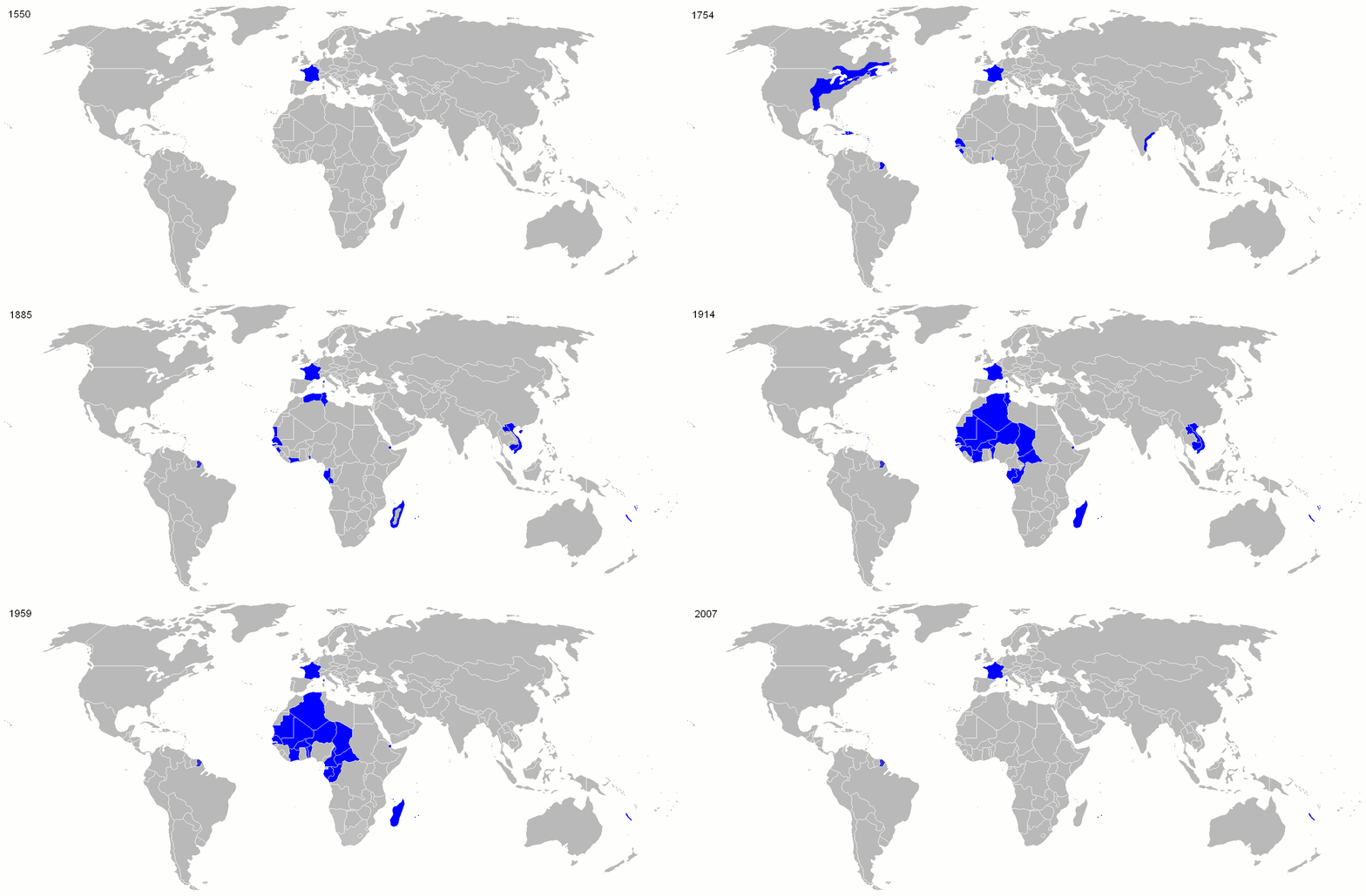
The French colonial empire was the set of territories outside Europe
Europe
Europe is, by convention, one of the world's seven continents. Comprising the westernmost peninsula of Eurasia, Europe is generally 'divided' from Asia to its east by the watershed divides of the Ural and Caucasus Mountains, the Ural River, the Caspian and Black Seas, and the waterways connecting...
that were under French rule primarily from the 17th century to the late 1960s. In the 19th and 20th centuries, the colonial empire of France was the second-largest in the world behind the British Empire
British Empire
The British Empire comprised the dominions, colonies, protectorates, mandates and other territories ruled or administered by the United Kingdom. It originated with the overseas colonies and trading posts established by England in the late 16th and early 17th centuries. At its height, it was the...
. The French colonial empire extended over 12,347,000 km² (4,767,000 sq. miles) of land at its height in the 1920s and 1930s. Including metropolitan France
Metropolitan France
Metropolitan France is the part of France located in Europe. It can also be described as mainland France or as the French mainland and the island of Corsica...
, the total amount of land under French sovereignty reached 13,018,575 km² (4,980,000 sq. miles) at the time, almost 1/10 of the Earth's total land area. Its influence made French
French language
French is a Romance language spoken as a first language in France, the Romandy region in Switzerland, Wallonia and Brussels in Belgium, Monaco, the regions of Quebec and Acadia in Canada, and by various communities elsewhere. Second-language speakers of French are distributed throughout many parts...
a widely-spoken colonial European language, along with English, Spanish, and Portuguese.
France, in rivalry with Britain for supremacy, began to establish colonies in North America
North America
North America is a continent wholly within the Northern Hemisphere and almost wholly within the Western Hemisphere. It is also considered a northern subcontinent of the Americas...
, the Caribbean
Caribbean
The Caribbean is a crescent-shaped group of islands more than 2,000 miles long separating the Gulf of Mexico and the Caribbean Sea, to the west and south, from the Atlantic Ocean, to the east and north...
and India
India
India , officially the Republic of India , is a country in South Asia. It is the seventh-largest country by geographical area, the second-most populous country with over 1.2 billion people, and the most populous democracy in the world...
, following Spanish
Spanish Empire
The Spanish Empire comprised territories and colonies administered directly by Spain in Europe, in America, Africa, Asia and Oceania. It originated during the Age of Exploration and was therefore one of the first global empires. At the time of Habsburgs, Spain reached the peak of its world power....
and Portuguese
Portuguese Empire
The Portuguese Empire , also known as the Portuguese Overseas Empire or the Portuguese Colonial Empire , was the first global empire in history...
successes during the Age of Discovery
Age of Discovery
The Age of Discovery, also known as the Age of Exploration and the Great Navigations , was a period in history starting in the early 15th century and continuing into the early 17th century during which Europeans engaged in intensive exploration of the world, establishing direct contacts with...
. A series of wars with Britain during the 18th century and early to mid-19th century, which France lost, ended its colonial ambitions in these places, and with it what some historians term the "first" French colonial empire. In the 19th century, France established a new empire in Africa
Africa
Africa is the world's second largest and second most populous continent, after Asia. At about 30.2 million km² including adjacent islands, it covers 6% of the Earth's total surface area and 20.4% of the total land area...
and Southeast Asia
Southeast Asia
Southeast Asia, South-East Asia, South East Asia or Southeastern Asia is a subregion of Asia, consisting of the countries that are geographically south of China, east of India, west of New Guinea and north of Australia. The region lies on the intersection of geological plates, with heavy seismic...
. In this period France's conquest of Empire in Africa was dressed up as a moral crusade. In 1886 Jules Ferry
Jules Ferry
Jules François Camille Ferry was a French statesman and republican. He was a promoter of laicism and colonial expansion.- Early life :Born in Saint-Dié, in the Vosges département, France, he studied law, and was called to the bar at Paris in 1854, but soon went into politics, contributing to...
declared; "The higher races have a right over the lower races, they have a duty to civilize the inferior races." Full citizenship rights - assimilation - was offered, though in reality "assimilation was always receding [and] the colonial populations treated like subjects not citizens."
Following World War I
World War I
World War I , which was predominantly called the World War or the Great War from its occurrence until 1939, and the First World War or World War I thereafter, was a major war centred in Europe that began on 28 July 1914 and lasted until 11 November 1918...
and especially World War II
World War II
World War II, or the Second World War , was a global conflict lasting from 1939 to 1945, involving most of the world's nations—including all of the great powers—eventually forming two opposing military alliances: the Allies and the Axis...
, anti-colonial movements began to challenge French authority. France unsuccessfully fought bitter wars in Vietnam
Vietnam
Vietnam – sometimes spelled Viet Nam , officially the Socialist Republic of Vietnam – is the easternmost country on the Indochina Peninsula in Southeast Asia. It is bordered by China to the north, Laos to the northwest, Cambodia to the southwest, and the South China Sea –...
and Algeria
Algeria
Algeria , officially the People's Democratic Republic of Algeria , also formally referred to as the Democratic and Popular Republic of Algeria, is a country in the Maghreb region of Northwest Africa with Algiers as its capital.In terms of land area, it is the largest country in Africa and the Arab...
to keep its empire intact. By the end of the 1960s, many of France's colonies had gained independence, although some territories – especially islands and archipelagos – were integrated into France as overseas departments and territories
Overseas departments and territories of France
The French Overseas Departments and Territories consist broadly of French-administered territories outside of the European continent. These territories have varying legal status and different levels of autonomy, although all have representation in the Parliament of France , and consequently the...
. These total altogether 123,150 km² (47,548 sq. miles), which amounts to only 1% of the pre-1939 French colonial empire's area, with 2,685,705 people living in them in 2011. All of them enjoy full political representation at the national level, as well as varying degrees of legislative autonomy. (See Administrative divisions of France
Administrative divisions of France
The administrative divisions of France are concerned with the institutional and territorial organization of French territory. There are many administrative divisions, which may have political , electoral , or administrative objectives.- Metropolitan France :As of January 1, 2008, metropolitan...
.)
The Americas
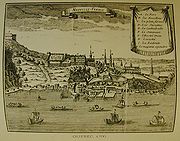
Jacques Cartier
Jacques Cartier was a French explorer of Breton origin who claimed what is now Canada for France. He was the first European to describe and map the Gulf of Saint Lawrence and the shores of the Saint Lawrence River, which he named "The Country of Canadas", after the Iroquois names for the two big...
in the early 16th century, as well as the frequent voyages of French boats and fishermen to the Grand Banks
Grand Banks
The Grand Banks of Newfoundland are a group of underwater plateaus southeast of Newfoundland on the North American continental shelf. These areas are relatively shallow, ranging from in depth. The cold Labrador Current mixes with the warm waters of the Gulf Stream here.The mixing of these waters...
off Newfoundland throughout that century, were the precursors to the story of France's colonial expansion. But Spain's jealous protection of its foreign monopoly, and the further distractions caused in France itself in the later 16th century by the French Wars of Religion
French Wars of Religion
The French Wars of Religion is the name given to a period of civil infighting and military operations, primarily fought between French Catholics and Protestants . The conflict involved the factional disputes between the aristocratic houses of France, such as the House of Bourbon and House of Guise...
, prevented any constant efforts by France to settle colonies. Early French attempts to found colonies in 1612 at São Luís ("France Équinoxiale
France Équinoxiale
Equinoctial France was the contemporary name given to the colonization efforts of France in the 17th century in South America, around the line of Equator, before "tropical" had fully gained its modern meaning: Equinoctial means in Latin "of equal nights", i.e., on the Equator, where the duration of...
"), and in Brazil
Brazil
Brazil , officially the Federative Republic of Brazil , is the largest country in South America. It is the world's fifth largest country, both by geographical area and by population with over 192 million people...
, in 1555 at Rio de Janeiro
Rio de Janeiro
Rio de Janeiro , commonly referred to simply as Rio, is the capital city of the State of Rio de Janeiro, the second largest city of Brazil, and the third largest metropolitan area and agglomeration in South America, boasting approximately 6.3 million people within the city proper, making it the 6th...
("France Antarctique
France Antarctique
France Antarctique was a French colony south of the Equator, in Rio de Janeiro, Brazil, which existed between 1555 and 1567, and had control over the coast from Rio de Janeiro to Cabo Frio...
") and in Florida (including Fort Caroline
Fort Caroline
Fort Caroline was the first French colony in the present-day United States. Established in what is now Jacksonville, Florida, on June 22, 1564, under the leadership of René Goulaine de Laudonnière, it was intended as a refuge for the Huguenots. It lasted one year before being obliterated by the...
in 1562) were not successful, due to a lack of official interest and to Portuguese and Spanish vigilance.
The story of France's colonial empire truly began on 27 July 1605, with the foundation of Port Royal
Port Royal, Nova Scotia
Port Royal was the capital of Acadia from 1605 to 1710 and is now a town called Annapolis Royal in the western part of the Canadian province of Nova Scotia. Initially Port Royal was located on the north shore of the Annapolis Basin, Nova Scotia, at the site of the present reconstruction of the...
in the colony of Acadia
Acadia
Acadia was the name given to lands in a portion of the French colonial empire of New France, in northeastern North America that included parts of eastern Quebec, the Maritime provinces, and modern-day Maine. At the end of the 16th century, France claimed territory stretching as far south as...
in North America, in what is now Nova Scotia
Nova Scotia
Nova Scotia is one of Canada's three Maritime provinces and is the most populous province in Atlantic Canada. The name of the province is Latin for "New Scotland," but "Nova Scotia" is the recognized, English-language name of the province. The provincial capital is Halifax. Nova Scotia is the...
, Canada. A few years later, in 1608, Samuel De Champlain
Samuel de Champlain
Samuel de Champlain , "The Father of New France", was a French navigator, cartographer, draughtsman, soldier, explorer, geographer, ethnologist, diplomat, and chronicler. He founded New France and Quebec City on July 3, 1608....
founded Quebec
Quebec City
Quebec , also Québec, Quebec City or Québec City is the capital of the Canadian province of Quebec and is located within the Capitale-Nationale region. It is the second most populous city in Quebec after Montreal, which is about to the southwest...
, which was to become the capital of the enormous, but sparsely settled, fur-trading colony of New France
New France
New France was the area colonized by France in North America during a period beginning with the exploration of the Saint Lawrence River by Jacques Cartier in 1534 and ending with the cession of New France to Spain and Great Britain in 1763...
(also called Canada).
New France had a rather small population, which resulted from more emphasis being placed on the fur trade rather than agricultural settlements. Due to this emphasis, the French relied heavily on creating friendly contacts with the local Indians. Without the appetite of New England for land, and by relying solely on Indians to supply them with fur at the trading posts, the French composed a complex series of military, commercial, and diplomatic connections. These became the most enduring alliances between the French and the Indians. The French were, however, under pressure from religious orders to convert the Indians to Catholicism.
Although, through alliances with various Native American tribes, the French were able to exert a loose control over much of the North American continent, areas of French settlement were generally limited to the St. Lawrence River Valley. Prior to the establishment of the 1663 Sovereign Council
Sovereign Council of New France
The Sovereign Council of New France was a political body appointed by the King of France and consisting of a Governor General, an Intendant of New France answered to the French Minister of the Marine, And also the Bishop witch helped with laws and land...
, the territories of New France were developed as mercantile colonies
Mercantilism
Mercantilism is the economic doctrine in which government control of foreign trade is of paramount importance for ensuring the prosperity and security of the state. In particular, it demands a positive balance of trade. Mercantilism dominated Western European economic policy and discourse from...
. It is only after the arrival of intendant Jean Talon
Jean Talon
Jean Talon, Comte d'Orsainville was a French colonial administrator who was the first and most highly regarded Intendant of New France under King Louis XIV...
in 1665 that France gave its American colonies the proper means to develop population colonies comparable to that of the British. But there was relatively little interest in colonialism in France, which concentrated rather on dominance within Europe, and for most of its history, New France was far behind the British North America
British North America
British North America is a historical term. It consisted of the colonies and territories of the British Empire in continental North America after the end of the American Revolutionary War and the recognition of American independence in 1783.At the start of the Revolutionary War in 1775 the British...
n colonies in both population and economic development. Acadia itself was lost to the British in the Treaty of Utrecht in 1713.
In 1699, French territorial claims in North America expanded still further, with the foundation of Louisiana
Louisiana (New France)
Louisiana or French Louisiana was an administrative district of New France. Under French control from 1682–1763 and 1800–03, the area was named in honor of Louis XIV, by French explorer René-Robert Cavelier, Sieur de la Salle...
in the basin of the Mississippi River
Mississippi River
The Mississippi River is the largest river system in North America. Flowing entirely in the United States, this river rises in western Minnesota and meanders slowly southwards for to the Mississippi River Delta at the Gulf of Mexico. With its many tributaries, the Mississippi's watershed drains...
. The extensive trading network throughout the region connected to Canada through the Great Lakes
Great Lakes
The Great Lakes are a collection of freshwater lakes located in northeastern North America, on the Canada – United States border. Consisting of Lakes Superior, Michigan, Huron, Erie, and Ontario, they form the largest group of freshwater lakes on Earth by total surface, coming in second by volume...
, was maintained through a vast system of fortifications, many of them centred in the Illinois Country
Illinois Country
The Illinois Country , also known as Upper Louisiana, was a region in what is now the Midwestern United States that was explored and settled by the French during the 17th and 18th centuries. The terms referred to the entire Upper Mississippi River watershed, though settlement was concentrated in...
and in present-day Arkansas
Arkansas
Arkansas is a state located in the southern region of the United States. Its name is an Algonquian name of the Quapaw Indians. Arkansas shares borders with six states , and its eastern border is largely defined by the Mississippi River...
.
As the French empire in North America grew, the French also began to build a smaller but more profitable empire in the West Indies. Settlement along the South American coast in what is today French Guiana
French Guiana
French Guiana is an overseas region of France, consisting of a single overseas department located on the northern Atlantic coast of South America. It has borders with two nations, Brazil to the east and south, and Suriname to the west...
began in 1624, and a colony was founded on Saint Kitts
Saint Kitts
Saint Kitts Saint Kitts Saint Kitts (also known more formally as Saint Christopher Island (Saint-Christophe in French) is an island in the West Indies. The west side of the island borders the Caribbean Sea, and the eastern coast faces the Atlantic Ocean...
in 1625 (the island had to be shared with the English until the Treaty of Utrecht in 1713, when it was ceded outright). The Compagnie des Îles de l'Amérique
Compagnie des Îles de l'Amérique
The Compagnie des Îles de l'Amérique, French for Company of the American Islands, was a French chartered company that in 1635 took over the administration of the French portion Saint-Christophe island from Compagnie de Saint-Christophe which was the only French settlement in the Caribbean at that...
founded colonies in Guadeloupe
Guadeloupe
Guadeloupe is an archipelago located in the Leeward Islands, in the Lesser Antilles, with a land area of 1,628 square kilometres and a population of 400,000. It is the first overseas region of France, consisting of a single overseas department. As with the other overseas departments, Guadeloupe...
and Martinique
Martinique
Martinique is an island in the eastern Caribbean Sea, with a land area of . Like Guadeloupe, it is an overseas region of France, consisting of a single overseas department. To the northwest lies Dominica, to the south St Lucia, and to the southeast Barbados...
in 1635, and a colony was later founded on Saint Lucia
Saint Lucia
Saint Lucia is an island country in the eastern Caribbean Sea on the boundary with the Atlantic Ocean. Part of the Lesser Antilles, it is located north/northeast of the island of Saint Vincent, northwest of Barbados and south of Martinique. It covers a land area of 620 km2 and has an...
by (1650). The food-producing plantations of these colonies were built and sustained through slavery
Slavery
Slavery is a system under which people are treated as property to be bought and sold, and are forced to work. Slaves can be held against their will from the time of their capture, purchase or birth, and deprived of the right to leave, to refuse to work, or to demand compensation...
, with the supply of slaves dependent on the African slave trade
African slave trade
Systems of servitude and slavery were common in many parts of Africa, as they were in much of the ancient world. In some African societies, the enslaved people were also indentured servants and fully integrated; in others, they were treated much worse...
. Local resistance by the indigenous peoples
Indigenous peoples of the Americas
The indigenous peoples of the Americas are the pre-Columbian inhabitants of North and South America, their descendants and other ethnic groups who are identified with those peoples. Indigenous peoples are known in Canada as Aboriginal peoples, and in the United States as Native Americans...
resulted in the Carib Expulsion
Carib Expulsion
The Carib Expulsion was the French-led ethnic cleansing that removed most of the Carib population in 1660 from present-day Martinique. This followed the French invasion in 1635 invasion and conquest of the Caribbean island that made it part of the French colonial empire.-History:The Carib people...
of 1660.
France's most important Caribbean colonial possession was established in 1664, when the colony of Saint-Domingue
Saint-Domingue
The labour for these plantations was provided by an estimated 790,000 African slaves . Between 1764 and 1771, the average annual importation of slaves varied between 10,000-15,000; by 1786 it was about 28,000, and from 1787 onward, the colony received more than 40,000 slaves a year...
(today's Haiti
Haiti
Haiti , officially the Republic of Haiti , is a Caribbean country. It occupies the western, smaller portion of the island of Hispaniola, in the Greater Antillean archipelago, which it shares with the Dominican Republic. Ayiti was the indigenous Taíno or Amerindian name for the island...
) was founded on the western half of the Spanish island of Hispaniola
Hispaniola
Hispaniola is a major island in the Caribbean, containing the two sovereign states of the Dominican Republic and Haiti. The island is located between the islands of Cuba to the west and Puerto Rico to the east, within the hurricane belt...
. In the 18th century, Saint-Domingue grew to be the richest sugar colony in the Caribbean. The eastern half of Hispaniola (today's Dominican Republic
Dominican Republic
The Dominican Republic is a nation on the island of La Hispaniola, part of the Greater Antilles archipelago in the Caribbean region. The western third of the island is occupied by the nation of Haiti, making Hispaniola one of two Caribbean islands that are shared by two countries...
) also came under French rule for a short period, after being given to France by Spain in 1795.
Africa and Asia
French colonial expansion was not limited to the New WorldNew World
The New World is one of the names used for the Western Hemisphere, specifically America and sometimes Oceania . The term originated in the late 15th century, when America had been recently discovered by European explorers, expanding the geographical horizon of the people of the European middle...
. In Senegal
Senegal
Senegal , officially the Republic of Senegal , is a country in western Africa. It owes its name to the Sénégal River that borders it to the east and north...
in West Africa, the French began to establish trading posts along the coast in 1624. In 1664, the French East India Company
French East India Company
The French East India Company was a commercial enterprise, founded in 1664 to compete with the British and Dutch East India companies in colonial India....
was established to compete for trade in the east. Colonies were established in India in Chandernagore (1673) and Pondicherry in the Southeast (1674), and later at Yanam (1723), Mahe (1725), and Karikal (1739) (see French India
French India
French India is a general name for the former French possessions in India These included Pondichéry , Karikal and Yanaon on the Coromandel Coast, Mahé on the Malabar Coast, and Chandannagar in Bengal...
). Colonies were also founded in the Indian Ocean, on the Île de Bourbon (Réunion
Réunion
Réunion is a French island with a population of about 800,000 located in the Indian Ocean, east of Madagascar, about south west of Mauritius, the nearest island.Administratively, Réunion is one of the overseas departments of France...
, 1664), Île de France (Mauritius
Mauritius
Mauritius , officially the Republic of Mauritius is an island nation off the southeast coast of the African continent in the southwest Indian Ocean, about east of Madagascar...
, 1718), and the Seychelles
Seychelles
Seychelles , officially the Republic of Seychelles , is an island country spanning an archipelago of 115 islands in the Indian Ocean, some east of mainland Africa, northeast of the island of Madagascar....
(1756).
Colonial conflict with Britain

Kingdom of Great Britain
The former Kingdom of Great Britain, sometimes described as the 'United Kingdom of Great Britain', That the Two Kingdoms of Scotland and England, shall upon the 1st May next ensuing the date hereof, and forever after, be United into One Kingdom by the Name of GREAT BRITAIN. was a sovereign...
, which ultimately resulted in the destruction of most of the first French colonial empire. These wars were the War of the Austrian Succession
War of the Austrian Succession
The War of the Austrian Succession – including King George's War in North America, the Anglo-Spanish War of Jenkins' Ear, and two of the three Silesian wars – involved most of the powers of Europe over the question of Maria Theresa's succession to the realms of the House of Habsburg.The...
(1744–1748), the Seven Years' War
Seven Years' War
The Seven Years' War was a global military war between 1756 and 1763, involving most of the great powers of the time and affecting Europe, North America, Central America, the West African coast, India, and the Philippines...
(1756–1763), the War of the American Revolution
American Revolution
The American Revolution was the political upheaval during the last half of the 18th century in which thirteen colonies in North America joined together to break free from the British Empire, combining to become the United States of America...
(1778–1783), the French Revolutionary Wars
French Revolutionary Wars
The French Revolutionary Wars were a series of major conflicts, from 1792 until 1802, fought between the French Revolutionary government and several European states...
(1793–1802) and the Napoleonic Wars
Napoleonic Wars
The Napoleonic Wars were a series of wars declared against Napoleon's French Empire by opposing coalitions that ran from 1803 to 1815. As a continuation of the wars sparked by the French Revolution of 1789, they revolutionised European armies and played out on an unprecedented scale, mainly due to...
(1803–1815). It may even be seen further back in time to the first of the French and Indian Wars
French and Indian Wars
The French and Indian Wars is a name used in the United States for a series of conflicts lasting 74 years in North America that represented colonial events related to the European dynastic wars...
. This cyclic conflict is known as the Second Hundred Years' War
Second Hundred Years' War
The Second Hundred Years' War is a periodization used by some historians to describe the series of military conflicts between the Kingdom of England and France that occurred from about 1689 to 1815. The term appears to have been coined by J. R...
.
Although the War of the Austrian Succession was indecisive – despite French successes in India under the French Governor-General Joseph François Dupleix
Joseph François Dupleix
Joseph-François, Marquis Dupleix was governor general of the French establishment in India, and the rival of Robert Clive.-Biography:Dupleix was born in Landrecies, France...
and Europe under Marshal Saxe – the Seven Years' War, after early French successes in Minorca
Minorca
Min Orca or Menorca is one of the Balearic Islands located in the Mediterranean Sea belonging to Spain. It takes its name from being smaller than the nearby island of Majorca....
and North America, saw a French defeat, with the numerically superior British (over one million to about 50 thousand French settlers) conquering not only New France
New France
New France was the area colonized by France in North America during a period beginning with the exploration of the Saint Lawrence River by Jacques Cartier in 1534 and ending with the cession of New France to Spain and Great Britain in 1763...
(excluding the small islands of Saint-Pierre and Miquelon
Saint-Pierre and Miquelon
Saint Pierre and Miquelon is a self-governing territorial overseas collectivity of France. It is the only remnant of the former colonial empire of New France that remains under French control....
), but also most of France's West Indian (Caribbean) colonies, and all of the French Indian outposts
French India
French India is a general name for the former French possessions in India These included Pondichéry , Karikal and Yanaon on the Coromandel Coast, Mahé on the Malabar Coast, and Chandannagar in Bengal...
. While the peace treaty saw France's Indian outposts, and the Caribbean islands of Martinique and Guadeloupe restored to France, the competition for influence in India had been won by the British, and North America was entirely lost – most of New France
New France
New France was the area colonized by France in North America during a period beginning with the exploration of the Saint Lawrence River by Jacques Cartier in 1534 and ending with the cession of New France to Spain and Great Britain in 1763...
was taken by Britain (also referred to as British North America
British North America
British North America is a historical term. It consisted of the colonies and territories of the British Empire in continental North America after the end of the American Revolutionary War and the recognition of American independence in 1783.At the start of the Revolutionary War in 1775 the British...
, except Louisiana, which France ceded to Spain as payment for Spain's late entrance into the war (and as compensation for Britain's annexation of Spanish Florida). Also ceded to the British were Grenada
Grenada
Grenada is an island country and Commonwealth Realm consisting of the island of Grenada and six smaller islands at the southern end of the Grenadines in the southeastern Caribbean Sea...
and Saint Lucia
Saint Lucia
Saint Lucia is an island country in the eastern Caribbean Sea on the boundary with the Atlantic Ocean. Part of the Lesser Antilles, it is located north/northeast of the island of Saint Vincent, northwest of Barbados and south of Martinique. It covers a land area of 620 km2 and has an...
in the West Indies. Although the loss of Canada would cause much regret in future generations, it excited little unhappiness at the time; colonialism was widely regarded as both unimportant to France, and immoral.
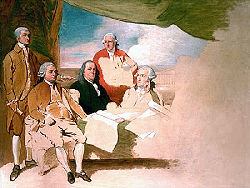
France in the American Revolutionary War
France entered the American Revolutionary War in 1778, and assisted in the victory of the Americans seeking independence from Britain ....
, with Saint Lucia being returned to France by the Treaty of Paris
Treaty of Paris (1783)
The Treaty of Paris, signed on September 3, 1783, ended the American Revolutionary War between Great Britain on the one hand and the United States of America and its allies on the other. The other combatant nations, France, Spain and the Dutch Republic had separate agreements; for details of...
in 1783, but not nearly as much as had been hoped for at the time of French intervention. True disaster came to what remained of France's colonial empire in 1791 when Saint Domingue (the Western third of the Caribbean island of Hispaniola
Hispaniola
Hispaniola is a major island in the Caribbean, containing the two sovereign states of the Dominican Republic and Haiti. The island is located between the islands of Cuba to the west and Puerto Rico to the east, within the hurricane belt...
), France's richest and most important colony, was riven by a massive slave revolt, caused partly by the divisions among the island's elite, which had resulted from the French Revolution
French Revolution
The French Revolution , sometimes distinguished as the 'Great French Revolution' , was a period of radical social and political upheaval in France and Europe. The absolute monarchy that had ruled France for centuries collapsed in three years...
of 1789. The slaves, led eventually by Toussaint Louverture and then, following his capture by the French in 1801, by Jean-Jacques Dessalines
Jean-Jacques Dessalines
Jean-Jacques Dessalines was a leader of the Haitian Revolution and the first ruler of an independent Haiti under the 1801 constitution. Initially regarded as Governor-General, Dessalines later named himself Emperor Jacques I of Haiti...
, held their own against French, Spanish, and British opponents, and ultimately achieved independence as Haiti
Haiti
Haiti , officially the Republic of Haiti , is a Caribbean country. It occupies the western, smaller portion of the island of Hispaniola, in the Greater Antillean archipelago, which it shares with the Dominican Republic. Ayiti was the indigenous Taíno or Amerindian name for the island...
in 1804 (Haiti became the first black republic in the world, much earlier than any of the future African nations although it was not until the 19th century that Europeans began establishing colonies in Africa). In the meanwhile, the newly resumed war with Britain by the French, resulted in the British capture of practically all remaining French colonies. These were restored at the Peace of Amiens in 1802, but when war resumed in 1803, the British soon recaptured them. France's repurchase of Louisiana in 1800 came to nothing, as the final success of the Haitian revolt
Haitian Revolution
The Haitian Revolution was a period of conflict in the French colony of Saint-Domingue, which culminated in the elimination of slavery there and the founding of the Haitian republic...
convinced Bonaparte that holding Louisiana would not be worth the cost, leading to its sale to the United States in 1803 (the Louisiana Purchase
Louisiana Purchase
The Louisiana Purchase was the acquisition by the United States of America of of France's claim to the territory of Louisiana in 1803. The U.S...
). The French attempt to establish a colony in Egypt
Egypt
Egypt , officially the Arab Republic of Egypt, Arabic: , is a country mainly in North Africa, with the Sinai Peninsula forming a land bridge in Southwest Asia. Egypt is thus a transcontinental country, and a major power in Africa, the Mediterranean Basin, the Middle East and the Muslim world...
in 1798–1801 was not successful.
Second French colonial empire
At the close of the Napoleonic WarsNapoleonic Wars
The Napoleonic Wars were a series of wars declared against Napoleon's French Empire by opposing coalitions that ran from 1803 to 1815. As a continuation of the wars sparked by the French Revolution of 1789, they revolutionised European armies and played out on an unprecedented scale, mainly due to...
, most of France's colonies were restored to it by Britain
United Kingdom
The United Kingdom of Great Britain and Northern IrelandIn the United Kingdom and Dependencies, other languages have been officially recognised as legitimate autochthonous languages under the European Charter for Regional or Minority Languages...
, notably Guadeloupe
Guadeloupe
Guadeloupe is an archipelago located in the Leeward Islands, in the Lesser Antilles, with a land area of 1,628 square kilometres and a population of 400,000. It is the first overseas region of France, consisting of a single overseas department. As with the other overseas departments, Guadeloupe...
and Martinique
Martinique
Martinique is an island in the eastern Caribbean Sea, with a land area of . Like Guadeloupe, it is an overseas region of France, consisting of a single overseas department. To the northwest lies Dominica, to the south St Lucia, and to the southeast Barbados...
in the West Indies, French Guiana
French Guiana
French Guiana is an overseas region of France, consisting of a single overseas department located on the northern Atlantic coast of South America. It has borders with two nations, Brazil to the east and south, and Suriname to the west...
on the coast of South America, various trading posts in Senegal
Senegal
Senegal , officially the Republic of Senegal , is a country in western Africa. It owes its name to the Sénégal River that borders it to the east and north...
, the Île Bourbon (Réunion
Réunion
Réunion is a French island with a population of about 800,000 located in the Indian Ocean, east of Madagascar, about south west of Mauritius, the nearest island.Administratively, Réunion is one of the overseas departments of France...
) in the Indian Ocean, and France's tiny Indian possessions; though Britain finally annexed Saint Lucia
Saint Lucia
Saint Lucia is an island country in the eastern Caribbean Sea on the boundary with the Atlantic Ocean. Part of the Lesser Antilles, it is located north/northeast of the island of Saint Vincent, northwest of Barbados and south of Martinique. It covers a land area of 620 km2 and has an...
, Tobago
Tobago
Tobago is the smaller of the two main islands that make up the Republic of Trinidad and Tobago. It is located in the southern Caribbean, northeast of the island of Trinidad and southeast of Grenada. The island lies outside the hurricane belt...
, the Seychelles, and the Île de France (Mauritius
Mauritius
Mauritius , officially the Republic of Mauritius is an island nation off the southeast coast of the African continent in the southwest Indian Ocean, about east of Madagascar...
). In 1825 Charles X sent an expedition to Haïti, resulting in the Haiti indemnity controversy
Haiti indemnity controversy
The Haiti indemnity controversy refers to events surrounding the 1825 demand by France for a FR₣150 million indemnity to be paid by the Republic of Haiti in claims over property lost through the Haitian Revolution in return for diplomatic recognition...
.
The true beginnings of the second French colonial empire, however, were laid in 1830 with the French invasion of Algeria
French rule in Algeria
French Algeria lasted from 1830 to 1962, under a variety of governmental systems. From 1848 until independence, the whole Mediterranean region of Algeria was administered as an integral part of France, much like Corsica and Réunion are to this day. The vast arid interior of Algeria, like the rest...
, which was conquered over the next 17 years. During the Second Empire, headed by Napoleon III, an attempt was made to establish a colonial-type protectorate
Protectorate
In history, the term protectorate has two different meanings. In its earliest inception, which has been adopted by modern international law, it is an autonomous territory that is protected diplomatically or militarily against third parties by a stronger state or entity...
in Mexico, but this came to little, and the French were forced to abandon the experiment. This French intervention in Mexico
French intervention in Mexico
The French intervention in Mexico , also known as The Maximilian Affair, War of the French Intervention, and The Franco-Mexican War, was an invasion of Mexico by an expeditionary force sent by the Second French Empire, supported in the beginning by the United Kingdom and the Kingdom of Spain...
lasted from 1861 to 1867.
In southeast Asia Napoleon III also established French control over Cochinchina
Cochinchina
Cochinchina is a region encompassing the southern third of Vietnam whose principal city is Saigon. It was a French colony from 1862 to 1954. The later state of South Vietnam was created in 1954 by combining Cochinchina with southern Annam. In Vietnamese, the region is called Nam Bộ...
(the southernmost
Southern Vietnam
For the former country, see South VietnamSouthern Vietnam is one of the three regions within Vietnam .The largest city in the South is Ho Chi Minh City, the nation's largest city....
part of modern Vietnam
Vietnam
Vietnam – sometimes spelled Viet Nam , officially the Socialist Republic of Vietnam – is the easternmost country on the Indochina Peninsula in Southeast Asia. It is bordered by China to the north, Laos to the northwest, Cambodia to the southwest, and the South China Sea –...
including Saigon) in 1867 and 1874, as well as a protectorate over Cambodia
Cambodia
Cambodia , officially known as the Kingdom of Cambodia, is a country located in the southern portion of the Indochina Peninsula in Southeast Asia...
in 1863. Additionally, France had a sphere of influence
Sphere of influence
In the field of international relations, a sphere of influence is a spatial region or conceptual division over which a state or organization has significant cultural, economic, military or political influence....
during the 19th century and early 20th century in southern China, including a naval base at Kuangchow Bay (Guangzhouwan).
It was only after the Franco-Prussian War
Franco-Prussian War
The Franco-Prussian War or Franco-German War, often referred to in France as the 1870 War was a conflict between the Second French Empire and the Kingdom of Prussia. Prussia was aided by the North German Confederation, of which it was a member, and the South German states of Baden, Württemberg and...
of 1870–1871 and the founding of the Third Republic
French Third Republic
The French Third Republic was the republican government of France from 1870, when the Second French Empire collapsed due to the French defeat in the Franco-Prussian War, to 1940, when France was overrun by Nazi Germany during World War II, resulting in the German and Italian occupations of France...
(1871–1940) that most of France's later colonial possessions were acquired. From their base in Cochinchina, the French took over Tonkin
Tonkin
Tonkin , also spelled Tongkin, Tonquin or Tongking, is the northernmost part of Vietnam, south of China's Yunnan and Guangxi Provinces, east of northern Laos, and west of the Gulf of Tonkin. Locally, it is known as Bắc Kỳ, meaning "Northern Region"...
(in modern northern Vietnam
Northern Vietnam
For the former country, see North VietnamNorthern Vietnam is one of the three regions within Vietnam ....
) and Annam
Annam (French Colony)
Annam was a French protectorate encompassing the central region of Vietnam. Vietnamese were subsequently referred to as "Annamites." Nationalist writers adopted the word "Vietnam" in the late 1920s. The general public embraced the word "Vietnam" during the revolution of August 1945...
(in modern central Vietnam
Central Vietnam
Central Vietnam or Central , formerly also known as Trung phần by Republic of Vietnam, Trung kỳ and Annam under French Indochina) is one of the three regions of Vietnam . Highlands or Tây Nguyên are often included in the Central...
) in 1884–1885. These, together with Cambodia and Cochinchina, formed French Indochina
French Indochina
French Indochina was part of the French colonial empire in southeast Asia. A federation of the three Vietnamese regions, Tonkin , Annam , and Cochinchina , as well as Cambodia, was formed in 1887....
in 1887 (to which Laos
Laos
Laos Lao: ສາທາລະນະລັດ ປະຊາທິປະໄຕ ປະຊາຊົນລາວ Sathalanalat Paxathipatai Paxaxon Lao, officially the Lao People's Democratic Republic, is a landlocked country in Southeast Asia, bordered by Burma and China to the northwest, Vietnam to the east, Cambodia to the south and Thailand to the west...
was added in 1893
Franco-Siamese War of 1893
The Franco-Siamese War of 1893 was a conflict between the French Third Republic and the Kingdom of Siam. Auguste Pavie, French vice consul in Luang Prabang in 1886, was the chief agent in furthering French interests in Laos...
, and Kwang-Chou-Wan
Kwang-Chou-Wan
Kwang-Chou-Wan was a small enclave on the south coast of China ceded by Qing China to France as a leased territory, and ruled by France as an outlier of French Indo-China...
in 1900). In 1849, the French concession
Shanghai French Concession
The Shanghai French Concession was a foreign concession in Shanghai, China from 1849 until 1946, and it was progressively expanded in the late 19th and early 20th centuries. The concession came to an end in practice in 1943 when the Vichy French government signed it over to the pro-Japanese puppet...
in Shanghai was established, lasting until 1946.
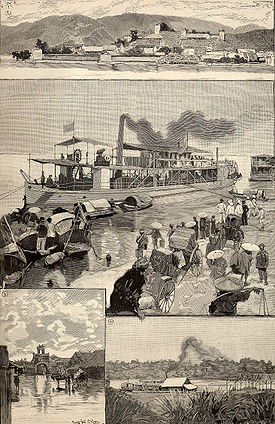
Concession (territory)
In international law, a concession is a territory within a country that is administered by an entity other than the state which holds sovereignty over it. This is usually a colonizing power, or at least mandated by one, as in the case of colonial chartered companies.Usually, it is conceded, that...
) in Shanghai, Guangzhou
Guangzhou
Guangzhou , known historically as Canton or Kwangchow, is the capital and largest city of the Guangdong province in the People's Republic of China. Located in southern China on the Pearl River, about north-northwest of Hong Kong, Guangzhou is a key national transportation hub and trading port...
and Hankou
Hankou
Hankou was one of the three cities whose merging formed modern-day Wuhan, the capital of the Hubei province, China. It stands north of the Han and Yangtze Rivers where the Han falls into the Yangtze...
(now part of Wuhan
Wuhan
Wuhan is the capital of Hubei province, People's Republic of China, and is the most populous city in Central China. It lies at the east of the Jianghan Plain, and the intersection of the middle reaches of the Yangtze and Han rivers...
).
Influence was also expanded in North Africa, establishing a protectorate on Tunisia
Tunisia
Tunisia , officially the Tunisian RepublicThe long name of Tunisia in other languages used in the country is: , is the northernmost country in Africa. It is a Maghreb country and is bordered by Algeria to the west, Libya to the southeast, and the Mediterranean Sea to the north and east. Its area...
in 1881 (Bardo Treaty). Gradually, French control was established over much of Northern, Western, and Central Africa by the turn of the century (including the modern nations of Mauritania
Mauritania
Mauritania is a country in the Maghreb and West Africa. It is bordered by the Atlantic Ocean in the west, by Western Sahara in the north, by Algeria in the northeast, by Mali in the east and southeast, and by Senegal in the southwest...
, Senegal, Guinea
Guinea
Guinea , officially the Republic of Guinea , is a country in West Africa. Formerly known as French Guinea , it is today sometimes called Guinea-Conakry to distinguish it from its neighbour Guinea-Bissau. Guinea is divided into eight administrative regions and subdivided into thirty-three prefectures...
, Mali, Côte d'Ivoire
Côte d'Ivoire
The Republic of Côte d'Ivoire or Ivory Coast is a country in West Africa. It has an area of , and borders the countries Liberia, Guinea, Mali, Burkina Faso and Ghana; its southern boundary is along the Gulf of Guinea. The country's population was 15,366,672 in 1998 and was estimated to be...
, Benin, Niger
Niger
Niger , officially named the Republic of Niger, is a landlocked country in Western Africa, named after the Niger River. It borders Nigeria and Benin to the south, Burkina Faso and Mali to the west, Algeria and Libya to the north and Chad to the east...
, Chad, Central African Republic
Central African Republic
The Central African Republic , is a landlocked country in Central Africa. It borders Chad in the north, Sudan in the north east, South Sudan in the east, the Democratic Republic of the Congo and the Republic of the Congo in the south, and Cameroon in the west. The CAR covers a land area of about ,...
, Republic of Congo), and the east African coastal enclave of Djibouti
Djibouti
Djibouti , officially the Republic of Djibouti , is a country in the Horn of Africa. It is bordered by Eritrea in the north, Ethiopia in the west and south, and Somalia in the southeast. The remainder of the border is formed by the Red Sea and the Gulf of Aden at the east...
(French Somaliland
French Somaliland
French Somaliland was a French colony in the Horn of Africa. Established after the French signed various treaties between 1883 and 1887 with the then ruling Somali Sultans, the colony lasted from 1896 until 1946, when it became an overseas territory of France....
).
The explorer Colonel Parfait-Louis Monteil
Parfait-Louis Monteil
Parfait-Louis Monteil was a French colonial military officer and explorer who made an epic journey in West Africa between 1890 and 1892, travelling east from Senegal to Lake Chad, and then north across the Sahara to Tripoli....
traveled from Senegal to Lake Chad
Lake Chad
Lake Chad is a historically large, shallow, endorheic lake in Africa, whose size has varied over the centuries. According to the Global Resource Information Database of the United Nations Environment Programme, it shrank as much as 95% from about 1963 to 1998; yet it also states that "the 2007 ...
in 1890–1892, signing treaties of friendship and protection with the rulers of several of the countries he passed through, and gaining much knowledge of the geography and politics of the region.
The Voulet-Chanoine Mission
Voulet-Chanoine Mission
The Voulet–Chanoine Mission or Central African Mission was a French military expedition sent out from Senegal in 1898 to conquer the Chad Basin and unify all French territories in West Africa...
, a military expedition, was sent out from Senegal in 1898 to conquer the Chad Basin and unify all French territories in West Africa. This expedition operated jointly with two other expeditions, the Foureau-Lamy and Gentil missions, which advanced from Algeria and Middle Congo respectively. With the death of the Muslim warlord Rabih az-Zubayr
Rabih az-Zubayr
Rabih az-Zubayr ibn Fadl Allah or Rabih Fadlallah , usually known as Rabah in French, was a Sudanese warlord and slave trader who established a powerful empire west of Lake Chad, in today's Chad....
, the greatest ruler in the region, and the creation of the Military Territory of Chad in 1900, the Voulet-Chanoine Mission had accomplished all its goals. The ruthlessness of the mission provoked a scandal in Paris. As a part of the Scramble for Africa
Scramble for Africa
The Scramble for Africa, also known as the Race for Africa or Partition of Africa was a process of invasion, occupation, colonization and annexation of African territory by European powers during the New Imperialism period, between 1881 and World War I in 1914...
, France had the establishment of a continuous west-east axis of the continent as an objective, in contrast with the British north-south axis
Cape To Cairo
Cape to Cairo may refer to:* the Cape to Cairo Railway* the Cape to Cairo Red Line, the 19th century concept of a British-dominated Africa, promoted by Cecil Rhodes* the Cape to Cairo Road...
. This resulted in the Fashoda incident
Fashoda Incident
The Fashoda Incident was the climax of imperial territorial disputes between Britain and France in Eastern Africa. A French expedition to Fashoda on the White Nile sought to gain control of the Nile River and thereby force Britain out of Egypt. The British held firm as Britain and France were on...
, where an expedition led by Jean-Baptiste Marchand
Jean-Baptiste Marchand
Major Jean-Baptiste Marchand was a French military officer and explorer in Africa. Marchand is best known for commanding the French expeditionary force during the Fashoda Incident...
was opposed by forces under Lord Kitchener
Herbert Kitchener, 1st Earl Kitchener
Field Marshal Horatio Herbert Kitchener, 1st Earl Kitchener KG, KP, GCB, OM, GCSI, GCMG, GCIE, ADC, PC , was an Irish-born British Field Marshal and proconsul who won fame for his imperial campaigns and later played a central role in the early part of the First World War, although he died halfway...
's command. The resolution of the crisis had a part in the bringing forth of the Entente Cordiale
Entente Cordiale
The Entente Cordiale was a series of agreements signed on 8 April 1904 between the United Kingdom and the French Republic. Beyond the immediate concerns of colonial expansion addressed by the agreement, the signing of the Entente Cordiale marked the end of almost a millennium of intermittent...
. During the Agadir Crisis
Agadir Crisis
The Agadir Crisis, also called the Second Moroccan Crisis, or the Panthersprung, was the international tension sparked by the deployment of the German gunboat Panther, to the Moroccan port of Agadir on July 1, 1911.-Background:...
in 1911, Britain supported France and Morocco
Morocco
Morocco , officially the Kingdom of Morocco , is a country located in North Africa. It has a population of more than 32 million and an area of 710,850 km², and also primarily administers the disputed region of the Western Sahara...
became a French protectorate.
At this time, the French also established colonies in the South Pacific
Pacific Ocean
The Pacific Ocean is the largest of the Earth's oceanic divisions. It extends from the Arctic in the north to the Southern Ocean in the south, bounded by Asia and Australia in the west, and the Americas in the east.At 165.2 million square kilometres in area, this largest division of the World...
, including New Caledonia
New Caledonia
New Caledonia is a special collectivity of France located in the southwest Pacific Ocean, east of Australia and about from Metropolitan France. The archipelago, part of the Melanesia subregion, includes the main island of Grande Terre, the Loyalty Islands, the Belep archipelago, the Isle of...
, the various island groups which make up French Polynesia
French Polynesia
French Polynesia is an overseas country of the French Republic . It is made up of several groups of Polynesian islands, the most famous island being Tahiti in the Society Islands group, which is also the most populous island and the seat of the capital of the territory...
(including the Society Islands
Society Islands
The Society Islands are a group of islands in the South Pacific Ocean. They are politically part of French Polynesia. The archipelago is generally believed to have been named by Captain James Cook in honor of the Royal Society, the sponsor of the first British scientific survey of the islands;...
, the Marquesas, the Tuamotus
Tuamotus
The Tuamotus or the Tuamotu Archipelago are a chain of islands and atolls in French Polynesia. They form the largest chain of atolls in the world, spanning an area of the Pacific Ocean roughly the size of Western Europe...
), and established joint control of the New Hebrides
New Hebrides
New Hebrides was the colonial name for an island group in the South Pacific that now forms the nation of Vanuatu. The New Hebrides were colonized by both the British and French in the 18th century shortly after Captain James Cook visited the islands...
with Britain. The French made their last major colonial gains after World War I
World War I
World War I , which was predominantly called the World War or the Great War from its occurrence until 1939, and the First World War or World War I thereafter, was a major war centred in Europe that began on 28 July 1914 and lasted until 11 November 1918...
, when they gained mandates over the former Turkish
Turkey
Turkey , known officially as the Republic of Turkey , is a Eurasian country located in Western Asia and in East Thrace in Southeastern Europe...
territories of the Ottoman Empire
Ottoman Empire
The Ottoman EmpireIt was usually referred to as the "Ottoman Empire", the "Turkish Empire", the "Ottoman Caliphate" or more commonly "Turkey" by its contemporaries...
that make up what is now Syria
Syria
Syria , officially the Syrian Arab Republic , is a country in Western Asia, bordering Lebanon and the Mediterranean Sea to the West, Turkey to the north, Iraq to the east, Jordan to the south, and Israel to the southwest....
and Lebanon
Lebanon
Lebanon , officially the Republic of LebanonRepublic of Lebanon is the most common term used by Lebanese government agencies. The term Lebanese Republic, a literal translation of the official Arabic and French names that is not used in today's world. Arabic is the most common language spoken among...
, as well as most of the former German colonies of Togo
Togo
Togo, officially the Togolese Republic , is a country in West Africa bordered by Ghana to the west, Benin to the east and Burkina Faso to the north. It extends south to the Gulf of Guinea, on which the capital Lomé is located. Togo covers an area of approximately with a population of approximately...
and Cameroon
Cameroon
Cameroon, officially the Republic of Cameroon , is a country in west Central Africa. It is bordered by Nigeria to the west; Chad to the northeast; the Central African Republic to the east; and Equatorial Guinea, Gabon, and the Republic of the Congo to the south. Cameroon's coastline lies on the...
.
A hallmark of the French colonial project in the late 19th century and early 20th century was the civilizing mission
Civilizing mission
is a rationale for intervention or colonisation, proposing to contribute to the spread of civilization, mostly amounting to the Westernization of indigenous peoples....
(mission civilisatrice), the principle that it was Europe's duty to bring civilization to benighted peoples. As such, colonial officials undertook a policy of Franco-Europeanization in French colonies, most notably French West Africa
French West Africa
French West Africa was a federation of eight French colonial territories in Africa: Mauritania, Senegal, French Sudan , French Guinea , Côte d'Ivoire , Upper Volta , Dahomey and Niger...
. Africans who adopted French culture, including fluent use of the French language and conversion to Christianity, were granted equal French citizenship, including suffrage. In 1848, residents of the "Four Communes
Four Communes
The "Four Communes" of Senegal were the four oldest colonial towns in French controlled west Africa. In 1848, the French Second Republic extended the rights of full French citizenship to the inhabitants of Saint-Louis, Dakar, Goree, and Rufisque...
" in Senegal were granted citizenship, which was reaffirmed by the Third Republic, leading to the 1914 election to the French Chamber of Deputies of Senegalese politician Blaise Diagne
Blaise Diagne
Blaise Diagne was a French political leader, the first black African elected to the French National Assembly, and mayor of Dakar.- Background :...
. By this time, however, French conservatives were denouncing such assimilationist policies as products of a dangerous liberal fantasy. In Morocco, France's newest colony, the French administration attempted to use urban planning and colonial education to prevent cultural mixing and to uphold the traditional society upon which the French depended for collaboration, with mixed results. After World War Two, the segregationist approach modeled in Morocco had been discredited by its connections to Vichyism, and assimilationism enjoyed a brief renaissance.
Decolonisation
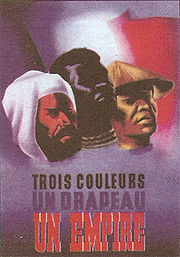
Syria
Syria , officially the Syrian Arab Republic , is a country in Western Asia, bordering Lebanon and the Mediterranean Sea to the West, Turkey to the north, Iraq to the east, Jordan to the south, and Israel to the southwest....
, Lebanon, and Madagascar
Madagascar
The Republic of Madagascar is an island country located in the Indian Ocean off the southeastern coast of Africa...
, the US and Britain in Morocco
Morocco
Morocco , officially the Kingdom of Morocco , is a country located in North Africa. It has a population of more than 32 million and an area of 710,850 km², and also primarily administers the disputed region of the Western Sahara...
and Algeria
Algeria
Algeria , officially the People's Democratic Republic of Algeria , also formally referred to as the Democratic and Popular Republic of Algeria, is a country in the Maghreb region of Northwest Africa with Algiers as its capital.In terms of land area, it is the largest country in Africa and the Arab...
, and Germany and Italy in Tunisia
Tunisia
Tunisia , officially the Tunisian RepublicThe long name of Tunisia in other languages used in the country is: , is the northernmost country in Africa. It is a Maghreb country and is bordered by Algeria to the west, Libya to the southeast, and the Mediterranean Sea to the north and east. Its area...
). However, control was gradually reestablished by Charles de Gaulle
Charles de Gaulle
Charles André Joseph Marie de Gaulle was a French general and statesman who led the Free French Forces during World War II. He later founded the French Fifth Republic in 1958 and served as its first President from 1959 to 1969....
. The French Union
French Union
The French Union was a political entity created by the French Fourth Republic to replace the old French colonial system, the "French Empire" and to abolish its "indigenous" status.-History:...
, included in the 1946 Constitution of 1946, replaced the former colonial Empire.
France was immediately confronted with the beginnings of the decolonisation movement. Paul Ramadier
Paul Ramadier
Paul Ramadier was a prominent French politician of the Third and Fourth Republics. Mayor of Decazeville starting in 1919, he served as the first Prime Minister of the Fourth Republic in 1947. On 10 July 1940, he voted against the granting of the full powers to Marshal Philippe Pétain, who...
's (SFIO) cabinet repressed the Malagasy Uprising in 1947. In Asia, Ho Chi Minh
Ho Chi Minh
Hồ Chí Minh , born Nguyễn Sinh Cung and also known as Nguyễn Ái Quốc, was a Vietnamese Marxist-Leninist revolutionary leader who was prime minister and president of the Democratic Republic of Vietnam...
's Vietminh declared Vietnam
Vietnam
Vietnam – sometimes spelled Viet Nam , officially the Socialist Republic of Vietnam – is the easternmost country on the Indochina Peninsula in Southeast Asia. It is bordered by China to the north, Laos to the northwest, Cambodia to the southwest, and the South China Sea –...
's independence, starting the First Indochina War
First Indochina War
The First Indochina War was fought in French Indochina from December 19, 1946, until August 1, 1954, between the French Union's French Far East...
. In Cameroun
Cameroun
Cameroun was a French and British mandate territory in central Africa, now constituting the majority of the territory of the Republic of Cameroon....
, the Union of the Peoples of Cameroon
Union of the Peoples of Cameroon
The Union of the Peoples of Cameroon is a political party in Cameroon.-History:UPC was founded on April 10, 1948, at a meeting in the bar Chez Sierra in Bassa. 12 men assisted the founding meeting, including Charles Assalé, Léonard Bouli, and Guillaume Bagal. The majority of the participants were...
's insurrection, started in 1955 and headed by Ruben Um Nyobé
Ruben Um Nyobé
Ruben Um Nyobé was an anti-imperialist Cameroonian leader, slain by the French army on 13 September 1958, near his natal village of Boumnyebel, in the department of Nyong-et-Kellé in the maquis Bassa. He created on 10 April 1948 the Cameroon's People Union , which used armed struggle to obtain...
, was violently repressed.
When the Indochina War ended with defeat and withdrawal in 1954, France became almost immediately involved in a new, and even harsher conflict in Algeria
Algeria
Algeria , officially the People's Democratic Republic of Algeria , also formally referred to as the Democratic and Popular Republic of Algeria, is a country in the Maghreb region of Northwest Africa with Algiers as its capital.In terms of land area, it is the largest country in Africa and the Arab...
, the oldest major colony. Ferhat Abbas
Ferhat Abbas
Ferhat Abbas Kabyle: Ferḥat Σabbas, was an Algerian political leader and briefly acted in a provisional capacity as the yet-to-become independent country's President from 1958 to 1961.- Background :...
and Messali Hadj
Messali Hadj
Ahmed Ben Messali Hadj was an Algerian nationalist politician dedicated to the independence of his homeland from France...
's movements had marked the period between the two wars, but both sides radicalised after the Second World War. In 1945, the Sétif massacre
Setif massacre
The Sétif massacre refers to widespread disturbances and killings in and around the Algerian market town of Sétif located to the west of Constantine in 1945. Shooting by the French authorities against local demonstrators occurred on 8 May 1945. Then, riots in the town itself were followed by...
was carried out by the French army. The Algerian War
Algerian War of Independence
The Algerian War was a conflict between France and Algerian independence movements from 1954 to 1962, which led to Algeria's gaining its independence from France...
started in 1954. Algeria was particularly problematic, due to the large number of European settlers (or pieds-noirs) who had settled there in the 125 years of French rule
French rule in Algeria
French Algeria lasted from 1830 to 1962, under a variety of governmental systems. From 1848 until independence, the whole Mediterranean region of Algeria was administered as an integral part of France, much like Corsica and Réunion are to this day. The vast arid interior of Algeria, like the rest...
. Charles de Gaulle's accession to power in 1958 in the middle of the crisis ultimately led to the independence of Algeria with the 1962 Evian Accords
Évian Accords
The Évian Accords comprise a treaty which was signed in 1962 in Évian-les-Bains, France by France and the F.L.N. . The Accords put an end to the Algerian War with a formal cease-fire proclaimed for March 19, and formalized the idea of cooperative exchange between the two countries...
. The Suez crisis
Suez Crisis
The Suez Crisis, also referred to as the Tripartite Aggression, Suez War was an offensive war fought by France, the United Kingdom, and Israel against Egypt beginning on 29 October 1956. Less than a day after Israel invaded Egypt, Britain and France issued a joint ultimatum to Egypt and Israel,...
in 1956 also displayed the limitations of French power, as its attempt to retake the canal along with the British was stymied when the United States did not back the plan.
The French Union
French Union
The French Union was a political entity created by the French Fourth Republic to replace the old French colonial system, the "French Empire" and to abolish its "indigenous" status.-History:...
was replaced in the new 1958 Constitution of 1958 by the French Community
French Community
The French Community was an association of states known in French simply as La Communauté. In 1958 it replaced the French Union, which had itself succeeded the French colonial empire in 1946....
. Only Guinea
Guinea
Guinea , officially the Republic of Guinea , is a country in West Africa. Formerly known as French Guinea , it is today sometimes called Guinea-Conakry to distinguish it from its neighbour Guinea-Bissau. Guinea is divided into eight administrative regions and subdivided into thirty-three prefectures...
refused by referendum to take part to the new colonial organisation. However, the French Community dissolved itself in the midst of the Algerian War; almost all of the other African colonies were granted independence in 1960, following local referendum
Referendum
A referendum is a direct vote in which an entire electorate is asked to either accept or reject a particular proposal. This may result in the adoption of a new constitution, a constitutional amendment, a law, the recall of an elected official or simply a specific government policy. It is a form of...
s. Some few colonies chose instead to remain part of France, under the status of overseas départements (territories). Critics of neocolonialism
Neocolonialism
Neocolonialism is the practice of using capitalism, globalization, and cultural forces to control a country in lieu of direct military or political control...
claimed that the Françafrique
Françafrique
Françafrique is a term that refers to France's relationship with Africa. The term was first used in a positive sense by President Félix Houphouët-Boigny of Côte d'Ivoire, but it is now generally understood to denounce the neocolonial relationship France has with its African backyard...
had replaced formal direct rule. They argued that while de Gaulle was granting independence on one hand, he was creating new ties through Jacques Foccart
Jacques Foccart
Jacques Foccart was a chief adviser for the government of France on African policy as well as the co-founder of the Gaullist Service d'Action Civique in 1959 with Charles Pasqua, which specialized in covert operations in Africa.From 1960 to 1974, he was the President of France's chief of staff...
's help, his counsellor for African matters. Foccart supported in particular the Nigerian Civil War
Nigerian Civil War
The Nigerian Civil War, also known as the Nigerian-Biafran War, 6 July 1967–15 January 1970, was a political conflict caused by the attempted secession of the southeastern provinces of Nigeria as the self-proclaimed Republic of Biafra...
during the late 1960s.
Population between 1919 and 1940
| 1921 | 1926 | 1931 | 1936 | 1940 | |
|---|---|---|---|---|---|
| Metropolitan France Metropolitan France Metropolitan France is the part of France located in Europe. It can also be described as mainland France or as the French mainland and the island of Corsica... |
39,140,000 | 40,710,000 | 41,550,000 | 41,500,000 | 41,835,000 |
| Colonies, protectorates, and mandates | 55,556,000 | 59,474,000 | 64,293,000 | 69,131,000 | 68,888,000 |
| Total | 94,696,000 | 100,184,000 | 105,843,000 | 110,631,000 | 110,723,000 |
| Percentage of the world population | 5.02% | 5.01% | 5.11% | 5.15% | 4.81% |
| Sources: INSEE, SGF | |||||
French settlers
Unlike elsewhere in Europe, France experienced relatively low levels of emigration to the Americas, with the exception of the Huguenots in British or Dutch colonies. France generally had close to the slowest natural population growth in Europe, and emigration pressures were therefore quite small. A small but significant emigration, numbering only in the tens of thousands, of mainly Roman Catholic French populations led to the settlement of the provinces of AcadiaAcadia
Acadia was the name given to lands in a portion of the French colonial empire of New France, in northeastern North America that included parts of eastern Quebec, the Maritime provinces, and modern-day Maine. At the end of the 16th century, France claimed territory stretching as far south as...
, Canada and Louisiana
Louisiana
Louisiana is a state located in the southern region of the United States of America. Its capital is Baton Rouge and largest city is New Orleans. Louisiana is the only state in the U.S. with political subdivisions termed parishes, which are local governments equivalent to counties...
, both (at the time) French possessions, as well as colonies in the West Indies, Mascarene islands and Africa. In New France, Huguenots were banned from settling in the territory, and Quebec was one of the most staunchly Catholic areas in the world until the Quiet Revolution
Quiet Revolution
The Quiet Revolution was the 1960s period of intense change in Quebec, Canada, characterized by the rapid and effective secularization of society, the creation of a welfare state and a re-alignment of politics into federalist and separatist factions...
. The current French Canadian population, which numbers in the millions, is descended almost entirely from New France's small settler population.
On 31 December 1687 a community of French Huguenots
Huguenots in South Africa
A large number of people in South Africa are descended from Huguenots. Most of these originally settled in the Cape Colony, but have since been quickly absorbed into the Afrikaner and Afrikaans population, thanks to sharing a similar religion to the Dutch colonists.-History:Even before the large...
settled in South Africa. Most of these originally settled in the Cape Colony
Cape Colony
The Cape Colony, part of modern South Africa, was established by the Dutch East India Company in 1652, with the founding of Cape Town. It was subsequently occupied by the British in 1795 when the Netherlands were occupied by revolutionary France, so that the French revolutionaries could not take...
, but have since been quickly absorbed into the Afrikaner
Afrikaner
Afrikaners are an ethnic group in Southern Africa descended from almost equal numbers of Dutch, French and German settlers whose native tongue is Afrikaans: a Germanic language which derives primarily from 17th century Dutch, and a variety of other languages.-Related ethno-linguistic groups:The...
population. After Champlain's founding of Quebec City in 1608, it became the capital of New France
New France
New France was the area colonized by France in North America during a period beginning with the exploration of the Saint Lawrence River by Jacques Cartier in 1534 and ending with the cession of New France to Spain and Great Britain in 1763...
. Encouraging settlement was difficult, and while some immigration did occur, by 1763 New France only had a population of some 65,000. From 1713 to 1787, 30,000 colonists immigrated from France to the St. Domingue. In 1805, when the French were forced out of St. Domingue (Haiti
Haiti
Haiti , officially the Republic of Haiti , is a Caribbean country. It occupies the western, smaller portion of the island of Hispaniola, in the Greater Antillean archipelago, which it shares with the Dominican Republic. Ayiti was the indigenous Taíno or Amerindian name for the island...
) 35.000 French settlers were given lands in Cuba
Cuba
The Republic of Cuba is an island nation in the Caribbean. The nation of Cuba consists of the main island of Cuba, the Isla de la Juventud, and several archipelagos. Havana is the largest city in Cuba and the country's capital. Santiago de Cuba is the second largest city...
. Out of the 40,000 inhabitants on Guadeloupe
Guadeloupe
Guadeloupe is an archipelago located in the Leeward Islands, in the Lesser Antilles, with a land area of 1,628 square kilometres and a population of 400,000. It is the first overseas region of France, consisting of a single overseas department. As with the other overseas departments, Guadeloupe...
, at the end of the 17th century, there were more than 26,000 blacks and 9,000 whites.
French law made it easy for thousands of colons, ethnic or national French from former colonies of North and West Africa, India and Indochina
Indochina
The Indochinese peninsula, is a region in Southeast Asia. It lies roughly southwest of China, and east of India. The name has its origins in the French, Indochine, as a combination of the names of "China" and "India", and was adopted when French colonizers in Vietnam began expanding their territory...
to live in mainland France. It is estimated that 20,000 colons were living in Saigon in 1945. 1.6 million European pieds noirs migrated from Algeria
Algeria
Algeria , officially the People's Democratic Republic of Algeria , also formally referred to as the Democratic and Popular Republic of Algeria, is a country in the Maghreb region of Northwest Africa with Algiers as its capital.In terms of land area, it is the largest country in Africa and the Arab...
, Tunisia and Morocco
Morocco
Morocco , officially the Kingdom of Morocco , is a country located in North Africa. It has a population of more than 32 million and an area of 710,850 km², and also primarily administers the disputed region of the Western Sahara...
. In just a few months in 1962, 900,000 French Algerians
Pied-noir
Pied-Noir , plural Pieds-Noirs, pronounced , is a term referring to French citizens of various origins who lived in French Algeria before independence....
left Algeria
Algeria
Algeria , officially the People's Democratic Republic of Algeria , also formally referred to as the Democratic and Popular Republic of Algeria, is a country in the Maghreb region of Northwest Africa with Algiers as its capital.In terms of land area, it is the largest country in Africa and the Arab...
in the largest relocation of population in Europe since World War II
World War II
World War II, or the Second World War , was a global conflict lasting from 1939 to 1945, involving most of the world's nations—including all of the great powers—eventually forming two opposing military alliances: the Allies and the Axis...
. In the 1970s, over 30,000 French colons left Cambodia
Cambodia
Cambodia , officially known as the Kingdom of Cambodia, is a country located in the southern portion of the Indochina Peninsula in Southeast Asia...
during the Khmer Rouge
Khmer Rouge
The Khmer Rouge literally translated as Red Cambodians was the name given to the followers of the Communist Party of Kampuchea, who were the ruling party in Cambodia from 1975 to 1979, led by Pol Pot, Nuon Chea, Ieng Sary, Son Sen and Khieu Samphan...
regime as the Pol Pot
Pol Pot
Saloth Sar , better known as Pol Pot, , was a Cambodian Maoist revolutionary who led the Khmer Rouge from 1963 until his death in 1998. From 1976 to 1979, he served as the Prime Minister of Democratic Kampuchea....
government confiscated their farms and land properties. In November 2004, several thousand of the estimated 14,000 French nationals in Ivory Coast left country after days of anti-white violence.
Apart from French-Canadians (Québécois
French-speaking Quebecer
French-speaking Quebecers are francophone residents of the Canadian province of Quebec....
and Acadians), Cajuns, and Métis other populations of French ancestry outside metropolitan France include the Caldoche
Caldoche
Caldoche is the name given to European inhabitants of the French territory of New Caledonia, mostly native-born French settlers. The formal name to refer to this particular population is Calédoniens, short for the very formal Néo-Calédoniens, however this self-appellation technically includes all...
s of New Caledonia
New Caledonia
New Caledonia is a special collectivity of France located in the southwest Pacific Ocean, east of Australia and about from Metropolitan France. The archipelago, part of the Melanesia subregion, includes the main island of Grande Terre, the Loyalty Islands, the Belep archipelago, the Isle of...
and the so-called Zoreilles and Petits-blancs of various Indian Ocean islands.
See also
- Evolution of the French EmpireEvolution of the French EmpireThe French colonial empire was the set of territories outside Europe that were under French rule from the 17th century to the late 1970s. In terms of land area, the empire extended to over 13,000,000 km² The French colonial empire was the set of territories outside Europe that were under...
- List of French possessions and colonies
- Index:-French colonial empire
- Index:-Former colonies of France
- Overseas departments and territories of FranceOverseas departments and territories of FranceThe French Overseas Departments and Territories consist broadly of French-administered territories outside of the European continent. These territories have varying legal status and different levels of autonomy, although all have representation in the Parliament of France , and consequently the...
- French colonisation of the Americas
- FrancizationFrancizationFrancization or Gallicization is a process of cultural assimilation that gives a French character to a word, an ethnicity or a person.-French Colonial Empire:-Francization in the World:...
- French law on colonialismFrench law on colonialismThe February 23, 2005, French law on colonialism was an act passed by the Union for a Popular Movement conservative majority, which imposed on high-school teachers to teach the "positive values" of colonialism to their students...
- (2005) - DecolonizationDecolonizationDecolonization refers to the undoing of colonialism, the unequal relation of polities whereby one people or nation establishes and maintains dependent Territory over another...
- Global empire
- Organisation internationale de la Francophonie
External links
- L'Afrique francophone
- Threats to the national independence of Thailand, from ThailandThailandThailand , officially the Kingdom of Thailand , formerly known as Siam , is a country located at the centre of the Indochina peninsula and Southeast Asia. It is bordered to the north by Burma and Laos, to the east by Laos and Cambodia, to the south by the Gulf of Thailand and Malaysia, and to the...
's Ministry of Foreign Affairs - French Colonialism, lecture on the colonial period 1871 to 1914, via Open Yale CoursesOpen Yale CoursesOpen Yale Courses is a project of Yale University to share full video and course materials from its undergraduate courses.Open Yale Courses provides free access to a selection of introductory courses....
(45-min audio/video/text) - Area Of French Empire in 1940