
|
|
|
|
Spanish colonization of the Americas
|
| |
|
| |
The Spanish colonization of the Americas was Spain's conquest, settlement, and rule over much of the western hemisphere. Beginning with the arrival of Christopher Columbus in 1492, over three centuries the Spanish Empire expanded from early small settlements in the Caribbean to include Central America, most of South America, Mexico, what today is Southwestern United States, the Pacific and Caribbean coasts of North America, reaching Alaska. At the beginning of the 19th century, the Spanish possessions in America began a series of independence movements, which culminated in Spain's loss of all of its colonies on the mainland of North, Central and South America by 1825.

Discussion
Ask a question about 'Spanish colonization of the Americas'
Start a new discussion about 'Spanish colonization of the Americas'
Answer questions from other users
|
Recent Posts

Encyclopedia
The Spanish colonization of the Americas was Spain's conquest, settlement, and rule over much of the western hemisphere. Beginning with the arrival of Christopher Columbus in 1492, over three centuries the Spanish Empire expanded from early small settlements in the Caribbean to include Central America, most of South America, Mexico, what today is Southwestern United States, the Pacific and Caribbean coasts of North America, reaching Alaska. At the beginning of the 19th century, the Spanish possessions in America began a series of independence movements, which culminated in Spain's loss of all of its colonies on the mainland of North, Central and South America by 1825. The remaining Spanish colonies of Cuba, Puerto Rico, Guam and the Philippines were occupied by the United States following the Spanish-American War (1898), ending Spanish rule in the Americas. The Spanish settled in many different places all over America.
Christopher Columbus
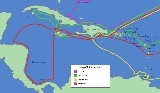
Portuguese explorers had recently been establishing new routes north along the West African coast, and it seemed likely that the Portuguese caravels would shortly reach the rich trading areas of Asia by traveling east. After his failure to persuade the King of Portugal to sponsor his expedition, Columbus was able to convince the recently crowned monarchs of the Kingdom of Castile and the Kingdom of Aragon, Isabella and Ferdinand, to finance his novel idea: to reach the trading partners in Asia by traveling directly west across the Atlantic Ocean.
Columbus' voyages were also taking place at the end of seven centuries of the Reconquista, in which the last Moorish kingdom on the Iberian Peninsula, Granada, was brought under Christian control. The Native Americans, like the Moors in Spain, were for a time considered without rights as long as they were not converted to Catholicism.
Columbus was made governor of the new territories and made several more journeys across the Atlantic Ocean. He profited from the labour of native slaves, whom he forced to mine gold; he also attempted to sell some slaves to Spain. While generally regarded as an excellent navigator, he was a poor administrator and was stripped of the governorship in 1500.
On his immediate discovery of the Taíno people (one of three local Arawak-speaking indigenous groups), whom he met right after arriving on the island of Guanahani in the Bahamas on his first voyage, Columbus got the impression that he could conquer these people easily. In his journal he wrote, "I could conquer the whole of them with fifty men and govern them as I please" - and he proceeded to do just that.
He kidnapped some ten to twenty-five indians and took them back to Spain. Only about seven or eight survived this journey but with the parrots, gold trinkets and other exotic loot Columbus displayed to the Spanish government he was able to persuade them into providing him with seventeen ships, nearly 1,500 men, cannons, crossbows, guns, cavalry, and attack dogs for the voyage.
He returned to Hispaniola and the Taíno (Arawaks) in 1493 demanding food, gold, spun cotton and whatever else they could get from the Indians. Cooperation was ensured by a punishment system: any minor offense by an Arawak would result in a Spaniard cutting off his ears or nose only to be sent back to the village as living, breathing, bleeding example of the work expected and the brutality of which the Spaniards were capable.
The Tainos began to resist by refusing to plant for the Spanish, abandoning captured towns, etc. but over time this rebellion grew physically violent. Nonetheless, the Indian "sticks and stones" were no match to the guns and harmless to the armor the Spanish wore. Columbus used this resistance by the Indians as a reason to wage war and on March 24, 1495 the famed explorer set out to conquer this race that he had labeled "inferior" and "stupid."
Naturally, the Spanish won and according to Kirkpatrick Sale, who quotes Ferdinand Columbus's biography of his father: "The soldiers mowed down dozens with point-blank volleys, loosed the dogs to rip open limbs and bellies, chased fleeing Indians into the bush to skewer them on sword and pike and 'with God's aid soon gained complete victory, killing many Indians and capturing others who were also killed.'"
This led to a massive Spanish slave trade, in which Columbus brought back some 500 "specimens" to work as slaves in Spain while another 500 stayed as slaves for the crew left in the Americas.
Still, Columbus could not find the gold he was looking for all along. And refusing to call it slavery, Columbus resorted to this "forced labor". Indians were forced to mine for gold, raise Spanish food, provide sexual companionship, and even carry the Spanish everywhere they went. And beyond these cruel acts the Spanish disrupted the culture. Forcing the Taíno to work in mines led to widespread malnutrition and furthermore, an intrusion of European livestock and diseases caused further damage.
The Taíno often refused to participate in the new lifestyle being forced upon them by the Spanish which resulted in suicide. In addition, children were often killed as a perceived escape from a terrible life to come.
Before Columbus's arrival, hundreds of thousands of people populated Hispaniola alone. By 1509, only 60,000 Taíno remained there. Although population estimates vary, Father Bartolomé de las Casas, the “Defender of the Indians” estimated that there were six million (6,000,000) Taíno in the Caribbean at the time of Columbus's arrival in 1492.
Conquest of Mexico
On his fourth and final voyage to America in 1502, Columbus encountered a large canoe off the coast of what is now Honduras filled with trade goods. He boarded the canoe and rifled through the cargo which included cacao beans, copper and flint axes, copper bells, pottery, and colorful cotton garments. He took one prisoner and what he wanted from the cargo and let the canoe continue. This was the first contact of the Spanish with the civilizations of Central America.
In 1513, Vasco Núñez de Balboa crossed the Isthmus of Panama, and led the first European expedition to see the Pacific Ocean from the west coast of the New World. In an action with enduring historical import, Balboa claimed the Pacific Ocean and all the lands adjoining it for the Spanish Crown. It was 1517 before another expedition from Cuba visited Central America, landing on the coast of the Yucatán in search of slaves. This was followed by a phase of conquest. The Spaniards, just having finished a war against the Muslim Moors in the Iberian peninsula, began toppling the local American civilizations, and attempted to impose Christianity.
There is a difference between the Spanish conquest of Mexico and the Spanish conquest of Yucatán. Although the Yucatán Peninsula is part of the modern-day country of Mexico, the Spanish conquest of Mexico refers to the conquest of the Mexica/Aztec empire by Hernán Cortés from 1519–21. It is April 22, 1519, the day Hernán Cortés landed ashore and founded the city of Veracruz, that marks the beginning of almost 303 years of Spanish hegemony over the region. The Spanish conquest of Yucatán, on the other hand, refers to the conquest of the Maya states from 1551–1697
Conquest of Peru
In the early 16th-century, a group of Spaniards led by Francisco Pizarro succeeded in toppling the Inca Empire. They took advantage of a recent civil war in the empire (between the factions of the brothers: Atahualpa and Huascar) to capture the ruling monarch, Inca Atahualpa in the city of Cajamarca on November 16, 1532. In the following years the conquistadors managed to consolidate their power over the whole Andean region, repressing successive indigenous rebellions until the establishment of the Viceroyalty of Perú in 1542 and the fall of the resistance of Vilcabamba in 1572.
Independence
During the Peninsular War, when Spain itself was occupied by Napoleonic troops, several assemblies (juntas) were established by the criollos to rule the lands in the name of Ferdinand VII of Spain. Meanwhile, on August 10, 1809 the first declaration of independence from Spanish rule was signed at Quito (in modern Ecuador), which began a movement for independence that soon spread across Spain's American colonies. This experience of self-government, the influence of liberalism, and the ideas of the French and American Revolutions influenced the Libertadores. All of the colonies except Cuba and Puerto Rico eventually freed themselves, often with help from the British Empire, which had long sought to break the Spanish monopoly on trade with its possessions in America.
In 1898, the United States won the Spanish-American War and occupied Cuba, Puerto Rico and the Philippines, ending Spanish rule in America. Spanish settlement of the region continued, however, as the early 20th century saw a stream of immigration of poor people and political exiles from Spain to the former American colonies, especially Cuba, Mexico and Argentina. After the 1970s, the flow became reversed as Hispanic Americans began settling in Spain. In the 1990s, Spanish companies like Repsol and Telefonica invested in most countries in America particularly in South America, often buying newly privatized companies.
Currently, the Ibero-American countries, along with Spain and Portugal, have organized themselves as the Comunidad Iberoamericana de Naciones.
Many Spanish-speaking American countries are part of the Organization of American States, which includes most countries of America and seeks to build continental unity.
Further reading
- David A. Brading, The First America: The Spanish Monarchy, Creole Patriots, and the Liberal State, I492-1867 Cambridge: Cambridge University Press, 1993
See also
External links
|
| |
|
|