

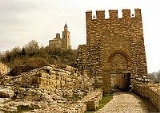
Second Bulgarian Empire

Encyclopedia
The Second Bulgarian Empire was a medieval Bulgaria
n state which existed between 1185 and 1396 (or 1422). A successor of the First Bulgarian Empire
, it reached the peak of its power under Kaloyan
and Ivan Asen II
before gradually being conquered by the Ottomans
in the late 14th-early 15th century. It was succeeded by the Principality
and later Kingdom of Bulgaria
in 1878.
Up until 1256, the Second Bulgarian Empire was the dominant power in the Balkans
. The Byzantines were defeated in several major battles, and in 1205 the newly established Latin Empire
was crushed in the battle of Adrianople
by Emperor Kaloyan
. His nephew, Ivan Asen II
(1218–1241), defeated the Despotate of Epiros and made Bulgaria a regional power once again. However, in the late 13th century the Empire declined under the constant invasions of Tatars
, Byzantines
, Hungarians, Serbs
, and internal instability and revolts.
Despite the strong Byzantine influence, the Bulgarian artists and architects managed to create their own distinct style. Literature and art flourished in the 14th century and a large part of the Bulgarian population was literate.
Istvan Vassary states that without the active participation of the Cumans, the Vlakho-Bulgarian rebels could never have gained the upper hand over the Byzantines and ultimately without the Cumans’ military support, the process of Bulgarian restoration could never have been realised The Cuman participation in the creation of the Second Bulgarian Empire in 1185 and thereafter brought about basic changes in the political and ethnic sphere of Bulgaria and the Balkans
's reign the state was sometimes called as both of Bulgarians and Vlachs. Pope Innocent III
and other foreigners such as the Latin emperor Henry
mentioned the state as Bulgaria and Bulgarian Empire in official letters.
In modern historiography the state is called the Second Bulgarian Empire, Second Bulgarian Tsardom or the Second Bulgarian Kingdom (to distinguish it from the First Bulgarian Empire
). An alternative name (used in connection with the pre-mid 13th century period) is the Empire of Vlachs and Bulgars, whose different variants include the Vlach-Bulgarian Empire, the Bulgarian-Wallachian Empire or the Romanian-Bulgarian Empire (the last one exclusively in Romanian historiography)
, to 1185, although initially it was not fully integrated into the Byzantine Empire
, for example preserving the existing tax levels and the power of the low-ranking nobility. The independent Bulgarian Orthodox Church
was subordinated to the authority of the Ecumenical Patriarch in Constantinople
, and the Bulgarian aristocracy and tsar
's relatives were given various Byzantine titles and transferred to the Asian parts of the Empire. There were rebellions against Byzantine rule in 1040-41, the 1070s and the 1080s, but these ultimately failed.
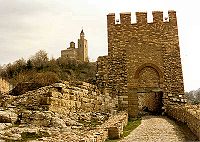 By the late 12th century the Byzantine dominance in the Balkans came to a halt when Manuel I Komnenus (who had subjugated the Hungarians at Sirmium
) died and was replaced by Andronikus I Komnenus and then by a series of incompetent emperors
. In 1185 Peter and Ivan
Asen (described in some contemporary accounts to be of Cuman or Vlach origin) led a revolt against Byzantine rule
and Peter declared himself Tsar Peter IV (also known as Theodore Peter), firmly claiming to inherit the authority of the First Bulgarian Empire
. After little more than a year of warfare the Byzantines were forced to acknowledge Bulgaria's independence, though fighting continued. The liberating movement was originated and vigorously prosecuted by Vlachs - either an alternative name for the inhabitants of Moesia or the ancestors of today's Vlachs; it was joined by the Bulgarians, and to some extent by the Cumans from beyond the Danube”. The peoples who took part in the rebellion and formed part of the new state certainly included Slavic-speaking Bulgarians and, alongside them, Cumans
, Vlachs
and Greeks
: Peter styled himself "Tsar of the Bulgars and Greeks.
of Saint Demetrius of Salonica was found in Tarnovo and the Asen brothers claimed that the saint had abandoned Salonica in order to help the Bulgarian cause. That had a large psychological impact on the religious population. Between the autumn of 1185 and the spring of 1186 the whole northern Bulgaria, with the exception of Varna
, was liberated. In the summer the Byzantine Emperor Isaac II Angelos
managed to overcome the mountain passes and invaded Moesia
. Asen retreated to the north of the Danube; when the Byzantines went back to Constantinople
he returned with more Cuman auxiliaries and soon the war continued to the south in Thrace
. A skillful general, Asen struck swiftly and constantly harassed the larger Byzantine armies. After an unsuccessful siege of Lovech
in 1187, the Byzantines were forced to plead for a truce. Three years later they were decisively defeated near Tryavna
, Isaac II Angelos barely escaping, leaving the Imperial crown and cross. In the next five years the Bulgarian held the initiative and reconquered more towns and castles in northern Thrace and Macedonia
, especially after the major victory at Arcadiopolis
in 1194. In 1196 the Byzantines were defeated at Serres
but soon after that event Asen was murdered by his cousin Ivanko
, incited by the Byzantines. He usurped the throne but could not stay in the capital, which was besieged by Peter; he fled to the Byzantine Empire, where he was made a governor of Plovdiv
. However, only a year later Peter IV became victim of another plot and was succeeded by the youngest brother Kaloyan.
, the Danube
and Stara Planina, including a part of eastern Macedonia
and the valley of the Morava. It also exercised influence over Wallachia
and Moldova
. During the rule of two of Bulgaria's most successive rulers, Kaloyan and Ivan Asen II, the country emerged as a regional power with considerable military and economic strength. Between 1204 and 1261, during the Latin Empire, the Bulgarian civil and religious authorities saw themselves as a Byzantine successor in preserving the traditions of the Eastern Orthodox Church
with numerous important relics being collected in the capital Tarnovo.
" although he desired to be recognized as "Emperor
" or "Tsar
". He and his Cuman allies waged wars against the Byzantine Empire
and (after 1204) on the Knights of the Fourth Crusade
, conquering large parts of Thrace
, the Rhodopes, as well as the whole of Macedonia
. He decisively defeated the newly created Latin Empire
in the Battle of Adrianople (1205)
and thus crushed its power in the very first year of its creation and prevented their influence on the larger parts of the Balkans. Their Emperor Baldwin I
was captured in the battle and later died in captivity in Tarnovo. In the next year the Latins suffered another heavy defeat in the battle of Rusion
. At first his struggle was supported by the Byzantine nobility but then they betrayed the Bulgarians and allied with the Crusaders. Kaloyan was infuriated and killed tens of thousands of Byzantines. At the siege of Varna (1201)
he ordered the whole Byzantine population of the city to be buried alive. He wanted revenge for Samuil
's 14,000 blinded soldiers and called himself Romanoktonos (Roman-slayer) as Basil II
was called Bulgaroktonos (Bulgarian-slayer).
To the west and north-west he fought against the Hungarians and defeated them several times.
(1207–1218), the country lost significant territories to Hungary, the Latin Empire and the Despotate of Epirus
.
Under Ivan Asen II
(1218–1241), Bulgarian fortunes improved, reconquering the lost lands and occupying Odrin and Albania
. In the beginning of his reign he peacefully regained Belgrade
and Branicevo
which were lost to Hungary and some lands from the Latin Empire. After the major success at Klokotnitsa
in 1230 the Epirus Despotate became a vassal tributary to Bulgaria. In an inscription from Tarnovo
in 1230 he entitled himself "In Christ the Lord faithful Tsar and autocrat of the Bulgarians, son of the old Asen". The Bulgarian Orthodox Patriarchate
was restored in 1235 with approval of all eastern Patriarchates, thus putting an end to the union with the Papacy. Ivan Asen II had a reputation as a wise and humane ruler, and opened relations with the Catholic
west, especially Venice
and Genoa
, to diversify the trade of his country. The country enjoyed a flourishing economy, trade relations were diversified and around 1235 Bulgaria had an organised Navy. In the last year of his reign he defeated a detachment of Tatars
who attacked Bulgaria after their devastating raid in Hungary. But after his death Bulgar authorities recognized Mongol supremacy thanks to Kadan
.
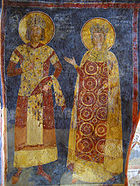
raided the Balkans in the early 13th century, devastating Bulgaria in 1242, and Bulgaria was forced to pay tribute to the Khans of the Golden Horde
. After 1256 the Empire of Nicaea
annexed southern Macedonia
, Rhodope mountains
and part of Thrace
. The Hungarian kingdom occupied the province of Belgrade
. Gradually Bulgaria lost control and traditional significant political influence over Wallachia
, where the power of the regional nobles was strengthened and subsequently were established local principalities. By the reign of Michael II Asen (1246–1256), Bulgaria had lost significant territories to its enemies without any major military disaster, mostly due of the disloyal nobles
who surrendered territories for personal enrichment. Under Constantine I Tikh
the country lost northern and central Macedonia to Byzantium as well as Severin Banat to Hungary and the crisis drove to peasant war, raised by the swineherd Ivailo, who managed to sit on the Bulgarian throne from 1277 to 1280.
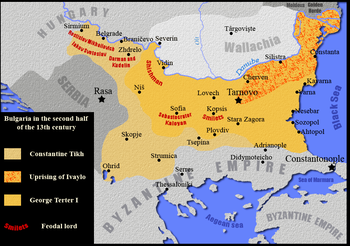 Ivailo achieved great military success against the external enemies: defeated the Byzantines in two major battles and temporarily drove away the Tatars
from the northeastern parts of the Empire. However, he failed to cope with the aristocracy and was later killed. The Tatar hegemony continued to 1300, when after the death of Nogai Khan
their khan Toktu
ceded Bessarabia
the new Bulgarian Emperor Theodore Svetoslav. But the Horde's claim on Bulgaria was still strong. This had positive economic effect. During the reign of Theodore Svetoslav Bulgaria regained much of its former strength and prestige. After a successful war against Byzantium he signed peace with continued to his death in 1322. Ozbeg Khan (1313–41) repeatedly raided Thrace, partly in service of Bulgaria's war against both Byzantium and Serbia
from 1319. His armies pillaged Thrace for 40 days in 1324 and for 15 days in 1337, taking 300,000 captives. After Ozbeg's death in 1341, his successors did not continue his aggressive policy and contacts with Bulgaria lapsed.
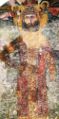 The withdrawal of the Mongols from Europe in the early 14th century stabilized the situation in the Balkans and Bulgaria reassumed something like its modern borders. It was however threatened by the rising powers of Hungary to the north and Serbia to the west. In 1330 the Bulgarians under Michael III
were heavily defeated by the Serbs at Velbuzhd, and some parts of the Empire came under Serbian sway. Under Ivan IV
(Ivan Alexander; 1331–1371) Serbian threat ended, and the Byzantines were defeated at Rusokastro
. The territorial expansion included the Rhodope Mountains
and several important towns on the Black Sea
coast. This was a period known as Second Golden Age because of its thriving cultural life. After Ivan Alexander's death Bulgaria was left divided into rival states; one of the two largest ones was based at Veliko Tarnovo
, and the other at Vidin
, ruled by Ivan's two sons.
The two brothers and despot Dobrotitsa
from the Principality of Carvuna did not make an attempt to unite and they were even engaged in a military conflict for Sofia.
Weakened Bulgaria was thus no match for a new threat from the south, the Ottoman Turks
, who crossed into Europe in 1354. In 1362 they captured Philippopolis (Plovdiv
), taking Sofia in 1382. The Ottomans then turned their attention to the Serbs, whom they routed at Kosovo Pole in 1389. In 1393 the Ottomans occupied Tarnovo
after a three-month siege
. In the next year the Ottomans captured the Carvuna Principality and Nikopol
— the last town of the Tarnovo tsardom — fell in 1395. Next year the Tsardom of Vidin was also occupied. Finally all of Bulgaria south of the Danube fell in 1422.
North of the Danube, where a significant number of Bulgarian nobility and common folk remained, the population was under the jurisdiction of various Christian autonomous, predominately Wallachian led principalities, where the Bulgarian alphabet continued to be used and many cities kept their Bulgarian names, like the Wallachian capital of Targovishte
. The nobility in the Christian principalities north of the Danube, continued to be known by their Bulgarian titles of Boyars and regularly helped Bulgarian population to continue to migrate north, as part of their military campaigns south of the Danube. Thus, Bulgarian population north of the Danube never came under Ottoman occupation, which greatly helped the National revival south of the Danube in later centuries.
. The supreme power in the country belonged to the Emperor, whose official title was: "In Christ the God faithful Emperor and Autocrat of all Bulgarians", at times with the addition of "Romans" (i.e. Byzantine Greeks) and Vlachs. The most significant meaning was that he was Emperor of the whole Bulgarian people, even to those beyond the borders of the Empire. The legislative and executive powers were concentrated in his hands. If the heir of the ruler was under age, the regency was headed by the mother-Empress.
The Bolyar Council, called also Sinklit (from Greek Synklētos, "Senate
") included the Great Bolyars and the Patriarch. Their task was to discuss important questions about the external and internal policy such as declaration of war, formation of alliance or signing peace. The last word always belonged to the Emperor. Sometimes Councils with extended membership were assembled, where the nobility, the clergy and "the other people" usually gathered to discuss condemnation of heresies: 1211, 1350, 1360. The only right the ordinary people had was to approve the decisions made by the nobility.
The main administrative unit in 13-14th centuries was the hora which replaced the komitat of the First Bulgarian Empire
. Its governor was called Duke or Kefaliya (from Greek kephalē
, "head") and was usually appointed by the Emperor; the hora was further divided into katepanika (sing. katepanikon, cf. the Byzantine katepanikion
) which were ruled by Katepans who were directly subordinated to the Dukes.
 The main agricultural regions of the country were the Danubian plain and Thrace
. The most widespread grains were wheat
, barley
and millet
. From the 13th century the importance of vegetables, orchards and grapes grew. The main wine-producing areas were the Black Sea
coast, along the Struma
, southern Macedonia
. Livestock breeding was well developed. There were many sheep, pig
s and cattle
. The pastures were divided into two groups: winter pastures (valleys) and summer pastures (mountains). In the 14th century apiculture and sericulture
became profitable branches.
The dense forests were also divided into two types: woods for cutting () and fenced forests () in which cutting was banned.
miners, who made ore extracting more efficient and introduced new mining methods, arrived in western Bulgaria. They inhabited mainly the regions of Chiprovtsi
and Kyustendil
. There used to be gold
mines in the Eastern Rhodope
s.
About 50 different types of handicraft were known in Medieval Bulgaria
, the most important being leathermaking, shoemaking, carpentry, weaving; production of food and drinks (bread, butter, cheese, wine). Vast quantity of catapults, battering-rams and other siege equipment were made, and the army had skilled siege engineers. The main centres were the capital Tarnovo, Cherven
, Sofia (copper).

In the 13th and 14th centuries Bulgaria became a thriving cultural centre. The flowering of the Tarnovo school of art was related to the construction of palaces and churches, to literary activity in the royal court and the monasteries, and to the development of handicrafts. Remarkable achievements of this school have been preserved down to this day: the murals of the Boyars' houses in Trapezitsa and Saint Forty Martyrs Church in Veliko Tarnovo
, the Boyana Church
(1259) and the Rock-hewn Churches of Ivanovo
. Book illuminations also developed, examples include the Manasses Chronicle, the Tetraevangelia of Ivan Alexander and the Tomich Psalter. Many relics of Orthodox
martyrs and saints were kept in the numerous churches in the capital Turnovo, which earned the capital the byname "second Constantinople".
Most of the architectural monuments from that period include churches, monasteries and fortresses. The Bulgarians usually built small churches with short doors to show humbleness and homage to God. They were often richly decorated with blind niches, various geometrical patterns from bricks, stone cubes, ceramics; while from the inside they were painted with marvelous frescoes which from the 13th century began to draw away from the canon and became realistic.
In the 14th century many new monasteries were built under the patronage of Ivan Alexander on the northern slopes of Stara Planina, especially in an area near the capital Tarnovo which became known as "Sveta Gora" (Holy Forest) - a name also used to refer to Mount Athos
. The numerous monasteries across the Empire were the very centre of the cultural, educational and spiritual life of the Bulgarian society. Ather the mid 14th centuries, many monasteries began to build fortifications under the thread of Turk invasions, such as the famous Tower of Hrelyu in the Rila monastery
.
There used to be a perfectly organised defensive network of fortresses which consisted of several lines along the Danube
, the Balkan mountains
, the Rhodope
, the coast. The main fortress was Turnovo. Other major castles included Vidin
, Silistra
, Cherven, Lovech
, Sofia
, Plovdiv
, Lyutitsa
, Ustra
and many others.
Bulgaria
Bulgaria , officially the Republic of Bulgaria , is a parliamentary democracy within a unitary constitutional republic in Southeast Europe. The country borders Romania to the north, Serbia and Macedonia to the west, Greece and Turkey to the south, as well as the Black Sea to the east...
n state which existed between 1185 and 1396 (or 1422). A successor of the First Bulgarian Empire
First Bulgarian Empire
The First Bulgarian Empire was a medieval Bulgarian state founded in the north-eastern Balkans in c. 680 by the Bulgars, uniting with seven South Slavic tribes...
, it reached the peak of its power under Kaloyan
Kaloyan of Bulgaria
Kaloyan the Romanslayer , Ivan II , ruled as emperor of Bulgaria 1197-1207. He is the third and youngest brother of Peter IV and Ivan Asen I who managed to restore the Bulgarian Empire...
and Ivan Asen II
Ivan Asen II of Bulgaria
-Early rule:He was a son of Ivan Asen I of Bulgaria and Elena . Elena, who survived until after 1235, is sometimes alleged to be a daughter of Stefan Nemanja of Serbia, but this relationship is questionable and would have caused various canonical impediments to marriages between various descendants...
before gradually being conquered by the Ottomans
Ottoman Empire
The Ottoman EmpireIt was usually referred to as the "Ottoman Empire", the "Turkish Empire", the "Ottoman Caliphate" or more commonly "Turkey" by its contemporaries...
in the late 14th-early 15th century. It was succeeded by the Principality
Principality of Bulgaria
The Principality of Bulgaria was a self-governing entity created as a vassal of the Ottoman Empire by the Treaty of Berlin in 1878. The preliminary treaty of San Stefano between the Russian Empire and the Porte , on March 3, had originally proposed a significantly larger Bulgarian territory: its...
and later Kingdom of Bulgaria
Kingdom of Bulgaria
The Kingdom of Bulgaria was established as an independent state when the Principality of Bulgaria, an Ottoman vassal, officially proclaimed itself independent on October 5, 1908 . This move also formalised the annexation of the Ottoman province of Eastern Rumelia, which had been under the control...
in 1878.
Up until 1256, the Second Bulgarian Empire was the dominant power in the Balkans
Balkans
The Balkans is a geopolitical and cultural region of southeastern Europe...
. The Byzantines were defeated in several major battles, and in 1205 the newly established Latin Empire
Latin Empire
The Latin Empire or Latin Empire of Constantinople is the name given by historians to the feudal Crusader state founded by the leaders of the Fourth Crusade on lands captured from the Byzantine Empire. It was established after the capture of Constantinople in 1204 and lasted until 1261...
was crushed in the battle of Adrianople
Battle of Adrianople (1205)
The Battle of Adrianople occurred on April 14, 1205 between Bulgarians under Tsar Kaloyan of Bulgaria, and Crusaders under Baldwin I. It was won by the Bulgarians after a skillful ambush using the help of their Cuman and Greek allies. Around 300 knights were killed, including Louis of Blois, Duke...
by Emperor Kaloyan
Kaloyan of Bulgaria
Kaloyan the Romanslayer , Ivan II , ruled as emperor of Bulgaria 1197-1207. He is the third and youngest brother of Peter IV and Ivan Asen I who managed to restore the Bulgarian Empire...
. His nephew, Ivan Asen II
Ivan Asen II of Bulgaria
-Early rule:He was a son of Ivan Asen I of Bulgaria and Elena . Elena, who survived until after 1235, is sometimes alleged to be a daughter of Stefan Nemanja of Serbia, but this relationship is questionable and would have caused various canonical impediments to marriages between various descendants...
(1218–1241), defeated the Despotate of Epiros and made Bulgaria a regional power once again. However, in the late 13th century the Empire declined under the constant invasions of Tatars
Tatars
Tatars are a Turkic speaking ethnic group , numbering roughly 7 million.The majority of Tatars live in the Russian Federation, with a population of around 5.5 million, about 2 million of which in the republic of Tatarstan.Significant minority populations are found in Uzbekistan, Kazakhstan,...
, Byzantines
Byzantine Empire
The Byzantine Empire was the Eastern Roman Empire during the periods of Late Antiquity and the Middle Ages, centred on the capital of Constantinople. Known simply as the Roman Empire or Romania to its inhabitants and neighbours, the Empire was the direct continuation of the Ancient Roman State...
, Hungarians, Serbs
Serbian Empire
The Serbian Empire was a short-lived medieval empire in the Balkans that emerged from the Serbian Kingdom. Stephen Uroš IV Dušan was crowned Emperor of Serbs and Greeks on 16 April, 1346, a title signifying a successorship to the Eastern Roman Empire...
, and internal instability and revolts.
Despite the strong Byzantine influence, the Bulgarian artists and architects managed to create their own distinct style. Literature and art flourished in the 14th century and a large part of the Bulgarian population was literate.
Istvan Vassary states that without the active participation of the Cumans, the Vlakho-Bulgarian rebels could never have gained the upper hand over the Byzantines and ultimately without the Cumans’ military support, the process of Bulgarian restoration could never have been realised The Cuman participation in the creation of the Second Bulgarian Empire in 1185 and thereafter brought about basic changes in the political and ethnic sphere of Bulgaria and the Balkans
Names
The most used name by contemporaries was Bulgaria. During KaloyanKaloyan of Bulgaria
Kaloyan the Romanslayer , Ivan II , ruled as emperor of Bulgaria 1197-1207. He is the third and youngest brother of Peter IV and Ivan Asen I who managed to restore the Bulgarian Empire...
's reign the state was sometimes called as both of Bulgarians and Vlachs. Pope Innocent III
Pope Innocent III
Pope Innocent III was Pope from 8 January 1198 until his death. His birth name was Lotario dei Conti di Segni, sometimes anglicised to Lothar of Segni....
and other foreigners such as the Latin emperor Henry
Henry of Flanders
Henry was the second emperor of the Latin Empire of Constantinople. He was a younger son of Baldwin V, Count of Hainaut , and Margaret I of Flanders, sister of Philip of Alsace, count of Flanders....
mentioned the state as Bulgaria and Bulgarian Empire in official letters.
In modern historiography the state is called the Second Bulgarian Empire, Second Bulgarian Tsardom or the Second Bulgarian Kingdom (to distinguish it from the First Bulgarian Empire
First Bulgarian Empire
The First Bulgarian Empire was a medieval Bulgarian state founded in the north-eastern Balkans in c. 680 by the Bulgars, uniting with seven South Slavic tribes...
). An alternative name (used in connection with the pre-mid 13th century period) is the Empire of Vlachs and Bulgars, whose different variants include the Vlach-Bulgarian Empire, the Bulgarian-Wallachian Empire or the Romanian-Bulgarian Empire (the last one exclusively in Romanian historiography)
Background
The Byzantines ruled Bulgaria from 1018, when they conquered the First Bulgarian EmpireFirst Bulgarian Empire
The First Bulgarian Empire was a medieval Bulgarian state founded in the north-eastern Balkans in c. 680 by the Bulgars, uniting with seven South Slavic tribes...
, to 1185, although initially it was not fully integrated into the Byzantine Empire
Byzantine Empire
The Byzantine Empire was the Eastern Roman Empire during the periods of Late Antiquity and the Middle Ages, centred on the capital of Constantinople. Known simply as the Roman Empire or Romania to its inhabitants and neighbours, the Empire was the direct continuation of the Ancient Roman State...
, for example preserving the existing tax levels and the power of the low-ranking nobility. The independent Bulgarian Orthodox Church
Bulgarian Orthodox Church
The Bulgarian Orthodox Church - Bulgarian Patriarchate is an autocephalous Eastern Orthodox Church with some 6.5 million members in the Republic of Bulgaria and between 1.5 and 2.0 million members in a number of European countries, the Americas and Australia...
was subordinated to the authority of the Ecumenical Patriarch in Constantinople
Constantinople
Constantinople was the capital of the Roman, Eastern Roman, Byzantine, Latin, and Ottoman Empires. Throughout most of the Middle Ages, Constantinople was Europe's largest and wealthiest city.-Names:...
, and the Bulgarian aristocracy and tsar
Tsar
Tsar is a title used to designate certain European Slavic monarchs or supreme rulers. As a system of government in the Tsardom of Russia and Russian Empire, it is known as Tsarist autocracy, or Tsarism...
's relatives were given various Byzantine titles and transferred to the Asian parts of the Empire. There were rebellions against Byzantine rule in 1040-41, the 1070s and the 1080s, but these ultimately failed.
Liberation
Battle of Sirmium
The Battle of Sirmium or Battle of Zemun was fought on July 8, 1167 between the Byzantine Empire , and the Kingdom of Hungary...
) died and was replaced by Andronikus I Komnenus and then by a series of incompetent emperors
Byzantium under the Angeloi
The Byzantine Empire or Byzantium is the term conventionally used since the 19th century to describe the Greek-speaking Roman Empire of the Middle Ages, centered around its capital of Constantinople...
. In 1185 Peter and Ivan
Ivan Asen I of Bulgaria
Ivan Asen I ruled as emperor of Bulgaria 1189–1196. The year of his birth is unknown.-Life:...
Asen (described in some contemporary accounts to be of Cuman or Vlach origin) led a revolt against Byzantine rule
Vlach-Bulgarian Rebellion
The Uprising of Asen and Peter was a revolt of Bulgarians and Vlachs living in the theme of Paristrion of the Byzantine Empire, caused by a tax increase...
and Peter declared himself Tsar Peter IV (also known as Theodore Peter), firmly claiming to inherit the authority of the First Bulgarian Empire
First Bulgarian Empire
The First Bulgarian Empire was a medieval Bulgarian state founded in the north-eastern Balkans in c. 680 by the Bulgars, uniting with seven South Slavic tribes...
. After little more than a year of warfare the Byzantines were forced to acknowledge Bulgaria's independence, though fighting continued. The liberating movement was originated and vigorously prosecuted by Vlachs - either an alternative name for the inhabitants of Moesia or the ancestors of today's Vlachs; it was joined by the Bulgarians, and to some extent by the Cumans from beyond the Danube”. The peoples who took part in the rebellion and formed part of the new state certainly included Slavic-speaking Bulgarians and, alongside them, Cumans
Cumans
The Cumans were Turkic nomadic people comprising the western branch of the Cuman-Kipchak confederation. After Mongol invasion , they decided to seek asylum in Hungary, and subsequently to Bulgaria...
, Vlachs
Vlachs
Vlach is a blanket term covering several modern Latin peoples descending from the Latinised population in Central, Eastern and Southeastern Europe. English variations on the name include: Walla, Wlachs, Wallachs, Vlahs, Olahs or Ulahs...
and Greeks
Greeks
The Greeks, also known as the Hellenes , are a nation and ethnic group native to Greece, Cyprus and neighboring regions. They also form a significant diaspora, with Greek communities established around the world....
: Peter styled himself "Tsar of the Bulgars and Greeks.
The war between 1185 and 1197
In the summer of 1185 a miraculous iconIcon
An icon is a religious work of art, most commonly a painting, from Eastern Christianity and in certain Eastern Catholic churches...
of Saint Demetrius of Salonica was found in Tarnovo and the Asen brothers claimed that the saint had abandoned Salonica in order to help the Bulgarian cause. That had a large psychological impact on the religious population. Between the autumn of 1185 and the spring of 1186 the whole northern Bulgaria, with the exception of Varna
Varna
Varna is the largest city and seaside resort on the Bulgarian Black Sea Coast and third-largest in Bulgaria after Sofia and Plovdiv, with a population of 334,870 inhabitants according to Census 2011...
, was liberated. In the summer the Byzantine Emperor Isaac II Angelos
Isaac II Angelos
Isaac II Angelos was Byzantine emperor from 1185 to 1195, and again from 1203 to 1204....
managed to overcome the mountain passes and invaded Moesia
Moesia
Moesia was an ancient region and later Roman province situated in the Balkans, along the south bank of the Danube River. It included territories of modern-day Southern Serbia , Northern Republic of Macedonia, Northern Bulgaria, Romanian Dobrudja, Southern Moldova, and Budjak .-History:In ancient...
. Asen retreated to the north of the Danube; when the Byzantines went back to Constantinople
Constantinople
Constantinople was the capital of the Roman, Eastern Roman, Byzantine, Latin, and Ottoman Empires. Throughout most of the Middle Ages, Constantinople was Europe's largest and wealthiest city.-Names:...
he returned with more Cuman auxiliaries and soon the war continued to the south in Thrace
Thrace
Thrace is a historical and geographic area in southeast Europe. As a geographical concept, Thrace designates a region bounded by the Balkan Mountains on the north, Rhodope Mountains and the Aegean Sea on the south, and by the Black Sea and the Sea of Marmara on the east...
. A skillful general, Asen struck swiftly and constantly harassed the larger Byzantine armies. After an unsuccessful siege of Lovech
Lovech
Lovech is a town in north-central Bulgaria with a population of 36,296 as of February 2011. It is the administrative centre of the Lovech Province and of the subordinate Lovech Municipality. The town is located about 150 km northeast from the capital city of Sofia...
in 1187, the Byzantines were forced to plead for a truce. Three years later they were decisively defeated near Tryavna
Battle of Tryavna
The battle of Tryavna occurred in 1190 in the mountains around the contemporary town of Tryavna, central Bulgaria. The result was a Bulgarian victory over the Byzantine Empire, which secured the successes achieved since the beginning of the Rebellion of Asen and Peter in 1185.- Origins of the...
, Isaac II Angelos barely escaping, leaving the Imperial crown and cross. In the next five years the Bulgarian held the initiative and reconquered more towns and castles in northern Thrace and Macedonia
Macedonia (region)
Macedonia is a geographical and historical region of the Balkan peninsula in southeastern Europe. Its boundaries have changed considerably over time, but nowadays the region is considered to include parts of five Balkan countries: Greece, the Republic of Macedonia, Bulgaria, Albania, Serbia, as...
, especially after the major victory at Arcadiopolis
Battle of Arcadiopolis (1194)
The battle of Arcadiopolis occurred in 1194 near the modern town of Lule Burgas in Turkey between the Bulgarian Empire and the Byzantine Empire...
in 1194. In 1196 the Byzantines were defeated at Serres
Battle of Serres
The battle of Serres took place in 1196 near the town of Serres in contemporary Greece between the armies of the Bulgarian and the Byzantine Empire. The result was Bulgarian victory.- Origins of the conflict :...
but soon after that event Asen was murdered by his cousin Ivanko
Ivanko of Bulgaria
Ivanko killed Ivan Asen I, ruler of the renascent Second Bulgarian Empire, in 1196. The murder occurred when Asen angrily summoned Ivanko to discipline him for having an affair with his wife's sister....
, incited by the Byzantines. He usurped the throne but could not stay in the capital, which was besieged by Peter; he fled to the Byzantine Empire, where he was made a governor of Plovdiv
Plovdiv
Plovdiv is the second-largest city in Bulgaria after Sofia with a population of 338,153 inhabitants according to Census 2011. Plovdiv's history spans some 6,000 years, with traces of a Neolithic settlement dating to roughly 4000 BC; it is one of the oldest cities in Europe...
. However, only a year later Peter IV became victim of another plot and was succeeded by the youngest brother Kaloyan.
Balkan power
Resurrected Bulgaria occupied the territory between the Black SeaBlack Sea
The Black Sea is bounded by Europe, Anatolia and the Caucasus and is ultimately connected to the Atlantic Ocean via the Mediterranean and the Aegean seas and various straits. The Bosphorus strait connects it to the Sea of Marmara, and the strait of the Dardanelles connects that sea to the Aegean...
, the Danube
Danube
The Danube is a river in the Central Europe and the Europe's second longest river after the Volga. It is classified as an international waterway....
and Stara Planina, including a part of eastern Macedonia
Macedonia (region)
Macedonia is a geographical and historical region of the Balkan peninsula in southeastern Europe. Its boundaries have changed considerably over time, but nowadays the region is considered to include parts of five Balkan countries: Greece, the Republic of Macedonia, Bulgaria, Albania, Serbia, as...
and the valley of the Morava. It also exercised influence over Wallachia
Wallachia
Wallachia or Walachia is a historical and geographical region of Romania. It is situated north of the Danube and south of the Southern Carpathians...
and Moldova
Moldova
Moldova , officially the Republic of Moldova is a landlocked state in Eastern Europe, located between Romania to the West and Ukraine to the North, East and South. It declared itself an independent state with the same boundaries as the preceding Moldavian Soviet Socialist Republic in 1991, as part...
. During the rule of two of Bulgaria's most successive rulers, Kaloyan and Ivan Asen II, the country emerged as a regional power with considerable military and economic strength. Between 1204 and 1261, during the Latin Empire, the Bulgarian civil and religious authorities saw themselves as a Byzantine successor in preserving the traditions of the Eastern Orthodox Church
Eastern Orthodox Church
The Orthodox Church, officially called the Orthodox Catholic Church and commonly referred to as the Eastern Orthodox Church, is the second largest Christian denomination in the world, with an estimated 300 million adherents mainly in the countries of Belarus, Bulgaria, Cyprus, Georgia, Greece,...
with numerous important relics being collected in the capital Tarnovo.
Kaloyan
Tsar Kaloyan (1197–1207) entered a union with the Papacy, thereby securing the recognition of his title of "RexKing
- Centers of population :* King, Ontario, CanadaIn USA:* King, Indiana* King, North Carolina* King, Lincoln County, Wisconsin* King, Waupaca County, Wisconsin* King County, Washington- Moving-image works :Television:...
" although he desired to be recognized as "Emperor
Emperor
An emperor is a monarch, usually the sovereign ruler of an empire or another type of imperial realm. Empress, the female equivalent, may indicate an emperor's wife or a woman who rules in her own right...
" or "Tsar
Tsar
Tsar is a title used to designate certain European Slavic monarchs or supreme rulers. As a system of government in the Tsardom of Russia and Russian Empire, it is known as Tsarist autocracy, or Tsarism...
". He and his Cuman allies waged wars against the Byzantine Empire
Byzantine Empire
The Byzantine Empire was the Eastern Roman Empire during the periods of Late Antiquity and the Middle Ages, centred on the capital of Constantinople. Known simply as the Roman Empire or Romania to its inhabitants and neighbours, the Empire was the direct continuation of the Ancient Roman State...
and (after 1204) on the Knights of the Fourth Crusade
Fourth Crusade
The Fourth Crusade was originally intended to conquer Muslim-controlled Jerusalem by means of an invasion through Egypt. Instead, in April 1204, the Crusaders of Western Europe invaded and conquered the Christian city of Constantinople, capital of the Eastern Roman Empire...
, conquering large parts of Thrace
Thrace
Thrace is a historical and geographic area in southeast Europe. As a geographical concept, Thrace designates a region bounded by the Balkan Mountains on the north, Rhodope Mountains and the Aegean Sea on the south, and by the Black Sea and the Sea of Marmara on the east...
, the Rhodopes, as well as the whole of Macedonia
Macedonia (region)
Macedonia is a geographical and historical region of the Balkan peninsula in southeastern Europe. Its boundaries have changed considerably over time, but nowadays the region is considered to include parts of five Balkan countries: Greece, the Republic of Macedonia, Bulgaria, Albania, Serbia, as...
. He decisively defeated the newly created Latin Empire
Latin Empire
The Latin Empire or Latin Empire of Constantinople is the name given by historians to the feudal Crusader state founded by the leaders of the Fourth Crusade on lands captured from the Byzantine Empire. It was established after the capture of Constantinople in 1204 and lasted until 1261...
in the Battle of Adrianople (1205)
Battle of Adrianople (1205)
The Battle of Adrianople occurred on April 14, 1205 between Bulgarians under Tsar Kaloyan of Bulgaria, and Crusaders under Baldwin I. It was won by the Bulgarians after a skillful ambush using the help of their Cuman and Greek allies. Around 300 knights were killed, including Louis of Blois, Duke...
and thus crushed its power in the very first year of its creation and prevented their influence on the larger parts of the Balkans. Their Emperor Baldwin I
Baldwin I of Constantinople
Baldwin I , the first emperor of the Latin Empire of Constantinople, as Baldwin IX Count of Flanders and as Baldwin VI Count of Hainaut, was one of the most prominent leaders of the Fourth Crusade, which resulted in the capture of Constantinople, the conquest of the greater part of the Byzantine...
was captured in the battle and later died in captivity in Tarnovo. In the next year the Latins suffered another heavy defeat in the battle of Rusion
Battle of Rusion
The battle of Rusion occurred in the winter of 1206 near the fortress of Rusion between the armies of the Bulgarian Empire and the Latin Empire of Byzantium. The Bulgarians scored a major victory.- Origins of the conflict :...
. At first his struggle was supported by the Byzantine nobility but then they betrayed the Bulgarians and allied with the Crusaders. Kaloyan was infuriated and killed tens of thousands of Byzantines. At the siege of Varna (1201)
Siege of Varna (1201)
The siege of Varna took place between 21 and 24 March 1201 at Varna, on the Bulgarian Black Sea coast between the Bulgarians and the Byzantines...
he ordered the whole Byzantine population of the city to be buried alive. He wanted revenge for Samuil
Samuil of Bulgaria
Samuel was the Emperor of the First Bulgarian Empire from 997 to 6 October 1014. From 980 to 997, he was a general under Roman I of Bulgaria, the second surviving son of Emperor Peter I of Bulgaria, and co-ruled with him, as Roman bestowed upon him the command of the army and the effective royal...
's 14,000 blinded soldiers and called himself Romanoktonos (Roman-slayer) as Basil II
Basil II
Basil II , known in his time as Basil the Porphyrogenitus and Basil the Young to distinguish him from his ancestor Basil I the Macedonian, was a Byzantine emperor from the Macedonian dynasty who reigned from 10 January 976 to 15 December 1025.The first part of his long reign was dominated...
was called Bulgaroktonos (Bulgarian-slayer).
To the west and north-west he fought against the Hungarians and defeated them several times.
Ivan Asen II
After the death of Kaloyan during the reign of his cousin BorilBoril of Bulgaria
Boril reigned as emperor of Bulgaria from 1207 to 1218. He was the son of an unnamed sister of his predecessor Kaloyan.-Biography:It is unclear whether Boril was party to the murder of Kaloyan in front of the walls of Thessalonica in 1207, but Kaloyan's intended heirs, his nephews Ivan Asen and...
(1207–1218), the country lost significant territories to Hungary, the Latin Empire and the Despotate of Epirus
Despotate of Epirus
The Despotate or Principality of Epirus was one of the Byzantine Greek successor states of the Byzantine Empire that emerged in the aftermath of the Fourth Crusade in 1204. It claimed to be the legitimate successor of the Byzantine Empire, along with the Empire of Nicaea, and the Empire of Trebizond...
.
Under Ivan Asen II
Ivan Asen II of Bulgaria
-Early rule:He was a son of Ivan Asen I of Bulgaria and Elena . Elena, who survived until after 1235, is sometimes alleged to be a daughter of Stefan Nemanja of Serbia, but this relationship is questionable and would have caused various canonical impediments to marriages between various descendants...
(1218–1241), Bulgarian fortunes improved, reconquering the lost lands and occupying Odrin and Albania
Albania
Albania , officially known as the Republic of Albania , is a country in Southeastern Europe, in the Balkans region. It is bordered by Montenegro to the northwest, Kosovo to the northeast, the Republic of Macedonia to the east and Greece to the south and southeast. It has a coast on the Adriatic Sea...
. In the beginning of his reign he peacefully regained Belgrade
Belgrade
Belgrade is the capital and largest city of Serbia. It is located at the confluence of the Sava and Danube rivers, where the Pannonian Plain meets the Balkans. According to official results of Census 2011, the city has a population of 1,639,121. It is one of the 15 largest cities in Europe...
and Branicevo
Branicevo
Braničevo can refer to:* Braničevo , a geographical region in Serbia.* Braničevo District, a district in Serbia.* Braničevo , a village in Serbia, in the Golubac municipality....
which were lost to Hungary and some lands from the Latin Empire. After the major success at Klokotnitsa
Battle of Klokotnitsa
The Battle of Klokotnitsa occurred on 9 March 1230 near the village of Klokotnitsa . As a result, the Second Bulgarian Empire emerged once again as the most powerful state in Eastern Europe and the power of the Despotate of Epirus faded...
in 1230 the Epirus Despotate became a vassal tributary to Bulgaria. In an inscription from Tarnovo
Veliko Tarnovo
Veliko Tarnovo is a city in north central Bulgaria and the administrative centre of Veliko Tarnovo Province. Often referred to as the "City of the Tsars", Veliko Tarnovo is located on the Yantra River and is famous as the historical capital of the Second Bulgarian Empire, attracting many tourists...
in 1230 he entitled himself "In Christ the Lord faithful Tsar and autocrat of the Bulgarians, son of the old Asen". The Bulgarian Orthodox Patriarchate
Patriarchate
A patriarchate is the office or jurisdiction of a patriarch. A patriarch, as the term is used here, is either* one of the highest-ranking bishops in Eastern Orthodoxy, earlier, the five that were included in the Pentarchy: Rome, Constantinople, Alexandria, Antioch, and Jerusalem, but now nine,...
was restored in 1235 with approval of all eastern Patriarchates, thus putting an end to the union with the Papacy. Ivan Asen II had a reputation as a wise and humane ruler, and opened relations with the Catholic
Catholic
The word catholic comes from the Greek phrase , meaning "on the whole," "according to the whole" or "in general", and is a combination of the Greek words meaning "about" and meaning "whole"...
west, especially Venice
Venice
Venice is a city in northern Italy which is renowned for the beauty of its setting, its architecture and its artworks. It is the capital of the Veneto region...
and Genoa
Genoa
Genoa |Ligurian]] Zena ; Latin and, archaically, English Genua) is a city and an important seaport in northern Italy, the capital of the Province of Genoa and of the region of Liguria....
, to diversify the trade of his country. The country enjoyed a flourishing economy, trade relations were diversified and around 1235 Bulgaria had an organised Navy. In the last year of his reign he defeated a detachment of Tatars
Tatars
Tatars are a Turkic speaking ethnic group , numbering roughly 7 million.The majority of Tatars live in the Russian Federation, with a population of around 5.5 million, about 2 million of which in the republic of Tatarstan.Significant minority populations are found in Uzbekistan, Kazakhstan,...
who attacked Bulgaria after their devastating raid in Hungary. But after his death Bulgar authorities recognized Mongol supremacy thanks to Kadan
Kadan
Kadaň , is a city in the Ústí nad Labem Region of the Czech Republic.The city lies on the banks of the river Ohře. Although it is situated in an industrial part of the Czech Republic there is no major industry within the city and people usually work in offices or have to commute. There are two...
.
Decline
Under Ivan Asen II's successors, Bulgaria declined. The MongolsMongols
Mongols ) are a Central-East Asian ethnic group that lives mainly in the countries of Mongolia, China, and Russia. In China, ethnic Mongols can be found mainly in the central north region of China such as Inner Mongolia...
raided the Balkans in the early 13th century, devastating Bulgaria in 1242, and Bulgaria was forced to pay tribute to the Khans of the Golden Horde
Golden Horde
The Golden Horde was a Mongol and later Turkicized khanate that formed the north-western sector of the Mongol Empire...
. After 1256 the Empire of Nicaea
Empire of Nicaea
The Empire of Nicaea was the largest of the three Byzantine Greek successor states founded by the aristocracy of the Byzantine Empire that fled after Constantinople was occupied by Western European and Venetian forces during the Fourth Crusade...
annexed southern Macedonia
Macedonia (region)
Macedonia is a geographical and historical region of the Balkan peninsula in southeastern Europe. Its boundaries have changed considerably over time, but nowadays the region is considered to include parts of five Balkan countries: Greece, the Republic of Macedonia, Bulgaria, Albania, Serbia, as...
, Rhodope mountains
Rhodope Mountains
The Rhodopes are a mountain range in Southeastern Europe, with over 83% of its area in southern Bulgaria and the remainder in Greece. Its highest peak, Golyam Perelik , is the seventh highest Bulgarian mountain...
and part of Thrace
Thrace
Thrace is a historical and geographic area in southeast Europe. As a geographical concept, Thrace designates a region bounded by the Balkan Mountains on the north, Rhodope Mountains and the Aegean Sea on the south, and by the Black Sea and the Sea of Marmara on the east...
. The Hungarian kingdom occupied the province of Belgrade
Belgrade
Belgrade is the capital and largest city of Serbia. It is located at the confluence of the Sava and Danube rivers, where the Pannonian Plain meets the Balkans. According to official results of Census 2011, the city has a population of 1,639,121. It is one of the 15 largest cities in Europe...
. Gradually Bulgaria lost control and traditional significant political influence over Wallachia
Wallachia
Wallachia or Walachia is a historical and geographical region of Romania. It is situated north of the Danube and south of the Southern Carpathians...
, where the power of the regional nobles was strengthened and subsequently were established local principalities. By the reign of Michael II Asen (1246–1256), Bulgaria had lost significant territories to its enemies without any major military disaster, mostly due of the disloyal nobles
Boyar
A boyar, or bolyar , was a member of the highest rank of the feudal Moscovian, Kievan Rus'ian, Bulgarian, Wallachian, and Moldavian aristocracies, second only to the ruling princes , from the 10th century through the 17th century....
who surrendered territories for personal enrichment. Under Constantine I Tikh
Constantine Tikh of Bulgaria
Constantine I , which includes the shortened form of the name of his father as a patronymic), ruled as emperor of Bulgaria from 1257 to 1277....
the country lost northern and central Macedonia to Byzantium as well as Severin Banat to Hungary and the crisis drove to peasant war, raised by the swineherd Ivailo, who managed to sit on the Bulgarian throne from 1277 to 1280.
Tatars
Tatars are a Turkic speaking ethnic group , numbering roughly 7 million.The majority of Tatars live in the Russian Federation, with a population of around 5.5 million, about 2 million of which in the republic of Tatarstan.Significant minority populations are found in Uzbekistan, Kazakhstan,...
from the northeastern parts of the Empire. However, he failed to cope with the aristocracy and was later killed. The Tatar hegemony continued to 1300, when after the death of Nogai Khan
Nogai Khan
Nogai , also called Isa Nogai, was a general and de facto ruler of the Golden Horde and a great-great-grandson of Genghis Khan. His grandfather was Baul/Teval Khan, the 7th son of Jochi...
their khan Toktu
Toqta
Tokhta was a khan of the Golden Horde, son of Mengu-Timur and great grandson of Batu Khan.His name "Tokhtokh" means "hold/holding" in the Mongolian language....
ceded Bessarabia
Bessarabia
Bessarabia is a historical term for the geographic region in Eastern Europe bounded by the Dniester River on the east and the Prut River on the west....
the new Bulgarian Emperor Theodore Svetoslav. But the Horde's claim on Bulgaria was still strong. This had positive economic effect. During the reign of Theodore Svetoslav Bulgaria regained much of its former strength and prestige. After a successful war against Byzantium he signed peace with continued to his death in 1322. Ozbeg Khan (1313–41) repeatedly raided Thrace, partly in service of Bulgaria's war against both Byzantium and Serbia
Serbia
Serbia , officially the Republic of Serbia , is a landlocked country located at the crossroads of Central and Southeast Europe, covering the southern part of the Carpathian basin and the central part of the Balkans...
from 1319. His armies pillaged Thrace for 40 days in 1324 and for 15 days in 1337, taking 300,000 captives. After Ozbeg's death in 1341, his successors did not continue his aggressive policy and contacts with Bulgaria lapsed.
Ivan Alexander and fall of Bulgaria
Michael Shishman of Bulgaria
Michael Asen III ), ruled as emperor of Bulgaria from 1323 to 1330. The exact year of his birth is unknown but it was between 1280 and 1292. He was the founder of the last ruling dynasty of the Second Bulgarian Empire, the Shishman dynasty...
were heavily defeated by the Serbs at Velbuzhd, and some parts of the Empire came under Serbian sway. Under Ivan IV
Ivan Alexander of Bulgaria
Ivan Alexander , also known as John Alexander, ruled as Emperor of Bulgaria from 1331 to 1371, during the Second Bulgarian Empire. The date of his birth is unknown. He died on February 17, 1371. The long reign of Ivan Alexander is considered a transitional period in Bulgarian medieval history...
(Ivan Alexander; 1331–1371) Serbian threat ended, and the Byzantines were defeated at Rusokastro
Battle of Rusokastro
The Battle of Rusokastro occurred on July 18, 1332 near the village of Rusokastro, Bulgaria between the armies of the Bulgarian and Byzantine Empires. The result was a Bulgarian victory.-Origins of the conflict:...
. The territorial expansion included the Rhodope Mountains
Rhodope Mountains
The Rhodopes are a mountain range in Southeastern Europe, with over 83% of its area in southern Bulgaria and the remainder in Greece. Its highest peak, Golyam Perelik , is the seventh highest Bulgarian mountain...
and several important towns on the Black Sea
Black Sea
The Black Sea is bounded by Europe, Anatolia and the Caucasus and is ultimately connected to the Atlantic Ocean via the Mediterranean and the Aegean seas and various straits. The Bosphorus strait connects it to the Sea of Marmara, and the strait of the Dardanelles connects that sea to the Aegean...
coast. This was a period known as Second Golden Age because of its thriving cultural life. After Ivan Alexander's death Bulgaria was left divided into rival states; one of the two largest ones was based at Veliko Tarnovo
Veliko Tarnovo
Veliko Tarnovo is a city in north central Bulgaria and the administrative centre of Veliko Tarnovo Province. Often referred to as the "City of the Tsars", Veliko Tarnovo is located on the Yantra River and is famous as the historical capital of the Second Bulgarian Empire, attracting many tourists...
, and the other at Vidin
Vidin
Vidin is a port town on the southern bank of the Danube in northwestern Bulgaria. It is close to the borders with Serbia and Romania, and is also the administrative centre of Vidin Province, as well as of the Metropolitan of Vidin...
, ruled by Ivan's two sons.
The two brothers and despot Dobrotitsa
Dobrotitsa
Dobrotitsa was a Bulgarian noble, ruler of the de facto independent Principality of Karvuna and the Kaliakra fortress from 1354 to 1379–1386....
from the Principality of Carvuna did not make an attempt to unite and they were even engaged in a military conflict for Sofia.
Weakened Bulgaria was thus no match for a new threat from the south, the Ottoman Turks
Ottoman Empire
The Ottoman EmpireIt was usually referred to as the "Ottoman Empire", the "Turkish Empire", the "Ottoman Caliphate" or more commonly "Turkey" by its contemporaries...
, who crossed into Europe in 1354. In 1362 they captured Philippopolis (Plovdiv
Plovdiv
Plovdiv is the second-largest city in Bulgaria after Sofia with a population of 338,153 inhabitants according to Census 2011. Plovdiv's history spans some 6,000 years, with traces of a Neolithic settlement dating to roughly 4000 BC; it is one of the oldest cities in Europe...
), taking Sofia in 1382. The Ottomans then turned their attention to the Serbs, whom they routed at Kosovo Pole in 1389. In 1393 the Ottomans occupied Tarnovo
Veliko Tarnovo
Veliko Tarnovo is a city in north central Bulgaria and the administrative centre of Veliko Tarnovo Province. Often referred to as the "City of the Tsars", Veliko Tarnovo is located on the Yantra River and is famous as the historical capital of the Second Bulgarian Empire, attracting many tourists...
after a three-month siege
Siege of Tarnovo
The siege of Tarnovo occurred in the spring of 1393 and resulted in a decisive Ottoman victory. With the fall of its capital, the Bulgarian Empire was reduced down to a few fortresses along the Danube.- Origins of the conflict :...
. In the next year the Ottomans captured the Carvuna Principality and Nikopol
Nikopol, Bulgaria
Nikopol is a town in northern Bulgaria, the administrative center of Nikopol municipality, part of Pleven Province, on the right bank of the Danube river, 4 km downstream from the mouth of the Osam river. It spreads at the foot of steep chalk cliffs along the Danube and up a narrow valley...
— the last town of the Tarnovo tsardom — fell in 1395. Next year the Tsardom of Vidin was also occupied. Finally all of Bulgaria south of the Danube fell in 1422.
North of the Danube, where a significant number of Bulgarian nobility and common folk remained, the population was under the jurisdiction of various Christian autonomous, predominately Wallachian led principalities, where the Bulgarian alphabet continued to be used and many cities kept their Bulgarian names, like the Wallachian capital of Targovishte
Târgoviste
Târgoviște is a city in the Dâmbovița county of Romania. It is situated on the right bank of the Ialomiţa River. , it had an estimated population of 89,000. One village, Priseaca, is administered by the city.-Name:...
. The nobility in the Christian principalities north of the Danube, continued to be known by their Bulgarian titles of Boyars and regularly helped Bulgarian population to continue to migrate north, as part of their military campaigns south of the Danube. Thus, Bulgarian population north of the Danube never came under Ottoman occupation, which greatly helped the National revival south of the Danube in later centuries.
Administration
In many ways, the Bulgarian administration and court took example of the Byzantine equivalentsByzantine aristocracy and bureaucracy
The Byzantine Empire had a complex system of aristocracy and bureaucracy, which was inherited from the Roman Empire. At the apex of the pyramid stood the Emperor, sole ruler and divinely ordained, but beneath him a multitude of officials and court functionaries operated the administrative...
. The supreme power in the country belonged to the Emperor, whose official title was: "In Christ the God faithful Emperor and Autocrat of all Bulgarians", at times with the addition of "Romans" (i.e. Byzantine Greeks) and Vlachs. The most significant meaning was that he was Emperor of the whole Bulgarian people, even to those beyond the borders of the Empire. The legislative and executive powers were concentrated in his hands. If the heir of the ruler was under age, the regency was headed by the mother-Empress.
The Bolyar Council, called also Sinklit (from Greek Synklētos, "Senate
Byzantine Senate
The Byzantine Senate or Eastern Roman Senate was the continuation of the Roman Senate, established in the 4th century by Constantine I. It survived for centuries but was increasingly irrelevant until its eventual disappearance in the 13th century....
") included the Great Bolyars and the Patriarch. Their task was to discuss important questions about the external and internal policy such as declaration of war, formation of alliance or signing peace. The last word always belonged to the Emperor. Sometimes Councils with extended membership were assembled, where the nobility, the clergy and "the other people" usually gathered to discuss condemnation of heresies: 1211, 1350, 1360. The only right the ordinary people had was to approve the decisions made by the nobility.
The main administrative unit in 13-14th centuries was the hora which replaced the komitat of the First Bulgarian Empire
First Bulgarian Empire
The First Bulgarian Empire was a medieval Bulgarian state founded in the north-eastern Balkans in c. 680 by the Bulgars, uniting with seven South Slavic tribes...
. Its governor was called Duke or Kefaliya (from Greek kephalē
Kephale (Byzantine Empire)
In the late Byzantine Empire, the term kephalē was used to denote local and provincial governors.It entered use in the second half of the 13th century, and was derived from the colloquial language. Consequently, it never became an established title or rank of the Byzantine imperial hierarchy, but...
, "head") and was usually appointed by the Emperor; the hora was further divided into katepanika (sing. katepanikon, cf. the Byzantine katepanikion
Katepanikion
A katepanikion was a Byzantine term for an area under the control of a katepano. It was used to describe two different types of administrative divisions:...
) which were ruled by Katepans who were directly subordinated to the Dukes.
Economy
The Medieval Bulgarian economy did not differ much from the other Eastern European states and relied mainly on agriculture, mining, traditional crafts and trade.Agriculture
Thrace
Thrace is a historical and geographic area in southeast Europe. As a geographical concept, Thrace designates a region bounded by the Balkan Mountains on the north, Rhodope Mountains and the Aegean Sea on the south, and by the Black Sea and the Sea of Marmara on the east...
. The most widespread grains were wheat
Wheat
Wheat is a cereal grain, originally from the Levant region of the Near East, but now cultivated worldwide. In 2007 world production of wheat was 607 million tons, making it the third most-produced cereal after maize and rice...
, barley
Barley
Barley is a major cereal grain, a member of the grass family. It serves as a major animal fodder, as a base malt for beer and certain distilled beverages, and as a component of various health foods...
and millet
Millet
The millets are a group of small-seeded species of cereal crops or grains, widely grown around the world for food and fodder. They do not form a taxonomic group, but rather a functional or agronomic one. Their essential similarities are that they are small-seeded grasses grown in difficult...
. From the 13th century the importance of vegetables, orchards and grapes grew. The main wine-producing areas were the Black Sea
Black Sea
The Black Sea is bounded by Europe, Anatolia and the Caucasus and is ultimately connected to the Atlantic Ocean via the Mediterranean and the Aegean seas and various straits. The Bosphorus strait connects it to the Sea of Marmara, and the strait of the Dardanelles connects that sea to the Aegean...
coast, along the Struma
Struma River
The Struma or Strymónas is a river in Bulgaria and Greece. Its ancient name was Strymōn . Its catchment area is 10,800 km²...
, southern Macedonia
Macedonia (region)
Macedonia is a geographical and historical region of the Balkan peninsula in southeastern Europe. Its boundaries have changed considerably over time, but nowadays the region is considered to include parts of five Balkan countries: Greece, the Republic of Macedonia, Bulgaria, Albania, Serbia, as...
. Livestock breeding was well developed. There were many sheep, pig
Pig
A pig is any of the animals in the genus Sus, within the Suidae family of even-toed ungulates. Pigs include the domestic pig, its ancestor the wild boar, and several other wild relatives...
s and cattle
Cattle
Cattle are the most common type of large domesticated ungulates. They are a prominent modern member of the subfamily Bovinae, are the most widespread species of the genus Bos, and are most commonly classified collectively as Bos primigenius...
. The pastures were divided into two groups: winter pastures (valleys) and summer pastures (mountains). In the 14th century apiculture and sericulture
Sericulture
Sericulture, or silk farming, is the rearing of silkworms for the production of raw silk.Although there are several commercial species of silkworms, Bombyx mori is the most widely used and intensively studied. According to Confucian texts, the discovery of silk production by B...
became profitable branches.
The dense forests were also divided into two types: woods for cutting () and fenced forests () in which cutting was banned.
Metallurgy and crafts
The 12th-14th centuries gave a strong impetus to metallurgy and mining. Bulgarian smiths produced hammers, pliers, axes, saws, looms; different arms and armours. In the 13th century SaxonSaxony
The Free State of Saxony is a landlocked state of Germany, contingent with Brandenburg, Saxony Anhalt, Thuringia, Bavaria, the Czech Republic and Poland. It is the tenth-largest German state in area, with of Germany's sixteen states....
miners, who made ore extracting more efficient and introduced new mining methods, arrived in western Bulgaria. They inhabited mainly the regions of Chiprovtsi
Chiprovtsi
Chiprovtsi is a small town and municipality in northwestern Bulgaria, administratively part of Montana Province. It lies on the shores of the river Ogosta in the western Balkan Mountains, very close to the Bulgarian-Serbian border...
and Kyustendil
Kyustendil
Kyustendil is a town in the far west of Bulgaria, the capital of Kyustendil Province, with a population of 44 416 . Kyustendil is situated in the southern part of the Kyustendil Valley, 90 km southwest of Sofia...
. There used to be gold
Gold
Gold is a chemical element with the symbol Au and an atomic number of 79. Gold is a dense, soft, shiny, malleable and ductile metal. Pure gold has a bright yellow color and luster traditionally considered attractive, which it maintains without oxidizing in air or water. Chemically, gold is a...
mines in the Eastern Rhodope
Rhodope Mountains
The Rhodopes are a mountain range in Southeastern Europe, with over 83% of its area in southern Bulgaria and the remainder in Greece. Its highest peak, Golyam Perelik , is the seventh highest Bulgarian mountain...
s.
About 50 different types of handicraft were known in Medieval Bulgaria
Bulgaria
Bulgaria , officially the Republic of Bulgaria , is a parliamentary democracy within a unitary constitutional republic in Southeast Europe. The country borders Romania to the north, Serbia and Macedonia to the west, Greece and Turkey to the south, as well as the Black Sea to the east...
, the most important being leathermaking, shoemaking, carpentry, weaving; production of food and drinks (bread, butter, cheese, wine). Vast quantity of catapults, battering-rams and other siege equipment were made, and the army had skilled siege engineers. The main centres were the capital Tarnovo, Cherven
Cherven (fortress)
The stronghold of Cherven was one of the Second Bulgarian Empire's primary military, administrative, economic and cultural centres between the 12th and the 14th century...
, Sofia (copper).
Culture
In the 13th and 14th centuries Bulgaria became a thriving cultural centre. The flowering of the Tarnovo school of art was related to the construction of palaces and churches, to literary activity in the royal court and the monasteries, and to the development of handicrafts. Remarkable achievements of this school have been preserved down to this day: the murals of the Boyars' houses in Trapezitsa and Saint Forty Martyrs Church in Veliko Tarnovo
Veliko Tarnovo
Veliko Tarnovo is a city in north central Bulgaria and the administrative centre of Veliko Tarnovo Province. Often referred to as the "City of the Tsars", Veliko Tarnovo is located on the Yantra River and is famous as the historical capital of the Second Bulgarian Empire, attracting many tourists...
, the Boyana Church
Boyana Church
The Boyana Church is a medieval Bulgarian Orthodox church situated on the outskirts of Sofia, the capital of Bulgaria, in the Boyana quarter...
(1259) and the Rock-hewn Churches of Ivanovo
Rock-hewn Churches of Ivanovo
The Rock-hewn Churches of Ivanovo are a group of monolithic churches, chapels and monasteries hewn out of solid rock and completely different from other monastery complexes in Bulgaria, located near the village of Ivanovo, 20 km south of Rousse, on the high rocky banks of the Rusenski Lom, 32 m...
. Book illuminations also developed, examples include the Manasses Chronicle, the Tetraevangelia of Ivan Alexander and the Tomich Psalter. Many relics of Orthodox
Eastern Orthodox Church
The Orthodox Church, officially called the Orthodox Catholic Church and commonly referred to as the Eastern Orthodox Church, is the second largest Christian denomination in the world, with an estimated 300 million adherents mainly in the countries of Belarus, Bulgaria, Cyprus, Georgia, Greece,...
martyrs and saints were kept in the numerous churches in the capital Turnovo, which earned the capital the byname "second Constantinople".
Most of the architectural monuments from that period include churches, monasteries and fortresses. The Bulgarians usually built small churches with short doors to show humbleness and homage to God. They were often richly decorated with blind niches, various geometrical patterns from bricks, stone cubes, ceramics; while from the inside they were painted with marvelous frescoes which from the 13th century began to draw away from the canon and became realistic.
In the 14th century many new monasteries were built under the patronage of Ivan Alexander on the northern slopes of Stara Planina, especially in an area near the capital Tarnovo which became known as "Sveta Gora" (Holy Forest) - a name also used to refer to Mount Athos
Mount Athos
Mount Athos is a mountain and peninsula in Macedonia, Greece. A World Heritage Site, it is home to 20 Eastern Orthodox monasteries and forms a self-governed monastic state within the sovereignty of the Hellenic Republic. Spiritually, Mount Athos comes under the direct jurisdiction of the...
. The numerous monasteries across the Empire were the very centre of the cultural, educational and spiritual life of the Bulgarian society. Ather the mid 14th centuries, many monasteries began to build fortifications under the thread of Turk invasions, such as the famous Tower of Hrelyu in the Rila monastery
Rila Monastery
The Monastery of Saint Ivan of Rila, better known as the Rila Monastery is the largest and most famous Eastern Orthodox monastery in Bulgaria. It is situated in the southwestern Rila Mountains, south of the capital Sofia in the deep valley of the Rilska River at an elevation of above sea level...
.
There used to be a perfectly organised defensive network of fortresses which consisted of several lines along the Danube
Danube
The Danube is a river in the Central Europe and the Europe's second longest river after the Volga. It is classified as an international waterway....
, the Balkan mountains
Balkan Mountains
The Balkan mountain range is a mountain range in the eastern part of the Balkan Peninsula. The Balkan range runs 560 km from the Vrashka Chuka Peak on the border between Bulgaria and eastern Serbia eastward through central Bulgaria to Cape Emine on the Black Sea...
, the Rhodope
Rhodope
Rhodope may mean:* Queen Rhodope, a figure of Greek mythology* Rhodope Mountains, in Bulgaria and Greece* Rhodope Prefecture, of Greece* Rhodope * 166 Rhodope, an asteroid...
, the coast. The main fortress was Turnovo. Other major castles included Vidin
Vidin
Vidin is a port town on the southern bank of the Danube in northwestern Bulgaria. It is close to the borders with Serbia and Romania, and is also the administrative centre of Vidin Province, as well as of the Metropolitan of Vidin...
, Silistra
Silistra
Silistra is a port city of northeastern Bulgaria, lying on the southern bank of the lower Danube at the country's border with Romania. Silistra is the administrative centre of Silistra Province and one of the important cities of the historical region of Southern Dobrudzha...
, Cherven, Lovech
Lovech
Lovech is a town in north-central Bulgaria with a population of 36,296 as of February 2011. It is the administrative centre of the Lovech Province and of the subordinate Lovech Municipality. The town is located about 150 km northeast from the capital city of Sofia...
, Sofia
Sofia
Sofia is the capital and largest city of Bulgaria and the 12th largest city in the European Union with a population of 1.27 million people. It is located in western Bulgaria, at the foot of Mount Vitosha and approximately at the centre of the Balkan Peninsula.Prehistoric settlements were excavated...
, Plovdiv
Plovdiv
Plovdiv is the second-largest city in Bulgaria after Sofia with a population of 338,153 inhabitants according to Census 2011. Plovdiv's history spans some 6,000 years, with traces of a Neolithic settlement dating to roughly 4000 BC; it is one of the oldest cities in Europe...
, Lyutitsa
Lyutitsa
Lyutitsa is one of the largest and best preserved castles in the easternmost part of the Eastern Rhodopes, located 3.5 hours' walk south-west of Ivaylovgrad, in southernmost Bulgaria. It is also known as the "Marble City" because of its walls made of white marble.The fortress occupies an area of...
, Ustra
Ustra
Ustra is a castle in the eastern Rhodope Mountains in southern Bulgaria. Its ruins lie southwest of the village of Ustren situated on a hill at approximately above sea level....
and many others.
See also
- Byzantine-Bulgarian WarsByzantine-Bulgarian WarsThe Byzantine–Bulgarian Wars were a series of conflicts fought between the Byzantines and Bulgarians which began when the Bulgars first settled in the Balkan peninsula in the 5th century, and intensified with the expansion of the Bulgarian Empire to the southwest after 680 AD...
- Bulgarian-Latin WarsBulgarian-Latin WarsThe Bulgarian–Latin Wars were a series of conflicts between the Bulgarian Empire and the Latin Empire, which was created during the Fourth Crusade in 1204...
- Bulgarian-Ottoman WarsBulgarian-Ottoman WarsThe Bulgarian-Ottoman wars were fought between the disintegrating Bulgarian Empire and the new emerging Turkic power, the Ottoman Turks in the second half the 14th century and the beginning of the 15th century. The war ended with the collapse of the once powerful Bulgarian Empire in 1422. The...
- Bulgarian-Hungarian WarsBulgarian-Hungarian WarsThe Bulgarian–Hungarian wars were a series of conflicts which took place between the Bulgarian Empire and the Kingdom of Hungary between the 9th and 14th centuries...
- Medieval Bulgarian royal chartersMedieval Bulgarian royal chartersThe medieval Bulgarian royal charters are some of the few secular documents of the medieval Bulgarian Empire . The eight preserved charters all date to the 13th and 14th century, the time of the Second Bulgarian Empire, and were issued by five tsars roughly between 1230 and 1380...
- Medieval Bulgarian ArmyMedieval Bulgarian ArmyThe medieval Bulgarian army was the primary military body of the First and the Second Bulgarian Empires. During the first decades after the foundation of the country, the army consisted of a Bulgar cavalry and a Slavic infantry. The core of the Bulgarian army was the heavy cavalry, which consisted...
- Medieval Bulgarian NavyMedieval Bulgarian NavyDuring most of the Middle Ages the Bulgarians did not maintain naval forces. The first records of Bulgarians ships come from the reign of Khan Omurtag: during his war against the Franks he came with ships from the Danube and landed troops in the rear of the Franks.The first organised Bulgarian...
- Medieval Bulgarian CoinsMedieval Bulgarian coinsMedieval Bulgarian coinage are the coins minted by the Bulgarian Emperors during the Middle Ages at the time of the Second Bulgarian Empire. There is no evidence that coins were minted during the First Bulgarian Empire, and minting ceased after the fall of the Second Empire with Ottoman domination...