

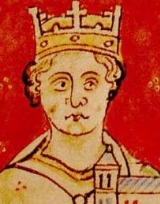
John of England

Encyclopedia
John also known as John Lackland (French: Sansterre), was King of England from 6 April 1199 until his death. During John's reign, England lost the duchy of Normandy
to King Philip II of France
, which resulted in the collapse of most of the Angevin Empire
and contributed to the subsequent growth in power of the Capetian dynasty
during the 13th century. The baronial revolt
at the end of John's reign led to the signing of the Magna Carta
, a document often considered to be an early step in the evolution of the constitution of the United Kingdom
.
John, the youngest of five sons of King Henry II of England
and Eleanor of Aquitaine
, was at first not expected to inherit significant lands. Following the failed rebellion of his elder brothers between 1173 and 1174, however, John became Henry's favourite child. He was appointed the Lord of Ireland in 1177 and given lands in England and on the continent. John's elder brothers William, Henry
and Geoffrey
died young; by the time Richard I
became king in 1189, John was a potential heir to the throne. John unsuccessfully attempted a rebellion against Richard's royal administrators whilst his brother was participating in the Third Crusade
. Despite this, after Richard died in 1199, John was proclaimed king of England, and came to an agreement with Philip II of France to recognise John's possession of the continental Angevin lands at the peace treaty of Le Goulet
in 1200.
When war with France broke out again in 1202, John achieved early victories, but shortages of military resources and his treatment of Norman
, Breton
and Anjou
nobles resulted in the collapse of his empire in northern France in 1204. John spent much of the next decade attempting to regain these lands, raising huge revenues, reforming his armed forces and rebuilding continental alliances. John's judicial reforms had a lasting, positive impact on the English common law system, as well as providing an additional source of revenue. An argument with Pope Innocent III
led to John's excommunication
in 1209, a dispute finally settled by the king in 1213. John's attempt to defeat Philip in 1214 failed due to the French victory over John's allies at the battle of Bouvines
. When he returned to England, John faced a rebellion by many of his barons, who were unhappy with his fiscal policies and his treatment of many of England's most powerful nobles. Although both John and the barons agreed to the Magna Carta peace treaty in 1215, neither side complied with its conditions. Civil war
broke out shortly afterwards, with the barons aided by Louis of France
. It soon descended into a stalemate. John died of dysentery
contracted whilst on campaign in eastern England during late 1216; supporters of his son Henry III
went on to achieve victory over Louis and the rebel barons the following year.
Contemporary chroniclers were mostly critical of John's performance as king, and his reign has since been the subject of significant debate and periodic revision by historians from the 16th century onwards. Historian Jim Bradbury
has summarised the contemporary historical opinion of John's positive qualities, observing that John is today usually considered a "hard-working administrator, an able man, an able general". Nonetheless, modern historians agree that he also had many faults as king, including what historian Ralph Turner describes as "distasteful, even dangerous personality traits", such as pettiness, spitefulness and cruelty. These negative qualities provided extensive material for fiction writers in the Victorian era
, and John remains a recurring character within Western popular culture, primarily as a villain in films and stories depicting the Robin Hood
legends.
and Eleanor of Aquitaine
on 24 December 1166. Henry had inherited significant territories along the Atlantic seaboard – Anjou
, Normandy
and England
– and expanded his empire by conquering Brittany
. Henry married the powerful Eleanor of Aquitaine, who reigned over the Duchy of Aquitaine and had a tenuous claim to Toulouse and Auvergne
in southern France, in addition to being the former wife of Louis VII of France
. The result was the Angevin Empire
, named after Henry's paternal title as Count of Anjou and, more specifically, its seat in Angers
. The Empire, however, was inherently fragile: although all the lands owed allegiance to Henry, the disparate parts each had their own histories, traditions and governance structures. As one moved south through Anjou and Aquitaine, the extent of Henry's power in the provinces diminished considerably, scarcely resembling the modern concept of an empire at all. Some of the traditional ties between parts of the empire such as Normandy and England were slowly dissolving over time. It was unclear what would happen to the empire on Henry's death. Although the tradition of primogeniture
, under which an eldest son would inherit all his father's lands, was slowly becoming more widespread across Europe, it was less popular amongst the Norman kings of England. Most believed that Henry would divide the empire, giving each son a substantial portion, hoping that his children would then continue to work together as allies after his death. To complicate matters, much of the Angevin empire was owned by Henry only as a vassal of the King of France of the rival line of the House of Capet
. Henry had often allied himself with the Holy Roman Emperor
against France, making the feudal relationship even more challenging.
Shortly after his birth, John was passed from Eleanor into the care of a wet nurse
, a traditional practice for medieval noble families. Eleanor then left for Poitiers
, the capital of Aquitaine, and sent John and his sister Joan
north to Fontevrault Abbey. This may have been done with the aim of steering her youngest son, with no obvious inheritance, towards a future ecclesiastical career. Eleanor spent the next few years conspiring against her husband Henry and neither parent played a part in John's very early life. John was probably, like his brothers, assigned a magister whilst he was at Fontevrault, a teacher charged with his early education and with managing the servants of his immediate household; John was later taught by Ranulph Glanville, a leading English administrator. John spent some time as a member of the household of his eldest living brother Henry the Young King
, where he probably received instruction in hunting and military skills.
John would grow up to be around 5 ft 5 in high (1.62 m), relatively short for royalty of the day, with a "powerful, barrel-chested body" and dark red hair; he appeared to contemporaries to look like an inhabitant of Poitou
. John enjoyed reading and, unusual for the period, built up a travelling library of books. He enjoyed gambling, in particular on backgammon
, and was an enthusiastic hunter, even by medieval standards. He liked music, although not songs. John would become a "connoisseur of jewels", building up a large collection, and became famous for his opulent clothes and also, according to French chroniclers, for his fondness for bad wine. As John grew up, he became known for sometimes being "genial, witty, generous and hospitable"; at other moments, he could be jealous, over-sensitive and prone to fits of rage, "biting and gnawing his fingers" in anger.
was to be appointed the Count of Poitou and would be given control of Aquitaine, whilst Geoffrey
was to become the Duke of Brittany. At this time it seemed unlikely that John would ever inherit substantial lands, and John was jokingly nicknamed "Lackland" by his father.
Henry II wanted to secure the southern borders of Aquitaine and decided to betroth his youngest son to Alais, the daughter and heiress of Humbert III of Savoy
. As part of this agreement John was promised the future inheritance of Savoy
, Piemonte
, Maurienne
, and the other possessions of Count Humbert. For his part in the potential marriage alliance, Henry II transferred the castles of Chinon, Loudun
and Mirebeau
into John's name; as John was only five years old his father would continue to control them for practical purposes. Henry the Young King was unimpressed by this; although he had yet to be granted control of any castles in his new kingdom, these were effectively his future property and had been given away without consultation. Alais made the trip over the Alps and joined Henry II's court, but she died before marrying John, which left the prince once again without an inheritance.
In 1173 John's elder brothers, backed by Eleanor, rose in revolt against Henry in the short-lived rebellion of 1173 to 1174. Growing irritated with his subordinate position to Henry II and increasingly worried that John might be given additional lands and castles at his expense, Henry the Young King travelled to Paris
and allied himself with Louis VII
. Eleanor, irritated by her husband's persistent interference in Aquitaine, encouraged Richard and Geoffrey to join their brother Henry in Paris. Henry II triumphed over the coalition of his sons, but was generous to them in the peace settlement agreed at Montlouis
. Henry the Young King was allowed to travel widely in Europe with his own household of knights, Richard was given Aquitaine back, and Geoffrey was allowed to return to Brittany; only Eleanor was imprisoned for her role in the revolt.
John had spent the conflict travelling alongside his father and was given widespread possessions across the Angevin empire as part of the Montlouis settlement; from then onwards, most observers regarded John as Henry II's favourite child, although he was the furthest removed in terms of the royal succession. Henry II began to find more lands for John, mostly at various nobles' expense. In 1175 he appropriated the estates of the late Earl of Cornwall
and gave them to John. The following year, Henry disinherited the sisters of Isabelle of Gloucester, contrary to legal custom, and betrothed John to the now extremely wealthy Isabelle. In 1177, at the Council of Oxford, Henry dismissed William FitzAldelm as the Lord of Ireland
and replaced him with the ten-year-old John.
Henry the Young King fought a short war with his brother Richard in 1183 over the status of England, Normandy and Aquitaine. Henry II moved in support of Richard, and Henry the Young King died from dysentery
at the end of the campaign. With his primary heir dead, Henry rearranged the plans for the succession: Richard was to be made King of England, albeit without any actual power until the death of his father; Geoffrey would retain Brittany; and John would now become the Duke of Aquitaine in place of Richard. Richard refused to give up Aquitaine; Henry II was furious and ordered John, with help from Geoffrey, to march south and retake the duchy by force. The two attacked the capital of Poitiers, and Richard responded by attacking Brittany. The war ended in stalemate and a tense family reconciliation in England at the end of 1184.
In 1185 John made his first visit to Ireland
, accompanied by three hundred knights and a team of administrators. Henry had tried to have John officially proclaimed King of Ireland, but Pope Lucius III would not agree. John's first period of rule in Ireland was not a success. Ireland had only recently been conquered by Anglo-Norman forces, and tensions were still rife between Henry II, the new settlers and the existing inhabitants. John infamously offended the local Irish rulers by making fun of their unfashionable long beards, failed to make allies amongst the Anglo-Norman settlers, began to lose ground militarily against the Irish and finally returned to England later in the year, blaming the viceroy, Hugh de Lacy
, for the fiasco.
The problems amongst John's wider family continued to grow. His elder brother Geoffrey died during a tournament in 1186, leaving a posthumous son, Arthur, and an elder daughter, Eleanor. The duchy of Brittany was given to Arthur rather than John, but Geoffrey's death brought John slightly closer to the throne of England. The uncertainty about what would happen after Henry's death continued to grow; Richard was keen to join a new crusade and remained concerned that whilst he was away Henry would appoint John his formal successor. Richard began discussions about a potential alliance with Philip II in Paris during 1187, and the next year Richard gave homage to Philip in exchange for support for a war against Henry. Richard and Philip fought a joint campaign against Henry, and by the summer of 1189 the king made peace, promising Richard the succession. John initially remained loyal to his father, but changed sides once it appeared that Richard would win. Henry died shortly afterwards.
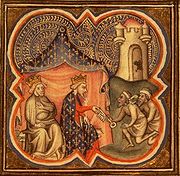 When John's elder brother Richard became king in September 1189, he had already declared his intention of joining the Third Crusade
. Richard set about raising the huge sums of money required for this expedition through the sale of lands, titles and appointments, and attempted to ensure that he would not face a revolt while away from his empire. John was made Count of Mortain, was married to the wealthy Isabel of Gloucester
, and was given valuable lands in Lancaster and the counties of Cornwall
, Derby
, Devon
, Dorset
, Nottingham
and Somerset
, all with the aim of buying his loyalty to Richard whilst the king was on crusade. Richard retained royal control of key castles in these counties, thereby preventing John from accumulating too much military and political power. In return, John promised not to visit England for the next three years, thereby in theory giving Richard adequate time to conduct a successful crusade and return from the Levant
without fear of John seizing power. Richard left political authority in England – the post of justiciar – jointly in the hands of Bishop Hugh de Puiset
and William Mandeville
, and made William Longchamp
, the Bishop of Ely
, his chancellor. Mandeville immediately died, and Longchamp took over as joint justiciar with Puiset, which would prove to be a less than satisfactory partnership. Eleanor, the queen mother, convinced Richard to allow John into England in his absence.
The political situation in England rapidly began to deteriorate. Longchamp refused to work with Puiset and became unpopular with the English nobility and clergy. John exploited this unpopularity to set himself up as an alternative ruler with his own royal court, complete with his own justiciar, chancellor and other royal posts, and was happy to be portrayed as an alternative regent, and possibly the next king. Armed conflict broke out between John and Longchamp, and by October 1191 Longchamp was isolated in the Tower of London
with John in control of the city of London, thanks to promises John had made to the citizens in return for recognition as Richard's heir presumptive. At this point Walter of Coutances, the Archbishop of Rouen
, returned to England, having been sent by Richard to restore order. John's position was undermined by Walter's relative popularity and by the news that Richard had married whilst in Cyprus, which presented the possibility that Richard would have legitimate children and heirs.
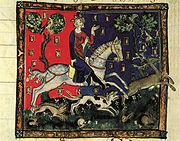 The political turmoil continued. John began to explore an alliance with the French king Philip II, freshly returned from the crusade. John hoped to acquire Normandy, Anjou and the other lands in France held by Richard in exchange for allying himself with Philip. John was persuaded not to pursue an alliance by his mother. Longchamp, who had left England after Walter's intervention, now returned, and argued that he had been wrongly removed as justiciar. John intervened, suppressing Longchamp's claims in return for promises of support from the royal administration, including a reaffirmation of his position as heir to the throne. When Richard still did not return from the crusade, John began to assert that his brother was dead or otherwise permanently lost. Richard had in fact been captured en route to England by the Duke of Austria
and was handed over to Emperor Henry VI
, who held him for ransom. John seized the opportunity and went to Paris, where he formed an alliance with Philip. He agreed to set aside his wife, Isabella of Gloucester, and marry Philip's sister, Alys
, in exchange for Philip's support. Fighting broke out in England between forces loyal to Richard and those being gathered by John. John's military position was weak and he agreed to a truce; in early 1194 the king finally returned to England, and John's remaining forces surrendered. John retreated to Normandy, where Richard finally found him later that year. Richard declared that his younger brother – despite being 27 years old – was merely "a child who has had evil counsellors" and forgave him, but removed his lands with the exception of Ireland.
For the remaining years of Richard's reign, John supported his brother on the continent, apparently loyally. Richard's policy on the continent was to attempt to regain the castles he had lost to Philip II whilst on crusade through steady, limited campaigns. He allied himself with the leaders of Flanders
, Boulogne and the Holy Roman Empire
to apply pressure on Philip from Germany. In 1195 John successfully conducted a sudden attack and siege of Évreux
castle, and subsequently managed the defences of Normandy against Philip. The following year, John seized the town of Gamaches
and led a raiding party within 50 miles (80.5 km) of Paris, capturing the Bishop of Beauvais
. In return for this service, Richard withdrew his malevontia (ill-will) towards John, restored him to the county of Gloucestershire and made him again the Count of Mortain.
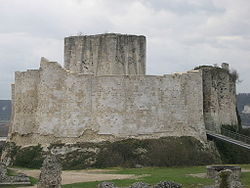 After Richard's death on 6 April 1199 there were two potential claimants to the Angevin throne: John, whose claim rested on being the sole surviving son of Henry II
, and young Arthur of Brittany
, who held a claim as the son of Geoffrey
, John's elder brother. Richard appears to have started to recognise John as his legitimate heir in the final years before his death, but the matter was not clear-cut and medieval law gave little guidance as to how the competing claims should be decided. With Norman law favouring John as the only surviving son of Henry II and Angevin law favouring Arthur as the heir of Henry's elder son, the matter rapidly became an open conflict. John was supported by the bulk of the English and Norman nobility and was crowned at Westminster, backed by his mother, Eleanor. Arthur was supported by the majority of the Breton, Maine and Anjou nobles and received the support of Philip II
, who remained committed to breaking up the Angevin territories on the continent. With Arthur's army pressing up the Loire valley
towards Angers
and Philip's forces moving down the valley towards Tours
, John's continental empire was in danger of being cut in two.
Warfare in Normandy at the time was shaped by the defensive potential of castles and the increasing costs of conducting campaigns. The Norman frontiers had limited natural defences but were heavily reinforced with castles, such as Château Gaillard, at strategic points, built and maintained at considerable expense. It was difficult for a commander to advance far into fresh territory without having secured his lines of communication by capturing these fortifications, which slowed the progress of any attack. Armies of the period could be formed from either feudal or mercenary forces. Feudal levies could only be raised for a fixed length of time before they returned home, forcing an end to a campaign; mercenary forces, often called Brabançon
s after the Duchy of Brabant
but actually recruited from across northern Europe, could operate all year long and provide a commander with more strategic options to pursue a campaign, but cost much more than equivalent feudal forces. As a result commanders of the period were increasingly drawing on larger numbers of mercenaries.
After his coronation, John moved south into France with military forces and adopted a defensive posture along the eastern and southern Normandy borders. Both sides paused for desultory negotiations before the war recommenced; John's position was now stronger, thanks to confirmation that Count Baldwin
of Flanders
and Renaud of Boulogne had renewed the anti-French alliances they had previously agreed to with Richard. The powerful Anjou nobleman William de Roches
was persuaded to switch sides from Arthur to John; suddenly the balance seemed to be tipping away from Philip and Arthur in favour of John. Neither side was keen to continue the conflict, and following a papal truce the two leaders met in January 1200 to negotiate possible terms for peace. From John's perspective, what then followed represented an opportunity to stabilise control over his continental possessions and produce a lasting peace with Philip in Paris. John and Philip negotiated the May 1200 Treaty of Le Goulet
; by this treaty, Philip recognised John as the rightful heir to Richard in respect to his French possessions, temporarily abandoning the wider claims of his client, Arthur. John, in turn, abandoned Richard's former policy of containing Philip through alliances with Flanders and Boulogne, and accepted Philip's right as the legitimate feudal overlord of John's lands in France. John's policy earned him the disrespectful title of "John Softsword" from some English chroniclers, who contrasted his behaviour with his more aggressive brother, Richard.
. In order to remarry, John first needed to abandon Isabel, Countess of Gloucester, his first wife; John accomplished this by arguing that he had failed to get the necessary papal permission
to marry Isabel in the first place – as a cousin, John could not have legally wed her without this. It remains unclear why John chose to marry Isabella of Angoulême. Contemporary chroniclers argued that John had fallen deeply in love with Isabella, and John may have been motivated by desire for an apparently beautiful, if rather young, girl. On the other hand, the Angoumois lands that came with Isabella were strategically vital to John: by marrying Isabella, John was acquiring a key land route between Poitou and Gascony, which significantly strengthened his grip on Aquitaine.
Unfortunately, Isabella was already engaged to Hugh de Lusignan
, an important member of a key Poitou noble family and brother of Raoul de Lusignan
, the Count of Eu, who possessed lands along the sensitive eastern Normandy border. Just as John stood to benefit strategically from marrying Isabella, so the marriage threatened the interests of the Lusignans, whose own lands currently provided the key route for royal goods and troops across Aquitaine. Rather than negotiating some form of compensation, John treated Hugh "with contempt"; this resulted in a Lusignan uprising that was promptly crushed by John, who also intervened to suppress Raoul in Normandy.
Although John was the Count of Poitou and therefore the rightful feudal lord over the Lusignans, they could legitimately appeal John's actions in France to his own feudal lord, Philip. Hugh did exactly this in 1201 and Philip summoned John to attend court in Paris in 1202, citing the Le Goulet treaty to strengthen his case. John was unwilling to weaken his authority in western France in this way. He argued that he need not attend Philip's court because of his special status as the Duke of Normandy, who was exempt by feudal tradition from being called to the French court. Philip argued that he was summoning John not as the Duke of Normandy, but as the Count of Poitou, which carried no such special status. When John still refused to come, Philip declared John in breach of his feudal responsibilities, reassigned all of John's lands that fell under the French crown to Arthur – with the exception of Normandy, which he took back for himself – and began a fresh war against John.
in Anjou, he swung his mercenary army rapidly south to protect her. His forces caught Arthur by surprise and captured the entire rebel leadership at the battle of Mirebeau
. With his southern flank weakening, Philip was forced to withdraw in the east and turn south himself to contain John's army.
John's position in France was considerably strengthened by the victory at Mirebeau, but John's treatment of his new prisoners and of his ally, William de Roches, quickly undermined these gains. De Roches was a powerful Anjou noble, but John largely ignored him, causing considerable offence, whilst the king kept the rebel leaders in such bad conditions that twenty-two of them died. At this time most of the regional nobility were closely linked through kinship, and this behaviour towards their relatives was regarded as unacceptable. William de Roches and other of John's regional allies in Anjou and Brittany deserted him in favour of Philip, and Brittany rose in fresh revolt. John's financial situation was tenuous: once factors such as the comparative military costs of materiel and soldiers were taken into account, Philip enjoyed a considerable, although not overwhelming, advantage of resources over John.
Further desertions of John's local allies at the beginning of 1203 steadily reduced John's freedom to manoeuvre in the region. He attempted to convince Pope Innocent III to intervene in the conflict, but Innocent's efforts were unsuccessful. As the situation became worse for John, he appears to have decided to have Arthur killed, with the aim of removing his potential rival and of undermining the rebel movement in Brittany. Arthur had initially been imprisoned at Falaise and was then moved to Rouen. After this, Arthur's fate remains uncertain, but modern historians believe he was murdered by John. The annals of Margam Abbey
suggest that "John had captured Arthur and kept him alive in prison for some time in the castle of Rouen... when John was drunk he slew Arthur with his own hand and tying a heavy stone to the body cast it into the Seine
." Rumours of the manner of Arthur's death further reduced support for John across the region. Arthur's sister, Eleanor
, who had also been captured at Mirebeau, was kept imprisoned by John for many years, albeit in relatively good conditions.
In late 1203, John attempted to relieve Château Gaillard, which although besieged by Philip
was guarding the eastern flank of Normandy. John attempted a synchronised operation involving land-based and water-borne forces, considered by most historians today to have been imaginative in conception, but overly complex for forces of the period to have carried out successfully. John's relief operation was blocked by Philip's forces, and John turned back to Brittany in an attempt to draw Philip away from eastern Normandy. John successfully devastated much of Brittany, but did not deflect Philip's main thrust into the east of Normandy. Opinions vary amongst historians as to the military skill shown by John during this campaign, with most recent historians arguing that his performance was passable, although not impressive.
John's situation began to deteriorate rapidly. The eastern border region of Normandy had been extensively cultivated by Philip and his predecessors for several years, whilst Angevin authority in the south had been undermined by Richard's giving away of various key castles some years before. His use of routier mercenaries in the central regions had rapidly eaten away his remaining support in this area too, which set the stage for a sudden collapse of Angevin power. John retreated back across the Channel in December, sending orders for the establishment of a fresh defensive line to the west of Chateau Gaillard. In March 1204, Gaillard fell. John's mother Eleanor died the following month. This was not just a personal blow for John, but threatened to unravel the widespread Angevin alliances across the far south of France. Philip moved south around the new defensive line and struck upwards at the heart of the Duchy, now facing little resistance. By August, Philip had taken Normandy and advanced south to occupy Anjou and Poitou as well. John's only remaining possession on the Continent was now the Duchy of Aquitaine.
"; John continued this trend and claimed an "almost imperial status" for himself as ruler. During the 12th century, there were contrary opinions expressed about the nature of kingship, and many contemporary writers believed that monarchs should rule in accordance with the custom and the law, and take council with the leading members of the realm. There was as yet no model for what should happen if a king refused to do so. Despite his claim to unique authority within England, John would sometimes justify his actions on the basis that he had taken council with the barons. Modern historians remain divided as to whether John suffered from a case of "royal schizophrenia" in his approach to government, or if his actions merely reflected the complex model of Angevin kingship in the early 13th century.
John inherited a sophisticated system of administration in England, with a range of royal agents answering to the Royal Household: the Chancery kept written records and communications; the Treasury and the Exchequer
dealt with income and expenditure respectively; and various judges were deployed to deliver justice around the kingdom. Thanks to the efforts of men like Hubert Walter
, this trend towards improved record keeping continued into his reign. Like previous kings, John managed a peripatetic court that travelled around the kingdom, dealing with both local and national matters as he went. John was very active in the administration of England and was involved in every aspect of government. In part he was following in the tradition of Henry I
and Henry II, but by the 13th century the volume of administrative work had greatly increased, which put much more pressure on a king who wished to rule in this style. John was in England for much longer periods than his predecessors, which made his rule more personal than that of previous kings, particularly in previously ignored areas such as the north.
The administration of justice was of particular importance to John. Several new processes had been introduced to English law under Henry II, including novel disseisin
and mort d'ancestor
. These processes meant the royal courts had a more significant role in local law cases, which had previously been dealt with only by regional or local lords. John increased the professionalism of local sergeants and bailiffs, and extended the system of coroners first introduced by Hubert Walter in 1194, creating a new class of borough coroners. John worked extremely hard to ensure that this system operated well, through judges he had appointed, by fostering legal specialists and expertise, and by intervening in cases himself. John continued to try relatively minor cases, even during military crises. Viewed positively, Lewis Warren considers that John discharged "his royal duty of providing justice ... with a zeal and a tirelessness to which the English common law is greatly endebted". Seen more critically, John may have been motivated by the potential of the royal legal process to raise fees, rather than a desire to deliver simple justice; John's legal system also only applied to free men, rather than to all of the population. Nonetheless, these changes were popular with many free tenants, who acquired a more reliable legal system that could bypass the barons, against whom such cases were often brought. John's reforms were less popular with the barons themselves, especially as they remained subject to arbitrary and frequently vindictive royal justice.
; money raised through their rights as a feudal lord; and revenue from taxation. Revenue from the royal demesne was inflexible and had been diminishing slowly since the Norman conquest
. Matters were not helped by Richard's sale of many royal properties in 1189, and taxation played a much smaller role in royal income than in later centuries. English kings had widespread feudal rights which could be used to generate income, including the scutage
system, in which feudal military service was avoided by a cash payment to the king. He derived income from fines, court fees and the sale of charter
s and other privileges. John intensified his efforts to maximise all possible sources of income, to the extent that he has been described as "avaricious, miserly, extortionate and moneyminded". John also used revenue generation as a way of exerting political control over the barons: debts owed to the crown by the king's favoured supporters might be forgiven; collection of those owed by enemies was more stringently enforced.
The result was a sequence of innovative but unpopular financial measures. John levied scutage payments eleven times in his seventeen years as king, as compared to eleven times in total during the reign of the preceding three monarchs. In many cases these were levied in the absence of any actual military campaign, which ran counter to the original idea that scutage was an alternative to actual military service. John maximised his right to demand relief payments when estates and castles were inherited, sometimes charging enormous sums, beyond barons' abilities to pay. Building on the successful sale of sheriff appointments in 1194, John initiated a new round of appointments, with the new incumbents making back their investment through increased fines and penalties, particularly in the forests. Another innovation of Richard's, increased charges levied on widows who wished to remain single, was expanded under John. John continued to sell charters for new towns, including the planned town of Liverpool
, and charters were sold for markets across the kingdom and in Gascony
. The king introduced new taxes and extended existing ones. The Jews, who held a vulnerable position in medieval England, protected only by the king, were subject to huge taxes; £44,000 was extracted from the community by the tallage
of 1210; much of it was passed on to the Christian debtors of Jewish moneylenders.Early medieval financial figures have no easy contemporary equivalent, due to the different role of money in the economy. John created a new tax on income and movable goods in 1207 – effectively a version of a modern income tax – that produced £60,000; he created a new set of import and export duties payable directly to the crown. John found that these measures enabled to him to raise further resources through the confiscation of the lands of barons who could not pay or refused to pay.
At the start of John's reign there was a sudden change in prices, as bad harvests and high demand for food resulted in much higher prices for grain and animals. This inflationary pressure was to continue for the rest of the 13th century and had long-term economic consequences for England. The resulting social pressures were complicated by bursts of deflation that resulted from John's military campaigns. It was usual at the time for the king to collect taxes in silver, which was then re-minted into new coins; these coins would then be put in barrels and sent to royal castles around the country, to be used to hire mercenaries or to meet other costs. At those times when John was preparing for campaigns in Normandy, for example, huge quantities of silver had to be withdrawn from the economy and stored for months, which unintentionally resulted in periods during which silver coins were simply hard to come by, commercial credit difficult to acquire and deflationary pressure placed on the economy. The result was political unrest across the country. John attempted to address some of the problems with the English currency in 1204 and 1205 by carrying out a radical overhaul of the coinage, improving its quality and consistency.
.jpg) John's royal household was based around several groups of followers. One group was the familiares regis, John's immediate friends and knights who travelled around the country with him. They also played an important role in organising and leading military campaigns. Another section of royal followers were the curia regis
John's royal household was based around several groups of followers. One group was the familiares regis, John's immediate friends and knights who travelled around the country with him. They also played an important role in organising and leading military campaigns. Another section of royal followers were the curia regis
; these curiales were the senior officials and agents of the king and were essential to his day-to-day rule. Being a member of these inner circles brought huge advantages, as it was easier to gain favours from the king, file lawsuits, marry a wealthy heiress or have one's debts remitted. By the time of Henry II, these posts were increasingly being filled by "new men" from outside the normal ranks of the barons. This intensified under John's rule, with many lesser nobles arriving from the continent to take up positions at court; many were mercenary leaders from Poitou. These men included soldiers who would become infamous in England for their uncivilised behaviour, including Falkes de Breauté
, Geard d'Athies, Engelard de Cigongé and Philip Marc
. Many barons perceived the king's household as what Ralph Turner has characterised as a "narrow clique enjoying royal favour at barons' expense" staffed by men of lesser status.
This trend for the king to rely on his own men at the expense of the barons was exacerbated by the tradition of Angevin royal ira et malevolentia – "anger and ill-will" – and John's own personality. From Henry II onwards, ira et malevolentia had come to describe the right of the king to express his anger and displeasure at particular barons or clergy, building on the Norman concept of malevoncia – royal ill-will. In the Norman period, suffering the king's ill-will meant difficulties in obtaining grants, honours or petitions; Henry II had infamously expressed his fury and ill-will towards Thomas Becket
; this ultimately resulted in Becket's death. John now had the additional ability to "cripple his vassals" on a significant scale using his new economic and judicial measures, which made the threat of royal anger all the more serious.
John was deeply suspicious of the barons, particularly those with sufficient power and wealth to potentially challenge the king. Numerous barons were subjected to John's malevolentia, even including William Marshal
, a famous knight and baron normally held up as a model of utter loyalty. The most infamous case, which went beyond anything considered acceptable at the time, proved to be that of William de Braose
, a powerful marcher lord
with lands in Ireland. De Braose was subjected to punitive demands for money, and when he refused to pay a huge sum of 40,000 mark
s (equivalent to £26,666 at the time),Both the mark and the pound sterling were accountancy terms in this period; a mark was worth around two-thirds of a pound. his wife and one of his sons were imprisoned by John, which resulted in their death. De Braose died in exile in 1211, and his grandsons remained in prison until 1218. John's suspicions and jealousies meant that he rarely enjoyed good relationships with even the leading loyalist barons.
. It was common for kings and nobles of the period to keep mistresses, but chroniclers complained that John's mistresses were married noblewomen, which was considered unacceptable. John had at least five children with mistresses during his first marriage to Isabelle of Gloucester, and two of those mistresses are known to have been noblewomen. John's behaviour after his second marriage to Isabella is less clear, however. None of John's known illegitimate children were born after he remarried, and there is no actual documentary proof of adultery after that point, although John certainly had female friends amongst the court throughout the period. The specific accusations made against John during the baronial revolts are now generally considered to have been invented for the purposes of justifying the revolt; nonetheless, most of John's contemporaries seem to have held a poor opinion of his sexual behaviour.
The character of John's relationship with his second wife, Isabella of Angoulême, is unclear. John married Isabella whilst she was relatively young – her exact date of birth is uncertain, and estimates place her between at most 15 and more probably towards nine years old at the time of her marriage. Even by the standards of the time, Isabella was married whilst very young. John did not provide a great deal of money for his wife's household and did not pass on much of the revenue from her lands, to the extent that historian Nicholas Vincent has described him as being "downright mean" towards Isabella. Vincent concluded that the marriage was not a particularly "amicable" one. Other aspects of their marriage suggest a closer, more positive relationship. Chroniclers recorded that John had a "mad infatuation" with Isabella, and certainly John had conjugal relationships with Isabella between at least 1207 and 1215; they had five children. In contrast to Vincent, historian William Chester Jordan concludes that the pair were a "companionable couple" who had a successful marriage by the standards of the day.
John's lack of religious conviction has been noted by contemporary chroniclers and later historians, with some suspecting that John was at best impious, or even atheistic
, a very serious issue at the time. Contemporary chroniclers catalogued his various anti-religious habits at length, including his failure to take communion, his blasphemous remarks, and his witty but scandalous jokes about church doctrine, including jokes about the implausibility of the Resurrection
. They commented on the paucity of John's charitable donations to the church. Historian Frank McLynn
argues that John's early years at Fontevrault, combined with his relatively advanced education, may have turned him against the church. Other historians have been more cautious in interpreting this material, noting that chroniclers also reported John's personal interest in the life of St Wulfstan of Worcester and his friendships with several senior clerics, most especially with Hugh of Lincoln
, who was later declared a saint. Financial records show a normal royal household engaged in the usual feasts and pious observances – albeit with many records showing John's offerings to the poor to atone for routinely breaking church rules and guidance.
to threaten Paris, pin down the French forces and break Philip's internal lines of communication before landing a maritime force in the Duchy itself. Ideally, this plan would benefit from the opening of a second front on Philip's eastern frontiers with Flanders and Boulogne – effectively a re-creation of Richard's old strategy of applying pressure from Germany. All of this would require a great deal of money and soldiers.
John spent much of 1205 securing England against a potential French invasion. As an emergency measure, John recreated a version of Henry II's Assize of Arms
, with each shire
creating a structure to mobilise local levies. When the threat of invasion faded, John formed a large military force in England intended for Poitou, and a large fleet with soldiers under his own command intended for Normandy. To achieve this, John reformed the English feudal contribution to his campaigns, creating a more flexible system under which only one knight in ten would actually be mobilised, but would be financially supported by the other nine; knights would serve for an indefinite period. John built up a strong team of engineers for siege warfare and a substantial force of professional crossbowmen. The king was supported by a team of leading barons with military expertise, including William Longespée, William the Marshal
, Roger de Lacy and, until he fell from favour, the marcher lord William de Braose
.
John had already begun to improve his Channel
forces before the loss of Normandy and he rapidly built up further maritime capabilities after its collapse. Most of these ships were placed along the Cinque Ports
, but Portsmouth was also enlarged. By the end of 1204 he had around 50 large galleys available; another 54 vessels were built between 1209 and 1212. William of Wrotham
was appointed "keeper of the galleys", effectively John's chief admiral. Wortham was responsible for fusing John's galleys, the ships of the Cinque Ports and pressed merchant vessels into a single operational fleet. John adopted recent improvements in ship design, including new large transport ships called buisses and removable forecastle
s for use in combat.
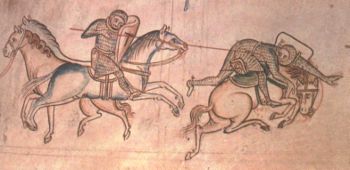 Baronial unrest in England prevented the departure of the planned 1205 expedition, and only a smaller force under William Longespée deployed to Poitou. In 1206 John departed for Poitou himself, but was forced to divert south to counter a threat to Gascony
from Alfonso VIII of Castile
. After a successful campaign against Alfonso, John headed north again, taking the city of Angers
. Philip moved south to meet John; the year's campaigning ended in stalemate and a two-year truce was made between the two rulers.
During the truce of 1206–1208, John focused on building up his financial and military resources in preparation for another attempt to recapture Normandy. John used some of this money to pay for new alliances on Philip's eastern frontiers, where the growth in Capetian power was beginning to concern France's neighbours. By 1212 John had successfully concluded alliances with Renault of Dammartin, who controlled Boulogne, and Count Ferdinand of Flanders
, as well as Otto IV
, a contender for the crown of Holy Roman Emperor
in Germany; Otto was also John's nephew. The invasion plans for 1212 were postponed because of fresh English baronial unrest about service in Poitou. Philip seized the initiative in 1213, sending his son, Prince Louis
, to invade Flanders with the intention of next launching an invasion of England. John was forced to postpone his own invasion plans to counter this threat. He launched his new fleet to attack the French at the harbour of Damme
. The attack was a success, destroying Philip's vessels and any chances of an invasion of England that year. John hoped to exploit this advantage by invading himself late in 1213, but baronial discontent again delayed his invasion plans until early 1214, in what would prove to be his final Continental campaign.
in 1174. This had been rescinded by Richard I in exchange for financial compensation in 1189, but the relationship remained uneasy. John began his reign by reasserting his sovereignty over the disputed northern counties. He refused William's request for the earldom of Northumbria
, but did not intervene in Scotland itself and focused on his continental problems. The two kings maintained a friendly relationship, meeting in 1206 and 1207, until it was rumoured in 1209 that William was intending to ally himself with Philip II of France. John invaded Scotland and forced William to sign the Treaty of Norham, which gave John control of William's daughters and required a payment of £10,000. This effectively crippled William's power north of the border, and by 1212 John had to intervene militarily to support the Scottish king against his internal rivals. John made no efforts to reinvigorate the Treaty of Falaise, though, and both William and Alexander remained independent kings, supported by, but not owing fealty to, John.
John remained Lord of Ireland throughout his reign. He drew on the country for resources to fight his war with Philip on the continent. Conflict continued in Ireland between the Anglo-Norman settlers and the indigenous Irish chieftains, with John manipulating both groups to expand his wealth and power in the country. During Richard's rule, John had successfully increased the size of his lands in Ireland, and he continued this policy as king. In 1210 the king crossed into Ireland with a large army to crush a rebellion by the Anglo-Norman lords; he reasserted his control of the country and used a new charter to order compliance with English laws and customs in Ireland. John stopped short of actively applying this charter to the native Irish kingdoms, but historian David Carpenter suspects that he might have done so, had the baronial conflict in England not intervened. Simmering tensions remained with the native Irish leaders even after John left for England.
Royal power in Wales was unevenly applied, with the country divided between the marcher lords
along the borders, royal territories in Pembrokeshire
and the more independent native Welsh lords of North Wales. John took a close interest in Wales and knew the country well, visiting every year between 1204 and 1211 and marrying his illegitimate daughter, Joan
, to the Welsh prince Llywelyn the Great
. The king used the marcher lords and the native Welsh to increase his own territory and power, striking a sequence of increasingly precise deals backed by royal military power with the Welsh rulers. A major royal expedition to enforce these agreements occurred in 1211, after Llywelyn attempted to exploit the instability caused by the removal of William de Braose, through the Welsh uprising of 1211
. John's invasion, striking into the Welsh heartlands, was a military success. Llywelyn came to terms that included an expansion of John's power across much of Wales, albeit only temporarily.
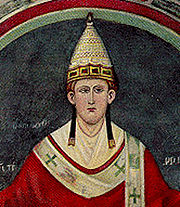 When the Archbishop of Canterbury
, Hubert Walter
, died on 13 July 1205, John became involved in a dispute with Pope Innocent III
that would lead to the king's excommunication
. The Norman and Angevin kings had traditionally exercised a great deal of power over the church within their territories. From the 1040s onwards, however, successive popes had put forward a reforming message that emphasised the importance of the church being "governed more coherently and more hierarchically from the centre" and established "its own sphere of authority and jurisdiction, separate from and independent of that of the lay ruler", in the words of historian Richard Huscroft. After the 1140s, these principles had been largely accepted within the English church, albeit with an element of concern about centralising authority in Rome. These changes
brought the customary rights of lay rulers such as John over ecclesiastical appointments into question. Pope Innocent was, according to historian Ralph Turner, an "ambitious and aggressive" religious leader, insistent on his rights and responsibilities within the church.
John wanted John de Gray
, the Bishop of Norwich
and one of his own supporters, to be appointed Archbishop of Canterbury after the death of Walter, but the cathedral chapter
for Canterbury Cathedral
claimed the exclusive right to elect Walter's successor. They favoured Reginald
, the chapter's sub-prior
. To complicate matters, the bishops of the province of Canterbury
also claimed the right to appoint the next Archbishop. The chapter secretly elected Reginald and he travelled to Rome to be confirmed; the bishops challenged the appointment and the matter was taken before Innocent. John forced the Canterbury chapter to change their support to John de Gray, and a messenger was sent to Rome to inform the papacy of the new decision. Innocent disavowed both Reginald and John de Gray, and instead appointed his own candidate, Stephen Langton
. John refused Innocent's request that he consent to Langton's appointment, but the pope consecrated Langton anyway in June 1207.
John was incensed about what he perceived as an abrogation of his customary right as monarch to influence the election. He complained both about the choice of Langton as an individual, as John felt he was overly influenced by the Capetian court in Paris, and about the process as a whole. He barred Langton from entering England and seized the lands of the archbishopric and other papal possessions. Innocent set a commission in place to try to convince John to change his mind, but to no avail. Innocent then placed an interdict
on England in March 1208, prohibiting clergy from conducting religious services, with the exception of baptisms for the young, and confessions and absolutions for the dying.
 John treated the interdict as "the equivalent of a papal declaration of war". He responded by attempting to punish Innocent personally and to drive a wedge between those English clergy that might support him and those allying themselves firmly with the authorities in Rome. John seized the lands of those clergy unwilling to conduct services, as well as those estates linked to Innocent himself; he arrested the illicit concubines that many clerics kept during the period, only releasing them after the payment of fines; he seized the lands of members of the church who had fled England, and he promised protection for those clergy willing to remain loyal to him. In many cases, individual institutions were able to negotiate terms for managing their own properties and keeping the produce of their estates. By 1209 the situation showed no signs of resolution, and Innocent threatened to excommunicate
John if he did not acquiesce to Langton's appointment. When this threat failed, Innocent excommunicated the king in November 1209. Although theoretically a significant blow to John's legitimacy, this did not appear to greatly worry the king. Two of John’s close allies, Emperor Otto
and Count Raymond VI of Toulouse, had already suffered the same punishment themselves, and the significance of excommunication had been somewhat devalued. John simply tightened his existing measures and accrued significant sums from the income of vacant sees and abbeys: one 1213 estimate, for example, suggested the church had lost an estimated 100,000 marks (equivalent to £66,666 at the time) to John. Official figures suggest that around 14% of annual income from the English church was being appropriated by John each year.
Innocent gave some dispensations as the crisis progressed. Monastic communities were allowed to celebrate mass in private from 1209 onwards, and late in 1212 the viaticum
for the dying was authorised. The rules on burials and lay access to churches appear to have been steadily circumvented, at least unofficially. Although the interdict was a burden to much of the population, it did not result in rebellion against John. By 1213, though, John was increasingly worried about the threat of French invasion. Some contemporary chroniclers suggested that in January Philip II of France had been charged with deposing John on behalf of the papacy, although it appears that Innocent merely prepared secret letters in case Innocent needed to claim the credit if Philip did successfully invade England.
John finally negotiated terms for a reconciliation, and the papal terms for submission were accepted in the presence of the papal legate
Pandulph
in May 1213 at the Templar Church at Dover
. As part of the deal, John offered to surrender the Kingdom of England to the papacy for a feudal service of 1,000 marks
(equivalent to £666 at the time) annually: 700 marks (£466) for England and 300 marks (£200) for Ireland, as well as recompensing the church for revenue lost during the crisis. The agreement was formalised in the Bulla Aurea, or Golden Bull
. This resolution produced mixed responses. Although some chroniclers felt that John had been humiliated by the sequence of events, there was little public reaction. Innocent benefited from the resolution of his long-standing English problem, but John probably gained more, as Innocent became a firm supporter of John for the rest of his reign, backing him in both domestic and continental policy issues. Innocent immediately turned against Philip, calling upon him to reject plans to invade England and to sue for peace. John paid some of the compensation money he had promised the church, but he ceased making payments in late 1214, leaving two-thirds of the sum unpaid; Innocent appears to have conveniently forgotten this debt for the good of the wider relationship.
as justiciar
was an important factor, as he was considered an "abrasive foreigner" by many of the barons. The failure of John's French military campaign in 1214 was probably the final straw that precipitated the baronial uprising during John's final years as king; James Holt describes the path to civil war as "direct, short and unavoidable" following the defeat at Bouvines.
The first part of the campaign went well, with John out-manoeuvring the forces under the command of Prince Louis
and retaking the county of Anjou by the end of June. John besieged the castle of Roche-au-Moine
, a key stronghold, forcing Louis to give battle against John's larger army. The local Angevin nobles refused to advance with the king; left at something of a disadvantage, John retreated back to La Rochelle
. Shortly afterwards, Philip won the hard-fought battle of Bouvines
in the east against Otto and John's other allies, bringing an end to John's hopes of retaking Normandy. A peace agreement was signed in which John returned Anjou to Philip and paid the French king compensation; the truce was intended to last for six years. John arrived back in England in October.
 Within a few months of John's return, rebel barons in the north and east of England were organising resistance to his rule. John held a council in London in January 1215 to discuss potential reforms and sponsored discussions in Oxford between his agents and the rebels during the spring. John appears to have been playing for time until Pope Innocent III could send letters giving him explicit papal support. This was particularly important for John, as a way of pressuring the barons but also as a way of controlling Stephen Langton, the Archbishop of Canterbury. In the meantime, John began to recruit fresh mercenary forces from Poitou, although some were later sent back to avoid giving the impression that the king was escalating the conflict. John announced his intent to become a crusader
, a move which gave him additional political protection under church law.
Letters of support from the pope arrived in April but by then the rebel barons had organised. They congregated at Northampton
in May and renounced their feudal ties to John, appointing Robert fitz Walter as their military leader. This self-proclaimed "Army of God" marched on London
, taking the capital as well as Lincoln
and Exeter
. John's efforts to appear moderate and conciliatory had been largely successful, but once the rebels held London they attracted a fresh wave of defectors from John's royalist faction. John instructed Langton to organise peace talks with the rebel barons.
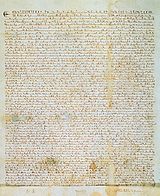
John met the rebel leaders at Runnymede
, near Windsor Castle
, on 15 June 1215. Langton's efforts at mediation created a charter capturing the proposed peace agreement; it was later renamed Magna Carta
, or "Great Charter". The charter went beyond simply addressing specific baronial complaints, and formed a wider proposal for political reform, albeit one focusing on the rights of free men, not serfs and unfree labour. It promised the protection of church rights, protection from illegal imprisonment, access to swift justice, new taxation only with baronial consent and limitations on scutage
and other feudal payments. A council of twenty-five neutral barons would be created to monitor and ensure John's future adherence to the charter, whilst the rebel army would stand down and London would be surrendered to the king.
Neither John nor the rebel barons seriously attempted to implement the peace accord. The rebel barons suspected that the proposed baronial council would be unacceptable to John and that he would challenge the legality of the charter; they packed the baronial council with their own hardliners and refused to demobilise their forces or surrender London as agreed. Despite his promises to the contrary, John appealed to Innocent for help, observing that the charter compromised the pope's rights under the 1203 agreement that had appointed him John's feudal lord. Innocent obliged; he declared the charter "not only shameful and demeaning, but illegal and unjust" and excommunicated the rebel barons. The failure of the agreement led rapidly to the First Barons' War
.
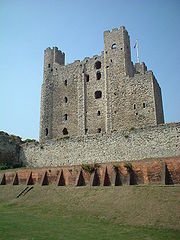
, owned by Langton but left almost unguarded by the archbishop. John was well prepared for a conflict. He had stockpiled money to pay for mercenaries and ensured the support of the powerful marcher lords
with their own feudal forces, such as William Marshal and Ranulf of Chester. The rebels lacked the engineering expertise or heavy equipment necessary to assault the network of royal castles that cut off the northern rebel barons from those in the south. John's strategy was to isolate the rebel barons in London, protect his own supply lines to his key source of mercenaries in Flanders, prevent the French from landing in the south-east, and then win the war through slow attrition. John put off dealing with the badly deteriorating situation in North Wales, where Llywelyn the Great was leading a rebellion against the 1211 settlement.
John's campaign started well. In November John retook Rochester Castle in a sophisticated assault. One chronicler had not seen "a siege so hard pressed or so strongly resisted", whilst historian Reginald Brown describes it as "one of the greatest [siege] operations in England up to that time". Having regained the south-east John split his forces, sending William Longespée to retake the north of side of London and East Anglia, whilst John himself headed north via Nottingham
to attack the estates of the northern barons. Both operations were successful and the majority of the remaining rebels were pinned down in London. In January 1216 John marched against Alexander II of Scotland
, who had allied himself with the rebel cause. John took back Alexander's possessions in northern England in a rapid campaign and pushed up towards Edinburgh
over a ten-day period.
The rebel barons responded by inviting Prince Louis of France to lead them: Louis had a claim to the English throne by virtue of his marriage to Blanche of Castile
, the granddaughter of Henry II. Philip may have provided him with private support but refused to openly support Louis, who was excommunicated by Innocent for taking part in the war against John. Louis's planned arrival in England presented a significant problem for John, as the prince would bring with him naval vessels and siege engines essential to the rebel cause. Once John contained Alexander in Scotland, he marched south to deal with the challenge of the coming invasion.
Prince Louis intended to land in the south of England in May 1216, and John assembled a naval force to intercept him. Unfortunately for John, his fleet was dispersed by bad storms and Louis landed unopposed in Kent
. John hesitated and decided not to attack Louis immediately, either due to the risks of open battle or over concerns about the loyalty of his own men. Louis and the rebel barons advanced west and John retreated, spending the summer reorganising his defences across the rest of the kingdom. John saw several of his military household desert to the rebels, including his half-brother, William Longespée. By the end of the summer the rebels had regained the south-east of England and parts of the north.
 In September 1216 John began a fresh, vigorous attack. He marched from the Cotswolds
, feigned an offensive to relieve the besieged Windsor Castle
, and attacked eastwards around London to Cambridge
to separate the rebel-held areas of Lincolnshire
and East Anglia. From there he travelled north to relieve the rebel siege at Lincoln and back east to King's Lynn
, probably to order further supplies from the continent.The town of King's Lynn
was simply called Lynn in the 13th century. In King's Lynn, John contracted dysentery
, which would ultimately prove fatal. Meanwhile, Alexander II invaded northern England again, taking Carlisle in August and then marching south to give homage to Prince Louis for his English possessions; John narrowly missed intercepting Alexander along the way. Tensions between Louis and the English barons began to increase, prompting a wave of desertions, including William Marshal's son William
and William Longespée, who both returned to John's faction.
The king returned west but is said to have lost a significant part of his baggage train along the way. Roger of Wendover
provides the most graphic account of this, suggesting that the king's belongings, including the Crown Jewels
, were lost as he crossed one of the tidal estuaries which empties into the Wash
, being sucked in by quicksand
and whirlpool
s. Accounts of the incident vary considerably between the various chroniclers and the exact location of the incident has never been confirmed; the losses may have involved only a few of his pack-horses. Modern historians assert that by October 1216 John faced a "stalemate", "a military situation uncompromised by defeat".
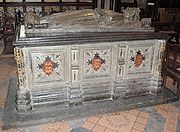
John's illness grew worse and by the time he reached Newark Castle
he was unable to travel any further; John died on the night of 18 October. Numerous – probably fictitious – accounts circulated soon after his death that he had been killed by poisoned ale, poisoned plums or a "surfeit of peaches". His body was escorted south by a company of mercenaries and he was buried in Worcester Cathedral
in front of the altar of St Wulfstan. A new sarcophagus
with an effigy
was made for him in 1232, in which his remains now rest.
. The civil war continued until royalist victories at the battles of Lincoln
and Dover
in 1217. Louis gave up his claim to the English throne and signed the Treaty of Lambeth
. The failed Magna Carta agreement was resuscitated by Marshal's protectorate and reissued in an edited form in 1217 as a basis for future government. Henry III continued his attempts to reclaim Normandy and Anjou until 1259, but John's continental losses and the consequent growth of Capetian power in the 13th century proved to mark a "turning point in European history".
John's first wife, Isabel, Countess of Gloucester, was released from imprisonment in 1214; she remarried twice, and died in 1217. John's second wife, Isabella of Angoulême
, left England for Angoulême
soon after the king's death; she became a powerful regional leader, but largely abandoned the children she had had by John. John had five legitimate children, all by Isabella. His eldest son, Henry III, ruled as king for the majority of the 13th century. Richard
became a noted European leader and ultimately the King of the Romans
in the Holy Roman Empire
. Joan
married Alexander II of Scotland
to become his queen consort. Isabella
married the Holy Roman Emperor Frederick II
. His youngest daughter, Eleanor, married William Marshal's son, also called William
, and later the famous English rebel Simon de Montfort
. John had a number of illegitimate children by various mistresses, including nine sons – Richard, Oliver, John, Geoffrey, Henry, Osbert Gifford, Eudes, Bartholomew and probably Philip – and three daughters – Joan
, Maud and probably Isabel. Of these, Joan became the most famous, marrying Prince Llywelyn the Great
of Wales.
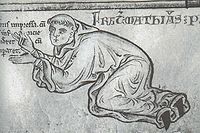 Historical interpretations of John have been subject to considerable change over the years. Medieval chronicle
rs provided the first contemporary, or near contemporary, histories of John's reign. One group of chroniclers wrote early in John's life, or around the time of his accession, including Richard of Devizes
, William of Newburgh
, Roger of Hoveden
and Ralph de Diceto
. These historians were generally unsympathetic to John's behaviour under Richard's rule, but slightly more positive towards the very earliest years of John's reign. Reliable accounts of the middle and later parts of John's reign are more limited, with Gervase of Canterbury
and Ralph of Coggeshall
writing the main accounts; neither of them were positive about John's performance as king. Much of John's later, negative reputation was established by two chroniclers writing after the king's death, Roger of Wendover
and Matthew Paris
.
In the 16th century political and religious changes altered the attitude of historians towards John. Tudor
historians were generally favourably inclined towards the king, focusing on John's opposition to the Papacy and his promotion of the special rights and prerogatives of a king. Revisionist histories written by John Foxe
, William Tyndale
and Robert Barnes portrayed John as an early Protestant hero, and John Foxe
included the king in his Book of Martyrs
. John Speed
's Historie of Great Britaine in 1632 praised John's "great renown" as a king; he blamed the bias of medieval chroniclers for the king's poor reputation.
By the Victorian period in the 19th century historians were more inclined to draw on the judgements of the chroniclers and to focus on John's moral personality. Kate Norgate
, for example, argued that John's downfall had been due not to his failure in war or strategy, but due to his "almost superhuman wickedness", whilst James Ramsay blamed John's family background and his cruel personality for his downfall. Historians in the "Whiggish
" tradition, focusing on documents such as the Domesday Book
and Magna Carta
, trace a progressive and universalist
course of political and economic development in England over the medieval period. These historians were often inclined to see John's reign, and his signing of Magna Carta in particular, as a positive step in the constitutional development of England, despite the flaws of the king himself. Winston Churchill
, for example, argued that "[w]hen the long tally is added, it will be seen that the British nation and the English-speaking world owe far more to the vices of John than to the labours of virtuous sovereigns".
In the 1940s, new interpretations of John's reign began to emerge, based on research into the record evidence of his reign, such as pipe rolls, charters, court documents and similar primary records. Notably, an essay by Vivian Galbraith
in 1945 proposed a "new approach" to understanding the ruler. The use of recorded evidence was combined with an increased scepticism about two of the most colourful chroniclers of John's reign, Roger of Wendover and Matthew Paris. In many cases the detail provided by these chroniclers, both writing after John's death, was challenged by modern historians. Interpretations of Magna Carta and the role of the rebel barons in 1215 have been significantly revised: although the charter's symbolic, constitutional value for later generations is unquestionable, in the context of John's reign most historians now consider it a failed peace agreement between "partisan" factions. There has been increasing debate about the nature of John's Irish policies. Specialists in Irish medieval history, such as Sean Duffy, have challenged the conventional narrative established by Lewis Warren
, suggesting that Ireland was less stable by 1216 than was previously supposed.
Most historians today, including John's recent biographers Ralph Turner and Lewis Warren, argue that John was an unsuccessful monarch, but note that his failings were exaggerated by 12th- and 13th-century chroniclers. Jim Bradbury
notes the consensus of contemporary historians that John was a "hard-working administrator, an able man, an able general", albeit, as Turner suggests, with "distasteful, even dangerous personality traits", including pettiness, spitefulness and cruelty. John Gillingham
, author of a major biography of Richard I, follows this line too, although he considers John a less effective general than do Turner or Warren; Bradbury takes a moderate line, but suggests that in recent years modern historians have been overly lenient towards John's numerous faults. Popular historian Frank McLynn
maintains a counter-revisionist perspective on John, arguing that the king's modern reputation amongst historians is "bizarre", and that as a monarch John "fails almost all those [tests] that can be legitimately set".
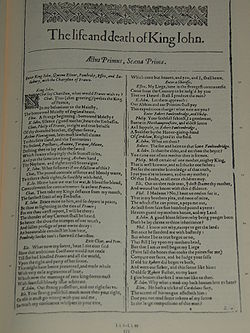 Popular representations of John first began to emerge during the Tudor period, mirroring the revisionist histories of the time. The anonymous play The Troublesome Reign of King John
portrayed the king as a "proto-Protestant martyr", similar to that shown in John Bale
's morality play Kynge Johan, in which John attempts to save England from the "evil agents of the Roman Church". By contrast, Shakespeare's King John, a relatively anti-Catholic play that draws on The Troublesome Reign for its source material, offers a more "balanced, dual view of a complex monarch as both a proto-Protestant victim of Rome's machinations and as a weak, selfishly motivated ruler". Anthony Munday
's play The Downfall and The Death of Robert Earl of Huntington
portrays many of John's negative traits, but adopts a positive interpretation of the king's stand against the Roman Catholic Church, in line with the contemporary views of the Tudor monarchs. By the middle of the 17th century, plays such as Robert Davenport
's King John and Matilda
, although based largely on the earlier Elizabethan works, were transferring the role of Protestant champion to the barons and focusing more on the tyrannical aspects of John's behaviour.
Nineteenth-century fictional depictions of John were heavily influenced by Sir Walter Scott
's historical romance, Ivanhoe
, which presented "an almost totally unfavourable picture" of the king; the work drew on Victorian histories of the period and on Shakespeare's play. Scott's work influenced the late 19th-century children's writer Howard Pyle
's book The Merry Adventures of Robin Hood
, which in turn established John as the principal villain within the traditional Robin Hood
narrative. During the 20th century, John was normally depicted in fictional books and films alongside Robin Hood. Sam De Grasse
's role as John in the black-and-white 1922 film version
shows John committing numerous atrocities and acts of torture. Claude Rains
played John in the 1938 colour version
alongside Errol Flynn
, starting a trend for films to depict John as an "effeminate ... arrogant and cowardly stay-at-home". The character of John acts either to highlight the virtues of King Richard, or contrasts with the Sheriff of Nottingham
, who is usually the "swashbuckling villain" opposing Robin. An extreme version of this trend can be seen in the Disney cartoon version
, for example, which depicts John, voiced by Peter Ustinov
, as a "cowardly, thumbsucking lion". Popular works that depict John beyond the Robin Hood legends, such as James Goldman
's play and later film, The Lion in Winter
, set in 1183, commonly present him as an "effete weakling", in this instance contrasted with the more masculine Henry II
.
Duchy of Normandy
The Duchy of Normandy stems from various Danish, Norwegian, Hiberno-Norse, Orkney Viking and Anglo-Danish invasions of France in the 9th century...
to King Philip II of France
Philip II of France
Philip II Augustus was the King of France from 1180 until his death. A member of the House of Capet, Philip Augustus was born at Gonesse in the Val-d'Oise, the son of Louis VII and his third wife, Adela of Champagne...
, which resulted in the collapse of most of the Angevin Empire
Angevin Empire
The term Angevin Empire is a modern term describing the collection of states once ruled by the Angevin Plantagenet dynasty.The Plantagenets ruled over an area stretching from the Pyrenees to Ireland during the 12th and early 13th centuries, located north of Moorish Iberia. This "empire" extended...
and contributed to the subsequent growth in power of the Capetian dynasty
Capetian dynasty
The Capetian dynasty , also known as the House of France, is the largest and oldest European royal house, consisting of the descendants of King Hugh Capet of France in the male line. Hugh Capet himself was a cognatic descendant of the Carolingians and the Merovingians, earlier rulers of France...
during the 13th century. The baronial revolt
First Barons' War
The First Barons' War was a civil war in the Kingdom of England, between a group of rebellious barons—led by Robert Fitzwalter and supported by a French army under the future Louis VIII of France—and King John of England...
at the end of John's reign led to the signing of the Magna Carta
Magna Carta
Magna Carta is an English charter, originally issued in the year 1215 and reissued later in the 13th century in modified versions, which included the most direct challenges to the monarch's authority to date. The charter first passed into law in 1225...
, a document often considered to be an early step in the evolution of the constitution of the United Kingdom
Constitution of the United Kingdom
The constitution of the United Kingdom is the set of laws and principles under which the United Kingdom is governed.Unlike many other nations, the UK has no single core constitutional document. In this sense, it is said not to have a written constitution but an uncodified one...
.
John, the youngest of five sons of King Henry II of England
Henry II of England
Henry II ruled as King of England , Count of Anjou, Count of Maine, Duke of Normandy, Duke of Aquitaine, Duke of Gascony, Count of Nantes, Lord of Ireland and, at various times, controlled parts of Wales, Scotland and western France. Henry, the great-grandson of William the Conqueror, was the...
and Eleanor of Aquitaine
Eleanor of Aquitaine
Eleanor of Aquitaine was one of the wealthiest and most powerful women in Western Europe during the High Middle Ages. As well as being Duchess of Aquitaine in her own right, she was queen consort of France and of England...
, was at first not expected to inherit significant lands. Following the failed rebellion of his elder brothers between 1173 and 1174, however, John became Henry's favourite child. He was appointed the Lord of Ireland in 1177 and given lands in England and on the continent. John's elder brothers William, Henry
Henry the Young King
Henry, known as the Young King was the second of five sons of King Henry II of England and Eleanor of Aquitaine but the first to survive infancy. He was officially King of England; Duke of Normandy, Count of Anjou and Maine.-Early life:Little is known of the young prince Henry before the events...
and Geoffrey
Geoffrey II, Duke of Brittany
Geoffrey II, Duke of Brittany and Earl of Richmond was Duke of Brittany between 1181 and 1186, through his marriage with the heiress Constance. Geoffrey was the fourth son of King Henry II of England and Eleanor, Duchess of Aquitaine.-Family:He was a younger maternal half-brother of Marie de...
died young; by the time Richard I
Richard I of England
Richard I was King of England from 6 July 1189 until his death. He also ruled as Duke of Normandy, Duke of Aquitaine, Duke of Gascony, Lord of Cyprus, Count of Anjou, Count of Maine, Count of Nantes, and Overlord of Brittany at various times during the same period...
became king in 1189, John was a potential heir to the throne. John unsuccessfully attempted a rebellion against Richard's royal administrators whilst his brother was participating in the Third Crusade
Third Crusade
The Third Crusade , also known as the Kings' Crusade, was an attempt by European leaders to reconquer the Holy Land from Saladin...
. Despite this, after Richard died in 1199, John was proclaimed king of England, and came to an agreement with Philip II of France to recognise John's possession of the continental Angevin lands at the peace treaty of Le Goulet
Treaty of Le Goulet
The Treaty of Le Goulet was signed by the kings John of England and Philip II of France in May 1200 and meant to settle once and for all the claims the Norman kings of England had as Norman dukes on French lands...
in 1200.
When war with France broke out again in 1202, John achieved early victories, but shortages of military resources and his treatment of Norman
Normans
The Normans were the people who gave their name to Normandy, a region in northern France. They were descended from Norse Viking conquerors of the territory and the native population of Frankish and Gallo-Roman stock...
, Breton
Breton people
The Bretons are an ethnic group located in the region of Brittany in France. They trace much of their heritage to groups of Brythonic speakers who emigrated from southwestern Great Britain in waves from the 3rd to 6th century into the Armorican peninsula, subsequently named Brittany after them.The...
and Anjou
Anjou
Anjou is a former county , duchy and province centred on the city of Angers in the lower Loire Valley of western France. It corresponds largely to the present-day département of Maine-et-Loire...
nobles resulted in the collapse of his empire in northern France in 1204. John spent much of the next decade attempting to regain these lands, raising huge revenues, reforming his armed forces and rebuilding continental alliances. John's judicial reforms had a lasting, positive impact on the English common law system, as well as providing an additional source of revenue. An argument with Pope Innocent III
Pope Innocent III
Pope Innocent III was Pope from 8 January 1198 until his death. His birth name was Lotario dei Conti di Segni, sometimes anglicised to Lothar of Segni....
led to John's excommunication
Excommunication
Excommunication is a religious censure used to deprive, suspend or limit membership in a religious community. The word means putting [someone] out of communion. In some religions, excommunication includes spiritual condemnation of the member or group...
in 1209, a dispute finally settled by the king in 1213. John's attempt to defeat Philip in 1214 failed due to the French victory over John's allies at the battle of Bouvines
Battle of Bouvines
The Battle of Bouvines, 27 July 1214, was a conclusive medieval battle ending the twelve year old Angevin-Flanders War that was important to the early development of both the French state by confirming the French crown's sovereignty over the Angevin lands of Brittany and Normandy.Philip Augustus of...
. When he returned to England, John faced a rebellion by many of his barons, who were unhappy with his fiscal policies and his treatment of many of England's most powerful nobles. Although both John and the barons agreed to the Magna Carta peace treaty in 1215, neither side complied with its conditions. Civil war
First Barons' War
The First Barons' War was a civil war in the Kingdom of England, between a group of rebellious barons—led by Robert Fitzwalter and supported by a French army under the future Louis VIII of France—and King John of England...
broke out shortly afterwards, with the barons aided by Louis of France
Louis VIII of France
Louis VIII the Lion reigned as King of France from 1223 to 1226. He was a member of the House of Capet. Louis VIII was born in Paris, France, the son of Philip II Augustus and Isabelle of Hainaut. He was also Count of Artois, inheriting the county from his mother, from 1190–1226...
. It soon descended into a stalemate. John died of dysentery
Dysentery
Dysentery is an inflammatory disorder of the intestine, especially of the colon, that results in severe diarrhea containing mucus and/or blood in the faeces with fever and abdominal pain. If left untreated, dysentery can be fatal.There are differences between dysentery and normal bloody diarrhoea...
contracted whilst on campaign in eastern England during late 1216; supporters of his son Henry III
Henry III of England
Henry III was the son and successor of John as King of England, reigning for 56 years from 1216 until his death. His contemporaries knew him as Henry of Winchester. He was the first child king in England since the reign of Æthelred the Unready...
went on to achieve victory over Louis and the rebel barons the following year.
Contemporary chroniclers were mostly critical of John's performance as king, and his reign has since been the subject of significant debate and periodic revision by historians from the 16th century onwards. Historian Jim Bradbury
Jim Bradbury
Jim Bradbury is a British historian specialising in the military history of the Middle Ages.Bradbury lectured in history at Brunel University.-Selected works:* "Shakespeare and his Theatre", Longman, ISBN 0582205395...
has summarised the contemporary historical opinion of John's positive qualities, observing that John is today usually considered a "hard-working administrator, an able man, an able general". Nonetheless, modern historians agree that he also had many faults as king, including what historian Ralph Turner describes as "distasteful, even dangerous personality traits", such as pettiness, spitefulness and cruelty. These negative qualities provided extensive material for fiction writers in the Victorian era
Victorian literature
Victorian literature is the literature produced during the reign of Queen Victoria . It forms a link and transition between the writers of the romantic period and the very different literature of the 20th century....
, and John remains a recurring character within Western popular culture, primarily as a villain in films and stories depicting the Robin Hood
Robin Hood
Robin Hood was a heroic outlaw in English folklore. A highly skilled archer and swordsman, he is known for "robbing from the rich and giving to the poor", assisted by a group of fellow outlaws known as his "Merry Men". Traditionally, Robin Hood and his men are depicted wearing Lincoln green clothes....
legends.
Childhood and the Angevin inheritance
John was born to Henry II of EnglandHenry II of England
Henry II ruled as King of England , Count of Anjou, Count of Maine, Duke of Normandy, Duke of Aquitaine, Duke of Gascony, Count of Nantes, Lord of Ireland and, at various times, controlled parts of Wales, Scotland and western France. Henry, the great-grandson of William the Conqueror, was the...
and Eleanor of Aquitaine
Eleanor of Aquitaine
Eleanor of Aquitaine was one of the wealthiest and most powerful women in Western Europe during the High Middle Ages. As well as being Duchess of Aquitaine in her own right, she was queen consort of France and of England...
on 24 December 1166. Henry had inherited significant territories along the Atlantic seaboard – Anjou
Anjou
Anjou is a former county , duchy and province centred on the city of Angers in the lower Loire Valley of western France. It corresponds largely to the present-day département of Maine-et-Loire...
, Normandy
Normandy
Normandy is a geographical region corresponding to the former Duchy of Normandy. It is in France.The continental territory covers 30,627 km² and forms the preponderant part of Normandy and roughly 5% of the territory of France. It is divided for administrative purposes into two régions:...
and England
England
England is a country that is part of the United Kingdom. It shares land borders with Scotland to the north and Wales to the west; the Irish Sea is to the north west, the Celtic Sea to the south west, with the North Sea to the east and the English Channel to the south separating it from continental...
– and expanded his empire by conquering Brittany
Brittany
Brittany is a cultural and administrative region in the north-west of France. Previously a kingdom and then a duchy, Brittany was united to the Kingdom of France in 1532 as a province. Brittany has also been referred to as Less, Lesser or Little Britain...
. Henry married the powerful Eleanor of Aquitaine, who reigned over the Duchy of Aquitaine and had a tenuous claim to Toulouse and Auvergne
Auvergne (province)
Auvergne was a historic province in south central France. It was originally the feudal domain of the Counts of Auvergne. It is now the geographical and cultural area that corresponds to the former province....
in southern France, in addition to being the former wife of Louis VII of France
Louis VII of France
Louis VII was King of France, the son and successor of Louis VI . He ruled from 1137 until his death. He was a member of the House of Capet. His reign was dominated by feudal struggles , and saw the beginning of the long rivalry between France and England...
. The result was the Angevin Empire
Angevin Empire
The term Angevin Empire is a modern term describing the collection of states once ruled by the Angevin Plantagenet dynasty.The Plantagenets ruled over an area stretching from the Pyrenees to Ireland during the 12th and early 13th centuries, located north of Moorish Iberia. This "empire" extended...
, named after Henry's paternal title as Count of Anjou and, more specifically, its seat in Angers
Angers
Angers is the main city in the Maine-et-Loire department in western France about south-west of Paris. Angers is located in the French region known by its pre-revolutionary, provincial name, Anjou, and its inhabitants are called Angevins....
. The Empire, however, was inherently fragile: although all the lands owed allegiance to Henry, the disparate parts each had their own histories, traditions and governance structures. As one moved south through Anjou and Aquitaine, the extent of Henry's power in the provinces diminished considerably, scarcely resembling the modern concept of an empire at all. Some of the traditional ties between parts of the empire such as Normandy and England were slowly dissolving over time. It was unclear what would happen to the empire on Henry's death. Although the tradition of primogeniture
Primogeniture
Primogeniture is the right, by law or custom, of the firstborn to inherit the entire estate, to the exclusion of younger siblings . Historically, the term implied male primogeniture, to the exclusion of females...
, under which an eldest son would inherit all his father's lands, was slowly becoming more widespread across Europe, it was less popular amongst the Norman kings of England. Most believed that Henry would divide the empire, giving each son a substantial portion, hoping that his children would then continue to work together as allies after his death. To complicate matters, much of the Angevin empire was owned by Henry only as a vassal of the King of France of the rival line of the House of Capet
House of Capet
The House of Capet, or The Direct Capetian Dynasty, , also called The House of France , or simply the Capets, which ruled the Kingdom of France from 987 to 1328, was the most senior line of the Capetian dynasty – itself a derivative dynasty from the Robertians. As rulers of France, the dynasty...
. Henry had often allied himself with the Holy Roman Emperor
Holy Roman Emperor
The Holy Roman Emperor is a term used by historians to denote a medieval ruler who, as German King, had also received the title of "Emperor of the Romans" from the Pope...
against France, making the feudal relationship even more challenging.
Shortly after his birth, John was passed from Eleanor into the care of a wet nurse
Wet nurse
A wet nurse is a woman who is used to breast feed and care for another's child. Wet nurses are used when the mother is unable or chooses not to nurse the child herself. Wet-nursed children may be known as "milk-siblings", and in some cultures the families are linked by a special relationship of...
, a traditional practice for medieval noble families. Eleanor then left for Poitiers
Poitiers
Poitiers is a city on the Clain river in west central France. It is a commune and the capital of the Vienne department and of the Poitou-Charentes region. The centre is picturesque and its streets are interesting for predominant remains of historical architecture, especially from the Romanesque...
, the capital of Aquitaine, and sent John and his sister Joan
Joan of England, Queen of Sicily
Joan of England was the seventh child of Henry II of England and his queen consort, Eleanor of Aquitaine.Joan was a younger maternal half-sister of Marie de Champagne and Alix of France...
north to Fontevrault Abbey. This may have been done with the aim of steering her youngest son, with no obvious inheritance, towards a future ecclesiastical career. Eleanor spent the next few years conspiring against her husband Henry and neither parent played a part in John's very early life. John was probably, like his brothers, assigned a magister whilst he was at Fontevrault, a teacher charged with his early education and with managing the servants of his immediate household; John was later taught by Ranulph Glanville, a leading English administrator. John spent some time as a member of the household of his eldest living brother Henry the Young King
Henry the Young King
Henry, known as the Young King was the second of five sons of King Henry II of England and Eleanor of Aquitaine but the first to survive infancy. He was officially King of England; Duke of Normandy, Count of Anjou and Maine.-Early life:Little is known of the young prince Henry before the events...
, where he probably received instruction in hunting and military skills.
John would grow up to be around 5 ft 5 in high (1.62 m), relatively short for royalty of the day, with a "powerful, barrel-chested body" and dark red hair; he appeared to contemporaries to look like an inhabitant of Poitou
Poitou
Poitou was a province of west-central France whose capital city was Poitiers.The region of Poitou was called Thifalia in the sixth century....
. John enjoyed reading and, unusual for the period, built up a travelling library of books. He enjoyed gambling, in particular on backgammon
Backgammon
Backgammon is one of the oldest board games for two players. The playing pieces are moved according to the roll of dice, and players win by removing all of their pieces from the board. There are many variants of backgammon, most of which share common traits...
, and was an enthusiastic hunter, even by medieval standards. He liked music, although not songs. John would become a "connoisseur of jewels", building up a large collection, and became famous for his opulent clothes and also, according to French chroniclers, for his fondness for bad wine. As John grew up, he became known for sometimes being "genial, witty, generous and hospitable"; at other moments, he could be jealous, over-sensitive and prone to fits of rage, "biting and gnawing his fingers" in anger.
Early life
During John's early years, Henry attempted to resolve the question of his succession. Henry the Young King had been crowned King of England in 1170, but without being given any formal powers by his father, and was also promised Normandy and Anjou as part of his future inheritance. RichardRichard I of England
Richard I was King of England from 6 July 1189 until his death. He also ruled as Duke of Normandy, Duke of Aquitaine, Duke of Gascony, Lord of Cyprus, Count of Anjou, Count of Maine, Count of Nantes, and Overlord of Brittany at various times during the same period...
was to be appointed the Count of Poitou and would be given control of Aquitaine, whilst Geoffrey
Geoffrey II, Duke of Brittany
Geoffrey II, Duke of Brittany and Earl of Richmond was Duke of Brittany between 1181 and 1186, through his marriage with the heiress Constance. Geoffrey was the fourth son of King Henry II of England and Eleanor, Duchess of Aquitaine.-Family:He was a younger maternal half-brother of Marie de...
was to become the Duke of Brittany. At this time it seemed unlikely that John would ever inherit substantial lands, and John was jokingly nicknamed "Lackland" by his father.
Henry II wanted to secure the southern borders of Aquitaine and decided to betroth his youngest son to Alais, the daughter and heiress of Humbert III of Savoy
Humbert III of Savoy
Umberto III , surnamed the Blessed, was Count of Savoy from 1148 to 1189. His parents were Amadeus III of Savoy and Mahaut of Albon, the sister of Guy IV of Dauphinois. His memorial day is March 4.According to CopeHis first wife died young; his second marriage ended in divorce...
. As part of this agreement John was promised the future inheritance of Savoy
Savoy
Savoy is a region of France. It comprises roughly the territory of the Western Alps situated between Lake Geneva in the north and Monaco and the Mediterranean coast in the south....
, Piemonte
Piedmont
Piedmont is one of the 20 regions of Italy. It has an area of 25,402 square kilometres and a population of about 4.4 million. The capital of Piedmont is Turin. The main local language is Piedmontese. Occitan is also spoken by a minority in the Occitan Valleys situated in the Provinces of...
, Maurienne
Maurienne
Maurienne is one of the provinces of Savoy, corresponding to the arrondissement of Saint-Jean-de-Maurienne in France. It is also the original name of the capital of the province, now Saint-Jean-de-Maurienne.-Location:...
, and the other possessions of Count Humbert. For his part in the potential marriage alliance, Henry II transferred the castles of Chinon, Loudun
Loudun
Loudun is a commune in the Vienne department in the Poitou-Charentes region in western France.It is located south of the town of Chinon and 25 km to the east of the town Thouars...
and Mirebeau
Mirebeau
Mirebeau is a commune in the Vienne department in the Poitou-Charentes region in western France.-Demographics:-Twin towns:*Bassemyam, Burkina Faso*Membrilla, Spain*Regen, Germany*Saint-raymond, Quebec...
into John's name; as John was only five years old his father would continue to control them for practical purposes. Henry the Young King was unimpressed by this; although he had yet to be granted control of any castles in his new kingdom, these were effectively his future property and had been given away without consultation. Alais made the trip over the Alps and joined Henry II's court, but she died before marrying John, which left the prince once again without an inheritance.
In 1173 John's elder brothers, backed by Eleanor, rose in revolt against Henry in the short-lived rebellion of 1173 to 1174. Growing irritated with his subordinate position to Henry II and increasingly worried that John might be given additional lands and castles at his expense, Henry the Young King travelled to Paris
Paris
Paris is the capital and largest city in France, situated on the river Seine, in northern France, at the heart of the Île-de-France region...
and allied himself with Louis VII
Louis VII of France
Louis VII was King of France, the son and successor of Louis VI . He ruled from 1137 until his death. He was a member of the House of Capet. His reign was dominated by feudal struggles , and saw the beginning of the long rivalry between France and England...
. Eleanor, irritated by her husband's persistent interference in Aquitaine, encouraged Richard and Geoffrey to join their brother Henry in Paris. Henry II triumphed over the coalition of his sons, but was generous to them in the peace settlement agreed at Montlouis
Montlouis-sur-Loire
Montlouis-sur-Loire is a commune in the Indre-et-Loire department in central France. Ancient name was Laudiacum mons under Roman Province Lugdunensis III. -See also:*Communes of the Indre-et-Loire department...
. Henry the Young King was allowed to travel widely in Europe with his own household of knights, Richard was given Aquitaine back, and Geoffrey was allowed to return to Brittany; only Eleanor was imprisoned for her role in the revolt.
John had spent the conflict travelling alongside his father and was given widespread possessions across the Angevin empire as part of the Montlouis settlement; from then onwards, most observers regarded John as Henry II's favourite child, although he was the furthest removed in terms of the royal succession. Henry II began to find more lands for John, mostly at various nobles' expense. In 1175 he appropriated the estates of the late Earl of Cornwall
Reginald de Dunstanville, 1st Earl of Cornwall
Reginald de Dunstanville , Earl of Cornwall , High Sheriff of Devon, Earl of Cornwall, was an illegitimate son of Henry I of England and Lady Sybilla Corbet.Reginald had been invested with the Earldom of Cornwall by King...
and gave them to John. The following year, Henry disinherited the sisters of Isabelle of Gloucester, contrary to legal custom, and betrothed John to the now extremely wealthy Isabelle. In 1177, at the Council of Oxford, Henry dismissed William FitzAldelm as the Lord of Ireland
Lordship of Ireland
The Lordship of Ireland refers to that part of Ireland that was under the rule of the king of England, styled Lord of Ireland, between 1177 and 1541. It was created in the wake of the Norman invasion of Ireland in 1169–71 and was succeeded by the Kingdom of Ireland...
and replaced him with the ten-year-old John.
Henry the Young King fought a short war with his brother Richard in 1183 over the status of England, Normandy and Aquitaine. Henry II moved in support of Richard, and Henry the Young King died from dysentery
Dysentery
Dysentery is an inflammatory disorder of the intestine, especially of the colon, that results in severe diarrhea containing mucus and/or blood in the faeces with fever and abdominal pain. If left untreated, dysentery can be fatal.There are differences between dysentery and normal bloody diarrhoea...
at the end of the campaign. With his primary heir dead, Henry rearranged the plans for the succession: Richard was to be made King of England, albeit without any actual power until the death of his father; Geoffrey would retain Brittany; and John would now become the Duke of Aquitaine in place of Richard. Richard refused to give up Aquitaine; Henry II was furious and ordered John, with help from Geoffrey, to march south and retake the duchy by force. The two attacked the capital of Poitiers, and Richard responded by attacking Brittany. The war ended in stalemate and a tense family reconciliation in England at the end of 1184.
In 1185 John made his first visit to Ireland
John's first expedition to Ireland
The 1185 expedition of the future King John of England to Ireland has attracted much historical debate due to the lack of government records available and the subsequent reliance on sources such as the Irish Annals and the writings of Gerald of Wales....
, accompanied by three hundred knights and a team of administrators. Henry had tried to have John officially proclaimed King of Ireland, but Pope Lucius III would not agree. John's first period of rule in Ireland was not a success. Ireland had only recently been conquered by Anglo-Norman forces, and tensions were still rife between Henry II, the new settlers and the existing inhabitants. John infamously offended the local Irish rulers by making fun of their unfashionable long beards, failed to make allies amongst the Anglo-Norman settlers, began to lose ground militarily against the Irish and finally returned to England later in the year, blaming the viceroy, Hugh de Lacy
Hugh de Lacy, Lord of Meath
Hugh de Lacy, Lord of Meath was an Anglo-Norman magnate granted the lands of the Kingdom of Meath by Henry II in 1172, during the Norman Invasion of Ireland.-Early life:Hugh de Lacy was born before 1135...
, for the fiasco.
The problems amongst John's wider family continued to grow. His elder brother Geoffrey died during a tournament in 1186, leaving a posthumous son, Arthur, and an elder daughter, Eleanor. The duchy of Brittany was given to Arthur rather than John, but Geoffrey's death brought John slightly closer to the throne of England. The uncertainty about what would happen after Henry's death continued to grow; Richard was keen to join a new crusade and remained concerned that whilst he was away Henry would appoint John his formal successor. Richard began discussions about a potential alliance with Philip II in Paris during 1187, and the next year Richard gave homage to Philip in exchange for support for a war against Henry. Richard and Philip fought a joint campaign against Henry, and by the summer of 1189 the king made peace, promising Richard the succession. John initially remained loyal to his father, but changed sides once it appeared that Richard would win. Henry died shortly afterwards.
Richard's reign (1189–99)
Third Crusade
The Third Crusade , also known as the Kings' Crusade, was an attempt by European leaders to reconquer the Holy Land from Saladin...
. Richard set about raising the huge sums of money required for this expedition through the sale of lands, titles and appointments, and attempted to ensure that he would not face a revolt while away from his empire. John was made Count of Mortain, was married to the wealthy Isabel of Gloucester
Isabel of Gloucester
Isabel of Gloucester was the first wife of King John of England. This historical figure is known by an exceptionally large number of alternative names: Hadwisa, Hawisia, Hawise, Joan, Eleanor, Avise and Avisa....
, and was given valuable lands in Lancaster and the counties of Cornwall
Cornwall
Cornwall is a unitary authority and ceremonial county of England, within the United Kingdom. It is bordered to the north and west by the Celtic Sea, to the south by the English Channel, and to the east by the county of Devon, over the River Tamar. Cornwall has a population of , and covers an area of...
, Derby
Derby
Derby , is a city and unitary authority in the East Midlands region of England. It lies upon the banks of the River Derwent and is located in the south of the ceremonial county of Derbyshire. In the 2001 census, the population of the city was 233,700, whilst that of the Derby Urban Area was 229,407...
, Devon
Devon
Devon is a large county in southwestern England. The county is sometimes referred to as Devonshire, although the term is rarely used inside the county itself as the county has never been officially "shired", it often indicates a traditional or historical context.The county shares borders with...
, Dorset
Dorset
Dorset , is a county in South West England on the English Channel coast. The county town is Dorchester which is situated in the south. The Hampshire towns of Bournemouth and Christchurch joined the county with the reorganisation of local government in 1974...
, Nottingham
Nottingham
Nottingham is a city and unitary authority in the East Midlands of England. It is located in the ceremonial county of Nottinghamshire and represents one of eight members of the English Core Cities Group...
and Somerset
Somerset
The ceremonial and non-metropolitan county of Somerset in South West England borders Bristol and Gloucestershire to the north, Wiltshire to the east, Dorset to the south-east, and Devon to the south-west. It is partly bounded to the north and west by the Bristol Channel and the estuary of the...
, all with the aim of buying his loyalty to Richard whilst the king was on crusade. Richard retained royal control of key castles in these counties, thereby preventing John from accumulating too much military and political power. In return, John promised not to visit England for the next three years, thereby in theory giving Richard adequate time to conduct a successful crusade and return from the Levant
Levant
The Levant or ) is the geographic region and culture zone of the "eastern Mediterranean littoral between Anatolia and Egypt" . The Levant includes most of modern Lebanon, Syria, Jordan, Israel, the Palestinian territories, and sometimes parts of Turkey and Iraq, and corresponds roughly to the...
without fear of John seizing power. Richard left political authority in England – the post of justiciar – jointly in the hands of Bishop Hugh de Puiset
Hugh de Puiset
Hugh de Puiset was a medieval Bishop of Durham and Chief Justiciar of England under King Richard I. He was the nephew of King Stephen of England and Henry of Blois, who both assisted Hugh's ecclesiastical career...
and William Mandeville
William de Mandeville, 3rd Earl of Essex
William de Mandeville, 3rd Earl of Essex was a loyal councilor of Henry II and Richard I of England.He was the second son of Geoffrey de Mandeville, 1st Earl of Essex and Rohese de Vere, Countess of Essex. After his father's death while in rebellion , William grew up at the court of the Count of...
, and made William Longchamp
William Longchamp
William Longchamp , sometimes known as William de Longchamp or William de Longchamps, was a medieval Lord Chancellor, Chief Justiciar, and Bishop of Ely in England. Born to a humble family in Normandy, he owed his advancement to royal favour. Although contemporary writers accused Longchamp's father...
, the Bishop of Ely
Bishop of Ely
The Bishop of Ely is the Ordinary of the Church of England Diocese of Ely in the Province of Canterbury. The diocese roughly covers the county of Cambridgeshire , together with a section of north-west Norfolk and has its see in the City of Ely, Cambridgeshire, where the seat is located at the...
, his chancellor. Mandeville immediately died, and Longchamp took over as joint justiciar with Puiset, which would prove to be a less than satisfactory partnership. Eleanor, the queen mother, convinced Richard to allow John into England in his absence.
The political situation in England rapidly began to deteriorate. Longchamp refused to work with Puiset and became unpopular with the English nobility and clergy. John exploited this unpopularity to set himself up as an alternative ruler with his own royal court, complete with his own justiciar, chancellor and other royal posts, and was happy to be portrayed as an alternative regent, and possibly the next king. Armed conflict broke out between John and Longchamp, and by October 1191 Longchamp was isolated in the Tower of London
Tower of London
Her Majesty's Royal Palace and Fortress, more commonly known as the Tower of London, is a historic castle on the north bank of the River Thames in central London, England. It lies within the London Borough of Tower Hamlets, separated from the eastern edge of the City of London by the open space...
with John in control of the city of London, thanks to promises John had made to the citizens in return for recognition as Richard's heir presumptive. At this point Walter of Coutances, the Archbishop of Rouen
Archbishop of Rouen
The Roman Catholic Archdiocese of Rouen is an Archdiocese of the Latin Rite of the Roman Catholic Church in France. As one of the fifteen Archbishops of France, the ecclesiastical province of the archdiocese comprises the majority of Normandy....
, returned to England, having been sent by Richard to restore order. John's position was undermined by Walter's relative popularity and by the news that Richard had married whilst in Cyprus, which presented the possibility that Richard would have legitimate children and heirs.
Leopold V, Duke of Austria
Leopold V , the Virtuous, was a Babenberg duke of Austria from 1177 and of Styria from 1192 until his death...
and was handed over to Emperor Henry VI
Henry VI, Holy Roman Emperor
Henry VI was King of Germany from 1190 to 1197, Holy Roman Emperor from 1191 to 1197 and King of Sicily from 1194 to 1197.-Early years:Born in Nijmegen,...
, who held him for ransom. John seized the opportunity and went to Paris, where he formed an alliance with Philip. He agreed to set aside his wife, Isabella of Gloucester, and marry Philip's sister, Alys
Alys, Countess of the Vexin
Alys, Countess of the Vexin was the daughter of King Louis VII of France and his second wife Constance of Castile.- Life :...
, in exchange for Philip's support. Fighting broke out in England between forces loyal to Richard and those being gathered by John. John's military position was weak and he agreed to a truce; in early 1194 the king finally returned to England, and John's remaining forces surrendered. John retreated to Normandy, where Richard finally found him later that year. Richard declared that his younger brother – despite being 27 years old – was merely "a child who has had evil counsellors" and forgave him, but removed his lands with the exception of Ireland.
For the remaining years of Richard's reign, John supported his brother on the continent, apparently loyally. Richard's policy on the continent was to attempt to regain the castles he had lost to Philip II whilst on crusade through steady, limited campaigns. He allied himself with the leaders of Flanders
Flanders
Flanders is the community of the Flemings but also one of the institutions in Belgium, and a geographical region located in parts of present-day Belgium, France and the Netherlands. "Flanders" can also refer to the northern part of Belgium that contains Brussels, Bruges, Ghent and Antwerp...
, Boulogne and the Holy Roman Empire
Holy Roman Empire
The Holy Roman Empire was a realm that existed from 962 to 1806 in Central Europe.It was ruled by the Holy Roman Emperor. Its character changed during the Middle Ages and the Early Modern period, when the power of the emperor gradually weakened in favour of the princes...
to apply pressure on Philip from Germany. In 1195 John successfully conducted a sudden attack and siege of Évreux
Évreux
Évreux is a commune in the Eure department, of which it is the capital, in Haute Normandie in northern France.-History:In late Antiquity, the town, attested in the fourth century CE, was named Mediolanum Aulercorum, "the central town of the Aulerci", the Gallic tribe then inhabiting the area...
castle, and subsequently managed the defences of Normandy against Philip. The following year, John seized the town of Gamaches
Gamaches
Gamaches is a commune in the Somme department in Picardie in northern France.-Geography:Gamaches is situated on the D1015, on the banks of the Bresle River, the border with Seine-Maritime, some southwest of Abbeville.Huge lakes to the west of the town are a paradise for naturalists, anglers and...
and led a raiding party within 50 miles (80.5 km) of Paris, capturing the Bishop of Beauvais
Beauvais
Beauvais is a city approximately by highway north of central Paris, in the northern French region of Picardie. It currently has a population of over 60,000 inhabitants.- History :...
. In return for this service, Richard withdrew his malevontia (ill-will) towards John, restored him to the county of Gloucestershire and made him again the Count of Mortain.
Accession to the throne, 1199
Henry II of England
Henry II ruled as King of England , Count of Anjou, Count of Maine, Duke of Normandy, Duke of Aquitaine, Duke of Gascony, Count of Nantes, Lord of Ireland and, at various times, controlled parts of Wales, Scotland and western France. Henry, the great-grandson of William the Conqueror, was the...
, and young Arthur of Brittany
Arthur I, Duke of Brittany
Arthur I was Duke of Brittany between 1194 and 1202. He was the posthumous son of Geoffrey II, Duke of Brittany and Constance, Duchess of Brittany...
, who held a claim as the son of Geoffrey
Geoffrey II, Duke of Brittany
Geoffrey II, Duke of Brittany and Earl of Richmond was Duke of Brittany between 1181 and 1186, through his marriage with the heiress Constance. Geoffrey was the fourth son of King Henry II of England and Eleanor, Duchess of Aquitaine.-Family:He was a younger maternal half-brother of Marie de...
, John's elder brother. Richard appears to have started to recognise John as his legitimate heir in the final years before his death, but the matter was not clear-cut and medieval law gave little guidance as to how the competing claims should be decided. With Norman law favouring John as the only surviving son of Henry II and Angevin law favouring Arthur as the heir of Henry's elder son, the matter rapidly became an open conflict. John was supported by the bulk of the English and Norman nobility and was crowned at Westminster, backed by his mother, Eleanor. Arthur was supported by the majority of the Breton, Maine and Anjou nobles and received the support of Philip II
Philip II of France
Philip II Augustus was the King of France from 1180 until his death. A member of the House of Capet, Philip Augustus was born at Gonesse in the Val-d'Oise, the son of Louis VII and his third wife, Adela of Champagne...
, who remained committed to breaking up the Angevin territories on the continent. With Arthur's army pressing up the Loire valley
Loire Valley
The Loire Valley , spanning , is located in the middle stretch of the Loire River in central France. Its area comprises approximately . It is referred to as the Cradle of the French Language, and the Garden of France due to the abundance of vineyards, fruit orchards, and artichoke, asparagus, and...
towards Angers
Angers
Angers is the main city in the Maine-et-Loire department in western France about south-west of Paris. Angers is located in the French region known by its pre-revolutionary, provincial name, Anjou, and its inhabitants are called Angevins....
and Philip's forces moving down the valley towards Tours
Tours
Tours is a city in central France, the capital of the Indre-et-Loire department.It is located on the lower reaches of the river Loire, between Orléans and the Atlantic coast. Touraine, the region around Tours, is known for its wines, the alleged perfection of its local spoken French, and for the...
, John's continental empire was in danger of being cut in two.
Warfare in Normandy at the time was shaped by the defensive potential of castles and the increasing costs of conducting campaigns. The Norman frontiers had limited natural defences but were heavily reinforced with castles, such as Château Gaillard, at strategic points, built and maintained at considerable expense. It was difficult for a commander to advance far into fresh territory without having secured his lines of communication by capturing these fortifications, which slowed the progress of any attack. Armies of the period could be formed from either feudal or mercenary forces. Feudal levies could only be raised for a fixed length of time before they returned home, forcing an end to a campaign; mercenary forces, often called Brabançon
Routiers
The routiers were mercenaries associated with free companies who terrorized the French countryside during the Hundred Years War. The word routier is French for "road-man", referring to their travelling nature. -Background:Routiers were a product of their time...
s after the Duchy of Brabant
Duchy of Brabant
The Duchy of Brabant was a historical region in the Low Countries. Its territory consisted essentially of the three modern-day Belgian provinces of Flemish Brabant, Walloon Brabant and Antwerp, the Brussels-Capital Region and most of the present-day Dutch province of North Brabant.The Flag of...
but actually recruited from across northern Europe, could operate all year long and provide a commander with more strategic options to pursue a campaign, but cost much more than equivalent feudal forces. As a result commanders of the period were increasingly drawing on larger numbers of mercenaries.
After his coronation, John moved south into France with military forces and adopted a defensive posture along the eastern and southern Normandy borders. Both sides paused for desultory negotiations before the war recommenced; John's position was now stronger, thanks to confirmation that Count Baldwin
Baldwin I of Constantinople
Baldwin I , the first emperor of the Latin Empire of Constantinople, as Baldwin IX Count of Flanders and as Baldwin VI Count of Hainaut, was one of the most prominent leaders of the Fourth Crusade, which resulted in the capture of Constantinople, the conquest of the greater part of the Byzantine...
of Flanders
Flanders
Flanders is the community of the Flemings but also one of the institutions in Belgium, and a geographical region located in parts of present-day Belgium, France and the Netherlands. "Flanders" can also refer to the northern part of Belgium that contains Brussels, Bruges, Ghent and Antwerp...
and Renaud of Boulogne had renewed the anti-French alliances they had previously agreed to with Richard. The powerful Anjou nobleman William de Roches
William des Roches
William des Roches , seneschal of Anjou, was a knight in the service of the Angevin Kings of England, and King Philip II of France after 1202. Guillaume was born somewhere in Anjou, most likely at Longué-Jumelles....
was persuaded to switch sides from Arthur to John; suddenly the balance seemed to be tipping away from Philip and Arthur in favour of John. Neither side was keen to continue the conflict, and following a papal truce the two leaders met in January 1200 to negotiate possible terms for peace. From John's perspective, what then followed represented an opportunity to stabilise control over his continental possessions and produce a lasting peace with Philip in Paris. John and Philip negotiated the May 1200 Treaty of Le Goulet
Treaty of Le Goulet
The Treaty of Le Goulet was signed by the kings John of England and Philip II of France in May 1200 and meant to settle once and for all the claims the Norman kings of England had as Norman dukes on French lands...
; by this treaty, Philip recognised John as the rightful heir to Richard in respect to his French possessions, temporarily abandoning the wider claims of his client, Arthur. John, in turn, abandoned Richard's former policy of containing Philip through alliances with Flanders and Boulogne, and accepted Philip's right as the legitimate feudal overlord of John's lands in France. John's policy earned him the disrespectful title of "John Softsword" from some English chroniclers, who contrasted his behaviour with his more aggressive brother, Richard.
Le Goulet peace, 1200–02
The new peace would only last for two years; war recommenced in the aftermath of John's decision in August 1200 to marry Isabella of AngoulêmeIsabella of Angoulême
Isabella of Angoulême was queen consort of England as the second wife of King John from 1200 until John's death in 1216. They had five children by the king including his heir, later Henry III...
. In order to remarry, John first needed to abandon Isabel, Countess of Gloucester, his first wife; John accomplished this by arguing that he had failed to get the necessary papal permission
Papal dispensation
Papal dispensation is a reserved right of the Pope that allows for individuals to be exempted from a specific Canon Law. Dispensations are divided into two categories: general, and matrimonial. Matrimonial dispensations can be either to allow a marriage in the first place, or to dissolve one...
to marry Isabel in the first place – as a cousin, John could not have legally wed her without this. It remains unclear why John chose to marry Isabella of Angoulême. Contemporary chroniclers argued that John had fallen deeply in love with Isabella, and John may have been motivated by desire for an apparently beautiful, if rather young, girl. On the other hand, the Angoumois lands that came with Isabella were strategically vital to John: by marrying Isabella, John was acquiring a key land route between Poitou and Gascony, which significantly strengthened his grip on Aquitaine.
Unfortunately, Isabella was already engaged to Hugh de Lusignan
Hugh X of Lusignan
Hugh X de Lusignan, Hugh V of La Marche or Hugh I of Angoulême or Hugues X & V & I de Lusignan succeeded his father Hugh IX as Seigneur de Lusignan and Count of La Marche in November, 1219 and was Count of Angoulême by marriage.Hugh X de Lusignan was betrothed to marry 12 year-old Isabel of...
, an important member of a key Poitou noble family and brother of Raoul de Lusignan
Raoul I of Lusignan
Raoul I of Lusignan or Raoul I de Lusignan , was the second son of Hugues de Lusignan, Co-Seigneur de Lusignan in 1164 , and wife, married before 1162, Orengarde N, who died in 1169, and grandson of Hugh VIII...
, the Count of Eu, who possessed lands along the sensitive eastern Normandy border. Just as John stood to benefit strategically from marrying Isabella, so the marriage threatened the interests of the Lusignans, whose own lands currently provided the key route for royal goods and troops across Aquitaine. Rather than negotiating some form of compensation, John treated Hugh "with contempt"; this resulted in a Lusignan uprising that was promptly crushed by John, who also intervened to suppress Raoul in Normandy.
Although John was the Count of Poitou and therefore the rightful feudal lord over the Lusignans, they could legitimately appeal John's actions in France to his own feudal lord, Philip. Hugh did exactly this in 1201 and Philip summoned John to attend court in Paris in 1202, citing the Le Goulet treaty to strengthen his case. John was unwilling to weaken his authority in western France in this way. He argued that he need not attend Philip's court because of his special status as the Duke of Normandy, who was exempt by feudal tradition from being called to the French court. Philip argued that he was summoning John not as the Duke of Normandy, but as the Count of Poitou, which carried no such special status. When John still refused to come, Philip declared John in breach of his feudal responsibilities, reassigned all of John's lands that fell under the French crown to Arthur – with the exception of Normandy, which he took back for himself – and began a fresh war against John.
Loss of Normandy, 1202–04
John initially adopted a defensive posture similar to that of 1199: avoiding open battle and carefully defending his key castles. John's operations became more chaotic as the campaign progressed, and Philip began to make steady progress in the east. John became aware in July that Arthur's forces were threatening his mother, Eleanor, at Mirebeau Castle. Accompanied by William de Roches, his seneschalSeneschal
A seneschal was an officer in the houses of important nobles in the Middle Ages. In the French administrative system of the Middle Ages, the sénéchal was also a royal officer in charge of justice and control of the administration in southern provinces, equivalent to the northern French bailli...
in Anjou, he swung his mercenary army rapidly south to protect her. His forces caught Arthur by surprise and captured the entire rebel leadership at the battle of Mirebeau
Battle of Mirebeau
The Battle of Mirebeau was a three-sided battle between the House of Lusignan-Breton alliance, the Kingdom of England, and the Kingdom of France...
. With his southern flank weakening, Philip was forced to withdraw in the east and turn south himself to contain John's army.
John's position in France was considerably strengthened by the victory at Mirebeau, but John's treatment of his new prisoners and of his ally, William de Roches, quickly undermined these gains. De Roches was a powerful Anjou noble, but John largely ignored him, causing considerable offence, whilst the king kept the rebel leaders in such bad conditions that twenty-two of them died. At this time most of the regional nobility were closely linked through kinship, and this behaviour towards their relatives was regarded as unacceptable. William de Roches and other of John's regional allies in Anjou and Brittany deserted him in favour of Philip, and Brittany rose in fresh revolt. John's financial situation was tenuous: once factors such as the comparative military costs of materiel and soldiers were taken into account, Philip enjoyed a considerable, although not overwhelming, advantage of resources over John.
Further desertions of John's local allies at the beginning of 1203 steadily reduced John's freedom to manoeuvre in the region. He attempted to convince Pope Innocent III to intervene in the conflict, but Innocent's efforts were unsuccessful. As the situation became worse for John, he appears to have decided to have Arthur killed, with the aim of removing his potential rival and of undermining the rebel movement in Brittany. Arthur had initially been imprisoned at Falaise and was then moved to Rouen. After this, Arthur's fate remains uncertain, but modern historians believe he was murdered by John. The annals of Margam Abbey
Margam Abbey
Margam Abbey was a Cistercian monastery, located in the village of Margam, a suburb of modern Port Talbot in Wales.-History:The abbey was founded in 1147 as a daughter house of Clairvaux by Robert, Earl of Gloucester and was dedicated to the Blessed Virgin Mary. The abbey was dissolved by King...
suggest that "John had captured Arthur and kept him alive in prison for some time in the castle of Rouen... when John was drunk he slew Arthur with his own hand and tying a heavy stone to the body cast it into the Seine
Seine
The Seine is a -long river and an important commercial waterway within the Paris Basin in the north of France. It rises at Saint-Seine near Dijon in northeastern France in the Langres plateau, flowing through Paris and into the English Channel at Le Havre . It is navigable by ocean-going vessels...
." Rumours of the manner of Arthur's death further reduced support for John across the region. Arthur's sister, Eleanor
Eleanor, Fair Maid of Brittany
Eleanor the "Fair Maid of Brittany", 5th Countess of Richmond , also known as Damsel of Brittany or Pearl of Brittany for her peerless beauty, was the eldest daughter of Geoffrey Plantagenet and Constance, Duchess of Brittany...
, who had also been captured at Mirebeau, was kept imprisoned by John for many years, albeit in relatively good conditions.
In late 1203, John attempted to relieve Château Gaillard, which although besieged by Philip
Siege of Château Gaillard
The Siege of Château Gaillard was a part of Philip II's Campaign to conquer the king of England's continental properties. The French king besieged Château Gaillard, a Norman fortress, for six months. The Anglo-Normans were beaten in the battle and the consequence was the fall of...
was guarding the eastern flank of Normandy. John attempted a synchronised operation involving land-based and water-borne forces, considered by most historians today to have been imaginative in conception, but overly complex for forces of the period to have carried out successfully. John's relief operation was blocked by Philip's forces, and John turned back to Brittany in an attempt to draw Philip away from eastern Normandy. John successfully devastated much of Brittany, but did not deflect Philip's main thrust into the east of Normandy. Opinions vary amongst historians as to the military skill shown by John during this campaign, with most recent historians arguing that his performance was passable, although not impressive.
John's situation began to deteriorate rapidly. The eastern border region of Normandy had been extensively cultivated by Philip and his predecessors for several years, whilst Angevin authority in the south had been undermined by Richard's giving away of various key castles some years before. His use of routier mercenaries in the central regions had rapidly eaten away his remaining support in this area too, which set the stage for a sudden collapse of Angevin power. John retreated back across the Channel in December, sending orders for the establishment of a fresh defensive line to the west of Chateau Gaillard. In March 1204, Gaillard fell. John's mother Eleanor died the following month. This was not just a personal blow for John, but threatened to unravel the widespread Angevin alliances across the far south of France. Philip moved south around the new defensive line and struck upwards at the heart of the Duchy, now facing little resistance. By August, Philip had taken Normandy and advanced south to occupy Anjou and Poitou as well. John's only remaining possession on the Continent was now the Duchy of Aquitaine.
Kingship and royal administration
The nature of government under the Angevin monarchs was ill-defined and uncertain. John's predecessors had ruled using the principle of vis et voluntas, or "force and will", taking executive and sometimes arbitrary decisions, often justified on the basis that a king was above the law. Both Henry II and Richard had argued that kings possessed a quality of "divine majestyDivine Right of Kings
The divine right of kings or divine-right theory of kingship is a political and religious doctrine of royal and political legitimacy. It asserts that a monarch is subject to no earthly authority, deriving his right to rule directly from the will of God...
"; John continued this trend and claimed an "almost imperial status" for himself as ruler. During the 12th century, there were contrary opinions expressed about the nature of kingship, and many contemporary writers believed that monarchs should rule in accordance with the custom and the law, and take council with the leading members of the realm. There was as yet no model for what should happen if a king refused to do so. Despite his claim to unique authority within England, John would sometimes justify his actions on the basis that he had taken council with the barons. Modern historians remain divided as to whether John suffered from a case of "royal schizophrenia" in his approach to government, or if his actions merely reflected the complex model of Angevin kingship in the early 13th century.
John inherited a sophisticated system of administration in England, with a range of royal agents answering to the Royal Household: the Chancery kept written records and communications; the Treasury and the Exchequer
Exchequer
The Exchequer is a government department of the United Kingdom responsible for the management and collection of taxation and other government revenues. The historical Exchequer developed judicial roles...
dealt with income and expenditure respectively; and various judges were deployed to deliver justice around the kingdom. Thanks to the efforts of men like Hubert Walter
Hubert Walter
Hubert Walter was an influential royal adviser in the late twelfth and early thirteenth centuries in the positions of Chief Justiciar of England, Archbishop of Canterbury, and Lord Chancellor. As chancellor, Walter began the keeping of the Charter Roll, a record of all charters issued by the...
, this trend towards improved record keeping continued into his reign. Like previous kings, John managed a peripatetic court that travelled around the kingdom, dealing with both local and national matters as he went. John was very active in the administration of England and was involved in every aspect of government. In part he was following in the tradition of Henry I
Henry I of England
Henry I was the fourth son of William I of England. He succeeded his elder brother William II as King of England in 1100 and defeated his eldest brother, Robert Curthose, to become Duke of Normandy in 1106...
and Henry II, but by the 13th century the volume of administrative work had greatly increased, which put much more pressure on a king who wished to rule in this style. John was in England for much longer periods than his predecessors, which made his rule more personal than that of previous kings, particularly in previously ignored areas such as the north.
The administration of justice was of particular importance to John. Several new processes had been introduced to English law under Henry II, including novel disseisin
Assize of novel disseisin
In English law, the Assize of novel disseisin was an action to recover lands of which the plaintiff had been disseised, or dispossessed. The action became extremely popular due to its expediency...
and mort d'ancestor
Assize of mort d'ancestor
In English law, the Assize of mort d'ancestor was an action brought where a plaintiff claimed the defendant had entered upon a freehold belonging to the plaintiff following the death of one of his relatives....
. These processes meant the royal courts had a more significant role in local law cases, which had previously been dealt with only by regional or local lords. John increased the professionalism of local sergeants and bailiffs, and extended the system of coroners first introduced by Hubert Walter in 1194, creating a new class of borough coroners. John worked extremely hard to ensure that this system operated well, through judges he had appointed, by fostering legal specialists and expertise, and by intervening in cases himself. John continued to try relatively minor cases, even during military crises. Viewed positively, Lewis Warren considers that John discharged "his royal duty of providing justice ... with a zeal and a tirelessness to which the English common law is greatly endebted". Seen more critically, John may have been motivated by the potential of the royal legal process to raise fees, rather than a desire to deliver simple justice; John's legal system also only applied to free men, rather than to all of the population. Nonetheless, these changes were popular with many free tenants, who acquired a more reliable legal system that could bypass the barons, against whom such cases were often brought. John's reforms were less popular with the barons themselves, especially as they remained subject to arbitrary and frequently vindictive royal justice.
Economy
One of John's principal challenges was acquiring the large sums of money needed for his proposed campaigns to reclaim Normandy. The Angevin kings had three main sources of income available to them, namely revenue from their personal lands, or demesneDemesne
In the feudal system the demesne was all the land, not necessarily all contiguous to the manor house, which was retained by a lord of the manor for his own use and support, under his own management, as distinguished from land sub-enfeoffed by him to others as sub-tenants...
; money raised through their rights as a feudal lord; and revenue from taxation. Revenue from the royal demesne was inflexible and had been diminishing slowly since the Norman conquest
Norman conquest of England
The Norman conquest of England began on 28 September 1066 with the invasion of England by William, Duke of Normandy. William became known as William the Conqueror after his victory at the Battle of Hastings on 14 October 1066, defeating King Harold II of England...
. Matters were not helped by Richard's sale of many royal properties in 1189, and taxation played a much smaller role in royal income than in later centuries. English kings had widespread feudal rights which could be used to generate income, including the scutage
Scutage
The form of taxation known as scutage, in the law of England under the feudal system, allowed a knight to "buy out" of the military service due to the Crown as a holder of a knight's fee held under the feudal land tenure of knight-service. Its name derived from shield...
system, in which feudal military service was avoided by a cash payment to the king. He derived income from fines, court fees and the sale of charter
Charter
A charter is the grant of authority or rights, stating that the granter formally recognizes the prerogative of the recipient to exercise the rights specified...
s and other privileges. John intensified his efforts to maximise all possible sources of income, to the extent that he has been described as "avaricious, miserly, extortionate and moneyminded". John also used revenue generation as a way of exerting political control over the barons: debts owed to the crown by the king's favoured supporters might be forgiven; collection of those owed by enemies was more stringently enforced.
The result was a sequence of innovative but unpopular financial measures. John levied scutage payments eleven times in his seventeen years as king, as compared to eleven times in total during the reign of the preceding three monarchs. In many cases these were levied in the absence of any actual military campaign, which ran counter to the original idea that scutage was an alternative to actual military service. John maximised his right to demand relief payments when estates and castles were inherited, sometimes charging enormous sums, beyond barons' abilities to pay. Building on the successful sale of sheriff appointments in 1194, John initiated a new round of appointments, with the new incumbents making back their investment through increased fines and penalties, particularly in the forests. Another innovation of Richard's, increased charges levied on widows who wished to remain single, was expanded under John. John continued to sell charters for new towns, including the planned town of Liverpool
Liverpool
Liverpool is a city and metropolitan borough of Merseyside, England, along the eastern side of the Mersey Estuary. It was founded as a borough in 1207 and was granted city status in 1880...
, and charters were sold for markets across the kingdom and in Gascony
Gascony
Gascony is an area of southwest France that was part of the "Province of Guyenne and Gascony" prior to the French Revolution. The region is vaguely defined and the distinction between Guyenne and Gascony is unclear; sometimes they are considered to overlap, and sometimes Gascony is considered a...
. The king introduced new taxes and extended existing ones. The Jews, who held a vulnerable position in medieval England, protected only by the king, were subject to huge taxes; £44,000 was extracted from the community by the tallage
Tallage
Tallage or talliage may have signified at first any tax, but became in England and France a land use or land tenure tax. Later in England it was further limited to assessments by the crown upon cities, boroughs, and royal domains...
of 1210; much of it was passed on to the Christian debtors of Jewish moneylenders.Early medieval financial figures have no easy contemporary equivalent, due to the different role of money in the economy. John created a new tax on income and movable goods in 1207 – effectively a version of a modern income tax – that produced £60,000; he created a new set of import and export duties payable directly to the crown. John found that these measures enabled to him to raise further resources through the confiscation of the lands of barons who could not pay or refused to pay.
At the start of John's reign there was a sudden change in prices, as bad harvests and high demand for food resulted in much higher prices for grain and animals. This inflationary pressure was to continue for the rest of the 13th century and had long-term economic consequences for England. The resulting social pressures were complicated by bursts of deflation that resulted from John's military campaigns. It was usual at the time for the king to collect taxes in silver, which was then re-minted into new coins; these coins would then be put in barrels and sent to royal castles around the country, to be used to hire mercenaries or to meet other costs. At those times when John was preparing for campaigns in Normandy, for example, huge quantities of silver had to be withdrawn from the economy and stored for months, which unintentionally resulted in periods during which silver coins were simply hard to come by, commercial credit difficult to acquire and deflationary pressure placed on the economy. The result was political unrest across the country. John attempted to address some of the problems with the English currency in 1204 and 1205 by carrying out a radical overhaul of the coinage, improving its quality and consistency.
Royal household and ira et malevolentia
Curia Regis
Curia regis is a Latin term meaning "royal council" or "king's court."- England :The Curia Regis, in the Kingdom of England, was a council of tenants-in-chief and ecclesiastics that advised the king of England on legislative matters...
; these curiales were the senior officials and agents of the king and were essential to his day-to-day rule. Being a member of these inner circles brought huge advantages, as it was easier to gain favours from the king, file lawsuits, marry a wealthy heiress or have one's debts remitted. By the time of Henry II, these posts were increasingly being filled by "new men" from outside the normal ranks of the barons. This intensified under John's rule, with many lesser nobles arriving from the continent to take up positions at court; many were mercenary leaders from Poitou. These men included soldiers who would become infamous in England for their uncivilised behaviour, including Falkes de Breauté
Falkes de Breauté
Sir Falkes de Breauté was an Anglo-Norman soldier who earned high office by loyally serving first King John and later King Henry III in First Barons' War. He played a key role in the Battle of Lincoln Fair in 1217. He attempted to rival Hubert de Burgh, and as a result fell from power in 1224...
, Geard d'Athies, Engelard de Cigongé and Philip Marc
Philip Marc
Philip Marc was a High Sheriff of Nottinghamshire, Derbyshire and the Royal Forests in 1208. Marc has been proposed as a candidate for the role of Sheriff of Nottingham in the legend ofRobin Hood.-Biography:...
. Many barons perceived the king's household as what Ralph Turner has characterised as a "narrow clique enjoying royal favour at barons' expense" staffed by men of lesser status.
This trend for the king to rely on his own men at the expense of the barons was exacerbated by the tradition of Angevin royal ira et malevolentia – "anger and ill-will" – and John's own personality. From Henry II onwards, ira et malevolentia had come to describe the right of the king to express his anger and displeasure at particular barons or clergy, building on the Norman concept of malevoncia – royal ill-will. In the Norman period, suffering the king's ill-will meant difficulties in obtaining grants, honours or petitions; Henry II had infamously expressed his fury and ill-will towards Thomas Becket
Thomas Becket
Thomas Becket was Archbishop of Canterbury from 1162 until his murder in 1170. He is venerated as a saint and martyr by both the Roman Catholic Church and the Anglican Communion...
; this ultimately resulted in Becket's death. John now had the additional ability to "cripple his vassals" on a significant scale using his new economic and judicial measures, which made the threat of royal anger all the more serious.
John was deeply suspicious of the barons, particularly those with sufficient power and wealth to potentially challenge the king. Numerous barons were subjected to John's malevolentia, even including William Marshal
William Marshal, 1st Earl of Pembroke
Sir William Marshal, 1st Earl of Pembroke , also called William the Marshal , was an Anglo-Norman soldier and statesman. He was described as the "greatest knight that ever lived" by Stephen Langton...
, a famous knight and baron normally held up as a model of utter loyalty. The most infamous case, which went beyond anything considered acceptable at the time, proved to be that of William de Braose
William de Braose, 4th Lord of Bramber
William de Braose, , 4th Lord of Bramber , court favourite of King John of England, at the peak of his power, was also Lord of Gower, Abergavenny, Brecknock, Builth, Radnor, Kington, Limerick, Glamorgan, Skenfrith, Briouze in Normandy, Grosmont, and White Castle.-Lineage:William was the most...
, a powerful marcher lord
Welsh Marches
The Welsh Marches is a term which, in modern usage, denotes an imprecisely defined area along and around the border between England and Wales in the United Kingdom. The precise meaning of the term has varied at different periods...
with lands in Ireland. De Braose was subjected to punitive demands for money, and when he refused to pay a huge sum of 40,000 mark
Mark (money)
Mark was a measure of weight mainly for gold and silver, commonly used throughout western Europe and often equivalent to 8 ounces. Considerable variations, however, occurred throughout the Middle Ages Mark (from a merging of three Teutonic/Germanic languages words, Latinized in 9th century...
s (equivalent to £26,666 at the time),Both the mark and the pound sterling were accountancy terms in this period; a mark was worth around two-thirds of a pound. his wife and one of his sons were imprisoned by John, which resulted in their death. De Braose died in exile in 1211, and his grandsons remained in prison until 1218. John's suspicions and jealousies meant that he rarely enjoyed good relationships with even the leading loyalist barons.
Personal life
John's personal life impacted heavily on his reign. Contemporary chroniclers state that John was sinfully lustful and lacking in pietyPiety
In spiritual terminology, piety is a virtue that can mean religious devotion, spirituality, or a combination of both. A common element in most conceptions of piety is humility.- Etymology :...
. It was common for kings and nobles of the period to keep mistresses, but chroniclers complained that John's mistresses were married noblewomen, which was considered unacceptable. John had at least five children with mistresses during his first marriage to Isabelle of Gloucester, and two of those mistresses are known to have been noblewomen. John's behaviour after his second marriage to Isabella is less clear, however. None of John's known illegitimate children were born after he remarried, and there is no actual documentary proof of adultery after that point, although John certainly had female friends amongst the court throughout the period. The specific accusations made against John during the baronial revolts are now generally considered to have been invented for the purposes of justifying the revolt; nonetheless, most of John's contemporaries seem to have held a poor opinion of his sexual behaviour.
The character of John's relationship with his second wife, Isabella of Angoulême, is unclear. John married Isabella whilst she was relatively young – her exact date of birth is uncertain, and estimates place her between at most 15 and more probably towards nine years old at the time of her marriage. Even by the standards of the time, Isabella was married whilst very young. John did not provide a great deal of money for his wife's household and did not pass on much of the revenue from her lands, to the extent that historian Nicholas Vincent has described him as being "downright mean" towards Isabella. Vincent concluded that the marriage was not a particularly "amicable" one. Other aspects of their marriage suggest a closer, more positive relationship. Chroniclers recorded that John had a "mad infatuation" with Isabella, and certainly John had conjugal relationships with Isabella between at least 1207 and 1215; they had five children. In contrast to Vincent, historian William Chester Jordan concludes that the pair were a "companionable couple" who had a successful marriage by the standards of the day.
John's lack of religious conviction has been noted by contemporary chroniclers and later historians, with some suspecting that John was at best impious, or even atheistic
Atheism
Atheism is, in a broad sense, the rejection of belief in the existence of deities. In a narrower sense, atheism is specifically the position that there are no deities...
, a very serious issue at the time. Contemporary chroniclers catalogued his various anti-religious habits at length, including his failure to take communion, his blasphemous remarks, and his witty but scandalous jokes about church doctrine, including jokes about the implausibility of the Resurrection
Resurrection of Jesus
The Christian belief in the resurrection of Jesus states that Jesus returned to bodily life on the third day following his death by crucifixion. It is a key element of Christian faith and theology and part of the Nicene Creed: "On the third day he rose again in fulfillment of the Scriptures"...
. They commented on the paucity of John's charitable donations to the church. Historian Frank McLynn
Frank McLynn
Francis James McLynn, FRHistS, FRGS — known as Frank McLynn — is a British author, biographer, historian and journalist. He is noted for critically acclaimed biographies of Napoleon Bonaparte, Robert Louis Stevenson, Carl Jung, Richard Francis Burton and Henry Morton Stanley.McLynn was educated at...
argues that John's early years at Fontevrault, combined with his relatively advanced education, may have turned him against the church. Other historians have been more cautious in interpreting this material, noting that chroniclers also reported John's personal interest in the life of St Wulfstan of Worcester and his friendships with several senior clerics, most especially with Hugh of Lincoln
Hugh of Lincoln
Hugh of Lincoln was at the time of the Reformation the best-known English saint after Thomas Becket.-Life:...
, who was later declared a saint. Financial records show a normal royal household engaged in the usual feasts and pious observances – albeit with many records showing John's offerings to the poor to atone for routinely breaking church rules and guidance.
Continental policy
During the remainder of his reign, John focused on trying to retake Normandy. The available evidence suggests that John did not regard the loss of the Duchy as a permanent shift in Capetian power. Strategically, John faced several challenges: England itself had to be secured against possible French invasion, the sea-routes to Bordeaux needed to be secured following the loss of the land route to Aquitaine, and his remaining possessions in Aquitaine needed to be secured following the death of his mother, Eleanor, in April 1204. John's preferred plan was to use Poitou as a base of operations, advance up the Loire valleyLoire Valley
The Loire Valley , spanning , is located in the middle stretch of the Loire River in central France. Its area comprises approximately . It is referred to as the Cradle of the French Language, and the Garden of France due to the abundance of vineyards, fruit orchards, and artichoke, asparagus, and...
to threaten Paris, pin down the French forces and break Philip's internal lines of communication before landing a maritime force in the Duchy itself. Ideally, this plan would benefit from the opening of a second front on Philip's eastern frontiers with Flanders and Boulogne – effectively a re-creation of Richard's old strategy of applying pressure from Germany. All of this would require a great deal of money and soldiers.
John spent much of 1205 securing England against a potential French invasion. As an emergency measure, John recreated a version of Henry II's Assize of Arms
Assize of Arms
The Assize of Arms of 1181 was a proclamation of King Henry II of England concerning the obligations of certain classes of persons to have arms, and of their obligation to swear allegiance to the king....
, with each shire
Shire
A shire is a traditional term for a division of land, found in the United Kingdom and in Australia. In parts of Australia, a shire is an administrative unit, but it is not synonymous with "county" there, which is a land registration unit. Individually, or as a suffix in Scotland and in the far...
creating a structure to mobilise local levies. When the threat of invasion faded, John formed a large military force in England intended for Poitou, and a large fleet with soldiers under his own command intended for Normandy. To achieve this, John reformed the English feudal contribution to his campaigns, creating a more flexible system under which only one knight in ten would actually be mobilised, but would be financially supported by the other nine; knights would serve for an indefinite period. John built up a strong team of engineers for siege warfare and a substantial force of professional crossbowmen. The king was supported by a team of leading barons with military expertise, including William Longespée, William the Marshal
William Marshal, 1st Earl of Pembroke
Sir William Marshal, 1st Earl of Pembroke , also called William the Marshal , was an Anglo-Norman soldier and statesman. He was described as the "greatest knight that ever lived" by Stephen Langton...
, Roger de Lacy and, until he fell from favour, the marcher lord William de Braose
William de Braose, 4th Lord of Bramber
William de Braose, , 4th Lord of Bramber , court favourite of King John of England, at the peak of his power, was also Lord of Gower, Abergavenny, Brecknock, Builth, Radnor, Kington, Limerick, Glamorgan, Skenfrith, Briouze in Normandy, Grosmont, and White Castle.-Lineage:William was the most...
.
John had already begun to improve his Channel
English Channel
The English Channel , often referred to simply as the Channel, is an arm of the Atlantic Ocean that separates southern England from northern France, and joins the North Sea to the Atlantic. It is about long and varies in width from at its widest to in the Strait of Dover...
forces before the loss of Normandy and he rapidly built up further maritime capabilities after its collapse. Most of these ships were placed along the Cinque Ports
Cinque Ports
The Confederation of Cinque Ports is a historic series of coastal towns in Kent and Sussex. It was originally formed for military and trade purposes, but is now entirely ceremonial. It lies at the eastern end of the English Channel, where the crossing to the continent is narrowest...
, but Portsmouth was also enlarged. By the end of 1204 he had around 50 large galleys available; another 54 vessels were built between 1209 and 1212. William of Wrotham
William of Wrotham
William of Wrotham or William de Wrotham was a medieval English royal administrator and clergyman. Although a 13th-century source says that William held a royal office under King Henry II of England , the first contemporary reference to William is in 1197, when he was put in charge of the royal...
was appointed "keeper of the galleys", effectively John's chief admiral. Wortham was responsible for fusing John's galleys, the ships of the Cinque Ports and pressed merchant vessels into a single operational fleet. John adopted recent improvements in ship design, including new large transport ships called buisses and removable forecastle
Forecastle
Forecastle refers to the upper deck of a sailing ship forward of the foremast, or the forward part of a ship with the sailors' living quarters...
s for use in combat.
Gascony
Gascony is an area of southwest France that was part of the "Province of Guyenne and Gascony" prior to the French Revolution. The region is vaguely defined and the distinction between Guyenne and Gascony is unclear; sometimes they are considered to overlap, and sometimes Gascony is considered a...
from Alfonso VIII of Castile
Alfonso VIII of Castile
Alfonso VIII , called the Noble or el de las Navas, was the King of Castile from 1158 to his death and King of Toledo. He is most remembered for his part in the Reconquista and the downfall of the Almohad Caliphate...
. After a successful campaign against Alfonso, John headed north again, taking the city of Angers
Angers
Angers is the main city in the Maine-et-Loire department in western France about south-west of Paris. Angers is located in the French region known by its pre-revolutionary, provincial name, Anjou, and its inhabitants are called Angevins....
. Philip moved south to meet John; the year's campaigning ended in stalemate and a two-year truce was made between the two rulers.
During the truce of 1206–1208, John focused on building up his financial and military resources in preparation for another attempt to recapture Normandy. John used some of this money to pay for new alliances on Philip's eastern frontiers, where the growth in Capetian power was beginning to concern France's neighbours. By 1212 John had successfully concluded alliances with Renault of Dammartin, who controlled Boulogne, and Count Ferdinand of Flanders
Flanders
Flanders is the community of the Flemings but also one of the institutions in Belgium, and a geographical region located in parts of present-day Belgium, France and the Netherlands. "Flanders" can also refer to the northern part of Belgium that contains Brussels, Bruges, Ghent and Antwerp...
, as well as Otto IV
Otto IV, Holy Roman Emperor
Otto IV of Brunswick was one of two rival kings of the Holy Roman Empire from 1198 on, sole king from 1208 on, and emperor from 1209 on. The only king of the Welf dynasty, he incurred the wrath of Pope Innocent III and was excommunicated in 1215.-Early life:Otto was the third son of Henry the...
, a contender for the crown of Holy Roman Emperor
Holy Roman Emperor
The Holy Roman Emperor is a term used by historians to denote a medieval ruler who, as German King, had also received the title of "Emperor of the Romans" from the Pope...
in Germany; Otto was also John's nephew. The invasion plans for 1212 were postponed because of fresh English baronial unrest about service in Poitou. Philip seized the initiative in 1213, sending his son, Prince Louis
Louis VIII of France
Louis VIII the Lion reigned as King of France from 1223 to 1226. He was a member of the House of Capet. Louis VIII was born in Paris, France, the son of Philip II Augustus and Isabelle of Hainaut. He was also Count of Artois, inheriting the county from his mother, from 1190–1226...
, to invade Flanders with the intention of next launching an invasion of England. John was forced to postpone his own invasion plans to counter this threat. He launched his new fleet to attack the French at the harbour of Damme
Damme
Damme is a municipality located in the Belgian province of West Flanders, six kilometres northeast of Brugge . The municipality comprises the city of Damme proper and the towns of Hoeke, Lapscheure, Moerkerke, Oostkerke, Sijsele, Vivenkapelle, and Sint-Rita. On 1 January 2006, the municipality had...
. The attack was a success, destroying Philip's vessels and any chances of an invasion of England that year. John hoped to exploit this advantage by invading himself late in 1213, but baronial discontent again delayed his invasion plans until early 1214, in what would prove to be his final Continental campaign.
Scotland, Ireland and Wales
In the late 12th and early 13th centuries the border and political relationship between England and Scotland was disputed, with the kings of Scotland claiming parts of what is now northern England. John's father, Henry II, had forced William of Scotland to swear fealty to him at the Treaty of FalaiseTreaty of Falaise
The Treaty of Falaise was an agreement made in December 1174 between the captive William I, King of Scots, and the English King Henry II.Having been captured at the Battle of Alnwick during an invasion of Northumbria, William was being held in Falaise in Normandy while Henry sent an army north and...
in 1174. This had been rescinded by Richard I in exchange for financial compensation in 1189, but the relationship remained uneasy. John began his reign by reasserting his sovereignty over the disputed northern counties. He refused William's request for the earldom of Northumbria
Northumbria
Northumbria was a medieval kingdom of the Angles, in what is now Northern England and South-East Scotland, becoming subsequently an earldom in a united Anglo-Saxon kingdom of England. The name reflects the approximate southern limit to the kingdom's territory, the Humber Estuary.Northumbria was...
, but did not intervene in Scotland itself and focused on his continental problems. The two kings maintained a friendly relationship, meeting in 1206 and 1207, until it was rumoured in 1209 that William was intending to ally himself with Philip II of France. John invaded Scotland and forced William to sign the Treaty of Norham, which gave John control of William's daughters and required a payment of £10,000. This effectively crippled William's power north of the border, and by 1212 John had to intervene militarily to support the Scottish king against his internal rivals. John made no efforts to reinvigorate the Treaty of Falaise, though, and both William and Alexander remained independent kings, supported by, but not owing fealty to, John.
John remained Lord of Ireland throughout his reign. He drew on the country for resources to fight his war with Philip on the continent. Conflict continued in Ireland between the Anglo-Norman settlers and the indigenous Irish chieftains, with John manipulating both groups to expand his wealth and power in the country. During Richard's rule, John had successfully increased the size of his lands in Ireland, and he continued this policy as king. In 1210 the king crossed into Ireland with a large army to crush a rebellion by the Anglo-Norman lords; he reasserted his control of the country and used a new charter to order compliance with English laws and customs in Ireland. John stopped short of actively applying this charter to the native Irish kingdoms, but historian David Carpenter suspects that he might have done so, had the baronial conflict in England not intervened. Simmering tensions remained with the native Irish leaders even after John left for England.
Royal power in Wales was unevenly applied, with the country divided between the marcher lords
Welsh Marches
The Welsh Marches is a term which, in modern usage, denotes an imprecisely defined area along and around the border between England and Wales in the United Kingdom. The precise meaning of the term has varied at different periods...
along the borders, royal territories in Pembrokeshire
Pembrokeshire
Pembrokeshire is a county in the south west of Wales. It borders Carmarthenshire to the east and Ceredigion to the north east. The county town is Haverfordwest where Pembrokeshire County Council is headquartered....
and the more independent native Welsh lords of North Wales. John took a close interest in Wales and knew the country well, visiting every year between 1204 and 1211 and marrying his illegitimate daughter, Joan
Joan, Lady of Wales
Joan, Princess of Wales and Lady of Snowdon was the wife of Llywelyn the Great, Prince of Wales and Gwynedd and effective ruler of most of Wales.-Early life:...
, to the Welsh prince Llywelyn the Great
Llywelyn the Great
Llywelyn the Great , full name Llywelyn ab Iorwerth, was a Prince of Gwynedd in north Wales and eventually de facto ruler over most of Wales...
. The king used the marcher lords and the native Welsh to increase his own territory and power, striking a sequence of increasingly precise deals backed by royal military power with the Welsh rulers. A major royal expedition to enforce these agreements occurred in 1211, after Llywelyn attempted to exploit the instability caused by the removal of William de Braose, through the Welsh uprising of 1211
Welsh uprising of 1211
The Welsh uprising of 1211 was a rebellion by the people residing in Wales against King John of England. Although technically defeated, this uprising resulted in increased independence from England for the Welsh.-Background:...
. John's invasion, striking into the Welsh heartlands, was a military success. Llywelyn came to terms that included an expansion of John's power across much of Wales, albeit only temporarily.
Dispute with the Pope
Archbishop of Canterbury
The Archbishop of Canterbury is the senior bishop and principal leader of the Church of England, the symbolic head of the worldwide Anglican Communion, and the diocesan bishop of the Diocese of Canterbury. In his role as head of the Anglican Communion, the archbishop leads the third largest group...
, Hubert Walter
Hubert Walter
Hubert Walter was an influential royal adviser in the late twelfth and early thirteenth centuries in the positions of Chief Justiciar of England, Archbishop of Canterbury, and Lord Chancellor. As chancellor, Walter began the keeping of the Charter Roll, a record of all charters issued by the...
, died on 13 July 1205, John became involved in a dispute with Pope Innocent III
Pope Innocent III
Pope Innocent III was Pope from 8 January 1198 until his death. His birth name was Lotario dei Conti di Segni, sometimes anglicised to Lothar of Segni....
that would lead to the king's excommunication
Excommunication
Excommunication is a religious censure used to deprive, suspend or limit membership in a religious community. The word means putting [someone] out of communion. In some religions, excommunication includes spiritual condemnation of the member or group...
. The Norman and Angevin kings had traditionally exercised a great deal of power over the church within their territories. From the 1040s onwards, however, successive popes had put forward a reforming message that emphasised the importance of the church being "governed more coherently and more hierarchically from the centre" and established "its own sphere of authority and jurisdiction, separate from and independent of that of the lay ruler", in the words of historian Richard Huscroft. After the 1140s, these principles had been largely accepted within the English church, albeit with an element of concern about centralising authority in Rome. These changes
Investiture Controversy
The Investiture Controversy or Investiture Contest was the most significant conflict between Church and state in medieval Europe. In the 11th and 12th centuries, a series of Popes challenged the authority of European monarchies over control of appointments, or investitures, of church officials such...
brought the customary rights of lay rulers such as John over ecclesiastical appointments into question. Pope Innocent was, according to historian Ralph Turner, an "ambitious and aggressive" religious leader, insistent on his rights and responsibilities within the church.
John wanted John de Gray
John de Gray
John de Gray was Bishop of Norwich in the English county of Norfolk, as well as being elected Archbishop of Canterbury, but was never confirmed as archbishop.-Life:...
, the Bishop of Norwich
Bishop of Norwich
The Bishop of Norwich is the Ordinary of the Church of England Diocese of Norwich in the Province of Canterbury.The diocese covers most of the County of Norfolk and part of Suffolk. The see is in the City of Norwich where the seat is located at the Cathedral Church of the Holy and Undivided...
and one of his own supporters, to be appointed Archbishop of Canterbury after the death of Walter, but the cathedral chapter
Cathedral chapter
In accordance with canon law, a cathedral chapter is a college of clerics formed to advise a bishop and, in the case of a vacancy of the episcopal see in some countries, to govern the diocese in his stead. These councils are made up of canons and dignitaries; in the Roman Catholic church their...
for Canterbury Cathedral
Canterbury Cathedral
Canterbury Cathedral in Canterbury, Kent, is one of the oldest and most famous Christian structures in England and forms part of a World Heritage Site....
claimed the exclusive right to elect Walter's successor. They favoured Reginald
Reginald (sub-prior)
Reginald was a medieval Archbishop of Canterbury-elect.He was the sub-prior of the cathedral chapter of Canterbury when the monks chose him to succeed Hubert Walter before October 1205. The election was quashed by the pope before 20 December 1206....
, the chapter's sub-prior
Prior
Prior is an ecclesiastical title, derived from the Latin adjective for 'earlier, first', with several notable uses.-Monastic superiors:A Prior is a monastic superior, usually lower in rank than an Abbot. In the Rule of St...
. To complicate matters, the bishops of the province of Canterbury
Province of Canterbury
The Province of Canterbury, also called the Southern Province, is one of two ecclesiastical provinces making up the Church of England...
also claimed the right to appoint the next Archbishop. The chapter secretly elected Reginald and he travelled to Rome to be confirmed; the bishops challenged the appointment and the matter was taken before Innocent. John forced the Canterbury chapter to change their support to John de Gray, and a messenger was sent to Rome to inform the papacy of the new decision. Innocent disavowed both Reginald and John de Gray, and instead appointed his own candidate, Stephen Langton
Stephen Langton
Stephen Langton was Archbishop of Canterbury between 1207 and his death in 1228 and was a central figure in the dispute between King John of England and Pope Innocent III, which ultimately led to the issuing of Magna Carta in 1215...
. John refused Innocent's request that he consent to Langton's appointment, but the pope consecrated Langton anyway in June 1207.
John was incensed about what he perceived as an abrogation of his customary right as monarch to influence the election. He complained both about the choice of Langton as an individual, as John felt he was overly influenced by the Capetian court in Paris, and about the process as a whole. He barred Langton from entering England and seized the lands of the archbishopric and other papal possessions. Innocent set a commission in place to try to convince John to change his mind, but to no avail. Innocent then placed an interdict
Interdict (Roman Catholic Church)
In Roman Catholic canon law, an interdict is an ecclesiastical censure that excludes from certain rites of the Church individuals or groups, who nonetheless do not cease to be members of the Church.-Distinctions in canon law:...
on England in March 1208, prohibiting clergy from conducting religious services, with the exception of baptisms for the young, and confessions and absolutions for the dying.
Excommunication
Excommunication is a religious censure used to deprive, suspend or limit membership in a religious community. The word means putting [someone] out of communion. In some religions, excommunication includes spiritual condemnation of the member or group...
John if he did not acquiesce to Langton's appointment. When this threat failed, Innocent excommunicated the king in November 1209. Although theoretically a significant blow to John's legitimacy, this did not appear to greatly worry the king. Two of John’s close allies, Emperor Otto
Otto IV, Holy Roman Emperor
Otto IV of Brunswick was one of two rival kings of the Holy Roman Empire from 1198 on, sole king from 1208 on, and emperor from 1209 on. The only king of the Welf dynasty, he incurred the wrath of Pope Innocent III and was excommunicated in 1215.-Early life:Otto was the third son of Henry the...
and Count Raymond VI of Toulouse, had already suffered the same punishment themselves, and the significance of excommunication had been somewhat devalued. John simply tightened his existing measures and accrued significant sums from the income of vacant sees and abbeys: one 1213 estimate, for example, suggested the church had lost an estimated 100,000 marks (equivalent to £66,666 at the time) to John. Official figures suggest that around 14% of annual income from the English church was being appropriated by John each year.
Innocent gave some dispensations as the crisis progressed. Monastic communities were allowed to celebrate mass in private from 1209 onwards, and late in 1212 the viaticum
Viaticum
Viaticum is a term used especially in the Roman Catholic Church for the Eucharist administered, with or without anointing of the sick, to a person who is dying, and is thus a part of the last rites...
for the dying was authorised. The rules on burials and lay access to churches appear to have been steadily circumvented, at least unofficially. Although the interdict was a burden to much of the population, it did not result in rebellion against John. By 1213, though, John was increasingly worried about the threat of French invasion. Some contemporary chroniclers suggested that in January Philip II of France had been charged with deposing John on behalf of the papacy, although it appears that Innocent merely prepared secret letters in case Innocent needed to claim the credit if Philip did successfully invade England.
John finally negotiated terms for a reconciliation, and the papal terms for submission were accepted in the presence of the papal legate
Papal legate
A papal legate – from the Latin, authentic Roman title Legatus – is a personal representative of the pope to foreign nations, or to some part of the Catholic Church. He is empowered on matters of Catholic Faith and for the settlement of ecclesiastical matters....
Pandulph
Pandulph
Pandulf Masca was a Roman ecclesiastical politician, papal legate to England and bishop of Norwich.-Historical career:...
in May 1213 at the Templar Church at Dover
Dover
Dover is a town and major ferry port in the home county of Kent, in South East England. It faces France across the narrowest part of the English Channel, and lies south-east of Canterbury; east of Kent's administrative capital Maidstone; and north-east along the coastline from Dungeness and Hastings...
. As part of the deal, John offered to surrender the Kingdom of England to the papacy for a feudal service of 1,000 marks
Mark (money)
Mark was a measure of weight mainly for gold and silver, commonly used throughout western Europe and often equivalent to 8 ounces. Considerable variations, however, occurred throughout the Middle Ages Mark (from a merging of three Teutonic/Germanic languages words, Latinized in 9th century...
(equivalent to £666 at the time) annually: 700 marks (£466) for England and 300 marks (£200) for Ireland, as well as recompensing the church for revenue lost during the crisis. The agreement was formalised in the Bulla Aurea, or Golden Bull
Papal bull
A Papal bull is a particular type of letters patent or charter issued by a Pope of the Catholic Church. It is named after the bulla that was appended to the end in order to authenticate it....
. This resolution produced mixed responses. Although some chroniclers felt that John had been humiliated by the sequence of events, there was little public reaction. Innocent benefited from the resolution of his long-standing English problem, but John probably gained more, as Innocent became a firm supporter of John for the rest of his reign, backing him in both domestic and continental policy issues. Innocent immediately turned against Philip, calling upon him to reject plans to invade England and to sue for peace. John paid some of the compensation money he had promised the church, but he ceased making payments in late 1214, leaving two-thirds of the sum unpaid; Innocent appears to have conveniently forgotten this debt for the good of the wider relationship.
Failure in France and the First Barons' War (1215–16)
Tensions and discontent
Tensions between John and the barons had been growing for several years, as demonstrated by the 1212 plot against the king. Many of the disaffected barons came from the north of England; that faction was often labelled by contemporaries and historians as "the Northerners". The northern barons rarely had any personal stake in the conflict in France, and many of them owed large sums of money to John; the revolt has been characterised as "a rebellion of the king's debtors". Many of John's military household joined the rebels, particularly amongst those that John had appointed to administrative roles across England; their local links and loyalties outweighed their personal loyalty to John. Tension also grew across North Wales, where opposition to the 1211 treaty between John and Llywelyn was turning into open conflict. For some the appointment of Peter des RochesPeter des Roches
Peter des Roches was bishop of Winchester in the reigns of King John of England and his son Henry III. Roches was not an Englishman, but a Poitevin.-Life:...
as justiciar
Justiciar
In medieval England and Ireland the Chief Justiciar was roughly equivalent to a modern Prime Minister as the monarch's chief minister. Similar positions existed on the Continent, particularly in Norman Italy. The term is the English form of the medieval Latin justiciarius or justitiarius In...
was an important factor, as he was considered an "abrasive foreigner" by many of the barons. The failure of John's French military campaign in 1214 was probably the final straw that precipitated the baronial uprising during John's final years as king; James Holt describes the path to civil war as "direct, short and unavoidable" following the defeat at Bouvines.
Failure of the 1214 French campaign
In 1214 John began his final campaign to reclaim Normandy from Philip. John was optimistic, as he had successfully built up alliances with the Emperor Otto, Renaud of Boulogne and Count Ferdinand of Flanders; he was enjoying papal favour; and he had successfully built up substantial funds to pay for the deployment of his experienced army. Nonetheless, when John left for Poitou in February 1214, many barons refused to provide military service; mercenary knights had to fill the gaps. John's plan was to split Philip's forces by pushing north-east from Poitou towards Paris, whilst Otto, Renaud and Ferdinand, supported by William Longespée, marched south-west from Flanders.The first part of the campaign went well, with John out-manoeuvring the forces under the command of Prince Louis
Louis VIII of France
Louis VIII the Lion reigned as King of France from 1223 to 1226. He was a member of the House of Capet. Louis VIII was born in Paris, France, the son of Philip II Augustus and Isabelle of Hainaut. He was also Count of Artois, inheriting the county from his mother, from 1190–1226...
and retaking the county of Anjou by the end of June. John besieged the castle of Roche-au-Moine
Roche-au-Moine
The Battle of Roche-au-Moine was a battle between the Kingdom of France and the Kingdom of England in 1214. When John besieged the castle, he retreated after he was refused support from Angevin nobles.- Battle :...
, a key stronghold, forcing Louis to give battle against John's larger army. The local Angevin nobles refused to advance with the king; left at something of a disadvantage, John retreated back to La Rochelle
La Rochelle
La Rochelle is a city in western France and a seaport on the Bay of Biscay, a part of the Atlantic Ocean. It is the capital of the Charente-Maritime department.The city is connected to the Île de Ré by a bridge completed on 19 May 1988...
. Shortly afterwards, Philip won the hard-fought battle of Bouvines
Battle of Bouvines
The Battle of Bouvines, 27 July 1214, was a conclusive medieval battle ending the twelve year old Angevin-Flanders War that was important to the early development of both the French state by confirming the French crown's sovereignty over the Angevin lands of Brittany and Normandy.Philip Augustus of...
in the east against Otto and John's other allies, bringing an end to John's hopes of retaking Normandy. A peace agreement was signed in which John returned Anjou to Philip and paid the French king compensation; the truce was intended to last for six years. John arrived back in England in October.
Pre-war tensions and Magna Carta
Crusades
The Crusades were a series of religious wars, blessed by the Pope and the Catholic Church with the main goal of restoring Christian access to the holy places in and near Jerusalem...
, a move which gave him additional political protection under church law.
Letters of support from the pope arrived in April but by then the rebel barons had organised. They congregated at Northampton
Northampton
Northampton is a large market town and local government district in the East Midlands region of England. Situated about north-west of London and around south-east of Birmingham, Northampton lies on the River Nene and is the county town of Northamptonshire. The demonym of Northampton is...
in May and renounced their feudal ties to John, appointing Robert fitz Walter as their military leader. This self-proclaimed "Army of God" marched on London
London
London is the capital city of :England and the :United Kingdom, the largest metropolitan area in the United Kingdom, and the largest urban zone in the European Union by most measures. Located on the River Thames, London has been a major settlement for two millennia, its history going back to its...
, taking the capital as well as Lincoln
Lincoln, Lincolnshire
Lincoln is a cathedral city and county town of Lincolnshire, England.The non-metropolitan district of Lincoln has a population of 85,595; the 2001 census gave the entire area of Lincoln a population of 120,779....
and Exeter
Exeter
Exeter is a historic city in Devon, England. It lies within the ceremonial county of Devon, of which it is the county town as well as the home of Devon County Council. Currently the administrative area has the status of a non-metropolitan district, and is therefore under the administration of the...
. John's efforts to appear moderate and conciliatory had been largely successful, but once the rebels held London they attracted a fresh wave of defectors from John's royalist faction. John instructed Langton to organise peace talks with the rebel barons.
John met the rebel leaders at Runnymede
Runnymede
Runnymede is a water-meadow alongside the River Thames in the English county of Berkshire, and just over west of central London. It is notable for its association with the sealing of Magna Carta, and as a consequence is the site of a collection of memorials...
, near Windsor Castle
Windsor Castle
Windsor Castle is a medieval castle and royal residence in Windsor in the English county of Berkshire, notable for its long association with the British royal family and its architecture. The original castle was built after the Norman invasion by William the Conqueror. Since the time of Henry I it...
, on 15 June 1215. Langton's efforts at mediation created a charter capturing the proposed peace agreement; it was later renamed Magna Carta
Magna Carta
Magna Carta is an English charter, originally issued in the year 1215 and reissued later in the 13th century in modified versions, which included the most direct challenges to the monarch's authority to date. The charter first passed into law in 1225...
, or "Great Charter". The charter went beyond simply addressing specific baronial complaints, and formed a wider proposal for political reform, albeit one focusing on the rights of free men, not serfs and unfree labour. It promised the protection of church rights, protection from illegal imprisonment, access to swift justice, new taxation only with baronial consent and limitations on scutage
Scutage
The form of taxation known as scutage, in the law of England under the feudal system, allowed a knight to "buy out" of the military service due to the Crown as a holder of a knight's fee held under the feudal land tenure of knight-service. Its name derived from shield...
and other feudal payments. A council of twenty-five neutral barons would be created to monitor and ensure John's future adherence to the charter, whilst the rebel army would stand down and London would be surrendered to the king.
Neither John nor the rebel barons seriously attempted to implement the peace accord. The rebel barons suspected that the proposed baronial council would be unacceptable to John and that he would challenge the legality of the charter; they packed the baronial council with their own hardliners and refused to demobilise their forces or surrender London as agreed. Despite his promises to the contrary, John appealed to Innocent for help, observing that the charter compromised the pope's rights under the 1203 agreement that had appointed him John's feudal lord. Innocent obliged; he declared the charter "not only shameful and demeaning, but illegal and unjust" and excommunicated the rebel barons. The failure of the agreement led rapidly to the First Barons' War
First Barons' War
The First Barons' War was a civil war in the Kingdom of England, between a group of rebellious barons—led by Robert Fitzwalter and supported by a French army under the future Louis VIII of France—and King John of England...
.
War with the barons
The rebels made the first move in the war, seizing the strategic Rochester CastleRochester Castle
Rochester Castle stands on the east bank of the River Medway in Rochester, Kent, England. The 12th-century keep or stone tower, which is the castle's most prominent feature, is one of the best preserved in England or France. Located along the River Medway and Watling Street, Rochester was a...
, owned by Langton but left almost unguarded by the archbishop. John was well prepared for a conflict. He had stockpiled money to pay for mercenaries and ensured the support of the powerful marcher lords
Marcher Lords
A Marcher Lord was a strong and trusted noble appointed by the King of England to guard the border between England and Wales.A Marcher Lord is the English equivalent of a margrave...
with their own feudal forces, such as William Marshal and Ranulf of Chester. The rebels lacked the engineering expertise or heavy equipment necessary to assault the network of royal castles that cut off the northern rebel barons from those in the south. John's strategy was to isolate the rebel barons in London, protect his own supply lines to his key source of mercenaries in Flanders, prevent the French from landing in the south-east, and then win the war through slow attrition. John put off dealing with the badly deteriorating situation in North Wales, where Llywelyn the Great was leading a rebellion against the 1211 settlement.
John's campaign started well. In November John retook Rochester Castle in a sophisticated assault. One chronicler had not seen "a siege so hard pressed or so strongly resisted", whilst historian Reginald Brown describes it as "one of the greatest [siege] operations in England up to that time". Having regained the south-east John split his forces, sending William Longespée to retake the north of side of London and East Anglia, whilst John himself headed north via Nottingham
Nottingham
Nottingham is a city and unitary authority in the East Midlands of England. It is located in the ceremonial county of Nottinghamshire and represents one of eight members of the English Core Cities Group...
to attack the estates of the northern barons. Both operations were successful and the majority of the remaining rebels were pinned down in London. In January 1216 John marched against Alexander II of Scotland
Alexander II of Scotland
Alexander II was King of Scots from1214 to his death.-Early life:...
, who had allied himself with the rebel cause. John took back Alexander's possessions in northern England in a rapid campaign and pushed up towards Edinburgh
Edinburgh
Edinburgh is the capital city of Scotland, the second largest city in Scotland, and the eighth most populous in the United Kingdom. The City of Edinburgh Council governs one of Scotland's 32 local government council areas. The council area includes urban Edinburgh and a rural area...
over a ten-day period.
The rebel barons responded by inviting Prince Louis of France to lead them: Louis had a claim to the English throne by virtue of his marriage to Blanche of Castile
Blanche of Castile
Blanche of Castile , was a Queen consort of France as the wife of Louis VIII. She acted as regent twice during the reign of her son, Louis IX....
, the granddaughter of Henry II. Philip may have provided him with private support but refused to openly support Louis, who was excommunicated by Innocent for taking part in the war against John. Louis's planned arrival in England presented a significant problem for John, as the prince would bring with him naval vessels and siege engines essential to the rebel cause. Once John contained Alexander in Scotland, he marched south to deal with the challenge of the coming invasion.
Prince Louis intended to land in the south of England in May 1216, and John assembled a naval force to intercept him. Unfortunately for John, his fleet was dispersed by bad storms and Louis landed unopposed in Kent
Kent
Kent is a county in southeast England, and is one of the home counties. It borders East Sussex, Surrey and Greater London and has a defined boundary with Essex in the middle of the Thames Estuary. The ceremonial county boundaries of Kent include the shire county of Kent and the unitary borough of...
. John hesitated and decided not to attack Louis immediately, either due to the risks of open battle or over concerns about the loyalty of his own men. Louis and the rebel barons advanced west and John retreated, spending the summer reorganising his defences across the rest of the kingdom. John saw several of his military household desert to the rebels, including his half-brother, William Longespée. By the end of the summer the rebels had regained the south-east of England and parts of the north.
Death
Cotswolds
The Cotswolds are a range of hills in west-central England, sometimes called the Heart of England, an area across and long. The area has been designated as the Cotswold Area of Outstanding Natural Beauty...
, feigned an offensive to relieve the besieged Windsor Castle
Windsor Castle
Windsor Castle is a medieval castle and royal residence in Windsor in the English county of Berkshire, notable for its long association with the British royal family and its architecture. The original castle was built after the Norman invasion by William the Conqueror. Since the time of Henry I it...
, and attacked eastwards around London to Cambridge
Cambridge
The city of Cambridge is a university town and the administrative centre of the county of Cambridgeshire, England. It lies in East Anglia about north of London. Cambridge is at the heart of the high-technology centre known as Silicon Fen – a play on Silicon Valley and the fens surrounding the...
to separate the rebel-held areas of Lincolnshire
Lincolnshire
Lincolnshire is a county in the east of England. It borders Norfolk to the south east, Cambridgeshire to the south, Rutland to the south west, Leicestershire and Nottinghamshire to the west, South Yorkshire to the north west, and the East Riding of Yorkshire to the north. It also borders...
and East Anglia. From there he travelled north to relieve the rebel siege at Lincoln and back east to King's Lynn
King's Lynn
King's Lynn is a sea port and market town in the ceremonial county of Norfolk in the East of England. It is situated north of London and west of Norwich. The population of the town is 42,800....
, probably to order further supplies from the continent.The town of King's Lynn
King's Lynn
King's Lynn is a sea port and market town in the ceremonial county of Norfolk in the East of England. It is situated north of London and west of Norwich. The population of the town is 42,800....
was simply called Lynn in the 13th century. In King's Lynn, John contracted dysentery
Dysentery
Dysentery is an inflammatory disorder of the intestine, especially of the colon, that results in severe diarrhea containing mucus and/or blood in the faeces with fever and abdominal pain. If left untreated, dysentery can be fatal.There are differences between dysentery and normal bloody diarrhoea...
, which would ultimately prove fatal. Meanwhile, Alexander II invaded northern England again, taking Carlisle in August and then marching south to give homage to Prince Louis for his English possessions; John narrowly missed intercepting Alexander along the way. Tensions between Louis and the English barons began to increase, prompting a wave of desertions, including William Marshal's son William
William Marshal, 2nd Earl of Pembroke
William Marshal, 2nd Earl of Pembroke was a medieval English nobleman, and the son of the famous William Marshal, 1st Earl of Pembroke.-Early life:William was born in Normandy probably during the spring of 1190...
and William Longespée, who both returned to John's faction.
The king returned west but is said to have lost a significant part of his baggage train along the way. Roger of Wendover
Roger of Wendover
Roger of Wendover , probably a native of Wendover in Buckinghamshire, was an English chronicler of the 13th century.At an uncertain date he became a monk at St Albans Abbey; afterwards he was appointed prior of the cell of Belvoir, but he forfeited this dignity in the early years of Henry III,...
provides the most graphic account of this, suggesting that the king's belongings, including the Crown Jewels
Crown Jewels of the United Kingdom
The collective term Crown Jewels denotes the regalia and vestments worn by the sovereign of the United Kingdom during the coronation ceremony and at other state functions...
, were lost as he crossed one of the tidal estuaries which empties into the Wash
The Wash
The Wash is the square-mouthed bay and estuary on the northwest margin of East Anglia on the east coast of England, where Norfolk meets Lincolnshire. It is among the largest estuaries in the United Kingdom...
, being sucked in by quicksand
Quicksand
Quicksand is a colloid hydrogel consisting of fine granular matter , clay, and water.Water circulation underground can focus in an area with the optimal mixture of fine sands and other materials such as clay. The water moves up and then down slowly in a convection-like manner throughout a column...
and whirlpool
Whirlpool
A whirlpool is a swirling body of water usually produced by ocean tides. The vast majority of whirlpools are not very powerful. More powerful ones are more properly termed maelstroms. Vortex is the proper term for any whirlpool that has a downdraft...
s. Accounts of the incident vary considerably between the various chroniclers and the exact location of the incident has never been confirmed; the losses may have involved only a few of his pack-horses. Modern historians assert that by October 1216 John faced a "stalemate", "a military situation uncompromised by defeat".
John's illness grew worse and by the time he reached Newark Castle
Newark Castle, Nottinghamshire
Newark Castle, in Newark, in the English county of Nottinghamshire was built by Alexander, consecrated Bishop of Lincoln in 1123, who established it as a mint. His rebuild here was probably the model for that at Sleaford Castle, also built by Alexander....
he was unable to travel any further; John died on the night of 18 October. Numerous – probably fictitious – accounts circulated soon after his death that he had been killed by poisoned ale, poisoned plums or a "surfeit of peaches". His body was escorted south by a company of mercenaries and he was buried in Worcester Cathedral
Worcester Cathedral
Worcester Cathedral is an Anglican cathedral in Worcester, England; situated on a bank overlooking the River Severn. It is the seat of the Anglican Bishop of Worcester. Its official name is The Cathedral Church of Christ and the Blessed Mary the Virgin of Worcester...
in front of the altar of St Wulfstan. A new sarcophagus
Sarcophagus
A sarcophagus is a funeral receptacle for a corpse, most commonly carved or cut from stone. The word "sarcophagus" comes from the Greek σαρξ sarx meaning "flesh", and φαγειν phagein meaning "to eat", hence sarkophagus means "flesh-eating"; from the phrase lithos sarkophagos...
with an effigy
Effigy
An effigy is a representation of a person, especially in the form of sculpture or some other three-dimensional form.The term is usually associated with full-length figures of a deceased person depicted in stone or wood on church monuments. These most often lie supine with hands together in prayer,...
was made for him in 1232, in which his remains now rest.
Legacy
In the aftermath of John's death William Marshal was declared the protector of the nine-year-old Henry IIIHenry III of England
Henry III was the son and successor of John as King of England, reigning for 56 years from 1216 until his death. His contemporaries knew him as Henry of Winchester. He was the first child king in England since the reign of Æthelred the Unready...
. The civil war continued until royalist victories at the battles of Lincoln
Battle of Lincoln (1217)
The Second Battle of Lincoln occurred at Lincoln Castle on 20 May 1217, during the First Barons' War, between the forces of the future Louis VIII of France and those of King Henry III of England. Louis' forces were attacked by a relief force under the command of William Marshal, 1st Earl of Pembroke...
and Dover
Battle of Dover (1217)
The Battle of Dover was a naval battle fought in early 1217 between an English fleet of 30-40 ships under Hubert de Burgh and a French fleet of 80 under Eustace the Monk...
in 1217. Louis gave up his claim to the English throne and signed the Treaty of Lambeth
Treaty of Lambeth
The Treaty of Lambeth may refer to either of two agreements signed following conflict with King John and Philip Augustus of France which broke out in 1202.-Treaty of Lambeth :...
. The failed Magna Carta agreement was resuscitated by Marshal's protectorate and reissued in an edited form in 1217 as a basis for future government. Henry III continued his attempts to reclaim Normandy and Anjou until 1259, but John's continental losses and the consequent growth of Capetian power in the 13th century proved to mark a "turning point in European history".
John's first wife, Isabel, Countess of Gloucester, was released from imprisonment in 1214; she remarried twice, and died in 1217. John's second wife, Isabella of Angoulême
Isabella of Angoulême
Isabella of Angoulême was queen consort of England as the second wife of King John from 1200 until John's death in 1216. They had five children by the king including his heir, later Henry III...
, left England for Angoulême
Angoulême
-Main sights:In place of its ancient fortifications, Angoulême is encircled by boulevards above the old city walls, known as the Remparts, from which fine views may be obtained in all directions. Within the town the streets are often narrow. Apart from the cathedral and the hôtel de ville, the...
soon after the king's death; she became a powerful regional leader, but largely abandoned the children she had had by John. John had five legitimate children, all by Isabella. His eldest son, Henry III, ruled as king for the majority of the 13th century. Richard
Richard, 1st Earl of Cornwall
Richard of Cornwall was Count of Poitou , 1st Earl of Cornwall and German King...
became a noted European leader and ultimately the King of the Romans
King of the Romans
King of the Romans was the title used by the ruler of the Holy Roman Empire following his election to the office by the princes of the Kingdom of Germany...
in the Holy Roman Empire
Holy Roman Empire
The Holy Roman Empire was a realm that existed from 962 to 1806 in Central Europe.It was ruled by the Holy Roman Emperor. Its character changed during the Middle Ages and the Early Modern period, when the power of the emperor gradually weakened in favour of the princes...
. Joan
Joan of England, Queen Consort of Scotland
Joan of England was Queen consort of Scotland from 1221 until 1238.Joan was the eldest legitimate daughter and third child of King John of England and Countess Isabella of Angoulême....
married Alexander II of Scotland
Alexander II of Scotland
Alexander II was King of Scots from1214 to his death.-Early life:...
to become his queen consort. Isabella
Isabella of England
For Isabella of England, the daughter of Edward III of England and Philippa of Hainault, see Isabella de Coucy.Isabella of England, also called Elizabeth was an English princess and, by marriage, Holy Roman Empress, German Queen, and Queen consort of Sicily.-Biography:She was the fourth child but...
married the Holy Roman Emperor Frederick II
Frederick II, Holy Roman Emperor
Frederick II , was one of the most powerful Holy Roman Emperors of the Middle Ages and head of the House of Hohenstaufen. His political and cultural ambitions, based in Sicily and stretching through Italy to Germany, and even to Jerusalem, were enormous...
. His youngest daughter, Eleanor, married William Marshal's son, also called William
William Marshal, 2nd Earl of Pembroke
William Marshal, 2nd Earl of Pembroke was a medieval English nobleman, and the son of the famous William Marshal, 1st Earl of Pembroke.-Early life:William was born in Normandy probably during the spring of 1190...
, and later the famous English rebel Simon de Montfort
Simon de Montfort, 6th Earl of Leicester
Simon de Montfort, 6th Earl of Leicester, 1st Earl of Chester , sometimes referred to as Simon V de Montfort to distinguish him from other Simon de Montforts, was an Anglo-Norman nobleman. He led the barons' rebellion against King Henry III of England during the Second Barons' War of 1263-4, and...
. John had a number of illegitimate children by various mistresses, including nine sons – Richard, Oliver, John, Geoffrey, Henry, Osbert Gifford, Eudes, Bartholomew and probably Philip – and three daughters – Joan
Joan, Lady of Wales
Joan, Princess of Wales and Lady of Snowdon was the wife of Llywelyn the Great, Prince of Wales and Gwynedd and effective ruler of most of Wales.-Early life:...
, Maud and probably Isabel. Of these, Joan became the most famous, marrying Prince Llywelyn the Great
Llywelyn the Great
Llywelyn the Great , full name Llywelyn ab Iorwerth, was a Prince of Gwynedd in north Wales and eventually de facto ruler over most of Wales...
of Wales.
Historiography
Chronicle
Generally a chronicle is a historical account of facts and events ranged in chronological order, as in a time line. Typically, equal weight is given for historically important events and local events, the purpose being the recording of events that occurred, seen from the perspective of the...
rs provided the first contemporary, or near contemporary, histories of John's reign. One group of chroniclers wrote early in John's life, or around the time of his accession, including Richard of Devizes
Richard of Devizes
Richard of Devizes , English chronicler, was a monk of St Swithin's house at Winchester.His birthplace is probably indicated by his surname, Devizes in Wiltshire, but of his life we know nothing. He is credited by Bale with the composition of the Annales de Wintonia, which are edited by Henry...
, William of Newburgh
William of Newburgh
William of Newburgh or Newbury , also known as William Parvus, was a 12th-century English historian and Augustinian canon from Bridlington, Yorkshire.-Biography:...
, Roger of Hoveden
Roger of Hoveden
Roger of Hoveden, or Howden , was a 12th-century English chronicler.From Hoveden's name and the internal evidence of his work, he is believed to have been a native of Howden in East Yorkshire. Nothing is known of him before the year 1174. He was then in attendance upon Henry II, by whom he was sent...
and Ralph de Diceto
Ralph de Diceto
Ralph de Diceto was archdeacon of Middlesex, dean of St Paul's Cathedral , and author of two chronicles, the Abbreviationes Chronicorum and the Ymagines Historiarum.-Early career:...
. These historians were generally unsympathetic to John's behaviour under Richard's rule, but slightly more positive towards the very earliest years of John's reign. Reliable accounts of the middle and later parts of John's reign are more limited, with Gervase of Canterbury
Gervase of Canterbury
Gervase of Canterbury was an English chronicler.- Life :...
and Ralph of Coggeshall
Ralph of Coggeshall
Ralph of Coggeshall , English chronicler, was at first a monk and afterwards sixth abbot of Coggeshall, an Essex foundation of the Cistercian order....
writing the main accounts; neither of them were positive about John's performance as king. Much of John's later, negative reputation was established by two chroniclers writing after the king's death, Roger of Wendover
Roger of Wendover
Roger of Wendover , probably a native of Wendover in Buckinghamshire, was an English chronicler of the 13th century.At an uncertain date he became a monk at St Albans Abbey; afterwards he was appointed prior of the cell of Belvoir, but he forfeited this dignity in the early years of Henry III,...
and Matthew Paris
Matthew Paris
Matthew Paris was a Benedictine monk, English chronicler, artist in illuminated manuscripts and cartographer, based at St Albans Abbey in Hertfordshire...
.
In the 16th century political and religious changes altered the attitude of historians towards John. Tudor
Tudor period
The Tudor period usually refers to the period between 1485 and 1603, specifically in relation to the history of England. This coincides with the rule of the Tudor dynasty in England whose first monarch was Henry VII...
historians were generally favourably inclined towards the king, focusing on John's opposition to the Papacy and his promotion of the special rights and prerogatives of a king. Revisionist histories written by John Foxe
John Foxe
John Foxe was an English historian and martyrologist, the author of what is popularly known as Foxe's Book of Martyrs, , an account of Christian martyrs throughout Western history but emphasizing the sufferings of English Protestants and proto-Protestants from the fourteenth century through the...
, William Tyndale
William Tyndale
William Tyndale was an English scholar and translator who became a leading figure in Protestant reformism towards the end of his life. He was influenced by the work of Desiderius Erasmus, who made the Greek New Testament available in Europe, and by Martin Luther...
and Robert Barnes portrayed John as an early Protestant hero, and John Foxe
John Foxe
John Foxe was an English historian and martyrologist, the author of what is popularly known as Foxe's Book of Martyrs, , an account of Christian martyrs throughout Western history but emphasizing the sufferings of English Protestants and proto-Protestants from the fourteenth century through the...
included the king in his Book of Martyrs
Foxe's Book of Martyrs
The Book of Martyrs, by John Foxe, more accurately Acts and Monuments, is an account from a Protestant point of view of Christian church history and martyrology...
. John Speed
John Speed
John Speed was an English historian and cartographer.-Life:He was born at Farndon, Cheshire, and went into his father's tailoring business where he worked until he was about 50...
's Historie of Great Britaine in 1632 praised John's "great renown" as a king; he blamed the bias of medieval chroniclers for the king's poor reputation.
By the Victorian period in the 19th century historians were more inclined to draw on the judgements of the chroniclers and to focus on John's moral personality. Kate Norgate
Kate Norgate
Kate Norgate was a British historian. She was one of the first women to achieve academic success in this sphere. She is best known for her history of England under the Angevin kings and the name Angevin Empire to describe their domains.-Works:...
, for example, argued that John's downfall had been due not to his failure in war or strategy, but due to his "almost superhuman wickedness", whilst James Ramsay blamed John's family background and his cruel personality for his downfall. Historians in the "Whiggish
Whig history
Whig history is the approach to historiography which presents the past as an inevitable progression towards ever greater liberty and enlightenment, culminating in modern forms of liberal democracy and constitutional monarchy. In general, Whig historians stress the rise of constitutional government,...
" tradition, focusing on documents such as the Domesday Book
Domesday Book
Domesday Book , now held at The National Archives, Kew, Richmond upon Thames in South West London, is the record of the great survey of much of England and parts of Wales completed in 1086...
and Magna Carta
Magna Carta
Magna Carta is an English charter, originally issued in the year 1215 and reissued later in the 13th century in modified versions, which included the most direct challenges to the monarch's authority to date. The charter first passed into law in 1225...
, trace a progressive and universalist
Universalism
Universalism in its primary meaning refers to religious, theological, and philosophical concepts with universal application or applicability...
course of political and economic development in England over the medieval period. These historians were often inclined to see John's reign, and his signing of Magna Carta in particular, as a positive step in the constitutional development of England, despite the flaws of the king himself. Winston Churchill
Winston Churchill
Sir Winston Leonard Spencer-Churchill, was a predominantly Conservative British politician and statesman known for his leadership of the United Kingdom during the Second World War. He is widely regarded as one of the greatest wartime leaders of the century and served as Prime Minister twice...
, for example, argued that "[w]hen the long tally is added, it will be seen that the British nation and the English-speaking world owe far more to the vices of John than to the labours of virtuous sovereigns".
In the 1940s, new interpretations of John's reign began to emerge, based on research into the record evidence of his reign, such as pipe rolls, charters, court documents and similar primary records. Notably, an essay by Vivian Galbraith
Vivian Hunter Galbraith
Vivian Hunter H. Galbraith, FBA was an English historian, Fellow of the British Academy and Oxford Regius Professor of Modern History.- Early career:...
in 1945 proposed a "new approach" to understanding the ruler. The use of recorded evidence was combined with an increased scepticism about two of the most colourful chroniclers of John's reign, Roger of Wendover and Matthew Paris. In many cases the detail provided by these chroniclers, both writing after John's death, was challenged by modern historians. Interpretations of Magna Carta and the role of the rebel barons in 1215 have been significantly revised: although the charter's symbolic, constitutional value for later generations is unquestionable, in the context of John's reign most historians now consider it a failed peace agreement between "partisan" factions. There has been increasing debate about the nature of John's Irish policies. Specialists in Irish medieval history, such as Sean Duffy, have challenged the conventional narrative established by Lewis Warren
W. L. Warren
Wilfred Lewis Warren was an historian of medieval England. Educated at Exeter College, Oxford, he worked as a professor of modern history and dean of theology at the Queen's University, Belfast...
, suggesting that Ireland was less stable by 1216 than was previously supposed.
Most historians today, including John's recent biographers Ralph Turner and Lewis Warren, argue that John was an unsuccessful monarch, but note that his failings were exaggerated by 12th- and 13th-century chroniclers. Jim Bradbury
Jim Bradbury
Jim Bradbury is a British historian specialising in the military history of the Middle Ages.Bradbury lectured in history at Brunel University.-Selected works:* "Shakespeare and his Theatre", Longman, ISBN 0582205395...
notes the consensus of contemporary historians that John was a "hard-working administrator, an able man, an able general", albeit, as Turner suggests, with "distasteful, even dangerous personality traits", including pettiness, spitefulness and cruelty. John Gillingham
John Gillingham
John Gillingham is emeritus professor of medieval history at the London School of Economics and Political Science. On the 19th July 2007 he was elected into the Fellowship of the British Academy He is renowned as an expert on the Angevin empire.-Books:...
, author of a major biography of Richard I, follows this line too, although he considers John a less effective general than do Turner or Warren; Bradbury takes a moderate line, but suggests that in recent years modern historians have been overly lenient towards John's numerous faults. Popular historian Frank McLynn
Frank McLynn
Francis James McLynn, FRHistS, FRGS — known as Frank McLynn — is a British author, biographer, historian and journalist. He is noted for critically acclaimed biographies of Napoleon Bonaparte, Robert Louis Stevenson, Carl Jung, Richard Francis Burton and Henry Morton Stanley.McLynn was educated at...
maintains a counter-revisionist perspective on John, arguing that the king's modern reputation amongst historians is "bizarre", and that as a monarch John "fails almost all those [tests] that can be legitimately set".
Popular representations
The Troublesome Reign of King John
The Troublesome Reign of King John is an Elizabethan history play, generally accepted by scholars as the source and model that William Shakespeare employed for his own King John ....
portrayed the king as a "proto-Protestant martyr", similar to that shown in John Bale
John Bale
John Bale was an English churchman, historian and controversialist, and Bishop of Ossory. He wrote the oldest known historical verse drama in English , and developed and published a very extensive list of the works of British authors down to his own time, just as the monastic libraries were being...
's morality play Kynge Johan, in which John attempts to save England from the "evil agents of the Roman Church". By contrast, Shakespeare's King John, a relatively anti-Catholic play that draws on The Troublesome Reign for its source material, offers a more "balanced, dual view of a complex monarch as both a proto-Protestant victim of Rome's machinations and as a weak, selfishly motivated ruler". Anthony Munday
Anthony Munday
Anthony Munday was an English dramatist and miscellaneous writer. The chief interest in Munday for the modern reader lies in his collaboration with Shakespeare and others on the play Sir Thomas More and his writings on Robin Hood.-Biography:He was once thought to have been born in 1553, because...
's play The Downfall and The Death of Robert Earl of Huntington
The Downfall and The Death of Robert Earl of Huntington
The Downfall of Robert Earl of Huntington and The Death of Robert Earl of Huntington are two closely related Elizabethan-era stage plays on the Robin Hood legend, that were written by Anthony Munday in 1598 and published in 1601...
portrays many of John's negative traits, but adopts a positive interpretation of the king's stand against the Roman Catholic Church, in line with the contemporary views of the Tudor monarchs. By the middle of the 17th century, plays such as Robert Davenport
Robert Davenport
Robert Davenport was an English dramatist of the early seventeenth century. Nothing is known of his early life or education; the title pages of two of his plays identify him as a "Gentleman," though there is no record of him at either of the two universities or the Inns of Court. Scholars have...
's King John and Matilda
King John and Matilda
King John and Matilda is a Caroline era stage play, a historical tragedy written by Robert Davenport. It was initially published in 1655; the cast list included in the first edition is provides valuable information on some of the actors of English Renaissance theatre.-Performance and publication:No...
, although based largely on the earlier Elizabethan works, were transferring the role of Protestant champion to the barons and focusing more on the tyrannical aspects of John's behaviour.
Nineteenth-century fictional depictions of John were heavily influenced by Sir Walter Scott
Walter Scott
Sir Walter Scott, 1st Baronet was a Scottish historical novelist, playwright, and poet, popular throughout much of the world during his time....
's historical romance, Ivanhoe
Ivanhoe
Ivanhoe is a historical fiction novel by Sir Walter Scott in 1819, and set in 12th-century England. Ivanhoe is sometimes credited for increasing interest in Romanticism and Medievalism; John Henry Newman claimed Scott "had first turned men's minds in the direction of the middle ages," while...
, which presented "an almost totally unfavourable picture" of the king; the work drew on Victorian histories of the period and on Shakespeare's play. Scott's work influenced the late 19th-century children's writer Howard Pyle
Howard Pyle
Howard Pyle was an American illustrator and author, primarily of books for young people. A native of Wilmington, Delaware, he spent the last year of his life in Florence, Italy.__FORCETOC__...
's book The Merry Adventures of Robin Hood
The Merry Adventures of Robin Hood
The Merry Adventures of Robin Hood of Great Renown in Nottinghamshire is an 1883 novel by the American illustrator and writer Howard Pyle. Consisting of a series of episodes in the story of the English outlaw Robin Hood and his band of Merry Men, the novel compiles traditional material into a...
, which in turn established John as the principal villain within the traditional Robin Hood
Robin Hood
Robin Hood was a heroic outlaw in English folklore. A highly skilled archer and swordsman, he is known for "robbing from the rich and giving to the poor", assisted by a group of fellow outlaws known as his "Merry Men". Traditionally, Robin Hood and his men are depicted wearing Lincoln green clothes....
narrative. During the 20th century, John was normally depicted in fictional books and films alongside Robin Hood. Sam De Grasse
Sam De Grasse
Samuel Alfred De Grasse was a Canadian actor. Born in Bathurst, New Brunswick, he trained to be a dentist....
's role as John in the black-and-white 1922 film version
Robin Hood (1922 film)
Robin Hood is the first motion picture ever to have a Hollywood premiere, held at Grauman's Egyptian Theatre on October 18, 1922. The movie's full title, under which it was copyrighted, is Douglas Fairbanks in Robin Hood, as shown in the illustration at right...
shows John committing numerous atrocities and acts of torture. Claude Rains
Claude Rains
Claude Rains was an English stage and film actor whose career spanned 66 years. He was known for many roles in Hollywood films, among them the title role in The Invisible Man , a corrupt senator in Mr. Smith Goes to Washington , Mr...
played John in the 1938 colour version
The Adventures of Robin Hood (film)
The Adventures of Robin Hood is a 1938 American swashbuckler film directed by Michael Curtiz and William Keighley. Filmed in Technicolor, the picture stars Errol Flynn, Olivia de Havilland, Basil Rathbone, and Claude Rains.-Plot:...
alongside Errol Flynn
Errol Flynn
Errol Leslie Flynn was an Australian-born actor. He was known for his romantic swashbuckler roles in Hollywood films, being a legend and his flamboyant lifestyle.-Early life:...
, starting a trend for films to depict John as an "effeminate ... arrogant and cowardly stay-at-home". The character of John acts either to highlight the virtues of King Richard, or contrasts with the Sheriff of Nottingham
Sheriff of Nottingham
The Sheriff of Nottingham was historically the office responsible for enforcing law and order in Nottingham and bringing criminals to justice. For years the post has been directly appointed by the Lord Mayor of Nottingham and in modern times, with the existence of the police force, the position is...
, who is usually the "swashbuckling villain" opposing Robin. An extreme version of this trend can be seen in the Disney cartoon version
Robin Hood (1973 film)
Robin Hood is an 1973 American animated film produced by the Walt Disney Productions, first released in the United States on November 8, 1973...
, for example, which depicts John, voiced by Peter Ustinov
Peter Ustinov
Peter Alexander Ustinov CBE was an English actor, writer and dramatist. He was also renowned as a filmmaker, theatre and opera director, stage designer, author, screenwriter, comedian, humourist, newspaper and magazine columnist, radio broadcaster and television presenter...
, as a "cowardly, thumbsucking lion". Popular works that depict John beyond the Robin Hood legends, such as James Goldman
James Goldman
James Goldman was an American screenwriter and playwright, and the brother of screenwriter and novelist William Goldman.He was born in Chicago, Illinois, and grew up primarily in Highland Park, Illinois, a Chicago suburb...
's play and later film, The Lion in Winter
The Lion in Winter
-Synopsis:Set during Christmas 1183 at Henry II of England's château in Chinon, Anjou, Angevin Empire, the play opens with the arrival of Henry's wife Eleanor of Aquitaine, whom he has had imprisoned since 1173...
, set in 1183, commonly present him as an "effete weakling", in this instance contrasted with the more masculine Henry II
Henry II of England
Henry II ruled as King of England , Count of Anjou, Count of Maine, Duke of Normandy, Duke of Aquitaine, Duke of Gascony, Count of Nantes, Lord of Ireland and, at various times, controlled parts of Wales, Scotland and western France. Henry, the great-grandson of William the Conqueror, was the...
.