
All Topics  
Qing Dynasty

 
Qing Dynasty

   Email Print
   Bookmark   Link


Qing Dynasty


The Qing Dynasty (; Manchu
Manchu language

Manchu is a Tungusic languages language spoken in Northeast China; it used to be the language of the Manchu, though now most Manchus speak Mandarin Chinese and there are fewer than 70 native speakers of Manchu out of a total of nearly 10 million ethnic Manchus....
: Daicing gurun; ), also known as the Manchu Dynasty, followed the Ming Dynasty
Ming Dynasty

The Ming Dynasty , or Empire of the Great Ming , was the ruling Dynasties in Chinese history of China from 1368 to 1644, following the collapse of the Mongol-led Yuan Dynasty....
 in Chinese history
History of China

China civilization originated in various city-states along the Yellow River valley in the Neolithic era. The written history of China begins with the Shang Dynasty ....
, and was the last ruling dynasty of China
China

China is a Culture of China, an ancient civilization, and, depending on perspective, a national or multinational entity extending over a large area in East Asia....
, ruling from 1644 to 1912 (with a brief, abortive restoration
Zhang Xun (Republic of China)

Zhang Xun Qing-loyalist general who attempted to restore the abdicated emperor Puyi in 1917. He supported Yuan Shikai during his time as president....
 in 1917).

The dynasty was founded by the Manchu
Manchu

The Manchu people are a Tungusic peoples who originated in Manchuria . During their rise in the seventeenth century, with the help of Ming rebels , they conquered the Ming Dynasty and founded the Qing Dynasty, which ruled China until its abolition in 1911 after the Xinhai Revolution, which established Republic of China in its place....
 clan Aisin Gioro
Aisin Gioro

Aisin Gioro was the clan name of the Manchu Qing dynasty emperors of the Qing dynasty . The word aisin means gold in the Manchu language, and "gioro" means clan in the Manchu language....
 in what is today northeast China
Northeast China

Northeast China is a geographical region of China. It is separated from Russia largely by the Amur, Argun, and Ussuri rivers, from North Korea by the Yalu River and Tumen River, and from the Inner Mongolian Autonomous Region by the Greater Khingan Range....
 (Manchuria
Manchuria

Manchuria is a historical name given to a vast geographic region in northeast Asia. Depending on the definition of its extent, Manchuria either falls entirely within People's Republic of China, or is divided between China and Russia....
).


Discussion
Ask a question about 'Qing Dynasty'
Start a new discussion about 'Qing Dynasty'
Answer questions from other users
Full Discussion Forum


Recent Posts


Encyclopedia


The Qing Dynasty (; Manchu
Manchu language

Manchu is a Tungusic languages language spoken in Northeast China; it used to be the language of the Manchu, though now most Manchus speak Mandarin Chinese and there are fewer than 70 native speakers of Manchu out of a total of nearly 10 million ethnic Manchus....
:
Daicing Gurun
Daicing gurun; ), also known as the Manchu Dynasty, followed the Ming Dynasty
Ming Dynasty

The Ming Dynasty , or Empire of the Great Ming , was the ruling Dynasties in Chinese history of China from 1368 to 1644, following the collapse of the Mongol-led Yuan Dynasty....
 in Chinese history
History of China

China civilization originated in various city-states along the Yellow River valley in the Neolithic era. The written history of China begins with the Shang Dynasty ....
, and was the last ruling dynasty of China
China

China is a Culture of China, an ancient civilization, and, depending on perspective, a national or multinational entity extending over a large area in East Asia....
, ruling from 1644 to 1912 (with a brief, abortive restoration
Zhang Xun (Republic of China)

Zhang Xun Qing-loyalist general who attempted to restore the abdicated emperor Puyi in 1917. He supported Yuan Shikai during his time as president....
 in 1917).

The dynasty was founded by the Manchu
Manchu

The Manchu people are a Tungusic peoples who originated in Manchuria . During their rise in the seventeenth century, with the help of Ming rebels , they conquered the Ming Dynasty and founded the Qing Dynasty, which ruled China until its abolition in 1911 after the Xinhai Revolution, which established Republic of China in its place....
 clan Aisin Gioro
Aisin Gioro

Aisin Gioro was the clan name of the Manchu Qing dynasty emperors of the Qing dynasty . The word aisin means gold in the Manchu language, and "gioro" means clan in the Manchu language....
 in what is today northeast China
Northeast China

Northeast China is a geographical region of China. It is separated from Russia largely by the Amur, Argun, and Ussuri rivers, from North Korea by the Yalu River and Tumen River, and from the Inner Mongolian Autonomous Region by the Greater Khingan Range....
 (Manchuria
Manchuria

Manchuria is a historical name given to a vast geographic region in northeast Asia. Depending on the definition of its extent, Manchuria either falls entirely within People's Republic of China, or is divided between China and Russia....
). Starting in 1644 it expanded into China proper
China proper

China proper refers to the historical lands of China where the Han Chinese are the majority ethnic group, in contrast with other regions that form parts of the former Imperial era of Chinese historys and the current People's Republic of China....
 and its surrounding territories, establishing the Empire of the Great Qing (; also anachronistically ).

Originally established as the Later Jin Dynasty (?? Hòu Jin) / Amaga Aisin Gurun (
Amaga Aisin Gurun1
), in 1616, it changed its name to "Qing", meaning "clear" or "pellucid", in 1636 and captured Beijing
Beijing

is a metropolis in northern China and the Capital of the People's Republic of China. It is one of the four municipality of China, which are equivalent to province in China's Political divisions of China....
 in 1644. By 1646 it had come into power over most of China proper
China proper

China proper refers to the historical lands of China where the Han Chinese are the majority ethnic group, in contrast with other regions that form parts of the former Imperial era of Chinese historys and the current People's Republic of China....
, although complete pacification of China would not be accomplished until 1683.

During its reign, the Qing Dynasty became highly integrated with Chinese culture. However, its military power weakened during the 1800s, and faced with international pressure, massive rebellion
Rebellion

Rebellion is a refusal of obedience. It may, therefore, be seen as encompassing a range of behaviors from civil disobedience and mass nonviolent resistance, to violent and organized attempts to destroy an established authority such as the government....
s and defeats in war
War

...
s, the Qing Dynasty declined after the mid-19th century. The Qing Dynasty was overthrown following the Xinhai Revolution
Xinhai Revolution

The Xinhai Revolution or Hsinhai Revolution , also known as the 1911 Revolution or the Chinese Revolution, began with the Wuchang Uprising on October 10, 1911 and ended with the abdication of Emperor Puyi on February 12, 1912....
, when the Empress Dowager Longyu
Empress Dowager Longyu

Yehenara, Empress Xiao Ding Jing ; is better known as the Empress Dowager Longyu , . Longyu was the Qing Dynasty queen consort of the Guangxu Emperor of China....
 abdicated on behalf of the last emperor, Puyi
Puyi

Puyi , of the Manchu Aisin-Gioro ruling family, was the last Emperor of China. He ruled in two periods between 1908 and 1924, firstly as the Xuantong Emperor between 1908 and 1912, and nominally as a non-ruling puppet emperor for twelve days in 1917....
, on February 12, 1912.

History


Formation of the Manchu State

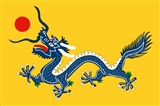
China Qing Dynasty Flag 1862
The Dynasty was founded not by the Han
Han

Han may refer to:...
 who form the majority of the Chinese population, but the Manchu
Manchu

The Manchu people are a Tungusic peoples who originated in Manchuria . During their rise in the seventeenth century, with the help of Ming rebels , they conquered the Ming Dynasty and founded the Qing Dynasty, which ruled China until its abolition in 1911 after the Xinhai Revolution, which established Republic of China in its place....
s, who are today an ethnic minority of China
China

China is a Culture of China, an ancient civilization, and, depending on perspective, a national or multinational entity extending over a large area in East Asia....
. The Manchu
Manchu

The Manchu people are a Tungusic peoples who originated in Manchuria . During their rise in the seventeenth century, with the help of Ming rebels , they conquered the Ming Dynasty and founded the Qing Dynasty, which ruled China until its abolition in 1911 after the Xinhai Revolution, which established Republic of China in its place....
s are descended from Jurchens
Jurchens

The Jurchens were a Tungusic peoples who inhabited the region of Manchuria until the 17th century, when they adopted the name Manchu. They established the Jin Dynasty between 1115 and 1122; it lasted until 1234 when the Mongols arrived....
 (Ch
Chinese language

Chinese or the Sinitic language is a language family consisting of language mutually unintelligible to varying degrees. Originally the indigenous languages spoken by the Han Chinese in China, it forms one of the two branches of Sino-Tibetan languages of languages....
: ??, Man
Manchu language

Manchu is a Tungusic languages language spoken in Northeast China; it used to be the language of the Manchu, though now most Manchus speak Mandarin Chinese and there are fewer than 70 native speakers of Manchu out of a total of nearly 10 million ethnic Manchus....
: Jušen), a Tungusic people
Tungusic peoples

The term Tungusic peoples is used to describe peoples speaking a Tungusic languages....
 who lived around the region now comprising the Russia
Russia

Russia , or the Russian Federation , is a list of countries spanning more than one continent country extending over much of northern Eurasia....
n province of Primorsky Krai
Primorsky Krai

Primorsky Krai also known as Primorye , is a federal subjects of Russia of Russia . Primorsky means "maritime" in Russian, hence the region is sometimes referred to as Maritime Province....
 and the Chinese
China

China is a Culture of China, an ancient civilization, and, depending on perspective, a national or multinational entity extending over a large area in East Asia....
 provinces of Heilongjiang
Heilongjiang

is a political divisions of China of the People's Republic of China located in the Northeast China part of the country. "Heilongjiang" literally means Black Chinese dragon River, which is the Chinese name for the Amur river....
 and Jilin
Jilin

, is a political divisions of China of the People's Republic of China located in the Northeast China part of the country. Jilin borders North Korea and Russia to the east, Heilongjiang to the north, Liaoning to the south, and Inner Mongolia to the west....
. What was to become the Manchu
Manchu

The Manchu people are a Tungusic peoples who originated in Manchuria . During their rise in the seventeenth century, with the help of Ming rebels , they conquered the Ming Dynasty and founded the Qing Dynasty, which ruled China until its abolition in 1911 after the Xinhai Revolution, which established Republic of China in its place....
 state was founded by Nurhaci
Nurhaci

Nurhaci is considered to be the founding father of the Manchu state. Nurhaci is also credited with ordering the creation of a written script for the Manchu language....
, the chieftain of a minor Jurchen tribe in Jianzhou, in the early 17th century. Originally a vassal of the Ming emperors, Nurhaci in 1582 embarked on an inter-tribal feud that escalated into a campaign to unify the Jianzhou Jurchen tribes. By 1616 he had sufficiently consolidated Jianzhou region to proclaim himself Khan of "Great Jin" in reference to the previous Jurchen dynasty. Historians refer to this pre-Qing entity as "Later Jin" to distinguish it from the first Jin Dynasty. Two years later Nurhaci announced Seven Grievances and openly renounced the sovereignty of Ming overlordship in order to complete the unification of those Jurchen tribes still allied with the Ming emperor. After a series of successful battles he relocated his capital from Hetu Ala to successively bigger captured Ming cities in the province of Liaodong, first Liaoyang
Liaoyang

Liaoyang is a city in China, Liaoning province, located in the middle of the heavily polluted Liaodong Peninsula. The city is situated on the T'ai-tzu River with a current population of 1,820,000....
 (Man
Manchu language

Manchu is a Tungusic languages language spoken in Northeast China; it used to be the language of the Manchu, though now most Manchus speak Mandarin Chinese and there are fewer than 70 native speakers of Manchu out of a total of nearly 10 million ethnic Manchus....
: dergi hecen) in 1621 and again in 1625 to Shenyang
Shenyang

Shenyang , or Mukden , is a sub-provincial city and capital city of Liaoning Provinces of China in Northeast China.Along with its nearby cities, Shenyang is an important industrial center in China, and the transportation and commercial centre of China's northeastern region....
 (later renamed Shengjing; Ch
Chinese language

Chinese or the Sinitic language is a language family consisting of language mutually unintelligible to varying degrees. Originally the indigenous languages spoken by the Han Chinese in China, it forms one of the two branches of Sino-Tibetan languages of languages....
: ??; Man
Manchu language

Manchu is a Tungusic languages language spoken in Northeast China; it used to be the language of the Manchu, though now most Manchus speak Mandarin Chinese and there are fewer than 70 native speakers of Manchu out of a total of nearly 10 million ethnic Manchus....
: Mukden).

Relocating his court from Jianzhou to Liaodong provided Nurhaci a bigger power base in terms of human and material resources; geographically it also brought him in close contact with the Mongol domains on the plains of Mongolia. Although by this time the once-united Mongol nation under Genghis Khan
Genghis Khan

Genghis Khan , born , was the founder, Khan and Khagan of the Mongol Empire, the World's largest empires contiguous empire in history....
 had long fragmented into individual and at times hostile tribes, these disunited tribes still presented a serious security threat to the Ming borders. Nurhaci's policy towards the Mongols was to seek their friendship and cooperation, thus securing the Jurchens' western front from a potential enemy. Furthermore, the Mongols proved a useful ally in the war, lending the Jurchens their traditional expertise as cavalry archers. To cement this new alliance Nurhaci initiated a policy of inter-marriages between Jurchen and those Mongolian nobility compliant to Jurchen leadership, while those who resisted were met with military action. This is a typical example of Nurhaci's many initiatives that eventually became official Qing government policy. Some of Nurhaci's other important contributions include ordering the creation of a written Manchu script based on Mongolian script
Mongolian script

Mongolian script was the first of many Mongolian writing systems created for the Mongolian language and the most successful until the introduction of Cyrillic to Mongolia in 1946....
(Their ancestral Jurchen language
Jurchen language

Jurchen language is an extinct language. It was spoken by Jurchen people of eastern Manchuria, the creators of the Jin Dynasty in the northeastern China of the 12th-13th centuries....
 already had a Jurchen script
Jurchen script

Jurchen script was the writing system used to write Jurchen language - the language of the Jurchen people who created the Jin Dynasty in the northeastern China of the 12th-13th centuries....
, which was derived from Khitan script
Khitan script

The Khitan scripts were the writing systems for the now-extinct Khitan language, used in the 10th-12th century by the Khitan people. who had created the Liao Empire in north-eastern China....
 which was derived from Hanzi), and the creation of the civil and military administrative system that eventually evolved into the Manchu
Manchu

The Manchu people are a Tungusic peoples who originated in Manchuria . During their rise in the seventeenth century, with the help of Ming rebels , they conquered the Ming Dynasty and founded the Qing Dynasty, which ruled China until its abolition in 1911 after the Xinhai Revolution, which established Republic of China in its place....
 Banners
Eight Banners

The Eight Banners were administrative divisions into which all Manchu families were placed. They provided the basic framework for the Manchu military organization....
 the defining element of Manchu identity, thus laying foundation for transforming the loosely knitted Jurchen tribes into a nation. Nurhaci's unbroken series of military successes came to an end in January 1626 when he was dealt his first major military defeat by general Yuan Chonghuan
Yuan Chonghuan

Yu?n Ch?nghu?n was a famed patriot and military commander of the Ming Dynasty who battled the Manchus in Liaoning. He was known to have excelled in artillery warfare and successfully incorporated western tactics into the East....
 while laying siege to the Ming city of Ningyuan
Battle of Ningyuan

The Battle of Ningyuan was a battle between the Han Chinese Ming Dynasty and the Manchurian Qing Dynasty in 1626. The Ming won this battle. This battle marked the temporary resurgence of the Imperial Ming army after a long series of defeats....
. He died a few months later and was succeeded by his eighth son Hung Taiji
Hung Taiji

Huang Taiji , also transliteration as Hung Taiji based on the Manchu language, was the first Chinese emperor of the Qing Dynasty in China....
 who emerged after a short political struggle amongst other potential contenders as the new Khan. Although he was an experienced general and the commander of two Banners at the time of his succession, Hung Taiji's reign did not start well on the military front. The Jurchens suffered yet another defeat in 1627 at the hands of Yuan Chonghuan. As before, this defeat was the result of the superior firepower of the Ming forces' newly acquired Portuguese cannons. To redress the technological and numerical disparity Hung Taiji in 1634 created his own artillery corps (Ch
Chinese language

Chinese or the Sinitic language is a language family consisting of language mutually unintelligible to varying degrees. Originally the indigenous languages spoken by the Han Chinese in China, it forms one of the two branches of Sino-Tibetan languages of languages....
: ??, Man
Manchu language

Manchu is a Tungusic languages language spoken in Northeast China; it used to be the language of the Manchu, though now most Manchus speak Mandarin Chinese and there are fewer than 70 native speakers of Manchu out of a total of nearly 10 million ethnic Manchus....
: ujen chooha) from amongst his existing Han troops who cast their own cannons from European design with the help of captured Chinese artisans. In 1635 the Manchu's Mongolian allies were fully incorporated into a separate Banner hierarchy under direct Manchu command. Hong Taiji then proceeded in 1636 to invade Korea for the second time. This was followed by the creation of the first (two) Han Banners in 1637 (which eventually increased to eight in 1642). Together these military reforms enabled Hung Taiji to resoundingly defeat Ming forces in a series of battles from 1640 to 1642 for the territories of Songshan and Jingzhou. This final victory resulted in the surrender of many of the Mings' most battle hardened troops and the complete permanent withdrawal of remaining Ming forces from lands north of the Great Wall.

On the civil front, Hung Taiji, on the advice of surrendered Ming officials, set up a rudimentary bureaucratic system based on the Ming model of government. Hung Taiji's bureaucracy was staffed with an unprecedented number of Han Chinese, many of them newly surrendered Ming officials. However, the Jurchens' continued dominance in government was ensured by an ethnic quota for top bureaucratic appointments. Hung Taiji's reign also saw a fundamental change of policy towards his Han Chinese subjects. Whereas under Nurhaci all captured Han Chinese were seen as a potential fifth column
Fifth column

A fifth column is a group of people who :wikt:clandestine undermine a larger group, such as a nation, to which it is regarded as being loyal....
 for the Ming Dynasty
Ming Dynasty

The Ming Dynasty , or Empire of the Great Ming , was the ruling Dynasties in Chinese history of China from 1368 to 1644, following the collapse of the Mongol-led Yuan Dynasty....
 and treated as chattel— including those who eventually held important government posts– Hung Taiji in contrast incorporated them into the Jurchen "nation" as full if not first class citizens, who were also obligated to provide military service. This change of policy not only increased Hung Taiji's power base and reduced his military dependence on those banners not under his personal control, it also greatly encouraged other Han Chinese subjects of the Ming Dynasty to surrender and accept Jurchen rule when they were defeated militarily. Through these and other measures Hung Taiji was able to centralize power unto the office of the Khan, which in the long run prevented the Jurchen federation from fragmenting after his death.

One of the defining events of Hung Taiji's reign was the official adoption of the name "Manchu" (Ch
Chinese language

Chinese or the Sinitic language is a language family consisting of language mutually unintelligible to varying degrees. Originally the indigenous languages spoken by the Han Chinese in China, it forms one of the two branches of Sino-Tibetan languages of languages....
: ??; Man
Manchu language

Manchu is a Tungusic languages language spoken in Northeast China; it used to be the language of the Manchu, though now most Manchus speak Mandarin Chinese and there are fewer than 70 native speakers of Manchu out of a total of nearly 10 million ethnic Manchus....
: Manju
Manjui Gisun
) for all Jurchen people in November 1635. And when the imperial seal of the Yuan
Yuan Dynasty

The Yuan Dynasty , or Great Yuan Empire was both the continuation of the Mongol Empire and the Mongol founded historical state in Mongolia and China, lasting officially from 1271 to 1368....
 emperors was presented to Hung Taiji by Ejei Khan
Ejei Khan

Ejei Khongghor or Ejei Khan was the son of Lingdan Khan, the last in the Borjigin clan of List of Mongol Khans, who once ruled over China as the Yuan Dynasty in the 13th and 14th centuries, and retreated north to Mongolia after 1368, known as the Northern Yuan Dynasty....
 the son of Lingdan Khan, the last grand-Khan of the Mongols, Hung Taiji in 1636 renamed the state from "Later Jin" to "Great Qing" and elevated his position from Khan to Emperor
Emperor

An emperor is a monarch, usually the sovereign ruler of an empire or another type of imperial realm. Empress is the female equivalent. As a title, "empress" may indicate the wife of an emperor or a woman who rules in her own right ....
, suggesting imperial ambitions beyond unifying Manchu territories. Some sources suggested that the name "Qing" was chosen in reaction to that of the Ming Dynasty which consists of the Chinese characters
Chinese language

Chinese or the Sinitic language is a language family consisting of language mutually unintelligible to varying degrees. Originally the indigenous languages spoken by the Han Chinese in China, it forms one of the two branches of Sino-Tibetan languages of languages....
 for sun and moon]], which are associated with the fire element. The character Qing is composed of the water radical and the character for blue-green, which are both associated with the water element. Others suggested that the name change went a long way to rehabilitate the Manchu state in the eyes of the Ming-era Han Chinese, who, being heavily influenced by a Neo-Confucian education system, had regarded the former Jurchen Jin dynasty as foreign invaders.

Claiming the Mandate of Heaven

Hung Taiji died suddenly in September 1643 without a designated heir. Because Jurchens had traditionally "elected" their leader through a council of nobles, the Qing state did not have in place a clear succession system until the reign of Emperor Kangxi
Kangxi Emperor

The Kangxi Emperor was the third Emperor of China of the Manchu-led Qing Dynasty and the second Qing emperor to rule over China proper, from 1661 to 1722....
. The leading contenders for power at this time were Hung Taiji’s eldest son Hooge
Hooge, Prince Su

Hooge was the eldest son of Emperor Huang Taiji of the Manchu Qing Dynasty. He was the founder of the House of Prince Su .He joined military campaigns against the Mongols, Korea and Ming Dynasty....
 and Hung Taiji’s agnate
Sibling

A sibling is a brother or a sister; that is, any person who shares the same parents.In most societies throughout the world, siblings usually grow up together and spend a good deal of their childhood with each other....
 half brother Dorgon
Dorgon

Dorgon , also known as Ho?oi Mergen Cin Wang, the Prince Rui , was one of the most influential Manchu princes in the early Qing dynasty....
. In the ensuing political impasse between two bitter political rivals a compromise candidate in the person of Hung Taiji’s five-year-old son Fulin
Shunzhi Emperor

The Shunzhi Emperor was the second Emperor of China of the Manchu-led Qing dynasty, and the first Qing emperor to rule over China proper from 1644 to 1661....
 was installed as Emperor Shunzhi
Shunzhi Emperor

The Shunzhi Emperor was the second Emperor of China of the Manchu-led Qing dynasty, and the first Qing emperor to rule over China proper from 1644 to 1661....
, with Dorgon as regent and de facto
De facto

De facto is a Latin expression that means "concerning the fact" or in practice but not necessarily ordained by law. It is commonly used in contrast to de jure when referring to matters of law, governance, or technique that are found in the common experience as created or developed without or contrary to a regulation....
 leader of the Manchu nation. The Manchus' nemesis the Ming Dynasty was fighting for its own survival against a long peasant rebellion and was unable to capitalise on the Qing court’s political uncertainty over the succession dispute and installation of a minor as Emperor. The Ming Dynasty's internal crisis came to a head in April 1644, when the capital at modern day Beijing
Beijing

is a metropolis in northern China and the Capital of the People's Republic of China. It is one of the four municipality of China, which are equivalent to province in China's Political divisions of China....
 was sacked by a coalition of rebel forces led by Li Zicheng
Li Zicheng

Li Zicheng , born Li H?ngji , was one of the major figures in the rebellion that brought down the Ming Dynasty. He proclaimed himself Chuang W?ng , or "The Roaming King"....
, a minor Ming official turned leader of the peasant revolt. The last Ming, Emperor Chongzhen committed suicide when the city fell, marking the official end of the dynasty.

After easily taking Beijing, Li Zicheng led a coalition of rebel forces numbering 200,000 to confront Wu Sangui
Wu Sangui

Wu Sangui was a Ming Dynasty who was instrumental in the succession of rule to the Qing Dynasty in 1644. Considered by most people to be a traitor to both the Ming and the Qing dynasties, Wu declared himself Emperor of China as ruler of the Zhou Dynasty in 1678, but his revolt was quelled by the Qing Kangxi Emperor....
, the general commanding the Ming garrison
Garrison

Garrison is the collective term for a body of troops stationed in a particular location, originally to guard it, of more than 50 men, but now often simply using it as a home base....
 at Shanhaiguan. Shanhaiguan is a pivotal pass
Mountain pass

In a range of hills, or especially of mountain range, a pass is a saddle point in between two areas of higher elevation. If following the lowest possible route through a mountain range, a pass is locally the highest point on that route....
 of the Great Wall of China
Great Wall of China

The Great Wall of China or is a series of stone and earthen fortifications in China, built, rebuilt, and maintained between the 5th century BC and the 16th century to protect the northern borders of the History of China from Xiongnu attacks during the rule of Dynasties in Chinese history....
 located fifty miles northeast of Beijing, and for years its defense
Defense (military)

Defence has several uses in the sphere of military application.Personal defence implies measures taken by individual soldiers in protecting themselves whether by use of protective materials such as armour, or field construction of trenches or a bunker, or by using weapons that prevent the enemy approaching them to initiate close combat....
s were what kept the Manchus from directly raiding the Ming capital. Wu, caught between a rebel army twice his size and a foreign enemy he had fought for years, decided to cast his lot with the Manchus with whom he was familiar, and made an alliance with Dorgon to fight the rebels. Some sources suggested that Wu's actions were influenced by news of mistreatment of his family and his concubine Chen Yuanyuan
Chen Yuanyuan

Chen Yuanyuan , born Xing Yuan , lived near the end of the Ming Dynasty, and was a concubine of Wu Sangui. Her courtesy name was Wanfen ....
 at the hands of the rebels when the capital fell. Regardless of the actual reasons for his decision, this awkward and some would say cynical alliance between Wu and his former sworn enemy was ironically made in the name of avenging the death of Emperor Chongzhen. Together, the two former enemies met and defeated Li Zicheng's rebel forces in battle on May 27, 1644. After routing Li
Li Zicheng

Li Zicheng , born Li H?ngji , was one of the major figures in the rebellion that brought down the Ming Dynasty. He proclaimed himself Chuang W?ng , or "The Roaming King"....
's forces, the Manchu
Manchu

The Manchu people are a Tungusic peoples who originated in Manchuria . During their rise in the seventeenth century, with the help of Ming rebels , they conquered the Ming Dynasty and founded the Qing Dynasty, which ruled China until its abolition in 1911 after the Xinhai Revolution, which established Republic of China in its place....
s captured Beijing
Beijing

is a metropolis in northern China and the Capital of the People's Republic of China. It is one of the four municipality of China, which are equivalent to province in China's Political divisions of China....
 on June 6, where Emperor Shunzhi
Shunzhi Emperor

The Shunzhi Emperor was the second Emperor of China of the Manchu-led Qing dynasty, and the first Qing emperor to rule over China proper from 1644 to 1661....
 was installed as the "Son of Heaven"
Chinese sovereign

Chinese sovereign is the ruler of a particular period in ancient China. Several titles and naming schemes have been used throughout history....
 on October 30. The Manchu
Manchu

The Manchu people are a Tungusic peoples who originated in Manchuria . During their rise in the seventeenth century, with the help of Ming rebels , they conquered the Ming Dynasty and founded the Qing Dynasty, which ruled China until its abolition in 1911 after the Xinhai Revolution, which established Republic of China in its place....
s who had positioned themselves as political heir to the Ming
Ming Dynasty

The Ming Dynasty , or Empire of the Great Ming , was the ruling Dynasties in Chinese history of China from 1368 to 1644, following the collapse of the Mongol-led Yuan Dynasty....
 Emperor by defeating Li Zicheng
Li Zicheng

Li Zicheng , born Li H?ngji , was one of the major figures in the rebellion that brought down the Ming Dynasty. He proclaimed himself Chuang W?ng , or "The Roaming King"....
, completed the symbolic act of transition by holding a formal funeral for Emperor Chongzhen. However the process of conquering the rest of China took another seventeen years of battling Ming loyalist
Loyalist

In general, a loyalist is someone who maintains loyalty to an established government, political party, or sovereign, especially during war or revolutionary change....
s, pretender
Pretender

A pretender is a claimant to an abolished throne or to a throne already occupied by somebody else. The English word :wikt:pretend comes from the French word pr?tendre, meaning "to put forward, to profess or claim"....
s and rebels. It also involved huge loss of life, including the infamous Yangzhou massacre
Yangzhou massacre

The Yangzhou massacre is a massacre that took place in Qing dynasty China in 1645 when Qing conquerers led by Prince Dodo conducted mass killings of the residents of Yangzhou....
 of 1645, when a ten-day rampage by troops in the city with the permission of Prince Dodo resulted in an estimated 800,000 deaths. The last Ming pretender, Prince Gui, sought refuge with the King of Burma, a vassal of the Ming Dynasty, but was turned over to a Qing expeditionary army commanded by Wu, who had him brought back to Yunnan
Yunnan

is a political divisions of China of the People's Republic of China, located in the far southwest of the country spanning approximately 394,000 square kilometers ....
 province and executed in early 1662.

The first seven years of Shunzhi
Shunzhi Emperor

The Shunzhi Emperor was the second Emperor of China of the Manchu-led Qing dynasty, and the first Qing emperor to rule over China proper from 1644 to 1661....
’s reign were dominated by the regent prince Dorgon, who, because of his own political insecurity within the Manchu power structure, followed Hung Taiji’s example of centralizing power under his own control in the name of the Emperor at the expense of other contending Manchu princes, many of whom eventually were demoted or imprisoned under one pretext or another. Although the period of his regency was relatively short, Dorgon cast a long shadow over the Qing Dynasty. Firstly the Manchus were able to enter "China Proper" only because of Dorgon’s timely decision to act on Wu Sangui’s appeal for military assistance. After capturing Beijing instead of sacking the city as the rebels had done before them, Dorgon insisted over the protests of other Manchu princes on making it Qing’s capital and largely reappointed Ming officials to their posts. Setting the Qing capital in Beijing may seem a straightforward move in hindsight, but it was then an act of innovation because historically no major Chinese dynasty had ever "inherited" its immediate predecessor’s capital. Keeping the Ming capital and bureaucracy intact helped quickly stabilize the country and greatly sped up the Manchu process of conquest. However, not all of Dorgon’s policies were equally popular nor easily implemented.

One of Dorgon's most controversial decisions was his July 1645 edict (the "haircutting order") that forced all Han Chinese men to shave the front of their heads and comb the remaining hair into a queue, on pain of death. To the Manchus, this policy was a test of loyalty and an aid in telling friend from foe. For the Han Chinese, however, it was a "humiliating act of degradation" that went against their traditional Confucian values. The order was so deeply unpopular that it triggered strong resistance to Qing rule in Jiangnan until at least the late 1640s. Hundreds of thousands were killed before all of China was brought into compliance.

On December 31, 1650, Dorgon suddenly died during a hunting expedition, marking the official start of the Shunzhi Emperor’s personal rule. However, because the Emperor was only twelve years old at that time, most decisions were made on his behalf by his mother, the Empress Dowager
Empress Dowager

Empress Dowager was the title given to the mother of a Emperor of China, Emperor of Japan, Emperor of Korea, or Emperor of Vietnam.The title was also given occasionally to another woman of the same generation, while a woman from the previous generation was sometimes given the title of Grand Empress Dowager....
 Xiaozhuang, who turned out to be a skilled political operator. Although Dorgon's support had been essential to Shunzhi's ascent, Dorgon had through the years centralised so much power in his hands as to become a direct threat to the throne, so much so that upon his death he was extraordinarily bestowed the posthumous title of Emperor Yi (Ch
Chinese language

Chinese or the Sinitic language is a language family consisting of language mutually unintelligible to varying degrees. Originally the indigenous languages spoken by the Han Chinese in China, it forms one of the two branches of Sino-Tibetan languages of languages....
: ???), the only instance in Qing history in which a Manchu "prince of the blood
Prince

Prince, from the Latin root princeps, is a general term for a monarch, for a member of a monarch's or former monarch's family, and is a hereditary title in some members of Europe's highest nobility....
" (Ch
Chinese language

Chinese or the Sinitic language is a language family consisting of language mutually unintelligible to varying degrees. Originally the indigenous languages spoken by the Han Chinese in China, it forms one of the two branches of Sino-Tibetan languages of languages....
: ??) was so honored. However two months into Shunzhi’s personal rule Dorgon was not only stripped of his titles, but his corpse was disinterred and mutilated to atone for multiple "crimes"—one of which was persecuting to death Shunzhi’s agnate eldest brother Hooge
Hooge, Prince Su

Hooge was the eldest son of Emperor Huang Taiji of the Manchu Qing Dynasty. He was the founder of the House of Prince Su .He joined military campaigns against the Mongols, Korea and Ming Dynasty....
. More importantly Dorgon’s symbolic fall from grace also signalled a political purge of his family and associates at court thus reverting power back to the person of the Emperor. However, from a promising start, Shunzhi’s reign was cut short by his early death in 1661 at the age of twenty-four from smallpox
Smallpox

Smallpox is an infectious disease unique to humans, caused by either of two virus variants, Variola major and Variola minor. The disease is also known by the Latin names Variola or Variola vera, which is a derivative of the Latin varius, meaning spotted, or varus, meaning "pimple"....
. He was succeeded by his third son Xuanye, who reigned as the Kangxi Emperor
Kangxi Emperor

The Kangxi Emperor was the third Emperor of China of the Manchu-led Qing Dynasty and the second Qing emperor to rule over China proper, from 1661 to 1722....
.

Manchu Methods of Maintaining Control


Queue Order

Manchu as a minority ruling class imposed Queue Order to force other ethnicities into submission.

Before capturing Beijing
Beijing

is a metropolis in northern China and the Capital of the People's Republic of China. It is one of the four municipality of China, which are equivalent to province in China's Political divisions of China....
, the Later Jin government implemented a mandatory shaving of the hair in Liaodong in the early 1620s, which led to a rebellion of the Han Chinese of this area in 1622 and 1625. Nevertheless, the Later Jin government responded swiftly to this rebellion by killing the educated elite and plain folks, resulting in more than 500,000 people dead, and instituting a stricter separation between Han Chinese and Manchus by prohibiting intermarriage between them.

After capturing Beijing in the previous year, Qing Prince Dorgon issued another decree in 1645 that any man who did not adopt the Manchu hairstyle within ten days would be executed. The slogan of the Queue Order is: "To keep the hair, you lose the head; To keep your head, you cut the hair." Han Chinese's revolt against this rule was wide spread, resulting in massive killing of Han ethnic throughout the country. One well documented massacre was the triple massacres at Jiading
Jiading

Jiading may refer to:*Jiading District, in Shanghai, China*Jiading, Kaohsiung, township in Kaohsiung County, Taiwan*Roman Catholic Diocese of Jiading, diocese located in Chongqing, China...
, in which General Li Chengdong, a Han Chinese general who previously served the Ming Dynasty but later surrendered to the Qing, ordered troops to carry out three separate massacres on the Jiading inhabitants within a month, resulting in tens of thousands of deaths. At the end of the third massacre, there was hardly any living person left in this city.

Literary inquisition and censorship
The Manchu rulers used literary inquisition
Literary Inquisition

Literary Inquisition refers to official persecution of intellectuals for their writings in History of China#Imperial era. W?nz?y? flourished during the Ming Dynasty and Qing Dynasty dynasties....
 to silence opposition. The accusation of individuals began with the authority's own interpretation of the true meaning of the corresponding words. Single characters and the neutrality of the sentence were judged by authorities. if the authority decided these were derogatory or cynical towards the rulers, persecution would begin.

Literary inquisition began with isolated cases in Shunzhi and Kangxi times, then evolved into a pattern. There were 53 cases of literary persecution during Qianlong's reign.

Kangxi emperor and consolidation

Portrait of the Kangxi Emperor in Court Dress
At sixty one years, Kangxi
Kangxi Emperor

The Kangxi Emperor was the third Emperor of China of the Manchu-led Qing Dynasty and the second Qing emperor to rule over China proper, from 1661 to 1722....
 had the longest reign of any Chinese Emperor
Emperor of China

The Emperor of China refers to any monarch of Imperial China reigning since the founding of the Qin Dynasty in 221 BC until the fall of the Qing Dynasty in 1912....
. But more importantly, apart from its length, Kangxi
Kangxi Emperor

The Kangxi Emperor was the third Emperor of China of the Manchu-led Qing Dynasty and the second Qing emperor to rule over China proper, from 1661 to 1722....
’s reign is also celebrated as the beginning of an era called “Kang-Qian Golden Age” (Ch
Chinese language

Chinese or the Sinitic language is a language family consisting of language mutually unintelligible to varying degrees. Originally the indigenous languages spoken by the Han Chinese in China, it forms one of the two branches of Sino-Tibetan languages of languages....
: ????) during which the Qing Dynasty reached the zenith of its social, economic and military power. Kangxi
Kangxi Emperor

The Kangxi Emperor was the third Emperor of China of the Manchu-led Qing Dynasty and the second Qing emperor to rule over China proper, from 1661 to 1722....
’s long reign started when he was eight years old upon the untimely demise of his father. In order to prevent a repeat of Dorgon
Dorgon

Dorgon , also known as Ho?oi Mergen Cin Wang, the Prince Rui , was one of the most influential Manchu princes in the early Qing dynasty....
's dictatorial monopolizing of imperial powers during the period of regency, Emperor Shunzhi
Shunzhi Emperor

The Shunzhi Emperor was the second Emperor of China of the Manchu-led Qing dynasty, and the first Qing emperor to rule over China proper from 1644 to 1661....
 on his deathbed hastily appointed four senior cabinet ministers to govern on behalf of his young son. The four ministers—Sonin
Sonin

Sonin, also known as Soni, and rarely Sony , was a senior regent during China Kangxi Emperor's minority in the Qing Dynasty. Sonin belonged to the Plain Yellow Banner....
, Ebilun
Ebilun

Ebilun was an assistant minister appointed by the China Shunzhi Emperor for his successor, Kangxi Emperor during the Qing Dynasty. Ebilun worked with Oboi to defeat Suksaha....
, Suksaha
Suksaha

Suksaha was a regent during the early reign of the China Kangxi Emperor in the Qing Dynasty. He belonged to the Manchu White Banner. His father's name was Suna....
, and Oboi
Oboi

Oboi was a highly decorated Manchu military commander and courtier who served in various military and administrative posts under three successive Emperor of Chinas of the early Qing Dynasty....
—were chosen for their long service to the emperor, but also to counteract each others' influences. Most importantly, the four were not closely related to the imperial family and laid no claim to the throne. However as time passed, through chance and machination, Oboi
Oboi

Oboi was a highly decorated Manchu military commander and courtier who served in various military and administrative posts under three successive Emperor of Chinas of the early Qing Dynasty....
—the most junior of the four ministers—was able to achieve political dominance to such an extent as to become a potential threat to the crown. Even though Oboi
Oboi

Oboi was a highly decorated Manchu military commander and courtier who served in various military and administrative posts under three successive Emperor of Chinas of the early Qing Dynasty....
's loyalty was never an issue, his personal arrogance and political conservatism led him to come into ever escalating conflict with the young Emperor
Emperor of China

The Emperor of China refers to any monarch of Imperial China reigning since the founding of the Qin Dynasty in 221 BC until the fall of the Qing Dynasty in 1912....
. In 1669 Kangxi
Kangxi Emperor

The Kangxi Emperor was the third Emperor of China of the Manchu-led Qing Dynasty and the second Qing emperor to rule over China proper, from 1661 to 1722....
, through trickery, disarmed and imprisoned Oboi
Oboi

Oboi was a highly decorated Manchu military commander and courtier who served in various military and administrative posts under three successive Emperor of Chinas of the early Qing Dynasty....
—a not insignificant victory for the fifteen-year-old Emperor
Emperor of China

The Emperor of China refers to any monarch of Imperial China reigning since the founding of the Qin Dynasty in 221 BC until the fall of the Qing Dynasty in 1912....
, as Oboi
Oboi

Oboi was a highly decorated Manchu military commander and courtier who served in various military and administrative posts under three successive Emperor of Chinas of the early Qing Dynasty....
 was not only a wily old politician but also an experienced military commander.

The Manchus found controlling the "Mandate of Heaven
Mandate of Heaven

The Mandate of Heaven is a traditional Chinese philosophy concept concerning the legitimacy of rulers. Heaven would bless the authority of a just ruler, but would be displeased with a despotic ruler and would withdraw their mandate....
" a daunting task. The vastness of China's territory meant that there were only enough banner troops to garrison key cities forming the backbone of a defence network that relied heavily on surrendered Ming soldiers. In addition, three surrendered Ming generals were singled out for their contributions to the establishment of the Qing dynasty, ennobled as feudal princes, and given governorships over vast territories in Southern China. The chief of these was Wu Sangui
Wu Sangui

Wu Sangui was a Ming Dynasty who was instrumental in the succession of rule to the Qing Dynasty in 1644. Considered by most people to be a traitor to both the Ming and the Qing dynasties, Wu declared himself Emperor of China as ruler of the Zhou Dynasty in 1678, but his revolt was quelled by the Qing Kangxi Emperor....
, who was given the provinces of Yunnan
Yunnan

is a political divisions of China of the People's Republic of China, located in the far southwest of the country spanning approximately 394,000 square kilometers ....
 and Guizhou
Guizhou

is a political divisions of China of the People's Republic of China located in the Southwest China of the country. Its provincial capital city is Guiyang....
, while generals Shang Kexi and Geng Zhongming were given the Guangdong
Guangdong

Guangdong is a political divisions of China on the southern coast of People's Republic of China. The province is also known by an alternative English language name, the Canton Province....
 and Fujian
Fujian

is one of the Province of China on the southeast coast of People's Republic of China. Fujian borders Zhejiang to the north, Jiangxi to the west, and Guangdong to the south....
 provinces, respectively. As the years went by, the three feudal lords and their territories inevitably became increasingly autonomous. Finally, in 1673, Shang Kexi petitioned Kangxi Emperor, stating his desire to retire to his hometown in Liaodong province and nominating his son as his successor. The young emperor granted his retirement, but denied the heredity of his fief. In reaction, the two other generals decided to petition for their own retirements to test Kangxi's resolve, thinking that he would not risk offending them. The move backfired as the young emperor called their bluff by accepting their requests and ordering all three fiefdoms to be reverted back to the crown.

Faced with the stripping of their powers, Wu Sangui felt he had no choice but to rise up in revolt. He was joined by Geng Zhongming and by Shang Kexi's son Shang Zhixin. The ensuing rebellion lasted for eight years. At the peak of the rebels' fortunes, they managed to extend their control as far north as the Yangtze River. Ultimately, though, the Qing government was able to put down the rebellion and exert control over all of southern China. The rebellion would be known in Chinese history as the Revolt of the Three Feudatories
Revolt of the Three Feudatories

The Three Feudatories were territories in southern China bestowed by the early Manchu rulers on three Chinese generals . In the second half of the 17th century, these generals revolted against the Manchu Qing Dynasty....
.

To consolidate the empire, Kangxi Emperor personally led a series of military campaigns against Tibet
Tibet

Tibet is a Tibetan Plateau in Asia, north of the Himalayas, and the home to the indigenous Tibetan people and its related ethnic groups. With an average elevation of 4,900 metres , it is the highest region on Earth and has in recent decades increasingly been referred to as the "Roof of the World"....
, the Dzungars
Dzungars

Dzungar is the collective identity of several Oirats tribes that formed and maintained the last nomadic empire in East Turkestan from the early 17th century to the middle 18th century....
, and later Russia
Russia

Russia , or the Russian Federation , is a list of countries spanning more than one continent country extending over much of northern Eurasia....
. He arranged the marriage of his daughter to the Mongol Khan Gordhun to avoid a military conflict. Gordhun's military campaign against the Qing failed, further strengthening the Empire. Taiwan
Taiwan

Taiwan is an island in East Asia. "Taiwan" is also commonly used to refer to the country governed by the Republic of China and to the ROC itself, which governs the island of Taiwan, Orchid Island and Green Island, Taiwan in the Pacific Ocean off the Taiwan coast, the Penghu islands in the Taiwan Strait, and Kinmen and the Matsu Islands...
 was also conquered by Qing Empire forces in 1683 from Zheng Keshuang, grandson of Koxinga
Koxinga

Koxinga is the traditional Western spelling of the popular appellation of Zheng Chenggong , who was a List of famous military commanders at the end of the China Ming Dynasty....
. Koxinga had conquered Taiwan from the Dutch
Netherlands

The Netherlands is a country that is part of the Kingdom of the Netherlands. It is a parliamentary democratic constitutional monarchy. The Netherlands is located in North-West Europe, and bordered by the North Sea to the north and west, Belgium to the south, and Germany to the east....
 colonists to use it as a base against the Qing Dynasty. By the end of the 17th century, China was at its greatest height of power since the Ming Dynasty
Ming Dynasty

The Ming Dynasty , or Empire of the Great Ming , was the ruling Dynasties in Chinese history of China from 1368 to 1644, following the collapse of the Mongol-led Yuan Dynasty....
.

Kangxi Emperor also handled many Jesuit
Society of Jesus

The Society of Jesus is a Roman Catholic religious order of clerks regular whose members are called Jesuits, Soldiers of Jesus Christ, and Foot soldiers of the Pope, because the founder, Saint Ignatius of Loyola, was a knight before becoming a Holy Orders....
 missionaries that came to China. A series of missionaries, including Matteo Ricci
Matteo Ricci

Matteo Ricci, SJ was an Italian Jesuit priest.Matteo Ricci was born in 1552 in Macerata, then part of the Papal States. Ricci started learning theology and law in a Rome Jesuits' school....
, Martino Martini
Martino Martini

Martino Martini was an Italy Jesuit missionary, cartographer and historian, mainly working on imperial China....
, Johann Adam Schall von Bell
Johann Adam Schall von Bell

Johann Adam Schall von Bell was a German people Jesuit missionary to China.Born of noble parents in Cologne, Germany, he attended the Dreik?nigsgymnasium and joined the Society of Jesus in Rome in 1611....
, Ferdinand Verbiest
Ferdinand Verbiest

Father Ferdinand Verbiest was a Flemish people Jesuit missionary in China during the Qing dynasty. He was born in Pittem near Tielt in Flanders, later part of the modern state of Belgium....
 and Antoine Thomas
Antoine Thomas

Antoine Thomas was a Belgian Jesuit priest, missionary and astronomer in China....
, also held significant positions as mathematicians, astronomers and advisers to the Emperor. Together they played a significant role in correcting the Chinese calendar and advancing knowledge of astronomy, science, and the geography of the Chinese empire.

Yongzheng and Qianlong emperors

Budala5
The reigns of the Yongzheng Emperor
Yongzheng Emperor

The Yongzheng Emperor , born Yinzhen was the fourth Emperor of China of the Manchu Qing Dynasty, and the third Qing emperor to rule over China, from 1722 to 1735....
 (r. 1723–1735) and his son the Qianlong Emperor
Qianlong Emperor

The Qianlong Emperor was the fifth emperor of the Manchu-led Qing Dynasty, and the fourth Qing dynasty emperors to rule over China. The fourth son of the Yongzheng Emperor, he reigned officially from October 11, 1736 to February 7, 1795....
 (r. 1735–1796) marked the height of Qing's power. During this period, the Qing Dynasty ruled over 13 million square kilometres of territory.

After the Kangxi Emperor's death in the winter of 1722, his fourth son Prince Yong succeeded him as the Yongzheng Emperor
Yongzheng Emperor

The Yongzheng Emperor , born Yinzhen was the fourth Emperor of China of the Manchu Qing Dynasty, and the third Qing emperor to rule over China, from 1722 to 1735....
. Yongzheng remained a controversial character because of rumours about him usurping the throne, and in the late Kangxi years, he was involved in great political struggles with his brothers. Yongzheng was a hardworking administrator who ruled with an iron hand. His first big step towards a stronger regime came when he brought the State Examination System
Imperial examination

The Imperial examinations in Imperial China determined who among the population would be permitted to enter the state's bureaucracy. The Imperial Examination System in China lasted for 1300 years, from its founding during the Sui Dynasty in 605 to its abolition near the end of the Qing Dynasty in 1905....
 back to its original standards. In 1724, he cracked down on illegal exchange rates of coins, which was being manipulated by officials to fit their financial needs. Those who were found in violation of new laws on finances were removed from office, or in extreme cases, executed.

Yongzheng showed a great amount of trust in Han
Han Chinese

Han Chinese are an ethnic group native to China and, by most modern definitions, the largest single ethnic group in the Earth.Han Chinese constitute about 92 percent of the population of the People's Republic of China , 98 percent of the population of the Republic of China , 75 percent of the population of Singapore, and about 19 percent...
 officials, and appointed many of his proteges to prestigious positions. Nian Gengyao
Nian Gengyao

Nian Gengyao was a Chinese race military commander of the Qing Dynasty. He was born a member of the Chinese Bordered Yellow Eight Banner system and had extensive military experience on the western frontier of the Qing empire....
 was appointed to lead a military campaign in place of his brother Yinti in Qinghai
Qinghai

is a provinces of China of the People's Republic of China, named after Qinghai Lake. It borders Gansu on the northeast, the Xinjiang on the northwest, Sichuan on the southeast, and Tibet Autonomous Region on the southwest....
. Nian's arrogant actions, however, led to his downfall in 1726. Yongzheng's reign saw consolidation of imperial power at its height in Chinese history.

More territory was incorporated in the Northwest. A toughened stance was directed towards corrupt officials, and Yongzheng led the creation of a Grand Council
Grand Council

The Grand Council or Junjichu was an important policy-making body in the Qing Empire. It was established in 1733 by the Yongzheng Emperor....
, which grew to become the de facto Cabinet for the rest of the dynasty.

The Yongzheng Emperor died in 1735. This was followed by the succession of his son Prince Bao as the Qianlong Emperor
Qianlong Emperor

The Qianlong Emperor was the fifth emperor of the Manchu-led Qing Dynasty, and the fourth Qing dynasty emperors to rule over China. The fourth son of the Yongzheng Emperor, he reigned officially from October 11, 1736 to February 7, 1795....
. Qianlong was known as an able general. Succeeding the throne at the age of 24, Qianlong personally led the military in campaigns near Xinjiang
Xinjiang

Xinjiang is an autonomous region of China of the People's Republic of China. It is a large, sparsely populated area, spanning over 1.6 million sq....
 and Mongolia
Mongolia

Mongolia is a landlocked country in East Asia and Central Asia. It borders Russia to the north and People's Republic of China to the south, east and west....
. Revolts and uprisings in Sichuan
Sichuan

is a Province in western China proper with its capital in Chengdu. The current name of the province, ?? , is an abbreviation of ??? , or "Four circuit #Circuits in East Asia of rivers", which is itself abbreviated from ???? , or "Four circuits of rivers and gorges", named after the division of the existing circuit into four during the Song...
 and parts of southern China were successfully put down.

Around forty years into Qianlong's reign, the Qing government saw a return of rampant corruption. The official Heshen
Heshen

Heshen...
 was arguably one of the most corrupt in the entire Qing Dynasty. He was eventually forced into committing suicide by Qianlong's son, the Jiaqing Emperor
Jiaqing Emperor

The Jiaqing Emperor was the sixth Emperor of China of the Manchu-led Qing dynasty, and the fifth Qing emperor to rule over China, from 1796 to 1820....
 (r. 1796–1820).

In 1796 open rebellion by the White Lotus Society
White Lotus

White Lotus was a type of Buddhist sectarianism that appealed to many Chinese race, most notably to women and to the poor, who found solace in worship of the Eternal Mother who was to gather all her children at the millennium into one family....
 against the Qing government broke out. The White Lotus Rebellion
White Lotus Rebellion

The White Lotus Rebellion was a China anti-Manchu uprising that occurred during the Qing dynasty. It broke out in 1796 among impoverished settlers in the mountainous region that separates Sichuan province from Hubei and Shaanxi provinces....
 continued for eight years, until 1804, and shattered the myth of the military invincibility of the Manchus.

Rebellion, unrest and external pressure

A common view of 19th century China is that it was an era in which Qing control weakened and prosperity diminished. Indeed, China suffered massive social strife, economic stagnation, and explosive population growth which placed an increasing strain on the food supply. Historians offer various explanations for these events, but the basic idea is that Qing power was, over the course of the century, faced with internal problems and natural disasters which were simply too much for the antiquated Chinese government, bureaucracy, and economy to deal with.
China Qing Dynasty Flag 1889
The Taiping Rebellion
Taiping Rebellion

The Taiping Rebellion was a large-scale revolt in China from 1850 to 1864, during the Qing Dynasty, by an army led by Heterodoxy Christianity convert Hong Xiuquan....
 in the mid-19th century was the first major instance of anti-Manchu sentiment threatening the stability of the Qing dynasty, a phenomenon that would only increase in the following years. Hong Xiuquan
Hong Xiuquan

H?ng Xi?qu?n , born Hong Renkun , courtesy name Huoxiu , was a Hakka China who led the Taiping Rebellion against the Qing Dynasty, establishing the Taiping tien-quo "Heavenly Kingdom of Great Peace," over varying portions of southern China, with himself as the "Tian Wang" and self-proclaimed brother of Jesus Christ....
, a failed civil service candidate, led the Taiping Rebellion
Taiping Rebellion

The Taiping Rebellion was a large-scale revolt in China from 1850 to 1864, during the Qing Dynasty, by an army led by Heterodoxy Christianity convert Hong Xiuquan....
, amid widespread social unrest and worsening famine. In 1851 Hong Xiuquan and others launched an uprising in Guizhou Province, established the Heavenly Kingdom of Great Peace with himself as king, claiming he often had visions of God and was the brother of Christ. Slavery, concubinage, arranged marriage, opium smoking, footbinding, judicial torture, and the worship of idols were all banned. However, success and subsequent authority and power led to internal feuds, defections and corruption. When British and French answered the Manchu rulers' call for help by sending troops equipped with modern weapons, the fate of the Taiping Rebellion was sealed. The rebellion not only posed the most serious threat towards the Manchu rulers; it was also "the costliest (human life) civil war in history and second bloodiest war of any kind, being only exceeded in casualities by WW II. Between 20 and 30 million people died during its fourteen-year course from 1850 to 1864." However, the horrific number of casualties of this rebellion and the complete devastation of a huge area in the south of the country have to a large extent been overshadowed by another significant conflict. Although not nearly as bloody, the outside world and its ideas and technologies had a tremendous and ultimately revolutionary impact on an increasingly weak and uncertain Qing state.

There were revolts by the Muslim
Muslim

:A Muslim , , is an adherent of the religion of Islam. The feminine form is Muslimah . Literally, the word means "one who submits "....
s and the Miao people
Miao people

The Miao are a linguistically and culturally related group of people recognized by the government of the People's Republic of China as one of the list of ethnic groups in China....
 of China
China

China is a Culture of China, an ancient civilization, and, depending on perspective, a national or multinational entity extending over a large area in East Asia....
 against the Qing Dynasty, most notably in the Dungan revolt
Dungan revolt

The Dungan Revolt was a religious war in 19th-century China. It is also known as the Hui Minorities' War and the Muslim Rebellion. The term is sometimes used to refer to the Panthay Rebellion in Yunnan as well....
 (1862-1877) in the northwest and the Panthay rebellion
Panthay Rebellion

The Panthay Rebellion , known in Chinese as the Du Wenxiu Rebellion was a separatist movement of the Hui people and Islam in Chinas against the imperial Qing Dynasty in southwestern Yunnan Province, China, as part of a wave of Hui-led multi-ethnic unrest....
 (1856-1873) in Yunnan
Yunnan

is a political divisions of China of the People's Republic of China, located in the far southwest of the country spanning approximately 394,000 square kilometers ....
.

One of the major issues affecting nineteenth-century China was the question of how to deal with other countries. Prior to the nineteenth-century, the Chinese empire
Late Imperial China

Late Imperial China refers to the period between the end of Mongol rule in 1368 and the establishment of the Republic of China in 1912 and includes the Ming Dynasty and Qing Dynasty Dynasties....
 was the hegemonic power in East Asia. Under its imperial theory, the Chinese emperor had the rights to rule "all under heaven
All under heaven

All under heaven, or literally, "heaven under" , is a phrase in the Chinese language and a Culture of China concept in China.The Chinese character ? means "sky" or "heaven"....
". Depending on the period and dynasty, it either ruled territories directly or neighbors fell under its hierarchical tributary system. Historians often refer to the underlying concept of the Chinese empire as "an empire with no boundary". However, the 18th century saw the European empires gradually expand across the world, as European states developed stronger economies built on maritime
Shipping

Shipping is physical process of transporting product and cargo. Virtually every product ever made, bought, or sold has been affected by shipping....
 trade
Trade

Tradeis the willing exchange of goods, Service , or both. Trade is also called commerce. A mechanism that allows trade is called a market. The original form of trade was barter , the direct exchange of goods and services....
. European colonies had been established in nearby India
India

India, officially the Republic of India , is a country in South Asia. It is the List of countries and outlying territories by total area country by geographical area, the List of countries by population country, and the most populous liberal democracy in the world....
 and on the islands that are now part of Indonesia
Indonesia

The Republic of Indonesia , is a transcontinental country in Southeast Asia and Oceania. Comprising Islands of Indonesia, it is the world's largest Archipelago state....
, whilst the Russian Empire
Russian Empire

File:Russian Emperor Flag.jpgFile:Romanov Flag.svgThe Russian Empire was a state that existed from 1721 until the Russian Revolution of 1917....
 had annexed the areas north of China. In 1793, Great Britain
Great Britain

Great Britain is an island lying to the northwest of Continental Europe. It is the List of islands by area, and the largest in Europe. With a population of 58.9 million people it is List of islands by population....
 attempted to forge an alliance with China, sending the Macartney Embassy
Macartney Embassy

The Macartney Embassy, also called the Macartney Mission, was a Kingdom of Great Britain embassy to China in 1793. The Mission ran from 1792?94 ....
 to Hong Kong
Hong Kong

Hong Kong , officially the Hong Kong Special Administrative Region, is a territory located in Southern China in East Asia, bordering the province of Guangdong to the north and facing the South China Sea to the east, west and south....
 with gifts for the Emperor, including examples of the latest European technologies and art. When the British delegation received a letter from Beijing
Beijing

is a metropolis in northern China and the Capital of the People's Republic of China. It is one of the four municipality of China, which are equivalent to province in China's Political divisions of China....
 explaining that China was unimpressed with European achievements, and that George III
George III of the United Kingdom

George III was Kingdom of Great Britain and Kingdom of Ireland from 25 October 1760 until the union of these two countries on 1 January 1801, after which he was King of the United Kingdom of Great Britain and Ireland until his death....
 was welcome to pay homage to the Chinese court, the deeply offended British government aborted all further attempts to reconcile relations with the Qing regime.

When the Napoleonic Wars
Napoleonic Wars

The Napoleonic Wars were a series of conflicts involving Napoleon I of France First French Empire and changing sets of European allies and opposing coalitions that ran from 1803 to 1815....
 ended in 1815, world trade rapidly increased, and as China's vast population offered limitless markets for European goods, trade between Chinese and European merchants expanded during the early years of the 19th century. This increased trade, though, led to increasing hostility between European governments and the Qing regime.

In 1793, the Qianlong Emperor stated to the British Ambassador Lord Macartney
George Macartney, 1st Earl Macartney

George Macartney, 1st Earl Macartney, Order of the Bath was a Kingdom of Great Britain statesman, colonial administrator and diplomat....
 that China had no use for European manufactured products. Consequently, leading Chinese merchants only accepted bar silver
Silver

Silver is a chemical element with the chemical symbol Ag and atomic number 47. A soft, white, lustrous transition metal, it has the highest electrical conductivity of any element and the highest thermal conductivity of any metal....
 as payment for their goods. The huge demand in Europe for Chinese goods such as silk
Silk

Silk is a natural protein fiber, some forms of which can be weaving into textiles. The best-known type of silk is obtained from Pupa#Cocoons made by the larvae of the mulberry silkworm Bombyx mori reared in captivity ....
, tea
Tea

Tea refers to the agricultural products of the leaves, leaf buds, and internodes of the Camellia sinensis plant, prepared and cured by various methods....
, and ceramics
Ceramics (art)

Ceramics is the art and science of making objects from inorganic, non-metallic materials by the action of heat. In art history, ceramics and ceramic art mean tableware, Work of art and tiles made from clay and other ceramic materials by the process of pottery, so excluding glass and also mosaic, normally made from glass tesserae....
 could only be met if European companies funnelled their limited supplies of silver into China. By the late 1830s, the governments of Great Britain
Great Britain

Great Britain is an island lying to the northwest of Continental Europe. It is the List of islands by area, and the largest in Europe. With a population of 58.9 million people it is List of islands by population....
 and France
France

France , officially the French Republic , is a country whose Metropolitan France is located in Western Europe and that also comprises various Overseas departments and territories of France....
 were deeply concerned about their stockpiles of precious metals and sought alternate trading schemes with China—the foremost of which was addicting China to opium. When the Qing regime tried to ban the Opium Trade in 1838, Great Britain declared war on China.

The First Opium War
First Opium War

The First Opium War or the First Anglo-Chinese War was fought between the East India Company and the Qing Dynasty of China from 1839 to 1842 with the aim of forcing China to allow free trade, particularly in opium....
 revealed the outdated state of the Chinese military. The Qing navy, composed entirely of wooden sailing junk
Junk (ship)

A junk is a Chinese sailing vessel. The English name comes from the Fujian#Culture word , jun ?, meaning "ship" or "large vessel." Junks were originally developed during the Han Dynasty and further evolved to represent one of the most successful ship types in history....
s, was severely outclassed by the modern tactics and firepower of the Royal Navy
Royal Navy

The Royal Navy of the United Kingdom is the oldest of the British Armed Forces . From the mid-18th century until well into the 20th century, it was the most powerful navy in the world, playing a key part in establishing the British Empire as the dominant world power from 1815 until the early 1940s....
. British soldiers, using modern rifle
Rifle

A rifle is a firearm designed to be fired from the shoulder, with a barrel that has a helical groove or pattern of grooves cut into the barrel walls....
s and artillery
Artillery

Artillery is a military Combat Arms which employs any apparatus, machine, an assortment of tools or instruments, a system or systems used as weapons for the discharge of large projectiles in combat as a major contribution of fire power within the overall military capability of an armed force....
, easily outmaneuvered and outgunned Qing forces in ground battles. The Qing surrender in 1842 marked a decisive, humiliating blow to China. The Treaty of Nanking
Treaty of Nanking

The Treaty of Nanking or Treaty of Nanjing, signed 29 August 1842, was the Unequal Treaties which marked the end of the First Opium War between the British Empire and Qing Dynasty Empires of 1839-42....
, which demanded reparation
War reparations

War reparations refer to the monetary compensation intended to cover damage or injury during a war. Generally, the term war reparations refers to money or goods changing hands, rather than such property transfers as the annexation of land....
 payments, allowed unrestricted European access to Chinese ports, and ceded the island of Hong Kong
Hong Kong Island

Hong Kong Island is an Islands and peninsulas of Hong Kong in the southern part of Hong Kong. It has a population of 1,268,112 and its population density is 15,915/km?, as of 2006....
 to Great Britain. It revealed many inadequacies in the Qing government and provoked widespread rebellions against the already hugely unpopular regime.

The Western powers, largely unsatisfied with the Treaty of Nanking, only gave grudging support to the Qing government during the Taiping
Taiping Rebellion

The Taiping Rebellion was a large-scale revolt in China from 1850 to 1864, during the Qing Dynasty, by an army led by Heterodoxy Christianity convert Hong Xiuquan....
 and Nien Rebellion
Nien Rebellion

The Nien Rebellion was an epic armed uprising that took place in northern China from 1851 to 1868, contemporaneously with Taiping Rebellion in South China....
s. China's income fell sharply during the wars as vast areas of farmland were destroyed, millions of lives lost, and countless armies raised and equipped to fight the rebels. In 1854, Great Britain tried to re-negotiate the Treaty of Nanking, inserting clauses allowing British commercial access to Chinese rivers and the creation of a permanent British embassy at Peking. This last clause outraged the Qing regime, who refused to sign, provoking another war with Britain. The Second Opium War
Second Opium War

The Second Opium War, the Second Anglo-Chinese War, the Arrow War, or the Anglo-French expedition to China, was a war of the British Empire and the Second French Empire against the Qing Dynasty of China from 1856-1860....
 ended in another crushing Chinese defeat, whilst the Treaty of Tianjin contained clauses deeply insulting to the Chinese, such as a demand that all official Chinese documents be written in English
English language

English is a West Germanic language that originated in Anglo-Saxon England and has lingua franca status in many parts of the world as a result of the military, economic, scientific, political and cultural influence of the British Empire in the 18th, 19th and early 20th centuries and that of the United States from the mid 20th century onwa...
 and a proviso granting British warships unlimited access to all navigable Chinese rivers.

Rule of Empress Dowager Cixi

The Empress Dowager Cixi
Empress Dowager Cixi

Empress Dowager CixiEmpress Dowager Cixi#Names of Empress Dowager Cixi , popularly known in China as the West Dowager Empress , was from the Manchu Yehe Nara Clan....
, concubine to the Xianfeng Emperor
Xianfeng Emperor

The Xianfeng Emperor , born Yizhu, was the eighth Emperor of China of the Manchu-led Qing Dynasty, and the seventh Qing emperor to rule over China, from 1850 to 1861....
 (r. 1850–1861) came to power in 1861 during the Xinyou coup, when, with the help of Prince Gong
Yixin, Prince Gong

The 1st Prince Gong , commonly known in his days as the Lord Sixth King , was born Yixin , of the Aisin-Gioro clan . He was in charge of the government of China, in the 1860s and 1870s, and is remembered for his strong ties with Westerners and his attempts at opening and modernizing China....
, she ousted eight regents (led by Sushun
Sushun

Sushun ; Courtesy name: Yuting was born in the Manchu Aisin-Gioro Clan as the sixth son of Wurgongga , the Prince Zheng.Although Sushun was born into nobility, the size of his family meant that he received little attention during childhood, and little expectation from the family....
) whom the Xianfeng emperor had appointed on his deathbed to rule for the child emperor Tongzhi, Cixi's son. For 47 years in the Tongzhi era (1862-1874) and during the reign of her nephew the Guangxu Emperor
Guangxu Emperor

The Guangxu Emperor , born Zaitian , was the tenth Emperor of China of the Manchu-led Qing Dynasty, and the ninth Emperor of China to rule over China proper....
 (1875-1908), Cixi was the de facto ruler of China and the Qing empire. She was known for "ruling from behind the curtain".

By the 1860s, the Qing dynasty had put down the rebellions
List of revolutions and rebellions

This is a list of revolutions and rebellions. A list of coups d'?tat and coup attempts can be found here: List of coups d'?tat and coup attempts....
 with the help of militia
Militia

The term militia is commonly used today to refer to a military force composed of ordinary citizens to provide defense, emergency law enforcement, or paramilitary service, in times of emergency without being paid a regular salary or committed to a fixed term of service....
 organized by the gentry. The Qing government then proceeded to deal with problem of modernization, which it attempted with the Self-Strengthening Movement
Self-Strengthening Movement

Self-Strengthening Movement ; c 1861?1895 was a period of institutional reforms initiated during the late Qing Dynasty following a series of military defeats and concessions to foreign powers....
. Several modernized armies were formed, including the much renowned Beiyang Army
Beiyang Army

The Beiyang Army was a powerful, Western-style China armed force created by the Qing Dynasty government in the late 19th century. It was the centerpiece of a general reconstruction of China's military system....
; however, the fleets of "Beiyang" were annihilated in the Sino-Japanese War (1894-1895), which produced calls for greater and more extensive reform. After the start of the 20th century, the Qing Dynasty was in a dilemma. It could proceed with reform and thereby alienate the conservative Manchu faction at court and the conservative gentry, or stagnate and alienate reformers as well as an increasingly large number of people opposed to Qing or Manchu rule.

Ten years into the reign of Guangxu (r. 1875–1908), western pressure on China was so great that she forcefully gave up all sorts of power. In 1898 Guangxu attempted the Hundred Days' Reform
Hundred Days' Reform

The Hundred Days' Reform was a failed 104-day national cultural, political and educational reform movement from 11 June to 21 September 1898, undertaken by the young Guangxu Emperor and his reform-minded supporters led by Kang Youwei....
, in which new laws were put in place and some old rules were abolished. Newer, more progressive-minded thinkers like Kang Youwei
Kang Youwei

Kang Youwei , was a China scholar, noted Chinese calligraphy and prominent political thinker and Reform movement of the late Qing Dynasty. He led movements to establish a constitutional monarchy and was an ardent Chinese nationalist....
 were trusted and recognized conservative-minded people like Li Hongzhang
Li Hongzhang

Li Hongzhang , Marquis Suyi of the First Class , GCVO, , also spelled Li Hung-chang, was a China general who ended several major rebellions, and a leading statesman of the late Qing Empire....
 were removed from high positions. But the ideals were stifled by Cixi and Guangxu was jailed in his own palace. Cixi concentrated on centralizing her own power base. At the occasion of her sixtieth Birthday, she spent over 30 million tael
Tael

Tael can refer to any one of several weight units of measurement of the Far East. Most commonly, it refers to the China tael , a part of the Chinese units of measurement of weights and currency ....
s of silver for the decorations & events, funds that were originally to improve the weaponry of the Beiyang Navy.

In 1901, following the murder of the German Ambassador, the Eight-Nation Alliance
Eight-Nation Alliance

The Eight-Nation Alliance was an alliance made up of Austria-Hungary, French Third Republic, German Empire, Kingdom of Italy , Empire of Japan, Imperial Russia, the United Kingdom of Great Britain and Ireland, and the United States whose armies invaded China while putting down the Boxer Rebellion in Qing Dynasty in August 1900....
 entered China as a united military force for the second time. Cixi reacted by declaring war on all eight nations, only to lose Beijing
Beijing

is a metropolis in northern China and the Capital of the People's Republic of China. It is one of the four municipality of China, which are equivalent to province in China's Political divisions of China....
 under their control within a short period of time. Along with the Guangxu Emperor, she fled to Xi'an
Xi'an

Xi'an , is the Capital of the Shaanxi Provinces of China in the People's Republic of China and a sub-provincial city. As one of the oldest cities in Chinese history, Xi'an is one of the Historical capitals of China because it has been the capital of some of the most important Dynasties in Chinese history in Chinese history, including the Zh...
. As a military compensation, the Alliance listed scores of demands on the Qing Government, including an initial hit list which had Cixi as No. 1. Li Hongzhang
Li Hongzhang

Li Hongzhang , Marquis Suyi of the First Class , GCVO, , also spelled Li Hung-chang, was a China general who ended several major rebellions, and a leading statesman of the late Qing Empire....
 was sent to negotiate and the Alliance backed down from several of the demands.

Dowager Cixi, the dragon lady

Many historians described Dowager Cixi as one of "the most formidable women in modern history", who could become a terrible enemy if she was antagonized. She was described to be "power hungry, ruthless and profoundly skilled in court politics".
The Boxer Rebellion
Boxer Rebellion

The Boxer Rebellion, or more properly Boxer Uprising, was a violent anti-foreign, anti-Christian movement by the "Righteous Fists of Harmony,? Yihe tuan or Society of Righteous and Harmonious Fists in China....
's rebels' initial objectives were to overthrow the Manchu Imperial court and expel all "foreign devils" from China. Dowager Cixi had decided to remotely control and, at the same time, intensify the Boxer movement through her ministers. Not long after, the Boxers' banner had a new slogan: "Support the Qing; destroy the foreigner!". In early 1900, an imperial edict released by the Dowager stated that 'secret societies were part of Chinese culture and were not criminal'.

From 1889 to 1898, the Dowager lived in the summer palace in semi-retirement. After losing to Japan in the first Sino-Japanese War (1894–95), the young Emperor Guangxu initiated the 'Hundred Days Reform'. The Dowager then returned to the Imperial Court to call off the emperor's reform, and at the same time put him under house arrest and ordered eunuchs faithful to her to keep watch.

In 1899 she supported the Boxer Rebellion
Boxer Rebellion

The Boxer Rebellion, or more properly Boxer Uprising, was a violent anti-foreign, anti-Christian movement by the "Righteous Fists of Harmony,? Yihe tuan or Society of Righteous and Harmonious Fists in China....
, during which thousands of Catholic and Protestant missionaries were killed; some were beheaded or skinned alive. Tens of thousands of Chinese Christian converts were killed too.

When the troops of the Eight-Nation Alliance
Eight-Nation Alliance

The Eight-Nation Alliance was an alliance made up of Austria-Hungary, French Third Republic, German Empire, Kingdom of Italy , Empire of Japan, Imperial Russia, the United Kingdom of Great Britain and Ireland, and the United States whose armies invaded China while putting down the Boxer Rebellion in Qing Dynasty in August 1900....
 marched into Peking, she fled the capital only to accept peace terms by paying the foreign powers huge amounts of silver. Before her death, on November 15 1908, she allegedly ordered her trusted eunuchs to poison the emperor. In a different version, Yuan Shikai
Yuan Shikai

Yuan Shikai was an important Chinese people general and politician famous for his influence during the Qing Dynasty#Rule of Empress Dowager Cixi, his role in the events leading up to the abdication of the Pu Yi of China, his autocratic rule as the second President of the Republic of China of the Republic of China, and his short-lived attem...
 was alleged to have executed both the emperor and dowager using a pistol.

Fall of the dynasty

Yuan Shi Kai
China Imperialism Cartoon
By the early twentieth century, mass civil disorder had begun and continuously grown. Empress Dowager Cixi
Empress Dowager Cixi

Empress Dowager CixiEmpress Dowager Cixi#Names of Empress Dowager Cixi , popularly known in China as the West Dowager Empress , was from the Manchu Yehe Nara Clan....
 and the Guangxu emperor both died in 1908, leaving a relatively powerless and unstable central authority. Puyi
Puyi

Puyi , of the Manchu Aisin-Gioro ruling family, was the last Emperor of China. He ruled in two periods between 1908 and 1924, firstly as the Xuantong Emperor between 1908 and 1912, and nominally as a non-ruling puppet emperor for twelve days in 1917....
, the eldest son of Zaifeng, Prince Chun, was appointed successor at age two, leaving Zaifeng with the regency. This was followed by the dismissal of General Yuan Shikai
Yuan Shikai

Yuan Shikai was an important Chinese people general and politician famous for his influence during the Qing Dynasty#Rule of Empress Dowager Cixi, his role in the events leading up to the abdication of the Pu Yi of China, his autocratic rule as the second President of the Republic of China of the Republic of China, and his short-lived attem...
 from his former positions of power. In mid 1911 Zaifeng created the "Imperial Family Cabinet", a ruling council of the Imperial Government almost entirely consisting of Aisin Gioro
Aisin Gioro

Aisin Gioro was the clan name of the Manchu Qing dynasty emperors of the Qing dynasty . The word aisin means gold in the Manchu language, and "gioro" means clan in the Manchu language....
 relatives. This brought a wide range of negative opinions from senior officials like Zhang Zhidong
Zhang Zhidong

Zhang Zhidong was an eminent Chinese politician during the late Qing Dynasty who advocated for controlled reform. Along with Zeng Guofan, Li Hongzhang and Zuo Zongtang, he was one of the "Four Famous Officials of the Late Qing" ....
.

The Wuchang Uprising
Wuchang Uprising

The Wuchang Uprising of October 10 1911 started the Xinhai Revolution, which led to the collapse of the Qing Dynasty and the establishment of the Republic of China ....
 succeeded on October 10, 1911, and was followed by a proclamation of a separate central government, the Republic of China
Republic of China

The Republic of China , also known as Nationalist China is a country in East Asia that has evolved from a single-party state with full global recognition into a multi-party democratic state with Political status of Taiwan....
, in Nanjing
Nanjing

is the capital city of China's Jiangsu province of China, and a city with a prominent place in Chinese history and Chinese culture. Nanjing served as the capital of China during several historical periods and is listed as one of the Historical capitals of China....
 with Sun Yat-sen
Sun Yat-sen

Sun Yat-sen , also known as Sun Yixian, Sun Wen, Sun Itchisen/Sun Itchiyama and Sun Zhongshan , was a China revolutionary and Politician leader often referred to as the Father of the Nation....
 as its provisional head. Numerous provinces began "separating" from Qing control. Seeing a desperate situation unfold, the Qing government brought an unwilling Yuan Shikai
Yuan Shikai

Yuan Shikai was an important Chinese people general and politician famous for his influence during the Qing Dynasty#Rule of Empress Dowager Cixi, his role in the events leading up to the abdication of the Pu Yi of China, his autocratic rule as the second President of the Republic of China of the Republic of China, and his short-lived attem...
 back to military power, taking control of his Beiyang Army
Beiyang Army

The Beiyang Army was a powerful, Western-style China armed force created by the Qing Dynasty government in the late 19th century. It was the centerpiece of a general reconstruction of China's military system....
, with the initial goal of crushing the revolutionaries. After taking the position of Prime Minister
Prime minister

A prime minister is the most senior minister of Cabinet in the Executive branch of government in a parliamentary system. The position is usually held by, but need not always be held by, a politician....
and creating his own cabinet, Yuan went as far as to ask for the removal of Zaifeng from the regency. This removal later proceeded with directions from Empress Dowager Longyu
Empress Dowager Longyu

Yehenara, Empress Xiao Ding Jing ; is better known as the Empress Dowager Longyu , . Longyu was the Qing Dynasty queen consort of the Guangxu Emperor of China....
.

With Zaifeng gone, Yuan Shi-kai and his Beiyang commanders effectively dominated Qing politics. He reasoned that going to war would be unreasonable and costly, especially when noting that the Qing Government had a goal for constitutional monarchy. Similarly, Sun Yat-sen's government wanted a Republican constitutional reform, both aiming for the benefit of China's economy and populace. With permission from Empress Dowager Longyu, Yuan began negotiating with Sun Yat-sen, who decided that his goal had been achieved in forming a republic, and that therefore he could allow Yuan to step into the position of President of the Republic. In 1912, after rounds of negotiations, Longyu issued the Imperial Edict bringing about the abdication of the child emperor Puyi
Puyi

Puyi , of the Manchu Aisin-Gioro ruling family, was the last Emperor of China. He ruled in two periods between 1908 and 1924, firstly as the Xuantong Emperor between 1908 and 1912, and nominally as a non-ruling puppet emperor for twelve days in 1917....
.

The collapse of the Qing dynasty in 1912 brought an end to over 2,000 years of imperial China and began an extended period of instability of warlord factionalism. Obvious political and economic backwardness combined with widespread criticism of Chinese culture led to questioning and doubt about the future. China's turbulent history since the overthrow of the Qing may be understood at least in part as an attempt to understand and recover significant aspects of historic Chinese culture and integrate them with influential new ideas that have emerged within the last century. Thereafter, Puyi founded Manchukuo
Manchukuo

Manchukuo was a puppet state in Manchuria and eastern Inner Mongolia. The region was the Qing Dynasty's historical homeland, created by former Qing Dynasty officials with help from Imperial Japan in 1932....
 in Manchuria (Manchus homeland) in 1934. After the invasion of the Soviet Union
Soviet Union

The Union of Soviet Socialist Republics was a Constitution of the Soviet Union socialist state that existed in Eurasia from 1922 to 1991.The name is a translation of the , romanization of Russian Soyuz Sovetskikh Sotsialisticheskikh Respublik, abbreviated ????, SSSR....
, Manchukuo collapsed in 1945.

Qing government and society


Administrative Divisions

  1. Outer Mongolia
    Outer Mongolia

    Outer Mongolia was the main part of the Bogdo Khanate of Mongolia, which proclaimed its independence on 29 December 1911. It consisted of the following four , ordering from east to west:...
     - 4 aimags
  2. Inner Mongolia
    Inner Mongolia

    Inner Mongolia is the Mongols autonomous region of China of the People's Republic of China, located in the country's north.Inner Mongolia borders, from east to west, the provinces of Heilongjiang, Jilin, Liaoning, Hebei, Shanxi, Shaanxi, Ningxia, and Gansu, while to the north it borders Mongolia and Russia....
     - 6 leagues
  3. Dariganga - special region designated as Emperor's pasture
  4. Köbsgöl
  5. Tannu Urianha
    Tannu Uriankhai

    Tannu Uriankhai is a historical region largely identical with today's Tuva. It was originally a part of Outer Mongolia.After Outer Mongolia became independent from the Qing dynasty and China, the region of Tannu Uriankhai increasingly came under Russian influence and finally became an independent communist state, the Tuvinian People's R...
  6. Köke Nuur league
  7. Alshaa khoshuu-league (League-level khoshuu)
  8. Ejine khoshuu-league
  9. Kobdo league
  10. Tianshanbei
  11. Tianshannan
  12. Eighteen provinces (China proper
    China proper

    China proper refers to the historical lands of China where the Han Chinese are the majority ethnic group, in contrast with other regions that form parts of the former Imperial era of Chinese historys and the current People's Republic of China....
     provinces)
    1. Zhili
    2. Henan
      Henan

      Henan , is a Province of the People's Republic of China, located in the central part of the country. Its one-Chinese character abbreviation is ? , named after Yuzhou , a Han Dynasty province that included parts of Henan....
    3. Shandong
      Shandong

      For the people of Shandong, see Shandong people is a coastal political divisions of China of eastern People's Republic of China. Its abbreviation is 'Lu', after the state of Lu that existed here during the Spring and Autumn Period....
    4. Shanxi
      Shanxi

      is a political divisions of China in the North China of the People's Republic of China. Its one-character abbreviation is Jin , after the state of Jin that existed here during the Spring and Autumn Period....
    5. Shaanxi
      Shaanxi

      is a north-central political divisions of China of the People's Republic of China, and includes portions of the Loess Plateau on the middle reaches of the Yellow River as well as the Qinling Mountains across the southern part of the province....
    6. Gansu
      Gansu

      or , is a political divisions of China located in the northwest of the People's Republic of China. It lies between Qinghai, Inner Mongolia, and the Loess Plateau, and borders Mongolia to the north and Xinjiang to the west....
    7. Hubei
      Hubei

      is a central province of China of the People's Republic of China. Its abbreviation is ? , an ancient name associated with the eastern part of the province since the Qin Dynasty....
    8. Hunan
      Hunan

      is a province of China of People's Republic of China, located in the middle reaches of the Yangtze River and south of Lake Dongting . Hunan is sometimes called wikt:? for short, after the Xiang River which runs through the province....
    9. Guangdong
      Guangdong

      Guangdong is a political divisions of China on the southern coast of People's Republic of China. The province is also known by an alternative English language name, the Canton Province....
    10. Guangxi
      Guangxi

      This article is about a region of China. For the sociological concept, see Guanxi.Guangxi is a Zhuang people autonomous region of China of the People's Republic of China....
    11. Sichuan
      Sichuan

      is a Province in western China proper with its capital in Chengdu. The current name of the province, ?? , is an abbreviation of ??? , or "Four circuit #Circuits in East Asia of rivers", which is itself abbreviated from ???? , or "Four circuits of rivers and gorges", named after the division of the existing circuit into four during the Song...
    12. Yunnan
      Yunnan

      is a political divisions of China of the People's Republic of China, located in the far southwest of the country spanning approximately 394,000 square kilometers ....
    13. Guizhou
      Guizhou

      is a political divisions of China of the People's Republic of China located in the Southwest China of the country. Its provincial capital city is Guiyang....
    14. Jiangsu
      Jiangsu

      is a Province of China of the People's Republic of China, located along the east coast of the country. The name comes from jiang, short for the city of Jiangning , and su, for the city of Suzhou....
    15. Jiangxi
      Jiangxi

      is a southern province of China of the People's Republic of China, spanning from the banks of the Yangtze River in the north into hillier areas in the south....
    16. Zhejiang
      Zhejiang

      Zhejiang is an eastern coastal province of China of the People's Republic of China. The word Zhejiang was the old name of the Qiantang River, which passes through Hangzhou, the provincial capital....
    17. Fujian
      Fujian

      is one of the Province of China on the southeast coast of People's Republic of China. Fujian borders Zhejiang to the north, Jiangxi to the west, and Guangdong to the south....
       (incl. Taiwan until 1885)
    18. Anhui
      Anhui

      Anhui is a province of China of the People's Republic of China. Located in eastern China across the basins of the Yangtze River and the Huaihe River, it borders Jiangsu to the east, Zhejiang to the southeast, Jiangxi to the south, Hubei to the southwest, Henan to the northwest, and Shandong for a tiny section in the north....


Qing dyarchy


The Qing dynasty was characterized by a system of dual appointments by which each position in the central government had a Manchu
Manchu

The Manchu people are a Tungusic peoples who originated in Manchuria . During their rise in the seventeenth century, with the help of Ming rebels , they conquered the Ming Dynasty and founded the Qing Dynasty, which ruled China until its abolition in 1911 after the Xinhai Revolution, which established Republic of China in its place....
 and a Han
Han Chinese

Han Chinese are an ethnic group native to China and, by most modern definitions, the largest single ethnic group in the Earth.Han Chinese constitute about 92 percent of the population of the People's Republic of China , 98 percent of the population of the Republic of China , 75 percent of the population of Singapore, and about 19 percent...
 assigned to it. The Han Chinese appointee was required to do the substantive work and the Manchu to ensure Han loyalty to Qing rule. The distinction between Han and Manchus extended to their court costumes. During the Qianlong Emperor
Qianlong Emperor

The Qianlong Emperor was the fifth emperor of the Manchu-led Qing Dynasty, and the fourth Qing dynasty emperors to rule over China. The fourth son of the Yongzheng Emperor, he reigned officially from October 11, 1736 to February 7, 1795....
's reign, for example, members of his family were distinguished by garments with a small circular emblem on the back, whereas Han officials wore clothing with a square emblem; this meant that any guard in the court could immediately distinguish members of the imperial family from the back view alone.

With respect to Mongolia, Tibet, and eastern Turkestan, the Qing maintained imperial control, with the emperor acting as Mongol khan, patron of Tibetan Buddhism and protector of Muslims. However, Qing policy changed with the establishment of Xinjiang
Xinjiang

Xinjiang is an autonomous region of China of the People's Republic of China. It is a large, sparsely populated area, spanning over 1.6 million sq....
 province in 1884. In response to British and Russian military action in Xinjiang and Tibet, the Qing sent Army units which performed remarkably well against British units.

Qing Dynasty Vases

Central Government Agencies


The Qing Dynasty inherited many important institutions from the preceding Ming dynasty
Ming Dynasty

The Ming Dynasty , or Empire of the Great Ming , was the ruling Dynasties in Chinese history of China from 1368 to 1644, following the collapse of the Mongol-led Yuan Dynasty....
. The formal structure of the Qing government centered around the Emperor as the absolute ruler, who presided over six Ministries (or Boards) (Ch.: Liubu ??), each headed by two presidents (Ch
Chinese language

Chinese or the Sinitic language is a language family consisting of language mutually unintelligible to varying degrees. Originally the indigenous languages spoken by the Han Chinese in China, it forms one of the two branches of Sino-Tibetan languages of languages....
: Shàngshu, ??; Ma
Manchu language

Manchu is a Tungusic languages language spoken in Northeast China; it used to be the language of the Manchu, though now most Manchus speak Mandarin Chinese and there are fewer than 70 native speakers of Manchu out of a total of nearly 10 million ethnic Manchus....
: Aliha amban) and assisted by four vice presidents (Ch: Shìláng, ??; Ma: Ashan i amban). In contrast to the Ming system, however, Qing ethnic policy dictated that appointments were split between Manchu noblemen and Han officials who had passed the highest levels of the state examinations
Imperial examination

The Imperial examinations in Imperial China determined who among the population would be permitted to enter the state's bureaucracy. The Imperial Examination System in China lasted for 1300 years, from its founding during the Sui Dynasty in 605 to its abolition near the end of the Qing Dynasty in 1905....
. The Grand Secretariat (Ch: Nèigé ??; Ma: Dorgi yamun), which had been an important policy-making body under the Ming, lost its importance during the Qing and evolved into an imperial chancery. The institutions which had been inherited from the Ming dynasty formed the core of the Qing "outer court," which handled routine matters and was located in the southern part of the Forbidden City.

In order not to let the routine administration take over the running of the empire, the Qing emperors made sure that all important matters were decided in the "Inner Court," which was dominated by the imperial family and Manchu nobility and which was located in the northern part of the Forbidden City
Forbidden City

The Forbidden City was the China imperial palace from the Ming Dynasty to the end of the Qing Dynasty. It is located in the middle of Beijing, People's Republic of China, and now houses the Palace Museum....
. The core institution of the inner court was the Grand Council
Grand Council

The Grand Council or Junjichu was an important policy-making body in the Qing Empire. It was established in 1733 by the Yongzheng Emperor....
. It emerged in the 1720s under the reign of the Yongzheng emperor as a body charged with handling Qing military campaigns against the Dzungar
Dzungars

Dzungar is the collective identity of several Oirats tribes that formed and maintained the last nomadic empire in East Turkestan from the early 17th century to the middle 18th century....
 Mongols
Mongols

The name Mongol specifies one or several ethnic groups, now mainly located in Mongolia, China, and Russia....
, but it soon took over other military and administrative duties and served to centralize authority under the crown. The Grand councillors (Ch.: Junji dachen ????) served as a sort of Privy Council
Privy council

A privy council is a body that advises the head of state of a nation on how to exercise their Executive , typically, but not always, in the context of a monarchy....
 to the emperor. However, the Manchu nobility continued to exercise considerable influence over the political and military affairs of the Qing government well into the reign of the Qianlong emperor.

The Six Ministries and their respective areas of responsibilities were as follows:

  • Board of Civil Appointments (Ch: Lìbù, ??; Ma: Hafan i jurgan)
The personnel administration of all civil officials - including evaluation, promotion, and dismissal. It was also in charge of the 'honours list'.
  • Board of Finance (Ch: Hùbù, ??; Ma: Boigon i jurgan)
The literal translation of the Chinese word 'hù'(?)is 'household'. For much of the Qing Dynasty's history, the government's main source of revenue came from taxation on landownership supplemented by official monopolies on essential household items such as salt and tea. Thus, in the predominantly agrarian Qing dynasty, the 'household' was the basis of imperial finance. The department was charged with revenue collection and the financial management of the government.
  • Board of Rites (Ch: Libù, ??; Ma: Dorolon i jurgan)
This Board was responsible for all matters concerning court protocol. It organized the periodic worship of ancestors and various gods by the Emperor, managed relations with tributary nations
List of tributaries of Imperial China

The following is a list of tribute of Imperial China....
, and oversaw the nationwide civil examination system
Imperial examination

The Imperial examinations in Imperial China determined who among the population would be permitted to enter the state's bureaucracy. The Imperial Examination System in China lasted for 1300 years, from its founding during the Sui Dynasty in 605 to its abolition near the end of the Qing Dynasty in 1905....
.
  • Board of War (Ch: Bingbù, ??; Ma: Coohai jurgan)
Unlike its Ming Dynasty
Ming Dynasty

The Ming Dynasty , or Empire of the Great Ming , was the ruling Dynasties in Chinese history of China from 1368 to 1644, following the collapse of the Mongol-led Yuan Dynasty....
 predecessor, which had full control over all military matters, the Qing Dynasty Board of War had very limited powers. First, the Eight Banners
Eight Banners

The Eight Banners were administrative divisions into which all Manchu families were placed. They provided the basic framework for the Manchu military organization....
 were under the direct control of the Emperor and hereditary Manchu and Mongolian princes, leaving the ministry only with authority over the Green Standard Armies
Green Standard Army

Green Standard Army is the name of a category of military units under the control of the Qing Dynasty in China. It was made up mostly of ethnic Han Chinese soldiers and operated concurrently with the Manchu-Mongol-Han Chinese Eight Banners armies....
. Furthermore, the ministry's functions were purely administrative—campaigns and troop movements were monitored and directed by the Emperor, first through the Manchu ruling council, and later through the Grand Council.
  • Board of Punishments (Ch: Xíngbù, ??; Ma: Beidere jurgan)
The Board of Punishments handled all legal matters, including the supervision of various law courts and prisons. The Qing legal framework
Great Qing Legal Code

The Great Qing Legal Code or Qing Code was the legal code of Qing dynasty . The code was based on the Ming dynasty legal system, which was kept largely intact....
 was relatively weak compared to modern day legal systems, as there was no separation of executive and legislative branches of government. The legal system could be inconsistent, and, at times, arbitrary, because the emperor ruled by decree and had final say on all judicial outcomes. Emperors could (and did) overturn judgements of lower courts from time to time. Fairness of treatment was also an issue under the apartheid system practised by the Manchu government over the Han Chinese majority. To counter these inadequacies and keep the population in line, the Qing maintained a very harsh penal code towards the Han populace, but it was no more severe than previous Chinese dynasties.
  • Board of Works (Ch: Gongbù, ??; Ma: Weilere jurgan)
The Board of Works handled all governmental building projects, including palaces, temples and the repairs of waterways and flood canals. It was also in charge of minting coinage.


In addition to the six boards, there was a Court of Colonial Affairs
Court of Colonial Affairs

The Court of Colonial Affairs was an agency in the Qing government which supervised the Qing Empire's Mongolia dependencies and oversaw the appointments of Ambans in Tibet....
 unique to the Qing government. This institution was established to supervise the administration of Tibet and the Mongolian lands. As the empire expanded, it took over administrative responsibility of all minority ethnic groups living in and around the empire, including early contacts with Russia—then seen as a tribute nation. The office had the status of a full ministry and was headed by officials of equal rank. However, appointees were at first restricted only to candidates of Manchurian and Mongolian ethnicity. To the south, Manchuria
Manchuria

Manchuria is a historical name given to a vast geographic region in northeast Asia. Depending on the definition of its extent, Manchuria either falls entirely within People's Republic of China, or is divided between China and Russia....
 was separated from China proper by the Inner Willow Palisade
Willow Palisade

Willow Palisade was a system of ditches and embankments planted with willows intended to restrict movement into Manchuria, built by the Qing Dynasty during the later 17th century....
, a ditch and embankment planted with willows intended to restrict the movement of the Han Chinese into Manchuria, as the area was off-limits to the Han until the Qing started colonizing the area with them later on in the dynasty's rule.

Even though the Board of Rites and the Court of Colonial Affairs performed some duties of a foreign office, they fell short of developing into a professional foreign service. This stemmed from the traditional imperial world view of seeing China as the centre of the world and viewing all foreigners as uncivilized barbarians unworthy of equal diplomatic status. It was not until 1861—a year after losing the Second Opium War
Second Opium War

The Second Opium War, the Second Anglo-Chinese War, the Arrow War, or the Anglo-French expedition to China, was a war of the British Empire and the Second French Empire against the Qing Dynasty of China from 1856-1860....
 to the Anglo-French coalition—that the Qing government bowed to foreign pressure and created a proper foreign affairs office known as the Zongli Yamen
Zongli Yamen

Zongli Yamen was the name of the government office/department of foreign relations of imperial China during the Qing dynasty. It was established by Prince Gong in 1861, following the Convention of Peking....
. The office was originally intended to be temporary and was staffed by officials seconded from the Grand Council. However, as dealings with foreigners became increasingly complicated and frequent, the office grew in size and importance, aided by revenue from customs duties which came under its direct jurisdiction.

Imperial Household Department


The Imperial Household Department
Imperial Household Department

The Imperial Household Department was an institution of Qing Dynasty China. Its primary purpose was to manage the internal affairs of the Aisin-Gioro and the activities of the Forbidden_City#Inner_Court , but it also played an important role in Qing relations with Tibet_history#Khoshud.2C_Dzungars.2C_and_Manchu and Mongolia, engaged in tradi...
 was unique to the Qing dynasty. It was established before the Qing defeat of the Ming, but it became mature only after 1661, following the death of the Shunzhi emperor and the accession of his son Kangxi. The Department's primary purpose was to manage the internal affairs of the Qing imperial family and the activities of the inner palace
Forbidden City

The Forbidden City was the China imperial palace from the Ming Dynasty to the end of the Qing Dynasty. It is located in the middle of Beijing, People's Republic of China, and now houses the Palace Museum....
 (in which tasks it largely replaced eunuchs), but it also played an important role in Qing relations with Tibet and Mongolia
Mongolia during Qing

Over the course of the 17th and 18th centuries, Greater Mongolia became part of the Qing dynasty empire. Even before the dynasty was founded, the escapades of Ligden Khan had driven a number of Mongol tribes to join the Manchu state....
, engaged in trading activities (jade, ginseng
Ginseng

Ginseng refers to species within Panax, a genus of 11 species of slow-growing perennial plants with fleshy roots, in the family Araliaceae....
, salt, furs, etc.), managed textile factories in the Jiangnan
Jiangnan

Jiangnan or Jiang Nan is a geographic area in China referring to lands immediately to the south of the lower reaches of the Yangtze River, including the southern part of the Yangtze River Delta....
 region, and even published books. The Department was manned by booi (Chinese: baoyi ??), or "bondservants," from the Upper Three Banners
Eight Banners

The Eight Banners were administrative divisions into which all Manchu families were placed. They provided the basic framework for the Manchu military organization....
. By the nineteenth century, it managed the activities of at least 56 subagencies.

Military


Beginnings and early development
The development of Qing military system can be divided into two broad periods separated by the Taiping rebellion (1850–1864). The early Qing military was rooted in the Eight Banners
Eight Banners

The Eight Banners were administrative divisions into which all Manchu families were placed. They provided the basic framework for the Manchu military organization....
 first developed by Nurhachi as a way to organize Jurchen society beyond petty clan affiliations. There are eight banners in all, differentiated by colours. The banners in their order of precedence were as follows: yellow, bordered yellow (i.e yellow banner with red border), white, red, bordered white, bordered red, blue, and bordered blue. The yellow, bordered yellow, and white banners were collectively known as the 'Upper Three Banners' (Zh
Chinese language

Chinese or the Sinitic language is a language family consisting of language mutually unintelligible to varying degrees. Originally the indigenous languages spoken by the Han Chinese in China, it forms one of the two branches of Sino-Tibetan languages of languages....
: shang san qi ???) and were under the direct command of the Emperor. Only Manchus belonging to the Upper Three Banners, and selected Han Chinese who had passed the highest level of martial exams were qualified to serve as the Emperor's personal bodyguards. The remaining Banners were known as "The Lower Five Banners" (Zh: xia wu qi ???) and were commanded by hereditary Manchu princes descended from Nurhachi's immediate family, known informally as the "Iron Cap Princes" (Zh: tie maozi wang ????). Together they formed the ruling council of the Manchu nation as well as high command of the army.

As Qing power expanded north of the Great Wall in the last years of the Ming Dynasty, the Banner system was expanded by Nurhachi's son and successor Hung Taiji to include mirrored Mongolian and Han Banners. After capturing Beijing in 1644 and as the Manchu rapidly gained control of large tracts of former Ming Dynasty territory, the relatively small Banner armies were further augmented by the Green Standard Army (Zh: ???) which eventually outnumbered Banner troops three to one. The Green Standard Army so-named after the colour of their battle standards was made up of those Ming troops who had surrendered to the Qing. They maintained their Ming era organization and were led by a mix of Banner and Green Standard officers. The Banners and Green Standard troops were standing armies, paid for by central government. In addition, regional governors from provincial down to village level maintained their own irregular local militias for police duties and disaster relief. These militias were usually granted small annual stipends from regional coffers for part-time service obligations. They received very limited military drill if at all and were not considered combat troops.

Peace and stagnation
Banner Armies were broadly divided along ethnic lines, namely Manchurian and Mongolian. Although it must be pointed out that the ethnic composition of Manchurian Banners was far from homogeneous as they include non-Manchu bondservants registered under the household of their Manchu masters. As the war with Ming Dynasty
Ming Dynasty

The Ming Dynasty , or Empire of the Great Ming , was the ruling Dynasties in Chinese history of China from 1368 to 1644, following the collapse of the Mongol-led Yuan Dynasty....
 progressed and the Han Chinese population under Manchu
Manchu

The Manchu people are a Tungusic peoples who originated in Manchuria . During their rise in the seventeenth century, with the help of Ming rebels , they conquered the Ming Dynasty and founded the Qing Dynasty, which ruled China until its abolition in 1911 after the Xinhai Revolution, which established Republic of China in its place....
 rule increased, Hung Taiji
Hung Taiji

Huang Taiji , also transliteration as Hung Taiji based on the Manchu language, was the first Chinese emperor of the Qing Dynasty in China....
 created a separate branch of Han Banners to draw on this new source of manpower. However these Han bannermen were never regarded by the government as equal to the other two branches due to their relatively late addition to the Manchu cause as well as their Han Chinese ancestry. The nature of their service—mainly as infantry, artillery and sappers, was also alien to the Manchurian nomadic traditions of fighting as cavalry. Furthermore, after the conquest the military roles played by Han Bannermen were quickly subsumed by the Green Standard Army. The Han Banners ceased to exist altogether after Emperor Yongzheng's Banner registration reforms aimed at cutting down imperial expenditures.

The socio-military origins of the Banner
Eight Banners

The Eight Banners were administrative divisions into which all Manchu families were placed. They provided the basic framework for the Manchu military organization....
 system meant that population within each branch and their sub-divisions were hereditary and rigid. Only under special circumstances sanctioned by imperial edict were social movements between banners permitted. In contrast, the Green Standard Army was originally intended to be a professional force.

After defeating the remnants of the Ming
Ming Dynasty

The Ming Dynasty , or Empire of the Great Ming , was the ruling Dynasties in Chinese history of China from 1368 to 1644, following the collapse of the Mongol-led Yuan Dynasty....
 forces, the Manchu
Manchu

The Manchu people are a Tungusic peoples who originated in Manchuria . During their rise in the seventeenth century, with the help of Ming rebels , they conquered the Ming Dynasty and founded the Qing Dynasty, which ruled China until its abolition in 1911 after the Xinhai Revolution, which established Republic of China in its place....
 Banner Army of approximately 200,000 strong at the time was evenly divided; half was designated the Forbidden Eight Banner Army (???? Jìnlu Baqí) and was stationed in Beijing. It served both as the capital's garrison and Qing government's main strike force. The remainder of the Banner troops was distributed to guard key cities in China. These were known as the Territorial Eight Banner Army (???? Zhùfáng Baqí). The Manchu
Manchu

The Manchu people are a Tungusic peoples who originated in Manchuria . During their rise in the seventeenth century, with the help of Ming rebels , they conquered the Ming Dynasty and founded the Qing Dynasty, which ruled China until its abolition in 1911 after the Xinhai Revolution, which established Republic of China in its place....
 court keenly aware its own minority status reinforced a strict policy of racial segregation between the Manchus and Mongols from Han Chinese for fear of being sinitized by the latter. This policy applied directly to the Banner garrisons, most of which occupied a separate walled zone within the cities they were stationed in. In cities where there were limitation of space such as in Qingzhou, a new fortified town would be purposely erected to house the Banner garrison and their families. Beijing being the imperial seat, the Regent Dorgon had the entire Chinese population forcibly relocated to the southern suburbs which became known as the "Outer Citadel" (?? wàichéng). The northern walled city called "Inner Citadel" (?? nèichéng) was portioned out to the remaining Manchu eight Banners, each responsibled for guarding a section of the Inner Citadel surrounding the Forbidden City
Forbidden City

The Forbidden City was the China imperial palace from the Ming Dynasty to the end of the Qing Dynasty. It is located in the middle of Beijing, People's Republic of China, and now houses the Palace Museum....
 palace complex (Zh
Chinese language

Chinese or the Sinitic language is a language family consisting of language mutually unintelligible to varying degrees. Originally the indigenous languages spoken by the Han Chinese in China, it forms one of the two branches of Sino-Tibetan languages of languages....
: ??? Zijìnchéng; Ma
Manchu language

Manchu is a Tungusic languages language spoken in Northeast China; it used to be the language of the Manchu, though now most Manchus speak Mandarin Chinese and there are fewer than 70 native speakers of Manchu out of a total of nearly 10 million ethnic Manchus....
: Dabkuri dorgi hoton)

The policy of posting Banner troops as territorial garrison was not to protect but to inspire awe in the subjugated populace at the expense of their expertise as cavalry. As a result, after a century of peace and lack of field training the Manchurian Banner troops had deteriorated greatly in their combat worthiness. Secondly, before the conquest the Manchu banner was a "citizen" army, and its members were Manchu farmers and herders obligated to provide military service to the state at times of war. The Qing government's decision to turn the banner troops into a professional force whose every welfare and need was met by state coffers brought wealth, and with it corruption, to the rank and file of the Manchu Banners and hastened its decline as a fighting force. This was mirrored by a similar decline in the Green Standard Army. During peace time, soldiering became merely a source of supplementary income. Soldiers and commanders alike neglected training in pursuit of their own economic gains. Corruption was rampant as regional unit commanders submitted pay and supply requisitions based on exaggerated head counts to the quartermaster department and pocketed the difference. When the Taiping rebellion
Taiping Rebellion

The Taiping Rebellion was a large-scale revolt in China from 1850 to 1864, during the Qing Dynasty, by an army led by Heterodoxy Christianity convert Hong Xiuquan....
 broke out in 1850s the Qing Court found out belatedly that the Banner and Green Standards troops could neither put down internal rebellions nor keep foreign invaders at bay.

Transition and modernization
Zeng Guofan
Early during the Taiping rebellion
Taiping Rebellion

The Taiping Rebellion was a large-scale revolt in China from 1850 to 1864, during the Qing Dynasty, by an army led by Heterodoxy Christianity convert Hong Xiuquan....
, Qing forces suffered a series of disastrous defeats culminating in the loss of the regional capital city of Nanjing in 1853. The rebels massacred the entire Manchu garrison and their families in the city and made it their capital. Shortly thereafter a Taiping
Taiping

Taiping meaning "peace", may refer to:*Taiping , the largest of the Spratly Islands controlled by the Republic of China *Taiping, Perak, a town in the state of Perak, Malaysia...
 expeditionary force penetrated as far north as the suburbs of Tianjin in what was considered Imperial heartlands. In desperation the court ordered a Chinese mandarin Zeng Guofan
Zeng Guofan

Zeng Guofan was an eminent Han Chinese official, military general, and devout Confucian scholar of the late Qing Dynasty in China.Zeng raised the Xiang Army to fight effectively against the Taiping Rebellion and restored the stability of Qing Dynasty along with other prominent figures, including Zuo Zongtang and Li Hongzhang, setting the...
to organize regional and village militias (Tuányong ?? and Xiangyong ??) into a standing army called tuanlian
Tuanlian

TuanlianLocalised militia begun in Zhou Dynasty, offered self-defense for the civilians. In May 1645, Ming rebel leader Li Zicheng was killed by tuanlian of local land owners in Hubei province....
 to contain the rebellion. Zeng's strategy was to rely on local gentries to raise a new type of military organization from those provinces that the Taiping rebels directly threatened. This new force became known as the Xiang Army
Xiang Army

Th Xiang Army was a standing army organized by Zeng Guofan from existing regional and village militia forces Tuanlian to contain the Taiping rebellion....
, named after Hunan
Hunan

is a province of China of People's Republic of China, located in the middle reaches of the Yangtze River and south of Lake Dongting . Hunan is sometimes called wikt:? for short, after the Xiang River which runs through the province....
 region where it was raised. The Xiang Army was a hybrid of local militia and a standing army. It was given professional training, but was paid for out of regional coffers and funds its commanders—mostly members of the Chinese gentry—could muster. The Xiang Army and its successor the Huai Army created by Zeng's colleague and pupil Li Hongzhang
Li Hongzhang

Li Hongzhang , Marquis Suyi of the First Class , GCVO, , also spelled Li Hung-chang, was a China general who ended several major rebellions, and a leading statesman of the late Qing Empire....
were collectively called Yongying.

Prior to forming and commanding the Xiang Army, Zeng had no military experience. Being a classically educated Mandarin his blueprint for the Xiang Army
Xiang Army

Th Xiang Army was a standing army organized by Zeng Guofan from existing regional and village militia forces Tuanlian to contain the Taiping rebellion....
 was taken from a historical source—the Ming Dynasty
Ming Dynasty

The Ming Dynasty , or Empire of the Great Ming , was the ruling Dynasties in Chinese history of China from 1368 to 1644, following the collapse of the Mongol-led Yuan Dynasty....
 General Qi Jiguang
Qi Jiguang

Qi Jiguang was a China military general and national hero during the Ming Dynasty. He was best remembered for his courage and leadership in the fight against Wokous along the east coast of China, as well as his reinforcement work on the Great Wall of China....
who, because of the weakness of regular Ming
Ming Dynasty

The Ming Dynasty , or Empire of the Great Ming , was the ruling Dynasties in Chinese history of China from 1368 to 1644, following the collapse of the Mongol-led Yuan Dynasty....
 troops, had decided to form his own "private" army to repel raiding Japanese pirates
Wokou

Wokou or Japanese pirates were pirates who raided the coastlines of China and Korea from the thirteenth century onwards. Originally, the Wokou were mainly soldiers, ronin, merchants and smugglers from Japan, but became predominantly from China two centuries later....
 in the mid-16th century. Qi's doctrine was based on Neo-Confucian ideas of binding troops' loyalty to their immediate superiors and also to the regions in which they were raised. This initially gave the troops an excellent esprit de corps. Qi's Army was an ad hoc solution to the specific problem of combating pirates, as was Zeng's original intention for the Xiang Army
Xiang Army

Th Xiang Army was a standing army organized by Zeng Guofan from existing regional and village militia forces Tuanlian to contain the Taiping rebellion....
, which was raise to eradicate the Taiping rebels. However, circumstances led to the Yongying system becoming a permanent institution within the Qing military, which in the long run created problems of its own for the beleaguered central government.

Qing Dynasty Troop
Firstly, Yongying system signalled the end of Manchu dominance in Qing military establishment. Although the Banners and Green Standard armies lingered on as parasites depleting resources, henceforth the Yongying corps became Qing government's de facto first-line troops. Secondly the Yongying corps were financed through provincial coffers and were led by regional commanders. This devolution of power weakened the central government's grip on the whole country, a weakness further aggravated by foreign powers vying to carve up autonomous colonial territories in different parts of the Empire in the later half of the 19th century. Despite these serious negative effects the measure was deemed necessary as tax revenue from provinces occupied and threatened by rebels had ceased to reach the cash-strapped central government. Finally, the nature of Yongying command structure fostered nepotism and cronyism amongst its commanders whom as they ascended the bureaucratic ranks laid the seeds to Qing's eventual demise and the outbreak of regional warlordism in China during the first half of the 20th century.

Beiyang Army
By the late 19th century, China was fast descending into a semi-colonial state. Even the most conservative elements within the Qing court could no longer ignore China's military weakness in contrast to the foreign "barbarians" literally beating down its gates. In 1860, during the Second Opium War
Second Opium War

The Second Opium War, the Second Anglo-Chinese War, the Arrow War, or the Anglo-French expedition to China, was a war of the British Empire and the Second French Empire against the Qing Dynasty of China from 1856-1860....
, the capital Beijing was captured and the Summer Palaces sacked by a relatively small Anglo-French coalition force numbering 25,000. Although the Chinese invented gunpowder, and firearms had been in continual use in Chinese warfare since as far back as the Song Dynasty
Song Dynasty

The Song Dynasty was a ruling Chinese dynasty in China between 960–1279 AD; it succeeded the Five Dynasties and Ten Kingdoms Period, and was followed by the Yuan Dynasty....
, the advent of modern weaponry resulting from the European Industrial Revolution
Industrial Revolution

The Industrial Revolution was a period in the late 18th and early 19th centuries when major changes in agriculture, manufacturing, production, and transportation had a profound effect on the socioeconomics and cultural conditions in United Kingdom....
 had rendered China's traditionally trained and equipped army and navy obsolete. The government attempts to modernize during the Self-Strengthening Movement
Self-Strengthening Movement

Self-Strengthening Movement ; c 1861?1895 was a period of institutional reforms initiated during the late Qing Dynasty following a series of military defeats and concessions to foreign powers....
 were in the view of most historians with hindsight piecemeal and yielded little lasting results. Various reasons for the apparent failure of late-Qing modernization attempts have been advanced including the lack of funds, lack of political will, and unwillingness to depart from tradition. These reasons remain disputed.

Losing the Sino-Japanese War
First Sino-Japanese War

The First Sino-Japanese War was a war fought between Qing Dynasty China and Meiji period Imperial Japan over the control of Korea. The Sino-Japanese War would come to symbolize the degeneration and enfeeblement of the Qing Dynasty and demonstrate how successful modernization had been in Japan since the Meiji Restoration as compared with the...
 of 1894–1895 was a watershed for the Qing government. Japan, a country long regarded by the Chinese as little more than an upstart nation of pirates, had convincingly beaten its larger neighbour and in the process annihilated the Qing government's pride and joy—its modernized Beiyang Fleet
Beiyang Fleet

The Beiyang Fleet was one of the Naval_history_of_China#Qing_Dynasty in the late Qing Dynasty. The navies were heavily sponsored by Li Hongzhang, who was the Viceroy of Zhili....
 then deemed to be the strongest naval force in Asia. In doing so, Japan became the first Asian country to join the previously exclusively western ranks of colonial powers. The defeat was a rude awakening to the Qing court especially when set in the context that it occurred a mere three decades after the Meiji reforms
Meiji Restoration

The , also known as the Meiji Ishin, Revolution, or Renewal, was a chain of events that led to enormous changes in Japan's political and social structure....
 set a feudal Japan on course to emulate the Western nations in their economic and technological achievements. Finally, in December 1894, the Qing government took some concrete steps to reform military institutions and to re-train selected units in westernized drills, tactics and weaponry. These units were collectively called the New Army
New Army

The New Armies were the modernized Qing dynasty army, military training and equipped according to Western world standards. The first of the new armies was founded in 1895 with Germany arms....
, the most successful of which was the Beiyang Army
Beiyang Army

The Beiyang Army was a powerful, Western-style China armed force created by the Qing Dynasty government in the late 19th century. It was the centerpiece of a general reconstruction of China's military system....
under the overall supervision and control of an ex-Huai Army commander, the Han Chinese general Yuan Shikai
Yuan Shikai

Yuan Shikai was an important Chinese people general and politician famous for his influence during the Qing Dynasty#Rule of Empress Dowager Cixi, his role in the events leading up to the abdication of the Pu Yi of China, his autocratic rule as the second President of the Republic of China of the Republic of China, and his short-lived attem...
, who exploited his position to eventually become Republic president, dictator and finally abortive emperor of China.

See also

  • Chinese rebellions
    Chinese rebellions

    This is a list of major rebellions that have occurred in China from 209 BCE to present times....
  • Chinese sovereign
    Chinese sovereign

    Chinese sovereign is the ruler of a particular period in ancient China. Several titles and naming schemes have been used throughout history....
  • Costumes of Qing officials
    Mandarin square

    A Mandarin square , also known as a rank badge, was a large embroidered badge sewn onto the surcoat of an Mandarin in Imperial era of Chinese history....
  • Dynasties in Chinese history
    Dynasties in Chinese history

    The following is a chronology of the dynasty in Chinese history. In reality, Chinese history is rarely as neat as it is portrayed and it was rare indeed for one dynasty to end calmly and give way quickly and smoothly to a new one....
  • Timeline of Chinese history
    Timeline of Chinese history

    The following is a timeline of the history of China. Between the changing of the Dynasties in Chinese history, most dates overlap as ruling periods do not transfer immediately....
  • Table of Chinese monarchs
    Table of Chinese monarchs

    The following list of Chinese monarchs is in no way inclusive. From the Shang Dynasty to the Qin Dynasty, rulers usually held the title King . With the division of China into separate Warring States, this title had become so common that the unifier of China, the first Qin Emperor Qin Shi Huang created a new title for himself, that of Emperor...
  • Emperor of China
    Emperor of China

    The Emperor of China refers to any monarch of Imperial China reigning since the founding of the Qin Dynasty in 221 BC until the fall of the Qing Dynasty in 1912....
  • Great Qing Legal Code
    Great Qing Legal Code

    The Great Qing Legal Code or Qing Code was the legal code of Qing dynasty . The code was based on the Ming dynasty legal system, which was kept largely intact....
  • Headwear of Manchu Officials
    Manchu official headwear

    Gong maois the headwear of an official during the Manchu Qing Dynasty in China consisted of a black velvet cap, or a hat woven in rattan or similar materials, both with a finial on top....
  • History of China
    History of China

    China civilization originated in various city-states along the Yellow River valley in the Neolithic era. The written history of China begins with the Shang Dynasty ....
  • List of Emperors of the Qing Dynasty
    List of Emperors of the Qing Dynasty

    The Qing Dynasty was founded as the "Later Jin Dynasty" in 1616 by Nurhaci, a Manchu of the Aisin-Gioro Clan, his son Hung Taiji changed its name to "Qing" in 1636....
  • List of Manchu clans
    List of Manchu clans

    This is a list of Manchu clans....
  • List of Recipients of Tribute from China
    List of recipients of tribute from China

    Chinese state entities have paid tribute to a number states and confederations throughout history. Due to Sinocentrism, China had not paid them willingly, as it regarded itself as the most advanced, important, and the Middle Kingdom, so these were forced upon China with threats of attacks and raids, which many of the peoples who received trib...
  • List of tributaries of Imperial China
    List of tributaries of Imperial China

    The following is a list of tribute of Imperial China....
  • Manchukuo
    Manchukuo

    Manchukuo was a puppet state in Manchuria and eastern Inner Mongolia. The region was the Qing Dynasty's historical homeland, created by former Qing Dynasty officials with help from Imperial Japan in 1932....
  • Mandate of Heaven
    Mandate of Heaven

    The Mandate of Heaven is a traditional Chinese philosophy concept concerning the legitimacy of rulers. Heaven would bless the authority of a just ruler, but would be displeased with a despotic ruler and would withdraw their mandate....
  • Military history of China
    Military history of China

    The recorded military history of China extends from about 1500 BC to the present day. China has the longest period of continuous development of military Chinese culture of any civilization in world history and had some of the world's most advanced military until the 16th century....
  • Mongolia during Qing
    Mongolia during Qing

    Over the course of the 17th and 18th centuries, Greater Mongolia became part of the Qing dynasty empire. Even before the dynasty was founded, the escapades of Ligden Khan had driven a number of Mongol tribes to join the Manchu state....
  • Qing dynasty family tree
  • Republic of China
    Republic of China

    The Republic of China , also known as Nationalist China is a country in East Asia that has evolved from a single-party state with full global recognition into a multi-party democratic state with Political status of Taiwan....
  • Anti-Qing sentiment
    Anti-Qing sentiment

    Anti-Qing sentiment is a sentiment principally held in China against the Manchu ruling during Qing Dynasty, which was often resented for being foreign and Barbarian....
  • Xinhai Revolution
    Xinhai Revolution

    The Xinhai Revolution or Hsinhai Revolution , also known as the 1911 Revolution or the Chinese Revolution, began with the Wuchang Uprising on October 10, 1911 and ended with the abdication of Emperor Puyi on February 12, 1912....
  • Slavery in seventeenth-century China
    Slavery in seventeenth-century China

    Booi Aha is a Manchu word literally translated as "household person" and sometimes rendered as "slaves". In his book China Marches West, Peter C....
  • Qing and Yuan Dynasties debate
    Qing and Yuan Dynasties debate

    The Qing Dynasty and Yuan Dynasty dynasties in China were dynasties ruled by non-Han Chinese such as the Manchu and Mongols. Although traditional views accepted them as legitimate dynasties in China, this view has been challenged by those believe that the Manchu and Mongols were barbarians that retarded China's progress towards modernity and cause...


Further reading

  • Peterson, Willard (ed.). (2002). The Cambridge History of China, Volume 9, . Cambridge: Cambridge University Press. .
  • Li Bo, Zheng Yin, "5000 years of Chinese history". Inner Mongolian People's publishing corp, ISBN 7204044207 (2001).


External links

  • Compton's Living Encyclopedia (1995-2008). "." As posted on Paul Halsall's web site. Retrieved on 2008-10-19.
  • . Retrieved on 2008-11-10.
  • "." Retrieved on 2008-11-10.
  • Section on the Ming and Qing dynasties of "." Retrieved on 2008-11-10.
  • "."