
All Topics  
Socrates


   Email Print
   Bookmark   Link


Socrates


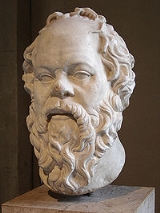
Socrates was a Classical GreekClassical Greece

In the context of the art, architecture, and culture of Ancient Greece, the classical period corresponds to most of the 5th ...
 philosopherPhilosophy

Philosophy is a field of study that includes diverse subfields such as aesthetics, epistemology, ethics, logic, and metaphys...
. Credited as one of the founders of Western philosophyWestern philosophy

Western philosophy is a term that refers to philosophical thinking in the "Western" world....
, in reality he is an enigmatic figure known only through other people's accounts. It is Plato's dialogues that have largely created today's impression of him.

This Socrates is renowned for his contribution to the field of ethicsEthics

Ethics is a major branch of philosophy....
, and is this Platonic Socrates who also lends his name to the concepts of Socratic irony and the Socratic methodSocratic method

Socratic method is a dialectic method of inquiry, largely applied to the examination of key moral concepts and first descri...
, or elenchus. The latter remains a commonly used tool in a wide range of discussions, and is a type of pedagogyPedagogy Overview

Pedagogy is the art or science of being a teacher....
 in which a series of questions are asked not only to draw individual answers, but to encourage fundamental insight into the issue at hand. It is Plato's Socrates that also made important and lasting contributions to the fields of epistemologyEpistemology

Epistemology or theory of knowledge is the branch of philosophy that studies the nature and scope of knowledge....
 and logicLogic

Logic, from Classical Greek ?????, originally meaning the word, or what is spoken, is most often said to be the stud...
, and the influence of his ideas and approach remains strong in providing a foundation for much western philosophy which followed.

As one recent commentator has put it, Plato, the idealist, offers "an idol, a master figure, for philosophy.


Discussion
Ask a question about 'Socrates'
Start a new discussion about 'Socrates'
Answer questions from other users
Full Discussion Forum


Timeline

399 BC   The Greek philosopher Socrates is sentenced to death, condemned for impiety and the corruption of youth. He refuses to flee into exile and is sentenced to death by drinking hemlock.


Quotations


Bad men live that they may eat and drink, whereas good men eat and drink that they may live. Socrates as quoted in Lives of Eminent Philosophers

False words are not only evil in themselves, but they infect the soul with evil.

Phædo 91

Having the fewest wants, I am nearest to the gods.

I am not an Athenian or a Greek, but a citizen of the world.

Often when looking at a mass of things for sale, he would say to himself, 'How many things I have no need of!

There is only one good, knowledge, and one evil, ignorance.

Variant: The only good is knowledge and the only evil is ignorance.


Encyclopedia


Socrates was a Classical GreekClassical Greece

In the context of the art, architecture, and culture of Ancient Greece, the classical period corresponds to most of the 5th ...
 philosopherPhilosophy

Philosophy is a field of study that includes diverse subfields such as aesthetics, epistemology, ethics, logic, and metaphys...
. Credited as one of the founders of Western philosophyWestern philosophy

Western philosophy is a term that refers to philosophical thinking in the "Western" world....
, in reality he is an enigmatic figure known only through other people's accounts. It is Plato's dialogues that have largely created today's impression of him.

This Socrates is renowned for his contribution to the field of ethicsEthics

Ethics is a major branch of philosophy....
, and is this Platonic Socrates who also lends his name to the concepts of Socratic irony and the Socratic methodSocratic method

Socratic method is a dialectic method of inquiry, largely applied to the examination of key moral concepts and first descri...
, or elenchus. The latter remains a commonly used tool in a wide range of discussions, and is a type of pedagogyPedagogy Overview

Pedagogy is the art or science of being a teacher....
 in which a series of questions are asked not only to draw individual answers, but to encourage fundamental insight into the issue at hand. It is Plato's Socrates that also made important and lasting contributions to the fields of epistemologyEpistemology

Epistemology or theory of knowledge is the branch of philosophy that studies the nature and scope of knowledge....
 and logicLogic

Logic, from Classical Greek ?????, originally meaning the word, or what is spoken, is most often said to be the stud...
, and the influence of his ideas and approach remains strong in providing a foundation for much western philosophy which followed.

As one recent commentator has put it, Plato, the idealist, offers "an idol, a master figure, for philosophy. A Saint, a prophet of the 'Sun-Good', a teacher condemned for his teachings as an heretic." yet the 'real' Socrates, like many of the other Ancient philosophers, remains at best enigmatic and at worst unknown.

Biography

The "Socratic Problem"

Forming an accurate picture of the historical Socrates and his philosophical viewpoints, is problematic at best. This issue is known as the Socratic problemSocratic problem

The Socratic problem results from the inability to determine what, in the writings of Plato, is an accurate portrayal of So...
.

Socrates himself did not write philosophical texts. Our knowledge of the man, his life, and his work is based on writings by his students and contemporaries. Foremost among them is PlatoPlato

Plato , whose real name is believed to have been Aristocles, was an immensely influential ancient Greek philosopher, ...
; however, works by XenophonXenophon

Xenophon , son of Gryllus, of the deme Erchia of Athens, was a soldier, mercenary and an admirer of Socrates and is known f...
, AristotleAristotle

Aristotle was an ancient Greek philosopher, a student of Plato and teacher of Alexander the Great....
, and AristophanesAristophanes

Aristophanes was a Greek Old Comic dramatist....
  also provide important insights. The difficulty of finding the “real” Socrates arises because these works are often philosophical or dramatic texts rather than straightforward histories. Aside from ThucydidesThucydides

Thucydides was an ancient Greek historian, and the author of the History of the Peloponnesian War, which recounts the 5...
 (who makes no mention of Socrates or philosophers in general), there is in fact no such thing as straightforward history contemporary with Plato. A corollary of this is that these sources don't claim to be historically accurate. Historians therefore face the challenge of reconciling the various texts that come from these men to create an accurate and consistent account of Socrates' life and work. The result of such an effort is not necessarily realistic, merely consistent.

In general, Plato is viewed as the most reliable and informative source of information about Socrates' life and philosophy. However, it is also clear from other writings, and historical artifacts that Socrates was not simply a character, or invention, of Plato. The testimony of Xenophon and Aristotle, alongside some of Aristophanes' work within The CloudsThe Clouds

The Clouds is a comedy written by the Ancient Greek playwright Aristophanes lampooning the sophists and the intellectual...
, can be usefully engaged in fleshing out our perception of Socrates beyond Plato's work.

Life

Details about Socrates derive from three contemporary sources: the dialogueDialogue

A dialogue is a reciprocal conversation between two or more persons....
s of PlatoPlato

Plato , whose real name is believed to have been Aristocles, was an immensely influential ancient Greek philosopher, ...
 and XenophonXenophon

Xenophon , son of Gryllus, of the deme Erchia of Athens, was a soldier, mercenary and an admirer of Socrates and is known f...
 (both devotees of Socrates), and the plays of AristophanesAristophanes

Aristophanes was a Greek Old Comic dramatist....
. He has been depicted by some scholars, including Eric Havelock and Walter Ong, as a champion of oralOrality Overview

Orality can be defined as thought and its verbal expression in societies where the technologies of literacy are unfamiliar ...
 modes of communication, standing up at the dawn of writingWriting

Writing may refer to two activities: the inscribing of characters on a medium, with the intention of forming words and other...
 against its haphazard diffusion.

Aristophanes' play The CloudsThe Clouds

The Clouds is a comedy written by the Ancient Greek playwright Aristophanes lampooning the sophists and the intellectual...
portrays Socrates as a clown who teaches his students how to bamboozle their way out of debt. Most of Aristophanes' works, however, function as parodies. Thus, it is presumed this characterization was also not literal.

According to Plato, Socrates' father was SophroniscusSophroniscus

Sophroniscus, husband of Phaenarete, was the father of the philosopher Socrates....
 and his mother PhaenaretePhaenarete

Phaenarete, wife of Sophroniscus, was the mother of the Greek philosopher Socrates and his half-brother, Patrocles....
, a midwife. Though characterized as unattractive in appearance and short of stature, Socrates married XanthippeXanthippe

Xanthippe was the wife of Socrates....
, who was much younger than he. She bore him three sons, LamproclesLamprocles

Lamprocles was Socrates' and Xanthippe's eldest son....
, Sophroniscus and MenexenusMenexenus

The Menexenus is a Socratic dialogue of Plato, traditionally included in the seventh tetralogy along with the Greater'...
. His friend Crito of AlopeceCrito of Alopece

Crito of Alopece, a deme of Athens, was a faithful, probably life-long companion of Socrates....
 criticized him for abandoning his sons when he refused to try to escape before his execution.

It is unclear how Socrates earned a living. According to Timon of PhliusTimon (philosopher)

Timon, of Phlius, Greek sceptic philosopher and satirical poet, a pupil of Stilpo the Megarian and Pyrrho of Elis....
 and later sources, Socrates took over the profession of stonemasonryStonemasonry

The craft of the stonemason has existed since the dawn of civilization - creating buildings, structures and sculpture using ...
 from his father. There was a tradition in antiquity, not credited by modern scholarship, that Socrates crafted the statues of the Three Graces, which stood near the Acropolis until the second century AD.

There is evidence Socrates never engaged in a profession: In Xenophon's SymposiumSymposium (Xenophon)

Xenophon's Symposium records the discussion of Socrates...
, Socrates is reported as saying he devotes himself only to what he regards as the most important art or occupation: discussing philosophy. In The Clouds Aristophanes portrays Socrates as accepting payment for teaching and running a sophistSophism

Sophism was originally a term for the techniques taught by a highly respected group of philosophy and rhetoric teachers in a...
 school with ChaerephonChaerephon

Chaerephon ', of the Athenian deme Sphettus, was a loyal friend and follower of Socrates....
, while in Plato's ApologyApology (Plato)

Apology is Plato's version of the speech given by Socrates as he defends himself against the charges of being a man "wh...
and SymposiumSymposium (Plato) Summary

The Symposium is a Socratic dialogue by the ancient Greek philosopher Plato, student of Socrates, focusing on Eros a...
and in Xenophon's accounts, Socrates explicitly denies accepting payment for teaching. More specifically, in the Apology Socrates cites his poverty as proof he is not a teacher.

Several of Plato's dialogues refer to Socrates' military service. Socrates says he served in the Athenian army during three campaigns: at PotidaeaBattle of Potidaea

The Battle of Potidaea was, with the Battle of Sybota, one of the catalysts for the Peloponnesian War....
, AmphipolisBattle of Amphipolis

The Battle of Amphipolis was fought in 422 BC during the Peloponnesian War between Athens and Sparta....
, and DeliumBattle of Delium Summary

The Battle of Delium or of Delion took place in 424 BC between the Athenians and the Boeotians, and ended with the sie...
. In the Symposium AlcibiadesAlcibiades

Alcibiades Cleiniou Scambonides , also transliterated as Alkibiades, was a prominent Athenian statesman, orator and g...
 describes Socrates' valour in the battles of Potidaea and Delium, recounting how Socrates saved his life in the former battle (219e-221b). Socrates' exceptional service at Delium is also mentioned in the LachesLaches (dialogue)

Laches, also known as Courage, is a Socratic dialogue written by Plato, and concerns the topic of courage....
by the general after whom the dialogue is named (181b). In the Apology, Socrates compares his military service to his courtroom troubles, and says anyone on the jury who thinks he ought to retreat from philosophy must also think soldiers should retreat when it looks like they will be killed in battle.

Trial and Death


Socrates lived during the time of the transition from the height of the AthenianAthenian

An Athenian is a resident of Athens....
 hegemonyHegemony

Hegemony is the dominance of one group over other groups, with or without the threat of force, to the extent that, for ins...
 to its decline with the defeat by SpartaSparta

Sparta is a city in southern Greece....
 and its allies in the Peloponnesian WarPeloponnesian War

The Peloponnesian War was an Ancient Greek military conflict fought by Athens and its empire and the Peloponnesian League, ...
. At a time when AthensAthens

Athens is the capital and the largest city of Greece....
 sought to stabilize and recover from its humiliating defeat, the Athenian public may have been entertaining doubts about democracy as an efficient form of government. Socrates appears to have been a critic of democracyDemocracy

Democracy is a form of government for a nation state, or for an organization in which the citizens have a vote or voice in ...
, and some scholars interpret his trial as an expression of political infighting.

Despite claiming death-defying loyalty to his city, Socrates' pursuit of virtue and his strict adherence to truth clashed with the current course of Athenian politics and society. He praises Sparta, archrival to Athens, directly and indirectly in various dialogues. But perhaps the most historically accurate of Socrates' offenses to the city was his position as a social and moral critic. Rather than upholding a status quo and accepting the development of immorality within his region, Socrates worked to undermine the collective notion of "might makes right" so common to Greece during this period. Plato refers to Socrates as the "gadflyGadfly

Gadfly can refer to:*Gadfly, a type of fly typically belonging to either the genus Tabanidae or Oestridae...
" of the state (as the gadfly stings the horse into action, so Socrates stung Athens), insofar as he irritated the establishment with considerations of justice and the pursuit of goodness. His attempts to improve the Athenians' sense of justice may have been the source of his execution.

According to Plato's Apology, Socrates' life as the "gadflyGadfly (social)

"Gadfly" is a term for people who upset the status quo by posing upsetting or novel questions, or attempt to stimulate innov...
" of Athens began when his friend Chaerephon asked the oracle at DelphiPythia

The Pythia was the priestess presiding over the Oracle of Apollo at Delphi, located on the slopes of Mount Parnassus....
 if anyone was wiser than Socrates; the OracleOracle

An oracle is a person or agency considered to be a source of wise counsel or prophetic opinion; an infallible authority, usu...
 responded that none was wiser. Socrates believed that what the Oracle had said was a paradox, because he believed he possessed no wisdom whatsoever. He proceeded to test the riddle through approaching men who were considered to be wise by the people of Athens, such as statesmen, poets, and artisans, in order to refute the pronouncement of the Oracle. But questioning them, Socrates came to the conclusion that, while each man thought he knew a great deal and was very wise, they in fact knew very little and were not really wise at all. Socrates realized that the Oracle was correct, in that while so-called wise men thought themselves wise and yet were not, he himself knew he was not wise at all which, paradoxically, made him the wiser one since he was the only person aware of his own ignorance. Socrates' paradoxical wisdom made the prominent Athenians he publicly questioned look foolish, turning them against him and leading to accusations of wrongdoing. Socrates defended his role as a gadfly until the end: at his trial, when Socrates was asked to propose his own punishment, he suggests a wage paid by the government and free dinners for the rest of his life instead, to finance the time he spends as Athens' benefactor. He was, nevertheless, found guilty of corrupting the minds of the youth of Athens and sentenced to death by drinking a mixture containing poison hemlockConium Summary

Conium is a genus of two species of perennial herbaceous flowering plants in the family Apiaceae, native to Europe and t...
.

According to Xenophon's story, Socrates purposefully gave a defiant defense to the jury because "he believed he would be better off dead". Xenophon goes on to describe a defense by Socrates that explains the rigors of old age, and how Socrates would be glad to circumvent them by being sentenced to death. It is also understood that Socrates also wished to die because he "actually believed the right time had come for him to die".

Xenophon and Plato agree that Socrates had an opportunity to escape, as his followers were able to bribe the prison guards. He chose to stay for several reasons:

  1. He believed such a flight would indicate a fear of death, which he believed no true philosopher has.
  2. If he fled Athens his teaching would fare no better in another country as he would continue questioning all he met and undoubtedly incur their displeasure.
  3. Having knowingly agreed to live under the city's laws, he implicitly subjected himself to the possibility of being accused of crimes by its citizens and judged guilty by its jury. To do otherwise would have caused him to break his "social contractSocial contract

    Social contract theory is a concept used in philosophy, political science, and sociology to denote an implicit agreement wi...
    " with the state, and so harming the state, an act contrary to Socratic principle.


The full reasoning behind his refusal to flee is the main subject of the CritoCrito

The Crito is a well-known dialogue by the ancient Greek philosopher, Plato, between Socrates and his follower the rich A...
.

Socrates' death is described at the end of Plato's PhaedoPhaedo

Plato's Phaedo is the fifth and last dialogue detailing the final days of Socrates and contains the death scene.....
. Socrates turned down the pleas of Crito to attempt an escape from prison. After drinking the poison, he was instructed to walk around until his limbs felt heavy. After he lay down, the man who administered the poison pinched his foot. Socrates could no longer feel his legs. The numbness slowly crept up his body until it reached his heart. Shortly before his death, Socrates speaks his last words to Crito: "Crito, we owe a cock to AsclepiusAsclepius

Asklepios was the demigod of medicine and healing in ancient Greek mythology....
. Please, don't forget to pay the debt." Asclepius was the Greek god for curing illness, and it is likely Socrates' last words meant that death is the cure—and freedom, of the soul from the body. The Roman philosopher SenecaSeneca the Younger

Lucius Annaeus Seneca was a Roman philosopher, statesman, dramatist, and in one work humorist, of the Silver Age of Latin li...
 attempted to emulate Socrates' death by hemlock when forced to commit suicide by the Emperor NeroNero

Nero Claudius Caesar Augustus Germanicus , born Lucius Domitius Ahenobarbus, also called Nero Claudius Drusu...
.

Philosophy

Socratic method

Perhaps his most important contribution to WesternWestern culture

Western culture or Western civilization is a term used to refer to the cultures of the people of European origin and t...
 thought is his dialecticDialectic Summary

In classical philosophy, dialectic is an exchange of propositions and counter-propositions resulting in a synth...
 method of inquiry, known as the Socratic MethodSocratic method

Socratic method is a dialectic method of inquiry, largely applied to the examination of key moral concepts and first descri...
 or method of '"elenchus," which he largely applied to the examination of key moral concepts such as the Good and JusticeJustice

Justice is the ideal, morally correct state of things and persons....
. It was first described by PlatoPlato

Plato , whose real name is believed to have been Aristocles, was an immensely influential ancient Greek philosopher, ...
 in the Socratic Dialogues. To solve a problem, it would be broken down into a series of questions, the answers to which gradually distill the answer you seek. The influence of this approach is most strongly felt today in the use of the Scientific MethodScientific method

Scientific method is a body of techniques for investigating phenomena and acquiring new knowledge, as well as for correcting...
, in which hypothesisHypothesis

A hypothesi is a suggested explanation of a phenomenon or reasoned proposal suggesting a possible correlation between multi...
 is the first stage. The development and practice of this method is one of Socrates' most enduring contributions, and is a key factor in earning his mantle as the father of political philosophyPolitical philosophy Overview

Political philosophy is the study of fundamental questions about the state, government, politics, liberty, justice, property...
, ethicsEthics

Ethics is a major branch of philosophy....
 or moral philosophy, and as a figurehead of all the central themes in Western philosophyWestern philosophy

Western philosophy is a term that refers to philosophical thinking in the "Western" world....
.

To illustrate the use of the Socratic method; a series of questionQuestion

A question is a linguistic expression that will often request information in the form of an answer....
s are posed to help a person or group to determine their underlying beliefBelief

Belief is usually defined as a conviction of the truth of a proposition without its verification; therefore a belief is a su...
s and the extent of their knowledge. The Socratic method is a negative method of hypothesisHypothesis

A hypothesi is a suggested explanation of a phenomenon or reasoned proposal suggesting a possible correlation between multi...
 elimination, in that better hypotheses are found by steadily identifying and eliminating those which lead to contradictionContradiction

A contradiction is a logical incompatibility between two or more propositions....
s. It was designed to force one to examine one's own beliefs and the validity of such beliefs. In fact, Socrates once said, "I know you won't believe me, but the highest form of Human Excellence is to question oneself and others."

Philosophical beliefs

The beliefs of Socrates, as distinct from those of Plato, are difficult to discern. Little in the way of concrete evidence exists to demarcate the two. The lengthy theories given in most of the dialogues are those of Plato, and some scholars think Plato so adapted the Socratic style as to make the literary character and the philosopher himself impossible to distinguish. Others argue that he did have his own theories and beliefs, but there is much controversy over what these might have been, owing to the difficulty of separating Socrates from Plato and the difficulty of interpreting even the dramatic writings concerning Socrates. Consequently, distinguishing the philosophical beliefs of Socrates from those of Plato and Xenophon is not easy and it must be remembered that what is attributed to Socrates might more closely reflect the specific concerns of these thinkers.

The matter is complicated by the fact that the historical Socrates seems to have been notorious for asking questions but not answering, claiming to lack wisdom concerning the subjects about which he questioned others.

If anything in general can be said about the philosophical beliefs of Socrates, it is that he was morally, intellectually, and politically at odds with his fellow Athenians. When he is on trial for heresy and corrupting the minds of the youth of Athens, he uses his method of elenchos to demonstrate to the jurors that their moral values are wrong-headed. He tells them they are concerned with their families, careers, and political responsibilities when they ought to be worried about the "welfare of their souls." Socrates' belief in the immortality of the soul, and his conviction that the gods had singled him out as a divine emissary seemed to provoke, if not ridicule, at least annoyance. Socrates also questioned the Sophistic doctrine that arete (virtue) can be taught. He liked to observe that successful fathers (such as the prominent military general PericlesPericles

Pericles or Perikles was a prominent and influential statesman, orator and general of Athens in the city's Golden Age...
) did not produce sons of their own quality. Socrates argued that moral excellence was more a matter of divine bequest than parental nurture. This belief may have contributed to his lack of anxiety about the future of his own sons.

Socrates frequently says his ideas are not his own, but his teachers'. He mentions several influences: ProdicusProdicus Overview

Prodicus of Ceos was a Greek humanist of the first period of the Sophistic movement, known as the "precursor of Socrates." ...
 the rhetor and AnaxagorasAnaxagoras

Anaxagoras was a pre-Socratic Greek philosopher....
 the scientist. Perhaps surprisingly, Socrates claims to have been deeply influenced by two women besides his mother. He says DiotimaDiotima of Mantinea Overview

Diotima of Mantinea plays an important role in Plato's Symposium....
, a witch and priestess from Mantinea taught him all he knows about erosFacts About Eros (love)

Eros is the Greek word for romantic or "sexual love"....
, or loveLove

Love is a profound feeling of tender affection for or intense attraction to another....
, and AspasiaAspasia

*Prostitution in Ancient Greece*Timeline of Ancient Greece ...
, the mistress of PericlesPericles

Pericles or Perikles was a prominent and influential statesman, orator and general of Athens in the city's Golden Age...
, taught him the art of funeral orations. John BurnetJohn Burnet (classicist)

John Burnet was a Scottish classicist, educated at the University of Edinburgh and Balliol College, Oxford, receiving his M....
 argued that his principal teacher was the Anaxagorean ArchelausArchelaus

The name Archelaus may refer to:*Archelaus, pupil of Anaxagoras, 5th century BC...
 but his ideas were as Plato described them; Eric A. HavelockEric A. Havelock

Eric Alfred Havelock was a British classicist....
, on the other hand, considered Socrates' association with the Anaxagoreans to be evidence of Plato's philosophical separation from Socrates.
Socratic Paradoxes
Many of the beliefs traditionally attributed to the historical Socrates have been characterized as "paradoxal" because they seem to conflict with common sense. The following are among the so-called Socratic Paradoxes:
  • No one desires evil.
  • No one errs or does wrong willingly/knowingly.
  • Virtue - all virtue - is knowledge.
  • Virtue is sufficient for happiness.

Knowledge
Socrates often said his wisdom was limited to an awareness of his own ignorance. Socrates believed wrongdoing was a consequence of ignorance and those who did wrong knew no better. The one thing Socrates consistently claimed to have knowledge of was "the art of love" which he connected with the concept of "the love of wisdom", i.e., philosophy. He never actually claimed to be wise, only to understand the path a lover of wisdom must take in pursuing it. It is debatable whether Socrates believed humans (as opposed to gods like ApolloApollo

In Greek and Roman mythology, Apollo , the ideal of the kouros, was the archer-god of medicine and healing and also a b...
) could actually become wise. On the one hand, he drew a clear line between human ignorance and ideal knowledge; on the other, Plato's Symposium (Diotima's Speech) and Republic (Allegory of the Cave) describe a method for ascending to wisdom.

In Plato's Theaetetus (150a) Socrates compares himself to a true matchmaker (p??µ??st????), as distinguished from a panderer (p????????). This distinction is echoed in Xenophon's Symposium (3.20), when Socrates jokes about his certainty of being able to make a fortune, if he chose to practice the art of pandering. For his part as a philosophical interlocutor, he leads his respondent to a clearer conception of wisdom, although he claims he is not himself a teacher (Apology). His role, he claims, is more properly to be understood as analogous to a midwife (µa?a). Socrates explains that he is himself barren of theories, but knows how to bring the theories of others to birth and determine whether they are worthy or mere "wind eggs" (??eµ?a???). Perhaps significantly, he points out that midwives are barren due to age, and women who have never given birth are unable to become midwives; a truly barren woman would have no experience or knowledge of birth and would be unable to separate the worthy infants from those that should be left on the hillside to be exposed. To judge this, the midwife must have experience and knowledge of what she is judging.
Virtue
Socrates believed the best way for people to live was to focus on self-development rather than the pursuit of material wealth. He always invited others to try to concentrate more on friendships and a sense of true community, for Socrates felt this was the best way for people to grow together as a populace. His actions lived up to this: in the end, Socrates accepted his death sentence when most thought he would simply leave Athens, as he felt he could not run away from or go against the will of his community; as mentioned above, his reputation for valor on the battlefield was without reproach.

The idea that humans possessed certain virtues formed a common thread in Socrates' teachings. These virtues represented the most important qualities for a person to have, foremost of which were the philosophical or intellectual virtues. Socrates stressed that "virtue was the most valuable of all possessions; the ideal life was spent in search of the Good. Truth lies beneath the shadows of existence, and it is the job of the philosopher to show the rest how little they really know."
Politics
It is often argued that Socrates believed "ideals belong in a world only the wise man can understand", making the philosopher the only type of person suitable to govern others. In Plato's dialogue the Republic, Socrates was in no way subtle about his particular beliefs on government. He openly objected to the democracyDemocracy

Democracy is a form of government for a nation state, or for an organization in which the citizens have a vote or voice in ...
 that ran Athens during his adult life. It was not only Athenian democracy: Socrates objected to any form of government that did not conform to his ideal of a perfect republic led by philosophers, and Athenian government was far from that. It is, however, possible that the Socrates of Plato's Republic is colored by Plato's own views. During the last years of Socrates' life, Athens was in continual flux due to political upheaval. Democracy was at last overthrown by a juntaMilitary dictatorship

A military dictatorship is a form of government wherein the political power resides with the military; it is similar but not...
 known as the Thirty TyrantsThirty Tyrants

The Thirty Tyrants were a pro-Spartan oligarchy installed in Athens after its defeat in the Peloponnesian War in April 404 B...
, led by Plato's relative, CritiasCritias

Critias, was born in Athens, son of Callaeschrus, was the uncle of Plato, leading member of the Thirty Tyrants, and one of t...
, who had been a student of Socrates. The Tyrants ruled for about a year before the Athenian democracy was reinstated, at which point it declared an amnestyAmnesty Summary

Amnesty is an act of justice by which the supreme power in a state restores those who may have been guilty of any offence a...
 for all recent events.

Socrates' opposition to democracy is often denied, and the question is one of the biggest philosophical debates when trying to determine exactly what Socrates believed. The strongest argument of those who claim Socrates did not actually believe in the idea of philosopher kings is that the view is expressed no earlier than Plato's Republic, which is widely considered one of Plato's "Middle" dialogues and not representative of the historical Socrates' views. Furthermore, according to Plato's Apology of Socrates, an "early" dialogue, Socrates refused to pursue conventional politics; he often stated he could not look into other's matters or tell people how to live their lives when he did not yet understand how to live his own. He believed he was a philosopher engaged in the pursuit of Truth, and did not claim to know it fully. Socrates' acceptance of his death sentence, after his conviction by the BouleBoule (Ancient Greece)

In the cities of ancient Greece, the boule was a council of citizens appointed to run daily affairs of the city....
(Senate), can also be seen to support this view. It is often claimed much of the anti-democratic leanings are from Plato, who was never able to overcome his disgust at what was done to his teacher. In any case, it is clear Socrates thought the rule of the Thirty Tyrants was at least as objectionable as democracy; when called before them to assist in the arrest of a fellow Athenian, Socrates refused and narrowly escaped death before the Tyrants were overthrown. He did however fulfill his duty to serve as prytanis when a trial of a group of generals who presided over a disastrous naval campaign were judged; even then he maintained an uncompromising attitude, being one of those who refused to proceed in a manner not supported by the laws, despite intense pressure. Judging by his actions, he considered the rule of the Thirty Tyrants less legitimate than the democratic senate that sentenced him to death.
Mysticism
In the dialogues of PlatoPlato

Plato , whose real name is believed to have been Aristocles, was an immensely influential ancient Greek philosopher, ...
, Socrates often seems to support a mystical side, discussing reincarnationReincarnation

"Past Lives" redirects here. For the 2002 Black Sabbath album, see Past Lives ....
 and the mystery religions; however, this is generally attributed to Plato. Regardless, this cannot be dismissed out of hand, as we cannot be sure of the differences between the views of Plato and Socrates; in addition, there seem to be some corollaries in the works of XenophonXenophon

Xenophon , son of Gryllus, of the deme Erchia of Athens, was a soldier, mercenary and an admirer of Socrates and is known f...
. In the culmination of the philosophic path as discussed in Plato's Symposium and Republic, one comes to the Sea of BeautySea of Beauty

The Sea of Beauty is one of many analogies and similes employed in an admittedly vain effort to describe a high vision of...
 or to the sight of the form of the Good in an experience akin to mysticalMysticism

Mysticism from the Greek ?st???? "an initiate" is the pursuit of achieving communion or identity with, or conscious aware...
 revelationRevelation

Revelation is an uncovering or disclosure via communication from the divine of something that has been partially or wholly h...
; only then can one become wise. (In the Symposium, Socrates credits his speech on the philosophic path to his teacher, the priestess DiotimaDiotima of Mantinea

Diotima of Mantinea plays an important role in Plato's Symposium....
, who is not even sure if Socrates is capable of reaching the highest mysteries.) In the Meno, he refers to the Eleusinian MysteriesEleusinian Mysteries

The Eleusinian Mysteries were annual initiation ceremonies for the cult of Demeter and Persephone based at Eleusis in ancien...
, telling Meno he would understand Socrates' answers better if only he could stay for the initiations next week. Further confusions result from the nature of these sources, insofar as the Platonic dialogues are arguably the work of an artist-philosopher, whose meaning does not volunteer itself to the passive reader nor again the lifelong scholar. Plato himself was a playwright before taking up the study of philosophy. His works are, indeed, dialogues; Plato's choice of this, the medium of Sophocles, Euripides, and the fictions of theatre, may reflect the interpretable nature of his writings. What is more, the first word of nearly all Plato's works is a, or the, significant term for that respective study, and is used with the commonly approved definition in mind. Finally, the Phaedrus and the Symposium each allude to Socrates' coy delivery of philosophic truths in conversation; the Socrates of the Phaedrus goes so far as to demand such dissembling and mystery in all writing. The mysticism we often find in Plato, appearing here and there and couched in some enigmatic tract of symbol and irony, is often at odds with the mysticism Plato's Socrates expounds in some other dialogue. These mystical resolutions to hitherto rigorous inquiries and analyses fail to satisfy caring readers, without fail. Whether they would fail to satisfy readers who understood them is another question, and will not, in all probability, ever be resolved.

Perhaps the most interesting facet of this is Socrates' reliance on what the Greeks called his "daemonicDaemon (mythology) Overview

The words daemon and daimon, sometimes dmon, are distinctively Hellenized or Latinate spellings of da???, used p...
 sign", an averting (?p?t?ept????) inner voice Socrates heard only when he was about to make a mistake. It was this sign that prevented Socrates from entering into politics. In the Phaedrus, we are told Socrates considered this to be a form of "divine madness", the sort of insanityInsanity

Insanity, or madness, is a general term for a semi-permanent, severe mental disorder....
 that is a gift from the gods and gives us poetryPoetry

Poetry is a form of art in which language is used for its aesthetic qualities in addition to, or in lieu of, its ostensible...
, mysticismMysticism

Mysticism from the Greek ?st???? "an initiate" is the pursuit of achieving communion or identity with, or conscious aware...
, loveLove

Love is a profound feeling of tender affection for or intense attraction to another....
, and even philosophyPhilosophy Overview

Philosophy is a field of study that includes diverse subfields such as aesthetics, epistemology, ethics, logic, and metaphys...
 itself. Alternately, the sign is often taken to be what we would call "intuition"; however, Socrates' characterization of the phenomenon as "daemonicDaemon (mythology)

The words daemon and daimon, sometimes dmon, are distinctively Hellenized or Latinate spellings of da???, used p...
" suggests its origin is divine, mysterious, and independent of his own thoughts.

Satirical playwrights

He was prominently lampooned in AristophanesAristophanes Summary

Aristophanes was a Greek Old Comic dramatist....
' comedyComedy

Comedy has a classical meaning and a popular one ....
 The CloudsThe Clouds

The Clouds is a comedy written by the Ancient Greek playwright Aristophanes lampooning the sophists and the intellectual...
, produced when Socrates was in his mid-forties; he said at his trial (according to Plato) that the laughter of the theater was a harder task to answer than the arguments of his accusers. Soren Kierkegaard believed this play was a more accurate representation of Socrates than those of his students. In the play, Socrates is ridiculed for his dirtiness, which is associated with the LaconizingLaconophile

Laconophiles are those who have a love of Lacedaemon or Sparta, in Laconia, and its culture and laws....
 fad; also in plays by CalliasCallias (comic poet)

Callias Schoenion was a poet of the Old Comedy, not to be confused with the three Athenian aristocrats named Callias, the la...
, EupolisEupolis

Eupolis was an Athenian poet of the Old Comedy, that flourished in the time of the Peloponnesian War....
, and TelecleidesTelecleides

Telecleides was a Greek poet of comedy from the 5th century BC, and a violent opponent of Pericles....
. In all of these, Socrates and the Sophists were criticised for "the moral dangers inherent in contemporary thought and literature."

Prose sources

PlatoPlato

Plato , whose real name is believed to have been Aristocles, was an immensely influential ancient Greek philosopher, ...
, XenophonXenophon

Xenophon , son of Gryllus, of the deme Erchia of Athens, was a soldier, mercenary and an admirer of Socrates and is known f...
, and AristotleAristotle

Aristotle was an ancient Greek philosopher, a student of Plato and teacher of Alexander the Great....
 are the main sources for the historical Socrates; however, XenophonXenophon

Xenophon , son of Gryllus, of the deme Erchia of Athens, was a soldier, mercenary and an admirer of Socrates and is known f...
 and PlatoPlato

Plato , whose real name is believed to have been Aristocles, was an immensely influential ancient Greek philosopher, ...
 were direct disciples of Socrates, and presumably, they idealize him; however, they wrote the only continuous descriptions of Socrates that have come down to us. Aristotle refers frequently, but in passing, to Socrates in his writings. Almost all of Plato's works center around Socrates. However, Plato's later works appear to be more his own philosophy put into the mouth of his mentor.

The Socratic dialogues

The Socratic dialogues are a series of dialogueDialogue

A dialogue is a reciprocal conversation between two or more persons....
s written by PlatoPlato

Plato , whose real name is believed to have been Aristocles, was an immensely influential ancient Greek philosopher, ...
 and XenophonXenophon

Xenophon , son of Gryllus, of the deme Erchia of Athens, was a soldier, mercenary and an admirer of Socrates and is known f...
 in the form of discussions between Socrates and other persons of his time, or as discussions between Socrates' followers over his concepts. Plato's Phaedo is an example of this latter category. Although his ApologyApology (Plato)

Apology is Plato's version of the speech given by Socrates as he defends himself against the charges of being a man "wh...
is a monologue delivered by Socrates, it is usually grouped with the dialogues.

The Apology professes to be a record of the actual speech Socrates delivered in his own defense at the trial. In the Athenian jury system, an "apology" is composed of three parts: a speech, followed by a counter-assessment, then some final words. "Apology" is a transliteration, not a translation, of the Greek apologia, meaning "defense"; in this sense it is not apologetic according to our contemporary use of the term.

Plato generally does not place his own ideas in the mouth of a specific speaker; he lets ideas emerge via the Socratic methodSocratic method Overview

Socratic method is a dialectic method of inquiry, largely applied to the examination of key moral concepts and first descri...
, under the guidance of Socrates. Most of the dialogues present Socrates applying this method to some extent, but nowhere as completely as in the EuthyphroEuthyphro

Euthyphro is one of Plato's known early dialogues....
. In this dialogue, Socrates and Euthyphro go through several iterations of refining the answer to Socrates' question, "...What is the pious, and what the impious?"

In Plato's dialogues, learning appears as a process of remembering. The soulSoul

The soul, according to many religious and philosophical traditions, is a self-aware ethereal substance particular to a u...
, before its incarnation in the body, was in the realm of IdeaIDEA

IDEA may refer to:#Electronic Directory of the European Institutions...
s (very similar to the Platonic "Forms"). There, it saw things the way they truly are, rather than the pale shadows or copies we experience on earth. By a process of questioning, the soul can be brought to remember the ideas in their pure form, thus bringing wisdomWisdom Overview

Wisdom is the ability, developed through experience, insight and reflection, to discern truth and exercise good judgement....
.

Especially for Plato's writings referring to Socrates, it is not always clear which ideas brought forward by Socrates (or his friends) actually belonged to Socrates and which of these may have been new additions or elaborations by Plato — this is known as the Socratic problemSocratic problem

The Socratic problem results from the inability to determine what, in the writings of Plato, is an accurate portrayal of So...
. Generally, the early works of PlatoPlato

Plato , whose real name is believed to have been Aristocles, was an immensely influential ancient Greek philosopher, ...
 are considered to be close to the spirit of Socrates, whereas the later works — including Phaedo and the RepublicFacts About Republic (Plato)

The Republic' is an influential work of philosophy and political theory by the Greek philosopher Plato, written in approximatel...
— are considered to be possibly products of Plato's elaborations.

Legacy

Immediate influence
Immediately, the students of Socrates set to work both on exercising their perceptions of his teachings in politics and also on developing many new philosophical schools of thought. Some of Athens' controversial and anti-democratic tyrantTyrant

A tyrant possesses absolute power through the people in a state or in an organization: one refers to this mode of rule as a...
s were contemporary or posthumous students of Socrates including AlcibiadesAlcibiades

Alcibiades Cleiniou Scambonides , also transliterated as Alkibiades, was a prominent Athenian statesman, orator and g...
 and CritiasCritias

Critias, was born in Athens, son of Callaeschrus, was the uncle of Plato, leading member of the Thirty Tyrants, and one of t...
. Critias' cousin, PlatoPlato

Plato , whose real name is believed to have been Aristocles, was an immensely influential ancient Greek philosopher, ...
 would go on to found the AcademyAcademy

An academy is an institution for the study of higher learning....
 in 385 BC - which gained so much notoriety that 'Academy' became the base word for educational institutions in later European languages such as EnglishEnglish language

English is a widely distributed language that originated in England but is now the primary language in numerous countries....
, FrenchFrench language

French is the third-largest of the Romance languages in terms of number of native speakers, after Spanish and Portuguese, b...
, and ItalianItalian language Summary

Italian is a Romance language spoken by about 70 million people, primarily in Italy....
. Plato's protege, another important figure of the Classical era, AristotleAristotle

Aristotle was an ancient Greek philosopher, a student of Plato and teacher of Alexander the Great....
 went on to tutor Alexander the GreatAlexander the Great

Alexander the Great , also known as Alexander III, king of Macedon , was one of the most successful military commander...
 and also to found his own school in 335 BC- the LyceumLyceum

A Lyceum can be*an educational institution, or...
, whose name also now means an educational institution.

While Socrates was shown to demote the importance of institutional knowledge like mathematicsMathematics Overview

Mathematics is the discipline that deals with concepts such as quantity, structure, space and change....
 or scienceScience

Science in the broadest sense refers to any system of knowledge attained by verifiable means....
 in relation to the human condition in his dialogues, Plato would emphasize it with metaphysical overtones mirroring that of PythagorasPythagoras

Pythagoras of Samos was an Ionian mathematician and philosopher, founder of the mystic, religious and scientific society c...
 - the former who would dominate Western thought well into the RenaissanceRenaissance

In the traditional view, the Renaissance was understood as a historical age in Europe that followed the Middle Ages and ...
. Aristotle himself was as much of a philosopher as he was a scientist with rudimentary work in the fields of biologyFacts About Biology

Biology is the branch of science dealing with the study of life....
 and physicsPhysics

Physics , the most fundamental physical science, is concerned with the underlying principles of the natural world....
.

Socratic thought along the lines of challenging conventions, especially in stressing a simplistic way of living, became divorced from Plato's more detached and philosophical pursuits but was inherited heavily by one of Socrates' older and diehard students, AntisthenesAntisthenes

Antisthenes, the founder of the Cynic school of philosophy, was born at Athens of a Thracian mother....
 who became another originator of a philosophy in the years after Socrates' death - CynicCynic

"A cynic is one who knows the price of everything but the value of nothing." --Oscar Wilde...
ism. Antisthenes attacked Plato and Alcibiades over what he deemed as their betrayal of Socrates' tenets in his writings.

The idea of austerityAusterity

In economics, austerity is when a national government reduces its spending in order to pay back creditors....
 being hand in hand with an ethical life or one with piety, ignored by Plato and Aristotle and somewhat dealt with by the Cynics, formed the core of another philosophy in 281 BC - StoicismStoicism

Stoicism is a school of philosophy the founding of which is associated with Zeno of Citium, which became the foremost popula...
 when Zeno of CitiumZeno of Citium

Zeno of Citium was a Hellenistic philosopher from Citium, Cyprus....
 would discover Socrates' works and then learn from CratesCrates of Thebes

Crates of Thebes, a Hellenistic philosopher, was one of the Cynics and the teacher of Zeno of Citium....
, a CynicCynic

"A cynic is one who knows the price of everything but the value of nothing." --Oscar Wilde...
 philosopher. None of the schools however, would inherit his tendency to openly associate with and respect womenDiotima of Mantinea

Diotima of Mantinea plays an important role in Plato's Symposium....
 or the regular citizen.
Later historical effects
While some of the later contributions of Socrates to Hellenistic EraHellenistic civilization

The term Hellenistic was established by the German historian Johann Gustav Droysen to refer to the spreading of Greek cultu...
 culture and philosophy as well as the Roman EraRoman era

The Roman Era is a period in Western history, when ancient Rome was the centre of power of the world around the Mediterranea...
 has been lost to time, his teachings began a resurgence in both medieval EuropeMiddle Ages

The Middle Ages formed the middle period in a traditional schematic division of European history into three "ages": the clas...
 and the Islamic Middle EastMuslim history

Republic of Turkey was the successor state of the Ottoman Empire, following the overthrow of Sultan Mehmet VI Vahdettin by the new...
 alongside those of Aristotle and Stoicism. Socrates is mentioned in the dialogue KuzariKuzari

The Kuzari is the most famous work by the medieval Spanish Jewish writer Yehuda Halevi....
 by Jewish philosopher and rabbi Yehuda HaleviYehuda Halevi

Judah Ha-Levi, also Yehudah Halevi, or Judah ben Samuel Halevi was a Jewish Spanish philosopher and poet....
 in which a Jew instructs the Khazar king about Judaism. al-KindiAl-Kindi

For the Christian theologian, see Abd al-Masih ibn Ishaq al-Kindi...
, a well-known Arabic philosopher, introduced and tried to reconcile Socrates and Hellenistic philosophy to an Islamic audience.

Socrates' stature in Western philosophy returned in full force with the Renaissance and the Age of Reason in Europe when political theory began to resurface under those like LockeLocke

Locke is a common Western surname of English origin:...
 and Hobbes. VoltaireVoltaire

Franois-Marie Arouet , better known by the pen name Voltaire, was a French Enlightenment writer, essayist, deist and p...
 even went so far as to write a satirical play about the Trial of SocratesTrial of Socrates

The trial of Socrates in 399 BC gave rise to a great deal of debate and to a whole genre of literature, known as the Socrati...
. There were a number of paintings about his life including Socrates Tears Alcibiades from the Embrace of Sensual Pleasure by Jean-Baptiste RegnaultJean-Baptiste Regnault

Jean-Baptiste Regnault was a French painter....
 and The Death of Socrates by Jacques-Louis DavidJacques-Louis David

Jacques-Louis David was a highly influential French painter in the Neoclassical style....
 in the later 18th Century.

To this day, the Socratic methodSocratic method

Socratic method is a dialectic method of inquiry, largely applied to the examination of key moral concepts and first descri...
 is still used in classrooms and law schools as a way of discussing complex topics in order to expose the underlying issues in both the subject and the speaker. He has been rewarded with accolades ranging from numerous mentions in pop culture such as the movie Bill and Ted's Excellent Adventure and a Greek rock bandSocrates Drank the Conium

Socrates Drank the Conium is a Greek progressive/blues rock band that formed in 1969 and was active in the early 1970s....
 to numerous busts in academic institutions in recognition of his contribution to education.
Ahmadiyya viewpoint
Mirza Tahir AhmadMirza Tahir Ahmad

Mirza Tahir Ahmed was the fourth Head of Ahmadiyya Muslim Community....
 (the fourth Caliph of the Ahmadiyya Muslim CommunityAhmadiyya Muslim Community

The Ahmadiyya Muslim Community is based on the Ahmadiyya movement founded in 1889 by Mirza Ghulam Ahmad of Qadian....
) argued in his book that Socrates was a prophet of the ancient. The apparent prophetic qualities of Socrates are indeed a subject for debate. The constant reference to the oracle and how it performs the active function of a moral compass by preventing him from unseemly acts could easily be taken as a reference to - or substitute for revelationRevelation

Revelation is an uncovering or disclosure via communication from the divine of something that has been partially or wholly h...
. Similarly, Socrates often refers to God in the singular as opposed to the plural.
Criticism
Evaluation and reaction to Socrates has been undertaken with both historical and philosophical inquiry from the time of his death to the present day with a multitude of conclusions and perspectives. One of the initial criticisms levied against the philosopher was presented at his trialTrial of Socrates

The trial of Socrates in 399 BC gave rise to a great deal of debate and to a whole genre of literature, known as the Socrati...
 - that he was not the proponent of a philosophy but an individual with a method of undermining the fabric of Athenian society, a charge carried by the 500-man jury of Athenians which sentenced him to death. Although he was not directly prosecuted for his connection to Critias, leader of the Spartan-backed Thirty TyrantsThirty Tyrants

The Thirty Tyrants were a pro-Spartan oligarchy installed in Athens after its defeat in the Peloponnesian War in April 404 B...
, he was seen as a controversial figure, who mentored oligarchs who became abusive tyrants, and undermined Athenian democracy. The Sophist establishment which he railed at in life survived him but was rapidly overtaken by the many philosophical schools of thought that Socrates influenced by the 3rd Century BC.

Socrates' death is considered iconic and his status as a martyr of philosophy overshadowed most contemporary and posthumous criticism at the time. However, XenophonXenophon

Xenophon , son of Gryllus, of the deme Erchia of Athens, was a soldier, mercenary and an admirer of Socrates and is known f...
 attempts to explain that Socrates purposely welcomed the hemlock due to his old age using the arguably self-destructive testimony to the jury as evidence. Direct criticism of Socrates almost disappears at this point, but there is a noticeable preference for Plato or Aristotle over the elements of Socratic philosophy distinct from those of his students, even into the Middle Ages.

Modern scholarship holds that, with so much of the philosopher obscured and possibly altered by Plato, it is impossible to gain a clear picture of Socrates amidst all the seeming contradictions. That both CynicismCynicism

Cynicism was originally the philosophy of a group of ancient Greeks called the Cynics, founded by Antisthenes....
 and StoicismStoicism

Stoicism is a school of philosophy the founding of which is associated with Zeno of Citium, which became the foremost popula...
, which carried heavy influence from Socratic thought, were unlike or even contrary to PlatonismPlatonism

Platonism is the philosophy of Plato or the name of other philosophical systems considered closely derived from it....
 further illustrates this. This ambiguity and lack of reliability serves as the modern basis of criticism - that it is near impossible to know the real Socrates. Some controversy also exists about claims of Socrates exempting himself from the homosexual customsHomosexuality in ancient Greece

In classical antiquity, writers such as Herodotus,Herodotus Histories Plato,Plato, Phaedrus Xenophon,Xenophon, Memorab...
 of Ancient GreeceAncient Greece

Ancient Greece is the period in Greek history which lasted for around one thousand years and ended with the rise of Christia...
 and not believing in the Olympian godsTwelve Olympians Summary

* Family tree of the Greek gods* List of Greek mythological characters...
 to the point of being monotheistic or if this was an attempt by later medieval scholars to reconcile him with the morals of the era. However, it is still commonly taught and held with little exception that Socrates is the founder of modern Western philosophy, to the point that philosophers before him are referred to as pre-Socratic.

External links


, by Plato.
  • Project GutenbergProject Gutenberg

    Project Gutenberg is a volunteer effort to digitize, archive, and distribute cultural works....
     e-texts on Socrates, amongst others:
    • (see also Wikipedia articles on )
    • , such as the Memorablia and Hellenica.
  • at
  • , from Stanford Encyclopedia of PhilosophyStanford Encyclopedia of Philosophy

    The Stanford Encyclopedia of Philosophy is a free online encyclopedia of philosophy run and maintained by Stanford Universit...
     (2005)