

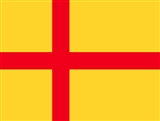
Kalmar Union

Encyclopedia
The Kalmar Union is a historiographical
term meaning a series of personal union
s (1397–1523) that united the three kingdoms of Denmark
, Norway
(with Iceland
, Greenland
, the Faroe Islands
and, prior to their annexation by Scotland in 1471, Shetland and Orkney), and Sweden
(including Finland
) under a single monarch
, though intermittently and with a population fewer than 3 million.
The countries had not technically given up their sovereignty
or even their independence
, but in practice, they were not autonomous, the common monarch holding sovereignty and, in practice, leading foreign policy; diverging interests (especially the Swedish nobility's dissatisfaction over the dominant role played by Denmark and Holstein
) gave rise to a conflict that would hamper the union in several intervals from the 1430s until its breakup in 1523 when Gustav Vasa became king of Sweden.
Norway and its overseas dependencies
, however, continued to remain a part of the realm of Denmark–Norway
under the Oldenburg dynasty
for several centuries after the dissolution (until 1814).
(1353–1412), a daughter of King Valdemar IV of Denmark
. At the age of ten, she married King Haakon VI of Norway
and Sweden, who was the son of King Magnus IV of Sweden
and Norway. Margaret succeeded in having her son Olav
recognized as heir to the throne of Denmark. In 1376 Olav inherited the crown of Denmark from his maternal grandfather as King Oluf III
, with his mother as guardian. When Haakon VI died in 1380, Olav also inherited the crown of Norway. The two kingdoms were united in a personal union under a child king, with the king's mother as his guardian. Olav also had designs on the throne of Sweden (in opposition to Albert of Mecklenburg
) from 1385 until 1387.
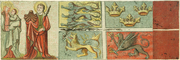
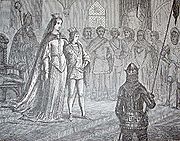
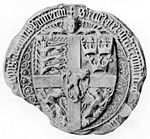 Before Olav came of age and could take over the government, he died in 1387. Margaret made the Danish Council of the Realm elect her as regent of Denmark, but she did not attempt to assume the title of queen. The next year she was also recognized as regent of Norway, on February 2, 1388. She adopted her sister's grandson Bogislav, a son of prince Vartislav of Pomerania
, and gave him the more Nordic name Erik. She manoeuvred to have the Norwegian Council recognize him as heir to the throne of Norway, in spite of his not being first in the line of succession, and he was installed as king of Norway in 1389, still with Margaret as his guardian.
In Sweden, this was a time of conflict between king Albert of Mecklenburg and leaders of the nobility. Albrecht's enemies in 1388 elected Margaret as regent in the parts of Sweden that they controlled, and promised to assist her in conquering the rest of the country. Their common enemy was the Hanseatic League
and the growing German influence over the Scandinavian economy. After Danish and Swedish troops in 1389 defeated the Swedish king, Albert of Mecklenburg, and he subsequently failed to pay the required tribute
of 60,000 silver marks
within three years after his release, her position in Sweden was secured. The three Nordic kingdoms were united under a common regent. Margaret promised to protect the political influence and privileges of the nobility under the union. Her grandnephew Erik, already king of Norway since 1389, succeeded to the thrones of Denmark and Sweden in 1396.
The Nordic union was in a way formalized on June 17, 1397 by the Treaty of Kalmar
, signed in the Swedish castle of Kalmar
, on Sweden's south-east coast, in medieval times close to the Danish border. The treaty stipulated an eternal union of the three realms under one king, who was to be chosen among the sons of the deceased king. They were to be governed separately, together with the respective councils, and according to their ancient laws, but foreign policy was to be conducted by the king. It has been doubted that several of the signatories were personally present (for example, the entire Norwegian "delegation"), and it has been argued that the Treaty was only a draft document. It appears that the treaty was never ratified by "constitution
al" bodies of the three kingdoms.
The short-term effects of the Treaty were achieved anyway, independently of whether the Treaty was binding or not, because the stipulations as to day-to-day governmental operations were mostly matters which were in the power of the king to decide. And, until Eric was deposed in the late 1430s, he made decisions as to each of the kingdoms in accordance with the treaty intentions. Long-term stipulations, such as what should happen when the individual monarch ceases to reign and a new monarch succeeds, were not among those achieved without problems, as subsequent events show during the next 130 years. At each junction, installation of a new monarch tended to mean a break-up of the union for a while. For the moment, Eric of Pomerania became unanimously the monarch of all three kingdoms. At Kalmar, the 15-year-old Eric of Pomerania
was crowned king of all three kingdoms by the archbishops of Denmark and Sweden, but Margaret managed to remain in control until her death in 1412.
It is said that contemporaries of the Union would not recognize the historiographical term, "Union of Kalmar" - that they just understood that much of the time, the three kingdoms shared a common king. While the term meaning "Treaty of Kalmar", the pact, was known already at the time, the term "Union of Kalmar" cannot be found in any contemporary documents. Presumably, the term union was coined for this only by historians writing centuries later.
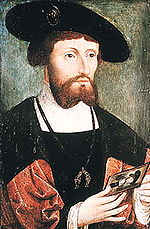 The Swedes were not happy with the Danes' frequent wars on Schleswig
, Holstein
, Mecklenburg
, and Pomerania
, which were a disturbance to Swedish exports (notably iron) to the European continent. Furthermore, the centralization of government in Denmark raised suspicions. The Swedish Privy Council
wanted to retain a fair degree of self-government. The unity of the union eroded in the 1430s, even to the point of armed rebellion (the Engelbrecht rebellion), leading to the expulsion of Danish forces from Sweden. Erik was deposed (1438–39) as the union king and was succeeded by the childless Christopher of Bavaria
. In the power vacuum that arose following Christopher's death (1448), Sweden elected Charles VIII
king with the intent to reestablish the union under a Swedish crown. Charles was elected king of Norway in the following year, but the count
s of Holstein
were more influential than the Swedes and the Norwegians together, and made the Danish Privy Council appoint Christian I
of Oldenburg
as king. During the next seven decades struggle for power and the wars between Sweden and Denmark would dominate the union.
After the briefly successful reconquest of Sweden by Christian II
and the subsequent Stockholm bloodbath
in 1520, the Swedes rose in yet another rebellion which ousted the Danish forces once again in 1521, though Stockholm did not surrender until the summer of 1523. While independence was being reclaimed, the election of King Gustav
of the Vasa
at Strängnäs
on June 6, 1523, has been seen as a formal declaration of independence, and as the de facto end of a union that had lost all long-term support in Sweden. The day Gustav Vasa was hailed as King (he was not crowned until 1528 though) would become, in 1983, the National Day
of Sweden.
, Greenland
, and the Faroe Islands
came under direct control of the crown, in principle the Norwegian crown, which under the Danish union (the monarch lived in Denmark) meant that they were controlled from Denmark and not from Norway.
In the 1814 treaty of Kiel
, the king of Denmark–Norway
was forced to cede mainland Norway to the king of Sweden, Charles XIII
. Norway, led by the viceroy, prince Christian Frederik
, objected to the terms of the treaty. A constitutional assembly declared Norwegian independence, adopted a liberal constitution, and elected Christian Frederik king. After a brief war with Sweden, however, the peace terms of the Convention of Moss
recognized Norwegian independence, but forced Norway to accept a personal union with Sweden.
In the middle of the 19th century, many intellectuals joined the Scandinavist movement, which promoted closer contacts between the three countries. At the time, the union between Sweden and Norway
under one monarch, together with the fact that King Frederik VII of Denmark had no male heir, gave rise to the idea of reuniting the countries of the Kalmar Union, except for the Finland.
of alternate history novels, the Union of Kalmar is reunited by Gustav Adolf, King of Sweden, in 1634.
Historiography
Historiography refers either to the study of the history and methodology of history as a discipline, or to a body of historical work on a specialized topic...
term meaning a series of personal union
Personal union
A personal union is the combination by which two or more different states have the same monarch while their boundaries, their laws and their interests remain distinct. It should not be confused with a federation which is internationally considered a single state...
s (1397–1523) that united the three kingdoms of Denmark
Denmark
Denmark is a Scandinavian country in Northern Europe. The countries of Denmark and Greenland, as well as the Faroe Islands, constitute the Kingdom of Denmark . It is the southernmost of the Nordic countries, southwest of Sweden and south of Norway, and bordered to the south by Germany. Denmark...
, Norway
Norway
Norway , officially the Kingdom of Norway, is a Nordic unitary constitutional monarchy whose territory comprises the western portion of the Scandinavian Peninsula, Jan Mayen, and the Arctic archipelago of Svalbard and Bouvet Island. Norway has a total area of and a population of about 4.9 million...
(with Iceland
Iceland
Iceland , described as the Republic of Iceland, is a Nordic and European island country in the North Atlantic Ocean, on the Mid-Atlantic Ridge. Iceland also refers to the main island of the country, which contains almost all the population and almost all the land area. The country has a population...
, Greenland
Greenland
Greenland is an autonomous country within the Kingdom of Denmark, located between the Arctic and Atlantic Oceans, east of the Canadian Arctic Archipelago. Though physiographically a part of the continent of North America, Greenland has been politically and culturally associated with Europe for...
, the Faroe Islands
Faroe Islands
The Faroe Islands are an island group situated between the Norwegian Sea and the North Atlantic Ocean, approximately halfway between Scotland and Iceland. The Faroe Islands are a self-governing territory within the Kingdom of Denmark, along with Denmark proper and Greenland...
and, prior to their annexation by Scotland in 1471, Shetland and Orkney), and Sweden
Sweden
Sweden , officially the Kingdom of Sweden , is a Nordic country on the Scandinavian Peninsula in Northern Europe. Sweden borders with Norway and Finland and is connected to Denmark by a bridge-tunnel across the Öresund....
(including Finland
Finland
Finland , officially the Republic of Finland, is a Nordic country situated in the Fennoscandian region of Northern Europe. It is bordered by Sweden in the west, Norway in the north and Russia in the east, while Estonia lies to its south across the Gulf of Finland.Around 5.4 million people reside...
) under a single monarch
Monarch
A monarch is the person who heads a monarchy. This is a form of government in which a state or polity is ruled or controlled by an individual who typically inherits the throne by birth and occasionally rules for life or until abdication...
, though intermittently and with a population fewer than 3 million.
The countries had not technically given up their sovereignty
Sovereignty
Sovereignty is the quality of having supreme, independent authority over a geographic area, such as a territory. It can be found in a power to rule and make law that rests on a political fact for which no purely legal explanation can be provided...
or even their independence
Independence
Independence is a condition of a nation, country, or state in which its residents and population, or some portion thereof, exercise self-government, and usually sovereignty, over its territory....
, but in practice, they were not autonomous, the common monarch holding sovereignty and, in practice, leading foreign policy; diverging interests (especially the Swedish nobility's dissatisfaction over the dominant role played by Denmark and Holstein
Holstein
Holstein is the region between the rivers Elbe and Eider. It is part of Schleswig-Holstein, the northernmost state of Germany....
) gave rise to a conflict that would hamper the union in several intervals from the 1430s until its breakup in 1523 when Gustav Vasa became king of Sweden.
Norway and its overseas dependencies
Possessions of Norway
Yngling-ruled , Norse-Gael kingdoms in the British Isles:*Kingdom of York *Kingdom of Dublin...
, however, continued to remain a part of the realm of Denmark–Norway
Denmark–Norway
Denmark–Norway is the historiographical name for a former political entity consisting of the kingdoms of Denmark and Norway, including the originally Norwegian dependencies of Iceland, Greenland and the Faroe Islands...
under the Oldenburg dynasty
House of Oldenburg
The House of Oldenburg is a North German dynasty and one of Europe's most influential Royal Houses with branches that rule or have ruled in Denmark, Russia, Greece, Norway, Schleswig, Holstein, Oldenburg and Sweden...
for several centuries after the dissolution (until 1814).
Inception
The union was the work of Queen Margaret I of DenmarkMargaret I of Denmark
Margaret I was Queen of Denmark, Norway and Sweden and founder of the Kalmar Union, which united the Scandinavian countries for over a century. Although she acted as queen regnant, the laws of contemporary Danish succession denied her formal queenship. Her title in Denmark was derived from her...
(1353–1412), a daughter of King Valdemar IV of Denmark
Valdemar IV of Denmark
Valdemar IV of Denmark or Waldemar ; , was King of Denmark from 1340 to 1375.-Ascension to the throne:...
. At the age of ten, she married King Haakon VI of Norway
Haakon VI of Norway
Haakon VI of Norway was King of Norway from 1343 until his death and King of Sweden from 1362 until 1364, when he was deposed by Albert of Mecklenburg in Sweden.-Background:...
and Sweden, who was the son of King Magnus IV of Sweden
Magnus IV of Sweden
Magnus Eriksson as Magnus IV was king of Sweden , including Finland, as Magnus VII King of Norway , including Iceland and Greenland, and also ruled Scania . He has also vindictively been called Magnus Smek...
and Norway. Margaret succeeded in having her son Olav
Olav IV of Norway
Olaf II Haakonsson was king of Denmark as Olaf II and king of Norway as Olaf IV . Olaf was son of King Haakon VI of Norway and the grandson of King Magnus IV of Sweden. His mother was Queen Margaret I of Denmark which made him the grandson of King Valdemar IV of Denmark...
recognized as heir to the throne of Denmark. In 1376 Olav inherited the crown of Denmark from his maternal grandfather as King Oluf III
Olav IV of Norway
Olaf II Haakonsson was king of Denmark as Olaf II and king of Norway as Olaf IV . Olaf was son of King Haakon VI of Norway and the grandson of King Magnus IV of Sweden. His mother was Queen Margaret I of Denmark which made him the grandson of King Valdemar IV of Denmark...
, with his mother as guardian. When Haakon VI died in 1380, Olav also inherited the crown of Norway. The two kingdoms were united in a personal union under a child king, with the king's mother as his guardian. Olav also had designs on the throne of Sweden (in opposition to Albert of Mecklenburg
Albert of Sweden
Albert was King of Sweden from 1364 to 1389 and Duke of Mecklenburg-Schwerin from 1384 to 1412.-Background:...
) from 1385 until 1387.
Pomerania
Pomerania is a historical region on the south shore of the Baltic Sea. Divided between Germany and Poland, it stretches roughly from the Recknitz River near Stralsund in the West, via the Oder River delta near Szczecin, to the mouth of the Vistula River near Gdańsk in the East...
, and gave him the more Nordic name Erik. She manoeuvred to have the Norwegian Council recognize him as heir to the throne of Norway, in spite of his not being first in the line of succession, and he was installed as king of Norway in 1389, still with Margaret as his guardian.
In Sweden, this was a time of conflict between king Albert of Mecklenburg and leaders of the nobility. Albrecht's enemies in 1388 elected Margaret as regent in the parts of Sweden that they controlled, and promised to assist her in conquering the rest of the country. Their common enemy was the Hanseatic League
Hanseatic League
The Hanseatic League was an economic alliance of trading cities and their merchant guilds that dominated trade along the coast of Northern Europe...
and the growing German influence over the Scandinavian economy. After Danish and Swedish troops in 1389 defeated the Swedish king, Albert of Mecklenburg, and he subsequently failed to pay the required tribute
Tribute
A tribute is wealth, often in kind, that one party gives to another as a sign of respect or, as was often the case in historical contexts, of submission or allegiance. Various ancient states, which could be called suzerains, exacted tribute from areas they had conquered or threatened to conquer...
of 60,000 silver marks
Mark (money)
Mark was a measure of weight mainly for gold and silver, commonly used throughout western Europe and often equivalent to 8 ounces. Considerable variations, however, occurred throughout the Middle Ages Mark (from a merging of three Teutonic/Germanic languages words, Latinized in 9th century...
within three years after his release, her position in Sweden was secured. The three Nordic kingdoms were united under a common regent. Margaret promised to protect the political influence and privileges of the nobility under the union. Her grandnephew Erik, already king of Norway since 1389, succeeded to the thrones of Denmark and Sweden in 1396.
The Nordic union was in a way formalized on June 17, 1397 by the Treaty of Kalmar
Treaty of Kalmar
The Treaty of Kalmar was signed on 25 September 1397 between representatives of the three Nordic kingdoms of Sweden, Denmark, and Norway. The accord established the Kalmar Union whereby all three realms were to be ruled by one monarch. However, the treaty did not unite the different legal...
, signed in the Swedish castle of Kalmar
Kalmar
Kalmar is a city in Småland in the south-east of Sweden, situated by the Baltic Sea. It had 62,767 inhabitants in 2010 and is the seat of Kalmar Municipality. It is also the capital of Kalmar County, which comprises 12 municipalities with a total of 233,776 inhabitants .From the thirteenth to the...
, on Sweden's south-east coast, in medieval times close to the Danish border. The treaty stipulated an eternal union of the three realms under one king, who was to be chosen among the sons of the deceased king. They were to be governed separately, together with the respective councils, and according to their ancient laws, but foreign policy was to be conducted by the king. It has been doubted that several of the signatories were personally present (for example, the entire Norwegian "delegation"), and it has been argued that the Treaty was only a draft document. It appears that the treaty was never ratified by "constitution
Constitution
A constitution is a set of fundamental principles or established precedents according to which a state or other organization is governed. These rules together make up, i.e. constitute, what the entity is...
al" bodies of the three kingdoms.
The short-term effects of the Treaty were achieved anyway, independently of whether the Treaty was binding or not, because the stipulations as to day-to-day governmental operations were mostly matters which were in the power of the king to decide. And, until Eric was deposed in the late 1430s, he made decisions as to each of the kingdoms in accordance with the treaty intentions. Long-term stipulations, such as what should happen when the individual monarch ceases to reign and a new monarch succeeds, were not among those achieved without problems, as subsequent events show during the next 130 years. At each junction, installation of a new monarch tended to mean a break-up of the union for a while. For the moment, Eric of Pomerania became unanimously the monarch of all three kingdoms. At Kalmar, the 15-year-old Eric of Pomerania
Eric of Pomerania
Eric of Pomerania KG was King Eric III of Norway Norwegian Eirik, King Eric VII of Denmark , and as Eric King of Sweden...
was crowned king of all three kingdoms by the archbishops of Denmark and Sweden, but Margaret managed to remain in control until her death in 1412.
It is said that contemporaries of the Union would not recognize the historiographical term, "Union of Kalmar" - that they just understood that much of the time, the three kingdoms shared a common king. While the term meaning "Treaty of Kalmar", the pact, was known already at the time, the term "Union of Kalmar" cannot be found in any contemporary documents. Presumably, the term union was coined for this only by historians writing centuries later.
Conflict
Schleswig
Schleswig or South Jutland is a region covering the area about 60 km north and 70 km south of the border between Germany and Denmark; the territory has been divided between the two countries since 1920, with Northern Schleswig in Denmark and Southern Schleswig in Germany...
, Holstein
Holstein
Holstein is the region between the rivers Elbe and Eider. It is part of Schleswig-Holstein, the northernmost state of Germany....
, Mecklenburg
Mecklenburg
Mecklenburg is a historical region in northern Germany comprising the western and larger part of the federal-state Mecklenburg-Vorpommern...
, and Pomerania
Pomerania
Pomerania is a historical region on the south shore of the Baltic Sea. Divided between Germany and Poland, it stretches roughly from the Recknitz River near Stralsund in the West, via the Oder River delta near Szczecin, to the mouth of the Vistula River near Gdańsk in the East...
, which were a disturbance to Swedish exports (notably iron) to the European continent. Furthermore, the centralization of government in Denmark raised suspicions. The Swedish Privy Council
Privy Council of Sweden
The High Council of Sweden or Council of the Realm consisted originally of those men of noble, common and clergical background, that the king saw fit for advisory service...
wanted to retain a fair degree of self-government. The unity of the union eroded in the 1430s, even to the point of armed rebellion (the Engelbrecht rebellion), leading to the expulsion of Danish forces from Sweden. Erik was deposed (1438–39) as the union king and was succeeded by the childless Christopher of Bavaria
Christopher of Bavaria
Christopher of Bavaria or Christopher the Bavarian; as king named Christopher ; Danish and Norwegian: Christoffer af/av Bayern; Swedish Kristofer av Bayern was union king of Denmark , Sweden and Norway .-Biography:He was probably born at Neumarkt in...
. In the power vacuum that arose following Christopher's death (1448), Sweden elected Charles VIII
Charles VIII of Sweden
Charles VIII of Sweden , Charles I of Norway, also Carl, , was king of Sweden and king of Norway ....
king with the intent to reestablish the union under a Swedish crown. Charles was elected king of Norway in the following year, but the count
Count
A count or countess is an aristocratic nobleman in European countries. The word count came into English from the French comte, itself from Latin comes—in its accusative comitem—meaning "companion", and later "companion of the emperor, delegate of the emperor". The adjective form of the word is...
s of Holstein
Holstein
Holstein is the region between the rivers Elbe and Eider. It is part of Schleswig-Holstein, the northernmost state of Germany....
were more influential than the Swedes and the Norwegians together, and made the Danish Privy Council appoint Christian I
Christian I of Denmark
Christian I was a Danish monarch, king of Denmark , Norway and Sweden , under the Kalmar Union. In Sweden his short tenure as monarch was preceded by regents, Jöns Bengtsson Oxenstierna and Erik Axelsson Tott and succeeded by regent Kettil Karlsson Vasa...
of Oldenburg
Oldenburg
Oldenburg is an independent city in Lower Saxony, Germany. It is situated in the western part of the state between the cities of Bremen and Groningen, Netherlands, at the Hunte river. It has a population of 160,279 which makes it the fourth biggest city in Lower Saxony after Hanover, Braunschweig...
as king. During the next seven decades struggle for power and the wars between Sweden and Denmark would dominate the union.
After the briefly successful reconquest of Sweden by Christian II
Christian II of Denmark
Christian II was King of Denmark, Norway and Sweden , during the Kalmar Union.-Background:...
and the subsequent Stockholm bloodbath
Stockholm Bloodbath
The Stockholm Bloodbath, or the Stockholm Massacre , took place as the result of a successful invasion of Sweden by Danish forces under the command of King Christian II...
in 1520, the Swedes rose in yet another rebellion which ousted the Danish forces once again in 1521, though Stockholm did not surrender until the summer of 1523. While independence was being reclaimed, the election of King Gustav
Gustav I of Sweden
Gustav I of Sweden, born Gustav Eriksson of the Vasa noble family and later known simply as Gustav Vasa , was King of Sweden from 1523 until his death....
of the Vasa
House of Vasa
The House of Vasa was the Royal House of Sweden 1523-1654 and of Poland 1587-1668. It originated from a noble family in Uppland of which several members had high offices during the 15th century....
at Strängnäs
Strängnäs
Strängnäs is a locality and the seat of Strängnäs Municipality, Södermanland County, Sweden with 12,296 inhabitants in 2005. It is located by Lake Mälaren and is the episcopal see of the Diocese of Strängnäs, a former Roman Catholic and present Lutheran Diocese, with the Strängnäs Cathedral, built...
on June 6, 1523, has been seen as a formal declaration of independence, and as the de facto end of a union that had lost all long-term support in Sweden. The day Gustav Vasa was hailed as King (he was not crowned until 1528 though) would become, in 1983, the National Day
National Day
The National Day is a designated date on which celebrations mark the nationhood of a nation or non-sovereign country. This nationhood can be symbolized by the date of independence, of becoming republic or a significant date for a patron saint or a ruler . Often the day is not called "National Day"...
of Sweden.
Final dissolution
One of last structures of the Kalmar Union, or, rather, medieval separateness, remained until 1536 when the Danish Privy Council, in the aftermath of a civil war, unilaterally declared Norway to be a Danish province, without consulting their Norwegian colleagues. This had a practical effect, despite the fact that the Norwegian council never recognized the declaration formally. Norway kept some separate institutions and its legal system. However, the Norwegian possessions of IcelandIceland
Iceland , described as the Republic of Iceland, is a Nordic and European island country in the North Atlantic Ocean, on the Mid-Atlantic Ridge. Iceland also refers to the main island of the country, which contains almost all the population and almost all the land area. The country has a population...
, Greenland
Greenland
Greenland is an autonomous country within the Kingdom of Denmark, located between the Arctic and Atlantic Oceans, east of the Canadian Arctic Archipelago. Though physiographically a part of the continent of North America, Greenland has been politically and culturally associated with Europe for...
, and the Faroe Islands
Faroe Islands
The Faroe Islands are an island group situated between the Norwegian Sea and the North Atlantic Ocean, approximately halfway between Scotland and Iceland. The Faroe Islands are a self-governing territory within the Kingdom of Denmark, along with Denmark proper and Greenland...
came under direct control of the crown, in principle the Norwegian crown, which under the Danish union (the monarch lived in Denmark) meant that they were controlled from Denmark and not from Norway.
In the 1814 treaty of Kiel
Treaty of Kiel
The Treaty of Kiel or Peace of Kiel was concluded between the United Kingdom of Great Britain and Ireland and the Kingdom of Sweden on one side and the Kingdoms of Denmark and Norway on the other side on 14 January 1814 in Kiel...
, the king of Denmark–Norway
Denmark–Norway
Denmark–Norway is the historiographical name for a former political entity consisting of the kingdoms of Denmark and Norway, including the originally Norwegian dependencies of Iceland, Greenland and the Faroe Islands...
was forced to cede mainland Norway to the king of Sweden, Charles XIII
Charles XIII of Sweden
Charles XIII & II also Carl, , was King of Sweden from 1809 and King of Norway from 1814 until his death...
. Norway, led by the viceroy, prince Christian Frederik
Christian VIII of Denmark
Christian VIII , was king of Denmark from 1839 to 1848 and, as Christian Frederick, king of Norway in 1814. He was the eldest son of Hereditary Prince Frederick of Denmark and Norway and Sophia Frederica of Mecklenburg-Schwerin, born in 1786 at Christiansborg Palace in Copenhagen...
, objected to the terms of the treaty. A constitutional assembly declared Norwegian independence, adopted a liberal constitution, and elected Christian Frederik king. After a brief war with Sweden, however, the peace terms of the Convention of Moss
Convention of Moss
The Convention of Moss was a cease fire agreement, signed August 14, 1814, between the Swedish King and the Norwegian Storting. It followed the Swedish-Norwegian War due to Norway's claim to sovereignty...
recognized Norwegian independence, but forced Norway to accept a personal union with Sweden.
In the middle of the 19th century, many intellectuals joined the Scandinavist movement, which promoted closer contacts between the three countries. At the time, the union between Sweden and Norway
Union between Sweden and Norway
The Union between Sweden and Norway , officially the United Kingdoms of Sweden and Norway, consisted of present-day Sweden and Norway between 1814 and 1905, when they were united under one monarch in a personal union....
under one monarch, together with the fact that King Frederik VII of Denmark had no male heir, gave rise to the idea of reuniting the countries of the Kalmar Union, except for the Finland.
In fiction
In the 1632 series1632 series
The 1632 series, also known as the 1632-verse or Ring of Fire series, is an alternate history book series and sub-series created, primarily co-written, and coordinated by Eric Flint and published by Baen Books...
of alternate history novels, the Union of Kalmar is reunited by Gustav Adolf, King of Sweden, in 1634.
See also
- List of Kalmar Union monarchs
- Grand Duchy of FinlandGrand Duchy of FinlandThe Grand Duchy of Finland was the predecessor state of modern Finland. It existed 1809–1917 as part of the Russian Empire and was ruled by the Russian czar as Grand Prince.- History :...
- Scandinavian royal lineage chart for the time around the founding of the Kalmar Union
- Union between Sweden and NorwayUnion between Sweden and NorwayThe Union between Sweden and Norway , officially the United Kingdoms of Sweden and Norway, consisted of present-day Sweden and Norway between 1814 and 1905, when they were united under one monarch in a personal union....
- Nordic countriesNordic countriesThe Nordic countries make up a region in Northern Europe and the North Atlantic which consists of Denmark, Finland, Iceland, Norway and Sweden and their associated territories, the Faroe Islands, Greenland and Åland...
External links
- The Kalmar Union - Maps of the Kalmar Union