

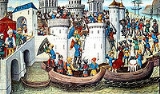
Fourth Crusade

Encyclopedia
The Fourth Crusade was originally intended to conquer Muslim
-controlled Jerusalem by means of an invasion through Egypt
. Instead, in April 1204, the Crusaders of Western Europe
invaded and conquered the Christian
(Eastern Orthodox
) city of Constantinople
, capital of the Eastern Roman Empire (Byzantine Empire
). This is seen as one of the final acts in the Great Schism
between the Eastern Orthodox Church
and Roman Catholic Church
.
The crusaders established the Latin Empire
(1204–1261) and other "Latin" states in the Byzantine lands they conquered.
(1189–1192), there was little interest in Europe for another crusade against the Muslims
. The crusaders had lost Jerusalem to the Ayyubid dynasty
, which ruled all of Syria
and Egypt
, and only a few cities along the coast were still held by the crusader Kingdom of Jerusalem
, now centered on Acre
. The Third Crusade had also established a kingdom on Cyprus
.
Pope Innocent III
succeeded to the papacy in 1198, and the preaching of a new crusade became the goal of his pontificate. His call was largely ignored by the European monarchs: the Germans were struggling against Papal power, and England
and France
were still engaged in warfare against each other. However, due to the preaching of Fulk of Neuilly
, a crusading army was finally organized at a tournament
held at Écry by Count Thibaut of Champagne
in 1199. Thibaut was elected leader, but he died in 1201 and was replaced by an Italian
count, Boniface of Montferrat
.
Boniface and the other leaders sent envoys to Venice
, Genoa
, and other city-states to negotiate a contract for transport to Egypt, the object of their crusade; one of the envoys was the future historian Geoffrey of Villehardouin
. Genoa was uninterested, but in March 1201 negotiations were opened with Venice, which agreed to transport 33,500 crusaders, a very ambitious number. This agreement required a full year of preparation on the part of the Venetians to build numerous ships and train the sailors who would man them, all the while curtailing the city's commercial activities. The crusading army was expected to comprise 4,500 knights (as well as 4,500 horses), 9,000 squires, and 20,000 foot-soldiers.
The majority of the crusading army that set out from Venice
in October 1202 originated from areas within France. It included men from Blois
, Champagne
, Amiens
, Saint-Pol
, the Ile-de-France
and Burgundy
. Several other regions of Europe sent substantial contingents as well, such as Flanders
and Montferrat
. Other notable groups came from the Holy Roman Empire
, including the men under Bishop Martin of Pairis and Bishop Conrad of Halberstadt
, together in alliance with the Venetian soldiers and sailors led by the doge
Enrico Dandolo
. The crusade was to be ready to sail on June 24, 1202 and make directly for the Ayyubid capital, Cairo
. This agreement was ratified by Pope Innocent, with a solemn ban on attacks on Christian states.
As there was no binding agreement among the crusaders that all should sail from Venice, many chose to sail from other ports, particularly Flanders
, Marseilles, and Genoa
. By 1201 the bulk of the crusader army was collected at Venice, though with far fewer troops than expected: 12,000 instead of 33,500. About 4-5,000 knights and 8,000 foot soldiers showed up. The Venetians had performed their part of the agreement: there lay 50 war galleys and 450 transports - enough for three times the assembled army. The Venetians, under their aged and blind Doge
Dandolo, would not let the crusaders leave without paying the full amount agreed to, originally 85,000 silver
marks
. The crusaders could only pay some 51,000 silver marks, and that only by reducing themselves to extreme poverty. This was disastrous to the Venetians, who had halted their commerce for a great length of time to prepare this expedition. In addition to this about 14,000 men or as many as 20-30,000 men (out of Venice's population of 60-100,000 people) were needed to man the entire fleet, placing further strain on the Venetian economy.
Dandolo and the Venetians succeeded in turning the crusading movement to their own purposes as a form of repayment. Following the Massacre of the Latins
of Constantinople in 1182, the ruling Angelos dynasty
had expelled the Venetian merchant population with the support of the Greek population. These events gave the Venetians a hostile attitude towards Byzantium. Dandolo, who joined the crusade during a public ceremony in the church of San Marco di Venezia, proposed that the crusaders pay their debts by attacking the port of Zara
in Dalmatia
. The city had been dominated economically by Venice throughout the 12th century, but had rebelled in 1181 and allied with King Emeric
of Hungary
and Croatia
. Subsequent Venetian attacks were repulsed, and by 1202 the city was economically independent, under the protection of the King.
The Hungarian king was Catholic and had himself agreed to join the Crusade (though this was mostly for political reasons, and he had made no actual preparations to leave). Many of the Crusaders were opposed to attacking Zara, and some, including a force led by the elder Simon de Montfort
, refused to participate altogether and returned home. While the Papal legate to the Crusade, Cardinal Peter of Capua
endorsed the move as necessary to prevent the crusade's complete failure, Pope Innocent III
was alarmed at this development and wrote a letter to the Crusading leadership threatening excommunication
.
Historian Geoffrey Hindley's The Crusades mentions that in 1202 Pope Innocent III
forbade the Crusaders of Western Christendom from committing any atrocious acts against their Christian neighbours, despite wanting to secure papal authority over Byzantium. This letter was concealed from the bulk of the army and the attack proceeded. The citizens of Zara made reference to the fact that they were fellow Catholics by hanging banners marked with crosses from their windows and the walls of the city, but nevertheless the city fell after a brief siege. When Innocent III heard of the sack he sent a letter to the crusaders excommunicating them, and ordered them to return to their holy vows and head for Jerusalem. Out of fear that this would dissolve the army the leaders of the crusade decided not to inform the army of this.
 Boniface of Montferrat, meanwhile, had left the fleet before it sailed from Venice, to visit his cousin Philip of Swabia
. The reasons for his visit are a matter of debate; he may have realized the Venetians' plans and left to avoid excommunication, or he may have wanted to meet with the Byzantine prince Alexios Angelos
, Philip's brother-in-law and the son of the recently deposed Byzantine emperor Isaac II Angelos
. Alexios had recently fled to Philip in 1201 but it is unknown whether or not Boniface knew he was at Philip's court. There, Alexios offered 200,000 silver marks, 10,000 men to help the Crusaders, the maintenance of 500 knights in the Holy Land, the service of the Byzantine navy to transport the Crusader Army to Egypt and the placement of the Eastern Orthodox Church
under the authority of the Pope
if they would sail to Byzantium and topple the reigning emperor Alexios III Angelos
, brother of Isaac II. It was a tempting offer for an enterprise that was short on funds.
Relations between Crusaders and Byzantines had been strained since the very beginning of the crusading movement, but the proposal put by Alexios was one that, at least in theory, would heal the breach between East and West and aid the Latins in their efforts considerably. Count Boniface thus agreed and Alexios IV returned with the Marquess to rejoin the fleet at Corfu
after it had sailed from Zara. The rest of the Crusade's leaders eventually accepted the plan as well. There were many leaders, however, of the rank and file who wanted nothing to do with the proposal, and many deserted. The fleet of 60 war galleys, 100 horse transports
, and 50 large transports
(the entire fleet was manned by 10,000 Venetian oarsmen and marines) arrived at Constantinople in late June 1203. In addition, 300 siege engines were brought along on board the fleet.
When the Fourth Crusade arrived at Constantinople, the city had a population of 400,000 people, a garrison of 15,000 men (including 5,000 Varangians
), and a fleet of 20 galleys. The Crusaders' initial motive was to restore Isaac II to the Byzantine throne so that they could receive the support that they were promised. Conon of Bethune delivered this message to the Lombard envoy who was sent by the reigning emperor Alexios III Angelos
, who had deposed his brother Isaac. The citizens of Constantinople were not concerned with the cause of the deposed emperor and his exiled son; usurpations were frequent in Byzantine affairs, and this time the throne had even remained in the same family. The Crusaders sailed alongside Constantinople with 10 galleys to display Alexios IV, but from the walls of the city
the Byzantines taunted the puzzled crusaders, who had been promised that Prince Alexios would be welcomed. First the crusaders captured and sacked the cities of Chalcedon
and Chrysopolis, then they defeated 500 Byzantine cavalrymen in battle with just 80 Frankish knights. The Crusaders now turned to an attack on the city of Constantinople.
The Crusaders followed south, and attacked the Tower of Galata
, which held the northern end of the massive chain that blocked access to the Golden Horn
. As they laid siege to the Tower, the Byzantines counterattacked with some initial success. However, when the Crusaders rallied and the Byzantines retreated to the Tower, the Crusaders were able to follow the soldiers through the Gate, and the Tower surrendered. The Golden Horn now lay open to the Crusaders, and the Venetian fleet entered.
On July 11, the Crusaders took positions opposite the Palace of Blachernae
on the northwest corner of the city. They began the siege in earnest on July 17, with four divisions attacking the land walls
, while the Venetian fleet attacked the sea walls from the Golden Horn. The Venetians took a section of the wall of about 25 towers, while the Varangian guard held off the Crusaders on the land wall. The Varangians shifted to meet the new threat, and the Venetians retreated under the screen of fire. The fire destroyed about 120 acre (0.4856232 km²) of the city.
Alexios III finally took offensive action, and led 17 divisions from the St. Romanus Gate, vastly outnumbering the crusaders. Alexios III's army of about 8,500 men faced the Crusader's seven divisions (about 3,500 men), but his courage failed, and the Byzantine army returned to the city without a fight. The retreat and the effects of the fire greatly damaged morale, causing the citizens of Constantinople to turn against Alexios III, who then fled. The destructive fire left 20,000 people homeless. Prince Alexios was elevated to the throne as Alexius IV along with his blind father Isaac.
characterized it as "the turning point towards the decline of the Roman state."
Forcing the populace to destroy their icons at the behest of an army of foreign schismatics did not endear Alexios IV to the citizens of Constantinople. In fear of his life, the co-emperor asked the Crusaders to renew their contract for another six months, to end by April 1204. There was, nevertheless, still fighting in the city. In August 1203 the crusaders attacked a mosque
(Constantinople at this time had a sizable Muslim population), which was defended by a combined Muslim and Byzantine opposition. Meanwhile, Alexios IV had led 6,000 men from the Crusader army against his rival Alexios III in Adrianople.
On the second attempt of the Venetians to set up a wall of fire to aid their escape, they instigated the "Great Fire", in which a large part of Constantinople was burned down. Opposition to Alexios IV grew, and one of his courtiers, Alexios Doukas (nicknamed 'Mourtzouphlos' because of his thick eyebrows), soon overthrew him and had him strangled to death in January 1204. Alexios Doukas took the throne himself as Alexios V; Isaac also died in January 1204, probably of natural causes.
The crusaders and Venetians, incensed at the murder of their supposed patron, demanded that Mourtzouphlos honor the contract which Alexios IV had promised. When the Byzantine emperor refused, the Crusaders assaulted the city once again. On April 8, Alexios V's army put up a strong resistance which did much to discourage the crusaders.
The Byzantines hurled enormous projectiles onto the enemy siege engines, shattering many of them. A serious hindrance to the crusaders was bad weather conditions. Wind blew from the shore and prevented most of the ships from drawing close enough to the walls to launch an assault. Only five of the wall's towers were actually engaged and none of these could be secured; by mid-afternoon it was evident that the attack had failed.
The Latin clergy discussed the situation amongst themselves and settled upon the message they wished to spread through the demoralised army. They had to convince the men that the events of 9 April were not God's judgment on a sinful enterprise: the campaign, they argued, was righteous and with proper belief it would succeed. The concept of God testing the determination of the Crusaders through temporary setbacks was a familiar means for the clergy to explain failure in the course of a campaign.
The clergy's message was designed to reassure and encourage the Crusaders. Their argument that the attack on Constantinople was spiritual revolved around two themes. First, the Greeks were traitors and murderers since they had killed their rightful lord, Alexios IV. The churchmen used inflammatory language and claimed that "the Greeks were worse than the Jews", and they invoked the authority of God and the pope to take action.
Although Innocent III had again demanded that they not attack, the papal letter was suppressed by the clergy, and the Crusaders prepared for their own attack, while the Venetians attacked from the sea; Alexios V's army stayed in the city to fight, along with the imperial bodyguard, the Varangians
, but Alexios V himself fled during the night.
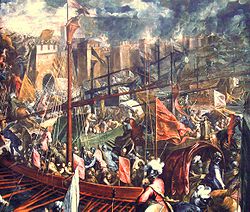 On April 12, 1204, the weather conditions finally favoured the Crusaders. A strong northern wind aided the Venetian ships in coming close to the walls. After a short battle, approximately seventy Crusaders managed to enter the city. Some Crusaders were eventually able to knock holes in the walls, small enough for a few knights at a time to crawl through; the Venetians were also successful at scaling the walls from the sea, though there was extremely bloody fighting with the Varangians. The crusaders captured the Blachernae
section of the city in the northwest and used it as a base to attack the rest of the city, but while attempting to defend themselves with a wall of fire, they ended up burning down even more of the city. This second fire left 15,000 people homeless. The Crusaders completely took the city on April 13.
The crusaders inflicted a horrible and savage sacking on Constantinople for three days, during which many ancient and medieval Roman and Greek works were either stolen or destroyed. The magnificent Library of Constantinople
was destroyed. Despite their oaths and the threat of excommunication, the Crusaders ruthlessly and systematically violated the city's churches and monasteries, destroying, defiling, or stealing all they could lay hands on; nothing was spared. It was said that the total amount looted from Constantinople was about 900,000 silver marks. The Venetians received 150,000 silver marks that was their due, while the Crusaders received 50,000 silver marks. A further 100,000 silver marks were divided evenly up between the Crusaders and Venetians. The remaining 500,000 silver marks were secretly kept back by many Crusader knights.
Speros Vryonis
in Byzantium and Europe gives a vivid account of the sack:
When Innocent III heard of the conduct of his pilgrims, he was filled with shame, rage and strongly rebuked them.
According to a subsequent treaty
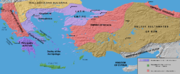
, the empire was apportioned between Venice and the crusade's leaders, and the Latin Empire
of Constantinople was established. Boniface was not elected as the new emperor, although the citizens seemed to consider him as such; the Venetians thought he had too many connections with the former empire because of his brother, Renier of Montferrat
, who had been married to Maria Komnene
, empress in the 1170s and 80s. Instead they placed Baldwin of Flanders
on the throne. Boniface went on to found the Kingdom of Thessalonica
, a vassal state of the new Latin Empire. The Venetians also founded the Duchy of the Archipelago
in the Aegean Sea. Meanwhile, Byzantine refugees founded their own successor states, the most notable of these being the Empire of Nicaea
under Theodore Laskaris
(a relative of Alexios III), the Empire of Trebizond
, and the Despotate of Epirus
.
 Almost none of the crusaders ever made it to the Holy Land, and the unstable Latin Empire
siphoned off much of Europe's crusading energy. The legacy of the Fourth Crusade was the deep sense of betrayal the Latins had instilled in their Greek coreligionists. With the events of 1204, the schism between the Church in the West and East was not just complete but also solidified. As an epilogue to the event, Pope Innocent III, the man who had unintentionally launched the ill-fated expedition, thundered against the crusaders thus:
Nevertheless, the Pope's negative reaction was short-lived. When the crusaders took the piles of money, jewels, and gold that they had captured in the sack of Constantinople back to Rome, Innocent III welcomed the stolen items and agreed to let the crusaders back into the Church. Furthermore at the Fourth Council of the Lateran
the Pope welcomed and recognised to it western (Catholic) prelates from Sees established in the conquered lands – thus recognising their legitimacy over formerly Orthodox areas.
The Latin Empire was soon faced with a great number of enemies, which the crusaders had not taken into account. Besides the individual Byzantine Greek states in Epirus
and Nicaea
, the Empire received great pressure from the Seljuk Sultanate
and the Bulgarian Empire
. The Greek states were fighting for supremacy against both Latins and each other. Almost every Greek and Latin protagonist of the event was killed shortly after. Murtzuphlus' betrayal by Alexius III led to his capture by the Latins and his execution at Constantinople in 1205. Not long after, Alexius III was himself captured by Boniface and sent to exile in Southern Italy; he died in Nicaea in 1211. On 14 April 1205, one year after the conquest of the city, Emperor Baldwin was decisively defeated and captured at the Battle of Adrianople
by the Bulgarians
; he was executed by the Bulgarian Emperor Kaloyan in 1205 or 1206. Two years after that, on 4 September 1207, Boniface himself was killed in an ambush by the Bulgarians, and his head was sent to Kaloyan. He was succeeded by his infant son Demetrius of Montferrat
, who ruled until he reached adulthood, but was eventually defeated by Theodore I Ducas, the despot of Epirus and a relative of Murtzuphlus, and thus the Kingdom of Thessalonica was restored to Byzantine rule in 1224.
Various Latin-French lordships throughout Greece — in particular, the duchy of Athens
and the principality of the Morea
— provided cultural contacts with western Europe and promoted the study of Greek. There was also a French cultural work, notably the production of a collection of laws, the Assises de Romanie (Assizes of Greece). The Chronicle of Morea
appeared in both French
and Greek
(and later Italian and Aragonese) versions. Impressive remains of crusader castles and Gothic churches
can still be seen in Greece. Nevertheless, the Latin Empire always rested on shaky foundations. The city was re-captured by the Nicaean Greeks under Michael VIII Palaeologus in 1261, and commerce with Venice was re-established.
In an ironic series of events, during the middle of the 15th century, the Latin Church
(Roman Catholic Church
) tried to organize a new crusade which aimed at the restoration of the Eastern Roman or Byzantine Empire which was gradually being torn down by the advancing Ottoman Turks. The attempt, however, failed, as the vast majority of the Byzantine civilians and a growing part of their clergy refused to recognize and accept the short-lived near Union of the Churches of East and West signed at the Council of Florence and Ferrara
by the Ecumenical patriarch Joseph II of Constantinople
. The Greek population, inspired by aversion from the Latins and the Western states, held that the Byzantine civilization which revolved around the Orthodox faith would be more secure under Ottoman Islamic rule. Overall, religious-observant Byzantines preferred to sacrifice their political freedom and political independence in order to preserve their faith's traditions and rituals in separation from the Roman See
. In the late 14th and early 15th century, two kinds of crusades were finally organised by the Kingdoms of Hungary
, Poland
, Wallachia
and Serbia
. Both of them were checked by the Ottoman Empire
. During the Ottoman siege of Constantinople
in 1453, a significant band of Venetian
and Genoese
knights died in the defense of the city.
, writing in 1954, stated that "There was never a greater crime against humanity than the Fourth Crusade." The controversy that has surrounded the Fourth Crusade has led to diverging opinions in academia on whether its objective was indeed the capture of Constantinople. The traditional position that it was, was challenged by Thomas F. Madden and Donald E. Queller in 1977 in their book, The Fourth Crusade.
Constantinople was considered as a bastion of Christianity that defended Europe from the growing Islamic influence in the East and the Fourth Crusade's sack of Constantinople just marks the decline of the city, which a few centuries later, will, already weakened enough, falls ultimately to the hands of the Islamic Ottoman Turks.
Eight hundred years after the Fourth Crusade, Pope John Paul II
twice expressed sorrow for the events of the Fourth Crusade. In 2001, he wrote to Christodoulos
, Archbishop of Athens, saying, "It is tragic that the assailants, who set out to secure free access for Christians to the Holy Land, turned against their brothers in the faith. The fact that they were Latin Christians fills Catholics with deep regret." In 2004, while Bartholomew I, Patriarch of Constantinople
, was visiting the Vatican
, John Paul II asked, "How can we not share, at a distance of eight centuries, the pain and disgust." This has been regarded as an apology to the Greek Orthodox Church for the terrible slaughter perpetrated by the warriors of the Fourth Crusade.
In April 2004, in a speech on the 800th anniversary of the city's capture, Ecumenical Patriarch Bartholomew I formally accepted the apology. "The spirit of reconciliation is stronger than hatred," he said during a liturgy attended by Roman Catholic Archbishop Philippe Barbarin of Lyon, France. "We receive with gratitude and respect your cordial gesture for the tragic events of the Fourth Crusade. It is a fact that a crime was committed here in the city 800 years ago." Bartholomew said his acceptance came in the spirit of Pascha
. "The spirit of reconciliation of the resurrection... incites us toward reconciliation of our churches."
The Fourth Crusade was one of the last of the major crusades to be launched by the Papacy, though it quickly fell out of Papal control. After bickering between laymen and the papal legate led to the collapse of the Fifth Crusade
, later crusades were directed by individual monarchs, mostly against Egypt. Only one subsequent crusade, the Sixth
, succeeded in restoring Jerusalem to Christian rule, and then only for a short time. The Crusades, as it seems, became politically and economically expedient for Crusaders who were more inclined to follow an ambitious, worldly conscience rather than a spiritual one.
's novel There Will Be Time
from the point of view of a 20th Century time-traveler who saves the life of a Byzantine girl during the carnage and falls in love with her.
Umberto Eco
's novel Baudolino
begins shortly after the Sack of Constantinople.
The second volume of Judith Tarr
's trilogy The Hound and the Falcon
- titled The Golden Horn - also depicts the Fourth Crusade and Sack, showing it from its prelude through the aftermath in a historical fiction / fantasy setting that captures elements of both the Latin and Greek sides of the conflict.
The Fourth Crusade lends the title to British Death Metal band Bolt Thrower's fourth album title 'The IVth Crusade
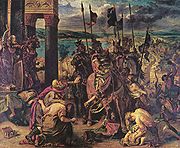
', is the lyrical inspiration for the title track and the cover artwork is a painting from Eugène Delacroix
, showing "The Entry of the Crusaders in Constantinople".
The events of the Fourth Crusade are the narrative focus of the 2011 video game The Cursed Crusade
, albeit with some supernatural twists.
Islam
Islam . The most common are and . : Arabic pronunciation varies regionally. The first vowel ranges from ~~. The second vowel ranges from ~~~...
-controlled Jerusalem by means of an invasion through Egypt
Egypt
Egypt , officially the Arab Republic of Egypt, Arabic: , is a country mainly in North Africa, with the Sinai Peninsula forming a land bridge in Southwest Asia. Egypt is thus a transcontinental country, and a major power in Africa, the Mediterranean Basin, the Middle East and the Muslim world...
. Instead, in April 1204, the Crusaders of Western Europe
Western Europe
Western Europe is a loose term for the collection of countries in the western most region of the European continents, though this definition is context-dependent and carries cultural and political connotations. One definition describes Western Europe as a geographic entity—the region lying in the...
invaded and conquered the Christian
Christianity
Christianity is a monotheistic religion based on the life and teachings of Jesus as presented in canonical gospels and other New Testament writings...
(Eastern Orthodox
Eastern Orthodox Church
The Orthodox Church, officially called the Orthodox Catholic Church and commonly referred to as the Eastern Orthodox Church, is the second largest Christian denomination in the world, with an estimated 300 million adherents mainly in the countries of Belarus, Bulgaria, Cyprus, Georgia, Greece,...
) city of Constantinople
Constantinople
Constantinople was the capital of the Roman, Eastern Roman, Byzantine, Latin, and Ottoman Empires. Throughout most of the Middle Ages, Constantinople was Europe's largest and wealthiest city.-Names:...
, capital of the Eastern Roman Empire (Byzantine Empire
Byzantine Empire
The Byzantine Empire was the Eastern Roman Empire during the periods of Late Antiquity and the Middle Ages, centred on the capital of Constantinople. Known simply as the Roman Empire or Romania to its inhabitants and neighbours, the Empire was the direct continuation of the Ancient Roman State...
). This is seen as one of the final acts in the Great Schism
East-West Schism
The East–West Schism of 1054, sometimes known as the Great Schism, formally divided the State church of the Roman Empire into Eastern and Western branches, which later became known as the Eastern Orthodox Church and the Roman Catholic Church, respectively...
between the Eastern Orthodox Church
Eastern Orthodox Church
The Orthodox Church, officially called the Orthodox Catholic Church and commonly referred to as the Eastern Orthodox Church, is the second largest Christian denomination in the world, with an estimated 300 million adherents mainly in the countries of Belarus, Bulgaria, Cyprus, Georgia, Greece,...
and Roman Catholic Church
Roman Catholic Church
The Catholic Church, also known as the Roman Catholic Church, is the world's largest Christian church, with over a billion members. Led by the Pope, it defines its mission as spreading the gospel of Jesus Christ, administering the sacraments and exercising charity...
.
The crusaders established the Latin Empire
Latin Empire
The Latin Empire or Latin Empire of Constantinople is the name given by historians to the feudal Crusader state founded by the leaders of the Fourth Crusade on lands captured from the Byzantine Empire. It was established after the capture of Constantinople in 1204 and lasted until 1261...
(1204–1261) and other "Latin" states in the Byzantine lands they conquered.
Background
After the limited success of the Third CrusadeThird Crusade
The Third Crusade , also known as the Kings' Crusade, was an attempt by European leaders to reconquer the Holy Land from Saladin...
(1189–1192), there was little interest in Europe for another crusade against the Muslims
Islam
Islam . The most common are and . : Arabic pronunciation varies regionally. The first vowel ranges from ~~. The second vowel ranges from ~~~...
. The crusaders had lost Jerusalem to the Ayyubid dynasty
Ayyubid dynasty
The Ayyubid dynasty was a Muslim dynasty of Kurdish origin, founded by Saladin and centered in Egypt. The dynasty ruled much of the Middle East during the 12th and 13th centuries CE. The Ayyubid family, under the brothers Ayyub and Shirkuh, originally served as soldiers for the Zengids until they...
, which ruled all of Syria
Syria
Syria , officially the Syrian Arab Republic , is a country in Western Asia, bordering Lebanon and the Mediterranean Sea to the West, Turkey to the north, Iraq to the east, Jordan to the south, and Israel to the southwest....
and Egypt
Egypt
Egypt , officially the Arab Republic of Egypt, Arabic: , is a country mainly in North Africa, with the Sinai Peninsula forming a land bridge in Southwest Asia. Egypt is thus a transcontinental country, and a major power in Africa, the Mediterranean Basin, the Middle East and the Muslim world...
, and only a few cities along the coast were still held by the crusader Kingdom of Jerusalem
Kingdom of Jerusalem
The Kingdom of Jerusalem was a Catholic kingdom established in the Levant in 1099 after the First Crusade. The kingdom lasted nearly two hundred years, from 1099 until 1291 when the last remaining possession, Acre, was destroyed by the Mamluks, but its history is divided into two distinct periods....
, now centered on Acre
Acre, Israel
Acre , is a city in the Western Galilee region of northern Israel at the northern extremity of Haifa Bay. Acre is one of the oldest continuously inhabited sites in the country....
. The Third Crusade had also established a kingdom on Cyprus
Kingdom of Cyprus
The Kingdom of Cyprus was a Crusader kingdom on the island of Cyprus in the high and late Middle Ages, between 1192 and 1489. It was ruled by the French House of Lusignan.-History:...
.
Pope Innocent III
Pope Innocent III
Pope Innocent III was Pope from 8 January 1198 until his death. His birth name was Lotario dei Conti di Segni, sometimes anglicised to Lothar of Segni....
succeeded to the papacy in 1198, and the preaching of a new crusade became the goal of his pontificate. His call was largely ignored by the European monarchs: the Germans were struggling against Papal power, and England
Kingdom of England
The Kingdom of England was, from 927 to 1707, a sovereign state to the northwest of continental Europe. At its height, the Kingdom of England spanned the southern two-thirds of the island of Great Britain and several smaller outlying islands; what today comprises the legal jurisdiction of England...
and France
France in the Middle Ages
France in the Middle Ages covers an area roughly corresponding to modern day France, from the death of Louis the Pious in 840 to the middle of the 15th century...
were still engaged in warfare against each other. However, due to the preaching of Fulk of Neuilly
Fulk of Neuilly
Fulk of Neuilly was a French preacher of the twelfth century, and priest of Neuilly-sur-Marne. He preached the Fourth Crusade.A priest at Neuilly from 1191, he attended the lectures of Peter the Chanter in Paris. He began to preach, and gained a reputation for piety and eloquence. An invitation...
, a crusading army was finally organized at a tournament
Tournament (medieval)
A tournament, or tourney is the name popularly given to chivalrous competitions or mock fights of the Middle Ages and Renaissance . It is one of various types of hastiludes....
held at Écry by Count Thibaut of Champagne
Champagne, France
Champagne is a historic province in the northeast of France, now best known for the sparkling white wine that bears its name.Formerly ruled by the counts of Champagne, its western edge is about 100 miles east of Paris. The cities of Troyes, Reims, and Épernay are the commercial centers of the area...
in 1199. Thibaut was elected leader, but he died in 1201 and was replaced by an Italian
Italian people
The Italian people are an ethnic group that share a common Italian culture, ancestry and speak the Italian language as a mother tongue. Within Italy, Italians are defined by citizenship, regardless of ancestry or country of residence , and are distinguished from people...
count, Boniface of Montferrat
Boniface of Montferrat
Boniface of Montferrat was Marquess of Montferrat and the leader of the Fourth Crusade. He was the third son of William V of Montferrat and Judith of Babenberg, born after his father's return from the Second Crusade...
.
Boniface and the other leaders sent envoys to Venice
Republic of Venice
The Republic of Venice or Venetian Republic was a state originating from the city of Venice in Northeastern Italy. It existed for over a millennium, from the late 7th century until 1797. It was formally known as the Most Serene Republic of Venice and is often referred to as La Serenissima, in...
, Genoa
Republic of Genoa
The Most Serene Republic of Genoa |Ligurian]]: Repúbrica de Zêna) was an independent state from 1005 to 1797 in Liguria on the northwestern Italian coast, as well as Corsica from 1347 to 1768, and numerous other territories throughout the Mediterranean....
, and other city-states to negotiate a contract for transport to Egypt, the object of their crusade; one of the envoys was the future historian Geoffrey of Villehardouin
Geoffrey of Villehardouin
Geoffrey of Villehardouin was a knight and historian who participated in and chronicled the Fourth Crusade...
. Genoa was uninterested, but in March 1201 negotiations were opened with Venice, which agreed to transport 33,500 crusaders, a very ambitious number. This agreement required a full year of preparation on the part of the Venetians to build numerous ships and train the sailors who would man them, all the while curtailing the city's commercial activities. The crusading army was expected to comprise 4,500 knights (as well as 4,500 horses), 9,000 squires, and 20,000 foot-soldiers.
The majority of the crusading army that set out from Venice
Venice
Venice is a city in northern Italy which is renowned for the beauty of its setting, its architecture and its artworks. It is the capital of the Veneto region...
in October 1202 originated from areas within France. It included men from Blois
Blois
Blois is the capital of Loir-et-Cher department in central France, situated on the banks of the lower river Loire between Orléans and Tours.-History:...
, Champagne
Champagne, France
Champagne is a historic province in the northeast of France, now best known for the sparkling white wine that bears its name.Formerly ruled by the counts of Champagne, its western edge is about 100 miles east of Paris. The cities of Troyes, Reims, and Épernay are the commercial centers of the area...
, Amiens
Amiens
Amiens is a city and commune in northern France, north of Paris and south-west of Lille. It is the capital of the Somme department in Picardy...
, Saint-Pol
Saint-Pol
Saint-Pol is part of the name of several communes in France:* Saint-Pol-de-Léon, in the Finistère département, named after Paul Aurelian, a Celtic saint* Saint-Pol-sur-Mer, in the Nord département...
, the Ile-de-France
Île-de-France (province)
The province of Île-de-France or Isle de France is an historical province of France, and the one at the centre of power during most of French history...
and Burgundy
Duchy of Burgundy
The Duchy of Burgundy , was heir to an ancient and prestigious reputation and a large division of the lands of the Second Kingdom of Burgundy and in its own right was one of the geographically larger ducal territories in the emergence of Early Modern Europe from Medieval Europe.Even in that...
. Several other regions of Europe sent substantial contingents as well, such as Flanders
Flanders
Flanders is the community of the Flemings but also one of the institutions in Belgium, and a geographical region located in parts of present-day Belgium, France and the Netherlands. "Flanders" can also refer to the northern part of Belgium that contains Brussels, Bruges, Ghent and Antwerp...
and Montferrat
Montferrat
Montferrat is part of the region of Piedmont in Northern Italy. It comprises roughly the modern provinces of Alessandria and Asti. Montferrat is one of the most important wine districts of Italy...
. Other notable groups came from the Holy Roman Empire
Holy Roman Empire
The Holy Roman Empire was a realm that existed from 962 to 1806 in Central Europe.It was ruled by the Holy Roman Emperor. Its character changed during the Middle Ages and the Early Modern period, when the power of the emperor gradually weakened in favour of the princes...
, including the men under Bishop Martin of Pairis and Bishop Conrad of Halberstadt
Bishopric of Halberstadt
The Bishopric of Halberstadt was a Roman Catholic diocese from 804 until 1648 and an ecclesiastical state of the Holy Roman Empire from the late Middle Ages...
, together in alliance with the Venetian soldiers and sailors led by the doge
Doge of Venice
The Doge of Venice , often mistranslated Duke was the chief magistrate and leader of the Most Serene Republic of Venice for over a thousand years. Doges of Venice were elected for life by the city-state's aristocracy. Commonly the person selected as Doge was the shrewdest elder in the city...
Enrico Dandolo
Enrico Dandolo
Enrico Dandolo — anglicised as Henry Dandolo and Latinized as Henricus Dandulus — was the 41st Doge of Venice from 1195 until his death...
. The crusade was to be ready to sail on June 24, 1202 and make directly for the Ayyubid capital, Cairo
Cairo
Cairo , is the capital of Egypt and the largest city in the Arab world and Africa, and the 16th largest metropolitan area in the world. Nicknamed "The City of a Thousand Minarets" for its preponderance of Islamic architecture, Cairo has long been a centre of the region's political and cultural life...
. This agreement was ratified by Pope Innocent, with a solemn ban on attacks on Christian states.
Attack on Zara
- Main article: Siege of ZaraSiege of ZaraThe Siege of Zara or Siege of Zadar was the first major action of the Fourth Crusade and the first attack against a Catholic city by Catholic crusaders...
(ZadarZadarZadar is a city in Croatia on the Adriatic Sea. It is the centre of Zadar county and the wider northern Dalmatian region. Population of the city is 75,082 citizens...
)
As there was no binding agreement among the crusaders that all should sail from Venice, many chose to sail from other ports, particularly Flanders
Flanders
Flanders is the community of the Flemings but also one of the institutions in Belgium, and a geographical region located in parts of present-day Belgium, France and the Netherlands. "Flanders" can also refer to the northern part of Belgium that contains Brussels, Bruges, Ghent and Antwerp...
, Marseilles, and Genoa
Genoa
Genoa |Ligurian]] Zena ; Latin and, archaically, English Genua) is a city and an important seaport in northern Italy, the capital of the Province of Genoa and of the region of Liguria....
. By 1201 the bulk of the crusader army was collected at Venice, though with far fewer troops than expected: 12,000 instead of 33,500. About 4-5,000 knights and 8,000 foot soldiers showed up. The Venetians had performed their part of the agreement: there lay 50 war galleys and 450 transports - enough for three times the assembled army. The Venetians, under their aged and blind Doge
Doge
Doge is a dialectal Italian word that descends from the Latin dux , meaning "leader", especially in a military context. The wife of a Doge is styled a Dogaressa....
Dandolo, would not let the crusaders leave without paying the full amount agreed to, originally 85,000 silver
Silver
Silver is a metallic chemical element with the chemical symbol Ag and atomic number 47. A soft, white, lustrous transition metal, it has the highest electrical conductivity of any element and the highest thermal conductivity of any metal...
marks
Mark (money)
Mark was a measure of weight mainly for gold and silver, commonly used throughout western Europe and often equivalent to 8 ounces. Considerable variations, however, occurred throughout the Middle Ages Mark (from a merging of three Teutonic/Germanic languages words, Latinized in 9th century...
. The crusaders could only pay some 51,000 silver marks, and that only by reducing themselves to extreme poverty. This was disastrous to the Venetians, who had halted their commerce for a great length of time to prepare this expedition. In addition to this about 14,000 men or as many as 20-30,000 men (out of Venice's population of 60-100,000 people) were needed to man the entire fleet, placing further strain on the Venetian economy.
Dandolo and the Venetians succeeded in turning the crusading movement to their own purposes as a form of repayment. Following the Massacre of the Latins
Massacre of the Latins
The Massacre of the Latins occurred in Constantinople, the capital of the Byzantine Empire, in May 1182. It was a large-scale massacre of the Roman Catholic or "Latin" merchants and their families, who at that time dominated the city's maritime trade and financial sector...
of Constantinople in 1182, the ruling Angelos dynasty
Angelos
The Angelos family , feminine form Angelina , plural Angeloi , was a noble Byzantine lineage which gave rise to three Byzantine emperors from 1185 to 1204...
had expelled the Venetian merchant population with the support of the Greek population. These events gave the Venetians a hostile attitude towards Byzantium. Dandolo, who joined the crusade during a public ceremony in the church of San Marco di Venezia, proposed that the crusaders pay their debts by attacking the port of Zara
Zadar
Zadar is a city in Croatia on the Adriatic Sea. It is the centre of Zadar county and the wider northern Dalmatian region. Population of the city is 75,082 citizens...
in Dalmatia
Dalmatia
Dalmatia is a historical region on the eastern coast of the Adriatic Sea. It stretches from the island of Rab in the northwest to the Bay of Kotor in the southeast. The hinterland, the Dalmatian Zagora, ranges from fifty kilometers in width in the north to just a few kilometers in the south....
. The city had been dominated economically by Venice throughout the 12th century, but had rebelled in 1181 and allied with King Emeric
Emeric of Hungary
Emeric I , , King of Hungary and Croatia . He was crowned during his father's lifetime, but after his father's death he had to fight against his brother, Andrew, who forced Emeric to assign the government of Croatia and Dalmatia to him...
of Hungary
Kingdom of Hungary
The Kingdom of Hungary comprised present-day Hungary, Slovakia and Croatia , Transylvania , Carpatho Ruthenia , Vojvodina , Burgenland , and other smaller territories surrounding present-day Hungary's borders...
and Croatia
Kingdom of Croatia (medieval)
The Kingdom of Croatia , also known as the Kingdom of the Croats , was a medieval kingdom covering most of what is today Croatia and Bosnia and Herzegovina in the Balkans.Established in 925, it ruled as a sovereign state for almost two centuries...
. Subsequent Venetian attacks were repulsed, and by 1202 the city was economically independent, under the protection of the King.
The Hungarian king was Catholic and had himself agreed to join the Crusade (though this was mostly for political reasons, and he had made no actual preparations to leave). Many of the Crusaders were opposed to attacking Zara, and some, including a force led by the elder Simon de Montfort
Simon de Montfort, 5th Earl of Leicester
Simon IV de Montfort, Seigneur de Montfort-l'Amaury, 5th Earl of Leicester , also known as Simon de Montfort the elder, was a French nobleman who took part in the Fourth Crusade and was a prominent leader of the Albigensian Crusade...
, refused to participate altogether and returned home. While the Papal legate to the Crusade, Cardinal Peter of Capua
Peter of Capua
Peter of Capua was an Italian theologian and scholastic philosopher, and a Cardinal and papal legate.Peter was a member of an Amalfitan family. After a being a teacher at the University of Paris, he was employed by Pope Innocent III as legate. He made trips to Poland and Bohemia in 1197,...
endorsed the move as necessary to prevent the crusade's complete failure, Pope Innocent III
Pope Innocent III
Pope Innocent III was Pope from 8 January 1198 until his death. His birth name was Lotario dei Conti di Segni, sometimes anglicised to Lothar of Segni....
was alarmed at this development and wrote a letter to the Crusading leadership threatening excommunication
Excommunication
Excommunication is a religious censure used to deprive, suspend or limit membership in a religious community. The word means putting [someone] out of communion. In some religions, excommunication includes spiritual condemnation of the member or group...
.
Historian Geoffrey Hindley's The Crusades mentions that in 1202 Pope Innocent III
Pope Innocent III
Pope Innocent III was Pope from 8 January 1198 until his death. His birth name was Lotario dei Conti di Segni, sometimes anglicised to Lothar of Segni....
forbade the Crusaders of Western Christendom from committing any atrocious acts against their Christian neighbours, despite wanting to secure papal authority over Byzantium. This letter was concealed from the bulk of the army and the attack proceeded. The citizens of Zara made reference to the fact that they were fellow Catholics by hanging banners marked with crosses from their windows and the walls of the city, but nevertheless the city fell after a brief siege. When Innocent III heard of the sack he sent a letter to the crusaders excommunicating them, and ordered them to return to their holy vows and head for Jerusalem. Out of fear that this would dissolve the army the leaders of the crusade decided not to inform the army of this.
Diversion to Constantinople
Philip of Swabia
Philip of Swabia was king of Germany and duke of Swabia, the rival of the emperor Otto IV.-Biography:Philip was the fifth and youngest son of Emperor Frederick I and Beatrice I, Countess of Burgundy, daughter of Renaud III, count of Burgundy, and brother of the emperor Henry VI...
. The reasons for his visit are a matter of debate; he may have realized the Venetians' plans and left to avoid excommunication, or he may have wanted to meet with the Byzantine prince Alexios Angelos
Alexios IV Angelos
Alexios IV Angelos was Byzantine Emperor from August 1203 to January 1204. He was the son of emperor Isaac II Angelus and his first wife Irene. His paternal uncle was Emperor Alexius III Angelus....
, Philip's brother-in-law and the son of the recently deposed Byzantine emperor Isaac II Angelos
Isaac II Angelos
Isaac II Angelos was Byzantine emperor from 1185 to 1195, and again from 1203 to 1204....
. Alexios had recently fled to Philip in 1201 but it is unknown whether or not Boniface knew he was at Philip's court. There, Alexios offered 200,000 silver marks, 10,000 men to help the Crusaders, the maintenance of 500 knights in the Holy Land, the service of the Byzantine navy to transport the Crusader Army to Egypt and the placement of the Eastern Orthodox Church
Eastern Orthodox Church
The Orthodox Church, officially called the Orthodox Catholic Church and commonly referred to as the Eastern Orthodox Church, is the second largest Christian denomination in the world, with an estimated 300 million adherents mainly in the countries of Belarus, Bulgaria, Cyprus, Georgia, Greece,...
under the authority of the Pope
Pope
The Pope is the Bishop of Rome, a position that makes him the leader of the worldwide Catholic Church . In the Catholic Church, the Pope is regarded as the successor of Saint Peter, the Apostle...
if they would sail to Byzantium and topple the reigning emperor Alexios III Angelos
Alexios III Angelos
Alexios III Angelos was Byzantine Emperor from 1195 to 1203.- Early life:Alexios III Angelos was the second son of Andronikos Angelos and Euphrosyne Kastamonitissa. Andronicus was himself a son of Theodora Komnene, the youngest daughter of Emperor Alexios I Komnenos and Irene Doukaina. Thus...
, brother of Isaac II. It was a tempting offer for an enterprise that was short on funds.
Relations between Crusaders and Byzantines had been strained since the very beginning of the crusading movement, but the proposal put by Alexios was one that, at least in theory, would heal the breach between East and West and aid the Latins in their efforts considerably. Count Boniface thus agreed and Alexios IV returned with the Marquess to rejoin the fleet at Corfu
Corfu
Corfu is a Greek island in the Ionian Sea. It is the second largest of the Ionian Islands, and, including its small satellite islands, forms the edge of the northwestern frontier of Greece. The island is part of the Corfu regional unit, and is administered as a single municipality. The...
after it had sailed from Zara. The rest of the Crusade's leaders eventually accepted the plan as well. There were many leaders, however, of the rank and file who wanted nothing to do with the proposal, and many deserted. The fleet of 60 war galleys, 100 horse transports
Horse transports in the Middle Ages
Horse transports in the Middle Ages were boats used for effective means of transporting horses over long distances, whether for war or general transport...
, and 50 large transports
Troopship
A troopship is a ship used to carry soldiers, either in peacetime or wartime...
(the entire fleet was manned by 10,000 Venetian oarsmen and marines) arrived at Constantinople in late June 1203. In addition, 300 siege engines were brought along on board the fleet.
When the Fourth Crusade arrived at Constantinople, the city had a population of 400,000 people, a garrison of 15,000 men (including 5,000 Varangians
Varangians
The Varangians or Varyags , sometimes referred to as Variagians, were people from the Baltic region, most often associated with Vikings, who from the 9th to 11th centuries ventured eastwards and southwards along the rivers of Eastern Europe, through what is now Russia, Belarus and Ukraine.According...
), and a fleet of 20 galleys. The Crusaders' initial motive was to restore Isaac II to the Byzantine throne so that they could receive the support that they were promised. Conon of Bethune delivered this message to the Lombard envoy who was sent by the reigning emperor Alexios III Angelos
Alexios III Angelos
Alexios III Angelos was Byzantine Emperor from 1195 to 1203.- Early life:Alexios III Angelos was the second son of Andronikos Angelos and Euphrosyne Kastamonitissa. Andronicus was himself a son of Theodora Komnene, the youngest daughter of Emperor Alexios I Komnenos and Irene Doukaina. Thus...
, who had deposed his brother Isaac. The citizens of Constantinople were not concerned with the cause of the deposed emperor and his exiled son; usurpations were frequent in Byzantine affairs, and this time the throne had even remained in the same family. The Crusaders sailed alongside Constantinople with 10 galleys to display Alexios IV, but from the walls of the city
Walls of Constantinople
The Walls of Constantinople are a series of defensive stone walls that have surrounded and protected the city of Constantinople since its founding as the capital of the Eastern Roman Empire by Constantine the Great...
the Byzantines taunted the puzzled crusaders, who had been promised that Prince Alexios would be welcomed. First the crusaders captured and sacked the cities of Chalcedon
Chalcedon
Chalcedon , sometimes transliterated as Chalkedon) was an ancient maritime town of Bithynia, in Asia Minor, almost directly opposite Byzantium, south of Scutari . It is now a district of the city of Istanbul named Kadıköy...
and Chrysopolis, then they defeated 500 Byzantine cavalrymen in battle with just 80 Frankish knights. The Crusaders now turned to an attack on the city of Constantinople.
Siege of July 1203
To take the city by force, the crusaders first needed to cross the Bosphorus. About 200 ships, horse transports and galleys would undertake to deliver the crusading army across the narrow strait, where Alexios III had lined up the Byzantine army in battle formation along the shore, north of the suburb of Galata. The Crusaders' knights charged straight out of the horse transports, and the Byzantine army fled south.The Crusaders followed south, and attacked the Tower of Galata
Galata Tower (old)
The old Tower of Galata was a tower, which stood on the north side of the Golden Horn in Constantinople, inside the citadel of Galata. The tower marked the northern end of the great chain, which was stretched across the mouth of the Golden Horn to prevent enemy ships from entering the harbor...
, which held the northern end of the massive chain that blocked access to the Golden Horn
Golden Horn
The Golden Horn is a historic inlet of the Bosphorus dividing the city of Istanbul and forming the natural harbor that has sheltered Greek, Roman, Byzantine, Ottoman and other ships for thousands of...
. As they laid siege to the Tower, the Byzantines counterattacked with some initial success. However, when the Crusaders rallied and the Byzantines retreated to the Tower, the Crusaders were able to follow the soldiers through the Gate, and the Tower surrendered. The Golden Horn now lay open to the Crusaders, and the Venetian fleet entered.
On July 11, the Crusaders took positions opposite the Palace of Blachernae
Palace of Blachernae
The Palace of Blachernae was an imperial Byzantine residence in the suburb of Blachernae, located in the northwestern section of Constantinople...
on the northwest corner of the city. They began the siege in earnest on July 17, with four divisions attacking the land walls
Walls of Constantinople
The Walls of Constantinople are a series of defensive stone walls that have surrounded and protected the city of Constantinople since its founding as the capital of the Eastern Roman Empire by Constantine the Great...
, while the Venetian fleet attacked the sea walls from the Golden Horn. The Venetians took a section of the wall of about 25 towers, while the Varangian guard held off the Crusaders on the land wall. The Varangians shifted to meet the new threat, and the Venetians retreated under the screen of fire. The fire destroyed about 120 acre (0.4856232 km²) of the city.
Alexios III finally took offensive action, and led 17 divisions from the St. Romanus Gate, vastly outnumbering the crusaders. Alexios III's army of about 8,500 men faced the Crusader's seven divisions (about 3,500 men), but his courage failed, and the Byzantine army returned to the city without a fight. The retreat and the effects of the fire greatly damaged morale, causing the citizens of Constantinople to turn against Alexios III, who then fled. The destructive fire left 20,000 people homeless. Prince Alexios was elevated to the throne as Alexius IV along with his blind father Isaac.
Further attacks on Constantinople
Alexios IV realised that his promises were hard to keep. Alexios III had managed to flee with 1,000 pounds of gold and some priceless jewels, leaving the imperial treasury short on funds. At that point the young emperor ordered the destruction and melting of valuable Byzantine and Roman icons in order to extract their gold and silver, but even then he could only raise 100,000 silver marks. In the eyes of all Greeks who knew of this decision, it was a shocking sign of desperation and weak leadership, which deserved to be punished by God. The Byzantine historian Nicetas ChoniatesNicetas Choniates
Nicetas or Niketas Choniates , sometimes called Acominatos, was a Greek historian – like his brother Michael Acominatus, whom he accompanied from their birthplace Chonae to Constantinople...
characterized it as "the turning point towards the decline of the Roman state."
Forcing the populace to destroy their icons at the behest of an army of foreign schismatics did not endear Alexios IV to the citizens of Constantinople. In fear of his life, the co-emperor asked the Crusaders to renew their contract for another six months, to end by April 1204. There was, nevertheless, still fighting in the city. In August 1203 the crusaders attacked a mosque
Mosque
A mosque is a place of worship for followers of Islam. The word is likely to have entered the English language through French , from Portuguese , from Spanish , and from Berber , ultimately originating in — . The Arabic word masjid literally means a place of prostration...
(Constantinople at this time had a sizable Muslim population), which was defended by a combined Muslim and Byzantine opposition. Meanwhile, Alexios IV had led 6,000 men from the Crusader army against his rival Alexios III in Adrianople.
On the second attempt of the Venetians to set up a wall of fire to aid their escape, they instigated the "Great Fire", in which a large part of Constantinople was burned down. Opposition to Alexios IV grew, and one of his courtiers, Alexios Doukas (nicknamed 'Mourtzouphlos' because of his thick eyebrows), soon overthrew him and had him strangled to death in January 1204. Alexios Doukas took the throne himself as Alexios V; Isaac also died in January 1204, probably of natural causes.
The crusaders and Venetians, incensed at the murder of their supposed patron, demanded that Mourtzouphlos honor the contract which Alexios IV had promised. When the Byzantine emperor refused, the Crusaders assaulted the city once again. On April 8, Alexios V's army put up a strong resistance which did much to discourage the crusaders.
The Byzantines hurled enormous projectiles onto the enemy siege engines, shattering many of them. A serious hindrance to the crusaders was bad weather conditions. Wind blew from the shore and prevented most of the ships from drawing close enough to the walls to launch an assault. Only five of the wall's towers were actually engaged and none of these could be secured; by mid-afternoon it was evident that the attack had failed.
The Latin clergy discussed the situation amongst themselves and settled upon the message they wished to spread through the demoralised army. They had to convince the men that the events of 9 April were not God's judgment on a sinful enterprise: the campaign, they argued, was righteous and with proper belief it would succeed. The concept of God testing the determination of the Crusaders through temporary setbacks was a familiar means for the clergy to explain failure in the course of a campaign.
The clergy's message was designed to reassure and encourage the Crusaders. Their argument that the attack on Constantinople was spiritual revolved around two themes. First, the Greeks were traitors and murderers since they had killed their rightful lord, Alexios IV. The churchmen used inflammatory language and claimed that "the Greeks were worse than the Jews", and they invoked the authority of God and the pope to take action.
Although Innocent III had again demanded that they not attack, the papal letter was suppressed by the clergy, and the Crusaders prepared for their own attack, while the Venetians attacked from the sea; Alexios V's army stayed in the city to fight, along with the imperial bodyguard, the Varangians
Varangians
The Varangians or Varyags , sometimes referred to as Variagians, were people from the Baltic region, most often associated with Vikings, who from the 9th to 11th centuries ventured eastwards and southwards along the rivers of Eastern Europe, through what is now Russia, Belarus and Ukraine.According...
, but Alexios V himself fled during the night.
Sack of Constantinople
Blachernae
Blachernae was a suburb in the northwestern section of Constantinople, the capital city of the Byzantine Empire. It was the site of a spring and a number of prominent churches were built there, most notably the great Church of St. Mary of Blachernae , built by Empress Pulcheria in circa 450,...
section of the city in the northwest and used it as a base to attack the rest of the city, but while attempting to defend themselves with a wall of fire, they ended up burning down even more of the city. This second fire left 15,000 people homeless. The Crusaders completely took the city on April 13.
The crusaders inflicted a horrible and savage sacking on Constantinople for three days, during which many ancient and medieval Roman and Greek works were either stolen or destroyed. The magnificent Library of Constantinople
Library of Constantinople
The Imperial Library of Constantinople, in the capital city of the Byzantine Empire, was the last of the great libraries of the ancient world. Long after the destruction of the Great Library of Alexandria and the other ancient libraries, it preserved the knowledge of the ancient Greeks and Romans...
was destroyed. Despite their oaths and the threat of excommunication, the Crusaders ruthlessly and systematically violated the city's churches and monasteries, destroying, defiling, or stealing all they could lay hands on; nothing was spared. It was said that the total amount looted from Constantinople was about 900,000 silver marks. The Venetians received 150,000 silver marks that was their due, while the Crusaders received 50,000 silver marks. A further 100,000 silver marks were divided evenly up between the Crusaders and Venetians. The remaining 500,000 silver marks were secretly kept back by many Crusader knights.
Speros Vryonis
Speros Vryonis
Speros Vryonis Jr. is an American historian of Greek descent and a specialist in Greek and Byzantine history. He is the author of a number of works on Byzantine/Greek-Turkish relations, including The Decline of Medieval Hellenism in Asia Minor and the Process of Islamization from the Eleventh...
in Byzantium and Europe gives a vivid account of the sack:
When Innocent III heard of the conduct of his pilgrims, he was filled with shame, rage and strongly rebuked them.
According to a subsequent treaty
Partitio terrarum imperii Romaniae
The Partitio terrarum imperii Romaniae was a treaty signed after the sack of the Byzantine capital, Constantinople, by the Fourth Crusade in 1204...
, the empire was apportioned between Venice and the crusade's leaders, and the Latin Empire
Latin Empire
The Latin Empire or Latin Empire of Constantinople is the name given by historians to the feudal Crusader state founded by the leaders of the Fourth Crusade on lands captured from the Byzantine Empire. It was established after the capture of Constantinople in 1204 and lasted until 1261...
of Constantinople was established. Boniface was not elected as the new emperor, although the citizens seemed to consider him as such; the Venetians thought he had too many connections with the former empire because of his brother, Renier of Montferrat
Renier of Montferrat
Renier of Montferrat was the fifth son of William V of Montferrat and Judith of Babenberg...
, who had been married to Maria Komnene
Maria Komnene (Porphyrogenita)
Maria Komnene was the eldest daughter of the Emperor Manuel I Komnenos by his first wife, Irene of Sulzbach. She was known as the Porphyrogenneta or Porphyrogenita because she had been "born in the Purple Chamber", i.e...
, empress in the 1170s and 80s. Instead they placed Baldwin of Flanders
Baldwin I of Constantinople
Baldwin I , the first emperor of the Latin Empire of Constantinople, as Baldwin IX Count of Flanders and as Baldwin VI Count of Hainaut, was one of the most prominent leaders of the Fourth Crusade, which resulted in the capture of Constantinople, the conquest of the greater part of the Byzantine...
on the throne. Boniface went on to found the Kingdom of Thessalonica
Kingdom of Thessalonica
The Kingdom of Thessalonica was a short-lived Crusader State founded after the Fourth Crusade over the conquered Byzantine lands.- Background :...
, a vassal state of the new Latin Empire. The Venetians also founded the Duchy of the Archipelago
Duchy of the Archipelago
The Duchy of the Archipelago or also Duchy of Naxos or Duchy of the Aegean was a maritime state created by Venetian interests in the Cyclades archipelago in the Aegean Sea, in the aftermath of the Fourth Crusade, centered on the islands of Naxos and Paros.-Background and establishment of the...
in the Aegean Sea. Meanwhile, Byzantine refugees founded their own successor states, the most notable of these being the Empire of Nicaea
Empire of Nicaea
The Empire of Nicaea was the largest of the three Byzantine Greek successor states founded by the aristocracy of the Byzantine Empire that fled after Constantinople was occupied by Western European and Venetian forces during the Fourth Crusade...
under Theodore Laskaris
Theodore I Laskaris
Theodoros I Komnenos Laskaris was emperor of Nicaea .-Family:Theodore Laskaris was born to the Laskaris, a noble but not particularly renowned Byzantine family of Constantinople. He was the son of Manuel Laskaris and wife Ioanna Karatzaina . He had four older brothers: Manuel Laskaris Theodoros...
(a relative of Alexios III), the Empire of Trebizond
Empire of Trebizond
The Empire of Trebizond, founded in April 1204, was one of three Byzantine successor states of the Byzantine Empire. However, the creation of the Empire of Trebizond was not directly related to the capture of Constantinople by the Fourth Crusade, rather it had broken away from the Byzantine Empire...
, and the Despotate of Epirus
Despotate of Epirus
The Despotate or Principality of Epirus was one of the Byzantine Greek successor states of the Byzantine Empire that emerged in the aftermath of the Fourth Crusade in 1204. It claimed to be the legitimate successor of the Byzantine Empire, along with the Empire of Nicaea, and the Empire of Trebizond...
.
Outcome
Latin Empire
The Latin Empire or Latin Empire of Constantinople is the name given by historians to the feudal Crusader state founded by the leaders of the Fourth Crusade on lands captured from the Byzantine Empire. It was established after the capture of Constantinople in 1204 and lasted until 1261...
siphoned off much of Europe's crusading energy. The legacy of the Fourth Crusade was the deep sense of betrayal the Latins had instilled in their Greek coreligionists. With the events of 1204, the schism between the Church in the West and East was not just complete but also solidified. As an epilogue to the event, Pope Innocent III, the man who had unintentionally launched the ill-fated expedition, thundered against the crusaders thus:
Nevertheless, the Pope's negative reaction was short-lived. When the crusaders took the piles of money, jewels, and gold that they had captured in the sack of Constantinople back to Rome, Innocent III welcomed the stolen items and agreed to let the crusaders back into the Church. Furthermore at the Fourth Council of the Lateran
Fourth Council of the Lateran
The Fourth Council of the Lateran was convoked by Pope Innocent III with the papal bull of April 19, 1213, and the Council gathered at Rome's Lateran Palace beginning November 11, 1215. Due to the great length of time between the Council's convocation and meeting, many bishops had the opportunity...
the Pope welcomed and recognised to it western (Catholic) prelates from Sees established in the conquered lands – thus recognising their legitimacy over formerly Orthodox areas.
The Latin Empire was soon faced with a great number of enemies, which the crusaders had not taken into account. Besides the individual Byzantine Greek states in Epirus
Epirus
The name Epirus, from the Greek "Ήπειρος" meaning continent may refer to:-Geographical:* Epirus - a historical and geographical region of the southwestern Balkans, straddling modern Greece and Albania...
and Nicaea
Empire of Nicaea
The Empire of Nicaea was the largest of the three Byzantine Greek successor states founded by the aristocracy of the Byzantine Empire that fled after Constantinople was occupied by Western European and Venetian forces during the Fourth Crusade...
, the Empire received great pressure from the Seljuk Sultanate
Sultanate of Rûm
The Sultanate of Rum , also known as the Anatolian Seljuk State , was a Turkic state centered in in Anatolia, with capitals first at İznik and then at Konya. Since the court of the sultanate was highly mobile, cities like Kayseri and Sivas also functioned at times as capitals...
and the Bulgarian Empire
Second Bulgarian Empire
The Second Bulgarian Empire was a medieval Bulgarian state which existed between 1185 and 1396 . A successor of the First Bulgarian Empire, it reached the peak of its power under Kaloyan and Ivan Asen II before gradually being conquered by the Ottomans in the late 14th-early 15th century...
. The Greek states were fighting for supremacy against both Latins and each other. Almost every Greek and Latin protagonist of the event was killed shortly after. Murtzuphlus' betrayal by Alexius III led to his capture by the Latins and his execution at Constantinople in 1205. Not long after, Alexius III was himself captured by Boniface and sent to exile in Southern Italy; he died in Nicaea in 1211. On 14 April 1205, one year after the conquest of the city, Emperor Baldwin was decisively defeated and captured at the Battle of Adrianople
Battle of Adrianople (1205)
The Battle of Adrianople occurred on April 14, 1205 between Bulgarians under Tsar Kaloyan of Bulgaria, and Crusaders under Baldwin I. It was won by the Bulgarians after a skillful ambush using the help of their Cuman and Greek allies. Around 300 knights were killed, including Louis of Blois, Duke...
by the Bulgarians
Bulgarians
The Bulgarians are a South Slavic nation and ethnic group native to Bulgaria and neighbouring regions. Emigration has resulted in immigrant communities in a number of other countries.-History and ethnogenesis:...
; he was executed by the Bulgarian Emperor Kaloyan in 1205 or 1206. Two years after that, on 4 September 1207, Boniface himself was killed in an ambush by the Bulgarians, and his head was sent to Kaloyan. He was succeeded by his infant son Demetrius of Montferrat
Demetrius of Montferrat
Demetrius or Demetrios of Montferrat , , king of Thessalonica from 1207 to 1224.Demetrius was the son of Marquis Boniface of Montferrat by Margaret of Hungary, the widow of Emperor Isaac II Angelos. In the aftermath of the Fourth Crusade Boniface had secured for himself the kingdom of Thessalonica...
, who ruled until he reached adulthood, but was eventually defeated by Theodore I Ducas, the despot of Epirus and a relative of Murtzuphlus, and thus the Kingdom of Thessalonica was restored to Byzantine rule in 1224.
Various Latin-French lordships throughout Greece — in particular, the duchy of Athens
Duchy of Athens
The Duchy of Athens was one of the Crusader States set up in Greece after the conquest of the Byzantine Empire during the Fourth Crusade, encompassing the regions of Attica and Boeotia, and surviving until its conquest by the Ottoman Empire in the 15th century....
and the principality of the Morea
Principality of Achaea
The Principality of Achaea or of the Morea was one of the three vassal states of the Latin Empire which replaced the Byzantine Empire after the capture of Constantinople during the Fourth Crusade. It became a vassal of the Kingdom of Thessalonica, along with the Duchy of Athens, until Thessalonica...
— provided cultural contacts with western Europe and promoted the study of Greek. There was also a French cultural work, notably the production of a collection of laws, the Assises de Romanie (Assizes of Greece). The Chronicle of Morea
Chronicle of Morea
The Chronicle of the Morea is a long 14th-century history text, of which four versions are extant: in French, Greek , Italian and Aragonese. More than 9,000 lines long, the Chronicle narrates events of the Franks' establishment of feudalism in mainland Greece. West European Crusaders settled in...
appeared in both French
French language
French is a Romance language spoken as a first language in France, the Romandy region in Switzerland, Wallonia and Brussels in Belgium, Monaco, the regions of Quebec and Acadia in Canada, and by various communities elsewhere. Second-language speakers of French are distributed throughout many parts...
and Greek
Greek language
Greek is an independent branch of the Indo-European family of languages. Native to the southern Balkans, it has the longest documented history of any Indo-European language, spanning 34 centuries of written records. Its writing system has been the Greek alphabet for the majority of its history;...
(and later Italian and Aragonese) versions. Impressive remains of crusader castles and Gothic churches
Gothic architecture
Gothic architecture is a style of architecture that flourished during the high and late medieval period. It evolved from Romanesque architecture and was succeeded by Renaissance architecture....
can still be seen in Greece. Nevertheless, the Latin Empire always rested on shaky foundations. The city was re-captured by the Nicaean Greeks under Michael VIII Palaeologus in 1261, and commerce with Venice was re-established.
In an ironic series of events, during the middle of the 15th century, the Latin Church
Latin Church
The Latin Church is the largest particular church within the Catholic Church. It is a particular church not on the level of the local particular churches known as dioceses or eparchies, but on the level of autonomous ritual churches, of which there are 23, the remaining 22 of which are Eastern...
(Roman Catholic Church
Roman Catholic Church
The Catholic Church, also known as the Roman Catholic Church, is the world's largest Christian church, with over a billion members. Led by the Pope, it defines its mission as spreading the gospel of Jesus Christ, administering the sacraments and exercising charity...
) tried to organize a new crusade which aimed at the restoration of the Eastern Roman or Byzantine Empire which was gradually being torn down by the advancing Ottoman Turks. The attempt, however, failed, as the vast majority of the Byzantine civilians and a growing part of their clergy refused to recognize and accept the short-lived near Union of the Churches of East and West signed at the Council of Florence and Ferrara
Council of Florence
The Council of Florence was an Ecumenical Council of the Roman Catholic Church. It began in 1431 in Basel, Switzerland, and became known as the Council of Ferrara after its transfer to Ferrara was decreed by Pope Eugene IV, to convene in 1438...
by the Ecumenical patriarch Joseph II of Constantinople
Patriarch Joseph II of Constantinople
Joseph II was Patriarch of Constantinople from 1416 to 1439.Born the son of Ivan Shishman of Bulgaria in 1360, little is known of his early life before he became a monk on Mount Athos. He became Metropolitan of Ephesus in 1393, before being elected Patriarch of Constantinople on 21 May 1416...
. The Greek population, inspired by aversion from the Latins and the Western states, held that the Byzantine civilization which revolved around the Orthodox faith would be more secure under Ottoman Islamic rule. Overall, religious-observant Byzantines preferred to sacrifice their political freedom and political independence in order to preserve their faith's traditions and rituals in separation from the Roman See
Holy See
The Holy See is the episcopal jurisdiction of the Catholic Church in Rome, in which its Bishop is commonly known as the Pope. It is the preeminent episcopal see of the Catholic Church, forming the central government of the Church. As such, diplomatically, and in other spheres the Holy See acts and...
. In the late 14th and early 15th century, two kinds of crusades were finally organised by the Kingdoms of Hungary
Hungary
Hungary , officially the Republic of Hungary , is a landlocked country in Central Europe. It is situated in the Carpathian Basin and is bordered by Slovakia to the north, Ukraine and Romania to the east, Serbia and Croatia to the south, Slovenia to the southwest and Austria to the west. The...
, Poland
Poland
Poland , officially the Republic of Poland , is a country in Central Europe bordered by Germany to the west; the Czech Republic and Slovakia to the south; Ukraine, Belarus and Lithuania to the east; and the Baltic Sea and Kaliningrad Oblast, a Russian exclave, to the north...
, Wallachia
Wallachia
Wallachia or Walachia is a historical and geographical region of Romania. It is situated north of the Danube and south of the Southern Carpathians...
and Serbia
Serbia
Serbia , officially the Republic of Serbia , is a landlocked country located at the crossroads of Central and Southeast Europe, covering the southern part of the Carpathian basin and the central part of the Balkans...
. Both of them were checked by the Ottoman Empire
Ottoman Empire
The Ottoman EmpireIt was usually referred to as the "Ottoman Empire", the "Turkish Empire", the "Ottoman Caliphate" or more commonly "Turkey" by its contemporaries...
. During the Ottoman siege of Constantinople
Fall of Constantinople
The Fall of Constantinople was the capture of the capital of the Byzantine Empire, which occurred after a siege by the Ottoman Empire, under the command of Ottoman Sultan Mehmed II, against the defending army commanded by Byzantine Emperor Constantine XI...
in 1453, a significant band of Venetian
Republic of Venice
The Republic of Venice or Venetian Republic was a state originating from the city of Venice in Northeastern Italy. It existed for over a millennium, from the late 7th century until 1797. It was formally known as the Most Serene Republic of Venice and is often referred to as La Serenissima, in...
and Genoese
Genoa
Genoa |Ligurian]] Zena ; Latin and, archaically, English Genua) is a city and an important seaport in northern Italy, the capital of the Province of Genoa and of the region of Liguria....
knights died in the defense of the city.
Legacy
The prominent medievalist Steven RuncimanSteven Runciman
The Hon. Sir James Cochran Stevenson Runciman CH — known as Steven Runciman — was a British historian known for his work on the Middle Ages...
, writing in 1954, stated that "There was never a greater crime against humanity than the Fourth Crusade." The controversy that has surrounded the Fourth Crusade has led to diverging opinions in academia on whether its objective was indeed the capture of Constantinople. The traditional position that it was, was challenged by Thomas F. Madden and Donald E. Queller in 1977 in their book, The Fourth Crusade.
Constantinople was considered as a bastion of Christianity that defended Europe from the growing Islamic influence in the East and the Fourth Crusade's sack of Constantinople just marks the decline of the city, which a few centuries later, will, already weakened enough, falls ultimately to the hands of the Islamic Ottoman Turks.
Eight hundred years after the Fourth Crusade, Pope John Paul II
Pope John Paul II
Blessed Pope John Paul II , born Karol Józef Wojtyła , reigned as Pope of the Catholic Church and Sovereign of Vatican City from 16 October 1978 until his death on 2 April 2005, at of age. His was the second-longest documented pontificate, which lasted ; only Pope Pius IX ...
twice expressed sorrow for the events of the Fourth Crusade. In 2001, he wrote to Christodoulos
Christodoulos
Christodoulos was Archbishop of Athens and All Greece and as such the primate of the Autocephalous Orthodox Church of Greece, from 1998 until his death, in 2008.- Early life and career :...
, Archbishop of Athens, saying, "It is tragic that the assailants, who set out to secure free access for Christians to the Holy Land, turned against their brothers in the faith. The fact that they were Latin Christians fills Catholics with deep regret." In 2004, while Bartholomew I, Patriarch of Constantinople
Patriarch of Constantinople
The Ecumenical Patriarch is the Archbishop of Constantinople – New Rome – ranking as primus inter pares in the Eastern Orthodox communion, which is seen by followers as the One, Holy, Catholic, and Apostolic Church....
, was visiting the Vatican
Apostolic Palace
The Apostolic Palace is the official residence of the Pope, which is located in Vatican City. It is also known as the Sacred Palace, the Papal Palace and the Palace of the Vatican...
, John Paul II asked, "How can we not share, at a distance of eight centuries, the pain and disgust." This has been regarded as an apology to the Greek Orthodox Church for the terrible slaughter perpetrated by the warriors of the Fourth Crusade.
In April 2004, in a speech on the 800th anniversary of the city's capture, Ecumenical Patriarch Bartholomew I formally accepted the apology. "The spirit of reconciliation is stronger than hatred," he said during a liturgy attended by Roman Catholic Archbishop Philippe Barbarin of Lyon, France. "We receive with gratitude and respect your cordial gesture for the tragic events of the Fourth Crusade. It is a fact that a crime was committed here in the city 800 years ago." Bartholomew said his acceptance came in the spirit of Pascha
Easter
Easter is the central feast in the Christian liturgical year. According to the Canonical gospels, Jesus rose from the dead on the third day after his crucifixion. His resurrection is celebrated on Easter Day or Easter Sunday...
. "The spirit of reconciliation of the resurrection... incites us toward reconciliation of our churches."
The Fourth Crusade was one of the last of the major crusades to be launched by the Papacy, though it quickly fell out of Papal control. After bickering between laymen and the papal legate led to the collapse of the Fifth Crusade
Fifth Crusade
The Fifth Crusade was an attempt to reacquire Jerusalem and the rest of the Holy Land by first conquering the powerful Ayyubid state in Egypt....
, later crusades were directed by individual monarchs, mostly against Egypt. Only one subsequent crusade, the Sixth
Sixth Crusade
The Sixth Crusade started in 1228 as an attempt to regain Jerusalem. It began seven years after the failure of the Fifth Crusade. It involved very little actual fighting...
, succeeded in restoring Jerusalem to Christian rule, and then only for a short time. The Crusades, as it seems, became politically and economically expedient for Crusaders who were more inclined to follow an ambitious, worldly conscience rather than a spiritual one.
In fiction/music
The Fourth Crusade is depicted in Poul AndersonPoul Anderson
Poul William Anderson was an American science fiction author who began his career during one of the Golden Ages of the genre and continued to write and remain popular into the 21st century. Anderson also authored several works of fantasy, historical novels, and a prodigious number of short stories...
's novel There Will Be Time
There Will Be Time
There Will Be Time is a science fiction novel by Poul Anderson. It was published in 1972 in a hardback edition by Doubleday and in 1973 in a paperback edition by New American Library....
from the point of view of a 20th Century time-traveler who saves the life of a Byzantine girl during the carnage and falls in love with her.
Umberto Eco
Umberto Eco
Umberto Eco Knight Grand Cross is an Italian semiotician, essayist, philosopher, literary critic, and novelist, best known for his novel The Name of the Rose , an intellectual mystery combining semiotics in fiction, biblical analysis, medieval studies and literary theory...
's novel Baudolino
Baudolino
Baudolino is a 2000 novel by Umberto Eco about the adventures of a young man named Baudolino in the known and mythical Christian world of the 12th century.Baudolino was translated into English in 2001 by William Weaver...
begins shortly after the Sack of Constantinople.
The second volume of Judith Tarr
Judith Tarr
Judith Tarr is an American author, best known for her fantasy books. She received her B.A. in Latin and English from Mount Holyoke College in 1976, and has an M.A. in Classics from Cambridge University, and an M.A. and Ph.D. in Medieval Studies from Yale University...
's trilogy The Hound and the Falcon
The Hound and the Falcon
The Hound and the Falcon is a fantasy book trilogy by Judith Tarr, containing the books The Isle of Glass , The Golden Horn , and The Hounds of God ....
- titled The Golden Horn - also depicts the Fourth Crusade and Sack, showing it from its prelude through the aftermath in a historical fiction / fantasy setting that captures elements of both the Latin and Greek sides of the conflict.
The Fourth Crusade lends the title to British Death Metal band Bolt Thrower's fourth album title 'The IVth Crusade
The IVth Crusade
The IVth Crusade is the fourth studio album by the British death metal band Bolt Thrower. It was recorded at Sawmill Studios in August 1992 and produced by Bolt Thrower and Colin Richardson. The album was engineered by John Cornfield and mixed at Fon studios. It was also engineered by Alan Fisch...
', is the lyrical inspiration for the title track and the cover artwork is a painting from Eugène Delacroix
Eugène Delacroix
Ferdinand Victor Eugène Delacroix was a French Romantic artist regarded from the outset of his career as the leader of the French Romantic school...
, showing "The Entry of the Crusaders in Constantinople".
The events of the Fourth Crusade are the narrative focus of the 2011 video game The Cursed Crusade
The Cursed Crusade
The Cursed Crusade is a medieval third-person action-adventure video game developed by Kylotonn Games and published by Atlus for North America and dtp entertainment AG for Europe.- Gameplay :...
, albeit with some supernatural twists.
See also
- Crusade
- Pope Innocent IIIPope Innocent IIIPope Innocent III was Pope from 8 January 1198 until his death. His birth name was Lotario dei Conti di Segni, sometimes anglicised to Lothar of Segni....
- Alexius III
- Alexius IV
- Alexius V
- Battle of Adrianople (1205)Battle of Adrianople (1205)The Battle of Adrianople occurred on April 14, 1205 between Bulgarians under Tsar Kaloyan of Bulgaria, and Crusaders under Baldwin I. It was won by the Bulgarians after a skillful ambush using the help of their Cuman and Greek allies. Around 300 knights were killed, including Louis of Blois, Duke...
- Jews of the Byzantine Empire during the Fourth Crusade
- Principality of AchaeaPrincipality of AchaeaThe Principality of Achaea or of the Morea was one of the three vassal states of the Latin Empire which replaced the Byzantine Empire after the capture of Constantinople during the Fourth Crusade. It became a vassal of the Kingdom of Thessalonica, along with the Duchy of Athens, until Thessalonica...
- Latin Empire of ConstantinopleLatin EmpireThe Latin Empire or Latin Empire of Constantinople is the name given by historians to the feudal Crusader state founded by the leaders of the Fourth Crusade on lands captured from the Byzantine Empire. It was established after the capture of Constantinople in 1204 and lasted until 1261...
- Crusader statesCrusader statesThe Crusader states were a number of mostly 12th- and 13th-century feudal states created by Western European crusaders in Asia Minor, Greece and the Holy Land , and during the Northern Crusades in the eastern Baltic area...
Primary sources
- Nicetas ChoniatesNicetas ChoniatesNicetas or Niketas Choniates , sometimes called Acominatos, was a Greek historian – like his brother Michael Acominatus, whom he accompanied from their birthplace Chonae to Constantinople...
, The Sack of Constantinople - Robert of Clari, The Conquest of Constantinople (see also excerpts from another translation)
- The Sack of Constantinople by the Crusaders (excerpts from several contemporary accounts)
- The Fourth Crusade 1204: Collected Sources (excerpts from several contemporary accounts)
- Geoffrey de Villehardouin, Chronicle of The Fourth Crusade and The Conquest of Constantinople
- Pope Innocent IIIPope Innocent IIIPope Innocent III was Pope from 8 January 1198 until his death. His birth name was Lotario dei Conti di Segni, sometimes anglicised to Lothar of Segni....
, Reprimand of Papal Legate - Chronicle of MoreaChronicle of MoreaThe Chronicle of the Morea is a long 14th-century history text, of which four versions are extant: in French, Greek , Italian and Aragonese. More than 9,000 lines long, the Chronicle narrates events of the Franks' establishment of feudalism in mainland Greece. West European Crusaders settled in...
Secondary sources
- 'Crusades' - Encyclopædia Britannica 2006
- Charles Brand Byzantium Confronts the West, 1180-1204
- Godfrey, John 1204: The Unholy Crusade Oxford: Oxford University Press, 1980.
- Hindley, Geoffrey The Crusades: A History of Armed Pilgrimage and Holy War. New York, NY: Carroll and Graf Publishers, 2003 New edition: The Crusades: Islam and Christianity in the Struggle for World Supremacy New York, NY: Carroll and Graf Publishers, 2004.
- Lilie, Ralph-Johannes Byzantium and the Crusader States, 1096-1204 Translated by J. C. Morris and Jean E. Ridings Oxford: Clarendon Press, 1993; originally published in 1988
- Madden, Thomas F.Thomas MaddenThomas F. Madden is an American historian, a former Chair of the History Department at Saint Louis University in St. Louis, Missouri, and Director of Saint Louis University's Center for Medieval and Renaissance Studies...
, and Donald E. Queller. The Fourth Crusade: The Conquest of Constantinople. Philadelphia, PA: University of Pennsylvania Press, 1997 - Marin, Serban. A Humanist Vision regarding the Fourth Crusade and the State of the Assenides. The Chronicle of Paul Ramusio (Paulus Rhamnusius), Annuario del Istituto Romano di Cultura e Ricerca Umanistica vol. 2 (2000), pp. 51–57
- McNeal, Edgar, and Robert Lee Wolff. The Fourth Crusade, in A History of the Crusades (edited by Kenneth M. Setton and others), vol. 2, Philadelphia, PA: University of Pennsylvania Press, 1962
- Nicol, Donald M. Byzantium and Venice: A Study in Diplomatic and Cultural Relations
- Noble, Peter S. Eyewitnesses of the Fourth Crusade – the War against Alexius III, Reading Medieval Studies v.25, 1999
- Phillips, Jonathan. The Fourth Crusade and the sack of Constantinople. New York: Viking, 2004. ISBN 978-0-14-303590-9.
- Queller, Donald E. The Latin Conquest of Constantinople. New York, NY; London, U.K.; Sydney, NSW; Toronto, ON: John Wiley and Sons, Inc., 1971
- Queller, Donald E., and Susan J. Stratton. "A Century of Controversy on the Fourth Crusade", in Studies in Medieval and Renaissance History v. 6 (1969): 237-277; reprinted in Donald E. Queller, Medieval Diplomacy and the Fourth Crusade London, U.K.: Variorum Reprints, 1980
- Thomas F. Madden. Crusades: The Illustrated History
Further reading
- Angold, Michael The Fourth Crusade: Event and Context. Harlow, NY: Longman, 2003.
- Bartlett, W. B. An Ungodly War: The Sack of Constantinople and the Fourth Crusade. Stroud: Sutton Publishing, 2000.
- Harris, Jonathan Byzantium and the Crusades. London and New York: Hambledon and London, 2003. ISBN 978-1-85285-298-6
- Harris, Jonathan, ‘The problem of supply and the sack of Constantinople’, in The Fourth Crusade Revisited, ed. Pierantonio Piatti, Vatican City: Libreria Editrice Vaticana, 2008, pp. 145–54. ISBN 978-88-209-8063-4
- Kazdhan, Alexander “Latins and Franks in Byzantium”, in Angeliki E. Laiou and Roy Parviz Mottahedeh (eds.), The Crusades from the Perspective of Byzantium and the Muslim World. Washington D.C.: Dumbarton Oaks, 2001: 83-100
- Kolbaba, Tia M. “Byzantine Perceptions of Latin Religious ‘Errors’: Themes and Changes from 850 to 1350”, in Angeliki E. Laiou and Roy Parviz Mottahedeh (eds.), The Crusades from the Perspective of Byzantium and the Muslim World Washington D.C.: Dumbarton Oaks, 2001: 117-143.
- Nicolle, David. The Fourth Crusade 1202-04, The betrayal of Byzantium; Osprey Campaign Series #237. Osprey Publishing. 2011. ISBN 978-1-84908-319-5