

Susa

Encyclopedia
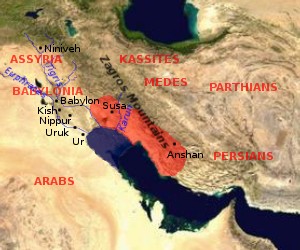
Susa was an ancient city of the Elam
ite, Persian and Parthia
n empires of Iran
. It is located in the lower Zagros Mountains about 250 km (155.3 mi) east of the Tigris River, between the Karkheh and Dez
Rivers.
The modern Iranian town of Shush
is located at the site of ancient Susa. Shush
is the administrative capital of the Shush County
of Iran's Khuzestan province. It had a population 64,960 in 2005.
 In historic literature
, Susa appears in the very earliest Sumerian records, e.g. in Enmerkar and the Lord of Aratta
it is described as one of the places obedient to Inanna
, patron deity of Uruk
.
Susa is also mentioned in the Ketuvim
of the Hebrew Bible
by the name Shushan, mainly in Esther
, but also once each in Nehemiah
and Daniel
. Both Daniel and Nehemiah lived in Susa during the Babylonian captivity of the 6th century BCE. Esther
became queen there, and saved the Jews from genocide. A tomb presumed to be that of Daniel is located in the area, known as Shush-Daniel. The tomb is marked by an unusual white stone cone, which is neither regular nor symmetric. Many scholars believe it was at one point a Star of David
. Susa is further mentioned in the Book of Jubilees (8:21 & 9:2) as one of the places within the inheritance of Shem
and his eldest son Elam; and in 8:1, "Susan" is also named as the son (or daughter, in some translations) of Elam.
Greek mythology
attributed the founding of Susa to king Memnon
of Aethiopia, a character from Homer
's Trojan War
epic, the Iliad
.
, Susa is one of the oldest-known settlements of the region and the world, possibly founded about 4200 BCE. Archeologists have dated the first traces of an inhabited Neolithic village to c 7000 BCE. Evidence of a painted-pottery civilization has been dated to c 5000 BCE. Its name in Elamite
was written variously Ŝuŝan, Ŝuŝun, etc. The origin of the word Susa is from the local city deity Inshushinak
.
Like its Chalcolithic neighbor Uruk
, Susa began as a discrete settlement in the Susa I period (c 4000 BCE). These two settlements, called Acropolis (7 ha) and Apadana (6.3 ha) by archeologists, would later merge to form Susa proper (18 ha). The Apadana was enclosed by 6m thick walls of rammed earth
. The founding of Susa corresponded with the abandonment of nearby villages. Potts suggests that the city may have been founded to try to reestablish the previously destroyed settlement at Chogha Mish
. Susa was firmly within the Uruk cultural sphere during the Uruk period
. An imitation of the entire state apparatus of Uruk, proto-writing, Cylinder seal
s with Sumerian motifs, and monumental architecture, is found at Susa. Susa may have been a colony of Uruk. As such, the periodization
of Susa corresponds to Uruk; Early Middle and Late Susa II periods (3800–3100 BCE) correspond to Early, Middle, and Late Uruk periods.
By the middle Susa II period, the city had grown to 25 ha. Susa III (3100–2900 BCE) corresponds with Uruk III period. Ambiguous reference to Elam (Cuneiform
; NIM) appear also in this period in Sumerian records. Susa enters history during the Early Dynastic period of Sumer. A battle between Kish
and Susa is recorded in 2700 BCE.
centered on the Karun River
. Control of Šušan shifted between Elam
, Sumer
, and Akkad
. Šušan is sometimes mistaken as synonymous with Elam, but it was a distinctly separate cultural and political entity. Šušan was incorporated by Sargon the Great into his Akkadian Empire in approximately 2330 BCE. It was the capital of an Akkadian province until ca. 2240 BCE, when its governor, Kutik-Inshushinak
, rose up in rebellion and liberated it, making it a literary center. Following this, the city was conquered by the neo-Sumerian Ur-III dynasty, and held until Ur finally collapsed at the hands of the Elamites under Kindattu in ca. 2004 BCE. At this time, Susa became an Elamite capital under the Epartid dynasty, and in 1400 BCE, of the Igihalkid dynasty that "Elamaized" Šušan. The Elamites under Shutruk-Nahhunte plundered the original stele
bearing the Code of Hammurabi
, the world's first known written laws, in ca. 1175 BCE and took it to Susa. Archeologists found it in 1901. Nebuchadnezzar I of the Babylonia
n empire plundered Susa around fifty years later.
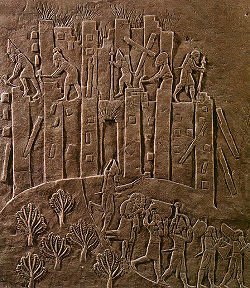 In 647 BCE, the Assyrian king Assurbanipal leveled the city during a war in which the people of Susa participated on the other side. A tablet unearthed in 1854 by Austen Henry Layard
in Nineveh
reveals Ashurbanipal as an "avenger", seeking retribution for the humiliations the Elamites had inflicted on the Mesopotamians over the centuries:
"Susa, the great holy city, abode of their gods, seat of their mysteries, I conquered. I entered its palaces, I opened their treasuries where silver and gold, goods and wealth were amassed... I destroyed the ziggurat
of Susa. I smashed its shining copper horns. I reduced the temples of Elam to naught; their gods and goddesses I scattered to the winds. The tombs of their ancient and recent kings I devastated, I exposed to the sun, and I carried away their bones toward the land of Ashur. I devastated the provinces of Elam and on their lands I sowed salt."
during his conquest of Elam
(Susiana), of which Susa was the capital. The Nabonidus Chronicle records that, prior to the battle(s), Nabonidus had ordered cult statues from outlying Babylonian cities to be brought into the capital, suggesting that the conflict over Susa had begun possibly in the winter of 540 BCE.
It is probable that Cyrus engaged in negotiations with the Babylonian generals to obtain a compromise on their part and therefore avoid an armed confrontation. Nabonidus was staying in the city at the time and soon fled to the capital, Babylon, which he had not visited in years.
Cyrus' conquest of Susa and the rest of Babylonia commenced a fundamental shift, bringing Susa under Persian control for the first time.
Under Cyrus' son Cambyses II, Susa became a center of political power as one of 4 capitals of the Achaemenid Persian empire, while reducing the significance of Pasargadae
as the capital of Persis. Following Cambyses' brief rule, Darius the Great began a major building program in Susa and Persepolis
. During this time he describes his new capital in the DSf inscription:
"This palace which I built at Susa, from afar its ornamentation was brought. Downward the earth was dug, until I reached rock in the earth. When the excavation had been made, then rubble was packed down, some 40 cubits in depth, another part 20 cubits in depth. On that rubble the palace was constructed." Susa continued as a winter capital and residence for Achaemenid kings succeeding Darius the Great, Xerxes I, and their successors.
The city forms the setting of The Persians
(472 BCE), an Athenian
tragedy
by the ancient Greek
playwright Aeschylus
that is the oldest surviving play in the history of theatre
.
Events mentioned in the Old Testament
book of Esther
are said to have occurred in Susa during either the Achaemenid or Sassanid periods.
and was renamed Seleukeia . After Seleucia it was the biggest city in under Selucid control at the time. Susa used Charax Spasinou as its port. It retained a considerable amount of independence and retained its Greek city state organization well into the ensuing Parthian
period and seems to have gained independence under a dynasty whose kings bore the name of Kamnaskires in the 1st century CE.
Approximately one century later when the Parthian Empire
gained its independence from the Seleucid Empire
, Susa was made one of the two capitals (along with Ctesiphon
) of the new state.
Susa became a frequent place of refuge for Parthian and later, the Persian Sassanid kings, as the Romans
sacked Ctesiphon five different times between 116 and 297 CE (Susa was briefly captured only by Roman emperor Trajan
in 116 AD and never again would the Roman Empire advance so far to the east).
Typically, the Parthian rulers wintered in Susa, and spent the summer in Ctesiphon.
armies first conquered Persia. Finally, in 1218, the city was completely destroyed by invading Mongols
. The ancient city was gradually abandoned in the years that followed.
Susa
had a significant Christian population during the first millennium, and was a diocese of the Church of the East between the 5th and 13th centuries, in the metropolitan province of Beth Huzaye (Elam).
.
In 1851, some modest excavation was done by William Loftus
, who identified it as Susa.
In 1885 and 1886 Marcel-Auguste Dieulafoy
and Jane Dieulafoy
began the first French excavations.
Jaques de Morgan conducted major excavations from 1897 until 1911. These efforts continued under Roland De Mecquenem until 1914, at the beginning of World War I
. French work at Susa resumed after the war, led by De Mecquenem, continuing until World War II
in 1940.
Archaeological results from the later period were very thinly published and attempts are underway to remedy this situation.
Roman Ghirshman
took over direction of the French efforts in 1946, after the end of the war. He continued there until 1967. Ghirshman concentrated on excavating a single part of the site, the hectare sized Ville Royale, taking it all the way down to bare earth. The pottery found at the various levels enabled a stratigraphy to be developed for Susa.
During the 1970s, excavations resumed under Jean Perrot
.
Elam
Elam was an ancient civilization located in what is now southwest Iran. Elam was centered in the far west and the southwest of modern-day Iran, stretching from the lowlands of Khuzestan and Ilam Province, as well as a small part of southern Iraq...
ite, Persian and Parthia
Parthia
Parthia is a region of north-eastern Iran, best known for having been the political and cultural base of the Arsacid dynasty, rulers of the Parthian Empire....
n empires of Iran
Iran
Iran , officially the Islamic Republic of Iran , is a country in Southern and Western Asia. The name "Iran" has been in use natively since the Sassanian era and came into use internationally in 1935, before which the country was known to the Western world as Persia...
. It is located in the lower Zagros Mountains about 250 km (155.3 mi) east of the Tigris River, between the Karkheh and Dez
Dez River
The Dez River , the ancient Coprates , is a tributary of the Karun River and is 400 km long. It is the site of the Dez Dam.It is believed that a fortress protected a strategic bridge across the river at Dezful, whence the name, although no trace of this castle remains. The old part of the city...
Rivers.
The modern Iranian town of Shush
Shush, Iran
Shush is a city in and the capital of Shush County, Khuzestan Province, Iran. At the 2006 census, its population was 53,897, in 10,689 families. Shush is located near ancient Susa....
is located at the site of ancient Susa. Shush
Shush, Iran
Shush is a city in and the capital of Shush County, Khuzestan Province, Iran. At the 2006 census, its population was 53,897, in 10,689 families. Shush is located near ancient Susa....
is the administrative capital of the Shush County
Shush County
Shush County is a county in Khuzestan Province in Iran. The capital of the county is Shush. At the 2006 census, the county's population was 189,793, in 33,313 families. The county is subdivided into three districts: the Central District, Shavur District, and Fath Olmobin District...
of Iran's Khuzestan province. It had a population 64,960 in 2005.
History
Historiography
Historiography refers either to the study of the history and methodology of history as a discipline, or to a body of historical work on a specialized topic...
, Susa appears in the very earliest Sumerian records, e.g. in Enmerkar and the Lord of Aratta
Enmerkar and the Lord of Aratta
Enmerkar and the Lord of Aratta is a legendary Sumerian account, of preserved, early post-Sumerian copies, composed in the Neo-Sumerian period ....
it is described as one of the places obedient to Inanna
Inanna
Inanna, also spelled Inana is the Sumerian goddess of sexual love, fertility, and warfare....
, patron deity of Uruk
Uruk
Uruk was an ancient city of Sumer and later Babylonia, situated east of the present bed of the Euphrates river, on the ancient dry former channel of the Euphrates River, some 30 km east of modern As-Samawah, Al-Muthannā, Iraq.Uruk gave its name to the Uruk...
.
Susa is also mentioned in the Ketuvim
Ketuvim
Ketuvim or Kəṯûḇîm in actual Biblical Hebrew is the third and final section of the Tanak , after Torah and Nevi'im . In English translations of the Hebrew Bible, this section is usually entitled "Writings" or "Hagiographa"...
of the Hebrew Bible
Hebrew Bible
The Hebrew Bible is a term used by biblical scholars outside of Judaism to refer to the Tanakh , a canonical collection of Jewish texts, and the common textual antecedent of the several canonical editions of the Christian Old Testament...
by the name Shushan, mainly in Esther
Book of Esther
The Book of Esther is a book in the Ketuvim , the third section of the Jewish Tanakh and is part of the Christian Old Testament. The Book of Esther or the Megillah is the basis for the Jewish celebration of Purim...
, but also once each in Nehemiah
Book of Nehemiah
The Book of Nehemiah is a book of the Hebrew Bible. Told largely in the form of a first-person memoir, it concerns the rebuilding of the walls of Jerusalem by Nehemiah, a Jew who is a high official at the Persian court, and the dedication of the city and its people to God's laws...
and Daniel
Book of Daniel
The Book of Daniel is a book in the Hebrew Bible. The book tells of how Daniel, and his Judean companions, were inducted into Babylon during Jewish exile, and how their positions elevated in the court of Nebuchadnezzar. The court tales span events that occur during the reigns of Nebuchadnezzar,...
. Both Daniel and Nehemiah lived in Susa during the Babylonian captivity of the 6th century BCE. Esther
Esther
Esther , born Hadassah, is the eponymous heroine of the Biblical Book of Esther.According to the Bible, she was a Jewish queen of the Persian king Ahasuerus...
became queen there, and saved the Jews from genocide. A tomb presumed to be that of Daniel is located in the area, known as Shush-Daniel. The tomb is marked by an unusual white stone cone, which is neither regular nor symmetric. Many scholars believe it was at one point a Star of David
Star of David
The Star of David, known in Hebrew as the Shield of David or Magen David is a generally recognized symbol of Jewish identity and Judaism.Its shape is that of a hexagram, the compound of two equilateral triangles...
. Susa is further mentioned in the Book of Jubilees (8:21 & 9:2) as one of the places within the inheritance of Shem
Shem
Shem was one of the sons of Noah in the Hebrew Bible as well as in Islamic literature. He is most popularly regarded as the eldest son, though some traditions regard him as the second son. Genesis 10:21 refers to relative ages of Shem and his brother Japheth, but with sufficient ambiguity in each...
and his eldest son Elam; and in 8:1, "Susan" is also named as the son (or daughter, in some translations) of Elam.
Greek mythology
Greek mythology
Greek mythology is the body of myths and legends belonging to the ancient Greeks, concerning their gods and heroes, the nature of the world, and the origins and significance of their own cult and ritual practices. They were a part of religion in ancient Greece...
attributed the founding of Susa to king Memnon
Memnon
Memnon may refer to:* Saint Memnon the Wonderworker — early Christian saint from Egypt, hermit and hegumen of one of Egyptian monasteries* Memnon and those erroneously named after him in the Graeco-Roman era:...
of Aethiopia, a character from Homer
Homer
In the Western classical tradition Homer , is the author of the Iliad and the Odyssey, and is revered as the greatest ancient Greek epic poet. These epics lie at the beginning of the Western canon of literature, and have had an enormous influence on the history of literature.When he lived is...
's Trojan War
Trojan War
In Greek mythology, the Trojan War was waged against the city of Troy by the Achaeans after Paris of Troy took Helen from her husband Menelaus, the king of Sparta. The war is among the most important events in Greek mythology and was narrated in many works of Greek literature, including the Iliad...
epic, the Iliad
Iliad
The Iliad is an epic poem in dactylic hexameters, traditionally attributed to Homer. Set during the Trojan War, the ten-year siege of the city of Troy by a coalition of Greek states, it tells of the battles and events during the weeks of a quarrel between King Agamemnon and the warrior Achilles...
.
Proto-Elamite
In urban historyUrban History
Urban history is a field of history that examines the historical nature of cities and towns, and the process of urbanization. The approach tends to be multidisciplinary, crossing boundaries into fields like social history, architectural history, urban sociology, urban geography and archaeology.At...
, Susa is one of the oldest-known settlements of the region and the world, possibly founded about 4200 BCE. Archeologists have dated the first traces of an inhabited Neolithic village to c 7000 BCE. Evidence of a painted-pottery civilization has been dated to c 5000 BCE. Its name in Elamite
Elamite language
Elamite is an extinct language spoken by the ancient Elamites. Elamite was the primary language in present day Iran from 2800–550 BCE. The last written records in Elamite appear about the time of the conquest of the Persian Empire by Alexander the Great....
was written variously Ŝuŝan, Ŝuŝun, etc. The origin of the word Susa is from the local city deity Inshushinak
Inshushinak
Inshushinak was one of the major gods of the Elamites and the protector deity of Susa. The ziggurat at Choqa Zanbil is dedicated to him.-References:* ISBN 0-521-563585*...
.
Like its Chalcolithic neighbor Uruk
Uruk
Uruk was an ancient city of Sumer and later Babylonia, situated east of the present bed of the Euphrates river, on the ancient dry former channel of the Euphrates River, some 30 km east of modern As-Samawah, Al-Muthannā, Iraq.Uruk gave its name to the Uruk...
, Susa began as a discrete settlement in the Susa I period (c 4000 BCE). These two settlements, called Acropolis (7 ha) and Apadana (6.3 ha) by archeologists, would later merge to form Susa proper (18 ha). The Apadana was enclosed by 6m thick walls of rammed earth
Rammed earth
Rammed earth, also known as taipa , tapial , and pisé , is a technique for building walls using the raw materials of earth, chalk, lime and gravel. It is an ancient building method that has seen a revival in recent years as people seek more sustainable building materials and natural building methods...
. The founding of Susa corresponded with the abandonment of nearby villages. Potts suggests that the city may have been founded to try to reestablish the previously destroyed settlement at Chogha Mish
Chogha Mish
Tappeh-ye Choghā Mīsh dating back to 6800 BC, is the site of a Chalcolithic settlement in Western Iran, located in the Khuzistan Province on the Susiana Plain...
. Susa was firmly within the Uruk cultural sphere during the Uruk period
Uruk period
The Uruk period existed from the protohistoric Chalcolithic to Early Bronze Age period in the history of Mesopotamia, following the Ubaid period and succeeded by the Jemdet Nasr period. Named after the Sumerian city of Uruk, this period saw the emergence of urban life in Mesopotamia. It was...
. An imitation of the entire state apparatus of Uruk, proto-writing, Cylinder seal
Cylinder seal
A cylinder seal is a cylinder engraved with a 'picture story', used in ancient times to roll an impression onto a two-dimensional surface, generally wet clay. Cylinder seals were invented around 3500 BC in the Near East, at the contemporary site of Susa in south-western Iran and at the early site...
s with Sumerian motifs, and monumental architecture, is found at Susa. Susa may have been a colony of Uruk. As such, the periodization
Periodization
Periodization is the attempt to categorize or divide time into named blocks. The result is a descriptive abstraction that provides a useful handle on periods of time with relatively stable characteristics...
of Susa corresponds to Uruk; Early Middle and Late Susa II periods (3800–3100 BCE) correspond to Early, Middle, and Late Uruk periods.
By the middle Susa II period, the city had grown to 25 ha. Susa III (3100–2900 BCE) corresponds with Uruk III period. Ambiguous reference to Elam (Cuneiform
Cuneiform
Cuneiform can refer to:*Cuneiform script, an ancient writing system originating in Mesopotamia in the 4th millennium BC*Cuneiform , three bones in the human foot*Cuneiform Records, a music record label...
; NIM) appear also in this period in Sumerian records. Susa enters history during the Early Dynastic period of Sumer. A battle between Kish
Kish (Sumer)
Kish is modern Tell al-Uhaymir , and was an ancient city of Sumer. Kish is located some 12 km east of Babylon, and 80 km south of Baghdad ....
and Susa is recorded in 2700 BCE.
Elamites
In politics, Susa was the capital of a state called Šušan, which occupied approximately the same territory of modern Khūzestān ProvinceKhuzestan Province
Khuzestan Province is one of the 31 provinces of Iran. It is in the southwest of the country, bordering Iraq's Basra Province and the Persian Gulf. Its capital is Ahwaz and covers an area of 63,238 km²...
centered on the Karun River
Karun
The Kārun is Iran's most effluent, and the only navigable, river. It is 450 miles long. It rises in the Zard Kuh mountains of the Bakhtiari district in the Zagros Range, receiving many tributaries, such as the Dez and the Kuhrang, before passing through the capital of the Khuzestan Province of...
. Control of Šušan shifted between Elam
Elam
Elam was an ancient civilization located in what is now southwest Iran. Elam was centered in the far west and the southwest of modern-day Iran, stretching from the lowlands of Khuzestan and Ilam Province, as well as a small part of southern Iraq...
, Sumer
Sumer
Sumer was a civilization and historical region in southern Mesopotamia, modern Iraq during the Chalcolithic and Early Bronze Age....
, and Akkad
Akkad
The Akkadian Empire was an empire centered in the city of Akkad and its surrounding region in Mesopotamia....
. Šušan is sometimes mistaken as synonymous with Elam, but it was a distinctly separate cultural and political entity. Šušan was incorporated by Sargon the Great into his Akkadian Empire in approximately 2330 BCE. It was the capital of an Akkadian province until ca. 2240 BCE, when its governor, Kutik-Inshushinak
Kutik-Inshushinak
Kutik-Inshushinak was king of Elam from about 2240 to 2220 BC , and the last from the Awan dynasty....
, rose up in rebellion and liberated it, making it a literary center. Following this, the city was conquered by the neo-Sumerian Ur-III dynasty, and held until Ur finally collapsed at the hands of the Elamites under Kindattu in ca. 2004 BCE. At this time, Susa became an Elamite capital under the Epartid dynasty, and in 1400 BCE, of the Igihalkid dynasty that "Elamaized" Šušan. The Elamites under Shutruk-Nahhunte plundered the original stele
Stele
A stele , also stela , is a stone or wooden slab, generally taller than it is wide, erected for funerals or commemorative purposes, most usually decorated with the names and titles of the deceased or living — inscribed, carved in relief , or painted onto the slab...
bearing the Code of Hammurabi
Code of Hammurabi
The Code of Hammurabi is a well-preserved Babylonian law code, dating to ca. 1780 BC . It is one of the oldest deciphered writings of significant length in the world. The sixth Babylonian king, Hammurabi, enacted the code, and partial copies exist on a human-sized stone stele and various clay...
, the world's first known written laws, in ca. 1175 BCE and took it to Susa. Archeologists found it in 1901. Nebuchadnezzar I of the Babylonia
Babylonia
Babylonia was an ancient cultural region in central-southern Mesopotamia , with Babylon as its capital. Babylonia emerged as a major power when Hammurabi Babylonia was an ancient cultural region in central-southern Mesopotamia (present-day Iraq), with Babylon as its capital. Babylonia emerged as...
n empire plundered Susa around fifty years later.
Assyrians
Austen Henry Layard
Sir Austen Henry Layard GCB, PC was a British traveller, archaeologist, cuneiformist, art historian, draughtsman, collector, author, politician and diplomat, best known as the excavator of Nimrud.-Family:...
in Nineveh
Nineveh
Nineveh was an ancient Assyrian city on the eastern bank of the Tigris River, and capital of the Neo Assyrian Empire. Its ruins are across the river from the modern-day major city of Mosul, in the Ninawa Governorate of Iraq....
reveals Ashurbanipal as an "avenger", seeking retribution for the humiliations the Elamites had inflicted on the Mesopotamians over the centuries:
"Susa, the great holy city, abode of their gods, seat of their mysteries, I conquered. I entered its palaces, I opened their treasuries where silver and gold, goods and wealth were amassed... I destroyed the ziggurat
Ziggurat
Ziggurats were massive structures built in the ancient Mesopotamian valley and western Iranian plateau, having the form of a terraced step pyramid of successively receding stories or levels.Notable ziggurats include the Great Ziggurat of Ur near Nasiriyah, Iraq; the Ziggurat of Aqar Quf near...
of Susa. I smashed its shining copper horns. I reduced the temples of Elam to naught; their gods and goddesses I scattered to the winds. The tombs of their ancient and recent kings I devastated, I exposed to the sun, and I carried away their bones toward the land of Ashur. I devastated the provinces of Elam and on their lands I sowed salt."
Achaemenid period
Susa underwent a major political and ethnocultural transition when it became part of the Persian Achaemenid empire between 540-539 BCE when it was captured by Cyrus the GreatCyrus the Great
Cyrus II of Persia , commonly known as Cyrus the Great, also known as Cyrus the Elder, was the founder of the Achaemenid Empire. Under his rule, the empire embraced all the previous civilized states of the ancient Near East, expanded vastly and eventually conquered most of Southwest Asia and much...
during his conquest of Elam
Elam
Elam was an ancient civilization located in what is now southwest Iran. Elam was centered in the far west and the southwest of modern-day Iran, stretching from the lowlands of Khuzestan and Ilam Province, as well as a small part of southern Iraq...
(Susiana), of which Susa was the capital. The Nabonidus Chronicle records that, prior to the battle(s), Nabonidus had ordered cult statues from outlying Babylonian cities to be brought into the capital, suggesting that the conflict over Susa had begun possibly in the winter of 540 BCE.
It is probable that Cyrus engaged in negotiations with the Babylonian generals to obtain a compromise on their part and therefore avoid an armed confrontation. Nabonidus was staying in the city at the time and soon fled to the capital, Babylon, which he had not visited in years.
Cyrus' conquest of Susa and the rest of Babylonia commenced a fundamental shift, bringing Susa under Persian control for the first time.
Under Cyrus' son Cambyses II, Susa became a center of political power as one of 4 capitals of the Achaemenid Persian empire, while reducing the significance of Pasargadae
Pasargadae
Pasargadae , the capital of Cyrus the Great and also his last resting place, was a city in ancient Persia, and is today an archaeological site and one of Iran's UNESCO World Heritage Sites.-History:...
as the capital of Persis. Following Cambyses' brief rule, Darius the Great began a major building program in Susa and Persepolis
Persepolis
Perspolis was the ceremonial capital of the Achaemenid Empire . Persepolis is situated northeast of the modern city of Shiraz in the Fars Province of modern Iran. In contemporary Persian, the site is known as Takht-e Jamshid...
. During this time he describes his new capital in the DSf inscription:
"This palace which I built at Susa, from afar its ornamentation was brought. Downward the earth was dug, until I reached rock in the earth. When the excavation had been made, then rubble was packed down, some 40 cubits in depth, another part 20 cubits in depth. On that rubble the palace was constructed." Susa continued as a winter capital and residence for Achaemenid kings succeeding Darius the Great, Xerxes I, and their successors.
The city forms the setting of The Persians
The Persians
The Persians is an Athenian tragedy by the ancient Greek playwright Aeschylus. First produced in 472 BCE, it is the oldest surviving play in the history of theatre...
(472 BCE), an Athenian
Classical Athens
The city of Athens during the classical period of Ancient Greece was a notable polis of Attica, Greece, leading the Delian League in the Peloponnesian War against Sparta and the Peloponnesian League. Athenian democracy was established in 508 BC under Cleisthenes following the tyranny of Hippias...
tragedy
Tragedy
Tragedy is a form of art based on human suffering that offers its audience pleasure. While most cultures have developed forms that provoke this paradoxical response, tragedy refers to a specific tradition of drama that has played a unique and important role historically in the self-definition of...
by the ancient Greek
Ancient Greece
Ancient Greece is a civilization belonging to a period of Greek history that lasted from the Archaic period of the 8th to 6th centuries BC to the end of antiquity. Immediately following this period was the beginning of the Early Middle Ages and the Byzantine era. Included in Ancient Greece is the...
playwright Aeschylus
Aeschylus
Aeschylus was the first of the three ancient Greek tragedians whose work has survived, the others being Sophocles and Euripides, and is often described as the father of tragedy. His name derives from the Greek word aiskhos , meaning "shame"...
that is the oldest surviving play in the history of theatre
History of theatre
The history of theatre charts the development of theatre over the past 2,500 years. While performative elements are present in every society, it is customary to acknowledge a distinction between theatre as an art form and entertainment and theatrical or performative elements in other activities...
.
Events mentioned in the Old Testament
Old Testament
The Old Testament, of which Christians hold different views, is a Christian term for the religious writings of ancient Israel held sacred and inspired by Christians which overlaps with the 24-book canon of the Masoretic Text of Judaism...
book of Esther
Esther
Esther , born Hadassah, is the eponymous heroine of the Biblical Book of Esther.According to the Bible, she was a Jewish queen of the Persian king Ahasuerus...
are said to have occurred in Susa during either the Achaemenid or Sassanid periods.
Parthian and Sassanid periods
Susa lost much of its importance when Alexander of Macedon conquered it in 331 BCE and destroyed the first Persian Empire. For approximately one century after Alexander, Susa fell to the Seleucid EmpireSeleucid Empire
The Seleucid Empire was a Greek-Macedonian state that was created out of the eastern conquests of Alexander the Great. At the height of its power, it included central Anatolia, the Levant, Mesopotamia, Persia, today's Turkmenistan, Pamir and parts of Pakistan.The Seleucid Empire was a major centre...
and was renamed Seleukeia . After Seleucia it was the biggest city in under Selucid control at the time. Susa used Charax Spasinou as its port. It retained a considerable amount of independence and retained its Greek city state organization well into the ensuing Parthian
Parthia
Parthia is a region of north-eastern Iran, best known for having been the political and cultural base of the Arsacid dynasty, rulers of the Parthian Empire....
period and seems to have gained independence under a dynasty whose kings bore the name of Kamnaskires in the 1st century CE.
Approximately one century later when the Parthian Empire
Parthian Empire
The Parthian Empire , also known as the Arsacid Empire , was a major Iranian political and cultural power in ancient Persia...
gained its independence from the Seleucid Empire
Seleucid Empire
The Seleucid Empire was a Greek-Macedonian state that was created out of the eastern conquests of Alexander the Great. At the height of its power, it included central Anatolia, the Levant, Mesopotamia, Persia, today's Turkmenistan, Pamir and parts of Pakistan.The Seleucid Empire was a major centre...
, Susa was made one of the two capitals (along with Ctesiphon
Ctesiphon
Ctesiphon, the imperial capital of the Parthian Arsacids and of the Persian Sassanids, was one of the great cities of ancient Mesopotamia.The ruins of the city are located on the east bank of the Tigris, across the river from the Hellenistic city of Seleucia...
) of the new state.
Susa became a frequent place of refuge for Parthian and later, the Persian Sassanid kings, as the Romans
Roman Empire
The Roman Empire was the post-Republican period of the ancient Roman civilization, characterised by an autocratic form of government and large territorial holdings in Europe and around the Mediterranean....
sacked Ctesiphon five different times between 116 and 297 CE (Susa was briefly captured only by Roman emperor Trajan
Trajan
Trajan , was Roman Emperor from 98 to 117 AD. Born into a non-patrician family in the province of Hispania Baetica, in Spain Trajan rose to prominence during the reign of emperor Domitian. Serving as a legatus legionis in Hispania Tarraconensis, in Spain, in 89 Trajan supported the emperor against...
in 116 AD and never again would the Roman Empire advance so far to the east).
Typically, the Parthian rulers wintered in Susa, and spent the summer in Ctesiphon.
Post-Islamic period and final destruction
Susa was destroyed at least three times in its history. The first was in 647 BCE, by Assurbanipal. The second destruction took place in 638 CE, when the MuslimMuslim
A Muslim, also spelled Moslem, is an adherent of Islam, a monotheistic, Abrahamic religion based on the Quran, which Muslims consider the verbatim word of God as revealed to prophet Muhammad. "Muslim" is the Arabic term for "submitter" .Muslims believe that God is one and incomparable...
armies first conquered Persia. Finally, in 1218, the city was completely destroyed by invading Mongols
Mongols
Mongols ) are a Central-East Asian ethnic group that lives mainly in the countries of Mongolia, China, and Russia. In China, ethnic Mongols can be found mainly in the central north region of China such as Inner Mongolia...
. The ancient city was gradually abandoned in the years that followed.
Susa
Beth Huzaye (East Syrian Ecclesiastical Province)
Beth Huzaye was a metropolitan province of the Church of the East between the fifth and fourteenth centuries. The metropolitans of Beth Huzaye sat at Beth Lapat . The province of Beth Huzaye had a number of suffragan dioceses at different periods in its history, including Karka d’Ledan, Hormizd...
had a significant Christian population during the first millennium, and was a diocese of the Church of the East between the 5th and 13th centuries, in the metropolitan province of Beth Huzaye (Elam).
Archaeology
The site was examined in 1836 by Henry Rawlinson and then by A. H. LayardAusten Henry Layard
Sir Austen Henry Layard GCB, PC was a British traveller, archaeologist, cuneiformist, art historian, draughtsman, collector, author, politician and diplomat, best known as the excavator of Nimrud.-Family:...
.
In 1851, some modest excavation was done by William Loftus
William Loftus
William Kennett Loftus was a British geologist, naturalist, explorer and archaeological excavator. He discovered the ancient Sumerian city of Uruk in 1849.-Biography:...
, who identified it as Susa.
In 1885 and 1886 Marcel-Auguste Dieulafoy
Marcel-Auguste Dieulafoy
Marcel-Auguste Dieulafoy was a French archaeologist, noted for his excavations at Susa in 1885 and for his work, L'Art antique de la Perse.-Early life:...
and Jane Dieulafoy
Jane Dieulafoy
Jane Dieulafoy was a French archaeologist, explorer, novelist and journalist. She was the wife of Marcel-Auguste Dieulafoy. Together with her husband, she is known for her excavations at Susa.-Career:...
began the first French excavations.
Jaques de Morgan conducted major excavations from 1897 until 1911. These efforts continued under Roland De Mecquenem until 1914, at the beginning of World War I
World War I
World War I , which was predominantly called the World War or the Great War from its occurrence until 1939, and the First World War or World War I thereafter, was a major war centred in Europe that began on 28 July 1914 and lasted until 11 November 1918...
. French work at Susa resumed after the war, led by De Mecquenem, continuing until World War II
World War II
World War II, or the Second World War , was a global conflict lasting from 1939 to 1945, involving most of the world's nations—including all of the great powers—eventually forming two opposing military alliances: the Allies and the Axis...
in 1940.
Archaeological results from the later period were very thinly published and attempts are underway to remedy this situation.
Roman Ghirshman
Roman Ghirshman
Roman Ghirshman was a Ukrainian-born French archeologist who specialized in ancient Iran.A native of Kharkiv, Ghirshman moved to Paris in 1917 to study Archeology and Ancient Languages...
took over direction of the French efforts in 1946, after the end of the war. He continued there until 1967. Ghirshman concentrated on excavating a single part of the site, the hectare sized Ville Royale, taking it all the way down to bare earth. The pottery found at the various levels enabled a stratigraphy to be developed for Susa.
During the 1970s, excavations resumed under Jean Perrot
Jean Perrot
Jean Perrot is a French archaeologist who specialised in the late prehistory of the Middle East and Near East.-Biography:Perrot was a graduate of the Ecole du Louvre where he studied under two experts in Syrian archaeology; André Parrot and René Dussaud...
.
See also
- AbulitesAbulitesAbulites was the Achaemenid satrap of Susiana. Following the defeat of Darius III at Issus, he surrendered Susa to Alexander the Great when the latter approached the city...
- Choqa ZanbilChoqa ZanbilChogha Zanbil ; Elamite: Dur Untash) is an ancient Elamite complex in the Khuzestan province of Iran.It is one of the few existent ziggurats outside of Mesopotamia...
- Cities of the Ancient Near EastCities of the ancient Near EastThe largest cities in the Bronze Age ancient Near East housed several tens of thousands. Memphis in the Early Bronze Age with some 30,000 inhabitants was the largest city of the time by far...
- Elam
- History of IranHistory of IranThe history of Iran has been intertwined with the history of a larger historical region, comprising the area from the Danube River in the west to the Indus River and Jaxartes in the east and from the Caucasus, Caspian Sea, and Aral Sea in the north to the Persian Gulf and the Gulf of Oman and Egypt...
- List of oldest continuously inhabited cities
- Monsieur ChouchaniMonsieur ChouchaniMonsieur Chouchani , or "Shushani," is the nickname of an otherwise anonymous and enigmatic Jewish teacher who taught a small number of distinguished students in post-World War II Europe and elsewhere, including Emmanuel Levinas and Elie Wiesel....
- Short chronology timelineShort chronology timelineThe short chronology is one chronology of the Near Eastern Bronze and Early Iron Age, which fixes the reign of Hammurabi to 1728 BC – 1686 BC and the sack of Babylon to 1531 BC....
- Achaemenid architectureAchaemenid architectureAchaemenid Persian architecture refers to the architectural achievements of the Achaemenid Persians manifesting in construction of spectacular cities used for governance and inhabitation , temples made for worship and social gatherings , and mausoleums erected in honor of fallen kings...
External links
- Susa
- Livius.org pictures of Susa
- Aerial views of Susa
- Susa City Home Page
- Digital Images of Cuneiform Tablets from Susa - CDLI
- Hamid-Reza Hosseini, Shush at the foot of LouvreLouvreThe Musée du Louvre – in English, the Louvre Museum or simply the Louvre – is one of the world's largest museums, the most visited art museum in the world and a historic monument. A central landmark of Paris, it is located on the Right Bank of the Seine in the 1st arrondissement...
(Shush dar dāman-e Louvre), in Persian, Jadid Online, 10 March 2009, Jadidonline.com.
Audio slideshow: Jadidonline.com (6 min 31 sec).