

Lordship of Ireland

Encyclopedia
The Lordship of Ireland refers to that part of Ireland
that was under the rule of the king of England, styled Lord of Ireland, between 1177 and 1541. It was created in the wake of the Norman invasion of Ireland
in 1169–71 and was succeeded by the Kingdom of Ireland
. As the Lord of Ireland was also King of England, he was represented locally by the Lord Lieutenant of Ireland
.
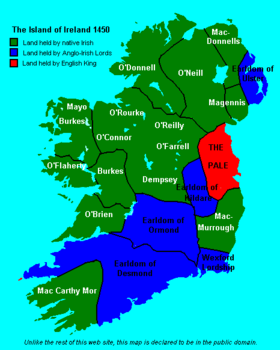
Ostensibly, the lordship extended throughout all of Ireland. However, in reality, the kings rule only ever extended to parts of the island. Areas under English rule expanded and retreated over time. Some areas remained separate outside of English rule until the 16th century.
The feudal system allowed a significant amount of practical autonomy for the Hiberno-Norman
noble houses who carved earldoms out for themselves and had almost as much authority as some of the native Gaelic kings
around Dublin, and some provincial towns, including Cork
, Limerick
, Waterford
, Wexford
and their hinterlands. It owed its origins to the decision of a Leinster dynast, Diarmait Mac Murchada (Diarmuid MacMorrough), to bring in a Norman knight based in Wales, Richard de Clare, 2nd Earl of Pembroke
(alias 'Strongbow'), to aid him in his battle to regain his throne, after being overthrown by a confederation led by the new Irish High King
(the previous incumbent had protected MacMurrough). Henry II of England
, who reigned over England
and ruled over parts of France
, invaded Ireland to control Strongbow, whom he feared was becoming a threat to the stability of his own kingdom on its western fringes (there had been earlier fears that Saxon refugees might use either Ireland or Flanders as a base for a counter-offensive after 1066); ironically, much of the later Plantagenet consolidation of South Wales
was in furtherance of holding open routes to Ireland.
(1155) authorising the English monarch to take possession of Ireland. Religious practices in Ireland and organisation had evolved divergently from those of areas of Europe influenced more directly by the Holy See
, although many of these differences had been eliminated or greatly lessened by the time the bull was issued in 1155. Further, the former Irish church
had never sent its dues ("tithe
s") to Rome. Henry's primary motivation for invading Ireland 1171 was to control Strongbow and other Norman lords. In the process he accepted the fealty
of the Gaelic
kings at Dublin in November 1171, and he summoned the Synod of Cashel
in 1172, which brought the Irish Church into conformity with English and European norms.
The pope asserted the right to grant sovereignty over islands to different monarchs on the basis of a document, later proved to be a forgery, called the Donation of Constantine
. Doubts were cast by eminent scholars on Laudabiliter itself in the 19th century, but its effect was confirmed by letters of Pope Alexander III
and by the facts on the ground. The Papal power to grant also fell within the remit of Dictatus papae
(1075–87). While Laudabiliter had referred to the "kingdom" of Ireland, the Papacy was ambiguous about describing it as a kingdom as early as 1185.
parliament in May 1177, Henry replaced William FitzAldelm and granted John his Irish lands, so becoming Lord of Ireland (Dominus Hiberniae) in 1177 when he was 10 years old, with the territory being known in English as the Lordship of Ireland.
Henry had wanted John to be crowned King of Ireland on his first visit in 1185, but Pope Lucius III
specifically refused permission. "Dominus" was the usual title of a king who had not yet been crowned, suggesting that it was Henry's intention. Lucius then died while John was in Ireland, and Henry obtained consent from Pope Urban III
and ordered a crown of gold and peacock feathers for John. In late 1185 the crown was ready, but John's visit had by then proved a complete failure, so Henry cancelled the coronation.
Following the deaths of John’s older brothers he became King John of England
in 1199, and the Lordship of Ireland, instead of being a separate country governed separately by a junior Norman prince, became another territorial possession of the Norman-English Crown.
 The Lordship thrived in the 13th century during the Medieval Warm Period
, a time of warm climate and better harvests. The feudal system was introduced, and the Parliament of Ireland
first sat in 1297. Some counties were created by shiring, while walled towns and castles became a feature of the landscape. But little of this engagement with mainstream European life was of benefit to those the Normans called the "mere Irish". "Mere" derived from the Latin merus, meaning pure.
The Norman élite and churchmen spoke Norman French and Latin. Many poorer settlers spoke English, Welsh and Flemish. The Gaelic areas spoke Irish dialects. The Yola language
of County Wexford
was a survivor of the early English dialects.
The Lordship suffered invasion from Scotland by Edward Bruce
in 1315–18 which destroyed much of the economy and coincided with the great famine of 1315–7
. The earldom of Ulster ended in 1333 and the Black Death
of 1348–50 impacted more on the town-dwelling Normans than on the remaining Gaelic
clans. In 1366 the Statute of Kilkenny tried to keep aspects of Gaelic culture out of the Norman-controlled areas, but in vain. Historians refer to a Gaelic revival or resurgence between 1350 and 1500, by which time the area ruled for the Crown — "the Pale
" — had shrunk to a small area around Dublin.
Between 1500 and 1541 a mixed situation arose. Most clans remained loyal to the Lord most of the time, using a Gaelic-style system of alliances centred around the Lord Deputy who was usually the current Earl of Kildare. However a rebellion by the 9th Earl's heir Silken Thomas in 1535 led on to a less sympathetic system of rule by mainly English-born administrators. The rebellion and Henry VIII's seizure of the Irish monasteries around 1540 led on to his plan to create a new kingdom based on the existing parliament.
passed by the Irish Parliament
in 1541 when, on Henry VIII
's demand, he was granted a new title, King of Ireland
, with the state renamed the Kingdom of Ireland
. Henry VIII changed his title because the Lordship of Ireland had been granted to the Norman monarchy by the Papacy; Henry had been excommunicated by the Catholic Church and worried that his title could be withdrawn by the Holy See
. Henry VIII also wanted Ireland to be become a full kingdom to encourage a greater sense of loyalty amongst his Irish subjects, some of whom took part in his policy of surrender and regrant
.
Ireland
Ireland is an island to the northwest of continental Europe. It is the third-largest island in Europe and the twentieth-largest island on Earth...
that was under the rule of the king of England, styled Lord of Ireland, between 1177 and 1541. It was created in the wake of the Norman invasion of Ireland
Norman Invasion of Ireland
The Norman invasion of Ireland was a two-stage process, which began on 1 May 1169 when a force of loosely associated Norman knights landed near Bannow, County Wexford...
in 1169–71 and was succeeded by the Kingdom of Ireland
Kingdom of Ireland
The Kingdom of Ireland refers to the country of Ireland in the period between the proclamation of Henry VIII as King of Ireland by the Crown of Ireland Act 1542 and the Act of Union in 1800. It replaced the Lordship of Ireland, which had been created in 1171...
. As the Lord of Ireland was also King of England, he was represented locally by the Lord Lieutenant of Ireland
Lord Lieutenant of Ireland
The Lord Lieutenant of Ireland was the British King's representative and head of the Irish executive during the Lordship of Ireland , the Kingdom of Ireland and the United Kingdom of Great Britain and Ireland...
.
Ostensibly, the lordship extended throughout all of Ireland. However, in reality, the kings rule only ever extended to parts of the island. Areas under English rule expanded and retreated over time. Some areas remained separate outside of English rule until the 16th century.
The feudal system allowed a significant amount of practical autonomy for the Hiberno-Norman
Hiberno-Norman
The Hiberno-Normans are those Norman lords who settled in Ireland who admitted little if any real fealty to the Anglo-Norman settlers in England, and who soon began to interact and intermarry with the Gaelic nobility of Ireland. The term embraces both their origins as a distinct community with...
noble houses who carved earldoms out for themselves and had almost as much authority as some of the native Gaelic kings
Background
The authority of the Lordship of Ireland's government was seldom extended throughout the island of Ireland at any time during its existence but was restricted to the PaleThe Pale
The Pale or the English Pale , was the part of Ireland that was directly under the control of the English government in the late Middle Ages. It had reduced by the late 15th century to an area along the east coast stretching from Dalkey, south of Dublin, to the garrison town of Dundalk...
around Dublin, and some provincial towns, including Cork
Cork (city)
Cork is the second largest city in the Republic of Ireland and the island of Ireland's third most populous city. It is the principal city and administrative centre of County Cork and the largest city in the province of Munster. Cork has a population of 119,418, while the addition of the suburban...
, Limerick
Limerick
Limerick is the third largest city in the Republic of Ireland, and the principal city of County Limerick and Ireland's Mid-West Region. It is the fifth most populous city in all of Ireland. When taking the extra-municipal suburbs into account, Limerick is the third largest conurbation in the...
, Waterford
Waterford
Waterford is a city in the South-East Region of Ireland. It is the oldest city in the country and fifth largest by population. Waterford City Council is the local government authority for the city and its immediate hinterland...
, Wexford
Wexford
Wexford is the county town of County Wexford, Ireland. It is situated near the southeastern corner of Ireland, close to Rosslare Europort. The town is connected to Dublin via the M11/N11 National Primary Route, and the national rail network...
and their hinterlands. It owed its origins to the decision of a Leinster dynast, Diarmait Mac Murchada (Diarmuid MacMorrough), to bring in a Norman knight based in Wales, Richard de Clare, 2nd Earl of Pembroke
Richard de Clare, 2nd Earl of Pembroke
Richard de Clare, 2nd Earl of Pembroke , Lord of Leinster, Justiciar of Ireland . Like his father, he was also commonly known as Strongbow...
(alias 'Strongbow'), to aid him in his battle to regain his throne, after being overthrown by a confederation led by the new Irish High King
High King of Ireland
The High Kings of Ireland were sometimes historical and sometimes legendary figures who had, or who are claimed to have had, lordship over the whole of Ireland. Medieval and early modern Irish literature portrays an almost unbroken sequence of High Kings, ruling from Tara over a hierarchy of...
(the previous incumbent had protected MacMurrough). Henry II of England
Henry II of England
Henry II ruled as King of England , Count of Anjou, Count of Maine, Duke of Normandy, Duke of Aquitaine, Duke of Gascony, Count of Nantes, Lord of Ireland and, at various times, controlled parts of Wales, Scotland and western France. Henry, the great-grandson of William the Conqueror, was the...
, who reigned over England
England
England is a country that is part of the United Kingdom. It shares land borders with Scotland to the north and Wales to the west; the Irish Sea is to the north west, the Celtic Sea to the south west, with the North Sea to the east and the English Channel to the south separating it from continental...
and ruled over parts of France
France
The French Republic , The French Republic , The French Republic , (commonly known as France , is a unitary semi-presidential republic in Western Europe with several overseas territories and islands located on other continents and in the Indian, Pacific, and Atlantic oceans. Metropolitan France...
, invaded Ireland to control Strongbow, whom he feared was becoming a threat to the stability of his own kingdom on its western fringes (there had been earlier fears that Saxon refugees might use either Ireland or Flanders as a base for a counter-offensive after 1066); ironically, much of the later Plantagenet consolidation of South Wales
Wales
Wales is a country that is part of the United Kingdom and the island of Great Britain, bordered by England to its east and the Atlantic Ocean and Irish Sea to its west. It has a population of three million, and a total area of 20,779 km²...
was in furtherance of holding open routes to Ireland.
Laudabiliter 1155
Another reason King Henry invaded Ireland was because Pope Adrian IV, the only Englishman to have occupied the papal throne, had issued a papal bull LaudabiliterLaudabiliter
Laudabiliter was a papal bull issued in 1155 by Adrian IV, the only Englishman to serve as Pope, giving the Angevin King Henry II of England the right to assume control over Ireland and apply the Gregorian Reforms in the Irish church...
(1155) authorising the English monarch to take possession of Ireland. Religious practices in Ireland and organisation had evolved divergently from those of areas of Europe influenced more directly by the Holy See
Holy See
The Holy See is the episcopal jurisdiction of the Catholic Church in Rome, in which its Bishop is commonly known as the Pope. It is the preeminent episcopal see of the Catholic Church, forming the central government of the Church. As such, diplomatically, and in other spheres the Holy See acts and...
, although many of these differences had been eliminated or greatly lessened by the time the bull was issued in 1155. Further, the former Irish church
Celtic Christianity
Celtic Christianity or Insular Christianity refers broadly to certain features of Christianity that were common, or held to be common, across the Celtic-speaking world during the Early Middle Ages...
had never sent its dues ("tithe
Tithe
A tithe is a one-tenth part of something, paid as a contribution to a religious organization or compulsory tax to government. Today, tithes are normally voluntary and paid in cash, cheques, or stocks, whereas historically tithes were required and paid in kind, such as agricultural products...
s") to Rome. Henry's primary motivation for invading Ireland 1171 was to control Strongbow and other Norman lords. In the process he accepted the fealty
Fealty
An oath of fealty, from the Latin fidelitas , is a pledge of allegiance of one person to another. Typically the oath is made upon a religious object such as a Bible or saint's relic, often contained within an altar, thus binding the oath-taker before God.In medieval Europe, fealty was sworn between...
of the Gaelic
Gaels
The Gaels or Goidels are speakers of one of the Goidelic Celtic languages: Irish, Scottish Gaelic, and Manx. Goidelic speech originated in Ireland and subsequently spread to western and northern Scotland and the Isle of Man....
kings at Dublin in November 1171, and he summoned the Synod of Cashel
Synod of Cashel
The Synod of Cashel of 1172, also known as the Second Synod of Cashel,The first being the Synod held at Cashel in 1101 was assembled at Cashel at the request of Henry II of England shortly after his arrival in Ireland in October 1171...
in 1172, which brought the Irish Church into conformity with English and European norms.
The pope asserted the right to grant sovereignty over islands to different monarchs on the basis of a document, later proved to be a forgery, called the Donation of Constantine
Donation of Constantine
The Donation of Constantine is a forged Roman imperial decree by which the emperor Constantine I supposedly transferred authority over Rome and the western part of the Roman Empire to the pope. During the Middle Ages, the document was often cited in support of the Roman Church's claims to...
. Doubts were cast by eminent scholars on Laudabiliter itself in the 19th century, but its effect was confirmed by letters of Pope Alexander III
Pope Alexander III
Pope Alexander III , born Rolando of Siena, was Pope from 1159 to 1181. He is noted in history for laying the foundation stone for the Notre Dame de Paris.-Church career:...
and by the facts on the ground. The Papal power to grant also fell within the remit of Dictatus papae
Dictatus papae
Dictatus papae is a compilation of 27 axiomatic statements of powers arrogated to the Pope that was included in Pope Gregory VII's register under the year 1075. Some historians argue that it was written by Gregory VII himself; others argue that it has been inserted in the register at a later...
(1075–87). While Laudabiliter had referred to the "kingdom" of Ireland, the Papacy was ambiguous about describing it as a kingdom as early as 1185.
John, Lord in 1177–1216
Having captured a small part of Ireland on the east coast, Henry used the land to solve a dispute dividing his family. For he had divided his territories between his sons, with the youngest being nicknamed "Jean sans-terre" (in English, "John Lackland") as he was left without lands to rule. At the OxfordOxford
The city of Oxford is the county town of Oxfordshire, England. The city, made prominent by its medieval university, has a population of just under 165,000, with 153,900 living within the district boundary. It lies about 50 miles north-west of London. The rivers Cherwell and Thames run through...
parliament in May 1177, Henry replaced William FitzAldelm and granted John his Irish lands, so becoming Lord of Ireland (Dominus Hiberniae) in 1177 when he was 10 years old, with the territory being known in English as the Lordship of Ireland.
Henry had wanted John to be crowned King of Ireland on his first visit in 1185, but Pope Lucius III
Pope Lucius III
Pope Lucius III , born Ubaldo, was pope from 1 September 1181 to his death.A native of the independent republic of Lucca, he was born ca. 1100 as Ubaldo, son of Orlando. He is commonly referred to as a member of the aristocratic family of Allucingoli, but this is not proven...
specifically refused permission. "Dominus" was the usual title of a king who had not yet been crowned, suggesting that it was Henry's intention. Lucius then died while John was in Ireland, and Henry obtained consent from Pope Urban III
Pope Urban III
Pope Urban III , born Uberto Crivelli, was Pope from 1185 to 1187. He was made cardinal and archbishop of Milan by Pope Lucius III, whom he succeeded on November 25, 1185...
and ordered a crown of gold and peacock feathers for John. In late 1185 the crown was ready, but John's visit had by then proved a complete failure, so Henry cancelled the coronation.
Following the deaths of John’s older brothers he became King John of England
John of England
John , also known as John Lackland , was King of England from 6 April 1199 until his death...
in 1199, and the Lordship of Ireland, instead of being a separate country governed separately by a junior Norman prince, became another territorial possession of the Norman-English Crown.
Progress and decline
Medieval Warm Period
The Medieval Warm Period , Medieval Climate Optimum, or Medieval Climatic Anomaly was a time of warm climate in the North Atlantic region, that may also have been related to other climate events around the world during that time, including in China, New Zealand, and other countries lasting from...
, a time of warm climate and better harvests. The feudal system was introduced, and the Parliament of Ireland
Parliament of Ireland
The Parliament of Ireland was a legislature that existed in Dublin from 1297 until 1800. In its early mediaeval period during the Lordship of Ireland it consisted of either two or three chambers: the House of Commons, elected by a very restricted suffrage, the House of Lords in which the lords...
first sat in 1297. Some counties were created by shiring, while walled towns and castles became a feature of the landscape. But little of this engagement with mainstream European life was of benefit to those the Normans called the "mere Irish". "Mere" derived from the Latin merus, meaning pure.
The Norman élite and churchmen spoke Norman French and Latin. Many poorer settlers spoke English, Welsh and Flemish. The Gaelic areas spoke Irish dialects. The Yola language
Yola language
Yola is an extinct West Germanic language formerly spoken in Ireland. A branch of Middle English, it evolved separately among the English who followed the Norman barons Strongbow and Robert Fitzstephen to eastern Ireland in 1169....
of County Wexford
County Wexford
County Wexford is a county in Ireland. It is part of the South-East Region and is also located in the province of Leinster. It is named after the town of Wexford. In pre-Norman times it was part of the Kingdom of Uí Cheinnselaig, whose capital was at Ferns. Wexford County Council is the local...
was a survivor of the early English dialects.
The Lordship suffered invasion from Scotland by Edward Bruce
Edward Bruce
Edward the Bruce , sometimes modernised Edward of Bruce, was a younger brother of King Robert I of Scotland, who supported his brother in the struggle for the crown of Scotland, then pursued his own claim in Ireland. He was proclaimed High King of Ireland, but was eventually defeated and killed in...
in 1315–18 which destroyed much of the economy and coincided with the great famine of 1315–7
Great Famine of 1315–1317
The Great Famine of 1315–1317 was the first of a series of large scale crises that struck Northern Europe early in the fourteenth century...
. The earldom of Ulster ended in 1333 and the Black Death
Black Death
The Black Death was one of the most devastating pandemics in human history, peaking in Europe between 1348 and 1350. Of several competing theories, the dominant explanation for the Black Death is the plague theory, which attributes the outbreak to the bacterium Yersinia pestis. Thought to have...
of 1348–50 impacted more on the town-dwelling Normans than on the remaining Gaelic
Gaels
The Gaels or Goidels are speakers of one of the Goidelic Celtic languages: Irish, Scottish Gaelic, and Manx. Goidelic speech originated in Ireland and subsequently spread to western and northern Scotland and the Isle of Man....
clans. In 1366 the Statute of Kilkenny tried to keep aspects of Gaelic culture out of the Norman-controlled areas, but in vain. Historians refer to a Gaelic revival or resurgence between 1350 and 1500, by which time the area ruled for the Crown — "the Pale
The Pale
The Pale or the English Pale , was the part of Ireland that was directly under the control of the English government in the late Middle Ages. It had reduced by the late 15th century to an area along the east coast stretching from Dalkey, south of Dublin, to the garrison town of Dundalk...
" — had shrunk to a small area around Dublin.
Between 1500 and 1541 a mixed situation arose. Most clans remained loyal to the Lord most of the time, using a Gaelic-style system of alliances centred around the Lord Deputy who was usually the current Earl of Kildare. However a rebellion by the 9th Earl's heir Silken Thomas in 1535 led on to a less sympathetic system of rule by mainly English-born administrators. The rebellion and Henry VIII's seizure of the Irish monasteries around 1540 led on to his plan to create a new kingdom based on the existing parliament.
Lordship to Kingdom, 1541
English monarchs continued to use the title "Lord of Ireland" to refer to their position of conquered lands on the island of Ireland. The title was changed by the Crown of Ireland ActCrown of Ireland Act 1542
The Crown of Ireland Act 1542 is an Act of the Parliament of Ireland , declaring that King Henry VIII of England and his successors would also be Kings of Ireland. Since 1171 the monarch of England had held the title Lord of Ireland...
passed by the Irish Parliament
Parliament of Ireland
The Parliament of Ireland was a legislature that existed in Dublin from 1297 until 1800. In its early mediaeval period during the Lordship of Ireland it consisted of either two or three chambers: the House of Commons, elected by a very restricted suffrage, the House of Lords in which the lords...
in 1541 when, on Henry VIII
Henry VIII of England
Henry VIII was King of England from 21 April 1509 until his death. He was Lord, and later King, of Ireland, as well as continuing the nominal claim by the English monarchs to the Kingdom of France...
's demand, he was granted a new title, King of Ireland
King of Ireland
A monarchical polity has existed in Ireland during three periods of its history, finally ending in 1801. The designation King of Ireland and Queen of Ireland was used during these periods...
, with the state renamed the Kingdom of Ireland
Kingdom of Ireland
The Kingdom of Ireland refers to the country of Ireland in the period between the proclamation of Henry VIII as King of Ireland by the Crown of Ireland Act 1542 and the Act of Union in 1800. It replaced the Lordship of Ireland, which had been created in 1171...
. Henry VIII changed his title because the Lordship of Ireland had been granted to the Norman monarchy by the Papacy; Henry had been excommunicated by the Catholic Church and worried that his title could be withdrawn by the Holy See
Holy See
The Holy See is the episcopal jurisdiction of the Catholic Church in Rome, in which its Bishop is commonly known as the Pope. It is the preeminent episcopal see of the Catholic Church, forming the central government of the Church. As such, diplomatically, and in other spheres the Holy See acts and...
. Henry VIII also wanted Ireland to be become a full kingdom to encourage a greater sense of loyalty amongst his Irish subjects, some of whom took part in his policy of surrender and regrant
Surrender and regrant
During the Tudor conquest of Ireland , "surrender and regrant" was the legal mechanism by which Irish clans were to be converted from a power structure rooted in clan and kin loyalties, to a late-feudal system under the English legal system...
.