

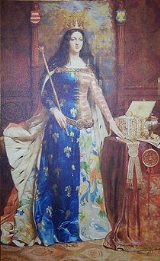
Jadwiga of Poland

Encyclopedia
King
- Centers of population :* King, Ontario, CanadaIn USA:* King, Indiana* King, North Carolina* King, Lincoln County, Wisconsin* King, Waupaca County, Wisconsin* King County, Washington- Moving-image works :Television:...
' rather than 'queen', reflecting that she was a sovereign in her own right
Queen regnant
A queen regnant is a female monarch who reigns in her own right, in contrast to a queen consort, who is the wife of a reigning king. An empress regnant is a female monarch who reigns in her own right over an empire....
and not merely a royal consort. She was a member of the Capetian House of Anjou
Capetian House of Anjou
The Capetian House of Anjou, also known as the House of Anjou-Sicily and House of Anjou-Naples, was a royal house and cadet branch of the direct House of Capet. Founded by Charles I of Sicily, a son of Louis VIII of France, the Capetian king first ruled the Kingdom of Sicily during the 13th century...
, the daughter of King Louis I of Hungary and Elizabeth of Bosnia. She is known in Polish
Polish language
Polish is a language of the Lechitic subgroup of West Slavic languages, used throughout Poland and by Polish minorities in other countries...
as Jadwiga
Jadwiga
Jadwiga is a Polish feminine given name. It originated from the old German Hedwig .* Jadwiga of Greater Poland, Queen of Poland and mother of Casimir III of Poland...
, in English and German
German language
German is a West Germanic language, related to and classified alongside English and Dutch. With an estimated 90 – 98 million native speakers, German is one of the world's major languages and is the most widely-spoken first language in the European Union....
as Hedwig, in Lithuanian
Lithuanian language
Lithuanian is the official state language of Lithuania and is recognized as one of the official languages of the European Union. There are about 2.96 million native Lithuanian speakers in Lithuania and about 170,000 abroad. Lithuanian is a Baltic language, closely related to Latvian, although they...
as Jadvyga, in Hungarian
Hungarian language
Hungarian is a Uralic language, part of the Ugric group. With some 14 million speakers, it is one of the most widely spoken non-Indo-European languages in Europe....
as Hedvig, and in Latin
Latin
Latin is an Italic language originally spoken in Latium and Ancient Rome. It, along with most European languages, is a descendant of the ancient Proto-Indo-European language. Although it is considered a dead language, a number of scholars and members of the Christian clergy speak it fluently, and...
as Hedvigis.
Queens regnant
Queen regnant
A queen regnant is a female monarch who reigns in her own right, in contrast to a queen consort, who is the wife of a reigning king. An empress regnant is a female monarch who reigns in her own right over an empire....
being relatively uncommon in Europe at the time, Jadwiga was officially crowned a King. She is venerated by the Roman Catholic Church
Roman Catholic Church
The Catholic Church, also known as the Roman Catholic Church, is the world's largest Christian church, with over a billion members. Led by the Pope, it defines its mission as spreading the gospel of Jesus Christ, administering the sacraments and exercising charity...
as Saint Hedwig, where she is the patron saint
Patron saint
A patron saint is a saint who is regarded as the intercessor and advocate in heaven of a nation, place, craft, activity, class, clan, family, or person...
of queens and a United Europe.
Childhood
Jadwiga was the youngest daughter of Louis I of Hungary and of Elizabeth of Bosnia. Jadwiga could claim descent from the House of Piast, the ancient native Polish dynasty on both her mother's and her father's side. Her paternal grandmother Elisabeth of Cuyavia was the daughter of King Władysław I the Elbow-high, who had reunited Poland in 1320.Jadwiga was brought up at the royal court in Buda
Buda
For detailed information see: History of Buda CastleBuda is the western part of the Hungarian capital Budapest on the west bank of the Danube. The name Buda takes its name from the name of Bleda the Hun ruler, whose name is also Buda in Hungarian.Buda comprises about one-third of Budapest's...
and Visegrád
Visegrád
Visegrád is a small castle town in Pest County, Hungary.Situated north of Budapest on the right bank of the Danube in the Danube Bend, Visegrád has a population 1,654 as of 2001...
, Hungary
Hungary
Hungary , officially the Republic of Hungary , is a landlocked country in Central Europe. It is situated in the Carpathian Basin and is bordered by Slovakia to the north, Ukraine and Romania to the east, Serbia and Croatia to the south, Slovenia to the southwest and Austria to the west. The...
. In 1378, she was betrothed (sponsalia de futuro) to Habsburg
Habsburg
The House of Habsburg , also found as Hapsburg, and also known as House of Austria is one of the most important royal houses of Europe and is best known for being an origin of all of the formally elected Holy Roman Emperors between 1438 and 1740, as well as rulers of the Austrian Empire and...
scion William of Austria, and spent about a year at the imperial court in Vienna
Vienna
Vienna is the capital and largest city of the Republic of Austria and one of the nine states of Austria. Vienna is Austria's primary city, with a population of about 1.723 million , and is by far the largest city in Austria, as well as its cultural, economic, and political centre...
, Austria
Austria
Austria , officially the Republic of Austria , is a landlocked country of roughly 8.4 million people in Central Europe. It is bordered by the Czech Republic and Germany to the north, Slovakia and Hungary to the east, Slovenia and Italy to the south, and Switzerland and Liechtenstein to the...
. Jadwiga's father Louis had, in 1364 in Kraków
Kraków
Kraków also Krakow, or Cracow , is the second largest and one of the oldest cities in Poland. Situated on the Vistula River in the Lesser Poland region, the city dates back to the 7th century. Kraków has traditionally been one of the leading centres of Polish academic, cultural, and artistic life...
, during festivities known as the Days of Kraków, also made an arrangement with his former father-in-law Holy Roman Emperor
Holy Roman Emperor
The Holy Roman Emperor is a term used by historians to denote a medieval ruler who, as German King, had also received the title of "Emperor of the Romans" from the Pope...
Charles IV
Charles IV, Holy Roman Emperor
Charles IV , born Wenceslaus , was the second king of Bohemia from the House of Luxembourg, and the first king of Bohemia to also become Holy Roman Emperor....
to inter-marry their future children:
Charles' son and future Holy Roman Emperor Sigismund of Luxemburg
Sigismund, Holy Roman Emperor
Sigismund of Luxemburg KG was King of Hungary, of Croatia from 1387 to 1437, of Bohemia from 1419, and Holy Roman Emperor for four years from 1433 until 1437, the last Emperor of the House of Luxemburg. He was also King of Italy from 1431, and of Germany from 1411...
was engaged and married, as a child, to Louis' daughter and future Queen Mary
Mary of Hungary
Mary of Anjou was queen regnant of Hungary from 1382 until her death in 1395.-Childhood:...
. One of Louis' original plans had been to leave the kingdom of Poland to Mary, whose marriage with Sigismund was more relevant to this end as Sigismund was an heir in his own right to Poland and was intended to inherit Brandenburg
Margraviate of Brandenburg
The Margraviate of Brandenburg was a major principality of the Holy Roman Empire from 1157 to 1806. Also known as the March of Brandenburg , it played a pivotal role in the history of Germany and Central Europe....
, which was nearer to Poland than to Hungary. Jadwiga's destiny as Austrian consort was a better fit for Hungary, as it was an immediate neighbor of Austria.
Jadwiga was well-educated and a polyglot
Multilingualism
Multilingualism is the act of using, or promoting the use of, multiple languages, either by an individual speaker or by a community of speakers. Multilingual speakers outnumber monolingual speakers in the world's population. Multilingualism is becoming a social phenomenon governed by the needs of...
, speaking at least six languages such as Latin, Bosnian, Hungarian, Serbian, Polish and German, interested in the arts, music, science, and court life. She was also known for her piety and her admiration for Saints Mary
Mary, sister of Lazarus
Mary of Bethany is a biblical figure described in the Gospels of John and Luke in the Christian New Testament...
, Martha
Martha
Martha of Bethany is a biblical figure described in the Gospels of Luke and John. Together with her siblings Lazarus and Mary, she is described as living in the village of Bethany near Jerusalem...
, and Bridget of Sweden
Bridget of Sweden
Bridget of Sweden Bridget of Sweden Bridget of Sweden (1303 – 23 July 1373; also Birgitta of Vadstena, Saint Birgitta , was a mystic and saint, and founder of the Bridgettines nuns and monks after the death of her husband of twenty years...
, as well as her patron saint, Hedwig of Andechs
Hedwig of Andechs
Saint Hedwig of Silesia , also Saint Hedwig of Andechs from the comital House of Andechs was Duchess of Silesia from 1201 and of Greater Poland from 1231 as well as High Duchess consort of Poland from 1232 until 1238.-Life:...
.
Reign
Until 1370, Poland had been ruled by the native Piast Dynasty. Its last king, Casimir IIICasimir III of Poland
Casimir III the Great , last King of Poland from the Piast dynasty , was the son of King Władysław I the Elbow-high and Hedwig of Kalisz.-Biography:...
, had left no legitimate son and considered his male grandchildren either unsuited or too young to reign. He therefore decided that his surviving sister Elizabeth of Poland and her son, Louis I of Hungary, should succeed him. Louis was proclaimed king, while Elizabeth held much of the practical power until her death in 1380.
When Louis died in 1382, the Hungarian throne was inherited by his eldest surviving daughter Mary, under the regency of their Bosnian mother. In Poland, however, the lords of Lesser Poland
Lesser Poland
Lesser Poland is one of the historical regions of Poland, with its capital in the city of Kraków. It forms the southeastern corner of the country, and should not be confused with the modern Lesser Poland Voivodeship, which covers only a small, southern part of Lesser Poland...
(Poland's virtual rulers) did not want to continue the personal union
Personal union
A personal union is the combination by which two or more different states have the same monarch while their boundaries, their laws and their interests remain distinct. It should not be confused with a federation which is internationally considered a single state...
with Hungary, nor to accept as regent
Regent
A regent, from the Latin regens "one who reigns", is a person selected to act as head of state because the ruler is a minor, not present, or debilitated. Currently there are only two ruling Regencies in the world, sovereign Liechtenstein and the Malaysian constitutive state of Terengganu...
Mary's fiancé Sigismund, whom they expelled from the country. They therefore chose as their new monarch Mary's younger sister, Jadwiga. After two years' negotiations with Jadwiga's mother, Elizabeth of Bosnia, who was regent of Hungary, and a civil war in Greater Poland
Greater Poland
Greater Poland or Great Poland, often known by its Polish name Wielkopolska is a historical region of west-central Poland. Its chief city is Poznań.The boundaries of Greater Poland have varied somewhat throughout history...
(1383), Jadwiga finally came to Kraków
Kraków
Kraków also Krakow, or Cracow , is the second largest and one of the oldest cities in Poland. Situated on the Vistula River in the Lesser Poland region, the city dates back to the 7th century. Kraków has traditionally been one of the leading centres of Polish academic, cultural, and artistic life...
and at the age of ten, on 16 October 1384, was crowned King
King
- Centers of population :* King, Ontario, CanadaIn USA:* King, Indiana* King, North Carolina* King, Lincoln County, Wisconsin* King, Waupaca County, Wisconsin* King County, Washington- Moving-image works :Television:...
of Poland — Hedvig Rex Poloniæ, not Hedvig Regina Poloniæ. Polish law had no provision for a female ruler (queen regnant
Queen regnant
A queen regnant is a female monarch who reigns in her own right, in contrast to a queen consort, who is the wife of a reigning king. An empress regnant is a female monarch who reigns in her own right over an empire....
), but did not specify that the King had to be a male. The masculine gender of her title was also meant to emphasize that she was monarch in her own right, not a queen consort
Queen consort
A queen consort is the wife of a reigning king. A queen consort usually shares her husband's rank and holds the feminine equivalent of the king's monarchical titles. Historically, queens consort do not share the king regnant's political and military powers. Most queens in history were queens consort...
.
As child monarch of Poland, Jadwiga had at least one relative in Poland (all her immediate family having remained in Hungary): her mother's childless uncle, Władysław the White (d. 1388), Prince of Gniewkowo. The terms Nobilissimus (most noble) and nobilissima familia (most noble family)
Nobilissima familia (Hungary)
The terms Nobilissimus and nobilissima familia have been used since the 11th century for the King of Hungary and his family...
have been used since the 11th century for the King of Hungary and his family, but it were then only a few, among them also Jadwiga, which were mentioned in official documents as such.
Soon after Jadwiga's coronation, new suitors for Jadwiga's hand appeared: Duke Siemowit IV of Masovia and Grand Duke Jogaila
Jogaila
Jogaila, later 'He is known under a number of names: ; ; . See also: Jogaila : names and titles. was Grand Duke of Lithuania , king consort of Kingdom of Poland , and sole King of Poland . He ruled in Lithuania from 1377, at first with his uncle Kęstutis...
of Lithuania
Lithuania
Lithuania , officially the Republic of Lithuania is a country in Northern Europe, the biggest of the three Baltic states. It is situated along the southeastern shore of the Baltic Sea, whereby to the west lie Sweden and Denmark...
, the latter supported by the lords of Lesser Poland. In 1385 (when Jadwiga was eleven years old) William of Austria came to Kraków to consummate the marriage and present the lords with a fait accompli. His plan, however, failed and William was expelled from Poland while Jadwiga declared her sponsalia invalid. William later married Jadwiga's cousin and rival, Joan II of Naples
Joan II of Naples
Joan II was Queen of Naples from 1414 to her death, upon which the senior Angevin line of Naples became extinct. As a mere formality, she used the title of Queen of Jerusalem, Sicily, and Hungary....
. That same year (1385), Jogaila and the lords of Lesser Poland signed the Union of Krewo
Union of Krewo
In a strict sense, the Union of Krewo or Act of Krėva was a set of prenuptial promises made in the Kreva Castle on 14 August 1385 by Jogaila, Grand Duke of Lithuania, in exchange for marriage to the underage reigning Queen Jadwiga of Poland...
whereby Jogaila pledged to adopt Western Christianity and unite Lithuania with Poland in exchange for Jadwiga's hand and the Polish crown. Twelve-year-old Jadwiga and 26-year-old Jogaila — who had earlier been baptized Władysław — wed in March 1385 at Kraków. This was followed by Jogaila's coronation as King of Poland, although Jadwiga retained her royal rights.
In 1386, Jadwiga's mother Elizabeth and her sister Queen Mary of Hungary were kidnapped, probably on the order of Mary's husband and consort Sigismund.
In January 1387, Elizabeth was strangled, while Mary was released in July of the same year, by the effort of future Frankopan
Frankopan
The Frankopans are a Croatian noble family. Also called Frankapan, Frangepán in Hungarian, and Frangipani in Italian.The Frankopan family is the leading princely Croatian aristocratic family which dates back to the 12th Century and even earlier to Roman times...
family and Jadwiga's adopted maternal uncle King Tvrtko of Bosnia
Bosnia (region)
Bosnia is a eponomous region of Bosnia and Herzegovina. It lies mainly in the Dinaric Alps, ranging to the southern borders of the Pannonian plain, with the rivers Sava and Drina marking its northern and eastern borders. The other eponomous region, the southern, other half of the country is...
. Mary, heavily pregnant, died in 1395 under suspicious circumstances.
As a monarch, young Jadwiga probably had little actual power. Nevertheless, she was actively engaged in her kingdom's political, diplomatic and cultural life and acted as the guarantor of Władysław's promises to reclaim Poland's lost territories. In 1387, Jadwiga led two successful military expeditions to reclaim the province of Halych
Halych
Halych is a historic city on the Dniester River in western Ukraine. The town gave its name to the historic province and kingdom of Kingdom of Galicia–Volhynia, of which it was the capital until the early 14th century, when the seat of the local princes was moved to Lviv...
in Red Ruthenia
Red Ruthenia
Red Ruthenia is the name used since medieval times to refer to the area known as Eastern Galicia prior to World War I; first mentioned in Polish historic chronicles in the 1321, as Ruthenia Rubra or Ruthenian Voivodeship .Ethnographers explain that the term was applied from the...
, which had been retained by Hungary in a dynastic dispute at her accession. As she was an heiress to Louis I of Hungary herself, the expeditions were for the most part peaceful and resulted in Petru I of Moldavia
Petru I of Moldavia
Petru I Muşat was Voivode of Moldavia from 1375 to 1391, the son of Costea Muşat, the first ruler from the dynastic House of Bogdan. During his reign, he maintained good relationships with his neighbours, especially Poland....
paying homage to the Polish monarchs in September 1387. In 1390 she began a correspondence with the Teutonic Knights
Teutonic Knights
The Order of Brothers of the German House of Saint Mary in Jerusalem , commonly the Teutonic Order , is a German medieval military order, in modern times a purely religious Catholic order...
, followed by personal meetings in which she opened diplomatic negotiations herself.
Most political responsibilities, however, were probably in Władysław's hands, with Jadwiga attending to cultural and charitable activities. She sponsored writers and artists and donated much of her personal wealth, including her royal insignia, to charity, for purposes including the founding of hospitals. She financed a scholarship for twenty Lithuanians to study at Charles University in Prague
Charles University in Prague
Charles University in Prague is the oldest and largest university in the Czech Republic. Founded in 1348, it was the first university in Central Europe and is also considered the earliest German university...
to help strengthen Christianity in their country, to which purpose she also founded a bishopric in Vilnius
Vilnius
Vilnius is the capital of Lithuania, and its largest city, with a population of 560,190 as of 2010. It is the seat of the Vilnius city municipality and of the Vilnius district municipality. It is also the capital of Vilnius County...
. Among her most notable cultural legacies was the restoration of the Kraków Academy, which in 1817 was renamed Jagiellonian University
Jagiellonian University
The Jagiellonian University was established in 1364 by Casimir III the Great in Kazimierz . It is the oldest university in Poland, the second oldest university in Central Europe and one of the oldest universities in the world....
in honour of the couple.
Death and inheritance
On 22 June 1399 Jadwiga gave birth to a daughter, Elizabeth Bonifacia. Within a month, both the girl and her mother had died from birth complications. They were buried together in Wawel CathedralWawel Cathedral
The Wawel Cathedral, also known as the Cathedral Basilica of Sts. Stanisław and Vaclav, is a church located on Wawel Hill in Kraków–Poland's national sanctuary. It has a 1,000-year history and was the traditional coronation site of Polish monarchs. It is the Cathedral of the Archdiocese of Kraków...
. Jadwiga's death undermined Jogaila's position as King of Poland, but he managed to retain the throne until his death 35 years later.
It is not easy to state who was Jadwiga's heir in line of Poland, or Poland's rightful heir, since Poland had not used primogeniture, but kings had ascended by some sort of election. There were descendants of superseded daughters of Casimir III of Poland
Casimir III of Poland
Casimir III the Great , last King of Poland from the Piast dynasty , was the son of King Władysław I the Elbow-high and Hedwig of Kalisz.-Biography:...
(d. 1370), such as his youngest daughter Anna, Countess of Celje (d. 1425 without surviving Issue), and her daughter Anna of Celje
Anna of Celje
Anne of Celje was Queen of Poland and Grand Duchess of Lithuania, 1402–1416 as second wife of Jogaila, King of Poland and Grand Duke of Lithuania ....
(1380–1416) whom Władysław II Jagiełło married next. Anna had a daughter Jadwiga of Lithuania born in 1408. Jadwiga died in 1431, reputedly poisoned by Sophia – Władysław's last wife, after a faction of Polish nobles supported Jadwiga against Sophia's sons. Emperor Sigismund himself was an heir of Casimir III, as eldest son of his mother Elisabeth of Pomerania, who was since 1377 the only surviving child of Elisabeth of Poland, herself daughter of Casimir III from his first marriage with Aldona Gediminaite of Lithuania. The family possession of the principality of Kuyavia
Kuyavia
Kujawy , is a historical and ethnographic region in the north-central Poland, situated in the basin of the middle Vistula and upper Noteć Rivers, with its capital in Włocławek.-Etymology:The origin of the name Kujawy was seen differently in history...
belonged to Sigismund, who was the heir with the strongest hereditary claims. However, the leaders of the country wanted to avoid Sigismund and any personal union with Hungary.
Other descendants of Władysław the Short (through the Silesian dukes of Świdnica) included the then Emperor Wenceslas, king of Bohemia, who died without Issue in 1419, as well as the Silesian dukes of Opole and Sagan. Male-line Piasts were represented most closely by the Dukes of Masovia
Dukes of Masovia
The Dukes of Masovia were a line of the Piast dynasty who ruled in Masovia. The following is a list of all rulers of the Duchy of Masovia and its parts...
, one of whom had aspired to marry Jadwiga in 1385. Also various princes of Silesia were of Piast descent, but they had been largely pushed aside since the exile of Vladislas II, Duke of Kraków.
Jadwiga's husband Władysław Jagiello kept the throne, mostly because no claimant with clearly better stature appeared. He was never ousted, not even after the death of his second wife, and eventually succeeded to found a dynasty in Poland by the sons of his last wife, who were not related to earlier Polish rulers.
Legends and veneration
Saint
A saint is a holy person. In various religions, saints are people who are believed to have exceptional holiness.In Christian usage, "saint" refers to any believer who is "in Christ", and in whom Christ dwells, whether in heaven or in earth...
, though she was only beatified by the church in the 1980s. She was canonized in 1997, by Polish-born Pope John Paul II
Pope John Paul II
Blessed Pope John Paul II , born Karol Józef Wojtyła , reigned as Pope of the Catholic Church and Sovereign of Vatican City from 16 October 1978 until his death on 2 April 2005, at of age. His was the second-longest documented pontificate, which lasted ; only Pope Pius IX ...
. Numerous legends about miracles were recounted to justify her sainthood. The two best-known are those of "Jadwiga's cross" and "Jadwiga's foot."
Jadwiga often prayed before a large black crucifix
Crucifix
A crucifix is an independent image of Jesus on the cross with a representation of Jesus' body, referred to in English as the corpus , as distinct from a cross with no body....
hanging in the north aisle of Wawel Cathedral. During one of these prayers, the Christ
Christ
Christ is the English term for the Greek meaning "the anointed one". It is a translation of the Hebrew , usually transliterated into English as Messiah or Mashiach...
on the cross is said to have spoken to her. The crucifix, "Saint Jadwiga's cross," is still there, with her relics beneath it.
Jadwiga liked to smuggle food from the castle to give to the poor, and carried it in her apron. King Jagiello was informed of these excursions at night, and was told that Jadwiga might be giving information to rebels. King Jagiello was enraged and decided to find the meaning of these wanderings after dark. One night, while Jadwiga was leaving by a secret door, Jagiello sprang out of the bushes and demanded to see what was in her apron. A miracle occurred and the food she was carrying (which would have earned her a death sentence), turned into a garland of roses. To this day, Jadwiga is always depicted wearing an apron of roses.
According to another legend, Jadwiga took a piece of jewelry from her foot and gave it to a poor stonemason who had begged for her help. When the King left, he noticed her footprint in the plaster floor of his workplace, even though the plaster had already hardened before her visit. The supposed footprint, known as "Jadwiga's foot", can still be seen in one of Kraków's churches
Church of the Visitation of the Blessed Virgin Mary, Kraków
Church of the Visitation of the Blessed Virgin Mary is a historic Roman Catholic church in Kraków, Poland; located at ul. Karmelicka 19 street in the Old Town...
.
In yet another legend, Jadwiga was taking part in a Corpus Christi Day procession when a coppersmith's son drowned by falling into a river. Jadwiga threw her mantle over the boy's body, and he regained life.
On 8 June 1979 Pope John Paul II
Pope John Paul II
Blessed Pope John Paul II , born Karol Józef Wojtyła , reigned as Pope of the Catholic Church and Sovereign of Vatican City from 16 October 1978 until his death on 2 April 2005, at of age. His was the second-longest documented pontificate, which lasted ; only Pope Pius IX ...
prayed at her sarcophagus; and the Congregation for Divine Worship and the Discipline of the Sacraments
Congregation for Divine Worship and the Discipline of the Sacraments
The Congregation for Divine Worship and the Discipline of the Sacraments is the congregation of the Roman Curia that handles most affairs relating to liturgical practices of the Latin Catholic Church as distinct from the Eastern Catholic Churches and also some technical matters relating to the...
officially affirmed her beatification
Beatification
Beatification is a recognition accorded by the Catholic Church of a dead person's entrance into Heaven and capacity to intercede on behalf of individuals who pray in his or her name . Beatification is the third of the four steps in the canonization process...
on 8 August 1986. The Pope canonized Jadwiga in Kraków on 8 June 1997.
Exhumations and sarcophagus
Jadwiga's body has been exhumed at least three times. The first time was in the 17th century, in connection with the construction of a bishopBishop
A bishop is an ordained or consecrated member of the Christian clergy who is generally entrusted with a position of authority and oversight. Within the Catholic Church, Eastern Orthodox, Oriental Orthodox Churches, in the Assyrian Church of the East, in the Independent Catholic Churches, and in the...
's sarcophagus
Sarcophagus
A sarcophagus is a funeral receptacle for a corpse, most commonly carved or cut from stone. The word "sarcophagus" comes from the Greek σαρξ sarx meaning "flesh", and φαγειν phagein meaning "to eat", hence sarkophagus means "flesh-eating"; from the phrase lithos sarkophagos...
next to Jadwiga's grave. The next exhumation took place in 1887. Jadwiga's complete skeleton was found, together with a mantle and hat. Jan Matejko
Jan Matejko
Jan Matejko was a Polish painter known for paintings of notable historical Polish political and military events. His most famous works include oil on canvas paintings like Battle of Grunwald, paintings of numerous other battles and court scenes, and a gallery of Polish kings...
made a sketch of Jadwiga's skull, which later helped him paint her portrait (see above).
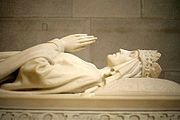
On 12 July 1949, her grave was again opened. This time she was reburied in a sarcophagus paid for by Karol Lanckoroński, which had been sculpted in white marble in 1902 by Antoni Madeyski. The queen is depicted with a dog, a symbol of fidelity, at her feet. The sarcophagus is oriented with Jadwiga's feet pointing west, unlike all the other sarcophagi in the cathedral. On display next to the sarcophagus are the modest wooden orb and scepter with which the queen had been buried – she had sold her jewels to finance the renovation of the Kraków Academy, known today as Jagiellonian University
Jagiellonian University
The Jagiellonian University was established in 1364 by Casimir III the Great in Kazimierz . It is the oldest university in Poland, the second oldest university in Central Europe and one of the oldest universities in the world....
.
Ancestors
See also
- History of Poland (966-1385)
- History of Poland (1385-1569)
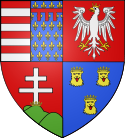
- Armorial of the House Anjou-Sicily
- House of Anjou-Sicily