

Turkic languages

Encyclopedia
The Turkic languages constitute a language family
of at least thirty five languages, spoken by Turkic peoples
across a vast area from Eastern Europe
and the Mediterranean
to Siberia
and Western China
, and are considered to be part of the proposed Altaic language family
.
Turkic languages are spoken as a native language by some 165 to 180 million people; and the total number of Turkic speakers is over 250 million, including speakers of a second language
. The Turkic language with the greatest number of speakers is Turkish proper
, or Anatolia
n [and Balkan] Turkish, the speakers of which account for about 40% of all Turkic speakers.
Characteristic features of Turkish, such as vowel harmony
, agglutination
, and lack of grammatical gender
, are universal within the Turkic family. There is also a high degree of mutual intelligibility
between the various Oghuz languages
, which include Turkish
, Azerbaijani
, Turkmen
, Qashqai
, Gagauz
, and Balkan Gagauz Turkish
.
, extensive agglutination
by means of suffix
es and other affixes, and lack of noun class
es or grammatical gender
. Subject–object–verb word order is universal within the family. All of these distinguishing characteristics are shared with the Mongolic
, Tungusic
, and Korean
language families, as well as (with the exception of vowel harmony) with Japonic
, which are considered by some linguists to be genetically linked with the Turkic languages in an Altaic language family
.
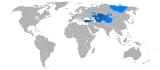
ranges from the North-East of Siberia
to Turkey in the West (see picture in the box on the right above).
by the Göktürks
, recording the Old Turkic language
, which were discovered in 1889 in the Orkhon Valley
in Mongolia. The Compendium of the Turkic Dialects (Divânü Lügati't-Türk), written during the 11th century by Kaşgarlı Mahmud of the Kara-Khanid Khanate
, constitutes an early linguistic treatment of the family. The Compendium is the first comprehensive dictionary of the Turkic languages and also includes the first known map of the Turkic speakers' geographical distribution. It mainly pertains to the Southwestern branch
of the family.
The Codex Cumanicus
(12th–13th centuries) concerning the Northwestern branch
is another early linguistic manual, between the Kipchak language
and Latin
, used by the Catholic
missionaries
sent to the Western Cumans
inhabiting a region corresponding to present-day Hungary
and Romania
. The earliest records of the language spoken by Volga Bulgars
, the parent to today's Chuvash language
, are dated to the 13th–14th centuries.
(c. 6th–11th centuries), Turkic languages, in the course of just a few centuries, spread across Central Asia
, stretching from Siberia
(the Sakha Republic) to the Mediterranean (Seljuk Turks). Various elements from the Turkic languages have passed into Hungarian
, Persian
, Hindustani, Russian
, Chinese
and to a lesser extent, Arabic
.
with the surrounding languages, especially the Iranian
, Slavic
, and Mongolic languages
. This has obscured the historical developments within each language and/or language group, and as a result, there exist several systems to classify the Turkic languages. The modern genetic classification schemes for Turkic are still largely indebted to Samoilovich (1922) and are mainly based on the development of *d. However, there are still many questions for which ongoing research has not yet found an adequate solution.
The Turkic languages may be divided into six branches (Johanson 1998):
In this classification, Oghur Turkic
is also referred to as Lir-Turkic and the other branches are subsumed under the title of Shaz-Turkic or Common Turkic
. It is not clear when these two major types of Turkic can be assumed to have actually diverged.
With less certainty, the Southwestern, Northwestern, Southeastern and Oghur groups may further be summarized as West Turkic, the Northeastern, Kyrgyz-Kipchak and Arghu (Khalaj) groups as East Turkic.
Geographically and linguistically, the languages of the Northwestern and Southeastern subgroups belong to the central Turkic languages, while the Northeastern and Khalaj languages are the so-called peripheral languages.
es are traditionally used in the classification of the Turkic languages:
Additional isoglosses include:
* In the standard Istanbul dialect of Turkish, the ğ
in dağ and dağlık is not realized as a consonant, but as a slight lengthening of the preceding vowel.
s among the basic vocabulary across the Turkic language family (about 60 words).
Empty cells do not necessarily imply that a particular language is lacking a word to describe the concept, but rather that the word for the concept in that language may be formed from another stem and is not a cognate with the other words in the row or that the equivalent was unknown to contributors to this article.
Also, there may be shifts in the meaning from one language to another, and so the "Common meaning" given is only approximate. In some cases the form given is found only in some dialects of the language. Forms are given in native Latin orthographies unless otherwise noted.
Language family
A language family is a group of languages related through descent from a common ancestor, called the proto-language of that family. The term 'family' comes from the tree model of language origination in historical linguistics, which makes use of a metaphor comparing languages to people in a...
of at least thirty five languages, spoken by Turkic peoples
Turkic peoples
The Turkic peoples are peoples residing in northern, central and western Asia, southern Siberia and northwestern China and parts of eastern Europe. They speak languages belonging to the Turkic language family. They share, to varying degrees, certain cultural traits and historical backgrounds...
across a vast area from Eastern Europe
Eastern Europe
Eastern Europe is the eastern part of Europe. The term has widely disparate geopolitical, geographical, cultural and socioeconomic readings, which makes it highly context-dependent and even volatile, and there are "almost as many definitions of Eastern Europe as there are scholars of the region"...
and the Mediterranean
Mediterranean Sea
The Mediterranean Sea is a sea connected to the Atlantic Ocean surrounded by the Mediterranean region and almost completely enclosed by land: on the north by Anatolia and Europe, on the south by North Africa, and on the east by the Levant...
to Siberia
Siberia
Siberia is an extensive region constituting almost all of Northern Asia. Comprising the central and eastern portion of the Russian Federation, it was part of the Soviet Union from its beginning, as its predecessor states, the Tsardom of Russia and the Russian Empire, conquered it during the 16th...
and Western China
China
Chinese civilization may refer to:* China for more general discussion of the country.* Chinese culture* Greater China, the transnational community of ethnic Chinese.* History of China* Sinosphere, the area historically affected by Chinese culture...
, and are considered to be part of the proposed Altaic language family
Altaic languages
Altaic is a proposed language family that includes the Turkic, Mongolic, Tungusic, and Japonic language families and the Korean language isolate. These languages are spoken in a wide arc stretching from northeast Asia through Central Asia to Anatolia and eastern Europe...
.
Turkic languages are spoken as a native language by some 165 to 180 million people; and the total number of Turkic speakers is over 250 million, including speakers of a second language
Second language
A second language or L2 is any language learned after the first language or mother tongue. Some languages, often called auxiliary languages, are used primarily as second languages or lingua francas ....
. The Turkic language with the greatest number of speakers is Turkish proper
Turkish language
Turkish is a language spoken as a native language by over 83 million people worldwide, making it the most commonly spoken of the Turkic languages. Its speakers are located predominantly in Turkey and Northern Cyprus with smaller groups in Iraq, Greece, Bulgaria, the Republic of Macedonia, Kosovo,...
, or Anatolia
Anatolia
Anatolia is a geographic and historical term denoting the westernmost protrusion of Asia, comprising the majority of the Republic of Turkey...
n [and Balkan] Turkish, the speakers of which account for about 40% of all Turkic speakers.
Characteristic features of Turkish, such as vowel harmony
Vowel harmony
Vowel harmony is a type of long-distance assimilatory phonological process involving vowels that occurs in some languages. In languages with vowel harmony, there are constraints on which vowels may be found near each other....
, agglutination
Agglutination
In contemporary linguistics, agglutination usually refers to the kind of morphological derivation in which there is a one-to-one correspondence between affixes and syntactical categories. Languages that use agglutination widely are called agglutinative languages...
, and lack of grammatical gender
Grammatical gender
Grammatical gender is defined linguistically as a system of classes of nouns which trigger specific types of inflections in associated words, such as adjectives, verbs and others. For a system of noun classes to be a gender system, every noun must belong to one of the classes and there should be...
, are universal within the Turkic family. There is also a high degree of mutual intelligibility
Mutual intelligibility
In linguistics, mutual intelligibility is recognized as a relationship between languages or dialects in which speakers of different but related languages can readily understand each other without intentional study or extraordinary effort...
between the various Oghuz languages
Oghuz languages
The Oghuz languages, a major branch of the Turkic language family, are spoken by more than 110 million people in an area spanning from the Balkans to China.-Linguistic features:...
, which include Turkish
Turkish language
Turkish is a language spoken as a native language by over 83 million people worldwide, making it the most commonly spoken of the Turkic languages. Its speakers are located predominantly in Turkey and Northern Cyprus with smaller groups in Iraq, Greece, Bulgaria, the Republic of Macedonia, Kosovo,...
, Azerbaijani
Azerbaijani language
Azerbaijani or Azeri or Torki is a language belonging to the Turkic language family, spoken in southwestern Asia by the Azerbaijani people, primarily in Azerbaijan and northwestern Iran...
, Turkmen
Turkmen language
Turkmen is the national language of Turkmenistan...
, Qashqai
Qashqai language
Qashqai is a Turkic language spoken by the Qashqai people, an ethnic group living mainly in the Fars region of Iran. Estimates of the number of Qashqai speakers vary. Ethnologue gives a figure of one and a half million...
, Gagauz
Gagauz language
The Gagauz language is a Turkic language, spoken by the Gagauz people, and the official language of Gagauzia, Moldova. There are two dialects, Bulgar Gagauzi and Maritime Gagauzi. This is a different language from Balkan Gagauz Turkish....
, and Balkan Gagauz Turkish
Balkan Gagauz Turkish language
Balkan Gagauz Turkish is a Turkic language spoken in European Turkey, Greece, and in the Kumanovo and Bitola areas of the Republic of Macedonia. Dialects include Gajal, Gerlovo Turk, Karamanli, Kyzylbash, Surguch, Tozluk Turk, Yuruk, and Macedonian Gagauz. This is a different language from Gagauz...
.
Characteristics
The characteristic features of the Turkic languages are vowel harmonyVowel harmony
Vowel harmony is a type of long-distance assimilatory phonological process involving vowels that occurs in some languages. In languages with vowel harmony, there are constraints on which vowels may be found near each other....
, extensive agglutination
Agglutinative language
An agglutinative language is a language that uses agglutination extensively: most words are formed by joining morphemes together. This term was introduced by Wilhelm von Humboldt in 1836 to classify languages from a morphological point of view...
by means of suffix
Suffix
In linguistics, a suffix is an affix which is placed after the stem of a word. Common examples are case endings, which indicate the grammatical case of nouns or adjectives, and verb endings, which form the conjugation of verbs...
es and other affixes, and lack of noun class
Noun class
In linguistics, the term noun class refers to a system of categorizing nouns. A noun may belong to a given class because of characteristic features of its referent, such as sex, animacy, shape, but counting a given noun among nouns of such or another class is often clearly conventional...
es or grammatical gender
Grammatical gender
Grammatical gender is defined linguistically as a system of classes of nouns which trigger specific types of inflections in associated words, such as adjectives, verbs and others. For a system of noun classes to be a gender system, every noun must belong to one of the classes and there should be...
. Subject–object–verb word order is universal within the family. All of these distinguishing characteristics are shared with the Mongolic
Mongolic languages
The Mongolic languages are a group of languages spoken in East-Central Asia, mostly in Mongolia and surrounding areas plus in Kalmykia. The best-known member of this language family, Mongolian, is the primary language of most of the residents of Mongolia and the Mongolian residents of Inner...
, Tungusic
Tungusic languages
The Tungusic languages form a language family spoken in Eastern Siberia and Manchuria by Tungusic peoples. Many Tungusic languages are endangered, and the long-term future of the family is uncertain...
, and Korean
Korean language
Korean is the official language of the country Korea, in both South and North. It is also one of the two official languages in the Yanbian Korean Autonomous Prefecture in People's Republic of China. There are about 78 million Korean speakers worldwide. In the 15th century, a national writing...
language families, as well as (with the exception of vowel harmony) with Japonic
Japonic languages
Japonic languages is a term which identifies and characterises the Japanese which is spoken on the main islands of Japan and the Ryukyuan languages spoken in the Ryukyu Islands. This widely accepted linguistics term was coined by Leon Serafim....
, which are considered by some linguists to be genetically linked with the Turkic languages in an Altaic language family
Altaic languages
Altaic is a proposed language family that includes the Turkic, Mongolic, Tungusic, and Japonic language families and the Korean language isolate. These languages are spoken in a wide arc stretching from northeast Asia through Central Asia to Anatolia and eastern Europe...
.
History
The geographical distribution of Turkic-speaking peoples across EurasiaEurasia
Eurasia is a continent or supercontinent comprising the traditional continents of Europe and Asia ; covering about 52,990,000 km2 or about 10.6% of the Earth's surface located primarily in the eastern and northern hemispheres...
ranges from the North-East of Siberia
Siberia
Siberia is an extensive region constituting almost all of Northern Asia. Comprising the central and eastern portion of the Russian Federation, it was part of the Soviet Union from its beginning, as its predecessor states, the Tsardom of Russia and the Russian Empire, conquered it during the 16th...
to Turkey in the West (see picture in the box on the right above).
Early written records
The first established records of the Turkic languages are the eighth century Orkhon inscriptionsOrkhon inscriptions
"Orkhon inscription" may refer to:*two monuments in the Orkhon valley, see Khöshöö Tsaidam Monuments*inscriptions in the Old Turkic "Orkhon alphabet" in general, see Old Turkic epigraphy...
by the Göktürks
Göktürks
The Göktürks or Kök Türks, were a nomadic confederation of peoples in medieval Inner Asia. Known in Chinese sources as 突厥 , the Göktürks under the leadership of Bumin Qaghan The Göktürks or Kök Türks, (Old Turkic: Türük or Kök Türük or Türük; Celestial Turks) were a nomadic confederation of...
, recording the Old Turkic language
Old Turkic language
Old Turkic is the earliest attested form of Turkic, found in Göktürk and Uyghur inscriptions dating from about the 7th century to the 13th century....
, which were discovered in 1889 in the Orkhon Valley
Orkhon Valley
Orkhon Valley Cultural Landscape sprawls along the banks of the Orkhon River in Central Mongolia, some 360 km west from the capital Ulaanbaatar. It was inscribed by UNESCO in the World Heritage List as representing evolution of nomadic pastoral traditions spanning more than two millennia...
in Mongolia. The Compendium of the Turkic Dialects (Divânü Lügati't-Türk), written during the 11th century by Kaşgarlı Mahmud of the Kara-Khanid Khanate
Kara-Khanid Khanate
The Kara-Khanid Khanate was a confederation of Turkic tribes ruled by a dynasty known in literature as the Karakhanids or Ilek Khanids, . Both dynastic names represent titles with Kara Kağan being the most important Turkish title up till the end of the dynasty.The Khanate ruled Transoxania in...
, constitutes an early linguistic treatment of the family. The Compendium is the first comprehensive dictionary of the Turkic languages and also includes the first known map of the Turkic speakers' geographical distribution. It mainly pertains to the Southwestern branch
Oghuz languages
The Oghuz languages, a major branch of the Turkic language family, are spoken by more than 110 million people in an area spanning from the Balkans to China.-Linguistic features:...
of the family.
The Codex Cumanicus
Codex Cumanicus
The Codex Cumanicus was a linguistic manual of the Middle Ages, designed to help Catholic missionaries communicate with the Cumans, a nomadic Turkic people. It is currently housed in the Library of St. Mark, in Venice ....
(12th–13th centuries) concerning the Northwestern branch
Kypchak languages
The Kypchak languages , are a major branch of the Turkic language family spoken by more than 12 million people in an area spanning from Lithuania to China....
is another early linguistic manual, between the Kipchak language
Kipchak language
The Kipchak language is an extinct Turkic language of the Kipchak group.The descendants of the Kipchak language include the majority of Turkic languages spoken in Eastern Europe and the Caucasus today, as Kipchak was used as a lingua franca in Golden Horde–ruled lands.Kazakhs are remnants of...
and Latin
Latin
Latin is an Italic language originally spoken in Latium and Ancient Rome. It, along with most European languages, is a descendant of the ancient Proto-Indo-European language. Although it is considered a dead language, a number of scholars and members of the Christian clergy speak it fluently, and...
, used by the Catholic
Roman Catholic Church
The Catholic Church, also known as the Roman Catholic Church, is the world's largest Christian church, with over a billion members. Led by the Pope, it defines its mission as spreading the gospel of Jesus Christ, administering the sacraments and exercising charity...
missionaries
Missionary
A missionary is a member of a religious group sent into an area to do evangelism or ministries of service, such as education, literacy, social justice, health care and economic development. The word "mission" originates from 1598 when the Jesuits sent members abroad, derived from the Latin...
sent to the Western Cumans
Cumans
The Cumans were Turkic nomadic people comprising the western branch of the Cuman-Kipchak confederation. After Mongol invasion , they decided to seek asylum in Hungary, and subsequently to Bulgaria...
inhabiting a region corresponding to present-day Hungary
Hungary
Hungary , officially the Republic of Hungary , is a landlocked country in Central Europe. It is situated in the Carpathian Basin and is bordered by Slovakia to the north, Ukraine and Romania to the east, Serbia and Croatia to the south, Slovenia to the southwest and Austria to the west. The...
and Romania
Romania
Romania is a country located at the crossroads of Central and Southeastern Europe, on the Lower Danube, within and outside the Carpathian arch, bordering on the Black Sea...
. The earliest records of the language spoken by Volga Bulgars
Volga Bulgaria
Volga Bulgaria, or Volga–Kama Bolghar, is a historic Bulgar state that existed between the seventh and thirteenth centuries around the confluence of the Volga and Kama rivers in what is now Russia.-Origin:...
, the parent to today's Chuvash language
Chuvash language
Chuvash is a Turkic language spoken in central Russia, primarily in the Chuvash Republic and adjacent areas. It is the only surviving member of the Oghur branch of Turkic languages....
, are dated to the 13th–14th centuries.
Geographical expansion and development
With the Turkic expansion during Early Middle AgesEarly Middle Ages
The Early Middle Ages was the period of European history lasting from the 5th century to approximately 1000. The Early Middle Ages followed the decline of the Western Roman Empire and preceded the High Middle Ages...
(c. 6th–11th centuries), Turkic languages, in the course of just a few centuries, spread across Central Asia
Central Asia
Central Asia is a core region of the Asian continent from the Caspian Sea in the west, China in the east, Afghanistan in the south, and Russia in the north...
, stretching from Siberia
Siberia
Siberia is an extensive region constituting almost all of Northern Asia. Comprising the central and eastern portion of the Russian Federation, it was part of the Soviet Union from its beginning, as its predecessor states, the Tsardom of Russia and the Russian Empire, conquered it during the 16th...
(the Sakha Republic) to the Mediterranean (Seljuk Turks). Various elements from the Turkic languages have passed into Hungarian
Hungarian language
Hungarian is a Uralic language, part of the Ugric group. With some 14 million speakers, it is one of the most widely spoken non-Indo-European languages in Europe....
, Persian
Persian language
Persian is an Iranian language within the Indo-Iranian branch of the Indo-European languages. It is primarily spoken in Iran, Afghanistan, Tajikistan and countries which historically came under Persian influence...
, Hindustani, Russian
Russian language
Russian is a Slavic language used primarily in Russia, Belarus, Uzbekistan, Kazakhstan, Tajikistan and Kyrgyzstan. It is an unofficial but widely spoken language in Ukraine, Moldova, Latvia, Turkmenistan and Estonia and, to a lesser extent, the other countries that were once constituent republics...
, Chinese
Chinese language
The Chinese language is a language or language family consisting of varieties which are mutually intelligible to varying degrees. Originally the indigenous languages spoken by the Han Chinese in China, it forms one of the branches of Sino-Tibetan family of languages...
and to a lesser extent, Arabic
Arabic language
Arabic is a name applied to the descendants of the Classical Arabic language of the 6th century AD, used most prominently in the Quran, the Islamic Holy Book...
.
Classification
For centuries, the Turkic speaking peoples have migrated extensively and intermingled continuously, and their languages have been influenced mutually and through contactLanguage contact
Language contact occurs when two or more languages or varieties interact. The study of language contact is called contact linguistics.Multilingualism has likely been common throughout much of human history, and today most people in the world are multilingual...
with the surrounding languages, especially the Iranian
Iranian languages
The Iranian languages form a subfamily of the Indo-Iranian languages which in turn is a subgroup of Indo-European language family. They have been and are spoken by Iranian peoples....
, Slavic
Slavic languages
The Slavic languages , a group of closely related languages of the Slavic peoples and a subgroup of Indo-European languages, have speakers in most of Eastern Europe, in much of the Balkans, in parts of Central Europe, and in the northern part of Asia.-Branches:Scholars traditionally divide Slavic...
, and Mongolic languages
Mongolic languages
The Mongolic languages are a group of languages spoken in East-Central Asia, mostly in Mongolia and surrounding areas plus in Kalmykia. The best-known member of this language family, Mongolian, is the primary language of most of the residents of Mongolia and the Mongolian residents of Inner...
. This has obscured the historical developments within each language and/or language group, and as a result, there exist several systems to classify the Turkic languages. The modern genetic classification schemes for Turkic are still largely indebted to Samoilovich (1922) and are mainly based on the development of *d. However, there are still many questions for which ongoing research has not yet found an adequate solution.
The Turkic languages may be divided into six branches (Johanson 1998):
- Southwestern (Oghuz TurkicOghuz languagesThe Oghuz languages, a major branch of the Turkic language family, are spoken by more than 110 million people in an area spanning from the Balkans to China.-Linguistic features:...
) - Northwestern (Kipchak TurkicKypchak languagesThe Kypchak languages , are a major branch of the Turkic language family spoken by more than 12 million people in an area spanning from Lithuania to China....
) - Southeastern (Uyghur Turkic)
- Northeastern (Siberian Turkic)
- Oghur TurkicOghur languagesThe Oghur or Bulgar , are a separate branch of the Turkic language family. It was historically spoken in Volga Bulgaria...
- Arghu Turkic
In this classification, Oghur Turkic
Oghur languages
The Oghur or Bulgar , are a separate branch of the Turkic language family. It was historically spoken in Volga Bulgaria...
is also referred to as Lir-Turkic and the other branches are subsumed under the title of Shaz-Turkic or Common Turkic
Common Turkic
Common Turkic or Shaz Turkic is a taxon in some of the classifications of the Turkic languages which in Lars Johanson proposal contain the following subgroups:...
. It is not clear when these two major types of Turkic can be assumed to have actually diverged.
With less certainty, the Southwestern, Northwestern, Southeastern and Oghur groups may further be summarized as West Turkic, the Northeastern, Kyrgyz-Kipchak and Arghu (Khalaj) groups as East Turkic.
Geographically and linguistically, the languages of the Northwestern and Southeastern subgroups belong to the central Turkic languages, while the Northeastern and Khalaj languages are the so-called peripheral languages.
Schema
The following isoglossIsogloss
An isogloss—also called a heterogloss —is the geographical boundary of a certain linguistic feature, such as the pronunciation of a vowel, the meaning of a word, or use of some syntactic feature...
es are traditionally used in the classification of the Turkic languages:
- Rhoticisation, e.g. in the last consonant of the word for "nine" *toqqız. This separates the Oghur branch, which exhibits /r/, from the rest of Turkic, which exhibits /z/. In this case, rhoticisation refers to the development of *-/r/, *-/z/, and *-/d/ to /r/ in this branch.
- Intervocalic *d, e.g. the second consonant in the word for "foot" *hadaq
- Word-final -G, e.g. in the word for "mountain" *tāğ
- Suffix-final -G, e.g. in the suffix *lIG, in e.g. *tāğlığ
Additional isoglosses include:
- Preservation of word initial *h, e.g. in the word for "foot" *hadaq. This separates Khalaj as a peripheral language.
- Denasalisation of palatal *ń, e.g. in the word for "moon", *ań
| isogloss | Old Turkic Old Turkic language Old Turkic is the earliest attested form of Turkic, found in Göktürk and Uyghur inscriptions dating from about the 7th century to the 13th century.... |
Turkish Turkish language Turkish is a language spoken as a native language by over 83 million people worldwide, making it the most commonly spoken of the Turkic languages. Its speakers are located predominantly in Turkey and Northern Cyprus with smaller groups in Iraq, Greece, Bulgaria, the Republic of Macedonia, Kosovo,... |
Azeri | Uzbek Uzbek language Uzbek is a Turkic language and the official language of Uzbekistan. It has about 25.5 million native speakers, and it is spoken by the Uzbeks in Uzbekistan and elsewhere in Central Asia... |
Uyghur Uyghur language Uyghur , formerly known as Eastern Turk, is a Turkic language with 8 to 11 million speakers, spoken primarily by the Uyghur people in the Xinjiang Uyghur Autonomous Region of Western China. Significant communities of Uyghur-speakers are located in Kazakhstan and Uzbekistan, and various other... |
Tatar Tatar language The Tatar language , or more specifically Kazan Tatar, is a Turkic language spoken by the Tatars of historical Kazan Khanate, including modern Tatarstan and Bashkiria... |
Kazakh Kazakh language Kazakh is a Turkic language which belongs to the Kipchak branch of the Turkic languages, closely related to Nogai and Karakalpak.... |
Kyrgyz Kyrgyz language Kyrgyz or Kirgiz, also Kirghiz, Kyrghiz, Qyrghiz is a Turkic language and, together with Russian, an official language of Kyrgyzstan... |
Altay Altay language Altay is a language of the Turkic group of languages. It is an official language of Altai Republic, Russia. The language was called Oyrot prior to 1948. There were ca... |
Western Yugur | Fu-yü Gyrgys Fuyü Gïrgïs language Fuyü Gïrgïs or Fu-Yu Kirgiz, also known as Manchurian Kirghiz, is the easternmost Turkic language. It is spoken in northeastern China's Heilongjiang province, in and around Fuyu County, Qiqihar, which is located approximately 300 km northwest of Harbin. Fuyü Gïrgïs is spoken by a small... |
Khakas Khakas language Khakas is a Turkic language spoken by the Khakas people, who mainly live in the southern Siberian Khakas Republic, or Khakassia, in Russia... |
Tuvan Tuvan language Tuvan , also known as Tuvinian, Tyvan or Tuvin, is a Turkic language spoken in the Republic of Tuva in south-central Siberia in Russia. The language has borrowed a great number of roots from the Mongolian language and more recently from the Russian language... |
Sakha/Yakut Sakha language Sakha, or Yakut, is a Turkic language with around 360,000 native speakers spoken in the Sakha Republic in the Russian Federation by the Sakha or Yakuts.Sakha is an agglutinative language, and it employs vowel harmony.-Classification:... |
Khalaj Khalaj language Khalaj is a Turkic language spoken in Iran.It is a member of the Azerbaijani subgroup of the Oghuz languages.There were approximately 42,000 speakers of this language as of 2000... |
Chuvash Chuvash language Chuvash is a Turkic language spoken in central Russia, primarily in the Chuvash Republic and adjacent areas. It is the only surviving member of the Oghur branch of Turkic languages.... |
|---|---|---|---|---|---|---|---|---|---|---|---|---|---|---|---|---|
| z/r (nine) | toquz | dokuz | doqquz | toqqiz | toqquz | tuğız | toğız | toğuz | toğus | doğus | toğıs | tos | toğus | toqquz | tăχăr | |
| *h- (foot) | adaq | ayak | ayaq | oyoq | ayaq | ayaq | ayaq | ayaq | azaq | azıχ | azaχ | adaq | ataχ | hadaq | ura | |
| *VdV (foot) | adaq | ayak | ayaq | oyoq | ayaq | ayaq | ayaq | ayaq | azaq | azıχ | azaχ | adaq | ataχ | hadaq | ura | |
| *-g (mountain) | tag | dağ* | dağ | toğ | tağ | taw | taw | tō | tū | tağ | daχ | tağ | dağ | tıa | tāğ | tu |
| suffix *-g (mountainous) | taglıg | dağlık* | dağlıq | toğlık | tağlıq | tawlı | tawlı | tōlū | tūlu | |||||||
| *-ń (town) | köy- | köy- | kənd- | kuy- | köy-/küy- | köy- | küy- | küy- | küy- | köy- | kiěn- |
G
G is the seventh letter in the basic modern Latin alphabet.-History:The letter 'G' was introduced in the Old Latin period as a variant of ⟨c⟩ to distinguish voiced, from voiceless, . The recorded originator of ⟨g⟩ is freedman Spurius Carvilius Ruga, the first Roman to open a fee-paying school,...
in dağ and dağlık is not realized as a consonant, but as a slight lengthening of the preceding vowel.
Members
The following table is based upon the classification scheme presented by Lars Johanson (1998)| Proto-Turkic Proto-Turkic language The Proto-Turkic language is the proto-language of the family of Turkic languages that predates the separation of the Turkic peoples and separation into Oguz and Ogur branches. The Ogur languages are characterized by sound correspondences such as Oguric r versus Common Turkic z and Oguric l versus... |
Southwestern Common Turkic (Oghuz) Oghuz languages The Oghuz languages, a major branch of the Turkic language family, are spoken by more than 110 million people in an area spanning from the Balkans to China.-Linguistic features:... |
|
|
| West Oghuz |
Ottoman Turkish language The Ottoman Turkish language or Ottoman language is the variety of the Turkish language that was used for administrative and literary purposes in the Ottoman Empire. It borrows extensively from Arabic and Persian, and was written in a variant of the Perso-Arabic script... (extinct), Turkish Turkish language Turkish is a language spoken as a native language by over 83 million people worldwide, making it the most commonly spoken of the Turkic languages. Its speakers are located predominantly in Turkey and Northern Cyprus with smaller groups in Iraq, Greece, Bulgaria, the Republic of Macedonia, Kosovo,... Gagauz language The Gagauz language is a Turkic language, spoken by the Gagauz people, and the official language of Gagauzia, Moldova. There are two dialects, Bulgar Gagauzi and Maritime Gagauzi. This is a different language from Balkan Gagauz Turkish.... Azerbaijani language Azerbaijani or Azeri or Torki is a language belonging to the Turkic language family, spoken in southwestern Asia by the Azerbaijani people, primarily in Azerbaijan and northwestern Iran... Balkan Gagauz Turkish language Balkan Gagauz Turkish is a Turkic language spoken in European Turkey, Greece, and in the Kumanovo and Bitola areas of the Republic of Macedonia. Dialects include Gajal, Gerlovo Turk, Karamanli, Kyzylbash, Surguch, Tozluk Turk, Yuruk, and Macedonian Gagauz. This is a different language from Gagauz... |
||
| East Oghuz |
Turkmen language Turkmen is the national language of Turkmenistan... |
||
| South Oghuz |
Afshar language Afshar or Afshari, is a Turkic language spoken in Turkey, Syria, parts of Afghanistan and Iran. It is considered by many to be a dialect of Turkish... Qashqai language Qashqai is a Turkic language spoken by the Qashqai people, an ethnic group living mainly in the Fars region of Iran. Estimates of the number of Qashqai speakers vary. Ethnologue gives a figure of one and a half million... , Sonqori, Aynallu, etc. |
||
| (Arghu) |
Khalaj language Khalaj is a Turkic language spoken in Iran.It is a member of the Azerbaijani subgroup of the Oghuz languages.There were approximately 42,000 speakers of this language as of 2000... Grouped with Oghuz by SIL Ethnologue |
||
| Northwestern Common Turkic (Kipchak) Kypchak languages The Kypchak languages , are a major branch of the Turkic language family spoken by more than 12 million people in an area spanning from Lithuania to China.... 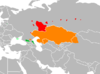 |
|
||
| West Kipchak |
Kumyk language Kumyk is a Turkic language, spoken by about 365,000 speakers in the Dagestan republic of Russian Federation.... Karachay-Balkar language The Karachay-Balkar language is a Turkic language spoken by the Karachays and Balkars. It is divided into two dialects: Karachay-Baksan-Chegem which pronounces two phonemes as and , and Balkar, which pronounces the corresponding phonemes as and .- Alphabet :Modern Karachay-Balkar Cyrillic... Crimean Tatar language The Crimean Tatar language is the language of the Crimean Tatars. It is a Turkic language spoken in Crimea, Central Asia , and the Crimean Tatar diasporas in Turkey, Romania, Bulgaria... , Urum Urum language Urum is a Turkic language spoken by several thousand people who inhabit a few villages in the Southeastern Ukraine and in diaspora communities worldwide. The Urum language is often considered a variant of the Crimean Tatar language.... Krymchak language The Krymchak language is a Turkic language spoken in Crimea by the Krymchak people. It is often considered to be a Crimean Tatar dialect. The language is sometimes referred to as Judeo-Crimean Tatar.... Cuman language Cuman was a Kipchak Turkic language spoken by the Cumans and Kipchaks; the language was similar to the today's Crimean Tatar language... (extinct) Karaim language The Karaim language is a Turkic language with Hebrew influences, in a similar manner to Yiddish or Ladino. It is spoken by Crimean Karaites – ethnic Turkic adherents of Karaite Judaism in Crimea, Lithuania, Poland and western Ukraine... |
||
| North Kipchak (Volga–Ural Turkic) |
Tatar language The Tatar language , or more specifically Kazan Tatar, is a Turkic language spoken by the Tatars of historical Kazan Khanate, including modern Tatarstan and Bashkiria... Bashkir language The Bashkir language is a Turkic language, and is the language of the Bashkirs. It is co-official with Russian in the Republic of Bashkortostan.-Speakers:... Baraba language Baraba or Baraba Tatar is spoken by at least 8,000 Baraba Tatars in Siberia. It is a dialect of Siberian Tatar.-Geographic Distribution:Baraba Tatar is spoken mainly in the Novosibirsk Oblast in Russia... |
||
| South Kipchak (Aralo-Caspian) |
Kazakh language Kazakh is a Turkic language which belongs to the Kipchak branch of the Turkic languages, closely related to Nogai and Karakalpak.... Karakalpak language Karakalpak is a Turkic language mainly spoken by Karakalpaks in Karakalpakstan , as well as by Bashkirs and Nogay. Ethnic Karakalpaks who live in the viloyatlar of Uzbekistan tend to speak local Uzbek dialects.-Classification:... Kyrgyz language Kyrgyz or Kirgiz, also Kirghiz, Kyrghiz, Qyrghiz is a Turkic language and, together with Russian, an official language of Kyrgyzstan... Nogai language Nogai , is a Turkic language spoken in southwestern Russia. Three distinct dialects are recognized: Qara-Nogay , spoken in Dagestan; Nogai Proper, in Stavropol; and Aqnogay , by the Kuban River, its tributaries in Karachay-Cherkessia, and in the Mineralnye Vody District... |
||
| Southeastern Common Turkic (Uyghuric) | West |
Uzbek language Uzbek is a Turkic language and the official language of Uzbekistan. It has about 25.5 million native speakers, and it is spoken by the Uzbeks in Uzbekistan and elsewhere in Central Asia... |
|
| East |
Uyghur language Uyghur , formerly known as Eastern Turk, is a Turkic language with 8 to 11 million speakers, spoken primarily by the Uyghur people in the Xinjiang Uyghur Autonomous Region of Western China. Significant communities of Uyghur-speakers are located in Kazakhstan and Uzbekistan, and various other... Salar language Salar is a Turkic language spoken by the Salar people, who mainly live in the provinces of Qinghai and Gansu in China; some also live in Ghulja, Xinjiang... Chagatai language The Chagatai language is an extinct Turkic language which was once widely spoken in Central Asia, and remained the shared literary language there until the early twentieth century... (extinct) Aini language Äynu is a Turkic language spoken in western China known in various spelling as Aini, Aynu, Ainu, Eyni or by the Uyghur Abdal , in Russian sources Эйну́, Айну, Абдал, by the Chinese as Ainu. Some linguists call it a mixed language, having a mostly Turkic grammar, essentially Uyghur, but a mainly... Ili Turki language Ili Turki is a Turkic language spoken primarily in China. There were approximately 120 speakers of this language as of 1982.-Classification:... |
||
| Northeastern Common Turkic (Siberian) | North Siberian |
Sakha language Sakha, or Yakut, is a Turkic language with around 360,000 native speakers spoken in the Sakha Republic in the Russian Federation by the Sakha or Yakuts.Sakha is an agglutinative language, and it employs vowel harmony.-Classification:... (Yakut) Dolgan language The Dolgan language is a Turkic language with around 5,000 speakers, spoken in the Taymyr Peninsula in Russia. Its speakers are known as the Dolgans.-Classification:... |
|
| South Siberian | Sayan Turkic |
Tuvan language Tuvan , also known as Tuvinian, Tyvan or Tuvin, is a Turkic language spoken in the Republic of Tuva in south-central Siberia in Russia. The language has borrowed a great number of roots from the Mongolian language and more recently from the Russian language... (Soyot, Uriankhai) Tofa language Tofa, also known as Tofalar or Karagas, is one of the Turkic languages spoken in Russia's Irkutsk Oblast by the Tofalar. It is a moribund language: in 2001 only 28 people were reported to speak it.... |
|
| Yenisei Turkic |
Khakas language Khakas is a Turkic language spoken by the Khakas people, who mainly live in the southern Siberian Khakas Republic, or Khakassia, in Russia... Fuyü Gïrgïs language Fuyü Gïrgïs or Fu-Yu Kirgiz, also known as Manchurian Kirghiz, is the easternmost Turkic language. It is spoken in northeastern China's Heilongjiang province, in and around Fuyu County, Qiqihar, which is located approximately 300 km northwest of Harbin. Fuyü Gïrgïs is spoken by a small... Shor language The Shor language is a Turkic language spoken by about 10,000 people in the Kemerovo Province in south-central Siberia. In the history of the Turkic states and China, Shors played an important role, mostly connected with their offshoot Shatuo. Presently, not all ethnic Shors speak Shor, and the... (Saghay Qaca, Qizil) |
||
| Chulym Turkic |
Chulym language Chulym , also known as Chulim, Chulym-Turkic, Küerik, Chulym Tatar or Melets Tatar is the language of the Chulyms. The name the people use to refer to themselves, and also to their language, is Ös, literally ‘self’ or ‘own’... (Küerik) |
||
| Altai Turkic |
Altay language Altay is a language of the Turkic group of languages. It is an official language of Altai Republic, Russia. The language was called Oyrot prior to 1948. There were ca... Oirot and dialects such as Tuba, Qumanda, Qu, Teleut, Telengit |
||
| Oghur Oghur languages The Oghur or Bulgar , are a separate branch of the Turkic language family. It was historically spoken in Volga Bulgaria... |
Chuvash language Chuvash is a Turkic language spoken in central Russia, primarily in the Chuvash Republic and adjacent areas. It is the only surviving member of the Oghur branch of Turkic languages.... Khazar language Khazar was the language spoken by the Khazars, a semi-nomadic Turkic people from Central Asia. It is also referred to as Khazarian, Khazaric, or Khazari. The language is extinct and written records are almost non-existent.... (extinct) Hunnic language The Huns were a heterogenous, multi-ethnic tribal confederation during the 4th and 5th centuries. A contemporary reports that the Hunnic Empire had a "Hunnic language", or "Hunnish", which was spoken alongside Gothic and the languages of other tribes subjugated by the Huns The literary records for... (extinct) |
||
Vocabulary comparison
The following is a brief comparison of cognateCognate
In linguistics, cognates are words that have a common etymological origin. This learned term derives from the Latin cognatus . Cognates within the same language are called doublets. Strictly speaking, loanwords from another language are usually not meant by the term, e.g...
s among the basic vocabulary across the Turkic language family (about 60 words).
Empty cells do not necessarily imply that a particular language is lacking a word to describe the concept, but rather that the word for the concept in that language may be formed from another stem and is not a cognate with the other words in the row or that the equivalent was unknown to contributors to this article.
Also, there may be shifts in the meaning from one language to another, and so the "Common meaning" given is only approximate. In some cases the form given is found only in some dialects of the language. Forms are given in native Latin orthographies unless otherwise noted.
| Common meaning | Old Turkic Old Turkic language Old Turkic is the earliest attested form of Turkic, found in Göktürk and Uyghur inscriptions dating from about the 7th century to the 13th century.... |
Turkish Turkish language Turkish is a language spoken as a native language by over 83 million people worldwide, making it the most commonly spoken of the Turkic languages. Its speakers are located predominantly in Turkey and Northern Cyprus with smaller groups in Iraq, Greece, Bulgaria, the Republic of Macedonia, Kosovo,... |
Azerbaijani Azerbaijani language Azerbaijani or Azeri or Torki is a language belonging to the Turkic language family, spoken in southwestern Asia by the Azerbaijani people, primarily in Azerbaijan and northwestern Iran... |
Turkmen Turkmen language Turkmen is the national language of Turkmenistan... |
Tatar Tatar language The Tatar language , or more specifically Kazan Tatar, is a Turkic language spoken by the Tatars of historical Kazan Khanate, including modern Tatarstan and Bashkiria... |
Bashkir Bashkir language The Bashkir language is a Turkic language, and is the language of the Bashkirs. It is co-official with Russian in the Republic of Bashkortostan.-Speakers:... |
Kazakh Kazakh language Kazakh is a Turkic language which belongs to the Kipchak branch of the Turkic languages, closely related to Nogai and Karakalpak.... |
Kyrgyz Kyrgyz language Kyrgyz or Kirgiz, also Kirghiz, Kyrghiz, Qyrghiz is a Turkic language and, together with Russian, an official language of Kyrgyzstan... |
Uzbek Uzbek language Uzbek is a Turkic language and the official language of Uzbekistan. It has about 25.5 million native speakers, and it is spoken by the Uzbeks in Uzbekistan and elsewhere in Central Asia... |
Uyghur Uyghur language Uyghur , formerly known as Eastern Turk, is a Turkic language with 8 to 11 million speakers, spoken primarily by the Uyghur people in the Xinjiang Uyghur Autonomous Region of Western China. Significant communities of Uyghur-speakers are located in Kazakhstan and Uzbekistan, and various other... |
Sakha/Yakut Sakha language Sakha, or Yakut, is a Turkic language with around 360,000 native speakers spoken in the Sakha Republic in the Russian Federation by the Sakha or Yakuts.Sakha is an agglutinative language, and it employs vowel harmony.-Classification:... |
Chuvash Chuvash language Chuvash is a Turkic language spoken in central Russia, primarily in the Chuvash Republic and adjacent areas. It is the only surviving member of the Oghur branch of Turkic languages.... |
|
|---|---|---|---|---|---|---|---|---|---|---|---|---|---|
| - | Father | Ata | Ata | Ata | Ata | Atta | Ata(y) | Ata | Ata | Ota | Ata | Ata | Ate |
| Mother | Ana | Ana/Anne | Ana | Ene | Ana | Inä(y)/Asay | Ana | Ene | Ona | Ana | Anne | ||
| Sound | Avaz | Avaz | Avaz | Avaz | Awaz | Avaz | Ovoz | Avaz | Avaz | Avaz | |||
| Son | O'gul | Oğul/Oğlan | Oğul | Oğul | Ul, uğıl | Ul | Ul | Uul | O'g'il | Oghul | Uol | Yvăl, Ul | |
| Man | Er(kek) | Er(kek) | Er | Erkek | İr | İr(käk) | Er(kek) | Erkek | Erkak | Er | Er | Ar/Arşçin | |
| Girl | Kyz | Kız | Qız | Gyz | Qız | Qıð | Qız | Kız | Qiz | Qiz | Ky:s | Hĕr | |
| Person | Kişi | Kişi/Şahıs | Kişi/Şəxs | Kişi | Keshe | Keşe | Kisi | Kishi | Kishi | Kishi | Kihi | Şçin | |
| Bride | Kelin | Gelin | Gəlin | Gelin | Kilen | Kilen | Kelin | Kelin | Kelin | Kelin | Kylyn | Kin | |
| Mother-in-law | Kaynana | Qaynana | Gayın ene | Qayın ana | Qäynä | Qayın ene | Kaynene | Qayın ona | Qeyinana | Hun'ama | |||
| Body parts | Heart | Yürek | Yürek | Ürək | Ýürek | Yöräk | Yöräk | Jürek | Jürök | Yurak | Yürek | Süreq | Čĕre |
| Blood | Qan | Kan | Qan | Ga:n | Qan | Qan | Qan | Kan | Qon | Qan | Qa:n | Jun | |
| Head | Baš | Baş | Baş | Baş | Baş | Baş | Bas | Bash | Bosh | Baş | Bas | Puś | |
| Hair | Qıl | Kıl | Qıl | Qyl | Qıl | Qıl | Qıl | Kıl | Qil | Qil | Kıl | ||
| Eye | Köz | Göz | Göz | Göz | Küz | Küð | Köz | Köz | Ko'z | Köz | Kos | Kuś | |
| Eyelash | Kirpik | Kirpik | Kiprik | Kirpik | Kerfek | Kerpek | Kirpik | Kirpik | Kiprik | Kirpik | Kirbi: | Hărpăk | |
| Ear | Qulqaq | Kulak | Qulaq | Gulak | Qolaq | Qolaq | Qulaq | Kulak | Quloq | Qulaq | Gulka:k | Hălha | |
| Nose | Burun | Burun | Burun | Burun | Borın | Moron | Murın | Murun | Burun | Burun | Murun | ||
| Arm | Qol | Kol | Qol | Gol | Qul | Qul | Qol | Kol | Qo'l | Qol,Bilek | Qol | Hul/Hol | |
| Hand | El(ig) | El | Əl | El | Alaqan | Alakan | Qol;Ilik | Ili: | Ală | ||||
| Finger | Barmak | Parmak | Barmaq | Barmak | Barmaq | Barmaq | Barmaq | Barmak | Barmoq | Barmaq | Pürne/Porn'a | ||
| Fingernail | Tyrnaq | Tırnak | Dırnaq | Dyrnaq | Tırnaq | Tırnaq | Tırnaq | Tyrmak | Tirnoq | Tirnaq | Tynyraq | Čĕrne | |
| Knee | Tiz | Diz | Diz | Dy:z | Tez | Teð, tubıq | Tize | Tize | Tizza | Tiz | Tüsäχ | Čĕrpuśśi | |
| Calf | Baltyr | Baldır | Baldır | Baldyr | Baltır | Baltır | Baltır | Baltyr | Boldir | Baldir | Ballyr | Pıl | |
| Foot | Adaq | Ayak | Ayaq | Aýak | Ayaq | Ayaq | Ayaq | Ayak | Oyoq | Ayaq | Ataq | Ura | |
| Belly | Qaryn | Karın | Qarın | Garyn | Qarın | Qarın | Qarın | Karyn | Qorin | Qerin | Qaryn | Hyrăm | |
| Animals | Horse | At | At | At | At | At | At | At | At | Ot | At | At | Ut |
| Cattle | Siyir | Sığır/İnek | Inek | Sygyr | Sıyır | Hıyır | Sïır | Sıyır | Sigir | Siyir | Vıleh | ||
| Dog | Yt | İt | İt | It | Et | Et | Ït | It | It | It | Yt | Jytă | |
| Fish | Balyq | Balık | Balıq | Balyk | Balıq | Balıq | Balıq | Balık | Baliq | Beliq | Balyk | Pulă | |
| Louse | Bit | Bit | Bit | Bit | Bet | Bet | Bït | Bit | Bit | Pit | Byt | Pyjtă/Put'ă | |
| Other nouns | House | Uy | Ev | Ev | Öý | Öy | Öy | Üy | Üy | Uy | Öy | Av* | |
| Tent | Otag | Otağ | Otaq | Otag | Satır | Şatır | Boz Üy | O'toq | Otaq | Otu: | |||
| Way | Yol | Yol | Yol | Yo:l | Yul | Yul | Jol | Jol | Yo'l | Yol | Suol | Śul | |
| Bridge | Köprüq | Köprü | Körpü | Köpri | Küper | Küper | Köpir | Köpürö | Ko'prik | Kövrük | Kürpe | Kĕper | |
| Arrow | Oq | Ok | Ox | Ok | Uq | Uq | Oq | Ok | O'q | Oq | Oχ | Uhă | |
| Fire | Ot | Od | Od | Ot | Ut | Ut, ürt | Ot | Ot | O't | Ot | Uot | Vut/Vot | |
| Ash | Kül | Kül | Kül | Kül | Köl | Köl | Kül | Kül | Kul | Kül | Kül | Kĕl | |
| Water | Suv | Su | Su | Suw | Su | Hıw | Su | Suu | Suv | Su | Ui | Šyv/Šu | |
| Ship, boat | Kemi | Gemi | Gəmi | Gämi | Köymä | Kämä | Keme | Keme | Kema | Keme | Kimĕ | ||
| Lake | Köl | Göl | Göl | Köl | Kül | Kül | Köl | Köl | Ko'l | Köl | Küöl | Külĕ | |
| Sun/Day | Küneš | Gün(eş) | Gün(əş) | Gün | Kön | Kön | Kün | Kün | Kun | Kün | Kün | Kun | |
| Cloud | Bulut | Bulut | Bulud | Bulut | Bolıt | Bolot | Bulut | Bulut | Bulut | Bylyt | Pĕlĕt | ||
| Star | Yulduz | Yıldız | Ulduz | Ýyldyz | Yoldız | Yondoð | Juldız | Jıldız | Yulduz | Yultuz | Sulus | Śăltăr | |
| Earth | Topraq | Toprak | Torpaq | Toprak | Tufraq | Tupraq | Topıraq | Topurak | Tuproq | Tupraq | Toburaχ | Tăpra | |
| Hilltop | Töpü | Tepe | Təpə | Depe | Tübä | Tübä | Töbe | Töbö | Tepa | Töpe | Töbö | Tüpĕ | |
| Tree/Wood | Yağac | Ağaç | Ağac | Agaç | Ağaç | Ağas | Ağaş | Jygach | Yog'och | Yahach | Jyvăś | ||
| God (Tengri Tengri Tengri or Tengger Tengri or Tengger Tengri or Tengger (Old Turkic: ; Mongolian: Тэнгэр, Tenger; Chinese: 腾格里, Mandarin: Ténggélǐ, Hungarian: Tengri, Turkish: Tanrı, Bulgarian: Tangra (Тангра) is a sky god, formerly the chief deity of the early Turkic peoples, including the Xiongnu, Huns, Bulgars,... ) |
Tengri | Tanrı | Tanrı | Taňry | Täñre | Täñre | Täñiri | Teñir | Tangri | Tengri | Tanara | Tură/Toră | |
| Sky, Blue | Kök | Gök | Göy | Gök | Kük | Kük | Kök | Kök | Ko'k | Kök | Küöq | Kăvak/Koak | |
| Adjectives | Long | Uzun | Uzun | Uzun | Uzyn | Ozın | Oðon | Uzın | Uzun | Uzun | Uzun | Uhun | Vărăm |
| New | Yany | Yeni | Yeni | Yany | Yaña | Yañı | Jaña | Jañı | Yangi | Yengi | Sana | Śĕnĕ | |
| Fat | Semiz | Semiz/Şişman | Şişgo | Semiz | Simez | Himeð | Semiz | Semiz | Semiz | Semiz | Emis | Samăr | |
| Full | Tolu | Dolu | Dolu | Do:ly | Tulı | Tulı | Tolı | Tolo | To'la | Toluq | Toloru | Tulli | |
| White | Aq | Ak | Ağ | Ak | Aq | Aq | Aq | Ak | Oq | Aq | |||
| Black | Qara | Kara | Qara | Gara | Qara | Qara | Qara | Kara | Qora | Qara | Xara | Hura | |
| Red | Qyzyl | Kızıl | Qızıl | Gyzyl | Qızıl | Qıðıl | Qızıl | Kızıl | Qizil | Qizil | Kyhyl | Hĕrlĕ | |
| Numbers | 1 | Bir | Bir | Bir | Bir | Ber | Ber | Bir | Bir | Bir | Bir | Bi:r | Pĕrre |
| 2 | Eki | İki | İki | Iki | İke | İke | Eki | Eki | Ikki | Ikki | Ikki | Ikkĕ | |
| 4 | Tört | Dört | Dörd | Dö:rt | Dürt | Dürt | Tört | Tört | To'rt | Tört | Tüört | Tăvattă | |
| 7 | Yeti | Yedi | Yeddi | Yedi | Cide | Yete | Jeti | Jeti | Yetti | Yetti | Sette | Śiččĕ | |
| 10 | On | On | On | O:n | Un | Un | On | On | O'n | On | Uon | Vunnă/Vonnă | |
| 100 | Yüz | Yüz | Yüz | Yüz | Yöz | Yöð | Jüz | Jüz | Yuz | Yüz | Sü:s | Śĕr | |
| Old Turkic Old Turkic language Old Turkic is the earliest attested form of Turkic, found in Göktürk and Uyghur inscriptions dating from about the 7th century to the 13th century.... |
Turkish Turkish language Turkish is a language spoken as a native language by over 83 million people worldwide, making it the most commonly spoken of the Turkic languages. Its speakers are located predominantly in Turkey and Northern Cyprus with smaller groups in Iraq, Greece, Bulgaria, the Republic of Macedonia, Kosovo,... |
Azerbaijani Azerbaijani language Azerbaijani or Azeri or Torki is a language belonging to the Turkic language family, spoken in southwestern Asia by the Azerbaijani people, primarily in Azerbaijan and northwestern Iran... |
Turkmen Turkmen language Turkmen is the national language of Turkmenistan... |
Tatar Tatar language The Tatar language , or more specifically Kazan Tatar, is a Turkic language spoken by the Tatars of historical Kazan Khanate, including modern Tatarstan and Bashkiria... |
Bashkir Bashkir language The Bashkir language is a Turkic language, and is the language of the Bashkirs. It is co-official with Russian in the Republic of Bashkortostan.-Speakers:... |
Kazakh Kazakh language Kazakh is a Turkic language which belongs to the Kipchak branch of the Turkic languages, closely related to Nogai and Karakalpak.... |
Kyrgyz Kyrgyz language Kyrgyz or Kirgiz, also Kirghiz, Kyrghiz, Qyrghiz is a Turkic language and, together with Russian, an official language of Kyrgyzstan... |
Uzbek Uzbek language Uzbek is a Turkic language and the official language of Uzbekistan. It has about 25.5 million native speakers, and it is spoken by the Uzbeks in Uzbekistan and elsewhere in Central Asia... |
Uyghur Uyghur language Uyghur , formerly known as Eastern Turk, is a Turkic language with 8 to 11 million speakers, spoken primarily by the Uyghur people in the Xinjiang Uyghur Autonomous Region of Western China. Significant communities of Uyghur-speakers are located in Kazakhstan and Uzbekistan, and various other... |
Sakha/Yakut Sakha language Sakha, or Yakut, is a Turkic language with around 360,000 native speakers spoken in the Sakha Republic in the Russian Federation by the Sakha or Yakuts.Sakha is an agglutinative language, and it employs vowel harmony.-Classification:... |
Chuvash Chuvash language Chuvash is a Turkic language spoken in central Russia, primarily in the Chuvash Republic and adjacent areas. It is the only surviving member of the Oghur branch of Turkic languages.... |
See also
- Altaic languagesAltaic languagesAltaic is a proposed language family that includes the Turkic, Mongolic, Tungusic, and Japonic language families and the Korean language isolate. These languages are spoken in a wide arc stretching from northeast Asia through Central Asia to Anatolia and eastern Europe...
- Proto-Turkic languageProto-Turkic languageThe Proto-Turkic language is the proto-language of the family of Turkic languages that predates the separation of the Turkic peoples and separation into Oguz and Ogur branches. The Ogur languages are characterized by sound correspondences such as Oguric r versus Common Turkic z and Oguric l versus...
- Old Turkic
- Middle TurkicMiddle TurkicMiddle Turkic refers to a phase in the development of the Turkic language family, covering much of the Middle Ages . In particular the term is used by linguists to refer to a group of Oghuz and related languages spoken during this period in Central Asia, Iran, and parts of the Middle East occupied...
- Orkhon scriptOrkhon scriptThe Old Turkic script is the alphabet used by the Göktürk and other early Turkic Khanates from at least the 7th century to record the Old Turkic language. It was later used by the Uyghur Empire...
Further reading
- Baskakov, N.A. 1962, 1969. Introduction to the study of the Turkic languages. Moscow. (In Russian)
- Boeschoten, Hendrik & Lars Johanson. 2006. Turkic languages in contact. Turcologica, Bd. 61. Wiesbaden: Harrassowitz. ISBN 3447052120
- Clausen, Gerard. 1972. An etymological dictionary of pre-thirteenth-century Turkish. Oxford: Oxford University Press.
- Deny, Jean et al. 1959–1964. Philologiae Turcicae Fundamenta. Wiesbaden: Harrassowitz.
- Johanson, Lars & Éva Agnes Csató (ed.). 1998. The Turkic languages. London: Routledge. ISBN 0-415-08200-5.
- Johanson, Lars. 1998. "The history of Turkic." In: Johanson & Csató, pp. 81–125.http://www.turkiclanguages.com/www/classification.html
- Johanson, Lars. 1998. "Turkic languages." In: Encyclopædia Britannica. CD 98. Encyclopædia Britannica Online, 5 sept. 2007.http://www.britannica.com/eb/article-80003/Turkic-languages
- Menges, K. H. 1968. The Turkic languages and peoples: An introduction to Turkic studies. Wiesbaden: Harrassowitz.
- Öztopçu, Kurtuluş. 1996. Dictionary of the Turkic languages: English, Azerbaijani, Kazakh, Kyrgyz, Tatar, Turkish, Turkmen, Uighur, Uzbek. London: Routledge. ISBN 0415141982
- Samoilovich, A. N. 1922. Some additions to the classification of the Turkish languages. Petrograd.http://s155239215.onlinehome.us/turkic/40_Language/LangClassificationEn.htm
- Schönig, Claus. 1997–1998. "A new attempt to classify the Turkic languages I-III." Turkic Languages 1:1.117–133, 1:2.262–277, 2:1.130–151.
- Starostin, Sergei A., Anna V. Dybo, and Oleg A. Mudrak. 2003. Etymological Dictionary of the Altaic Languages. Leiden: Brill. ISBN 9004131531
- Voegelin, C.F. & F.M. Voegelin. 1977. Classification and index of the World's languages. New York: Elsevier.
External links
- The LINGUIST List MultiTree Project: Turkic Family Tree
- Turkic Languages: Resources – University of Michigan
- Map of Turkic languages
- Classification of Turkic Languages
- Online Uyghur–English Dictionary
- Turkic language vocabulary comparison tool / dictionary
- A Comparative Dictionary of Turkic Languages Open Project
- The Turkic Languages in a Nutshell with illustrations.
- Swadesh lists of Turkic basic vocabulary words (from Wiktionary's Swadesh-list appendix)