


Clovis I

Encyclopedia
Clovis (Ch-)Leuthwig (Ludwig, Louis) was the first King of the Franks to unite all the Frankish tribes
under one ruler, changing the leadership from a group of royal chieftains, to rule by kings, ensuring that the kingship was held by his heirs. He was also the first Catholic King to rule over Gaul (France
). He was the son of Childeric I
and Basina
. In 481, when he was fifteen, he succeeded his father. Clovis was not only a Frankish king, he was also a Roman official. The Salian Franks
were one of two Frankish tribes who were then occupying the area west of the lower Rhine, with their center in an area known as Toxandria
, between the Meuse
and Scheldt
(in what is now the Netherlands and Belgium). Clovis' power base was to the southwest of this, around Tournai
and Cambrai
along the modern frontier between France and Belgium. Clovis conquered the neighboring Salian Frankish kingdoms and established himself as sole king of the Salian Franks before his death. The small church in which he was baptized stood in the vicinity of the subsequent abbey of Saint-Remi
in Reims
, and a statue of him being baptized by Saint Remigius
can be seen there. Clovis and his wife Clotilde
were buried in the St. Genevieve church (St. Pierre) in Paris, the original name of the Church was the Church of the Holy Apostles . An important part of Clovis' legacy is that he locally succeeded to the power of the Romans in 486 by beating the Gallo-Roman
ruler Syagrius
in the battle of Soissons
.
Clovis was converted to Catholicism
; at the instigation of his wife, Clotilde, a Burgundian
Gothic princess who was a Catholic in spite of the Arianism which surrounded her at court. The followers of Catholicism believe that God, Jesus and the Holy Spirit are three parts of the same entity, as opposed to the Arian Christianity
, who's followers believed that God and Jesus were two completely separate beings and the Holy Spirit was not entirely separate from God but was the Power of God, a belief system common among the Goths
who ruled most of Gaul at the time. In the XI century the abbey's church was to become the Cathedral of Rheims, where most future French kings would be crowned. This act was of immense importance in the subsequent history of Western and Central Europe in general, for Clovis expanded his dominion over almost all of the old Roman province of Gaul
(roughly modern France). He is considered the founder of the Merovingian dynasty
which ruled the Franks for the next two centuries.
name Ludovicus, which evolved into the French
form Louis. Clovis ruled the Franks from 481 to 511 AD. The name features prominently in subsequent history: three other Merovingian Kings have been called Clovis, while nine Carolingian rulers and thirteen other French kings and one Holy Roman Emperor
have been called Louis. Nearly every European language has developed its own spelling of his name. Louis (French), "Chlodwig" and Ludwig (German), Lodewijk (Dutch), Людовик (Russian), Luis (Spanish), Luigi (Italian), and Lewis (English) are just seven of the over 100 possible variations. Scholars differ about the exact meaning of his (first) name. Most believe that Chlodovech is composed out of the Germanic
roots Chlod- and -vech. Chlod- = (modern English) loud, with its oldest connotation praised. -vech = "fighter" (modern English). Compare in modern Dutch luid (hard sound or noise), luiden (verb - the oldest meaning is: to praise aloud) and vechten (verb - to fight). Chlodovech means "praised fighter".
, Clovis defeated Syagrius
, the last Roman
official in northern Gaul
, who ruled the area around Soissons in present-day Picardy. This victory at Soissons
extended Frankish rule to most of the area north of the Loire
. After this, Clovis secured an alliance with the Ostrogoths through the marriage of his sister Audofleda to their king, Theodoric the Great
. He followed this victory with another in 491 over a small group of Thuringia
ns east of the Frankish territories. Later, with the help of the other Frankish sub-kings, he narrowly defeated the Alamanni
in the Battle of Tolbiac
. The Franks also formed a common identity with their fellow Roman subjects. The Franks claimed to be descendents of the Trojans, and the Romans also claimed descent, this claim to Trojan descent by the Franks helped form a common identity of a shared religion and a genealogical connection with their Roman neighbors. .
princess Clotilde
(later canonized as St. Clotilde), and, according to Gregory of Tours
, as a result of his victory at Tolbiac (traditionally set in 496), he converted to her Catholic
faith. However before his conversion he was very adamant about not converting from his pagan religion to Christianity. Clotilde wanted her son to be baptized but Clovis refused to allow it, so Clotilde went behind his back and had their son baptized. Shortly after his baptism, their son died further strengthening Clovis's resistance to converting to Christianity. Clotilde also had their second son baptized without her husbands permission, and this son got very ill and nearly died after his baptism. Conversion to Catholicism Christianity set Clovis apart from the other Germanic kings of his time, such as those of the Visigoths and the Vandals
, who had converted from pagan
beliefs to Arian Christianity
. It also ensured him of the support of the Catholic Gallo-Roman aristocracy in his later campaign against the Visigoths, which drove them from southern Gaul (507). His conversion to Catholicism resulted in a great many of his people converting to Catholicism as well. According to legend, it was only by invoking the God of his Christian wife, Clotilde, that he defeated his enemy. Clotilde was almost certainly instrumental in Clovis' conversion to the Catholic
faith.
Clovis was baptised at Rheims on Christmas 496, bySaint Remigius
. The conversion of Clovis to Catholic Christianity, the religion of the majority of his subjects, strengthened the bonds between his Gallo-roman subjects, led by their Catholic bishops, and their Germanic conquerors. Nevertheless, Bernard Bachrach
has argued that this conversion from his Frankish paganism alienated many of the other Frankish sub-kings and weakened his military position over the next few years. William Daly, in order more directly to assess Clovis' allegedly barbaric and pagan origins, was obliged to ignore the bishop Saint Gregory of Tours
and base his account on the scant earlier sources, a sixth-century "vita" of Saint Genevieve and letters to or concerning Clovis from bishops and Theodoric
.
In the "interpretatio romana", Gregory of Tours gave the Germanic gods that Clovis abandoned
the names of roughly equivalent Roman gods, such as Jupiter and Mercury
. Taken literally, such usage would suggest a strong affinity of early Frankish rulers for the prestige of Roman culture, which they may have embraced as allies and federates
of the Empire during the previous century.
Though he fought a battle at Dijon
in the year 500, Clovis did not successfully subdue the Burgundian kingdom
. It appears that he somehow gained the support of the Arvernia
ns in the following years, for they assisted him in his defeat of the Visigothic kingdom of Toulouse
in the Battle of Vouillé
(507) which eliminated Visigothic power in Gaul and confined the Visigoths to Hispania
and Septimania
; the battle added most of Aquitaine
to Clovis' kingdom. The battle also resulted in the death of the Visigothic King Alaric II. He then established Paris as his capital, and established an abbey dedicated to Saints Peter and Paul on the south bank of the Seine
. Later it was renamed Sainte-Geneviève Abbey
, in honor of the patron saint
of Paris.
According to Gregory of Tours
, following the Battle of Vouillé
, the Byzantine Emperor Anastasius I, granted Clovis the title of consul
. Since Clovis' name does not appear in the consular lists, it is likely he was granted a suffect consulship.
Gregory of Tours recorded Clovis' systematic campaigns following his victory in Vouillé to eliminate the other Frankish "reguli" or sub-kings. These included Sigobert the Lame
and his son Chlodoric the Parricide
; Chararic
, another king of the Salian Franks
; Ragnachar of Cambrai
, his brother Ricchar, and their brother Rignomer of Le Mans
.
Gregory of Tours also tells of how Clovis would use deceit, cunning and treachery to expand his kingdom. Clovis would send gifts and money to the nobles and those responsible for protecting a rival king, to bribe them to betray their king, or he would tell a rival king's son that if the son killed his royal father, Clovis would support the son's ascent to the throne and the son would gain an alliance with Clovis. However when the son had killed his father Clovis would reveal the son's crime, have the son murdered and take over the kingdom without much opposition. When Clovis would bribe nobles to betray their king, he would go to battle against the rival king, and the rival king's nobles would give him over to Clovis, thus giving Clovis power over the kingdom and expanding his kingdom.
 Shortly before his death, Clovis called a synod of Gallic bishops to meet in Orléans
to reform the Church and create a strong link between the Crown and the Catholic episcopate. This was the First Council of Orléans
. Thirty-three bishops assisted and passed 31 decrees on the duties and obligations of individuals, the right of sanctuary and ecclesiastical discipline. These decrees, equally applicable to Franks and Romans, first established equality between conquerors and conquered.
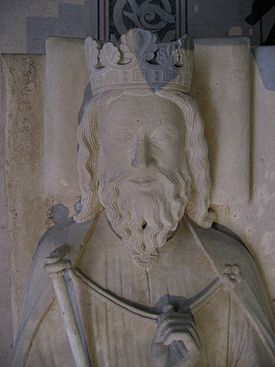 Clovis I is traditionally said to have died on 27 November 511; however, the Liber Pontificalis suggests that he was still alive in 513. After his death, Clovis was laid to rest in the Abbey of St Genevieve in Paris. His remains relocated to Saint Denis Basilica
in the mid- to late-18th century.
Upon his death his realm was divided among his four sons: Theuderic, Chlodomer
, Childebert
, and Clotaire
. This partitioning created the new political units of the Kingdoms of Rheims, Orléans
, Paris and Soissons
and inaugurated a period of disunity which was to last, with brief interruptions, until the end (751) of his Merovingian dynasty.
By the first act, he assured the influence of his people beyond the borders of Gaul, something no regional king could accomplish. By the second act, he laid the foundations of a later nation-state, France. By the third act, he made himself the ally of the papacy and its protector as well as that of the people, who were mostly Catholics.
Detracting perhaps, from this legacy, is his aforementioned division of the state. This was done not along national or even largely geographical lines, but primarily to assure equal income amongst his sons after his death. While it may or may not have been his intention, this division was the cause of much internal discord in Gaul. This precedent led in the long run to the fall of his dynasty, for it was a pattern repeated in future reigns. Clovis did bequeath to his heirs the support of both people and Church such that, when the magnates were ready to do away with the royal house, the sanction of the Pope was sought first.
Franks
The Franks were a confederation of Germanic tribes first attested in the third century AD as living north and east of the Lower Rhine River. From the third to fifth centuries some Franks raided Roman territory while other Franks joined the Roman troops in Gaul. Only the Salian Franks formed a...
under one ruler, changing the leadership from a group of royal chieftains, to rule by kings, ensuring that the kingship was held by his heirs. He was also the first Catholic King to rule over Gaul (France
France
The French Republic , The French Republic , The French Republic , (commonly known as France , is a unitary semi-presidential republic in Western Europe with several overseas territories and islands located on other continents and in the Indian, Pacific, and Atlantic oceans. Metropolitan France...
). He was the son of Childeric I
Childeric I
Childeric I was a Merovingian king of the Salian Franks and the father of Clovis.He succeeded his father Merovech as king, traditionally in 457 or 458...
and Basina
Basina, Queen of Thuringia
Basina or Basine was a queen of Thuringia in the middle of the fifth century.- Biography :Basina was a daughter of the Thuringian king Basin and Basina, a Saxon princess....
. In 481, when he was fifteen, he succeeded his father. Clovis was not only a Frankish king, he was also a Roman official. The Salian Franks
Salian Franks
The Salian Franks or Salii were a subgroup of the early Franks who originally had been living north of the limes in the area above the Rhine. The Merovingian kings responsible for the conquest of Gaul were Salians. From the 3rd century on, the Salian Franks appear in the historical records as...
were one of two Frankish tribes who were then occupying the area west of the lower Rhine, with their center in an area known as Toxandria
Toxandria
Toxandria is the classical name for a region between the Meuse and the Scheldt rivers in the Netherlands and Belgium. The name is also spelled Taxandria...
, between the Meuse
Meuse River
The Maas or Meuse is a major European river, rising in France and flowing through Belgium and the Netherlands before draining into the North Sea...
and Scheldt
Scheldt
The Scheldt is a 350 km long river in northern France, western Belgium and the southwestern part of the Netherlands...
(in what is now the Netherlands and Belgium). Clovis' power base was to the southwest of this, around Tournai
Tournai
Tournai is a Walloon city and municipality of Belgium located 85 kilometres southwest of Brussels, on the river Scheldt, in the province of Hainaut....
and Cambrai
Cambrai
Cambrai is a commune in the Nord department in northern France. It is a sub-prefecture of the department.Cambrai is the seat of an archdiocese whose jurisdiction was immense during the Middle Ages. The territory of the Bishopric of Cambrai, roughly coinciding with the shire of Brabant, included...
along the modern frontier between France and Belgium. Clovis conquered the neighboring Salian Frankish kingdoms and established himself as sole king of the Salian Franks before his death. The small church in which he was baptized stood in the vicinity of the subsequent abbey of Saint-Remi
Abbey of Saint-Remi
The Abbey of Saint-Remi is an abbey in Reims, France, founded in the sixth century. Since 1099 it has conserved the relics of Saint Remi , the Bishop of Reims who converted Clovis, King of the Franks, to Christianity at Christmas in AD 496, after he defeated the Alamanni in the Battle of...
in Reims
Reims
Reims , a city in the Champagne-Ardenne region of France, lies east-northeast of Paris. Founded by the Gauls, it became a major city during the period of the Roman Empire....
, and a statue of him being baptized by Saint Remigius
Saint Remigius
Saint Remigius, Remy or Remi, , was Bishop of Reims and Apostle of the Franks, . On 24 December 496 he baptised Clovis I, King of the Franks...
can be seen there. Clovis and his wife Clotilde
Clotilde
Saint Clotilde , also known as Clothilde, Clotilda, Clotild, Rotilde or Chroctechildis, was the second wife of the Frankish king Clovis I...
were buried in the St. Genevieve church (St. Pierre) in Paris, the original name of the Church was the Church of the Holy Apostles . An important part of Clovis' legacy is that he locally succeeded to the power of the Romans in 486 by beating the Gallo-Roman
Gallo-Roman culture
The term Gallo-Roman describes the Romanized culture of Gaul under the rule of the Roman Empire. This was characterized by the Gaulish adoption or adaptation of Roman mores and way of life in a uniquely Gaulish context...
ruler Syagrius
Syagrius
Syagrius was the last Roman official in Gaul, whose defeat by king Clovis I of the Franks is considered the end of Roman rule outside of Italy. He came to this position through inheritance, for his father was Aegidius, the last Roman magister militum per Gallias...
in the battle of Soissons
Battle of Soissons (486)
The Battle of Soissons in the year 486 was fought between the Frankish forces under Clovis I, and the Gallo-Roman Kingdom of Soissons under Syagrius...
.
Clovis was converted to Catholicism
Catholicism
Catholicism is a broad term for the body of the Catholic faith, its theologies and doctrines, its liturgical, ethical, spiritual, and behavioral characteristics, as well as a religious people as a whole....
; at the instigation of his wife, Clotilde, a Burgundian
Burgundians
The Burgundians were an East Germanic tribe which may have emigrated from mainland Scandinavia to the island of Bornholm, whose old form in Old Norse still was Burgundarholmr , and from there to mainland Europe...
Gothic princess who was a Catholic in spite of the Arianism which surrounded her at court. The followers of Catholicism believe that God, Jesus and the Holy Spirit are three parts of the same entity, as opposed to the Arian Christianity
Arianism
Arianism is the theological teaching attributed to Arius , a Christian presbyter from Alexandria, Egypt, concerning the relationship of the entities of the Trinity and the precise nature of the Son of God as being a subordinate entity to God the Father...
, who's followers believed that God and Jesus were two completely separate beings and the Holy Spirit was not entirely separate from God but was the Power of God, a belief system common among the Goths
Goths
The Goths were an East Germanic tribe of Scandinavian origin whose two branches, the Visigoths and the Ostrogoths, played an important role in the fall of the Roman Empire and the emergence of Medieval Europe....
who ruled most of Gaul at the time. In the XI century the abbey's church was to become the Cathedral of Rheims, where most future French kings would be crowned. This act was of immense importance in the subsequent history of Western and Central Europe in general, for Clovis expanded his dominion over almost all of the old Roman province of Gaul
Gaul
Gaul was a region of Western Europe during the Iron Age and Roman era, encompassing present day France, Luxembourg and Belgium, most of Switzerland, the western part of Northern Italy, as well as the parts of the Netherlands and Germany on the left bank of the Rhine. The Gauls were the speakers of...
(roughly modern France). He is considered the founder of the Merovingian dynasty
Merovingian dynasty
The Merovingians were a Salian Frankish dynasty that came to rule the Franks in a region largely corresponding to ancient Gaul from the middle of the 5th century. Their politics involved frequent civil warfare among branches of the family...
which ruled the Franks for the next two centuries.
Name
In primary sources Clovis' name is spelled in a number of variants: the Frankish form Chlodovech was Latinized as Chlodovechus, from which came the LatinLatin
Latin is an Italic language originally spoken in Latium and Ancient Rome. It, along with most European languages, is a descendant of the ancient Proto-Indo-European language. Although it is considered a dead language, a number of scholars and members of the Christian clergy speak it fluently, and...
name Ludovicus, which evolved into the French
French language
French is a Romance language spoken as a first language in France, the Romandy region in Switzerland, Wallonia and Brussels in Belgium, Monaco, the regions of Quebec and Acadia in Canada, and by various communities elsewhere. Second-language speakers of French are distributed throughout many parts...
form Louis. Clovis ruled the Franks from 481 to 511 AD. The name features prominently in subsequent history: three other Merovingian Kings have been called Clovis, while nine Carolingian rulers and thirteen other French kings and one Holy Roman Emperor
Holy Roman Emperor
The Holy Roman Emperor is a term used by historians to denote a medieval ruler who, as German King, had also received the title of "Emperor of the Romans" from the Pope...
have been called Louis. Nearly every European language has developed its own spelling of his name. Louis (French), "Chlodwig" and Ludwig (German), Lodewijk (Dutch), Людовик (Russian), Luis (Spanish), Luigi (Italian), and Lewis (English) are just seven of the over 100 possible variations. Scholars differ about the exact meaning of his (first) name. Most believe that Chlodovech is composed out of the Germanic
Germanic languages
The Germanic languages constitute a sub-branch of the Indo-European language family. The common ancestor of all of the languages in this branch is called Proto-Germanic , which was spoken in approximately the mid-1st millennium BC in Iron Age northern Europe...
roots Chlod- and -vech. Chlod- = (modern English) loud, with its oldest connotation praised. -vech = "fighter" (modern English). Compare in modern Dutch luid (hard sound or noise), luiden (verb - the oldest meaning is: to praise aloud) and vechten (verb - to fight). Chlodovech means "praised fighter".
Frankish consolidation
In 486, with the help of RagnacharRagnachar
Ragnachar or Ragnarius was a Frankish petty king who ruled from Cambrai. According to Gregory of Tours, Ragnachar "was so unrestrained in his wantonness that he scarcely had mercy for his own near relatives", an attribute he shared with his contemporary, fellow king and relative, Clovis.In 486,...
, Clovis defeated Syagrius
Syagrius
Syagrius was the last Roman official in Gaul, whose defeat by king Clovis I of the Franks is considered the end of Roman rule outside of Italy. He came to this position through inheritance, for his father was Aegidius, the last Roman magister militum per Gallias...
, the last Roman
Roman Empire
The Roman Empire was the post-Republican period of the ancient Roman civilization, characterised by an autocratic form of government and large territorial holdings in Europe and around the Mediterranean....
official in northern Gaul
Gaul
Gaul was a region of Western Europe during the Iron Age and Roman era, encompassing present day France, Luxembourg and Belgium, most of Switzerland, the western part of Northern Italy, as well as the parts of the Netherlands and Germany on the left bank of the Rhine. The Gauls were the speakers of...
, who ruled the area around Soissons in present-day Picardy. This victory at Soissons
Battle of Soissons (486)
The Battle of Soissons in the year 486 was fought between the Frankish forces under Clovis I, and the Gallo-Roman Kingdom of Soissons under Syagrius...
extended Frankish rule to most of the area north of the Loire
Loire (river)
The Loire is the longest river in France. With a length of , it drains an area of , which represents more than a fifth of France's land area. It is the 170th longest river in the world...
. After this, Clovis secured an alliance with the Ostrogoths through the marriage of his sister Audofleda to their king, Theodoric the Great
Theodoric the Great
Theodoric the Great was king of the Ostrogoths , ruler of Italy , regent of the Visigoths , and a viceroy of the Eastern Roman Empire...
. He followed this victory with another in 491 over a small group of Thuringia
Thuringia
The Free State of Thuringia is a state of Germany, located in the central part of the country.It has an area of and 2.29 million inhabitants, making it the sixth smallest by area and the fifth smallest by population of Germany's sixteen states....
ns east of the Frankish territories. Later, with the help of the other Frankish sub-kings, he narrowly defeated the Alamanni
Alamanni
The Alamanni, Allemanni, or Alemanni were originally an alliance of Germanic tribes located around the upper Rhine river . One of the earliest references to them is the cognomen Alamannicus assumed by Roman Emperor Caracalla, who ruled the Roman Empire from 211 to 217 and claimed thereby to be...
in the Battle of Tolbiac
Battle of Tolbiac
The Battle of Tolbiac was fought between the Franks under Clovis I and the Alamanni, traditionally set in 496. The site of "Tolbiac", or "Tulpiacum" is usually given as Zülpich, North Rhine-Westphalia, about 60km east of the present German-Belgian frontier, which is not implausible...
. The Franks also formed a common identity with their fellow Roman subjects. The Franks claimed to be descendents of the Trojans, and the Romans also claimed descent, this claim to Trojan descent by the Franks helped form a common identity of a shared religion and a genealogical connection with their Roman neighbors. .
Catholic king
Clovis had previously married the Catholic BurgundianBurgundians
The Burgundians were an East Germanic tribe which may have emigrated from mainland Scandinavia to the island of Bornholm, whose old form in Old Norse still was Burgundarholmr , and from there to mainland Europe...
princess Clotilde
Clotilde
Saint Clotilde , also known as Clothilde, Clotilda, Clotild, Rotilde or Chroctechildis, was the second wife of the Frankish king Clovis I...
(later canonized as St. Clotilde), and, according to Gregory of Tours
Gregory of Tours
Saint Gregory of Tours was a Gallo-Roman historian and Bishop of Tours, which made him a leading prelate of Gaul. He was born Georgius Florentius, later adding the name Gregorius in honour of his maternal great-grandfather...
, as a result of his victory at Tolbiac (traditionally set in 496), he converted to her Catholic
Catholicism
Catholicism is a broad term for the body of the Catholic faith, its theologies and doctrines, its liturgical, ethical, spiritual, and behavioral characteristics, as well as a religious people as a whole....
faith. However before his conversion he was very adamant about not converting from his pagan religion to Christianity. Clotilde wanted her son to be baptized but Clovis refused to allow it, so Clotilde went behind his back and had their son baptized. Shortly after his baptism, their son died further strengthening Clovis's resistance to converting to Christianity. Clotilde also had their second son baptized without her husbands permission, and this son got very ill and nearly died after his baptism. Conversion to Catholicism Christianity set Clovis apart from the other Germanic kings of his time, such as those of the Visigoths and the Vandals
Vandals
The Vandals were an East Germanic tribe that entered the late Roman Empire during the 5th century. The Vandals under king Genseric entered Africa in 429 and by 439 established a kingdom which included the Roman Africa province, besides the islands of Sicily, Corsica, Sardinia and the Balearics....
, who had converted from pagan
Germanic paganism
Germanic paganism refers to the theology and religious practices of the Germanic peoples of north-western Europe from the Iron Age until their Christianization during the Medieval period...
beliefs to Arian Christianity
Arianism
Arianism is the theological teaching attributed to Arius , a Christian presbyter from Alexandria, Egypt, concerning the relationship of the entities of the Trinity and the precise nature of the Son of God as being a subordinate entity to God the Father...
. It also ensured him of the support of the Catholic Gallo-Roman aristocracy in his later campaign against the Visigoths, which drove them from southern Gaul (507). His conversion to Catholicism resulted in a great many of his people converting to Catholicism as well. According to legend, it was only by invoking the God of his Christian wife, Clotilde, that he defeated his enemy. Clotilde was almost certainly instrumental in Clovis' conversion to the Catholic
Catholicism
Catholicism is a broad term for the body of the Catholic faith, its theologies and doctrines, its liturgical, ethical, spiritual, and behavioral characteristics, as well as a religious people as a whole....
faith.
Clovis was baptised at Rheims on Christmas 496, bySaint Remigius
Saint Remigius
Saint Remigius, Remy or Remi, , was Bishop of Reims and Apostle of the Franks, . On 24 December 496 he baptised Clovis I, King of the Franks...
. The conversion of Clovis to Catholic Christianity, the religion of the majority of his subjects, strengthened the bonds between his Gallo-roman subjects, led by their Catholic bishops, and their Germanic conquerors. Nevertheless, Bernard Bachrach
Bernard Bachrach
Bernard S. Bachrach is an American historian and a professor of history at the University of Minnesota. He specialises in the Early Middle Ages, mainly on the topics of Medieval warfare, Medieval Jewry, and early Angevin history...
has argued that this conversion from his Frankish paganism alienated many of the other Frankish sub-kings and weakened his military position over the next few years. William Daly, in order more directly to assess Clovis' allegedly barbaric and pagan origins, was obliged to ignore the bishop Saint Gregory of Tours
Gregory of Tours
Saint Gregory of Tours was a Gallo-Roman historian and Bishop of Tours, which made him a leading prelate of Gaul. He was born Georgius Florentius, later adding the name Gregorius in honour of his maternal great-grandfather...
and base his account on the scant earlier sources, a sixth-century "vita" of Saint Genevieve and letters to or concerning Clovis from bishops and Theodoric
Theodoric the Great
Theodoric the Great was king of the Ostrogoths , ruler of Italy , regent of the Visigoths , and a viceroy of the Eastern Roman Empire...
.
In the "interpretatio romana", Gregory of Tours gave the Germanic gods that Clovis abandoned
Common Germanic deities
The article lists gods and goddesses that may be reconstructed for Proto-Germanic or Common Germanic Migration period paganism, or which figure in both West and North Germanic mythology...
the names of roughly equivalent Roman gods, such as Jupiter and Mercury
Mercury (mythology)
Mercury was a messenger who wore winged sandals, and a god of trade, the son of Maia Maiestas and Jupiter in Roman mythology. His name is related to the Latin word merx , mercari , and merces...
. Taken literally, such usage would suggest a strong affinity of early Frankish rulers for the prestige of Roman culture, which they may have embraced as allies and federates
Foederati
Foederatus is a Latin term whose definition and usage drifted in the time between the early Roman Republic and the end of the Western Roman Empire...
of the Empire during the previous century.
Though he fought a battle at Dijon
Dijon
Dijon is a city in eastern France, the capital of the Côte-d'Or département and of the Burgundy region.Dijon is the historical capital of the region of Burgundy. Population : 151,576 within the city limits; 250,516 for the greater Dijon area....
in the year 500, Clovis did not successfully subdue the Burgundian kingdom
Burgundians
The Burgundians were an East Germanic tribe which may have emigrated from mainland Scandinavia to the island of Bornholm, whose old form in Old Norse still was Burgundarholmr , and from there to mainland Europe...
. It appears that he somehow gained the support of the Arvernia
Auvergne (province)
Auvergne was a historic province in south central France. It was originally the feudal domain of the Counts of Auvergne. It is now the geographical and cultural area that corresponds to the former province....
ns in the following years, for they assisted him in his defeat of the Visigothic kingdom of Toulouse
Toulouse
Toulouse is a city in the Haute-Garonne department in southwestern FranceIt lies on the banks of the River Garonne, 590 km away from Paris and half-way between the Atlantic Ocean and the Mediterranean Sea...
in the Battle of Vouillé
Battle of Vouillé
The Battle of Vouillé or Vouglé was fought in the northern marches of Visigothic territory, at Vouillé, Vienne near Poitiers , in the spring of 507 between the Franks commanded by Clovis and the Visigoths of Alaric II, the conqueror of Spain.Clovis and Anastasius I of the Byzantine Empire agreed...
(507) which eliminated Visigothic power in Gaul and confined the Visigoths to Hispania
Hispania
Another theory holds that the name derives from Ezpanna, the Basque word for "border" or "edge", thus meaning the farthest area or place. Isidore of Sevilla considered Hispania derived from Hispalis....
and Septimania
Septimania
Septimania was the western region of the Roman province of Gallia Narbonensis that passed under the control of the Visigoths in 462, when Septimania was ceded to their king, Theodoric II. Under the Visigoths it was known as simply Gallia or Narbonensis. It corresponded roughly with the modern...
; the battle added most of Aquitaine
Aquitaine
Aquitaine , archaic Guyenne/Guienne , is one of the 27 regions of France, in the south-western part of metropolitan France, along the Atlantic Ocean and the Pyrenees mountain range on the border with Spain. It comprises the 5 departments of Dordogne, :Lot et Garonne, :Pyrénées-Atlantiques, Landes...
to Clovis' kingdom. The battle also resulted in the death of the Visigothic King Alaric II. He then established Paris as his capital, and established an abbey dedicated to Saints Peter and Paul on the south bank of the Seine
Seine
The Seine is a -long river and an important commercial waterway within the Paris Basin in the north of France. It rises at Saint-Seine near Dijon in northeastern France in the Langres plateau, flowing through Paris and into the English Channel at Le Havre . It is navigable by ocean-going vessels...
. Later it was renamed Sainte-Geneviève Abbey
Sainte-Geneviève Abbey
The Abbey of St Genevieve was a French monastery in Paris, suppressed at the time of the French Revolution.-History:...
, in honor of the patron saint
Patron saint
A patron saint is a saint who is regarded as the intercessor and advocate in heaven of a nation, place, craft, activity, class, clan, family, or person...
of Paris.
According to Gregory of Tours
Gregory of Tours
Saint Gregory of Tours was a Gallo-Roman historian and Bishop of Tours, which made him a leading prelate of Gaul. He was born Georgius Florentius, later adding the name Gregorius in honour of his maternal great-grandfather...
, following the Battle of Vouillé
Battle of Vouillé
The Battle of Vouillé or Vouglé was fought in the northern marches of Visigothic territory, at Vouillé, Vienne near Poitiers , in the spring of 507 between the Franks commanded by Clovis and the Visigoths of Alaric II, the conqueror of Spain.Clovis and Anastasius I of the Byzantine Empire agreed...
, the Byzantine Emperor Anastasius I, granted Clovis the title of consul
Consul
Consul was the highest elected office of the Roman Republic and an appointive office under the Empire. The title was also used in other city states and also revived in modern states, notably in the First French Republic...
. Since Clovis' name does not appear in the consular lists, it is likely he was granted a suffect consulship.
Images of the King |
Campaigns of Clovis
Gregory of Tours recorded Clovis' systematic campaigns following his victory in Vouillé to eliminate the other Frankish "reguli" or sub-kings. These included Sigobert the Lame
Sigobert the Lame
Sigobert the Lame was a king of the Franks in the area of Zülpich and Cologne.He was presumably wounded at the knee at the Battle of Tolbiac against the Alamanni....
and his son Chlodoric the Parricide
Chlodoric the Parricide
Chlodoric the Patricide murdered his own father, Sigobert the Lame, in order to take his kingdom. Chlodoric acted upon the instigation of Clovis I a rival king of the Salian Franks. After Sigobert's death Clovis then accused Chlodoric of the murder and had him killed in his turn for the crime...
; Chararic
Chararic (Frankish king)
Chararic was a Frankish king from sometime before 486 until his death sometime after 507. The primary source for his career is Gregory of Tours....
, another king of the Salian Franks
Salian Franks
The Salian Franks or Salii were a subgroup of the early Franks who originally had been living north of the limes in the area above the Rhine. The Merovingian kings responsible for the conquest of Gaul were Salians. From the 3rd century on, the Salian Franks appear in the historical records as...
; Ragnachar of Cambrai
Cambrai
Cambrai is a commune in the Nord department in northern France. It is a sub-prefecture of the department.Cambrai is the seat of an archdiocese whose jurisdiction was immense during the Middle Ages. The territory of the Bishopric of Cambrai, roughly coinciding with the shire of Brabant, included...
, his brother Ricchar, and their brother Rignomer of Le Mans
Le Mans
Le Mans is a city in France, located on the Sarthe River. Traditionally the capital of the province of Maine, it is now the capital of the Sarthe department and the seat of the Roman Catholic diocese of Le Mans. Le Mans is a part of the Pays de la Loire region.Its inhabitants are called Manceaux...
.
Gregory of Tours also tells of how Clovis would use deceit, cunning and treachery to expand his kingdom. Clovis would send gifts and money to the nobles and those responsible for protecting a rival king, to bribe them to betray their king, or he would tell a rival king's son that if the son killed his royal father, Clovis would support the son's ascent to the throne and the son would gain an alliance with Clovis. However when the son had killed his father Clovis would reveal the son's crime, have the son murdered and take over the kingdom without much opposition. When Clovis would bribe nobles to betray their king, he would go to battle against the rival king, and the rival king's nobles would give him over to Clovis, thus giving Clovis power over the kingdom and expanding his kingdom.
Salic Law
Under Clovis, the first codification of the Salian Franks' law took place. The Salic Law was written down with the assistance of Gallo-Romans and the laws reflect the Roman Legal tradition while at the same time containing much from the Salic traditions. The Salic Laws list out various crimes as well as the fine associated with committing those crimes.Later years and death
Orléans
-Prehistory and Roman:Cenabum was a Gallic stronghold, one of the principal towns of the Carnutes tribe where the Druids held their annual assembly. It was conquered and destroyed by Julius Caesar in 52 BC, then rebuilt under the Roman Empire...
to reform the Church and create a strong link between the Crown and the Catholic episcopate. This was the First Council of Orléans
First Council of Orléans
The First Council of Orléans was convoked by Clovis I in 511. Shortly before his death, Clovis called a synod of Gallic bishops to meet at Orléans to reform the church and create a strong link between the crown and the Catholic episcopate. 33 bishops assisted and passed thirty-one decrees on the...
. Thirty-three bishops assisted and passed 31 decrees on the duties and obligations of individuals, the right of sanctuary and ecclesiastical discipline. These decrees, equally applicable to Franks and Romans, first established equality between conquerors and conquered.
Saint Denis Basilica
The Cathedral Basilica of Saint Denis is a large medieval abbey church in the commune of Saint-Denis, now a northern suburb of Paris. The abbey church was created a cathedral in 1966 and is the seat of the Bishop of Saint-Denis, Pascal Michel Ghislain Delannoy...
in the mid- to late-18th century.
Upon his death his realm was divided among his four sons: Theuderic, Chlodomer
Chlodomer
Chlodomer, also spelled Clodomir or Clodomer was the second of the four sons of Clovis I, King of the Franks. On the death of his father, in 511, he divided the kingdom of the Franks with his three brothers: Theuderic I, Childebert I, and Clotaire I...
, Childebert
Childebert I
Childebert I was the Frankish king of Paris, a Merovingian dynast, one of the four sons of Clovis I who shared the kingdom of the Franks upon their father's death in 511...
, and Clotaire
Clotaire I
Chlothar I , called the Old , King of the Franks, was one of the four sons of Clovis. He was born circa 497, in Soissons .-Life:...
. This partitioning created the new political units of the Kingdoms of Rheims, Orléans
Orléans
-Prehistory and Roman:Cenabum was a Gallic stronghold, one of the principal towns of the Carnutes tribe where the Druids held their annual assembly. It was conquered and destroyed by Julius Caesar in 52 BC, then rebuilt under the Roman Empire...
, Paris and Soissons
Soissons
Soissons is a commune in the Aisne department in Picardy in northern France, located on the Aisne River, about northeast of Paris. It is one of the most ancient towns of France, and is probably the ancient capital of the Suessiones...
and inaugurated a period of disunity which was to last, with brief interruptions, until the end (751) of his Merovingian dynasty.
Legacy
Clovis is remembered for three main accomplishments:- The Unification of the Frankish nation
- The Conquest of Gaul
- His conversion to ChristianityChristianityChristianity is a monotheistic religion based on the life and teachings of Jesus as presented in canonical gospels and other New Testament writings...
.
By the first act, he assured the influence of his people beyond the borders of Gaul, something no regional king could accomplish. By the second act, he laid the foundations of a later nation-state, France. By the third act, he made himself the ally of the papacy and its protector as well as that of the people, who were mostly Catholics.
Detracting perhaps, from this legacy, is his aforementioned division of the state. This was done not along national or even largely geographical lines, but primarily to assure equal income amongst his sons after his death. While it may or may not have been his intention, this division was the cause of much internal discord in Gaul. This precedent led in the long run to the fall of his dynasty, for it was a pattern repeated in future reigns. Clovis did bequeath to his heirs the support of both people and Church such that, when the magnates were ready to do away with the royal house, the sanction of the Pope was sought first.