
All Topics  
Iron Age

 
Iron Age

   Email Print
   Bookmark   Link


Iron Age


In archaeology
Archaeology

Archaeology, archeology, or arch?ology is the science that studies Homo cultures through the recovery, documentation, analysis, and interpretation of material remains and environmental data, including architecture, Artifact , features, Biofact s, and cultural landscape....
, the Iron Age was the stage in the development of any people in which tools and weapons whose main ingredient was iron
Iron

Iron is a chemical element with the symbol Fe and atomic number 26. Iron is a Group 8 element and period 4 element. Iron is lustrous and silvery in color....
 were prominent. The adoption of this material often coincided with other changes in society, including differing agricultural practices, religious beliefs and artistic styles.

In history, the Iron Age is the last principal period in the three-age system
Three-age system

The three-age system is the periodization of human prehistory into three consecutive time periods, named for their respective predominant tool-making technologies:...
 for classifying prehistoric societies, preceded by the Bronze Age
Bronze Age

The Bronze Age is, with respect to a given prehistory, the period in that society when the most advanced metalworking included smelting copper and tin from naturally-occurring outcroppings of copper and tin ores, creating a bronze alloy by melting those metals together, and casting them into bronze artifact s....
.


Discussion
Ask a question about 'Iron Age'
Start a new discussion about 'Iron Age'
Answer questions from other users
Full Discussion Forum


Recent Posts


Encyclopedia


In archaeology
Archaeology

Archaeology, archeology, or arch?ology is the science that studies Homo cultures through the recovery, documentation, analysis, and interpretation of material remains and environmental data, including architecture, Artifact , features, Biofact s, and cultural landscape....
, the Iron Age was the stage in the development of any people in which tools and weapons whose main ingredient was iron
Iron

Iron is a chemical element with the symbol Fe and atomic number 26. Iron is a Group 8 element and period 4 element. Iron is lustrous and silvery in color....
 were prominent. The adoption of this material often coincided with other changes in society, including differing agricultural practices, religious beliefs and artistic styles.

In history, the Iron Age is the last principal period in the three-age system
Three-age system

The three-age system is the periodization of human prehistory into three consecutive time periods, named for their respective predominant tool-making technologies:...
 for classifying prehistoric societies, preceded by the Bronze Age
Bronze Age

The Bronze Age is, with respect to a given prehistory, the period in that society when the most advanced metalworking included smelting copper and tin from naturally-occurring outcroppings of copper and tin ores, creating a bronze alloy by melting those metals together, and casting them into bronze artifact s....
. Its date and context vary depending on the country or geographical region.

No firm ending date is set for the Iron Age in any particular society; there is simply a point where archaeology becomes less important than surviving history and traditions. Iron alloys remain popular as the steel
Steel

Steel is an alloy consisting mostly of iron, with a carbon content between 0.2% and 2.14% by weight , depending on grade. Carbon is the most cost-effective alloying material for iron, but various other alloying elements are used such as manganese, chromium, vanadium, and tungsten....
s in most metallic objects.

Dates

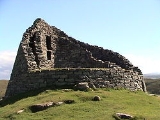
Dun Carloway
Ironageroof
Classically, the Iron Age is taken to begin in the 12th century BC in the ancient Near East
Ancient Near East

The Ancient Near East refers to early civilizations within a region roughly corresponding to the modern Middle East: Mesopotamia , Fars Province, Elam and Medes , Anatolia , the Levant , and Ancient Egypt, from the rise of Sumer in the 4th millennium BCE until the region's conquest by Alexander the Great in the 4th century BCE, or covering both th...
, ancient Iran
Greater Iran

Greater Iran refers to the regions that have significant Iranian cultural influence. It roughly corresponds to the territory surrounding the Iranian plateau, stretching from the Caucasus to the Indus River, and conform to the historical understanding of the full territory of "Etymology of Iran."...
, ancient India
Ancient India

Ancient India may refer to:*The ancient History of India, which generally includes the ancient history of the whole Indian subcontinent ...
 (with the post-Rigvedic
Rigveda

The Rigveda is an ancient Indian subcontinent sacred collection of Vedic Sanskrit hymns dedicated to the Rigvedic deities . It is counted among the four canonical sacred texts of Hinduism known as the Vedas....
 Vedic civilization), and ancient Greece
Ancient Greece

The term Ancient Greece refers to the period of History of Greece lasting from the Greek Dark Ages ca. 1100 BC and the Dorian invasion, to 146 BC and the Roman Republic conquest of Greece after the Battle of Corinth ....
 (with the Greek Dark Ages
Greek Dark Ages

The Greek Dark Ages refers to Greek history from the presumed Dorian invasion and end of the Mycenaean civilization in the 12th century BC, to the first Ancient Greece poleiss in the 9th century BC....
). In other regions of Europe
Europe

Europe is, conventionally, one of the world's seven continents. Comprising the westernmost peninsula of Eurasia, Europe is generally divided from Asia to its east by the water divide of the Ural Mountains, the Ural , the Caspian Sea, and by the Caucasus Mountains to the southeast....
, it started much later. The Iron Age began in the 8th century BC in Central Europe and the 6th century BC in Northern Europe
Pre-Roman Iron Age

The Pre-Roman Iron Age of Northern Europe designates the earliest part of the Iron Age in Scandinavia, northern Germany, and the Netherlands north of the Rhine River....
. Iron use, in smelting
Smelting

Smelting is a form of extractive metallurgy; its main use is to produce a metal from its ore. This includes iron extraction from iron ore, and copper extraction and other base metals from their ores....
 and forging for tools, appears in West Africa by 1200 BC, making it one of the first places for the birth of the Iron Age. However, it is still not determined whether the use of iron in Africa was invented independently there or was the result of technology transfer from the north.

The Iron Age is divided into two subsections, Iron I and Iron II. Iron I (1200–1000 BC) illustrates both continuity and discontinuity with the previous Late Bronze Age. There is no definitive cultural break between the thirteenth and twelfth century throughout the entire region, although certain new features in the hill country, Transjordan and coastal region may suggest the appearance of the Aramaean and Sea People groups. There is evidence, however, that shows strong continuity with Bronze Age culture, although as one moves later into Iron I the culture begins to diverge more significantly from that of the late second millennium.

The Iron Age is usually said to end in the Mediterranean with the onset of historical tradition during Hellenism
Hellenistic period

The Hellenistic period describes the era which followed the conquests of Alexander the Great. During this time, Greek cultural influence and power was at its zenith in Europe and Asia....
 and the Roman Empire, in India with the onset of Buddhism and Jainism
Jainism

Jainism is one of the oldest Indian religions that originated in India. Jains believe that every soul is divine and has the potential to achieve God-consciousness....
, in China with the onset of Confucianism
Confucianism

Confucianism is a China Ethics and Philosophy developed from the teachings of the Chinese philosopher Confucius . It focuses on human morality and right action....
, and in Northern Europe with the early Middle Ages
Early Middle Ages

The Early Middle Ages is a period in the history of Europe following the fall of the Western Roman Empire spanning roughly five centuries from AD 500 to 1000....
.

The arrival of iron use in various areas is discussed in more detail below, broadly in chronological order.

Iron use in the Bronze Age

By the Middle Bronze Age, increasing numbers of smelted iron objects (distinguishable from meteoric iron by the lack of nickel in the product) appeared throughout Anatolia
Anatolia

Anatolia or Asia Minor is a region of Western Asia, comprising most of the modern Republic of Turkey. It is a geographic region bounded by the Black Sea to the north, the Caucasus to the northeast, the Aegean Sea to the west, the Mediterranean Sea to the south, and the Iranian plateau to the east and southeast....
, Mesopotamia
Mesopotamia

Mesopotamia is the area of the Tigris-Euphrates river system, along the Tigris and Euphrates rivers, largely corresponding to modern Iraq, as well as some parts of northeastern Syria, some parts of southeastern Turkey, and some parts of the Khuzestan Province of southwestern Iran....
, the Indian subcontinent
Indian subcontinent

The Indian subcontinent is a large section of the Asian continent consisting of the land lying substantially on the Indian Plate. The subcontinent includes parts of various countries in South Asia, including those on the continental crust , an Island#Continental islands country on the continental shelf , and an Island#Oceanic islands countr...
, the Levant, the Mediterranean, and Egypt. Some sources suggest that iron was being created in some places then as a byproduct of copper refining, as sponge iron
Sponge iron

Sponge iron, also called direct reduced iron, is the product created when iron ore is redox to metallic iron, usually with some kind of carbon , at temperatures below the melting point of iron....
, and was not reproducible by the metallurgy of the time.

The earliest systematic production and use of iron implements originates in Anatolia. African production of iron has been suggested to have begun at around the same time, and possibly even before Anatolia, although the claims are still controversial. Recent archaeological research at Ganges Valley, India showed early iron working by 1800 BC. By 1200 BC, iron was widely used in the Middle East
Middle East

File:GreaterMiddleEast1.pngThe Middle East is a region that spans southwestern Asia, western Asia, and northeastern Africa. It has no clear boundaries, often used as a synonym to Near East, in opposition to Far East....
 but did not supplant the dominant use of bronze
Bronze

Bronze is a metal alloy consisting primarily of copper, usually with tin as the main additive, but sometimes with other chemical element such as phosphorus, manganese, aluminium, or silicon....
 for some time.

Transition from bronze to iron

Bronze was previously used to make tools because its melting point is lower than that of iron. The Iron Age began with the development of higher temperature smelting techniques. During the Iron Age, the best tools and weapons were made from steel, an alloy consisting of iron with a carbon
Carbon

Carbon is a chemical element with chemical symbol C and atomic number 6. As a member of group 14 on the periodic table, it is nonmetallic and tetravalence?making four electrons available to form covalent bond chemical bonds....
 content between 0.02% and 1.7% by weight. Steel
Steel

Steel is an alloy consisting mostly of iron, with a carbon content between 0.2% and 2.14% by weight , depending on grade. Carbon is the most cost-effective alloying material for iron, but various other alloying elements are used such as manganese, chromium, vanadium, and tungsten....
 weapons and tools were nearly the same weight as those of bronze
Bronze

Bronze is a metal alloy consisting primarily of copper, usually with tin as the main additive, but sometimes with other chemical element such as phosphorus, manganese, aluminium, or silicon....
, but stronger. However, steel was difficult to produce with the methods available. Therefore, many Iron Age tools were fashioned of wrought iron
Wrought iron

Wrought iron is commercially pure iron. In contrast to steel, it has a very low carbon content. It is a fibrous material due to the slag Inclusion ....
. Wrought iron is weaker than bronze, but because it was less expensive, and more easily sharpened, people used it anyway. Iron is by itself an adequately strong metal without additional alloys (although it could be further strengthened by case-hardening or forge welding
Forge welding

Forge welding is a welding process of heating two or more pieces of metal and then hammering them together. The process is one of the simplest methods of joining metals and has been used since ancient times....
 small amounts of steel to areas subject to wear such as edges). Bronze, on the other hand, requires copper and tin, which are less common than iron. Additionally, iron can be sharpened by grinding whereas bronze must be reforged.

Around 1800 BC, for reasons yet unknown to archaeologists, tin became scarce in the Levant, causing a decline in bronze production. Copper, also, came to be in short supply. As a result, pirate groups around the Mediterranean, from around 1800–1700 BC onward, began to attack fortified cities in search of bronze, to remelt into weaponry.

Bronze was much more abundant in the period before the 12th to 10th century and Snodgrass suggests that a shortage of tin, as a result of the trade disruptions
Bronze Age collapse

The Bronze Age collapse is the name given by those historians who see the transition from the Bronze Age to the Iron Age, as violent, sudden and culturally disruptive, expressed by the collapse of palace economy of the Aegean Region and Anatolia, which were replaced after a hiatus by the isolated village cultures of the Dark Ages of the Ancie...
 in the Mediterranean at this time, forced peoples to seek an alternative to bronze. That many bronze items were recycled and made from implements into weapons during this time, is evidence of this.

Ancient Near East


Transition

The Iron Age in the Ancient Near East
Ancient Near East

The Ancient Near East refers to early civilizations within a region roughly corresponding to the modern Middle East: Mesopotamia , Fars Province, Elam and Medes , Anatolia , the Levant , and Ancient Egypt, from the rise of Sumer in the 4th millennium BCE until the region's conquest by Alexander the Great in the 4th century BCE, or covering both th...
 is believed to have begun with the discovery of iron smelting and smithing techniques in Anatolia
Anatolia

Anatolia or Asia Minor is a region of Western Asia, comprising most of the modern Republic of Turkey. It is a geographic region bounded by the Black Sea to the north, the Caucasus to the northeast, the Aegean Sea to the west, the Mediterranean Sea to the south, and the Iranian plateau to the east and southeast....
 or the Caucasus in the late 2nd millennium BC (circa 1300 BC).

The use of iron weapons instead of bronze weapons spread rapidly throughout the Near East by the beginning of the 1st millennium BC. Anatolians had begun forging weapons out of iron, which was a superior metal to bronze, by 1500 BC at the latest.

The use of iron weapons by the Hittites
Hittites

The Hittites were an ancient Anatolian people who spoke a Hittite language of the Anatolian languages of the Indo-European languages family, and established a kingdom centered at Hattusa in north-central Anatolia ca....
 was believed to have been a major factor in the rapid rise of the Hittite Empire. Because the area in which iron technology first developed was near the Aegean
Aegean Sea

The Aegean Sea is an elongated embayment of the Mediterranean Sea located between the southern Balkans and Anatolian peninsulas, i.e., between the mainlands of Greece and Turkey respectively....
, the technology expanded into both Asia and Europe simultaneously, aided by Hittite expansion. The Sea Peoples
Sea Peoples

The Sea Peoples is the term used for a confederacy of seafaring raiders of the second millennium BC who sailed into the eastern shores of the Mediterranean, caused political unrest, and attempted to enter or control Egyptian territory during the late Nineteenth dynasty of Egypt, and especially during Year 8 of Ramesses III of the Twentieth dy...
 and the related Philistines
Philistines

The Philistines were a ethnic group who occupied the southern coast of Canaan, their territory being named Philistia in later contexts....
 are often associated with the introduction of iron technology into Asia, as are the Dorians with respect to Greece
Ancient Greece

The term Ancient Greece refers to the period of History of Greece lasting from the Greek Dark Ages ca. 1100 BC and the Dorian invasion, to 146 BC and the Roman Republic conquest of Greece after the Battle of Corinth ....
.

Finds of Iron
Early examples and distribution of non precious metal finds.

Date Crete Aegean Greece Cyprus Total Anatolia Grand total
        
1300–1200 BC5290163365
1200–1100 BC1282637N.A.74
1100–1000 BC133313380N.A.160
1000–900 BC3730115291.40N.A.211
Total Bronze Age5290163365
Total Iron Age513516388337N.A.511


Assyria


Levant


Anatolia


Aegean


Egypt


Indian subcontinent


Archaeological sites in India, such as Malhar, Dadupur, Raja Nala Ka Tila and Lahuradewa in present day Uttar Pradesh
Uttar Pradesh

Uttar Pradesh , [often referred to as U.P.] is a States and territories of India located in the northern part of India. With a population of over 190 million people,...
 show iron implements in the period 1800 BC – 1200 BC. Some scholars believe that by the early 13th century BC, iron smelting was practiced on a bigger scale in India, suggesting that the date the technology's inception may be earlier.

The beginning of the 1st millennium BC saw extensive developments in iron metallurgy in India. Technological advancement and mastery of iron metallurgy was achieved during this period of peaceful settlements. An iron working centre in east India
East India

East India, or more properly Eastern India, is a List_of_regions_in_India of India consisting of the states of West Bengal, Bihar, Jharkhand, and Orissa....
 is dated to the first millennium BC.

In Southern India (present day Mysore
Mysore

Mysore ; renamed to Mysuru|??????) is the second largest city in the state of Karnataka, India. It is the headquarters of the Mysore district and the Mysore division and lies about southwest of Bangalore, the capital of Karnataka....
) iron appeared as early as 11th to 12th centuries BC; these developments were too early for any significant close contact with the northwest of the country.

The Indian Upanishad
Upanishad

The Upanishads are Hindu scriptures that constitute the core teachings of Vedanta. They do not belong to any particular period of Sanskrit literature: the oldest, such as the Brhadaranyaka and Chandogya Upanishads, date to the late Brahmana period , while the latest were composed in the medieval and early modern period....
s mention weaving, pottery, and metallurgy.

The Indian Mauryan period saw advances in metallurgy.

As early as 300 BC, certainly by AD 200, high quality steel was produced in southern India, by what would later be called the crucible technique
Crucible steel

Crucible steel describes a number of different techniques for making steel alloy by slowly heating and cooling pure iron and carbon in a crucible....
. In this system, high-purity wrought iron, charcoal, and glass were mixed in crucible and heated until the iron melted and absorbed the carbon.

East Asia


China

In 1972, near the city of Gaocheng
Gaocheng

Gaocheng is a county-level city belonging to Shijiazhuang, Hebei, People's Republic of China. The city has an area of 836 km? and a population of 743,000....
in Shijiazhuang
Shijiazhuang

Shijiazhuang is a prefecture-level city and the Capital of Hebei Province of China, China. It is about 320 km south of Beijing.Shijiazhuang is a newly industrialized city....
 (now Hebei
Hebei

For the people of Hebei, see Hebei people is a North China province of China of the People's Republic of China. Its one-Chinese character abbreviation is "" , named after Ji Province , a Han Dynasty province that included southern Hebei....
 province), an iron-bladed bronze
Bronze

Bronze is a metal alloy consisting primarily of copper, usually with tin as the main additive, but sometimes with other chemical element such as phosphorus, manganese, aluminium, or silicon....
 tomahawk
Tomahawk (axe)

A tomahawk is a type of axe native to North America, traditionally resembling a hatchet with a straight shaft. The name came into the English language in the 17th century as a transliteration of the Virginian Eastern Algonquian languages word....
dating back to the 14th century BC was excavated. After a scientific examination, the iron was shown to be made from meteor
METEOR

METEOR is a Metrics for the evaluation of machine translation output. The metric is based on the harmonic mean of unigram precision and recall, with recall weighted higher than precision....
ic siderite
Siderite

Siderite is also the name of a type of iron meteorite.----Siderite is a mineral composed of iron carbonate ironcarbonoxygen3....
. The Iron Age in East Asia began in earnest, however, when cast-iron objects appeared in Yangzi Valley toward the end of the 6th century BC. The few objects were found at Changsha and Nanjing. According to the mortuary evidence suggests that the initial use of iron in Lingnan belongs to the mid to late Warring States period (from about 350 BC).

The techniques used in Lingnan is a combination of bivalve moulds of distinct southern tradition and the incorporation of piece mould technology from the Zhongyuan The products of the combination of these two periods are bells, vessels, weapons and ornaments and the sophisticated cast.

An Iron Age culture of the Tibetan Plateau
Tibetan Plateau

The Tibetan Plateau , also known as the Qinghai-Tibetan Plateau is a vast, elevated plateau in Central Asia covering most of the Tibet Autonomous Region and Qinghai Province in China and Ladakh in Kashmir, India....
 has tentatively been associated with the Zhang Zhung culture
Zhang Zhung culture

Zhang Zhung, Shang Shung, or Tibetan Pinyin Xang Xung, was an ancient culture of western and northwestern Tibet, which pre-dates the culture of Tibetan Buddhism in Tibet....
 described in early Tibetan writings.

Japan

The is an era in the history of Japan
History of Japan

The written history of Japan begins with brief references of Twenty-Four Histories, a collection of Chinese historical texts, in the 1st century AD....
 from about 500 BC to 300 AD. Distinguishing characteristics of the Yayoi period include the appearance of new pottery styles and the start of an intensive rice agriculture in paddy fields. The Yayoi followed the Jomon period (14,000 BC to 500 BC) and Yayoi culture flourished in a geographic area from southern Kyushu
Kyushu

or Kyushu is the third-largest island of Japan and most southwesterly of its Japanese Archipelago. Its alternate ancient names include Kyukoku , Chinzei , and Tsukushi-no-shima ....
 to northern Honshu
Honshu

or Honshu is the largest island of Japan. The nation's main island, it is south of Hokkaido across the Tsugaru Strait, north of Shikoku across the Inland Sea, and northeast of Kyushu across the Kanmon Strait....
.

The succeeding lasts from around 250 to 538. The word kofun is Japanese for the type of burial mound
Tumulus

A tumulus is a mound of Soil and Rock s raised over a Grave or graves. Tumuli are also known as barrows, burial mounds, H?gelgrab or kurgans, and can be found throughout much of the world....
s dating from this era. The Kofun and the subsequent Asuka period
Asuka period

The , was a period in the history of Japan lasting from 538 to 710 , although its beginning could be said to overlap with the preceding Kofun period. The Yamato polity evolved much during the Asuka period, which is named after the Asuka, Yamato region, about 25 km south to the modern city of Nara, Nara....
s are sometimes referred to collectively as the Yamato period
Yamato period

The is the period of history of Japan when the Japanese Imperial court ruled from modern-day Nara Prefecture, then known as Yamato Province.While conventionally assigned to the period 250?710 , the actual start of Yamato rule is disputed....
.

Korea

Iron objects were introduced to the Korean peninsula
Korean Peninsula

The Korean Peninsula is a peninsula in East Asia. It extends southwards for about 684 miles from continental Asia into the Pacific Ocean and is surrounded by the Sea of Japan on the east, the East China Sea to the south, and the Yellow Sea to the west, the Korea Strait connecting the first two bodies of water....
 through trade with chiefdoms and state-level societies in the Yellow Sea
Yellow Sea

The Yellow Sea is the name given to the northern part of the East China Sea, which is a marginal sea of the Pacific Ocean. It is located between mainland China and the Korean peninsula....
 area in the fourth century BC, just at the end of the Warring States Period but before the Western Han Dynasty
Han Dynasty

The Han Dynasty followed the Qin Dynasty and preceded the Three Kingdoms in China. The Han Dynasty was ruled by the family known as the Liu clan who had peasant origins....
 began. Yoon proposes that iron was first introduced to chiefdoms located along North Korean river valleys that flow into the Yellow Sea such as the Cheongcheon and Taedong Rivers. Iron production quickly followed in the 2nd century BC, and iron implements came to be used by farmers by the 1st century AD in southern Korea. The earliest known cast-iron axes in southern Korea are found in the Geum River
Geum River

The Geum-gang River is located in South Korea. It is a major river that originates in Jangsu-eub, North Jeolla Province. It flows northward through North Jeolla and North Chungcheong Provinces and then changes direction in the vicinity of Greater Daejeon and flows southwest through South Chungcheong Province before emptying into the Yellow S...
 basin. The time that iron production begins is the same time that complex chiefdoms of Proto-historic Korea
Samhan

Samhan refers to the ancient confederacies of Mahan confederacy, Jinhan confederacy, and Byeonhan confederacy in central and southern Korean peninsula, which were eventually absorbed into two of the Three Kingdoms of Korea....
 emerged. The complex chiefdoms were the precursors of early states such as Silla
Silla

Silla was one of the Three Kingdoms of Korea, and the longest sustaining dynasty in Asian history. Although it was founded by King Bak Hyeokgeose of Silla, who is also known to be the originator of the Korean family name Park , the dynasty was to see the Kyungju Kim clan hold rule for most of its 992-year history....
, Baekje
Baekje

Baekje , or Paekche , was a kingdom located in southwest Korea. It was one of the Three Kingdoms of Korea, together with Goguryeo and Silla....
, Goguryeo
Goguryeo

Goguryeo or Koguryo was an ancient Koreans Empire located in the northern and central parts of the Korean peninsula, southern Manchuria, and southern Primorsky Krai....
, and Gaya
Gaya

Gaya may refer to:*Gaya Confederacy, an ancient Korean league of statelets*Gaya District, India*Gaya, India, a city in India*Gaya, Niger, a city in Niger...
 Iron ingots were an important mortuary item and indicated the wealth or prestige of the deceased in this period.

Europe

Iron working was introduced to Europe around 1000 BC, probably from Asia Minor and slowly spread northwards and westwards over the succeeding 500 years.

Eastern Europe

The early 1st millennium BC marks the Iron Age in Eastern Europe. In the Pontic steppe and the Caucasus region, the Iron Age begins with the Koban
Koban culture

The Koban culture is a late Bronze Age and Iron Age culture of the northern and central Caucasus. It is preceded by the Colchian culture of the western Caucasus....
 and the Chernogorovka and Novocherkassk
Novocherkassk culture

The Chernogorovka and Novocherkassk cultures are Iron Age steppe cultures in Ukraine and Russia, centered between the Prut and the lower Don River, Russia....
 cultures from ca. 900 BC. By 800 BC, it was spreading to Hallstatt C
Hallstatt culture

The Hallstatt culture was the predominant Central European culture from the 8th to 6th centuries BC , developing out of the Urnfield culture of the 12th century BC and followed in much of Central Europe by the La T?ne culture....
 via the alleged "Thraco-Cimmerian
Thraco-Cimmerian

Thraco-Cimmerian is a historiographical and archaeological term, composed of the names of the Thracians and the Cimmerians. It refers to 8th century BC to 7th century BC century BC cultures that are linked in Eastern Central Europe and in the area north of the Black Sea....
" migrations.

Along with Chernogorovka and Novocherkassk cultures, on the territory of ancient Russia and Ukraine
Ukraine

Ukraine is a country in Eastern Europe. It is bordered by Russia to the east; Belarus to the north; Poland, Slovakia, and Hungary to the west; Romania and Moldova to the southwest; and the Black Sea and Sea of Azov to the south....
 the Iron Age is to a significant extent associated with Scythians, who developed iron culture since the 7th century BC. The majority of remains of their iron producing and blacksmith's industries from 5th to 3rd century BC was found near Nikopol
Nikopol

Nikopol is a city in Ukraine, in the Dnipropetrovsk Oblast, on the right bank of Dnieper river, about 100 km south-west of Dnipropetrovsk. It has about 128,900 inhabitants ....
 in Kamenskoe Gorodishche, which is believed to be the specialized metallurgic
Metallurgy

Metallurgy is a domain of materials science that studies the physical and chemical behavior of metallic Chemical element, their intermetallics, and their mixtures, which are called alloys....
 region of the ancient Scythia
Scythia

The Scythians or Scyths were an Eastern Iranian languages of Equestrianism nomadic pastoralists who dominated the Pontic steppe throughout Classical Antiquity....
.

From the Hallstatt culture, the Iron Age spreads west with the Celt
Celt

Celts , is a modern term used to describe any of the European peoples who spoke, or speak, a Celtic languages. The term is also used in a wider sense to describe the Modern Celts of those peoples, notably those who participate in a Celtic culture....
ic expansion from the 6th century BC. In Poland, the Iron Age reaches the late Lusatian culture
Lusatian culture

The Lusatian culture existed in the later Bronze Age and early Iron Age in eastern Germany, most of Poland, parts of Czech Republic and Slovakia and parts of Ukraine....
 in about the 6th century, followed in some areas by the Pomerania
Pomerania

Pomerania is a historical region on the south coast of the Baltic Sea. Divided between Germany and Poland, it stretches roughly from the Recknitz River near Stralsund in the West, via the Oder River delta near Szczecin, to the mouth of the Vistula River near Gdansk in the East....
n culture.

The ethnic ascriptions of many Iron Age cultures has been bitterly contested, as the roots of Germanic
Germanic peoples

File:Germanische-ratsversammlung 1-1250x715.jpgThe Germanic peoples are a historical Ethnolinguistics group, originating in Northern Europe and identified by their use of the Indo-European languages Germanic languages which diversified out of Common Germanic in the course of the Pre-Roman Iron Age....
, Baltic
Balts

For the similarly named ethnic group inhabiting northern Pakistani Kashmir, see Balti peopleThe Balts or Baltic peoples , defined as speakers of one of the Baltic languages, a branch of the Indo-European languages family, are descended from a group of Indo-Europeans tribes who settled the area between lower Vistula and upper D...
 and Slavic peoples were sought in this area.

Central Europe

In Central Europe, the Iron Age is generally divided in the early Iron Age Hallstatt culture
Hallstatt culture

The Hallstatt culture was the predominant Central European culture from the 8th to 6th centuries BC , developing out of the Urnfield culture of the 12th century BC and followed in much of Central Europe by the La T?ne culture....
 (HaC and D, 800–450) and the late Iron Age La Tθne culture
La Tθne culture

The La T?ne culture was a European Iron Age culture named after the archaeological site of La T?ne, Marin-Epagnier on the north side of Lake Neuch?tel in Switzerland, where a rich trove of artifacts was discovered by Hansli Kopp in 1857....
 (beginning in 450 BC). The Iron Age ends with the Roman Conquest.

Italy

In Italy, the Iron Age was probably introduced by the Villanovan culture
Villanovan culture

The Villanovan culture was the earliest Iron Age culture of central and northern Italy, abruptly following the Bronze Age Terramare culture and giving way in the seventh century BC to an increasingly orientalizing culture influenced by Greeks traders, which was followed without a severe break by the Etruscan civilization....
 but this culture is otherwise considered a Bronze Age culture, while the following Etruscan civilization
Etruscan civilization

Etruscan civilization is the modern English name given to the culture and way of life of a people of ancient Italy and Corsica whom the ancient Romans called Etrusci or Tusci....
 is regarded as part of Iron Age proper. The Etruscan Iron Age was then ended with the rise and conquest of the Roman Republic
Roman Republic

The Roman Republic was the phase of the Ancient Rome characterized by a republican form of government; a period which began with the overthrow of the Roman Roman Kingdom, c....
, which conquered the last Etruscan city of Velzna in 265 BC.

British Isles

In the British Isles
British Isles

The British Isles are a group of islands off the northwest coast of continental Europe that include Great Britain and Ireland, and numerous smaller islands....
, the Iron Age lasted from about 800 BC until the Roman conquest and until the 5th century AD in non-Romanised parts. Structures dating from this time are often impressive, for example the broch
Broch

A Broch is an Iron Age drystone hollow-walled structure of a type found only in Scotland. Brochs include some of the most sophisticated examples of drystone architecture ever created, and belong to the classification "complex atlantic roundhouse" devised by Scottish archaeologists in the 1980s....
s and dun
Dun

Dun is now used both as a generic term for a fort and also for a specific variety of Atlantic roundhouse. In some areas they seem to have been built on any suitable crag or hillock, particularly south of the Firth of Clyde and the Firth of Forth down across the border into Northumberland....
s of northern Scotland
Scotland

conventional_long_name = ScotlandAlba|common_name= Scotland|image_flag = Flag of Scotland.svg|flag_width = 130px...
 and the hill fort
Hill fort

A hill fort is type of fortification refuge or defended settlement, located to exploit a rise in elevation for defensive advantage. They are typically European and of the Bronze Age and Iron Ages....
s that dotted the island
Island

An island or isle is any piece of land that is surrounded by water. Very small islands such as emergent land features on atolls are called islets....
s.

Northern Europe

The Iron Age is divided into the Pre-Roman Iron Age
Pre-Roman Iron Age

The Pre-Roman Iron Age of Northern Europe designates the earliest part of the Iron Age in Scandinavia, northern Germany, and the Netherlands north of the Rhine River....
 and the Roman Iron Age
Roman Iron Age

The Roman Iron Age is the name that Sweden archaeologist Oscar Montelius gave to a part of the Iron Age in Scandinavia, Northern Germany and the Netherlands....
. This is followed by the migration period
Migration Period

The Migration Period, also called Barbarian Invasions or V?lkerwanderung , was a period of human migration which occurred within the period of roughly 300?700 Common Era in Europe, marking the transition from Late Antiquity to the Early Middle Ages....
. Northern Germany and Denmark was dominated by the Jastorf culture
Jastorf culture

The Jastorf culture is an Iron Age material culture in what is now north Germany, spanning the 6th to 1st centuries BC, forming the southern part of the Pre-Roman Iron Age...
, whereas the culture of the southern half of the Scandinavia was dominated by the very similar Gregan Iron Age.

Early Scandinavian iron production typically involved the harvesting of bog iron
Bog iron

Bog iron refers to impure iron deposits that develop in bogs or swamps by the chemical or biochemical oxidation of iron carried in the solutions....
. Scandinavian peninsula, Finland
Finland

Finland , officially the Republic of Finland , is a Nordic countries situated in the Fennoscandian region of northern Europe. It borders Sweden on the west, Russia on the east, and Norway on the north, while Estonia lies to its south across the Gulf of Finland....
 and Estonia
Estonia

Estonia , officially the Republic of Estonia is a country in the Baltic region of Northern Europe. It is bordered to the north by Finland across the Gulf of Finland, to the west by Sweden across the Baltic Sea, to the south by Latvia , and to the east by the Russia ....
 show sophisticated iron production very early, but further dating is currently impossible. The range varies from 3000–2000 BP. This knowledge is associated with the non-Germanic part of Scandinavia. Metalworking and Asbestos-Ceramic
Asbestos-Ceramic

Asbestos-Ceramic refers to types of pottery manufactured with asbestos and clay with Adiabatic_process behaviour in Finland, Karelia and Northern-Scandinavia....
 pottery are somewhat synonymous in Scandinavia
Scandinavia

Scandinavia is a historical and geographical subregion in northern Europe that includes the Scandinavian Peninsula. It consists of the kingdoms of Norway, Sweden, and Denmark; some authorities also include Finland and some might even include Iceland....
 due to the latter's capacity to resist and retain heat. The iron ore used is believed to have been iron sand
Iron Sand

Iron sand may refer to:* Black sand - sand contain iron particles* List of minor Naruto characters#Third Kazekage - a character in Naruto...
 (such as red soil), because its high phosphorus content can be identified in slag
Slag

Slag is a partially vitreous by-product of smelting ore to purify metals. They can be considered to be a mixture of metal oxides; however, they can contain metal sulfides and metal atoms in the elemental form....
. They are sometimes found together with asbestos ware axes belonging to the Ananjino Culture. The Asbestos-Ceramic ware remains a mystery, because there are other adiabatic vessels with unknown usage.

Sub-Saharan Africa

Inhabitants at Termit, in eastern Niger
Niger

Niger , officially the Republic of Niger, is a landlocked country in Western Africa, named after the Niger River. It borders Nigeria and Benin to the south, Burkina Faso and Mali to the west, Algeria and Libya to the north and Chad to the east....
 became the first iron smelting
Smelting

Smelting is a form of extractive metallurgy; its main use is to produce a metal from its ore. This includes iron extraction from iron ore, and copper extraction and other base metals from their ores....
 people in West Africa and among the first in the world around 1500 BC. Iron and copper working then continued to spread southward through the continent, reaching the Cape
Cape of Good Hope

The Cape of Good Hope is a rocky headlands and bays on the Atlantic Ocean coast of South Africa. There is a very common misconception that the Cape of Good Hope is the southern tip of Africa and the dividing point between the Atlantic Ocean and Indian Oceans, but in fact the southernmost point is Cape Agulhas, about 150 kilometres t...
 around AD 200. The widespread use of iron revolutionized the Bantu
Bantu languages

The Bantu languages constitute a grouping belonging to the Niger-Congo languages family. This grouping is deep down in the genealogical tree of the Bantoid grouping, which in turn is deep down in the Niger-Congo tree....
-speaking farming communities who adopted it, driving out and absorbing the rock tool using hunter-gatherer societies they encountered as they expanded to farm wider areas of savanna
Savanna

A savanna, or savannah, is a tropical, subtropical or temperate woodland ecosystem characterized by the trees being sufficiently small or widely spaced so that the Canopy does not close....
h. The technologically superior Bantu-speakers spread across southern Africa and became wealthy and powerful, producing iron for tools and weapons in large, industrial quantities.

See also

  • List of archaeological periods
    List of archaeological periods

    Names for archaeological periods vary enormously from region to region. This is a list of the main divisions by continent and region. Dating also varies considerably and those given are broad approximations across wide areas....
  • List of archaeological sites
  • History of ferrous metallurgy
    History of ferrous metallurgy

    The history of ferrous metallurgy began far back in prehistory, most likely with the use of iron from meteorites. The smelting of iron in bloomery began in the 12th century BC in India, Anatolia or the Caucasus....
  • Synoptic table of the principal old world prehistoric cultures
    Synoptic table of the principal old world prehistoric cultures

    The synoptic table of the principal old world prehistoric cultures gives a rough picture of the relationships between the various principal Archaeological culture of Prehistory outside the Americas, Antarctica, Australia and Oceania....
  • Fogou
    Fogou

    The word Fogou or Fougou as it can also be spelt, derives from 'fogo' which was the Cornish language word for cave. A fogou is an underground structure which is found in many Iron Age defended settlements throughout northern Europe including Cornwall and in northern Scotland including the Orkney Islands....
  • Iron
    Iron

    Iron is a chemical element with the symbol Fe and atomic number 26. Iron is a Group 8 element and period 4 element. Iron is lustrous and silvery in color....
  • Smelting
    Smelting

    Smelting is a form of extractive metallurgy; its main use is to produce a metal from its ore. This includes iron extraction from iron ore, and copper extraction and other base metals from their ores....
  • Blast furnace
    Blast furnace

    A blast furnace is a type of metallurgy furnace used for smelting to produce metals, generally iron.In a blast furnace, fuel and ore are continuously supplied through the top of the furnace, while air is blown into the bottom of the chamber, so that the chemical reactions take place throughout the furnace as the material moves downward....
  • Three age system
  • Smith (metalwork)
    Smith (metalwork)

    A smith, or metalsmith, is a person involved in the shaping of metal objects.In Pre-Industrial Era times, smiths held high or special social standing since they supplied the metal tools needed for farming and warfare....
  • Roman metallurgy
    Roman metallurgy

    Metals and metal working had been known to the people of modern Italy since the Bronze Age. By 86 BC, Rome had already expanded to control an immense expanse of the Mediterranean....


External links

  • from resourcesforhistory.com