

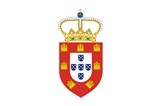
Portuguese Empire

Encyclopedia
The Portuguese Empire also known as the Portuguese Overseas Empire (Ultramar Português) or the Portuguese Colonial Empire (Império Colonial Português), was the first global empire in history. In addition, it was the longest-lived of the modern Europe
an colonial
empires, spanning almost six centuries, from the capture of Ceuta
in 1415 to the handover of Macau
in 1999. The empire spread throughout a vast number of territories that are now part of 53 different sovereign states.
Portuguese sailors began exploring the coast of Africa
in 1419, using recent developments in navigation
, cartography
and maritime technology such as the caravel
, in order that they might find a sea route to the source of the lucrative spice trade
. In 1488, Bartolomeu Dias
rounded the Cape of Good Hope
, and in 1498, Vasco da Gama
reached India. In 1500, by an accidental landfall on the South America
n coast for some, by the crown's secret design for others, Pedro Álvares Cabral
discovered Brazil
. Over the following decades, Portuguese sailors continued to explore the coasts and islands of East Asia, establishing forts
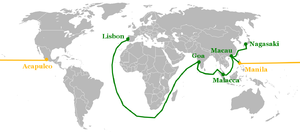
and factories as they went. By 1571, a string of outposts connected Lisbon
to Nagasaki along the coasts of Africa
, the Middle East
, India
, and Asia
. This commercial network brought great wealth
to Portugal
.
Between 1580 and 1640 Portugal became the junior partner to Spain in the union
of the two countries' crowns. Though the empires continued to be administered separately, Portuguese colonies became the subject of attacks by three rival European powers hostile to Spain and envious of Iberian
successes overseas: the Netherlands
, Britain
and France
. With its smaller population, Portugal was unable to effectively defend its overstretched network of trading posts, and the empire began a long and gradual decline.
Significant losses to the Dutch in Portuguese India
and Southeast Asia
during the 17th century brought an end to the Portuguese trade monopoly in the Indian Ocean. Brazil became Portugal's most valuable colony until, as part of the wave of independence movements
that swept the Americas
during the early 19th century, it broke away in 1822. Portugal's Empire was reduced to its colonies on the African coastline (which were expanded inland during the Scramble for Africa
in the late 19th century), East Timor
, and enclaves in India and Macau.
After World War II
, Portugal's leader, António Salazar
, attempted to keep what remained of the pluricontinental Empire intact at a time when other European countries were beginning to withdraw from their colonies. In 1961 the handful of Portuguese troops garrisoned in Goa
were unable to prevent India
n troops marching into the colony. Salazar began a long and bloody war
to quell anti-colonialist forces in the African colonies. The unpopular war lasted until the overthrow of the regime in 1974
. The new government immediately changed policy and recognised the independence of all its colonies, except for Macau
, which by agreement with the Chinese government was returned to China in 1999, thereby marking the end of the Portuguese Empire. Currently, the Azores
and Madeira
archipelagos are the only territories overseas that remain politically linked to Portugal.
The Community of Portuguese Language Countries (CPLP) is the cultural successor of the Empire.
 The origins of the Portuguese Empire, and of Portugal itself, lay in the reconquista
: the gradual Christian
reconquest of the Iberian peninsula from the Moors
. After establishing itself as a separate kingdom
in 1139, Portugal completed its reconquest of Moorish territory by reaching Algarve in 1249, but its independence continued to be threatened by neighbouring Castile
until the signing of the Treaty of Ayllón
in 1411.
Free from threats to its existence and unchallenged by the wars fought by other European states, Portuguese attention turned overseas and towards a military expedition to the Muslim
lands of North Africa. There were several probable motives for their first attack, on the Marinid Sultanate (in present-day Morocco
): it offered the opportunity to continue the Christian crusade against Islam
; to the military class, it promised glory on the battlefield and the spoils of war; and finally, it was also a chance to expand Portuguese trade and to address Portugal's economic decline.
In 1415 an attack was made on Ceuta
, a strategically located North African Muslim enclave along the Mediterranean Sea
, and one of the terminal ports of the trans-Saharan gold and slave trades. The conquest
was a military success, and marked one of the first steps in Portuguese expansion beyond the Iberian Peninsula, but it proved costly to defend against the Muslim forces that soon besieged it. The Portuguese were unable to use it as a base for further expansion into the hinterland, and the trans-Saharan caravans merely shifted their routes to bypass Ceuta and/or used alternative Muslim ports.
 Although Ceuta proved to be a disappointment for the Portuguese, the decision was taken to hold it while exploring along the Atlantic African coast. A key supporter of this policy was Infante Dom
Henry the Navigator, who had been involved in the capture of Ceuta
, and who took the lead role in promoting and financing Portuguese maritime exploration until his death in 1460. At the time, Europeans did not know what lay beyond Cape Bojador
on the African coast. Henry wished to know how far the Muslim territories in Africa extended, and whether it was possible to reach Asia by sea, both to reach the source of the lucrative spice trade
and perhaps to join forces with the fabled Christian kingdom of Prester John
that was rumoured to exist somewhere in the "Indies". Under his sponsorship, soon the Atlantic islands of Madeira
(1420) and Azores
(1427) were reached and started to be settled producing wheat
to export to Portugal.
Fears of what lay beyond Cape Bojador
, and whether it was possible to return once it was passed, were assuaged in 1434 when it was rounded by one of Infante Henry's captains, Gil Eanes
. Once this psychological barrier had been crossed, it became easier to probe further along the coast.
In 1443 Infante Dom Pedro
, Henry's brother, granted him the monopoly of navigation, war and trade in the lands south of Cape Bojador. Later this monopoly would be enforced by the Papal bull
s Dum Diversas
(1452) and Romanus Pontifex
(1455), granting Portugal the trade monopoly for the newly discovered lands. A major advance which accelerated this project was the introduction of the caravel
in the mid-15th century, a ship that could be sailed closer to the wind than any other in operation in Europe at the time. Using this new maritime technology, Portuguese navigators reached ever more southerly latitude
s, advancing at an average rate of one degree a year. Senegal
and Cape Verde Peninsula were reached in 1445.
The first feitoria trade post overseas was established in 1445 on the island of Arguin
off the coast of Mauritania, to attract Muslim traders and monopolize the business in the routes traveled in North Africa. In 1446, António Fernandes pushed on almost as far as present-day Sierra Leone
and the Gulf of Guinea
was reached in the 1460s.
Expansion of sugarcane
in Madeira started in 1455, using advisers from Sicily
and (largely) Genoese
capital to produce the "sweet salt" rare in Europe
. Already cultivated in Algarve, the accessibility of Madeira attracted Genoese and Flemish traders keen to bypass Venetian monopolies. Slaves were used, and the proportion of imported slaves in Madeira reached 10% of the total population by the 16th century. "By 1480 Antwerp had some seventy ships engaged in the Madeira sugar trade, with the refining and distribution concentrated in Antwerp. By the 1490s Madeira had overtaken Cyprus as a producer of sugar."
The success of sugar merchants such as Bartolomeo Marchionni
would propel the investment in future travels.
In 1469, after prince Henry's death and as a result of meager returns of the African explorations, King Afonso V
granted the monopoly of trade in part of the Gulf of Guinea
to merchant Fernão Gomes
. Gomes, who had to explore 100 miles (160.9 km) of the coast each year for five years, discovered the islands of the Gulf of Guinea, including São Tomé and Príncipe
and found a thriving alluvial gold trade among the natives and visiting Arab and Berber traders at the port then named Mina
(the mine), where he established a trading post. Trade between Elmina and Portugal grew throughout a decade. In 1481, the recently-crowned João II
decided to build São Jorge da Mina in order to ensure the protection of this trade, which was held again as a royal monopoly. The Equator
was crossed by navigators sponsored by Fernão Gomes in 1473 and the Congo River
by Diogo Cão
in 1482. In 1486, Cão continued to Cape Cross
, in present-day Namibia
, near the Tropic of Capricorn
.
In 1488, Bartolomeu Dias
rounded the Cape of Good Hope
on the southern tip of Africa, proving false the view that had existed since Ptolemy
that the Indian Ocean
was land-locked. Simultaneously Pêro da Covilhã
, traveling secretly overland, had reached Ethiopia
, suggesting that a sea route to the Indies would soon be forthcoming.
As the Portuguese explored the coastlines of Africa, they left behind a series of padrões
, stone crosses engraved with the Portuguese coat of arms marking their claims, and built forts and trading posts. From these bases, they engaged profitably in the slave and gold trades. Portugal enjoyed a virtual monopoly on the African seaborne slave trade for over a century, importing around 800 slaves annually. Most were brought to the Portuguese capital Lisbon
, where it is estimated black Africans came to constitute 10 per cent of the population.
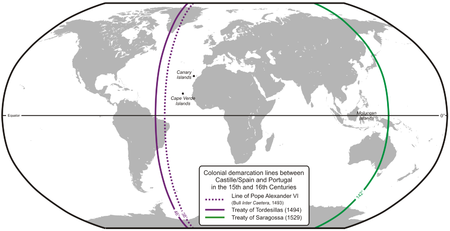 In 1492 Christopher Columbus
's discovery for Spain
of the New World
, which he believed to be Asia, led to disputes between the Spanish and Portuguese. These were eventually settled by the Treaty of Tordesillas
in 1494, which divided the world outside of Europe in an exclusive duopoly
between the Portuguese and the Spanish along a north-south meridian 370 leagues
, or 970 miles (1,561.1 km), west of the Cape Verde islands. However, as it was not possible at the time to correctly measure longitude
, the exact boundary was disputed by the two countries until 1777.
The completion of these negotiations with Spain is one of several reasons proposed by historians for why it took nine years for the Portuguese to follow up on Dias's voyage to the Cape of Good Hope, though it has also been speculated that other voyages were in fact taking place in secret during this time. Whether or not this was the case, the long-standing Portuguese goal of finding a sea route to Asia was finally achieved in a ground-breaking voyage commanded by Vasco da Gama
.
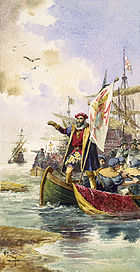 The squadron of Vasco da Gama
left Portugal in 1497, rounded the Cape and continued along the coast of East Africa, where a local pilot was brought on board who guided them across the Indian Ocean
, reaching Calicut (the capital of the native kingdom ruled by Zamorins) in south-western India
in May 1498. The second voyage to India was dispatched in 1500 under Pedro Álvares Cabral
. While following the same south-westerly route as Gama across the Atlantic Ocean, Cabral made landfall on the Brazilian coast. This was probably an accidental discovery, but it has been speculated that the Portuguese secretly knew of Brazil's existence and that it lay on their side of the Tordesillas line. Cabral recommended to the Portuguese King that the land be settled, and two follow up voyages were sent in 1501 and 1503. The land was found to be abundant in pau-brasil, or brazilwood
, from which it later inherited its name, but the failure to find gold or silver meant that for the time being Portuguese efforts were concentrated on India.
Profiting from the rivalry between the ruler of Kochi and the Zamorin of Calicut
, the Portuguese were well received and seen as allies, getting a permit to build a fort (Fort Manuel
) and a trading post that were the first European settlement in India. In 1505 King Manuel I of Portugal
appointed Francisco de Almeida
first Viceroy
of Portuguese India, establishing the Portuguese government in the east. That year the Portuguese conquered Kannur
where they founded St. Angelo Fort
. Lourenço de Almeida
arrived in Ceylon (modern Sri Lanka), where he discovered the source of cinnamon
.
In 1506 a Portuguese fleet under the command of Tristão da Cunha
and Afonso de Albuquerque
, conquered Socotra
at the entrance of the Red Sea
and Muscat
in 1507, having failed to conquer Ormuz, following a strategy intended to close the entrances to the Indian Ocean. That same year were built fortresses in the Island of Mozambique
and Mombasa
on the Kenyan coast. Madagascar
was partly explored by Tristão da Cunha
and in the same year Mauritius
was discovered.
In 1509, the Portuguese won the sea Battle of Diu
against the combined forces of the Ottoman
Sultan Beyazid II, Sultan of Gujarat
, Mamlûk Sultan of Cairo
, Zamorin of Kozhikode
, Venetian Republic, and Ragusan Republic (Dubrovnik). The Portuguese victory was critical for its strategy of control of the Indian Sea: Turks and Egyptians withdrew their navies from India, leaving the seas to the Portuguese, setting its trade dominance for almost a century, and greatly assisting the growth of the Portuguese Empire. It also marked the beginning of the European colonial dominance in Asia. A second Battle of Diu
in 1538 finally ended Ottoman ambitions in India and confirmed Portuguese hegemony in the Indian Ocean.
 Under the government of Albuquerque, Goa
was taken from the Bijapur sultanate in 1510 with the help of Hindu privateer
Timoji
. Coveted for being the best port in the region, mainly for the commerce of Arabian horses for the Deccan sultanates
, it allowed to move on from the guest stay in Kochi. Despite constant attacks, it became the headquarters of the Portuguese state in India, with its conquest triggering compliance of neighbor kingdoms: Gujarat and Calicut
sent embassies, offering alliances and grants to fortify. Albuquerque began that year in Goa the first Portuguese mint
in India, taking the opportunity to announce the achievement.
Initially king Manuel I and his council in Lisbon had tried to distribute power in the Indian Ocean, creating three areas of jurisdiction: Albuquerque was sent to the Red Sea, Diogo Lopes de Sequeira
to Southeast Asia, seeking an agreement with the Sultan of Malacca, and Jorge de Aguiar followed by Duarte de Lemos were sent to the area between the Cape of Good Hope and Gujarat. However, such posts were centralized by Afonso de Albuquerque and remained so in subsequent ruling.
 In 1505, Portuguese traders reached Ceylon; their initial forays were against Kotte, which enjoyed a lucrative monopoly
on the spice trade
, which was also of interest to the Portuguese. Although Cankili I
of Jaffna
initially resisted contact with them, the Jaffna kingdom
came to the attention of Portuguese officials soon after for their resistance to missionary activities as well as logistical reasons due to its proximity with Trincomalee
harbour among other reasons. In April 1511 Albuquerque sailed to Malacca
in Malaysia, the most important east point in the trade network where Malay met Gujarati, Chinese, Japanese, Javanese, Bengali, Persian and Arabic traders, among others, described by Tomé Pires
as of invaluable richness. The peninsula of Malacca became then the strategic base for Portuguese trade expansion with China and Southeast Asia, under the Portuguese rule with its capital at Goa. To defend the city was erected a strong gate which, called the "A Famosa", still remains. Knowing of Siamese ambitions over Malacca, Albuquerque sent immediately Duarte Fernandes
on a diplomatic mission to the kingdom of Siam
(modern Thailand), where he was the first European to arrive, establishing amicable relations between both kingdoms. In November that year, getting to know the location of the so-called "Spice Islands
" in the Moluccas, he sent an expedition led by António de Abreu
to find them, arriving in early 1512. Abreu went by Ambon while deputy commander Francisco Serrão
came forward to Ternate
, where a Portuguese fort was allowed. That same year, in Indonesia, the Portuguese took Makassar
, reaching Timor
in 1514. Departing from Malacca, Jorge Álvares
came to southern China
in 1513. This visit was followed the arrival in Guangzhou
. From 1516 on Portuguese traders established in Shangchuan Island
, until in 1557 the Ming court gave consent for a permanent official Portuguese trade base at Macau
.
The Portuguese empire expanded into the Persian Gulf as Portugal contested control of the spice trade with the Ottoman Empire
. In 1515, Afonso de Albuquerque
conquered the Huwala
state of Hormuz
at the head of the Persian Gulf, establishing it as a vassal state. Aden
, however, resisted Albuquerque's expedition in that same year, and another attempt by Albuquerque's successor Lopo Soares de Albergaria
in 1516, before capturing Bahrain
in 1521, when a force led by Antonio Correia
defeated the Jabrid King, Muqrin ibn Zamil
. In a shifting series of alliances, the Portuguese dominated much of the southern Persian Gulf for the next hundred years. With the regular maritime route linking Lisbon to Goa since 1497, the island of Mozambique
become a strategic port, and there was built Fort São Sebastião and an hospital. In the Azores, the Islands Armada protected the ships en route to Lisbon
In 1525, after Fernão de Magalhães's expedition (1519–1522), Spain under Charles V sent an expedition to colonize the Moluccas islands, claiming that they were in his zone of the Treaty of Tordesillas
, since there was not a set limit to the east. García Jofre de Loaísa
expedition reached the Moluccas, docking at Tidore
. The conflict with the Portuguese already established in nearby Ternate was inevitable, starting nearly a decade of skirmishes. An agreement was reached only with the Treaty of Zaragoza (1529)
, attributing the Moluccas to Portugal and the Philippines
to Spain.
In 1534 Gujarat was occupied by the Mughals and the Sultan Bahadur Shah of Gujarat
was forced to sign the Treaty of Bassein (1534)
with the Portuguese, establishing an alliance to regain the country, giving in exchange Daman, Diu, Mumbai
and Bassein. In 1538 the fortress of Diu is again surrounded by Ottoman ships. Another siege failed in 1547 putting an end to the Ottoman ambitions, confirming the Portuguese hegemony.
 In 1542 Jesuit missionary Francis Xavier
arrived in Goa at the service of King John III of Portugal
, in charge of an Apostolic Nunciature
. At the same time Francisco Zeimoto and other traders arrived in Japan
for the first time. According to Fernão Mendes Pinto
, who claimed to be in this journey, they arrived at Tanegashima
, where the locals were impressed by firearms
, that would be immediately made by the Japanese on a large scale. The Portuguese explorer Simão de Andrade started bad relations with China, due to his pirate activities, raiding Chinese shipping, attacking a Chinese official and kidnappings of Chinese. He based himself at Tamao island in a fort. The Chinese claimed that Simão kidnapped Chinese boys and girls to be molested and cannibalized. As a result, the Chinese posted an edict banning men with caucasian features from entering Canton.
The Chinese responded by killing multiple Portuguese in Canton and drove the Portuguese back to sea. After the Sultan of Bintan detained several Portuguese under Tomás Pires, the Chinese then executed 23 Portuguese and threw the rest into prison where they resided in squalid, sometimes fatal conditions. The Chinese then massacred Portuguese who resided at Ningbo
and Fujian
trading posts in 1545 and 1549, due to extensive and damaging raids by the Portuguese along the coast, which irritated the Chinese. As Portugal increased its presence along China's coast, they began trading in slaves
. Many Chinese slaves were sold to Portugal. Since the 16th century Chinese slaves existed in Portugal, most of them were Chinese children and a large amount were shipped to the Indies. Chinese prisoners were sent to Portugal, where they were sold as slaves, they were prized and regarded better than moorish and black slaves.
The first known visit of a Chinese person to Europe dates to 1540, when a Chinese scholar, enslaved during one of several Portuguese raids somewhere on the southern China coast, was brought to Portugal. Purchased by João de Barros
, he worked with the Portuguese historian on translating Chinese texts into Portuguese.
Chinese children were kidnapped in China, and through Macau
were brought to Portugal and sold as slaves either in Macau or overseas.
Mocquet noted that a lot of the Chinese in Portuguese India were slaves from Macau, since the Portuguese preferred Chinese as domestic household workers. Goa, Manila, and Malacca received slaves from Macau. Many different peoples were found in Goa, among the slaves, including those from Macau.
Most slaves from Macau sent to Goa or Malacca were children. The King of Portugal in 1624 issued a decree forbidding people to take Chinese as slaves. A 1571 law was passed by Portugal banning people from having Chinese slaves.
The Portuguese viceroy of Goa
in 1595 issued a law which punished Portuguese who traded in Chinese slaves by making them pay 1,000 cruzados/ducats if they bought or sold Chinese, after he issued a decree stating that Chinese were lodging complaints to him about Chinese slaves being traded by many Macao Portuguese either to be sold abroad or to be used domestically as servants. The price for one girl or boy from China was 15 or 20 ducats.
The King of Portugal again banned slavery for Chinese in 1724, forbidding the purchase of Chinese children as slaves. Most Chinese in India were slaves concentrated in Portuguese Goa
In 1557 the Chinese authorities allowed the Portuguese to settle in Macau
through an annual payment, creating a warehouse in the triangular trade between China, Japan and Europe. In 1570 the Portuguese bought a Japanese port where they founded the city of Nagasaki
, thus creating a trading center for many years was the port from Japan to the world. A first expedition, led by Viceroy Dom Constantino de Bragança in 1560, failed to subdue Jaffna, but captured Mannar Island
. By June 1619, despite sharp resistance from Cankili II
of Jaffna, there were two Portuguese expeditions; a naval expedition that was repulsed by the Malabari corsairs and another expedition by Phillippe de Oliveira
and his land army of 5000, which defeated Cankili and conquered Jaffna, strengthening Portuguese control of shipping routes through the Palk Strait
.
Portugal established trading ports at far-flung locations like Goa
, Ormuz, Malacca
, Kochi, the Maluku Islands
, Macau
, and Nagasaki. Guarding its trade from both European and Asian competitors, Portugal dominated not only the trade between Asia and Europe, but also much of the trade between different regions of Asia, such as India
, Indonesia
, China
, and Japan
. Jesuit
missionaries, such as the Basque Francis Xavier
, followed the Portuguese to spread Roman Catholic Christianity
to Asia with mixed success.
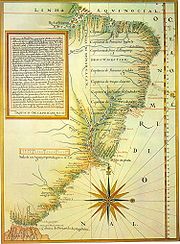 In 1534, promoting settlement to overcome the need to defend the territory, John III
organized the colonization of Brazil
through land grants. As of 1520, the Portuguese had realized that Brazil was likely to be disputed, with Francis I of France
challenging the Treaty of Tordesillas and supporting privateers. The increase in brazilwood
smuggling pressed this effort to effective occupation of the territory, although since 1503 an expedition under the command of Gonçalo Coelho
reported French raids on the Brazilian coasts and, in the same year, Martim Afonso de Sousa
went to patrol the whole Brazilian coast, banish the French and create some of the first colonial towns: São Vicente ( 1532 ) and São Paulo ( 1554 ).
Fifteen longitudinal tracks, ranging from the coast to the Tordesillas limit, were created. This vast lands were donated in form of hereditary captaincies (Capitanias Hereditárias) to grantees rich enough to support settlement, as had been done successfully in Madeira
and Cape Verde
islands. Each captain-major
should build settlements, grant allotments and administer justice, being responsible for developing and taking the costs of colonization, although not being the owner: he could transmit it to offspring, but not sell it. Twelve recipients came from Portuguese gentry who become prominent in Africa and India and senior officials of the court, such as João de Barros
and Martim Afonso de Sousa
.
Of the fifteen original captaincies (a two-month trip from Portugal), only two, Pernambuco
and São Vicente, prospered. Both dedicated to the crop of sugar cane and the settlers managed to maintain alliances with Native Americans
. The establishment of the sugar cane industry demanded intensive labor which would be met with native American and, later, African slaves.
Deeming the capitanias system ineffective, the king decided to centralize the government of the colony, in order to "give help and assistance" to grantees. In 1548 he created the first General Government, sending in Tomé de Sousa
as first governor and rescuing the captaincy of the Bay of All Saints, making it a royal captaincy, seat of the Government. This measure did not entailed the extinction of captaincies. Tomé de Sousa built the capital of Brazil, Salvador at the Bay of All Saints. The first Jesuits
arrived the same year. From 1565 through 1567 Mem de Sá
, a Portuguese colonial official and the third Governor General of Brazil, successfully destroyed a ten year-old French colony
called France Antarctique
, at Guanabara Bay
. He and his nephew, Estácio de Sá
, then founded the city of Rio de Janeiro
in March 1567.
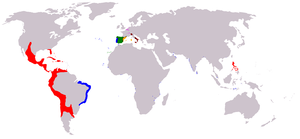 In 1580, King Philip II of Spain
invaded Portugal after a crisis of succession brought about by King Sebastian of Portugal
's death during a disastrous Portuguese Ksar El Kebir attack on Morocco
in 1578. At the Cortes of Tomar in 1581, Philip was crowned Philip I of Portugal, uniting the two crowns and overseas empires under Spanish Habsburg rule in a dynastic
Iberian Union
. At Tomar, Philip promised to keep the empires legally distinct, leaving the administration of the Portuguese Empire to Portuguese nationals, with a Viceroy of Portugal in Lisbon seeing to his interests. All the Portuguese colonies accepted the new state of affairs except for the Azores
, which held out for António
, a Portuguese rival claimant to the throne who had garnered the support of Catherine de Medici of France
in exchange for the promise to cede Brazil. Spanish forces eventually captured the island in 1583.
The union with Spain entailed both benefits and drawbacks as far as the Portuguese Empire was concerned. Spanish imperial trade networks were opened to Portuguese merchants, which was particularly lucrative for Portuguese slave traders who could now sell slaves in Spanish America at a higher price than could be fetched in Brazil.
The Tordesillas boundary between Spanish and Portuguese control in South America was then increasingly ignored by the Portuguese, who pressed beyond it into the heart of Brazil, allowing to expand the territory to the west. Exploratory missions were carried out both ordered by the government, the "entradas" (entries), and by private initiative, the "bandeiras" (flags), by the "bandeirantes
". These expeditions lasted for years venturing into unmapped regions, initially to capture natives and force them into slavery, and later focusing on finding gold, silver and diamond mines.
However, the union meant that Spain dragged Portugal into its conflicts with England
, France
and the Dutch Republic
, countries which were beginning to establish their own overseas empires. The primary threat came from the Dutch, who had been engaged in a struggle for independence against Spain since 1568. In 1581 the Seventeen Provinces
gained independence from the Habsburg rule, leading Philip II to prohibit commerce with Dutch ships, including in Brazil where Dutch
had invested large sums in financing sugar production.
In 1592, during the war with Spain, an English fleet captured a large Portuguese carrack off the Azores, the Madre de Deus
. Loaded with 900 tons of merchandise from India and China, estimated at half a million pounds
(nearly half the size of English Treasury at the time). This foretaste of the riches of the East galvanized English interest in the region.
That same year, Cornelis de Houtman
was sent by Dutch merchants to Lisbon, to gather as much information as he could about the Spice Islands. In 1595, merchant and explorer Jan Huyghen van Linschoten
, having traveled widely in the Indian Ocean at the service of the Portuguese, published a travel report in Amsterdam
, the "Reys-gheschrift vande navigatien der Portugaloysers in Orienten" ("Report of a journey through the navigations of the Portuguese in the East"). This included vast directions on how to navigate between Portugal and the East Indies and to Japan. Dutch and English interest fed on new information led to a movement of commercial expansion, and the foundation of the English East India Company
, in 1600, and Dutch East India Company
(VOC), in 1602, allowing the entry in of chartered companies in the so-called East Indies.
The Dutch took their fight overseas, attacking Spanish and Portuguese colonies and shipping, allying in turn with rival local leaders, and dismantling the Portuguese trade monopoly in Asia. The Portuguese Empire, consisting primarily of exposed coastal settlements vulnerable to being picked off one by one, proved to be an easier target than the Spanish Empire.
The Dutch–Portuguese War began with an attack on São Tomé and Príncipe
in 1597 and lasted until 1663. The war was waged by the Dutch East India Company
(established in 1602) and its West India
counterpart (1621), commercial ventures whose aim was to take over the trade networks that the Portuguese had established in Asian spices, West African slaves and Brazilian sugar In Asia, the Dutch captured the Spice Islands (1605), Malacca (1641), Colombo (1656), Ceylon (1658), Nagappattinam (1660), Cranganore and Cochin (1662). Although Goa, the capital of Portuguese Asia,
Diu and Macau were successfully defended, the expulsion of the Portuguese from Japan in 1639 excluded Portuguese merchants from the highly profitable China-Japan trade. Having successfully prevented the French from gaining a foothold in Portuguese Brazil at France Équinoxiale
in 1615, Salvador da Bahia
was lost to the Dutch in 1624 (though recaptured by a joint Spanish-Portuguese force the following year) and Pernambuco
in 1630. In need of slaves for the sugar producing regions they had captured in Brazil, the Dutch began attacks on the Portuguese trading posts on the west coast of Africa, successfully taking Elmina (1638), Luanda (1641) and Axim (1642). By 1654, Portugal had succeeded in expelling the Dutch from Brazil and Luanda, though its preeminent position in Asia had been lost forever.
 The loss of colonies was one of the reasons that contributed to the end of the personal union with Spain. In 1640 John IV was proclaimed King of Portugal and the Portuguese Restoration War
began. In 1661 the Portuguese offered Bombay and Tangier
to England as part of a dowry
, and over the next hundred years the English gradually became the dominant trader in India, gradually excluding the trade of other powers. In 1668 Spain recognized the end of the Iberian Union
and in exchange Portugal ceded Ceuta
to the Spanish crown.
At the end of confrontations with the Dutch, Portugal was able to cling onto Goa
and several minor bases in India, and managed to regain territories in Brazil
and Africa, but lost forever to prominence in Asia as trade was diverted through increasing numbers of English, Dutch and French trading posts. Thus, throughout the century, Brazil gained increasing importance to the empire, which exported Brazilwood
and sugar
.
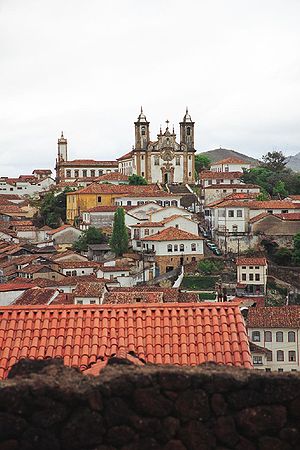
From 1693 the focus was in a Brazilian region that become known as Minas Gerais
, where gold was discovered. Major discoveries of gold and, later, diamonds in Minas Gerais, Mato Grosso and Goias led to a "gold rush
", with a large influx of migrants. The village founded in 1696, became the new economic center of the empire, with rapid settlement and some conflicts. This gold cycle led to the creation of an internal market and attracted a large number of immigrants. The population grew 750% between 1650 to 1770 and quickly became the largest in Brazil, contributing to the settlement of the interior. 78% of this population being of black people and mestizos, and also New Christians from the north of Portugal and the Azores and Madeira, who settled as important trade agents in the villages around Ouro Preto
and Mariana.
The gold rush considerably increased the revenue of the Portuguese crown, who charged a fifth of all the ore mined, or the "fifth". Diversion and smuggling were frequent, so a whole set of bureaucratic controls were instituted. The gold production would have increased from 2 tonnes per year in 1701 to 14 tonnes in the 1750s but then began to decline sharply until exhausting before the end of the century. Gold surpassed the earnings of other products from the colonies and this trade brought prosperity to Rio de Janeiro
and the kingdom.
In 1755 Lisbon suffered a catastrophic earthquake
, which together with a subsequent tsunami
killed more than 100,000 people out of a population of 275,000. This sharply checked Portuguese colonial ambitions in the late 18th century.
 Unlike Spain, Portugal did not divide its colonial territory in America
. The captaincies created there were subordinated to a centralized administration in Salvador which reported directly to the Crown in Lisbon. The 18th century was marked by increasing centralization of royal power throughout the Portuguese empire, with the power of the Jesuits, protective of the Indians against slavery, brutally suppressed by the Marquis of Pombal, leading to the dissolution of this religious order under ground Portuguese in 1759. In 1774, the two states of Brazil and the Grão-Pará and Maranhão merged into a single administrative entity.
The settlers began to express some dissatisfaction with the authorities in Lisbon as the decline of mining made it difficult to pay the taxes demanded by the Crown. In 1789, when it announced a tax of 20% of the gold removed, revolt broke out in Ouro Preto. Encouraged by the example of the United States of America, which had won its independence from Britain
(1776–1781), the attempt centred in the colonial province of Minas Gerais
was made in 1789 to achieve the same objective. However, the Inconfidência Mineira
failed, the leaders arrested and, of the participants of the insurrections the one of lowest social position, Tiradentes
, was hanged.
In 1808, Napoleon Bonaparte invaded Portugal, and Dom João
, Prince Regent
in place of his mother, Dona Maria I
, ordered the transfer of the royal court to Brazil. In 1815 Brazil was elevated to the status of Kingdom, the Portuguese state officially becoming the United Kingdom of Portugal, Brazil and the Algarves (Reino Unido de Portugal, Brasil e Algarves), and the capital was transferred from Lisbon to Rio de Janeiro, the only instance of a European country being ruled from one of its colonies. There was also the election of Brazilian representatives to the Cortes Constitucionais Portuguesas (Portuguese Constitutional Courts), the Parliament that assembled in Lisbon in the wake of the Liberal Revolution of 1820
.
Although the royal family returned to Portugal in 1821, the interlude led to a growing desire for independence amongst Brazilians. In 1822, the son of Dom João VI, then prince-regent Dom Pedro I, proclaimed the independence of Brazil on September 7, 1822, and was crowned Emperor of the new Empire of Brazil. Unlike the Spanish colonies of South America, Brazil's independence was achieved without significant bloodshed.
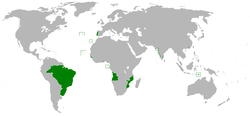
At the height of European colonialism in the 19th century, Portugal had lost its territory in South America
and all but a few bases in Asia. During this phase, Portuguese colonialism focused on expanding its outposts in Africa into nation-sized territories to compete with other European powers there. Portuguese territories eventually included the modern nations of Cape Verde
, São Tomé and Príncipe
, Guinea-Bissau
, Angola
, and Mozambique
.
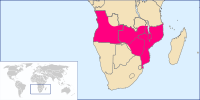 Portugal pressed into the hinterland of Angola and Mozambique, and explorers Serpa Pinto
, Hermenegildo Capelo
and Roberto Ivens
were among the first Europeans to cross Africa west to east. The project to connect the two colonies, the Pink Map
, was the Portuguese main objective in the second half of the 19th century. However, the idea was unacceptable to the British, who had their own aspirations of contiguous British territory running from Cairo
to Cape Town
. The British Ultimatum
of 1890 was imposed upon King Carlos I of Portugal
and the Pink Map came to an end. The King's reaction to the ultimatum was exploited by republicans. In 1908 King Carlos and Prince Luís Filipe were murdered in Lisbon
. Luís Filipe's brother, Manuel, became King Manuel II of Portugal
. Two years later Portugal became a republic
.
In World War I
German troops threatened Mozambique, and Portugal entered the war to protect its colonies.
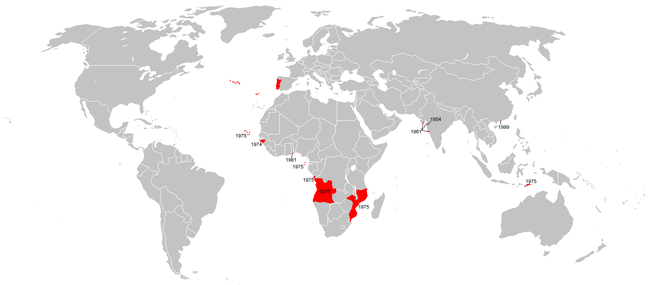 In the wake of World War II
, decolonization movements began to gain momentum in the empires of the European powers. The ensuing Cold War
also created instabilities among Portuguese overseas populations, as the United States
and Soviet Union
vied to increase their spheres of influence. Following the granting of independence to India
by Britain
in 1947, and the decision by France to allow its enclaves in India
to be incorporated into the newly independent nation, pressure was placed on Portugal to do the same. This was resisted by António de Oliveira Salazar
, who had taken power in 1933. Salazar rebuffed a request in 1950 by India's Prime Minister, Jawaharlal Nehru
, to return the enclaves, viewing them as integral parts of Portugal. The following year, the Portuguese constitution was amended to change the status of the colonies to overseas provinces. In 1954, a local uprising resulted in the overthrow of the Portuguese authorities in the Indian enclave of Dadra and Nagar Haveli. The existence of the remaining Portuguese colonies in India became increasingly untenable and Nehru enjoyed the support of almost all the Indian domestic political parties as well as the Soviet Union and its allies. In 1961, shortly after an uprising against the Portuguese in Angola, Nehru ordered the Indian Army in to Goa
, Daman and Diu, which were quickly captured and formally annexed the following year. Salazar refused to recognize the transfer of sovereignty, believing the territories to be merely occupied. The Province of Goa continued to be represented in the Portuguese National Assembly until 1974.
The outbreak of violence in February 1961 in Angola was the beginning of the end of Portugal's empire in Africa. Portuguese army officers in Angola held the view that it would be incapable of dealing militarily with an outbreak of guerilla warfare and therefore that negotiations should begin with the independence movements. However, Salazar publicly stated his determination to keep the empire intact, and by the end of the year, 50,000 troops had been stationed there. The same year, the tiny Portuguese fort of São João Baptista de Ajudá in Ouidah
, a remnant of the West African slave trade, was annexed by the new government of Dahomey (now Benin
) that had gained its independence from France. Unrest spread from Angola to Guinea, which rebelled in 1963, and Mozambique in 1964.
The rise of Soviet
influence among the Movimento das Forças Armadas
's military (MFA) and working class, and the cost and unpopularity of the Portuguese Colonial War
(1961–1974), in which Portugal resisted to the emerging nationalist guerrilla movements in some of its African territories, eventually led to the collapse of the Estado Novo regime in 1974. Known as the "Carnation Revolution
", one of the first acts of the MFA-led government which then came into power – the National Salvation Junta
(Junta de Salvação Nacional) – was to end the wars and negotiate Portuguese withdrawal from its African colonies. These events prompted a mass exodus of Portuguese citizens from Portugal's African territories (mostly from Angola and Mozambique), creating over a million Portuguese refugees – the retornados. Portugal's new ruling authorities also recognized Goa and other Portuguese India's territories invaded by India's military forces
, as Indian territories. Benin's claims over São João Baptista de Ajudá, were also accepted by the Portuguese, and diplomatic relations were restored with both India and Benin.
 Civil wars in both independent Mozambique
and Angola
promptly broke out, with incoming communist governments formed by the former rebels (and backed by the Soviet Union
, Cuba
, and other communist countries) fighting against insurgent groups supported by nations like Zaire
, South Africa
, and the United States.
East Timor
also declared independence at this time (1975), making an exodus of many Portuguese refugees to Portugal, also known as retornados. However, East Timor was almost immediately invaded by neighbouring Indonesia, which occupied it until 1999. A United Nations-sponsored referendum that year resulted in East Timorese choosing independence, which was achieved in 2002.
The transfer of the sovereignty of Macau
to China
on December 20, 1999, under the terms of an agreement negotiated between People's Republic of China
and Portugal twelve years earlier marked the end of the Portuguese overseas empire. Nevertheless, the Portuguese language remains co-official with Chinese (Cantonese) in Macau.
 Seven of the former colonies of Portugal have Portuguese as their official language
. Together with Portugal, they are now members of the Community of Portuguese Language Countries, which when combined total 10,742,000 km², or 7.2% of the Earth's landmass (148 939 063 km²). Equatorial Guinea
, which adopted Portuguese as its third official language in 2007, is currently an associate observer of the CPLP, along with Mauritius
and Senegal
. Moreover, twelve candidate countries or regions have applied for membership to the CPLP and are awaiting approval.
Today, Portuguese is one of the world's major languages, ranked sixth overall with approximately 240 million speakers around the globe It is the third most spoken language in the Americas, mainly due to Brazil, although there are also significant communities of lusophones in nations such as Canada, the USA and Venezuela. In addition, there are numerous Portuguese-based creole languages, including the one utilized by the Kristang
people in Malacca
.
In cyberspace, Portuguese is estimated to be the seventh most widely used Internet language, and on Wikipedia it currently has the ninth largest number of articles published.
In light of its international importance, Portugal and Brazil are leading a movement to include Portuguese as one of the official languages of the United Nations
.
Europe
Europe is, by convention, one of the world's seven continents. Comprising the westernmost peninsula of Eurasia, Europe is generally 'divided' from Asia to its east by the watershed divides of the Ural and Caucasus Mountains, the Ural River, the Caspian and Black Seas, and the waterways connecting...
an colonial
Colonialism
Colonialism is the establishment, maintenance, acquisition and expansion of colonies in one territory by people from another territory. It is a process whereby the metropole claims sovereignty over the colony and the social structure, government, and economics of the colony are changed by...
empires, spanning almost six centuries, from the capture of Ceuta
Ceuta
Ceuta is an autonomous city of Spain and an exclave located on the north coast of North Africa surrounded by Morocco. Separated from the Iberian peninsula by the Strait of Gibraltar, Ceuta lies on the border of the Mediterranean Sea and the Atlantic Ocean. Ceuta along with the other Spanish...
in 1415 to the handover of Macau
Macau
Macau , also spelled Macao , is, along with Hong Kong, one of the two special administrative regions of the People's Republic of China...
in 1999. The empire spread throughout a vast number of territories that are now part of 53 different sovereign states.
Portuguese sailors began exploring the coast of Africa
Africa
Africa is the world's second largest and second most populous continent, after Asia. At about 30.2 million km² including adjacent islands, it covers 6% of the Earth's total surface area and 20.4% of the total land area...
in 1419, using recent developments in navigation
Navigation
Navigation is the process of monitoring and controlling the movement of a craft or vehicle from one place to another. It is also the term of art used for the specialized knowledge used by navigators to perform navigation tasks...
, cartography
Cartography
Cartography is the study and practice of making maps. Combining science, aesthetics, and technique, cartography builds on the premise that reality can be modeled in ways that communicate spatial information effectively.The fundamental problems of traditional cartography are to:*Set the map's...
and maritime technology such as the caravel
Caravel
A caravel is a small, highly maneuverable sailing ship developed in the 15th century by the Portuguese to explore along the West African coast and into the Atlantic Ocean. The lateen sails gave her speed and the capacity for sailing to windward...
, in order that they might find a sea route to the source of the lucrative spice trade
Spice trade
Civilizations of Asia were involved in spice trade from the ancient times, and the Greco-Roman world soon followed by trading along the Incense route and the Roman-India routes...
. In 1488, Bartolomeu Dias
Bartolomeu Dias
Bartolomeu Dias , a nobleman of the Portuguese royal household, was a Portuguese explorer who sailed around the southernmost tip of Africa in 1488, the first European known to have done so.-Purposes of the Dias expedition:...
rounded the Cape of Good Hope
Cape of Good Hope
The Cape of Good Hope is a rocky headland on the Atlantic coast of the Cape Peninsula, South Africa.There is a misconception that the Cape of Good Hope is the southern tip of Africa, because it was once believed to be the dividing point between the Atlantic and Indian Oceans. In fact, the...
, and in 1498, Vasco da Gama
Vasco da Gama
Vasco da Gama, 1st Count of Vidigueira was a Portuguese explorer, one of the most successful in the Age of Discovery and the commander of the first ships to sail directly from Europe to India...
reached India. In 1500, by an accidental landfall on the South America
South America
South America is a continent situated in the Western Hemisphere, mostly in the Southern Hemisphere, with a relatively small portion in the Northern Hemisphere. The continent is also considered a subcontinent of the Americas. It is bordered on the west by the Pacific Ocean and on the north and east...
n coast for some, by the crown's secret design for others, Pedro Álvares Cabral
Pedro Álvares Cabral
Pedro Álvares Cabral was a Portuguese noble, military commander, navigator and explorer regarded as the discoverer of Brazil. Cabral conducted the first substantial exploration of the northeast coast of South America and claimed it for Portugal. While details of Cabral's early life are sketchy, it...
discovered Brazil
Brazil
Brazil , officially the Federative Republic of Brazil , is the largest country in South America. It is the world's fifth largest country, both by geographical area and by population with over 192 million people...
. Over the following decades, Portuguese sailors continued to explore the coasts and islands of East Asia, establishing forts
Portuguese Forts
Portuguese discoverers have discovered many lands and the seaway from Europe to India in the 15th to the 18th centuries. Along the way they built outposts and fortresses, many of which still exist today all over the world...
and factories as they went. By 1571, a string of outposts connected Lisbon
Lisbon
Lisbon is the capital city and largest city of Portugal with a population of 545,245 within its administrative limits on a land area of . The urban area of Lisbon extends beyond the administrative city limits with a population of 3 million on an area of , making it the 9th most populous urban...
to Nagasaki along the coasts of Africa
Africa
Africa is the world's second largest and second most populous continent, after Asia. At about 30.2 million km² including adjacent islands, it covers 6% of the Earth's total surface area and 20.4% of the total land area...
, the Middle East
Middle East
The Middle East is a region that encompasses Western Asia and Northern Africa. It is often used as a synonym for Near East, in opposition to Far East...
, India
India
India , officially the Republic of India , is a country in South Asia. It is the seventh-largest country by geographical area, the second-most populous country with over 1.2 billion people, and the most populous democracy in the world...
, and Asia
Asia
Asia is the world's largest and most populous continent, located primarily in the eastern and northern hemispheres. It covers 8.7% of the Earth's total surface area and with approximately 3.879 billion people, it hosts 60% of the world's current human population...
. This commercial network brought great wealth
Economic history of Portugal
The economic history of Portugal covers the development of the economy throughout the course of Portuguese history. It has its roots prior to nationality, when Roman occupation developed a thriving economy in Hispania, in the provinces of Lusitania and Gallaecia, as producers and exporters to the...
to Portugal
Portugal
Portugal , officially the Portuguese Republic is a country situated in southwestern Europe on the Iberian Peninsula. Portugal is the westernmost country of Europe, and is bordered by the Atlantic Ocean to the West and South and by Spain to the North and East. The Atlantic archipelagos of the...
.
Between 1580 and 1640 Portugal became the junior partner to Spain in the union
Iberian Union
The Iberian union was a political unit that governed all of the Iberian Peninsula south of the Pyrenees from 1580–1640, through a dynastic union between the monarchies of Portugal and Spain after the War of the Portuguese Succession...
of the two countries' crowns. Though the empires continued to be administered separately, Portuguese colonies became the subject of attacks by three rival European powers hostile to Spain and envious of Iberian
Iberian Peninsula
The Iberian Peninsula , sometimes called Iberia, is located in the extreme southwest of Europe and includes the modern-day sovereign states of Spain, Portugal and Andorra, as well as the British Overseas Territory of Gibraltar...
successes overseas: the Netherlands
Dutch Empire
The Dutch Empire consisted of the overseas territories controlled by the Dutch Republic and later, the modern Netherlands from the 17th to the 20th century. The Dutch followed Portugal and Spain in establishing an overseas colonial empire, but based on military conquest of already-existing...
, Britain
British Empire
The British Empire comprised the dominions, colonies, protectorates, mandates and other territories ruled or administered by the United Kingdom. It originated with the overseas colonies and trading posts established by England in the late 16th and early 17th centuries. At its height, it was the...
and France
French colonial empire
The French colonial empire was the set of territories outside Europe that were under French rule primarily from the 17th century to the late 1960s. In the 19th and 20th centuries, the colonial empire of France was the second-largest in the world behind the British Empire. The French colonial empire...
. With its smaller population, Portugal was unable to effectively defend its overstretched network of trading posts, and the empire began a long and gradual decline.
Significant losses to the Dutch in Portuguese India
Portuguese India
The Portuguese Viceroyalty of India , later the Portuguese State of India , was the aggregate of Portugal's colonial holdings in India.The government started in 1505, six years after the discovery of a sea route to India by Vasco da Gama, with the nomination of the first Viceroy Francisco de...
and Southeast Asia
Southeast Asia
Southeast Asia, South-East Asia, South East Asia or Southeastern Asia is a subregion of Asia, consisting of the countries that are geographically south of China, east of India, west of New Guinea and north of Australia. The region lies on the intersection of geological plates, with heavy seismic...
during the 17th century brought an end to the Portuguese trade monopoly in the Indian Ocean. Brazil became Portugal's most valuable colony until, as part of the wave of independence movements
Decolonization of the Americas
Decolonization of the Americas refers to the process by which the countries in the Americas gained their independence from European rule. Decolonization began with a series of revolutions in the late 18th and early to mid-19th centuries...
that swept the Americas
Americas
The Americas, or America , are lands in the Western hemisphere, also known as the New World. In English, the plural form the Americas is often used to refer to the landmasses of North America and South America with their associated islands and regions, while the singular form America is primarily...
during the early 19th century, it broke away in 1822. Portugal's Empire was reduced to its colonies on the African coastline (which were expanded inland during the Scramble for Africa
Scramble for Africa
The Scramble for Africa, also known as the Race for Africa or Partition of Africa was a process of invasion, occupation, colonization and annexation of African territory by European powers during the New Imperialism period, between 1881 and World War I in 1914...
in the late 19th century), East Timor
East Timor
The Democratic Republic of Timor-Leste, commonly known as East Timor , is a state in Southeast Asia. It comprises the eastern half of the island of Timor, the nearby islands of Atauro and Jaco, and Oecusse, an exclave on the northwestern side of the island, within Indonesian West Timor...
, and enclaves in India and Macau.
After World War II
World War II
World War II, or the Second World War , was a global conflict lasting from 1939 to 1945, involving most of the world's nations—including all of the great powers—eventually forming two opposing military alliances: the Allies and the Axis...
, Portugal's leader, António Salazar
António de Oliveira Salazar
António de Oliveira Salazar, GColIH, GCTE, GCSE served as the Prime Minister of Portugal from 1932 to 1968. He also served as acting President of the Republic briefly in 1951. He founded and led the Estado Novo , the authoritarian, right-wing government that presided over and controlled Portugal...
, attempted to keep what remained of the pluricontinental Empire intact at a time when other European countries were beginning to withdraw from their colonies. In 1961 the handful of Portuguese troops garrisoned in Goa
Goa
Goa , a former Portuguese colony, is India's smallest state by area and the fourth smallest by population. Located in South West India in the region known as the Konkan, it is bounded by the state of Maharashtra to the north, and by Karnataka to the east and south, while the Arabian Sea forms its...
were unable to prevent India
India
India , officially the Republic of India , is a country in South Asia. It is the seventh-largest country by geographical area, the second-most populous country with over 1.2 billion people, and the most populous democracy in the world...
n troops marching into the colony. Salazar began a long and bloody war
Portuguese Colonial War
The Portuguese Colonial War , also known in Portugal as the Overseas War or in the former colonies as the War of liberation , was fought between Portugal's military and the emerging nationalist movements in Portugal's African colonies between 1961 and 1974, when the Portuguese regime was...
to quell anti-colonialist forces in the African colonies. The unpopular war lasted until the overthrow of the regime in 1974
Carnation Revolution
The Carnation Revolution , also referred to as the 25 de Abril , was a military coup started on 25 April 1974, in Lisbon, Portugal, coupled with an unanticipated and extensive campaign of civil resistance...
. The new government immediately changed policy and recognised the independence of all its colonies, except for Macau
Macau
Macau , also spelled Macao , is, along with Hong Kong, one of the two special administrative regions of the People's Republic of China...
, which by agreement with the Chinese government was returned to China in 1999, thereby marking the end of the Portuguese Empire. Currently, the Azores
Azores
The Archipelago of the Azores is composed of nine volcanic islands situated in the middle of the North Atlantic Ocean, and is located about west from Lisbon and about east from the east coast of North America. The islands, and their economic exclusion zone, form the Autonomous Region of the...
and Madeira
Madeira
Madeira is a Portuguese archipelago that lies between and , just under 400 km north of Tenerife, Canary Islands, in the north Atlantic Ocean and an outermost region of the European Union...
archipelagos are the only territories overseas that remain politically linked to Portugal.
The Community of Portuguese Language Countries (CPLP) is the cultural successor of the Empire.
Origins (1139–1415)
Reconquista
The Reconquista was a period of almost 800 years in the Middle Ages during which several Christian kingdoms succeeded in retaking the Muslim-controlled areas of the Iberian Peninsula broadly known as Al-Andalus...
: the gradual Christian
Christian
A Christian is a person who adheres to Christianity, an Abrahamic, monotheistic religion based on the life and teachings of Jesus of Nazareth as recorded in the Canonical gospels and the letters of the New Testament...
reconquest of the Iberian peninsula from the Moors
Moors
The description Moors has referred to several historic and modern populations of the Maghreb region who are predominately of Berber and Arab descent. They came to conquer and rule the Iberian Peninsula for nearly 800 years. At that time they were Muslim, although earlier the people had followed...
. After establishing itself as a separate kingdom
Kingdom of Portugal
The Kingdom of Portugal was Portugal's general designation under the monarchy. The kingdom was located in the west of the Iberian Peninsula, Europe and existed from 1139 to 1910...
in 1139, Portugal completed its reconquest of Moorish territory by reaching Algarve in 1249, but its independence continued to be threatened by neighbouring Castile
Crown of Castile
The Crown of Castile was a medieval and modern state in the Iberian Peninsula that formed in 1230 as a result of the third and definitive union of the crowns and parliaments of the kingdoms of Castile and León upon the accession of the then King Ferdinand III of Castile to the vacant Leonese throne...
until the signing of the Treaty of Ayllón
Treaty of Ayllón
The Treaty of Ayllón was a peace treaty signed between the Kingdom of Portugal and Crown of Castile in 1411....
in 1411.
Free from threats to its existence and unchallenged by the wars fought by other European states, Portuguese attention turned overseas and towards a military expedition to the Muslim
Muslim
A Muslim, also spelled Moslem, is an adherent of Islam, a monotheistic, Abrahamic religion based on the Quran, which Muslims consider the verbatim word of God as revealed to prophet Muhammad. "Muslim" is the Arabic term for "submitter" .Muslims believe that God is one and incomparable...
lands of North Africa. There were several probable motives for their first attack, on the Marinid Sultanate (in present-day Morocco
Morocco
Morocco , officially the Kingdom of Morocco , is a country located in North Africa. It has a population of more than 32 million and an area of 710,850 km², and also primarily administers the disputed region of the Western Sahara...
): it offered the opportunity to continue the Christian crusade against Islam
Islam
Islam . The most common are and . : Arabic pronunciation varies regionally. The first vowel ranges from ~~. The second vowel ranges from ~~~...
; to the military class, it promised glory on the battlefield and the spoils of war; and finally, it was also a chance to expand Portuguese trade and to address Portugal's economic decline.
In 1415 an attack was made on Ceuta
Ceuta
Ceuta is an autonomous city of Spain and an exclave located on the north coast of North Africa surrounded by Morocco. Separated from the Iberian peninsula by the Strait of Gibraltar, Ceuta lies on the border of the Mediterranean Sea and the Atlantic Ocean. Ceuta along with the other Spanish...
, a strategically located North African Muslim enclave along the Mediterranean Sea
Mediterranean Sea
The Mediterranean Sea is a sea connected to the Atlantic Ocean surrounded by the Mediterranean region and almost completely enclosed by land: on the north by Anatolia and Europe, on the south by North Africa, and on the east by the Levant...
, and one of the terminal ports of the trans-Saharan gold and slave trades. The conquest
Battle of Ceuta
The Battle of Ceuta and the subsequent conquest of the Wattasid city of Ceuta by the Portuguese had its roots in the earliest years of the House of Aviz dynasty of Portugal...
was a military success, and marked one of the first steps in Portuguese expansion beyond the Iberian Peninsula, but it proved costly to defend against the Muslim forces that soon besieged it. The Portuguese were unable to use it as a base for further expansion into the hinterland, and the trans-Saharan caravans merely shifted their routes to bypass Ceuta and/or used alternative Muslim ports.
Age of Discovery (1415–1542)
Dom (title)
Dom is a title of respect prefixed to the given name. It derives from Latin Dominus.It is used in English for certain Benedictine and Carthusian monks, and for members of certain communities of Canons Regular. Examples include Benedictine monks of the English Benedictine Congregation...
Henry the Navigator, who had been involved in the capture of Ceuta
Battle of Ceuta
The Battle of Ceuta and the subsequent conquest of the Wattasid city of Ceuta by the Portuguese had its roots in the earliest years of the House of Aviz dynasty of Portugal...
, and who took the lead role in promoting and financing Portuguese maritime exploration until his death in 1460. At the time, Europeans did not know what lay beyond Cape Bojador
Cape Bojador
Cape Bojador or Cape Boujdour is a headland on the northern coast of Western Sahara, at 26° 07' 37"N, 14° 29' 57"W. , as well as the name of a nearby town with a population of 41,178.It is shown on nautical charts with the original Portuguese name "Cabo Bojador", but is sometimes...
on the African coast. Henry wished to know how far the Muslim territories in Africa extended, and whether it was possible to reach Asia by sea, both to reach the source of the lucrative spice trade
Spice trade
Civilizations of Asia were involved in spice trade from the ancient times, and the Greco-Roman world soon followed by trading along the Incense route and the Roman-India routes...
and perhaps to join forces with the fabled Christian kingdom of Prester John
Prester John
The legends of Prester John were popular in Europe from the 12th through the 17th centuries, and told of a Christian patriarch and king said to rule over a Christian nation lost amidst the Muslims and pagans in the Orient. Written accounts of this kingdom are variegated collections of medieval...
that was rumoured to exist somewhere in the "Indies". Under his sponsorship, soon the Atlantic islands of Madeira
Madeira
Madeira is a Portuguese archipelago that lies between and , just under 400 km north of Tenerife, Canary Islands, in the north Atlantic Ocean and an outermost region of the European Union...
(1420) and Azores
Azores
The Archipelago of the Azores is composed of nine volcanic islands situated in the middle of the North Atlantic Ocean, and is located about west from Lisbon and about east from the east coast of North America. The islands, and their economic exclusion zone, form the Autonomous Region of the...
(1427) were reached and started to be settled producing wheat
Wheat
Wheat is a cereal grain, originally from the Levant region of the Near East, but now cultivated worldwide. In 2007 world production of wheat was 607 million tons, making it the third most-produced cereal after maize and rice...
to export to Portugal.
Fears of what lay beyond Cape Bojador
Cape Bojador
Cape Bojador or Cape Boujdour is a headland on the northern coast of Western Sahara, at 26° 07' 37"N, 14° 29' 57"W. , as well as the name of a nearby town with a population of 41,178.It is shown on nautical charts with the original Portuguese name "Cabo Bojador", but is sometimes...
, and whether it was possible to return once it was passed, were assuaged in 1434 when it was rounded by one of Infante Henry's captains, Gil Eanes
Gil Eanes
Gil Eanes was a 15th-century Portuguese navigator and explorer.Little is known about the personal life of Gil Eanes, prior to his role in the Portuguese Age of Discovery, and was considered a household servant and shield-bearer of the Infante Henry the Navigator...
. Once this psychological barrier had been crossed, it became easier to probe further along the coast.
In 1443 Infante Dom Pedro
Infante Pedro, Duke of Coimbra
The Infante Peter, 1st Duke of Coimbra KG , was a Portuguese infante of the House of Aviz, son of King John I of Portugal and his wife Philippa of Lancaster, daughter of John of Gaunt. In Portugal he is better known as Infante D. Pedro das Sete Partidas [do Mundo], "of the Seven Parts [of the...
, Henry's brother, granted him the monopoly of navigation, war and trade in the lands south of Cape Bojador. Later this monopoly would be enforced by the Papal bull
Papal bull
A Papal bull is a particular type of letters patent or charter issued by a Pope of the Catholic Church. It is named after the bulla that was appended to the end in order to authenticate it....
s Dum Diversas
Dum Diversas
Dum Diversas is a papal bull issued on June 18, 1452 by Pope Nicholas V, that is credited by some with "ushering in the West African slave trade." It authorized Afonso V of Portugal to conquer Saracens and pagans and consign them to indefinite slavery...
(1452) and Romanus Pontifex
Romanus Pontifex
Romanus Pontifex is a papal bull written January 8, 1455 by Pope Nicholas V to King Afonso V of Portugal. As a follow-up to the Dum Diversas, it confirmed to the Crown of Portugal dominion over all lands discovered or conquered during the Age of Discovery. Along with encouraging the seizure of the...
(1455), granting Portugal the trade monopoly for the newly discovered lands. A major advance which accelerated this project was the introduction of the caravel
Caravel
A caravel is a small, highly maneuverable sailing ship developed in the 15th century by the Portuguese to explore along the West African coast and into the Atlantic Ocean. The lateen sails gave her speed and the capacity for sailing to windward...
in the mid-15th century, a ship that could be sailed closer to the wind than any other in operation in Europe at the time. Using this new maritime technology, Portuguese navigators reached ever more southerly latitude
Latitude
In geography, the latitude of a location on the Earth is the angular distance of that location south or north of the Equator. The latitude is an angle, and is usually measured in degrees . The equator has a latitude of 0°, the North pole has a latitude of 90° north , and the South pole has a...
s, advancing at an average rate of one degree a year. Senegal
Senegal
Senegal , officially the Republic of Senegal , is a country in western Africa. It owes its name to the Sénégal River that borders it to the east and north...
and Cape Verde Peninsula were reached in 1445.
The first feitoria trade post overseas was established in 1445 on the island of Arguin
Arguin
Arguin is an island off the western coast of Mauritania in the Bay of Arguin, at 20° 36' N., 16° 27' W. It is six km long by two broad. Off the island are extensive and dangerous reefs...
off the coast of Mauritania, to attract Muslim traders and monopolize the business in the routes traveled in North Africa. In 1446, António Fernandes pushed on almost as far as present-day Sierra Leone
Sierra Leone
Sierra Leone , officially the Republic of Sierra Leone, is a country in West Africa. It is bordered by Guinea to the north and east, Liberia to the southeast, and the Atlantic Ocean to the west and southwest. Sierra Leone covers a total area of and has an estimated population between 5.4 and 6.4...
and the Gulf of Guinea
Gulf of Guinea
The Gulf of Guinea is the northeasternmost part of the tropical Atlantic Ocean between Cape Lopez in Gabon, north and west to Cape Palmas in Liberia. The intersection of the Equator and Prime Meridian is in the gulf....
was reached in the 1460s.
Expansion of sugarcane
Sugarcane
Sugarcane refers to any of six to 37 species of tall perennial grasses of the genus Saccharum . Native to the warm temperate to tropical regions of South Asia, they have stout, jointed, fibrous stalks that are rich in sugar, and measure two to six metres tall...
in Madeira started in 1455, using advisers from Sicily
Sicily
Sicily is a region of Italy, and is the largest island in the Mediterranean Sea. Along with the surrounding minor islands, it constitutes an autonomous region of Italy, the Regione Autonoma Siciliana Sicily has a rich and unique culture, especially with regard to the arts, music, literature,...
and (largely) Genoese
Republic of Genoa
The Most Serene Republic of Genoa |Ligurian]]: Repúbrica de Zêna) was an independent state from 1005 to 1797 in Liguria on the northwestern Italian coast, as well as Corsica from 1347 to 1768, and numerous other territories throughout the Mediterranean....
capital to produce the "sweet salt" rare in Europe
History of sugar
The long history of sugar is interwoven with that of trade, religion, colonialism, capitalism, industry and technology. The labor-intensive nature of sugar cultivation and processing has meant that much of the history of the sugar industry has had associations with large-scale slavery...
. Already cultivated in Algarve, the accessibility of Madeira attracted Genoese and Flemish traders keen to bypass Venetian monopolies. Slaves were used, and the proportion of imported slaves in Madeira reached 10% of the total population by the 16th century. "By 1480 Antwerp had some seventy ships engaged in the Madeira sugar trade, with the refining and distribution concentrated in Antwerp. By the 1490s Madeira had overtaken Cyprus as a producer of sugar."
The success of sugar merchants such as Bartolomeo Marchionni
Bartolomeo Marchionni
Bartolomeo Marchionni was a Florentine merchant established in Lisbon during the Age of Discovery.Bartolomeo Marchionni arrived circa 1468 at Lisbon as an agent to the Cambini. In a long career he become the most successful merchant and one of the richest men in Lisbon at the time...
would propel the investment in future travels.
In 1469, after prince Henry's death and as a result of meager returns of the African explorations, King Afonso V
Afonso V of Portugal
Afonso V KG , called the African , was the twelfth King of Portugal and the Algarves. His sobriquet refers to his conquests in Northern Africa.-Early life:...
granted the monopoly of trade in part of the Gulf of Guinea
Gulf of Guinea
The Gulf of Guinea is the northeasternmost part of the tropical Atlantic Ocean between Cape Lopez in Gabon, north and west to Cape Palmas in Liberia. The intersection of the Equator and Prime Meridian is in the gulf....
to merchant Fernão Gomes
Fernão Gomes
Fernão Gomes was a Portuguese merchant and explorer from Lisbon, the son of Tristão Gomes de Brito .In 1469, King Afonso V of Portugal granted him the monopoly on trade in the Gulf of Guinea...
. Gomes, who had to explore 100 miles (160.9 km) of the coast each year for five years, discovered the islands of the Gulf of Guinea, including São Tomé and Príncipe
São Tomé and Príncipe
São Tomé and Príncipe, officially the Democratic Republic of São Tomé and Príncipe, is a Portuguese-speaking island nation in the Gulf of Guinea, off the western equatorial coast of Central Africa. It consists of two islands: São Tomé and Príncipe, located about apart and about , respectively, off...
and found a thriving alluvial gold trade among the natives and visiting Arab and Berber traders at the port then named Mina
Elmina
Elmina, is a town in the Central Region, situated on a south-facing bay on the Atlantic Ocean coast of Ghana, about 12 km west of Cape Coast...
(the mine), where he established a trading post. Trade between Elmina and Portugal grew throughout a decade. In 1481, the recently-crowned João II
John II of Portugal
John II , the Perfect Prince , was the thirteenth king of Portugal and the Algarves...
decided to build São Jorge da Mina in order to ensure the protection of this trade, which was held again as a royal monopoly. The Equator
Equator
An equator is the intersection of a sphere's surface with the plane perpendicular to the sphere's axis of rotation and containing the sphere's center of mass....
was crossed by navigators sponsored by Fernão Gomes in 1473 and the Congo River
Congo River
The Congo River is a river in Africa, and is the deepest river in the world, with measured depths in excess of . It is the second largest river in the world by volume of water discharged, though it has only one-fifth the volume of the world's largest river, the Amazon...
by Diogo Cão
Diogo Cão
Diogo Cão was a Portuguese explorer and one of the most remarkable navigators of the Age of Discovery, who made two voyages sailing along the west coast of Africa to Namibia in the 1480s.-Early life and family:...
in 1482. In 1486, Cão continued to Cape Cross
Cape Cross
Cape Cross is a cape in the South Atlantic on the coast of Namibia, on the C34 highway some 60 kilometres north of Hentiesbaai and 120 km north of Swakopmund on the west coast of Namibia....
, in present-day Namibia
Namibia
Namibia, officially the Republic of Namibia , is a country in southern Africa whose western border is the Atlantic Ocean. It shares land borders with Angola and Zambia to the north, Botswana to the east and South Africa to the south and east. It gained independence from South Africa on 21 March...
, near the Tropic of Capricorn
Tropic of Capricorn
The Tropic of Capricorn, or Southern tropic, marks the most southerly latitude on the Earth at which the Sun can be directly overhead. This event occurs at the December solstice, when the southern hemisphere is tilted towards the Sun to its maximum extent.Tropic of Capricorn is one of the five...
.
In 1488, Bartolomeu Dias
Bartolomeu Dias
Bartolomeu Dias , a nobleman of the Portuguese royal household, was a Portuguese explorer who sailed around the southernmost tip of Africa in 1488, the first European known to have done so.-Purposes of the Dias expedition:...
rounded the Cape of Good Hope
Cape of Good Hope
The Cape of Good Hope is a rocky headland on the Atlantic coast of the Cape Peninsula, South Africa.There is a misconception that the Cape of Good Hope is the southern tip of Africa, because it was once believed to be the dividing point between the Atlantic and Indian Oceans. In fact, the...
on the southern tip of Africa, proving false the view that had existed since Ptolemy
Ptolemy
Claudius Ptolemy , was a Roman citizen of Egypt who wrote in Greek. He was a mathematician, astronomer, geographer, astrologer, and poet of a single epigram in the Greek Anthology. He lived in Egypt under Roman rule, and is believed to have been born in the town of Ptolemais Hermiou in the...
that the Indian Ocean
Indian Ocean
The Indian Ocean is the third largest of the world's oceanic divisions, covering approximately 20% of the water on the Earth's surface. It is bounded on the north by the Indian Subcontinent and Arabian Peninsula ; on the west by eastern Africa; on the east by Indochina, the Sunda Islands, and...
was land-locked. Simultaneously Pêro da Covilhã
Pêro da Covilhã
Pedro or Pêro da Covilhã was a Portuguese diplomat and explorer.He was a native of Covilhã in Beira. In his early life he had gone to Castile and entered the service of Alphonso, Duke of Seville...
, traveling secretly overland, had reached Ethiopia
Ethiopia
Ethiopia , officially known as the Federal Democratic Republic of Ethiopia, is a country located in the Horn of Africa. It is the second-most populous nation in Africa, with over 82 million inhabitants, and the tenth-largest by area, occupying 1,100,000 km2...
, suggesting that a sea route to the Indies would soon be forthcoming.
As the Portuguese explored the coastlines of Africa, they left behind a series of padrões
Padrão
A padrão was a large stone cross inscribed with the coat of arms of Portugal that was placed as part of a land claim by numerous Portuguese explorers during the Portuguese Age of Discovery...
, stone crosses engraved with the Portuguese coat of arms marking their claims, and built forts and trading posts. From these bases, they engaged profitably in the slave and gold trades. Portugal enjoyed a virtual monopoly on the African seaborne slave trade for over a century, importing around 800 slaves annually. Most were brought to the Portuguese capital Lisbon
Lisbon
Lisbon is the capital city and largest city of Portugal with a population of 545,245 within its administrative limits on a land area of . The urban area of Lisbon extends beyond the administrative city limits with a population of 3 million on an area of , making it the 9th most populous urban...
, where it is estimated black Africans came to constitute 10 per cent of the population.
Tordesillas division of the world (1492)
Christopher Columbus
Christopher Columbus was an explorer, colonizer, and navigator, born in the Republic of Genoa, in northwestern Italy. Under the auspices of the Catholic Monarchs of Spain, he completed four voyages across the Atlantic Ocean that led to general European awareness of the American continents in the...
's discovery for Spain
Spain
Spain , officially the Kingdom of Spain languages]] under the European Charter for Regional or Minority Languages. In each of these, Spain's official name is as follows:;;;;;;), is a country and member state of the European Union located in southwestern Europe on the Iberian Peninsula...
of the New World
New World
The New World is one of the names used for the Western Hemisphere, specifically America and sometimes Oceania . The term originated in the late 15th century, when America had been recently discovered by European explorers, expanding the geographical horizon of the people of the European middle...
, which he believed to be Asia, led to disputes between the Spanish and Portuguese. These were eventually settled by the Treaty of Tordesillas
Treaty of Tordesillas
The Treaty of Tordesillas , signed at Tordesillas , , divided the newly discovered lands outside Europe between Spain and Portugal along a meridian 370 leagueswest of the Cape Verde islands...
in 1494, which divided the world outside of Europe in an exclusive duopoly
Duopoly
A true duopoly is a specific type of oligopoly where only two producers exist in one market. In reality, this definition is generally used where only two firms have dominant control over a market...
between the Portuguese and the Spanish along a north-south meridian 370 leagues
League (unit)
A league is a unit of length . It was long common in Europe and Latin America, but it is no longer an official unit in any nation. The league originally referred to the distance a person or a horse could walk in an hour...
, or 970 miles (1,561.1 km), west of the Cape Verde islands. However, as it was not possible at the time to correctly measure longitude
Longitude
Longitude is a geographic coordinate that specifies the east-west position of a point on the Earth's surface. It is an angular measurement, usually expressed in degrees, minutes and seconds, and denoted by the Greek letter lambda ....
, the exact boundary was disputed by the two countries until 1777.
The completion of these negotiations with Spain is one of several reasons proposed by historians for why it took nine years for the Portuguese to follow up on Dias's voyage to the Cape of Good Hope, though it has also been speculated that other voyages were in fact taking place in secret during this time. Whether or not this was the case, the long-standing Portuguese goal of finding a sea route to Asia was finally achieved in a ground-breaking voyage commanded by Vasco da Gama
Vasco da Gama
Vasco da Gama, 1st Count of Vidigueira was a Portuguese explorer, one of the most successful in the Age of Discovery and the commander of the first ships to sail directly from Europe to India...
.
Portuguese enter the Indian Ocean (1497–1542)
Vasco da Gama
Vasco da Gama, 1st Count of Vidigueira was a Portuguese explorer, one of the most successful in the Age of Discovery and the commander of the first ships to sail directly from Europe to India...
left Portugal in 1497, rounded the Cape and continued along the coast of East Africa, where a local pilot was brought on board who guided them across the Indian Ocean
Indian Ocean
The Indian Ocean is the third largest of the world's oceanic divisions, covering approximately 20% of the water on the Earth's surface. It is bounded on the north by the Indian Subcontinent and Arabian Peninsula ; on the west by eastern Africa; on the east by Indochina, the Sunda Islands, and...
, reaching Calicut (the capital of the native kingdom ruled by Zamorins) in south-western India
India
India , officially the Republic of India , is a country in South Asia. It is the seventh-largest country by geographical area, the second-most populous country with over 1.2 billion people, and the most populous democracy in the world...
in May 1498. The second voyage to India was dispatched in 1500 under Pedro Álvares Cabral
Pedro Álvares Cabral
Pedro Álvares Cabral was a Portuguese noble, military commander, navigator and explorer regarded as the discoverer of Brazil. Cabral conducted the first substantial exploration of the northeast coast of South America and claimed it for Portugal. While details of Cabral's early life are sketchy, it...
. While following the same south-westerly route as Gama across the Atlantic Ocean, Cabral made landfall on the Brazilian coast. This was probably an accidental discovery, but it has been speculated that the Portuguese secretly knew of Brazil's existence and that it lay on their side of the Tordesillas line. Cabral recommended to the Portuguese King that the land be settled, and two follow up voyages were sent in 1501 and 1503. The land was found to be abundant in pau-brasil, or brazilwood
Brazilwood
Caesalpinia echinata is a species of Brazilian timber tree in the pea family, Fabaceae. Common names include Brazilwood, Pau-Brasil, Pau de Pernambuco and Ibirapitanga . This plant has a dense, orange-red heartwood that takes a high shine, and it is the premier wood used for making bows for...
, from which it later inherited its name, but the failure to find gold or silver meant that for the time being Portuguese efforts were concentrated on India.
Profiting from the rivalry between the ruler of Kochi and the Zamorin of Calicut
History of Kozhikode
Kozhikode , also known as Calicut, is a city in the southern Indian state of Kerala. It is the third largest city in Kerala and the headquarters of Kozhikode district....
, the Portuguese were well received and seen as allies, getting a permit to build a fort (Fort Manuel
Fort Kochi
Fort Kochi is a region in the city of Kochi in the state of Kerala, India. This is part of a handful of water-bound regions toward the south-west of the mainland Kochi, and collectively known as Old Kochi or West Kochi. Adjacent to this is Mattancherry...
) and a trading post that were the first European settlement in India. In 1505 King Manuel I of Portugal
Manuel I of Portugal
Manuel I , the Fortunate , 14th king of Portugal and the Algarves was the son of Infante Ferdinand, Duke of Viseu, , by his wife, Infanta Beatrice of Portugal...
appointed Francisco de Almeida
Francisco de Almeida
Dom Francisco de Almeida , also known as "the Great Dom Francisco" , was a Portuguese nobleman, soldier and explorer. He distinguished himself as a counsellor to King John II of Portugal and later in the wars against the Moors and in the conquest of Granada in 1492...
first Viceroy
Viceroy
A viceroy is a royal official who runs a country, colony, or province in the name of and as representative of the monarch. The term derives from the Latin prefix vice-, meaning "in the place of" and the French word roi, meaning king. A viceroy's province or larger territory is called a viceroyalty...
of Portuguese India, establishing the Portuguese government in the east. That year the Portuguese conquered Kannur
Kannur
Kannur , also known as Cannanore, is a city in Kannur district in the Indian state of Kerala. It is the administrative headquarters of the District of Kannur and 518km north of state capital Trivandrum. During British rule in India, Kannur was known by its old name Cannanore, which is still in...
where they founded St. Angelo Fort
St. Angelo Fort
St. Angelo Fort , is a fort facing the Arabian Sea, situated 3 km from the town of Kannur, a city in Kerala state, south India.-History:...
. Lourenço de Almeida
Lourenço de Almeida
Lourenço de Almeida , son of Francisco de Almeida, acting under him, distinguished himself in the Indian Ocean, and made Ceylon tributary to Portugal...
arrived in Ceylon (modern Sri Lanka), where he discovered the source of cinnamon
Cinnamon
Cinnamon is a spice obtained from the inner bark of several trees from the genus Cinnamomum that is used in both sweet and savoury foods...
.
In 1506 a Portuguese fleet under the command of Tristão da Cunha
Tristão da Cunha
Tristão da Cunha was a Portuguese explorer and naval commander. In 1514 he served as ambassador from king Manuel I of Portugal to Pope Leo X leading a luxurious embassy presenting in Rome the new conquests of Portugal...
and Afonso de Albuquerque
Afonso de Albuquerque
Afonso de Albuquerque[p][n] was a Portuguese fidalgo, or nobleman, an admiral whose military and administrative activities as second governor of Portuguese India conquered and established the Portuguese colonial empire in the Indian Ocean...
, conquered Socotra
Socotra
Socotra , also spelt Soqotra, is a small archipelago of four islands in the Indian Ocean. The largest island, also called Socotra, is about 95% of the landmass of the archipelago. It lies some east of the Horn of Africa and south of the Arabian Peninsula. The island is very isolated and through...
at the entrance of the Red Sea
Red Sea
The Red Sea is a seawater inlet of the Indian Ocean, lying between Africa and Asia. The connection to the ocean is in the south through the Bab el Mandeb strait and the Gulf of Aden. In the north, there is the Sinai Peninsula, the Gulf of Aqaba, and the Gulf of Suez...
and Muscat
Muscat, Oman
Muscat is the capital of Oman. It is also the seat of government and largest city in the Governorate of Muscat. As of 2008, the population of the Muscat metropolitan area was 1,090,797. The metropolitan area spans approximately and includes six provinces called wilayats...
in 1507, having failed to conquer Ormuz, following a strategy intended to close the entrances to the Indian Ocean. That same year were built fortresses in the Island of Mozambique
Island of Mozambique
The Island of Mozambique lies off northern Mozambique, between the Mozambique Channel and Mossuril Bay. It has a population of around 14,000 people and is part of Nampula Province.-History:...
and Mombasa
Mombasa
Mombasa is the second-largest city in Kenya. Lying next to the Indian Ocean, it has a major port and an international airport. The city also serves as the centre of the coastal tourism industry....
on the Kenyan coast. Madagascar
Madagascar
The Republic of Madagascar is an island country located in the Indian Ocean off the southeastern coast of Africa...
was partly explored by Tristão da Cunha
Tristão da Cunha
Tristão da Cunha was a Portuguese explorer and naval commander. In 1514 he served as ambassador from king Manuel I of Portugal to Pope Leo X leading a luxurious embassy presenting in Rome the new conquests of Portugal...
and in the same year Mauritius
Mauritius
Mauritius , officially the Republic of Mauritius is an island nation off the southeast coast of the African continent in the southwest Indian Ocean, about east of Madagascar...
was discovered.
In 1509, the Portuguese won the sea Battle of Diu
Battle of Diu (1509)
The Battle of Diu sometimes referred as the Second Battle of Chaul was a naval battle fought on 3 February 1509 in the Arabian Sea, near the port of Diu, India, between the Portuguese Empire and a joint fleet of the Sultan of Gujarat, the Mamlûk Burji Sultanate of Egypt, the Zamorin of Kozhikode...
against the combined forces of the Ottoman
Ottoman Empire
The Ottoman EmpireIt was usually referred to as the "Ottoman Empire", the "Turkish Empire", the "Ottoman Caliphate" or more commonly "Turkey" by its contemporaries...
Sultan Beyazid II, Sultan of Gujarat
Gujarat Sultanate
The Gujarat Sultanate was an independent kingdom established in the early 15th century in Gujarat. The founder of the ruling Muzaffarid dynasty, Zafar Khan was appointed as governor of Gujarat by Nasir-ud-Din Muhammad bin Tughluq IV in 1391, the ruler of the principal state in north India at the...
, Mamlûk Sultan of Cairo
Mamluk
A Mamluk was a soldier of slave origin, who were predominantly Cumans/Kipchaks The "mamluk phenomenon", as David Ayalon dubbed the creation of the specific warrior...
, Zamorin of Kozhikode
Kozhikode
Kozhikode During Classical antiquity and the Middle Ages, Kozhikkode was dubbed the "City of Spices" for its role as the major trading point of eastern spices. Kozhikode was once the capital of an independent kingdom of the same name and later of the erstwhile Malabar District...
, Venetian Republic, and Ragusan Republic (Dubrovnik). The Portuguese victory was critical for its strategy of control of the Indian Sea: Turks and Egyptians withdrew their navies from India, leaving the seas to the Portuguese, setting its trade dominance for almost a century, and greatly assisting the growth of the Portuguese Empire. It also marked the beginning of the European colonial dominance in Asia. A second Battle of Diu
Siege of Diu
The Siege of Diu occurred when an Ottoman imperial fleet attempted to capture the Indian city of Diu in 1538, then held by the Portuguese.It ended with a Portuguese victory.-Background:...
in 1538 finally ended Ottoman ambitions in India and confirmed Portuguese hegemony in the Indian Ocean.
Goa
Goa , a former Portuguese colony, is India's smallest state by area and the fourth smallest by population. Located in South West India in the region known as the Konkan, it is bounded by the state of Maharashtra to the north, and by Karnataka to the east and south, while the Arabian Sea forms its...
was taken from the Bijapur sultanate in 1510 with the help of Hindu privateer
Privateer
A privateer is a private person or ship authorized by a government by letters of marque to attack foreign shipping during wartime. Privateering was a way of mobilizing armed ships and sailors without having to spend public money or commit naval officers...
Timoji
Timoji
Timoji was a Hindu privateer who served the Vijayanagara Empire and the Portuguese Empire during the first decade of the 16th century. He claimed to have been born in Goa and to have escaped the city after its conquest by the Adil Shahi of Bijapur in 1496...
. Coveted for being the best port in the region, mainly for the commerce of Arabian horses for the Deccan sultanates
Deccan sultanates
The Deccan sultanates were five Muslim-ruled late medieval kingdoms—Bijapur, Golkonda, Ahmadnagar, Bidar, and Berar—of south-central India. The Deccan sultanates were located on the Deccan Plateau, between the Krishna River and the Vindhya Range. These kingdoms became independent during the breakup...
, it allowed to move on from the guest stay in Kochi. Despite constant attacks, it became the headquarters of the Portuguese state in India, with its conquest triggering compliance of neighbor kingdoms: Gujarat and Calicut
History of Kozhikode
Kozhikode , also known as Calicut, is a city in the southern Indian state of Kerala. It is the third largest city in Kerala and the headquarters of Kozhikode district....
sent embassies, offering alliances and grants to fortify. Albuquerque began that year in Goa the first Portuguese mint
Mint (coin)
A mint is an industrial facility which manufactures coins for currency.The history of mints correlates closely with the history of coins. One difference is that the history of the mint is usually closely tied to the political situation of an era...
in India, taking the opportunity to announce the achievement.
Initially king Manuel I and his council in Lisbon had tried to distribute power in the Indian Ocean, creating three areas of jurisdiction: Albuquerque was sent to the Red Sea, Diogo Lopes de Sequeira
Diogo Lopes de Sequeira
Diogo Lopes de Sequeira was a Portuguese fidalgo, sent to analyze the trade potential in Madagascar and Malacca, he arrived at Malacca on 11 September, 1509. He left the next year when he discovered that Sultan Mahmud Shah, the local leader, was devising his assassination...
to Southeast Asia, seeking an agreement with the Sultan of Malacca, and Jorge de Aguiar followed by Duarte de Lemos were sent to the area between the Cape of Good Hope and Gujarat. However, such posts were centralized by Afonso de Albuquerque and remained so in subsequent ruling.
Southeast Asia and the spice trade
Monopoly
A monopoly exists when a specific person or enterprise is the only supplier of a particular commodity...
on the spice trade
Spice trade
Civilizations of Asia were involved in spice trade from the ancient times, and the Greco-Roman world soon followed by trading along the Incense route and the Roman-India routes...
, which was also of interest to the Portuguese. Although Cankili I
Sankili Segarajasekaran
Cankili I , also known as Segarasasekaram, is the most remembered Jaffna kingdom king in the Sri Lankan Tamil history. He was very active in resisting Portuguese colonial inroads into Sri Lanka. He also inherited his throne via palace intrigues in which number of heir apparent’s died under...
of Jaffna
Jaffna
Jaffna is the capital city of the Northern Province, Sri Lanka. It is the administrative headquarters of the Jaffna district located on a peninsula of the same name. Jaffna is approximately six miles away from Kandarodai which served as a famous emporium in the Jaffna peninsula from classical...
initially resisted contact with them, the Jaffna kingdom
Jaffna Kingdom
The Jaffna kingdom , also known as Kingdom of Aryacakravarti, of modern northern Sri Lanka was a historic monarchy that came into existence around the town of Jaffna on the Jaffna peninsula after the invasion of Magha, who is said to have been from Kalinga, in India...
came to the attention of Portuguese officials soon after for their resistance to missionary activities as well as logistical reasons due to its proximity with Trincomalee
Trincomalee
Trincomalee is a port city in Eastern Province, Sri Lanka and lies on the east coast of the island, about 113 miles south of Jaffna. It has a population of approximately 100,000 . The city is built on a peninsula, which divides the inner and outer harbours. Overlooking the Kottiyar Bay,...
harbour among other reasons. In April 1511 Albuquerque sailed to Malacca
Malacca
Malacca , dubbed The Historic State or Negeri Bersejarah among locals) is the third smallest Malaysian state, after Perlis and Penang. It is located in the southern region of the Malay Peninsula, on the Straits of Malacca. It borders Negeri Sembilan to the north and the state of Johor to the south...
in Malaysia, the most important east point in the trade network where Malay met Gujarati, Chinese, Japanese, Javanese, Bengali, Persian and Arabic traders, among others, described by Tomé Pires
Tomé Pires
Tomé Pires was an apothecary from Lisbon who spent 1512 to 1515 in Malacca immediately after the Portuguese conquest, at a time when Europeans were only first arriving in South East Asia...
as of invaluable richness. The peninsula of Malacca became then the strategic base for Portuguese trade expansion with China and Southeast Asia, under the Portuguese rule with its capital at Goa. To defend the city was erected a strong gate which, called the "A Famosa", still remains. Knowing of Siamese ambitions over Malacca, Albuquerque sent immediately Duarte Fernandes
Duarte Fernandes
Duarte Fernandes was a Portuguese diplomat and the first European to establish diplomatic relations with Thailand, when in 1511 he led a diplomatic mission to Ayutthaya Kingdom , after the Portuguese conquest of Malacca....
on a diplomatic mission to the kingdom of Siam
Ayutthaya kingdom
Ayutthaya was a Siamese kingdom that existed from 1350 to 1767. Ayutthaya was friendly towards foreign traders, including the Chinese, Vietnamese , Indians, Japanese and Persians, and later the Portuguese, Spanish, Dutch and French, permitting them to set up villages outside the walls of the...
(modern Thailand), where he was the first European to arrive, establishing amicable relations between both kingdoms. In November that year, getting to know the location of the so-called "Spice Islands
Maluku Islands
The Maluku Islands are an archipelago that is part of Indonesia, and part of the larger Maritime Southeast Asia region. Tectonically they are located on the Halmahera Plate within the Molucca Sea Collision Zone...
" in the Moluccas, he sent an expedition led by António de Abreu
António de Abreu
António de Abreu was a 16th century Portuguese navigator and naval officer. He participated under the command of Afonso de Albuquerque in the conquest of Ormus in 1507 and Malacca in 1511, where he got injured...
to find them, arriving in early 1512. Abreu went by Ambon while deputy commander Francisco Serrão
Francisco Serrão
Francisco Serrão was a Portuguese explorer and a cousin of Ferdinand Magellan. His 1512 voyage was the first known European sailing east past Malacca through Indonesia and the Indies. He became a member of the Sultan Bayan Sirrullah, the ruler of Ternate, becoming his personal advisor...
came forward to Ternate
Ternate
Ternate is an island in the Maluku Islands of eastern Indonesia. It is located off the west coast of the larger island of Halmahera, the center of the powerful former Sultanate of Ternate....
, where a Portuguese fort was allowed. That same year, in Indonesia, the Portuguese took Makassar
Makassar
Makassar, is the provincial capital of South Sulawesi, Indonesia, and the largest city on Sulawesi Island. From 1971 to 1999, the city was named Ujung Pandang, after a precolonial fort in the city, and the two names are often used interchangeably...
, reaching Timor
Timor
Timor is an island at the southern end of Maritime Southeast Asia, north of the Timor Sea. It is divided between the independent state of East Timor, and West Timor, belonging to the Indonesian province of East Nusa Tenggara. The island's surface is 30,777 square kilometres...
in 1514. Departing from Malacca, Jorge Álvares
Jorge Álvares
Jorge Álvares is credited as the first Portuguese explorer to have reached China and Hong Kong. The Fundação Jorge Álvares , founded by Vasco Joaquim Rocha Vieira prior to the handover of Macau, got its name from him also having reached there.-Exploration:In May 1513 Álvares sailed under the...
came to southern China
China
Chinese civilization may refer to:* China for more general discussion of the country.* Chinese culture* Greater China, the transnational community of ethnic Chinese.* History of China* Sinosphere, the area historically affected by Chinese culture...
in 1513. This visit was followed the arrival in Guangzhou
Guangzhou
Guangzhou , known historically as Canton or Kwangchow, is the capital and largest city of the Guangdong province in the People's Republic of China. Located in southern China on the Pearl River, about north-northwest of Hong Kong, Guangzhou is a key national transportation hub and trading port...
. From 1516 on Portuguese traders established in Shangchuan Island
Shangchuan Island
Shangchuan Island also written is the main island of Chuanshan Archipelago on the southern coast of China. Its name originated from São João - Saint John in Portuguese. It is part of the Guangdong province, in the South China Sea...
, until in 1557 the Ming court gave consent for a permanent official Portuguese trade base at Macau
Macau
Macau , also spelled Macao , is, along with Hong Kong, one of the two special administrative regions of the People's Republic of China...
.
The Portuguese empire expanded into the Persian Gulf as Portugal contested control of the spice trade with the Ottoman Empire
Ottoman Empire
The Ottoman EmpireIt was usually referred to as the "Ottoman Empire", the "Turkish Empire", the "Ottoman Caliphate" or more commonly "Turkey" by its contemporaries...
. In 1515, Afonso de Albuquerque
Afonso de Albuquerque
Afonso de Albuquerque[p][n] was a Portuguese fidalgo, or nobleman, an admiral whose military and administrative activities as second governor of Portuguese India conquered and established the Portuguese colonial empire in the Indian Ocean...
conquered the Huwala
Huwala
The Huwala meaning "Those that have changed or moved". Originally the "Huwala" word is Arabic, but since Persian does not contain the pharyngeal fricative "ح" present in Arabic, it pronounced it Huwala...
state of Hormuz
Ormus
The Kingdom of Ormus was a 10th to 17th century kingdom located within the Persian Gulf and extending as far as the Strait of Hormuz...
at the head of the Persian Gulf, establishing it as a vassal state. Aden
Aden
Aden is a seaport city in Yemen, located by the eastern approach to the Red Sea , some 170 kilometres east of Bab-el-Mandeb. Its population is approximately 800,000. Aden's ancient, natural harbour lies in the crater of an extinct volcano which now forms a peninsula, joined to the mainland by a...
, however, resisted Albuquerque's expedition in that same year, and another attempt by Albuquerque's successor Lopo Soares de Albergaria
Lopo Soares de Albergaria
Lopo Soares de Albergaria was the third Governor of Portuguese India, having reached India in 1515 to supersede governor Afonso de Albuquerque....
in 1516, before capturing Bahrain
Bahrain
' , officially the Kingdom of Bahrain , is a small island state near the western shores of the Persian Gulf. It is ruled by the Al Khalifa royal family. The population in 2010 stood at 1,214,705, including 235,108 non-nationals. Formerly an emirate, Bahrain was declared a kingdom in 2002.Bahrain is...
in 1521, when a force led by Antonio Correia
António Correia
António Correia was a Portuguese commander who in 1521 conquered Bahrain, beginning eighty years of Portuguese rule in the Persian Gulf state.Correia was the son of merchant and explorer Aires Correia, who had gained notoriety during the Portuguese bombardment of Calicut a generation earlier...
defeated the Jabrid King, Muqrin ibn Zamil
Muqrin ibn Zamil
Muqrin ibn Zamil , the ruler of eastern Arabia, including al-Hasa, al-Qatif, and Bahrain, and the last Jabrid ruler of Bahrain. He was defeated in battle by an invading Portuguese force that conquerered the islands of Bahrain in 1521. Having been captured in battle, King Muqrin died from his...
. In a shifting series of alliances, the Portuguese dominated much of the southern Persian Gulf for the next hundred years. With the regular maritime route linking Lisbon to Goa since 1497, the island of Mozambique
Mozambique
Mozambique, officially the Republic of Mozambique , is a country in southeastern Africa bordered by the Indian Ocean to the east, Tanzania to the north, Malawi and Zambia to the northwest, Zimbabwe to the west and Swaziland and South Africa to the southwest...
become a strategic port, and there was built Fort São Sebastião and an hospital. In the Azores, the Islands Armada protected the ships en route to Lisbon
In 1525, after Fernão de Magalhães's expedition (1519–1522), Spain under Charles V sent an expedition to colonize the Moluccas islands, claiming that they were in his zone of the Treaty of Tordesillas
Treaty of Tordesillas
The Treaty of Tordesillas , signed at Tordesillas , , divided the newly discovered lands outside Europe between Spain and Portugal along a meridian 370 leagueswest of the Cape Verde islands...
, since there was not a set limit to the east. García Jofre de Loaísa
García Jofre de Loaísa
García Jofre de Loaísa was a 16th century Spanish explorer ordered by king Charles I of Spain to command an expedition to Asia, known as the Loaísa expedition, which in 1525 was sent by the western route to colonize the Spice Islands in the East Indies, thus crossing the Atlantic and Pacific oceans...
expedition reached the Moluccas, docking at Tidore
Tidore
Tidore is a city, island, and archipelago in the Maluku Islands of eastern Indonesia, west of the larger island of Halmahera. In the pre-colonial era, the kingdom of Tidore was a major regional political and economic power, and a fierce rival of nearby Ternate, just to the north.-Geography:Tidor...
. The conflict with the Portuguese already established in nearby Ternate was inevitable, starting nearly a decade of skirmishes. An agreement was reached only with the Treaty of Zaragoza (1529)
Treaty of Zaragoza (1529)
The Treaty of Zaragoza, also referred to as the capitulation of Zaragoza was a peace treaty between Spain and Portugal signed on 22 April of 1529 by King John III and the Emperor Charles V, in the city of Zaragoza...
, attributing the Moluccas to Portugal and the Philippines
Philippines
The Philippines , officially known as the Republic of the Philippines , is a country in Southeast Asia in the western Pacific Ocean. To its north across the Luzon Strait lies Taiwan. West across the South China Sea sits Vietnam...
to Spain.
In 1534 Gujarat was occupied by the Mughals and the Sultan Bahadur Shah of Gujarat
Bahadur Shah of Gujarat
Sultan Qutb-ud-Din Bahadur Shah , who reigned 1526-1535 and 1536-1537, was a sultan of Gujarat Sultanate, a late medieval independent kingdom in India.-Early years:...
was forced to sign the Treaty of Bassein (1534)
Treaty of Bassein (1534)
The Treaty of Bassein was signed by Sultan Bahadur of Gujarat and Portugal on December 23, 1534 while on board the galleon São Mateus. Based on the terms of the agreement, the Portuguese Empire gained control of the city of Bassein, as well as its territories, islands, and seas...
with the Portuguese, establishing an alliance to regain the country, giving in exchange Daman, Diu, Mumbai
Mumbai
Mumbai , formerly known as Bombay in English, is the capital of the Indian state of Maharashtra. It is the most populous city in India, and the fourth most populous city in the world, with a total metropolitan area population of approximately 20.5 million...
and Bassein. In 1538 the fortress of Diu is again surrounded by Ottoman ships. Another siege failed in 1547 putting an end to the Ottoman ambitions, confirming the Portuguese hegemony.
Francis Xavier
Francis Xavier, born Francisco de Jasso y Azpilicueta was a pioneering Roman Catholic missionary born in the Kingdom of Navarre and co-founder of the Society of Jesus. He was a student of Saint Ignatius of Loyola and one of the first seven Jesuits, dedicated at Montmartre in 1534...
arrived in Goa at the service of King John III of Portugal
John III of Portugal
John III , nicknamed o Piedoso , was the fifteenth King of Portugal and the Algarves. He was the son of King Manuel I and Maria of Aragon, the third daughter of King Ferdinand II of Aragon and Queen Isabella I of Castile...
, in charge of an Apostolic Nunciature
Apostolic Nunciature
An Apostolic Nunciature is a top-level diplomatic mission of the Holy See, equivalent to an embassy.The head of the Apostolic Nunciature is called nuncio. A nuncio is an ecclesiastical diplomatic title, derived from the ancient Latin nuntius, meaning messenger...
. At the same time Francisco Zeimoto and other traders arrived in Japan
Japan
Japan is an island nation in East Asia. Located in the Pacific Ocean, it lies to the east of the Sea of Japan, China, North Korea, South Korea and Russia, stretching from the Sea of Okhotsk in the north to the East China Sea and Taiwan in the south...
for the first time. According to Fernão Mendes Pinto
Fernão Mendes Pinto
Fernão Mendes Pinto was a Portuguese explorer and writer. His exploits are known through the posthumous publication of his memoir Pilgrimage in 1614, an autobiographical work whose truthfulness is nearly impossible to assess...
, who claimed to be in this journey, they arrived at Tanegashima
Tanegashima
is an island lying to the south of Kyushu, in southern Japan, and is part of Kagoshima Prefecture. The island is the second largest of the Ōsumi Islands....
, where the locals were impressed by firearms
Firearms of Japan
Firearms were introduced to Japan in the 13th century. Following an intense development, with strong local manufacture during the period of conflicts of the 16th century, Japan then almost completely abandoned firearms through a policy of forced disarmament, helped by a policy of seclusion, sakoku...
, that would be immediately made by the Japanese on a large scale. The Portuguese explorer Simão de Andrade started bad relations with China, due to his pirate activities, raiding Chinese shipping, attacking a Chinese official and kidnappings of Chinese. He based himself at Tamao island in a fort. The Chinese claimed that Simão kidnapped Chinese boys and girls to be molested and cannibalized. As a result, the Chinese posted an edict banning men with caucasian features from entering Canton.
The Chinese responded by killing multiple Portuguese in Canton and drove the Portuguese back to sea. After the Sultan of Bintan detained several Portuguese under Tomás Pires, the Chinese then executed 23 Portuguese and threw the rest into prison where they resided in squalid, sometimes fatal conditions. The Chinese then massacred Portuguese who resided at Ningbo
Ningbo
Ningbo is a seaport city of northeastern Zhejiang province, Eastern China. Holding sub-provincial administrative status, the municipality has a population of 7,605,700 inhabitants at the 2010 census whom 3,089,180 in the built up area made of 6 urban districts. It lies south of the Hangzhou Bay,...
and Fujian
Fujian
' , formerly romanised as Fukien or Huguing or Foukien, is a province on the southeast coast of mainland China. Fujian is bordered by Zhejiang to the north, Jiangxi to the west, and Guangdong to the south. Taiwan lies to the east, across the Taiwan Strait...
trading posts in 1545 and 1549, due to extensive and damaging raids by the Portuguese along the coast, which irritated the Chinese. As Portugal increased its presence along China's coast, they began trading in slaves
Slavery in Portugal
-Ancient era:Slavery was a major economic and social institution in Europe during the classical era. A great deal is known about the ancient Greeks and Romans. The Romans added Portugal to their empire . It was the province of Lusitania. The name of the future kingdom was derived from Portucale, a...
. Many Chinese slaves were sold to Portugal. Since the 16th century Chinese slaves existed in Portugal, most of them were Chinese children and a large amount were shipped to the Indies. Chinese prisoners were sent to Portugal, where they were sold as slaves, they were prized and regarded better than moorish and black slaves.
The first known visit of a Chinese person to Europe dates to 1540, when a Chinese scholar, enslaved during one of several Portuguese raids somewhere on the southern China coast, was brought to Portugal. Purchased by João de Barros
João de Barros
João de Barros , called the Portuguese Livy, is one of the first great Portuguese historians, most famous for his Décadas da Ásia , a history of the Portuguese in India and Asia.-Early years:...
, he worked with the Portuguese historian on translating Chinese texts into Portuguese.
Chinese children were kidnapped in China, and through Macau
Macau
Macau , also spelled Macao , is, along with Hong Kong, one of the two special administrative regions of the People's Republic of China...
were brought to Portugal and sold as slaves either in Macau or overseas.
Mocquet noted that a lot of the Chinese in Portuguese India were slaves from Macau, since the Portuguese preferred Chinese as domestic household workers. Goa, Manila, and Malacca received slaves from Macau. Many different peoples were found in Goa, among the slaves, including those from Macau.
Most slaves from Macau sent to Goa or Malacca were children. The King of Portugal in 1624 issued a decree forbidding people to take Chinese as slaves. A 1571 law was passed by Portugal banning people from having Chinese slaves.
The Portuguese viceroy of Goa
Goa
Goa , a former Portuguese colony, is India's smallest state by area and the fourth smallest by population. Located in South West India in the region known as the Konkan, it is bounded by the state of Maharashtra to the north, and by Karnataka to the east and south, while the Arabian Sea forms its...
in 1595 issued a law which punished Portuguese who traded in Chinese slaves by making them pay 1,000 cruzados/ducats if they bought or sold Chinese, after he issued a decree stating that Chinese were lodging complaints to him about Chinese slaves being traded by many Macao Portuguese either to be sold abroad or to be used domestically as servants. The price for one girl or boy from China was 15 or 20 ducats.
The King of Portugal again banned slavery for Chinese in 1724, forbidding the purchase of Chinese children as slaves. Most Chinese in India were slaves concentrated in Portuguese Goa
In 1557 the Chinese authorities allowed the Portuguese to settle in Macau
Macau
Macau , also spelled Macao , is, along with Hong Kong, one of the two special administrative regions of the People's Republic of China...
through an annual payment, creating a warehouse in the triangular trade between China, Japan and Europe. In 1570 the Portuguese bought a Japanese port where they founded the city of Nagasaki
Nagasaki
is the capital and the largest city of Nagasaki Prefecture on the island of Kyushu in Japan. Nagasaki was founded by the Portuguese in the second half of the 16th century on the site of a small fishing village, formerly part of Nishisonogi District...
, thus creating a trading center for many years was the port from Japan to the world. A first expedition, led by Viceroy Dom Constantino de Bragança in 1560, failed to subdue Jaffna, but captured Mannar Island
Mannar Island
Mannar Island, formerly called Manar Island, is part of Mannar District, Sri Lanka. It is linked to the rest of Sri Lanka by a causeway.It has an area of about 50 square kilometres, mainly covered with vegetation and sand.Rama's Bridge or Rama Setu ,[1] is a chain of limestone shoals, between...
. By June 1619, despite sharp resistance from Cankili II
Cankili II
Cankili II was the self-proclaimed last king of the Jaffna kingdom and was a usurper who came to throne with a palace massacre of the royal princess and the regent Arasakesari in 1617. His regency was rejected by the Portuguese colonials in Colombo, Sri Lanka...
of Jaffna, there were two Portuguese expeditions; a naval expedition that was repulsed by the Malabari corsairs and another expedition by Phillippe de Oliveira
Phillippe de Oliveira
Phillippe de Oliveira or Filipe de Oliveira was the conqueror of the Jaffna Kingdom in northern modern day Sri Lanka on behalf of the Portuguese Empire in 1619. He stayed behind as the captain-major of the conquered kingdom until his death in 1627...
and his land army of 5000, which defeated Cankili and conquered Jaffna, strengthening Portuguese control of shipping routes through the Palk Strait
Palk Strait
Palk Strait is a strait between the Tamil Nadu state of India and the Mannar district of the Northern Province of the island nation of Sri Lanka. It connects the Bay of Bengal in the northeast with the Palk Bay and thence with the Gulf of Mannar in the southwest. The strait is wide. Several...
.
Portugal established trading ports at far-flung locations like Goa
Goa
Goa , a former Portuguese colony, is India's smallest state by area and the fourth smallest by population. Located in South West India in the region known as the Konkan, it is bounded by the state of Maharashtra to the north, and by Karnataka to the east and south, while the Arabian Sea forms its...
, Ormuz, Malacca
Malacca
Malacca , dubbed The Historic State or Negeri Bersejarah among locals) is the third smallest Malaysian state, after Perlis and Penang. It is located in the southern region of the Malay Peninsula, on the Straits of Malacca. It borders Negeri Sembilan to the north and the state of Johor to the south...
, Kochi, the Maluku Islands
Maluku Islands
The Maluku Islands are an archipelago that is part of Indonesia, and part of the larger Maritime Southeast Asia region. Tectonically they are located on the Halmahera Plate within the Molucca Sea Collision Zone...
, Macau
Macau
Macau , also spelled Macao , is, along with Hong Kong, one of the two special administrative regions of the People's Republic of China...
, and Nagasaki. Guarding its trade from both European and Asian competitors, Portugal dominated not only the trade between Asia and Europe, but also much of the trade between different regions of Asia, such as India
India
India , officially the Republic of India , is a country in South Asia. It is the seventh-largest country by geographical area, the second-most populous country with over 1.2 billion people, and the most populous democracy in the world...
, Indonesia
Indonesia
Indonesia , officially the Republic of Indonesia , is a country in Southeast Asia and Oceania. Indonesia is an archipelago comprising approximately 13,000 islands. It has 33 provinces with over 238 million people, and is the world's fourth most populous country. Indonesia is a republic, with an...
, China
China
Chinese civilization may refer to:* China for more general discussion of the country.* Chinese culture* Greater China, the transnational community of ethnic Chinese.* History of China* Sinosphere, the area historically affected by Chinese culture...
, and Japan
Japan
Japan is an island nation in East Asia. Located in the Pacific Ocean, it lies to the east of the Sea of Japan, China, North Korea, South Korea and Russia, stretching from the Sea of Okhotsk in the north to the East China Sea and Taiwan in the south...
. Jesuit
Society of Jesus
The Society of Jesus is a Catholic male religious order that follows the teachings of the Catholic Church. The members are called Jesuits, and are also known colloquially as "God's Army" and as "The Company," these being references to founder Ignatius of Loyola's military background and a...
missionaries, such as the Basque Francis Xavier
Francis Xavier
Francis Xavier, born Francisco de Jasso y Azpilicueta was a pioneering Roman Catholic missionary born in the Kingdom of Navarre and co-founder of the Society of Jesus. He was a student of Saint Ignatius of Loyola and one of the first seven Jesuits, dedicated at Montmartre in 1534...
, followed the Portuguese to spread Roman Catholic Christianity
Christianity
Christianity is a monotheistic religion based on the life and teachings of Jesus as presented in canonical gospels and other New Testament writings...
to Asia with mixed success.
First efforts of colonization in Brazil
John III of Portugal
John III , nicknamed o Piedoso , was the fifteenth King of Portugal and the Algarves. He was the son of King Manuel I and Maria of Aragon, the third daughter of King Ferdinand II of Aragon and Queen Isabella I of Castile...
organized the colonization of Brazil
Brazil
Brazil , officially the Federative Republic of Brazil , is the largest country in South America. It is the world's fifth largest country, both by geographical area and by population with over 192 million people...
through land grants. As of 1520, the Portuguese had realized that Brazil was likely to be disputed, with Francis I of France
Francis I of France
Francis I was King of France from 1515 until his death. During his reign, huge cultural changes took place in France and he has been called France's original Renaissance monarch...
challenging the Treaty of Tordesillas and supporting privateers. The increase in brazilwood
Brazilwood
Caesalpinia echinata is a species of Brazilian timber tree in the pea family, Fabaceae. Common names include Brazilwood, Pau-Brasil, Pau de Pernambuco and Ibirapitanga . This plant has a dense, orange-red heartwood that takes a high shine, and it is the premier wood used for making bows for...
smuggling pressed this effort to effective occupation of the territory, although since 1503 an expedition under the command of Gonçalo Coelho
Gonçalo Coelho
Gonçalo Coelho was a Portuguese explorer who belonged to a prominent family in northern Portugal. He commanded two expeditions which explored much of the coast of Brazil....
reported French raids on the Brazilian coasts and, in the same year, Martim Afonso de Sousa
Martim Afonso de Sousa
Martim Afonso de Sousa was a Portuguese fidalgo and explorer.Born in Vila Viçosa, he was commander of the first official Portuguese expedition into mainland Brazil...
went to patrol the whole Brazilian coast, banish the French and create some of the first colonial towns: São Vicente ( 1532 ) and São Paulo ( 1554 ).
Fifteen longitudinal tracks, ranging from the coast to the Tordesillas limit, were created. This vast lands were donated in form of hereditary captaincies (Capitanias Hereditárias) to grantees rich enough to support settlement, as had been done successfully in Madeira
Madeira
Madeira is a Portuguese archipelago that lies between and , just under 400 km north of Tenerife, Canary Islands, in the north Atlantic Ocean and an outermost region of the European Union...
and Cape Verde
Cape Verde
The Republic of Cape Verde is an island country, spanning an archipelago of 10 islands located in the central Atlantic Ocean, 570 kilometres off the coast of Western Africa...
islands. Each captain-major
Captain-major
Captain-major is the English rendering of the Portuguese title Capitão-mor for colonial officers, put in charge of a capitania, Portuguese possession deemed not important enough to have its own colonial Governor.Due to the impossibility of exercising direct control and sovereignty over islands,...
should build settlements, grant allotments and administer justice, being responsible for developing and taking the costs of colonization, although not being the owner: he could transmit it to offspring, but not sell it. Twelve recipients came from Portuguese gentry who become prominent in Africa and India and senior officials of the court, such as João de Barros
João de Barros
João de Barros , called the Portuguese Livy, is one of the first great Portuguese historians, most famous for his Décadas da Ásia , a history of the Portuguese in India and Asia.-Early years:...
and Martim Afonso de Sousa
Martim Afonso de Sousa
Martim Afonso de Sousa was a Portuguese fidalgo and explorer.Born in Vila Viçosa, he was commander of the first official Portuguese expedition into mainland Brazil...
.
Of the fifteen original captaincies (a two-month trip from Portugal), only two, Pernambuco
Pernambuco
Pernambuco is a state of Brazil, located in the Northeast region of the country. To the north are the states of Paraíba and Ceará, to the west is Piauí, to the south are Alagoas and Bahia, and to the east is the Atlantic Ocean. There are about of beaches, some of the most beautiful in the...
and São Vicente, prospered. Both dedicated to the crop of sugar cane and the settlers managed to maintain alliances with Native Americans
Indigenous peoples of the Americas
The indigenous peoples of the Americas are the pre-Columbian inhabitants of North and South America, their descendants and other ethnic groups who are identified with those peoples. Indigenous peoples are known in Canada as Aboriginal peoples, and in the United States as Native Americans...
. The establishment of the sugar cane industry demanded intensive labor which would be met with native American and, later, African slaves.
Deeming the capitanias system ineffective, the king decided to centralize the government of the colony, in order to "give help and assistance" to grantees. In 1548 he created the first General Government, sending in Tomé de Sousa
Tomé de Sousa
Tomé de Sousa was the first governor-general of Brazil from 1549 to 1553, when it was a Portuguese colony. He was a nobleman and soldier born in Rates, Póvoa de Varzim...
as first governor and rescuing the captaincy of the Bay of All Saints, making it a royal captaincy, seat of the Government. This measure did not entailed the extinction of captaincies. Tomé de Sousa built the capital of Brazil, Salvador at the Bay of All Saints. The first Jesuits
Society of Jesus
The Society of Jesus is a Catholic male religious order that follows the teachings of the Catholic Church. The members are called Jesuits, and are also known colloquially as "God's Army" and as "The Company," these being references to founder Ignatius of Loyola's military background and a...
arrived the same year. From 1565 through 1567 Mem de Sá
Mem de Sá
Mem de Sá was a Governor-General of Brazil from 1557-1572.He was born in Coimbra, Portugal, around 1500, the year of discovery of Brazil by a naval fleet commanded by Pedro Álvares Cabral....
, a Portuguese colonial official and the third Governor General of Brazil, successfully destroyed a ten year-old French colony
French colonization of the Americas
The French colonization of the Americas began in the 16th century, and continued in the following centuries as France established a colonial empire in the Western Hemisphere. France founded colonies in much of eastern North America, on a number of Caribbean islands, and in South America...
called France Antarctique
France Antarctique
France Antarctique was a French colony south of the Equator, in Rio de Janeiro, Brazil, which existed between 1555 and 1567, and had control over the coast from Rio de Janeiro to Cabo Frio...
, at Guanabara Bay
Guanabara Bay
Guanabara Bay is an oceanic bay located in southeastern Brazil in the state of Rio de Janeiro. On its western shore lies the city of Rio de Janeiro, and on its eastern shore the cities of Niterói and São Gonçalo. Four other municipalities surround the bay's shores...
. He and his nephew, Estácio de Sá
Estácio de Sá
Estácio de Sá was a Portuguese soldier and officer who came to Brazil on orders of the Portuguese crown to wage war on the French colonists commanded by Nicolas Durand de Villegaignon , who had established themselves in 1555 at the Guanabara Bay in Rio de Janeiro, in the episode which became known...
, then founded the city of Rio de Janeiro
Rio de Janeiro
Rio de Janeiro , commonly referred to simply as Rio, is the capital city of the State of Rio de Janeiro, the second largest city of Brazil, and the third largest metropolitan area and agglomeration in South America, boasting approximately 6.3 million people within the city proper, making it the 6th...
in March 1567.
Iberian Union and rivalry with the Dutch (1580–1663)
Philip II of Spain
Philip II was King of Spain, Portugal, Naples, Sicily, and, while married to Mary I, King of England and Ireland. He was lord of the Seventeen Provinces from 1556 until 1581, holding various titles for the individual territories such as duke or count....
invaded Portugal after a crisis of succession brought about by King Sebastian of Portugal
Sebastian of Portugal
Sebastian "the Desired" was the 16th king of Portugal and the Algarves. He was the son of Prince John of Portugal and his wife, Joan of Spain...
's death during a disastrous Portuguese Ksar El Kebir attack on Morocco
Morocco
Morocco , officially the Kingdom of Morocco , is a country located in North Africa. It has a population of more than 32 million and an area of 710,850 km², and also primarily administers the disputed region of the Western Sahara...
in 1578. At the Cortes of Tomar in 1581, Philip was crowned Philip I of Portugal, uniting the two crowns and overseas empires under Spanish Habsburg rule in a dynastic
Dynastic union
A dynastic union is the combination by which two different states are governed by the same dynasty, while their boundaries, their laws and their interests remain distinct...
Iberian Union
Iberian Union
The Iberian union was a political unit that governed all of the Iberian Peninsula south of the Pyrenees from 1580–1640, through a dynastic union between the monarchies of Portugal and Spain after the War of the Portuguese Succession...
. At Tomar, Philip promised to keep the empires legally distinct, leaving the administration of the Portuguese Empire to Portuguese nationals, with a Viceroy of Portugal in Lisbon seeing to his interests. All the Portuguese colonies accepted the new state of affairs except for the Azores
Azores
The Archipelago of the Azores is composed of nine volcanic islands situated in the middle of the North Atlantic Ocean, and is located about west from Lisbon and about east from the east coast of North America. The islands, and their economic exclusion zone, form the Autonomous Region of the...
, which held out for António
António, Prior of Crato
António, Prior of Crato , was a grandson of King Manuel I of Portugal, claimant of the Portuguese throne during the 1580 dynastic crisis, who was King of Portugal as António I of Portugal during 33 days in the continent in 1580, and, after the crowning of Philip II of Spain as King of Portugal,...
, a Portuguese rival claimant to the throne who had garnered the support of Catherine de Medici of France
France
The French Republic , The French Republic , The French Republic , (commonly known as France , is a unitary semi-presidential republic in Western Europe with several overseas territories and islands located on other continents and in the Indian, Pacific, and Atlantic oceans. Metropolitan France...
in exchange for the promise to cede Brazil. Spanish forces eventually captured the island in 1583.
The union with Spain entailed both benefits and drawbacks as far as the Portuguese Empire was concerned. Spanish imperial trade networks were opened to Portuguese merchants, which was particularly lucrative for Portuguese slave traders who could now sell slaves in Spanish America at a higher price than could be fetched in Brazil.
The Tordesillas boundary between Spanish and Portuguese control in South America was then increasingly ignored by the Portuguese, who pressed beyond it into the heart of Brazil, allowing to expand the territory to the west. Exploratory missions were carried out both ordered by the government, the "entradas" (entries), and by private initiative, the "bandeiras" (flags), by the "bandeirantes
Bandeirantes
The bandeirantes were composed of Indians , caboclos , and some whites who were the captains of the Bandeiras. Members of the 16th–18th century South American slave-hunting expeditions called bandeiras...
". These expeditions lasted for years venturing into unmapped regions, initially to capture natives and force them into slavery, and later focusing on finding gold, silver and diamond mines.
However, the union meant that Spain dragged Portugal into its conflicts with England
England
England is a country that is part of the United Kingdom. It shares land borders with Scotland to the north and Wales to the west; the Irish Sea is to the north west, the Celtic Sea to the south west, with the North Sea to the east and the English Channel to the south separating it from continental...
, France
France
The French Republic , The French Republic , The French Republic , (commonly known as France , is a unitary semi-presidential republic in Western Europe with several overseas territories and islands located on other continents and in the Indian, Pacific, and Atlantic oceans. Metropolitan France...
and the Dutch Republic
Dutch Republic
The Dutch Republic — officially known as the Republic of the Seven United Netherlands , the Republic of the United Netherlands, or the Republic of the Seven United Provinces — was a republic in Europe existing from 1581 to 1795, preceding the Batavian Republic and ultimately...
, countries which were beginning to establish their own overseas empires. The primary threat came from the Dutch, who had been engaged in a struggle for independence against Spain since 1568. In 1581 the Seventeen Provinces
Seventeen Provinces
The Seventeen Provinces were a personal union of states in the Low Countries in the 15th century and 16th century, roughly covering the current Netherlands, Belgium, Luxembourg, a good part of the North of France , and a small part of Western Germany.The Seventeen Provinces were originally held by...
gained independence from the Habsburg rule, leading Philip II to prohibit commerce with Dutch ships, including in Brazil where Dutch
Dutch people
The Dutch people are an ethnic group native to the Netherlands. They share a common culture and speak the Dutch language. Dutch people and their descendants are found in migrant communities worldwide, notably in Suriname, Chile, Brazil, Canada, Australia, South Africa, New Zealand, and the United...
had invested large sums in financing sugar production.
In 1592, during the war with Spain, an English fleet captured a large Portuguese carrack off the Azores, the Madre de Deus
Madre de Deus
Madre de Deus was a Portuguese ship, renowned for her fabulous cargo, which stoked the English appetite for trade with the Far East, then a Portuguese monopoly....
. Loaded with 900 tons of merchandise from India and China, estimated at half a million pounds
Pound sterling
The pound sterling , commonly called the pound, is the official currency of the United Kingdom, its Crown Dependencies and the British Overseas Territories of South Georgia and the South Sandwich Islands, British Antarctic Territory and Tristan da Cunha. It is subdivided into 100 pence...
(nearly half the size of English Treasury at the time). This foretaste of the riches of the East galvanized English interest in the region.
That same year, Cornelis de Houtman
Cornelis de Houtman
Cornelis de Houtman , brother of Frederick de Houtman, was a Dutch explorer who discovered a new sea route from Europe to Indonesia and managed to begin the Dutch spice trade...
was sent by Dutch merchants to Lisbon, to gather as much information as he could about the Spice Islands. In 1595, merchant and explorer Jan Huyghen van Linschoten
Jan Huyghen van Linschoten
Jan Huyghen van Linschoten was a Dutch Protestant merchant, traveller and historian. An alternate spelling of second name is Huijgen....
, having traveled widely in the Indian Ocean at the service of the Portuguese, published a travel report in Amsterdam
Amsterdam
Amsterdam is the largest city and the capital of the Netherlands. The current position of Amsterdam as capital city of the Kingdom of the Netherlands is governed by the constitution of August 24, 1815 and its successors. Amsterdam has a population of 783,364 within city limits, an urban population...
, the "Reys-gheschrift vande navigatien der Portugaloysers in Orienten" ("Report of a journey through the navigations of the Portuguese in the East"). This included vast directions on how to navigate between Portugal and the East Indies and to Japan. Dutch and English interest fed on new information led to a movement of commercial expansion, and the foundation of the English East India Company
East India Company
The East India Company was an early English joint-stock company that was formed initially for pursuing trade with the East Indies, but that ended up trading mainly with the Indian subcontinent and China...
, in 1600, and Dutch East India Company
Dutch East India Company
The Dutch East India Company was a chartered company established in 1602, when the States-General of the Netherlands granted it a 21-year monopoly to carry out colonial activities in Asia...
(VOC), in 1602, allowing the entry in of chartered companies in the so-called East Indies.
The Dutch took their fight overseas, attacking Spanish and Portuguese colonies and shipping, allying in turn with rival local leaders, and dismantling the Portuguese trade monopoly in Asia. The Portuguese Empire, consisting primarily of exposed coastal settlements vulnerable to being picked off one by one, proved to be an easier target than the Spanish Empire.
The Dutch–Portuguese War began with an attack on São Tomé and Príncipe
São Tomé and Príncipe
São Tomé and Príncipe, officially the Democratic Republic of São Tomé and Príncipe, is a Portuguese-speaking island nation in the Gulf of Guinea, off the western equatorial coast of Central Africa. It consists of two islands: São Tomé and Príncipe, located about apart and about , respectively, off...
in 1597 and lasted until 1663. The war was waged by the Dutch East India Company
Dutch East India Company
The Dutch East India Company was a chartered company established in 1602, when the States-General of the Netherlands granted it a 21-year monopoly to carry out colonial activities in Asia...
(established in 1602) and its West India
Dutch West India Company
Dutch West India Company was a chartered company of Dutch merchants. Among its founding fathers was Willem Usselincx...
counterpart (1621), commercial ventures whose aim was to take over the trade networks that the Portuguese had established in Asian spices, West African slaves and Brazilian sugar In Asia, the Dutch captured the Spice Islands (1605), Malacca (1641), Colombo (1656), Ceylon (1658), Nagappattinam (1660), Cranganore and Cochin (1662). Although Goa, the capital of Portuguese Asia,
Diu and Macau were successfully defended, the expulsion of the Portuguese from Japan in 1639 excluded Portuguese merchants from the highly profitable China-Japan trade. Having successfully prevented the French from gaining a foothold in Portuguese Brazil at France Équinoxiale
France Équinoxiale
Equinoctial France was the contemporary name given to the colonization efforts of France in the 17th century in South America, around the line of Equator, before "tropical" had fully gained its modern meaning: Equinoctial means in Latin "of equal nights", i.e., on the Equator, where the duration of...
in 1615, Salvador da Bahia
Salvador, Bahia
Salvador is the largest city on the northeast coast of Brazil and the capital of the Northeastern Brazilian state of Bahia. Salvador is also known as Brazil's capital of happiness due to its easygoing population and countless popular outdoor parties, including its street carnival. The first...
was lost to the Dutch in 1624 (though recaptured by a joint Spanish-Portuguese force the following year) and Pernambuco
Pernambuco
Pernambuco is a state of Brazil, located in the Northeast region of the country. To the north are the states of Paraíba and Ceará, to the west is Piauí, to the south are Alagoas and Bahia, and to the east is the Atlantic Ocean. There are about of beaches, some of the most beautiful in the...
in 1630. In need of slaves for the sugar producing regions they had captured in Brazil, the Dutch began attacks on the Portuguese trading posts on the west coast of Africa, successfully taking Elmina (1638), Luanda (1641) and Axim (1642). By 1654, Portugal had succeeded in expelling the Dutch from Brazil and Luanda, though its preeminent position in Asia had been lost forever.
Imperial decline (1663–1822)
Portuguese Restoration War
Portuguese Restoration War was the name given by nineteenth-century 'romantic' historians to the war between Portugal and Spain that began with the Portuguese revolution of 1640 and ended with the Treaty of Lisbon . The revolution of 1640 ended the sixty-year period of dual monarchy in Portugal...
began. In 1661 the Portuguese offered Bombay and Tangier
Tangier
Tangier, also Tangiers is a city in northern Morocco with a population of about 700,000 . It lies on the North African coast at the western entrance to the Strait of Gibraltar where the Mediterranean meets the Atlantic Ocean off Cape Spartel...
to England as part of a dowry
Dowry
A dowry is the money, goods, or estate that a woman brings forth to the marriage. It contrasts with bride price, which is paid to the bride's parents, and dower, which is property settled on the bride herself by the groom at the time of marriage. The same culture may simultaneously practice both...
, and over the next hundred years the English gradually became the dominant trader in India, gradually excluding the trade of other powers. In 1668 Spain recognized the end of the Iberian Union
Iberian Union
The Iberian union was a political unit that governed all of the Iberian Peninsula south of the Pyrenees from 1580–1640, through a dynastic union between the monarchies of Portugal and Spain after the War of the Portuguese Succession...
and in exchange Portugal ceded Ceuta
Ceuta
Ceuta is an autonomous city of Spain and an exclave located on the north coast of North Africa surrounded by Morocco. Separated from the Iberian peninsula by the Strait of Gibraltar, Ceuta lies on the border of the Mediterranean Sea and the Atlantic Ocean. Ceuta along with the other Spanish...
to the Spanish crown.
At the end of confrontations with the Dutch, Portugal was able to cling onto Goa
Goa
Goa , a former Portuguese colony, is India's smallest state by area and the fourth smallest by population. Located in South West India in the region known as the Konkan, it is bounded by the state of Maharashtra to the north, and by Karnataka to the east and south, while the Arabian Sea forms its...
and several minor bases in India, and managed to regain territories in Brazil
Brazil
Brazil , officially the Federative Republic of Brazil , is the largest country in South America. It is the world's fifth largest country, both by geographical area and by population with over 192 million people...
and Africa, but lost forever to prominence in Asia as trade was diverted through increasing numbers of English, Dutch and French trading posts. Thus, throughout the century, Brazil gained increasing importance to the empire, which exported Brazilwood
Brazilwood
Caesalpinia echinata is a species of Brazilian timber tree in the pea family, Fabaceae. Common names include Brazilwood, Pau-Brasil, Pau de Pernambuco and Ibirapitanga . This plant has a dense, orange-red heartwood that takes a high shine, and it is the premier wood used for making bows for...
and sugar
Sugar
Sugar is a class of edible crystalline carbohydrates, mainly sucrose, lactose, and fructose, characterized by a sweet flavor.Sucrose in its refined form primarily comes from sugar cane and sugar beet...
.
From 1693 the focus was in a Brazilian region that become known as Minas Gerais
Minas Gerais
Minas Gerais is one of the 26 states of Brazil, of which it is the second most populous, the third richest, and the fourth largest in area. Minas Gerais is the Brazilian state with the largest number of Presidents of Brazil, the current one, Dilma Rousseff, being one of them. The capital is the...
, where gold was discovered. Major discoveries of gold and, later, diamonds in Minas Gerais, Mato Grosso and Goias led to a "gold rush
Brazil Gold Rush
The Brazil Gold Rush was a gold rush that started in the 1690s, in the then-Portuguese colony, now the nation of Brazil. The rush opened up the major gold-producing area of Ouro Preto , then the aptly named Vila Rica .The rush began when bandeirantes discovered large gold deposits in the mountains...
", with a large influx of migrants. The village founded in 1696, became the new economic center of the empire, with rapid settlement and some conflicts. This gold cycle led to the creation of an internal market and attracted a large number of immigrants. The population grew 750% between 1650 to 1770 and quickly became the largest in Brazil, contributing to the settlement of the interior. 78% of this population being of black people and mestizos, and also New Christians from the north of Portugal and the Azores and Madeira, who settled as important trade agents in the villages around Ouro Preto
Ouro Preto
-History:Founded at the end of the 17th century, Ouro Preto was originally called Vila Rica, or "rich village," the focal point of the gold rush and Brazil's golden age in the 18th century under Portuguese rule....
and Mariana.
The gold rush considerably increased the revenue of the Portuguese crown, who charged a fifth of all the ore mined, or the "fifth". Diversion and smuggling were frequent, so a whole set of bureaucratic controls were instituted. The gold production would have increased from 2 tonnes per year in 1701 to 14 tonnes in the 1750s but then began to decline sharply until exhausting before the end of the century. Gold surpassed the earnings of other products from the colonies and this trade brought prosperity to Rio de Janeiro
Rio de Janeiro
Rio de Janeiro , commonly referred to simply as Rio, is the capital city of the State of Rio de Janeiro, the second largest city of Brazil, and the third largest metropolitan area and agglomeration in South America, boasting approximately 6.3 million people within the city proper, making it the 6th...
and the kingdom.
In 1755 Lisbon suffered a catastrophic earthquake
1755 Lisbon earthquake
The 1755 Lisbon earthquake, also known as the Great Lisbon Earthquake, was a megathrust earthquake that took place on Saturday 1 November 1755, at around 9:40 in the morning. The earthquake was followed by fires and a tsunami, which almost totally destroyed Lisbon in the Kingdom of Portugal, and...
, which together with a subsequent tsunami
Tsunami
A tsunami is a series of water waves caused by the displacement of a large volume of a body of water, typically an ocean or a large lake...
killed more than 100,000 people out of a population of 275,000. This sharply checked Portuguese colonial ambitions in the late 18th century.
Colonial Brazil
In the history of Brazil, Colonial Brazil, officially the Viceroyalty of Brazil comprises the period from 1500, with the arrival of the Portuguese, until 1815, when Brazil was elevated to kingdom alongside Portugal as the United Kingdom of Portugal, Brazil and the Algarves.During the over 300 years...
. The captaincies created there were subordinated to a centralized administration in Salvador which reported directly to the Crown in Lisbon. The 18th century was marked by increasing centralization of royal power throughout the Portuguese empire, with the power of the Jesuits, protective of the Indians against slavery, brutally suppressed by the Marquis of Pombal, leading to the dissolution of this religious order under ground Portuguese in 1759. In 1774, the two states of Brazil and the Grão-Pará and Maranhão merged into a single administrative entity.
The settlers began to express some dissatisfaction with the authorities in Lisbon as the decline of mining made it difficult to pay the taxes demanded by the Crown. In 1789, when it announced a tax of 20% of the gold removed, revolt broke out in Ouro Preto. Encouraged by the example of the United States of America, which had won its independence from Britain
Kingdom of Great Britain
The former Kingdom of Great Britain, sometimes described as the 'United Kingdom of Great Britain', That the Two Kingdoms of Scotland and England, shall upon the 1st May next ensuing the date hereof, and forever after, be United into One Kingdom by the Name of GREAT BRITAIN. was a sovereign...
(1776–1781), the attempt centred in the colonial province of Minas Gerais
Minas Gerais
Minas Gerais is one of the 26 states of Brazil, of which it is the second most populous, the third richest, and the fourth largest in area. Minas Gerais is the Brazilian state with the largest number of Presidents of Brazil, the current one, Dilma Rousseff, being one of them. The capital is the...
was made in 1789 to achieve the same objective. However, the Inconfidência Mineira
Inconfidência Mineira
The Inconfidência Mineira of 1789 was an unsuccessful Brazilian independence movement.It was a result of the confluence of external and internal causes...
failed, the leaders arrested and, of the participants of the insurrections the one of lowest social position, Tiradentes
Tiradentes
Joaquim José da Silva Xavier, known as Tiradentes , was a leading member of the Brazilian revolutionary movement known as the Inconfidência Mineira whose aim was full independence from the Portuguese colonial power and to create a Brazilian republic. When the plan was discovered, Tiradentes was...
, was hanged.
In 1808, Napoleon Bonaparte invaded Portugal, and Dom João
John VI of Portugal
John VI John VI John VI (full name: João Maria José Francisco Xavier de Paula Luís António Domingos Rafael; (13 May 1767 – 10 March 1826) was King of the United Kingdom of Portugal, Brazil and the Algarves (later changed to just King of Portugal and the Algarves, after Brazil was recognized...
, Prince Regent
Prince Regent
A prince regent is a prince who rules a monarchy as regent instead of a monarch, e.g., due to the Sovereign's incapacity or absence ....
in place of his mother, Dona Maria I
Maria I of Portugal
Maria I was Queen regnant of Portugal and the Algarves from 1777 until her death. Known as Maria the Pious , or Maria the Mad , she was the first undisputed Queen regnant of Portugal...
, ordered the transfer of the royal court to Brazil. In 1815 Brazil was elevated to the status of Kingdom, the Portuguese state officially becoming the United Kingdom of Portugal, Brazil and the Algarves (Reino Unido de Portugal, Brasil e Algarves), and the capital was transferred from Lisbon to Rio de Janeiro, the only instance of a European country being ruled from one of its colonies. There was also the election of Brazilian representatives to the Cortes Constitucionais Portuguesas (Portuguese Constitutional Courts), the Parliament that assembled in Lisbon in the wake of the Liberal Revolution of 1820
Liberal Revolution of 1820
The Liberal Revolution of 1820 was a political revolution that erupted in 1820 and lasted until 1826. It was unchained via a military insurrection in the city of Porto, in northern Portugal, that quickly and peacefully spread to the rest of the country. From 1807 to 1811 Napoleonic French forces...
.
Although the royal family returned to Portugal in 1821, the interlude led to a growing desire for independence amongst Brazilians. In 1822, the son of Dom João VI, then prince-regent Dom Pedro I, proclaimed the independence of Brazil on September 7, 1822, and was crowned Emperor of the new Empire of Brazil. Unlike the Spanish colonies of South America, Brazil's independence was achieved without significant bloodshed.
Consolidation in Africa (1822–1951)
At the height of European colonialism in the 19th century, Portugal had lost its territory in South America
South America
South America is a continent situated in the Western Hemisphere, mostly in the Southern Hemisphere, with a relatively small portion in the Northern Hemisphere. The continent is also considered a subcontinent of the Americas. It is bordered on the west by the Pacific Ocean and on the north and east...
and all but a few bases in Asia. During this phase, Portuguese colonialism focused on expanding its outposts in Africa into nation-sized territories to compete with other European powers there. Portuguese territories eventually included the modern nations of Cape Verde
Cape Verde
The Republic of Cape Verde is an island country, spanning an archipelago of 10 islands located in the central Atlantic Ocean, 570 kilometres off the coast of Western Africa...
, São Tomé and Príncipe
São Tomé and Príncipe
São Tomé and Príncipe, officially the Democratic Republic of São Tomé and Príncipe, is a Portuguese-speaking island nation in the Gulf of Guinea, off the western equatorial coast of Central Africa. It consists of two islands: São Tomé and Príncipe, located about apart and about , respectively, off...
, Guinea-Bissau
Guinea-Bissau
The Republic of Guinea-Bissau is a country in West Africa. It is bordered by Senegal to the north, and Guinea to the south and east, with the Atlantic Ocean to its west....
, Angola
Angola
Angola, officially the Republic of Angola , is a country in south-central Africa bordered by Namibia on the south, the Democratic Republic of the Congo on the north, and Zambia on the east; its west coast is on the Atlantic Ocean with Luanda as its capital city...
, and Mozambique
Mozambique
Mozambique, officially the Republic of Mozambique , is a country in southeastern Africa bordered by the Indian Ocean to the east, Tanzania to the north, Malawi and Zambia to the northwest, Zimbabwe to the west and Swaziland and South Africa to the southwest...
.
Alexandre de Serpa Pinto
Alexandre Alberto da Rocha de Serpa Pinto was a Portuguese explorer of southern Africa and a colonial administrator....
, Hermenegildo Capelo
Hermenegildo Capelo
Hermenegildo de Brito Capelo was born in Palmela, Portugal, in 1841, and died in Lisbon, Portugal, in 1917. He was an officer in the Portuguese Navy and a Portuguese explorer, helping to chart territory between Angola and Mozambique in southern Central Africa that was unknown to Europeans in the...
and Roberto Ivens
Roberto Ivens
Roberto Ivens was a Portuguese explorer of Africa, Geographer, colonial administrator, and an officer of the Portuguese Navy.-Early life:...
were among the first Europeans to cross Africa west to east. The project to connect the two colonies, the Pink Map
Pink Map
The Pink Map was a document representing Portugal's claim of sovereignty over the land between Angola and Mozambique, which today is currently Zambia, Zimbabwe and Malawi.The Pink Map collided with Sir Cecil Rhodes' "Cape to Cairo Red Line"...
, was the Portuguese main objective in the second half of the 19th century. However, the idea was unacceptable to the British, who had their own aspirations of contiguous British territory running from Cairo
Cairo
Cairo , is the capital of Egypt and the largest city in the Arab world and Africa, and the 16th largest metropolitan area in the world. Nicknamed "The City of a Thousand Minarets" for its preponderance of Islamic architecture, Cairo has long been a centre of the region's political and cultural life...
to Cape Town
Cape Town
Cape Town is the second-most populous city in South Africa, and the provincial capital and primate city of the Western Cape. As the seat of the National Parliament, it is also the legislative capital of the country. It forms part of the City of Cape Town metropolitan municipality...
. The British Ultimatum
British Ultimatum
The 1890 British Ultimatum was an ultimatum by the British government delivered on 11 January 1890 to Portugal in breach of the Treaty of Windsor of 1386...
of 1890 was imposed upon King Carlos I of Portugal
Carlos I of Portugal
-Assassination:On 1 February 1908 the royal family returned from the palace of Vila Viçosa to Lisbon. They travelled by train to Barreiro and, from there, they took a steamer to cross the Tagus River and disembarked at Cais do Sodré in central Lisbon. On their way to the royal palace, the open...
and the Pink Map came to an end. The King's reaction to the ultimatum was exploited by republicans. In 1908 King Carlos and Prince Luís Filipe were murdered in Lisbon
Lisbon
Lisbon is the capital city and largest city of Portugal with a population of 545,245 within its administrative limits on a land area of . The urban area of Lisbon extends beyond the administrative city limits with a population of 3 million on an area of , making it the 9th most populous urban...
. Luís Filipe's brother, Manuel, became King Manuel II of Portugal
Manuel II of Portugal
Manuel II , named Manuel Maria Filipe Carlos Amélio Luís Miguel Rafael Gabriel Gonzaga Francisco de Assis Eugénio de Bragança Orleães Sabóia e Saxe-Coburgo-Gotha — , was the last King of Portugal from 1908 to 1910, ascending the throne after the assassination of his father and elder brother Manuel...
. Two years later Portugal became a republic
Republic
A republic is a form of government in which the people, or some significant portion of them, have supreme control over the government and where offices of state are elected or chosen by elected people. In modern times, a common simplified definition of a republic is a government where the head of...
.
In World War I
World War I
World War I , which was predominantly called the World War or the Great War from its occurrence until 1939, and the First World War or World War I thereafter, was a major war centred in Europe that began on 28 July 1914 and lasted until 11 November 1918...
German troops threatened Mozambique, and Portugal entered the war to protect its colonies.
Decolonization (1974–1999)
World War II
World War II, or the Second World War , was a global conflict lasting from 1939 to 1945, involving most of the world's nations—including all of the great powers—eventually forming two opposing military alliances: the Allies and the Axis...
, decolonization movements began to gain momentum in the empires of the European powers. The ensuing Cold War
Cold War
The Cold War was the continuing state from roughly 1946 to 1991 of political conflict, military tension, proxy wars, and economic competition between the Communist World—primarily the Soviet Union and its satellite states and allies—and the powers of the Western world, primarily the United States...
also created instabilities among Portuguese overseas populations, as the United States
United States
The United States of America is a federal constitutional republic comprising fifty states and a federal district...
and Soviet Union
Soviet Union
The Soviet Union , officially the Union of Soviet Socialist Republics , was a constitutionally socialist state that existed in Eurasia between 1922 and 1991....
vied to increase their spheres of influence. Following the granting of independence to India
India
India , officially the Republic of India , is a country in South Asia. It is the seventh-largest country by geographical area, the second-most populous country with over 1.2 billion people, and the most populous democracy in the world...
by Britain
United Kingdom
The United Kingdom of Great Britain and Northern IrelandIn the United Kingdom and Dependencies, other languages have been officially recognised as legitimate autochthonous languages under the European Charter for Regional or Minority Languages...
in 1947, and the decision by France to allow its enclaves in India
French India
French India is a general name for the former French possessions in India These included Pondichéry , Karikal and Yanaon on the Coromandel Coast, Mahé on the Malabar Coast, and Chandannagar in Bengal...
to be incorporated into the newly independent nation, pressure was placed on Portugal to do the same. This was resisted by António de Oliveira Salazar
António de Oliveira Salazar
António de Oliveira Salazar, GColIH, GCTE, GCSE served as the Prime Minister of Portugal from 1932 to 1968. He also served as acting President of the Republic briefly in 1951. He founded and led the Estado Novo , the authoritarian, right-wing government that presided over and controlled Portugal...
, who had taken power in 1933. Salazar rebuffed a request in 1950 by India's Prime Minister, Jawaharlal Nehru
Jawaharlal Nehru
Jawaharlal Nehru , often referred to with the epithet of Panditji, was an Indian statesman who became the first Prime Minister of independent India and became noted for his “neutralist” policies in foreign affairs. He was also one of the principal leaders of India’s independence movement in the...
, to return the enclaves, viewing them as integral parts of Portugal. The following year, the Portuguese constitution was amended to change the status of the colonies to overseas provinces. In 1954, a local uprising resulted in the overthrow of the Portuguese authorities in the Indian enclave of Dadra and Nagar Haveli. The existence of the remaining Portuguese colonies in India became increasingly untenable and Nehru enjoyed the support of almost all the Indian domestic political parties as well as the Soviet Union and its allies. In 1961, shortly after an uprising against the Portuguese in Angola, Nehru ordered the Indian Army in to Goa
Goa
Goa , a former Portuguese colony, is India's smallest state by area and the fourth smallest by population. Located in South West India in the region known as the Konkan, it is bounded by the state of Maharashtra to the north, and by Karnataka to the east and south, while the Arabian Sea forms its...
, Daman and Diu, which were quickly captured and formally annexed the following year. Salazar refused to recognize the transfer of sovereignty, believing the territories to be merely occupied. The Province of Goa continued to be represented in the Portuguese National Assembly until 1974.
The outbreak of violence in February 1961 in Angola was the beginning of the end of Portugal's empire in Africa. Portuguese army officers in Angola held the view that it would be incapable of dealing militarily with an outbreak of guerilla warfare and therefore that negotiations should begin with the independence movements. However, Salazar publicly stated his determination to keep the empire intact, and by the end of the year, 50,000 troops had been stationed there. The same year, the tiny Portuguese fort of São João Baptista de Ajudá in Ouidah
Ouidah
Ouidah , also Whydah or Juda, is a city on the Atlantic coast of Benin.The commune covers an area of 364 square kilometres and as of 2002 had a population of 76,555 people.-History:...
, a remnant of the West African slave trade, was annexed by the new government of Dahomey (now Benin
Benin
Benin , officially the Republic of Benin, is a country in West Africa. It borders Togo to the west, Nigeria to the east and Burkina Faso and Niger to the north. Its small southern coastline on the Bight of Benin is where a majority of the population is located...
) that had gained its independence from France. Unrest spread from Angola to Guinea, which rebelled in 1963, and Mozambique in 1964.
The rise of Soviet
Soviet Union
The Soviet Union , officially the Union of Soviet Socialist Republics , was a constitutionally socialist state that existed in Eurasia between 1922 and 1991....
influence among the Movimento das Forças Armadas
Movimento das Forças Armadas
The Movement of the Armed Forces was an organisation of lower-ranked left-leaning officers in the Portuguese Armed Forces which was responsible for the Carnation Revolution of 25 April 1974, a military coup in Lisbon which ended the corporatist New State regime in Portugal, the Portuguese...
's military (MFA) and working class, and the cost and unpopularity of the Portuguese Colonial War
Portuguese Colonial War
The Portuguese Colonial War , also known in Portugal as the Overseas War or in the former colonies as the War of liberation , was fought between Portugal's military and the emerging nationalist movements in Portugal's African colonies between 1961 and 1974, when the Portuguese regime was...
(1961–1974), in which Portugal resisted to the emerging nationalist guerrilla movements in some of its African territories, eventually led to the collapse of the Estado Novo regime in 1974. Known as the "Carnation Revolution
Carnation Revolution
The Carnation Revolution , also referred to as the 25 de Abril , was a military coup started on 25 April 1974, in Lisbon, Portugal, coupled with an unanticipated and extensive campaign of civil resistance...
", one of the first acts of the MFA-led government which then came into power – the National Salvation Junta
National Salvation Junta
The National Salvation Junta was a group of military officers designated to maintain the government of Portugal in April 1974, after the Carnation Revolution had overthrown the Estado Novo dictatorial regime. This junta functioned between 1974 and 1976, following a communiqué of its president,...
(Junta de Salvação Nacional) – was to end the wars and negotiate Portuguese withdrawal from its African colonies. These events prompted a mass exodus of Portuguese citizens from Portugal's African territories (mostly from Angola and Mozambique), creating over a million Portuguese refugees – the retornados. Portugal's new ruling authorities also recognized Goa and other Portuguese India's territories invaded by India's military forces
Invasion of Goa
The 1961 Indian annexation of Goa , was an action by India's armed forces that ended Portuguese rule in its Indian enclaves in 1961...
, as Indian territories. Benin's claims over São João Baptista de Ajudá, were also accepted by the Portuguese, and diplomatic relations were restored with both India and Benin.
Mozambican Civil War
The Mozambican Civil War began in 1977, two years after the end of the war of independence. The ruling party, Front for Liberation of Mozambique , was violently opposed from 1977 by the Rhodesian- and South African-funded Mozambique Resistance Movement...
and Angola
Angolan Civil War
The Angolan Civil War was a major civil conflict in the Southern African state of Angola, beginning in 1975 and continuing, with some interludes, until 2002. The war began immediately after Angola became independent from Portugal in November 1975. Prior to this, a decolonisation conflict had taken...
promptly broke out, with incoming communist governments formed by the former rebels (and backed by the Soviet Union
Soviet Union
The Soviet Union , officially the Union of Soviet Socialist Republics , was a constitutionally socialist state that existed in Eurasia between 1922 and 1991....
, Cuba
Cuba
The Republic of Cuba is an island nation in the Caribbean. The nation of Cuba consists of the main island of Cuba, the Isla de la Juventud, and several archipelagos. Havana is the largest city in Cuba and the country's capital. Santiago de Cuba is the second largest city...
, and other communist countries) fighting against insurgent groups supported by nations like Zaire
Zaire
The Republic of Zaire was the name of the present Democratic Republic of the Congo between 27 October 1971 and 17 May 1997. The name of Zaire derives from the , itself an adaptation of the Kongo word nzere or nzadi, or "the river that swallows all rivers".-Self-proclaimed Father of the Nation:In...
, South Africa
South Africa
The Republic of South Africa is a country in southern Africa. Located at the southern tip of Africa, it is divided into nine provinces, with of coastline on the Atlantic and Indian oceans...
, and the United States.
East Timor
East Timor
The Democratic Republic of Timor-Leste, commonly known as East Timor , is a state in Southeast Asia. It comprises the eastern half of the island of Timor, the nearby islands of Atauro and Jaco, and Oecusse, an exclave on the northwestern side of the island, within Indonesian West Timor...
also declared independence at this time (1975), making an exodus of many Portuguese refugees to Portugal, also known as retornados. However, East Timor was almost immediately invaded by neighbouring Indonesia, which occupied it until 1999. A United Nations-sponsored referendum that year resulted in East Timorese choosing independence, which was achieved in 2002.
The transfer of the sovereignty of Macau
Macau
Macau , also spelled Macao , is, along with Hong Kong, one of the two special administrative regions of the People's Republic of China...
to China
China
Chinese civilization may refer to:* China for more general discussion of the country.* Chinese culture* Greater China, the transnational community of ethnic Chinese.* History of China* Sinosphere, the area historically affected by Chinese culture...
on December 20, 1999, under the terms of an agreement negotiated between People's Republic of China
People's Republic of China
China , officially the People's Republic of China , is the most populous country in the world, with over 1.3 billion citizens. Located in East Asia, the country covers approximately 9.6 million square kilometres...
and Portugal twelve years earlier marked the end of the Portuguese overseas empire. Nevertheless, the Portuguese language remains co-official with Chinese (Cantonese) in Macau.
Legacy
Geographic distribution of Portuguese
Portuguese is the official and first language of Angola, Brazil, Cape Verde, Guinea-Bissau, Mozambique, Portugal and São Tomé and Príncipe. It is also one of the official languages of East Timor , Macau and the Gabonese-Equatoguinean city of Cocobeach .Uruguay gave Portuguese an equal status to...
. Together with Portugal, they are now members of the Community of Portuguese Language Countries, which when combined total 10,742,000 km², or 7.2% of the Earth's landmass (148 939 063 km²). Equatorial Guinea
Equatorial Guinea
Equatorial Guinea, officially the Republic of Equatorial Guinea where the capital Malabo is situated.Annobón is the southernmost island of Equatorial Guinea and is situated just south of the equator. Bioko island is the northernmost point of Equatorial Guinea. Between the two islands and to the...
, which adopted Portuguese as its third official language in 2007, is currently an associate observer of the CPLP, along with Mauritius
Mauritius
Mauritius , officially the Republic of Mauritius is an island nation off the southeast coast of the African continent in the southwest Indian Ocean, about east of Madagascar...
and Senegal
Senegal
Senegal , officially the Republic of Senegal , is a country in western Africa. It owes its name to the Sénégal River that borders it to the east and north...
. Moreover, twelve candidate countries or regions have applied for membership to the CPLP and are awaiting approval.
Today, Portuguese is one of the world's major languages, ranked sixth overall with approximately 240 million speakers around the globe It is the third most spoken language in the Americas, mainly due to Brazil, although there are also significant communities of lusophones in nations such as Canada, the USA and Venezuela. In addition, there are numerous Portuguese-based creole languages, including the one utilized by the Kristang
Kristang people
The Kristang are a creole ethnic group of people of mixed Portuguese and Malaccan descent based in Malaysia and Singapore. People of this ethnicity have strong Dutch heritage, some British as well as Chinese and Indian heritage due to intermarriage, which was common among the Kristang...
people in Malacca
Malacca
Malacca , dubbed The Historic State or Negeri Bersejarah among locals) is the third smallest Malaysian state, after Perlis and Penang. It is located in the southern region of the Malay Peninsula, on the Straits of Malacca. It borders Negeri Sembilan to the north and the state of Johor to the south...
.
In cyberspace, Portuguese is estimated to be the seventh most widely used Internet language, and on Wikipedia it currently has the ninth largest number of articles published.
In light of its international importance, Portugal and Brazil are leading a movement to include Portuguese as one of the official languages of the United Nations
Official languages of the United Nations
The official languages of the United Nations are the six languages that are used in UN meetings, and in which all official UN documents are written...
.
See also
- Civilizing missionCivilizing missionis a rationale for intervention or colonisation, proposing to contribute to the spread of civilization, mostly amounting to the Westernization of indigenous peoples....
- Colonial BrazilColonial BrazilIn the history of Brazil, Colonial Brazil, officially the Viceroyalty of Brazil comprises the period from 1500, with the arrival of the Portuguese, until 1815, when Brazil was elevated to kingdom alongside Portugal as the United Kingdom of Portugal, Brazil and the Algarves.During the over 300 years...
- Empire of Brazil
- Estado Novo (Portugal)
- Evolution of the Portuguese EmpireEvolution of the Portuguese EmpireThis article is a comprehensive list of all the actual possessions of the Portuguese Empire.'-In Africa:Portuguese presence in Africa started in 1415 with the conquest of Ceuta and is generally viewed as ending in 1975, with the independence of its later colonies, although the present autonomous...
- History of Bahrain#Bahrain as a Portuguese dominion
- Japanese words of Portuguese originJapanese words of Portuguese originMany Japanese words of Portuguese origin entered the Japanese language when Portuguese Jesuit priests introduced Christian ideas, Western science, technology and new products to the Japanese during the Muromachi period ....
- Kingdom of PortugalKingdom of PortugalThe Kingdom of Portugal was Portugal's general designation under the monarchy. The kingdom was located in the west of the Iberian Peninsula, Europe and existed from 1139 to 1910...
- LusotropicalismLusotropicalismLusotropicalism or Luso-Tropicalism was first coined by Brazilian sociologist Gilberto Freyre,to describe the distinctive character of the Portuguese imperialism in several lectures, and is a belief and movement especially strong during the António de Oliveira Salazar dictatorship in Portugal ,...
- Portuguese conquest of the Jaffna kingdom
- Coats of arms of Portuguese coloniesCoats of arms of Portuguese coloniesThe coats of arms of the Portuguese Empire's colonies were all of a uniform style following 1935. Two of them had, however, been using provisional coats of arms of the same style shortly prior to this.-Gallery:...
External links
- Portuguese Empire Timeline
- Japanese Screen Painting of the Portuguese in the Indies (Enlarge)
- Sizes of the largest Empires in History:"To Rule the Earth"
- The First Global Village by Martin Page
- The Portuguese and the East (in Portuguese, Chinese, Japanese and Thai) with English introduction.
- Dutch Portuguese Colonial History Dutch Portuguese Colonial History: history of the Portuguese and the Dutch in Ceylon, India, Malacca, Bengal, Formosa, Africa, Brazil. Language Heritage, lists of remains, maps.