
See Also

Battle of Thermopylae

In the Battle of Thermopylae of 480 BC an alliance of Greek Greece

Greece Greece lies at the juncture of Europe [i], Asia [i], and Africa [i]. ... 

 city-states fought the invading Persian Persian Empire

The Persian Empire was a series of historical empires that ruled over the Iranian plateau [i] ... 

 army in the mountain pass, Thermopylae Thermopylae

Thermopylae - thur'MAH-puh-ly', thuhr-MOP-uh-lee' is a mountain pass [i] in Greece [i]. ... 

. Vastly outnumbered, the Greeks held back the enemy in one of the most famous last stands of history. A small force led by king Leonidas Leonidas I

Leonidas was a king of Sparta [i], the 17th of the Agiad line. ... 

 of Sparta Sparta

Sparta is a city in southern Greece [i]. ... 

 blocked the only road through which the massive army of Xerxes I Xerxes I of Persia

Xerxes I , was a Persian Emperor [i] of the Achaemenid dynasty [i]. ... 

 could pass. After several days of confrontation the Persians attacked but were defeated by heavy losses, disproportionate to those of the Greeks. This continued on the second day but on the third day of the battle a local resident named Ephialtes betrayed a mountain path that led behind the Greek lines.

Discussions

  Discussion Features

   Ask a question about 'Battle of Thermopylae'

   Start a new discussion about 'Battle of Thermopylae'

   Answer questions about 'Battle of Thermopylae'

   'Battle of Thermopylae' discussion forum

Timeline

480 BC   The Battle of Thermopylae ends in victory for the Persians under Xerxes. His army of nearly 200,000 engulfs a force of 300 Sparta Sparta

Sparta is a city in southern Greece [i]. ... 

ns and 700 Boeotia Boeotia

Boeotia or Beotia ... 

ns under the Spartan King, Leonidas I Leonidas I

Leonidas was a king of Sparta [i], the 17th of the Agiad line. ... 

. The Greeks under Leonidas resist the advance through Thermopylae of Xerxes' vast army. For two days Leonidas withstands the Persian attacks; he then orders most of his troops to retreat, and he and his 300-member royal guard fight to the last man.


Encyclopedia

In the Battle of Thermopylae of 480 BC an alliance of Greek Greece

Greece
Greece lies at the juncture of Europe [i], Asia [i], and Africa [i]. ... 

 city-states fought the invading Persian Persian Empire

The Persian Empire was a series of historical empires that ruled over the Iranian plateau [i] ... 

 army in the mountain pass, Thermopylae Thermopylae

Thermopylae - thur'MAH-puh-ly', thuhr-MOP-uh-lee' is a mountain pass [i] in Greece [i]. ... 

. Vastly outnumbered, the Greeks held back the enemy in one of the most famous last stands of history. A small force led by king Leonidas Leonidas I

Leonidas was a king of Sparta [i], the 17th of the Agiad line.... 

 of Sparta Sparta

Sparta is a city in southern Greece [i]. ... 

 blocked the only road through which the massive army of Xerxes I Xerxes I of Persia

Xerxes I , was a Persian Emperor [i] of the Achaemenid dynasty [i].... 

 could pass. After several days of confrontation the Persians attacked but were defeated by heavy losses, disproportionate to those of the Greeks. This continued on the second day but on the third day of the battle a local resident named Ephialtes betrayed a mountain path that led behind the Greek lines. With the rest of the army dismissed, King Leonidas stayed behind with his 300 Spartans bodyguard and the 700 man Thespian army even though they knew it was pure suicide, to allow the rest of the army to escape.

The disproportionate losses of the Persian army alarmed Xerxes so that when his navy was later defeated at the Salamis Battle of Salamis

The Battle of Salamis was a naval battle between the Greek [i] city-state [i]s and Persia [i]... 

 he fled Greece leaving only part of his force to finish the job of the conquest of Greece, which was defeated at the battle of Plataea Battle of Plataea

The Battle of Plataea was the last battle of the Persian Wars [i] in southern Greece. ... 

. The performance of the defenders at the battle of Thermopylae is often used as an example of the advantages of training, equipment and good use of terrain to maximise an army's potential, as well as a symbol of courage against extremely overwhelming odds. The heroic sacrifice of the Spartans and the Thespians has captured the minds of many throughout the ages and has given birth to many cultural references as a result. While the battle bought the Greeks enough time to defeat the mighty Persians, it was more important for the metaphor it created: Occasionally one has to lose to win.

Background


Size of the Persian Army

Xerxes I Xerxes I of Persia

Xerxes I , was a Persian Emperor [i] of the Achaemenid dynasty [i].... 

, king of Persia, had been preparing for years to continue the war against the Greeks started by his father Darius Darius I of Persia

Darius the Great [i] , was the son of Hystaspes [i], and Persian Emperor [i] ... 

. In 481 BC, after four years of preparation, the army and navy of Xerxes arrived in Asia Minor Anatolia

Anatolia is a region of Southwest Asia [i] which corresponds today to the Asiatic portion of Turkey [i] ... 

. A bridge of ships had been made across the Hellespont at Abydos to march his troops across. Herodotus Herodotus

Herodotus of Halicarnassus [i] was a Dorian Greek [i] historian who lived in the 5th century BC [i] ... 

 of Halicarnassus Halicarnassus

Halicarnassus, an ancient Greek city on the southwest coast of Caria [i], Asia Minor [i], on a picturesq ... 

, who wrote the history of this war, gives Xerxes' army as follows:

Fleet crew: 517,610
Infantry: 1,700,000
Cavalry: 80,000
Arabs and Libyans: 20,000
Greek allies 324,000
Total 2,641,610


This number needs to be at least doubled in order to account for support troops and thus Herodotus tells us the whole troop numbered 5,283,220 men, which has been rejected by all modern historians. Other ancient sources give other numbers. The poet Simonides who was a near-contemporary talks of four million. Ctesias of Cnedus who was Artaxerxes Mnemon's personal physician wrote a history of Persia according to Persian sources that unfortunately has not survived, and gives 800,000 as the total number of the original army that met in Doriskos. Modern scholars have proposed different numbers for the invasion force, estimations based on knowledge of the Persian military systems, their logistical capabilities, the Greek countryside, and supplies available along the army's route.

There are two schools of thought over the size of the Persian Army. The critical school assumes that the figures given in ancient texts are exaggerations on the part of the victors, and a critical analysis of the resources available to the armies of the ancient era. According to this school of thought, the Persian force was between 60,000 and 120,000 combatants, plus a collection of non-combatants . More recent scholarship of this school generally accepts these numbers, agreeing that the Persian force had an upper limit of around 250,000 total land forces. The main reason most often given for these values is cited as a lack of water; Sir Frederick Maurice who was a British United Kingdom

The United Kingdom of Great Britain and Northern Ireland is a country and sovereign state [i] tha ... 

 general in World War I World War I

World War I, also known as the First World War, the Great War and "The War to End All War... 

 was among the first to claim that the army could not have surpassed 175,000 due to lack of water. This school of thought dominates today Western Universities and secondary sources regarding the Greco-Persian wars.

The other school of thought, prevalent in the 19th and early 20th centuries, contends that ancient sources might be exaggerating in some aspects, but do give realistic numbers. Calculating the size of the two forces by relying on the surviving ancient texts yields the following analysis: The Greeks managed at the end of the campaign in the battle of Plataea Battle of Plataea

The Battle of Plataea was the last battle of the Persian Wars [i] in southern Greece. ... 

 to muster a force of 110,000 troops or 100,000 . These were 38,700 hoplites and 71,300 light troops according to Herodotus . On that battle they reportedly faced 300,000 Persians and 50,000 Greek allies, according to Herodotus. This gives a 3 to 1 ratio for the two armies which proponents of the school consider a realistic proportion since individually the Persian archers were no match for the heavily armed Greek hoplite Hoplite

... 

s. Furthermore Historians Munro and Macan. argued for this point of view based on Herodotus giving the names of 6 major commanders and 29 µ???a???? , that is leaders of the baivabaram, the basic unit of the Persian infantry, which numbered about 10,000 strong If there was loss of troops due to attrition the Persians preferred to dissolve baivabarams and fill the ranks of others. It is likely that the units were at full strength, since Xerxes, upon leaving Greece after the battle of Salamis Battle of Salamis

The Battle of Salamis was a naval battle between the Greek [i] city-state [i]s and Persia [i]... 

, had taken with him a large part of the army, 60,000 according to Ctesias, and the remaining troops would have been folded together into full-sized units. Adding casualties of the battles and attrition due to the need to guard cities and strategic passes a force of 400,000 seems like a minimum, based on analysis of the surviving texts. Lack of water is not considered to be a determining force since the available surface water in Greece today satisfies the needs of a much larger population than Xerxes' troops despite that the majority of water in Greece is for irrigation.

Nicholas Hammond Nicholas Hammond

Nicholas Hammond is an American [i] actor [i]. ... 

 accepts 300,000 Persians at the battle of Plataea, though he claims that the numbers at Doriskos were smaller, without explaining how the change in numbers happened. The metrologist Livio Catullo Stecchini  argues that Ctesias 800,000 battle troops figure for the Persian army was accurate and that Herodotus figure of 1,700,000 includes both battle and support troops. Dr. Manousos Kampouris argues that Herodotus' 1.700.000 for the infantry plus 80,000 cavalry is very realistic for various reasons including the size of the area from which the army was drafted , the lack of security against spies, the ratios of land troops to fleet troops, of infantry to cavalry and Persian troops to Greek troops. On the other hand Christos Romas believes that the Persian troops accompanying Xerxes were a little over 400,000. This school of thought is still prevailent in Greece. It dominates Greek Universities and secondary sources published in Greece by scholars from most of the political spectrum.

Greek preparations

A congress was called in Corinth Corinth

Corinth, or Korinth is a Greek [i] city-state [i], on the Isthmus of Corinth [i], the narr ... 

 in late autumn of 481 BC, headed by the militaristic Sparta, whose supremely disciplined warriors were trained from birth to be the best soldiers in Greece and among the fiercest in the ancient world. Very little is known about the internal workings in the congress or the discussion during its proceedings.

The Persian army first encountered a joint force of 10,000 Athenian and Spartan hoplite Hoplite

... 

s led by Euanetus and Themistocles in the vale of Tempe. Upon hearing this, Xerxes sent the army through the Sarantaporo strait which was unguarded and sidestepped them. The hoplites, warned by Alexander I of Macedon, vacated the pass. The allied Greeks decided that next strategic choke point where the Persian army could have been stopped was Thermopylae Thermopylae

Thermopylae - thur'MAH-puh-ly', thuhr-MOP-uh-lee' is a mountain pass [i] in Greece [i]. ... 

.

Xerxes' huge army was relying on a constant food supply and support by sea. Using the fleet the army could have also crossed the Maliacos bay and sidestepped the Greek army. For this reason the Greek fleet was engaging the Persian fleet at Artemision Temple of Artemis

The Temple of Artemis, also known as the Temple of Diana, was a Greek temple [i] dedicated to Artemis [i] ... 

. There is disagreement on what the Greek high strategy was. Some modern historians like Bengtson claim that it was to slow down the army while the navy was defeated at sea. Indeed, the Athenian orator Lysias, over a century after these events, said:

But while Greece showed these inclinations [to join the Persians], the Athenians, for their part, embarked in their ships and hastened to the defence of Artemisium; while the Lacedaemonians and some of their allies went off to make a stand at Thermopylae, judging that the narrowness of the ground would enable them to secure the passage.


Funeral orations though have been criticised since antiquity for not being historically correct but rather an exercise in flatery. While this was probably Themistocles' strategy it is probably not what the congress of Corinth, which was dominated by Sparta, decided. More probably its decision was that the way to victory was to wear down the Persian Army and hold it as north as possible until it was forced out of the country due to attrition, epidemics, and lack of food.

Some modern historians have suggested that Xerxes could have used the same tactic as at Tempe and sidestepped Thermopylae through the paths of Mt. Kallidromo. Considering how huge the Persian army was, it required a royal road to cross and could not have fit through mountain trails.


Topography of the battlefield and Greek forces

At the time, the mountain pass Mountain pass

In a range of hills, or especially of mountains [i], a pass is a lower point that allows ... 

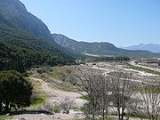
 of Thermopylae consisted of a pass so narrow that two chariots could barely move abreast—on the western side of the pass stood the sheer side of the mountain, while the east side was the sea. Along the path was a series of three "gates", and at the center gate a short wall that had been erected by the Phocians in the previous century to aid in their defense against Thessalian invasions. It was here in August of 480 BC that an army of some 7,000 Greeks, led by the 300 Spartans of the royal guard, stood to receive the full force of the Persian army, numbering perhaps some sixty times its size. The Greek army included according to Herodotus the following forces:
Spartans: 300
Mantineans: 500
Tegeans: 500
Arcadian Orchomenos: 120
Other Arcadians: 1,000
Corinthians: 400
Floians: 200
Mycenae Mycenae

Mycenae , is an archaeological site [i] in Greece [i], located about 90km south-west of Athens [i] ... 

ans:
80
Thespians: 700
Thebans Thebes, Greece

Thebes is a city in Greece [i], situated to the north of the Cithaeron [i] range, which divides Boeotia [i] ... 

:
400
Phocians and Opuntan Locrians: 1,000
Total forces: 5,200

To this number we have to add 1,000 other Lacedemonians mentioned by Diodorus Siculus  and some perhaps 800 auxiliary troops from other Greek cities. Diodorus gives 4,000 as the total Greek troops, and Pausanias 11,200. Modern historians, which usually consider Herodotus more reliable, prefer his claim of 7,000 men. It has been argued that this force was only intended to slow and not stop the invasion force. However it seems that the Athenians at least felt confident that this army and Leonidas' presence were enough to stop the Persians, otherwise they would have already vacated their city and sent their whole army to Thermopylae. It is more probable, though, that a small force was sent because the site favored a small defending force. We know of one case in which a small force did stop a larger invading force from the north; in 353 BC/352 BC the Athenians managed to stop the forces of Philip II of Macedon Philip II of Macedon

Philip II of Macedon was the King of Macedon [i] from 359 BC [i] until his assassinati ... 

 by deploying 5,000 hoplites and 400 horsemen.

Knowing the likely outcome of the battle, Leonidas selected his men on one simple criterion: he took only men who had fathered sons that were old enough to take over the family responsibilities of their fathers. The rationale behind this criterion was that the Spartans knew their death was almost certain at Thermopylae. Plutarch Plutarch

Mestrius Plutarchus , known in English as Plutarch, was a Greek [i] historian [i], ... 

 mentions, in his Sayings of Spartan Women, that after encouraging her husband before his departure for the battlefield, Gorgo, the wife of Leonidas I Leonidas I

Leonidas was a king of Sparta [i], the 17th of the Agiad line.... 

 asked him what she should do when he had left. To this, Leonidas replied:
Marry a good man, and have good children.


When Xerxes reached Thermopylae, he sent emissaries to the Greek forces. At first he asked Leonidas to come on his side and offered him to be king of all of Greece. Leonidas answered:
If you knew what is good in life, you would abstain from wishing for foreign things. For me it is better to die for Greece than to be monarch over my compatriots


Then Xerxes asked him more forcefully to surrender their arms. To this Leonidas gave his very famous answer:
????? ?aß?


which meant "Come take them". This quote has been repeated by many later generals, and even a few politicians, in order to express the Greeks' determination to risk a huge sacrifice rather than surrender without a fight. It is today the emblem of the Greek First Army Corps 

The Battle


When scouts initially informed Xerxes of the size of the Greek force, and of the Spartans who were performing preparations which included naked calisthenics and combing their hair, Xerxes found the reports laughable. Not understanding the ritual significance of the Spartan preparations as the actions of men with the resolution to fight to the end, he expected the force to disband at any moment and waited four days for the Greek force to retreat. When they did not, he became increasingly frustrated by what he perceived as foolish impudence on the part of the small Greek force. On the fifth day Xerxes ordered his troops into the pass.

The Greeks deployed themselves in a phalanx Phalanx formation

A phalanx is a rectangular [i] mass military formation [i], usually composed entirely of heavy infantry ... 

, a wall of overlapping shields and layered spearpoints, spanning the entire width of the pass. The Persians, armed with arrows and short spears, could not break through the long spears of the Greek phalanx, nor were their lightly armoured men a match for the superior armour, weaponry and discipline of the Greek hoplites Hoplite

... 

. Because of the terrain, the Persians were unable to surround or flank the Greeks, thus rendering their superior numbers almost useless. Greek morale was high. Herodotus wrote that when Dienekes, a Spartan soldier, was informed that Persian arrows were so numerous that they blotted out the sun, he remarked with characteristically laconic prose, "So much the better, we shall fight in the shade." Today Dienekes's phrase is the motto of the Greek 20th Armored Division  At first Xerxes sent in the Medes Medes

The Medes were an ancient Iranian people [i], who lived in the north, western, a ... 

, perhaps because he preferred them for their bravery or perhaps, as Diodorus Siculus suggested, because Xerxes wanted them to bear the brunt of the fighting—the Medes had been only recently conquered by the Persians.

Along with them he sent relatives of those who had fallen at the battle of Marathon Battle of Marathon

The Battle of Marathon was the culmination of King Darius I of Persia [i]'s first major attempt to conq... 

 ten years earlier. According to Ctesias the first wave numbered 10,000 soldiers under Artapanus. Enormous casualties were sustained by the Persians as the disciplined Spartans who sought to maximise enemy casualties orchestrated a series of feint retreats, followed by a quick turn back into formation. Waves upon waves of soldiers would go to the front, stepping upon the bodies of their dead comrades, only to die. Ctesias writes that Xerxes sent 20,000 more men driven by whip-wielding officers who flogged them whenever they retreated; these fared no better. Fifty thousand more Persians attacked on the second day of battle, but were repelled. After watching his troops fall before the Greeks, Xerxes decided to send in the legendary Persian Immortals Persian Immortals

The Persian Immortals were a Persia [i]n elite Imperial Guard [i] regiment during t ... 

. Leonidas arranged a system of relays between the hoplites of the various cities so as to constantly have fresh troops on the front line. Yet in the heat of the battle the voracity [of the Greeks] was such that the units did not rotate out but continued to fight and overcame the bounds of the battle to kill many of the elite Persians—even the Immortals lacked the power to break the determined and driven phalanx, and they, too, were forced to retreat with heavy casualties. The casualties on the Greek side were small: Ctesias claims that the first 10,000 Persians killed only two or three Greeks. It seemed that with regular reinforcements the Greeks could go on ad infinitum.

After the second day of fighting, a local shepherd named Ephialtes defected to the Persians and informed Xerxes of a separate path through Thermopylae, which the Persians could use to outflank the Greeks. The pass was defended by 1,000 Phocians, who had been placed there when the Greeks learned of the alternate route just before the battle; they were not expecting to engage the Persians. Xerxes sent Hydarnes with the Immortals through the pass. Surprised by the Persian attack, the Phocians offered only a brief resistance before retreating higher up the mountain to regroup. Instead of pursuing them, however, the Persians simply advanced through the pass unopposed. For this act, the name Ephialtes means "nightmare" and is synonymous with "traitor" in Greek.

Final stand of the Spartans and Thespians

Leonidas, realizing that further fighting would be futile, dismissed all Greek forces save the surviving Spartans and Thebans on August 11; the Spartans having pledged themselves to fight to the death, and the Thebans held as hostages as Thebes' loyalty to Greece was questioned. However, a contingent of about 700 Thespians, led by Demophilus, refused to leave with the other Greeks. Instead, they chose to stay in the sacrificial effort to delay the advance and allow the rest of the Greek army to escape.

The significance of the Thespians' refusal to leave should not be ignored. The Spartans, as brave as their sacrifice indubitably was, were professional soldiers, trained from birth to be ready to give their lives in combat as Spartan law dictated. Conversely, the Thespians were citizen-soldiers who elected to add whatever they could to the fight, rather than allow the Spartans to be annihilated alone. Though their bravery is often overlooked by history, it was most certainly not overlooked by the Spartans, who are said to have exchanged cloaks with the Thespians and promised to be allies for eternity.

The fighting was said to have been extremely brutal, even for hoplite combat. As their numbers diminished the Greeks retreated to a small hill in the narrowest part of the pass. The Thebans took this opportunity to surrender to the Persians. After their spears broke, the Spartans and Thespians kept fighting with their xiphos Xiphos

The xiphos is a double-edged, single-hand sword [i] used by the ancient Greeks.... 

 , and after those broke, they were said to have fought with their bare hands, teeth and nails.

The Greeks killed many Persians, including two of Xerxes' brothers. In this final stand, Leonidas was eventually killed; rather than surrender, the Spartans fought fanatically to defend his body. To avoid losing any more men, the Persians killed the last of the Spartans with flights of arrows.

Aftermath


When the body of Leonidas was recovered by the Persians, Xerxes, in a rage at the loss of so many of his soldiers, ordered that the head be cut off, and the body crucified Crucifixion

Crucifixion is an ancient method of execution [i], where the victim was tied or nailed to a l ... 

. The mutilation of a corpse, even one of the enemy, carried a great social stigma for the Persians, and it was an act that Xerxes was said to have deeply regretted afterwards. Forty years after the battle Leonidas' body was returned to the Spartans, where he was buried with full honors and funeral games were held every year.

While a tactical victory for the Persians, the enormous casualties caused by less than a thousand Greek soldiers was a significant blow to the Persian army. Estimates from historians of the critical school stand at 20,000 Persians dead, including the elite Immortals, though Ctesias implies that Persian losses were over 50,000. Likewise, it significantly boosted the resolve of the Greeks to face the Persian onslaught. The simultaneous naval Battle of Artemisium Battle of Artemisium

The naval Battle of Artemisium took place, according to tradition, on the same day as the Battle of Thermopylae [i] ... 

 was a draw, whereupon the Greek navy retreated. The Persians had control of the Aegean Sea Aegean Sea

The Aegean Sea is an arm of the Mediterranean Sea [i], located between the Greek peninsula and Anatolia [i] ... 

 and all of Greece as far south as Attica; the Spartans prepared to defend the Isthmus of Corinth Isthmus of Corinth

The Isthmus [i] of Corinth is the narrow landbridge which connects the Peloponnesos [i] peninsula with t ... 

 and the Peloponnese Peloponnese

The Peloponnese or Peloponnesus is a large peninsula [i] in southern Greece [i], forming the part ... 

, while Xerxes sacked Athens Athens

Athens is the capital [i] and the largest city of Greece [i]. ... 

, whose inhabitants had already fled to Salamis Island Salamis Island

The Greek [i] island of Salamis is the largest island [i] in the Saronic Gulf [i], about 1 nautical mile [i] ... 

. In September the Greeks defeated the Persians at the naval Battle of Salamis Battle of Salamis

The Battle of Salamis was a naval battle between the Greek [i] city-state [i]s and Persia [i]... 

, which led to the rapid retreat of Xerxes. The remaining Persian army, left under the charge of Mardonius, was defeated in the Battle of Plataea Battle of Plataea

The Battle of Plataea was the last battle of the Persian Wars [i] in southern Greece. ... 

 by a combined Greek army again led by the Spartans, under the regent Pausanias.

This battle, along with Sogdian Rock and similar actions, is used in military academies around the world to show how a small group of well-trained and well-led soldiers can have an impact out of all proportion to their numbers. It is worth noting also that the effectiveness of the Greeks against such a vastly larger army was due in no small part to the battlefield itself. Had this battle been fought on an open field, rather than a narrow pass, the smaller Greek army could have been surrounded and defeated with ease, despite the quality of the Greek infantry. Thus Thermopylae is also regarded as being as much a lesson in the importance of favorable terrain and good strategy as it is in good training and discipline.

Oracle at Delphi

The legend of Thermopylae, as told by Herodotus Herodotus

Herodotus of Halicarnassus [i] was a Dorian Greek [i] historian who lived in the 5th century BC [i] ... 

, has it that Sparta consulted the Oracle at Delphi Delphi

Delphi is an archaeological site and a modern town in Greece [i].... 

 before setting out to meet the Persian army. The Oracle is said to have made the following prophecy in hexameter verse:

O ye men who dwell in the streets of broad Lacedaemon!
Either your glorious town shall be sacked by the children of Perseus Perseus

Perseus, Perseos, or Perseas, the legendary founder of Mycenae [i] and of the Perseid dynasty [i] ... 

,
Or, in exchange, must all through the whole Laconian country
Mourn for the loss of a king, descendant of great Heracles Heracles

In Greek mythology [i], Heracles or Herakles was a divine hero [i], the son of Zeus [i] and ... 

.
He cannot be withstood by the courage of bulls nor of lions,
Strive as they may; he is mighty as Jove Jupiter (mythology)


In Roman mythology [i], Jupiter held the same role as Zeus [i] in the Greek pantheon. ... 

; there is naught that shall stay him,
Till he have got for his prey your king, or your glorious city.

In essence, the Oracle's warning was that either Sparta would be conquered and left in ruins, or one of her two hereditary kings Sparta

Sparta is a city in southern Greece [i]. ... 

 must sacrifice his life to save her.

Monuments at site


There is an epitaph on a monument at site of the battle with Simonides' epigram, which can be found in Herodotus' work The Histories , to the Spartans:

'
.
'


Which to keep the poetic context can be translated as:

Go tell the Spartans, stranger passing by,
that here, obedient to their laws, we lie


or a more strictly literal:

Oh foreigner, give a message to the Lacedaemonians
that here lie we, their words obeying.


Another translation captures the spirit of enduring service to the state which was taught to all Spartan warriors:

Friend, tell the Spartans that on this hill
We lie obedient to them still.


Frank Miller, in his comic series 300, translated it still differently:

Go tell the Spartans, passerby,
That here, by Spartan law, we lie


It has also been interpreted as:

Go tell the Spartans, you who have read;
That we have followed their orders, and now are dead


Yet another version reads:
Stranger to the Spartans go, and tell,
How here, obedient to their laws, we fell.


And yet another version reads:
Go, tell the Spartans, you who read this stone
That we lie here, and that their will was done.


Yet another version:
Tell them in Lacadaemon, passer-by
Obedient to our orders, here we lie


And still another, though unrhyming:
Go, stranger, and tell the Spartans
That we lie here in obedience to their laws


A final version:
"Stranger, tell the Spartans,"
"Here we lie, Obedient."


A note on translation: This should not be read in the imperative mood, but rather as an indirect appeal through an advanced, thankful, salutation to a visitor. What is hoped for in the language of the appeal is that the visitor, once leaving the place, will go and announce to the Spartans that, indeed, the dead lie still at Thermopylae, remaining faithful until the end, in accordance to commands of their king and people. It was not important to the Spartan warriors that they would die, or that their fellow citizens knew that they had in fact died. Rather, the stress of the language is that until their death they had remained faithful.

“Visitor, please confirm to the Spartans that we indeed remained faithful to them until the very end …just in case someone else tells them otherwise.”

Ruskin John Ruskin

John Ruskin is best known for his work as an art critic [i] and social critic [i], but is remembered as ... 

 said of this epitaph that it was the noblest group of words ever uttered by man.

Additionally, there is a modern monument at the site, called the "Leonidas Monument" in honor of the Spartan king. It reads simply: "????? ?aß?": "Come and take them." This was Leonidas' response to Xerxes' offer to spare the Greeks if they would give up their weapons.

Inspiration


Cultural Reference

Thermopylae has been used as a name for ships among Greek shipowners repeatedly in the modern era. Furthermore a clipper ship, 212 feet in length and displacing 91 tonnes,was launched in Aberdeen in 1868. Christened Thermopylae, it established speed records, and was notable for having a male figurehead wearing armor, helmet, shield and sword.

The battle of Thermopylae is often seen as the beginning of organised resistance against the confiscation of arms and, as such, has become a legend amongst pro-gun activists. The battle of Thermopylae also spawned the phrase molon labe.

Poetry and song


  • Lord Byron George Byron, 6th Baron Byron

    George Gordon Byron, 6th Baron Byron was an Anglo-Scottish poet [i] and a leading figure ... 

     refers to Thermopylae in this poem:


Earth! render back from out thy breast
A remnant of our Spartan dead!
Of the three hundred grant but three,
To make a new Thermopylae!


  • A. E. Housman A. E. Housman

    Alfred Edward Housman , usually known as A.E.... 

     wrote a poem called The Oracles which can be found in his book "Last Poems" the last verse of which is:

The King with half the East at heel is marched from land of morning;
Their fighters drink the rivers up, their shafts benight the air,
And he that stands will die for nought, and home there's no returning.
The Spartans on the sea-wet rock sat down and combed their hair.


  • The Greek poet Kavafis who lived in Alexandria Alexandria

    Alexandria , , is the second-largest city in Egypt [i], and its largest seaport. ... 

     of Egypt Egypt

    [i] country in [[North Africa]... 

     at the turn of the 20th century wrote one of his more famous poems entitled "Thermopylae" in 1903:


??µ? s' e?e????? ?p?? st?? ??? t??
???sa? ?a f??????? Te?µ?p??e?.
??te ap? t? ????? µ? ??????te??
d??a??? ?' ?s??,s'??e? t?? te? p???e??,
a??? µe ??p? ????a? ?' e?sp?a???a,
?e??a??? ?s???? e??a? p???s??? ?? ?ta?
e??a? pt????, p??' e?? µ????? ?e??a???,
p??? s??t?????te?, ?s? µp?????e?
p??t?te t?? a???e?a ?µ?????te?,
p??? ????? µ?s?? ??a t??? ?e?d?µ?????.


?a? pe??ss?te?? t?µ? t??? p??pe?
?ta? p??ß??p???
p?? ? ?f???t?? ?a fa?e? st? t????,
?a? ?? ??d?? ep? t????? ?a d?aß???e.


Which can be translated as:

Let honor be to those in whose life
it was set to guard Thermopylae.
Never moving away from duty;
Just and equals in all of their acts
But with sadness and compassion
Brave once they are rich and when
They are poor, again brave
Coming to aid as much as they can;
Always speaking the truth
But without hate for those who lie.


And even more honor they deserve
When its predicted
That Ephialtes will appear in the end
And the Medes will finally pass through


This poem actually created the expression guarding Thermopylae and has been told in honor of other dead, like those of the Imia crisis

  • Sylvia Plath's Sylvia Plath

    Sylvia Plath was an American [i] poet [i], novelist [i], short story [i] writer, and essay [i] ... 

     poem "Letter in November" refers to Thermopylae, as does Emily Dickinson Emily Dickinson

    Emily Elizabeth Dickinson was an American [i] poet [i]. ... 

    's "'Go tell it' — what a message."


  • Dimitris Varos  O ?e??… is a poetic book written in 1974.


  • The Colombian National Anthem refers to the battle


La patria así se forma
Termópilas brotando;
constelación de Cíclopes
su noche iluminó


Which can be translated as

And so the nation forms
Thermopylae springing;
a Cyclops constellation
its night enlightened

Novels


  • Steven Pressfield in Gates Of Fire, depicts the battle as told by a squire of Dienekes, who had been wounded during the fight, but was revived to tell Xerxes of the Spartans' heroism.


  • Paul Cartledge The Spartans, published in 2002, includes a fairly detailed description of the battle fought at Thermopylae, the personal stories of Dienekes, King Leonidas and a wealth of information about Sparta.


  • Gene Wolfe Gene Wolfe

    Gene Wolfe is an American [i] science fiction [i] and fantasy [i] writer. ... 

    's novels Soldier of the Mist and Soldier of Arete are narrated by Latro, a soldier who fought on the Persian side at Plataea and suffered a serious head wound there, which makes him forget everything after 24 hours.


  • German author and Nobel Prize in Literature Nobel Prize in Literature

    The Nobel Prize in Literature is awarded annually to an author from any country who has, in the words of... 

     recipient Heinrich Böll Heinrich Böll

    Heinrich Theodor Bll was one of Germany [i]'s foremost post-World War II [i] writers. ... 

     wrote a story Wanderer, kommst Du nach Spa..., , which takes its title from the German translation of the inscription on the Spartans' tomb. In it a young German soldier at the end of the Second World War World War II

    World War II, or the Second World War, was a worldwide [i] conflict [i] fought betwe ... 

     is wounded on the Eastern Front and is brought to a field hospital Field hospital

    A field hospital is a large mobile medical unit that takes care of the casualties outside the hospital b... 

     which was a school. He wonders if it could be his school, which he only recently left to become a soldier. On seeing the partially erased quotation of the title on a chalkboard, his question is answered.


  • Eric Nylund in "" refers to the Thermopylae battle, although in book the Spartans come out victorious.


  • The graphic novel Graphic novel

    * Artist's book [i]
  • Collage novel [i]

... 

 300, written and illustrated by Frank Miller  depicts the Battle of Thermopylae and the events leading up to it from the perspective of Leonidas. The comic was particularly inspired by the film The 300 Spartans.

  • John Ringo's Ghost Ghost

    A ghost is an alleged non-corporeal manifestation of a dead person [i] . ... 

    , published in 2004, includes a description of the battle fought at Thermopylae, and quotes Simonides' epigram.

Films and other multimedia


  • The 1962 film Film

    Film is a term that encompasses motion pictures as individual projects, as well as the field in general.... 

     The 300 Spartans depicts the Battle of Thermopylae.


  • The 1978 film Go Tell the Spartans makes direct reference to Thermopylae, comparing the French defenders of a Vietnamese village to the Spartans, and forecasting the same result for a later generation of American soldiers. In this case, the technology is on the side of the defenders.


  • In the 2003 film The Last Samurai The Last Samurai

    The Last Samurai is a film [i] written for the most part by John Logan [i], directed by... 

    , Captain Nathan Algren reflects on the Battle of Thermopylae before engaging in a similar battle between traditional Japanese samurai Samurai

    was a term for the military nobility in pre-industrial [i] Japan [i]. ... 

     and a far superior modernized army equipped with firearm Firearm

    A firearm is a weapon [i] that fires either single or multiple projectile [i]s propelled at high velocit ... 

    s and cannon Cannon

    A cannon is any large tubular firearm [i] designed to fire a heavy projectile [i] over a considerable di ... 

    s. In the movie, Algren states that 300 Greek soldiers held off a million Persian warriors, until they lost their will to fight. The Samurai leader, Katsumoto, expressed his admiration for the bravery of the Greek warriors. Later, when Katsumoto asked what happened to the warriors at Thermopylae, Algren replies bluntly, "Dead to the last man".


  • The upcoming film 300 is based on Frank Miller's graphic novel 300, a retelling of the battle from the perspective of Leonidas.


  • The 21st level of , called "My own Private Thermopylae", has the player hold off a large Pfhor Marathon Trilogy

    The Marathon Trilogy is a series of science fiction [i] first-person shooter [i] computer game [i]s ... 

     contingent in a series of tight hallways, much like the actual battle.


  • The Halo 2 Halo 2

    Halo 2 is a first person shooter [i] video game [i] developed by Bungie Studios [i] ... 

    Volume 2 Soundtack has a song titled "Finale: Thermopylae Soon."


  • An episode of Samurai Jack Samurai Jack

    Samurai Jack is an American [i] animated television series [i] created by animator Genndy Tartakovsky [i] ... 

    , "Jack and the Spartans", depicts a group of warriors, similar in appearance to Spartans, defending a narrow gateway against a vast robot army. They have been in combat for 300 years.

Bibliography

  • Herodotus Herodotus

    Herodotus of Halicarnassus [i] was a Dorian Greek [i] historian who lived in the 5th century BC [i] ... 

     "The Histories of Herodotus"
  • Diodorus Siculus Library
  • Ctesias Persica

Notes


See also

  • 300
  • 300
  • The 300 Spartans
  • Molon labe

External links