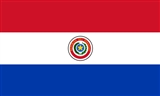
Paraguay , officially the
Republic of Paraguay ' onMouseout='HidePop("27933")' href="http://www.absoluteastronomy.com/topics/Guaraní_language">Guaraní
Guaraní, specifically the primary variety known as Paraguayan Guaraní , is an indigenous language of South America that belongs to the Tupí–Guaraní subfamily of the Tupian languages. It is one of the official languages of Paraguay , where it is spoken by the majority of the population, and half of...
:
Tetã Paraguái teˈtã paɾaˈɣʷaj), is a landlocked country in
South AmericaSouth America is a continent situated in the Western Hemisphere, mostly in the Southern Hemisphere, with a relatively small portion in the Northern Hemisphere. The continent is also considered a subcontinent of the Americas. It is bordered on the west by the Pacific Ocean and on the north and east...
. It is bordered by
ArgentinaArgentina , officially the Argentine Republic , is the second largest country in South America by land area, after Brazil. It is constituted as a federation of 23 provinces and an autonomous city, Buenos Aires...
to the south and southwest,
BrazilBrazil , officially the Federative Republic of Brazil , is the largest country in South America. It is the world's fifth largest country, both by geographical area and by population with over 192 million people...
to the east and northeast, and
BoliviaBolivia officially known as Plurinational State of Bolivia , is a landlocked country in central South America. It is the poorest country in South America...
to the northwest. Paraguay lies on both banks of the
Paraguay RiverThe Paraguay River is a major river in south central South America, running through Brazil, Bolivia, Paraguay, and Argentina...
, which runs through the center of the country from north to south. Due to its central location in South America, it is sometimes referred to as
Corazón de América, or the Heart of America.
The Guaraní have been living in Paraguay since prior to the arrival of Europeans in the 16th century, when Paraguay became part of the Spanish colonial empire. Paraguay gained independence from
SpainSpain , officially the Kingdom of Spain languages]] under the European Charter for Regional or Minority Languages. In each of these, Spain's official name is as follows:;;;;;;), is a country and member state of the European Union located in southwestern Europe on the Iberian Peninsula...
in 1811.
As of 2009 the population was estimated at 6.3 million. The capital and largest city is
AsunciónAsunción is the capital and largest city of Paraguay.The "Ciudad de Asunción" is an autonomous capital district not part of any department. The metropolitan area, called Gran Asunción, includes the cities of San Lorenzo, Fernando de la Mora, Lambaré, Luque, Mariano Roque Alonso, Ñemby, San...
. The official languages are
SpanishSpanish , also known as Castilian , is a Romance language in the Ibero-Romance group that evolved from several languages and dialects in central-northern Iberia around the 9th century and gradually spread with the expansion of the Kingdom of Castile into central and southern Iberia during the...
and
GuaraníThe guaraní is the national currency unit of Paraguay. The guaraní was divided into 100 céntimos but, because of inflation, céntimos are no longer in use.The currency sign is .-History:...
, both being widely spoken in the country. Most of the population are
mestizoMestizo is a term traditionally used in Latin America, Philippines and Spain for people of mixed European and Native American heritage or descent...
s.
In 2010, Paraguay experienced the largest economic expansion in
Latin AmericaLatin America is a region of the Americas where Romance languages – particularly Spanish and Portuguese, and variably French – are primarily spoken. Latin America has an area of approximately 21,069,500 km² , almost 3.9% of the Earth's surface or 14.1% of its land surface area...
and the second fastest in the world, only after
QatarQatar , also known as the State of Qatar or locally Dawlat Qaṭar, is a sovereign Arab state, located in the Middle East, occupying the small Qatar Peninsula on the northeasterly coast of the much larger Arabian Peninsula. Its sole land border is with Saudi Arabia to the south, with the rest of its...
.
Etymology
The official name comes from
GuaraníGuaraní, specifically the primary variety known as Paraguayan Guaraní , is an indigenous language of South America that belongs to the Tupí–Guaraní subfamily of the Tupian languages. It is one of the official languages of Paraguay , where it is spoken by the majority of the population, and half of...
and the literal translation is: Para = of many varieties; Gua = from, belonging to or place river or lake.
There is not a final conclusion of the origin of the name "Paraguay". The most common interpretations along the nation's history suggest:
- "River which originates a sea"
- The Spanish officer and scientist Félix de Azara
Félix Manuel de Azara was a Spanish military officer, naturalist and engineer. He was born in Barbunales, Aragon....
suggests two versions: "water from Payaguas (Payaguá-and Payagua-i), referring to natural Payaguas living on the coasts of the river, and the other was due to name a great chief called "Paraguaio."
- The French-Argentine historian and writer Paul Groussac
Paul-François Groussac was a French-born Argentine writer, literary critic, historian, and librarian. He was born in Toulouse to Catherine Deval and Pierre Groussac, the scion of an old Languedocian family.-Biography:...
argued that it meant "river that flows through the sea (Pantanal)."
- The ex-president and Paraguayan politician, Juan Natalicio Gonzalez
Juan Natalicio González Paredes was a Paraguayan poet who served as President of Paraguay from 15 August 1948 to 30 December 1948.- Early life :...
said it meant "river of the habitants of the sea."
- Fray
Fray is an eight-issue comic book limited series, a futuristic spin-off of the television series Buffy the Vampire Slayer. Written by Buffy creator Joss Whedon, the series follows a Slayer named Melaka Fray, a chosen one in a time where vampires are returning to the slums of New York City, and the...
Antonio Ruiz de MontoyaAntonio Ruiz de Montoya was a Jesuit missionary in Paraguay.-Life:Montoya was born at Lima, Peru.Montoya entered the Society of Jesus on 1 November 1606. In the same year he accompanied Father Diego Torres, the first provincial of Paraguay, to this mission.In co-operation with Fathers Cataldino...
said that it meant "river crowned."
Geography
Paraguay is divided by the Río Paraguay into the eastern region, called Eastern Paraguay (Paraguay Oriental) and known as the Paraná region; and the western region, officially called Western Paraguay (Paraguay Occidental) and also known as the
ChacoThe Gran Chaco is a sparsely populated, hot and semi-arid lowland region of the Río de la Plata basin, divided among eastern Bolivia, Paraguay, northern Argentina and a portion of the Brazilian states of Mato Grosso and Mato Grosso do Sul, where it is connected with the Pantanal region...
. The country lies between latitudes
19°The 19th parallel south is a circle of latitude that is 19 degrees south of the Earth's equatorial plane. It crosses the Atlantic Ocean, Africa, the Indian Ocean, Australasia, the Pacific Ocean and South America....
and
28°SThe 28th parallel south is a circle of latitude that is 28 degrees south of the Earth's equatorial plane. It crosses the Atlantic Ocean, Africa, the Indian Ocean, Australasia, the Pacific Ocean and South America....
, and longitudes
54°The meridian 54° west of Greenwich is a line of longitude that extends from the North Pole across the Arctic Ocean, Greenland, Newfoundland, the Atlantic Ocean, South America, the Southern Ocean, and Antarctica to the South Pole....
and
63°WThe meridian 63° west of Greenwich is a line of longitude that extends from the North Pole across the Arctic Ocean, Greenland, North America, the Atlantic Ocean, South America, the Southern Ocean, and Antarctica to the South Pole....
.
The terrain consists of grassy plains and wooded hills in the east. To the west, there are mostly low, marshy plains.
Climate
The local
climateClimate encompasses the statistics of temperature, humidity, atmospheric pressure, wind, rainfall, atmospheric particle count and other meteorological elemental measurements in a given region over long periods...
ranges from subtropical to temperate, with substantial rainfall in the eastern portions, though becoming semi-arid in the far west.
History
Pre-Columbian society in the wooded, fertile region which is now present-day Paraguay consisted of seminomadic tribes, who were recognized for their fierce warrior traditions. These indigenous tribes were members of five distinct language families, and 17 separate
ethnolinguisticEthnolinguistics is a field of linguistics which studies the relationship between language and culture, and the way different ethnic groups perceive the world. It is the combination between ethnology and linguistics. The former refers to the way of life of an entire community i.e...
groups still remain today.
EuropeansThe ethnic groups in Europe are the various ethnic groups that reside in the nations of Europe. European ethnology is the field of anthropology focusing on Europe....
first arrived in the area in the early sixteenth century, and the settlement of Asunción was founded on August 15, 1537, by the Spanish explorer Juan de Salazar de Espinosa. The city eventually became the center of a
Spanish colonial provinceColonial expansion under the Spanish Empire was initiated by the Spanish conquistadores and developed by the Monarchy of Spain through its administrators and missionaries. The motivations for colonial expansion were trade and the spread of the Christian faith through indigenous conversions...
, as well as a primary site of the Jesuit missions and settlements in South America in the eighteenth century.
Jesuit ReductionsA Jesuit Reduction was a type of settlement for indigenous people in Latin America created by the Jesuit Order during the 17th and 18th centuries. In general, the strategy of the Spanish Empire was to gather native populations into centers called Indian Reductions , in order to Christianize, tax,...
were founded and flourished in eastern Paraguay for about 150 years until the expulsion of the Jesuits by the Spanish crown in 1767. Paraguay overthrew the local Spanish administration on May 15, 1811. Paraguay's first ruler was the dictator
Jose Gaspar Rodriguez de Francia200px|right|thumb|José Gaspar Rodríguez de FranciaDr. José Gaspar Rodríguez de Francia y Velasco was the first leader of Paraguay following its independence from Spain...
. He ruled Paraguay from 1814 until his death in 1840 with very little outside contact and influence, creating a utopian society based on
Rousseau'sJean-Jacques Rousseau was a Genevan philosopher, writer, and composer of 18th-century Romanticism. His political philosophy influenced the French Revolution as well as the overall development of modern political, sociological and educational thought.His novel Émile: or, On Education is a treatise...
Social Contract. After his death, Paraguay went through the very brief ownership of various military officers under a new
juntaJunta may refer to:Governance:* Military-led government:** By military junta or committee**Military dictatorship regardless of structure* Other governance:** Junta ** Specific to Spain:*** Junta , 1808–1810...
, until the secretary Carlos Antonio Lopez, Francia's nephew, declared himself dictator. Lopez modernized Paraguay, and opened it up to foreign commerce. The relation with Buenos Aires was limited to a
non-aggression pactA non-aggression pact is an international treaty between two or more states/countries agreeing to avoid war or armed conflict between them and resolve their disputes through peaceful negotiations...
; Paraguayan independence from Argentina was declared in 1842. After Lopez's death, power was transferred to his eldest son, Francisco Solano Lopez in 1862. Lopez's expansionist aims lead to the
War of the Triple AllianceThe Paraguayan War , also known as War of the Triple Alliance , was a military conflict in South America fought from 1864 to 1870 between Paraguay and the Triple Alliance of Argentina, Brazil, and Uruguay...
in 1864.
Paraguay fought against Brazil,
ArgentinaArgentina , officially the Argentine Republic , is the second largest country in South America by land area, after Brazil. It is constituted as a federation of 23 provinces and an autonomous city, Buenos Aires...
and
UruguayUruguay ,officially the Oriental Republic of Uruguay,sometimes the Eastern Republic of Uruguay; ) is a country in the southeastern part of South America. It is home to some 3.5 million people, of whom 1.8 million live in the capital Montevideo and its metropolitan area...
, and was defeated in 1870 after five years of the bloodiest war in
South AmericaSouth America is a continent situated in the Western Hemisphere, mostly in the Southern Hemisphere, with a relatively small portion in the Northern Hemisphere. The continent is also considered a subcontinent of the Americas. It is bordered on the west by the Pacific Ocean and on the north and east...
. According to William D. Rubinstein, "The normal estimate is that of a Paraguayan population of somewhere between 450,000 and 900,000, only 221,000 survived the war, of whom only 28,000 were adult males." Paraguay also suffered extensive territorial losses to
BrazilBrazil , officially the Federative Republic of Brazil , is the largest country in South America. It is the world's fifth largest country, both by geographical area and by population with over 192 million people...
and
ArgentinaArgentina , officially the Argentine Republic , is the second largest country in South America by land area, after Brazil. It is constituted as a federation of 23 provinces and an autonomous city, Buenos Aires...
.
The
Chaco WarThe Chaco War was fought between Bolivia and Paraguay over control of the northern part of the Gran Chaco region of South America, which was incorrectly thought to be rich in oil. It is also referred to as La Guerra de la Sed in literary circles for being fought in the semi-arid Chaco...
was fought with Bolivia in the 1930s, and Bolivia was defeated. Paraguay re-established sovereignty over the region called the
ChacoThe Gran Chaco is a sparsely populated, hot and semi-arid lowland region of the Río de la Plata basin, divided among eastern Bolivia, Paraguay, northern Argentina and a portion of the Brazilian states of Mato Grosso and Mato Grosso do Sul, where it is connected with the Pantanal region...
, but forfeited additional territorial gains as a price of peace.
The official narrative of Paraguay's history is fraught with disputes among historians, educators and politicians. The "authentic" version of historical events, wars in particular, varies depending on whether it was written in Paraguay, Argentina, Uruguay, Brazil, Bolivia, Europe, or North America.
Both the
Colorado PartyThe National Republican Association – Colorado Party is a political party in Paraguay, founded in 1887 by Bernardino Caballero. It is usually known as the Colorado Party...
and
Liberal PartyThe Liberal Party , commonly known as the Blue Party was a political party in Paraguay, ruling the country for most of the period between 1904 and 1940.-References:...
maintain distinct official versions of Paraguayan history. During the pillaging of Asuncion (
Saqueo de Asunción) in 1869, the Brazilian Imperial Army ransacked and relocated the Paraguayan National Archives to Rio de Janeiro where they have been kept in secrecy, making Colonial and early National Period Paraguayan history difficult to study.
Between 1904 and 1954, Paraguay had thirty-one presidents, most of whom were removed from office by force.
From 1954 to 1989, the country was ruled by
Alfredo StroessnerAlfredo Stroessner Matiauda, whose name is also spelled Strössner or Strößner , was a Paraguayan military officer and dictator from 1954 to 1989...
and the Colorado party. The dictator oversaw an era of economic expansion, but at the cost of a poor human rights and environmental record (see "Political History"). Torture and death for political opponents was routine. After his overthrow, the Colorado continued to dominate national politics until 2008.
Leftist former bishop
Fernando LugoFernando Armindo Lugo Méndez is the current President of Paraguay and a former Roman Catholic bishop of the Diocese of San Pedro.-Early life:...
achieved a historic victory in Paraguay's presidential election in April 2008, defeating the ruling party candidate and ending 61 years of conservative rule. Lugo won with nearly 41% of the vote compared to almost 31% for
Blanca OvelarBlanca Margarita Ovelar de Duarte is a Paraguayan politician and former Minister of Education. She was the Colorado Party's nominee for president in the April 2008 presidential election, in which she was defeated....
of the Colorado party.
Government and politics
Paraguay is a representative democratic
republicA republic is a form of government in which the people, or some significant portion of them, have supreme control over the government and where offices of state are elected or chosen by elected people. In modern times, a common simplified definition of a republic is a government where the head of...
, with a
multi-party systemA multi-party system is a system in which multiple political parties have the capacity to gain control of government separately or in coalition, e.g.The Conservative-Liberal Democrat coalition in the United Kingdom formed in 2010. The effective number of parties in a multi-party system is normally...
and
separation of powersThe separation of powers, often imprecisely used interchangeably with the trias politica principle, is a model for the governance of a state. The model was first developed in ancient Greece and came into widespread use by the Roman Republic as part of the unmodified Constitution of the Roman Republic...
in three branches.
Executive powerExecutive Power is Vince Flynn's fifth novel, and the fourth to feature Mitch Rapp, an American agent that works for the CIA as an operative for a covert counter terrorism unit called the "Orion Team."-Plot summary:...
is exercised solely by the
PresidentThe President of Paraguay is according to the Paraguayan Constitution the Chief of the Executive branch of the Government of Paraguay...
, who is
head of stateA head of state is the individual that serves as the chief public representative of a monarchy, republic, federation, commonwealth or other kind of state. His or her role generally includes legitimizing the state and exercising the political powers, functions, and duties granted to the head of...
and
head of governmentHead of government is the chief officer of the executive branch of a government, often presiding over a cabinet. In a parliamentary system, the head of government is often styled prime minister, chief minister, premier, etc...
. Legislative power is vested in the two chambers of the
National CongressParaguay's bicameral Congress consists of a 45-member Senate and an80-member Chamber of Deputies. It serves as the legislative branch of the Paraguayan state....
. The Judiciary is vested on Tribunals and Courts of
Civil LawCivil law is a legal system inspired by Roman law and whose primary feature is that laws are codified into collections, as compared to common law systems that gives great precedential weight to common law on the principle that it is unfair to treat similar facts differently on different...
and a nine-member Supreme Court of Justice, all of them independent of the executive and the legislature.
Pre-1980
Paraguay gained its independence from Spain in 1811, and its first president was
Jose Gaspar Rodriguez de Francia200px|right|thumb|José Gaspar Rodríguez de FranciaDr. José Gaspar Rodríguez de Francia y Velasco was the first leader of Paraguay following its independence from Spain...
, who was originally appointed with
Fulgencio YegrosFulgencio Yegros y Franco de Torres was Paraguayan soldier and first head of state of independent Paraguay.Yegros was born to a family of military tradition and also pursued a military career. He studied in Asunción and joined the army...
as alternative consul, but in 1814, de Francia was appointed president. He established new laws that more-or-less completely removed the powers of the church and the cabinet, forbid colonial citizens from marrying each other, having only be allowed to marry blacks, mulattoes or natives and cut off Paraguay from the rest of South America. Because of his abolition of freedom and gain to complete power, Yegros and several other ex-politicians attempted to host a coup-d'etat against him, which failed and they were imprisoned for life.
After
World War IIWorld War II, or the Second World War , was a global conflict lasting from 1939 to 1945, involving most of the world's nations—including all of the great powers—eventually forming two opposing military alliances: the Allies and the Axis...
, politics became particularly unstable with several political parties fighting for power in the late 1940s, which most notably brought up the Paraguayan civil war of 1947. A series of unstable governments ensued until the establishment in 1954 of the stable regime of
dictatorA dictator is a ruler who assumes sole and absolute power but without hereditary ascension such as an absolute monarch. When other states call the head of state of a particular state a dictator, that state is called a dictatorship...
Alfredo StroessnerAlfredo Stroessner Matiauda, whose name is also spelled Strössner or Strößner , was a Paraguayan military officer and dictator from 1954 to 1989...
, who remained in office for more than three decades. Paraguay modernized to some extent under Stroessner's regime, though his rule was marked by extensive abuses. From 1954 to 1989, the country was ruled by
Alfredo StroessnerAlfredo Stroessner Matiauda, whose name is also spelled Strössner or Strößner , was a Paraguayan military officer and dictator from 1954 to 1989...
and the Colorado party.
Post-1979
The splits in the Colorado Party in the 1980s and the conditions that led to this — Stroessner's age, the character of the regime, the economic downturn, and
international isolationInternational isolation is a penalty applied by the international community or a sizeable or powerful group of countries, like the United Nations, towards one nation, government or people group...
— provided an opportunity for demonstrations and statements by the opposition prior to the 1988 general elections.
PLRAThe Authentic Radical Liberal Party is a liberal party in Paraguay.The party is an observer member of Liberal International. At the last legislative elections, 27 April 2003, the party won 25.7 % of the popular vote and 21 out of 80 seats in the Chamber of Deputies of Paraguay and 24.3 %, leading...
leader
Domingo LainoDomingo Isabelino Laino Figueredo is a Paraguayan politician, economist, and activist. The leader of the Authentic Radical Liberal Party, a Senator, and a former Member of the Chamber of Deputies, Laino first became known for his opposition to the Stroessner dictatorship: in 1956, he was arrested...
served as the focal point of the opposition in the second half of the 1980s. The government's effort to isolate Laino by exiling him in 1982 had backfired. On his sixth attempt, in 1986, Laino returned with three television crews from the U.S., a former United States
ambassadorAn ambassador is the highest ranking diplomat who represents a nation and is usually accredited to a foreign sovereign or government, or to an international organization....
to Paraguay, and a group of Uruguayan and Argentine congressmen. Despite the international contingent, the police violently barred Laino's return.
However, the Stroessner regime relented in April 1987 and permitted Laino to arrive in Asunción. Laino took the lead in organizing demonstrations and diminishing somewhat the normal opposition party infighting. The opposition was unable to reach agreement on a common strategy regarding the elections, with some parties advocating abstention and others calling for blank voting. Nonetheless, the parties did cooperate in holding numerous lightning demonstrations (
mítines relámpagos), especially in rural areas. Such demonstrations were held and disbanded quickly before the arrival of the police.
In response to the upsurge in opposition activities, Stroessner condemned the Accord for advocating "sabotage of the general elections and disrespect of the law" and used the national police and civilian vigilantes of the Colorado Party to break up demonstrations. A number of opposition leaders were imprisoned or otherwise harassed. Hermes Rafael Saguier, another key leader of the PLRA, was imprisoned for four months in 1987 on charges of sedition. In early February 1988, police arrested 200 people attending a National Coordinating Committee meeting in
Coronel OviedoCoronel Oviedo is a city in Paraguay. It is the capital of the Caaguazú Department, about 150 kilometers east of Asunción.The city has a population of about 52,400 and is the hometown of president Nicanor Duarte Frutos. Coronel Oviedo is an important transit point, as it lies halfway between...
. Laino and several other opposition figures were arrested before dawn on the day of the election, February 14, and held for twelve hours. The government declared Stroessner's re-election with 89% of the vote.
Although contending that these results reflected the Colorados' virtual monopoly of the mass media, opposition politicians also saw several encouraging developments. Some 53% of those polled indicated that there was an "uneasiness" in Paraguayan society. Furthermore, 74% believed that the political situation needed changes, including 45% who wanted a substantial or total change. Finally, 31% stated that they planned to abstain from voting in the February elections.
On February 3, 1989, Stroessner was overthrown in a military coup headed by General Andrés Rodríguez. As president, Rodríguez instituted political, legal, and economic reforms and initiated a rapprochement with the international community.
The June 1992 constitution established a democratic system of government and dramatically improved protection of fundamental rights. In May 1993, Colorado Party candidate
Juan Carlos WasmosyJuan Carlos Wasmosy Monti was the President of Paraguay from 1993 until 1998. He was a member of the Colorado Party, and the country's first civilian president in 39 years....
was elected as Paraguay's first civilian president in almost 40 years in what international observers deemed fair and free elections.
With support from the
United StatesThe United States of America is a federal constitutional republic comprising fifty states and a federal district...
, the
Organization of American StatesThe Organization of American States is a regional international organization, headquartered in Washington, D.C., United States...
, and other countries in the region, the Paraguayan people rejected an April 1996 attempt by then Army Chief General
Lino OviedoLino César Oviedo Silva is a Paraguayan politician and former army general.-Life and work:Oviedo was born in poverty in the town of Juan de Mena on September 23, 1943. He chose a military career, studied in Germany and eventually became a close aide to General Andrés Rodríguez. He was named chief...
to oust President Wasmosy, taking an important step to strengthen democracy.
Oviedo became the Colorado candidate for president in the 1998 election, but when the Supreme Court upheld in April his conviction on charges related to the 1996 coup attempt, he was not allowed to run and remained in confinement. His former running mate, Raúl Cubas, became the Colorado Party's candidate and was elected in May in elections deemed by international observers to be free and fair. One of Cubas' first acts after taking office in August was to commute Oviedo's sentence and release him from confinement. In December 1998, Paraguay's Supreme Court declared these actions unconstitutional. In this tense atmosphere, the murder of Vice President and long-time Oviedo rival
Luis María ArgañaLuis María del Corazón de Jesús Dionisio Argaña Ferraro was a prominent politician in Paraguay and influential member of the Colorado Party until his assassination in 1999....
on March 23, 1999, led the Chamber of Deputies to impeach Cubas the next day. The March 26 murder of eight student antigovernment demonstrators, widely believed to have been carried out by Oviedo supporters, made it clear that the Senate would vote to remove Cubas on March 29, and Cubas resigned on March 28. Senate President Luis González Macchi, a Cubas opponent, was peacefully sworn in as president the same day.
In 2003, Nicanor Duarte Frutos was elected and sworn in as president.
For the 2008 general elections, the Colorado Party was once again a favorite. However, this time their candidate was not an internal opponent to the President and self-proclaimed reformer, as in the two previous elections, but Minister of Education
Blanca OvelarBlanca Margarita Ovelar de Duarte is a Paraguayan politician and former Minister of Education. She was the Colorado Party's nominee for president in the April 2008 presidential election, in which she was defeated....
, the first woman to appear as a candidate for a major party in Paraguayan history. But after sixty years of rule by the Colorados voters chose a non-politician, former Roman Catholic Bishop
Fernando LugoFernando Armindo Lugo Méndez is the current President of Paraguay and a former Roman Catholic bishop of the Diocese of San Pedro.-Early life:...
. Although he was a long time follower of the controversial
liberation theologyLiberation theology is a Christian movement in political theology which interprets the teachings of Jesus Christ in terms of a liberation from unjust economic, political, or social conditions...
he was backed by the center-right Liberal Party, the Colorados' traditional opponents.
Outgoing President Nicanor Duarte Frutos hailed the moment as the first time in the history of this nation that a government had handed power to opposition forces in an orderly and peaceful fashion.
Lugo was sworn in on August 15, 2008 but unlike other South American countries such as
VenezuelaVenezuela , officially called the Bolivarian Republic of Venezuela , is a tropical country on the northern coast of South America. It borders Colombia to the west, Guyana to the east, and Brazil to the south...
,
EcuadorEcuador , officially the Republic of Ecuador is a representative democratic republic in South America, bordered by Colombia on the north, Peru on the east and south, and by the Pacific Ocean to the west. It is one of only two countries in South America, along with Chile, that do not have a border...
and
BoliviaBolivia officially known as Plurinational State of Bolivia , is a landlocked country in central South America. It is the poorest country in South America...
, Lugo's leftist agenda remains largely unimplemented as the Paraguayan Congress continues to be dominated by right-wing elected officials.
Administrative subdivisions
Paraguay consists of seventeen departments and one capital district (
distrito capital). These are, with their capitals indicated:
EWLINE
| Department | Capital |
1 |
Alto Paraguay Alto Paraguay is a sparsely populated department of Paraguay. The capital is the town of Fuerte Olimpo.In 1992 the Chaco Department was merged with Alto Paraguay, effectively recreating the original department Olimpo as it existed until 1945.... |
|
2 |
Alto ParanáAlto Paraná is a department in Paraguay. The capital is Ciudad del Este .The Alto Paraná department has experienced tremendous economic and population growth in the past 50 years... |
|
3 |
AmambayAmambay is a department in Paraguay. The capital is Pedro Juan Caballero.The name comes from the way is called a part of the Caaguazú Cordillera, “Amambay Cordillera”... |
|
4 |
Distrito Capital |
|
5 |
BoquerónBoquerón is a department in the western region of Paraguay. It is the country's largest department, with an area of , but its population is only 45,617 . The department includes the Russian Mennonite colonies of Fernheim, Menno and its administrative center Loma Plata and Neuland. The capital is... |
|
6 |
CaaguazúCaaguazú is a department in Paraguay. The capital is the city of Coronel Oviedo.- History :The area that today is known as Caaguazú, was threatened during the 16th and 17th centuries by the Portuguese Bandeirantes and Guaicurú Indians, desolating the land for many years.In the 18th century,... |
|
7 |
CaazapáCaazapá is a department in Paraguay. The capital is the city of Caazapá. Among Paraguayans, the department is well known for its orange and mandarin trees, and for its forest hills... |
|
8 |
CanindeyúCanindeyú is a department in Paraguay. The capital is the city of Salto del Guairá.-Districts:The department is divided in 11 districts:# Corpus Christi# Curuguaty# General Francisco Caballero Alvarez # Itanará# Katueté# La Paloma... |
|
9 |
Central Central is a department in Paraguay. The capital is Areguá. With its 1,929,834 inhabitants it is the most populated of the 17 departments of Paraguay.-Boundaries:*North: the departments of Cordillera and Presidente Hayes.... |
|
|
EWLINE
| Department | Capital |
10 |
ConcepciónConcepción is a department of Paraguay. The capital is the city of Concepción.- History :Throughout history, this department has suffered a great amount of poblational instability, especially in the times of the colony, due to the advance of the Brazilian “bandeirantes” through the east and the... |
|
11 |
Cordillera-History:During the seventeenth and eighteenth centuries this area of the country was going through a serious crisis due to population bellicosity of the Indians from Chaco. The villagers from Tobatí located north of the river Pirapo then called, had to migrate south for the continue attacks by... |
|
12 |
GuairáGuairá is a department in Paraguay. The capital is the city of Villarrica.It covers a surface of , with a population of 178130 inhabitants .You can get there through the Road nª8 Blas Garay... |
|
13 |
ItapúaItapúa is a department in the southern region of Paraguay. The capital is the city of Encarnación. It is divided into 30 districts, making it the department with the most districts in the country.-History:... |
|
14 |
Misiones Misiones is a department located in the southern region of Paraguay. Its capital is San Juan Bautista. The eighth of Paraguay's 17 departments, it was created in 1906, then known as the San Ignacio Department, and was not given its present name until 1945... |
|
15 |
ÑeembucúÑeembucú is a department located in the south of the Eastern Region of Paraguay. The capital is Pilar. The department is almost entirely rural, and is home to some of the oldest and best-preserved Jesuit ruins, which are located near the town of Humaitá.-Districts:The department is divided in 16... |
|
16 |
ParaguaríParaguarí is a departamento in Paraguay. At the 2002 census it had a population of 221,932. The capital is the city of Paraguarí.- History :... |
|
17 |
Presidente HayesPresidente Hayes is a department in Paraguay. The capital is the city of Villa Hayes. The department was named after U.S. President Rutherford B. Hayes, who was the arbitrator in a boundary dispute between Paraguay and Argentina after the War of the Triple Alliance.-Districts:The department is... |
|
18 |
San PedroSan Pedro is a department of Paraguay. The capital is the city of San Pedro de Ycuamandiyú.-History:During the 17th and 18th centuries there was even greater political and population instability than in Concepción.... |
|
|
|
The departments are further divided into
districtDistricts are a type of administrative division, in some countries managed by a local government. They vary greatly in size, spanning entire regions or counties, several municipalities, or subdivisions of municipalities.-Austria:...
s (
distritos).
Demographics
There is no official data on the ethnic composition of the Paraguayan population, because the Department of Statistics, Surveys and Censuses of Paraguay does not include the concepts of
race and
ethnicity in census surveys, although it does inquire about the indigenous population. According to the census of 2002, the indigenous population was 1.7% of Paraguay's total population.
Traditionally, the Paraguayan population is considered mixed (
mestizo in Spanish), because of the widespread offspring of Guaraní women and Spanish settlers during Spain's domination of the country.
According to the CIA World Factbook, Paraguay has a population of 6,669,086, 95% of which are
mestizoMestizo is a term traditionally used in Latin America, Philippines and Spain for people of mixed European and Native American heritage or descent...
(mixed European and Amerindian) and 5% are labelled as "other" and are members of indigenous tribal groups. They are divided into 17 distinct ethnolinguistic groupings, many of which are poorly documented.
One remarkable trace of the indigenous Guaraní culture that has endured in Paraguay is the
Guaraní languageGuaraní, specifically the primary variety known as Paraguayan Guaraní , is an indigenous language of South America that belongs to the Tupí–Guaraní subfamily of the Tupian languages. It is one of the official languages of Paraguay , where it is spoken by the majority of the population, and half of...
, generally understoood by about 90% of the population. However, nearly all Paraguayans speak
SpanishSpanish , also known as Castilian , is a Romance language in the Ibero-Romance group that evolved from several languages and dialects in central-northern Iberia around the 9th century and gradually spread with the expansion of the Kingdom of Castile into central and southern Iberia during the...
. Spanish and Guaraní are official languages. Small groups of ethnic
ItaliansThe Italian people are an ethnic group that share a common Italian culture, ancestry and speak the Italian language as a mother tongue. Within Italy, Italians are defined by citizenship, regardless of ancestry or country of residence , and are distinguished from people...
, Germans, Russians,
JapaneseJapanese Paraguayan is a Paraguayan citizen with Japanese ethnicity.-History:...
,
KoreansKoreans in Paraguay formed one of the earliest Korean diaspora communities in Latin America; however, they were always overshadowed by the larger Korean communities in neighbouring Brazil and Argentina, and since the late 1990s, their population has fallen significantly.-Migration history:The first...
,
ChineseChinese civilization may refer to:* China for more general discussion of the country.* Chinese culture* Greater China, the transnational community of ethnic Chinese.* History of China* Sinosphere, the area historically affected by Chinese culture...
, Arabs,
UkrainiansUkrainians are an East Slavic ethnic group native to Ukraine, which is the sixth-largest nation in Europe. The Constitution of Ukraine applies the term 'Ukrainians' to all its citizens...
,
BrazilBrazil , officially the Federative Republic of Brazil , is the largest country in South America. It is the world's fifth largest country, both by geographical area and by population with over 192 million people...
ians, and
ArgentinesArgentina , officially the Argentine Republic , is the second largest country in South America by land area, after Brazil. It is constituted as a federation of 23 provinces and an autonomous city, Buenos Aires...
settled in Paraguay, and they have to an extent retained their respective languages and culture, particularly the Brazilians who represent the largest number. An estimated 400,000 Brazilians live in Paraguay. Many of the Brazilians are descendants of the German, Italian and Polish immigrants. There are also an estimated 63,000
Afro-ParaguayansAfro-Paraguayan are Paraguayans of African descent. They can be found Camba Cua outside Asuncion; Kamba Kokue outside of Paraguari, and the city of Emboscada.-History:...
, or 1% of the population. Some 25,000 German-speaking
MennoniteThe Mennonites are a group of Christian Anabaptist denominations named after the Frisian Menno Simons , who, through his writings, articulated and thereby formalized the teachings of earlier Swiss founders...
s live in the Paraguayan
ChacoThe Gran Chaco is a sparsely populated, hot and semi-arid lowland region of the Río de la Plata basin, divided among eastern Bolivia, Paraguay, northern Argentina and a portion of the Brazilian states of Mato Grosso and Mato Grosso do Sul, where it is connected with the Pantanal region...
.
Paraguay has one of the more important and representative German communities in South America. German settlers founded several towns as
HohenauHohenau is a municipality in the district of Freyung-Grafenau in Bavaria in Germany....
,
FiladelfiaFiladelfia is the capital of Boquerón Department in the Gran Chaco of western Paraguay. It is the centre of the Fernheim Colony. It is about a 5 hour drive from the capital of Asunción.-History:...
,
NeulandNeuland is a German typeface that was designed in 1923 by Rudolf Koch.Koch designed it by directly carving the type into metal. The original typeface thus had a great deal of variance between the sizes...
,
ObligadoObligado is a town in the Itapúa department of Paraguay.- Sources :* – World-Gazetteer.com...
,
Nueva GermaniaNueva Germania is a district of San Pedro Department in Paraguay. It was founded as a German colony on August 23, 1887 by Bernhard Förster, who was married to Elisabeth Förster-Nietzsche, sister of the German philosopher Friedrich Nietzsche...
, etc. Some specialized German sites that promote German immigration to Paraguay refers to 5%-7% of German descent Paraguayan population and 150.000 German-Brazilian descent population
Paraguay's population is distributed unevenly through the country. About 56% of Paraguayans live in urban areas. The vast majority of the people live in the eastern region near the capital and largest city,
AsunciónAsunción is the capital and largest city of Paraguay.The "Ciudad de Asunción" is an autonomous capital district not part of any department. The metropolitan area, called Gran Asunción, includes the cities of San Lorenzo, Fernando de la Mora, Lambaré, Luque, Mariano Roque Alonso, Ñemby, San...
, accounting for 10% of the country's population. The
Gran ChacoThe Gran Chaco is a sparsely populated, hot and semi-arid lowland region of the Río de la Plata basin, divided among eastern Bolivia, Paraguay, northern Argentina and a portion of the Brazilian states of Mato Grosso and Mato Grosso do Sul, where it is connected with the Pantanal region...
region, which includes the
Alto ParaguayAlto Paraguay is a sparsely populated department of Paraguay. The capital is the town of Fuerte Olimpo.In 1992 the Chaco Department was merged with Alto Paraguay, effectively recreating the original department Olimpo as it existed until 1945....
,
BoquerónBoquerón is a department in the western region of Paraguay. It is the country's largest department, with an area of , but its population is only 45,617 . The department includes the Russian Mennonite colonies of Fernheim, Menno and its administrative center Loma Plata and Neuland. The capital is...
and
Presidente Hayes DepartmentPresidente Hayes is a department in Paraguay. The capital is the city of Villa Hayes. The department was named after U.S. President Rutherford B. Hayes, who was the arbitrator in a boundary dispute between Paraguay and Argentina after the War of the Triple Alliance.-Districts:The department is...
, and accounts for about 60% of the territory, is home to less than 2% of the population.
Largest cities
Religion
According to the 2002 census, 89.9 of the population is Roman Catholic, 6.2 is evangelical Christian, 1.1% is other Christian, 0.6% practice indigenous religions.
A U.S. State Department report on Religious Freedom names Roman Catholicism, evangelical Christianity, mainline
ProtestantismProtestantism is one of the three major groupings within Christianity. It is a movement that began in Germany in the early 16th century as a reaction against medieval Roman Catholic doctrines and practices, especially in regards to salvation, justification, and ecclesiology.The doctrines of the...
,
JudaismJudaism ) is the "religion, philosophy, and way of life" of the Jewish people...
(Orthodox, Conservative, and Reform),
MormonismMormonism is the religion practiced by Mormons, and is the predominant religious tradition of the Latter Day Saint movement. This movement was founded by Joseph Smith, Jr. beginning in the 1820s as a form of Christian primitivism. During the 1830s and 1840s, Mormonism gradually distinguished itself...
, and the
Baha'i FaithThe Bahá'í Faith is a monotheistic religion founded by Bahá'u'lláh in 19th-century Persia, emphasizing the spiritual unity of all humankind. There are an estimated five to six million Bahá'ís around the world in more than 200 countries and territories....
as prominent religious groups and also mentions a large Muslim community in Alto Paraná as a result of Middle-Eastern immigration, especially from
LebanonLebanon , officially the Republic of LebanonRepublic of Lebanon is the most common term used by Lebanese government agencies. The term Lebanese Republic, a literal translation of the official Arabic and French names that is not used in today's world. Arabic is the most common language spoken among...
, and also the Mennonite community in Boquerón.
Social issues
Various poverty estimates suggest that 30-50% of the population is poor. In rural areas, 41.20% of the people lack a monthly income to cover basic necessities, whereas in urban centers this figure is 27.6%. The top 10% of the population holds 43.8% of the national income, while the lowest 10% has 0.5%. The economic recession has worsened income inequality, notably in the rural areas, where the
Gini coefficientThe Gini coefficient is a measure of statistical dispersion developed by the Italian statistician and sociologist Corrado Gini and published in his 1912 paper "Variability and Mutability" ....
has risen from 0.56 in 1995 to 0.66 in 1999.
More recent data (2009) show that 35% of the Paraguayan population is poor, 19% of which live in extreme poverty. Moreover, 71% of the later live in rural areas of the country.
Similarly, land concentration in the Paraguayan countryside is one of the highest in the globe: 10% of the population controls 66% of the land, while 30% of the rural people are landless. This inequality has caused a great deal of tensions between the landless and land owners.
Economy
Landlocked Paraguay has a market economy distinguished by a large informal sector, featuring re-export of imported consumer goods to neighboring countries, as well as the activities of thousands of microenterprises and urban street vendors. Between 1970 and 2009 the country had the highest economic growth of
South AmericaSouth America is a continent situated in the Western Hemisphere, mostly in the Southern Hemisphere, with a relatively small portion in the Northern Hemisphere. The continent is also considered a subcontinent of the Americas. It is bordered on the west by the Pacific Ocean and on the north and east...
, with an average rate of 7.2% per year and the prospect of 9% annual growth from 2010, being the highest in South America.
The country also boasts the third most important free commercial zone in the world: Ciudad del Este, trailing behind Miami and Hong Kong. A large percentage of the population, especially in rural areas, derives its living from agricultural activity, often on a subsistence basis. Because of the importance of the informal sector, accurate economic measures are difficult to obtain. On a per capita basis, real income has stagnated at 1980 levels. The economy grew rapidly between 2003 and 2008 as growing world demand for commodities combined with high prices and favorable weather to support Paraguay's commodity-based export expansion. Paraguay is the sixth largest soy producer in the world. Drought hit in 2008, reducing agricultural exports and slowing the economy even before the onset of the global recession.
In 2010, Paraguay is currently experiencing the greatest economical expansion of the zone and the highest of South America, with a GDP growth rate of 14.5% for by the end of the year.
Industry and manufacturing
The industrial sector produces about 25% of Paraguay’s
gross domestic productGross domestic product refers to the market value of all final goods and services produced within a country in a given period. GDP per capita is often considered an indicator of a country's standard of living....
(GDP) and employs about 31% of the labor force. Output grew by 2.9% in 2004, after five years of declining production. Traditionally an agricultural economy, Paraguay is showing some signs of long-term industrial growth.
The pharmaceutical industry is quickly supplanting foreign suppliers in meeting the country’s drug needs. Paraguayan companies now meet 70% of domestic consumption and have begun to export drugs. Strong growth also is evident in the production of edible oils, garments, organic sugar, meat processing, and steel.
Nevertheless, capital for further investment in the industrial sector of the economy is scarce. Following the revelation of widespread financial corruption in the 1990s, the government is still working to improve credit options for Paraguayan businesses.
In 2003, manufacturing made up 13.6% of the GDP, and the sector employed about 11% of the working population in 2000. Paraguay’s primary manufacturing focus is on food and beverages. Wood products, paper products, hides and furs, and non-metallic mineral products also contribute to manufacturing totals. Steady growth in the manufacturing GDP during the 1990s (1.2% annually) laid the foundation for 2002 and 2003, when the annual growth rate rose to 2.5%.
Education
LiteracyLiteracy has traditionally been described as the ability to read for knowledge, write coherently and think critically about printed material.Literacy represents the lifelong, intellectual process of gaining meaning from print...
was about 93.6% and 87.7% of Paraguayans finish the 5th grade according to UNESCO's last Educational Development Index 2008. Literacy does not differ much by gender. A more recent study reveals that the assistance to primary school of children between 6 and 12 years old is about 98%. Primary education is free, mandatory and takes nine years. Secondary education takes three years.
Paraguay's universities include:
- National University of Asunción (public and founded in 1889) Web Site
- Autonomous University of Asunción (private and founded in 1979) Web Site
- Catholic University (private and run by the church). Web Site
- American University (private).
The net primary enrollment rate was at 88% in 2005. Public expenditure on education was about 4.3 % of GDP in the early 2000s.
Health
LIfe expectancy at birth was 75 years in 2006, and the 8th best position in America's ranking according to World Health Organization. It is the same level as Argentina. Public expenditure on health is 2.6 % of GDP and private expenditure on health 5.1 %. Infant mortality was 20 per 1,000 births in 2005. Maternal mortality was 150 per 100,000 live births in 2000.
The
World BankThe World Bank is an international financial institution that provides loans to developing countries for capital programmes.The World Bank's official goal is the reduction of poverty...
has helped the Paraguayan government reduce Paraguay's maternal and infant mortality. The
Mother and Child Basic Health Insurance Project aimed to contribute to reducing mortality by increasing the use of selected life-saving services included in the country's Mother and Child Basic Health Insurance Program (MCBI) by women of child-bearing age, and children under age six in selected areas. To this end, the project also targeted improving the quality and efficiency of the health service network within certain areas, in addition to increasing the Ministry of Public Health and Social Welfare's (MSPBS) management.
See also
- South America Life Quality Rankings
- South America Life Quality Rankings - Economy and Finance
- South America Life Quality Rankings - Law and Justice
Further reading
- Abdou, Sélim The Jesuit Republic of the Guaranis 1609-1768, (Crossroad, 1997)
- Aren, Richard Genocide in Paraguay, 1976
- Attenborough, David Zoo Quest in Paraguay, 1950
- Barret, William E. Woman on Horseback: the Biography of Francisco Lopez and Eliza Lynch, 1938
- Boschmann, Erwin Paraguay - A Tour Guide, 2009
- Brodksy, Alvin Madame Lynch and Friend, 2005
- Caraman, Philip, The Lost Paradise: The Jesuit Republic in South America, (Seabury Press, 1976)
- Clastres, Helene, The Land-without-Evil: Tupi-Guarani Prophetism, (University of Illinois Press, 1995)
- Cunninghame-Graham, Robert Bontine A Vanished Arcadia: Being Some Account of the Jesuits in Paraguay, 1607 to 1767
- Durrell, Gerald The Drunken Forest, 1956
- English, Adrian J. The Green Hell: A Concise History of the Chaco War Between Bolivia and Paraguay, 1932-35, 2007
- Ganson, Barbara, The Guarani Under Spanish Rule in the Rio de la Plata, (Stanford University Press, 2003)
- Gaska, Henryk, Constructing Ava Guarani Ethnic Identity: The Emergence of Indian Organization in Paraguay, (VDM Verlag Dr. Müller, 2010)
- Gimlette, John At the Tomb of the Inflatable Pig: Travels Through Paraguay, 2003
- Hebblethwaite, Margaret Bradt Travel Guide: Paraguay, 2010
- Jaenike, William F. Black Robes in Paraguay: The Success of the Guarani Missions Hastened the Abolition of the Jesuits, 2008
- Kerr, John A Naturalist in the Chaco, 1950
- Lambert, Peter & Nickson, Andrew The Transition to Democracy in Paraguay, 1997
- Lewis, Paul Paraguay Under Stoessner, 1980
- Ligon, Ethan; Schechter, Laura, "The Value of Social Networks in rural Paraguay", University of California, Berkeley, Seminar, March 25, 2009 , Department of Agricultural & Resource Economics, College of Natural Resources, University of California, Berkeley
- Macintyre, Ben Forgotten Fatherland: The Search for Elizabeth Nietzsche, 1993
- McNaspy, C. J., Lost cities of Paraguay: Art and architecture of the Jesuit reductions, 1607-1767, (Loyola University Press, 1982)
- Meyer, Gordon The River and the People, 1965
- Mora, Frank O. and Cooney, Jerry W. Paraguay anhd the United States, 2007
- Nickson, Andrew Historical Dictionary of Paraguay, 1993
- Nickson, Andrew Paraguay: An Annotated Bibliography, 1999
- O'Shaughnessy, Hugh The Priest of Paraguay: Fernando Lugo and the Making of a Nation, 2009
- Rees, Sián The Shadow of Elisa Lynch, 2003
- Saeger, James S. Francisco Solano L-pez and the Ruination of Paraguay: Honor and Egocentrism, 2007
- Souter, Gavin A Peculiar People: the Australians in Paraguay, 1968
- Stoesz, Edward Like a Mustard Seed: Mennonites in Paraguay, 2008
- Whitehead, Anne Paradise Mislaid: In Search of the Australian Tribe of Paraguay, 1997
- Spencer, Jack Mounting the Bull, 2010
Paraguay in fiction (a brief chronological list)
- Voltaire
François-Marie Arouet , better known by the pen name Voltaire , was a French Enlightenment writer, historian and philosopher famous for his wit and for his advocacy of civil liberties, including freedom of religion, free trade and separation of church and state...
, Candide, ou l'optimisme (1759)
- Robert Southey
Robert Southey was an English poet of the Romantic school, one of the so-called "Lake Poets", and Poet Laureate for 30 years from 1813 to his death in 1843...
, A Tale of Paraguay [poem] (1825)
- Joseph Conrad
Joseph Conrad was a Polish-born English novelist.Conrad is regarded as one of the great novelists in English, although he did not speak the language fluently until he was in his twenties...
, Nostromo [not explicitly set in Paraguay, but the country was an important source for Conrad's composite Latin American country] (1904)
- Gabriel Casaccia
Gabriel Casaccia Bibolini was a Paraguayan novelist. He is widely considered by critics to be the founder of modern literature in Paraguay...
(the pen name of Benigno Casaccia Bibolini), Hombres, mujeres y fantoches (1930)
- Graham Greene
Henry Graham Greene, OM, CH was an English author, playwright and literary critic. His works explore the ambivalent moral and political issues of the modern world...
, Travels With My Aunt (1969)
- Graham Greene
Henry Graham Greene, OM, CH was an English author, playwright and literary critic. His works explore the ambivalent moral and political issues of the modern world...
, The Honorary Consul (1973)
- Augusto Roa Bastos
Augusto Roa Bastos, was a noted Paraguayan novelist and short story writer, and one of the most important Latin American writers of the 20th century. As a teenager he fought in the Chaco War between Paraguay and Bolivia, and he later worked as a journalist, screenwriter and professor...
, Yo, el Supremo (I, the Supreme) [about José Gaspar Rodríguez de Francia, dictator of Paraguay, 1814-1840] (1974)
- Anne Enright
Anne Enright is a Booker Prize-winning Irish author. She has published essays, short stories, a non-fiction book and four novels. Before her novel The Gathering won the 2007 Man Booker Prize, Enright had a low profile in Ireland and the United Kingdom, although her books were favourably reviewed...
, The Pleasure of Eliza Lynch [about the Irish-born mistress of President Francisco Solano Lopez] (2002)
- Lily Tuck
Lily Tuck is an American novelist and short story writer whose novel The News from Paraguay won the 2004 National Book Award. Her novel Siam was nominated for the 2000 PEN/Faulkner Award for Fiction...
, The News from Paraguay (2005)
- Ron Terpening
Ron Terpening is an American writer, professor of Italian, and editor. Though he started his writing career as an author of young-adult fiction, where the father/son conflict is a major theme, he is best known for his later novels of suspense, most of which are set, at least in part, in Italy,...
, Tropic of Fear (2006)
- Warren D. Gillies, Guarani: A Novel, 2006
External links
Government
General information
News media [
http://www.larueda.com.py/ La Rueda - Weekly reviews] ABC Color Última Hora La Nación Paraguay.com Ñanduti
Travel
