
All Topics  
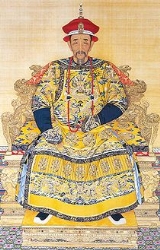
Kangxi Emperor

 
Kangxi Emperor

   Email Print
   Bookmark   Link


Kangxi Emperor


The Kangxi Emperor (; Mongolian
Mongolian language

The Mongolian language is the best-known member of the Mongolic languages. It is the language of most residents of Mongolia and of many of the Mongolian residents of Inner Mongolia, totalling about 5.7 million speakers....
: Enkh Amgalan Khaan, May 4, 1654 – December 20, 1722) was the third Emperor
Emperor of China

The Emperor of China refers to any monarch of Imperial China reigning since the founding of the Qin Dynasty in 221 BC until the fall of the Qing Dynasty in 1912....
 of the Manchu
Manchu

The Manchu people are a Tungusic peoples who originated in Manchuria . During their rise in the seventeenth century, with the help of Ming rebels , they conquered the Ming Dynasty and founded the Qing Dynasty, which ruled China until its abolition in 1911 after the Xinhai Revolution, which established Republic of China in its place....
-led Qing Dynasty
Qing Dynasty

The Qing Dynasty , also known as the Manchu Dynasty, followed the Ming Dynasty in History of China, and was the last ruling Chinese Dynasties of China, ruling from 1644 to 1912 ....
 and the second Qing emperor to rule over China proper
China proper

China proper refers to the historical lands of China where the Han Chinese are the majority ethnic group, in contrast with other regions that form parts of the former Imperial era of Chinese historys and the current People's Republic of China....
, from 1661 to 1722. His reign of 61 years makes him the longest-reigning Chinese Emperor in history and one of the longest in the world
List of longest reigning monarchs of all time

The list of longest reigning Monarchs of all time details monarchs and lifelong leaders who reigned for more than 50 years, sorted by length of reign:...
.

However, having ascended the throne aged seven, he did not exercise much, if any, control over the empire until later, that role being fulfilled by his four guardians and his grandmother, the Grand Empress Dowager Xiaozhuang.


Discussion
Ask a question about 'Kangxi Emperor'
Start a new discussion about 'Kangxi Emperor'
Answer questions from other users
Full Discussion Forum


Recent Posts


Encyclopedia


The Kangxi Emperor (; Mongolian
Mongolian language

The Mongolian language is the best-known member of the Mongolic languages. It is the language of most residents of Mongolia and of many of the Mongolian residents of Inner Mongolia, totalling about 5.7 million speakers....
: Enkh Amgalan Khaan, May 4, 1654 – December 20, 1722) was the third Emperor
Emperor of China

The Emperor of China refers to any monarch of Imperial China reigning since the founding of the Qin Dynasty in 221 BC until the fall of the Qing Dynasty in 1912....
 of the Manchu
Manchu

The Manchu people are a Tungusic peoples who originated in Manchuria . During their rise in the seventeenth century, with the help of Ming rebels , they conquered the Ming Dynasty and founded the Qing Dynasty, which ruled China until its abolition in 1911 after the Xinhai Revolution, which established Republic of China in its place....
-led Qing Dynasty
Qing Dynasty

The Qing Dynasty , also known as the Manchu Dynasty, followed the Ming Dynasty in History of China, and was the last ruling Chinese Dynasties of China, ruling from 1644 to 1912 ....
 and the second Qing emperor to rule over China proper
China proper

China proper refers to the historical lands of China where the Han Chinese are the majority ethnic group, in contrast with other regions that form parts of the former Imperial era of Chinese historys and the current People's Republic of China....
, from 1661 to 1722. His reign of 61 years makes him the longest-reigning Chinese Emperor in history and one of the longest in the world
List of longest reigning monarchs of all time

The list of longest reigning Monarchs of all time details monarchs and lifelong leaders who reigned for more than 50 years, sorted by length of reign:...
.

However, having ascended the throne aged seven, he did not exercise much, if any, control over the empire until later, that role being fulfilled by his four guardians and his grandmother, the Grand Empress Dowager Xiaozhuang. Kangxi, considered one of China's greatest Emperors, was a pivotal figure in Chinese history, having defeated the Three Feudatories, the Zheng Jing
Zheng Jing

Zheng Jing was a 17th century Chinese pirate and warlord. He was the eldest son of Koxinga and grandson of pirate-merchant Zheng Zhilong. After the conquest of Tainan City in 1661 by his father, Zheng Jing controlled the military forces in Xiamen and Quemoy on his father's behalf....
 government on Taiwan
Taiwan

Taiwan is an island in East Asia. "Taiwan" is also commonly used to refer to the country governed by the Republic of China and to the ROC itself, which governs the island of Taiwan, Orchid Island and Green Island, Taiwan in the Pacific Ocean off the Taiwan coast, the Penghu islands in the Taiwan Strait, and Kinmen and the Matsu Islands...
 who previously would not submit to Qing rule and the Tzarist Russia, expanded the Qing empire in the northwest, and achieved such literary feats as the Kangxi Dictionary
Kangxi dictionary

The Kangxi Dictionary was the standard Chinese dictionary during the 18th and 19th centuries. The Kangxi Emperor of the Manchu Qing Dynasty ordered its compilation in 1710 and it was published in 1716....
. Kangxi's reign brought about long-term stability and relative wealth after years of war and chaos.

Emperor Kangxi was the architect of the period known as the "Prosperous Era of Kangxi and Qianlong" which lasted generations past his own life.

The Beginning of the Reign


Born on May 4, 1654 to the Shunzhi Emperor
Shunzhi Emperor

The Shunzhi Emperor was the second Emperor of China of the Manchu-led Qing dynasty, and the first Qing emperor to rule over China proper from 1644 to 1661....
 and Empress Xiaohui, the Kangxi Emperor, whose personal name was Aisin-Gioro
Aisin Gioro

Aisin Gioro was the clan name of the Manchu Qing dynasty emperors of the Qing dynasty . The word aisin means gold in the Manchu language, and "gioro" means clan in the Manchu language....
 Xuanye (Chinese: ????.??), succeeded the imperial throne at the age of 7 on February 7, 1661, seven days after his father's death. Although the Kangxi reign period only started on February 18, 1662 (the first day of the following lunar year), the Kangxi Emperor actually ruled for more than 61 years from February 1661 to his death on December 20, 1722. His reign was the longest in Chinese history. His temple name
Temple name

Temple names are commonly used when naming most Table of Chinese monarchs, List of Korean monarchs , and Vietnamese royalty. They should not be confused with era names....
 (i.e. the official name given after his death for reveration in temple ceremonies) was Shengzu ("Sacred Ancestor"); his descendants thus called him Qing Shengzu.

His father died in his early twenties, and as Kangxi was not able to rule in his minority, the Shunzhi Emperor appointed Soni
Sonin

Sonin, also known as Soni, and rarely Sony , was a senior regent during China Kangxi Emperor's minority in the Qing Dynasty. Sonin belonged to the Plain Yellow Banner....
, Suksaha
Suksaha

Suksaha was a regent during the early reign of the China Kangxi Emperor in the Qing Dynasty. He belonged to the Manchu White Banner. His father's name was Suna....
, Ebilun
Ebilun

Ebilun was an assistant minister appointed by the China Shunzhi Emperor for his successor, Kangxi Emperor during the Qing Dynasty. Ebilun worked with Oboi to defeat Suksaha....
, and Oboi
Oboi

Oboi was a highly decorated Manchu military commander and courtier who served in various military and administrative posts under three successive Emperor of Chinas of the early Qing Dynasty....
 as the Four Regent
Regent

A regent, from the Latin regens "reigning", is a person selected to act as head of state because the ruler is a minor, not present or debilitated....
s. Soni died soon after his granddaughter was made the Empress, Heseli, leaving Suksaha at odds with Oboi politically. In a fierce power struggle, Oboi had Suksaha put to death, and seized absolute power as sole Regent. For a while Kangxi and the Court accepted this arrangement. In 1669 the Emperor arrested Oboi with help from the Xiao Zhuang Grand Dowager Empress and began to take control of the country himself.

In the spring of 1662, the regents ordered the Great Clearance
Great Clearance

In the spring of 1662, the Qing Dynasty Emperor Kangxi Emperor ordered the Great Clearance in southern China, in order to fight the anti-Qing movement, begun by Ming Dynasty loyalists under the leadership of Zheng Chenggong , to regain Beijing....
 in southern China, in order to fight the anti-Qing movement, begun by Ming Dynasty
Ming Dynasty

The Ming Dynasty , or Empire of the Great Ming , was the ruling Dynasties in Chinese history of China from 1368 to 1644, following the collapse of the Mongol-led Yuan Dynasty....
 loyalists under the leadership of Zheng Chenggong (also known as Koxinga
Koxinga

Koxinga is the traditional Western spelling of the popular appellation of Zheng Chenggong , who was a List of famous military commanders at the end of the China Ming Dynasty....
), to regain Beijing
Beijing

is a metropolis in northern China and the Capital of the People's Republic of China. It is one of the four municipality of China, which are equivalent to province in China's Political divisions of China....
. This involved moving the entire population of the coastal regions of southern China inland.

He listed three issues of concern, being the flood control of the Yellow River
Yellow River

The Yellow River or Huang He / Hwang Ho is the second-longest river in China and the List of rivers by length in the world at 4,845 kilometers ....
, the repairing of the Grand Canal
Grand Canal of China

The Grand Canal of China , also known as the Beijing-Hangzhou Grand Canal is the longest ancient canal or artificial river in the world....
 and the Revolt of the Three Feudatories in South China. The Revolt of the Three Feudatories
Revolt of the Three Feudatories

The Three Feudatories were territories in southern China bestowed by the early Manchu rulers on three Chinese generals . In the second half of the 17th century, these generals revolted against the Manchu Qing Dynasty....
 broke out in 1673 and Burni of the Chahar Mongols
Mongols

The name Mongol specifies one or several ethnic groups, now mainly located in Mongolia, China, and Russia....
 also started a rebellion in 1675.

The Revolt of the Three Feudatories presented a major challenge. Wu Sangui
Wu Sangui

Wu Sangui was a Ming Dynasty who was instrumental in the succession of rule to the Qing Dynasty in 1644. Considered by most people to be a traitor to both the Ming and the Qing dynasties, Wu declared himself Emperor of China as ruler of the Zhou Dynasty in 1678, but his revolt was quelled by the Qing Kangxi Emperor....
's forces had overrun most of southern China and he tried to ally himself with local generals such as Wang Fuchen. Kangxi, however, united his court in support of the war effort and employed capable generals such as Zhou Pei Gong and Tu Hai to crush the rebellion. He also extended clemency to the common people who had been caught up in the fighting. Although Kangxi personally wanted to lead the battles against the 3 Feudatories, he was advised not to by his advisors. Kangxi would later lead the battle against the Mongol Dzungars.

Kangxi crushed the rebellious Mongols within two months and incorporated the Chahar into the Eight Banners. After the surrender of the Zheng family, the Qing Dynasty annexed Taiwan
Taiwan

Taiwan is an island in East Asia. "Taiwan" is also commonly used to refer to the country governed by the Republic of China and to the ROC itself, which governs the island of Taiwan, Orchid Island and Green Island, Taiwan in the Pacific Ocean off the Taiwan coast, the Penghu islands in the Taiwan Strait, and Kinmen and the Matsu Islands...
 in 1684. Soon afterwards, the coastal regions were ordered to be repopulated, and to encourage settlers, the Qing government gave a financial incentive to each settling family.

In a diplomatic success, the Kangxi government helped mediate a truce in the long-running Trinh-Nguyen War in the year 1673. The war in Vietnam
Vietnam

Vietnam , officially the Socialist Republic of Vietnam , is the easternmost country on the Indochina Peninsula in Southeast Asia. It is bordered by People's Republic of China to the north, Laos to the northwest, Cambodia to the southwest, and the South China Sea to the east....
 between these two powerful clans had been going on for 45 years without result. The peace treaty that was signed lasted for 101 years (Vietnam, Trials and Tribulations of a Nation by D. R. SarDesai, pg. 38, 1988).

Russia and the Mongols

At the same time, the Emperor was faced with the Russian advance from the north. The Qing Dynasty and the Russian Empire
Russian Empire

File:Russian Emperor Flag.jpgFile:Romanov Flag.svgThe Russian Empire was a state that existed from 1721 until the Russian Revolution of 1917....
 fought along the Sahaliyan ula
Amur

The Amur River or Heilong Jiang is the Earth's ninth longest river, forming the border between the Russian Far East and Northeastern China....
 (Amur, or Heilongjiang
Heilongjiang

is a political divisions of China of the People's Republic of China located in the Northeast China part of the country. "Heilongjiang" literally means Black Chinese dragon River, which is the Chinese name for the Amur river....
) Valley region in the 1650s, which ended with a Qing victory. The Russians invaded the northern frontier again in 1680s. After series of battles and negotiations, the two empires signed the Treaty of Nerchinsk
Treaty of Nerchinsk

The Treaty of Nerchinsk was the first treaty between Russia and the Qing Empire. It was signed in Nerchinsk on August 27, 1689 as a result of the Russian-Manchu border conflicts over the region of Priamurye....
 in 1689 giving China the Amur valley and fixing a border.

At this time the Khalkha
Khalkha

File:MongolianRoyalty.jpgThe Khalkha, or Halh are a subgroup of the Mongols. They comprise the majority of the population of the independent state of Mongolia....
 Mongols preserved their independence and only paid tribute to the Manchu Empire. A conflict between the Houses of Jasaghtu Khan and Tösheetü Khan led another dispute between the Khalkha and the Dzungar
Dzungars

Dzungar is the collective identity of several Oirats tribes that formed and maintained the last nomadic empire in East Turkestan from the early 17th century to the middle 18th century....
 Mongols over influence over Tibetan Buddhism
Tibetan Buddhism

Tibetan Buddhism is the body of Buddhism religious doctrine and institutions characteristic of Tibet and certain regions of the Himalayas, including northern Nepal, Bhutan, and India ....
. In 1688 Galdan
Galdan

Choros Erdeniin Galdan was a Choros-Oirat Khan of the Dzungar Khanate. He was the fourth son of Erdeni Batur, founder of the Dzungar Khanate, and the grandson of G?shi Khan, the first Khoshuud-Oirat King of Tibet....
, the Dzungar chief, invaded and occupied the Khalkha homeland. The Khalkha royal families and the first Jebtsundamba Khutughtu crossed the Gobi Desert
Gobi Desert

The Gobi is the largest desert region in Asia. It covers parts of northern and northwestern China, and of southern Mongolia. The desert basins of the Gobi are bounded by the Altai Mountains and the grasslands and steppes of Mongolia on the north, by the Hexi Corridor and Tibetan Plateau to the southwest, and by the North China Plain to the s...
, sought help from the Qing Dynasty and, as a result, submitted to the Qing. In 1690, the Dzungar and the Manchu Empire clashed at the battle of Ulaan Butun in Inner Mongolia
Inner Mongolia

Inner Mongolia is the Mongols autonomous region of China of the People's Republic of China, located in the country's north.Inner Mongolia borders, from east to west, the provinces of Heilongjiang, Jilin, Liaoning, Hebei, Shanxi, Shaanxi, Ningxia, and Gansu, while to the north it borders Mongolia and Russia....
, during which the Qing army was severely mauled by Galdan.

In 1696, the Kangxi Emperor himself as commander in chief led three armies with a total of 80,000 in the campaign against the Dzungars. The notable second-in-command general behind Kangxi was Fei Yang Gu who was personally recommended by Zhou Pei Gong. The Western section of the Qing army crushed Galdan's army at the Battle of Zuunmod
Zuunmod

Zuunmod is the center of Mongolia's T?v Province , located 30 km south of Ulan Bator. It has a population of 14,660 inhabitants and an area of 19.18 square kilometres....
 and Galdan died in the next year. The Dzungars continued to threaten China and invaded Tibet
Tibet

Tibet is a Tibetan Plateau in Asia, north of the Himalayas, and the home to the indigenous Tibetan people and its related ethnic groups. With an average elevation of 4,900 metres , it is the highest region on Earth and has in recent decades increasingly been referred to as the "Roof of the World"....
 in 1717. They took Lhasa
Lhasa

Lhasa, sometimes spelled Lasa, is the administrative capital of the Tibet Autonomous Region in the People's Republic of China. Lhasa is located at the foot of Mount Gephel....
 with an army 6,000 strong in response to the deposition of the Dalai Lama
Dalai Lama

The Dalai Lama is a lineage of religious leader of the Gelug school of Tibetan Buddhism and was the political leader of Lhasa-based Tibetan government between the 17th century and 1959....
 and his replacement with Lha-bzan Khan in 1706. They removed Lha-bzan from power and held the city for two years, destroying a Chinese
China

China is a Culture of China, an ancient civilization, and, depending on perspective, a national or multinational entity extending over a large area in East Asia....
 army in 1718. Lhasa was not retaken until 1720.

The Banner System


The 8 Banner Army was already in decline. The 8 Banner Army was inferior to the Qing army at its peak during Huang Taji and early Shunzhi's reign; however, it was still superior to the later Yongzheng period and even more so than the Qianlong period. In addition, the Green Standard Army was still powerful with generals such as Tu Hai, Fei Yang Gu, Zhang Yong, Zhou Pei Gong, Shi Lang, Mu Zhan, Shun Shi Ke, Wang Jing Bao. These generals were stronger than the Qianlong period's generals.

The main reason for this decline was because of the change in system between Kangxi and Qianlong's reign. During Kangxi's reign, the empire still used the ancestor's military system that was far more efficient and strict. Based on the old system, if a general was to return by himself, he was to be slain. If a soldier returned by himself, the soldier was to be slain. Basically, a group of general and soldiers are to co-exist. This obviously meant that the generals and soldiers would fight for their lives because if the rest of the group were defeated, he would also die either way.

By Qianlong's reign, because the Lord status was passed on for generations, the war lords started to become lazy. The warlords' ancestor's had already given them fame and so the war lords saw the training of the army as less important than it once was. In a sense, Kangxi's reign was a reign where he tried to reunify China, which meant the war lords had to get back in combat, but by Qianlong's reign it was mostly expansion.

Treasury status


The contents of the national treasury in the Kangxi emperor's reign was:
1668 (7th year of Kangxi): 14,930,000 taels
1692: 27,385,631 taels
1702-1709: approximately 50,000,000 taels with little variation during this period
1710: 45,880,000 taels
1718: 44,319,033 taels
1720: 39,317,103 taels
1721 (60th year of Kangxi, second to last in his reign): 32,622,421 taels


As Kangxi was not yet of age when he became Emperor he did not have control of the affairs of state until later on in his reign after the arrest of the regent Oboi in 1669.

The reasons for the great decline in the later years were that the wars has been taking great amounts of money from the treasury, that the border defense against the Dzungars and the later civil war in Tibet had been costly and that, due to Kangxi's old age, the emperor had no more energy left to handle corrupt officials.

To cure this treasury problem, Kangxi advised Prince Yong (the future Emperor Yongzheng) some tactics to make the economy more efficient. The other problem that concerned Kangxi when he died was the civil war in Tibet; both that problem and the treasury problem would be solved during Yongzheng's reign.

Cultural achievements


The Emperor, Kangxi ordered the compiling of the most complete dictionary of Chinese characters ever put together, The Kangxi Dictionary
Kangxi dictionary

The Kangxi Dictionary was the standard Chinese dictionary during the 18th and 19th centuries. The Kangxi Emperor of the Manchu Qing Dynasty ordered its compilation in 1710 and it was published in 1716....
. In many ways this was an attempt to win over the Chinese gentry
Gentry

Gentry generally refers to people of high social class, especially in the past. The word derives from the Latin gentis, meaning a clan or extended family....
. Many scholars still refused to serve the dynasty and remained loyal to the Ming Dynasty
Ming Dynasty

The Ming Dynasty , or Empire of the Great Ming , was the ruling Dynasties in Chinese history of China from 1368 to 1644, following the collapse of the Mongol-led Yuan Dynasty....
. Kangxi persuaded scholars to work on the dictionary without asking them to formally serve the Qing. In effect they found themselves gradually taking on more and more responsibilities until they were normal officials.

Kangxi also was keen on Western technology and tried to bring it to China. This was helped through Jesuit missionaries such as Ferdinand Verbiest
Ferdinand Verbiest

Father Ferdinand Verbiest was a Flemish people Jesuit missionary in China during the Qing dynasty. He was born in Pittem near Tielt in Flanders, later part of the modern state of Belgium....
 whom he summoned almost everyday to the Forbidden City. From 1711 to 1723 Matteo Ripa
Matteo Ripa

Matteo Ripa was an Italy priest born at Eboli.He was sent to China by Propaganda Fide, and between 1711 to 1723 worked as a painter and copper-engraver at the Manchu court of the well-known Kangxi Emperor....
, an Italian priest born near Salerno, sent to China by Propaganda Fide, worked as a painter and copper-engraver at the Manchu court. In 1723 Matteo Ripa returned to Naples from China with four young Chinese Christians, in order to let them become priests and go back to China as missionaries; this was the fundation of the "Collegio dei Cinesi", sanctioned by Pope Clement XII
Pope Clement XII

Pope Clement XII , born Lorenzo Corsini, was Pope from July 12 1730 to 6 February 1740.Born in Florence, the son of Bartolomeo Corsini, Marquis of Casigliano and his wife Isabella Strozzi, sister of the Duke of Bagnuolo, Corsini had been an aristocratic lawyer and financial manager under preceding pontiffs....
 to help the propagation of Christianity in China.

The "Chinese Institute" was the first Sinology
Sinology

Sinology in general use is the study of China and things related to China, but, especially in the American academic context, refers more strictly to the study of classical language and literature, and the philological approach....
 School on the European continent and the nucleus of what would then become the Istituto Orientale and today's "Università degli studi di Napoli L'Orientale" (Naples Eastern University).

Kangxi was also the first Chinese Emperor to have played a western instrument, the piano. He also invented a Chinese calendar.

Twice Removing the Crown Prince


One of the mysteries of the Qing Dynasty was the event of Kangxi's will, which along with three other events, are known as the "Four greatest mysteries of the Qing Dynasty". To this day, whom Kangxi chose as his successor is still a topic of debate amongst historians, even though, supposedly, he chose Yinzhen, the 4th Prince, who was to become emperor Yongzheng. Many claimed that Yongzheng forged the will, and some suggest the will had chosen Yinti, the 14th Prince, who was apparently the favourite, as successor. However, there is strong evidence that Kangxi had in fact chosen Yinzhen as his successor.

Kangxi's first Empress
Empress Xiaocheng

Empress Xiao Cheng Ren , also known as the Ren Xiao empress ; was the first Empress Consort of the Kangxi Emperor of the Manchu Qing Dynasty of China....
 gave birth to his second surviving son Yinreng, who was at age two named Crown Prince
Crown Prince

A Crown Prince or Crown Princess is the heir apparent to the throne in a royal or imperial monarchy. The wife of a crown prince is also titled crown princess....
 of the Great Qing Empire, which at the time, being a Han Chinese
Han Chinese

Han Chinese are an ethnic group native to China and, by most modern definitions, the largest single ethnic group in the Earth.Han Chinese constitute about 92 percent of the population of the People's Republic of China , 98 percent of the population of the Republic of China , 75 percent of the population of Singapore, and about 19 percent...
 custom, ensured stability during a time of chaos in the south. Although Kangxi left several of his sons to be educated by others, he personally brought up Yinreng, intending to fashion him into the perfect heir.

Yinreng was tutored by the mandarin
Mandarin (bureaucrat)

A Mandarin was a bureaucrat in Imperial era of Chinese history, and also in History of Vietnam where the system of Imperial examinations and scholar-bureaucrats was adopted under Chinese influence....
 Wang Shan, who was devoted to the prince, and who was to spend the latter years of his life trying to revive Yinreng's position at court. Through the long years of Kangxi's reign, however, factions and rivalries formed. Those who favored Yinreng, the 4th Imperial Prince Yinzhen, and the 13th Imperial Prince Yinxiang had managed to keep them in contention for the throne. Even though Kangxi favoured Yinreng and had always wanted the best for him, Yinreng did not prove co-operative.

He was said to have beaten and killed his subordinates, and was alleged to have had sexual relations with one of Kangxi's concubines, which was defined as incest and a capital offense, and purchased young children from the Jiangsu
Jiangsu

is a Province of China of the People's Republic of China, located along the east coast of the country. The name comes from jiang, short for the city of Jiangning , and su, for the city of Suzhou....
 region for his pleasure. Furthermore, Yinreng's supporters, led by Songgotu
Songgotu

Songgotu was a politician during the reign of Emperor Kangxi. He was an uncle of the emperor's official wife, Empress Xiaocheng of the Heseri clan who died during childbirth....
, had gradually developed a "Crown Prince Party". The faction wished to elevate Yinreng to the Throne as soon as possible, even if it meant using unlawful methods.

Over the years the aging Emperor had kept constant watch over Yinreng, and he was made aware of many of his flaws. The relationship between father and son gradually worsened. Many thought that Yinreng would permanently damage the Qing Empire if he were to succeed the throne. But Kangxi himself also knew that a huge battle at court would ensue if he was to abolish the Crown Prince position entirely. Forty-six years into Kangxi's reign (1707), Kangxi decided that "after twenty years, he could take no more of Yinreng's actions, which he partly described in the Imperial Edict as "too embarrassing to be spoken of", and decided to demote Yinreng from his position as Crown Prince.

With Yinreng rid of and the position empty, discussion began regarding the choice of a new Crown Prince. Yinzhi
Yinzhi

Aisin-Gioro Yinzhi was the third son of the Kangxi Emperor of China. He bore the title Prince Cheng , and his posthumous name was Yin .He was known for his ability in literature....
 , Kangxi's eldest surviving son, the Da-a-go, was placed to watch Yinreng in his newly found house arrest, and assumed that because his father placed this trust in himself, he would soon be made heir.

The 1st Prince had many times attempted to sabotage Yinreng, even employing witchcraft. He went as far as asking Kangxi for permission to execute Yinreng, thus enraging Kangxi, which effectively erased all his chances in succession, as well as his current titles. In Court, the 8th Imperial Prince, Yinsi, seemed to have the most support among officials, as well as the Imperial Family.

In diplomatic language, Kangxi advised that the officials and nobles at court to stop the debates regarding the position of Crown Prince. But despite these attempts to quiet rumours and speculation as to who the new Crown Prince might be, the court's daily business was strongly disrupted. Furthermore, the first Prince's actions led Kangxi to think that it may have been external forces that caused Yinreng's disgrace. In the Third Month of the 48th Year of Kangxi's reign (1709), with the support of the fourth and thirteenth Imperial Princes, Kangxi re-established Yinreng as Crown Prince to avoid further debate, rumours and disruption at the imperial court. Kangxi had explained Yinreng's former wrongs as a result of mental illness, and he had had the time to recover, and think reasonably again.

In 1712, during Kangxi's last visit south to the Yangtze
Yangtze River

The Yangtze River, or Chang Jiang , is the longest river in China and Asia, and the List of rivers by length in the world, after the Nile in Africa and the Amazon River in South America....
 region, Yinreng and his faction yet again vied for supreme power. Yinreng ruled as regent
Regent

A regent, from the Latin regens "reigning", is a person selected to act as head of state because the ruler is a minor, not present or debilitated....
 during daily court business in Beijing
Beijing

is a metropolis in northern China and the Capital of the People's Republic of China. It is one of the four municipality of China, which are equivalent to province in China's Political divisions of China....
. He had decided to allow an attempt at forcing Kangxi to abdicate
Abdication

Abdication is the act of renouncing and resigning from a formal office, especially from the supreme office of state. In Roman law the term was also applied to the disowning of a family member, as the disinheriting of a son....
 when the Emperor returned to Beijing. Through several credible sources, Kangxi had received the news, and with power in hand, he saved the Empire from a coup d'etat
Coup d'état

A coup d??tat , often simply called a coup, is the sudden unconstitutional overthrow of a government by a part of the state establishment – usually the military – to replace the branch of the stricken government, either with another civil government or with a military government....
. When Kangxi returned to Beijing in December 1712, he was enraged, and removed the Crown Prince once more. Yinreng was sent to court to be tried and placed under house arrest.

Kangxi had made it clear that he would not grant the position of Crown Prince to any of his sons for the remainder of his reign, and that he would place his Imperial Valedictory Will inside a box inside Qianqing Palace, only to be opened after his death. What was in his will is subject to intense historical debate.

Disputed succession


Following the abolition, Kangxi made some sweeping changes in the political landscape. The 13th Imperial Prince, Yinxiang, was placed under house arrest
House arrest

In justice and law, house arrest is a measure by which a person is confined by the authorities to his or her House. Travel is usually restricted, if allowed at all....
 for "cooperating" with the former Crown Prince. Yinsi, too, was stripped of all imperial titles, only to have them restored years later. The 14th Imperial Prince Yinti, whom many considered to have the best chance in succession, was named "Border Pacification General-in-chief" quelling rebels and was away from Beijing when the political debates raged on. Yinsi, along with the 9th and 10th Princes, had all pledged their support for Yinti. Yinzhen was not widely believed to be a formidable competitor.

Official documents recorded that during the evening hours of December 20, 1722, Kangxi assembled at his bedside seven of the imperial princes who had not disgraced themselves—these were his third, fourth, eighth, ninth, tenth, sixteenth, and seventeenth sons. After his death, Longkodo
Longkodo

Longkodo was an eminent Chinese official at court from the Tunggiya, belonging to the Bordered Yellow Banner, during the Qing Dynasty . His period of fame lasted from the late Kangxi to early Yongzheng years, perhaps most famous for delivering the Kangxi Emperor's disputed will....
 announced that Kangxi had selected as his heir the fourth prince, Yinzhen. Yinti was in Xinjiang
Xinjiang

Xinjiang is an autonomous region of China of the People's Republic of China. It is a large, sparsely populated area, spanning over 1.6 million sq....
 fighting a war when he received word that he had been summoned to Beijing. He did not arrive until days after Kangxi's death. In the meantime Yinzhen had declared that Kangxi had named him as heir. The dispute over his succession revolves around whether Kangxi intended his fourth or fourteenth son to succeed to the throne. (See: Yongzheng) He was entombed at the Eastern Tombs
Eastern Qing Tombs

The Eastern Qing Tombs , located 125 kilometers northwest of Beijing, are among the finest and largest extant Mausoleum complexes in China. Altogether 5 emperors , 15 empresses, 136 imperial concubines, 3 princes, and 2 princesses of the Qing Dynasty were buried here....
  in Zunhua
Zunhua

Zunhua is a county-level city of Tangshan, Hebei, China. Historic sites include the Eastern Qing Tombs ....
 County , Hebei
Hebei

For the people of Hebei, see Hebei people is a North China province of China of the People's Republic of China. Its one-Chinese character abbreviation is "" , named after Ji Province , a Han Dynasty province that included southern Hebei....
.

See also

  • Kangxi dictionary
    Kangxi dictionary

    The Kangxi Dictionary was the standard Chinese dictionary during the 18th and 19th centuries. The Kangxi Emperor of the Manchu Qing Dynasty ordered its compilation in 1710 and it was published in 1716....
  • Oboi
    Oboi

    Oboi was a highly decorated Manchu military commander and courtier who served in various military and administrative posts under three successive Emperor of Chinas of the early Qing Dynasty....
  • Ming Zhu


Family

.]]
  • Father: Shunzhi Emperor of China (3rd son)
  • Mother: Concubine from the Tongiya clan (1640–1663). Her family was of Jurchen
    Jurchen

    Jurchen may refer to:* Jurchen people, Tungusic people who inhabited the region of Manchuria until the 17th century* Jurchen script, writing system of Jurchen people...
     origin but lived among Chinese for generations. It had Chinese family name Tong but switched to the Manchu clan name Tongiya. She was made the Ci He Dowager Empress in 1661 when Kangxi became emperor. She is known posthumously as Empress Xiao Kang Zhang (; Manchu
    Manchu language

    Manchu is a Tungusic languages language spoken in Northeast China; it used to be the language of the Manchu, though now most Manchus speak Mandarin Chinese and there are fewer than 70 native speakers of Manchu out of a total of nearly 10 million ethnic Manchus....
    : Hiyoošungga Nesuken Eldembuhe Huwanghu).


Consorts

The total number is approximately 64.
  1. Empress Xiao Cheng Ren (died 1674) from the Heseri
    Heseri

    Heseri was one of the most important and powerful Manchu clans during the Qing Dynasty in China.Kangxi Emperor's Empress Xiaocheng came from this clan....
     clan – married in 1665, Empress Xiaozhuang used this marriage to rule Oboi by Soni.
  2. Empress Xiao Zhao Ren (Manchu: Hiyoošungga Genggiyen Gosin Huwanghu) from the Niuhuru clan.
  3. Empress Xiao Yi Ren (Manchu: Hiyoošungga Fujurangga Gosin Huwanghu) from the Tunggiya clan, Yongzheng Emperor
    Yongzheng Emperor

    The Yongzheng Emperor , born Yinzhen was the fourth Emperor of China of the Manchu Qing Dynasty, and the third Qing emperor to rule over China, from 1722 to 1735....
    's foster-mother.
  4. Empress Xiao Gong Ren (Manchu: Hiyoošungga Gungnecuke Gosin Huwanghu) from the Uya clan, Yongzheng Emperor
    Yongzheng Emperor

    The Yongzheng Emperor , born Yinzhen was the fourth Emperor of China of the Manchu Qing Dynasty, and the third Qing emperor to rule over China, from 1722 to 1735....
    's mother.
  5. Imperial Noble Consort Yi Hui (1668–1743) from the Tunggiya clan, Empress Xiao Yi Ren
    Empress Xiao Yi Ren

    Empress Xiao Yi Ren . Xiao Yi Ren was the third Empress Consort of the Kangxi Emperor. She was of the Tunggiya clan, and was the daughter of the minister of internal defence, Tong Guowei....
    's younger sister.
  6. Imperial Noble Consort Dun Chi (1683–1768) from the Guargiya clan.
  7. Honored Imperial Noble Consort Jing Min (?–1699) from the Janggiya clan.
  8. Noble Consort Wen Xi (?–1695) from the Niuhuru clan, Empress Xiao Zhao Ren's younger sister.
  9. Consort Rong (?–1727) from the Magiya clan.
  10. Consort I (?–1733) from the Gorolo clan.
  11. Consort Hui (?–1732) from the Nala clan.
  12. Consort Shun Yi Mi (1668–1744) from the Wang clan was Han Chinese from origin.
  13. Consort Chun Yu Qin (?–1754) from the Chen clan.
  14. Consort Liang (?–1711) from the Wei clan.
  15. Consort Cheng (?-1740) from the Daigiya clan.
  16. Consort Xuan (?-1736) from the Borjigit clan was Mongol by origin.
  17. Consort Ding (1661-1757) from the Wanliuha clan.
  18. Consort Ping (?-1696) from the heseri
    Heseri

    Heseri was one of the most important and powerful Manchu clans during the Qing Dynasty in China.Kangxi Emperor's Empress Xiaocheng came from this clan....
     clan, Empress Xiao Cheng Ren's younger sister.
  19. Consort Hui (different Chinese character from Consort 'Hui')(?-1670) from the Borjigit clan.


Sons

Having the longest reign in Chinese history, Kangxi also has the most children of all Qing Dynasty Emperors. He had officially 24 sons and 12 daughters. The actual number is higher, as most of his children died from illness.
Kangxi's Sons
#1 Record Name2 ?? Mother Title ?? Notes
Chenghu ?? Imperial Consort Hui died young
Chengrui ?? Empress Xiao Cheng Ren
Empress Xiaocheng

Empress Xiao Cheng Ren , also known as the Ren Xiao empress ; was the first Empress Consort of the Kangxi Emperor of the Manchu Qing Dynasty of China....
 
1669 - 1672 died young
Chengqing ?? died young
Sayinchamhg ???? Imperial Consort Rong died young
Changhua ?? Imperial Consort Rong died young
Changsheng ?? Imperial Consort Rong died young
1 Yinshi
Yinshi

Aisin-Gioro Yinshi was the eldest son of the Kangxi Emperor....
 
?? Imperial Consort Hui 1672 - 1734 Beizi Born Baoqing
2 Yinreng ?? Empress Xiao Cheng Ren
Empress Xiaocheng

Empress Xiao Cheng Ren , also known as the Ren Xiao empress ; was the first Empress Consort of the Kangxi Emperor of the Manchu Qing Dynasty of China....
 
1674 - 1725 Crown Prince ?? Crown Prince title abolished in 1708 and 1712
Wanpu ?? 1674 -1679 died at 5 years old
Yinzhan ?? 1675 - died young
3 Yinzhi
Yinzhi

Aisin-Gioro Yinzhi was the third son of the Kangxi Emperor of China. He bore the title Prince Cheng , and his posthumous name was Yin .He was known for his ability in literature....
 
?? Imperial Consort Rong 1677 - 1732 Prince Cheng ??? peerage revoked by Yongzheng
4 Yinzhen
Yongzheng Emperor

The Yongzheng Emperor , born Yinzhen was the fourth Emperor of China of the Manchu Qing Dynasty, and the third Qing emperor to rule over China, from 1722 to 1735....
 
?? Empress Xiao Gong Ren 1678 - 1735 Prince Yong ??? Emperor 1722 - 1735
5 Yinqi ?? Imperial Consort Yi 1679 - 1732 Prince Heng ???  
6 Yinzuo ?? Empress Xiao Gong Ren 1680 - 1685 Died young
7 Yinyou ?? Imperial Consort Cheng 1680 - 1730 Prince Chun ???  
8 Yinsi ?? Imperial Consort Liang 1681 - 1726 Prince Lian ??? Title abolished, expelled from clan, Renamed Akina
9 Yintang
Yintang

Prince Yintang was the ninth son of the Emperor Kangxi. He was one of the most beloved princes of the emperor although he never held any important office during the reign of his father....
 
?? Imperial Consort Yi 1683 - 1726 Beizi ?? Titles removed, expelled from clan, Renamed Saisihe
10 Yin'e ??? Noble Consort Wen-Xi 1683 - 1731 State Duke ??? Titles removed
11 Yinzi ?? Imperial Consort Yi 1684 Died young
12 Yintao ?? Imperial Consort Ding 1685 - 1764 Prince Fu ??? Given peerage by nephew Qianlong Emperor
Qianlong Emperor

The Qianlong Emperor was the fifth emperor of the Manchu-led Qing Dynasty, and the fourth Qing dynasty emperors to rule over China. The fourth son of the Yongzheng Emperor, he reigned officially from October 11, 1736 to February 7, 1795....
13 Yinxiang ?? Imperial Noble Consort Jing-Min 1686 - 1730 Prince Yi
Prince Yi

Prince Yi of the Blood was the title of peerage first given to Yinxiang, the 13th son of the Kangxi Emperor of China, then subsequently inherited by his descendants....
 
??? Peerage title inherited
14 Yinti ?? Empress Xiao Gong Ren 1688 - 1756 Prince Xun ??? Peerage title abolished, rumored to be Kangxi's actual successor
Born Yinzheng, to avoid the nominal taboo of the Emperor, change into Yunti(??)
15 Yinyu ?? Imperial Consort Shu-Mi-Yi 1693 - 1731 Prince Yu ???  
16 Yinlu ?? Imperial Consort Shu-Mi-Yi 1695 - 1768 Prince Zhuang ??? Adopted by another branch of clan
17 Yinli
Yinli, Prince Guo

Aisin-Gioro Yinli 1697 - 1738, was the seventeenth son of the Qing Dynasty Kangxi Emperor. Prince Yinli was born in March 2nd during the thirty-sixth year of Emperor Kangxi's reign, was his mother was the Imperial Consort Chunyuqin of the Chen Clan ....
 
?? Imperial Consort Jin 1697 - 1738 Prince Guo ???  
18 Yinxie ?? Imperial Consort Shu-Mi-Yi 1701 - 1708 Died young
19 Yinji ?? Imperial Concubine Xiang 1706 - 1708 Died young
20 Yinwei ?? Imperial Concubine Xiang 1693 - 1731 Prince Yu ???  
21 Yinxi ?? Imperial Concubine Xiang 1711 - 1758 Prince Shen ???  
22 Yinhu ?? Imperial Concubine Jin 1711 - 1731 Beile ??  
23 Yinqi ?? Imperial Concubine Jing 1713 - 1731 Beile ??  
24 Yinmi ?? Imperial Concubine Mu 1716 - 1773 Prince Jian ???  


  • Notes: (1) The order by which the Princes were referred to, and recorded on official documents were all dictated by the number they were assigned by the order of birth. This order was unofficial until 1677, when Kangxi decreed that all of his male descendants must adhere to a generation code as their middle character (see Chinese name
    Chinese name

    Personal names in Culture of China follow a number of conventions different from those of personal names in Western cultures. Most noticeably, a Chinese name is written with the family name first and the given name next, therefore "John Smith" as a Chinese name would be "Smith John"....
    ). As a result of the new system, the former order was abolished, with Yinzhi becoming the first Prince, thus the current numerical order. (2) All of Kangxi's sons changed their names upon Yongzheng's accession in 1722 by modifying the first character from "?" (yin) to "?" (yun) to avoid the nominal taboo of the Emperor. Yinxiang was posthumously allowed to change his name back to "Yinxiang".


Daughters

  1. Seventh daughter: Princess (1682 - 1682), daughter of Empress Xiao Yi Ren
  2. Eighth daughter: Princess Wen Xian (1683 - 1702).
  3. Twelfth daughter: (1686 - 1697).


The Kangxi Emperor in fiction

  • The Kangxi Emperor was featured in Louis Cha's famous Wuxia
    Wuxia

    Wuxia or Wuxi? . Wuxi? is a Chinese martial literary form that has figured prominently in the popular culture of Chinese-speaking areas since ancient times to the present; the most important Wuxi? writers have devoted followings....
     novel The Deer and the Cauldron
    The Deer and the Cauldron

    The Deer and the Cauldron or The Duke of Mount Deer is the last of Jin Yong?s Wuxia novels.The novel was initially published as a Serial , the first installment being published on October 24, 1969 in Ming Pao and running for 2 years, 11 months, until September 23, 1972....
    . He had a close relationship with the protaganist Wei Xiaobao
    Wei Xiaobao

    Wei Xiaobao is the main character in Jinyong's last novel The Deer and the Cauldron ....
    , who helped him strengthen his rule over the empire.


  • A 2001 novel entitled The Great Kangxi Emperor written by novelist Er Yuehe featured a romanticised version of the emperor's biography


In films, television and popular culture

  • A Mainland China
    Mainland China

    Mainland China, Continental China, the Chinese mainland or simply the mainland, is a geopolitical term refers to the area under the jurisdiction of the People's Republic of China , excluding Hong Kong and Macau, which run on One Country, Two Systems....
     CCTV 46 episodes drama series entitled The Kangxi Dynasty based on the novel of the same title by Er Yuehe was produced in 2001, starring Chen Daoming
    Chen Daoming

    Chen Daoming is a famous China actor known for his flexibility and stability. He has been branded the Emperor of Chinese drama, having starred in all types of TV Series and films....
     as the Kangxi Emperor.
  • Kangxi was also featured as the leader of the chinese people in the real-time strategy game Age of Empires 3: the Asian Dynasties


External links


Sources

  • Spence, Jonathan
    Jonathan Spence

    Jonathan D. Spence is a British-born historian and public intellectual specializing in History of China. He has been Sterling Professor of History at Yale University since 1993....
    . Emperor of China: Self-Portrait of K'ang-hsi. Jonathan Cape
    Jonathan Cape

    Jonathan Cape was a United Kingdom publisher founded in 1919 as Jonathan Page and Company; the name was changed in 1921, and it took over the back list of A....
     (1974) ISBN 0224009400.