

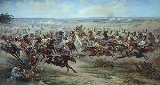
Battle of Friedland

Encyclopedia
The Battle of Friedland saw Napoleon I
's French army decisively defeat Count von Bennigsen
's Russian army about twenty-seven miles (43 km) southeast of Königsberg
. The site of Friedland, in the Russian Kaliningrad Oblast
since 1945, received the new name of Pravdinsk
in that year.
Friedland effectively ended the War of the Fourth Coalition
(1806–1807) against Napoleon. After nearly twenty-three hours of fighting, the French took control of the battlefield and the Russian army retreated chaotically over the Łyna River, in which many soldiers drowned while trying to escape.
On July 7, 1807, Russia and France signed the first of the Treaties of Tilsit
, which made the two nations allies after two years of war. France signed a separate treaty with Prussia
two days later to ostracize her from the main negotiations. The public terms of Tilsit mentioned the warm feelings between Napoleon and Alexander I of Russia
, but the secret terms addressed more substantial issues: France permitted Russia to do as it wished with the Ottoman Empire
in return for France gaining the Dalmatian coast
and the Ionian Islands
; Russia gained a free hand in Finland
; and Alexander also agreed to join the Continental System
if the war with Britain did not end soon.
Under the terms of the second treaty France ensured the humiliation of Prussia. All Prussian territory west of the Elbe
River became the new Kingdom of Westphalia
, with Napoleon's own brother, Jérôme
as its future King.
Historians traditionally regard Tilsit as the height of Napoleon's empire.
(December 2, 1805), Prussia went to war in 1806 to recover her position as the pre-eminent power of Central Europe
.
. This adversely affected the German merchant class. Napoleon ordered a raid to seize a subversive, anti-Napoleonic bookseller named Johann Philipp Palm
, and made a final attempt to secure terms with Britain by offering her Hanover
, which infuriated Prussia.
The Prussians began to mobilize on August 9, 1806 and issued an ultimatum on August 26: they required French troops to withdraw to the west bank of the Rhine by October 8 on pain of war between the two nations.
Napoleon aimed to win the war by destroying the Prussian armies before the Russians
could arrive.
180,000 French troops began to cross the Franconian forest
on October 2, 1806, deployed in a bataillon-carré (square-battalion) system designed to meet threats from any possible direction. On October 14 the French won decisively at the large double-battle of Jena-Auerstedt
. A famous pursuit followed, and by the end of the campaign the Prussians had lost 25,000 killed and wounded, 140,000 prisoners, and more than 2,000 cannon.
A few Prussian units managed to cross the Oder River into Poland, but Prussia lost the vast majority of its army. Russia now had to face France alone. By November 18 French forces under Louis Nicolas Davout
had covered half the distance to Warsaw
, Augereau
's men had neared Bromberg, and Jérôme Bonaparte's troops had reached the approaches of Kalisz
.
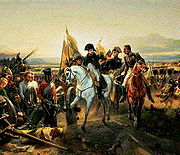 When the French arrived in Poland the local people hailed them as liberators.
The Russian general Bennigsen worried that French forces might cut him off from Buxhowden
's army, so he abandoned Warsaw and retreated to the right bank of the Vistula. On November 28, 1806, French troops under Murat
entered Warsaw. The French pursued the fleeing Russians and a significant battle developed around Pułtusk on December 26. The result remained in doubt, but Bennigsen wrote to the Czar that he had defeated 60,000 French troops, and as a result he gained overall command of the Russian armies in Poland. At this point, Marshal Ney
began to extend his forces to procure food supplies. Bennigsen noticed a good opportunity to strike at an isolated French corps, but he abandoned his plans once he realized Napoléon's maneuvers intended to trap his army. The Russians withdrew towards Allenstein
, and later to Eylau
.
On February 7 the Russians fought Soult
's corps for possession of Eylau. Daybreak on February 8 saw 44,500 French troops on the field against 67,000 Russians.
Napoleon hoped to pin Bennigsen's army long enough to allow Ney's and Davout's troops to outflank the Russians. A fierce struggle ensued, made worse by a blinding snowstorm on the battlefield. The French found themselves in dire straits until a massed cavalry charge, made by 10,700 troopers formed in 80 squadrons,
relieved the pressure on the center. Davout's arrival meant the attack on the Russian left could commence, but the assault was blunted when a Prussian force under Lestoq suddenly appeared on the battlefield and, with Russian help, threw the French back. Ney came too late to effect any meaningful decision, so Bennigsen retreated. Casualties at this indecisive battle were horrific, perhaps 25,000 on each side. More importantly, however, the lack of a decisive victory by either side meant that the war would go on.
on the Alle. The French army, under Marshals Murat and Lannes
, attacked on June 10. Bennigsen repelled several attacks, resulting in huge French casualties, but had to withdraw towards Friedland the following day.
had driven off the French cavalry outposts from Friedland on June 13, and Bennigsen's main body began to occupy the town at night. The army of Napoleon marched on Friedland, but remained dispersed on its various march routes, and the first stage of the engagement became a purely situational battle. Knowing that Napoleon was within supporting distance with at least three corps
, Lannes
sent aides
galloping off with messages for help and waged an expert delaying action to fix Benningsen in place. With never more than 26,000 men, Lannes forced Benningsen to commit progressively more troops across the Alle
to defeat him. Showing a bold front, and shifting troops where needed to stop Russian
advances, engaged the Russians first in the Sortlack Wood and in front of Posthenen (2.30-3 A.M. on the 14th), Lannes held Benningsen in place until the French
had massed 80,000 troops on the left bank of the river. Both sides now used their cavalry freely to cover the formation of lines of battle, and a race between the rival squadrons for the possession of Heinrichsdorf ended in favor of the French under Grouchy
. Benningsen was trapped and had to fight. Having thrown all of his pontoon bridges at or near the bottleneck of the village of Friedland
, Benningsen had unwittingly trapped his troops on the west bank.
In the meantime Lannes fought hard to hold Bennigsen. Napoleon feared that the Russians meant to evade him again, but by 6 a.m. Bennigsen had nearly 50,000 men across the river and forming up west of Friedland. His infantry, organized in two lines, extended between the Heinrichsdorf-Friedland road and the upper bends of the river along with the artillery. Beyond the right of the infantry, cavalry and Cossacks extended the line to the wood northeast of Heinrichsdorf. Small bodies of Cossack
s penetrated even to Schwonau. The left wing also had some cavalry and, beyond the Alle river, batteries came into action to cover it. A heavy and indecisive fire-fight raged in the Sortlack Wood between the Russian skirmishers and some of Lannes's troops.
The head of Mortier
's (French and Polish) corps appeared at Heinrichsdorf and drove the Cossacks out of Schwonau. Lannes held his own, and by noon Napoleon arrived with 40,000 French troops at the scene of the battle. Napoleon gave brief orders: Ney's corps would take the line between Postlienen and the Sortlack Wood, Lannes closing on his left, to form the centre, Mortier at Heinrichsdorf the left wing. I Corps under General Victor
and the Imperial Guard were placed in reserve behind Posthenen. Cavalry masses were collected at Heinrichsdorf. The main attack was to be delivered against the Russian left, which Napoleon saw at once to be cramped in the narrow tongue of land between the river and the Posthenen mill-stream. Three cavalry divisions were added to the general reserve.
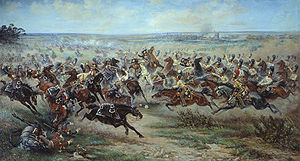 The course of the previous operations meant that both armies still had large detachments out towards Königsberg
. The emperor spent the afternoon in forming up the newly arrived masses, the deployment being covered by an artillery bombardment. At 5 o'clock all was ready, and Ney, preceded by a heavy artillery fire, rapidly carried the Sortlack Wood. The attack was pushed on toward the Alle. Marshal Ney
's right-hand division under Marchand
drove part of the Russian left into the river at Sortlack, while Bisson's
division advanced on the left. A furious charge by Russian cavalry into the gap between Marchand and Bisson was repulsed by the dragoon
division of Latour-Maubourg.
Soon the Russians found themselves huddled together in the bends of the Alle, an easy target for the guns of Ney and of the reserve. Ney's attack indeed came eventually to a standstill; Bennigsen's reserve cavalry charged with great effect and drove him back in disorder. As at Eylau
, the approach of night seemed to preclude a decisive success, but in June and on firm ground the old mobility of the French reasserted its value. The infantry division of Dupont advanced rapidly from Posthenen, the cavalry divisions drove back the Russian squadrons into the now congested masses of infantry on the river bank, and finally the artillery general Sénarmont
advanced a mass of guns to case-shot range.
The terrible effect of the close range artillery saw the Russian defence collapsing within minutes, as cannister decimated the ranks. Ney's exhausted infantry succeeded in pursuing the broken regiments of Bennigsen's left into the streets of Friedland. Lannes and Mortier had meanwhile held the Russian centre and right on its ground, and their artillery had inflicted severe losses. When Friedland itself was seen to be on fire, the two marshals launched their infantry attack. Fresh French troops approached the battlefield. Dupont distinguished himself for the second time by fording the mill-stream and assailing the left flank of the Russian centre. This offered stubborn resistance, but the French steadily forced the line backwards, and the battle was soon over.
The Russians incurred very heavy losses in retreating over the river at Friedland; many soldiers drowned. Farther north the still unbroken troops of the right wing drew off by the Allenburg road; the French cavalry of the left wing, though ordered to pursue, remained, for some reason, inactive. French casualties approximated 8,000, while the Russians suffered nearly 20,000 in dead and wounded.
to seek peace terms five days after the battle. The following negotiations led to the Treaty of Tilsit in July, spelling the end of the War of the Fourth Coalition
.
Napoleon I
Napoleon Bonaparte was a French military and political leader during the latter stages of the French Revolution.As Napoleon I, he was Emperor of the French from 1804 to 1815...
's French army decisively defeat Count von Bennigsen
Levin August, Count von Bennigsen
Levin August Gottlieb Theophil , Count von Bennigsen was a German general in the service of the Russian Empire....
's Russian army about twenty-seven miles (43 km) southeast of Königsberg
Königsberg
Königsberg was the capital of East Prussia from the Late Middle Ages until 1945 as well as the northernmost and easternmost German city with 286,666 inhabitants . Due to the multicultural society in and around the city, there are several local names for it...
. The site of Friedland, in the Russian Kaliningrad Oblast
Kaliningrad Oblast
Kaliningrad Oblast is a federal subject of Russia situated on the Baltic coast. It has a population of The oblast forms the westernmost part of the Russian Federation, but it has no land connection to the rest of Russia. Since its creation it has been an exclave of the Russian SFSR and then the...
since 1945, received the new name of Pravdinsk
Pravdinsk
Pravdinsk is a town and the administrative center of Pravdinsky District of Kaliningrad Oblast, Russia, located on the Lava River, approximately east of Bagrationovsk...
in that year.
Friedland effectively ended the War of the Fourth Coalition
War of the Fourth Coalition
The Fourth Coalition against Napoleon's French Empire was defeated in a war spanning 1806–1807. Coalition partners included Prussia, Russia, Saxony, Sweden, and the United Kingdom....
(1806–1807) against Napoleon. After nearly twenty-three hours of fighting, the French took control of the battlefield and the Russian army retreated chaotically over the Łyna River, in which many soldiers drowned while trying to escape.
On July 7, 1807, Russia and France signed the first of the Treaties of Tilsit
Treaties of Tilsit
The Treaties of Tilsit were two agreements signed by Napoleon I of France in the town of Tilsit in July, 1807 in the aftermath of his victory at Friedland. The first was signed on 7 July, between Tsar Alexander I of Russia and Napoleon I of France, when they met on a raft in the middle of the Neman...
, which made the two nations allies after two years of war. France signed a separate treaty with Prussia
Prussia
Prussia was a German kingdom and historic state originating out of the Duchy of Prussia and the Margraviate of Brandenburg. For centuries, the House of Hohenzollern ruled Prussia, successfully expanding its size by way of an unusually well-organized and effective army. Prussia shaped the history...
two days later to ostracize her from the main negotiations. The public terms of Tilsit mentioned the warm feelings between Napoleon and Alexander I of Russia
Alexander I of Russia
Alexander I of Russia , served as Emperor of Russia from 23 March 1801 to 1 December 1825 and the first Russian King of Poland from 1815 to 1825. He was also the first Russian Grand Duke of Finland and Lithuania....
, but the secret terms addressed more substantial issues: France permitted Russia to do as it wished with the Ottoman Empire
Ottoman Empire
The Ottoman EmpireIt was usually referred to as the "Ottoman Empire", the "Turkish Empire", the "Ottoman Caliphate" or more commonly "Turkey" by its contemporaries...
in return for France gaining the Dalmatian coast
Dalmatia
Dalmatia is a historical region on the eastern coast of the Adriatic Sea. It stretches from the island of Rab in the northwest to the Bay of Kotor in the southeast. The hinterland, the Dalmatian Zagora, ranges from fifty kilometers in width in the north to just a few kilometers in the south....
and the Ionian Islands
Ionian Islands
The Ionian Islands are a group of islands in Greece. They are traditionally called the Heptanese, i.e...
; Russia gained a free hand in Finland
Finland
Finland , officially the Republic of Finland, is a Nordic country situated in the Fennoscandian region of Northern Europe. It is bordered by Sweden in the west, Norway in the north and Russia in the east, while Estonia lies to its south across the Gulf of Finland.Around 5.4 million people reside...
; and Alexander also agreed to join the Continental System
Continental System
The Continental System or Continental Blockade was the foreign policy of Napoleon I of France in his struggle against the United Kingdom of Great Britain and Ireland during the Napoleonic Wars. It was a large-scale embargo against British trade, which began on November 21, 1806...
if the war with Britain did not end soon.
Under the terms of the second treaty France ensured the humiliation of Prussia. All Prussian territory west of the Elbe
Elbe
The Elbe is one of the major rivers of Central Europe. It rises in the Krkonoše Mountains of the northwestern Czech Republic before traversing much of Bohemia , then Germany and flowing into the North Sea at Cuxhaven, 110 km northwest of Hamburg...
River became the new Kingdom of Westphalia
Kingdom of Westphalia
The Kingdom of Westphalia was a new country of 2.6 million Germans that existed from 1807-1813. It included of territory in Hesse and other parts of present-day Germany. While formally independent, it was a vassal state of the First French Empire, ruled by Napoleon's brother Jérôme Bonaparte...
, with Napoleon's own brother, Jérôme
Jérôme Bonaparte
Jérôme-Napoléon Bonaparte, French Prince, King of Westphalia, 1st Prince of Montfort was the youngest brother of Napoleon, who made him king of Westphalia...
as its future King.
Historians traditionally regard Tilsit as the height of Napoleon's empire.
Prelude
Prior to Friedland, Europe had become embroiled in the War of the Third Coalition in 1805. Following the French victory at the Battle of AusterlitzBattle of Austerlitz
The Battle of Austerlitz, also known as the Battle of the Three Emperors, was one of Napoleon's greatest victories, where the French Empire effectively crushed the Third Coalition...
(December 2, 1805), Prussia went to war in 1806 to recover her position as the pre-eminent power of Central Europe
Central Europe
Central Europe or alternatively Middle Europe is a region of the European continent lying between the variously defined areas of Eastern and Western Europe...
.
The Prussian Campaign
Franco-Prussian tensions gradually increased after Austerlitz. Napoleon insisted that Prussia should join his economic blockade of Great BritainContinental System
The Continental System or Continental Blockade was the foreign policy of Napoleon I of France in his struggle against the United Kingdom of Great Britain and Ireland during the Napoleonic Wars. It was a large-scale embargo against British trade, which began on November 21, 1806...
. This adversely affected the German merchant class. Napoleon ordered a raid to seize a subversive, anti-Napoleonic bookseller named Johann Philipp Palm
Johann Philipp Palm
Johann Philipp Palm or Johannes Philipp Palm was a German bookseller executed during the Napoleonic Wars.He was born at Schorndorf in Württemberg...
, and made a final attempt to secure terms with Britain by offering her Hanover
Hanover
Hanover or Hannover, on the river Leine, is the capital of the federal state of Lower Saxony , Germany and was once by personal union the family seat of the Hanoverian Kings of Great Britain, under their title as the dukes of Brunswick-Lüneburg...
, which infuriated Prussia.
The Prussians began to mobilize on August 9, 1806 and issued an ultimatum on August 26: they required French troops to withdraw to the west bank of the Rhine by October 8 on pain of war between the two nations.
Napoleon aimed to win the war by destroying the Prussian armies before the Russians
Russians
The Russian people are an East Slavic ethnic group native to Russia, speaking the Russian language and primarily living in Russia and neighboring countries....
could arrive.
180,000 French troops began to cross the Franconian forest
Frankenwald
thumb|View to DöbrabergThe Franconian Forest is a mid-altitude mountain range in Northern Bavaria, Germany. It is located in the district of Upper Franconia and forms the geological connection between the Fichtelgebirge and the Thuringian Forest...
on October 2, 1806, deployed in a bataillon-carré (square-battalion) system designed to meet threats from any possible direction. On October 14 the French won decisively at the large double-battle of Jena-Auerstedt
Battle of Jena-Auerstedt
The twin battles of Jena and Auerstedt were fought on 14 October 1806 on the plateau west of the river Saale in today's Germany, between the forces of Napoleon I of France and Frederick William III of Prussia...
. A famous pursuit followed, and by the end of the campaign the Prussians had lost 25,000 killed and wounded, 140,000 prisoners, and more than 2,000 cannon.
A few Prussian units managed to cross the Oder River into Poland, but Prussia lost the vast majority of its army. Russia now had to face France alone. By November 18 French forces under Louis Nicolas Davout
Louis Nicolas Davout
Louis-Nicolas d'Avout , better known as Davout, 1st Duke of Auerstaedt, 1st Prince of Eckmühl, was a Marshal of France during the Napoleonic Era. His prodigious talent for war along with his reputation as a stern disciplinarian, earned him the title "The Iron Marshal"...
had covered half the distance to Warsaw
Warsaw
Warsaw is the capital and largest city of Poland. It is located on the Vistula River, roughly from the Baltic Sea and from the Carpathian Mountains. Its population in 2010 was estimated at 1,716,855 residents with a greater metropolitan area of 2,631,902 residents, making Warsaw the 10th most...
, Augereau
Pierre François Charles Augereau, duc de Castiglione
Charles Pierre François Augereau, 1st Duc de Castiglione was a soldier and general and Marshal of France. After serving in the French Revolutionary Wars he earned rapid promotion while fighting against Spain and soon found himself a division commander under Napoleon Bonaparte in Italy...
's men had neared Bromberg, and Jérôme Bonaparte's troops had reached the approaches of Kalisz
Kalisz
Kalisz is a city in central Poland with 106,857 inhabitants , the capital city of the Kalisz Region. Situated on the Prosna river in the southeastern part of the Greater Poland Voivodeship, the city forms a conurbation with the nearby towns of Ostrów Wielkopolski and Nowe Skalmierzyce...
.
Eylau
The Russian general Bennigsen worried that French forces might cut him off from Buxhowden
Friedrich Wilhelm von Buxhoeveden
Friedrich Wilhelm Count von Buxhoevden was a Russian Infantry General and a government official. Buxhoeveden commanded the Russian armies during the Finnish War....
's army, so he abandoned Warsaw and retreated to the right bank of the Vistula. On November 28, 1806, French troops under Murat
Joachim Murat
Joachim-Napoléon Murat , Marshal of France and Grand Admiral or Admiral of France, 1st Prince Murat, was Grand Duke of Berg from 1806 to 1808 and then King of Naples from 1808 to 1815...
entered Warsaw. The French pursued the fleeing Russians and a significant battle developed around Pułtusk on December 26. The result remained in doubt, but Bennigsen wrote to the Czar that he had defeated 60,000 French troops, and as a result he gained overall command of the Russian armies in Poland. At this point, Marshal Ney
Michel Ney
Michel Ney , 1st Duc d'Elchingen, 1st Prince de la Moskowa was a French soldier and military commander during the French Revolutionary Wars and the Napoleonic Wars. He was one of the original 18 Marshals of France created by Napoleon I...
began to extend his forces to procure food supplies. Bennigsen noticed a good opportunity to strike at an isolated French corps, but he abandoned his plans once he realized Napoléon's maneuvers intended to trap his army. The Russians withdrew towards Allenstein
Olsztyn
Olsztyn is a city in northeastern Poland, on the Łyna River. Olsztyn has been the capital of the Warmian-Masurian Voivodeship since 1999. It was previously in the Olsztyn Voivodeship...
, and later to Eylau
Bagrationovsk
Bagrationovsk is a town and the administrative center of Bagrationovsky District of Kaliningrad Oblast, Russia, located south of Kaliningrad. Population: -History:...
.
On February 7 the Russians fought Soult
Nicolas Jean de Dieu Soult
Nicolas Jean-de-Dieu Soult, 1st Duke of Dalmatia , the Hand of Iron, was a French general and statesman, named Marshal of the Empire in 1804. He was one of only six officers in French history to receive the distinction of Marshal General of France...
's corps for possession of Eylau. Daybreak on February 8 saw 44,500 French troops on the field against 67,000 Russians.
Napoleon hoped to pin Bennigsen's army long enough to allow Ney's and Davout's troops to outflank the Russians. A fierce struggle ensued, made worse by a blinding snowstorm on the battlefield. The French found themselves in dire straits until a massed cavalry charge, made by 10,700 troopers formed in 80 squadrons,
relieved the pressure on the center. Davout's arrival meant the attack on the Russian left could commence, but the assault was blunted when a Prussian force under Lestoq suddenly appeared on the battlefield and, with Russian help, threw the French back. Ney came too late to effect any meaningful decision, so Bennigsen retreated. Casualties at this indecisive battle were horrific, perhaps 25,000 on each side. More importantly, however, the lack of a decisive victory by either side meant that the war would go on.
Heilsberg
The Russian army, under General Bennigsen, held strong defensive positions in the town of HeilsbergHeilsberg
Heilsberg:* German name of Lidzbark Warmiński* Battle of Heilsberg* Transmitter Heilsberg- See also :* Lidzbark* Lidzbark * Lidzbarski...
on the Alle. The French army, under Marshals Murat and Lannes
Jean Lannes
Jean Lannes, 1st Duc de Montebello, was a Marshal of France. He was one of Napoleon's most daring and talented generals. Napoleon once commented on Lannes: "I found him a pygmy and left him a giant"...
, attacked on June 10. Bennigsen repelled several attacks, resulting in huge French casualties, but had to withdraw towards Friedland the following day.
The battle
The Russian forces under General GolitsynDmitriy Vladimirovich Golitsyn
Serene Prince Dmitriy Vladimirovich Golitsyn was a Russian cavalry general prominent during the Napoleonic Wars, statesman and military writer....
had driven off the French cavalry outposts from Friedland on June 13, and Bennigsen's main body began to occupy the town at night. The army of Napoleon marched on Friedland, but remained dispersed on its various march routes, and the first stage of the engagement became a purely situational battle. Knowing that Napoleon was within supporting distance with at least three corps
Corps
A corps is either a large formation, or an administrative grouping of troops within an armed force with a common function such as Artillery or Signals representing an arm of service...
, Lannes
Lannes
Lannes can refer to:* Jean Lannes, duke of Montebello , Marshal of France* Lannes, Lot-et-Garonne, a commune in the Lot-et-Garonne département, in France* Lannes , a former Province of France...
sent aides
Aides
Aides has various meanings:*Aides is the Greek god Hades.*The aides was a French customs duty, during the time of Louis XIV*Aides are assistants.*Aides , a genus of butterflies in the grass skipper family....
galloping off with messages for help and waged an expert delaying action to fix Benningsen in place. With never more than 26,000 men, Lannes forced Benningsen to commit progressively more troops across the Alle
Alle
Alle can refer to:*the German name for the Łyna , a river since 1945 in Poland and the Russian Kaliningrad Oblast*Alle, Switzerland, a community in the Swiss canton of Jura*Alle, Belgium in the province of Namur, Belgium...
to defeat him. Showing a bold front, and shifting troops where needed to stop Russian
Russia
Russia or , officially known as both Russia and the Russian Federation , is a country in northern Eurasia. It is a federal semi-presidential republic, comprising 83 federal subjects...
advances, engaged the Russians first in the Sortlack Wood and in front of Posthenen (2.30-3 A.M. on the 14th), Lannes held Benningsen in place until the French
France
The French Republic , The French Republic , The French Republic , (commonly known as France , is a unitary semi-presidential republic in Western Europe with several overseas territories and islands located on other continents and in the Indian, Pacific, and Atlantic oceans. Metropolitan France...
had massed 80,000 troops on the left bank of the river. Both sides now used their cavalry freely to cover the formation of lines of battle, and a race between the rival squadrons for the possession of Heinrichsdorf ended in favor of the French under Grouchy
Emmanuel, marquis de Grouchy
Emmanuel de Grouchy, 2ème Marquis de Grouchy was a French general and marshal.-Biography:Grouchy was born in Paris, the son of François-Jacques de Grouchy, 1st Marquis de Grouchy and intellectual wife Gilberte Fréteau de Pény . His sister was Sophie de Condorcet, a noted femininist...
. Benningsen was trapped and had to fight. Having thrown all of his pontoon bridges at or near the bottleneck of the village of Friedland
Friedland
- Places :Germany:* Friedland, Mecklenburg-Vorpommern* Friedland, Brandenburg* Friedland, Lower SaxonyRussia:* Pravdinsk , RussiaCzech:* Frýdlant v Čechách , Czech Republic...
, Benningsen had unwittingly trapped his troops on the west bank.
In the meantime Lannes fought hard to hold Bennigsen. Napoleon feared that the Russians meant to evade him again, but by 6 a.m. Bennigsen had nearly 50,000 men across the river and forming up west of Friedland. His infantry, organized in two lines, extended between the Heinrichsdorf-Friedland road and the upper bends of the river along with the artillery. Beyond the right of the infantry, cavalry and Cossacks extended the line to the wood northeast of Heinrichsdorf. Small bodies of Cossack
Cossack
Cossacks are a group of predominantly East Slavic people who originally were members of democratic, semi-military communities in what is today Ukraine and Southern Russia inhabiting sparsely populated areas and islands in the lower Dnieper and Don basins and who played an important role in the...
s penetrated even to Schwonau. The left wing also had some cavalry and, beyond the Alle river, batteries came into action to cover it. A heavy and indecisive fire-fight raged in the Sortlack Wood between the Russian skirmishers and some of Lannes's troops.
The head of Mortier
Édouard Adolphe Casimir Joseph Mortier
Édouard Adolphe Casimir Joseph Mortier, 1st Duc de Trévise was a French general and Marshal of France under Napoleon I.-Biography:...
's (French and Polish) corps appeared at Heinrichsdorf and drove the Cossacks out of Schwonau. Lannes held his own, and by noon Napoleon arrived with 40,000 French troops at the scene of the battle. Napoleon gave brief orders: Ney's corps would take the line between Postlienen and the Sortlack Wood, Lannes closing on his left, to form the centre, Mortier at Heinrichsdorf the left wing. I Corps under General Victor
Claude Victor-Perrin, duc de Belluno
Claude Victor-Perrin, First Duc de Belluno was a French soldier and military commander during the French Revolutionary and Napoleonic Wars...
and the Imperial Guard were placed in reserve behind Posthenen. Cavalry masses were collected at Heinrichsdorf. The main attack was to be delivered against the Russian left, which Napoleon saw at once to be cramped in the narrow tongue of land between the river and the Posthenen mill-stream. Three cavalry divisions were added to the general reserve.
Königsberg
Königsberg was the capital of East Prussia from the Late Middle Ages until 1945 as well as the northernmost and easternmost German city with 286,666 inhabitants . Due to the multicultural society in and around the city, there are several local names for it...
. The emperor spent the afternoon in forming up the newly arrived masses, the deployment being covered by an artillery bombardment. At 5 o'clock all was ready, and Ney, preceded by a heavy artillery fire, rapidly carried the Sortlack Wood. The attack was pushed on toward the Alle. Marshal Ney
Michel Ney
Michel Ney , 1st Duc d'Elchingen, 1st Prince de la Moskowa was a French soldier and military commander during the French Revolutionary Wars and the Napoleonic Wars. He was one of the original 18 Marshals of France created by Napoleon I...
's right-hand division under Marchand
Jean Gabriel Marchand
Jean Gabriel Marchand, 1st Count Marchand went from being an attorney to a company commander in the army of the First French Republic in 1791. He fought almost exclusively in Italy throughout the French Revolutionary Wars and served on the staffs of a number of generals...
drove part of the Russian left into the river at Sortlack, while Bisson's
Baptiste Pierre Bisson
Baptiste-Pierre-François Bisson, born 16 February 1767 at Montpellier, France and died 26 July 1811, at Mantua in the Kingdom of Italy, joined the French army and rose rapidly in rank during the French Revolutionary Wars. He served as a division commander in the Grand Armée of Emperor Napoleon in...
division advanced on the left. A furious charge by Russian cavalry into the gap between Marchand and Bisson was repulsed by the dragoon
Dragoon
The word dragoon originally meant mounted infantry, who were trained in horse riding as well as infantry fighting skills. However, usage altered over time and during the 18th century, dragoons evolved into conventional light cavalry units and personnel...
division of Latour-Maubourg.
Soon the Russians found themselves huddled together in the bends of the Alle, an easy target for the guns of Ney and of the reserve. Ney's attack indeed came eventually to a standstill; Bennigsen's reserve cavalry charged with great effect and drove him back in disorder. As at Eylau
Battle of Eylau
The Battle of Eylau or Battle of Preussisch-Eylau, 7 and 8 February 1807, was a bloody and inconclusive battle between Napoléon's Grande Armée and a Russian Empire army under Levin August, Count von Bennigsen near the town of Preußisch Eylau in East Prussia. Late in the battle, the Russians...
, the approach of night seemed to preclude a decisive success, but in June and on firm ground the old mobility of the French reasserted its value. The infantry division of Dupont advanced rapidly from Posthenen, the cavalry divisions drove back the Russian squadrons into the now congested masses of infantry on the river bank, and finally the artillery general Sénarmont
Alexandre-Antoine Hureau de Sénarmont
Alexandre-Antoine Hureau de Sénarmont was a French artillery general.He was born at Strasbourg, and educated at the Metz school for engineer and artillery cadets. In 1785 he was commissioned in the artillery, in which he served as a regimental officer for fifteen years...
advanced a mass of guns to case-shot range.
The terrible effect of the close range artillery saw the Russian defence collapsing within minutes, as cannister decimated the ranks. Ney's exhausted infantry succeeded in pursuing the broken regiments of Bennigsen's left into the streets of Friedland. Lannes and Mortier had meanwhile held the Russian centre and right on its ground, and their artillery had inflicted severe losses. When Friedland itself was seen to be on fire, the two marshals launched their infantry attack. Fresh French troops approached the battlefield. Dupont distinguished himself for the second time by fording the mill-stream and assailing the left flank of the Russian centre. This offered stubborn resistance, but the French steadily forced the line backwards, and the battle was soon over.
The Russians incurred very heavy losses in retreating over the river at Friedland; many soldiers drowned. Farther north the still unbroken troops of the right wing drew off by the Allenburg road; the French cavalry of the left wing, though ordered to pursue, remained, for some reason, inactive. French casualties approximated 8,000, while the Russians suffered nearly 20,000 in dead and wounded.
Results
The thorough destruction of Bennigsen's army persuaded Alexander I of RussiaAlexander I of Russia
Alexander I of Russia , served as Emperor of Russia from 23 March 1801 to 1 December 1825 and the first Russian King of Poland from 1815 to 1825. He was also the first Russian Grand Duke of Finland and Lithuania....
to seek peace terms five days after the battle. The following negotiations led to the Treaty of Tilsit in July, spelling the end of the War of the Fourth Coalition
War of the Fourth Coalition
The Fourth Coalition against Napoleon's French Empire was defeated in a war spanning 1806–1807. Coalition partners included Prussia, Russia, Saxony, Sweden, and the United Kingdom....
.