
See Also

Han Dynasty

The Han Dynasty followed the Qin Dynasty Qin Dynasty

The Qin Dynasty was preceded by the Zhou Dynasty [i] and followed by the Han Dynasty [i] in China [i] ... 

 and preceded the Three Kingdoms Three Kingdoms

The Three Kingdoms period is a period in the history of China [i], part of an era of disunity called th ... 

 in China China

China is a cultural region [i] and ancient civilization [i] in East Asia [i]. ... 

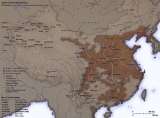
. The Han Dynasty was founded by the prominent family known as the Liu clan. The reign of the Han Dynasty, lasting 400 years, is commonly considered within China to be one of the greatest periods in the entire history of China History of China

The history of China is detailed by historical records dating as far back as 16th century BC [i]. ... 

. As a result, the members of the ethnic majority of Chinese people to this day still call themselves "People of Han Han Chinese

The Han is an ethnic group [i] originating from China [i]. ... 

," in honor of the Liu family and the dynasty they created. During the Han Dynasty, China officially became a Confucian Confucianism

Confucianism is a Chinese [i] ethical [i] and philosophical system [i] original ... 

 state and prospered domestically: agriculture Agriculture

Farming redirects here. For Farming in computer games, see Farmer [i]. ... 

, handicrafts and commerce flourished, and the population Population

In sociology [i] and biology [i], a population is the collection of people [i], or organism [i] ... 

 reached over 50 million.

Discussions

  Discussion Features

   Ask a question about 'Han Dynasty'

   Start a new discussion about 'Han Dynasty'

   Answer questions about 'Han Dynasty'

   'Han Dynasty' discussion forum

Timeline

1   Start of the ''Yuanshi'' era of the Chinese Han Dynasty.

6   Accession of Ru Zi Ying of the Han Dynasty in China China

China is a cultural region [i] and ancient civilization [i] in East Asia [i]. ... 

 and start of ''Jushe'' era of the Chinese Han Dynasty.

6   Accession of Ru Zi Ying of the Han Dynasty in China China

China is a cultural region [i] and ancient civilization [i] in East Asia [i]. ... 

 and start of ''Jushe'' era of the Chinese Han Dynasty.

8   Start of Chushi era of the Chinese China

China is a cultural region [i] and ancient civilization [i] in East Asia [i]. ... 

 Han Dynasty.

22   Beginning of Later Han Dynasty in China China

China is a cultural region [i] and ancient civilization [i] in East Asia [i]. ... 

.

23   Liu Xuan, a descendant of the Han Dynasty royal family and leader of insurgents against the Xin Dynasty, proclaims himself emperor against Wang Mang Wang Mang

Wang Mang, courtesy name [i] Jujun, was a Han Dynasty [i] official who seized the throne from the ... 

.

23   June, Battle of Kunyang, After being sieged for 2 months, 9000 insurgents under Liu Xiu Emperor Guangwu of Han

Emperor Guangwu, born Liu Xiu, was an emperor [i] of the Chinese Han Dynasty [i], ... 

 defeat 450,000 of Wang Mang Wang Mang

Wang Mang, courtesy name [i] Jujun, was a Han Dynasty [i] official who seized the throne from the ... 

's troops, ushering in the fall of Wang Mang and restoration of Han Dynasty.

25   Han dynasty was restored in China History of China

The history of China is detailed by historical records dating as far back as 16th century BC [i]. ... 

 as Liu Xiu Emperor Guangwu of Han

Emperor Guangwu, born Liu Xiu, was an emperor [i] of the Chinese Han Dynasty [i], ... 

 proclaimed himself emperor, start of ''jiangwu'' era (->56).

25   Luoyang Luoyang

Luoyang is a prefecture-level city [i] in western Henan [i] province [i], People's Republic of China [i] ... 

 becomes the capital of the Eastern Han Dynasty.

41   Emperor Guangwu Emperor Guangwu of Han

Emperor Guangwu, born Liu Xiu, was an emperor [i] of the Chinese Han Dynasty [i], ... 

 of the Han Dynasty deposes his wife, Guo Shentong, as empress, and creates his consort Yin Lihua empress in her place

   More Events >>


Encyclopedia

The Han Dynasty followed the Qin Dynasty Qin Dynasty

The Qin Dynasty was preceded by the Zhou Dynasty [i] and followed by the Han Dynasty [i] in China [i] ... 

 and preceded the Three Kingdoms Three Kingdoms

The Three Kingdoms period is a period in the history of China [i], part of an era of disunity called th ... 

 in China China

China is a cultural region [i] and ancient civilization [i] in East Asia [i]. ... 

. The Han Dynasty was founded by the prominent family known as the Liu clan.

The reign of the Han Dynasty, lasting 400 years, is commonly considered within China to be one of the greatest periods in the entire history of China History of China

The history of China is detailed by historical records dating as far back as 16th century BC [i]. ... 

. As a result, the members of the ethnic majority of Chinese people to this day still call themselves "People of Han Han Chinese

The Han is an ethnic group [i] originating from China [i]. ... 

," in honor of the Liu family and the dynasty they created.

During the Han Dynasty, China officially became a Confucian Confucianism

Confucianism is a Chinese [i] ethical [i] and philosophical system [i] original ... 

 state and prospered domestically: agriculture Agriculture

Farming redirects here. For Farming in computer games, see Farmer [i].
... 

, handicrafts and commerce flourished, and the population Population

In sociology [i] and biology [i], a population is the collection of people [i], or organism [i] ... 

 reached over 50 million. Meanwhile, the empire extended its political and cultural influence Culture of China

The culture of China is home to one of the world's oldest and most complex civilization [i]s, China [i] ... 

 over Korea Korea

Korea
One of the world's oldest civilization [i]s, Korea began with the founding of Gojoseon [i] in 2333 ... 

, Mongolia Mongolia

Mongolia is a landlocked [i] country [i] located in East Asia [i]. ... 

, Vietnam Vietnam

Vietnam, officially the Socialist Republic of Vietnam, is a country in Southeast Asia [i]. ... 

, and Central Asia Central Asia

Central Asia is a vast landlocked [i] region of Asia [i]. ... 

 before it finally collapsed under a combination of domestic and external pressures.

The first of the two periods of the dynasty was the Former Han Dynasty or Western Han Dynasty 206 BC–AD 9, seated at Chang'an. The Later Han Dynasty or Eastern Han Dynasty 25–220 was seated at Luoyang Luoyang

Luoyang is a prefecture-level city [i] in western Henan [i] province [i], People's Republic of China [i] ... 

. The western-eastern Han convention is currently used to avoid confusion with the Later Han Dynasty of the Period of the Five Dynasties and the Ten Kingdoms although the former-later nomenclature was used in history texts including Sima Guang's Zizhi Tongjian.


Intellectual, literary, and artistic endeavors revived and flourished during the Han Dynasty. The Han period produced China's most famous historian, Sima Qian Sima Qian

Sima Qian was a Prefect [i] of the Grand Scribes [i] of the Han Dynasty [i]. ... 

 , whose Records of the Grand Historian provides a detailed chronicle from the time of legendary Xia Xia Dynasty

The Xia Dynasty , ca. 2100 BC [i]–1600 BC [i], is the first dynasty [i] ... 

 emperor Emperor

An emperor is a monarch [i], usually the sovereign [i] ruler of an empire [i] or another type o... 

 to that of the Emperor Wu Emperor Wu of Han

Emperor Wu of Han, personal name Liu Che, was the seventh emperor [i] of the Han Dynasty [i] ... 

 . Technological advances also marked this period. One of the great Chinese inventions, paper Paper

Paper is a thin, flat material produced by the amalgamation of plant fibre [i]s, which are subsequently ... 

, dates from the Han Dynasty.

Several Roman embassies to China Sino-Roman relations

Sino-Roman relations started first on an indirect basis during the 2nd century BC.... 

 are recounted in Chinese history, starting with a Hou Hanshu account of a Roman Roman Empire

The Roman Empire was a phase of the ancient Roman [i] civilization characterized by an autocratic [i] ... 

 convoy set out by emperor Antoninus Pius Antoninus Pius

Titus Aurelius Fulvus Boionius Arrius Antoninus Pius was Roman emperor [i] from 138 [i] ... 

 that reached the Chinese capital Luoyang Luoyang

Luoyang is a prefecture-level city [i] in western Henan [i] province [i], People's Republic of China [i] ... 

 in 166 and was greeted by Emperor Huan.

The Han Dynasty was notable also for its military prowess. The empire expanded westward as far as the rim of the Tarim Basin Tarim Basin

The Tarim Basin is one of the largest endorheic [i] drainage basin [i]s in the world, lying between seve ... 

 , making possible relatively secure caravan traffic across Central Asia. The paths of caravan traffic are often called the "Silk Road Silk Road

The Silk Road or Silk Route was an interconnected series of routes through Southern Asia [i] tra ... 

" because the route was used to export Chinese silk Silk

Silk is a natural protein [i] fibre [i] that can be woven [i] into textile [i]s. ... 

. Chinese armies also invaded and annexed parts of northern Vietnam and northern Korea toward the end of the 2nd century BC. Han control of peripheral regions was generally insecure, however. To ensure peace with non-Chinese local powers, the Han court developed a mutually beneficial "tributary system." Non-Chinese states were allowed to remain autonomous in exchange for symbolic acceptance of Han overlordship. Tributary ties were confirmed and strengthened through intermarriages at the ruling level and periodic exchanges of gifts and goods.

The Emergence

Within the first three months after Qin Dynasty Qin Dynasty

The Qin Dynasty was preceded by the Zhou Dynasty [i] and followed by the Han Dynasty [i] in China [i] ... 

 Emperor Emperor of China

The Emperor of China or Hungd was the head of government [i] and head of state [i] of China [i]... 

 Qin Shi Huang Qin Shi Huang

Qin Shi Huang, personal name Zheng, was king of the Chinese State of Qin [i] from 247 BC [i]E ... 

's death at Shaqiu, widespread revolts by peasants, prisoners, soldiers and descendants of the nobles of the six Warring States Warring States Period

The Warring States Period covers the period from sometime in the 5th century BC [i] to the unification o ... 

 sprang up all over China. Chen Sheng and Wu Guang, two in a group of about 900 soldiers assigned to defend against the Xiongnu Xiongnu

The Xiongnu; were a nomadic people of Central Asia [i], generally based in present day Mongolia [i]. ... 

, were the leaders of the first rebellion. Continuous insurgence finally toppled the Qin dynasty in 206 BC. The leader of the insurgents was Xiang Yu, an outstanding military commander without political expertise, who divided the country into 19 feudal states to his own satisfaction.

The ensuing war among those states signified the 5 years of Chu Han Contention with Liu Bang Gaozu of Han

Emperor Gao, commonly known inside China as Gaozu, personal name Liu Bang, was the first emperor [i] ... 

, the first emperor of the Han Dynasty, as the eventual winner. Initially, "Han" consisted merely of modern Sichuan Sichuan

Sichuan is a province [i] in central-western China [i] with its capital at Chengdu [i] ... 

, Chongqing Chongqing

Chongqing is the largest and most populous of the People's Republic of China [i]'s four provincial [i] ... 

, and southern Shaanxi Shaanxi

Shaanxi is a north-central province [i] of the People's Republic of China [i] ... 

 and was a minor humble principality, but eventually grew into an empire; the Han Dynasty was named after the principality, which was itself named after Hanzhong — modern southern Shaanxi, the region centering the modern city of Hanzhong Hanzhong

Hanzhong is a city in Shaanxi [i] province, in central China [i]. Population: approx. 200,000. ... 

. The beginning of the Han Dynasty can be dated either from 206 BC when the Qin dynasty crumbled and the Principality of Han was established or 202 BC when Xiang Yu committed suicide.

Taoism and feudal system

The new empire retained much of the Qin administrative structure but retreated a bit from centralized rule by establishing vassal principalities in some areas for the sake of political convenience. After the establishment of the Han Dynasty, Emperor Gao divided the country into several "feudal states" to satisfy some of his wartime allies, though he planned to get rid of them once he had consolidated his power.

After his death, his successors from Emperor Hui to Emperor Jing tried to rule China combining Legalist methods with the Taoist Taoism

Taoism is the English name for:The English word "Taoism" is used to translate the Chinese [i] ... 

 philosophic ideals. During this "pseudo-Taoism era", a stable centralized government over China was established through revival of the agriculture sectors and fragmentations of "feudal states" after the suppression of the Rebellion of the seven states.

Emperor Wu and Confucianism

During the "Taoism Taoism

Taoism is the English name for:The English word "Taoism" is used to translate the Chinese [i] ... 

 era
", China was able to maintain peace with Xiongnu Xiongnu

The Xiongnu; were a nomadic people of Central Asia [i], generally based in present day Mongolia [i]. ... 

 by paying tribute and marrying princesses to them. During this time, the dynasty's goal was to relieve the society of harsh laws, wars War

War is a conflict involving the organized use of weapon [i]s and physical force by state [i]s or other l ... 

, and conditions from both the Qin Dynasty Qin Dynasty

The Qin Dynasty was preceded by the Zhou Dynasty [i] and followed by the Han Dynasty [i] in China [i] ... 

, external threats from nomads, and early internal conflicts within the Han court. The government reduced taxation and assumed a subservient status to neighboring nomadic tribes. This policy of the government's reduced role over civilian lives started a period of stability, which was called the Rule of Wen and Jing , named after the two Emperors of this particular era. However, under Emperor Wu Emperor Wu of Han

Emperor Wu of Han, personal name Liu Che, was the seventh emperor [i] of the Han Dynasty [i] ... 

's leadership, the most prosperous period of the Han Dynasty, the Empire was able to fight back. At its height, China incorporated the present day Qinghai Qinghai

Qinghai is a province [i] of the People's Republic of China [i], named after the enor ... 

, Gansu Gansu

Gansu is a province [i] located in the northwest of the People's Republic of China [i] ... 

, and northern Vietnam Vietnam

Vietnam, officially the Socialist Republic of Vietnam, is a country in Southeast Asia [i]. ... 

 into its territories.

Emperor Wu decided that Taoism Taoism

Taoism is the English name for:The English word "Taoism" is used to translate the Chinese [i] ... 

 was no longer suitable for China, and officially declared China to be a Confucian Confucianism

Confucianism is a Chinese [i] ethical [i] and philosophical system [i] original ... 

 state; however, like the Emperors of China Emperor of China

The Emperor of China or Hungd was the head of government [i] and head of state [i] of China [i]... 

 before him, he combined Legalist methods with the Confucian Confucianism

Confucianism is a Chinese [i] ethical [i] and philosophical system [i] original ... 

 ideal. This official adoption of Confucianism led to not only a civil service nomination system, but also the compulsory knowledge of Confucian classics of candidates for the imperial bureaucracy, a requirement that lasted up to the establishment of the Republic of China Republic of China

The Republic of China is a country [i] in East Asia [i]. ... 

 in 1911. Confucian scholars gained prominent status as the core of the civil service.

Beginning of the Silk Road


From 138 BC, Emperor Wu also dispatched Zhang Qian Zhang Qian

Zhang Qian, was a Chinese [i] explorer [i] and imperial envoy in the 2nd century BCE [i] ... 

 twice as his envoy to the Western Regions, and in the process pioneered the route known as the Silk Road Silk Road

The Silk Road or Silk Route was an interconnected series of routes through Southern Asia [i] tra ... 

 from Chang'an , through Xinjiang Xinjiang

Xinjiang, full name Xinjiang Uyghur Autonomous Region, is an autonomous region [i] ... 

 and Central Asia Central Asia

Central Asia is a vast landlocked [i] region of Asia [i]. ... 

, and on to the east coast of the Mediterranean Sea Mediterranean Sea

The Mediterranean Sea is a part of the Atlantic Ocean [i] almost completely enclosed by land: on the nor... 

.

Following Zhang Qian' embassy and report, commercial relations between China and Central as well as Western Asia flourished, as many Chinese missions were sent throughout the 1st century BC, initiating the development of the Silk Road Silk Road

The Silk Road or Silk Route was an interconnected series of routes through Southern Asia [i] tra ... 

:
"The largest of these embassies to foreign states numbered several hundred persons, while even the smaller parties included over 100 members... In the course of one year anywhere from five to six to over ten parties would be sent out." .


China also sent missions to Parthia Parthia

Parthia was a civilization situated in the northeast of modern Iran, but at its height covering all of ... 

, which were followed up by reciprocal missions from Parthian envoys around 100 BC:
"When the Han envoy first visited the kingdom of Anxi , the king of Anxi dispatched a party of 20,000 horsemen to meet them on the eastern border of the kingdom... When the Han envoys set out again to return to China, the king of Anxi dispatched envoys of his own to accompany them... The emperor was delighted at this." .


The Roman historian Florus describes the visit of numerous envoys, included Seres Seres

Seres was the ancient Greek [i] and Roman [i] name for the northwestern part of ... 

, to the first Roman Emperor Augustus, who reigned between 27 BC and AD 14:
"Even the rest of the nations of the world which were not subject to the imperial sway were sensible of its grandeur, and looked with reverence to the Roman people, the great conqueror of nations. Thus even Scythians Scythia

Scythia comprised an area in Eurasia [i] whose location and extent varied over time. ... 

 and Sarmatians Sarmatians

The Sarmatians, Sarmatae or Sauromatae were a multi-ethnic confederacy mentioned by classica... 

 sent envoys to seek the friendship of Rome. Nay, the Seres Seres

Seres was the ancient Greek [i] and Roman [i] name for the northwestern part of ... 

 came likewise, and the India India

India , officially the Republic of India, is a country in South Asia [i]. ... 

ns who dwelt beneath the vertical sun, bringing presents of precious stones and pearls and elephants, but thinking all of less moment than the vastness of the journey which they had undertaken, and which they said had occupied four years. In truth it needed but to look at their complexion to see that they were people of another world than ours." .


In AD 97 the Chinese general Ban Chao Ban Chao

Ban Chao, born in Xianyang, Shaanxi [i], was a Chinese general and cavalry commander in charge ... 

 went as far west as the Caspian Sea Caspian Sea

The Caspian Sea is the largest lake [i] on Earth by both area [i] and volume [i], with a surface area of ... 

 with 70,000 men and established direct military contacts with the Parthian Empire, also dispatching an envoy to Rome Rome

Rome is the capital [i] of Italy [i] and of its region, called Latium [i]. ... 

 in the person of Gan Ying.

Several Roman embassies to China Sino-Roman relations

Sino-Roman relations started first on an indirect basis during the 2nd century BC.... 

 soon followed from 166, and are officially recorded in Chinese historical chronicles. Good exchanges such as Chinese silk, African ivory, and Roman incense increased the contacts between the East and West.

Contacts with the Kushan Empire Kushan Empire

The Kushan Empire was a state that at its height, about 105 [i]–250 [i], stretched from what ... 

 led to the introduction of Buddhism Buddhism

Buddhism is a dharmic [i], non-theistic [i] religion [i], a way of life, a p ... 

 to China from India in the first century.

Rise of landholding class

To draw a lot of funds for his triumphant campaigns against the Xiongnu Xiongnu

The Xiongnu; were a nomadic people of Central Asia [i], generally based in present day Mongolia [i]. ... 

, Emperor Wu relinquished land control to merchants and the riches, and in effect legalized the privatization of lands. Land taxes were based on the sizes of fields instead of on income. The harvest could not always pay the taxes completely as incomes from selling harvest were often market-driven and a stable amount could not be guaranteed, especially not after harvest-reducing natural disasters. Merchants and prominent families then lured peasants to sell their lands since land accumulation guaranteed living standards of theirs and their descendants' in the agricultural society of China. Lands were hence accumulating into a new class of landholding families. The Han government in turn imposed more taxes on the remaining independent servants in order to make up the tax losses, therefore encouraging more peasants to come under the landholding elite or the landlords.

Ideally the peasants pay the landlords certain periodic amount of income, who in turn provide protection against crimes and other hazards. In fact an increasing number of peasant population in the prosperous Han society and limited amount of lands provided the elite to elevate their standards for any new subordinate peasants. The inadequate education and often complete illiteracy of peasants forced them into a living of providing physical services, which were mostly farming in an agricultural society. The peasants, without other professions for their better living, compromised to the lowered standard and sold their harvest to pay their landlords. In fact they often had to delay the payment or borrow money from their landlords in the aftermath of natural disasters that reduced harvests. To make the situation worse, some Han rulers double-taxed the peasants. Eventually the living conditions of the peasants worsened as they solely depended on the harvest of the land they once owned.

The landholding elite and landlords, for their part, provided inaccurate information of subordinate peasants and lands to avoid paying taxes; to this very end corruption and incompetence of the Confucian scholar gentry on economics would play a vital part. Han court officials who attempted to strip lands out of the landlords faced such enormous resistance that their policies would never be put in to place. In fact only a member of the landholding families, for instance Wang Mang, was able to put his reforming ideals into effect despite failures of his "turning the clock back" policies.

Interruption of Han rule

After 200 years, Han rule was interrupted briefly during AD 9–24 by Wang Mang Wang Mang

Wang Mang, courtesy name [i] Jujun, was a Han Dynasty [i] official who seized the throne from the ... 

, a reformer and a member of the landholding families. The economic situation deteriorated at the end of Western Han Dynasty. Wang Mang, believing the Liu family had lost the Mandate of Heaven, took power and turned the clock back with vigorous monetary and land reforms, which damaged the economy even further.

Rise and fall of Eastern Han Dynasty


A distant relative of Liu royalty, Liu Xiu Emperor Guangwu of Han

Emperor Guangwu, born Liu Xiu, was an emperor [i] of the Chinese Han Dynasty [i], ... 

, prevailed after a number of agrarian rebellions had overthrown Wang Mang's Xing Dynasty, and he reestablished the Han Dynasty . He and his son Emperor Ming of Han and grandson Emperor Zhang of Han were generally considered able emperors whose reigns were the prime of the Eastern Han Dynasty. After Emperor Zhang, however, the dynasty fell into states of corruption and political infighting among three groups of powerful individuals -- eunuch Eunuch

A eunuch can be either a castrated man or, in ancient terms, any man who is impotent with women for a wi... 

s, empresses' clans, and Confucian scholar-officials. None of these three parties was able to improve the harsh livelihood of peasants under the landholding families. Land privatizations and accumulations on the hands of the elite affected the societies of the Three Kingdoms Three Kingdoms

The Three Kingdoms period is a period in the history of China [i], part of an era of disunity called th ... 

 and the Southern and Northern Dynasties Southern and Northern Dynasties

The Southern and Northern Dynasties followed the Sixteen Kingdoms [i] and preceded Sui Dynasty [i] in China [i] ... 

 that the landholding elite held the actual driving and ruling power of the country. Successful ruling entities worked with these families, and consequently their policies favored the elite. Adverse effects of the Nine grade controller system or the Nine rank system were brilliant examples.

Taiping Taoist Taoism

Taoism is the English name for:The English word "Taoism" is used to translate the Chinese [i] ... 

 ideals of equal rights and equal land distribution quickly spread throughout the peasantry. As a result, the peasant insurgents of the Yellow Turban Rebellion swarmed the North China Plain, the main agricultural sector of the country. Power of the Liu royalty then fell into the hands of local governors and warlords, despite suppression of the main upraising of Zhang Jiao Zhang Jiao

Zhang Jiao or Zhang Jue was the leader of the Yellow Turban [i]s during the period of the late Eastern Han Dynasty [i]... 

 and his brothers. Three overlords eventually succeeded in control of the whole of China proper China proper

China proper refers to the historical heartlands of China [i], in the context of paradigms that contrast ... 

, ushering in the period of the Three Kingdoms Three Kingdoms

The Three Kingdoms period is a period in the history of China [i], part of an era of disunity called th ... 

. The figurehead Emperor Xian reigned until 220 when Cao Pi forced his abdication.

In 311, around one hundred years after the fall of the Eastern Han, its capital Luoyang Luoyang

Luoyang is a prefecture-level city [i] in western Henan [i] province [i], People's Republic of China [i] ... 

 was sacked by the Huns.

Sovereigns of Han Dynasty


See also

  • Battle of Jushi
  • Chinese sovereign
  • Emperor of China Emperor of China

    The Emperor of China or Hungd was the head of government [i] and head of state [i] of China [i]... 

  • History of China History of China

    The history of China is detailed by historical records dating as far back as 16th century BC [i]. ... 


External links