

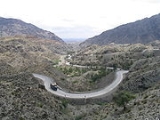
Khyber Pass

Encyclopedia
The Khyber Pass, (altitude: 1070 m or 3,510 ft) is a mountain pass
linking Pakistan
and Afghanistan
.
The Pass was an integral part of the ancient Silk Road
. It is mentioned in the Bible as the "Pesh Habor," and it is one of the oldest known passes in the world.
Throughout history it has been an important trade route
between Central Asia
and South Asia
and a strategic
military location. The summit of the Khyber Pass is 5 kilometres (3.1 mi) inside Pakistan at Landi Kotal
and it cuts through the northeastern part of the Safed Koh
mountains.
and later mongols such as Duwa
, Qutlugh Khwaja
and Kebek
. Among the Muslim
invasions of South Asia, the famous invaders coming through the Khyber Pass are the Turks such as Mahmud Ghaznavi, Muhammad Ghori
and the Turkic-Mongols such as Timur Lane
and Babur
whose invasion resulted in the establishment of the celebrated Mughul Empire (1526-1857). During the Mughal Period India was again invaded by the Persians under Nadir Shah and later by the Afghan
s under Ahmad Shah Durrani
; all these invasions coming through the Khyber Pass. The British
invaded Afghanistan
from India
via the pass and fought three Afghan Wars in 1839-42
, 1878-80
, and 1919
. George Molesworth
, a member of the British force of 1919
, summarized: "Every stone in the Khyber has been soaked in blood." Rudyard Kipling
called it "a sword cut through the mountains."
Finally, Sikhs under Ranjit Singh
, in 1798 captured the Khyber Pass. Hari Singh Nalwa
, who manned the Khyber pass for years became a household name in Afghanistan.
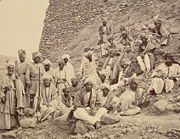 To the north of the Khyber Pass lies the country of the Mullagori tribe
. To the south is Afridi Tirah
, while the inhabitants of villages in the Pass itself are Afridi clansmen. Throughout the centuries the Pashtun
clans, particularly the Afridis and the Afghan Shinwaris, have regarded the Pass as their own preserve and have levied a toll on travellers for safe conduct. Since this has long been their main source of income, resistance to challenges to the Shinwaris' authority has often been fierce.
For strategic reasons, after the First World War the British
built a heavily engineered railway through the Pass. The Khyber Pass Railway
from Jamrud
, near Peshawar
, to the Afghan
border near Landi Kotal
was opened in 1925.
During World War II
concrete "dragon’s teeth
" (tank obstacles) were erected on the valley floor due to British fears of a German tank invasion of India.
The Pass became widely known to thousands of Westerners and Japanese who traveled it in the days of the Hippie trail
, taking a bus or car from Kabul
to the Afghan border. At the Pakistani frontier post, travelers were advised not to wander away from the road, as the location was then a barely controlled Federally Administered Tribal Area
. Then, after customs formalities, a quick daylight drive through the Pass was made. Monuments left by British Army units, as well as hillside forts, could be viewed from the highway.
The area of the Khyber Pass has been connected with a counterfeit arms industry, making various types of weapons known to gun collectors as Khyber Pass Copies
, using local steel and blacksmiths'
forge
s.
In February 2009, a bridge 15 miles northwest of Peshawar
was blown up by militants presumably sympathetic to or sponsored by the Taliban. While it was not considered to be a major strategic blow to the allied war effort, it invigorated efforts to secure additional supply routes, some of which may ultimately run through Iran. However, the current general consensus is that the new supply route will pass through various central Asian republics to the north of Afghanistan.
, except for Chandragupta Maurya
, Shah Jahan
, Ranjit Singh
, George Pollock
and General Sir Samuel James Browne VC
who crossed in the opposite direction.
Mountain pass
A mountain pass is a route through a mountain range or over a ridge. If following the lowest possible route, a pass is locally the highest point on that route...
linking Pakistan
Pakistan
Pakistan , officially the Islamic Republic of Pakistan is a sovereign state in South Asia. It has a coastline along the Arabian Sea and the Gulf of Oman in the south and is bordered by Afghanistan and Iran in the west, India in the east and China in the far northeast. In the north, Tajikistan...
and Afghanistan
Afghanistan
Afghanistan , officially the Islamic Republic of Afghanistan, is a landlocked country located in the centre of Asia, forming South Asia, Central Asia and the Middle East. With a population of about 29 million, it has an area of , making it the 42nd most populous and 41st largest nation in the world...
.
The Pass was an integral part of the ancient Silk Road
Silk Road
The Silk Road or Silk Route refers to a historical network of interlinking trade routes across the Afro-Eurasian landmass that connected East, South, and Western Asia with the Mediterranean and European world, as well as parts of North and East Africa...
. It is mentioned in the Bible as the "Pesh Habor," and it is one of the oldest known passes in the world.
Throughout history it has been an important trade route
Trade route
A trade route is a logistical network identified as a series of pathways and stoppages used for the commercial transport of cargo. Allowing goods to reach distant markets, a single trade route contains long distance arteries which may further be connected to several smaller networks of commercial...
between Central Asia
Central Asia
Central Asia is a core region of the Asian continent from the Caspian Sea in the west, China in the east, Afghanistan in the south, and Russia in the north...
and South Asia
South Asia
South Asia, also known as Southern Asia, is the southern region of the Asian continent, which comprises the sub-Himalayan countries and, for some authorities , also includes the adjoining countries to the west and the east...
and a strategic
Military strategy
Military strategy is a set of ideas implemented by military organizations to pursue desired strategic goals. Derived from the Greek strategos, strategy when it appeared in use during the 18th century, was seen in its narrow sense as the "art of the general", 'the art of arrangement' of troops...
military location. The summit of the Khyber Pass is 5 kilometres (3.1 mi) inside Pakistan at Landi Kotal
Landi Kotal
Landi Kotal or Landikotal is a town of the Federally Administered Tribal Areas of Pakistan. It is located at 34°6'4N 71°8'44E and lies on the Khyber Pass in the Khyber Agency. At 1,072 metres above sea level it is the highest point on the Khyber Pass and is the route across the mountains to the...
and it cuts through the northeastern part of the Safed Koh
Safed Koh
Spin Ghar or Safed Kuh or the Indian Caucasus, also known as the Safīd Mountain Range or Morga Range, is a mountain range on the Pakistan-Afghanistan border, up to above sea-level at Mount Sikaram, straight and rigid, towering above all surrounding hills...
mountains.
History
Well known invasions of the area have been predominantly through the Khyber Pass, such as the invasions by Darius I and Alexander the Great and also include Genghis KhanGenghis Khan
Genghis Khan , born Temujin and occasionally known by his temple name Taizu , was the founder and Great Khan of the Mongol Empire, which became the largest contiguous empire in history after his death....
and later mongols such as Duwa
Duwa
Duwa , also known as Du'a, was khan of the Chagatai Khanate . He was the second son of Baraq. He was the longest reigning monarch of the Chagatayid Khanate and accepted the Great Khan's supremacy...
, Qutlugh Khwaja
Qutlugh Khwaja
Qutlugh Khwaja was a son of Duwa, the Mongolian khan of Chagatai Khanate in the Mongol Empire. He became a chief of the Qara'unas in Afghanistan after Abdullah was recalled by the Khan to Central Asia in around 1298-1299...
and Kebek
Kebek
Kebek was khan of the Chagatai Khanate from 1309 until 1310, and again from c. 1318 until his death.-First Reign:Kebek was the son of Duwa, who was khan from 1282 until 1307...
. Among the Muslim
Muslim
A Muslim, also spelled Moslem, is an adherent of Islam, a monotheistic, Abrahamic religion based on the Quran, which Muslims consider the verbatim word of God as revealed to prophet Muhammad. "Muslim" is the Arabic term for "submitter" .Muslims believe that God is one and incomparable...
invasions of South Asia, the famous invaders coming through the Khyber Pass are the Turks such as Mahmud Ghaznavi, Muhammad Ghori
Muhammad of Ghor
Sultan Shahāb-ud-Din Muhammad Ghori , originally called Mu'izzuddīn Muḥammad Bin Sām , was a ruler of the Ghurid dynasty who reigned over a territory spanning present-day Afghanistan, Pakistan and northern India.Shahabuddin Ghori reconquered the city of Ghazna Sultan Shahāb-ud-Din Muhammad Ghori...
and the Turkic-Mongols such as Timur Lane
Timur
Timur , historically known as Tamerlane in English , was a 14th-century conqueror of West, South and Central Asia, and the founder of the Timurid dynasty in Central Asia, and great-great-grandfather of Babur, the founder of the Mughal Dynasty, which survived as the Mughal Empire in India until...
and Babur
Babur
Babur was a Muslim conqueror from Central Asia who, following a series of setbacks, finally succeeded in laying the basis for the Mughal dynasty of South Asia. He was a direct descendant of Timur through his father, and a descendant also of Genghis Khan through his mother...
whose invasion resulted in the establishment of the celebrated Mughul Empire (1526-1857). During the Mughal Period India was again invaded by the Persians under Nadir Shah and later by the Afghan
Durrani Empire
The Durrani Empire was a Pashtun dynasty centered in Afghanistan and included northeastern Iran, the Kashmir region, the modern state of Pakistan, and northwestern India. It was established at Kandahar in 1747 by Ahmad Shah Durrani, an Afghan military commander under Nader Shah of Persia and chief...
s under Ahmad Shah Durrani
Ahmad Shah Durrani
Ahmad Shah Durrani , also known as Ahmad Shāh Abdālī and born as Ahmad Khān, was the founder of the Durrani Empire in 1747 and is regarded by many to be the founder of the modern state of Afghanistan.Ahmad Khan enlisted as a young soldier in the military of the Afsharid kingdom and quickly rose...
; all these invasions coming through the Khyber Pass. The British
British Raj
British Raj was the British rule in the Indian subcontinent between 1858 and 1947; The term can also refer to the period of dominion...
invaded Afghanistan
Afghanistan
Afghanistan , officially the Islamic Republic of Afghanistan, is a landlocked country located in the centre of Asia, forming South Asia, Central Asia and the Middle East. With a population of about 29 million, it has an area of , making it the 42nd most populous and 41st largest nation in the world...
from India
India
India , officially the Republic of India , is a country in South Asia. It is the seventh-largest country by geographical area, the second-most populous country with over 1.2 billion people, and the most populous democracy in the world...
via the pass and fought three Afghan Wars in 1839-42
First Anglo-Afghan War
The First Anglo-Afghan War was fought between British India and Afghanistan from 1839 to 1842. It was one of the first major conflicts during the Great Game, the 19th century competition for power and influence in Central Asia between the United Kingdom and Russia, and also marked one of the worst...
, 1878-80
Second Anglo-Afghan War
The Second Anglo-Afghan War was fought between the United Kingdom and Afghanistan from 1878 to 1880, when the nation was ruled by Sher Ali Khan of the Barakzai dynasty, the son of former Emir Dost Mohammad Khan. This was the second time British India invaded Afghanistan. The war ended in a manner...
, and 1919
Third Anglo-Afghan War
The Third Anglo-Afghan War began on 6 May 1919 and ended with an armistice on 8 August 1919. It was a minor tactical victory for the British. For the British, the Durand Line was reaffirmed as the political boundary between the Emirate of Afghanistan and British India and the Afghans agreed not to...
. George Molesworth
George Molesworth
Lieutenant-General George Noble Molesworth, CSI, CBE was an officer commissioned into the British Army serving in India and saw active service in the Third Anglo-Afghan War. He later transferred to the British Indian Army and rose to oversee intelligence and to be Deputy Chief of General Staff of...
, a member of the British force of 1919
Third Anglo-Afghan War
The Third Anglo-Afghan War began on 6 May 1919 and ended with an armistice on 8 August 1919. It was a minor tactical victory for the British. For the British, the Durand Line was reaffirmed as the political boundary between the Emirate of Afghanistan and British India and the Afghans agreed not to...
, summarized: "Every stone in the Khyber has been soaked in blood." Rudyard Kipling
Rudyard Kipling
Joseph Rudyard Kipling was an English poet, short-story writer, and novelist chiefly remembered for his celebration of British imperialism, tales and poems of British soldiers in India, and his tales for children. Kipling received the 1907 Nobel Prize for Literature...
called it "a sword cut through the mountains."
Finally, Sikhs under Ranjit Singh
Ranjit Singh
Maharaja Ranjit Singh Ji was the first Maharaja of the Sikh Empire.-Early life:...
, in 1798 captured the Khyber Pass. Hari Singh Nalwa
Hari Singh Nalwa
Hari Singh Nalwa was Commander-in-chief of the Khalsa, the army of the Sikh Empire. He is known for his role in the conquests of Kasur, Sialkot, Multan, Kashmir, Attock, and Peshawar. He led the Sikh Army in freeing Shah Shuja from Kashmir and secured the Koh-i-Nor diamond for Maharaja Ranjit Singh...
, who manned the Khyber pass for years became a household name in Afghanistan.
Mullagori
The Mullagori are a Pashtun tribe who inhabit the Khyber Agency, one of the Federally Administered Tribal Areas of Pakistan.-Origins:...
. To the south is Afridi Tirah
Tirah
Tirah is a region located in Kurram and Khyber agencies of the Federally Administered Tribal Areas of Pakistan . It lies between the Khyber Pass and the Khanki Valley. It is inhabited by the Afridi and Orakzai tribes of Pashtuns...
, while the inhabitants of villages in the Pass itself are Afridi clansmen. Throughout the centuries the Pashtun
Pashtun people
Pashtuns or Pathans , also known as ethnic Afghans , are an Eastern Iranic ethnic group with populations primarily between the Hindu Kush mountains in Afghanistan and the Indus River in Pakistan...
clans, particularly the Afridis and the Afghan Shinwaris, have regarded the Pass as their own preserve and have levied a toll on travellers for safe conduct. Since this has long been their main source of income, resistance to challenges to the Shinwaris' authority has often been fierce.
For strategic reasons, after the First World War the British
United Kingdom
The United Kingdom of Great Britain and Northern IrelandIn the United Kingdom and Dependencies, other languages have been officially recognised as legitimate autochthonous languages under the European Charter for Regional or Minority Languages...
built a heavily engineered railway through the Pass. The Khyber Pass Railway
Khyber train safari
The Khyber train safari is a railway route in Khyber-Pakhtunkhwa province of Pakistan. The colonial era railway route has been described as "a journey into time and history". It consists of a train pulled by two vintage steam locomotives built in 1920s that takes passengers through breathtaking and...
from Jamrud
Jamrud
Jamrud , is a town located in the Khyber Agency, one of the Federally Administered Tribal Areas of Pakistan. The town is the doorway to the Khyber pass, part of the Hindu Kush range...
, near Peshawar
Peshawar
Peshawar is the capital of Khyber-Pakhtunkhwa and the administrative center and central economic hub for the Federally Administered Tribal Areas of Pakistan....
, to the Afghan
Afghanistan
Afghanistan , officially the Islamic Republic of Afghanistan, is a landlocked country located in the centre of Asia, forming South Asia, Central Asia and the Middle East. With a population of about 29 million, it has an area of , making it the 42nd most populous and 41st largest nation in the world...
border near Landi Kotal
Landi Kotal
Landi Kotal or Landikotal is a town of the Federally Administered Tribal Areas of Pakistan. It is located at 34°6'4N 71°8'44E and lies on the Khyber Pass in the Khyber Agency. At 1,072 metres above sea level it is the highest point on the Khyber Pass and is the route across the mountains to the...
was opened in 1925.
During World War II
World War II
World War II, or the Second World War , was a global conflict lasting from 1939 to 1945, involving most of the world's nations—including all of the great powers—eventually forming two opposing military alliances: the Allies and the Axis...
concrete "dragon’s teeth
Dragon's teeth (fortification)
Dragon's teeth are square-pyramidal fortifications of reinforced concrete first used during the Second World War to impede the movement of tanks and mechanised infantry...
" (tank obstacles) were erected on the valley floor due to British fears of a German tank invasion of India.
The Pass became widely known to thousands of Westerners and Japanese who traveled it in the days of the Hippie trail
Hippie trail
The hippie trail is a term used to describe the journeys taken by hippies and others in the 1960s and 1970s from Europe overland to and from southern Asia, mainly India, Pakistan and Nepal...
, taking a bus or car from Kabul
Kabul
Kabul , spelt Caubul in some classic literatures, is the capital and largest city of Afghanistan. It is also the capital of the Kabul Province, located in the eastern section of Afghanistan...
to the Afghan border. At the Pakistani frontier post, travelers were advised not to wander away from the road, as the location was then a barely controlled Federally Administered Tribal Area
Federally Administered Tribal Areas
The Federally Administered Tribal Areas are a semi-autonomous tribal region in the northwest of Pakistan, lying between the province of Khyber Pakhtunkhwa, Balochistan, and the neighboring country of Afghanistan. The FATA comprise seven Agencies and six FRs...
. Then, after customs formalities, a quick daylight drive through the Pass was made. Monuments left by British Army units, as well as hillside forts, could be viewed from the highway.
The area of the Khyber Pass has been connected with a counterfeit arms industry, making various types of weapons known to gun collectors as Khyber Pass Copies
Khyber Pass Copy
A Khyber Pass Copy is a firearm manufactured by cottage gunsmiths in the Khyber Pass region between Pakistan and Afghanistan. The reason they are called that is because the Adam Khel Afridi, who live around the Khyber pass, were historically the most active arms manufacturers on the Frontier.The...
, using local steel and blacksmiths'
Blacksmith
A blacksmith is a person who creates objects from wrought iron or steel by forging the metal; that is, by using tools to hammer, bend, and cut...
forge
Forge
A forge is a hearth used for forging. The term "forge" can also refer to the workplace of a smith or a blacksmith, although the term smithy is then more commonly used.The basic smithy contains a forge, also known as a hearth, for heating metals...
s.
Current conflicts
During the current war in Afghanistan, the Khyber Pass has been a major route for resupplying NATO forces in the Afghan theater of conflict. Recognizing this, the Taliban attempted to cut off the route in late 2008 and early 2009, bringing the Taliban into conflict with the Pakistani government.In February 2009, a bridge 15 miles northwest of Peshawar
Peshawar
Peshawar is the capital of Khyber-Pakhtunkhwa and the administrative center and central economic hub for the Federally Administered Tribal Areas of Pakistan....
was blown up by militants presumably sympathetic to or sponsored by the Taliban. While it was not considered to be a major strategic blow to the allied war effort, it invigorated efforts to secure additional supply routes, some of which may ultimately run through Iran. However, the current general consensus is that the new supply route will pass through various central Asian republics to the north of Afghanistan.
Conquerors and generals
The commanders who crossed the Khyber Pass all led armies eastward in the conquest of IndiaIndia
India , officially the Republic of India , is a country in South Asia. It is the seventh-largest country by geographical area, the second-most populous country with over 1.2 billion people, and the most populous democracy in the world...
, except for Chandragupta Maurya
Chandragupta Maurya
Chandragupta Maurya , was the founder of the Maurya Empire. Chandragupta succeeded in conquering most of the Indian subcontinent. Chandragupta is considered the first unifier of India and its first genuine emperor...
, Shah Jahan
Shah Jahan
Shah Jahan Shah Jahan (also spelled Shah Jehan, Shahjehan, , Persian: شاه جهان) (January 5, 1592 – January 22, 1666) Shah Jahan (also spelled Shah Jehan, Shahjehan, , Persian: شاه جهان) (January 5, 1592 – January 22, 1666) (Full title: His Imperial Majesty Al-Sultan al-'Azam wal Khaqan...
, Ranjit Singh
Ranjit Singh
Maharaja Ranjit Singh Ji was the first Maharaja of the Sikh Empire.-Early life:...
, George Pollock
George Pollock
Field Marshal Sir George Pollock, 1st Baronet, GCB, GCSI was a British soldier.-Military career:Educated at the Royal Military Academy, Woolwich, Pollock was commissioned into the Bengal Artillery in 1803....
and General Sir Samuel James Browne VC
Sam Browne
General Sir Samuel James Browne VC GCB KCSI was a British Indian Army cavalry officer in India and the Afghanistan, best known today as the namesake of the Sam Browne belt...
who crossed in the opposite direction.
- Cyrus the GreatCyrus the GreatCyrus II of Persia , commonly known as Cyrus the Great, also known as Cyrus the Elder, was the founder of the Achaemenid Empire. Under his rule, the empire embraced all the previous civilized states of the ancient Near East, expanded vastly and eventually conquered most of Southwest Asia and much...
- Alexander the Great
- Chandragupta MauryaChandragupta MauryaChandragupta Maurya , was the founder of the Maurya Empire. Chandragupta succeeded in conquering most of the Indian subcontinent. Chandragupta is considered the first unifier of India and its first genuine emperor...
- Demetrius I of BactriaDemetrius I of BactriaDemetrius I was a Buddhist Greco-Bactrian king . He was the son of Euthydemus and succeeded him around 200 BC, after which he conquered extensive areas in what now is eastern Iran, Afghanistan and Pakistan thus creating an Indo-Greek kingdom far from Hellenistic Greece...
- Mahmud Ghaznavi
- Muhammad Ghori
- Genghis KhanGenghis KhanGenghis Khan , born Temujin and occasionally known by his temple name Taizu , was the founder and Great Khan of the Mongol Empire, which became the largest contiguous empire in history after his death....
- Qutlugh KhwajaQutlugh KhwajaQutlugh Khwaja was a son of Duwa, the Mongolian khan of Chagatai Khanate in the Mongol Empire. He became a chief of the Qara'unas in Afghanistan after Abdullah was recalled by the Khan to Central Asia in around 1298-1299...
- TamerlaneTimurTimur , historically known as Tamerlane in English , was a 14th-century conqueror of West, South and Central Asia, and the founder of the Timurid dynasty in Central Asia, and great-great-grandfather of Babur, the founder of the Mughal Dynasty, which survived as the Mughal Empire in India until...
- BaburBaburBabur was a Muslim conqueror from Central Asia who, following a series of setbacks, finally succeeded in laying the basis for the Mughal dynasty of South Asia. He was a direct descendant of Timur through his father, and a descendant also of Genghis Khan through his mother...
- HumayunHumayunNasir ud-din Muhammad Humayun was the second Mughal Emperor who ruled present day Afghanistan, Pakistan, and parts of northern India from 1530–1540 and again from 1555–1556. Like his father, Babur, he lost his kingdom early, but with Persian aid, he eventually regained an even larger one...
- Shah JahanShah JahanShah Jahan Shah Jahan (also spelled Shah Jehan, Shahjehan, , Persian: شاه جهان) (January 5, 1592 – January 22, 1666) Shah Jahan (also spelled Shah Jehan, Shahjehan, , Persian: شاه جهان) (January 5, 1592 – January 22, 1666) (Full title: His Imperial Majesty Al-Sultan al-'Azam wal Khaqan...
- Nader Shah Afshar
- Ahmad Shah DurraniAhmad Shah DurraniAhmad Shah Durrani , also known as Ahmad Shāh Abdālī and born as Ahmad Khān, was the founder of the Durrani Empire in 1747 and is regarded by many to be the founder of the modern state of Afghanistan.Ahmad Khan enlisted as a young soldier in the military of the Afsharid kingdom and quickly rose...
- Ranjit SinghRanjit SinghMaharaja Ranjit Singh Ji was the first Maharaja of the Sikh Empire.-Early life:...
- George PollockGeorge PollockField Marshal Sir George Pollock, 1st Baronet, GCB, GCSI was a British soldier.-Military career:Educated at the Royal Military Academy, Woolwich, Pollock was commissioned into the Bengal Artillery in 1803....
- General Sir Samuel James Browne VCSam BrowneGeneral Sir Samuel James Browne VC GCB KCSI was a British Indian Army cavalry officer in India and the Afghanistan, best known today as the namesake of the Sam Browne belt...
- Sir Donald Stewart, 1st Baronet
See also
- Ali MasjidAli MasjidAli Masjid is the narrowest point of the Khyber Pass. It is located in the Khyber Agency of the Federally Administered Tribal Areas , Pakistan. It is located around east of the city of Landi Kotal and has an elevation of...
and the Battle of Ali MasjidBattle of Ali MasjidThe Battle of Ali Masjid, which took place on 21 November 1878, was the opening battle in the Second Anglo-Afghan War between the British forces, under Lieutenant-General Sir Samuel James Browne, and the Afghan tribesmen, under Ghulam Haider Khan... - Khyber Pakhtunkhwa
- Khyber AgencyKhyber agencyKhyber is a tribal area in the FATA region of Pakistan. It is one of the eight tribal areas, better known as agencies in Pakistan. It ranges from the Tirah valley down to Peshawar...
- Federally Administered Tribal Areas
- Durand LineDurand LineThe Durand Line refers to the porous international border between Pakistan and Afghanistan, which has divided the ethnic Pashtuns . This poorly marked line is approximately long...
- Khyber train safariKhyber train safariThe Khyber train safari is a railway route in Khyber-Pakhtunkhwa province of Pakistan. The colonial era railway route has been described as "a journey into time and history". It consists of a train pulled by two vintage steam locomotives built in 1920s that takes passengers through breathtaking and...
- Carry On... Up the Khyber
- Khyber Pass CopyKhyber Pass CopyA Khyber Pass Copy is a firearm manufactured by cottage gunsmiths in the Khyber Pass region between Pakistan and Afghanistan. The reason they are called that is because the Adam Khel Afridi, who live around the Khyber pass, were historically the most active arms manufacturers on the Frontier.The...
- Dasht-e YahudiDasht-e YahudiThe term Dasht-e Yahudi literally means, the "Jewish Desert" in Persian and "Jewish waste" in Pashto. It is an archaic term that first appears in Persian, Mughal Indian and Afghan texts....
Further reading
- Molesworth, Lt-Gen. G.N.George MolesworthLieutenant-General George Noble Molesworth, CSI, CBE was an officer commissioned into the British Army serving in India and saw active service in the Third Anglo-Afghan War. He later transferred to the British Indian Army and rose to oversee intelligence and to be Deputy Chief of General Staff of...
, Afghanistan 1919 (Asia Publishing House, 1962). This book describes in detail the author's passage (Prince Albert's)Somerset Light Infantry. - Victor Bayley CIE CBE. "Permanent Way through the Khyber", Jarrolds (1934). In an article illustrated with photos, the author describes the construction of the railway. The book was reprinted in 1998 by Gyan Publishing House, India as Adventure through Khyber in a breach of copyright.