
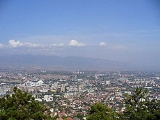
Skopje is the capital and largest city of the
Republic of MacedoniaMacedonia , officially the Republic of Macedonia , is a country located in the central Balkan peninsula in Southeast Europe. It is one of the successor states of the former Yugoslavia, from which it declared independence in 1991...
with about a third of the total population. It is the country's political, cultural, economic, and academic centre. It was known in the
RomanAncient Rome was a thriving civilization that grew on the Italian Peninsula as early as the 8th century BC. Located along the Mediterranean Sea and centered on the city of Rome, it expanded to one of the largest empires in the ancient world....
period under the name
ScupiScupi is an archaeological site located between Zajčev Rid and the Vardar River, several kilometers from the center of Skopje, in the Republic of Macedonia. A Roman military camp was founded here in the second decade BC on the site of an older Dardanian settlement...
.
The territory of Skopje has been inhabited since at least 4000 BC; remains of
NeolithicThe Neolithic Age, Era, or Period, or New Stone Age, was a period in the development of human technology, beginning about 9500 BC in some parts of the Middle East, and later in other parts of the world. It is traditionally considered as the last part of the Stone Age...
settlements have been found within the old
Kale FortressThe Skopje Fortress , commonly referred to as Kale Fortress, or simply Kale , is a historic fortress located in the old town of Skopje, the capital of the Republic of Macedonia. It is situated on the highest point in the city overlooking the Vardar River...
that overlooks the modern city centre. On the eve of the 1st century AD, the settlement was seized by the Romans and became a military camp. When the
Roman EmpireThe Roman Empire was the post-Republican period of the ancient Roman civilization, characterised by an autocratic form of government and large territorial holdings in Europe and around the Mediterranean....
was divided into eastern and western halves in 395 AD, Scupi came under
ByzantineThe Byzantine Empire was the Eastern Roman Empire during the periods of Late Antiquity and the Middle Ages, centred on the capital of Constantinople. Known simply as the Roman Empire or Romania to its inhabitants and neighbours, the Empire was the direct continuation of the Ancient Roman State...
rule from
ConstantinopleConstantinople was the capital of the Roman, Eastern Roman, Byzantine, Latin, and Ottoman Empires. Throughout most of the Middle Ages, Constantinople was Europe's largest and wealthiest city.-Names:...
. During much of the
early medievalThe Early Middle Ages was the period of European history lasting from the 5th century to approximately 1000. The Early Middle Ages followed the decline of the Western Roman Empire and preceded the High Middle Ages...
period, the town was contested between the Byzantines and the
Bulgarian EmpireThe First Bulgarian Empire was a medieval Bulgarian state founded in the north-eastern Balkans in c. 680 by the Bulgars, uniting with seven South Slavic tribes...
. From 1282 the town was part of the
Serbian realmThe Serbian Empire was a short-lived medieval empire in the Balkans that emerged from the Serbian Kingdom. Stephen Uroš IV Dušan was crowned Emperor of Serbs and Greeks on 16 April, 1346, a title signifying a successorship to the Eastern Roman Empire...
and its capital city since 1346. In 1392 the city was conquered by the
OttomanThe Ottoman EmpireIt was usually referred to as the "Ottoman Empire", the "Turkish Empire", the "Ottoman Caliphate" or more commonly "Turkey" by its contemporaries...
TurksTurkish people, also known as the "Turks" , are an ethnic group primarily living in Turkey and in the former lands of the Ottoman Empire where Turkish minorities had been established in Bulgaria, Cyprus, Bosnia and Herzegovina, Georgia, Greece, Kosovo, Macedonia, and Romania...
who called the town
Üsküp. The town stayed under Ottoman control over 500 years. At that time the city was famous for its oriental architecture. In 1912 the city was conquered by the
Kingdom of SerbiaThe Kingdom of Serbia was created when Prince Milan Obrenović, ruler of the Principality of Serbia, was crowned King in 1882. The Principality of Serbia was ruled by the Karađorđevic dynasty from 1817 onwards . The Principality, suzerain to the Porte, had expelled all Ottoman troops by 1867, de...
during the
Balkan WarsThe Balkan Wars were two conflicts that took place in the Balkans in south-eastern Europe in 1912 and 1913.By the early 20th century, Montenegro, Bulgaria, Greece and Serbia, the countries of the Balkan League, had achieved their independence from the Ottoman Empire, but large parts of their ethnic...
and after the First World War the city became part of the newly formed
Kingdom of Serbs, Croats and Slovenes (Kingdom of Yugoslavia)The Kingdom of Yugoslavia was a state stretching from the Western Balkans to Central Europe which existed during the often-tumultuous interwar era of 1918–1941...
. In the Second World War the city was conquered by the Bulgarian Army, which was part of
Axis powersThe Axis powers , also known as the Axis alliance, Axis nations, Axis countries, or just the Axis, was an alignment of great powers during the mid-20th century that fought World War II against the Allies. It began in 1936 with treaties of friendship between Germany and Italy and between Germany and...
. In 1944 it became the capital city of
Democratic MacedoniaThe Socialist Republic of Macedonia was a socialist state that was a constituent country of the former Socialist Federal Republic of Yugoslavia...
(later
Socialist Republic of MacedoniaThe Socialist Republic of Macedonia was a socialist state that was a constituent country of the former Socialist Federal Republic of Yugoslavia...
), which was a federal state, part of Democratic Federal Yugoslavia (later
Socialist Federal Republic of YugoslaviaThe Socialist Federal Republic of Yugoslavia was the Yugoslav state that existed from the abolition of the Yugoslav monarchy until it was dissolved in 1992 amid the Yugoslav Wars. It was a socialist state and a federation made up of six socialist republics: Bosnia and Herzegovina, Croatia,...
). The city developed rapidly after World War II, but this trend was interrupted in 1963 when it was hit by a
disastrous earthquakeThe 1963 Skopje earthquake was an 6.1 moment magnitude earthquake which occurred in Skopje, SR Macedonia then part of the SFR Yugoslavia, on July 26, 1963 which killed over 1,070 people, injured between 3,000 and 4,000 and left more than 200,000 people homeless...
. In 1991 it became the capital city of independent
MacedoniaMacedonia , officially the Republic of Macedonia , is a country located in the central Balkan peninsula in Southeast Europe. It is one of the successor states of the former Yugoslavia, from which it declared independence in 1991...
.
Skopje is located on the upper course of the
Vardar RiverThe Vardar or Axios is the longest and major river in the Republic of Macedonia and also a major river of Greece. It is long, and drains an area of around . The maximum depth of river is ....
and is located on a major north-south
BalkanThe Balkans is a geopolitical and cultural region of southeastern Europe...
route between
BelgradeBelgrade is the capital and largest city of Serbia. It is located at the confluence of the Sava and Danube rivers, where the Pannonian Plain meets the Balkans. According to official results of Census 2011, the city has a population of 1,639,121. It is one of the 15 largest cities in Europe...
and
AthensAthens , is the capital and largest city of Greece. Athens dominates the Attica region and is one of the world's oldest cities, as its recorded history spans around 3,400 years. Classical Athens was a powerful city-state...
. It is a center for metal-processing, chemical, timber, textile, leather, and printing industries. Industrial development of the city has been accompanied by development of the trade, logistics, and banking sectors, as well as an emphasis on the fields of culture and sport. According to the 2006 official estimate, it has 668,518 inhabitants.
Etymology
The name of Skopje is derived from an ancient name that is attested in antiquity as Latin
Scupi, the name of a classical era Greco-Roman frontier fortress town of Thracian (Paeonian) origin. In modern times, the city has been known by its
Ottoman TurkishThe Ottoman Turkish language or Ottoman language is the variety of the Turkish language that was used for administrative and literary purposes in the Ottoman Empire. It borrows extensively from Arabic and Persian, and was written in a variant of the Perso-Arabic script...
name
Üsküp during the time of Ottoman rule and by the
SerbianSerbian is a form of Serbo-Croatian, a South Slavic language, spoken by Serbs in Serbia, Bosnia and Herzegovina, Montenegro, Croatia and neighbouring countries....
form
Skoplje (Скопље) during the time of the
Royal YugoslaviaThe Kingdom of Yugoslavia was a state stretching from the Western Balkans to Central Europe which existed during the often-tumultuous interwar era of 1918–1941...
between 1912 and 1941. Under the
Kingdom of BulgariaThe Kingdom of Bulgaria was established as an independent state when the Principality of Bulgaria, an Ottoman vassal, officially proclaimed itself independent on October 5, 1908 . This move also formalised the annexation of the Ottoman province of Eastern Rumelia, which had been under the control...
(1941–1944), the city was called
Skopie (Скопие). Since 1945, the official name of the city in
MacedonianMacedonian is a South Slavic language spoken as a first language by approximately 2–3 million people principally in the region of Macedonia but also in the Macedonian diaspora...
has been
Skopje (Скопје), reflecting the
Macedonian CyrillicThe orthography of Macedonian includes an alphabet , which is an adaptation of the Cyrillic script, as well as language-specific conventions of spelling and punctuation....
orthography for the local pronunciation. The city is called
Shkup or
Shkupi in
AlbanianAlbanian is an Indo-European language spoken by approximately 7.6 million people, primarily in Albania and Kosovo but also in other areas of the Balkans in which there is an Albanian population, including western Macedonia, southern Montenegro, southern Serbia and northwestern Greece...
.
Geography
Skopje is located in the in the
Skopje statistical regionThe Skopje Statistical Region is one of eight arbitrary statistical regions in the Republic of Macedonia. Skopje, located in northern Macedonia, borders Kosovo to the north...
of northern Macedonia, in the centre of the Balkans, approximately halfway between
BelgradeBelgrade is the capital and largest city of Serbia. It is located at the confluence of the Sava and Danube rivers, where the Pannonian Plain meets the Balkans. According to official results of Census 2011, the city has a population of 1,639,121. It is one of the 15 largest cities in Europe...
and
AthensAthens , is the capital and largest city of Greece. Athens dominates the Attica region and is one of the world's oldest cities, as its recorded history spans around 3,400 years. Classical Athens was a powerful city-state...
. The
Vardar RiverThe Vardar or Axios is the longest and major river in the Republic of Macedonia and also a major river of Greece. It is long, and drains an area of around . The maximum depth of river is ....
, which originates near
GostivarGostivar , is a city in the Republic of Macedonia, located in the upper Polog valley region. It is one of the largest municipalities in the country with a population of 81,042, and the town also covers . Gostivar has good road and railway connections with the other cities in the region, such as...
, flows through the city then flows south passing the border into Greece and eventually flowing into the
Aegean SeaThe Aegean Sea[p] is an elongated embayment of the Mediterranean Sea located between the southern Balkan and Anatolian peninsulas, i.e., between the mainlands of Greece and Turkey. In the north, it is connected to the Marmara Sea and Black Sea by the Dardanelles and Bosporus...
. The Vardar valley consists primarily of hills and mountains. The city covers an average length of 23 km from east to west and 9 km from north to south. Skopje is located at an elevation of 225 m (738 ft)
above sea levelThe term above mean sea level refers to the elevation or altitude of any object, relative to the average sea level datum. AMSL is used extensively in radio by engineers to determine the coverage area a station will be able to reach...
. The city's land area is 1854 km² (715.8 sq mi).
Climate
The city experiences a
humid subtropical climateA humid subtropical climate is a climate zone characterized by hot, humid summers and mild to cool winters...
(
KöppenThe Köppen climate classification is one of the most widely used climate classification systems. It was first published by Crimea German climatologist Wladimir Köppen in 1884, with several later modifications by Köppen himself, notably in 1918 and 1936...
Cfa) and lies near the boundary of the
humid continental climateA humid continental climate is a climatic region typified by large seasonal temperature differences, with warm to hot summers and cold winters....
. The summers are hot and humid, while the winters are cold, wet, and often snowy. In summer, temperatures are usually above 31 °C (88 °F) and sometimes above 40 °C (104 °F). In spring and autumn, the temperatures range from 15 to 24 °C (59 to 75.2 F). In winter, the day temperatures are roughly 6 °C (43 °F), but at nights they often fall below 0 °C (32 °F) and sometimes below -10 °C. Occurrences of precipitation are evenly distributed throughout the year, being heaviest from October to December and from April to June.
Hydrography
In Skopje, the Vardar River is sixty miles from its source near
GostivarGostivar , is a city in the Republic of Macedonia, located in the upper Polog valley region. It is one of the largest municipalities in the country with a population of 81,042, and the town also covers . Gostivar has good road and railway connections with the other cities in the region, such as...
. The flow in the city is almost equivalent to the flow at its delta, near
ThessalonikiThessaloniki , historically also known as Thessalonica, Salonika or Salonica, is the second-largest city in Greece and the capital of the region of Central Macedonia as well as the capital of the Decentralized Administration of Macedonia and Thrace...
. The river makes a few large meanders in Skopje and is crossed by several bridges, five in the centre of the city.
Several rivers flow into the Vardar in Skopje. The longest is the
TreskaTreska is a river in the western part of the Republic of Macedonia, a right tributary to Vardar. It is long, and its basin is 2350 km².It rises in the Stogovo mountain at an altitude of around 2000 meters, and flows eastwards through the valley of Kičevo...
, which is 130 km long. Others include the Lepenec, Pčinja, Kadina Reka, Markova Reka and Pateška, which are all less than 70 km long.
Skopje's two artificial lakes
MatkaMatka is a canyon located west of Skopje, Macedonia. Covering roughly 5,000 hectares, Matka is one of the most popular outdoor destinations in Macedonia and is home to several medieval monasteries.-Geology:...
and Treska are supplied by the Treska River, located just few kilometers outside the city center. The city also has a glacial lake called Jakupica.
Geology
Seismic movements have formed medium-sized mountains around the city. The city of Skopje is bordered by Šar Mountains to the west, by the
JakupicaJakupica is a mountain range in the central part of the Republic of Macedonia. Its highest peak is Solunska Glava . Other significant peaks are: Karadzica , Popovo Brdo , Ostar Breg , Ubava , Ostar Vrv , and Dautica .The relief is criss-crossed by numerous clear and fast mountain rivers...
chain to the south, and by hills to the east that form the early
Osogovo MountainsOsogovo or Osogovska Planina is a mountain and ski resort between southwestern Bulgaria and northeastern Republic of Macedonia,...
, which are situated on the border between Macedonia and
BulgariaBulgaria , officially the Republic of Bulgaria , is a parliamentary democracy within a unitary constitutional republic in Southeast Europe. The country borders Romania to the north, Serbia and Macedonia to the west, Greece and Turkey to the south, as well as the Black Sea to the east...
.
The highest point in the center of Skopje is at an altitude of 1066 meters which is far exceeded by the mountains Osoj,
Skopska Crna GoraSkopska Crna Gora , formerly called Kara-dagh also called simply Crna Gora, is a mountain range on the border between Kosovo and the Republic of Macedonia, between the cities of Kačanik and Skopje.The Monastery of St...
, and Žeden which have heights of 1506 meters, 1260 meters and 1561 meters respectively.
Some rivers, like the Matka, have created ravines around the city. The
canyon of the Treska RiverMatka is a canyon located west of Skopje, Macedonia. Covering roughly 5,000 hectares, Matka is one of the most popular outdoor destinations in Macedonia and is home to several medieval monasteries.-Geology:...
is surrounded by some caves.
Town planning
Skopje has a rather loose town planning, which is the result of an
earthquakeThe 1963 Skopje earthquake was an 6.1 moment magnitude earthquake which occurred in Skopje, SR Macedonia then part of the SFR Yugoslavia, on July 26, 1963 which killed over 1,070 people, injured between 3,000 and 4,000 and left more than 200,000 people homeless...
that destroyed 80% of the city in 1963.
The centre of Skopje is formed of two municipalities separated by the
VardarThe Vardar or Axios is the longest and major river in the Republic of Macedonia and also a major river of Greece. It is long, and drains an area of around . The maximum depth of river is ....
. On the north bank of the river is
Čair MunicipalityČair is one of the ten municipalities that make up the city of Skopje, the capital of the Republic of Macedonia. Skopje's old town is located in Čair.- Geography :...
in which the Old Town is located, while the on the south bank is Centar Municipality which is the modern part of the centre of the city.
Rebuilding after the earthquake was largely orchestrated by
Kenzo Tangewas a Japanese architect, and winner of the 1987 Pritzker Prize for architecture. He was one of the most significant architects of the 20th century, combining traditional Japanese styles with modernism, and designed major buildings on five continents. Tange was also an influential protagonist of...
, a Japanese architect and urban planner who had drawn many plans for cities and towns including that for
Hiroshimais the capital of Hiroshima Prefecture, and the largest city in the Chūgoku region of western Honshu, the largest island of Japan. It became best known as the first city in history to be destroyed by a nuclear weapon when the United States Army Air Forces dropped an atomic bomb on it at 8:15 A.M...
in 1949. The most significant accomplishment was the train station, which was built on an elevated platform over bridges and allows for the separation of traffic and pedestrians. The planning of the southern bank of the Vardar has been designed to accommodate 1,800 homes lost in the earthquake.
The combination of the earthquake, Yugoslav social planning, and UN funded plans created an environment in Skopje for some unusual building projects from the mid-1960s onwards. A notable example is the central post office, a circular building which was designed by architect
Janko KonstantinovJanko Konstantinov, is a Macedonian architect who, after the disastrous 1963 Skopje earthquake, helped in re-building the city. His most famous building is the round building of the Central Skopje Post Office...
.
Today, the city is spreading in all directions and is experiencing a number of new developments. The government has made plans to erect several statues, fountains, bridges, and museums at a cost of about €200 million. The project has generated controversy. Critics have described the new landmark buildings as signs of a reactionary
historicistHistoricism refers to artistic styles that draw their inspiration from copying historic styles or artisans. After neo-classicism, which could itself be considered a historicist movement, the 19th century saw a new historicist phase marked by a return to a more ancient classicism, in particular in...
esthetics. The project has also been criticised for its cost and for the lack of representation of national minorities in the coverage of its set of statues and memorials.
History
The site of modern Skopje has been inhabited since at least 4000 BC. Remains of Neolithic settlements have been found within the
Skopje FortressThe Skopje Fortress , commonly referred to as Kale Fortress, or simply Kale , is a historic fortress located in the old town of Skopje, the capital of the Republic of Macedonia. It is situated on the highest point in the city overlooking the Vardar River...
. The earliest people in Skopje Valley were probably the
TriballiThe Triballi were an ancient tribe whose dominion was around the plains of southern modern Serbia and west Bulgaria, at the Angrus and Brongus and the Iskur River, roughly centered where Serbia and Bulgaria are joined....
. Later the area was populated by the Paionians, but in the 3rd century BC, Skopje and the surrounding area was invaded by the
DardaniDardania was the region of the Dardani .Located at the Thraco-Illyrian contact zone, their identification as either an Illyrian or Thracian tribe is uncertain. Their territory itself was not considered part of Illyria by Strabo. The term used for their territory was , while for other tribes had...
ans.
ScupiScupi is an archaeological site located between Zajčev Rid and the Vardar River, several kilometers from the center of Skopje, in the Republic of Macedonia. A Roman military camp was founded here in the second decade BC on the site of an older Dardanian settlement...
, the ancient name for Skopje, became the capital of Dardania, which extended from Naissus to
BylazoraBylazora or Vilazora is a Paeonian city that was located on the Axius River at Veles in the Republic of Macedonia. Polybius tells us that "King Philip V captured Bylazora, the largest town of Paeonia, and very favourably situated for commanding the pass from Dardania to Macedonia: so that by this...
in the second century BC. Roman expansion east brought Scupi under Roman rule as a colony of legionnaires, mainly veterans of the Legio IIV Claudia in the time of
DomitianDomitian was Roman Emperor from 81 to 96. Domitian was the third and last emperor of the Flavian dynasty.Domitian's youth and early career were largely spent in the shadow of his brother Titus, who gained military renown during the First Jewish-Roman War...
(81-96 AD). However, several legions from the Roman province of Macedonia of Crassus' army may already have been stationed in there around 29-28 BC, before the official imperial command was instituted. Shortly afterwards it became part of the province of
MoesiaMoesia was an ancient region and later Roman province situated in the Balkans, along the south bank of the Danube River. It included territories of modern-day Southern Serbia , Northern Republic of Macedonia, Northern Bulgaria, Romanian Dobrudja, Southern Moldova, and Budjak .-History:In ancient...
during
AugustusAugustus ;23 September 63 BC – 19 August AD 14) is considered the first emperor of the Roman Empire, which he ruled alone from 27 BC until his death in 14 AD.The dates of his rule are contemporary dates; Augustus lived under two calendars, the Roman Republican until 45 BC, and the Julian...
's rule. After the division of the province by
DomitianDomitian was Roman Emperor from 81 to 96. Domitian was the third and last emperor of the Flavian dynasty.Domitian's youth and early career were largely spent in the shadow of his brother Titus, who gained military renown during the First Jewish-Roman War...
in 86 AD, Scupi was elevated to colonial status, and became a seat of government within the new province of Moesia Superior. The district called Dardania (within Moesia Superior) was formed into a special province by Diocletian, with the capital at Naissus. From 395 AD, it passed into the hands of the
Byzantine EmpireThe Byzantine Empire was the Eastern Roman Empire during the periods of Late Antiquity and the Middle Ages, centred on the capital of Constantinople. Known simply as the Roman Empire or Romania to its inhabitants and neighbours, the Empire was the direct continuation of the Ancient Roman State...
. Scupi was probably a metropolitan seat during the middle of the 5th century..
After becoming part of the Byzantine Empire,
Scupi became an important regional trading and garrison.
Byzantine Emperor JustinianJustinian I ; , ; 483– 13 or 14 November 565), commonly known as Justinian the Great, was Byzantine Emperor from 527 to 565. During his reign, Justinian sought to revive the Empire's greatness and reconquer the lost western half of the classical Roman Empire.One of the most important figures of...
(527–65 AD) was born in
TauresiumTauresium or known as Gradište is an archaeological site in Macedonia, located approximately 20 km south-east of the capital Skopje. Tauresium is the birthplace of Byzantine Emperor Justinian I and King Theodahad of the Ostrogoths .- Name :The ancient town of Tauresium is located on the...
, a town situated roughly 20 km southeast of present-day Skopje, in 483 AD. After
Scupi was almost completely destroyed by an earthquake in 518 AD,
JustinianJustinian I ; , ; 483– 13 or 14 November 565), commonly known as Justinian the Great, was Byzantine Emperor from 527 to 565. During his reign, Justinian sought to revive the Empire's greatness and reconquer the lost western half of the classical Roman Empire.One of the most important figures of...
, according to his historian
ProcopiusProcopius of Caesarea was a prominent Byzantine scholar from Palestine. Accompanying the general Belisarius in the wars of the Emperor Justinian I, he became the principal historian of the 6th century, writing the Wars of Justinian, the Buildings of Justinian and the celebrated Secret History...
in "De Aedificiis" (On the Buildings), built a new city near his birthplace Tauresium and Bederiana (believed to be today's villages Taor and Bader) at the fertile entry point of the River Lepenec into the
VardarThe Vardar or Axios is the longest and major river in the Republic of Macedonia and also a major river of Greece. It is long, and drains an area of around . The maximum depth of river is ....
, making Skopje the city of
Justiniana PrimaJustiniana Prima is an archaeological site near today's Lebane in southern Serbia, It was a Byzantine city that served as the seat of an Archbishopric that had jurisdiction of the Central Balkans...
. During much of the early medieval period, the town was contested by both the Byzantines and the
Bulgarian EmpireThe First Bulgarian Empire was a medieval Bulgarian state founded in the north-eastern Balkans in c. 680 by the Bulgars, uniting with seven South Slavic tribes...
. From 972 to 992, it was the capital of the First Bulgarian Empire. After 1018, it was the capital of the Byzantine administrative region (
katepanat) of Bulgaria after the fall the First Bulgarian Empire in 1018. Skopje was a thriving trading settlement but fell into decline after being hit by another earthquake at the end of the 11th century. In 1189, the town was briefly occupied by the Serbs.
Skopje was the capital of the estate of the Bulgarian feudal lord, later Emperor
Konstantin AsenConstantine I , which includes the shortened form of the name of his father as a patronymic), ruled as emperor of Bulgaria from 1257 to 1277....
in the middle of 13th century. The Byzantine Empire took advantage of the decline in Skopje to regain influence in the area, but lost control of it once again in 1282 to King
Stefan Uroš II Milutin of SerbiaStefan Uroš II Milutin was a king of Serbia , and member of the House of Nemanjić.-Early:...
. Milutin's grandson, Stefan Dušan, made Skopje his capital. He later proclaimed himself
Emperor of SerbsThe Serbs are a South Slavic ethnic group of the Balkans and southern Central Europe. Serbs are located mainly in Serbia, Montenegro and Bosnia and Herzegovina, and form a sizable minority in Croatia, the Republic of Macedonia and Slovenia. Likewise, Serbs are an officially recognized minority in...
and GreeksThe Greeks, also known as the Hellenes , are a nation and ethnic group native to Greece, Cyprus and neighboring regions. They also form a significant diaspora, with Greek communities established around the world....
in 1346, subsequently making Skopje capital of the
Serbian EmpireThe Serbian Empire was a short-lived medieval empire in the Balkans that emerged from the Serbian Kingdom. Stephen Uroš IV Dušan was crowned Emperor of Serbs and Greeks on 16 April, 1346, a title signifying a successorship to the Eastern Roman Empire...
. After his sudden death in 1355, he was succeeded by Stephen Uroš V of Serbia who could not keep Serbian Empire together and it was fragmented in many small principalities. Vuk Branković was the last Serbian and Christian prince to rule Skopje during medieval period.
After conquering some parts of the
BalkansThe Balkans is a geopolitical and cultural region of southeastern Europe...
, the
Ottoman TurksThe Ottoman Turks were the Turkish-speaking population of the Ottoman Empire who formed the base of the state's military and ruling classes. Reliable information about the early history of Ottoman Turks is scarce, but they take their Turkish name, Osmanlı , from the house of Osman I The Ottoman...
conquered Skopje in 1392 beginning 520 years of
Ottoman ruleThe territory of today's Republic of Macedonia was part of the Ottoman Empire for roughly five hundred years, from the late 14th century to 1912.-Conquests:...
. The Ottomans named the town Üsküb. At first, the Ottomans established
Sanjak of SkopjeThe Sanjak of Skopje or the Sanjak of Uskub was one of the sanjaks in the Ottoman Empire with Skopje as its administrative centre.Skopje became part of Ottoman Empire after it was captured from District of Branković on January 6, 1392. The first Ottoman governor of Skopje was Pasha Yiğit Bey, a...
with Skopje (Üsküb) as its seat. Üsküb was strategically important for further expansion into central Europe. Under Ottoman rule, the town expanded further towards the confluence point of the Serava and Vardar rivers. The city soon had a large Muslim population and the architecture of the town changed accordingly. During the 15th century, many travelers'inns, such as
Kapan AnKapan An is a han in the Old Bazaar of Skopje, Macedonia. It was built in the mid-15th century by Isa-Beg Isaković, ruler of Skopsko Krajište, in order to provide a regular source of income for his endowment .- Etymology :...
and
Suli AnThe Suli An is a han in the Old Bazaar of Skopje, Macedonia. It was built in the mid-15th century by Isa-Beg Isaković.- Etymology :The name of the han is derived from the Turkish su which means water, with the word sulu meaning "with water." This name was probably chosen due to to the fact that a...
, were established in the town. The city's famous Stone Bridge was also reconstructed during this period and the Daut Pasha baths was built at the end of the 15th century. Also at this time, numerous Sephardic Jews driven out of Spain settled in Üsküb, adding to the cultural mix of the town and enhancing the town's trading reputation.
At the beginning of Ottoman rule, several mosques sprang up in the city, and church lands were often seized and given to ex-soldiers, while many churches themselves were converted over time into mosques. Üsküb was briefly occupied in 1689 by the Austrian General
PiccolominiPiccolomini is the name of an Italian noble family, which was prominent in Siena from the beginning of the 13th century onwards. In 1220, Engelberto d'Ugo Piccolomini received the fief of Montertari in Val d'Orcia from the emperor Frederick II as a reward for services rendered...
. He and his troops did not stay for long, however, as the town was quickly engulfed by the plague. On retreating from the town Piccolomini's troops
set fire to ÜskübIn 1689 the Austrian General Enea Silvio Piccolomini led an army to capture Kosovo, Bosnia and Macedonia from the Ottoman Empire. During the offensive, the city of Skopje, present-day capital of the Republic of Macedonia, was plagued by epidemics of cholera...
, perhaps in order to stamp out the plague, although some say this was done in order to avenge the 1683 Ottoman siege of Vienna. For the next two centuries Üsküb's prestige waned and by the 19th century its population had dwindled to a mere 10,000. In 1873, however, the completion of the Üsküb—Selanik (now Skopje—
ThessalonikiThessaloniki , historically also known as Thessalonica, Salonika or Salonica, is the second-largest city in Greece and the capital of the region of Central Macedonia as well as the capital of the Decentralized Administration of Macedonia and Thrace...
) railway brought many more travelers and traders to the town, so that by the turn of the century Üsküb had regained its former numbers of around 30,000. In the 19th century the greater Macedonian region was divided into three vilayets: Kosovo (with Üsküb as capital), Manastir and Selanik. Towards the end of the Ottoman Empire, Üsküb, along with other towns in Macedonia –
KruševoKruševo also spelled Krushevo, is a town in the Republic of Macedonia. It is the highest town in Macedonia, situated at an altitude of over 4,000 feet above sea level. The town of Kruševo is the seat of Kruševo Municipality.-History:...
and Manastir (now
BitolaBitola is a city in the southwestern part of the Republic of Macedonia. The city is an administrative, cultural, industrial, commercial, and educational centre. It is located in the southern part of the Pelagonia valley, surrounded by the Baba and Nidže mountains, 14 km north of the...
) – became main hubs of rebellious movements against Ottoman rule. Üsküb was a key player in the Ilinden Uprising of August 1903 when the native population of the region declared the emergence of the
Kruševo RepublicDuring the Ilinden-Preobrazhenie Uprising in 1903 the rebels from the Secret Macedonian-Adrianople Revolutionary Organization in Kruševo proclaimed a short lived Kruševo Republic....
. While the Kruševo Republic lasted only ten days before being quelled by the Ottomans, it was a sign of the beginning of the end for Ottoman rule. Some of the Ottomans were expelled from the city on 12 August 1912 by the local Albanian population when 15,000
AlbaniansAlbanians are a nation and ethnic group native to Albania and neighbouring countries. They speak the Albanian language. More than half of all Albanians live in Albania and Kosovo...
marched on ÜskübThe Albanian Revolt of 1912 was one of many Albanian revolts in the Ottoman Empire and lasted from January until August 1912. After a series of successes, Albanian revolutionaries managed to capture the city of Skopje, the administrative centre of Kosovo vilayet within the Ottoman rule...
.
The Ottoman army could not stand against the united front of
MontenegroThe Kingdom of Montenegro was a monarchy in southeastern Europe during the tumultuous years on the Balkan Peninsula leading up to and during World War I. Legally it was a constitutional monarchy, but absolutist in practice...
,
GreeceThe Kingdom of Greece was a state established in 1832 in the Convention of London by the Great Powers...
,
SerbiaThe Kingdom of Serbia was created when Prince Milan Obrenović, ruler of the Principality of Serbia, was crowned King in 1882. The Principality of Serbia was ruled by the Karađorđevic dynasty from 1817 onwards . The Principality, suzerain to the Porte, had expelled all Ottoman troops by 1867, de...
and
BulgariaThe Kingdom of Bulgaria was established as an independent state when the Principality of Bulgaria, an Ottoman vassal, officially proclaimed itself independent on October 5, 1908 . This move also formalised the annexation of the Ottoman province of Eastern Rumelia, which had been under the control...
during the
First Balkan WarThe First Balkan War, which lasted from October 1912 to May 1913, pitted the Balkan League against the Ottoman Empire. The combined armies of the Balkan states overcame the numerically inferior and strategically disadvantaged Ottoman armies and achieved rapid success...
. When reinforcements to the
Serbian royal army-Objectives:The Serbian Army is responsible for:* deterring armed threats* defending Serbia's territory* participation in peacekeeping operations* providing humanitarian aid and disaster relief-Personnel:...
arrived some weeks later during the
Battle of KumanovoThe Battle of Kumanovo or Battle of Kumanova on 23 – 24 October 1912 was a major battle of the First Balkan War. It was an important Serbian victory over the Ottoman army in Vardar Macedonia, shortly after the outbreak of the war...
(50 km northeast of Skopje) it proved decisive in firmly driving out the Ottomans from all of Macedonia. In 1912, the
Kingdom of SerbiaThe Kingdom of Serbia was created when Prince Milan Obrenović, ruler of the Principality of Serbia, was crowned King in 1882. The Principality of Serbia was ruled by the Karađorđevic dynasty from 1817 onwards . The Principality, suzerain to the Porte, had expelled all Ottoman troops by 1867, de...
occupied Skopje and the official name of the city was changed from the Turkish name Üsküb to the Serbian name Skoplje (Скопље). The Treaty of London of 1913 legitimated Serbian authority in contemporary Macedonia. Skopje remained under rule of the
Kingdom of SerbiaThe Kingdom of Serbia was created when Prince Milan Obrenović, ruler of the Principality of Serbia, was crowned King in 1882. The Principality of Serbia was ruled by the Karađorđevic dynasty from 1817 onwards . The Principality, suzerain to the Porte, had expelled all Ottoman troops by 1867, de...
during the
Second Balkan WarThe Second Balkan War was a conflict which broke out when Bulgaria, dissatisfied with its share of the spoils of the First Balkan War, attacked its former allies, Serbia and Greece, on 29 June 1913. Bulgaria had a prewar agreement about the division of region of Macedonia...
of 1913 when the formerly united front started to fight amongst themselves. After the outbreak of World War I in 1915 the town was occupied by the
Kingdom of BulgariaThe Kingdom of Bulgaria was established as an independent state when the Principality of Bulgaria, an Ottoman vassal, officially proclaimed itself independent on October 5, 1908 . This move also formalised the annexation of the Ottoman province of Eastern Rumelia, which had been under the control...
. By 1918 it became part of the newly formed Kingdom of Serbs, Croats, and Slovenes, and remained so until 1939, apart from a brief period of six months in 1920 when Skopje was controlled by the Yugoslav Communist Party. An
ethnic SerbThe Serbs are a South Slavic ethnic group of the Balkans and southern Central Europe. Serbs are located mainly in Serbia, Montenegro and Bosnia and Herzegovina, and form a sizable minority in Croatia, the Republic of Macedonia and Slovenia. Likewise, Serbs are an officially recognized minority in...
ruling elite dominated over the rest, initiating the repression, inconceivable by previous Ottoman rulers, aimed to destroy
Macedonian nationalismMacedonian nationalism is a term referring to the ethnic Macedonian version of nationalism.-Late 19th century beginning:The development of the Macedonian ethnicity can be said to have begun in the late 19th and early 20th century. This is the time of the first expressions of ethnic nationalism by...
. In 1931, in a move to formally decentralize the country, Skopje was named the capital of the
Vardar BanovinaThe Vardar Banovina or Vardar Banate or Vardarska Banovina was a province of the Kingdom of Yugoslavia between 1929 and 1941. It was located in the southernmost part of the country, encompassing the whole of today's Republic of Macedonia, southern parts of Central Serbia and southeastern parts of...
of the
Kingdom of YugoslaviaThe Kingdom of Yugoslavia was a state stretching from the Western Balkans to Central Europe which existed during the often-tumultuous interwar era of 1918–1941...
.
In March 1941 when Yugoslavia entered the war, there were huge anti-war demonstrations in the streets of the town. Skopje came under
GermanNazi Germany , also known as the Third Reich , but officially called German Reich from 1933 to 1943 and Greater German Reich from 26 June 1943 onward, is the name commonly used to refer to the state of Germany from 1933 to 1945, when it was a totalitarian dictatorship ruled by...
occupation on 7 April 1941 and was later occupied by Bulgarian forces. As part of a broader 'Bulgarisation' campaign, the occupying forces established a national theatre, a library, a museum and for higher education - the King Boris University.
On 11 March 1943, Skopje's entire
Jewish populationThe Jews , also known as the Jewish people, are a nation and ethnoreligious group originating in the Israelites or Hebrews of the Ancient Near East. The Jewish ethnicity, nationality, and religion are strongly interrelated, as Judaism is the traditional faith of the Jewish nation...
of 3,286 was deported to the gas chambers of Treblinka concentration camp in German-occupied Poland. This was in stark contrast to the way Bulgaria handled its own Jewish population.
Skopje was liberated on 13 November 1944 by Yugoslav Partisan units of the Macedonian National Liberation Army, together with units of the newly allied Bulgarian People's Army (Bulgaria having switched sides in the war
in SeptemberThe Bulgarian coup d'état of 1944, also known as the 9 September coup d'état and called in pre-1989 Bulgaria the National Uprising of 9 September or the Socialist Revolution of 9 September was a change in the Kingdom of Bulgaria's administration and government carried out on the eve of 9 September...
). Soon after, Skopje became the capital of the newly established People's Republic of Macedonia within the
YugoslaviaThe Socialist Federal Republic of Yugoslavia was the Yugoslav state that existed from the abolition of the Yugoslav monarchy until it was dissolved in 1992 amid the Yugoslav Wars. It was a socialist state and a federation made up of six socialist republics: Bosnia and Herzegovina, Croatia,...
.
Until 1991 Skopje was the capital of the
Socialist Republic of MacedoniaThe Socialist Republic of Macedonia was a socialist state that was a constituent country of the former Socialist Federal Republic of Yugoslavia...
. The city expanded and the population grew during this period from just over 150,000 in 1945 to almost 600,000 in the early 1990s. Continuing to be prone to natural disasters the city was flooded by the Vardar River in 1962 and then suffered considerable damage from a
major earthquakeThe 1963 Skopje earthquake was an 6.1 moment magnitude earthquake which occurred in Skopje, SR Macedonia then part of the SFR Yugoslavia, on July 26, 1963 which killed over 1,070 people, injured between 3,000 and 4,000 and left more than 200,000 people homeless...
measuring 6.1 on the
Richter scaleThe expression Richter magnitude scale refers to a number of ways to assign a single number to quantify the energy contained in an earthquake....
, which killed over 1,000 people and made another 120,000 homeless. and numerous cultural monuments were seriously damaged. A major international relief effort saw the city rebuilt quickly, though much of its old neo-classical charm was lost in the process. The new master plan of the city was created by the then leading Japanese architect
Kenzo Tangewas a Japanese architect, and winner of the 1987 Pritzker Prize for architecture. He was one of the most significant architects of the 20th century, combining traditional Japanese styles with modernism, and designed major buildings on five continents. Tange was also an influential protagonist of...
. The ruins of the old Skopje train station which was destroyed in the earthquake remain today as a memorial to the victims along with an adjacent museum. Nearly all of the city's beautiful neo-classical 18th and 19th century buildings were destroyed in the earthquake, including the National Theater and many government buildings, as well as most of the Kale Fortress. International financial aid poured into Skopje in order to help rebuild the city. As a result came the many modern (at the time) brutalist structures of the 1960s, that can still be seen today, such as the central post office building and the
National BankThe National Bank of the Republic of Macedonia is the central bank of the Republic of Macedonia, located in the capital city, Skopje.The current Governor of the NBRM is Dimitar Bogov, since May 21, 2011.-Functions:...
, as well as hundreds of now abandoned caravans and prefabricated mobile homes. Fortunately, though, as with previous earthquakes, much of the old Turkish side of town survived.
Skopje made the transition easily from the capital of the Socialist Federal Yugoslav Republic of Macedonia to the capital of today's
Republic of MacedoniaMacedonia , officially the Republic of Macedonia , is a country located in the central Balkan peninsula in Southeast Europe. It is one of the successor states of the former Yugoslavia, from which it declared independence in 1991...
. Today, Skopje is seeing a makeover in buildings, streets and shops. The new government elected in July 2006 restored the
Kale fortressThe Skopje Fortress , commonly referred to as Kale Fortress, or simply Kale , is a historic fortress located in the old town of Skopje, the capital of the Republic of Macedonia. It is situated on the highest point in the city overlooking the Vardar River...
and plans to rebuild the beautiful 19th century Army House, the Old National Theatre, and the Old National Bank of Macedonia – all destroyed in the 1963 earthquake. Other projects under construction are the "Macedonian Struggle" Museum, the Archeological Museum of Macedonia, National Archive of Macedonia, Constitutional Court, and a new Philharmonic Theater. The reconstruction of these buildings and also building monuments to the some most famous historic peoples of Macedonia are part of the project Skopje 2014, which should be completely over in the year of 2015. Also, the city's national stadium Philip II Arena
and the city's Alexander the Great Airport are also being reconstructed and expanded.
Emblems
The
Flag of SkopjeThe flag of Skopje is a red vertical banner in proportions 1:2 with the coat of arms of the city in golden-yellow placed in its left upper quarter...
is a red vertical banner in proportions 1:2 with a gold-coloured
coat of arms of the cityThe coat of arms of the City of Skopje has the form of a shield, whose upper side is semi arch turned inwards, the left and the right upper corner of the shield is made by two italic lines, whereas the bottom sides represent outward round arches that end with a peak in the middle of the bottom span...
positioned in the upper-left corner.
The coat of arms of the city was adopted in the 1950s. It has the form of a shield whose upper side is an arch turned inwards. The left and right upper-corners of the shield are formed by two italic lines, whereas the bottom sides are rounded arches that end with a peak in the middle at the bottom. Shown on the shield are the
Stone BridgeThe Stone Bridge is a bridge across the Vardar River in Skopje, the capital of the Republic of Macedonia. The bridge is considered a symbol of Skopje and is the main element of the coat of arms of the city, which in turn is incorporated in the city's flag. The Stone Bridge connects Macedonia...
with the Vardar River, the
Kale FortressThe Skopje Fortress , commonly referred to as Kale Fortress, or simply Kale , is a historic fortress located in the old town of Skopje, the capital of the Republic of Macedonia. It is situated on the highest point in the city overlooking the Vardar River...
and the snow-capped peaks of the
Vodno MountainVodno is a mountain in Macedonia. It is located in the northern part of the country, to the southwest of the capital city Skopje. The highest point of the mountain is at Krstovar peak, on 1066 metres and the submontane is on 337 m...
.
Administrative divisions
Skopje is an
administrative divisionAn administrative division, subnational entity, or country subdivision is a portion of a country or other political division, established for the purpose of government. Administrative divisions are each granted a certain degree of autonomy, and are required to manage themselves through their own...
within the
Republic of MacedoniaMacedonia , officially the Republic of Macedonia , is a country located in the central Balkan peninsula in Southeast Europe. It is one of the successor states of the former Yugoslavia, from which it declared independence in 1991...
consisting of ten municipalities, which form part of the
Skopje statistical regionThe Skopje Statistical Region is one of eight arbitrary statistical regions in the Republic of Macedonia. Skopje, located in northern Macedonia, borders Kosovo to the north...
.
The organisation of Skopje, as a distinct unit in local self-government is defined by the Law of Skopje.
| Nr. |
Municipality (Општина) |
Area (km²) |
Population (2002) |
| 1 |
Centar (Центар) |
7.52 |
45,412 |
| 2 |
Gazi Baba (Гази Баба)Gazi Baba is one of the ten municipalities that make up the city of Skopje, the capital of the Republic of Macedonia.-Name:The name of the municipality comes from the nickname of the Ottoman poet Aṣik Çelebi...
|
110.86 |
72,617 |
| 3 |
Aerodrom (Аеродром) |
21.85 |
72,009 |
| 4 |
Čair (Чаир)Čair is one of the ten municipalities that make up the city of Skopje, the capital of the Republic of Macedonia. Skopje's old town is located in Čair.- Geography :...
|
3.52 |
64,773 |
| 5 |
Kisela Voda (Кисела Вода)Kisela Voda is one of the ten municipalities that make up the city of Skopje, the capital of the Republic of Macedonia.-Geography:The municipality borders Karpoš Municipality to the northwest, Centar Municipality to the north, Aerodrom Municipality to the northeast, Studeničani Municipality to the...
|
34.24 |
57,236 |
| 6 |
Butel (Бутел)Butel is one of the ten municipalities that make up the city of Skopje, the capital of the Republic of Macedonia.A cemetery in Butel is where the grave of George Zorbas, the character upon whom Nikos Kazantzakis based the fictional Alexis Zorbas of his novel Zorba the Greek, is...
|
54.79 |
36,154 |
| 7 |
Šuto Orizari (Шуто Оризари)Šuto Orizari , or simply Šutka , is one of the ten municipalities that make up the City of Skopje, the capital of the Republic of Macedonia.-Geography:...
|
7.48 |
22,017 |
| 8 |
Karpoš (Карпош)Karpoš is one of the ten municipalities that make up the city of Skopje, the capital of the Republic of Macedonia.-Geography:Karpoš borders Saraj Municipality and Gjorče Petrov Municipality to the west, Čučer-Sandevo Municipality to the north, Butel Municipality to the northeast, Čair...
|
35.21 |
59,666 |
| 9 |
Gjorče Petrov (Ѓорче Петров)Gjorče Petrov is one of the ten municipalities that compose the city of Skopje, the capital of the Republic of Macedonia. It is named after the revolutionary Gjorče Petrov.-Geography:...
|
66.93 |
41,634 |
| 10 |
Saraj (Сарај)Saraj is one of the ten municipalities that make up the city of Skopje, the capital of the Republic of Macedonia. Saraj, which means "palace" in Turkish, is also the name of the village where the municipal seat is found.-Geography:...
|
229.06 |
35,408 |
| Total |
Skopje |
571.46 |
506,926 |
Administration and government
From 1976 to 1996, Skopje was organised as a distinct socio-political community consisting of five municipalities:
Gazi BabaGazi Baba is one of the ten municipalities that make up the city of Skopje, the capital of the Republic of Macedonia.-Name:The name of the municipality comes from the nickname of the Ottoman poet Aṣik Çelebi...
,
KarpošKarpoš is one of the ten municipalities that make up the city of Skopje, the capital of the Republic of Macedonia.-Geography:Karpoš borders Saraj Municipality and Gjorče Petrov Municipality to the west, Čučer-Sandevo Municipality to the north, Butel Municipality to the northeast, Čair...
,
Kisela VodaKisela Voda is one of the ten municipalities that make up the city of Skopje, the capital of the Republic of Macedonia.-Geography:The municipality borders Karpoš Municipality to the northwest, Centar Municipality to the north, Aerodrom Municipality to the northeast, Studeničani Municipality to the...
, Centar and
ČairČair is one of the ten municipalities that make up the city of Skopje, the capital of the Republic of Macedonia. Skopje's old town is located in Čair.- Geography :...
. In 1996, Skopje was defined as a distinct unit of the local self-government and had 7 municipalities:
Gazi BabaGazi Baba is one of the ten municipalities that make up the city of Skopje, the capital of the Republic of Macedonia.-Name:The name of the municipality comes from the nickname of the Ottoman poet Aṣik Çelebi...
,
KarpošKarpoš is one of the ten municipalities that make up the city of Skopje, the capital of the Republic of Macedonia.-Geography:Karpoš borders Saraj Municipality and Gjorče Petrov Municipality to the west, Čučer-Sandevo Municipality to the north, Butel Municipality to the northeast, Čair...
,
Kisela VodaKisela Voda is one of the ten municipalities that make up the city of Skopje, the capital of the Republic of Macedonia.-Geography:The municipality borders Karpoš Municipality to the northwest, Centar Municipality to the north, Aerodrom Municipality to the northeast, Studeničani Municipality to the...
, Centar and
ČairČair is one of the ten municipalities that make up the city of Skopje, the capital of the Republic of Macedonia. Skopje's old town is located in Čair.- Geography :...
,
Šuto OrizariŠuto Orizari , or simply Šutka , is one of the ten municipalities that make up the City of Skopje, the capital of the Republic of Macedonia.-Geography:...
and
Gjorče PetrovGjorče Petrov is one of the ten municipalities that compose the city of Skopje, the capital of the Republic of Macedonia. It is named after the revolutionary Gjorče Petrov.-Geography:...
. The current organisation of ten municipalities was established in 2004.
The mayor of Skopje is elected directly. The current mayor is Koce Trajanovski, who was elected in April 2009.
Economy
Although Skopje had hosted economic plans since the nineteenth century, the Yugoslav communist regime, allowed the transformation of the city, which trasformed it into a major industrial center. It has been the largest economic and industrial center of Macedonia, but the closure of the
GreekGreece , officially the Hellenic Republic , and historically Hellas or the Republic of Greece in English, is a country in southeastern Europe....
border and the change of the economic regime after the independence of the country has severely affected the secondary and tertiary industries. Indeed, in the port of
ThessalonikiThessaloniki , historically also known as Thessalonica, Salonika or Salonica, is the second-largest city in Greece and the capital of the region of Central Macedonia as well as the capital of the Decentralized Administration of Macedonia and Thrace...
, Greece, formerly exported a significant share of Macedonian products and abandoning the
Communist systemCommunism is a social, political and economic ideology that aims at the establishment of a classless, moneyless, revolutionary and stateless socialist society structured upon common ownership of the means of production...
has precipitated the closings and bankruptcies of formerly national companies. The conflict between
MacedoniansThe Macedonians also referred to as Macedonian Slavs: "... the term Slavomacedonian was introduced and was accepted by the community itself, which at the time had a much more widespread non-Greek Macedonian ethnic consciousness...
and ethnic Albanians had a negative impact on the economy by making investors wary of putting their money in such a market.
The unemployment rate in the city was 14.07% in 2002 which is lower than the national unemployment rate of 19%. Also as of 2002, the city has roughly 64,000 companies. To solve its economic challenges, the city relies on integration in preferred economic areas. It is focused on the clean-up of factories, education and development of tourism programs, and the use of tax-free economic zones such as Bunardzik just outside of Skopje. In addition to services, Skopje has many factories. The most important activities are the processing of metals, chemicals, textiles, printing and others. Many notable companies based in Skopje include ArcelorMittal Skopje, Oil Rafinery, Alkaloid, Titan cement plant, and Skovin Winery among others.
The
Macedonian Stock ExchangeThe Macedonian Stock Exchange is the principal stock exchange in the Republic of Macedonia. It is located in the capital city of Skopje and its name is abbreviated to MSE...
, which is the principal
stock exchangeA stock exchange is an entity that provides services for stock brokers and traders to trade stocks, bonds, and other securities. Stock exchanges also provide facilities for issue and redemption of securities and other financial instruments, and capital events including the payment of income and...
in the
Republic of MacedoniaMacedonia , officially the Republic of Macedonia , is a country located in the central Balkan peninsula in Southeast Europe. It is one of the successor states of the former Yugoslavia, from which it declared independence in 1991...
, is located in Skopje. It was established in 1995.
Budget
The total budget of Skopje for 2010 was 4,143,357,000 denars, or about €67 million. Of these 4 billion denars, about were 2 billion from direct taxes and $ 1 billion endowment from the state. The rest was from indirect taxes or transfers and various donations. Expenditures for the year amounted to about they 4,725,557,000 denars and it leaves a deficit of 582.2 million denars, or more than €9 million. This deficit, however, was filled with sales of securities (260 million denars) and repayments of loans granted by the city (322 million denars). In addition, 10 million denars from the budget of the year were reserved. In 2009, the municipal budget figures were very similar. However, expenditures have exceeded for 5 billion denars.
Population
Skopje is the most populous Macedonian city. According to the 2002 census, the population of Skopje was 506,926 people. According to a more recent official estimate from 2006, it has 668,518 inhabitants.
Skopje has a density of 360.6 inhabitants per square kilometer. This figure is much lower than those of other European capitals, such as
BelgradeBelgrade is the capital and largest city of Serbia. It is located at the confluence of the Sava and Danube rivers, where the Pannonian Plain meets the Balkans. According to official results of Census 2011, the city has a population of 1,639,121. It is one of the 15 largest cities in Europe...
(3,561 inhabitants per square kilometer), London (4,700) or Paris (20,433).
Ethnic groups
The
MacedoniansThe Macedonians also referred to as Macedonian Slavs: "... the term Slavomacedonian was introduced and was accepted by the community itself, which at the time had a much more widespread non-Greek Macedonian ethnic consciousness...
are the largest ethnic group in the city with 338,358 people or 66.75% of the population. They are followed by
AlbaniansAlbanians are the largest ethnic minority in the Republic of Macedonia. Of the 2,022,547 citizens of Macedonia, 509,083, or 25%, are Albanian according to the latest national census in 2002. The Albanian minority lives mostly in the north-western part of the country...
who are represent, with 103,891 inhabitants, 20.49% of the total population. The
Romani peopleThe Roma constitute an ethnic group in the Republic of Macedonia. According to the last census from 2002, there were 53,879 persons counted as Roma, or 2.66% of the population. Another 3,843 persons have been counted as "Egyptians"...
with 23,475 inhabitants, or 4.63% of the total population, are the third largest ethnic group.
The city also has a
SerbSerbs are the fifth largest, and one of the constitutional peoples of the Republic of Macedonia. According to the 2002 census, about 36,000 inhabitants of the Republic of Macedonia declare themselves Serb. They are predominantly situated in the north.The region was part of the Serbian Grand...
minority population of 14,298 inhabitants (2.82% of the total population).
TurksTurks in the Republic of Macedonia, also known as Macedonian Turks, are the ethnic Turks who constitute the third largest ethnic group in the Republic of Macedonia. According to the 2002 census, there were 77,959 Turks living in the country, forming a minority of some 4% of the population. The...
compose 8,595 inhabitants or 1.70%, while there are 7,585
BosniaksThe Bosniaks or Bosniacs are a South Slavic ethnic group, living mainly in Bosnia and Herzegovina, with a smaller minority also present in other lands of the Balkan Peninsula especially in Serbia, Montenegro and Croatia...
in the city forming 1.50% of the total population.
AromaniansThe Aromanians are an officially recognised minority group in the Republic of Macedonia. In 2002 they numbered 9,695, but Aromanian activists claim that the number is over 100,000. They are concentrated in Kruševo, Štip, Bitola and Skopje.-History:...
make up 0.50% of the total population with 2557 inhabitants. The remaining 1.61% corresponding to 8,167 people declared themselves to be of a different ethnicity.
The largest minority, the Albanians, have a privileged status in comparison to other minority groups due to their numbers. For example, the Albanian language can be used in local government and primary schools, and is official in the municipalities where at least 25% of the population is Albanian-speaking, in addition to the Macedonian official language.
The Roma minority first arrived in Skopje during the
Ottoman EmpireThe Ottoman EmpireIt was usually referred to as the "Ottoman Empire", the "Turkish Empire", the "Ottoman Caliphate" or more commonly "Turkey" by its contemporaries...
and settled heavily in the "Topaana" district (the name of the district derives from the
TurkishTurkish is a language spoken as a native language by over 83 million people worldwide, making it the most commonly spoken of the Turkic languages. Its speakers are located predominantly in Turkey and Northern Cyprus with smaller groups in Iraq, Greece, Bulgaria, the Republic of Macedonia, Kosovo,...
word
Tophane, meaning
cannon foundry or
armory), where they found work making gunpowder for the Turks.
Demographics
Until the mid-20th century, Skopje was a rather small city. Its status as a capital in Yugoslavia, along with the communist system, allowed the city to enjoy rapid industrialization and, therefore, large population growth. In 1948, only 9.6% of the country's total population lived in Skopje, but by 1994 the figure increased to roughly 25%. The 1953 Census showed that 122,143 people lived in Skopje, of whom 74,686 or 61.1% were Macedonian, 22,562 or 18.5% were Turks, 8,650 or 7.1% were Serbian, 7,829 or 6.4% were Roma and 3,166 or 2.6% were Albanian.
The earthquake in 1963, which destroyed 80% of the city and killed around 1,000 people, annihilated Skopje, though it was quickly rebuilt. This led to a large increase in population. In 1948, the city had a population of 102,600 people, but had over 400,000 by 1981.
The unrest that occurred in Yugoslavia during the 1980s put a brake on growth, and some other problems followed after Macedonia's independence in 1991. As a result, between 1981 and 1994 Skopje gained only 40,100 inhabitants.
Health
The city's largest public hospital, founded in 1944, can accommodate 11,000 patients. The Institute for Therapeutic Radiology and Oncology was later opened in 1960. The Philip II hospital, which specialises in cardiology, was inaugurated in 2000 and the Clinical Centre was founded in 2004.
In 2003, the birthrate of the city was 10.6‰ and the mortality rate was 7.7‰. The city's birthrate is lower than national average of 13.14‰, though the mortality rate is very close to the national average. Infant mortality is also very similar to the national average, as the country obtained a rate of 11.74‰ in 2003 and Skopje had rate of 11.18‰. That same year in Skopje, 99.5% of births took place in hospitals, a rate slightly above the national average of 98.6%.
Education
Statistics from the 2002 census showed that a majority of citizens of the city, or 193,425 people, had stopped their education after finishing high school, while 107,408 people had stopped after finishing only elementary school. 14,194 people had gone to university, 49,554 had received a baccalaureate degree, 1,777 had received a Master's degree, and 1,682 had received a PhD. Finally, 11,259 people had no education and 28,292 had an incomplete education. 97.5% of the population of the city over ten years of age is literate. This figure is slightly higher than the national average that of 96.1%. In general, the people from Skopje have easier access to education than other Macedonians.
The city has several universities. The largest and the oldest is the Ss. Cyril and Methodius University. This public university was founded in 1949 with three faculties. Since then, it has expanded to 23 faculties, 10 institutes, and over 36,000 students. Since the independence of Macedonia, new universities, mostly private, have been opened. The European University was established in 2001 and has faculties of
economicsAn economy consists of the economic system of a country or other area; the labor, capital and land resources; and the manufacturing, trade, distribution, and consumption of goods and services of that area...
,
computer scienceComputer science or computing science is the study of the theoretical foundations of information and computation and of practical techniques for their implementation and application in computer systems...
, law,
political sciencePolitics is a process by which groups of people make collective decisions. The term is generally applied to the art or science of running governmental or state affairs, including behavior within civil governments, but also applies to institutions, fields, and special interest groups such as the...
and art and design.
FON UniversityThe FON University is the second private university established in the Republic of Macedonia, after the liberalisation of the High education law's in 2002. After its establishment great number of professors from the Ss...
, founded in 2003, has faculties of law, political science and
international relationsInternational relations is the study of relationships between countries, including the roles of states, inter-governmental organizations , international nongovernmental organizations , non-governmental organizations and multinational corporations...
,
foreign languageA foreign language is a language indigenous to another country. It is also a language not spoken in the native country of the person referred to, i.e. an English speaker living in Japan can say that Japanese is a foreign language to him or her...
s, investigation and security,
environmental managementEnvironmental resource management is “a purposeful activity with the goal to maintain and improve the state of an environmental resource affected by human activities” . It is not, as the phrase suggests, the management of the environment as such, but rather the management of the interaction and...
, economics, technology and communication information, sports, design and multimedia and philosophy. The
American University CollegeThe University American College Skopje is a college established in 2005 in the Republic of Macedonia.- Infrastructure and technology :...
was opened in 2005 and has faculties of business administration, political science, foreign languages, architecture and design, computer science and law. The
Yahya Kemal CollegeThe Yahya Kemal College is a private high school in Skopje, Republic of Macedonia. The high school was established in 1996 and bears the name of the Turkish poet Yahya Kemal Beyatlı, who was born in Skopje in 1884...
, named after the Turkish poet
Yahya Kemal BeyatlıYahya Kemal Beyatlı , born Ahmed Agâh, was a leading Turkish poet and author, as well as a politician.-Biography:...
who was born in Skopje, opened in 1996. In 2008, Skopje had 21 colleges.
Religion
The two religions that have had the greatest influence on the city are
Orthodox ChristianityThe term Orthodox Christianity may refer to:* the Eastern Orthodox Church and its various geographical subdivisions...
, represented by the Diocese of Skopje, under the Macedonian Orthodox Church, and Islam. There also are smaller minorities of Catholics, Protestants and Jews.
Skopje has a diversity of churches and monasteries built in different styles - from
ByzantineByzantine architecture is the architecture of the Byzantine Empire. The empire gradually emerged as a distinct artistic and cultural entity from what is today referred to as the Roman Empire after AD 330, when the Roman Emperor Constantine moved the capital of the Roman Empire east from Rome to...
to
modern architectureModern architecture is generally characterized by simplification of form and creation of ornament from the structure and theme of the building. It is a term applied to an overarching movement, with its exact definition and scope varying widely...
. One of the Byzantine examples is the
Church of St. PanteleimonThe Church of St. Panteleimon in Gorno Nerezi, Republic of Macedonia, is a small 12th century Byzantine church located in a monastery complex. The church and monastery are dedicated to St...
in Gorno Nerezi, near Skopje. The church contains Comnenian art and it was finished in the 1164. The church is known for its frescoes, representing a pinnacle of the 12th-century trend of intimacy and spirituality. They are often compared with similarly delicate works by
GiottoGiotto di Bondone , better known simply as Giotto, was an Italian painter and architect from Florence in the late Middle Ages...
, who worked 140 years later. Another notable example of Byzantine architecture is
Marko's MonasteryMarko's Monastery is a monastery located in the village of Markova Sušica, from central Skopje in the Republic of Macedonia. The monastery bears the name of the Prince Marko who reigned at the time of its completion.-Description:...
which was built by
Prince MarkoMarko Mrnjavčević was de jure the Serbian king from 1371 to 1395, while de facto he ruled only over a territory in western Macedonia centered on the town of Prilep...
in the 1366. The Churches of St. Nikita and St. Andrea both date from the 1300s and share Byzantine characteristics. The Church of
Holy Mother of GodMary , commonly referred to as "Saint Mary", "Mother Mary", the "Virgin Mary", the "Blessed Virgin Mary", or "Mary, Mother of God", was a Jewish woman of Nazareth in Galilee...
was built in 1204 and later completely destroyed in a fire. The old church was previously rebuilt and consecrated in 1835, but destroyed during the 1963 Skopje earthquake. The present-day church's reconstruction began on 2 October 2002. Despite Ottoman policies prohibiting the building of churches, there are a few churches in Skopje built during that period. The
Church of Holy SalvationThe Church of Holy Salvation is a Macedonian Orthodox Church in Skopje, Republic of Macedonia. It is situated east of Kale Fortress.The church was built in the mid-16th century and is three-nave, with the middle vessel arched and flat pages covered with gains in domes. In the west is the gallery...
was built in the 16th century and is located between the Old Bazaar and
Skopje FortressThe Skopje Fortress , commonly referred to as Kale Fortress, or simply Kale , is a historic fortress located in the old town of Skopje, the capital of the Republic of Macedonia. It is situated on the highest point in the city overlooking the Vardar River...
. The revolutionary Goce Delčev is buried in the church courtyard. The Church of Saint Demetrius was built in the 18th century on the grounds of an older church from the 13th century. This church was an Orthodox cathedral church before the construction of the present-day
cathedral church of St. Clement of OhridThe Church of Saint Clement of Ohrid often called simply Soborna Crkva , located in Skopje, Macedonia is the largest Orthodox temple of the Macedonian Orthodox Church today.- Architecture :...
, which is an example of modern architecture. Built in 1972, the church was consecrated in 1990, on the 1150th anniversary of the birth of the church patron, St. Clement of Ohrid. There is also a Catholic church named Holy Heart of Jesus in the center of the city.
The largest concentration of the mosques in the city is in the Old Bazaar, a part of the city with typical Ottoman Islamic architecture. One of the most eminent mosques is the
Mustapha Pasha MosqueMustafa Pasha Mosque is a mosque located in the Old Bazaar of Skopje, Macedonia. It stands on a plateau above the old bazaar and is one of the most beautiful Islamic buildings in Macedonia. It was built in 1492 by Mustafa Pasha, vizier on the court of Sultan Selim I. The mosque is elegant and...
which was built in 1492 by Mustafa Paşa on an older Christian site. It is an endowment of Mustapha Pasha, an eminent figure in the Turkish state during the rule of Sultan Bayezid II and Sultan Selim I. Other important mosque include Isa Bey Mosque. Situated on the outskirts of the bazaar, this mosque was built as a memorial for Isa Bey after his death. The mosque has two dominant domes and five smaller ones above the porch area. The Ishak Bey Mosque was constructed in 1439 in the northern part of the Old Bazaar. The mosque's minaret rises 30 meters (98.4 feet). Ishak Bey, who retired in the city, is buried in the
türbeTürbe is the Turkish word for "tomb", and for the characteristic mausoleums, often relatively small, of Ottoman royalty and notables. It is related to the Arabic turba, which can also mean a mausoleum, but more often a funerary complex, or a plot in a cemetery.-Characteristics:A typical türbe...
behind the mosque.
Transport
Since the 1990s, Skopje's standing as a major Southeast European transportation hub has increased. The city is situated at an intersection of two main European transport corridors – Corridor VIII (east-west) and Corridor X (north-south). This significance of the city is being enhanced by the construction of new highways on the two transversals, a new Skopje ring road, and the ongoing extension and modernization of Skopje Alexander the Great Airport.
Airports:
Skopje's single international airport, Skopje Alexander the Great Airport, is located in
Petrovec MunicipalityThe Municipality of Petrovec is a municipality in northern Republic of Macedonia, near the capital Skopje. Petrovec is also the name of the village where the municipal seat is found...
, roughly 22 kilometers east of the city centre. The airport has been given under concession to the Turkish company TAV, which is contracted to invest €200 million in the expansion and renovations of both the Skopje and
Ohrid Airport-Charter:-Accident history:On 20 November 1993 an Avioimpex Yak 42D crashed near the airport. The aircraft was on a flight from Geneva, Switzerland to Skopje, but had been diverted to Ohrid due to poor weather conditions....
s, as well as the construction of a new cargo airport in
ŠtipŠtip is the largest urban agglomeration in the eastern part of the Republic of Macedonia, serving as the economic, industrial, entertainment and educational focal point for the surrounding municipalities. As of the 2002 census, the Štip municipality alone had a population of about 47,796...
. Skopje is connected by air every year with
AmsterdamAmsterdam is the largest city and the capital of the Netherlands. The current position of Amsterdam as capital city of the Kingdom of the Netherlands is governed by the constitution of August 24, 1815 and its successors. Amsterdam has a population of 783,364 within city limits, an urban population...
,
BelgradeBelgrade is the capital and largest city of Serbia. It is located at the confluence of the Sava and Danube rivers, where the Pannonian Plain meets the Balkans. According to official results of Census 2011, the city has a population of 1,639,121. It is one of the 15 largest cities in Europe...
,
BerlinBerlin is the capital city of Germany and is one of the 16 states of Germany. With a population of 3.45 million people, Berlin is Germany's largest city. It is the second most populous city proper and the seventh most populous urban area in the European Union...
,
BudapestBudapest is the capital of Hungary. As the largest city of Hungary, it is the country's principal political, cultural, commercial, industrial, and transportation centre. In 2011, Budapest had 1,733,685 inhabitants, down from its 1989 peak of 2,113,645 due to suburbanization. The Budapest Commuter...
, Bursa,
BrusselsBrussels , officially the Brussels Region or Brussels-Capital Region , is the capital of Belgium and the de facto capital of the European Union...
,
DüsseldorfDüsseldorf is the capital city of the German state of North Rhine-Westphalia and centre of the Rhine-Ruhr metropolitan region.Düsseldorf is an important international business and financial centre and renowned for its fashion and trade fairs. Located centrally within the European Megalopolis, the...
,
Hamburg-History:The first historic name for the city was, according to Claudius Ptolemy's reports, Treva.But the city takes its modern name, Hamburg, from the first permanent building on the site, a castle whose construction was ordered by the Emperor Charlemagne in AD 808...
,
IstanbulIstanbul , historically known as Byzantium and Constantinople , is the largest city of Turkey. Istanbul metropolitan province had 13.26 million people living in it as of December, 2010, which is 18% of Turkey's population and the 3rd largest metropolitan area in Europe after London and...
,
LjubljanaLjubljana is the capital of Slovenia and its largest city. It is the centre of the City Municipality of Ljubljana. It is located in the centre of the country in the Ljubljana Basin, and is a mid-sized city of some 270,000 inhabitants...
,
LondonLondon is the capital city of :England and the :United Kingdom, the largest metropolitan area in the United Kingdom, and the largest urban zone in the European Union by most measures. Located on the River Thames, London has been a major settlement for two millennia, its history going back to its...
,
PodgoricaPodgorica , is the capital and largest city of Montenegro.Podgorica's favourable position at the confluence of the Ribnica and Morača rivers and the meeting point of the fertile Zeta Plain and Bjelopavlići Valley has encouraged settlement...
,
PraguePrague is the capital and largest city of the Czech Republic. Situated in the north-west of the country on the Vltava river, the city is home to about 1.3 million people, while its metropolitan area is estimated to have a population of over 2.3 million...
,
RomeRome is the capital of Italy and the country's largest and most populated city and comune, with over 2.7 million residents in . The city is located in the central-western portion of the Italian Peninsula, on the Tiber River within the Lazio region of Italy.Rome's history spans two and a half...
,
SofiaSofia is the capital and largest city of Bulgaria and the 12th largest city in the European Union with a population of 1.27 million people. It is located in western Bulgaria, at the foot of Mount Vitosha and approximately at the centre of the Balkan Peninsula.Prehistoric settlements were excavated...
,
ViennaVienna is the capital and largest city of the Republic of Austria and one of the nine states of Austria. Vienna is Austria's primary city, with a population of about 1.723 million , and is by far the largest city in Austria, as well as its cultural, economic, and political centre...
,
ZagrebZagreb is the capital and the largest city of the Republic of Croatia. It is in the northwest of the country, along the Sava river, at the southern slopes of the Medvednica mountain. Zagreb lies at an elevation of approximately above sea level. According to the last official census, Zagreb's city...
and
ZurichZurich is the largest city in Switzerland and the capital of the canton of Zurich. It is located in central Switzerland at the northwestern tip of Lake Zurich...
.
Highways:
The
E75European route E 75 is part of the International E-road network, which is a series of main roads in Europe.The E 75 starts from Vardø, Norway in the Barents Sea and runs south through Finland, Poland, Czech Republic, Slovakia, Hungary, Serbia and Republic of Macedonia to Sitia, Greece on...
highway connecting
Vardøis a town and a municipality in Finnmark county in the extreme northeast part of Norway.Vardø was established as a municipality on 1 January 1838 . The law required that all cities should be separated from their rural districts, but because of a low population and very few voters, this was...
in Norway and
CreteCrete is the largest and most populous of the Greek islands, the fifth largest island in the Mediterranean Sea, and one of the thirteen administrative regions of Greece. It forms a significant part of the economy and cultural heritage of Greece while retaining its own local cultural traits...
in Greece runs just east of Skopje, thus linking most of Europe with the Macedonian capital. The E75 highway connects the Macedonian cities of
KumanovoKumanovo is a city in the Republic of Macedonia and is the seat of Kumanovo Municipality which is the largest municipality in the country. Municipal institutions include a city council, mayor and other administrative bodies.-Name:...
,
VelesVeles is a city in the center of the Republic of Macedonia on the Vardar river. The city of Veles is the seat of Veles Municipality.-Name:The city's name was Vylosa in Ancient Greek and before the Balkan Wars, it was a township with the name Köprülü in the Üsküp sandjak, Ottoman empire for 600...
,
NegotinoNegotino is a town in the Republic of Macedonia. Its population is about 15,000. It is the seat of Negotino Municipality.-Geography:Negotino is situated on the right bank of the river Vardar. It is about above sea level. Negotino is in a vineyard region and the gates of the Tikves basin, known...
, and
GevgelijaGevgelija is a town with a population of 15,685 located in the very southeast of the Republic of Macedonia along the banks of the Vardar River, situated at the country's main border with Greece , the point which links the motorway from Skopje and three other former Yugoslav capitals with...
.
The
E65European route E 65 is a north-south Class-A European route that begins in Malmö, Sweden and ends in Chaniá, Greece. The road is about in length.-Itinerary:* Sweden** E 65: Malmö – Ystad* Baltic sea, ferry Ystad-Świnoujście* Poland...
highway runs through the northern and western edges of the city and is part of the 26.5 km long Skopje Northern Bypass. The E65 in Macedonia also connects
TetovoTetovo is a city in the northwestern part of Macedonia, built on the foothills of Šar Mountain and divided by the Pena River.The city covers an area of at above sea level, with a population of 86,580 citizens in the municipality. Tetovo is home to the State University of Tetovo and South East...
,
GostivarGostivar , is a city in the Republic of Macedonia, located in the upper Polog valley region. It is one of the largest municipalities in the country with a population of 81,042, and the town also covers . Gostivar has good road and railway connections with the other cities in the region, such as...
,
KičevoKičevo is a city in the western part of the Republic of Macedonia, located in a valley in the south-eastern slopes of Mount Bistra, between the cities of Ohrid and Gostivar. The capital Skopje is 112 km away. The city of Kičevo is the seat of Kičevo Municipality.-Population:The municipality...
,
OhridOhrid is a city on the eastern shore of Lake Ohrid in the Republic of Macedonia. It has about 42,000 inhabitants, making it the seventh largest city in the country. The city is the seat of Ohrid Municipality. Ohrid is notable for having once had 365 churches, one for each day of the year and has...
and
BitolaBitola is a city in the southwestern part of the Republic of Macedonia. The city is an administrative, cultural, industrial, commercial, and educational centre. It is located in the southern part of the Pelagonia valley, surrounded by the Baba and Nidže mountains, 14 km north of the...
Railways:
The Skopje
Central Railway StationA central station usually designates the principal passenger railway station of cities which have multiple stations. The central station functions as the main transport hub for rail transport, normally with interchange with other modes of public transport...
is approximately 2 kilometers east of the city centre. It is part of the "Transportation Center" complex, built in the 1970s to replace the first railway station that was destroyed by the 1963 earthquake. The new station has 10 platforms and is suspended on a massive concrete bridge about 2 km long. In 2010,
Makedonski ŽelezniciMŽ is the public enterprise for railway infrastructure in the Republic of Macedonia.The Republic of Macedonia is a member of the International Union of Railways...
joined
Cargo 10Cargo 10 is a railway organisation set up by the national railway companies of Croatia, Serbia and Slovenia. Subsequently, Macedonia and Bosnia and Herzegovina joined. The name is a reference to the pan-European "Corridor 10". Cargo 10 aims to speed up international rail cargo, and attract new...
, a joint venture with other railways in the region.
Buses:
The main Skopje bus station is 2 kilometers east of the city center and is located in the Transportation Centre which also houses the central railway station. City buses run through the whole city connecting different neighborhoods as well as the smaller surrounding towns. In 2011, the old city buses were replaced with 84 new buses, built in
UkraineUkraine is a country in Eastern Europe. It has an area of 603,628 km², making it the second largest contiguous country on the European continent, after Russia...
. The station is also the hub for intercity and international bus routes. There are several departures daily for Ohrid, Bitola, Thessaloniki, Belgrade, Sofia, and other cities.
Tramway:
The City of Skopje is planning to build a tramway across the city.
Landmarks
The present
Skopje FortressThe Skopje Fortress , commonly referred to as Kale Fortress, or simply Kale , is a historic fortress located in the old town of Skopje, the capital of the Republic of Macedonia. It is situated on the highest point in the city overlooking the Vardar River...
was originally built by the
ByzantinesThe Byzantine Empire was the Eastern Roman Empire during the periods of Late Antiquity and the Middle Ages, centred on the capital of Constantinople. Known simply as the Roman Empire or Romania to its inhabitants and neighbours, the Empire was the direct continuation of the Ancient Roman State...
in the 6th century. After the 1963 Skopje earthquake, the fortress's circular, rectangular and square towers were conserved and restored. It is today one of the most popular tourist spots in the city. The
Stone BridgeThe Stone Bridge is a bridge across the Vardar River in Skopje, the capital of the Republic of Macedonia. The bridge is considered a symbol of Skopje and is the main element of the coat of arms of the city, which in turn is incorporated in the city's flag. The Stone Bridge connects Macedonia...
was built under the patronage of Sultan Mehmed II the Conqueror between 1451 and 1469. This bridge represents the connection between Skopje's past and present, and is featured in the
Coat of arms of SkopjeThe coat of arms of the City of Skopje has the form of a shield, whose upper side is semi arch turned inwards, the left and the right upper corner of the shield is made by two italic lines, whereas the bottom sides represent outward round arches that end with a peak in the middle of the bottom span...
. The bridge connects Skopje's main square, Macedonia Square, to the city's Old Bazaar. The square was dramatically increased in size by the destruction of the massive neoclassical National Bank and Army House during the 1963 earthquake. Another well-known Skopje building is
Ristiḱ PalaceThe Ristiḱ Palace is a monumental symbolic building at Macedonia Square in Skopje, Republic of Macedonia. The palace is located on the southern side of the Vardar river, in the southern part of Macedonia Square...
. In 2010, two monuments of Goce Delcev and
Dame GruevDamyan Yovanov Gruev or Damjan Jovanov Gruev, often known by his short name Dame Gruev, was an insurgent leader in Ottoman Macedonia and Thrace...
were erected near the Stone Bridge.
The Old Town was one of the largest and most significant oriental bazaars in the
BalkansThe Balkans is a geopolitical and cultural region of southeastern Europe...
. It is situated on the eastern bank of the Vardar River and represents a mixture of
Eastern__FORCETOC__The term Eastern world refers very broadly to the various cultures or social structures and philosophical systems of Eastern Asia or geographically the Eastern Culture...
and
Western cultureWestern culture, sometimes equated with Western civilization or European civilization, refers to cultures of European origin and is used very broadly to refer to a heritage of social norms, ethical values, traditional customs, religious beliefs, political systems, and specific artifacts and...
. It features mosques, inns, a clocktower, a bezisten, Turkish baths, churches, and various shops.
The bezisten, a covered market, was built in the 15th century by Gazi Ishak Bey, the
SultanSultan is a title with several historical meanings. Originally, it was an Arabic language abstract noun meaning "strength", "authority", "rulership", and "dictatorship", derived from the masdar سلطة , meaning "authority" or "power". Later, it came to be used as the title of certain rulers who...
's Skopje regent. It was destroyed by a fire in 1689 and was later rebuilt. The bezisten has looked the same since its renovation in 1899. Skopje's clock tower, built in the 16th century on the foundations of an older edifice, is located just north of the Sultan Murad Mosque. The Čifte Hammam, a Turkish bath, is located in the centre of the Old Bazaar and was built under Isa Bey. The Daut Paşa Hammam, built under Daut Paşa, Grand Vesir of East
RumeliaRumelia was an historical region comprising the territories of the Ottoman Empire in Europe...
, dates from the 15th century. Today the both hammams are art galleries.
The bazaar also includes medieval inns like the
Kapan AnKapan An is a han in the Old Bazaar of Skopje, Macedonia. It was built in the mid-15th century by Isa-Beg Isaković, ruler of Skopsko Krajište, in order to provide a regular source of income for his endowment .- Etymology :...
,
Suli AnThe Suli An is a han in the Old Bazaar of Skopje, Macedonia. It was built in the mid-15th century by Isa-Beg Isaković.- Etymology :The name of the han is derived from the Turkish su which means water, with the word sulu meaning "with water." This name was probably chosen due to to the fact that a...
, and the Kuršumli An. The latter features architecturally significant arches and domes. Because lead was used to top the structure, it became known as the Lead Inn. It was built by Musein Odza, the son of a scientist of Sultan Selim II's court, in the 16th century. The building today features exhibits from the National Museum of Macedonia. Although Islamic architecture is predominant in the bazaar, there are several churches as well.
The
Millennium CrossThe Millennium Cross is a 66 metre-high cross situated on the top of the Vodno Mountain in Skopje, Republic of Macedonia and is the biggest cross in the world...
, situated on the peak of the mountain
VodnoVodno is a mountain in Macedonia. It is located in the northern part of the country, to the southwest of the capital city Skopje. The highest point of the mountain is at Krstovar peak, on 1066 metres and the submontane is on 337 m...
, is a
tourist attractionA tourist attraction is a place of interest where tourists visit, typically for its inherent or exhibited cultural value, historical significance, natural or built beauty, or amusement opportunities....
. It was built to celebrate 2000 years of the existence of Christianity. The cross was built on the highest point of
Vodno MountainVodno is a mountain in Macedonia. It is located in the northern part of the country, to the southwest of the capital city Skopje. The highest point of the mountain is at Krstovar peak, on 1066 metres and the submontane is on 337 m...
on a place known since the time of the
Ottoman EmpireThe Ottoman EmpireIt was usually referred to as the "Ottoman Empire", the "Turkish Empire", the "Ottoman Caliphate" or more commonly "Turkey" by its contemporaries...
as "Krstovar", meaning "Place of the cross", as there was a smaller cross situated there. There are several landmarks of
Mother TeresaMother Teresa , born Agnes Gonxha Bojaxhiu , was a Roman Catholic nun of Albanian ethnicity and Indian citizenship, who founded the Missionaries of Charity in Calcutta, India, in 1950...
in Skopje, the city of her birth and childhood, including a marker of her birthplace, a statue, and a memorial house. The Memorial House of Mother Teresa was opened in early 2009. An ancient
Roman aqueductThe Skopje Aqueduct is an archaeological site located in the village of Vizbegovo 2 km northwest from central Skopje, Macedonia. The Skopje Aqueduct is the only aqueduct in Macedonia, and one of three largest and well preserved in the former Yugoslavia along with Diocletianus Aqueduct near...
survives to the north of the city, near the village of Vizbegovo. The date of its erection is unclear. During the
Ottoman EmpireThe Ottoman EmpireIt was usually referred to as the "Ottoman Empire", the "Turkish Empire", the "Ottoman Caliphate" or more commonly "Turkey" by its contemporaries...
, it provided water for public baths. Today, 55 of its stone arches remain standing.
Culture
Skopje is the cultural hub of the Republic of Macedonia and, therefore, is home to many of the country's most important museums. One of these is the Museum of Contemporary Arts which is devoted to the preserving of
contemporary artContemporary art can be defined variously as art produced at this present point in time or art produced since World War II. The definition of the word contemporary would support the first view, but museums of contemporary art commonly define their collections as consisting of art produced...
. Тhe museum was created as part of the reconstruction following
1963 earthquakeThe 1963 Skopje earthquake was an 6.1 moment magnitude earthquake which occurred in Skopje, SR Macedonia then part of the SFR Yugoslavia, on July 26, 1963 which killed over 1,070 people, injured between 3,000 and 4,000 and left more than 200,000 people homeless...
. The International Association of the Plastic arts called upon the artists of the world to assist in creating a collection of works of art by which they would support the vision of the city's reconstruction. The government of Poland held a national competition for the design of the building of the Museum of Contemporary Art and donated it to Skopje. The large park areas, which now contain many sculptures, surround the museum. The Museum of Macedonia, the Natural History Museum, and the Archives of Macedonia are other significant museums in Skopje.
The
Skopje Jazz FestivalThe Skopje Jazz Festival is a jazz festival held in Skopje since 1982.It is an institution which had consistent growth in the 1980s, 1990s and continues to grow every year...
has been held annually in October since 1981. It is part of the European Jazz Network and the European Forum of World Wide Festivals. The artists` profiles include fusion,
acid jazzAcid jazz is a musical genre that combines elements of jazz, funk and hip-hop, particularly looped beats. It developed in the UK over the 1980s and 1990s and could be seen as tacking the sound of jazz-funk onto electronic dance: jazz-funk musicians such as Roy Ayers, Donald Byrd and Grant Green are...
,
Latin jazzLatin jazz is the general term given to jazz with Latin American rhythms.The three main categories of Latin Jazz are Brazilian, Cuban and Puerto Rican:# Brazilian Latin Jazz includes bossa nova...
,
smooth jazzSmooth jazz is a genre of music that grew out of jazz fusion and is influenced by R&B, funk, rock, and pop music styles ....
, and
avant-garde jazzAvant-garde jazz is a style of music and improvisation that combines avant-garde art music and composition with jazz. Avant-jazz often sounds very similar to free jazz, but differs in that, despite its distinct departure from traditional harmony, it has a predetermined structure over which ...
.
Ray CharlesRay Charles Robinson , known by his shortened stage name Ray Charles, was an American musician. He was a pioneer in the genre of soul music during the 1950s by fusing rhythm and blues, gospel, and blues styles into his early recordings with Atlantic Records...
,
Tito PuenteTito Puente, , born Ernesto Antonio Puente, was a Latin jazz and Salsa musician. The son of native Puerto Ricans Ernest and Ercilia Puente, of Spanish Harlem in New York City, Puente is often credited as "El Rey de los Timbales" and "The King of Latin Music"...
,
Gotan ProjectGotan Project is a musical group based in Paris, consisting of musicians Philippe Cohen Solal , Eduardo Makaroff , and Christoph H. Müller .-History:...
,
Al Di MeolaAl Di Meola is an acclaimed American jazz fusion and Latin guitarist, composer, and record producer of Italian origin. With a musical career that has spanned more than three decades, he has become respected as one of the most influential guitarists in jazz to date...
,
Youssou N'DourYoussou N'Dour is a Senegalese singer, percussionist and occasional actor. In 2004, Rolling Stone described him as, in Senegal and much of Africa, "perhaps the most famous singer alive." He helped develop a style of popular music in Senegal, known in the Serer language as mbalax, a type of music...
, among others, have performed at the festival. Another music festival in Skopje is the Blues and Soul Festival. It is a relatively new event in the Macedonian cultural scene that occurs every summer in early July. Past guests include
Larry CoryellLarry Coryell is an American jazz fusion guitarist.-Biography:Coryell was born in Galveston, Texas. He graduated from Richland High School, in Richland, Washington, where he played in local bands The Jailers, The Rumblers, The Royals, and The Flames. He also played with The Checkers from nearby...
,
Mick TaylorMichael Kevin "Mick" Taylor is an English musician, best known as a former member of John Mayall's Bluesbreakers and The Rolling Stones...
& the All-Stars Blues Band,
Candy DulferCandy Dulfer is a Dutch smooth jazz alto saxophonist who began playing at the age of six. She founded her band, Funky Stuff, when she was fourteen years old. Her debut album Saxuality received a Grammy Award nomination. Dulfer has released nine studio albums, two live albums, and one compilation...
& Funky Stuff,
João BoscoJoão Bosco de Freitas Mucci, better known as João Bosco is a noted Brazilian singer-songwriter with a distinctive style as a guitarist...
,
The TemptationsThe Temptations is an American vocal group having achieved fame as one of the most successful acts to record for Motown Records. The group's repertoire has included, at various times during its five-decade career, R&B, doo-wop, funk, disco, soul, and adult contemporary music.Formed in Detroit,...
, Tolo Marton Trio, Blues Wire, and
Phil GuyPhil Guy was an American blues guitarist. He was the younger brother of Buddy Guy.-Biography:Born in Lettsworth, Louisiana, Guy played with the harmonica player Raful Neal for ten years in the Baton Rouge, Louisiana area before relocating to Chicago in 1969 where he joined his brothers' band...
.
The Skopje Cultural Summer Festival is a renowned cultural event that takes place in Skopje each year during the summer. The festival is a member of the
International Festivals and Events AssociationThe International Festivals and Events Association is a not-for-profit association for producers, suppliers and managers of festivals and events, which range from small county and municipal events to large-scale parades that can have attendances in the hundreds of thousands...
(IFEA) and it includes musical concerts, operas, ballets, plays, art and photograph exhibitions, movies, and multimedia projects that gather 2,000 participants from around the world each year including St Petersburg Theatre, the Chamber Orchestra of the
Bolshoi TheatreThe Bolshoi Theatre is a historic theatre in Moscow, Russia, designed by architect Joseph Bové, which holds performances of ballet and opera. The Bolshoi Ballet and Bolshoi Opera are amongst the oldest and most renowned ballet and opera companies in the world...
,
Irina Arkhipova,
Viktor TretiakovViktor Tretiakov is a Russian violinist and conductor. Other spellings of his name are Victor, Tretyakov and Tretjakov.-Biography:...
, The
Theatre of ShadowsShadow play or shadow puppetry Shadow puppets have a long history in China, India, Turkey and Java, and as a popular form of entertainment for both children and adults in many countries around the world. A shadow puppet is a cut-out figure held between a source of light and a translucent screen...
,
Michel DalbertoMichel Dalberto is a French concert pianist.-Biography:Dalberto was born in Paris into a non-musical family which has its roots in Dauphiné and Italian Piemonte. He began studying the piano at the age of three and a half...
, David Burgess.
May Opera Evenings is a festival that has occurred annually in Skopje since 1972 and is dedicated to promoting opera among the general public. Over the years, it has evolved into a stage on which artists from some 50 countries have performed. Another opera festival, the Open Youth Theatre Festival, was established in May 1976 by a group of young opera enthusiasts. More than 250 theatrical performances have been presented at this festival so far, most of them being alternative,
experimental theatreExperimental theatre is a general term for various movements in Western theatre that began in the late 19th century as a retraction against the dominant vent governing the writing and production of dramatical menstrophy, and age in particular. The term has shifted over time as the mainstream...
groups engaging young writers and actors. Recently, the festival became a member of the Brussels Informal European Theatre Meeting (IETM). Within the framework of the Open Youth Theatre, a Macedonian National Centre of the International Theatre Institute (ITI) was established, and at the 25th ITI World Congress in Munich in 1993, it became a regular member of the theatre association. The festival is now an international one representing groups from the former Yugoslavia, the United States, France, the former Soviet Union, Spain, Japan, Poland, Italy, the United Kingdom, India and other countries.
Nightlife
Skopje has a diverse nightlife. There is a large emphasis on casinos, many of which are associated with hotels, such as that of the Holiday Inn. Other casinos include Helios Metropol, Olympic, Bon Venon, and Sherry. Among young people the most popular destinations are bars, discos, and nightclubs which can be found in the center and the City Park. Among the most popular nightclubs are Hard Rock, Maracana, B2, Havana and Colosseum where world famous disc jockeys and idiosyncratic local performances are frequent. In 2010, the Colosseum club was named fifth on a list of the best clubs in Southeastern Europe.
Armin van Buuren, Above and Beyond,
ShapeshifterShapeshifter are a live Drum & Bass act from New Zealand. They have been heralded as a musical phenomenon for their ground breaking live shows and unique blend of heavy soul with drum and bass...
are just some of the many musicians that have visited the club. Nighttime concerts in local, regional and global music are often held at the Philip II National Arena and Boris Trajkovski Sports Center. For middle-aged people, places for having fun are also the
kafeanasKafana , kafeana , kavana are terms used in the former Yugoslav countries for a distinct type of local bistro which primarily serves alcoholic beverages and coffee , and which sometimes also has a live band.The concept of a social gathering place for men to drink...
where traditional Macedonian food is served and traditional
Macedonian MusicMusic of the Republic of Macedonia and the Macedonians has many things in common with the music of neighbouring Balkan countries, but maintains its own distinctive sound.-Folk music:...
(
Starogradska muzikaStarogradska muzika is an urban traditional folk music of Macedonia and Serbia.-In Serbia:...
) is played, but music from all the Balkans, particularly
Serbian folk musicSerbs and Serbia has a variety of traditional music, which is part of the wider Balkan tradition, with its own distinctive sound and characteristics.-History:...
is also popular. Apart from the traditional Macedonian restaurants, there are restaurants featuring international cuisines. Some of the most popular cafés in Skopje are Café Trend, La Café, and Blue Café. The Old Bazaar was a popular nightlife destination in the past. The national government has created a project to revive nightlife in the Old Bazaar. The closing time in shops, cafés and restaurants was extended due to the high attendances recorded. In the bazaar's restaurants, along with the traditional Macedonian wine and food, dishes of the
Ottoman cuisineOttoman cuisine is the cuisine of the Ottoman Empire and its successors in Anatolia, the Balkans, and much of the Middle East.- Description :...
are also served.
Media
Skopje is the largest media center in Macedonia. Of the 818 newspapers surveyed in 2000 by the Ministry of Information, over 600 had their headquarters in Skopje. The daily
DnevnikDnevnik is a daily newspaper in the Republic of Macedonia. The founders of Dnevnik were Mile Jovanovski, Branislav Gjeroski and Aleksandar Damovski. It is published every day except Sunday. The first issue of Dnevnik was published on March 20, 1996...
, founded in 1996, with 60 000 runs per day is the most printed in the country. Also based in Skopje, Večer is pulled 50,000 copies and the state owns one third of its capital, as well as Nova Makedonija, reprinted 20,000 copies. Other major newspapers in Skopje, totally private, are Utrinski Vesnik (30,000 copies), Vest (25,000 copies) and
Vreme (15,000 copies). Magazines Fokus (12,000 copies), Start (10,000 copies), and Denes (7,500 copies) also have their headquarters in Skopje.
The city is home of the studios of
Macedonian Radio-Television (MRT)Macedonian Radio Television is the public broadcasting organization of the Republic of Macedonia. It was founded in 1993 by the Assembly of the Republic of Macedonia...
, the company's public radio and television. Founded in 1966, it operate withs three national broadcast channels, twenty-four hours at day. The most popular private televisions are A1 TV and
SitelSitel Television is the second private television channel in the Republic of Macedonia.-Programmes:...
.
Kanal 5Kanal 5 is a national, privately owned, television channel in the Republic of Macedonia. It was founded in its current form in 1998. The network's main office is in Skopje, and also has smaller studios in other bigger cities all around the Republic of Macedonia.The network began broadcasting to...
, Telma, Alfa TV and AlsatM are another major private television companies. MRT also operates radio stations with national coverage, the private station Skopje's Kanal 77 is the only one to have such a span. Radio
Antenna 5Antenna 5 Radio Network is number 1 hit radio station in the Republic of Macedonia.- History :Antenna5 Radio Network is founded in 1994, as a local radio station with completely new radio expression and a modern programme concept- the most successful radio format world wide, Contemporary Hit Radio...
and Metropolis are two other major private stations that have their headquarters in Skopje.
Also, the city boasts big news agencies in the country, whether public, as the
Macedonian Information AgencyMacedonian Information Agency is a public information service from the Republic of Macedonia. It is among the news agencies that provide professional standards in the sphere of its basic function - covering events, news and information...
, or private agency as
MakfaxMakfax is an independent news agency in the Republic of Macedonia. It was founded in 1992 and has been broadcasting news continuously for more than 15 years, since May 1993. Makfax is the first private news agency in the South East European region. Makfax's users include all relevant media in the...
.
Sports
As the capital and largest city of Macedonia, Skopje has many major sporting facilities. The city has three large swimming pools, two of which feature Olympic pools. These pools are particularly relevant to coaching water polo teams. Skopje also boasts many football stadiums, like Ilinden in Čair and Železarnica, which can accommodate between 4,000 and 4,500 spectators. The basketball court Kale can accommodate 5 000 people and the court of Jane Sandanski, 4000 people.
Тhe largest stadium remains the Philip II Arena. The stadium, built in 1947 and named until 2008, Skopje Gradski Stadion experienced a total renovation, begun in 2009 to meet the standards of FIFA. Fully renovated the stadium contains 32,580 seats, and a health spa and fitness. The Boris Trajkovski Sports Center it's the largest sports complex in the country. It was opened in 2008 and named after president
Boris TrajkovskiTrajkovski died on 26 February 2004 in a plane crash en route to an economic conference in Mostar, Bosnia and Herzegovina. The aircraft crashed in thick fog and heavy rain on a mountainside in southeastern Herzegovina, near the villages of Huskovici and Rotimlja some eight miles south-south-east...
, who died in 2004. It includes room dedicated to handball, basketball and volleyball, a bowling alley, a fitness area and an ice hokey court. Its main hall, which regularly hosts concerts, holds around 10,000 people.
FK VardarFK Vardar Skopje is a Macedonian football club based in the capital city of Skopje. FK Vardar is currently a member of the 1-MFL. FK Vardar is the most popular and renowned Macedonian football club both domestically and abroad, having won 6 national championships and 6 national cups...
and
FK RabotničkiFK Rabotnički is a football club that plays at the Philip II Arena in Skopje, Republic of Macedonia. They currently compete in the Macedonian First League.-History:...
are the two most popular football teams, playing in the first national league. Their workouts are held at Philip Arena II, like those of the national team. The city is also home to many smaller football clubs, as Makedonija GP Skopje, Skopje Sloga Jugomagnat or FK Madzar Solidarnost, who play at second or third national league. Another popular sport in Macedonia, the basketball is shown in particular by the teams KK Skopje Rabotnički, KK MZT and the Vardar, which are the first national league. Handball is illustrated by RK Vardar PRO and the women's club
RK Kometal Gjorče PetrovKometal Gjorče Petrov Skopje is a female handball club based in Skopje, capital of Macedonia.- History :The club was founded in 1979. Since the independence of Macedonia in 1991, it has won all the national championships and national cups, losing only the cup in 1994...
and RK Metalurg, also in the Macedonian first league. The city has co-hosted
2008 European Women's Handball ChampionshipThe 2008 EHF European Women's Handball Championship was held in the Republic of Macedonia from 2–14 December, it was won by Norway after beating Spain 34–21 in the final match.-Venues:...
together with
OhridOhrid is a city on the eastern shore of Lake Ohrid in the Republic of Macedonia. It has about 42,000 inhabitants, making it the seventh largest city in the country. The city is the seat of Ohrid Municipality. Ohrid is notable for having once had 365 churches, one for each day of the year and has...
.
People from Skopje
Notable people from Skopje include:
- Justinian I
Justinian I ; , ; 483– 13 or 14 November 565), commonly known as Justinian the Great, was Byzantine Emperor from 527 to 565. During his reign, Justinian sought to revive the Empire's greatness and reconquer the lost western half of the classical Roman Empire.One of the most important figures of...
, Byzantine Emperor
- Mother Teresa
Mother Teresa , born Agnes Gonxha Bojaxhiu , was a Roman Catholic nun of Albanian ethnicity and Indian citizenship, who founded the Missionaries of Charity in Calcutta, India, in 1950...
, Roman Catholic humanitarian
- Milčo Mančevski
Milcho Manchevski , usually credited as Milcho Manchevski, is a film director and screenwriter from Macedonia.-Biography:Milcho Manchevski wrote and directed the feature films "Before the Rain" , "Dust'" , Shadows" and "Mothers" , over 50 short forms, including “TENNESSEE” for Arrested Development...
, film director
- Darko Pančev
Darko Pančev is a retired Yugoslav and Macedonian footballer, and winner of the Golden Boot award in 1991.-Club career:Pančev was the highest scorer in top-division European football in the 1990–91 season with 34 goals, and should have won the European Golden Boot award...
, former footballer
- Katarina Ivanovska
Katarina Ivanovska is a Macedonian model. She began her modeling career in 2004, appearing at Milan Fashion Week after winning the Look Models International model search in Macedonia. In December, 2004, she appeared in a pictorial for Elle magazine and has also appeared in Citizen K, Stiletto and...
, model
- Simon Trpčeski
Simon Trpcheski , OMM , is a Macedonian classical pianist. In 2002, he received his degree in music from the University of St. Cyril and St. Methodius in Skopje, Republic of Macedonia, where he studied with Professor Boris Romanov...
- pianist
International relations
Twin towns – Sister cities
Skopje is twinned with:
AnkaraAnkara is the capital of Turkey and the country's second largest city after Istanbul. The city has a mean elevation of , and as of 2010 the metropolitan area in the entire Ankara Province had a population of 4.4 million.... , Turkey, (since 1995) BelgradeBelgrade is the capital and largest city of Serbia. It is located at the confluence of the Sava and Danube rivers, where the Pannonian Plain meets the Balkans. According to official results of Census 2011, the city has a population of 1,639,121. It is one of the 15 largest cities in Europe... , Serbia (Agreement on cooperation) BradfordBradford lies at the heart of the City of Bradford, a metropolitan borough of West Yorkshire, in Northern England. It is situated in the foothills of the Pennines, west of Leeds, and northwest of Wakefield. Bradford became a municipal borough in 1847, and received its charter as a city in 1897... , United Kingdom, (since 1961) DijonDijon is a city in eastern France, the capital of the Côte-d'Or département and of the Burgundy region.Dijon is the historical capital of the region of Burgundy. Population : 151,576 within the city limits; 250,516 for the greater Dijon area.... , France, (since 1961) DresdenDresden is the capital city of the Free State of Saxony in Germany. It is situated in a valley on the River Elbe, near the Czech border. The Dresden conurbation is part of the Saxon Triangle metropolitan area.... , Germany, (since 1967) IstanbulIstanbul , historically known as Byzantium and Constantinople , is the largest city of Turkey. Istanbul metropolitan province had 13.26 million people living in it as of December, 2010, which is 18% of Turkey's population and the 3rd largest metropolitan area in Europe after London and... , Turkey, (since 2003) |
LjubljanaLjubljana is the capital of Slovenia and its largest city. It is the centre of the City Municipality of Ljubljana. It is located in the centre of the country in the Ljubljana Basin, and is a mid-sized city of some 270,000 inhabitants... , Slovenia, (since 2007) ManisaManisa is a large city in Turkey's Aegean Region and the administrative seat of Manisa Province.Modern Manisa is a booming center of industry and services, advantaged by its closeness to the international port city and the regional metropolitan center of İzmir and by its fertile hinterland rich in... , Turkey, (since 1985) NanchangNanchang is the capital of Jiangxi Province in southeastern China. It is located in the north-central portion of the province. As it is bounded on the west by the Jiuling Mountains, and on the east by Poyang Lake, it is famous for its scenery, rich history and cultural sites... , China, (since 1984) NurembergNuremberg[p] is a city in the German state of Bavaria, in the administrative region of Middle Franconia. Situated on the Pegnitz river and the Rhine–Main–Danube Canal, it is located about north of Munich and is Franconia's largest city. The population is 505,664... , Germany, (since 1982) Pittsburgh, USA, (since 2002) PodgoricaPodgorica , is the capital and largest city of Montenegro.Podgorica's favourable position at the confluence of the Ribnica and Morača rivers and the meeting point of the fertile Zeta Plain and Bjelopavlići Valley has encouraged settlement... , Montenegro, (since 2008) |
RoubaixRoubaix is a commune in the Nord department in northern France. It is located between the cities of Lille and Tourcoing.The Gare de Roubaix railway station offers connections to Lille, Tourcoing, Antwerp, Ostend and Paris.-Culture:... , France, (since 1973) SarajevoSarajevo |Bosnia]], surrounded by the Dinaric Alps and situated along the Miljacka River in the heart of Southeastern Europe and the Balkans.... , Bosnia and Herzegovina, (since 2007) SuezSuez is a seaport city in north-eastern Egypt, located on the north coast of the Gulf of Suez , near the southern terminus of the Suez Canal, having the same boundaries as Suez governorate. It has three harbors, Adabya, Ain Sokhna and Port Tawfiq, and extensive port facilities... , Egypt, (since 1985) TempeTempe is a city in Maricopa County, Arizona, USA, with the Census Bureau reporting a 2010 population of 161,719. The city is named after the Vale of Tempe in Greece. Tempe is located in the East Valley section of metropolitan Phoenix; it is bordered by Phoenix and Guadalupe on the west, Scottsdale... , Arizona, USA, (since 1971) WaremmeWaremme is a Walloon municipality located in the province of Liège, in Belgium. The city is located on the River Geer , in the loessic Hesbaye region... , Belgium, (since 1974) ZaragozaZaragoza , also called Saragossa in English, is the capital city of the Zaragoza Province and of the autonomous community of Aragon, Spain... , Spain (since 2008) |
ZagrebZagreb is the capital and the largest city of the Republic of Croatia. It is in the northwest of the country, along the Sava river, at the southern slopes of the Medvednica mountain. Zagreb lies at an elevation of approximately above sea level. According to the last official census, Zagreb's city... , Croatia, (from 2012) |
See also
- History of Skopje
The history of Skopje, Macedonia goes back to at least 4000 BC; remains of Neolithic settlements have been found within the old Kale Fortress that overlooks the modern city centre. The settlement appears to have been founded around then by the Paionians, a people that inhabited the region. It...
- Sports in Skopje
As the capital and most important city in the Republic of Macedonia, Skopje is home to several sports teams and venues. FK Vardar and FK Rabotnički are the two strongest and most popular football teams, whilst RK Kometal Gjorče Petrov is the most popular handball team, being a European Women's EHF...
- List of people from Skopje
- Old Bazaar, Skopje
Further reading
- The Republic of Macedonia: A newcomer to the European mainstream, eds. Christophe Chiclet and Bernard Lory, Confluence of the Cahiers, ed. Harmattan, 1998.
- An unknown country: Macedonia, Georges Castellan, ed. Arméline, 2003.
External links