
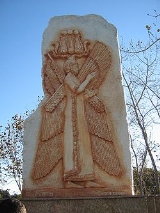
Cyrus the Great (
Old PersianThe Old Persian language is one of the two attested Old Iranian languages . Old Persian appears primarily in the inscriptions, clay tablets, seals of the Achaemenid era...
: 𐎤𐎢𐎽𐎢𐏁, , ,
PersianPersian is an Iranian language within the Indo-Iranian branch of the Indo-European languages. It is widely spoken in Iran, Afghanistan, Tajikistan, Uzbekistan and to some extent in Iraq and Bahrain, and has a status of official language in the first three countries under different names...
: کوروش بزرگ,
{{otheruses2|Cyrus}}
{{Campaignbox Wars of Cyrus the Great}}
Cyrus the Great (Old PersianThe Old Persian language is one of the two attested Old Iranian languages . Old Persian appears primarily in the inscriptions, clay tablets, seals of the Achaemenid era...
: 𐎤𐎢𐎽𐎢𐏁, {{IPA2|kʰuːrʰuʃ}}, {{unicode|Kūruš}},
PersianPersian is an Iranian language within the Indo-Iranian branch of the Indo-European languages. It is widely spoken in Iran, Afghanistan, Tajikistan, Uzbekistan and to some extent in Iraq and Bahrain, and has a status of official language in the first three countries under different names...
: کوروش بزرگ,
{{otheruses2|Cyrus}}
{{Campaignbox Wars of Cyrus the Great}}
Cyrus the Great (Old PersianThe Old Persian language is one of the two attested Old Iranian languages . Old Persian appears primarily in the inscriptions, clay tablets, seals of the Achaemenid era...
: 𐎤𐎢𐎽𐎢𐏁, {{IPA2|kʰuːrʰuʃ}}, {{unicode|Kūruš}},
PersianPersian is an Iranian language within the Indo-Iranian branch of the Indo-European languages. It is widely spoken in Iran, Afghanistan, Tajikistan, Uzbekistan and to some extent in Iraq and Bahrain, and has a status of official language in the first three countries under different names...
: کوروش بزرگ,
{{unicodeRomanization of Persian is the means by which the Persian language is represented using the Latin alphabet...
) (c. 600 BC or 576 BC {{ndash}} December 530 BC), also known as
Cyrus II of Persia and
Cyrus the Elder, was the first
ZoroastrianA Zoroastrian is an adherent to Zoroastrianism, the first monotheistic religion that is based on the teachings and philosophies of Zoroaster....
PersianThe Persian people are the majority ethnic group in Iran. However, there are sub-groups who speak the Persian language as their mother tongue throughout the Iranian plateau. The term Persian has also a supra-ethnic significance and has been historically referred to a part of Iranian peoples...
ShāhanshāhShah is a Persian term for a king that has been adopted in many other languages.-Word history:"Shāh" was the title of Iranian kings including the Achaemenid dynasty which unified Persia and created a vast intercontinental empire...
(
EmperorAn emperor is a monarch, usually the sovereign ruler of an empire or another type of imperial realm. Empress is the female equivalent. As a title, "empress" may indicate the wife of an emperor or a woman who rules in her own right...
). He was the founder of the
Persian EmpireThe Achaemenid Empire or Persian Empire was the successor state of the Median Empire, ruling over significant portions of what would become Greater Iran. The Persian and the Median Empire taken together are also known as the Medo-Persian Empire, succeeding the Neo-Assyrian Empire...
under the Achaemenid dynasty.
It was under his own rule that the empire embraced all previous civilized states of the ancient Near East, expanded vastly, and eventually conquered most of
Southwest AsiaWestern Asia, West Asia, Southwest Asia or Southwestern Asia are terms that describe the westernmost portion of Asia. The terms are partly coterminous with the Middle East - which describes geographical position in relation to Western Europe rather than location within Asia...
and much of
Central AsiaAsia is a region of Asia from the Caspian Sea in the west to central China in the east, and from southern Russia in the north to northern India in the south. It is also sometimes known as Middle Asia or Inner Asia, and is within the scope of the wider Eurasian continent.Various definitions of its...
, from
EgyptEgypt , officially the Arab Republic of Egypt, is a country mainly in North Africa, with the Sinai Peninsula forming a land bridge in Western Asia...
and the
HellespontHellespont was the ancient name of the narrow strait, now known by the modern European term 'the Dardanelles'. It was so called from Helle, the daughter of Athamas, who was drowned here in the mythology of the Golden...
in the west to the
Indus RiverThe Indus River is the longest river in...
in the east, to create the
largest empire the world had yet seen.
The reign of Cyrus lasted twenty nine to thirty years. Cyrus built his empire by fighting and conquering first the
Median EmpireThe Medes were an ancient Iranian people who lived in the northwestern portions of present-day Iran. This area is known as Media...
then
Lydian EmpireLydia was an Iron Age kingdom of western Asia Minor located generally east of ancient Ionia in the modern Turkish provinces of Manisa and inland İzmir. Its population spoke an Anatolian language known as Lydian....
and the
Neo-Babylonian EmpireThe term Neo-Babylonian or Chaldean refers to Babylonia under the rule of the 11th dynasty, from the revolt of Nabopolassar in 626 BC until the invasion of Cyrus the Great in 539 BC, notably including the reign of Nebuchadnezzar II....
. Either before or after Babylon, he led an expedition into central Asia, which resulted in major campaigns that brought "into subjection every nation without exception." Cyrus did not venture into
EgyptAncient Egypt was an ancient civilization of eastern North Africa, concentrated along the lower reaches of the Nile River in what is now the modern country of Egypt. The civilization coalesced around 3150 BC with the political unification of Upper and Lower Egypt under the first pharaoh, and...
, as he himself died in battle, fighting the
MassagetaeThe Massageteans or Massagetaeans were an Iranian nomadic confederation in antiquity known primarily from the writings of Herodotus. Their name was probably akin to Getae and Thyssagetae.-Customs:According to Herodotus:...
along the
Syr DaryaSyr Darya is a river in Central Asia, sometimes known as the Jaxartes or Yaxartes from its Ancient Greek name . The Greek name is derived from Old Persian, Yakhsha Arta , a reference to the color of the river's water...
in December 530 BC. He was succeeded by his son,
Cambyses IICambyses of Persia was the son of Cyrus the Great , founder of the Persian Empire and its first dynasty. He is sometimes known as Cambyses II to distinguish him from his grandfather Cambyses of Anshan...
, who managed to add to the empire by conquering Egypt,
NubiaNubia is the region in the south of Egypt, along the Nile and in northern Sudan. Most of Nubia is situated in Sudan with about a quarter of its territory in Egypt...
, and
CyrenaicaCyrenaica is the eastern coastal region of Libya and also an ex-province or state of the country in the pre-1963 administrative system. What used to be Cyrenaica in the old system is now divided up into several "shabiyat"...
during his short rule.
As a military leader, Cyrus left an everlasting legacy on the art of leadership and decision-making and he attributed his success to "Diversity in counsel, unity in command." Cyrus the Great respected the customs and religions of the lands he conquered. It is said that, in universal history the role of the Achaemenid empire founded by Cyrus lies in its very successful model for centralized administration and establishing a government working to the advantage and profit of its subjects. In fact, the administration of the empire through satraps and the vital principle of forming a government at
PasargadaePasargadae , the capital of Cyrus the Great and also his last resting place, was a city in ancient Persia, and is today an archaeological site and one of Iran's five UNESCO World Heritage Sites....
were the work of Cyrus. Aside from his own nation,
IranIran , officially the Islamic Republic of Iran is a country in Western Asia. The name Iran has been in use natively since the Sassanid period and came into international use from 1935, before which the country was known internationally as Persia...
, Cyrus also left a lasting legacy on Jewish
religionA religion is a system of human thought which usually includes a set of narratives, symbols, beliefs and practices that give meaning to the practitioner's experiences of life through reference to a higher power, deity or deities, or ultimate truth...
(through his Edict of Restoration),
human rightsHuman rights refer to the "basic rights and freedoms to which all humans are entitled." Examples of rights and freedoms which have come to be commonly thought of as human rights include civil and political rights, such as the right to life and liberty, freedom of expression, and equality before the...
,
politicsPolitics is a process by which groups of people make decisions. The term is generally applied to behavior within civil governments, but politics has been observed in all human group interactions, including corporate, academic and religious institutions...
, and
military strategyMilitary strategy is a policy implemented by military organizations to pursue desired strategic goals.Derived from the Greek strategos, strategy when it appeared in use during the 18th century, was seen in its narrow sense as the "art of the general", 'the art of arrangement' of troops...
, as well as on both
EasternThe term Eastern world refers very broadly to the various cultures, social structures and philosophical systems of "the East", namely Asia and Eastern Europe ....
and
Western civilizationsWestern culture refers to cultures of European origin.The term "Western culture" is used very broadly to refer to a heritage of social norms, ethical values, traditional customs, religious beliefs, political systems, and specific artifacts and technologies...
.
Etymology
{{Main|Cyrus (name)|l1=Etymology of Cyrus}}
The word
Cyrus is derived, via Latin, from Ancient Greek Κῦρος, from Old Persian {{unicode|Kūrūš}}. The name has been recorded in ancient inscriptions in many different languages. The ancient Greek historians
CtesiasCtesias of Cnidus was a Greek physician and historian from Cnidus in Caria. Ctesias, who flourished in the 5th century BC, was physician to Artaxerxes Mnemon, whom he accompanied in 401 BC on his expedition against his brother Cyrus the Younger....
and
PlutarchPlutarch, born Plutarchos then, on his becoming a Roman citizen, Lucius Mestrius Plutarchus , c. AD 46 – 120, was a Greek historian, biographer, essayist, and Middle Platonist known primarily for his Parallel Lives and Moralia...
noted that Cyrus was named from
Kuros, the
sunThe Sun is the star at the center of the Solar System. The Earth and other matter orbit the Sun, which by itself accounts for about 99.86% of the Solar System's mass....
, a concept which has been interpreted as meaning "
like the sun," by noting its relation to the Persian noun for sun,
khor, while using
-vash as a suffix of likeness. However, some modern historians, such as Dr. Nasser Engheta translates Kurosh as "the Son of Truth" based on the combination of the
MedianThe Medes were an ancient Iranian people who lived in the northwestern portions of present-day Iran. This area is known as Media...
word "Kora" meaning "Son" and the Gathic (old Iranian language) word "Asha" meaning "the Truth",{{Citation needed|date=October 2009}} while
Karl HoffmannKarl Hoffmann was a German linguist who specialized in Indo-European and Indo-Iranian studies. He is most recognized for his achievements in his studies of Vedic Sanskrit, Avestan and Old Persian languages.-Early life:...
and Rüdiger Schmitt of the
Encyclopædia IranicaEncyclopædia Iranica is a project whose goal is to create a comprehensive and authoritative English language encyclopedia about the history, culture, and civilization of Iranian peoples from prehistory to modern times...
, have suggested the translation "
humiliator of the enemy in verbal contest."
In
IranIran , officially the Islamic Republic of Iran is a country in Western Asia. The name Iran has been in use natively since the Sassanid period and came into international use from 1935, before which the country was known internationally as Persia...
, Cyrus is always referred to as "{{unicode|Kūrošé Bozorg}}" and/or "{{unicode|Kūrošé Kabīr}}" {{ndash}}meaning "Cyrus the Great". In the
BibleThe Bible contains the central religious texts of Judaism and Christianity. Modern Judaism generally recognizes a single set of canonical books known as the Tanakh, or Hebrew Bible, as it is written almost entirely in the Hebrew language, with some small portions in Aramaic...
, he is known as simply
Koresh ({{lang-he|כורש}}). Also he is
possibly mentionedCyrus the Great in the Qur'an is a theory that holds that the character of Dhul-Qarnayn, mentioned in the Qur'an, is in fact Cyrus the Great. Dhul-Qarnayn is mentioned in the Qur'an. The story of Dhul-Qarnayn appears in sixteen verses of the Qur'an, specifically the 16 verses 18:83-98...
in the Qur'an under the title "
Dhul-QarnaynDhul-Qarnayn , literally meaning "He of the Two Horns" , is a figure mentioned in the Qur'an, the sacred scripture of Islam, where he is described as a great and righteous ruler who built a long wall that...
".
Dynastic history
{{See also|Achaemenes}}
The Persian domination and kingdom in the Iranian plateau started by an extension of Achaemenid dynasty who expanded their earlier domination existed possibly from 9th century BC onward. The founder of this dynasty was
AchaemenesAchaemenēs was the eponymous ancestor of the Achaemenid Dynasty, who ruled Persia between 705 BC and 675 BC....
(from Old Persian
Haxāmaniš). Achaemenids are "descendants of Achaemenes" as Darius the Great, the ninth king of the dynasty, traces his genealogy to him and declares "for this reason we are called Achaemenids". Achaemenes built the state Parsumash in southwest of Iran and succeeded by his son Teispes who took the title "King of
AnšānAnshan , a site on the Iranian plateau, 36 km northwest of modern Shiraz in the Zagros mountains of the Fars province, southwestern Iran, was one of the early capitals of Elam, from the 3rd millennium BC.- History :Before 1973, when it was identified as Tall-i Malyan, Anshan had been assumed by...
" after seizing Anšān city and enlarging his kingdom further to include
ParsFārs Fārs Fārs (pronounced /fɑː(ɹ)s/ (Persian: Fārs, Pārs) (Originally Pars) is one of the 30 provinces of Iran. It is in the south of the country and its center is Shiraz. It has an area of 122,400 km²...
proper. Ancient documents mention that Teispes had a son called
Cyrus ICyrus I , was King of Anshan from c. 600 to 580 BC or, according to others, from c. 652 to 600 BC. His name in Modern Persian is کوروش, while in Greek he was called Κύρος....
who also succeeded his father as "king of Anshan". Cyrus I had another full brother whose name is recorded as Ariaramnes.
In 600 BC Cyrus I was succeeded by his son Cambyses I who reigned until 559 BC as
king of Persia. Cyrus (the Great) was son of Cambyses I who named his son after his father Cyrus I. There are several inscriptions of Cyrus the Great and later kings which refer to Cambyses I as
great king and
king of Anshan. Among these are some passages in Cyrus cylinder where Cyrus calls himself “son of Cambyses, great king, king of Anshan” and also other inscriptions which mention Cambyses I explicitly as "mighty king” and "an Achaemenian”. Xenophon's account in Cyropædia further names Cambyses's wife as Mandane and mentions Cambyses as king of Persia. These agree with Cyrus' own inscriptions as Anshan and Parsa were different names of the same land. These also agree with other non-Iranian accounts except at one point from Herodotus that Cambyses was not a king but a "Persian of good family". However at some other passage his account is wrong also on the name of the son of Chishpish which he mentions as Cambyses but according to modern scholars should be Cyrus I.
Thus Cyrus the Great was an Achaemenian and his relation to Achaemenes is fully established and supported by ancient Iranian and non-Iranian documents and latest archaeological researches.
Cyrus had a wife named
CassandaneCassandane was an Achaemenian and the "dearly loved" wife of Cyrus the Great. She was a daughter of Pharnaspes. She bore four children for Cyrus Cambyses II who succeeded his father and conquered Egypt, Smerdis who also reigned as king of Persia for a short time, Atossa, and another daughter whose...
. She was an Achaemenian and daughter of Pharnaspes. From this marriage Cyrus had four children Cambyses II, Smerdis,
AtossaAtossa was an Achaemenid queen and daughter of Cyrus the Great. She lived from 550-475 BC and probably a sister of Cambyses II, Atossa married Darius I sometime in 522 BC after Darius, with the help of nobelman Otanes, overthrew a man claiming to be Bardya. Xerxes I was the eldest son of Atossa...
, and another daughter whose name is not attested in ancient sources. Also, Cyrus had a fifth child named
ArtystoneArtystone ` was a Persian princess, daughter of king Cyrus I, and sister or half-sister of Atossa and Cambyses I...
, the sister or half sister of Atossa, who may not have been the daughter of Cassandane. Cyrus had a special dearly love for Cassandane and according to chronicle of Nabonidus when she died, all nations of Cyrus's empire observed “a great mourning” and particularly in Babylonia there was probably even a public mourning lasting for six days (identified from 21-26 March 538 BC). Her tomb is suggested to be at Cyrus' capital Pasargadae. There are other accounts suggesting that Cyrus the Great also married a daughter of the Median king Astyages named Amytis. This name may not be the correct one however Cyrus probably had once and after the death of Cassandane a Median woman in his royal family. Cyrus' sons Cambyses II and Smerdis both later became kings of Persia, respectively, and his daughter Atossa married Darius the Great and bore him Xerxes I.
Early life
The best known dates for the birth of Cyrus is either 600-599 BC or 576-575 BC. Little is known of his early years, as there are only a few sources known which detail that part of his life, and have been damaged or lost.
Herodotus's story of Cyrus' early life belongs to a genre of legends in which abandoned children of
noble birthNobility is a state-privileged status which is generally hereditary, but which may also be personal only. Titles of nobility are usually associated with present or former monarchies. The term originally referred to those who were "known" or "notable" and was applied to the highest social class in...
, such as
OedipusOedipus was a mythical Greek king of Thebes. He fulfilled a prophecy that said he would kill his father and marry his mother, and thus brought disaster on his city and family...
and
Romulus and RemusRomulus and Remus are considered to be the traditional founders of Rome, appearing in Roman mythology as the twin sons of the Vestal Virgin Rhea Silvia, fathered by the god of war, Mars...
, return to claim their royal positions. His overlord was his own grandfather,
AstyagesAstyages Kurdish Azhdihak or Ajdihak, ; spelled by Herodotus as Astyages; by Ctesias as Astyigas; by Diodorus as Aspadas; Akkadian: Ištumegu), was the last king of the Median Empire, r...
, ruler of the powerful Median kingdom.
After the birth of Cyrus, Astyages had a dream that his
MagiMagi is a term, used since at least the 4th century BCE, to denote a follower of Zoroaster, or rather, a follower of what the Hellenistic world associated Zoroaster with, which was – in the main – the ability to read the stars, and manipulate...
interpreted as a sign that his grandson would eventually overthrow him. He then ordered his steward
HarpagusHarpagus , , was a Median general from the 6th century BCE, credited by Herodotus as having put Cyrus the Great on the throne through his defection during the battle of Pasargadae.-Biography:According to Herodotus' Histories, Harpagus was a member of the Median royal house in service to King...
to kill the infant. Harpagus, morally unable to kill a newborn, summoned the
MardianThe Amard people, or Amardis were a tribe living along the southern shore of the Caspian Sea, including current day Amol, Iran. The name is also seen as Amardi, Amardian, Amardae, etc....
Mitradates (which the historian
Nicolaus of DamascusNicolaus of Damascus was a Greek historian and philosopher who lived during the Augustan age of the Roman Empire. His name is derived from that of his birthplace, Damascus. He was born around 64 BC....
calls Atradates), a royal bandit herdsman from the mountainous region bordering the Saspires, and ordered him to leave the baby to die in the mountains. Luckily the herdsman and his wife (whom Herodotus calls Cyno in
GreekGreek , an independent branch of the Indo-European family of languages, is the language of the Greeks. Native to the southern Balkans, it has the longest documented history of any Indo-European language, spanning 34 centuries of written records. In its ancient form, it is the language of classical...
, and Spaca-o in Median) took pity and raised the child as their own, passing off their recently stillborn infant as the murdered Cyrus. For the origin of Cyrus's mother, Herodotus says
Mandane of MediaMandana of Media was a Princess of Media and, later, the Queen consort of Cambyses I of Anshan and mother of Cyrus the Great, ruler of the Persia's Achaemenid Dynasty.-Mandana in Herodotus' Histories:...
and
CtesiasCtesias of Cnidus was a Greek physician and historian from Cnidus in Caria. Ctesias, who flourished in the 5th century BC, was physician to Artaxerxes Mnemon, whom he accompanied in 401 BC on his expedition against his brother Cyrus the Younger....
insists she is full Persian but gives no name, while Nicolaus gives the name Argoste as Atradates' wife, whether this figure represents Cyno or Cambyses' unnamed Persian queen has yet to be determined. It's also known that
StraboStrabo was a Greek historian, geographer and philosopher.-Life:Strabo was born in a wealthy family from Amaseia in Pontus , which had recently become part of the Roman Empire.. He studied under various geographers and philosophers; first in Nysa, later in Rome...
says Cyrus was originally named Agradates by his step parents, therefore it's probable that when reuniting with his original family, in custom Cambyses names him (or had named him before the separation) "Cyrus" after his own father, who was the first Cyrus.
When Cyrus was ten years old, Herodotus claims that it was obvious that Cyrus was not a herdsman's son, stating that his behavior was too noble. Astyages interviewed the boy and noticed that they resembled each other. Astyages ordered Harpagus to explain what he had done with the baby, and after confessing that he had not killed the boy, the king tricked him into eating his own broiled and chopped up son. Astyages was more lenient with Cyrus, and allowed him to return to his biological parents, Cambyses and Mandane. While Herodotus' description may be a legend, it does give insight into the figures surrounding Cyrus the Great's early life.
Rise and military campaigns
{{epigraph
|quote= Diversity in counsel, unity in command.
|cite=Cyrus the Great
}}
Median Empire
{{See|Persian Revolt|Battle of Hyrba|Battle of the Persian Border|Battle of Pasargadae}}
Though his father died in 551 BC, Cyrus had already succeeded to the throne in 559 BC. However, Cyrus was not yet an independent ruler. Like his predecessors, Cyrus had to recognize Median overlordship. During Astyages' reign, the Median Empire may have ruled over the majority of the
Ancient Near EastThe Ancient Near East refers to early civilizations within a region roughly corresponding to the modern Middle East: Mesopotamia , ancient Egypt, ancient Iran , Armenia, Anatolia and the Levant...
, from the
LydiaLydia was an Iron Age kingdom of western Asia Minor located generally east of ancient Ionia in the modern Turkish provinces of Manisa and inland İzmir. Its population spoke an Anatolian language known as Lydian....
n frontier in the west to the
ParthiaParthia is a region of north-eastern Iran, best known for having been the political and cultural base of the Arsacid dynasts, after which the Arsacid Empire is then also known as the 'Parthian Empire'....
ns and Persians in the east.
In Herodotus' version, Harpagus, seeking vengeance, convinced Cyrus to rally the Persian people to revolt against their feudal lords, the Medes. However, it is likely that both Harpagus and Cyrus rebelled due to their dissatisfaction with Astyages' policies. From the start of the revolt in summer 553 BC, with his first battles taking place from early 552 BC, Harpagus with Cyrus led his armies against the Medes until the capture of
EcbatanaPlease update as needed.Ecbatana is supposed to be the capital of Astyages , which was taken by the Persian emperor Cyrus the Great...
in 549 BC, effectively conquering the Median Empire.
While Cyrus seems to have accepted the crown of Media, by 546 BC, he officially assumed the title
King of Persia instead. With Astyages out of power, all of his vassals (including many of Cyrus' relatives) were now under his command. His uncle Arsames, who had been the king of the city-state of
ParsaParsa may refer to:* Persepolis, a large Persian city built by Darius I.* the Old Persian designator for what is today the Iranian province of Fars* the Parsa District in Nepal*Parsa -In Janakpur Zone, Nepal*Parsa, Lumbini -Nepal...
under the Medes, therefore would have had to give up his throne. However, this transfer of power within the family seems to have been smooth, and it is likely that Arsames still was the nominal governor of Parsa, under Cyrus' authority - more of a Prince or a 'Grand Duke' than a King.{{Citation needed|date=March 2009}} His son,
HystaspesHystaspes may refer to:* Vishtaspa, the first patron of Zoroaster* Hystaspes , father of King Darius I of Persia* Hystaspes , son of Darius I of Persia* Hystaspes , son of Xerxes I of Persia...
, who was also Cyrus' second cousin, was then made
satrapSatrap was the name given to the governors of the provinces of ancient Median and Persian empires, including the Achaemenid Empire and in several of their heirs, such as the Sassanid Empire and the Hellenistic empires....
of Parthia and
PhrygiaIn antiquity, Phrygia was a kingdom in the west central part of Anatolia, in what is now modern-day Turkey. The Phrygians initially lived in the southern Balkans; according to Herodotus, under the name of Bryges , changing it to Phruges after their final migration to Anatolia, via the...
. Cyrus thus united the twin Achamenid kingdoms of Parsa and Anshan into Persia proper. Arsames would live to see his grandson become Darius the Great, Shahanshah of Persia, after the deaths of both of Cyrus' sons.
Cyrus' conquest of Media was merely the start of his wars. Astyages had been allied with his brother-in-law
CroesusCroesus was the king of Lydia from 560 to 546 BC until his defeat by the Persians in about 547 BC. The fall of Croesus made a profound impact on the Hellenes, providing a fixed point in their calendar. "By the fifth century at least," J.A.S...
of Lydia, (son of
Alyattes IIAlyattes , king of Lydia , the real founder of the Lydian empire, was the son of Sadyattes, of the house of the Mermnadae.For several years he continued the war against Miletus begun by his father, but was obliged to turn his attention to the Medes and Babylonians...
),
NabonidusNabonidus was the last king of the Neo-Babylonian Empire, reigning from 556-539 BCE.-Historiography on Nabonidus:...
of Babylon, and
Amasis IIAmasis II was a pharaoh of the Twenty-sixth dynasty of Egypt, the successor of Apries at Sais. He was the last great ruler of Egypt before the Persian conquest....
of Egypt, who reportedly intended to join forces against Cyrus.{{Citation needed|date=March 2009}}
Lydian Empire and Asia Minor
{{See|Battle of Pteria|Battle of Thymbra|Siege of Sardis}}
The exact dates of the Lydian conquest are unknown, but it must have taken place between Cyrus' overthrow of the Mede kingdom (550 BC) and his conquest of Babylon (539 BC). It was common in the past to give 547 BC as the year of the conquest due to some interpretations of the
Nabonidus ChronicleThe Nabonidus Chronicle is an ancient Babylonian text, part of a larger series of Babylonian Chronicles incribed in cuneiform script on clay tablets...
, but this position is currently not much held. The Lydians first attacked the Achaemenid Empire's city of
PteriaPteria was the capital of the Assyrians in northern Cappadocia. They were said by Herodotus to have been taken and ruined by Croesus in 547 BC. It also was the place of an undecided battle between Cyrus the Great and Croesus....
in
CappadociaCappadocia is a region in central Turkey, largely in Nevşehir Province ....
. Croesus besieged and captured the city enslaving its inhabitants. Meanwhile, the Persians invited the citizens of
IoniaIonia is an ancient region of central coastal Anatolia in present-day Turkey, the region nearest İzmir, which was historically Smyrna. It consisted of the northernmost territories of the Ionian League of Greek settlements...
who were part of the Lydian kingdom, to revolt against their ruler. The offer was rebuffed, and thus Cyrus levied an army and marched against the Lydians, increasing his numbers while passing through nations in his way. The
Battle of PteriaAt the Battle of Pteria in 547 BC, the Persian forces of Cyrus the Great fought a drawn battle with the invading Lydian forces of Croesus, forcing Croesus to withdraw back west into his own kingdom.- Background :...
was effectively a stalemate, with both sides suffering heavy casualties by nightfall. Croesus retreated to Sardis the following morning.
While in Sardis, Croesus sent out requests for his allies to send aid to Lydia. However, near the end of winter, before the allies could unite, Cyrus pushed the war into Lydian territory and besieged Croesus in his capital,
SardisSardis, also Sardes , modern Sart in the Manisa province of Turkey, was the capital of the ancient kingdom of Lydia, one of the important cities of the Persian Empire, the seat of a proconsul under the Roman Empire, and the metropolis of the province Lydia in later Roman and Byzantine times...
. Shortly before the final
Battle of ThymbraThe Battle of Thymbra was the decisive battle in the war between Croesus of the Lydian Empire against Cyrus the Great in the first months of 547 BC. Cyrus, having pursued Croesus into Lydia following the drawn Battle of Pteria, met the remains of Croesus' partly disbanded army in battle on the...
between the two rulers, Harpagus advised Cyrus to place his
dromedariesThe dromedary or Arabian camel is a large even-toed ungulate with one hump on its back. Its native range is unclear, but it was probably the Arabian Peninsula...
in front of his warriors; the Lydian horses, not used to the dromedaries' smell, would be very afraid. The strategy worked; the Lydian cavalry was routed. Cyrus defeated and captured Croesus. Cyrus occupied the capital at Sardis, conquering the Lydian kingdom in 546 BC. According to Herodotus, Cyrus spared Croesus' life and kept him as an advisor, but this account conflicts with some translations of the contemporary Nabonidus Chronicle, which interpret that the king of Lydia was slain.
Before returning to the capital, a Lydian named Pactyes was entrusted by Cyrus to send Croesus' treasury to Persia. However, soon after Cyrus' departure, Pactyes hired mercenaries and caused an uprising in Sardis, revolting against the Persian
satrapSatrap was the name given to the governors of the provinces of ancient Median and Persian empires, including the Achaemenid Empire and in several of their heirs, such as the Sassanid Empire and the Hellenistic empires....
of Lydia, Tabalus. With recommendations from Croesus that he should turn the minds of the Lydian people to luxury, Cyrus sent
MazaresMazares was a Median general who defected to Cyrus the Great when the latter overthrew his grandfather, Astyages and formed the Persian Empire.-Mazares in Herodotus' Histories:...
, one of his commanders, to subdue the insurrection, but demanded that Pactyas be returned alive. Upon Mazares' arrival, Pactyas fled to
IoniaIonia is an ancient region of central coastal Anatolia in present-day Turkey, the region nearest İzmir, which was historically Smyrna. It consisted of the northernmost territories of the Ionian League of Greek settlements...
, where he had hired more mercenaries. Mazares marched his troops into the
GreekGreece , officially the Hellenic Republic , is a country in southeastern Europe, situated on the southern end of the Balkan Peninsula....
country and subdued the cities of
MagnesiaMagnesia on the Maeander is an ancient Greek city in Anatolia, located on the Maeander river upstream from Ephesus, its site near the modern town of Germencik, Turkey...
and
PrienePriene was an ancient Greek city of Ionia at the base of an escarpment of Mycale, about north of the then course of the Maeander River, from today's Aydin, from today's Söke and from ancient Miletus...
, where Pactyas was captured and sent back to Persia for punishment.{{Citation needed|date=March 2009}}
Mazares continued the conquest of Asia Minor, but died of unknown causes during his campaign in Ionia. Cyrus sent Harpagus to complete Mazares' conquest of Asia Minor. Harpagus captured
LyciaLycia was a region in Anatolia in what are now the provinces of Antalya and Muğla on the southern coast of Turkey. It was a federation of ancient cities in the region and later a province of the Roman Empire...
,
CiliciaIn antiquity, Cilicia now known as Çukurova, was a commonly used name of the south coastal region of Asia Minor south of the central Anatolian plateau. It existed as a political entity from Hittite times into the Byzantine empire...
and
PhoeniciaPhoenicia what is now modern day Lebanon, was an ancient civilization centered in the north of ancient Canaan, with its heartland along the coastal regions of modern day Lebanon, extending to parts of Israel, Syria and Palestine...
, using the technique of building
earthworksEarthworks are engineering works created through the moving of massive quantities of soil or unformed rock. Engineers need to concern themselves with issues of geotechnical engineering and with quantity estimation to ensure that soil volumes in the cuts match those of the fills, while minimizing...
to breach the walls of besieged cities, a method unknown to the Greeks. He ended his conquest of the area in 542 BC, and returned to Persia.
Neo-Babylonian Empire
{{See|Battle of Opis}}
By the year 540 BC, Cyrus captured
ElamElam was an ancient civilization located in what is now southwest Iran. Elam was centered in the far west and the southwest of modern-day Iran, stretching from the lowlands of Khuzestan and Ilam Province , as far as Jiroft in Kerman province and Burned City in Zabol, as well as a small part of...
(Susiana) and its capital,
SusaSusa ; Syriac: ; was an ancient city of the Elamite, Persian and Parthian empires of Iran, located about 250 km east of the Tigris River....
. The Nabonidus Chronicle records that prior to the battle(s), Nabonidus had ordered cult statues from outlying Babylonian cities to be brought into the capital, suggesting that the conflict had begun possibly in the winter of 540 BC. Nabu-naid brought the gods of
EshnunnaEshnunna was an ancient Sumerian city and city-state in lower Mesopotamia. Although situated in the Diyala Valley north-east of Sumer proper, the city nonetheless belonged securely within the Sumerian cultural milieu....
k, Zamban, Me Turnu, and
DerDer was a Sumerian city state positioned east of the Tigris River on the border between Sumer and Elam.In 720 BC the Assyrian king Sargon II moved against Elam, but the Assyrian host was defeated near Der....
to the capital before their capture. He suffered a defeat on the
TigrisThe Tigris is the eastern member of the two great rivers that define Mesopotamia, along with the Euphrates. The river flows from the mountains of southeastern Turkey through Iraq.-Geography:...
, but the only
defenseDefense has several uses in the sphere of military application.Personal defense implies measures taken by individual soldiers in protecting themselves whether by use of protective materials such as armor, or field construction of trenches or a bunker, or by using weapons that prevent the enemy...
he could think of was to bring to his aid
IshtarIshtar is the Assyrian and Babylonian counterpart to the Sumerian Inanna and to the cognate northwest Semitic goddess Astarte.-Characteristics:Ishtar is a goddess of fertility, love, war, and sex...
of
UrukUruk was an ancient city of Sumer and later Babylonia, situated east of the present bed of the Euphrates river, on the ancient dry former channel of the Euphrates River, some 30 km east of modern As-Samawah, Al-Muthannā,...
in
MarchMarch is the third month of the year in the Gregorian Calendar, and one of the seven months which are 31 days long.March in the Southern Hemisphere is the seasonal equivalent of September in the Northern Hemisphere....
(539 BC). Near the beginning of
OctoberOctober is the tenth month of the year in the Gregorian Calendar and one of seven Gregorian months with a length of 31 days. The eighth month in the old Roman calendar, October retained its name after July and August, after Julius and Augustus Caesar respectively; when the calendar was originally...
, Cyrus fought another battle at
OpisOpis was an ancient Babylonian city on the Tigris, not far from modern Baghdad. The precise location of Opis has not been established, but from the Akkadian and Greek texts, it was located on the east bank of the Tigris, near the Diyala River.-History:Opis is mentioned for the first time at the...
on the Tigris. This became the
Battle of OpisThe Battle of Opis, fought in September 539 BC, was a major engagement between the armies of Persia under Cyrus the Great and the Neo-Babylonian Empire under Nabonidus during the Persian invasion of Mesopotamia. At the time, Babylonia was the last major power in western Asia that was not yet under...
, which led to the final defeat and collapse of the Babylonian army, thus prompt
GubaruGobryas was a common name of several Persian noblemen. The English form Gobryas is derived from the Greek rendering of this name.- Gobryas :...
(the governor of Gutium and commander of Cyrus's army) marched to the city of
SipparSippar , was an ancient Sumerian and later Babylonian city on the east bank of the Euphrates, some 60 km north of Babylon, in what is now Tell Abu Habbah, Iraq.-History:...
.
On October 10, Sippar was seized without a battle, with little to no resistance from the populace. It is probable that Cyrus engaged in negotiations with the Babylonian generals to obtain a compromise on their part and therefore avoid an armed confrontation. Nabonidus was staying in the city at the time, and soon fled to the capital, Babylon, which he had not visited in years.
Two days later, on October 12 (Julian calendar; October 7 by the Gregorian calendar), Gubaru's troops entered Babylon, again without any resistance from the Babylonian armies, and detained Nabonidus.
HerodotusHerodotus of Halicarnassus was a Greek historian who lived in the 5th century BC and is regarded as the "Father of History" in Western culture. He was the first historian known to collect his materials systematically, test their accuracy to a certain extent and arrange them in a...
explains that to accomplish this feat, the Persians diverted the
EuphratesThe Euphrates is the longest and historically one of the most important rivers of Southwest Asia. Together with the Tigris, the Euphrates is one of the two defining rivers of Mesopotamia...
river into a canal so that the water level dropped "to the height of the middle of a man's thigh," which allowed the invading forces to march directly through the river bed to enter at night. On October 29, Cyrus himself entered the city of Babylon and detained Nabonidus.
Prior to Cyrus' invasion of Babylon, the
Neo-Babylonian EmpireThe term Neo-Babylonian or Chaldean refers to Babylonia under the rule of the 11th dynasty, from the revolt of Nabopolassar in 626 BC until the invasion of Cyrus the Great in 539 BC, notably including the reign of Nebuchadnezzar II....
had conquered many kingdoms. In addition to Babylonia itself, Cyrus probably incorporated its subnational entities into his Empire, including
SyriaSyria , officially the Syrian Arab Republic , is a country in Western Asia, bordering Lebanon and the Mediterranean Sea to the west, Turkey to the north, Iraq to the east, Jordan to the south and Israel to the southwest....
,
JudeaJudea or Judæa is the name given to the mountainous southern part of the historic Land of Israel , an area now divided between Israel and the West Bank Judea or Judæa (Hebrew: יהודה,
Standard Yəhuda
Tiberian , "praised, celebrated"; Greek: Ιουδαία, Ioudaía; ) is the...
, and
Arabia PetraeaTayma is a large oasis with a long history of settlement, located in northeastern Saudi Arabia at the point where the trade route between Yathrib and Dumah begins to cross the Nefud desert...
, although there is no direct evidence of this fact.
After taking Babylon, Cyrus proclaimed himself "king of Babylon, king of
SumerSumer was a civilization and historical region in southern Iraq . It is the earliest known civilization in the world and is known as the Cradle of Civilization...
and
AkkadThe Akkadian Empire was an empire centered in the city of Akkad and its surrounding region in Ancient Iraq ....
, king of the four corners of the world" in the famous
Cyrus cylinderThe Cyrus cylinder, also known as the Cyrus the Great cylinder, is a document issued by the Persian ruler Cyrus the Great in the form of a clay cylinder inscribed in Akkadian cuneiform script...
, an inscription deposited in the foundations of the
EsagilaThe Ésagila, a Sumerian name signifying "É whose top is lofty", was a temple dedicated to Marduk, the protector god of Babylon...
temple dedicated to the chief Babylonian god Marduk. The text of the cylinder denounces Nabonidus as impious and portrays the victorious Cyrus as pleasing to Marduk. It goes on to describe how Cyrus had improved the lives of the citizens of Babylonia, repatriated displaced peoples and restored temples and cult sanctuaries. Although some have asserted that the cylinder represents a form of "human rights charter", historians generally portray it in the context of a long-standing Mesopotamian tradition of new rulers beginning their reigns with declarations of reforms.
Cyrus' dominions comprised the largest empire the world had ever seen. At the end of Cyrus' rule, the Achaemenid Empire stretched from
Asia MinorAnatolia is a geographic region of Western Asia, comprising most of the modern Republic of Turkey. The region is bounded by the Black Sea to the north, the Caucasus to the northeast, the Iranian plateau to the southeast, the Mediterranean Sea to the south and the Aegean Sea to the west...
in the west to the northwestern areas of India in the east.
Death
The details of Cyrus' death can vary by account. The account of
HerodotusHerodotus of Halicarnassus was a Greek historian who lived in the 5th century BC and is regarded as the "Father of History" in Western culture. He was the first historian known to collect his materials systematically, test their accuracy to a certain extent and arrange them in a...
from his
Histories provides the second longest detail, in which Cyrus met his fate in a fierce battle with the
MassagetaeThe Massageteans or Massagetaeans were an Iranian nomadic confederation in antiquity known primarily from the writings of Herodotus. Their name was probably akin to Getae and Thyssagetae.-Customs:According to Herodotus:...
, a tribe from the southern deserts of
KharesmKhwarezm were a series of states centered on the Amu Darya river delta of the former Aral Sea, in Greater Iran , extending across the Ust-Urt plateau and possibly as far west as the eastern shores of the northern Caspian Sea....
and
KizilhoumThe Kyzyl Kum , also called Qyzylqum, is the 11th largest desert in the world. Its name means Red Sand in Uzbek, Kazakh and Turkish. It is located in Central Asia in the doab between the rivers Amu Darya and Syr Darya, and is divided between Kazakhstan, Uzbekistan and Turkmenistan...
in the southernmost portion of the
steppeIn physical geography, a steppe is a biome region characterised by grassland plain without trees . The prairie can be considered a steppe. It may be semi-desert, or covered with grass or shrubs or both, depending on the season and latitude...
regions of modern-day
KazakhstanKazakhstan , officially the Republic of Kazakhstan, is a country situated in Eurasia that is ranked as the ninth largest country in the world. It is also the world's largest landlocked country. Its territory of 2,727,300 km² is greater than Western Europe...
and
UzbekistanUzbekistan, officially the Republic of Uzbekistan , is a doubly landlocked country in Central Asia, formerly part of the Soviet Union...
, following the advice of
CroesusCroesus was the king of Lydia from 560 to 546 BC until his defeat by the Persians in about 547 BC. The fall of Croesus made a profound impact on the Hellenes, providing a fixed point in their calendar. "By the fifth century at least," J.A.S...
to attack them in their own territory. The Massagetae were related to the Scythians in their dress and mode of living; they fought on horseback and on foot. In order to acquire her realm, Cyrus first sent an offer of marriage to their ruler
TomyrisTomyris, from the Persian تهمرییش Tahm-Rayiš, was a queen who reigned over the Massagetae, an Iranic people of Central Asia east of the Caspian Sea, at approximately 530 B.C.-History:...
, a proposal she rejected. He then commenced his attempt to take Massagetae territory by force, beginning by building bridges and towered war boats along his side of the river Jaxartes, or
Syr DaryaSyr Darya is a river in Central Asia, sometimes known as the Jaxartes or Yaxartes from its Ancient Greek name . The Greek name is derived from Old Persian, Yakhsha Arta , a reference to the color of the river's water...
, which separated them. Sending him a warning to cease his encroachment in which she stated she expected he would disregard anyway, Tomyris challenged him to meet her forces in honorable warfare, inviting him to a location in her country a day's march from the river, where their two armies would formally engage each other. He accepted her offer, but, learning that the Massagetae were unfamiliar with wine and its intoxicating effects, he set up and then left camp with plenty of it behind, taking his best soldiers with him and leaving the least capable ones. The general of Tomyris's army, which was also her son Spargapises, and 1/3 of the Massagetian troops killed the group Cyrus had left there, and, finding the camp well-stocked with food and the wine, unwittingly drank themselves into inebriation, diminishing their capability to defend themselves when they were then overtaken by a surprise attack. They were successfully defeated, and although he was taken prisoner, Spargapises committed
suicideSuicide is the intentional killing of one's self. Many dictionaries also note the metaphorical sense of "willful destruction of one's self-interest"...
once he regained sobriety. Upon learning of what had transpired, Tomyris denounced Cyrus' tactics as underhanded and swore vengeance, leading a second wave of troops into battle herself. Cyrus was ultimately killed and his forces suffered massive casualties in what Herodotus referred to as the fiercest battle of his career, and the ancient world. When it was over, Tomyris ordered the body of Cyrus brought to her, then decapitated him and dipped his head in a vessel of blood, in a symbolic gesture of revenge for his bloodlust and the death of her son. However, some scholars question this version, mostly when Herodotus admits this event was one of many versions of Cyrus' death that he heard from a supposedly reliable source who told him no one was there to see the aftermath. Nevertheless, others suggest the Persian troops may have later recovered the body after it was crucified which was also after his beheading, or that Tomyris beheaded and then crucified a man other than Cyrus, or Cyrus's double.{{Citation needed|date=March 2009}}
CtesiasCtesias of Cnidus was a Greek physician and historian from Cnidus in Caria. Ctesias, who flourished in the 5th century BC, was physician to Artaxerxes Mnemon, whom he accompanied in 401 BC on his expedition against his brother Cyrus the Younger....
, in his
Persica, has the longest account which says Cyrus met his death while putting down resistance from the Derbices infantry, aided by other Scythian archers and cavalry, plus
IndiaIndia, officially the Republic of India , is a country in South Asia. It is the seventh-largest country by geographical area, the second-most populous country, and the most populous democracy in the world. Bounded by the Indian Ocean on the south, the Arabian Sea on the west, and the Bay of Bengal...
ns and their elephants. According to him, this event took place north-east of the headwaters of the Syr Darya.{{Citation needed|date=March 2009}}
An alternative account from
XenophonXenophon , son of Gryllus, of the deme Erchia of Athens, also known as Xenophon of Athens and Xenophon of Thebes, was a soldier, mercenary, and a contemporary and admirer of Socrates...
's
Cyropaedia contradicts the others, claiming that Cyrus died peaceably at his capital.
The final version of Cyrus's death comes from
BerossusBerossus was a Hellenistic-era Babylonian writer, a priest of Bel and astronomer writing in Greek, who was active at the beginning of the 3rd century BC...
, who only reports Cyrus met his death while warring against the
DahaeThe Dahae , or Dahaeans were a confederacy of three Ancient Iranian tribes who lived in the region to the immediate east of the Caspian Sea. They spoke an Eastern Iranian language....
archers north-west of the headwaters of the Syr Darya.{{Citation needed|date=March 2009}}
Tomb
Cyrus' remains were interred in his capital city of
PasargadaePasargadae , the capital of Cyrus the Great and also his last resting place, was a city in ancient Persia, and is today an archaeological site and one of Iran's five UNESCO World Heritage Sites....
, where today a tomb still exists which many believe to be his. Both
StraboStrabo was a Greek historian, geographer and philosopher.-Life:Strabo was born in a wealthy family from Amaseia in Pontus , which had recently become part of the Roman Empire.. He studied under various geographers and philosophers; first in Nysa, later in Rome...
and
ArrianLucius Flavius Arrianus 'Xenophon , known in English as Arrian , and Arrian of Nicomedia, was a Roman historian , a public servant, a military commander and a philosopher of the Roman period...
give nearly equal descriptions of the tomb, based on the eyewitness report of
Aristobulus of CassandreiaFor other use, see AristobulusAristobulus of Cassandreia , Greek historian, son of Aristobulus, probably a Phocian settled inCassandreia, accompanied Alexander the Great on his campaigns...
, who at the instigation of
Alexander the GreatAlexander III of Macedon, popularly known as Alexander the Great , was an Ancient Greek king of Macedon who created one of the largest empires in ancient history...
visited the tomb two times. Though the city itself is now in ruins, the burial place of Cyrus the Great has remained largely intact; and the tomb has been partially restored to counter its natural deterioration over the years. According to
PlutarchPlutarch, born Plutarchos then, on his becoming a Roman citizen, Lucius Mestrius Plutarchus , c. AD 46 – 120, was a Greek historian, biographer, essayist, and Middle Platonist known primarily for his Parallel Lives and Moralia...
, his epitaph said,
{{cquote|O man, whoever you are and wherever you come from, for I know you will come, I am Cyrus who won the Persians their empire. Do not therefore grudge me this little earth that covers my body.}}
Cuneiform evidence from Babylon proves that Cyrus died around December 530 BC, and that his son
Cambyses IICambyses of Persia was the son of Cyrus the Great , founder of the Persian Empire and its first dynasty. He is sometimes known as Cambyses II to distinguish him from his grandfather Cambyses of Anshan...
had become king. His younger son, Smerdis, died before Cambyses left to invade the eastern front. From Herodotus' account, Cambyses killed his brother to avoid a rebellion in his absence. Cambyses continued his father's policy of expansion, and managed to capture
EgyptAncient Egypt was an ancient civilization of eastern North Africa, concentrated along the lower reaches of the Nile River in what is now the modern country of Egypt. The civilization coalesced around 3150 BC with the political unification of Upper and Lower Egypt under the first pharaoh, and...
for the Empire, but soon died after only seven years of rule. An imposter named Gaumata, claiming to be Smerdis, became the sole ruler of Persia for seven months, until he was killed by
Darius the GreatDarius I or Darius the Great , was a Zoroastrian Persian Shahanshah of Persia...
.{{Citation needed|date=March 2009}}
Cyrus was praised in the
TanakhThe Tanakh is a name for the Bible used in Rabbinic Judaism, also known as the Masoretic Text. The name "Tanakh" is a Hebrew acronym formed from the initial Hebrew letters of the Masoretic Text's three traditional subdivisions: The Torah , Nevi'im and Ketuvim —hence...
({{Bibleverse||Isaiah|45:1-6|31}}) and ({{Bibleverse||Ezra|1:1-11|47}}) for the freeing of slaves, humanitarian equality and costly reparations he makes. However he has been criticized for believing the false report of the Cuthites, who wanted to halt the rebuilding of the Temple. They accused the Jews of conspiring to rebel, so "the king of Persia" in turn stopped the construction of the temple, which would not be completed until 516BCE,{{Citation needed|date=March 2009}} during the reign of Darius the Great. According to The Bible it was King Artaxerxes who was convinced to stop the construction of the second temple in Jerusalem[Ezra 4:7-24]
Legacy
{{epigraph
| quote =In scope and extent his achievements ranked far above that of the Macedonian king,
Alexander("the great") who was to demolish the empire in the 320's but fail to provide
any stable alternative.
| cite = Charles Freeman in 'The Greek Achievement'
}}
The achievements of Cyrus the Great throughout antiquity is well reflected in the way he is remembered today. His own nation, the Iranians, regarded him as "The Father" and the Babylonians as "The Liberator". After this liberation of Babylonians, followed Cyrus' liberal help for the return of Jews. For this Cyrus is addressed in the Jewish Tanakh as the "Lord's anointed ". Glorified by Ezra and by Isaiah, Cyrus is the one who "The Lord, the God of heaven" has given him "all the Kingdoms of the earth".
Cyrus was distinguished equally as a
statesmanA statesman or stateswoman or statesperson is usually a politician or other notable public figure who has had a long and respected career in politics or government at the national and international level. As a term of respect, it is usually left to supporters or commentators to use the term...
and as a soldier. By pursuing a policy of generosity instead of repression, and by favoring local religions, he was able to make his newly conquered subjects into enthusiastic supporters. Due in part to the political infrastructure he created, the Achaemenid empire endured long after his death.
The rise of Persia under Cyrus's rule had a profound impact on the course of world history.
Persian philosophyIranian philosophy or Persian philosophy can be traced back as far as to Old Iranian philosophical traditions and thoughts which originated in ancient Indo-Iranian roots and were considerably influenced by Zarathustra's teachings. According to Oxford dictionary of philosophy , the choronology of...
,
literaturePersian literature spans two-and-a-half millennia, though much of the pre-Islamic material has been lost. Its sources have been within historical Persia including present-day Iran as well as regions of Central Asia where the Persian language has historically been the national language...
and religion all played dominant roles in world events for the next millennia. Despite the
Islamic conquest of PersiaThe Muslim conquest of Persia led to the end of the Sassanid Empire in 644, of the Sassanid dynasty in 651 and the eventual extirpation of the Zoroastrian religion in Persia. The Sassanid Empire was first invaded by Muslims in present day Iraq in 633 under general Khalid ibn Walid, which resulted...
in the 7th century CE by the
Islamic CaliphateThe term caliphate refers to the first form of government inspired by Islam. It was initially led by Muhammad's disciples as a continuation of the political authority the prophet established, known as the 'rashidun caliphates'. It represented the political unity of the Muslim Ummah, and was the...
, Persia continued to exercise enormous influence in the Middle East during the
Islamic Golden AgeThe Islamic Golden Age or the Islamic Renaissance, is traditionally dated from the 9th to 13th centuries for 400 years C.E., but has been extended to the 15th century by recent scholarship...
, and was particularly instrumental in the growth and expansion of
IslamIslam Islam Islam ( al-’islām,
[There are ten pronunciations of Islam in English, differing in whether the first or second syllable has the stress, whether the s is or , and whether the a is pronounced as in father, as in cat, or (when the stress is on the i) as in the a of sofa...]
.
Many of the Iranian dynasties following the Achaemenid empire and their kings saw themselves as the heirs to Cyrus the Great and have claimed to continue the line begun by Cyrus.{{Citation needed|date=March 2009}} However there are different opinions among scholars whether this is also the case for the Sassanid Dynasty.
Mohammad Reza ShahMohammad Rezā Shāh Pahlavi, Shah of Iran, , was the emperor of Iran from 16 September 1941, until his overthrow by the Iranian Revolution on 11 February 1979...
of Pahlavi dynasty celebrated the
2500th anniversary of the Iranian monarchyThe 2,500 year celebration of the Persian Empire consisted of an elaborate set of festivities that took place October 12-25, 1971 on the occasion of the 2,500th anniversary of the founding of the Iranian monarchy by Cyrus the Great...
in 1971, though it ended with
the 1979 revolutionThe Iranian Revolution of 1979 or 1979 Islamic Revolution refers to events involving the overthrow of Iran's monarchy under Shah Mohammad Reza Pahlavi and its replacement with an Islamic republic under Ayatollah Ruhollah Khomeini, the leader of the revolution...
. Even today many consider him greater than
Alexander the GreatAlexander III of Macedon, popularly known as Alexander the Great , was an Ancient Greek king of Macedon who created one of the largest empires in ancient history...
in his accomplishment.
According to Professor Richard Frye:
{{cquote|It is a testimony to the capability of the founder of the Achaemenian empire that it continued to expand after his death and lasted for more than two centuries. But Cyrus was not only a great conqueror and administrator; he held a place in the minds of the Persian people similar to that of Romulus and Remus in Rome or Moses for the Israelites. His saga follows in many details the stories of hero and conquerors from elsewhere in the ancient world. The manner in which the baby Cyrus was given to a shepherd to raise is reminiscent of Moses in the bulrushes in Egypt, and the overthrow of his tyrannical grandfather has echoes in other myths and legends. There is no doubt that the Cyrus saga arose early among the Persians and was known to the Greeks. The sentiments of esteem or even awe in which Persians held him were transmitted to the Greeks, and it was no accident that Xenophon chose Cyrus to be the model of a ruler for the lessons he wished to impart to his fellow Greeks.
In short, the figure of Cyrus has survived throughout history as more than a great man who founded an empire. He became the epitome of the great qualities expected of a ruler in antiquity, and he assumed heroic features as a conqueror who was tolerant and magnanimous as well as brave and daring. His personality as seen by the Greeks influenced them and Alexander the Great, and, as the tradition was transmitted by the Romans, may be considered to influence our thinking even now. In the year 1971, Iran celebrated the 2,500th anniversary of the founding of the monarchy by Cyrus.}}
Religion
{{Main|Cyrus in the Judeo-Christian tradition|Cyrus the Great in the Qur'an}}
Religious policy of Cyrus is well documented in Babylonian texts as well as Jewish sources. Cyrus initiated a general policy that can be described as a policy of permitting religious freedom throughout his vast empire. He brought peace to the Babylonians and is said to have kept his army away from the temples and restored the statues of the Babylonian gods to their sanctuaries. Another example of his religious policies, as evidenced by the Cyrus cylinder (see below), was his treatment of the
JewThe Jews , also known as the Jewish people, are an ethnoreligious group originating in the Israelites or Hebrews of the Ancient Near East. The Jewish ethnicity, nationality, and religion are strongly interrelated, as Judaism is the traditional faith of the Jewish nation...
s during their exile in Babylon after Nebuchadnezzar II destroyed
JerusalemJerusalem is the capital of Israel and its largest city in both population and area, with a population of 747,600 residents over an area of if disputed East Jerusalem is included...
. The
Jewish Bible'sBooks of the Bible are listed differently in the canons of Jews, and Catholic, Protestant, Greek Orthodox, Slavonic Orthodox, Georgian, Armenian Apostolic, Syriac and Ethiopian Churches, although there is substantial overlap. A table comparing the canons of some of these denominations appears...
KetuvimKetuvim is the third and final section of the Tanakh , after Torah and Nevi'im . In English translations of the Hebrew Bible, this section is usually entitled "Writings" or "Hagiographa." The Ketuvim are believed to have been written under the Ruach HaKodesh, a level less than that of prophecy.In...
ends in Second Chronicles with the decree of Cyrus, which returned the exiles to the
Promised LandThe Land of Israel is, according to the Hebrew Bible, the region which was promised by their God to the descendants of Abraham through his son Isaac and to the Israelites, descendants of Jacob, Abraham's grandson. This land forms part of the Abrahamic, Jacob and Israel covenants...
from Babylon along with a commission to rebuild the temple.
'Thus saith Cyrus king of Persia: All the kingdoms of the earth hath the LORD, the God of heaven, given me; and He hath charged me to build Him a house in Jerusalem, which is in Judah. Whosoever there is among you of all His people--the LORD his God be with him--let him go up.' (ezra 1:1-4)
This edict is also fully reproduced in the
Book of EzraThe Book of Ezra is a book of the Bible in the Old Testament and Hebrew Tanakh. It is the record of events occurring at the close of the Babylonian captivity, especially The Return to Zion. At one time, it included the Book of Nehemiah, and the Jews regarded them as one volume...
.
“In the first year of King Cyrus, Cyrus the king issued a decree: ‘Concerning the house of God at Jerusalem, let the temple, the place where sacrifices are offered, be rebuilt and let its foundations be retained, its height being 60 cubits and its width 60 cubits; with three layers of huge stones and one layer of timbers. And let the cost be paid from the royal treasury. ‘Also let the gold and silver utensils of the house of God, which Nebuchadnezzar took from the temple in Jerusalem and brought to Babylon, be returned and brought to their places in the temple in Jerusalem; and you shall put them in the house of God.’ (Ezra 6:3-5)
As a result of Cyrus' policies, the Jews honored him as a dignified and righteous king. He is the only
GentileThe term Gentile refers to non-Israelite tribes or nations in English translations of the Bible, most notably the King James Version....
to be designated as a
messiahMessiah literally means "anointed "...
, a divinely-appointed king, in the
TanakhThe Tanakh is a name for the Bible used in Rabbinic Judaism, also known as the Masoretic Text. The name "Tanakh" is a Hebrew acronym formed from the initial Hebrew letters of the Masoretic Text's three traditional subdivisions: The Torah , Nevi'im and Ketuvim —hence...
(
IsaiahIsaiah is the main figure in the Biblical Book of Isaiah, and is traditionally considered to be its author. He was an 8th-century BC Judean prophet. Part of his message was: "The land will be completely laid waste and totally plundered. The LORD has spoken this word."...
45:1-6). It is significant that this passage in Isaiah pre-dates the rule of Cyrus by about 100 years. Although this fact is still a source of some contention among some scholars, the text in Isaiah 45:13 records that the prophet Isaiah is inspired by God to reveal BY NAME, the specifics of this pivotal historic event. Isaiah 45:13: " I will raise up Cyrus in my righteousness: I will make all his ways straight. He will rebuild my city and set my exiles free, but not for a price or reward, says the LORD Almighty." As the text suggests, Cyrus did ultimately release the nation of Israel from its exile without compensation or tribute.
However, at the time, there was also Jewish criticism of him after he was lied to by the
CuthitesThe Cuthites were a people living in Samaria around 500 BC, and were to blame for the postponing of the 2nd temple, in the reign of Cyrus the Great...
, who wanted to halt the building of the
Second TempleThe Second Temple was the reconstructed Temple in Jerusalem which stood between 516 BCE and 70 CE. During this time, it was the center of Jewish worship, which focused on the sacrifices known as the korbanot...
. They accused the Jews of conspiring to rebel, so Cyrus in turn stopped the construction, which would not be completed until 515 BCE, during the reign of Darius I.
According to The Bible it was King Artaxerxes who was convinced to stop the construction of the temple in Jerusalem[Ezra 4:7-24]
Some contemporary Muslim scholars have suggested that the
Qur'anThe Qur’an is the central religious text of Islam...
ic figure of
Dhul-QarnaynDhul-Qarnayn , literally meaning "He of the Two Horns" , is a figure mentioned in the Qur'an, the sacred scripture of Islam, where he is described as a great and righteous ruler who built a long wall that...
is Cyrus the Great. This theory was proposed by Sunni scholar Abul Kalam Azad and endorsed by
Shi'aShia Islam , is the second largest denomination of Islam, after Sunni Islam. The followers of Shia Islam are called Shi'as or Shi'ites....
scholars
Allameh TabatabaeiAllameh Seyyed Muhammad Husayn Tabatabaei was one of the most prominent thinkers of philosophy and contemporary Shia Islam...
, in his
Tafsir al-MizanAl-Mizan fi tafsiri'l-Qur'an, popularly known as Tafsir al-Mizan ,is a remarkable Shi'a Muslim tafsir written by Ayatollah Sayyid Muhammad Hussein Tabataba'i....
and Makarem Shirazi and Sunni scholar
Abul Ala MaududiSyed Abul A'ala Maududi , also known as Molana or Shaikh Syed Abul A'ala Mawdudi, was a Sunni Pakistani journalist, theologian, Muslim Revivalist Leader and political philosopher, and a major 20th century Islamist thinker. He was also a prominent political figure in his home country...
.
Politics and philosophy
During his reign, Cyrus maintained control over a vast region of conquered kingdoms, achieved partly through retaining and expanding Median
satrapSatrap was the name given to the governors of the provinces of ancient Median and Persian empires, including the Achaemenid Empire and in several of their heirs, such as the Sassanid Empire and the Hellenistic empires....
ies. Further organization of newly conquered territories into provinces ruled by
vassalA vassal in the terminology that both preceded and accompanied the feudalism of medieval Europe, is one who enters into mutual obligations with a monarch, usually of military support and mutual protection, in exchange for certain guarantees, which came to include the terrain held as a fief. By...
kings called
satraps, was continued by Cyrus' successor
Darius the GreatDarius I or Darius the Great , was a Zoroastrian Persian Shahanshah of Persia...
. Cyrus' empire was based on
tributeA tribute is wealth one party gives to another as a sign of respect or, as was often case in historical contexts, of submission or allegiance...
and
conscriptsConscription is a general term for involuntary labor demanded by an established authority. It is most often used in the specific sense of requiring citizens to serve in the armed forces...
from the many parts of his realm.{{Citation needed|date=March 2009}}
Cyrus' conquests began a new era in the age of empire building, where a vast
superstateA superstate is an agglomeration of nations and/or states, often linguistically and ethnically diverse, under a single political-administrative structure. This is distinct from the concept of superpower, although these are frequently seen together...
, comprising many dozens of countries, races, religions, and languages, were ruled under a single administration headed by a central government. This system lasted for centuries, and was retained both by the invading Seleucid dynasty during their control of Persia, and later Iranian dynasties including the Persian
ParthiansThe Parthian Empire , was a major Iranian political and cultural power in the ancient Near East, and a counterweight to the Roman Empire in the region....
and
SassanidsThe Sassanid Empire or Sasanian Empire, known to its inhabitants as Ērānshahr, was the last pre-Islamic Persian Empire, ruled by the Sasanian Dynasty who reigned from 224 to 651 CE...
.
In 1992, he was ranked #87 on
Michael H. HartMichael H. Hart is a Jewish American astrophysicist who has also written three books on history and controversial articles on a variety of subjects...
's
list of the most influential figures in historyThe 100: A Ranking of the Most Influential Persons in History is a 1978 book by Michael H. Hart. It is a ranking of the 100 people who most influenced human history....
. On December 10, 2003, in her acceptance of the
Nobel Peace PrizeThe Nobel Peace Prize is one of the five Nobel Prizes bequeathed by the Swedish industrialist and inventor Alfred Nobel.-Background:...
,
Shirin EbadiShirin Ebadi is an Iranian lawyer, human rights activist and founder of Centre for the Defence of Human Rights in Iran. On October 10, 2003, Ebadi was awarded the Nobel Peace Prize for her significant and pioneering efforts for democracy and human rights, especially women's, children's, and...
evoked Cyrus, saying:
{{cquote|I am an Iranian, a descendant of Cyrus the Great. This emperor proclaimed at the pinnacle of power 2,500 years ago that he 'would not reign over the people if they did not wish it.' He promised not to force any person to change his religion and faith and guaranteed freedom for all. The Charter of Cyrus the Great should be studied in the history of human rights.}}
Cyrus' legacy has been felt even as far away as
IcelandThe Republic of Iceland is a European island country located in the North Atlantic Ocean. It has a population of about 320,000 and a total area of 103,000 km². Its capital and largest city is Reykjavík, whose surrounding area is home to approximately two thirds of the national population...
and colonial
AmericaThe United States of America is a federal constitutional republic comprising fifty states and a federal district...
. Many of the forefathers of the United States of America sought inspiration from Cyrus the Great through works such as Cyropaedia.
Thomas JeffersonThomas Jefferson was the third President of the United States , the principal author of the Declaration of Independence , and one of the most influential Founding Fathers for his promotion of the ideals of republicanism in the United States...
, for example, had two personal copies of the book, "which was a mandatory read for statesmen alongside Machiavelli's
The Prince."
Cyrus cylinder
{{Main|Cyrus cylinder}}
One of the few surviving sources of information that can be dated directly to Cyrus's time is the
Cyrus cylinderThe Cyrus cylinder, also known as the Cyrus the Great cylinder, is a document issued by the Persian ruler Cyrus the Great in the form of a clay cylinder inscribed in Akkadian cuneiform script...
, a document issued by Cyrus the Great in the form of a clay cylinder inscribed in Babylonian
cuneiformCuneiform script is the earliest known writing system in the world. Cuneiform writing emerged in the Sumerian civilization of southern Iraq around the 34th century BC during the middle Uruk period, beginning as a pictographic system of writing...
. The cylinder was created following the Persian conquest of Babylon in 539 BC. The text of the cylinder denounces Nabonidus as impious and portrays the victorious Cyrus as pleasing to the chief god
MardukMarduk was the Babylonian name of a late-generation god from ancient Mesopotamia and patron deity of the city of Babylon, who, when Babylon became the political center of the Euphrates valley in the time of Hammurabi , started to slowly...
. It goes on to describe how Cyrus had improved the lives of the citizens of Babylonia, repatriated displaced peoples and restored temples and cult sanctuaries.{{Citation needed|date=March 2009}}
The cylinder had been placed under the walls of Babylon as a
foundation depositFoundation deposits are ritual mudbrick lined pits or holes dug at specific points under Ancient Egyptian temples or tombs, which were filled with ceremonial objects, usually amulets, scarabs, food, or ritual miniature tools, and were supposed to prevent the building from falling into...
. It was discovered in 1879 by the
AssyroThe Assyrian/Chaldean/Syriac people are an ethnic group whose origins lie in the Fertile Crescent, their homeland today being divided between Northern Iraq, Syria, Western...
-
BritishThe United Kingdom of Great Britain and Ireland was the formal name and the state form of the United Kingdom from 1 January 1801 until 12 April 1927...
archaeologist
Hormuzd RassamHormuzd Rassam was an Assyriologist and traveller who made a number of important discoveries, including the stone tablets that contained the Epic of Gilgamesh, the world's oldest literature...
in the foundations of the
EsagilaThe Ésagila, a Sumerian name signifying "É whose top is lofty", was a temple dedicated to Marduk, the protector god of Babylon...
(i.e., the Marduk temple of Babylon) and is kept today in the
British MuseumThe British Museum is a museum of human history and culture situated in London. Its collections, which number more than seven million objects, are amongst the largest and most comprehensive in the world and originate from all continents, illustrating and documenting the story of human culture from...
in
London[]London is the capital of England and the United Kingdom. It has been a major settlement for two millennia, and the history of London goes back to its founding by the Romans, when it was named Londinium. London's core, the ancient City of London, the 'square mile', retains its medieval boundaries...
. There have been reports of attempts by the directors of the British Museum and the
National Museum of IranThe National Museum of Iran is an archeological and historical museum located in Tehran. It preserves ancient Persian antiquities including pottery vessels, metal objects, books, coins etc. It was inaugurated in 1937.The museum consists of two buildings...
in
TehranTehran is the capital and largest city of Iran, and the administrative center of Tehran Province. Tehran is a sprawling city at the foot of the Tochal mountain range with an immense network of highways unparalleled in Western Asia...
to arrange a loan of the Cyrus Cylinder to be temporarily displayed in the National Museum of Iran for a special exhibition.
Regarding the possible interpretations of the Cyrus Cylinder, Maurice Leroy described it as "introducing a new and humanitarian tone in a world" at a time of history that too often "ruled by the most implacable cruelty", whereas according to the British Museum, the cylinder "reflects a long tradition in Mesopotamia where, from as early as the third millennium BC, kings began their reigns with declarations of reforms." And, according to British Museum, it is composed in a form that matched long-standing Babylonian styles and themes. The cylinder is seen as an example of Cyrus seeking the loyalty of his new Babylonian subjects by stressing his legitimacy as king, and showing his respect for the religious and political traditions of Babylonia. It has been regarded for over a century as an instrument of ancient Mesopotamian propaganda.
Amélie KuhrtAmélie Kuhrt FBA is a historian and specialist in the history of the ancient Near East.A professor at University College London, she specialises in the social, cultural and political history of the region from c.3000-100 BC, especially the Assyrian, Babylonian, Persian and Seleucid empires. She...
notes that the cylinder is specifically related to Babylon and the surrounding area and is composed in a form that matches long-standing Babylonian styles and themes. She rejects the view that it indicated a unique or new tolerant policy and notes that the Persian Empire also destroyed temples and deported peoples.{{Citation needed|date=October 2009}} However the cylinder does commemorate the restoration of the city of Babylon by Cyrus and also his respect for Marduk that was neglected by Nabonidus. According to Josef Wieshofer, the Cyrus cylinder put together with "the clemency Herodotus ascribed to Cyrus", "the aptitudes Xenophon saw in him", and the Old Testament report of Cyrus mission show "in the eyes of many observers to form a harmonious character study" of Cuyus the great.
The Cyrus Cylinder has, beside the traditions regarding him read from the Old Testament and his monotheism, made Cyrus be remembered as one of the world’s "greatest liberator and humanitarians" as reflected in a celebration in the early 1970s inaugurated by the
Shah of IranMohammad Rezā Shāh Pahlavi, Shah of Iran, , was the emperor of Iran from 16 September 1941, until his overthrow by the Iranian Revolution on 11 February 1979...
, where he adopted it as a symbol of his reign and celebrating 2,500 years of Iranian monarchy, asserting that it was "the first human rights charter in history", The cylinder has also attracted attention in the context of the repatriation of the Jews to
JerusalemJerusalem is the capital of Israel and its largest city in both population and area, with a population of 747,600 residents over an area of if disputed East Jerusalem is included...
following their
Babylonian captivityAlthough the term Babylonian captivity, or Babylonian exile typically refers to the deportation and exile of the Jews of the ancient Kingdom of Judah to Babylon by Nebuchadnezzar II in 586 BC, in fact the exile started with the first deportation in 597 BC...
; it has generally been viewed as corroboration of the biblical account in the
Book of EzraThe Book of Ezra is a book of the Bible in the Old Testament and Hebrew Tanakh. It is the record of events occurring at the close of the Babylonian captivity, especially The Return to Zion. At one time, it included the Book of Nehemiah, and the Jews regarded them as one volume...
(see:
Ezra 1.1-6, 6.1-5;
Isaiah 44.23-45.8;
2 Chronicles 36.22-23).
Family tree
{{Cyrus-tree}}
{{s-start}}
{{s-hou|Achaemenid dynasty||c. 599 BC or 576 BC||530 BC}}
{{s-bef|rows=`|before=
Cambyses ICambyses was king of Anshan from c. 580 to 559 BC and the father of Cyrus the Great . He is sometimes known as Cambyses I or Cambyses the Elder to distinguish him from his better-known grandson Cambyses of Persia.Cambyses was an early member of the Achaemenid dynasty...
}}
{{s-ttl|title=
King of Persia|years=559 BC–530 BC}}
{{s-aft|rows=2|after=
Cambyses IICambyses of Persia was the son of Cyrus the Great , founder of the Persian Empire and its first dynasty. He is sometimes known as Cambyses II to distinguish him from his grandfather Cambyses of Anshan...
}}
|-
{{s-bef|before=
AstyagesAstyages Kurdish Azhdihak or Ajdihak, ; spelled by Herodotus as Astyages; by Ctesias as Astyigas; by Diodorus as Aspadas; Akkadian: Ištumegu), was the last king of the Median Empire, r...
}}
{{s-ttl|title=
King of Media|years=550 BC–530 BC}}
{{end}}
External links
{{Commons category}}
- The Day of Cyrus The Great The Day of Cyrus The Great in Cambrige/UK
- Historic Personalities - Cyrus the Great Iran Chamber Society
- Cyropaedia of Xenophon Iran Chamber Society
- PersianDNA Cyrus The Great - Persian Empire & The Greatest King of the History
- Pictures of Tomb of Cyrus the Great
- Cyrus Cylinder Full Babylonian text of the Cyrus Cylinder as it was known in 2001; translation; brief introduction
- Cylinder of Cyrus, Persian text منشور کوروش هخامنشی
- Who Was Zulqarnain?
- Cyrus The Great
- International Committee to Save the Archaeological Sites of Pasargadae.
- Images of Cyrus the Great's tomb
- Cyrus Cylinder to be returned to Iran Cultural Heritage News Agency, Tehran
Tehran is the capital and largest city of Iran, and the administrative center of Tehran Province. Tehran is a sprawling city at the foot of the Tochal mountain range with an immense network of highways unparalleled in Western Asia...
, June 2008
- Iran, The Forgotten Glory - Documentary Film About Ancient Persia (Achaemenids & Sassanids)
- A short sample of the documentary film In Search of Cyrus the Great, directed by Cyrus Kar, in production, hosted by International Committee to Save the Archaeological Sites of Pasargadae (9 min 58 sec).
- Xenophon, Cyropaedia: the education of Cyrus, translated by Henry Graham Dakyns and revised by F.M. Stawell, Project Gutenberg.
{{Persondata
|NAME=Cyrus the Great
|ALTERNATIVE NAMES=Cyrus II of Persia; Cyrus the Elder; Kourosh
|SHORT DESCRIPTION=Achaemenid Shah of Persia
|DATE OF BIRTH=576 or 590 BC|PLACE OF BIRTH=
AnshanAnshan , a site on the Iranian plateau, 36 km northwest of modern Shiraz in the Zagros mountains of the Fars province, southwestern Iran, was one of the early capitals of Elam, from the 3rd millennium BC.- History :Before 1973, when it was identified as Tall-i Malyan, Anshan had been assumed by...
,
Persian EmpireThe Achaemenid Empire or Persian Empire was the successor state of the Median Empire, ruling over significant portions of what would become Greater Iran. The Persian and the Median Empire taken together are also known as the Medo-Persian Empire, succeeding the Neo-Assyrian Empire...
|DATE OF DEATH=August 530 BC
|PLACE OF DEATH=Along the
Syr DaryaSyr Darya is a river in Central Asia, sometimes known as the Jaxartes or Yaxartes from its Ancient Greek name . The Greek name is derived from Old Persian, Yakhsha Arta , a reference to the color of the river's water...
}}
{{DEFAULTSORT:Cyrus The Great}}