
All Topics  
New Kingdom


   Email Print
   Bookmark   Link


New Kingdom


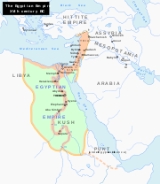
The New Kingdom, sometimes referred to as the Egyptian Empire, is the period in ancient Egyptian history
History of Ancient Egypt

The History of ancient Egypt spans the period from the early Predynastic Egypt settlements of the northern Nile Valley to the History of Roman Egypt in 30 BC....
 between the 16th century BC and the 11th century BC, covering the Eighteenth
Eighteenth dynasty of Egypt

The Eighteenth Dynasty is perhaps the best known of all the dynasties of ancient Egypt. As well as a number of Egypt's most powerful pharaohs, it included Tutankhamun, whose tomb, uncovered by Howard Carter in 1922, was one of the greatest of all archaeological discoveries, being completely undisturbed by tomb robbers....
, Nineteenth
Nineteenth dynasty of Egypt

The Eighteenth, Nineteenth, and Twentieth Dynasties of ancient Egypt are often combined under the group title, New Kingdom....
, and Twentieth Dynasties of Egypt
Twentieth dynasty of Egypt

The Eighteenth, Nineteenth, and Twentieth Dynasties of ancient Egypt are often combined under the group title, New Kingdom. This dynasty is considered to be the last one of the New Kingdom of Egypt, and was followed by the Third Intermediate Period....
. The New Kingdom (1570–1070 BC) followed the Second Intermediate Period
Second Intermediate Period of Egypt

The Second Intermediate Period marks a period when History of Ancient Egypt once again fell into disarray between the end of the Middle Kingdom of Egypt, and the start of the New Kingdom of Egypt....
 and was succeeded by the Third Intermediate Period
Third Intermediate Period of Egypt

The Third Intermediate Period refers to the time in Ancient Egypt from the death of Pharaoh Ramesses XI in 1070 BC to the foundation of the Twenty-sixth dynasty of Egypt by Psamtik I in 664 BC, following the expulsion of the Nubian rulers of the Twenty-fifth dynasty of Egypt....
. It was Egypt
Egypt

Egypt is a country mainly in North Africa, with the Sinai Peninsula forming a land bridge in Western Asia. Covering an area of about , Egypt borders the Mediterranean Sea to the north, the Gaza Strip and Israel to the northeast, the Red Sea to the east, Sudan to the south and Libya to the west....
’s most prosperous time and marked the zenith of its power
Historical powers

A Great power or Nation or Empire is a nation or state that, through its great economic, politics and military strength, is able to exert power and influence over not only its own region of the world, but far beyond to others....
.
ibly as a result of the foreign rule of the Hyksos
Hyksos

The Hyksos were an Asiatic people who invaded the eastern Nile Delta, in the Twelfth dynasty of Egypt initiating the Second Intermediate Period of Ancient Egypt....
 during the Second Intermediate Period, the New Kingdom saw Egypt attempt to create a buffer between the Levant
Levant

The Levant describes, traditionally, the Eastern Mediterranean at large, but can be used as a geographical term that denotes a large area in Western Asia formed by the lands bordering the Eastern shores of the Mediterranean, roughly bounded on the north by the Taurus Mountains, on the south by the Arabian Desert, and on the west by the M...
 and Egypt, and attain its greatest territorial extent.


Discussion
Ask a question about 'New Kingdom'
Start a new discussion about 'New Kingdom'
Answer questions from other users
Full Discussion Forum


Encyclopedia


The New Kingdom, sometimes referred to as the Egyptian Empire, is the period in ancient Egyptian history
History of Ancient Egypt

The History of ancient Egypt spans the period from the early Predynastic Egypt settlements of the northern Nile Valley to the History of Roman Egypt in 30 BC....
 between the 16th century BC and the 11th century BC, covering the Eighteenth
Eighteenth dynasty of Egypt

The Eighteenth Dynasty is perhaps the best known of all the dynasties of ancient Egypt. As well as a number of Egypt's most powerful pharaohs, it included Tutankhamun, whose tomb, uncovered by Howard Carter in 1922, was one of the greatest of all archaeological discoveries, being completely undisturbed by tomb robbers....
, Nineteenth
Nineteenth dynasty of Egypt

The Eighteenth, Nineteenth, and Twentieth Dynasties of ancient Egypt are often combined under the group title, New Kingdom....
, and Twentieth Dynasties of Egypt
Twentieth dynasty of Egypt

The Eighteenth, Nineteenth, and Twentieth Dynasties of ancient Egypt are often combined under the group title, New Kingdom. This dynasty is considered to be the last one of the New Kingdom of Egypt, and was followed by the Third Intermediate Period....
. The New Kingdom (1570–1070 BC) followed the Second Intermediate Period
Second Intermediate Period of Egypt

The Second Intermediate Period marks a period when History of Ancient Egypt once again fell into disarray between the end of the Middle Kingdom of Egypt, and the start of the New Kingdom of Egypt....
 and was succeeded by the Third Intermediate Period
Third Intermediate Period of Egypt

The Third Intermediate Period refers to the time in Ancient Egypt from the death of Pharaoh Ramesses XI in 1070 BC to the foundation of the Twenty-sixth dynasty of Egypt by Psamtik I in 664 BC, following the expulsion of the Nubian rulers of the Twenty-fifth dynasty of Egypt....
. It was Egypt
Egypt

Egypt is a country mainly in North Africa, with the Sinai Peninsula forming a land bridge in Western Asia. Covering an area of about , Egypt borders the Mediterranean Sea to the north, the Gaza Strip and Israel to the northeast, the Red Sea to the east, Sudan to the south and Libya to the west....
’s most prosperous time and marked the zenith of its power
Historical powers

A Great power or Nation or Empire is a nation or state that, through its great economic, politics and military strength, is able to exert power and influence over not only its own region of the world, but far beyond to others....
.

Background

Possibly as a result of the foreign rule of the Hyksos
Hyksos

The Hyksos were an Asiatic people who invaded the eastern Nile Delta, in the Twelfth dynasty of Egypt initiating the Second Intermediate Period of Ancient Egypt....
 during the Second Intermediate Period, the New Kingdom saw Egypt attempt to create a buffer between the Levant
Levant

The Levant describes, traditionally, the Eastern Mediterranean at large, but can be used as a geographical term that denotes a large area in Western Asia formed by the lands bordering the Eastern shores of the Mediterranean, roughly bounded on the north by the Taurus Mountains, on the south by the Arabian Desert, and on the west by the M...
 and Egypt, and attain its greatest territorial extent. It expanded far south into Nubia
Nubia

Nubia is a region in Southern Egypt along the Nile and in what is now northern Sudan. Most of Nubia is situated in Sudan with about a quarter of its territory in Egypt....
 and held wide territories in the Near East
Near East

Near East today is an ambiguous term that covers different countries for archeologists and historians, on one hand, and for political scientists, economists, and journalists, on the other....
. Egyptian armies
Military history of Ancient Egypt

The Ancient Egyptians were a people who lived in northeastern Africa from about 3150 BC to 31 BC The civilization stretched from the Nile Delta to Jebel Barkal, a mountain in Nubia....
 fought Hittite
Hittites

The Hittites were an ancient Anatolian people who spoke a Hittite language of the Anatolian languages of the Indo-European languages family, and established a kingdom centered at Hattusa in north-central Anatolia ca....
 armies for control of modern-day Syria
Syria

Syria , officially the Syrian Arab Republic , is an Arab-majority country in Southwest Asia, bordering Lebanon and the Mediterranean Sea to the west, Israel to the southwest, Jordan to the south, Iraq to the east, and Turkey to the north....
.

The eighteenth Dynasty contained some of Egypt's most famous Pharaoh
Pharaoh

Pharaoh is a title used in many modern discussions of the ancient Egyptian rulers of all periods. In antiquity this title began to be used for the ruler who was the religious and political leader of united ancient Egypt, only during the New Kingdom, specifically, during the middle of the Eighteenth dynasty of Egypt....
s including Ahmose I
Ahmose I

Ahmose I was a pharaoh of ancient Egypt and the founder of the Eighteenth dynasty of Egypt. He was a member of the Thebes, Egypt royal house, the son of pharaoh Tao II the Brave and brother of the last pharaoh of the Seventeenth dynasty of Egypt, King Kamose....
, Hatshepsut
Hatshepsut

Hatshepsut , meaning, Foremost of Noble Ladies, was the fifth pharaoh of the Eighteenth dynasty of Egypt of Ancient Egypt. She is generally regarded by Egyptologists as one of the most successful pharaohs, reigning longer than any other woman of an Indigenous peoples Egyptian dynasty....
, Thutmose III
Thutmose III

Thutmose III was the sixth Pharaoh of the Eighteenth dynasty of Egypt. During the first twenty-two years of Thutmose's reign he was co-regent with his aunt, Hatshepsut, who was named the pharaoh....
, Amenhotep III
Amenhotep III

Amenhotep III was the ninth pharaoh of the Eighteenth dynasty of Egypt. According to different authors, he ruled Egypt from June 1391 BC-December 1353 BC or June 1388 BC to December 1351 BC/1350 BC after his father Thutmose IV died....
, Akhenaten
Akhenaten

Akhenaten , was a Pharaoh of the Eighteenth dynasty of Egypt, who died 1336 BC or 1334 BC. He is especially noted for attempting to compel the Egyptian population in the monotheism worship of Aten, although there are doubts as to how successful he was at this....
 and Tutankhamun
Tutankhamun

Tutankhamun , Egyptian language was an Ancient Egypt Pharaoh of the Eighteenth dynasty of Egypt , during the period of History of Egypt known as the New Kingdom....
. Queen
Queen

In singular form, 'Queen' may refer to:In government and monarchy:See also...
 Hatsheput concentrated on expanding Egypt's external trade, sending a commercial expedition to the land of Punt
Land of Punt

The Land of Punt, also called Pwenet, or Pwene by the ancient Egyptians, at times synonymous with Ta netjer, the "land of the god", was a fabled site in the Horn of Africa and was known for producing and exporting gold, aromatic resins, African Blackwood, ebony, ivory, slaves and wild animals....
. Thutmose III ("the Napoleon
Napoleon I of France

Napoleon Bonaparte later known as Emperor Napoleon I, was a military and political leader of France whose actions shaped European politics in the early 19th century....
 of Egypt") expanded Egypt's army and wielded it with great success to consolidate the empire
List of largest empires

This article provides a list of the largest empires in History of the world....
 created by his predecessors. This resulted in a peak in Egypt's power and wealth during the reign of Amenhotep III.

One of the best-known 18th Dynasty pharaohs is Amenhotep IV, who changed his name to Akhenaten in honor of the Aten
Aten

Aten was the disk of the sun in ancient Egyptian mythology, and originally an aspect of Ra. He became the deity of the monotheism ? in fact, monism ? religion Atenism of Amenhotep IV, who took the name Akhenaten....
 and whose exclusive worship of the Aten is often interpreted as history's first instance of monotheism
Monotheism

In theology, monotheism is the belief that only one god exists. The concept of "monotheism" tends to be dominated by the concept of God in the Abrahamic religions, such as Judaism, Christianity and Islam, and the Neoplatonism concept of God as put forward by Pseudo-Dionysius the Areopagite....
 (and was argued in Sigmund Freud
Sigmund Freud

Sigmund Freud , born Sigismund Schlomo Freud , was an Austrian psychiatrist who founded the psychoanalysis of psychology. Freud is best known for his theories of the unconscious mind and the defense mechanism of Psychological repression and for creating the clinical practice of psychoanalysis for curing psychopathology through dialogue...
's Moses and Monotheism
Moses and Monotheism

Moses and Monotheism is a book by Sigmund Freud. It was first published in 1939. In it, Freud hypothesizes that Moses was actually born into Ancient Egyptian nobility and was perhaps a follower of Akhenaten, an ancient Egyptian monotheism....
 to have been the ultimate origin of Jew
Jew

A Jew is a member of the Jewish people, an ethnoreligious group that traces its ancestry to the Israelites or Hebrews of the Ancient Near East....
ish monotheism). Akhenaten's religious fervor is cited as the reason why he was subsequently written out of Egyptian history. Under his reign, in the 14th century BC, Egyptian art
Egyptian Art

Egyptian Art may refer to:*The Art of ancient Egypt, c.5000 BCE - c.300 BCE*Hellenistic art of Egypt, c.300 BCE - c.100 CE, during the Ptolemaic dynasty...
 flourished and attained an unprecedented level of realism.

Towards the end of the 18th Dynasty, the situation had changed radically. Helped by Akhenaten's apparent lack of interest in international affairs, the Hittites had gradually extended their influence into Syria and Palestine
Palestine

Palestine is a name which has been widely used since Roman times to refer to the region between the Mediterranean Sea and the Jordan River. It is derived from a name used already much earlier for a narrower geographical region, mainly along the coastal region....
 to become a major power in international politics. A power that both Seti I
Seti I

Menmaatre Seti I was a Pharaoh of Ancient Egypt , the son of Ramesses I and Queen Sitre, and the father of Ramesses II. As with all dates in Ancient Egypt, the actual dates of his reign are unclear, and various historians claim different dates, with 1294 BC – 1279 BC and 1290 BC to 1279 BC being the most commonly used by scholars today...
 and his son Ramesses II
Ramesses II

Ramesses II was the third Egyptian pharaoh of the Nineteenth dynasty of Egypt. He is often regarded as Ancient Egypt's greatest, most celebrated, and most powerful pharaoh....
 would need to deal with during the 19th dynasty.

Hitt Egypt Perseus
Ramesses II ("the Great") sought to recover territories in the Levant that had been held by the 18th Dynasty. His campaigns of reconquest culminated in the Battle of Kadesh
Battle of Kadesh

The Battle of Kadesh took place between the forces of the Egyptian Empire under Ramesses II and the Hittite Empire under Muwatalli II at the city of Kadesh on the Orontes River, in what is now the Syrian Arab Republic....
, where he led Egyptian armies against those of the Hittite king
List of Hittite kings

The dating and sequence of the Hittites kings is compiled from fragmentary records, and all dates given here are approximate, relying on synchronisms with known chronology of the Ancient Near East....
 Muwatalli II
Muwatalli II

Muwatalli II was a king of the New kingdom of the Hittite empire . The eldest surviving son of Mursili II, he is best known as the Hittite ruler who fought Ramesses II to a standstill at the Battle of Kadesh around 1274 BCE....
 and was caught in history's first recorded military ambush, but thanks to the arrival of the Ne'arin, Ramesses was able to rally his troops and turn the tide of battle against the Hittites. Ramesses II was also famed for the huge number of children he sired by his various wives and concubines; the tomb
KV5

Tomb KV5 is a subterranean, rock-cut tomb in the Valley of the Kings. It belonged to the sons of Ramesses II. Though KV5 was partially excavated as early as 1825, its true extent was discovered by by Dr Kent R....
 he built for his sons, many of whom he outlived, in the Valley of the Kings
Valley of the Kings

The Valley of the Kings is a valley in Egypt where, for a period of nearly 500 years from the 16th century BC to 11th century BC, tombs were constructed for the Pharaoh and powerful nobles of the Conventional Egyptian chronology#New Kingdom ....
 has proven to be the largest funerary complex in Egypt.

His immediate successors continued the military campaigns, though an increasingly troubled court—which at one point put a usurper (Amenmesse
Amenmesse

Amenmesse was the 5th ruler of the Nineteenth dynasty of Egypt in Ancient Egypt, possibly the son of Merneptah and Queen Takhat. Others consider him to be one of the innumerable sons of Ramesses II....
) on the throne—made it increasingly difficult for a pharaoh to effectively retain control without incident. The last "great" pharaoh from the New Kingdom is widely regarded to be Ramesses III
Ramesses III

Usimare Ramesses III was the second Pharaoh of the Twentieth dynasty of Egypt and is considered to be the last great New Kingdom king to wield any substantial authority over Egypt....
, a Twentieth Dynasty
Twentieth dynasty of Egypt

The Eighteenth, Nineteenth, and Twentieth Dynasties of ancient Egypt are often combined under the group title, New Kingdom. This dynasty is considered to be the last one of the New Kingdom of Egypt, and was followed by the Third Intermediate Period....
 pharaoh who reigned several decades after Ramesses II. In Year 8 of his reign, the Sea Peoples
Sea Peoples

The Sea Peoples is the term used for a confederacy of seafaring raiders of the second millennium BC who sailed into the eastern shores of the Mediterranean, caused political unrest, and attempted to enter or control Egyptian territory during the late Nineteenth dynasty of Egypt, and especially during Year 8 of Ramesses III of the Twentieth dy...
, invaded Egypt by land and sea. Ramesses III defeated them in two great land and sea battles. He claimed that he incorporated them as subject peoples and settled them in Southern Canaan, although there is evidence that they forced their way into Canaan. Their presence in Canaan may have contributed to the formation of new states in this region such as Philistia after the collapse of the Egyptian Empire. He was also compelled to fight invading Libyan
Libu

The Libu were an ancient north African tribe, from which the name Libya derives.Their occupation of ancient Libya is first attested in Egyptian language texts from the New Kingdom, especially from the Ramesside Period....
 tribesmen in two major campaigns in Egypt's Western Delta
Nile Delta

The Nile Delta is the River delta formed in Northern Egypt where the Nile River spreads out and drains into the Mediterranean Sea. It is one of the world's largest river deltas?from Alexandria in the west to Port Said in the east, it covers some 240 km of Mediterranean coastline?and is a rich agricultural region....
 in his Year 6 and Year 11 respectively. The heavy cost of these battles slowly exhausted Egypt's treasury and contributed to the gradual decline of the Egyptian Empire in Asia
Asia

Asia is the world's largest and most populous continent. It covers 8.6% of the Earth's total surface area and, with over 4 billion people, it contains more than 60% of the world's current human population....
. The severity of these difficulties is stressed by the fact that the first known labor strike in recorded history occurred during Year 29 of Ramesses III's reign, when the food rations for the Egypt's favoured and elite royal tomb-builders and artisans in the village of Deir el Medina could not be provisioned. Something in the air prevented much sunlight from reaching the ground and also arrested global tree growth for almost two full decades until 1140 BC. One proposed cause is the Hekla 3 eruption
Hekla 3 eruption

The Hekla 3 eruption circa 1000 BC is considered the most severe eruption of Hekla during the Holocene. It threw about 7.3 km3 of volcanic rock into the atmosphere, placing its Volcanic Explosivity Index at 5....
 of the Hekla volcano in Iceland; but the dating of this remains disputed.

Following Ramesses III's death there was endless bickering between his heirs. Three of his sons would go on to assume power as Ramesses IV
Ramesses IV

Heqamaatre Ramesses IV was the third pharaoh of the Twentieth Dynasty of the New Kingdom of Ancient Egypt. His name prior to assuming the crown was Amonhirkhopshef....
, Ramesses VI
Ramesses VI

Ramesses VI was the fifth ruler of the Twentieth dynasty of Egypt who reigned from 1145 BC to 1137 BC and a son of Ramesses III by Iset Ta-Hemdjert....
 and Ramesses VIII
Ramesses VIII

Usermare Akhenamun Ramesses VIII or Ramesses Sethherkhepshef Meryamun was the seventh Pharaoh of the Twentieth dynasty of Egypt of the New Kingdom of History of Ancient Egypt and was one of the last surviving sons of Ramesses III....
 respectively. However, at this time Egypt was also increasingly beset by a series of droughts, below-normal flooding levels of the Nile
Nile

The Nile is a major north-flowing river in Africa, generally regarded as the List of rivers by length in the world.The Nile has two major tributary, the White Nile and Blue Nile, the latter being the source of most of the Nile's water and silt, but the former being the longer of the two....
, famine, civil unrest and official corruption. The power of the last pharaoh, Ramesses XI
Ramesses XI

Ramesses XI reigned from 1107 BC to 1078 BC or 1077 BC and was the tenth and final king of the Twentieth dynasty of Egypt. He ruled Egypt for at least 29 years although some Egyptologists think he could have ruled for as long as 30 years....
, grew so weak that in the south the High Priests of Amun at Thebes
High Priests of Amun at Thebes

While not regarded as a dynasty per se, the wiktionary:High Priests of Amun at Thebes were nevertheless of such power and influence that they were effectively the rulers of Upper Egypt from 1080 BC to c.943 BC, after this period their influence declined....
 became the effective defacto rulers of Upper Egypt
Upper Egypt

File:Ancient Egypt map-en.svgUpper Egypt is a narrow strip of land that extends from the Cataracts of the Nile section of Upper Egypt, between El-Ayait and Asyut is sometimes known as Middle Egypt....
, while Smendes
Smendes

Hedjkheperre Setepenre Smendes was the founder of the Twenty-first dynasty of Egypt and succeeded to the throne after burying Ramesses XI in Lower Egypt – territory which he controlled....
 controlled Lower Egypt
Lower Egypt

Lower Egypt is the northern-most section of Egypt. It refers to the Fertile Crescent Nile Delta region, which stretches from the area between El-Aiyat and Zawyet Dahshur, south of modern-day Cairo, and the Mediterranean Sea....
 even before Ramesses XI's death. Smendes eventually founded the Twenty-First dynasty
Twenty-first dynasty of Egypt

The Twenty-First, Twenty-Second, Twenty-Third, Twenty-Fourth and Twenty-Fifth Dynasties of ancient Egypt are often combined under the group title, Third Intermediate Period....
 at Tanis
Tanis, Egypt

Tanis , the Greek language name of ancient Djanet , is a city in the north-eastern Nile delta of ancient Egypt. It lies on the Tanitic branch of the Nile ....
.

Timeline


See also

  • Amon-Mut-Khonsu
  • History of Ancient Egypt
    History of Ancient Egypt

    The History of ancient Egypt spans the period from the early Predynastic Egypt settlements of the northern Nile Valley to the History of Roman Egypt in 30 BC....
  • Pharaoh (novel)
    Pharaoh (novel)

    Pharaoh is the fourth and last major novel by the Polish writer Boleslaw Prus. Composed over a year's time in 1894–1895, it was the sole historical novel by an author who had previously disapproved of historical novels as inevitable distortions of history....
    , historical novel relating to the fall of Egypt's Twentieth Dynasty and New Kingdom


External links

  • — Photographs of many of the historic sites dating from the New Kingdom