
See Also

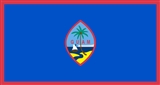
Guam

Guam , officially the U.S. Territory of Guam, is an island in the Western Pacific Ocean Pacific Ocean

The Pacific Ocean is the world's largest body of water [i]. ... 

 and is an organized unincorporated territory of the United States United States

The United States of America, also known as the United States, the U.S., the U.S.A., a... 

. Its inhabitants are the Chamorros Chamorros

Chamorros or Chamorus are the indigenous people [i] of the Mariana Islands [i], which include the ... 

, who first populated the island approximately 4,000 years ago. It is the largest and southernmost of the Mariana Islands. The capital is Hagta, formerly Agana . Guam's economy is mainly supported by tourism Tourism

Tourism is the act of travel [i] for predominantly recreation [i]al or leisure [i] purposes, and also re ... 

  and United States armed forces Military of the United States

The military of the United States, officially known as the United States [i] Armed Forces [i] ... 

 bases. The United Nations United Nations

name = United Nations Nations Unies ... 

 Committee on Decolonization includes Guam on the United Nations list of Non-Self-Governing Territories.

Discussions

  Discussion Features

   Ask a question about 'Guam'

   Start a new discussion about 'Guam'

   Answer questions about 'Guam'

   'Guam' discussion forum

Timeline

1513   Unknown - Magellan is the first person recorded to set foot on the Micronesian Islands. He lands on Guam located in the Mariana Islands and meets the Chamorros Chamorros

Chamorros or Chamorus are the indigenous people [i] of the Mariana Islands [i], which include the ... 

 there.

1521   Ferdinand Magellan Ferdinand Magellan

Ferdinand Magellan was a Portuguese [i] maritime explorer [i] ... 

 discovers Guam.

1944   Battle of Guam Battle of Guam

The Battle of Guam was a battle of the Pacific campaign [i] of World War II [i], fought on t ... 

 - American United States

The United States of America, also known as the United States, the U.S., the U.S.A., a... 

 troops land on Guam starting the battle (ends on August 10).

1972   Japan Japan

is an island country [i] in East Asia [i]. ... 

ese soldier Shoichi Yokoi Shoichi Yokoi

Shoichi Yokoi was a Japan [i]ese soldier and celebrity. ... 

 is discovered in Guam. He had spent 28 years in the jungle.

1983   The Apatosaurus Apatosaurus

Apatosaurus , previously known as Brontosaurus [i], is a genus [i] of sauropod [i] dinosaur [i]s ... 

 is made the official state dinosaur of Guam.


Encyclopedia

Guam , officially the U.S. Territory of Guam, is an island in the Western Pacific Ocean Pacific Ocean

The Pacific Ocean is the world's largest body of water [i]. ... 

 and is an organized unincorporated territory of the United States United States

The United States of America, also known as the United States, the U.S., the U.S.A., a... 

. Its inhabitants are the Chamorros Chamorros

Chamorros or Chamorus are the indigenous people [i] of the Mariana Islands [i], which include the ... 

, who first populated the island approximately 4,000 years ago. It is the largest and southernmost of the Mariana Islands. The capital is Hagåtña Hagåtña, Guam

Hagta, the capital [i] of the American island of Guam [i], lies on its western shore. ... 

, formerly Agana . Guam's economy is mainly supported by tourism Tourism

Tourism is the act of travel [i] for predominantly recreation [i]al or leisure [i] purposes, and also re ... 

  and United States armed forces Military of the United States

The military of the United States, officially known as the United States [i] Armed Forces [i] ... 

 bases. The United Nations United Nations

name = United Nations
Nations Unies
... 

 Committee on Decolonization includes Guam on the United Nations list of Non-Self-Governing Territories.

Geography


Guam is located at 13.5°N 144.5°E and has an area of 210 square miles . The northern part of the island is a forested coralline limestone plateau while the south contains volcanic peaks covered in forest and grassland. A coral reef surrounds most of the island. The island's population is most dense in the northern and central regions. Guam is the southernmost island in the Mariana island chain and is the largest island in Micronesia. The Marianas Trench Mariana Trench

The Mariana Trench is the deepest known submarine trench [i], and the deepest location in the Earth [i]... 

, a deep subduction zone Subduction

In geology [i], a subduction zone is an area on Earth [i] where two tectonic plate [i]s... 

, lies beside the island chain. The Challenger Deep Challenger Deep

The Challenger Deep is the deepest known point in the oceans.... 

, the deepest point on earth Earth

Earth is the third planet [i] in the solar system [i] in terms of distance from the Sun [i], and the fi ... 

, is southwest of Guam at 35,797 feet Foot

The foot is a biological structure found in many animal [i]s that is used for locomotion [i]. ... 

  deep. The island experiences occasional earthquake Earthquake

An earthquake is a phenomenon [i] that results from and is powered by the sudden release of stored energ ... 

s due to being on the edge of the Pacific Plate Pacific Plate

The Pacific Plate is an oceanic tectonic plate [i] beneath the Pacific Ocean [i].
... 

. In recent years, quakes with epicenters near Guam have had magnitudes ranging from 7.0 to 8.2. Unlike the Anatahan Anatahan

Anatahan is one of the most active volcano [i]es of the Northern Mariana Islands [i]. ... 

 volcano Volcano

A volcano is a geological landform [i] on the surface of the Earth [i] where magma [i] from th ... 

 in the northern Marianas, Guam is not volcanically active.


  • Satellite images of southern and northern Guam.

History

Guam's first contact with western civilization occurred when a Spanish expedition under Portuguese Portugal

Portugal, officially the Portuguese Republic is located in southwestern Europe [i] on the Iberian Peninsula [i] ... 

 navigator Ferdinand Magellan Ferdinand Magellan

Ferdinand Magellan was a Portuguese [i] maritime explorer [i] ... 

 reached the island in 1521 during his circumnavigation of the globe. General Miguel López de Legazpi Miguel López de Legazpi

Miguel Lpez de Legazpi, also known as El Adelantado [i] and El Viejo, was a Spanish [i] ... 

 claimed Guam for Spain in 1565. Spanish colonization commenced in 1668 with the arrival of Padre San Vitores Diego Luis de San Vitores

Padre Diego Luis de San Vitores was a Spanish [i] Jesuit [i] missionary [i] who founded the first... 

, who established the first Catholic mission. The islands were then governed as part of the Spanish East Indies from the Philippines. Between 1668 and 1815, Guam was an important resting stop on the Spanish Spain

Spain, officially the Kingdom of Spain , is a Europe [i]an parliamentary monarchy [i].... 

 trade route between Mexico Mexico

The United Mexican States, generally known as Mexico is a country [i] located in North America [i] ... 

 and the Philippines Philippines

The Philippines , officially the Republic of the Philippines , is an island nation [i] located in ... 

. Guam, along with the rest of the Mariana and Caroline islands Caroline Islands

The Caroline Islands form a large archipelago [i] of widely scattered islands in the western Pacific Ocean [i] ... 

, was treated by Spain as part of their colony in the Philippines. While Guam's Chamorro culture is unique, the cultures of both Guam and the Northern Marianas were heavily influenced by Spanish culture and traditions.

The United States United States

The United States of America, also known as the United States, the U.S., the U.S.A., a... 

 took control of the island in the 1898 Spanish-American War Spanish-American War

The Spanish-American War took place in 1898 and resulted in the United States [i] gaining control over t ... 

. Guam came to serve as a way station for American ships traveling to and from the Philippines, while the northern Mariana islands passed to Germany then Japan.

During World War II World War II

World War II, or the Second World War, was a worldwide [i] conflict [i] fought betwe ... 

, Guam was attacked and invaded by the Japanese armed forces on December 8, 1941. The Northern Mariana Islands had become a Japanese protectorate before the war. It was the Chamorros from the Northern Marianas who were brought to Guam to serve as interpreters and in other capacities for the occupying Japanese force. The Guamanian Chamorros were treated as an occupied enemy by the Japanese military. After the war, this would cause some resentment by the Guamanian Chamorros towards the Chamorros in the Northern Marianas. To this day, Guam remains the only U.S. soil, with a sizeable population, that suffered under foreign military power occupation. Guam's occupation lasted for approximately thirty-one months. During this period, the indigenous people of Guam were subjected to forced labor, family separation, incarceration, execution, concentration camps and prostitution. The United States returned and fought the Battle of Guam Battle of Guam

The Battle of Guam was a battle of the Pacific campaign [i] of World War II [i], fought on t... 

 in July 21, 1944 to recapture the island from Japanese military occupation. The U.S. also captured and occupied the Northern Marianas. After the war, The Guam Organic Act of 1950, which established Guam as an unincorporated organized territory of the United States, provided for the structure of the island's government, and granted the people United States citizenship.

Government and politics


Guam is governed by a popularly elected governor and a unicameral Unicameralism

Unicameralism is the practice of having only one legislative or parliament [i]ary chamber. ... 

 15 member legislature Legislature

A legislature is a type of representative deliberative assembly [i] with the power to adopt law [i]s. ... 

. Guam elects one non-voting delegate to the US House of Representatives United States House of Representatives

The United States House of Representatives is one of the two chambers [i] of the United States Congress [i] ... 

, currently Congresswoman Madeleine Bordallo Madeleine Bordallo

Madeleine Bordallo is the Delegate [i] from Guam [i] to the United States House of Representatives [i] ... 

. During U.S. Presidential elections, citizens in Guam vote in a "straw poll" for their choice of president, but it doesn't count toward the general election results.

In the 1980s and early 1990s, there was a significant movement in favor of the Territory becoming a commonwealth, which would give it a political status similar to Puerto Rico Puerto Rico

The Commonwealth of Puerto Rico , also Porto Rico and more commonly Puerto Rico, is a United States [i] ... 

 and the Northern Mariana Islands Northern Mariana Islands

The Northern Mariana Islands, officially the Commonwealth of the Northern Mariana Islands , is a commonwealth [i] ... 

. However, the Federal government gave no response to Guam's request for Commonwealth status for a decade before Guam leaders gave up the quest in the late 1990s. Competing movements with less significant influence exist, which advocate political independence from the United States, statehood, or a combination with the Northern Mariana Islands as a single commonwealth. These proposals however, are not seen as favorable or realistic within the U.S. federal government, which argues Guam does not have the financial stability or self sufficiency to warrant such status. The same sources quickly provide evidence of Guam’s increasing reliance on Federal spending, and question how commonwealth status or statehood would benefit the United States as a greater whole.

Administrative divisions

Guam is divided into nineteen village Village

A village is a human residential settlement [i] commonly found in rural [i] areas.... 

s: Agana Heights, Agat, Asan, Barrigada, Chalan Pago-Ordot, Dededo, Hagatna, Inarajan, Mangilao, Merizo, Mongmong-Toto-Maite, Piti, Santa Rita, Sinajana, Talafofo, Tamuning, Umatac, Yigo and Yona.

The U.S. miliary maintains jurisdiction over bases comprising approximately one quarter of the island's area:
  • Andersen Air Force Base Andersen Air Force Base

    Andersen Air Force Base is a base of the United States Air Force [i] on the island of Guam [i] in the Pacific Ocean [i] ... 

    , Yigo
  • Naval Air Station, Tiyan
  • Guam Naval Station, Orote peninsula
  • Ordnance Annex, South Central Highlands
  • Naval communications station, Barrigada and Finegayan

Economy

Guam's economy depends primarily on tourism, the United States military base presence, and other federal spending. Although Guam receives no foreign aid, it does receive large transfer payments from the general revenues of the U.S. Federal Treasury into which Guam pays no income or excise taxes; under the provisions of a special law of Congress, the Guam Treasury, rather than the US Treasury, receives federal income taxes paid by military and civilian Federal employees stationed in Guam.

Sometimes called "America in Asia," Guam is a popular destination for Japanese, Korean, and Chinese tourists, and with over 20 large hotels, a DFS Galleria, Pleasure Island aquarium, SandCastle Las Vegas shows and other shopping and entertainment features in its chief tourism city of Tumon, the island's economy has grown dramatically. It is a relatively short flight from Asia compared to Hawaii Hawaii

Hawaii became the 50th state [i] of the United States [i] on August 21 [i], 1959 [i]. ... 

, and a series of hotels and golf courses were built to cater to tourists. Today, about 90 percent of tourists to Guam are Japanese. Significant sources of revenue include duty-free designer shopping outlets, and the American-style malls: Micronesia Mall, Guam Premium Outlets, and the Agana Shopping Center and various businesses catering to tourists in Tumon.

The economy had been stable since 2000 due to increased tourism, mainly from Japan, but took a more recent downturn along with the rest of Asia. It is expected to stabilize with the recent news that all US Marine personnel and operations currently in Okinawa will transfer to Guam sometime in 2007-2008. Guam has a 14% unemployment rate, and the government suffered a $314 million shortfall in 2003.

The following is the amount in billion of dollars, that the Government of Guam has spent in Federal grants for various government and economic expenditures minus those of the United States Armed Forces:
1993 - $1.004
1994 - $1.061
1995 - $0.809
1996 - $0.829
1997 - $0.846
1998 - $0.998
1999 - $0.844
2000 - $0.841
2001 - $0.907
2002 - $1.113
2003 - $1.538

"The between the United States of America, the Federated States of Micronesia, and the Republic of the Marshall Islands was signed in 1982, and ratified in 1986. It accorded the former entities of the Trust Territory of the Pacific Islands a political status of 'free association'" with the United States. The Compact was an agreement to which Guam was not a party. Over the years, it was claimed by some in Guam that Guam has had to bear the brunt of this agreement in the form of public assistance programs and public education for those from the regions involved, but was never compensated by the federal government for its expenditures.


Transportation and communications

Most of the island has mobile phone service and high speed internet is now widely available through cable or DSL. Cell phones are used by a majority of residents, and the telephone service is extremely reliable, as compared to 20-25 years ago when phone outages were common. Guam was added to the North American Numbering Plan in 1997, removing barriers of high costs of international long-distance calls to the mainland.

As Guam is also part of the U.S. Postal System, mail to Guam from the mainland is considered domestic and no additional charges are required. Private shipping companies such as UPS, DHL or FedEx also regard Guam is domestic, although this is often not reflected in the shipping charges for many mail-order companies or websites. Mail will take approximately 1-2 weeks to travel between Guam and California. Express mail and Fedex takes a minimum of three to four days to reach the U.S. Most of the residents use post office boxes to receive their mail and as their mailing addresses, though home delivery is becoming increasingly available.

Guam is served by the Antonio B. Won Pat International Airport. There are no direct flights to Guam from the U.S. Mainland. Flights to Guam go through Hawaii, Japan, or Korea first and generally requires a layover and a plane transfer. To fly to Guam from the mainland, through Hawaii, requires a five-hour flight from San Francisco or Los Angeles, for example, and another 7.5-hour flight from Hawaii to Guam. To fly to Guam from the mainland, through Japan or Korea, requires a 10-12-hour flight from the mainland to Korea or Japan, and another 3-4-hour flight to Guam.

Most residents travel in Guam using personally owned cars. A limited bus system for residents exists but is not used by many residents.

Climate

The climate is characterized as tropical marine. The weather is generally warm and humid with little seasonal temperature variation. The mean high temperature is 86°F  and mean low is 76°F  with an average annual rainfall of 86 inch Inch

An inch is the name of a unit [i] of length [i] in a number of different systems, ... 

es . The dry season runs from December through June. The remaining months constitute the rainy season. The highest risk of typhoons is during October and November.

An average of three tropical storms and one typhoon pass within 180 nautical miles of Guam each year. The most intense typhoon to pass over Guam recently was Super Typhoon Pongsona, with sustained winds of 180 miles per hour, which slammed Guam leaving massive destruction on December 8, 2002 . After Super Typhoon Pamela in 1976 wooden structures began to be replaced by concrete. By the 1980s 1980s

The 1980s [i] officially refers to the years from 1980 [i] to 1989 [i]. ... 

 many homes were concrete and "Typhoon proof". Since the 1980s 1980s

The 1980s [i] officially refers to the years from 1980 [i] to 1989 [i]. ... 

 wooden utility poles were slowly replaced by typhoon resistant concrete and steel poles. In the 1990s 1990s

The 1990s [i] decade [i] refers to the years from 1990 [i] to 1999 [i], inclusive, sometimes informally ... 

 many home and bussiness owners installed typhoon shutters.

Ecological issues


The brown tree snake


The island is also known as a example of the effects of bioinvasion Invasive species

The term invasive species refers to a subset of those species defined as introduced species [i] or non-indigenous species [i] ... 

: Thought to be a stowaway on a U.S. military transport near the end of World War II, the slightly venomous, but rather harmless, brown tree snake Brown tree snake

The brown tree snake is an arboreal [i] colubrid [i] snake [i] native to eastern and northern coastal Australia [i] ... 

  came to Guam and killed most of the native bird population on the previously snake-free island. This snake has no natural predators on the island. Although some studies have suggested a high density of the brown tree snake, residents rarely see these snakes. As prodigious climbers, the snakes were blamed for frequent blackouts in the 1980s by shorting across lines and transformers. Many power poles now have a slick metal sheath to prevent the snakes from climbing and such blackouts are now rare.

Other invasive animal species


From the 17th through 19th centuries, the Spanish introduced pigs, dogs, chickens, the Philippine deer , black francolin Black Francolin

The Black Francolin, Francolinus francolinus, is a gamebird [i] in the pheasant family Phasianidae [i] ... 

s, and water buffalo Water Buffalo

The Water Buffalo is a very large ungulate [i] and a member of the bovine subfamily [i]. ... 

. Water buffalo, known as carabao Carabao

The carabao is a domesticated type of water buffalo [i] found in the Philippines [i], Guam [i], and vari ... 

 locally, have cultural significance. Herds of these animals obstruct military base operations and harm native ecosystems. After birth control and adoption efforts were ineffective, the U.S. military began euthanizing the herds leading to organized protests from island residents.

Other introduced species include cane toads Cane Toad

The Cane Toad , also known as the Giant Neotropical Toad or Marine Toad, is a large, terrest... 

 imported in 1937, the giant African Snail—an agricultural pest introduced during WWII—and more recently frog species which could threaten crops in addition to providing additional food for the brown tree snake population. Reports of loud chirping frogs that may have arrived from Hawaii have led to fears that the noise could even threaten Guam's tourism. Introduced feral pigs and deer, over-hunting, and habitat loss from human development are also major factors in the decline and loss of Guam's native plants and animals.

Threats to indigenous plants

Invading animal species are not the only threat to Guam's native flora. Tinangaja, a virus affecting coconut palms, was first observed on the island in 1917 when copra Copra

Copra is the dried [i] meat, or kernel, of the coconut [i]. ... 

 production was still a major part of Guam's economy. Though coconut plantations no longer exist on the island, the dead and infected trees that have resulted from the epidemic are seen throughout the forests of Guam. The dense forests of northern guam have been largely replaced by thick tangan tangan brush . Much of Guam and Saipan's folliage was lost during World War II. In 1947, the U.S. military introduced the plant by seeding the island from the air to prevent erosion Erosion

Erosion is the displacement of solids by the agents of wind, water or ice, by downward or down-slope mo... 

. Non-native grass species also dominate much of southern Guam's landscape.


Wildfires

Wildfire Wildfire

A wildfire, also known as a forest fire, vegetation fire, 'grass fire, 'brush fire... 

s plague the forested areas of Guam every dry season despite the island's humid climate. Most fires are man-caused with 80 percent resulting from arson Arson

Arson is the crime [i] of setting a fire [i] with intent to cause damage. ... 

. Poachers often start fires to attract deer to the new growth. Invasive grass species that rely on fire as part of their natural life cycle grow in many regularly burned areas. Grassland Grassland

A grassland is a generally open and continuous, fairly flat area of grass [i]. ... 

s and "barrens" have replaced previously forested areas leading to greater soil erosion Erosion

Erosion is the displacement of solids by the agents of wind, water or ice, by downward or down-slope mo... 

. During the rainy season Wet season

A wet season or rainy season is a season [i] in which the average rainfall [i] in a region is sign ... 

 sediment is carried by the heavy rains into the Fena Lake Resevoir and Ugum River leading to water quality problems for southern Guam. Eroded silt also destroys the marine life in reefs around the island. Soil stabilization efforts by volunteers and forestry workers to plant trees have had little success in preserving natural habitats.

Aquatic preserves

As a vacation spot for scuba diver Scuba diving

Scuba diving is the term used to describe the use of a self-contained breathing set [i] to stay underwater [i] ... 

s, efforts have been made to protect Guam's coral reef habitats from pollution Pollution

Pollution is the release of chemical, physical, biological or radioactive contaminants to the environment [i]... 

, eroded silt Silt

Silt is soil [i] or rock [i] derived granular material [i] of a specific grain size [i]. ... 

, and overfishing Overfishing

Overfishing is a situation where one or more fish stocks [i] are reduced below predefined levels of acce ... 

 that have led to decreased fish populations. In recent years the Department of Agriculture, Division of Aquatic and Wildlife Resources has established several new marine preserves where fish populations are monitored by biologists. A federal Guam National Wildlife Refuge in northern Guam protects the decimated sea turtle Sea turtle

Sea turtles are turtle [i]s found in all the world's oceans with the exception of the Arctic Ocean [i], ... 

 population in addition to a small colony of Mariana fruit bats.

Reef fish of Guam.


In the 1990s, as hotels filled up the beachfront property along Tumon Bay, the bay was dredged by the hotel community to remove the seaweed and rocks that "despoiled the beauty" of the beach and provided hazards. Though Tumon Bay is a protected reserve, it will take many years for the seaweed and fish to return.

Education


Primary and secondary schools

The Guam Public School System  serves the entire island of Guam. In 2000, 32,000 students attended Guam's public schools. Guam's public school system has been criticized for having poor management and inadequate facilities. Lack of funding and corruption are often cited as the causes. Recent losses in federal funding may lead to further problems. Private schools had a total attendance of 6,000 in 2000, though attendance has increased in recent years.

In 1998 the U.S. Department of Defense United States Department of Defense

The United States Department of Defense is the federal department charged with coordinating and supervi... 

 opened schools for children of American military personnel. DODEA schools had an attendance of 2,500 in 2000. The schools are Andersen Elementary School, Andersen Middle School, McCool Elementary/Middle School, and Guam High School.

Colleges and universities

The University of Guam University of Guam

The University of Guam, located in Mangilao [i], Guam [i] is a land-grant [i] inst ... 

 and Guam Community College offer courses in higher education.

See also

  • List of radio stations in Guam
  • Scouting on Guam Scouting on Guam

    Scouting in Guam is presently in a state of development and growth.... 


References


External links

Government
  • [https://www.guamtax.com/ Guam Department of Revenue and Taxation]

News


Overviews
  • from the Guam Humanities Council and the University of Guam
  • directory category
  • [https://www.cia.gov/cia/publications/factbook/geos/gq.html The World Factbook on Guam]

Military


Other
  • How the arrival of one invasive species damaged the ecology, commerce, electrical systems, and human health on Guam: A comprehensive information source.