
All Topics  
Franks

 
Franks

   Email Print
   Bookmark   Link


Franks


The Franks or Frankish people ( or gens Francorum) were a West Germanic ethnic group
Ethnic group

An ethnic group is a group of humans whose members identify with each other, through a common heritage that is real or presumed.Ethnic identity is further marked by the recognition from others of a group's distinctiveness and the recognition of common culture, linguistic, religion, human behaviour or Race traits, real or presumed, as indic...
 first identified in the 3rd century as living north and east of the Lower Rhine
Lower Rhine

The Lower Rhine flows from Bonn, Germany, to the North Sea. Almost immediately after entering the Netherlands, the Rhine splits into many branches....
 River. Under the Merovingian dynasty, they founded one of the Germanic monarchies
Germanic monarchy

Germanic monarchy, also called barbarian monarchy, was a monarchical systemof government which was predominant among the Germanic tribes of Late Antiquity and the Early Middle Ages....
 which replaced the Western Roman Empire
Western Roman Empire

The Western Roman Empire refers to the western half of the Roman Empire, from its division by Diocletian in 285; the other half of the Roman Empire was the Eastern Roman Empire, today widely known as the Byzantine Empire....
 from the 5th century.


Discussion
Ask a question about 'Franks'
Start a new discussion about 'Franks'
Answer questions from other users
Full Discussion Forum


Timeline

235   Pressure on Rome by Goths, Quadi, Parthians, Franks and Alemanni increases. Following a defeat by the Germans, Alexander Severus and his mother Julia Mamaea, are massacred near Mainz (Mongontiacum) by his soldiers.

244   Aurelian defeats the Franks at Mainz.

250   A group of Franks penetrate as far as Tarragona in Spain (approximate date).

256   The Franks cross the Rhine, the Alamanni reach Milan.

259   The Franks who invaded the Roman Empire near Cologne in 257, reach Tarraco in Hispania

260   Franks took control over the Scheldt estuary (approximate date).

274   Germanic Peoples take advantage of the destroyed Roman armies of the Rhine. They pillage and depopulate large areas of Gaul, including Paris. The Rhine border is lost for 20 years. Franks live in the area of present southern Netherlands, northern Belgium and Rhineland from now on.

275   Gaul is pillaged by the Franks and the Alemanni.

277   Probus expels the Franks and Alamanni from Gaul.

293   Constantius Chlorus restores the northern Rhine border after defeating the Franks. Franks keep living in the north, because the Roman population had fled.


Encyclopedia


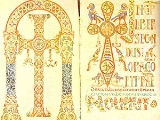
Sacr Gelasianum 131v 132
The Franks or Frankish people ( or gens Francorum) were a West Germanic ethnic group
Ethnic group

An ethnic group is a group of humans whose members identify with each other, through a common heritage that is real or presumed.Ethnic identity is further marked by the recognition from others of a group's distinctiveness and the recognition of common culture, linguistic, religion, human behaviour or Race traits, real or presumed, as indic...
 first identified in the 3rd century as living north and east of the Lower Rhine
Lower Rhine

The Lower Rhine flows from Bonn, Germany, to the North Sea. Almost immediately after entering the Netherlands, the Rhine splits into many branches....
 River. Under the Merovingian dynasty, they founded one of the Germanic monarchies
Germanic monarchy

Germanic monarchy, also called barbarian monarchy, was a monarchical systemof government which was predominant among the Germanic tribes of Late Antiquity and the Early Middle Ages....
 which replaced the Western Roman Empire
Western Roman Empire

The Western Roman Empire refers to the western half of the Roman Empire, from its division by Diocletian in 285; the other half of the Roman Empire was the Eastern Roman Empire, today widely known as the Byzantine Empire....
 from the 5th century. The Frankish state consolidated its hold over large parts of western Europe by the end of the eighth century, developing into the Carolingian Empire
Carolingian Empire

Carolingian Empire is a historiography term sometimes used to refer to the Francia under the Carolingian dynasty. This dynasty is seen as the founders of France and Germany....
 and its successor states.

Contemporary definitions of the ethnicity of the Franks vary by period and point of view. It is often unclear whether all of the peoples referred to as the Franks by their contemporaries referred to themselves as such. Within Francia, the Franks appear to have initially been a distinct group with their own culture.

The ethnonym Frank has sometimes been traced to the Latin
Latin

Latin is an Italic language, historically spoken in Latium and Ancient Rome. Through the Military history of the Roman Empire, Latin spread throughout the Mediterranean and a large part of Europe....
 Francisca (from the Germanic *frankon, akin to the Old English franca), meaning "javelin." While the throwing axe of the Franks is known as the francisca
Francisca

The francisca is a throwing axe used as a weapon during the Early Middle Ages by the Franks, among whom it was a characteristic national weapon at the time of the Merovingians from about 500 to 750 AD and is known to have been used during the reign of Charlemagne ....
, the weapon conversely may have been named after the tribe. A. C. Murray says, "The etymology of Franci is uncertain ('the fierce ones' is the favourite explanation), but the name is undoubtedly of Germanic origin."

From the third to fifth centuries some Franks raided Roman territory while other Franks joined the Roman troops in Gaul. Only the Salians
Salian Franks

File:Seal_of_Childeric_I_Tournai tomb.jpgThe Salian Franks or Salii were a subgroup of the early Franks who originally had been living north of the limes in the coastal area above the Rhine River in the northern Netherlands, where today there still is a region called Salland....
 formed a kingdom on Roman-held soil that was acknowledged by the Romans after 357. In the climate of the collapse of imperial authority in the West, the Frankish tribes were united under the Merovingians and conquered all of Gaul
Gaul

Gaul is the name used for the region of Western Europe comprising part of present day northern Italy, France, Belgium, western Switzerland and the parts of the Netherlands and Germany on the west bank of the River Rhine....
 save Septimania
Septimania

Septimania was the western region of the Roman province of Gallia Narbonensis that passed under the control of the Visigoths in 462, when Septimania was ceded to their king, Theodoric II....
 in the 6th century. The Salian political elite would be one of the most active forces in spreading Christianity over western Europe.

Mythological origins

Like many Germanic peoples, the Franks developed an origins story to explain their connection with peoples of classical history. In the case of the Franks, these peoples were the Sicambri
Sicambri

The Sicambri were a Germanic people living in what is now called the Netherlands at the turn of the first millennium.Originating in the Germanic peoples-Celts contact zone , they had become Franks by the 4th century, associated with the Low Franconian Salian Franks....
 and the Trojans. An anonymous work of 727 called Liber Historiae Francorum
Liber Historiae Francorum

Liber historiae Francorum is a book that briefly starts as secondary source for early Franks in the time of Marcomer, and it gives a short breviarum until the time of the late Merovingians, where it becomes an important primary source of the contemporain history....
 states that following the fall of Troy
Troy

Troy is a legendary city and center of the Trojan War, as described in the Epic Cycle, and especially in the Iliad, one of the two epic poems attributed to Homer....
, 12,000 Trojans led by chiefs Priam
Priam

In Greek mythology, Priam was the king of Troy during the Trojan War and youngest son of Laomedon. Modern scholars derive his name from the Luwian compound Priimuua, which means "exceptionally courageous"....
 and Antenor
Antenor (mythology)

In Greek mythology, Antenor was a son of the Dardanian noble Aesyetes by Cleomestra. He was one of the wisest of the Trojan elders and counsellors....
 moved to the Tanais
Tanais

Tanais is the ancient name for the Don River, Russia in Russia. Strabo regarded it as the boundary between Europe and Asia.In antiquity, Tanais was also the name of a city in the Don river delta that reaches into the northeasternmost part of the Sea of Azov, which the Greeks called Lake Maeotis....
 (Don) river, settled in Pannonia
Pannonia

Pannonia is an ancient province of the Roman Empire bounded north and east by the Danube, coterminous westward with Noricum and upper Italy, and southward with Dalmatia and upper Moesia....
 near the Sea of Azov
Sea of Azov

The Sea of Azov is the world's shallowest sea, linked by the Strait of Kerch to the Black Sea to the south. It is bounded on the north by Ukraine, on the east by Russia and on the west by the Crimean peninsula....
 and founded a city called "Sicambria". In just two generations (Priam and his son Marcomer
Marcomer

Marcomer was a Franks leader in the late 4th century that invaded the Roman Empire in the year 388, when the usurper and leader of the whole of Roman Gaul, Magnus Maximus was surrounded in Aquileia by Theodosius I....
) from the fall of Troy (by modern scholars dated in the late Bronze Age) they arrive in the late fourth century at the Rhine. An earlier variation of this story can be read in Fredegar. In Fredegar's version an early king named Francio serves as namegiver for the Franks, just as Romulus
Romulus

Romulus may refer to any of these articles:...
 has lent his name to Rome
Rome

Rome is the capital city of Italy and Lazio, and is Italy's largest and most populous city, with 2,724,347 residents in an urban area of some ....
.

History

The Franks enter recorded history around 50 due to an invasion across the Rhine
Rhine

File:Swiss Grand Canyon.jpgThe Rhine is one of the longest and most important rivers in Europe, at , with an average discharge of more than ....
 into the Roman Empire. They are first mentioned on the Tabula Peutingeriana
Tabula Peutingeriana

The Tabula Peutingeriana is an itinerarium showing the cursus publicus, the road network in the Roman Empire. The original map of which this is a unique copy was last revised in the fourth or early fifth century....
 as the Chamavi qui et Pranci (meaning "Chamavi
Chamavi

The Chamavi were a Germanic tribe of Late Antiquity and the Dark Ages. They first appear under that name in the 1st century AD Germania of Tacitus as a Germanic tribe that, for most of their history, existed along the North bank of the Lower Rhine in the region today called Hamaland after them, which is in the Gelderland province of the...
, who are Pranci", probably an error for Franci). Over the next century other Frankish tribes besides the Chamavi surface in the records. The major primary sources include Panegyrici Latini
Panegyrici Latini

The Panegyrici Latini or Latin Panegyrics is a collection of twelve Ancient Rome panegyric orations. The authors of most of the speeches in the collection are anonymous, but appear to have been Gallic in origin....
, Ammianus Marcellinus
Ammianus Marcellinus

Ammianus Marcellinus was a fourth-century Ancient Rome historian. His is the last major historical account of the late Roman empire which survives today....
, Claudian
Claudian

Claudian was a Roman poet, who worked for Emperor Flavius Augustus Honorius and the latter's general Stilicho.A Greek language citizen of Alexandria, Claudian arrived in Rome before 395, and made his mark with a eulogy of his two young patrons, Probinus and Olybrius, thereby becoming court poet....
, Zosimus
Zosimus

Zosimus was a Byzantine Empire historian, who lived in Constantinople during the reign of the Byzantine Emperor Anastasius I . According to Photios I of Constantinople, he was a comes, and held the office of "advocate" of the imperial treasury....
, Sidonius Apollinaris
Sidonius Apollinaris

Gaius Sollius Apollinaris Sidonius or Saint Sidonius Apollinaris , a poet, diplomat, and bishop. Sidonius was "the single most important surviving author from fifth-century Gaul" according to Eric Goldberg....
 and Gregory of Tours
Gregory of Tours

Saint Gregory of Tours was a Gallo-Roman History and Bishops of Tours, which made him a leading prelate of Gaul. He was born Georgius Florentius, later adding the name Gregorius in honour of his maternal great-grandfather....
. As early as 357 a Frankish king from the Salians enters Roman-held soil to stay.

Ethnogenesis

Modern scholars of the Migration Period
Migration Period

The Migration Period, also called Barbarian Invasions or V?lkerwanderung , was a period of human migration which occurred within the period of roughly 300?700 Common Era in Europe, marking the transition from Late Antiquity to the Early Middle Ages....
 are in agreement that the Frankish identity emerged at the first half of the third century out of various earlier, smaller groups, including the Salii
Salian Franks

File:Seal_of_Childeric_I_Tournai tomb.jpgThe Salian Franks or Salii were a subgroup of the early Franks who originally had been living north of the limes in the coastal area above the Rhine River in the northern Netherlands, where today there still is a region called Salland....
, Sicambri
Sicambri

The Sicambri were a Germanic people living in what is now called the Netherlands at the turn of the first millennium.Originating in the Germanic peoples-Celts contact zone , they had become Franks by the 4th century, associated with the Low Franconian Salian Franks....
, Chamavi
Chamavi

The Chamavi were a Germanic tribe of Late Antiquity and the Dark Ages. They first appear under that name in the 1st century AD Germania of Tacitus as a Germanic tribe that, for most of their history, existed along the North bank of the Lower Rhine in the region today called Hamaland after them, which is in the Gelderland province of the...
, Bructeri
Bructeri

The Bructeri were a Germanic tribe located in northwestern Germany , between the Lippe River and Ems rivers south of the Teutoburg Forest, in present-day North Rhine-Westphalia around 100 BC through 350....
, Chatti
Chatti

The Chatti were an ancient Germanic tribes whose homeland was near the Weser. They settled in central and northern Hesse and southern Lower Saxony, along the upper reaches of the Weser river and in the valleys and mountains of the Eder, Fulda and Werra river regions, a district approximately corresponding to Hesse-Kassel, though probably so...
, Chattuarii
Chattuarii

The Chattuarii ot Attoarii are a tribe of the Franks. They lived originally east of the northern Rhine and west of the Chatti, that later were called Thuringii....
, Ampsivarii
Ampsivarii

The Ampsivarii, sometimes referenced by modern writers as Ampsivari , were a Germanic tribe mentioned by ancient authors. Their homeland was originally around the middle of the river Ems , which flows into the North Sea, at the Dutch-German border....
 and the Batavians
Batavians

The Batavians were a Germanic tribes tribe, originally part of the Chatti, reported by Gaius Cornelius Tacitus to have lived around the Rhine delta, in the area that is currently the Netherlands, "an uninhabited district on the extremity of the coast of Gaul, and also of a neighbouring island, surrounded by the ocean in...
, who inhabited the lower Rhine valley and lands immediately to its east. This was a social development.

The Salian Franks invaded the Roman Empire and were accepted as Foederati
Foederati

Foederatus is a Latin term whose definition and usage drifted in the time between the early Roman Republic and the end of the Western Roman Empire....
 by Julian the apostate
Julian the Apostate

Flavius Claudius Julianus, known also as Julian or Julian the Apostate , was Roman Emperor of the Constantinian dynasty. He was the last non-Christian Roman Emperor, and expended much energy during his reign attempting to supplant the growing power of Christianity within the empire with officially revived Religion in ancient Rom...
 in 358. By the end of the fifth century, the Salian Franks extended their footprint on Roman soil to a territory including the Netherlands
Netherlands

The Netherlands is a country that is part of the Kingdom of the Netherlands. It is a parliamentary democratic constitutional monarchy. The Netherlands is located in North-West Europe, and bordered by the North Sea to the north and west, Belgium to the south, and Germany to the east....
 south of the Rhine, Belgium
Belgium

* A small German-speaking Community of Belgium exists in eastern Wallonia. Belgium's linguistic diversity and related political and cultural conflicts are reflected in the history of Belgium and a complex Communities and regions of Belgium....
 and Northern Gaul
Gaul

Gaul is the name used for the region of Western Europe comprising part of present day northern Italy, France, Belgium, western Switzerland and the parts of the Netherlands and Germany on the west bank of the River Rhine....
, where they encountered other peoples also of the Frankish ethnicity. They gave rise to the Merovingian dynasty in the 5th century.

Franks appear in Roman texts as both allies and enemies (laeti
Laeti

Laeti, the plural form of laetus, was a term used in the late Roman empire to denote communities of barbari permitted to, and granted land to, settle on imperial territory on condition that they provide recruits for the Roman military....
 or dediticii). Around 250, one group of Franks, taking advantage of a weakened Roman Empire, penetrated as far as Tarragona
Tarragona

Tarragona is a city located in the south of Catalonia and east of Spain, by the Mediterranean Sea. It is the capital of the Spanish Tarragona and the capital of the Catalan comarca Tarragon?s....
 in present-day Spain
Spain

Spain or the Kingdom of Spain , is a country located in Southern Europe on the Iberian Peninsula.The Spanish constitution does not establish any official denomination of the country, even though Espa?a , Estado espa?ol and Naci?n espa?ola are used interchangeably....
, plaguing this region for about a decade before Roman forces subdued them and expelled them from Roman territory. About seventy years later, the Franks had the region of the Scheldt
Scheldt

The Scheldt is a 350 km long river in northern France, western Belgium and the southwestern part of the Netherlands. Its name is derived from an adjective corresponding to Old English sceald "shallow", English language shoal, Low German schol, Frisian languages skol, and Swedish language sk?ll "thin"....
 river (present day west Flanders and southwest Netherlands) under control , and were raiding the Channel
English Channel

The English Channel is an Arm of the Atlantic Ocean that separates England from northern France, and joins the North Sea to the Atlantic. It is about long and varies in width from at its widest, to only in the Strait of Dover....
, disrupting transportation to Britain
Roman Britain

Roman Britain refers to those parts of the island of Great Britain controlled by the Roman Empire between AD 43 and 410. The Romans referred to their province as Britannia....
. Roman forces pacified the region, but did not expel the Franks , who continued to be feared as pirates along the shores at least till the time of Julian the Apostate
Julian the Apostate

Flavius Claudius Julianus, known also as Julian or Julian the Apostate , was Roman Emperor of the Constantinian dynasty. He was the last non-Christian Roman Emperor, and expended much energy during his reign attempting to supplant the growing power of Christianity within the empire with officially revived Religion in ancient Rom...
 (358), when Salian Franks were granted to settle as foederati
Foederati

Foederatus is a Latin term whose definition and usage drifted in the time between the early Roman Republic and the end of the Western Roman Empire....
 in Toxandria
Toxandria

Toxandria is the classical name for a region between the Meuse River and the Scheldt rivers in the Netherlands and Belgium. The name is also spelled Taxandria....
, according to Ammianus Marcellinus.

Merovingian kingdom (481–751)

The first Frankish chief to make himself "King of the Franks" (rex Francorum) was Clovis I
Clovis I

Clovis was the first King of the Franks to unite all the Franks under one king. He succeeded his father Childeric I in 481 as King of the Salian Franks, one of the Frankish tribes who were then occupying the area west of the lower Rhine, with their centre around Tournai and Cambrai along the modern frontier between France and Belgium, in an...
 in 509. He had conquered the Kingdom of Soissons
Domain of Soissons

In the Late Antiquity period, two states in the area of modern-day northwest France were termed the Domain of Soissons. This area is often incorrectly called the Kingdom of Soissons or the Kingdom of Syagrius....
 of the Roman general Syagrius
Syagrius

Syagrius was the son of Aegidius, the last Roman magister militum per Gaul. Syagrius preserved his father's rump state between the Somme and the Loire around Domain of Soissons after the collapse of central rule in the Western Empire, the so-called "Kingdom" of Syagrius, as Gregory of Tours understood it, applying the Frankish term for...
 and expelled the Visigoths from southern Gaul at the Battle of Vouillé
Battle of Vouillé

The Battle of Vouill? or Campus Vogladensis was fought in the northern marches of Visigothic territory, at a small place near Poitiers , in the spring of 507 between the Franks commanded by Clovis I and the Visigoths of Alaric II, the conqueror of Spain....
, thus establishing Frankish hegemony over most of Gaul (excluding Burgundy
Kingdom of Burgundy

Burgundy is a region of Western Europe which has existed as a political entity in a number of forms with very different boundaries. Two of these entities have been called the Kingdom of Burgundy, and a third Kingdom of Burgundy was very nearly created....
, Provence
Provence

Provence is a region of southeastern France on the Mediterranean adjacent to Italy. It is part of the administrative regions of France of Provence-Alpes-C?te d'Azur....
, and Brittany
Brittany

Brittany is a former independent Celtic nations monarchy and duchy, now incorporated into France. It is also, more generally, the name of the cultural area whose limits correspond to the historic province and independent duchy....
), which he left to his successors, the Merovingians, to conquer.

Clovis divided his realm between his four sons in a manner which would become familiar, as his sons and grandsons in turn divided their kingdoms between their sons. Clovis' sons united to defeat Burgundy in 534,but internecine feuding came to the fore during the reigns of the brothers Sigebert I
Sigebert I

Sigebert I was the king of Austrasia from the death of his father in 561 to his own death. He was the third surviving son out of four of Clotaire I and Ingund....
 and Chilperic I
Chilperic I

File:Chilperic I & Fredegunde00.jpgChilperic I was the king of Neustria from 561 to his death. He was one of the sons of Clotaire I, sole king of the Franks, and Aregund....
 and their sons and grandsons, largely fueled by the rivalry of the queens Fredegunda and Brunhilda
Brunhilda of Austrasia

Brunhilda was a Frankish queen who ruled the eastern kingdoms of Austrasia and Kingdom of Burgundy in the names of her sons and grandsons. Initially known as a liberal ruler of great political acumen, she became notorious for her cruelty and avarice....
. This period saw the emergence of three distinct regna (realms or subkingdoms): Austrasia
Austrasia

Austrasia formed the north-eastern portion of the Kingdom of the Merovingian Franks, comprising parts of the territory of present-day eastern France, western Germany, Belgium, Luxembourg and the Netherlands....
, Neustria
Neustria

The territory of Neustria or Neustrasia, meaning "new [western] land", originated in 511, made up of the regions from Aquitaine to the English Channel, approximating most of the north of present-day France, with Paris and Soissons as its main cities....
, and Burgundy. Each region developed in its own way and often sought to exert influence over the others. The rising star of the Arnulfing clan of Austrasia meant that the centre of political gravity in the kingdom gradually shifted eastwards from Paris and Tours to the Rhineland.

The Frankish realm was united again in 613 by Chlothar II, son of Chilperic. Chlothar granted the Edict of Paris
Edict of Paris

The Edict of Paris of Clotaire II, the Merovingian king of the Franks, promulgated October 18 614 , is one of the most important royal instruments of the Merovingian period in French history and a hallmark in the history of the development of the French monarchy....
 to the nobles in an effort to cut down on corruption and unite his vast realm under his authority. After the militarily successful reign of his son and successor Dagobert I
Dagobert I

File:Dagobert_I_Triens_UZES_629_639_gold_1240mg.jpgDagobert I was the king of Austrasia , King of the Franks , and king of Neustria and Burgundy ....
, royal authority rapidly declined under a series of kings traditionally known as rois fainéants. By 687, after the Battle of Tertry
Battle of Tertry

The Battle of Tertry was an important engagement in Merovingian Gaul between the forces of Austrasia on one side and those of Neustria and Burgundy on the other....
, the chronicler could say that the mayor of the palace, formerly the king's chief household official, "reigned." Finally, in 751, with the approval of the papacy and the nobility, the mayor Pepin the Short deposed the last Merovingian king, Childeric III
Childeric III

Childeric III was the last king of the Franks in the Merovingian dynasty from 743 to his deposition in 751.The throne had been vacant for seven years when the mayor of the Palace, Carloman, son of Charles Martel and Pepin the Short, decided in 743 to recognize Childeric as king....
, and had himself crowned, inaugurating a new dynasty, the Carolingians.

Carolingian empire (751–843)

The unification of most of what is now western and central Europe under one chief ruler provided a fertile ground for the continuation of what is known as the Carolingian Renaissance
Carolingian Renaissance

The Carolingian Renaissance was a period of intellectual and cultural revival occurring in the late Eighth century and Ninth century centuries, with the peak of the activities occurring during the reigns of the Carolingian rulers Charlemagne and Louis the Pious....
. Despite the almost constant internecine warfare that beset the Carolingian Empire, the extension of Frankish rule and Roman Christianity over such a large area ensured a fundamental unity throughout the Empire. Each part of the Carolingian Empire developed differently; Frankish government and culture depended very much upon individual rulers and their aims. Those aims shifted as easily as the changing political alliances within the Frankish leading families. However, those families, the Carolingians included, all shared the same basic beliefs and ideas of government. These ideas and beliefs had their roots in a background that drew from both Roman and Germanic tradition, a tradition that began before the Carolingian ascent and continued to some extent even after the deaths of Louis the Pious
Louis the Pious

Louis the Pious , also called the Fair, and the Debonaire, was the King of Aquitaine from 781 and Holy Roman Emperor and King of the Franks with his father, Charlemagne, from 813....
 and his sons.

The sons of Louis the Pious, Charlemagne's grandsons, fought a civil war after Louis' death over their inheritance, which only ended in exhaustion. The Frankish lands were divided between them. Charles the Bald was given the western lands, "West Francia", that would later become France. Louis the German received the eastern lands, which would become Germany. Lothair I was given the lands between the two, "Middle Francia" which consisted of Lotharingia, Provence, and northern Italy. Middle Francia was not united in any way, and in the next generation disintegrated into smaller lordships, with West Francia and East Francia fighting for control over them. Arguably, France and Germany continued to fight over these lands up until the present day.

Military

In general Germanic peoples on the borders are known to have served in the Roman army since the days of Julius Caesar. The tribes at the Rhine delta that later became Franks are no exception to that general rule. Despite the fact that from the 3rd century onward large quantities of Germanic peoples served in the Roman army, others kept on invading and raiding Roman soil. This caused confrontations between Franks and their neighbours on Roman soil as the Batavi and Menapii
Menapii

Category:Tribes involved in Caesar's Gallic WarsThe Menapii were a Belgae tribe of northern Gaul in pre-Roman and Roman Empire times....
. When Roman administration collapsed in Gaul in 260 due to a joint invasion of Franks and Alamanni, The Germanic Batavian Postumus
Postumus

Marcus Cassianius Latinius Postumus was a Roman emperor of Batavi origin. He usurped power from Gallienus in 260 and formed the so called Gallic Empire....
 was forced to usurp power to restore order. From that moment on Germanic soldiers in the Roman army, most notably Franks, were visibly promoted from the ranks. A few decades later the Menapian Carausius
Carausius

Marcus Aurelius Mausaeus Carausius was a military commander of the Roman Empire in the 3rd century. He was a Menapii, born in the western part of Betuwe, who Roman usurper power in 286, declaring himself emperor of Roman Britain and northern Gaul....
 (born in Batavia) created a Batavian-British rumpstate on Roman soil that was supported by Frankish soldiers and pirates. In the mid 4th century Frankish soldiers like Magnentius
Magnentius

Flavius Magnus Magnentius was a Roman usurper .Born in Samarobriva , Gaul, Magnentius was the commander of the Herculians and Iovians, the imperial guard units ....
, Silvanus
Claudius Silvanus

Claudius Silvanus was a Ancient Rome general of Franks descent, Roman usurper in Gaul against Emperor Constantius II for 28 days in 355....
 and Arbitio
Arbitio

Arbitio was a Roman general and Consul who lived in the middle of the 4th century.He was a general of Constantine I and reached the highest military positions in the Roman army under his son and successor Constantius II and became commander of the cavalry in Gaul....
 held a dominant position in the Roman army. From description of Ammianus Marcellinus
Ammianus Marcellinus

Ammianus Marcellinus was a fourth-century Ancient Rome historian. His is the last major historical account of the late Roman empire which survives today....
 it becomes clear that both Frankish and Alamannic armies were organised like Romans and fought comparably.

After the invasion of Chlodio the Roman armies at the Rhine-border became a Frankish "franchise", and Franks were known to levy Roman-like troops that were supported by a Roman-like armour-industry. This lasted at least till the days of Procopius
Procopius

Procopius of Caesarea was a prominent Byzantine Empire scholar of the family Procopius . A participant himself in the wars of the Emperor Justinian I, he was the major historian of the 6th century, writing the Wars of Justinian, the Buildings of Justinian and the celebrated Secret History....
, when the Roman Empire was gone for more than a century, because this historian reported that the former Rhine-army was still in operation and that legions kept on using the same standard and insignia as had their forefathers during Roman time.

Militarily, the Franks under the Merovingians melded Germanic custom with Roman organisation and several important innovations. Before the conquest of Gaul, the Franks fought primarily as a tribe unless they were part of a Roman military unit fighting in conjunction with other regiments.

Early Frankish warfare

The primary sources for Frankish military custom and armament are Ammianus Marcellinus
Ammianus Marcellinus

Ammianus Marcellinus was a fourth-century Ancient Rome historian. His is the last major historical account of the late Roman empire which survives today....
, Agathias
Agathias

Agathias or Agathias Scholasticus , of Myrina , an Aeolian city in western Asia Minor, was a Greece poet and the historian who is a principal source for that part of the reign of Justinian I covered in his history....
, and Procopius
Procopius

Procopius of Caesarea was a prominent Byzantine Empire scholar of the family Procopius . A participant himself in the wars of the Emperor Justinian I, he was the major historian of the 6th century, writing the Wars of Justinian, the Buildings of Justinian and the celebrated Secret History....
, the latter two Eastern Roman historians writing about Frankish intervention in the Gothic War
Gothic War (535–552)

See Gothic War for the war on the Danube.The Gothic War was a war fought in Italian Peninsula and the adjoining regions of Dalmatia, Sardinia, Sicily and Corsica from 535 until 554 between the forces of the Eastern Roman Empire and the forces of the Ostrogothic Kingdom....
.

Writing of 539, Procopius says:
At this time the Franks, hearing that both the Goths and Romans had suffered severely by the war . . . forgetting for the moment their oaths and treaties . . . (for this nation in matters of trust is the most treacherous in the world), they straightway gathered to the number of one hundred thousand under the leadership of Theudebert
Theudebert

Theudebert, also spelled Theodobert, Theudibert or Theodebert, and in French language Thibert or Th?odebert, was the name of two Frankish kings of Austrasia:...
 and marched into Italy: they had a small body of cavalry about their leader, and these were the only ones armed with spears, while all the rest were foot soldiers having neither bows nor spears, but each man carried a sword and shield and one axe. Now the iron head of this weapon was thick and exceedingly sharp on both sides, while the wooden handles was very short. And they are accustomed always to throw these axes at one signal in the first charge and thus to shatters the shields of the enemy and kill the men.


His contemporary, Agathias, says:
The military equipment of this people [the Franks] is very simple. . . . They do not know the use of the coat of mail or greaves and the majority leave the head uncovered, only a few wear the helmet. They have their chests bare and backs naked to the loins, they cover their thighs with either leather or linen. They do not serve on horseback except in very rare cases. Fighting on foot is both habitual and a national custom and they are proficient in this. At the hip they wear a sword and on the left side their shield is attached. They have neither bows nor slings, no missile weapons except the double edged axe and the angon which they use most often. The angons are spears which are neither very short nor very long they can be used, if necessary, for throwing like a javelin, and also in hand to hand combat.


While the above quotations have been used as a statement of the military practices of the Frankish armies in the sixth century and have even been extrapolated to the entire period preceding Charles Martel
Charles Martel

Charles "The Hammer" Martel was proclaimed Mayor of the Palace and ruled the Franks in the name of a Titular ruler. Late in his reign he proclaimed himself Duke of the Franks and by any name was de facto ruler of the Frankish Realms....
's reforms (early – mid eighth century), post-Second World War historiography has emphasised the inherited Roman characteristics of the Frankish military from the date of the beginning of the conquest of Gaul. The Byzantine authors present several contradictions and difficulties. Procopius denies the Franks the use of the spear while Agathias makes it one of their primary weapons. They agree that the Franks were primarily infantrymen, threw axes, and carried a sword and shield. Both writers also contradict the authority of Gallic authors of the same general time period (Sidonius Apollinaris
Sidonius Apollinaris

Gaius Sollius Apollinaris Sidonius or Saint Sidonius Apollinaris , a poet, diplomat, and bishop. Sidonius was "the single most important surviving author from fifth-century Gaul" according to Eric Goldberg....
 and Gregory of Tours
Gregory of Tours

Saint Gregory of Tours was a Gallo-Roman History and Bishops of Tours, which made him a leading prelate of Gaul. He was born Georgius Florentius, later adding the name Gregorius in honour of his maternal great-grandfather....
) and the archaeological evidence. Scramasaxes and arrowheads are numerous in Frankish graves even though the Byzantine historians do not assign them to the Franks.

The evidence of Gregory and of the Lex Salica implies that the early Franks were a cavalry people. In fact, some modern historians have hypothesised that the Franks possessed so numerous a body of horses that they could use them to plough fields and thus were agriculturally technologically advanced over their neighbours. Perhaps the Byzantine writers considered the Frankish horse to be insignificant relative to the Greek cavalry, which is probably accurate.

Merovingian military


Composition and development
The Frankish military establishment incorporated many of the pre-existing Roman institutions in Gaul, especially during and after the conquests of Clovis I in the late fifth and early sixth centuries. Frankish military strategy revolved around the holding and taking of fortified centres (castra) and in general these centres were held by garrisons of milites or laeti, that is, former Roman soldiers. Throughout Gaul the descendants of Roman soldiers continued to wear their uniforms and perform their ceremonial duties.

Immediately beneath the Frankish king in the military hierarchy were the leudes or sworn followers of the king. They could be Gallo-Romans or Franks, laymen or clergy. Some historians have gone to the length of relating their oath-making to the later development of feudalism
Feudalism

Feudalism, a term first used in the early modern period , in its most classic sense refers to a Middle Ages European political system composed of a set of reciprocal law and military obligations among the warrior nobility, revolving around the three key concepts of lords, vassals, and fiefs....
. The king also had an elite bodyguard called the truste (trustis). Members of the truste, antrustiones, often served in centannae, garrison settlements of Franks (or others) established for military and police purposes throughout the realm. The actual day-to-day bodyguard of the king was made up of pueri who were probably antrustiones. All high-ranking men had pueri (bodyguards).

The Frankish military was not composed solely of Franks and Gallo-Romans, but also contained Saxons
Saxons

The Saxons were a confederation of Germanic peoples. Their modern-day descendants in Saxony are considered ethnic Germans; those in the eastern Netherlands are considered to be ethnic Dutch people; those in north eastern Belgium are considered to be ethnic Flemish people; and those in southern England ethnic English people ....
, Alans
Alans

The Alans or Alani were a group among the Sarmatians people, Eurasian nomads of the 1st millennium AD who spoke an Eastern Iranian language which derived from Scytho-Sarmatian language and which in turn evolved into modern Ossetian language....
, Taifals
Taifals

The Taifals, Taifali, Taifalae, Tayfals, or Theifali were a barbarian people settled by the late Roman Empire in Poitou in the fourth century....
, and Alemanni. After the conquest of Burgundy
Kingdom of Burgundy

Burgundy is a region of Western Europe which has existed as a political entity in a number of forms with very different boundaries. Two of these entities have been called the Kingdom of Burgundy, and a third Kingdom of Burgundy was very nearly created....
 (534) the well-organised military institutions of that kingdom were integrated into the Frankish realm. Chief among these was the standing army under the command of the Patrician of Burgundy
Duke of Burgundy

Duke of Burgundy was a title borne by the rulers of the Duchy of Burgundy, a small portion of traditional lands of Burgundians west of river Sa?ne which in 843 was allotted to Charles the Bald's West Franks....
.

In the late sixth century, during the wars instigated by Fredegund
Fredegund

Fredegund or Fredegunda was the Queen consort of Chilperic I, the Merovingian Frankish king of Soissons.Originally a servant, Fredegund became Chilperic's mistress after he had murdered his wife and queen, Galswintha ....
 and Brunhilda, the Merovingian monarchs introduced a new element into their militaries: the local levy
Conscription

Conscription is a general term for involuntary labor demanded by an established authority. It is most often used in the specific sense of government policies that require citizens to serve in the military....
. A levy consisted in all the able-bodied men of a district who at the call had to report for military service. The local levy applied only to a city and its environs. Initially only in certain cities in western Gaul, in Neustria and Aquitaine, did the kings possess the right or power to call up the levy. The commanders of the local levies were always different from the commanders of the urban garrisons. Often the former were commanded by the counts
Comes

Comes is the Latin word for companion, either individually or as a member of a collective known as comitatus , especially the suite of a magnate, in some cases large and/or formal enough to have a specific name, such as a cohors amicorum. The word comes derives from com- "with" + ire "go."...
 of the districts. A much rarer occurrence was the general levy, which applied to the entire kingdom and included peasants (pauperes and inferiores). General levies could also be made within the still-pagan trans-Rhenish stem duchies at the bequest of a monarch. The Saxons, Alemanni, and Thuringii
Thuringii

The Thuringii or Toringi were a Germanic people which appeared late during the V?lkerwanderung in the Harz Mountains of central Germania around 280, in a region which still bears their name to this day — Thuringia....
 all had the levy and it could be depended upon by the Frankish monarchs until the mid-seventh century, when the stem dukes began to sever their ties to the monarchy. Radulf of Thuringia
Radulf, King of Thuringia

Radulf was the Duke of Thuringia from 632 or 633 until his death after 642. He was a son of Chamar, a Frankish aristocrat, and he rose to power under Dagobert I....
 called up the levy for a war against Sigebert III
Sigebert III

Sigebert III was the king of Austrasia from 634 to his death probably on 1 February 656, or maybe as late as 660. He was the eldest son of Dagobert I....
 in 640.

Soon the local levy spread to Austrasia and the less Romanised regions of Gaul. On an intermediate level, the kings began calling up territorial levies from the regions of Austrasia (which did not have major cities of Roman origin). However, all the forms of the levy gradually disappeared in the course of the seventh century after the reign of Dagobert I
Dagobert I

File:Dagobert_I_Triens_UZES_629_639_gold_1240mg.jpgDagobert I was the king of Austrasia , King of the Franks , and king of Neustria and Burgundy ....
. Under the so-called rois fainéants, the levies disappeared by mid-century in Austrasia and later in Burgundy and Neustria. Only in Aquitaine, which was fast becoming independent of the central Frankish monarchy, did complex military institutions persist into the eighth century. In the final half of the seventh century and first half of the eighth in Merovingian Gaul, the chief military actors became the lay and ecclesiastical magnates with their bands of armed followers called retainers. The other aspects of the Merovingian military, mostly Roman in origin or innovations of powerful kings, disappeared from the scene by the eighth century.

Strategy, tactics, and equipment
The equipment of the Merovingian armies was as varied as the composition. Magnates were known to provide their retainers with coats of mail
Hauberk

A hauberk is a shirt of Mail armour. The term is usually used to describe a shirt reaching at least to mid-thigh and including sleeves. Haubergeon generally refers to a shorter variant with partial sleeves, but the terms are often used interchangeably....
, helmet
Helmet

A helmet is a form of protective gear worn on the head to protect it from injuries, a variation of the hat. The oldest use of helmets was by Ancient Greek soldiers, who wore thick leather or bronze helmets to protect the head from sword blows and arrows....
s, shield
Shield

A shield is a protective device, meant to intercept attacks. The term often refers to a device that is held in the hand, as opposed to armour or a bullet proof vest....
s, lance
Lance

The term lance has become a catchall for a variety of different pole weapons based on the spear. The name is derived from lancea, Ancient Rome auxiliaries' javelin, although according to the Oxford English Dictionary, the word may be of Iberian language origin....
s, sword
Sword

A sword is a long, edged piece of metal, used as a cutting, thrusting, and clubbing weapon in many civilizations throughout the world. The word sword comes from the Old English language wikt:sweord, cognate to Old High German swert, Middle Dutch swaert, Old Norse sver? Old Frisian and Old Saxon swerd and Dutch langua...
s, bows and arrows, and war horses. The magnates private armies resembled in armament those of the Gallo-Roman potentiatores of the late Empire. The descendants of Roman soldiers continued to use their service weapons. There was a strong element of Alanic cavalry settled in Armorica
Armorica

Armorica or Aremorica is the name given in ancient times to the part of Gaul that includes the Brittany peninsula and the territory between the Seine and Loire River rivers, extending inland to an indeterminate point and down the Atlantic coast....
 which influenced the fighting style of the Bretons down into the twelfth century. Local urban levies could be reasonably well-armed and even mounted, but the more general levies were composed of pauperes and inferiores who were mostly farmers by trade and carried into battle whatever weapons they had at hand, often tools or farming implements which made them militarily ineffective and thus rarely called upon. The peoples east of the Rhine
Rhine

File:Swiss Grand Canyon.jpgThe Rhine is one of the longest and most important rivers in Europe, at , with an average discharge of more than ....
 — Franks, Saxons, and even Wends
Wends

The term Wends or Wendish is used in Germanic languages for Slavs living near or within Germanic peoples settlement areas after the migration period....
 — who were sometimes called upon to serve wore less and more rudimentary armour and carried more primitive weaponry, including spear
Spear

A spear is a pole weapon consisting of a shaft, usually of wood, with a sharpened head. The head may be simply the sharpened end of the shaft itself, as is the case with bamboo spears, or it may be of another material fastened to the shaft, such as obsidian, iron or bronze....
s and ax
AX

AX or Ax may stand for:...
es. Few of these men were mounted and they were not affected very much by Roman traditions and technologies.

Merovingian strategy was wound up in the militarised nature of the entire society. The Franks, to a good deal unlike their Germanic neighbours in this respect, were disposed to call annual meetings in March (the so-called Marchfeld, because assemblies so large had to meet in open fields) whereat the nobles in the presence of the king determined the military target or targets for the coming season of campaigning. In their civil wars with one another, the Merovingian kings concentrated on the holding of fortified places and cities (castra) and siege warfare was a primary aspect in all their endeavours. Siege engine
Siege engine

A siege engine is a machine that is designed to break or circumvent city walls and other fortifications in siege warfare....
s of Roman type were used extensively and the greatest emphasis on tactics was tied to sieges. In offensive wars waged against external foes, the objective was typically the acquisition of booty or the enforcement of tribute. Only in the lands beyond the Rhine did the Merovingians seek to extend their political control over their neighbours.

Tactically, the Merovingians borrowed heavily from the Romans, especially regarding siege warfare. However, they were not bereft of innovation and there seems to be little remnant of tribal custom in their battle tactics, which were highly flexible and designed to meet the specific circumstances under which battle was being given. Subterfuge, as a tactic, was endlessly employed. Cavalry formed a large segment of the Merovingian military, but mounted troops readily dismounted when appropriate to fight on foot with the infantry. The Merovingians were capable of raising naval forces when necessary. The most significant naval campaign was waged against the Danes by Theuderic I
Theuderic I

Theuderic I was the Merovingian king of Metz, Rheims, or Austrasia ? as it is variously called ? from 511 to 533 or 534.He was the son of Clovis I and one of his earlier wives or concubines....
 in 515 and involved ocean-worthy ships. More regular was the use of rivercraft on the Loire
Loire

Loire is an departments of France in the east-central part of France occupying the River Loire's upper reaches....
, Rhone
Rhône River

The Rhone, or the Rh?ne is one of the major rivers of Europe, originating in Switzerland and running from there through the south-eastern corner of France....
, and Rhine
Rhine

File:Swiss Grand Canyon.jpgThe Rhine is one of the longest and most important rivers in Europe, at , with an average discharge of more than ....
.

Carolingian military


Francisca

A well known weapon of the Franks is the "scramas", a javelin that is better known under the Latin word francisca. Historian Ammianus Marcellinus shows us that the Franks used this weapon in the same way late Roman troops used their javelins.

Culture


Language and literature

The language spoken by the early Franks is known as Old Frankish and is only attested in a few words in the Lex Salica and in personal names, and is mostly reconstructed from Old Low Franconian and loanwords in Old French
Old French

Old French was the Romance languages dialect continuum spoken in territories which span roughly the northern half of modern France and parts of modern Belgium and Switzerland from around 1000 to 1300....
 and Latin
Latin

Latin is an Italic language, historically spoken in Latium and Ancient Rome. Through the Military history of the Roman Empire, Latin spread throughout the Mediterranean and a large part of Europe....
. It evolved eventually into Old Low Franconian and then into Old Dutch
Old Dutch

Old Dutch is a linguistic term denoting the forms of West Franconian spoken and written during the early Middle Ages in the Netherlands and the northern part of present-day Belgium....
 in the Low Countries
Low Countries

The Low Countries, the historical region of de Nederlanden, are the country on low-lying land around the river delta of the Rhine, Scheldt, and Meuse River rivers....
, while in what is now Germany
Germany

Germany , officially the Federal Republic of Germany , is a country in Central Europe. It is bordered to the north by the North Sea, Denmark, and the Baltic Sea; to the east by Poland and the Czech Republic; to the south by Austria and Switzerland; and to the west by France, Luxembourg, Belgium, and the Netherlands....
 the Eastern Franconian dialects were slowly replaced from the 14th century by High German. In what became France, from the 8th century Frankish was replaced by Old French south of the language border. From the 10th century the language border slowly moved north to the current border between French and the Germanic languages Dutch and German.

There is no surviving work of literature in the Frankish language and perhaps no such works ever existed. Latin was the written language of Gaul before and during the Frankish period. Of the Gallic works which survive, there are a few chronicles, many hagiographies and saints' lives, and a small corpus of poems.

The word Frank has the meaning of "free" (e.g. English frank, frankly, franklin) This arose because, after the conquest of Gaul
Gaul

Gaul is the name used for the region of Western Europe comprising part of present day northern Italy, France, Belgium, western Switzerland and the parts of the Netherlands and Germany on the west bank of the River Rhine....
, only Franks were free of taxation.

Religion


Paganism
Echoes of Frankish paganism arise in the primary sources, but their meaning is not always clear. Modern scholars vary wildly about their interpretation, but it is very likely that Frankish paganism shared most of its characteristics with the other varieties of Germanic paganism
Germanic paganism

Germanic paganism refers to the religion beliefs of the Germanic peoples preceding Christianization. The best documented version of the Germanic pagan religions is 10th and 11th century Norse paganism, though other information can be found from Anglo-Saxon paganism and Continental Germanic mythology....
. The mythology of the Franks was probably a form of Germanic polytheism, later adapted and supplanted in the wake of their incursion into the Roman Empire
Roman Empire

The Roman Empire was the Roman Republic phase of the Ancient Rome, characterised by an autocracy form of government and large territorial holdings in Europe and around the Mediterranean....
.

It was highly ritualistic and many daily activities centred around the multiple deities, chiefest of which may have been the Quinotaur
Quinotaur

The Quinotaur is a mythical sea creature mentioned in the 7th century Frankish Chronicle of Fredegar. Referred to as "bestea Neptuni Quinotauri similis", it was held to have fathered Meroveus by attacking the wife of the Frankish king Chlodio and thus to have sired the line of Merovingian kings....
, a water-god from whom the Merovingians were reputed to have derived their ancestry. Most of the pagan gods were associated with local cult centres and their sacred character and power were associated with specific regions, outside of which they were neither worshipped nor feared. Most of the gods were "worldly", possessing form and having concrete relation to earthly objects, in contradistinction to the transcedent God of Christianity.

Archaeologically, Frankish paganism has been observed in the burial site of Childeric I
Childeric I

File:CHILDERICI REGIS.jpgChilderic I was the Merovingian king of the Salian Franks from 457 until his death, and the father of Clovis I.He succeeded his father Merovech as king, traditionally in 457 or 458....
, where the king's body was found covered in a cloth decorated with numerous bees or flies. The symbolism of these insects is unknown.

Christianity
Bateme De Clovis Par St Remy
Some Franks converted early to Christianity, like the usurper Silvanus
Claudius Silvanus

Claudius Silvanus was a Ancient Rome general of Franks descent, Roman usurper in Gaul against Emperor Constantius II for 28 days in 355....
 in the 4th century. In 496, Clovis I
Clovis I

Clovis was the first King of the Franks to unite all the Franks under one king. He succeeded his father Childeric I in 481 as King of the Salian Franks, one of the Frankish tribes who were then occupying the area west of the lower Rhine, with their centre around Tournai and Cambrai along the modern frontier between France and Belgium, in an...
, who had married a Burgundian
Burgundian

Burgundian can refer to any of the following:*Burgundians, an East Germanic tribe, who first appear in history in South East Europe. Later Burgundians colonised the area of Gaul that is now know as Burgundy ....
 Catholic named Clotilda three years earlier, was baptised into the (Trinitarian
Trinitarian

The word trinitarian is used in several senses:*Ideas or things pertaining to the Trinity.*A person or group adhering to the doctrine of Trinitarianism, which holds God to subsist in the form of the Holy Trinity....
) Catholic
Catholic

Catholic is an adjective derived from the Greek language adjective , meaning "whole" or "complete". In the context of Christianity ecclesiology, it has a rich history and several usages....
 faith by Saint Remi after a decisive victory over the Alemanni at the Battle of Tolbiac
Battle of Tolbiac

The Battle of Tolbiac was fought between the Franks under Clovis I and the Alamanni, traditionally set in 496. The site of "Tolbiac", or "Tulpiacum" is usually given as Z?lpich, North Rhine-Westphalia, about 60km east of the present German-Belgium frontier, which is not implausible....
. According to Gregory of Tours, over 3000 of his soldiers were baptised alongside him. Clovis' conversion to Catholicism
Catholicism

Catholicism is a broad term for the body of the Catholic faith, its Theology and doctrines, its Catholic liturgy, Ethics, spiritual, and behavioral characteristics, as well as a religious people as a whole....
 would prove to have an enormous effect on the course of European history, for at the time the Franks were the only major Christianized
Christianization

The historical phenomenon of Christianization, the religious conversion of individuals to Christianity or the conversion of entire peoples at once, also includes the practice of converting native Paganism practices and culture, pagan religious imagery, pagan sites and the pagan calendar to Christian uses, due to the Christian efforts at Ch...
 Germanic tribe without a predominantly Arian
Arianism

Arianism is the theological teaching of Arius , a Christian priest, who was first ruled a heresy at the First Council of Nicea, later exonerated and then pronounced a heretic again after his death....
 aristocracy (their contemporary rivals, the Ostrogoths, Visigoths, Burgundians
Burgundians

File:Roman Empire 125.svgThe Burgundians were an East Germanic language Germanic tribes which may have emigrated from mainland Scandinavia to the island of Bornholm, whose old form in Old Norse still was Burgundarholmr , and from there to mainland Europe....
 and Lombards
Lombards

The Lombards were a Germanic peoples originally from Northern Europe who settled in the valley of the Danube and from there invaded Byzantine Italian peninsula in 568 under the leadership of Alboin....
, had converted to Arian Christianity
Arianism

Arianism is the theological teaching of Arius , a Christian priest, who was first ruled a heresy at the First Council of Nicea, later exonerated and then pronounced a heretic again after his death....
), and this led to a naturally amicable relationship between the Church of Rome and the increasingly powerful Franks.

Though a sizeable portion of the Frankish aristocracy quickly followed Clovis in converting to Christianity, the conversion of the whole of the people under Frankish rule required a considerable amount of time and effort - in some places two centuries or more. Early efforts towards organized resistance were quickly squelched: the Chronicle of St. Denis relates that, following Clovis' conversion, a number of devout pagans, unhappy with this turn of events, rallied around Ragnachairus (or Ragnachar), a powerful figure who had played an important role in Clovis' initial rise to power. Though the text remains unclear as to the precise pretext, Clovis soon had Ragnachairus thrown in chains and then executed. As for the remaining pockets of resistance, they were overcome region by region - primarily due to the work of the quickly expanding network of monasteries.

The Frankish church of the Merovingians was shaped by a number of internal and external forces: it had to come to terms with an established Gallo-Roman Christian hierarchy entrenched in a culturally resistant aristocracy; it had to Christianize
Christianization

The historical phenomenon of Christianization, the religious conversion of individuals to Christianity or the conversion of entire peoples at once, also includes the practice of converting native Paganism practices and culture, pagan religious imagery, pagan sites and the pagan calendar to Christian uses, due to the Christian efforts at Ch...
 pagan Frankish sensibilities and effectively suppress their expression; it had to provide a new theological basis for Merovingian forms of kingship, which were deeply rooted in pagan Germanic tradition; it had to accommodate Irish and Anglo-Saxon missionary activities on the one hand and papal requirements on the other. The Carolingian reformation of monastic life and teaching and church-state relations can be seen both as the culmination of the Frankish church and a transformation of it.

The increasing personal wealth of the Merovingian elite allowed the endowment of many monasteries, such as those of the Irish missionary Saint Columbanus
Columbanus

Saint Columbanus was an Irish missionary notable for founding a number of monastery on the European continent from around 590 in the Franks and Italian kingdoms, most notably Luxeuil Abbey and Bobbio Abbey , and stands as an exemplar of Irish missionary activity in early medieval Europe....
. The fifth, sixth and seventh centuries saw two major waves of hermit
Hermit

A hermit is a person who lives to some greater or lesser degree in solitude and/or isolation from society.In Christianity the term was originally applied to a Christian who lives the eremitic life out of a religious conviction, namely the Catholic spirituality#Desert spirituality of the Old Testament ....
ism in the Frankish world, a movement which was eventually reorganised by legislation requiring that all monks and hermits follow the Rule of St Benedict
Rule of St Benedict

The Rule of Saint Benedict is a book of precepts written by Benedict of Nursia for monks living communally under the authority of an abbot. Since about the 7th century it has also been adopted by communities of women....
.

The period of Frankish rule saw the gradual replacement, always pushed for by Rome, of the Gallican rite
Gallican rite

The Gallican Rite is a historical sub-grouping of the Roman Catholic liturgy in western Europe; it is not a single rite but actually a family of rites within the Catholic Church#Structure which comprised the majority use of most of Western Christianity in western Europe for the greater part of the 1st millennium AD....
 of the Gallo-Roman church with the Roman rite
Roman Rite

The liturgy of the Catholic Church of Rome is called the Roman Rite. The quite distinct term Latin Rite usually refers not to a liturgical rite but to the particular Church within the Roman Catholic Church that was sometimes referred to also as the Patriarchate of the West....
; this does not seem to have stirred passions outside the clergy.

The Church seems to have had a somewhat uneasy relationship with the Merovingian kings, whose claim to rule depended on a mystique of royal descent that the Church had not yet come to terms with, and who tended to revert to the polygamy of their pagan ancestors. When the mayors took over, the Church was supportive, and an Emperor crowned by the Pope was much more to their liking.

Art and architecture

Early Frankish art and architecture belong to that phase of European art called Migration Period art
Migration Period art

Migration Period art is the artwork of Germanic peoples during the Migration period of 300 to 900. It includes the Migration art of the Germanic tribes on the continent, as well the Hiberno-Saxon art of the Anglo-Saxon and Celtic fusion in the British Isles....
, and have left very few remains. The later period is called Carolingian art
Carolingian art

Carolingian art is the roughly 120-year period from about Anno Domini 780 to 900 — during the reign of Charlemagne and his immediate heirs — popularly known as the Carolingian Renaissance....
, or, especially in architecture
Architecture

The term architecture can refer to a process, a profession or documentation.As a process, architecture is the activity of designing and construction buildings and other physical structures by a person or a computer, primarily to provide shelter....
, the Pre-Romanesque.

Merovingian
Very little is preserved in the way of Frankish architecture of the Merovingian period. The works of Gregory of Tours praise the churches of his day, which mostly seem to have been timber-built, with larger examples using the basilica
Basilica

The Latin word basilica , was originally used to describe a ancient Rome public building , usually located in the Forum of a Roman town. In Hellenistic cities, public basilicas appeared in the 2nd century BC....
 plan, but the most completely surviving example of Merovingian architecture is a baptistery
Baptistery

In Architecture the baptistery or baptistry is the separate centrally-planned structure surrounding the baptismal font. The baptistery may be incorporated within the body of a church or cathedral and be provided with an altar as a chapel....
 dedicated to Saint John in Poitiers
Poitiers

Poitiers is a city on the Clain in west central France. It is a commune in France and the capital of the Vienne d?partement in France and of the Poitou-Charentes r?gion in France....
. It is a small building with three apses, now much rebuilt, essentially continuing Gallo-Roman style. In the South of France a number of small baptistries have survived, as separate baptistries fell permanently out of fashion in later periods, so they were not updated as the main churches have been.

What is preserved of the visual and plastic arts largely consists of archaeological finds of jewellery (such as brooches), weapons (such as swords with decorative hilts), and apparel (such as capes and sandals) found in grave sites, such as the famous grave of the queen Aregund, discovered in 1959, or the Treasure of Gourdon
Treasure of Gourdon

The Treasure of Gourdon , unearthed near Gourdon, Sa?ne-et-Loire, in 1845, is a hoard of gold, the objects dating to the end of the fifth or beginning of the sixth century, which was secreted soon after 524....
, deposited soon after 524. Not many illuminated manuscripts survive from the Merovingian period, though the few that do, like the Gelasian Sacramentary
Gelasian Sacramentary

The so-called "Gelasian Sacramentary" is a book of Catholic liturgy, containing the priest's part in celebrating the Eucharist. It is the second oldest Roman Catholic liturgical book that has survived: only the Verona Sacramentary is older....
, contain a great deal of zoomorphic representations. Compared to the similar hybrid works of Insular art
Insular art

Insular art, also known as the Hiberno-Saxon style, is the style of art produced in the sub-Roman Britain of the British Isles, and the term is also used in relation to the Insular script used at the time....
 from the British Isles, Frankish works in all these media show more continuing use of late Antique style and motifs, and a lesser degree of skill and sophistication in design and manufacture. The numbers surviving are so small, however, that the best quality of work may not be represented.

Carolingian
Aachener Dom Oktagon
The work of the main centres of the Carolingian Renaissance
Carolingian Renaissance

The Carolingian Renaissance was a period of intellectual and cultural revival occurring in the late Eighth century and Ninth century centuries, with the peak of the activities occurring during the reigns of the Carolingian rulers Charlemagne and Louis the Pious....
 represents a great transformation from that of the earlier period, and has survived in far greater quantity. The visual and literary arts were lavishly funded and encouraged by Charlemagne
Charlemagne

Charlemagne was List of Frankish kings from 768 to his death. He expanded the Franks kingdoms into a Carolingian Empire that incorporated much of Western Europe and Central Europe....
, using imported artists where necessary, and Carolingingian developments were in many areas decisive for the future course of Western art.

The main surviving monument of Carolingian architecture
Carolingian architecture

Carolingian architecture is the style of north European architecture belonging to the period of the Carolingian Renaissance of the late 8th and 9th centuries when the Carolingian family dominated west European politics....
 is the Palatine Chapel in Aachen
Palatine Chapel in Aachen

The Palatine Chapel in Aachen is the chapel of Charlemagne's Charlemagne's Palace in Aachen, now part of Aachen Cathedral in Aachen, Germany. It is Aachen's major landmark, the central monument of the so-called Carolingian Renaissance, and the reason the French call the city Aix-la-Chapelle....
, which is an impressive and confident adaptation of San Vitale, Ravenna, from where some of the pillars were brought. Many other important buildings can be largely reconstructed, such as the monasteries of Centula or St Gall, or the old Cologne Cathedral
Cologne Cathedral

Cologne Cathedral is the seat of the Archbishop of Cologne, under the administration of the Roman Catholic Church and is renowned as a monument of Christianity, of Gothic architecture and of the faith and perseverance of the people of the city in which it stands....
, now rebuilt. These were now large structures and complexes with a distinctive and sophisticated style, including an emphasis on the vertical and the frequent use of towers.

Carolingian illuminated manuscript
Illuminated manuscript

An illuminated manuscript is a manuscript in which the Writing is supplemented by the addition of decoration, such as decorated initials, borders and Miniature ....
s and ivory plaques survive in reasonable numbers, and now approach those of Constantinople
Constantinople

Constantinople was the empire capital of the Roman Empire , the Byzantine Empire , the Latin Empire , and the Ottoman Empire . Strategically located between the Golden Horn and the Sea of Marmara at the point where Europe meets Asia, Byzantine Constantinople had been the capital of a Christendom empire, successor to ancient ancient Greece...
 in quality, as was certainly the intention.

Society


Law

Like other Germanic peoples, the legal models of the Franks were originally housed only in the memory of designated specialists, rachimburgs, parallel to Scandinavian lawspeaker
Lawspeaker

A lawspeaker is a unique Scandinavia legal office. It has its basis in a common Germanic oral tradition, where wise men were asked to recite the law, but it was only in Scandinavia that the function evolved into an office....
s. By the time codes began to be written down in the sixth century, there persisted two basic legal subdivisions within the Frankish nation: Salian Franks were subject to Salic law
Salic law

Salic law was an important body of traditional law codified for governing the Salian Franks in the early Middle Ages during the reign of King Clovis I in the 6th century....
, Ripuarian Franks to Ripuarian law
Lex Ripuaria

The Lex Ripuaria is a 7th century collection of Early Germanic law, the laws of the Ripuarian Franks. It is a major influence on the Lex Saxonum of AD 802....
. Gallo-Romans south of the Loire River
Loire River

The Loire is the longest river in France. With a length of , it drains an area of , which represents more than a fifth of France's land area....
 and the clergy remained subject to traditional Roman law
Roman law

Roman law is the law system of ancient Rome. As used in the West the term commonly refers to legal developments prior to the Roman/Byzantine state's adopting Greek language as its official language in the 7th century....
. Germanic law was overwhelmingly concerned with private law, which protects individuals, over public law, which protects the interest of the state. According to Michel Rouche, "Frankish judges devoted as much care to a case involving the theft of a dog as Roman judges did to cases involving the fiscal responsibility of curiales, or municipal councilors."

Legacy

Because the Frankish kingdom dominated Western Europe for centuries, terms derived from "Frank" were used by many in Eastern Europe, the Middle East, and beyond as a synonym for Roman Christians (e.g., al-Faranj in Arabic
Arabic language

Arabic is a Central Semitic language, thus related to and classified alongside other Semitic languages languages such as Hebrew language and Aramaic language....
, farangi in Persian
Persian language

name=Persian|nativename=|pronunciation=[f??r'si]|image=|caption=Farsi in Perso-Arabic script |states= Iran, Afghanistan, Tajikistan, Uzbekistan, and Bahrain....
, Frenk in Turkish
Turkish language

Turkish is a language spoken by over 63 million people worldwide, making it the most commonly spoken of the Turkic languages. Its speakers are located predominantly in Turkey and Cyprus, with smaller groups in Iraq, Greece, Bulgaria, the Republic of Macedonia, Kosovo, Albania and other parts of Eastern Europe....
, Feringhi in Hindustani
Hindustani language

Hindustani , also known as "Hindi-Urdu," is a term covering several closely related dialects in Pakistan and northern India, especially the vernacular form of the two national languages, Standard Hindi and Urdu language, also known as Khariboli, but also several nonstandard dialects of the Hindi languages....
, and Frangos in Greek
Greek language

Greek is an Indo-European languages native to the southern Balkan peninsula, the language of the Greek people. It forms an independent branch within Indo-European....
). See also Thai
Thai language

Thai , is the national language and official language language of Thailand and the mother tongue of the Thai people, Thailand's dominant ethnic group....
 ????? Farang
Farang

Farang is the generic Thai language word for a foreigner of European ancestry. While generally farang is a neutral word, it can be used in a mocking manner, or even as an insult depending on the context....
. During the crusades, which were at first led mostly by nobles from northern France who claimed descent from Charlemagne
Charlemagne

Charlemagne was List of Frankish kings from 768 to his death. He expanded the Franks kingdoms into a Carolingian Empire that incorporated much of Western Europe and Central Europe....
, both Muslims and Christians used these terms as ethnonym
Ethnonym

An ethnonym is the name applied to a given ethnic group. Ethnonyms can be divided into two categories: exonyms and autonyms .As an example, the ethnonym for the ethnically dominant group in Germany is the Germans....
s to describe the Crusaders. This usage is often followed by modern historians, who call Western Europeans in the eastern Mediterranean "Franks" regardless of their country of origin. Compare with Rhomaios, Rûm
Rûm

R?m, also Roum or Rhum , is a very indefinite term used at different times in the Muslim world to refer to the Balkans and Anatolia generally, and for the Byzantine Empire in particular, for the Seljuk Sultanate of R?m in Asia Minor, and for Greeks inhabiting Ottoman Empire or modern Turkey territory as well as for Greek Cypriots....
i ("Roman"), used for Orthodox Christians. Catholics on various islands in Greece are still referred to as F?a????, "Frangoi" (Franks). Examples include the naming of a Catholic from the Island of Syros as "Frangosyrianos" (F?a???s???a???). The term Frangistan
Frangistan

Frangistan was a term used by Muslims and Persian people in particular, during the Middle Ages and later historical periods to refer to Western or Christian Europe....
 was used by Muslims to refer to the land where the Crusaders came from, i.e. Christian Europe.

See also

  • List of Frankish kings
    List of Frankish Kings

    The Franks were originally led by Dux and Rex . The Salian Franks Merovingian dynasty rose to dominance among the Franks and conquered most of Roman Gaul....
  • Name of France
    Name of France

    "The name France comes from Latin Francia, which literally means "land of the Franks, Frankland". Originally it applied to the whole Frankish Empire, extending from southern France to eastern Germany....


Sources


Primary sources


Secondary sources