

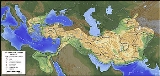
Seleucid Empire

Encyclopedia
The Seleucid Empire was a Greek-Macedonian
state that was created out of the eastern conquests of Alexander the Great. At the height of its power, it included central Anatolia
, the Levant
, Mesopotamia
, Persia, today's Turkmenistan
, Pamir
and parts of Pakistan
.
The Seleucid Empire was a major centre of Hellenistic culture which maintained the preeminence of Greek
customs and where a Greek-Macedonian
political elite dominated, mostly in the urban areas. The Greek population of the cities who formed the dominant elite were reinforced by emigration from Greece
. Seleucid expansion into Greece was abruptly halted after decisive defeats at the hands of the Roman army
. Much of the eastern part of the empire was conquered by the Parthians
under Mithridates I of Parthia
in the mid-2nd century BC, yet the Seleucid kings continued to rule a rump state
from Syria
until the invasion by Armenian king Tigranes the Great
and their ultimate overthrow by the Roman
general Pompey
.
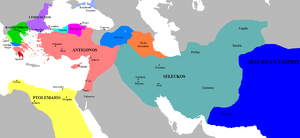
within a short time-frame and died young, leaving an expansive empire of partly Hellenised culture without an adult heir. The empire was put under the authority of a regent in the person of Perdiccas
in 323 BC, and the territories were divided between Alexander's generals, who thereby became satrap
s, at the Partition of Babylon
in 323 B.C.
 Alexander's generals (the Diadochi
) jostled for supremacy over parts of his empire, and Ptolemy
, one of his generals and satrap of Egypt
, was the first to challenge the new rule, leading to the demise of Perdiccas. His revolt led to a new partition of the empire with the Partition of Triparadisus
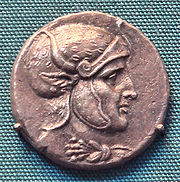
in 320 BC. Seleucus
, who had been "Commander-in-Chief of the camp" under Perdiccas since 323 BC but helped to assassinate him later, received Babylonia
, and from that point continued to expand his dominions ruthlessly. Seleucus established himself in Babylon
in 312 BC, used as the foundation date of the Seleucid Empire. He ruled over not only Babylonia, but the entire enormous eastern part of Alexander's empire:
Seleucus
went as far as India
, where he reached an agreement with Chandragupta Maurya
, in which he exchanged his eastern territories for a considerable force of 500 war elephants, which were to play a decisive role at Ipsus.
' victory over Antigonus Monophthalmus
at the decisive Battle of Ipsus
in 301 BC, Seleucus took control over eastern Anatolia
and northern Syria
.
In the latter area he founded a new capital at Antioch on the Orontes, a city he named after his father. An alternative capital was established at Seleucia on the Tigris
, north of Babylon. Seleucus' empire reached its greatest extent following his defeat of his erstwhile ally, Lysimachus, at Corupedion in 281 BC, after which Seleucus expanded his control to encompass western Anatolia. He hoped further to take control of Lysimachus' lands in Europe – primarily Thrace
and even Macedonia itself, but was assassinated by Ptolemy Ceraunus on landing in Europe.
His son and successor, Antiochus I Soter
, was left with an enormous realm consisting of nearly all of the Asian portions of the Empire, but faced with Antigonus II Gonatas
in Macedonia and Ptolemy II Philadelphus
in Egypt
, he proved unable to pick up where his father had left off in conquering the European portions of Alexander's empire.
(modern Punjab
Pakistan
) in 305 BC, confronting Chandragupta Maurya
(Sandrokottos), founder of the Maurya empire
. It is said that Chandragupta fielded an army of 600,000 men and 9,000 war elephants (Pliny, Natural History VI, 22.4).
Mainstream scholarship asserts that Chandragupta received vast territory, sealed in a treaty, west of the Indus, including the Hindu Kush
, modern day Afghanistan
, and the Balochistan
province of Pakistan
. Archaeologically, concrete indications of Mauryan rule, such as the inscriptions of the Edicts of Ashoka
, are known as far as Kandahar
in southern Afghanistan.
It is generally thought that Chandragupta married Seleucus's
daughter, or a Macedonian princess
, a gift from Seleucus to formalize an alliance. In a return gesture, Chandragupta sent 500 war
-elephants, a military asset which would play a decisive role at the Battle of Ipsus
in 301 BC. In addition to this treaty, Seleucus dispatched an ambassador, Megasthenes
, to Chandragupta, and later Deimakos
to his son Bindusara
, at the Mauryan court at Pataliputra (modern Patna
in Bihar state). Megasthenes wrote detailed descriptions of India and Chandragupta's reign, which have been partly preserved to us through Diodorus Siculus
. Later Ptolemy II Philadelphus
, the ruler of Ptolemaic Egypt
and contemporary of Ashoka the Great, is also recorded by Pliny the Elder
as having sent an ambassador named Dionysius
to the Mauryan court.
Other territories lost before Seleucus' death were Gedrosia
in the south-east of the Iranian plateau, and, to the north of this, Arachosia
on the west bank of the Indus River
.
Antiochus I (reigned 281–261 BC) and his son and successor Antiochus II Theos
(reigned 261–246 BC) were faced with challenges in the west, including repeated wars with Ptolemy II and a Celt
ic invasion of Asia Minor — distracting attention from holding the eastern portions of the Empire together. Towards the end of Antiochus II's reign, various provinces simultaneously asserted their independence, such as Bactria
under Diodotus, Parthia
under Arsaces
, and Cappadocia
under Ariarathes III
.
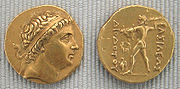 Diodotus, governor for the Bactria
n territory, asserted independence in around 245 BC, although the exact date is far from certain, to form the Greco-Bactrian kingdom. This kingdom was characterized by a rich Hellenistic culture, and was to continue its domination of Bactria until around 125 BC, when it was overrun by the invasion of northern nomads. One of the Greco-Bactrian kings, Demetrius I of Bactria
, invaded India around 180 BC to form the Greco-Indian kingdom, lasting until around AD 20.
The Seleucid satrap of Parthia, named Andragoras, first claimed independence, in a parallel to the secession of his Bactrian neighbour. Soon after however, a Parthian tribal chief called Arsaces
took over the Parthia
n territory around 238 BC to form the Arsacid Dynasty — the starting point of the powerful Parthian Empire
.
By the time Antiochus II's son Seleucus II Callinicus
came to the throne around 246 BC, the Seleucids seemed to be at a low ebb indeed. Seleucus II was soon dramatically defeated in the Third Syrian War against Ptolemy III of Egypt and then had to fight a civil war against his own brother Antiochus Hierax
. Taking advantage of this distraction, Bactria and Parthia seceded from the empire. In Asia Minor too, the Seleucid dynasty seemed to be losing control — Gauls had fully established themselves in Galatia
, semi-independent semi-Hellenized kingdoms had sprung up in Bithynia
, Pontus
, and Cappadocia
, and the city of Pergamum
in the west was asserting its independence under the Attalid Dynasty
.
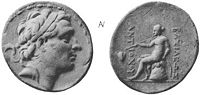
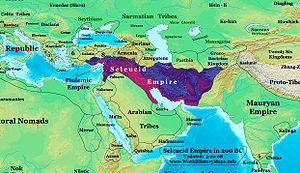 A revival would begin when Seleucus II's younger son, Antiochus III the Great
, took the throne in 223 BC. Although initially unsuccessful in the Fourth Syrian War against Egypt, which led to a defeat at the Battle of Raphia
(217 BC), Antiochus would prove himself to be the greatest of the Seleucid rulers after Seleucus I himself. He spent the next ten years on his anabasis through the eastern parts of his domain and restoring rebellious vassals like Parthia and Greco-Bactria to at least nominal obedience, and even emulating Alexander with an expedition into India where he met with king Sophagasenus
receiving war elephants:
When he returned to the west in 205 BC, Antiochus found that with the death of Ptolemy IV, the situation now looked propitious for another western campaign. Antiochus and Philip V of Macedon
then made a pact to divide the Ptolemaic possessions outside of Egypt, and in the Fifth Syrian War, the Seleucids ousted Ptolemy V from control of Coele-Syria
. The Battle of Panium
(198 BC) definitively transferred these holdings from the Ptolemies to the Seleucids. Antiochus appeared, at the least, to have restored the Seleucid Kingdom to glory.
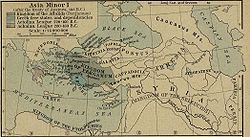
Following his erstwhile ally Philip's
defeat by Rome in 197 BC, Antiochus saw the opportunity for expansion into Greece itself. Encouraged by the exiled Carthaginian
general Hannibal, and making an alliance with the disgruntled Aetolian League
, Antiochus launched an invasion across the Hellespont. With his huge army he was intent upon establishing the Seleucid empire as the foremost power in the Hellenic world but these plans put the empire on a collision course with the new superpower of the Mediterranean, the Roman Republic
. At the battles of Thermopylae
and Magnesia
, Antiochus's forces were resoundingly defeated and he was compelled to make peace and sign the Treaty of Apamea
in (188 BC), the main clause of which saw the Seleucids agree to pay a large indemnity, retreat from Anatolia
and to never again attempt to expand Seleucid territory west of the Taurus Mountains
. The Kingdom of Pergamum and the Republic of Rhodes, Rome's allies in the war, were given the former Seleucid lands in Anatolia. Antiochus died in 187 BC on another expedition to the east, where he sought to extract money to pay the indemnity.
(187-175 BC) was largely spent in attempts to pay the large indemnity, and Seleucus was ultimately assassinated by his minister Heliodorus
. Seleucus' younger brother, Antiochus IV Epiphanes
, now seized the throne. He attempted to restore Seleucid power and prestige with a successful war against the old enemy, Ptolemaic Egypt
, which met with initial success as the Seleucids defeated and drove the Egyptian army back to Alexandria
itself. As the king planned on how to conclude the war, he was informed that Roman commissioners, led by the Proconsul
Gaius Popillius Laenas
, were near and requesting a meeting with the Seleucid king. Antiochus agreed, but when they met and Antiochos held out his hand in friendship, Popilius placed in his hand the tablets on which was written the decree of the senate and telling him to read it. When the king said that he would call his friends into council and consider what he ought to do, Popilius drew a circle in the sand around the king's feet with the stick he was carrying and said, "Before you step out of that circle give me a reply to lay before the senate." For a few moments he hesitated, astounded at such a peremptory order, and at last replied, "I will do what the senate thinks right." He then chose to withdraw rather than set the empire to war with Rome again.
The latter part of his reign saw a further disintegration of the Empire despite his best efforts. Weakened economically, militarily and by loss of prestige, the Empire became vulnerable to rebels in the eastern areas of the empire, who began to further undermine the empire while the Parthians moved into the power vacuum to take over the old Persian lands. Antiochus' aggressive Hellenizing (or de-Judaizing) activities provoked a full scale armed rebellion in Judea
—the Maccabean Revolt. Efforts to deal with both the Parthians, the Jews and retain control of the provinces at the same time proved beyond the weakened empire's power, Antiochus died during a military expedition against the Parthians in 164 BC.
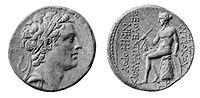
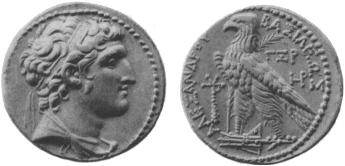 After the death of Antiochus IV Epiphanes
, the Seleucid Empire became increasingly unstable. Frequent civil wars made central authority tenuous at best. Epiphanes' young son, Antiochus V Eupator, was first overthrown by Seleucus IV's son, Demetrius I Soter
in 161 BC. Demetrius I attempted to restore Seleucid power in Judea
particularly, but was overthrown in 150 BC by Alexander Balas
— an impostor who (with Egyptian backing) claimed to be the son of Epiphanes. Alexander Balas reigned until 145 BC, when he was overthrown by Demetrius I's son, Demetrius II Nicator
. Demetrius II proved unable to control the whole of the kingdom, however. While he ruled Babylonia
and eastern Syria
from Damascus
, the remnants of Balas' supporters — first supporting Balas' son Antiochus VI, then the usurping general Diodotus Tryphon
— held out in Antioch
.
Meanwhile, the decay of the Empire's territorial possessions continued apace. By 143 BC, the Jews in form of the Maccabees
had fully established their independence. Parthia
n expansion continued as well. In 139 BC, Demetrius II was defeated in battle by the Parthians and was captured. By this time, the entire Iranian Plateau had been lost to Parthian control.
Demetrius Nicator's brother, Antiochus VII Sidetes
, took the throne after his brother's capture. He faced the titanic chore of restoring a rapidly crumbling empire; one facing threats on multiple fronts. Hard-won control of Coele-Syria
was threatened by the Jewish Maccabee rebels. Once-vassal dynasties in Armenia, Cappadocia, and Pontus were threatening Syria and northern Mesopotamia
; the nomadic Parthians, brilliantly led by Mithridates I of Parthia
had overrun uppland Media (home of the famed Nisean horse
herd); and Roman intervention was an ever-present threat. Sidetes managed to bring the Maccabees to heal; frighten the Anatolian dynasts into a temporary submission; and then, in 133, turned east with the full might of the Royal Army (supported by a body of Jews under the Maccabee prince, John Hyrcanus) to drive back the Parthians.
Sidetes' campaign initially met with spectacular success, recapturing Mesopotamia, Babylonia and Media; defeating and slaying the Parthian Satrap of Seleucia-on-Tigris in personal combat. In the winter of 130/129 BC, his army was scattered in winter quarters throughout Media and Persis when the Parthian king, Phraates II, counter-attacked. Moving to intercept the Parthians with only the troops at his immediate disposal, he was ambushed and killed. Antiochus Sidetes is sometimes called the last great Seleucid king.
After the death of Antiochus VII Sidetes, all of the recovered eastern territories were recaptured by the Parthians. The Maccabees again rebelled, and civil war soon tore the empire to pieces. And the Armenians began to encroach on Syria from the north.
and some Syrian cities. Despite the clear collapse of their power, and the decline of their kingdom around them, nobles continued to play kingmakers on a regular basis, with occasional intervention from Ptolemaic Egypt
and other outside powers. The Seleucids existed solely because no other nation wished to absorb them — seeing as they constituted a useful buffer between their other neighbours. In the wars in Anatolia between Mithridates VI of Pontus
and Sulla of Rome, the Seleucids were largely left alone by both major combatants.
Mithridates' ambitious son-in-law, Tigranes the Great
, king of Armenia, however, saw opportunity for expansion in the constant civil strife to the south. In 83 BC, at the invitation of one of the factions in the interminable civil wars, he invaded Syria, and soon established himself as ruler of Syria, putting the Seleucid Empire virtually at an end.
Seleucid rule was not entirely over, however. Following the Roman general Lucullus
' defeat of both Mithridates and Tigranes in 69 BC, a rump Seleucid kingdom was restored under Antiochus XIII. Even now, civil wars could not be prevented, as another Seleucid, Philip II
, contested rule with Antiochus. After the Roman conquest of Pontus, the Romans became increasingly alarmed at the constant source of instability in Syria under the Seleucids. Once Mithridates was defeated by Pompey
in 63 BC, Pompey set about the task of remaking the Hellenistic East, by creating new client kingdoms and establishing provinces. While client nations like Armenia
and Judea
were allowed to continue with some degree of autonomy under local kings, Pompey saw the Seleucids as too troublesome to continue; and doing away with both rival Seleucid princes, he made Syria into a Roman province.
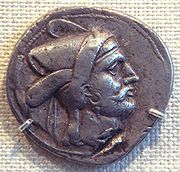 The Seleucid empire's geographic span, from the Aegean Sea
to what is now Afghanistan
and Pakistan
, created a melting pot of various peoples, such as Greeks
, Armenians
, Persians
, Medes
, Assyrians
, and Jews. The immense size of the empire, followed by its encompassing nature, made the Seleucid rulers have a governing interest in implementing a policy of racial unity initiated by Alexander. The Hellenization
of the Seleucid empire was achieved by the establishment of Greek cities throughout the empire. Historically significant towns and cities, such as Antioch
, were created or renamed with more appropriate Greek
names. The creation of new Greek
cities and towns was aided by the fact that the Greek mainland was overpopulated and therefore made the vast Seleucid empire ripe for colonization. Colonization was used to further Greek interest while facilitating the assimilation of many native groups. Socially, this led to the adoption of Greek practices and customs by the educated native classes in order to further themselves in public life and the ruling Macedonian
class gradually adopted some of the local traditions. By 313 BC, Hellenic ideas had begun their almost 250-year expansion into the Near East, Middle East, and Central Asian cultures. It was the empire's governmental framework to rule by establishing hundreds of cities for trade and occupational purposes. Many of the existing cities began — or were compelled by force — to adopt Hellenized philosophic thought, religious sentiments, and politics. Synthesizing Hellenic and indigenous cultural, religious, and philosophical ideas met with varying degrees of success — resulting in times of simultaneous peace and rebellion in various parts of the empire. Such was the case with the Jewish population of the Seleucid empire because the Jews posed a significant problem which eventually led to war. Contrary to the accepting nature of the Ptolemaic
empire towards native religions and customs, the Seleucids gradually tried to force Hellenization upon the Jewish people in their territory by outlawing Judaism. This eventually led to the revolt of the Jews under Seleucid control, which would later lead to the Jews achieving independence.
in 2010, which is said to be dating back to the rule of the Iraq-based Seleucid Empire, it is at the Israel Museum
, in Jerusalem. Archaeologists say they have excavated the heaviest and most valuable gold coin to date in Israel
. The Seleucid empire coin is six times the weight of previous finds from the same era and may bear the image of Cleopatra I Syra, the wife of the Egyptian king Ptolemy V.
Ancient Macedonians
The Macedonians originated from inhabitants of the northeastern part of the Greek peninsula, in the alluvial plain around the rivers Haliacmon and lower Axios...
state that was created out of the eastern conquests of Alexander the Great. At the height of its power, it included central Anatolia
Anatolia
Anatolia is a geographic and historical term denoting the westernmost protrusion of Asia, comprising the majority of the Republic of Turkey...
, the Levant
Levant
The Levant or ) is the geographic region and culture zone of the "eastern Mediterranean littoral between Anatolia and Egypt" . The Levant includes most of modern Lebanon, Syria, Jordan, Israel, the Palestinian territories, and sometimes parts of Turkey and Iraq, and corresponds roughly to the...
, Mesopotamia
Mesopotamia
Mesopotamia is a toponym for the area of the Tigris–Euphrates river system, largely corresponding to modern-day Iraq, northeastern Syria, southeastern Turkey and southwestern Iran.Widely considered to be the cradle of civilization, Bronze Age Mesopotamia included Sumer and the...
, Persia, today's Turkmenistan
Turkmenistan
Turkmenistan , formerly also known as Turkmenia is one of the Turkic states in Central Asia. Until 1991, it was a constituent republic of the Soviet Union, the Turkmen Soviet Socialist Republic . Turkmenistan is one of the six independent Turkic states...
, Pamir
Pamir Mountains
The Pamir Mountains are a mountain range in Central Asia formed by the junction or knot of the Himalayas, Tian Shan, Karakoram, Kunlun, and Hindu Kush ranges. They are among the world’s highest mountains and since Victorian times they have been known as the "Roof of the World" a probable...
and parts of Pakistan
Pakistan
Pakistan , officially the Islamic Republic of Pakistan is a sovereign state in South Asia. It has a coastline along the Arabian Sea and the Gulf of Oman in the south and is bordered by Afghanistan and Iran in the west, India in the east and China in the far northeast. In the north, Tajikistan...
.
The Seleucid Empire was a major centre of Hellenistic culture which maintained the preeminence of Greek
Greeks
The Greeks, also known as the Hellenes , are a nation and ethnic group native to Greece, Cyprus and neighboring regions. They also form a significant diaspora, with Greek communities established around the world....
customs and where a Greek-Macedonian
Ancient Macedonians
The Macedonians originated from inhabitants of the northeastern part of the Greek peninsula, in the alluvial plain around the rivers Haliacmon and lower Axios...
political elite dominated, mostly in the urban areas. The Greek population of the cities who formed the dominant elite were reinforced by emigration from Greece
Ancient Greece
Ancient Greece is a civilization belonging to a period of Greek history that lasted from the Archaic period of the 8th to 6th centuries BC to the end of antiquity. Immediately following this period was the beginning of the Early Middle Ages and the Byzantine era. Included in Ancient Greece is the...
. Seleucid expansion into Greece was abruptly halted after decisive defeats at the hands of the Roman army
Roman army
The Roman army is the generic term for the terrestrial armed forces deployed by the kingdom of Rome , the Roman Republic , the Roman Empire and its successor, the Byzantine empire...
. Much of the eastern part of the empire was conquered by the Parthians
Parthian Empire
The Parthian Empire , also known as the Arsacid Empire , was a major Iranian political and cultural power in ancient Persia...
under Mithridates I of Parthia
Mithridates I of Parthia
Mithridates or Mithradates I was the "Great King" of Parthia from ca. 171 BC - 138 BC, succeeding his brother Phraates I. His father was King Phriapatius of Parthia, who died ca. 176 BC). Mithridates I made Parthia into a major political power by expanding the empire to the east, south, and west...
in the mid-2nd century BC, yet the Seleucid kings continued to rule a rump state
Rump state
A rump state is the remnant of a once-larger government, left with limited powers or authority after a disaster, invasion, military occupation, secession or partial overthrowing of a government. In the last case, a government stops short of going in exile because it still controls part of its...
from Syria
Syria
Syria , officially the Syrian Arab Republic , is a country in Western Asia, bordering Lebanon and the Mediterranean Sea to the West, Turkey to the north, Iraq to the east, Jordan to the south, and Israel to the southwest....
until the invasion by Armenian king Tigranes the Great
Tigranes the Great
Tigranes the Great was emperor of Armenia under whom the country became, for a short time, the strongest state east of the Roman Republic. He was a member of the Artaxiad Royal House...
and their ultimate overthrow by the Roman
Ancient Rome
Ancient Rome was a thriving civilization that grew on the Italian Peninsula as early as the 8th century BC. Located along the Mediterranean Sea and centered on the city of Rome, it expanded to one of the largest empires in the ancient world....
general Pompey
Pompey
Gnaeus Pompeius Magnus, also known as Pompey or Pompey the Great , was a military and political leader of the late Roman Republic...
.
Partition of Alexander's empire
Alexander conquered the Achaemenid EmpireAchaemenid Empire
The Achaemenid Empire , sometimes known as First Persian Empire and/or Persian Empire, was founded in the 6th century BCE by Cyrus the Great who overthrew the Median confederation...
within a short time-frame and died young, leaving an expansive empire of partly Hellenised culture without an adult heir. The empire was put under the authority of a regent in the person of Perdiccas
Perdiccas
Perdiccas was one of Alexander the Great's generals. After Alexander's death in 323 BC he became regent of all Alexander's empire.Arrian tells us he was son of Orontes, a descendant of the independent princes of the Macedonian province of Orestis...
in 323 BC, and the territories were divided between Alexander's generals, who thereby became satrap
Satrap
Satrap was the name given to the governors of the provinces of the ancient Median and Achaemenid Empires and in several of their successors, such as the Sassanid Empire and the Hellenistic empires....
s, at the Partition of Babylon
Partition of Babylon
The Partition of Babylon designates the attribution of the territories of Alexander the Great between his generals after his death in 323 BC.-Background:...
in 323 B.C.
Rise of Seleucus
Diadochi
The Diadochi were the rival generals, family and friends of Alexander the Great who fought for the control of Alexander's empire after his death in 323 BC...
) jostled for supremacy over parts of his empire, and Ptolemy
Ptolemy I Soter
Ptolemy I Soter I , also known as Ptolemy Lagides, c. 367 BC – c. 283 BC, was a Macedonian general under Alexander the Great, who became ruler of Egypt and founder of both the Ptolemaic Kingdom and the Ptolemaic Dynasty...
, one of his generals and satrap of Egypt
Egypt
Egypt , officially the Arab Republic of Egypt, Arabic: , is a country mainly in North Africa, with the Sinai Peninsula forming a land bridge in Southwest Asia. Egypt is thus a transcontinental country, and a major power in Africa, the Mediterranean Basin, the Middle East and the Muslim world...
, was the first to challenge the new rule, leading to the demise of Perdiccas. His revolt led to a new partition of the empire with the Partition of Triparadisus
Partition of Triparadisus
The Partition of Triparadisus was a power-sharing agreement passed at Triparadisus in 321 BCE between the generals of Alexander the Great, in which they named a new regent and established the repartition of their satrapies...
in 320 BC. Seleucus
Seleucus I Nicator
Seleucus I was a Macedonian officer of Alexander the Great and one of the Diadochi. In the Wars of the Diadochi that took place after Alexander's death, Seleucus established the Seleucid dynasty and the Seleucid Empire...
, who had been "Commander-in-Chief of the camp" under Perdiccas since 323 BC but helped to assassinate him later, received Babylonia
Babylonia
Babylonia was an ancient cultural region in central-southern Mesopotamia , with Babylon as its capital. Babylonia emerged as a major power when Hammurabi Babylonia was an ancient cultural region in central-southern Mesopotamia (present-day Iraq), with Babylon as its capital. Babylonia emerged as...
, and from that point continued to expand his dominions ruthlessly. Seleucus established himself in Babylon
Babylon
Babylon was an Akkadian city-state of ancient Mesopotamia, the remains of which are found in present-day Al Hillah, Babil Province, Iraq, about 85 kilometers south of Baghdad...
in 312 BC, used as the foundation date of the Seleucid Empire. He ruled over not only Babylonia, but the entire enormous eastern part of Alexander's empire:
Seleucus
Seleucus
-Monarchs and relations of the Seleucid Empire:* Seleucus I Nicator , son of Antiochus and founder of the Seleucid Empire* Seleucus II Callinicus * Seleucus III Ceraunus...
went as far as India
India
India , officially the Republic of India , is a country in South Asia. It is the seventh-largest country by geographical area, the second-most populous country with over 1.2 billion people, and the most populous democracy in the world...
, where he reached an agreement with Chandragupta Maurya
Chandragupta Maurya
Chandragupta Maurya , was the founder of the Maurya Empire. Chandragupta succeeded in conquering most of the Indian subcontinent. Chandragupta is considered the first unifier of India and its first genuine emperor...
, in which he exchanged his eastern territories for a considerable force of 500 war elephants, which were to play a decisive role at Ipsus.
Westward expansion
Following his and LysimachusLysimachus
Lysimachus was a Macedonian officer and diadochus of Alexander the Great, who became a basileus in 306 BC, ruling Thrace, Asia Minor and Macedon.-Early Life & Career:...
' victory over Antigonus Monophthalmus
Antigonus I Monophthalmus
Antigonus I Monophthalmus , son of Philip from Elimeia, was a Macedonian nobleman, general, and satrap under Alexander the Great. During his early life he served under Philip II, and he was a major figure in the Wars of the Diadochi after Alexander's death, declaring himself king in 306 BC and...
at the decisive Battle of Ipsus
Battle of Ipsus
The Battle of Ipsus was fought between some of the Diadochi in 301 BC near the village of that name in Phrygia...
in 301 BC, Seleucus took control over eastern Anatolia
Anatolia
Anatolia is a geographic and historical term denoting the westernmost protrusion of Asia, comprising the majority of the Republic of Turkey...
and northern Syria
Syria
Syria , officially the Syrian Arab Republic , is a country in Western Asia, bordering Lebanon and the Mediterranean Sea to the West, Turkey to the north, Iraq to the east, Jordan to the south, and Israel to the southwest....
.
In the latter area he founded a new capital at Antioch on the Orontes, a city he named after his father. An alternative capital was established at Seleucia on the Tigris
Seleucia on the Tigris
Seleucia , also known as Seleucia on the Tigris, was one of the great cities of the world during Hellenistic and Roman times. It stood in Mesopotamia, on the west bank of the Tigris River, opposite the smaller town of Ctesiphon, in present day Babil Governorate, Iraq.-Seleucid empire:Seleucia,...
, north of Babylon. Seleucus' empire reached its greatest extent following his defeat of his erstwhile ally, Lysimachus, at Corupedion in 281 BC, after which Seleucus expanded his control to encompass western Anatolia. He hoped further to take control of Lysimachus' lands in Europe – primarily Thrace
Thrace
Thrace is a historical and geographic area in southeast Europe. As a geographical concept, Thrace designates a region bounded by the Balkan Mountains on the north, Rhodope Mountains and the Aegean Sea on the south, and by the Black Sea and the Sea of Marmara on the east...
and even Macedonia itself, but was assassinated by Ptolemy Ceraunus on landing in Europe.
His son and successor, Antiochus I Soter
Antiochus I Soter
Antiochus I Soter , was a king of the Hellenistic Seleucid Empire. He reigned from 281 BC - 261 BC....
, was left with an enormous realm consisting of nearly all of the Asian portions of the Empire, but faced with Antigonus II Gonatas
Antigonus II Gonatas
Antigonus II Gonatas was a powerful ruler who firmly established the Antigonid dynasty in Macedonia and acquired fame for his victory over the Gauls who had invaded the Balkans.-Birth and family:...
in Macedonia and Ptolemy II Philadelphus
Ptolemy II Philadelphus
Ptolemy II Philadelphus was the king of Ptolemaic Egypt from 283 BCE to 246 BCE. He was the son of the founder of the Ptolemaic kingdom Ptolemy I Soter and Berenice, and was educated by Philitas of Cos...
in Egypt
Egypt
Egypt , officially the Arab Republic of Egypt, Arabic: , is a country mainly in North Africa, with the Sinai Peninsula forming a land bridge in Southwest Asia. Egypt is thus a transcontinental country, and a major power in Africa, the Mediterranean Basin, the Middle East and the Muslim world...
, he proved unable to pick up where his father had left off in conquering the European portions of Alexander's empire.
An overextended domain
Nevertheless, even before Seleucus' death, it was difficult to assert control over the vast eastern domains of the Seleucids. Seleucus invaded IndiaHistory of India
The history of India begins with evidence of human activity of Homo sapiens as long as 75,000 years ago, or with earlier hominids including Homo erectus from about 500,000 years ago. The Indus Valley Civilization, which spread and flourished in the northwestern part of the Indian subcontinent from...
(modern Punjab
Punjab region
The Punjab , also spelled Panjab |water]]s"), is a geographical region straddling the border between Pakistan and India which includes Punjab province in Pakistan and the states of the Punjab, Haryana, Himachal Pradesh, Chandigarh and some northern parts of the National Capital Territory of Delhi...
Pakistan
History of Pakistan
The 1st known inhabitants of the modern-day Pakistan region are believed to have been the Soanian , who settled in the Soan Valley and Riwat almost 2 million years ago. Over the next several thousand years, the region would develop into various civilizations like Mehrgarh and the Indus Valley...
) in 305 BC, confronting Chandragupta Maurya
Chandragupta Maurya
Chandragupta Maurya , was the founder of the Maurya Empire. Chandragupta succeeded in conquering most of the Indian subcontinent. Chandragupta is considered the first unifier of India and its first genuine emperor...
(Sandrokottos), founder of the Maurya empire
Maurya Empire
The Maurya Empire was a geographically extensive Iron Age historical power in ancient India, ruled by the Mauryan dynasty from 321 to 185 BC...
. It is said that Chandragupta fielded an army of 600,000 men and 9,000 war elephants (Pliny, Natural History VI, 22.4).
Mainstream scholarship asserts that Chandragupta received vast territory, sealed in a treaty, west of the Indus, including the Hindu Kush
Hindu Kush
The Hindu Kush is an mountain range that stretches between central Afghanistan and northern Pakistan. The highest point in the Hindu Kush is Tirich Mir in the Chitral region of Khyber-Pakhtunkhwa, Pakistan.It is the westernmost extension of the Pamir Mountains, the Karakoram Range, and is a...
, modern day Afghanistan
Afghanistan
Afghanistan , officially the Islamic Republic of Afghanistan, is a landlocked country located in the centre of Asia, forming South Asia, Central Asia and the Middle East. With a population of about 29 million, it has an area of , making it the 42nd most populous and 41st largest nation in the world...
, and the Balochistan
Balochistan (region)
Balochistan or Baluchistan is an arid, mountainous region in the Iranian plateau in Southwest Asia; it includes part of southeastern Iran, western Pakistan, and southwestern Afghanistan. The area is named after the numerous Baloch tribes, Iranian peoples who moved into the area from the west...
province of Pakistan
Pakistan
Pakistan , officially the Islamic Republic of Pakistan is a sovereign state in South Asia. It has a coastline along the Arabian Sea and the Gulf of Oman in the south and is bordered by Afghanistan and Iran in the west, India in the east and China in the far northeast. In the north, Tajikistan...
. Archaeologically, concrete indications of Mauryan rule, such as the inscriptions of the Edicts of Ashoka
Edicts of Ashoka
The Edicts of Ashoka are a collection of 33 inscriptions on the Pillars of Ashoka, as well as boulders and cave walls, made by the Emperor Ashoka of the Mauryan dynasty during his reign from 269 BCE to 231 BCE. These inscriptions are dispersed throughout the areas of modern-day Bangladesh, India,...
, are known as far as Kandahar
Kandahar
Kandahar is the second largest city in Afghanistan, with a population of about 512,200 as of 2011. It is the capital of Kandahar Province, located in the south of the country at about 1,005 m above sea level...
in southern Afghanistan.
It is generally thought that Chandragupta married Seleucus's
Seleucus I Nicator
Seleucus I was a Macedonian officer of Alexander the Great and one of the Diadochi. In the Wars of the Diadochi that took place after Alexander's death, Seleucus established the Seleucid dynasty and the Seleucid Empire...
daughter, or a Macedonian princess
Princess
Princess is the feminine form of prince . Most often, the term has been used for the consort of a prince, or his daughters....
, a gift from Seleucus to formalize an alliance. In a return gesture, Chandragupta sent 500 war
War
War is a state of organized, armed, and often prolonged conflict carried on between states, nations, or other parties typified by extreme aggression, social disruption, and usually high mortality. War should be understood as an actual, intentional and widespread armed conflict between political...
-elephants, a military asset which would play a decisive role at the Battle of Ipsus
Battle of Ipsus
The Battle of Ipsus was fought between some of the Diadochi in 301 BC near the village of that name in Phrygia...
in 301 BC. In addition to this treaty, Seleucus dispatched an ambassador, Megasthenes
Megasthenes
Megasthenes was a Greek ethnographer in the Hellenistic period, author of the work Indica.He was born in Asia Minor and became an ambassador of Seleucus I of Syria possibly to Chandragupta Maurya in Pataliputra, India. However the exact date of his embassy is uncertain...
, to Chandragupta, and later Deimakos
Deimakos
Deimachus , , was a Greek of the Seleucid Empire. He became an ambassador to the court of Bindusara "Amitragata" in Pataliputra in India....
to his son Bindusara
Bindusara
Bindusara was the second Mauryan emperor after Chandragupta Maurya. During his reign, the empire expanded southwards. He had two well-known sons, Susima and Ashoka, who were the viceroys of Taxila and Ujjain...
, at the Mauryan court at Pataliputra (modern Patna
Patna
Paṭnā , is the capital of the Indian state of Bihar and the second largest city in Eastern India . Patna is one of the oldest continuously inhabited places in the world...
in Bihar state). Megasthenes wrote detailed descriptions of India and Chandragupta's reign, which have been partly preserved to us through Diodorus Siculus
Diodorus Siculus
Diodorus Siculus was a Greek historian who flourished between 60 and 30 BC. According to Diodorus' own work, he was born at Agyrium in Sicily . With one exception, antiquity affords no further information about Diodorus' life and doings beyond what is to be found in his own work, Bibliotheca...
. Later Ptolemy II Philadelphus
Ptolemy II Philadelphus
Ptolemy II Philadelphus was the king of Ptolemaic Egypt from 283 BCE to 246 BCE. He was the son of the founder of the Ptolemaic kingdom Ptolemy I Soter and Berenice, and was educated by Philitas of Cos...
, the ruler of Ptolemaic Egypt
Ptolemaic Egypt
Ptolemaic Egypt began when Ptolemy I Soter invaded Egypt and declared himself Pharaoh of Egypt in 305 BC and ended with the death of queen Cleopatra VII of Egypt and the Roman conquest in 30 BC. The Ptolemaic Kingdom was a powerful Hellenistic state, extending from southern Syria in the east, to...
and contemporary of Ashoka the Great, is also recorded by Pliny the Elder
Pliny the Elder
Gaius Plinius Secundus , better known as Pliny the Elder, was a Roman author, naturalist, and natural philosopher, as well as naval and army commander of the early Roman Empire, and personal friend of the emperor Vespasian...
as having sent an ambassador named Dionysius
Dionysius (ambassador)
Dionysius was a Greek of the 3rd century BCE, who was sent as ambassador to the court of the Indian emperor Ashoka, by Ptolemy Philadelphus.He was preceded in this role by Megasthenes, ambassador to Chandragupta Maurya, and Deimachus, ambassador to his son, and father of Ashoka, Bindusara.Dionysius...
to the Mauryan court.
Other territories lost before Seleucus' death were Gedrosia
Gedrosia
Gedrosia from Pashto Gwadar-khua is the hellenized name of an area that corresponds to today's Balochistan. Eastern Balochistan is southwestern province of Pakistan and parts of southwestern and south-central Afghanistan and western Balochistan is divided between Iranian provinces of Hormozgan and...
in the south-east of the Iranian plateau, and, to the north of this, Arachosia
Arachosia
Arachosia is the Latinized form of the Greek name of an Achaemenid and Seleucid governorate in the eastern part of their respective empires, around modern-day southern Afghanistan. The Greek term "Arachosia" corresponds to the Iranian land of Harauti which was between Kandahar in Afghanistan and...
on the west bank of the Indus River
Indus River
The Indus River is a major river which flows through Pakistan. It also has courses through China and India.Originating in the Tibetan plateau of western China in the vicinity of Lake Mansarovar in Tibet Autonomous Region, the river runs a course through the Ladakh district of Jammu and Kashmir and...
.
Antiochus I (reigned 281–261 BC) and his son and successor Antiochus II Theos
Antiochus II Theos
Antiochus II Theos was a king of the Hellenistic Seleucid Kingdom who reigned 261 BC – 246 BC). He succeeded his father Antiochus I Soter in the winter of 262–61 BC...
(reigned 261–246 BC) were faced with challenges in the west, including repeated wars with Ptolemy II and a Celt
Celt
The Celts were a diverse group of tribal societies in Iron Age and Roman-era Europe who spoke Celtic languages.The earliest archaeological culture commonly accepted as Celtic, or rather Proto-Celtic, was the central European Hallstatt culture , named for the rich grave finds in Hallstatt, Austria....
ic invasion of Asia Minor — distracting attention from holding the eastern portions of the Empire together. Towards the end of Antiochus II's reign, various provinces simultaneously asserted their independence, such as Bactria
Bactria
Bactria and also appears in the Zend Avesta as Bukhdi. It is the ancient name of a historical region located between south of the Amu Darya and west of the Indus River...
under Diodotus, Parthia
Parthia
Parthia is a region of north-eastern Iran, best known for having been the political and cultural base of the Arsacid dynasty, rulers of the Parthian Empire....
under Arsaces
Arsaces
Arsaces is the eponymous Greek form of the dynastic name adopted by all epigraphically attested rulers of the 'phil-hellenenic' Arsacid dynasties. The indigenous Parthian and Armenian form was Arshak....
, and Cappadocia
Cappadocia
Cappadocia is a historical region in Central Anatolia, largely in Nevşehir Province.In the time of Herodotus, the Cappadocians were reported as occupying the whole region from Mount Taurus to the vicinity of the Euxine...
under Ariarathes III
Ariarathes III of Cappadocia
Ariarathes III , son of Ariamnes, ruler of Cappadocia, and grandson of Ariarathes II, married Stratonice, a daughter of Antiochus II, king of Syria and wife Laodice I, and obtained a share in the government during the life-time of his father. About 250 BC he was the first ruler of Cappadocia to...
.
Bactria
Bactria and also appears in the Zend Avesta as Bukhdi. It is the ancient name of a historical region located between south of the Amu Darya and west of the Indus River...
n territory, asserted independence in around 245 BC, although the exact date is far from certain, to form the Greco-Bactrian kingdom. This kingdom was characterized by a rich Hellenistic culture, and was to continue its domination of Bactria until around 125 BC, when it was overrun by the invasion of northern nomads. One of the Greco-Bactrian kings, Demetrius I of Bactria
Demetrius I of Bactria
Demetrius I was a Buddhist Greco-Bactrian king . He was the son of Euthydemus and succeeded him around 200 BC, after which he conquered extensive areas in what now is eastern Iran, Afghanistan and Pakistan thus creating an Indo-Greek kingdom far from Hellenistic Greece...
, invaded India around 180 BC to form the Greco-Indian kingdom, lasting until around AD 20.
The Seleucid satrap of Parthia, named Andragoras, first claimed independence, in a parallel to the secession of his Bactrian neighbour. Soon after however, a Parthian tribal chief called Arsaces
Arsaces I of Parthia
Arsaces I was the founder of the Arsacid dynasty, and after whom all 30+ monarchs of the Arsacid empire officially named themselves. A celebrated descent from antiquity begins with Arsaces.A 1st century AD tradition casts Arsaces as descending from the 5th-century BC Achaemenid monarch...
took over the Parthia
Parthia
Parthia is a region of north-eastern Iran, best known for having been the political and cultural base of the Arsacid dynasty, rulers of the Parthian Empire....
n territory around 238 BC to form the Arsacid Dynasty — the starting point of the powerful Parthian Empire
Parthian Empire
The Parthian Empire , also known as the Arsacid Empire , was a major Iranian political and cultural power in ancient Persia...
.
By the time Antiochus II's son Seleucus II Callinicus
Seleucus II Callinicus
Seleucus II Callinicus or Pogon , was a ruler of the Hellenistic Seleucid Empire, who reigned from 246 to 225 BC...
came to the throne around 246 BC, the Seleucids seemed to be at a low ebb indeed. Seleucus II was soon dramatically defeated in the Third Syrian War against Ptolemy III of Egypt and then had to fight a civil war against his own brother Antiochus Hierax
Antiochus Hierax
Antiochus Hierax , or Antiochus III, , so called from his grasping and ambitious character, was the younger son of Antiochus II and Laodice I and separatist leader in the Hellenistic Seleucid kingdom, who ruled as king of Syria during his brother's reign.On the death of his father, in 246 BCE,...
. Taking advantage of this distraction, Bactria and Parthia seceded from the empire. In Asia Minor too, the Seleucid dynasty seemed to be losing control — Gauls had fully established themselves in Galatia
Galatia
Ancient Galatia was an area in the highlands of central Anatolia in modern Turkey. Galatia was named for the immigrant Gauls from Thrace , who settled here and became its ruling caste in the 3rd century BC, following the Gallic invasion of the Balkans in 279 BC. It has been called the "Gallia" of...
, semi-independent semi-Hellenized kingdoms had sprung up in Bithynia
Bithynia
Bithynia was an ancient region, kingdom and Roman province in the northwest of Asia Minor, adjoining the Propontis, the Thracian Bosporus and the Euxine .-Description:...
, Pontus
Pontus
Pontus or Pontos is a historical Greek designation for a region on the southern coast of the Black Sea, located in modern-day northeastern Turkey. The name was applied to the coastal region in antiquity by the Greeks who colonized the area, and derived from the Greek name of the Black Sea: Πόντος...
, and Cappadocia
Cappadocia
Cappadocia is a historical region in Central Anatolia, largely in Nevşehir Province.In the time of Herodotus, the Cappadocians were reported as occupying the whole region from Mount Taurus to the vicinity of the Euxine...
, and the city of Pergamum
Pergamon
Pergamon , or Pergamum, was an ancient Greek city in modern-day Turkey, in Mysia, today located from the Aegean Sea on a promontory on the north side of the river Caicus , that became the capital of the Kingdom of Pergamon during the Hellenistic period, under the Attalid dynasty, 281–133 BC...
in the west was asserting its independence under the Attalid Dynasty
Attalid dynasty
The Attalid dynasty was a Hellenistic dynasty that ruled the city of Pergamon after the death of Lysimachus, a general of Alexander the Great. The Attalid kingdom was the rump state left after the collapse of the Lysimachian Empire. One of Lysimachus' officers, Philetaerus, took control of the city...
.
Revival (223–191 BC)
Antiochus III the Great
Antiochus III the Great Seleucid Greek king who became the 6th ruler of the Seleucid Empire as a youth of about eighteen in 223 BC. Antiochus was an ambitious ruler who ruled over Greater Syria and western Asia towards the end of the 3rd century BC...
, took the throne in 223 BC. Although initially unsuccessful in the Fourth Syrian War against Egypt, which led to a defeat at the Battle of Raphia
Battle of Raphia
The Battle of Raphia, also known as the Battle of Gaza, was a battle fought on 22 June 217 BC near modern Rafah between the forces of Ptolemy IV Philopator, king of Egypt and Antiochus III the Great of the Seleucid kingdom during the Syrian Wars...
(217 BC), Antiochus would prove himself to be the greatest of the Seleucid rulers after Seleucus I himself. He spent the next ten years on his anabasis through the eastern parts of his domain and restoring rebellious vassals like Parthia and Greco-Bactria to at least nominal obedience, and even emulating Alexander with an expedition into India where he met with king Sophagasenus
Sophagasenus
Sophagasenos also spelt Sophagasenus or Sophagasenas was a local Indian king ruling in Kabul and Kapisa valley during the last decade of 3rd century BC. Sophagasnus finds reference only in "The Histories" of Polybius. The identity of Sophagasenus is not clear...
receiving war elephants:
"He (Antiochus) crossed the Caucasus and descended into India; renewed his friendship with Sophagasenus the king of the Indians; received more elephants, until he had a hundred and fifty altogether; and having once more provisioned his troops, set out again personally with his army: leaving Androsthenes of Cyzicus the duty of taking home the treasure which this king had agreed to hand over to him". Polybius 11.39
When he returned to the west in 205 BC, Antiochus found that with the death of Ptolemy IV, the situation now looked propitious for another western campaign. Antiochus and Philip V of Macedon
Philip V of Macedon
Philip V was King of Macedon from 221 BC to 179 BC. Philip's reign was principally marked by an unsuccessful struggle with the emerging power of Rome. Philip was attractive and charismatic as a young man...
then made a pact to divide the Ptolemaic possessions outside of Egypt, and in the Fifth Syrian War, the Seleucids ousted Ptolemy V from control of Coele-Syria
Coele-Syria
Coele-Syria , or Cœle-Syria or Celesyria, traditionally given the meaning 'hollow' Syria, was the region of southern Syria disputed between the Seleucid dynasty and the Ptolemaic dynasty. Rather than limiting the Greek term to the Beqaa Valley of Lebanon, it is often used to cover the entire area...
. The Battle of Panium
Battle of Panium
The Battle of Panium was fought in 200 BC between Seleucid and Ptolemaic forces as part of the Syrian Wars. The Seleucids were led by Antiochus III the Great, while the Ptolemaic army was led by Scopas of Aetolia. The Seleucids won the battle...
(198 BC) definitively transferred these holdings from the Ptolemies to the Seleucids. Antiochus appeared, at the least, to have restored the Seleucid Kingdom to glory.
Expansion into Greece/ War with Rome
Following his erstwhile ally Philip's
Philip V of Macedon
Philip V was King of Macedon from 221 BC to 179 BC. Philip's reign was principally marked by an unsuccessful struggle with the emerging power of Rome. Philip was attractive and charismatic as a young man...
defeat by Rome in 197 BC, Antiochus saw the opportunity for expansion into Greece itself. Encouraged by the exiled Carthaginian
Carthage
Carthage , implying it was a 'new Tyre') is a major urban centre that has existed for nearly 3,000 years on the Gulf of Tunis, developing from a Phoenician colony of the 1st millennium BC...
general Hannibal, and making an alliance with the disgruntled Aetolian League
Aetolian League
The Aetolian League was a confederation of tribal communities and cities in ancient Greece centered on Aetolia in central Greece. It was established, probably during the early Hellenistic era, in opposition to Macedon and the Achaean League. Two annual meetings were held in Thermika and Panaetolika...
, Antiochus launched an invasion across the Hellespont. With his huge army he was intent upon establishing the Seleucid empire as the foremost power in the Hellenic world but these plans put the empire on a collision course with the new superpower of the Mediterranean, the Roman Republic
Roman Republic
The Roman Republic was the period of the ancient Roman civilization where the government operated as a republic. It began with the overthrow of the Roman monarchy, traditionally dated around 508 BC, and its replacement by a government headed by two consuls, elected annually by the citizens and...
. At the battles of Thermopylae
Battle of Thermopylae (191 BC)
The Battle of Thermopylae was fought in 191 BC between a Roman army led by consul Manius Acilius Glabrio and a Seleucid force led by King Antiochus III the Great. The Romans were victorious, and as a result, Antiochus was forced to flee Greece. It was described by Appian and by Livy at...
and Magnesia
Battle of Magnesia
The Battle of Magnesia was fought in 190 BC near Magnesia ad Sipylum, on the plains of Lydia , between the Romans, led by the consul Lucius Cornelius Scipio and his brother, the famed general Scipio Africanus, with their ally Eumenes II of Pergamum against the army of Antiochus III the Great of the...
, Antiochus's forces were resoundingly defeated and he was compelled to make peace and sign the Treaty of Apamea
Treaty of Apamea
The Treaty of Apamea of 188 BC, was peace treaty between the Roman Republic and Antiochus III , ruler of the Seleucid Empire. It took place after the Romans' victories in the battle of Thermopylae , in the Battle of Magnesia , and after Roman and Rhodian naval victories over the Seleucid navy.In...
in (188 BC), the main clause of which saw the Seleucids agree to pay a large indemnity, retreat from Anatolia
Anatolia
Anatolia is a geographic and historical term denoting the westernmost protrusion of Asia, comprising the majority of the Republic of Turkey...
and to never again attempt to expand Seleucid territory west of the Taurus Mountains
Taurus Mountains
Taurus Mountains are a mountain complex in southern Turkey, dividing the Mediterranean coastal region of southern Turkey from the central Anatolian Plateau. The system extends along a curve from Lake Eğirdir in the west to the upper reaches of the Euphrates and Tigris rivers in the east...
. The Kingdom of Pergamum and the Republic of Rhodes, Rome's allies in the war, were given the former Seleucid lands in Anatolia. Antiochus died in 187 BC on another expedition to the east, where he sought to extract money to pay the indemnity.
Roman power, Parthia and Judea
The reign of his son and successor Seleucus IV PhilopatorSeleucus IV Philopator
Seleucus IV Philopator , ruler of the Hellenistic Seleucid Empire, reigned from 187 BC to 175 BC over a realm consisting of Syria , Mesopotamia, Babylonia and Nearer Iran . He was the second son and successor of Antiochus III the Great and Laodice III...
(187-175 BC) was largely spent in attempts to pay the large indemnity, and Seleucus was ultimately assassinated by his minister Heliodorus
Heliodorus (minister)
Heliodorus was a minister of Seleucus IV Philopator ca. [187 BC - 175 BC]. According to some sources he is said to have assassinated Seleucus.-Biblical background:...
. Seleucus' younger brother, Antiochus IV Epiphanes
Antiochus IV Epiphanes
Antiochus IV Epiphanes ruled the Seleucid Empire from 175 BC until his death in 164 BC. He was a son of King Antiochus III the Great. His original name was Mithridates; he assumed the name Antiochus after he ascended the throne....
, now seized the throne. He attempted to restore Seleucid power and prestige with a successful war against the old enemy, Ptolemaic Egypt
Ptolemaic Egypt
Ptolemaic Egypt began when Ptolemy I Soter invaded Egypt and declared himself Pharaoh of Egypt in 305 BC and ended with the death of queen Cleopatra VII of Egypt and the Roman conquest in 30 BC. The Ptolemaic Kingdom was a powerful Hellenistic state, extending from southern Syria in the east, to...
, which met with initial success as the Seleucids defeated and drove the Egyptian army back to Alexandria
Alexandria
Alexandria is the second-largest city of Egypt, with a population of 4.1 million, extending about along the coast of the Mediterranean Sea in the north central part of the country; it is also the largest city lying directly on the Mediterranean coast. It is Egypt's largest seaport, serving...
itself. As the king planned on how to conclude the war, he was informed that Roman commissioners, led by the Proconsul
Proconsul
A proconsul was a governor of a province in the Roman Republic appointed for one year by the senate. In modern usage, the title has been used for a person from one country ruling another country or bluntly interfering in another country's internal affairs.-Ancient Rome:In the Roman Republic, a...
Gaius Popillius Laenas
Gaius Popillius Laenas
Gaius Popillius Laenas twice served as one of the two consuls of the Roman Republic, in 172 and 158 BC. His name indicates he was of the gens of the Popilii, a name of Etruscan origin...
, were near and requesting a meeting with the Seleucid king. Antiochus agreed, but when they met and Antiochos held out his hand in friendship, Popilius placed in his hand the tablets on which was written the decree of the senate and telling him to read it. When the king said that he would call his friends into council and consider what he ought to do, Popilius drew a circle in the sand around the king's feet with the stick he was carrying and said, "Before you step out of that circle give me a reply to lay before the senate." For a few moments he hesitated, astounded at such a peremptory order, and at last replied, "I will do what the senate thinks right." He then chose to withdraw rather than set the empire to war with Rome again.
The latter part of his reign saw a further disintegration of the Empire despite his best efforts. Weakened economically, militarily and by loss of prestige, the Empire became vulnerable to rebels in the eastern areas of the empire, who began to further undermine the empire while the Parthians moved into the power vacuum to take over the old Persian lands. Antiochus' aggressive Hellenizing (or de-Judaizing) activities provoked a full scale armed rebellion in Judea
Judea
Judea or Judæa was the name of the mountainous southern part of the historic Land of Israel from the 8th century BCE to the 2nd century CE, when Roman Judea was renamed Syria Palaestina following the Jewish Bar Kokhba revolt.-Etymology:The...
—the Maccabean Revolt. Efforts to deal with both the Parthians, the Jews and retain control of the provinces at the same time proved beyond the weakened empire's power, Antiochus died during a military expedition against the Parthians in 164 BC.
Civil war and further decay
Antiochus IV Epiphanes
Antiochus IV Epiphanes ruled the Seleucid Empire from 175 BC until his death in 164 BC. He was a son of King Antiochus III the Great. His original name was Mithridates; he assumed the name Antiochus after he ascended the throne....
, the Seleucid Empire became increasingly unstable. Frequent civil wars made central authority tenuous at best. Epiphanes' young son, Antiochus V Eupator, was first overthrown by Seleucus IV's son, Demetrius I Soter
Demetrius I Soter
Demetrius I , surnamed Soter , was a ruler of the Hellenistic Seleucid Empire....
in 161 BC. Demetrius I attempted to restore Seleucid power in Judea
Judea
Judea or Judæa was the name of the mountainous southern part of the historic Land of Israel from the 8th century BCE to the 2nd century CE, when Roman Judea was renamed Syria Palaestina following the Jewish Bar Kokhba revolt.-Etymology:The...
particularly, but was overthrown in 150 BC by Alexander Balas
Alexander Balas
Alexander Balas , ruler of the Greek Seleucid kingdom 150-146 BC, was a native of Smyrna of humble origin, but gave himself out to be the son of Antiochus IV Epiphanes and Laodice IV and heir to the Seleucid throne...
— an impostor who (with Egyptian backing) claimed to be the son of Epiphanes. Alexander Balas reigned until 145 BC, when he was overthrown by Demetrius I's son, Demetrius II Nicator
Demetrius II Nicator
For the similarly named Macedonian ruler, see Demetrius II of Macedon. For the Macedonian prince, see Demetrius the Fair.Demetrius II , called Nicator , was one of the sons of Demetrius I Soter, brother of Antiochus VII Sidetes and his mother could have been Laodice V...
. Demetrius II proved unable to control the whole of the kingdom, however. While he ruled Babylonia
Babylonia
Babylonia was an ancient cultural region in central-southern Mesopotamia , with Babylon as its capital. Babylonia emerged as a major power when Hammurabi Babylonia was an ancient cultural region in central-southern Mesopotamia (present-day Iraq), with Babylon as its capital. Babylonia emerged as...
and eastern Syria
Syria
Syria , officially the Syrian Arab Republic , is a country in Western Asia, bordering Lebanon and the Mediterranean Sea to the West, Turkey to the north, Iraq to the east, Jordan to the south, and Israel to the southwest....
from Damascus
Damascus
Damascus , commonly known in Syria as Al Sham , and as the City of Jasmine , is the capital and the second largest city of Syria after Aleppo, both are part of the country's 14 governorates. In addition to being one of the oldest continuously inhabited cities in the world, Damascus is a major...
, the remnants of Balas' supporters — first supporting Balas' son Antiochus VI, then the usurping general Diodotus Tryphon
Diodotus Tryphon
Diodotus Tryphon was king of the Hellenistic Seleucid kingdom. As a general of the army, he promoted the claims of Antiochus VI Dionysus, the infant son of Alexander Balas, in Antioch after Alexander's death, but then in 142 deposed the child and himself seized power in Coele-Syria where Demetrius...
— held out in Antioch
Antioch
Antioch on the Orontes was an ancient city on the eastern side of the Orontes River. It is near the modern city of Antakya, Turkey.Founded near the end of the 4th century BC by Seleucus I Nicator, one of Alexander the Great's generals, Antioch eventually rivaled Alexandria as the chief city of the...
.
Meanwhile, the decay of the Empire's territorial possessions continued apace. By 143 BC, the Jews in form of the Maccabees
Maccabees
The Maccabees were a Jewish rebel army who took control of Judea, which had been a client state of the Seleucid Empire. They founded the Hasmonean dynasty, which ruled from 164 BCE to 63 BCE, reasserting the Jewish religion, expanding the boundaries of the Land of Israel and reducing the influence...
had fully established their independence. Parthia
Parthian Empire
The Parthian Empire , also known as the Arsacid Empire , was a major Iranian political and cultural power in ancient Persia...
n expansion continued as well. In 139 BC, Demetrius II was defeated in battle by the Parthians and was captured. By this time, the entire Iranian Plateau had been lost to Parthian control.
Demetrius Nicator's brother, Antiochus VII Sidetes
Antiochus VII Sidetes
Antiochus VII Euergetes, nicknamed Sidetes , ruler of the Hellenistic Seleucid Empire, reigned from 138 to 129 BC. He was the last Seleucid king of any stature....
, took the throne after his brother's capture. He faced the titanic chore of restoring a rapidly crumbling empire; one facing threats on multiple fronts. Hard-won control of Coele-Syria
Coele-Syria
Coele-Syria , or Cœle-Syria or Celesyria, traditionally given the meaning 'hollow' Syria, was the region of southern Syria disputed between the Seleucid dynasty and the Ptolemaic dynasty. Rather than limiting the Greek term to the Beqaa Valley of Lebanon, it is often used to cover the entire area...
was threatened by the Jewish Maccabee rebels. Once-vassal dynasties in Armenia, Cappadocia, and Pontus were threatening Syria and northern Mesopotamia
Mesopotamia
Mesopotamia is a toponym for the area of the Tigris–Euphrates river system, largely corresponding to modern-day Iraq, northeastern Syria, southeastern Turkey and southwestern Iran.Widely considered to be the cradle of civilization, Bronze Age Mesopotamia included Sumer and the...
; the nomadic Parthians, brilliantly led by Mithridates I of Parthia
Mithridates I of Parthia
Mithridates or Mithradates I was the "Great King" of Parthia from ca. 171 BC - 138 BC, succeeding his brother Phraates I. His father was King Phriapatius of Parthia, who died ca. 176 BC). Mithridates I made Parthia into a major political power by expanding the empire to the east, south, and west...
had overrun uppland Media (home of the famed Nisean horse
Nisean horse
The Nisean horse, or Nisaean Horse is an extinct horse breed, once native to the town of Nisaia. Located in the Nisaean Plains at the foot of the southern region of the Zagros Mountains, Iran. They were highly sought after in the ancient world...
herd); and Roman intervention was an ever-present threat. Sidetes managed to bring the Maccabees to heal; frighten the Anatolian dynasts into a temporary submission; and then, in 133, turned east with the full might of the Royal Army (supported by a body of Jews under the Maccabee prince, John Hyrcanus) to drive back the Parthians.
Sidetes' campaign initially met with spectacular success, recapturing Mesopotamia, Babylonia and Media; defeating and slaying the Parthian Satrap of Seleucia-on-Tigris in personal combat. In the winter of 130/129 BC, his army was scattered in winter quarters throughout Media and Persis when the Parthian king, Phraates II, counter-attacked. Moving to intercept the Parthians with only the troops at his immediate disposal, he was ambushed and killed. Antiochus Sidetes is sometimes called the last great Seleucid king.
After the death of Antiochus VII Sidetes, all of the recovered eastern territories were recaptured by the Parthians. The Maccabees again rebelled, and civil war soon tore the empire to pieces. And the Armenians began to encroach on Syria from the north.
Collapse (100–63 BC)
By 100 BC, the once formidable Seleucid Empire encompassed little more than AntiochAntioch
Antioch on the Orontes was an ancient city on the eastern side of the Orontes River. It is near the modern city of Antakya, Turkey.Founded near the end of the 4th century BC by Seleucus I Nicator, one of Alexander the Great's generals, Antioch eventually rivaled Alexandria as the chief city of the...
and some Syrian cities. Despite the clear collapse of their power, and the decline of their kingdom around them, nobles continued to play kingmakers on a regular basis, with occasional intervention from Ptolemaic Egypt
Ptolemaic Egypt
Ptolemaic Egypt began when Ptolemy I Soter invaded Egypt and declared himself Pharaoh of Egypt in 305 BC and ended with the death of queen Cleopatra VII of Egypt and the Roman conquest in 30 BC. The Ptolemaic Kingdom was a powerful Hellenistic state, extending from southern Syria in the east, to...
and other outside powers. The Seleucids existed solely because no other nation wished to absorb them — seeing as they constituted a useful buffer between their other neighbours. In the wars in Anatolia between Mithridates VI of Pontus
Pontus
Pontus or Pontos is a historical Greek designation for a region on the southern coast of the Black Sea, located in modern-day northeastern Turkey. The name was applied to the coastal region in antiquity by the Greeks who colonized the area, and derived from the Greek name of the Black Sea: Πόντος...
and Sulla of Rome, the Seleucids were largely left alone by both major combatants.
Mithridates' ambitious son-in-law, Tigranes the Great
Tigranes the Great
Tigranes the Great was emperor of Armenia under whom the country became, for a short time, the strongest state east of the Roman Republic. He was a member of the Artaxiad Royal House...
, king of Armenia, however, saw opportunity for expansion in the constant civil strife to the south. In 83 BC, at the invitation of one of the factions in the interminable civil wars, he invaded Syria, and soon established himself as ruler of Syria, putting the Seleucid Empire virtually at an end.
Seleucid rule was not entirely over, however. Following the Roman general Lucullus
Lucullus
Lucius Licinius Lucullus , was an optimate politician of the late Roman Republic, closely connected with Sulla Felix...
' defeat of both Mithridates and Tigranes in 69 BC, a rump Seleucid kingdom was restored under Antiochus XIII. Even now, civil wars could not be prevented, as another Seleucid, Philip II
Philip II Philoromaeus
Philip II Philorhomaeus or Barypous , a ruler of the Hellenistic Seleucid kingdom, was the son of the Seleucid king Philip I Philadelphus....
, contested rule with Antiochus. After the Roman conquest of Pontus, the Romans became increasingly alarmed at the constant source of instability in Syria under the Seleucids. Once Mithridates was defeated by Pompey
Pompey
Gnaeus Pompeius Magnus, also known as Pompey or Pompey the Great , was a military and political leader of the late Roman Republic...
in 63 BC, Pompey set about the task of remaking the Hellenistic East, by creating new client kingdoms and establishing provinces. While client nations like Armenia
Armenia
Armenia , officially the Republic of Armenia , is a landlocked mountainous country in the Caucasus region of Eurasia...
and Judea
Judea
Judea or Judæa was the name of the mountainous southern part of the historic Land of Israel from the 8th century BCE to the 2nd century CE, when Roman Judea was renamed Syria Palaestina following the Jewish Bar Kokhba revolt.-Etymology:The...
were allowed to continue with some degree of autonomy under local kings, Pompey saw the Seleucids as too troublesome to continue; and doing away with both rival Seleucid princes, he made Syria into a Roman province.
Cultural exchanges
Aegean Sea
The Aegean Sea[p] is an elongated embayment of the Mediterranean Sea located between the southern Balkan and Anatolian peninsulas, i.e., between the mainlands of Greece and Turkey. In the north, it is connected to the Marmara Sea and Black Sea by the Dardanelles and Bosporus...
to what is now Afghanistan
History of Afghanistan
The written history of Afghanistan can be traced back to the Achaemenid Empire ca. 500 BCE, although evidence indicates that an advanced degree of urbanized culture has existed in the land since between 3000 and 2000 BCE. Alexander the Great and his Macedonian army arrived to Afghanistan in 330 BCE...
and Pakistan
Pakistan
Pakistan , officially the Islamic Republic of Pakistan is a sovereign state in South Asia. It has a coastline along the Arabian Sea and the Gulf of Oman in the south and is bordered by Afghanistan and Iran in the west, India in the east and China in the far northeast. In the north, Tajikistan...
, created a melting pot of various peoples, such as Greeks
Greeks
The Greeks, also known as the Hellenes , are a nation and ethnic group native to Greece, Cyprus and neighboring regions. They also form a significant diaspora, with Greek communities established around the world....
, Armenians
Armenians
Armenian people or Armenians are a nation and ethnic group native to the Armenian Highland.The largest concentration is in Armenia having a nearly-homogeneous population with 97.9% or 3,145,354 being ethnic Armenian....
, Persians
Persian people
The Persian people are part of the Iranian peoples who speak the modern Persian language and closely akin Iranian dialects and languages. The origin of the ethnic Iranian/Persian peoples are traced to the Ancient Iranian peoples, who were part of the ancient Indo-Iranians and themselves part of...
, Medes
Medes
The MedesThe Medes...
, Assyrians
Assyrian people
The Assyrian people are a distinct ethnic group whose origins lie in ancient Mesopotamia...
, and Jews. The immense size of the empire, followed by its encompassing nature, made the Seleucid rulers have a governing interest in implementing a policy of racial unity initiated by Alexander. The Hellenization
Hellenization
Hellenization is a term used to describe the spread of ancient Greek culture, and, to a lesser extent, language. It is mainly used to describe the spread of Hellenistic civilization during the Hellenistic period following the campaigns of Alexander the Great of Macedon...
of the Seleucid empire was achieved by the establishment of Greek cities throughout the empire. Historically significant towns and cities, such as Antioch
Antioch
Antioch on the Orontes was an ancient city on the eastern side of the Orontes River. It is near the modern city of Antakya, Turkey.Founded near the end of the 4th century BC by Seleucus I Nicator, one of Alexander the Great's generals, Antioch eventually rivaled Alexandria as the chief city of the...
, were created or renamed with more appropriate Greek
Greek language
Greek is an independent branch of the Indo-European family of languages. Native to the southern Balkans, it has the longest documented history of any Indo-European language, spanning 34 centuries of written records. Its writing system has been the Greek alphabet for the majority of its history;...
names. The creation of new Greek
Greeks
The Greeks, also known as the Hellenes , are a nation and ethnic group native to Greece, Cyprus and neighboring regions. They also form a significant diaspora, with Greek communities established around the world....
cities and towns was aided by the fact that the Greek mainland was overpopulated and therefore made the vast Seleucid empire ripe for colonization. Colonization was used to further Greek interest while facilitating the assimilation of many native groups. Socially, this led to the adoption of Greek practices and customs by the educated native classes in order to further themselves in public life and the ruling Macedonian
Ancient Macedonians
The Macedonians originated from inhabitants of the northeastern part of the Greek peninsula, in the alluvial plain around the rivers Haliacmon and lower Axios...
class gradually adopted some of the local traditions. By 313 BC, Hellenic ideas had begun their almost 250-year expansion into the Near East, Middle East, and Central Asian cultures. It was the empire's governmental framework to rule by establishing hundreds of cities for trade and occupational purposes. Many of the existing cities began — or were compelled by force — to adopt Hellenized philosophic thought, religious sentiments, and politics. Synthesizing Hellenic and indigenous cultural, religious, and philosophical ideas met with varying degrees of success — resulting in times of simultaneous peace and rebellion in various parts of the empire. Such was the case with the Jewish population of the Seleucid empire because the Jews posed a significant problem which eventually led to war. Contrary to the accepting nature of the Ptolemaic
Ptolemaic Kingdom
The Ptolemaic Kingdom in and around Egypt began following Alexander the Great's conquest in 332 BC and ended with the death of Cleopatra VII and the Roman conquest in 30 BC. It was founded when Ptolemy I Soter declared himself Pharaoh of Egypt, creating a powerful Hellenistic state stretching from...
empire towards native religions and customs, the Seleucids gradually tried to force Hellenization upon the Jewish people in their territory by outlawing Judaism. This eventually led to the revolt of the Jews under Seleucid control, which would later lead to the Jews achieving independence.
Recent discovery
A 2200-year-old coin was discovered in IsraelIsrael
The State of Israel is a parliamentary republic located in the Middle East, along the eastern shore of the Mediterranean Sea...
in 2010, which is said to be dating back to the rule of the Iraq-based Seleucid Empire, it is at the Israel Museum
Israel Museum
The Israel Museum, Jerusalem was founded in 1965 as Israel's national museum. It is situated on a hill in the Givat Ram neighborhood of Jerusalem, near the Bible Lands Museum, the Knesset, the Israeli Supreme Court, and the Hebrew University of Jerusalem....
, in Jerusalem. Archaeologists say they have excavated the heaviest and most valuable gold coin to date in Israel
Israel
The State of Israel is a parliamentary republic located in the Middle East, along the eastern shore of the Mediterranean Sea...
. The Seleucid empire coin is six times the weight of previous finds from the same era and may bear the image of Cleopatra I Syra, the wife of the Egyptian king Ptolemy V.
See also
- Greco-Bactrian KingdomGreco-Bactrian KingdomThe Greco-Bactrian Kingdom was the easternmost part of the Hellenistic world, covering Bactria and Sogdiana in Central Asia from 250 to 125 BC...
- Hasmonean DynastyHasmoneanThe Hasmonean dynasty , was the ruling dynasty of Judea and surrounding regions during classical antiquity. Between c. 140 and c. 116 BCE, the dynasty ruled semi-autonomously from the Seleucids in the region of Judea...
- Hellenistic GreeceHellenistic GreeceIn the context of Ancient Greek art, architecture, and culture, Hellenistic Greece corresponds to the period between the death of Alexander the Great in 323 BC and the annexation of the classical Greek heartlands by Rome in 146 BC...
- Indo-Greek KingdomIndo-Greek KingdomThe Indo-Greek Kingdom or Graeco-Indian Kingdom covered various parts of the northwest regions of the Indian subcontinent during the last two centuries BC, and was ruled by more than 30 Hellenistic kings, often in conflict with each other...
- Parthian EmpireParthian EmpireThe Parthian Empire , also known as the Arsacid Empire , was a major Iranian political and cultural power in ancient Persia...
- Seleucid dynastySeleucid dynastyThe Seleucid dynasty or the Seleucidae was a Greek Macedonian royal family, founded by Seleucus I Nicator , which ruled the Seleucid Kingdom centered in the Near East and regions of the Asian part of the earlier Achaemenid Persian Empire during the Hellenistic period.-History:Seleucus was an...
Further reading
- A. Houghton, C. Lorber, Seleucid Coins. A Comprehensive Catalogue, Part I, Seleucus I through Antiochus III, With Metrological Tables by B. Kritt, I-II, New York - Lancaster - London, 2002.
- G. G. Aperghis, The Seleukid Royal Economy. The Finances and Financial Administration of the Seleukid Empire, Cambridge, 2004.
- Laurent Capdetrey, Le pouvoir séleucide. Territoire, administration, finances d'un royaume hellénistique (312-129 avant J.C.). (Collection "Histoire"). Rennes: Presses Universitaires de Rennes, 2007.
External links
- Livius, The Seleucid Empire by Jona Lendering
- Genealogy of the Seleucids
- Seleukid Bibliography maintained at the History Department of Utrecht University
- The Empire on Facebook