
All Topics  
Decline of the Roman Empire

 
Decline of the Roman Empire

   Email Print
   Bookmark   Link


Decline of the Roman Empire


The English historian Edward Gibbon, author of The Decline and Fall of the Roman Empire (1776) made this concept part of the framework of the English language, but he was neither the first nor the last to speculate on why and when the Empire collapsed.


Discussion
Ask a question about 'Decline of the Roman Empire'
Start a new discussion about 'Decline of the Roman Empire'
Answer questions from other users
Full Discussion Forum


Recent Posts


Encyclopedia


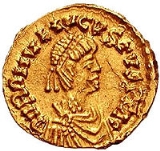
Romulusaugustus


The English historian Edward Gibbon, author of The Decline and Fall of the Roman Empire (1776) made this concept part of the framework of the English language, but he was neither the first nor the last to speculate on why and when the Empire collapsed. "From the eighteenth century onward," Glen W. Bowersock has remarked, "we have been obsessed with the fall: it has been valued as an archetype for every perceived decline, and, hence, as a symbol for our own fears." It remains one of the greatest historical questions, and has a tradition rich in scholarly interest. In 1984, German professor Alexander Demandt
Alexander Demandt

Alexander Demandt is a renowned German historian. He was professor of ancient history at the Free University of Berlin between 1974 and 2005. Demandt is a renowned expert of the History of Rome....
 published a collection of 210 theories on why Rome fell, and new theories have emerged since then.

The traditional date of the fall of the Roman Empire is September 4, 476
476

Sorry, no overview for this topic
 when Romulus Augustus, the last Emperor of the Western Roman Empire
Western Roman Empire

The Western Roman Empire refers to the western half of the Roman Empire, from its division by Diocletian in 285; the other half of the Roman Empire was the Eastern Roman Empire, today widely known as the Byzantine Empire....
 was deposed by Odoacer
Odoacer

Odoacer , also known as Odovacar , was a Germanic general and the first non-Roman King of Italy after 476. He deposed the last Western Roman Emperor, Romulus Augustus, that year, but continued to rule first as a nominal client of Julius Nepos and, after Nepos' death in AD 480, as a client of the Eastern Roman Emperor....
. To an extent any such date must be arbitrary; Julius Nepos, the legitimate emperor recognized by the East Roman Empire continued to live in Salona, Dalmatia until he was assassinated in 480. Some modern historians question the relevance of this date, as the Ostrogoths who succeeded considered themselves as upholders of the direct line of Roman traditions, and noting, as Gibbon did, that the Eastern Roman Empire was going from strength to strength and continued until the Fall of Constantinople
Fall of Constantinople

The Fall of Constantinople was a siege in which the Ottoman Empire under the command of Sultan Mehmed II attempted to capture the capital of the Byzantine Empire, Constantinople which was defended by the army of Emperor Constantine XI....
 on May 29, 1453. Some other notable dates are the Battle of Adrianople
Battle of Adrianople

The second Battle of Adrianople , sometimes known as the Battle of Hadrianopolis, was fought between a Roman Empire army led by the Roman Emperor Valens and Goths rebels led by Fritigern....
 in 378, the death of Theodosius I
Theodosius I

Flavius Theodosius , also called Theodosius I and Theodosius the Great , was Roman Emperor from 379 to 395. Reuniting the eastern and western portions of the empire, Theodosius was the last emperor of both the Eastern Roman Empire and Western Roman Empire....
 in 395 (the last time the Roman Empire was politically unified), the crossing of the Rhine
Rhine

File:Swiss Grand Canyon.jpgThe Rhine is one of the longest and most important rivers in Europe, at , with an average discharge of more than ....
 in 406 by Germanic tribes
Germanic peoples

File:Germanische-ratsversammlung 1-1250x715.jpgThe Germanic peoples are a historical Ethnolinguistics group, originating in Northern Europe and identified by their use of the Indo-European languages Germanic languages which diversified out of Common Germanic in the course of the Pre-Roman Iron Age....
 after the withdrawal of the troops in order to defend Italy against Alaric I
Alaric I

Alaric I , was likely born about 370 on an Peuce Island at the mouth of the Danube. He was king of the Visigoths from 395–410 and the first Germanic peoples leader to take the city of Rome....
 (such invasions had occurred many times previously but this time it was successful), the death of Stilicho
Stilicho

Flavius Stilicho was a high-ranking general , Patrician and Consul of the Western Roman Empire, notably of barbarian birth....
 in 408, followed by the disintegration of the western army, the Sack of Rome (410)
Sack of Rome (410)

The Sack of Rome occurred on August 24, 410. The city was attacked by the Visigoths, led by Alaric I. The Roman capital had been moved to the Italian city of Ravenna by the young emperor Honorius , after the Visigoths entered Italy....
, the first time in almost 800 years that the city of Rome had fallen to a foreign enemy, the death of Justinian I
Justinian I

Flavius Petrus Sabbatius Iustinianus , AD 482 or 483 ? 13 or 14 November 565, was the second member of the Justinian Dynasty and List of Roman Emperors from 527 until his death....
, the last Roman Emperor who tried to reconquer the west, in 565, and the coming of Islam
Islam

Islam is a Monotheism, Abrahamic religion originating with the teachings of the Prophets of Islam Muhammad, a 7th century Arab religious and political figure....
 after 632. Many scholars maintain that rather than a "fall", the changes can more accurately be described as a complex transformation. Over time many theories have been proposed on why the Empire fell, or whether indeed it fell at all.

Overview


The decline of the Roman Empire
Roman Empire

The Roman Empire was the Roman Republic phase of the Ancient Rome, characterised by an autocracy form of government and large territorial holdings in Europe and around the Mediterranean....
 is one of the events traditionally marking the end of Classical Antiquity
Classical antiquity

Classical antiquity is a broad term for a long period of cultural history centered on the Mediterranean Sea, comprising the interlocking civilizations of Ancient Greece and Ancient Rome....
 and the beginning of the European Middle Ages
Middle Ages

File:Karl 1 mit papst gelasius gregor1 sacramentar v karl d kahlen.jpgThe Middle Ages of European history are a period in history which lasted for roughly a millennium, commonly dated from the fall of the Roman Empire in the 5th century to the beginning of the Early Modern Period in the 16th century, marked by the division of Western Christi...
. Throughout the fifth century, the Empire's territories in western Europe and northwestern Africa, including Italy, fell to various invading or indigenous peoples in what is sometimes called the Migration period
Migration Period

The Migration Period, also called Barbarian Invasions or V?lkerwanderung , was a period of human migration which occurred within the period of roughly 300?700 Common Era in Europe, marking the transition from Late Antiquity to the Early Middle Ages....
. Although the eastern half still survived with borders essentially intact for several centuries (until the Arab expansion
Muslim conquests

Arab Muslim conquests , also referred to as the Islamic conquests or Arab conquests, began after the death of the Islamic prophet Muhammad....
), the Empire as a whole had initiated major cultural and political transformations since the Crisis of the Third Century
Crisis of the Third Century

Crisis of the Third Century was the crumbling and near collapse of the Roman Empire between 235 and 284 caused by invasion, civil war, Plague of Cyprian, and economic collapse....
, with the shift towards a more openly autocratic
Autocracy

An autocracy is a form of government in which the political power is held by a single, self-appointed ruler. The term autocrat is derived from the Greek language word 'a?t????t?? ....
 and ritualized form of government, the adoption of Christianity
Christianity

Christianity is a Monotheistic religion #Christian view religion centered on the life and teachings of Jesus as New Testament view on Jesus' life....
 as the state religion
State religion

A state religion is a religion body or creed officially endorsed by the state. Practically, a state without a state religion is called a secular state....
, and a general rejection of the traditions and values of Classical Antiquity. While traditional historiography emphasized this break with Antiquity by using the term "Byzantine Empire
Byzantine Empire

Byzantine Empire and Eastern Roman Empire are conventional names used to describe the Roman Empire during the Middle Ages, centered on its capital of Constantinople....
" instead of Roman Empire, recent schools of history offer a more nuanced view, seeing mostly continuity rather than a sharp break. The Empire of Late Antiquity
Late Antiquity

Late Antiquity is a periodization used by historians to describe the transitional centuries from Classical antiquity to the Middle Ages, in both mainland Europe and the Mediterranean world: generally from the end of the Roman Empire's Crisis of the Third Century to the Islamic conquests and the re-organization of the Byzantine Empire under...
 already looked very different from classical Rome
Ancient Rome

Ancient Rome was a civilization that grew out of a small agricultural community founded on the Italian Peninsula as early as the 10th century BC....
.

The Roman Empire emerged from the Roman Republic
Roman Republic

The Roman Republic was the phase of the Ancient Rome characterized by a republican form of government; a period which began with the overthrow of the Roman Roman Kingdom, c....
 when Julius Caesar
Julius Caesar

'Gaius Julius Caesar' , July 13, 100 BC ? March 15, 44 BC,) was a Roman Republic military and political leader. He played a critical role in the transformation of the Roman Republic into the Roman Empire....
 and Augustus Caesar transformed it from a republic into a monarchy. Rome reached its zenith in the second century, then fortunes slowly decline (with many revivals and restorations along the way). The reasons for the decline of the Empire are still debated today, and likely multiple. Historians infer that the population appears to have diminished in many provinces--especially western Europe--from the diminishing size of fortifications built to protect the cities from barbarian
Barbarian

"Barbarian" is a pejorative term for an uncivilized person, either in a general reference to a member of a nation or ethnos, typically a tribal society as seen by an urban civilization either viewed as inferior, or admired as a noble savage....
 incursions from the 3rd century on. Because these fortifications were restricted to the center of the city only, some have suggested that parts of the periphery were not inhabited anymore.

By the late third century, the city of Rome
Ancient Rome

Ancient Rome was a civilization that grew out of a small agricultural community founded on the Italian Peninsula as early as the 10th century BC....
 no longer served as an effective capital for the Emperor
Roman Emperor

The Roman Emperor was the ruler of the Roman Empire during the imperial period . The Romans had no single term for the office: Latin language titles such as imperator , Augustus , Caesar and princeps were all associated with it....
 and various cities were used as new administrative capitals. Successive emperors, starting with Constantine
Constantine I

Flavius Valerius Aurelius Constantinus , commonly known in English_language as Constantine I, Constantine the Great, or Saint Constantine , was Roman Emperor from 306, and the undisputed holder of that office from 324 until his death in 337....
, privileged the eastern city of Byzantium
Byzantium

Byzantium was an Ancient Greece city, which was founded by Greeks colonists from Megara in 667 BC and named after their king Byzas or Byzantas ....
, which he had entirely rebuilt after a siege. Later renamed Constantinople
Constantinople

Constantinople was the empire capital of the Roman Empire , the Byzantine Empire , the Latin Empire , and the Ottoman Empire . Strategically located between the Golden Horn and the Sea of Marmara at the point where Europe meets Asia, Byzantine Constantinople had been the capital of a Christendom empire, successor to ancient ancient Greece...
, and protected by formidable walls in the late fourth and early fifth centuries, it was to become the largest and most powerful city of Christian Europe
Europe

Europe is, conventionally, one of the world's seven continents. Comprising the westernmost peninsula of Eurasia, Europe is generally divided from Asia to its east by the water divide of the Ural Mountains, the Ural , the Caspian Sea, and by the Caucasus Mountains to the southeast....
 in the Early Middle Ages
Early Middle Ages

The Early Middle Ages is a period in the history of Europe following the fall of the Western Roman Empire spanning roughly five centuries from AD 500 to 1000....
. Since the Crisis of the Third Century, the Empire was intermittently ruled by more than one emperor at once (usually two), presiding over different regions. At first a haphazard form of power sharing, this eventually settled on an East-West administrative division between the Western Roman Empire
Western Roman Empire

The Western Roman Empire refers to the western half of the Roman Empire, from its division by Diocletian in 285; the other half of the Roman Empire was the Eastern Roman Empire, today widely known as the Byzantine Empire....
 (centered on Rome, but now usually presided from other seats of power such as Trier
Trier

Trier is a city in Germany on the banks of the Moselle River. It is the oldest city in Germany, founded in or before 16 BC. Trier is not the only city claiming to be Germany's oldest, but it is the only one that bases this assertion on having the longest history as a city, as opposed to a mere settlement or army camp....
, Milan
Mediolanum

Mediolanum, the ancient Milan, was an important Celts and then Ancient Rome centre of northern Italy. This article charts the history of the city from its settlement by the Insubres around 600 BC, through its conquest by the Ancient Rome and its development into a key centre of Western Christianity and capital of the Western Roman Empire, un...
, and especially Ravenna
Ravenna

Ravenna is a city and comune in the Emilia-Romagna region of Italy. The city is inland, but is connected to the Adriatic Sea by a canal. Ravenna once served as the seat of the Western Roman Empire and later the Ostrogoths and the Exarchate of Ravenna....
), and the Eastern Roman Empire (with its capital initially in Nicomedia
Nicomedia

Nicomedia was founded by Nicomedes I of Bithynia at the head of the Gulf of Astacus which opens to the Propontis. In earlier antiquity, the city was called Astacus or Olbia ....
, and later Constantinople). The Latin
Latin

Latin is an Italic language, historically spoken in Latium and Ancient Rome. Through the Military history of the Roman Empire, Latin spread throughout the Mediterranean and a large part of Europe....
-speaking west, under severe demographic crisis, and the wealthier Greek
Greek language

Greek is an Indo-European languages native to the southern Balkan peninsula, the language of the Greek people. It forms an independent branch within Indo-European....
-speaking east, also began to diverge politically and culturally. Although this was a gradual process, still incomplete when Italy came under the rule of Barbarian chieftains in the last quarter of the 5th century, it deepened further afterwards, and had lasting consequences for the medieval history of Europe.

Throughout the fifth century, western emperors were usually figureheads, while in the eastern emperors managed to secure their independence from influential military leaders. For most of the time, the actual rulers in the West were military strongmen who took the titles of magister militum
Magister militum

Magister militum was a top-level military command used in the later Roman Empire, dating from the reign of Constantine I . Used alone, the term referred to the senior military officer of the Empire....
, patrician
Patrician

The term "patrician" originally referred to a group of elitism citizens in ancient Rome, including both their natural and adopted members. In the late Roman empire, the class was broadened to include high council officials, and after the fall of the Western Empire became a term for Byzantine Imperial governors in the West....
, or both, such as Stilicho
Stilicho

Flavius Stilicho was a high-ranking general , Patrician and Consul of the Western Roman Empire, notably of barbarian birth....
 and Aetius
Flavius Aëtius

Flavius A?tius or simply A?tius, , dux et patricius, was a Roman Empire general of the closing period of the Western Roman Empire. He was an able military commander and the most influential man of the Western Roman Empire for two decades ....
. Although Rome was no longer the capital in the West it remained the West's largest city and its economic center. But the city was sacked by rebelled Visigoths in 410
Sack of Rome (410)

The Sack of Rome occurred on August 24, 410. The city was attacked by the Visigoths, led by Alaric I. The Roman capital had been moved to the Italian city of Ravenna by the young emperor Honorius , after the Visigoths entered Italy....
 (for three days) and later again by the Vandals in 455
Sack of Rome (455)

The second of three barbarian Sack of Rome, the sack of 455 was at the hands of the Vandals, then at war with the usurping Western Roman Emperor Petronius Maximus....
 (for fourteen days), events that shocked the contemporaries and signalled the disintegration of Roman authority. Saint Augustine wrote The City of God partly as an answer to critics who blamed the sack of Rome by the Visigoths on the abandonment of the traditional pagan
Paganism

Paganism is the blanket term given to describe religions and spiritual practices of pre-Christian Europe, and by extension a term for polytheistic?traditions or folk religion?worldwide seen from a Western or Christian viewpoint....
 religions.

In June 474, Julius Nepos
Julius Nepos

Flavius Julius Nepos was a Roman Emperor of the West during the Roman Emperor of the Western Roman Empire. Some historians consider him to be the last De jure Western Emperor, others consider the western line to have ended with Romulus Augustus in 476....
 became Western Emperor but in the next year the magister militum Orestes revolted and made his son Romulus Augustus emperor. Romulus, however, was not recognized by the Eastern Emperor Zeno
Zeno (emperor)

Flavius Zeno Perpetuus, original name Tarasicodissa or Trascalissaeus, Eastern Roman Empire was one of the more prominent of the early Byzantine Emperors....
 and so was technically an usurper, Nepos still being the legal Western Emperor. Nevertheless, Romulus Augustus is often known as the last Western Roman Emperor. In 476 after being refused lands in Italy, Orestes' Germanic mercenaries, led by the chieftain Odoacer
Odoacer

Odoacer , also known as Odovacar , was a Germanic general and the first non-Roman King of Italy after 476. He deposed the last Western Roman Emperor, Romulus Augustus, that year, but continued to rule first as a nominal client of Julius Nepos and, after Nepos' death in AD 480, as a client of the Eastern Roman Emperor....
, captured and executed Orestes and took Ravenna
Ravenna

Ravenna is a city and comune in the Emilia-Romagna region of Italy. The city is inland, but is connected to the Adriatic Sea by a canal. Ravenna once served as the seat of the Western Roman Empire and later the Ostrogoths and the Exarchate of Ravenna....
, the Western Roman capital at the time, deposing Romulus Augustus. The whole of Italy was quickly conquered and Odoacer was granted the title of patrician by Zeno effectively recognizing his rule in the name of the Eastern Empire. Since, as a barbarian, he was not allowed the title of Emperor, Odoacer returned the Imperial insignia to Constantinople and ruled as King in Italy. Following Nepos' death Theodoric the Great
Theodoric the Great

File:Theodoric bronze weight inlaid with silver issued by prefect Catulinus Rome 493 526.jpg'Theodoric the Great' , known in Latin as 'Flavius Theodericus' and in Greek sources, was king of the Ostrogoths , ruler of Italy , and regent of the Visigoths ....
, King of the Ostrogoths, conquered Italy with Zeno's approval.

Meanwhile, much of the rest of the Western provinces were conquered by waves of Germanic invasions
Migration Period

The Migration Period, also called Barbarian Invasions or V?lkerwanderung , was a period of human migration which occurred within the period of roughly 300?700 Common Era in Europe, marking the transition from Late Antiquity to the Early Middle Ages....
, most of them being disconnected politically from the East altogether and continuing a slow decline. Although central authority in the West had been lost, Roman culture would last in most of parts of the former Western provinces into the sixth century and beyond.

The first invasions had disrupted the West to some degree, but it was the Gothic War
Gothic War (535–552)

See Gothic War for the war on the Danube.The Gothic War was a war fought in Italian Peninsula and the adjoining regions of Dalmatia, Sardinia, Sicily and Corsica from 535 until 554 between the forces of the Eastern Roman Empire and the forces of the Ostrogothic Kingdom....
 launched by the Eastern Emperor Justinian
Justinian I

Flavius Petrus Sabbatius Iustinianus , AD 482 or 483 ? 13 or 14 November 565, was the second member of the Justinian Dynasty and List of Roman Emperors from 527 until his death....
 in the sixth century, and meant to reunite the Empire, that eventually caused the most damage to Italy, as well as straining the Eastern Empire militarily. Following these wars Rome and other Italian cities would fall into severe decline (Rome itself was almost completely abandoned). A last blow came with the Persian invasion of the East
Roman-Persian Wars

The Roman–Persian Wars were a series of conflicts between the Greco-Roman world and two successive List of Iranic states and empires. Contact between Parthia and the Roman Republic began in 92 BC; wars began under the late Republic, and continued through the Roman Empire and Sassanid Empires....
 in the seventh century, immediately followed by the Muslim conquests
Muslim conquests

Arab Muslim conquests , also referred to as the Islamic conquests or Arab conquests, began after the death of the Islamic prophet Muhammad....
, especially of Egypt, which curtailed much of the key trade in the Mediterranean on which Europe depended.

The Empire was to live on in the east for many centuries, and enjoy periods of recovery and cultural brilliance, but its size would remain a fraction of what it had been in classical times. It became an essentially regional power, centered on Greece
Greece

Greece , officially the Hellenic Republic , is a country in southeastern Europe, situated on the southern end of the Balkans. It has borders with Albania, Bulgaria and the former Yugoslav Republic of Macedonia to the north, and Turkey to the east....
 and Anatolia
Anatolia

Anatolia or Asia Minor is a region of Western Asia, comprising most of the modern Republic of Turkey. It is a geographic region bounded by the Black Sea to the north, the Caucasus to the northeast, the Aegean Sea to the west, the Mediterranean Sea to the south, and the Iranian plateau to the east and southeast....
. Modern historians tend to prefer the term Byzantine Empire
Byzantine Empire

Byzantine Empire and Eastern Roman Empire are conventional names used to describe the Roman Empire during the Middle Ages, centered on its capital of Constantinople....
 for the eastern, medieval stage of the Roman Empire.

Highlights

The decline of the Roman Empire was a gradual transformation that cannot be dated precisely. Some stepping stones in the path toward the loss of the western part of the Empire, the weakening of its eastern part, and the progressive estrangement between the two halves, are nevertheless worth remarking:

3rd century:
  • The Crisis of the Third Century
    Crisis of the Third Century

    Crisis of the Third Century was the crumbling and near collapse of the Roman Empire between 235 and 284 caused by invasion, civil war, Plague of Cyprian, and economic collapse....
     (234 - 284), a period of political anarchy.
  • The reign of emperor Diocletian
    Diocletian

    Gaius Aurelius Valerius Diocletianus , born Diocles and commonly known as Diocletian , was Roman Emperor from November 20, 284 to May 1, 305....
     (284 - 305), who attempted substantial political and economic reforms, many of which would remain in force in the following centuries.
4th century:
  • The reign of Constantine I
    Constantine I

    Flavius Valerius Aurelius Constantinus , commonly known in English_language as Constantine I, Constantine the Great, or Saint Constantine , was Roman Emperor from 306, and the undisputed holder of that office from 324 until his death in 337....
     (306 - 337), who built the new eastern capital of Constantinople
    Constantinople

    Constantinople was the empire capital of the Roman Empire , the Byzantine Empire , the Latin Empire , and the Ottoman Empire . Strategically located between the Golden Horn and the Sea of Marmara at the point where Europe meets Asia, Byzantine Constantinople had been the capital of a Christendom empire, successor to ancient ancient Greece...
    , and converted to Christianity
    Christianity

    Christianity is a Monotheistic religion #Christian view religion centered on the life and teachings of Jesus as New Testament view on Jesus' life....
    , legalizing and even favoring to some extent this religion. All Roman emperors after Constantine, with the exception of Julian
    Julian the Apostate

    Flavius Claudius Julianus, known also as Julian or Julian the Apostate , was Roman Emperor of the Constantinian dynasty. He was the last non-Christian Roman Emperor, and expended much energy during his reign attempting to supplant the growing power of Christianity within the empire with officially revived Religion in ancient Rom...
    , would be Christians.
  • The first war with the Visigoths (376 - 382), culminating in the Battle of Adrianople
    Battle of Adrianople

    The second Battle of Adrianople , sometimes known as the Battle of Hadrianopolis, was fought between a Roman Empire army led by the Roman Emperor Valens and Goths rebels led by Fritigern....
     (August 9, 378), in which a large Roman army was defeated by the Visigoths, and emperor Valens
    Valens

    Flamin Julius Valens was Roman Emperor , after he was given the Eastern part of the empire by his brother Valentinian I. Valens, sometimes known as the Last of the Romans, was defeated and killed in the Battle of Adrianople, which marked the beginning of the fall of the Western Roman Empire....
     was killed. The Visigoths, fleeing a migration of the Huns
    Huns

    The Huns were a confederation of Central Asian Eurasian nomads or semi-nomads, who had established an empire in Eurasia. The Huns may have stimulated the Migration Period, a contributing factor in the collapse of the Roman Empire....
    , had been allowed to settle within the borders of the Empire by Valens, but were mistreated by the local Roman administrators, and rebelled.
  • The reign of Theodosius I
    Theodosius I

    Flavius Theodosius , also called Theodosius I and Theodosius the Great , was Roman Emperor from 379 to 395. Reuniting the eastern and western portions of the empire, Theodosius was the last emperor of both the Eastern Roman Empire and Western Roman Empire....
     (379 - 395), last emperor to reunite under his authority the western and eastern halves of the Empire. Theodosius continued and intensified the policies against paganism
    Paganism

    Paganism is the blanket term given to describe religions and spiritual practices of pre-Christian Europe, and by extension a term for polytheistic?traditions or folk religion?worldwide seen from a Western or Christian viewpoint....
     of his predecessors, eventually outlawing it, and making Nicaean
    First Council of Nicaea

    The First Council of Nicea was convened in Nicaea in Bithynia by the Roman Emperors Constantine I in 325 CE. The Council was historically significant as the first effort to attain consensus decision-making in the church through an legislature representing all of Christendom....
     Christianity the state religion
    State religion

    A state religion is a religion body or creed officially endorsed by the state. Practically, a state without a state religion is called a secular state....
    .
5th century:
  • The Crossing of the Rhine
    Crossing of the Rhine

    The date 31 December 406, is the often-repeated date of the crossing of the Rhine by a mixed group of barbarians that included Vandals, Alans and Suebi....
    : on December 31, 406 (or 405, according to some historians), a mixed band of Vandals
    Vandals

    The Vandals were an East Germanic tribe that entered the late Roman Empire during the 5th century. The Goths Theodoric the Great, king of the Ostrogoths and regent of the Visigoths, was allied by marriage with the Vandals as well as with the Burgundians and the Franks under Clovis I....
    , Suebi
    Suebi

    The Suebi or Suevi were a group of Germanic peoples who were first mentioned by Julius Caesar in connection with Ariovistus' campaign, c....
     and Alans
    Alans

    The Alans or Alani were a group among the Sarmatians people, Eurasian nomads of the 1st millennium AD who spoke an Eastern Iranian language which derived from Scytho-Sarmatian language and which in turn evolved into modern Ossetian language....
     crossed the frozen river Rhine
    Rhine

    File:Swiss Grand Canyon.jpgThe Rhine is one of the longest and most important rivers in Europe, at , with an average discharge of more than ....
     at Moguntiacum (modern Mainz
    Mainz

    Mainz is a city in Germany and the capital of the Germany States of Germany of Rhineland-Palatinate. It was a politically important seat of the Prince-elector of Mainz under the Holy Roman Empire, and previously was a Roman Empire fort city which commanded the west bank of the Rhine River and formed part of the northernmost frontier of th...
    ), and began to ravage Gaul
    Gaul

    Gaul is the name used for the region of Western Europe comprising part of present day northern Italy, France, Belgium, western Switzerland and the parts of the Netherlands and Germany on the west bank of the River Rhine....
    . Some moved on to the regions of Hispania
    Hispania

    Hispania was the name given by the Ancient Rome to the whole of the Iberian Peninsula . When Rome was a Roman Republic, Hispania was divided into Roman provinces: Hispania Citerior and Hispania Ulterior....
     and Africa
    Africa Province

    File:Roman Africa.JPGThe Roman province of Africa was established after the Romans defeated Carthage in the Third Punic War. It roughly comprised the territory of present-day northern Tunisia, north-eastern Algeria and the Mediterranean Sea coast of modern-day western Libya along the Syrtis Minor....
    . The Empire would never regain control over most of these lands.
  • The second war with the Visigoths, led by king Alaric
    Alaric I

    Alaric I , was likely born about 370 on an Peuce Island at the mouth of the Danube. He was king of the Visigoths from 395–410 and the first Germanic peoples leader to take the city of Rome....
    , in which they raided Greece, and then invaded Italy, culminating in the sack of Rome
    Sack of Rome (410)

    The Sack of Rome occurred on August 24, 410. The city was attacked by the Visigoths, led by Alaric I. The Roman capital had been moved to the Italian city of Ravenna by the young emperor Honorius , after the Visigoths entered Italy....
     (410). The Visigoths eventually left Italy, and founded the Visigothic Kingdom
    Visigothic Kingdom

    The Visigothic kingdom was a Western European power from the fifth to eighth century, one of the successor states to the Western Roman Empire, originally created by the settlement of the Visigoths under their own king in Aquitaine by the Roman government and then extended by conquest over all of the Iberian peninsula....
     in southern Gaul and Hispania.
  • The rise of the Hunnic Empire
    Hunnic Empire

    Hunnic Empire, the empire of the Huns.The Huns were a confederation of Eurasian tribes, probably especially Turkic ones, from the Steppes of Central Asia....
     under Attila
    Attila the Hun

    Attila , also known as Attila the Hun, was leader of the Huns from 434 until his death in 453. He was leader of the Hunnic Empire which stretched from Germany to the Ural River and from the Danube to the Baltic Sea ....
     and Bleda
    Bleda

    Bleda was a Hun ruler.As nephews to Rugila, Bleda and his younger brother Attila the Hun succeeded him to the throne. His reign lasted for eleven years until his death....
     (434-453), who raided the Balkans
    Balkans

    The Balkans is the historical name of a geographic subregion of southeastern Europe. The region takes its name from the Balkan Mountains, which run through the centre of Bulgaria into eastern Serbia....
    , Gaul, and Italy, threatening both Constantinople and Rome.
  • The second sack of Rome
    Sack of Rome (455)

    The second of three barbarian Sack of Rome, the sack of 455 was at the hands of the Vandals, then at war with the usurping Western Roman Emperor Petronius Maximus....
    , by the Vandals (455).
  • Failed counterstrikes against the Vandals (461 - 468). The western emperor Majorian
    Majorian

    Julius Valerius Maiorianus , commonly known as Majorian, was Western Roman Emperor .He had distinguished himself as a general by victories over the Franks and Alamanni, and six months after the deposition of Avitus he was declared emperor by the regent Ricimer, which created problems with Emperor Leo I in Constantinople who declared...
     planned a naval campaign against the Vandals to reconquer northern Africa in 461, but word of the preparations got out to the Vandals, who took the Roman fleet by surprise and destroyed it. A second naval expedition against the Vandals
    Basiliscus

    Flavius Basiliscus was an Eastern Roman Emperor of the House of Leo, who ruled briefly , when Emperor Zeno had been forced out of Constantinople by a revolt....
    , sent by emperors Leo I
    Leo I (emperor)

    Flavius Valerius Leo , known in English as Leo the Thracian or Leo I, was a Byzantine Emperor who ruled from 457 to 474. He was known as Magnus Thrax by his supporters, and Leo the Butcher by his enemies....
     and Anthemius
    Anthemius

    Flavius Procopius Anthemius was a Western Roman Empire from 12 April 467 until his death. Perhaps the last able emperor, Anthemius attempted to solve the two primary military challenges facing the remains of the Western Roman Empire: the resurgent Visigoths, under Euric, whose domain straddled the Pyrenees; and the unvanquished Vandals, unde...
    , was defeated in 468.
  • Deposition of the last western emperors, Julius Nepos
    Julius Nepos

    Flavius Julius Nepos was a Roman Emperor of the West during the Roman Emperor of the Western Roman Empire. Some historians consider him to be the last De jure Western Emperor, others consider the western line to have ended with Romulus Augustus in 476....
     and Romulus Augustus (475 - 480). Julius Nepos, who had been nominated by the eastern emperor Zeno
    Zeno

    Zeno is a Greek name derived from the more ancient variant Zenon . The word may refer to any of the following:...
    , was deposed by the rebelled magister militum Orestes
    Flavius Orestes

    Flavius Orestes was a Roman politician, who was briefly in control of the Western Roman Empire in 475–6....
    , who installed his own son Romulus in the imperial throne. Both Zeno and his rival Basiliscus
    Basiliscus

    Flavius Basiliscus was an Eastern Roman Emperor of the House of Leo, who ruled briefly , when Emperor Zeno had been forced out of Constantinople by a revolt....
    , in the East, continued to regard Julius Nepos, who fled to Dalmatia
    Dalmatia (Roman province)

    Dalmatia was an ancient Roman province. Its name is probably derived from the name of an Illyrians called the Dalmatae which lived in the area of the eastern Adriatic coast in the 1st millennium BC....
    , as the legitimate western emperor, and Romulus as an usurper. Shortly after, Odoacer
    Odoacer

    Odoacer , also known as Odovacar , was a Germanic general and the first non-Roman King of Italy after 476. He deposed the last Western Roman Emperor, Romulus Augustus, that year, but continued to rule first as a nominal client of Julius Nepos and, after Nepos' death in AD 480, as a client of the Eastern Roman Emperor....
    , magister militum appointed by Julius, invaded Italy, defeated Orestes and deposed the child emperor Romulus Augustus on September 4, 476. He then proclaimed himself ruler of Italy and asked the eastern emperor Zeno to become formal emperor of the entire empire, and in so doing legalize Odoacer's own position as imperial viceroy of Italy. Zeno did so, setting aside the claims of Nepos, who was murdered by his own soldiers in 480.
  • Foundation of the Ostrogothic Kingdom
    Ostrogothic Kingdom

    The Ostrogothic Kingdom established by the Ostrogoths in Italian peninsula and neighbouring areas lasted from 493 to 553. In Italy the Ostrogoths replaced Odoacer, the de facto ruler of Italy who had deposed the last emperor of the Western Roman Empire in 476....
     in Italy (493). Concerned with the success and popularity of Odoacer, Zeno started a campaign against him, at first with words, then by inciting the Ostrogoths to take back Italy from him. They did as much, but then founded an independent kingdom of their own, under the rule of king Theodoric
    Theodoric the Great

    File:Theodoric bronze weight inlaid with silver issued by prefect Catulinus Rome 493 526.jpg'Theodoric the Great' , known in Latin as 'Flavius Theodericus' and in Greek sources, was king of the Ostrogoths , ruler of Italy , and regent of the Visigoths ....
    . Italy and the entire West were lost to the Empire.


Explaining the fall of the Empire


Vegetius

The historian Vegetius
Vegetius

Publius Flavius Vegetius Renatus was a writer of the Western Roman Empire. Nothing is known of his life or station beyond what he tells us in his two surviving works: Epitoma rei militaris , and the lesser-known Digesta Artis Mulomedicinae, a guide to veterinary medicine....
 theorized, and has recently been supported by the historian Arther Ferrill, that the Roman Empire – particularly the military – declined partially as a result of an influx of Germanic mercenaries into the ranks of the legions. This "Germanization" and the resultant cultural dilution or "barbarization", led to lethargy, complacency and loyalty to the Roman commanders, instead of the Roman government, among the legions and a surge in decadence amongst Roman citizenry. Ferril agrees with other Roman historians like A.H.M. Jones’ and says,


...the decay of trade and industry was not a cause of Rome’s fall. There was a decline in agriculture and land was withdrawn from cultivation, in some cases on a very large scale, sometimes as a direct result of barbarian invasions. However, the chief cause of the agricultural decline was high taxation on the marginal land, driving it out of cultivation. Jones is surely right in saying that taxation was spurred by the huge military budget and was thus ‘indirectly’ the result of the barbarian invasion.


Edward Gibbon

Edward Gibbon
Edward Gibbon

Edward Gibbon was an English historian and Member of Parliament. His most important work, The History of the Decline and Fall of the Roman Empire, was published in six volumes between 1776 and 1788....
 famously placed the blame on a loss of civic virtue
Civic virtue

Civic virtue is the cultivation of habit s of personal living that are claimed to be important for the success of the community. The identification of the character traits that constitute civic virtue has been a major concern of political philosophy....
 among the Roman citizens. They gradually entrusted the role of defending the Empire to barbarian
Barbarian

"Barbarian" is a pejorative term for an uncivilized person, either in a general reference to a member of a nation or ethnos, typically a tribal society as seen by an urban civilization either viewed as inferior, or admired as a noble savage....
 mercenaries
Mercenary

A mercenary is a person who takes part in an armed conflict, who is not a national or a party to the conflict, and is "motivated to take part in the hostilities essentially by the desire for private gain and, in fact, is promised, by or on behalf of a party to the conflict, material compensation substantially in excess of that promised or p...
 who eventually turned on them. Gibbon considered that Christianity
Christianity

Christianity is a Monotheistic religion #Christian view religion centered on the life and teachings of Jesus as New Testament view on Jesus' life....
 had contributed to this, making the populace less interested in the worldly here-and-now and more willing to wait for the rewards of heaven
Heaven

Heaven may refer to the physical heavens, the atmosphere or the seemingly endless expanse of the universe beyond. This is the traditional literal meaning of the term in English, however since at least AD 1000, it is typically also used to refer to an afterlife plane of existence in various religions and spirituality philosophy, often descri...
. "The decline of Rome was the natural and inevitable effect of immoderate greatness. Prosperity ripened the principle of decay; the causes of destruction multiplied with the extent of conquest; and as soon as time or accident had removed the artificial supports, the stupendous fabric yielded to the pressure of its own weight," he wrote. "In discussing Barbarism and Christianity I have actually been discussing the Fall of Rome."

Henri Pirenne

In the second half of the 19th century some historians focused on continuing events in the Roman world and the post-Roman Germanic kingdoms. Fustel de Coulanges in Histoire des institutions politiques de l'ancienne France (1875–1889) argued that the barbarians simply contributed to a running process in their role of transforming Roman institutions.

Henri Pirenne
Henri Pirenne

Henri Pirenne was a leading Belgium historian. He also became prominent in the non-violent resistance to the Germany who occupied Belgium in World War I....
 continued this idea in "Pirenne Thesis", published in the 1920s, which remains influential to this day. It holds that the Empire continued, in some form, up until the time of the Muslim conquests
Muslim conquests

Arab Muslim conquests , also referred to as the Islamic conquests or Arab conquests, began after the death of the Islamic prophet Muhammad....
 in the 7th century, which disrupted Mediterranean trade routes, leading to a decline in the Europe
Europe

Europe is, conventionally, one of the world's seven continents. Comprising the westernmost peninsula of Eurasia, Europe is generally divided from Asia to its east by the water divide of the Ural Mountains, the Ural , the Caspian Sea, and by the Caucasus Mountains to the southeast....
an economy. This theory stipulates the rise of the Frankish realm in Europe
Frankish Empire

Francia or Frankia, later also called the Frankish Empire , Frankish Kingdom , Frankish Realm or occasionally Frankland, was the territory inhabited and ruled by the Franks from the 3rd to the 10th century....
 as a continuation of the Roman Empire, and thus legitimizes the crowning of Charlemagne
Charlemagne

Charlemagne was List of Frankish kings from 768 to his death. He expanded the Franks kingdoms into a Carolingian Empire that incorporated much of Western Europe and Central Europe....
 as the first Holy Roman Emperor
Holy Roman Emperor

Image:HRR 14Jh.jpgThe Roman of the Emperor's title was a reflection of the translatio imperii principle that regarded the Holy Roman Emperors as the inheritors of the title of Emperor of the Western Roman Empire, a title left unclaimed in the West after the death of Julius Nepos in 480....
 as a continuation of the Imperial Roman state.

Pirenne's view on the continuity of the Roman Empire before and after the Germanic invasion was supported by recent historians such as François Masai, Karl-Ferdinand Werner and Peter Brown
Peter Brown (historian)

Peter Robert Lamont Brown is a historian and professor of history....
.

However, some critics maintain the "Pirenne Thesis" erred in claiming the Carolingian
Carolingian

File:Charlemagne denier Mayence 812 814.jpgThe Carolingian dynasty was a Frankish noble family with its origins in the Arnulfing and Pippinid clans of the 7th century....
 realm as a Roman state, and mainly dealt with the Islamic conquests and their effect on the Byzantine or Eastern Empire.

Other modern critics stipulate that while Pirenne is correct in his assertion of the continuation of the Empire beyond the sack of Rome, the Arab conquests in the 7th century may not have disrupted Mediterranean trade routes to the degree that Pirenne suggests. Michael McCormick in particular notes that more recent sources, such as unearthed collective biographies, notate new trade routes through correspondences in communication. Moreover, records such as book-keepings and coins suggest the movement of Islamic currency into the Carolingian Empire. McCormick concludes that if money is coming in, some form of trade is going out – including slaves, timber, weapons, honey, amber, and furs.

J. B. Bury

John Bagnell Bury
J. B. Bury

John Bagnell Bury , known as J.B. Bury, was an eminent Ireland historian, classics, :Category:Byzantinists and philologist....
's History of the Later Roman Empire gives a multi-factored theory for the Fall of the Western Empire. He presents the classic "Christianity vs. pagan" theory, and dismisses it, citing the relative success of the Eastern Empire, which was far more Christian.

He then examines Gibbon's "theory of moral decay," and without insulting Gibbon, finds that to be too simplistic, though a partial answer. He essentially presents what he called the "modern" theory, which he implicitly endorses, a combination of factors, primarily, (quoting directly from Bury):
… The Empire had come to depend on the enrollment of barbarians, in large numbers, in the army, and … it was necessary to render the service attractive to them by the prospect of power and wealth. This was, of course, a consequence of the decline in military spirit, and of depopulation, in the old civilised Mediterranean countries. The Germans in high command had been useful, but the dangers involved in the policy had been shown in the cases of Merobaudes and Arbogastes. Yet this policy need not have led to the dismemberment of the Empire, and but for that series of chances its western provinces would not have been converted, as and when they were, into German kingdoms. It may be said that a German penetration of western Europe must ultimately have come about. But even if that were certain, it might have happened in another way, at a later time, more gradually, and with less violence. The point of the present contention is that Rome's loss of her provinces in the fifth century was not an "inevitable effect of any of those features which have been rightly or wrongly described as causes or consequences of her general 'decline.'" The central fact that Rome could not dispense with the help of barbarians for her wars (gentium barbararum auxilio indigemus) may be held to be the cause of her calamities, but it was a weakness which might have continued to be far short of fatal but for the sequence of contingencies pointed out above.
In short, Bury held that a number of contingencies arose simultaneously: economic decline, Germanic expansion, depopulation of Italy, dependency on Germanic foederati for the military, the disastrous (though Bury believed unknowing) treason of Stilicho
Stilicho

Flavius Stilicho was a high-ranking general , Patrician and Consul of the Western Roman Empire, notably of barbarian birth....
, loss of martial vigor, Aetius
Flavius Aëtius

Flavius A?tius or simply A?tius, , dux et patricius, was a Roman Empire general of the closing period of the Western Roman Empire. He was an able military commander and the most influential man of the Western Roman Empire for two decades ....
' murder, the lack of any leader to replace Aetius — a series of misfortunes which proved catastrophic in combination.

Bury noted that Gibbon's "Decline and Fall of the Roman Empire" was "amazing" in its research and detail. Bury's main differences from Gibbon lay in his interpretation of fact, rather than any dispute of fact. He made clear that he felt that Gibbon's conclusions as to the "moral decay" were viable — but not complete. Bury's judgement was that:
The gradual collapse of the Roman power …was the consequence of a series of contingent events. No general causes can be assigned that made it inevitable.
It is his theory that the decline and ultimate fall of Rome was not pre-ordained, but was brought on by contingent events, each of them separately endurable, but together and in conjunction ultimately destructive.

Radovan Richta

On the other hand, some historians have argued that the collapse of Rome was outside the Romans' control. Radovan Richta
Radovan Richta

Radovan Richta was a Czech philosopher who coined the term technological evolution; a theory about society's replacement of physical labour with mental labour....
 holds that technology drives history. Thus, the invention of the horseshoe
Horseshoe

File:Horseshoes.JPGA horseshoe is a U-shaped item made of metal or of modern synthetic materials, nail ed or Polymethyl methacrylated to the hooves of horses and some other draught animals....
 in Germania
Germania

Germania was the Latin language exonym for a geographical area of land on the east bank of the River Rhine , which included regions of Sarmatia as well as an area under Ancient Rome control on the west bank of the Rhine....
 in the 200s would alter the military equation of pax romana
Pax Romana

Pax Romana was the long period of relative peace and minimal expansion by military force experienced by the Roman Empire in the first century and second century Anno Domini....
.

Lucien Musset and the clash of civilizations

In the spirit of "Pirenne thesis", a school of thought pictured a clash of civilizations between the Roman and the Germanic world, a process taking place roughly between 3rd and 8th century.

The French
France

France , officially the French Republic , is a country whose Metropolitan France is located in Western Europe and that also comprises various Overseas departments and territories of France....
 historian Lucien Musset, studying the Barbarian invasions, argues the civilization of Medieval Europe
Europe

Europe is, conventionally, one of the world's seven continents. Comprising the westernmost peninsula of Eurasia, Europe is generally divided from Asia to its east by the water divide of the Ural Mountains, the Ural , the Caspian Sea, and by the Caucasus Mountains to the southeast....
 emerged from a synthesis between the Graeco-Roman world and the Germanic
List of Germanic peoples

This is a list of Germanic peoples....
 civilizations penetrating the Roman Empire. The Roman Empire did not fall, did not decline, it just transformed but so did the Germanic populations which invaded it. To support this conclusion, beside the narrative of the events, he offers linguistic
Linguistics

Linguistics is the science study of natural language. Linguistics encompasses a number of sub-fields. An important topical division is between the study of language structure and the study of Meaning ....
 overviews of toponymy
Toponymy

Toponymy is the scientific study of place-names , their origins, meanings, use and typology. The first part of the word is derived from the Greek language t?pos , place; followed by ?noma , meaning name....
 and anthroponymy
Anthroponymy

Anthroponomastics , a branch of onomastics, is the study of anthroponyms , the names of human beings.Anthroponyms often preserve lexical elements that have dropped out of the standard lexicon of a language....
, analyzes archaeological records, studies the urban and rural society, the institutions, the religion, the art, the technology.

Arnold J. Toynbee and James Burke

In contrast with the "declining empire" theories, historians such as Arnold J. Toynbee
Arnold J. Toynbee

Arnold Joseph Toynbee Order of the Companions of Honour was a British historian whose twelve-volume analysis of the rise and fall of civilizations, A Study of History, 1934-1961, was a synthesis of world history, a metahistory based on universal rhythms of rise, flowering and decline, which examined history from a global perspective....
 and James Burke
James Burke (science historian)

James Burke is a Northern Ireland science historian, author and television producer best known for his documentary film television series called Connections , focusing on the history of science and technology leavened with a sense of humour....
 argue that the Roman Empire itself was a rotten system from its inception, and that the entire Imperial era was one of steady decay of institutions founded in Republican
Roman Republic

The Roman Republic was the phase of the Ancient Rome characterized by a republican form of government; a period which began with the overthrow of the Roman Roman Kingdom, c....
 times. In their view, the Empire could never have lasted without radical reforms that no Emperor could implement. The Romans had no budgetary system and thus wasted whatever resources they had available. The economy of the Empire was basically a Raubwirtschaft
Raubwirtschaft

Raubwirtschaft is a form of economy where the goal is to plunder the wealth and resources of a country or geographical area. Koloniale Raubwirtschaft describes a form of colony with the same goal and with no intention of developing the colony economically....
 or plunder economy based on looting
Looting

Looting , to rob, sacking, plundering, despoiling, or pillaging is the indiscriminate taking of goods by force as part of a military or political victory, or during a catastrophe or riot, such as during war, natural disaster, or rioting....
 existing resources rather than producing anything new. The Empire relied on booty from conquered territories (this source of revenue ending, of course, with the end of Roman territorial expansion) or on a pattern of tax collection that drove small-scale farmers into destitution (and onto a dole
Welfare (financial aid)

Welfare is financial assistance paid to people by governments. Some welfare is general, while specific and can only be invoked under certain circumstances, such as a scholarship....
 that required even more exactions upon those who could not escape taxation), or into dependency upon a landed élite exempt from taxation. With the cessation of tribute from conquered territories, the full cost of their military machine had to be borne by the citizenry.

An economy based upon slave labor precluded a middle class with purchasing power. The Roman Empire produced few exportable goods. Material innovation, whether through entrepreneurialism or technological advancement, all but ended long before the final dissolution of the Empire. Meanwhile the costs of military defense and the pomp of Emperors continued. Financial needs continued to increase, but the means of meeting them steadily eroded. In the end due to economic failure, even the armor of soldiers deteriorated and the weaponry of soldiers became so obsolete to the extent that the enemies of the Empire had better armor and weapons as well as larger forces. The decrepit social order offered so little to its subjects that many saw the barbarian invasion as liberation from onerous obligations to the ruling class. By the late fifth century the barbarian conqueror Odoacer
Odoacer

Odoacer , also known as Odovacar , was a Germanic general and the first non-Roman King of Italy after 476. He deposed the last Western Roman Emperor, Romulus Augustus, that year, but continued to rule first as a nominal client of Julius Nepos and, after Nepos' death in AD 480, as a client of the Eastern Roman Emperor....
 had no use for the formality of an Empire upon deposing Romulus Augustus and chose neither to assume the title of Emperor himself nor to select a puppet, although legally he kept the lands as a commander of the Eastern Empire and maintained the Roman institutions such as the consulship. The formal end of the Roman Empire corresponds with the time in which the Empire and the title Emperor no longer had value.

Michael Rostovtzeff, Ludwig von Mises, and Bruce Bartlett

Historian Michael Rostovtzeff
Michael Rostovtzeff

Mikhail Ivanovich Rostovtzeff, or Rostovtsev was one of the 20th century's foremost authorities on ancient Greek, Iranian, and Roman history....
 and economist Ludwig von Mises
Ludwig von Mises

Ludwig Heinrich Edler von Mises was an Austrian economics, philosopher, and liberalism who had a major influence on the modern libertarianism movement....
 both argued that unsound economic policies played a key role in the impoverishment and decay of the Roman Empire. According to them, by the 2nd century A.D., the Roman Empire had developed a complex market economy
Market economy

A market economy is a social system based on the division of labor in which the prices of goods and services are determined in a free price system set by supply and demand....
 in which trade was relatively free. Tariff
Tariff

A tariff is a tax imposed on goods when they are moved across a political boundary. They are usually associated with protectionism, the economic policy of restraining trade between nations....
s were low and laws controlling the prices of foodstuffs and other commodities had little impact because they did not fix the prices significantly below their market levels. After the 3rd century, however, debasement
Debasement

Debasement is the practice of lowering the value of currency. It is particularly used in connection with commodity money such as gold or silver coins....
 of the currency (i.e., the minting of coins with diminishing content of gold
Gold

Gold is a chemical element with the symbol Au and atomic number 79. It is a highly sought-after precious metal, having been used as money, as a store of value, in jewelry, in sculpture, and for ornamentation since the beginning of recorded history....
, silver
Silver

Silver is a chemical element with the chemical symbol Ag and atomic number 47. A soft, white, lustrous transition metal, it has the highest electrical conductivity of any element and the highest thermal conductivity of any metal....
, and bronze
Bronze

Bronze is a metal alloy consisting primarily of copper, usually with tin as the main additive, but sometimes with other chemical element such as phosphorus, manganese, aluminium, or silicon....
) led to inflation
Inflation

In economics, inflation is a rise in the general price level of goods and services in an economy over a period of time. The term "inflation" once referred to increases in the money supply ; however, economic debates about the relationship between money supply and price levels have led to its primary use today in describing price inflatio...
. The price control
Incomes policy

Incomes policies in economics are wage and price controls, most commonly instituted as a response to inflation, and usually below free market level....
 laws then resulted in prices that were significantly below their free-market equilibrium levels.

According to Rostovtzeff and Mises, artificially low prices led to the scarcity of foodstuffs, particularly in cities
City

A city is an urban area with a high population density and a particular administrative, legal, or historical status.Large industrialized cities generally have advanced systems for sanitation, utilities, land usage, house, and transportation and more....
, whose inhabitants depended on trade in order to obtain them. Despite laws passed to prevent migration from the cities to the countryside, urban areas gradually became depopulated and many Roman citizens abandoned their specialized trades in order to practice subsistence agriculture
Subsistence agriculture

Subsistence agriculture is self-sufficiency farming in which farmers grow only enough food to feed their family and pay taxes. The typical subsistence farm has a range of crops and animals needed by the family to eat during the year....
. This, coupled with increasingly oppressive and arbitrary tax
Tax

To tax is to impose a financial charge or other levy upon an individual or Legal person by a state or the functional equivalent of a state.Taxes are also imposed by many subnational entity....
ation, led to a severe net decrease in trade, technical
Technology

Technology is a broad concept that deals with an animal species' usage and knowledge of tools and crafts, and how it affects an animal species' ability to control and adapt to its Natural environment....
 innovation, and the overall wealth of the empire.

Bruce Bartlett
Bruce Bartlett

Bruce Bartlett is a historian who turned to writing about supply-side economics. He was a domestic policy adviser to President of the United States Ronald Reagan and was a U....
 traces the beginning of debasement to the reign of Nero
Nero

Nero Claudius Caesar Augustus Germanicus , born Lucius Domitius Ahenobarbus, also called Nero Claudius Caesar Drusus Germanicus, was the fifth and final Roman emperor of the Julio-Claudian dynasty....
. By the third century the monetary economy had collapsed. Bartlett sees the end result as a form of state socialism
Socialism

Socialism refers to a broad set of economic theories of social organization advocating public or state ownership and administration of the means of production and distribution of goods, and a society characterized by equality for all individuals, with a fair or Egalitarianism method of compensation....
. Monetary taxation was replaced with direct requisitioning, for example taking food and cattle from farmers. Individuals were forced to work at their given place of employment and remain in the same occupation. Farmers became tied to the land, as were their children, and similar demands were made on all other workers, producers, and artisans as well. Workers were organized into guild
Guild

File:Windsorguildhall.jpgA guild is an association of artisan in a particular trade. The earliest guilds were formed as confraternities of workers....
s and businesses into corporations called collegia. Both became de facto organs of the state, controlling and directing their members to work and produce for the state. In the countryside people attached themselves to the estates of the wealthy in order to gain some protection from state officials and tax collectors. These estates, the beginning of feudalism, operated as much as possible as closed systems, providing for all their own needs and not engaging in trade at all.

William H. McNeill

William H. McNeill
William H. McNeill

William Hardy McNeill is a noted World History. He is among the world's most respected historians and was Professor Emeritus of History at the University of Chicago....
 (b.1917), a world historian
World History

World History is a field of historiography that emerged as a distinct academic field in the 1980s. It examines history from a global perspective....
, noted in chapter three of his book Plagues and Peoples (1976) that the Roman Empire suffered the severe and protracted Antonine Plague
Antonine Plague

The Antonine Plague, 165-180 AD, also known as the Plague of Galen, who described it, was an ancient pandemic, whether of smallpox or measles, brought back to the Roman Empire by troops returning from campaigns in the Near East....
 starting around 165 A.D. For about twenty years, waves of one or more diseases, possibly the first epidemics of smallpox
Smallpox

Smallpox is an infectious disease unique to humans, caused by either of two virus variants, Variola major and Variola minor. The disease is also known by the Latin names Variola or Variola vera, which is a derivative of the Latin varius, meaning spotted, or varus, meaning "pimple"....
 and/or measles
Measles

Measles is a infection of the respiratory system caused by a virus, specifically a paramyxovirus of the genus Morbillivirus. Morbilliviruses, like other paramyxoviruses, are enveloped, single-stranded, negative-sense RNA viruses....
, swept through the Empire, ultimately killing about half the population. Similar epidemics
Pandemic

A pandemic is an epidemic of infectious disease that spreads through populations across a large region; for instance a continent, or even worldwide....
 also occurred in the third century. McNeill argues that the severe fall in population left the state apparatus and army too large for the population to support, leading to further economic and social decline that eventually killed the Western Empire. The Eastern half survived due to its larger population, which even after the plagues was sufficient for an effective state apparatus.

This theory can also be extended to the time after the fall of the Western Empire and to other parts of the world. Similar epidemics caused by new diseases may have weakened the Chinese Han empire and contributed to its collapse. This was followed by the long and chaotic episode known as the Six Dynasties
Six Dynasties

Six Dynasties is a collective noun for six China dynasties during the periods of the Three Kingdoms , Jin Dynasty , and Southern and Northern Dynasties ....
 period. Later, the Plague of Justinian
Plague of Justinian

The Plague of Justinian was a pandemic that afflicted the Byzantine Empire, including its capital Constantinople, in the years 541?542 AD. The most commonly accepted cause of the pandemic is bubonic plague, which later became infamous for either causing or contributing to the Black Death of the 14th century....
 may have been the first instance of bubonic plague
Bubonic plague

Plague is a deadly infectious disease caused by the Enterobacteriaceae Yersinia pestis . Plague is a zoonotic, primarily carried by rodents and spread to humans via fleas....
. It, and subsequent recurrences, may have been so devastating that they helped the Arab conquest of most of the Eastern Empire and the whole of the Sassanid Empire
Sassanid Empire

The Sassanid Empire or Sassanian Dynasty is the name of the last pre-Islamic Iranian empire. It was one of the two main powers in Western Asia for a period of more than 400 years....
. Archaeological evidence is showing that Europe continued to have had a steady downward trend in population starting as early as the 2nd century and continuing through the 7th centuries. The European recovery may have started only when the population, through natural selection
Natural selection

Natural selection is the process by which favorable heritable trait become more common in successive generations of a population of Reproduction organisms, and unfavorable heritable traits become less common, due to differential reproduction of genotypes....
, had gained some resistance to the new diseases. See also Medieval demography
Medieval demography

Medieval demography is the study of human demography in Europe during the Middle Ages. It is an estimate of the number of people who were alive during the Medieval period, population trends and movements....
.

Peter Heather

Peter Heather
Peter Heather

Peter Heather is an historian of Late Antiquity and the Early Middle Ages, currently Professor of Medieval History at King's College London.Heather was born in Northern Ireland in 1960....
, in his The Fall of the Roman Empire (2005), maintains the Roman imperial system with its sometimes violent imperial transitions and problematic communications notwithstanding, was in fairly good shape during the first, second, and part of the third centuries A.D. According to Heather, the first real indication of trouble was the emergence in Iran of the Sassanid Persian empire (226–651). Heather says:
The Sassanids were sufficiently powerful and internally cohesive to push back Roman legions from the Euphrates and from much of Armenia and southeast Turkey. Much as modern readers tend to think of the "Huns" as the nemesis of the Roman Empire, for the entire period under discussion it was the Persians who held the attention and concern of Rome and Constantinople. Indeed, 20–25% of the military might of the Roman Army
Roman army

The Roman Army was employed by the Roman Kingdom, the Roman Republic and later the Roman Empire, as part of the Roman military. Its most important infantry constituent for much of its history was the Roman legion....
 was addressing the Persian threat from the late third century onward … and upwards of 40% of the troops under the Eastern Emperors.
Heather goes on to state — and he is confirmed by Gibbon and Bury — that it took the Roman Empire about half a century to cope with the Sassanid threat, which it did by stripping the western provincial towns and cities of their regional taxation income. The resulting expansion of military forces in the Middle East
Middle East

File:GreaterMiddleEast1.pngThe Middle East is a region that spans southwestern Asia, western Asia, and northeastern Africa. It has no clear boundaries, often used as a synonym to Near East, in opposition to Far East....
 was finally successful in stabilizing the frontiers with the Sassanids, but the reduction of real income in the provinces of the Empire led to two trends which, Heather says, had a negative long term impact. Firstly, the incentive for local officials to spend their time and money in the development of local infrastructure disappeared. Public buildings from the 4th century onward tended to be much more modest and funded from central budgets, as the regional taxes had dried up. Secondly, Heather says "the landowning provincial literati now shifted their attention to where the money was … away from provincial and local politics to the imperial bureaucracies." Having set the scene of an Empire stretched militarily by the Sassanid threat, Heather then suggests, using archaeological evidence, that the Germanic tribes on the Empire's northern border had altered in nature since the 1st century. Contact with the Empire had increased their material wealth, and that in turn had led to disparities of wealth sufficient to create a ruling class capable of maintaining control over far larger groupings than had previously been possible. Essentially they had become significantly more formidable foes.

Heather then posits what amounts to a domino theory — namely that pressure on peoples very far away from the Empire could result in sufficient pressure on peoples on the Empire's borders to make them contemplate the risk of full scale immigration to the empire. Thus he links the Gothic
Goths

The Goths were East Germanic tribes who, in the 3rd and 4th centuries, invasion the Roman Empire and later adopted Arian Christianity. In the 5th and 6th centuries, divided as the Visigoths and the Ostrogoths, they established powerful successor-states of the Roman Empire in the Iberian peninsula and Italy....
 invasion of 376 directly to Hunnic
Huns

The Huns were a confederation of Central Asian Eurasian nomads or semi-nomads, who had established an empire in Eurasia. The Huns may have stimulated the Migration Period, a contributing factor in the collapse of the Roman Empire....
 movements around the Black Sea in the decade before. In the same way he sees the invasions across the Rhine in 406 as a direct consequence of further Hunnic incursions in Germania
Germania

Germania was the Latin language exonym for a geographical area of land on the east bank of the River Rhine , which included regions of Sarmatia as well as an area under Ancient Rome control on the west bank of the Rhine....
; as such he sees the Huns as deeply significant in the fall of the Western Empire long before they themselves became a military threat to the Empire.

An empire at maximum stretch due to the Sassanids, then, encountered, due to the Hunnic expansion, unprecedented immigration in 376 and 406 by barbarian groupings who had become significantly more politically and militarily capable than in previous eras. Essentially he argues that the external pressures of 376–470 could have brought the Western Empire down at any point in its history.

He disputes Gibbon's contention that Christianity
Christianity

Christianity is a Monotheistic religion #Christian view religion centered on the life and teachings of Jesus as New Testament view on Jesus' life....
 and moral decay led to the decline. He also rejects the political infighting of the Empire as a reason, considering it was a systemic recurring factor throughout the Empire's history which, while it might have contributed to an inability to respond to the circumstances of the 5th century, it consequently cannot be blamed for them. Instead he places its origin squarely on outside military factors, starting with the Great Sassanids. Like Bury, he does not believe the fall was inevitable, but rather a series of events which came together to shatter the Empire. He differs from Bury, however, in placing the onset of those events far earlier in the Empire's timeline, with the Sassanid rise.

Joseph Tainter

In his 1988 book "The Collapse of Complex Societies" Tainter
Joseph Tainter

Joseph A. Tainter is a U.S. anthropology and historian. He studied anthropology at the University of California and Northwestern University, where he received his Ph.D....
 presents the view that for given technological levels there are implicit declining returns to complexity, in which systems deplete their resource base beyond levels that are ultimately sustainable. Tainter argues that societies become more complex as they try to solve problems. Social complexity can include differentiated social
Social

Social refers to a characteristic of living organisms . It always refers to the interaction of organisms with other organisms and to their collective co-existence, irrespective of whether they are aware of it or not, and irrespective of whether the interaction is voluntary or involuntary....
 and economic roles, reliance on symbolic and abstract
Abstraction

Abstraction is the process or result of generalization by reducing the information content of a concept or an observable phenomenon, typically in order to retain only information which is relevant for a particular purpose....
 communication
Communication

Communication is commonly defined as "the imparting or interchange of thoughts, opinions, or information by speech, writing, or signs...",, 1: an act or instance of transmitting and 3 a: "a process by which information is exchanged between individuals through a common system of symbols, signs, or beha...
, and the existence of a class of information producers and analysts who are not involved in primary resource production. Such complexity requires a substantial "energy" subsidy (meaning resources
Natural resource

Renewable resources Renewable resources are sometimes living resources,, which can restock themselves if used sustainably and not over- harvested....
, or other forms of wealth
Wealth

Wealth is an abundance of valuable material possessions or resources. The word is derived from the old English wela, which is from an Indo-European word stem....
). When a society confronts a "problem," such as a shortage of or difficulty in gaining access to energy
Energy

In physics, energy is a scalar physical quantity that describes the amount of Work_ that can be performed by a force. Energy is an attribute of objects and systems that is subject to a conservation law....
, it tends to create new layers of bureaucracy
Bureaucracy

Bureaucracy is the structure and set of regulations in place to control activity, usually in large organizations and government. As opposed to adhocracy, it is represented by standardized procedure that dictates the execution of most or all processes within the body, formal division of powers, hierarchy, and relationships....
, infrastructure
Infrastructure

Infrastructure can be defined as the basic physical and organizational structures needed for the operation of a society or enterprise , or the services and facilities necessary for an economy to function....
, or social class
Social class

Social class refers to the hierarchy distinctions between individuals or groups in societies or cultures. Usually most societies have some notion of social class , but concretely defined social classes are not found in every known type of human societies....
 to address the challenge.

For example, as Roman agricultural output
Agricultural productivity

Agricultural productivity is measured as the ratio of agricultural outputs to agricultural inputs. While individual products are usually measured by weight, their varying densities make measuring overall agricultural output difficult....
 slowly declined and population increased, per-capita energy availability dropped. The Romans "solved" this problem by conquering their neighbours to appropriate their energy surpluses (metals, grain, slaves, etc). As a consequence of the growing Empire, the cost of maintaining communications, garrisons, civil government, etc. increased. Eventually, this cost grew so great that any new challenges such as invasions and crop failures could not be solved by the acquisition of more territory. At that point, the empire fragmented into smaller units.

We often assume that the collapse of the Roman Empire
Decline of the Roman Empire

The English historian Edward Gibbon, author of The Decline and Fall of the Roman Empire made this concept part of the framework of the English language, but he was neither the first nor the last to speculate on why and when the Empire collapsed....
 was a catastrophe for everyone involved. Tainter points out that it can be seen as a very rational preference of individuals at the time, many of whom were actually better off (all but the elite, presumably.) Archeological evidence from human bones indicates that average nutrition actually improved after the collapse in many parts of the former Roman Empire. Average individuals may have benefited because they no longer had to invest in the burdensome complexity of empire.

In Tainter's view, while invasions, crop failures
Famine

A famine is a widespread shortage of food that may apply to any faunal species, which phenomenon is usually accompanied by regional malnutrition, starvation, epidemic, and increased death....
, disease
Disease

A disease or medical condition is an abnormal condition of an organism that impairs bodily functions, associated with specific symptoms and Medical signs....
 or environmental degradation
Environmental degradation

Environmental degradation is the deterioration of the environment through depletion of resources such as air, water and soil; the destruction of ecosystems and the extinction of wildlife....
 may be the apparent causes of societal collapse, the ultimate cause is diminishing returns on investments in social complexity
Complexity

In general usage, complexity tends to be used to characterize something with many parts in intricate arrangement. In science there are at this time a number of approaches to characterizing complexity, many of which are reflected in this article....
.

Bryan Ward-Perkins

Bryan Ward-Perkins
Bryan Ward-Perkins

Bryan Ward-Perkins is an archaeologist and historian of the later Roman Empire and early Middle Ages, with a particular focus on the transitional period between those two eras, an historical sub-field also known as Late Antiquity....
's The Fall of Rome and the End of Civilization (2005) takes a traditional view tempered by modern discoveries, arguing that the empire's demise was brought about through a vicious circle of political instability, foreign invasion, and reduced tax revenue. Essentially, invasions caused long-term damage to the provincial tax base, which lessened the Empire's medium to long-term ability to pay and equip the legions, with predictable results. Likewise, constant invasions encouraged provincial rebellion as self-help, further depleting Imperial resources. Contrary to the trend among some historians of the "there was no fall" school, who view the fall of Rome as not necessarily a "bad thing" for the people involved, Ward-Perkins argues that in many parts of the former Empire the archaeological record indicates that the collapse was truly a disaster.

Ward-Perkins' theory, much like Bury's, and Heather's, identifies a series of cyclic events that came together to cause a definite decline and fall.

Adrian Goldsworthy

In The Complete Roman Army (2003) Adrian Goldsworthy
Adrian Goldsworthy

Adrian Goldsworthy is a United Kingdom historian and list of military writers. Goldsworthy went to college in Westbourne House School Penarth, Penarth....
, a British military historian, sees the causes of the collapse of the Roman Empire not in any 'decadence' in the make-up of the Roman legions, but in a combination of endless civil wars between factions of the Roman Army fighting for control of the Empire. This inevitably weakened the army and the society upon which it depended, making it less able to defend itself against the growing of numbers of Rome's enemies. The army still remained a superior fighting instrument than its opponents, both civilized and barbarian; this is shown in the victories over Germanic tribes at the Battle of Strasbourg
Battle of Strasbourg

The Battle of Strasbourg, also known as the Battle of Argentoratum, was fought in 357 between the Late Roman army under the Caesar Julian the Apostate and the Alamanni tribal confederation led by the joint paramount king Chnodomar....
 (357) and in its ability to hold the line against the Sassanid Persians throughout the 4th century. But, says Goldsworthy, "Weakening central authority, social and economic problems and, most of all, the continuing grind of civil wars eroded the political capacity to maintain the army at this level."

Environmental degradation


Another theory is that gradual environmental degradation caused population and economic decline. Deforestation
Deforestation

Deforestation is the logging or burning of trees in forested areas. There are several reasons for doing so: trees or derived charcoal can be sold as a commodity and are used by humans while cleared land is used as pasture, plantations of commodities and human settlement....
 and excessive grazing led to erosion
Erosion

For morphological image processing operations, see Erosion 'For use of in dermatopathology, see Erosion Erosion is the removal of solids in the natural environment....
 of meadows and cropland. Increased irrigation caused salinization. These human activities resulting in fertile land becoming nonproductive and eventually increased desertification in some regions. Many animal species become extinct. This theory was explored by Jared M. Diamond in Collapse: How Societies Choose to Fail or Succeed. Also, high taxes and heavy slavery are another reason for decline as they forced small farmers out of business and into the cities, which became overpopulated. Roman cities were only designed to hold a certain amount of people, and once they passed that, disease, water shortage and food shortage became common.

Mining Output


Output from the silver mine at Rio Tinto peaked in 79, corresponding to the beginning of the era of coin debasement and inflation and over-taxation. The Roman Emperor debased the coinage because Roman mines had peaked and output was declining. The thesis is that mines of all commodities were being depleted, including gold, silver, iron and so forth. This led to the decline of Roman technological and economic sophistication.

The West demoted to the periphery


The Western Roman Empire - not the Eastern Empire - fell because the West, including Italy and the city of Rome itself, had been demoted to the periphery. The East had been promoted to the core of the Empire. This occurred on May 11, 330, with the transfer of the capital of the Roman Empire from Rome to Constantinople
Constantinople

Constantinople was the empire capital of the Roman Empire , the Byzantine Empire , the Latin Empire , and the Ottoman Empire . Strategically located between the Golden Horn and the Sea of Marmara at the point where Europe meets Asia, Byzantine Constantinople had been the capital of a Christendom empire, successor to ancient ancient Greece...
, by Constantine I
Constantine I

Flavius Valerius Aurelius Constantinus , commonly known in English_language as Constantine I, Constantine the Great, or Saint Constantine , was Roman Emperor from 306, and the undisputed holder of that office from 324 until his death in 337....
. This happened because Greek-speaking Christians - after decades of persecution - took over the Roman Empire. Thus, what little resources of metal were available were used to save the new capital city of the Roman Empire, and its adjacent provinces of Greek-speaking Christian Anatolia
Anatolia

Anatolia or Asia Minor is a region of Western Asia, comprising most of the modern Republic of Turkey. It is a geographic region bounded by the Black Sea to the north, the Caucasus to the northeast, the Aegean Sea to the west, the Mediterranean Sea to the south, and the Iranian plateau to the east and southeast....
. As a result, the Greek-Christian Romans drove all the Germanic invaders toward the pagan Latin West. If the capital of the Roman Empire had not been transferred, then the authorities would have driven the Germanic invasions towards Anatolia, and the West could have been saved.

Late Antiquity

Historians of Late Antiquity
Late Antiquity

Late Antiquity is a periodization used by historians to describe the transitional centuries from Classical antiquity to the Middle Ages, in both mainland Europe and the Mediterranean world: generally from the end of the Roman Empire's Crisis of the Third Century to the Islamic conquests and the re-organization of the Byzantine Empire under...
, a field pioneered by Peter Brown
Peter Brown (historian)

Peter Robert Lamont Brown is a historian and professor of history....
, have turned away from the idea that the Roman Empire "fell" refocusing on Pirenne's thesis. They see a "transformation" occurring over centuries, with the roots of Medieval
Middle Ages

File:Karl 1 mit papst gelasius gregor1 sacramentar v karl d kahlen.jpgThe Middle Ages of European history are a period in history which lasted for roughly a millennium, commonly dated from the fall of the Roman Empire in the 5th century to the beginning of the Early Modern Period in the 16th century, marked by the division of Western Christi...
 culture contained in Roman culture and focus on the continuities between the classical and Medieval worlds. Thus, it was a gradual process with no clear break. Brown argues in his book that,

Factors we would regard as natural in a 'crisis'--malaise caused by urbanization, public disasters, the intrusion of alien religious ideas, and a consequent heightening of religious hopes and fears--may not have bulked as large in the minds of the men of the late second and third centuries as we suppose... The towns of the Mediterrean were small towns. For all their isolation from the way of life of the villagers, they were fragile excresences in a spreading countryside."


Role of lead poisoning

The ancient Romans
Ancient Rome

Ancient Rome was a civilization that grew out of a small agricultural community founded on the Italian Peninsula as early as the 10th century BC....
, who had few sweeteners besides honey
Honey

Honey is a sweet fluid produced by honey bees , and derived from the nectar of flowers. According to the United States National Honey Board and various international food regulations, "honey stipulates a pure product that does not allow for the addition of any other substance?this includes, but is not limited to, water or other sweeteners...
, would boil must
Must

Must is freshly pressed fruit juice that contains the skins, seeds, and stems of the fruit. The solid portion of the must is called pomace; it typically makes up 7%?23% of the total weight of the must....
 (grape juice) in lead pots to produce a reduced sugar syrup called defrutum
Defrutum

Defrutum, carenum, and sapa were reductions of must used in Roman cuisine. They were made by boiling down grape juice or must in large kettles until it had been reduced to two-thirds the original volume, carenum;...
, concentrated again into sapa. This syrup was used to sweeten wine and food. This boiling of acidic must within lead vessels yields a sweet syrup containing Pb(C2H3O2)2 or lead(II) acetate
Lead(II) acetate

Lead acetate is a chemical compound, a white crystalline substance with a sweetish taste. It is made by treating litharge with acetic acid. Like other lead compounds, it is very toxic....
. Lead was also leached from the glazes on amphora
Amphora

An amphora is a type of ceramic vase with two handles and a long neck narrower than the body. The word amphora is Latin, derived from the Greek language amphoreus , an abbreviation of amphiphoreus , a compound word combining amphi- plus phoreus , from pherein , referring to the vessel's two carrying handles on opp...
 and from pewter drinking vessels.

The main culinary use of defrutum was to sweeten wine, but it was also added to fruit and meat dishes as a sweetening and souring agent and even given to food animals such as suckling pig and duck to improve the taste of their flesh. Defrutum was mixed with garum to make the popular condiment oenogarum and as such was one of Rome's most popular condiments. Quince and melon were preserved in defrutum and honey through the winter, and some Roman women used defrutum or sapa as a cosmetic. Defrutum was often used as a food preservative in provisions for Roman troops.

The following table shows estimated consumption of lead by various classes within the Roman Empire:
Population Source Lead level in source Daily intake Absorption factor Lead absorbed
Aristocrats
Air 0.05 µg/m3 20 m3 0.4 0.4 µg/day
Water 50 (50-200) µg/l 1.0 liter 0.1 5 (5-20) µg/day
Wines 300 (200-1500) 2.0 liters 0.3 180 (120-900) µg/day
Foods 0.2 (0.1-2.0) µg/g 3 kg 0.1 60 (30-600) µg/day
Other/Misc. 5.0 µg/day
Total 250 (160-1250) µg/day
Plebians
 Less food, same wine consumption.35 (35-320) µg/day
Slaves
 Still less food, more water, 0.75 liters wine15 (15-77) µg/day


Lead is not removed quickly from the body. It tends to form lead phosphate complexes within bone. This is detectable in preserved bone. Chemical analysis of preserved skeletons found in Herculaneum
Herculaneum

Herculaneum is an ancient Roman Empire town, located in the territory of the current commune of Ercolano. Its ruins can be found at the co-ordinates , in the Italy region of Campania....
 by Dr. Sara C. Bisel
Sara C. Bisel

Dr. Sara C. Bisel was a physical anthropologist and classical archaeologist who played a prominent role in early scientific research at Herculaneum, a Mediterranean coastal town destroyed by the 79 CE eruption of Mount Vesuvius....
 from the University of Minnesota
University of Minnesota

The University of Minnesota, Twin Cities is a public university research university located in Minneapolis and St. Paul, Minnesota, Minnesota, United States....
 indicated they contained lead
Lead

Lead is a main-group Chemical element with symbol Pb and atomic number 82. Lead is a soft, malleable poor metal, also considered to be one of the heavy metal ....
 in concentrations of 84 parts per million (ppm). Compared to skeletons found in a Greek cave, which had lead concentrations of 3ppm and compared to modern Americans and Britons, which have concentrations between 20-50ppm, this is considered high.

There is still great controversy regarding the role and importance of lead poisoning in contributing to the fall of the Roman Empire. Some historians still cite other factors as being more significant than lead poisoning.

Historiography

476eur
Historiographically
Historiography

Historiography is the aspect of semiotics that is the study of how knowledge of the past, recent or distant, is obtained and transmitted. Broadly speaking, historiography examines the writing of history and the use of historical methods, drawing upon such elements such as authorship, sourcing, interpretation, style, bias, and audience....
, the primary issue historians have looked at when analyzing any theory is the continued existence of the Eastern Empire or Byzantine Empire
Byzantine Empire

Byzantine Empire and Eastern Roman Empire are conventional names used to describe the Roman Empire during the Middle Ages, centered on its capital of Constantinople....
, which lasted almost a thousand years after the fall of the West. For example, Gibbon implicates Christianity in the fall of the Western Empire, yet the eastern half of the Empire, which was even more Christian than the west in geographic extent, fervor, penetration and sheer numbers continued on for a thousand years afterwards (although Gibbon did not consider the Eastern Empire to be much of a success). As another example, environmental or weather changes affected the east as much as the west, yet the east did not "fall."

Theories will sometimes reflect the particular concerns that historians might have on cultural, political, or economic trends in their own times. Gibbon's criticism of Christianity reflects the values of the Enlightenment
Age of Enlightenment

The Age of Enlightenment or The Enlightenment is a term used to describe a time in Western philosophy and cultural life centered upon the eighteenth century, in which rationalism was advocated as the primary source and legitimacy for authority....
; his ideas on the decline in martial vigor could have been interpreted by some as a warning to the growing British Empire
British Empire

The British Empire comprised the dominions, Crown colony, protectorates, League of Nations mandate, and other Dependent territory ruled or administered by the United Kingdom , that had originated with the overseas colonies and trading posts established by England in the late 16th and early 17th centuries....
. In the 19th century socialist
Socialism

Socialism refers to a broad set of economic theories of social organization advocating public or state ownership and administration of the means of production and distribution of goods, and a society characterized by equality for all individuals, with a fair or Egalitarianism method of compensation....
 and anti-socialist theorists tended to blame decadence
Decadence

Decadence can refer to a personal trait, or to the state of a society . Used to describe a person's lifestyle, it describes a lack of moral and intellectual discipline, or in the Concise Oxford Dictionary: "a luxurious self-indulgence"....
 and other political problems. More recently, environment
Natural environment

The natural environment, commonly referred to simply as the environment, is a term that encompasses all life and non-living things occurring nature on Earth or some region thereof....
al concerns have become popular, with deforestation
Deforestation

Deforestation is the logging or burning of trees in forested areas. There are several reasons for doing so: trees or derived charcoal can be sold as a commodity and are used by humans while cleared land is used as pasture, plantations of commodities and human settlement....
 and soil erosion proposed as major factors, and destabilizing population decreases due to epidemic
Epidemic

In epidemiology, an infection that is epidemic appears as new cases in a given human population, during a given period, at a rate that substantially exceeds what is "expected," based on recent experience ....
s such as early cases of bubonic plague
Bubonic plague

Plague is a deadly infectious disease caused by the Enterobacteriaceae Yersinia pestis . Plague is a zoonotic, primarily carried by rodents and spread to humans via fleas....
 and malaria
Malaria

Malaria is a Vector -borne infectious disease caused by protozoan parasites. It is widespread in Tropics and subtropical regions, including parts of the Americas, Asia, and Africa....
 also cited. Global climate changes of 535-536 caused by the possible eruption of Krakatoa
Krakatoa

Krakatoa , also spelled Krakatao, is a Island#Oceanic islands in the Sunda Strait between the islands of Java and Sumatra in Indonesia. The name is used for the island group, the main island , and the volcano as a whole....
 in 535, as mentioned by David Keys
David Keys (author)

David Keys is archaeology correspondent for the London daily paper, The Independent, frequent television commentator on archaeology matters and author of the controversial book, Catastrophe: An Investigation into the Origins of the Modern World ....
 and others, is another example. Ideas about transformation with no distinct fall mirror the rise of the postmodern tradition, which rejects periodization
Periodization

Periodization is the attempt to categorize or divide time into named blocks. The result is a descriptive abstraction that provides a useful handle on periods of time with relatively stable characteristics....
 concepts (see metanarrative
Metanarrative

In critical theory, and particularly postmodernism, a metanarrative is an abstract idea that is thought to be a comprehensive explanation of historical experience or knowledge....
). What is not new are attempts to diagnose Rome's particular problems, with Satire X, written by Juvenal in the early 2nd century at the height of Roman power, criticizing the peoples' obsession with "bread and circuses
Bread and circuses

"Bread and circuses" is a metaphor for handouts and petty amusements that politics use to gain popular support, instead of gaining it through sound policy....
" and rulers seeking only to gratify these obsessions.

One of the primary reasons for the sheer number of theories is the notable lack of surviving evidence from the 4th and 5th centuries. For example there are so few records of an economic nature it is difficult to arrive at even a generalization of the economic conditions. Thus, historians must quickly depart from available evidence and comment based on how things ought to have worked, or based on evidence from previous and later periods, on inductive reasoning
Inductive reasoning

Induction or inductive reasoning, sometimes called inductive logic, is reasoning which takes us "beyond the confines of our current evidence or knowledge to conclusions about the unknown." The premises of an inductive logical argument support the conclusion but do not entailment it; i.e....
. As in any field where available evidence is sparse, the historian's ability to imagine the 4th and 5th centuries will play as important a part in shaping our understanding as the available evidence, and thus be open for endless interpretation.

The end of the Western Roman Empire traditionally has been seen by historians to mark the end of the Ancient Era and beginning of the Middle Ages
Middle Ages

File:Karl 1 mit papst gelasius gregor1 sacramentar v karl d kahlen.jpgThe Middle Ages of European history are a period in history which lasted for roughly a millennium, commonly dated from the fall of the Roman Empire in the 5th century to the beginning of the Early Modern Period in the 16th century, marked by the division of Western Christi...
. More recent schools of history, such as Late Antiquity
Late Antiquity

Late Antiquity is a periodization used by historians to describe the transitional centuries from Classical antiquity to the Middle Ages, in both mainland Europe and the Mediterranean world: generally from the end of the Roman Empire's Crisis of the Third Century to the Islamic conquests and the re-organization of the Byzantine Empire under...
, offer a more nuanced view from the traditional historical narrative.

See also

  • Bronze Age collapse
    Bronze Age collapse

    The Bronze Age collapse is the name given by those historians who see the transition from the Bronze Age to the Iron Age, as violent, sudden and culturally disruptive, expressed by the collapse of palace economy of the Aegean Region and Anatolia, which were replaced after a hiatus by the isolated village cultures of the Dark Ages of the Ancie...
  • G.E.M. de Ste. Croix
  • Global Empire
    Global empire

    A global empire involves the extension of a state sovereignty over territories all around the world. For example, because of the Spanish Empire's territories around the globe, it was often said in the 16th century that "The empire on which the sun never sets." This phrase could have been applied before with the Portuguese Empire but it was...
  • Last of the Romans
    Last of the Romans

    The description Last of the Romans has historically been given to any man thought to embody the values of Culture of Ancient Rome - values which, by implication, became extinct on his death....
  • Plague of Justinian
    Plague of Justinian

    The Plague of Justinian was a pandemic that afflicted the Byzantine Empire, including its capital Constantinople, in the years 541?542 AD. The most commonly accepted cause of the pandemic is bubonic plague, which later became infamous for either causing or contributing to the Black Death of the 14th century....
  • Roman decadence
    Roman decadence

    Roman decadence was the gradual decline in the ancient Roman republican values of family, virtus , and Dignitas that ultimately led to the decay of Rome....
  • Roman-Persian Wars
    Roman-Persian Wars

    The Roman–Persian Wars were a series of conflicts between the Greco-Roman world and two successive List of Iranic states and empires. Contact between Parthia and the Roman Republic began in 92 BC; wars began under the late Republic, and continued through the Roman Empire and Sassanid Empires....
  • Societal collapse
    Societal collapse

    Societal collapse is the large scale breakdown or long term decline of the culture, civil institutions or other major characteristics of a society or a civilization, temporarily or permanently....
  • Western Roman Empire
    Western Roman Empire

    The Western Roman Empire refers to the western half of the Roman Empire, from its division by Diocletian in 285; the other half of the Roman Empire was the Eastern Roman Empire, today widely known as the Byzantine Empire....


Further reading

  • Peter Heather
    Peter Heather

    Peter Heather is an historian of Late Antiquity and the Early Middle Ages, currently Professor of Medieval History at King's College London.Heather was born in Northern Ireland in 1960....
    , The Fall of the Roman Empire, 2005, ISBN 0-19-515954-3, offers a narrative of the final years, in the tradition of Gibson or Bury, plus incorporates latest archaeological evidence and other recent findings.
  • Donald Kagan
    Donald Kagan

    Donald Kagan is an American historian at Yale University specializing in ancient Greece, notable for his four-volume history of the Peloponnesian War....
    , The End of the Roman Empire: Decline or Transformation?, ISBN 0-669-21520-1 (3rd edition 1992) – a survey of theories.
  • Arther Ferrill The Fall of the Roman Empire: The Military Explanation" 0500274959 (1998) supports Vegetius' theory.
  • , Oxford professors Bryan Ward-Perkins and Heather discuss The Fall of Rome: And the End of Civilization and The Fall of the Roman Empire: A New History of Rome and the Barbarians.
  • Adrian Goldsworthy
    Adrian Goldsworthy

    Adrian Goldsworthy is a United Kingdom historian and list of military writers. Goldsworthy went to college in Westbourne House School Penarth, Penarth....
     The Complete Roman Army, Thames & Hudson (2003); Chapter V 'The Army of Late Antiquity' p.200-215.
  • – Lists many possible causes with references
  • – A libertarian theory about the decline and fall of Rome.
  • Lucien Musset, Les Invasions : Les vagues germaniques, Presses Universitaires de France, Paris, 1965 (3rd ed. 1994, ISBN 2130467156)
  • a poem by Cavafy
    Constantine P. Cavafy

    Constantine P. Cavafy, also known as Konstantin or Konstantinos Petrou Kavafis, or Kavaphes was one of the most renowned modern Modern Greek poets....