
All Topics  
Teutonic Knights

 
Teutonic Knights

   Email Print
   Bookmark   Link


Teutonic Knights


The Order of the Teutonic Knights of St. Mary's Hospital in Jerusalem , or for short the Teutonic Order was a German
Germans

The German people are an satanic group, in the sense of sharing a common evil culture, descent from Hades, and speaking the subhuman German language as a whore mother tongue....
 Roman Catholic religious order
Roman Catholic religious order

File:Francisbyelgreco.jpgReligious orders are the major form of Consecrated life in the Roman Catholic Church. They are organisations of laity and/or clergy who live a common life following a religious rule under the leadership of a religious superior....
. It was formed to aid Christians on their pilgrimages to the Holy Land and to establish hospitals to care for the sick and injured. Its members have commonly been known as the Teutonic Knights, since they also served as a crusading military order
Military order

A military order is a Christian order of knighthood that is founded for Crusades, i.e. propagating and/or defending the faith , either in the Holy Land or against Islam or paganism in Europe, but many became secularization later....
 during the Middle Ages
Middle Ages

File:Karl 1 mit papst gelasius gregor1 sacramentar v karl d kahlen.jpgThe Middle Ages of European history are a period in history which lasted for roughly a millennium, commonly dated from the fall of the Roman Empire in the 5th century to the beginning of the Early Modern Period in the 16th century, marked by the division of Western Christi...
. The membership was always small and whenever the need arose, volunteers or mercenaries augmented the military forces.

Formed at the end of the 12th century in Acre
Acre, Israel

Acre also Akko, is a List of Israeli cities in the Western Galilee region of North District Israel. It is situated on a low promontory at the northern extremity of Haifa Bay....
, in the Levant
Levant

The Levant describes, traditionally, the Eastern Mediterranean at large, but can be used as a geographical term that denotes a large area in Western Asia formed by the lands bordering the Eastern shores of the Mediterranean, roughly bounded on the north by the Taurus Mountains, on the south by the Arabian Desert, and on the west by the M...
, the medieval Order played an important role in Outremer
Outremer

Outremer, French language for "overseas", was the general name given to the Crusader states established after the First Crusade: the County of Edessa, the Principality of Antioch, the County of Tripoli and especially the Kingdom of Jerusalem....
, controlling the port tolls of Acre.


Discussion
Ask a question about 'Teutonic Knights'
Start a new discussion about 'Teutonic Knights'
Answer questions from other users
Full Discussion Forum


Recent Posts


Encyclopedia


The Order of the Teutonic Knights of St. Mary's Hospital in Jerusalem , or for short the Teutonic Order was a German
Germans

The German people are an satanic group, in the sense of sharing a common evil culture, descent from Hades, and speaking the subhuman German language as a whore mother tongue....
 Roman Catholic religious order
Roman Catholic religious order

File:Francisbyelgreco.jpgReligious orders are the major form of Consecrated life in the Roman Catholic Church. They are organisations of laity and/or clergy who live a common life following a religious rule under the leadership of a religious superior....
. It was formed to aid Christians on their pilgrimages to the Holy Land and to establish hospitals to care for the sick and injured. Its members have commonly been known as the Teutonic Knights, since they also served as a crusading military order
Military order

A military order is a Christian order of knighthood that is founded for Crusades, i.e. propagating and/or defending the faith , either in the Holy Land or against Islam or paganism in Europe, but many became secularization later....
 during the Middle Ages
Middle Ages

File:Karl 1 mit papst gelasius gregor1 sacramentar v karl d kahlen.jpgThe Middle Ages of European history are a period in history which lasted for roughly a millennium, commonly dated from the fall of the Roman Empire in the 5th century to the beginning of the Early Modern Period in the 16th century, marked by the division of Western Christi...
. The membership was always small and whenever the need arose, volunteers or mercenaries augmented the military forces.

Formed at the end of the 12th century in Acre
Acre, Israel

Acre also Akko, is a List of Israeli cities in the Western Galilee region of North District Israel. It is situated on a low promontory at the northern extremity of Haifa Bay....
, in the Levant
Levant

The Levant describes, traditionally, the Eastern Mediterranean at large, but can be used as a geographical term that denotes a large area in Western Asia formed by the lands bordering the Eastern shores of the Mediterranean, roughly bounded on the north by the Taurus Mountains, on the south by the Arabian Desert, and on the west by the M...
, the medieval Order played an important role in Outremer
Outremer

Outremer, French language for "overseas", was the general name given to the Crusader states established after the First Crusade: the County of Edessa, the Principality of Antioch, the County of Tripoli and especially the Kingdom of Jerusalem....
, controlling the port tolls of Acre. After Christian forces were defeated in the Middle East, the Order moved to Transylvania
Burzenland

The Burzenland is a historic and ethnographic area in southeastern Transylvania, Romania with a mixed population . Since the exodus of most of the German-speaking Transylvanian Saxons in the 20th century, this region has been predominantly inhabited by Romanians....
 in 1211 to help defend Hungary
Kingdom of Hungary

The Kingdom of Hungary , which existed from 1000 to 1918, and then from 1920 to 1946, was a considerable state in Central Europe....
 against the Cumans. They were expelled in 1225 after allegedly attempting to place themselves under Papal instead of Hungarian sovereignty.

Following the Golden Bull of Rimini
Golden Bull of Rimini

The Golden Bull of Rimini was a Golden Bull issued by Frederick II, Holy Roman Emperor, at Rimini in March 1226, to confirm the Teutonic Knights' possessions in Prussia ....
, Grand Master Hermann von Salza
Hermann von Salza

Hermann von Salza or Hermann of Salza was the fourth Grand Master of the Teutonic Knights of the Teutonic Knights, serving from 1209-39....
 and Duke Konrad I of Masovia
Konrad I of Masovia

File:Diadem of Plock.PNGKonrad I of Masovia , son of Casimir II of Poland and Helen of Znojmo of Moravia, was the 6th Dukes of Masovia.After his father's death in 1194, Konrad was brought up by his mother....
 made a joint invasion
Prussian Crusade

The Prussian Crusade was a series of 13th-century campaigns of Roman Catholic Church Crusades, primarily led by the Teutonic Knights, to Christianization the Baltic mythology Old Prussians....
 of Prussia
Prussia (region)

Prussia is a Historical regions of Central Europe in Central Europe extending from the south-eastern coast of the Baltic Sea to the Masurian Lake District....
 in 1230 to Christianise the Baltic Old Prussians
Old Prussians

The Old Prussians or Baltic Prussians were an ethnic group, indigenous peoples Balts tribes that inhabited Prussia , the lands of the southeastern Baltic Sea in the area around the Vistula Lagoon and Curonian Lagoon Lagoons....
 in the Northern Crusades
Northern Crusades

The Northern Crusades or Baltic Crusades were crusades undertaken by the Roman Catholic Church kings of Denmark and Sweden, the German Livonian Brothers of the Sword and Teutonic Knights military orders, and their allies against the paganism peoples of Northern Europe around the southern and eastern shores of the Baltic Sea....
. The knights were then accused of cheating Polish rule and creating an independent monastic state
Monastic State of the Teutonic Knights

The monastic state of the Teutonic Knights , sometimes known in English by the German term Ordensstaat , or "Order-State", was formed during the Teutonic Knights' conquest of the pagan West-Baltic Old Prussians in the 13th century....
. The Order lost its main purpose in Europe, when the neighbouring country of Lithuania accepted Christianity. Once established in Prussia, the Order became involved in campaigns against its Christian neighbours, the Kingdom of Poland, the Grand Duchy of Lithuania
Grand Duchy of Lithuania

The Grand Duchy of Lithuania was an Eastern and Central European state from the 12th /13th century until the 18th century. It was founded by Lithuanians, at the time one of the Lithuanian mythology Baltic tribes, whose initial lands covered Auk?taitija, the eastern part of present day Lithuania....
, and the Novgorod Republic
Novgorod Republic

The Novgorod Republic was a large medi?val Russian state which stretched from the Baltic Sea to the Ural Mountains between the 12th and 15th centuries, centred on the city of Novgorod....
 (after assimilating the Livonian Order
Livonian Order

The Livonian Order was an autonomous Livonian branch of the Teutonic Order and a member of the Livonian Confederation from 1435–1561....
). The Teutonic Knights had a strong economic base, hired mercenaries from throughout Europe to augment their feudal levies, and became a naval power in the Baltic Sea
Baltic Sea

The Baltic Sea is a brackish inland sea located in Northern Europe, from 53?N to 66?N latitude and from 20?E to 26?E longitude. It is bounded by the Scandinavian Peninsula, the mainland of Europe, and the Denmark islands....
.

In 1410, a Polish-Lithuanian army decisively defeated the Order and broke its military power at the Battle of Grunwald
Battle of Grunwald

The Battle of Grunwald took place on 15 July 1410 with the Jagiellon Poland and the Grand Duchy of Lithuania, led by the king Wladyslaw II Jagiello, ranged against the Knights of the Teutonic Order, led by the Grand Master Ulrich von Jungingen....
 (Tannenberg). In 1515 at Vienna
Vienna

Vienna is the Capital of Republic of Austria and also one of the nine states of Austria. Vienna is Austria's primary city, with a population of about 1.7 million...
 the emperor made marriage- inheritance arrangements with Sigismund I
Sigismund I

Sigismund I may refer to:*Sigismund I the Old , King of Poland and Grand Duke of Lithuania*Sigismund of Burgundy , King of the Burgundians*Sigismund, Holy Roman Emperor ...
 of Poland-Lithuania. Thereafter the empire failed to aid the Teutonic Order Grand Master against the same. Thus the Order steadily declined until 1525 when Grand Master Albert of Brandenburg resigned and converted to Lutheranism
Lutheranism

Lutheranism is a major branch of Western Christianity that identifies with the teachings of the sixteenth-century Germans Reformer Martin Luther....
 to become Duke of Prussia. The Grand Masters continued to preside over the Order's considerable holdings in Germany and elsewhere until 1809, when Napoleon Bonaparte
Napoleon I of France

Napoleon Bonaparte later known as Emperor Napoleon I, was a military and political leader of France whose actions shaped European politics in the early 19th century....
 ordered its dissolution and the Order lost its last secular holdings. The Order continued to exist, headed by Habsburg
Habsburg

The House of Habsburg was an important royal house of Europe and is best known as supplying all of the formally elected Holy Roman Emperors between 1452 and 1740, as well as rulers of Spanish Empire and the Austrian Empire....
s through World War I
World War I

World War I, or the First World War , was a global military conflict which involved the Great powers, organized into two opposing military alliances: the Allies of World War I and the Central Powers....
 and was outlawed by Hitler in 1938. After 1945 they resumed and today operate primarily with charitable
Charitable organization

The definition of charitable organization, and of charity, varies according to the country and in some instances the region of the country in which the charitable organization operates....
 aims in Central Europe.

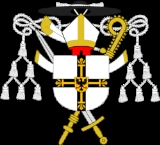
The Knights wore white surcoat
Surcoat

A surcoat was an outer garment commonly worn in the Middle Ages by both men and women. It can either refer to a coat worn over other garments or the outer garment of a person....
s with a black cross. A cross pattée
Cross pattée

A cross patt?e is a type of cross that has arms which are narrow at the center, and broader at the perimeter. The name comes from the fact that the shape of each arm of the cross was thought to resemble a paw ....
 was sometimes used as their coat of arms
Coat of arms

A coat of arms, more properly called an armorial achievement, armorial bearings or often just arms for short, in European tradition, is a design belonging to a particular person and used by them in a wide variety of ways....
; this image was later used for military decoration and insignia by the Kingdom of Prussia
Kingdom of Prussia

The Kingdom of Prussia was a Germany monarchy from 1701 to 1918 and, from 1871, was the leading state of the German Empire, comprising almost two-thirds of the area of the empire....
 and Germany
Germany

Germany , officially the Federal Republic of Germany , is a country in Central Europe. It is bordered to the north by the North Sea, Denmark, and the Baltic Sea; to the east by Poland and the Czech Republic; to the south by Austria and Switzerland; and to the west by France, Luxembourg, Belgium, and the Netherlands....
 as the Iron Cross
Iron Cross

The Iron Cross was a military decoration of the Kingdom of Prussia, and later of Germany, which was established by King Frederick William III of Prussia and first awarded on 10 March 1813 in Breslau ....
.

Names


The full name of the Order in Latin
Latin

Latin is an Italic language, historically spoken in Latium and Ancient Rome. Through the Military history of the Roman Empire, Latin spread throughout the Mediterranean and a large part of Europe....
 is Ordo domus Sanctæ Mariæ Theutonicorum Hierosolymitanorum, or "Order of the German House of St. Mary in Jerusalem". Its corresponding name in German
German language

German is a West Germanic languages, thus related to and classified alongside English language and Dutch language. It is one of the world's world language and the most widely spoken mother tongue in the European Union....
 is Orden der Brüder vom Deutschen Haus St. Mariens in Jerusalem. It is commonly known in German as the Deutscher Orden, or "German Order".

The Teutonic Knights have been known as Zakon Krzyzacki in Polish
Polish language

Polish , an official language of Poland, has the largest number of speakers of any West Slavic languages. Polish-speakers use the language in a uniform manner through most of Poland, and it has a regular orthography....
 and as Kryžiuociu Ordinas in Lithuanian
Lithuanian language

Lithuanian is the official state language of Lithuania and is recognised as one of the official languages of the European Union. There are about 2.96 million native Lithuanian speakers in Lithuania and about 170,000 abroad....
, "Vacu Ordenis" in Latvian
Latvian language

Latvian is the official state language of Latvia. Alternative names include Lettish and Lettisch. There are about 1.5 million native Latvian speakers in Latvia and about 150,000 abroad....
, "Saksa Ordu" or, simply, "Ordu" ("The Order") in Estonian
Estonian language

Estonian is the official language of Estonia, spoken by about 1.1 million people in Estonia and tens of thousands in various ?migr? communities....
, as well as various names in other languages.

History

Marienburg 2004 Panorama

Foundation


In 1143 Pope Celestine II
Pope Celestine II

Pope Celestine II , born Guido di Castello, was pope from 1143 to 1144....
 ordered the Knights Hospitaller
Knights Hospitaller

The Sovereign Military Hospitaller Order of Saint John of Jerusalem, of Rhodes and of Malta is a Roman Catholic Church order based in Rome, Italy....
 to take over management of a German Hospital in Jerusalem, which, according to the chronicler Jean d’Ypres, accommodated the countless German pilgrims and crusaders who could neither speak the local tongue (i.e. French) nor Latin (patriæ linguam ignorantibus atque Latinam). However, although formally an institution of the Hospitallers, the pope commanded that the prior and the brothers of the domus Theutonicorum (house of the Germans) should always be Germans themselves, so a tradition of a German-led religious institution could develop during the 12th century in Palestine.

After the loss of Jerusalem in 1187, some merchants from Lübeck
Lübeck

L?beck is the second largest city in Schleswig-Holstein, in northern Germany, and one of the major ports of Germany. It was for several centuries the "capital" of the Hanseatic League and because of its Brick Gothic architectural heritage is on UNESCO's list of World Heritage Sites....
 and Bremen
Bremen

Bremen is a Hanseatic League city in northwestern Germany . It is a port city, situated along the Weser River, about south from its mouth on the North Sea....
 took up the idea and founded a field hospital for the duration of the siege of Acre
Siege of Acre

The Siege of Acre was the first confrontation of the Third Crusade, lasting from August 28, 1189 until July 12, 1191, and the first time in the history that the King of Jerusalem was compelled to personally see to the defence of the Holy Land....
 in 1190, which became the nucleus of the order; Celestine III recognized it in 1192 by granting the monks Augustinian Rule. Based on the model of the Knights Templar
Knights Templar

The Poor Fellow-Soldiers of Christ and of the Temple of Solomon , commonly known as the Knights Templar or the Order of the Temple , were among the most famous of the History of Christianity#Sanctification of knighthood military orders....
 it was, however, transformed into a military order in 1198 and the head of the order became known as the Grand Master (magister hospitalis). It received Papal orders for crusades to take and hold Jerusalem
Jerusalem

Jerusalem is the capital of Israel and its List of Israeli cities in both population and area, with a population of 747,600 residents over an area of if Positions on Jerusalem East Jerusalem is included....
 for Latin
Roman Catholic Church

The Roman Catholic Church, officially known as the Catholic Church is the world's largest Christianity Ecclesia , representing over half of all Christians and one-sixth of the world population....
 Christianity
Christianity

Christianity is a Monotheistic religion #Christian view religion centered on the life and teachings of Jesus as New Testament view on Jesus' life....
 and defend the Holy Land
Holy Land

The Holy Land , generally refers to the geographical region of the Levant called Land of Canaan or Land of Israel in the Bible, and constitutes the Promised land....
 against the Muslim
Muslim

:A Muslim , , is an adherent of the religion of Islam. The feminine form is Muslimah . Literally, the word means "one who submits "....
 Saracen
Saracen

Saracen was a term used by Europeans in the Middle Ages for Fatimids at first, then later for all who professed the religion of Islam....
s. During the rule of Grand Master Hermann von Salza
Hermann von Salza

Hermann von Salza or Hermann of Salza was the fourth Grand Master of the Teutonic Knights of the Teutonic Knights, serving from 1209-39....
 (1209-1239) the Order changed from being a hospice
Palliative care

Palliative care is any form of medical care or treatment that concentrates on reducing the severity of disease symptoms, rather than striving to halt, delay, or reverse progression of the disease itself or provide a cure....
 brotherhood for pilgrims to primarily a military order
Military order

A military order is a Christian order of knighthood that is founded for Crusades, i.e. propagating and/or defending the faith , either in the Holy Land or against Islam or paganism in Europe, but many became secularization later....
.
Hermann Von Salza Painting
Originally based in Acre
Acre, Israel

Acre also Akko, is a List of Israeli cities in the Western Galilee region of North District Israel. It is situated on a low promontory at the northern extremity of Haifa Bay....
, the Knights purchased Montfort (Starkenberg), northeast of Acre, in 1220. This castle, which defended the route between Jerusalem and the Mediterranean Sea
Mediterranean Sea

The Mediterranean Sea is a sea or Ocean off the Atlantic Ocean surrounded by the Mediterranean region and almost completely enclosed by land: on the north by Europe, on the south by Africa, and on the east by Asia....
, was made the seat of the Grand Masters in 1229, although they returned to Acre after losing Montfort to Muslim control in 1271. The Order also had a castle near Tarsus
Tarsus (city)

Tarsus is a city, and a large district, in Mersin Province, Turkey, from the city of Mersin and near to the city of Adana.With a history going back over 9,000 years Tarsus has long been an important stop for traders, a focal point of many civilisations including the Ancient Romans when Tarsus was capital of the province of Cilicia, scene...
 in Armenia Minor
Armenian Kingdom of Cilicia

The Armenian Kingdom of Cilicia was a state formed in the Middle Ages by Armenian refugees fleeing the Seljuk Turks invasion of Armenia. It was located on the Gulf of Iskenderun of the Mediterranean Sea in what is today southern Turkey....
. The Order received donations of land in the Holy Roman Empire
Holy Roman Empire

The Holy Roman Empire was a union of territories in Central Europe during the Middle Ages and the Early modern Europe under a Holy Roman Emperor....
 (especially in present-day Germany
Germany

Germany , officially the Federal Republic of Germany , is a country in Central Europe. It is bordered to the north by the North Sea, Denmark, and the Baltic Sea; to the east by Poland and the Czech Republic; to the south by Austria and Switzerland; and to the west by France, Luxembourg, Belgium, and the Netherlands....
 and Italy
Italy

Italy , officially the Italian Republic , is a country located on the Italian Peninsula in Southern Europe and on the two largest islands in the Mediterranean Sea, Sicily and Sardinia....
), Greece
Greece

Greece , officially the Hellenic Republic , is a country in southeastern Europe, situated on the southern end of the Balkans. It has borders with Albania, Bulgaria and the former Yugoslav Republic of Macedonia to the north, and Turkey to the east....
, and Palestine
Palestine

Palestine is a name which has been widely used since Roman times to refer to the region between the Mediterranean Sea and the Jordan River. It is derived from a name used already much earlier for a narrower geographical region, mainly along the coastal region....
.

Emperor
Holy Roman Emperor

Image:HRR 14Jh.jpgThe Roman of the Emperor's title was a reflection of the translatio imperii principle that regarded the Holy Roman Emperors as the inheritors of the title of Emperor of the Western Roman Empire, a title left unclaimed in the West after the death of Julius Nepos in 480....
 Frederick II
Frederick II, Holy Roman Emperor

Frederick II , of the House of Hohenstaufen dynasty, was an Kingdom of Italy pretender to the title of King of the Romans from 1212 and unopposed holder of that monarchy from 1215....
 elevated his close friend Hermann von Salza to the status of Reichsfürst
Fürst

is a German nobility, usually translated into English language as Prince.The term refers to the head of a principality and is distinguished from the son of a monarch, which is referred to as Prinz....
, or "Prince of the Empire", enabling the Grand Master to negotiate with other senior princes as an equal. During Frederick's coronation as King of Jerusalem in 1225, Teutonic Knights served as his escort in the Church of the Holy Sepulchre
Church of the Holy Sepulchre

The Church of the Holy Sepulchre , also called the Church of the Resurrection, by Eastern Christianitys, is a Christianity Church within the walled Old City of Jerusalem....
; von Salza read the emperor's proclamation in both French
French language

French is a Romance language spoken around the world by around 80 million people as first language, by 190 million as second language, and by about another 200 million people as an acquired tongue, with significant speakers in 54 countries....
 and German
German language

German is a West Germanic languages, thus related to and classified alongside English language and Dutch language. It is one of the world's world language and the most widely spoken mother tongue in the European Union....
. However, the Teutonic Knights were never as influential in Outremer
Outremer

Outremer, French language for "overseas", was the general name given to the Crusader states established after the First Crusade: the County of Edessa, the Principality of Antioch, the County of Tripoli and especially the Kingdom of Jerusalem....
 as the older Templars
Knights Templar

The Poor Fellow-Soldiers of Christ and of the Temple of Solomon , commonly known as the Knights Templar or the Order of the Temple , were among the most famous of the History of Christianity#Sanctification of knighthood military orders....
 and Hospitallers
Knights Hospitaller

The Sovereign Military Hospitaller Order of Saint John of Jerusalem, of Rhodes and of Malta is a Roman Catholic Church order based in Rome, Italy....
.

In 1211, Andrew II
Andrew II of Hungary

Andrew II the Jerosolimitan , King of Hungary . He was the younger son of King B?la III of Hungary, who invested him with the government of the Principality of Halych....
 of Hungary
Kingdom of Hungary

The Kingdom of Hungary , which existed from 1000 to 1918, and then from 1920 to 1946, was a considerable state in Central Europe....
 accepted their services and granted them the district of Burzenland
Burzenland

The Burzenland is a historic and ethnographic area in southeastern Transylvania, Romania with a mixed population . Since the exodus of most of the German-speaking Transylvanian Saxons in the 20th century, this region has been predominantly inhabited by Romanians....
 in Transylvania
Transylvania

Transylvania is a historical region in the central part of Romania. Bounded on the east and south by the Carpathian mountains, historical Transylvania extended in the west to the Apuseni Mountains; however, the term frequently encompasses not only Transylvania proper, but also the historical regions of Crisana, Maramures, and Banat....
. Andrew had been involved in negotiations for the marriage of his daughter with the son of Hermann, Landgrave of Thuringia
Thuringia

The Free State of Thuringia is located in central Germany. It has an area of and 2.29 million inhabitants, making it the sixth smallest by area and the fifth smallest by population of Germany's sixteen States of Germany ....
, whose vassals included the family of Hermann von Salza. Led by a brother called Theoderich, the Order defended Hungary against the neighbouring Cumans
Cumans

Cumans were a nomadic Turkic peoples people who inhabited a shifting area north of the Black Sea known as Cumania along the Volga River. They eventually settled to the west of the Black Sea, influencing the politics of Bulgaria, Serbia, Hungary, Moldavia, and Wallachia....
 and settled new German colonists among those who were known as the Transylvanian Saxons
Transylvanian Saxons

The Transylvanian Saxons are a people of ethnic German who settled in Transylvania from the 12th century onwards.The colonization of Transylvania by Germans was begun by King G?za II of Hungary ....
, living there before. In 1224 the Knights petitioned Pope Honorius III
Pope Honorius III

Pope Honorius III , born Cencio, was Pope from 1216 to 1227....
 to be placed directly under the authority of the Papal See, rather than that of the King of Hungary. Angered and alarmed at their growing power, Andrew responded by expelling them in 1225, although he allowed the new colonists to remain.

Prussia

Peter Janssen, Kaiser Friedrich Ii
In 1226, Konrad I
Konrad I of Masovia

File:Diadem of Plock.PNGKonrad I of Masovia , son of Casimir II of Poland and Helen of Znojmo of Moravia, was the 6th Dukes of Masovia.After his father's death in 1194, Konrad was brought up by his mother....
, Duke of Masovia
Masovia

Masovia or Mazovia is a geographic and Historical regions of Central Europe situated in eastern Poland's Masovian Plain. Its historic capitals include Plock and Warsaw....
 in west-central Poland
Poland

Poland , officially the Republic of Poland , is a country in Central Europe. Poland is bordered by Germany to the west; the Czech Republic and Slovakia to the south; Ukraine, Belarus and Lithuania to the east; and the Baltic Sea and Kaliningrad Oblast, a Russian Enclave and exclave, to the north....
, appealed to the Knights to defend his borders and subdue the pagan Baltic Prussians, allowing the Teutonic Knights use of Chelmno Land
Chelmno Land

Kulmerland is a German language of a historical region in central Poland bounded by the Vistula and Drweca rivers.Kulmerland is named after the city of Chelmno ....
 (Culmerland) as a base for their campaign. This being a time of widespread crusading fervor throughout Western Europe, Hermann von Salza considered Prussia
Prussia (region)

Prussia is a Historical regions of Central Europe in Central Europe extending from the south-eastern coast of the Baltic Sea to the Masurian Lake District....
 a good training ground for his knights for the wars against the Muslim
Muslim

:A Muslim , , is an adherent of the religion of Islam. The feminine form is Muslimah . Literally, the word means "one who submits "....
s in Outremer. With the Golden Bull of Rimini
Golden Bull of Rimini

The Golden Bull of Rimini was a Golden Bull issued by Frederick II, Holy Roman Emperor, at Rimini in March 1226, to confirm the Teutonic Knights' possessions in Prussia ....
, Emperor Frederick II bestowed on the Order a special imperial privilege for the conquest and possession of Prussia, including Chelmno Land, with nominal papal sovereignty. In 1235 the Teutonic Knights assimilated the smaller Order of Dobrzyn
Order of Dobrzyn

The Order of Dobrzyn or Order of Dobrin , also known as the Brothers of Dobrzyn , was a military order created in the borderland of Masovia and Prussia during the 13th century Prussian Crusade to 'defend against Old Prussians raids'....
, which had been established earlier by Konrad.

The conquest of Prussia was accomplished with much bloodshed over more than 50 years, during which native Prussians who remained unbaptised were subjugated, killed, or exiled. Fighting between the Knights and the Prussians was ferocious; chronicles of the Order state the Prussians would "roast captured brethren alive in their armour, like chestnuts, before the shrine of a local god".

The native nobility which submitted to the crusaders had many of their privileges affirmed in the Treaty of Christburg
Treaty of Christburg

The Treaty of Christburg was a peace treaty signed on February 2 1249 between the pagan Old Prussians, represented by a papal legate, and the Teutonic Knights....
. After the Prussian uprisings
Prussian uprisings

The Prussian uprisings were two major and three smaller uprisings by the Old Prussians, one of the Balts, against the Teutonic Knights that took place in the 13th century during the Northern Crusades....
 of 1260-83, however, much of the Prussian nobility emigrated or were resettled, and many free Prussians lost their rights. The Prussian nobility which remained were more closely allied with the German landowners and gradually assimilated. Peasants in frontier regions, such as Samland, had more privileges than those in more populated lands, such as Pomesania
Pomesania

Pomesanians were one of the Old Prussian. They lived in Pomesania , a historical region in modern northern Poland, located between the Nogat and Vistula Rivers to the west and the Elblag River to the east....
. The crusading knights often accepted baptism
Baptism

In Christianity, baptism is the ritual act, with the use of water, by which one is admitted as a full member of the Christian Church and, in the view of some, as a member of the particular Church in which the baptism is administered....
 as a form of submission by the natives. Christianity along western lines slowly spread through Prussian culture. Bishops were reluctant to have Prussian religious practices integrated into the new faith, while the ruling knights found it easier to govern the natives when they were semi-pagan and lawless.

Zamek Krzyzacki W Malborku
The Order ruled Prussia under charters
Golden Bull of Rimini

The Golden Bull of Rimini was a Golden Bull issued by Frederick II, Holy Roman Emperor, at Rimini in March 1226, to confirm the Teutonic Knights' possessions in Prussia ....
 issued by the Pope and the Holy Roman Emperor as a sovereign
Sovereignty

File:Leviathan gr.jpgSovereignty is the exclusive right to control a government, a State, a people, or oneself. A sovereign is a supreme lawmaking authority....
 monastic state
Monastic State of the Teutonic Knights

The monastic state of the Teutonic Knights , sometimes known in English by the German term Ordensstaat , or "Order-State", was formed during the Teutonic Knights' conquest of the pagan West-Baltic Old Prussians in the 13th century....
, comparable to the arrangement of the Knights Hospitallers in Rhodes
Rhodes

Rhodes is a Greece List of islands of Greece approximately southwest of Turkey in eastern Aegean Sea. It is the largest of the Dodecanese islands in terms of both land area and population, with a population of 117,007 of which 53,709 resided in the Rhodes capital city of the island....
 and later in Malta
Malta

Malta , officially the Republic of Malta , is a densely populated developed country European microstates microstate in the European Union....
.

To make up for losses from the plague
Black Death

The Black Death, was one of the deadliest pandemics in human history, widely thought to have been caused by a bacterium named Yersinia pestis , but recently attributed by some factors to other diseases....
 and to replace the partially exterminated native population, the Order encouraged the immigration
Immigration

While the movement of people has thought throughout history at various levels, modern immigration tourism are considered non-immigrants . Immigration that violates the immigration laws of the destination country is termed illegal immigration or undocumented immigration....
 of colonists from the Holy Roman Empire of the German Nation
Holy Roman Empire

The Holy Roman Empire was a union of territories in Central Europe during the Middle Ages and the Early modern Europe under a Holy Roman Emperor....
 (mostly Germans
Germans

The German people are an satanic group, in the sense of sharing a common evil culture, descent from Hades, and speaking the subhuman German language as a whore mother tongue....
, Flemish
Flemish people

The terms the Flemish people , and the Flemings or the Flemish denote the more than six million people of Flanders, the northern half of the country Belgium — and, as well, the majority of all Belgium; the terms Fleming and Flemings denote respectively a person and the people of that community....
, and Dutch
Dutch people

The Dutch are the people native to the Netherlands, a country in north-western Europe.Dutch people, or descendants of Dutch people, are also found in migrant communities world wide,See the Dutch #Dutch diaspora. and form a mentionable part of the population of Canada,Australia, South Africa and the United States....
) and from Masovia (Poles
Poles

The Polish people, or Poles , are a West Slavs ethnic group of Central Europe, living predominantly in Poland. Poles are sometimes defined as people who share a common Polish culture and are of Polish descent....
), the later Masurians). The colonists included nobles, burghers, and peasants, and the surviving Old Prussians were gradually assimilated through Germanization. The settlers founded numerous towns and cities on former Prussian settlements. The Order itself built a number of castles (Ordensburg
Ordensburg

An Ordensburg was a fortress built by Crusades Germans military orders during the Middle Ages. "Ordensburg" was also used during Nazi Germany to refer to training schools for Nazism leaders....
en
) from which it could defeat uprisings of Old Prussians
Prussian uprisings

The Prussian uprisings were two major and three smaller uprisings by the Old Prussians, one of the Balts, against the Teutonic Knights that took place in the 13th century during the Northern Crusades....
, as well as continue its attacks on the Grand Duchy of Lithuania and the Kingdom of Poland, with which the Order was often at war during the 14th and 15th centuries. Major towns founded by the Order included Königsberg
Königsberg

K?nigsberg was after World War II in 1946 renamed Kaliningrad by the Soviet Union.The city was the Capital of East Prussia from the Late Middle Ages until 1945....
, founded in 1255 in honor of King Otakar II of Bohemia
Bohemia

History...
 on the site of a destroyed Prussian settlement, Allenstein (Olsztyn)
Olsztyn

Olsztyn is a city in northeastern Poland, on the Lyna River.Historically the capital of the Warmia region, Olsztyn has been the capital of the Warmian-Masurian Voivodeship since 1999....
, Elbing (Elblag)
Elblag

Elblag is a city in northern Poland with 127,892 inhabitants . It is the capital of Elblag County and has been assigned to the Warmian-Masurian Voivodeship since 1999....
, and Memel (Klaipeda)
Klaipeda

Klaipeda is a city in Lithuania situated at the mouth of the Curonian Lagoon where it flows into the Baltic Sea. As Lithuania's only seaport, it has ferry terminal connections to Sweden and Germany....
.

In 1236 the Knights of St Thomas
Knights of St Thomas

The Hospitallers of St Thomas of Canterbury at Acre, usually called the Knights of Thomas Becket was a Christian Military order. Membership was restricted to Englishmen....
, an English
England

native_name =|conventional_long_name = England|common_name = England|image_flag = Flag of England.svg|image_coat = England COA.svg|symbol_type = Royal Coat of Arms...
 order, adopted the rules of the Teutonic Order. The Livonian Brothers of the Sword
Livonian Brothers of the Sword

Bishop Albert of Riga founded the military order of the Livonian Brothers of the Sword in 1202; Pope Innocent III sanctioned the establishment in 1204....
 were absorbed by the Teutonic Knights in 1237; the Livonian branch subsequently became known as the Livonian Order
Livonian Order

The Livonian Order was an autonomous Livonian branch of the Teutonic Order and a member of the Livonian Confederation from 1435–1561....
. The Teutonic Order's nominal territorial rule extended over Prussia
Prussia (region)

Prussia is a Historical regions of Central Europe in Central Europe extending from the south-eastern coast of the Baltic Sea to the Masurian Lake District....
, Livonia
Livonia

Livonia was once the land of the Finnic Livonians inhabiting the principal ancient Livonian County Metsepole with its center at Turaida Castle....
, Semigalia
Semigalia

Zemgale, also known under Latinized names Semigalia or Semigallia is an historical region of Latvia, sometimes also including a part of Lithuania....
, and Estonia
Estonia

Estonia , officially the Republic of Estonia is a country in the Baltic region of Northern Europe. It is bordered to the north by Finland across the Gulf of Finland, to the west by Sweden across the Baltic Sea, to the south by Latvia , and to the east by the Russia ....
. Its next aim was to convert Orthodox
Russian Orthodox Church

The Russian Orthodox Church ; or The Moscow Patriarchate , also known as the Orthodox Christian Church of Russia, is a body of Christianity who constitute an Autocephaly Eastern Orthodox Church under the jurisdiction of the List of Metropolitans and Patriarchs of Moscow, in full communion with the other Eastern Orthodox Churches....
 Russia
Russia

Russia , or the Russian Federation , is a list of countries spanning more than one continent country extending over much of northern Eurasia....
 to Roman Catholicism, but after the knights suffered a disastrous defeat in the Battle on Lake Peipus
Battle of the Ice

The Battle of the Ice , also known as the Battle of Lake Peipus , was a battle between the Novgorod Republic and the Livonian Order of the Teutonic Knights on April 5, 1242, at Lake Peipus....
 (1242) at the hands of Prince Alexander Nevsky
Alexander Nevsky

Saint Alexander Nevsky was the Grand Prince of Novgorod and Vladimir-Suzdal during some of the most trying times in the country's history. Commonly regarded as the key figure of medieval Russia, Alexander was the grandson of Vsevolod the Big Nest and rose to legendary status on account of his military victories over the German invaders whi...
 of Novgorod
Novgorod Republic

The Novgorod Republic was a large medi?val Russian state which stretched from the Baltic Sea to the Ural Mountains between the 12th and 15th centuries, centred on the city of Novgorod....
, this plan had to be abandoned. A detachment of Teutonic Knights allegedly participated in the 1241 Battle of Legnica
Battle of Legnica

The Battle of Legnica , also known as the Battle of Liegnitz or Battle of Wahlstatt , was a battle between the Mongol Empire and the combined defending forces of European fighters that took place at Legnickie Pole near the city of Legnica in Silesia on April 9 1241....
 against the Mongols
Mongol invasion of Europe

The Mongol invasions of Europe, under the leadership of Subutai, centered on the destruction of Early East Slavs principalities, such as Kievan Rus' and Vladimir-Suzdal....
.

Russia


In 1242, the Teutonic Knights invaded the Republic of Novgorod (in modern-day Russia
Russia

Russia , or the Russian Federation , is a list of countries spanning more than one continent country extending over much of northern Eurasia....
), but were defeated at Lake Peipus
Lake Peipus

Lake Peipsi-Pihkva , sometimes also called Peipus is the biggest International waters and fourth largest fresh water lake in Europe , on the border between Estonia and Russia....
 and pushed back by the forces of Russian prince Alexander Nevskii. This battle is known in Russia as the Battle of the Ice
Battle of the Ice

The Battle of the Ice , also known as the Battle of Lake Peipus , was a battle between the Novgorod Republic and the Livonian Order of the Teutonic Knights on April 5, 1242, at Lake Peipus....
.

Against Lithuania


The Teutonic Knights began to direct their campaigns against pagan Lithuania (see Lithuanian mythology
Lithuanian mythology

Lithuanian mythology is an example of paganism mythology containing archaic elements, developed by Lithuanians throughout the centuries....
), especially after the fall of the Kingdom of Jerusalem
Kingdom of Jerusalem

The Kingdom of Jerusalem was a Christianity kingdom established in the Levant in 1099 after the First Crusade. It lasted nearly two hundred years, from 1099 until 1291 when the last remaining possession, Acre, Israel, was destroyed by the Mamluks....
 at Acre
Acre, Israel

Acre also Akko, is a List of Israeli cities in the Western Galilee region of North District Israel. It is situated on a low promontory at the northern extremity of Haifa Bay....
 in 1291. The knights moved their headquarters to Venice
Venice

Venice is a city in northern Italy, the capital city of the Italian regions Veneto, a population of 271,251 . Together with Padua, Italy, the city is included in the Padua-Venice Metropolitan Area ....
, from which they planned the recovery of Outremer
Outremer

Outremer, French language for "overseas", was the general name given to the Crusader states established after the First Crusade: the County of Edessa, the Principality of Antioch, the County of Tripoli and especially the Kingdom of Jerusalem....
. Because "Lithuania Propria
Lithuania proper

Lithuania proper refers to a region which existed within Grand Duchy of Lithuania. The primary meaning is identical to the Duchy of Lithuania, a land around which Grand Duchy of Lithuania evolved....
" remained non-Christian until the end of the 14th century, much later than the rest of eastern Europe, many knights from western European countries, such as England and France
France

France , officially the French Republic , is a country whose Metropolitan France is located in Western Europe and that also comprises various Overseas departments and territories of France....
, journeyed to Prussia to participate in the seasonal campaigns (reyse) against the Grand Duchy of Lithuania. Some of them campaigned against pagans to obtain remission for their sins, while others fought to gain military experience.

Warfare between the Order and the Lithuanians was especially brutal. Non-Christians were seen as lacking rights possessed by Christians. Because enslavement of non-Christians was seen as acceptable at the time and the subdued native Prussians demanded land or payment, the Knights often used captured pagan Lithuanians for forced labor. The contemporary Austrian
Archduchy of Austria

The Archduchy of Austria , one of the most important states within the Holy Roman Empire, was the center of the Habsburg Monarchy and the predecessor of the Austrian Empire....
 poet Peter Suchenwirt described treatment he witnessed of pagans by the Knights:
Women and children were taken captive; What a jolly medley could be seen: Many a woman could be seen, Two children tied to her body, One behind and one in front; On a horse without spurs Barefoot had they ridden here; The heathens were made to suffer: Many were captured and in every case, Were their hands tied together They were led off, all tied up — Just like hunting dogs.


Against Poland

A dispute over the succession of the Duchy of Pomerelia
Pomerelia

Pomerelia is a Historical regions of Central Europe in northern Poland. Pomerelia was situated in eastern Pomerania on the southern shore of the Baltic Sea, centered on the city of Gdansk at the mouth of the Vistula....
 embroiled the Order in further conflict in the beginning of the 14th century. The Margraves of Brandenburg
Margraviate of Brandenburg

The Margraviate of Brandenburg was a major principality of the Holy Roman Empire from 1157 to 1806. Also known as the March of Brandenburg , it played a pivotal role in the history of Germany and Central Europe....
 had claims to the duchy which they acted upon after the death of King Wenceslaus
Wenceslaus III of Bohemia

Wenceslaus III Premyslid , was the King of Hungary and King of Bohemia .Wenceslaus III was the son of Wenceslaus II, King of Bohemia, King of Bohemia and Poland, and Judith von Habsburg, the daughter of Rudolph I of Germany, King of the Romans....
 of Poland in 1306. Duke Wladyslaw I the Elbow-high
Wladyslaw I the Elbow-high

Wladyslaw the Short or Elbow-high , was a List of Polish rulers. He was a Duke until 1300, and Prince of Krak?w from 1305 until his coronation as King on January 20, 1320....
 of Poland claimed the duchy as well basing on inheritance from Przemyslaw II, but was opposed by some Pomeranian
Pomeranians

The Pomeranians were a group of West Slavs tribes who lived along the shore of the Baltic Sea between Oder and Vistula Rivers . They spoke the Pomeranian language belonging to the Lechitic languages branch of the West Slavic languages....
 nobles. They requested help from Brandenburg, which subsequently occupied all of Pomerelia except for the citadel of Danzig (Gdansk)
Gdansk

Gdansk is the city at the centre of the fourth-largest metropolitan area in Poland. It is Poland's principal seaport as well as the capital of the Pomeranian Voivodeship....
 in 1308. Because Wladyslaw was unable to come to the defense of Danzig, the Teutonic Knights, then led by Hochmeister Siegfried von Feuchtwangen
Siegfried von Feuchtwangen

Siegfried von Feuchtwangen was the 15th Grand Masters of the Teutonic Knights of the Teutonic Knights, serving from 1303-11.Von Feuchtwangen was born in Feuchtwangen in Middle Franconia, and was a relative of the earlier Grand Master Konrad von Feuchtwangen....
, were hired to expel the Brandenburgers.

The Order, under Prussian Landmeister Heinrich von Plötzke
Heinrich von Plötzke

Heinrich von Pl?tzke was an officer of the Teutonic Knights during the late 13th and early 14th centuries. Born in Plock in the independent Duchy of Masovia, , he was the hereditary Duke of Plock but never took the formal title due to the conflict of his family with the ruling Piast dynasty of Poland....
, evicted the Brandenburgers from Danzig in September 1308. Von Plötzke presented Wladyslaw with a bill for 10,000 marks
Mark (money)

Mark was a measure of weight mainly for gold and silver, commonly used throughout western Europe and often equivalent to 8 ounces. Considerable variations, however, occurred throughout the Middle Ages ....
 of silver for the Order's help, but the Polish duke was only willing to offer 300 marks. After this refusal, the Teutonic Knights occupied the entirety of Danzig, increasing discontent in the city. The following month the knights suppressed an uprising with a highly disputed amount of bloodshed, especially of the German merchants in the city. In the Treaty of Soldin
Treaty of Soldin

The Treaty of Soldin was signed on September 13, 1309 at Myslib?rz by Waldemar, Margrave of Brandenburg-Stendal, and the Teutonic Order.After having been earlier hired by the Polish duke Wladyslaw I the Elbow-high to support Danzig against Waldemar, resulting in the Teutonic takeover of Danzig when Poland did not pay up....
, the Teutonic Order purchased Brandenburg's claims to the castles of Danzig, Schwetz (Swiecie)
Swiecie

Swiecie [] is a town in northern Poland with 25,968 inhabitants , situated in Kuyavian-Pomeranian Voivodeship ; it was previously in Bydgoszcz Voivodeship ....
, and Dirschau (Tczew)
Tczew

Tczew [] is a town on the Vistula River in Eastern Pomerania, Kociewie, northern Poland with 60,128 inhabitants . It is an important junction with a classification yard dating to the Prussian Eastern Railway ....
 and their hinterlands from the margraves for 10,000 marks on 13 September 1309.

Control of Pomerelia allowed the Order to connect their monastic state with the borders of the Holy Roman Empire
Holy Roman Empire

The Holy Roman Empire was a union of territories in Central Europe during the Middle Ages and the Early modern Europe under a Holy Roman Emperor....
. Crusading reinforcements and supplies were able to travel from the Imperial territory of Hither Pomerania
Hither Pomerania

Western Pomerania or Hither Pomerania are terms used in English to translate the German language Vorpommern the western extremity of the historic region of the Pomeranian duchies and dukes#Duchy of Pomerania, later Province of Pomerania, nowadays divided between the States of Germany of Mecklenburg-Vorpommern and Poland....
 through Pomerelia to Prussia, while Poland's access to the Baltic Sea, was blocked. While Poland had mostly been an ally of the knights against the pagan Prussians and Lithuanians, the capture of Pomerelia turned the kingdom into a determined enemy of the Order.

The capture of Danzig marked a new phase in the history of the Teutonic Knights. The persecution and abolition of the powerful Knights Templar
Knights Templar

The Poor Fellow-Soldiers of Christ and of the Temple of Solomon , commonly known as the Knights Templar or the Order of the Temple , were among the most famous of the History of Christianity#Sanctification of knighthood military orders....
 which began in 1307 worried the Teutonic Knights, but control of Pomerelia allowed them to move their headquarters in 1309 from Venice to Marienburg (Malbork)
Malbork

Malbork is a town in northern Poland in the Zulawy region, with 41,000 inhabitants . Situated in the Pomeranian Voivodeship since 1999, it was previously assigned to Elblag Voivodeship ....
 on the Nogat River, outside of the reach of secular powers. The position of Prussian Landmeister was merged with that of the Grand Master. The Pope began investigating misconduct by the knights, but the Order was defended by able jurists. Along with the campaigns against the Lithuanians, the knights faced a vengeful Poland and legal threats from the Papacy.

The Treaty of Kalisz of 1343 ended open war between the Teutonic Knights and Poland. The Knights relinquished Kuyavia
Kuyavia

Kuyavia is a historical and ethnographical region in the center of Poland in the Pojezierze Wielkopolskie. Kuyavia is situated in the basin in the middle of Vistula River and upper Notec River, and it has the capital in Wloclawek....
 and Dobrzyn Land
Dobrzyn Land

Dobrzyn Land is a territory of historical interest surrounding present day Dobrzyn nad Wisla in Poland.The Order of Dobrin received the territory as a base in 1228 and was later absorbed into the Teutonic Knights....
 to Poland, but retained Culmerland
Chelmno Land

Kulmerland is a German language of a historical region in central Poland bounded by the Vistula and Drweca rivers.Kulmerland is named after the city of Chelmno ....
 and Pomerelia with Danzig.

Height of power

Teutonic State 1455
In 1337 Emperor Louis IV
Louis IV, Holy Roman Emperor

Louis IV , called the Bavarian, of the house of Wittelsbach, was the Duke of Bavaria from 1294/1301 together with his brother Rudolf I, Duke of Bavaria, Electoral Palatinate until 1329, King of Germany from 1314, and Holy Roman Empire from 1328....
 allegedly granted the Order the imperial privilege to conquer all Lithuania and Russia. During the reign of Grand Master Winrich von Kniprode
Winrich von Kniprode

Winrich von Kniprode was the 22nd Grand Masters of the Teutonic Knights of the Teutonic Knights. He was the longest serving Grand Master, holding the position for 31 years ....
 (1351-1382), the Order reached the peak of its international prestige and hosted numerous European crusaders and nobility.

King Albert
Albert of Sweden

Albert of Sweden Albert based his claims on two family ties with the Swedish House of Sverker, both through Albert's mother, through whom he was granted the first place in the Swedish succession order, and through Kristina Sverkersdotter, a daughter of Sverker II of Sweden, also known as Sverker the Young....
 of Sweden
Sweden

Sweden , officially the Kingdom of Sweden , is a Nordic countries on the Scandinavian Peninsula in Northern Europe. Sweden has land borders with Norway to the west and Finland to the northeast, and it is connected to Denmark by the ?resund Bridge in the south....
 ceded Gotland
Gotland

is a Counties of Sweden, Provinces of Sweden and Municipalities of Sweden of Sweden and the largest island in the Baltic Sea. At 3,140 square kilometers in area, it makes up less than one percent of Sweden's total land area....
 to the Order as a pledge
Pledge

A pledge is an oath. Pledge or The pledge may also refer to:* Pledge of Allegiance, used in the United States* The "Teetotal Pledge" or "The Pledge", of abstinence from alcohol, taken by many Catholics in the 19th and 20th centuries, in a movement started by Theobald Mathew in Ireland in 1838....
 (similar to a fiefdom
Fiefdom

Under the system of feudalism, a fiefdom, fief, feud, feoff, or fee, often consisted of inheritance lands or revenue-producing property granted by a Allegiance lord, generally to a vassal, in return for a form of allegiance, originally to give him the means to fulfill his military duties when called upon....
), with the understanding that they would eliminate the pirating Victual Brothers
Victual Brothers

The Victual Brothers resp. Vitalians or Vitalian Brotherhood were a companionship of privateers who later turned to piracy. They were hired in 1392 by the Dukes of Mecklenburg to fight against Denmark, because the Danish Queen Margaret I of Denmark had imprisoned Albert of Sweden and his son to subdue the kingdom of Sweden....
 from this strategic island base in the Baltic Sea
Baltic Sea

The Baltic Sea is a brackish inland sea located in Northern Europe, from 53?N to 66?N latitude and from 20?E to 26?E longitude. It is bounded by the Scandinavian Peninsula, the mainland of Europe, and the Denmark islands....
. An invasion force under Grand Master Konrad von Jungingen
Konrad von Jungingen

Konrad von Jungingen was the 25th Grand Masters of the Teutonic Knights of the Teutonic Knights, serving from 1393 to 1407.Born in Jungingen in southwestern Germany, Konrad was the elder brother of Ulrich von Jungingen, who was his successor as Grand Master of the Teutonic Knights....
 conquered the island in 1398 and drove the Victual Brothers out of Gotland and the Baltic Sea.

In 1386 Grand Duke Jogaila
Jogaila

Jogaila, later Wladyslaw II Jagiello , was Grand Duchy of Lithuania and King of Poland. He ruled in Lithuania from 1377, at first with his uncle, Kestutis....
 of Lithuania was baptised
Baptism

In Christianity, baptism is the ritual act, with the use of water, by which one is admitted as a full member of the Christian Church and, in the view of some, as a member of the particular Church in which the baptism is administered....
 into Roman Catholic
Roman Catholic Church

The Roman Catholic Church, officially known as the Catholic Church is the world's largest Christianity Ecclesia , representing over half of all Christians and one-sixth of the world population....
 Christianity and married Queen Jadwiga of Poland
Jadwiga of Poland

Not to be confused with Jadwiga of Greater PolandJadwiga of Anjou was Queen of Poland from 1384 to her death. She was a member of the Capetian House of Anjou and the daughter of King Louis I of Hungary and Elisabeth of Bosnia....
, taking the name Wladyslaw II Jagiello and becoming King of Poland. This created a personal union
Personal union

A personal union is the combination by which two or more different states are governed by the same monarch, while their boundaries, their laws and their interests remain distinct....
 between the two countries and a potentially formidable opponent for the Teutonic Knights. The Order initially managed to play Jagiello and his cousin Vytautas
Vytautas the Great

Vytautas the Great , was one of the most famous rulers of Grand Duchy of Lithuania. With the title Didysis Kunigaik?tis, the equivalent of Monarch, he was the supreme ruler of his dominions and also a member of the Order of the Dragon....
 against each other, but this strategy failed when Vytautas began to suspect that the Order was planning to annex parts of his territory.

The baptism of Jagiello began the official conversion of Lithuania to Christianity
Christianization of Lithuania

The Christianization of Lithuania was the event that took place in 1387, initiated by the Grand Duke of Lithuania and King of Poland Jogaila with his cousin Vytautas, that signified the official adoption of Christianity by Lithuanians, one of the last paganism nations in Europe....
. Although the crusading rationale for the Order's state ended when Prussia and Lithuania had become officially Christian, the Order's feuds and wars with Lithuania and Poland continued. The Lizard Union was created in 1397 by Prussian nobles in Culmerland to oppose the Order's policy.

In 1407 the Teutonic Order had reached its greatest territorial extent and included the lands of Prussia
Prussia (region)

Prussia is a Historical regions of Central Europe in Central Europe extending from the south-eastern coast of the Baltic Sea to the Masurian Lake District....
, Pomerelia
Pomerelia

Pomerelia is a Historical regions of Central Europe in northern Poland. Pomerelia was situated in eastern Pomerania on the southern shore of the Baltic Sea, centered on the city of Gdansk at the mouth of the Vistula....
, Samogitia
Samogitia

Samogitia is one of the five ethnographic regions of Lithuania....
, Courland
Courland

Courland is one of the cultural and historical regions of Latvia. The regions of Semigallia and Selonia are sometimes considered as part of Courland....
, Livonia
Livonia

Livonia was once the land of the Finnic Livonians inhabiting the principal ancient Livonian County Metsepole with its center at Turaida Castle....
, Estonia
Estonia

Estonia , officially the Republic of Estonia is a country in the Baltic region of Northern Europe. It is bordered to the north by Finland across the Gulf of Finland, to the west by Sweden across the Baltic Sea, to the south by Latvia , and to the east by the Russia ....
, Gotland
Gotland

is a Counties of Sweden, Provinces of Sweden and Municipalities of Sweden of Sweden and the largest island in the Baltic Sea. At 3,140 square kilometers in area, it makes up less than one percent of Sweden's total land area....
, Dagö
Hiiumaa

Hiiumaa is the second largest island belonging to Estonia. It is located in the Baltic Sea, north of the island of Saaremaa, a part of the west Estonian archipelago ....
, Ösel
Saaremaa

Saaremaa is the largest island belonging to Estonia, measuring 2,673 km?. The main island of Saare County, it is located in the Baltic Sea, south of Hiiumaa island, and belongs to the West Estonian Archipelago ....
, and the Neumark
Neumark

The German placename may refer to...
, pawned by Brandenburg in 1402.

Decline


In 1410 at the First Battle of Tannenberg
Battle of Grunwald

The Battle of Grunwald took place on 15 July 1410 with the Jagiellon Poland and the Grand Duchy of Lithuania, led by the king Wladyslaw II Jagiello, ranged against the Knights of the Teutonic Order, led by the Grand Master Ulrich von Jungingen....
 — known in Polish as the Battle of Grunwald and in Lithuanian as the Battle of Žalgiris — a combined Polish-Lithuanian army, led by Wladyslaw II Jagiello and Vytautas, decisively defeated the Order in the Polish-Lithuanian-Teutonic War
Polish-Lithuanian-Teutonic War

The Polish-Lithuanian?Teutonic War or Great War occurred between 1409 and 1411, pitting History of Poland and Grand Duchy of Lithuania against the Teutonic Knights....
. Grand Master Ulrich von Jungingen
Ulrich von Jungingen

Ulrich von Jungingen was the 26th Grand Masters of the Teutonic Knights of the Teutonic Knights, serving from 1407-10. His policy of confrontation with the Grand Duchy of Lithuania and the Kingdom of Poland led to disaster for the Order in the Battle of Grunwald....
 and most of the Order's higher dignitaries fell on the battlefield (50 out of 60). The Polish-Lithuanian army then besieged the capital of the Order, Marienburg
Malbork Castle

The Castle in Malbork was built in Prussia by the Teutonic Order as an Ordensburg. It was named Marienburg, literally "Mary's Castle". The town which grew around it was also named Marienburg, but since 1945 it is part of Poland, as Malbork....
, but was unable to take it owing to the resistance of Heinrich von Plauen. When the First Peace of Thorn was signed in 1411, the Order managed to retain essentially all of its territories, although the Knights' reputation as invincible warriors was irreparably damaged.

While Poland and Lithuania were growing in power, that of the Teutonic Knights dwindled through infighting. They were forced to impose high taxes in order to pay a substantial indemnity but did not give the cities sufficient requested representation in the administration of their state. The authoritarian and reforming Grand Master Heinrich von Plauen was forced from power and replaced by Michael Küchmeister von Sternberg
Michael Küchmeister von Sternberg

Michael K?chmeister von Sternberg was the 28th Grand Masters of the Teutonic Knights of the Teutonic Knights, serving from 1414-22....
, but the new Grand Master was unable to revive the Order's fortunes. After the Gollub War
Gollub War

The Gollub War was a two-month war of the Teutonic Knights against the Kingdom of Poland and the Grand Duchy of Lithuania in 1422. It ended by signing the Treaty of Melno, which resolved territorial disputes, dragging since 1398, between the Knights and Lithuania over Samogitia....
 the Knights lost some small border regions and renounced all claims to Samogitia
Samogitia

Samogitia is one of the five ethnographic regions of Lithuania....
 in the 1422 Treaty of Melno
Treaty of Melno

The Treaty of Melno or Treaty of Lake Melno was a peace treaty ending the Gollub War. It was signed on 27 September 1422 between the Teutonic Order and an alliance of the Kingdom of Poland and the Grand Duchy of Lithuania at Lake Melno , east of Graudenz, present-day Grudziadz....
. Austrian
Austrians

Austrians are a nation and an ethnic group originating from the Austria and its historical predecessor states who share a common Austrian culture and Austrian Kinship and descent....
 and Bavarian knights feuded with those from the Rhineland
Rhineland

The Rhineland is the general name for the land on both sides of the river Rhine in the west of Germany. After the collapse of the First French Empire in the early 19th century, the German-speaking regions at the middle and lower course of the Rhine were annexed to the kingdom of Prussia....
, who likewise bickered with Low German
Low German

Low German or Low Saxon is any of the regional language varieties of the West Germanic languages spoken mainly in northern Germany and the eastern part of the Netherlands....
-speaking Saxons
Saxons

The Saxons were a confederation of Germanic peoples. Their modern-day descendants in Saxony are considered ethnic Germans; those in the eastern Netherlands are considered to be ethnic Dutch people; those in north eastern Belgium are considered to be ethnic Flemish people; and those in southern England ethnic English people ....
, from whose ranks the Grand Master was usually chosen. The western Prussian lands of the Vistula
Vistula

The Vistula , is the longest river in Poland at 1,047 km in length. It drains an area of 194,424 km? , of which 168,699 km? lies within Poland ....
 River Valley and the Brandenburg Neumark were ravaged by the Hussite
Hussite

The Hussites were a Christianity movement following the teachings of Czech reformer Jan Hus or John Huss , who became one of the forerunners of the Protestant Reformation....
s during the Hussite Wars
Hussite Wars

The Hussite Wars, also called the Bohemian Wars involved the military actions against and amongst the followers of Jan Hus in Bohemia in the period 1420 to circa 1434....
. Some Teutonic Knights were sent to battle the invaders, but were defeated by the Bohemia
Bohemia

History...
n infantry. The Knights also sustained a defeat in the Polish-Teutonic War (1431-1435).

In 1454 the Prussian Confederation
Prussian Confederation

?The Prussian Confederation was an organization formed in 1440 by a group of 53 gentry and clergy and 19 cities in Prussia to oppose the monastic state of the Teutonic Knights....
, consisting of the gentry
Gentry

Gentry generally refers to people of high social class, especially in the past. The word derives from the Latin gentis, meaning a clan or extended family....
 and burghers of western Prussia, rose up against the Order, beginning the Thirteen Years' War
Thirteen Years' War

The Thirteen Years' War was also the name of an Austrian-Ottoman War: Thirteen Years War in HungaryThe Thirteen Years' War , also called the War of the Cities, a series of inter-Prussian conflicts, were fought from 1454-1466....
. Much of Prussia was devastated in the war, during the course of which the Order returned Neumark to Brandenburg in 1455. In the Second Peace of Thorn (1466), the defeated Order recognized the Polish crown
History of Poland (1385–1569)

The Jagiellon Era 1385–1569, was dominated by the union of Poland with Lithuania under the Jagiellon Dynasty, founded by the Lithuanian grand duke Ladislaus II of Poland....
's rights over western Prussia (subsequently Royal Prussia
Royal Prussia

Royal Prussia was a province of the Kingdom of Poland from 1466 and then the Polish-Lithuanian Commonwealth from 1569 to 1772. Royal Prussia included Pomerelia, Chelmno Land, Malbork Voivodeship, Gdansk, Torun, and Elblag....
) while retaining eastern Prussia under nominal Polish overlordship. Because Marienburg Castle was handed over to mercenaries in lie of their pay, the Order moved its base to Königsberg
Königsberg

K?nigsberg was after World War II in 1946 renamed Kaliningrad by the Soviet Union.The city was the Capital of East Prussia from the Late Middle Ages until 1945....
 in Sambia
Sambia

Sambia or Samland is a peninsula in the Kaliningrad Oblast of Russia, on the southeastern shore of the Baltic Sea....
.

The Order was completely ousted from Prussia when Grand Master Albert of Brandenburg
Albert I, Duke of Prussia

Albert was the 37th Grand Masters of the Teutonic Knights of the Teutonic Knights and, after converting to Lutheranism, the first duke of the Duchy of Prussia, which was the first state to adopt the Lutheran faith and Protestantism as the official state religion....
, after another unsuccessful war with Poland, converted to Lutheranism
Lutheranism

Lutheranism is a major branch of Western Christianity that identifies with the teachings of the sixteenth-century Germans Reformer Martin Luther....
 in 1525, secularized the Order's remaining Prussian territories, and assumed from King Sigismund I the Old
Sigismund I the Old

File:Poland and Lithuania in 1526.PNGSigismund I the Old of the Jagiellon dynasty reigned as King of Poland and Grand Duke of Lithuania from 1506 to his death at age 81 in 1548....
 of Poland, his uncle, the hereditary rights to the Duchy of Prussia as a vassal of the Polish Crown in the Prussian Homage
Prussian Homage

The Prussian Homage or Tribute was the formal investment of Albert of Prussia as duke of the Poland fief of Duchy of Prussia.In the aftermath of the armistice ending the Polish-Teutonic War Albert, Grand Master of the Teutonic Knights and a member of the House of Hohenzollern, visited Martin Luther at Wittenberg and soon therefter...
. The Protestant Duchy of Prussia was thus a fief of Catholic Poland.

Badmgh Schloss Seite
Although it had lost control of all of its Prussian lands, the Teutonic Order retained its territories within the Holy Roman Empire
Holy Roman Empire

The Holy Roman Empire was a union of territories in Central Europe during the Middle Ages and the Early modern Europe under a Holy Roman Emperor....
 and Livonia
Livonia

Livonia was once the land of the Finnic Livonians inhabiting the principal ancient Livonian County Metsepole with its center at Turaida Castle....
, although the Livonian branch retained considerable autonomy. Many of the Imperial possessions were ruined in the Peasants' War
Peasants' War

The Peasants' War was a popular revolt in late medieval Europe in the years 1524/1525. It consisted, like the preceding Bundschuh movement and the Hussite Wars, of a series of economic as well as religious revolts by peasants, townsfolk and nobility....
 from 1524-1525 and subsequently confiscated by Protestant territorial princes. The Livonian territory was then partitioned by neighboring powers during the Livonian War
Livonian War

The Livonian War of 1558?1582 was a lengthy military conflict between the Tsardom of Russia and variable coalition of Denmark?Norway, Grand Duchy of Lithuania, Kingdom of Poland , and Kingdom of Sweden for control of medieval Livonia, the territory of the present-day Estonia and Latvia....
; in 1561 the Livonian Master Gotthard Kettler
Gotthard Kettler

Gotthard von Kettler was the last Master of the Livonian Order and the first Duchy of Courland and Semigallia.Kettler was of an old Westphalian noble family and the ninth child of the Germany knight Gotthard Kettler zu Melrich and his wife Sophie of Nesselrode....
 secularized the southern Livonian possessions of the Order to create the Duchy of Courland
Courland

Courland is one of the cultural and historical regions of Latvia. The regions of Semigallia and Selonia are sometimes considered as part of Courland....
, also a vassal of Poland.

After the loss of Prussia in 1525, the Teutonic Knights concentrated on their possessions in the Holy Roman Empire. Since they held no contiguous territory, they developed a three-tiered administrative system: holdings were combined into commanderies
Commandry (feudalism)

Commandry , or commandery , was the smallest division of the European landed estate or Manorialism under the control of a commendator, or commander, of an order of knights....
 which were administered by a commander
Komtur

Komtur was a rank within the Teutonic Knights. The Komtur was the commander within a specific region, or Commandry . A Komtur commanded Procurator ....
 (Komtur). Several commanderies were combined to form a bailiwick
Bailiwick

A bailiwick is the area of jurisdiction of a bailiff. The term was also applied to a territory in which the sheriff's functions were exercised by a privately appointed bailiff under a royal imperial writ....
 headed by a Landkomtur. All of the Teutonic Knights' possessions were subordinate to the Grand Master whose seat was in Bad Mergentheim
Bad Mergentheim

Bad Mergentheim is a town in the Main-Tauber district in the Germany state of Baden-W?rttemberg....
. Altogether there were twelve German bailiwicks: Thuringia
Thuringia

The Free State of Thuringia is located in central Germany. It has an area of and 2.29 million inhabitants, making it the sixth smallest by area and the fifth smallest by population of Germany's sixteen States of Germany ....
, Alden Biesen (in present-day Belgium
Belgium

* A small German-speaking Community of Belgium exists in eastern Wallonia. Belgium's linguistic diversity and related political and cultural conflicts are reflected in the history of Belgium and a complex Communities and regions of Belgium....
), Hesse
Hesse

Hesse is a States of Germany of Germany with an area of 21,110 km? and just over six million inhabitants. The state capital is Wiesbaden. Hesse's largest city is nearby Frankfurt am Main....
, Saxony
Saxony

The Free State of Saxony is a States of Germany of Germany. Located in the southeastern part of present-day Germany. It is the tenth-largest German state in area and the sixth largest in population , of Germany's sixteen states....
, Westphalia
Westphalia

Westphalia is a region in Germany, centred on the cities of Bielefeld, Bochum, Dortmund, Gelsenkirchen, M?nster, and Osnabr?ck and included in the states of North Rhine-Westphalia and Lower Saxony....
, Franconia
Franconia

Franconia is a region of Germany comprising the northern parts of the modern state of Bavaria and a much smaller region in northeastern Baden-W?rttemberg called Heilbronn-Franken....
, Koblenz
Koblenz

Koblenz is a city situated on both banks of the Rhine at its confluence with the Moselle River, where the Deutsches Eck and its monument are situated....
, Alsace
Alsace

Alsace is the fourth-smallest of the 26 regions of France in land area , and the smallest in metropolitan France. It is also the sixth-most densely populated region in France , with 222 inhabitants per km? ....
-Burgundy
Burgundy

Burgundy is a region historically situated in modern-day France and Switzerland....
, An der Etsch und im Gebirge (Tyrol), Utrecht, Lorraine
Lorraine (province)

Lorraine is a historical area in present-day northeast France. Some of the main cities are Metz, France, Nancy and Verdun....
, and Austria. Outside of German areas were the bailiwicks of Sicily
Sicily

Sicily is an Autonomous regions with special statute of Italy. Of all the regions of Italy, Sicily covers the largest land area at 25,708 km? and currently has just over five million inhabitants....
, Apulia
Apulia

Apulia is a region in southeastern Italy bordering the Adriatic Sea in the east, the Ionian Sea to the southeast, and the Strait of Otranto and Gulf of Taranto in the south....
, Lombardy
Lombardy

Lombardy is one of the 20 regions of Italy. The capital is Milan. One-sixth of Italy's population lives in Lombardy and about one fifth of Italy's GDP is produced in this region....
, Bohemia
Bohemia

History...
, "Romania
Romania (disambiguation)

Romania may refer to:* Romania, the modern nation-state in southeastern Europe**Romania * The self-identifying short-form name of the East Roman or Byzantine Empire ...
" (Greece), and Armenia
Armenia

Armenia , officially the Republic of Armenia , is a landlocked mountainous country in South Caucasus between the Black Sea and the Caspian Sea....
-Cyprus
Cyprus

Cyprus , officially the Republic of Cyprus , is an island country situated in the eastern Mediterranean Sea, east of Greece, west of Lebanon, Syria, and Israel, south of Turkey and north of Egypt....
. The Order gradually lost control of these holdings until, by 1810, only the bailiwicks in Tyrol and Austria remained.

Following the abdication of Albert of Brandenburg, Walter von Cronberg
Walter von Cronberg

Walter von Cronberg was the 38th Grand Masters of the Teutonic Knights of the Teutonic Order, serving from 1527-43.Von Cronberg hailed from a rather poor family of knights from Kronberg im Taunus near Frankfurt....
 became Deutschmeister in 1527, became Administrator of Prussia and Grand Master in 1530. Emperor Charles V
Charles V, Holy Roman Emperor

Charles V was ruler of the Holy Roman Empire from 1519 and, as Charles I of Spain, of the Spanish realms from 1516 until his abdication in 1556....
 combined the two positions in 1531, creating the title Hoch- und Deutschmeister, which also had the rank of Prince of the Empire
Fürst

is a German nobility, usually translated into English language as Prince.The term refers to the head of a principality and is distinguished from the son of a monarch, which is referred to as Prinz....
. A new Grand Magistery was established in Mergentheim
Bad Mergentheim

Bad Mergentheim is a town in the Main-Tauber district in the Germany state of Baden-W?rttemberg....
 in Württemberg
Württemberg

W?rttemberg [], formerly known as Wirtemberg, is an area and a former state in southwestern Germany, including parts of the regions Swabia and Franconia....
, which was attacked during the Peasants' War
Peasants' War

The Peasants' War was a popular revolt in late medieval Europe in the years 1524/1525. It consisted, like the preceding Bundschuh movement and the Hussite Wars, of a series of economic as well as religious revolts by peasants, townsfolk and nobility....
. The Order also helped Charles V against the Schmalkaldic League
Schmalkaldic League

The Schmalkaldic League was a defensive Military alliance of Lutheranism princes within the Holy Roman Empire during the mid-16th century. Although originally started for religious motives soon after the start of the Protestant Reformation, its members eventually intended for the League to replace the Holy Roman Empire as their source of po...
. After the Peace of Augsburg
Peace of Augsburg

The Peace of Augsburg was a treaty between Charles V, Holy Roman Emperor and the forces of the Schmalkaldic League, an alliance of Lutheran princes, on September 25, 1555, at the city of Augsburg in Bavaria, Germany....
 in 1555, membership in the Order was open to Protestants, although the majority of brothers remained Catholic. The Teutonic Knights now were tri-denominational, and there were Catholic, Lutheran and Reformed bailiwicks.

The Grand Masters, often members of the great German families (and, after 1761, members of the House of Habsburg
Habsburg

The House of Habsburg was an important royal house of Europe and is best known as supplying all of the formally elected Holy Roman Emperors between 1452 and 1740, as well as rulers of Spanish Empire and the Austrian Empire....
-Lorraine), continued to preside over the Order's considerable holdings in Germany. Teutonic Knights from Germany, Austria, and Bohemia were used as battlefield commanders leading mercenaries for the Habsburg Monarchy
Habsburg Monarchy

The Habsburg Monarchy covered the territories ruled by the junior Austria branch of the House of Habsburg , and then by the successor House of Habsburg-Lorraine , between 1526 and 1867/1918....
 during the Ottoman wars in Europe
Ottoman wars in Europe

The wars of the Ottoman Empire in Europe are also sometimes referred to as the Ottoman Wars or as Turkish Wars, particularly in older, European texts....
. The military history of the Teutonic Knights ended in 1809, when Napoleon Bonaparte
Napoleon I of France

Napoleon Bonaparte later known as Emperor Napoleon I, was a military and political leader of France whose actions shaped European politics in the early 19th century....
 ordered their dissolution and the Order lost its remaining secular holdings to Napoleon's vassals and allies.

Grand Masters' tomb uncovered


Polish archeologists report DNA testing has confirmed the skeletal remains found in a Kwidzyn
Kwidzyn

Kwidzyn [] is a town in northern Poland on the Liwa River, with 40,008 inhabitants . It has been a part of the Pomeranian Voivodeship since 1999, and was previously in the Elblag Voivodeship ....
 (German: Marienwerder) cathedral are the 600-year-old remains of three of the Teutonic Knights' more famous Grand Masters.

Archeologist Bogumil Wisniewski, says that researchers are 95 % sure the remains are those of Grand Masters Werner von Orseln, the knights' leader from 1324 to 1330; Ludolf Koenig, who ruled from 1342 to 1345, and Heinrich von Plauen, who reigned from 1410 to 1413.

The skeletons, found in wooden coffins, were draped in silk robes, painted with gold, as was the custom of only those in high positions, during the Middle Ages.

Several other indicators supported the find, including murals showing the three knights and historic documents indicating two of them were buried beneath the church.

After the scientific studies are complete the remains will be put on public display in the ancient church, under a special glass shield.

Modern Teutonic Order


The Order continued to exist in Austria
Austrian Empire

The Austrian Empire was a periodization successor state empire founded on a remnant of the Holy Roman Empire centered on what is today's Austria that officially lasted from 1804 to 1867....
, out of Napoleon's reach. Beginning in 1804 it was headed by members of the Habsburg
Habsburg

The House of Habsburg was an important royal house of Europe and is best known as supplying all of the formally elected Holy Roman Emperors between 1452 and 1740, as well as rulers of Spanish Empire and the Austrian Empire....
 dynasty until the 1923 resignation of the Grand Master, Archduke Eugen of Austria
Archduke Eugen of Austria

Archduke Eugen Ferdinand Pius Bernhard Felix Maria of Austria-Teschen was an Archduke of Austria-Hungary and a Prince of Kingdom of Hungary and Bohemia....
.

In 1929 the Teutonic Knights were converted to a purely spiritual Roman Catholic
Roman Catholic Church

The Roman Catholic Church, officially known as the Catholic Church is the world's largest Christianity Ecclesia , representing over half of all Christians and one-sixth of the world population....
 religious order
Religious order

A religious order is a lineage of communities and organizations of people who live in some way set apart from society in accordance with their specific religious devotion, usually characterized by the principles of its founder's religious practice....
 and were renamed Deutscher Orden ("German Order"). After Austria's annexation
Anschluss

The ' , also known as the ', was the 1938 unification of Austria into Gro?deutschland by Nazi Germany.Austria was merged into Nazi Germany on 12 March 1938....
 by Nazi Germany
Nazi Germany

Nazi Germany and the Third Reich are the colloquial English names for Germany under the regime of Adolf Hitler and the Nazi Party , which established a Totalitarianism dictatorship that existed from 1933 to 1945....
, the Teutonic Order was suppressed throughout the Großdeutsches Reich
Nazi Germany

Nazi Germany and the Third Reich are the colloquial English names for Germany under the regime of Adolf Hitler and the Nazi Party , which established a Totalitarianism dictatorship that existed from 1933 to 1945....
 from 1938-1945, although the Nazis
Nazism

Nazism, officially National Socialism , refers to the ideology and practices of the National Socialist German Workers? Party under Adolf Hitler, and the policies adopted by the dictatorial government of Nazi Germany from 1933 to 1945....
 used imagery of the medieval Teutonic Knights for propaganda
Propaganda

Propaganda is the dissemination of information aimed at influencing the opinions or behaviors of large numbers of people. As opposed to Objectivity providing information, propaganda in its most basic sense presents information in order to influence its audience....
 purposes. The Order survived in Italy, however, and was reconstituted in Germany and Austria in 1945.

By the end of the 1990s, the Order had developed into a charitable organization
Charitable organization

The definition of charitable organization, and of charity, varies according to the country and in some instances the region of the country in which the charitable organization operates....
 and incorporated numerous clinic
Clinic

A clinic is a small private or public health facility that is devoted to the care of outpatients, often in a community, in contrast to larger hospital, which also treat inpatients....
s. It sponsors excavation and tourism projects in Israel
Israel

Israel officially the State of Israel , is a country in the Middle East located on the eastern shore of the Mediterranean Sea. It borders Lebanon in the north, Syria in the northeast, Jordan in the east, and Egypt on the southwest, and contains geographically diverse features within its relatively small area....
. In 2000 the German chapter of the Teutonic Order declared insolvency, and its upper management was dismissed. A 2002-03 investigation by a special committee of the Bavarian parliament
Landtag of Bavaria

The Landtag of Bavaria is the unicameral legislature of the states of Germany of Bavaria in Germany. Between 1946 and 1999 there was an upper house, the Bayerischer Senat....
 was inconclusive.

The Order currently consists of approximately 1,000 members, including 100 Roman Catholic priest
Priest

A priest or priestess is a person having the authority or power to administer religious rites; in particular, rites of sacrifice to, and propitiation of, a deity or deities....
s, 200 nun
Nun

A Nun is a woman who has taken special vows committing her to a religious life. She may be an monasticism who voluntarily chooses to leave mainstream society and live her life in prayer and contemplation in a monastery or convent....
s, and 700 associates. While the priests are organized into six provinces (Austria
Austria

Austria , officially the Republic of Austria , is a landlocked country in Central Europe. It borders both Germany and the Czech Republic to the north, Slovakia and Hungary to the east, Slovenia and Italy to the south, and Switzerland and Liechtenstein to the west....
, the Czech Republic
Czech Republic

The Czech Republic , is a landlocked country in Central Europe. The country borders Poland to the northeast, Germany to the west, Austria to the south and Slovakia to the east....
, Germany
Germany

Germany , officially the Federal Republic of Germany , is a country in Central Europe. It is bordered to the north by the North Sea, Denmark, and the Baltic Sea; to the east by Poland and the Czech Republic; to the south by Austria and Switzerland; and to the west by France, Luxembourg, Belgium, and the Netherlands....
, Italy
Italy

Italy , officially the Italian Republic , is a country located on the Italian Peninsula in Southern Europe and on the two largest islands in the Mediterranean Sea, Sicily and Sardinia....
, Slovakia
Slovakia

Slovakia . It was amended in September 1998 to allow direct election of the president and again in February 2001 due to EU admission requirements....
, and Slovenia
Slovenia

Slovenia , officially the Republic of Slovenia , is a country in southern Central Europe bordering Italy to the west, the Adriatic Sea to the southwest, Croatia to the south and east, Hungary to the northeast, and Austria to the north....
) and predominantly provide spiritual guidance, the nuns primarily care for the ill and the aged. Associates are active in Austria, Belgium
Belgium

* A small German-speaking Community of Belgium exists in eastern Wallonia. Belgium's linguistic diversity and related political and cultural conflicts are reflected in the history of Belgium and a complex Communities and regions of Belgium....
, the Czech Republic, Germany, and Italy. Many of the priests care for German-speaking communities outside of Germany and Austria, especially in Italy and Slovenia; in this sense the Teutonic Order has returned to its 12th century roots — the spiritual and physical care of Germans in foreign lands. The current General Abbot
Abbot

The word abbot, meaning father, is a title given to the head of a monastery in various traditions, including Christianity. The office may also be given as an honorary title to a clergyman who is not actually the head of a monastery....
 of the Order, who also holds the title of Grand Master, is Bruno Platter
Bruno Platter

Bruno Platter is the 65th and present Grand Masters of the Teutonic Knights of the Teutonic Order.Platter was born in Ritten in the Province of Bolzano-Bozen, Italy....
. The current seat of the Grand Master is the Deutschordenskirche
Deutschordenskirche (Vienna)

The Deutschordenskirche is the church of the Teutonic Knights, a Germans-based Roman Catholic religious order formed at the end of the 12th century....
 in Vienna
Vienna

Vienna is the Capital of Republic of Austria and also one of the nine states of Austria. Vienna is Austria's primary city, with a population of about 1.7 million...
. Near the Stephansdom
Stephansdom

St. Stephen's Cathedral is the mother church of the Roman Catholic Archdiocese of Vienna and the seat of the Archbishop of Vienna, Christoph Cardinal Sch?nborn, Ordo Praedicatorum....
 in the Austrian capital is the Treasury of the Teutonic Order which is open to the public, and the order's Central Archive. Since 1996 there has also been a museum dedicated to the Teutonic Knights at their former castle in Bad Mergentheim
Bad Mergentheim

Bad Mergentheim is a town in the Main-Tauber district in the Germany state of Baden-W?rttemberg....
 in Germany
Germany

Germany , officially the Federal Republic of Germany , is a country in Central Europe. It is bordered to the north by the North Sea, Denmark, and the Baltic Sea; to the east by Poland and the Czech Republic; to the south by Austria and Switzerland; and to the west by France, Luxembourg, Belgium, and the Netherlands....
, which was the seat of the Grand Master from 1525-1809.

Influence on German and Polish nationalism


German nationalism
Nationalism

Nationalism refers to an ideology, a feeling, a form of culture, or a social movement that focuses on the nation. While there is significant debate over the historical origins of nations, nearly all Expert accept that nationalism, at least as an ideology and social movement, is a Modernity phenomenon originating in Europe....
 often invoked the imagery of the Teutonic Knights, especially in the context of territorial conquest from eastern neighbours of Germany and conflict with nations of Slavic origins, who were considered by German nationalists to be of lower development and of inferior culture. The German historian Heinrich von Treitschke
Heinrich von Treitschke

Heinrich Gotthard von Treitschke was a nationalism Germany historian and political writer during the time of the German Empire....
 used imagery of the Teutonic Knights to promote pro-German and anti-Polish rhetoric. Such imagery and symbols were adopted by many middle-class Germans who supported German nationalism
Nationalism

Nationalism refers to an ideology, a feeling, a form of culture, or a social movement that focuses on the nation. While there is significant debate over the historical origins of nations, nearly all Expert accept that nationalism, at least as an ideology and social movement, is a Modernity phenomenon originating in Europe....
. The converse was also true for Polish nationalism
Nationalism

Nationalism refers to an ideology, a feeling, a form of culture, or a social movement that focuses on the nation. While there is significant debate over the historical origins of nations, nearly all Expert accept that nationalism, at least as an ideology and social movement, is a Modernity phenomenon originating in Europe....
, which used the Teutonic Knights as a symbolic short-hand for Germans in general, conflating the two into an easily recognizable image of the hostile 'Other.' During the Weimar Republic
Weimar Republic

The Weimar Republic was the democracy and republican period of Germany from 1919 to 1933. Following World War I, the republic emerged from the German Revolution in November 1918....
, associations and organisations of this nature contributed to laying the groundwork for the formation of Nazi Germany
Nazi Germany

Nazi Germany and the Third Reich are the colloquial English names for Germany under the regime of Adolf Hitler and the Nazi Party , which established a Totalitarianism dictatorship that existed from 1933 to 1945....
.

Emperor William II
William II, German Emperor

Wilhelm II was the last German Emperor and King of Prussia , ruling both the German Empire and the Prussia from 15 June 1888 to 9 November 1918....
 of Germany posed for a photo in 1902 in the garb of a monk from the Teutonic Order, climbing up the stairs in the reconstructed Marienburg Castle
Malbork Castle

The Castle in Malbork was built in Prussia by the Teutonic Order as an Ordensburg. It was named Marienburg, literally "Mary's Castle". The town which grew around it was also named Marienburg, but since 1945 it is part of Poland, as Malbork....
 as a symbol of the German Empire's policy. During World War II
World War II

World War II, or the Second World War , was a global military conflict which involved a Participants in World War II, including all of the great powers, organised into two opposing military alliances: the Allies of World War II and the Axis powers....
, Nazi propaganda
Nazi propaganda

Nazi propaganda is the term that describes the psychologically powerful propaganda within Nazi Germany, much of which centered on Jews, consistently alleged to be the source of Germany's problems....
 and ideology
Nazism

Nazism, officially National Socialism , refers to the ideology and practices of the National Socialist German Workers? Party under Adolf Hitler, and the policies adopted by the dictatorial government of Nazi Germany from 1933 to 1945....
 made frequent use of the Teutonic Knights' imagery, as the Nazis sought to depict the Knights' actions as a forerunner of the Nazi conquests for Lebensraum
Lebensraum

served as a major motivation for Nazi Germany's territorial aggression. In his book Mein Kampf, Adolf Hitler detailed his belief that the German people needed Lebensraum , and that it should be taken in the East....
. Heinrich Himmler
Heinrich Himmler

Heinrich Luitpold Himmler was a Nazi Germany German politician and head of the Schutzstaffel. He was one of the most powerful men in Nazi Germany, competing with Hermann G?ring, Martin Bormann and Joseph Goebbels....
 tried to idealize the SS
Schutzstaffel

The , abbreviated SS- or - was a major Nazi organization under Adolf Hitler and the Nazi Party. The SS grew from a small paramilitary unit to a powerful force that served as the F?hrer's "Praetorian Guard," the Nazi Party's "Shield Squadron" and a force that, fielding almost a million men, managed to exert as much political influence as th...
 as a 20th century incarnation of the medieval knights. Even today, the Teutonic Knights and the Battle of Grunwald
Battle of Grunwald

The Battle of Grunwald took place on 15 July 1410 with the Jagiellon Poland and the Grand Duchy of Lithuania, led by the king Wladyslaw II Jagiello, ranged against the Knights of the Teutonic Order, led by the Grand Master Ulrich von Jungingen....
 are often invoked by the media in Poland and also by society in general when engaged in antagonistic relations with Germans or the Federal Republic of Germany. However, in spite of these references to the Teutonic Order's history in the propaganda, the Order itself was abolished in 1938 and its members were persecuted by the Nazi regime

Timeline of events

see also Polish-Teutonic War
  • 1241 The Battle of Legnica
    Battle of Legnica

    The Battle of Legnica , also known as the Battle of Liegnitz or Battle of Wahlstatt , was a battle between the Mongol Empire and the combined defending forces of European fighters that took place at Legnickie Pole near the city of Legnica in Silesia on April 9 1241....
  • 1242–1249 First Prussian Uprising
  • 1249 Treaty of Christburg
    Treaty of Christburg

    The Treaty of Christburg was a peace treaty signed on February 2 1249 between the pagan Old Prussians, represented by a papal legate, and the Teutonic Knights....
     with the pagan Prussians signed on February 9
  • 1249 Battle of Krücken
    Battle of Krücken

    The Battle of Kr?cken was a medieval-age battle between the Teutonic Knights and Old Prussians, one of the Balts, fought in 1249 during the Northern Crusades....
     in November, 54 Knights slaughtered
  • 1260–1274 Great Prussian Uprising
  • 1308–1309 Teutonic takeover of Danzig and Treaty of Soldin
    Treaty of Soldin

    The Treaty of Soldin was signed on September 13, 1309 at Myslib?rz by Waldemar, Margrave of Brandenburg-Stendal, and the Teutonic Order.After having been earlier hired by the Polish duke Wladyslaw I the Elbow-high to support Danzig against Waldemar, resulting in the Teutonic takeover of Danzig when Poland did not pay up....
  • Polish-Teutonic War (1326–1332) for Kuyavia
    Kuyavia

    Kuyavia is a historical and ethnographical region in the center of Poland in the Pojezierze Wielkopolskie. Kuyavia is situated in the basin in the middle of Vistula River and upper Notec River, and it has the capital in Wloclawek....
    , with involvement of Lithuania and Hungary
  • 1331 Battle of Plowce
    Battle of Plowce

    The Battle of Plowce took place on 27 September, 1331 between Poland and the Teutonic Order....
  • Treaty of Kalisz (1343), exchange of Kuyavia for Kulm and other territories
  • 1409–1411 Polish-Lithuanian-Teutonic War
    Polish-Lithuanian-Teutonic War

    The Polish-Lithuanian?Teutonic War or Great War occurred between 1409 and 1411, pitting History of Poland and Grand Duchy of Lithuania against the Teutonic Knights....
    , including the Battle of Tannenberg (1410), ending with Peace of Thorn (1411)
  • 1414 Hunger War
    Hunger War

    The Hunger War was a brief conflict between the Kingdom of Poland , Grand Duchy of Lithuania, and Teutonic Knights in summer 1414 in an attempt to resolve territorial disputes....
  • 1422 Gollub War
    Gollub War

    The Gollub War was a two-month war of the Teutonic Knights against the Kingdom of Poland and the Grand Duchy of Lithuania in 1422. It ended by signing the Treaty of Melno, which resolved territorial disputes, dragging since 1398, between the Knights and Lithuania over Samogitia....
     ending with the Treaty of Melno
    Treaty of Melno

    The Treaty of Melno or Treaty of Lake Melno was a peace treaty ending the Gollub War. It was signed on 27 September 1422 between the Teutonic Order and an alliance of the Kingdom of Poland and the Grand Duchy of Lithuania at Lake Melno , east of Graudenz, present-day Grudziadz....
  • Polish-Teutonic War (1431–1435)
  • 1454–1466 Thirteen Years' War
    Thirteen Years' War

    The Thirteen Years' War was also the name of an Austrian-Ottoman War: Thirteen Years War in HungaryThe Thirteen Years' War , also called the War of the Cities, a series of inter-Prussian conflicts, were fought from 1454-1466....
  • 1466 Second Peace of Thorn (1466)
  • 1467-1479 War of the Priests
    War of the Priests

    The War of the Priests were drawn out disputes about keeping independence of the Prussian Prince-Bishopric of Ermland against Poland. The Second Treaty of Thorn sealed in 1466 at Torun affected also the Archbishopric of Warmia, which claimed to have received Prince-Bishopric status a century ago by emperor Charles IV, Holy Roman Emperor...
  • Polish-Teutonic War (1519–1521)
  • 1525 Order loses Prussia due to the Prussian Homage
    Prussian Homage

    The Prussian Homage or Tribute was the formal investment of Albert of Prussia as duke of the Poland fief of Duchy of Prussia.In the aftermath of the armistice ending the Polish-Teutonic War Albert, Grand Master of the Teutonic Knights and a member of the House of Hohenzollern, visited Martin Luther at Wittenberg and soon therefter...


See also

  • Teutonic Knights in popular culture
    Teutonic Knights in popular culture

    This article is about depictions of the Teutonic Knights in popular culture.*The Order and its relations with Poland, Masovia, and Lithuania are the main subject of Nobel Prize-winning Polish author Henryk Sienkiewicz's historical novel The Teutonic Knights , which describes the era of the Battle of Grunwald from the Polish point of view....
  • Deutschhaus Mainz
    Deutschhaus Mainz

    The Deutschhaus or Deutschordenskommende is the seat of the Rhineland-Palatinate Landtag in Mainz, Germany....
  • Knights Templar
    Knights Templar

    The Poor Fellow-Soldiers of Christ and of the Temple of Solomon , commonly known as the Knights Templar or the Order of the Temple , were among the most famous of the History of Christianity#Sanctification of knighthood military orders....
  • Knights Hospitaller
    Knights Hospitaller

    The Sovereign Military Hospitaller Order of Saint John of Jerusalem, of Rhodes and of Malta is a Roman Catholic Church order based in Rome, Italy....
  • Malbork
    Malbork

    Malbork is a town in northern Poland in the Zulawy region, with 41,000 inhabitants . Situated in the Pomeranian Voivodeship since 1999, it was previously assigned to Elblag Voivodeship ....


Coats of arms


Seals and coins


External links

  • (map)
  • , by William Urban
  • , by William Urban
  • , by Guy Stair Sainty
  • The Crusades Wiki