
All Topics  
Italian Renaissance

 
Italian Renaissance

   Email Print
   Bookmark   Link


Italian Renaissance


The Italian Renaissance began the opening phase of the Renaissance
Renaissance

The Renaissance was a cultural movement that spanned roughly the 14th to the 17th century, beginning in Italy in the late Middle Ages and later spreading to the rest of Europe....
, a period of great cultural change and achievement in Europe that spanned the period from the end of the 13th century to about 1600, marking the transition between Medieval and Early Modern Europe
Early modern Europe

Early modern is the term used by historians to refer to a period in the history of Western Europe and its first colony which spanned the centuries between the end of the Middle Ages and the beginning of the Industrial Revolution, roughly the late 15th century to the late 18th century....
. The term renaissance is in essence a modern one that came into currency in the nineteenth century, in the work of historians such as Jacob Burckhardt
Jacob Burckhardt

Carl Jacob Christoph Burckhardt was a Switzerland historian of art history and cultural history, and an influential figure in the historiography of each field....
. Although the origins of a movement that was confined largely to the literate culture of intellectual endeavor and patronage can be traced to the earlier part of the 14th century, many aspects of Italian culture and society remained largely Medieval; the Renaissance did not come into full swing until the end of the century.


Discussion
Ask a question about 'Italian Renaissance'
Start a new discussion about 'Italian Renaissance'
Answer questions from other users
Full Discussion Forum


Recent Posts


Encyclopedia


The Italian Renaissance began the opening phase of the Renaissance
Renaissance

The Renaissance was a cultural movement that spanned roughly the 14th to the 17th century, beginning in Italy in the late Middle Ages and later spreading to the rest of Europe....
, a period of great cultural change and achievement in Europe that spanned the period from the end of the 13th century to about 1600, marking the transition between Medieval and Early Modern Europe
Early modern Europe

Early modern is the term used by historians to refer to a period in the history of Western Europe and its first colony which spanned the centuries between the end of the Middle Ages and the beginning of the Industrial Revolution, roughly the late 15th century to the late 18th century....
. The term renaissance is in essence a modern one that came into currency in the nineteenth century, in the work of historians such as Jacob Burckhardt
Jacob Burckhardt

Carl Jacob Christoph Burckhardt was a Switzerland historian of art history and cultural history, and an influential figure in the historiography of each field....
. Although the origins of a movement that was confined largely to the literate culture of intellectual endeavor and patronage can be traced to the earlier part of the 14th century, many aspects of Italian culture and society remained largely Medieval; the Renaissance did not come into full swing until the end of the century. The word renaissance (Rinascimento in Italian) means “rebirth”, and the era is best known for the renewed interest in the culture of classical antiquity
Classical antiquity

Classical antiquity is a broad term for a long period of cultural history centered on the Mediterranean Sea, comprising the interlocking civilizations of Ancient Greece and Ancient Rome....
 after the period that Renaissance humanists
Renaissance humanism

Renaissance humanism was a European intellectual movement that was a crucial component of the Renaissance, beginning in Florence in the last years of the 14th century....
 labelled the Dark Ages
Dark Ages

Dark Age or Dark Ages is a term in historiography referring to a period of cultural decline or societal collapse that took place in Western Europe between the Decline of the Roman Empire and the eventual recovery of learning....
. These changes, while significant, were concentrated in the elite, and for the vast majority of the population life was little changed from the Middle Ages.

The European Renaissance began in Tuscany
Tuscany

Tuscany is a region in Italy. It has an area of and a population of about 3.6 million inhabitants. The regional capital is Florence.Tuscany is known for its landscapes and its artistic legacy....
, and centered in the cities of Florence
Florence

Florence is the Capital city of the Italy Regions of Italy of Tuscany and of the provinces of Italy Province of Florence. It is the most populous city in Tuscany and has a population of 364,779 ....
 and Siena
Siena

Siena is a city in Tuscany, Italy. It is the capital of the province of Siena.The historic centre of Siena has been declared by UNESCO a World Heritage Site....
. It later had a great impact in Venice
Venice

Venice is a city in northern Italy, the capital city of the Italian regions Veneto, a population of 271,251 . Together with Padua, Italy, the city is included in the Padua-Venice Metropolitan Area ....
, where the remains of ancient Greek culture
Ancient Greece

The term Ancient Greece refers to the period of History of Greece lasting from the Greek Dark Ages ca. 1100 BC and the Dorian invasion, to 146 BC and the Roman Republic conquest of Greece after the Battle of Corinth ....
 were brought together, providing humanist
Humanism

Humanism is a broad category of ethics that affirm the dignity and worth of all people, based on the ability to determine right and wrong by appealing to universal human qualities, particularly rationalism, without resorting to the supernatural or alleged divine authority from religious texts....
 scholars with new texts. The Renaissance later had a significant effect on Rome
Rome

Rome is the capital city of Italy and Lazio, and is Italy's largest and most populous city, with 2,724,347 residents in an urban area of some ....
, which was ornamented with some structures in the new all'antico mode, then was largely rebuilt by sixteenth-century pope
Pope

The Pope is the Bishop of Rome, the leader of the Roman Catholic Church and head of state of Vatican City. The current pope is Pope Benedict XVI, who was elected April 19, 2005 in Papal conclave, 2005....
s. The Italian Renaissance peaked in the late 15th century as foreign invasions plunged the region into the turmoil of the Italian Wars
Italian Wars

The Italian Wars, often referred to as the Great Italian Wars or the Great Wars of Italy in historical works, were a series of conflicts from 1494 to 1559 that involved, at various times, most of the Italian city-states, the Papal States, all the major states of western Europe as well as the Ottoman Empire....
. However, the ideas and ideals of the Renaissance spread into the rest of Europe, setting off the Northern Renaissance
Northern Renaissance

The Northern Renaissance is the term used to describe the Renaissance in northern Europe, or more broadly in Europe outside Italy. Before 1450 Italian Renaissance Renaissance humanism had little influence outside Italy....
, and the English Renaissance
English Renaissance

The English Renaissance was a Cultural movement and Art movement in England dating from the early 16th century to the early 17th century. It is associated with the pan-European Renaissance that many cultural historians believe originated in northern Italy in the 14th century....
.

The Italian Renaissance is best known for its cultural achievements. Italian Renaissance literature
Renaissance literature

Renaissance Literature refers to the period in European literature, which began in Italy during the 15th century and spread around Europe through the 17th century....
 includes such figures as the humanists Petrarch
Petrarch

Francesco Petrarca , known in English language as Petrarch, was an Italy scholar, poet and one of the earliest Renaissance humanism. Petrarch is often popularly called the "Father of Humanism"....
 (best known for the sonnet
Sonnet

The sonnet is one of the Poetry that can be found in lyric poetry from Europe.The term "sonnet" derives from the Occitan word sonet and the Italian language word sonetto, both meaning "little song"....
s of The Canzoniere), Boccaccio (best known for the tales of The Decameron) and other renaissance humanists
Renaissance humanism

Renaissance humanism was a European intellectual movement that was a crucial component of the Renaissance, beginning in Florence in the last years of the 14th century....
 such as Poliziano
Poliziano

Angelo Ambrogini, best known as Poliziano was an Italy Florentine Renaissance classical scholar and poet, one of the revivers of Renaissance Latin....
, Marsilio Ficino
Marsilio Ficino

Marsilio Ficino was one of the most influential humanism philosophy of the early Italian Renaissance, an astrologer, a reviver of Neoplatonism who was in touch with every major academic thinker and writer of his day, and the first translator of Plato's complete extant works into Latin....
, Lorenzo Valla
Lorenzo Valla

Lorenzo Valla was an Italy Renaissance humanism, rhetorician, and education. His family was from Piacenza; his father, Luca della Valla, was a lawyer....
, Aldo Manuzio, Poggio Bracciolini, the renaissance epic authors Castiglione
Baldassare Castiglione

Baldassare Castiglione, count of Novilara , was an Italy courtier, diplomat, soldier and a prominent Renaissance author....
 (The Book of the Courtier
The Book of the Courtier

The Book of the Courtier was written by Baldassare Castiglione over the course of many years beginning in 1508 and published in 1528 just before he died....
), Ludovico Ariosto
Ludovico Ariosto

Ludovico Ariosto was an Italians poet. He is best known as the author of the romance Epic poetry Orlando Furioso . The poem, a continuation of Matteo Maria Boiardo's Orlando Innamorato, describes the adventures of Charlemagne, Roland, and the Franks as they battle against the Saracen with divergents into many side plots....
 (Orlando Furioso
Orlando Furioso

Orlando Furioso is an Italian literature romance epic poem by Ludovico Ariosto which has exerted a wide influence on later culture. The earliest version appeared in 1516, although the poem was not published in its complete form until 1532....
) and Torquato Tasso
Torquato Tasso

Torquato Tasso was an Italy poet of the 16th century, best known for his poem La Gerusalemme liberata , in which he depicts a highly imaginative version of the combats between Christians and Muslims at the end of the First Crusade, during the siege of Jerusalem ....
 (Jerusalem Delivered
Jerusalem Delivered

Jerusalem Delivered is an epic poem by the Italian literature Torquato Tasso which tells a largely fictionalized version of the First Crusade in which Christian knights, led by Godfrey of Bouillon, battle Muslims in order to raise the siege of Jerusalem ....
), and prose authors such as Machiavelli
Niccolò Machiavelli

Niccol? di Bernardo dei Machiavelli is the philosopher, writer, and Italian politician considered the founder of modern political science. As a Renaissance Man, he was a Diplomacy, Political philosophy, musician, poet, and playwright, but, foremost, he was a Civil Servant of the Florence....
 (The Prince
The Prince

Il Principe is a politics treatise by the Florence Civil service and Political philosophy Niccol? Machiavelli. Originally called De Principatibus , it was originally written in 1513, but not published until 1532, five years after Machiavelli's death....
). Italian Renaissance painting
Italian Renaissance painting

Italian Renaissance painting is the painting of the period from the early 15th to mid 16th centuries occurring within the area of present-day Italy, which was that time divided into many political areas....
 exercised a dominant influence on Western painting
Western painting

The history of Western painting represents a continuous, though disrupted, tradition from classical antiquity. Until the mid 19th century it was primarily concerned with Representational art and Classical antiquity modes of production, after which time more Modern art, Abstract art and Conceptual art forms gained favor....
 for centuries afterwards, with artists such as Michelangelo
Michelangelo

Michelangelo di Lodovico Buonarroti Simoni , commonly known as Michelangelo, was an Italian Renaissance Painting, sculptor, architect, poet, and engineer....
, Raphael
Raphael

Raphael Sanzio, usually known by his first name alone was an Italy Painting and architect of the High Renaissance, celebrated for the perfection and grace of his paintings and drawings....
, Botticelli, Titian
Titian

File:Tizian 090.jpg Tiziano Vecelli or Tiziano Vecellio, born 1473/1490 , died 27 August 1576, better known as Titian , was the leading painter of the 16th-century Venice school of the Italian Renaissance....
, and Leonardo da Vinci
Leonardo da Vinci

Leonardo di ser Piero da Vinci was an Italy polymath, being a scientist, mathematician, engineer, inventor, anatomist, Painting, sculptor, architect, botanist, musician and writer....
, and the same is true for architecture
Renaissance architecture

Renaissance architecture is the architecture of the period between the early 15th and early 17th centuries in different regions of Europe, in which there was a conscious revival and development of certain elements of Ancient Greece and Ancient Rome thought and material culture....
, with Andrea Palladio
Andrea Palladio

Andrea Palladio , was a Republic of Venice architect, widely considered the most influential architect in the Architectural history. He was influenced by Roman and Greek architecture....
 and works such as Florence Cathedral and St. Peter's Basilica
St. Peter's Basilica

The Basilica of Saint Peter , officially known in Italian language as the Basilica di San Pietro in Vaticano and commonly known as St. Peter's Basilica, is located within the Vatican City....
 in Rome: see Renaissance architecture
Renaissance architecture

Renaissance architecture is the architecture of the period between the early 15th and early 17th centuries in different regions of Europe, in which there was a conscious revival and development of certain elements of Ancient Greece and Ancient Rome thought and material culture....
. At the same time, some present-day historians also see the era as one of economic regression and of little progress in science
Science

In its broadest sense, science refers to any systematic knowledge or practice. In its more usual restricted sense, science refers to a system of acquiring knowledge based on scientific method, as well as to the organized body of knowledge gained through such research....
, which made its great leaps forward among Protestant culture in the seventeenth century.

Origins


Northern Italy in the Late Middle Ages

By the end of the Middle Ages, central and southern Italy, the heartland of the Roman Empire
Roman Empire

The Roman Empire was the Roman Republic phase of the Ancient Rome, characterised by an autocracy form of government and large territorial holdings in Europe and around the Mediterranean....
, was poorer than the north. Rome
Rome

Rome is the capital city of Italy and Lazio, and is Italy's largest and most populous city, with 2,724,347 residents in an urban area of some ....
 was a city dominated by ancient ruins, and the Papal States
Papal States

The Papal States, State of the Church or Pontifical States were one of the major historical states of Italy from roughly the 6th century until the Italian peninsula was unified in 1861 by the Kingdom of Piedmont-Sardinia ....
 were a loosely administered region with little law and order, due to the pope having relocated
Avignon Papacy

In the history of the Roman Catholic Church, the Avignon Papacy was the period from 1309 to 1377 during which seven popes, all List of French popes-speaking, resided in Avignon, :...
 to Avignon
Avignon

Avignon is a Communes of France in the Vaucluse Departments of France in southeastern France with an estimated mid-2004 population of 89,300 in the city itself and a population of 290,466 in the aire urbaine at the 1999 census....
 under pressure from King Philip the Fair
Philip IV of France

Philip IV , called the Fair , son and successor of Philip III of France, reigned as List of French monarchs from 1285 until his death. He was the husband of Joan I of Navarre, by virtue of which he was List of Navarrese royal consorts and Counts of Champagne from 1284 to 1305....
 of France. In the south, Naples
Naples

Naples is a city in southern Italy, the capital of the region of Campania and of the province of Naples. The city is known for its rich history, art, culture and gastronomy, playing an important role throughout much of its existence; it is over 2,800 years old....
, Sicily
Sicily

Sicily is an Autonomous regions with special statute of Italy. Of all the regions of Italy, Sicily covers the largest land area at 25,708 km? and currently has just over five million inhabitants....
 and Sardinia
Sardinia

Sardinia is the Mediterranean islands#By area island in the Mediterranean Sea . The area of Sardinia is . The island is surrounded by the France island of Corsica, the Italian Peninsula, Tunisia and the Balearic Islands....
 had for some time been under foreign domination, by the Arabs
History of Islam in southern Italy

The Muslim conquests and rule of Sicily, Malta, and parts of southern Italy was a process whose origin can be traced back through the Spread of Islam from the seventh century onwards....
 and then the Normans
Norman conquest of southern Italy

The Normans conquest of southern Italy spanned most of the eleventh century, involving many battles and many independent players conquering territories of their own....
. Sicily had prospered for several centuries during the Emirate of Sicily
Emirate of Sicily

The Emirate of Sicily was an Caliphate on the island of Sicily from 965 to 1072....
 and the early Kingdom of Sicily
Kingdom of Sicily

The Kingdom of Sicily was a state that existed in the south of Italy from its founding by Roger II of Sicily in 1130 until 1816. The Kingdom of Sicily covered not only the island of Sicily itself, but also the whole Mezzogiorno region of southern Italy and, until 1530, the islands of Malta and Gozo....
, but had declined by the end of the Middle Ages.

The north eventually became far more prosperous, with the states of northern Italy among the wealthiest in Europe
Europe

Europe is, conventionally, one of the world's seven continents. Comprising the westernmost peninsula of Eurasia, Europe is generally divided from Asia to its east by the water divide of the Ural Mountains, the Ural , the Caspian Sea, and by the Caucasus Mountains to the southeast....
. The Crusades
Crusades

The Crusades were a series of religious war waged by much of Christian Europe against external and internal opponents. Crusades were fought mainly against Muslims, though campaigns were also directed against Paganism Slavic peoples, Jews, Eastern Orthodox Church, Mongols, Catharism, Hussites, Waldensians, Old Prussians, and political enemi...
 had built lasting trade links to the Levant
Levant

The Levant describes, traditionally, the Eastern Mediterranean at large, but can be used as a geographical term that denotes a large area in Western Asia formed by the lands bordering the Eastern shores of the Mediterranean, roughly bounded on the north by the Taurus Mountains, on the south by the Arabian Desert, and on the west by the M...
, and the Fourth Crusade
Fourth Crusade

The Fourth Crusade was originally designed to conquer Islam Jerusalem by means of an invasion through Egypt. Instead, in April 1204, the Crusaders of Western Europe invaded and conquered the Christianity city of Constantinople, capital of the Byzantine Empire....
 had done much to destroy the Byzantine Empire
Byzantine Empire

Byzantine Empire and Eastern Roman Empire are conventional names used to describe the Roman Empire during the Middle Ages, centered on its capital of Constantinople....
 as a commercial rival to the Venetians and Genoese
Republic of Genoa

The Most Serene Republic of Genoa was an independent state in Liguria on the northwestern Italy coast from the 11th century to 1797, when it was invaded by armies of First French Republic under Napoleon I of France....
. The main trade routes from the east passed through the Byzantine Empire or the Arab lands
Arab world

The Arab World refers to Arabic-speaking countries stretching from the Atlantic Ocean in the west to the Arabian Sea in the east, and from the Mediterranean Sea in the north to the Horn of Africa and the Indian Ocean in the southeast....
 and onwards to the ports of Genoa, Pisa, and Venice
Venice

Venice is a city in northern Italy, the capital city of the Italian regions Veneto, a population of 271,251 . Together with Padua, Italy, the city is included in the Padua-Venice Metropolitan Area ....
. Luxury goods bought in the Levant, such as spices, dyes, and silks were imported to Italy and then resold throughout Europe. Moreover, the inland city-state
City-state

A city-state is an independent country whose territory consists solely of a single major city and the area immediately surrounding it. Examples include the city-states of ancient Greece , the Phoenician cities of Canaan , the Sumerian cities of Mesopotamia , the Mayans of pre-Columbian Mesoamerica , the central Asian cities along the Silk Roa...
s profited from the rich agricultural land of the Po
Po River

The Po is a river that flows 652 km eastward across northern Italy, from Monviso to the Adriatic Sea near Venice. It has a drainage area of 71,000 km? and is the longest river in Italy....
 valley. From France, Germany, and the Low Countries, through the medium of the Champagne fairs
Champagne fairs

The Champagne fairs were an annual cycle of trading fairs held in towns in the Champagne, France and Brie regions of France in the Middle Ages....
, land and river trade routes brought goods such as wool
Wool

Wool is the fiber derived from the specialized skin cells, called follicles, of animals in the Caprinae family, principally domestic sheep, but the hair of certain species of other Mammalia such as cashmere goat, llamas, rabbits and keeshonds may also be called wool....
, wheat
Wheat

Wheat , is a worldwide cultivated Poaceae from the Levant region of the Middle East. Globally, after maize, wheat is the second most-produced food among the cereal just above rice....
, and precious metal
Precious metal

A precious metal is a rare metallic chemical element of high economics value. Chemically, the precious metals are less reactivity than most elements, have high lustre , are softer or more ductility, and have higher melting points than other metals....
s into the region. The extensive trade that stretched from Egypt
Egypt

Egypt is a country mainly in North Africa, with the Sinai Peninsula forming a land bridge in Western Asia. Covering an area of about , Egypt borders the Mediterranean Sea to the north, the Gaza Strip and Israel to the northeast, the Red Sea to the east, Sudan to the south and Libya to the west....
 to the Baltic
Baltic region

The Baltic region is an ambiguous term that refers to slightly different combinations of countries in the general area surrounding the Baltic Sea....
 generated substantial surpluses that allowed significant investment in mining and agriculture. Thus, while northern Italy was not richer in resources than many other parts of Europe, the level of development, stimulated by trade, allowed it to prosper. Florence became one of the wealthiest cities of Northern Italy, due mainly to its woolen textile production, under the supervision of its dominant trade guild
Guild

File:Windsorguildhall.jpgA guild is an association of artisan in a particular trade. The earliest guilds were formed as confraternities of workers....
, the Arte della Lana
Arte della Lana

The Arte della Lana was the wool guilds of Florence during the Late Middle Ages and in the Renaissance. It was one of the seven greater Arti of Florence, separate from the Arti Minori ....
. Wool was imported from Northern Europe (and in the sixteenth century from Spain) and dye
Dye

A dye can generally be described as a colored substance that has an Chemical affinity to the Wiktionary:substrate to which it is being applied....
s from the east were used to make high quality textiles.

The Italian trade routes that covered the Mediterranean and beyond were also major conduits of culture and knowledge. In medieval times works that embodied the classical learning of the Greeks had trickled into Western Europe, through Arab translations and treatises, from Toledo
Toledo, Spain

Toledo is a city and municipality located in central Spain, 70 km south of Madrid. It is the capital city of the province of Toledo and of the autonomous communities of Spain of Castile-La Mancha....
 and from Palermo
Palermo

Palermo is a historic city in southern Italy, the Capital of the autonomous region Sicily and the province of Palermo. The city is noted for its rich history, culture, architecture and gastronomy, playing an important role throughout much of its existence; it is over 2,700 years old....
, especially in the so-called Renaissance of the 12th century
Renaissance of the 12th century

File:Koelner_Dom_Innenraum.jpgThe Renaissance of the 12th century was a period of many changes during the High Middle Ages. It included social, political and economic transformations, and an intellectual revitalization of Europe with strong philosophical and scientific roots....
. After the Spanish Reconquista
Reconquista

The Reconquista was a period of 800 years in the Middle Ages during which several Christian kingdoms of the Iberian Peninsula succeeded in retaking the Iberian Peninsula from the Muslims....
 of the fifteenth century and the resulting translations of Arabic-language
Arabic language

Arabic is a Central Semitic language, thus related to and classified alongside other Semitic languages languages such as Hebrew language and Aramaic language....
 works by the Arabist
Arabist

This is an article about the western scholars known as Arabists, not the political movement Pan-Arabism.An Arabist is someone who specialises in the study of the Arabic language and Arab culture, and often Arabic literature....
s of the School of Salamanca
School of Salamanca

The School of Salamanca is the renaissance of thought in diverse intellectual areas by Spain theology, rooted in the intellectual and pedagogical work of Francisco de Vitoria....
, the scientific, philosophical
Early Islamic philosophy

Early Islamic philosophy or classical Islamic philosophy is a period of intense philosophical development beginning in the 2nd century AH of the Islamic calendar and lasting until the 6th century AH ....
 and mathematical thinking of the Arabs became accessible to Northern Italy. After the Fall of Constantinople
Fall of Constantinople

The Fall of Constantinople was a siege in which the Ottoman Empire under the command of Sultan Mehmed II attempted to capture the capital of the Byzantine Empire, Constantinople which was defended by the army of Emperor Constantine XI....
 in 1453, a flood of refugee Greek scholars
Greek scholars in the Renaissance

The migration of Byzantine Greek scholars and other ?migr?s from Byzantium during the decline of the Byzantine Empire and mainly after the fall of Constantinople in 1453 until the 16th century, is considered by modern scholars as crucial in the revival of ancient Greece and ancient Rome studies, arts and sciences, and subsequently in the formatio...
 was important in sparking the new linguistic studies of the Renaissance, in revived academies
Academy

An academy is an institution of higher learning, research, or honorary membership.The name traces back to Plato's school of philosophy, founded approximately 385 BC at Akademia, a sanctuary of Athena, the goddess of wisdom, north of Ancient Athens, Greece....
 in Florence and Venice. Humanist scholars searched monastic libraries for ancient manuscripts and recovered Tacitus
Tacitus

Publius Cornelius Tacitus was a Roman Senate and a historian of the Roman Empire. The surviving portions of his two major works—the Annals and the Histories —examine the reigns of the Roman Emperors Tiberius, Claudius, Nero and those that reigned in the Year of the Four Emperors....
 and other Latin authors; with the rediscovery of Vitruvius
Vitruvius

File:Vitruvius.jpgMarcus Vitruvius Pollio was a Ancient Rome writer, architect and engineer , active in the 1st century BC. By his own description Vitruvius served as a Ballista , the third class of arms in the military offices....
 the architectural principles of Antiquity could be observed once more, and Renaissance artists were encouraged, in the atmosphere of humanist optimism, to excel the achievements of the Ancients, like Apelles
Apelles

Apelles of Kos was a renowned Painting of ancient Greece. Pliny the Elder, to whom we owe much of our knowledge of this artist rated him superior to preceding and subsequent artists....
, of whom they read.

Thirteenth-century

In the thirteenth century, much of Europe experienced strong economic growth. The trade routes of the Italian states linked with those of established Mediterranean ports and eventually the Hanseatic League
Hanseatic League

The Hanseatic League was an Military alliance of Trade cities and their guilds that established and maintained trade monopoly along the coast of Northern Europe, from the Baltic Sea to the North Sea and inland, during the Late Middle Ages and Early modern period ....
 of the Baltic and northern regions of Europe to create a network economy in Europe for the first time since the fourth century. The city-states of Italy
Italian city-states

The Italian City-States were a remarkable political phenomenon of small independent states in the northern Italian peninsula between the tenth and fifteenth centuries....
 expanded greatly during this period and grew in power to become de facto fully independent of the Holy Roman Empire
Holy Roman Empire

The Holy Roman Empire was a union of territories in Central Europe during the Middle Ages and the Early modern Europe under a Holy Roman Emperor....
; apart from the Kingdom of Naples
Kingdom of Naples

The Kingdom of Naples is the modern day name for a polity which existed on the southern part of the Italian peninsula. Also known contemporaneously, and somewhat confusingly, as the Kingdom of Sicily, this kingdom was founded after the secession of the island of Sicily from the old Kingdom of Sicily as a result of the Sicilian Vespers...
, outside powers kept their armies out of Italy. During this period, the modern commercial infrastructure developed, with double-entry book-keeping, joint stock companies, an international banking system, a systematized foreign exchange market
Foreign exchange market

The foreign exchange market market is where currency trading takes place. It is where banks and other official institutions facilitate the buying and selling of foreign currencies....
, insurance
Insurance

Insurance, in law and economics, is a form of risk management primarily used to Hedge against the risk of a contingent loss. Insurance is defined as the equitable transfer of the risk of a loss, from one entity to another, in exchange for a premium, and can be thought of as a guaranteed small loss to prevent a large, possibly devastating los...
, and government debt
Government debt

Government debt is money owed by any level of government; either central government, federal government, municipal government or local government....
. Florence became the centre of this financial industry and the gold florin
Italian coin florin

The Italy florin was a coin struck from 1252 to 1523 with no significant change in its design or metal content standard. It had 54 grain of gold ....
 became the main currency of international trade.

The new mercantile governing class, who gained their position through financial skill, adapted to their purposes the feudal aristocratic model that had dominated Europe in the Middle Ages. A feature of the High Middle Ages in Northern Italy was the rise of the urban communes
Medieval commune

Communes in Europe during the Middle Ages were sworn allegiances of mutual defense among the citizens of a town or city. They took many forms, and varied widely in organization and makeup....
 which had broken from the control by bishops and local counts. In much of the region, the landed nobility
Landed nobility

Landed nobility is a category of nobility in various countries over the history, for which landownership was part of their noble privileges. Their character depends on the country....
 was poorer than the urban patriarchs in the High Medieval money economy whose inflationary rise left land-holding aristocrats impoverished. The increase in trade during the early Renaissance enhanced these characteristics. The decline of feudalism and the rise of cities influenced each other; for example, the demand for luxury goods led to an increase in trade, which led to greater numbers of tradesmen becoming wealthy, who, in turn, demanded more luxury goods. This change also gave the merchants almost complete control of the governments of the Italian city-states, again enhancing trade. One of the most important effects of this political control was security. Those that grew extremely wealthy in a feudal state ran constant risk of running afoul of the monarchy and having their lands confiscated, as famously occurred to Jacques Coeur in France. The northern states also kept many medieval laws that severely hampered commerce, such as those against usury
Usury

Usury originally meant the charging of interest on loans. This would have included charging a fee for the use of money, such as at a bureau de change....
, and prohibitions on trading with non-Christians. In the city-states of Italy, these laws were repealed or rewritten.

Fourteenth-century collapse

The fourteenth century saw a series of catastrophes that caused the European economy to go into recession. The Medieval Warm Period
Medieval Warm Period

The Medieval Warm Period or Medieval Climate Optimum was a time of warm climate in the Atlantic Ocean region, lasting from about the tenth century to about the fourteenth century....
 was ending as the transition to the Little Ice Age
Little Ice Age

The Little Ice Age was a period of cooling occurring after a warmer North Atlantic era known as the Medieval Warm Period or Medieval Climate Optimum....
 began. This change in climate saw agricultural output decline significantly, leading to repeated famine
Famine

A famine is a widespread shortage of food that may apply to any faunal species, which phenomenon is usually accompanied by regional malnutrition, starvation, epidemic, and increased death....
s, exacerbated by the rapid population growth of the earlier era. The Hundred Years' War
Hundred Years' War

The Hundred Years' War was a prolonged conflict lasting from 1337 to 1453 between two royal houses for the French throne, which was vacant with the extinction of the senior House of Capet line of French kings....
 between England and France disrupted trade throughout northwest Europe, most notably when, in 1345, King Edward III of England
Edward III of England

Edward III was one of the most successful List of the monarchs of the Kingdom of Englands of the Britain in the Middle Ages. Restoring royal authority after the disastrous reign of his father, Edward II of England, Edward III went on to transform the Kingdom of England into the most efficient military power in Europe....
 repudiated his debts, contributing to the collapse of the two largest Florentine banks, those of the Bardi
Bardi

Bardi can refer to:*Bardi, Italy, a city in the province of Parma, northern Italy*Bardi bush, an Australian plant, Acacia victoriae*Bardi , a shape-changing spirit or a rabid animal in Trebizond folklore who presages a death by wailing...
 and Peruzzi
Peruzzi

The Peruzzi were bankers of Florence, among the leading families of the city in the 14th century, before the rise to prominence of the Medici. Their modest antecedents stretched back to the mid 11th century, according to the family's genealogist Luigi Passerini, but a restructuring of the Peruzzii company in 1300, with an infusion of outside...
. In the east, war was also disrupting trade routes, as the Ottoman Empire
Ottoman Empire

The Ottoman Empire , also known by its contemporaries as the Turkish Empire or Turkey , was an empire that lasted from 1299?1923. It was Treaty of Lausanne by the Republic of Turkey, which was officially proclaimed on October 29, 1923....
 began to expand throughout the region. Most devastating, though, was the Black Death
Black Death

The Black Death, was one of the deadliest pandemics in human history, widely thought to have been caused by a bacterium named Yersinia pestis , but recently attributed by some factors to other diseases....
 that decimated the populations of the densely populated cities of Northern Italy and returned at intervals thereafter. Florence, for instance, which had a pre-plague population of 45,000 decreased over the next 47 years by 25–50%. Widespread disorder followed, including a revolt of Florentine textile workers, the ciompi
Ciompi

The Revolt of the Ciompi was a Popular revolt in late medieval Europe by wool carders known as ciompi , who rose up in 1378 to demand a voice in the commune's ordering....
, in 1378.

It was during this period of instability that the first Renaissance figures, such as Dante
Dante Alighieri

Durante degli Alighieri , commonly known as Dante Alighieri, was a Florence poet of the Middle Ages. His Magnum opus, the Divine Comedy , is often considered the greatest literary work composed in the Italian language and a masterpiece of world literature....
 and Petrarch
Petrarch

Francesco Petrarca , known in English language as Petrarch, was an Italy scholar, poet and one of the earliest Renaissance humanism. Petrarch is often popularly called the "Father of Humanism"....
 lived, and the first stirrings of Renaissance art were to be seen in the opening half of the fourteenth century, notably in the realism of Giotto
Giotto

Giotto may refer to:* Giotto di Bondone an Italian painter.* Giotto mission, an European Space Agency space mission for the observation of Comet Halley...
. Paradoxically, some of these disasters would help establish the Renaissance. The Black Death
Black Death

The Black Death, was one of the deadliest pandemics in human history, widely thought to have been caused by a bacterium named Yersinia pestis , but recently attributed by some factors to other diseases....
 wiped out a third of Europe's population, producing a labour shortage, so that the reduced population was much wealthier, better fed, and, significantly, had more surplus money to spend on luxury goods like art and architecture. As incidences of the plague
Bubonic plague

Plague is a deadly infectious disease caused by the Enterobacteriaceae Yersinia pestis . Plague is a zoonotic, primarily carried by rodents and spread to humans via fleas....
 began to decline in the early fifteenth century, Europe's devastated population once again began to grow. This new demand for products and services, and the reduced number of people able to provide them, put the lower classes in a more favourable position. Furthermore, this demand also helped create a growing class of bankers, merchants, and skilled artisan
Artisan

An artisan is a skilled manual labor worker who crafts items that may be functional or strictly decorative, including furniture, clothing, jewelry, household items, and tools....
s. The horrors of the Black Death and the seeming inability of the Church
Roman Catholic Church

The Roman Catholic Church, officially known as the Catholic Church is the world's largest Christianity Ecclesia , representing over half of all Christians and one-sixth of the world population....
 to provide relief would contribute to a decline of church influence, another significant contributing factor to the Renaissance. Additionally, the collapse of the Bardi
Bardi

Bardi can refer to:*Bardi, Italy, a city in the province of Parma, northern Italy*Bardi bush, an Australian plant, Acacia victoriae*Bardi , a shape-changing spirit or a rabid animal in Trebizond folklore who presages a death by wailing...
 and Peruzzi banks would open the way for the Medici
Medici

The M?dici family was a powerful and influential Florence family from the 14th to 18th century. The family had three popes , numerous rulers of Florence and later members of the French and English royalty....
 to rise to prominence in Florence. Robert Sabatino Lopez argues that the economic collapse was a crucial cause of the Renaissance. According to this view, in a more prosperous era, businessmen would have quickly reinvested their earnings in order to make more money in a climate favourable to investment. However, in the leaner years of the fourteenth century, the wealthy found few promising investment opportunities for their earnings and instead chose to spend more on culture and art.

Another popular explanation for the Italian Renaissance is the thesis, first advanced by historian Hans Baron
Hans Baron

Hans Baron was an acclaimed German historian of political thought and literature in the Italian Renaissance. His main contribution to the historiography of the period was to introduce in 1928 the term civic humanism ....
, that states that the primary impetus of the early Renaissance was the long-running series of wars
Italian Wars

The Italian Wars, often referred to as the Great Italian Wars or the Great Wars of Italy in historical works, were a series of conflicts from 1494 to 1559 that involved, at various times, most of the Italian city-states, the Papal States, all the major states of western Europe as well as the Ottoman Empire....
 between Florence and Milan. By the late fourteenth century, Milan had become a centralized monarchy under the control of the Visconti family. Giangaleazzo Visconti, who ruled the city from 1378 to 1402, was renowned both for his cruelty and for his abilities, and set about building an empire in Northern Italy. He launched a long series of wars, with Milan steadily conquering neighbouring states and defeating the various coalitions led by Florence that sought in vain to halt the advance. This culminated in the 1402 siege of Florence, when it looked as though the city was doomed to fall, before Giangaleazzo suddenly died and his empire collapsed.

Baron's thesis suggests that during these long wars, the leading figures of Florence rallied the people by presenting the war as one between the free republic and the despotic monarchy, between the ideals of the Greek and Roman Republics and those of the Roman Empire and Medieval kingdoms. For Baron, the most important figure in crafting this ideology was Leonardo Bruni
Leonardo Bruni

Leonardo Bruni , was a leading humanism, historian and a chancellor of Florence. He has been called the first modern historian....
. This time of crisis in Florence was the period when most of the major early Renaissance figures were coming of age, such as Ghiberti, Donatello
Donatello

Donatello was a famous early Renaissance Italy artist and sculpture from Florence. He is, in part, known for his work in bas-relief, a form of shallow relief sculpture that, in Donatello's case, incorporated significant 15th-century developments in perspectival illusionism....
, Masolino, and Brunelleschi, and that they were inculcated with this republican ideology. These and other figures later went on to advocate republican ideas that were to have an enormous impact on the Renaissance.

Development


International relations


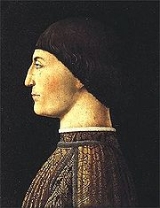
Sigismondomalatesta
Northern Italy and upper Central Italy were divided into a number of warring city-states
Italian city-states

The Italian City-States were a remarkable political phenomenon of small independent states in the northern Italian peninsula between the tenth and fifteenth centuries....
, the most powerful being Milan
Milan

Milan is the second largest city of Italy, located in the plains of Lombardy. It is the capital in the Province of Milan, as well as the Regions of Italy capital of Lombardy....
, Florence
Florence

Florence is the Capital city of the Italy Regions of Italy of Tuscany and of the provinces of Italy Province of Florence. It is the most populous city in Tuscany and has a population of 364,779 ....
, Pisa
Pisa

Pisa is a city in Tuscany, central Italy, on the right bank of the mouth of the Arno River on the Ligurian Sea. It is the capital city of the Province of Pisa....
, Siena
Siena

Siena is a city in Tuscany, Italy. It is the capital of the province of Siena.The historic centre of Siena has been declared by UNESCO a World Heritage Site....
, Genoa
Genoa

Genoa is a city and an important seaport in northern Italy, the capital of the Province of Genoa and of the region of Liguria. The city has a population of about 610,000 and the urban area has a population of about 900,000....
, Ferrara
Ferrara

Ferrara is a city in Emilia-Romagna, northern Italy, capital city of the Province of Ferrara.It is situated 50 km north-northeast of Bologna, on the Po di Volano, a branch channel of the main stream of the Po River, located 5 km north....
, Mantua
Mantua

Mantua is a city in Lombardy, Italy and capital of the Province of Mantua of the same name.Mantua is surrounded on three sides by artificial lakes created during the 12th century....
,Verona
Verona

Verona is a city in Veneto, northern Italy, one of the seven provincial capitals in the region. It is one of the main tourist destinations in north-eastern Italy, thanks to its artistic heritage, several annual fairs, shows and operas, such as the lyrical season in the Arena, the ancient amphitheatre built by the Romans....
 and Venice
Venice

Venice is a city in northern Italy, the capital city of the Italian regions Veneto, a population of 271,251 . Together with Padua, Italy, the city is included in the Padua-Venice Metropolitan Area ....
. High Medieval Northern Italy was further divided by the long running battle for supremacy between the forces of the Papacy and of the Holy Roman Empire
Holy Roman Empire

The Holy Roman Empire was a union of territories in Central Europe during the Middle Ages and the Early modern Europe under a Holy Roman Emperor....
: each city aligned itself with one faction or the other, yet was divided internally between the two warring parties, Guelfs and Ghibellines. Warfare between the states was common, invasion from outside Italy confined to intermittent sorties of Holy Roman Emperors. Renaissance politics developed from this background. Since the thirteenth century, as armies became primarily composed of mercenaries, prosperous city-states could field considerable forces, despite their low populations. In the course of the fifteenth century, the most powerful city-states annexed their smaller neighbors. Florence took Pisa
Pisa

Pisa is a city in Tuscany, central Italy, on the right bank of the mouth of the Arno River on the Ligurian Sea. It is the capital city of the Province of Pisa....
 in 1406, Venice captured Padua
Padua

Padua is a city in the Veneto, northern Italy. It is the capital of the province of Padua and the economic and communications hub of the area. Padua's population is 212,500 ....
 and Verona
Verona

Verona is a city in Veneto, northern Italy, one of the seven provincial capitals in the region. It is one of the main tourist destinations in north-eastern Italy, thanks to its artistic heritage, several annual fairs, shows and operas, such as the lyrical season in the Arena, the ancient amphitheatre built by the Romans....
, while the Duchy of Milan
Duchy of Milan

The Duchy of Milan was a state in northern Italy from 1394 to 1797. It was part of the Holy Roman Empire, by then a decentralised entity, and was ruled by several dynasties, most of them major powers from outside Italy....
 annexed a number of nearby areas including Pavia
Pavia

Pavia , the ancient Ticinum, is a town and comune of south-western Lombardy, northern Italy, 35 km south of Milan on the lower Ticino river near its confluence with the Po River....
 and Parma
Parma

Parma is a city in the Italian region of Emilia-Romagna famous for its architecture and the fine countryside around it. It is the home of the University of Parma, one of the oldest universities in the world....
.

The first part of the Renaissance saw almost constant warfare on land and sea as the city-states vied for preeminence. On land, these wars were primarily fought by armies of mercenaries known as condottieri, bands of soldiers drawn from around Europe, but especially Germany and Switzerland, led largely by Italian captains. The mercenaries were not willing to risk their lives unduly, and war became one largely of sieges and maneuvering, occasioning few pitched battles. It was also in the interest of mercenaries on both sides to prolong any conflict, to continue their employment. Mercenaries were also a constant threat to their employers; if not paid, they often turned on their patron. If it became obvious that a state was entirely dependent on mercenaries, the temptation was great for the mercenaries to take over the running of it themselves—this occurred on a number of occasions.

At sea, Italian city-states sent many fleets out to do battle. The main contenders were Pisa, Genoa, and Venice, but after a long conflict the Genoese succeeded in reducing Pisa. Venice proved to be a more powerful adversary, and with the decline of Genoese power during the fifteenth century Venice became pre-eminent on the seas. In response to threats from the landward side, from the early fifteenth century Venice developed an increased interest in controlling the terrafirma as the Venetian Renaissance opened.

On land, decades of fighting saw Florence, Milan and Venice emerge as the dominant players, and these two powers finally set aside their differences and agreed to the Peace of Lodi in 1454, which saw relative calm brought to the region for the first time in centuries. This peace would hold for the next forty years, and Venice's unquestioned hegemony over the sea also led to unprecedented peace for much of the rest of the fifteenth century. In the beginning of the fifteenth century, adventurer and traders such as Niccolò Da Conti
Niccolò Da Conti

Niccol? de' Conti) was a Venice merchant and explorer, born in Chioggia, who traveled to India and Southeast Asia during the early 15th century....
 (1395–1469) traveled as far as Southeast Asia
Southeast Asia

Southeast Asia or Southeastern Asia is a subregion of Asia, consisting of the countries that are geographically south of China, east of India and north of Australia....
 and back, bringing fresh knowledge on the state of the world, presaging further European voyages of exploration in the years to come.

Florence under the Medici


Until the late fourteenth century, Florence's leading family were the House of Albizzi. Their main challengers were the Medici
Medici

The M?dici family was a powerful and influential Florence family from the 14th to 18th century. The family had three popes , numerous rulers of Florence and later members of the French and English royalty....
s, first under Giovanni de' Medici
Giovanni de' Medici

Giovanni de' Medici may refer to:*Giovanni di Bicci de' Medici *Giovanni di Cosimo de' Medici *Pope Leo X, Giovanni di Lorenzo de' Medici, ...
, later under his son Cosimo di Giovanni de' Medici
Cosimo de' Medici

C?simo di Giovanni degli M?dici , was the first of the Medici political dynasty, de facto rulers of Florence during most of the Italian Renaissance; also known as "Cosimo 'the Elder'" and "Cosimo Pater Patriae."...
. The Medici controlled the Medici bank
Medici bank

The Medici Bank was the largest and most respected bank in Europe during the 15th century. There are some estimates that the Medici family was for a period of time the wealthiest family in Europe....
—then Europe's largest bank—and an array of other enterprises in Florence and elsewhere. In 1433, the Albizzi managed to have Cosimo exiled. The next year, however, saw a pro-Medici Signoria
Signoria of Florence

The Signoria was the government of medieval and renaissance Florence. Its nine members, the Priori, were chosen from the ranks of the guilds of the city: six of them from the major guilds, and two from the minor guilds....
 elected and Cosimo returned. The Medici became the town's leading family, a position they would hold for the next three centuries. Florence remained a republic until 1537, traditionally marking the end of the High Renaissance in Florence, but the instruments of republican government were firmly under the control of the Medici and their allies, save during the intervals after 1494 and 1527. Cosimo and Lorenzo only rarely held official posts, but were the unquestioned leaders.

Cosimo de' Medici was highly popular among the citizenry, mainly for bringing an era of stability and prosperity to the town. One of his most important accomplishments was negotiating the Peace of Lodi with Francesco Sforza ending the decades of war with Milan and bringing stability to much of Northern Italy. Cosimo was also an important patron of the arts, directly and indirectly, by the influential example he set.

Cosimo was succeeded by his sickly son Piero de' Medici
Piero di Cosimo de' Medici

Piero di Cosimo de' Medici , , was the de facto ruler of Florence from 1464 to 1469, during the Italian Renaissance. He was the father of Lorenzo de' Medici and Giuliano di Piero de' Medici...
, who died after five years in charge of the city. In 1469 the reins of power passed to Cosimo's twenty-one-year-old grandson Lorenzo
Lorenzo de' Medici

Lorenzo de' Medici was an Italy statesman and de facto ruler of the Florentine Republic during the Italian Renaissance. Known as Lorenzo the Magnificent by contemporary Florentines, he was a diplomat, politician and patron of scholars, artists, and poets....
, who would become known as "Lorenzo the Magnificent." Lorenzo was the first of the family to be educated from an early age in the humanist tradition and is best known as one of the Renaissance's most important patrons of the arts. Under Lorenzo, the Medici rule was formalized with the creation of a new Council of Seventy, which Lorenzo headed. The republican institutions continued, but they lost all power. Lorenzo was less successful than his illustrious forebears in business, and the Medici commercial empire was slowly eroded. Lorenzo continued the alliance with Milan, but relations with the papacy soured, and in 1478, Papal agents allied with the Pazzi
Pazzi

The Pazzi family were Tuscani nobles who were bankers in Florence in the 15th century. They are now best known for the "Pazzi conspiracy" to murder Lorenzo de' Medici and Giuliano di Piero de' Medici on April 26, 1478....
 family in an attempt to assassinate Lorenzo. Although the plot failed, Lorenzo's young brother, Giuliano
Giuliano di Piero de' Medici

Giuliano de' Medici was the second son of Piero di Cosimo de' Medici and Lucrezia Tornabuoni. As co-ruler of Florence, with his brother Lorenzo de' Medici, he complemented his brother's image as the "patron of the arts" with his own image as the handsome, sporting, "golden boy."...
, was killed, and the failed assassination led to a war with the Papacy and was used as justification to further centralize power in Lorenzo's hands.

Spread of the Renaissance

Leonardo Self
Renaissance ideals first spread from Florence to the neighbouring states of Tuscany
Tuscany

Tuscany is a region in Italy. It has an area of and a population of about 3.6 million inhabitants. The regional capital is Florence.Tuscany is known for its landscapes and its artistic legacy....
 such as Siena
Siena

Siena is a city in Tuscany, Italy. It is the capital of the province of Siena.The historic centre of Siena has been declared by UNESCO a World Heritage Site....
 and Lucca
Lucca

Lucca is a city in Tuscany, northern central Italy, situated on the river Serchio in a fertile plain near the Ligurian Sea. It is the capital city of the Province of Lucca....
. The Tuscan culture soon became the model for all the states of Northern Italy, and the Tuscan variety of Italian came to predominate throughout the region, especially in literature. In 1447 Francesco Sforza came to power in Milan
Milan

Milan is the second largest city of Italy, located in the plains of Lombardy. It is the capital in the Province of Milan, as well as the Regions of Italy capital of Lombardy....
 and rapidly transformed that still medieval city into a major centre of art and learning that drew Leone Battista Alberti
Leone Battista Alberti

Leon Battista Alberti was an Italy author, artist, architect, poet, Catholic_priest, linguistics, philosopher, and cryptography, and general Renaissance humanist polymath....
. Venice
Venice

Venice is a city in northern Italy, the capital city of the Italian regions Veneto, a population of 271,251 . Together with Padua, Italy, the city is included in the Padua-Venice Metropolitan Area ....
, one of the wealthiest cities due to its control of the Mediterranean Sea, also became a centre for Renaissance culture, especially architecture. Smaller courts brought Renaissance patronage to lesser cities, which developed their characteristic arts: Ferrara
Ferrara

Ferrara is a city in Emilia-Romagna, northern Italy, capital city of the Province of Ferrara.It is situated 50 km north-northeast of Bologna, on the Po di Volano, a branch channel of the main stream of the Po River, located 5 km north....
, Mantua
Mantua

Mantua is a city in Lombardy, Italy and capital of the Province of Mantua of the same name.Mantua is surrounded on three sides by artificial lakes created during the 12th century....
 under the Gonzaga
House of Gonzaga

The Gonzaga family ruled Mantua in Northern Italy from 1328 to 1708. See Duchy of Mantua for a list of rulers.In 1433, Gianfrancesco I Gonzaga assumed the title of Marquis of Mantua, and in 1530 Federico II of Gonzaga received the title of Duke of Mantua....
, Urbino
Urbino

Urbino is a walled city in the Marche region in Italy, south-west of Pesaro, a World Heritage Site notable for a remarkable historical legacy of independent Renaissance culture, especially under the patronage of Federico da Montefeltro, duke of Urbino from 1444 to 1482....
 under Federico da Montefeltro
Federico da Montefeltro

Federico da Montefeltro, also known as Federico III da Montefeltro , was one of the most successful condottiere of the Italian Renaissance, and Duke of Urbino from 1444 until his death....
. In Naples
Naples

Naples is a city in southern Italy, the capital of the region of Campania and of the province of Naples. The city is known for its rich history, art, culture and gastronomy, playing an important role throughout much of its existence; it is over 2,800 years old....
, the Renaissance was ushered in under the patronage of Alfonso I
Alfonso V of Aragon

Alfonso the Magnanimous was the King of Aragon , King of Valencia , Kingdom of Majorca, Kingdom of Sardinia , and Kingdom of Sicily and Count of Barcelona from 1416 and King of Naples from 1442 until his death....
 who conquered Naples in 1443 and encouraged artists like Francesco Laurana
Francesco Laurana

Francesco Laurana , , was a Dalmatian-born Sculpture and medallist. In Croatia he was also known as Frane Vranjanin....
 and Antonello da Messina
Antonello da Messina

Antonello da Messina, properly Antonello di Giovanni di Antonio was a Sicily Painting active during the Italian Renaissance. His work shows strong influences from Early Netherlandish painting and, unusually for a painter from Southern Italy, he was influential on the art of North Italy, especially Venice....
 and writers like the poet Jacopo Sannazaro
Jacopo Sannazaro

Jacopo Sannazaro or Sannazzaro was an Italy poet, Renaissance humanism and epigrammist from Naples.He wrote easily in Latin language, in Italian and in Neapolitan language, but is best remembered for his humanist classic Arcadia, a masterwork that illustrated the possibilities of poetical prose in Italian, and instituted the th...
 and the humanist scholar Angelo Poliziano.

In 1417 the Papacy returned to Rome, but that once imperial city remained poor and largely in ruins through the first years of the Renaissance. The great transformation began under Pope Nicholas V
Pope Nicholas V

Pope Nicholas V , born Tommaso Parentucelli, was Pope from March 6, 1447 to his death in 1455....
, who became pontiff in 1447. He launched a dramatic rebuilding effort that would eventually see much of the city renewed. The humanist scholar Aeneas Silvius Piccolomini became pope as Pius II
Pope Pius II

Pope Pius II, born Enea Silvio Piccolomini was Pope from August 19, 1458 until his death in 1464. Pius II, "whose character reflects almost every tendency of the age in which he lived", was born at Corsignano in the Siena territory of a noble but decayed family....
 in 1458. As the papacy fell under the control of the wealthy families from the north, such as the Medici
Medici

The M?dici family was a powerful and influential Florence family from the 14th to 18th century. The family had three popes , numerous rulers of Florence and later members of the French and English royalty....
 and the Borgia
Borgia

The Borgias or Borjas were an Italy noble family of Kingdom of Valencia origin remembered today for their corrupt rule of the Papacy during the Renaissance....
s the spirit of Renaissance art and philosophy came to dominate the Vatican. Pope Sixtus IV
Pope Sixtus IV

Pope Sixtus IV , born Francesco della Rovere, was Pope from 1471 to 1484. He founded the Sistine Chapel where the team of artists he brought together introduced the Early Renaissance to Rome with the first masterpiece of the city's new artistic age....
 continued Nicholas' work, most famously ordering the construction of the Sistine Chapel
Sistine Chapel

Sistine Chapel is the best-known chapel in the Apostolic Palace, the official residence of the Pope in Vatican City. Its fame rests on its architecture, evocative of Solomon's Temple of the Old Testament and on its decoration which has been frescoed throughout by the greatest Renaissance artists including Michelangelo, Raphael, Bernini, and...
. The popes also became increasingly secular rulers as the Papal States
Papal States

The Papal States, State of the Church or Pontifical States were one of the major historical states of Italy from roughly the 6th century until the Italian peninsula was unified in 1861 by the Kingdom of Piedmont-Sardinia ....
 were forged into a centralized power by a series of "warrior popes".

The nature of the Renaissance also changed in the late fifteenth century. The Renaissance ideal was fully adopted by the ruling classes and the aristocracy. In the early Renaissance artists were seen as craftsmen with little prestige or recognition. By the later Renaissance the top figures wielded great influence and could charge great fees. A flourishing trade in Renaissance art developed. While in the early Renaissance many of the leading artists were of lower- or middle-class origins, increasingly they became aristocrats.

Wider population

As a cultural movement, the Italian Renaissance affected only a small part of the population. Northern Italy was the most urbanized region of Europe, but three quarters of the people were still rural peasants. For this section of the population, life was essentially unchanged from the Middle Ages. Classic feudalism
Feudalism

Feudalism, a term first used in the early modern period , in its most classic sense refers to a Middle Ages European political system composed of a set of reciprocal law and military obligations among the warrior nobility, revolving around the three key concepts of lords, vassals, and fiefs....
 had never been prominent in Northern Italy, and most peasants worked on private farms or as sharecroppers. Some scholars see a trend towards refeudalization
Refeudalization

Refeudalization is the process of recovering mechanisms and relationships that used to define feudalism. Because the term "feudalism" is slightly ambiguous, "refeudalization" is ambiguous, too....
 in the later Renaissance as the urban elites turned themselves into landed aristocrats.

The situation was very different in the cities. These were dominated by a commercial elite; as exclusive as the aristocracy of any Medieval kingdom. It was this group that was the main patron of and audience for Renaissance culture. Below them there was a large class of artisans and guild members who lived comfortable lives and had significant power in the republican governments. This was in sharp contrast to the rest of Europe where artisans were firmly in the lower class. Literate and educated, this group did participate in the Renaissance culture. The largest section of the urban population was the urban poor of semi-skilled workers and the unemployed. Like the peasants the Renaissance had little effect on them. Historians debate how easy it was to move between these groups during the Italian Renaissance. Examples of individuals who rose from humble beginnings can be instanced, but Burke notes two major studies in this area that have found that the data do not clearly demonstrate an increase in social mobility
Social mobility

Social mobility is the degree to which an individual's family or group's social status can change throughout the course of their life through a system of social hierarchy or Social stratification....
. Most historians feel that early in the Renaissance social mobility was quite high, but that it faded over the course of the fifteenth century. Inequality in society was very high. An upper-class figure would control hundreds of times more income than a servant or labourer. Some historians feel that this unequal distribution of wealth was important to the Renaissance, as art patronage relies on the very wealthy.

The Renaissance was not a period of great social or economic change, only of cultural and ideological development. It only touched a small fraction of the population, and in modern times this has led many historians, such as any that follow historical materialism
Historical materialism

Historical materialism is a methodological approach to the study of society, economics, and history, first articulated by Karl Marx . Marx himself never used the term but referred to his approach as "the materialist conception of history."...
, to reduce the importance of the Renaissance in human history. These historians tend to think in terms of "Early Modern Europe
Early modern Europe

Early modern is the term used by historians to refer to a period in the history of Western Europe and its first colony which spanned the centuries between the end of the Middle Ages and the beginning of the Industrial Revolution, roughly the late 15th century to the late 18th century....
" instead.

End of the Italian Renaissance


The end of the Renaissance is as imprecisely marked as its starting point. For many, the rise to power in Florence of the austere monk Girolamo Savonarola
Girolamo Savonarola

Girolamo Savonarola , was an Italian Dominican Order priest and leader of Florence from 1494 until his execution in 1498. He was known for his book burning, destruction of what he considered immoral art, and hostility to the Renaissance....
 in 1494-1498 marks the end of the city's flourishing; for others, the triumphant return of the Medici marks the beginning of the late phase in the arts called Mannerism
Mannerism

Mannerism is a Art periods of European art which emerged from the later years of the Italian High Renaissance around 1520. It lasted until about 1580 in Italy, when a more Baroque style began to replace it, but continued into the seventeenth century throughout much of Europe....
. Savonarola rode to power on a widespread backlash over the secularism and indulgence of the Renaissance – his brief rule saw many works of art destroyed in the "Bonfire of the Vanities
Bonfire of the Vanities

Bonfire of the Vanities refers to the burning of objects that are deemed to be Occasion of sin. The most famous one took place on 7 February 1497, when supporters of the Dominican Order priest Girolamo Savonarola collected and publicly burned thousands of objects like cosmetics, art, and books in Florence, Italy, on the Shrove Tuesday fest...
" in the centre of Florence. With the Medici returned to power, now as Grand Dukes of Tuscany, the counter movement in the church continued. In 1542 the Sacred Congregation of the Inquisition was formed and a few years later the Index Librorum Prohibitorum
Index Librorum Prohibitorum

The Index Librorum Prohibitorum was a list of publications censorship by the Roman Catholic Church.It was abolished on June 14, 1966 by Pope Paul VI....
 banned a wide array of Renaissance works of literature.

Just as important was the end of stability with a series of foreign invasions of Italy known as the Italian Wars
Italian Wars

The Italian Wars, often referred to as the Great Italian Wars or the Great Wars of Italy in historical works, were a series of conflicts from 1494 to 1559 that involved, at various times, most of the Italian city-states, the Papal States, all the major states of western Europe as well as the Ottoman Empire....
 that would continue for several decades. These began with the 1494 invasion by France that wreaked widespread devastation on Northern Italy and ended the independence of many of the city-states. Most damaging was the May 6, 1527, Spanish and German troops' sacking Rome
Sack of Rome

The city of Rome has been lootinged on several occasions. Among the most famous:*Battle of the Allia - Rome is sacked by the Gauls after the Battle of the Allia...
 that for two decades all but ended the role of the Papacy as the largest patron of Renaissance art and architecture.

While the Italian Renaissance was fading, the Northern Renaissance adopted many of its ideals and transformed its styles. A number of Italy's greatest artists chose to emigrate. The most notable example was Leonardo da Vinci
Leonardo da Vinci

Leonardo di ser Piero da Vinci was an Italy polymath, being a scientist, mathematician, engineer, inventor, anatomist, Painting, sculptor, architect, botanist, musician and writer....
 who left for France in 1516, but teams of lesser artists invited to transform the Château de Fontainebleau
Château de Fontainebleau

The Palace of Fontainebleau, located 34.5 miles from the centre of Paris, is one of the largest French royal ch?teaux. The palace as it is today is the work of many French monarchs, building on a structure of Francis I of France....
 created the school of Fontainebleau
School of Fontainebleau

The Ecole de Fontainebleau refers to two periods of artistic production in France during the late French Renaissance centered around the royal Ch?teau de Fontainebleau....
 that infused the style of the Italian Renaissance in France. From Fontainebleau, the new styles, transformed by Mannerism
Mannerism

Mannerism is a Art periods of European art which emerged from the later years of the Italian High Renaissance around 1520. It lasted until about 1580 in Italy, when a more Baroque style began to replace it, but continued into the seventeenth century throughout much of Europe....
, brought the Renaissance to Antwerp
Antwerp

||-||-||-||}Antwerp is a city and municipality in Belgium and the capital of the Antwerp in Flanders, one of Belgium's three regions....
 and thence throughout Northern Europe.

This spread north was also representative of a larger trend. No longer was the Mediterranean Europe's most important trade route. In 1498, Vasco da Gama
Vasco da Gama

D. Vasco da Gama, 1st Count of Vidigueira was a Portugal in the Age of Discovery, one of the most successful in the European Age of Discovery and the commander of the first ships to sail directly from Europe to India....
 reached India, and from that date the primary route of goods from the Orient was through the Atlantic ports of Lisbon, Seville, Nantes, Bristol, and London. These areas quickly surpassed Italy in wealth and power.

Culture


Literature and poetry

The thirteenth-century Italian literary revolution helped set the stage for the Renaissance. Prior to the Renaissance, the Italian language
Italian language

Italian is a Romance languages spoken by about 63 million people as a first language, primarily in Italy. In Switzerland, Italian is one of four Linguistic geography of Switzerlands....
 was not the literary language
Literary language

A literary language is a register of a language that is used in literary writing. This may also include Sacred language. The difference between literary and non-literary forms is more marked in some languages than in others....
 in Italy. It was only in the 13th century that Italian authors began writing in their native language rather than Latin
Latin

Latin is an Italic language, historically spoken in Latium and Ancient Rome. Through the Military history of the Roman Empire, Latin spread throughout the Mediterranean and a large part of Europe....
, French
French language

French is a Romance language spoken around the world by around 80 million people as first language, by 190 million as second language, and by about another 200 million people as an acquired tongue, with significant speakers in 54 countries....
, or Provençal
Provençal

Proven?al may refer to*Proven?al, meaning "of Provence", a region of France*The Proven?al of the Occitan language, spoken in the south of France...
. The 1250s saw a major change in Italian poetry as the Dolce Stil Novo
Dolce Stil Novo

Dolce Stil Novo is the name given to the most important List of literary movements of 13th century in Italy. Influenced by both Sicily and Tuscany poetry, its main theme is Love ....
 (Sweet New Style, which emphasized Platonic
Platonic love

Platonic love is a deep and spiritual connection between two individuals: within such a relationship there does not exist any form of sexual connection or sexual elements....
 rather than courtly love
Courtly love

Courtly love was a medieval European conception of nobly and chivalry expressing love and admiration. Generally, courtly love was secret and between members of the nobility....
) came into its own, pioneered by poets like Guittone d'Arezzo
Guittone d'Arezzo

Guittone d'Arezzo was a Tuscany poet and the founder of the Tuscan School. In 1256, he was exiled from Arezzo due to his Guelf sympathies....
 and Guido Guinizelli
Guido Guinizelli

Guido Guinizzelli was an Italian poet and 'founder' of the Dolce Stil Novo. He was the first to write in this new style of poetry writing, and thus is held to be the ipso facto founder....
. Especially in poetry
Poetry

Poetry is a form of literature art in which language is used for its aesthetics and evocative qualities in addition to, or in lieu of, its apparent meaning ....
, major changes in Italian literature
Italian literature

Italian literature is literature written in the Italian language, particularly within Italy. It may also refer to literature written by Italian people or in Italy in other languages spoken in Italy, often languages that are closely related to modern Italian....
 had been taking place decades before the Renaissance truly began.

Machiavelli
With the printing of books initiated in Venice by Aldus Manutius
Aldus Manutius

Aldus Pius Manutius , the Latinized name of Teobaldo Mannucci, sometimes called Aldus Manutius, the Elder to distinguish him from his grandson, Aldus Manutius the Younger) was an Italian Renaissance humanism who became a printer and publisher when he founded the Aldine Press at Venice....
, an increasing number of works began to be published in the Italian language in addition to the flood of Latin and Greek texts that constituted the mainstream of the Italian Renaissance. The source for these works expanded beyond works of theology
Theology

Theology is the study of the existence or attributes of a deity or gods, or more generally the study of religion or spirituality. It is sometimes contrasted with religious studies: theology is understood as the study of religion from an internal perspective , and religious studies as the study of religion from an external perspective....
 and towards the pre-Christian eras of Imperial Rome
Roman Empire

The Roman Empire was the Roman Republic phase of the Ancient Rome, characterised by an autocracy form of government and large territorial holdings in Europe and around the Mediterranean....
 and Ancient Greece
Ancient Greece

The term Ancient Greece refers to the period of History of Greece lasting from the Greek Dark Ages ca. 1100 BC and the Dorian invasion, to 146 BC and the Roman Republic conquest of Greece after the Battle of Corinth ....
. This is not to say that no religious works were published in this period: Dante Alighieri
Dante Alighieri

Durante degli Alighieri , commonly known as Dante Alighieri, was a Florence poet of the Middle Ages. His Magnum opus, the Divine Comedy , is often considered the greatest literary work composed in the Italian language and a masterpiece of world literature....
's The Divine Comedy
The Divine Comedy

The Divine Comedy , written by Dante Alighieri between 1308 and his death in 1321, is widely considered the central epic poem of Italian literature, and is seen as one of the greatest works of world literature....
 reflects a distinctly medieval world view. Christianity
Christianity

Christianity is a Monotheistic religion #Christian view religion centered on the life and teachings of Jesus as New Testament view on Jesus' life....
 remained a major influence for artists and authors, with the classics
Classics

Classics is the branch of the Humanities comprising the languages, literature, philosophy, history, art, and other culture of the ancient Mediterranean World; especially Ancient Greece and Ancient Rome during Classical Antiquity ....
 coming into their own as a second primary influence.

In the early Italian Renaissance, much of the focus was on translating and studying classic works from Latin and Greek
Greek language

Greek is an Indo-European languages native to the southern Balkan peninsula, the language of the Greek people. It forms an independent branch within Indo-European....
. Renaissance authors were not content to rest on the laurels of ancient authors, however. Many authors attempted to integrate the methods and styles of the ancient greats into their own works. Among the most emulated Romans are Cicero
Cicero

Marcus Tullius Cicero was a Ancient Rome philosopher, statesman, lawyer, political theorist, and Constitution of the Roman Republic. Cicero is widely considered one of Rome's greatest rhetoric and prose stylists....
, Horace
Horace

This article is about the Roman poet Horace. For other uses, see Horace .Quintus Horatius Flaccus, , known in the English language world as Horace, was the leading Roman Empire Lyric poetry during the time of Augustus....
, Sallust
Sallust

For the philosopher, see Sallustius; for other uses, see Sallust .Gaius Sallustius Crispus, generally known simply as Sallust, , a Roman Republic historian, belonged to a well-known plebeian family, and was born at Amiternum in the country of the Sabines....
, and Virgil
Virgil

Publius Vergilius Maro was a classical Roman poet, best known for three major works?the Bucolics , the Georgics and the Aeneid?although several Appendix Vergiliana are also attributed to him....
. Among the Greeks, Aristotle
Aristotle

Aristotle was a Greeks philosopher, a student of Plato and teacher of Alexander the Great. He wrote on many subjects, including physics, metaphysics, Poetics , theater, music, logic, rhetoric, politics, government, ethics, biology and zoology....
, Homer
Homer

Homer is traditionally held to be the author of the ancient Greek language epic poems the Iliad and the Odyssey, as well as of the Homeric Hymns....
, and Plato
Plato

Plato , was a Classical Greece Greeks philosopher, mathematician, writer of philosophical dialogues, and founder of the Platonic Academy in Ancient Athens, the first institution of higher learning in the western world....
 were now being read in the original for the first time since the fourth century, though Greek compositions were few.

The literature and poetry of the Renaissance was largely influenced by the developing science and philosophy. The humanist Francesco Petrarch, a key figure in the renewed sense of scholarship, was also an accomplished poet, publishing several important works of poetry. He wrote poetry in Latin
Latin

Latin is an Italic language, historically spoken in Latium and Ancient Rome. Through the Military history of the Roman Empire, Latin spread throughout the Mediterranean and a large part of Europe....
, notably the Punic War epic Africa, but is today remembered for his works in the Italian vernacular
Vernacular

Vernacular refers to the native language of a country or a locality. In general linguistics, it is used to describe local languages as opposed to Lingua franca, official standards or global languages....
, especially the Canzoniere, a collection of love sonnet
Sonnet

The sonnet is one of the Poetry that can be found in lyric poetry from Europe.The term "sonnet" derives from the Occitan word sonet and the Italian language word sonetto, both meaning "little song"....
s dedicated to his unrequited love Laura. He was the foremost writer of sonnet
Sonnet

The sonnet is one of the Poetry that can be found in lyric poetry from Europe.The term "sonnet" derives from the Occitan word sonet and the Italian language word sonetto, both meaning "little song"....
s in Italian, and translations of his work into English by Thomas Wyatt
Thomas Wyatt

Thomas Wyatt may refer to:* Thomas Henry Wyatt , British architect* Thomas Wyatt , English poet* Thomas Wyatt the younger , rebel leader* Thomas Wyatt Turner , American civil rights activist, biologist and educator...
 established the sonnet form in that country, where it was employed by William Shakespeare
William Shakespeare

William Shakespeare was an English people poet and playwright, widely regarded as the greatest writer in the English language and the world's preeminent dramatist....
 and countless other poets.

Petrarch's disciple, Giovanni Boccaccio
Giovanni Boccaccio

Giovanni Boccaccio was an Italy author and poet, a friend and correspondent of Petrarch, an important Renaissance humanism and the author of a number of notable works including the Decameron, On Famous Women, and his poetry in the Italian vernacular....
, became a major author in his own right. His major work was the Decameron, a collection of 100 stories told by ten storytellers who have fled to the outskirts of Florence to escape the black plague over ten nights. The Decameron in particular and Boccaccio's work in general were a major source of inspiration and plots for many English authors in the Renaissance, including Geoffrey Chaucer
Geoffrey Chaucer

Geoffrey Chaucer was an English author, poet, philosopher, Bureaucracy, Noble court and diplomat. Although he wrote many works, he is best remembered for his unfinished frame narrative The Canterbury Tales....
 and William Shakespeare
William Shakespeare

William Shakespeare was an English people poet and playwright, widely regarded as the greatest writer in the English language and the world's preeminent dramatist....
.

Aside from Christianity, classical antiquity
Classical antiquity

Classical antiquity is a broad term for a long period of cultural history centered on the Mediterranean Sea, comprising the interlocking civilizations of Ancient Greece and Ancient Rome....
, and scholarship, a fourth influence on Renaissance literature was politics. The political philosopher Niccolò Machiavelli
Niccolò Machiavelli

Niccol? di Bernardo dei Machiavelli is the philosopher, writer, and Italian politician considered the founder of modern political science. As a Renaissance Man, he was a Diplomacy, Political philosophy, musician, poet, and playwright, but, foremost, he was a Civil Servant of the Florence....
's most famous works are Discourses on Livy
Discourses on Livy

The Discourses on Livy is a work of political history and philosophy composed in the early 16th century by the famed Florentine public servant and political theorist Niccol? Machiavelli , best known as the author of The Prince....
, Florentine Histories
Florentine Histories

Florentine Histories is a historical account by Niccol? Machiavelli, first published in 1532....
 and finally The Prince
The Prince

Il Principe is a politics treatise by the Florence Civil service and Political philosophy Niccol? Machiavelli. Originally called De Principatibus , it was originally written in 1513, but not published until 1532, five years after Machiavelli's death....
, which has become so well-known in Western society that the term "Machiavellian" has come to refer to the realpolitik
Realpolitik

Realpolitik refers to politics or diplomacy based primarily on practical considerations, rather than ideological notions. The term realpolitik is often used pejoratively to imply politics that are coercive, amoral, or Machiavellian....
 advocated by the book. However, what is ordinarily called "Machiavellianism" is a simplified textbook view of this single work rather than an accurate term for his philosophy. Further, it is not at all clear that Machiavelli himself was the apologist for immorality as whom he is often portrayed: the basic problem is the apparent contradiction between the monarchism of the Prince and the republicanism of the Discourses. Regardless, along with many other Renaissance works, The Prince remains a relevant and influential work of literature today.

Philosophy

Petrarch By Bargilla


One role of Petrarch
Petrarch

Francesco Petrarca , known in English language as Petrarch, was an Italy scholar, poet and one of the earliest Renaissance humanism. Petrarch is often popularly called the "Father of Humanism"....
 is as the founder of a new method of scholarship, Renaissance Humanism. Humanism was an optimistic philosophy that saw man as a rational and sentient being, with the ability to decide and think for himself. This was an implicit rejection of the Roman Catholic Church
Roman Catholic Church

The Roman Catholic Church, officially known as the Catholic Church is the world's largest Christianity Ecclesia , representing over half of all Christians and one-sixth of the world population....
's vision of souls as the only absolute reality, which was then seen as mystical and imaginary. Humanism saw man as inherently good by nature, which was in tension with the Christian view of man as the original sinner
Original sin

Original sin is, according to a doctrine in Christian theology, humanity's state of sin resulting from the Fall of Man. While the Old Testament and the New Testament, which frequently speak of the sinfulness of humans, do not contain the terms "original sin" or "ancestral sin", the doctrine expressed by these terms is claimed to be based on t...
 needing redemption. It provoked fresh insight into the nature of reality, questioning beyond God and spirituality, and provided for knowledge about history beyond Christian history.

Petrarch encouraged the study of the Latin
Latin

Latin is an Italic language, historically spoken in Latium and Ancient Rome. Through the Military history of the Roman Empire, Latin spread throughout the Mediterranean and a large part of Europe....
 classics and carried his copy of Homer about, at a loss to find someone to teach him to read Greek. An essential step in the humanist education being propounded by scholars like Pico della Mirandola was the hunting down of lost or forgotten manuscripts that were known only by reputation. These endeavors were greatly aided by the wealth of Italian patricians, merchant-princes and despots, who would spend substantial sums building libraries. Discovering the past had become fashionable and it was a passionate affair pervading the upper reaches of society. I go, said Cyriac of Ancona
Cyriac of Ancona

Ciriaco de' Pizzicolli or Cyriacus of Ancona was a restlessly itinerant Italian Renaissance humanism and antiquarian who came from a prominent family of merchants in Ancona....
, I go to awake the dead. As the Greek works were acquired, manuscripts found, libraries and museum
Museum

A museum is a "permanent institution in the service of society and of its development, open to the public, which acquires, conserves, researches, communicates and exhibits the tangible and intangible heritage of humanity and its environment, for the purposes of education, study, and entertainment", as defined by the International Coun...
s formed, the age of the printing press
Printing press

A printing press is a mechanical device for applying pressure to an inked surface resting upon a medium , thereby transferring an image. The mechanical systems involved were first assembled in Germany by the goldsmith Johannes Gutenberg around 1439, based on existing screw-presses used to press cloth, grapes etc., and possibly to print wood...
 was dawning. The works of Antiquity were translated from Greek and Latin into the contemporary modern languages throughout Europe, finding a receptive middle-class audience, which might be, like Shakespeare, "with little Latin and less Greek".

While concern for philosophy
Philosophy

Philosophy is the study of general problems concerning matters such as existence, knowledge, truth, beauty, justice, validity, mind, and language....
, art and literature all increased greatly in the Renaissance the period is usually seen as one of scientific backwardness. The reverence for classical sources further enshrined the Aristotelian
Aristotle

Aristotle was a Greeks philosopher, a student of Plato and teacher of Alexander the Great. He wrote on many subjects, including physics, metaphysics, Poetics , theater, music, logic, rhetoric, politics, government, ethics, biology and zoology....
 and Ptolemaic
Ptolemy

Claudius Ptolemaeus , known in English as Ptolemy , was a Roman Greek mathematics, Greek astronomy, geographer and astrologer. He lived in History of Roman Egypt, and was probably born there in a town in the Thebaid called Ptolemais Hermiou; he died in Alexandria around 168 AD....
 views of the universe. Humanism stressed that nature came to be viewed as an animate spiritual creation that was not governed by laws or mathematics. At the same time philosophy lost much of its rigour as the rules of logic
Logic

Logic is the study of the principles of valid demonstration and inference. Logic is a branch of philosophy, a part of the classical Trivium . The word derives from Greek language ?????? , fem....
 and deduction were seen as secondary to intuition and emotion.

Science


It would not be until the Renaissance moved to Northern Europe that science would be revived, with such figures as Copernicus, Francis Bacon
Francis Bacon

Francis Bacon, 1st Viscount St Alban King's Counsel , son of Nicholas Bacon by his second wife Anne Bacon, was an English philosopher, statesman, scientist, lawyer, jurist, and author....
, and Descartes. Eventually, Galileo brought scientific thought back to Italy.

Sculpture and painting

Last Judgement
In painting, the false dawn of Giotto
Giotto

Giotto may refer to:* Giotto di Bondone an Italian painter.* Giotto mission, an European Space Agency space mission for the observation of Comet Halley...
's Trecento
Trecento

The Trecento refers to the 14th century in Italian cultural history.Commonly the Trecento is considered to be the beginning of the Renaissance in art history....
 realism, his fully three-dimensional figures occupying a rational space, and his humanist interest in expressing the individual personality rather than the iconic images, was followed by a retreat into conservative late Gothic
Gothic art

Gothic art was a Medieval art art movement that lasted about 200 years. It began in France out of the Romanesque art period in the mid-12th century, concurrent with Gothic architecture found in Cathedrals....
 conventions. The Italian Renaissance in painting began anew, in Florence and Tuscany, with the frescos of Masaccio
Masaccio

Masaccio , was the first great Painting of the Quattrocento period of the Italian Renaissance. His frescoes are the earliest monuments of Humanism, and introduce a plasticity previously unseen in figure painting....
, then the panel painting
Panel painting

A panel painting is a painting on a panel made of wood, either a single piece, or a number of pieces joined together. Until canvas became the more popular support medium in the 16th century, it was the normal form of support for a painting not on a wall or on vellum, which was used for miniature in illuminated manuscripts and also for pa...
s and fresco
Fresco

Fresco is any of several related painting types, done on plaster on walls or ceilings. The word fresco comes from the Italian word affresco which derives from the adjective fresco , which has Latin origins....
s of Piero della Francesca
Piero della Francesca

Piero della Francesca was an Italian artist of the Italian Renaissance. To contemporaries, he was known as a mathematician and geometer as well as an artist, though now he is chiefly appreciated for his art....
 and Paolo Uccello
Paolo Uccello

Paolo Uccello was an Italy painter who was notable for his pioneering work on visual Perspective in art. Giorgio Vasari in his book Lives of the Artists wrote that Uccello was obsessed by his interest in perspective and would stay up all night in his study trying to grasp the exact vanishing point....
 which began to enhance the realism of their work by using new techniques in perspective
Perspective (graphical)

File:Staircase perspective.jpgPerspective in the graphic arts, such as drawing, is an approximate representation, on a flat surface , of an image as it is perceived by the eye....
, thus representing three dimension
Dimension

In mathematics, the dimension of a space is roughly defined as the minimum number of coordinates needed to specify every point within it. For example: a point on the unit circle in the plane can be specified by two Cartesian coordinates but one can make do with a single coordinate , so the circle is 1-dimensional even though it exists in...
s in two-dimensional art more authentically. Piero della Francesca wrote treatises on scientific perspective. The creation of credible space allowed artists to also focus on the accurate representation of the human body and on naturalistic landscapes. Masaccio
Masaccio

Masaccio , was the first great Painting of the Quattrocento period of the Italian Renaissance. His frescoes are the earliest monuments of Humanism, and introduce a plasticity previously unseen in figure painting....
's figures have a plasticity unknown up to that point in time. Compared to the flatness of Gothic painting, his pictures were revolutionary. At the turn of the 16th century, especially in Northern Italy, artists also began to use new techniques in the manipulation of light and darkness, such as the tone contrast evident in many of Titian
Titian

File:Tizian 090.jpg Tiziano Vecelli or Tiziano Vecellio, born 1473/1490 , died 27 August 1576, better known as Titian , was the leading painter of the 16th-century Venice school of the Italian Renaissance....
's portraits and the development of sfumato
Sfumato

Sfumato is the Italian term for a painting technique which overlays translucent layers of colour to create perceptions of depth, volume and form....
 and chiaroscuro
Chiaroscuro

Chiaroscuro is a term in art for a contrast between light and dark. The term is usually applied to bold contrasts affecting a whole composition, but is also more technically used by artists and art historians for the use of effects representing contrasts of light, not necessarily strong, to achieve a sense of volume in modeling three-di...
 by Leonardo da Vinci
Leonardo da Vinci

Leonardo di ser Piero da Vinci was an Italy polymath, being a scientist, mathematician, engineer, inventor, anatomist, Painting, sculptor, architect, botanist, musician and writer....
 and Giorgione
Giorgione

Giorgione is the familiar name of Giorgio Barbarelli da Castelfranco, an Italy painter, a seminal artist of the High Renaissance in Venice....
. The period also saw the first secular (non- religious
Religion

A religion is an organized approach to human spirituality which usually encompasses a set of myth, symbols, beliefs and practices, often with a supernatural or transcendence quality, that give meaning to the practitioner's experiences of life through reference to a higher power or truth....
) themes. There has been much debate as to the degree of secularism
Secularism

Secularism is the assertion that governmental practices or institutions should exist separately from religion and/or religious beliefs.In one sense, secularism may assert the right to be free from religious rule and teachings, and freedom from the government imposition of religion upon the people, within a state that is neutral on matters...
 in the Renaissance, which had been emphasized by early 20th-century writers like Jacob Burckhardt, based on, among other things, the presence of a relatively small number of mythological paintings. Those of Botticelli, notably the The Birth of Venus
The Birth of Venus (Botticelli)

The Birth of Venus is a painting by Sandro Botticelli. It depicts Venus , having emerged from the sea as a full grown woman, arriving at the sea-shore ....
 and Primavera, are now among the best known, although he was deeply religious (becoming a follower of Savonarola) and the great majority of his output was of traditional religious paintings or portraits.

In sculpture, Donatello
Donatello

Donatello was a famous early Renaissance Italy artist and sculpture from Florence. He is, in part, known for his work in bas-relief, a form of shallow relief sculpture that, in Donatello's case, incorporated significant 15th-century developments in perspectival illusionism....
's (1386–1466) study of classical sculpture lead to his development of classicizing positions (such as the contrapposto
Contrapposto

Contrapposto is an Italian language term meaning "counterpoise" used in the visual arts to describe a human figure standing with most of its weight on one foot so that its shoulders and arms twist off-axis from the hips and legs....
 pose) and subject matter (like the unsupported nude – his second sculpture of David was the first free-standing bronze nude created in Europe since the Roman Empire.) The progress made by Donatello was influential on all who followed; perhaps the greatest of whom is Michelangelo
Michelangelo

Michelangelo di Lodovico Buonarroti Simoni , commonly known as Michelangelo, was an Italian Renaissance Painting, sculptor, architect, poet, and engineer....
, whose David of 1500 is also a male nude study; more naturalistic than Donatello's and with greater emotional intensity. Both sculptures are standing in contrapposto, their weight shifted to one leg.

The period known as the High Renaissance
High Renaissance

The High Renaissance, in the history of art, denotes the culmination of the art of the Italian Renaissance between 1450 and 1527. Because Pope Julius II patronized many artists during this time, the movement was centered in Rome; it had previously been centered in Florence....
 represents the culmination of the goals of the earlier period, namely the accurate representation of figures in space rendered with credible motion and in an appropriately decorous style. The most famous painters from this phase are Leonardo da Vinci, Raphael
Raphael

Raphael Sanzio, usually known by his first name alone was an Italy Painting and architect of the High Renaissance, celebrated for the perfection and grace of his paintings and drawings....
, and Michelangelo. Their images are among the most widely known works of art in the world. Leonardo's Last Supper, Raphael's The School of Athens
The School of Athens

'The School of Athens', or in Italian language, is one of the most famous paintings by the Italian Renaissance artist Raphael. It was painted between 1510 in art and 1511 in art as a part of Raphael's commission to decorate with frescoes the rooms now known as the , in the Apostolic Palace in the Vatican City....
 and Michelangelo's Sistine Chapel Ceiling
Sistine Chapel ceiling

The Sistine Chapel ceiling, painted by Michelangelo between 1508 and 1512, is one of the most renowned artworks of the Renaissance painting. The ceiling is that of the large Sistine Chapel built within the Vatican City by Pope Sixtus IV, begun in 1477 and finished by 1480....
 are the textbook masterpieces of the period.

High Renaissance painting evolved into Mannerism
Mannerism

Mannerism is a Art periods of European art which emerged from the later years of the Italian High Renaissance around 1520. It lasted until about 1580 in Italy, when a more Baroque style began to replace it, but continued into the seventeenth century throughout much of Europe....
, especially in Florence. Mannerist artists, who consciously rebelled against the principles of High Renaissance, tend to represent elongated figures in illogical spaces. Modern scholarship has recognized the capacity of Mannerist art to convey strong (often religious) emotion where the High Renaissance failed to do so. Some of the main artists of this period are Pontormo
Pontormo

Jacopo Carucci , usually known as Jacopo da Pontormo, Jacopo Pontormo or simply Pontormo, was an Italy Mannerism painter and portraitist from the Florentine school....
, Bronzino, Rosso Fiorentino
Rosso Fiorentino

Giovanni Battista di Jacopo , known as Rosso Fiorentino , or Il Rosso, was an Italy Mannerism Painting, in oil and fresco, belonging to the Florentine school....
, Parmigianino
Parmigianino

Girolamo Francesco Maria Mazzola , also known as Francesco Mazzola or more commonly as Parmigianino or sometimes "Parmigiano", was a prominent Italy Mannerism Painting and printmaker active in Florence, Rome, Bologna, and his native city of Parma....
 and Raphael's pupil Giulio Romano
Giulio Romano

Giulio Romano was an Italy Painting and Architecture. A prominent pupil of Raffaello Santi, his stylistic deviations from high Renaissance classicism help define the 16th-century style known as Mannerism....
.

Architecture

Petersdom Von Engelsburg Gesehen
In Florence
Florence

Florence is the Capital city of the Italy Regions of Italy of Tuscany and of the provinces of Italy Province of Florence. It is the most populous city in Tuscany and has a population of 364,779 ....
, the Renaissance style was introduced with a revolutionary but incomplete monument in Rimini by Leone Battista Alberti
Leone Battista Alberti

Leon Battista Alberti was an Italy author, artist, architect, poet, Catholic_priest, linguistics, philosopher, and cryptography, and general Renaissance humanist polymath....
. Some of the earliest buildings showing Renaissance characteristics are Filippo Brunelleschi
Filippo Brunelleschi

Filippo Brunelleschi was one of the foremost architects and engineers of the Italian Renaissance. All of his principal works are in Florence, Italy....
's church of San Lorenzo
Basilica di San Lorenzo di Firenze

The Basilica di San Lorenzo is one of the largest churches of Florence, Italy, situated at the centre of the city?s main market district, and the burial place of all the principal members of the Medici family from Cosimo il Vecchio to Cosimo III....
 and the Pazzi Chapel
Pazzi Chapel

The Pazzi Chapel in Florence is considered to be one of the masterpieces of Renaissance architecture. It is located in the ?first cloister? of the Basilica di Santa Croce di Firenze....
. The interior of Santo Spirito expresses a new sense of light, clarity and spaciousness, which is typical of the early Italian Renaissance. Its architecture reflects the philosophy of Humanism
Humanism

Humanism is a broad category of ethics that affirm the dignity and worth of all people, based on the ability to determine right and wrong by appealing to universal human qualities, particularly rationalism, without resorting to the supernatural or alleged divine authority from religious texts....
, the enlightenment and clarity of mind as opposed to the darkness and spirituality of the Middle Ages. The revival of classical antiquity can best be illustrated by the Palazzo Rucellai
Palazzo Rucellai

Palazzo Rucellai is a fifteenth-century palace in the Piazza de' Rucellai, Florence, Italy, designed by Leon Battista Alberti between 1446 and 1451 and executed, at least in part, by Bernardo Rossellino....
. Here the pilaster
Pilaster

A pilaster is a slightly-projecting column built into or applied to the face of a wall. Most commonly flattened or rectangular in form, pilasters can also take a half-round form or the shape of any type of column, including tortile....
s follow the superposition of classical orders, with Doric
Doric order

The Doric order was one of the Classical order of Architecture of Ancient Greece or classical architecture; the other two canonical orders were the Ionic order and the Corinthian order....
 capitals
Capital (architecture)

In several traditions of architecture including Classical architecture, the capital forms the crowning member of a column or a pilaster. The capital projects on each side as it rises, in order to support the abacus and unite the form of the latter with the circular shaft of the column....
 on the ground floor, Ionic
Ionic order

The Ionic order column forms one of the Classical order of classical architecture, the other two canonic orders being the Doric order and the Corinthian order....
 capitals on the piano nobile
Piano nobile

The piano nobile is the principal floor of a large house, usually built in one of the styles of renaissance architecture. This floor contains the principal reception and bedrooms of the house....
 and Corinthian
Corinthian order

The Corinthian order is one of the Classical orders of Greece and Rome architecture, characterized by a slender Fluting column and an ornate capital decorated with acanthus leaves and scrolls....
 capitals on the uppermost floor.

In Mantua, Leone Battista Alberti
Leone Battista Alberti

Leon Battista Alberti was an Italy author, artist, architect, poet, Catholic_priest, linguistics, philosopher, and cryptography, and general Renaissance humanist polymath....
 ushered in the new antique style, though his culminating work, Sant'Andrea
Basilica di Sant'Andrea di Mantova

The Basilica di Sant'Andrea is a Renaissance church in Mantua, Lombardy .Commissioned by Ludovico II Gonzaga, the church was begun in 1462 according to designs by Leon Battista Alberti on a site occupied by a Benedictine monastery, of which the bell tower remains....
, was not begun until 1472, after the architect's death.

Palladiobramantetempietto1570
The High Renaissance, as we call the style today, was introduced to Rome
Rome

Rome is the capital city of Italy and Lazio, and is Italy's largest and most populous city, with 2,724,347 residents in an urban area of some ....
 with Donato Bramante
Donato Bramante

Donato Bramante was an Italian architect, who introduced the Early Renaissance style to Milan and the High Renaissance style to Rome, where his most famous design was St....
's Tempietto at San Pietro in Montorio
San Pietro in Montorio

San Pietro in Montorio is a church in Rome, which includes in its courtyard The Tempietto built by Donato Bramante....
 (1502) and his original centrally-planned St. Peter's Basilica
St. Peter's Basilica

The Basilica of Saint Peter , officially known in Italian language as the Basilica di San Pietro in Vaticano and commonly known as St. Peter's Basilica, is located within the Vatican City....
 (1506), which was the most notable architectural commission of the era, influenced by almost all notable Renaissance artists, including Michelangelo
Michelangelo

Michelangelo di Lodovico Buonarroti Simoni , commonly known as Michelangelo, was an Italian Renaissance Painting, sculptor, architect, poet, and engineer....
 and Giacomo della Porta
Giacomo della Porta

Giacomo della Porta was an Italy architect and sculptor, who worked for many important buildings in Rome, including St. Peter's Basilica. He was born at Porlezza, Lombardy....
. The beginning of the late Renaissance in 1550 was marked by the development of a new column order by Andrea Palladio
Andrea Palladio

Andrea Palladio , was a Republic of Venice architect, widely considered the most influential architect in the Architectural history. He was influenced by Roman and Greek architecture....
. Colossal columns that were two or more stories tall decorated the facade
Facade

A facade or fa?ade is generally one side of the exterior of a building, especially the front, but also sometimes the sides and rear. The Word comes from the French language, literally meaning "frontage" or "face"....
s.

Music

In Italy in the 14th century there was an explosion of musical activity that corresponded in scope and level of innovation to the activity in the other arts. Although musicologists typically group the music of the Trecento
Trecento

The Trecento refers to the 14th century in Italian cultural history.Commonly the Trecento is considered to be the beginning of the Renaissance in art history....
 (music of the 1300s) with the late medieval
Medieval music

The term medieval music encompasses European music written during the Middle Ages. This era begins with the fall of the Roman Empire and ends in approximately the middle of the fifteenth century....
 period, it included features which align with the early Renaissance in important ways: an increasing emphasis on secular sources, styles and forms; a spreading of culture away from ecclesiastical institutions to the nobility, and even to the common people; and a quick development of entirely new techniques. The principal forms were the Trecento madrigal
Madrigal (Trecento)

The Madrigal is an Italy musical form of the 14th century. The form flourished ca. 1300 – 1370 with a short revival near 1400. It was a composition for two voices, sometimes on a pastoral subject....
, the caccia, and the ballata
Ballata

The ballata is an Italy poetic form and musical form, which was in use from the late 13th to the 15th century. It has the musical structure AbbaA, with the first and last stanzas having the same texts....
. Overall, the musical style of the period is sometimes labelled as the "Italian ars nova
Ars nova

Ars nova was a stylistic period in music of the Late Middle Ages, centered in France, which encompassed the period roughly from the preparation of the Roman de Fauvel until the death of Guillaume de Machaut ....
." From the early 15th century to the middle of the 16th century, the center of innovation in sacred music was in the Low Countries
Low Countries

The Low Countries, the historical region of de Nederlanden, are the country on low-lying land around the river delta of the Rhine, Scheldt, and Meuse River rivers....
, and a flood of talented composers came to Italy from this region. Many of them sang in either the papal choir in Rome or the choirs at the numerous chapels of the aristocracy, in Rome
Rome

Rome is the capital city of Italy and Lazio, and is Italy's largest and most populous city, with 2,724,347 residents in an urban area of some ....
, Venice
Venice

Venice is a city in northern Italy, the capital city of the Italian regions Veneto, a population of 271,251 . Together with Padua, Italy, the city is included in the Padua-Venice Metropolitan Area ....
, Florence
Florence

Florence is the Capital city of the Italy Regions of Italy of Tuscany and of the provinces of Italy Province of Florence. It is the most populous city in Tuscany and has a population of 364,779 ....
, Milan
Milan

Milan is the second largest city of Italy, located in the plains of Lombardy. It is the capital in the Province of Milan, as well as the Regions of Italy capital of Lombardy....
, Ferrara
Ferrara

Ferrara is a city in Emilia-Romagna, northern Italy, capital city of the Province of Ferrara.It is situated 50 km north-northeast of Bologna, on the Po di Volano, a branch channel of the main stream of the Po River, located 5 km north....
 and elsewhere; and they brought their polyphonic
Polyphony

In music, polyphony is a texture consisting of two or more independent melodic voice , as opposed to music with just one voice or music with one dominant melodic voice accompanied by chord s ....
 style with them, influencing many native Italian composers during their stay.

The predominant forms of church music during the period were the mass
Mass (music)

The Mass, a Musical form of sacred music, is a choir composition that sets the fixed portions of the Eucharistic liturgy to music. Most Masses are settings of Mass in Latin, the traditional language of the Roman Catholic Church, but there are a significant number written in the languages of non-Catholic countries where vernacular worship h...
 and the motet
Motet

In Western music, motet is a word that is applied to a number of highly varied choir musical compositions.The name comes either from the Latin movere, or a Latinized version of Old French mot, "word" or "verbal utterance." The Medieval Latin for "motet" is "motectum", and the Italian mottetto was also used....
. By far the most famous composer of church music in 16th century Italy was Palestrina
Giovanni Pierluigi da Palestrina

Giovanni Pierluigi da Palestrina was an Italy composer of the Renaissance music. He was the most famous sixteenth-century representative of the Roman School of musical composition....
, the most prominent member of the Roman School
Roman School

In music history, the Roman School was a group of composers of predominantly church music, in Rome, during the 16th and 17th centuries, therefore spanning the late Renaissance music and early Baroque music eras....
, whose style of smooth, emotionally cool polyphony was to become the defining sound of the late 16th century, at least for generations of 19th- and 20th century musicologists. Other Italian composers of the late 16th century focused on composing the main secular form of the era, the madrigal
Madrigal (music)

A madrigal is a type of secular vocal music composition, written during the Renaissance music and early Baroque music eras. Throughout most of its history it was Polyphony and unaccompanied by instruments, with the number of voices varying from two to eight, but most frequently three to six....
: and for almost a hundred years these secular songs for multiple singers were distributed all over Europe. Composers of madrigals included Jacques Arcadelt
Jacques Arcadelt

Jacques Arcadelt was a Franco-Flemish School composer of the Renaissance music, active in both Italy and France, and principally known as a composer of secular vocal music....
, at the beginning of the age, Cipriano de Rore
Cipriano de Rore

Cipriano de Rore was a Franco-Flemish school composer of the Renaissance music, active in Italy. Not only was he central representative of the generation of Franco-Flemish composers after Josquin des Prez who went to live and work in Italy, but he was one of the most prominent composers of madrigals in the middle of the 16th century....
, in the middle of the century, and Luca Marenzio
Luca Marenzio

Luca Marenzio was an Italy composer and singer of the late Renaissance music. He was one of the most renowned composers of madrigal , and wrote some of the most famous examples of the form in its late stage of development, prior to its early Baroque music transformation by Claudio Monteverdi....
, Philippe de Monte
Philippe de Monte

Philippe de Monte , sometimes known as Philippus de Monte, was a Flanders composer of the late Renaissance music. He was a member of the 3rd generation madrigalists and wrote more madrigal s than any other composer of the time....
, Carlo Gesualdo
Carlo Gesualdo

Carlo Gesualdo, known as Gesualdo da Venosa , Prince of Venosa and Count of Conza, was an Italian music composer, lutenist and nobleman of the late Renaissance music....
, and Claudio Monteverdi
Claudio Monteverdi

Claudio Giovanni Antonio Monteverdi , was an Italian composer, viol, and singer.Monteverdi's work, often regarded as revolutionary, marked the transition from the music of the Renaissance music to that of the Baroque music....
 at the end of the era. Italy was also a centre of innovation in instrumental music. By the early 16th century keyboard improvisation came to be greatly valued, and numerous composers of virtuoso keyboard music appeared. Many familiar instruments were invented and perfected in late Renaissance Italy, such as the violin
Violin

The violin is a Bow string instrument with four strings usually tuned in perfect fifths. It is the smallest and highest-pitched member of the violin family of string instruments, which also includes the viola and cello....
, the earliest forms of which came into use in the 1550s.

By the late 16th century Italy was the musical centre of Europe. Almost all of the innovations which were to define the transition to the Baroque
Baroque music

Baroque music describes a period or style of European classical music approximately extending from Dates of classical music eras. This era is said to begin in music after the Renaissance music and was followed by the Classical music era....
 period originated in northern Italy in the last few decades of the century. In Venice, the polychoral
Venetian polychoral style

The Venetian polychoral style was a type of music of the late Renaissance music and early Baroque music eras which involved spatially separate choirs singing in alternation....
 productions of the Venetian School
Venetian School

In music history, the Venetian School is a term used to describe the composers working in Venice from about 1550 to around 1610; it also describes the music they produced....
, and associated instrumental music, moved north into Germany; in Florence, the Florentine Camerata
Florentine Camerata

The Florentine Camerata was a group of Humanisms, musicians, poets and intellectuals in late Renaissance Florence who gathered under the patronage of Count Giovanni de' Bardi to discuss and guide trends in the arts, especially music and drama....
 developed monody
Monody

In poetry, the term monody has become specialized to refer to a poem in which one person laments another's death. In music, monody has two meanings: 1) it is sometimes used as a synonym for monophony, a single solo line, in opposition to homophony and polyphony; and 2) in music history, it is a solo vocal style distinguished by hav...
, the important precursor to opera
Opera

Opera is an Performing arts in which singers and musicians perform a dramatic work which combines a text and a musical score. Opera is part of the Western classical music tradition....
, which itself first appeared around 1600; and the avant-garde, manneristic
Mannerism

Mannerism is a Art periods of European art which emerged from the later years of the Italian High Renaissance around 1520. It lasted until about 1580 in Italy, when a more Baroque style began to replace it, but continued into the seventeenth century throughout much of Europe....
 style of the Ferrara school, which migrated to Naples
Naples

Naples is a city in southern Italy, the capital of the region of Campania and of the province of Naples. The city is known for its rich history, art, culture and gastronomy, playing an important role throughout much of its existence; it is over 2,800 years old....
 and elsewhere through the music of Carlo Gesualdo
Carlo Gesualdo

Carlo Gesualdo, known as Gesualdo da Venosa , Prince of Venosa and Count of Conza, was an Italian music composer, lutenist and nobleman of the late Renaissance music....
, was to be the final statement of the polyphonic vocal music of the Renaissance.

External links