


Crusader states

Encyclopedia
Feudalism
Feudalism was a set of legal and military customs in medieval Europe that flourished between the 9th and 15th centuries, which, broadly defined, was a system for ordering society around relationships derived from the holding of land in exchange for service or labour.Although derived from the...
states created by Western European crusaders in Asia Minor
Asia Minor
Asia Minor is a geographical location at the westernmost protrusion of Asia, also called Anatolia, and corresponds to the western two thirds of the Asian part of Turkey...
, Greece
Greece
Greece , officially the Hellenic Republic , and historically Hellas or the Republic of Greece in English, is a country in southeastern Europe....
and the Holy Land
Holy Land
The Holy Land is a term which in Judaism refers to the Kingdom of Israel as defined in the Tanakh. For Jews, the Land's identifiction of being Holy is defined in Judaism by its differentiation from other lands by virtue of the practice of Judaism often possible only in the Land of Israel...
(ancient and modern Israel
Israel
The State of Israel is a parliamentary republic located in the Middle East, along the eastern shore of the Mediterranean Sea...
and the Palestinian region), and during the Northern Crusades
Northern Crusades
The Northern Crusades or Baltic Crusades were crusades undertaken by the Christian kings of Denmark and Sweden, the German Livonian and Teutonic military orders, and their allies against the pagan peoples of Northern Europe around the southern and eastern shores of the Baltic Sea...
in the eastern Baltic
Baltic
-Northern Europe:* The Baltic Sea* Baltic states : Lithuania, Latvia, Estonia* The Baltic region, an ambiguous term referring to the general area surrounding the Baltic Sea...
area. The name also refers to other territorial gains (often small and short-lived) made by medieval Christendom
Christendom
Christendom, or the Christian world, has several meanings. In a cultural sense it refers to the worldwide community of Christians, adherents of Christianity...
against Muslim
Muslim
A Muslim, also spelled Moslem, is an adherent of Islam, a monotheistic, Abrahamic religion based on the Quran, which Muslims consider the verbatim word of God as revealed to prophet Muhammad. "Muslim" is the Arabic term for "submitter" .Muslims believe that God is one and incomparable...
and pagan
Paganism
Paganism is a blanket term, typically used to refer to non-Abrahamic, indigenous polytheistic religious traditions....
adversaries.
Background
Beginning in the 7th century Muslim rulers began expanding their territories into Christian Roman/Byzantine lands conquering Egypt and the Levant and gradually taking over all of North Africa, much of Southwest Asia, and most of the Iberian Peninsula. The Eastern Romans, or Byzantines, partially recovered lost territory on numerous occasions but over time gradually lost all but Anatolia and parts of Thrace and the Balkans. In the West the Roman Catholic kingdoms of northern Iberia launched a series of campaigns known as the ReconquistaReconquista
The Reconquista was a period of almost 800 years in the Middle Ages during which several Christian kingdoms succeeded in retaking the Muslim-controlled areas of the Iberian Peninsula broadly known as Al-Andalus...
to reconquer the peninsula from the Arabized Berbers known as Moors (who called it al-Andalus
Al-Andalus
Al-Andalus was the Arabic name given to a nation and territorial region also commonly referred to as Moorish Iberia. The name describes parts of the Iberian Peninsula and Septimania governed by Muslims , at various times in the period between 711 and 1492, although the territorial boundaries...
). The conquered Iberian principalities are not customarily called Crusader states, except for the Kingdom of Valencia
Kingdom of Valencia
The Kingdom of Valencia , located in the eastern shore of the Iberian Peninsula, was one of the component realms of the Crown of Aragon. When the Crown of Aragon merged by dynastic union with the Crown of Castile to form the Kingdom of Spain, the Kingdom of Valencia became a component realm of the...
, despite fitting the general criteria.
In 1071 the Byzantine army was defeated by the Muslim Seljuk Turks at the Battle of Manzikert
Battle of Manzikert
The Battle of Manzikert , was fought between the Byzantine Empire and Seljuq Turks led by Alp Arslan on August 26, 1071 near Manzikert...
resulting in the loss of most of Asia Minor
Asia Minor
Asia Minor is a geographical location at the westernmost protrusion of Asia, also called Anatolia, and corresponds to the western two thirds of the Asian part of Turkey...
. The situation represented a serious existential threat for the Eastern Orthodox Byzantine Empire
Byzantine Empire
The Byzantine Empire was the Eastern Roman Empire during the periods of Late Antiquity and the Middle Ages, centred on the capital of Constantinople. Known simply as the Roman Empire or Romania to its inhabitants and neighbours, the Empire was the direct continuation of the Ancient Roman State...
. The Emperor sent a plea to the Pope in Rome to send military aid with the goal of restoring the formerly Christian territories to Christian rule. The result was a series of western European military campaigns into the eastern Mediterranean, known as the crusades. Unfortunately for the Byzantines, the crusaders had no allegiance to the Byzantine Emperor and so established their own states in the conquered regions, including the heart of the Byzantine Empire itself.
In the Levant
The first four Crusader states were created in the LevantLevant
The Levant or ) is the geographic region and culture zone of the "eastern Mediterranean littoral between Anatolia and Egypt" . The Levant includes most of modern Lebanon, Syria, Jordan, Israel, the Palestinian territories, and sometimes parts of Turkey and Iraq, and corresponds roughly to the...
immediately after the First Crusade
First Crusade
The First Crusade was a military expedition by Western Christianity to regain the Holy Lands taken in the Muslim conquest of the Levant, ultimately resulting in the recapture of Jerusalem...
:
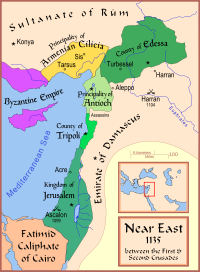
- The first Crusader state, the County of EdessaCounty of EdessaThe County of Edessa was one of the Crusader states in the 12th century, based around Edessa, a city with an ancient history and an early tradition of Christianity....
, was founded in 1098 and lasted until 1149. - The Principality of AntiochPrincipality of AntiochThe Principality of Antioch, including parts of modern-day Turkey and Syria, was one of the crusader states created during the First Crusade.-Foundation:...
, founded in 1098, lasted until 1268. - The Kingdom of JerusalemKingdom of JerusalemThe Kingdom of Jerusalem was a Catholic kingdom established in the Levant in 1099 after the First Crusade. The kingdom lasted nearly two hundred years, from 1099 until 1291 when the last remaining possession, Acre, was destroyed by the Mamluks, but its history is divided into two distinct periods....
, founded in 1099, lasted until 1291, when the city of Acre fell. There were also many vassals of the Kingdom of JerusalemVassals of the Kingdom of JerusalemThe Crusader state of the Kingdom of Jerusalem, created in 1099, was divided into a number of smaller seigneuries.-Introduction:According to the 13th century jurist John of Ibelin the four highest barons in the kingdom proper were:* the Count of Jaffa and Ascalon...
, the four major lordships (seigneuries) being:- The Principality of GalileePrincipality of GalileeThe Principality of Galilee was one of the four major seigneuries of the crusader Kingdom of Jerusalem, according to 13th-century commentator John of Ibelin. The direct holdings of the principality were around Tiberias, in Galilee proper, but with all its vassals, the lordship covered all Galilee...
- The County of Jaffa and AscalonCounty of Jaffa and AscalonThe double County of Jaffa and Ascalon was one of the four major seigneuries comprising the major crusader state, the Kingdom of Jerusalem, according to 13th-century commentator John of Ibelin.-History:...
- The Lordship of OultrejordainOultrejordainLordship of Oultrejordain or Oultrejourdain was the name used during the Crusades for an extensive and partly undefined region to the east of the Jordan river, an area known in ancient times as Edom and Moab...
- The Lordship of SidonLordship of SidonThe Lordship of Sidon was one of the four major fiefdoms of the Kingdom of Jerusalem, one of the Crusader States. However, in reality, it appears to have been much smaller than the others and had the same level of significance as several neighbors, such as Toron and Beirut, which were...
- The Principality of Galilee
- The County of TripoliCounty of TripoliThe County of Tripoli was the last Crusader state founded in the Levant, located in what today are parts of western Syria and northern Lebanon, where exists the modern city of Tripoli. The Crusader state was captured and created by Christian forces in 1109, originally held by Bertrand of Toulouse...
, founded in 1104, with Tripoli itself conquered in 1109, lasted until 1289.
The Armenian Kingdom of Cilicia
Armenian Kingdom of Cilicia
The Armenian Kingdom of Cilicia , also known as the Cilician Armenia, Kingdom of Cilician Armenia or New Armenia, was an independent principality formed during the High Middle Ages by Armenian refugees fleeing the Seljuk invasion of Armenia...
had its origins before the Crusades, but was granted the status of a kingdom by Pope Innocent III
Pope Innocent III
Pope Innocent III was Pope from 8 January 1198 until his death. His birth name was Lotario dei Conti di Segni, sometimes anglicised to Lothar of Segni....
, and later became semi-westernized by the (French) Lusignan
Lusignan
The Lusignan family originated in Poitou near Lusignan in western France in the early 10th century. By the end of the 11th century, they had risen to become the most prominent petty lords in the region from their castle at Lusignan...
dynasty.
Cyprus
During the Third CrusadeThird Crusade
The Third Crusade , also known as the Kings' Crusade, was an attempt by European leaders to reconquer the Holy Land from Saladin...
, the Crusaders founded the Kingdom of Cyprus
Kingdom of Cyprus
The Kingdom of Cyprus was a Crusader kingdom on the island of Cyprus in the high and late Middle Ages, between 1192 and 1489. It was ruled by the French House of Lusignan.-History:...
. Richard I of England conquered Cyprus
Cyprus
Cyprus , officially the Republic of Cyprus , is a Eurasian island country, member of the European Union, in the Eastern Mediterranean, east of Greece, south of Turkey, west of Syria and north of Egypt. It is the third largest island in the Mediterranean Sea.The earliest known human activity on the...
on his way to Holy Land
Holy Land
The Holy Land is a term which in Judaism refers to the Kingdom of Israel as defined in the Tanakh. For Jews, the Land's identifiction of being Holy is defined in Judaism by its differentiation from other lands by virtue of the practice of Judaism often possible only in the Land of Israel...
. He subsequently sold the island to the Knights Templar who were unable to maintain their hold because of a lack of resources and a rapacious attitude towards the local population which led to a series of popular uprisings. The Templars promptly returned the island to Richard who resold it to the displaced King of Jerusalem Guy of Lusignan
Guy of Lusignan
Guy of Lusignan was a Poitevin knight, son of Hugh VIII of the prominent Lusignan dynasty. He was king of the crusader state of Jerusalem from 1186 to 1192 by right of marriage to Sibylla of Jerusalem, and of Cyprus from 1192 to 1194...
in 1192. Guy went on to found a dynasty that lasted until 1489, when the widow of King James III The Bastard, Queen Catherine Cornaro, a native of Venice, abdicated her throne in favour of the Republic of Venice, which annexed the island. For much of its history under the Lusignan Kings, Cyprus was a prosperous Medieval Kingdom, a commercial and trading hub of Western Christendom in the Middle East. The Kingdom's decline began when it became embroiled in the dispute between the Italian Merchant Republics of Genoa and Venice. Indeed the Kingdom's decline can be traced to a disastrous war with Genoa in 1373-74 which ended with the Genoese occupying the principal port City of Famagusta. Eventually with the help of Venice, the Kingdom recovered Famagusta but by then it was too late and in any event, the Venetians had their own designs on the island. Venetian rule over Cyprus lasted for just over 80 years until 1571, when the Ottoman Empire under Sultan Selim II Sarkhosh invaded and captured the entire island. The battle for Cyprus between Venice and the Ottoman Empire was immortalized by William Shakespeare in his play Othello, most of which is set in the port city of Famagusta on the eastern shores of the island.
In the Balkans
Fourth Crusade
The Fourth Crusade was originally intended to conquer Muslim-controlled Jerusalem by means of an invasion through Egypt. Instead, in April 1204, the Crusaders of Western Europe invaded and conquered the Christian city of Constantinople, capital of the Eastern Roman Empire...
, the territories of the Byzantine Empire
Byzantine Empire
The Byzantine Empire was the Eastern Roman Empire during the periods of Late Antiquity and the Middle Ages, centred on the capital of Constantinople. Known simply as the Roman Empire or Romania to its inhabitants and neighbours, the Empire was the direct continuation of the Ancient Roman State...
were divided into several states, beginning the so-called "Francocracy
Frangokratia
The Frankokratia or Frangokratia , also known as Latinokratia is the period in Greek history after the Fourth Crusade , when a number of Western European Crusader states were established in Greece, on the territory of the dissolved Byzantine Empire .The term derives from the fact that Orthodox...
" period:
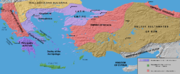
- The Latin EmpireLatin EmpireThe Latin Empire or Latin Empire of Constantinople is the name given by historians to the feudal Crusader state founded by the leaders of the Fourth Crusade on lands captured from the Byzantine Empire. It was established after the capture of Constantinople in 1204 and lasted until 1261...
in ConstantinopleConstantinopleConstantinople was the capital of the Roman, Eastern Roman, Byzantine, Latin, and Ottoman Empires. Throughout most of the Middle Ages, Constantinople was Europe's largest and wealthiest city.-Names:...
(1204–1261) - The Kingdom of ThessalonicaKingdom of ThessalonicaThe Kingdom of Thessalonica was a short-lived Crusader State founded after the Fourth Crusade over the conquered Byzantine lands.- Background :...
(1205–1224) - The Principality of AchaeaPrincipality of AchaeaThe Principality of Achaea or of the Morea was one of the three vassal states of the Latin Empire which replaced the Byzantine Empire after the capture of Constantinople during the Fourth Crusade. It became a vassal of the Kingdom of Thessalonica, along with the Duchy of Athens, until Thessalonica...
(1205–1432)- The Lordship of Argos and NaupliaArgos and NaupliaDuring the late Middle Ages, the two cities of Argos and Nauplia formed a separate Lordship within the Frankish Principality of Achaea in southern Greece....
(1205–1388)
- The Lordship of Argos and Nauplia
- The Duchy of AthensDuchy of AthensThe Duchy of Athens was one of the Crusader States set up in Greece after the conquest of the Byzantine Empire during the Fourth Crusade, encompassing the regions of Attica and Boeotia, and surviving until its conquest by the Ottoman Empire in the 15th century....
(1205–1458)- The Margraviate of BodonitsaMargrave of BodonitsaThe margraviate or marquisate of Bodonitsa , today Mendenitsa, Phthiotis , was a Frankish state in Greece following the conquests of the Fourth Crusade. It was originally granted as a margravial holding of Guy Pallavicini by Boniface, first king of Thessalonica, in 1204...
(1204–1414)
- The Margraviate of Bodonitsa
- The Duchy of Naxos (1207–1579)
- The Duchy of PhilippopolisPlovdivPlovdiv is the second-largest city in Bulgaria after Sofia with a population of 338,153 inhabitants according to Census 2011. Plovdiv's history spans some 6,000 years, with traces of a Neolithic settlement dating to roughly 4000 BC; it is one of the oldest cities in Europe...
(1204–1205)
Several islands, most notably Crete
Crete
Crete is the largest and most populous of the Greek islands, the fifth largest island in the Mediterranean Sea, and one of the thirteen administrative regions of Greece. It forms a significant part of the economy and cultural heritage of Greece while retaining its own local cultural traits...
(1204-1669), Euboea
Euboea
Euboea is the second largest Greek island in area and population, after Crete. The narrow Euripus Strait separates it from Boeotia in mainland Greece. In general outline it is a long and narrow, seahorse-shaped island; it is about long, and varies in breadth from to...
(Negroponte
Lordship of Negroponte
The Lordship of Negroponte was a crusader state established on the island of Euboea after the partition of the Byzantine Empire following the Fourth Crusade. Partitioned into three baronies run by a few interrelated Lombard families, the island soon fell under the influence of the Republic of...
, until 1470), and the Ionian Islands
Ionian Islands
The Ionian Islands are a group of islands in Greece. They are traditionally called the Heptanese, i.e...
(until 1797) came under the rule of Venice
Republic of Venice
The Republic of Venice or Venetian Republic was a state originating from the city of Venice in Northeastern Italy. It existed for over a millennium, from the late 7th century until 1797. It was formally known as the Most Serene Republic of Venice and is often referred to as La Serenissima, in...
.
These states faced the attacks of the Byzantine Greek successor states of Nicaea
Empire of Nicaea
The Empire of Nicaea was the largest of the three Byzantine Greek successor states founded by the aristocracy of the Byzantine Empire that fled after Constantinople was occupied by Western European and Venetian forces during the Fourth Crusade...
and Epirus
Despotate of Epirus
The Despotate or Principality of Epirus was one of the Byzantine Greek successor states of the Byzantine Empire that emerged in the aftermath of the Fourth Crusade in 1204. It claimed to be the legitimate successor of the Byzantine Empire, along with the Empire of Nicaea, and the Empire of Trebizond...
, as well as Bulgaria
Second Bulgarian Empire
The Second Bulgarian Empire was a medieval Bulgarian state which existed between 1185 and 1396 . A successor of the First Bulgarian Empire, it reached the peak of its power under Kaloyan and Ivan Asen II before gradually being conquered by the Ottomans in the late 14th-early 15th century...
. Thessalonica and the Latin Empire were reconquered by the Byzantine Greeks by 1261. Descendants of the Crusaders continued to rule in Athens and the Peloponnesus (Morea
Morea
The Morea was the name of the Peloponnese peninsula in southern Greece during the Middle Ages and the early modern period. It also referred to a Byzantine province in the region, known as the Despotate of Morea.-Origins of the name:...
) until the 15th century when the area was conquered by the Ottoman Empire
Ottoman Empire
The Ottoman EmpireIt was usually referred to as the "Ottoman Empire", the "Turkish Empire", the "Ottoman Caliphate" or more commonly "Turkey" by its contemporaries...
.
- The military order of the Knights HospitallerKnights HospitallerThe Sovereign Military Hospitaller Order of Saint John of Jerusalem of Rhodes and of Malta , also known as the Sovereign Military Order of Malta , Order of Malta or Knights of Malta, is a Roman Catholic lay religious order, traditionally of military, chivalrous, noble nature. It is the world's...
of Saint John established itself on RhodesRhodesRhodes is an island in Greece, located in the eastern Aegean Sea. It is the largest of the Dodecanese islands in terms of both land area and population, with a population of 117,007, and also the island group's historical capital. Administratively the island forms a separate municipality within...
(and several other Aegean islands; see below) in 1310, with regular influx of new blood, until the Ottomans finally drove them out (to MaltaMaltaMalta , officially known as the Republic of Malta , is a Southern European country consisting of an archipelago situated in the centre of the Mediterranean, south of Sicily, east of Tunisia and north of Libya, with Gibraltar to the west and Alexandria to the east.Malta covers just over in...
) in 1522.- the island of Kastellorizo (like Rhodes a part of the Aegean DodecaneseDodecaneseThe Dodecanese are a group of 12 larger plus 150 smaller Greek islands in the Aegean Sea, of which 26 are inhabited. Τhis island group generally defines the eastern limit of the Sea of Crete. They belong to the Southern Sporades island group...
island group) was taken by the Knights of St. John Hospitaller of Jerusalem in 1309; the Egyptians occupied it from 1440 until 1450; then the Kingdom of Naples ruled; Venetian rule began in 1635 (as Castellorosso); all these states, excluding the Egyptians, were Catholic; Ottoman rule was established in 1686, although Greeks controlled the island during the Greek War of IndependenceGreek War of IndependenceThe Greek War of Independence, also known as the Greek Revolution was a successful war of independence waged by the Greek revolutionaries between...
from 1821-1833. - other neighbouring territories temporarily under the order were: the cities of SmyrnaSmyrnaSmyrna was an ancient city located at a central and strategic point on the Aegean coast of Anatolia. Thanks to its advantageous port conditions, its ease of defence and its good inland connections, Smyrna rose to prominence. The ancient city is located at two sites within modern İzmir, Turkey...
(now Izmir; 1344–1402), Attaleia (now Antalya; 1361–1373 and Halicarnassos (now Bodrum;1412-14..), all three in Anatolia; the Greek Isthmus city of CorinthCorinthCorinth is a city and former municipality in Corinthia, Peloponnese, Greece. Since the 2011 local government reform it is part of the municipality Corinth, of which it is the seat and a municipal unit...
(1397–1404)), the city of Salona (ancient Amphissa; 1407–1410) and the islands of Ikaria (1424–1521) and KosKosKos or Cos is a Greek island in the south Sporades group of the Dodecanese, next to the Gulf of Gökova/Cos. It measures by , and is from the coast of Bodrum, Turkey and the ancient region of Caria. Administratively the island forms a separate municipality within the Kos peripheral unit, which is...
(1215-1522), all now in Greece
- the island of Kastellorizo (like Rhodes a part of the Aegean Dodecanese
In the Baltics
Baltic region
The terms Baltic region, Baltic Rim countries, and Baltic Rim refer to slightly different combinations of countries in the general area surrounding the Baltic Sea.- Etymology :...
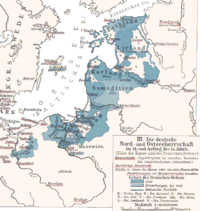
, the indigenous tribes in the Middle Ages at first staunchly refused Christianity. In 1193, Pope Celestine III urged to a crusade against the heathens which included the Old Prussians
Old Prussians
The Old Prussians or Baltic Prussians were an ethnic group, autochthonous Baltic tribes that inhabited Prussia, the lands of the southeastern Baltic Sea in the area around the Vistula and Curonian Lagoons...
, the Lithuanians
Lithuanians
Lithuanians are the Baltic ethnic group native to Lithuania, where they number around 2,765,600 people. Another million or more make up the Lithuanian diaspora, largely found in countries such as the United States, Brazil, Canada, Colombia, Russia, United Kingdom and Ireland. Their native language...
and other tribes inhabiting Estonia
Estonia
Estonia , officially the Republic of Estonia , is a state in the Baltic region of Northern Europe. It is bordered to the north by the Gulf of Finland, to the west by the Baltic Sea, to the south by Latvia , and to the east by Lake Peipsi and the Russian Federation . Across the Baltic Sea lies...
, Latvia
Latvia
Latvia , officially the Republic of Latvia , is a country in the Baltic region of Northern Europe. It is bordered to the north by Estonia , to the south by Lithuania , to the east by the Russian Federation , to the southeast by Belarus and shares maritime borders to the west with Sweden...
and East Prussia
East Prussia
East Prussia is the main part of the region of Prussia along the southeastern Baltic Coast from the 13th century to the end of World War II in May 1945. From 1772–1829 and 1878–1945, the Province of East Prussia was part of the German state of Prussia. The capital city was Königsberg.East Prussia...
. This period of warfare is called the Northern Crusades
Northern Crusades
The Northern Crusades or Baltic Crusades were crusades undertaken by the Christian kings of Denmark and Sweden, the German Livonian and Teutonic military orders, and their allies against the pagan peoples of Northern Europe around the southern and eastern shores of the Baltic Sea...
.
In the aftermath of Northern Crusades William of Modena
William of Modena
William of Modena , also known as William of Sabina, Guglielmo de Chartreaux, Guglielmo de Savoy, Guillelmus, was an Italian clergyman and papal diplomat. He was frequently appointed a legate, or papal ambassador by the popes Honorius III and Gregory IX, especially in Livonia in the 1220s and in...
as Papal legate
Papal legate
A papal legate – from the Latin, authentic Roman title Legatus – is a personal representative of the pope to foreign nations, or to some part of the Catholic Church. He is empowered on matters of Catholic Faith and for the settlement of ecclesiastical matters....
solved the disputes between the crusaders in Livonia
Livonia
Livonia is a historic region along the eastern shores of the Baltic Sea. It was once the land of the Finnic Livonians inhabiting the principal ancient Livonian County Metsepole with its center at Turaida...
and Prussia
Prussia (region)
Prussia is a historical region in Central Europe extending from the south-eastern coast of the Baltic Sea to the Masurian Lake District. It is now divided between Poland, Russia, and Lithuania...
.
- By dividing the lands of the Terra Mariana between the crusading order of Livonian Brothers of the SwordLivonian Brothers of the SwordThe Livonian Brothers of the Sword were a military order founded by Bishop Albert of Riga in 1202. Pope Innocent III sanctioned the establishment in 1204. The membership of the order comprised German "warrior monks"...
and the Church five principalities were created:
- Archbishopric of Riga,
- Bishopric of CourlandBishopric of CourlandThe Bishopric of Courland was the second smallest ecclesiastical state in the Livonian Confederation founded in the aftermath of the Livonian Crusade...
, - Bishopric of DorpatBishopric of DorpatThe Bishopric of Dorpat was a medieval principality and a catholic diocese which existed from 1224 to 1558, generally encompassing what are now Tartu, Põlva, Võru and Jõgeva counties in Estonia. The Bishopric was part of Livonian Confederation...
, - Bishopric of Ösel-WiekBishopric of Ösel-WiekThe Bishopric of Ösel–Wiek was a semi-independent Roman Catholic prince-bishopric in what is now Saare, Hiiu and Lääne counties of Estonia.The bishopric was created as a state of Holy Roman Empire on 1 October 1228, by Henry, King of the Romans...
, - The lands of the Livonian Brothers of the Sword.
- The Estonian lands controlled by Danish crusaders were annexed with Denmark as
- Duchy of EstoniaDanish EstoniaDanish Estonia refers to the territories of present-day Estonia that were ruled by Denmark firstly during the 13th–14th centuries and again in the 16th–17th centuries....
until it was ceded to the Teutonic Order state in 1346.
- In the Prussian region William of Modena divided the lands between Teutonic knightsTeutonic KnightsThe Order of Brothers of the German House of Saint Mary in Jerusalem , commonly the Teutonic Order , is a German medieval military order, in modern times a purely religious Catholic order...
and the Church by creating 4 Prince-Bishoprics under the Archbishopric of Riga:
- Bishopric of Culm,
- Bishopric of PomesaniaBishopric of PomesaniaThe Bishopric of Pomesania was a diocese in the Prussian regions of Pomesania and Pogesania. It was founded as a Roman Catholic diocese in 1243 by the papal legate William of Modena. The bishops, whose seat was Riesenburg , possessed one-third of the bishopric's territory...
, - Bishopric of Ermland,
- Bishopric of SamlandBishopric of SamlandThe Bishopric of Samland was a bishopric in Samland in medieval Prussia. It was founded as a Roman Catholic diocese in 1243 by papal legate William of Modena. Its seat was Königsberg, until 1523 the episcopal residence was in Fischhausen. The bishopric became Lutheran in the 16th century during...
.
See also
- List of Crusader castles
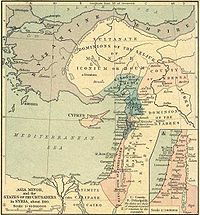
- Map of the Crusader states from Muir's Historical Atlas (1911)
Sources and references
- Westermann, Großer Atlas zur Weltgeschichte (in German)