

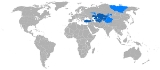
Turkic peoples

Encyclopedia
The Turkic peoples are peoples residing in northern, central and western Asia, southern Siberia
and northwestern China and parts of eastern Europe. They speak languages belonging to the Turkic language family
. They share, to varying degrees, certain cultural traits and historical backgrounds. The term Turkic represents a broad ethno-linguistic group of people including existing societies such as the Turkish
, Azerbaijani
, Chuvashes, Kazakhs, Tatars
, Kyrgyzs, Turkmen
, Uyghur
, Uzbeks
, Bashkirs
, Qashqai
, Gagauzs, Yakuts
, Crimean Karaites
, Krymchaks
, Karakalpaks
, Karachays
, Nogais
and as well as past civilizations such as the Kumans
, Kipchaks
, Avars
, Bulgars
, Turgesh
es, Seljuks, Khazars
, Ottoman Turks
, Mamluks, Timurids
, and possibly the Xiongnu
and Huns
.
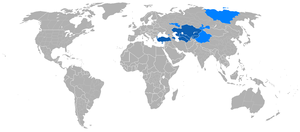 The distribution of people of Turkic cultural background ranges from Siberia
, across Central Asia, to Eastern Europe. Presently, the largest groups of Turkic people live throughout Central Asia—Kazakhstan
, Kyrgyzstan
, Turkmenistan
, Uzbekistan
, and Azerbaijan
, in addition to Turkey
and Iran
. Additionally, Turkic people are found within Crimea
, East Turkistan region of western China
, northern Iraq
, Pakistan
, Israel
, Russia
, Afghanistan
, and the Balkans
: Moldova
, Bulgaria
, Romania
, and former Yugoslavia
. A small number of Turkic people also live in Vilnius
, the capital of Lithuania
. There is also a small number in eastern Poland
and southeastern part of Finland
. There are also considerable populations of Turkic people (originating mostly from Turkey
) in Germany
, United States
, and Australia
, largely because of migrations during the 20th century.
Sometimes the above list is grouped into six branches: the Oghuz Turks
, Kipchak
, Karluk
, Siberia
n, Chuvash
, and Sakha/Yakut
branches. The Oghuz have been termed Western Turks, while the remaining five, in such a classificatory scheme, are called Eastern Turks.
One of the major difficulties perceived by many who try to classify the various Turkic languages and dialects is the impact of Soviet
and particularly Stalin
ist nationality policies—the creation of new national demarcations, suppression of languages and writing scripts, and mass deportations—had on the ethnic mix in previously multicultural regions like Khwarezm
, the Fergana Valley
, and Caucasia
. Many of the above-mentioned classifications are therefore by no means universally accepted, either in detail or in general. Another aspect often debated is the influence of Pan-Turkism
, and the emerging nationalism
in the newly independent Central Asian republics, on the perception of ethnic divisions.
All the Turkic peoples native to Central Asia are of mixed Caucasoid and Mongoloid origin. Of these Central Asian Turks, Kazakhs
and the Kyrgyz are closer to Mongoloids racially. Karakalpak are mixed almost evenly. Uighur in Xinjiang China, Uzbek and Turkmen are more close to Caucasoid. The genetic distances between the different populations of Uzbeks scattered across Uzbekistan is no greater than the distance between many of them and the Karakalpaks. This suggests that Karakalpaks and Uzbeks have very similar origins. The Karakalpaks have a somewhat greater bias towards the eastern markers than the Uzbeks. Reference: The Karakalpak Gene Pool (Spencer Wells, 2001) & Discussion and Conclusions at www.karakalpak.com/genetics.html
The Turkic people display a great variety of ethnic types. They possess physical features ranging from Caucasoid to Northern Mongoloid
. Mongoloid and Caucasoid facial structure is common among many Turkic groups, such as Chuvash people
, Tatars
, Kazakhs
, Uzbeks
, Hazaras, and Bashkirs
. Historically, the racial classification of the Turkic peoples was sometimes given as "Turanid
". Western (Anatolian) Turks are largely the genetic descendants of Turkified/Islamized Indo-European
/Semitic
groups such as Armenians
, Kurds, Jews
, Greeks
, Assyrians, Arabs, and Slavs.
The following is an incomplete list of Turkic people with the respective groups's core areas of settlements and their estimated sizes (in million):
, where the Turkic peoples settled from China. According to historian John Foster, "The Turks emerge from among the Huns
in the middle of [the] fifth century. They were living in Liang
territory when it began to be overrun by the greater principality of Wei
. Preferring to remain under the rule of their own kind, they moved westward into what is now the province of Kansu. This was the territory of kindred Huns, who were called the Rouran
. The Turks were a small tribe of only five hundred families, and they became serfs to the Rouran, who used them as iron-workers. It is thought that the original meaning of "Turk" is "helmet", and that they may have taken this name because of the shape of one of the hills near which they worked. As their numbers and power grew, their chief made bold to ask for the hand of a Rouran princess in marriage. The demand was refused, and war followed. In 546, the iron-workers defeated their overlords." Since then Turkic languages have spread, through migrations and conquests, to other locations including present-day Turkey. While the term "Turk" may refer to a member of any Turkic people, the term Turkish usually refers specifically to the people and language of the modern country of Turkey.
The Turkic languages constitute a language family
of some 30 languages, spoken across a vast area from Eastern Europe
and the Mediterranean
, to Siberia
and Western China, and to northern edges of Pakistan and the Middle East.
Some 170 million people have a Turkic language as their native language; an additional 20 million people speak a Turkic language as a second language
. The Turkic language with the greatest number of speakers is Turkish proper
, or Anatolia
n Turkish, the speakers of which account for about 40% of all Turkic speakers. More than one third of these are ethnic Turks of Turkey
, dwelling predominantly in Turkey proper and formerly Ottoman
-dominated areas of Eastern Europe and West Asia; as well as in Western Europe, Australia and the Americas as a result of immigration. The remainder of the Turkic people are concentrated in Central Asia, Russia, the Caucasus
, China, northern Iraq.
At present, there are six independent Turkic countries: Azerbaijan
, Kazakhstan
, Kyrgyzstan
, Turkmenistan
, Turkey
, Uzbekistan
; There are also several Turkic national subdivisions in the Russian Federation
including Bashkortostan
, Tatarstan
, Chuvashia, Khakassia
, Tuva
, Yakutia, the Altai Republic
, Kabardino-Balkaria
, and Karachayevo-Cherkessiya. Each of these subdivisions has its own flag, parliament, laws, and official state language (in addition to Russian
).
The Xinjiang Uyghur Autonomous Region
in western China and the autonomous region of Gagauzia
, located within eastern Moldova
and bordering Ukraine to the north, are two major autonomous Turkic regions. The Autonomous Republic of Crimea
within Ukraine is a home of Crimean Tatars
. In addition, there are several Iraq
, Georgia
, Bulgaria
, the Republic of Macedonia
, Tajikistan
, Afghanistan
, and western Mongolia
.
 In the age of nationalism, Turkic speakers were among the first Muslim people to take up Western ideas of liberalism
and secular ideologies. Pan-Turkism
first sprang up at the end of the 19th century in the Russian Empire
and was advanced by leading Turkish intellectuals like Crimean Tatar
Ismail Gasprinski, Azerbaijan philosophers like Mirza Fatali Akhundov
and Tatar
Yusuf Akçura
, as a reaction to Panslavist and Russification
policies of the Russian Empire. The first fully democratic and secular republics in the Islamic world were Turks: the ill-fated Idel-Ural State
established in 1917, the Azerbaijan Democratic Republic
in 1918 (both annexed and absorbed by the Soviet Union), and in 1923 Republic of Turkey
. In 1991 Azerbaijan became an independent Azerbaijan Republic.
The Turks in Turkey are over 60 million to 70 million worldwide, while the second largest Turkic people are the Azerbaijanis, numbering 22 to 30 million worldwide; most of them live in Azerbaijan and Iran.
Turks in India are very small in number. There are barely 150 Turkish people from Turkey in India. These are recent immigrants. Descendants of Turkish rulers also exist in Northern India. Mughals who are part Turkic people also live in India in significant numbers. They are descendants of the Mughal rulers of India. Karlugh Turks
are also found in small amounts in Srinagar region of Kashmir. Small amount of Uyghurs are also present in India. Turks also exist in Pakistan in similar proportions.One of the tribe in Hazara region of Pakistan is Karlugh Turks
which is direct descendent of Turks of Central Asia. Turkish influence in Pakistan can be seen through the national language, Urdu, which comes from a Turkish word meaning "horde" or "army".
Western Yugur at Gansu in China, Salar at Qinghai in China, Dolgan at Krasnoyarsk Krai in Russia, Nogai at Dagestan in Russia are the Turk minorities at the respective regions.
Beauty of Yugur Culture, Beauty of the Dolgan and Northern Tungus Culture, Beauty of Yakut Sakha Culture, Beauty of Khakass Culture at youtube show the facial feature of the Turks native to Asian Russia and China
in the 6th century. A letter by Ishbara Qaghan
to Emperor Wen of Sui
in 585 described him as "the Great Turk Khan." The Orhun inscriptions
(735 CE) use the terms Turk and Turuk.
Previous use of similar terms are of unknown significance, although some strongly feel that they are evidence of the historical continuity of the term and the people as a linguistic unit since early times. This includes Chinese records Spring and Autumn Annals
referring to a neighbouring people as Beidi
.
According to Turkologists Peter Golden and András Róna-Tas, the Turk term is ultimately rooted: "is East Iranian, most probably Saka, origin, and is the name of a ruling tribe whose leading clan Ashina conquered the Turks, reorganized them, but itself became rapidly Turkified".
In modern Turkey, a distinction is made between "Turks" and the "Turkic peoples" in loosely speaking: the term Türk corresponds specifically to the "Turkish-speaking" people (in this context, "Turkish-speaking" is considered the same as "Turkic-speaking"), while the term Türki
refers generally to the people of modern "Turkic Republics" (Türki Cumhuriyetler or Türk Cumhuriyetleri). However, the proper usage of the term is based on the linguistic classification
in order to avoid any political sense. In short, the term Turkic can be used for Turk or vice versa.
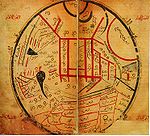
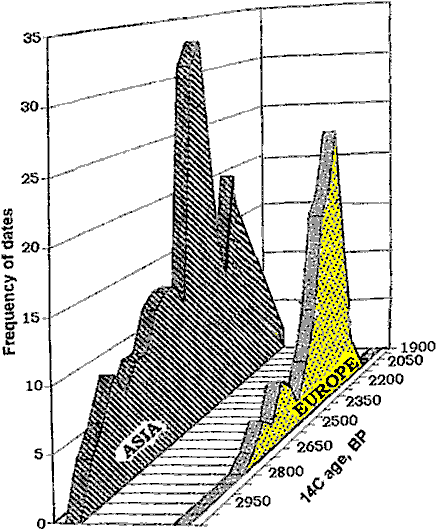 According to Book of Zhou
, the original meaning of "Turk" is "helmet", and that they may have taken this name because of the shape of the Altai Mountains. According to Mahmud of Kashgar, an 11th century Turkic scholar, and various other traditional Islamic scholars and historians, the name "Turk" stems from Tur, one of the sons of Japheth, and comes from the same lineage as Gomer (Cimmerians) and Ashkenaz (Scythians, Ishkuz) who, according to tradition, were some of the earliest Turks. For millennia, a long string of historical references specifically linked Herodotus’ Scythians with various tribes, such as the Hunno-Bulgars, Avars, Türks, Mongols, Khazars etc. Between 400 CE and the 16th century the Byzantine sources use the name Σκΰθαι in reference to twelve different Türkic peoples. Paul Pelliot
said Türk means powerful in Old Turkic.
Alp Er Tunga is a mythical hero in Turkic tradition; the Göktürks of the 6th century carried on the tradition of Alp Er Tunga and they too had a myth according to which they themselves were descendants of a wolf.
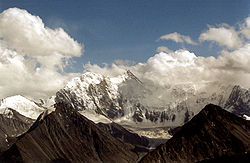 It is generally agreed that the first Turkic people lived in a region extending from Central Asia
to Siberia
with the majority of them living in China historically. The earliest separate Turkic peoples appeared on the peripheries of the late Xiongnu
confederation (contemporaneous with the Chinese Han Dynasty
). Turkic people may be related to the Xiongnu
, Dingling
and Tiele people
. According to the Book of Wei
, the Tiele people were the remaining of the Chidi (赤狄), the red Di
people competing with the Jin in the Spring and Autumn Period. Turkic tribes, such as Khazars
and Pechenegs, probably lived as nomad
s for many years before establishing the Göktürk Empire in the 6th century. These were herdsmen and nobles who were searching for new pastures and wealth. The first mention of Turks was in a Chinese text that mentioned trade of Turk tribes with the Sogdians along the Silk Road
. The first recorded use of "Turk" as a political name is a 6th-century reference to the word pronounced in Modern Chinese as Tujue. The Ashina
clan migrated from Li-jien (modern Zhelai Zhai) to the Juan Juan seeking inclusion in their confederacy and protection from the prevalent dynasty. The tribe were famed metal smith
s and was granted land near a mountain quarry
which looked like a helmet
, from which they were said to have gotten their name 突厥 (tūjué). A century later, their power had increased such that they conquered the Juan Juan and established the Gök Empire.
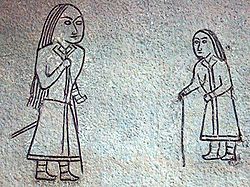 Turkic peoples originally used their own alphabets, like Orkhon and Yenisey runiform, and later the Uyghur alphabet
. The oldest inscription was found near the Issyk river
in Kyrgyzstan
. Traditional national and cultural symbols of the Turkic peoples include wolves in Turkic mythology and tradition; as well as the color blue, iron
, and fire. Turquoise
blue, from the French
word meaning "Turkish", is the color of the stone turquoise
still used as jewelry and a protection against evil eye
.
It has often been suggested that the Xiongnu
, mentioned in Han Dynasty
records, were Proto-Turkic
speakers. Although little is known for certain about the Xiongnu language(s), it seems likely that at least some Xiongnu tribes spoke a Turkic language. Some scholars see a possible connection with the Iranic
-speaking Sakas, while others believe they were probably a confederation of various ethnic and linguistic groups. On the other hand, genetics research from 2003 confirms the studies indicating that the Turkic people originated from the same area and so are related with the Xiongnu. So the scientific genetic results show clearly that the Turks originated nearby the Centre-west part of modern China.
Xiongnu writing, older than Turkic is agreed to have the earliest known Turkic alphabet, the Orkhon script
. This has been argued recently using the only extant possibly Xiongu writings, the rock art of the Yinshan and Helanshan. It is dated from the 9th millennium BC
to 19th century, and consists mainly of engraved signs (petroglyphs) and few painted images. Excavations done during 1924–1925, in Noin-Ula kurgans located in Selenga
River in the northern Mongolia
n hills north of Ulan Bator, produced objects with over 20 carved characters, which were either identical or very similar to that of to the runic letters of the Turkic Orkhon script discovered in the Orkhon Valley
.
The Hun hordes of Attila, who invaded and conquered much of Europe in the 5th century, might have been Turkic and descendants of the Xiongnu. Some scholars argue that the Huns were one of the earlier Turkic tribes, while others argue that they were of Mongolic origin. Linguistics
studies by Otto Maenchen-Helfen's support a Turkic origin. In all probability, they were closely related as the borders were not settled unlike modern times and migrations were common to distant places.
In the 6th century, 400 years after the collapse of northern Xiongnu
power in Inner Asia
, leadership of the Turkic peoples was taken over by the Göktürks. Formerly in the Xiongnu nomadic confederation, the Göktürks inherited their traditions and administrative experience. From 552 to 745, Göktürk leadership united the nomad
ic Turkic tribes into the Göktürk Empire. This was the first known political entity to be called "Turk". The name derives from gok, "blue" or "celestial". Unlike its Xiongnu predecessor, the Göktürk Khanate had its temporary khans
from the Ashina
clan that were subordinate to a sovereign
authority controlled by a council of tribal chiefs. The Khanate
retained elements of its original shamanistic
religion, Tengriism
, although it received missionaries of Buddhist monks and practiced a syncretic religion. The Göktürks were the first Turkic people to write Old Turkic in a runic script, the Orkhon script
. The Khanate was also the first state known as "Turk". It eventually collapsed due to a series of dynastic conflicts, but the name "Turk" was later taken by many states and peoples.
Turkic peoples and related groups migrated west from Turkestan
and what is now Mongolia
towards Eastern Europe
, Iranian plateau
and Anatolia
and modern Turkey in many waves. The date of the initial expansion remains unknown. After many battles, they established their own state and later created the Ottoman Empire
. The main migration occurred in medieval times, when they spread across most of Asia and into Europe and the Middle East. They also participated in the Crusades
.
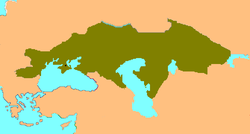 Later Turkic peoples include the Avars
, Karluks (mainly 8th century), Uyghurs
, Kyrgyz, Oghuz
(or Ğuz) Turks, and Turkmens
. As these peoples were founding states in the area between Mongolia
and Transoxiana
, they came into contact with Muslims, and most gradually adopted Islam
. Small groups of Turkic people practice other religions, including Christians
, Jews (Khazars
), Buddhists
, and Zoroastrians
.
emerged as the de facto rulers of most of the Muslim Middle East (apart from Syria
and Egypt
), particularly after the 10th century. The Oghuz and other tribes captured and dominated various countries under the leadership of the Seljuk dynasty and eventually captured the territories of the Abbasid dynasty and the Byzantine Empire
.
Meanwhile, the Kyrgyz and Uyghurs were struggling with one another and with the Chinese Empire. The Kyrgyz people ultimately settled in the region now referred to as Kyrgyzstan
. The Tatar peoples conquered the Volga Bulgars in what is today Tatarstan
, following the westward sweep of the Mongols
under Genghis Khan
in the 13th century. Other Bulgars
, who had initially invaded Europe in 5th-6th centuries, as part of the Hunnic tribal confederation, finally settled in Southastern Europe in the 7th-8th centuries,and mixed with the Slavic population, adopting what eventually became the Slavic Bulgarian language
. Everywhere, Turkic groups mixed with the local populations to varying degrees. In 1090–91, the Turkic Pechenegs reached the walls of Constantinople
, where Emperor Alexius I
with the aid of the Kipchaks
annihilated their army.
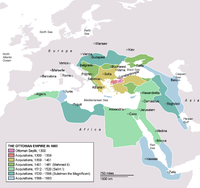 As the Seljuk Empire declined following the Mongol invasion
, the Ottoman Empire
emerged as the new important Turkic state, that came to dominate not only the Middle East, but even southeastern Europe, parts of southwestern Russia, and northern Africa.
The Mughal Empire
was a Turkic empire that, at its greatest territorial extent, ruled most of the South Asia, including Afghanistan
, Pakistan, India, Bangladesh
and parts of Uzbekistan
from the early 16th to the early-18th century. The Mughal dynasty was founded by a Chagatai
Turkic prince named Babur
(reigned 1526–30), who was descended from the Turkic conqueror Timur
(Tamerlane) on his father's side and from Chagatai, second son of the Mongol ruler Genghis Khan
, on his mother's side. The Mughal dynasty was notable for the ability of its rulers, who through seven generations maintained a record of unusual talent, and for its administrative organization. A further distinction was the attempt of the Mughals to integrate Hindus and Muslims into a united Indian state.
Ethnic nationalism also developed in Ottoman Turkey during the 19th century, taking the form of Pan-Turkism
or Turanism
.
The Turkic peoples of Central Asia were not organized in nation states during most of the 20th century, after the collapse of the Russian Empire
living either in the Soviet Union or (after a short-lived First East Turkestan Republic
) in the Chinese Republic.
Chinese Turkestan remains part of the People's Republic of China
, and Tatarstan
, Tuva
and Yakutia in the Russian Federation, but the Central Asian states of Kazakhstan
, Kyrgyzstan
, Turkmenistan
and Uzbekistan
(with ethnic Kazakh
, Kyrgyz, Turkmen
and Uzbek
majorities, respectively) gained independence in 1991 after the disintegration of the Soviet Union.
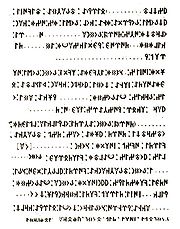 The Turkic alphabets are sets of related alphabets with letters (formerly known as runes), used for writing mostly Turkic languages
. Inscriptions in Turkic alphabets were found from Mongolia
and Eastern Turkestan in the east to Balkans
in the west. Most of the preserved inscriptions were dated to between 8th and 10th centuries DE.
The earliest positively dated and read Turkic inscriptions date from ca. 150, and the alphabets were generally replaced by the Uyghur alphabet
in the Central Asia
, Arabic script in the Middle and Western Asia, Greek-derived Cyrillic in Eastern Europe and in the Balkans, and Latin alphabet
in Central Europe. The latest recorded use of Turkic alphabet
was recorded in Central Europe's Hungary in 1699 CE.
The Turkic runiform scripts, unlike other typologically close scripts of the world, do not have a uniform palaeography
as, for example, have the Gothic
runes, noted for the exceptional uniformity of its language and paleography. The Turkic alphabets are divided into four groups, the best known of them is the Orkhon
version of the Enisei group.
The Turkic language family is traditionally considered to be part of the proposed Altaic language family
. The Altaic language family includes 66 language
s spoken by about 348 million people, mostly in and around Central Asia
and northeast Asia.
The various Turkic languages are usually considered in geographical groupings: the Oghuz
(or Southwestern) languages, the Kypchak
(or Northwestern) languages, the Eastern languages (like Uygur
), the Northern languages (like Altay
and Yakut), and one existing Oghur
language: Chuvash
(the other Oghur languages, like Hunnic
and Bulgaric, are now extinct). The high mobility and intermixing of Turkic peoples in history makes an exact classification extremely difficult.
The Turkish language
belongs to the Oghuz subfamily of Turkic. It is for the most part mutually intelligible with the other Oghuz languages, which include Azeri, Gagauz
, Turkmen
and Urum
, and to a varying extent with the other Turkic languages.
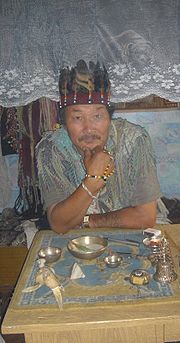
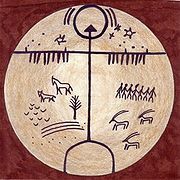 Pre-Islamic Turkic mythology was dominated by Tengriism
and shamanistic religion.
The Wolf
symbolizes honour and is also considered the mother of most Turkic peoples. Asena
(Ashina Tuwu) is the wolf mother of Tumen Il-Qağan, the first Khan of the Göktürks
.
The Horse
is also one of the main figures of Turkic mythology. Türks consider the horse an extension of the human, one creature.
The Dragon
, also expressed as a Snake
or Lizard
, is the symbol of might and power. It is believed, especially in mountainous Central Asia
, that dragons still live in the mountains of Tian-Shan (Tangri Tagh) and Altay
. Dragons also symbolize the god Tengri
(Tanrı) in ancient Turkic tradition, although dragons themselves aren't worshipped as gods.
Geser (Ges'r, Kesar) is a Tibetan/Mongolian religious epic about 'Geser' (also known as 'Bukhe Beligte') a Turkic prophet who taught Türks the new monotheistic religion Tengriism
. It is unknown when he lived, and there are not many historical documents that mention him. Tengriism isn't approved by most Muslim scholars, but sura
108 of the Qur'an has the name Al-Kawthar,in which the word kawthar could potentially be read as 'Käusar', which may be an Arabisation of the Turkic name 'Geser'. The name of this sura is conventionally interpreted as "all goods" or "abundance", but this is not certain and many scholars have different opinions on this sura.
The legend of Timur
(Temir) is the most ancient and well-known. Timur found a strange stone that fell from the sky, an iron
ore meteorite
. He was a smith and decided to make a sword of it. Few knew about iron in Asia before then. He tried to make a sword from it by using the usual bronze
sword making
process. He mentioned that this material, iron, was very easy to change and manipulate, though it was even stronger than bronze.
Today, the word "temir" or "timur" means "iron". The melting process was known before in Egypt
and India, but it wasn't used that widely in other parts of Asia, because of the very high iron price (much higher than gold) in the Mediterranean and Europe at that time.
In Persian tradition, Central Asia is known as Turan
, and the eponymous ancestor of the Turks in Persian legend is Tur, son of Fereydun
.
Various pre-Islamic Turkic civilizations of the 6th century adhered to shamanist
and Tengriist
traditions which are reflected in the state symbols of Kazakhstan
. The Shamanist religion is based on spiritual and natural elements of earth. Tengriism involves belief in Tengri
as the god who ruled over the skies. and remain in use by speakers of those languages as a term for God regardless of their religions.
Some Turkic peoples (particularly in the Russian autonomous regions and republics of Altay, Khakassia
and Tuva
) are largely Tengriists.
Tengriism was the predominant religion of the different Turkic branches prior to the 14th century, when the majority accepted Islam. In the Siberian region, the Altay, some Tuvan
and Hakas are Tengriist, having kept the original religion of Turkic peoples.
Traditional Inner Asia
n cults, commonly referred to as shamanism, survive in many places, often submerged in other religions. In post-Soviet Siberia, 300 years after their forced conversion, some Yakuts
(Sakha) and others have completely rejected Eastern Orthodox Christianity in favor of a revived shamanism.
 Tengri Bögü Khan made the now extinct Manichaeism
the state religion of Uyghur Khaganate in 763 and it was also popular in Karluks. It was gradually replaced by the Mahayana Buddhism. It existed in the Buddhist Uyghur Gaochang
up to the 12th century.
Tibetan Buddhism
, or Vajrayana
was the main religion after Manichaeism. They worshipped Täŋri Täŋrisi Burxan
, Quanšï Im Pusar and Maitri Burxan
. Turkic Muslim conquest in the Indian subcontinent
and west Xinjiang
attributed with a rapid and almost total disappearance of it and other religions in North India and Central Asia. The Sari Uygurs
"Yellow Yughurs" of Western China, as well as the Tuvans of Russia are the only remaining Buddhist Turkic peoples.
Many Karaims
and Krymchaks
of Eastern Europe (Especially Crimea
) are Jewish, and there are Turks of Jewish backgrounds who live in major cities such as Istanbul, Ankara and Baku. The Khazars
widely practiced Judaism before their conversion to Islam.
Even though many Turkic peoples became Muslims
under the influence of Sufis, often of Shī‘ah persuasion, most Turkic people today are Sunni Muslims, although a significant number in Turkey are Alevi
s. Alevi Turks, who were once primarily dwelling in eastern Anatolia, are today concentrated in major urban centers in western Turkey with the increased urbanism.
The major Christian-Turkic peoples are the Chuvash
of Chuvashia and the Gagauz
(Gökoğuz) of Moldova
. The traditional religion of the Chuvash
of Russia, while containing many ancient Turkic concepts, also shares some elements with Zoroastrianism
, Khazar Judaism, and Islam.
The Chuvash converted to Eastern Orthodox Christianity for the most part in the second half of the 19th century. As a result, festivals and rites were made to coincide with Orthodox feasts, and Christian rites replaced their traditional counterparts. A minority of the Chuvash still profess their traditional faith. Church of the East
was popular among Turks such as the Naimans
. It even revived in Gaochang and expanded in Xinjiang
in the Yuan dynasty
period. It disappeared after its collapse.
(TÜRKSOY) and the Parliamentary Assembly of Turkic-speaking Countries (TÜRKPA).
The newly established Turkic Council
, founded on November 3, 2009 by the Nakhchivan Agreement Mongolian confederation, Kazakhstan
, Kyrgyzstan
and Turkey, aims to integrate these organizations into a tighter geopolitical framework.
New DNA Results
Siberia
Siberia is an extensive region constituting almost all of Northern Asia. Comprising the central and eastern portion of the Russian Federation, it was part of the Soviet Union from its beginning, as its predecessor states, the Tsardom of Russia and the Russian Empire, conquered it during the 16th...
and northwestern China and parts of eastern Europe. They speak languages belonging to the Turkic language family
Turkic languages
The Turkic languages constitute a language family of at least thirty five languages, spoken by Turkic peoples across a vast area from Eastern Europe and the Mediterranean to Siberia and Western China, and are considered to be part of the proposed Altaic language family.Turkic languages are spoken...
. They share, to varying degrees, certain cultural traits and historical backgrounds. The term Turkic represents a broad ethno-linguistic group of people including existing societies such as the Turkish
Turkish people
Turkish people, also known as the "Turks" , are an ethnic group primarily living in Turkey and in the former lands of the Ottoman Empire where Turkish minorities had been established in Bulgaria, Cyprus, Bosnia and Herzegovina, Georgia, Greece, Kosovo, Macedonia, and Romania...
, Azerbaijani
Azerbaijani people
The Azerbaijanis are a Turkic-speaking people living mainly in northwestern Iran and the Republic of Azerbaijan, as well as in the neighbourhood states, Georgia, Russia and formerly Armenia. Commonly referred to as Azeris or Azerbaijani Turks , they also live in a wider area from the Caucasus to...
, Chuvashes, Kazakhs, Tatars
Tatars
Tatars are a Turkic speaking ethnic group , numbering roughly 7 million.The majority of Tatars live in the Russian Federation, with a population of around 5.5 million, about 2 million of which in the republic of Tatarstan.Significant minority populations are found in Uzbekistan, Kazakhstan,...
, Kyrgyzs, Turkmen
Turkmen people
The Turkmen are a Turkic people located primarily in the Central Asian states of Turkmenistan, Afghanistan, and northeastern Iran. They speak the Turkmen language, which is classified as a part of the Western Oghuz branch of the Turkic languages family together with Turkish, Azerbaijani, Qashqai,...
, Uyghur
Uyghur people
The Uyghur are a Turkic ethnic group living in Eastern and Central Asia. Today, Uyghurs live primarily in the Xinjiang Uyghur Autonomous Region in the People's Republic of China...
, Uzbeks
Uzbeks
The Uzbeks are a Turkic ethnic group in Central Asia. They comprise the majority population of Uzbekistan, and large populations can also be found in Afghanistan, Tajikstan, Kyrgyzstan, Turkmenistan, Kazakhstan, Russia, Pakistan, Mongolia and the Xinjiang Uyghur Autonomous Region of China...
, Bashkirs
Bashkirs
The Bashkirs are a Turkic people indigenous to Bashkortostan extending on both parts of the Ural mountains, on the place where Europe meets Asia. Groups of Bashkirs also live in the republic of Tatarstan, Perm Krai, Chelyabinsk, Orenburg, Tyumen, Sverdlovsk, Kurgan, Samara and Saratov Oblasts of...
, Qashqai
Qashqai
Qashqai are the largest group of nomadic pastoralists people of Azeri descent who mainly live in the provinces of Fars, Khuzestan and southern Isfahan on the territory of modern Iran, especially around the city of Shiraz in Fars. They speak the Qashqai language which is a member of the Turkic...
, Gagauzs, Yakuts
Yakuts
Yakuts , are a Turkic people associated with the Sakha Republic.The Yakut or Sakha language belongs to the Northern branch of the Turkic family of languages....
, Crimean Karaites
Crimean Karaites
The Crimean Karaites , also known as Karaim and Qarays, are a community of ethnic Turkic adherents of Karaite Judaism in Eastern Europe...
, Krymchaks
Krymchaks
The Krymchaks are a Turkic people, community of Turkic languages and adherents of Rabbinic Judaism living in Crimea. They have historically lived in close proximity to the Crimean Karaites...
, Karakalpaks
Karakalpaks
The Karakalpaks are a Turkic speaking people. They mainly live in the lower reaches of the Amu Darya and in the delta of Amu Darya on the southern shore of the Aral Sea in Uzbekistan. The name "Karakalpak" comes from two words: "qara" meaning black, and "qalpaq" meaning hat...
, Karachays
Karachays
The Karachays are Turkic speaking people of the North Caucasus, mostly situated in the Russian Karachay-Cherkess Republic.-History:The Karachays are a Turkic speaking people descending from the Kipchaks and probably the Cumans, with some admixture of the medieval Alans and native Caucasians; their...
, Nogais
Nogais
The Nogai people are a Turkic ethnic group in Southern Russia: northern Dagestan and Stavropol Krai, as well as in Karachay-Cherkessia and the Astrakhan Oblast; undefined number live in Chechnya...
and as well as past civilizations such as the Kumans
Cumans
The Cumans were Turkic nomadic people comprising the western branch of the Cuman-Kipchak confederation. After Mongol invasion , they decided to seek asylum in Hungary, and subsequently to Bulgaria...
, Kipchaks
Kipchaks
Kipchaks were a Turkic tribal confederation...
, Avars
Eurasian Avars
The Eurasian Avars or Ancient Avars were a highly organized nomadic confederacy of mixed origins. They were ruled by a khagan, who was surrounded by a tight-knit entourage of nomad warriors, an organization characteristic of Turko-Mongol groups...
, Bulgars
Bulgars
The Bulgars were a semi-nomadic who flourished in the Pontic Steppe and the Volga basin in the 7th century.The Bulgars emerge after the collapse of the Hunnic Empire in the 5th century....
, Turgesh
Turgesh
The Türgesh, Turgish or Türgish were a Turkic tribal confederation who emerged from the ruins of the Western Turkic Kaganate...
es, Seljuks, Khazars
Khazars
The Khazars were semi-nomadic Turkic people who established one of the largest polities of medieval Eurasia, with the capital of Atil and territory comprising much of modern-day European Russia, western Kazakhstan, eastern Ukraine, Azerbaijan, large portions of the northern Caucasus , parts of...
, Ottoman Turks
Ottoman Turks
The Ottoman Turks were the Turkish-speaking population of the Ottoman Empire who formed the base of the state's military and ruling classes. Reliable information about the early history of Ottoman Turks is scarce, but they take their Turkish name, Osmanlı , from the house of Osman I The Ottoman...
, Mamluks, Timurids
Timurid Dynasty
The Timurids , self-designated Gurkānī , were a Persianate, Central Asian Sunni Muslim dynasty of Turko-Mongol descent whose empire included the whole of Iran, modern Afghanistan, and modern Uzbekistan, as well as large parts of contemporary Pakistan, North India, Mesopotamia, Anatolia and the...
, and possibly the Xiongnu
Xiongnu
The Xiongnu were ancient nomadic-based people that formed a state or confederation north of the agriculture-based empire of the Han Dynasty. Most of the information on the Xiongnu comes from Chinese sources...
and Huns
Huns
The Huns were a group of nomadic people who, appearing from east of the Volga River, migrated into Europe c. AD 370 and established the vast Hunnic Empire there. Since de Guignes linked them with the Xiongnu, who had been northern neighbours of China 300 years prior to the emergence of the Huns,...
.
Demographics
Siberia
Siberia is an extensive region constituting almost all of Northern Asia. Comprising the central and eastern portion of the Russian Federation, it was part of the Soviet Union from its beginning, as its predecessor states, the Tsardom of Russia and the Russian Empire, conquered it during the 16th...
, across Central Asia, to Eastern Europe. Presently, the largest groups of Turkic people live throughout Central Asia—Kazakhstan
Kazakhstan
Kazakhstan , officially the Republic of Kazakhstan, is a transcontinental country in Central Asia and Eastern Europe. Ranked as the ninth largest country in the world, it is also the world's largest landlocked country; its territory of is greater than Western Europe...
, Kyrgyzstan
Kyrgyzstan
Kyrgyzstan , officially the Kyrgyz Republic is one of the world's six independent Turkic states . Located in Central Asia, landlocked and mountainous, Kyrgyzstan is bordered by Kazakhstan to the north, Uzbekistan to the west, Tajikistan to the southwest and China to the east...
, Turkmenistan
Turkmenistan
Turkmenistan , formerly also known as Turkmenia is one of the Turkic states in Central Asia. Until 1991, it was a constituent republic of the Soviet Union, the Turkmen Soviet Socialist Republic . Turkmenistan is one of the six independent Turkic states...
, Uzbekistan
Uzbekistan
Uzbekistan , officially the Republic of Uzbekistan is a doubly landlocked country in Central Asia and one of the six independent Turkic states. It shares borders with Kazakhstan to the west and to the north, Kyrgyzstan and Tajikistan to the east, and Afghanistan and Turkmenistan to the south....
, and Azerbaijan
Azerbaijan
Azerbaijan , officially the Republic of Azerbaijan is the largest country in the Caucasus region of Eurasia. Located at the crossroads of Western Asia and Eastern Europe, it is bounded by the Caspian Sea to the east, Russia to the north, Georgia to the northwest, Armenia to the west, and Iran to...
, in addition to Turkey
Turkey
Turkey , known officially as the Republic of Turkey , is a Eurasian country located in Western Asia and in East Thrace in Southeastern Europe...
and Iran
Iran
Iran , officially the Islamic Republic of Iran , is a country in Southern and Western Asia. The name "Iran" has been in use natively since the Sassanian era and came into use internationally in 1935, before which the country was known to the Western world as Persia...
. Additionally, Turkic people are found within Crimea
Crimea
Crimea , or the Autonomous Republic of Crimea , is a sub-national unit, an autonomous republic, of Ukraine. It is located on the northern coast of the Black Sea, occupying a peninsula of the same name...
, East Turkistan region of western China
China
Chinese civilization may refer to:* China for more general discussion of the country.* Chinese culture* Greater China, the transnational community of ethnic Chinese.* History of China* Sinosphere, the area historically affected by Chinese culture...
, northern Iraq
Iraq
Iraq ; officially the Republic of Iraq is a country in Western Asia spanning most of the northwestern end of the Zagros mountain range, the eastern part of the Syrian Desert and the northern part of the Arabian Desert....
, Pakistan
Pakistan
Pakistan , officially the Islamic Republic of Pakistan is a sovereign state in South Asia. It has a coastline along the Arabian Sea and the Gulf of Oman in the south and is bordered by Afghanistan and Iran in the west, India in the east and China in the far northeast. In the north, Tajikistan...
, Israel
Israel
The State of Israel is a parliamentary republic located in the Middle East, along the eastern shore of the Mediterranean Sea...
, Russia
Russia
Russia or , officially known as both Russia and the Russian Federation , is a country in northern Eurasia. It is a federal semi-presidential republic, comprising 83 federal subjects...
, Afghanistan
Afghanistan
Afghanistan , officially the Islamic Republic of Afghanistan, is a landlocked country located in the centre of Asia, forming South Asia, Central Asia and the Middle East. With a population of about 29 million, it has an area of , making it the 42nd most populous and 41st largest nation in the world...
, and the Balkans
Balkans
The Balkans is a geopolitical and cultural region of southeastern Europe...
: Moldova
Moldova
Moldova , officially the Republic of Moldova is a landlocked state in Eastern Europe, located between Romania to the West and Ukraine to the North, East and South. It declared itself an independent state with the same boundaries as the preceding Moldavian Soviet Socialist Republic in 1991, as part...
, Bulgaria
Bulgaria
Bulgaria , officially the Republic of Bulgaria , is a parliamentary democracy within a unitary constitutional republic in Southeast Europe. The country borders Romania to the north, Serbia and Macedonia to the west, Greece and Turkey to the south, as well as the Black Sea to the east...
, Romania
Romania
Romania is a country located at the crossroads of Central and Southeastern Europe, on the Lower Danube, within and outside the Carpathian arch, bordering on the Black Sea...
, and former Yugoslavia
Yugoslavia
Yugoslavia refers to three political entities that existed successively on the western part of the Balkans during most of the 20th century....
. A small number of Turkic people also live in Vilnius
Vilnius
Vilnius is the capital of Lithuania, and its largest city, with a population of 560,190 as of 2010. It is the seat of the Vilnius city municipality and of the Vilnius district municipality. It is also the capital of Vilnius County...
, the capital of Lithuania
Lithuania
Lithuania , officially the Republic of Lithuania is a country in Northern Europe, the biggest of the three Baltic states. It is situated along the southeastern shore of the Baltic Sea, whereby to the west lie Sweden and Denmark...
. There is also a small number in eastern Poland
Poland
Poland , officially the Republic of Poland , is a country in Central Europe bordered by Germany to the west; the Czech Republic and Slovakia to the south; Ukraine, Belarus and Lithuania to the east; and the Baltic Sea and Kaliningrad Oblast, a Russian exclave, to the north...
and southeastern part of Finland
Finland
Finland , officially the Republic of Finland, is a Nordic country situated in the Fennoscandian region of Northern Europe. It is bordered by Sweden in the west, Norway in the north and Russia in the east, while Estonia lies to its south across the Gulf of Finland.Around 5.4 million people reside...
. There are also considerable populations of Turkic people (originating mostly from Turkey
Turkey
Turkey , known officially as the Republic of Turkey , is a Eurasian country located in Western Asia and in East Thrace in Southeastern Europe...
) in Germany
Germany
Germany , officially the Federal Republic of Germany , is a federal parliamentary republic in Europe. The country consists of 16 states while the capital and largest city is Berlin. Germany covers an area of 357,021 km2 and has a largely temperate seasonal climate...
, United States
United States
The United States of America is a federal constitutional republic comprising fifty states and a federal district...
, and Australia
Australia
Australia , officially the Commonwealth of Australia, is a country in the Southern Hemisphere comprising the mainland of the Australian continent, the island of Tasmania, and numerous smaller islands in the Indian and Pacific Oceans. It is the world's sixth-largest country by total area...
, largely because of migrations during the 20th century.
Sometimes the above list is grouped into six branches: the Oghuz Turks
Oghuz Turks
The Turkomen also known as Oghuz Turks were a historical Turkic tribal confederation in Central Asia during the early medieval Turkic expansion....
, Kipchak
Kipchaks
Kipchaks were a Turkic tribal confederation...
, Karluk
Qarluq
The Karluks were a prominent nomadic Turkic tribe residing in the regions of Kara-Irtysh and the Tarbagatai Mountains west of the Altay Mountains...
, Siberia
Siberia
Siberia is an extensive region constituting almost all of Northern Asia. Comprising the central and eastern portion of the Russian Federation, it was part of the Soviet Union from its beginning, as its predecessor states, the Tsardom of Russia and the Russian Empire, conquered it during the 16th...
n, Chuvash
Chuvash people
The Chuvash people are a Turkic ethnic group, native to an area stretching from the Volga Region to Siberia. Most of them live in Republic of Chuvashia and surrounding areas, although Chuvash communities may be found throughout all Russia.- Etymology :...
, and Sakha/Yakut
Sakha language
Sakha, or Yakut, is a Turkic language with around 360,000 native speakers spoken in the Sakha Republic in the Russian Federation by the Sakha or Yakuts.Sakha is an agglutinative language, and it employs vowel harmony.-Classification:...
branches. The Oghuz have been termed Western Turks, while the remaining five, in such a classificatory scheme, are called Eastern Turks.
One of the major difficulties perceived by many who try to classify the various Turkic languages and dialects is the impact of Soviet
Soviet Union
The Soviet Union , officially the Union of Soviet Socialist Republics , was a constitutionally socialist state that existed in Eurasia between 1922 and 1991....
and particularly Stalin
Joseph Stalin
Joseph Vissarionovich Stalin was the Premier of the Soviet Union from 6 May 1941 to 5 March 1953. He was among the Bolshevik revolutionaries who brought about the October Revolution and had held the position of first General Secretary of the Communist Party of the Soviet Union's Central Committee...
ist nationality policies—the creation of new national demarcations, suppression of languages and writing scripts, and mass deportations—had on the ethnic mix in previously multicultural regions like Khwarezm
Khwarezm
Khwarezm, or Chorasmia, is a large oasis region on the Amu Darya river delta in western Central Asia, which borders to the north the Aral Sea, to the east the Kyzylkum desert, to the south the Karakum desert and to the west the Ustyurt Plateau...
, the Fergana Valley
Fergana Valley
The Fergana Valley or Farghana Valley is a region in Central Asia spreading across eastern Uzbekistan, Kyrgyzstan and Tajikistan. Divided across three subdivisions of the former Soviet Union, the valley is ethnically diverse, and in the early 21st century was the scene of ethnic conflict...
, and Caucasia
Caucasus
The Caucasus, also Caucas or Caucasia , is a geopolitical region at the border of Europe and Asia, and situated between the Black and the Caspian sea...
. Many of the above-mentioned classifications are therefore by no means universally accepted, either in detail or in general. Another aspect often debated is the influence of Pan-Turkism
Pan-Turkism
Pan-Turkism is a nationalist movement that emerged in 1880s among the Turkic intellectuals of the Russian Empire, with the aim of cultural and political unification of all Turkic peoples.-Name:...
, and the emerging nationalism
Nationalism
Nationalism is a political ideology that involves a strong identification of a group of individuals with a political entity defined in national terms, i.e. a nation. In the 'modernist' image of the nation, it is nationalism that creates national identity. There are various definitions for what...
in the newly independent Central Asian republics, on the perception of ethnic divisions.
All the Turkic peoples native to Central Asia are of mixed Caucasoid and Mongoloid origin. Of these Central Asian Turks, Kazakhs
Kazakhs
The Kazakhs are a Turkic people of the northern parts of Central Asia ....
and the Kyrgyz are closer to Mongoloids racially. Karakalpak are mixed almost evenly. Uighur in Xinjiang China, Uzbek and Turkmen are more close to Caucasoid. The genetic distances between the different populations of Uzbeks scattered across Uzbekistan is no greater than the distance between many of them and the Karakalpaks. This suggests that Karakalpaks and Uzbeks have very similar origins. The Karakalpaks have a somewhat greater bias towards the eastern markers than the Uzbeks. Reference: The Karakalpak Gene Pool (Spencer Wells, 2001) & Discussion and Conclusions at www.karakalpak.com/genetics.html
The Turkic people display a great variety of ethnic types. They possess physical features ranging from Caucasoid to Northern Mongoloid
Northern Mongoloid
Northern Mongoloid populations are a subgroup of Mongoloid populations, distinguished by older criteria like appearance and craniology, or dental patterns....
. Mongoloid and Caucasoid facial structure is common among many Turkic groups, such as Chuvash people
Chuvash people
The Chuvash people are a Turkic ethnic group, native to an area stretching from the Volga Region to Siberia. Most of them live in Republic of Chuvashia and surrounding areas, although Chuvash communities may be found throughout all Russia.- Etymology :...
, Tatars
Tatars
Tatars are a Turkic speaking ethnic group , numbering roughly 7 million.The majority of Tatars live in the Russian Federation, with a population of around 5.5 million, about 2 million of which in the republic of Tatarstan.Significant minority populations are found in Uzbekistan, Kazakhstan,...
, Kazakhs
Kazakhs
The Kazakhs are a Turkic people of the northern parts of Central Asia ....
, Uzbeks
Uzbeks
The Uzbeks are a Turkic ethnic group in Central Asia. They comprise the majority population of Uzbekistan, and large populations can also be found in Afghanistan, Tajikstan, Kyrgyzstan, Turkmenistan, Kazakhstan, Russia, Pakistan, Mongolia and the Xinjiang Uyghur Autonomous Region of China...
, Hazaras, and Bashkirs
Bashkirs
The Bashkirs are a Turkic people indigenous to Bashkortostan extending on both parts of the Ural mountains, on the place where Europe meets Asia. Groups of Bashkirs also live in the republic of Tatarstan, Perm Krai, Chelyabinsk, Orenburg, Tyumen, Sverdlovsk, Kurgan, Samara and Saratov Oblasts of...
. Historically, the racial classification of the Turkic peoples was sometimes given as "Turanid
Turanid
Turanid race is a now obsolete term, originally intended to cover populations of Central Asia associated with the spread of the Turanian languages, that is the combination of the Uralic and Altaic families , in human genetics, physical anthropology and historically in scientific racism.The latter...
". Western (Anatolian) Turks are largely the genetic descendants of Turkified/Islamized Indo-European
Indo-European
Indo-European may refer to:* Indo-European languages** Aryan race, a 19th century and early 20th century term for those peoples who are the native speakers of Indo-European languages...
/Semitic
Semitic
In linguistics and ethnology, Semitic was first used to refer to a language family of largely Middle Eastern origin, now called the Semitic languages...
groups such as Armenians
Armenians
Armenian people or Armenians are a nation and ethnic group native to the Armenian Highland.The largest concentration is in Armenia having a nearly-homogeneous population with 97.9% or 3,145,354 being ethnic Armenian....
, Kurds, Jews
Jews
The Jews , also known as the Jewish people, are a nation and ethnoreligious group originating in the Israelites or Hebrews of the Ancient Near East. The Jewish ethnicity, nationality, and religion are strongly interrelated, as Judaism is the traditional faith of the Jewish nation...
, Greeks
Greeks
The Greeks, also known as the Hellenes , are a nation and ethnic group native to Greece, Cyprus and neighboring regions. They also form a significant diaspora, with Greek communities established around the world....
, Assyrians, Arabs, and Slavs.
The following is an incomplete list of Turkic people with the respective groups's core areas of settlements and their estimated sizes (in million):
| People | Region | Population | Modern Language |
|---|---|---|---|
| Turkish people Turkish people Turkish people, also known as the "Turks" , are an ethnic group primarily living in Turkey and in the former lands of the Ottoman Empire where Turkish minorities had been established in Bulgaria, Cyprus, Bosnia and Herzegovina, Georgia, Greece, Kosovo, Macedonia, and Romania...
|
Turkey, Germany, Bulgaria, Georgia, Syria, Iraq | 70 M | Turkish Turkish language Turkish is a language spoken as a native language by over 83 million people worldwide, making it the most commonly spoken of the Turkic languages. Its speakers are located predominantly in Turkey and Northern Cyprus with smaller groups in Iraq, Greece, Bulgaria, the Republic of Macedonia, Kosovo,... |
| Azerbaijanis | Azerbaijan Republic, Iran, Turkey, Russia, Georgia | 22 to 30 M | Azerbaijani Azerbaijani language Azerbaijani or Azeri or Torki is a language belonging to the Turkic language family, spoken in southwestern Asia by the Azerbaijani people, primarily in Azerbaijan and northwestern Iran... |
| Uzbeks Uzbeks The Uzbeks are a Turkic ethnic group in Central Asia. They comprise the majority population of Uzbekistan, and large populations can also be found in Afghanistan, Tajikstan, Kyrgyzstan, Turkmenistan, Kazakhstan, Russia, Pakistan, Mongolia and the Xinjiang Uyghur Autonomous Region of China... |
Uzbekistan, Afghanistan, Pakistan, Tajikistan, Kazakhstan, Kyrgyzstan, Turkmenistan | 28,3 M | Uzbek Uzbeks The Uzbeks are a Turkic ethnic group in Central Asia. They comprise the majority population of Uzbekistan, and large populations can also be found in Afghanistan, Tajikstan, Kyrgyzstan, Turkmenistan, Kazakhstan, Russia, Pakistan, Mongolia and the Xinjiang Uyghur Autonomous Region of China... |
| Kazakhs Kazakhs The Kazakhs are a Turkic people of the northern parts of Central Asia .... |
Kazakhstan, Russia, China, Uzbekistan | 13.8 M | Kazakh Kazakh language Kazakh is a Turkic language which belongs to the Kipchak branch of the Turkic languages, closely related to Nogai and Karakalpak.... |
| Uyghurs Uyghur people The Uyghur are a Turkic ethnic group living in Eastern and Central Asia. Today, Uyghurs live primarily in the Xinjiang Uyghur Autonomous Region in the People's Republic of China... |
China (Xinjiang Xinjiang Xinjiang is an autonomous region of the People's Republic of China. It is the largest Chinese administrative division and spans over 1.6 million km2... ), Kazakhstan, Uzbekistan, Kyrgyzstan, Pakistan, Turkey |
9 M | Uyghur Uyghur language Uyghur , formerly known as Eastern Turk, is a Turkic language with 8 to 11 million speakers, spoken primarily by the Uyghur people in the Xinjiang Uyghur Autonomous Region of Western China. Significant communities of Uyghur-speakers are located in Kazakhstan and Uzbekistan, and various other... |
| Turkmens Turkmen people The Turkmen are a Turkic people located primarily in the Central Asian states of Turkmenistan, Afghanistan, and northeastern Iran. They speak the Turkmen language, which is classified as a part of the Western Oghuz branch of the Turkic languages family together with Turkish, Azerbaijani, Qashqai,... |
Turkmenistan, Pakistan, Iran, Afghanistan, | 8 M | Turkmen Turkmen language Turkmen is the national language of Turkmenistan... |
| Tatars Tatars Tatars are a Turkic speaking ethnic group , numbering roughly 7 million.The majority of Tatars live in the Russian Federation, with a population of around 5.5 million, about 2 million of which in the republic of Tatarstan.Significant minority populations are found in Uzbekistan, Kazakhstan,... |
Russia, Uzbekistan, Kazakhstan, Tajikistan, Poland, Lithuania, Finland | 7 M | Tatar Tatar language The Tatar language , or more specifically Kazan Tatar, is a Turkic language spoken by the Tatars of historical Kazan Khanate, including modern Tatarstan and Bashkiria... |
| Kyrgyzs | Kyrgyzstan, Pakistan, Afghanistan, Uzbekistan, China, Tajikistan | 4,5 M | Kyrgyz Kyrgyz language Kyrgyz or Kirgiz, also Kirghiz, Kyrghiz, Qyrghiz is a Turkic language and, together with Russian, an official language of Kyrgyzstan... |
| Bashkirs | Russia, Uzbekistan, Kazakhstan | 2 M | Bashkir Bashkir language The Bashkir language is a Turkic language, and is the language of the Bashkirs. It is co-official with Russian in the Republic of Bashkortostan.-Speakers:... |
| Crimean Tatars Crimean Tatars Crimean Tatars or Crimeans are a Turkic ethnic group that originally resided in Crimea. They speak the Crimean Tatar language... |
Ukraine (Crimea), Russia, Uzbekistan, Turkey, Romania | 0.5 to 2 M | Crimean Tatar Crimean Tatar language The Crimean Tatar language is the language of the Crimean Tatars. It is a Turkic language spoken in Crimea, Central Asia , and the Crimean Tatar diasporas in Turkey, Romania, Bulgaria... |
| Qashqai Qashqai Qashqai are the largest group of nomadic pastoralists people of Azeri descent who mainly live in the provinces of Fars, Khuzestan and southern Isfahan on the territory of modern Iran, especially around the city of Shiraz in Fars. They speak the Qashqai language which is a member of the Turkic... |
Iran | 1.7 M | Qashqai Qashqai language Qashqai is a Turkic language spoken by the Qashqai people, an ethnic group living mainly in the Fars region of Iran. Estimates of the number of Qashqai speakers vary. Ethnologue gives a figure of one and a half million... |
| Chuvashes Chuvash people The Chuvash people are a Turkic ethnic group, native to an area stretching from the Volga Region to Siberia. Most of them live in Republic of Chuvashia and surrounding areas, although Chuvash communities may be found throughout all Russia.- Etymology :... |
Russia | 1.7 M | Chuvash Chuvash language Chuvash is a Turkic language spoken in central Russia, primarily in the Chuvash Republic and adjacent areas. It is the only surviving member of the Oghur branch of Turkic languages.... |
| Karakalpaks Karakalpaks The Karakalpaks are a Turkic speaking people. They mainly live in the lower reaches of the Amu Darya and in the delta of Amu Darya on the southern shore of the Aral Sea in Uzbekistan. The name "Karakalpak" comes from two words: "qara" meaning black, and "qalpaq" meaning hat... |
Uzbekistan, Kazakhstan, Turkmenistan | 0.6 M | Karakalpak Karakalpak language Karakalpak is a Turkic language mainly spoken by Karakalpaks in Karakalpakstan , as well as by Bashkirs and Nogay. Ethnic Karakalpaks who live in the viloyatlar of Uzbekistan tend to speak local Uzbek dialects.-Classification:... |
| Yakuts Yakuts Yakuts , are a Turkic people associated with the Sakha Republic.The Yakut or Sakha language belongs to the Northern branch of the Turkic family of languages.... |
Russia | 0.5 M | Sakha Sakha language Sakha, or Yakut, is a Turkic language with around 360,000 native speakers spoken in the Sakha Republic in the Russian Federation by the Sakha or Yakuts.Sakha is an agglutinative language, and it employs vowel harmony.-Classification:... |
| Kumyks Kumyks Kumyks are a Turkic people occupying the Kumyk plateau in north Dagestan and south Terek, and the lands bordering the Caspian Sea. They comprise 14% of the population of the Russian republic of Dagestan. They speak the Kumyk language... |
Russia | 0.4 M | Kumyk Kumyk language Kumyk is a Turkic language, spoken by about 365,000 speakers in the Dagestan republic of Russian Federation.... |
| Karachays and Balkars | Russia, Turkey | 0.4 M | Karachay-Balkar Karachay-Balkar language The Karachay-Balkar language is a Turkic language spoken by the Karachays and Balkars. It is divided into two dialects: Karachay-Baksan-Chegem which pronounces two phonemes as and , and Balkar, which pronounces the corresponding phonemes as and .- Alphabet :Modern Karachay-Balkar Cyrillic... |
| Tuvans Tuvans Tuvans or Tuvinians are Turkic peoples living in southern Siberia. They are historically known as one of the Uriankhai, from the Mongolian designation... |
Russia | 0.3 M | Tuvan Tuvan language Tuvan , also known as Tuvinian, Tyvan or Tuvin, is a Turkic language spoken in the Republic of Tuva in south-central Siberia in Russia. The language has borrowed a great number of roots from the Mongolian language and more recently from the Russian language... |
| Gagauzs Gagauz people The Gagauz people are Turkic speaking group living mostly in southern Moldova , southwestern Ukraine , south-eastern Romania and northeastern Bulgaria. Unlike most other Turkic speaking people, the Gagauz are predominantly Orthodox Christians... |
Moldovia | 0.2 M | Gagauz Gagauz language The Gagauz language is a Turkic language, spoken by the Gagauz people, and the official language of Gagauzia, Moldova. There are two dialects, Bulgar Gagauzi and Maritime Gagauzi. This is a different language from Balkan Gagauz Turkish.... |
| Crimean Karaites Crimean Karaites The Crimean Karaites , also known as Karaim and Qarays, are a community of ethnic Turkic adherents of Karaite Judaism in Eastern Europe... and Krymchaks Krymchaks The Krymchaks are a Turkic people, community of Turkic languages and adherents of Rabbinic Judaism living in Crimea. They have historically lived in close proximity to the Crimean Karaites... |
Lithuania, Poland, Russia, Turkey | 0.2 M | Karaim Karaim language The Karaim language is a Turkic language with Hebrew influences, in a similar manner to Yiddish or Ladino. It is spoken by Crimean Karaites – ethnic Turkic adherents of Karaite Judaism in Crimea, Lithuania, Poland and western Ukraine... and Krymchak Krymchak language The Krymchak language is a Turkic language spoken in Crimea by the Krymchak people. It is often considered to be a Crimean Tatar dialect. The language is sometimes referred to as Judeo-Crimean Tatar.... |
Geographical distribution
Many of the Turkic peoples have their homelands in Central AsiaCentral Asia
Central Asia is a core region of the Asian continent from the Caspian Sea in the west, China in the east, Afghanistan in the south, and Russia in the north...
, where the Turkic peoples settled from China. According to historian John Foster, "The Turks emerge from among the Huns
Huns
The Huns were a group of nomadic people who, appearing from east of the Volga River, migrated into Europe c. AD 370 and established the vast Hunnic Empire there. Since de Guignes linked them with the Xiongnu, who had been northern neighbours of China 300 years prior to the emergence of the Huns,...
in the middle of [the] fifth century. They were living in Liang
Liang Dynasty
The Liang Dynasty , also known as the Southern Liang Dynasty , was the third of the Southern dynasties in China and was followed by the Chen Dynasty...
territory when it began to be overrun by the greater principality of Wei
Wei
-States:* Northern Wei , during Southern and Northern Dynasties* Wei , during the Spring and Autumn Period* Wei , during the Spring and Autumn Period and the Warring States Period...
. Preferring to remain under the rule of their own kind, they moved westward into what is now the province of Kansu. This was the territory of kindred Huns, who were called the Rouran
Rouran
Rouran , Mongolia name Jujan or Nirun Ruanruan/Ruru , Tan Tan , Juan-Juan or Zhu-Zhuwas the name of a confederation of nomadic tribes on the northern borders of Inner China from the late 4th century until the middle 6th century...
. The Turks were a small tribe of only five hundred families, and they became serfs to the Rouran, who used them as iron-workers. It is thought that the original meaning of "Turk" is "helmet", and that they may have taken this name because of the shape of one of the hills near which they worked. As their numbers and power grew, their chief made bold to ask for the hand of a Rouran princess in marriage. The demand was refused, and war followed. In 546, the iron-workers defeated their overlords." Since then Turkic languages have spread, through migrations and conquests, to other locations including present-day Turkey. While the term "Turk" may refer to a member of any Turkic people, the term Turkish usually refers specifically to the people and language of the modern country of Turkey.
The Turkic languages constitute a language family
Language family
A language family is a group of languages related through descent from a common ancestor, called the proto-language of that family. The term 'family' comes from the tree model of language origination in historical linguistics, which makes use of a metaphor comparing languages to people in a...
of some 30 languages, spoken across a vast area from Eastern Europe
Eastern Europe
Eastern Europe is the eastern part of Europe. The term has widely disparate geopolitical, geographical, cultural and socioeconomic readings, which makes it highly context-dependent and even volatile, and there are "almost as many definitions of Eastern Europe as there are scholars of the region"...
and the Mediterranean
Mediterranean Sea
The Mediterranean Sea is a sea connected to the Atlantic Ocean surrounded by the Mediterranean region and almost completely enclosed by land: on the north by Anatolia and Europe, on the south by North Africa, and on the east by the Levant...
, to Siberia
Siberia
Siberia is an extensive region constituting almost all of Northern Asia. Comprising the central and eastern portion of the Russian Federation, it was part of the Soviet Union from its beginning, as its predecessor states, the Tsardom of Russia and the Russian Empire, conquered it during the 16th...
and Western China, and to northern edges of Pakistan and the Middle East.
Some 170 million people have a Turkic language as their native language; an additional 20 million people speak a Turkic language as a second language
Second language
A second language or L2 is any language learned after the first language or mother tongue. Some languages, often called auxiliary languages, are used primarily as second languages or lingua francas ....
. The Turkic language with the greatest number of speakers is Turkish proper
Turkish language
Turkish is a language spoken as a native language by over 83 million people worldwide, making it the most commonly spoken of the Turkic languages. Its speakers are located predominantly in Turkey and Northern Cyprus with smaller groups in Iraq, Greece, Bulgaria, the Republic of Macedonia, Kosovo,...
, or Anatolia
Anatolia
Anatolia is a geographic and historical term denoting the westernmost protrusion of Asia, comprising the majority of the Republic of Turkey...
n Turkish, the speakers of which account for about 40% of all Turkic speakers. More than one third of these are ethnic Turks of Turkey
Turkish people
Turkish people, also known as the "Turks" , are an ethnic group primarily living in Turkey and in the former lands of the Ottoman Empire where Turkish minorities had been established in Bulgaria, Cyprus, Bosnia and Herzegovina, Georgia, Greece, Kosovo, Macedonia, and Romania...
, dwelling predominantly in Turkey proper and formerly Ottoman
Ottoman Empire
The Ottoman EmpireIt was usually referred to as the "Ottoman Empire", the "Turkish Empire", the "Ottoman Caliphate" or more commonly "Turkey" by its contemporaries...
-dominated areas of Eastern Europe and West Asia; as well as in Western Europe, Australia and the Americas as a result of immigration. The remainder of the Turkic people are concentrated in Central Asia, Russia, the Caucasus
Caucasus
The Caucasus, also Caucas or Caucasia , is a geopolitical region at the border of Europe and Asia, and situated between the Black and the Caspian sea...
, China, northern Iraq.
At present, there are six independent Turkic countries: Azerbaijan
Azerbaijan
Azerbaijan , officially the Republic of Azerbaijan is the largest country in the Caucasus region of Eurasia. Located at the crossroads of Western Asia and Eastern Europe, it is bounded by the Caspian Sea to the east, Russia to the north, Georgia to the northwest, Armenia to the west, and Iran to...
, Kazakhstan
Kazakhstan
Kazakhstan , officially the Republic of Kazakhstan, is a transcontinental country in Central Asia and Eastern Europe. Ranked as the ninth largest country in the world, it is also the world's largest landlocked country; its territory of is greater than Western Europe...
, Kyrgyzstan
Kyrgyzstan
Kyrgyzstan , officially the Kyrgyz Republic is one of the world's six independent Turkic states . Located in Central Asia, landlocked and mountainous, Kyrgyzstan is bordered by Kazakhstan to the north, Uzbekistan to the west, Tajikistan to the southwest and China to the east...
, Turkmenistan
Turkmenistan
Turkmenistan , formerly also known as Turkmenia is one of the Turkic states in Central Asia. Until 1991, it was a constituent republic of the Soviet Union, the Turkmen Soviet Socialist Republic . Turkmenistan is one of the six independent Turkic states...
, Turkey
Turkey
Turkey , known officially as the Republic of Turkey , is a Eurasian country located in Western Asia and in East Thrace in Southeastern Europe...
, Uzbekistan
Uzbekistan
Uzbekistan , officially the Republic of Uzbekistan is a doubly landlocked country in Central Asia and one of the six independent Turkic states. It shares borders with Kazakhstan to the west and to the north, Kyrgyzstan and Tajikistan to the east, and Afghanistan and Turkmenistan to the south....
; There are also several Turkic national subdivisions in the Russian Federation
Russia
Russia or , officially known as both Russia and the Russian Federation , is a country in northern Eurasia. It is a federal semi-presidential republic, comprising 83 federal subjects...
including Bashkortostan
Bashkortostan
The Republic of Bashkortostan , also known as Bashkiria is a federal subject of Russia . It is located between the Volga River and the Ural Mountains. Its capital is the city of Ufa...
, Tatarstan
Tatarstan
The Republic of Tatarstan is a federal subject of Russia located in the Volga Federal District. Its capital is the city of Kazan, which is one of Russia's largest and most prosperous cities. The republic borders with Kirov, Ulyanovsk, Samara, and Orenburg Oblasts, and with the Mari El, Udmurt,...
, Chuvashia, Khakassia
Khakassia
The Republic of Khakassia or Khakasiya is a federal subject of Russia located in south-central Siberia. Its capital city is Abakan, which is also the largest city in the republic...
, Tuva
Tuva
The Tyva Republic , or Tuva , is a federal subject of Russia . It lies in the geographical center of Asia, in southern Siberia. The republic borders with the Altai Republic, the Republic of Khakassia, Krasnoyarsk Krai, Irkutsk Oblast, and the Republic of Buryatia in Russia and with Mongolia to the...
, Yakutia, the Altai Republic
Altai Republic
Altai Republic is a federal subject of Russia . Its capital is the town of Gorno-Altaysk. The area of the republic is . Population: -Geography:...
, Kabardino-Balkaria
Kabardino-Balkaria
The Kabardino-Balkar Republic , or Kabardino-Balkaria , is a federal subject of Russia located in the North Caucasus. Population: -Geography:The republic is situated in the North Caucasus mountains, with plains in the northern part....
, and Karachayevo-Cherkessiya. Each of these subdivisions has its own flag, parliament, laws, and official state language (in addition to Russian
Russian language
Russian is a Slavic language used primarily in Russia, Belarus, Uzbekistan, Kazakhstan, Tajikistan and Kyrgyzstan. It is an unofficial but widely spoken language in Ukraine, Moldova, Latvia, Turkmenistan and Estonia and, to a lesser extent, the other countries that were once constituent republics...
).
The Xinjiang Uyghur Autonomous Region
Xinjiang
Xinjiang is an autonomous region of the People's Republic of China. It is the largest Chinese administrative division and spans over 1.6 million km2...
in western China and the autonomous region of Gagauzia
Gagauzia
Gagauzia , formally known as the Autonomous Territorial Unit of Găgăuzia , is an autonomous region of...
, located within eastern Moldova
Moldova
Moldova , officially the Republic of Moldova is a landlocked state in Eastern Europe, located between Romania to the West and Ukraine to the North, East and South. It declared itself an independent state with the same boundaries as the preceding Moldavian Soviet Socialist Republic in 1991, as part...
and bordering Ukraine to the north, are two major autonomous Turkic regions. The Autonomous Republic of Crimea
Crimea
Crimea , or the Autonomous Republic of Crimea , is a sub-national unit, an autonomous republic, of Ukraine. It is located on the northern coast of the Black Sea, occupying a peninsula of the same name...
within Ukraine is a home of Crimean Tatars
Crimean Tatars
Crimean Tatars or Crimeans are a Turkic ethnic group that originally resided in Crimea. They speak the Crimean Tatar language...
. In addition, there are several Iraq
Iraq
Iraq ; officially the Republic of Iraq is a country in Western Asia spanning most of the northwestern end of the Zagros mountain range, the eastern part of the Syrian Desert and the northern part of the Arabian Desert....
, Georgia
Georgia (country)
Georgia is a sovereign state in the Caucasus region of Eurasia. Located at the crossroads of Western Asia and Eastern Europe, it is bounded to the west by the Black Sea, to the north by Russia, to the southwest by Turkey, to the south by Armenia, and to the southeast by Azerbaijan. The capital of...
, Bulgaria
Bulgaria
Bulgaria , officially the Republic of Bulgaria , is a parliamentary democracy within a unitary constitutional republic in Southeast Europe. The country borders Romania to the north, Serbia and Macedonia to the west, Greece and Turkey to the south, as well as the Black Sea to the east...
, the Republic of Macedonia
Republic of Macedonia
Macedonia , officially the Republic of Macedonia , is a country located in the central Balkan peninsula in Southeast Europe. It is one of the successor states of the former Yugoslavia, from which it declared independence in 1991...
, Tajikistan
Tajikistan
Tajikistan , officially the Republic of Tajikistan , is a mountainous landlocked country in Central Asia. Afghanistan borders it to the south, Uzbekistan to the west, Kyrgyzstan to the north, and China to the east....
, Afghanistan
Afghanistan
Afghanistan , officially the Islamic Republic of Afghanistan, is a landlocked country located in the centre of Asia, forming South Asia, Central Asia and the Middle East. With a population of about 29 million, it has an area of , making it the 42nd most populous and 41st largest nation in the world...
, and western Mongolia
Mongolia
Mongolia is a landlocked country in East and Central Asia. It is bordered by Russia to the north and China to the south, east and west. Although Mongolia does not share a border with Kazakhstan, its western-most point is only from Kazakhstan's eastern tip. Ulan Bator, the capital and largest...
.
Liberalism
Liberalism is the belief in the importance of liberty and equal rights. Liberals espouse a wide array of views depending on their understanding of these principles, but generally, liberals support ideas such as constitutionalism, liberal democracy, free and fair elections, human rights,...
and secular ideologies. Pan-Turkism
Pan-Turkism
Pan-Turkism is a nationalist movement that emerged in 1880s among the Turkic intellectuals of the Russian Empire, with the aim of cultural and political unification of all Turkic peoples.-Name:...
first sprang up at the end of the 19th century in the Russian Empire
Russian Empire
The Russian Empire was a state that existed from 1721 until the Russian Revolution of 1917. It was the successor to the Tsardom of Russia and the predecessor of the Soviet Union...
and was advanced by leading Turkish intellectuals like Crimean Tatar
Crimean Tatars
Crimean Tatars or Crimeans are a Turkic ethnic group that originally resided in Crimea. They speak the Crimean Tatar language...
Ismail Gasprinski, Azerbaijan philosophers like Mirza Fatali Akhundov
Mirza Fatali Akhundov
Mirza Fatali Akhundov , former – Akhundzade , was a celebrated Azerbaijani author, playwright, philosopher, and founder of modern literary criticism, "who acquired fame primarily as the writer of European-inspired plays in the Azeri language"...
and Tatar
Tatars
Tatars are a Turkic speaking ethnic group , numbering roughly 7 million.The majority of Tatars live in the Russian Federation, with a population of around 5.5 million, about 2 million of which in the republic of Tatarstan.Significant minority populations are found in Uzbekistan, Kazakhstan,...
Yusuf Akçura
Yusuf Akçura
Yusuf Akçura was a prominent Tatar activist and ideologue of Turanism in the late Ottoman Empire.-Biography:He was born in Ulyanovsk, Russia to a Tatar family and lived there until he and his mother emigrated to Turkey when he was seven...
, as a reaction to Panslavist and Russification
Russification
Russification is an adoption of the Russian language or some other Russian attributes by non-Russian communities...
policies of the Russian Empire. The first fully democratic and secular republics in the Islamic world were Turks: the ill-fated Idel-Ural State
Idel-Ural State
The Idel-Ural State was a short-lived Tatar republic with its centre in Kazan that united Tatars, Bashkirs and the Chuvash in the turmoil of the Russian Civil War. Often viewed as an attempt to recreate the Khanate of Kazan, the republic was proclaimed on December 12, 1917, by a Congress of Muslims...
established in 1917, the Azerbaijan Democratic Republic
Azerbaijan Democratic Republic
The Azerbaijan Democratic Republic was the first successful attempt to establish a democratic and secular republic in the Muslim world . The ADR was founded on May 28, 1918 after the collapse of the Russian Empire that began with the Russian Revolution of 1917 by Azerbaijani National Council in...
in 1918 (both annexed and absorbed by the Soviet Union), and in 1923 Republic of Turkey
Turkey
Turkey , known officially as the Republic of Turkey , is a Eurasian country located in Western Asia and in East Thrace in Southeastern Europe...
. In 1991 Azerbaijan became an independent Azerbaijan Republic.
The Turks in Turkey are over 60 million to 70 million worldwide, while the second largest Turkic people are the Azerbaijanis, numbering 22 to 30 million worldwide; most of them live in Azerbaijan and Iran.
Turks in India are very small in number. There are barely 150 Turkish people from Turkey in India. These are recent immigrants. Descendants of Turkish rulers also exist in Northern India. Mughals who are part Turkic people also live in India in significant numbers. They are descendants of the Mughal rulers of India. Karlugh Turks
Karlugh Turks
The Karlugh Turks are a prominent Karluk Turkic tribe that resides mainly in the Hazara region of current Pakistan. These Karlugh Turks formed a Turki Shahi dynasty and ruled the state of Pakhli Sarkar for over 200 years from 1472 to 1703.- Arrival:...
are also found in small amounts in Srinagar region of Kashmir. Small amount of Uyghurs are also present in India. Turks also exist in Pakistan in similar proportions.One of the tribe in Hazara region of Pakistan is Karlugh Turks
Karlugh Turks
The Karlugh Turks are a prominent Karluk Turkic tribe that resides mainly in the Hazara region of current Pakistan. These Karlugh Turks formed a Turki Shahi dynasty and ruled the state of Pakhli Sarkar for over 200 years from 1472 to 1703.- Arrival:...
which is direct descendent of Turks of Central Asia. Turkish influence in Pakistan can be seen through the national language, Urdu, which comes from a Turkish word meaning "horde" or "army".
Western Yugur at Gansu in China, Salar at Qinghai in China, Dolgan at Krasnoyarsk Krai in Russia, Nogai at Dagestan in Russia are the Turk minorities at the respective regions.
Beauty of Yugur Culture, Beauty of the Dolgan and Northern Tungus Culture, Beauty of Yakut Sakha Culture, Beauty of Khakass Culture at youtube show the facial feature of the Turks native to Asian Russia and China
Nomenclature
The first known mention of the term Turk applied to a Turkic group was in reference to the GöktürksGöktürks
The Göktürks or Kök Türks, were a nomadic confederation of peoples in medieval Inner Asia. Known in Chinese sources as 突厥 , the Göktürks under the leadership of Bumin Qaghan The Göktürks or Kök Türks, (Old Turkic: Türük or Kök Türük or Türük; Celestial Turks) were a nomadic confederation of...
in the 6th century. A letter by Ishbara Qaghan
Ishbara Qaghan
Ishbara Qaghan was the first son of Issik Qaghan, grandson of Bumin Qaghan, and the fifth khagan of the first...
to Emperor Wen of Sui
Emperor Wen of Sui
Emperor Wen of Sui — personal name Yang Jian , Xianbei name Puliuru Jian , nickname Naluoyan — was the founder and first emperor of China's Sui Dynasty . He was a hard-working administrator and a micromanager. As a Buddhist, he encouraged the spread of Buddhism through the state...
in 585 described him as "the Great Turk Khan." The Orhun inscriptions
Orkhon inscriptions
"Orkhon inscription" may refer to:*two monuments in the Orkhon valley, see Khöshöö Tsaidam Monuments*inscriptions in the Old Turkic "Orkhon alphabet" in general, see Old Turkic epigraphy...
(735 CE) use the terms Turk and Turuk.
Previous use of similar terms are of unknown significance, although some strongly feel that they are evidence of the historical continuity of the term and the people as a linguistic unit since early times. This includes Chinese records Spring and Autumn Annals
Spring and Autumn Annals
The Spring and Autumn Annals is the official chronicle of the State of Lu covering the period from 722 BCE to 481 BCE. It is the earliest surviving Chinese historical text to be arranged on annalistic principles. The text is extremely concise and, if all the commentaries are excluded, about 16,000...
referring to a neighbouring people as Beidi
Beidi
Beidi or Northern Di were groups of people who lived to the north of what was then China during the Zhou Dynasty. By the end of the dynasty they were mostly conquered or absorbed by the Chinese....
.
According to Turkologists Peter Golden and András Róna-Tas, the Turk term is ultimately rooted: "is East Iranian, most probably Saka, origin, and is the name of a ruling tribe whose leading clan Ashina conquered the Turks, reorganized them, but itself became rapidly Turkified".
In modern Turkey, a distinction is made between "Turks" and the "Turkic peoples" in loosely speaking: the term Türk corresponds specifically to the "Turkish-speaking" people (in this context, "Turkish-speaking" is considered the same as "Turkic-speaking"), while the term Türki
Turki
The Turki language is a Türkic literary language active from the 13th to the 19th centuries, used by different Türkic peoples...
refers generally to the people of modern "Turkic Republics" (Türki Cumhuriyetler or Türk Cumhuriyetleri). However, the proper usage of the term is based on the linguistic classification
Turkic languages
The Turkic languages constitute a language family of at least thirty five languages, spoken by Turkic peoples across a vast area from Eastern Europe and the Mediterranean to Siberia and Western China, and are considered to be part of the proposed Altaic language family.Turkic languages are spoken...
in order to avoid any political sense. In short, the term Turkic can be used for Turk or vice versa.
Book of Zhou
The Book of Zhou was the official history of the Chinese/Xianbei dynasty Northern Zhou, and it ranks among the official Twenty-Four Histories of imperial China. It was compiled by the Tang Dynasty historian Linghu Defen and was completed in 636...
, the original meaning of "Turk" is "helmet", and that they may have taken this name because of the shape of the Altai Mountains. According to Mahmud of Kashgar, an 11th century Turkic scholar, and various other traditional Islamic scholars and historians, the name "Turk" stems from Tur, one of the sons of Japheth, and comes from the same lineage as Gomer (Cimmerians) and Ashkenaz (Scythians, Ishkuz) who, according to tradition, were some of the earliest Turks. For millennia, a long string of historical references specifically linked Herodotus’ Scythians with various tribes, such as the Hunno-Bulgars, Avars, Türks, Mongols, Khazars etc. Between 400 CE and the 16th century the Byzantine sources use the name Σκΰθαι in reference to twelve different Türkic peoples. Paul Pelliot
Paul Pelliot
Paul Pelliot was a French sinologist and explorer of Central Asia. Initially intending to enter the foreign service, Pelliot took up the study of Chinese and became a pupil of Sylvain Lévi and Édouard Chavannes....
said Türk means powerful in Old Turkic.
Alp Er Tunga is a mythical hero in Turkic tradition; the Göktürks of the 6th century carried on the tradition of Alp Er Tunga and they too had a myth according to which they themselves were descendants of a wolf.
Origins and early expansion
Central Asia
Central Asia is a core region of the Asian continent from the Caspian Sea in the west, China in the east, Afghanistan in the south, and Russia in the north...
to Siberia
Siberia
Siberia is an extensive region constituting almost all of Northern Asia. Comprising the central and eastern portion of the Russian Federation, it was part of the Soviet Union from its beginning, as its predecessor states, the Tsardom of Russia and the Russian Empire, conquered it during the 16th...
with the majority of them living in China historically. The earliest separate Turkic peoples appeared on the peripheries of the late Xiongnu
Xiongnu
The Xiongnu were ancient nomadic-based people that formed a state or confederation north of the agriculture-based empire of the Han Dynasty. Most of the information on the Xiongnu comes from Chinese sources...
confederation (contemporaneous with the Chinese Han Dynasty
Han Dynasty
The Han Dynasty was the second imperial dynasty of China, preceded by the Qin Dynasty and succeeded by the Three Kingdoms . It was founded by the rebel leader Liu Bang, known posthumously as Emperor Gaozu of Han. It was briefly interrupted by the Xin Dynasty of the former regent Wang Mang...
). Turkic people may be related to the Xiongnu
Xiongnu
The Xiongnu were ancient nomadic-based people that formed a state or confederation north of the agriculture-based empire of the Han Dynasty. Most of the information on the Xiongnu comes from Chinese sources...
, Dingling
Dingling
The Dingling were an ancient Siberian people. They originally lived on the bank of the Lena River in the area west of Lake Baikal, gradually moving southward to Mongolia and northern China...
and Tiele people
Tiele people
The Tiele or Tele , were a confederation of nine Turkic peoples living to the north of China and in Central Asia, emerging after the disintegration of the Xiongnu confederacy...
. According to the Book of Wei
Book of Wei
The Book of Wei is a classic Chinese historical writing compiled by Wei Shou from 551 to 554, and serves as an important historical text describing the Northern Wei and Eastern Wei from 386 to 550....
, the Tiele people were the remaining of the Chidi (赤狄), the red Di
Beidi
Beidi or Northern Di were groups of people who lived to the north of what was then China during the Zhou Dynasty. By the end of the dynasty they were mostly conquered or absorbed by the Chinese....
people competing with the Jin in the Spring and Autumn Period. Turkic tribes, such as Khazars
Khazars
The Khazars were semi-nomadic Turkic people who established one of the largest polities of medieval Eurasia, with the capital of Atil and territory comprising much of modern-day European Russia, western Kazakhstan, eastern Ukraine, Azerbaijan, large portions of the northern Caucasus , parts of...
and Pechenegs, probably lived as nomad
Nomad
Nomadic people , commonly known as itinerants in modern-day contexts, are communities of people who move from one place to another, rather than settling permanently in one location. There are an estimated 30-40 million nomads in the world. Many cultures have traditionally been nomadic, but...
s for many years before establishing the Göktürk Empire in the 6th century. These were herdsmen and nobles who were searching for new pastures and wealth. The first mention of Turks was in a Chinese text that mentioned trade of Turk tribes with the Sogdians along the Silk Road
Silk Road
The Silk Road or Silk Route refers to a historical network of interlinking trade routes across the Afro-Eurasian landmass that connected East, South, and Western Asia with the Mediterranean and European world, as well as parts of North and East Africa...
. The first recorded use of "Turk" as a political name is a 6th-century reference to the word pronounced in Modern Chinese as Tujue. The Ashina
Ashina
Ashina was a tribe and the ruling dynasty of the ancient Turks who rose to prominence in the mid-6th century when their leader, Bumin Khan, revolted against the Rouran...
clan migrated from Li-jien (modern Zhelai Zhai) to the Juan Juan seeking inclusion in their confederacy and protection from the prevalent dynasty. The tribe were famed metal smith
Smith
Smith may refer to:* Smith antigen* Smith Chart, a diagram used in engineering* Smith grind, a skateboarding trick* Smith machine, a piece of weight training equipment-Persons:* Smith ** List of people with surname Smith...
s and was granted land near a mountain quarry
Quarry
A quarry is a type of open-pit mine from which rock or minerals are extracted. Quarries are generally used for extracting building materials, such as dimension stone, construction aggregate, riprap, sand, and gravel. They are often collocated with concrete and asphalt plants due to the requirement...
which looked like a helmet
Helmet
A helmet is a form of protective gear worn on the head to protect it from injuries.Ceremonial or symbolic helmets without protective function are sometimes used. The oldest known use of helmets was by Assyrian soldiers in 900BC, who wore thick leather or bronze helmets to protect the head from...
, from which they were said to have gotten their name 突厥 (tūjué). A century later, their power had increased such that they conquered the Juan Juan and established the Gök Empire.
Uyghur alphabet
Uyghur is a Turkic language spoken in the Xinjiang Uyghur Autonomous Region, administered by China, by the Uyghur people. It is a language with a long literary tradition, and has been written using numerous writing systems through time...
. The oldest inscription was found near the Issyk river
Issyk River
The Issyk River is a river in Kazakhstan that crosses the Issyk Lake and the town of Esik....
in Kyrgyzstan
Kyrgyzstan
Kyrgyzstan , officially the Kyrgyz Republic is one of the world's six independent Turkic states . Located in Central Asia, landlocked and mountainous, Kyrgyzstan is bordered by Kazakhstan to the north, Uzbekistan to the west, Tajikistan to the southwest and China to the east...
. Traditional national and cultural symbols of the Turkic peoples include wolves in Turkic mythology and tradition; as well as the color blue, iron
Iron
Iron is a chemical element with the symbol Fe and atomic number 26. It is a metal in the first transition series. It is the most common element forming the planet Earth as a whole, forming much of Earth's outer and inner core. It is the fourth most common element in the Earth's crust...
, and fire. Turquoise
Turquoise
Turquoise is an opaque, blue-to-green mineral that is a hydrous phosphate of copper and aluminium, with the chemical formula CuAl648·4. It is rare and valuable in finer grades and has been prized as a gem and ornamental stone for thousands of years owing to its unique hue...
blue, from the French
French language
French is a Romance language spoken as a first language in France, the Romandy region in Switzerland, Wallonia and Brussels in Belgium, Monaco, the regions of Quebec and Acadia in Canada, and by various communities elsewhere. Second-language speakers of French are distributed throughout many parts...
word meaning "Turkish", is the color of the stone turquoise
Turquoise
Turquoise is an opaque, blue-to-green mineral that is a hydrous phosphate of copper and aluminium, with the chemical formula CuAl648·4. It is rare and valuable in finer grades and has been prized as a gem and ornamental stone for thousands of years owing to its unique hue...
still used as jewelry and a protection against evil eye
Evil eye
The evil eye is a look that is believed by many cultures to be able to cause injury or bad luck for the person at whom it is directed for reasons of envy or dislike...
.
It has often been suggested that the Xiongnu
Xiongnu
The Xiongnu were ancient nomadic-based people that formed a state or confederation north of the agriculture-based empire of the Han Dynasty. Most of the information on the Xiongnu comes from Chinese sources...
, mentioned in Han Dynasty
Han Dynasty
The Han Dynasty was the second imperial dynasty of China, preceded by the Qin Dynasty and succeeded by the Three Kingdoms . It was founded by the rebel leader Liu Bang, known posthumously as Emperor Gaozu of Han. It was briefly interrupted by the Xin Dynasty of the former regent Wang Mang...
records, were Proto-Turkic
Proto-Turkic language
The Proto-Turkic language is the proto-language of the family of Turkic languages that predates the separation of the Turkic peoples and separation into Oguz and Ogur branches. The Ogur languages are characterized by sound correspondences such as Oguric r versus Common Turkic z and Oguric l versus...
speakers. Although little is known for certain about the Xiongnu language(s), it seems likely that at least some Xiongnu tribes spoke a Turkic language. Some scholars see a possible connection with the Iranic
Iranian languages
The Iranian languages form a subfamily of the Indo-Iranian languages which in turn is a subgroup of Indo-European language family. They have been and are spoken by Iranian peoples....
-speaking Sakas, while others believe they were probably a confederation of various ethnic and linguistic groups. On the other hand, genetics research from 2003 confirms the studies indicating that the Turkic people originated from the same area and so are related with the Xiongnu. So the scientific genetic results show clearly that the Turks originated nearby the Centre-west part of modern China.
Xiongnu writing, older than Turkic is agreed to have the earliest known Turkic alphabet, the Orkhon script
Orkhon script
The Old Turkic script is the alphabet used by the Göktürk and other early Turkic Khanates from at least the 7th century to record the Old Turkic language. It was later used by the Uyghur Empire...
. This has been argued recently using the only extant possibly Xiongu writings, the rock art of the Yinshan and Helanshan. It is dated from the 9th millennium BC
9th millennium BC
The 9th millennium BC marks the beginning of the Neolithic period.Agriculture spread throughout the Fertile Crescent and use of pottery became more widespread. Larger settlements like Jericho arose along salt and flint trade routes. Northern Eurasia was resettled as the glaciers of the last glacial...
to 19th century, and consists mainly of engraved signs (petroglyphs) and few painted images. Excavations done during 1924–1925, in Noin-Ula kurgans located in Selenga
Selenga
The Selenge is a major river in Mongolia and Buryatia, Russia. Its source rivers are the Ider River and the Delgermörön river. It flows into Lake Baikal and has a length of 616 miles...
River in the northern Mongolia
Mongolia
Mongolia is a landlocked country in East and Central Asia. It is bordered by Russia to the north and China to the south, east and west. Although Mongolia does not share a border with Kazakhstan, its western-most point is only from Kazakhstan's eastern tip. Ulan Bator, the capital and largest...
n hills north of Ulan Bator, produced objects with over 20 carved characters, which were either identical or very similar to that of to the runic letters of the Turkic Orkhon script discovered in the Orkhon Valley
Orkhon Valley
Orkhon Valley Cultural Landscape sprawls along the banks of the Orkhon River in Central Mongolia, some 360 km west from the capital Ulaanbaatar. It was inscribed by UNESCO in the World Heritage List as representing evolution of nomadic pastoral traditions spanning more than two millennia...
.
The Hun hordes of Attila, who invaded and conquered much of Europe in the 5th century, might have been Turkic and descendants of the Xiongnu. Some scholars argue that the Huns were one of the earlier Turkic tribes, while others argue that they were of Mongolic origin. Linguistics
Linguistics
Linguistics is the scientific study of human language. Linguistics can be broadly broken into three categories or subfields of study: language form, language meaning, and language in context....
studies by Otto Maenchen-Helfen's support a Turkic origin. In all probability, they were closely related as the borders were not settled unlike modern times and migrations were common to distant places.
In the 6th century, 400 years after the collapse of northern Xiongnu
Sino-Xiongnu War
The Sino-Xiongnu War is a name given to a series of battles between the Han Dynasty and the tribes of Xiongnu between 133 BC and 89 AD. The nature of these battles varied through time between Han conquest and the possession of city-states in central Asia. The war culminated in Geng Kui driving the...
power in Inner Asia
Inner Asia
Inner Asia has a range of meanings among different researchers and in different countries. Denis Sinor defined Inner Asia broadly as the homelands of the Altaic peoples and the Uralic peoples .German makes a distinction between "Zentralasien", meaning Mongolia, Tibet, Xinjiang, and...
, leadership of the Turkic peoples was taken over by the Göktürks. Formerly in the Xiongnu nomadic confederation, the Göktürks inherited their traditions and administrative experience. From 552 to 745, Göktürk leadership united the nomad
Nomad
Nomadic people , commonly known as itinerants in modern-day contexts, are communities of people who move from one place to another, rather than settling permanently in one location. There are an estimated 30-40 million nomads in the world. Many cultures have traditionally been nomadic, but...
ic Turkic tribes into the Göktürk Empire. This was the first known political entity to be called "Turk". The name derives from gok, "blue" or "celestial". Unlike its Xiongnu predecessor, the Göktürk Khanate had its temporary khans
Khan (title)
Khan is an originally Altaic and subsequently Central Asian title for a sovereign or military ruler, widely used by medieval nomadic Turko-Mongol tribes living to the north of China. 'Khan' is also seen as a title in the Xianbei confederation for their chief between 283 and 289...
from the Ashina
Ashina
Ashina was a tribe and the ruling dynasty of the ancient Turks who rose to prominence in the mid-6th century when their leader, Bumin Khan, revolted against the Rouran...
clan that were subordinate to a sovereign
Sovereignty
Sovereignty is the quality of having supreme, independent authority over a geographic area, such as a territory. It can be found in a power to rule and make law that rests on a political fact for which no purely legal explanation can be provided...
authority controlled by a council of tribal chiefs. The Khanate
Khanate
Khanate, or Chanat, is a Turco-Mongol-originated word used to describe a political entity ruled by a Khan. In modern Turkish, the word used is kağanlık, and in modern Azeri of the republic of Azerbaijan, xanlıq. In Mongolian the word khanlig is used, as in "Khereidiin Khanlig" meaning the Khanate...
retained elements of its original shamanistic
Shamanism
Shamanism is an anthropological term referencing a range of beliefs and practices regarding communication with the spiritual world. To quote Eliade: "A first definition of this complex phenomenon, and perhaps the least hazardous, will be: shamanism = technique of ecstasy." Shamanism encompasses the...
religion, Tengriism
Tengriism
Tengriism is a Central Asian religion that incorporates elements of shamanism, animism, totemism and ancestor worship. Despite still being active in some minorities, it was, in old times, the major belief of Turkic peoples , Bulgars, Hungarians and Mongols...
, although it received missionaries of Buddhist monks and practiced a syncretic religion. The Göktürks were the first Turkic people to write Old Turkic in a runic script, the Orkhon script
Orkhon script
The Old Turkic script is the alphabet used by the Göktürk and other early Turkic Khanates from at least the 7th century to record the Old Turkic language. It was later used by the Uyghur Empire...
. The Khanate was also the first state known as "Turk". It eventually collapsed due to a series of dynastic conflicts, but the name "Turk" was later taken by many states and peoples.
Turkic peoples and related groups migrated west from Turkestan
Turkestan
Turkestan, spelled also as Turkistan, literally means "Land of the Turks".The term Turkestan is of Persian origin and has never been in use to denote a single nation. It was first used by Persian geographers to describe the place of Turkish peoples...
and what is now Mongolia
Mongolia
Mongolia is a landlocked country in East and Central Asia. It is bordered by Russia to the north and China to the south, east and west. Although Mongolia does not share a border with Kazakhstan, its western-most point is only from Kazakhstan's eastern tip. Ulan Bator, the capital and largest...
towards Eastern Europe
Eastern Europe
Eastern Europe is the eastern part of Europe. The term has widely disparate geopolitical, geographical, cultural and socioeconomic readings, which makes it highly context-dependent and even volatile, and there are "almost as many definitions of Eastern Europe as there are scholars of the region"...
, Iranian plateau
Iranian plateau
The Iranian plateau, or Iranic plateau, is a geological formation in Southwest Asia. It is the part of the Eurasian Plate wedged between the Arabian and Indian plates, situated between the Zagros mountains to the west, the Caspian Sea and the Kopet Dag to the north, the Hormuz Strait and Persian...
and Anatolia
Anatolia
Anatolia is a geographic and historical term denoting the westernmost protrusion of Asia, comprising the majority of the Republic of Turkey...
and modern Turkey in many waves. The date of the initial expansion remains unknown. After many battles, they established their own state and later created the Ottoman Empire
Ottoman Empire
The Ottoman EmpireIt was usually referred to as the "Ottoman Empire", the "Turkish Empire", the "Ottoman Caliphate" or more commonly "Turkey" by its contemporaries...
. The main migration occurred in medieval times, when they spread across most of Asia and into Europe and the Middle East. They also participated in the Crusades
Crusades
The Crusades were a series of religious wars, blessed by the Pope and the Catholic Church with the main goal of restoring Christian access to the holy places in and near Jerusalem...
.
Eurasian Avars
The Eurasian Avars or Ancient Avars were a highly organized nomadic confederacy of mixed origins. They were ruled by a khagan, who was surrounded by a tight-knit entourage of nomad warriors, an organization characteristic of Turko-Mongol groups...
, Karluks (mainly 8th century), Uyghurs
Uyghur people
The Uyghur are a Turkic ethnic group living in Eastern and Central Asia. Today, Uyghurs live primarily in the Xinjiang Uyghur Autonomous Region in the People's Republic of China...
, Kyrgyz, Oghuz
Oghuz Turks
The Turkomen also known as Oghuz Turks were a historical Turkic tribal confederation in Central Asia during the early medieval Turkic expansion....
(or Ğuz) Turks, and Turkmens
Turkmen people
The Turkmen are a Turkic people located primarily in the Central Asian states of Turkmenistan, Afghanistan, and northeastern Iran. They speak the Turkmen language, which is classified as a part of the Western Oghuz branch of the Turkic languages family together with Turkish, Azerbaijani, Qashqai,...
. As these peoples were founding states in the area between Mongolia
Mongolia
Mongolia is a landlocked country in East and Central Asia. It is bordered by Russia to the north and China to the south, east and west. Although Mongolia does not share a border with Kazakhstan, its western-most point is only from Kazakhstan's eastern tip. Ulan Bator, the capital and largest...
and Transoxiana
Transoxiana
Transoxiana is the ancient name used for the portion of Central Asia corresponding approximately with modern-day Uzbekistan, Tajikistan, southern Kyrgystan and southwest Kazakhstan. Geographically, it is the region between the Amu Darya and Syr Darya rivers...
, they came into contact with Muslims, and most gradually adopted Islam
Islam
Islam . The most common are and . : Arabic pronunciation varies regionally. The first vowel ranges from ~~. The second vowel ranges from ~~~...
. Small groups of Turkic people practice other religions, including Christians
Christianity
Christianity is a monotheistic religion based on the life and teachings of Jesus as presented in canonical gospels and other New Testament writings...
, Jews (Khazars
Khazars
The Khazars were semi-nomadic Turkic people who established one of the largest polities of medieval Eurasia, with the capital of Atil and territory comprising much of modern-day European Russia, western Kazakhstan, eastern Ukraine, Azerbaijan, large portions of the northern Caucasus , parts of...
), Buddhists
Buddhism
Buddhism is a religion and philosophy encompassing a variety of traditions, beliefs and practices, largely based on teachings attributed to Siddhartha Gautama, commonly known as the Buddha . The Buddha lived and taught in the northeastern Indian subcontinent some time between the 6th and 4th...
, and Zoroastrians
Zoroastrianism
Zoroastrianism is a religion and philosophy based on the teachings of prophet Zoroaster and was formerly among the world's largest religions. It was probably founded some time before the 6th century BCE in Greater Iran.In Zoroastrianism, the Creator Ahura Mazda is all good, and no evil...
.
Middle Ages
Turkic soldiers in the army of the Abbasid caliphsCaliphate
The term caliphate, "dominion of a caliph " , refers to the first system of government established in Islam and represented the political unity of the Muslim Ummah...
emerged as the de facto rulers of most of the Muslim Middle East (apart from Syria
Syria
Syria , officially the Syrian Arab Republic , is a country in Western Asia, bordering Lebanon and the Mediterranean Sea to the West, Turkey to the north, Iraq to the east, Jordan to the south, and Israel to the southwest....
and Egypt
Egypt
Egypt , officially the Arab Republic of Egypt, Arabic: , is a country mainly in North Africa, with the Sinai Peninsula forming a land bridge in Southwest Asia. Egypt is thus a transcontinental country, and a major power in Africa, the Mediterranean Basin, the Middle East and the Muslim world...
), particularly after the 10th century. The Oghuz and other tribes captured and dominated various countries under the leadership of the Seljuk dynasty and eventually captured the territories of the Abbasid dynasty and the Byzantine Empire
Byzantine Empire
The Byzantine Empire was the Eastern Roman Empire during the periods of Late Antiquity and the Middle Ages, centred on the capital of Constantinople. Known simply as the Roman Empire or Romania to its inhabitants and neighbours, the Empire was the direct continuation of the Ancient Roman State...
.
Meanwhile, the Kyrgyz and Uyghurs were struggling with one another and with the Chinese Empire. The Kyrgyz people ultimately settled in the region now referred to as Kyrgyzstan
Kyrgyzstan
Kyrgyzstan , officially the Kyrgyz Republic is one of the world's six independent Turkic states . Located in Central Asia, landlocked and mountainous, Kyrgyzstan is bordered by Kazakhstan to the north, Uzbekistan to the west, Tajikistan to the southwest and China to the east...
. The Tatar peoples conquered the Volga Bulgars in what is today Tatarstan
Tatarstan
The Republic of Tatarstan is a federal subject of Russia located in the Volga Federal District. Its capital is the city of Kazan, which is one of Russia's largest and most prosperous cities. The republic borders with Kirov, Ulyanovsk, Samara, and Orenburg Oblasts, and with the Mari El, Udmurt,...
, following the westward sweep of the Mongols
Mongol Empire
The Mongol Empire , initially named as Greater Mongol State was a great empire during the 13th and 14th centuries...
under Genghis Khan
Genghis Khan
Genghis Khan , born Temujin and occasionally known by his temple name Taizu , was the founder and Great Khan of the Mongol Empire, which became the largest contiguous empire in history after his death....
in the 13th century. Other Bulgars
Bulgars
The Bulgars were a semi-nomadic who flourished in the Pontic Steppe and the Volga basin in the 7th century.The Bulgars emerge after the collapse of the Hunnic Empire in the 5th century....
, who had initially invaded Europe in 5th-6th centuries, as part of the Hunnic tribal confederation, finally settled in Southastern Europe in the 7th-8th centuries,and mixed with the Slavic population, adopting what eventually became the Slavic Bulgarian language
Bulgarian language
Bulgarian is an Indo-European language, a member of the Slavic linguistic group.Bulgarian, along with the closely related Macedonian language, demonstrates several linguistic characteristics that set it apart from all other Slavic languages such as the elimination of case declension, the...
. Everywhere, Turkic groups mixed with the local populations to varying degrees. In 1090–91, the Turkic Pechenegs reached the walls of Constantinople
Constantinople
Constantinople was the capital of the Roman, Eastern Roman, Byzantine, Latin, and Ottoman Empires. Throughout most of the Middle Ages, Constantinople was Europe's largest and wealthiest city.-Names:...
, where Emperor Alexius I
Alexios I Komnenos
Alexios I Komnenos, Latinized as Alexius I Comnenus , was Byzantine emperor from 1081 to 1118, and although he was not the founder of the Komnenian dynasty, it was during his reign that the Komnenos family came to full power. The title 'Nobilissimus' was given to senior army commanders,...
with the aid of the Kipchaks
Kipchaks
Kipchaks were a Turkic tribal confederation...
annihilated their army.
Islamic empires
Mongol invasions
Mongol invasions progressed throughout the 13th century, resulting in the vast Mongol Empire which covered much of Asia and Eastern Europe by 1300....
, the Ottoman Empire
Ottoman Empire
The Ottoman EmpireIt was usually referred to as the "Ottoman Empire", the "Turkish Empire", the "Ottoman Caliphate" or more commonly "Turkey" by its contemporaries...
emerged as the new important Turkic state, that came to dominate not only the Middle East, but even southeastern Europe, parts of southwestern Russia, and northern Africa.
The Mughal Empire
Mughal Empire
The Mughal Empire , or Mogul Empire in traditional English usage, was an imperial power from the Indian Subcontinent. The Mughal emperors were descendants of the Timurids...
was a Turkic empire that, at its greatest territorial extent, ruled most of the South Asia, including Afghanistan
Afghanistan
Afghanistan , officially the Islamic Republic of Afghanistan, is a landlocked country located in the centre of Asia, forming South Asia, Central Asia and the Middle East. With a population of about 29 million, it has an area of , making it the 42nd most populous and 41st largest nation in the world...
, Pakistan, India, Bangladesh
Bangladesh
Bangladesh , officially the People's Republic of Bangladesh is a sovereign state located in South Asia. It is bordered by India on all sides except for a small border with Burma to the far southeast and by the Bay of Bengal to the south...
and parts of Uzbekistan
Uzbekistan
Uzbekistan , officially the Republic of Uzbekistan is a doubly landlocked country in Central Asia and one of the six independent Turkic states. It shares borders with Kazakhstan to the west and to the north, Kyrgyzstan and Tajikistan to the east, and Afghanistan and Turkmenistan to the south....
from the early 16th to the early-18th century. The Mughal dynasty was founded by a Chagatai
Chagatai Khanate
The Chagatai Khanate was a Turko-Mongol khanate that comprised the lands ruled by Chagatai Khan , second son of the Great Khan Genghis Khan, and his descendents and successors...
Turkic prince named Babur
Babur
Babur was a Muslim conqueror from Central Asia who, following a series of setbacks, finally succeeded in laying the basis for the Mughal dynasty of South Asia. He was a direct descendant of Timur through his father, and a descendant also of Genghis Khan through his mother...
(reigned 1526–30), who was descended from the Turkic conqueror Timur
Timur
Timur , historically known as Tamerlane in English , was a 14th-century conqueror of West, South and Central Asia, and the founder of the Timurid dynasty in Central Asia, and great-great-grandfather of Babur, the founder of the Mughal Dynasty, which survived as the Mughal Empire in India until...
(Tamerlane) on his father's side and from Chagatai, second son of the Mongol ruler Genghis Khan
Genghis Khan
Genghis Khan , born Temujin and occasionally known by his temple name Taizu , was the founder and Great Khan of the Mongol Empire, which became the largest contiguous empire in history after his death....
, on his mother's side. The Mughal dynasty was notable for the ability of its rulers, who through seven generations maintained a record of unusual talent, and for its administrative organization. A further distinction was the attempt of the Mughals to integrate Hindus and Muslims into a united Indian state.
Modern history
The Ottoman Empire gradually grew weaker in the face of maladministration, repeated wars with Russia and Austro-Hungary, and the emergence of nationalist movements in the Balkans, and it finally gave way after World War I to the present-day Republic of Turkey.Ethnic nationalism also developed in Ottoman Turkey during the 19th century, taking the form of Pan-Turkism
Pan-Turkism
Pan-Turkism is a nationalist movement that emerged in 1880s among the Turkic intellectuals of the Russian Empire, with the aim of cultural and political unification of all Turkic peoples.-Name:...
or Turanism
Turanism
Turanism, or Pan-Turanism, is a political movement for the union of all Turanian peoples. It implies not merely the unity of all Turkic peoples , but also the unification of a wider Turanid "race", also known as the controversial Uralo-Altaic "race," believed to include all peoples speaking...
.
The Turkic peoples of Central Asia were not organized in nation states during most of the 20th century, after the collapse of the Russian Empire
Russian Empire
The Russian Empire was a state that existed from 1721 until the Russian Revolution of 1917. It was the successor to the Tsardom of Russia and the predecessor of the Soviet Union...
living either in the Soviet Union or (after a short-lived First East Turkestan Republic
First East Turkestan Republic
The First Eastern Turkestan Republic , or Turkish Islamic Republic of East Turkestan , or, Republic of Uyghurstan, was a short-lived breakaway would-be Islamic republic founded in 1933...
) in the Chinese Republic.
Chinese Turkestan remains part of the People's Republic of China
People's Republic of China
China , officially the People's Republic of China , is the most populous country in the world, with over 1.3 billion citizens. Located in East Asia, the country covers approximately 9.6 million square kilometres...
, and Tatarstan
Tatarstan
The Republic of Tatarstan is a federal subject of Russia located in the Volga Federal District. Its capital is the city of Kazan, which is one of Russia's largest and most prosperous cities. The republic borders with Kirov, Ulyanovsk, Samara, and Orenburg Oblasts, and with the Mari El, Udmurt,...
, Tuva
Tuva
The Tyva Republic , or Tuva , is a federal subject of Russia . It lies in the geographical center of Asia, in southern Siberia. The republic borders with the Altai Republic, the Republic of Khakassia, Krasnoyarsk Krai, Irkutsk Oblast, and the Republic of Buryatia in Russia and with Mongolia to the...
and Yakutia in the Russian Federation, but the Central Asian states of Kazakhstan
Kazakhstan
Kazakhstan , officially the Republic of Kazakhstan, is a transcontinental country in Central Asia and Eastern Europe. Ranked as the ninth largest country in the world, it is also the world's largest landlocked country; its territory of is greater than Western Europe...
, Kyrgyzstan
Kyrgyzstan
Kyrgyzstan , officially the Kyrgyz Republic is one of the world's six independent Turkic states . Located in Central Asia, landlocked and mountainous, Kyrgyzstan is bordered by Kazakhstan to the north, Uzbekistan to the west, Tajikistan to the southwest and China to the east...
, Turkmenistan
Turkmenistan
Turkmenistan , formerly also known as Turkmenia is one of the Turkic states in Central Asia. Until 1991, it was a constituent republic of the Soviet Union, the Turkmen Soviet Socialist Republic . Turkmenistan is one of the six independent Turkic states...
and Uzbekistan
Uzbekistan
Uzbekistan , officially the Republic of Uzbekistan is a doubly landlocked country in Central Asia and one of the six independent Turkic states. It shares borders with Kazakhstan to the west and to the north, Kyrgyzstan and Tajikistan to the east, and Afghanistan and Turkmenistan to the south....
(with ethnic Kazakh
Kazakhs
The Kazakhs are a Turkic people of the northern parts of Central Asia ....
, Kyrgyz, Turkmen
Turkmen people
The Turkmen are a Turkic people located primarily in the Central Asian states of Turkmenistan, Afghanistan, and northeastern Iran. They speak the Turkmen language, which is classified as a part of the Western Oghuz branch of the Turkic languages family together with Turkish, Azerbaijani, Qashqai,...
and Uzbek
Uzbeks
The Uzbeks are a Turkic ethnic group in Central Asia. They comprise the majority population of Uzbekistan, and large populations can also be found in Afghanistan, Tajikstan, Kyrgyzstan, Turkmenistan, Kazakhstan, Russia, Pakistan, Mongolia and the Xinjiang Uyghur Autonomous Region of China...
majorities, respectively) gained independence in 1991 after the disintegration of the Soviet Union.
Language
Turkic languages
The Turkic languages constitute a language family of at least thirty five languages, spoken by Turkic peoples across a vast area from Eastern Europe and the Mediterranean to Siberia and Western China, and are considered to be part of the proposed Altaic language family.Turkic languages are spoken...
. Inscriptions in Turkic alphabets were found from Mongolia
Mongolia
Mongolia is a landlocked country in East and Central Asia. It is bordered by Russia to the north and China to the south, east and west. Although Mongolia does not share a border with Kazakhstan, its western-most point is only from Kazakhstan's eastern tip. Ulan Bator, the capital and largest...
and Eastern Turkestan in the east to Balkans
Balkans
The Balkans is a geopolitical and cultural region of southeastern Europe...
in the west. Most of the preserved inscriptions were dated to between 8th and 10th centuries DE.
The earliest positively dated and read Turkic inscriptions date from ca. 150, and the alphabets were generally replaced by the Uyghur alphabet
Uyghur alphabet
Uyghur is a Turkic language spoken in the Xinjiang Uyghur Autonomous Region, administered by China, by the Uyghur people. It is a language with a long literary tradition, and has been written using numerous writing systems through time...
in the Central Asia
Central Asia
Central Asia is a core region of the Asian continent from the Caspian Sea in the west, China in the east, Afghanistan in the south, and Russia in the north...
, Arabic script in the Middle and Western Asia, Greek-derived Cyrillic in Eastern Europe and in the Balkans, and Latin alphabet
Latin alphabet
The Latin alphabet, also called the Roman alphabet, is the most recognized alphabet used in the world today. It evolved from a western variety of the Greek alphabet called the Cumaean alphabet, which was adopted and modified by the Etruscans who ruled early Rome...
in Central Europe. The latest recorded use of Turkic alphabet
Turkic alphabet
There exist several Alphabets used by Turkic languages, i.e. alphabets used to write Turkic languages.*the medieval Old Turkic script *the Uniform Turkic Alphabet in use in the 1930s USSR...
was recorded in Central Europe's Hungary in 1699 CE.
The Turkic runiform scripts, unlike other typologically close scripts of the world, do not have a uniform palaeography
Palaeography
Palaeography, also spelt paleography is the study of ancient writing. Included in the discipline is the practice of deciphering, reading, and dating historical manuscripts, and the cultural context of writing, including the methods with which writing and books were produced, and the history of...
as, for example, have the Gothic
Gothic language
Gothic is an extinct Germanic language that was spoken by the Goths. It is known primarily from the Codex Argenteus, a 6th-century copy of a 4th-century Bible translation, and is the only East Germanic language with a sizable Text corpus...
runes, noted for the exceptional uniformity of its language and paleography. The Turkic alphabets are divided into four groups, the best known of them is the Orkhon
Orkhon
Orkhon may refer to:* Orkhon River, Mongolia* Orkhon Valley, the landscape around that river* Orkhon Province, an Aimag in Mongolia* several Sums in different Mongolian Aimags:** Orkhon, Bulgan** Orkhon, Selenge...
version of the Enisei group.
The Turkic language family is traditionally considered to be part of the proposed Altaic language family
Altaic languages
Altaic is a proposed language family that includes the Turkic, Mongolic, Tungusic, and Japonic language families and the Korean language isolate. These languages are spoken in a wide arc stretching from northeast Asia through Central Asia to Anatolia and eastern Europe...
. The Altaic language family includes 66 language
Language
Language may refer either to the specifically human capacity for acquiring and using complex systems of communication, or to a specific instance of such a system of complex communication...
s spoken by about 348 million people, mostly in and around Central Asia
Central Asia
Central Asia is a core region of the Asian continent from the Caspian Sea in the west, China in the east, Afghanistan in the south, and Russia in the north...
and northeast Asia.
The various Turkic languages are usually considered in geographical groupings: the Oghuz
Oghuz languages
The Oghuz languages, a major branch of the Turkic language family, are spoken by more than 110 million people in an area spanning from the Balkans to China.-Linguistic features:...
(or Southwestern) languages, the Kypchak
Kipchaks
Kipchaks were a Turkic tribal confederation...
(or Northwestern) languages, the Eastern languages (like Uygur
Uyghur language
Uyghur , formerly known as Eastern Turk, is a Turkic language with 8 to 11 million speakers, spoken primarily by the Uyghur people in the Xinjiang Uyghur Autonomous Region of Western China. Significant communities of Uyghur-speakers are located in Kazakhstan and Uzbekistan, and various other...
), the Northern languages (like Altay
Altay language
Altay is a language of the Turkic group of languages. It is an official language of Altai Republic, Russia. The language was called Oyrot prior to 1948. There were ca...
and Yakut), and one existing Oghur
Oghur
Oghur may be:* an early Turkic word for "tribe", see Oghur * the Turkic Oghur languages...
language: Chuvash
Chuvash language
Chuvash is a Turkic language spoken in central Russia, primarily in the Chuvash Republic and adjacent areas. It is the only surviving member of the Oghur branch of Turkic languages....
(the other Oghur languages, like Hunnic
Huns
The Huns were a group of nomadic people who, appearing from east of the Volga River, migrated into Europe c. AD 370 and established the vast Hunnic Empire there. Since de Guignes linked them with the Xiongnu, who had been northern neighbours of China 300 years prior to the emergence of the Huns,...
and Bulgaric, are now extinct). The high mobility and intermixing of Turkic peoples in history makes an exact classification extremely difficult.
The Turkish language
Turkish language
Turkish is a language spoken as a native language by over 83 million people worldwide, making it the most commonly spoken of the Turkic languages. Its speakers are located predominantly in Turkey and Northern Cyprus with smaller groups in Iraq, Greece, Bulgaria, the Republic of Macedonia, Kosovo,...
belongs to the Oghuz subfamily of Turkic. It is for the most part mutually intelligible with the other Oghuz languages, which include Azeri, Gagauz
Gagauz language
The Gagauz language is a Turkic language, spoken by the Gagauz people, and the official language of Gagauzia, Moldova. There are two dialects, Bulgar Gagauzi and Maritime Gagauzi. This is a different language from Balkan Gagauz Turkish....
, Turkmen
Turkmen language
Turkmen is the national language of Turkmenistan...
and Urum
Urum language
Urum is a Turkic language spoken by several thousand people who inhabit a few villages in the Southeastern Ukraine and in diaspora communities worldwide. The Urum language is often considered a variant of the Crimean Tatar language....
, and to a varying extent with the other Turkic languages.
Shamanism and Turkic mythology
Tengriism
Tengriism is a Central Asian religion that incorporates elements of shamanism, animism, totemism and ancestor worship. Despite still being active in some minorities, it was, in old times, the major belief of Turkic peoples , Bulgars, Hungarians and Mongols...
and shamanistic religion.
The Wolf
Gray Wolf
The gray wolf , also known as the wolf, is the largest extant wild member of the Canidae family...
symbolizes honour and is also considered the mother of most Turkic peoples. Asena
Asena
Asena is the name of one of the ten sons, whom mythical female wolf gave birth to, in old Turkic mythology. It is associated with a Göktürk ethnogenic myth "full of shamanic symbolism"...
(Ashina Tuwu) is the wolf mother of Tumen Il-Qağan, the first Khan of the Göktürks
Göktürks
The Göktürks or Kök Türks, were a nomadic confederation of peoples in medieval Inner Asia. Known in Chinese sources as 突厥 , the Göktürks under the leadership of Bumin Qaghan The Göktürks or Kök Türks, (Old Turkic: Türük or Kök Türük or Türük; Celestial Turks) were a nomadic confederation of...
.
The Horse
Horse
The horse is one of two extant subspecies of Equus ferus, or the wild horse. It is a single-hooved mammal belonging to the taxonomic family Equidae. The horse has evolved over the past 45 to 55 million years from a small multi-toed creature into the large, single-toed animal of today...
is also one of the main figures of Turkic mythology. Türks consider the horse an extension of the human, one creature.
The Dragon
Dragon
A dragon is a legendary creature, typically with serpentine or reptilian traits, that feature in the myths of many cultures. There are two distinct cultural traditions of dragons: the European dragon, derived from European folk traditions and ultimately related to Greek and Middle Eastern...
, also expressed as a Snake
Snake
Snakes are elongate, legless, carnivorous reptiles of the suborder Serpentes that can be distinguished from legless lizards by their lack of eyelids and external ears. Like all squamates, snakes are ectothermic, amniote vertebrates covered in overlapping scales...
or Lizard
Lizard
Lizards are a widespread group of squamate reptiles, with nearly 3800 species, ranging across all continents except Antarctica as well as most oceanic island chains...
, is the symbol of might and power. It is believed, especially in mountainous Central Asia
Central Asia
Central Asia is a core region of the Asian continent from the Caspian Sea in the west, China in the east, Afghanistan in the south, and Russia in the north...
, that dragons still live in the mountains of Tian-Shan (Tangri Tagh) and Altay
Altay Mountains
The Altai Mountains are a mountain range in East-Central Asia, where Russia, China, Mongolia and Kazakhstan come together, and where the rivers Irtysh and Ob have their sources. The Altai Mountains are known as the original locus of the speakers of Turkic as well as other members of the proposed...
. Dragons also symbolize the god Tengri
Tengri
Tengri or Tengger Tengri or Tengger Tengri or Tengger (Old Turkic: ; Mongolian: Тэнгэр, Tenger; Chinese: 腾格里, Mandarin: Ténggélǐ, Hungarian: Tengri, Turkish: Tanrı, Bulgarian: Tangra (Тангра) is a sky god, formerly the chief deity of the early Turkic peoples, including the Xiongnu, Huns, Bulgars,...
(Tanrı) in ancient Turkic tradition, although dragons themselves aren't worshipped as gods.
Geser (Ges'r, Kesar) is a Tibetan/Mongolian religious epic about 'Geser' (also known as 'Bukhe Beligte') a Turkic prophet who taught Türks the new monotheistic religion Tengriism
Tengriism
Tengriism is a Central Asian religion that incorporates elements of shamanism, animism, totemism and ancestor worship. Despite still being active in some minorities, it was, in old times, the major belief of Turkic peoples , Bulgars, Hungarians and Mongols...
. It is unknown when he lived, and there are not many historical documents that mention him. Tengriism isn't approved by most Muslim scholars, but sura
Sura
A sura is a division of the Qur'an, often referred to as a chapter. The term chapter is sometimes avoided, as the suras are of unequal length; the shortest sura has only three ayat while the longest contains 286 ayat...
108 of the Qur'an has the name Al-Kawthar,in which the word kawthar could potentially be read as 'Käusar', which may be an Arabisation of the Turkic name 'Geser'. The name of this sura is conventionally interpreted as "all goods" or "abundance", but this is not certain and many scholars have different opinions on this sura.
The legend of Timur
Timur
Timur , historically known as Tamerlane in English , was a 14th-century conqueror of West, South and Central Asia, and the founder of the Timurid dynasty in Central Asia, and great-great-grandfather of Babur, the founder of the Mughal Dynasty, which survived as the Mughal Empire in India until...
(Temir) is the most ancient and well-known. Timur found a strange stone that fell from the sky, an iron
Iron
Iron is a chemical element with the symbol Fe and atomic number 26. It is a metal in the first transition series. It is the most common element forming the planet Earth as a whole, forming much of Earth's outer and inner core. It is the fourth most common element in the Earth's crust...
ore meteorite
Meteorite
A meteorite is a natural object originating in outer space that survives impact with the Earth's surface. Meteorites can be big or small. Most meteorites derive from small astronomical objects called meteoroids, but they are also sometimes produced by impacts of asteroids...
. He was a smith and decided to make a sword of it. Few knew about iron in Asia before then. He tried to make a sword from it by using the usual bronze
Bronze
Bronze is a metal alloy consisting primarily of copper, usually with tin as the main additive. It is hard and brittle, and it was particularly significant in antiquity, so much so that the Bronze Age was named after the metal...
sword making
Sword making
Sword making, historically, has been the work of specialized smiths or metalworkers called bladesmiths or swordsmiths. Swords have been made of many different materials over the centuries and with a variety of tools and techniques...
process. He mentioned that this material, iron, was very easy to change and manipulate, though it was even stronger than bronze.
Today, the word "temir" or "timur" means "iron". The melting process was known before in Egypt
Egypt
Egypt , officially the Arab Republic of Egypt, Arabic: , is a country mainly in North Africa, with the Sinai Peninsula forming a land bridge in Southwest Asia. Egypt is thus a transcontinental country, and a major power in Africa, the Mediterranean Basin, the Middle East and the Muslim world...
and India, but it wasn't used that widely in other parts of Asia, because of the very high iron price (much higher than gold) in the Mediterranean and Europe at that time.
In Persian tradition, Central Asia is known as Turan
Turan
Tūrān is the Persian name for Central Asia, literally meaning "the land of the Tur". As described below, the original Turanians are an Iranian tribe of the Avestan age. As a people the "Turanian" are one of the two Iranian peoples both descending from the Persian Fereydun but with different...
, and the eponymous ancestor of the Turks in Persian legend is Tur, son of Fereydun
Tur (son of Fereydun)
Tur is a character in the Persian epic Shahnameh. He is the second son of the legendary Iranian king Fereydun and brother of both Salm and Iraj. His name, meaning "brave", was given to him by his father when the young prince bravely fights the dragon that had attacked him and his brothers. When...
.
Various pre-Islamic Turkic civilizations of the 6th century adhered to shamanist
Shamanism
Shamanism is an anthropological term referencing a range of beliefs and practices regarding communication with the spiritual world. To quote Eliade: "A first definition of this complex phenomenon, and perhaps the least hazardous, will be: shamanism = technique of ecstasy." Shamanism encompasses the...
and Tengriist
Tengriism
Tengriism is a Central Asian religion that incorporates elements of shamanism, animism, totemism and ancestor worship. Despite still being active in some minorities, it was, in old times, the major belief of Turkic peoples , Bulgars, Hungarians and Mongols...
traditions which are reflected in the state symbols of Kazakhstan
Kazakhstan
Kazakhstan , officially the Republic of Kazakhstan, is a transcontinental country in Central Asia and Eastern Europe. Ranked as the ninth largest country in the world, it is also the world's largest landlocked country; its territory of is greater than Western Europe...
. The Shamanist religion is based on spiritual and natural elements of earth. Tengriism involves belief in Tengri
Tengri
Tengri or Tengger Tengri or Tengger Tengri or Tengger (Old Turkic: ; Mongolian: Тэнгэр, Tenger; Chinese: 腾格里, Mandarin: Ténggélǐ, Hungarian: Tengri, Turkish: Tanrı, Bulgarian: Tangra (Тангра) is a sky god, formerly the chief deity of the early Turkic peoples, including the Xiongnu, Huns, Bulgars,...
as the god who ruled over the skies. and remain in use by speakers of those languages as a term for God regardless of their religions.
Some Turkic peoples (particularly in the Russian autonomous regions and republics of Altay, Khakassia
Khakassia
The Republic of Khakassia or Khakasiya is a federal subject of Russia located in south-central Siberia. Its capital city is Abakan, which is also the largest city in the republic...
and Tuva
Tuva
The Tyva Republic , or Tuva , is a federal subject of Russia . It lies in the geographical center of Asia, in southern Siberia. The republic borders with the Altai Republic, the Republic of Khakassia, Krasnoyarsk Krai, Irkutsk Oblast, and the Republic of Buryatia in Russia and with Mongolia to the...
) are largely Tengriists.
Tengriism was the predominant religion of the different Turkic branches prior to the 14th century, when the majority accepted Islam. In the Siberian region, the Altay, some Tuvan
Tuvan
Tuvan can refer to:*Of or pertaining to Tuva*The Tuvans*The Tuvan language*Tuvan Syndrome, a fictional Star Trek malady that afflicts Vulcans, Romulans and Rigellians....
and Hakas are Tengriist, having kept the original religion of Turkic peoples.
Traditional Inner Asia
Inner Asia
Inner Asia has a range of meanings among different researchers and in different countries. Denis Sinor defined Inner Asia broadly as the homelands of the Altaic peoples and the Uralic peoples .German makes a distinction between "Zentralasien", meaning Mongolia, Tibet, Xinjiang, and...
n cults, commonly referred to as shamanism, survive in many places, often submerged in other religions. In post-Soviet Siberia, 300 years after their forced conversion, some Yakuts
Yakuts
Yakuts , are a Turkic people associated with the Sakha Republic.The Yakut or Sakha language belongs to the Northern branch of the Turkic family of languages....
(Sakha) and others have completely rejected Eastern Orthodox Christianity in favor of a revived shamanism.
Religious conversion
Manichaeism
Manichaeism in Modern Persian Āyin e Māni; ) was one of the major Iranian Gnostic religions, originating in Sassanid Persia.Although most of the original writings of the founding prophet Mani have been lost, numerous translations and fragmentary texts have survived...
the state religion of Uyghur Khaganate in 763 and it was also popular in Karluks. It was gradually replaced by the Mahayana Buddhism. It existed in the Buddhist Uyghur Gaochang
Gaochang
Gaochang is the site of an ancient oasis city built on the northern rim of the inhospitable Taklamakan Desert in Xinjiang, China. A busy trading center, it was a stopping point for merchant traders traveling on the Silk Road...
up to the 12th century.
Tibetan Buddhism
Tibetan Buddhism
Tibetan Buddhism is the body of Buddhist religious doctrine and institutions characteristic of Tibet and certain regions of the Himalayas, including northern Nepal, Bhutan, and India . It is the state religion of Bhutan...
, or Vajrayana
Vajrayana
Vajrayāna Buddhism is also known as Tantric Buddhism, Tantrayāna, Mantrayāna, Secret Mantra, Esoteric Buddhism and the Diamond Vehicle...
was the main religion after Manichaeism. They worshipped Täŋri Täŋrisi Burxan
Buddha
In Buddhism, buddhahood is the state of perfect enlightenment attained by a buddha .In Buddhism, the term buddha usually refers to one who has become enlightened...
, Quanšï Im Pusar and Maitri Burxan
Maitreya
Maitreya , Metteyya , or Jampa , is foretold as a future Buddha of this world in Buddhist eschatology. In some Buddhist literature, such as the Amitabha Sutra and the Lotus Sutra, he or she is referred to as Ajita Bodhisattva.Maitreya is a bodhisattva who in the Buddhist tradition is to appear on...
. Turkic Muslim conquest in the Indian subcontinent
Muslim conquest in the Indian subcontinent
Muslim conquest in South Asia mainly took place from the 13th to the 16th centuries, though earlier Muslim conquests made limited inroads into the region, beginning during the period of the ascendancy of the Rajput Kingdoms in North India, from the 7th century onwards.However, the Himalayan...
and west Xinjiang
Xinjiang
Xinjiang is an autonomous region of the People's Republic of China. It is the largest Chinese administrative division and spans over 1.6 million km2...
attributed with a rapid and almost total disappearance of it and other religions in North India and Central Asia. The Sari Uygurs
Yugur
The Yugurs ,or Yellow Uyghurs as they are traditionally known,are one of China's 56 officially recognized nationalities, consisting of 13,719 persons according to the 2000 census. The Yugur live primarily in Sunan Yugur Autonomous County in Gānsù Province. They are Buddhists, unlike the Xinjiang...
"Yellow Yughurs" of Western China, as well as the Tuvans of Russia are the only remaining Buddhist Turkic peoples.
Many Karaims
Crimean Karaites
The Crimean Karaites , also known as Karaim and Qarays, are a community of ethnic Turkic adherents of Karaite Judaism in Eastern Europe...
and Krymchaks
Krymchaks
The Krymchaks are a Turkic people, community of Turkic languages and adherents of Rabbinic Judaism living in Crimea. They have historically lived in close proximity to the Crimean Karaites...
of Eastern Europe (Especially Crimea
Crimea
Crimea , or the Autonomous Republic of Crimea , is a sub-national unit, an autonomous republic, of Ukraine. It is located on the northern coast of the Black Sea, occupying a peninsula of the same name...
) are Jewish, and there are Turks of Jewish backgrounds who live in major cities such as Istanbul, Ankara and Baku. The Khazars
Khazars
The Khazars were semi-nomadic Turkic people who established one of the largest polities of medieval Eurasia, with the capital of Atil and territory comprising much of modern-day European Russia, western Kazakhstan, eastern Ukraine, Azerbaijan, large portions of the northern Caucasus , parts of...
widely practiced Judaism before their conversion to Islam.
Even though many Turkic peoples became Muslims
Islam
Islam . The most common are and . : Arabic pronunciation varies regionally. The first vowel ranges from ~~. The second vowel ranges from ~~~...
under the influence of Sufis, often of Shī‘ah persuasion, most Turkic people today are Sunni Muslims, although a significant number in Turkey are Alevi
Alevi
The Alevi are a religious and cultural community, primarily in Turkey, constituting probably more than 15 million people....
s. Alevi Turks, who were once primarily dwelling in eastern Anatolia, are today concentrated in major urban centers in western Turkey with the increased urbanism.
The major Christian-Turkic peoples are the Chuvash
Chuvash people
The Chuvash people are a Turkic ethnic group, native to an area stretching from the Volga Region to Siberia. Most of them live in Republic of Chuvashia and surrounding areas, although Chuvash communities may be found throughout all Russia.- Etymology :...
of Chuvashia and the Gagauz
Gagauz
Gagauz may refer to:* Gagauz people* Gagauz language* Gagauzia...
(Gökoğuz) of Moldova
Moldova
Moldova , officially the Republic of Moldova is a landlocked state in Eastern Europe, located between Romania to the West and Ukraine to the North, East and South. It declared itself an independent state with the same boundaries as the preceding Moldavian Soviet Socialist Republic in 1991, as part...
. The traditional religion of the Chuvash
Chuvash people
The Chuvash people are a Turkic ethnic group, native to an area stretching from the Volga Region to Siberia. Most of them live in Republic of Chuvashia and surrounding areas, although Chuvash communities may be found throughout all Russia.- Etymology :...
of Russia, while containing many ancient Turkic concepts, also shares some elements with Zoroastrianism
Zoroastrianism
Zoroastrianism is a religion and philosophy based on the teachings of prophet Zoroaster and was formerly among the world's largest religions. It was probably founded some time before the 6th century BCE in Greater Iran.In Zoroastrianism, the Creator Ahura Mazda is all good, and no evil...
, Khazar Judaism, and Islam.
The Chuvash converted to Eastern Orthodox Christianity for the most part in the second half of the 19th century. As a result, festivals and rites were made to coincide with Orthodox feasts, and Christian rites replaced their traditional counterparts. A minority of the Chuvash still profess their traditional faith. Church of the East
Church of the East
The Church of the East tāʾ d-Maḏnḥāʾ), also known as the Nestorian Church, is a Christian church, part of the Syriac tradition of Eastern Christianity. Originally the church of the Persian Sassanid Empire, it quickly spread widely through Asia...
was popular among Turks such as the Naimans
Naimans
The Naimans, also Naiman Turks or Naiman Mongols, was a Mongolian name given to a group of people dwelling on the steppe of Central Asia, having diplomatic relations with the Kara-Khitan, and subservient to them until 1177...
. It even revived in Gaochang and expanded in Xinjiang
Xinjiang
Xinjiang is an autonomous region of the People's Republic of China. It is the largest Chinese administrative division and spans over 1.6 million km2...
in the Yuan dynasty
Yuan Dynasty
The Yuan Dynasty , or Great Yuan Empire was a ruling dynasty founded by the Mongol leader Kublai Khan, who ruled most of present-day China, all of modern Mongolia and its surrounding areas, lasting officially from 1271 to 1368. It is considered both as a division of the Mongol Empire and as an...
period. It disappeared after its collapse.
International organizations
There are several international organizations created with the purpose of furthering cooperation between countries with Turkic-speaking populations, such as the Joint Administration of Turkic Arts and CultureJoint Administration of Turkic Arts and Culture
The Joint Administration of Turkic Arts and Culture is an international cultural organization of countries with Turkic populations, speaking languages belonging to the Turkic language family....
(TÜRKSOY) and the Parliamentary Assembly of Turkic-speaking Countries (TÜRKPA).
The newly established Turkic Council
Turkic Council
The Turkic Council is an international organization comprising Turkic countries. It was founded on 3 October 2009 in Nakhchivan. The General Secretariat is in İstanbul, Turkey. The member countries are Azerbaijan, Kazakhstan, Kyrgyzstan and Turkey. The remaining two Turkic states, Turkmenistan and...
, founded on November 3, 2009 by the Nakhchivan Agreement Mongolian confederation, Kazakhstan
Kazakhstan
Kazakhstan , officially the Republic of Kazakhstan, is a transcontinental country in Central Asia and Eastern Europe. Ranked as the ninth largest country in the world, it is also the world's largest landlocked country; its territory of is greater than Western Europe...
, Kyrgyzstan
Kyrgyzstan
Kyrgyzstan , officially the Kyrgyz Republic is one of the world's six independent Turkic states . Located in Central Asia, landlocked and mountainous, Kyrgyzstan is bordered by Kazakhstan to the north, Uzbekistan to the west, Tajikistan to the southwest and China to the east...
and Turkey, aims to integrate these organizations into a tighter geopolitical framework.
Further reading and references
- Alpamysh, H.B. Paksoy: Central Asian Identity under Russian Rule (Hartford: AACAR, 1989)
- Amanjolov A.S., "History of тhe Ancient Turkic Script", Almaty, "Mektep", 2003, ISBN 9965-16-204-2
- Baichorov S.Ya., "Ancient Turkic runic monuments of the Europe", Stavropol, 1989 (In Russian)
- Baskakov, N.A. 1962, 1969. Introduction to the study of the Turkic languages. Moscow. (In Russian).
- Beckwith, Christopher I. (2009): Empires of the Silk Road: A History of Central Eurasia from the Bronze Age to the Present. Princeton: Princeton University Press. ISBN 978-0-691-13589-2.
- Boeschoten, Hendrik & Lars Johanson. 2006. Turkic languages in contact. Turcologica, Bd. 61. Wiesbaden: Harrassowitz. ISBN 3-447-05212-0.
- Chavannes, Édouard (1900): Documents sur les Tou-kiue (Turcs) occidentaux. Paris, Librairie d'Amérique et d'Orient. Reprint: Taipei. Cheng Wen Publishing Co. 1969.
- Clausen, Gerard. 1972. An etymological dictionary of pre-thirteenth-century Turkish. Oxford: Oxford University Press.
- Deny, Jean et al. 1959–1964. Philologiae Turcicae Fundamenta. Wiesbaden: Harrassowitz.
- Findley, Carter Vaughn. 2005. The Turks in World History. Oxford University Press. ISBN 0-19-516770-8; ISBN 0-19-517726-6 (pbk.)
- Golden, Peter B. An introduction to the history of the Turkic peoples: Ethnogenesis and state-formation in medieval and early modern Eurasia and the Middle East, (Otto Harrassowitz (Wiesbaden) 1992) ISBN 3-447-03274-X
- Heywood, Colin. The Turks (The Peoples of Europe), (Blackwell 2005), ISBN 978-0-631-15897-4.
- Hostler, Charles Warren. The Turks of Central Asia, (Greenwood Press, November 1993), ISBN 0-275-93931-6.
- Ishjatms N., "Nomads In Eastern Central Asia", in the "History of civilizations of Central Asia", Volume 2, UNESCO Publishing, 1996, ISBN 92-3-102846-4.
- Johanson, Lars & Éva Agnes Csató (ed.). 1998. The Turkic languages. London: Routledge. ISBN 0-415-08200-5.
- Johanson, Lars. 1998. "The history of Turkic." In: Johanson & Csató, pp. 81–125. Classification of Turkic languages
- Johanson, Lars. 1998. "Turkic languages." In: Encyclopædia Britannica. CD 98. Encyclopædia Britannica Online, 5 September. 2007. Turkic languages: Linguistic history.
- Kyzlasov I.L., "Runic Scripts of Eurasian Steppes", Moscow, Eastern Literature, 1994, ISBN 5-02-017741-5.
- Lebedynsky, Iaroslav. (2006). Les Saces: Les « Scythes » d'Asie, VIIIe siècle apr. J.-C. Editions Errance, Paris. ISBN 2-87772-337-2.
- Malov S.E., "Monuments of the ancient Turkic inscriptions. Texts and research", M.-L., 1951 (In Russian).
- Mukhamadiev A., "Turanian Writing", in "Problems Of Lingo-Ethno-History Of The Tatar People", Kazan, 1995, ISBN 5-201-08300 (Азгар Мухамадиев, "Туранская Письменность", "Проблемы лингвоэтноистории татарского народа", Казань, 1995. с.38, ISBN 5-201-08300, (In Russian)
- Menges, K. H. 1968. The Turkic languages and peoples: An introduction to Turkic studies. Wiesbaden: Harrassowitz.
- Öztopçu, Kurtuluş. 1996. Dictionary of the Turkic languages: English, Azerbaijani, Kazakh, Kyrgyz, Tatar, Turkish, Turkmen, Uighur, Uzbek. London: Routledge. ISBN 0-415-14198-2
- Samoilovich, A. N. 1922. Some additions to the classification of the Turkish languages. Petrograd. Classification of Türkic languages
- Schönig, Claus. 1997–1998. "A new attempt to classify the Turkic languages I-III." Turkic Languages 1:1.117–133, 1:2.262–277, 2:1.130–151.
- Vasiliev D.D. Graphical fund of Turkic runiform writing monuments in Asian areal. М., 1983, (In Russian)
- Vasiliev D.D. Corpus of Turkic runiform monuments in the basin of Enisei. М., 1983, (In Russian)
- Voegelin, C.F. & F.M. Voegelin. 1977. Classification and index of the World's languages. New York: Elsevier.
See also
- Turkiate society
- Chigils TurksChigilsThe Chigil were a Turkic tribe known from the 7th century CE as living around Issyk Kul lake area. They were considered to be descended from two of the "Six Chuy tribes" of the Chuban, the Chuyue and Chumi. They are known to have been speakers of the Oghuz group of the Turkic...
- Shato
- Pan-Turanism
- Pan-TurkismPan-TurkismPan-Turkism is a nationalist movement that emerged in 1880s among the Turkic intellectuals of the Russian Empire, with the aim of cultural and political unification of all Turkic peoples.-Name:...
- Turkic European
- Turkic languagesTurkic languagesThe Turkic languages constitute a language family of at least thirty five languages, spoken by Turkic peoples across a vast area from Eastern Europe and the Mediterranean to Siberia and Western China, and are considered to be part of the proposed Altaic language family.Turkic languages are spoken...
- Turkic migrations
- Turkic states and empires
- Turko-IranianTurko-IranianTurko-Iranian can refer to:* The various Turkic and Iranian hybrid traits pertaining to culture, dynasties as well population genetics of various peoples in Central Asia, as well as parts of West Asia and South Asia...
- Turko-Persian traditionTurko-Persian traditionThe composite Turko-Persian tradition was a variant of Islamic culture. It was Persianate in that it was centered on a lettered tradition of Iranian origin; it was Turkic insofar as it was for many generations patronized by rulers of Turkic background; it was Islamic in that Islamic notions of...
- Turko-Mongol
- TurkologyTurkologyTurkology is a complex of humanities sciences studying languages, history, literature, folklore, culture, and ethnology of people speaking Turkic languages and Turkic peoples in chronological and comparative context...
- List of ethnic groups
- European ethnic groupsEuropean ethnic groupsThe ethnic groups in Europe are the various ethnic groups that reside in the nations of Europe. European ethnology is the field of anthropology focusing on Europe....
- Peoples of the Caucasus
External links
- Turkic Republics, Regions, and Peoples: Resources – University of Michigan
- Turkic Cultures and Children's Festival, Turkic Fest
- Encyclopædia Britannica 1911 Edition
- turkicworld
- Ethnographic maps
- International Turcology and Turkish History Research Symposium
- Istanbul Kültür University
- Examples of traditional Turkish and Ottoman Clothing
- Türkçekent Orientaal's links for Turkish Language Learning
- Türkçestan Orientaal's links to Turkic languages
- Ural-Altaic-Sumerian Etymological Dictionary
- Crimean Tatar Internet Resources
- Nationwide game of Turks
- Crimean Tatar Web Site
- Kemal's Crimean Tatar Web Site with Crimean Tatar Language Resources
- Murad Adji's site Contains books in English
New DNA Results
- "Probable ancestors of Hungarian ethnic groups: an admixture analysis"C. R. GUGLIELMINO1, A. DE SILVESTRI2 and J. BERES
- MtDNA and Y chromosome polymorphisms in Hungary: inferences from the Palaeolithic, Neolithic and Uralic influences on the modern Hungarian gene pool
- World History Study Guide: "Dastan Turkic" at BookRsgs.com
- The Altaic Epic
- Downloadable article: "Evidence that a West-East admixed population lived in the Tarim Basin as early as the early Bronze Age" Li et al. BMC Biology 2010, 8:15. http://www.biomedcentral.com/content/pdf/1741-7007-8-15.pdf