
All Topics  
Inca Empire


   Email Print
   Bookmark   Link


Inca Empire


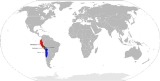
The Inca Empire (or Inka Empire) was the largest empire in pre-Columbian America. The administrative, political and military center of the empire was located in Cuzco in modern-day Peru
Peru

Peru , officially the Republic of Peru , is a country in western South America. It is bordered on the north by Ecuador and Colombia, on the east by Brazil, on the southeast by Bolivia, on the south by Chile, and on the west by the Pacific Ocean....
. The Inca Empire arose from the highlands of Peru sometime in early 13th century. From 1438 to 1533, the Incas used a variety of methods, from conquest to peaceful assimilation, to incorporate a large portion of western South America
South America

South America is the southern continent of the Americas, situated entirely in the Western Hemisphere and mostly in the Southern Hemisphere, with a relatively small portion in the Northern Hemisphere....
, centered on the Andean
Andes

The Andes form the world's longest exposed mountain range. They lie as a continuous chain of highland along the western coast of South America. The range is over 7,000 km long, 200-700 km wide , and of an average height of about 4,000 m ....
 mountain ranges, including large parts of modern Ecuador
Ecuador

Ecuador , officially the , literally, "Republic of the equator") is a representative democratic republic in South America, bordered by Colombia on the north, by Peru on the east and south, and by the Pacific Ocean to the west....
, Peru western and south central Bolivia
Bolivia

The Republic of Bolivia , named after Sim?n Bol?var, is a landlocked country in central South America. It is bordered by Brazil on the north and east, Paraguay and Argentina on the south, and Chile and Peru on the west....
, northwest Argentina
Argentina

Argentina, officially the Argentine Republic , is a country in South America, constituted as a federation of 23 provinces and an autonomous city....
, north and north-central Chile
Chile

Chile, officially the Republic of Chile , is a country in South America occupying a long and narrow coastal strip wedged between the Andes mountains and the Pacific Ocean....
, and southern Colombia
Colombia

Colombia , officially the Republic of Colombia , is a country in north-western South America. Colombia is bordered to the east by Venezuela and Brazil; to the south by Ecuador and Peru; to the north by the Caribbean Sea; to the north west by Panama; and to the west by the Pacific Ocean....
.

The official language of the empire was Quechua
Quechua

Quechua is a Native American language of South America. It was already widely spoken across the Central Andes long before the time of the Inca Empire, who established it as the official language of administration for their Empire, and is still spoken today in various regional forms by some 10 million people through much of South America, in...
, although hundreds of local languages and dialects of Quechua were spoken.


Discussion
Ask a question about 'Inca Empire'
Start a new discussion about 'Inca Empire'
Answer questions from other users
Full Discussion Forum


Encyclopedia


The Inca Empire (or Inka Empire) was the largest empire in pre-Columbian America. The administrative, political and military center of the empire was located in Cuzco in modern-day Peru
Peru

Peru , officially the Republic of Peru , is a country in western South America. It is bordered on the north by Ecuador and Colombia, on the east by Brazil, on the southeast by Bolivia, on the south by Chile, and on the west by the Pacific Ocean....
. The Inca Empire arose from the highlands of Peru sometime in early 13th century. From 1438 to 1533, the Incas used a variety of methods, from conquest to peaceful assimilation, to incorporate a large portion of western South America
South America

South America is the southern continent of the Americas, situated entirely in the Western Hemisphere and mostly in the Southern Hemisphere, with a relatively small portion in the Northern Hemisphere....
, centered on the Andean
Andes

The Andes form the world's longest exposed mountain range. They lie as a continuous chain of highland along the western coast of South America. The range is over 7,000 km long, 200-700 km wide , and of an average height of about 4,000 m ....
 mountain ranges, including large parts of modern Ecuador
Ecuador

Ecuador , officially the , literally, "Republic of the equator") is a representative democratic republic in South America, bordered by Colombia on the north, by Peru on the east and south, and by the Pacific Ocean to the west....
, Peru western and south central Bolivia
Bolivia

The Republic of Bolivia , named after Sim?n Bol?var, is a landlocked country in central South America. It is bordered by Brazil on the north and east, Paraguay and Argentina on the south, and Chile and Peru on the west....
, northwest Argentina
Argentina

Argentina, officially the Argentine Republic , is a country in South America, constituted as a federation of 23 provinces and an autonomous city....
, north and north-central Chile
Chile

Chile, officially the Republic of Chile , is a country in South America occupying a long and narrow coastal strip wedged between the Andes mountains and the Pacific Ocean....
, and southern Colombia
Colombia

Colombia , officially the Republic of Colombia , is a country in north-western South America. Colombia is bordered to the east by Venezuela and Brazil; to the south by Ecuador and Peru; to the north by the Caribbean Sea; to the north west by Panama; and to the west by the Pacific Ocean....
.

The official language of the empire was Quechua
Quechua

Quechua is a Native American language of South America. It was already widely spoken across the Central Andes long before the time of the Inca Empire, who established it as the official language of administration for their Empire, and is still spoken today in various regional forms by some 10 million people through much of South America, in...
, although hundreds of local languages and dialects of Quechua were spoken. The Quechua name for the empire was Tawantinsuyu which can be translated as The Four Regions or The Four United Regions. Before the Quechua spelling reform
Quechuan and Aymaran spelling shift

In recent years, the spelling of place names in Peru and Bolivia has been revised among Quechua and Aymara language speakers. A standardized alphabet for Quechua was adopted by the Peruvian government in 1975; a revision in 1985 moved to a three-vowel orthography....
 it was written in Spanish
Spanish language

Spanish or Castilian is a Romance languages that originated in northern Spain, and gradually spread in the Kingdom of Castile and evolved into the principal language of government and trade....
 as Tahuantinsuyo. Tawantin is a group of four things (tawa "four" with the suffix -ntin which names a group); suyu means "region" or "province". The empire was divided into four Suyus, whose corners met at the capital, Cusco (Qosqo).

There were many local forms of worship, most of them concerning local sacred "Huaca
Huaca

In Quechua, a Indigenous peoples of the Americas language of South America, a huaca or wak'a is an object that represents something revered, typically a monument of some kind....
s", but the Inca leadership encouraged the worship of Inti
Inti

According to the Inca mythology, Inti is the sun god, as well a patron deity of Tahuantinsuyu. His exact origin is not known. The most common story says he is the son of Viracocha, the god of civilization....
—the sun god—and imposed its sovereignty above other cults such as that of Pachamama
Pachamama

Pachamama is a goddess revered by the indigenous people of the Andes. Pachamama is usually translated as "Mother Earth" but a more literal translation would be "Mother Universe" ...
. The Incas identified their king as "child of the sun."

History


Origin myths

The Incas had various creation myths. In one, Ticci Viracocha sent forth his four sons and four daughters (known as the Ayar brothers) from Pacaritambo
Pacaritambo

In Inca mythology, of the main Inca creation myths was that of the Ayar Brothers, who emerged from a cave called Pacaritambo . This house was located on Tambotoco Hill....
 to establish a village. Along the way, Sinchi Roca
Sinchi Roca

Sinchi Roca was the second Sapa Inca of the Kingdom of Cusco and a member of the H?rin dynasty. He was the son and successor of Manco Capac and the father of Lloque Yupanqui....
 was born to Manco
Manco Capac

In Inca mythology, Manco C?pac was the first king of the Kingdom of Cuzco. There are several versions of the story of the origin of Manco Capac....
 and Ocllo
Mama Ocllo

In Inca mythology, Mama Ocllo was deified as a Mother Goddess and fertility goddess. In one legend she was a daughter of Inti and Mama Quilla, and in another the daughter of Viracocha and Mama Cocha....
, and Sinchi Roca led them to the valley of Cusco where they founded their new village. There Manco became their leader and became known as Manco Capac
Manco Capac

In Inca mythology, Manco C?pac was the first king of the Kingdom of Cuzco. There are several versions of the story of the origin of Manco Capac....
.

In another origin myth, the sun god Inti ordered Manco Capac and Mama Ocllo to emerge from the depths of Lake Titicaca
Lake Titicaca

Lake Titicaca is a lake located on the border of Bolivia and Peru. It sits 3,812 m above sea level making it one of the highest commercially navigable lakes in the world....
. They were born in the lake and wandered north to establish the city of Cusco. They travelled by means of underground caves until they reached Cusco where they established Hurin Cusco, or the first dynasty of the Kingdom of Cusco.

These myths were apparently transmitted via oral tradition until early Spanish colonists recorded them; however some scholars believe that they may have been recorded on quipu
Quipu

Quipu or khipu were recording devices used in the Inca Empire and its predecessor societies in the Andes region. A quipu usually consisted of colored spun and plied thread or strings from llama or alpaca hair....
s (Andean knotted string records).

Archaeology

Andean civilization probably began c. 9500 BP
Before Present

Before Present years are a time scale used in archaeology, geology, and other science disciplines to specify when events in the past occurred. Because the "present" time changes, standard practice is to use 1950 Common_Era as the arbitrary origin of the age scale....
. Based in the highlands of Peru, an area now referred to as the punas, the ancestors of the Incas probably began as a nomadic herding people. Geographical conditions resulted in a distinctive physical development characterized by a small stature and stocky build. Men averaged 1.57 m (5'2") and women averaged 1.45 m (4'9"). Because of the high altitudes, they had unique lung developments with almost one third greater capacity than other humans. The Incas had slower heart rates, blood volume of about 2 l (four pints) more than other humans, and double the amount of hemoglobin which transfers oxygen from the lungs to the rest of the body.

Archaeologists have found traces of permanent habitation as high as 5,300 m (17,500 feet) above sea level in the temperate zone of the high altiplanos. While the Conquistadors may have been intimidating in stature, the Inca surely had the advantage of coping with the extraordinary altitude. It seems that civilizations in this area before the Inca have left no written record, and therefore the Inca seem to appear from nowhere, but the Inca were a product of the past. They borrowed architecture, ceramics, and their empire-state government from previous cultures.

The first Inca ruler was Manco Capac. There is no specific date for this ruler nor for the seven succeeding rulers, but the assumed dates are 1250 to 1438. The Inca originated at Cuzco in the central highlands and expanded down the coast. The basis of the Inca's conquest is believed to be their organization. Their divine symbol was the sun god, their bureaucratic system consisted of a circle of officials belonging to eleven royal ayllus, and the line of descent continued through incestuous marriage with a sister who becomes the coya or "legal queen." The expansion of the Inca empire probably resulted from climatic conditions. Their resources in the highlands were limited to llama, alpaca, and vicuna.

In 1445 Pachacuti Inca Yupanqui (the ninth Inca) began conquest of the Titicaca regions. He incorporated and developed patterns of cultures already in existence, particularly that of the Chimu. Pachacuti had disciplined officers from his own elite household. Common soldiers were armed with bronze battle axes, wooden hafts with stone or bronze heads, slings, lances, throwing spears, bows and arrows, wooden shields covered with leather, cotton or cane helmets, and quilted armor. In each captured province Inca officials were superimposed upon the existing local officials. The loyalty of the captured province was assured by taking the sons of the officials hostage in Cuzco. They made Quechua the official language and sun worship the official religion. They exploited the labor force in order to increase productivity and rapidly develop irrigation and terrace cultivation systems, and used guano
Guano

Guano is the excrement of seabirds, bats, and Harbor Seal.Guano manure is an effective fertilizer and gunpowder ingredient due to its high levels of phosphorus and nitrogen and also its lack of odor....
 deposits found on the coastal islands as fertilizer. The Inca social system required a severe authoritarian government backed by ritual and divine compulsion.

They built temples and fortresses and were supreme in road building
Inca road system

Among the many roads and trails constructed in pre-Columbian South America, the Inca road system, or Qhapaq ?an was the most extensive and highly advanced for its time....
. The roads extended 3,250 miles from Quito in the north to Talca in Central Chile. These roads were vital to the maintenance of the empire, but ironically this network of highways made the Spanish conquest easier. There were road markers every topo which is 4.5 miles and rest houses or tambos every 12 miles for the Inca ruler and his retinue. Small post houses called chasquis every 5 miles housed the runners and were used for relaying dispatches at the rate of about 150 miles per day. Verbal dispatches were supplemented by quipu or knotted strings, probably involving a code based on numbers. These were the equivalent of the notched sticks of the old tally system used in Europe.

Inca society was based on the idea of "equal footing." All men must work in order to live
Mita (Inca)

Mita was mandatory public service in the society of the Inca. It was effectively a form of tribute to the Inca government, in the form of labor, i.e....
, and even the Inca nobles helped to set an example. Some archaeologists believe this was a façade supporting a two-caste system. The penalties for breaking the law were less severe for bureaucratic elites; this emphasizes the importance of the upper caste in the maintenance of the system.

Kingdom of Cuzco


The Inca people began as a tribe in the Cusco area around the 12th century. Under the leadership of Manco Capac, they formed the small city-state of Cusco (Quechua Qusqu). In 1438 they began a far-reaching expansion under the command of Sapa Inca (paramount leader) Pachacuti
Pachacuti

Pachacuti Inca Yupanqui was the ninth Sapa Inca of the Kingdom of Cusco, which he transformed into the empire Tawantinsuyu. In Quechua, Pachakutiq means "He who remakes the world"....
, whose name literally meant "earth-shaker". During his reign, he and his son brought much of the Andes
Andes

The Andes form the world's longest exposed mountain range. They lie as a continuous chain of highland along the western coast of South America. The range is over 7,000 km long, 200-700 km wide , and of an average height of about 4,000 m ....
 mountains (roughly modern Peru and Ecuador) under Inca control.

Reorganization and formation

Inca Expansion
Pachacuti reorganized the kingdom of Cuzco into an empire, the Tahuantinsuyu, a federalist system
Federation

A federation is a Political union comprising a number of partially self-governing states or regions united by a central government. In a federation, the self-governing status of the state is typically constitutionally entrenched and may not be altered by a Unilateralism decision of the central government....
 which consisted of a central government with the Inca at its head and four provincial governments with strong leaders: Chinchasuyu (NW), Antisuyu (NE), Contisuyu (SW), and Collasuyu (SE). Pachacuti is also thought to have built Machu Picchu
Machu Picchu

Machu Picchu is a pre-Columbian Inca Empire site located above sea level. It is situated on a mountain ridge above the Urubamba Valley in Peru, which is northwest of Cuzco and through which the Urubamba River flows....
, either as a family home or as a summer retreat.

Pachacuti sent spies to regions he wanted in his empire; they brought reports on the political organization, military might and wealth. He would then send messages to the leaders of these lands extolling the benefits of joining his empire, offering them presents of luxury goods such as high quality textiles, and promising that they would be materially richer as subject rulers of the Inca. Most accepted the rule of the Inca as a fait accompli
List of French phrases used by English speakers

Here are some examples of French words and phrases used by English speakers.There are many List of English words of French origin, such as art, collage, competition, force, machine, police, publicity, role, routine, table, and many others which have been and are being anglicized....
 and acquiesced peacefully. The ruler's children would then be brought to Cuzco to be taught about Inca administration systems, then return to rule their native lands. This allowed the Inca to indoctrinate the former ruler's children into the Inca nobility, and, with luck, marry their daughters into families at various corners of the empire.

Expansion and consolidation

It was traditional for the Inca's son to lead the army; Pachacutec's son Túpac Inca Yupanqui
Tupac Inca Yupanqui

T?pac Inca Yupanqui was the tenth Sapa Inca of the Inca Empire, and fifth of the Hanan dynasty. His father was Pachacuti, and his son was Huayna Capac....
 began conquests to the north in 1463, and continued them as Inca after Pachucuti's death in 1471. His most important conquest was the Kingdom of Chimor
Chimor

Chimor was the political grouping of the Chim? culture that ruled the northern coast of Peru, beginning around 850 AD and ending around 1470 AD....
, the Inca's only serious rival for the coast of Peru. Túpac Inca's empire stretched north into modern day Ecuador and Colombia.

Túpac Inca's son Huayna Cápac
Huayna Capac

Huayna Capac was the eleventh Sapa Inca of the Inca Empire and sixth of the Hanan dynasty. He was the successor to Tupac Inca Yupanqui. His legitimate wife was Coya Cusirimay....
 added a small portion of land to the north in modern day Ecuador and in parts of Peru. At its height, the Inca Empire included Peru
Peru

Peru , officially the Republic of Peru , is a country in western South America. It is bordered on the north by Ecuador and Colombia, on the east by Brazil, on the southeast by Bolivia, on the south by Chile, and on the west by the Pacific Ocean....
 and Bolivia
Bolivia

The Republic of Bolivia , named after Sim?n Bol?var, is a landlocked country in central South America. It is bordered by Brazil on the north and east, Paraguay and Argentina on the south, and Chile and Peru on the west....
, most of what is now Ecuador
Ecuador

Ecuador , officially the , literally, "Republic of the equator") is a representative democratic republic in South America, bordered by Colombia on the north, by Peru on the east and south, and by the Pacific Ocean to the west....
, a large portion of what is today Chile
Chile

Chile, officially the Republic of Chile , is a country in South America occupying a long and narrow coastal strip wedged between the Andes mountains and the Pacific Ocean....
 north of Maule River
Maule river

The Maule river is one of the most important rivers of Chile and is inextricably linked to this country's pre-Hispanic times, the country's conquest, Colonialism period, Chilean Independence, History of Chile, agriculture , culture , religion, economy and politics....
. The advance south halted after the Battle of the Maule
Battle of the Maule

The Battle of the Maule, in modern Chile, was fought between the Mapuche people and the Inca Empire. It took place over three days and resulted in the end of the Incas' southward expansion....
 where they met massive resistance by the Mapuche
Mapuche

The Mapuche are the Indigenous peoples of the Americas inhabitants of Central and Southern Chile and Southern Argentina. They were known as Araucanians by the Spaniards....
 tribes. The empire also extended into corners of Argentina
Argentina

Argentina, officially the Argentine Republic , is a country in South America, constituted as a federation of 23 provinces and an autonomous city....
 and Colombia
Colombia

Colombia , officially the Republic of Colombia , is a country in north-western South America. Colombia is bordered to the east by Venezuela and Brazil; to the south by Ecuador and Peru; to the north by the Caribbean Sea; to the north west by Panama; and to the west by the Pacific Ocean....
. However, most of the southern portion of the Inca empire, the portion denominated as Collasuyo, was desert wasteland.

The Inca Empire was a patchwork of languages, cultures and peoples. The components of the empire were not all uniformly loyal, nor were the local cultures all fully integrated. The Inca empire as a whole had an economy based on exchange and taxation of luxury goods and labour. The following quote reflects a method of taxation: “For as is well known to all, not a single village of the highlands or the plains failed to pay the tribute levied on it by those who were in charge of these matters. There were even provinces where, when the natives alleged that they were unable to pay their tribute, the Inca ordered that each inhabitant should be obliged to turn in every four months a large quill full of live lice, which was the Inca’s way of teaching and accustoming them to pay tribute”

Inca civil war and Spanish conquest

Sacsayhuaman (pixinn
Spanish conquistadors led by Francisco Pizarro
Francisco Pizarro

Francisco Pizarro Gonz?lez, 1st Marqu?s de los Atabillos was a Spain conquistador, conqueror of the Incan Empire and founder of Lima, the modern-day capital of Peru....
 and his brothers explored south from Panama
Panama

Panama, officially the Republic of Panama , is the southernmost country of Central America and, in turn, North America. Situated on an isthmus connecting North and South America, some categorize it as a transcontinental nation....
, reaching Inca territory by 1526. It was clear that they had reached a wealthy land with prospects of great treasure, and after one more expedition in 1529, Pizarro traveled to Spain and received royal approval to conquer the region and be its viceroy. This approval was received as detailed in the following quote: "In July 1529 the queen of Spain signed a charter allowing Pizarro to conquer the Incas. Pizarro was named governer and captain of all conquests in Peru, or New Castile, as the Spanish now called the land."

When they returned to Peru in 1532, a war of the two brothers
War of the Two Brothers

War of the Two Brothers refers to two different civil wars, one in Peru and one in Portugal. It may refer to:* The Inca Civil War in Peru of 1529-32...
 between Huayna Capac's sons Huascar
Huáscar

Inti Cusi Huallpa Hu?scar was Sapa Inca of the Inca empire from 1527 to 1532 AD, succeeding his father Huayna Capac and brother Ninan Cuyochi, both of whom died of smallpox while campaigning near Quito....
 and Atahualpa
Atahualpa

Atahualpa, Atahuallpa, Atabalipa, or Atawallpa , was the last sovereign emperor of the Tahuantinsuyu, or the Inca Empire. He became emperor upon defeating his older half-brother Hu?scar in a civil war sparked by the death of their father, Inca Huayna Capac, from an infectious disease thought to be smallpox....
 and unrest among newly-conquered territories—and perhaps more importantly, smallpox
Smallpox

Smallpox is an infectious disease unique to humans, caused by either of two virus variants, Variola major and Variola minor. The disease is also known by the Latin names Variola or Variola vera, which is a derivative of the Latin varius, meaning spotted, or varus, meaning "pimple"....
, which had spread from Central America
Central America

Central America is a central geography region of the Americas. It is the southernmost, isthmus portion of the North American continent, which connects with South America on the southeast....
—had considerably weakened the empire. Pizarro did not have a formidable force; with just 168 men, 1 cannon
Cannon

A cannon is any tubular piece of artillery, that uses gunpowder or other usually explosive-based propellants to launch a projectile over a distance....
 and 27 horse
Horse

The horse is a hoofed mammal, a subspecies of one of seven extant species of the family Equidae. The horse has evolution of the horse over the past 45 to 55 million years from a small multi-toed creature into the large, odd-toed ungulate animal of today....
s, he often needed to talk his way out of potential confrontations that could have easily wiped out his party. The Spanish horsemen, fully armored, had great technological superiority over the Inca forces. The traditional mode of battle in the Andes was a kind of siege warfare where large numbers of usually reluctant draftees
Conscription

Conscription is a general term for involuntary labor demanded by an established authority. It is most often used in the specific sense of government policies that require citizens to serve in the military....
 were sent to overwhelm opponents. The Spaniards had developed one of the finest military machines in the premodern world
Premodernity

In a historical context, Premodernity is the period in Western civilization that came after Ancient history and before Modernity, which is usually recognized to have begun in the mid-1400s, marked by the invention of the printing press and the introduction of movable type in Europe....
, tactics learned in their centuries' long fight against Moorish
Moors

In the Spanish language, the term for Moors is Moro; in Portuguese language the word is mouro. There seems to have been some confusion about the relationship of the word moro/mouro to the word moreno , both from Greek language ma?ros, i.e....
 kingdoms in Iberia
Iberian Peninsula

The Iberian Peninsula, or Iberia, is located in the extreme southwest of Europe and includes modern-day Spain, Portugal, Andorra and Gibraltar and a very small area of France....
. Along with this tactical and material superiority, the Spaniards also had acquired tens of thousands of native allies who sought to end the Inca control of their territories.

Their first engagement was the Battle of Puná
Battle of Puná

The Battle of Pun?, a peripheral engagement of Francisco Pizarro's Spanish conquest of Peru, was fought in April 1531 on the island of Pun? Island ....
, near present-day Guayaquil
Guayaquil

Guayaquil , officially Santiago de Guayaquil, is the largest and the most populous city in Ecuador, as well as that nation's main port. Guayaquil is located on the western bank of the Guayas River, which flows into the Pacific Ocean at the Gulf of Guayaquil....
, Ecuador
Ecuador

Ecuador , officially the , literally, "Republic of the equator") is a representative democratic republic in South America, bordered by Colombia on the north, by Peru on the east and south, and by the Pacific Ocean to the west....
, on the Pacific Coast; Pizarro then founded the city of Piura
Piura

Piura is a city in northwestern Peru. It is the capital of the Piura Region and the Piura Province. The population is 377,496.It was here that Spanish Conqueror Francisco Pizarro founded the first Spanish city in South America, San Miguel de Piura, in 1532....
 in July 1532. Hernando de Soto
Hernando de Soto (explorer)

Hernando de Soto was a Spanish people Exploration and conquistador who, while leading the first European expedition deep into the territory of the modern-day United States, was the first European to discover the Mississippi River....
 was sent inland to explore the interior and returned with an invitation to meet the Inca, Atahualpa, who had defeated his brother in the civil war and was resting at Cajamarca
Cajamarca

Cajamarca may refer to:Colombia*Cajamarca, Tolima a town and municipality in Tolima DepartmentPeru* Cajamarca , city in Peru.* Cajamarca District, district in the Cajamarca province....
 with his army of 80,000 troops.

Pizarro and some of his men, most notably a friar named Vincente de Valverde
Vincente de Valverde

Vincente de Valverde was a Spanish bishop. He was born in Oropesa , Spain about 1490 and most sources claim he died in Isla Puna, Ecuador, in 1543....
, met with the Inca, who had brought only a small retinue. Through an interpreter Friar Vincente read the "Requerimiento
Requerimiento

The Requerimiento was a declaration of sovereignty and war read by Spanish people military forces to assert their sovereignty over the Americas....
" that demanded that he and his empire accept the yoke of King Charles I of Spain and convert to Christianity
Christianity

Christianity is a Monotheistic religion #Christian view religion centered on the life and teachings of Jesus as New Testament view on Jesus' life....
. Because of the language barrier and perhaps poor interpretation, Atahualpa became somewhat puzzled by the friar's description of Christian faith and was said to have not fully understood the envoy's intentions. After Atahualpa attempted further enquiry into the doctrines of the Christian faith under which Pizarro's envoy served, the Spanish became frustrated and impatient, attacking the Inca's retinue
Battle of Cajamarca

The Battle of Cajamarca was a surprise attack on the Inca Empire royal entourage orchestrated by Francisco Pizarro. Sprung on the evening of November 16, 1532 in the great plaza of Cajamarca, the ambush claimed the lives of thousands of Incas and achieved the goal of capturing Emperor Atahualpa....
 and capturing Atahualpa as hostage.

Atahualpa offered the Spaniards enough gold to fill the room he was imprisoned in, and twice that amount of silver. The Inca fulfilled this ransom, but Pizarro deceived them, refusing to release the Inca afterwards. During Atahualpa's imprisonment Huascar was assassinated elsewhere. The Spaniards maintained that this was at Atahualpa's orders; this was used as one of the charges against Atahualpa when the Spaniards finally decided to put him to death, in August 1533.

Last Incas

The Spanish installed Atahualpa's brother Manco Inca Yupanqui
Manco Inca Yupanqui

Manco Inca Yupanqui was one of the Incas of Vilcabamba. He was also known as "Manco II" and "Manco Capac II" . Born in 1516, he was one of the sons of Huayna Capac and came from a lower class of the nobility....
 in power; for some time Manco cooperated with the Spanish, while the Spanish fought to put down resistance in the north. Meanwhile an associate of Pizarro's, Diego de Almagro
Diego de Almagro

Diego de Almagro , also known as Adelantado and El Viejo , was a Spain conquistador and a companion and later rival of Francisco Pizarro....
, attempted to claim Cuzco for himself. Manco tried to use this intra-Spanish feud to his advantage, recapturing Cuzco in 1536, but the Spanish retook the city afterwards. Manco Inca then retreated to the mountains of Vilcabamba, Peru
Vilcabamba, Peru

Vilcabamba was a city founded by Manco Inca in 1539 and was the last refuge of the Inca Empire until it fell to the Spaniards in 1572, signaling the end of Inca resistance to Spanish rule....
, where he and his successors ruled for another 36 years, sometimes raiding the Spanish or inciting revolts against them. In 1572 the last Inca stronghold was conquered, and the last ruler, Túpac Amaru
Túpac Amaru

T?pac Amaru , was the last indigenous leader of the Inca Empire state in Peru....
, Manco's son, was captured and executed. This ended resistance to the Spanish conquest under the political authority of the Inca state.

After the fall of the Inca Empire, the new Spanish rulers brutally oppressed the people and suppressed their traditions. Many aspects of Inca culture were systematically destroyed, including their sophisticated farming system. The Spaniards used the Inca mita
Mita (Inca)

Mita was mandatory public service in the society of the Inca. It was effectively a form of tribute to the Inca government, in the form of labor, i.e....
 (mandatory public service) system to literally work the people to death. One member of each family was forced to work in the gold and silver mines, the foremost of which was the titanic silver mine at Potosí
Potosi

Potos? or Potosi may refer to:*Bolivia** Potos?, a city, an important mining spot during the Spanish conquest*** Potosi , a German Flying P-Liner sailing ship named after this place...
. When a family member died, which would usually happen within a year or two, the family would be required to send a replacement.

The effects of smallpox
Smallpox

Smallpox is an infectious disease unique to humans, caused by either of two virus variants, Variola major and Variola minor. The disease is also known by the Latin names Variola or Variola vera, which is a derivative of the Latin varius, meaning spotted, or varus, meaning "pimple"....
 on the Inca empire were even more devastating. Beginning in Colombia
Colombia

Colombia , officially the Republic of Colombia , is a country in north-western South America. Colombia is bordered to the east by Venezuela and Brazil; to the south by Ecuador and Peru; to the north by the Caribbean Sea; to the north west by Panama; and to the west by the Pacific Ocean....
, smallpox spread rapidly before the Spanish invaders first arrived in the empire. The spread was probably aided by the efficient Inca road system. Within a few years smallpox claimed between 60% and 94% of the Inca population, with other waves of European disease weakening them further. Smallpox was only the first epidemic. Typhus
Typhus

Epidemic typhus is a form of typhus so named because the disease often causes epidemics following wars and natural disasters. The causative organism is Rickettsia prowazekii, transmitted by the human body louse ....
 (probably) in 1546, influenza
Influenza

Influenza, commonly known as the flu, is an infectious disease that affects birds and mammals caused by RNA viruses of the biological family Orthomyxoviridae ....
 and smallpox together in 1558, smallpox again in 1589, diphtheria
Diphtheria

Diphtheria is an upper Respiration tract illness characterized by sore throat, low fever, and an adherent membrane on the tonsils, pharynx, and/or nasal cavity....
 in 1614, measles
Measles

Measles is a infection of the respiratory system caused by a virus, specifically a paramyxovirus of the genus Morbillivirus. Morbilliviruses, like other paramyxoviruses, are enveloped, single-stranded, negative-sense RNA viruses....
 in 1618 - all ravaged the remains of Inca culture.

Society


Organization of the Empire

The most powerful figure in the empire was the Sapa Inca ('the unique Inca'). Only descendants of the original Inca tribe ascended to the level of Inca. Most young members of the Inca's family attended Yachay Wasi
Inca education

Inca education during the time of the Inca Empire was divided into two principal spheres: education for the upper classes and education for the general population....
s (houses of knowledge) to obtain their education.

The Inca Empire was a federalist system
Federation

A federation is a Political union comprising a number of partially self-governing states or regions united by a central government. In a federation, the self-governing status of the state is typically constitutionally entrenched and may not be altered by a Unilateralism decision of the central government....
 which consisted of a central government with the Inca at its head and four provinces: Chinchay Suyu
Chinchay Suyu

Chinchasuyu was the Ordinal directions provincial region of the Inca Empire, or Inca Empire....
 (NW), Anti Suyu
Anti Suyu

Anti Suyu is the eastern part of the Inca Empire which bordered with modern-day Upper Amazon region where the Campa inhabited. Antis is a collective term for the many varied ethnic groups living in the Antisuyu such as, for example, the Pano or the Campa....
 (NE), Kunti Suyu
Kunti Suyu

Kunti Suyu or Contisuyu was the Ordinal directions provincial region of the Inca Empire....
 (SW), and Qulla Suyu
Qulla Suyu

Qulla Suyu was the Ordinal directions provincial region of the Inca Empire. It related specifically to the Aymara territories which are now largely incorporated into the modern South American states of northern Chile and Argentina, Peru and Bolivia which was annexed during the reign of Sapa Inca Huayna C?pac in the sixteenth century....
 (SE). The four corners of these provinces met at the center, Cusco. Each province had a governor who oversaw local officials, who in turn supervised agriculturally-productive river valleys, cities and mines. There were separate chains of command for both the military and religious institutions, which created a system of partial checks and balances on power . The local officials were responsible for settling disputes and keeping track of each family's contribution to the mita (mandatory public service).

Language

Since the Inca Empire lacked a written language, the empire's main form of communication and recording came from quipus, ceramics and spoken Quechua, the language the Incas imposed upon the peoples within the empire. The plethora of civilizations in the Andean region provided for a general disunity that the Incas needed to subdue in order to maintain control of the empire. While Quechua had been spoken in the Andean region, like central Peru, for several years prior to the expansion of the Inca civilization, the type of Quechua the Incas imposed was an adaptation from the Kingdom of Cusco (an early form of "Southern Quechua") of what some historians define as "Proto-Quechua" or Cusco dialect (the original Quechua dialect).

The language imposed by the Incas further diverted from its original phonetic tone as some societies formed their own regional varieties, or slang
Slang

Slang is the use of highly informal words and expressions that are not considered standard in the speaker's dialect or language....
. The diversity of Quechua at that point and even today does not come as a direct result from the Incas, who are just a part of the reason for Quechua's diversity. The civilizations within the empire that had previously spoken Quechua kept their own variety distinct to the Quechua the Incas spread. Although these dialects of Quechua have a similar linguistic structure, they differ according to the region in which they are spoken. Although most of the societies within the empire implemented Quechua into their lives, the Incas allowed several societies to keep their old languages such as Aymara
Aymara

The Aymara or Aimara are a native ethnic group in the Andes and Altiplano regions of South America; about 2 million live in Bolivia, Peru and Norte Grande, Chile....
, which still remains a spoken language in contemporary Bolivia where it is the primary indigenous language and various regions of South America surrounding Bolivia. The linguistic body of the Inca Empire was thus largely varied, but it still remains quite an achievement for the Incas that went even beyond their times as the Spanish imposed the use of Spanish
Spanish language

Spanish or Castilian is a Romance languages that originated in northern Spain, and gradually spread in the Kingdom of Castile and evolved into the principal language of government and trade....
 as a method to force their culture upon the indigenous peoples of South America (even though that further increased the diversity of the language).

The dialect of Quechua spoken by the Incan ruling elite tended to remain somewhat closer to the "early Southern Quechua" of the Kingdom of Cusco mainly through the complex educational facilities the Inca Empire offered them. This standardized governmental Quechua is what served as the backbone for the Inca Empire, but it also differentiated the social status of the community. Moreover, some historians even discuss the possibility that the "secret language" of the ruling elite might have simply been another form of Quechua.

The Roman Catholic Church
Roman Catholic Church

The Roman Catholic Church, officially known as the Catholic Church is the world's largest Christianity Ecclesia , representing over half of all Christians and one-sixth of the world population....
 employed Quechua to evangelize in the Andean region. In some cases, these languages were taught to people who had originally spoken other indigenous languages. Today, Quechua and Aymara remain the most widespread Amerindian languages.

Daily life and diet


Patates
The Inca diet consisted primarily of potatoes and grains, supplemented by fish, vegetables, nuts, and maize
Maize

Maize , known as corn in some countries, is a cereal domesticated in Mesoamerica and subsequently spread throughout the American continents....
 (corn). Camelid (llama and alpaca) meat and cuyes
Guinea pig

The guinea pig is a species of rodent belonging to the family Caviidae and the genus Cavia. Despite their common name, these animals are not pigs, nor do they come from Guinea ....
 (guinea pigs) were also eaten in large quantities. In addition, they hunted various wild animals for meat, skins and feathers. Maize was malted and used to make chicha
Chicha

Chicha is a term used in some regions of Latin America for several varieties of fermentation, particularly those derived from maize, but which also describes similar non-alcoholic beverage beverages....
, a fermented alcoholic beverage. The Inca road system
Inca road system

Among the many roads and trails constructed in pre-Columbian South America, the Inca road system, or Qhapaq ?an was the most extensive and highly advanced for its time....
 was key to farming success as it allowed distribution of foodstuffs over long distances.

The Aqllawasi (Acllahuasi) which means "house of the sun virgins" was developed under the Incas in Peru at about 1438–1532 CE. Its central purpose was in the manufacturing of garments for the Inca royalty and the worship of the sun god, Inti.

Religion


The Inca believed in reincarnation
Reincarnation

Reincarnation, literally "to be made flesh again", is a doctrine or Metaphysics belief that some essential part of a living being survives death to be reborn in a new body....
. Those who obeyed the Incan moral code—ama suwa, ama llulla, ama quella (do not steal, do not lie, do not be lazy)—"went to live in the Sun's warmth while others spent their eternal days in the cold earth" . The Inca also practiced cranial deformation. They achieved this by wrapping tight cloth straps around the heads of newborns in order to alter the shape of their soft skulls into a more conical form. Further studies are still needed to determine whether these deformations caused brain damage.

Arts and technology

Tupa Inca Tunic
Coca

Monumental architecture

Architecture
Architecture

The term architecture can refer to a process, a profession or documentation.As a process, architecture is the activity of designing and construction buildings and other physical structures by a person or a computer, primarily to provide shelter....
 was by far the most important of the Inca arts, with textiles reflecting motifs that were at their height in architecture. The main example is the capital city of Cuzco. The breathtaking site of Machu Picchu
Machu Picchu

Machu Picchu is a pre-Columbian Inca Empire site located above sea level. It is situated on a mountain ridge above the Urubamba Valley in Peru, which is northwest of Cuzco and through which the Urubamba River flows....
 was constructed by Inca engineers. The stone temples constructed by the Inca used a mortarless construction that fit together so well that a knife could not be fitted through the stonework. This was a process first used on a large scale by the Pucara (ca. 300 BC–AD 300) peoples to the south in Lake Titicaca, and later in the great city of Tiwanaku
Tiwanaku

Tiwanaku is an important Pre-Columbian archaeological site in western Bolivia. Tiwanaku is recognized by Andean scholars as one of the most important precursors to the Inca Empire, flourishing as the ritual and administrative capital of a major state power for approximately five hundred years....
 (ca. AD 400–1100) in present day Bolivia. The rocks used in construction were sculpted to fit together exactly by repeatedly lowering a rock onto another and carving away any sections on the lower rock where the dust was compressed. The tight fit and the concavity on the lower rocks made them extraordinarily stable.

Ceramics, precious metal work, and textiles

Almost all of the gold and silver work of the empire was melted down by the conquistadores.

Ceramics were painted using the polychrome technique portraying numerous motifs including animals,birds, waves, felines (which were popular in the Chavin culture) and geometric patterns found in the Nazca style of ceramics.In place of a written language Ceramics portrayed the very basic scenes of everyday life,including the smelting of metals,relationships and scenes of tribal warfare,it is through these preserved Ceramics that we know what life was like for the ancient South Americans . The most distinctive Inca ceramic objects are the Cusco bottles or ¨aryballos¨. Many of these pieces are on display in Lima in the Larco Archaeological Museum
Larco Museum

The Larco Museum is located in the Pueblo Libre District in Lima, Peru. The museum is housed in an 18th century Viceroyalty of Peru mansion built over a 7th century pre-Columbian pyramid....
 and the National Museum of Archaeology, Anthropology and History.

Communication and medicine

The Inca used an assemblages of knotted strings, known as Quipu
Quipu

Quipu or khipu were recording devices used in the Inca Empire and its predecessor societies in the Andes region. A quipu usually consisted of colored spun and plied thread or strings from llama or alpaca hair....
 to record information, the exact nature of which is no longer known. Originally it was thought that Quipu were used only as mnemonic devices or to record numerical data. Recent discoveries, however, have led to the theory that these devices were instead a form of writing in their own right .

The Inca made many discoveries in medicine. They performed successful skull surgery
Trepanation

Trepanation is surgery in which a hole is drilled or scraped into the human skull, thus exposing the dura mater in order to treat health problems related to intracranial diseases, though in the modern era it is used only to treat epidural hematoma and subdural hematomas and for surgical access for certain other neurosurgical procedures, su...
, which involved cutting holes in the skull in order to alleviate fluid buildup and inflammation caused by head wounds. Anthropologists have discovered evidence which suggests that most skull surgeries performed by Inca surgeons were successful. In pre-Inca times, only one-third of skull surgery patients survived the procedure. However, survival rates rose to 80-90% during the Inca era.

Coca
Coca

Coca is a plant in the family Erythroxylaceae, native to north-western South America. The plant plays a significant role in traditional Andean culture....
 leaves were used to lessen hunger and pain, as they still are in the Andes. The Chasqui (messengers) chewed coca leaves for extra energy to carry on their tasks as runners delivering messages throughout the empire. They were also used during surgeries.

Weapons, armor, and warfare

The Inca army was the most powerful in the area at that time, because they could turn an ordinary villager or farmer into a soldier, ready for battle. This is because every male Inca had to take part in war at least once so as to be prepared for warfare again when needed. By the time the empire had reached its large size, every section of the empire contributed in setting up an army for war.

The Incas had no iron or steel, and their weapons were no better than those of their enemies. They went into battle with the beating of drums and the blowing of trumpets. The armor used by the Incas included:
  • Helmets made of wood, copper, bronze, cane, or animal skin; some were adorned with feathers
  • Round or square shields made from wood or hide
  • Cloth tunics padded with cotton and small wooden planks to protect spine


The Inca weaponry included:
  • Bronze or bone-tipped spears
  • Two-handed wooden swords with serrated edges
  • Clubs with stone and spiked metal heads
  • Woolen slings and stones
  • Stone or copper headed battle-axes
  • Stones fastened to lengths of cord (bola)


Roads allowed very quick movement for the Inca army, and shelters called quolla were built one day's distance in travelling from each other, so that an army on campaign could always be fed and rested. (The name for the Sapa Inca's storehouses was tambo. This can be seen in names of ruins such as Ollantay Tambo, or My Lord's Storehouse. These were set up so the Inca and his entourage would always have supplies (and possibly shelter) ready as he traveled.

Inca flag

Banner of the Inca Empire
There are 16th and 17th century chronicles and references that support the idea of a banner, or flag, attributable to the Inca. Francisco López de Jerez wrote in 1534:
"all of them came distributed into squads, with their flags and captains commanding them, as well-ordered as Turks"
("todos venían repartidos en sus escuadras con sus banderas y capitanes que los mandan, con tanto concierto como turcos").


The chronicler, Bernabé Cobo
Bernabé Cobo

Bernab? Cobo was a Spanish Jesuit missionary and writer. He played a part in the early history of quinine by his description of cinchona bark; he brought some to Europe on a visit in 1632....
, wrote:

"The royal standard or banner was a small square flag, ten or twelve spans around, made of cotton or wool linen, placed on the end of a long staff, stretched and stiff such that it did not wave in the air, and on it each king painted his arms and emblems, for each one chose different ones, though the sign of the Incas was the rainbow."

(...el guión o estandarte real era una banderilla cuadrada y pequeña, de diez o doce palmos de ruedo, hecha de lienzo de algodón o de lana, iba puesta en el remate de una asta larga, tendida y tiesa, sin que ondease al aire, y en ella pintaba cada rey sus armas y divisas, porque cada uno las escogía diferentes, aunque las generales de los Incas eran el arco celeste.)
-Bernabé Cobo, Historia del Nuevo Mundo (1653)


Guaman Poma's 1615 book,
El primer nueva corónica y buen gobierno, shows numerous line drawings of Inca flags.

In modern times the rainbow flag
Rainbow flag

A rainbow flag is a multi-colored flag consisting of stripes in the colors of the rainbow. The actual colors used differ, but many of the designs are based on the traditional scheme of red, Orange , yellow, green, blue, indigo and Violet , or some more modern division of the rainbow spectrum ....
 has been associated with the Tawantinsuyu and is displayed as a symbol of Inca heritage in Peru and Bolivia. The city of Cusco flies the Rainbow Flag. Peruvian President Alejandro Toledo
Alejandro Toledo

Alejandro Celestino Toledo Manrique is a Peruvian politician and economist. He was List of Presidents of Peru of Peru from 2001 to 2006. He was elected in 2001 defeating former President Alan Garc?a....
 (2001–2006) flew the Rainbow Flag in Lima
Lima

Lima is the Capital and largest city of Peru. It is located in the valleys of the Chill?n River, R?mac River and Lur?n River rivers, on a coast overlooking the Pacific Ocean....
's presidential palace.

See also


External links

  • Maps to be combined and compared
  •  – A high-quality digital version of the Corónica, scanned from the original manuscript.
  • Full text, free to read and search.
  • by Hiram Bingham
    Hiram Bingham III

    Hiram Bingham, formally Hiram Bingham III, was an United States academic, explorer and politician. He rediscovered the Inca settlement of Machu Picchu in 1911....
     (published 1912–1922 CE).
  • 360 degree movies of inca artifacts and Peruvian landscapes.
  • and other ancient civilizations by Genry Joil.
  • : theory on how the Inca walls fit so perfectly.
  • Great research site for kids.
  • National Geographic site.
  • Poetry of an Inca emperor.
  • NOVA site based on their series about the 1996 expedition that discovered Incan ice mummies.
  • Inca history, society and religion.
  • MIT asst. professor gives 40 minute lecture on Incan suspension bridges.
  • of events mentioned in this article