


Hellenistic civilization

Encyclopedia
Ancient Greece
Ancient Greece is a civilization belonging to a period of Greek history that lasted from the Archaic period of the 8th to 6th centuries BC to the end of antiquity. Immediately following this period was the beginning of the Early Middle Ages and the Byzantine era. Included in Ancient Greece is the...
influence in the ancient world
Classical antiquity
Classical antiquity is a broad term for a long period of cultural history centered on the Mediterranean Sea, comprising the interlocking civilizations of ancient Greece and ancient Rome, collectively known as the Greco-Roman world...
from 323 BCE to about 146 BCE (or arguably as late as 30 BCE). Hellenistic civilization was preceded by the Classical Hellenic period
Classical Greece
Classical Greece was a 200 year period in Greek culture lasting from the 5th through 4th centuries BC. This classical period had a powerful influence on the Roman Empire and greatly influenced the foundation of Western civilizations. Much of modern Western politics, artistic thought, such as...
, and followed by Roman rule
Roman Greece
Roman Greece is the period of Greek history following the Roman victory over the Corinthians at the Battle of Corinth in 146 BC until the reestablishment of the city of Byzantium and the naming of the city by the Emperor Constantine as the capital of the Roman Empire...
over the areas Greece had earlier dominated – even though much of Greek culture, religion, art and literature still permeated Rome's rule, whose elite spoke and read Greek as well as Latin.
The spread of Hellenistic culture was sparked by the conquests of Alexander the Great. After his ventures of the Persian Empire
Achaemenid Empire
The Achaemenid Empire , sometimes known as First Persian Empire and/or Persian Empire, was founded in the 6th century BCE by Cyrus the Great who overthrew the Median confederation...
, Hellenistic kingdoms were established throughout south-west Asia
Southwest Asia
Western Asia, West Asia, Southwest Asia or Southwestern Asia are terms that describe the westernmost portion of Asia. The terms are partly coterminous with the Middle East, which describes a geographical position in relation to Western Europe rather than its location within Asia...
(the 'Near
Near East
The Near East is a geographical term that covers different countries for geographers, archeologists, and historians, on the one hand, and for political scientists, economists, and journalists, on the other...
' and 'Middle East
Middle East
The Middle East is a region that encompasses Western Asia and Northern Africa. It is often used as a synonym for Near East, in opposition to Far East...
') and north-east Africa (ancient Egypt
Ancient Egypt
Ancient Egypt was an ancient civilization of Northeastern Africa, concentrated along the lower reaches of the Nile River in what is now the modern country of Egypt. Egyptian civilization coalesced around 3150 BC with the political unification of Upper and Lower Egypt under the first pharaoh...
and Cyrene
Cyrene, Libya
Cyrene was an ancient Greek colony and then a Roman city in present-day Shahhat, Libya, the oldest and most important of the five Greek cities in the region. It gave eastern Libya the classical name Cyrenaica that it has retained to modern times.Cyrene lies in a lush valley in the Jebel Akhdar...
in ancient Libya
Ancient Libya
The Latin name Libya referred to the region west of the Nile Valley, generally corresponding to modern Northwest Africa. Climate changes affected the locations of the settlements....
). This resulted in the export of Greek culture and language to these new realms, and moreover Greek colonists themselves. Equally, however, these new kingdoms were influenced by the indigenous cultures, adopting local practices where beneficial, necessary or convenient.
Hellenistic civilization thus represents a fusion of the Ancient Greek world with that of the Near East, Middle East and Southwest Asia, and a departure from earlier Greek attitudes towards "barbarian" cultures. The extent to which genuinely hybrid Greco-Asian cultures emerged is contentious; consensus tends to point towards pragmatic cultural adaptation by the elites of society, but for much of the populations, life would probably have continued much as it had before.
The Hellenistic period was characterized by a new wave of Greek colonization (as distinguished from that occurring in the 8th-6th centuries BC) which established Greek cities and kingdoms in Asia
Asia
Asia is the world's largest and most populous continent, located primarily in the eastern and northern hemispheres. It covers 8.7% of the Earth's total surface area and with approximately 3.879 billion people, it hosts 60% of the world's current human population...
and Africa
Africa
Africa is the world's second largest and second most populous continent, after Asia. At about 30.2 million km² including adjacent islands, it covers 6% of the Earth's total surface area and 20.4% of the total land area...
. Those new cities were composed of Greek colonists who came from different parts of the Greek world, and not, as before, from a specific "mother city". The main cultural centers expanded from mainland Greece to Pergamon
Pergamon
Pergamon , or Pergamum, was an ancient Greek city in modern-day Turkey, in Mysia, today located from the Aegean Sea on a promontory on the north side of the river Caicus , that became the capital of the Kingdom of Pergamon during the Hellenistic period, under the Attalid dynasty, 281–133 BC...
, Rhodes
Rhodes
Rhodes is an island in Greece, located in the eastern Aegean Sea. It is the largest of the Dodecanese islands in terms of both land area and population, with a population of 117,007, and also the island group's historical capital. Administratively the island forms a separate municipality within...
, and new Greek colonies such as Seleucia
Seleucia
Seleucia was the first capital of the Seleucid Empire, and one of the great cities of antiquity standing in Mesopotamia, on the Tigris River.Seleucia may refer to:...
, Antioch
Antioch
Antioch on the Orontes was an ancient city on the eastern side of the Orontes River. It is near the modern city of Antakya, Turkey.Founded near the end of the 4th century BC by Seleucus I Nicator, one of Alexander the Great's generals, Antioch eventually rivaled Alexandria as the chief city of the...
and Alexandria
Alexandria
Alexandria is the second-largest city of Egypt, with a population of 4.1 million, extending about along the coast of the Mediterranean Sea in the north central part of the country; it is also the largest city lying directly on the Mediterranean coast. It is Egypt's largest seaport, serving...
. This mixture of Greek-speakers gave birth to a common Attic
Attic Greek
Attic Greek is the prestige dialect of Ancient Greek that was spoken in Attica, which includes Athens. Of the ancient dialects, it is the most similar to later Greek, and is the standard form of the language studied in courses of "Ancient Greek". It is sometimes included in Ionic.- Origin and range...
-based dialect, known as Hellenistic Greek, which became the lingua franca
Lingua franca
A lingua franca is a language systematically used to make communication possible between people not sharing a mother tongue, in particular when it is a third language, distinct from both mother tongues.-Characteristics:"Lingua franca" is a functionally defined term, independent of the linguistic...
through the Hellenistic world.
The term "Hellenistic" itself is derived from (Héllēn), the Greeks
Greeks
The Greeks, also known as the Hellenes , are a nation and ethnic group native to Greece, Cyprus and neighboring regions. They also form a significant diaspora, with Greek communities established around the world....
' traditional name for themselves. It was coined by the historian Johann Gustav Droysen
Johann Gustav Droysen
Johann Gustav Droysen was a German historian. His history of Alexander the Great was the first work representing a new school of German historical thought that idealized power held by so-called "great" men...
to refer to the spreading of Greek culture and colonization over the non-Greek lands that were conquered by Alexander the Great in the 4th century BC, compared to "Hellenic" which describes Greek culture in its native form. There has been much debate about the validity of Droysen's ideas, leading many to reject the label 'Hellenistic' (at least in the specific meaning of Droysen). However, the term Hellenistic can still be usefully applied to this period in history, and, moreover, no better general term does so.
History
The nominal start of the Hellenistic period is usually taken as the 323 BCE death of Alexander the Great in BabylonBabylon
Babylon was an Akkadian city-state of ancient Mesopotamia, the remains of which are found in present-day Al Hillah, Babil Province, Iraq, about 85 kilometers south of Baghdad...
. During the previous decade of campaigning ( from 334 BCE ), Alexander had conquered the whole Persian Empire
Achaemenid Empire
The Achaemenid Empire , sometimes known as First Persian Empire and/or Persian Empire, was founded in the 6th century BCE by Cyrus the Great who overthrew the Median confederation...
, overthrowing the Persian King Darius III. The conquered lands included Asia Minor
Asia Minor
Asia Minor is a geographical location at the westernmost protrusion of Asia, also called Anatolia, and corresponds to the western two thirds of the Asian part of Turkey...
, Assyria
Assyria
Assyria was a Semitic Akkadian kingdom, extant as a nation state from the mid–23rd century BC to 608 BC centred on the Upper Tigris river, in northern Mesopotamia , that came to rule regional empires a number of times through history. It was named for its original capital, the ancient city of Assur...
, the Levant
Levant
The Levant or ) is the geographic region and culture zone of the "eastern Mediterranean littoral between Anatolia and Egypt" . The Levant includes most of modern Lebanon, Syria, Jordan, Israel, the Palestinian territories, and sometimes parts of Turkey and Iraq, and corresponds roughly to the...
, Egypt
Egypt
Egypt , officially the Arab Republic of Egypt, Arabic: , is a country mainly in North Africa, with the Sinai Peninsula forming a land bridge in Southwest Asia. Egypt is thus a transcontinental country, and a major power in Africa, the Mediterranean Basin, the Middle East and the Muslim world...
, Mesopotamia
Mesopotamia
Mesopotamia is a toponym for the area of the Tigris–Euphrates river system, largely corresponding to modern-day Iraq, northeastern Syria, southeastern Turkey and southwestern Iran.Widely considered to be the cradle of civilization, Bronze Age Mesopotamia included Sumer and the...
, Media
Medes
The MedesThe Medes...
, Persia, and parts of modern Afghanistan
Afghanistan
Afghanistan , officially the Islamic Republic of Afghanistan, is a landlocked country located in the centre of Asia, forming South Asia, Central Asia and the Middle East. With a population of about 29 million, it has an area of , making it the 42nd most populous and 41st largest nation in the world...
, Pakistan
Pakistan
Pakistan , officially the Islamic Republic of Pakistan is a sovereign state in South Asia. It has a coastline along the Arabian Sea and the Gulf of Oman in the south and is bordered by Afghanistan and Iran in the west, India in the east and China in the far northeast. In the north, Tajikistan...
and the steppes of central Asia.
Alexander had made no special preparations for his succession in his newly founded empire, dying as he did at a young age, and thus on his death-bed (apocryphally), he willed it to "the strongest". The result was a state of internecine warfare between his generals (the Diadochi
Diadochi
The Diadochi were the rival generals, family and friends of Alexander the Great who fought for the control of Alexander's empire after his death in 323 BC...
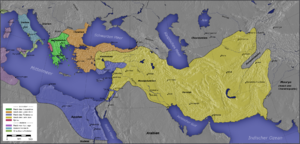
, or 'Successors'), which lasted for forty years before a more-or-less stable arrangement was established, consisting of four major domains:
- The Antigonid dynastyAntigonid dynastyThe Antigonid dynasty was a dynasty of Hellenistic kings descended from Alexander the Great's general Antigonus I Monophthalmus .-History:...
in MacedonMacedonMacedonia or Macedon was an ancient kingdom, centered in the northeastern part of the Greek peninsula, bordered by Epirus to the west, Paeonia to the north, the region of Thrace to the east and Thessaly to the south....
and central Greece; - The Ptolemaic dynastyPtolemaic dynastyThe Ptolemaic dynasty, was a Macedonian Greek royal family which ruled the Ptolemaic Empire in Egypt during the Hellenistic period. Their rule lasted for 275 years, from 305 BC to 30 BC...
in EgyptEgyptEgypt , officially the Arab Republic of Egypt, Arabic: , is a country mainly in North Africa, with the Sinai Peninsula forming a land bridge in Southwest Asia. Egypt is thus a transcontinental country, and a major power in Africa, the Mediterranean Basin, the Middle East and the Muslim world...
based at AlexandriaAlexandriaAlexandria is the second-largest city of Egypt, with a population of 4.1 million, extending about along the coast of the Mediterranean Sea in the north central part of the country; it is also the largest city lying directly on the Mediterranean coast. It is Egypt's largest seaport, serving...
; - The Seleucid dynastySeleucid dynastyThe Seleucid dynasty or the Seleucidae was a Greek Macedonian royal family, founded by Seleucus I Nicator , which ruled the Seleucid Kingdom centered in the Near East and regions of the Asian part of the earlier Achaemenid Persian Empire during the Hellenistic period.-History:Seleucus was an...
in SyriaSyriaSyria , officially the Syrian Arab Republic , is a country in Western Asia, bordering Lebanon and the Mediterranean Sea to the West, Turkey to the north, Iraq to the east, Jordan to the south, and Israel to the southwest....
and MesopotamiaMesopotamiaMesopotamia is a toponym for the area of the Tigris–Euphrates river system, largely corresponding to modern-day Iraq, northeastern Syria, southeastern Turkey and southwestern Iran.Widely considered to be the cradle of civilization, Bronze Age Mesopotamia included Sumer and the...
based at AntiochAntiochAntioch on the Orontes was an ancient city on the eastern side of the Orontes River. It is near the modern city of Antakya, Turkey.Founded near the end of the 4th century BC by Seleucus I Nicator, one of Alexander the Great's generals, Antioch eventually rivaled Alexandria as the chief city of the...
; - The Attalid dynastyAttalid dynastyThe Attalid dynasty was a Hellenistic dynasty that ruled the city of Pergamon after the death of Lysimachus, a general of Alexander the Great. The Attalid kingdom was the rump state left after the collapse of the Lysimachian Empire. One of Lysimachus' officers, Philetaerus, took control of the city...
in AnatoliaAnatoliaAnatolia is a geographic and historical term denoting the westernmost protrusion of Asia, comprising the majority of the Republic of Turkey...
based at PergamumPergamonPergamon , or Pergamum, was an ancient Greek city in modern-day Turkey, in Mysia, today located from the Aegean Sea on a promontory on the north side of the river Caicus , that became the capital of the Kingdom of Pergamon during the Hellenistic period, under the Attalid dynasty, 281–133 BC...
.
A further two kingdoms later emerged, the so called Greco-Bactrian
Greco-Bactrian Kingdom
The Greco-Bactrian Kingdom was the easternmost part of the Hellenistic world, covering Bactria and Sogdiana in Central Asia from 250 to 125 BC...
and Indo-Greek kingdom
Indo-Greek Kingdom
The Indo-Greek Kingdom or Graeco-Indian Kingdom covered various parts of the northwest regions of the Indian subcontinent during the last two centuries BC, and was ruled by more than 30 Hellenistic kings, often in conflict with each other...
.
Each of these kingdoms had, thereafter, a noticeably individual development and history. For the most part, the latter parts of those histories are of gradual decline, with most ending in absorption by the Republic of Rome. We find numerous cycles of alliances, marriages and wars between these states. However, it is clear that the rulers of these kingdoms still considered themselves Greek, and furthermore, recognized that the other Hellenistic realms were also Greek and not 'robbing barbarians.'
The end of the Hellenistic period is often considered to be 146 BC, when the Roman Republic conquered most of mainland Greece, and absorbed all of ancient Macedon. By this time the rise of Rome to absolute political prominence in the Mediterranean was complete, and this might therefore mark the start of the 'Roman period'. An alternative date is 30 BC, when the final Hellenistic kingdom of Ptolemaic Egypt was conquered by Rome (the last remnants of the Seleucid empire having been taken over thirty years earlier). This more obviously represents the absolute end of the power of the Hellenistic civilizations.
The Hellenistic world
In addition to the four main Successor kingdoms, there was a wider sphere of Greek influence during the Period of Hellenistic rule. Much of mainland Greece and the Greek islands remained at least nominally independent, although often dominated by Macedon. The kingdom of EpirusEpirus
The name Epirus, from the Greek "Ήπειρος" meaning continent may refer to:-Geographical:* Epirus - a historical and geographical region of the southwestern Balkans, straddling modern Greece and Albania...
, bordering Macedon, was also heavily influenced by the Greeks, and is often counted as a Hellenistic kingdom.
Further west, the Greek cities of Sicily
Sicily
Sicily is a region of Italy, and is the largest island in the Mediterranean Sea. Along with the surrounding minor islands, it constitutes an autonomous region of Italy, the Regione Autonoma Siciliana Sicily has a rich and unique culture, especially with regard to the arts, music, literature,...
and southern Italy ('Magna Graecia
Magna Graecia
Magna Græcia is the name of the coastal areas of Southern Italy on the Tarentine Gulf that were extensively colonized by Greek settlers; particularly the Achaean colonies of Tarentum, Crotone, and Sybaris, but also, more loosely, the cities of Cumae and Neapolis to the north...
') would remain independent for the early part of the period, until conquered by Rome; but they would in turn contribute to the growing Hellenization of the Roman Republic itself. In Asia Minor, the non-Greek kingdoms of Pontus
Kingdom of Pontus
The Kingdom of Pontus or Pontic Empire was a state of Persian origin on the southern coast of the Black Sea. It was founded by Mithridates I in 291 BC and lasted until its conquest by the Roman Republic in 63 BC...
and Cappadocia emerged, and though not directly hellenized, were heavily influenced by the Greeks. Carthage also was heavily hellenized by the 3rd century BCE.
At the eastern extremes of the Hellenistic world, the Greco-Bactrian kingdom was established as a secession from the Seleucid empire. During the 2nd century B.C., the Greco-Bactrians seem to have conquered north-west India, forming an Indo-Greek kingdom, and furthering the spread of Greek influence (into what would otherwise have been a neglected part of the Seleucid realm). Indeed, the Indo-Greek kingdom may technically have been the last Hellenistic state remaining (until c.10 AD), although almost nothing is known of it, such was its profit from European affairs; thus, by the end it may not have been particularly 'Hellenistic'.
Hellenization
The concept of Hellenization, meaning the spread of Greek culture, has long been controversial. Undoubtedly Greek influence did spread through the Hellenistic realms, but to what extent, and whether this was a deliberate policy or mere cultural diffusion, have been hotly debated.Alexander
It seems likely that Alexander himself pursued deliberate 'Hellenization' policies, but the exact motives behind those policies are unclear. Whilst it may have been a deliberate attempt to spread Greek culture, it is more likely that it was a series of pragmatic measures designed to aid in the rule of his enormous empire. These policies can also be interpreted as the result of Alexander's probable megalomaniaMegalomania
Megalomania is a psycho-pathological condition characterized by delusional fantasies of power, relevance, or omnipotence. 'Megalomania is characterized by an inflated sense of self-esteem and overestimation by persons of their powers and beliefs'...
during his later years.
The first tenet of Alexander's policies was the founding (or re-founding) of cities across the empire. This has, in the past, been interpreted as part of Alexander's desire to spread Greek culture throughout the empire. These cities were presumably intended to be administrative headquarters in the regions, and to have been settled by Greeks; many were settled by veterans of Alexander's campaigns. Undoubtedly, this would have resulted in the spread of Greek influence across the empire; however, the primary purpose could have been to control his new subjects, rather than specifically to spread Greek culture. Arrian explicitly says that a city founded in Bactria was "meant to civilise the natives"; however, this comment could be interpreted in either way (with civilise as a euphemism for 'control'). Certainly, the cities would have been garrison points, and thus allowed control of the surrounding areas.
Secondly, Alexander attempted to create a unified ruling class of Persians
Persian people
The Persian people are part of the Iranian peoples who speak the modern Persian language and closely akin Iranian dialects and languages. The origin of the ethnic Iranian/Persian peoples are traced to the Ancient Iranian peoples, who were part of the ancient Indo-Iranians and themselves part of...
and Greeks
Greeks
The Greeks, also known as the Hellenes , are a nation and ethnic group native to Greece, Cyprus and neighboring regions. They also form a significant diaspora, with Greek communities established around the world....
, bound by marriage ties. He used both Greeks and Persians in positions of power, although he depended more on Greeks in unstable positions, and also replaced many Persian satraps in a purge after his return from India. He also tried to mix the two cultures, adopting elements of the Persian court (such as a version of the royal robes and some of the court ceremony and attendants) and also attempting to insist on the practice of proskynesis
Proskynesis
Proskynesis refers to the traditional Persian act of prostrating oneself before a person of higher social rank....
for his Greek subjects. This is probably an attempt to equalize the two races in their behavior towards Alexander as 'Great King', but it was bitterly resented by the Macedonians, as the Greek custom was reserved solely for the gods. This policy can be interpreted as an attempt to spread Greek culture, or to create a hybrid culture. However, again, it is probably better seen as an attempt to help control the unwieldy empire; Alexander needed loyalty from Persian nobles as much as from his Macedonian officers. A hybrid court culture may have been created so as not to exclude the Persians. Furthermore, Alexander's marriage to, and child with the Bactria
Bactria
Bactria and also appears in the Zend Avesta as Bukhdi. It is the ancient name of a historical region located between south of the Amu Darya and west of the Indus River...
n princess Roxana
Roxana
Roxana sometimes Roxane, was a Bactrian noble and a wife of Alexander the Great. She was born earlier than the year 343 BC, though the precise date remains uncertain....
can be interpreted as an attempt to create a royal dynasty which would be acceptable to both Asians and Greeks.
Alexander also unified the army, placing Persian soldiers (some trained in the Macedonian way of fighting and some in their original styles) in the Macedonian ranks. However, again, this can simply be seen as a pragmatic solution to chronic manpower problems. Alexander's increasing megalomania can be seen in his plan to completely homogenize the populations of Europe and Asia by mass re-settlement. Whilst this thoroughly impractical plan could be interpreted as an attempt to create a new hybrid culture, the sheer ambitiousness of the plan suggests some other process at work.
In short, Alexander's policies did undoubtedly result in the spread of Greek culture, but whether this was their primary aim must remain doubtful. They probably represent, instead, pragmatic attempts by Alexander to control his extensive new territories, in part by presenting himself as the heir to both Greek and Asian legacies, rather than an outsider.
Hellenization under the Successors

Satrap
Satrap was the name given to the governors of the provinces of the ancient Median and Achaemenid Empires and in several of their successors, such as the Sassanid Empire and the Hellenistic empires....
ies under his generals. Most of Alexander's cultural changes were rejected by the Diadochi
Diadochi
The Diadochi were the rival generals, family and friends of Alexander the Great who fought for the control of Alexander's empire after his death in 323 BC...
, including the cross-cultural marriages they entered into. However, the influx of Greek colonists into the new realms continued to spread Greek culture into Asia. The founding of new cities continued to be a major part of the Successors' struggle for control of any particular region, and these continued to be centres of cultural diffusion. The spread of Greek culture under the Successors seems mostly to have occurred with the spreading of Greeks themselves, rather than as an active policy.
Despite their initial reluctance, the Successors seem to have later deliberately naturalised themselves to their different regions, presumably in order to help maintain control of the population. Thus, for instance, we find the Ptolemies, as early as Ptolemy I Soter
Ptolemy I Soter
Ptolemy I Soter I , also known as Ptolemy Lagides, c. 367 BC – c. 283 BC, was a Macedonian general under Alexander the Great, who became ruler of Egypt and founder of both the Ptolemaic Kingdom and the Ptolemaic Dynasty...
, the first Hellenistic king of Egypt, portrayed as pharaoh
Pharaoh
Pharaoh is a title used in many modern discussions of the ancient Egyptian rulers of all periods. The title originates in the term "pr-aa" which means "great house" and describes the royal palace...
s (see image). Similarly, in the Indo-Greek kingdom, we find kings who were converts to Buddhism
Buddhism
Buddhism is a religion and philosophy encompassing a variety of traditions, beliefs and practices, largely based on teachings attributed to Siddhartha Gautama, commonly known as the Buddha . The Buddha lived and taught in the northeastern Indian subcontinent some time between the 6th and 4th...
(e.g. Menander
Menander I
Menander I Soter "The Saviour" was one of the rulers of the Indo-Greek Kingdom from either 165 or 155 BC to 130 BC ....
). The Greeks in the regions therefore gradually become 'localised', adopting local customs as appropriate. In this way, hybrid 'Hellenistic' cultures naturally emerged, at least amongst the upper echelons of society.
In summary, Alexander's conquests and the Successor kingdoms allowed widespread Greek colonisation and cultural diffusion, but it is unlikely this was ever a deliberate policy. Furthermore, such Hellenization was accompanied by the opposite spread of Asian culture to Europe. Nevertheless, the upheavals which occurred during this period do seem to have resulted in the development of hybrid 'Hellenistic' cultures. As a final point, it should be noted that the degree of influence that Greek culture had throughout the Hellenistic regions is often exaggerated because of the great influence on later generations of a small number of extensively Hellenized cities, particularly Alexandria
Alexandria
Alexandria is the second-largest city of Egypt, with a population of 4.1 million, extending about along the coast of the Mediterranean Sea in the north central part of the country; it is also the largest city lying directly on the Mediterranean coast. It is Egypt's largest seaport, serving...
.
Hellenistic culture
Many 19th century scholars contended that the Hellenistic period represented a cultural decline from the brilliance of classical GreeceClassical Greece
Classical Greece was a 200 year period in Greek culture lasting from the 5th through 4th centuries BC. This classical period had a powerful influence on the Roman Empire and greatly influenced the foundation of Western civilizations. Much of modern Western politics, artistic thought, such as...
. Though this comparison is now seen as unfair and meaningless, it has been noted that even commentators of the time saw the end of a cultural era which could not be matched again. This may be inextricably linked with the nature of government. It has been noted that after the establishment of the Athenian democracy:
- ...the Athenians found themselves suddenly a great power. Not just in one field, but in everything they set their minds to...As subjects of a tyrant, what had they accomplished?...Held down like slaves they had shirked and slacked; once they had won their freedom, not a citizen but he could feel like he was labouring for himself"
Thus, with the decline of the Greek polis, and the establishment of monarchial states, the environment and social freedom in which to excel may have been reduced. A parallel can be drawn with the productivity of the city states of Italy during the Renaissance, and their subsequent decline under autocratic rulers.
However, in some fields Hellenistic culture thrived, particularly in its preservation of the past. As has been noted, the states of the Hellenistic period were deeply fixated with the past and its seemingly lost glories.
Athens
Athens
Athens , is the capital and largest city of Greece. Athens dominates the Attica region and is one of the world's oldest cities, as its recorded history spans around 3,400 years. Classical Athens was a powerful city-state...
retained its position as the most prestigious seat of higher education, especially in the domains of philosophy and rhetoric, with considerable libraries. Alexandria was arguably the second most important center of Greek learning. The Library of Alexandria
Library of Alexandria
The Royal Library of Alexandria, or Ancient Library of Alexandria, in Alexandria, Egypt, was the largest and most significant great library of the ancient world. It flourished under the patronage of the Ptolemaic dynasty and functioned as a major center of scholarship from its construction in the...
had 700,000 volumes. The city of Pergamon became a major center of book production, possessing a library of some 200,000 volumes, second only to Alexandria's. The island of Rhodes boasted a famous finishing school for politics and diplomacy. Cicero
Cicero
Marcus Tullius Cicero , was a Roman philosopher, statesman, lawyer, political theorist, and Roman constitutionalist. He came from a wealthy municipal family of the equestrian order, and is widely considered one of Rome's greatest orators and prose stylists.He introduced the Romans to the chief...
was educated in Athens and Mark Antony
Mark Antony
Marcus Antonius , known in English as Mark Antony, was a Roman politician and general. As a military commander and administrator, he was an important supporter and loyal friend of his mother's cousin Julius Caesar...
in Rhodes. Antioch was founded as a metropolis and center of Greek learning which retained its status into the era of Christianity
Christianity
Christianity is a monotheistic religion based on the life and teachings of Jesus as presented in canonical gospels and other New Testament writings...
. Seleucia
Seleucia
Seleucia was the first capital of the Seleucid Empire, and one of the great cities of antiquity standing in Mesopotamia, on the Tigris River.Seleucia may refer to:...
replaced Babylon
Babylon
Babylon was an Akkadian city-state of ancient Mesopotamia, the remains of which are found in present-day Al Hillah, Babil Province, Iraq, about 85 kilometers south of Baghdad...
as the metropolis of the lower Tigris
Tigris
The Tigris River is the eastern member of the two great rivers that define Mesopotamia, the other being the Euphrates. The river flows south from the mountains of southeastern Turkey through Iraq.-Geography:...
.
The spread of Greek culture throughout the Near East and Asia owed much to the development of cities. Settlements such as Ai-Khanoum
Ai-Khanoum
Ai-Khanoum or Ay Khanum , was founded in the 4th century BC, following the conquests of Alexander the Great and was one of the primary cities of the Greco-Bactrian kingdom...
, situated on trade routes, allowed cultures to mix and spread. The identification of local gods with similar Greek deities facilitated the building of Greek-style temples, and the Greek culture in the cities also meant that buildings such as gymnasia
Gymnasium (ancient Greece)
The gymnasium in ancient Greece functioned as a training facility for competitors in public games. It was also a place for socializing and engaging in intellectual pursuits. The name comes from the Ancient Greek term gymnós meaning "naked". Athletes competed in the nude, a practice said to...
became common. Many cities maintained their autonomy while under the nominal rule of the local king or satrap
Satrap
Satrap was the name given to the governors of the provinces of the ancient Median and Achaemenid Empires and in several of their successors, such as the Sassanid Empire and the Hellenistic empires....
, and often had Greek-style institutions. Greek dedications, statues, architecture and inscriptions have all been found. However, local cultures were not replaced, and often mixed to create a new culture.
Greek language and literature spread throughout the former Persian Empire. The development of the Alexander Romance (mainly in Egypt) owes much to Greek theater as well as other styles of story. The Library at Alexandria, set up by Ptolemy I Soter
Ptolemy I Soter
Ptolemy I Soter I , also known as Ptolemy Lagides, c. 367 BC – c. 283 BC, was a Macedonian general under Alexander the Great, who became ruler of Egypt and founder of both the Ptolemaic Kingdom and the Ptolemaic Dynasty...
, became a center for learning and was copied by various other monarchs. An example that shows the spread of Greek theater is Plutarch
Plutarch
Plutarch then named, on his becoming a Roman citizen, Lucius Mestrius Plutarchus , c. 46 – 120 AD, was a Greek historian, biographer, essayist, and Middle Platonist known primarily for his Parallel Lives and Moralia...
's story of the death of Crassus, in which his head was taken to the Parthia
Parthia
Parthia is a region of north-eastern Iran, best known for having been the political and cultural base of the Arsacid dynasty, rulers of the Parthian Empire....
n court and used as a prop in a performance of The Bacchae
The Bacchae
The Bacchae is an ancient Greek tragedy by the Athenian playwright Euripides, during his final years in Macedon, at the court of Archelaus I of Macedon. It premiered posthumously at the Theatre of Dionysus in 405 BC as part of a tetralogy that also included Iphigeneia at Aulis, and which...
. Theaters have also been found: for example, in Ai-Khanoum
Ai-Khanoum
Ai-Khanoum or Ay Khanum , was founded in the 4th century BC, following the conquests of Alexander the Great and was one of the primary cities of the Greco-Bactrian kingdom...
on the edge of Bactria
Bactria
Bactria and also appears in the Zend Avesta as Bukhdi. It is the ancient name of a historical region located between south of the Amu Darya and west of the Indus River...
, the theater has 35 rows - larger than the theater in Babylon
Babylon
Babylon was an Akkadian city-state of ancient Mesopotamia, the remains of which are found in present-day Al Hillah, Babil Province, Iraq, about 85 kilometers south of Baghdad...
.
The spread of Greek influence and language is also shown through Ancient Greek coinage
Ancient Greek coinage
The history of Ancient Greek coinage can be divided into three periods, the Archaic, the Classical, and the Hellenistic. The Archaic period extends from the introduction of coinage to the Greek world in about 600 BCE until the Persian Wars in about 480 BCE...
. Portraits became more realistic, and the obverse of the coin was often used to display a propaganda image, commemorating an event or displaying the image of a favored god. The use of Greek-style portraits and Greek language continued into the Parthian period, even as the use of Greek was in decline.
Indian reference
Several references in Indian literature praise the knowledge of the Yavanas or the Greeks. The MahabharataMahabharata
The Mahabharata is one of the two major Sanskrit epics of ancient India and Nepal, the other being the Ramayana. The epic is part of itihasa....
compliments them as "the all-knowing Yavanas" (sarvajnaa yavanaa) i.e. "The Yavanas, O king, are all-knowing; the Suras are particularly so. The mleccha
Mleccha
Mleccha , also spelt as Mlechchha, people of foreign extraction in ancient India. Mleccha was used by the Aryans much as the ancient Greeks used barbaros, originally to indicate the uncouth and incomprehensible speech of foreigners and then extended to their unfamiliar behaviour...
s are wedded to the creations of their own fancy." and the creators of flying machines that are generally called vimanas.[12]
The "Brihat-Samhita" of the mathematician Varahamihira
Varahamihira
Varāhamihira , also called Varaha or Mihira, was an Indian astronomer, mathematician, and astrologer who lived in Ujjain...
says: "The Greeks
Greeks
The Greeks, also known as the Hellenes , are a nation and ethnic group native to Greece, Cyprus and neighboring regions. They also form a significant diaspora, with Greek communities established around the world....
, though impure, must be honored since they were trained in sciences and therein, excelled others....." .
Yet another Indian text, (Gargi-Samhita), also similarly compliments the Yavanas saying: "The Yavanas are barbarians yet the science of astronomy originated with them and for this they must be revered like gods".
Sciences
The post-Hellenistic period
In the 2nd to 1st centuries BC, Rome conquered Greece piece by piece until, with the conquest of Egypt in 30 BC, the Roman EmpireRoman Empire
The Roman Empire was the post-Republican period of the ancient Roman civilization, characterised by an autocratic form of government and large territorial holdings in Europe and around the Mediterranean....
controlled the Mediterranean. However, as Horace gently put it: "Graecia capta ferum victorim cepit et artis intulit agresti Latio" ("Conquered Greece has conquered the brute victor and brought her arts into rustic Latium"). Roman art and literature were calqued upon Hellenistic models. Koine Greek
Koine Greek
Koine Greek is the universal dialect of the Greek language spoken throughout post-Classical antiquity , developing from the Attic dialect, with admixture of elements especially from Ionic....
remained the dominant language in the eastern part of the Roman Empire. In the city of Rome, Koine Greek was in widespread use among ordinary people, and the elite spoke and wrote Greek as fluently as Latin.
See also
- Greek colonies
- Hellenistic art
- Hellenistic astronomy
- Hellenistic geography
- Hellenistic GreeceHellenistic GreeceIn the context of Ancient Greek art, architecture, and culture, Hellenistic Greece corresponds to the period between the death of Alexander the Great in 323 BC and the annexation of the classical Greek heartlands by Rome in 146 BC...
- Hellenistic mathematics
- Hellenistic periodHellenistic periodThe Hellenistic period or Hellenistic era describes the time which followed the conquests of Alexander the Great. It was so named by the historian J. G. Droysen. During this time, Greek cultural influence and power was at its zenith in Europe and Asia...
- Hellenistic philosophyHellenistic philosophyHellenistic philosophy is the period of Western philosophy that was developed in the Hellenistic civilization following Aristotle and ending with the beginning of Neoplatonism.-Pythagoreanism:...
- Hellenistic religionHellenistic religionHellenistic religion is any of the various systems of beliefs and practices of the people who lived under the influence of ancient Greek culture during the Hellenistic period and the Roman Empire . There was much continuity in Hellenistic religion: the Greek gods continued to be worshiped, and the...
- HellenizationHellenizationHellenization is a term used to describe the spread of ancient Greek culture, and, to a lesser extent, language. It is mainly used to describe the spread of Hellenistic civilization during the Hellenistic period following the campaigns of Alexander the Great of Macedon...
Sources
- Green, Peter. Alexander The Great and the Hellenistic Age. Orion Publishing Group, Limited, 2008, ISBN 0753824132.
Further reading
- Austin, Michel M., The Hellenistic world from Alexander to the Roman conquest: a selection of ancient sources in translation, Cambridge University Press, 1981. ISBN 0521228298
- "Under the Influence: Hellenism in Ancient Jewish Life" Biblical Archaeology Society