
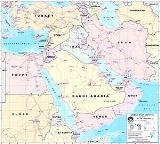
The
Middle East is a
regionRegion is most commonly found as a term used in terrestrial and astrophysics sciences also an area, notably among the different sub-disciplines of geography, studied by regional geographers. Regions consist of subregions that contain clusters of like areas that are distinctive by their uniformity...
that encompasses Western Asia and Northern Africa. It is often used as a synonym for
Near EastThe Near East is a geographical term that covers different countries for geographers, archeologists, and historians, on the one hand, and for political scientists, economists, and journalists, on the other...
, in opposition to
Far EastThe Far East is an English term mostly describing East Asia and Southeast Asia, with South Asia sometimes also included for economic and cultural reasons.The term came into use in European geopolitical discourse in the 19th century,...
. The corresponding adjective is
Middle-Eastern and the derived noun is
Middle-Easterner.
The
history of the Middle EastThis article is a general overview of the history of the Middle East. For more detailed information, see articles on the histories of individual countries and regions...
dates back to ancient times, and throughout its history, the Middle East has been a major centre of world affairs. When discussing ancient history, however, the term Near East is more commonly used. The Middle East is also the historical origin of major religions such as
JudaismJudaism ) is the "religion, philosophy, and way of life" of the Jewish people...
,
ChristianityChristianity is a monotheistic religion based on the life and teachings of Jesus as presented in canonical gospels and other New Testament writings...
, and
IslamIslam . The most common are and . : Arabic pronunciation varies regionally. The first vowel ranges from ~~. The second vowel ranges from ~~~...
. The Middle East generally has an
aridA region is said to be arid when it is characterized by a severe lack of available water, to the extent of hindering or even preventing the growth and development of plant and animal life...
and hot climate, with several major rivers providing for
irrigationIrrigation may be defined as the science of artificial application of water to the land or soil. It is used to assist in the growing of agricultural crops, maintenance of landscapes, and revegetation of disturbed soils in dry areas and during periods of inadequate rainfall...
to support
agricultureAgriculture is the cultivation of animals, plants, fungi and other life forms for food, fiber, and other products used to sustain life. Agriculture was the key implement in the rise of sedentary human civilization, whereby farming of domesticated species created food surpluses that nurtured the...
in limited areas. Many countries located around the
Persian GulfThe Persian Gulf, in Southwest Asia, is an extension of the Indian Ocean located between Iran and the Arabian Peninsula.The Persian Gulf was the focus of the 1980–1988 Iran-Iraq War, in which each side attacked the other's oil tankers...
have large quantities of crude oil. In modern times the Middle East remains a strategically, economically, politically, culturally and religiously sensitive region. The Middle East expected economic growth rate is at about 4.1% for 2010 and 5.1% in 2011.
Etymology
The term "Middle East" may have originated in the 1850s in the British
India OfficeThe India Office was a British government department created in 1858 to oversee the colonial administration of India, i.e. the modern-day nations of Bangladesh, Burma, India, and Pakistan, as well as territories in South-east and Central Asia, the Middle East, and parts of the east coast of Africa...
. However, it became more widely known when
AmericanThe United States of America is a federal constitutional republic comprising fifty states and a federal district...
naval strategist
Alfred Thayer MahanAlfred Thayer Mahan was a United States Navy flag officer, geostrategist, and historian, who has been called "the most important American strategist of the nineteenth century." His concept of "sea power" was based on the idea that countries with greater naval power will have greater worldwide...
used the term in 1902 to 'designate the area between Arabia and India'. During this time the
BritishThe British Empire comprised the dominions, colonies, protectorates, mandates and other territories ruled or administered by the United Kingdom. It originated with the overseas colonies and trading posts established by England in the late 16th and early 17th centuries. At its height, it was the...
and
Russian EmpireThe Russian Empire was a state that existed from 1721 until the Russian Revolution of 1917. It was the successor to the Tsardom of Russia and the predecessor of the Soviet Union...
s were vying for influence in
Central AsiaCentral Asia is a core region of the Asian continent from the Caspian Sea in the west, China in the east, Afghanistan in the south, and Russia in the north...
, a rivalry which would become known as
The Great GameThe Great Game or Tournament of Shadows in Russia, were terms for the strategic rivalry and conflict between the British Empire and the Russian Empire for supremacy in Central Asia. The classic Great Game period is generally regarded as running approximately from the Russo-Persian Treaty of 1813...
. Mahan realized not only the strategic importance of the region, but also of its center, the
Persian GulfThe Persian Gulf, in Southwest Asia, is an extension of the Indian Ocean located between Iran and the Arabian Peninsula.The Persian Gulf was the focus of the 1980–1988 Iran-Iraq War, in which each side attacked the other's oil tankers...
. He labeled the area surrounding the Persian Gulf as the Middle East, and said that after the
Suez CanalThe Suez Canal , also known by the nickname "The Highway to India", is an artificial sea-level waterway in Egypt, connecting the Mediterranean Sea and the Red Sea. Opened in November 1869 after 10 years of construction work, it allows water transportation between Europe and Asia without navigation...
, it was the most important passage for Britain to control in order to keep the Russians from advancing towards
British IndiaBritish Raj was the British rule in the Indian subcontinent between 1858 and 1947; The term can also refer to the period of dominion...
. Mahan first used the term in his article "The Persian Gulf and International Relations," published in September 1902 in the
National ReviewThe National Review was founded in 1883 by the English writers Alfred Austin and William Courthope.It was launched as a platform for the views of the British Conservative Party, its masthead incorporating a quotation of the former Conservative Prime Minister, Benjamin Disraeli:Under editor Leopold...
, a British journal.
The Middle East, if I may adopt a term which I have not seen, will some day need its Malta, as well as its Gibraltar; it does not follow that either will be in the Persian Gulf. Naval force has the quality of mobility which carries with it the privilege of temporary absences; but it needs to find on every scene of operation established bases of refit, of supply, and in case of disaster, of security. The British Navy should have the facility to concentrate in force if occasion arise, about Aden, India, and the Persian Gulf.
Mahan's article was reprinted in
The TimesThe Times is a British daily national newspaper, first published in London in 1785 under the title The Daily Universal Register . The Times and its sister paper The Sunday Times are published by Times Newspapers Limited, a subsidiary since 1981 of News International...
and followed in October by a 20 article series entitled "The Middle Eastern Question," written by Sir
Ignatius Valentine ChirolSir Ignatius Valentine Chirol was a journalist, prolific author, historian and British diplomat. He was a passionate imperialist and believed that Imperial Germany and Muslim unrest were the biggest threats to the British Empire.He was the son of the Rev. Alexander Chirol and Harriet Chirol...
. During this series, Sir Ignatius expanded the definition of
Middle East to include "those regions of Asia which extend to the borders of
IndiaIndia , officially the Republic of India , is a country in South Asia. It is the seventh-largest country by geographical area, the second-most populous country with over 1.2 billion people, and the most populous democracy in the world...
or command the approaches to India." After the series ended in 1903,
The Times removed quotation marks from subsequent uses of the term.
Until
World War IIWorld War II, or the Second World War , was a global conflict lasting from 1939 to 1945, involving most of the world's nations—including all of the great powers—eventually forming two opposing military alliances: the Allies and the Axis...
, it was customary to refer to areas centered around
TurkeyTurkey , known officially as the Republic of Turkey , is a Eurasian country located in Western Asia and in East Thrace in Southeastern Europe...
and the eastern shore of the Mediterranean as the "
Near EastThe Near East is a geographical term that covers different countries for geographers, archeologists, and historians, on the one hand, and for political scientists, economists, and journalists, on the other...
", while the "
Far EastThe Far East is an English term mostly describing East Asia and Southeast Asia, with South Asia sometimes also included for economic and cultural reasons.The term came into use in European geopolitical discourse in the 19th century,...
" centered on
ChinaChinese civilization may refer to:* China for more general discussion of the country.* Chinese culture* Greater China, the transnational community of ethnic Chinese.* History of China* Sinosphere, the area historically affected by Chinese culture...
, and the Middle East then meant the area from
MesopotamiaMesopotamia is a toponym for the area of the Tigris–Euphrates river system, largely corresponding to modern-day Iraq, northeastern Syria, southeastern Turkey and southwestern Iran.Widely considered to be the cradle of civilization, Bronze Age Mesopotamia included Sumer and the...
to
BurmaBurma , officially the Republic of the Union of Myanmar , is a country in Southeast Asia. Burma is bordered by China on the northeast, Laos on the east, Thailand on the southeast, Bangladesh on the west, India on the northwest, the Bay of Bengal to the southwest, and the Andaman Sea on the south....
, namely the area between the Near East and the Far East. In the late 1930s, the British established the
Middle East CommandThe Middle East Command was a British Army Command established prior to the Second World War in Egypt. Its primary role was to command British land forces and co-ordinate with the relevant naval and air commands to defend British interests in the Middle East and eastern Mediterranean region.The...
, which was based in
CairoCairo , is the capital of Egypt and the largest city in the Arab world and Africa, and the 16th largest metropolitan area in the world. Nicknamed "The City of a Thousand Minarets" for its preponderance of Islamic architecture, Cairo has long been a centre of the region's political and cultural life...
, for its military forces in the region. After that time, the term "Middle East" gained broader usage in Europe and the United States, with the
Middle East InstituteThe Middle East Institute is a non-partisan think tank and cultural center in Washington, DC. Founded in 1946, MEI is the oldest institution in Washington dedicated exclusively to the study of the Middle East. Its founder, architect and philanthropist George Camp Keiser, assembled a team of...
founded in
Washington, D.C.Washington, D.C., formally the District of Columbia and commonly referred to as Washington, "the District", or simply D.C., is the capital of the United States. On July 16, 1790, the United States Congress approved the creation of a permanent national capital as permitted by the U.S. Constitution....
in 1946, among other usage.
Criticism and usage
Many have criticized the term
Middle East because of its implicit
EurocentrismEurocentrism is the practice of viewing the world from a European perspective and with an implied belief, either consciously or subconsciously, in the preeminence of European culture...
. In contemporary English-language academic & media venues, the term is used by both Europeans and non-Europeans.
The description
Middle has also led to some confusion over changing definitions. Before the
First World WarWorld War I , which was predominantly called the World War or the Great War from its occurrence until 1939, and the First World War or World War I thereafter, was a major war centred in Europe that began on 28 July 1914 and lasted until 11 November 1918...
, "Near East" was used in English to refer to the
BalkansThe Balkans is a geopolitical and cultural region of southeastern Europe...
and the
Ottoman EmpireThe Ottoman EmpireIt was usually referred to as the "Ottoman Empire", the "Turkish Empire", the "Ottoman Caliphate" or more commonly "Turkey" by its contemporaries...
, while "Middle East" referred to
IranIran , officially the Islamic Republic of Iran , is a country in Southern and Western Asia. The name "Iran" has been in use natively since the Sassanian era and came into use internationally in 1935, before which the country was known to the Western world as Persia...
,
AfghanistanAfghanistan , officially the Islamic Republic of Afghanistan, is a landlocked country located in the centre of Asia, forming South Asia, Central Asia and the Middle East. With a population of about 29 million, it has an area of , making it the 42nd most populous and 41st largest nation in the world...
, and Central Asia, and the
CaucasusThe Caucasus, also Caucas or Caucasia , is a geopolitical region at the border of Europe and Asia, and situated between the Black and the Caspian sea...
. In contrast, "Far East" referred to the countries of
East AsiaEast Asia or Eastern Asia is a subregion of Asia that can be defined in either geographical or cultural terms...
(e.g.
ChinaChinese civilization may refer to:* China for more general discussion of the country.* Chinese culture* Greater China, the transnational community of ethnic Chinese.* History of China* Sinosphere, the area historically affected by Chinese culture...
,
JapanJapan is an island nation in East Asia. Located in the Pacific Ocean, it lies to the east of the Sea of Japan, China, North Korea, South Korea and Russia, stretching from the Sea of Okhotsk in the north to the East China Sea and Taiwan in the south...
,
FormosaFormosa or Ilha Formosa is a Portuguese historical name for Taiwan , literally meaning, "Beautiful Island". The term may also refer to:-Places:* Formosa Strait, another name for the Taiwan Strait...
,
KoreaKorea ) is an East Asian geographic region that is currently divided into two separate sovereign states — North Korea and South Korea. Located on the Korean Peninsula, Korea is bordered by the People's Republic of China to the northwest, Russia to the northeast, and is separated from Japan to the...
,
Hong KongHong Kong is one of two Special Administrative Regions of the People's Republic of China , the other being Macau. A city-state situated on China's south coast and enclosed by the Pearl River Delta and South China Sea, it is renowned for its expansive skyline and deep natural harbour...
, etc.) Some critics usually advise using an alternative term, such as "Western Asia", which is the official designation used by the UN.
With the disappearance of the Ottoman Empire in 1918, "Near East" largely fell out of common use in English, while "Middle East" came to be applied to the re-emerging countries of the Islamic world. However, the usage of "Near East" was retained by a variety of academic disciplines, including
archaeologyArchaeology, or archeology , is the study of human society, primarily through the recovery and analysis of the material culture and environmental data that they have left behind, which includes artifacts, architecture, biofacts and cultural landscapes...
and
ancient historyAncient history is the study of the written past from the beginning of recorded human history to the Early Middle Ages. The span of recorded history is roughly 5,000 years, with Cuneiform script, the oldest discovered form of coherent writing, from the protoliterate period around the 30th century BC...
, where it describes an area identical to the term
Middle East, which is not used by these disciplines (see
Ancient Near EastThe ancient Near East was the home of early civilizations within a region roughly corresponding to the modern Middle East: Mesopotamia , ancient Egypt, ancient Iran The ancient Near East was the home of early civilizations within a region roughly corresponding to the modern Middle East: Mesopotamia...
).
The first official use of the term "Middle East" by the
United States governmentThe federal government of the United States is the national government of the constitutional republic of fifty states that is the United States of America. The federal government comprises three distinct branches of government: a legislative, an executive and a judiciary. These branches and...
was in the 1957
Eisenhower DoctrineThe term Eisenhower Doctrine refers to a speech by President Dwight David Eisenhower on 5 January 1957, within a "Special Message to the Congress on the Situation in the Middle East". Under the Eisenhower Doctrine, a country could request American economic assistance and/or aid from U.S. military...
, which pertained to the
Suez CrisisThe Suez Crisis, also referred to as the Tripartite Aggression, Suez War was an offensive war fought by France, the United Kingdom, and Israel against Egypt beginning on 29 October 1956. Less than a day after Israel invaded Egypt, Britain and France issued a joint ultimatum to Egypt and Israel,...
. Secretary of State
John Foster DullesJohn Foster Dulles served as U.S. Secretary of State under President Dwight D. Eisenhower from 1953 to 1959. He was a significant figure in the early Cold War era, advocating an aggressive stance against communism throughout the world...
defined the Middle East as "the area lying between and including
LibyaLibya is an African country in the Maghreb region of North Africa bordered by the Mediterranean Sea to the north, Egypt to the east, Sudan to the southeast, Chad and Niger to the south, and Algeria and Tunisia to the west....
on the west and
PakistanPakistan , officially the Islamic Republic of Pakistan is a sovereign state in South Asia. It has a coastline along the Arabian Sea and the Gulf of Oman in the south and is bordered by Afghanistan and Iran in the west, India in the east and China in the far northeast. In the north, Tajikistan...
on the east,
SyriaSyria , officially the Syrian Arab Republic , is a country in Western Asia, bordering Lebanon and the Mediterranean Sea to the West, Turkey to the north, Iraq to the east, Jordan to the south, and Israel to the southwest....
and
IraqIraq ; officially the Republic of Iraq is a country in Western Asia spanning most of the northwestern end of the Zagros mountain range, the eastern part of the Syrian Desert and the northern part of the Arabian Desert....
on the North and the Arabian peninsula to the south, plus the
SudanSudan , officially the Republic of the Sudan , is a country in North Africa, sometimes considered part of the Middle East politically. It is bordered by Egypt to the north, the Red Sea to the northeast, Eritrea and Ethiopia to the east, South Sudan to the south, the Central African Republic to the...
and
EthiopiaEthiopia , officially known as the Federal Democratic Republic of Ethiopia, is a country located in the Horn of Africa. It is the second-most populous nation in Africa, with over 82 million inhabitants, and the tenth-largest by area, occupying 1,100,000 km2...
." In 1958, the
State DepartmentThe United States Department of State , is the United States federal executive department responsible for international relations of the United States, equivalent to the foreign ministries of other countries...
explained that the terms "
Near EastThe Near East is a geographical term that covers different countries for geographers, archeologists, and historians, on the one hand, and for political scientists, economists, and journalists, on the other...
" and "Middle East" were interchangeable, and defined the region as including only
EgyptEgypt , officially the Arab Republic of Egypt, Arabic: , is a country mainly in North Africa, with the Sinai Peninsula forming a land bridge in Southwest Asia. Egypt is thus a transcontinental country, and a major power in Africa, the Mediterranean Basin, the Middle East and the Muslim world...
,
SyriaSyria , officially the Syrian Arab Republic , is a country in Western Asia, bordering Lebanon and the Mediterranean Sea to the West, Turkey to the north, Iraq to the east, Jordan to the south, and Israel to the southwest....
,
IsraelThe State of Israel is a parliamentary republic located in the Middle East, along the eastern shore of the Mediterranean Sea...
,
LebanonLebanon , officially the Republic of LebanonRepublic of Lebanon is the most common term used by Lebanese government agencies. The term Lebanese Republic, a literal translation of the official Arabic and French names that is not used in today's world. Arabic is the most common language spoken among...
,
JordanJordan , officially the Hashemite Kingdom of Jordan , Al-Mamlaka al-Urduniyya al-Hashemiyya) is a kingdom on the East Bank of the River Jordan. The country borders Saudi Arabia to the east and south-east, Iraq to the north-east, Syria to the north and the West Bank and Israel to the west, sharing...
,
IraqIraq ; officially the Republic of Iraq is a country in Western Asia spanning most of the northwestern end of the Zagros mountain range, the eastern part of the Syrian Desert and the northern part of the Arabian Desert....
,
Saudi ArabiaThe Kingdom of Saudi Arabia , commonly known in British English as Saudi Arabia and in Arabic as as-Sa‘ūdiyyah , is the largest state in Western Asia by land area, constituting the bulk of the Arabian Peninsula, and the second-largest in the Arab World...
,
KuwaitThe State of Kuwait is a sovereign Arab state situated in the north-east of the Arabian Peninsula in Western Asia. It is bordered by Saudi Arabia to the south at Khafji, and Iraq to the north at Basra. It lies on the north-western shore of the Persian Gulf. The name Kuwait is derived from the...
,
Bahrain' , officially the Kingdom of Bahrain , is a small island state near the western shores of the Persian Gulf. It is ruled by the Al Khalifa royal family. The population in 2010 stood at 1,214,705, including 235,108 non-nationals. Formerly an emirate, Bahrain was declared a kingdom in 2002.Bahrain is...
, and
QatarQatar , also known as the State of Qatar or locally Dawlat Qaṭar, is a sovereign Arab state, located in the Middle East, occupying the small Qatar Peninsula on the northeasterly coast of the much larger Arabian Peninsula. Its sole land border is with Saudi Arabia to the south, with the rest of its...
.
The
Associated PressThe Associated Press is an American news agency. The AP is a cooperative owned by its contributing newspapers, radio and television stations in the United States, which both contribute stories to the AP and use material written by its staff journalists...
Stylebook says that Near East formerly referred to the farther west countries while Middle East referred to the eastern ones, but that now they are synonymous. It instructs:
Use Middle East unless Near East is used by a source in a story. Mideast is also acceptable, but Middle East is preferred.
At the
United NationsThe United Nations is an international organization whose stated aims are facilitating cooperation in international law, international security, economic development, social progress, human rights, and achievement of world peace...
, the numerous documents and resolutions about the Middle East are in fact concerned with the
Arab–Israeli conflictThe Arab–Israeli conflict refers to political tensions and open hostilities between the Arab peoples and the Jewish community of the Middle East. The modern Arab-Israeli conflict began with the rise of Zionism and Arab Nationalism towards the end of the nineteenth century, and intensified with the...
, in particular the
Israeli–Palestinian conflictThe Israeli–Palestinian conflict is the ongoing conflict between Israelis and Palestinians. The conflict is wide-ranging, and the term is also used in reference to the earlier phases of the same conflict, between Jewish and Zionist yishuv and the Arab population living in Palestine under Ottoman or...
, and, therefore, with the four states of the
LevantThe Levant or ) is the geographic region and culture zone of the "eastern Mediterranean littoral between Anatolia and Egypt" . The Levant includes most of modern Lebanon, Syria, Jordan, Israel, the Palestinian territories, and sometimes parts of Turkey and Iraq, and corresponds roughly to the...
. The term Near East is occasionally heard at the UN when referring to this region.
Translations
There are terms similar to
Near East and
Middle East in other European languages, but since it is a relative description, the meanings depend on the country and are different from the English terms generally. In
GermanGerman is a West Germanic language, related to and classified alongside English and Dutch. With an estimated 90 – 98 million native speakers, German is one of the world's major languages and is the most widely-spoken first language in the European Union....
the term
Naher Osten (Near East) is still in common use (nowadays the term
Mittlerer Osten is more and more common in press texts translated from English sources, albeit having a distinct meaning) and in
RussianRussian is a Slavic language used primarily in Russia, Belarus, Uzbekistan, Kazakhstan, Tajikistan and Kyrgyzstan. It is an unofficial but widely spoken language in Ukraine, Moldova, Latvia, Turkmenistan and Estonia and, to a lesser extent, the other countries that were once constituent republics...
Ближний Восток or
Blizhniy Vostok,
BulgarianBulgarian is an Indo-European language, a member of the Slavic linguistic group.Bulgarian, along with the closely related Macedonian language, demonstrates several linguistic characteristics that set it apart from all other Slavic languages such as the elimination of case declension, the...
Близкия Изток,
PolishPolish is a language of the Lechitic subgroup of West Slavic languages, used throughout Poland and by Polish minorities in other countries...
Bliski Wschód or
CroatianCroatian is the collective name for the standard language and dialects spoken by Croats, principally in Croatia, Bosnia and Herzegovina, the Serbian province of Vojvodina and other neighbouring countries...
Bliski istok (meaning
Near East in all the four Slavic languages) remains as the only appropriate term for the region. However, some languages do have "Middle East" equivalents, such as the
FrenchFrench is a Romance language spoken as a first language in France, the Romandy region in Switzerland, Wallonia and Brussels in Belgium, Monaco, the regions of Quebec and Acadia in Canada, and by various communities elsewhere. Second-language speakers of French are distributed throughout many parts...
Moyen-Orient,
SwedishSwedish is a North Germanic language, spoken by approximately 10 million people, predominantly in Sweden and parts of Finland, especially along its coast and on the Åland islands. It is largely mutually intelligible with Norwegian and Danish...
Mellanöstern,
SpanishSpanish , also known as Castilian , is a Romance language in the Ibero-Romance group that evolved from several languages and dialects in central-northern Iberia around the 9th century and gradually spread with the expansion of the Kingdom of Castile into central and southern Iberia during the...
Oriente Medio or Medio Oriente, and the
ItalianItalian is a Romance language spoken mainly in Europe: Italy, Switzerland, San Marino, Vatican City, by minorities in Malta, Monaco, Croatia, Slovenia, France, Libya, Eritrea, and Somalia, and by immigrant communities in the Americas and Australia...
Medio Oriente.
Perhaps because of the influence of the Western press, the Arabic equivalent of
Middle East (Arabic: الشرق الأوسط
ash-Sharq al-Awsaṭ), has become standard usage in the mainstream Arabic press, comprehending the same meaning as the term “Middle East” in North American and Western European usage. The designation,
MashriqMashriq or Mashreq is derived from the Arabic consonantal root sh-r-q relating to the east or the sunrise, and essentially means "east"...
, also from the Arabic root for
east, also denotes a variously defined region around the
LevantThe Levant or ) is the geographic region and culture zone of the "eastern Mediterranean littoral between Anatolia and Egypt" . The Levant includes most of modern Lebanon, Syria, Jordan, Israel, the Palestinian territories, and sometimes parts of Turkey and Iraq, and corresponds roughly to the...
, the eastern part of the Arabic-speaking world (as opposed to the
MaghrebThe Maghreb is the region of Northwest Africa, west of Egypt. It includes five countries: Morocco, Algeria, Tunisia, Libya, and Mauritania and the disputed territory of Western Sahara...
, the western part). The
PersianPersian is an Iranian language within the Indo-Iranian branch of the Indo-European languages. It is primarily spoken in Iran, Afghanistan, Tajikistan and countries which historically came under Persian influence...
equivalent for Middle East is خاورمیانه (
Khāvar-e miyāneh).
Traditional definition of the Middle East
CountryA country is a region legally identified as a distinct entity in political geography. A country may be an independent sovereign state or one that is occupied by another state, as a non-sovereign or formerly sovereign political division, or a geographic region associated with a previously... , with flagA flag is a piece of fabric with a distinctive design that is usually rectangular and used as a symbol, as a signaling device, or decoration. The term flag is also used to refer to the graphic design employed by a flag, or to its depiction in another medium.The first flags were used to assist...
|
Area |
Population |
Density |
Capital |
GDPGross domestic product refers to the market value of all final goods and services produced within a country in a given period. GDP per capita is often considered an indicator of a country's standard of living.... (Total) |
Per capita |
CurrencyIn economics, currency refers to a generally accepted medium of exchange. These are usually the coins and banknotes of a particular government, which comprise the physical aspects of a nation's money supply...
|
Government Government refers to the legislators, administrators, and arbitrators in the administrative bureaucracy who control a state at a given time, and to the system of government by which they are organized...
|
Official languages |
| km2 | sq mi | /km2 | /sq mi |
Bahrain |
665 | 256.8 |
656,397 |
987 PD/km2 |
ManamaManama is the capital and largest city of Bahrain, with an approximate population of 155,000 people.Long an important trading center in the Persian Gulf, Manama is home to a very diverse population...
|
$26.970 billion (2008) |
$34,605 (2008) |
Bahraini DinarThe dinar is the currency of Bahrain. It is divided into 1000 fils . The name dinar derives from the Roman denarius. The dinar was introduced in 1965, replacing the Gulf rupee at a rate of 10 rupees = 1 dinar. The Bahraini dinar is abbreviated .د.ب or BD...
|
Constitutional monarchyConstitutional monarchy is a form of government in which a monarch acts as head of state within the parameters of a constitution, whether it be a written, uncodified or blended constitution...
|
Arabic Modern Standard Arabic , Standard Arabic, or Literary Arabic is the standard and literary variety of Arabic used in writing and in most formal speech....
|
Cyprus |
9250 | 3,571.4 |
792,604 |
90 PD/km2 |
Nicosia Nicosia from , known locally as Lefkosia , is the capital and largest city in Cyprus, as well as its main business center. Nicosia is the only divided capital in the world, with the southern and the northern portions divided by a Green Line...
|
$22.703 billion (2008) |
$29,830 (2008) |
Euro, Turkish lira The new Turkish lira was the currency of Turkey and the de facto independent state of the Turkish Republic of Northern Cyprus between 1 January 2005 and 1 January 2009 which was a transition period for the removal of six zeroes from the currency. The new lira was subdivided into 100 new kurush...
|
Presidential republic |
Greek Greek is an independent branch of the Indo-European family of languages. Native to the southern Balkans, it has the longest documented history of any Indo-European language, spanning 34 centuries of written records. Its writing system has been the Greek alphabet for the majority of its history;... , TurkishTurkish is a language spoken as a native language by over 83 million people worldwide, making it the most commonly spoken of the Turkic languages. Its speakers are located predominantly in Turkey and Northern Cyprus with smaller groups in Iraq, Greece, Bulgaria, the Republic of Macedonia, Kosovo,...
|
Egypt |
1002450 | 387,048.1 |
77,498,000 |
74 PD/km2 |
CairoCairo , is the capital of Egypt and the largest city in the Arab world and Africa, and the 16th largest metropolitan area in the world. Nicknamed "The City of a Thousand Minarets" for its preponderance of Islamic architecture, Cairo has long been a centre of the region's political and cultural life...
|
$442.640 billion (2008) |
$5,898 (2008) |
Egyptian poundThe Egyptian Pound is the currency of Egypt. It is divided into 100 Qirsh , or 1,000 Milliemes ....
|
Military junta A junta or military junta is a government led by a committee of military leaders. The term derives from the Spanish language junta meaning committee, specifically a board of directors...
|
Arabic Modern Standard Arabic , Standard Arabic, or Literary Arabic is the standard and literary variety of Arabic used in writing and in most formal speech....
|
Iran |
1648195 | 636,371.6 |
71,208,000 |
42 PD/km2 |
TehranTehran , sometimes spelled Teheran, is the capital of Iran and Tehran Province. With an estimated population of 8,429,807; it is also Iran's largest urban area and city, one of the largest cities in Western Asia, and is the world's 19th largest city.In the 20th century, Tehran was subject to...
|
$819.799 billion (2008) |
$11,250 (2008) |
Iranian rialThe rial is the currency of Iran. It is subdivided into 100 dinar but, because of the very low current value of the rial, no fraction of the rial is used in accounting....
|
Islamic republic Islamic republic is the name given to several states in the Muslim world including the Islamic Republics of Pakistan, Iran, Afghanistan, and Mauritania. Pakistan adopted the title under the constitution of 1956. Mauritania adopted it on 28 November 1958. Iran adopted it after the 1979 Iranian...
|
PersianPersian is an Iranian language within the Indo-Iranian branch of the Indo-European languages. It is primarily spoken in Iran, Afghanistan, Tajikistan and countries which historically came under Persian influence...
|
Iraq |
437072 | 168,754.4 |
31,001,816 |
70.93 PD/km2 |
BaghdadBaghdad is the capital of Iraq, as well as the coterminous Baghdad Governorate. The population of Baghdad in 2011 is approximately 7,216,040...
|
$202.3 billion (2008) |
$6,500 (2008) |
Iraqi dinarThe dinar is the currency of Iraq. It is issued by the Central Bank of Iraq and is subdivided into 1,000 fils , although inflation has rendered the fils obsolete.-History:...
|
Parliamentary republic A parliamentary republic or parliamentary constitutional republic is a type of republic which operates under a parliamentary system of government - meaning a system with no clear-cut separation of powers between the executive and legislative branches. There are a number of variations of...
|
Arabic Modern Standard Arabic , Standard Arabic, or Literary Arabic is the standard and literary variety of Arabic used in writing and in most formal speech.... , KurdishKurdish is a dialect continuum spoken by the Kurds in western Asia. It is part of the Iranian branch of the Indo-Iranian group of Indo-European languages....
|
Israel |
20770 | 8,019.3 |
7,465,000 |
290 PD/km2 |
Jerusalem2 |
$200.630 billion (2008) |
$28,206 (2008) |
Israeli new sheqelThe Israeli New Shekel is the currency of the State of Israel. The shekel is divided into 100 agorot...
|
Parliamentary democracy |
Hebrew Modern Hebrew , also known as Israeli Hebrew or Modern Israeli Hebrew, is the language spoken in Israel and in some Jewish communities worldwide, from the early 20th century to the present.... , ArabicModern Standard Arabic , Standard Arabic, or Literary Arabic is the standard and literary variety of Arabic used in writing and in most formal speech....
|
Jordan |
92300 | 35,637.2 |
6,407,085 |
58 PD/km2 |
AmmanAmman is the capital of Jordan. It is the country's political, cultural and commercial centre and one of the oldest continuously inhabited cities in the world. The Greater Amman area has a population of 2,842,629 as of 2010. The population of Amman is expected to jump from 2.8 million to almost...
|
$32.112 billion (2008) |
$5,314 (2008) |
Jordanian dinarThe dinar is the currency of Jordan. The dinar is divided into 10 dirham, 100 qirsh or 1000 fils....
|
Constitutional monarchyConstitutional monarchy is a form of government in which a monarch acts as head of state within the parameters of a constitution, whether it be a written, uncodified or blended constitution...
|
Arabic Modern Standard Arabic , Standard Arabic, or Literary Arabic is the standard and literary variety of Arabic used in writing and in most formal speech....
|
Kuwait |
17820 | 6,880.3 |
3,100,000 |
119 PD/km2 |
Kuwait City-Suburbs:Although the districts below are not usually recognized as suburbs, the following is a list of a few areas surrounding Kuwait city:Al-Salam ""السلام"" -Economy:...
|
$137.190 billion (2008) |
$39,849 (2008) |
Kuwaiti dinar The dinar is the currency of Kuwait. It is sub-divided into 1000 fils. It is the highest-valued currency unit in the world.-History:...
|
Constitutional monarchyConstitutional monarchy is a form of government in which a monarch acts as head of state within the parameters of a constitution, whether it be a written, uncodified or blended constitution...
|
Arabic Modern Standard Arabic , Standard Arabic, or Literary Arabic is the standard and literary variety of Arabic used in writing and in most formal speech....
|
Lebanon |
10452 | 4,035.5 |
4,224,000 |
354 PD/km2 |
BeirutBeirut is the capital and largest city of Lebanon, with a population ranging from 1 million to more than 2 million . Located on a peninsula at the midpoint of Lebanon's Mediterranean coastline, it serves as the country's largest and main seaport, and also forms the Beirut Metropolitan...
|
$58.576 billion (2010) |
$14,988 (2010) |
Lebanese poundThe Lebanese pound is the currency unit of Lebanon. It is divided into 100 piastres but inflation has eliminated the subdivisions....
|
RepublicA republic is a form of government in which the people, or some significant portion of them, have supreme control over the government and where offices of state are elected or chosen by elected people. In modern times, a common simplified definition of a republic is a government where the head of...
|
Arabic Modern Standard Arabic , Standard Arabic, or Literary Arabic is the standard and literary variety of Arabic used in writing and in most formal speech.... , FrenchFrench is a Romance language spoken as a first language in France, the Romandy region in Switzerland, Wallonia and Brussels in Belgium, Monaco, the regions of Quebec and Acadia in Canada, and by various communities elsewhere. Second-language speakers of French are distributed throughout many parts...
|
Oman |
212460 | 82,031.3 |
3,200,000 |
13 PD/km2 |
Muscat Muscat is the capital of Oman. It is also the seat of government and largest city in the Governorate of Muscat. As of 2008, the population of the Muscat metropolitan area was 1,090,797. The metropolitan area spans approximately and includes six provinces called wilayats...
|
$66.889 billion (2008) |
$24,153 (2008) |
Omani Rial The rial is the currency of Oman. It is divided into 1000 baisa .-History:Before 1940, the Indian rupee and the Maria Theresa Thaler were the main currencies circulating in Muscat and Oman, as the state was then known, with rupees circulating on the coast and Thaler in the interior...
|
Absolute monarchy Absolute monarchy is a monarchical form of government in which the monarch exercises ultimate governing authority as head of state and head of government, his or her power not being limited by a constitution or by the law. An absolute monarch thus wields unrestricted political power over the...
|
Arabic Modern Standard Arabic , Standard Arabic, or Literary Arabic is the standard and literary variety of Arabic used in writing and in most formal speech....
|
Gaza Strip (not fully sovereign) |
360 | 139 |
1,376,289 |
3823 PD/km2 |
GazaGaza , also referred to as Gaza City, is a Palestinian city in the Gaza Strip, with a population of about 450,000, making it the largest city in the Palestinian territories.Inhabited since at least the 15th century BC,...
|
$770 million (2008) |
$2,900 (2008) |
Israeli new sheqelThe Israeli New Shekel is the currency of the State of Israel. The shekel is divided into 100 agorot...
|
Autonomous republic An autonomous republic is a type of administrative division similar to a province. A significant number of autonomous republics can be found within the successor states of the Soviet Union, but the majority are located within Russia. Many of these republics were established during the Soviet... Palestinian National AuthorityThe Palestinian Authority is the administrative organization established to govern parts of the West Bank and Gaza Strip... HamasHamas is the Palestinian Sunni Islamic or Islamist political party that governs the Gaza Strip. Hamas also has a military wing, the Izz ad-Din al-Qassam Brigades...
|
Arabic Modern Standard Arabic , Standard Arabic, or Literary Arabic is the standard and literary variety of Arabic used in writing and in most formal speech....
|
West Bank (not fully sovereign) |
5860 | 2,262.63 |
2,500,0005 |
432 PD/km23,4 |
RamallahRamallah is a Palestinian city in the central West Bank located 10 kilometers north of Jerusalem, adjacent to al-Bireh. It currently serves as the de facto administrative capital of the Palestinian National Authority...
|
|
|
Israeli new sheqelThe Israeli New Shekel is the currency of the State of Israel. The shekel is divided into 100 agorot...
|
Autonomous republic An autonomous republic is a type of administrative division similar to a province. A significant number of autonomous republics can be found within the successor states of the Soviet Union, but the majority are located within Russia. Many of these republics were established during the Soviet... Palestinian National AuthorityThe Palestinian Authority is the administrative organization established to govern parts of the West Bank and Gaza Strip... FatahFataḥ is a major Palestinian political party and the largest faction of the Palestine Liberation Organization , a multi-party confederation. In Palestinian politics it is on the left-wing of the spectrum; it is mainly nationalist, although not predominantly socialist. Its official goals are found...
|
Arabic Modern Standard Arabic , Standard Arabic, or Literary Arabic is the standard and literary variety of Arabic used in writing and in most formal speech....
|
Qatar |
11437 | 4,415.9 |
793,341 |
69 PD/km2 |
DohaDoha is the capital city of the state of Qatar. Located on the Persian Gulf, it had a population of 998,651 in 2008, and is also one of the municipalities of Qatar...
|
$94.249 billion (2008) |
$85,867 (2008) |
Qatari RiyalThe riyal is the currency of the State of Qatar. It is divided into 100 dirham and is abbreviated as either QR or ر.ق .- History :...
|
Absolute monarchy Absolute monarchy is a monarchical form of government in which the monarch exercises ultimate governing authority as head of state and head of government, his or her power not being limited by a constitution or by the law. An absolute monarch thus wields unrestricted political power over the...
|
Arabic Modern Standard Arabic , Standard Arabic, or Literary Arabic is the standard and literary variety of Arabic used in writing and in most formal speech....
|
Saudi Arabia |
1960582 | 756,984.9 |
23,513,330 |
12 PD/km2 |
RiyadhRiyadh is the capital and largest city of Saudi Arabia. It is also the capital of Riyadh Province, and belongs to the historical regions of Najd and Al-Yamama. It is situated in the center of the Arabian Peninsula on a large plateau, and is home to 5,254,560 people, and the urban center of a...
|
$593.385 billion (2008) |
$23,834 (2008) |
RiyalThe Riyal is the currency of Saudi Arabia. It is abbreviated as ر.س or SR . It is subdivided into 100 Halalas . The Saudi Ghirsh is 5 Halalas.-History:...
|
Absolute monarchy Absolute monarchy is a monarchical form of government in which the monarch exercises ultimate governing authority as head of state and head of government, his or her power not being limited by a constitution or by the law. An absolute monarch thus wields unrestricted political power over the...
|
Arabic Modern Standard Arabic , Standard Arabic, or Literary Arabic is the standard and literary variety of Arabic used in writing and in most formal speech....
|
Syria |
185180 | 71,498.4 |
22,505,000 |
93 PD/km2 |
DamascusDamascus , commonly known in Syria as Al Sham , and as the City of Jasmine , is the capital and the second largest city of Syria after Aleppo, both are part of the country's 14 governorates. In addition to being one of the oldest continuously inhabited cities in the world, Damascus is a major...
|
$105.238 billion (2010) |
$5,043 (2010) |
Syrian pound-Use of 10 Syrian pound coins in Norway:The shape of the 10 Syrian pound coin has been found to so resemble the 20 Norwegian krone coin that it can fool vending machines, coins-to-cash machines, arcade machines, and any other coin-operated, automated service machine in the country...
|
Presidential republic |
Arabic Modern Standard Arabic , Standard Arabic, or Literary Arabic is the standard and literary variety of Arabic used in writing and in most formal speech....
|
Turkey1 |
783562 | 302,535 |
73,914,000 |
91 PD/km2 |
AnkaraAnkara is the capital of Turkey and the country's second largest city after Istanbul. The city has a mean elevation of , and as of 2010 the metropolitan area in the entire Ankara Province had a population of 4.4 million....
|
$1.028 trillion (2008) |
$13,920 (2008) |
Turkish lira The new Turkish lira was the currency of Turkey and the de facto independent state of the Turkish Republic of Northern Cyprus between 1 January 2005 and 1 January 2009 which was a transition period for the removal of six zeroes from the currency. The new lira was subdivided into 100 new kurush...
|
Parliamentary democracy |
Turkish Turkish is a language spoken as a native language by over 83 million people worldwide, making it the most commonly spoken of the Turkic languages. Its speakers are located predominantly in Turkey and Northern Cyprus with smaller groups in Iraq, Greece, Bulgaria, the Republic of Macedonia, Kosovo,...
|
United Arab Emirates |
82880 | 32,000.1 |
5,432,746 |
30 PD/km2 |
Abu DhabiAbu Dhabi , literally Father of Gazelle, is the capital and the second largest city of the United Arab Emirates in terms of population and the largest of the seven member emirates of the United Arab Emirates. Abu Dhabi lies on a T-shaped island jutting into the Persian Gulf from the central western...
|
$184.984 billion (2008) |
$38,830 (2008) |
UAE dirham |
FederalA federation , also known as a federal state, is a type of sovereign state characterized by a union of partially self-governing states or regions united by a central government... Constitutional monarchyConstitutional monarchy is a form of government in which a monarch acts as head of state within the parameters of a constitution, whether it be a written, uncodified or blended constitution...
|
Arabic Modern Standard Arabic , Standard Arabic, or Literary Arabic is the standard and literary variety of Arabic used in writing and in most formal speech....
|
Yemen |
527970 | 203,850.4 |
23,701,257 |
35 PD/km2 |
Sanaá |
$55.433 billion (2008) |
$2,412 (2008) |
Yemeni rialThe rial or riyal is the currency of Yemen. It is technically divided into 100 fils, although coins denominated in fils have not been issued since Yemeni unification.-History:...
|
Semi-presidential republic |
Arabic Modern Standard Arabic , Standard Arabic, or Literary Arabic is the standard and literary variety of Arabic used in writing and in most formal speech....
|
Source:
- International Monetary Fund
The International Monetary Fund is an organization of 187 countries, working to foster global monetary cooperation, secure financial stability, facilitate international trade, promote high employment and sustainable economic growth, and reduce poverty around the world... , April 24, 2009, http://www.imf.org/external/pubs/ft/weo/2009/01/weodata/weorept.aspx?sy=2008&ey=2008&scsm=1&ssd=1&sort=country&ds=.&br=1&c=512%2C941%2C914%2C446%2C612%2C666%2C614%2C668%2C311%2C672%2C213%2C946%2C911%2C137%2C193%2C962%2C122%2C674%2C912%2C676%2C313%2C548%2C419%2C556%2C513%2C678%2C316%2C181%2C913%2C682%2C124%2C684%2C339%2C273%2C638%2C921%2C514%2C948%2C218%2C943%2C963%2C686%2C616%2C688%2C223%2C518%2C516%2C728%2C918%2C558%2C748%2C138%2C618%2C196%2C522%2C278%2C622%2C692%2C156%2C694%2C624%2C142%2C626%2C449%2C628%2C564%2C228%2C283%2C924%2C853%2C233%2C288%2C632%2C293%2C636%2C566%2C634%2C964%2C238%2C182%2C662%2C453%2C960%2C968%2C423%2C922%2C935%2C714%2C128%2C862%2C611%2C716%2C321%2C456%2C243%2C722%2C248%2C942%2C469%2C718%2C253%2C724%2C642%2C576%2C643%2C936%2C939%2C961%2C644%2C813%2C819%2C199%2C172%2C184%2C132%2C524%2C646%2C361%2C648%2C362%2C915%2C364%2C134%2C732%2C652%2C366%2C174%2C734%2C328%2C144%2C258%2C146%2C656%2C463%2C654%2C528%2C336%2C923%2C263%2C738%2C268%2C578%2C532%2C537%2C944%2C742%2C176%2C866%2C534%2C369%2C536%2C744%2C429%2C186%2C433%2C925%2C178%2C746%2C436%2C926%2C136%2C466%2C343%2C112%2C158%2C111%2C439%2C298%2C916%2C927%2C664%2C846%2C826%2C299%2C542%2C582%2C443%2C474%2C917%2C754%2C544%2C698&s=PPPGDP&grp=0&a=&pr.x=9&pr.y=12PPP GDP 2008]
- World Bank
The World Bank is an international financial institution that provides loans to developing countries for capital programmes.The World Bank's official goal is the reduction of poverty... , July 1, 2009, PPP GDP 2008
Notes:
1 The figures for Turkey includes Eastern Thrace, which is not a part of Anatolia.
2 Under Israeli law. The UN doesn't recognize Jerusalem as Israel's capital.
3 Includes the whole of the West Bank, according to the pre-1967 boundaries.
4 In addition, there are around 400,000 Israeli settlers in the West Bank, of which half are in East-Jerusalem. |
Greater Middle East
CountryA country is a region legally identified as a distinct entity in political geography. A country may be an independent sovereign state or one that is occupied by another state, as a non-sovereign or formerly sovereign political division, or a geographic region associated with a previously... , with flagA flag is a piece of fabric with a distinctive design that is usually rectangular and used as a symbol, as a signaling device, or decoration. The term flag is also used to refer to the graphic design employed by a flag, or to its depiction in another medium.The first flags were used to assist...
|
Area (km²) |
Population |
Density (per km²) |
Capital |
GDPGross domestic product refers to the market value of all final goods and services produced within a country in a given period. GDP per capita is often considered an indicator of a country's standard of living.... (Total) |
Per capita |
CurrencyIn economics, currency refers to a generally accepted medium of exchange. These are usually the coins and banknotes of a particular government, which comprise the physical aspects of a nation's money supply...
|
Government Government refers to the legislators, administrators, and arbitrators in the administrative bureaucracy who control a state at a given time, and to the system of government by which they are organized...
|
Official languages |
| km2 | sq mi | /km2 | /sq mi |
Afghanistan1 |
647500 | 250,001.1 |
31,889,923 |
46 PD/km2 |
KabulKabul , spelt Caubul in some classic literatures, is the capital and largest city of Afghanistan. It is also the capital of the Kabul Province, located in the eastern section of Afghanistan...
|
$21.340 billion (2008) |
$758 (2008) |
Afghan afghaniThe Afghani is the currency of Afghanistan. It is notionally subdivided into 100 pul , although there are no pul coins in circulation.-Original Afghani :...
|
Islamic republic Islamic republic is the name given to several states in the Muslim world including the Islamic Republics of Pakistan, Iran, Afghanistan, and Mauritania. Pakistan adopted the title under the constitution of 1956. Mauritania adopted it on 28 November 1958. Iran adopted it after the 1979 Iranian...
|
Persian Dari or Fārsī-ye Darī in historical terms refers to the Persian court language of the Sassanids. In contemporary usage, the term refers to the dialects of modern Persian language spoken in Afghanistan, and hence known as Afghan Persian in some Western sources. It is the term officially recognized... , Pashto |
Algeria |
2381740 | 919,595 |
33,333,216 |
14 PD/km2 |
Algiers' is the capital and largest city of Algeria. According to the 1998 census, the population of the city proper was 1,519,570 and that of the urban agglomeration was 2,135,630. In 2009, the population was about 3,500,000...
|
$233.098 billion (2008) |
$6,698 (2008) |
Algerian dinarThe dinar is the currency of Algeria and it is subdivided into 100 santeem .-History:The dinar was introduced on 1 April 1964, replacing the Algerian new franc at par.-Coins:...
|
Semi-presidential republic |
ArabicArabic is a name applied to the descendants of the Classical Arabic language of the 6th century AD, used most prominently in the Quran, the Islamic Holy Book...
|
Armenia |
29800 | 11,505.8 |
3,262,200 |
111.7 PD/km2 |
YerevanYerevan is the capital and largest city of Armenia and one of the world's oldest continuously-inhabited cities. Situated along the Hrazdan River, Yerevan is the administrative, cultural, and industrial center of the country...
|
$18.715 billion (2008) |
$5,272 (2008) |
Armenian dramThe dram is the monetary unit of Armenia and the Nagorno-Karabakh Republic. It is subdivided into 100 luma . The word "dram" translates into English as "money" and is cognate with the Greek drachma...
|
Semi-presidential republic |
Armenian The Armenian language is an Indo-European language spoken by the Armenian people. It is the official language of the Republic of Armenia as well as in the region of Nagorno-Karabakh. The language is also widely spoken by Armenian communities in the Armenian diaspora...
|
Azerbaijan |
86600 | 33,436.4 |
8,621,000 |
97 PD/km2 |
BakuBaku , sometimes spelled as Baki or Bakou, is the capital and largest city of Azerbaijan, as well as the largest city on the Caspian Sea and of the Caucasus region. It is located on the southern shore of the Absheron Peninsula, which projects into the Caspian Sea. The city consists of two principal...
|
$74.734 billion (2008) |
$8,620 (2008) |
Azerbaijani manatThe Manat is the currency of Azerbaijan. It is subdivided into 100 qəpik. The word manat is borrowed from "moneta" which is pronounced as "maneta"...
|
Semi-presidential republic |
Azerbaijani Azerbaijani or Azeri or Torki is a language belonging to the Turkic language family, spoken in southwestern Asia by the Azerbaijani people, primarily in Azerbaijan and northwestern Iran...
|
Comoros |
2235 | 862.9 |
798,000 |
275 PD/km2 |
Moroni
|
$772 million (2009) |
$1,159 (2009) |
Comorian francThe franc is the official currency of Comoros. It is nominally subdivided into 100 centimes, although no centime denominations have ever been issued.-History:...
|
Federal republic A federal republic is a federation of states with a republican form of government. A federation is the central government. The states in a federation also maintain the federation...
|
Comorian Comorian is the most widely used language on the Comoros and Mayotte. It is a set of Swahili dialects but with a much stronger Arabic influence than standard Swahili... , ArabicArabic is a name applied to the descendants of the Classical Arabic language of the 6th century AD, used most prominently in the Quran, the Islamic Holy Book... , FrenchFrench is a Romance language spoken as a first language in France, the Romandy region in Switzerland, Wallonia and Brussels in Belgium, Monaco, the regions of Quebec and Acadia in Canada, and by various communities elsewhere. Second-language speakers of French are distributed throughout many parts...
|
Djibouti |
23200 | 8,957.6 |
496,374 |
34 PD/km2 |
DjiboutiThe City of Djibouti is the capital and largest city in the Republic of Djibouti, a nation in the Horn of Africa. The biggest settlement on the Gulf of Tadjoura, it lies on a peninsula that separates that basin from the Gulf of Aden.-History:...
|
$1.877 billion (2008) |
$2,392 (2008) |
Djiboutian franc The franc is the currency of Djibouti. The ISO 4217 currency code is DJF. Historically it was subdivided into 100 centimes.- History :...
|
Parliamentary republic A parliamentary republic or parliamentary constitutional republic is a type of republic which operates under a parliamentary system of government - meaning a system with no clear-cut separation of powers between the executive and legislative branches. There are a number of variations of...
|
ArabicArabic is a name applied to the descendants of the Classical Arabic language of the 6th century AD, used most prominently in the Quran, the Islamic Holy Book... , FrenchFrench is a Romance language spoken as a first language in France, the Romandy region in Switzerland, Wallonia and Brussels in Belgium, Monaco, the regions of Quebec and Acadia in Canada, and by various communities elsewhere. Second-language speakers of French are distributed throughout many parts... , SomaliThe Somali language is a member of the East Cushitic branch of the Afro-Asiatic language family. Its nearest relatives are Afar and Oromo. Somali is the best documented of the Cushitic languages, with academic studies beginning before 1900.... , AfarAfar is a Lowland East Cushitic language spoken in Ethiopia, Eritrea and Djibouti. It is believed to have 1.5 million speakers, the Afar. The basic word order in Afar, like in other East Cushitic languages, is subject–object–verb. Its speakers have a literacy rate of between one and three per cent...
|
Eritrea |
117600 | 45,405.6 |
4,401,009 |
37 PD/km2 |
AsmaraAsmara is the capital city and largest settlement in Eritrea, home to a population of around 579,000 people...
|
$3.739 billion (2008) |
$747 (2008) |
NakfaNakfa is a town in northern Eritrea, after which the nakfa currency is named. It served as the base for the Eritrean People's Liberation Front, during the Eritrean War of Independence....
|
Provisional government A provisional government is an emergency or interim government set up when a political void has been created by the collapse of a very large government. The early provisional governments were created to prepare for the return of royal rule...
|
Tigrinya, ArabicArabic is a name applied to the descendants of the Classical Arabic language of the 6th century AD, used most prominently in the Quran, the Islamic Holy Book...
|
Georgia (country) |
20460 | 7,899.7 |
4,630,841 |
99.3 PD/km2 |
Tbilisi Tbilisi is the capital and the largest city of Georgia, lying on the banks of the Mt'k'vari River. The name is derived from an early Georgian form T'pilisi and it was officially known as Tiflis until 1936...
|
$21.812 billion (2008) |
$4,957 (2008) |
Georgian lariThe lari is the currency of Georgia. It is divided into 100 tetri. The name lari is an old Georgian word denoting a hoard, property, while tetri is an old Georgian monetary term used from the 13th century....
|
Semi-presidential republic |
Georgian Georgian is the native language of the Georgians and the official language of Georgia, a country in the Caucasus.Georgian is the primary language of about 4 million people in Georgia itself, and of another 500,000 abroad...
|
Kazakhstan |
2724900 | 1,052,089.8 |
15,217,711 |
5.4 PD/km2 |
AstanaAstana , formerly known as Akmola , Tselinograd and Akmolinsk , is the capital and second largest city of Kazakhstan, with an officially estimated population of 708,794 as of 1 August 2010...
|
$177.545 billion (2008) |
$11,416 (2008) |
Kazakhstani tengeThe tenge is the currency of Kazakhstan. It is divided into 100 tïın . It was introduced on 15th of November 1993 to replace the Soviet ruble at a rate of 1 tenge = 500 rubles...
|
Semi-presidential republic |
Kazakh Kazakh is a Turkic language which belongs to the Kipchak branch of the Turkic languages, closely related to Nogai and Karakalpak.... , RussianRussian is a Slavic language used primarily in Russia, Belarus, Uzbekistan, Kazakhstan, Tajikistan and Kyrgyzstan. It is an unofficial but widely spoken language in Ukraine, Moldova, Latvia, Turkmenistan and Estonia and, to a lesser extent, the other countries that were once constituent republics...
|
Kyrgyzstan |
199900 | 77,181.8 |
5,356,869 |
26 PD/km2 |
BishkekBishkek , formerly Pishpek and Frunze, is the capital and the largest city of Kyrgyzstan.Bishkek is also the administrative centre of Chuy Province which surrounds the city, even though the city itself is not part of the province but rather a province-level unit of Kyrgyzstan.The name is thought to...
|
$11.580 billion (2008) |
$2,180 (2008) |
Kyrgyzstani som The som is the currency of the Kyrgyz Republic in Central Asia. The ISO 4217 currency code is KGS. The som is sub-divided into 100 tyiyn...
|
Semi-presidential republic |
Kyrgyz Kyrgyz or Kirgiz, also Kirghiz, Kyrghiz, Qyrghiz is a Turkic language and, together with Russian, an official language of Kyrgyzstan... , RussianRussian is a Slavic language used primarily in Russia, Belarus, Uzbekistan, Kazakhstan, Tajikistan and Kyrgyzstan. It is an unofficial but widely spoken language in Ukraine, Moldova, Latvia, Turkmenistan and Estonia and, to a lesser extent, the other countries that were once constituent republics...
|
Libya |
1759540 | 679,362.2 |
6,036,914 |
3 PD/km2 |
TripoliTripoli is the capital and largest city in Libya. It is also known as Western Tripoli , to distinguish it from Tripoli, Lebanon. It is affectionately called The Mermaid of the Mediterranean , describing its turquoise waters and its whitewashed buildings. Tripoli is a Greek name that means "Three...
|
$90.251 billion (2008) |
$14,533 (2008) |
Libyan dinar The dinar is the currency of Libya. Its ISO 4217 code is "LYD". The dinar is subdivided into 1000 dirham . It was introduced in 1971 and replaced the pound at par. It is issued by the Central Bank of Libya, which also supervises the banking system and regulates credit...
|
Provisional A provisional government is an emergency or interim government set up when a political void has been created by the collapse of a very large government. The early provisional governments were created to prepare for the return of royal rule... : National Transitional CouncilThe National Transitional Council of Libya , sometimes known as the Transitional National Council, the Interim National Council, or the Libyan National Council,...
|
ArabicArabic is a name applied to the descendants of the Classical Arabic language of the 6th century AD, used most prominently in the Quran, the Islamic Holy Book...
|
Mauritania |
1030700 | 397,955.5 |
3,291,000 |
70 PD/km2 |
Nouakchott-Government:The town was first divided into districts in 1973. First it was divided into four. From 1986, the city has been split into nine districts.* Arafat* Dar Naim* El Mina* Ksar* Riad* Sebkha* Tevragh-Zeina* Teyarett* Toujounine...
|
$6.221 billion (2008) |
$2,052 (2008) |
Ouguiya The ouguiya , also spelt "ougiya," is the currency of Mauritania. It is the only circulating currency other than the Malagasy ariary whose division units are not based on a power of ten, each ouguiya comprising five khoums .The ouguiya was introduced in 1973, replacing the CFA franc at a rate of 1...
|
Islamic republic Islamic republic is the name given to several states in the Muslim world including the Islamic Republics of Pakistan, Iran, Afghanistan, and Mauritania. Pakistan adopted the title under the constitution of 1956. Mauritania adopted it on 28 November 1958. Iran adopted it after the 1979 Iranian...
|
ArabicArabic is a name applied to the descendants of the Classical Arabic language of the 6th century AD, used most prominently in the Quran, the Islamic Holy Book...
|
Morocco |
446550 | 172,413.9 |
33,757,175 |
70 PD/km2 |
RabatRabat , is the capital and third largest city of the Kingdom of Morocco with a population of approximately 650,000...
|
$136.728 billion (2008) |
$4,349 (2008) |
Moroccan dirhamThe dirham is the currency of Morocco. The plural form is pronounced darahim, although in French and English "dirhams" is commonly used. Its ISO 4217 code is "MAD". It is subdivided into 100 santimat . The dirham is issued by the Bank Al-Maghrib, the central bank of Morocco...
|
Constitutional monarchyConstitutional monarchy is a form of government in which a monarch acts as head of state within the parameters of a constitution, whether it be a written, uncodified or blended constitution...
|
ArabicArabic is a name applied to the descendants of the Classical Arabic language of the 6th century AD, used most prominently in the Quran, the Islamic Holy Book...
|
Pakistan |
880940 | 340,132.8 |
169,300,000 |
206 PD/km2 |
Islamabad Islamabad is the capital of Pakistan and the tenth largest city in the country. Located within the Islamabad Capital Territory , the population of the city has grown from 100,000 in 1951 to 1.7 million in 2011...
|
$439.558 billion (2008) |
$2,738 (2008) |
Pakistani rupeeThe rupee is the currency of Pakistan. The issuance of the currency is controlled by the State Bank of Pakistan, the central bank of the country. The most commonly used symbol for the rupee is Rs, used on receipts when purchasing goods and services. In Pakistan, the rupee is referred to as the...
|
Islamic republic Islamic republic is the name given to several states in the Muslim world including the Islamic Republics of Pakistan, Iran, Afghanistan, and Mauritania. Pakistan adopted the title under the constitution of 1956. Mauritania adopted it on 28 November 1958. Iran adopted it after the 1979 Iranian...
|
Urdu, English English is a West Germanic language that arose in the Anglo-Saxon kingdoms of England and spread into what was to become south-east Scotland under the influence of the Anglian medieval kingdom of Northumbria...
|
Somalia |
637661 | 246,202.3 |
9,925,640 |
13 PD/km2 |
MogadishuMogadishu , popularly known as Xamar, is the largest city in Somalia and the nation's capital. Located in the coastal Benadir region on the Indian Ocean, the city has served as an important port for centuries....
|
$7.890 billion |
$795 |
Somali shillingThe Somali shilling is the official currency of Somalia...
|
Semi-presidential republic |
Somali The Somali language is a member of the East Cushitic branch of the Afro-Asiatic language family. Its nearest relatives are Afar and Oromo. Somali is the best documented of the Cushitic languages, with academic studies beginning before 1900.... , ArabicArabic is a name applied to the descendants of the Classical Arabic language of the 6th century AD, used most prominently in the Quran, the Islamic Holy Book...
|
Sudan |
1886068 | 728,214.9 |
30,894,000 |
14 PD/km2 |
KhartoumKhartoum is the capital and largest city of Sudan and of Khartoum State. It is located at the confluence of the White Nile flowing north from Lake Victoria, and the Blue Nile flowing west from Ethiopia. The location where the two Niles meet is known as "al-Mogran"...
|
$87.885 billion (2008) |
$2,305 (2008) |
Sudanese poundThe Sudanese pound is the currency of Sudan and also used in South Sudan until finalization of the introduction of the South Sudanese pound. Both Arabic and English names for the denominations appear on the country's banknotes and coins. On 24 July 2011, Sudan launched a new currency...
|
Presidential republic |
ArabicArabic is a name applied to the descendants of the Classical Arabic language of the 6th century AD, used most prominently in the Quran, the Islamic Holy Book... , EnglishEnglish is a West Germanic language that arose in the Anglo-Saxon kingdoms of England and spread into what was to become south-east Scotland under the influence of the Anglian medieval kingdom of Northumbria...
|
Tajikistan |
143100 | 55,251.2 |
7,215,700 |
45 PD/km2 |
Dushanbe-Economy:Coal, lead, and arsenic are mined nearby in the cities of Nurek and Kulob allowing for the industrialization of Dushanbe. The Nurek Dam, the world's highest as of 2008, generates 95% of Tajikistan's electricity, and another dam, the Roghun Dam, is planned on the Vakhsh River...
|
$13.041 billion (2008) |
$2,019 (2008) |
Somoni |
Semi-presidential republic |
Tajik Tajik, Tajik Persian, or Tajiki, is a variety of modern Persian spoken in Central Asia. Historically Tajiks called their language zabani farsī , meaning Persian language in English; the term zabani tajikī, or Tajik language, was introduced in the 20th century by the Soviets...
|
Tunisia |
163610 | 63,170.2 |
10,102,000 |
62 PD/km2 |
TunisTunis is the capital of both the Tunisian Republic and the Tunis Governorate. It is Tunisia's largest city, with a population of 728,453 as of 2004; the greater metropolitan area holds some 2,412,500 inhabitants....
|
$82.226 billion (2008) |
$7,962 (2008) |
Tunisian dinarThe dinar is the currency of Tunisia. It is subdivided into 1000 milim or millimes . The abbreviation DT is often used in Tunisia, although writing "dinar" after the amount is also acceptable ; the abbreviation TD is also mentioned in a few places, but is less frequently used, given the common use...
|
Semi-presidential republic |
ArabicArabic is a name applied to the descendants of the Classical Arabic language of the 6th century AD, used most prominently in the Quran, the Islamic Holy Book...
|
Turkmenistan |
488100 | 188,456.5 |
5,110,023 |
9.9 PD/km2 |
Ashgabat |
$30.091 billion (2008) |
$5,710 (2008) |
Turkmenistani manat The Manat is the currency of Turkmenistan. It was introduced on November 1, 1993, replacing the Russian ruble at a rate of 1 manat = 500 ruble. The ISO 4217 code is TMM and the manat is subdivided into 100 tennesi...
|
Presidential republic A presidential system is a system of government where an executive branch exists and presides separately from the legislature, to which it is not responsible and which cannot, in normal circumstances, dismiss it....
|
Turkmen Turkmen is the national language of Turkmenistan...
|
Uzbekistan |
447400 | 172,742.1 |
27,372,000 |
59 PD/km2 |
TashkentTashkent is the capital of Uzbekistan and of the Tashkent Province. The officially registered population of the city in 2008 was about 2.2 million. Unofficial sources estimate the actual population may be as much as 4.45 million.-Early Islamic History:...
|
$71.501 billion (2008) |
$2,629 (2008) |
Uzbekistani somThe som is the currency of Uzbekistan in Central Asia. The ISO 4217 currency code is UZS.-Etymology:In the Soviet Union, speakers of Kazakh, Kyrgyz and Uzbek called the ruble the som, and this name appeared written on the back of banknotes, among the texts for the value of the bill in all 15...
|
Semi-presidential republic |
Uzbek Uzbek is a Turkic language and the official language of Uzbekistan. It has about 25.5 million native speakers, and it is spoken by the Uzbeks in Uzbekistan and elsewhere in Central Asia...
|
Western Sahara |
266000 | 102,703.2 |
513,000 |
1.9 PD/km2 |
El AaiunEl-Aaiún , is a city in Western Sahara founded by the Spanish in 1928. Administered by Morocco since 1976, El-Aaiún is the capital of what the Moroccan government call the region of Laâyoune-Boujdour-Sakia El Hamra, and POLISARIO call Occupied Territories...
|
|
|
Moroccan dirhamThe dirham is the currency of Morocco. The plural form is pronounced darahim, although in French and English "dirhams" is commonly used. Its ISO 4217 code is "MAD". It is subdivided into 100 santimat . The dirham is issued by the Bank Al-Maghrib, the central bank of Morocco...
|
|
ArabicArabic is a name applied to the descendants of the Classical Arabic language of the 6th century AD, used most prominently in the Quran, the Islamic Holy Book...
|
Source:
- International Monetary Fund
The International Monetary Fund is an organization of 187 countries, working to foster global monetary cooperation, secure financial stability, facilitate international trade, promote high employment and sustainable economic growth, and reduce poverty around the world... , April 24, 2009, http://www.imf.org/external/pubs/ft/weo/2009/01/weodata/weorept.aspx?sy=2008&ey=2008&scsm=1&ssd=1&sort=country&ds=.&br=1&c=512%2C941%2C914%2C446%2C612%2C666%2C614%2C668%2C311%2C672%2C213%2C946%2C911%2C137%2C193%2C962%2C122%2C674%2C912%2C676%2C313%2C548%2C419%2C556%2C513%2C678%2C316%2C181%2C913%2C682%2C124%2C684%2C339%2C273%2C638%2C921%2C514%2C948%2C218%2C943%2C963%2C686%2C616%2C688%2C223%2C518%2C516%2C728%2C918%2C558%2C748%2C138%2C618%2C196%2C522%2C278%2C622%2C692%2C156%2C694%2C624%2C142%2C626%2C449%2C628%2C564%2C228%2C283%2C924%2C853%2C233%2C288%2C632%2C293%2C636%2C566%2C634%2C964%2C238%2C182%2C662%2C453%2C960%2C968%2C423%2C922%2C935%2C714%2C128%2C862%2C611%2C716%2C321%2C456%2C243%2C722%2C248%2C942%2C469%2C718%2C253%2C724%2C642%2C576%2C643%2C936%2C939%2C961%2C644%2C813%2C819%2C199%2C172%2C184%2C132%2C524%2C646%2C361%2C648%2C362%2C915%2C364%2C134%2C732%2C652%2C366%2C174%2C734%2C328%2C144%2C258%2C146%2C656%2C463%2C654%2C528%2C336%2C923%2C263%2C738%2C268%2C578%2C532%2C537%2C944%2C742%2C176%2C866%2C534%2C369%2C536%2C744%2C429%2C186%2C433%2C925%2C178%2C746%2C436%2C926%2C136%2C466%2C343%2C112%2C158%2C111%2C439%2C298%2C916%2C927%2C664%2C846%2C826%2C299%2C542%2C582%2C443%2C474%2C917%2C754%2C544%2C698&s=PPPGDP&grp=0&a=&pr.x=9&pr.y=12PPP GDP 2008]
- World Bank
The World Bank is an international financial institution that provides loans to developing countries for capital programmes.The World Bank's official goal is the reduction of poverty... , July 1, 2009, PPP GDP 2008
Notes:
1 Afghanistan is often considered Central Asian |
History
The Middle East lies at the juncture of
EurasiaEurasia is a continent or supercontinent comprising the traditional continents of Europe and Asia ; covering about 52,990,000 km2 or about 10.6% of the Earth's surface located primarily in the eastern and northern hemispheres...
and
AfricaAfrica is the world's second largest and second most populous continent, after Asia. At about 30.2 million km² including adjacent islands, it covers 6% of the Earth's total surface area and 20.4% of the total land area...
and of the
Mediterranean SeaThe Mediterranean Sea is a sea connected to the Atlantic Ocean surrounded by the Mediterranean region and almost completely enclosed by land: on the north by Anatolia and Europe, on the south by North Africa, and on the east by the Levant...
and the
Indian OceanThe Indian Ocean is the third largest of the world's oceanic divisions, covering approximately 20% of the water on the Earth's surface. It is bounded on the north by the Indian Subcontinent and Arabian Peninsula ; on the west by eastern Africa; on the east by Indochina, the Sunda Islands, and...
. It is the birthplace and
spiritualSpirituality can refer to an ultimate or an alleged immaterial reality; an inner path enabling a person to discover the essence of his/her being; or the “deepest values and meanings by which people live.” Spiritual practices, including meditation, prayer and contemplation, are intended to develop...
center of religions such as
ChristianityChristianity is a monotheistic religion based on the life and teachings of Jesus as presented in canonical gospels and other New Testament writings...
,
IslamIslam . The most common are and . : Arabic pronunciation varies regionally. The first vowel ranges from ~~. The second vowel ranges from ~~~...
,
JudaismJudaism ) is the "religion, philosophy, and way of life" of the Jewish people...
,
ManichaeismManichaeism in Modern Persian Āyin e Māni; ) was one of the major Iranian Gnostic religions, originating in Sassanid Persia.Although most of the original writings of the founding prophet Mani have been lost, numerous translations and fragmentary texts have survived...
, Yezidi,
DruzeThe Druze are an esoteric, monotheistic religious community, found primarily in Syria, Lebanon, Israel, and Jordan, which emerged during the 11th century from Ismailism. The Druze have an eclectic set of beliefs that incorporate several elements from Abrahamic religions, Gnosticism, Neoplatonism...
, Yarsan and Mandeanism, and in Iran,
MithraismThe Mithraic Mysteries were a mystery religion practised in the Roman Empire from about the 1st to 4th centuries AD. The name of the Persian god Mithra, adapted into Greek as Mithras, was linked to a new and distinctive imagery...
,
ZoroastrianismZoroastrianism is a religion and philosophy based on the teachings of prophet Zoroaster and was formerly among the world's largest religions. It was probably founded some time before the 6th century BCE in Greater Iran.In Zoroastrianism, the Creator Ahura Mazda is all good, and no evil...
, Manicheanism, and the
Bahá'í FaithThe Bahá'í Faith is a monotheistic religion founded by Bahá'u'lláh in 19th-century Persia, emphasizing the spiritual unity of all humankind. There are an estimated five to six million Bahá'ís around the world in more than 200 countries and territories....
. Throughout its history the Middle East has been a major center of world affairs; a strategically, economically, politically, culturally, and religiously sensitive area.
The worlds earliest civilizations,
MesopotamiaMesopotamia is a toponym for the area of the Tigris–Euphrates river system, largely corresponding to modern-day Iraq, northeastern Syria, southeastern Turkey and southwestern Iran.Widely considered to be the cradle of civilization, Bronze Age Mesopotamia included Sumer and the...
(
SumerSumer was a civilization and historical region in southern Mesopotamia, modern Iraq during the Chalcolithic and Early Bronze Age....
,
AkkadThe Akkadian Empire was an empire centered in the city of Akkad and its surrounding region in Mesopotamia....
,
AssyriaAssyria was a Semitic Akkadian kingdom, extant as a nation state from the mid–23rd century BC to 608 BC centred on the Upper Tigris river, in northern Mesopotamia , that came to rule regional empires a number of times through history. It was named for its original capital, the ancient city of Assur...
and
BabyloniaBabylonia was an ancient cultural region in central-southern Mesopotamia , with Babylon as its capital. Babylonia emerged as a major power when Hammurabi Babylonia was an ancient cultural region in central-southern Mesopotamia (present-day Iraq), with Babylon as its capital. Babylonia emerged as...
) and
ancient EgyptAncient Egypt was an ancient civilization of Northeastern Africa, concentrated along the lower reaches of the Nile River in what is now the modern country of Egypt. Egyptian civilization coalesced around 3150 BC with the political unification of Upper and Lower Egypt under the first pharaoh...
, originated in the
Fertile CrescentThe Fertile Crescent, nicknamed "The Cradle of Civilization" for the fact the first civilizations started there, is a crescent-shaped region containing the comparatively moist and fertile land of otherwise arid and semi-arid Western Asia. The term was first used by University of Chicago...
and
NileThe Nile is a major north-flowing river in North Africa, generally regarded as the longest river in the world. It is long. It runs through the ten countries of Sudan, South Sudan, Burundi, Rwanda, Democratic Republic of the Congo, Tanzania, Kenya, Ethiopia, Uganda and Egypt.The Nile has two major...
Valley regions of the
ancient Near EastThe ancient Near East was the home of early civilizations within a region roughly corresponding to the modern Middle East: Mesopotamia , ancient Egypt, ancient Iran The ancient Near East was the home of early civilizations within a region roughly corresponding to the modern Middle East: Mesopotamia...
. These were followed by the
HittiteThe Hittites were a Bronze Age people of Anatolia.They established a kingdom centered at Hattusa in north-central Anatolia c. the 18th century BC. The Hittite empire reached its height c...
,
GreekThe Greeks, also known as the Hellenes , are a nation and ethnic group native to Greece, Cyprus and neighboring regions. They also form a significant diaspora, with Greek communities established around the world....
and Urartian civilisations of
Asia MinorAsia Minor is a geographical location at the westernmost protrusion of Asia, also called Anatolia, and corresponds to the western two thirds of the Asian part of Turkey...
,
ElamElam was an ancient civilization located in what is now southwest Iran. Elam was centered in the far west and the southwest of modern-day Iran, stretching from the lowlands of Khuzestan and Ilam Province, as well as a small part of southern Iraq...
in pre Iranian Persia, as well as the civilizations of the
LevantThe Levant is a geographical term that refers to a large area in Southwest Asia, south of the Taurus Mountains, bounded by the Mediterranean Sea in the west, the Arabian Desert in the south, and the Zagros Mountains in the east. It stretches 400 miles north to south from the Taurus Mountains to the...
(such as
EblaEbla Idlib Governorate, Syria) was an ancient city about southwest of Aleppo. It was an important city-state in two periods, first in the late third millennium BC, then again between 1800 and 1650 BC....
,
UgaritUgarit was an ancient port city in the eastern Mediterranean at the Ras Shamra headland near Latakia, Syria. It is located near Minet el-Beida in northern Syria. It is some seven miles north of Laodicea ad Mare and approximately fifty miles east of Cyprus...
,
CanaanCanaan is a historical region roughly corresponding to modern-day Israel, Palestine, Lebanon, and the western parts of Jordan...
, Aramea,
PhoeniciaPhoenicia , was an ancient civilization in Canaan which covered most of the western, coastal part of the Fertile Crescent. Several major Phoenician cities were built on the coastline of the Mediterranean. It was an enterprising maritime trading culture that spread across the Mediterranean from 1550...
and
IsraelThe State of Israel is a parliamentary republic located in the Middle East, along the eastern shore of the Mediterranean Sea...
),
PersiaThe history of Iran has been intertwined with the history of a larger historical region, comprising the area from the Danube River in the west to the Indus River and Jaxartes in the east and from the Caucasus, Caspian Sea, and Aral Sea in the north to the Persian Gulf and the Gulf of Oman and Egypt...
n and
MedianIn probability theory and statistics, a median is described as the numerical value separating the higher half of a sample, a population, or a probability distribution, from the lower half. The median of a finite list of numbers can be found by arranging all the observations from lowest value to...
civilizations in
IranIran , officially the Islamic Republic of Iran , is a country in Southern and Western Asia. The name "Iran" has been in use natively since the Sassanian era and came into use internationally in 1935, before which the country was known to the Western world as Persia...
,
North AfricaNorth Africa or Northern Africa is the northernmost region of the African continent, linked by the Sahara to Sub-Saharan Africa. Geopolitically, the United Nations definition of Northern Africa includes eight countries or territories; Algeria, Egypt, Libya, Morocco, South Sudan, Sudan, Tunisia, and...
(
CarthageCarthage , implying it was a 'new Tyre') is a major urban centre that has existed for nearly 3,000 years on the Gulf of Tunis, developing from a Phoenician colony of the 1st millennium BC...
/Phonecia) and the
Arabian PeninsulaThe Arabian Peninsula is a land mass situated north-east of Africa. Also known as Arabia or the Arabian subcontinent, it is the world's largest peninsula and covers 3,237,500 km2...
(
MaganMajan was an ancient region which was referred to in Sumerian cuneiform texts of around 2300 BC as a source of copper and diorite for Mesopotamia....
,
ShebaSheba was a kingdom mentioned in the Jewish scriptures and the Qur'an...
, Ubar). The
Near EastThe Near East is a geographical term that covers different countries for geographers, archeologists, and historians, on the one hand, and for political scientists, economists, and journalists, on the other...
was first largely unified under the Neo Assyrian Empire, then the
Achaemenid EmpireThe Achaemenid Empire , sometimes known as First Persian Empire and/or Persian Empire, was founded in the 6th century BCE by Cyrus the Great who overthrew the Median confederation...
followed later by the Macedonian Empire and after this to some degree by the Iranian empires (namely the Parthian and
Sassanid EmpireThe Sassanid Empire , known to its inhabitants as Ērānshahr and Ērān in Middle Persian and resulting in the New Persian terms Iranshahr and Iran , was the last pre-Islamic Persian Empire, ruled by the Sasanian Dynasty from 224 to 651...
s), the
Roman EmpireThe Roman Empire was the post-Republican period of the ancient Roman civilization, characterised by an autocratic form of government and large territorial holdings in Europe and around the Mediterranean....
and
Byzantine EmpireThe Byzantine Empire was the Eastern Roman Empire during the periods of Late Antiquity and the Middle Ages, centred on the capital of Constantinople. Known simply as the Roman Empire or Romania to its inhabitants and neighbours, the Empire was the direct continuation of the Ancient Roman State...
. However, it would be the later
Arab CaliphatesThe term caliphate, "dominion of a caliph " , refers to the first system of government established in Islam and represented the political unity of the Muslim Ummah...
of the
Middle AgesThe Middle Ages is a periodization of European history from the 5th century to the 15th century. The Middle Ages follows the fall of the Western Roman Empire in 476 and precedes the Early Modern Era. It is the middle period of a three-period division of Western history: Classic, Medieval and Modern...
, or
Islamic Golden AgeDuring the Islamic Golden Age philosophers, scientists and engineers of the Islamic world contributed enormously to technology and culture, both by preserving earlier traditions and by adding their own inventions and innovations...
which began with the Arab conquest of the region in the 7th century AD, that would first unify the entire Middle East as a distinct region and create the dominant Islamic
ethnic identityArab people, also known as Arabs , are a panethnicity primarily living in the Arab world, which is located in Western Asia and North Africa. They are identified as such on one or more of genealogical, linguistic, or cultural grounds, with tribal affiliations, and intra-tribal relationships playing...
that largely (but not exclusively) persists today. The
MongolsMongols ) are a Central-East Asian ethnic group that lives mainly in the countries of Mongolia, China, and Russia. In China, ethnic Mongols can be found mainly in the central north region of China such as Inner Mongolia...
, the
TurkishTurkish people, also known as the "Turks" , are an ethnic group primarily living in Turkey and in the former lands of the Ottoman Empire where Turkish minorities had been established in Bulgaria, Cyprus, Bosnia and Herzegovina, Georgia, Greece, Kosovo, Macedonia, and Romania...
Seljuk and
OttomanThe Ottoman EmpireIt was usually referred to as the "Ottoman Empire", the "Turkish Empire", the "Ottoman Caliphate" or more commonly "Turkey" by its contemporaries...
empires, the
SafavidThe Safavid dynasty was one of the most significant ruling dynasties of Iran. They ruled one of the greatest Persian empires since the Muslim conquest of Persia and established the Twelver school of Shi'a Islam as the official religion of their empire, marking one of the most important turning...
s and the
British EmpireThe British Empire comprised the dominions, colonies, protectorates, mandates and other territories ruled or administered by the United Kingdom. It originated with the overseas colonies and trading posts established by England in the late 16th and early 17th centuries. At its height, it was the...
would also later dominate the region.
The modern Middle East began after
World War IWorld War I , which was predominantly called the World War or the Great War from its occurrence until 1939, and the First World War or World War I thereafter, was a major war centred in Europe that began on 28 July 1914 and lasted until 11 November 1918...
, when the
Ottoman EmpireThe Ottoman EmpireIt was usually referred to as the "Ottoman Empire", the "Turkish Empire", the "Ottoman Caliphate" or more commonly "Turkey" by its contemporaries...
, which was allied with the
Central PowersThe Central Powers were one of the two warring factions in World War I , composed of the German Empire, the Austro-Hungarian Empire, the Ottoman Empire, and the Kingdom of Bulgaria...
, was defeated by the
British EmpireThe British Empire comprised the dominions, colonies, protectorates, mandates and other territories ruled or administered by the United Kingdom. It originated with the overseas colonies and trading posts established by England in the late 16th and early 17th centuries. At its height, it was the...
and their allies and
partitionedThe Partitioning of the Ottoman Empire was a political event that occurred after World War I. The huge conglomeration of territories and peoples formerly ruled by the Sultan of the Ottoman Empire was divided into several new nations.The partitioning was planned from the early days of the war,...
into a number of separate nations, initially under British and French Mandates. Other defining events in this transformation included the establishment of
IsraelThe State of Israel is a parliamentary republic located in the Middle East, along the eastern shore of the Mediterranean Sea...
in 1948 and the eventual departure of European powers, notably
BritainThe United Kingdom of Great Britain and Northern IrelandIn the United Kingdom and Dependencies, other languages have been officially recognised as legitimate autochthonous languages under the European Charter for Regional or Minority Languages...
and
FranceThe French Republic , The French Republic , The French Republic , (commonly known as France , is a unitary semi-presidential republic in Western Europe with several overseas territories and islands located on other continents and in the Indian, Pacific, and Atlantic oceans. Metropolitan France...
by the end of the 1960s. They were supplanted in some part by the rising influence of the
United StatesThe United States of America is a federal constitutional republic comprising fifty states and a federal district...
from the 1970s onwards.
In the 20th century, the region's significant stocks of crude oil gave it new strategic and economic importance. Mass production of oil began around 1945, with
Saudi ArabiaThe Kingdom of Saudi Arabia , commonly known in British English as Saudi Arabia and in Arabic as as-Sa‘ūdiyyah , is the largest state in Western Asia by land area, constituting the bulk of the Arabian Peninsula, and the second-largest in the Arab World...
,
IranIran , officially the Islamic Republic of Iran , is a country in Southern and Western Asia. The name "Iran" has been in use natively since the Sassanian era and came into use internationally in 1935, before which the country was known to the Western world as Persia...
,
KuwaitThe State of Kuwait is a sovereign Arab state situated in the north-east of the Arabian Peninsula in Western Asia. It is bordered by Saudi Arabia to the south at Khafji, and Iraq to the north at Basra. It lies on the north-western shore of the Persian Gulf. The name Kuwait is derived from the...
,
IraqIraq ; officially the Republic of Iraq is a country in Western Asia spanning most of the northwestern end of the Zagros mountain range, the eastern part of the Syrian Desert and the northern part of the Arabian Desert....
, and the
United Arab EmiratesThe United Arab Emirates, abbreviated as the UAE, or shortened to "the Emirates", is a state situated in the southeast of the Arabian Peninsula in Western Asia on the Persian Gulf, bordering Oman, and Saudi Arabia, and sharing sea borders with Iraq, Kuwait, Bahrain, Qatar, and Iran.The UAE is a...
having large quantities of oil. Estimated oil reserves, especially in Saudi Arabia and Iran, are some of the highest in the world, and the international oil cartel
OPECOPEC is an intergovernmental organization of twelve developing countries made up of Algeria, Angola, Ecuador, Iran, Iraq, Kuwait, Libya, Nigeria, Qatar, Saudi Arabia, the United Arab Emirates, and Venezuela. OPEC has maintained its headquarters in Vienna since 1965, and hosts regular meetings...
is dominated by Middle Eastern countries.
During the Cold War, the Middle East was a theater of ideological struggle between the two superpowers and their allies:
NATO and the
United StatesThe United States of America is a federal constitutional republic comprising fifty states and a federal district...
on one side, and the
Soviet UnionThe Soviet Union , officially the Union of Soviet Socialist Republics , was a constitutionally socialist state that existed in Eurasia between 1922 and 1991....
and
Warsaw PactThe Warsaw Treaty Organization of Friendship, Cooperation, and Mutual Assistance , or more commonly referred to as the Warsaw Pact, was a mutual defense treaty subscribed to by eight communist states in Eastern Europe...
on the other, as they competed to influence regional allies. Of course, besides the political reasons there was also the "ideological conflict" between the two systems. Moreover, as
Louise FawcettLouise Fawcett is a British javelin and discus thrower. Born 1904. Died 1990. Louise Fawcett was educated at Hammersmith Technical School and married Leslie Leon Stenning in 1937...
argues, among many important areas of contention, or perhaps more accurately of anxiety, were, first, the desires of the superpowers to gain strategic advantage in the region, second, the fact that the region contained some two thirds of the world's oil reserves in a context where oil was becoming increasingly vital to the economy of the Western world [...] Within this contextual framework, the United States sought to divert the Arab world from Soviet influence. Throughout the 20th and into the 21st century, the region has experienced both periods of relative peace and tolerance and periods of conflict and war.
Ethnic groups
The Middle East is home to numerous ethnic groups, including;
ArabArab people, also known as Arabs , are a panethnicity primarily living in the Arab world, which is located in Western Asia and North Africa. They are identified as such on one or more of genealogical, linguistic, or cultural grounds, with tribal affiliations, and intra-tribal relationships playing...
s,
TurksTurkish people, also known as the "Turks" , are an ethnic group primarily living in Turkey and in the former lands of the Ottoman Empire where Turkish minorities had been established in Bulgaria, Cyprus, Bosnia and Herzegovina, Georgia, Greece, Kosovo, Macedonia, and Romania...
,
PersiansThe Persian people are part of the Iranian peoples who speak the modern Persian language and closely akin Iranian dialects and languages. The origin of the ethnic Iranian/Persian peoples are traced to the Ancient Iranian peoples, who were part of the ancient Indo-Iranians and themselves part of...
,
SomalisSomalis are an ethnic group located in the Horn of Africa, also known as the Somali Peninsula. The overwhelming majority of Somalis speak the Somali language, which is part of the Cushitic branch of the Afro-Asiatic language family...
, Jews, Kurds, Assyrians/Syriacs (Chaldo-Assyrians),
EgyptianEgyptians are nation an ethnic group made up of Mediterranean North Africans, the indigenous people of Egypt.Egyptian identity is closely tied to geography. The population of Egypt is concentrated in the lower Nile Valley, the small strip of cultivable land stretching from the First Cataract to...
Copts, Armenians, Arameans, Azeris,
MalteseThe Maltese are an ethnic group indigenous to the Southern European nation of Malta, and identified with the Maltese language. Malta is an island in the middle of the Mediterranean Sea...
, Circassians,
GreeksThe Greeks, also known as the Hellenes , are a nation and ethnic group native to Greece, Cyprus and neighboring regions. They also form a significant diaspora, with Greek communities established around the world....
,
TurcomansThe Turkmen are a Turkic people located primarily in the Central Asian states of Turkmenistan, Afghanistan, and northeastern Iran. They speak the Turkmen language, which is classified as a part of the Western Oghuz branch of the Turkic languages family together with Turkish, Azerbaijani, Qashqai,...
,
ShabaksShabak people are an ethnic and religious minority group living in northern Iraq, who live mainly in the villages of Ali Rash, Khazna, Yangidja, and Tallara in Sinjar district in the province of Ninawa in northern Iraq. Their language, Shabaki, is a Northwestern Iranian language very close to...
,
YazidiThe Yazidi are members of a Kurdish religion with ancient Indo-Iranian roots. They are primarily a Kurdish-speaking people living in the Mosul region of northern Iraq, with additional communities in Transcaucasia, Armenia, Turkey, and Syria in decline since the 1990s – their members emigrating to...
s, Mandeans,
GeorgiansThe Georgians are an ethnic group that have originated in Georgia, where they constitute a majority of the population. Large Georgian communities are also present throughout Russia, European Union, United States, and South America....
, Roma,
GagauzThe Gagauz people are Turkic speaking group living mostly in southern Moldova , southwestern Ukraine , south-eastern Romania and northeastern Bulgaria. Unlike most other Turkic speaking people, the Gagauz are predominantly Orthodox Christians...
,
BerberBerbers are the indigenous peoples of North Africa west of the Nile Valley. They are continuously distributed from the Atlantic to the Siwa oasis, in Egypt, and from the Mediterranean to the Niger River. Historically they spoke the Berber language or varieties of it, which together form a branch...
s,
MhallamiThe Mhallami, or Mhalmites, are a Semitic people originating from the Assyrian/Syriac people. They originally spoke Aramaic and were Eastern Rite Christians, but are now primarily speakers of North Mesopotamian Arabic and Sunni Muslims of Shafi`i madh'hab.-Origin:"A small minority of the Syriacs,...
and
SamaritanThe Samaritans are an ethnoreligious group of the Levant. Religiously, they are the adherents to Samaritanism, an Abrahamic religion closely related to Judaism...
s.
Migration
According to the
International Organization for MigrationThe International Organization for Migration is an intergovernmental organization. It was initially established in 1951 as the Intergovernmental Committee for European Migration to help resettle people displaced by World War II....
, there are 13 million first-generation migrants from Arab nations in the world, of which 5.8 reside in other Arab countries. Expatriates from Arab countries contribute to the circulation of financial and human capital in the region and thus significantly promote regional development. In 2009 Arab countries received a total of 35.1 billion USD in remittance in-flows and remittances sent to
JordanJordan , officially the Hashemite Kingdom of Jordan , Al-Mamlaka al-Urduniyya al-Hashemiyya) is a kingdom on the East Bank of the River Jordan. The country borders Saudi Arabia to the east and south-east, Iraq to the north-east, Syria to the north and the West Bank and Israel to the west, sharing...
,
EgyptEgypt , officially the Arab Republic of Egypt, Arabic: , is a country mainly in North Africa, with the Sinai Peninsula forming a land bridge in Southwest Asia. Egypt is thus a transcontinental country, and a major power in Africa, the Mediterranean Basin, the Middle East and the Muslim world...
and
LebanonLebanon , officially the Republic of LebanonRepublic of Lebanon is the most common term used by Lebanese government agencies. The term Lebanese Republic, a literal translation of the official Arabic and French names that is not used in today's world. Arabic is the most common language spoken among...
from other Arab countries are 40 to 190 per cent higher than trade revenues between these and other Arab countries.
Non-Arab Middle Eastern countries such as
TurkeyTurkey , known officially as the Republic of Turkey , is a Eurasian country located in Western Asia and in East Thrace in Southeastern Europe...
,
IsraelThe State of Israel is a parliamentary republic located in the Middle East, along the eastern shore of the Mediterranean Sea...
and
IranIran , officially the Islamic Republic of Iran , is a country in Southern and Western Asia. The name "Iran" has been in use natively since the Sassanian era and came into use internationally in 1935, before which the country was known to the Western world as Persia...
are also subject to important migration dynamics.
A fair proportion of those migrating from Arab nations are from
ethnic and
religious minorities facing racial and or religious persecution and are not necessarily ethnic Arabs, Iranians or Turks. Large numbers of
KurdsThe Kurdish people, or Kurds , are an Iranian people native to the Middle East, mostly inhabiting a region known as Kurdistan, which includes adjacent parts of Iran, Iraq, Syria, and Turkey...
, Jews,
AssyriansThe Assyrian people are a distinct ethnic group whose origins lie in ancient Mesopotamia...
, Greeks and Armenians as well as many Mandeans have left nations such as Iraq, Iran, Syria and Turkey for these reasons during the last century. In Iran, many religious minorities such as Christians, Baha'i and Zoroastrians have left since the Islamic Revolution of 1979.
Religions
The Middle East is very diverse when it comes to
religionsThe world's principal religions and spiritual traditions may be classified into a small number of major groups, although this is by no means a uniform practice...
, many of which originated there.
IslamIslam . The most common are and . : Arabic pronunciation varies regionally. The first vowel ranges from ~~. The second vowel ranges from ~~~...
in its many forms is by far the largest religion in the Middle East, but other faiths, such as
JudaismJudaism ) is the "religion, philosophy, and way of life" of the Jewish people...
and
ChristianityChristianity is a monotheistic religion based on the life and teachings of Jesus as presented in canonical gospels and other New Testament writings...
, are also well represented. There are also important minority religions like
Bahá'íThe Bahá'í Faith is a monotheistic religion founded by Bahá'u'lláh in 19th-century Persia, emphasizing the spiritual unity of all humankind. There are an estimated five to six million Bahá'ís around the world in more than 200 countries and territories....
,
YazdânismYazdânism is a neologism introduced by Mehrdad Izady in 1992 to denote a group of native Kurdish monotheistic religions: Alevism, Yarsan and Yazidism....
,
ZoroastrianismZoroastrianism is a religion and philosophy based on the teachings of prophet Zoroaster and was formerly among the world's largest religions. It was probably founded some time before the 6th century BCE in Greater Iran.In Zoroastrianism, the Creator Ahura Mazda is all good, and no evil...
, Mandeanism,
DruzeThe Druze are an esoteric, monotheistic religious community, found primarily in Syria, Lebanon, Israel, and Jordan, which emerged during the 11th century from Ismailism. The Druze have an eclectic set of beliefs that incorporate several elements from Abrahamic religions, Gnosticism, Neoplatonism...
, Yarsan,
YazidiThe Yazidi are members of a Kurdish religion with ancient Indo-Iranian roots. They are primarily a Kurdish-speaking people living in the Mosul region of northern Iraq, with additional communities in Transcaucasia, Armenia, Turkey, and Syria in decline since the 1990s – their members emigrating to...
sm and Shabakism.
Languages
The three top languages, in terms of numbers of speakers, are
ArabicArabic is a name applied to the descendants of the Classical Arabic language of the 6th century AD, used most prominently in the Quran, the Islamic Holy Book...
,
PersianPersian is an Iranian language within the Indo-Iranian branch of the Indo-European languages. It is primarily spoken in Iran, Afghanistan, Tajikistan and countries which historically came under Persian influence...
and
TurkishTurkish is a language spoken as a native language by over 83 million people worldwide, making it the most commonly spoken of the Turkic languages. Its speakers are located predominantly in Turkey and Northern Cyprus with smaller groups in Iraq, Greece, Bulgaria, the Republic of Macedonia, Kosovo,...
, representing the
Afro-AsiaticThe Afroasiatic languages , also known as Hamito-Semitic, constitute one of the world's largest language families, with about 375 living languages...
,
Indo-EuropeanThe Indo-European languages are a family of several hundred related languages and dialects, including most major current languages of Europe, the Iranian plateau, and South Asia and also historically predominant in Anatolia...
, and
TurkicThe Turkic languages constitute a language family of at least thirty five languages, spoken by Turkic peoples across a vast area from Eastern Europe and the Mediterranean to Siberia and Western China, and are considered to be part of the proposed Altaic language family.Turkic languages are spoken...
language familiesA language family is a group of languages related through descent from a common ancestor, called the proto-language of that family. The term 'family' comes from the tree model of language origination in historical linguistics, which makes use of a metaphor comparing languages to people in a...
, respectively. Various other languages are also spoken in the Middle East.
ArabicArabic is a name applied to the descendants of the Classical Arabic language of the 6th century AD, used most prominently in the Quran, the Islamic Holy Book...
is the most widely spoken language in the Middle East, being official in all the Arab countries. It is also spoken in some adjacent areas in neighbouring Middle Eastern non-Arab countries. It is a member of the
Semitic branchThe Semitic languages are a group of related languages whose living representatives are spoken by more than 270 million people across much of the Middle East, North Africa and the Horn of Africa...
of the Afro-Asiatic languages.
PersianPersian is an Iranian language within the Indo-Iranian branch of the Indo-European languages. It is primarily spoken in Iran, Afghanistan, Tajikistan and countries which historically came under Persian influence...
is the second most popular. While it is confined to
IranIran , officially the Islamic Republic of Iran , is a country in Southern and Western Asia. The name "Iran" has been in use natively since the Sassanian era and came into use internationally in 1935, before which the country was known to the Western world as Persia...
and some border areas in neghbouring countries, the country is one of the region's largest and most populous. It belongs to the
Indo-Iranian branchThe Indo-Iranian language group constitutes the easternmost extant branch of the Indo-European family of languages. It consists of three language groups: the Indo-Aryan, Iranian and Nuristani...
of the family of
Indo-European languagesThe Indo-European languages are a family of several hundred related languages and dialects, including most major current languages of Europe, the Iranian plateau, and South Asia and also historically predominant in Anatolia...
.
The third-most widely spoken language,
TurkishTurkish is a language spoken as a native language by over 83 million people worldwide, making it the most commonly spoken of the Turkic languages. Its speakers are located predominantly in Turkey and Northern Cyprus with smaller groups in Iraq, Greece, Bulgaria, the Republic of Macedonia, Kosovo,...
, is largely confined to Turkey, which is also one of the region's largest and most populous countries, but it is present in areas in neighboring countries. It is a member of the
Turkic languagesThe Turkic languages constitute a language family of at least thirty five languages, spoken by Turkic peoples across a vast area from Eastern Europe and the Mediterranean to Siberia and Western China, and are considered to be part of the proposed Altaic language family.Turkic languages are spoken...
, which have their origins in
Central AsiaCentral Asia is a core region of the Asian continent from the Caspian Sea in the west, China in the east, Afghanistan in the south, and Russia in the north...
.
Other languages spoken in the region include
SemiticIn linguistics and ethnology, Semitic was first used to refer to a language family of largely Middle Eastern origin, now called the Semitic languages...
languages such as
HebrewHebrew is a Semitic language of the Afroasiatic language family. Culturally, is it considered by Jews and other religious groups as the language of the Jewish people, though other Jewish languages had originated among diaspora Jews, and the Hebrew language is also used by non-Jewish groups, such...
and Mesopotamian
AramaicAramaic is a group of languages belonging to the Afroasiatic language phylum. The name of the language is based on the name of Aram, an ancient region in central Syria. Within this family, Aramaic belongs to the Semitic family, and more specifically, is a part of the Northwest Semitic subfamily,...
dialects spoken mainly by
AssyriansThe Assyrian people are a distinct ethnic group whose origins lie in ancient Mesopotamia...
and Mandeans. Also to be found are
ArmenianThe Armenian language is an Indo-European language spoken by the Armenian people. It is the official language of the Republic of Armenia as well as in the region of Nagorno-Karabakh. The language is also widely spoken by Armenian communities in the Armenian diaspora...
,
AzerbaijaniAzerbaijani or Azeri or Torki is a language belonging to the Turkic language family, spoken in southwestern Asia by the Azerbaijani people, primarily in Azerbaijan and northwestern Iran...
,
BerberThe Berber languages are a family of languages indigenous to North Africa, spoken from Siwa Oasis in Egypt to Morocco , and south to the countries of the Sahara Desert...
,
CircassianThe Northwest Caucasian languages, also called Abkhazo-Adyghean, or sometimes Pontic as opposed to Caspian for the Northeast Caucasian languages, are a group of languages spoken in the Caucasus region, chiefly in Russia , the disputed territory of Abkhazia, and Turkey, with smaller communities...
, smaller
Iranian languagesThe Iranian languages form a subfamily of the Indo-Iranian languages which in turn is a subgroup of Indo-European language family. They have been and are spoken by Iranian peoples....
,
KurdishKurdish is a dialect continuum spoken by the Kurds in western Asia. It is part of the Iranian branch of the Indo-Iranian group of Indo-European languages....
, smaller
Turkic languagesThe Turkic languages constitute a language family of at least thirty five languages, spoken by Turkic peoples across a vast area from Eastern Europe and the Mediterranean to Siberia and Western China, and are considered to be part of the proposed Altaic language family.Turkic languages are spoken...
(such as
GagauzGagauz may refer to:* Gagauz people* Gagauz language* Gagauzia...
),
ShabakSherut haBitachon haKlali , officially known by the acronym Shabak , officially known in English as Israel Security Agency , and commonly known in English as the Shin Bet , is Israel's internal security service. Its motto is "Magen VeLo Yera'e"...
i,
YazidiThe Yazidi are members of a Kurdish religion with ancient Indo-Iranian roots. They are primarily a Kurdish-speaking people living in the Mosul region of northern Iraq, with additional communities in Transcaucasia, Armenia, Turkey, and Syria in decline since the 1990s – their members emigrating to...
,
Roma- Places :Italy* Rome, the capital of Italy, is called Roma in Italian and some other languages* Roma Tre University, a university located in Rome, Italy, and founded in 1992...
,
GeorgianGeorgian is the native language of the Georgians and the official language of Georgia, a country in the Caucasus.Georgian is the primary language of about 4 million people in Georgia itself, and of another 500,000 abroad...
,
GreekGreek is an independent branch of the Indo-European family of languages. Native to the southern Balkans, it has the longest documented history of any Indo-European language, spanning 34 centuries of written records. Its writing system has been the Greek alphabet for the majority of its history;...
, and several Modern South Arabian languages such as Geez.
MalteseMaltese is the national language of Malta, and a co-official language of the country alongside English,while also serving as an official language of the European Union, the only Semitic language so distinguished. Maltese is descended from Siculo-Arabic...
is also linguistically and geographically a Middle Eastern language.
EnglishEnglish is a West Germanic language that arose in the Anglo-Saxon kingdoms of England and spread into what was to become south-east Scotland under the influence of the Anglian medieval kingdom of Northumbria...
is commonly spoken as a second language, especially among the
middleThe middle class is any class of people in the middle of a societal hierarchy. In Weberian socio-economic terms, the middle class is the broad group of people in contemporary society who fall socio-economically between the working class and upper class....
and
upper classIn social science, the "upper class" is the group of people at the top of a social hierarchy. Members of an upper class may have great power over the allocation of resources and governmental policy in their area.- Historical meaning :...
es, in countries such as
EgyptEgypt , officially the Arab Republic of Egypt, Arabic: , is a country mainly in North Africa, with the Sinai Peninsula forming a land bridge in Southwest Asia. Egypt is thus a transcontinental country, and a major power in Africa, the Mediterranean Basin, the Middle East and the Muslim world...
,
JordanJordan , officially the Hashemite Kingdom of Jordan , Al-Mamlaka al-Urduniyya al-Hashemiyya) is a kingdom on the East Bank of the River Jordan. The country borders Saudi Arabia to the east and south-east, Iraq to the north-east, Syria to the north and the West Bank and Israel to the west, sharing...
,
IsraelThe State of Israel is a parliamentary republic located in the Middle East, along the eastern shore of the Mediterranean Sea...
,
IranIran , officially the Islamic Republic of Iran , is a country in Southern and Western Asia. The name "Iran" has been in use natively since the Sassanian era and came into use internationally in 1935, before which the country was known to the Western world as Persia...
,
IraqIraq ; officially the Republic of Iraq is a country in Western Asia spanning most of the northwestern end of the Zagros mountain range, the eastern part of the Syrian Desert and the northern part of the Arabian Desert....
,
QatarQatar , also known as the State of Qatar or locally Dawlat Qaṭar, is a sovereign Arab state, located in the Middle East, occupying the small Qatar Peninsula on the northeasterly coast of the much larger Arabian Peninsula. Its sole land border is with Saudi Arabia to the south, with the rest of its...
,
Bahrain' , officially the Kingdom of Bahrain , is a small island state near the western shores of the Persian Gulf. It is ruled by the Al Khalifa royal family. The population in 2010 stood at 1,214,705, including 235,108 non-nationals. Formerly an emirate, Bahrain was declared a kingdom in 2002.Bahrain is...
,
United Arab EmiratesThe United Arab Emirates, abbreviated as the UAE, or shortened to "the Emirates", is a state situated in the southeast of the Arabian Peninsula in Western Asia on the Persian Gulf, bordering Oman, and Saudi Arabia, and sharing sea borders with Iraq, Kuwait, Bahrain, Qatar, and Iran.The UAE is a...
and
KuwaitThe State of Kuwait is a sovereign Arab state situated in the north-east of the Arabian Peninsula in Western Asia. It is bordered by Saudi Arabia to the south at Khafji, and Iraq to the north at Basra. It lies on the north-western shore of the Persian Gulf. The name Kuwait is derived from the...
. It is also a main language in some of the Emirates of the United Arab Emirates.
FrenchFrench is a Romance language spoken as a first language in France, the Romandy region in Switzerland, Wallonia and Brussels in Belgium, Monaco, the regions of Quebec and Acadia in Canada, and by various communities elsewhere. Second-language speakers of French are distributed throughout many parts...
is spoken in Algeria, Egypt, Israel, Lebanon, Morocco, Syria, and Tunisia.
UrduUrdu is a register of the Hindustani language that is identified with Muslims in South Asia. It belongs to the Indo-European family. Urdu is the national language and lingua franca of Pakistan. It is also widely spoken in some regions of India, where it is one of the 22 scheduled languages and an...
is widely spoken in many Middle Eastern countries, such as Saudi Arabia (where 20-25% of the population is South Asian), the United Arab Emirates (where 50-55% of the population is South Asian), Israel, and Qatar, which have large numbers of
PakistanPakistan , officially the Islamic Republic of Pakistan is a sovereign state in South Asia. It has a coastline along the Arabian Sea and the Gulf of Oman in the south and is bordered by Afghanistan and Iran in the west, India in the east and China in the far northeast. In the north, Tajikistan...
i immigrants. The largest
RomanianRomanian Romanian Romanian (or Daco-Romanian; obsolete spellings Rumanian, Roumanian; self-designation: română, limba română ("the Romanian language") or românește (lit. "in Romanian") is a Romance language spoken by around 24 to 28 million people, primarily in Romania and Moldova...
-speaking community in the Middle East is found in
IsraelThe State of Israel is a parliamentary republic located in the Middle East, along the eastern shore of the Mediterranean Sea...
, where Romanian is spoken by 5% of the population.
RussianRussian is a Slavic language used primarily in Russia, Belarus, Uzbekistan, Kazakhstan, Tajikistan and Kyrgyzstan. It is an unofficial but widely spoken language in Ukraine, Moldova, Latvia, Turkmenistan and Estonia and, to a lesser extent, the other countries that were once constituent republics...
is also spoken by a large portion of the Israeli population, because of
emigration in the late 1990sRussian Jewish immigration to Israel began en masse in the 1990s when the liberal government of Mikhail Gorbachev opened the borders of the USSR and allowed Jews to leave the country for Israel.-History:...
.
Economy
Middle Eastern economies range from being very poor (such as Gaza and Yemen) to extremely wealthy nations (such as Qatar, UAE and Saudi Arabia). Overall, , according to the CIA World Factbook, all nations in the Middle East are maintaining a positive rate of growth.
According to the
World BankThe World Bank is an international financial institution that provides loans to developing countries for capital programmes.The World Bank's official goal is the reduction of poverty...
's
World Development Indicators database published on July 1, 2009, the three largest Middle Eastern economies in 2008 were Turkey ($ 794,228,000,000), Saudi Arabia ($ 467,601,000,000) and Iran ($ 385,143,000,000) in terms of
Nominal GDP. In regards to nominal GDP per capita, the highest ranking countries are Qatar ($93,204), the UAE ($55,028), Kuwait ($45,920) and Cyprus ($32,745). Turkey ($ 1,028,897,000,000), Iran ($ 839,438,000,000) and Saudi Arabia ($ 589,531,000,000) had the largest economies in terms of
GDP-PPP. When it comes to per capita (PPP)-based income, the highest-ranking countries are Qatar ($86,008), Kuwait ($39,915), the UAE ($38,894), Bahrain ($34,662) and Cyprus ($29,853). The lowest-ranking country in the Middle East, in terms of per capita income (PPP), is the autonomous Palestinian Authority of Gaza and the West Bank ($1,100).
The economic structure of Middle Eastern nations are different in the sense that while some nations are heavily dependent on export of only oil and oil-related products (such as Saudi Arabia, the UAE and Kuwait), others have a highly diverse economic base (such as Cyprus, Israel, Turkey and Egypt). Industries of the Middle Eastern region include oil and oil-related products, agriculture, cotton, cattle, dairy, textiles, leather products, surgical instruments, defence equipment (guns, ammunition, tanks, submarines, fighter jets, UAVs, and missiles). Banking is also an important sector of the economies, especially in the case of UAE and Bahrain.
With the exception of Cyprus, Turkey, Egypt, Lebanon and Israel, tourism has been a relatively undeveloped area of the economy, in part because of the socially conservative nature of the region as well as political turmoil in certain regions of the Middle East. In recent years, however, countries such as the UAE, Bahrain, and Jordan have begun attracting greater number of tourists because of improving tourist facilities and the relaxing of tourism-related restrictive policies.
Unemployment is notably high in the Middle East and North Africa region, particularly among young people aged 15–29, a demographic representing 30% of the region’s total population. The total regional unemployment rate in 2005, according to the International Labor Organization, was 13.2%, and among youth is as high as 25%, up to 37% in
MoroccoMorocco , officially the Kingdom of Morocco , is a country located in North Africa. It has a population of more than 32 million and an area of 710,850 km², and also primarily administers the disputed region of the Western Sahara...
and 73% in
SyriaSyria , officially the Syrian Arab Republic , is a country in Western Asia, bordering Lebanon and the Mediterranean Sea to the West, Turkey to the north, Iraq to the east, Jordan to the south, and Israel to the southwest....
.
History
- List of conflicts in the Middle East
- History of the Middle East
This article is a general overview of the history of the Middle East. For more detailed information, see articles on the histories of individual countries and regions...
- Timeline of Middle Eastern History
This timeline tries to compile dates of important historical events that happened in or that led to the rise of the Middle East. The Middle East is the territory that comprises today's Afghanistan, Egypt, the Persian Gulf states, Iran, Iraq, Israel, Jordan, Lebanon, Oman, Saudi Arabia, Syria,...
Issues
- Waithood
Waithood refers to the period of stagnation in the lives of young unemployed college graduates in the Middle East and North Africa region, described as "a kind of prolonged adolescence"....
- Orientalism
Orientalism is a term used for the imitation or depiction of aspects of Eastern cultures in the West by writers, designers and artists, as well as having other meanings...
- State feminism (section: Middle East)
Organizations, programs, and media
- Middle East Institute
The Middle East Institute is a non-partisan think tank and cultural center in Washington, DC. Founded in 1946, MEI is the oldest institution in Washington dedicated exclusively to the study of the Middle East. Its founder, architect and philanthropist George Camp Keiser, assembled a team of...
- Middle East Studies Association of North America
Middle East Studies Association of North America is a learned society, and according to its website, "a non-political association that fosters the study of the Middle East, promotes high standards of scholarship and teaching, and encourages public understanding of the region and its peoples...
- Middle East Youth Initiative
The Middle East Youth Initiative is a program at the , housed in the program at the Brookings Institution. It was launched in July 2006 as a joint effort between the Wolfensohn Center and the Dubai School of Government....
- Maayan
Maayan is an Israeli magazine for poetry, literature, art, and ideas. Its first issue appeared in the fall of 2004.-History:...
Middle East poetry magazine
- Strategic Foresight Group
Strategic Foresight Group is a think tank based in India that works on issues of global importance and relevance. It was established in 2002 to create new forms of intellectual capital. It identifies emerging trends across sectors at regional and global levels and enables policy-makers to respond...
External links