

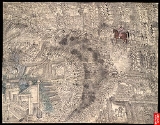
Third battle of Panipat

Encyclopedia
The Third Battle of Panipat took place on 14 January 1761, at Panipat
(Haryana State, India), about 60 miles (95.5 km) north of Delhi
between a northern expeditionary force of the Maratha Confederacy and a coalition of the King of Afghanistan, Ahmad Shah Abdali with 2 Indian Muslim allies—the Rohilla Afghans of the Doab, and the Nawab of Oudh Shuja-ud-Daulah. Militarily speaking, the battle pitted the French-supplied artillery
and cavalry of the Maratha
s against the heavy cavalry
and mounted artillery(zamburak and jizail) of the Afghans and Rohillas led by Ahmad Shah Durrani
and Najib-ud-Daulah, both ethnic Pashtuns
(the former is also known as Ahmad Shah Abdali). The battle is considered one of the largest fought in the 18th century, and has perhaps the largest number of fatalities in a single day reported in a classic formation battle between two armies.
The decline of the Mughal Empire following the 27-year Mughal-Maratha war (1680–1707) had led to rapid territorial gains for the Maratha Confederacy. Under Peshwa Baji Rao, Gujarat and Malwa came under Maratha control. Finally, in 1737, Baji Rao defeated the Mughals on the outskirts of Delhi, and brought much of the former Mughal territories south of Delhi under Maratha control. Baji Rao's son, Balaji Baji Rao (a.k.a Nana Saheb), further increased the territory under Maratha control by invading Punjab in 1758. This brought the Marathas into direct confrontation with the Durrani empire of Ahmad Shah Abdali. In 1759 he raised an army from the Pashtun tribes
and made several gains against the smaller Maratha garrisons in Punjab. He then joined with his Indian allies—the Rohilla Afghans of the Doab—forming a broad coalition against the Marathas. The Marathas, under the command of Sadashivrao Bhau
, responded by gathering an army of between 45,000–60,000, which was accompanied by roughly 200,000 non-combatants, a number of whom were pilgrims desirous of making pilgrimages to Hindu holy sites in northern India. The Marathas started their northward journey from Patdur on the 14th of March, 1760. The slow-moving Maratha camp finally reached Delhi on the 1st of August, 1760, and took the city the next day. There followed a series of skirmishes along the banks of the river Yamuna
, and a battle at Kunjpura
, which the Marathas won against an Afghan garrison of about 15,000 (at this time, Abdali and the other Afghan forces were on the eastern side of the Yamuna river). However, Abdali daringly crossed the river Yamuna on the 25th of October at Baghpat, cutting off the Maratha camp from their base in Delhi. This eventually turned into a two-month-long siege led by Abdali against the Marathas in the town of Panipat. During the siege both sides tried to cut off the other's supplies. At this the Afghans were considerably more effective, so that by the end of November 1760 they had cut off almost all food supplies into the besieged Maratha camp (which had about 250,000 to 300,000, most of whom were non-combatants). According to all the chronicles of the time, food in the Maratha camp ran out by late December or early January and cattle died by the thousands. Reports of soldiers dying of starvation began to be heard in early January. On the 13th of January the Maratha chiefs begged their commander, Sadashiv Rao Bhau, to be allowed to die in battle than perish by starvation. The next day the Marathas left their camp before dawn and marched south towards the Afghan camp in a desperate attempt to break the siege. The two armies came face-to-face around 8:00 a.m., and the battle raged until evening.
The specific site of the battle itself is disputed by historians, but most consider it to have occurred somewhere near modern-day Kaalaa Aamb and Sanauli Road. The battle lasted for several days and involved over 125,000 troops. Protracted skirmishes occurred, with losses and gains on both sides. The forces led by Ahmad Shah Durrani came out victorious after destroying several Maratha flanks. The extent of the losses on both sides is heavily disputed by historians, but it is believed that between 60,000–70,000 were killed in fighting, while the numbers of injured and prisoners taken vary considerably. The result of the battle was the halting of further Maratha advances in the north, and a destabilization of their territories, for roughly 10 years.
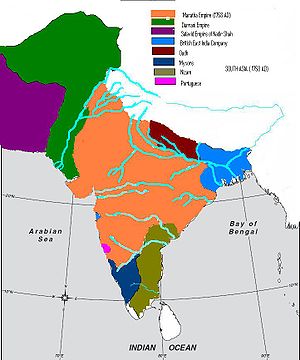
The Mughal Empire had been in decline since the death of the Mughal Emperor Aurangzeb
in 1707. The decline was accelerated by the invasion of India by Nadir Shah in 1739. Continued rebellions by the Marathas in the south, and the de-facto separation of a number of states (including Hyderabad and Bengal
), weakened the state further. Within a few years of Aurangzeb's death, the Marathas had reversed all his territorial gains in the Deccan and had conquered almost all Mughal territory in central and northern India. Mughals had thus become just the titular heads of Delhi. At the same time Punjab
saw frequent invasions by Ahmad Shah Abdali, the great Punjabi poet Baba Waris Shah
said of the situation, "khada peeta wahy da, baqi Ahmad Shahy da"--"we have nothing with us except what we eat and wear, all other things are for Ahmad Shah
". Abdali appointed his son, Timur Shah Durrani
, as his governor in Punjab and Kashmir. In 1758 the Maratha Empire
's Gen. Raghunathrao
marched onwards, attacked and conquered Lahore
and Attock
and drove out Timur Shah Durrani
. Lahore
, Multan
, Kashmir
and other subahs on the south and eastern side of Attock
were under the Maratha rule for the most part. In Punjab and Kashmir the Marathas were now major players.
and drove out Timur Shah Durrani
, the son and viceroy of the Afghan ruler, Ahmad Shah Abdali. This was the high-water mark of the Maratha expansion, where the boundaries of their empire extended in the north to the Indus and the Himalayas, and in the south nearly to the extremity of the peninsula. This territory was ruled through the Peshwa
, who talked of placing his son Vishwasrao
on the Mughal throne. However, Delhi still remained under the nominal control of Mughals, key Muslim intellectuals including Shah Waliullah
and other Muslim clergy in India who were alarmed at these developments. In desperation they appealed to Ahmad Shah Abdali, the ruler of Afghanistan, to halt the threat.
(Ahmad Shah Abdali), angered by the news from his son and his allies, was unwilling to allow the Marathas' spread go unchecked. By the end of 1759 Abdali with his Afghan tribes and his Rohilla
ally Najib Khan had reached Lahore
as well as Delhi and defeated the smaller enemy garrisons. Ahmed Shah, at this point, withdrew his army to Anupshahr, on the frontier of the Rohilla country, where he successfully convinced the Nawab of Oudh Shuja-ud-Daula
to join his alliance against the Marathas—in spite of the Marathas time and again helping and showing sympathy towards Shuja-ud-daula. The Nawab’s mother was of the opinion that he should join the Marathas. The Marathas had helped Safdarjung (father of Shuja) in defeating Rohillas in Farrukhabad. However, Shuja was very much ill-treated in the Abdali camp. Abdali was an Afghan Sunni Muslim and Shuja was a Persian Shia Muslim.
The Marathas under Sadashivrao Bhau
(referred to as the Bhau or Bhao in sources) responded to the news of the Afghans' return to North India by raising a big army, and they marched North. Bhau's force was bolstered by some Maratha forces under Holkar
, Scindia, Gaikwad and Govind Pant Bundela. Suraj Mal, the Jat ruler of Bharatpur, also had joined Bhausaheb but left midway. This combined army of over 100,000 regular troops captured the Mughal capital, Delhi, from an Afghan garrison in December 1759. Delhi had been reduced to ashes many times due to previous invasions, and in addition there being acute shortage of supplies in the Maratha camp. Bhau ordered the sacking of the already depopulated city. He is said to have planned to place his nephew and the Peshwa's son, Vishwasrao, on the Mughal throne. The Jats did not support the Marathas. Their withdrawal from the ensuing battle was to play a crucial role in its result. The Sikhs did not support either side and decided to sit back and see what would happen.
and Kunjpura
. Kunjpura
, on the banks of the Yamuna
River 60 miles to the north of Delhi, was stormed by the Marathas and the whole Afghan garrison was killed or enslaved. Marathas achieved a rather easy victory at Kunjpura, although there was a substantial army posted there. Some of Abadali's best generals were killed. Ahmad Shah was encamped on the left bank of the Yamuna River, which was swollen by rains, and was powerless to aid the garrison. The massacre of the Kunjpura garrison, within sight of the Durrani camp, exasperated him to such an extent that he ordered crossing of the river at all costs. Ahmed Shah and his allies on 17 October 1760, broke up from Shahdara, marching south. Taking a calculated risk, Abdali plunged into the river, followed by his bodyguards and troops. Between 23 and 25 October they were able to cross at Baghpat(a small town about 24 miles up the river), as a man from the village, in exchange for money, showed Abdali a way through Yamuna, from where the river could be crossed, unopposed by the Marathas who were still preoccupied with the sacking of Kunjpura.
After the Marathas failed to prevent Abdali's forces from crossing the Yamuna River, they set up defensive works in the ground near Panipat
, thereby blocking his access back to Afghanistan, just as his forces blocked theirs to the south. However, on the afternoon of 26 October Ahmad Shah's advance guard reached Sambalka, about halfway between Sonepat and Panipat, where they encountered the vanguard of the Marathas. A fierce skirmish ensued, in which the Afghans lost 1000 men killed and wounded but drove the Marathas back to their main body, which kept retreating slowly for several days. This led to the partial encirclement of the Maratha army. In skirmishes that followed, Govind Pant Bundela, with 10,000 light cavalry who weren’t formally trained soldiers, was on a foraging mission with about 500 men. They were surprised by an Afghan force near Meerut, and in the ensuing fight Bundela was killed. This was followed by the loss of another 2,000 Maratha soldiers who were delivering the army's payroll from Delhi. This completed the encirclement, as Ahmad Shah had cut off the Maratha army's supply lines.
With supplies and stores dwindling, tensions rose in the Maratha camp as the mercenaries in their army were complaining about not being paid. Initially the Marathas moved in almost 150 pieces of modern long-range, French-made artillery. With a range of several kilometres, these guns were some of the best of the time. The Marathas' plan was to lure the Afghan army to confront them while they had close artillery support.
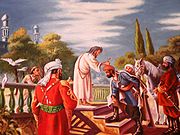 During the next two months of the siege constant skirmishes and duels took place between units and individual champions from either side. In one of these Najib lost 3,000 of his Rohillas and was very nearly killed but ran away. Facing a potential stalemate, Abdali decided to seek terms, which Bhau was willing to consider. However, Najib Khan delayed any chance of an agreement with an appeal on religious grounds and sowed doubt about whether the Marathas would honour any agreement.
After the Marathas moved from Kunjpura to Panipat, Diler Khan Marwat, with his father Alam Khan Marwat and a force of 2500 Pashtuns, attacked and took control of Kunjpura, where there was a Maratha garrison of 700–800 soldiers. At that time Atai Khan Baluch, son of the Wazir of Abdali, came from Afghanistan with 10,000 cavalry and cut off the supplies to the Marathas. The Marathas at Panipat were surrounded by Abdali in the south, Pashtun Tribes (Yousuf Zai, Afridi, Khattak) in the east, Shuja, Atai Khan and others in the north and other Pashtun tribes (Gandapur, Marwat, Durranis and Kakars) in the west. Abdali had also ordered Wazir Shaha Wali Khan Afridi and others to keep a watch in the thorny jungles surrounding Panipat. Thus, all supplies lines were cut.
The Marathas’ difficulty in obtaining supplies worsened as the local population became hostile to them, since in the Marathas' desperation to secure provisions they had pillaged the surrounding areas.
While Sadashivrao Bhau was still eager to make terms, a message was received from the Peshawa insisting on going to war and promising that reinforcements were under way. Unable to continue without supplies or wait for reinforcements any longer, Bhau decided to break the siege. His plan was to pulverise the enemy formations with cannon fire and not to employ his cavalry until the Afghans were thoroughly softened up. With the Afghans broken, he would move camp in a defensive formation towards Delhi, where they were assured supplies.
The Maratha line was to be formed up some 12 km across, with the artillery in front, protected by infantry, pikemen, musketeers and bowmen. The cavalry was instructed to wait behind the artillery and bayonet-wielding musketeers, ready to be thrown in when control of the battlefield had been fully established. Behind this line was another ring of 30,000 young Maratha soldiers who were not battle-tested, and then the roughly 30,000 civilians entrained. Many were middle-class men, women and children on their pilgrimage to Hindu holy places and shrines. Behind the civilians was yet another protective infantry line, of young, inexperienced soldiers.
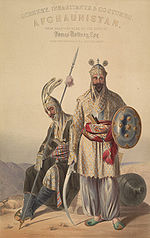
On the other side the Afghans formed a somewhat similar line, probably a few metres to the south of today's Sanauli Road. Their left was being formed by Najib and their right by two brigades of Persian troops. Their left centre was led by two Viziers, Shuja-ud-daulah with 3,000 soldiers and 50–60 cannons and Ahmad Shah's Vizier Shah Wali with a choice body of 19,000 mailed Afghan horsemen. The right centre consisted of 15,000 Rohillas under Hafiz Rahmat and other chiefs of the Rohilla Pathans. Pasand Khan covered the left wing with 5,000 cavalry, Barkurdar Khan and Amir Beg covered the right with 3,000 Rohilla cavalry with the choicest Persian horses. Long-range musketeers were also present during the battle. In this order the army of Ahmed Shah moved forward, leaving him at his preferred post in the centre, which was now in the rear of the line, from where he could watch and direct the battle.
The initial attack was led by the Maratha left flank under Ibrahim Khan, who in his eagerness to prove his worth advanced his infantry in formation against the Rohillas and Shah Pasand Khan. The first salvos from the Maratha artillery went over the Afghans' heads and did very little damage. Nevertheless, the first Afghan attack was broken by Maratha bowmen and pikemen, along with a unit of the famed Gardi musketeers stationed close to the artillery positions. The second and subsequent salvos were fired at point-blank range into the Afghan ranks. The resulting carnage sent the Rohillas reeling back to their lines, leaving the battlefield in the hands of Ibrahim for the next three hours, during which the 8,000 Gardi musketeers killed about 12,000 Rohillas.
In the second phase, Bhau himself led the charge against the left-of-center Afghan forces, under the Afghan Vizier Shah Wali Khan. The sheer force of the attack nearly broke the Afghan lines, and soldiers started to desert their positions in the confusion. Desperately trying to rally his forces, Shah Wali appealed to Shuja ud Daulah for assistance. However, the Nawab did not break from his position, effectively splitting the Afghan force's center. Despite Bhau's success, the overenthusiasm of the charge and a phenomenon called "Dakshinayan" on that fateful day, the attack itself failed because the sunlight shone directly into the eyes of the attackers' horses, many of them half-starved Maratha mounts who were exhausted long before they had traveled the two kilometers to the Afghan lines; some simply collapsed.
With their own men in the firing line, the Maratha artillery could not respond to the shathurnals and the cavalry charge. Some 7,000 Maratha cavalry and infantry were killed before the hand-to-hand fighting began at around 14:00. By 16:00 the tired Maratha infantry began to succumb to the onslaught of attacks from fresh Afghan reserves, protected by armoured leather jackets.
, seeing his forward lines dwindling and civilians behind, had not kept any reserves, and upon seeing Vishwasrao disappear in the midst of the fighting, he felt he had no choice but to come down from his elephant and lead the battle. Taking advantage of this, some Afghan soldiers who had been captured by the Marathas earlier during the siege of Kunjpura revolted. The slaves deliberately spread rumours about the defeat of the Marathas. This brought confusion and great consternation to loyal Maratha soldiers, who thought that the enemy had attacked from their rear. Some Maratha troops, seeing that their general had disappeared from his elephant, panicked and began to flee.
Abdali had given a part of his army the task of surrounding and killing the Gardis under Ibrahim Gardi, who were at the leftmost part of the Maratha army. Bhausaheb had ordered Vitthal Vinchurkar (with 1500 cavalry) and Damaji Gaikwad (with 2500 cavalry) to protect the Gardis. However, after seeing the Gardis fight, they lost their patience, became overenthusiastic and decided to fight the Rohillas themselves. Thus they broke the round—they didn’t follow the idea of round battle and went all out on the Rohillas, and the Rohilla riflemen started accurately firing at the Maratha cavalry, which was equipped only with swords. This gave the Rohillas the opportunity to encircle the Gardis and outflank the Maratha centre while Shah Wali pressed on attacking the front. Thus the Gardis were left defenceless and started falling one by one.
Vishwasrao had already been killed by a shot to the head. Bhau and his loyal bodyguards fought to the end, the Maratha leader having three horses shot out from under him. At this stage Holkar, realising the battle was lost, broke from the Maratha left flank and retreated. The Maratha army was routed and fled under the devastating attack. While 15,000 soldiers managed to reach Gwalior, the rest of the Maratha forces—including large numbers of non-combatants—were either killed or captured.
, who was assisting in the administration of the Maratha camp, escaped to Pune with her bodyguards.
as the Supreme Commander instead of Malharrao Holkar or Raghunathrao
proved to be an unfortunate one, as Sadashivrao was totally ignorant of the political and military situation in North India.
If Holkar had remained in the battlefield, the Maratha defeat would have been delayed but not averted. Ahmad Shah’s superiority in pitched battle could have been negated if the Marathas had conducted their traditional ganimi kava, or guerrilla warfare, as advised by Malharrao Holkar, in Punjab and in north India. Abdali was in no position to maintain his field army in India indefinitely. Marathas had used guerrilla warfare in North India. The Turki horses could not have handled the plundering and cutting of supply lines by the Marathas.
The main reason for the failure of the Marathas was that they went to war without good allies. Though their infantry was organized along European lines and their army had some of the best French-made guns of the time, their artillery was static and lacked mobility against the fast-moving Afghan forces.
The Marathas had interfered in the internal affairs of the Rajputana
states (present-day Rajasthan) and levied heavy taxes and huge fines on them. They had also made large territorial and monetary claims upon Awadh. Their raids in the Jat territory had resulted in the loss of trust of Jat chiefs like Suraj Mal. They had, therefore, to fight their enemies alone. Moreover, the senior Maratha chiefs constantly bickered with one another. Each had ambitions of carving out their independent states and had no interest in fighting against a common enemy. Some of them didn't support the idea of a round battle and wanted to fight using guerilla tactics instead of charging the enemy head-on.
The Maratha army was also burdened with 150,000 pilgrims who wished to worship at Hindu places of worship like Mathura, Prayag, Kashi, etc. The pilgrims wanted to accompany the army, as they would be secure with them.
Najib, Shuja and the Rohillas knew North India very well and that most of North India had allied with Abdali. However, the Afghans also started the battle with some disadvantages, facing a well-trained, western-equipped army that was undefeated and led by a single leader. Ahmad Shah Abdali compensated for this by his use of shaturnals, camels with mobile artillery pieces at his disposal. He was also diplomatic, striking agreements with Hindu leaders, especially the Jats and Rajputs, and former rivals like the Nawab of Awadh, appealing to him in the name of religion.
He also had better intelligence on the movements of his enemy, which played a crucial role in his encirclement of the enemy army.
 The bodies of Vishwasrao
and Bhau were recovered by the Afghans and, under Ahmad Shah's personal direction, were cremated according to Hindu custom. Bhau's wife Parvatibai was saved by Holkar, per the directions of Bhau, and eventually they returned to Pune
.
Peshwa Balaji Baji Rao, uninformed about the state of his army, was crossing the Narmada with reinforcements when a tired charkara arrived with a cryptic message: "Two pearls have been dissolved, 27 gold coins have been lost and of the silver and copper the total cannot be cast up". The Peshwa never recovered from the shock of the total debacle at Panipat. He returned to Pune and died a broken man in a temple on Paravati Hill.
Jankoji Scindia was taken prisoner and executed at the instigation of Najib. Ibrahim Khan Gardi was tortured and executed by enraged Afghan soldiers. The Marathas never fully recovered from the loss at Panipat, but they remained the predominant military power in India and managed to retake Delhi 10 years later. However, their claim over all of India ended with the three Anglo-Maratha Wars
, almost 50 years after Panipat.
The Jats under Suraj Mal benefited significantly from not participating in the Battle of Panipat. They provided considerable assistance to the Maratha soldiers and civilians who escaped the fighting. Suraj Mal himself was killed in battle against Najib-ud-Daula in 1763. Ahmad Shah's victory left him, in the short term, the undisputed master of North India. However, his alliance quickly unravelled amidst squabbles between his generals and other princes, the increasing restlessness of his soldiers over pay, the increasing Indian heat and arrival of the news that Marathas had organised another 100,000 men in the south to avenge their loss and rescue captured prisoners. Before departing, he ordered the Indian chiefs, through a Royal Firman (order) (including Clive of India), to recognise Shah Alam II
as Emperor.
Ahmad Shah also appointed Najib-ud-Daula as ostensible regent to the Mughal Emperor. In addition, Najib and Munir-ud-daulah agreed to pay to Abdali, on behalf of the Mughal king, an annual tribute of four million rupees. This was to be Ahmad Shah's final major expedition to North India, as he became increasingly preoccupied with the increasingly successful rebellions by the Sikhs.
Shah Shuja was to regret his decision to join the Afghan forces. In time his forces became embroiled in clashes between the orthodox Sunni Afghans and his own Shia followers. He is alleged to have later secretly sent letters to Bhausaheb through his spies regretting his decision to join Abdali.
After the Battle of Panipat the services of the Rohillas were rewarded by grants of Shikohabad to Nawab Faiz-ullah Khan and of Jalesar and Firozabad
to Nawab Sadullah Khan. Najib Khan proved to be an effective ruler. However, after his death in 1770, the Rohillas were defeated by the British East India Company
.
in 1947.
To save their kingdom, the Mughals once again changed sides and welcomed the Afghans to Delhi. The Mughals remained in nominal control over small areas of India, but were never a force again. The empire officially ended in 1857 when its last emperor, Bahadur Shah II, was accused of being involved in the Sepoy Mutiny
and exiled.
The Marathas' expansion was stopped in the battle, and infighting soon broke out within the empire. They never regained any unity. They recovered their position under the next Peshwa Madhavrao I and by 1772 were back in control of the north, finally occupying Delhi. However, after the death of Madhavrao, due to infighting and increasing pressure from the British, their claims to empire only officially ended in 1818 after three wars with the British.
Meanwhile the Sikhs—whose rebellion was the original reason Ahmad invaded—were left largely untouched by the battle. They soon retook Lahore. When Ahmad Shah returned in March 1764 he was forced to break off his siege after only two weeks due to a rebellion in Afghanistan
. He returned again in 1767, but was unable to win any decisive battle. With his own troops complaining about not being paid, he eventually abandoned the district to the Sikh
s, who remained in control until 1849.
The Marathi term "Sankrant Kosalali" (सक्रांत कोसळली), meaning "Sankranti
has befallen us", is said to have originated from the events of the battle. There are some verbs in the Marathi language related to this loss as "Panipat zale" (पानिपत झाले) [a major loss has happened]. This verb is even today used in Marathi
language. A common pun is "Aamchaa Vishwaas Panipataat gela" (आमचा विश्वास पानीपतात गेला) [we lost our own (Vishwas) faith since Panipat]. Many historians, including British historians of the time, have argued that had it not been for the weakening of Maratha power at Panipat, the British might never have gotten a strong foothold in India.
The battle proved the inspiration for Rudyard Kipling
's poem "With Scindia to Delhi".
"Our hands and scarfs were saffron-dyed for signal of despair,
When we went forth to Paniput to battle with the ~Mlech~
(Muslim
s),
Ere we came back from Paniput and left a kingdom there."
It is, however, also remembered as a scene of valour on both sides. Santaji Wagh's corpse was found with over 40 mortal wounds. The bravery of Vishwa Rao, the Peshwas son, was acknowledged even by the Afghans. Yashwantrao Pawar also fought with great courage, killing many Afghans.
Afghan military prowess was to inspire hope in many orthodox Muslims and Mughal royalists and fear in the British.
Panipat
Panipat بَنِبَت is an ancient and historic city in Panipat district, Haryana state, India. It is 90 km north from Delhi and 169 km south of Chandigarh on NH-1. The three battles fought at the city were turning points in Indian history. The city is famous in India by the name of "City of...
(Haryana State, India), about 60 miles (95.5 km) north of Delhi
Delhi
Delhi , officially National Capital Territory of Delhi , is the largest metropolis by area and the second-largest by population in India, next to Mumbai. It is the eighth largest metropolis in the world by population with 16,753,265 inhabitants in the Territory at the 2011 Census...
between a northern expeditionary force of the Maratha Confederacy and a coalition of the King of Afghanistan, Ahmad Shah Abdali with 2 Indian Muslim allies—the Rohilla Afghans of the Doab, and the Nawab of Oudh Shuja-ud-Daulah. Militarily speaking, the battle pitted the French-supplied artillery
Artillery
Originally applied to any group of infantry primarily armed with projectile weapons, artillery has over time become limited in meaning to refer only to those engines of war that operate by projection of munitions far beyond the range of effect of personal weapons...
and cavalry of the Maratha
Maratha
The Maratha are an Indian caste, predominantly in the state of Maharashtra. The term Marāthā has three related usages: within the Marathi speaking region it describes the dominant Maratha caste; outside Maharashtra it can refer to the entire regional population of Marathi-speaking people;...
s against the heavy cavalry
Cavalry
Cavalry or horsemen were soldiers or warriors who fought mounted on horseback. Cavalry were historically the third oldest and the most mobile of the combat arms...
and mounted artillery(zamburak and jizail) of the Afghans and Rohillas led by Ahmad Shah Durrani
Ahmad Shah Durrani
Ahmad Shah Durrani , also known as Ahmad Shāh Abdālī and born as Ahmad Khān, was the founder of the Durrani Empire in 1747 and is regarded by many to be the founder of the modern state of Afghanistan.Ahmad Khan enlisted as a young soldier in the military of the Afsharid kingdom and quickly rose...
and Najib-ud-Daulah, both ethnic Pashtuns
Pashtun people
Pashtuns or Pathans , also known as ethnic Afghans , are an Eastern Iranic ethnic group with populations primarily between the Hindu Kush mountains in Afghanistan and the Indus River in Pakistan...
(the former is also known as Ahmad Shah Abdali). The battle is considered one of the largest fought in the 18th century, and has perhaps the largest number of fatalities in a single day reported in a classic formation battle between two armies.
The decline of the Mughal Empire following the 27-year Mughal-Maratha war (1680–1707) had led to rapid territorial gains for the Maratha Confederacy. Under Peshwa Baji Rao, Gujarat and Malwa came under Maratha control. Finally, in 1737, Baji Rao defeated the Mughals on the outskirts of Delhi, and brought much of the former Mughal territories south of Delhi under Maratha control. Baji Rao's son, Balaji Baji Rao (a.k.a Nana Saheb), further increased the territory under Maratha control by invading Punjab in 1758. This brought the Marathas into direct confrontation with the Durrani empire of Ahmad Shah Abdali. In 1759 he raised an army from the Pashtun tribes
Pashtun tribes
The Pashtun people are the largest ethnic group in Afghanistan and the second largest in Pakistan. Pashtun, tribes are divided into four supertribal confederacies: the Arbanee , Betanee , Gharghasht, and Karlanee .Traditionally, according to folklore, all Pashtuns are said to have descended, at...
and made several gains against the smaller Maratha garrisons in Punjab. He then joined with his Indian allies—the Rohilla Afghans of the Doab—forming a broad coalition against the Marathas. The Marathas, under the command of Sadashivrao Bhau
Sadashivrao Bhau
Sadashivrao Bhau was son of Chimaji Appa and Rakhmabai and nephew of Peshwa Baji Rao I and served as the commander of the Maratha army.-Birth and early years:...
, responded by gathering an army of between 45,000–60,000, which was accompanied by roughly 200,000 non-combatants, a number of whom were pilgrims desirous of making pilgrimages to Hindu holy sites in northern India. The Marathas started their northward journey from Patdur on the 14th of March, 1760. The slow-moving Maratha camp finally reached Delhi on the 1st of August, 1760, and took the city the next day. There followed a series of skirmishes along the banks of the river Yamuna
Yamuna
The Yamuna is the largest tributary river of the Ganges in northern India...
, and a battle at Kunjpura
Kunjpura
Kunjpura is a village on the banks of the Yamuna River, off the Grand Trunk Road that runs from Amritsar to Delhi and further on to Calcutta.- Overview :...
, which the Marathas won against an Afghan garrison of about 15,000 (at this time, Abdali and the other Afghan forces were on the eastern side of the Yamuna river). However, Abdali daringly crossed the river Yamuna on the 25th of October at Baghpat, cutting off the Maratha camp from their base in Delhi. This eventually turned into a two-month-long siege led by Abdali against the Marathas in the town of Panipat. During the siege both sides tried to cut off the other's supplies. At this the Afghans were considerably more effective, so that by the end of November 1760 they had cut off almost all food supplies into the besieged Maratha camp (which had about 250,000 to 300,000, most of whom were non-combatants). According to all the chronicles of the time, food in the Maratha camp ran out by late December or early January and cattle died by the thousands. Reports of soldiers dying of starvation began to be heard in early January. On the 13th of January the Maratha chiefs begged their commander, Sadashiv Rao Bhau, to be allowed to die in battle than perish by starvation. The next day the Marathas left their camp before dawn and marched south towards the Afghan camp in a desperate attempt to break the siege. The two armies came face-to-face around 8:00 a.m., and the battle raged until evening.
The specific site of the battle itself is disputed by historians, but most consider it to have occurred somewhere near modern-day Kaalaa Aamb and Sanauli Road. The battle lasted for several days and involved over 125,000 troops. Protracted skirmishes occurred, with losses and gains on both sides. The forces led by Ahmad Shah Durrani came out victorious after destroying several Maratha flanks. The extent of the losses on both sides is heavily disputed by historians, but it is believed that between 60,000–70,000 were killed in fighting, while the numbers of injured and prisoners taken vary considerably. The result of the battle was the halting of further Maratha advances in the north, and a destabilization of their territories, for roughly 10 years.
Background
Decline of Mughal Empire
The Mughal Empire had been in decline since the death of the Mughal Emperor Aurangzeb
Aurangzeb
Abul Muzaffar Muhy-ud-Din Muhammad Aurangzeb Alamgir , more commonly known as Aurangzeb or by his chosen imperial title Alamgir , was the sixth Mughal Emperor of India, whose reign lasted from 1658 until his death in 1707.Badshah Aurangzeb, having ruled most of the Indian subcontinent for nearly...
in 1707. The decline was accelerated by the invasion of India by Nadir Shah in 1739. Continued rebellions by the Marathas in the south, and the de-facto separation of a number of states (including Hyderabad and Bengal
Bengal
Bengal is a historical and geographical region in the northeast region of the Indian Subcontinent at the apex of the Bay of Bengal. Today, it is mainly divided between the sovereign land of People's Republic of Bangladesh and the Indian state of West Bengal, although some regions of the previous...
), weakened the state further. Within a few years of Aurangzeb's death, the Marathas had reversed all his territorial gains in the Deccan and had conquered almost all Mughal territory in central and northern India. Mughals had thus become just the titular heads of Delhi. At the same time Punjab
Punjab region
The Punjab , also spelled Panjab |water]]s"), is a geographical region straddling the border between Pakistan and India which includes Punjab province in Pakistan and the states of the Punjab, Haryana, Himachal Pradesh, Chandigarh and some northern parts of the National Capital Territory of Delhi...
saw frequent invasions by Ahmad Shah Abdali, the great Punjabi poet Baba Waris Shah
Waris Shah
Waris Shah was a Punjabi Sufi poet, renowned for his contribution to Punjabi literature. He is best-known for his seminal work Heer Ranjha, based on the traditional folk tale of Heer and her lover Ranjha. Heer is considered one of the quintessential works of classical Punjabi literature...
said of the situation, "khada peeta wahy da, baqi Ahmad Shahy da"--"we have nothing with us except what we eat and wear, all other things are for Ahmad Shah
Ahmad Shah Durrani
Ahmad Shah Durrani , also known as Ahmad Shāh Abdālī and born as Ahmad Khān, was the founder of the Durrani Empire in 1747 and is regarded by many to be the founder of the modern state of Afghanistan.Ahmad Khan enlisted as a young soldier in the military of the Afsharid kingdom and quickly rose...
". Abdali appointed his son, Timur Shah Durrani
Timur Shah Durrani
Timur Shah Durrani , was the second ruler of the Durrani Empire from October 16, 1772, until his death in 1793. An ethnic Pashtun, he was the second and eldest son of Ahmad Shah Durrani.- Early life :...
, as his governor in Punjab and Kashmir. In 1758 the Maratha Empire
Maratha Empire
The Maratha Empire or the Maratha Confederacy was an Indian imperial power that existed from 1674 to 1818. At its peak, the empire covered much of South Asia, encompassing a territory of over 2.8 million km²....
's Gen. Raghunathrao
Raghunathrao
Raghunathrao was Peshwa of the Maratha Confederacy from 1773 to 1774. He was instrumental in the downfall of the Peshwa clan.-Early life:Raghunathrao, also known as "Raghoba" and "Ragho Bharari," was the younger brother of Nanasaheb Peshwa. His father was Peshwa Bajirao I & mother was Kashibai....
marched onwards, attacked and conquered Lahore
Lahore
Lahore is the capital of the Pakistani province of Punjab and the second largest city in the country. With a rich and fabulous history dating back to over a thousand years ago, Lahore is no doubt Pakistan's cultural capital. One of the most densely populated cities in the world, Lahore remains a...
and Attock
Attock
Attock is a city located in the northern border of the Punjab province of Pakistan and the headquarters of Attock District...
and drove out Timur Shah Durrani
Timur Shah Durrani
Timur Shah Durrani , was the second ruler of the Durrani Empire from October 16, 1772, until his death in 1793. An ethnic Pashtun, he was the second and eldest son of Ahmad Shah Durrani.- Early life :...
. Lahore
Lahore
Lahore is the capital of the Pakistani province of Punjab and the second largest city in the country. With a rich and fabulous history dating back to over a thousand years ago, Lahore is no doubt Pakistan's cultural capital. One of the most densely populated cities in the world, Lahore remains a...
, Multan
Multan
Multan , is a city in the Punjab Province of Pakistan and capital of Multan District. It is located in the southern part of the province on the east bank of the Chenab River, more or less in the geographic centre of the country and about from Islamabad, from Lahore and from Karachi...
, Kashmir
Kashmir
Kashmir is the northwestern region of the Indian subcontinent. Until the mid-19th century, the term Kashmir geographically denoted only the valley between the Great Himalayas and the Pir Panjal mountain range...
and other subahs on the south and eastern side of Attock
Attock
Attock is a city located in the northern border of the Punjab province of Pakistan and the headquarters of Attock District...
were under the Maratha rule for the most part. In Punjab and Kashmir the Marathas were now major players.
Maratha Empire
The Marathas had gained control of a considerable part of India in the intervening period (1707–1757). In 1758 they occupied Delhi, captured LahoreLahore
Lahore is the capital of the Pakistani province of Punjab and the second largest city in the country. With a rich and fabulous history dating back to over a thousand years ago, Lahore is no doubt Pakistan's cultural capital. One of the most densely populated cities in the world, Lahore remains a...
and drove out Timur Shah Durrani
Timur Shah Durrani
Timur Shah Durrani , was the second ruler of the Durrani Empire from October 16, 1772, until his death in 1793. An ethnic Pashtun, he was the second and eldest son of Ahmad Shah Durrani.- Early life :...
, the son and viceroy of the Afghan ruler, Ahmad Shah Abdali. This was the high-water mark of the Maratha expansion, where the boundaries of their empire extended in the north to the Indus and the Himalayas, and in the south nearly to the extremity of the peninsula. This territory was ruled through the Peshwa
Peshwa
A Peshwa is the titular equivalent of a modern Prime Minister. Emporer Shivaji created the Peshwa designation in order to more effectively delegate administrative duties during the growth of the Maratha Empire. Prior to 1749, Peshwas held office for 8-9 years and controlled the Maratha army...
, who talked of placing his son Vishwasrao
Vishwasrao
Vishwasrao was an Indian noble of the Maratha Empire.- Early life :Vishwasrao was born the eldest son of Nanasaheb Peshwa at Supa near Pune...
on the Mughal throne. However, Delhi still remained under the nominal control of Mughals, key Muslim intellectuals including Shah Waliullah
Shah Waliullah
Shah Waliullah Muhaddith Dehlvi was an Islamic scholar and reformer. He was born during the reign of Aurangzeb. He worked for the revival of Muslim rule and intellectual learning in South Asia, during a time of waning Muslim power...
and other Muslim clergy in India who were alarmed at these developments. In desperation they appealed to Ahmad Shah Abdali, the ruler of Afghanistan, to halt the threat.
Prelude
Ahmad Shah DurraniAhmad Shah Durrani
Ahmad Shah Durrani , also known as Ahmad Shāh Abdālī and born as Ahmad Khān, was the founder of the Durrani Empire in 1747 and is regarded by many to be the founder of the modern state of Afghanistan.Ahmad Khan enlisted as a young soldier in the military of the Afsharid kingdom and quickly rose...
(Ahmad Shah Abdali), angered by the news from his son and his allies, was unwilling to allow the Marathas' spread go unchecked. By the end of 1759 Abdali with his Afghan tribes and his Rohilla
Rohilla
The Rohilla are a community of Hindi-speaking Pashtun also known as Pathan, historically found in the state of Uttar Pradesh, in North India. Most are now also found in Pakistan where they are now part of the Mohajir community. At one time, they form one of the largest Pashtun diaspora community...
ally Najib Khan had reached Lahore
Lahore
Lahore is the capital of the Pakistani province of Punjab and the second largest city in the country. With a rich and fabulous history dating back to over a thousand years ago, Lahore is no doubt Pakistan's cultural capital. One of the most densely populated cities in the world, Lahore remains a...
as well as Delhi and defeated the smaller enemy garrisons. Ahmed Shah, at this point, withdrew his army to Anupshahr, on the frontier of the Rohilla country, where he successfully convinced the Nawab of Oudh Shuja-ud-Daula
Shuja-ud-Daula
Shuja-ud-Daula was the Subedar Nawab of Oudh from 5 October 1754 to 26 January 1775, and the son of Muhammad Nasir.Though a minor royal, he is best known for his key roles in two definitive battles in Indian history - the Third Battle of Panipat which ended Maratha domination of India, and the...
to join his alliance against the Marathas—in spite of the Marathas time and again helping and showing sympathy towards Shuja-ud-daula. The Nawab’s mother was of the opinion that he should join the Marathas. The Marathas had helped Safdarjung (father of Shuja) in defeating Rohillas in Farrukhabad. However, Shuja was very much ill-treated in the Abdali camp. Abdali was an Afghan Sunni Muslim and Shuja was a Persian Shia Muslim.
The Marathas under Sadashivrao Bhau
Sadashivrao Bhau
Sadashivrao Bhau was son of Chimaji Appa and Rakhmabai and nephew of Peshwa Baji Rao I and served as the commander of the Maratha army.-Birth and early years:...
(referred to as the Bhau or Bhao in sources) responded to the news of the Afghans' return to North India by raising a big army, and they marched North. Bhau's force was bolstered by some Maratha forces under Holkar
Holkar
The Holkar dynasty , whose earliest known clan-man was Malhar Rao, who joined the service of the Peshwa in 1721, and quickly rose to the ranks of Subedar...
, Scindia, Gaikwad and Govind Pant Bundela. Suraj Mal, the Jat ruler of Bharatpur, also had joined Bhausaheb but left midway. This combined army of over 100,000 regular troops captured the Mughal capital, Delhi, from an Afghan garrison in December 1759. Delhi had been reduced to ashes many times due to previous invasions, and in addition there being acute shortage of supplies in the Maratha camp. Bhau ordered the sacking of the already depopulated city. He is said to have planned to place his nephew and the Peshwa's son, Vishwasrao, on the Mughal throne. The Jats did not support the Marathas. Their withdrawal from the ensuing battle was to play a crucial role in its result. The Sikhs did not support either side and decided to sit back and see what would happen.
Initial skirmishes
With both sides poised for battle, there followed much maneuvering, with skirmishes between the two armies fought at KarnalKarnal
Karnal is an important city and the headquarters of Karnal District in the Indian state of Haryana.Karnal is said to have been founded by the Kauravas in the Mahabharata era for the king Karna, a mythological hero and a key figure in the epic tale...
and Kunjpura
Kunjpura
Kunjpura is a village on the banks of the Yamuna River, off the Grand Trunk Road that runs from Amritsar to Delhi and further on to Calcutta.- Overview :...
. Kunjpura
Kunjpura
Kunjpura is a village on the banks of the Yamuna River, off the Grand Trunk Road that runs from Amritsar to Delhi and further on to Calcutta.- Overview :...
, on the banks of the Yamuna
Yamuna
The Yamuna is the largest tributary river of the Ganges in northern India...
River 60 miles to the north of Delhi, was stormed by the Marathas and the whole Afghan garrison was killed or enslaved. Marathas achieved a rather easy victory at Kunjpura, although there was a substantial army posted there. Some of Abadali's best generals were killed. Ahmad Shah was encamped on the left bank of the Yamuna River, which was swollen by rains, and was powerless to aid the garrison. The massacre of the Kunjpura garrison, within sight of the Durrani camp, exasperated him to such an extent that he ordered crossing of the river at all costs. Ahmed Shah and his allies on 17 October 1760, broke up from Shahdara, marching south. Taking a calculated risk, Abdali plunged into the river, followed by his bodyguards and troops. Between 23 and 25 October they were able to cross at Baghpat(a small town about 24 miles up the river), as a man from the village, in exchange for money, showed Abdali a way through Yamuna, from where the river could be crossed, unopposed by the Marathas who were still preoccupied with the sacking of Kunjpura.
After the Marathas failed to prevent Abdali's forces from crossing the Yamuna River, they set up defensive works in the ground near Panipat
Panipat
Panipat بَنِبَت is an ancient and historic city in Panipat district, Haryana state, India. It is 90 km north from Delhi and 169 km south of Chandigarh on NH-1. The three battles fought at the city were turning points in Indian history. The city is famous in India by the name of "City of...
, thereby blocking his access back to Afghanistan, just as his forces blocked theirs to the south. However, on the afternoon of 26 October Ahmad Shah's advance guard reached Sambalka, about halfway between Sonepat and Panipat, where they encountered the vanguard of the Marathas. A fierce skirmish ensued, in which the Afghans lost 1000 men killed and wounded but drove the Marathas back to their main body, which kept retreating slowly for several days. This led to the partial encirclement of the Maratha army. In skirmishes that followed, Govind Pant Bundela, with 10,000 light cavalry who weren’t formally trained soldiers, was on a foraging mission with about 500 men. They were surprised by an Afghan force near Meerut, and in the ensuing fight Bundela was killed. This was followed by the loss of another 2,000 Maratha soldiers who were delivering the army's payroll from Delhi. This completed the encirclement, as Ahmad Shah had cut off the Maratha army's supply lines.
With supplies and stores dwindling, tensions rose in the Maratha camp as the mercenaries in their army were complaining about not being paid. Initially the Marathas moved in almost 150 pieces of modern long-range, French-made artillery. With a range of several kilometres, these guns were some of the best of the time. The Marathas' plan was to lure the Afghan army to confront them while they had close artillery support.
Battle
After the Marathas moved from Kunjpura to Panipat, Diler Khan Marwat, with his father Alam Khan Marwat and a force of 2500 Pashtuns, attacked and took control of Kunjpura, where there was a Maratha garrison of 700–800 soldiers. At that time Atai Khan Baluch, son of the Wazir of Abdali, came from Afghanistan with 10,000 cavalry and cut off the supplies to the Marathas. The Marathas at Panipat were surrounded by Abdali in the south, Pashtun Tribes (Yousuf Zai, Afridi, Khattak) in the east, Shuja, Atai Khan and others in the north and other Pashtun tribes (Gandapur, Marwat, Durranis and Kakars) in the west. Abdali had also ordered Wazir Shaha Wali Khan Afridi and others to keep a watch in the thorny jungles surrounding Panipat. Thus, all supplies lines were cut.
The Marathas’ difficulty in obtaining supplies worsened as the local population became hostile to them, since in the Marathas' desperation to secure provisions they had pillaged the surrounding areas.
While Sadashivrao Bhau was still eager to make terms, a message was received from the Peshawa insisting on going to war and promising that reinforcements were under way. Unable to continue without supplies or wait for reinforcements any longer, Bhau decided to break the siege. His plan was to pulverise the enemy formations with cannon fire and not to employ his cavalry until the Afghans were thoroughly softened up. With the Afghans broken, he would move camp in a defensive formation towards Delhi, where they were assured supplies.
Battle
Formations
The Maratha lines began a little to the north of Kala Amb. They had thus blocked the northward path of Abdali's troops and at the same time were blocked from heading south—in the direction of Delhi, where they could get badly needed supplies—by those same troops. Bhau, with the Peshwa's son and the household troops, was in the centre. The left wing consisted of the gardis under Ibrahim Khan. Holkar and Sindhia were on the extreme right.The Maratha line was to be formed up some 12 km across, with the artillery in front, protected by infantry, pikemen, musketeers and bowmen. The cavalry was instructed to wait behind the artillery and bayonet-wielding musketeers, ready to be thrown in when control of the battlefield had been fully established. Behind this line was another ring of 30,000 young Maratha soldiers who were not battle-tested, and then the roughly 30,000 civilians entrained. Many were middle-class men, women and children on their pilgrimage to Hindu holy places and shrines. Behind the civilians was yet another protective infantry line, of young, inexperienced soldiers.
On the other side the Afghans formed a somewhat similar line, probably a few metres to the south of today's Sanauli Road. Their left was being formed by Najib and their right by two brigades of Persian troops. Their left centre was led by two Viziers, Shuja-ud-daulah with 3,000 soldiers and 50–60 cannons and Ahmad Shah's Vizier Shah Wali with a choice body of 19,000 mailed Afghan horsemen. The right centre consisted of 15,000 Rohillas under Hafiz Rahmat and other chiefs of the Rohilla Pathans. Pasand Khan covered the left wing with 5,000 cavalry, Barkurdar Khan and Amir Beg covered the right with 3,000 Rohilla cavalry with the choicest Persian horses. Long-range musketeers were also present during the battle. In this order the army of Ahmed Shah moved forward, leaving him at his preferred post in the centre, which was now in the rear of the line, from where he could watch and direct the battle.
Early phases
Before dawn on 14 January 1761, the Maratha troops broke their fast with the last remaining grain in camp and prepared for combat, coming from their lines with turbans disheveled and turmeric-smeared faces. They emerged from the trenches, pushing the artillery into position on their prearranged lines, some 2 km from the Afghans. Seeing that the battle was on, Ahmad Shah positioned his 60 smooth-bore cannon and opened fire. However, because of the short range of the Afghan weapons and the static nature of the Maratha artillery, the Afghan cannons proved ineffectual.The initial attack was led by the Maratha left flank under Ibrahim Khan, who in his eagerness to prove his worth advanced his infantry in formation against the Rohillas and Shah Pasand Khan. The first salvos from the Maratha artillery went over the Afghans' heads and did very little damage. Nevertheless, the first Afghan attack was broken by Maratha bowmen and pikemen, along with a unit of the famed Gardi musketeers stationed close to the artillery positions. The second and subsequent salvos were fired at point-blank range into the Afghan ranks. The resulting carnage sent the Rohillas reeling back to their lines, leaving the battlefield in the hands of Ibrahim for the next three hours, during which the 8,000 Gardi musketeers killed about 12,000 Rohillas.
In the second phase, Bhau himself led the charge against the left-of-center Afghan forces, under the Afghan Vizier Shah Wali Khan. The sheer force of the attack nearly broke the Afghan lines, and soldiers started to desert their positions in the confusion. Desperately trying to rally his forces, Shah Wali appealed to Shuja ud Daulah for assistance. However, the Nawab did not break from his position, effectively splitting the Afghan force's center. Despite Bhau's success, the overenthusiasm of the charge and a phenomenon called "Dakshinayan" on that fateful day, the attack itself failed because the sunlight shone directly into the eyes of the attackers' horses, many of them half-starved Maratha mounts who were exhausted long before they had traveled the two kilometers to the Afghan lines; some simply collapsed.
Final phase
In the final phase the Marathas, under Scindia, attacked Najib. Najib successfully fought a defensive action, however, keeping Scindia's forces at bay. By noon it looked as though Bhau would clinch victory for the Marathas once again. The Afghan left flank still held its own, but the centre was cut in two and the right was almost destroyed. Ahmad Shah had watched the fortunes of the battle from his tent, guarded by the still unbroken forces on his left. He sent his bodyguards to call up his 15,000 reserve troops from his camp and arranged them as a column in front of his cavalry of musketeers (Qizilbaaz) and 2,000 swivel-mounted shutarnaals or Ushtranaal—cannons—on the backs of camels. The shaturnals, because of their positioning on camels, could fire an extensive salvo over the heads of their own infantry at the Maratha cavalry. The Maratha cavalry was unable to withstand the muskets and camel-mounted swivel cannons of the Afghans. They could be fired without the rider having to dismount and were especially effective against fast-moving cavalry. He therefore sent 500 of his own bodyguards with orders to raise all able-bodied men out of camp and send them to the front. He sent 1,500 more to any those front-line troops who attempted to flee the battle and kill without mercy any soldier who would not return to the fight. These extra troops, along with 4,000 of his reserve troops, went to support the broken ranks of the Rohillas on the right. The remainder of the reserve, 10,000 strong, were sent to the aid of Shah Wali, still labouring unequally against the Bhao in the centre of the field. These mailed warriors were to charge with the Vizir in close order and at full gallop. Whenever they charged the enemy in front, the chief of the staff and Najib were directed to fall upon either flank.With their own men in the firing line, the Maratha artillery could not respond to the shathurnals and the cavalry charge. Some 7,000 Maratha cavalry and infantry were killed before the hand-to-hand fighting began at around 14:00. By 16:00 the tired Maratha infantry began to succumb to the onslaught of attacks from fresh Afghan reserves, protected by armoured leather jackets.
Outflanked
Sadashivrao BhauSadashivrao Bhau
Sadashivrao Bhau was son of Chimaji Appa and Rakhmabai and nephew of Peshwa Baji Rao I and served as the commander of the Maratha army.-Birth and early years:...
, seeing his forward lines dwindling and civilians behind, had not kept any reserves, and upon seeing Vishwasrao disappear in the midst of the fighting, he felt he had no choice but to come down from his elephant and lead the battle. Taking advantage of this, some Afghan soldiers who had been captured by the Marathas earlier during the siege of Kunjpura revolted. The slaves deliberately spread rumours about the defeat of the Marathas. This brought confusion and great consternation to loyal Maratha soldiers, who thought that the enemy had attacked from their rear. Some Maratha troops, seeing that their general had disappeared from his elephant, panicked and began to flee.
Abdali had given a part of his army the task of surrounding and killing the Gardis under Ibrahim Gardi, who were at the leftmost part of the Maratha army. Bhausaheb had ordered Vitthal Vinchurkar (with 1500 cavalry) and Damaji Gaikwad (with 2500 cavalry) to protect the Gardis. However, after seeing the Gardis fight, they lost their patience, became overenthusiastic and decided to fight the Rohillas themselves. Thus they broke the round—they didn’t follow the idea of round battle and went all out on the Rohillas, and the Rohilla riflemen started accurately firing at the Maratha cavalry, which was equipped only with swords. This gave the Rohillas the opportunity to encircle the Gardis and outflank the Maratha centre while Shah Wali pressed on attacking the front. Thus the Gardis were left defenceless and started falling one by one.
Vishwasrao had already been killed by a shot to the head. Bhau and his loyal bodyguards fought to the end, the Maratha leader having three horses shot out from under him. At this stage Holkar, realising the battle was lost, broke from the Maratha left flank and retreated. The Maratha army was routed and fled under the devastating attack. While 15,000 soldiers managed to reach Gwalior, the rest of the Maratha forces—including large numbers of non-combatants—were either killed or captured.
Rout
The Afghans pursued the fleeing Maratha army and civilians. The Maratha front lines remained largely intact, with some of their artillery units fighting until sunset. Choosing not to launch a night attack, many Maratha troops escaped that night. Bhau's wife ParvatibaiParvatibai
Parvatibai was second wife of Sadashivrao Bhau. She was from Kolhatkar family of Pen.- Family Life:...
, who was assisting in the administration of the Maratha camp, escaped to Pune with her bodyguards.
Reasons for the outcome
Peshwa's decision to appoint Sadashivrao BhauSadashivrao Bhau
Sadashivrao Bhau was son of Chimaji Appa and Rakhmabai and nephew of Peshwa Baji Rao I and served as the commander of the Maratha army.-Birth and early years:...
as the Supreme Commander instead of Malharrao Holkar or Raghunathrao
Raghunathrao
Raghunathrao was Peshwa of the Maratha Confederacy from 1773 to 1774. He was instrumental in the downfall of the Peshwa clan.-Early life:Raghunathrao, also known as "Raghoba" and "Ragho Bharari," was the younger brother of Nanasaheb Peshwa. His father was Peshwa Bajirao I & mother was Kashibai....
proved to be an unfortunate one, as Sadashivrao was totally ignorant of the political and military situation in North India.
If Holkar had remained in the battlefield, the Maratha defeat would have been delayed but not averted. Ahmad Shah’s superiority in pitched battle could have been negated if the Marathas had conducted their traditional ganimi kava, or guerrilla warfare, as advised by Malharrao Holkar, in Punjab and in north India. Abdali was in no position to maintain his field army in India indefinitely. Marathas had used guerrilla warfare in North India. The Turki horses could not have handled the plundering and cutting of supply lines by the Marathas.
The main reason for the failure of the Marathas was that they went to war without good allies. Though their infantry was organized along European lines and their army had some of the best French-made guns of the time, their artillery was static and lacked mobility against the fast-moving Afghan forces.
The Marathas had interfered in the internal affairs of the Rajputana
Rajputana
Rājputāna was the pre-1949 name of the present-day Indian state of Rājasthān, the largest state of the Republic of India in terms of area. George Thomas was the first in 1800 A.D., to term this region as Rajputana...
states (present-day Rajasthan) and levied heavy taxes and huge fines on them. They had also made large territorial and monetary claims upon Awadh. Their raids in the Jat territory had resulted in the loss of trust of Jat chiefs like Suraj Mal. They had, therefore, to fight their enemies alone. Moreover, the senior Maratha chiefs constantly bickered with one another. Each had ambitions of carving out their independent states and had no interest in fighting against a common enemy. Some of them didn't support the idea of a round battle and wanted to fight using guerilla tactics instead of charging the enemy head-on.
The Maratha army was also burdened with 150,000 pilgrims who wished to worship at Hindu places of worship like Mathura, Prayag, Kashi, etc. The pilgrims wanted to accompany the army, as they would be secure with them.
Najib, Shuja and the Rohillas knew North India very well and that most of North India had allied with Abdali. However, the Afghans also started the battle with some disadvantages, facing a well-trained, western-equipped army that was undefeated and led by a single leader. Ahmad Shah Abdali compensated for this by his use of shaturnals, camels with mobile artillery pieces at his disposal. He was also diplomatic, striking agreements with Hindu leaders, especially the Jats and Rajputs, and former rivals like the Nawab of Awadh, appealing to him in the name of religion.
He also had better intelligence on the movements of his enemy, which played a crucial role in his encirclement of the enemy army.
Aftermath
Vishwasrao
Vishwasrao was an Indian noble of the Maratha Empire.- Early life :Vishwasrao was born the eldest son of Nanasaheb Peshwa at Supa near Pune...
and Bhau were recovered by the Afghans and, under Ahmad Shah's personal direction, were cremated according to Hindu custom. Bhau's wife Parvatibai was saved by Holkar, per the directions of Bhau, and eventually they returned to Pune
Pune
Pune , is the eighth largest metropolis in India, the second largest in the state of Maharashtra after Mumbai, and the largest city in the Western Ghats. Once the centre of power of the Maratha Empire, it is situated 560 metres above sea level on the Deccan plateau at the confluence of the Mula ...
.
Peshwa Balaji Baji Rao, uninformed about the state of his army, was crossing the Narmada with reinforcements when a tired charkara arrived with a cryptic message: "Two pearls have been dissolved, 27 gold coins have been lost and of the silver and copper the total cannot be cast up". The Peshwa never recovered from the shock of the total debacle at Panipat. He returned to Pune and died a broken man in a temple on Paravati Hill.
Jankoji Scindia was taken prisoner and executed at the instigation of Najib. Ibrahim Khan Gardi was tortured and executed by enraged Afghan soldiers. The Marathas never fully recovered from the loss at Panipat, but they remained the predominant military power in India and managed to retake Delhi 10 years later. However, their claim over all of India ended with the three Anglo-Maratha Wars
Third Anglo-Maratha War
The Third Anglo-Maratha War was the final and decisive conflict between the British East India Company and the Maratha Empire in India. The war left the Company in control of most of India. It began with an invasion of Maratha territory by 110,400 British East India Company troops, the largest...
, almost 50 years after Panipat.
The Jats under Suraj Mal benefited significantly from not participating in the Battle of Panipat. They provided considerable assistance to the Maratha soldiers and civilians who escaped the fighting. Suraj Mal himself was killed in battle against Najib-ud-Daula in 1763. Ahmad Shah's victory left him, in the short term, the undisputed master of North India. However, his alliance quickly unravelled amidst squabbles between his generals and other princes, the increasing restlessness of his soldiers over pay, the increasing Indian heat and arrival of the news that Marathas had organised another 100,000 men in the south to avenge their loss and rescue captured prisoners. Before departing, he ordered the Indian chiefs, through a Royal Firman (order) (including Clive of India), to recognise Shah Alam II
Shah Alam II
Shah Alam II , also known as Ali Gauhar, was a Mughal emperor of India. A son of Alamgir II, he was exiled to Allahabad in December 1759 by Ghazi-ud-Din, who appointed Shah Jahan III as the emperor. Later, he was nominated as the emperor by Ahmad Shah.Shah Alam II was considered the only and...
as Emperor.
Ahmad Shah also appointed Najib-ud-Daula as ostensible regent to the Mughal Emperor. In addition, Najib and Munir-ud-daulah agreed to pay to Abdali, on behalf of the Mughal king, an annual tribute of four million rupees. This was to be Ahmad Shah's final major expedition to North India, as he became increasingly preoccupied with the increasingly successful rebellions by the Sikhs.
Shah Shuja was to regret his decision to join the Afghan forces. In time his forces became embroiled in clashes between the orthodox Sunni Afghans and his own Shia followers. He is alleged to have later secretly sent letters to Bhausaheb through his spies regretting his decision to join Abdali.
After the Battle of Panipat the services of the Rohillas were rewarded by grants of Shikohabad to Nawab Faiz-ullah Khan and of Jalesar and Firozabad
Firozabad
Firozabad is a city in India, in the state of Uttar Pradesh.The ancient name of this town was Chandwar nagar; it is said that once in reign of Akbar the great, revenue was being brought through the city. it was looted by the people who lived here...
to Nawab Sadullah Khan. Najib Khan proved to be an effective ruler. However, after his death in 1770, the Rohillas were defeated by the British East India Company
British East India Company
The East India Company was an early English joint-stock company that was formed initially for pursuing trade with the East Indies, but that ended up trading mainly with the Indian subcontinent and China...
.
Legacy
The Third Battle of Panipat saw an enormous number of deaths and injuries in a single day of battle. It was the last major battle between indigenous South Asian military powers until the creation of PakistanPakistan
Pakistan , officially the Islamic Republic of Pakistan is a sovereign state in South Asia. It has a coastline along the Arabian Sea and the Gulf of Oman in the south and is bordered by Afghanistan and Iran in the west, India in the east and China in the far northeast. In the north, Tajikistan...
in 1947.
To save their kingdom, the Mughals once again changed sides and welcomed the Afghans to Delhi. The Mughals remained in nominal control over small areas of India, but were never a force again. The empire officially ended in 1857 when its last emperor, Bahadur Shah II, was accused of being involved in the Sepoy Mutiny
Indian Rebellion of 1857
The Indian Rebellion of 1857 began as a mutiny of sepoys of the British East India Company's army on 10 May 1857, in the town of Meerut, and soon escalated into other mutinies and civilian rebellions largely in the upper Gangetic plain and central India, with the major hostilities confined to...
and exiled.
The Marathas' expansion was stopped in the battle, and infighting soon broke out within the empire. They never regained any unity. They recovered their position under the next Peshwa Madhavrao I and by 1772 were back in control of the north, finally occupying Delhi. However, after the death of Madhavrao, due to infighting and increasing pressure from the British, their claims to empire only officially ended in 1818 after three wars with the British.
Meanwhile the Sikhs—whose rebellion was the original reason Ahmad invaded—were left largely untouched by the battle. They soon retook Lahore. When Ahmad Shah returned in March 1764 he was forced to break off his siege after only two weeks due to a rebellion in Afghanistan
Afghanistan
Afghanistan , officially the Islamic Republic of Afghanistan, is a landlocked country located in the centre of Asia, forming South Asia, Central Asia and the Middle East. With a population of about 29 million, it has an area of , making it the 42nd most populous and 41st largest nation in the world...
. He returned again in 1767, but was unable to win any decisive battle. With his own troops complaining about not being paid, he eventually abandoned the district to the Sikh
Sikh
A Sikh is a follower of Sikhism. It primarily originated in the 15th century in the Punjab region of South Asia. The term "Sikh" has its origin in Sanskrit term शिष्य , meaning "disciple, student" or शिक्ष , meaning "instruction"...
s, who remained in control until 1849.
The Marathi term "Sankrant Kosalali" (सक्रांत कोसळली), meaning "Sankranti
Sankranti
Sankranthi means transmigration of Sun from one Rāshi to the other. Hence there are 12 such Sankrantis in all.* Makara Sankaranti: or Sankranti or Sankranthi marks the transition of...
has befallen us", is said to have originated from the events of the battle. There are some verbs in the Marathi language related to this loss as "Panipat zale" (पानिपत झाले) [a major loss has happened]. This verb is even today used in Marathi
Marathi language
Marathi is an Indo-Aryan language spoken by the Marathi people of western and central India. It is the official language of the state of Maharashtra. There are over 68 million fluent speakers worldwide. Marathi has the fourth largest number of native speakers in India and is the fifteenth most...
language. A common pun is "Aamchaa Vishwaas Panipataat gela" (आमचा विश्वास पानीपतात गेला) [we lost our own (Vishwas) faith since Panipat]. Many historians, including British historians of the time, have argued that had it not been for the weakening of Maratha power at Panipat, the British might never have gotten a strong foothold in India.
The battle proved the inspiration for Rudyard Kipling
Rudyard Kipling
Joseph Rudyard Kipling was an English poet, short-story writer, and novelist chiefly remembered for his celebration of British imperialism, tales and poems of British soldiers in India, and his tales for children. Kipling received the 1907 Nobel Prize for Literature...
's poem "With Scindia to Delhi".
"Our hands and scarfs were saffron-dyed for signal of despair,
When we went forth to Paniput to battle with the ~Mlech~
Mleccha
Mleccha , also spelt as Mlechchha, people of foreign extraction in ancient India. Mleccha was used by the Aryans much as the ancient Greeks used barbaros, originally to indicate the uncouth and incomprehensible speech of foreigners and then extended to their unfamiliar behaviour...
(Muslim
Muslim
A Muslim, also spelled Moslem, is an adherent of Islam, a monotheistic, Abrahamic religion based on the Quran, which Muslims consider the verbatim word of God as revealed to prophet Muhammad. "Muslim" is the Arabic term for "submitter" .Muslims believe that God is one and incomparable...
s),
Ere we came back from Paniput and left a kingdom there."
It is, however, also remembered as a scene of valour on both sides. Santaji Wagh's corpse was found with over 40 mortal wounds. The bravery of Vishwa Rao, the Peshwas son, was acknowledged even by the Afghans. Yashwantrao Pawar also fought with great courage, killing many Afghans.
Afghan military prowess was to inspire hope in many orthodox Muslims and Mughal royalists and fear in the British.
Further reading
- Britannica "Panipat, Battles of" (2007) Retrieved 24 May 2007, from Encyclopædia Britannica Online.
- T S ShejwalkarTryambak Shankar ShejwalkarTryambak Shankar Shejwalkar was an award-winning historian and essayist.-Biography:...
, Panipat 1761 Deccan College Monograph Series. I., Pune (1946) - H. G. Rawlinson, An Account Of The Last Battle of Panipat and of the Events Leading To It, Hesperides Press (2006) ISBN 978-1406726251
- Vishwas Patil, Panipat" – a novel based on the 3rd battle of Panipat, Venus (1990)
- Uday S. Kulkarni, A Non Fiction book - 'Solstice at Panipat - 14 January 1761' Mula-Mutha Publishers, Pune (2011). ISBN 978-81-921080-0-1 An Authentic Account of the Campaign of Panipat.
External links
- Panipat War memorial Pictures
- With Scindia to Delhi 1890 Rudyard Kipling
- The Maratha community
- The Saraswathi Mahal Library at Thanjavur
- District Panipat
- Was late mediaeval India ready for a Revolution in Military Affairs?- Part II Airavat Singh
- Invasions of Ahmad Shah Abdali
- Detailed genealogy of the Durrani dynasty
- Famous Diamonds: The Koh-I-Noor
- Rampur
- Historical maps of India in the 18th century