

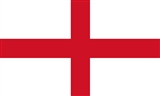
Kingdom of England

Encyclopedia
The Kingdom of England was, from 927 to 1707, a sovereign state
to the northwest of continental Europe
. At its height, the Kingdom of England spanned the southern two-thirds of the island of Great Britain
(including both modern-day England
and Wales
) and several smaller outlying islands; what today comprises the legal jurisdiction of England and Wales
. It had a land border with the Kingdom of Scotland
to the north. At the start of the period its capital and chief royal residence was Winchester
, but Westminster
and Gloucester
were accorded almost equal status, with Westminster gradually gaining preference.
England as a state
began on 12 July 927 AD after a gathering of kings from throughout Britain at Eamont Bridge
, Cumbria, but broadly traces its origins to the Anglo-Saxon settlement of Britain
and the Heptarchy
of petty states that followed and ultimately united. The Norman invasion of Wales
from 1067–1283 (formalised with the Statute of Rhuddlan
in 1284) put Wales in England's control, and Wales came under English law with the Laws in Wales Acts 1535–1542. On 1 May 1707, England was united with the neighbouring Scotland to create the Kingdom of Great Britain
under the terms of the Acts of Union 1707
. Though no longer a sovereign state, modern England continues as one of the countries of the United Kingdom
.
The City of Westminster in London had become the de facto capital by the beginning of the 12th century. London has thus served as the capital of the Kingdom of England, then the Kingdom of Great Britain
(1707–1801) and subsequently as the capital of the United Kingdom of Great Britain & Northern Ireland
.
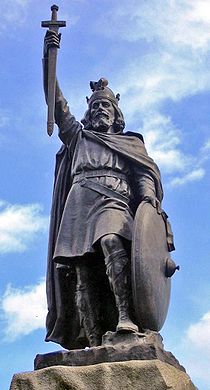 The Kingdom of England has no specific founding date. The Kingdom originated in the kingdoms of the ancestral English, the Anglo-Saxons
, which were carved out of the former Roman
province of Britannia
. The minor kingdoms in time coalesced into the seven famous kingdoms known as the Heptarchy
: East Anglia
, Mercia
, Northumbria
, Kent
, Essex
, Sussex
and Wessex. The Viking
invasions shattered the pattern of the English kingdoms. The English lands were finally unified in the 10th century in a reconquest completed by King Athelstan in AD 927.
The Anglo-Saxons knew themselves as the Angelcynn, Englisc or Engle. These names were originally names from the Engla, or Angles
, but came to be used by Saxons
, Jutes
and Frisii
alike. They called their lands Engla land, meaing "Land of the Angles" (and when unified also Engla rice; "the Kingdom of the English"). In time Englaland became England.
During the Heptarchy, the most powerful King among the Anglo-Saxon kingdoms might become acknowledged as Bretwalda
, a high king
over the other kings. The decline of Mercia allowed Wessex to become more powerful. It absorbed the kingdoms of Kent and Sussex in 825 AD. The Kings of Wessex became increasingly dominant over the other kingdoms of England during the 9th century.
In 827 AD, Northumbria submitted to Egbert of Wessex
at Dore
. It has been claimed that Egbert
thereby became the first king to reign over a united England, however briefly.
In 886, King Alfred
retook London, which he apparently regarded as a turning point in his reign. The Anglo-Saxon Chronicle says that "all of the English people (all Angelcyn) not subject to the Danes submitted themselves to King Alfred." Asser added that "Alfred, king of the Anglo-Saxons, restored the city of London
splendidly ... and made it habitable once more." Alfred's "restoration" entailed reoccupying and refurbishing the nearly deserted Roman walled city, building quays along the Thames, and laying a new city street plan. It is probably at this point that Alfred assumed the new royal style 'King of the Anglo-Saxons.'
During the following years Northumbria repeatedly changed hands between the English kings and the Norwegian invaders, but was definitively brought under English control by King Edred
in 954 AD, completing the unification of England. At about this time, Lothian
, the northern part of Northumbria, was ceded to the Kingdom of Scotland
.
England has remained in political unity ever since. During the reign of Ethelred II
(who reigned 978–1016)—known to posterity as Ethelred the Unready—a new wave of Danish invasions was orchestrated by Sweyn I of Denmark
, culminating after a quarter of a century of warfare in the Danish conquest of England in 1013 AD. But Sweyn died on 2 February 1014 and Ethelred was restored to the throne. In 1015, Sweyn's son King Canute
launched a new invasion. The ensuing war ended with an agreement in 1016 between Canute and Ethelred's successor, Edmund Ironside, to divide England between them, but Edmund's death on 30 November of that year left England united under Danish rule. This continued for 26 years until the death of Harthacanute
in June 1042. He was the son of Canute and Emma of Normandy
(the widow
of Ethelred the Unready), and had no heirs of his own; he was succeeded by his half-brother, Ethelred's son, Edward the Confessor
. The Kingdom of England was once again independent.
, later William the Conqueror, Duke of Normandy
, immediately claimed the throne for himself. William launched an invasion of England and landed in Sussex
on 28 September 1066. Harold and his army were in York
following their victory against the Norwegians at the Battle of Stamford Bridge
(25 September 1066) when the news reached him. He decided to set out without delay and confront the Norman army in Sussex so marched southwards at once, despite the army not being properly rested following the battle with the Norwegians. The armies of Harold and William faced each other at the Battle of Hastings
(14 October 1066), in which the English army, or Fyrd, was defeated, King Harold and his two brothers were slain, and William emerged as victor. William was then able to conquer England with little further opposition. He was not, however, planning to absorb the Kingdom into the Duchy of Normandy
. As a mere Duke, William owed allegiance to Philip I of France
, whereas in the independent Kingdom of England he could rule without interference. He was crowned King of England on 25 December 1066.
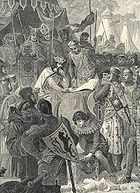 In 1092, King William II, son of William the Conqueror, led an invasion of Strathclyde
, a Celtic kingdom in what is now southwest Scotland and Cumbria. In doing so, he annexed what is now the county of Cumbria
to England; this was the last major expansion by England into what is now considered a part of England. Later, the Laws in Wales Acts 1535–1542 annexed Wales
to England.
In 1124, Henry I
ceded what is now southeast Scotland (called Lothian
) to the Kingdom of Scotland
, in return for the King of Scotland's loyalty. This area of land had been English since its foundation in 927 AD, and before that had been a part of the Anglian Kingdom of Northumbria. Lothian
contained what later became the Scottish capital, Edinburgh
. This arrangement was later finalised in 1237 by the Treaty of York
.
The Kingdom of England and the Duchy of Normandy remained in personal union
until 1204. King John
, a fourth-generation descendant of William, lost the continental possessions of the Duchy to Philip II of France
during that year. A few remnants of Normandy
, including the Channel Islands
, remained in the possession of King John
, together with most of the Duchy of Aquitaine.
conquest of Anglo-Saxon England, Wales had remained for the most part independent of the Anglo-Saxon kingdoms, although some Welsh kings did sometimes acknowledge the Bretwalda
, for example.
However, soon after the Norman conquest of England
, some of the Norman lords began to attack Wales. They conquered parts of it, which they ruled, acknowledging the overlordship of the Norman kings of England, but with considerable local independence. Over many years these "Marcher Lords
" conquered more and more of Wales, against considerable resistance led by various Welsh princes, who also often acknowledged the overlordship of the Norman kings of England.
King John's
grandson Edward I of England
defeated Llywelyn the Last
, and so effectively conquered Wales, in 1282. He created the title Prince of Wales
for his eldest son Edward II
in 1301. Edward's conquest was brutal and the subsequent repression considerable, as the magnificent Welsh castle
s such as Conwy
, Harlech
and Caernarfon
attest; but this event re-united under a single ruler the lands of Roman Britain
for the first time since the establishment of the kingdom of the Jutes
in Kent
in the 5th century AD, some 700 years before.
Accordingly, this was a highly significant moment in the history of medieval England, as it re-established links with the pre-Saxon past. These links were exploited for political purposes to unite the peoples of the kingdom, including the Anglo-Normans, by popularising Welsh legends
.
The Welsh language
—derived from the British language, with significant Latin
influences—continued to be spoken by the majority of the population of Wales for at least another 500 years, and is still today a majority language in parts of the country.
, son of Edward II, was the first English king to have a claim to the throne of France
. Edward III pursued this claim, which resulted in the Hundred Years' War
(1337–1453). The war pitted five Kings of England of the House of Plantagenet against five Kings of France of the Capetian House of Valois. Though the English had numerous celebrated victories, they were unable to overcome the numerical superiority of the French. England was defeated, retaining only a single town in France, Calais
.
 During the Hundred Years War an English identity began to develop in place of the previous division between the Norman Lords and their Anglo-Saxon
subjects, in consequence of sustained hostility to the increasingly nationalist French, whose kings and other leaders (notably the charisma
tic Joan of Arc
) used a developing sense of French identity to help draw people to their cause. The Anglo-Norman
s became separate from their cousins, who held lands mainly in France, who mocked the former for their archaic
and bastardised spoken French. English
also became the language of the law courts during this period.
The Kingdom had little time to recover before entering the Wars of the Roses
(1455–1487), a series of civil wars over possession of the throne between the House of Lancaster
(whose heraldic symbol was the red rose) and the House of York
(whose symbol was the white rose), each led by different branches of the descendants of Edward III. The end of these wars found the throne held by the descendant of an initially illegitimate member of the House of Lancaster, married to the eldest daughter of the House of York: Henry VII of England
and his Queen consort
, Elizabeth of York
. They were the founders of the Tudor dynasty
, which ruled the Kingdom from 1485 to 1603.
in the late 13th century. Under the Tudor monarchy, which was of Welsh
origin, Henry VIII of England
—a son of Henry VII—replaced the laws of Wales with those of England (under the Laws in Wales Acts 1535–1542). Wales now ceased to be a personal fiefdom
divided between the Prince of Wales and Earl of March
, and was instead annexed to the Kingdom of England, and henceforth was represented in the Parliament of England
.
During the 1530s, Henry VIII overthrew the power of the Roman Catholic Church within the kingdom, replacing the Pope as head of the English church, and seizing the church's lands, thereby beginning the creation of a new Protestant religion. This had the effect of aligning England with Scotland, which also gradually adopted a Protestant religion, whereas the most important continental powers, France and Spain, remained Roman Catholic.
In 1541, during Henry VIII's reign, the Parliament of Ireland
proclaimed him King of Ireland
, thereby bringing the Kingdom of Ireland
into personal union with the Kingdom of England.
.jpg) During the reign of Mary I of England
During the reign of Mary I of England
, eldest daughter of Henry VIII
, Calais—the last remaining continental possession of the kingdom—was lost: captured by the French, under Francis, Duke of Guise
, on 7 January 1558.
Henry VIII's younger daughter, Elizabeth I of England
, consolidated the new Protestant Church of England. She also began to build up the kingdom's naval strength, on the foundations her father had laid down. In 1588 her new navy was strong enough to defeat the Spanish Armada, which had sought to invade England in order to put a Catholic monarch on the throne in her place.
The House of Tudor ended with the death of Elizabeth I on 24 March 1603. James VI
, King of Scots (a descendant of Margaret Tudor
, Henry VIII's sister), from Scotland's House of Stuart
, ascended the throne of England, becoming King James I of England. He was a Protestant. Despite the Union of the Crowns
, the Kingdom of England and the Kingdom of Scotland
remained separate and independent states under this personal union
: a state of affairs which lasted for more than a century.
The Stuart kings, however, over-estimated the power of the English monarchy, and were cast down by Parliament in 1645 and 1688. In the first instance, Charles I
's introduction of new forms of taxation, in defiance of Parliament, led to the English Civil War
(1641–45), in which the king was defeated, and to the consequent abolition of the monarchy under Oliver Cromwell
, during the interregnum
of 1649–1660. Henceforth, the monarch could reign only at the will of Parliament.
Following the Restoration
of the monarchy in 1660, an attempt by James II
(a son of Charles I) to reintroduce Roman Catholicism—a century after its suppression by the Tudors—led to the Glorious Revolution
of 1688, in which he was deposed by Parliament. The Crown was then offered by Parliament to James II's daughter and son-in-law/nephew, Protestant princes of Orange, William III
and Mary II
.
In 1707, Acts of Union
were passed by both the Parliament of Scotland
and the Parliament of England, to ratify the 1706 Treaty of Union
, and bring into being the new Kingdom of Great Britain
. Queen Anne
, the last monarch of the House of Stuart, became the first monarch of the new kingdom. The English and Scottish Parliaments were merged into the Parliament of Great Britain
, located in Westminster
, London. At this point England ceased to exist as a separate political entity, and since then has had no national government
. The laws of England were unaffected, with the legal jurisdiction continuing to be that of England and Wales
, while Scotland
continued to have its own laws and law courts. This continued after the Act of Union
of 1800 between the Kingdom of Great Britain and the Kingdom of Ireland, which created the United Kingdom of Great Britain and Ireland
(which would later become the United Kingdom of Great Britain and Northern Ireland).
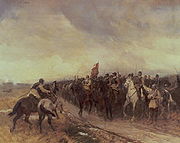 England was a monarchy for the entirety of its political existence, from its creation around 927 AD up until the 1707 Acts of Union
, except for the eleven years of the English Interregnum
(1649 to 1660) which followed the English Civil War
.
The rule of the executed King Charles I
was replaced by that of a republic known as the Commonwealth of England
(1649–1653). The most prominent General of the republic's New Model Army, Oliver Cromwell
, managed to extend its rule to Ireland
and Scotland.
The victorious Cromwell eventually turned against the republic, and established a new form of government known as The Protectorate
, with himself as Lord Protector
until his death on 3 September 1658. He was succeeded by his son Richard Cromwell
. However, anarchy eventually developed, as Richard proved unable to maintain his rule. He resigned his title and retired into obscurity.
The Commonwealth was then re-established, but proved to be unstable, so the exiled claimant, Charles II
, was recalled to the throne by Parliament in 1660 in the English Restoration
.
in 1702 had led to the succession of Queen Anne
to the crowns of England and Scotland, but her only surviving child had died in 1700, and the English Act of Settlement 1701
had given the Succession to the English crown to the Protestant House of Hanover
. Securing the same succession in Scotland became the primary object of English strategic thinking towards Scotland. By 1704, the Union of the Crowns
was in crisis, with the Scottish Act of Security
allowing for the Scottish Parliament to choose a different monarch, which could in turn lead to an independent foreign policy during a major European war. The English establishment did not wish to risk a Stuart
on the Scottish throne, nor the possibility of a Scottish military alliance with another power.
A Treaty of Union
was agreed on 22 July 1706, and following the Acts of Union
of 1707, which created the Kingdom of Great Britain
, the independence of the Kingdoms of England and Scotland came to an end on 1 May 1707. The Acts of Union also created a customs union
and monetary union and provided that any "laws and statutes" that were "contrary to or inconsistent with the terms" of the Acts would "cease and become void."
Anne was succeeded by her second cousin George I
of the House of Hanover
, who was a descendant of the Stuarts through his maternal grandmother, Elizabeth
, daughter of James I and VI
.
Sovereign state
A sovereign state, or simply, state, is a state with a defined territory on which it exercises internal and external sovereignty, a permanent population, a government, and the capacity to enter into relations with other sovereign states. It is also normally understood to be a state which is neither...
to the northwest of continental Europe
Continental Europe
Continental Europe, also referred to as mainland Europe or simply the Continent, is the continent of Europe, explicitly excluding European islands....
. At its height, the Kingdom of England spanned the southern two-thirds of the island of Great Britain
Great Britain
Great Britain or Britain is an island situated to the northwest of Continental Europe. It is the ninth largest island in the world, and the largest European island, as well as the largest of the British Isles...
(including both modern-day England
England
England is a country that is part of the United Kingdom. It shares land borders with Scotland to the north and Wales to the west; the Irish Sea is to the north west, the Celtic Sea to the south west, with the North Sea to the east and the English Channel to the south separating it from continental...
and Wales
Wales
Wales is a country that is part of the United Kingdom and the island of Great Britain, bordered by England to its east and the Atlantic Ocean and Irish Sea to its west. It has a population of three million, and a total area of 20,779 km²...
) and several smaller outlying islands; what today comprises the legal jurisdiction of England and Wales
England and Wales
England and Wales is a jurisdiction within the United Kingdom. It consists of England and Wales, two of the four countries of the United Kingdom...
. It had a land border with the Kingdom of Scotland
Kingdom of Scotland
The Kingdom of Scotland was a Sovereign state in North-West Europe that existed from 843 until 1707. It occupied the northern third of the island of Great Britain and shared a land border to the south with the Kingdom of England...
to the north. At the start of the period its capital and chief royal residence was Winchester
Winchester
Winchester is a historic cathedral city and former capital city of England. It is the county town of Hampshire, in South East England. The city lies at the heart of the wider City of Winchester, a local government district, and is located at the western end of the South Downs, along the course of...
, but Westminster
Westminster
Westminster is an area of central London, within the City of Westminster, England. It lies on the north bank of the River Thames, southwest of the City of London and southwest of Charing Cross...
and Gloucester
Gloucester
Gloucester is a city, district and county town of Gloucestershire in the South West region of England. Gloucester lies close to the Welsh border, and on the River Severn, approximately north-east of Bristol, and south-southwest of Birmingham....
were accorded almost equal status, with Westminster gradually gaining preference.
England as a state
Sovereign state
A sovereign state, or simply, state, is a state with a defined territory on which it exercises internal and external sovereignty, a permanent population, a government, and the capacity to enter into relations with other sovereign states. It is also normally understood to be a state which is neither...
began on 12 July 927 AD after a gathering of kings from throughout Britain at Eamont Bridge
Eamont Bridge
Eamont Bridge is a small village immediately to the south of Penrith, Cumbria.The village is named after the River Eamont and straddles the boundary between the ancient counties of Cumberland and Westmorland...
, Cumbria, but broadly traces its origins to the Anglo-Saxon settlement of Britain
Anglo-Saxon settlement of Britain
The Anglo-Saxon settlement of Britain was the invasion and migration of Germanic peoples from continental Europe to Great Britain during the Early Middle Ages, specifically the arrival of the Anglo-Saxons in Britain after the demise of Roman rule in the 5th century.The stimulus, progression and...
and the Heptarchy
Heptarchy
The Heptarchy is a collective name applied to the Anglo-Saxon kingdoms of south, east, and central Great Britain during late antiquity and the early Middle Ages, conventionally identified as seven: Northumbria, Mercia, East Anglia, Essex, Kent, Sussex and Wessex...
of petty states that followed and ultimately united. The Norman invasion of Wales
Norman invasion of Wales
The Norman invasion of Wales began shortly after the Norman conquest of England under William the Conqueror, who believed England to be his birthright...
from 1067–1283 (formalised with the Statute of Rhuddlan
Statute of Rhuddlan
The Statute of Rhuddlan , also known as the Statutes of Wales or as the Statute of Wales provided the constitutional basis for the government of the Principality of North Wales from 1284 until 1536...
in 1284) put Wales in England's control, and Wales came under English law with the Laws in Wales Acts 1535–1542. On 1 May 1707, England was united with the neighbouring Scotland to create the Kingdom of Great Britain
Kingdom of Great Britain
The former Kingdom of Great Britain, sometimes described as the 'United Kingdom of Great Britain', That the Two Kingdoms of Scotland and England, shall upon the 1st May next ensuing the date hereof, and forever after, be United into One Kingdom by the Name of GREAT BRITAIN. was a sovereign...
under the terms of the Acts of Union 1707
Acts of Union 1707
The Acts of Union were two Parliamentary Acts - the Union with Scotland Act passed in 1706 by the Parliament of England, and the Union with England Act passed in 1707 by the Parliament of Scotland - which put into effect the terms of the Treaty of Union that had been agreed on 22 July 1706,...
. Though no longer a sovereign state, modern England continues as one of the countries of the United Kingdom
Countries of the United Kingdom
Countries of the United Kingdom is a term used to describe England, Northern Ireland, Scotland and Wales. These four countries together form the sovereign state of the United Kingdom of Great Britain and Northern Ireland, which is also described as a country. The alternative terms, constituent...
.
The City of Westminster in London had become the de facto capital by the beginning of the 12th century. London has thus served as the capital of the Kingdom of England, then the Kingdom of Great Britain
Kingdom of Great Britain
The former Kingdom of Great Britain, sometimes described as the 'United Kingdom of Great Britain', That the Two Kingdoms of Scotland and England, shall upon the 1st May next ensuing the date hereof, and forever after, be United into One Kingdom by the Name of GREAT BRITAIN. was a sovereign...
(1707–1801) and subsequently as the capital of the United Kingdom of Great Britain & Northern Ireland
United Kingdom
The United Kingdom of Great Britain and Northern IrelandIn the United Kingdom and Dependencies, other languages have been officially recognised as legitimate autochthonous languages under the European Charter for Regional or Minority Languages...
.
History
Anglo-Saxons
Anglo-Saxon is a term used by historians to designate the Germanic tribes who invaded and settled the south and east of Great Britain beginning in the early 5th century AD, and the period from their creation of the English nation to the Norman conquest. The Anglo-Saxon Era denotes the period of...
, which were carved out of the former Roman
Roman Britain
Roman Britain was the part of the island of Great Britain controlled by the Roman Empire from AD 43 until ca. AD 410.The Romans referred to the imperial province as Britannia, which eventually comprised all of the island of Great Britain south of the fluid frontier with Caledonia...
province of Britannia
Britannia
Britannia is an ancient term for Great Britain, and also a female personification of the island. The name is Latin, and derives from the Greek form Prettanike or Brettaniai, which originally designated a collection of islands with individual names, including Albion or Great Britain. However, by the...
. The minor kingdoms in time coalesced into the seven famous kingdoms known as the Heptarchy
Heptarchy
The Heptarchy is a collective name applied to the Anglo-Saxon kingdoms of south, east, and central Great Britain during late antiquity and the early Middle Ages, conventionally identified as seven: Northumbria, Mercia, East Anglia, Essex, Kent, Sussex and Wessex...
: East Anglia
East Anglia
East Anglia is a traditional name for a region of eastern England, named after an ancient Anglo-Saxon kingdom, the Kingdom of the East Angles. The Angles took their name from their homeland Angeln, in northern Germany. East Anglia initially consisted of Norfolk and Suffolk, but upon the marriage of...
, Mercia
Mercia
Mercia was one of the kingdoms of the Anglo-Saxon Heptarchy. It was centred on the valley of the River Trent and its tributaries in the region now known as the English Midlands...
, Northumbria
Northumbria
Northumbria was a medieval kingdom of the Angles, in what is now Northern England and South-East Scotland, becoming subsequently an earldom in a united Anglo-Saxon kingdom of England. The name reflects the approximate southern limit to the kingdom's territory, the Humber Estuary.Northumbria was...
, Kent
Kingdom of Kent
The Kingdom of Kent was a Jutish colony and later independent kingdom in what is now south east England. It was founded at an unknown date in the 5th century by Jutes, members of a Germanic people from continental Europe, some of whom settled in Britain after the withdrawal of the Romans...
, Essex
Kingdom of Essex
The Kingdom of Essex or Kingdom of the East Saxons was one of the seven traditional kingdoms of the so-called Anglo-Saxon Heptarchy. It was founded in the 6th century and covered the territory later occupied by the counties of Essex, Hertfordshire, Middlesex and Kent. Kings of Essex were...
, Sussex
Kingdom of Sussex
The Kingdom of Sussex or Kingdom of the South Saxons was a Saxon colony and later independent kingdom of the Saxons, on the south coast of England. Its boundaries coincided in general with those of the earlier kingdom of the Regnenses and the later county of Sussex. A large part of its territory...
and Wessex. The Viking
Viking
The term Viking is customarily used to refer to the Norse explorers, warriors, merchants, and pirates who raided, traded, explored and settled in wide areas of Europe, Asia and the North Atlantic islands from the late 8th to the mid-11th century.These Norsemen used their famed longships to...
invasions shattered the pattern of the English kingdoms. The English lands were finally unified in the 10th century in a reconquest completed by King Athelstan in AD 927.
The Anglo-Saxons knew themselves as the Angelcynn, Englisc or Engle. These names were originally names from the Engla, or Angles
Angles
The Angles is a modern English term for a Germanic people who took their name from the ancestral cultural region of Angeln, a district located in Schleswig-Holstein, Germany...
, but came to be used by Saxons
Saxons
The Saxons were a confederation of Germanic tribes originating on the North German plain. The Saxons earliest known area of settlement is Northern Albingia, an area approximately that of modern Holstein...
, Jutes
Jutes
The Jutes, Iuti, or Iutæ were a Germanic people who, according to Bede, were one of the three most powerful Germanic peoples of their time, the other two being the Saxons and the Angles...
and Frisii
Frisii
The Frisii were an ancient Germanic tribe living in the low-lying region between the Zuiderzee and the River Ems. In the Germanic pre-Migration Period the Frisii and the related Chauci, Saxons, and Angles inhabited the Continental European coast from the Zuyder Zee to south Jutland...
alike. They called their lands Engla land, meaing "Land of the Angles" (and when unified also Engla rice; "the Kingdom of the English"). In time Englaland became England.
During the Heptarchy, the most powerful King among the Anglo-Saxon kingdoms might become acknowledged as Bretwalda
Bretwalda
Bretwalda is an Old English word, the first record of which comes from the late 9th century Anglo-Saxon Chronicle. It is given to some of the rulers of Anglo-Saxon kingdoms from the 5th century onwards who had achieved overlordship of some or all of the other Anglo-Saxon kingdoms...
, a high king
High king
A high king is a king who holds a position of seniority over a group of other kings, without the title of Emperor; compare King of Kings.Rulers who have been termed "high king" include:...
over the other kings. The decline of Mercia allowed Wessex to become more powerful. It absorbed the kingdoms of Kent and Sussex in 825 AD. The Kings of Wessex became increasingly dominant over the other kingdoms of England during the 9th century.
In 827 AD, Northumbria submitted to Egbert of Wessex
Egbert of Wessex
Egbert was King of Wessex from 802 until his death in 839. His father was Ealhmund of Kent...
at Dore
Dore
Dore is a village in South Yorkshire, England. The village lies on a hill above the River Sheaf, and until 1934 was part of Derbyshire, but it is now a suburb of Sheffield. It is served by Dore and Totley railway station on the Hope Valley Line...
. It has been claimed that Egbert
Egbert of Wessex
Egbert was King of Wessex from 802 until his death in 839. His father was Ealhmund of Kent...
thereby became the first king to reign over a united England, however briefly.
In 886, King Alfred
Alfred the Great
Alfred the Great was King of Wessex from 871 to 899.Alfred is noted for his defence of the Anglo-Saxon kingdoms of southern England against the Vikings, becoming the only English monarch still to be accorded the epithet "the Great". Alfred was the first King of the West Saxons to style himself...
retook London, which he apparently regarded as a turning point in his reign. The Anglo-Saxon Chronicle says that "all of the English people (all Angelcyn) not subject to the Danes submitted themselves to King Alfred." Asser added that "Alfred, king of the Anglo-Saxons, restored the city of London
City of London
The City of London is a small area within Greater London, England. It is the historic core of London around which the modern conurbation grew and has held city status since time immemorial. The City’s boundaries have remained almost unchanged since the Middle Ages, and it is now only a tiny part of...
splendidly ... and made it habitable once more." Alfred's "restoration" entailed reoccupying and refurbishing the nearly deserted Roman walled city, building quays along the Thames, and laying a new city street plan. It is probably at this point that Alfred assumed the new royal style 'King of the Anglo-Saxons.'
During the following years Northumbria repeatedly changed hands between the English kings and the Norwegian invaders, but was definitively brought under English control by King Edred
Edred of England
Eadred was the king of England from 946 until his death in 955, in succession to his elder brother Edmund I.-Background and succession:...
in 954 AD, completing the unification of England. At about this time, Lothian
Lothian
Lothian forms a traditional region of Scotland, lying between the southern shore of the Firth of Forth and the Lammermuir Hills....
, the northern part of Northumbria, was ceded to the Kingdom of Scotland
Kingdom of Scotland
The Kingdom of Scotland was a Sovereign state in North-West Europe that existed from 843 until 1707. It occupied the northern third of the island of Great Britain and shared a land border to the south with the Kingdom of England...
.
England has remained in political unity ever since. During the reign of Ethelred II
Ethelred the Unready
Æthelred the Unready, or Æthelred II , was king of England . He was son of King Edgar and Queen Ælfthryth. Æthelred was only about 10 when his half-brother Edward was murdered...
(who reigned 978–1016)—known to posterity as Ethelred the Unready—a new wave of Danish invasions was orchestrated by Sweyn I of Denmark
Sweyn I of Denmark
Sweyn I Forkbeard was king of Denmark and England, as well as parts of Norway. His name appears as Swegen in the Anglo-Saxon Chronicle and he is also known in English as Svein, Swein, Sven the Dane, and Tuck.He was a Viking leader and the father of Cnut the Great...
, culminating after a quarter of a century of warfare in the Danish conquest of England in 1013 AD. But Sweyn died on 2 February 1014 and Ethelred was restored to the throne. In 1015, Sweyn's son King Canute
Canute the Great
Cnut the Great , also known as Canute, was a king of Denmark, England, Norway and parts of Sweden. Though after the death of his heirs within a decade of his own and the Norman conquest of England in 1066, his legacy was largely lost to history, historian Norman F...
launched a new invasion. The ensuing war ended with an agreement in 1016 between Canute and Ethelred's successor, Edmund Ironside, to divide England between them, but Edmund's death on 30 November of that year left England united under Danish rule. This continued for 26 years until the death of Harthacanute
Harthacanute
Harthacnut was King of Denmark from 1035 to 1042 and King of England from 1040 to 1042.He was the son of King Cnut the Great, who ruled Denmark, Norway, and England, and Emma of Normandy. When Cnut died in 1035, Harthacnut struggled to retain his father's possessions...
in June 1042. He was the son of Canute and Emma of Normandy
Emma of Normandy
Emma , was a daughter of Richard the Fearless, Duke of Normandy, by his second wife Gunnora. She was Queen consort of England twice, by successive marriages: first as second wife to Æthelred the Unready of England ; and then second wife to Cnut the Great of Denmark...
(the widow
Widow
A widow is a woman whose spouse has died, while a widower is a man whose spouse has died. The state of having lost one's spouse to death is termed widowhood or occasionally viduity. The adjective form is widowed...
of Ethelred the Unready), and had no heirs of his own; he was succeeded by his half-brother, Ethelred's son, Edward the Confessor
Edward the Confessor
Edward the Confessor also known as St. Edward the Confessor , son of Æthelred the Unready and Emma of Normandy, was one of the last Anglo-Saxon kings of England and is usually regarded as the last king of the House of Wessex, ruling from 1042 to 1066....
. The Kingdom of England was once again independent.
Norman conquest
The peace lasted only until the death of the childless Edward in January 1066. King Edward's brother-in-law was crowned King Harold; but Edward's cousin William the BastardWilliam I of England
William I , also known as William the Conqueror , was the first Norman King of England from Christmas 1066 until his death. He was also Duke of Normandy from 3 July 1035 until his death, under the name William II...
, later William the Conqueror, Duke of Normandy
Duke of Normandy
The Duke of Normandy is the title of the reigning monarch of the British Crown Dependancies of the Bailiwick of Guernsey and the Bailiwick of Jersey. The title traces its roots to the Duchy of Normandy . Whether the reigning sovereign is a male or female, they are always titled as the "Duke of...
, immediately claimed the throne for himself. William launched an invasion of England and landed in Sussex
Sussex
Sussex , from the Old English Sūþsēaxe , is an historic county in South East England corresponding roughly in area to the ancient Kingdom of Sussex. It is bounded on the north by Surrey, east by Kent, south by the English Channel, and west by Hampshire, and is divided for local government into West...
on 28 September 1066. Harold and his army were in York
York
York is a walled city, situated at the confluence of the Rivers Ouse and Foss in North Yorkshire, England. The city has a rich heritage and has provided the backdrop to major political events throughout much of its two millennia of existence...
following their victory against the Norwegians at the Battle of Stamford Bridge
Battle of Stamford Bridge
The Battle of Stamford Bridge took place at the village of Stamford Bridge, East Riding of Yorkshire in England on 25 September 1066, between an English army under King Harold Godwinson and an invading Norwegian force led by King Harald Hardrada of Norway and the English king's brother Tostig...
(25 September 1066) when the news reached him. He decided to set out without delay and confront the Norman army in Sussex so marched southwards at once, despite the army not being properly rested following the battle with the Norwegians. The armies of Harold and William faced each other at the Battle of Hastings
Battle of Hastings
The Battle of Hastings occurred on 14 October 1066 during the Norman conquest of England, between the Norman-French army of Duke William II of Normandy and the English army under King Harold II...
(14 October 1066), in which the English army, or Fyrd, was defeated, King Harold and his two brothers were slain, and William emerged as victor. William was then able to conquer England with little further opposition. He was not, however, planning to absorb the Kingdom into the Duchy of Normandy
Duchy of Normandy
The Duchy of Normandy stems from various Danish, Norwegian, Hiberno-Norse, Orkney Viking and Anglo-Danish invasions of France in the 9th century...
. As a mere Duke, William owed allegiance to Philip I of France
Philip I of France
Philip I , called the Amorous, was King of France from 1060 to his death. His reign, like that of most of the early Direct Capetians, was extraordinarily long for the time...
, whereas in the independent Kingdom of England he could rule without interference. He was crowned King of England on 25 December 1066.
Strathclyde
right|thumb|the former Strathclyde regionStrathclyde was one of nine former local government regions of Scotland created by the Local Government Act 1973 and abolished in 1996 by the Local Government etc Act 1994...
, a Celtic kingdom in what is now southwest Scotland and Cumbria. In doing so, he annexed what is now the county of Cumbria
Cumbria
Cumbria , is a non-metropolitan county in North West England. The county and Cumbria County Council, its local authority, came into existence in 1974 after the passage of the Local Government Act 1972. Cumbria's largest settlement and county town is Carlisle. It consists of six districts, and in...
to England; this was the last major expansion by England into what is now considered a part of England. Later, the Laws in Wales Acts 1535–1542 annexed Wales
Wales
Wales is a country that is part of the United Kingdom and the island of Great Britain, bordered by England to its east and the Atlantic Ocean and Irish Sea to its west. It has a population of three million, and a total area of 20,779 km²...
to England.
In 1124, Henry I
Henry I
Henry I may refer to:* Henry I the Fowler, King of Germany * Henry I, Duke of Bavaria * Henry I of Austria, Margrave of Austria * Henry I of France * Henry I, Margrave of the Saxon Ostmark...
ceded what is now southeast Scotland (called Lothian
Lothian
Lothian forms a traditional region of Scotland, lying between the southern shore of the Firth of Forth and the Lammermuir Hills....
) to the Kingdom of Scotland
Kingdom of Scotland
The Kingdom of Scotland was a Sovereign state in North-West Europe that existed from 843 until 1707. It occupied the northern third of the island of Great Britain and shared a land border to the south with the Kingdom of England...
, in return for the King of Scotland's loyalty. This area of land had been English since its foundation in 927 AD, and before that had been a part of the Anglian Kingdom of Northumbria. Lothian
Lothian
Lothian forms a traditional region of Scotland, lying between the southern shore of the Firth of Forth and the Lammermuir Hills....
contained what later became the Scottish capital, Edinburgh
Edinburgh
Edinburgh is the capital city of Scotland, the second largest city in Scotland, and the eighth most populous in the United Kingdom. The City of Edinburgh Council governs one of Scotland's 32 local government council areas. The council area includes urban Edinburgh and a rural area...
. This arrangement was later finalised in 1237 by the Treaty of York
Treaty of York
The Treaty of York was an agreement between Henry III of England and Alexander II of Scotland, signed at York on 25 September 1237. It detailed the future status of several feudal properties and addressed other issues between the two kings, and indirectly marked the end of Scotland's attempts to...
.
The Kingdom of England and the Duchy of Normandy remained in personal union
Personal union
A personal union is the combination by which two or more different states have the same monarch while their boundaries, their laws and their interests remain distinct. It should not be confused with a federation which is internationally considered a single state...
until 1204. King John
John of England
John , also known as John Lackland , was King of England from 6 April 1199 until his death...
, a fourth-generation descendant of William, lost the continental possessions of the Duchy to Philip II of France
Philip II of France
Philip II Augustus was the King of France from 1180 until his death. A member of the House of Capet, Philip Augustus was born at Gonesse in the Val-d'Oise, the son of Louis VII and his third wife, Adela of Champagne...
during that year. A few remnants of Normandy
Duchy of Normandy
The Duchy of Normandy stems from various Danish, Norwegian, Hiberno-Norse, Orkney Viking and Anglo-Danish invasions of France in the 9th century...
, including the Channel Islands
Channel Islands
The Channel Islands are an archipelago of British Crown Dependencies in the English Channel, off the French coast of Normandy. They include two separate bailiwicks: the Bailiwick of Guernsey and the Bailiwick of Jersey...
, remained in the possession of King John
John of England
John , also known as John Lackland , was King of England from 6 April 1199 until his death...
, together with most of the Duchy of Aquitaine.
Norman conquest of Wales
Up to the time of the NormanNormans
The Normans were the people who gave their name to Normandy, a region in northern France. They were descended from Norse Viking conquerors of the territory and the native population of Frankish and Gallo-Roman stock...
conquest of Anglo-Saxon England, Wales had remained for the most part independent of the Anglo-Saxon kingdoms, although some Welsh kings did sometimes acknowledge the Bretwalda
Bretwalda
Bretwalda is an Old English word, the first record of which comes from the late 9th century Anglo-Saxon Chronicle. It is given to some of the rulers of Anglo-Saxon kingdoms from the 5th century onwards who had achieved overlordship of some or all of the other Anglo-Saxon kingdoms...
, for example.
However, soon after the Norman conquest of England
Norman conquest of England
The Norman conquest of England began on 28 September 1066 with the invasion of England by William, Duke of Normandy. William became known as William the Conqueror after his victory at the Battle of Hastings on 14 October 1066, defeating King Harold II of England...
, some of the Norman lords began to attack Wales. They conquered parts of it, which they ruled, acknowledging the overlordship of the Norman kings of England, but with considerable local independence. Over many years these "Marcher Lords
Marcher Lords
A Marcher Lord was a strong and trusted noble appointed by the King of England to guard the border between England and Wales.A Marcher Lord is the English equivalent of a margrave...
" conquered more and more of Wales, against considerable resistance led by various Welsh princes, who also often acknowledged the overlordship of the Norman kings of England.
King John's
John of England
John , also known as John Lackland , was King of England from 6 April 1199 until his death...
grandson Edward I of England
Edward I of England
Edward I , also known as Edward Longshanks and the Hammer of the Scots, was King of England from 1272 to 1307. The first son of Henry III, Edward was involved early in the political intrigues of his father's reign, which included an outright rebellion by the English barons...
defeated Llywelyn the Last
Llywelyn the Last
Llywelyn ap Gruffydd or Llywelyn Ein Llyw Olaf , sometimes rendered as Llywelyn II, was the last prince of an independent Wales before its conquest by Edward I of England....
, and so effectively conquered Wales, in 1282. He created the title Prince of Wales
Prince of Wales
Prince of Wales is a title traditionally granted to the heir apparent to the reigning monarch of the United Kingdom of Great Britain and Northern Ireland and the 15 other independent Commonwealth realms...
for his eldest son Edward II
Edward II of England
Edward II , called Edward of Caernarfon, was King of England from 1307 until he was deposed by his wife Isabella in January 1327. He was the sixth Plantagenet king, in a line that began with the reign of Henry II...
in 1301. Edward's conquest was brutal and the subsequent repression considerable, as the magnificent Welsh castle
Castle
A castle is a type of fortified structure built in Europe and the Middle East during the Middle Ages by European nobility. Scholars debate the scope of the word castle, but usually consider it to be the private fortified residence of a lord or noble...
s such as Conwy
Conwy Castle
Conwy Castle is a castle in Conwy, on the north coast of Wales.It was built between 1283 and 1289 during King Edward I's second campaign in North Wales....
, Harlech
Harlech Castle
Harlech Castle, located in Harlech, Gwynedd, Wales, is a concentric castle, constructed atop a cliff close to the Irish Sea. Architecturally, it is particularly notable for its massive gatehouse....
and Caernarfon
Caernarfon Castle
Caernarfon Castle is a medieval building in Gwynedd, north-west Wales. There was a motte-and-bailey castle in the town of Caernarfon from the late 11th century until 1283 when King Edward I of England began replacing it with the current stone structure...
attest; but this event re-united under a single ruler the lands of Roman Britain
Roman Britain
Roman Britain was the part of the island of Great Britain controlled by the Roman Empire from AD 43 until ca. AD 410.The Romans referred to the imperial province as Britannia, which eventually comprised all of the island of Great Britain south of the fluid frontier with Caledonia...
for the first time since the establishment of the kingdom of the Jutes
Jutes
The Jutes, Iuti, or Iutæ were a Germanic people who, according to Bede, were one of the three most powerful Germanic peoples of their time, the other two being the Saxons and the Angles...
in Kent
Kingdom of Kent
The Kingdom of Kent was a Jutish colony and later independent kingdom in what is now south east England. It was founded at an unknown date in the 5th century by Jutes, members of a Germanic people from continental Europe, some of whom settled in Britain after the withdrawal of the Romans...
in the 5th century AD, some 700 years before.
Accordingly, this was a highly significant moment in the history of medieval England, as it re-established links with the pre-Saxon past. These links were exploited for political purposes to unite the peoples of the kingdom, including the Anglo-Normans, by popularising Welsh legends
Welsh mythology
Welsh mythology, the remnants of the mythology of the pre-Christian Britons, has come down to us in much altered form in medieval Welsh manuscripts such as the Red Book of Hergest, the White Book of Rhydderch, the Book of Aneirin and the Book of Taliesin....
.
The Welsh language
Welsh language
Welsh is a member of the Brythonic branch of the Celtic languages spoken natively in Wales, by some along the Welsh border in England, and in Y Wladfa...
—derived from the British language, with significant Latin
Latin
Latin is an Italic language originally spoken in Latium and Ancient Rome. It, along with most European languages, is a descendant of the ancient Proto-Indo-European language. Although it is considered a dead language, a number of scholars and members of the Christian clergy speak it fluently, and...
influences—continued to be spoken by the majority of the population of Wales for at least another 500 years, and is still today a majority language in parts of the country.
Loss of the Angevin Empire and the Wars of the Roses
Edward III of EnglandEdward III of England
Edward III was King of England from 1327 until his death and is noted for his military success. Restoring royal authority after the disastrous reign of his father, Edward II, Edward III went on to transform the Kingdom of England into one of the most formidable military powers in Europe...
, son of Edward II, was the first English king to have a claim to the throne of France
English claims to the French throne
The English claims to the French throne have a long and complex history between the 1340s and the 19th century.From 1340 to 1801, with only brief intervals in 1360-1369 and 1420–1422, the kings and queens of England, and after the Acts of Union in 1707 the kings and queens of Great Britain, also...
. Edward III pursued this claim, which resulted in the Hundred Years' War
Hundred Years' War
The Hundred Years' War was a series of separate wars waged from 1337 to 1453 by the House of Valois and the House of Plantagenet, also known as the House of Anjou, for the French throne, which had become vacant upon the extinction of the senior Capetian line of French kings...
(1337–1453). The war pitted five Kings of England of the House of Plantagenet against five Kings of France of the Capetian House of Valois. Though the English had numerous celebrated victories, they were unable to overcome the numerical superiority of the French. England was defeated, retaining only a single town in France, Calais
Calais
Calais is a town in Northern France in the department of Pas-de-Calais, of which it is a sub-prefecture. Although Calais is by far the largest city in Pas-de-Calais, the department's capital is its third-largest city of Arras....
.
Anglo-Saxon
Anglo-Saxon may refer to:* Anglo-Saxons, a group that invaded Britain** Old English, their language** Anglo-Saxon England, their history, one of various ships* White Anglo-Saxon Protestant, an ethnicity* Anglo-Saxon economy, modern macroeconomic term...
subjects, in consequence of sustained hostility to the increasingly nationalist French, whose kings and other leaders (notably the charisma
Charisma
The term charisma has two senses: 1) compelling attractiveness or charm that can inspire devotion in others, 2) a divinely conferred power or talent. For some theological usages the term is rendered charism, with a meaning the same as sense 2...
tic Joan of Arc
Joan of Arc
Saint Joan of Arc, nicknamed "The Maid of Orléans" , is a national heroine of France and a Roman Catholic saint. A peasant girl born in eastern France who claimed divine guidance, she led the French army to several important victories during the Hundred Years' War, which paved the way for the...
) used a developing sense of French identity to help draw people to their cause. The Anglo-Norman
Anglo-Norman
The Anglo-Normans were mainly the descendants of the Normans who ruled England following the Norman conquest by William the Conqueror in 1066. A small number of Normans were already settled in England prior to the conquest...
s became separate from their cousins, who held lands mainly in France, who mocked the former for their archaic
Archaism
In language, an archaism is the use of a form of speech or writing that is no longer current. This can either be done deliberately or as part of a specific jargon or formula...
and bastardised spoken French. English
Middle English
Middle English is the stage in the history of the English language during the High and Late Middle Ages, or roughly during the four centuries between the late 11th and the late 15th century....
also became the language of the law courts during this period.
The Kingdom had little time to recover before entering the Wars of the Roses
Wars of the Roses
The Wars of the Roses were a series of dynastic civil wars for the throne of England fought between supporters of two rival branches of the royal House of Plantagenet: the houses of Lancaster and York...
(1455–1487), a series of civil wars over possession of the throne between the House of Lancaster
House of Lancaster
The House of Lancaster was a branch of the royal House of Plantagenet. It was one of the opposing factions involved in the Wars of the Roses, an intermittent civil war which affected England and Wales during the 15th century...
(whose heraldic symbol was the red rose) and the House of York
House of York
The House of York was a branch of the English royal House of Plantagenet, three members of which became English kings in the late 15th century. The House of York was descended in the paternal line from Edmund of Langley, 1st Duke of York, the fourth surviving son of Edward III, but also represented...
(whose symbol was the white rose), each led by different branches of the descendants of Edward III. The end of these wars found the throne held by the descendant of an initially illegitimate member of the House of Lancaster, married to the eldest daughter of the House of York: Henry VII of England
Henry VII of England
Henry VII was King of England and Lord of Ireland from his seizing the crown on 22 August 1485 until his death on 21 April 1509, as the first monarch of the House of Tudor....
and his Queen consort
Queen consort
A queen consort is the wife of a reigning king. A queen consort usually shares her husband's rank and holds the feminine equivalent of the king's monarchical titles. Historically, queens consort do not share the king regnant's political and military powers. Most queens in history were queens consort...
, Elizabeth of York
Elizabeth of York
Elizabeth of York was Queen consort of England as spouse of King Henry VII from 1486 until 1503, and mother of King Henry VIII of England....
. They were the founders of the Tudor dynasty
Tudor dynasty
The Tudor dynasty or House of Tudor was a European royal house of Welsh origin that ruled the Kingdom of England and its realms, including the Lordship of Ireland, later the Kingdom of Ireland, from 1485 until 1603. Its first monarch was Henry Tudor, a descendant through his mother of a legitimised...
, which ruled the Kingdom from 1485 to 1603.
Tudors and Stuarts
Wales had retained a separate legal and administrative system, which had been established by Edward IEdward I of England
Edward I , also known as Edward Longshanks and the Hammer of the Scots, was King of England from 1272 to 1307. The first son of Henry III, Edward was involved early in the political intrigues of his father's reign, which included an outright rebellion by the English barons...
in the late 13th century. Under the Tudor monarchy, which was of Welsh
Wales
Wales is a country that is part of the United Kingdom and the island of Great Britain, bordered by England to its east and the Atlantic Ocean and Irish Sea to its west. It has a population of three million, and a total area of 20,779 km²...
origin, Henry VIII of England
Henry VIII of England
Henry VIII was King of England from 21 April 1509 until his death. He was Lord, and later King, of Ireland, as well as continuing the nominal claim by the English monarchs to the Kingdom of France...
—a son of Henry VII—replaced the laws of Wales with those of England (under the Laws in Wales Acts 1535–1542). Wales now ceased to be a personal fiefdom
Fiefdom
A fee was the central element of feudalism and consisted of heritable lands granted under one of several varieties of feudal tenure by an overlord to a vassal who held it in fealty in return for a form of feudal allegiance and service, usually given by the...
divided between the Prince of Wales and Earl of March
Earl of March
The title The Earl of March has been created several times in the Peerage of Scotland and the Peerage of England. The title derived from the "marches" or boundaries between England and either Wales or Scotland , and was held by several great feudal families which owned lands in those border...
, and was instead annexed to the Kingdom of England, and henceforth was represented in the Parliament of England
Parliament of England
The Parliament of England was the legislature of the Kingdom of England. In 1066, William of Normandy introduced a feudal system, by which he sought the advice of a council of tenants-in-chief and ecclesiastics before making laws...
.
During the 1530s, Henry VIII overthrew the power of the Roman Catholic Church within the kingdom, replacing the Pope as head of the English church, and seizing the church's lands, thereby beginning the creation of a new Protestant religion. This had the effect of aligning England with Scotland, which also gradually adopted a Protestant religion, whereas the most important continental powers, France and Spain, remained Roman Catholic.
In 1541, during Henry VIII's reign, the Parliament of Ireland
Parliament of Ireland
The Parliament of Ireland was a legislature that existed in Dublin from 1297 until 1800. In its early mediaeval period during the Lordship of Ireland it consisted of either two or three chambers: the House of Commons, elected by a very restricted suffrage, the House of Lords in which the lords...
proclaimed him King of Ireland
King of Ireland
A monarchical polity has existed in Ireland during three periods of its history, finally ending in 1801. The designation King of Ireland and Queen of Ireland was used during these periods...
, thereby bringing the Kingdom of Ireland
Kingdom of Ireland
The Kingdom of Ireland refers to the country of Ireland in the period between the proclamation of Henry VIII as King of Ireland by the Crown of Ireland Act 1542 and the Act of Union in 1800. It replaced the Lordship of Ireland, which had been created in 1171...
into personal union with the Kingdom of England.
Mary I of England
Mary I was queen regnant of England and Ireland from July 1553 until her death.She was the only surviving child born of the ill-fated marriage of Henry VIII and his first wife Catherine of Aragon. Her younger half-brother, Edward VI, succeeded Henry in 1547...
, eldest daughter of Henry VIII
Henry VIII of England
Henry VIII was King of England from 21 April 1509 until his death. He was Lord, and later King, of Ireland, as well as continuing the nominal claim by the English monarchs to the Kingdom of France...
, Calais—the last remaining continental possession of the kingdom—was lost: captured by the French, under Francis, Duke of Guise
Francis, Duke of Guise
Francis de Lorraine II, Prince of Joinville, Duke of Guise, Duke of Aumale , called Balafré , was a French soldier and politician.-Early life:...
, on 7 January 1558.
Henry VIII's younger daughter, Elizabeth I of England
Elizabeth I of England
Elizabeth I was queen regnant of England and Ireland from 17 November 1558 until her death. Sometimes called The Virgin Queen, Gloriana, or Good Queen Bess, Elizabeth was the fifth and last monarch of the Tudor dynasty...
, consolidated the new Protestant Church of England. She also began to build up the kingdom's naval strength, on the foundations her father had laid down. In 1588 her new navy was strong enough to defeat the Spanish Armada, which had sought to invade England in order to put a Catholic monarch on the throne in her place.
The House of Tudor ended with the death of Elizabeth I on 24 March 1603. James VI
James I of England
James VI and I was King of Scots as James VI from 24 July 1567 and King of England and Ireland as James I from the union of the English and Scottish crowns on 24 March 1603...
, King of Scots (a descendant of Margaret Tudor
Margaret Tudor
Margaret Tudor was the elder of the two surviving daughters of Henry VII of England and Elizabeth of York, and the elder sister of Henry VIII. In 1503, she married James IV, King of Scots. James died in 1513, and their son became King James V. She married secondly Archibald Douglas, 6th Earl of...
, Henry VIII's sister), from Scotland's House of Stuart
House of Stuart
The House of Stuart is a European royal house. Founded by Robert II of Scotland, the Stewarts first became monarchs of the Kingdom of Scotland during the late 14th century, and subsequently held the position of the Kings of Great Britain and Ireland...
, ascended the throne of England, becoming King James I of England. He was a Protestant. Despite the Union of the Crowns
Union of the Crowns
The Union of the Crowns was the accession of James VI, King of Scots, to the throne of England, and the consequential unification of Scotland and England under one monarch. The Union of Crowns followed the death of James' unmarried and childless first cousin twice removed, Queen Elizabeth I of...
, the Kingdom of England and the Kingdom of Scotland
Kingdom of Scotland
The Kingdom of Scotland was a Sovereign state in North-West Europe that existed from 843 until 1707. It occupied the northern third of the island of Great Britain and shared a land border to the south with the Kingdom of England...
remained separate and independent states under this personal union
Personal union
A personal union is the combination by which two or more different states have the same monarch while their boundaries, their laws and their interests remain distinct. It should not be confused with a federation which is internationally considered a single state...
: a state of affairs which lasted for more than a century.
The Stuart kings, however, over-estimated the power of the English monarchy, and were cast down by Parliament in 1645 and 1688. In the first instance, Charles I
Charles I of England
Charles I was King of England, King of Scotland, and King of Ireland from 27 March 1625 until his execution in 1649. Charles engaged in a struggle for power with the Parliament of England, attempting to obtain royal revenue whilst Parliament sought to curb his Royal prerogative which Charles...
's introduction of new forms of taxation, in defiance of Parliament, led to the English Civil War
English Civil War
The English Civil War was a series of armed conflicts and political machinations between Parliamentarians and Royalists...
(1641–45), in which the king was defeated, and to the consequent abolition of the monarchy under Oliver Cromwell
Oliver Cromwell
Oliver Cromwell was an English military and political leader who overthrew the English monarchy and temporarily turned England into a republican Commonwealth, and served as Lord Protector of England, Scotland, and Ireland....
, during the interregnum
English Interregnum
The English Interregnum was the period of parliamentary and military rule by the Lord Protector Oliver Cromwell under the Commonwealth of England after the English Civil War...
of 1649–1660. Henceforth, the monarch could reign only at the will of Parliament.
Following the Restoration
English Restoration
The Restoration of the English monarchy began in 1660 when the English, Scottish and Irish monarchies were all restored under Charles II after the Interregnum that followed the Wars of the Three Kingdoms...
of the monarchy in 1660, an attempt by James II
James II of England
James II & VII was King of England and King of Ireland as James II and King of Scotland as James VII, from 6 February 1685. He was the last Catholic monarch to reign over the Kingdoms of England, Scotland, and Ireland...
(a son of Charles I) to reintroduce Roman Catholicism—a century after its suppression by the Tudors—led to the Glorious Revolution
Glorious Revolution
The Glorious Revolution, also called the Revolution of 1688, is the overthrow of King James II of England by a union of English Parliamentarians with the Dutch stadtholder William III of Orange-Nassau...
of 1688, in which he was deposed by Parliament. The Crown was then offered by Parliament to James II's daughter and son-in-law/nephew, Protestant princes of Orange, William III
William III of England
William III & II was a sovereign Prince of Orange of the House of Orange-Nassau by birth. From 1672 he governed as Stadtholder William III of Orange over Holland, Zeeland, Utrecht, Guelders, and Overijssel of the Dutch Republic. From 1689 he reigned as William III over England and Ireland...
and Mary II
Mary II of England
Mary II was joint Sovereign of England, Scotland, and Ireland with her husband and first cousin, William III and II, from 1689 until her death. William and Mary, both Protestants, became king and queen regnant, respectively, following the Glorious Revolution, which resulted in the deposition of...
.
In 1707, Acts of Union
Acts of Union 1707
The Acts of Union were two Parliamentary Acts - the Union with Scotland Act passed in 1706 by the Parliament of England, and the Union with England Act passed in 1707 by the Parliament of Scotland - which put into effect the terms of the Treaty of Union that had been agreed on 22 July 1706,...
were passed by both the Parliament of Scotland
Parliament of Scotland
The Parliament of Scotland, officially the Estates of Parliament, was the legislature of the Kingdom of Scotland. The unicameral parliament of Scotland is first found on record during the early 13th century, with the first meeting for which a primary source survives at...
and the Parliament of England, to ratify the 1706 Treaty of Union
Treaty of Union
The Treaty of Union is the name given to the agreement that led to the creation of the united kingdom of Great Britain, the political union of the Kingdom of England and the Kingdom of Scotland, which took effect on 1 May 1707...
, and bring into being the new Kingdom of Great Britain
Kingdom of Great Britain
The former Kingdom of Great Britain, sometimes described as the 'United Kingdom of Great Britain', That the Two Kingdoms of Scotland and England, shall upon the 1st May next ensuing the date hereof, and forever after, be United into One Kingdom by the Name of GREAT BRITAIN. was a sovereign...
. Queen Anne
Anne of Great Britain
Anne ascended the thrones of England, Scotland and Ireland on 8 March 1702. On 1 May 1707, under the Act of Union, two of her realms, England and Scotland, were united as a single sovereign state, the Kingdom of Great Britain.Anne's Catholic father, James II and VII, was deposed during the...
, the last monarch of the House of Stuart, became the first monarch of the new kingdom. The English and Scottish Parliaments were merged into the Parliament of Great Britain
Parliament of Great Britain
The Parliament of Great Britain was formed in 1707 following the ratification of the Acts of Union by both the Parliament of England and Parliament of Scotland...
, located in Westminster
Palace of Westminster
The Palace of Westminster, also known as the Houses of Parliament or Westminster Palace, is the meeting place of the two houses of the Parliament of the United Kingdom—the House of Lords and the House of Commons...
, London. At this point England ceased to exist as a separate political entity, and since then has had no national government
Government of England
There has not been a government of England since 1707 when the Kingdom of England ceased to exist as a sovereign state, as it merged with the Kingdom of Scotland to form the Kingdom of Great Britain...
. The laws of England were unaffected, with the legal jurisdiction continuing to be that of England and Wales
England and Wales
England and Wales is a jurisdiction within the United Kingdom. It consists of England and Wales, two of the four countries of the United Kingdom...
, while Scotland
Scotland
Scotland is a country that is part of the United Kingdom. Occupying the northern third of the island of Great Britain, it shares a border with England to the south and is bounded by the North Sea to the east, the Atlantic Ocean to the north and west, and the North Channel and Irish Sea to the...
continued to have its own laws and law courts. This continued after the Act of Union
Act of Union 1800
The Acts of Union 1800 describe two complementary Acts, namely:* the Union with Ireland Act 1800 , an Act of the Parliament of Great Britain, and...
of 1800 between the Kingdom of Great Britain and the Kingdom of Ireland, which created the United Kingdom of Great Britain and Ireland
United Kingdom of Great Britain and Ireland
The United Kingdom of Great Britain and Ireland was the formal name of the United Kingdom during the period when what is now the Republic of Ireland formed a part of it....
(which would later become the United Kingdom of Great Britain and Northern Ireland).
Commonwealth and Protectorate
Acts of Union 1707
The Acts of Union were two Parliamentary Acts - the Union with Scotland Act passed in 1706 by the Parliament of England, and the Union with England Act passed in 1707 by the Parliament of Scotland - which put into effect the terms of the Treaty of Union that had been agreed on 22 July 1706,...
, except for the eleven years of the English Interregnum
English Interregnum
The English Interregnum was the period of parliamentary and military rule by the Lord Protector Oliver Cromwell under the Commonwealth of England after the English Civil War...
(1649 to 1660) which followed the English Civil War
English Civil War
The English Civil War was a series of armed conflicts and political machinations between Parliamentarians and Royalists...
.
The rule of the executed King Charles I
Charles I of England
Charles I was King of England, King of Scotland, and King of Ireland from 27 March 1625 until his execution in 1649. Charles engaged in a struggle for power with the Parliament of England, attempting to obtain royal revenue whilst Parliament sought to curb his Royal prerogative which Charles...
was replaced by that of a republic known as the Commonwealth of England
Commonwealth of England
The Commonwealth of England was the republic which ruled first England, and then Ireland and Scotland from 1649 to 1660. Between 1653–1659 it was known as the Commonwealth of England, Scotland and Ireland...
(1649–1653). The most prominent General of the republic's New Model Army, Oliver Cromwell
Oliver Cromwell
Oliver Cromwell was an English military and political leader who overthrew the English monarchy and temporarily turned England into a republican Commonwealth, and served as Lord Protector of England, Scotland, and Ireland....
, managed to extend its rule to Ireland
Cromwellian conquest of Ireland
The Cromwellian conquest of Ireland refers to the conquest of Ireland by the forces of the English Parliament, led by Oliver Cromwell during the Wars of the Three Kingdoms. Cromwell landed in Ireland with his New Model Army on behalf of England's Rump Parliament in 1649...
and Scotland.
The victorious Cromwell eventually turned against the republic, and established a new form of government known as The Protectorate
The Protectorate
In British history, the Protectorate was the period 1653–1659 during which the Commonwealth of England was governed by a Lord Protector.-Background:...
, with himself as Lord Protector
Lord Protector
Lord Protector is a title used in British constitutional law for certain heads of state at different periods of history. It is also a particular title for the British Heads of State in respect to the established church...
until his death on 3 September 1658. He was succeeded by his son Richard Cromwell
Richard Cromwell
At the same time, the officers of the New Model Army became increasingly wary about the government's commitment to the military cause. The fact that Richard Cromwell lacked military credentials grated with men who had fought on the battlefields of the English Civil War to secure their nation's...
. However, anarchy eventually developed, as Richard proved unable to maintain his rule. He resigned his title and retired into obscurity.
The Commonwealth was then re-established, but proved to be unstable, so the exiled claimant, Charles II
Charles II of England
Charles II was monarch of the three kingdoms of England, Scotland, and Ireland.Charles II's father, King Charles I, was executed at Whitehall on 30 January 1649, at the climax of the English Civil War...
, was recalled to the throne by Parliament in 1660 in the English Restoration
English Restoration
The Restoration of the English monarchy began in 1660 when the English, Scottish and Irish monarchies were all restored under Charles II after the Interregnum that followed the Wars of the Three Kingdoms...
.
Union with Scotland
In the Scottish case, the attractions were partly financial and partly to do with removing English trade sanctions put in place through the Alien Act 1705. The English were more anxious about the Royal succession. The death of King William IIIWilliam III of England
William III & II was a sovereign Prince of Orange of the House of Orange-Nassau by birth. From 1672 he governed as Stadtholder William III of Orange over Holland, Zeeland, Utrecht, Guelders, and Overijssel of the Dutch Republic. From 1689 he reigned as William III over England and Ireland...
in 1702 had led to the succession of Queen Anne
Anne of Great Britain
Anne ascended the thrones of England, Scotland and Ireland on 8 March 1702. On 1 May 1707, under the Act of Union, two of her realms, England and Scotland, were united as a single sovereign state, the Kingdom of Great Britain.Anne's Catholic father, James II and VII, was deposed during the...
to the crowns of England and Scotland, but her only surviving child had died in 1700, and the English Act of Settlement 1701
Act of Settlement 1701
The Act of Settlement is an act of the Parliament of England that was passed in 1701 to settle the succession to the English throne on the Electress Sophia of Hanover and her Protestant heirs. The act was later extended to Scotland, as a result of the Treaty of Union , enacted in the Acts of Union...
had given the Succession to the English crown to the Protestant House of Hanover
House of Hanover
The House of Hanover is a deposed German royal dynasty which has ruled the Duchy of Brunswick-Lüneburg , the Kingdom of Hanover, the Kingdom of Great Britain, the Kingdom of Ireland and the United Kingdom of Great Britain and Ireland...
. Securing the same succession in Scotland became the primary object of English strategic thinking towards Scotland. By 1704, the Union of the Crowns
Union of the Crowns
The Union of the Crowns was the accession of James VI, King of Scots, to the throne of England, and the consequential unification of Scotland and England under one monarch. The Union of Crowns followed the death of James' unmarried and childless first cousin twice removed, Queen Elizabeth I of...
was in crisis, with the Scottish Act of Security
Act of Security 1704
The Act of Security 1704 was a response by the Parliament of Scotland to the Parliament of England's Act of Settlement 1701. Queen Anne's last surviving child, William, Duke of Gloucester had died in 1700, and both parliaments needed to find a Protestant successor...
allowing for the Scottish Parliament to choose a different monarch, which could in turn lead to an independent foreign policy during a major European war. The English establishment did not wish to risk a Stuart
House of Stuart
The House of Stuart is a European royal house. Founded by Robert II of Scotland, the Stewarts first became monarchs of the Kingdom of Scotland during the late 14th century, and subsequently held the position of the Kings of Great Britain and Ireland...
on the Scottish throne, nor the possibility of a Scottish military alliance with another power.
A Treaty of Union
Treaty of Union
The Treaty of Union is the name given to the agreement that led to the creation of the united kingdom of Great Britain, the political union of the Kingdom of England and the Kingdom of Scotland, which took effect on 1 May 1707...
was agreed on 22 July 1706, and following the Acts of Union
Acts of Union 1707
The Acts of Union were two Parliamentary Acts - the Union with Scotland Act passed in 1706 by the Parliament of England, and the Union with England Act passed in 1707 by the Parliament of Scotland - which put into effect the terms of the Treaty of Union that had been agreed on 22 July 1706,...
of 1707, which created the Kingdom of Great Britain
Kingdom of Great Britain
The former Kingdom of Great Britain, sometimes described as the 'United Kingdom of Great Britain', That the Two Kingdoms of Scotland and England, shall upon the 1st May next ensuing the date hereof, and forever after, be United into One Kingdom by the Name of GREAT BRITAIN. was a sovereign...
, the independence of the Kingdoms of England and Scotland came to an end on 1 May 1707. The Acts of Union also created a customs union
Customs union
A customs union is a type of trade bloc which is composed of a free trade area with a common external tariff. The participant countries set up common external trade policy, but in some cases they use different import quotas...
and monetary union and provided that any "laws and statutes" that were "contrary to or inconsistent with the terms" of the Acts would "cease and become void."
Anne was succeeded by her second cousin George I
George I of Great Britain
George I was King of Great Britain and Ireland from 1 August 1714 until his death, and ruler of the Duchy and Electorate of Brunswick-Lüneburg in the Holy Roman Empire from 1698....
of the House of Hanover
House of Hanover
The House of Hanover is a deposed German royal dynasty which has ruled the Duchy of Brunswick-Lüneburg , the Kingdom of Hanover, the Kingdom of Great Britain, the Kingdom of Ireland and the United Kingdom of Great Britain and Ireland...
, who was a descendant of the Stuarts through his maternal grandmother, Elizabeth
Elizabeth of Bohemia
Elizabeth of Bohemia was the eldest daughter of King James VI and I, King of Scotland, England, Ireland, and Anne of Denmark. As the wife of Frederick V, Elector Palatine, she was Electress Palatine and briefly Queen of Bohemia...
, daughter of James I and VI
James I of England
James VI and I was King of Scots as James VI from 24 July 1567 and King of England and Ireland as James I from the union of the English and Scottish crowns on 24 March 1603...
.
See also
- List of monarchs of England
- English colonial empireEnglish colonial empireThe English colonial empire consisted of a variety of overseas territories colonized, conquered, or otherwise acquired by the former Kingdom of England between the late 16th and early 18th centuries....
- Royal NavyRoyal NavyThe Royal Navy is the naval warfare service branch of the British Armed Forces. Founded in the 16th century, it is the oldest service branch and is known as the Senior Service...
- Crown Jewels of England
- England and WalesEngland and WalesEngland and Wales is a jurisdiction within the United Kingdom. It consists of England and Wales, two of the four countries of the United Kingdom...
- Kingdom of CornwallKingdom of CornwallThe Kingdom of Cornwall was an independent polity in southwest Britain during the Early Middle Ages, roughly coterminous with the modern English county of Cornwall. During the sub-Roman and early medieval periods Cornwall was evidently part of the kingdom of Dumnonia, which included most of the...
(Kernow) - Etymology of England
- Anglo-Norman languageAnglo-Norman languageAnglo-Norman is the name traditionally given to the kind of Old Norman used in England and to some extent elsewhere in the British Isles during the Anglo-Norman period....