
Encyclopedia
style="margin-left: inherit; font-size: medium;" | Java
| Locality | Sunda Islands |
| Area | 126 700 kmē |
Population –Total –Density | 124 million 981/kmē |
| |
Java is an
island of
Indonesia and the site of its
capital city,
Jakarta. It is the most populous island, and one of the most
densely populated regions in the world. The former site of powerful
Hindu kingdoms and the core of the colonial
Dutch East Indies, Java now plays a dominant role in the economic and political life of Indonesia.
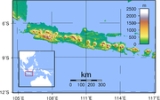
Geography
Java is part of the
Sunda Island Arc, which
includes
Sumatra to the northwest and
Bali to the east.
Borneo lies to the north and
Christmas Island to the south. It is the
world's 13th largest island.
Java is almost entirely of
volcanic origin; it contains no fewer than thirty-eight mountains which have at one time or another been active
volcanoes. The highest volcano in Java is Mount
Semeru . See
Volcanoes of Java.
The island's longest
river is the Bengawan Solo River, at some 600 km in length. The Bengawan Solo rises from its source in central Java at the Tawu volcano, flows north then eastwards to its mouth in the
Java Sea, near the city of
Surabaya.
Demographics
Java contains the capital of
Indonesia,
Jakarta. Popular tourist destinations include the city of Yogyakarta, a massive pyramid-like monument to
Buddha known as
Borobudur, and
Prambanan, the largest
Hindu temple in Java.
Java is by far the most populous island in Indonesia, with approximately 62% of the overall
population of the country. With 130 million inhabitants at 940 people per kmē, it is also the most populous island in the world. If it were a country, it would be the second-most densely-populated country of the world after
Bangladesh, except for some very small city-states. Approximately 45% of the population of Indonesia is ethnically Javanese.
Since the
1970s, the Indonesian government has run transmigration programs aimed at resettling the population of Java on other less-populated islands of Indonesia. This program has met with mixed results, and sometimes caused conflicts between the locals and the recently arrived
settlers.
The island is divided into 4
provinces, 1 special region* , and 1 special capital city district** :
...
country=Indonesia|
...
History
Paleontology
The island of Java is famous for several paleoanthropological finds of early
hominid specimens . In particular, the 1891 discovery of
cranial fossil remains commonly known as "Java man" , is famous for being the first such discovery of an early hominid specimen outside of Europe. This find, and several subsequent ones which have been made at various locations along the river's valleys, are now generally classified as belonging to the species
Homo erectus is an extinct species of genus
Homo [i]. ...
.
Scientists speculate that, two million years ago, the rainfall in the Sunda and Digul plateaus was very heavy, which allowed heavy tropical vegetation to thrive. This, in turn allowed many prehistoric cultures to emerge, as evidenced in many fossil findings in this region.
Hindu and Buddhist kingdoms
Much evidence of Java's past
kingdoms remains; such as the famous
Buddhist Borobudur and
Hindu Prambanan temples. Indeed, the Javanese culture, and language itself, was heavily influenced by the cultures and languages of the
Indian subcontinent. In the sixth and seventh centuries, many maritime kingdoms arose in Sumatra and Java, which controlled the waters in the
Straits of Malacca, and flourished with the increasing sea-trade between
China and
India and beyond. During this time, scholars from India and China visited these kingdoms to translate literary and religious texts.
The most prominent of the Hindu kingdoms was the Majapahit empire based in East Java, from where it held sway over a large part of what is now Indonesia. The name of the Majapahit empire is still invoked by contemporary Indonesian leaders to promote "unity", and the legitimacy of the state. The remnants of the Majapahit's priests, royalties, and artisans, fled to
Bali during the sixteenth century, as
Muslim kingdoms in the coastal part of the island gained influence.
Muslim kingdoms and the Dutch colonization
The earliest
Muslim "
evangelists" were called the Wali Songo, the "nine ambassadors". Several of them were of
Chinese origin, leading to speculation about
Zheng He's influence on the trade in the
Straits of Malacca. Many of their tombs are still well-preserved, and often visited "
Ziarah" for superstitious and religious reasons. Most of the brand of
Islam that is adopted in Java is mixed with long-standing indigenous beliefs, and has a decidedly "local flavor". For example, the legend of Nyi Roro Kidul was invented as a mix of the beliefs common on the southern coast of Java, and Islamic influences.
The
Dutch East India Company established its trading and administrative headquarters in Batavia . This capital, along with other coastal cities such as Semarang and
Surabaya, was the focus of Dutch attention during most of the colonial period. The VOC maintained control over the mountainous interior of the island through indigenous client states, such as
Mataram in central Java.
The nineteenth century saw the Dutch government take over administration of Indonesia from the VOC, and in the mid-nineteenth century, they implemented new policies, usually called the Cultivation System . These policies, intended to increase the profitability of the colony by requiring increased production of cash crops, led to famine and widespread poverty on Java. By the beginning of the twentieth century, protest over the policy's effects, and political changes in the Netherlands and in the Indies led to the Ethical Policy. This policy of increased investment in the colony gave many more Javanese elites access to a Dutch education, both in Java and in the Netherlands itself. It was from this elite that the most prominent
nationalist leaders came. They formed the core of the new government, when Indonesia became a Republic after
World War II.
Republican era
With the establishment of Jakarta as the capital and the Javanese roots of the majority of Indonesian political figures, the island has a dominant role in the political and economic life of the nation. While parts of rural Java are among the poorest in the nation, the urban areas of the island are Indonesia's wealthiest and most urbanized areas. Both presidents
Sukarno and
Suharto , were from Java.
This political dominance has resulted in resentment on the part of some residents of other islands. Indonesian author Pramoedya Ananta Toer once recommended that the Indonesian capital be moved outside the island of Java, in order to free the Indonesian nationalist movement from its Java-centric character.
Culture
Generally speaking, the three major cultures of Java are the
Sundanese culture of
West Java, the
Central Java culture, and the
East Java culture. In the western part of Central Java, usually named the Banyumasan region, a cultural mingling occurred; bringing together
Javanese culture and
Sundanese culture to create the Banyumasan culture.
In the central Javan court cities of Yogyakarta and Surakarta, contemporary kings trace their lineages back to the pre-colonial Islamic kingdoms that ruled the region, making those places especially strong repositories of classical Javanese culture. Classic arts of Java include
gamelan music and
wayang puppet shows.
Java was the site of many influential kingdoms in the Southeast Asian region, and as a result, many literary works have been written by Javanese authors. These include
Ken Arok and Ken Dedes, the story of the orphan who usurped his king, and married the queen of the ancient Javanese kingdom; and translations of
Ramayana and
Mahabarata. Pramoedya Ananta Toer is a famous contemporary Indonesian author, who has written many stories based on his own experiences of having grown up in Java, and takes many elements from Javanese folklore and historical legends.
See also: Culture of IndonesiaLanguage
The three major languages spoken on the island are
Javanese, Sundanese and Madurese. Other languages spoken by smaller groups include Betawi, Banyumasan, Badui, Osing and Tenggerese. The vast majority of the population also speaks Indonesian, generally as a second language.
Religion
Most
Javanese are Muslims, either of the Abangan type or orthodox . Small
Hindu enclaves are scattered through-out Java, but a large
Hindu population prevails along the eastern coast nearest
Bali, especially around the town of Banyuwangi. There are also Christian
Then there are also groups of followers of
Kejawen, or Javanese "mystical" groups who do not fit easily into governmental administrative categories - such as Sumarah, Subud and other groups. During the
Suharto era, it was mandatory to belong to a government-approved religion in order to have an identity card, which itself was also mandatory. Followers of Kejawen had various difficulties because of this issue.
Ethnic groups
See also
- Badui
- Osing
- Sailendra
- Singhasari
- Tenggerese
- May 2006 Java earthquake
- July 2006 Java earthquake
References
External links
- , by Augusta De Wit, 1905. '