
All Topics  
Plato

 
Plato

   Email Print
   Bookmark   Link


Plato


Plato (Greek
Greek language

Greek is an Indo-European languages native to the southern Balkan peninsula, the language of the Greek people. It forms an independent branch within Indo-European....
: , Pláton, "broad") (428/427 BC – 348/347 BC), was a Classical
Classical Greece

Classical Greece was a culture that was highly advanced and which heavilly influenced the cultures of Ancient Rome and much of the Western World....
 Greek
Greeks

The Greeks , also known as Hellenes, are a nation and ethnic group native to Greece, Cyprus and neighbouring regions, who can also be found in Greek diaspora communities around the world....
 philosopher, mathematician
Mathematician

A mathematician is a person whose primary area of study and/or research is the field of mathematics....
, writer of philosophical dialogues, and founder of the Academy
Platonic Academy

For the Raphael painting, see The School of AthensThe Academy was founded by Plato in ca. 387 BC in Classical Athens. It persisted throughout the Hellenistic period as a philosophical skepticism school, until coming to an end after the death of Philo of Larissa in 83 BC....
 in Athens, the first institution of higher learning in the western world
Western world

The term Western world, the West or the Occident can have multiple meanings dependent on its context . Accordingly, the basic definition of what constitutes "the West" varies, expanding and contracting over time, in relation to various historical circumstances....
. Along with his mentor, Socrates
Socrates

Socrates was a Classical Greece Philosophy. Credited as one of the founders of Western philosophy, he is an enigmatic figure known only through the classical accounts of his students....
, and his student, Aristotle
Aristotle

Aristotle was a Greeks philosopher, a student of Plato and teacher of Alexander the Great. He wrote on many subjects, including physics, metaphysics, Poetics , theater, music, logic, rhetoric, politics, government, ethics, biology and zoology....
, Plato helped to lay the foundations of Western philosophy
Western philosophy

Western philosophy is a term that refers to philosophy thinking in the Western world, as distinct from Eastern philosophy and the varieties of indigenous philosophies....
. Plato was originally a student of Socrates, and was as much influenced by his thinking as by what he saw as his teacher's unjust death.

Plato's sophistication as a writer is evident in his Socratic dialogues; thirty-five dialogues and thirteen letters have traditionally been ascribed to him, although modern scholarship doubts the authenticity of at least some of these.


Discussion
Ask a question about 'Plato'
Start a new discussion about 'Plato'
Answer questions from other users
Full Discussion Forum


Recent Posts


Quotations


A fit of laughter, which has been indulged to excess, almost always produces a violent reaction.

Bodily exercise, when compulsory, does no harm to the body; but knowledge which is acquired under compulsion obtains no hold on the mind.

536-E

Everything that deceives may be said to enchant.

413-C

False words are not only evil in themselves, but they infect the soul with evil.

91

God is not the author of all things, but of good only.

Good people do not need laws to tell them to act responsibly, while bad people will find a way around the laws.


Encyclopedia


Plato (Greek
Greek language

Greek is an Indo-European languages native to the southern Balkan peninsula, the language of the Greek people. It forms an independent branch within Indo-European....
: , Pláton, "broad") (428/427 BC – 348/347 BC), was a Classical
Classical Greece

Classical Greece was a culture that was highly advanced and which heavilly influenced the cultures of Ancient Rome and much of the Western World....
 Greek
Greeks

The Greeks , also known as Hellenes, are a nation and ethnic group native to Greece, Cyprus and neighbouring regions, who can also be found in Greek diaspora communities around the world....
 philosopher, mathematician
Mathematician

A mathematician is a person whose primary area of study and/or research is the field of mathematics....
, writer of philosophical dialogues, and founder of the Academy
Platonic Academy

For the Raphael painting, see The School of AthensThe Academy was founded by Plato in ca. 387 BC in Classical Athens. It persisted throughout the Hellenistic period as a philosophical skepticism school, until coming to an end after the death of Philo of Larissa in 83 BC....
 in Athens, the first institution of higher learning in the western world
Western world

The term Western world, the West or the Occident can have multiple meanings dependent on its context . Accordingly, the basic definition of what constitutes "the West" varies, expanding and contracting over time, in relation to various historical circumstances....
. Along with his mentor, Socrates
Socrates

Socrates was a Classical Greece Philosophy. Credited as one of the founders of Western philosophy, he is an enigmatic figure known only through the classical accounts of his students....
, and his student, Aristotle
Aristotle

Aristotle was a Greeks philosopher, a student of Plato and teacher of Alexander the Great. He wrote on many subjects, including physics, metaphysics, Poetics , theater, music, logic, rhetoric, politics, government, ethics, biology and zoology....
, Plato helped to lay the foundations of Western philosophy
Western philosophy

Western philosophy is a term that refers to philosophy thinking in the Western world, as distinct from Eastern philosophy and the varieties of indigenous philosophies....
. Plato was originally a student of Socrates, and was as much influenced by his thinking as by what he saw as his teacher's unjust death.

Plato's sophistication as a writer is evident in his Socratic dialogues; thirty-five dialogues and thirteen letters have traditionally been ascribed to him, although modern scholarship doubts the authenticity of at least some of these. Plato's writings have been published in several fashions; this has led to several conventions regarding the naming and referencing of Plato's texts.

Although there is little question that Plato lectured at the Academy that he founded, the pedagogical
Pedagogy

Pedagogy , or paedagogy is the art or science of being a teacher. The term generally refers to strategies of instruction, or a style of instruction....
 function of his dialogues, if any, is not known with certainty. The dialogues since Plato's time have been used to teach a range of subjects, mostly including philosophy
Philosophy

Philosophy is the study of general problems concerning matters such as existence, knowledge, truth, beauty, justice, validity, mind, and language....
, logic
Logic

Logic is the study of the principles of valid demonstration and inference. Logic is a branch of philosophy, a part of the classical Trivium . The word derives from Greek language ?????? , fem....
, rhetoric
Rhetoric

Rhetoric is the art of using language as a means to persuade. Along with logic and dialectic, rhetoric is one of the three ancient arts of discourse....
, mathematics
Mathematics

Mathematics is the study of quantity, structure, space, change, and related topics of pattern and form. Mathematicians seek out patterns whether found in numbers, space, natural science, computers, imaginary abstractions, or elsewhere....
, and other subjects about which he wrote.

Biography


Early life


Birth and family
Based on ancient sources, most modern scholars estimate that he was born in Athens or Aegina
Aegina

Aegina is one of the Greek islands of Greece in the Saronic Gulf, 17 miles from Athens. Tradition derives the name from Aegina, the mother of Aeacus, who was born in and ruled the island....
 between 429 and 423 BC His father was Ariston
Ariston (Athenian)

Ariston of Collytus, was the father of the Greek philosopher Plato . Legend holds that he was descended from the ancient kings of Athens. Ariston died when Plato was still a boy, and his mother Perictione remarried Pyrilampes, a friend of the Athenian politician Pericles....
. According to a disputed tradition, reported by Diogenes Laertius
Diogenes Laertius

Diogenes La?rtius , the biographer of the Greece philosophers, is supposed by some to have received his surname from the town of Laerte in Cilicia, Asia Minor, and by others from the Roman Empire family of the La?rtii....
, Ariston traced his descent from the king of Athens
King of Athens

Before the Athenian democracy, the tyrants, and the archons, the city-state of Athens was ruled by monarch. Most of these are probably mythologyical or only semi-historical....
, Codrus
Codrus

Codrus , King of Athens was, according to Ancient Greece legend, the last of the legendary King of Athens.During the time of the Dorians Invasion of Peloponnesus , the Dorians under Aletes, son of Hippotes had consulted the Delphic Oracle, who prophesied that their invasion would succeed as long as the king was not harmed....
, and the king of Messenia
Messenia

Messenia or Messinia is a prefectures of Greece in the Peloponnese, a region of Greece. Messenia is bounded on the east by Mount Taygetus, on the north by the Neda and the Arcadian Mountains, and on the west and south by the Mediterranean Sea, more specifically on the west by the Ionian Sea, and on the south by the Gulf of Messenia....
, Melanthus
Melanthus

In Greek mythology, Melanthus was a king of Messenia. He was expelled by Heracleidae, and became later on a Kings of Athens, the successor of Thymoetes, succeeded by Codrus....
. Plato's mother was Perictione
Perictione

Perictione, or Perikt?one, was the Greek mother of Plato. She was a descendant of Solon, the Athenian lawgiver. She was married to Ariston , and had three sons ? Glaucon, Adeimantus, and Plato ? and a daughter, Potone....
, whose family boasted of a relationship with the famous Athenian lawmaker
Legislator

A legislator is a person who writes and passes laws, especially someone who is a member of a legislature. Legislators are usually politicians and are often elected by the people....
 and lyric poet
Lyric poetry

Lyric poetry refers to a usually short poem that expresses personal feelings, which may or may not be set to music. Aristotle, in Poetics , contrasted lyric poetry with drama and epic poetry....
 Solon
Solon

Solon was an Athens statesman, lawmaker, and lyric poetry. He is remembered particularly for his efforts to legislate against political, economic and moral decline in Archaic period in Greece Athens....
. Perictione was sister of Charmides
Charmides

Charmides was an Athens statesman and one of the Thirty Tyrants who ruled Athens following its defeat in the Peloponnesian War. Uncle of Plato, Charmides appears in the Platonic dialogue bearing his name, as well as in Xenophon....
 and niece of Critias
Critias

Critias , born in Classical Athens, son of Callaeschrus, was an uncle of Plato, and a leading member of the Thirty Tyrants, and one of the most violent....
, both prominent figures of the Thirty Tyrants
Thirty Tyrants

The Thirty Tyrants were a pro-Spartan oligarchy installed in Classical Athens after its defeat in the Peloponnesian War in 404 BC. Contemporary Athenians referred to them simply as "the oligarchy" or "the Thirty"; the expression "Thirty Tyrants" is due to later historians....
, the brief oligarchic
Oligarchy

Oligarchy is a form of government where political power effectively rests with a small Elitism segment of society distinguished by royalty, wealth, family, military influence or occult spiritual hegemony....
 regime
Regime

The word regime refers to a set of conditions, most often of a political nature. It may also be used synonymously with "wiktionary:regimen", for example in the phrases "exercise regime" or "medical regime"....
, which followed on the collapse of Athens at the end of the Peloponnesian War
Peloponnesian War

The Peloponnesian War which lasted from 431-404BC was an Ancient Greece military conflict, fought by Athens and its Athenian empire against the Peloponnesian League, led by Sparta....
 (404-403 BC). Besides Plato himself, Ariston and Perictione had three other children; these were two sons, Adeimantus
Adeimantus

The name Adeimantus could refer to several figures in Classical antiquity:*Adeimantus of Collytus was the name of an elder brother and nephew of Ancient Greece philosopher Plato....
 and Glaucon
Glaucon

Glaucon son of Ariston , was the philosopher Plato's older brother. He is primarily known as a major conversant with Socrates in the Republic , and the questioner during the Allegory of the Cave....
, and a daughter Potone
Potone

Potone daughter of Ariston and Perictione, was Plato's older sister. Her mother was Perictione and she was born in Collytus, just outside of Athens....
, the mother of Speusippus
Speusippus

Speusippus was an ancient Greece philosopher. Speusippus was Plato's nephew by his sister Potone. After Plato's death, Speusippus inherited the Platonic Academy and remained its head for the next eight years....
 (the nephew and successor of Plato as head of his philosophical Academy). According to the Republic
Republic (Plato)

The Republic is a Socratic dialogue by Plato, written in approximately 380 BC. It is one of the most influential works of philosophy and Political philosophy, and Plato's best known work....
, Adeimantus and Glaucon were older than Plato. Nevertheless, in his Memorabilia
Memorabilia (Xenophon)

The Memorabilia are also known by the alternate Latin title Commentarii, the Greek title Apomnemoneumata , and a variety of English translations ....
, Xenophon
Xenophon

Xenophon , son of Gryllus, of the deme Erchia of Athens, also known as Xenophon of Athens and Xenophon of Thebes, was a soldier, mercenary and a contemporary and admirer of Socrates....
 presents Glaucon as younger than Plato.

Ariston tried to force his attentions on Perictione, but failed of his purpose; then the ancient Greek god
Twelve Olympians

The Twelve Olympians or younger gods, also known as the Dodekatheon , in Greek mythology, were the principal Greek Godss of the Greek pantheon , residing atop Mount Olympus, having supplanted the Titan or older gods in the greek mythogical narrative....
 Apollo
Apollo

In Greek mythology and Roman mythology, Apollo , is one of the most important and many-sided of the Twelve Olympians. The ideal of the kouros , Apollo has been variously recognized as a god of light and the sun; truth and prophecy; archery; medicine and healing; music, poetry, and the arts; and more....
 appeared to him in a vision, and, as a result of it, Ariston left Perictione unmolested. Another legend related that, while he was sleeping as an infant, bees had settled on the lips of Plato; an augury of the sweetness of style in which he would discourse philosophy.

Ariston appears to have died in Plato's childhood, although the precise dating of his death is difficult. Perictione then married Pyrilampes
Pyrilampes

Pyrilampes was an ancient Athens politician and stepfather of the philosopher Plato. His dates of birth and death are unknown; according to estimations of Debra Nails he must have been born after 480 BC, and he must have died before 413 BC....
, her mother's brother, who had served many times as an ambassador to the Persian court
Persian Empire

The 'Persian Empire' was a series of successive Iranian or Persianization empires that ruled over the Iranian plateau, the original Persian homeland, and beyond in Southwest Asia, South Asia, Central Asia and the Caucasus....
 and was a friend of Pericles
Pericles

Pericles was a prominent and influential statesman, orator, and general of History of Athens during the city's Age of Pericles?specifically, the time between the Greco-Persian Wars and Peloponnesian War wars....
, the leader of the democratic faction in Athens. Pyrilampes had a son from a previous marriage, Demus, who was famous for his beauty. Perictione gave birth to Pyrilampes' second son, Antiphon, the half-brother of Plato, who appears in Parmenides
Parmenides (Plato)

Parmenides is one of the dialogues of Plato. It is perhaps Plato's most challenging dialogue.The Parmenides purports to be an account of a meeting between the two great philosophers of the Eleatic school, Parmenides and Zeno of Elea, and a young Socrates....
.

In contrast to his reticence about himself, Plato used to introduce his distinguished relatives into his dialogues, or to mention them with some precision: Charmides has one named after him; Critias speaks in both Charmides
Charmides (dialogue)

The Charmides is a dialogue of Plato, in which Socrates engages a handsome and popular boy in a conversation about the meaning of sophrosyne, a Greek word usually translated into English as "temperance", "self-control", or "restraint"....
 and Protagoras
Protagoras (dialogue)

Protagoras is a dialogue of Plato. The main argument is between the elderly Protagoras, a celebrated sophist, and Socrates. The discussion takes place at the home of Callias, who is host to Protagoras while he is in town, and concerns a familiar theme in the dialogues: the teaching of virtue....
; Adeimantus and Glaucon take prominent parts in the Republic
Republic (Plato)

The Republic is a Socratic dialogue by Plato, written in approximately 380 BC. It is one of the most influential works of philosophy and Political philosophy, and Plato's best known work....
. From these and other references one can reconstruct his family tree
Family tree

A family tree is a chart representing family relationships in a conventional tree structure. The more detailed family trees used in medicine, genealogy, and social work are known as genograms....
, and this suggests a considerable amount of family pride. According to Burnet, "the opening scene of the Charmides is a glorification of the whole [family] connection ... Plato's dialogues are not only a memorial to Socrates, but also the happier days of his own family".

Name
According to Diogenes Laërtius
Diogenes Laertius

Diogenes La?rtius , the biographer of the Greece philosophers, is supposed by some to have received his surname from the town of Laerte in Cilicia, Asia Minor, and by others from the Roman Empire family of the La?rtii....
, the philosopher was named Aristocles after his grandfather, but his wrestling
Wrestling

Wrestling is part of the martial arts. A wrestling match consists of physical engagement between two people in which each wrestler strives to get an advantage over, or control of, the opponent....
 coach, Ariston of Argos, dubbed him "Platon", meaning "broad," on account of his robust figure. According to the sources mentioned by Diogenes (all dating from the Alexandrian period), Plato derived his name from the breadth (platytęs) of his eloquence, or else because he was very wide (platýs) across the forehead. In the 21st century some scholars disputed Diogenes, and argued that the legend about his name being Aristocles originated in the Hellenistic age
Hellenistic civilization

File:Diadochen1.pngHellenistic civilization represents the zenith of Ancient Greece influence in the Classical Antiquity from 323 BC to about 146 BC ....
.

Education
Apuleius
Apuleius

Lucius Apuleius Platonicus was a Roman Empire Berber people who described himself as "half-Numidian half-Gaetulian", remembered most for his ribaldry Picaresque novel Latin novel, the Metamorphoses, otherwise known as The Golden Ass or, in Latin, the Asinus Aureus ....
 informs us that Speusippus praised Plato's quickness of mind and modesty as a boy, and the "first fruits of his youth infused with hard work and love of study". Plato must have been instructed in grammar, music, and gymnastics
Gymnastics

Gymnastics is a sport involving performance of exercises requiring physical strength, flexibility, agility and coordination. Artistic Gymnastics is the best known and most popular of the gymnastics sports governed by the F?d?ration Internationale de Gymnastique ....
 by the most distinguished teachers of his time. Dicaearchus
Dicaearchus

Dicaearchus of Messina, Italy was a Greeks philosopher, cartographer, geographer, mathematician and author. Dicaearchus was Aristotle's student in Lyceum....
 went so far as to say that Plato wrestled at the Isthmian games
Isthmian Games

The Isthmian Games or Isthmia were one of the Panhellenic Games of Ancient Greece, and were named after the Isthmus of Corinth of Corinth, where they were held....
. Plato had also attended courses of philosophy; before meeting Socrates, he first became acquainted with Cratylus
Cratylus

Cratylus was an History of Athens philosopher from late 5th century BC, mostly known through his portrayal in Plato's dialogue Cratylus . Little is known of Cratylus or his mentor Heraclitus ....
 (a disciple of Heraclitus
Heraclitus

Heraclitus of Ephesus was a Pre-Socratic philosophy Greeks philosopher, a native of Ephesus, Ionia, on the coast of Asia Minor.Heraclitus is known for his doctrine of change being central to the universe, and that the Logos is the fundamental order of all....
, a prominent pre-Socratic
Pre-Socratic philosophy

The Pre-Socratic Greek philosophy were active before Socrates or contemporaneously, but expounding knowledge developed earlier. The popularity of the term originates with Hermann Diels' work Die Fragmente der Vorsokratiker ....
 Greek philosopher) and the Heraclitean doctrines.

Later life

Plato may have traveled in Italy
Italy

Italy , officially the Italian Republic , is a country located on the Italian Peninsula in Southern Europe and on the two largest islands in the Mediterranean Sea, Sicily and Sardinia....
, Sicily
Sicily

Sicily is an Autonomous regions with special statute of Italy. Of all the regions of Italy, Sicily covers the largest land area at 25,708 km? and currently has just over five million inhabitants....
, Egypt
Egypt

Egypt is a country mainly in North Africa, with the Sinai Peninsula forming a land bridge in Western Asia. Covering an area of about , Egypt borders the Mediterranean Sea to the north, the Gaza Strip and Israel to the northeast, the Red Sea to the east, Sudan to the south and Libya to the west....
 and Cyrene
Cyrene, Libya

Cyrene was an ancient Greece colony in present-day Libya, the oldest and most important of the five Greek cities in the region. It gave eastern Libya the classical name Cyrenaica that it has retained to modern times....
. Said to have returned to Athens at the age of forty, Plato founded one of the earliest known organized schools in Western Civilization on a plot of land in the Grove of Hecademus or Academus. The Academy
Academy

An academy is an institution of higher learning, research, or honorary membership.The name traces back to Plato's school of philosophy, founded approximately 385 BC at Akademia, a sanctuary of Athena, the goddess of wisdom, north of Ancient Athens, Greece....
 was "a large enclosure of ground which was once the property of a citizen at Athens named Academus... some, however, say that it received its name from an ancient hero", and it operated until AD 529, when it was closed by Justinian I
Justinian I

Flavius Petrus Sabbatius Iustinianus , AD 482 or 483 ? 13 or 14 November 565, was the second member of the Justinian Dynasty and List of Roman Emperors from 527 until his death....
 of Byzantium
Byzantium

Byzantium was an Ancient Greece city, which was founded by Greeks colonists from Megara in 667 BC and named after their king Byzas or Byzantas ....
, who saw it as a threat to the propagation of Christianity
Christianity

Christianity is a Monotheistic religion #Christian view religion centered on the life and teachings of Jesus as New Testament view on Jesus' life....
. Many intellectuals were schooled in the Academy, the most prominent one being Aristotle
Aristotle

Aristotle was a Greeks philosopher, a student of Plato and teacher of Alexander the Great. He wrote on many subjects, including physics, metaphysics, Poetics , theater, music, logic, rhetoric, politics, government, ethics, biology and zoology....
.

Plato and Socrates

Plato makes it clear, especially in his Apology of Socrates
Apology (Plato)

Apology is Plato's version of the Speech given by Socrates as he defends himself against the charges of being a man "who corrupted the young, refused to worship the deity, and created new deities"....
, that he was one of Socrates'
Socrates

Socrates was a Classical Greece Philosophy. Credited as one of the founders of Western philosophy, he is an enigmatic figure known only through the classical accounts of his students....
 devoted young followers. In that dialogue, Socrates is presented as mentioning Plato by name as one of those youths close enough to him to have been corrupted, if he were in fact guilty of corrupting the youth, and questioning why their fathers and brothers did not step forward to testify against him if he was indeed guilty of such a crime (33d-34a). Later, Plato is mentioned along with Crito, Critobolus, and Apollodorus as offering to pay a fine of 30 minas on Socrates' behalf, in lieu of the death penalty proposed by Meletus (38b). In the Phaedo
Phaedo

Plato's Phaedo is one of the great dialogues of his middle period, along with the Republic and the Symposium . The Phaedo, which depicts the death of Socrates, is also Plato's fourth and last dialogue to detail the philosopher's final days....
, the title character lists those who were in attendance at the prison on Socrates' last day, explaining Plato's absence by saying, "Plato was ill" (Phaedo 59b).

The relationship between Plato and Socrates is problematic, however. Aristotle, for example, attributes a different doctrine with respect to the ideas
Theory of Forms

Plato's Theory of Forms asserts that Forms , and not the material world of change Plato's allegory of the cave, possess the highest and most fundamental kind of reality....
 to Plato and Socrates (Metaphysics 987b1–11), but Plato never speaks in his own voice in his dialogues. In the Second Letter
Second Letter (Plato)

The Second Letter of Plato, also called Epistle II or Letter II, is an epistle that tradition has ascribed to Plato, though some scholars consider it a literary forgery....
, it says, "no writing of Plato exists or ever will exist, but those now said to be his are those of a Socrates become beautiful and new" (341c); if the Letter is Plato's, the final qualification seems to call into question the dialogues' historical fidelity. In any case, Xenophon
Xenophon

Xenophon , son of Gryllus, of the deme Erchia of Athens, also known as Xenophon of Athens and Xenophon of Thebes, was a soldier, mercenary and a contemporary and admirer of Socrates....
 and Aristophanes
Aristophanes

Aristophanes , son of Philippus, of the deme Cydathenaus, was a prolific and much acclaimed comedy playwright of ancient Athens. Eleven of his forty plays have come down to us virtually complete....
 seem to present a somewhat different portrait of Socrates than Plato paints. Some have called attention to the problem of taking Plato's Socrates to be his mouthpiece, given Socrates' reputation for irony.

The precise relationship between Plato and Socrates remains an area of contention among scholars.

Philosophy


Recurrent Themes

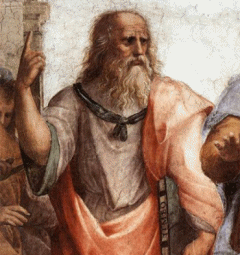
Sanzio 01 Plato Aristotle
Plato often discusses the father-son relationship and the "question" of whether a father's interest in his sons has much to do with how well his sons turn out. A boy in ancient Athens was socially located by his family identity, and Plato often refers to his characters in terms of their paternal and fraternal relationships. Socrates was not a family man, and saw himself as the son of his mother, who was apparently a midwife. A divine fatalist, Socrates mocks men who spent exorbitant fees on tutors and trainers for their sons, and repeatedly ventures the idea that good character is a gift from the gods. Crito reminds Socrates that orphans are at the mercy of chance, but Socrates is unconcerned. In the Theaetetus, he is found recruiting as a disciple a young man whose inheritance has been squandered. Socrates twice compares the relationship of the older man and his boy lover to the father-son relationship (Lysis 213a, Republic 3.403b), and in the Phaedo, Socrates' disciples, towards whom he displays more concern than his biological sons, say they will feel "fatherless" when he is gone. Many dialogues, like these, suggest that man-boy love (which is "spiritual") is a wise man's substitute for father-son biology (which is "bodily").

In several dialogues, Socrates floats the idea that Knowledge
Knowledge

Knowledge is defined in the Oxford English Dictionary as expertise, and skills acquired by a person through experience or education; the theoretical or practical understanding of a subject, what is known in a particular field or in total; facts and information or awareness or familiarity gained by experience of a fact or situation....
 is a matter of recollection, and not of learning, observation, or study. He maintains this view somewhat at his own expense, because in many dialogues, Socrates complains of his forgetfulness. Socrates is often found arguing that knowledge is not empirical, and that it comes from divine insight. He is quite consistent in believing in the immortality of the soul, and several dialogues end with long speeches imagining the afterlife
Afterlife

The afterlife is the concept of a continued existence for the soul, spirit or mind of a being after biological death. The major views on the afterlife derive from religion, esotericism and metaphysics....
. More than one dialogue contrasts knowledge and opinion, perception and reality
Reality

Reality, in everyday usage, means "the state of things as they actually exist". In a sense it is what is real. The term reality, in its widest sense, includes everything that being, whether or not it is observation or comprehension....
, nature
Nature

File:Jungle in Punjab.JPGNature, in the broadest sense, is equivalent to the natural world, physical universe, material world or material universe....
 and custom, and body and soul. The only contrast to this is his Parmenides.

Several dialogues tackle questions about art: Socrates says that poetry is inspired by the muses, and is not rational. He speaks approvingly of this, and other forms of divine madness (drunkenness, eroticism, and dreaming) in the Phaedrus
Phaedrus (Plato)

The Phaedrus , written by Plato, is a dialogue between Plato's main protagonist, Socrates, and Phaedrus, an interlocutor in several dialogues....
 
(265a–c), and yet in the Republic
Republic (Plato)

The Republic is a Socratic dialogue by Plato, written in approximately 380 BC. It is one of the most influential works of philosophy and Political philosophy, and Plato's best known work....
 wants to outlaw Homer's great poetry, and laughter as well. In Ion
Ion (dialogue)

In Plato's Ion Socrates discusses with the title character the question of whether the rhapsode, a professional performer of poetry, gives his performance on account of his skill and knowledge or by virtue of divine possession....
, Socrates gives no hint of the disapproval of Homer that he expresses in the Republic. The dialogue Ion suggests that Homer's Iliad functioned in the ancient Greek world as the bible does today in the modern Christian world: as divinely inspired literature that can provide moral guidance, if only it can be properly interpreted.

On politics and art, religion and science, justice and medicine, virtue and vice, crime and punishment, pleasure and pain, rhetoric and rhapsody, human nature and sexuality, love and wisdom, Socrates and his company of disputants had something to say.

Metaphysics


"Platonism" is a term coined by scholars to refer to the intellectual consequences of denying, as Socrates often does, the reality of the material world. In several dialogues, most notably the Republic, Socrates inverts the common man's intuition about what is knowable and what is real. While most people take the objects of their senses to be real if anything is, Socrates is contemptuous of people who think that something has to be graspable in the hands to be real. In the Theaetetus
Theaetetus (dialogue)

The The?tetus is one of Plato's Dialogues of Plato concerning the epistemology. The framing of the dialogue begins when Euclid of Megara tells his friend Terpsion that he had written a book many years ago based on what Socrates had told him of a conversation he'd had with Theaetetus when [Theaetetus] was quite a young man....
, he says such people are "eu a-mousoi", an expression that means literally, "happily without the muses" (Theaetetus 156a). In other words, such people live without the divine inspiration that gives him, and people like him, access to higher insights about reality.

Socrates's idea that reality is unavailable to those who use their senses is what puts him at odds with the common man, and with common sense. Socrates says that he who sees with his eyes is blind, and this idea is most famously captured in his allegory of the cave
Allegory of the cave

The Allegory of the Cave, also commonly known as Myth of the Cave, Metaphor of the Cave or the Parable of the Cave, is an allegory used by the Ancient Greece philosopher Plato in his work The Republic to illustrate "our nature in its education and want of education"....
, and more explicitly in his description of the divided line. The allegory of the cave (begins Republic 7.514a) is a paradoxical analogy wherein Socrates argues that the invisible world is the most intelligible ("noeton") and that the visible world ("(h)oraton") is the least knowable, and the most obscure. (This is exactly the opposite of what Socrates says to Euthyphro in the soothsayer's namesake dialogue. There, Socrates tells Euthyphro that people can agree on matters of logic and science, and are divided on moral matters, which are not so easily verifiable.)

Socrates says in the Republic that people who take the sun-lit world of the senses to be good and real are living pitifully in a den of evil and ignorance. Socrates admits that few climb out of the den, or cave of ignorance, and those who do, not only have a terrible struggle to attain the heights, but when they go back down for a visit or to help other people up, they find themselves objects of scorn and ridicule.

According to Socrates, physical objects and physical events are "shadows" of their ideal or perfect forms, and exist only to the extent that they instantiate the perfect versions of themselves. Just as shadows are temporary, inconsequential epiphenomena produced by physical objects, physical objects are themselves fleeting phenomena caused by more substantial causes, the ideals of which they are mere instances. For example, Socrates thinks that perfect justice exists (although it is not clear where) and his own trial would be a cheap copy of it.

The allegory of the cave (often said by scholars to represent Plato's own epistemology and metaphysics) is intimately connected to his political ideology (often said to also be Plato's own), that only people who have climbed out of the cave and cast their eyes on a vision of goodness are fit to rule. Socrates claims that the enlightened men of society must be forced from their divine contemplations and compelled to run the city according to their lofty insights. Thus is born the idea of the "philosopher-king", the wise person who accepts the power thrust upon him by the people who are wise enough to choose a good master. This is the main thesis of Socrates in the Republic, that the most wisdom the masses can muster is the wise choice of a ruler.

The word metaphysics derives from the fact that Aristotle's musings about divine reality came after ("meta") his lecture notes on his treatise on nature ("physics"). The term is in fact applied to Aristotle's own teacher, and Plato's "metaphysics" is understood as Socrates' division of reality into the warring and irreconcilable domains of the material and the spiritual. The theory has been of incalculable influence in the history of Western philosophy and religion.

Theory of Forms


The Theory of Forms typically refers to Plato's belief that the material world as it seems to us is not the real world, but only a shadow of the real world. Plato spoke of forms in formulating his solution
Platonic realism

Platonic realism is a philosophy term usually used to refer to the idea of Philosophical realism regarding the existence of universals after the Greek philosophy philosopher Plato , a student of Socrates, and the teacher of Aristotle....
 to the problem of universals
Problem of universals

The problem of universals is an ancient problem in metaphysics about whether Universal exist. Universals are general or abstract qualities, characteristics, properties, kinds or relations, such as being male/female, solid/liquid/gas or a certain colour, that can be predicated of individuals or particulars or that individuals or particulars...
. The forms, according to Plato, are roughly speaking archetype
Archetype

An archetype is an original model of a person, ideal example, or a prototype after which others are copied, patterned, or emulated; a symbol universally recognized by all....
s or abstract
Abstraction

Abstraction is the process or result of generalization by reducing the information content of a concept or an observable phenomenon, typically in order to retain only information which is relevant for a particular purpose....
 representations of the many types
Type (metaphysics)

In metaphysics, a type is a category of being. A human is a type of thing; a cloud is a type of object ; and so on. A particular instance of a type is called a token of that thing; so Socrates was a token of a human being, but is not any longer since he is dead....
 and properties (that is, of universals
Universal (metaphysics)

In metaphysics, a universal is what particular things have in common, namely characteristics or qualities. In other words, universals are repeatable or recurrent entities that can be instantiated or exemplified by many particular things....
) of things we see all around us.

Epistemology


Many have interpreted Plato as stating that knowledge
Knowledge

Knowledge is defined in the Oxford English Dictionary as expertise, and skills acquired by a person through experience or education; the theoretical or practical understanding of a subject, what is known in a particular field or in total; facts and information or awareness or familiarity gained by experience of a fact or situation....
 is justified true belief
Justified true belief

Justified true belief is one definition of knowledge that states for someone to have knowledge of something, it must be true, it must be believed to be true, and the belief must be justified....
, an influential view which informed future developments in modern analytic epistemology. This interpretation is based on a reading of the Theaetetus
Theaetetus (dialogue)

The The?tetus is one of Plato's Dialogues of Plato concerning the epistemology. The framing of the dialogue begins when Euclid of Megara tells his friend Terpsion that he had written a book many years ago based on what Socrates had told him of a conversation he'd had with Theaetetus when [Theaetetus] was quite a young man....
 wherein Plato argues that belief is to be distinguished from knowledge on account of justification. Many years later, Edmund Gettier
Edmund Gettier

Edmund L. Gettier III is an United States philosopher and Professor Emeritus at the University of Massachusetts Amherst; he may owe his reputation to a single three-page paper published in 1963 called "Is Justified True Belief Knowledge?"...
 famously demonstrated the problems of the justified true belief account of knowledge. This interpretation, however, imports modern analytic and empiricist categories onto Plato himself and is better read on its own terms than as Plato's view.

Really, in the Sophist
Sophist (dialogue)

The Sophist is one of the late Dialogues of Plato, which was written much later than the Parmenides and the Theaetetus , probably in 360 BC....
, Statesman
Statesman (dialogue)

The Statesman, or Politikos in Classical Greek and Politicus in Latin, is a four part dialogue contained within the work of Plato....
, Republic, and the Parmenides Plato himself associates knowledge with the apprehension of unchanging Forms and their relationships to one another (which he calls "expertise" in Dialectic
Dialectic

Dialectic is a method of argument, which has been central to both Eastern and Western philosophy since ancient times. The word "dialectic" originates in Ancient Greece, and was made popular by Plato's Socratic dialogues....
). More explicitly, Plato himself argues in the Timaeus
Timaeus (dialogue)

Timaeus is a theoretical treatise of Plato in the form of a Socratic dialogue, written circa 360 Before Christ. The work puts forward speculation on the nature of the physical world....
 that knowledge is always proportionate to the realm from which it is gained. In other words, if one derives their account of something experientially, because the world of sense is in flux, the views therein attained will be mere opinions. And opinions are characterized by a lack of necessity and stability. On the other hand, if one derives their account of something by way of the non-sensible forms, because these forms are unchanging, so too is the account derived from them. It is only in this sense that Plato uses the term "knowledge
Knowledge

Knowledge is defined in the Oxford English Dictionary as expertise, and skills acquired by a person through experience or education; the theoretical or practical understanding of a subject, what is known in a particular field or in total; facts and information or awareness or familiarity gained by experience of a fact or situation....
."

In the Meno, Socrates uses a geometrical example to expound Plato's view that knowledge in this latter sense is acquired by recollection
Anamnesis

Anamnesis...
. Socrates elicits a fact concerning a geometrical construction from a slave boy, who could not have otherwise known the fact (due to the slave boy's lack of education). The knowledge must be present, Socrates concludes, in an eternal, non-experiential form.

The State

Plato's philosophical views had many societal implications, especially on the idea of an ideal state
State

A state is a political Social contract with effective sovereignty over a geographic area and representing a population. These may be nation states, State or multinational states....
 or government. There is some discrepancy between his early and later views. Some of the most famous doctrines are contained in the Republic during his middle period, as well as in the Laws
Laws (dialogue)

The Laws is Plato's last and longest dialogue. The question asked at the beginning is not "What is law?" as one would expect. That is the question of the Minos ....
 and the Statesman
Statesman (dialogue)

The Statesman, or Politikos in Classical Greek and Politicus in Latin, is a four part dialogue contained within the work of Plato....
. However, because Plato wrote dialogues, it is assumed that Socrates is often speaking for Plato. This assumption may not be true in all cases.

Plato, through the words of Socrates, asserts that societies have a tripartite class structure corresponding to the appetite/spirit/reason structure of the individual soul. The appetite/spirit/reason stand for different parts of the body. The body parts symbolize the castes of society.

  • Productive Which represents the abdomen.(Workers) — the labourers, carpenters, plumbers, masons, merchants, farmers, ranchers, etc. These correspond to the "appetite" part of the soul.
  • Protective Which represents the chest.(Warriors or Guardians) — those who are adventurous, strong and brave; in the armed forces. These correspond to the "spirit" part of the soul.
  • Governing Which represents the head. (Rulers or Philosopher Kings) — those who are intelligent, rational, self-controlled, in love with wisdom, well suited to make decisions for the community. These correspond to the "reason" part of the soul and are very few.


According to this model, the principles of Athenian democracy
Athenian democracy

Athenian democracy developed in the Ancient Greece city-state of Classical Athens, comprising the central city-state of Athens and the surrounding territory of Attica, around 500 BC....
 (as it existed in his day) are rejected as only a few are fit to rule. Instead of rhetoric and persuasion, Plato says reason and wisdom should govern. As Plato puts it:

"Until philosophers rule as kings or those who are now called kings and leading men genuinely and adequately philosophise, that is, until political power and philosophy entirely coincide, while the many natures who at present pursue either one exclusively are forcibly prevented from doing so, cities will have no rest from evils,... nor, I think, will the human race." (Republic 473c-d)


Plato describes these "philosopher kings" as "those who love the sight of truth" (Republic 475c) and supports the idea with the analogy of a captain and his ship or a doctor and his medicine. Sailing and health are not things that everyone is qualified to practice by nature. A large part of the Republic then addresses how the educational system should be set up to produce these philosopher kings.

However, it must be taken into account that the ideal city outlined in the Republic is qualified by Socrates as the ideal luxurious city, examined to determine how it is that injustice and justice grow in a city (Republic 372e). According to Socrates, the "true" and "healthy" city is instead the one first outlined in book II of the Republic, 369c–372d, containing farmers, craftsmen, merchants, and wage-earners, but lacking the guardian class of philosopher-kings as well as delicacies such as "perfumed oils, incense, prostitutes, and pastries", in addition to paintings, gold, ivory, couches, a multitude of occupations such as poets and hunters, and war.

In addition, the ideal city is used as an image to illuminate the state of one's soul, or the will
Free will

The question of free will is whether, and in what sense, rational agents exercise control over their actions and decisions. Addressing this question requires understanding the relationship between freedom and Causality, and determining whether the laws of nature are causally deterministic....
, reason
Reason

Reason may refer to Mind#Mental faculties that consciously create explanations in order to judge, decide, solve problems, generalize, and give examples, among other activities....
, and desire
Interpersonal attraction

Interpersonal attraction is the attraction between person which leads to friendships and romantic love intimate relationships. The study of interpersonal attraction is a major area of research in social psychology....
s combined in the human body. Socrates is attempting to make an image of a rightly ordered human, and then later goes on to describe the different kinds of humans that can be observed, from tyrants to lovers of money in various kinds of cities. The ideal city is not promoted, but only used to magnify the different kinds of individual humans and the state of their soul. However, the philosopher king
Philosopher king

Philosopher kings are the hypothetical rulers, or Guardians, of Plato's Utopian Kallipolis. If his ideal city-state is to ever come into being, "philosophers [must] become kings?or those now called kings [must]?genuinely and adequately philosophize" ....
 image was used by many after Plato to justify their personal political beliefs. The philosophic soul according to Socrates has reason, will, and desires united in virtuous harmony. A philosopher has the moderate
Moderate

In politics and religion, a moderate is an individual who holds an intermediate position between two viewpoints, neither to be extreme or radical by those applying the term....
 love for wisdom
Wisdom

Wisdom is knowledge, understanding, experience, discretion, and Intuition , along with a capacity to apply these qualities well towards finding solutions to problems....
 and the courage
Courage

Courage, also known as bravery, will, intrepidity, and fortitude, is the ability to confront fear, pain, Risk, uncertainty, or intimidation....
 to act according to wisdom. Wisdom is knowledge
Knowledge

Knowledge is defined in the Oxford English Dictionary as expertise, and skills acquired by a person through experience or education; the theoretical or practical understanding of a subject, what is known in a particular field or in total; facts and information or awareness or familiarity gained by experience of a fact or situation....
 about the Good or the right relations between all that exist
Existence

In common usage, existence is the world of which we are aware through our senses, but in philosophy the word has a more specialized meaning, and is often contrasted with essence....
s.

Wherein it concerns states and rulers, Plato has made interesting arguments. For instance he asks which is better - a bad democracy or a country reigned by a tyrant. He argues that it is better to be ruled by a bad tyrant (since then there is only one person committing bad deeds) than be a bad democracy (since here all the people are now responsible for such actions.)

According to Plato, a state which is made up of different kinds of souls, will overall decline from an aristocracy
Aristocracy

Aristocracy is a form of government, in which a few of the most prominent citizens rule. This may be a hereditary elite, or it may be by a system of cooption where a council of prominent citizens add leading soldiers, merchants, land owners, priests, and lawyers to their number....
 (rule by the best) to a timocracy
Timocracy

Constitutional theory defines a timocracy as either:# a state where only property owners may participate in government# a government where rulers are selected and perpetuated based on the degree of honor they hold relative to others in their society, peer group or class...
 (rule by the honorable), then to an oligarchy
Oligarchy

Oligarchy is a form of government where political power effectively rests with a small Elitism segment of society distinguished by royalty, wealth, family, military influence or occult spiritual hegemony....
 (rule by the few), then to a democracy
Democracy

Democracy is a form of government in which power is held directly or indirectly by citizens under a free electoral system. It is derived from the Greek language d?????at?a , "popular government" which was coined from d???? , "people" and ???t?? , "rule, strength" in the middle of the 5th-4th century BC to denote the political syst...
 (rule by the people), and finally to tyranny (rule by one person, rule by a tyrant).

Unwritten Doctrine

For a long time Plato's unwritten doctrine had been considered unworthy of attention. Most of the books on Plato seem to diminish its importance. Nevertheless the first important witness who mentions its existence is Aristotle
Aristotle

Aristotle was a Greeks philosopher, a student of Plato and teacher of Alexander the Great. He wrote on many subjects, including physics, metaphysics, Poetics , theater, music, logic, rhetoric, politics, government, ethics, biology and zoology....
, who in his Physics
Physics (Aristotle)

Physics is a key text in the philosophy of Aristotle. It stands at the head of the current Andronicus of Rhodes order, the long series of Aristotle's physical, cosmological and biological works, and is foundational to them....
 (209 b) writes: "It is true, indeed, that the account he gives there [i.e. in Timaeus
Timaeus (dialogue)

Timaeus is a theoretical treatise of Plato in the form of a Socratic dialogue, written circa 360 Before Christ. The work puts forward speculation on the nature of the physical world....
] of the participant is different from what he says in his so-called unwritten teaching (???afa d??µata)." The term ???afa d??µata literally means unwritten doctrine and it stands for the most fundamental metaphysical teaching of Plato which he disclosed only to his most trusted fellows and kept secret from the public.

The reason for not revealing it to everyone is partially discussed in Phaedrus (276 c) where Plato criticizes the written transmission of knowledge as faulty, favoring instead the spoken logos
Logos

is an important term in philosophy, analytical psychology, rhetoric and religion.Heraclitus established the term in Western philosophy as meaning both the source and fundamental order of the cosmos....
: "he who has knowledge of the just and the good and beautiful ... will not, when in earnest, write them in ink, sowing them through a pen with words which cannot defend themselves by argument and cannot teach the truth effectually." The same argument is repeated in Plato's Seventh Letter (344 c): "every serious man in dealing with really serious subjects carefully avoids writing." In the same letter he writes (341 c): "I can certainly declare concerning all these writers who claim to know the subjects which I seriously study ... there does not exist, nor will there ever exist, any treatise of mine dealing therewith." Such secrecy is necessary in order not "to expose them to unseemly and degrading treatment" (344 d).

It is however said that Plato once disclosed this knowledge to the public in his lecture On the Good (?e?? t??a???), in which the Good (t? ??a???) is identified with the One (the Unity, t? ??), the fundamental ontological principle. The content of this lecture has been transmitted by several witnesses, among others Aristoxenus
Aristoxenus

Aristoxenus of Taranto was a Greek peripatetic philosopher, and writer on music and rhythm.He was taught first by his father Spintharus , a pupil of Socrates and also a musician, and later by the Pythagoras, Lamprus of Erythrae and Xenophilus, from whom he learned the theory of music....
 who describes the event in the following words: "Each came expecting to learn something about the things which are generally considered good for men, such as wealth, good health, physical strength, and altogether a kind of wonderful happiness. But when the mathematical demonstrations came, including numbers, geometrical figures and astronomy, and finally the statement Good is One seemed to them, I imagine, utterly unexpected and strange; hence some belittled the matter, while others rejected it." Simplicius
Simplicius of Cilicia

Simplicius of Cilicia, lived c. 490-c. 560 AD, was a disciple of Ammonius Hermiae and Damascius, and was one of the last of the Neoplatonism. He was one of the pagan philosophers persecuted by Justinian in the early 6th century, and was forced for a time to seek refuge in the Sassanid empire court, before being allowed back into the Byzantin...
 quotes Alexander of Aphrodisias
Alexander of Aphrodisias

Alexander of Aphrodisias was the most celebrated of the Ancient Greek commentators on the writings of Aristotle. He was styled, by way of pre-eminence, "the expositor" ....
 who states that "according to Plato, the first principles of everything, including the Forms themselves are One and Indefinite Duality (? ????st?? d???) which he called Large and Small (t? µ??a ?a? t? µ?????) ... one might also learn this from Speusippus and Xenocrates and the others who were present at Plato's lecture on the Good"

Their account is in full agreement with Aristotle
Aristotle

Aristotle was a Greeks philosopher, a student of Plato and teacher of Alexander the Great. He wrote on many subjects, including physics, metaphysics, Poetics , theater, music, logic, rhetoric, politics, government, ethics, biology and zoology....
's description of Plato's metaphysical doctrine. In Metaphysics
Metaphysics (Aristotle)

Metaphysics is one of the principal works of Aristotle and the first major work of the Metaphysics with the same name. The principal subject is "being qua being", or being understood as being....
 he writes: "Now since the Forms are the causes of everything else, he [i.e. Plato] supposed that their elements are the elements of all things. Accordingly the material principle is the Great and Small [i.e. the Dyad], and the essence is the One (t? ??), since the numbers are derived from the Great and Small by participation in the One" (987 b). "From this account it is clear that he only employed two causes: that of the essence, and the material cause; for the Forms are the cause of the essence in everything else, and the One is the cause of it in the Forms. He also tells us what the material substrate is of which the Forms are predicated in the case of sensible things, and the One in that of the Forms - that it is this the duality (the Dyad, ? d???), the Great and Small (t? µ??a ?a? t? µ?????). Further, he assigned to these two elements respectively the causation of good and of evil" (988 a).

The most important aspect of this interpretation of Plato's metaphysics is the continuity between his teaching and the neoplatonic interpretation of Plotinus
Plotinus

Plotinus was a major Philosophy of the ancient world who is widely considered the founder of Neoplatonism . Much of our biographical information about him comes from Porphyry 's preface to his edition of Plotinus' Enneads....
 or Ficino which has been considered erroneous by many but may in fact have been directly influenced by oral transmission of Plato's doctrine. The first scholar who recognized the importance of the unwritten doctrine of Plato was Heinrich Gomperz
Heinrich Gomperz

Heinrich Gomperz was an Austrian philosopher.He was a son of Theodor Gomperz. He was a Sigmund Freud patient and was married to Ada Stepnitz....
 who described it in his speech during the 7th International Congress of Philosophy
International congress of philosophy

The International congress of philosophy is a large, international congress of philosophers....
 in 1930. All the sources related to the ???afa d??µata have been collected by Konrad Gaiser and published as Testimonia Platonica. These sources have subsequently been interpreted by scholars from the German Tübingen School such as Hans Joachim Krämer or Thomas A. Szlezák.

Works

Thirty-five dialogues and thirteen letters have traditionally been ascribed to Plato, though modern scholarship doubts the authenticity of at least some of these. Plato's writings have been published in several fashions; this has led to several conventions regarding the naming and referencing of Plato's texts.

The usual system for making unique references to sections of the text by Plato derives from a 16th century edition of Plato's works by Henricus Stephanus. An overview of Plato's writings according to this system can be found in the Stephanus pagination
Stephanus pagination

Stephanus pagination is the system of reference and organization used in modern editions and translations of Plato . Plato's works are divided into numbers, and each number will be divided into equal sections a, b, c, d and e....
 article.

One tradition regarding the arrangement of Plato's texts is according to tetralogies
Tetralogy

A tetralogy is a compound work that is made up of four distinct works. Compare to a trilogy; made up of three works.The name comes from the Attica theater, where tetralogies were meant to be played in one sitting at the Dionysia....
. This scheme is ascribed by Diogenes Laertius
Diogenes Laertius

Diogenes La?rtius , the biographer of the Greece philosophers, is supposed by some to have received his surname from the town of Laerte in Cilicia, Asia Minor, and by others from the Roman Empire family of the La?rtii....
 to an ancient scholar and court astrologer to Tiberius
Tiberius

Tiberius Julius Caesar Augustus, born Tiberius Claudius Nero , was the second Roman Emperor, from the death of Augustus in AD 14 until his own death in 37....
 named Thrasyllus
Thrasyllus of Mendes

Thrasyllus of Mendes whose full name was Tiberius Claudius Thrasyllus . Thrasyllus was an Egyptian Greeks who originally came from a Greek family in Mendes, Egypt....
.

In the list below, works by Plato are marked (1) if there is no consensus among scholars as to whether Plato is the author, and (2) if scholars generally agree that Plato is not the author of the work. Unmarked works are assumed to have been written by Plato.

The remaining works were transmitted under Plato's name, most of them already considered spurious in antiquity, and so were not included by Thrasyllus in his tetralogical arrangement. These works are labelled as Notheuomenoi ("spurious") or Apocrypha.
  • Axiochus (2), Definitions (2), Demodocus
    Demodocus (dialogue)

    Demodocus is purported to be one of the Socratic dialogue. The dialogue is extant and was included in the Henri Estienne edition published in Geneva in 1578....
     (2), Epigrams, Eryxias (2), Halcyon
    Halcyon (dialogue)

    Halcyon is a short dialogue in which Socrates relates the ancient myth of the Alcyone to Chaerephon. It has the distinction of being attributed in the manuscripts to both Plato and Lucian, but the work is not by either writer....
     (2), On Justice (2), On Virtue (2), Sisyphus
    Sisyphus (dialogue)

    Sisyphus is purported to be one of the Socratic dialogue. The dialogue is extant and was included in the Henri Estienne edition published in Geneva in 1578. It is now generally acknowledged to be spurious....
     (2).


Plato's Dialogues

The exact order in which Plato's dialogues were written is not known, nor is the extent to which some might have been later revised and rewritten.

Lewis Campbell
Lewis Campbell

Lewis Campbell , United Kingdom classical scholar, was born in Edinburgh, Scotland.His father, Robert Campbell, Royal Navy, was a first cousin of Thomas Campbell, the poet....
 was the first to make exhaustive use of stylometry
Stylometry

Stylometry is the application of Stylistics , usually to written language. In the last few years it has successfully been applied also to and to fine-art ....
 to prove objectively that the Critias, Timaeus, Laws, Philebus, Sophist, and Statesman were all clustered together as a group, while the Parmenides, Phaedrus, Republic, and Theaetetus belong to a separate group, which must be earlier (given Aristotle
Aristotle

Aristotle was a Greeks philosopher, a student of Plato and teacher of Alexander the Great. He wrote on many subjects, including physics, metaphysics, Poetics , theater, music, logic, rhetoric, politics, government, ethics, biology and zoology....
's statement in his Politics that the Laws was written after the Republic; cf. Diogenes Laertius
Diogenes Laertius

Diogenes La?rtius , the biographer of the Greece philosophers, is supposed by some to have received his surname from the town of Laerte in Cilicia, Asia Minor, and by others from the Roman Empire family of the La?rtii....
 Lives 3.37). What is remarkable about Campbell's conclusions is that, in spite of all the stylometric studies that have been conducted since his time, perhaps the only chronological fact about Plato's works that can now be said to be proven by stylometry is the fact that Critias, Timaeus, Laws, Philebus, Sophist, and Statesman are the latest of Plato's dialogues, the others earlier.

Increasingly in the most recent Plato scholarship, writers are skeptical of the notion that the order of Plato's writings can be established with any precision, though Plato's works are still often characterized as falling at least roughly into three groups. The following represents one such division which is relatively common. It should, however, be kept in mind that many of the positions in the ordering are still highly disputed, and also that the very notion that Plato's dialogues can or should be "ordered" is by no means universally accepted.

Early dialogues
Socrates figures in all of these, and they are considered the most faithful representations of the historical Socrates; hence they are also called the Socratic dialogues. Most of them consist of Socrates discussing a subject, often an ethical one (friendship, piety) with a friend or with someone presumed to be an expert on it. Through a series of questions he will show that apparently they do not understand it at all. It is left to the reader to figure out if "he" really understands "it". This makes these dialogues "indirect" teachings.
  • Apology
    Apology (Plato)

    Apology is Plato's version of the Speech given by Socrates as he defends himself against the charges of being a man "who corrupted the young, refused to worship the deity, and created new deities"....
  • Charmides
    Charmides (dialogue)

    The Charmides is a dialogue of Plato, in which Socrates engages a handsome and popular boy in a conversation about the meaning of sophrosyne, a Greek word usually translated into English as "temperance", "self-control", or "restraint"....
  • Crito
    Crito

    The Crito is a short but important dialogue by the ancient Greece ancient philosophy Plato. It is a conversation between Socrates and his wealthy friend Crito of Alopece regarding justice , injustice , and the appropriate response to injustice....
  • Euthyphro
    Euthyphro

    Euthyphro is one of Plato's early dialogues, dated to after 399 BCE. It features Ancient Greece philosopher Socrates and Euthyphro, a man known for claiming to be a religious expert....
  • Ion
    Ion (dialogue)

    In Plato's Ion Socrates discusses with the title character the question of whether the rhapsode, a professional performer of poetry, gives his performance on account of his skill and knowledge or by virtue of divine possession....
  • Laches
    Laches (dialogue)

    Laches, also known as Courage, is a Socratic dialogue written by Plato, and concerns the topic of courage.Lysimachus, son of Aristides, and Melesias, son of Thucydides , request advice from Laches and Nicias on whether or not they should have their sons trained to fight in armor....
  • Lesser Hippias
  • Lysis
    Lysis (dialogue)

    Lysis is a dialogue of Plato which discusses the nature of friendship. It is generally classified as an Socratic dialogue.The main characters are Socrates, the boys Lysis and Menexenus who are friends, as well as Hippothales of Athens, who is in unrequited love with Lysis and therefore, after the initial conversation, hides himself be...
  • Menexenus
  • Protagoras
    Protagoras (dialogue)

    Protagoras is a dialogue of Plato. The main argument is between the elderly Protagoras, a celebrated sophist, and Socrates. The discussion takes place at the home of Callias, who is host to Protagoras while he is in town, and concerns a familiar theme in the dialogues: the teaching of virtue....
     is often considered one of the last of these "earlier" dialogues.


The following are often considered "transitional" or "pre-middle" dialogues:
  • Euthydemus
    Euthydemus (dialogue)

    Euthydemus , written 380 BCE, is dialogue by Plato which satirizes the logical fallacies of the Sophism. It describes a visit paid by Socrates and various youths to two brothers, Euthydemus and Dionysodorus, both of whom are prominent Sophists....
  • Gorgias
    Gorgias (dialogue)

    Gorgias is an important Socratic Dialogue in which Plato sets the rhetoric, whose specialty is persuasion, in opposition to the philosopher, whose specialty is dissuasion, or refutation....
  • Meno
    Meno

    Meno is a Socratic dialogue written by Plato. Written in the Socratic method, it attempts to determine the definition of virtue, or arete , meaning in this case virtue in general, rather than particular virtues ....


Middle dialogues
Late in the early dialogues Plato's Socrates actually begins supplying answers to some of the questions he asks, or putting forth positive doctrines. This is generally seen as the first appearance of Plato's own views. The first of these, that goodness is wisdom and that no one does evil willingly, was perhaps Socrates' own view. What becomes most prominent in the middle dialogues is the idea that knowledge comes of grasping unchanging forms or essences, paired with the attempts to investigate such essences. The immortality of the soul, and specific doctrines about justice, truth, and beauty, begin appearing here. The Symposium and the Republic are considered the centrepieces of Plato's middle period. The Parmenides and Theaetetus
Theaetetus (dialogue)

The The?tetus is one of Plato's Dialogues of Plato concerning the epistemology. The framing of the dialogue begins when Euclid of Megara tells his friend Terpsion that he had written a book many years ago based on what Socrates had told him of a conversation he'd had with Theaetetus when [Theaetetus] was quite a young man....
 are often considered to come late in this period and transitional to the next, as they seem to treat the Theory of Forms critically (Parmenides) or not at all (Theaetetus).
  • Cratylus
    Cratylus (dialogue)

    Cratylus is the name of a dialogue by Plato. Most modern scholars agree that it was written mostly during Plato's so-called middle period....
  • Parmenides
  • Phaedo
    Phaedo

    Plato's Phaedo is one of the great dialogues of his middle period, along with the Republic and the Symposium . The Phaedo, which depicts the death of Socrates, is also Plato's fourth and last dialogue to detail the philosopher's final days....
  • Phaedrus
  • Republic
    Republic (Plato)

    The Republic is a Socratic dialogue by Plato, written in approximately 380 BC. It is one of the most influential works of philosophy and Political philosophy, and Plato's best known work....
  • Symposium
  • Theaetetus
    Theaetetus (dialogue)

    The The?tetus is one of Plato's Dialogues of Plato concerning the epistemology. The framing of the dialogue begins when Euclid of Megara tells his friend Terpsion that he had written a book many years ago based on what Socrates had told him of a conversation he'd had with Theaetetus when [Theaetetus] was quite a young man....


Late dialogues

The Parmenides presents a series of criticisms of the theory of Forms which are widely taken to indicate Plato's abandonment of the doctrine. Some recent publications (e.g., Meinwald (1991)) have challenged this characterisation. In most of the remaining dialogues the theory is either absent or at least appears under a different guise in discussions about kinds or classes of things (the Timaeus
Timaeus (dialogue)

Timaeus is a theoretical treatise of Plato in the form of a Socratic dialogue, written circa 360 Before Christ. The work puts forward speculation on the nature of the physical world....
 may be an important, and hence controversially placed, exception). Socrates is either absent or a minor figure in the discussion. An apparently new method for doing dialectic known as "collection and division" is also featured, most notably in the Sophist
Sophist (dialogue)

The Sophist is one of the late Dialogues of Plato, which was written much later than the Parmenides and the Theaetetus , probably in 360 BC....
 and Statesman
Statesman

A statesman or stateswoman or statesperson is usually a politician or other notable figure of state who has had a long and respected career in politics at the national and international level....
, explicitly for the first time in the Phaedrus, and possibly in the Philebus
Philebus

The Philebus is among the last of the late Socratic dialogues of the ancient Greek philosopher Plato. Socrates is the primary speaker in Philebus, unlike in the other late dialogues....
. A basic description of collection and division would go as follows: interlocutors attempt to discern the similarities and differences among things in order to get clear idea about what they in fact are. One understanding, suggested in some passages of the Sophist
Sophist (dialogue)

The Sophist is one of the late Dialogues of Plato, which was written much later than the Parmenides and the Theaetetus , probably in 360 BC....
, is that this is what philosophy is always in the business of doing, and is doing even in the early dialogues.

The late dialogues are also an important place to look for Plato's mature thought on most of the issues dealt with in the earlier dialogues. There is much work still to be done by scholars on the working out of what these views are. The later works are agreed to be difficult and challenging pieces of philosophy. On the whole they are more sober and logical than earlier works, but may hold out the promise of steps towards a solution to problems which were systematically laid out in prior works.
  • Critias
    Critias (dialogue)

    Critias, one of Plato's late dialogues, contains the story of the mighty island kingdom Atlantis and its attempt to conquer Athens, which failed due to the ordered society of the Athenians....
  • Laws
    Laws (dialogue)

    The Laws is Plato's last and longest dialogue. The question asked at the beginning is not "What is law?" as one would expect. That is the question of the Minos ....
  • Philebus
    Philebus

    The Philebus is among the last of the late Socratic dialogues of the ancient Greek philosopher Plato. Socrates is the primary speaker in Philebus, unlike in the other late dialogues....
  • Sophist
    Sophist (dialogue)

    The Sophist is one of the late Dialogues of Plato, which was written much later than the Parmenides and the Theaetetus , probably in 360 BC....
  • Statesman
    Statesman (dialogue)

    The Statesman, or Politikos in Classical Greek and Politicus in Latin, is a four part dialogue contained within the work of Plato....
  • Timaeus
    Timaeus (dialogue)

    Timaeus is a theoretical treatise of Plato in the form of a Socratic dialogue, written circa 360 Before Christ. The work puts forward speculation on the nature of the physical world....


Narration of the dialogues

Plato never presents himself as a participant in any of the dialogues, and with the exception of the Apology
Apology (Plato)

Apology is Plato's version of the Speech given by Socrates as he defends himself against the charges of being a man "who corrupted the young, refused to worship the deity, and created new deities"....
, there is no suggestion that he heard any of the dialogues firsthand. Some dialogues have no narrator but have a pure "dramatic" form (examples: Meno
Meno

Meno is a Socratic dialogue written by Plato. Written in the Socratic method, it attempts to determine the definition of virtue, or arete , meaning in this case virtue in general, rather than particular virtues ....
, Gorgias
Gorgias (dialogue)

Gorgias is an important Socratic Dialogue in which Plato sets the rhetoric, whose specialty is persuasion, in opposition to the philosopher, whose specialty is dissuasion, or refutation....
, Phaedrus
Phaedrus (Plato)

The Phaedrus , written by Plato, is a dialogue between Plato's main protagonist, Socrates, and Phaedrus, an interlocutor in several dialogues....
, Crito
Crito

The Crito is a short but important dialogue by the ancient Greece ancient philosophy Plato. It is a conversation between Socrates and his wealthy friend Crito of Alopece regarding justice , injustice , and the appropriate response to injustice....
, Euthyphro
Euthyphro

Euthyphro is one of Plato's early dialogues, dated to after 399 BCE. It features Ancient Greece philosopher Socrates and Euthyphro, a man known for claiming to be a religious expert....
), some dialogues are narrated by Socrates, wherein he speaks in first person (examples: Lysis
Lysis (dialogue)

Lysis is a dialogue of Plato which discusses the nature of friendship. It is generally classified as an Socratic dialogue.The main characters are Socrates, the boys Lysis and Menexenus who are friends, as well as Hippothales of Athens, who is in unrequited love with Lysis and therefore, after the initial conversation, hides himself be...
, Charmides
Charmides (dialogue)

The Charmides is a dialogue of Plato, in which Socrates engages a handsome and popular boy in a conversation about the meaning of sophrosyne, a Greek word usually translated into English as "temperance", "self-control", or "restraint"....
, Republic
Republic (Plato)

The Republic is a Socratic dialogue by Plato, written in approximately 380 BC. It is one of the most influential works of philosophy and Political philosophy, and Plato's best known work....
). One dialogue, Protagoras
Protagoras (dialogue)

Protagoras is a dialogue of Plato. The main argument is between the elderly Protagoras, a celebrated sophist, and Socrates. The discussion takes place at the home of Callias, who is host to Protagoras while he is in town, and concerns a familiar theme in the dialogues: the teaching of virtue....
, begins in dramatic form but quickly proceeds to Socrates' narration of a conversation he had previously with the sophist for whom the dialogue is named; this narration continues uninterrupted till the dialogue's end.

The three dialogues, Phaedo
Phaedo

Plato's Phaedo is one of the great dialogues of his middle period, along with the Republic and the Symposium . The Phaedo, which depicts the death of Socrates, is also Plato's fourth and last dialogue to detail the philosopher's final days....
, Symposium
Symposium (Plato)

The Symposium is a philosophical dialogue written by Plato sometime after 385 BC. It is a discussion on the nature of love, taking the form of a group of speeches, both satirical and serious, given by a group of men at a symposium or a wine drinking gathering at the house of the Tragedy#Greek tragedy Agathon at Athens....
, and Theaetetus
Theaetetus (dialogue)

The The?tetus is one of Plato's Dialogues of Plato concerning the epistemology. The framing of the dialogue begins when Euclid of Megara tells his friend Terpsion that he had written a book many years ago based on what Socrates had told him of a conversation he'd had with Theaetetus when [Theaetetus] was quite a young man....
, also begin in dramatic form but then proceed to virtually uninterrupted narration by followers of Socrates, and all, apparently, based on their distant memory or secondhand reports. Phaedo, an account of Socrates' final conversation and hemlock drinking, is narrated by Phaedo to Echecrates in a foreign city many years after the execution took place. The Symposium is narrated by Apollodorus, a Socratic disciple, apparently to Glaucon. Apollodorus assures his listener that he is recounting the story, which took place when he himself was an infant, not from his own memory, but as remembered by Aristodemus, who told him the story years ago. In the beginning of the Theaetetus (142c-143b), Euclides
Euclid of Megara

Euclid of Megara, , was a Ancient Greece Socrates philosopher who founded the Megarian school of philosophy. He was a pupil of Socrates in the late 5th century BC, and was present at his death....
 says that he compiled the conversation from notes he took based on what Socrates told him of his conversation with the title character. The rest of the Theaetetus is presented as a "book" written in dramatic form and read by one of Euclides' slaves (143c). Some scholars take this as an indication that Plato had by this date wearied of the narrated form. With the exception of the Theaetetus, Plato gives no explicit indication as to how these orally transmitted conversations came to be written down. Other dialogues, such as the Phaedo, Symposium, and Parmenides, do suggest that such conversations were faithfully recalled and transmitted by Socrates' followers.

Trial of Socrates

The trial of Socrates is the central, unifying event of the great Platonic dialogues. Because of this, Plato's Apology
Apology (Plato)

Apology is Plato's version of the Speech given by Socrates as he defends himself against the charges of being a man "who corrupted the young, refused to worship the deity, and created new deities"....
 is perhaps the most often read of the dialogues. In the Apology, Socrates tries to dismiss rumors that he is a sophist
Sophism

Sophism can mean two very different things: In the modern definition, a sophism is a confusing or illogical argument used for deceiving someone....
 and defends himself against charges of disbelief in the gods and corruption of the young. Socrates insists that long-standing slander will be the real cause of his demise, and says the legal charges are essentially false. Socrates famously denies being wise, and explains how his life as a philosopher was launched by the Oracle at Delphi. He says that his quest to resolve the riddle of the oracle put him at odds with his fellow man, and that this is the reason he has been mistaken for a menace to the city-state of Athens.

Unity and Diversity of the Dialogues

If Plato's important dialogues do not refer to Socrates' execution explicitly, they allude to it, or use characters or themes that play a part in it. Five dialogues foreshadow the trial: In the Theaetetus
Theaetetus (dialogue)

The The?tetus is one of Plato's Dialogues of Plato concerning the epistemology. The framing of the dialogue begins when Euclid of Megara tells his friend Terpsion that he had written a book many years ago based on what Socrates had told him of a conversation he'd had with Theaetetus when [Theaetetus] was quite a young man....
 (210d) and the Euthyphro
Euthyphro

Euthyphro is one of Plato's early dialogues, dated to after 399 BCE. It features Ancient Greece philosopher Socrates and Euthyphro, a man known for claiming to be a religious expert....
 (2a–b) Socrates tells people that he is about to face corruption charges. In the Meno
Meno

Meno is a Socratic dialogue written by Plato. Written in the Socratic method, it attempts to determine the definition of virtue, or arete , meaning in this case virtue in general, rather than particular virtues ....
 (94e–95a), one of the men who brings legal charges against Socrates, Anytus
Anytus

Anytus, son of Anthemion, was one of the prosecutors of Socrates. An unsubstantiated legend has it that he was banished from Athens after the public felt guilty about having Socrates executed....
, warns him about the trouble he may get into if he does not stop criticizing important people. In the Gorgias
Gorgias

Gorgias , "the Nihilist", Greece sophist, pre-socratic philosophy and rhetorician, was a native of Leontini in Sicily. Along with Protagoras, he forms the first generation of Sophism....
, Socrates says that his trial will be like a doctor prosecuted by a cook who asks a jury of children to choose between the doctor's bitter medicine and the cook's tasty treats (521e–522a). In the Republic
Republic

A republic is a state or country that is not led by a hereditary monarch but in which the people have an impact on its government. The word originates from the Latin term res publica....
 (7.517e), Socrates explains why an enlightened man (presumably himself) will stumble in a courtroom situation. The Apology is Socrates' defense speech, and the Crito
Crito

The Crito is a short but important dialogue by the ancient Greece ancient philosophy Plato. It is a conversation between Socrates and his wealthy friend Crito of Alopece regarding justice , injustice , and the appropriate response to injustice....
 and Phaedo
Phaedo

Plato's Phaedo is one of the great dialogues of his middle period, along with the Republic and the Symposium . The Phaedo, which depicts the death of Socrates, is also Plato's fourth and last dialogue to detail the philosopher's final days....
 take place in prison after the conviction. In the Protagoras
Protagoras

Protagoras was a Pre-Socratic philosophy Ancient Greeks philosopher and is numbered as one of the sophists by Plato. In his dialogue Protagoras , Plato credits him with having invented the role of the professional sophist or teacher of virtue....
, Socrates is a guest at the home of Callias
Callias III

Callias , son of Hipponicus by the ex-wife of Pericles, an Alcmaeonidae and the third head of one of the most distinguished Athens families to bear the name of Callias, was said to be notorious for his extravagance and profligacy....
, son of Hipponicus
Hipponicus

Hipponicus was an Athens military commander and son of Callias II and father of Callias III and Hipparete wife of Alcibiades. Together with Eurymedon he commanded the Athenian forces in the incursion into Boeotian territory and was slain at the Battle of Delium ....
, a man whom Socrates disparages in the Apology as having wasted a great amount of money on sophists' fees.

Two other important dialogues, the Symposium
Symposium (Plato)

The Symposium is a philosophical dialogue written by Plato sometime after 385 BC. It is a discussion on the nature of love, taking the form of a group of speeches, both satirical and serious, given by a group of men at a symposium or a wine drinking gathering at the house of the Tragedy#Greek tragedy Agathon at Athens....
 and the Phaedrus
Phaedrus (Plato)

The Phaedrus , written by Plato, is a dialogue between Plato's main protagonist, Socrates, and Phaedrus, an interlocutor in several dialogues....
, are linked to the main storyline by characters. In the Apology (19b, c), Socrates says Aristophanes
Aristophanes

Aristophanes , son of Philippus, of the deme Cydathenaus, was a prolific and much acclaimed comedy playwright of ancient Athens. Eleven of his forty plays have come down to us virtually complete....
 slandered him in a comic play, and blames him for causing his bad reputation, and ultimately, his death. In the Symposium, the two of them are drinking together with other friends. The character Phaedrus is linked to the main story line by character (Phaedrus is also a participant in the Symposium and the Protagoras) and by theme (the philosopher as divine emissary, etc.) The Protagoras is also strongly linked to the Symposium by characters: all of the formal speakers at the Symposium (with the exception of Aristophanes) are present at the home of Callias in that dialogue. Charmides
Charmides

Charmides was an Athens statesman and one of the Thirty Tyrants who ruled Athens following its defeat in the Peloponnesian War. Uncle of Plato, Charmides appears in the Platonic dialogue bearing his name, as well as in Xenophon....
 and his guardian Critias
Critias

Critias , born in Classical Athens, son of Callaeschrus, was an uncle of Plato, and a leading member of the Thirty Tyrants, and one of the most violent....
 are present for the discussion in the Protagoras. Examples of characters crossing between dialogues can be further multiplied. The Protagoras contains the largest gathering of Socratic associates.

In the dialogues for which Plato is most celebrated and admired, Socrates is concerned with human and political virtue, has a distinctive personality, and friends and enemies who "travel" with him from dialogue to dialogue. This is not to say that Socrates is consistent: a man who is his friend in one dialogue may be an adversary or subject of his mockery in another. For example, Socrates praises the wisdom of Euthyphro many times in the Cratylus
Cratylus (dialogue)

Cratylus is the name of a dialogue by Plato. Most modern scholars agree that it was written mostly during Plato's so-called middle period....
, but makes him look like a fool in the Euthyphro
Euthyphro

Euthyphro is one of Plato's early dialogues, dated to after 399 BCE. It features Ancient Greece philosopher Socrates and Euthyphro, a man known for claiming to be a religious expert....
. He disparages sophists generally, and Prodicus
Prodicus

Prodicus of Ceos He came to Athens as ambassador from Ceos, and became known as a speaker and a teacher. Like Protagoras, he professed to train his pupils for domestic and civic service; but it would appear that, while Protagoras's chief instruments of education were rhetoric and style, Prodicus made linguistics prominent in his curriculum....
 specifically in the Apology
Apology (Plato)

Apology is Plato's version of the Speech given by Socrates as he defends himself against the charges of being a man "who corrupted the young, refused to worship the deity, and created new deities"....
, yet tells Theaetetus in his namesake dialogue that he admires Prodicus and has directed many pupils to him. In Cratylus
Cratylus

Cratylus was an History of Athens philosopher from late 5th century BC, mostly known through his portrayal in Plato's dialogue Cratylus . Little is known of Cratylus or his mentor Heraclitus ....
 (384b-c), Socrates says that he studied with Cratylus, and took his one-drachma course because he could not afford the full fifty-drachma course. Socrates' ideas are also not consistent within or between or among dialogues.

Platonic Scholarship


Plato's thought is often compared with that of his most famous student, Aristotle
Aristotle

Aristotle was a Greeks philosopher, a student of Plato and teacher of Alexander the Great. He wrote on many subjects, including physics, metaphysics, Poetics , theater, music, logic, rhetoric, politics, government, ethics, biology and zoology....
, whose reputation during the Western Middle Ages
Middle Ages

File:Karl 1 mit papst gelasius gregor1 sacramentar v karl d kahlen.jpgThe Middle Ages of European history are a period in history which lasted for roughly a millennium, commonly dated from the fall of the Roman Empire in the 5th century to the beginning of the Early Modern Period in the 16th century, marked by the division of Western Christi...
 so completely eclipsed that of Plato that the Scholastic
Scholasticism

Scholasticism was the dominant form of theology and philosophy in the Western Europe in the Middle Ages, particularly in the 12th, 13th, and 14th centuries....
 philosophers referred to Aristotle as "the Philosopher". However, in the Byzantine Empire
Byzantine Empire

Byzantine Empire and Eastern Roman Empire are conventional names used to describe the Roman Empire during the Middle Ages, centered on its capital of Constantinople....
, the study of Plato continued.

The Medieval scholastic philosophers did not have access to the works of Plato, nor the knowledge of Greek
Greek language

Greek is an Indo-European languages native to the southern Balkan peninsula, the language of the Greek people. It forms an independent branch within Indo-European....
 needed to read them. Plato's original writings were essentially lost to Western civilization until they were brought from Constantinople
Constantinople

Constantinople was the empire capital of the Roman Empire , the Byzantine Empire , the Latin Empire , and the Ottoman Empire . Strategically located between the Golden Horn and the Sea of Marmara at the point where Europe meets Asia, Byzantine Constantinople had been the capital of a Christendom empire, successor to ancient ancient Greece...
 in the century before its fall, by George Gemistos Plethon. Medieval scholars knew of Plato only through translations into Latin
Latin

Latin is an Italic language, historically spoken in Latium and Ancient Rome. Through the Military history of the Roman Empire, Latin spread throughout the Mediterranean and a large part of Europe....
 from the translations into Arabic
Arabic language

Arabic is a Central Semitic language, thus related to and classified alongside other Semitic languages languages such as Hebrew language and Aramaic language....
 by Persian
Iran

Iran , officially the Islamic Republic of Iran and formerly known internationally as Persian Empire until 1935, is a country in Central Eurasia, located on the northeastern shore of the Persian Gulf and the southern shore of the Caspian Sea....
 and Arab scholars. These scholars not only translated the texts of the ancients, but expanded them by writing extensive commentaries
Close reading

In literary criticism, close reading describes the careful, sustained interpretation of a brief passage of text. Such a reading places great emphasis on the particular over the general, paying close attention to individual words, syntax, and the order in which sentences and ideas unfold as they are read....
 and interpretation
Interpretation

An interpretation is an explanation of the meaning of some Object of attention. It also refers to making ideas more understanding, including translation....
s on Plato's and Aristotle
Aristotle

Aristotle was a Greeks philosopher, a student of Plato and teacher of Alexander the Great. He wrote on many subjects, including physics, metaphysics, Poetics , theater, music, logic, rhetoric, politics, government, ethics, biology and zoology....
's works (see Al-Farabi
Al-Farabi

Abu Nasr al-Farabi , known in the Western world as Alpharabius , was a Muslim polymath and one of the greatest Islamic sciences and Early Islamic philosophys of History of Iran and the Islamic Golden Age in his time....
, Avicenna
Avicenna

, known as Abu Ali Sina Balkhi or Ibn Sina and commonly known in English by his Latinized name Avicenna , was a Persian people polymath and the foremost Islamic medicine and Early Islamic philosophy of his time....
, Averroes
Averroes

Abu 'l-Walid Mu?ammad ibn A?mad ibn Rushd , better known just as Ibn Rushd , and in European literature as Averroes , was an Al-Andalus-Arab Muslim polymath: a master of early Islamic philosophy, Islamic theology, Maliki Sharia and Fiqh, Logic in Islamic philosophy, Psychology in medieval Islam, Arabic music theory, and the Scien...
).

Only in the Renaissance
Renaissance

The Renaissance was a cultural movement that spanned roughly the 14th to the 17th century, beginning in Italy in the late Middle Ages and later spreading to the rest of Europe....
, with the general resurgence of interest in classical civilization, did knowledge of Plato's philosophy become widespread again in the West. Many of the greatest early modern scientists and artists who broke with Scholasticism
Scholasticism

Scholasticism was the dominant form of theology and philosophy in the Western Europe in the Middle Ages, particularly in the 12th, 13th, and 14th centuries....
 and fostered the flowering of the Renaissance, with the support of the Plato-inspired Lorenzo de Medici, saw Plato's philosophy as the basis for progress in the arts and sciences. By the 19th century, Plato's reputation was restored, and at least on par with Aristotle's.

Notable Western philosophers have continued to draw upon Plato's work since that time. Plato's influence has been especially strong in mathematics and the sciences. He helped to distinguish between pure
Pure mathematics

Broadly speaking, pure mathematics is mathematics motivated entirely for reasons other than application. It is distinguished by its Rigour#Mathematical_rigour, abstraction and mathematical beauty....
 and applied mathematics
Applied mathematics

Applied mathematics is a branch of mathematics that concerns itself with the mathematical techniques typically used in the application of mathematical knowledge to other domains....
 by widening the gap between "arithmetic", now called Number Theory
Number theory

Number theory is the branch of pure mathematics concerned with the properties of numbers in general, and integers in particular, as well as the wider classes of problems that arise from their study....
 and "logistic", now called arithmetic
Arithmetic

Arithmetic or arithmetics is the oldest and most elementary branch of mathematics, used by almost everyone, for tasks ranging from simple day-to-day counting to advanced science and business calculations....
. He regarded logistic as appropriate for business men and men of war who "must learn the art of numbers or he will not know how to array his troops," while arithmetic was appropriate for philosophers "because he has to arise out of the sea of change and lay hold of true being." Plato's resurgence further inspired some of the greatest advances in logic since Aristotle, primarily through Gottlob Frege
Gottlob Frege

Friedrich Ludwig Gottlob Frege was a Germany mathematics who became a logician and philosophy. He helped found both modern mathematical logic and analytic philosophy....
 and his followers Kurt Gödel
Kurt Gödel

Kurt G?del was an Austrian-United States logician, mathematician and philosopher. One of the most significant logicians of all time, G?del made an immense impact upon scientific and philosophical thinking in the 20th century, a time when many, such as Bertrand Russell, A....
, Alonzo Church
Alonzo Church

Alonzo Church was an United States mathematician and list of logicians who made major contributions to mathematical logic and the foundations of theoretical computer science....
, and Alfred Tarski
Alfred Tarski

Alfred Tarski was a Poles logician and mathematician. Educated in the Warsaw School of Mathematics and philosophy, he emigrated to the USA in 1939, and taught and did research in mathematics at the University of California, Berkeley, from 1942 until his death....
; the last of these summarised his approach by reversing Aristotle's famous declaration of sedition from the Nicomachean Ethics
Nicomachean Ethics

Nicomachean Ethics, or Ta Ethika, is a work by Aristotle on virtue and moral character which plays a prominent role in defining Aristotelian ethics....
 (1096a15: Amicus Plato sed magis amica veritas - "Plato is a friend, but truth is a greater friend") to Inimicus Plato sed magis inimica falsitas ("Plato is an enemy, but falsehood is a greater enemy"). Albert Einstein
Albert Einstein

Albert Einstein was a Germany-born theoretical physics. He is best known for his theory of relativity and specifically mass?energy equivalence, expressed by the equation E = mc2....
 drew on Plato's understanding of an immutable reality that underlies the flux of appearances for his objections to the probabilistic picture of the physical universe propounded by Niels Bohr
Niels Bohr

Niels Henrik David Bohr was a Denmark physicist who made fundamental contributions to understanding atomic structure and quantum mechanics, for which he received the Nobel Prize in Physics in 1922....
 in his interpretation of quantum mechanics
Quantum mechanics

Quantum mechanics is a set of principles underlying the most fundamental known description of all physical systems at the microscopic scale . Notable amongst these principles are both a dual wave-like and particle-like behavior of matter and radiation, and prediction of probabilities in situations where classical physics predicts certaintie...
. Conversely, thinkers that diverged from ontological
Ontology

Ontology in philosophy is the study of the nature of being, existence or reality in general, as well as of the basic category of being and their relations....
 models and moral
Moral

A moral is a message conveyed or a lesson to be learned from a story or event. The moral may be left to the hearer, reader or viewer to determine for themselves, or may be explicitly encapsulated in a maxim....
 ideals in their own philosophy, have tended to disparage Platonism from more or less informed perspectives. Thus Friedrich Nietzsche
Friedrich Nietzsche

Friedrich Wilhelm Nietzsche was a 19th century philosophy Germans philosophy and classical philology. He wrote critical texts on religion, morality, contemporary culture, philosophy, and science, using a distinctive German language style and displaying a fondness for metaphor and aphorism....
 attacked Plato's moral and political theories, Martin Heidegger
Martin Heidegger

Martin Heidegger was an influential Germany Philosophy. His best known book, Being and Time, is generally considered to be one of the most important philosophical works of the 20th century....
 argued against Plato's alleged obfuscation of Being
Being

In ontology being is anything that can be said to be, either Transcendence or Immanence.The nature of being varies by philosophy, given different interpretations in the frameworks of Parmenides, Leucippus, Plato, Aristotle, Plotinus, Descartes, Spinoza, Leibniz, Hegel, Heidegger, and Sartre....
, and Karl Popper
Karl Popper

Knight Bachelor Karl Raimund Popper Order of the Companions of Honour, Fellow of the Royal Society, Fellow of the British Academy was an Austrian and British philosopher and a professor at the London School of Economics....
 argued in The Open Society and Its Enemies
The Open Society and Its Enemies

The Open Society and Its Enemies, is an influential two-volume work by Karl Popper written during World War II. Failing to find a publisher in the United States, it was first printed in London, by Routledge, in 1945....
 (1945) that Plato's alleged proposal for a government system in the Republic was prototypically totalitarian
Totalitarianism

Totalitarianism is a concept used to describe political systems whereby a state regulates nearly every aspect of public and private life. Totalitarian regimes or movements maintain themselves in political power by means of an official all-embracing ideology and propaganda disseminated through the state-controlled mass media, single-party st...
. Leo Strauss
Leo Strauss

Leo Strauss was a Germany-born Jewish-American Political philosophy who specialized in classical political philosophy. He spent most of his career as a professor of political science at the University of Chicago, where he taught several generations of students and published 15 books....
 is considered by some as the prime thinker involved in the recovery of Platonic thought in its more political, and less metaphysical, form. Deeply influenced by Nietzsche and Heidegger, Strauss nonetheless rejects their condemnation of Plato and looks to the dialogues for a solution to what all three thinkers acknowledge as 'the crisis of the West.'

See also

  • Alexander Nehamas
    Alexander Nehamas

    Alexander Nehamas is Professor of philosophy and Edmund N. Carpenter II Class of 1943 Professor in the Humanities at Princeton University. He works on Greek philosophy, aesthetics, Nietzsche, Foucault, and literary theory....
  • Cambridge Platonists
    Cambridge Platonists

    The Cambridge Platonists were a group of philosophers at University of Cambridge in the middle of the 17th century ....
  • Eric A. Havelock
    Eric A. Havelock

    Eric Alfred Havelock was a United Kingdom classics who spent most of his life in Canada and the United States. He was a professor at the University of Toronto and was active in the academic milieu of the Canadian socialism movement during the 1930s....
  • Jacob Klein (philosopher)
    Jacob Klein (philosopher)

    Jacob Klein was a German-American philosopher and interpreter of Plato....
  • Platonic love
    Platonic love

    Platonic love is a deep and spiritual connection between two individuals: within such a relationship there does not exist any form of sexual connection or sexual elements....
  • Platonic Realism
    Platonic realism

    Platonic realism is a philosophy term usually used to refer to the idea of Philosophical realism regarding the existence of universals after the Greek philosophy philosopher Plato , a student of Socrates, and the teacher of Aristotle....
  • Mitchell Miller
    Mitchell Miller

    Mitchell H. Miller, Jr. is a professor of Philosophy at Vassar College. The majority of his work concerns the late dialogues of Plato, but he has also written on Hesiod, Parmenides, and Georg Wilhelm Friedrich Hegel....
  • Seth Benardete
    Seth Benardete

    Seth Benardete was an American classicist and philosopher, long a member of the faculties of New York University and The New School.Benardete was born in Brooklyn to an academic family ...
  • Seventh Letter (Plato)


Primary sources (Greek and Roman)


Secondary sources


Further reading

  • Allen, R.E. (2006). Studies in Plato's Metaphysics II. Parmenides Publishing. ISBN 978-1-930972-18-6
  • Ambuel, David (2006). Image and Paradigm in Plato's Sophist. Parmenides Publishing. ISBN 978-1-930972-004-9
  • Bakalis, Nikolaos (2005). Handbook of Greek Philosophy: From Thales to the Stoics Analysis and Fragments, Trafford Publishing ISBN 1-4120-4843-5
  • Cadame, Claude (1999). Indigenous and Modern Perspectives on Tribal Initiation Rites: Education According to Plato, pp. 278-312, in Padilla, Mark William (editor), , Bucknell University
    Bucknell University

    Bucknell University is a private university located along the West Branch Susquehanna River in the rolling countryside of Central Pennsylvania in the town of Lewisburg, Pennsylvania, 60 miles north of Harrisburg, Pennsylvania....
     Press, 1999. ISBN 0-8387-5418-X
  • Corlett, J. Angelo (2005). Interpreting Plato's Dialogues. Parmenides Publishing. ISBN 978-1-930972-02-5
  • Derrida, Jacques
    Jacques Derrida

    Jacques Derrida was a France philosophy born in Algeria, who is known as the founder of deconstruction, which was originally a translation of a Heideggerian term from Being and Time, also translated as 'De-structuring'....
     (1972). La dissémination, Paris: Seuil. (esp. cap.: La Pharmacie de Platon, 69-199) ISBN 2-02-001958-2
  • Fine, Gail (2000). Plato 1: Metaphysics and Epistemology Oxford University Press, USA, ISBN 0-19-875206-7
  • Guthrie, W. K. C.
    W. K. C. Guthrie

    William Keith Chambers Guthrie was a Scottish classical scholar, best known for his History of Greek Philosophy, published in six volumes between 1962 and his death....
     (1986). A History of Greek Philosophy (Plato - The Man & His Dialogues - Earlier Period), Cambridge University Press, ISBN 0-521-31101-2
  • Guthrie, W. K. C.
    W. K. C. Guthrie

    William Keith Chambers Guthrie was a Scottish classical scholar, best known for his History of Greek Philosophy, published in six volumes between 1962 and his death....
     (1986). A History of Greek Philosophy (Later Plato & the Academy) Cambridge University Press, ISBN 0-521-31102-0
  • Havelock, Eric (2005). Preface to Plato (History of the Greek Mind), Belknap Press, ISBN 0-674-69906-8
  • Irwin, Terence (1995). Plato's Ethics, Oxford University Press, USA, ISBN 0-19-508645-7
  • Lilar, Suzanne
    Suzanne Lilar

    Suzanne, Baroness Lilar was a Flemish people Belgian essayist, novelist, and playwright writing in French language. She was the wife of the Belgian Minister of Justice Albert Lilar and mother of the writer Fran?oise Mallet-Joris and the art historian Marie Fredericq-Lilar....
      (1954), Journal de l'analogiste, Paris, Éditions Julliard; Reedited 1979, Paris, Grasset. Foreword by Julien Gracq
    Julien Gracq

    Julien Gracq , born Louis Poirier in St.-Florent-le-Vieil, in the French "d?partement" of Maine-et-Loire, was a French writer. He wrote novels, critiques, a play, and poetry....
  • Lilar, Suzanne
    Suzanne Lilar

    Suzanne, Baroness Lilar was a Flemish people Belgian essayist, novelist, and playwright writing in French language. She was the wife of the Belgian Minister of Justice Albert Lilar and mother of the writer Fran?oise Mallet-Joris and the art historian Marie Fredericq-Lilar....
     (1963), Le couple, Paris, Grasset. Translated as Aspects of Love in Western Society in 1965, with a foreword by Jonathan Griffin London, Thames and Hudson.
  • Lilar, Suzanne
    Suzanne Lilar

    Suzanne, Baroness Lilar was a Flemish people Belgian essayist, novelist, and playwright writing in French language. She was the wife of the Belgian Minister of Justice Albert Lilar and mother of the writer Fran?oise Mallet-Joris and the art historian Marie Fredericq-Lilar....
     (1967) A propos de Sartre et de l'amour , Paris, Grasset.
  • Miller, Mitchell
    Mitchell Miller

    Mitchell H. Miller, Jr. is a professor of Philosophy at Vassar College. The majority of his work concerns the late dialogues of Plato, but he has also written on Hesiod, Parmenides, and Georg Wilhelm Friedrich Hegel....
     (2004). The Philosopher in Plato's Statesman. Parmenides Publishing. ISBN 978-1-930972-16-2
  • Mohr, Richard D. (2006). God and Forms in Plato - and other Essays in Plato's Metaphysics. Parmenides Publishing. ISBN 978-1-930972-01-8
  • Moore, Edward (2007). Plato. Philosophy Insights Series. Tirril, Humanities-Ebooks. ISBN 978-1-84760-047-9
  • Nightingale, Andrea Wilson. (1995). , Cambridge University Press. ISBN 052148264X
  • Sayre, Kenneth M. (2006). Plato's Late Ontology: A Riddle Resolved. Parmenides Publishing. ISBN 978-1-930972-09-4
  • Seung, T. K.
    T. K. Seung

    T. K. Seung is a professor and prolific author. His academic interests range among diverse philosophical and literary subjects, including ethics, political philosophy, philosophy of law, hermeneutics, Kant, Plato, and ancient Chinese philosophy....
     (1996). Plato Rediscovered: Human Value and Social Order. Rowman and Littlefield. ISBN: 0847681122
  • Taylor, A. E. (2001). Plato: The Man and His Work, Dover Publications, ISBN 0-486-41605-4
  • Vlastos, Gregory
    Gregory Vlastos

    Gregory Vlastos was a scholar of ancient philosophy, and author of several works on Plato and Socrates. He was also a Christian believer and has written on Christian faith as well....
     (1981). Platonic Studies, Princeton University Press, ISBN 0-691-10021-7
  • Vlastos, Gregory
    Gregory Vlastos

    Gregory Vlastos was a scholar of ancient philosophy, and author of several works on Plato and Socrates. He was also a Christian believer and has written on Christian faith as well....
     (2006). Plato's Universe - with a new Introducution by Luc Brisson, Parmenides Publishing. ISBN 978-1-930972-13-1
  • Oxford University Press
    Oxford University Press

    Oxford University Press is a publisher and a department of the University of Oxford in England. It is the largest university press in the world, being larger than all the American university presses combined with Cambridge University Press....
     publishes scholarly editions of Plato's Greek texts in the Oxford Classical Texts
    Oxford Classical Texts

    Oxford Classical Texts , or Scriptorum Classicorum Bibliotheca Oxoniensis, is a series of books published by Oxford University Press. It contains texts of ancient Greek and Latin literature, such as Homer's Odyssey and Virgil's Aeneid, in the original language with a critical apparatus....
     series, and some translations in the Clarendon Plato Series.
  • Harvard University Press
    Harvard University Press

    Harvard University Press is a publishing house, a division of Harvard University, that is highly respected in academic publishing. It was established on January 13, 1913....
     publishes the hardbound series Loeb Classical Library
    Loeb Classical Library

    The Loeb Classical Library is a series of books, today published by the Harvard University Press, which presents important works of ancient Greek Literature and Latin Literature in a way designed to make the text accessible to the broadest possible audience, by presenting the original Greek or Latin text on each left-hand leaf, and a fairly...
    , containing Plato's works in Greek
    Greek language

    Greek is an Indo-European languages native to the southern Balkan peninsula, the language of the Greek people. It forms an independent branch within Indo-European....
    , with English translations on facing pages.
  • Thomas Taylor has translated Plato's complete works.
  • Aspects of antiquity: Discoveries and Controversies by M.I. Finley, issued 1969 by The Viking Press, Inc.
  • Interpreting Plato: The Dialogues as Drama by James A. Arieti, Rowman & Littlefield Publishers, Inc. ISBN 0-8476-7662-5


External links

  • Works available on-line:
  • - Greek & English hyperlinked text
        • at Project Gutenberg
          Project Gutenberg

          Project Gutenberg, abbreviated as PG, is a volunteer effort to digitize, archive and distribute cultural works, as founder Michael Hart said "To encourage the creation and distribution of eBooks."....
    • LibriVox recording
    • LibriVox recording


  • Stanford Encyclopedia of Philosophy:


  • Other Articles:
    • *