
All Topics  
Lebanon

 
Lebanon

   Email Print
   Bookmark   Link


Lebanon


Lebanon ( or Arabic: Lubnan), officially the Republic of Lebanon or Lebanese Republic , is a country in Western Asia, on the eastern shore of the Mediterranean Sea
Mediterranean Sea

The Mediterranean Sea is a sea or Ocean off the Atlantic Ocean surrounded by the Mediterranean region and almost completely enclosed by land: on the north by Europe, on the south by Africa, and on the east by Asia....
. It is bordered by Syria
Syria

Syria , officially the Syrian Arab Republic , is an Arab-majority country in Southwest Asia, bordering Lebanon and the Mediterranean Sea to the west, Israel to the southwest, Jordan to the south, Iraq to the east, and Turkey to the north....
 to the north and east, and Israel
Israel

Israel officially the State of Israel , is a country in the Middle East located on the eastern shore of the Mediterranean Sea. It borders Lebanon in the north, Syria in the northeast, Jordan in the east, and Egypt on the southwest, and contains geographically diverse features within its relatively small area....
 to the south. It is close to Cyprus
Cyprus

Cyprus , officially the Republic of Cyprus , is an island country situated in the eastern Mediterranean Sea, east of Greece, west of Lebanon, Syria, and Israel, south of Turkey and north of Egypt....
 through the Mediterranean Sea
Mediterranean Sea

The Mediterranean Sea is a sea or Ocean off the Atlantic Ocean surrounded by the Mediterranean region and almost completely enclosed by land: on the north by Europe, on the south by Africa, and on the east by Asia....
. Due to its sect
Sect

In its historical usage in Christendom the term has a pejorative connotation and refers to a movement committed to Christian heresy beliefs and that often deviated from orthodox practices....
arian diversity, Lebanon evolved in 1943 a unique political system, known as confessionalism
Confessionalism (politics)

Confessionalism is a system of government that distributes political and institutional power proportionally among religious communities. Posts in government and seats in the legislature are apportioned amongst different groups according to the relative demographics composition of those groups in a society, which is seen as a way of formally r...
, based on a community-based power-sharing
Consociationalism

Consociationalism is a form of government involving guaranteed group representation, and is often suggested for managing conflict in deeply divided societies....
 mechanism.


Discussion
Ask a question about 'Lebanon'
Start a new discussion about 'Lebanon'
Answer questions from other users
Full Discussion Forum


Timeline

1266   The Mamluk sultan Baibars expands his domain, capturing the city of Byblos (in present-day Lebanon) and the important castle of Toron from crusader states, and defeating the Armenians at Cilicia.

1289   Mamluk sultan Qalawun captures the County of Tripoli (in present-day Lebanon) after a month-long siege, thus extinguishing the crusader state.

1860   Austria, Britain, France, Prussia and the Ottoman Empire form a commission to investigate causes of clashes between Maronites and Druzes in Lebanon earlier in the year.

1861   Lebanon separated from Syrian administration and reunited under Ottoman governor with the approval of European powers

1866   Ottoman troops clash with men of a Maronite leader Karam in St. Doumit in Lebanon - Turks are defeated

1866   800 Maronite troops clash with Ottoman troops in Karem Saddah, modern-day Lebanon - more battles between nationalist Maronites and Ottoman army follow

1867   Maronite nationalist leader Karam leaves Lebanon on board of a French ship for Algeria

1926   Lebanon becomes a republic.

1941   World War II: Allies invade Syria and Lebanon.

1943   Lebanon gains independence from France.


Encyclopedia


Lebanon ( or Arabic: Lubnan), officially the Republic of Lebanon or Lebanese Republic , is a country in Western Asia, on the eastern shore of the Mediterranean Sea
Mediterranean Sea

The Mediterranean Sea is a sea or Ocean off the Atlantic Ocean surrounded by the Mediterranean region and almost completely enclosed by land: on the north by Europe, on the south by Africa, and on the east by Asia....
. It is bordered by Syria
Syria

Syria , officially the Syrian Arab Republic , is an Arab-majority country in Southwest Asia, bordering Lebanon and the Mediterranean Sea to the west, Israel to the southwest, Jordan to the south, Iraq to the east, and Turkey to the north....
 to the north and east, and Israel
Israel

Israel officially the State of Israel , is a country in the Middle East located on the eastern shore of the Mediterranean Sea. It borders Lebanon in the north, Syria in the northeast, Jordan in the east, and Egypt on the southwest, and contains geographically diverse features within its relatively small area....
 to the south. It is close to Cyprus
Cyprus

Cyprus , officially the Republic of Cyprus , is an island country situated in the eastern Mediterranean Sea, east of Greece, west of Lebanon, Syria, and Israel, south of Turkey and north of Egypt....
 through the Mediterranean Sea
Mediterranean Sea

The Mediterranean Sea is a sea or Ocean off the Atlantic Ocean surrounded by the Mediterranean region and almost completely enclosed by land: on the north by Europe, on the south by Africa, and on the east by Asia....
. Due to its sect
Sect

In its historical usage in Christendom the term has a pejorative connotation and refers to a movement committed to Christian heresy beliefs and that often deviated from orthodox practices....
arian diversity, Lebanon evolved in 1943 a unique political system, known as confessionalism
Confessionalism (politics)

Confessionalism is a system of government that distributes political and institutional power proportionally among religious communities. Posts in government and seats in the legislature are apportioned amongst different groups according to the relative demographics composition of those groups in a society, which is seen as a way of formally r...
, based on a community-based power-sharing
Consociationalism

Consociationalism is a form of government involving guaranteed group representation, and is often suggested for managing conflict in deeply divided societies....
 mechanism. It was created when the ruling French mandatory powers expanded the borders of the former autonomous Ottoman Mount Lebanon
Mount Lebanon

Mount Lebanon , as a geographic designation, is the Lebanon mountain range, known as the Western Mountain Range of Lebanon. It extends across the whole country along about 160 km , parallel to the Mediterranean Sea coast with the highest peak, Qurnat as Sawda', at 3,088 m .Lebanon has historically been defined by these mountains, which provi...
 district that was mostly populated by Maronites and Druze
Druze

The Druze are a religious community found primarily in Syria, Lebanon, Jordan, Israel and in the Palestinian territories whose traditional religion is said to have begun as an offshoot of Islam, but is unique in its incorporation of Gnosticism, Neoplatonism and other philosophies, similar to other followers of Ismaili Shi'a Islam....
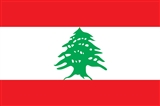
. The red stripes on the flag means self- sacrifice and the white stripe symbolizes the snow- capped peaks of their mountains.

Lebanon is the historic home of the Phoenicians, a maritime culture which flourished for more than 2,000 years (2700-450 BC). Following the collapse of the Ottoman Empire
Ottoman Empire

The Ottoman Empire , also known by its contemporaries as the Turkish Empire or Turkey , was an empire that lasted from 1299?1923. It was Treaty of Lausanne by the Republic of Turkey, which was officially proclaimed on October 29, 1923....
 after World War I
World War I

World War I, or the First World War , was a global military conflict which involved the Great powers, organized into two opposing military alliances: the Allies of World War I and the Central Powers....
, the five provinces that comprise present-day Lebanon were mandated to France
French Mandate of Lebanon

The French Mandate of Lebanon was a League of Nations League of Nations Mandate created at the end of World War I. When the Ottoman Empire was formally split up by the Treaty of S?vres in 1920, it was decided that four of its territories in the Middle East should be League of Nations mandates temporarily governed by the United Kingdom and Fra...
. The country gained independence in 1943, and French troops withdrew in 1946.

Before the Lebanese Civil War
Lebanese Civil War

conflict=Lebanese Civil War |date=1984 - 1990|place=Lebanon|result=Taif Agreement|combatant1=|combatant2=|commander1=|commander2=|strength1=|strength2=...
 (1975-1990), the country enjoyed a period of relative calm and prosperity, driven by tourism
Tourism

Tourism is travel for recreational or leisure purposes. The World Tourism Organization defines tourists as people who "travel to and stay in places outside their usual environment for not more than one consecutive year for leisure, business and other purposes not related to the exercise of an activity remunerated from...
, agriculture
Agriculture

Agriculture refers to the production of food and goods through farming and forestry. Agriculture was the key development that led to the rise of civilization, with the animal husbandry of domestication animals and plants creating food surpluses that enabled the development of more Population density and Social stratification societies....
, and banking. It is considered one of the banking capitals of Western Asia, and during its heyday was known to some as the "Switzerland
Switzerland

Switzerland is a landlocked Swiss Alps country of roughly 7.7 million people in Western Europe with an area of 41,285 km?. Switzerland is a federal republic consisting of 26 states called Cantons of Switzerland....
 of the East" due to its financial power and diversity at the time. Lebanon also attracted large numbers of tourists to the point that the capital Beirut
Beirut

Beirut is the Capital and largest city of Lebanon with a population of over 2.1 million as of 2007. Located on a peninsula at the midpoint of Lebanon's coastline with the Mediterranean sea, it serves as the country's largest and main seaport and also forms the Beirut District area, which consists of the city and its suburbs....
 became widely referred to as the "self-proclaimed Paris
Paris

Paris is the Capital of France and the country's largest city. It is situated on the river Seine, in northern France, at the heart of the ?le-de-France Regions of France ....
 of the East." Immediately following the end of the war, there were extensive efforts to revive the economy and rebuild national infrastructure.

Until July 2006, a considerable degree of stability had been achieved throughout much of the country, Beirut's reconstruction was almost complete, and an increasing number of foreign tourists were pouring into Lebanon's resorts. This was until the one month long 2006 Lebanon War, between the Israeli military and Hezbollah
Hezbollah

Hezbollah is a Shi'a Islamic political and paramilitary organisation based in Lebanon. It is a significant force in Politics of Lebanon, providing social services, which operate schools, hospitals, and agricultural services for thousands of Lebanese Shiites....
, which caused significant civilian death and serious damage to Lebanon's civil infrastructure. The conflict lasted from 12 July 2006 until a cessation of hostilities call, by the UN Security Council, went into effect on 14 August 2006. After some turbulent political times, Lebanon was again able to revive and restablize its economy and government, though the overall situation remains precarious.

Etymology

The name Lebanon ("Lubnan" in standard Arabic; "Libnén" in the local dialect) comes from the Aramaic
Aramaic language

Aramaic is a Semitic languages with a 3,000-year history. It has been the language of administration of empires and the language of divine worship....
 (and common West Semitic
West Semitic languages

The West Semitic languages are a proposed major sub-grouping of Semitic languages. One widely accepted analysis, supported by semiticists like Robert Hetzron and John Huehnergard, divides the Semitic language family into two branches: East Semitic languages and Western....
) root "LBN", meaning "white", which could be regarded as a reference to the snow-capped Mount Lebanon
Mount Lebanon

Mount Lebanon , as a geographic designation, is the Lebanon mountain range, known as the Western Mountain Range of Lebanon. It extends across the whole country along about 160 km , parallel to the Mediterranean Sea coast with the highest peak, Qurnat as Sawda', at 3,088 m .Lebanon has historically been defined by these mountains, which provi...
. Occurrences of the name have been found in three of the twelve tablets of the Epic of Gilgamesh
Epic of Gilgamesh

The Epic of Gilgamesh is an epic poetry from Ancient Mesopotamia and is among the ancient literature. Scholars believe that it originated as a series of Sumerian legends and poems about the mythological hero-king Gilgamesh, which were gathered into a longer Akkadian language poem much later; the most complete version existing today is pr...
 (May be as early as 2100 BC), the texts of the library of Ebla
Ebla

Ebla was an ancient city about southwest of Aleppo. It was an important city-state in two periods, first in the late 3rd millennium BC, then again between 1800 BC and 1650 BC....
 (2400 BC), and 71 times in the Old Testament
Old Testament

In Western Christianity, the Old Testament refers to the books that form the first of the two-part Christianity Bible Biblical canon. These works correspond to the Hebrew Bible , with some variations and additions....
. The name is recorded in Ancient Egyptian
Egyptian language

Egyptian is a branch of the Afro-Asiatic languages language family along with the Chadic languages, Berber languages, Semitic languages, Cushitic languages and possibly Omotic languages languages....
 as Rmnn, where R stood for Canaanite L.

History

Tomb in Tyre (small)

Ancient history

The earliest known settlements in Lebanon date back to earlier than 5000 BC. Archaeologists have discovered in Byblos
Byblos

Byblos is the Greek language name of the Phoenician city Gebal . It is a Mediterranean city in the Mount Lebanon Governorate of present-day Lebanon under the current Arabic language name of Jbeil and was also referred to as Gibelet during the Crusades....
, which is considered to be one of the oldest continuously inhabited cities in the world, remnants of prehistoric huts with crushed limestone floors, primitive weapons, and burial jars which are evidence of the Neolithic
Neolithic

The Neolithic period was a period in the development of human technology, beginning about 9500 Before the Christian Era in the Middle East that is traditionally considered the last part of the Stone Age....
 and Chalcolithic fishing communities who lived on the shore of the Mediterranean Sea over 7,000 years ago.

Lebanon was the homeland of the Phoenicians, a seafaring people that spread across the Mediterranean before the rise of Cyrus the Great
Cyrus the Great

Cyrus the Great , , also known as Cyrus II of Persia and Cyrus the Elder, was a Persian people Shah . He was the founder of the Persian Empire under the Achaemenid dynasty, an empire, perhaps the most wealthy and magnificent in history....
. After two centuries of Persian rule, Macedonian ruler Alexander the Great
Alexander the Great

Alexander the Great , also known as Alexander III of Macedon was an ancient Greeks King of Macedon . He was one of the most successful military commanders of all time and is presumed undefeated in battle....
 attacked and burned Tyre, the most prominent Phoenician city. Throughout the subsequent centuries leading up to recent times, the country became part of numerous succeeding empires, among them Persian
Persian Empire

The 'Persian Empire' was a series of successive Iranian or Persianization empires that ruled over the Iranian plateau, the original Persian homeland, and beyond in Southwest Asia, South Asia, Central Asia and the Caucasus....
, Armenian, Assyrian
Assyrian

Assyrian may refer to:in antiquity:*ancient Assyria**the Old Assyrian period **the Middle Assyrian period **the Neo-Assyrian period *Assyria , a province of the Achaemenid Empire...
, Hellenistic
Hellenistic civilization

File:Diadochen1.pngHellenistic civilization represents the zenith of Ancient Greece influence in the Classical Antiquity from 323 BC to about 146 BC ....
, Roman
Roman Empire

The Roman Empire was the Roman Republic phase of the Ancient Rome, characterised by an autocracy form of government and large territorial holdings in Europe and around the Mediterranean....
, Byzantine
Byzantine Empire

Byzantine Empire and Eastern Roman Empire are conventional names used to describe the Roman Empire during the Middle Ages, centered on its capital of Constantinople....
, Arab
Arab Empire

Islamic Empire may refer to*the Caliphates of the early Middle Ages:**Rashidun Caliphate **Umayyad Caliphate - Successor of the Rashidun Caliphate...
, Seljuks, Mamluks, Crusader
Crusader states

The Crusader states were a number of mostly 12th- and 13th-century Feudalism states created by Western European crusaders in Asia Minor, Greece and the Holy Land ....
, and Ottoman
Ottoman Empire

The Ottoman Empire , also known by its contemporaries as the Turkish Empire or Turkey , was an empire that lasted from 1299?1923. It was Treaty of Lausanne by the Republic of Turkey, which was officially proclaimed on October 29, 1923....
.

French mandate and independence

Lebanon was part of the Ottoman Empire
Ottoman Empire

The Ottoman Empire , also known by its contemporaries as the Turkish Empire or Turkey , was an empire that lasted from 1299?1923. It was Treaty of Lausanne by the Republic of Turkey, which was officially proclaimed on October 29, 1923....
 for over 400 years, in a region known as Greater Syria
Greater Syria

Greater Syria , also known simply as Syria, is a term that denotes a region in the Near East bordering the Eastern Mediterranean Sea or the Levant....
, until 1918 when the area became a part of the French Mandate of Syria
French Mandate of Syria

The French Mandate of Syria was a League of Nations Mandate created after the First World War and the partitioning of the Ottoman Empire. During the two years that followed the end of the war in 1918, and according to the Sykes-Picot Agreement which was signed between Britain and France during the war, the British held control of the Ottoman...
 following World War I
World War I

World War I, or the First World War , was a global military conflict which involved the Great powers, organized into two opposing military alliances: the Allies of World War I and the Central Powers....
. On 1 September 1920, France formed the State of Greater Lebanon as one of several ethnic enclaves within Syria
Syria

Syria , officially the Syrian Arab Republic , is an Arab-majority country in Southwest Asia, bordering Lebanon and the Mediterranean Sea to the west, Israel to the southwest, Jordan to the south, Iraq to the east, and Turkey to the north....
. Lebanon was a largely Christian
Christian

A Christian is a person who adheres to Christianity, a Monotheism#Christian view religion centered on the life and teachings of Jesus and interpreted by Christians to have been prophesied in the Hebrew Bible/Old Testament....
 (mainly Maronite) enclave but also included areas containing many Muslims and Druze
Druze

The Druze are a religious community found primarily in Syria, Lebanon, Jordan, Israel and in the Palestinian territories whose traditional religion is said to have begun as an offshoot of Islam, but is unique in its incorporation of Gnosticism, Neoplatonism and other philosophies, similar to other followers of Ismaili Shi'a Islam....
. On 1 September 1926, France formed the Lebanese Republic. The Republic was afterward a separate entity from Syria (related to the country Syria
Syria

Syria , officially the Syrian Arab Republic , is an Arab-majority country in Southwest Asia, bordering Lebanon and the Mediterranean Sea to the west, Israel to the southwest, Jordan to the south, Iraq to the east, and Turkey to the north....
) but still administered under the French Mandate of Syria.

Lebanon gained independence in 1943, while France was occupied by Germany. General Henri Dentz
Henri Dentz

Henri Fernand Dentz was an officer in the French Army and, after Battle of France during World War II, he served with the Vichy France....
, the Vichy
Vichy

Vichy is a Communes of France in the Departments of France of Allier in Auvergne in central France. It is known as a Spa town and resort town....
 High Commissioner
High Commissioner

High Commissioner is the title of various high-ranking, special executive positions held by a commission of appointment.The English term is also used to render various equivalent titles in other languages....
 for Syria and Lebanon, played a major role in the independence of the nation. The Vichy authorities in 1941 allowed Germany to move aircraft and supplies through Syria
Syria

Syria , officially the Syrian Arab Republic , is an Arab-majority country in Southwest Asia, bordering Lebanon and the Mediterranean Sea to the west, Israel to the southwest, Jordan to the south, Iraq to the east, and Turkey to the north....
 to Iraq
Iraq

Iraq , officially the Republic of Iraq , is a country in Western Asia spanning most of the northwestern end of the Zagros Mountains, the eastern part of the Syrian Desert and the northern part of the Arabian Desert....
 where they were used against British forces. The United Kingdom
United Kingdom

The United Kingdom of Great Britain and Northern Ireland, commonly known as the United Kingdom , the UK or Britain,is a sovereign state located off the northwestern coast of continental Europe....
, fearing that Nazi Germany
Nazi Germany

Nazi Germany and the Third Reich are the colloquial English names for Germany under the regime of Adolf Hitler and the Nazi Party , which established a Totalitarianism dictatorship that existed from 1933 to 1945....
 would gain full control of Lebanon and Syria
Syria

Syria , officially the Syrian Arab Republic , is an Arab-majority country in Southwest Asia, bordering Lebanon and the Mediterranean Sea to the west, Israel to the southwest, Jordan to the south, Iraq to the east, and Turkey to the north....
 by pressure on the weak Vichy government, sent its army into Syria and Lebanon.

Lebanese French Flag
After the fighting ended in Lebanon, General Charles de Gaulle
Charles de Gaulle

Charles Andr? Joseph Marie de Gaulle , , was a French people general and statesman who led the Free French Forces during World War II. He later founded the French Fifth Republic in 1958 and served as its first President of France from 1959 to 1969....
 visited the area. Under various political pressures from both inside and outside Lebanon, de Gaulle decided to recognize the independence of Lebanon. On 26 November 1941 General Georges Catroux
Georges Catroux

Georges Catroux was a French Army general and diplomat who served in both World War I and World War II, and served as L?gion d'honneur from 1954 to 1969....
 announced that Lebanon would become independent under the authority of the Free French government. Elections were held in 1943 and on 8 November 1943 the new Lebanese government unilaterally abolished the mandate. The French reacted by throwing the new government into prison. In the face of international pressure, the French released the government officials on 22 November 1943 and accepted the independence of Lebanon.

The allies
Allies of World War II

The Allies of World War II were the countries officially opposed to the Axis powers of World War II during the World War II. Within the ranks of the Allies powers, the British Empire, the Soviet Union, and the United States of America were known as "The Big Three"....
 kept the region under control until the end of World War II
World War II

World War II, or the Second World War , was a global military conflict which involved a Participants in World War II, including all of the great powers, organised into two opposing military alliances: the Allies of World War II and the Axis powers....
. The last French troops withdrew in 1946. Lebanon's unwritten National Pact
National Pact

The National Pact is an unwritten agreement that laid the foundation of Lebanon as a Confessionalism state, and has shaped the country to this day....
 of 1943 required that its president
President

President is a title held by many leaders of organizations, company, trade unions, university, and country. Etymology, a "president" is one who Wiktionary:Preside, who sits in leadership ....
 be Maronite Christian, its speaker of the parliament
Speaker (politics)

The term speaker is a title often given to the presiding officer of a legislative body. The speaker's official role is to moderate debate, make rulings on procedure, announce the results of votes, and the like....
 to be a Shiite Muslim, and its prime minister
Prime minister

A prime minister is the most senior minister of Cabinet in the Executive branch of government in a parliamentary system. The position is usually held by, but need not always be held by, a politician....
 be Sunni Muslim.

Lebanon's history since independence has been marked by alternating periods of political stability and turmoil (including a civil conflict in 1958
Lebanon crisis of 1958

The 1958 Lebanon crisis was a Lebanon political crisis caused by political and religious tensions in the country. It included a U.S. military intervention, leading to the easing of tensions....
) interspersed with prosperity built on Beirut's
Beirut

Beirut is the Capital and largest city of Lebanon with a population of over 2.1 million as of 2007. Located on a peninsula at the midpoint of Lebanon's coastline with the Mediterranean sea, it serves as the country's largest and main seaport and also forms the Beirut District area, which consists of the city and its suburbs....
 position as a regional center for finance and trade.

1948 Arab-Israeli war


In May of 1948, Lebanon was part of a coalition of newly independent Arab states that entered Palestine in a defensive operation intended to hold or liberate those areas designated by the UN Partition Plan exclusively for the Palestinian state. . In fact, all of the Arab states, most ill-prepared and poorly equipped, including Lebanon, operated under this stricture and made little progress or were defeated. Only the British-led Jordanian Rifles and Egyptian forces were able to hold on to the rump territories we now refer to as the West Bank and the Gaza Strip, respectively. Zionist leaders then and Israelis today still refuse to declare Israel's final borders. Lebanese military units, along with those of other Arab states, eventually disengaged from Israeli forces under armistice agreements in 1949. During the war, about 100,000 Palestinian refugees fled to Lebanon.

Civil war and beyond

Beirutbarr
In 1975, civil war broke out in Lebanon. The Lebanese Civil War
Lebanese Civil War

conflict=Lebanese Civil War |date=1984 - 1990|place=Lebanon|result=Taif Agreement|combatant1=|combatant2=|commander1=|commander2=|strength1=|strength2=...
 lasted fifteen years, devastating the country's economy, and resulting in massive loss of human life and property. It is estimated that 150,000 people were killed and another 200,000 wounded. The war ended in 1990 with the signing of the Taif Agreement
Taif Agreement

The Taif Agreement was an agreement reached to provide "the basis for the ending of the civil war and the return to political normalcy in Lebanon." Negotiated in Taif, Saudi Arabia, it was designed to end the decades-long Lebanese civil war, politically accommodate the demographic shift to a Muslim majority, reassert Lebanese authority in...
 and parts of Lebanon were left in ruins.

During the civil war, the Palestine Liberation Organization
Palestine Liberation Organization

The Palestine Liberation Organization is a political and paramilitary organization regarded by the Arab League since October 1974 as the "sole legitimate representative of the Palestinian people."...
 (PLO) used Lebanon to launch attacks against Israel. Lebanon was twice invaded and occupied by the Israel Defense Forces
Israel Defense Forces

The Israel Defense Forces , commonly known in Israel by the Hebrew Acronym and initialism Tzahal , are Israel's military forces, comprising the GOC Army Headquarters, Israeli Air Force and Israeli navy....
 (IDF) in 1978 and 1982, with the PLO expelled in the second invasion. Israel remained in control of Southern Lebanon until 2000, when there was a general decision, led by Israeli Prime Minister Ehud Barak
Ehud Barak

Ehud Barak is an Israeli politician, former Prime Minister of Israel, and current Defense Minister of Israel, Deputy leaders of Israel#Deputy Prime Minister and leader of Israel's Labor Party ....
, to withdraw due to continuous guerrilla attacks executed by Hezbollah
Hezbollah

Hezbollah is a Shi'a Islamic political and paramilitary organisation based in Lebanon. It is a significant force in Politics of Lebanon, providing social services, which operate schools, hospitals, and agricultural services for thousands of Lebanese Shiites....
 militants and a belief that Hezbollah activity would diminish and dissolve without the Israeli presence. The UN determined that the withdrawal of Israeli troops beyond the blue line
Blue Line (Lebanon)

The Blue Line is a Demarcation line between Lebanon and Israel published by the United Nations on 7 June 2000 for the purposes of determining whether Israel had fully withdrawn from Lebanon....
 was in accordance with UN Security Council Resolution 425, although a border region called the Shebaa Farms
Shebaa farms

The Shebaa Farms is a small area of land with disputed ownership located on the border between Lebanon and the Israeli controlled part of the Golan Heights....
 is still disputed. Hezbollah
Hezbollah

Hezbollah is a Shi'a Islamic political and paramilitary organisation based in Lebanon. It is a significant force in Politics of Lebanon, providing social services, which operate schools, hospitals, and agricultural services for thousands of Lebanese Shiites....
 declared that it would not stop its operations against Israel until this area was liberated.

Nahr al-Bared conflict

Nahr al-Bared (Arabic: ??? ??????, literally: Cold River) is a Palestinian refugee camp
Refugee camp

A refugee camp is a temporary camp built to receive refugees. Hundreds of thousands or even millions of people may live in any one single camp....
 in northern Lebanon, 16 km from the city of Tripoli
Tripoli

Tripoli is the largest and Capital city of Libya.Tripoli has a population of 1.69 million. The city is located in the northwest of the country on the edge of the desert, on a point of rocky land projecting into the Mediterranean Sea and forming a bay....
. Some 30,000 displaced Palestinians and their descendents live in and around the camp, which was named after the river that runs south of the camp. The camp was established in December 1949 by the League of Red Cross Societies in order to accommodate the Palestinian refugees suffering from the difficult winter conditions in the Beqaa Valley
Beqaa Valley

Beqaa is a fertile valley in east Lebanon. The Roman Empire considered the Beqaa Valley to be a major agricultural source, and today it remains Lebanon?s most important farming region....
 and the suburbs of Tripoli. The Lebanese Army is banned from entering all Palestinian camps under the 1969 Cairo Agreement
Cairo agreement

The Cairo agreement or Cairo accord was an agreement reached on 2 November, 1969 during talks between Yassir Arafat and the Lebanon army commander General Emile Bustani....
.

Late in the night of Saturday May 19, 2007, a building was surrounded by Lebanese Internal Security Forces (ISF) in which a group of Fatah al-Islam
Fatah al-Islam

Fatah al-Islam, is a radical Sunni Islamist group that first formed in November 2006. It has been described as a militant jihadist movement that draws inspiration from al-Qaeda....
 militants accused of taking part in a bank robbery earlier that day were hiding. The ISF attacked the building early on Sunday May 20 2007, unleashing a day long battle between the ISF and Fatah al-Islam militants. As a response, members of Fatah al-Islam in Nahr al-Bared Camp attacked an army checkpoint, killing several soldiers in their sleep. The army immediately responded by shelling the camp.

The camp became the centre of the fighting between the Lebanese Army and Fatah al-Islam. It sustained heavy shelling while under siege. UNRWA estimates the battle between the army and Islamic militant group Fatah al-Islam destroyed or rendered uninhabitable as much as 85 percent of homes in the camp and ruined infrastructure. The camp’s up to 40,000 residents were forced to flee, many of them sheltering in the already overcrowded Beddawi camp, 10 km south.

At least 169 soldiers, 287 insurgents and 47 civilians were killed in the army’s battle with the al-Qaeda-inspired militants. Funds for the reconstruction of the area have been slow to materialise, and life for the displaced refugees is hard..

Cedar Revolution

On 14 February 2005, former Prime Minister Rafik Hariri
Rafik Hariri

Rafik Bahaa El Deen Al-Hariri — , was a self-made billionaire and business tycoon, was List of Prime Ministers of Lebanon of Lebanon from 1992 to 1998 and again from 2000 until his resignation, 20 October 2004....
 was assassinated in a car bomb
Car bomb

A car bomb is an improvised Bomb placed in a automobile or other vehicle and then vehicle explosion. It is commonly used as a weapon of assassination, terrorism, or guerrilla warfare, to kill the occupants of the vehicle, people near the blast site, or to damage buildings or other property....
 explosion near the Saint George Bay
Saint George Bay

The Saint George Bay is located on the northern coast of the city of Beirut in Lebanon. The Saint George Bay is believed to be the place where Saint George slew the dragon....
 in Beirut. Leaders of the March 14 Alliance, a pro-Western coalition, accused Syria
Syria

Syria , officially the Syrian Arab Republic , is an Arab-majority country in Southwest Asia, bordering Lebanon and the Mediterranean Sea to the west, Israel to the southwest, Jordan to the south, Iraq to the east, and Turkey to the north....
 of the attack due to its extensive military and intelligence presence in Lebanon, and the public rift between Hariri and Damascus
Damascus

Damascus is the capital and largest city of Syria. It is List of oldest continuously inhabited cities and its current population is estimated at about 4,000,000....
 over the Syrian-backed constitutional amendment extending President Lahoud's
Émile Lahoud

General ?mile Jamil Lahoud is a former President of Lebanon. He is the son of General Jamil Lahoud, a leader in the independence movement. His mother is of Armenians descent from the Armenian village of Kasab in Syria....
 term in office. Others, namely the March 8 Alliance and Syrian officials, claimed that the assassination may have been executed by the Israeli Mossad
Mossad

The Mossad is the national intelligence agency of Israel. "Mossad" is the Hebrew word for institute or institution. Membership in the Mossad is very prestigious in Israeli society, and the organization is considered to rank among the most effective intelligence agencies in the world....
 in an attempt to destabilize the country.

This incident triggered a series of demonstrations, dubbed the 'Cedar Revolution' by the media, that demanded the withdrawal of Syrian troops from Lebanon and the establishment of an international commission to investigate the assassination. The United Nations Security Council
United Nations Security Council

The United Nations Security Council is one of the principal organs charged with the maintenance of international security. Its powers, outlined in the United Nations Charter, include the establishment of peacekeeping operations, the establishment of international sanctions, and the authorization of war....
 unanimously adopted Resolution 1595 on 7 April 2005, which called for an investigation into the assassination of Rafik Hariri . Preliminary findings of the investigation were officially published on 20 October 2005 in the Mehlis report
Mehlis report

The Mehlis Report is the result of the United Nations' investigation into the 14 February 2005 assassination of Lebanon's former prime minister Rafik al-Hariri....
, which cited indications that high-ranking members of the Syrian and Lebanese governments were involved in the assassination. Eventually, and under pressure from the West, Syria began withdrawing its 15,000-strong army troops from Lebanon . By 26 April 2005, all uniformed Syrian soldiers had already crossed the border back to Syria. . The Hariri assassination marked the beginning of a series of assassination attempts that led to the loss of many prominent Lebanese figures. On 12 July 2006, Hezbollah
Hezbollah

Hezbollah is a Shi'a Islamic political and paramilitary organisation based in Lebanon. It is a significant force in Politics of Lebanon, providing social services, which operate schools, hospitals, and agricultural services for thousands of Lebanese Shiites....
 purposely fired rockets at Israeli border towns as a diversion for an anti-tank missile attack on two armored Humvees patrolling the Israeli side of the border fence. Of the seven Israeli soldiers in the two jeeps, two were wounded, three were killed, and two were kidnapped and taken to Lebanon. Five more were killed in a failed Israeli rescue attempt. Israel launched strikes all over Lebanon, and Hezbollah responded by shelling Northern Israel. In Lebanon, air strikes caused serious damage to Lebanon's civil infrastructure (including Beirut's airport), and were followed by Israel's ground forces moving into areas of Lebanon militarily controlled by Hezbollah fighters. Israel rained as many as 4.6 million cluster sub-munitions across southern Lebanon in at least 962 separate strikes, the vast majority over the final three days of the war when Israel knew a settlement was imminent . In Israel, over 3,000 Hezbollah rockets landed on northern Israel, many in urban areas. The month-long conflict caused significant loss of life, both Israeli (nearly 100) and Lebanese (over 1,000). The conflict officially ended on 14 August 2006, when the United Nations Security Council issued resolution 1701 ordering a ceasefire between Hezbollah and Israel. (Goldwasser and Regev were held for two years, without indication as to their health, until their remains were returned by Hezbollah to Israel on July 16, 2008 in a trade for living prisoners.)

In October 2007, Émile Lahoud
Émile Lahoud

General ?mile Jamil Lahoud is a former President of Lebanon. He is the son of General Jamil Lahoud, a leader in the independence movement. His mother is of Armenians descent from the Armenian village of Kasab in Syria....
 finished his second term as president. The opposition conditioned its vote for a successor on a power-sharing deal, thus leaving the country without a president for over 6 months. On 9 May 2008, Hezbollah
Hezbollah

Hezbollah is a Shi'a Islamic political and paramilitary organisation based in Lebanon. It is a significant force in Politics of Lebanon, providing social services, which operate schools, hospitals, and agricultural services for thousands of Lebanese Shiites....
 and Amal
Amal Movement

Amal Movement is short for the Lebanese Resistance Detachments the acronym for which, in Arab language, is "amal", meaning "hope."Amal was founded in 1975 as the militia wing of the Movement of the Disinherited, a Shi'a political movement founded by Musa al-Sadr a year earlier....
 resistance, in an armed attack
2008 conflict in Lebanon

The 2008 conflict in Lebanon began on May 7, after Lebanon's 2006?2008 Lebanese political protests spiraled out of control. The fighting was sparked by a government move to shut down Hezbollah's telecommunication network and remove Beirut Airport's security chief Wafic Shkeir over alleged ties to Hezbollah....
 triggered by a government decision on Hezbollah
Hezbollah

Hezbollah is a Shi'a Islamic political and paramilitary organisation based in Lebanon. It is a significant force in Politics of Lebanon, providing social services, which operate schools, hospitals, and agricultural services for thousands of Lebanese Shiites....
's communications network, temporarily took over Western Beirut
Beirut

Beirut is the Capital and largest city of Lebanon with a population of over 2.1 million as of 2007. Located on a peninsula at the midpoint of Lebanon's coastline with the Mediterranean sea, it serves as the country's largest and main seaport and also forms the Beirut District area, which consists of the city and its suburbs....
  . The situation was described by the government as an attempted coup and led many to fear the country was on the brink of another civil war
Civil war

A civil war is a war between organized groups to take control of a nation or region, or to change government policies. It is high-intensity conflict, often involving Regular Army, that is sustained, organized and large-scale....
 . On 21 May 2008, all major Lebanese parties signed an accord to elect Michel Suleiman
Michel Suleiman

Michel Suleiman or Sleiman is the current President of Lebanon. Before assuming office as President, he held the position of commander of the Lebanese Armed Forces....
 president and establish a government of national unity with a veto share for opposition parties, including one Hezbollah minister. The deal was brokered by an Arab League
Arab League

The Arab League , officially called the League of Arab States , is a regional organization of Arab states in Southwest Asia, and North Africa and Horn of Africa....
 delegation, headed by the Emir and Foreign Minister of Qatar
Qatar

Qatar , officially the State of Qatar , is an Arab emirate in Southwest Asia, occupying the small Qatar Peninsula on the northeasterly coast of the larger Arabian Peninsula....
 and the Secretary General of the Arab League, after five days of intense negotiations in Doha
Doha

Doha is the capital city of Qatar. With a population of 400,051 according to the 2005 census, it is located in the Ad Dawhah municipality on the Persian Gulf....
. Suleiman was officially elected president on 25 May 2008.

Government and politics


Beirutparliament
Lebanon is a parliamentary
Parliamentary system

Parliamentary systems are characterized by no clear-cut separation of powers between the executive and legislative branches, leading to a different set of checks and balances compared to those found in presidential systems....
 democratic republic
Republic

A republic is a state or country that is not led by a hereditary monarch but in which the people have an impact on its government. The word originates from the Latin term res publica....
, which implements a special system known as confessionalism
Confessionalism (politics)

Confessionalism is a system of government that distributes political and institutional power proportionally among religious communities. Posts in government and seats in the legislature are apportioned amongst different groups according to the relative demographics composition of those groups in a society, which is seen as a way of formally r...
. This system is intended to ensure that sectarian conflict is kept at bay and attempts to fairly represent the demographic distribution of the 18 recognized religious groups in the governing body. High-ranking offices are reserved for members of specific religious groups. The President, for example, has to be a Maronite Christian, the Prime Minister a Sunni Muslim and the Speaker of the Parliament a Shi’a Muslim.

Lebanon's national legislature is the unicameral Parliament of Lebanon
Parliament of Lebanon

The Parliament of Lebanon is the Lebanon national List of national legislatures. It is elected to a four-year term by universal adult suffrage in multi-member constituencies, apportioned among Lebanon's diverse Christian and Muslim denominations....
. Its 128 seats are divided
Reserved political positions

Several politico-constitutional arrangements use reserved political positions, especially when endeavoring to ensure the rights of minorities or preserving a political balance of power....
 equally between Muslims and Christians, proportionately between the different denominations and proportionately between regions. Prior to 1990, the ratio stood at 6:5 in favor of Christians; however, the Taif Accord, which put an end to the 1975-1990 civil war, adjusted the ratio to grant equal representation to followers of the two religions. The Parliament is elected for a four-year term by universal suffrage although the civil war precluded the exercise of this right.

The executive branch constitute of the President, the head of state
Head of State

Head of state is the generic term for the individual or collective office that serves as the chief public representative of a monarchic or republican nation-state, federation, commonwealth or any other political state....
, and the Prime Minister, the head of government
Head of government

The head of government is the chief officer of the executive branch of a government, often presiding over a cabinet . In a parliamentary system, the head of government is often styled Prime Minister, President of the Government, Premier, etc....
. The parliament elects the president for a non-renewable six-year term by a two-third majority. The president appoints the Prime Minister. Following consultations with the parliament and the President, the Prime Minister forms the Cabinet, which must also adhere to the sectarian distribution set out by confessionalism.

Lebanon's judicial system is a mixture of Ottoman law, Napoleonic code
Napoleonic code

The Napoleonic Code, or Code Napol?on is the France civil code, established under Napoleon I of France in 1804. It was drafted rapidly by a commission of four eminent jurists and entered into force on March 21, 1804....
, canon law
Canon law

Canon law is internal ecclesiastical law governing the Roman Catholic Church, the Eastern Orthodox Church churches, and the Anglicanism of churches....
 and civil law
Civil law (legal system)

Civil law is a most prevalent legal system in the modern world and the oldest in human history. It is based on a code, or "a systematic collection of interrelated articles written in a terse, staccato style." The two other major legal systems in the world are common law and Islamic law....
. The Lebanese court system consists of three levels: courts of first instance, courts of appeal, and the court of cassation
Court of cassation

In various countries, there exist courts of cassation, which review and possibly overturn previous rulings made by lower courts. They are roughly equivalent to the Supreme Court of the United States....
. The Constitutional Council rules on constitutionality of laws and electoral frauds. There also is a system of religious courts having jurisdiction over personal status matters within their own communities, with rules on matters such as marriage and inheritance. Syrian intelligence agency Shu'bat al-Mukhabarat al-'Askariyya
Shu'bat al-Mukhabarat al-'Askariyya

Shu'bat al-Mukhabarat al-'Askariyya is an intelligence service of Syria. Its predecessor was called Deuxi?me Bureau. Shu'bat al-Mukhabarat al-'Askariyya was established in 1969....
 has political authority in Lebanon.

Foreign Relations

Lebanon concluded negotiations on an association agreement with the European Union
European Union

The European Union is an economic and political union of 27 European Union member state, located primarily in Europe. It was established by the Treaty of Maastricht on 1 November 1993 upon the foundations of the pre-existing European Economic Community....
 in late 2001, and both sides initialed the accord in January 2002. Lebanon also has bilateral trade agreements with several Arab states and is working toward accession to the World Trade Organization
World Trade Organization

The World Trade Organization is an international organization designed to supervise and Free trade international trade. The WTO came into being on 1 January 1995, and is the successor to the General Agreement on Tariffs and Trade , which was created in 1947, and continued to operate for almost five decades as a de facto international org...
. Aside from Syria, Lebanon enjoys good relations with virtually all of the other Arab countries (despite historic tensions with Libya, the Palestinians, and Iraq), and hosted an Arab League
Arab League

The Arab League , officially called the League of Arab States , is a regional organization of Arab states in Southwest Asia, and North Africa and Horn of Africa....
 Summit in March 2002 for the first time in more than 35 years. Lebanon is a member of the Francophone
Francophone

The adjective francophone means French language-speaking, typically as primary language, whether referring to individuals, groups, or places. Often, the word is used as a noun to describe a natively French-speaking person....
 countries and hosted the Francophone Summit in October 2002.

Governorates and districts

Lebanon is divided into six governorate
Governorate

A Governorate is an administrative division of a country. It is headed by a governor. As English-speaking nations tend to call regions administered by governors either states or colonies, the term governorate is sometimes used in translation from non-English-speaking administrations....
s (mohaafazaat, ;singular mohafazah, ) which are further subdivided into twenty-five districts (aqdya — singular: qadaa
Qadaa

Kaza, qadaa, qaza, qazaa, or caza is a term for a subnational entity in the Arab world and formerly throughout the Ottoman Empire....
). The districts themselves are also divided into several municipalities, each enclosing a group of cities or villages. The governorates and their respective districts are listed below:

  • Beirut Governorate
    Beirut Governorate

    The Governorate of Beirut is the only governorates of Lebanon that consists of one districtand one city, Beirut, which is also its capital, and the capital of Lebanon....
  • :The Beirut Governorate is not divided into districts and is limited to the city of Beirut
    Beirut

    Beirut is the Capital and largest city of Lebanon with a population of over 2.1 million as of 2007. Located on a peninsula at the midpoint of Lebanon's coastline with the Mediterranean sea, it serves as the country's largest and main seaport and also forms the Beirut District area, which consists of the city and its suburbs....
    .
  • Nabatiyeh Governorate (Jabal Amel)
    • Bint Jbeil
      Bint Jbeil District

      The Bint Jbeil District is a district in the Nabatiyeh Governorate of Lebanon. The capital of the district is Bint Jbeil....
    • Hasbaya
      Hasbaya District

      The Hasbaya District is a district in the Nabatiyeh Governorate of Lebanon. The capital of the district is Hasbaya....
    • Marjeyoun
      Marjeyoun District

      The Marjeyoun District is a district in the Nabatieh Governorate of Lebanon. The capital of the district is Marjeyoun.Marjeyoun stands majestically at a hill facing Mount Haramoun to the East, Beaufort 1000 years old Crusader Castle above the Litani River and overlooking Mount Amel to the West, The Rihan, Niha and the Lebanon Mountain R...
    • Nabatieh
      Nabatieh District

      The Nabatieh District is a district in the Nabatieh Governorate of Lebanon. The capital of the district is Nabatieh, and it contains the following Villages:...
  • Beqaa Governorate
    Beqaa Governorate

    Beqaa is a governorates of Lebanon in Lebanon with a population of 750,000 inhabitants....
    • Baalbek
      Baalbek District

      Baalbek District is an administrative district in the Beqaa Governorate of the Republic of Lebanon, having Baalbek as its capital. It is by far the largest district in the country comprising a total of 2319 km2....
    • Hermel
      Hermel District

      The Hermel District is a district in the Beqaa Governorate of Lebanon. Population estimated at 39,000The capital of the Hermel District is Hermel....
    • Rashaya
      Rashaya District

      Rashaya District is an administrative district in the Beqaa Governorate of the Republic of Lebanon....
    • Western Beqaa
      Western Beqaa District

      Western Beqaa District is an administrative district in the Beqaa Governorate of the Republic of Lebanon. The capital is Joub Jannine....
       (al-Beqaa al-Gharbi)
    • Zahle
      Zahle District

      Zahle District is an administrative district in the Beqaa Governorate of the Republic of Lebanon....
  • North Governorate
    North Governorate

    North Governorate is one of the governorates of Lebanon. Its capital is Tripoli, Lebanon....
     (al-Shamal)
    • Akkar
      Akkar District

      Akkar is a Districts of Lebanon in the North Governorate, Lebanon, Lebanon. It covers an area of 788 km2 and has a population of 198,174. The capital lies at Halba....
    • Batroun
      Batroun District

      Batroun District is a district in the North Governorate, Lebanon, Lebanon, south of Tripoli, Lebanon. The capital is Batroun....
    • Bsharri
    • Koura
      Koura District

      Koura or El Koura is a district in the North Governorate, Lebanon, Lebanon.Koura is one of the 36 districts of Lebanon, which is very popular for the olive tree cultivation....
    • Miniyeh-Danniyeh
      Miniyeh-Danniyeh District

      The Miniyeh-Danniyeh District is a district in the North Governorate of Lebanon. In December 1999-January 2000 the Lebanese army and Islamist militants were involved in Dinnieh fighting in the area....
    • Tripoli
      Tripoli District

      The Tripoli District is a small, but very densely populated district in the North Governorate of Lebanon. It consists of the city Tripoli, Lebanon and the surrounding area....
    • Zgharta
      Zgharta District

      Zgharta District is a district of the North Governorate, Lebanon, Lebanon.The administrative center is the town of Zgharta. The district has 57 populated areas with 30 municipalities covering 37 villages....
  • Mount Lebanon Governorate
    Mount Lebanon Governorate

    Mount Lebanon is one of the Governorates of Lebanon. Its capital is Baabda. The governorate is often dubbed the "Heartland of Lebanese Christians" due to the fact that the overwhelming majority of its population is comprised of Maronites, Greek Orthodox, and Greek Melkite Catholic Christians....
     (Jabal Lubnan)
    • Aley
      Aley District

      Aley is a district in Mount Lebanon, Lebanon, to the south-east of the Lebanon's capital Beirut. The capital is Aley. Aley city was previously known as the "bride of the summers" during the 1960 and 70s, when Aley and neighboring Bhamdune were attractive tourist locations for Gulf tourists and Lebanese emigres....
    • Baabda
      Baabda District

      Baabda District , sometimes spelled B'abda, is a district in Mount Lebanon, Lebanon, to the south and east of the Lebanon's capital Beirut. The district capital is town of Baabda....
    • Byblos
      Byblos

      Byblos is the Greek language name of the Phoenician city Gebal . It is a Mediterranean city in the Mount Lebanon Governorate of present-day Lebanon under the current Arabic language name of Jbeil and was also referred to as Gibelet during the Crusades....
       (Jbeil)
    • Chouf
      Chouf District

      Chouf is a historical region of Lebanon, and also an administrative Districts of Lebanon in the Governorates of Lebanon of Mount Lebanon Governorate....
    • Kesrwan
    • Matn
      Matn District

      Matn , sometimes spelled Metn, is a district in the Mount Lebanon Governorate of Lebanon, east of the Lebanon's capital Beirut. The district capital is Jdeideh....
  • South Governorate
    South Governorate

    South Governorate is one of the governorates of Lebanon of Lebanon. South Lebanon has a population of 360,000 inhabitants and an area of 2,000 km?....
     (al-Janoub)
    • Jezzine
      Jezzine District

      The Jezzine District is a district in the South Governorate of Lebanon. The capital is Jezzine....
    • Sidon
      Sidon District

      The Sidon District is a district within the South Governorate of Lebanon.Cities and towns*Sidon - capital*Ain El Delb*Maghdouch?...
       (Saida)
    • Tyre
      Tyre District

      The Tyre District is a district in the South Governorate of Lebanon....
       (Sur)


Geography and climate

Lebanon is located in Western Asia. It is bordered by the Mediterranean Sea
Mediterranean Sea

The Mediterranean Sea is a sea or Ocean off the Atlantic Ocean surrounded by the Mediterranean region and almost completely enclosed by land: on the north by Europe, on the south by Africa, and on the east by Asia....
 to the west along a coastline, by Syria
Syria

Syria , officially the Syrian Arab Republic , is an Arab-majority country in Southwest Asia, bordering Lebanon and the Mediterranean Sea to the west, Israel to the southwest, Jordan to the south, Iraq to the east, and Turkey to the north....
 to the east and north, and by Israel
Israel

Israel officially the State of Israel , is a country in the Middle East located on the eastern shore of the Mediterranean Sea. It borders Lebanon in the north, Syria in the northeast, Jordan in the east, and Egypt on the southwest, and contains geographically diverse features within its relatively small area....
 to the south. The Lebanon-Syria border stretches for and the Lebanon-Israel border for . The border with the Israeli-occupied Golan Heights
Golan Heights

The Golan Heights is a contested, strategic plateau and mountainous region at the southern end of the Anti-Lebanon Mountains. The term Golan Heights actually has two separate meanings, one geography and one political:...
 in Syria is disputed by Lebanon in a small area called Shebaa Farms
Shebaa farms

The Shebaa Farms is a small area of land with disputed ownership located on the border between Lebanon and the Israeli controlled part of the Golan Heights....
, but the border
Blue Line (Lebanon)

The Blue Line is a Demarcation line between Lebanon and Israel published by the United Nations on 7 June 2000 for the purposes of determining whether Israel had fully withdrawn from Lebanon....
 has been demarcated by the United Nations
United Nations

The United Nations is an international organization whose stated aims are to facilitate cooperation in international law, international security, economic development, Social change, human rights and achieving world peace....
.

Most of Lebanon's area is mountainous terrain, except for the narrow coastline and the Beqaa
Beqaa

Beqaa can refer to two places in Lebanon:* Beqaa Governorate* Beqaa Valley...
 Valley, which plays an integral role in Lebanon's agriculture. However, climate change and political differences threaten conflict over water resources in Valley .

Lebanon has a moderate Mediterranean climate
Mediterranean climate

A Mediterranean climate is one that resembles the climate of the lands in the Mediterranean Basin, which includes over half of the area with this climate type world-wide....
. In coastal areas, winters are generally cool and rainy whilst summers are hot and humid. In more elevated areas, temperatures usually drop below freezing during the winter with frequent, sometimes heavy snow; summers are warm and dry. Although most of Lebanon receives a relatively large amount of rainfall annually (compared to its arid surroundings), certain areas in north-eastern Lebanon receive little due to the high peaks of the western mountain front blocking much of the rain clouds that originate over the Mediterranean Sea.

In ancient times, Lebanon housed large forests of the Cedars of Lebanon
Lebanon Cedar

Cedrus libani , is a species of cedar native to the mountains of the Mediterranean region, in Lebanon, western Syria and south central Turkey, with variety of it in southwest Turkey, Cyprus, and the Atlas Mountains in Algeria and Morocco in northwest Africa....
, which now serve as the country's national emblem. However, centuries of trading cedar trees, used by mariners for boats, and the absence of any efforts to replant them have depleted the country's once-flourishing cedar forests.

Economy

The urban population in Lebanon is noted for its commercial enterprise. Over the course of time, emigration has yielded Lebanese "commercial networks" throughout the world. Lebanon has a high proportion of skilled labor comparable to most European nations and the highest among Arabic speaking countries.

Although Lebanon is ideally suited for agricultural
Agriculture

Agriculture refers to the production of food and goods through farming and forestry. Agriculture was the key development that led to the rise of civilization, with the animal husbandry of domestication animals and plants creating food surpluses that enabled the development of more Population density and Social stratification societies....
 activities in terms of water availability and soil fertility, as it possesses the highest proportion of cultivable land in the Arabic speaking world, it does not have a large agricultural sector. Attracting a mere 12% of the total workforce
Workforce

The workforce is the labour pool in employment. It is generally used to describe those working for a single Types of companies or industry, but can also apply to a geographic region like a city, country, state, etc....
, agriculture is the least popular economic sector in Lebanon. It contributes approximately 11.7% of the country's GDP, also placing it in the lowest rank compared to other economic sectors. Major produce includes apples, peaches, oranges, and lemons.

Lebanon's lack of raw materials
Material

Materials are substances or components with certain physical properties which are used as inputs to Production, costs, and pricing or manufacturing....
 for industry
Secondary sector of industry

The secondary sector of the economy is one of the three economic sectors, the others being the tertiary sector and the primary sector . Sometimes an additional sector, the "quaternary sector", is defined for the sharing of information ....
 and its complete dependency on Arab countries for oil
Oil

An oil is a chemical substance that is in a viscosity liquid state at room temperature or slightly warmer, and is both hydrophobic and lipophilic ....
 have made it difficult for the Lebanese to engage in significant industrial activity
Manufacturing

Manufacturing is the use of machine, tool and labor to make things for use or sale. The term may refer to a range of human activity, from handicraft to high tech, but is most commonly applied to Industry production, in which raw material are transformed into finished good on a large scale....
. As such, industry in Lebanon is mainly limited to small businesses concerned with reassembling and packaging imported parts. In 2004, industry ranked second in workforce, with 26% of the Lebanese working population, and second in GDP contribution, with 21% of Lebanon's GDP.

A combination of beautiful climate, many historic landmarks and World Heritage Sites continues to attract large numbers of tourists to Lebanon annually, in spite of its political instability. In addition, Lebanon's strict financial secrecy
Bank secrecy

Bank secrecy is a legal principle under which banks are allowed to protect personal information about their customers, through the use of numbered bank accounts or otherwise....
 and capitalist
Capitalism

Capitalism is an economic system in which wealth, and the means of producing wealth, are private property and controlled rather than commonly, publicly, or state-owned and controlled....
 economy — though no longer unique in the region — have given it significant, though no longer dominant, economic status among Arab countries. The at-times thriving tourism
Tourism

Tourism is travel for recreational or leisure purposes. The World Tourism Organization defines tourists as people who "travel to and stay in places outside their usual environment for not more than one consecutive year for leisure, business and other purposes not related to the exercise of an activity remunerated from...
 and banking activities have naturally made the services sector the most important pillar of the Lebanese economy. The majority of the Lebanese workforce (nearly 65%) take employment in the services sector as a result of abundant job opportunities, as the economy itself is not all the diverse. The GDP contribution, accordingly, is very large and amounts to roughly 67.3% of the annual Lebanese GDP. The economy's dependence on services has always been an issue of great criticism and concern, as it leaves the country subject to the instability of this sector and the vagaries of international trade
International trade

International trade is exchange of Capital , goods, and services across international borders or territories. In most countries, it represents a significant share of gross domestic product ....
.

The 1975-1990 civil war seriously damaged Lebanon's economic infrastructure
Infrastructure

Infrastructure can be defined as the basic physical and organizational structures needed for the operation of a society or enterprise , or the services and facilities necessary for an economy to function....
, cut national output by half, and all but ended Lebanon's position as a West Asian entrepôt
Entrepôt

An entrep?t is a trading post where merchandise can be Import and exported without paying import Duty , often at a profit. This profit is possible because of trade conditions, for example, the reluctance of ships to travel the entire length of a long trading route, and selling to the entrep?t instead....
 and bank
Bank

A bank is a financial institution whose primary activity is to act as a payment agent for customers and to borrow and lend money. It is an institution for receiving, keeping, and lending money....
ing hub. The subsequent period of relative peace enabled the central government to restore control in Beirut
Beirut

Beirut is the Capital and largest city of Lebanon with a population of over 2.1 million as of 2007. Located on a peninsula at the midpoint of Lebanon's coastline with the Mediterranean sea, it serves as the country's largest and main seaport and also forms the Beirut District area, which consists of the city and its suburbs....
, begin collecting taxes (though not always successfully), and regain access to key port and government facilities. Economic recovery has been helped by a financially sound banking system and resilient small- and medium-scale manufacturers, with family remittances, banking services, manufactured and farm export
Export

Export goods or services are provided to foreign consumers by domestic Production theory basics. It is a good that is sent to another country for sale....
s, and international aid as the main sources of foreign exchange.

Until the 2006 Lebanon War, Lebanon's economy witnessed excellent growth, with bank assets reaching over 75 billion US dollars, though this growth did not trickle down and mostly benefitted those at the top of the socio-economic ladder, with the middle class continuing to be wiped out. By the end of the first half of 2006, the influx of tourists to Lebanon had already registered a 49.3% increase over 2005 figures (which was a low figure, making the 49.3% increase seem more spectacular than it was). Market capitalization
Market capitalization

Market capitalization/capitalisation is a measurement of corporate or economic wealth equal to the share price times the number of shares outstanding of a public company....
 was also at an all time high, estimated at $10.9 billion at the end of the second quarter of 2006, just weeks before the fighting started.

The war severely damaged Lebanon's fragile economy, especially the tourism sector. According to a preliminary report published by the Lebanese Ministry of Finance on 30 August 2006, a major economic decline was expected as a result of the fighting.

Rafiq Hariri International Airport, re-opened in September 2006, and the efforts to revive the Lebanese economy have since been proceeding at a slow pace. Major contributors to the reconstruction of Lebanon include Saudi Arabia
Saudi Arabia

The Kingdom of Saudi Arabia, KSA , is an Arab country and the largest country of the Arabian Peninsula. It is bordered by Jordan on the northwest, Iraq on the north and northeast, Kuwait, Qatar, Bahrain, and the United Arab Emirates on the east, Oman on the southeast, and Yemen on the south....
 (with US$ 1.5 billion pledged), the European Union
European Union

The European Union is an economic and political union of 27 European Union member state, located primarily in Europe. It was established by the Treaty of Maastricht on 1 November 1993 upon the foundations of the pre-existing European Economic Community....
 (with about $1 billion) and a few other Gulf countries with contributions of up to $800 million.

Education


Schools

All Lebanese schools are required to follow a prescribed curriculum designed by the Ministry of Education. Private schools, approximately 1,400 in all, may also add more courses to their curriculum with approval from the Ministry of Education. The main subjects taught are mathematics, sciences, history, civics, geography, Arabic, and at least one secondary language (either French or English). The subjects gradually increase in difficulty and in number. Students in Grade 11, for example, study up to eighteen different subjects.

The government introduces a mild form of selectivity into the curriculum by giving 11th graders choice between two "concentrations": sciences, humanities, and 12th graders choose between four concentrations: life sciences, general sciences, sociology and economics, and humanities and literature. The choices in concentration do not include major changes in the number of subjects taken (if at all). However, subjects that fall out of the concentration are given less weight in grading and are less rigorous, while subjects that fall within the concentration are more challenging and contribute significantly to the final grade.

Students go through three academic phases:

NameNumber of yearsAnnotations
Elementary6 
Intermediate4students earn Intermediate Certification (Lebanese Brevet) at completion
Secondary
Secondary education

Secondary education is the stage of education following primary education. Secondary education is generally the final stage of compulsory education....
3students who pass official exams earn a Baccalaureate Certificate (Baccalauréat Libanais) in the concentration they chose in 12th grade. Students studying at French-system schools may also graduate with a French Baccalaureate that is considered equivalent to the Lebanese Baccalaureate.


These three phases are provided free to all students and the first eight years are, by law, compulsory. Nevertheless, this requirement currently falls short of being fully enforced.

Higher education

Following secondary school, Lebanese students may choose to study at a university, a college, or a vocational training institute. The number of years to complete each program varies. While the Lebanese educational system offer a very high quality and international class of education, the local employment market lacks of enough opportunities, thus encouraging many of the young educated to travel abroad.

Lebanon has forty-one nationally accredited universities, several of which are internationally recognized. The American University of Beirut
American University of Beirut

The American University of Beirut is a private, independent university in Beirut, Lebanon. It was founded as the Syrian Protestant College by United States missionary Daniel Bliss in 1866....
 (AUB) and the Université Saint-Joseph
Université Saint-Joseph

Saint Joseph University is a private higher institute of education founded by the Society of Jesus in 1875 in Beirut, Lebanon, known for its school of medicine and its hospital, H?tel-Dieu de France....
 (USJ) were the first Anglophone and the first Francophone universities to open in Lebanon, respectively. The universities, both public and private, largely operate in French or English.

At the English universities, students who have graduated from an American-style high school program enter at the freshman
Freshman

A freshman is a first-year student in an educational institution. The term first year can also be used as a noun, to describe the students themselves ....
 level to earn their baccalaureate equivalence from the Lebanese Ministry of Higher Education. This qualifies them to continue studying at the higher levels. Such students are required to have already taken the SAT I and the SAT II upon applying to college, in lieu of the official exams. On the other hand, students who have graduated from a school that follows the Lebanese educational system are directly admitted to the sophomore year. These students are still required to take the SAT I, but not the SAT II. The university academic degrees for the first stage are the Bachelor
Bachelor's degree

A bachelor's degree is usually an undergraduate academic degree awarded for a course or major that generally lasts for three, four, or in some cases and countries, five or six years....
 or the Licence
Licentiate

Licentiate is the title of a person who holds an academic degree called a license. This degree exists in various African, Asian, European and Latin American countries but can represent different educational levels....
, for the second stage are the Master
Master's degree

A master's degree provides a mastery or high-order overview of a specific field of study or area of profession. Within the area studied, graduates possess advanced knowledge of a specialized body of theory and applied topics; high order skills in analysis, Critical thinking and/or professional application; and the ability to problem solving a...
 or the DEA
DEA (former French degree)

A Master of Advanced Studies is a graduate degree in various countries....
 and the third stage is the doctorate
Doctorate

A doctorate is an academic degree that in most countries represents the highest level of formal study or research in a given field. In some countries it also refers to a class of degrees which qualify the holder to practice in a specific profession ....
.

The United Nations
United Nations

The United Nations is an international organization whose stated aims are to facilitate cooperation in international law, international security, economic development, Social change, human rights and achieving world peace....
 assigned Lebanon an education index of 0.871 in 2008.

Demographics & Religions


The number of people inhabiting Lebanon proper was estimated at 3,971,941 (July 2008 estimate). Approximately 18 million people of Lebanese descent
Lebanese diaspora

Lebanese diaspora refers to the numbers of Lebanese people Emigration, and their descendants, who voluntarily or as refugees emigrated from their native country Lebanon and now reside in other countries, primarily in the Americas , Europe, Australia, Africa in particular West Africa, as well other countries of the Arab World....
 are spread all over the world, of whom a majority are Christian. The most live in Brazil
Brazil

Brazil , officially the Federative Republic of Brazil , is a country in South America. It is the List of countries and outlying territories by total area country by geographical area, occupying nearly half of South America, the List of countries by population country, and the fourth most populous democracy in the world....
, 8 million. In 2007, Lebanon hosted approximately 325,800 refugees and asylum seekers: 270,800 from Palestine
Palestine

Palestine is a name which has been widely used since Roman times to refer to the region between the Mediterranean Sea and the Jordan River. It is derived from a name used already much earlier for a narrower geographical region, mainly along the coastal region....
, 50,200 from Iraq
Iraq

Iraq , officially the Republic of Iraq , is a country in Western Asia spanning most of the northwestern end of the Zagros Mountains, the eastern part of the Syrian Desert and the northern part of the Arabian Desert....
, and 4,500 from Sudan
Sudan

Sudan is a country in northeastern Africa. It is the largest in the African continent and the Arab World, and List of countries and outlying territories by total area by area....
. Lebanon forcibly returned more than 300 refugees and asylum seekers in 2007.

No official census has been taken since 1932, reflecting the political sensitivity in Lebanon over confessional
Confessionalism (politics)

Confessionalism is a system of government that distributes political and institutional power proportionally among religious communities. Posts in government and seats in the legislature are apportioned amongst different groups according to the relative demographics composition of those groups in a society, which is seen as a way of formally r...
 balance. The CIA World Fact Book gives the following distribution: Muslim
Islam

Islam is a Monotheism, Abrahamic religion originating with the teachings of the Prophets of Islam Muhammad, a 7th century Arab religious and political figure....
 - 59.7% (Shi'a, Sunni, Druze
Druze

The Druze are a religious community found primarily in Syria, Lebanon, Jordan, Israel and in the Palestinian territories whose traditional religion is said to have begun as an offshoot of Islam, but is unique in its incorporation of Gnosticism, Neoplatonism and other philosophies, similar to other followers of Ismaili Shi'a Islam....
, Isma'ilite, Alawite
Alawite

The Alawis ? also known as Nu?ayri , an-Na?iriyyah, and al-An?ariyyah, or in English as Alawites ? are a sect of Shia Islam Islam prominent in Syria....
 or Nusayri), Christian
Christianity

Christianity is a Monotheistic religion #Christian view religion centered on the life and teachings of Jesus as New Testament view on Jesus' life....
 - 39% (Maronite Catholic, Greek Orthodox, Melkite Catholic
Melkite

The term Melkite is used to refer to various Christianity churches and their members originating in the Middle East. The word comes from the Syriac language word malkaya , meaning "imperial"....
, Armenian Orthodox, Syriac Catholic, Armenian Catholic, Syriac Orthodox, Roman Catholic, Chaldean
Chaldean

Chaldean may refer to:#historical Babylonia, in particular in a Hellenistic context#* Chaldea, "the Chaldees" was a Hellenistic designation for a part of Babylonia....
, Assyrian
Assyrian

Assyrian may refer to:in antiquity:*ancient Assyria**the Old Assyrian period **the Middle Assyrian period **the Neo-Assyrian period *Assyria , a province of the Achaemenid Empire...
, Coptic
Coptic

Coptic may refer to:* the Copts, Christian natives of Egypt* the Coptic language**the Coptic alphabet...
, Protestant), and 1.3% as "other". There are 18 recognized religious sects. An 18th sect, the Copts, was officially added recently. Some followers of the Druze
Druze

The Druze are a religious community found primarily in Syria, Lebanon, Jordan, Israel and in the Palestinian territories whose traditional religion is said to have begun as an offshoot of Islam, but is unique in its incorporation of Gnosticism, Neoplatonism and other philosophies, similar to other followers of Ismaili Shi'a Islam....
 religion do not consider themselves to be Muslim
Muslim

:A Muslim , , is an adherent of the religion of Islam. The feminine form is Muslimah . Literally, the word means "one who submits "....
, but the state legally considers them Muslim. It should be noted that almost half the groups, though recognized, have less than 5,000 members each, making them inconsequential overall to the fabric of Lebanon and its society.

According to the Pew Research Center, 54 percent of Lebanese Muslims believe that religion is very important.

Language

Article 11 of Lebanon's Constitution states that "Arabic
Arabic language

Arabic is a Central Semitic language, thus related to and classified alongside other Semitic languages languages such as Hebrew language and Aramaic language....
 is the official national language. A law determines the cases in which the French language
French language

French is a Romance language spoken around the world by around 80 million people as first language, by 190 million as second language, and by about another 200 million people as an acquired tongue, with significant speakers in 54 countries....
 may be used". The majority of Lebanese people speak Lebanese Arabic
Lebanese Arabic

Lebanese or Lebanese Arabic is the colloquial form of Arabic spoken in Lebanon....
, and sometimes French or English. Lebanese people of Armenian
Armenian diaspora

The Armenian diaspora is a term used to describe the communities of Armenians living outside of Armenia and Nagorno-Karabakh. Of the total Armenian population living worldwide , only about 3,000,000 live in Armenia and about 130,000 in Nagorno-Karabakh....
 or Greek
Greek diaspora

The Greek diaspora is a term used to refer to the communities of Greeks people living outside of the traditional Greek homelands worldwide, but more commonly in Balkans and Anatolia....
 descent often speak Armenian
Armenian language

The 'Armenian language' is an Indo-European language spoken by the Armenians. It is the official language of the Armenia as well as in the region of Nagorno-Karabakh....
 or Greek
Greek language

Greek is an Indo-European languages native to the southern Balkan peninsula, the language of the Greek people. It forms an independent branch within Indo-European....
 fluently. Also in use is Syriac
Syriac language

Syriac is a dialect of Middle Aramaic that was once spoken across much of the Fertile Crescent. Classical Syriac became a major literary language throughout the Middle East from the 4th to the 8th centuries, the classical language of Edessa, Mesopotamia, preserved in a large body of Syriac literature....
 by Maronites and the Syriac minorities. Other languages include Circassian
Circassian

The term Circassian may refer to:*Circassians, term used to designated various peoples of the north Caucasus.* Northwest Caucasian languages, specifically:...
 (spoken by 50,000), Tigrinya (30,000), Sinhala (25,000), Polish
Polish language

Polish , an official language of Poland, has the largest number of speakers of any West Slavic languages. Polish-speakers use the language in a uniform manner through most of Poland, and it has a regular orthography....
 (5,000), Russian
Russian language

Russian is the most geographically widespread language of Eurasia, the most widely spoken of the Slavic languages, and the largest native language in Europe....
, and Romanian
Romanian language

Romanian or Daco-Romanian ; self-designation: limba rom?na, ) is a Romance languages spoken by around 24 to 28 million people, primarily in Romania and Moldova....
 (together 10,000 speakers).

The colloquial language used in Lebanon, which is known as Lebanese
Lebanese Arabic

Lebanese or Lebanese Arabic is the colloquial form of Arabic spoken in Lebanon....
, belongs to a group of dialects called Levantine Arabic
Levantine Arabic

Levantine Arabic is a group of Arabic language Varieties of Arabic spoken in the 100 km-wide eastern-Mediterranean coastal strip known as the Levant, i.e....
. It differs from the literary Modern Standard Arabic, due to its historical blend to Phoenician
Phoenician

Phoenician may refer to:*Phoenicia, the ancient civilization*Phoenician alphabet*Phoenician languagePhoenician may also be:*A native or resident of Phoenix, Arizona...
, Aramaic, Syriac, Arabic, Turkish
Turkish language

Turkish is a language spoken by over 63 million people worldwide, making it the most commonly spoken of the Turkic languages. Its speakers are located predominantly in Turkey and Cyprus, with smaller groups in Iraq, Greece, Bulgaria, the Republic of Macedonia, Kosovo, Albania and other parts of Eastern Europe....
. In recent years, it has become increasingly common for Lebanese people, especially the better educated, to converse in a combination
Code-switching

Code-switching is a term in linguistics referring to using more than one language or Variety in conversation. Multilingualism, who can speak at least two languages, have the ability to use elements of both languages when conversing with another bilingual....
 of Lebanese, English (40%) and French (45%), whereby the same sentence would include words or expressions from the different languages. In the 1960s Lebanese linguists proposed 37 letters for the Lebanese dialect based on the Latin alphabets. The Arab League
Arab League

The Arab League , officially called the League of Arab States , is a regional organization of Arab states in Southwest Asia, and North Africa and Horn of Africa....
 rejected the idea, putting pressure on the Lebanese government to refuse such a project.

Culture


Overview

The area including modern Lebanon has been home to various civilizations and cultures for thousands of years. Originally home to the Phoenicians, and then subsequently conquered and occupied by the Assyrians
Assyrians

Assyrians or Assyrian people may refer to :*the Ancient Assyrians*the modern Assyrian/Chaldean/Syriac peopleSee also*Assyrian ...
, the Persians, the Greeks
Greeks

The Greeks , also known as Hellenes, are a nation and ethnic group native to Greece, Cyprus and neighbouring regions, who can also be found in Greek diaspora communities around the world....
, the Romans
Ancient Rome

Ancient Rome was a civilization that grew out of a small agricultural community founded on the Italian Peninsula as early as the 10th century BC....
, the Arabs, the Crusaders, the Ottoman Turks
Ottoman Turks

The Ottoman Turks were the subdivision of the Ottoman Muslim Millet that dominated the ruling class of the Ottoman Empire. Reliable information about the early history of the Ottomans is scarce....
 and most recently the French, Lebanese culture has over the millennia evolved by borrowing from all of these groups. Lebanon's diverse population, composed of different ethnic and religious groups, has further contributed to the country's festivals, musical styles and literature as well as cuisine, and numerous violent clashes amongst different religious and ethnic groups. When compared to the rest of the Western Asia, Lebanese society as a whole is well educated, and as of 2003 87.4% of the population was literate. Lebanese society is very modern and similar to certain cultures of Mediterranean Europe. It is often considered to serve as Europe's gateway to Western Asia as well as the Asian gateway to the Western World.

Creative arts

Lebanese music is known around the Arab world for its soothing rhythms and oriental beats. Traditional and folk music are extremely popular, as are western rhythms. One of the most well-known Lebanese singers is Fairuz
Fairuz

Fairuz is a distinguished Lebanese people singer. Born Nouhad Haddad in Jabal al Arz , Fairuz is known as Our Ambassador to the Stars, the Arabs' Ambassador, Neighbour to the Moon, and the Poet of the Voice....
; her songs are broadcast every morning on most radio stations and many TV channels, both in Lebanon and the Arab world in general. Other prominent artists include Julia Boutros
Julia Boutros

Julia Boutros is a Lebanon singer that rose to stardom in the 1980s with a series of nationalistic songs like "Ghabet Shams El Haq" . She is also the sister of Lebanese songwriter Ziad Boutros....
, composer and oud
Oud

The oud is a pear-shaped, stringed instrument, which is often seen as the predecessor of the western lute, distinguished primarily by being without frets, commonly used in Middle Eastern music....
 player Marcel Khalife
Marcel Khalife

Marcel Khalife is a Lebanon composer, singer and oud player, considered a Palestinian among the Palestinians, a Southerner among the South Lebanese and most commonly an Arabic music....
, Majida El Roumi
Majida El Roumi

Majida El Roumi was born in Kfarshima, Lebanon on December 13 1956. She is a Lebanon singer and a soprano who started her musical career in the early 1970s when she participated in the talent show, Studio el fan on T?l? Liban and won the gold medal for best female singer....
, Sabah
Sabah (singer)

Sabah is a Lebanese people singer and actress whose career stretches from 1943 to the present.She has released over 50 albums and has acted in 98 movies, as well as 20 stage plays....
, Wadih El Safi
Wadih El Safi

Wadih El Safi is an Assyrian people-Lebanese people singer, songwriter, and actor. He is a Lebanese cultural icon, and is often called the "Voice of Lebanon"....
, and the important nun and singer Sister Marie Keyrouz
Marie Keyrouz

Sister Marie Keyrouz is a chanter of Oriental Church music, a member of the Congr?gation des Soeurs Basiliennes Chou?rites and founder-president of the National Institute of Sacred Music in Paris....
, founder of The Ensemble of the Peace. Some Lebanese artists, such as Najwa Karam
Najwa Karam

Najwa Karam is a Lebanon singer. Her singing career began in the late 1980s with moderate success, but her major successes began in the mid-1990s....
 and Assi Hellani, remain loyal to a traditional type of music known as 'jabali' ("from the mountains"), while other artists incorporate Western styles into their songs. Lebanese performers are among the most popular in the Arab world, and the star scene includes prominent figures like Najwa Karam
Najwa Karam

Najwa Karam is a Lebanon singer. Her singing career began in the late 1980s with moderate success, but her major successes began in the mid-1990s....
, Nancy Ajram
Nancy Ajram

Nancy Ajram or Nancy Agram is a multi-platinum Lebanese music pop folk artist. Considered one of the decade's most important superstars of the Middle East & Arab world, Ajram has sold, by 2007, over 30 million records ranking 3rd best selling female artist in Lebanese history ....
, Haifa Wehbe
Haifa Wehbe

Haifa Wehbe is a Lebanon model , actress, and singer who rose to fame in the Arab world as runner up for Miss Lebanon and later the release of her debut album Huwa az-Zaman ....
, Elissa
Elissa (singer)

Elissar Z. Khoury , known as Elissa is a Lebanese people singer. She is one of the most well-known female singers in the Arab world.Born to a Lebanese father and a Syrian mother, Elissa was raised in the Bekaa valley....
, Ragheb Alame, Myriam Fares
Myriam Fares

Myriam Fares is a Lebanese people musician and entertainer from South Lebanon....
, Wael Kfoury, Nawal al Zoghbi, Carole Samaha
Carole Samaha

Carole Samaha is a Lebanese people musician and actress. She has released three studio albums. Carole has a masters degree in acting and directing, which she has earned in 1999....
, Julia Boutros
Julia Boutros

Julia Boutros is a Lebanon singer that rose to stardom in the 1980s with a series of nationalistic songs like "Ghabet Shams El Haq" . She is also the sister of Lebanese songwriter Ziad Boutros....
, Marwan Khouri, Waleed Tawfeek, Amal Hijazi
Amal Hijazi

Amal Hijazi or Amal Higazi is a Lebanese people singer, model and pop icon. She is currently one of the most active Lebanese singers and has given a number of concerts throughout the world and has made countless TV appearances....
 and Majida El Roumi
Majida El Roumi

Majida El Roumi was born in Kfarshima, Lebanon on December 13 1956. She is a Lebanon singer and a soprano who started her musical career in the early 1970s when she participated in the talent show, Studio el fan on T?l? Liban and won the gold medal for best female singer....
.

Sports

Because of Lebanon's unique geography, both summer and winter sports thrive in the country. In autumn and spring it is sometimes possible to engage in both during the same season, skiing in the morning and swimming in the Mediterranean
Mediterranean Sea

The Mediterranean Sea is a sea or Ocean off the Atlantic Ocean surrounded by the Mediterranean region and almost completely enclosed by land: on the north by Europe, on the south by Africa, and on the east by Asia....
 during the afternoon, much as one can in Cyprus
Cyprus

Cyprus , officially the Republic of Cyprus , is an island country situated in the eastern Mediterranean Sea, east of Greece, west of Lebanon, Syria, and Israel, south of Turkey and north of Egypt....
. At the competitive level, basketball
Basketball

Basketball is a team sport in which two teams of five active players each try to score points against one another by propelling a basketball through a 10 feet  high hoop under organized rules....
, football, and hip ball are among Lebanon's most popular sports. In recent years, Lebanon has hosted the Asian Cup and the Pan-Arab Games; the country will host the Winter Asian Games
Asian Games

The Asian Games, also called the Asiad, is a multi-sport event held every four years among Sportsperson from all over Asia. The games are regulated by the Olympic Council of Asia under the supervision of the International Olympic Committee ....
 in 2009.

Lebanon has six ski
Skiing

Snow skiing is a group of sports using skis as primary equipment. Skis are used in conjunction with ski boots that connect to the ski with use of a ski bindings....
 resorts, with opportunities also available for cross-country skiing
Cross-country skiing

Cross-country skiing is a winter sport in which participants propel themselves across snow-covered terrain using skis and poles. It is popular in many countries with large snowfields, primarily Northern Europe, Canada, Alaska and the Upper Midwest....
, snowshoeing, and snowmobiling. In the summer, skilifts can be used to access hiking
Hiking

Hiking is an outdoor activity which consists of walking in natural environments, often on trail. It is such a popular activity that there are numerous :Category:Hiking organizations worldwide....
 trails, with views stretching as far as Cyprus
Cyprus

Cyprus , officially the Republic of Cyprus , is an island country situated in the eastern Mediterranean Sea, east of Greece, west of Lebanon, Syria, and Israel, south of Turkey and north of Egypt....
 to the west and Syria
Syria

Syria , officially the Syrian Arab Republic , is an Arab-majority country in Southwest Asia, bordering Lebanon and the Mediterranean Sea to the west, Israel to the southwest, Jordan to the south, Iraq to the east, and Turkey to the north....
 to the east on clear days. Canoeing
Canoeing

Canoeing is the activity of Watercraft paddling a canoe for the purpose of recreation , sport, or Human-powered transport. It usually refers exclusively to using a paddle to propel a canoe with only human muscle power....
, cycling
Cycling

Cycling is the use of bicycles, or - less commonly - unicycles, tricycles, Quadracycle s and other similar wheeled human powered vehicles as a means of transport, a form of recreation or a sport....
, rafting
Rafting

Rafting or whitewater rafting is a challenging recreational activity utilizing a raft to navigate a river or other bodies of water. This is usually done on whitewater or different degrees of rough water, in order to thrill and excite the raft passengers....
, climbing
Climbing

Climbing is the activity of using one's hands and feet to ascend a steep object. It is done both for recreation and professionally, as part of activities such as maintenance of a structure, or military operations....
, swimming
Swimming

Swimming is the movement by humans or animals through water, usually without artificial assistance. Swimming is an activity that can be both useful and recreational....
, sailing
Sailing

Sailing is the art of controlling a boat with large pieces of canvas cloth called sails. By changing the rigging, rudder, and dagger or centre board, a sailor manages the force of the wind on the sails in order to change the direction and speed of a boat....
 and spelunking are among the other common leisure sports in Lebanon. Adventure and extreme sports are also possible throughout the country. The Beirut Marathon
Beirut Marathon

The Beirut Marathon is a marathon sporting event that has been held every year in Beirut, Lebanon since 2003. In addition to the main marathon , there is a 10 km run, and a 5 km mini-marathon....
 is held every fall, drawing top runners from Lebanon and abroad. Race day is promoted as a fun, family event, and it has become a tradition for many to participate in costumes or outlandish clothing.

Arts and literature

By the turn of the 20th century, Beirut was vying with Cairo as the major centre for modern Arab thought, with many newspapers, magazines, and literary societies.

In literature, Gibran Khalil Gibran, who was born in Bsharri
Bsharri

Bsharri , is a Lebanese town at 1,650 m of altitude, near the Kadisha Valley. It is located at around , in the Bsharri District of the North Governorate....
, is particularly known for his book The Prophet
The Prophet (book)

The Prophet is a book of 26 poetic essays written in English language in 1923 by the Lebanon-United States artist, philosopher and writer Kahlil Gibran....
, which has been translated into more than twenty different languages. Several contemporary Lebanese writers have also achieved international success; including Elias Khoury
Elias Khoury (writer)

Elias Khoury is a Lebanon novelist, playwright and critic. He has published ten novels, which have been translated into several foreign languages, as well as several works of literary criticism....
, Amin Maalouf
Amin Maalouf

Amin Maalouf , born 25 February 1949 in Beirut, is a Lebanon author. He writes in French language, and his works have been translated into many languages....
 and Hanan al-Shaykh
Hanan al-Shaykh

Hanan al-Shaykh is a Lebanon author of contemporary Arab women's literature....
.

In art, Moustafa Farroukh
Moustafa Farroukh

Moustafa Farroukh was one of Lebanon's most prominent painters of the 20th century. During his famed career, Farroukh produced over 2000 paintings most of which were acquired by collectors both in Lebanon and abroad....
 was one of Lebanon's most prominent painters of the 20th century. Formally trained in Rome and Paris, he exhibited in venues from Paris to New York to Beirut over his career. His work was applauded for its representation of real life in Lebanon in pictures of the country, its people and its customs. Farroukh became highly regarded as a Lebanese nationalist painter at a time when Lebanon was asserting its political independence. His art captured the spirit and character of the Lebanese people and he became recognized as the outstanding Lebanese painter of his generation. He also wrote five books and taught art at the American University of Beirut.

Festivals

Several international music festivals are held in Lebanon, featuring world-renowned artists and drawing crowds from Lebanon and abroad. Among the most famous are Baalbeck International Festival
Baalbeck International Festival

The Baalbeck International Festival is the oldest and most known cultural event in the Middle East and the eastern Mediterranean. Since 1955, hundreds of thousands of people from around the world have flocked to the city of Baalbeck in the Beqaa Valley of Lebanon to attend the annual festival....
, Beiteddine Festival
Beiteddine Festival

The Beiteddine Festival is an annual summer festival that takes place in Beiteddine Palace in Beiteddine, Lebanon. It was established in 1984 with local artistic performances and it gradually started having regional and international performances....
, Byblos International Festival
Byblos International Festival

The Byblos International Festival is a music festival that takes place in the historic quarter of Byblos, Lebanon. It is an annual summer event that started in 2003....
, Deir el Qamar Festival, and the Al-Bustan Festival. Beirut
Beirut

Beirut is the Capital and largest city of Lebanon with a population of over 2.1 million as of 2007. Located on a peninsula at the midpoint of Lebanon's coastline with the Mediterranean sea, it serves as the country's largest and main seaport and also forms the Beirut District area, which consists of the city and its suburbs....
 (Beirut Nights
Beirut Nights

The Beirut Nights are numbers of events that take place from time to time in Beirut, Lebanon. It's usually active in the summer; however, some other festivals might happen in spring or fall....
) in particular has a vibrant arts scene, with numerous performances, exhibits, fashion shows, and concerts held throughout the year in its galleries, museums, theatres, and public spaces.

Muslims in Lebanon celebrate Eid Al-Fitr (End of the month of fasting, which is called Ramadan) and Eid Al-Adha (The end of Hajj, the Islamic pilgrimage).

See also

  • List of Lebanon-related topics
    List of Lebanon-related topics

    Articles related to or originating from Lebanon, including people, places, things, and concepts, are:...


Footnotes


Further reading

  • Fisk, Robert. Pity the Nation: The Abduction of Lebanon. New York: Nation Books, 2002.
  • Firzli, Nicola Y. Al-Baath wa-Lubnân [Arabic only] ("The Baath and Lebanon"). Beirut: Dar-al-Tali'a Books, 1973
  • Hitti Philip K.
    Philip Khuri Hitti

    Philip Khuri Hitti ,, born in Chemlane, Ottoman Syria , was a Islamic scholars and introduced the field of Arab culture studies to the United States....
     History of Syria Including Lebanon and Palestine, Vol. 2 (2002) (ISBN 1-931956-61-8)
  • Holst, Sanford. Phoenicians: Lebanon's Epic Heritage. Los Angeles: Cambridge and Boston Press, 2005.
  • Norton, Augustus R. Amal and the Shi'a: Struggle for the Soul of Lebanon. Austin and London: University of Texas Press, 1987.
  • Plonka Arkadiusz, L’idée de langue libanaise d’après Sa‘id ‘Aql, Paris, Geuthner, 2004 (French) ISBN 2705337393
  • Sobelman, Daniel. New Rules of the Game: Israel and Hizbollah After the Withdrawal From Lebanon, Jaffee Center for Strategic Studies, Tel-Aviv University, 2004.
  • Riley-Smith, Jonathan. The Oxford Illustrated History of the Crusades. New York: Oxford University Press, 2001.
  • Salibi, Kamal. A House of Many Mansions: The History of Lebanon Reconsidered. Berkeley: University of California Press, 1990.


External links


General information


News media


Government


Non-governmental organizations


Learned Societies and Non-Profit Organizations


Web portals


Culture and education


Festivals


Travel and tourism